EP4131523B1 - Gasdiffusionseinheit für eine brennstoffzelle, membran-elektroden-einheit für eine brennstoffzelle und anordnung für eine brennstoffzelle - Google Patents
Gasdiffusionseinheit für eine brennstoffzelle, membran-elektroden-einheit für eine brennstoffzelle und anordnung für eine brennstoffzelle Download PDFInfo
- Publication number
- EP4131523B1 EP4131523B1 EP22188018.0A EP22188018A EP4131523B1 EP 4131523 B1 EP4131523 B1 EP 4131523B1 EP 22188018 A EP22188018 A EP 22188018A EP 4131523 B1 EP4131523 B1 EP 4131523B1
- Authority
- EP
- European Patent Office
- Prior art keywords
- gas diffusion
- carrier substrate
- membrane
- diffusion layer
- fuel cell
- Prior art date
- Legal status (The legal status is an assumption and is not a legal conclusion. Google has not performed a legal analysis and makes no representation as to the accuracy of the status listed.)
- Active
Links
Images


Classifications
-
- H—ELECTRICITY
- H01—ELECTRIC ELEMENTS
- H01M—PROCESSES OR MEANS, e.g. BATTERIES, FOR THE DIRECT CONVERSION OF CHEMICAL ENERGY INTO ELECTRICAL ENERGY
- H01M8/00—Fuel cells; Manufacture thereof
- H01M8/02—Details
- H01M8/0271—Sealing or supporting means around electrodes, matrices or membranes
- H01M8/0273—Sealing or supporting means around electrodes, matrices or membranes with sealing or supporting means in the form of a frame
-
- H—ELECTRICITY
- H01—ELECTRIC ELEMENTS
- H01M—PROCESSES OR MEANS, e.g. BATTERIES, FOR THE DIRECT CONVERSION OF CHEMICAL ENERGY INTO ELECTRICAL ENERGY
- H01M8/00—Fuel cells; Manufacture thereof
- H01M8/02—Details
- H01M8/0202—Collectors; Separators, e.g. bipolar separators; Interconnectors
- H01M8/023—Porous and characterised by the material
-
- H—ELECTRICITY
- H01—ELECTRIC ELEMENTS
- H01M—PROCESSES OR MEANS, e.g. BATTERIES, FOR THE DIRECT CONVERSION OF CHEMICAL ENERGY INTO ELECTRICAL ENERGY
- H01M8/00—Fuel cells; Manufacture thereof
- H01M8/10—Fuel cells with solid electrolytes
- H01M8/1004—Fuel cells with solid electrolytes characterised by membrane-electrode assemblies [MEA]
-
- H—ELECTRICITY
- H01—ELECTRIC ELEMENTS
- H01M—PROCESSES OR MEANS, e.g. BATTERIES, FOR THE DIRECT CONVERSION OF CHEMICAL ENERGY INTO ELECTRICAL ENERGY
- H01M8/00—Fuel cells; Manufacture thereof
- H01M8/10—Fuel cells with solid electrolytes
- H01M2008/1095—Fuel cells with polymeric electrolytes
-
- H—ELECTRICITY
- H01—ELECTRIC ELEMENTS
- H01M—PROCESSES OR MEANS, e.g. BATTERIES, FOR THE DIRECT CONVERSION OF CHEMICAL ENERGY INTO ELECTRICAL ENERGY
- H01M8/00—Fuel cells; Manufacture thereof
- H01M8/02—Details
- H01M8/0271—Sealing or supporting means around electrodes, matrices or membranes
- H01M8/028—Sealing means characterised by their material
- H01M8/0284—Organic resins; Organic polymers
-
- H—ELECTRICITY
- H01—ELECTRIC ELEMENTS
- H01M—PROCESSES OR MEANS, e.g. BATTERIES, FOR THE DIRECT CONVERSION OF CHEMICAL ENERGY INTO ELECTRICAL ENERGY
- H01M8/00—Fuel cells; Manufacture thereof
- H01M8/02—Details
- H01M8/0271—Sealing or supporting means around electrodes, matrices or membranes
- H01M8/0286—Processes for forming seals
-
- H—ELECTRICITY
- H01—ELECTRIC ELEMENTS
- H01M—PROCESSES OR MEANS, e.g. BATTERIES, FOR THE DIRECT CONVERSION OF CHEMICAL ENERGY INTO ELECTRICAL ENERGY
- H01M8/00—Fuel cells; Manufacture thereof
- H01M8/18—Regenerative fuel cells, e.g. redox flow batteries or secondary fuel cells
-
- Y—GENERAL TAGGING OF NEW TECHNOLOGICAL DEVELOPMENTS; GENERAL TAGGING OF CROSS-SECTIONAL TECHNOLOGIES SPANNING OVER SEVERAL SECTIONS OF THE IPC; TECHNICAL SUBJECTS COVERED BY FORMER USPC CROSS-REFERENCE ART COLLECTIONS [XRACs] AND DIGESTS
- Y02—TECHNOLOGIES OR APPLICATIONS FOR MITIGATION OR ADAPTATION AGAINST CLIMATE CHANGE
- Y02E—REDUCTION OF GREENHOUSE GAS [GHG] EMISSIONS, RELATED TO ENERGY GENERATION, TRANSMISSION OR DISTRIBUTION
- Y02E60/00—Enabling technologies; Technologies with a potential or indirect contribution to GHG emissions mitigation
- Y02E60/30—Hydrogen technology
- Y02E60/50—Fuel cells
Definitions
- the invention relates to a membrane electrode unit for a fuel cell with a gas diffusion unit, comprising a flat gas diffusion layer which is arranged on a carrier substrate, wherein a sealing arrangement is arranged on at least one main side of the carrier substrate, wherein a connecting section of the sealing arrangement is assigned to the peripheral edge of the gas diffusion unit, wherein the connecting section forms a sealing bead.
- Gas diffusion units of the type mentioned at the beginning are used not only in fuel cells, but also in comparable applications, for example in electrolyzers or redox flow batteries.
- Fuel cells generate electrical energy by oxidizing a fuel and usually consist of several electrically conductive electrodes arranged in a stack on top of each other, which are gas-permeable and separated from each other by an ion-conducting membrane.
- the reaction media are supplied via bipolar plates, which are provided with fluid channels, whereby a cooling medium can also be passed through the bipolar plates, which dissipates reaction heat. In order to direct the reaction media and the cooling media in a targeted manner, it is necessary to seal the distribution structures and channels.
- a stack element of a fuel cell usually comprises two bipolar plates between which a membrane electrode arrangement is arranged.
- a membrane electrode arrangement in turn comprises two gas diffusion layers between which a catalyst-coated membrane is arranged or two gas diffusion electrodes between which the membrane is arranged.
- a fuel cell stack can comprise more than 200 arrangements, each comprising two bipolar plates and a membrane electrode arrangement. To ensure high functionality, it is necessary to assemble the components of the arrangement in the correct position relative to one another, whereby leaks of reaction media should be avoided. The reaction media should only react with one another in the area of the gas diffusion layers and the catalyst-coated membrane.
- the invention is based on the object of further developing the arrangement in such a way that assembly is simplified.
- the membrane electrode unit according to the invention for a fuel cell comprises a gas diffusion unit, a further gas diffusion layer and a catalyst-coated membrane which is arranged between the gas diffusion unit and the further gas diffusion layer, wherein the further gas diffusion layer is provided with a further sealing bead along the peripheral edge, wherein the catalyst-coated membrane is arranged between the gas diffusion unit and the further Gas diffusion layer is arranged and wherein the sealing bead of the connecting section and the further sealing bead of the gas diffusion layer are in sealing contact with the membrane.
- the gas diffusion unit comprises a flat gas diffusion layer which is arranged on a carrier substrate, wherein a sealing arrangement is arranged on at least one main side of the carrier substrate, wherein a connecting section of the sealing arrangement is assigned to the peripheral edge of the gas diffusion layer, wherein the connecting section forms a sealing bead, wherein the connecting section fixes the gas diffusion layer to the carrier substrate in a material-locking manner.
- the carrier substrate is provided with a sealing arrangement which is arranged on one or preferably on both main sides of the carrier substrate.
- the sealing arrangement can provide a seal against the bipolar plates. Because the sealing arrangement is applied to a carrier substrate, it is particularly easy to place the sealing arrangement between the bipolar plates. For example, it is not necessary to manually attach a separately formed seal to the bipolar plates, which has previously involved a particularly high level of manual production effort.
- the sealing arrangement is dimensionally stable and can be assigned to a bipolar plate in the correct position particularly easily.
- the gas diffusion layer is fixed to the carrier substrate in a material-locking manner. This is done by a region of the sealing arrangement that forms a connecting section.
- the connecting section forms a sealing bead, via which a seal can be made against adjacent components, and on the other hand, the connecting section connects the gas diffusion layer and the carrier substrate.
- the gas diffusion layer and the carrier substrate are securely connected to one another and in a material-locking manner.
- the gas diffusion layer is fixed in the correct position on the carrier substrate, so that the Assembly of the membrane, for example a polymer electrolyte membrane (CCM) coated with a catalyst, within the arrangement is particularly simple.
- CCM polymer electrolyte membrane
- a carrier substrate can be provided on which a gas diffusion layer is arranged.
- the sealing arrangement is then applied to the carrier substrate, the sealing material forming a connecting section in the region of the edge of the gas diffusion layer, through which the gas diffusion layer is bonded to the carrier substrate in a materially bonded manner.
- the sealing material is shaped in such a way that at least one sealing bead is formed.
- the carrier substrate is preferably designed as a film, with openings made in the film. Due to the design as a film, the carrier substrate is particularly thin. The openings enable unhindered transport of reaction media and also cooling media through the carrier substrate. An opening is made in particular in the region of the carrier substrate in which the gas diffusion layer is arranged. This allows unhindered transport of reaction medium towards the membrane.
- a sealing arrangement is arranged on both main sides of the carrier substrate.
- a single carrier substrate is required between two bipolar plates.
- a sealing arrangement is located on both main sides of the carrier substrate, each of which comes to rest against an adjacent bipolar plate.
- the sealing arrangement can have sealing beads which surround openings and/or are assigned to the edge of the carrier substrate. Reaction media are passed through first openings and cooling media through second openings. Because the sealing beads surround the openings, leaks can be avoided.
- a sealing arrangement assigned to the edge of the carrier substrate seals the arrangement with two bipolar plates in the area of the edges.
- the carrier substrate can be made of thermoplastics.
- An advantageous material for the carrier substrate is polyethylene naphthalate (PEN).
- PEN is a thermoplastic from the polyester family produced by polycondensation.
- PEN has a high gas impermeability, a high heat resistance and a high chemical and hydrolysis resistance. Accordingly, PEN is particularly suitable for use in fuel cells.
- the sealing arrangement is preferably made of an injection-moldable elastomer material.
- the sealing arrangement can be applied during injection molding, for example. It is particularly conceivable to select the sealing material from the group of polyolefin, fluorine and silicone elastomers.
- a gas diffusion unit with a carrier substrate and gas diffusion layer is first provided, with the gas diffusion layer being firmly bonded to the carrier substrate.
- the membrane coated with a catalyst is arranged on the gas diffusion layer in such a way that the connecting section comes to rest sealingly on the edges of the catalyst-coated membrane.
- a further gas diffusion layer covers the catalyst-coated membrane, with the further gas diffusion layer having a further sealing bead, which also comes to rest on the catalyst-coated membrane and seals the membrane in the area of the edges on the side opposite the gas diffusion unit. Because the gas diffusion layer of the gas diffusion unit is fixed to a carrier substrate, it is particularly easy to produce the membrane electrode unit. In particular, it is not necessary to fix the catalyst-coated membrane in the membrane electrode unit.
- the sealing bead of the two gas diffusion layers seals the membrane in the area of the edges and fixes it in the correct position. Accordingly, it is not necessary to bond the catalyst-coated membrane to one or both Gas diffusion layers.
- the catalyst-coated membrane can simply be loosely inserted between the gas diffusion layers.
- the gas diffusion layer and the further gas diffusion layer have a matrix of fibrous material.
- fibrous materials are fabrics, papers and nonwovens. Nonwovens are preferred because they are inexpensive to produce and have a high permeability for reaction media. Furthermore, nonwovens can be made electrically conductive.
- An arrangement according to the invention for a fuel cell comprises a membrane electrode unit according to the invention, which is arranged between two bipolar plates, wherein the bipolar plates have a distribution structure in the areas assigned to the gas diffusion layers and wherein channels for media transport are introduced into the bipolar plates.
- a sealing arrangement is arranged on both main sides of the carrier substrate, which comes into contact with the bipolar plates to seal the channels.
- the carrier substrate with the sealing arrangements arranged on both main sides creates a seal between the bipolar plates and prevents leaks of reaction media or cooling media.
- Figure 1 shows a top view of a gas diffusion unit 1 for a fuel cell.
- the gas diffusion unit 1 comprises a flat gas diffusion layer 3, consisting of an electrically conductive nonwoven fabric.
- the gas diffusion layer 3 is arranged on a carrier substrate 4.
- the carrier substrate 4 is designed as a film and in the present embodiment consists of polyethylene naphthalate (PEN). Openings 10 are made in the film.
- PEN polyethylene naphthalate
- a sealing arrangement 7 is attached to each of the two main sides 5, 6 of the carrier substrate 4.
- the sealing arrangement 7 forms a connecting section 8 on a main side 5, wherein the connecting section is assigned to the peripheral edge 9 of the gas diffusion layer 3.
- the connecting section 8 accordingly forms a sealing bead and fixes the gas diffusion layer 3 in a material-locking manner to the carrier substrate 4.
- the carrier substrate 4 has an opening 10 which is assigned to the gas diffusion layer 3 and serves to transport transport media through the gas diffusion layer 3.
- the carrier substrate 4 has further openings 10 which serve to transport cooling media through the carrier substrate 4.
- the sealing arrangement 7 has a sealing bead which surrounds the openings 10. A further sealing bead is assigned to the edge of the carrier substrate 4.
- the sealing arrangement 7 is made of injection-moldable elastomer material. In this embodiment, the sealing arrangement 7 consists of a polyolefin elastomer.
- Figure 2 shows a further gas diffusion layer 12.
- the further gas diffusion layer 12 consists of a flat, electrically conductive nonwoven fabric and is provided with a further sealing bead 14 along the peripheral edge 9.
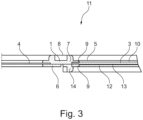
- Figure 3 shows a membrane electrode assembly 11 for a fuel cell, comprising a gas diffusion unit 1 according to Figure 1 , and a further gas diffusion layer 12 after Figure 2 .
- a membrane 13 coated with a catalyst is arranged between the gas diffusion unit 1 and the further gas diffusion layer 12.
- the sealing bead of the connecting section 8 of the sealing arrangement 7 of the gas diffusion unit 1 and the further sealing bead 14 of the further gas diffusion layer 12 lie sealingly against the catalyst-coated membrane 13.
- the catalyst-coated membrane 13 is only held force-fittingly between the gas diffusion unit 1 and the gas diffusion layer 12.
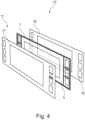
- FIG 4 shows an arrangement 15 for a fuel cell.
- the arrangement 15 comprises a membrane electrode unit 11 according to Figure 3 which is arranged between two bipolar plates 16, 17.
- the bipolar plates 16, 17 are formed flat from a graphite-containing material. Alternatively, the bipolar plates 16, 17 can also be formed from a metallic material.
- the bipolar plates 16, 17 have a distribution structure for distributing reaction medium in the areas assigned to the gas diffusion layers 3, 12. Furthermore, channels 18 for the transport of reaction media and cooling media are introduced into the bipolar plates 16, 17.
- the sealing arrangement 7 arranged on both main sides 5, 6 of the carrier substrate 4 comes into contact with the bipolar plates 16, 17 in order to seal the channels 18.
Landscapes
- Life Sciences & Earth Sciences (AREA)
- Engineering & Computer Science (AREA)
- Manufacturing & Machinery (AREA)
- Sustainable Development (AREA)
- Sustainable Energy (AREA)
- Chemical & Material Sciences (AREA)
- Chemical Kinetics & Catalysis (AREA)
- Electrochemistry (AREA)
- General Chemical & Material Sciences (AREA)
- Fuel Cell (AREA)
Description
- Die Erfindung betrifft eine Membran-Elektroden-Einheit für eine Brennstoffzelle mit einer Gasdiffusionseinheit, umfassend eine flächig ausgebildete Gasdiffusionsschicht, welche auf einem Trägersubstrat angeordnet ist, wobei auf zumindest einer Hauptseite des Trägersubstrats eine Dichtungsanordnung angeordnet ist, wobei ein Verbindungsabschnitt der Dichtungsanordnung der umlaufenden Kante der Gasdiffusionseinheit zugeordnet ist, wobei der Verbindungsabschnitt eine Dichtwulst ausbildet. Gasdiffusionseinheiten der eingangs genannten Art finden nicht nur in Brennstoffzellen Einsatz, sondern auch in vergleichbaren Anwendungen, beispielsweise in Elektrolyseuren oder Redox-Flow-Batterien.
- Brennstoffzellen erzeugen elektrische Energie durch Oxidation eines Brennstoffes und bestehen zumeist aus mehreren stapelförmig übereinander angeordneten elektrisch leitenden Elektroden, die gasdurchlässig sind und die durch eine ionenleitende Membran voneinander getrennt sind. Die Zufuhr von Reaktionsmedien erfolgt über Bipolarplatten, welche mit Fluidkanälen versehen sind, wobei durch die Bipolarplatten ferner ein Kühlmedium geleitet werden kann, welches Reaktionswärme abführt. Für eine gezielte Lenkung der Reaktionsmedien und der Kühlmedien ist es dabei erforderlich, die Verteilstrukturen und Kanäle abzudichten.
- Aus der
EP 1 320 142 B1 ist es beispielsweise bekannt, ein Dichtelement vorzusehen, welches zwischen zwei Bipolarplatten angeordnet ist und welches die Bipolarplatten und die zwischen den Bipolarplatten angeordneten Gasdiffusionsschichten mit der Membran so abdichtet, dass die Reaktionsmedien über die Membran miteinander in Kontakt treten und dass die Kühlmedien in den dafür bestimmten Kanälen strömen. - Ein Stapelelement einer Brennstoffzelle umfasst zumeist zwei Bipolarplatten, zwischen denen eine Membran-Elektroden-Anordnung angeordnet ist. Eine Membran-Elektroden-Anordnung umfasst wiederum zwei Gasdiffusionslagen, zwischen denen eine katalysatorbeschichtete Membran angeordnet ist oder zwei Gasdiffusionselektroden zwischen denen die Membran angeordnet ist. Ein Brennstoffzellenstapel kann dabei mehr als 200 Anordnungen, umfassend jeweils zwei Bipolarplatten und eine Membran-Elektroden-Anordnung umfassen. Für eine hohe Funktionsfähigkeit ist es dabei erforderlich, die Komponenten der Anordnung lagerichtig zueinander zu montieren, wobei Leckagen von Reaktionsmedien vermieden werden sollen. Die Reaktionsmedien sollen ausschließlich im Bereich der Gasdiffusionsschichten und der katalysatorbeschichteten Membran miteinander reagieren.
- Aus der
US 2014/356762 A1 ist eine Gasdiffusionseinheit bekannt, bei der an eine Gasdiffusionsschicht ein Dichtkörper angebunden ist. Vergleichbare Ausgestaltungen zeigen dieKR 10-2021-0063971 A EP 1 296 394 A1 . - Der Erfindung liegt die Aufgabe zugrunde, die Anordnung so weiterzuentwickeln, dass sich die Montage vereinfacht.
- Diese Aufgabe wird mit den Merkmalen der Ansprüche 1 und 7 gelöst. Auf vorteilhafte Ausgestaltungen nehmen die jeweils darauf rückbezogenen Ansprüche Bezug.
- Die erfindungsgemäße Membran-Elektroden-Einheit für eine Brennstoffzelle umfasst eine Gasdiffusionseinheit, eine weitere Gasdiffusionsschicht und eine katalysatorbeschichtete Membran, die zwischen Gasdiffusionseinheit und der weiteren Gasdiffusionsschicht angeordnet ist, wobei die weitere Gasdiffusionsschicht entlang der umlaufenden Kante mit einer weiteren Dichtwulst versehen ist, wobei die katalysatorbeschichtete Membran zwischen Gasdiffusionseinheit und der weiteren Gasdiffusionsschicht angeordnet ist und wobei die Dichtwulst des Verbindungsabschnitts und die weitere Dichtwulst der Gasdiffusionsschicht dichtend an der Membran anliegen.
- Die Gasdiffusionseinheit umfasst eine flächig ausgebildete Gasdiffusionsschicht, welche auf einem Trägersubstrat angeordnet ist, wobei auf zumindest einer Hauptseite des Trägersubstrats eine Dichtungsanordnung angeordnet ist, wobei ein Verbindungsabschnitt der Dichtungsanordnung der umlaufenden Kante der Gasdiffusionsschicht zugeordnet ist, wobei der Verbindungsabschnitt eine Dichtwulst ausbildet, wobei der Verbindungsabschnitt die Gasdiffusionsschicht stoffschlüssig an dem Trägersubstrat fixiert.
- Das Trägersubstrat ist mit einer Dichtungsanordnung versehen, welche auf einer oder vorzugsweise auf beiden Hauptseiten des Trägersubstrats angeordnet ist. Die Dichtungsanordnung kann dabei eine Abdichtung gegenüber den Bipolarplatten bewirken. Dadurch, dass die Dichtungsanordnung auf einem Trägersubstrat aufgebracht ist, ist es besonders einfach, die Dichtungsanordnung zwischen den Bipolarplatten zu platzieren. Dabei ist es beispielsweise nicht erforderlich, eine separat ausgebildete Dichtung manuell auf den Bipolarplatten anzubringen, was bislang mit einem besonders hohen manuellen Fertigungsaufwand einhergeht. Durch die Anordnung der Dichtungsanordnung auf einem Trägersubstrat ist die Dichtungsanordnung formstabil und kann besonders einfach lagerichtig einer Bipolarplatte zugeordnet werden.
- Bei der erfindungsgemäßen Ausgestaltung ist die Gasdiffusionsschicht stoffschlüssig an dem Trägersubstrat fixiert. Dies erfolgt durch einen Bereich der Dichtungsanordnung, der einen Verbindungsabschnitt bildet. Der Verbindungsabschnitt bildet einerseits eine Dichtwulst aus, über die eine Abdichtung gegenüber angrenzenden Komponenten erfolgen kann, andererseits erfolgt durch den Verbindungsabschnitt eine Verbindung von Gasdiffusionsschicht und Trägersubstrat. Dadurch sind Gasdiffusionsschicht und Trägersubstrat verliersicher und stoffschlüssig miteinander verbunden. Hierbei ist besonders vorteilhaft, dass die Gasdiffusionsschicht lagerichtig auf dem Trägersubstrat fixiert ist, so dass die Montage der Membran, beispielsweise einer mit einem Katalysator beschichteten Polymerelektrolytmembran (CCM), innerhalb der Anordnung besonders einfach ist. Zur Herstellung einer Gasdiffusionseinheit kann ein Trägersubstrat bereitgestellt werden, auf welchem eine Gasdiffusionsschicht angeordnet wird. Anschließend wird die Dichtungsanordnung auf das Trägersubstrat aufgebracht, wobei das Dichtungsmaterial im Bereich der Kante der Gasdiffusionsschicht einen Verbindungsabschnitt ausbildet, durch den die Gasdiffusionsschicht stoffschlüssig an das Trägersubstrat angebunden wird. Das Dichtungsmaterial wird dabei so ausgeformt, dass sich zumindest eine Dichtwulst ausbildet Vorzugsweise ist das Trägersubstrat als Folie ausgebildet, wobei in die Folie Durchbrechungen eingebracht sind. Durch die Ausbildung als Folie ist das Trägersubstrat besonders dünn. Die Durchbrechungen ermöglichen einen ungehinderten Transport von Reaktionsmedien und auch von Kühlmedien durch das Trägersubstrat hindurch. Eine Durchbrechung ist insbesondere in den Bereich des Trägersubstrats eingebracht, in welchem die Gasdiffusionsschicht angeordnet ist. Dadurch ist ein ungehinderter Transport von Reaktionsmedium in Richtung der Membran möglich.
- Vorzugsweise ist auf beiden Hauptseiten des Trägersubstrats eine Dichtungsanordnung angeordnet. Bei dieser Ausgestaltung ist zwischen zwei Bipolarplatten lediglich ein einziges Trägersubstrat erforderlich. Auf beiden Hauptseiten des Trägersubstrats befindet sich eine Dichtungsanordnung, welche jeweils zur Anlage an einer angrenzenden Bipolarplatte gelangt.
- Die Dichtungsanordnung kann Dichtwulste aufweisen, welche Durchbrechungen umgeben und/oder der Kante des Trägersubstrats zugeordnet sind. Durch erste Durchbrechungen werden Reaktionsmedien geleitet und durch zweite Durchbrechungen Kühlmedien. Dadurch, dass die Dichtwulste die Durchbrechungen umgeben, können Leckagen vermieden werden. Eine der Kante des Trägersubstrats zugeordnete Dichtungsanordnung bewirkt eine Abdichtung der Anordnung mit zwei Bipolarplatten im Bereich der Kanten.
- Das Trägersubstrat kann aus thermoplastischen Kunststoffen ausgebildet sein. Ein vorteilhafter Werkstoff für das Trägersubstrat ist dabei Polyethylennaphthalat (PEN). PEN ist ein durch Polykondensation hergestellter thermoplastischer Kunststoff aus der Familie der Polyester. PEN weist eine hohe Gasdichtigkeit, eine hohe Wärmeformbeständigkeit und eine hohe Chemikalien- und Hydrolysebeständigkeit auf. Dementsprechend ist PEN insbesondere für den Einsatz in Brennstoffzellen geeignet.
- Die Dichtungsanordnung ist vorzugsweise aus spritzgießfähigem elastomerem Werkstoff ausgebildet. Das Aufbringen der Dichtungsanordnung kann bei dieser Ausgestaltung beispielsweise im Zuge des Spritzgießens erfolgen. Dabei ist es insbesondere denkbar, den Dichtungswerkstoff aus der Gruppe der Polyolefin-, Fluor- und Silikon-Elastomere auszuwählen.
- Zur Herstellung der Membran-Elektroden-Einheit wird zunächst eine Gasdiffusionseinheit mit Trägersubstrat und Gasdiffusionsschicht bereitgestellt, wobei die Gasdiffusionsschicht stoffschlüssig an das Trägersubstrat angebunden ist. Die mit einem Katalysator beschichtete Membran wird so auf der Gasdiffusionsschicht angeordnet, dass der Verbindungsabschnitt dichtend an den Kanten der katalysatorbeschichteten Membran zur Anlage gelangt. Eine weitere Gasdiffusionsschicht deckt die katalysatorbeschichtete Membran ab, wobei die weitere Gasdiffusionsschicht eine weitere Dichtwulst aufweist, welche ebenfalls zur Anlage an der katalysatorbeschichteten Membran gelangt und auf der der Gasdiffusionseinheit gegenüberliegenden Seite die Membran im Bereich der Kanten abdichtet. Dadurch, dass die Gasdiffusionsschicht der Gasdiffusionseinheit auf einem Trägersubstrat fixiert ist, ist es besonders einfach, die Membran-Elektroden-Einheit herzustellen. Es ist insbesondere nicht erforderlich, die katalysatorbeschichtete Membran in der Membran-Elektroden-Einheit zu fixieren. Durch die Dichtwulst der beiden Gasdiffusionsschichten ist die Membran im Bereich der Kanten abgedichtet und lagerichtig fixiert. Dementsprechend ist es auch nicht erforderlich, die katalysatorbeschichtete Membran stoffschlüssig an eine oder beide Gasdiffusionsschichten anzubinden. Die katalysatorbeschichtete Membran kann lediglich zwischen den Gasdiffusionsschichten lose eingelegt werden.
- Vorzugsweise weisen die Gasdiffusionsschicht und die weitere Gasdiffusionsschicht eine Matrix aus faserhaltigem Werkstoff auf. Faserhaltige Werkstoffe sind beispielsweise Gewebe, Papiere und Vliesstoffe. Vliesstoffe sind dabei bevorzugt, weil diese kostengünstig herstellbar sind und eine hohe Durchlässigkeit für Reaktionsmedien aufweisen. Des Weiteren können Vliesstoffe elektrisch leitfähig ausgerüstet werden.
- Eine erfindungsgemäße Anordnung für eine Brennstoffzelle umfasst eine erfindungsgemäße Membran-Elektroden-Einheit, welche zwischen zwei Bipolarplatten angeordnet ist, wobei die Bipolarplatten in den den Gasdiffusionsschichten zugeordneten Bereichen eine Verteilstruktur aufweist und wobei in die Bipolarplatten Kanäle für Medientransport eingebracht sind.
- Vorzugsweise ist auf beiden Hauptseiten des Trägersubstrat eine Dichtungsanordnung angeordnet, welche zur Abdichtung der Kanäle zur Anlage an den Bipolarplatten gelangt. Insofern bewirkt das Trägersubstrat mit den auf beiden Hauptseiten angeordneten Dichtungsanordnungen eine Abdichtung zwischen den Bipolarplatten und verhindert, dass Leckagen von Reaktionsmedien oder Kühlmedien entstehen.
- Einige Ausgestaltungen der erfindungsgemäßen Gasdiffusionseinheit, Membran-Elektroden-Einheit und Anordnung werden nachfolgend anhand der Figuren näher erläutert. Diese zeigen, jeweils schematisch:
- Fig. 1
- eine Gasdiffusionseinheit mit Trägersubstrat in der Draufsicht;
- Fig. 2
- eine weitere Gasdiffusionsschicht;
- Fig. 3
- eine Membran-Elektroden-Einheit im Schnitt;
- Fig. 4
- eine Anordnung mit Bipolarplatten und Membran-Elektroden-Einheit als Explosionsdarstellung.
-
Figur 1 zeigt in der Draufsicht eine Gasdiffusionseinheit 1 für eine Brennstoffzelle. Die Gasdiffusionseinheit 1 umfasst eine flächig ausgebildete Gasdiffusionsschicht 3, bestehend aus einem elektrisch leitfähigen Vliesstoff. Die Gasdiffusionsschicht 3 ist auf einem Trägersubstrat 4 angeordnet. Das Trägersubstrat 4 ist als Folie ausgebildet und besteht bei der vorliegenden Ausgestaltung aus Polyethylennaphthalat (PEN). In die Folie sind Durchbrechungen 10 eingebracht. - Auf beiden Hauptseiten 5, 6 des Trägersubstrats 4 ist jeweils eine Dichtungsanordnung 7 angebracht. Dabei bildet die Dichtungsanordnung 7 auf einer Hauptseite 5 einen Verbindungsabschnitt 8, wobei der Verbindungsabschnitt der umlaufenden Kante 9 der Gasdiffusionsschicht 3 zugeordnet ist. Der Verbindungsabschnitt 8 bildet dementsprechend eine Dichtwulst aus und fixiert die Gasdiffusionsschicht 3 stoffschlüssig an dem Trägersubstrat 4.
- Das Trägersubstrat 4 weist eine Durchbrechung 10 auf, welche der Gasdiffusionsschicht 3 zugeordnet ist und dem Transport von Transportmedien durch die Gasdiffusionsschicht 3 hindurch dient. Das Trägersubstrat 4 weist weitere Durchbrechungen 10 auf, welche dem Transport von Kühlmedien durch das Trägersubstrat 4 hindurch dienen. Die Dichtungsanordnung 7 weist eine Dichtwulst auf, welche die Durchbrechungen 10 umgeben. Eine weitere Dichtwulst ist der Kante des Trägersubstrats 4 zugeordnet. Die Dichtungsanordnung 7 ist aus spritzgießfähigem elastomerem Werkstoff ausgebildet. In dieser Ausgestaltung besteht die Dichtungsanordnung 7 aus einem Polyolefin-Elastomer.
-
Figur 2 zeigt eine weitere Gasdiffusionsschicht 12. Die weitere Gasdiffusionsschicht 12 besteht aus einem flächig ausgebildeten, elektrisch leitfähig ausgerüsteten Vliesstoff und ist entlang der umlaufenden Kante 9 mit einer weiteren Dichtwulst 14 versehen. -
Figur 3 zeigt eine Membran-Elektroden-Einheit 11 für eine Brennstoffzelle, umfassend eine Gasdiffusionseinheit 1 gemäßFigur 1 , und eine weitere Gasdiffusionsschicht 12 nachFigur 2 . Zwischen der Gasdiffusionseinheit 1 und der weiteren Gasdiffusionsschicht 12 ist eine mit einem Katalysator beschichtete Membran 13 angeordnet. Die Dichtwulst des Verbindungsabschnittes 8 der Dichtungsanordnung 7 der Gasdiffusionseinheit 1 und die weitere Dichtwulst 14 der weiteren Gasdiffusionsschicht 12 liegen dichtend an der katalysatorbeschichteten Membran 13 an. Die katalysatorbeschichtete Membran 13 ist dabei lediglich kraftschlüssig zwischen der Gasdiffusionseinheit 1 und der Gasdiffusionsschicht 12 gehalten. -
Figur 4 zeigt eine Anordnung 15 für eine Brennstoffzelle. Die Anordnung 15 umfasst eine Membran-Elektroden-Einheit 11 gemäßFigur 3 , welche zwischen zwei Bipolarplatten 16, 17 angeordnet ist. Die Bipolarplatten 16, 17 sind flächig aus einem graphithaltigen Werkstoff ausgebildet. Alternativ können die Bipolarplatten 16, 17 auch aus einem metallischen Werkstoff ausgebildet sein. Die Bipolarplatten 16, 17 weisen in den den Gasdiffusionsschichten 3, 12 zugeordneten Bereichen eine Verteilstruktur zur Verteilung von Reaktionsmedium auf. Des Weiteren sind in die Bipolarplatten 16, 17 Kanäle 18 für den Transport von Reaktionsmedien und von Kühlmedien eingebracht. - Die auf beiden Hauptseiten 5, 6 des Trägersubstrats 4 angeordnete Dichtungsanordnung 7 gelangt zur Abdichtung der Kanäle 18 zur Anlage an den Bipolarplatten 16, 17.
Claims (9)
- Membran-Elektroden-Einheit (11) für eine Brennstoffzelle, umfassend eine Gasdiffusionseinheit (1) mit einer flächig ausgebildeten Gasdiffusionsschicht (3), welche auf einem Trägersubstrat (4) angeordnet ist, wobei auf zumindest einer Hauptseite (5, 6) des Trägersubstrats (4) eine Dichtungsanordnung (7), wobei ein Verbindungsabschnitt (8) der Dichtungsanordnung (7) der umlaufenden Kante (9) der Gasdiffusionsschicht (3) zugeordnet ist, wobei der Verbindungsabschnitt (8) eine Dichtwulst ausbildet, wobei der Verbindungsabschnitt (8) die Gasdiffusionsschicht (3) stoffschlüssig an dem Trägersubstrat (4) fixiert sowie eine weitere Gasdiffusionsschicht (12) und eine katalysatorbeschichtete Membran (13), die zwischen Gasdiffusionseinheit (1) und der weiteren Gasdiffusionsschicht (12) angeordnet ist, wobei die weitere Gasdiffusionsschicht (12) entlang der umlaufenden Kante (9) mit einer weiteren Dichtwulst (14) versehen ist, dadurch gekennzeichnet, dass die Dichtwulst des Verbindungsabschnittes (8) und die weitere Dichtwulst (14) dichtend an der katalysatorbeschichteten Membran (13) anliegen.
- Membran-Elektroden-Einheit nach Anspruch 1, dadurch gekennzeichnet, dass das Trägersubstrat (4) als Folie ausgebildet ist, wobei in die Folie Durchbrechungen (10) eingebracht sind.
- Membran-Elektroden-Einheit nach Anspruch 1 oder 2, dadurch gekennzeichnet, dass auf beiden Hauptseiten (5, 6) des Trägersubstrats (4) eine Dichtungsanordnung (7) angeordnet ist.
- Membran-Elektroden-Einheit nach Anspruch 2 oder 3, dadurch gekennzeichnet, dass die Dichtungsanordnung (7) eine Dichtwulst aufweist, welche Durchbrechungen (10) umgeben und/oder der Kante des Trägersubstrat (4) zugeordnet sind.
- Membran-Elektroden-Einheit nach einem der Ansprüche 1 bis 4, dadurch gekennzeichnet, dass das Trägersubstrat (4) aus einem thermoplastischen Werkstoff ausgebildet ist.
- Membran-Elektroden-Einheit nach einem der Ansprüche 1 bis 5, dadurch gekennzeichnet, dass die Dichtungsanordnung (7) aus spritzgießfähigem elastomerem Werkstoff ausgebildet ist.
- Membran-Elektroden-Einheit nach einem der Ansprüche 1 bis 6, dadurch gekennzeichnet, dass die Gasdiffusionsschichten (3, 12) eine Matrix aus faserhaltigem Material aufweisen.
- Anordnung (15) für eine Brennstoffzelle, umfassend eine Membran-Elektroden-Einheit (11) nach einem der Ansprüche 1 bis 7, welche zwischen zwei Bipolarplatten (16, 17) angeordnet ist, wobei die Bipolarplatten (16, 17) in den den Gasdiffusionsschichten (3, 12) zugeordneten Bereichen eine Verteilstruktur aufweisen und wobei in die Bipolarplatten (16, 17) Kanäle (18) für den Transport eingebracht sind.
- Anordnung nach Anspruch 8, dadurch gekennzeichnet, dass auf beiden Hauptseiten (5, 6) des Trägersubstrats (4) eine Dichtungsanordnung (7) angeordnet ist, welche zur Abdichtung der Kanäle (18) zur Anlage an den Bipolarplatten (16, 17) gelangt.
Applications Claiming Priority (1)
| Application Number | Priority Date | Filing Date | Title |
|---|---|---|---|
| DE102021120110.1A DE102021120110A1 (de) | 2021-08-03 | 2021-08-03 | Gasdiffusionseinheit für eine Brennstoffzelle, Membran-Elektroden-Einheit für eine Brennstoffzelle und Anordnung für eine Brennstoffzelle |
Publications (3)
| Publication Number | Publication Date |
|---|---|
| EP4131523A1 EP4131523A1 (de) | 2023-02-08 |
| EP4131523B1 true EP4131523B1 (de) | 2024-05-08 |
| EP4131523C0 EP4131523C0 (de) | 2024-05-08 |
Family
ID=82786387
Family Applications (1)
| Application Number | Title | Priority Date | Filing Date |
|---|---|---|---|
| EP22188018.0A Active EP4131523B1 (de) | 2021-08-03 | 2022-08-01 | Gasdiffusionseinheit für eine brennstoffzelle, membran-elektroden-einheit für eine brennstoffzelle und anordnung für eine brennstoffzelle |
Country Status (5)
| Country | Link |
|---|---|
| US (1) | US20230044808A1 (de) |
| EP (1) | EP4131523B1 (de) |
| CN (1) | CN115706235B (de) |
| CA (1) | CA3169414C (de) |
| DE (1) | DE102021120110A1 (de) |
Families Citing this family (2)
| Publication number | Priority date | Publication date | Assignee | Title |
|---|---|---|---|---|
| DE102023201813A1 (de) | 2023-02-28 | 2024-08-29 | Robert Bosch Gesellschaft mit beschränkter Haftung | Verfahren zum Herstellen einer Baugruppe, Baugruppe und Brennstoffzelle |
| CN116169316B (zh) * | 2023-04-24 | 2023-06-30 | 上海韵量新能源科技有限公司 | 一种燃料电池密封结构、燃料电池、燃料电池堆 |
Family Cites Families (12)
| Publication number | Priority date | Publication date | Assignee | Title |
|---|---|---|---|---|
| CA2412869C (en) * | 2000-06-29 | 2010-10-05 | Nok Corporation | Constituent part for fuel cell |
| DE10160905B4 (de) | 2001-12-12 | 2007-07-19 | Carl Freudenberg Kg | Dichtungsanordnung für Brennstoffzellen, Verfahren zur Herstellung und Verwendung einer solchen Dichtungsanordnung |
| US20070003821A1 (en) * | 2005-06-30 | 2007-01-04 | Freudenberg-Nok General Partnership | Integrally molded gasket for a fuel cell assembly |
| JP5364990B2 (ja) | 2007-10-19 | 2013-12-11 | トヨタ自動車株式会社 | 燃料電池 |
| US8399150B2 (en) * | 2010-06-23 | 2013-03-19 | GM Global Technology Operations LLC | Integrated fuel cell assembly and method of making |
| DE102010049548A1 (de) | 2010-10-25 | 2012-04-26 | Daimler Ag | Verfahren zur Herstellung einer Membrananordnung mit einer Elektrolytmembran für eine Brennstoffzelle |
| DE102011051309B4 (de) * | 2011-06-24 | 2013-01-17 | Eisenhuth Gmbh & Co. Kg | Membranelektrodeneinheit für eine Brennstoffzelle, Gießform und Verfahren zum Herstellen der Membranelektrodeneinheit |
| US9425469B2 (en) * | 2013-05-29 | 2016-08-23 | Yong Gao | Integrated gas diffusion layer with sealing function and method of making the same |
| CN204315668U (zh) * | 2014-10-21 | 2015-05-06 | 上海恒劲动力科技有限公司 | 一种具有密封功能的一体化气体扩散层及膜电极组件 |
| DE102018216266A1 (de) * | 2018-09-25 | 2020-03-26 | Audi Ag | Brennstoffzellenaufbau, Brennstoffzellenvorrichtung sowie Kraftfahrzeug |
| KR102264147B1 (ko) * | 2019-11-25 | 2021-06-11 | 평화오일씰공업 주식회사 | 연료전지용 기체확산층 일체형 가스켓, 및 이를 구비한 가스켓 일체형 막-전극 집합체 |
| CN112103541B (zh) | 2020-09-17 | 2024-07-05 | 国鸿氢能科技(嘉兴)股份有限公司 | 一种一体化密封的膜电极结构 |
-
2021
- 2021-08-03 DE DE102021120110.1A patent/DE102021120110A1/de not_active Ceased
-
2022
- 2022-08-01 EP EP22188018.0A patent/EP4131523B1/de active Active
- 2022-08-01 CN CN202210916469.4A patent/CN115706235B/zh active Active
- 2022-08-02 CA CA3169414A patent/CA3169414C/en active Active
- 2022-08-03 US US17/879,817 patent/US20230044808A1/en active Pending
Also Published As
| Publication number | Publication date |
|---|---|
| US20230044808A1 (en) | 2023-02-09 |
| CA3169414C (en) | 2025-02-04 |
| CA3169414A1 (en) | 2023-02-03 |
| CN115706235B (zh) | 2026-03-10 |
| CN115706235A (zh) | 2023-02-17 |
| DE102021120110A1 (de) | 2023-02-09 |
| EP4131523C0 (de) | 2024-05-08 |
| EP4131523A1 (de) | 2023-02-08 |
Similar Documents
| Publication | Publication Date | Title |
|---|---|---|
| DE112005000978B4 (de) | Hybridbipolarplattenanordnung und Vorrichtungen, die diese enthalten sowie deren Verwendung | |
| DE102009017906B4 (de) | Brennstoffzelle mit einer integrierten ablenkeinrichtung | |
| DE10015360B4 (de) | Separatoreinheit für Elektrolysezellen und Brennstoffzellen | |
| EP4131523B1 (de) | Gasdiffusionseinheit für eine brennstoffzelle, membran-elektroden-einheit für eine brennstoffzelle und anordnung für eine brennstoffzelle | |
| DE102017101760B4 (de) | Verfahren zur bildung eines brennstoffzellenstapels | |
| DE102019202682A1 (de) | Mit Rahmen ausgestattete Membranelektrodenanordnung, Verfahren zur Herstellung der mit Rahmen ausgestatteten Membranelektrodenanordnung und Brennstoffzelle | |
| DE112007002486T5 (de) | Brennstoffzelle, Verfahren zum Herstellen einer Brennstoffzelle und Einheitszellenbaugruppe | |
| DE102019202686B4 (de) | Mit Rahmen ausgestattete Membranelektrodenanordnung und Brennstoffzelle | |
| DE102021212620A1 (de) | Anordnung für ein elektrochemisches system, stapel sowie elektrochemisches system | |
| WO2003044886A2 (de) | Brennstoffzellensystem | |
| DE102021115559A1 (de) | Brennstoffzelle | |
| DE102020215012A1 (de) | Bipolarplatte für eine elektrochemische Zelle, elektrochemische Zelle und Verfahren zum Betrieb einer elektrochemischen Zelle | |
| DE102018222609A1 (de) | Stromerzeugungszelle | |
| DE112005001970B4 (de) | Separatorplattenanordnung | |
| DE102022110356A1 (de) | Brennstoffzelle | |
| DE102018220914B4 (de) | Brennstoffzelle | |
| DE102009003946B4 (de) | Barrierefilm für eine Brennstoffzelle | |
| DE102020213132A1 (de) | Membran-Elektroden-Einheit für eine elektrochemische Zelle und Verfahren zur Herstellung einer Membran-Elektroden-Einheit | |
| DE102015002500A1 (de) | Polymerelektrolyt-Brennstoffzelle | |
| DE102015100607B4 (de) | Verfahren zum Ausbilden einer Dichtung für eine PEM-Brennstoffzelle | |
| DE112006003210B4 (de) | Polymerelektrolytbrennstoffzelle und dichtung | |
| DE102020215024A1 (de) | Bipolarplatte für eine elektrochemische Zelle, Anordnung elektrochemischer Zellen und Verfahren zur Herstellung der Bipolarplatte | |
| DE102024122752A1 (de) | Bipolarplatte mit mindestens einer Lage und mindestens einem Einlegeteil | |
| EP2286483A1 (de) | Anordnung für eine brennstoffzelle | |
| DE102011007304B4 (de) | Polymerelektrolytbrennstoffzellenstapel |
Legal Events
| Date | Code | Title | Description |
|---|---|---|---|
| PUAI | Public reference made under article 153(3) epc to a published international application that has entered the european phase |
Free format text: ORIGINAL CODE: 0009012 |
|
| STAA | Information on the status of an ep patent application or granted ep patent |
Free format text: STATUS: THE APPLICATION HAS BEEN PUBLISHED |
|
| AK | Designated contracting states |
Kind code of ref document: A1 Designated state(s): AL AT BE BG CH CY CZ DE DK EE ES FI FR GB GR HR HU IE IS IT LI LT LU LV MC MK MT NL NO PL PT RO RS SE SI SK SM TR |
|
| RIN1 | Information on inventor provided before grant (corrected) |
Inventor name: QUICK, CHRISTIAN Inventor name: KEMMERICH, JAN Inventor name: EMIG, JUERGEN |
|
| STAA | Information on the status of an ep patent application or granted ep patent |
Free format text: STATUS: REQUEST FOR EXAMINATION WAS MADE |
|
| 17P | Request for examination filed |
Effective date: 20230616 |
|
| RBV | Designated contracting states (corrected) |
Designated state(s): AL AT BE BG CH CY CZ DE DK EE ES FI FR GB GR HR HU IE IS IT LI LT LU LV MC MK MT NL NO PL PT RO RS SE SI SK SM TR |
|
| GRAP | Despatch of communication of intention to grant a patent |
Free format text: ORIGINAL CODE: EPIDOSNIGR1 |
|
| STAA | Information on the status of an ep patent application or granted ep patent |
Free format text: STATUS: GRANT OF PATENT IS INTENDED |
|
| INTG | Intention to grant announced |
Effective date: 20240105 |
|
| RIC1 | Information provided on ipc code assigned before grant |
Ipc: H01M 8/0284 20160101ALN20231215BHEP Ipc: H01M 8/0286 20160101ALN20231215BHEP Ipc: H01M 8/10 20160101ALN20231215BHEP Ipc: H01M 8/18 20060101ALN20231215BHEP Ipc: H01M 8/023 20160101ALI20231215BHEP Ipc: H01M 8/0273 20160101AFI20231215BHEP Ipc: H01M 8/1004 20160101ALI20231215BHEP |
|
| RIN1 | Information on inventor provided before grant (corrected) |
Inventor name: QUICK, CHRISTIAN Inventor name: KEMMERICH, JAN Inventor name: EMIG, JUERGEN |
|
| GRAS | Grant fee paid |
Free format text: ORIGINAL CODE: EPIDOSNIGR3 |
|
| GRAA | (expected) grant |
Free format text: ORIGINAL CODE: 0009210 |
|
| STAA | Information on the status of an ep patent application or granted ep patent |
Free format text: STATUS: THE PATENT HAS BEEN GRANTED |
|
| AK | Designated contracting states |
Kind code of ref document: B1 Designated state(s): AL AT BE BG CH CY CZ DE DK EE ES FI FR GB GR HR HU IE IS IT LI LT LU LV MC MK MT NL NO PL PT RO RS SE SI SK SM TR |
|
| REG | Reference to a national code |
Ref country code: GB Ref legal event code: FG4D Free format text: NOT ENGLISH |
|
| REG | Reference to a national code |
Ref country code: CH Ref legal event code: EP |
|
| REG | Reference to a national code |
Ref country code: DE Ref legal event code: R096 Ref document number: 502022000870 Country of ref document: DE |
|
| REG | Reference to a national code |
Ref country code: IE Ref legal event code: FG4D Free format text: LANGUAGE OF EP DOCUMENT: GERMAN |
|
| U01 | Request for unitary effect filed |
Effective date: 20240508 |
|
| U07 | Unitary effect registered |
Designated state(s): AT BE BG DE DK EE FI FR IT LT LU LV MT NL PT SE SI Effective date: 20240515 |
|
| U20 | Renewal fee for the european patent with unitary effect paid |
Year of fee payment: 3 Effective date: 20240820 |
|
| PG25 | Lapsed in a contracting state [announced via postgrant information from national office to epo] |
Ref country code: IS Free format text: LAPSE BECAUSE OF FAILURE TO SUBMIT A TRANSLATION OF THE DESCRIPTION OR TO PAY THE FEE WITHIN THE PRESCRIBED TIME-LIMIT Effective date: 20240908 |
|
| PG25 | Lapsed in a contracting state [announced via postgrant information from national office to epo] |
Ref country code: HR Free format text: LAPSE BECAUSE OF FAILURE TO SUBMIT A TRANSLATION OF THE DESCRIPTION OR TO PAY THE FEE WITHIN THE PRESCRIBED TIME-LIMIT Effective date: 20240508 |
|
| PG25 | Lapsed in a contracting state [announced via postgrant information from national office to epo] |
Ref country code: GR Free format text: LAPSE BECAUSE OF FAILURE TO SUBMIT A TRANSLATION OF THE DESCRIPTION OR TO PAY THE FEE WITHIN THE PRESCRIBED TIME-LIMIT Effective date: 20240809 |
|
| PG25 | Lapsed in a contracting state [announced via postgrant information from national office to epo] |
Ref country code: ES Free format text: LAPSE BECAUSE OF FAILURE TO SUBMIT A TRANSLATION OF THE DESCRIPTION OR TO PAY THE FEE WITHIN THE PRESCRIBED TIME-LIMIT Effective date: 20240508 |
|
| PG25 | Lapsed in a contracting state [announced via postgrant information from national office to epo] |
Ref country code: PL Free format text: LAPSE BECAUSE OF FAILURE TO SUBMIT A TRANSLATION OF THE DESCRIPTION OR TO PAY THE FEE WITHIN THE PRESCRIBED TIME-LIMIT Effective date: 20240508 |
|
| PG25 | Lapsed in a contracting state [announced via postgrant information from national office to epo] |
Ref country code: PL Free format text: LAPSE BECAUSE OF FAILURE TO SUBMIT A TRANSLATION OF THE DESCRIPTION OR TO PAY THE FEE WITHIN THE PRESCRIBED TIME-LIMIT Effective date: 20240508 Ref country code: NO Free format text: LAPSE BECAUSE OF FAILURE TO SUBMIT A TRANSLATION OF THE DESCRIPTION OR TO PAY THE FEE WITHIN THE PRESCRIBED TIME-LIMIT Effective date: 20240808 Ref country code: IS Free format text: LAPSE BECAUSE OF FAILURE TO SUBMIT A TRANSLATION OF THE DESCRIPTION OR TO PAY THE FEE WITHIN THE PRESCRIBED TIME-LIMIT Effective date: 20240908 Ref country code: HR Free format text: LAPSE BECAUSE OF FAILURE TO SUBMIT A TRANSLATION OF THE DESCRIPTION OR TO PAY THE FEE WITHIN THE PRESCRIBED TIME-LIMIT Effective date: 20240508 Ref country code: GR Free format text: LAPSE BECAUSE OF FAILURE TO SUBMIT A TRANSLATION OF THE DESCRIPTION OR TO PAY THE FEE WITHIN THE PRESCRIBED TIME-LIMIT Effective date: 20240809 Ref country code: ES Free format text: LAPSE BECAUSE OF FAILURE TO SUBMIT A TRANSLATION OF THE DESCRIPTION OR TO PAY THE FEE WITHIN THE PRESCRIBED TIME-LIMIT Effective date: 20240508 Ref country code: RS Free format text: LAPSE BECAUSE OF FAILURE TO SUBMIT A TRANSLATION OF THE DESCRIPTION OR TO PAY THE FEE WITHIN THE PRESCRIBED TIME-LIMIT Effective date: 20240808 |
|
| PG25 | Lapsed in a contracting state [announced via postgrant information from national office to epo] |
Ref country code: CZ Free format text: LAPSE BECAUSE OF FAILURE TO SUBMIT A TRANSLATION OF THE DESCRIPTION OR TO PAY THE FEE WITHIN THE PRESCRIBED TIME-LIMIT Effective date: 20240508 |
|
| PG25 | Lapsed in a contracting state [announced via postgrant information from national office to epo] |
Ref country code: SK Free format text: LAPSE BECAUSE OF FAILURE TO SUBMIT A TRANSLATION OF THE DESCRIPTION OR TO PAY THE FEE WITHIN THE PRESCRIBED TIME-LIMIT Effective date: 20240508 Ref country code: RO Free format text: LAPSE BECAUSE OF FAILURE TO SUBMIT A TRANSLATION OF THE DESCRIPTION OR TO PAY THE FEE WITHIN THE PRESCRIBED TIME-LIMIT Effective date: 20240508 |
|
| PG25 | Lapsed in a contracting state [announced via postgrant information from national office to epo] |
Ref country code: SM Free format text: LAPSE BECAUSE OF FAILURE TO SUBMIT A TRANSLATION OF THE DESCRIPTION OR TO PAY THE FEE WITHIN THE PRESCRIBED TIME-LIMIT Effective date: 20240508 |
|
| PG25 | Lapsed in a contracting state [announced via postgrant information from national office to epo] |
Ref country code: SM Free format text: LAPSE BECAUSE OF FAILURE TO SUBMIT A TRANSLATION OF THE DESCRIPTION OR TO PAY THE FEE WITHIN THE PRESCRIBED TIME-LIMIT Effective date: 20240508 Ref country code: SK Free format text: LAPSE BECAUSE OF FAILURE TO SUBMIT A TRANSLATION OF THE DESCRIPTION OR TO PAY THE FEE WITHIN THE PRESCRIBED TIME-LIMIT Effective date: 20240508 Ref country code: RO Free format text: LAPSE BECAUSE OF FAILURE TO SUBMIT A TRANSLATION OF THE DESCRIPTION OR TO PAY THE FEE WITHIN THE PRESCRIBED TIME-LIMIT Effective date: 20240508 Ref country code: CZ Free format text: LAPSE BECAUSE OF FAILURE TO SUBMIT A TRANSLATION OF THE DESCRIPTION OR TO PAY THE FEE WITHIN THE PRESCRIBED TIME-LIMIT Effective date: 20240508 |
|
| REG | Reference to a national code |
Ref country code: DE Ref legal event code: R097 Ref document number: 502022000870 Country of ref document: DE |
|
| PLBE | No opposition filed within time limit |
Free format text: ORIGINAL CODE: 0009261 |
|
| STAA | Information on the status of an ep patent application or granted ep patent |
Free format text: STATUS: NO OPPOSITION FILED WITHIN TIME LIMIT |
|
| 26N | No opposition filed |
Effective date: 20250211 |
|
| PG25 | Lapsed in a contracting state [announced via postgrant information from national office to epo] |
Ref country code: MC Free format text: LAPSE BECAUSE OF FAILURE TO SUBMIT A TRANSLATION OF THE DESCRIPTION OR TO PAY THE FEE WITHIN THE PRESCRIBED TIME-LIMIT Effective date: 20240508 |
|
| PG25 | Lapsed in a contracting state [announced via postgrant information from national office to epo] |
Ref country code: IE Free format text: LAPSE BECAUSE OF NON-PAYMENT OF DUE FEES Effective date: 20240801 |
|
| U20 | Renewal fee for the european patent with unitary effect paid |
Year of fee payment: 4 Effective date: 20250825 |
|
| PG25 | Lapsed in a contracting state [announced via postgrant information from national office to epo] |
Ref country code: CY Free format text: LAPSE BECAUSE OF FAILURE TO SUBMIT A TRANSLATION OF THE DESCRIPTION OR TO PAY THE FEE WITHIN THE PRESCRIBED TIME-LIMIT; INVALID AB INITIO Effective date: 20220801 |
|
| PG25 | Lapsed in a contracting state [announced via postgrant information from national office to epo] |
Ref country code: HU Free format text: LAPSE BECAUSE OF FAILURE TO SUBMIT A TRANSLATION OF THE DESCRIPTION OR TO PAY THE FEE WITHIN THE PRESCRIBED TIME-LIMIT; INVALID AB INITIO Effective date: 20220801 |
|
| REG | Reference to a national code |
Ref country code: CH Ref legal event code: H13 Free format text: ST27 STATUS EVENT CODE: U-0-0-H10-H13 (AS PROVIDED BY THE NATIONAL OFFICE) Effective date: 20260324 |
|
| PG25 | Lapsed in a contracting state [announced via postgrant information from national office to epo] |
Ref country code: CH Free format text: LAPSE BECAUSE OF NON-PAYMENT OF DUE FEES Effective date: 20250831 |