EP4130386B1 - Shiftable cabin - Google Patents
Shiftable cabin Download PDFInfo
- Publication number
- EP4130386B1 EP4130386B1 EP22163688.9A EP22163688A EP4130386B1 EP 4130386 B1 EP4130386 B1 EP 4130386B1 EP 22163688 A EP22163688 A EP 22163688A EP 4130386 B1 EP4130386 B1 EP 4130386B1
- Authority
- EP
- European Patent Office
- Prior art keywords
- operator
- station
- movable
- ground engaging
- machine frame
- Prior art date
- Legal status (The legal status is an assumption and is not a legal conclusion. Google has not performed a legal analysis and makes no representation as to the accuracy of the status listed.)
- Active
Links
Images








Classifications
-
- E—FIXED CONSTRUCTIONS
- E01—CONSTRUCTION OF ROADS, RAILWAYS, OR BRIDGES
- E01C—CONSTRUCTION OF, OR SURFACES FOR, ROADS, SPORTS GROUNDS, OR THE LIKE; MACHINES OR AUXILIARY TOOLS FOR CONSTRUCTION OR REPAIR
- E01C23/00—Auxiliary devices or arrangements for constructing, repairing, reconditioning, or taking-up road or like surfaces
- E01C23/06—Devices or arrangements for working the finished surface; Devices for repairing or reconditioning the surface of damaged paving; Recycling in place or on the road
- E01C23/08—Devices or arrangements for working the finished surface; Devices for repairing or reconditioning the surface of damaged paving; Recycling in place or on the road for roughening or patterning; for removing the surface down to a predetermined depth high spots or material bonded to the surface, e.g. markings; for maintaining earth roads, clay courts or like surfaces by means of surface working tools, e.g. scarifiers, levelling blades
- E01C23/085—Devices or arrangements for working the finished surface; Devices for repairing or reconditioning the surface of damaged paving; Recycling in place or on the road for roughening or patterning; for removing the surface down to a predetermined depth high spots or material bonded to the surface, e.g. markings; for maintaining earth roads, clay courts or like surfaces by means of surface working tools, e.g. scarifiers, levelling blades using power-driven tools, e.g. vibratory tools
- E01C23/088—Rotary tools, e.g. milling drums
-
- E—FIXED CONSTRUCTIONS
- E01—CONSTRUCTION OF ROADS, RAILWAYS, OR BRIDGES
- E01C—CONSTRUCTION OF, OR SURFACES FOR, ROADS, SPORTS GROUNDS, OR THE LIKE; MACHINES OR AUXILIARY TOOLS FOR CONSTRUCTION OR REPAIR
- E01C23/00—Auxiliary devices or arrangements for constructing, repairing, reconditioning, or taking-up road or like surfaces
- E01C23/06—Devices or arrangements for working the finished surface; Devices for repairing or reconditioning the surface of damaged paving; Recycling in place or on the road
- E01C23/12—Devices or arrangements for working the finished surface; Devices for repairing or reconditioning the surface of damaged paving; Recycling in place or on the road for taking-up, tearing-up, or full-depth breaking-up paving, e.g. sett extractor
- E01C23/122—Devices or arrangements for working the finished surface; Devices for repairing or reconditioning the surface of damaged paving; Recycling in place or on the road for taking-up, tearing-up, or full-depth breaking-up paving, e.g. sett extractor with power-driven tools, e.g. oscillated hammer apparatus
- E01C23/127—Devices or arrangements for working the finished surface; Devices for repairing or reconditioning the surface of damaged paving; Recycling in place or on the road for taking-up, tearing-up, or full-depth breaking-up paving, e.g. sett extractor with power-driven tools, e.g. oscillated hammer apparatus rotary, e.g. rotary hammers
-
- B—PERFORMING OPERATIONS; TRANSPORTING
- B60—VEHICLES IN GENERAL
- B60G—VEHICLE SUSPENSION ARRANGEMENTS
- B60G17/00—Resilient suspensions having means for adjusting the spring or vibration-damper characteristics, for regulating the distance between a supporting surface and a sprung part of vehicle or for locking suspension during use to meet varying vehicular or surface conditions, e.g. due to speed or load
-
- B—PERFORMING OPERATIONS; TRANSPORTING
- B60—VEHICLES IN GENERAL
- B60G—VEHICLE SUSPENSION ARRANGEMENTS
- B60G2500/00—Indexing codes relating to the regulated action or device
- B60G2500/30—Height or ground clearance
-
- B—PERFORMING OPERATIONS; TRANSPORTING
- B62—LAND VEHICLES FOR TRAVELLING OTHERWISE THAN ON RAILS
- B62D—MOTOR VEHICLES; TRAILERS
- B62D33/00—Superstructures for load-carrying vehicles
- B62D33/06—Drivers' cabs
- B62D33/063—Drivers' cabs movable from one position into at least one other position, e.g. tiltable, pivotable about a vertical axis, displaceable from one side of the vehicle to the other
-
- E—FIXED CONSTRUCTIONS
- E01—CONSTRUCTION OF ROADS, RAILWAYS, OR BRIDGES
- E01C—CONSTRUCTION OF, OR SURFACES FOR, ROADS, SPORTS GROUNDS, OR THE LIKE; MACHINES OR AUXILIARY TOOLS FOR CONSTRUCTION OR REPAIR
- E01C2301/00—Machine characteristics, parts or accessories not otherwise provided for
- E01C2301/30—Cabin details
-
- E—FIXED CONSTRUCTIONS
- E02—HYDRAULIC ENGINEERING; FOUNDATIONS; SOIL SHIFTING
- E02F—DREDGING; SOIL-SHIFTING
- E02F9/00—Component parts of dredgers or soil-shifting machines, not restricted to one of the kinds covered by groups E02F3/00 - E02F7/00
- E02F9/16—Cabins, platforms, or the like, for drivers
- E02F9/166—Cabins, platforms, or the like, for drivers movable, tiltable or pivoting, e.g. movable seats, dampening arrangements of cabins
-
- F—MECHANICAL ENGINEERING; LIGHTING; HEATING; WEAPONS; BLASTING
- F15—FLUID-PRESSURE ACTUATORS; HYDRAULICS OR PNEUMATICS IN GENERAL
- F15B—SYSTEMS ACTING BY MEANS OF FLUIDS IN GENERAL; FLUID-PRESSURE ACTUATORS, e.g. SERVOMOTORS; DETAILS OF FLUID-PRESSURE SYSTEMS, NOT OTHERWISE PROVIDED FOR
- F15B1/00—Installations or systems with accumulators; Supply reservoir or sump assemblies
- F15B1/02—Installations or systems with accumulators
- F15B1/021—Installations or systems with accumulators used for damping
Definitions
- the present disclosure relates to improvements in the mounting of an operator's station on a road milling machine so that the operator's station can be laterally shifted to extend over an edge of a machine frame of the milling machine.
- Road milling machines are typically designed to have at least one zero clearance side wherein the milling machine can mill close to an obstacle. It is desirable for the operator of the milling machine to be able to directly observe the cutting action of the milling drum, particularly on the zero clearance side. To that end various arrangements have been provided for laterally shifting a cabin or an operator's station outward toward the zero clearance side to provide the operator with an improved view of the milling operation.
- a self-propelled road milling machine in one embodiment includes a machine frame having a longitudinal axis extending between a front and a rear of the machine frame, the machine frame including left and right edges.
- a plurality of ground engaging units support the machine frame from a ground surface.
- a milling drum is supported from the machine frame.
- An operator's station is supported from the machine frame by a support linkage configured to move the operator's station laterally between an inner position and an outer position relative to the machine frame.
- the support linkage includes at least one pivot link extending between the machine frame and the operator's station, the at least one pivot link being oriented to pivot about a pivot axis extending parallel to the longitudinal axis of the machine frame.
- the operator's station in the outer position extends laterally partially beyond one of the left and right edges of the machine frame. The outer position is at a higher elevation than the inner position relative to the machine frame.
- the milling machine may include a hydraulic lifting cylinder connected to at least one of the support linkage and the operator's station, the hydraulic lifting cylinder being configured to move the operator's station between the inner and outer positions.
- the milling machine may include a hydraulic accumulator hydraulically communicated with the hydraulic lifting cylinder and configured to provide a hydraulic spring support to the operator's station at least when the operator's station is in the outer position.
- the milling machine may include a hydraulic flow restrictor disposed between the hydraulic lifting cylinder and the hydraulic accumulator and configured to restrict flow of hydraulic fluid in at least one direction between the hydraulic lifting cylinder and the hydraulic accumulator to dampen the hydraulic spring support of the operator's station.
- the milling machine may include an extension sensor configured to provide an extension signal corresponding to an extension of the hydraulic lifting cylinder.
- Any of the above embodiments may include a proximity sensor configured to detect the presence of the operator's station in the outer position relative to the machine frame.
- the hydraulic lifting cylinder may be a smart cylinder and the extension sensor may be integral to the hydraulic lifting cylinder.
- the support linkage may be configured to move the operator's station laterally between the inner position and the outer position without any fore or aft movement of the operator's station relative to the machine frame such that a footprint of the operator's station over the machine frame when moving between the inner and outer positions is minimized.
- the milling machine may include a lifting actuator connected to at least one of the support linkage and the operator's station.
- the lifting actuator may be connected between the machine frame and the operator's station.
- the outer position of the operator's station may provide a human operator on the operator's station both an improved view of an area of the ground surface adjacent the milling drum due to the laterally outward movement, and an improved overall view around the self-propelled road milling machine due to the higher elevation of the outer position.
- a stationary footprint of the operator's station may fall entirely between left and right edges of the machine frame.
- the plurality of ground engaging units may include at least one front ground engaging unit and at least two rear ground engaging units, and at least one of the rear ground engaging units may be a movable rear ground engaging unit movable relative to the machine frame between a retracted position and an extended position.
- the milling drum may be located such that when the movable rear ground engaging unit is in the retracted position the movable rear ground engaging unit is located ahead of the milling drum.
- the outer position of the operator's station may extend laterally partially beyond the one of the left and right edges of the machine frame adjacent the movable rear ground engaging unit.
- the two rear ground engaging units may be laterally aligned and the milling drum may be located laterally between the two rear ground engaging units when the movable rear ground engaging unit is in the extended position, and the operator's station when in the outer position may be at least partially located above a location in which the movable rear ground engaging unit would be located if the movable rear ground engaging unit was in the extended position.
- the milling machine may include at least two lifting columns extending between the at least two rear ground engaging units and the machine frame for raising and lowering the machine frame relative to the ground surface, one of the lifting columns being a movable lifting column attached to the movable rear ground engaging unit.
- the operator's station may include a recess configured to at least partially receive the movable lifting column when the movable rear ground engaging unit is in the extended position and the operator's station is in the outer position.
- a controller may be configured to receive an extension signal from the extension sensor and a pressure signal from a pressure sensor associated with the hydraulic lifting cylinder, and to generate control signals to the hydraulic lifting cylinder, the controller being configured such that when the operator's station is moved toward the outer position, if the movable ground engaging unit and the movable lifting column are in the extended position and the operator's station engages the movable lifting column, the controller detects a rise in hydraulic pressure within the hydraulic lifting cylinder and directs the hydraulic lifting cylinder to retract a predetermined distance to provide a predetermined clearance between the operator's station and the movable lifting column in the outer position of the operator's station.
- the controller may be configured to receive a proximity signal from a proximity sensor configured to detect a proximity of the operator's station to the movable lifting column, and to generate control signals to the lifting actuator, the controller being configured such that when the operator's station is moved toward the outer position, if the movable ground engaging unit and the movable lifting column are in the extended position and the proximity sensor detects the operator's station within a predetermined distance of the movable lifting column, the controller directs the lifting actuator to stop moving so as to provide a predetermined clearance between the operator's station and the movable lifting column in the outer position of the operator's station.
- the pivoting mechanism which moves the movable ground engaging unit and the movable lifting column may be configured such that the most extended position of the movable lifting column is located such that the movable lifting column cannot interfere with the operator's station, even if the operator's station is in its outermost position.
- the lifting mechanism which moves the operator's station may be configured such that the laterally outward movement from inner position always terminates at an intermediate position which is chosen such that a clearance is provided between the operator's station and the movable lifting column if the lifting column is in its extended position.
- the human operator is provided with an operational interface which allows the operator to select between the third mode and the fourth mode.
- the controller may be configured to receive a proximity signal from a proximity sensor configured to detect a proximity of the movable lifting column to the operator's station and to generate control signals to the extension actuator, the controller being configured such that when the operator's station is in the outer position, and the proximity sensor detects the operator's station within a predetermined distance of the movable lifting column, the controller directs the extension actuator to stop so as to provide a predetermined clearance between the operator's station and the movable lifting column in the extended position of the movable rear ground engaging unit and the movable lifting column.
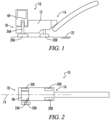
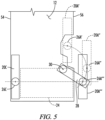
- FIGS. 1 and 2 show a construction machine in the form of a self-propelled road milling machine generally designated as 10.
- the road milling machine 10 includes a machine frame 12 having a longitudinal axis 14 extending between a front 16 and a rear 18 of the machine frame 12.
- the road milling machine 10 illustrated is of the type sometimes referred to as a compact milling machine which is characterized by a milling drum located between the rear wheels or tracks and by a pivotable right rear wheel or track.
- a plurality of ground engaging units 20A, 20B, 20C and 20D support the machine frame 12 from a ground surface 22.
- the milling machine 10 may have at least one front ground engaging unit and at least two rear ground engaging units.
- the ground engaging units are illustrated as tracked units, but wheeled units may also be used.
- One or more of the ground engaging units may be powered such as by a hydraulic motor to drive the milling machine 10.
- One or more of the ground engaging units may be steerable.
- At least one of the rear ground engaging units may be a movable rear ground engaging unit 20A movable relative to the machine frame 12 between a retracted position 20A' and a fully extended position 20A′′′.
- the movable ground engaging unit may also be movable to one or more intermediate extended positions such as 20A". Both the fully extended position 20A′′′ and the intermediate extended position 20 A" may be referred to as extended positions.
- the right rear ground engaging unit 20A is shown in the fully extended position 20A′′′.
- the retracted position 20A' and intermediate extended position 20A" are schematically shown in Fig. 5 discussed below.
- a milling drum 24 of the milling machine 10 is located laterally between the rear ground engaging units 20A and 20C.
- the movable right rear ground engaging unit 20A is in the retracted position 20A' the movable right rear ground engaging unit 20A is located ahead of the milling drum 24.
- At least the two rear ground engaging units 20A and 20C are connected to the machine frame 12 by lifting columns such as 26A and 26C. The lifting columns raise and lower the machine frame 12 and the attached milling drum 24 relative to the ground surface 22.
- At least the right rear lifting column 26A is a movable lifting column 26A attached to the movable rear ground engaging unit 20A.
- FIG. 9 shows the details of one embodiment of a mechanism for moving the movable ground engaging unit 20A and the movable lifting column 26A between the various positions relative to the machine frame.
- a swing arm 28 may be pivotally attached to machine frame 12 at pivotal connection 30, and pivotally attached to the movable ground engaging unit 20A via the movable lifting column 26A.
- An extension actuator 32 may be pivotally connected at one end 34 to the machine frame 12 and at the other end 36 to the swing arm 28 such that extension and retraction of the extension actuator 32 pivots the swing arm 28 and the attached lifting column 26A and ground engaging unit 20A between the various positions thereof.
- a steering actuator 38 is pivotally connected at one end 40 to the machine frame 12 and at the other end 42 to a steering arm 44 attached to the movable ground engaging unit 20A. Extension and retraction of the steering actuator 38 pivots the movable ground engaging unit 20A about a steering axis 46 relative to the movable lifting column 26A.
- the actuators 32 and 38 may be hydraulic cylinders and may be "smart" hydraulic cylinders including integral extension sensors as further explained below with reference to Fig. 11 .
- the movable right rear ground engaging unit 20A can be placed in the fully extended position 20A′′′ as seen in Figs. 1 and 2 wherein the movable right rear ground engaging unit 20A is located laterally outside the milling drum 24 for increased stability during normal milling operations. And the movable right rear ground engaging unit 20A can be moved to the retracted position 20A' wherein the movable right rear ground engaging unit 20A does not extend laterally outside the machine frame 12 thus allowing the milling machine 10 to mill close to an obstacle such as a curb or wall.
- the two rear ground engaging units are laterally aligned and the milling drum is located laterally between the two rear ground engaging units so that the rotational axis of the milling drum is substantially aligned laterally with the rotational axes of the two rear ground engaging units.
- the rotational axes of the milling drum and the two rear ground engaging units may intersect a center of steering of the milling machine 10 when the milling machine 10 is configured to be steered in the so-called Ackermann steering condition.
- milling machine 10 may include a movable operator's station 48 which may be an enclosed cabin or may be an open operator's station.
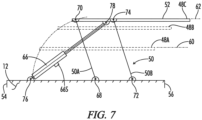
- a support linkage 50 is configured to move the operator's station 48 laterally between an inner position 48A, and intermediate outer position 48B and an outermost position 48C relative to the machine frame 12.
- the operator's station 48 including a floor 52 thereof, is located at a lowest elevation 60 schematically shown in Fig. 7 , and has a footprint entirely within the left and right edges 54 and 56 of the machine frame 12.
- the outermost position 48C the operator's station 48 extends laterally partially beyond the right edge 56 of machine frame 12 by a distance 58 (see Fig. 6 ) and the floor 52 is at a higher elevation schematically shown as 62 in Fig. 7 .
- Both the intermediate outer position 48B and the outermost position 48C may be referred to as outer positions of the operator's station 48.
- the operator's station 48 when the operator's station 48 is in the outermost position 48C it is at least partially located above the fully extended position 20A′′′ of the movable rear ground engaging unit 20A.
- the operator's station 48 may include a recess 64 configured to at least partially receive the movable lifting column 26A when the movable rear ground engaging unit 20A is in the fully extended position 20A′′′ and the operator's station 48 is in the outermost position 48C.
- a hydraulic lifting cylinder 66 may be connected between the machine frame 12 and at least one of the support linkage 50 and the operator's station 48.
- the hydraulic lifting cylinder 66 may be configured to move the operator's station between the inner position 48A and the outermost position 48C.
- the hydraulic lifting cylinder 66 may be a "smart" hydraulic cylinder including an integral extension sensor 66S configured to provide an extension signal corresponding to an extension of the hydraulic lifting cylinder 66 as further explained below with reference to Fig. 11 .
- the extension signal also corresponds to the position of the operator's station 48 relative to the machine frame 12.
- the hydraulic lifting cylinder 66 may also be referred to as a lifting actuator 66. As is further explained below, more generally the lifting actuator 66 may be described as being connected to at least one of the support linkage 50 and the operator's station 48.
- the support linkage 50 may be configured to move the operator's station 48 laterally between the inner position 48A and the outermost position 48C without any fore or aft movement of the operator's station 48 relative to the machine frame 12 such that a footprint of the operator's station 48 over the machine frame 12 when moving between the inner and outermost positions 48A and 48C is minimized.
- Such a configuration of the support linkage 50 may be provided by constructing the support linkage 50 to include two pivot links 50A and 50B extending between the machine frame 12 and the operator's station 48.
- Pivot link 50A is pivotally connected to machine frame 12 to pivot about pivot axis 68 and to operator's station 48 to pivot about pivot axis 70.
- Pivot link 50B is pivotally connected to machine frame 12 to pivot about pivot axis 72 and to operator's station 48 to pivot about pivot axis 74.
- the pivot axes 68, 70, 72 and 74 may all extend parallel to the longitudinal axis 14 of machine frame 12.
- the pivot links 50A and 50B may be of equal lengths.
- pivot links 50A and 50B may be attached directly to machine frame 12 or to a separate component fixedly attached to machine frame 12. And the pivot links 50A and 50B may be attached directly to the operator's station 48 or to a separate component fixedly attached to operator's station 48.
- the lifting cylinder 66 may be pivotally connected at pivot point 76 to the machine frame 12 and at pivot point 78 to the operator's station 48.
- the hydraulic lifting cylinder 66 may have its upper end pivotally connected to one of the pivot links such as pivot link 50B.
- Figs. 12 and 13 show in greater detail the construction of the embodiment of the lifting linkage 50 and the hydraulic lifting cylinder 66 shown in Fig. 4 .
- a lower mounting platform 100 has flanges 102 and 104 constructed to be attached to the machine frame 12 via bolts so that the mounting platform 100 effectively becomes part of the machine frame 12.
- the previously described pivotal connection 76 of the lifting actuator 66 to frame 12, and the pivotal connections 68 and 72 of the pivot links 50A and 50B to the machine frame 12 are formed on the lower mounting platform 100.
- the hydraulic lifting cylinder 66 can be a conventional, or "dumb", hydraulic cylinder.
- a proximity sensor 67 may be arranged so as to detect when the pivot link 50B has reached a position corresponding to either the outer position 48C or the intermediate outer position 48B.
- a rotary angle sensor 69 may be placed on one of the pivot axes 68, 70, 72 or 74 to detect the relative rotation between the components of the support linkage 50 and/or the machine frame 12, which rotational angle can be correlated to the position of the operator's station 48 relative to the machine frame 12.
- Figs. 8A and 8B schematically show a hydraulic power supply system 80 which may be used with the hydraulic lifting cylinder 66.
- Pressurized hydraulic fluid may be provided from source 82, also identified as P, via a 3-way electro-hydraulic control valve 84 and supply lines 85 and 87 to either a cylinder end 86 or piston end 88 of the hydraulic lifting cylinder 66.
- Returning hydraulic fluid is directed by control valve 84 to a tank 90, also identified as T.
- a pressure sensor 83 may be connected to the supply line 85 and configured to provide a pressure signal 81 (see Fig. 10 ) corresponding to a hydraulic pressure within the cylinder end 86 of the hydraulic lifting cylinder 66.
- a second pressure sensor may be connected to supply line 87.
- the configuration of the hydraulic lifting cylinder 66 as shown in Fig. 7 wherein the hydraulic lifting cylinder 66 is supporting the weight of the operator's station 48 against the force of gravity conveniently allows a hydraulic spring support to be provided by communicating a hydraulic accumulator 92 with the supply lines 85 and 87.
- the accumulator 92 may be connected to the supply lines 85 and 87 by a connecting line 94.
- the connecting line 94 may also connect the supply lines 85 and 87 to each other.
- a two-way flow restrictor 96 and a control valve 97 may be disposed in the connecting line 94 between the supply lines 85 and 87.
- a one-way flow restrictor 98 and a control valve 99 may be disposed in the portion of connecting line 94 connected to accumulator 92.
- the one-way flow restrictor 98 includes a check valve 100 allowing free flow to the accumulator 92 but preventing free flow from the accumulator 92.
- a bypass 102 in the one-way flow restrictor 98 includes a flow restrictor 104 which allows a restricted flow of hydraulic fluid from the accumulator 92 back to the supply lines 85, 87.
- Fig. 8A shows the system 80 in a first position such as it would be in if the lifting cylinder 66 has been extended to move the operator's station 48 to the position 48C.
- the control valve 84 is in a position blocking further hydraulic flow to and from the lifting cylinder 66 so that no further adjustment of the lifting cylinder 66 is taking place.
- the control valves 97 and 99 are in the open position to allow the accumulator 92 to provide the hydraulic spring function.
- the one-way flow restrictor 98 may be described as a hydraulic flow restrictor 98 disposed between the hydraulic lifting cylinder 66 and the hydraulic accumulator 92 and configured to restrict flow of hydraulic fluid in at least one direction between the hydraulic lifting cylinder 66 and the hydraulic accumulator 92 to dampen the hydraulic spring support of the operator's station 92.
- Fig. 8B shows the system 80 in a second position as it would be in if the lifting cylinder 66 were being retracted to move the operator's station back toward the inner position 48A.
- the control valve 84 is in the left side operating position to control flow to and from the lifting cylinder 66.
- the control valves 97 and 99 are in their closed positions to block flow to and from the accumulator 92 and between the supply lines 85 and 87.
- a similar arrangement to extend the lifting cylinder would move the control valve 84 to the right side operating position and the control valves 97 and 99 would remain closed.
- the broken line box 101 around the valves 97 and 99 and the flow restrictors 96 and 104 is to indicate that optionally those components may be constructed as one integral block of hydraulic components in which case the connecting passages such as 94 are integrally formed in the block. Those components can also be individual hydraulic components connected by separate hydraulic lines.
- the flow restrictors 96 and 104 can be either fixed flow restrictors having a fixed dimension flow path therethrough, or they may be variable restrictions having a variable dimension flow path therethrough. Variable restrictions allow the damping function to be adjusted.
- the hydraulic lifting cylinder 66 and the extension actuator 32 may be "smart" hydraulic cylinders having integral extension sensors 66S and 32S respectively.
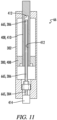
- a representative construction of such a “smart” hydraulic cylinder is shown in Fig. 11 , and the details of a “smart” hydraulic lifting cylinder 66 will be described by way of example.
- Fig. 11 may also be representative of the internal construction of the other actuators herein described when those actuators are implemented as “smart” cylinders.
- the actuator 66 is of a type sometimes referred to as "smart cylinder" which includes an integrated sensor 66S configured to provide a signal corresponding to an extension of the piston member 300 relative to the cylinder member 302 of the actuator 66.
- the sensor 66S includes a position sensor electronics housing 304 and a position sensor coil element 306.
- the piston portion 408 of actuator 66 includes a piston 408 and a rod 410.
- the piston 408 and rod 410 have a bore 412 defined therein, within which is received the position sensor coil element 306.
- the actuator 66 is constructed such that a signal is provided at connector 414 representative of the position of the piston 408 relative to the position sensor coil element 306.
- Such smart cylinders may operate on several different physical principles. Examples of such smart cylinders include but are not limited to magnetostrictive sensing, magnetoresistive sensing, resistitve (potentiometric) sensing, Hall effect sensing, sensing using linear variable differential transformers, and sensing using linear variable inductance transducers.
- hydraulic lifting cylinder 66 may include integral extension sensor 66S and extension actuator 32 may include integral extension sensor 32S.
- Extension sensor 66S provides a signal 222 corresponding to the extension of the lifting cylinder 66 and the position of the operator's station 48.
- Extension sensor 32S provides a signal 221 corresponding to the extension of extension actuator 32 and the position of the movable ground engaging unit 20A and the movable lifting column 26A.
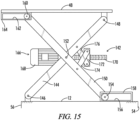
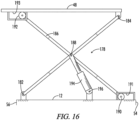
- Figs. 14-17B illustrate several alternate embodiments of lifting linkages and/or lifting actuators.
- the Figs. 14-17B are schematic front elevation views of the alternative embodiments. This is in contrast to the schematic Fig. 6 showing the lifting linkage 50 which is a rear elevation view.
- the left and right edges 54 and 56 of machine frame 12 seen in Fig. 7 and now reversed in Figs. 14-17B .
- the lifting linkage 50 discussed above included two pivot links each extending between the machine frame 12 and the operator's station 48, the two pivot links each being oriented to pivot about a respective pivot axis extending parallel to the longitudinal axis of the machine frame 12.
- the alternate embodiments of Figs. 14-17B each include only one such pivot link.
- all of the embodiments can be described as including at least one pivot link extending between the machine frame 12 and the operator's station 48, the at least one pivot link being oriented to pivot relative to the machine frame 12 about a pivot axis extending parallel to the longitudinal axis of the machine frame 12.
- the lifting actuator is a hydraulic cylinder
- the alternative embodiments show that other types of actuators, for example a rotary threaded spindle and nut, may be used.
- the lifting actuator does not have to be attached to either the machine frame 12 or the operator's station 48 but may instead be connected between the various links of the lifting linkage.
- the lifting actuator may be any suitable actuator.
- a lifting linkage 120 includes a pivot link 122 pivotally connected at 124 to the machine frame 12 and at 126 to the operator's station 48.
- a supporting link 128 is pivotally attached to pivot link 122 at 130.
- Supporting link128 has a lower roller 132 rolling on an upper surface of machine frame 12, and an upper roller 134 rollably supporting a lower surface of the operator's station 48.
- a lifting actuator 136 includes a threaded spindle 138 which is received in a threaded nut 140 held at the upper end of pivot link 122, so that rotation of the threaded spindle 138 causes the upper ends of the links 122 and 128 to move closer to or further from each other to raise or lower the operator's station 48 relative to the machine frame 12. As the operator's station is raised it also moves laterally to the left in Fig. 14 , and as it is lowered it moves laterally to the right.
- the spindle 138 can be manually actuated as by handle 142, or can be rotated by a hydraulic or electric rotary actuator.
- a lifting linkage 142 includes a pivot link 144 pivotally connected at 146 to the machine frame 12 and at 148 to the operator's station 48.
- a supporting link 150 is pivotally attached to pivot link 144 at 152.
- Supporting link 150 has a lower roller 154 which rolls along a slot 156 of guide 158 attached to machine frame 12, and an upper roller 160 which rolls along a slot 162 of a guide 164 attached to the operator's station 48.
- a lifting actuator 166 includes an electric motor 168 driving a threaded spindle 170 which is received in a threaded nut 172 held between scissor links 174 and 176, so that rotation of the threaded spindle 170 causes the upper ends of the links 144 and 150 to move closer to or further from each other to raise or lower the operator's station 48 relative to the machine frame 12. As the operator's station is raised it also moves laterally to the left in Fig. 15 , and as it is lowered it moves laterally to the right.
- the spindle 170 could also be manually actuated as by handle as in Fig. 14 , or can be rotated by any other suitable rotary actuator.
- a lifting linkage 178 includes a pivot link 180 pivotally connected at 182 to the machine frame 12 and at 184 to the operator's station 48.
- a supporting link 186 is pivotally attached to pivot link 180 at 188.
- Supporting link 186 has a lower roller 190 rolling on an upper surface or in a track of machine frame 12, and an upper roller 192 rollably supporting a lower surface or track of the operator's station 48.
- a lifting actuator 194, which is shown as a hydraulic cylinder 194 is pivotally connected at 196 to machine frame 12 and to the pivotal connection 188. Extension or retraction of the hydraulic cylinder 194 pivots the pivot link 180 about the lower pivotal connection 182 to raise or lower the operator's station 48 relative to the machine frame 12. As the operator's station is raised it also moves laterally to the left in Fig. 1 , and as it is lowered it moves laterally to the right.
- the hydraulic cylinder lifting actuator 194 could be replaced by any suitable linear actuator.
- a lifting linkage 400 includes a pivot link 402 pivotally connected at 404 to the machine frame 12 and at 406 to the operator's station 48.
- a supporting link 408 is pivotally attached to pivot link 402 at 410.
- Supporting link 408 has a lower roller 412 rolling on an upper surface or in a track 414 of machine frame 12, and an upper roller 416 rollably supporting a lower surface or track 418 of the operator's station 48.
- a lifting actuator 420 which is schematically shown as a winch 420, is mounted on machine frame 12 and includes a winch drum on which one end of a winch belt or cable 424 is wound. The other end of the winch belt or cable 424 is attached to a roller schematically shown as 426. The roller 426 is constantly pulled to the left in Figs. 17A and 17B by tension in the winch belt or cable 424.
- Fig. 17A the roller 426 is shown riding on top of an arch shaped protrusion of the support link 408.
- the roller 426 is constantly trapped between a lower surface of the pivot link 402 and the upper surface of the support link 408.
- Fig. 17B the roller 426 is displaced to the right, as compared to Fig. 17A , and is still trapped between the links 402 and 408.
- the winch belt or cable 424 is wound upon the winch drum 422 by rotating the winch drum 422 counterclockwise as indicated by the arrow 430 in Fig. 17A .
- the pivot link 402 pivots upward from the position of Fig. 17B towards the position of Fig. 17A the operator's station is rising and moving laterally to the left in the figures.
- the lower roller 412 of the support link 408 is moving to the left within the track 414 and the upper track 418 is moving to the left relative to the upper roller 416.
- the winch drum 422 is rotated clockwise as indicated by the arrow 432 in Fig. 17B and the weight of the operator's station acting downward due to gravity pushes the operator's station down toward the machine frame 12 as the roller 426 is squeezed between the links 402 and 408 back towards the position of Fig. 17B .
- a first advantage is that due to the lifting linkage 50 being configured to pivot about pivot axes 68 and 72 parallel to the longitudinal axis 14 of the machine frame 12, the operator's station 48 is moved laterally between the inner position 48A and the outermost position 48C without any fore or aft movement of the operator's station relative to the machine frame 12. This reduces the use of valuable floor space on the machine frame 12 and volume above that floor space as compared to a system like that of U.S. 10,960,938 wherein the operator's station also moves fore and aft as it is moved between its inner and outer positions.
- a second advantage provided by the lifting linkage 50 being configured to pivot about pivot axes 68 and 72 parallel to the longitudinal axis 14 of the machine frame 12 is that in addition to providing lateral movement of the operator's station 48, the lifting linkage 50 lifts the operator's station 48 so that in either the intermediate outer position 48B or the outermost position 48C the operator's station 48 is raised in elevation thus providing an improved overall view around the milling machine 10 due to the higher elevation.
- a third advantage provided by the lifting linkage 50 being configured to pivot about pivot axes 68 and 72 parallel to the longitudinal axis 14 of the machine frame 12 is that this permits the hydraulic lifting cylinder 66 to be arranged with the hydraulic accumulator 92 to provide a hydraulic spring support for the operator's station, thus providing improved comfort and safety for the operator.
- the automatic control system 200 includes a controller 202.
- the controller 202 receives input signals from the various sensors described herein.
- the controller 202 may also receive other signals indicative of various operational functions of the road milling machine 10.
- Communication of control signals from the controller 202 to the various actuators such as 66 and 32 of the road milling machines 10 are schematically illustrated in Fig. 10 by the communication lines 204 and 206.
- the flow of hydraulic fluid to the hydraulic lifting cylinder 66 is controlled by the electro-hydraulic control valve 84 which receives electrical control signals conducted over communication line 204 from controller 202 in a known manner.
- the extension actuator 32 will be directly controlled by another electro-hydraulic control valve (not shown) receiving electrical control signals conducted over communication line 206.
- controller 202 may control the direction of the road milling machine 10 by steering of the ground engaging units 20A, 20B, 20C, 20D via their respective steering cylinders such as 38.
- the controller 202 may control the extension of the lifting columns 26A and 26C in a similar manner.
- Controller 202 includes or may be associated with a processor 208, a computer readable medium 210, a data base 212 and an input/output module or control panel 214 having a display 216.
- Various operations, steps or algorithms as described in connection with the controller 202 can be embodied directly in hardware, in a computer program product 220 such as a software module executed by the processor 208, or in a combination of the two.
- the computer program product 220 can reside in RAM memory, flash memory, ROM memory, EPROM memory, EEPROM memory, registers, hard disk, a removable disk, or any other form of computer-readable medium 210 known in the art.
- An exemplary computer-readable medium 210 can be coupled to the processor 208 such that the processor can read information from, and write information to, the memory/ storage medium.
- the medium can be integral to the processor.
- the processor and the medium can reside in an application specific integrated circuit (ASIC).
- the ASIC can reside in a user terminal.
- the processor and the medium can reside as discrete components in a user terminal.
- processor may refer to at least general-purpose or specific-purpose processing devices and/or logic as may be understood by one of skill in the art, including but not limited to a microprocessor, a microcontroller, a state machine, and the like.
- a processor can also be implemented as a combination of computing devices, e.g., a combination of a DSP and a microprocessor, a plurality of microprocessors, one or more microprocessors in conjunction with a DSP core, or any other such configuration.
- control system 200 can provide several modes of operation for preventing interference between the operator's station 48 and the movable lifting column 26A due to the superposition of the outer position 48C of the operator's station 48 and the extended position of the movable lifting column 26A.
- the controller 202 may receive an extension signal 222 from integral extension sensor 66S of the "smart" hydraulic lifting cylinder 66 and the pressure signal 81 from pressure sensor 83 associated with the cylinder end 86 of the hydraulic lifting cylinder 66.
- the extension signal 222 corresponds to an amount of extension of the hydraulic lifting cylinder 66.
- the pressure signal 81 corresponds to the hydraulic pressure within the cylinder end 86 of the hydraulic lifting cylinder 66.
- the controller 202 may be configured to receive the extension signal 222 and the pressure signal 81 and to generate control signals 204 to the hydraulic lifting cylinder 66 such that when the operator's station 48 is moved toward the outermost position 48C, if the movable ground engaging unit 20A and the movable lifting column 26A are in the fully extended positions 20A′′′ and 26A′′′ and the operator's station 48 engages the movable lifting column 26A, the controller 202 detects a rise in hydraulic pressure within the hydraulic lifting cylinder 66 and directs the hydraulic lifting cylinder 66 to retract a predetermined distance to the intermediate outer position 48B to provide a predetermined clearance 223 (see Fig. 6 ) (for example 20 mm) between the operator's station 48 and the movable lifting column 26A.
- a predetermined clearance 223 see Fig. 6
- a proximity sensor 224 may be mounted on the operator's station 48 or optionally on the movable lifting column 26A and configured to provide a proximity signal 226 corresponding to a proximity of the operator's station 48 to the movable lifting column 26A.
- the concern may be the possible interference of inner edge 65 of recess 64 with the movable lifting column 26A.
- the controller 202 may be configured to receive the proximity signal 226 and to generate control signals 204 to the hydraulic lifting cylinder 66, the controller 202 being configured such that when the operator's station 48 is moved toward the outermost position 48C, if the movable ground engaging unit 20A and the movable lifting column 26A are in the fully extended positions 20A′′′ and 26A′′′ and the proximity sensor 224 detects the operator's station 48 within a predetermined distance of the movable lifting column 26C, the controller 202 directs the hydraulic lifting cylinder 66 to stop extending so as to provide a predetermined clearance 223 (for example 20 mm) between the operator's station 48 and the movable lifting column 26A, again leaving the operator's station 48 in the intermediate outer position 48B.
- a predetermined clearance 223 for example 20 mm
- a third mode of operation may be provided by configuring the pivoting mechanism which moves the movable ground engaging unit 20A and the movable lifting column 26A such that the extended position of the movable lifting column 26A is located so that the movable lifting column 26A cannot interfere with the operator's station 48, even if the operator's station 48 is in the outermost position 48C.
- This extended position of the movable lifting column 26A may be forward of the operator's station 48 in the intermediate extended position 26A" as schematically shown in Fig. 6 .
- the extended position of the movable lifting column might be located laterally outward of the outermost position 48C of the operator's station.
- the limitation of the movement of the movable lifting column 26A can be provided by the physical geometry of the swing arm 28 and extension actuator 32, and various physical structures associated therewith, or the limitation of movement can be provided by control of the extension of the extension actuator 32 via the controller 202.
- the extension actuator 32 it is not necessary, however, for the extension actuator 32 to be a "smart" cylinder or to have an extension sensor 32S associated therewith.
- the extension actuator 32 can be a conventional or "dumb" hydraulic cylinder.
- the limitation of the movement of the swing arm 28 may be provided by the physical geometry of the swing arm 28 and extension actuator 32, and various physical structures associated therewith.
- the limitation of the movement of the swing arm 28 may be provided by the controller 202 using other position sensors detecting the position of the movable rear ground engaging unit relative to the machine frame 12.
- the hydraulic lifting cylinder 66 may be a "smart" cylinder or to have an extension sensor 66S associated therewith.
- the hydraulic lifting cylinder 66 may be a conventional hydraulic cylinder.
- the limitation of the movement of the operator's station 48 may be provided by the physical geometry of the lifting linkage 50 and the various physical structures associated therewith.
- the limitation of the movement of the operator's station 48 may be provided by the controller 202 using other position sensors detecting the position of the operator's station 48 relative to the machine frame 12, for example the proximity sensor 67 or the rotary position sensor 69.
- This third mode of operation may be described as a mode wherein the outer position of the operator's station 48 and the extended position of the movable ground engaging unit 20A are defined such that when the movable ground engaging unit is 20A in the extended position the operator's station 48 is movable between the inner position and the outer position without interference between the movable lifting column 26A and the operator's station 48, and such that when the operator's station 48 is in the outer position the movable ground engaging unit 20A is movable between the retracted position and the extended position without interference between the movable lifting column 26A and the operator's station 48A.
- a fourth mode of operation may be provided by configuring the lifting mechanism which moves the operator's station 48 such that the laterally outer movement from inner position 48A always terminates at intermediate outer position 48B which is chosen such that in position 48B a clearance 223 (see Fig. 6 ) is provided between the inner edge 65 of recess 64 of operator's station 48 and the movable lifting column 26A if the lifting column 26A is in its fully extended position 26A'''.
- the limitation of the movement of the operator's station 48 can be provided by the physical geometry of the lifting linkage 50 and the hydraulic lifting cylinder 66, and various physical structures associated therewith, or the limitation of movement can be provided by control of the extension of the hydraulic lifting cylinder 66 via the controller 202 if the hydraulic lifting cylinder 66 has an extension sensor 66S associated therewith.
- the hydraulic lifting cylinder 66 it is not necessary, however, for the hydraulic lifting cylinder 66 to be a "smart" cylinder or to have an extension sensor 66S associated therewith.
- the hydraulic lifting cylinder 66 may be a conventional hydraulic cylinder.
- the limitation of the movement of the operator's station 48 may be provided by the physical geometry of the lifting linkage 50 and the various physical structures associated therewith.
- the limitation of the movement of the operator's station 48 may be provided by the controller 202 using other position sensors detecting the position of the operator's station 48 relative to the machine frame 12, for example the proximity sensor 67 or the rotary position sensor 69.
- extension actuator 32 it is not necessary for the extension actuator 32 to be a "smart" cylinder or to have an extension sensor 32S associated therewith.
- This fourth mode of operation may also be described as a mode wherein the outer position of the operator's station 48 and the extended position of the movable ground engaging unit 20A are defined such that when the movable ground engaging unit is 20A in the extended position the operator's station 48 is movable between the inner position and the outer position without interference between the movable lifting column 26A and the operator's station 48, and such that when the operator's station 48 is in the outer position the movable ground engaging unit 20A is movable between the retracted position and the extended position without interference between the movable lifting column 26A and the operator's station 48A.
- the human operator can be provided with an operator interface, for example the interface 218, configured to let the human operator select between the third and fourth modes described above.
- the hydraulic lifting cylinder 66 may be associated with a lifting cylinder extension sensor 66S configured to provide a cylinder extension signal 222 corresponding to the extension of the hydraulic lifting cylinder 66. This allows the hydraulic lifting cylinder to selectively define the outer position of the operator's station 48 as either the outermost position 48C or the intermediate outer position 48B.
- the controller 202 may be configured to receive the cylinder extension signal 222 and the movable rear ground engaging unit position signal 221 and to generate control signals 204 and 206 to the hydraulic lifting cylinder 66 and to the extension actuator 32, the controller being configured such that:
- a proximity sensor 228 may be mounted on the operator's station 48 or optionally on the movable lifting column 46A and configured to provide a proximity signal 230 corresponding to a proximity of the operator's station 48 to the movable lifting column 26A. This can also be described as a proximity of the movable lifting column 26A to the operator's station 48. In this case the concern is that if the operator's station 48 is already in the outermost position 48C, and the operator then tries to move the movable lifting column 26A from the retracted position 26A' to the fully extended position 26A′′′, the moving lifting column 26A would impact the operator's station 48.
- the controller 202 may be configured to receive the proximity signal 230 and to generate control signals 206 to the extension actuator 32, the controller 202 being configured such that when the operator's station 48 is in the outermost position 48C, and the proximity sensor 228 detects the operator's station 48 within a predetermined distance (for example 20 mm) of the movable lifting column 26A, the controller 202 directs the extension actuator 32 to stop so as to provide a predetermined clearance 232 (for example 20 mm)(see Fig. 6 ) between the operator's station 48 and the movable lifting column 26A in the intermediate extended position 26A" of the movable lifting column 26A.
- a predetermined clearance 232 for example 20 mm
- Figs. 18 and 19 schematically represent a "large" milling machine like that of U.S. 10,968,576 incorporating certain aspects of the present disclosure.
- the milling machine is generally designated as 500.
- Those components analogous to the embodiment of Figs. 1 and 2 carry the same identifying numbers.
- the operator's station 48 is located longitudinally between the front tracks 20B, 20D and the rear tracks 20A, 20C.
Landscapes
- Engineering & Computer Science (AREA)
- Mining & Mineral Resources (AREA)
- Architecture (AREA)
- Civil Engineering (AREA)
- Structural Engineering (AREA)
- Mechanical Engineering (AREA)
- Road Paving Machines (AREA)
- Physics & Mathematics (AREA)
- Fluid Mechanics (AREA)
- General Engineering & Computer Science (AREA)
Description
- The present disclosure relates to improvements in the mounting of an operator's station on a road milling machine so that the operator's station can be laterally shifted to extend over an edge of a machine frame of the milling machine.
- Road milling machines are typically designed to have at least one zero clearance side wherein the milling machine can mill close to an obstacle. It is desirable for the operator of the milling machine to be able to directly observe the cutting action of the milling drum, particularly on the zero clearance side. To that end various arrangements have been provided for laterally shifting a cabin or an operator's station outward toward the zero clearance side to provide the operator with an improved view of the milling operation.
- One example of such an arrangement is seen in
U.S. 10,960,938 - Another prior art milling machine with shiftable cabin is known from
US 2008/258535 A1 . - Accordingly, there is a continuing need for improved arrangements for shiftable operator's stations or cabins on such construction machines.
- In one embodiment a self-propelled road milling machine includes a machine frame having a longitudinal axis extending between a front and a rear of the machine frame, the machine frame including left and right edges. A plurality of ground engaging units support the machine frame from a ground surface. A milling drum is supported from the machine frame. An operator's station is supported from the machine frame by a support linkage configured to move the operator's station laterally between an inner position and an outer position relative to the machine frame. The support linkage includes at least one pivot link extending between the machine frame and the operator's station, the at least one pivot link being oriented to pivot about a pivot axis extending parallel to the longitudinal axis of the machine frame. The operator's station in the outer position extends laterally partially beyond one of the left and right edges of the machine frame. The outer position is at a higher elevation than the inner position relative to the machine frame.
- In another embodiment the milling machine may include a hydraulic lifting cylinder connected to at least one of the support linkage and the operator's station, the hydraulic lifting cylinder being configured to move the operator's station between the inner and outer positions.
- In any of the above embodiments the milling machine may include a hydraulic accumulator hydraulically communicated with the hydraulic lifting cylinder and configured to provide a hydraulic spring support to the operator's station at least when the operator's station is in the outer position.
- In any of the above embodiments the milling machine may include a hydraulic flow restrictor disposed between the hydraulic lifting cylinder and the hydraulic accumulator and configured to restrict flow of hydraulic fluid in at least one direction between the hydraulic lifting cylinder and the hydraulic accumulator to dampen the hydraulic spring support of the operator's station.
- In any of the above embodiments the milling machine may include an extension sensor configured to provide an extension signal corresponding to an extension of the hydraulic lifting cylinder.
- Any of the above embodiments may include a proximity sensor configured to detect the presence of the operator's station in the outer position relative to the machine frame.
- In any of the above embodiments the hydraulic lifting cylinder may be a smart cylinder and the extension sensor may be integral to the hydraulic lifting cylinder.
- In any of the above embodiments the support linkage may be configured to move the operator's station laterally between the inner position and the outer position without any fore or aft movement of the operator's station relative to the machine frame such that a footprint of the operator's station over the machine frame when moving between the inner and outer positions is minimized.
- In any of the above embodiments the milling machine may include a lifting actuator connected to at least one of the support linkage and the operator's station.
- In any of the above embodiments the lifting actuator may be connected between the machine frame and the operator's station.
- In any of the above embodiments the outer position of the operator's station, as compared to the inner position, may provide a human operator on the operator's station both an improved view of an area of the ground surface adjacent the milling drum due to the laterally outward movement, and an improved overall view around the self-propelled road milling machine due to the higher elevation of the outer position.
- In any of the above embodiments when the operator's station is in the inner position a stationary footprint of the operator's station may fall entirely between left and right edges of the machine frame.
- In any of the above embodiments the plurality of ground engaging units may include at least one front ground engaging unit and at least two rear ground engaging units, and at least one of the rear ground engaging units may be a movable rear ground engaging unit movable relative to the machine frame between a retracted position and an extended position. The milling drum may be located such that when the movable rear ground engaging unit is in the retracted position the movable rear ground engaging unit is located ahead of the milling drum. The outer position of the operator's station may extend laterally partially beyond the one of the left and right edges of the machine frame adjacent the movable rear ground engaging unit.
- In another embodiment the two rear ground engaging units may be laterally aligned and the milling drum may be located laterally between the two rear ground engaging units when the movable rear ground engaging unit is in the extended position, and the operator's station when in the outer position may be at least partially located above a location in which the movable rear ground engaging unit would be located if the movable rear ground engaging unit was in the extended position.
- In any of the above embodiments the milling machine may include at least two lifting columns extending between the at least two rear ground engaging units and the machine frame for raising and lowering the machine frame relative to the ground surface, one of the lifting columns being a movable lifting column attached to the movable rear ground engaging unit. Further the operator's station may include a recess configured to at least partially receive the movable lifting column when the movable rear ground engaging unit is in the extended position and the operator's station is in the outer position.
- In a first mode of operation of any of the above embodiments a controller may be configured to receive an extension signal from the extension sensor and a pressure signal from a pressure sensor associated with the hydraulic lifting cylinder, and to generate control signals to the hydraulic lifting cylinder, the controller being configured such that when the operator's station is moved toward the outer position, if the movable ground engaging unit and the movable lifting column are in the extended position and the operator's station engages the movable lifting column, the controller detects a rise in hydraulic pressure within the hydraulic lifting cylinder and directs the hydraulic lifting cylinder to retract a predetermined distance to provide a predetermined clearance between the operator's station and the movable lifting column in the outer position of the operator's station.
- In a second mode of operation of any of the above embodiments the controller may be configured to receive a proximity signal from a proximity sensor configured to detect a proximity of the operator's station to the movable lifting column, and to generate control signals to the lifting actuator, the controller being configured such that when the operator's station is moved toward the outer position, if the movable ground engaging unit and the movable lifting column are in the extended position and the proximity sensor detects the operator's station within a predetermined distance of the movable lifting column, the controller directs the lifting actuator to stop moving so as to provide a predetermined clearance between the operator's station and the movable lifting column in the outer position of the operator's station.
- In a third mode of operation of any of the above embodiments the pivoting mechanism which moves the movable ground engaging unit and the movable lifting column may be configured such that the most extended position of the movable lifting column is located such that the movable lifting column cannot interfere with the operator's station, even if the operator's station is in its outermost position.
- In a fourth mode of operation of any of the above embodiments the lifting mechanism which moves the operator's station may be configured such that the laterally outward movement from inner position always terminates at an intermediate position which is chosen such that a clearance is provided between the operator's station and the movable lifting column if the lifting column is in its extended position. By so limiting the outer position of the operator's station it is insured that the movable lifting column cannot interfere with the operator's station, even if the movable lifting column is in its fully extended position.
- In a fifth mode of operation of any of the above embodiments the human operator is provided with an operational interface which allows the operator to select between the third mode and the fourth mode.
- In a sixth mode of operation of any of the above embodiments the controller may be configured to receive a proximity signal from a proximity sensor configured to detect a proximity of the movable lifting column to the operator's station and to generate control signals to the extension actuator, the controller being configured such that when the operator's station is in the outer position, and the proximity sensor detects the operator's station within a predetermined distance of the movable lifting column, the controller directs the extension actuator to stop so as to provide a predetermined clearance between the operator's station and the movable lifting column in the extended position of the movable rear ground engaging unit and the movable lifting column.
- Numerous objects, features and advantages of the present invention will be readily apparent to those skilled in the art upon a review of following description in conjunction with the accompanying drawings.
- Fig. 1
- is a schematic right side elevation view of a road milling machine.
- Fig. 2
- is schematic plan view of the road milling machine of
Fig. 1 . - Fig. 3
- is right rear perspective view of the road milling machine of
Fig. 1 showing the operator's station in an inner position. - Fig. 4
- is right rear perspective view of the road milling machine of
Fig. 1 showing the operator's station in an outer position. - Fig. 5
- is a schematic plan view of the rear portion of the road milling machine of
Fig. 1 showing the right rear track in a fully extended position in solid lines, and in a retracted position and an intermediate extended position in dashed lines. - Fig. 6
- is a schematic plan view of the rear portion of the road milling machine similar to
Fig. 5 , further schematically showing the operator's station in an inner position in solid lines, and in an outermost position and an intermediate outer position in dashed lines. - Fig. 7
- is a schematic rear elevation view of a support linkage supporting the operator's station from the machine frame of the road milling machine. The operator's station is shown in an outermost position in solid lines, and in an inner position and an intermediate outer position in dashed lines. A hydraulic lifting cylinder is shown for moving the support linkage and the operator's station between the various positions.
- Fig. 8A
- is a schematic illustration of a hydraulic power supply associated with the lifting cylinder. The hydraulic power supply is in a first position wherein the lifting cylinder is locked in an extended position and a hydraulic spring feature is provided.
- Fig. 8B
- is a schematic illustration similar to
Fig. 8A , but with the hydraulic power supply in a second position wherein the lifting cylinder is being retracted to lower the operator's station and shift it inward. The hydraulic spring feature is blocked during lifting cylinder extension or retraction. - Fig. 9
- is a plan view of the movable right rear track and lifting column of the road milling machine of
Fig. 1 , further showing an extension actuator, sometimes called a swing cylinder, for moving the right rear track and lifting column between the various positions ofFig. 5 . - Fig. 10
- is a schematic view of a controller of the road milling machine along with the various sensor inputs and control outputs associated with the controller.
- Fig. 11
- is a schematic illustration of a hydraulic smart cylinder having an integral extension sensor.
- Fig. 12
- is a right front side lower perspective view of the operator's station and one embodiment of the lifting linkage and lifting actuator.
- Fig. 13
- is an enlarged perspective view of the lifting linkage and lifting actuator of
Fig. 12 . - Fig. 14
- is a schematic representation of another embodiment of a lifting linkage and lifting actuator.
- Fig. 15
- is schematic representation of another embodiment of a lifting linkage and lifting actuator.
- Fig. 16
- is schematic representation of another embodiment of a lifting linkage and lifting actuator.
- Fig. 17A
- is schematic representation of another embodiment of a lifting linkage and lifting actuator in a raised position.
- Fig. 17B
- is schematic representation of the lifting linkage and lifting actuator of
Fig. 17A in a lowered position. - Fig. 18
- is a schematic right side elevation view of a road milling machine in the form of a "large" milling machine having two front tracks and two rear tracks, and incorporating a shiftable cabin according to some aspects of the present disclosure.
- Fig. 19
- is schematic plan view of the road milling machine of
Fig. 18 . -
FIGS. 1 and 2 show a construction machine in the form of a self-propelled road milling machine generally designated as 10. Theroad milling machine 10 includes amachine frame 12 having alongitudinal axis 14 extending between a front 16 and a rear 18 of themachine frame 12. Theroad milling machine 10 illustrated is of the type sometimes referred to as a compact milling machine which is characterized by a milling drum located between the rear wheels or tracks and by a pivotable right rear wheel or track. - It will be understood that many aspects of the present invention are also applicable to other types of construction machines, including the so called "large" or "half-lane" milling machines characterized by two front and two rear tracks with a milling drum located between the front and rear tracks, such as shown for example in
U.S. 10,968,576 U.S. 10,968,576 Figs. 18 and 19 . Also, some aspects of the invention may be used with "half-lane" milling machines which use two front ground engaging units and one rear ground engaging unit. - A plurality of
ground engaging units machine frame 12 from aground surface 22. In the embodiment illustrated inFigs. 1 and 2 there are two frontground engaging units ground engaging units 20A and 20C. In general, the millingmachine 10 may have at least one front ground engaging unit and at least two rear ground engaging units. The ground engaging units are illustrated as tracked units, but wheeled units may also be used. One or more of the ground engaging units may be powered such as by a hydraulic motor to drive the millingmachine 10. One or more of the ground engaging units may be steerable. - At least one of the rear ground engaging units, in the illustrated embodiment the right rear
ground engaging unit 20A, may be a movable rearground engaging unit 20A movable relative to themachine frame 12 between a retractedposition 20A' and a fullyextended position 20A‴. The movable ground engaging unit may also be movable to one or more intermediate extended positions such as 20A". Both the fullyextended position 20A‴ and the intermediateextended position 20 A" may be referred to as extended positions. InFigs. 1 and 2 the right rearground engaging unit 20A is shown in the fullyextended position 20A‴. The retractedposition 20A' and intermediateextended position 20A" are schematically shown inFig. 5 discussed below. - As schematically shown in
Fig. 5 , when the movable right rearground engaging unit 20A is in the fullyextended position 20A''', a millingdrum 24 of themilling machine 10 is located laterally between the rearground engaging units 20A and 20C. When the movable right rearground engaging unit 20A is in the retractedposition 20A' the movable right rearground engaging unit 20A is located ahead of the millingdrum 24. At least the two rearground engaging units 20A and 20C are connected to themachine frame 12 by lifting columns such as 26A and 26C. The lifting columns raise and lower themachine frame 12 and the attached millingdrum 24 relative to theground surface 22. At least the rightrear lifting column 26A is amovable lifting column 26A attached to the movable rearground engaging unit 20A. -
Fig. 9 shows the details of one embodiment of a mechanism for moving the movableground engaging unit 20A and themovable lifting column 26A between the various positions relative to the machine frame. Aswing arm 28 may be pivotally attached tomachine frame 12 atpivotal connection 30, and pivotally attached to the movableground engaging unit 20A via themovable lifting column 26A. Anextension actuator 32 may be pivotally connected at oneend 34 to themachine frame 12 and at theother end 36 to theswing arm 28 such that extension and retraction of theextension actuator 32 pivots theswing arm 28 and the attachedlifting column 26A andground engaging unit 20A between the various positions thereof. A steeringactuator 38 is pivotally connected at oneend 40 to themachine frame 12 and at theother end 42 to asteering arm 44 attached to the movableground engaging unit 20A. Extension and retraction of thesteering actuator 38 pivots the movableground engaging unit 20A about a steeringaxis 46 relative to themovable lifting column 26A. In an embodiment either or both of theactuators Fig. 11 . - When the movable
ground engaging unit 20A is in the retractedposition 20A' the movable lifting column is in its corresponding retractedposition 26A'. When the movableground engaging unit 20A is in its intermediateextended position 20A" the movable lifting column is in its corresponding intermediateextended position 26A". When the movableground engaging unit 20A is in its fullyextended position 20A‴ the movable lifting column is in its corresponding fullyextended position 26A'''. Both the intermediateextended position 26A" and the fullyextended position 26A‴ may be referred to as extended positions of themovable lifting column 26A. - As is understood by those skilled in the art with reference to compact road milling machines of type shown, the movable right rear
ground engaging unit 20A can be placed in the fullyextended position 20A‴ as seen inFigs. 1 and 2 wherein the movable right rearground engaging unit 20A is located laterally outside the millingdrum 24 for increased stability during normal milling operations. And the movable right rearground engaging unit 20A can be moved to the retractedposition 20A' wherein the movable right rearground engaging unit 20A does not extend laterally outside themachine frame 12 thus allowing themilling machine 10 to mill close to an obstacle such as a curb or wall. - In an embodiment, when the movable right rear
ground engaging unit 20A is placed in the fullyextended position 20A‴ the two rear ground engaging units are laterally aligned and the milling drum is located laterally between the two rear ground engaging units so that the rotational axis of the milling drum is substantially aligned laterally with the rotational axes of the two rear ground engaging units. When so aligned the rotational axes of the milling drum and the two rear ground engaging units may intersect a center of steering of themilling machine 10 when themilling machine 10 is configured to be steered in the so-called Ackermann steering condition. - As best seen in
Figs. 3 and 4 milling machine 10 may include a movable operator'sstation 48 which may be an enclosed cabin or may be an open operator's station. As schematically shown inFig. 7 asupport linkage 50 is configured to move the operator'sstation 48 laterally between aninner position 48A, and intermediateouter position 48B and anoutermost position 48C relative to themachine frame 12. In theinner position 48A the operator'sstation 48, including afloor 52 thereof, is located at alowest elevation 60 schematically shown inFig. 7 , and has a footprint entirely within the left andright edges machine frame 12. In theoutermost position 48C the operator'sstation 48 extends laterally partially beyond theright edge 56 ofmachine frame 12 by a distance 58 (seeFig. 6 ) and thefloor 52 is at a higher elevation schematically shown as 62 inFig. 7 . Both the intermediateouter position 48B and theoutermost position 48C may be referred to as outer positions of the operator'sstation 48. - As is best shown in the schematic illustration of
Fig. 6 , when the operator'sstation 48 is in theoutermost position 48C it is at least partially located above the fullyextended position 20A‴ of the movable rearground engaging unit 20A. To allow this superposition of positions the operator'sstation 48 may include arecess 64 configured to at least partially receive themovable lifting column 26A when the movable rearground engaging unit 20A is in the fullyextended position 20A‴ and the operator'sstation 48 is in theoutermost position 48C. - A
hydraulic lifting cylinder 66, may be connected between themachine frame 12 and at least one of thesupport linkage 50 and the operator'sstation 48. Thehydraulic lifting cylinder 66 may be configured to move the operator's station between theinner position 48A and theoutermost position 48C. Thehydraulic lifting cylinder 66 may be a "smart" hydraulic cylinder including anintegral extension sensor 66S configured to provide an extension signal corresponding to an extension of thehydraulic lifting cylinder 66 as further explained below with reference toFig. 11 . The extension signal also corresponds to the position of the operator'sstation 48 relative to themachine frame 12. Thehydraulic lifting cylinder 66 may also be referred to as a liftingactuator 66. As is further explained below, more generally the liftingactuator 66 may be described as being connected to at least one of thesupport linkage 50 and the operator'sstation 48. - In an embodiment the
support linkage 50 may be configured to move the operator'sstation 48 laterally between theinner position 48A and theoutermost position 48C without any fore or aft movement of the operator'sstation 48 relative to themachine frame 12 such that a footprint of the operator'sstation 48 over themachine frame 12 when moving between the inner andoutermost positions - Such a configuration of the
support linkage 50 may be provided by constructing thesupport linkage 50 to include twopivot links machine frame 12 and the operator'sstation 48.Pivot link 50A is pivotally connected tomachine frame 12 to pivot aboutpivot axis 68 and to operator'sstation 48 to pivot aboutpivot axis 70.Pivot link 50B is pivotally connected tomachine frame 12 to pivot aboutpivot axis 72 and to operator'sstation 48 to pivot aboutpivot axis 74. The pivot axes 68, 70, 72 and 74 may all extend parallel to thelongitudinal axis 14 ofmachine frame 12. In one embodiment thepivot links - It will be understood that the
pivot links machine frame 12 or to a separate component fixedly attached tomachine frame 12. And thepivot links station 48 or to a separate component fixedly attached to operator'sstation 48. - In an embodiment as schematically shown in
Fig. 7 thelifting cylinder 66 may be pivotally connected atpivot point 76 to themachine frame 12 and atpivot point 78 to the operator'sstation 48. In another embodiment as shown inFig. 4 thehydraulic lifting cylinder 66 may have its upper end pivotally connected to one of the pivot links such aspivot link 50B. -
Figs. 12 and13 show in greater detail the construction of the embodiment of the liftinglinkage 50 and thehydraulic lifting cylinder 66 shown inFig. 4 . In this embodiment alower mounting platform 100 hasflanges machine frame 12 via bolts so that the mountingplatform 100 effectively becomes part of themachine frame 12. The previously describedpivotal connection 76 of the liftingactuator 66 to frame 12, and thepivotal connections pivot links machine frame 12 are formed on thelower mounting platform 100. Upper ends of thepivot links support bars platform 48, so that the support bars 106 and 108 effectively become part of the operator'splatform 48. Thepivotal connections pivot links station 48 are formed with the support bars 106 and 108. The upper end of the liftingactuator 66 and at itspivotal connection 78 is attached to a mountingbracket 110 which is separately bolted to the operator'splatform 48. Thus, the entire assembly of the liftinglinkage 50 and the liftingactuator 66 can be removed by unbolting thelower mounting platform 100 frommachine frame 12 and unbolting the support bars 106 and 108 and the mountingbracket 110 from the bottom of the operator'sstation 48. - In an embodiment the
hydraulic lifting cylinder 66 can be a conventional, or "dumb", hydraulic cylinder. When using such a conventionalhydraulic cylinder 66 the position of the operator'sstation 48 relative to themachine frame 12 may be detected via various position sensor arrangements. In one embodiment aproximity sensor 67 may be arranged so as to detect when thepivot link 50B has reached a position corresponding to either theouter position 48C or the intermediateouter position 48B. In another embodiment arotary angle sensor 69 may be placed on one of the pivot axes 68, 70, 72 or 74 to detect the relative rotation between the components of thesupport linkage 50 and/or themachine frame 12, which rotational angle can be correlated to the position of the operator'sstation 48 relative to themachine frame 12. -
Figs. 8A and8B schematically show a hydraulicpower supply system 80 which may be used with thehydraulic lifting cylinder 66. Pressurized hydraulic fluid may be provided fromsource 82, also identified as P, via a 3-way electro-hydraulic control valve 84 andsupply lines cylinder end 86 or piston end 88 of thehydraulic lifting cylinder 66. Returning hydraulic fluid is directed bycontrol valve 84 to atank 90, also identified as T.A pressure sensor 83 may be connected to thesupply line 85 and configured to provide a pressure signal 81 (seeFig. 10 ) corresponding to a hydraulic pressure within thecylinder end 86 of thehydraulic lifting cylinder 66. A second pressure sensor may be connected to supplyline 87. - The configuration of the
hydraulic lifting cylinder 66 as shown inFig. 7 wherein thehydraulic lifting cylinder 66 is supporting the weight of the operator'sstation 48 against the force of gravity conveniently allows a hydraulic spring support to be provided by communicating ahydraulic accumulator 92 with thesupply lines accumulator 92 may be connected to thesupply lines line 94. The connectingline 94 may also connect thesupply lines - A two-
way flow restrictor 96 and acontrol valve 97 may be disposed in the connectingline 94 between thesupply lines - A one-
way flow restrictor 98 and acontrol valve 99 may be disposed in the portion of connectingline 94 connected toaccumulator 92. The one-way flow restrictor 98 includes acheck valve 100 allowing free flow to theaccumulator 92 but preventing free flow from theaccumulator 92. Abypass 102 in the one-way flow restrictor 98 includes aflow restrictor 104 which allows a restricted flow of hydraulic fluid from theaccumulator 92 back to thesupply lines -
Fig. 8A shows thesystem 80 in a first position such as it would be in if the liftingcylinder 66 has been extended to move the operator'sstation 48 to theposition 48C. Thecontrol valve 84 is in a position blocking further hydraulic flow to and from the liftingcylinder 66 so that no further adjustment of the liftingcylinder 66 is taking place. Thecontrol valves accumulator 92 to provide the hydraulic spring function. - With this arrangement impact loads which would otherwise be transmitted between the
machine frame 12 and the operator'sstation 48 may be hydraulically damped, when the operator'sstation 48 is in theoutermost position 48C or in the intermediateouter position 48B. The one-way flow restrictor 98 may be described as ahydraulic flow restrictor 98 disposed between thehydraulic lifting cylinder 66 and thehydraulic accumulator 92 and configured to restrict flow of hydraulic fluid in at least one direction between thehydraulic lifting cylinder 66 and thehydraulic accumulator 92 to dampen the hydraulic spring support of the operator'sstation 92. -
Fig. 8B shows thesystem 80 in a second position as it would be in if the liftingcylinder 66 were being retracted to move the operator's station back toward theinner position 48A. Thecontrol valve 84 is in the left side operating position to control flow to and from the liftingcylinder 66. Thecontrol valves accumulator 92 and between thesupply lines control valve 84 to the right side operating position and thecontrol valves - The
broken line box 101 around thevalves flow restrictors - Optionally, the
flow restrictors - As previously noted, the
hydraulic lifting cylinder 66 and theextension actuator 32 may be "smart" hydraulic cylinders havingintegral extension sensors Fig. 11 , and the details of a "smart"hydraulic lifting cylinder 66 will be described by way of example.Fig. 11 may also be representative of the internal construction of the other actuators herein described when those actuators are implemented as "smart" cylinders. In the illustrated embodiment, theactuator 66 is of a type sometimes referred to as "smart cylinder" which includes anintegrated sensor 66S configured to provide a signal corresponding to an extension of the piston member 300 relative to thecylinder member 302 of theactuator 66. - The
sensor 66S includes a position sensor electronics housing 304 and a positionsensor coil element 306. - The
piston portion 408 ofactuator 66 includes apiston 408 and arod 410. Thepiston 408 androd 410 have abore 412 defined therein, within which is received the positionsensor coil element 306. - The
actuator 66 is constructed such that a signal is provided atconnector 414 representative of the position of thepiston 408 relative to the positionsensor coil element 306. - Such smart cylinders may operate on several different physical principles. Examples of such smart cylinders include but are not limited to magnetostrictive sensing, magnetoresistive sensing, resistitve (potentiometric) sensing, Hall effect sensing, sensing using linear variable differential transformers, and sensing using linear variable inductance transducers.
-
Fig. 10 schematically illustrates the sensors associated with each of theactuators hydraulic lifting cylinder 66 may includeintegral extension sensor 66S andextension actuator 32 may includeintegral extension sensor 32S.Extension sensor 66S provides asignal 222 corresponding to the extension of the liftingcylinder 66 and the position of the operator'sstation 48.Extension sensor 32S provides asignal 221 corresponding to the extension ofextension actuator 32 and the position of the movableground engaging unit 20A and themovable lifting column 26A. -
Figs. 14-17B illustrate several alternate embodiments of lifting linkages and/or lifting actuators. With reference to the arrangement of themilling machine 10 seen inFigs. 1 and 2 , theFigs. 14-17B are schematic front elevation views of the alternative embodiments. This is in contrast to the schematicFig. 6 showing the liftinglinkage 50 which is a rear elevation view. Thus, the left andright edges machine frame 12 seen inFig. 7 , and now reversed inFigs. 14-17B . - The lifting
linkage 50 discussed above included two pivot links each extending between themachine frame 12 and the operator'sstation 48, the two pivot links each being oriented to pivot about a respective pivot axis extending parallel to the longitudinal axis of themachine frame 12. The alternate embodiments ofFigs. 14-17B each include only one such pivot link. Thus, in general all of the embodiments can be described as including at least one pivot link extending between themachine frame 12 and the operator'sstation 48, the at least one pivot link being oriented to pivot relative to themachine frame 12 about a pivot axis extending parallel to the longitudinal axis of themachine frame 12. - Also, in the embodiment illustrated in
Figs. 3, 4 ,12 and13 , the lifting actuator is a hydraulic cylinder, whereas the alternative embodiments show that other types of actuators, for example a rotary threaded spindle and nut, may be used. Also as shown in these embodiments the lifting actuator does not have to be attached to either themachine frame 12 or the operator'sstation 48 but may instead be connected between the various links of the lifting linkage. In general, the lifting actuator may be any suitable actuator. - In the embodiment of
Fig. 14 , a liftinglinkage 120 includes apivot link 122 pivotally connected at 124 to themachine frame 12 and at 126 to the operator'sstation 48. A supportinglink 128 is pivotally attached to pivot link 122 at 130. Supporting link128 has alower roller 132 rolling on an upper surface ofmachine frame 12, and anupper roller 134 rollably supporting a lower surface of the operator'sstation 48. A liftingactuator 136 includes a threadedspindle 138 which is received in a threadednut 140 held at the upper end ofpivot link 122, so that rotation of the threadedspindle 138 causes the upper ends of thelinks station 48 relative to themachine frame 12. As the operator's station is raised it also moves laterally to the left inFig. 14 , and as it is lowered it moves laterally to the right. Thespindle 138 can be manually actuated as byhandle 142, or can be rotated by a hydraulic or electric rotary actuator. - In the embodiment of
Fig. 15 , a liftinglinkage 142 includes apivot link 144 pivotally connected at 146 to themachine frame 12 and at 148 to the operator'sstation 48. A supportinglink 150 is pivotally attached to pivot link 144 at 152. Supportinglink 150 has alower roller 154 which rolls along aslot 156 ofguide 158 attached tomachine frame 12, and anupper roller 160 which rolls along aslot 162 of aguide 164 attached to the operator'sstation 48. A liftingactuator 166 includes anelectric motor 168 driving a threadedspindle 170 which is received in a threadednut 172 held betweenscissor links spindle 170 causes the upper ends of thelinks station 48 relative to themachine frame 12. As the operator's station is raised it also moves laterally to the left inFig. 15 , and as it is lowered it moves laterally to the right. Thespindle 170 could also be manually actuated as by handle as inFig. 14 , or can be rotated by any other suitable rotary actuator. - In the embodiment of
Fig. 16 , a liftinglinkage 178 includes a pivot link 180 pivotally connected at 182 to themachine frame 12 and at 184 to the operator'sstation 48. A supportinglink 186 is pivotally attached to pivot link 180 at 188. Supportinglink 186 has alower roller 190 rolling on an upper surface or in a track ofmachine frame 12, and anupper roller 192 rollably supporting a lower surface or track of the operator'sstation 48. A liftingactuator 194, which is shown as ahydraulic cylinder 194, is pivotally connected at 196 tomachine frame 12 and to thepivotal connection 188. Extension or retraction of thehydraulic cylinder 194 pivots the pivot link 180 about the lowerpivotal connection 182 to raise or lower the operator'sstation 48 relative to themachine frame 12. As the operator's station is raised it also moves laterally to the left inFig. 1 , and as it is lowered it moves laterally to the right. The hydrauliccylinder lifting actuator 194 could be replaced by any suitable linear actuator. - In the embodiment of
Figs. 17A and 17B , a lifting linkage 400 includes apivot link 402 pivotally connected at 404 to themachine frame 12 and at 406 to the operator'sstation 48. A supportinglink 408 is pivotally attached to pivot link 402 at 410. Supportinglink 408 has alower roller 412 rolling on an upper surface or in atrack 414 ofmachine frame 12, and anupper roller 416 rollably supporting a lower surface or track 418 of the operator'sstation 48. A liftingactuator 420, which is schematically shown as awinch 420, is mounted onmachine frame 12 and includes a winch drum on which one end of a winch belt orcable 424 is wound. The other end of the winch belt orcable 424 is attached to a roller schematically shown as 426. Theroller 426 is constantly pulled to the left inFigs. 17A and 17B by tension in the winch belt orcable 424. - In
Fig. 17A theroller 426 is shown riding on top of an arch shaped protrusion of thesupport link 408. Theroller 426 is constantly trapped between a lower surface of thepivot link 402 and the upper surface of thesupport link 408. - In
Fig. 17B theroller 426 is displaced to the right, as compared toFig. 17A , and is still trapped between thelinks station 48 from the lowered position ofFig. 17B to the raised position ofFig. 17A the winch belt orcable 424 is wound upon thewinch drum 422 by rotating thewinch drum 422 counterclockwise as indicated by thearrow 430 inFig. 17A . This pulls theroller 426 to the left from the position ofFig. 17B toward the position ofFig. 17A . As thepivot link 402 pivots upward from the position ofFig. 17B towards the position ofFig. 17A the operator's station is rising and moving laterally to the left in the figures. Thelower roller 412 of thesupport link 408 is moving to the left within thetrack 414 and theupper track 418 is moving to the left relative to theupper roller 416. To lower the operator'sstation 48 from the raised position ofFig. 17A thewinch drum 422 is rotated clockwise as indicated by thearrow 432 inFig. 17B and the weight of the operator's station acting downward due to gravity pushes the operator's station down toward themachine frame 12 as theroller 426 is squeezed between thelinks Fig. 17B . - The arrangement described above provides a movable operator's station having many advantages as compared to prior art systems such as for example those shown in
U.S. 10,960,938 - A first advantage is that due to the lifting
linkage 50 being configured to pivot about pivot axes 68 and 72 parallel to thelongitudinal axis 14 of themachine frame 12, the operator'sstation 48 is moved laterally between theinner position 48A and theoutermost position 48C without any fore or aft movement of the operator's station relative to themachine frame 12. This reduces the use of valuable floor space on themachine frame 12 and volume above that floor space as compared to a system like that ofU.S. 10,960,938 - A second advantage provided by the lifting
linkage 50 being configured to pivot about pivot axes 68 and 72 parallel to thelongitudinal axis 14 of themachine frame 12 is that in addition to providing lateral movement of the operator'sstation 48, the liftinglinkage 50 lifts the operator'sstation 48 so that in either the intermediateouter position 48B or theoutermost position 48C the operator'sstation 48 is raised in elevation thus providing an improved overall view around themilling machine 10 due to the higher elevation. - A third advantage provided by the lifting
linkage 50 being configured to pivot about pivot axes 68 and 72 parallel to thelongitudinal axis 14 of themachine frame 12 is that this permits thehydraulic lifting cylinder 66 to be arranged with thehydraulic accumulator 92 to provide a hydraulic spring support for the operator's station, thus providing improved comfort and safety for the operator. - Referring now to
Fig. 10 , anautomatic control system 200 for theroad milling machine 10 is there schematically shown. Theautomatic control system 200 includes acontroller 202. Thecontroller 202 receives input signals from the various sensors described herein. Thecontroller 202 may also receive other signals indicative of various operational functions of theroad milling machine 10. Communication of control signals from thecontroller 202 to the various actuators such as 66 and 32 of theroad milling machines 10 are schematically illustrated inFig. 10 by thecommunication lines hydraulic lifting cylinder 66 is controlled by the electro-hydraulic control valve 84 which receives electrical control signals conducted overcommunication line 204 fromcontroller 202 in a known manner. Similarly, theextension actuator 32 will be directly controlled by another electro-hydraulic control valve (not shown) receiving electrical control signals conducted overcommunication line 206. - Similarly, the
controller 202 may control the direction of theroad milling machine 10 by steering of theground engaging units - The
controller 202 may control the extension of thelifting columns -
Controller 202 includes or may be associated with aprocessor 208, a computerreadable medium 210, adata base 212 and an input/output module orcontrol panel 214 having adisplay 216. An input/output device 218, such as a keyboard or other user interface, is provided so that the human operator may input instructions to the controller. It is understood that thecontroller 202 described herein may be a single controller having all of the described functionality, or it may include multiple controllers wherein the described functionality is distributed among the multiple controllers. - Various operations, steps or algorithms as described in connection with the
controller 202 can be embodied directly in hardware, in acomputer program product 220 such as a software module executed by theprocessor 208, or in a combination of the two. Thecomputer program product 220 can reside in RAM memory, flash memory, ROM memory, EPROM memory, EEPROM memory, registers, hard disk, a removable disk, or any other form of computer-readable medium 210 known in the art. An exemplary computer-readable medium 210 can be coupled to theprocessor 208 such that the processor can read information from, and write information to, the memory/ storage medium. In the alternative, the medium can be integral to the processor. The processor and the medium can reside in an application specific integrated circuit (ASIC). The ASIC can reside in a user terminal. In the alternative, the processor and the medium can reside as discrete components in a user terminal. - The term "processor" as used herein may refer to at least general-purpose or specific-purpose processing devices and/or logic as may be understood by one of skill in the art, including but not limited to a microprocessor, a microcontroller, a state machine, and the like. A processor can also be implemented as a combination of computing devices, e.g., a combination of a DSP and a microprocessor, a plurality of microprocessors, one or more microprocessors in conjunction with a DSP core, or any other such configuration.
- In addition to providing the various control features discussed above, the
control system 200 can provide several modes of operation for preventing interference between the operator'sstation 48 and themovable lifting column 26A due to the superposition of theouter position 48C of the operator'sstation 48 and the extended position of themovable lifting column 26A. - It will be appreciated that due to the superposition of the
outermost position 48C of the operator'sstation 48 and the fullyextended position 26A‴ of themovable lifting column 26A it is desirable to provide a system for preventing interference of those components with each other. This can be accomplished in any one of several modes of operation as further described below. - In a first mode of operation the
controller 202 may receive anextension signal 222 fromintegral extension sensor 66S of the "smart"hydraulic lifting cylinder 66 and thepressure signal 81 frompressure sensor 83 associated with thecylinder end 86 of thehydraulic lifting cylinder 66. Theextension signal 222 corresponds to an amount of extension of thehydraulic lifting cylinder 66. Thepressure signal 81 corresponds to the hydraulic pressure within thecylinder end 86 of thehydraulic lifting cylinder 66. Thecontroller 202 may be configured to receive theextension signal 222 and thepressure signal 81 and to generatecontrol signals 204 to thehydraulic lifting cylinder 66 such that when the operator'sstation 48 is moved toward theoutermost position 48C, if the movableground engaging unit 20A and themovable lifting column 26A are in the fully extendedpositions 20A‴ and 26A‴ and the operator'sstation 48 engages themovable lifting column 26A, thecontroller 202 detects a rise in hydraulic pressure within thehydraulic lifting cylinder 66 and directs thehydraulic lifting cylinder 66 to retract a predetermined distance to the intermediateouter position 48B to provide a predetermined clearance 223 (seeFig. 6 ) (for example 20 mm) between the operator'sstation 48 and themovable lifting column 26A. - In a second mode of operation a proximity sensor 224 (see
Figs. 6 and10 ) may be mounted on the operator'sstation 48 or optionally on themovable lifting column 26A and configured to provide aproximity signal 226 corresponding to a proximity of the operator'sstation 48 to themovable lifting column 26A. In this case the concern may be the possible interference ofinner edge 65 ofrecess 64 with themovable lifting column 26A. - The
controller 202 may be configured to receive theproximity signal 226 and to generatecontrol signals 204 to thehydraulic lifting cylinder 66, thecontroller 202 being configured such that when the operator'sstation 48 is moved toward theoutermost position 48C, if the movableground engaging unit 20A and themovable lifting column 26A are in the fully extendedpositions 20A‴ and 26A‴ and theproximity sensor 224 detects the operator'sstation 48 within a predetermined distance of themovable lifting column 26C, thecontroller 202 directs thehydraulic lifting cylinder 66 to stop extending so as to provide a predetermined clearance 223 (for example 20 mm) between the operator'sstation 48 and themovable lifting column 26A, again leaving the operator'sstation 48 in the intermediateouter position 48B. - A third mode of operation may be provided by configuring the pivoting mechanism which moves the movable
ground engaging unit 20A and themovable lifting column 26A such that the extended position of themovable lifting column 26A is located so that themovable lifting column 26A cannot interfere with the operator'sstation 48, even if the operator'sstation 48 is in theoutermost position 48C. This extended position of themovable lifting column 26A may be forward of the operator'sstation 48 in the intermediateextended position 26A" as schematically shown inFig. 6 . Or the extended position of the movable lifting column might be located laterally outward of theoutermost position 48C of the operator's station. By so limiting the extended position of themovable lifting column 26A it is insured that themovable lifting column 26A cannot interfere with the operator'sstation 48, even if the operator'sstation 48 is in theoutermost position 48C. - The limitation of the movement of the
movable lifting column 26A can be provided by the physical geometry of theswing arm 28 andextension actuator 32, and various physical structures associated therewith, or the limitation of movement can be provided by control of the extension of theextension actuator 32 via thecontroller 202. - In this embodiment it is not necessary, however, for the
extension actuator 32 to be a "smart" cylinder or to have anextension sensor 32S associated therewith. Theextension actuator 32 can be a conventional or "dumb" hydraulic cylinder. In an embodiment using a conventional hydraulic cylinder forextension actuator 32, the limitation of the movement of theswing arm 28 may be provided by the physical geometry of theswing arm 28 andextension actuator 32, and various physical structures associated therewith. In another embodiment using a conventional hydraulic cylinder forextension actuator 32, the limitation of the movement of theswing arm 28 may be provided by thecontroller 202 using other position sensors detecting the position of the movable rear ground engaging unit relative to themachine frame 12. - Also, in this embodiment it is not necessary for the
hydraulic lifting cylinder 66 to be a "smart" cylinder or to have anextension sensor 66S associated therewith. Thehydraulic lifting cylinder 66 may be a conventional hydraulic cylinder. In an embodiment using a conventional hydraulic cylinder forhydraulic lifting cylinder 66, the limitation of the movement of the operator'sstation 48 may be provided by the physical geometry of the liftinglinkage 50 and the various physical structures associated therewith. In another embodiment using a conventional hydraulic cylinder forhydraulic lifting cylinder 66, the limitation of the movement of the operator'sstation 48 may be provided by thecontroller 202 using other position sensors detecting the position of the operator'sstation 48 relative to themachine frame 12, for example theproximity sensor 67 or therotary position sensor 69. - This third mode of operation may be described as a mode wherein the outer position of the operator's
station 48 and the extended position of the movableground engaging unit 20A are defined such that when the movable ground engaging unit is 20A in the extended position the operator'sstation 48 is movable between the inner position and the outer position without interference between themovable lifting column 26A and the operator'sstation 48, and such that when the operator'sstation 48 is in the outer position the movableground engaging unit 20A is movable between the retracted position and the extended position without interference between themovable lifting column 26A and the operator'sstation 48A. - A fourth mode of operation may be provided by configuring the lifting mechanism which moves the operator's
station 48 such that the laterally outer movement frominner position 48A always terminates at intermediateouter position 48B which is chosen such that inposition 48B a clearance 223 (seeFig. 6 ) is provided between theinner edge 65 ofrecess 64 of operator'sstation 48 and themovable lifting column 26A if thelifting column 26A is in its fullyextended position 26A'''. By so limiting the outer position of the operator'sstation 48 it is insured that themovable lifting column 26A cannot interfere with the operator'sstation 48, even if themovable lifting column 26A is in the fullyextended position 26A‴. - The limitation of the movement of the operator's
station 48 can be provided by the physical geometry of the liftinglinkage 50 and thehydraulic lifting cylinder 66, and various physical structures associated therewith, or the limitation of movement can be provided by control of the extension of thehydraulic lifting cylinder 66 via thecontroller 202 if thehydraulic lifting cylinder 66 has anextension sensor 66S associated therewith. - In this embodiment it is not necessary, however, for the
hydraulic lifting cylinder 66 to be a "smart" cylinder or to have anextension sensor 66S associated therewith. Thehydraulic lifting cylinder 66 may be a conventional hydraulic cylinder. - In an embodiment using a conventional hydraulic cylinder for
hydraulic lifting cylinder 66, the limitation of the movement of the operator'sstation 48 may be provided by the physical geometry of the liftinglinkage 50 and the various physical structures associated therewith. In another embodiment using a conventional hydraulic cylinder forhydraulic lifting cylinder 66, the limitation of the movement of the operator'sstation 48 may be provided by thecontroller 202 using other position sensors detecting the position of the operator'sstation 48 relative to themachine frame 12, for example theproximity sensor 67 or therotary position sensor 69. - Also, in this embodiment it is not necessary for the
extension actuator 32 to be a "smart" cylinder or to have anextension sensor 32S associated therewith. - This fourth mode of operation may also be described as a mode wherein the outer position of the operator's
station 48 and the extended position of the movableground engaging unit 20A are defined such that when the movable ground engaging unit is 20A in the extended position the operator'sstation 48 is movable between the inner position and the outer position without interference between themovable lifting column 26A and the operator'sstation 48, and such that when the operator'sstation 48 is in the outer position the movableground engaging unit 20A is movable between the retracted position and the extended position without interference between themovable lifting column 26A and the operator'sstation 48A. - In a fifth mode of operation the human operator can be provided with an operator interface, for example the
interface 218, configured to let the human operator select between the third and fourth modes described above. - In this fifth mode of operation the
hydraulic lifting cylinder 66 may be associated with a liftingcylinder extension sensor 66S configured to provide acylinder extension signal 222 corresponding to the extension of thehydraulic lifting cylinder 66. This allows the hydraulic lifting cylinder to selectively define the outer position of the operator'sstation 48 as either theoutermost position 48C or the intermediateouter position 48B. - In this fifth mode of operation the
controller 202 may be configured to receive thecylinder extension signal 222 and the movable rear ground engaging unit position signal 221 and to generatecontrol signals hydraulic lifting cylinder 66 and to theextension actuator 32, the controller being configured such that: - in one operating mode (the Third Mode above) the
extension actuator 32 is limited to movement of the movable rearground engaging unit 20A between the retractedposition 20A' and the intermediateextended position 20A", and thehydraulic lifting cylinder 66 is permitted to move the operator'sstation 48 to theoutermost position 48C; - in another operating mode (the Fourth Mode above) the
extension actuator 32 is permitted to move the movableground engaging unit 20A to the fullyextended position 20A‴, and thehydraulic lifting cylinder 66 is limited to movement of the operator'sstation 48 between theinner position 48A and the intermediateouter position 48B; and - wherein the
controller 202 includes theoperator interface 218 configured to let the human operator select between the one operating mode and the other operating mode. - In a Sixth Mode of operation a proximity sensor 228 (see
Figs. 6 and10 ) may be mounted on the operator'sstation 48 or optionally on the movable lifting column 46A and configured to provide aproximity signal 230 corresponding to a proximity of the operator'sstation 48 to themovable lifting column 26A. This can also be described as a proximity of themovable lifting column 26A to the operator'sstation 48. In this case the concern is that if the operator'sstation 48 is already in theoutermost position 48C, and the operator then tries to move themovable lifting column 26A from the retractedposition 26A' to the fullyextended position 26A‴, the movinglifting column 26A would impact the operator'sstation 48. - The
controller 202 may be configured to receive theproximity signal 230 and to generatecontrol signals 206 to theextension actuator 32, thecontroller 202 being configured such that when the operator'sstation 48 is in theoutermost position 48C, and theproximity sensor 228 detects the operator'sstation 48 within a predetermined distance (for example 20 mm) of themovable lifting column 26A, thecontroller 202 directs theextension actuator 32 to stop so as to provide a predetermined clearance 232 (for example 20 mm)(seeFig. 6 ) between the operator'sstation 48 and themovable lifting column 26A in the intermediateextended position 26A" of themovable lifting column 26A. -
Figs. 18 and 19 schematically represent a "large" milling machine like that ofU.S. 10,968,576 Figs. 1 and 2 carry the same identifying numbers. In themilling machine 500 the operator'sstation 48 is located longitudinally between thefront tracks rear tracks 20A, 20C. - In such a
milling machine 500 there is no issue of interference of the shiftable operator'sstation 48 with any of the lifting columns. But there is still a need for an efficient mechanism for both lifting and laterally shifting the operator's station so as to give the operator an improved view of the engagement of themilling drum 502 with the ground surface being milled. Thus inFig. 19 the operator'splatform 48 is shown in dashed lines as schematically having been shifted over the right edge of themachine frame 12. - Thus, it is seen that the apparatus and methods of the present disclosure readily achieve the ends and advantages mentioned as well as those inherent therein. While certain preferred embodiments of the disclosure have been illustrated and described for present purposes, numerous changes in the arrangement and construction of parts and steps may be made by those skilled in the art, which changes are encompassed within the scope of the present disclosure as defined by the appended claims.
Claims (15)
- A self-propelled road milling machine (10), comprising:a machine frame (12) having a longitudinal axis (14) extending between a front and a rear of the machine frame, the machine frame including left and right edges;a plurality of ground engaging units (20A, 20B, 20C, 20D) for supporting the machine frame from a ground surface;a milling drum (24) supported from the machine frame;an operator's station (48); anda support linkage (50) including at least one pivot link (50A, 50B) extending between the machine frame and the operator's station, the at least one pivot link characterized by the pivot link being oriented to pivot relative to the machine frame about a pivot axis extending parallel to the longitudinal axis of the machine frame, the support linkage being configured to move the operator's station laterally between an inner position and an outer position relative to the machine frame, the outer position extending laterally partially beyond one of the left and right edges of the machine frame and the outer position being at a higher elevation than the inner position relative to the machine frame.
- The self-propelled road milling machine of claim 1, further comprising:a hydraulic lifting cylinder (66) connected to at least one of the support linkage andthe operator's station, the hydraulic lifting cylinder being configured to movethe operator's station between the inner and outer positions, anda hydraulic accumulator (92) hydraulically communicated with the hydraulic lifting cylinder and configured to provide a hydraulic spring support to the operator's station at least when the operator's station is in the outer position.
- The self-propelled road milling machine of claim 2, further comprising:a hydraulic flow restrictor (96) disposed between the hydraulic lifting cylinder andthe hydraulic accumulator and configured to restrict flow of hydraulic fluid in at least one direction between the hydraulic lifting cylinder and the hydraulic accumulator to dampen the hydraulic spring support of the operator's station.
- The self-propelled road milling machine according to one of the preceding claims, wherein:
the support linkage is configured to move the operator's station laterally between the inner position and the outer position without any fore or aft movement of the operator's station relative to the machine frame such that a footprint of the operator's station over the machine frame when moving between the inner and outer positions is minimized. - The self-propelled road milling machine according to one of the preceding claims, wherein:
the outer position of the operator's station, as compared to the inner position, provides a human operator on the operator's station both an improved view of an area of the ground surface adjacent the milling drum due to the laterally outward movement, and an improved overall view around the self-propelled road milling machine due to the higher elevation of the outer position. - The self-propelled road milling machine according to one of the preceding claims, wherein:the plurality of ground engaging units includes at least one front ground engaging unit and at least two rear ground engaging units, and at least one of the rear ground engaging units is a movable rear ground engaging unit movable relative to the machine frame between a retracted position and an extended position;the milling drum is located such that when the movable rear ground engaging unit is in the retracted position the movable rear ground engaging unit is located ahead of the milling drum; andthe outer position of the operator's station extends laterally partially beyond one of the left and right edges of the machine frame adjacent the movable rear ground engaging unit.
- The self-propelled road milling machine of claim 6, wherein:when the movable rear ground engaging unit is in the extended position the two rear ground engaging units are laterally aligned and the milling drum is located laterally between the two rear ground engaging units; andthe operator's station when in the outer position is at least partially located above a location in which the movable rear ground engaging unit would be located if the movable rear ground engaging unit was in the extended position.
- The self-propelled road milling machine according to claim 6 or 7, further comprising:at least two lifting columns (26A, 26B, 26C, 26D) extending between the at least two rear ground engaging units and the machine frame for raising and lowering the machine frame relative to the ground surface, one of the lifting columns being a movable lifting column attached to the movable rear ground engaging unit; andwherein the operator's station includes a recess (64) configured to at least partially receive the movable lifting column when the movable rear ground engaging unit is in the extended position and the operator's station is in the outer position.
- The self-propelled road milling machine according to one of claims 6 to 8, further comprising:a hydraulic lifting cylinder (66) connected to at least one of the support linkage andthe operator's station, the hydraulic lifting cylinder being configured to movethe operator's station between the inner and outer positions; an extension sensor (66S) configured to provide an extension signal corresponding to an extension of the hydraulic lifting cylinder;a pressure sensor (83) configured to provide a pressure signal corresponding to a hydraulic pressure within the hydraulic lifting cylinder;a movable lifting column extending between the movable rear ground engaging unit and the machine frame for raising and lowering the machine frame relative to the ground surface; anda controller (202) configured to receive the extension signal and the pressure signaland to generate control signals to the hydraulic lifting cylinder, the controller being configured such that when the operator's station is moved toward the outer position, if the movable ground engaging unit and the movable lifting column are in the extended position and the operator's station engages the movable lifting column, the controller detects a rise in hydraulic pressure within the hydraulic lifting cylinder and directs the hydraulic lifting cylinder to move a predetermined distance to provide a predetermined clearance between the operator's station and the movable lifting column in the outer position of the operator's station.
- The self-propelled road milling machine according to one of claims 6 to 9, further comprising:a lifting actuator (136, 166, 194) connected to at least one of the support linkage and the operator's station, the lifting actuator being configured to move the operator's station between the inner and outer positions;a movable lifting column extending between the movable rear ground engaging unit and the machine frame for raising and lowering the machine frame relative to the ground surface;a proximity sensor (224) configured to provide a proximity signal corresponding to a proximity of the operator's station to the movable lifting column; anda controller configured to receive the proximity signal and to generate control signals to the lifting actuator, the controller being configured such that when the operator's station is moved toward the outer position, if the movable ground engaging unit and the movable lifting column are in the extended position and the proximity sensor detects the operator's station within a predetermined distance of the movable lifting column, the controller directs the lifting actuator to stop moving so as to provide a predetermined clearance between the operator's station and the movable lifting column in the outer position of the operator's station.
- The self-propelled road milling machine according to one of claims 6 to 10, further comprising:a movable lifting column extending between the movable rear ground engaging unit and the machine frame for raising and lowering the machine frame relative to the ground surface; andwherein the outer position of the operator's station and the extended position of the movable ground engaging unit are defined such that when the movable ground engaging unit is in the extended position the operator's station is movable between the inner position and the outer position without interference between the movable lifting column and the operator's station, and such that when the operator's station is in the outer position the movable ground engaging unit is movable between the retracted position and the extended position without interference between the movable lifting column and the operator's station.
- The self-propelled road milling machine of claim 11, wherein:
when the movable rear ground engaging unit is in the extended position the movable rear ground engaging unit is located forward relative to the other of the rear ground engaging units. - The self-propelled road milling machine according to claim 11 or 12, wherein:when the movable rear ground engaging unit is in the extended position the two rear ground engaging units are laterally aligned and the milling drum is located laterally between the two rear ground engaging units; andwhen the operator's station is in the outer position and the movable rear ground engaging unit is in the extended position, the movable lifting column is located laterally outward of the operator's station so that the movable lifting column does not interfere with the operator's station.
- The self-propelled road milling machine according to one of claims 6 to 13, further comprising:a lifting actuator (136, 166, 194) connected to at least one of the support linkage and the operator's station, the lifting actuator being configured to move the operator's station between the inner and outer positions and an intermediate outer position;a lifting actuator extension sensor (66S) configured to provide a lifting actuator extension signal corresponding to an extension of the lifting actuator;a movable lifting column extending between the movable rear ground engaging unit and the machine frame for raising and lowering the machine frame relative to the ground surface;an extension actuator configured (32) to move the movable rear ground engaging unit and the movable lifting column between the retracted position and the extended position and an intermediate extended position;an extension actuator extension sensor (32S) configured to provide a movable rear ground engaging unit position signal corresponding to a position of the movable rear ground engaging unit relative to the machine frame; anda controller (202) configured to receive the lifting actuator extension signal and the movable rear ground engaging unit position signal and to generate control signals to the lifting actuator and to the extension actuator, the controller being configured such that:in one operating mode the extension actuator is limited to movement of the movable rear ground engaging unit between the retracted position and the intermediate extended position, and the lifting actuator is permitted to move the operator's station to the outer position;in another operating mode the extension actuator is permitted to move the movable ground engaging unit to the extended position, and the lifting actuator is limited to movement of the operator's station between the inner position and the intermediate outer position; andwherein the controller includes an operator interface configured to let a human operator select between the one operating mode and the another operating mode.
- The self-propelled road milling machine according to one of claims 6 to 14, further comprising:a movable lifting column extending between the movable rear ground engaging unit and the machine frame for raising and lowering the machine frame relative to the ground surface;an extension actuator (32) configured to move the movable rear ground engaging unit and the movable lifting column between the retracted position and the extended position;a proximity sensor (67) configured to provide a proximity signal corresponding to a proximity of the operator's station to the movable lifting column; anda controller (202) configured to receive the proximity signal and to generate control signals to the extension actuator, the controller being configured such that when the operator's station is in the outer position, and the proximity sensor detects the operator's station within a predetermined distance of the movable lifting column, the controller directs the extension actuator to stop so as to provide a predetermined clearance between the operator's station and the movable lifting column in the extended position of the movable rear ground engaging unit and the movable lifting column.
Applications Claiming Priority (2)
| Application Number | Priority Date | Filing Date | Title |
|---|---|---|---|
| US202163229790P | 2021-08-05 | 2021-08-05 | |
| US17/562,136 US12134867B2 (en) | 2021-08-05 | 2021-12-27 | Shiftable cabin |
Publications (3)
| Publication Number | Publication Date |
|---|---|
| EP4130386A1 EP4130386A1 (en) | 2023-02-08 |
| EP4130386C0 EP4130386C0 (en) | 2023-12-06 |
| EP4130386B1 true EP4130386B1 (en) | 2023-12-06 |
Family
ID=80930240
Family Applications (1)
| Application Number | Title | Priority Date | Filing Date |
|---|---|---|---|
| EP22163688.9A Active EP4130386B1 (en) | 2021-08-05 | 2022-03-22 | Shiftable cabin |
Country Status (3)
| Country | Link |
|---|---|
| US (1) | US12134867B2 (en) |
| EP (1) | EP4130386B1 (en) |
| CN (2) | CN217869877U (en) |
Families Citing this family (1)
| Publication number | Priority date | Publication date | Assignee | Title |
|---|---|---|---|---|
| US12134867B2 (en) * | 2021-08-05 | 2024-11-05 | Wirtgen Gmbh | Shiftable cabin |
Family Cites Families (16)
| Publication number | Priority date | Publication date | Assignee | Title |
|---|---|---|---|---|
| US3182605A (en) | 1963-10-07 | 1965-05-11 | Lawrence J Brasher | Vehicle control |
| US4436169A (en) * | 1982-01-25 | 1984-03-13 | Fmc Corporation | Elevating and tilting mechanism for crane cab |
| JPH05255950A (en) | 1992-03-11 | 1993-10-05 | Hitachi Constr Mach Co Ltd | Driver's cab for working machine |
| DE19631042C5 (en) | 1996-08-01 | 2015-08-20 | Wirtgen Gmbh | Road construction machines for roadworks |
| DE202007005756U1 (en) * | 2007-04-19 | 2008-08-28 | Wirtgen Gmbh | Self-propelled construction machine |
| DE102007033808B4 (en) * | 2007-07-05 | 2025-01-30 | Wirtgen Gmbh | Self-propelled large milling machine |
| CN103492645B (en) | 2011-04-14 | 2016-12-28 | 维米尔制造公司 | Excavator, surface mining machine |
| CN202641889U (en) | 2012-06-04 | 2013-01-02 | 三一集团有限公司 | Engineering machinery |
| DE102015012560A1 (en) | 2014-10-07 | 2016-04-07 | Bomag Gmbh | Control station for a construction machine and construction machine with a control station |
| DE102014016587B4 (en) * | 2014-11-11 | 2019-03-21 | Wirtgen Gmbh | Self-propelled road milling machine |
| DE102018002170A1 (en) * | 2017-12-22 | 2019-06-27 | Bomag Gmbh | Self-propelled floor milling machine, especially road milling machine, stabilizer or recycler |
| DE102018210253A1 (en) | 2018-06-22 | 2019-12-24 | Wirtgen Gmbh | Self-propelled construction machine and method for processing floor coverings |
| US11001315B2 (en) | 2018-09-24 | 2021-05-11 | Caterpillar Paving Products Inc. | Movable operator station for improved visibility |
| US10960938B2 (en) * | 2018-09-24 | 2021-03-30 | Caterpillar Paving Products Inc. | Movable operator station movement limiting system |
| FI20215518A1 (en) * | 2021-05-04 | 2022-11-05 | Ponsse Oyj | Mobile machinery cab damping system |
| US12134867B2 (en) * | 2021-08-05 | 2024-11-05 | Wirtgen Gmbh | Shiftable cabin |
-
2021
- 2021-12-27 US US17/562,136 patent/US12134867B2/en active Active
-
2022
- 2022-03-22 EP EP22163688.9A patent/EP4130386B1/en active Active
- 2022-06-15 CN CN202221516469.7U patent/CN217869877U/en active Active
- 2022-06-15 CN CN202210685794.4A patent/CN115704200A/en active Pending
Also Published As
| Publication number | Publication date |
|---|---|
| CN217869877U (en) | 2022-11-22 |
| EP4130386A1 (en) | 2023-02-08 |
| US20230044267A1 (en) | 2023-02-09 |
| CN115704200A (en) | 2023-02-17 |
| EP4130386C0 (en) | 2023-12-06 |
| US12134867B2 (en) | 2024-11-05 |
Similar Documents
| Publication | Publication Date | Title |
|---|---|---|
| US7721830B2 (en) | Tractor with automatic steering arrangement | |
| US6752403B2 (en) | Working apparatus | |
| US9206024B2 (en) | Systems and methods for sensor controlled reach carriage | |
| EP3406505B1 (en) | Work vehicle | |
| CA2627053C (en) | Tractor with automatic steering arrangement | |
| EP0258819A1 (en) | Electronic bucket positioning and control system | |
| GB2295364A (en) | Electro-hydraulic steering system for an articulated vehicle | |
| EP4130386B1 (en) | Shiftable cabin | |
| JP5005243B2 (en) | On-demand electro-hydraulic steering device | |
| EP1972471B1 (en) | Active axle suspension system | |
| US6926113B2 (en) | Cushioned steering for articulated vehicle | |
| EP4204284B1 (en) | System and method for adjusting the chassis height of a machine | |
| GB2510927A (en) | Steering mechanism for an articulated vehicle | |
| US11619026B2 (en) | Motor grader suspended mass ride control | |
| EP3008008B1 (en) | Steering mechanism for an articulated vehicle | |
| JPH09216566A (en) | Vehicle steering device | |
| JP4800118B2 (en) | Vehicle steering system | |
| JP5832193B2 (en) | Unloader for work equipment | |
| EP1502894B1 (en) | Load handling machine | |
| US20210131067A1 (en) | Method to select an active steering input device based on orbital pressure | |
| EP3926102B1 (en) | Work vehicle provided with an antirollover system | |
| JP6793919B2 (en) | Paddy field work vehicle | |
| BR102020016703B1 (en) | WORK MACHINE, OPEN LINK CONTROL SYSTEM FOR A WORK MACHINE, AND METHOD FOR MOVING A WORK IMPLEMENT | |
| JPH02128605A (en) | Hose connection structure | |
| JPH02128606A (en) | Hydraulic system for passenger tractors |
Legal Events
| Date | Code | Title | Description |
|---|---|---|---|
| PUAI | Public reference made under article 153(3) epc to a published international application that has entered the european phase |
Free format text: ORIGINAL CODE: 0009012 |
|
| STAA | Information on the status of an ep patent application or granted ep patent |
Free format text: STATUS: THE APPLICATION HAS BEEN PUBLISHED |
|
| AK | Designated contracting states |
Kind code of ref document: A1 Designated state(s): AL AT BE BG CH CY CZ DE DK EE ES FI FR GB GR HR HU IE IS IT LI LT LU LV MC MK MT NL NO PL PT RO RS SE SI SK SM TR |
|
| STAA | Information on the status of an ep patent application or granted ep patent |
Free format text: STATUS: REQUEST FOR EXAMINATION WAS MADE |
|
| 17P | Request for examination filed |
Effective date: 20230217 |
|
| RBV | Designated contracting states (corrected) |
Designated state(s): AL AT BE BG CH CY CZ DE DK EE ES FI FR GB GR HR HU IE IS IT LI LT LU LV MC MK MT NL NO PL PT RO RS SE SI SK SM TR |
|
| GRAJ | Information related to disapproval of communication of intention to grant by the applicant or resumption of examination proceedings by the epo deleted |
Free format text: ORIGINAL CODE: EPIDOSDIGR1 |
|
| GRAP | Despatch of communication of intention to grant a patent |
Free format text: ORIGINAL CODE: EPIDOSNIGR1 |
|
| GRAP | Despatch of communication of intention to grant a patent |
Free format text: ORIGINAL CODE: EPIDOSNIGR1 |
|
| STAA | Information on the status of an ep patent application or granted ep patent |
Free format text: STATUS: GRANT OF PATENT IS INTENDED |
|
| INTG | Intention to grant announced |
Effective date: 20230601 |
|
| INTG | Intention to grant announced |
Effective date: 20230609 |
|
| INTG | Intention to grant announced |
Effective date: 20230616 |
|
| GRAS | Grant fee paid |
Free format text: ORIGINAL CODE: EPIDOSNIGR3 |
|
| GRAA | (expected) grant |
Free format text: ORIGINAL CODE: 0009210 |
|
| STAA | Information on the status of an ep patent application or granted ep patent |
Free format text: STATUS: THE PATENT HAS BEEN GRANTED |
|
| AK | Designated contracting states |
Kind code of ref document: B1 Designated state(s): AL AT BE BG CH CY CZ DE DK EE ES FI FR GB GR HR HU IE IS IT LI LT LU LV MC MK MT NL NO PL PT RO RS SE SI SK SM TR |
|
| REG | Reference to a national code |
Ref country code: GB Ref legal event code: FG4D |
|
| REG | Reference to a national code |
Ref country code: DE Ref legal event code: R096 Ref document number: 602022001197 Country of ref document: DE |
|
| REG | Reference to a national code |
Ref country code: CH Ref legal event code: EP |
|
| REG | Reference to a national code |
Ref country code: IE Ref legal event code: FG4D |
|
| U01 | Request for unitary effect filed |
Effective date: 20231227 |
|
| U07 | Unitary effect registered |
Designated state(s): AT BE BG DE DK EE FI FR IT LT LU LV MT NL PT SE SI Effective date: 20240110 |
|
| PG25 | Lapsed in a contracting state [announced via postgrant information from national office to epo] |
Ref country code: GR Free format text: LAPSE BECAUSE OF FAILURE TO SUBMIT A TRANSLATION OF THE DESCRIPTION OR TO PAY THE FEE WITHIN THE PRESCRIBED TIME-LIMIT Effective date: 20240307 |
|
| PG25 | Lapsed in a contracting state [announced via postgrant information from national office to epo] |
Ref country code: ES Free format text: LAPSE BECAUSE OF FAILURE TO SUBMIT A TRANSLATION OF THE DESCRIPTION OR TO PAY THE FEE WITHIN THE PRESCRIBED TIME-LIMIT Effective date: 20231206 |
|
| PG25 | Lapsed in a contracting state [announced via postgrant information from national office to epo] |
Ref country code: GR Free format text: LAPSE BECAUSE OF FAILURE TO SUBMIT A TRANSLATION OF THE DESCRIPTION OR TO PAY THE FEE WITHIN THE PRESCRIBED TIME-LIMIT Effective date: 20240307 Ref country code: ES Free format text: LAPSE BECAUSE OF FAILURE TO SUBMIT A TRANSLATION OF THE DESCRIPTION OR TO PAY THE FEE WITHIN THE PRESCRIBED TIME-LIMIT Effective date: 20231206 |
|
| U20 | Renewal fee for the european patent with unitary effect paid |
Year of fee payment: 3 Effective date: 20240325 |
|
| PG25 | Lapsed in a contracting state [announced via postgrant information from national office to epo] |
Ref country code: RS Free format text: LAPSE BECAUSE OF FAILURE TO SUBMIT A TRANSLATION OF THE DESCRIPTION OR TO PAY THE FEE WITHIN THE PRESCRIBED TIME-LIMIT Effective date: 20231206 Ref country code: NO Free format text: LAPSE BECAUSE OF FAILURE TO SUBMIT A TRANSLATION OF THE DESCRIPTION OR TO PAY THE FEE WITHIN THE PRESCRIBED TIME-LIMIT Effective date: 20240306 Ref country code: HR Free format text: LAPSE BECAUSE OF FAILURE TO SUBMIT A TRANSLATION OF THE DESCRIPTION OR TO PAY THE FEE WITHIN THE PRESCRIBED TIME-LIMIT Effective date: 20231206 |
|
| PG25 | Lapsed in a contracting state [announced via postgrant information from national office to epo] |
Ref country code: IS Free format text: LAPSE BECAUSE OF FAILURE TO SUBMIT A TRANSLATION OF THE DESCRIPTION OR TO PAY THE FEE WITHIN THE PRESCRIBED TIME-LIMIT Effective date: 20240406 |
|
| PG25 | Lapsed in a contracting state [announced via postgrant information from national office to epo] |
Ref country code: CZ Free format text: LAPSE BECAUSE OF FAILURE TO SUBMIT A TRANSLATION OF THE DESCRIPTION OR TO PAY THE FEE WITHIN THE PRESCRIBED TIME-LIMIT Effective date: 20231206 |
|
| PG25 | Lapsed in a contracting state [announced via postgrant information from national office to epo] |
Ref country code: SK Free format text: LAPSE BECAUSE OF FAILURE TO SUBMIT A TRANSLATION OF THE DESCRIPTION OR TO PAY THE FEE WITHIN THE PRESCRIBED TIME-LIMIT Effective date: 20231206 |
|
| PG25 | Lapsed in a contracting state [announced via postgrant information from national office to epo] |
Ref country code: SM Free format text: LAPSE BECAUSE OF FAILURE TO SUBMIT A TRANSLATION OF THE DESCRIPTION OR TO PAY THE FEE WITHIN THE PRESCRIBED TIME-LIMIT Effective date: 20231206 Ref country code: SK Free format text: LAPSE BECAUSE OF FAILURE TO SUBMIT A TRANSLATION OF THE DESCRIPTION OR TO PAY THE FEE WITHIN THE PRESCRIBED TIME-LIMIT Effective date: 20231206 Ref country code: RO Free format text: LAPSE BECAUSE OF FAILURE TO SUBMIT A TRANSLATION OF THE DESCRIPTION OR TO PAY THE FEE WITHIN THE PRESCRIBED TIME-LIMIT Effective date: 20231206 Ref country code: IS Free format text: LAPSE BECAUSE OF FAILURE TO SUBMIT A TRANSLATION OF THE DESCRIPTION OR TO PAY THE FEE WITHIN THE PRESCRIBED TIME-LIMIT Effective date: 20240406 Ref country code: CZ Free format text: LAPSE BECAUSE OF FAILURE TO SUBMIT A TRANSLATION OF THE DESCRIPTION OR TO PAY THE FEE WITHIN THE PRESCRIBED TIME-LIMIT Effective date: 20231206 |
|
| PG25 | Lapsed in a contracting state [announced via postgrant information from national office to epo] |
Ref country code: PL Free format text: LAPSE BECAUSE OF FAILURE TO SUBMIT A TRANSLATION OF THE DESCRIPTION OR TO PAY THE FEE WITHIN THE PRESCRIBED TIME-LIMIT Effective date: 20231206 |
|
| PG25 | Lapsed in a contracting state [announced via postgrant information from national office to epo] |
Ref country code: PL Free format text: LAPSE BECAUSE OF FAILURE TO SUBMIT A TRANSLATION OF THE DESCRIPTION OR TO PAY THE FEE WITHIN THE PRESCRIBED TIME-LIMIT Effective date: 20231206 |
|
| REG | Reference to a national code |
Ref country code: DE Ref legal event code: R097 Ref document number: 602022001197 Country of ref document: DE |
|
| PLBE | No opposition filed within time limit |
Free format text: ORIGINAL CODE: 0009261 |
|
| STAA | Information on the status of an ep patent application or granted ep patent |
Free format text: STATUS: NO OPPOSITION FILED WITHIN TIME LIMIT |
|
| 26N | No opposition filed |
Effective date: 20240909 |
|
| PG25 | Lapsed in a contracting state [announced via postgrant information from national office to epo] |
Ref country code: MC Free format text: LAPSE BECAUSE OF FAILURE TO SUBMIT A TRANSLATION OF THE DESCRIPTION OR TO PAY THE FEE WITHIN THE PRESCRIBED TIME-LIMIT Effective date: 20231206 |
|
| PG25 | Lapsed in a contracting state [announced via postgrant information from national office to epo] |
Ref country code: MC Free format text: LAPSE BECAUSE OF FAILURE TO SUBMIT A TRANSLATION OF THE DESCRIPTION OR TO PAY THE FEE WITHIN THE PRESCRIBED TIME-LIMIT Effective date: 20231206 |
|
| PG25 | Lapsed in a contracting state [announced via postgrant information from national office to epo] |
Ref country code: IE Free format text: LAPSE BECAUSE OF NON-PAYMENT OF DUE FEES Effective date: 20240322 |
|
| PG25 | Lapsed in a contracting state [announced via postgrant information from national office to epo] |
Ref country code: IE Free format text: LAPSE BECAUSE OF NON-PAYMENT OF DUE FEES Effective date: 20240322 |
|
| U20 | Renewal fee for the european patent with unitary effect paid |
Year of fee payment: 4 Effective date: 20250325 |
|
| PG25 | Lapsed in a contracting state [announced via postgrant information from national office to epo] |
Ref country code: CY Free format text: LAPSE BECAUSE OF FAILURE TO SUBMIT A TRANSLATION OF THE DESCRIPTION OR TO PAY THE FEE WITHIN THE PRESCRIBED TIME-LIMIT; INVALID AB INITIO Effective date: 20220322 |
|
| REG | Reference to a national code |
Ref country code: CH Ref legal event code: H13 Free format text: ST27 STATUS EVENT CODE: U-0-0-H10-H13 (AS PROVIDED BY THE NATIONAL OFFICE) Effective date: 20251023 |
|
| PG25 | Lapsed in a contracting state [announced via postgrant information from national office to epo] |
Ref country code: TR Free format text: LAPSE BECAUSE OF FAILURE TO SUBMIT A TRANSLATION OF THE DESCRIPTION OR TO PAY THE FEE WITHIN THE PRESCRIBED TIME-LIMIT Effective date: 20231206 |
|
| PG25 | Lapsed in a contracting state [announced via postgrant information from national office to epo] |
Ref country code: CH Free format text: LAPSE BECAUSE OF NON-PAYMENT OF DUE FEES Effective date: 20250331 |