EP4130189A1 - Polyurethane-based adhesive composition, surface protection film comprising same, method for manufacturing surface protection film, and method for manufacturing organic light-emitting electronic device - Google Patents
Polyurethane-based adhesive composition, surface protection film comprising same, method for manufacturing surface protection film, and method for manufacturing organic light-emitting electronic device Download PDFInfo
- Publication number
- EP4130189A1 EP4130189A1 EP21864765.9A EP21864765A EP4130189A1 EP 4130189 A1 EP4130189 A1 EP 4130189A1 EP 21864765 A EP21864765 A EP 21864765A EP 4130189 A1 EP4130189 A1 EP 4130189A1
- Authority
- EP
- European Patent Office
- Prior art keywords
- polyurethane
- adhesive composition
- equal
- film
- parts
- Prior art date
- Legal status (The legal status is an assumption and is not a legal conclusion. Google has not performed a legal analysis and makes no representation as to the accuracy of the status listed.)
- Pending
Links
Images
Classifications
-
- C—CHEMISTRY; METALLURGY
- C09—DYES; PAINTS; POLISHES; NATURAL RESINS; ADHESIVES; COMPOSITIONS NOT OTHERWISE PROVIDED FOR; APPLICATIONS OF MATERIALS NOT OTHERWISE PROVIDED FOR
- C09J—ADHESIVES; NON-MECHANICAL ASPECTS OF ADHESIVE PROCESSES IN GENERAL; ADHESIVE PROCESSES NOT PROVIDED FOR ELSEWHERE; USE OF MATERIALS AS ADHESIVES
- C09J175/00—Adhesives based on polyureas or polyurethanes; Adhesives based on derivatives of such polymers
- C09J175/04—Polyurethanes
-
- C—CHEMISTRY; METALLURGY
- C09—DYES; PAINTS; POLISHES; NATURAL RESINS; ADHESIVES; COMPOSITIONS NOT OTHERWISE PROVIDED FOR; APPLICATIONS OF MATERIALS NOT OTHERWISE PROVIDED FOR
- C09J—ADHESIVES; NON-MECHANICAL ASPECTS OF ADHESIVE PROCESSES IN GENERAL; ADHESIVE PROCESSES NOT PROVIDED FOR ELSEWHERE; USE OF MATERIALS AS ADHESIVES
- C09J7/00—Adhesives in the form of films or foils
- C09J7/30—Adhesives in the form of films or foils characterised by the adhesive composition
-
- C—CHEMISTRY; METALLURGY
- C09—DYES; PAINTS; POLISHES; NATURAL RESINS; ADHESIVES; COMPOSITIONS NOT OTHERWISE PROVIDED FOR; APPLICATIONS OF MATERIALS NOT OTHERWISE PROVIDED FOR
- C09J—ADHESIVES; NON-MECHANICAL ASPECTS OF ADHESIVE PROCESSES IN GENERAL; ADHESIVE PROCESSES NOT PROVIDED FOR ELSEWHERE; USE OF MATERIALS AS ADHESIVES
- C09J7/00—Adhesives in the form of films or foils
- C09J7/30—Adhesives in the form of films or foils characterised by the adhesive composition
- C09J7/38—Pressure-sensitive adhesives [PSA]
-
- C—CHEMISTRY; METALLURGY
- C08—ORGANIC MACROMOLECULAR COMPOUNDS; THEIR PREPARATION OR CHEMICAL WORKING-UP; COMPOSITIONS BASED THEREON
- C08G—MACROMOLECULAR COMPOUNDS OBTAINED OTHERWISE THAN BY REACTIONS ONLY INVOLVING UNSATURATED CARBON-TO-CARBON BONDS
- C08G18/00—Polymeric products of isocyanates or isothiocyanates
- C08G18/06—Polymeric products of isocyanates or isothiocyanates with compounds having active hydrogen
- C08G18/08—Processes
- C08G18/10—Prepolymer processes involving reaction of isocyanates or isothiocyanates with compounds having active hydrogen in a first reaction step
- C08G18/12—Prepolymer processes involving reaction of isocyanates or isothiocyanates with compounds having active hydrogen in a first reaction step using two or more compounds having active hydrogen in the first polymerisation step
-
- C—CHEMISTRY; METALLURGY
- C08—ORGANIC MACROMOLECULAR COMPOUNDS; THEIR PREPARATION OR CHEMICAL WORKING-UP; COMPOSITIONS BASED THEREON
- C08G—MACROMOLECULAR COMPOUNDS OBTAINED OTHERWISE THAN BY REACTIONS ONLY INVOLVING UNSATURATED CARBON-TO-CARBON BONDS
- C08G18/00—Polymeric products of isocyanates or isothiocyanates
- C08G18/06—Polymeric products of isocyanates or isothiocyanates with compounds having active hydrogen
- C08G18/28—Polymeric products of isocyanates or isothiocyanates with compounds having active hydrogen characterised by the compounds used containing active hydrogen
- C08G18/40—High-molecular-weight compounds
- C08G18/48—Polyethers
- C08G18/4804—Two or more polyethers of different physical or chemical nature
- C08G18/4812—Mixtures of polyetherdiols with polyetherpolyols having at least three hydroxy groups
-
- C—CHEMISTRY; METALLURGY
- C08—ORGANIC MACROMOLECULAR COMPOUNDS; THEIR PREPARATION OR CHEMICAL WORKING-UP; COMPOSITIONS BASED THEREON
- C08G—MACROMOLECULAR COMPOUNDS OBTAINED OTHERWISE THAN BY REACTIONS ONLY INVOLVING UNSATURATED CARBON-TO-CARBON BONDS
- C08G18/00—Polymeric products of isocyanates or isothiocyanates
- C08G18/06—Polymeric products of isocyanates or isothiocyanates with compounds having active hydrogen
- C08G18/28—Polymeric products of isocyanates or isothiocyanates with compounds having active hydrogen characterised by the compounds used containing active hydrogen
- C08G18/40—High-molecular-weight compounds
- C08G18/48—Polyethers
- C08G18/4804—Two or more polyethers of different physical or chemical nature
- C08G18/4816—Two or more polyethers of different physical or chemical nature mixtures of two or more polyetherpolyols having at least three hydroxy groups
-
- C—CHEMISTRY; METALLURGY
- C08—ORGANIC MACROMOLECULAR COMPOUNDS; THEIR PREPARATION OR CHEMICAL WORKING-UP; COMPOSITIONS BASED THEREON
- C08G—MACROMOLECULAR COMPOUNDS OBTAINED OTHERWISE THAN BY REACTIONS ONLY INVOLVING UNSATURATED CARBON-TO-CARBON BONDS
- C08G18/00—Polymeric products of isocyanates or isothiocyanates
- C08G18/06—Polymeric products of isocyanates or isothiocyanates with compounds having active hydrogen
- C08G18/28—Polymeric products of isocyanates or isothiocyanates with compounds having active hydrogen characterised by the compounds used containing active hydrogen
- C08G18/40—High-molecular-weight compounds
- C08G18/48—Polyethers
- C08G18/4825—Polyethers containing two hydroxy groups
-
- C—CHEMISTRY; METALLURGY
- C08—ORGANIC MACROMOLECULAR COMPOUNDS; THEIR PREPARATION OR CHEMICAL WORKING-UP; COMPOSITIONS BASED THEREON
- C08G—MACROMOLECULAR COMPOUNDS OBTAINED OTHERWISE THAN BY REACTIONS ONLY INVOLVING UNSATURATED CARBON-TO-CARBON BONDS
- C08G18/00—Polymeric products of isocyanates or isothiocyanates
- C08G18/06—Polymeric products of isocyanates or isothiocyanates with compounds having active hydrogen
- C08G18/28—Polymeric products of isocyanates or isothiocyanates with compounds having active hydrogen characterised by the compounds used containing active hydrogen
- C08G18/40—High-molecular-weight compounds
- C08G18/48—Polyethers
- C08G18/4829—Polyethers containing at least three hydroxy groups
-
- C—CHEMISTRY; METALLURGY
- C08—ORGANIC MACROMOLECULAR COMPOUNDS; THEIR PREPARATION OR CHEMICAL WORKING-UP; COMPOSITIONS BASED THEREON
- C08G—MACROMOLECULAR COMPOUNDS OBTAINED OTHERWISE THAN BY REACTIONS ONLY INVOLVING UNSATURATED CARBON-TO-CARBON BONDS
- C08G18/00—Polymeric products of isocyanates or isothiocyanates
- C08G18/06—Polymeric products of isocyanates or isothiocyanates with compounds having active hydrogen
- C08G18/28—Polymeric products of isocyanates or isothiocyanates with compounds having active hydrogen characterised by the compounds used containing active hydrogen
- C08G18/40—High-molecular-weight compounds
- C08G18/48—Polyethers
- C08G18/4833—Polyethers containing oxyethylene units
-
- C—CHEMISTRY; METALLURGY
- C08—ORGANIC MACROMOLECULAR COMPOUNDS; THEIR PREPARATION OR CHEMICAL WORKING-UP; COMPOSITIONS BASED THEREON
- C08G—MACROMOLECULAR COMPOUNDS OBTAINED OTHERWISE THAN BY REACTIONS ONLY INVOLVING UNSATURATED CARBON-TO-CARBON BONDS
- C08G18/00—Polymeric products of isocyanates or isothiocyanates
- C08G18/06—Polymeric products of isocyanates or isothiocyanates with compounds having active hydrogen
- C08G18/28—Polymeric products of isocyanates or isothiocyanates with compounds having active hydrogen characterised by the compounds used containing active hydrogen
- C08G18/40—High-molecular-weight compounds
- C08G18/48—Polyethers
- C08G18/4833—Polyethers containing oxyethylene units
- C08G18/4837—Polyethers containing oxyethylene units and other oxyalkylene units
- C08G18/4841—Polyethers containing oxyethylene units and other oxyalkylene units containing oxyethylene end groups
-
- C—CHEMISTRY; METALLURGY
- C08—ORGANIC MACROMOLECULAR COMPOUNDS; THEIR PREPARATION OR CHEMICAL WORKING-UP; COMPOSITIONS BASED THEREON
- C08G—MACROMOLECULAR COMPOUNDS OBTAINED OTHERWISE THAN BY REACTIONS ONLY INVOLVING UNSATURATED CARBON-TO-CARBON BONDS
- C08G18/00—Polymeric products of isocyanates or isothiocyanates
- C08G18/06—Polymeric products of isocyanates or isothiocyanates with compounds having active hydrogen
- C08G18/28—Polymeric products of isocyanates or isothiocyanates with compounds having active hydrogen characterised by the compounds used containing active hydrogen
- C08G18/40—High-molecular-weight compounds
- C08G18/48—Polyethers
- C08G18/50—Polyethers having heteroatoms other than oxygen
- C08G18/5021—Polyethers having heteroatoms other than oxygen having nitrogen
- C08G18/5036—Polyethers having heteroatoms other than oxygen having nitrogen containing -N-C=O groups
- C08G18/5045—Polyethers having heteroatoms other than oxygen having nitrogen containing -N-C=O groups containing urethane groups
-
- C—CHEMISTRY; METALLURGY
- C08—ORGANIC MACROMOLECULAR COMPOUNDS; THEIR PREPARATION OR CHEMICAL WORKING-UP; COMPOSITIONS BASED THEREON
- C08G—MACROMOLECULAR COMPOUNDS OBTAINED OTHERWISE THAN BY REACTIONS ONLY INVOLVING UNSATURATED CARBON-TO-CARBON BONDS
- C08G18/00—Polymeric products of isocyanates or isothiocyanates
- C08G18/06—Polymeric products of isocyanates or isothiocyanates with compounds having active hydrogen
- C08G18/70—Polymeric products of isocyanates or isothiocyanates with compounds having active hydrogen characterised by the isocyanates or isothiocyanates used
- C08G18/72—Polyisocyanates or polyisothiocyanates
- C08G18/74—Polyisocyanates or polyisothiocyanates cyclic
- C08G18/75—Polyisocyanates or polyisothiocyanates cyclic cycloaliphatic
- C08G18/758—Polyisocyanates or polyisothiocyanates cyclic cycloaliphatic containing two or more cycloaliphatic rings
-
- C—CHEMISTRY; METALLURGY
- C09—DYES; PAINTS; POLISHES; NATURAL RESINS; ADHESIVES; COMPOSITIONS NOT OTHERWISE PROVIDED FOR; APPLICATIONS OF MATERIALS NOT OTHERWISE PROVIDED FOR
- C09J—ADHESIVES; NON-MECHANICAL ASPECTS OF ADHESIVE PROCESSES IN GENERAL; ADHESIVE PROCESSES NOT PROVIDED FOR ELSEWHERE; USE OF MATERIALS AS ADHESIVES
- C09J11/00—Features of adhesives not provided for in group C09J9/00, e.g. additives
-
- C—CHEMISTRY; METALLURGY
- C09—DYES; PAINTS; POLISHES; NATURAL RESINS; ADHESIVES; COMPOSITIONS NOT OTHERWISE PROVIDED FOR; APPLICATIONS OF MATERIALS NOT OTHERWISE PROVIDED FOR
- C09J—ADHESIVES; NON-MECHANICAL ASPECTS OF ADHESIVE PROCESSES IN GENERAL; ADHESIVE PROCESSES NOT PROVIDED FOR ELSEWHERE; USE OF MATERIALS AS ADHESIVES
- C09J175/00—Adhesives based on polyureas or polyurethanes; Adhesives based on derivatives of such polymers
- C09J175/04—Polyurethanes
- C09J175/08—Polyurethanes from polyethers
-
- C—CHEMISTRY; METALLURGY
- C09—DYES; PAINTS; POLISHES; NATURAL RESINS; ADHESIVES; COMPOSITIONS NOT OTHERWISE PROVIDED FOR; APPLICATIONS OF MATERIALS NOT OTHERWISE PROVIDED FOR
- C09J—ADHESIVES; NON-MECHANICAL ASPECTS OF ADHESIVE PROCESSES IN GENERAL; ADHESIVE PROCESSES NOT PROVIDED FOR ELSEWHERE; USE OF MATERIALS AS ADHESIVES
- C09J5/00—Adhesive processes in general; Adhesive processes not provided for elsewhere, e.g. relating to primers
-
- C—CHEMISTRY; METALLURGY
- C09—DYES; PAINTS; POLISHES; NATURAL RESINS; ADHESIVES; COMPOSITIONS NOT OTHERWISE PROVIDED FOR; APPLICATIONS OF MATERIALS NOT OTHERWISE PROVIDED FOR
- C09J—ADHESIVES; NON-MECHANICAL ASPECTS OF ADHESIVE PROCESSES IN GENERAL; ADHESIVE PROCESSES NOT PROVIDED FOR ELSEWHERE; USE OF MATERIALS AS ADHESIVES
- C09J7/00—Adhesives in the form of films or foils
- C09J7/20—Adhesives in the form of films or foils characterised by their carriers
-
- H—ELECTRICITY
- H10—SEMICONDUCTOR DEVICES; ELECTRIC SOLID-STATE DEVICES NOT OTHERWISE PROVIDED FOR
- H10K—ORGANIC ELECTRIC SOLID-STATE DEVICES
- H10K59/00—Integrated devices, or assemblies of multiple devices, comprising at least one organic light-emitting element covered by group H10K50/00
- H10K59/10—OLED displays
- H10K59/12—Active-matrix OLED [AMOLED] displays
- H10K59/1201—Manufacture or treatment
-
- H—ELECTRICITY
- H10—SEMICONDUCTOR DEVICES; ELECTRIC SOLID-STATE DEVICES NOT OTHERWISE PROVIDED FOR
- H10K—ORGANIC ELECTRIC SOLID-STATE DEVICES
- H10K59/00—Integrated devices, or assemblies of multiple devices, comprising at least one organic light-emitting element covered by group H10K50/00
- H10K59/40—OLEDs integrated with touch screens
-
- H—ELECTRICITY
- H10—SEMICONDUCTOR DEVICES; ELECTRIC SOLID-STATE DEVICES NOT OTHERWISE PROVIDED FOR
- H10K—ORGANIC ELECTRIC SOLID-STATE DEVICES
- H10K59/00—Integrated devices, or assemblies of multiple devices, comprising at least one organic light-emitting element covered by group H10K50/00
- H10K59/80—Constructional details
- H10K59/87—Passivation; Containers; Encapsulations
- H10K59/873—Encapsulations
-
- C—CHEMISTRY; METALLURGY
- C09—DYES; PAINTS; POLISHES; NATURAL RESINS; ADHESIVES; COMPOSITIONS NOT OTHERWISE PROVIDED FOR; APPLICATIONS OF MATERIALS NOT OTHERWISE PROVIDED FOR
- C09J—ADHESIVES; NON-MECHANICAL ASPECTS OF ADHESIVE PROCESSES IN GENERAL; ADHESIVE PROCESSES NOT PROVIDED FOR ELSEWHERE; USE OF MATERIALS AS ADHESIVES
- C09J2203/00—Applications of adhesives in processes or use of adhesives in the form of films or foils
- C09J2203/318—Applications of adhesives in processes or use of adhesives in the form of films or foils for the production of liquid crystal displays
-
- C—CHEMISTRY; METALLURGY
- C09—DYES; PAINTS; POLISHES; NATURAL RESINS; ADHESIVES; COMPOSITIONS NOT OTHERWISE PROVIDED FOR; APPLICATIONS OF MATERIALS NOT OTHERWISE PROVIDED FOR
- C09J—ADHESIVES; NON-MECHANICAL ASPECTS OF ADHESIVE PROCESSES IN GENERAL; ADHESIVE PROCESSES NOT PROVIDED FOR ELSEWHERE; USE OF MATERIALS AS ADHESIVES
- C09J2203/00—Applications of adhesives in processes or use of adhesives in the form of films or foils
- C09J2203/326—Applications of adhesives in processes or use of adhesives in the form of films or foils for bonding electronic components such as wafers, chips or semiconductors
-
- C—CHEMISTRY; METALLURGY
- C09—DYES; PAINTS; POLISHES; NATURAL RESINS; ADHESIVES; COMPOSITIONS NOT OTHERWISE PROVIDED FOR; APPLICATIONS OF MATERIALS NOT OTHERWISE PROVIDED FOR
- C09J—ADHESIVES; NON-MECHANICAL ASPECTS OF ADHESIVE PROCESSES IN GENERAL; ADHESIVE PROCESSES NOT PROVIDED FOR ELSEWHERE; USE OF MATERIALS AS ADHESIVES
- C09J2301/00—Additional features of adhesives in the form of films or foils
- C09J2301/10—Additional features of adhesives in the form of films or foils characterized by the structural features of the adhesive tape or sheet
- C09J2301/12—Additional features of adhesives in the form of films or foils characterized by the structural features of the adhesive tape or sheet by the arrangement of layers
- C09J2301/122—Additional features of adhesives in the form of films or foils characterized by the structural features of the adhesive tape or sheet by the arrangement of layers the adhesive layer being present only on one side of the carrier, e.g. single-sided adhesive tape
-
- C—CHEMISTRY; METALLURGY
- C09—DYES; PAINTS; POLISHES; NATURAL RESINS; ADHESIVES; COMPOSITIONS NOT OTHERWISE PROVIDED FOR; APPLICATIONS OF MATERIALS NOT OTHERWISE PROVIDED FOR
- C09J—ADHESIVES; NON-MECHANICAL ASPECTS OF ADHESIVE PROCESSES IN GENERAL; ADHESIVE PROCESSES NOT PROVIDED FOR ELSEWHERE; USE OF MATERIALS AS ADHESIVES
- C09J2301/00—Additional features of adhesives in the form of films or foils
- C09J2301/30—Additional features of adhesives in the form of films or foils characterized by the chemical, physicochemical or physical properties of the adhesive or the carrier
- C09J2301/312—Additional features of adhesives in the form of films or foils characterized by the chemical, physicochemical or physical properties of the adhesive or the carrier parameters being the characterizing feature
-
- C—CHEMISTRY; METALLURGY
- C09—DYES; PAINTS; POLISHES; NATURAL RESINS; ADHESIVES; COMPOSITIONS NOT OTHERWISE PROVIDED FOR; APPLICATIONS OF MATERIALS NOT OTHERWISE PROVIDED FOR
- C09J—ADHESIVES; NON-MECHANICAL ASPECTS OF ADHESIVE PROCESSES IN GENERAL; ADHESIVE PROCESSES NOT PROVIDED FOR ELSEWHERE; USE OF MATERIALS AS ADHESIVES
- C09J2475/00—Presence of polyurethane
-
- Y—GENERAL TAGGING OF NEW TECHNOLOGICAL DEVELOPMENTS; GENERAL TAGGING OF CROSS-SECTIONAL TECHNOLOGIES SPANNING OVER SEVERAL SECTIONS OF THE IPC; TECHNICAL SUBJECTS COVERED BY FORMER USPC CROSS-REFERENCE ART COLLECTIONS [XRACs] AND DIGESTS
- Y10—TECHNICAL SUBJECTS COVERED BY FORMER USPC
- Y10T—TECHNICAL SUBJECTS COVERED BY FORMER US CLASSIFICATION
- Y10T428/00—Stock material or miscellaneous articles
- Y10T428/28—Web or sheet containing structurally defined element or component and having an adhesive outermost layer
- Y10T428/2852—Adhesive compositions
- Y10T428/2896—Adhesive compositions including nitrogen containing condensation polymer [e.g., polyurethane, polyisocyanate, etc.]
Definitions
- the present application relates to a polyurethane-based adhesive composition, a surface protective film comprising the same, a method for preparing a surface protective film, and a method for manufacturing an organic light emitting electronic device.
- portable terminals such as mobile communication terminals (wireless terminal), personal digital assistants (PDA), portable multimedia players (PMP) and electronic notebooks tend to be smaller in sizes for portability.
- PDA personal digital assistants
- PMP portable multimedia players
- electronic notebooks tend to be smaller in sizes for portability.
- transformable displays that is, flexible displays such as curved displays, bended displays, foldable displays and rollable displays have been developed.
- a plastic substrate used as a substrate material of a flexible display has a problem of significantly low gas barrier properties (moisture, oxygen and the like).
- a barrier film employing various materials and structures have been formed on the substrate in the art in order to improve problems of the plastic substrate.
- a surface protective film for a process is a film temporarily protecting a thin film encapsulation layer, and is attached to the thin film encapsulation layer during the process to prevent contamination or damage on the thin film encapsulation layer surface during the process, and is removed when the process is finished.
- properties required for the surface protective film is that, first, an adhesive provided on the surface protective film needs to be well-attached on an adherend surface and needs to prevent damage on the adherend at the time by being removed with low peel strength during the removing step. Second, adherend contamination needs to be prevented by having little adhesive residue after removing the surface protective film.
- Adhesives used in a surface protective film generally comprise acryl-based adhesives, silicone-based adhesives, urethane-based adhesives, and the like.
- Acryl-based adhesives have excellent adhesive strength, but have poor re-peelability after adhesion, which may cause a problem of damaging an adherend or leaving residues on an adherend, and silicone-based adhesives readily cause adherend contamination although low-rate and high-rate peel strength are all superior after adhering to an adherend.
- the present application is directed to providing a polyurethane-based adhesive composition, a surface protective film comprising the same, and a method for preparing a surface protective film.
- One embodiment of the present application provides a polyurethane-based adhesive composition
- a polyurethane-based adhesive composition comprising a polyurethane polymer comprising a difunctional polyol and a trifunctional polyol; and an isocyanate-based crosslinking agent, wherein the adhesive composition has viscosity of greater than or equal to 1,000 cPs and less than or equal to 10,000 cPs under a condition of 25°C and relative humidity of 60%, the difunctional polyol is included in 5 parts by weight to 40 parts by weight based on 100 parts by weight of the polyurethane polymer, and the trifunctional polyol is included in 60 parts by weight to 95 parts by weight based on 100 parts by weight of the polyurethane polymer.
- Another embodiment of the present application provides a surface protective film comprising a base film; and an adhesive film comprising the polyurethane-based adhesive composition according to the present application or a cured material thereof provided on one surface of the base film.
- Another embodiment of the present application provides a method for preparing a surface protective film, the method comprising preparing the polyurethane-based adhesive composition according to the present application; adding a curing agent to the polyurethane-based adhesive composition; and coating the polyurethane-based adhesive composition on a base film.
- one embodiment of the present application provides a method for manufacturing an organic light emitting electronic device, the method comprising attaching the adhesive film of the surface protective film according to the present application on an encapsulation layer of an organic light emitting device.
- a content portion of a difunctional polyol and a trifunctional polyol satisfies a specific range, and urethane crosslinking density can be effectively controlled by controlling a hydroxyl group of the urethane polyol.
- the adhesive composition satisfying a specific range, excellent coatability with a small thickness variation for a base can be obtained during adhesion coating.
- An adhesive film comprising the same later has favorable adhesion to an adherend, has excellent adhesive strength, and also has excellent re-peelability at a high rate while having favorable re-peelability at a low rate. Accordingly, the adherend can be protected due to superior adhesive strength with the adherend during the process, and adherend contamination can be prevented as well due to less residues of the adhesive film when removed.
- a surface protective film according to one embodiment of the present application has a small amount of adhesive film residues on an adherend surface even when removing the surface protective film from the adherend, and damage or contamination on the adherend surface can be prevented after removing the surface protective film.
- the surface protective film of the present disclosure maintains adhesive strength with an adherend even when raising a temperature, and delamination of the surface protective film from the adherend at a high temperature can be prevented.
- 'p to q' means a range of 'greater than or equal to p and less than or equal to q'.
- a (meth)acrylate comprises both an acrylate and a methacrylate.
- a polymer comprising a certain monomer as a monomer unit means the monomer participating in a polymerization reaction and being included in the polymer as a repeating unit.
- a polymer comprising a monomer is interpreted in the same manner as the polymer comprising the monomer as a monomer unit.
- a 'polymer' is used in a broad sense comprising a copolymer unless specified as a 'homopolymer'.
- a "monomer unit” means that the corresponding compound is polymerized to form bonds in a polymer.
- a weight average molecular weight (Mw) and a number average molecular weight (Mn) are polystyrene converted molecular weights employing a monodispersed polystyrene polymer (standard sample) having various degrees of polymerization commercially available for measuring a molecular weight as a standard material, and measured by gel permeation chromatography (GPC).
- a molecular weight means a weight average molecular weight unless particularly described otherwise.
- the weight average molecular weight is one of average molecular weights not uniform in the molecular weights and using a molecular weight of a certain polymer material as a standard, and is a value obtained by averaging molecular weights of component molecular species of a polymer compound having molecular weight distribution by a weight fraction.
- the weight average molecular weight may be measured through a gel permeation chromatography (GPC) analysis.
- GPC gel permeation chromatography
- One embodiment of the present application provides a polyurethane-based adhesive composition
- a polyurethane-based adhesive composition comprising a polyurethane polymer comprising a difunctional polyol and a trifunctional polyol; and an isocyanate-based crosslinking agent, wherein the adhesive composition has viscosity of greater than or equal to 1,000 cPs and less than or equal to 10,000 cPs under a condition of 25°C and relative humidity of 60%, the difunctional polyol is included in 5 parts by weight to 40 parts by weight based on 100 parts by weight of the polyurethane polymer, and the trifunctional polyol is included in 60 parts by weight to 95 parts by weight based on 100 parts by weight of the polyurethane polymer.
- a content portion of the difunctional polyol and the trifunctional polyol satisfies a specific range, and urethane crosslinking density may be effectively controlled by controlling a hydroxyl group of the urethane polyol.
- the viscosity of the adhesive composition satisfying a specific range, excellent coatability with a small thickness variation for a base may be obtained during adhesion coating.
- An adhesive film comprising the same later has favorable adhesion to an adherend, has excellent adhesive strength, and also has excellent re-peelability at a high rate while having favorable re-peelability at a low rate. Accordingly, the adherend may be protected due to superior adhesive strength with the adherend during the process, and adherend contamination may be prevented as well due to less residues of the adhesive film when removed.
- the difunctional polyol and the trifunctional polyol are particularly preferably an ether polyol.
- the difunctional polyol may be included in 5 parts by weight to 40 parts by weight based on 100 parts by weight of the polyurethane polymer and the trifunctional polyol may be included in 60 parts by weight to 95 parts by weight based on 100 parts by weight of the polyurethane polymer.
- the difunctional polyol may be included in 5 parts by weight to 40 parts by weight, preferably in 7 parts by weight to 35 parts by weight, and more preferably in 10 parts by weight to 30 parts by weight based on 100 parts by weight of the polyurethane polymer.
- the trifunctional polyol may be included in 60 parts by weight to 95 parts by weight, preferably in 60 parts by weight to 90 parts by weight, and more preferably in 70 parts by weight to 90 parts by weight based on 100 parts by weight of the polyurethane polymer.
- the polyurethane-based adhesive composition according to the present application has a polyurethane polymer, and particularly, the difunctional polyol and the trifunctional polyol in the polyurethane polymer satisfy the above-mentioned weight ranges.
- the difunctional polyol satisfies the above-mentioned weight range
- suitable peel strength is obtained since adhesion and flexibility are provided to two-dimensional crosslinking and an adherend later, and the crosslinking distance is suitable
- the trifunctional polyol satisfies the above-mentioned weight range re-peel strength is reduced by increasing the degree of three-dimensional crosslinking, and gelation of the adhesive composition comprising the same may be prevented by adjusting the molecular weight range to a specific range.
- the hydroxyl group of the polyurethane polymer and the isocyanate functional group have a molar ratio (-OH/NCO) of greater than or equal to 1.3 and less than or equal to 1.7.
- the hydroxyl group of the polyurethane polymer and the isocyanate functional group have a molar ratio (-OH/NCO) of greater than or equal to 1.3 and less than or equal to 1.7, preferably greater than or equal to 1.35 and less than or equal to 1.7, and more preferably greater than or equal to 1.4 and less than or equal to 1.65.
- the functional group is also expressed as a functional atomic group, and may mean, in a group of organic compounds having common chemical properties, a common atomic group or bonding mode causing the properties.
- an expression such as difunctional or trifunctional may mean the number of functional groups having common chemical properties in a specific molecule, and specifically, difunctional means comprising two functional groups and trifunctional means comprising three functional groups.
- the polyol is, as a material obtained by reacting an initiator such as a multifunctional alcohol or aromatic amine having two or more hydroxyl groups (-OH) or amine groups (-NH 2 ) in the molecule with propylene oxide (PO) or ethylene oxide (EO) under a specific condition, a material preparing a polyurethane polymer together with an isocyanate, and the polyol may mean a material having two functional groups or three functional groups by reacting PPG (propylene glycol), PTMEG (tetramethylene glycol) or PEG (ethylene glycol) polyester with propylene oxide (PO) or ethylene oxide (EO).
- an initiator such as a multifunctional alcohol or aromatic amine having two or more hydroxyl groups (-OH) or amine groups (-NH 2 ) in the molecule
- PO propylene oxide
- EO ethylene oxide
- the functional group ratio of the polyurethane polymer satisfying the above-mentioned range, gelation of the adhesive composition may be prevented and molecular weight and viscosity ranges may be properly adjusted, and as a result, properties suitable for adhesive composition coating are obtained.
- the functional group ratio of the polyurethane polymer is adjusted to have proper molecular weight and viscosity, and the adjustment factor is dependent on content and type of the solvent or the crosslinking agent included in the adhesive composition.
- the adhesive composition may have viscosity of greater than or equal to 1,000 cPs and less than or equal to 10,000 cPs under a condition of 25°C and relative humidity of 60%.
- viscosity expresses a quantity indicating the magnitude of difficulty in the flow of a fluid, that is, a degree of stickiness, and when a fluid is flowing, shear force per unit area acting between adjacent fluid layers is proportional to the velocity gradient at the position, and this proportional constant is referred to as viscosity.
- viscosity is internal resistance when a fluid flows, and a method of expressing viscosity comprises kinematic viscosity, absolute viscosity and the like.
- the viscosity may be measured with low viscosity to high viscosity liquid samples at a constant temperature using a HB-type rotational or vibrational viscometer manufactured by Brookfield Ametek.
- the viscosity may be measured using a Brookfield HB viscometer at a temperature of 25°C using No. 40 and No. 52 spindles provided by the Brookfield, and when measuring the viscosity, the rotational rate may be adjusted so that the torque value, a force applied to the composition, comes between 20% to 60%.
- the viscosity of the adhesive composition may satisfy a range of greater than or equal to 1,000 cPs and less than or equal to 10,000 cPs, preferably greater than or equal to 1,500 cPs and less than or equal to 8,000 cPs, and more preferably greater than or equal to 2,000 cPs and less than or equal to 7,000 cPs under a condition of 25°C and relative humidity of 60%.
- the adhesive composition when the viscosity of the adhesive composition is outside the above-mentioned lower limit, the adhesive composition flows due to low viscosity when coating later making coating difficult, and when the viscosity is outside the above-mentioned upper limit, introducing the coating solution using a pump is difficult in mass production lowering productivity of the adhesive film.
- the viscosity basically increases when the molecular weight increases, and the value increases as the ratio of the trifunctional polyol included in the adhesive composition increases, and accordingly, a main purpose of the present disclosure is deriving the viscosity range as above and a molecular weight range to described later by the difunctional polyol and the trifunctional polyol in the polyurethane polymer satisfying the above-mentioned specific weight ranges, and the functional group ratio (-OH/NCO) satisfying the specific range in the polyurethane-based adhesive composition according to the present application.
- the polyurethane polymer comprises a solvent, and the solvent is included in greater than or equal to 5 parts by weight and less than or equal to 35 parts by weight based on 100 parts by weight of a sum of the difunctional polyol and the trifunctional polyol.
- toluene methyl ethyl ketone (MEK), methyl isobutyl ketone (MIBK) or ethyl acetate (EAc)
- MEK methyl ethyl ketone
- MIBK methyl isobutyl ketone
- EAc ethyl acetate
- the polyurethane polymer comprises a solvent
- the solvent may be included in greater than or equal to 5 parts by weight and less than or equal to 35 parts by weight, preferably greater than or equal to 7 parts by weight and less than or equal to 35 parts by weight, and more preferably greater than or equal to 10 parts by weight and less than or equal to 30 parts by weight based on 100 parts by weight of a sum of the difunctional polyol and the trifunctional polyol.
- the ratio of the functional groups of the polyurethane polymer is adjusted to have proper molecular weight and viscosity, and the adjustment factor is dependent on content and type of the solvent or the crosslinking agent included in the adhesive composition.
- the viscosity of the adhesive composition itself is adjusted to a specific range by adjusting the solvent content range, and as a result, properties of excellent productivity and preventing gelation are obtained.
- a non-volatile content of the polyurethane polymer may satisfy a range of greater than or equal to 65% and less than or equal to 95%.
- the non-volatile content of the polyurethane polymer may be greater than or equal to 65% and less than or equal to 95%, greater than or equal to 70% and less than or equal to 95%, or greater than or equal to 75% and less than or equal to 90%.
- the polyurethane polymer has a molecular weight of greater than or equal to 50,000 g/mol and less than or equal to 200,000 g/mol.
- the molecular weight of the polyurethane polymer may satisfy a range of greater than or equal to 50,000 g/mol and less than or equal to 200,000 g/mol, preferably greater than or equal to 60,000 g/mol and less than or equal to 180,000 g/mol, and more preferably greater than or equal to 80,000 g/mol and less than or equal to 150,000 g/mol.
- the viscosity of the adhesive composition comprising the same satisfies a specific range, and as a result, properties of excellent productivity and preventing gelation are obtained.
- an adhesive film comprising the same later has favorable adhesion to an adherend, has excellent adhesive strength, and also has excellent re-peelability at a high rate while having favorable re-peelability at a low rate.
- the adherend may be protected due to superior adhesive strength with the adherend during the process, and, while preventing adherend contamination due to less residues of the adhesive film when removed, excellent productivity is obtained in terms of production of the polyurethane polymer by preventing gelation and thereby having excellent coatability.
- the polyurethane-based adhesive composition may have a glass transition temperature (Tg) value of 0°C or lower, and -60°C or higher and preferably -50°C or higher.
- Tg glass transition temperature
- the glass transition temperature of the polyurethane-based adhesive composition may satisfy the above-mentioned range by adjusting a molar ratio (content ratio) of the polyurethane polymer and the isocyanate-based crosslinking agent included in the adhesive composition.
- an adhesive film comprising the same has particularly excellent folding properties.
- a molar ratio (content ratio) of the polyurethane polymer and the isocyanate-based crosslinking agent included in the adhesive composition to a specific range in the adhesive composition according to the present application, the glass transition temperature of the whole adhesive composition may be adjusted to a range of 0°C or lower, and accordingly, an adhesive film having particularly superior folding and bending properties may be formed.
- the glass transition temperature is a value obtained by, using a differential scanning calorimeter (DSC, Mettler Toledo), sealing approximately 10 mg of a sample in a dedicated pan, heating the sample under a constant temperature raising environment, and drawing endothermic and exothermic amounts of materials resulting from a phase change depending on a temperature.
- DSC differential scanning calorimeter
- the glass transition temperature is a nominal value described in literatures, catalogues and the like, or a value calculated based on the following General Formula (1) (Fox formula).
- 1 / Tg W 1 / Tg 1 + W 2 / Tg 2 + ... + Wn / Tgn
- Tg represents a glass transition temperature (unit: K) of Polymer A
- General Formula (1) means a calculation formula when Polymer A comprises n types of monomer components of Monomer 1, Monomer 2, ..., Monomer n.
- General Formula (1) is a case of an acrylic resin based on an acrylic monomer, however, measurements may be conducted in a similar manner as a glass transition temperature or the like of a polymer known as an urethane resin as in the disclosure of the present application.
- a content of each monomer may be estimated through a component analysis, and the glass transition temperature may be calculated therefrom based on General Formula (1) (Fox formula).
- the polyurethane-based adhesive composition further comprises one or more selected from the group consisting of a solvent, a curing agent, a dispersant, a photoinitiator, a thermal initiator, a silane coupling agent, a plasticizer, a tackifier and an antistatic agent.
- the crosslinking agent may comprise a crosslinking compound, and as the crosslinking agent, an isocyanate-based crosslinking agent may be used, and those known in the art may be used.
- any suitable multifunctional isocyanate compound commonly used in the art may be selected and used as long as it is a compound usable in a urethanization reaction.
- Examples of the multifunctional isocyanate compound may comprise a multifunctional aliphatic-based isocyanate, a multifunctional alicyclic-based isocyanate, a multifunctional aromatic-based isocyanate compound, a trimethylol propane adduct obtained by modifying polyisocyanate with a trifunctional isocyanate, a biuret body obtained by reacting polyisocyanate with water, a trimer having an isocyanurate ring and the like, but are not limited thereto.
- Examples of the multifunctional aliphatic-based isocyanate compound may comprise trimethylene diisocyanate, tetramethylene diisocyanate, pentamethylene diisocyanate, hexamethylene diisocyanate, 1,2-propylene diisocyanate, 1,3-butylene diisocyanate, dodecamethylene diisocyanate, 2,4,4-trimethylhexamethylene diisocyanate and the like, but are not limited thereto.
- Examples of the multifunctional alicyclic-based isocyanate compound may comprise isophorone diisocyanate (IPDI), 1,4-cyclohexane diisocyanate (CHDI), 4,4'-dicyclohexylmethane diisocyanate (HMDI), bis(isocyanatomethyl)cyclohexane (HXDI) and the like, but are not limited thereto.
- IPDI isophorone diisocyanate
- CHDI 1,4-cyclohexane diisocyanate
- HMDI 4,4'-dicyclohexylmethane diisocyanate
- HXDI bis(isocyanatomethyl)cyclohexane
- Examples of the multifunctional aromatic-based isocyanate compound may comprise toluene 2,4-diisocyanate (TDI), toluene 2,6-diisocyanate (TDI), 4,4'-methylene diphenyl diisocyanate (MDI), 2,4'-methylene diphenyl diisocyanate (MDI), polymeric methylene diphenyl diisocyanate (PMDI), p-phenylene diisocyanate (PDI), m-phenylene diisocyanate (PDI), naphthalene 1,5-diisocyanate (NDI), naphthalene 2,4-diisocyanate (NDI), p-xylylene diisocyanate (XDI), 1,3-bis(1-isocyanato-1-methylethyl)benzene (TMXDI) and the like, but are not limited thereto.
- TDI toluene 2,4-diisocyanate
- two or more types of the isocyanate compound may be mixed to the adhesive composition, and herein, type and content of the two or more types of the isocyanate compound may be properly selected.
- the isocyanate compound included in the adhesive composition the multifunctional aromatic-based isocyanate compound and the multifunctional aliphatic-based isocyanate compound may be mixed and used.
- the antistatic agent known material may be used to accomplish target effects, and considering purposes of the present application, a suitable antistatic composition may be used.
- the antistatic agent may comprise one selected from the group consisting of acryl-based resins, urethane-based resins, urethane-acryl-based copolymers, ester-based resins, ether-based resins, amide-based resins, epoxy-based resins and melamine resins, or a mixture thereof, but is not limited thereto.
- the antistatic composition may comprise a conductive material.
- the conductive material may comprise a conductive polymer or carbon nanotubes, but is not limited thereto.
- the conductive polymer may comprise, for example, polyaniline-based, polypyrrole-based, polythiophene-based, a derivative or copolymer thereof, but is not limited thereto.
- the carbon nanotube may have a tube shape produced by rolling a graphite plate shape formed by connecting hexagonal rings formed with 6 carbon atoms to each other.
- the carbon nanotube has excellent rigidity and electrical conductivity, and when included in the antistatic composition of the surface protective film, hardness may increase, and an antistatic function may be enhanced.
- thermal initiator those known in the art may be used.
- toluene methyl ethyl ketone (MEK), methyl isobutyl ketone (MIBK) or ethyl acetate (EAc)
- MEK methyl ethyl ketone
- MIBK methyl isobutyl ketone
- EAc ethyl acetate
- the solvent is not limited thereto as long as it is capable of dissolving specific materials, and resulting general organic solvents may be used.
- One embodiment of the present application provides a surface protective film comprising a base film; and an adhesive film comprising the polyurethane-based adhesive composition or a cured material thereof provided on one surface of the base film.
- the meaning of the adhesive film comprising the polyurethane-based adhesive composition may comprise the adhesive composition as it is.
- the meaning of the adhesive film comprising the polyurethane-based adhesive composition may comprise the adhesive composition after drying.
- the meaning of the adhesive film comprising the polyurethane-based adhesive composition may comprise the adhesive composition after thermal curing.
- the meaning of the adhesive film comprising the polyurethane-based adhesive composition may comprise the adhesive composition after photocuring.
- low-rate peel strength is 5 gf/inch or greater when bonding one surface of the adhesive film to a glass substrate and then peeling at a peeling angle of 180° and a rate of 1.8 m/min
- high-rate peel strength is 50 gf/inch or less when bonding one surface of the adhesive film to a glass substrate and peeling at a peeling angle of 180° and a rate of 20 m/min.
- the adhesive film comprising the polyurethane-based adhesive composition has excellent re-peel strength at a high rate as well as having favorable re-peel strength at a low rate.
- low-rate peel strength may be 5 gf/inch or greater, preferably 5.5 gf/inch or greater and more preferably 6 gf/inch or greater when bonding one surface of the adhesive film to a glass substrate, and peeling at a peeling angle of 180° and a rate of 1.8 m/min.
- low-rate peel strength may be 60 gf/inch or less, preferably 55 gf/inch or less and more preferably 40 gf/inch or less when bonding one surface of the adhesive film to a glass substrate, and peeling at a peeling angle of 180° and a rate of 1.8 m/min.
- high-rate peel strength may be 50 gf/inch or less, preferably 48 gf/inch or less, and more preferably 45 gf/inch or less when bonding one surface of the adhesive film to a glass substrate, and peeling at a peeling angle of 180° and a rate of 20 m/min.
- high-rate peel strength may be 10 gf/inch or greater, preferably 20 gf/inch or greater and more preferably 35 gf/inch or greater when bonding one surface of the adhesive film to a glass substrate, and peeling at a peeling angle of 180° and a rate of 20 m/min.
- the adhesive film according to the present application has favorable adhesion to an adherend, has excellent adhesive strength, and also has excellent re-peelability at a high rate while having favorable re-peelability at a low rate. Accordingly, the adherend may be protected due to superior adhesive strength with the adherend during the process, and adherend contamination may be prevented as well due to less residues of the adhesive film when removed.
- the low-rate peel strength means a value obtained when cutting the adhesive film according to the present disclosure to a width of 1 inch, attaching to a glass substrate by going back and forth once using a 2 kg rubber roller, leaving unattended for 10 minutes or less at 23°C, and while peeling the adhesive film at an angle of 180° and a peeling rate of 1.8 m/min using a texture analyzer (manufactured by Stable Micro Systems).
- the high-rate peel strength means a value obtained when cutting the adhesive film according to the present disclosure to a width of 1 inch, attaching to a glass substrate by going back and forth once using a 2 kg rubber roller, leaving unattended for 10 minutes or less at 23°C, and while peeling the adhesive film at an angle of 180° and a peeling rate of 20 m/min using a texture analyzer (manufactured by Stable Micro Systems).
- the base film may be selected from the group consisting of PET (polyethylene terephthalate), PC (polycarbonate), PI (polyimide), PEN (polyethylene naphthalate), PEEK (polyether ether ketone), PAR (polyarylate), PCO (polycyclic olefin), polynorbornene, PES (polyethersulphone) and COP (cycloolefin polymer).
- PET polyethylene terephthalate
- PC polycarbonate
- PI polyimide
- PEN polyethylene naphthalate
- PEEK polyether ether ketone
- PAR polyarylate
- PCO polycyclic olefin
- polynorbornene polynorbornene
- PES polyethersulphone
- COP cycloolefin polymer
- PET polyethylene terephthalate
- PEN polyethylene naphthalate
- PAR polyarylate
- the base film may be PET (polyethylene terephthalate).
- the base film may have a thickness of greater than or equal to 25 ⁇ m and less than or equal to 150 um, preferably greater than or equal to 38 um and less than or equal to 130 ⁇ m, and more preferably greater than or equal to 50 um and less than or equal to 125 ⁇ m.
- the base film referred to herein may be a transparent base film, and being transparent means having visible light (400 nm to 700 nm) transmittance of 80% or greater.
- the laminated protective film may be thin-filmed, and an adherend may be sufficiently protected from external impact when used in a process later.
- the adhesive film may have a thickness of greater than or equal to 10 um and less than or equal to 100 ⁇ m.
- the adhesive film may have a thickness of greater than or equal to 10 um and less than or equal to 100 um, preferably greater than or equal to 12 um and less than or equal to 75 ⁇ m, and more preferably greater than or equal to 15 um and less than or equal to 50 um.
- the adhesive film has a thickness in the above-mentioned range, air bubbles may be less generated inside the adhesive film, and accordingly, superior adhesive strength is obtained when adhering with an adherend, delamination does not occur, and a problem of dent does not occur.
- an antistatic layer may be included on a surface of the base film in contact with the adhesive film.
- the antistatic hard coating layer may be included on a surface of the base film opposite to the surface in contact with the adhesive film.
- the amount of accumulated static electricity may be reduced.
- generation of static electricity on the adhesive film surface may be reduced when peeling the protective layer from the surface protective film.
- antistatic layer' in the present specification means a layer for the purpose of suppressing generation of static electricity.
- the antistatic layer may be formed using known methods to achieve target effects.
- the antistatic layer may be formed on one surface or both surfaces of the base layer using an inline coating method.
- the antistatic layer may be formed using a proper antistatic composition considering purposes of the present application.
- the first antistatic layer may comprise one selected from the group consisting of acryl-based resins, urethane-based resins, urethane-acryl-based copolymers, ester-based resins, ether-based resins, amide-based resins, epoxy-based resins and melamine resins, or a mixture thereof, but is not limited thereto.
- the antistatic layer may comprise a conductive material.
- the conductive material may comprise a conductive polymer or carbon nanotubes, but is not limited thereto.
- the conductive polymer may comprise, for example, polyaniline-based, polypyrrole-based, polythiophene-based, a derivative or copolymer thereof, but is not limited thereto.
- the carbon nanotube may have a tube shape produced by rounding a graphite plate shape formed by connecting hexagonal rings formed with 6 carbons to each other.
- the carbon nanotube has excellent rigidity and electrical conductivity, and when used as the antistatic layer of the surface protective film, hardness of the antistatic layer increases, and an antistatic function may be enhanced.
- a thickness of the antistatic layer may be properly selected considering purposes of the present application, and the antistatic layer may have a thickness of 10 nm or greater; or 20 nm or greater. In one embodiment, the antistatic layer may have a thickness of 400 nm or less; 300 nm or less; or 100 nm or less. By the thickness of the antistatic layer satisfying a range of greater than or equal to 10 nm and less than or equal to 400 nm, excellent coatability is obtained in the base film.
- surface resistance of the antistatic layer may be properly selected considering purposes of the present application.
- surface resistance of the first antistatic layer may be each independently 10 4 ⁇ /sq or greater; 10 5 ⁇ /sq or greater; 10 6 ⁇ /sq or greater; 10 7 ⁇ /sq or greater; 10 8 ⁇ /sq or greater; or 10 9 ⁇ /sq or greater.
- surface resistance of the antistatic layer may be each independently 5 ⁇ 10 12 ⁇ /sq or less; or 10 11 ⁇ /sq or less.
- the surface protective film may have an excellent antistatic function.
- the surface protective film has a thickness of greater than or equal to 35 um and less than or equal to 250 um.
- the surface protective film may have a thickness of greater than or equal to 35 ⁇ m and less than or equal to 250 ⁇ m, preferably greater than or equal to 50 um and less than or equal to 200 ⁇ m, and more preferably greater than or equal to 60 um and less than or equal to 150 ⁇ m.
- the surface protective film has a thickness in the above-mentioned range, a suitable thickness is obtained when applied to an adherend later, adhesive strength is not reduced, and a surface protective film having excellent reliability even when repeating folding/unfolding several times may be provided.
- the adhesive film may be laminated in a plural number.
- the surface protective film provided in one embodiment of the present application further comprises a release sheet on a surface of the adhesive film opposite to the surface in contact with the base film.
- Including a release sheet on one surface of the adhesive film means providing a release sheet on a surface of the adhesive film opposite to the surface in contact with the base film.
- a hydrophobic film may be used as the release sheet.
- the release sheet is a layer for protecting a very thin adhesive sheet and refers to a transparent layer attached on one surface of the adhesive film, and films having excellent mechanical strength, thermal stability, moisture barrier properties, isotropy and the like may be used.
- acetate-based such as triacetyl cellulose (TAC), polyester-based, polyethersulphone-based, polycarbonate-based, polyamide-based, polyimide-based, polyolefin-based, cycloolefin-based, polyurethane-based and acryl-based resin films, and the like, may be used, however, the release sheet is not limited thereto as long as it is a commercially available silicone-treated release sheet.
- TAC triacetyl cellulose
- polyester-based polyethersulphone-based
- polycarbonate-based polyamide-based
- polyimide-based polyolefin-based
- cycloolefin-based polyurethane-based and acryl-based resin films, and the like
- the release sheet is not limited thereto as long as it is a commercially available silicone-treated release sheet.
- the release sheet is for protecting a surface for a process, and may all be removed when used.
- One embodiment of the present application provides a method for preparing a surface protective film, the method comprising preparing the polyurethane-based adhesive composition according to the present application; adding a curing agent to the polyurethane-based adhesive composition; and coating the polyurethane-based adhesive composition on a base film.
- the method for preparing a surface protective film further comprises, after the coating of the polyurethane-based adhesive composition on a base film, drying the polyurethane-based adhesive composition; and thermal curing the polyurethane-based adhesive composition.
- One embodiment of the present specification provides a method for manufacturing an organic light emitting electronic device.
- the method for manufacturing an organic light emitting electronic device comprises attaching the adhesive film of the surface protective film described above on an encapsulation layer of an organic light emitting device.
- the method for manufacturing an organic light emitting electronic device comprises attaching, in a surface protective film comprising a base film; and an adhesive film comprising the polyurethane-based adhesive composition of the present application or a cured material thereof provided on one surface of the base film, the adhesive film of the protective film on an encapsulation layer of an organic light emitting device.
- the method for manufacturing an organic light emitting electronic device further comprises removing the protective layer from the surface protective film prior to the attaching of the adhesive layer on an encapsulation layer.
- the organic light emitting device consecutively comprises glass, a plastic substrate, a thin film transistor, an organic light emitting diode and an encapsulation layer.
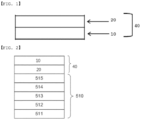
- FIG. 2 illustrates a state in which the surface protective film according to one embodiment of the present disclosure is attached on an encapsulation layer during the process of manufacturing an organic light emitting electronic device.
- the surface protective film of FIG. 1 according to one embodiment of the present disclosure is attached on an encapsulation layer (515) of an organic light emitting device (510) consecutively comprising glass (511), a plastic substrate (512), a thin film transistor (513), an organic light emitting diode (514) and an encapsulation layer (515) so that the adhesive film (20) and the encapsulation layer (515) face each other.
- the encapsulation layer may exhibit excellent moisture barrier properties and optical properties in the organic light emitting electronic device.
- the encapsulation layer may be formed as a stable encapsulation layer regardless of a type of the organic light emitting electronic device such as top emission or bottom emission.
- the encapsulation layer may comprise a single-layered or multilayered inorganic material layer.
- a method of forming the encapsulation layer common methods of forming an encapsulation layer known in the art may be used.
- Examples of the single-layered or multilayered inorganic material layer may comprise aluminum oxide-based, silicon nitride-based, silicon oxynitride-based and the like.
- the method for manufacturing an organic light emitting electronic device of the present application may further comprise peeling the surface protective film from the encapsulation layer; and laminating a touch screen panel and a cover window on the encapsulation layer.
- the surface protective film has an excellent antistatic function for the encapsulation layer when peeled from the encapsulation layer, which prevents attachment of foreign substances between the encapsulation layer and the touch screen when bonding the touch screen panel on the encapsulation layer, and thereby prevents device defects.
- the temperature was raised from room temperature (25°C) to 80°C, and, while maintaining the temperature, disappearance of the residual isocyanate group was identified by an IR spectrum, and the reaction was terminated and the resin was discharged.
- Preparation was made in the same manner as in Preparation Example 1 except that 20 parts of difunctional ester polyol and 80 parts of trifunctional ether polyol (PPG) were introduced.
- PPG trifunctional ether polyol
- OH/NCO functional group ratio, molecular weight, viscosity, polyol composition and content for Preparation Examples 1 to 8 and Comparative Preparation Examples 1 to 9 are as shown in the following Table 1.
- Table 1 OH/NCO Ratio Molecula r Weight (Mn) Visco sity (cPs) Polyol (Difunctional/ Trifunctional) Polyol Ratio (Difunctional/ Trifunctional) Preparation Example 1 1.5 100,000 4,200 PPG/PPG 10/90 Preparation Example 2 1.5 85,000 3,500 PPG/PPG 20/80 Preparation Example 3 1.5 95,000 3,800 PPG+EO/PPG 20/80 Preparation Example 4 1.4 110,000 4,500 PPG+EO/PPG 20/80 Preparation Example 5 1.5 123,000 4900 PPG/PPG+EO 20/80 Preparation Example 6 1.5 105,000 4100 PPG/PPG+EO 30/70 Preparation Example 7 1.6 100,000 3900 PPG+EO/PPG+EO 20/80 Preparation Example 8 1.65
- Low-rate and high-rate peel strength of the adhesive layers according to Preparation Examples 1 to 8 and Comparative Preparation Examples 1 to 9 are as shown in the following Table 2.
- coating was not conducted in Comparative Preparation Example 6 due to gelation in the resin preparation process, and the adhesive compositions of Comparative Preparation Example 7, Comparative Preparation Example 8 and Comparative Preparation Example 9 each had viscosity outside the range of the composition itself, and coating was not conducted due to poor coatability, and as a result, high-rate peel strength and low-rate peel strength themselves were not able to be measured.
Landscapes
- Chemical & Material Sciences (AREA)
- Organic Chemistry (AREA)
- Health & Medical Sciences (AREA)
- Chemical Kinetics & Catalysis (AREA)
- Medicinal Chemistry (AREA)
- Polymers & Plastics (AREA)
- Engineering & Computer Science (AREA)
- Manufacturing & Machinery (AREA)
- Microelectronics & Electronic Packaging (AREA)
- Adhesives Or Adhesive Processes (AREA)
- Adhesive Tapes (AREA)
- Laminated Bodies (AREA)
- Electroluminescent Light Sources (AREA)
Abstract
Description
- This application claims priority to and the benefits of
Korean Patent Application No. 10-2020-0113642, filed with the Korean Intellectual Property Office on September 7, 2020 - The present application relates to a polyurethane-based adhesive composition, a surface protective film comprising the same, a method for preparing a surface protective film, and a method for manufacturing an organic light emitting electronic device.
- With recent development of display-relating technologies, display devices transformable at the stage of use such as folding, rolling in a roll shape or stretching like a rubber band have been researched and developed. These displays may be transformed into various shapes, and therefore, may satisfy demands for both a larger display at the stage of use and a smaller display for portability.
- In addition, portable terminals such as mobile communication terminals (wireless terminal), personal digital assistants (PDA), portable multimedia players (PMP) and electronic notebooks tend to be smaller in sizes for portability.
- However, users want to receive information from various contents such as text information, videos and games through a screen of a portable terminal, and therefore require an enlarged or widened screen regarding the size of a display screen. However, satisfying both requirements has limits since a smaller portable terminal leads to a reduction in the size of a display screen.
- Existing display devices have used non-transformable displays (unbreakable display), however, in order to overcome such limits, transformable displays, that is, flexible displays such as curved displays, bended displays, foldable displays and rollable displays have been developed.
- A plastic substrate used as a substrate material of a flexible display has a problem of significantly low gas barrier properties (moisture, oxygen and the like). In view of the above, a barrier film employing various materials and structures have been formed on the substrate in the art in order to improve problems of the plastic substrate.
- However, as existing barrier films are not used any more recently, development of a surface protective film for a process capable of protecting a thin film encapsulation (TFE) layer during a manufacturing process of a flexible optical device has been required. A surface protective film for a process is a film temporarily protecting a thin film encapsulation layer, and is attached to the thin film encapsulation layer during the process to prevent contamination or damage on the thin film encapsulation layer surface during the process, and is removed when the process is finished.
- Properties required for the surface protective film is that, first, an adhesive provided on the surface protective film needs to be well-attached on an adherend surface and needs to prevent damage on the adherend at the time by being removed with low peel strength during the removing step. Second, adherend contamination needs to be prevented by having little adhesive residue after removing the surface protective film.
- Adhesives used in a surface protective film generally comprise acryl-based adhesives, silicone-based adhesives, urethane-based adhesives, and the like. Acryl-based adhesives have excellent adhesive strength, but have poor re-peelability after adhesion, which may cause a problem of damaging an adherend or leaving residues on an adherend, and silicone-based adhesives readily cause adherend contamination although low-rate and high-rate peel strength are all superior after adhering to an adherend.
- Accordingly, development of a novel adhesive composition and a protective film comprising the same has been required in order to resolve such problems.
-
Japanese Patent Application Laid-Open Publication No. 2006-299283 - The present application is directed to providing a polyurethane-based adhesive composition, a surface protective film comprising the same, and a method for preparing a surface protective film.
- One embodiment of the present application provides a polyurethane-based adhesive composition comprising a polyurethane polymer comprising a difunctional polyol and a trifunctional polyol; and an isocyanate-based crosslinking agent, wherein the adhesive composition has viscosity of greater than or equal to 1,000 cPs and less than or equal to 10,000 cPs under a condition of 25°C and relative humidity of 60%, the difunctional polyol is included in 5 parts by weight to 40 parts by weight based on 100 parts by weight of the polyurethane polymer, and the trifunctional polyol is included in 60 parts by weight to 95 parts by weight based on 100 parts by weight of the polyurethane polymer.
- Another embodiment of the present application provides a surface protective film comprising a base film; and an adhesive film comprising the polyurethane-based adhesive composition according to the present application or a cured material thereof provided on one surface of the base film.
- Another embodiment of the present application provides a method for preparing a surface protective film, the method comprising preparing the polyurethane-based adhesive composition according to the present application; adding a curing agent to the polyurethane-based adhesive composition; and coating the polyurethane-based adhesive composition on a base film.
- Lastly, one embodiment of the present application provides a method for manufacturing an organic light emitting electronic device, the method comprising attaching the adhesive film of the surface protective film according to the present application on an encapsulation layer of an organic light emitting device.
- In a polyurethane-based adhesive composition according to one embodiment of the present application, a content portion of a difunctional polyol and a trifunctional polyol satisfies a specific range, and urethane crosslinking density can be effectively controlled by controlling a hydroxyl group of the urethane polyol.
- In addition, by viscosity of the adhesive composition satisfying a specific range, excellent coatability with a small thickness variation for a base can be obtained during adhesion coating. An adhesive film comprising the same later has favorable adhesion to an adherend, has excellent adhesive strength, and also has excellent re-peelability at a high rate while having favorable re-peelability at a low rate. Accordingly, the adherend can be protected due to superior adhesive strength with the adherend during the process, and adherend contamination can be prevented as well due to less residues of the adhesive film when removed.
- In addition, a surface protective film according to one embodiment of the present application has a small amount of adhesive film residues on an adherend surface even when removing the surface protective film from the adherend, and damage or contamination on the adherend surface can be prevented after removing the surface protective film.
- In addition, the surface protective film of the present disclosure maintains adhesive strength with an adherend even when raising a temperature, and delamination of the surface protective film from the adherend at a high temperature can be prevented.
-
-
FIG. 1 is a diagram illustrating a side view of a surface protective film according to one embodiment of the present application. -
FIG. 2 illustrates one embodiment in which the surface protective film according to one embodiment of the present disclosure is attached to an organic light emitting device (510) . -
- 10:
- Base Film
- 20:
- Adhesive Film
- 40:
- Surface Protective Film
- 510:
- Organic Light Emitting Device
- 511:
- Glass
- 512:
- Plastic Substrate
- 513:
- Thin Film Transistor
- 514:
- Organic Light Emitting Diode
- 515:
- Encapsulation Layer
- Hereinafter, the present specification will be described in more detail.
- Before describing the present disclosure, several terms will be defined first.
- In the present specification, a description of a certain part "including" certain constituents means capable of further comprising other constituents, and does not exclude other constituents unless particularly stated on the contrary.
- In the present specification, 'p to q' means a range of 'greater than or equal to p and less than or equal to q'.
- In the present specification, a (meth)acrylate comprises both an acrylate and a methacrylate.
- In the present specification, a polymer comprising a certain monomer as a monomer unit means the monomer participating in a polymerization reaction and being included in the polymer as a repeating unit. In the present specification, a polymer comprising a monomer is interpreted in the same manner as the polymer comprising the monomer as a monomer unit.
- In the present specification, it is understood that a 'polymer' is used in a broad sense comprising a copolymer unless specified as a 'homopolymer'.
- In the present specification, a "monomer unit" means that the corresponding compound is polymerized to form bonds in a polymer.
- In the present specification, a weight average molecular weight (Mw) and a number average molecular weight (Mn) are polystyrene converted molecular weights employing a monodispersed polystyrene polymer (standard sample) having various degrees of polymerization commercially available for measuring a molecular weight as a standard material, and measured by gel permeation chromatography (GPC). In the present specification, a molecular weight means a weight average molecular weight unless particularly described otherwise.
- The weight average molecular weight is one of average molecular weights not uniform in the molecular weights and using a molecular weight of a certain polymer material as a standard, and is a value obtained by averaging molecular weights of component molecular species of a polymer compound having molecular weight distribution by a weight fraction.
- The weight average molecular weight may be measured through a gel permeation chromatography (GPC) analysis.
- Hereinafter, embodiments of the present disclosure will be described in detail with reference to accompanying drawings so that those skilled in the art may readily implement the present disclosure. However, the present disclosure may be embodied in various different forms, and is not limited to the embodiments described herein.
- One embodiment of the present application provides a polyurethane-based adhesive composition comprising a polyurethane polymer comprising a difunctional polyol and a trifunctional polyol; and an isocyanate-based crosslinking agent, wherein the adhesive composition has viscosity of greater than or equal to 1,000 cPs and less than or equal to 10,000 cPs under a condition of 25°C and relative humidity of 60%, the difunctional polyol is included in 5 parts by weight to 40 parts by weight based on 100 parts by weight of the polyurethane polymer, and the trifunctional polyol is included in 60 parts by weight to 95 parts by weight based on 100 parts by weight of the polyurethane polymer.
- In the polyurethane-based adhesive composition according to one embodiment of the present application, a content portion of the difunctional polyol and the trifunctional polyol satisfies a specific range, and urethane crosslinking density may be effectively controlled by controlling a hydroxyl group of the urethane polyol.
- In addition, by the viscosity of the adhesive composition satisfying a specific range, excellent coatability with a small thickness variation for a base may be obtained during adhesion coating. An adhesive film comprising the same later has favorable adhesion to an adherend, has excellent adhesive strength, and also has excellent re-peelability at a high rate while having favorable re-peelability at a low rate. Accordingly, the adherend may be protected due to superior adhesive strength with the adherend during the process, and adherend contamination may be prevented as well due to less residues of the adhesive film when removed.
- In one embodiment of the present application, the difunctional polyol and the trifunctional polyol are particularly preferably an ether polyol.
- In one embodiment of the present application, the difunctional polyol may be included in 5 parts by weight to 40 parts by weight based on 100 parts by weight of the polyurethane polymer and the trifunctional polyol may be included in 60 parts by weight to 95 parts by weight based on 100 parts by weight of the polyurethane polymer.
- In one embodiment of the present application, the difunctional polyol may be included in 5 parts by weight to 40 parts by weight, preferably in 7 parts by weight to 35 parts by weight, and more preferably in 10 parts by weight to 30 parts by weight based on 100 parts by weight of the polyurethane polymer.
- In one embodiment of the present application, the trifunctional polyol may be included in 60 parts by weight to 95 parts by weight, preferably in 60 parts by weight to 90 parts by weight, and more preferably in 70 parts by weight to 90 parts by weight based on 100 parts by weight of the polyurethane polymer.
- The polyurethane-based adhesive composition according to the present application has a polyurethane polymer, and particularly, the difunctional polyol and the trifunctional polyol in the polyurethane polymer satisfy the above-mentioned weight ranges. Particularly, when the difunctional polyol satisfies the above-mentioned weight range, suitable peel strength is obtained since adhesion and flexibility are provided to two-dimensional crosslinking and an adherend later, and the crosslinking distance is suitable, and when the trifunctional polyol satisfies the above-mentioned weight range, re-peel strength is reduced by increasing the degree of three-dimensional crosslinking, and gelation of the adhesive composition comprising the same may be prevented by adjusting the molecular weight range to a specific range.
- In the polyurethane-based adhesive composition provided in one embodiment of the present application, the hydroxyl group of the polyurethane polymer and the isocyanate functional group have a molar ratio (-OH/NCO) of greater than or equal to 1.3 and less than or equal to 1.7.
- In another embodiment, the hydroxyl group of the polyurethane polymer and the isocyanate functional group have a molar ratio (-OH/NCO) of greater than or equal to 1.3 and less than or equal to 1.7, preferably greater than or equal to 1.35 and less than or equal to 1.7, and more preferably greater than or equal to 1.4 and less than or equal to 1.65.
- In the present application, the functional group is also expressed as a functional atomic group, and may mean, in a group of organic compounds having common chemical properties, a common atomic group or bonding mode causing the properties.
- In other words, in the present application, an expression such as difunctional or trifunctional may mean the number of functional groups having common chemical properties in a specific molecule, and specifically, difunctional means comprising two functional groups and trifunctional means comprising three functional groups.
- In the present application, the polyol is, as a material obtained by reacting an initiator such as a multifunctional alcohol or aromatic amine having two or more hydroxyl groups (-OH) or amine groups (-NH2) in the molecule with propylene oxide (PO) or ethylene oxide (EO) under a specific condition, a material preparing a polyurethane polymer together with an isocyanate, and the polyol may mean a material having two functional groups or three functional groups by reacting PPG (propylene glycol), PTMEG (tetramethylene glycol) or PEG (ethylene glycol) polyester with propylene oxide (PO) or ethylene oxide (EO).
- In the present application, by the functional group ratio of the polyurethane polymer satisfying the above-mentioned range, gelation of the adhesive composition may be prevented and molecular weight and viscosity ranges may be properly adjusted, and as a result, properties suitable for adhesive composition coating are obtained. In other words, in one embodiment of the present application, the functional group ratio of the polyurethane polymer is adjusted to have proper molecular weight and viscosity, and the adjustment factor is dependent on content and type of the solvent or the crosslinking agent included in the adhesive composition.
- In one embodiment of the present application, the adhesive composition may have viscosity of greater than or equal to 1,000 cPs and less than or equal to 10,000 cPs under a condition of 25°C and relative humidity of 60%.
- In the present application, viscosity expresses a quantity indicating the magnitude of difficulty in the flow of a fluid, that is, a degree of stickiness, and when a fluid is flowing, shear force per unit area acting between adjacent fluid layers is proportional to the velocity gradient at the position, and this proportional constant is referred to as viscosity. In other words, in the present application, viscosity is internal resistance when a fluid flows, and a method of expressing viscosity comprises kinematic viscosity, absolute viscosity and the like.
- In one embodiment of the present application, the viscosity may be measured with low viscosity to high viscosity liquid samples at a constant temperature using a HB-type rotational or vibrational viscometer manufactured by Brookfield Ametek.
- Specifically, the viscosity may be measured using a Brookfield HB viscometer at a temperature of 25°C using No. 40 and No. 52 spindles provided by the Brookfield, and when measuring the viscosity, the rotational rate may be adjusted so that the torque value, a force applied to the composition, comes between 20% to 60%.
- In one embodiment of the present application, the viscosity of the adhesive composition may satisfy a range of greater than or equal to 1,000 cPs and less than or equal to 10,000 cPs, preferably greater than or equal to 1,500 cPs and less than or equal to 8,000 cPs, and more preferably greater than or equal to 2,000 cPs and less than or equal to 7,000 cPs under a condition of 25°C and relative humidity of 60%.
- In the present application, when the viscosity of the adhesive composition is outside the above-mentioned lower limit, the adhesive composition flows due to low viscosity when coating later making coating difficult, and when the viscosity is outside the above-mentioned upper limit, introducing the coating solution using a pump is difficult in mass production lowering productivity of the adhesive film.
- In one embodiment of the present application, the viscosity basically increases when the molecular weight increases, and the value increases as the ratio of the trifunctional polyol included in the adhesive composition increases, and accordingly, a main purpose of the present disclosure is deriving the viscosity range as above and a molecular weight range to described later by the difunctional polyol and the trifunctional polyol in the polyurethane polymer satisfying the above-mentioned specific weight ranges, and the functional group ratio (-OH/NCO) satisfying the specific range in the polyurethane-based adhesive composition according to the present application.
- In the adhesive composition provided in one embodiment of the present application, the polyurethane polymer comprises a solvent, and the solvent is included in greater than or equal to 5 parts by weight and less than or equal to 35 parts by weight based on 100 parts by weight of a sum of the difunctional polyol and the trifunctional polyol.
- As the solvent included in the polyurethane polymer, toluene, methyl ethyl ketone (MEK), methyl isobutyl ketone (MIBK) or ethyl acetate (EAc) may be used, however, the solvent is not limited thereto as long as it is capable of dissolving specific materials, and resulting general organic solvents may be used.
- In another embodiment, the polyurethane polymer comprises a solvent, and the solvent may be included in greater than or equal to 5 parts by weight and less than or equal to 35 parts by weight, preferably greater than or equal to 7 parts by weight and less than or equal to 35 parts by weight, and more preferably greater than or equal to 10 parts by weight and less than or equal to 30 parts by weight based on 100 parts by weight of a sum of the difunctional polyol and the trifunctional polyol.
- The ratio of the functional groups of the polyurethane polymer is adjusted to have proper molecular weight and viscosity, and the adjustment factor is dependent on content and type of the solvent or the crosslinking agent included in the adhesive composition. Particularly, in preparing the polyurethane polymer as above, the viscosity of the adhesive composition itself is adjusted to a specific range by adjusting the solvent content range, and as a result, properties of excellent productivity and preventing gelation are obtained.
- In one embodiment of the present application, a non-volatile content of the polyurethane polymer may satisfy a range of greater than or equal to 65% and less than or equal to 95%.
- In another embodiment, the non-volatile content of the polyurethane polymer may be greater than or equal to 65% and less than or equal to 95%, greater than or equal to 70% and less than or equal to 95%, or greater than or equal to 75% and less than or equal to 90%.
- In the adhesive composition provided in one embodiment of the present application, the polyurethane polymer has a molecular weight of greater than or equal to 50,000 g/mol and less than or equal to 200,000 g/mol.
- In another embodiment, the molecular weight of the polyurethane polymer may satisfy a range of greater than or equal to 50,000 g/mol and less than or equal to 200,000 g/mol, preferably greater than or equal to 60,000 g/mol and less than or equal to 180,000 g/mol, and more preferably greater than or equal to 80,000 g/mol and less than or equal to 150,000 g/mol.
- By the molecular weight of the polyurethane polymer satisfying the above-mentioned range, the viscosity of the adhesive composition comprising the same satisfies a specific range, and as a result, properties of excellent productivity and preventing gelation are obtained.
- In other words, by the content portion of the difunctional polyol and the trifunctional polyol satisfying a specific range and the viscosity of the adhesive composition satisfying a specific range as well in the polyurethane-based adhesive composition according to the present application, an adhesive film comprising the same later has favorable adhesion to an adherend, has excellent adhesive strength, and also has excellent re-peelability at a high rate while having favorable re-peelability at a low rate. In addition, the adherend may be protected due to superior adhesive strength with the adherend during the process, and, while preventing adherend contamination due to less residues of the adhesive film when removed, excellent productivity is obtained in terms of production of the polyurethane polymer by preventing gelation and thereby having excellent coatability.
- In one embodiment of the present application, the polyurethane-based adhesive composition may have a glass transition temperature (Tg) value of 0°C or lower, and -60°C or higher and preferably -50°C or higher.
- In one embodiment of the present application, the glass transition temperature of the polyurethane-based adhesive composition may satisfy the above-mentioned range by adjusting a molar ratio (content ratio) of the polyurethane polymer and the isocyanate-based crosslinking agent included in the adhesive composition.
- By the glass transition temperature of the adhesive composition according to the present application satisfying the above-mentioned range, an adhesive film comprising the same has particularly excellent folding properties. In other words, by adjusting a molar ratio (content ratio) of the polyurethane polymer and the isocyanate-based crosslinking agent included in the adhesive composition to a specific range in the adhesive composition according to the present application, the glass transition temperature of the whole adhesive composition may be adjusted to a range of 0°C or lower, and accordingly, an adhesive film having particularly superior folding and bending properties may be formed.
- In the present specification, the glass transition temperature is a value obtained by, using a differential scanning calorimeter (DSC, Mettler Toledo), sealing approximately 10 mg of a sample in a dedicated pan, heating the sample under a constant temperature raising environment, and drawing endothermic and exothermic amounts of materials resulting from a phase change depending on a temperature.
- Specifically, the glass transition temperature is a nominal value described in literatures, catalogues and the like, or a value calculated based on the following General Formula (1) (Fox formula).

- In General Formula (1), Tg represents a glass transition temperature (unit: K) of Polymer A, Tgi (i=1, 2, ... n) represents a glass transition temperature (unit: K) when Monomer i forms a homopolymer, and Wi (i=1, 2, ... n) represents a mass fraction in all monomer components of Monomer i.
- General Formula (1) means a calculation formula when Polymer A comprises n types of monomer components of Monomer 1, Monomer 2, ..., Monomer n.
- General Formula (1) is a case of an acrylic resin based on an acrylic monomer, however, measurements may be conducted in a similar manner as a glass transition temperature or the like of a polymer known as an urethane resin as in the disclosure of the present application.
- In one embodiment of the present application, as for the glass transition temperature of the adhesive composition, a content of each monomer may be estimated through a component analysis, and the glass transition temperature may be calculated therefrom based on General Formula (1) (Fox formula).
- In the adhesive composition provided in one embodiment of the present application, the polyurethane-based adhesive composition further comprises one or more selected from the group consisting of a solvent, a curing agent, a dispersant, a photoinitiator, a thermal initiator, a silane coupling agent, a plasticizer, a tackifier and an antistatic agent.
- In one embodiment of the present application, the crosslinking agent may comprise a crosslinking compound, and as the crosslinking agent, an isocyanate-based crosslinking agent may be used, and those known in the art may be used.
- As the isocyanate crosslinking agent, any suitable multifunctional isocyanate compound commonly used in the art may be selected and used as long as it is a compound usable in a urethanization reaction.
- Examples of the multifunctional isocyanate compound may comprise a multifunctional aliphatic-based isocyanate, a multifunctional alicyclic-based isocyanate, a multifunctional aromatic-based isocyanate compound, a trimethylol propane adduct obtained by modifying polyisocyanate with a trifunctional isocyanate, a biuret body obtained by reacting polyisocyanate with water, a trimer having an isocyanurate ring and the like, but are not limited thereto.
- Examples of the multifunctional aliphatic-based isocyanate compound may comprise trimethylene diisocyanate, tetramethylene diisocyanate, pentamethylene diisocyanate, hexamethylene diisocyanate, 1,2-propylene diisocyanate, 1,3-butylene diisocyanate, dodecamethylene diisocyanate, 2,4,4-trimethylhexamethylene diisocyanate and the like, but are not limited thereto.
- Examples of the multifunctional alicyclic-based isocyanate compound may comprise isophorone diisocyanate (IPDI), 1,4-cyclohexane diisocyanate (CHDI), 4,4'-dicyclohexylmethane diisocyanate (HMDI), bis(isocyanatomethyl)cyclohexane (HXDI) and the like, but are not limited thereto.
- Examples of the multifunctional aromatic-based isocyanate compound may comprise toluene 2,4-diisocyanate (TDI), toluene 2,6-diisocyanate (TDI), 4,4'-methylene diphenyl diisocyanate (MDI), 2,4'-methylene diphenyl diisocyanate (MDI), polymeric methylene diphenyl diisocyanate (PMDI), p-phenylene diisocyanate (PDI), m-phenylene diisocyanate (PDI), naphthalene 1,5-diisocyanate (NDI), naphthalene 2,4-diisocyanate (NDI), p-xylylene diisocyanate (XDI), 1,3-bis(1-isocyanato-1-methylethyl)benzene (TMXDI) and the like, but are not limited thereto.
- In one embodiment of the present specification, two or more types of the isocyanate compound may be mixed to the adhesive composition, and herein, type and content of the two or more types of the isocyanate compound may be properly selected. For example, as the isocyanate compound included in the adhesive composition, the multifunctional aromatic-based isocyanate compound and the multifunctional aliphatic-based isocyanate compound may be mixed and used.
- As the antistatic agent, known material may be used to accomplish target effects, and considering purposes of the present application, a suitable antistatic composition may be used. For example, the antistatic agent may comprise one selected from the group consisting of acryl-based resins, urethane-based resins, urethane-acryl-based copolymers, ester-based resins, ether-based resins, amide-based resins, epoxy-based resins and melamine resins, or a mixture thereof, but is not limited thereto.
- In one example, the antistatic composition may comprise a conductive material. The conductive material may comprise a conductive polymer or carbon nanotubes, but is not limited thereto.
- The conductive polymer may comprise, for example, polyaniline-based, polypyrrole-based, polythiophene-based, a derivative or copolymer thereof, but is not limited thereto.
- The carbon nanotube may have a tube shape produced by rolling a graphite plate shape formed by connecting hexagonal rings formed with 6 carbon atoms to each other. The carbon nanotube has excellent rigidity and electrical conductivity, and when included in the antistatic composition of the surface protective film, hardness may increase, and an antistatic function may be enhanced.
- In addition, as the thermal initiator, those known in the art may be used.
- As the solvent, toluene, methyl ethyl ketone (MEK), methyl isobutyl ketone (MIBK) or ethyl acetate (EAc) may be used, however, the solvent is not limited thereto as long as it is capable of dissolving specific materials, and resulting general organic solvents may be used.
- One embodiment of the present application provides a surface protective film comprising a base film; and an adhesive film comprising the polyurethane-based adhesive composition or a cured material thereof provided on one surface of the base film.
- In the present application, the meaning of the adhesive film comprising the polyurethane-based adhesive composition may comprise the adhesive composition as it is.
- In the present application, the meaning of the adhesive film comprising the polyurethane-based adhesive composition may comprise the adhesive composition after drying.
- In the present application, the meaning of the adhesive film comprising the polyurethane-based adhesive composition may comprise the adhesive composition after thermal curing.
- In the present application, the meaning of the adhesive film comprising the polyurethane-based adhesive composition may comprise the adhesive composition after photocuring.
- In the surface protective film provided in one embodiment of the present application, low-rate peel strength is 5 gf/inch or greater when bonding one surface of the adhesive film to a glass substrate and then peeling at a peeling angle of 180° and a rate of 1.8 m/min, and high-rate peel strength is 50 gf/inch or less when bonding one surface of the adhesive film to a glass substrate and peeling at a peeling angle of 180° and a rate of 20 m/min.
- In the present application, the adhesive film comprising the polyurethane-based adhesive composition has excellent re-peel strength at a high rate as well as having favorable re-peel strength at a low rate.
- In another embodiment, low-rate peel strength may be 5 gf/inch or greater, preferably 5.5 gf/inch or greater and more preferably 6 gf/inch or greater when bonding one surface of the adhesive film to a glass substrate, and peeling at a peeling angle of 180° and a rate of 1.8 m/min.
- In another embodiment, low-rate peel strength may be 60 gf/inch or less, preferably 55 gf/inch or less and more preferably 40 gf/inch or less when bonding one surface of the adhesive film to a glass substrate, and peeling at a peeling angle of 180° and a rate of 1.8 m/min.
- In another embodiment, high-rate peel strength may be 50 gf/inch or less, preferably 48 gf/inch or less, and more preferably 45 gf/inch or less when bonding one surface of the adhesive film to a glass substrate, and peeling at a peeling angle of 180° and a rate of 20 m/min.
- In another embodiment, high-rate peel strength may be 10 gf/inch or greater, preferably 20 gf/inch or greater and more preferably 35 gf/inch or greater when bonding one surface of the adhesive film to a glass substrate, and peeling at a peeling angle of 180° and a rate of 20 m/min.
- By the high-rate peel strength and the low-rate peel strength satisfying the above-mentioned ranges, the adhesive film according to the present application has favorable adhesion to an adherend, has excellent adhesive strength, and also has excellent re-peelability at a high rate while having favorable re-peelability at a low rate. Accordingly, the adherend may be protected due to superior adhesive strength with the adherend during the process, and adherend contamination may be prevented as well due to less residues of the adhesive film when removed.
- The low-rate peel strength means a value obtained when cutting the adhesive film according to the present disclosure to a width of 1 inch, attaching to a glass substrate by going back and forth once using a 2 kg rubber roller, leaving unattended for 10 minutes or less at 23°C, and while peeling the adhesive film at an angle of 180° and a peeling rate of 1.8 m/min using a texture analyzer (manufactured by Stable Micro Systems).
- The high-rate peel strength means a value obtained when cutting the adhesive film according to the present disclosure to a width of 1 inch, attaching to a glass substrate by going back and forth once using a 2 kg rubber roller, leaving unattended for 10 minutes or less at 23°C, and while peeling the adhesive film at an angle of 180° and a peeling rate of 20 m/min using a texture analyzer (manufactured by Stable Micro Systems).
- In one embodiment of the present application, the base film may be selected from the group consisting of PET (polyethylene terephthalate), PC (polycarbonate), PI (polyimide), PEN (polyethylene naphthalate), PEEK (polyether ether ketone), PAR (polyarylate), PCO (polycyclic olefin), polynorbornene, PES (polyethersulphone) and COP (cycloolefin polymer).
- PET (polyethylene terephthalate), PEN (polyethylene naphthalate) and PAR (polyarylate) may be one type of polyester.
- In another embodiment, the base film may be PET (polyethylene terephthalate).
- In one embodiment of the present application, the base film may have a thickness of greater than or equal to 25 µm and less than or equal to 150 um, preferably greater than or equal to 38 um and less than or equal to 130 µm, and more preferably greater than or equal to 50 um and less than or equal to 125 µm.
- The base film referred to herein may be a transparent base film, and being transparent means having visible light (400 nm to 700 nm) transmittance of 80% or greater.
- When the base film has a thickness in the above-mentioned range, the laminated protective film may be thin-filmed, and an adherend may be sufficiently protected from external impact when used in a process later.
- In one embodiment of the present application, the adhesive film may have a thickness of greater than or equal to 10 um and less than or equal to 100 µm.
- In another embodiment, the adhesive film may have a thickness of greater than or equal to 10 um and less than or equal to 100 um, preferably greater than or equal to 12 um and less than or equal to 75 µm, and more preferably greater than or equal to 15 um and less than or equal to 50 um.
- When the adhesive film has a thickness in the above-mentioned range, air bubbles may be less generated inside the adhesive film, and accordingly, superior adhesive strength is obtained when adhering with an adherend, delamination does not occur, and a problem of dent does not occur.
- In one embodiment of the present application, an antistatic layer may be included on a surface of the base film in contact with the adhesive film. In this case, the antistatic hard coating layer may be included on a surface of the base film opposite to the surface in contact with the adhesive film.
- By the adhesive film according to one embodiment of the present disclosure being provided on one surface of the antistatic layer, the amount of accumulated static electricity may be reduced. In addition, since surface resistance of the adhesive film decreases, generation of static electricity on the adhesive film surface may be reduced when peeling the protective layer from the surface protective film.
- Accordingly, when removing the protective layer from the surface protective film in order to attach the adhesive film to an adherend surface, or when peeling the surface protective film from an adherend surface, foreign substances that may be attached to the adhesive film or the adherend by static electricity may be prevented. In addition, decline in the properties of the adherend surface may be prevented by preventing contamination on the adherend surface during the process.
- The term "antistatic layer' in the present specification means a layer for the purpose of suppressing generation of static electricity.
- The antistatic layer may be formed using known methods to achieve target effects. For example, the antistatic layer may be formed on one surface or both surfaces of the base layer using an inline coating method.
- In the present disclosure, the antistatic layer may be formed using a proper antistatic composition considering purposes of the present application. For example, the first antistatic layer may comprise one selected from the group consisting of acryl-based resins, urethane-based resins, urethane-acryl-based copolymers, ester-based resins, ether-based resins, amide-based resins, epoxy-based resins and melamine resins, or a mixture thereof, but is not limited thereto.
- In one example, the antistatic layer may comprise a conductive material. The conductive material may comprise a conductive polymer or carbon nanotubes, but is not limited thereto.
- The conductive polymer may comprise, for example, polyaniline-based, polypyrrole-based, polythiophene-based, a derivative or copolymer thereof, but is not limited thereto.
- The carbon nanotube may have a tube shape produced by rounding a graphite plate shape formed by connecting hexagonal rings formed with 6 carbons to each other. The carbon nanotube has excellent rigidity and electrical conductivity, and when used as the antistatic layer of the surface protective film, hardness of the antistatic layer increases, and an antistatic function may be enhanced.
- A thickness of the antistatic layer may be properly selected considering purposes of the present application, and the antistatic layer may have a thickness of 10 nm or greater; or 20 nm or greater. In one embodiment, the antistatic layer may have a thickness of 400 nm or less; 300 nm or less; or 100 nm or less. By the thickness of the antistatic layer satisfying a range of greater than or equal to 10 nm and less than or equal to 400 nm, excellent coatability is obtained in the base film.
- In one embodiment, surface resistance of the antistatic layer may be properly selected considering purposes of the present application. For example, surface resistance of the first antistatic layer may be each independently 104 Ω/sq or greater; 105 Ω/sq or greater; 106 Ω/sq or greater; 107 Ω/sq or greater; 108 Ω/sq or greater; or 109 Ω/sq or greater. For example, surface resistance of the antistatic layer may be each independently 5×10¹² Ω/sq or less; or 1011 Ω/sq or less. When the antistatic layer has surface resistance in the above-described range, the surface protective film may have an excellent antistatic function.
- In the protective film provided in one embodiment of the present application, the surface protective film has a thickness of greater than or equal to 35 um and less than or equal to 250 um.
- In another embodiment, the surface protective film may have a thickness of greater than or equal to 35 µm and less than or equal to 250 µm, preferably greater than or equal to 50 um and less than or equal to 200 µm, and more preferably greater than or equal to 60 um and less than or equal to 150 µm.
- When the surface protective film has a thickness in the above-mentioned range, a suitable thickness is obtained when applied to an adherend later, adhesive strength is not reduced, and a surface protective film having excellent reliability even when repeating folding/unfolding several times may be provided.
- In one embodiment of the present application, the adhesive film may be laminated in a plural number.
- The surface protective film provided in one embodiment of the present application further comprises a release sheet on a surface of the adhesive film opposite to the surface in contact with the base film.
- Including a release sheet on one surface of the adhesive film means providing a release sheet on a surface of the adhesive film opposite to the surface in contact with the base film.
- In one embodiment of the present application, a hydrophobic film may be used as the release sheet. The release sheet is a layer for protecting a very thin adhesive sheet and refers to a transparent layer attached on one surface of the adhesive film, and films having excellent mechanical strength, thermal stability, moisture barrier properties, isotropy and the like may be used. For example, acetate-based such as triacetyl cellulose (TAC), polyester-based, polyethersulphone-based, polycarbonate-based, polyamide-based, polyimide-based, polyolefin-based, cycloolefin-based, polyurethane-based and acryl-based resin films, and the like, may be used, however, the release sheet is not limited thereto as long as it is a commercially available silicone-treated release sheet.
- The release sheet is for protecting a surface for a process, and may all be removed when used.
- One embodiment of the present application provides a method for preparing a surface protective film, the method comprising preparing the polyurethane-based adhesive composition according to the present application; adding a curing agent to the polyurethane-based adhesive composition; and coating the polyurethane-based adhesive composition on a base film.
- In the method for preparing a surface protective film, descriptions on the polyurethane-based adhesive composition are the same as the descriptions provided above.
- The method for preparing a surface protective film provided in one embodiment of the present application further comprises, after the coating of the polyurethane-based adhesive composition on a base film, drying the polyurethane-based adhesive composition; and thermal curing the polyurethane-based adhesive composition.
- One embodiment of the present specification provides a method for manufacturing an organic light emitting electronic device.
- In one embodiment of the present specification, the method for manufacturing an organic light emitting electronic device comprises attaching the adhesive film of the surface protective film described above on an encapsulation layer of an organic light emitting device.
- In other words, the method for manufacturing an organic light emitting electronic device provided in the present specification comprises attaching, in a surface protective film comprising a base film; and an adhesive film comprising the polyurethane-based adhesive composition of the present application or a cured material thereof provided on one surface of the base film, the adhesive film of the protective film on an encapsulation layer of an organic light emitting device.
- In one embodiment, when the surface protective film further comprises a protective layer, the method for manufacturing an organic light emitting electronic device further comprises removing the protective layer from the surface protective film prior to the attaching of the adhesive layer on an encapsulation layer.
- In one embodiment of the present specification, the organic light emitting device consecutively comprises glass, a plastic substrate, a thin film transistor, an organic light emitting diode and an encapsulation layer.
-
FIG. 2 illustrates a state in which the surface protective film according to one embodiment of the present disclosure is attached on an encapsulation layer during the process of manufacturing an organic light emitting electronic device. When referring toFIG. 2 , the surface protective film ofFIG. 1 according to one embodiment of the present disclosure is attached on an encapsulation layer (515) of an organic light emitting device (510) consecutively comprising glass (511), a plastic substrate (512), a thin film transistor (513), an organic light emitting diode (514) and an encapsulation layer (515) so that the adhesive film (20) and the encapsulation layer (515) face each other. - The encapsulation layer may exhibit excellent moisture barrier properties and optical properties in the organic light emitting electronic device. In addition, the encapsulation layer may be formed as a stable encapsulation layer regardless of a type of the organic light emitting electronic device such as top emission or bottom emission.
- In one embodiment, the encapsulation layer may comprise a single-layered or multilayered inorganic material layer. As a method of forming the encapsulation layer, common methods of forming an encapsulation layer known in the art may be used.
- Examples of the single-layered or multilayered inorganic material layer may comprise aluminum oxide-based, silicon nitride-based, silicon oxynitride-based and the like.
- The method for manufacturing an organic light emitting electronic device of the present application may further comprise peeling the surface protective film from the encapsulation layer; and laminating a touch screen panel and a cover window on the encapsulation layer. The surface protective film has an excellent antistatic function for the encapsulation layer when peeled from the encapsulation layer, which prevents attachment of foreign substances between the encapsulation layer and the touch screen when bonding the touch screen panel on the encapsulation layer, and thereby prevents device defects.
- Hereinafter, the present disclosure will be described in detail with reference to examples so that those having common knowledge in the art may readily implement the present disclosure. However, the present disclosure may be embodied in various different forms, and is not limited to the examples described herein.
- To a 5-neck 2 L reactor, 10 parts of difunctional ether polyol (adding 200 of EO to PPG, trade name SC2204 of KPX Chemical) and 90 parts of trifunctional ether polyol (trade name SC3314 of KPX Chemical) were introduced with respect to 100 parts by weight of polyol, and H12MDI (manufactured by Evonik Industries), an isocyanate, was introduced thereto in an amount such that OH/NCO (functional group molar ratio) is 1.5, and then 40 parts by weight of toluene was introduced thereto.
- The temperature was raised from room temperature (25°C) to 80°C, and, while maintaining the temperature, disappearance of the residual isocyanate group was identified by an IR spectrum, and the reaction was terminated and the resin was discharged.
- Preparation was made in the same manner as in Preparation Example 1 except that 20 parts of difunctional ether polyol (PPG) and 80 parts of trifunctional ether polyol (PPG) were introduced. (Non-volatile content 710)
- Preparation was made in the same manner as in Preparation Example 1 except that 20 parts of difunctional ether polyol (PPG+EO) and 80 parts of trifunctional ether polyol (PPG) were introduced. (Non-volatile content 710)
- Preparation was made in the same manner as in Preparation Example 3 except that the amount of H12MDI, an isocyanate, was changed such that OH/NCO is 1.45. (Non-volatile content 710)
- Preparation was made in the same manner as in Preparation Example 1 except that 20 parts of difunctional ether polyol (PPG) and 80 parts of trifunctional ether polyol (PPG+EO) were introduced. (non-volatile content 710)
- Preparation was made in the same manner as in Preparation Example 1 except that 30 parts of difunctional ether polyol (PPG) and 70 parts of trifunctional ether polyol (PPG+EO) were introduced. (non-volatile content 710)
- Preparation was made in the same manner as in Preparation Example 1 except that 20 parts of difunctional ether polyol (PPG+EO) and 80 parts of trifunctional ether polyol (PPG) were introduced, and the amount of H12MDI, an isocyanate, was changed such that OH/NCO is 1.6. (non-volatile content 710)
- Preparation was made in the same manner as in Preparation Example 7 except that the amount of H12MDI, an isocyanate, was changed such that OH/NCO is 1.65. (Non-volatile content 710)
- Preparation was made in the same manner as in Preparation Example 1 except that 70 parts of difunctional ether polyol (PPG) and 30 parts of trifunctional ether polyol (PPG) were introduced, and OH/NCO was adjusted to 1.2. (Non-volatile content 710)
- Preparation was made in the same manner as in Comparative Preparation Example 1 except that 80 parts of difunctional ether polyol (PPG) and 20 parts of trifunctional ether polyol (PPG) were introduced. (Non-volatile content 710)
- Preparation was made in the same manner as in Comparative Preparation Example 1 except that 90 parts of difunctional ether polyol (PPG) and 10 parts of trifunctional ether polyol (PPG) were introduced. (Non-volatile content 710)
- Preparation was made in the same manner as in Preparation Example 1 except that 20 parts of difunctional ester polyol and 80 parts of trifunctional ether polyol (PPG) were introduced.
- Preparation was made in the same manner as in Preparation Example 1 except that 100 parts of difunctional ether polyol (PPG+EO) was introduced, and OH/NCO was adjusted to 1.1. (Non-volatile content 710)
- Preparation was made in the same manner as in Preparation Example 1 except that 100 parts of difunctional ether polyol (PPG+EO) was introduced. (Non-volatile content 710)
- Preparation was made in the same manner as in Comparative Preparation Example 5 except that OH/NCO was adjusted to 1.3.
- Preparation was made in the same manner as in Preparation Example 3 except that OH/NCO was adjusted to 1.2. (Non-volatile content 710)
- Preparation was made in the same manner as in Preparation Example 1 except that toluene was introduced in 100 parts by weight. (Non-volatile content 50%)
- With respect to 100 parts by weight (based on solid content) of each of Preparation Examples 1 to 8 and Comparative Preparation Examples 1 to 9, 15 parts by weight of a multifunctional isocyanate curing agent was introduced, and the result was sufficiently stirred, coated on a polyester (PET) film, and dried for 3 minutes in a 140°C oven to prepare a polyurethane adhesive layer having a thickness of 75 µm. After that, the result was aged for 120 hours in a 50°C oven.
- In preparing the adhesive layer as above, coating was not conducted in Comparative Preparation Example 6 due to gelation in the resin preparation process, and the adhesive composition of each of Comparative Preparation Example 7 and Comparative Preparation Example 8 had viscosity outside the range of the composition itself, and coating was not conducted due to poor coatability.
- OH/NCO functional group ratio, molecular weight, viscosity, polyol composition and content for Preparation Examples 1 to 8 and Comparative Preparation Examples 1 to 9 are as shown in the following Table 1.
[Table 1] OH/NCO Ratio Molecula r Weight (Mn) Visco sity (cPs) Polyol (Difunctional/ Trifunctional) Polyol Ratio (Difunctional/ Trifunctional) Preparation Example 1 1.5 100,000 4,200 PPG/PPG 10/90 Preparation Example 2 1.5 85,000 3,500 PPG/PPG 20/80 Preparation Example 3 1.5 95,000 3,800 PPG+EO/PPG 20/80 Preparation Example 4 1.4 110,000 4,500 PPG+EO/PPG 20/80 Preparation Example 5 1.5 123,000 4900 PPG/PPG+EO 20/80 Preparation Example 6 1.5 105,000 4100 PPG/PPG+EO 30/70 Preparation Example 7 1.6 100,000 3900 PPG+EO/PPG+EO 20/80 Preparation Example 8 1.65 87,000 3200 PPG+EO/PPG+EO 20/80 Comparative Preparation Example 1 1.2 110,000 5400 PPG/PPG 70/30 Comparative Preparation Example 2 1.2 95,000 5000 PPG/PPG 80/20 Comparative Preparation Example 3 1.5 65,000 5500 PPG/PPG 90/10 Comparative Preparation Example 4 1.5 117,000 4900 Ester/PPG 20/80 Comparative Preparation Example 5 1.1 43,000 1900 PPG+EO 100/0 Comparative Preparation Example 6 1.5 - - PPG 0/100 Comparative Preparation Example 7 1.3 32,000 750 PPG+EO 100/0 Comparative Preparation Example 8 1.2 210,000 13,50 0 PPG+EO/PPG 20/80 Comparative Preparation Example 9 1.5 60,000 800 PPG/PPG 10/90 - Low-rate and high-rate peel strength of the adhesive layers according to Preparation Examples 1 to 8 and Comparative Preparation Examples 1 to 9 are as shown in the following Table 2. In addition, coating was not conducted in Comparative Preparation Example 6 due to gelation in the resin preparation process, and the adhesive compositions of Comparative Preparation Example 7, Comparative Preparation Example 8 and Comparative Preparation Example 9 each had viscosity outside the range of the composition itself, and coating was not conducted due to poor coatability, and as a result, high-rate peel strength and low-rate peel strength themselves were not able to be measured.
[Table 2] Low-Rate Peel Strength (1.8 m/min) High-Rate Peel Strength (20 m/min) Example 1 (Preparation Example 1) 17.7 34.2 Example 2 (Preparation Example 2) 23.2 42.9 Example 3 (Preparation Example 3) 15.9 31.0 Example 4 (Preparation Example 4) 19.3 37.2 Example 5 (Preparation Example 5) 16.1 33.6 Example 6 (Preparation Example 6) 21.1 38.4 Example 7 (Preparation Example 7) 13.7 28.1 Example 8 (Preparation Example 8) 16.5 32.4 Comparative Example 1 (Comparative Preparation Example 1) 73.9 130.5 Comparative Example 2 (Comparative Preparation Example 2) 73.9 130.5 Comparative Example 3 (Comparative Preparation Example 3) 89.1 153.6 Comparative Example 4 (Comparative Preparation Example 4) 35.1 70.8 Comparative Example 5 (Comparative Preparation Example 5) 110.3 183.7 Comparative Example 6 (Comparative Preparation Example 6) Coating not Conducted Due to Gelation Coating not Conducted Due to Gelation Comparative Example 7 (Comparative Preparation Example 7) Unable to Coat Unable to Coat Comparative Example 8 (Comparative Preparation Example 8) Unable to Coat Unable to Coat Comparative Example 9 (Comparative Preparation Example 9) Unable to Coat Unable to Coat - As seen from Table 1 and Table 2, it was seen that, in the polyurethane-based adhesive compositions of Examples 1 to 8, the content portion of the difunctional polyol and the trifunctional polyol satisfies a specific range, and urethane crosslinking density was effectively controlled by controlling the hydroxyl group of the urethane polyol.
- In addition, it was identified that, by the adhesive composition viscosity satisfying a specific range, excellent coatability with a small thickness variation for the base was obtained during adhesion coating, and particularly, it was identified that the adhesive compositions of Comparative Preparation Example 7 to Comparative Preparation Example 9 had viscosity outside the range, and coating was not conducted due to poor coatability.
- With the polyurethane-based adhesive composition of each of Examples 1 to 8, it was identified that adherend damage was minimized when attaching to the adherend and re-peeling by reducing re-peelability at a high rate.
Claims (17)
- A polyurethane-based adhesive composition comprising:a polyurethane polymer comprising a difunctional polyol and a trifunctional polyol; andan isocyanate-based crosslinking agent,wherein the adhesive composition has viscosity of greater than or equal to 1,000 cPs and less than or equal to 10,000 cPs under a condition of 25°C and relative humidity of 60%;the difunctional polyol is included in 5 parts by weight to 40 parts by weight based on 100 parts by weight of the polyurethane polymer; andthe trifunctional polyol is included in 60 parts by weight to 95 parts by weight based on 100 parts by weight of the polyurethane polymer.
- The polyurethane-based adhesive composition of Claim 1, wherein the polyurethane polymer comprises a solvent, and the solvent is included in greater than or equal to 5 parts by weight and less than or equal to 35 parts by weight based on 100 parts by weight of a sum of the difunctional polyol and the trifunctional polyol.
- The polyurethane-based adhesive composition of Claim 1, wherein the hydroxyl group of the polyurethane polymer and the isocyanate functional group have a molar ratio (-OH/NCO) of greater than or equal to 1.3 and less than or equal to 1.7.
- The polyurethane-based adhesive composition of Claim 1, wherein the polyurethane polymer has a molecular weight of greater than or equal to 50,000 g/mol and less than or equal to 200,000 g/mol.
- The polyurethane-based adhesive composition of Claim 1, which has a glass transition temperature (Tg) value of 0°C or lower.
- The polyurethane-based adhesive composition of Claim 1, further comprising one or more selected from the group consisting of a solvent, a curing agent, a dispersant, a photoinitiator, a thermal initiator, a silane coupling agent, a plasticizer, a tackifier and an antistatic agent.
- A surface protective film comprising:a base film; andan adhesive film comprising the polyurethane-based adhesive composition of any one of Claims 1 to 6 or a cured material thereof provided on one surface of the base film.
- The surface protective film of Claim 7, wherein low-rate peel strength is 5 gf/inch or greater when bonding one surface of the adhesive film to a glass substrate and then peeling at a peeling angle of 180° and a rate of 1.8 m/min, and high-rate peel strength is 50 gf/inch or less when bonding one surface of the adhesive film to a glass substrate and peeling at a peeling angle of 180° and a rate of 20 m/min.
- The surface protective film of Claim 7, wherein the base film has a thickness of greater than or equal to 25 um and less than or equal to 150 um.
- The surface protective film of Claim 7, wherein the adhesive film has a thickness of greater than or equal to 10 µm and less than or equal to 100 um.
- The surface protective film of Claim 7, further comprising a release sheet on a surface of the adhesive film opposite to the surface in contact with the base film.
- The surface protective film of Claim 7, wherein the base film is selected from the group consisting of PET (polyethylene terephthalate), PC (polycarbonate), PI (polyimide), PEN (polyethylene naphthalate), PEEK (polyether ether ketone), PAR (polyarylate), PCO (polycyclic olefin), polynorbornene, PES (polyethersulphone) and COP (cycloolefin polymer).
- A method for preparing a surface protective film, the method comprising:preparing the polyurethane-based adhesive composition of any one of Claims 1 to 6;adding a curing agent to the polyurethane-based adhesive composition; andcoating the polyurethane-based adhesive composition on a base film.
- The method for preparing a surface protective film of Claim 13, comprising:drying the polyurethane-based adhesive composition; andthermal curing the polyurethane-based adhesive composition,after the coating of the polyurethane-based adhesive composition on a base film.
- A method for manufacturing an organic light emitting electronic device, the method comprising:
attaching, in a surface protective film comprising a base film; and an adhesive film comprising the polyurethane-based adhesive composition of any one of Claims 1 to 6 or a cured material thereof provided on one surface of the base film, the adhesive film of the surface protective film on an encapsulation layer of an organic light emitting device. - The method for manufacturing an organic light emitting electronic device of Claim 15, wherein the organic light emitting device consecutively comprises glass, a plastic substrate, a thin film transistor, an organic light emitting diode and an encapsulation layer.
- The method for manufacturing an organic light emitting electronic device of Claim 15, further comprising:peeling the surface protective film from the encapsulation layer; andlaminating a touch screen panel and a cover window on the encapsulation layer.
Applications Claiming Priority (2)
| Application Number | Priority Date | Filing Date | Title |
|---|---|---|---|
| KR20200113642 | 2020-09-07 | ||
| PCT/KR2021/012095 WO2022050808A1 (en) | 2020-09-07 | 2021-09-07 | Polyurethane-based adhesive composition, surface protection film comprising same, method for manufacturing surface protection film, and method for manufacturing organic light-emitting electronic device |
Publications (2)
| Publication Number | Publication Date |
|---|---|
| EP4130189A1 true EP4130189A1 (en) | 2023-02-08 |
| EP4130189A4 EP4130189A4 (en) | 2023-11-01 |
Family
ID=80491350
Family Applications (1)
| Application Number | Title | Priority Date | Filing Date |
|---|---|---|---|
| EP21864765.9A Pending EP4130189A4 (en) | 2020-09-07 | 2021-09-07 | POLYURETHANE-BASED ADHESIVE COMPOSITION, SURFACE PROTECTION FILM COMPRISING SAME, METHOD FOR MANUFACTURING SURFACE PROTECTION FILM, AND METHOD FOR MANUFACTURING ORGANIC ELECTROLUMINESCENT DEVICE |
Country Status (7)
| Country | Link |
|---|---|
| US (1) | US12590229B2 (en) |
| EP (1) | EP4130189A4 (en) |
| JP (1) | JP7566356B2 (en) |
| KR (1) | KR20220032503A (en) |
| CN (1) | CN115427530B (en) |
| TW (1) | TWI878608B (en) |
| WO (1) | WO2022050808A1 (en) |
Families Citing this family (3)
| Publication number | Priority date | Publication date | Assignee | Title |
|---|---|---|---|---|
| KR102690638B1 (en) * | 2022-05-10 | 2024-07-31 | 충남대학교산학협력단 | Ultra-low adhesion and low-residue temporary protective film to protect display devices |
| US12202234B2 (en) * | 2022-06-09 | 2025-01-21 | Stek Co., Ltd. | Exterior film of building for protecting glass |
| KR20250118616A (en) * | 2024-01-30 | 2025-08-06 | 주식회사 한솔케미칼 | Photocurable coating composition and coating film using the same |
Family Cites Families (21)
| Publication number | Priority date | Publication date | Assignee | Title |
|---|---|---|---|---|
| US6524675B1 (en) | 1999-05-13 | 2003-02-25 | 3M Innovative Properties Company | Adhesive-back articles |
| US8128779B2 (en) * | 2006-10-04 | 2012-03-06 | 3M Innovative Properties Company | Method of making multilayer polyurethane protective film |
| BR112012027721A2 (en) * | 2010-04-30 | 2016-09-06 | Dow Global Technologies Llc | adhesive composition and method for joining two or more substrates |
| KR101411014B1 (en) | 2010-12-31 | 2014-06-23 | 제일모직주식회사 | Optically adhesive composition, optically adhesive film prepared from the same, and display panel comprising the same |
| CN102585713B (en) | 2010-12-31 | 2014-07-23 | 第一毛织株式会社 | Optical adhesive composition for displays, optical adhesive film prepared from the same, and display panel including the same |
| JP5961474B2 (en) * | 2012-07-31 | 2016-08-02 | 日東電工株式会社 | Surface protection film |
| JP5835525B1 (en) * | 2013-12-25 | 2015-12-24 | Dic株式会社 | Adhesive composition and adhesive film |
| CN106536666A (en) | 2014-07-02 | 2017-03-22 | 汉高股份有限及两合公司 | Removable polyurethane hot melt adhesive and uses thereof |
| JP5861794B1 (en) * | 2015-03-27 | 2016-02-16 | 東洋インキScホールディングス株式会社 | Removable adhesive |
| JP2017137396A (en) * | 2016-02-03 | 2017-08-10 | 東洋インキScホールディングス株式会社 | Pressure-sensitive adhesive and film and laminate using the same |
| JP2018062628A (en) * | 2016-10-14 | 2018-04-19 | 東洋インキScホールディングス株式会社 | Pressure sensitive adhesive and adhesive film |
| JP6747310B2 (en) * | 2017-01-20 | 2020-08-26 | 東洋インキScホールディングス株式会社 | Adhesive and adhesive sheet |
| US11355733B2 (en) | 2017-10-23 | 2022-06-07 | Lg Chem, Ltd. | Optical film having antistatic layers, optical film manufacturing method, and organic light-emitting electronic device manufacturing method |
| JP6536664B2 (en) * | 2017-12-14 | 2019-07-03 | 東洋インキScホールディングス株式会社 | Pressure-sensitive adhesive, pressure-sensitive adhesive sheet, and laminate |
| JP2018131629A (en) | 2018-04-02 | 2018-08-23 | 東洋インキScホールディングス株式会社 | Pressure sensitive adhesive and pressure sensitive adhesive sheet |
| KR102133641B1 (en) * | 2018-08-03 | 2020-07-21 | 도레이첨단소재 주식회사 | Adhesive film for surface protection and electronic member attached by the same |
| KR102410121B1 (en) * | 2018-12-05 | 2022-06-16 | 주식회사 엘지화학 | Adhesive composition, surface protective film and method for manufacturing organic light emitting electronic device |
| EP3896136B1 (en) | 2018-12-11 | 2026-01-28 | Sanyo Chemical Industries, Ltd. | Two-pack curable urethane adhesive |
| CN113166597B (en) | 2019-01-25 | 2023-09-01 | 株式会社Lg化学 | Surface protection film and method for manufacturing organic light emitting electronic device |
| KR20200113642A (en) | 2019-03-26 | 2020-10-07 | 엘지전자 주식회사 | Motor driving apparatus and home appliance including the same |
| JP6705530B1 (en) * | 2019-05-15 | 2020-06-03 | 東洋インキScホールディングス株式会社 | Hydroxyl-terminated urethane prepolymer-containing solution and method for producing the same, pressure-sensitive adhesive, pressure-sensitive adhesive sheet and method for producing the same |
-
2021
- 2021-09-07 CN CN202180027542.6A patent/CN115427530B/en active Active
- 2021-09-07 TW TW110133258A patent/TWI878608B/en active
- 2021-09-07 EP EP21864765.9A patent/EP4130189A4/en active Pending
- 2021-09-07 US US17/916,917 patent/US12590229B2/en active Active
- 2021-09-07 WO PCT/KR2021/012095 patent/WO2022050808A1/en not_active Ceased
- 2021-09-07 JP JP2022559710A patent/JP7566356B2/en active Active
- 2021-09-07 KR KR1020210118890A patent/KR20220032503A/en active Pending
Also Published As
| Publication number | Publication date |
|---|---|
| KR20220032503A (en) | 2022-03-15 |
| JP2023521608A (en) | 2023-05-25 |
| JP7566356B2 (en) | 2024-10-15 |
| EP4130189A4 (en) | 2023-11-01 |
| TW202218882A (en) | 2022-05-16 |
| US12590229B2 (en) | 2026-03-31 |
| US20230151249A1 (en) | 2023-05-18 |
| CN115427530B (en) | 2024-07-30 |
| CN115427530A (en) | 2022-12-02 |
| TWI878608B (en) | 2025-04-01 |
| WO2022050808A1 (en) | 2022-03-10 |
Similar Documents
| Publication | Publication Date | Title |
|---|---|---|
| CN102858898B (en) | Adhesive sheet | |
| EP4130189A1 (en) | Polyurethane-based adhesive composition, surface protection film comprising same, method for manufacturing surface protection film, and method for manufacturing organic light-emitting electronic device | |
| JP5499031B2 (en) | Adhesive compatible with corrosion sensitive layers | |
| CN108329855B (en) | Adhesives and Adhesive Sheets | |
| JP7191224B2 (en) | Method for producing surface protective film and organic light-emitting electronic device | |
| CN109306257B (en) | Urethane Adhesives, Adhesive Sheets, and Displays | |
| JP7214296B2 (en) | PSA COMPOSITION, SURFACE PROTECTIVE FILM AND METHOD FOR MANUFACTURING ORGANIC LIGHT-EMITTING ELECTRONIC DEVICE | |
| JP2013189562A (en) | Adhesive sheet | |
| WO2016063784A1 (en) | Adhesive tape, method for manufacturing same, article and portable electronic terminal | |
| JP7229584B2 (en) | Method for producing surface protective film and organic light-emitting electronic device | |
| CN115335483B (en) | Adhesive composition and surface protection film | |
| JP7531975B2 (en) | Adhesive composition containing antistatic agent and surface protection film | |
| CN109233725B (en) | Adhesives and adhesive sheets for surface protection | |
| JP2002038119A (en) | Pressure sensitive adhesive and its use | |
| KR101860549B1 (en) | Protected Coating composition for processing Wafer and the Coating Material manufacturing thereof | |
| JP2006199842A (en) | Adhesive composition and adhesive sheet | |
| EP3421542A2 (en) | Compound | |
| KR20200031350A (en) | Manufacturing method for polyurethane film and polyurethane film manufactured by the same | |
| EP4174102A1 (en) | Photocurable composition, coating layer comprising cured product thereof, and substrate for semiconductor process | |
| CN101835864A (en) | Fluoropolymer-silicon composite and method for making same | |
| CN113861919A (en) | Polyurethane adhesive composition, polyurethane adhesive tape and method for producing polyurethane adhesive tape | |
| KR20240176671A (en) | Urethane based prepolymer, urethane based adhesive composition, surface protective film comprising same, method for preparing thereof and method for preparing organic light emitting electronic device | |
| KR20240176655A (en) | Solvent free adhesive composition, surface protective film comprising same, method for preparing thereof and method for preparing organic light emitting electronic device | |
| KR20180103377A (en) | Manufacturing method for thermoplastic polyurethane film and thermoplastic polyurethane film manufactured by the same | |
| JP2018044117A (en) | Thermosetting resin composition, thermosetting adhesive composition, and thermosetting adhesive sheet and diaphragm for thin flat-plate speakers prepared therewith |
Legal Events
| Date | Code | Title | Description |
|---|---|---|---|
| STAA | Information on the status of an ep patent application or granted ep patent |
Free format text: STATUS: THE INTERNATIONAL PUBLICATION HAS BEEN MADE |
|
| PUAI | Public reference made under article 153(3) epc to a published international application that has entered the european phase |
Free format text: ORIGINAL CODE: 0009012 |
|
| STAA | Information on the status of an ep patent application or granted ep patent |
Free format text: STATUS: REQUEST FOR EXAMINATION WAS MADE |
|
| 17P | Request for examination filed |
Effective date: 20221025 |
|
| AK | Designated contracting states |
Kind code of ref document: A1 Designated state(s): AL AT BE BG CH CY CZ DE DK EE ES FI FR GB GR HR HU IE IS IT LI LT LU LV MC MK MT NL NO PL PT RO RS SE SI SK SM TR |
|
| A4 | Supplementary search report drawn up and despatched |
Effective date: 20230928 |
|
| RIC1 | Information provided on ipc code assigned before grant |
Ipc: C08G 18/50 20060101ALI20230922BHEP Ipc: C09J 7/30 20180101ALI20230922BHEP Ipc: C09J 7/20 20180101ALI20230922BHEP Ipc: C09J 11/00 20060101ALI20230922BHEP Ipc: C09J 175/04 20060101AFI20230922BHEP |
|
| DAV | Request for validation of the european patent (deleted) | ||
| DAX | Request for extension of the european patent (deleted) | ||
| RAP3 | Party data changed (applicant data changed or rights of an application transferred) |
Owner name: LG CHEM, LTD. |
|
| RAP1 | Party data changed (applicant data changed or rights of an application transferred) |
Owner name: XINMEI FONTANA HOLDING (HONG KONG) LIMITED |