EP4129856A1 - Package of oxyalkylene group-containing pva-based resin, and method for producing same - Google Patents
Package of oxyalkylene group-containing pva-based resin, and method for producing same Download PDFInfo
- Publication number
- EP4129856A1 EP4129856A1 EP21779042.7A EP21779042A EP4129856A1 EP 4129856 A1 EP4129856 A1 EP 4129856A1 EP 21779042 A EP21779042 A EP 21779042A EP 4129856 A1 EP4129856 A1 EP 4129856A1
- Authority
- EP
- European Patent Office
- Prior art keywords
- based resin
- package
- bag
- film
- pva
- Prior art date
- Legal status (The legal status is an assumption and is not a legal conclusion. Google has not performed a legal analysis and makes no representation as to the accuracy of the status listed.)
- Granted
Links
Images

Classifications
-
- C—CHEMISTRY; METALLURGY
- C08—ORGANIC MACROMOLECULAR COMPOUNDS; THEIR PREPARATION OR CHEMICAL WORKING-UP; COMPOSITIONS BASED THEREON
- C08F—MACROMOLECULAR COMPOUNDS OBTAINED BY REACTIONS ONLY INVOLVING CARBON-TO-CARBON UNSATURATED BONDS
- C08F216/00—Copolymers of compounds having one or more unsaturated aliphatic radicals, each having only one carbon-to-carbon double bond, and at least one being terminated by an alcohol, ether, aldehydo, ketonic, acetal or ketal radical
- C08F216/02—Copolymers of compounds having one or more unsaturated aliphatic radicals, each having only one carbon-to-carbon double bond, and at least one being terminated by an alcohol, ether, aldehydo, ketonic, acetal or ketal radical by an alcohol radical
- C08F216/04—Acyclic compounds
- C08F216/06—Polyvinyl alcohol ; Vinyl alcohol
-
- B—PERFORMING OPERATIONS; TRANSPORTING
- B32—LAYERED PRODUCTS
- B32B—LAYERED PRODUCTS, i.e. PRODUCTS BUILT-UP OF STRATA OF FLAT OR NON-FLAT, e.g. CELLULAR OR HONEYCOMB, FORM
- B32B15/00—Layered products comprising a layer of metal
- B32B15/04—Layered products comprising a layer of metal comprising metal as the main or only constituent of a layer, which is next to another layer of the same or of a different material
- B32B15/08—Layered products comprising a layer of metal comprising metal as the main or only constituent of a layer, which is next to another layer of the same or of a different material of synthetic resin
- B32B15/082—Layered products comprising a layer of metal comprising metal as the main or only constituent of a layer, which is next to another layer of the same or of a different material of synthetic resin comprising vinyl resins; comprising acrylic resins
-
- B—PERFORMING OPERATIONS; TRANSPORTING
- B32—LAYERED PRODUCTS
- B32B—LAYERED PRODUCTS, i.e. PRODUCTS BUILT-UP OF STRATA OF FLAT OR NON-FLAT, e.g. CELLULAR OR HONEYCOMB, FORM
- B32B15/00—Layered products comprising a layer of metal
- B32B15/20—Layered products comprising a layer of metal comprising aluminium or copper
-
- B—PERFORMING OPERATIONS; TRANSPORTING
- B32—LAYERED PRODUCTS
- B32B—LAYERED PRODUCTS, i.e. PRODUCTS BUILT-UP OF STRATA OF FLAT OR NON-FLAT, e.g. CELLULAR OR HONEYCOMB, FORM
- B32B27/00—Layered products comprising a layer of synthetic resin
- B32B27/06—Layered products comprising a layer of synthetic resin as the main or only constituent of a layer, which is next to another layer of the same or of a different material
- B32B27/08—Layered products comprising a layer of synthetic resin as the main or only constituent of a layer, which is next to another layer of the same or of a different material of synthetic resin
-
- B—PERFORMING OPERATIONS; TRANSPORTING
- B32—LAYERED PRODUCTS
- B32B—LAYERED PRODUCTS, i.e. PRODUCTS BUILT-UP OF STRATA OF FLAT OR NON-FLAT, e.g. CELLULAR OR HONEYCOMB, FORM
- B32B27/00—Layered products comprising a layer of synthetic resin
- B32B27/30—Layered products comprising a layer of synthetic resin comprising vinyl (co)polymers; comprising acrylic (co)polymers
- B32B27/306—Layered products comprising a layer of synthetic resin comprising vinyl (co)polymers; comprising acrylic (co)polymers comprising vinyl acetate or vinyl alcohol (co)polymers
-
- B—PERFORMING OPERATIONS; TRANSPORTING
- B32—LAYERED PRODUCTS
- B32B—LAYERED PRODUCTS, i.e. PRODUCTS BUILT-UP OF STRATA OF FLAT OR NON-FLAT, e.g. CELLULAR OR HONEYCOMB, FORM
- B32B27/00—Layered products comprising a layer of synthetic resin
- B32B27/32—Layered products comprising a layer of synthetic resin comprising polyolefins
-
- B—PERFORMING OPERATIONS; TRANSPORTING
- B32—LAYERED PRODUCTS
- B32B—LAYERED PRODUCTS, i.e. PRODUCTS BUILT-UP OF STRATA OF FLAT OR NON-FLAT, e.g. CELLULAR OR HONEYCOMB, FORM
- B32B27/00—Layered products comprising a layer of synthetic resin
- B32B27/34—Layered products comprising a layer of synthetic resin comprising polyamides
-
- B—PERFORMING OPERATIONS; TRANSPORTING
- B32—LAYERED PRODUCTS
- B32B—LAYERED PRODUCTS, i.e. PRODUCTS BUILT-UP OF STRATA OF FLAT OR NON-FLAT, e.g. CELLULAR OR HONEYCOMB, FORM
- B32B7/00—Layered products characterised by the relation between layers; Layered products characterised by the relative orientation of features between layers, or by the relative values of a measurable parameter between layers, i.e. products comprising layers having different physical, chemical or physicochemical properties; Layered products characterised by the interconnection of layers
- B32B7/04—Interconnection of layers
- B32B7/12—Interconnection of layers using interposed adhesives or interposed materials with bonding properties
-
- B—PERFORMING OPERATIONS; TRANSPORTING
- B65—CONVEYING; PACKING; STORING; HANDLING THIN OR FILAMENTARY MATERIAL
- B65D—CONTAINERS FOR STORAGE OR TRANSPORT OF ARTICLES OR MATERIALS, e.g. BAGS, BARRELS, BOTTLES, BOXES, CANS, CARTONS, CRATES, DRUMS, JARS, TANKS, HOPPERS, FORWARDING CONTAINERS; ACCESSORIES, CLOSURES, OR FITTINGS THEREFOR; PACKAGING ELEMENTS; PACKAGES
- B65D75/00—Packages comprising articles or materials partially or wholly enclosed in strips, sheets, blanks, tubes or webs of flexible sheet material, e.g. in folded wrappers
- B65D75/28—Articles or materials wholly enclosed in composite wrappers, i.e. wrappers formed by associating or interconnecting two or more sheets or blanks
-
- C—CHEMISTRY; METALLURGY
- C08—ORGANIC MACROMOLECULAR COMPOUNDS; THEIR PREPARATION OR CHEMICAL WORKING-UP; COMPOSITIONS BASED THEREON
- C08F—MACROMOLECULAR COMPOUNDS OBTAINED BY REACTIONS ONLY INVOLVING CARBON-TO-CARBON UNSATURATED BONDS
- C08F216/00—Copolymers of compounds having one or more unsaturated aliphatic radicals, each having only one carbon-to-carbon double bond, and at least one being terminated by an alcohol, ether, aldehydo, ketonic, acetal or ketal radical
- C08F216/12—Copolymers of compounds having one or more unsaturated aliphatic radicals, each having only one carbon-to-carbon double bond, and at least one being terminated by an alcohol, ether, aldehydo, ketonic, acetal or ketal radical by an ether radical
- C08F216/14—Monomers containing only one unsaturated aliphatic radical
- C08F216/1416—Monomers containing oxygen in addition to the ether oxygen, e.g. allyl glycidyl ether
- C08F216/1425—Monomers containing side chains of polyether groups
- C08F216/1433—Monomers containing side chains of polyethylene oxide groups
-
- C—CHEMISTRY; METALLURGY
- C08—ORGANIC MACROMOLECULAR COMPOUNDS; THEIR PREPARATION OR CHEMICAL WORKING-UP; COMPOSITIONS BASED THEREON
- C08J—WORKING-UP; GENERAL PROCESSES OF COMPOUNDING; AFTER-TREATMENT NOT COVERED BY SUBCLASSES C08B, C08C, C08F, C08G or C08H
- C08J5/00—Manufacture of articles or shaped materials containing macromolecular substances
- C08J5/18—Manufacture of films or sheets
-
- B—PERFORMING OPERATIONS; TRANSPORTING
- B32—LAYERED PRODUCTS
- B32B—LAYERED PRODUCTS, i.e. PRODUCTS BUILT-UP OF STRATA OF FLAT OR NON-FLAT, e.g. CELLULAR OR HONEYCOMB, FORM
- B32B2307/00—Properties of the layers or laminate
- B32B2307/50—Properties of the layers or laminate having particular mechanical properties
- B32B2307/514—Oriented
- B32B2307/518—Oriented bi-axially
-
- B—PERFORMING OPERATIONS; TRANSPORTING
- B32—LAYERED PRODUCTS
- B32B—LAYERED PRODUCTS, i.e. PRODUCTS BUILT-UP OF STRATA OF FLAT OR NON-FLAT, e.g. CELLULAR OR HONEYCOMB, FORM
- B32B2307/00—Properties of the layers or laminate
- B32B2307/70—Other properties
- B32B2307/724—Permeability to gases, adsorption
- B32B2307/7242—Non-permeable
- B32B2307/7244—Oxygen barrier
-
- B—PERFORMING OPERATIONS; TRANSPORTING
- B32—LAYERED PRODUCTS
- B32B—LAYERED PRODUCTS, i.e. PRODUCTS BUILT-UP OF STRATA OF FLAT OR NON-FLAT, e.g. CELLULAR OR HONEYCOMB, FORM
- B32B2307/00—Properties of the layers or laminate
- B32B2307/70—Other properties
- B32B2307/724—Permeability to gases, adsorption
- B32B2307/7242—Non-permeable
- B32B2307/7246—Water vapor barrier
-
- B—PERFORMING OPERATIONS; TRANSPORTING
- B32—LAYERED PRODUCTS
- B32B—LAYERED PRODUCTS, i.e. PRODUCTS BUILT-UP OF STRATA OF FLAT OR NON-FLAT, e.g. CELLULAR OR HONEYCOMB, FORM
- B32B2439/00—Containers; Receptacles
- B32B2439/02—Open containers
- B32B2439/06—Bags, sacks, sachets
-
- B—PERFORMING OPERATIONS; TRANSPORTING
- B65—CONVEYING; PACKING; STORING; HANDLING THIN OR FILAMENTARY MATERIAL
- B65B—MACHINES, APPARATUS OR DEVICES FOR, OR METHODS OF, PACKAGING ARTICLES OR MATERIALS; UNPACKING
- B65B3/00—Packaging plastic material, semiliquids, liquids or mixed solids and liquids, in individual containers or receptacles, e.g. bags, sacks, boxes, cartons, cans, or jars
-
- B—PERFORMING OPERATIONS; TRANSPORTING
- B65—CONVEYING; PACKING; STORING; HANDLING THIN OR FILAMENTARY MATERIAL
- B65D—CONTAINERS FOR STORAGE OR TRANSPORT OF ARTICLES OR MATERIALS, e.g. BAGS, BARRELS, BOTTLES, BOXES, CANS, CARTONS, CRATES, DRUMS, JARS, TANKS, HOPPERS, FORWARDING CONTAINERS; ACCESSORIES, CLOSURES, OR FITTINGS THEREFOR; PACKAGING ELEMENTS; PACKAGES
- B65D81/00—Containers, packaging elements, or packages, for contents presenting particular transport or storage problems, or adapted to be used for non-packaging purposes after removal of contents
- B65D81/24—Adaptations for preventing deterioration or decay of contents; Applications to the container or packaging material of food preservatives, fungicides, pesticides or animal repellants
-
- C—CHEMISTRY; METALLURGY
- C08—ORGANIC MACROMOLECULAR COMPOUNDS; THEIR PREPARATION OR CHEMICAL WORKING-UP; COMPOSITIONS BASED THEREON
- C08F—MACROMOLECULAR COMPOUNDS OBTAINED BY REACTIONS ONLY INVOLVING CARBON-TO-CARBON UNSATURATED BONDS
- C08F218/00—Copolymers of compounds having one or more unsaturated aliphatic radicals, each having only one carbon-to-carbon double bond, and at least one being terminated by an acyloxy radical of a saturated carboxylic acid, of carbonic acid or of a haloformic acid
- C08F218/02—Esters of monocarboxylic acids
- C08F218/04—Vinyl esters
- C08F218/08—Vinyl acetate
Definitions
- the present invention relates to a package capable of storing an oxyalkylene group-containing PVA-based resin stably and a method for manufacturing the same.
- the polyvinyl alcohol-based resin (PVA-based resin) is usually shipped as a package in which the PVA-based resin powder or pellet is packed in a bag, from its manufacturing site.
- the package is distributed and traded in the market.
- the package may be stored in a container or a warehouse until a user who receives a delivered package takes out the PVA-based resin from the package. In the case of exporting overseas, the PVA-based resin will be kept in a state of packaging for a long time of distribution.
- the user takes out the PVA-based resin from the package and uses it for melt molding or preparing an aqueous solution according to an intended use.
- the PVA-based resin taken from the package sometimes has defects which was not predicted at the manufacturing site. The occurrence of defects may be reduced or avoided by choosing a proper bag for the packaging, although a variety of defects differ in causes depending on the type of PVA-based resin, storage period, distribution route, etc.
- an acetoacetyl group-modified PVA-based resin powder packed in the bag may undergo a crosslinking reaction between acetoacetyl groups as a modified group during long period of storage, because the acetoacetyl group contains an active hydrogen.
- a crosslinked substance generated from the crosslinking reaction may be insoluble in the aqueous solution, which is a known problem.
- Patent Document 1 ( WO 2016/052446 ) has proposed to pack acetoacetyl group-modified PVA-based resin powder with a bag made of a film having a water vapor permeability of 10 g/m 2 ⁇ day or less.
- the crosslinked substance of the acetoacetyl group-modified PVA-based resin may be generated particularly due to absorption of moisture. Therefore, the bag having a low water vapor permeability may prevent the occurrence of the crosslinking reaction while the package is stored.
- Patent Document 2 ( WO 2017/104501 ) has proposed a solution of this problem by using a bag made of a film having a methanol vapor permeability of 0.5 to1000 g/m 2 ⁇ day. This proposal is on the basis that the residual volatile component may be a component such as methanol used in the synthesis of the PVA-based resin.
- the Patent Document 2 proposed to use a low density polyethylene film bag for the package.
- the low density polyethylene film can suppress the permeation of water vapor which may be absorbed by the PVA-based resin packed in the bag but allows the methanol vapor contained in the PVA-based resin to go out from the inside of the bag, thereby reducing the quantity of vaporized methanol and moisture when the PVA-based resin is melt-molded.
- a purpose of the present invention is to provide a package of an oxyalkylene group-containing PVA-based resin free from a problematic increase in viscosity during melt kneading even if the package is stored for a long time period. Also, a method for producing the package is provided.
- the present inventors analyzed the problem associated with the increase in viscosity in the case of melt kneading the oxyalkylene group-containing PVA-based resin after being stored for a long time period.
- the inventors considered that the oxyalkylene group may react with oxygen to generate a compound having a carboxyl group as shown in the following formula, and the compound having a carboxyl group would make a crosslinking reaction with a hydroxyl group in the oxyalkylene group-containing PVA-based resin, as a result, the viscosity is increased.
- the inventors have studied from the viewpoint of preventing oxidation of the oxyalkylene group-containing PVA-based resin during storage and accomplished the invention.
- the package of the present invention comprises a bag made of a film having an oxygen permeability of 1000 cc/m 2 ⁇ day ⁇ atm or less as an amount of oxygen permeated in 24 hours per 1 m 2 of the film under a condition of 25 °C and 65 %RH; and an oxyalkylene group-containing polyvinyl alcohol-based resin packed in the bag.
- the film may be a single-layer film or a multilayer film.
- a preferable film has a water vapor permeability of 300 g/m 2 ⁇ day or less as an amount of water vapor permeated in 24 hours per 1 m 2 of the film under a condition of 40 °C and 90 %RH.
- Another aspect of the present invention is a method of manufacturing a package.
- the method comprises packing an oxyalkylene group-containing polyvinyl alcohol-based resin in a bag made of a film having an oxygen permeability of 1000 cc/m 2 ⁇ day ⁇ atm or less as an amount of oxygen permeated in 24 hours per 1 m 2 of the film under a condition of 25 °C and 65 %RH.
- the oxyalkylene group-containing polyvinyl alcohol-based resin usually refers to a resin having a structural unit represented by the following general formula (3).
- X is a single bond or a binding chain
- Y is a hydrogen atom or a methyl group
- n is an integer of 1 to 50
- R 1 and R 2 each is independently a hydrogen atom or an alkyl group.
- the oxidation of the oxyalkylene group-containing PVA-based resin packed in the package may be suppressed, thereby suppressing the viscosity increase caused from the storage. Therefore, an oxyalkylene group-containing PVA-based resin in a state close to immediately after being produced may be provided even if the package of the oxyalkylene group-containing PVA-based resin is stored for a long time period in a distribution process.
- the package of the present invention comprises a bag made of a film having an oxygen permeability of 1000 cc/m 2 ⁇ day ⁇ atm or less as an amount of oxygen permeated in 24 hours per 1 m 2 of the film under a condition of 25 °C and 65 %RH; and an oxyalkylene group-containing polyvinyl alcohol-based resin packed in the bag.
- the oxyalkylene group-containing PVA-based resin which is an object of the package, is a PVA-based resin containing a vinyl alcohol unit represented by the general formula (1), a vinyl ester unit represented by the general formula (2), and an oxyalkylene group-containing unit represented by the general formula (3).
- the vinyl alcohol unit is a basic structural unit of the PVA-based resin.
- the vinyl ester unit corresponds to an unsaponified portion when the saponification degree is less than 100%.
- the vinyl alcohol unit (1) and the vinyl ester unit (2) both are derived from a vinyl ester compound used as a monomer making up the PVA-based resin.
- vinyl ester monomer examples include vinyl formate, vinyl acetate, vinyl propionate, vinyl valerate, vinyl butyrate, vinyl isobutyrate, vinyl pivalate, vinyl caprate, vinyl laurate, vinyl stearate, vinyl benzoate, vinyl versatate and the like.
- vinyl acetate is preferably used because of economy.
- R a is an alkyl group having from 1 to 18 carbon atoms and depends on the vinyl ester compound used as a raw material for synthetizing the PVA-based resin.
- R a is preferably a methyl group, and a preferable vinyl ester unit is vinyl acetate unit represented by the formula (2').
- the oxyalkylene group-containing unit represented by the formula (3) is derived from the oxyalkylene-supplying vinyl monomer (i.e. vinyl monomer having oxylalkylene) used for copolymerization with the vinyl ester monomer.
- a compound in which an oxyalkylene group and a vinyl-containing group are linked can be used as the oxyalkylene-supplying vinyl monomer.
- (meth)acrylic acid ester (meth)acrylic acid amide, (meth)allyl ether, vinyl ether and the like may be used, if they contain an oxyalkylene group.
- Y is a hydrogen or a methyl group
- X which links the vinyl group to the oxyalkylene group is usually a single bond or a binding chain.
- the binding chain include methylene group, ethylene group, ether bond (-O-), amide bond (-CONH-), ester bond (-COO-), and -CH 2 O-.
- methylene group, ether bond, and amide bond are preferable, because they do not almost affect the PVA-based resin and the oxyalkylene group.
- R 1 and R 2 each is usually independently a hydrogen atom or an alkyl group having from 1 to 10 carbon atoms, and n is an integer of 1 to 50, depending on the type of the oxyalkylene group.
- n is an average value of oxyalkylene group-containing units contained in the PVA-based resin.
- the repeating number (n) of oxyalkylene is an integer chosen from the range of 1 to 100 for an individual oxyalkylene group-containing unit.
- a measurement with use of a nuclear magnetic resonance spectroscopy (NMR) provides an average value for the repeating number n.
- a proportion of oxyalkylene group in the oxyalkylene group-containing PVA-based resin which is an element of the invention is not particularly limited, but the proportion is usually from 0.1 to 10 mol%, preferably from 0.5 to 5 mol%.
- an oxyalkylene group-containing PVA-based resin which has an unduly high proportion of oxyalkylene group may be difficult to increase polymerization degree in the synthesis thereof, resulting in difficulty to satisfy intended physical properties as a final product therefrom.
- physical properties such as mechanical strength and gas-barrier property may be impaired in the case of such oxyalkylene group-containing PVA-based resin without a desired high polymerization degree.
- an oxyalkylene group-containing PVA-based resin which has unduly low proportion of oxyalkylene group tends to be low in flexibility, have a relatively high melting point, and impair moldability.
- the proportion of oxyalkylene group is determined based on a rate (mol%) of the oxyalkylene-supplying monomer with respect to the total of charged vinyl monomers for the synthesis.
- a saponification degree of the oxyalkylene group-containing PVA-based resin is usually from 60 to 100 mol%, preferably from 70 to 99 mol%, more preferably from 80 to 95 mol%, and still more preferably from 88 to 94 mol%.
- the saponification degree is appropriately selected depending on an intended water solubility.
- the saponification degree is determined based on an amount of alkali consumed for hydrolysis of the residual acetate in the resin, and is measured according to JIS K6726.
- An average polymerization degree of the oxyalkylene group-containing PVA-based resin is usually from 100 to 3000, and preferably from 200 to 1000.
- An oxyalkylene group-containing PVA-based resin having an unduly high average polymerization degree may become difficult to be melt molded.
- An oxyalkylene group-containing PVA-based resin having an unduly low average polymerization degree may not meet a satisfactory strength.
- the oxyalkylene group-containing PVA-based resin to be packed may include other monomer copolymerized within the range of 10 mol% or less, preferably 5 mol% or less, and particularly preferably 1 mol% or less.
- Examples of other monomers include olefins such as ethylene, propylene, isobutylene, ⁇ -octene, ⁇ -dodecene, and ⁇ -octadecene; hydroxy group-containing ⁇ -olefins such as 3-buten-1-ol, 4-penten-1-ol, 5-hexen-1-ol, 3,4-dihydroxy-1-butene and derivatives such as acylated products thereof; unsaturated acids such as acrylic acid, methacrylic acid, crotonic acid, maleic acid, maleic anhydride, itaconic acid, undecylenic acid, or salts, monoesters, or dialkyl esters thereof; nitriles such as acrylonitrile and methacrylonitrile; amides such as acrylamide and methacrylamide; olefin sulfonic acids such as ethylene sulfonic acid, allyl sulfonic acid, methallyl sul
- the oxyalkylene group-containing PVA-based resin comprising the above-mentioned units is readily oxidized in the oxyalkylene group to generate a compound having a carboxyl group.
- the compound having a carboxyl group is not limited to a compound generated by oxidization of a primary hydroxyl group at the terminal of the oxyalkylene group of the oxyalkylene group-containing PVA-based resin.
- An oxyalkylene group-containing PVA-based resin may be hydrolyzed in the oxyalkylene group to generate a polyethylene glycol separated from the main chain of the PVA-based resin.
- generated polyethylene glycol as an oxidative decomposition product is also included in the compound having a carboxyl group generated by the oxidation of the oxyalkylene group.
- the polyethylene glycol as an oxidative decomposition product may be not only a low boiling point compound such as acetic acid, but also a long-chain compound having a high boiling point.
- a long chain carboxylic acid as the long chain compound may cause to increase viscosity during melt kneading.
- the long chain carboxylic acid may be a monocarboxylic acid or dicarboxylic acid having a repeated oxyalkylene group.
- the repeating number (n) is usually an integer of 1 to 50, depending on the oxyalkylene group unit derived from the oxyalkylene group-containing PVA-based resin.
- the long-chain and high boiling point compound having a carboxyl group includes a monocarboxylic acid such as diethylene glycol monocarboxymethyl ether and triethylene glycol monocarboxymethyl ether; and a dicarboxylic acid such as ethylene bisglycolic acid and diethylene glycol biscarboxymethyl ether.
- the above-mentioned compound having a carboxyl group may be a cause of coloring of the oxyalkylene group-containing PVA-based resin. Further, the presence of the compound having carboxyl group may cause to increase the viscosity of the oxyalkylene group-containing PVA-based resin in melt kneading operation.
- a long-chain carboxylic acids as a high boiling point compound causes a serious increase of viscosity during melt kneading of the oxyalkylene group-containing PVA-based resin.
- the compound having a carboxyl group can be detected by a method of determining an acid value of a chemical product in accordance with JIS K0070, for instance, a neutralization titration method, potentiometric titration, gas chromatography equipped with mass spectrometer (GC-MS) for a low boiling point compound, and high performance liquid chromatography equipped with mass spectrometer (HPLC-MS) for a high boiling point compound.
- a neutralization titration method for instance, a neutralization titration method, potentiometric titration, gas chromatography equipped with mass spectrometer (GC-MS) for a low boiling point compound, and high performance liquid chromatography equipped with mass spectrometer (HPLC-MS) for a high boiling point compound.
- GC-MS mass spectrometer
- HPLC-MS high performance liquid chromatography equipped with mass spectrometer
- the oxyalkylene group-containing PVA-based resin having a structure described above is packed in a bag, in a form of powder, granules, pellets or the like.
- the bag used in the package of the invention has an oxygen permeability of 1000 cc/m 2 ⁇ day ⁇ atm or less, preferably 500 cc/m 2 ⁇ day ⁇ atm or less, more preferably 300 cc/m 2 ⁇ day ⁇ atm or less, still more preferably 100 cc/m 2 ⁇ day ⁇ atm or less, particularly preferably 10 cc/m 2 ⁇ day ⁇ atm or less, as an amount of oxygen permeated in 24 hours (1 day) per 1 m 2 of the film under a condition of 25 °C and 65 %RH.
- the film constituting the bag may be either a single-layer film or a multilayer film.
- the multilayer film include a laminate film in which from 2 to 10 layers, preferably from 2 to 6 layers of plastic films are laminated; a metal foil-attached film in which a metal foil is attached on a plastic film; metal vapor-deposited film in which metal is deposited on one or both sides of a plastic film; laminated structure in which a plastic film is further laminated on a metal vapor-deposited film or a metal foil-attached film, and the like.
- a protective sheet made of paper, a non-woven fabric or a woven fabric, or a knitted fabric may be further attached to the outer surface of the single-layer film or the multilayer film.
- the laminating method is not particularly limited. Films may be laminated via an adhesive layer, a laminated film may be produced by extruding a molten thermoplastic resin onto a base film, or by co-extruding a plurality of thermoplastic resins.
- the multilayer film may be either a multilayer film containing one oxygen barrier layer satisfying the above gas barrier property, or a multilayer film satisfying the above oxygen barrier property as a whole multilayer structure.
- oxygen barrier layer examples include a metal foil such as an aluminum foil, a metal (e.g. aluminum) vapor-deposited layer, a (biaxially) oriented polypropylene film, a polyethylene terephthalate film, a polyamide film, an ethylene-vinyl alcohol (EVOH) film, and a vinylidene chloride film.
- a metal foil such as an aluminum foil, a metal (e.g. aluminum) vapor-deposited layer, a (biaxially) oriented polypropylene film, a polyethylene terephthalate film, a polyamide film, an ethylene-vinyl alcohol (EVOH) film, and a vinylidene chloride film.
- a metal foil such as an aluminum foil, a metal (e.g. aluminum) vapor-deposited layer, a (biaxially) oriented polypropylene film, a polyethylene terephthalate film, a polyamide film, an ethylene-vinyl alcohol (EVOH) film, and a vinyl
- an aluminum foil, an aluminum vapor-deposited layer, and a biaxially oriented polypropylene film are particularly preferable as the oxygen barrier layer.
- These can achieve an oxygen permeability of 100 cc/m 2 ⁇ day ⁇ atm or less, preferably 10 cc/m 2 ⁇ day ⁇ atm or less, as an amount of oxygen permeated in 24 hours (1 day) per 1 m 2 of the film under a condition of 25 °C and 65 %RH, in terms of thickness of 25 ⁇ m.
- Such an oxygen barrier layer may be used as a layer of a multilayer film comprising various layers other than the gas-barrier property according to needs. Thereby, a multilayer film having a required property such as flexibility, strength, light weight as a bag, and handling property, in addition to the gas barrier property.
- the oxyalkylene group is readily oxidized to produce a carboxyl group-containing compound.
- the carboxyl group undergoes a crosslinking reaction with an OH group in the molecular chain of the same oxyalkylene group-containing PVA-based resin or an OH group of another oxyalkylene group containing PVA-based resin.
- the crosslinked substance produced is considered to induce the viscosity increase during melt kneading. Therefore, avoiding the increase in oxygen concentration in the package would be effective for the suppression of the oxidation of the oxyalkylene group. Thus suppression would be effective for suppression of increasing viscosity during melt kneading as well.
- the carboxyl group-containing compound also causes coloring of the PVA-based resin
- suppressing the generation of the carboxyl group-containing compound may suppress the coloring, and as a result, deterioration in the quality of the PVA-based resin molded article such as film would be prevented.
- a preferable film constituting the bag further has a water vapor permeability of 300 g/m 2 ⁇ day or less, particularly 200 g/m 2 ⁇ day or less, more particularly 100 g/m 2 ⁇ day or less, further more particularly 10 g/m 2 ⁇ day or less, as an amount of water vapor permeated per 24 hours (1 day) per 1 m 2 of the film under a condition of 40 °C and 90 %RH.
- the oxyalkylene group-containing PVA-based resin like a typical PVA-based resin absorbs moisture easily. Once an oxyalkylene group-containing PVA-based resin absorbs moisture to be plasticized, resulting in undergoing an oxidation by oxygen to generate a decomposition product. Further, due to moisture absorption, the oxyalkylene group-containing PVA-based resin powder or pellets may adhere to each other to form an agglomerate. From this point of view, the lower the water vapor permeability of the film constituting the bag, the more preferred.
- the thickness of the film constituting the bag is appropriately selected depending on the type of film because the thickness affects oxygen permeability, strength, flexibility, and handling property.
- the total thickness is usually from 20 to 500 ⁇ m, preferably from 30 to 200 ⁇ m.
- a film having unduly thickness may provide a heavy bag, and tends to impair the flexibility of the bag.
- a multilayer film includes a gas-barrier layer, a desirable gas-barrier property can be achieved despite of the thickness.
- a required strength can be secured by laminating a protective sheet such as paper or cloth.
- the protective sheet When the protective sheet is laminated, the total thickness may exceed 500 ⁇ m as long as the bag and the package meet a handling property such as flexibility.
- the bag used in the package of the invention is obtainable by shaping the above-mentioned film into a bag.
- the bag may have any mode and shape as long as the object can be packed in a bag. Specific examples include a three-side sealed bag which has heat-sealed three edges of both sides and the bottom of the bag; a side seal bag made by folding the film in half and heat-fuse seals both sides; a bag having an opening at two adjacent sides made by cutting two stacked films with an L-shaped seal; a bottom gusset bag with a gusset on the bottom as a bag; a horizontal gusset bag with gussets on both sides; a bag having a fastener or zipper at the opening, and the like.
- bags may be made, for instance, by heat sealing a film for the bag.
- a bag may be directly made from a thermoplastic resin as a raw material by a tubular film method in which a tubular film is extruded through a ring die.
- the method of closing the opening of the bag is not particularly limited. Various methods such as heat sealing, adhesive, sealing with fastener or zipper can be applied, and the method is appropriately selected depending on the configuration of the bag.
- the bag has a common shape in a general distribution form. Typically, a square bag having a long side of 50 to 150 cm and a short side of 30 to 80 cm is common in the case of the bag whose capacity ranges from 10 to 30 kg.
- the following may be packed in the package of the present invention.
- a PVA-based resin other than the oxyalkylene group-containing PVA-based resin such as an unmodified PVA-based resin and another modified PVA-based resin (collectively referred to as "other type of PVA-based resin") may be packed together.
- Other types of PVA-based resins may be packed in the form of powder, granules, pellets and the like.
- the percentage of the oxyalkylene group-containing PVA-based resin may be 50% by weight or more, preferably 60% by weight or more, more preferably 80% by weight or more, and particularly preferably 90% by weight or more, based on the total weight of the PVA-based resin contained in the package.
- antioxidants examples include dibutylhydroxytoluene, butylhydroxyanisole, and tocopherol.
- Such an antioxidant may be packed in a form of powder, pellet or granule, and may be mixed with powdery or pellet-shaped oxyalkylene group-containing PVA-based resin.
- an individual packet of pellets or granular antioxidants may be packed in the package of the oxyalkylene group-containing PVA-based resin.
- the percentage of the antioxidant contained in the package is from 1 to 10000 ppm, preferably from 1 to 1000 ppm, and more preferably from 5 to 500 ppm with respect to the oxyalkylene group-containing PVA-based resin.
- a drying agent for preventing moisture absorption of the PVA-based resin, a lubricant for improving processing characteristics during melt molding, and the like may be packed as long as the effects of the invention are not impaired.
- These may be mixed in a form of powder, pellet or granule with a powdery or pellet-shaped oxyalkylene group-containing PVA-based resin.
- an individual packet of these items may be packed together in the package of the oxyalkylene group-containing PVA-based resin.
- the package of the invention may be produced by putting oxyalkylene-containing PVA-based resin, and the other objects or items according to needs, in the bag having an oxygen permeability of 1000 cc/m 2 ⁇ day ⁇ atm or less, and thereafter sealing the opening of the bag.
- the opening After inserting the object or items to be packed through the opening of the bag, the opening may be closed.
- the method of closing the opening may be performed with use of an adhesive, a heat seal, a fastener or a zipper, depending on the type of the bag.
- a package having the above configuration can be stored for one to several months from the shipment at the manufacturing site.
- PVA-based resin oxyalkylene group-containing PVA-based resin
- unpredicted increase in viscosity during melt kneading of the oxyalkylene group-containing PVA-based resin may not be occurred due to preventing the PVA-based resin from oxidation.
- a method for manufacturing a package comprises packing the oxyalkylene group-containing polyvinyl alcohol-based resin in a bag made of a film having an oxygen permeability of 1000 cc/m 2 ⁇ day ⁇ atm or less as an amount of oxygen permeated in 24 hours per 1 m 2 of the film under a condition of 25 °C and 65 %RH.
- the bag described in the package of the invention may be used in the manufacturing method of the invention.
- the oxyalkylene group-containing polyvinyl alcohol-based resin to be packed in the bag is an oxyalkylene group-containing polyvinyl alcohol-based resin described in the package of the invention. In the case that other possible objects or items listed earlier are further packed, they may be charged as a mixture with the oxyalkylene group-containing polyvinyl alcohol-based resin before or after charging the oxyalkylene group-containing polyvinyl alcohol-based resin.
- the opening of the bag is closed.
- the methods of packing and sealing the opening are appropriately selected according to the type or shape of the bag used.
- As for sealing a heat seal, fastener, zipper, or adhesive may be adopted, depending on the type of bag.
- Oxygen permeability (cc/m 2 ⁇ day ⁇ atm)
- the oxygen permeation amount per 1 m 2 at 25 °C and 65 %RH for 24 hours was measured by using the MOCON method (OXTRAN coulometric method) according to JIS7126-2.
- the water vapor permeation amount per 1 m 2 of the film at 40 °C and 90 %RH was measured by a cup method according to JIS Z0208.
- the PVA-based resin immediately after being produced which was powder that have passed through a sieve with a mesh opening size of 2800 ⁇ m was packed with a bag to prepare a package. After storing the package in a blower dryer at 60 °C for a certain period (1 month, 2 months or 3 months), the PVA-based resin was taken out from the bag and was measured with regard to the acid value with potentiometric titration according to JIS K0070.
- a large acid value means a large content of the carboxyl group-containing compound, and indicates that the oxidation of the oxyalkylene group was proceeded.
- the PVA-based resin immediately after being produced was powder that have passed through a sieve with a mesh opening size of 2800 ⁇ m.
- the PVA-based resin was packed with a bag to preparer a package. After storing the package for a certain period (1 month, 2 months or 3 months), the PVA-based resin was taken out from the bag and was measured with regard to a dynamic viscosity behavior in a molten state at respective storing time period. The changes of the dynamic viscosity behavior over time were compared. In the test, the dynamic viscosity behavior was monitored with a Lab-Plast mill by Brabender GmbH & Co.
- the PVA-based resin immediately after being produced which was powder that has passed through a sieve with a mesh opening size of 2800 ⁇ m, was packed with a bag to prepare a package. After storing the package for a certain period (1 month, 2 months or 3 months), the PVA-based resin was taken out from the bag and was measured with regard to the yellowness (YI value) with a spectral colorimeter SE6000 manufactured by Nippon Denshoku Industries Co., Ltd. The value of ⁇ YI ASTM (D1925) was adopted as the YI value data.
- the following oxyethylene group-containing PVA-based resin or unmodified polyvinyl alcohol powder was packed to prepare a package.
- 35 parts of vinyl acetate, 8.6 parts (corresponding to 1 mol% based on the amount of charged vinyl acetate) of the oxyethylene group-containing monomer, and 15 parts of methanol were charged into a polymerization reactor.
- the reactor was heated to attain a reflux state.
- 0.3 mol% (based on the total amount of vinyl acetate) of azobisisobutyronitrile was charged in the reactor, and the polymerization reaction was proceeded.
- oxyethylene group-containing PVA-based resin had an oxyethylene group at a proportion of 1 mol%.
- the powdery oxyethylene group-containing PVA-based resin that has passed through a sieve with a mesh opening size of 2800 ⁇ m was used.
- the saponification degree of this oxyethylene group-containing PVA-based resin was 93.5 mol%, and the average polymerization degree was 550.
- the saponification degree was determined based on an amount of alkali consumed for hydrolysis of residual vinyl acetate in accordance with JIS K6726.
- the average polymerization degree was measured in accordance with JIS K6726.
- the volatile component such as water and methanol was contained at a concentration of 4% by weight based on the oxyethylene group-containing PVA-based resin.
- the acid value of the oxyethylene group-containing PVA-based resin immediately after being produced was less than 0.05 mgKOH/mg (below limit of detection) as a measurement value based on the above measurement method.
- the peak arrival time determined by the melt viscosity stability test was 94 minutes.
- the value of ⁇ YI ASTM (D1925) was 5.8.
- the acid value of the unmodified PVA-based resin immediately after being produced was 0.37 mgKOH/mg measured according to the above-mentioned measurement method. This acid value was higher than that of the oxyethylene group-containing PVA-based resin immediately after the production, which is presumed to generate an acetic acid by hydrolysis of unsaponified acetyl group.
- the peak arrival time determined by the melt viscosity stability test was 76 minutes.
- the value of ⁇ YI ASTM (D1925) was 6.2.
- the following four types of bags (f1-f4) were used.
- the film constituting the respective bag had an oxygen permeability and water vapor permeability as shown in Table 1.
- a standard aluminum bag ALH-8 for vacuum packaging (Tokyo Garasu Kikai Co., Ltd.), which was a three-side sealed bag of a multilayer (total thickness 116 ⁇ m) having a layer structure of polyethylene terephthalate (12 ⁇ m) / aluminum (9 ⁇ m) / polyamide (15 ⁇ m) / non-oriented polypropylene (80 ⁇ m), which was positioned from the inside of the bag.
- the aluminum foil was placed as a gas barrier layer and had an oxygen permeation amount below limit of detection (less than 0.01cc/m 2 ⁇ day ⁇ atm) which was the converted value at a thickness of 25 ⁇ m.
- the bag was made of the film having a thickness of 116 ⁇ m and an oxygen permeation amount below limit of detection as well.
- a three-side sealed bag made of a five-layer film obtained by co-extruding polyamide (PA), adhesive resin, and polyethylene (PE) with a three-type five-layer extruder.
- the five-layer film had a total thickness of 71 ⁇ m and the following layer structure (the left end was positioned inside of the bag).
- PA / PA / Adhesive / PE / PE total thickness of PA layers: 53 ⁇ m, and total thickness of PE layers: 15 ⁇ m).
- the bag was made of the film (total thickness 71 ⁇ m) having an oxygen permeation amount of 61 cc/m 2 ⁇ day ⁇ atm.
- the polyamide film was placed as a gas barrier layer and had an oxygen permeation amount of 129 cc/m 2 ⁇ day ⁇ atm which was a converted value at a thickness of 25 ⁇ m.
- a three-side sealed bag made of a laminated film (thickness 60 ⁇ m) obtained by dry-laminating a biaxially oriented polypropylene (OPP) film (thickness 20 ⁇ m) and a non-oriented polypropylene (non-oriented PP) film (thickness 40 ⁇ m), wherein the OPP film was positioned inside the bag.
- OPP biaxially oriented polypropylene
- non-oriented PP non-oriented polypropylene
- the bag was made of the film (thickness 60 ⁇ m) having an oxygen permeation amount of 3.9 cc/m 2 ⁇ day ⁇ atm.
- the OPP film was placed as a gas barrier layer and had an oxygen permeation amount of 3.1 cc/m 2 ⁇ day ⁇ atm which was a converted value at a thickness of 25 ⁇ m.
- Unipack ® (SEISANNIPPONSHA LTD.), which was a bag of single-layer film of low density polyethylene (thickness 40 ⁇ m) with a zipper, was used.
- the low density polyethylene film had an oxygen permeation amount of 2000 cc/m 2 ⁇ day ⁇ atm which was a converted value at a thickness of 25 ⁇ m.
- packages No.1 to No.6 were prepared by putting the oxyethylene group-containing PVA-based resin powder or the unmodified PVA resin powder, both of which were produced above, into a bag chosen from f1 to f4, and closing the opening of the bag with a heat seal or a zipper.
- the prepared package was stored at 60 °C for 1 month, 2 months or 3 months in a thermostat. Therefore, the PVA-based resin was taken out from the package, and the acid value, melt viscosity stability, and yellowness were examined in accordance with the above measurement method.
- Table 1 shows the configuration and measurement results of each package. Further, graphs showing the viscosity behavior of the oxyethylene group-containing PVA-based resin taken out from the packages No.1 and No.4 are shown in Figs. 1 and 2 , respectively.
- the vertical axis represents the torque (Nm) of the instrument, and the horizontal axis represents the time (minutes).
- the acid value of the package (No.1-No.3) which was produced using a bag (f1, f2 or f3) made of a film having an oxygen permeability of 1000 cc/m 2 ⁇ day ⁇ atm or less, had smaller change with storage time period as compared with the acid value of the package (No.4) using a bag (f4) made of a film having an oxygen permeability of more than 2000 cc/m 2 ⁇ day ⁇ atm.
- the influence of the change in acid value with storage time period could be understood from the viscosity behaviors in Figs. 1 and 2 .
- the viscosity behavior shown in Fig. 1 did not almost shift between 1 month and 3 months, whereas the viscosity behavior shown in Fig. 2 , the peak point shifted to the left side after storage of 1 month, 2 months, 3 months in order. It is considered that in the case of the package No.4, carboxylation was proceeded due to the oxidation of the oxyethylene group and the resulting carboxyl group was crosslinked with a hydroxyl group in the PVA-based resin during melt kneading, as a result, the viscosity was increased.
- the generation of a carboxyl group-containing compound derived from the oxyethylene group-containing PVA-based resin in the package may be suppressed during storage. This can be understood from the fact that the viscosity behavior was kept stable during melt kneading.
- the acetic acid derived from the unmodified PVA is not involved in the problem to be solved by the invention. Therefore, in the case of No.5, the crosslinking reaction did not occur regardless of the increase of the acid value, and the viscosity behavior was stable during melt kneading.
- the YI value increased with storage time period, but in storage for 2 months or 3 months, the degree of increase in coloring in the case of the package (No.1 or No.3) using bag (f1 or f3) with low oxygen permeability was suppressed down to 1/2 or less, preferably 1/3 or less, comparing with that in the case of the package (No.2 or No.4) using bag (f2 or f4) with high oxygen permeability.
- the suppression level of coloring was as good as that of the unmodified PVA resin.
- oxidation of the oxyalkylene group-containing PVA-based resin packed in the package can be suppressed even when the package is stored for a long time period. Therefore, if the package of an oxyalkylene group-containing PVA-based resin is delivered to a user through a distribution process under a harsh condition, the user may be free from a problem concerning workability during melt kneading and melt molding. Further, since coloring of the oxyalkylene group-containing PVA-based resin due to storage of the package can be suppressed, the user of the oxyalkylene group-containing PVA-based resin could provide an article having properties expected from inherent properties of the packed oxyalkylene group-containing PVA-based resin.
Landscapes
- Chemical & Material Sciences (AREA)
- Health & Medical Sciences (AREA)
- Chemical Kinetics & Catalysis (AREA)
- Medicinal Chemistry (AREA)
- Polymers & Plastics (AREA)
- Organic Chemistry (AREA)
- Engineering & Computer Science (AREA)
- Manufacturing & Machinery (AREA)
- Materials Engineering (AREA)
- Composite Materials (AREA)
- Mechanical Engineering (AREA)
- Packages (AREA)
- Wrappers (AREA)
- Processing And Handling Of Plastics And Other Materials For Molding In General (AREA)
- Processes Of Treating Macromolecular Substances (AREA)
- Manufacture Of Macromolecular Shaped Articles (AREA)
- Addition Polymer Or Copolymer, Post-Treatments, Or Chemical Modifications (AREA)
Abstract
Description
- The present invention relates to a package capable of storing an oxyalkylene group-containing PVA-based resin stably and a method for manufacturing the same.
- The polyvinyl alcohol-based resin (PVA-based resin) is usually shipped as a package in which the PVA-based resin powder or pellet is packed in a bag, from its manufacturing site. The package is distributed and traded in the market. The package may be stored in a container or a warehouse until a user who receives a delivered package takes out the PVA-based resin from the package. In the case of exporting overseas, the PVA-based resin will be kept in a state of packaging for a long time of distribution.
- After the process such a distribution / storage process, the user takes out the PVA-based resin from the package and uses it for melt molding or preparing an aqueous solution according to an intended use. The PVA-based resin taken from the package sometimes has defects which was not predicted at the manufacturing site. The occurrence of defects may be reduced or avoided by choosing a proper bag for the packaging, although a variety of defects differ in causes depending on the type of PVA-based resin, storage period, distribution route, etc.
- For example, an acetoacetyl group-modified PVA-based resin powder packed in the bag may undergo a crosslinking reaction between acetoacetyl groups as a modified group during long period of storage, because the acetoacetyl group contains an active hydrogen. When preparing an aqueous solution of the acetoacetyl group-modified PVA-based resin powder, a crosslinked substance generated from the crosslinking reaction may be insoluble in the aqueous solution, which is a known problem. For solving the problem, Patent Document 1 (
WO 2016/052446 ) has proposed to pack acetoacetyl group-modified PVA-based resin powder with a bag made of a film having a water vapor permeability of 10 g/m2 · day or less. The crosslinked substance of the acetoacetyl group-modified PVA-based resin may be generated particularly due to absorption of moisture. Therefore, the bag having a low water vapor permeability may prevent the occurrence of the crosslinking reaction while the package is stored. - On the other hand, regarding a melt moldable PVA-based resin such as
side chain 1,2-glycol bond-containing PVA-based resin, there is a problem associated with melt molding of the PVA-based resin. When the PVA-based resin is molded with a melt extruder, a controlled operation may sometimes become difficult due to flowing back of the charged PVA-based resin (usually in a form of powder or granule) with a volatile component in the extruder. Patent Document 2 (WO 2017/104501 ) has proposed a solution of this problem by using a bag made of a film having a methanol vapor permeability of 0.5 to1000 g/m2· day. This proposal is on the basis that the residual volatile component may be a component such as methanol used in the synthesis of the PVA-based resin. - There is another problem concerning a property that PVA-based resin easily absorbs moisture. The absorbed moisture may vaporize when the PVA-based resin is melt-molded. The absorbed moisture increases quantity of volatile components and, like the residual methanol, may make the PVA-based resin flow back, which results in an unstable operation of the melt extruder. The
Patent Document 2 proposed to use a low density polyethylene film bag for the package. The low density polyethylene film can suppress the permeation of water vapor which may be absorbed by the PVA-based resin packed in the bag but allows the methanol vapor contained in the PVA-based resin to go out from the inside of the bag, thereby reducing the quantity of vaporized methanol and moisture when the PVA-based resin is melt-molded. - However, another problem concerning an oxyalkylene group-containing PVA-based resin packed with a low density polyethylene film bag. If the package is distributed to a user after being stored for a long time period, the user may notice a colored oxyalkylene group-containing PVA-based resin when feeding it to melt-molding, and further notice a serious increase in viscosity of the oxyalkylene group-containing PVA-based resin when melt kneading it.
-
- [Patent Document 1]
WO 2016/052446 - [Patent Document 2]
WO 2017/104501 - A purpose of the present invention is to provide a package of an oxyalkylene group-containing PVA-based resin free from a problematic increase in viscosity during melt kneading even if the package is stored for a long time period. Also, a method for producing the package is provided.
- The present inventors analyzed the problem associated with the increase in viscosity in the case of melt kneading the oxyalkylene group-containing PVA-based resin after being stored for a long time period. The inventors considered that the oxyalkylene group may react with oxygen to generate a compound having a carboxyl group as shown in the following formula, and the compound having a carboxyl group would make a crosslinking reaction with a hydroxyl group in the oxyalkylene group-containing PVA-based resin, as a result, the viscosity is increased.


- Based on the analysis, the inventors have studied from the viewpoint of preventing oxidation of the oxyalkylene group-containing PVA-based resin during storage and accomplished the invention.
- The package of the present invention comprises a bag made of a film having an oxygen permeability of 1000 cc/m2·day·atm or less as an amount of oxygen permeated in 24 hours per 1 m2 of the film under a condition of 25 °C and 65 %RH; and an oxyalkylene group-containing polyvinyl alcohol-based resin packed in the bag. The film may be a single-layer film or a multilayer film.
- According to the invention, a preferable film has a water vapor permeability of 300 g/m2·day or less as an amount of water vapor permeated in 24 hours per 1 m2 of the film under a condition of 40 °C and 90 %RH.
- Another aspect of the present invention is a method of manufacturing a package. The method comprises packing an oxyalkylene group-containing polyvinyl alcohol-based resin in a bag made of a film having an oxygen permeability of 1000 cc/m2·day·atm or less as an amount of oxygen permeated in 24 hours per 1 m2 of the film under a condition of 25 °C and 65 %RH.
- In the present invention, the oxyalkylene group-containing polyvinyl alcohol-based resin usually refers to a resin having a structural unit represented by the following general formula (3).

- In the formula (3), X is a single bond or a binding chain, Y is a hydrogen atom or a methyl group, n is an integer of 1 to 50, and R1 and R2 each is independently a hydrogen atom or an alkyl group.
- According to a package of the present invention or a package obtainable by a production method of the invention, the oxidation of the oxyalkylene group-containing PVA-based resin packed in the package may be suppressed, thereby suppressing the viscosity increase caused from the storage. Therefore, an oxyalkylene group-containing PVA-based resin in a state close to immediately after being produced may be provided even if the package of the oxyalkylene group-containing PVA-based resin is stored for a long time period in a distribution process.
-
-
Fig.1 is a graph showing dynamic viscosity behaviors of the oxyalkylene group-containing PVA-based resin taken out from the package No.1. -
Fig.2 is a graph showing dynamic viscosity behaviors of the oxyalkylene group-containing PVA-based resin taken out from the package No.4. - The package of the present invention comprises a bag made of a film having an oxygen permeability of 1000 cc/m2·day·atm or less as an amount of oxygen permeated in 24 hours per 1 m2 of the film under a condition of 25 °C and 65 %RH; and an oxyalkylene group-containing polyvinyl alcohol-based resin packed in the bag.
- The oxyalkylene group-containing PVA-based resin, which is an object of the package, is a PVA-based resin containing a vinyl alcohol unit represented by the general formula (1), a vinyl ester unit represented by the general formula (2), and an oxyalkylene group-containing unit represented by the general formula (3). The vinyl alcohol unit is a basic structural unit of the PVA-based resin. The vinyl ester unit corresponds to an unsaponified portion when the saponification degree is less than 100%.


- The vinyl alcohol unit (1) and the vinyl ester unit (2) both are derived from a vinyl ester compound used as a monomer making up the PVA-based resin.
- Examples of the vinyl ester monomer include vinyl formate, vinyl acetate, vinyl propionate, vinyl valerate, vinyl butyrate, vinyl isobutyrate, vinyl pivalate, vinyl caprate, vinyl laurate, vinyl stearate, vinyl benzoate, vinyl versatate and the like. Of these, vinyl acetate is preferably used because of economy.
- Therefore, in the formula (2), Ra is an alkyl group having from 1 to 18 carbon atoms and depends on the vinyl ester compound used as a raw material for synthetizing the PVA-based resin. Ra is preferably a methyl group, and a preferable vinyl ester unit is vinyl acetate unit represented by the formula (2').

- The oxyalkylene group-containing unit represented by the formula (3) is derived from the oxyalkylene-supplying vinyl monomer (i.e. vinyl monomer having oxylalkylene) used for copolymerization with the vinyl ester monomer. A compound in which an oxyalkylene group and a vinyl-containing group are linked can be used as the oxyalkylene-supplying vinyl monomer. Specifically, (meth)acrylic acid ester (meth)acrylic acid amide, (meth)allyl ether, vinyl ether and the like may be used, if they contain an oxyalkylene group.
- Therefore, in the formula (3), Y is a hydrogen or a methyl group, and X which links the vinyl group to the oxyalkylene group is usually a single bond or a binding chain. Examples of the binding chain include methylene group, ethylene group, ether bond (-O-), amide bond (-CONH-), ester bond (-COO-), and -CH2O-. Of these, methylene group, ether bond, and amide bond are preferable, because they do not almost affect the PVA-based resin and the oxyalkylene group.
- R1 and R2 each is usually independently a hydrogen atom or an alkyl group having from 1 to 10 carbon atoms, and n is an integer of 1 to 50, depending on the type of the oxyalkylene group. Hereinafter, n is an average value of oxyalkylene group-containing units contained in the PVA-based resin. In general, the repeating number (n) of oxyalkylene is an integer chosen from the range of 1 to 100 for an individual oxyalkylene group-containing unit. A measurement with use of a nuclear magnetic resonance spectroscopy (NMR) provides an average value for the repeating number n.
- A proportion of oxyalkylene group in the oxyalkylene group-containing PVA-based resin which is an element of the invention is not particularly limited, but the proportion is usually from 0.1 to 10 mol%, preferably from 0.5 to 5 mol%. In general, an oxyalkylene group-containing PVA-based resin which has an unduly high proportion of oxyalkylene group may be difficult to increase polymerization degree in the synthesis thereof, resulting in difficulty to satisfy intended physical properties as a final product therefrom. Also, physical properties such as mechanical strength and gas-barrier property may be impaired in the case of such oxyalkylene group-containing PVA-based resin without a desired high polymerization degree. On the other hand, an oxyalkylene group-containing PVA-based resin which has unduly low proportion of oxyalkylene group tends to be low in flexibility, have a relatively high melting point, and impair moldability. Hereinafter, the proportion of oxyalkylene group is determined based on a rate (mol%) of the oxyalkylene-supplying monomer with respect to the total of charged vinyl monomers for the synthesis.
- A saponification degree of the oxyalkylene group-containing PVA-based resin is usually from 60 to 100 mol%, preferably from 70 to 99 mol%, more preferably from 80 to 95 mol%, and still more preferably from 88 to 94 mol%. The saponification degree is appropriately selected depending on an intended water solubility. The saponification degree is determined based on an amount of alkali consumed for hydrolysis of the residual acetate in the resin, and is measured according to JIS K6726.
- An average polymerization degree of the oxyalkylene group-containing PVA-based resin is usually from 100 to 3000, and preferably from 200 to 1000. An oxyalkylene group-containing PVA-based resin having an unduly high average polymerization degree may become difficult to be melt molded. An oxyalkylene group-containing PVA-based resin having an unduly low average polymerization degree may not meet a satisfactory strength.
- In addition to the above-mentioned vinyl ester monomer and oxyalkylene-supplying vinyl monomer, the oxyalkylene group-containing PVA-based resin to be packed may include other monomer copolymerized within the range of 10 mol% or less, preferably 5 mol% or less, and particularly preferably 1 mol% or less. Examples of other monomers include olefins such as ethylene, propylene, isobutylene, α-octene, α-dodecene, and α-octadecene; hydroxy group-containing α-olefins such as 3-buten-1-ol, 4-penten-1-ol, 5-hexen-1-ol, 3,4-dihydroxy-1-butene and derivatives such as acylated products thereof; unsaturated acids such as acrylic acid, methacrylic acid, crotonic acid, maleic acid, maleic anhydride, itaconic acid, undecylenic acid, or salts, monoesters, or dialkyl esters thereof; nitriles such as acrylonitrile and methacrylonitrile; amides such as acrylamide and methacrylamide; olefin sulfonic acids such as ethylene sulfonic acid, allyl sulfonic acid, methallyl sulfonic acid or salts thereof; alkyl vinyl ethers; vinyl compounds such as dimethylallyl vinyl ketone, N-vinylpyrrolidone, vinyl chloride, vinylethylene carbonate, 2,2-dialkyl-4-vinyl-1,3-dioxolane, glycerin monoallyl ether; substituted vinyl acetates such as isopropenyl acetate, and 1-methoxyvinyl acetate; vinylidene chloride, 1,4-diacetoxy-2-butene, 1,4-dihydroxy-2-butene, vinylenecarbonate and the like.
- For polymerization of the vinyl monomers and saponification of the resultant polymers, respective known methods in the production of polyvinyl alcohol may be adopted.
- The oxyalkylene group-containing PVA-based resin comprising the above-mentioned units is readily oxidized in the oxyalkylene group to generate a compound having a carboxyl group.
- The compound having a carboxyl group is not limited to a compound generated by oxidization of a primary hydroxyl group at the terminal of the oxyalkylene group of the oxyalkylene group-containing PVA-based resin. An oxyalkylene group-containing PVA-based resin may be hydrolyzed in the oxyalkylene group to generate a polyethylene glycol separated from the main chain of the PVA-based resin. Thus generated polyethylene glycol as an oxidative decomposition product is also included in the compound having a carboxyl group generated by the oxidation of the oxyalkylene group. The polyethylene glycol as an oxidative decomposition product may be not only a low boiling point compound such as acetic acid, but also a long-chain compound having a high boiling point. A long chain carboxylic acid as the long chain compound may cause to increase viscosity during melt kneading.
- The long chain carboxylic acid may be a monocarboxylic acid or dicarboxylic acid having a repeated oxyalkylene group. The repeating number (n) is usually an integer of 1 to 50, depending on the oxyalkylene group unit derived from the oxyalkylene group-containing PVA-based resin.
- The long-chain and high boiling point compound having a carboxyl group includes a monocarboxylic acid such as diethylene glycol monocarboxymethyl ether and triethylene glycol monocarboxymethyl ether; and a dicarboxylic acid such as ethylene bisglycolic acid and diethylene glycol biscarboxymethyl ether.
- The above-mentioned compound having a carboxyl group may be a cause of coloring of the oxyalkylene group-containing PVA-based resin. Further, the presence of the compound having carboxyl group may cause to increase the viscosity of the oxyalkylene group-containing PVA-based resin in melt kneading operation. In particular, a long-chain carboxylic acids as a high boiling point compound causes a serious increase of viscosity during melt kneading of the oxyalkylene group-containing PVA-based resin.
- The compound having a carboxyl group can be detected by a method of determining an acid value of a chemical product in accordance with JIS K0070, for instance, a neutralization titration method, potentiometric titration, gas chromatography equipped with mass spectrometer (GC-MS) for a low boiling point compound, and high performance liquid chromatography equipped with mass spectrometer (HPLC-MS) for a high boiling point compound.
- The oxyalkylene group-containing PVA-based resin having a structure described above is packed in a bag, in a form of powder, granules, pellets or the like.
- The bag used in the package of the invention has an oxygen permeability of 1000 cc/m2 · day · atm or less, preferably 500 cc/m2 · day · atm or less, more preferably 300 cc/m2 · day · atm or less, still more preferably 100 cc/m2 · day · atm or less, particularly preferably 10 cc/m2 · day · atm or less, as an amount of oxygen permeated in 24 hours (1 day) per 1 m2 of the film under a condition of 25 °C and 65 %RH.
- The film constituting the bag may be either a single-layer film or a multilayer film. Examples of the multilayer film include a laminate film in which from 2 to 10 layers, preferably from 2 to 6 layers of plastic films are laminated; a metal foil-attached film in which a metal foil is attached on a plastic film; metal vapor-deposited film in which metal is deposited on one or both sides of a plastic film; laminated structure in which a plastic film is further laminated on a metal vapor-deposited film or a metal foil-attached film, and the like.
- A protective sheet made of paper, a non-woven fabric or a woven fabric, or a knitted fabric may be further attached to the outer surface of the single-layer film or the multilayer film.
- In the case of the multilayer film, the laminating method is not particularly limited. Films may be laminated via an adhesive layer, a laminated film may be produced by extruding a molten thermoplastic resin onto a base film, or by co-extruding a plurality of thermoplastic resins.
- The multilayer film may be either a multilayer film containing one oxygen barrier layer satisfying the above gas barrier property, or a multilayer film satisfying the above oxygen barrier property as a whole multilayer structure.
- Examples of the oxygen barrier layer include a metal foil such as an aluminum foil, a metal (e.g. aluminum) vapor-deposited layer, a (biaxially) oriented polypropylene film, a polyethylene terephthalate film, a polyamide film, an ethylene-vinyl alcohol (EVOH) film, and a vinylidene chloride film. One or more of these oxygen barrier layers may be contained in the multilayer film.
- Of these, an aluminum foil, an aluminum vapor-deposited layer, and a biaxially oriented polypropylene film are particularly preferable as the oxygen barrier layer. These can achieve an oxygen permeability of 100 cc/m2·day·atm or less, preferably 10 cc/m2·day·atm or less, as an amount of oxygen permeated in 24 hours (1 day) per 1 m2 of the film under a condition of 25 °C and 65 %RH, in terms of thickness of 25 µm. Such an oxygen barrier layer may be used as a layer of a multilayer film comprising various layers other than the gas-barrier property according to needs. Thereby, a multilayer film having a required property such as flexibility, strength, light weight as a bag, and handling property, in addition to the gas barrier property.
- As described above, in the oxyalkylene group-containing PVA-based resin, the oxyalkylene group is readily oxidized to produce a carboxyl group-containing compound. The carboxyl group undergoes a crosslinking reaction with an OH group in the molecular chain of the same oxyalkylene group-containing PVA-based resin or an OH group of another oxyalkylene group containing PVA-based resin. The crosslinked substance produced is considered to induce the viscosity increase during melt kneading. Therefore, avoiding the increase in oxygen concentration in the package would be effective for the suppression of the oxidation of the oxyalkylene group. Thus suppression would be effective for suppression of increasing viscosity during melt kneading as well.
- Further, since the carboxyl group-containing compound also causes coloring of the PVA-based resin, suppressing the generation of the carboxyl group-containing compound may suppress the coloring, and as a result, deterioration in the quality of the PVA-based resin molded article such as film would be prevented.
- According to the invention, a preferable film constituting the bag further has a water vapor permeability of 300 g/m2·day or less, particularly 200 g/m2· day or less, more particularly 100 g/m2·day or less, further more particularly 10 g/m2·day or less, as an amount of water vapor permeated per 24 hours (1 day) per 1 m2 of the film under a condition of 40 °C and 90 %RH.
- The oxyalkylene group-containing PVA-based resin like a typical PVA-based resin absorbs moisture easily. Once an oxyalkylene group-containing PVA-based resin absorbs moisture to be plasticized, resulting in undergoing an oxidation by oxygen to generate a decomposition product. Further, due to moisture absorption, the oxyalkylene group-containing PVA-based resin powder or pellets may adhere to each other to form an agglomerate. From this point of view, the lower the water vapor permeability of the film constituting the bag, the more preferred.
- The thickness of the film constituting the bag is appropriately selected depending on the type of film because the thickness affects oxygen permeability, strength, flexibility, and handling property. In the case of a multilayer film including a gas-barrier layer, the total thickness is usually from 20 to 500 µm, preferably from 30 to 200 µm. A film having unduly thickness may provide a heavy bag, and tends to impair the flexibility of the bag.
- If a multilayer film includes a gas-barrier layer, a desirable gas-barrier property can be achieved despite of the thickness. In the case of the multilayer film, a required strength can be secured by laminating a protective sheet such as paper or cloth. When the protective sheet is laminated, the total thickness may exceed 500 µm as long as the bag and the package meet a handling property such as flexibility.
- The bag used in the package of the invention is obtainable by shaping the above-mentioned film into a bag. The bag may have any mode and shape as long as the object can be packed in a bag. Specific examples include a three-side sealed bag which has heat-sealed three edges of both sides and the bottom of the bag; a side seal bag made by folding the film in half and heat-fuse seals both sides; a bag having an opening at two adjacent sides made by cutting two stacked films with an L-shaped seal; a bottom gusset bag with a gusset on the bottom as a bag; a horizontal gusset bag with gussets on both sides; a bag having a fastener or zipper at the opening, and the like.
- These bags may be made, for instance, by heat sealing a film for the bag. Alternatively, in the case of a single-layer film, a bag may be directly made from a thermoplastic resin as a raw material by a tubular film method in which a tubular film is extruded through a ring die.
- The method of closing the opening of the bag is not particularly limited. Various methods such as heat sealing, adhesive, sealing with fastener or zipper can be applied, and the method is appropriately selected depending on the configuration of the bag.
- The bag has a common shape in a general distribution form. Typically, a square bag having a long side of 50 to 150 cm and a short side of 30 to 80 cm is common in the case of the bag whose capacity ranges from 10 to 30 kg.
- In addition to the oxyalkylene group-containing PVA-based resin, the following may be packed in the package of the present invention.
- A PVA-based resin other than the oxyalkylene group-containing PVA-based resin, such as an unmodified PVA-based resin and another modified PVA-based resin (collectively referred to as "other type of PVA-based resin") may be packed together. These other types of PVA-based resins may be packed in the form of powder, granules, pellets and the like.
- When packed as a mixture with other type of PVA-based resin, the percentage of the oxyalkylene group-containing PVA-based resin may be 50% by weight or more, preferably 60% by weight or more, more preferably 80% by weight or more, and particularly preferably 90% by weight or more, based on the total weight of the PVA-based resin contained in the package.
- Examples of the antioxidant include dibutylhydroxytoluene, butylhydroxyanisole, and tocopherol.
- Such an antioxidant may be packed in a form of powder, pellet or granule, and may be mixed with powdery or pellet-shaped oxyalkylene group-containing PVA-based resin. Alternatively, an individual packet of pellets or granular antioxidants may be packed in the package of the oxyalkylene group-containing PVA-based resin.
- The percentage of the antioxidant contained in the package is from 1 to 10000 ppm, preferably from 1 to 1000 ppm, and more preferably from 5 to 500 ppm with respect to the oxyalkylene group-containing PVA-based resin.
- In addition to the above-mentioned objects, a drying agent for preventing moisture absorption of the PVA-based resin, a lubricant for improving processing characteristics during melt molding, and the like may be packed as long as the effects of the invention are not impaired. These may be mixed in a form of powder, pellet or granule with a powdery or pellet-shaped oxyalkylene group-containing PVA-based resin. Alternatively, an individual packet of these items may be packed together in the package of the oxyalkylene group-containing PVA-based resin.
- The package of the invention may be produced by putting oxyalkylene-containing PVA-based resin, and the other objects or items according to needs, in the bag having an oxygen permeability of 1000 cc/m2·day·atm or less, and thereafter sealing the opening of the bag.
- After inserting the object or items to be packed through the opening of the bag, the opening may be closed. The method of closing the opening may be performed with use of an adhesive, a heat seal, a fastener or a zipper, depending on the type of the bag.
- A package having the above configuration can be stored for one to several months from the shipment at the manufacturing site. When a user takes out the PVA-based resin (oxyalkylene group-containing PVA-based resin) for feeding as a melt molding material even after being stored for one to several months, unpredicted increase in viscosity during melt kneading of the oxyalkylene group-containing PVA-based resin may not be occurred due to preventing the PVA-based resin from oxidation.
- According to the invention, a method for manufacturing a package is also included. The method comprises packing the oxyalkylene group-containing polyvinyl alcohol-based resin in a bag made of a film having an oxygen permeability of 1000 cc/m2·day·atm or less as an amount of oxygen permeated in 24 hours per 1 m2 of the film under a condition of 25 °C and 65 %RH.
- The bag described in the package of the invention may be used in the manufacturing method of the invention.
- The oxyalkylene group-containing polyvinyl alcohol-based resin to be packed in the bag is an oxyalkylene group-containing polyvinyl alcohol-based resin described in the package of the invention. In the case that other possible objects or items listed earlier are further packed, they may be charged as a mixture with the oxyalkylene group-containing polyvinyl alcohol-based resin before or after charging the oxyalkylene group-containing polyvinyl alcohol-based resin.
- After packing, the opening of the bag is closed. The methods of packing and sealing the opening are appropriately selected according to the type or shape of the bag used. As for sealing, a heat seal, fastener, zipper, or adhesive may be adopted, depending on the type of bag.
- For the film constituting a bag, the oxygen permeation amount per 1 m2 at 25 °C and 65 %RH for 24 hours was measured by using the MOCON method (OXTRAN coulometric method) according to JIS7126-2.
- With regard to the film constituting a bag, the water vapor permeation amount per 1 m2 of the film at 40 °C and 90 %RH was measured by a cup method according to JIS Z0208.
- The PVA-based resin immediately after being produced which was powder that have passed through a sieve with a mesh opening size of 2800 µm was packed with a bag to prepare a package. After storing the package in a blower dryer at 60 °C for a certain period (1 month, 2 months or 3 months), the PVA-based resin was taken out from the bag and was measured with regard to the acid value with potentiometric titration according to JIS K0070. A large acid value means a large content of the carboxyl group-containing compound, and indicates that the oxidation of the oxyalkylene group was proceeded.
- The PVA-based resin immediately after being produced was powder that have passed through a sieve with a mesh opening size of 2800 µm. The PVA-based resin was packed with a bag to preparer a package. After storing the package for a certain period (1 month, 2 months or 3 months), the PVA-based resin was taken out from the bag and was measured with regard to a dynamic viscosity behavior in a molten state at respective storing time period. The changes of the dynamic viscosity behavior over time were compared. In the test, the dynamic viscosity behavior was monitored with a Lab-Plast mill by Brabender GmbH & Co. (Plastograph EC Plus) for 2 hours in the kneading operation at 210 °C and a rotation speed of 50 rpm. From the monitoring, a graph showing a relationship between a kneading time and a torque value of the instrument was obtained. Moreover, the time period (minutes) until the viscosity reaches a peak point or maximum torque value was determined from the graph and adopted as an index of melt viscosity stability. The increase in torque of the instrument means an increase in the viscosity of the resin in a molten state. Moreover, the peak arrival time was compared with that of the PVA-based resin immediately after the production.
- The PVA-based resin immediately after being produced, which was powder that has passed through a sieve with a mesh opening size of 2800 µm, was packed with a bag to prepare a package. After storing the package for a certain period (1 month, 2 months or 3 months), the PVA-based resin was taken out from the bag and was measured with regard to the yellowness (YI value) with a spectral colorimeter SE6000 manufactured by Nippon Denshoku Industries Co., Ltd. The value of ΔYI ASTM (D1925) was adopted as the YI value data.
- The following oxyethylene group-containing PVA-based resin or unmodified polyvinyl alcohol powder was packed to prepare a package.
- Polyoxyethylene allyl ether with an average chain length n=15 was used as an oxyethylene group-containing monomer. 35 parts of vinyl acetate, 8.6 parts (corresponding to 1 mol% based on the amount of charged vinyl acetate) of the oxyethylene group-containing monomer, and 15 parts of methanol were charged into a polymerization reactor. The reactor was heated to attain a reflux state. Then, 0.3 mol% (based on the total amount of vinyl acetate) of azobisisobutyronitrile was charged in the reactor, and the polymerization reaction was proceeded. While the polymerization reaction was carried out, 65 parts (65% based on the total amount charged) of vinyl acetate was added dropwise to the reactor at a constant rate, and a methanol solution of oxyethylene group-containing polyvinyl acetate was obtained. The oxyethylene group-containing polyvinyl acetate was saponified with sodium hydroxide to obtain a desirable oxyethylene group-containing PVA-based resin.
- Thus produced oxyethylene group-containing PVA-based resin had an oxyethylene group at a proportion of 1 mol%. The powdery oxyethylene group-containing PVA-based resin that has passed through a sieve with a mesh opening size of 2800 µm was used. The saponification degree of this oxyethylene group-containing PVA-based resin was 93.5 mol%, and the average polymerization degree was 550. The saponification degree was determined based on an amount of alkali consumed for hydrolysis of residual vinyl acetate in accordance with JIS K6726. The average polymerization degree was measured in accordance with JIS K6726.
- The volatile component such as water and methanol was contained at a concentration of 4% by weight based on the oxyethylene group-containing PVA-based resin.
- The acid value of the oxyethylene group-containing PVA-based resin immediately after being produced was less than 0.05 mgKOH/mg (below limit of detection) as a measurement value based on the above measurement method. The peak arrival time determined by the melt viscosity stability test was 94 minutes. Moreover, the value of ΔYI ASTM (D1925) was 5.8.
- An unmodified polyvinyl alcohol-based resin having a saponification degree of 88 mol% measured in accordance with JIS K6726, an average polymerization degree of 500 measured in accordance with JIS K6726, and containing 4% by weight of a volatile component (water, methanol), was used.
- The acid value of the unmodified PVA-based resin immediately after being produced was 0.37 mgKOH/mg measured according to the above-mentioned measurement method. This acid value was higher than that of the oxyethylene group-containing PVA-based resin immediately after the production, which is presumed to generate an acetic acid by hydrolysis of unsaponified acetyl group. The peak arrival time determined by the melt viscosity stability test was 76 minutes. The value of ΔYI ASTM (D1925) was 6.2.
- The following four types of bags (f1-f4) were used. The film constituting the respective bag had an oxygen permeability and water vapor permeability as shown in Table 1.
- A standard aluminum bag ALH-8 for vacuum packaging (Tokyo Garasu Kikai Co., Ltd.), which was a three-side sealed bag of a multilayer (total thickness 116 µm) having a layer structure of polyethylene terephthalate (12 µm) / aluminum (9 µm) / polyamide (15 µm) / non-oriented polypropylene (80 µm), which was positioned from the inside of the bag.
- The aluminum foil was placed as a gas barrier layer and had an oxygen permeation amount below limit of detection (less than 0.01cc/m2·day·atm) which was the converted value at a thickness of 25 µm. The bag was made of the film having a thickness of 116 µm and an oxygen permeation amount below limit of detection as well.
- A three-side sealed bag made of a five-layer film obtained by co-extruding polyamide (PA), adhesive resin, and polyethylene (PE) with a three-type five-layer extruder. The five-layer film had a total thickness of 71 µm and the following layer structure (the left end was positioned inside of the bag).
- PA / PA / Adhesive / PE / PE (total thickness of PA layers: 53 µm, and total thickness of PE layers: 15 µm).
- The bag was made of the film (total thickness 71 µm) having an oxygen permeation amount of 61 cc/m2·day·atm. The polyamide film was placed as a gas barrier layer and had an oxygen permeation amount of 129 cc/m2·day·atm which was a converted value at a thickness of 25 µm.
- A three-side sealed bag made of a laminated film (thickness 60 µm) obtained by dry-laminating a biaxially oriented polypropylene (OPP) film (
thickness 20 µm) and a non-oriented polypropylene (non-oriented PP) film (thickness 40 µm), wherein the OPP film was positioned inside the bag. - The bag was made of the film (thickness 60 µm) having an oxygen permeation amount of 3.9 cc/m2·day·atm. The OPP film was placed as a gas barrier layer and had an oxygen permeation amount of 3.1 cc/m2·day·atm which was a converted value at a thickness of 25 µm.
- Unipack® (SEISANNIPPONSHA LTD.), which was a bag of single-layer film of low density polyethylene (
thickness 40 µm) with a zipper, was used. - The low density polyethylene film had an oxygen permeation amount of 2000 cc/m2·day·atm which was a converted value at a thickness of 25 µm.
[Table 1] Bag No layer structure oxygen permeability cc/m2·day·atm water vapor permeability g/m2 · day f1 PET / AI / PA / non-oriented PP <0.01 (below limit of detection) <0.5 (below limit of detection) f2 PA / PA / adhesive / PE / PE 61 11.2 f3 OPP / non-oriented PP 3.9 2.8 f4 single layer LDPE >2000 12.4 - As shown in Table 2, packages No.1 to No.6 were prepared by putting the oxyethylene group-containing PVA-based resin powder or the unmodified PVA resin powder, both of which were produced above, into a bag chosen from f1 to f4, and closing the opening of the bag with a heat seal or a zipper.
- The prepared package was stored at 60 °C for 1 month, 2 months or 3 months in a thermostat. Therefore, the PVA-based resin was taken out from the package, and the acid value, melt viscosity stability, and yellowness were examined in accordance with the above measurement method. Table 1 shows the configuration and measurement results of each package. Further, graphs showing the viscosity behavior of the oxyethylene group-containing PVA-based resin taken out from the packages No.1 and No.4 are shown in
Figs. 1 and 2 , respectively. In the figures, the vertical axis represents the torque (Nm) of the instrument, and the horizontal axis represents the time (minutes).

- As can be seen from Table 2, the acid value of the package (No.1-No.3), which was produced using a bag (f1, f2 or f3) made of a film having an oxygen permeability of 1000 cc/m2·day·atm or less, had smaller change with storage time period as compared with the acid value of the package (No.4) using a bag (f4) made of a film having an oxygen permeability of more than 2000 cc/m2·day· atm.
- In particular, the packages (No.1 and 3), which were produced using the bag (f1 and f3) made of the multilayer film including an oxygen barrier layer having an oxygen permeability of 100 cc/m2·day·atm or less which was an converted value at a thickness of 25 µm, were small in change of their acid value.
- The influence of the change in acid value with storage time period could be understood from the viscosity behaviors in
Figs. 1 and 2 . The viscosity behavior shown inFig. 1 did not almost shift between 1 month and 3 months, whereas the viscosity behavior shown inFig. 2 , the peak point shifted to the left side after storage of 1 month, 2 months, 3 months in order. It is considered that in the case of the package No.4, carboxylation was proceeded due to the oxidation of the oxyethylene group and the resulting carboxyl group was crosslinked with a hydroxyl group in the PVA-based resin during melt kneading, as a result, the viscosity was increased. Therefore, by packaging with a bag having a low oxygen permeability, the generation of a carboxyl group-containing compound derived from the oxyethylene group-containing PVA-based resin in the package may be suppressed during storage. This can be understood from the fact that the viscosity behavior was kept stable during melt kneading. - On the other hand, in the case that an unmodified PVA-based resin was packed, the acid value did not fluctuate even in the package (No.6), which was produced using the bag (f4) made of a film having an oxygen permeability of more than 2000 cc/m2·day·atm. This fact also proved that the influence of the oxygen permeability of the bag appeared peculiarly in the case of the package of an oxyalkylene group-containing PVA-based resin.
- In addition, regarding the package (No.5) in which the unmodified PVA resin was packed with the bag f1, an increase of acid value was observed, which was presumed to generate acetic acid by hydrolysis of the residual acetic acid groups which was triggered by water remained in the unmodified PVA-based resin. The generated acetic acid is volatile because of low molecular weight compound. This acetic acid derived from the unmodified PVA resin is distinguishable from a polymer compound having a carboxyl group which is generated from the reaction of the oxyalkylene group-containing PVA with oxygen. The polymer compound having a carboxyl group may induce viscosity increase, which is a problem to be solved by the invention. In other words, the acetic acid derived from the unmodified PVA is not involved in the problem to be solved by the invention. Therefore, in the case of No.5, the crosslinking reaction did not occur regardless of the increase of the acid value, and the viscosity behavior was stable during melt kneading.
- The YI value increased with storage time period, but in storage for 2 months or 3 months, the degree of increase in coloring in the case of the package (No.1 or No.3) using bag (f1 or f3) with low oxygen permeability was suppressed down to 1/2 or less, preferably 1/3 or less, comparing with that in the case of the package (No.2 or No.4) using bag (f2 or f4) with high oxygen permeability. The suppression level of coloring was as good as that of the unmodified PVA resin.
- According to the package of the present invention, oxidation of the oxyalkylene group-containing PVA-based resin packed in the package can be suppressed even when the package is stored for a long time period. Therefore, if the package of an oxyalkylene group-containing PVA-based resin is delivered to a user through a distribution process under a harsh condition, the user may be free from a problem concerning workability during melt kneading and melt molding. Further, since coloring of the oxyalkylene group-containing PVA-based resin due to storage of the package can be suppressed, the user of the oxyalkylene group-containing PVA-based resin could provide an article having properties expected from inherent properties of the packed oxyalkylene group-containing PVA-based resin.
Claims (8)
- A package comprisinga bag made of a film having an oxygen permeability of 1000 cc/m2·day· atm or less as an amount of oxygen permeated in 24 hours per 1 m2 of the film under a condition of 25 °C and 65 %RH; andan oxyalkylene group-containing polyvinyl alcohol-based resin packed in the bag.
- The package according to claim 1, wherein the oxyalkylene group-containing polyvinyl alcohol-based resin has a structural unit represented by a general formula (3), wherein X is a single bond or a binding chain, Y is a hydrogen atom or a methyl group, n is an integer of 1 to 50, and R1 and R2 each is independently a hydrogen atom or an alkyl group.
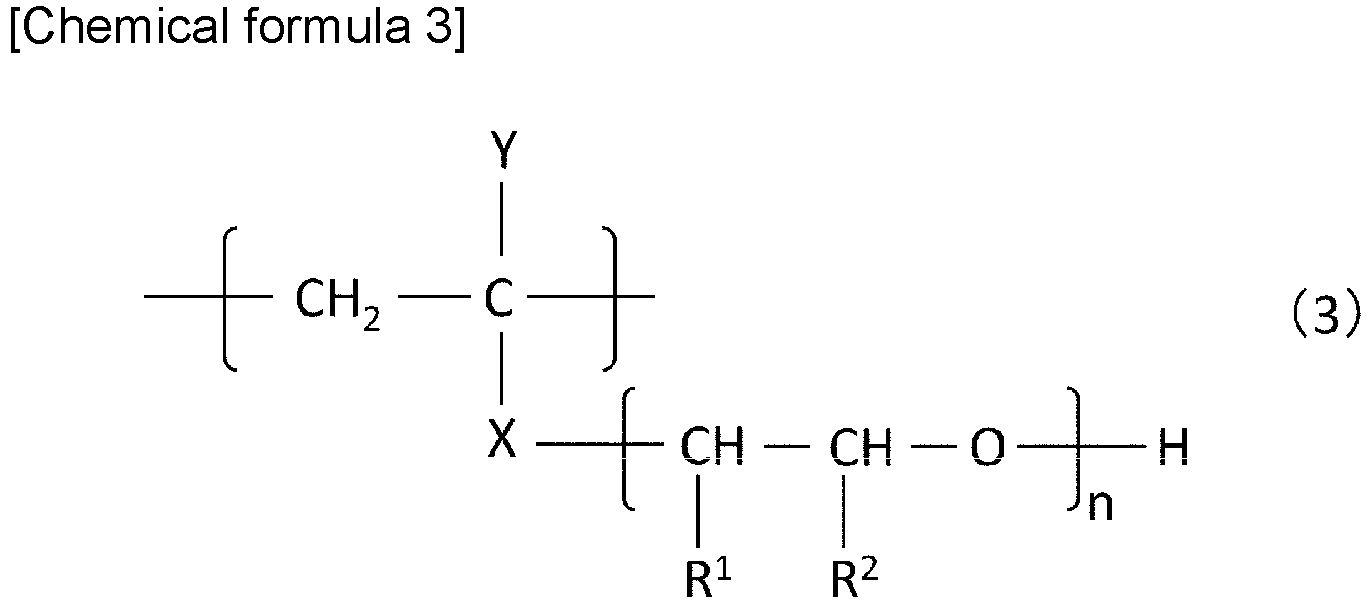
- The package according to claim 1 or 2, wherein the film constituting the bag has a water vapor permeability of 300 g/m2·day or less as an amount of water vapor permeated in 24 hours per 1 m2 of the film under a condition of 40 °C and 90 %RH.
- The package according to any one of claims 1 to 4, wherein the film constituting the bag is a multilayer film having an oxygen permeability of 1000 cc/m2·day·atm or less as an amount of oxygen permeated in 24 hours per 1 m2 of the film under a condition of 25 °C and 65% RH.
- The package according to claim 4, wherein the multilayer film includes a barrier layer having an oxygen permeability of 100 cc/m2·day·atm or less as an amount of oxygen permeated in 24 hours per 1 m2 of the film under a condition of 25 °C and 65 %RH in terms of a thickness of 25 µm.
- The package according to claim 5, wherein the barrier layer is an aluminum foil, an aluminum vapor-deposited layer, or a biaxially oriented polypropylene film.
- A method of manufacturing a package, comprising packing an oxyalkylene group-containing polyvinyl alcohol-based resin in a bag made of a film having an oxygen permeability of 1000 cc/m2·day·atm or less as an amount of oxygen permeated in 24 hours per 1 m2 of the film under a condition of 25 °C and 65 %RH.
- The method of manufacturing a package according to claim 7, wherein the oxyalkylene group-containing polyvinyl alcohol-based resin has a structural unit represented by a general formula (3) wherein X is a single bond or a binding chain, Y is a hydrogen atom or a methyl group, n is an integer of 1 to 50, and R1 and R2 each is independently a hydrogen atom or an alkyl group.

Applications Claiming Priority (2)
| Application Number | Priority Date | Filing Date | Title |
|---|---|---|---|
| JP2020059340 | 2020-03-30 | ||
| PCT/JP2021/010721 WO2021200134A1 (en) | 2020-03-30 | 2021-03-17 | Package of oxyalkylene group-containing pva-based resin, and method for producing same |
Publications (3)
| Publication Number | Publication Date |
|---|---|
| EP4129856A1 true EP4129856A1 (en) | 2023-02-08 |
| EP4129856A4 EP4129856A4 (en) | 2024-02-07 |
| EP4129856B1 EP4129856B1 (en) | 2024-10-30 |
Family
ID=77929163
Family Applications (1)
| Application Number | Title | Priority Date | Filing Date |
|---|---|---|---|
| EP21779042.7A Active EP4129856B1 (en) | 2020-03-30 | 2021-03-17 | Package of oxyalkylene group-containing pva-based resin, and method for manufacturing the same |
Country Status (5)
| Country | Link |
|---|---|
| US (1) | US20230021895A1 (en) |
| EP (1) | EP4129856B1 (en) |
| JP (2) | JPWO2021200134A1 (en) |
| CN (1) | CN115335301B (en) |
| WO (1) | WO2021200134A1 (en) |
Family Cites Families (12)
| Publication number | Priority date | Publication date | Assignee | Title |
|---|---|---|---|---|
| JP3262640B2 (en) * | 1993-05-25 | 2002-03-04 | 日本合成化学工業株式会社 | Laminate structure |
| JP2002105269A (en) * | 2000-10-04 | 2002-04-10 | Nippon Synthetic Chem Ind Co Ltd:The | Melt molding |
| JP2003155307A (en) * | 2001-11-19 | 2003-05-27 | Nippon Synthetic Chem Ind Co Ltd:The | Melt molding resin |
| CN1961010B (en) * | 2004-05-10 | 2010-11-24 | 东赛璐株式会社 | Gas barrier film, gas barrier laminate, and method for producing same |
| US8664333B2 (en) * | 2005-08-22 | 2014-03-04 | The Nippon Synthetic Chemical Industry Co., Ltd. | Acetoacetic ester group-containing polyvinyl alcohol-based resin, resin composition, and uses thereof |
| EP2080613B1 (en) * | 2006-11-16 | 2016-03-16 | Mitsubishi Plastics, Inc. | Gas barrier film laminate |
| JP2010230826A (en) * | 2009-03-26 | 2010-10-14 | Fujifilm Corp | Photomask blanks and photomasks |
| JP5433817B2 (en) * | 2011-07-22 | 2014-03-05 | 株式会社クラレ | Polyoxyalkylene-modified vinyl alcohol polymer and use thereof |
| US9732167B2 (en) * | 2012-02-08 | 2017-08-15 | Mitsubishi Gas Chemical Company, Inc. | Oxygen-absorbing resin composition and oxygen-absorbing multilayer body using same, and molded article and medical container using these |
| JP2013203436A (en) * | 2012-03-28 | 2013-10-07 | Mitsubishi Gas Chemical Co Inc | Deoxidizing multi-layer member and weight bag using the same |
| JP6728679B2 (en) * | 2014-09-30 | 2020-07-22 | 三菱ケミカル株式会社 | Method of storing modified group-containing polyvinyl alcohol resin having active hydrogen |
| CN108349642B (en) * | 2015-12-18 | 2020-09-01 | 三菱化学株式会社 | Packaging bag and method for storing polyvinyl alcohol resin for melt molding using same |
-
2021
- 2021-03-17 CN CN202180025101.2A patent/CN115335301B/en active Active
- 2021-03-17 WO PCT/JP2021/010721 patent/WO2021200134A1/en not_active Ceased
- 2021-03-17 JP JP2022511826A patent/JPWO2021200134A1/ja active Pending
- 2021-03-17 EP EP21779042.7A patent/EP4129856B1/en active Active
-
2022
- 2022-09-14 US US17/944,617 patent/US20230021895A1/en not_active Abandoned
-
2025
- 2025-06-19 JP JP2025103540A patent/JP2025131885A/en active Pending
Also Published As
| Publication number | Publication date |
|---|---|
| EP4129856A4 (en) | 2024-02-07 |
| CN115335301B (en) | 2026-02-17 |
| WO2021200134A1 (en) | 2021-10-07 |
| CN115335301A (en) | 2022-11-11 |
| US20230021895A1 (en) | 2023-01-26 |
| JPWO2021200134A1 (en) | 2021-10-07 |
| EP4129856B1 (en) | 2024-10-30 |
| JP2025131885A (en) | 2025-09-09 |
Similar Documents
| Publication | Publication Date | Title |
|---|---|---|
| AU2004323623B2 (en) | Ethylene/vinyl alcohol copolymer composition and multilayer structure using the same | |
| US11560464B2 (en) | Resin composition, production method for resin composition, and molded body using resin composition | |
| CN105579524B (en) | Resin combination, multilayer tablet, packaging material and container | |
| JP7339330B2 (en) | Multi-layer product suitable for produce storage bag applications | |
| EP1754727B1 (en) | Ethylene/vinyl alcohol copolymer and molded object thereof | |
| EP3392165B1 (en) | Use of a packaging bag and method for storing melt-processable polyvinyl alcohol resin in which said packaging bag is used | |
| JP7149842B2 (en) | Resin composition, molding, multi-layer structure, agricultural film and geomembrane | |
| EP4129856B1 (en) | Package of oxyalkylene group-containing pva-based resin, and method for manufacturing the same | |
| JP2023085574A (en) | Modified vinyl alcohol polymer | |
| JP5188006B2 (en) | Resin composition and multilayer structure using the same | |
| JP7157760B2 (en) | Resin composition, laminate and package | |
| CN116056894B (en) | Polyvinyl alcohol-based resin composition and melt-molded article using the same | |
| US20090186235A1 (en) | Resin Composition and Multi-Layer Structure Using the Same | |
| JP2025021523A (en) | Resin material, compatibilizer, multilayer structure, and method for recycling multilayer structure | |
| CN122070328A (en) | Resin Composition | |
| CN121969683A (en) | Composition, molded article, film, and multilayer structure | |
| EP4692225A1 (en) | Polyvinyl alcohol-based resin composition, film or sheet, and multilayer structure | |
| US20260125546A1 (en) | Resin composition, resin composition for recycling agent, use in recycling agent, regrind layer, multilayer structure, package, food package, and methods for producing recycling agent and regrind layer | |
| CN120936670A (en) | Ethylene-vinyl alcohol copolymer composition and method for producing the same, pellet, multilayer structure and method for producing the same | |
| CN121605040A (en) | Multilayer structure and packaging material | |
| JP2025116822A (en) | Resin composition, molding material, multilayer structure, molded article, food packaging material, and method for producing resin composition and multilayer structure |
Legal Events
| Date | Code | Title | Description |
|---|---|---|---|
| STAA | Information on the status of an ep patent application or granted ep patent |
Free format text: STATUS: THE INTERNATIONAL PUBLICATION HAS BEEN MADE |
|
| PUAI | Public reference made under article 153(3) epc to a published international application that has entered the european phase |
Free format text: ORIGINAL CODE: 0009012 |
|
| STAA | Information on the status of an ep patent application or granted ep patent |
Free format text: STATUS: REQUEST FOR EXAMINATION WAS MADE |
|
| 17P | Request for examination filed |
Effective date: 20220927 |
|
| AK | Designated contracting states |
Kind code of ref document: A1 Designated state(s): AL AT BE BG CH CY CZ DE DK EE ES FI FR GB GR HR HU IE IS IT LI LT LU LV MC MK MT NL NO PL PT RO RS SE SI SK SM TR |
|
| DAV | Request for validation of the european patent (deleted) | ||
| DAX | Request for extension of the european patent (deleted) | ||
| A4 | Supplementary search report drawn up and despatched |
Effective date: 20240108 |
|
| RIC1 | Information provided on ipc code assigned before grant |
Ipc: C08F 218/08 20060101ALI20240102BHEP Ipc: B65D 65/40 20060101ALI20240102BHEP Ipc: B65D 81/24 20060101AFI20240102BHEP |
|
| GRAP | Despatch of communication of intention to grant a patent |
Free format text: ORIGINAL CODE: EPIDOSNIGR1 |
|
| STAA | Information on the status of an ep patent application or granted ep patent |
Free format text: STATUS: GRANT OF PATENT IS INTENDED |
|
| INTG | Intention to grant announced |
Effective date: 20240717 |
|
| GRAS | Grant fee paid |
Free format text: ORIGINAL CODE: EPIDOSNIGR3 |
|
| GRAA | (expected) grant |
Free format text: ORIGINAL CODE: 0009210 |
|
| STAA | Information on the status of an ep patent application or granted ep patent |
Free format text: STATUS: THE PATENT HAS BEEN GRANTED |
|
| P01 | Opt-out of the competence of the unified patent court (upc) registered |
Free format text: CASE NUMBER: APP_52334/2024 Effective date: 20240918 |
|
| AK | Designated contracting states |
Kind code of ref document: B1 Designated state(s): AL AT BE BG CH CY CZ DE DK EE ES FI FR GB GR HR HU IE IS IT LI LT LU LV MC MK MT NL NO PL PT RO RS SE SI SK SM TR |
|
| REG | Reference to a national code |
Ref country code: GB Ref legal event code: FG4D |
|
| REG | Reference to a national code |
Ref country code: CH Ref legal event code: EP |
|
| REG | Reference to a national code |
Ref country code: IE Ref legal event code: FG4D |
|
| REG | Reference to a national code |
Ref country code: DE Ref legal event code: R096 Ref document number: 602021021090 Country of ref document: DE |
|
| REG | Reference to a national code |
Ref country code: LT Ref legal event code: MG9D |
|
| REG | Reference to a national code |
Ref country code: NL Ref legal event code: MP Effective date: 20241030 |
|
| PG25 | Lapsed in a contracting state [announced via postgrant information from national office to epo] |
Ref country code: IS Free format text: LAPSE BECAUSE OF FAILURE TO SUBMIT A TRANSLATION OF THE DESCRIPTION OR TO PAY THE FEE WITHIN THE PRESCRIBED TIME-LIMIT Effective date: 20250228 Ref country code: PT Free format text: LAPSE BECAUSE OF FAILURE TO SUBMIT A TRANSLATION OF THE DESCRIPTION OR TO PAY THE FEE WITHIN THE PRESCRIBED TIME-LIMIT Effective date: 20250228 Ref country code: HR Free format text: LAPSE BECAUSE OF FAILURE TO SUBMIT A TRANSLATION OF THE DESCRIPTION OR TO PAY THE FEE WITHIN THE PRESCRIBED TIME-LIMIT Effective date: 20241030 |
|
| PG25 | Lapsed in a contracting state [announced via postgrant information from national office to epo] |
Ref country code: NL Free format text: LAPSE BECAUSE OF FAILURE TO SUBMIT A TRANSLATION OF THE DESCRIPTION OR TO PAY THE FEE WITHIN THE PRESCRIBED TIME-LIMIT Effective date: 20241030 Ref country code: FI Free format text: LAPSE BECAUSE OF FAILURE TO SUBMIT A TRANSLATION OF THE DESCRIPTION OR TO PAY THE FEE WITHIN THE PRESCRIBED TIME-LIMIT Effective date: 20241030 |
|
| REG | Reference to a national code |
Ref country code: AT Ref legal event code: MK05 Ref document number: 1736700 Country of ref document: AT Kind code of ref document: T Effective date: 20241030 |
|
| PG25 | Lapsed in a contracting state [announced via postgrant information from national office to epo] |
Ref country code: BG Free format text: LAPSE BECAUSE OF FAILURE TO SUBMIT A TRANSLATION OF THE DESCRIPTION OR TO PAY THE FEE WITHIN THE PRESCRIBED TIME-LIMIT Effective date: 20241030 |
|
| PG25 | Lapsed in a contracting state [announced via postgrant information from national office to epo] |
Ref country code: ES Free format text: LAPSE BECAUSE OF FAILURE TO SUBMIT A TRANSLATION OF THE DESCRIPTION OR TO PAY THE FEE WITHIN THE PRESCRIBED TIME-LIMIT Effective date: 20241030 |
|
| PG25 | Lapsed in a contracting state [announced via postgrant information from national office to epo] |
Ref country code: NO Free format text: LAPSE BECAUSE OF FAILURE TO SUBMIT A TRANSLATION OF THE DESCRIPTION OR TO PAY THE FEE WITHIN THE PRESCRIBED TIME-LIMIT Effective date: 20250130 |
|
| PG25 | Lapsed in a contracting state [announced via postgrant information from national office to epo] |
Ref country code: GR Free format text: LAPSE BECAUSE OF FAILURE TO SUBMIT A TRANSLATION OF THE DESCRIPTION OR TO PAY THE FEE WITHIN THE PRESCRIBED TIME-LIMIT Effective date: 20250131 Ref country code: AT Free format text: LAPSE BECAUSE OF FAILURE TO SUBMIT A TRANSLATION OF THE DESCRIPTION OR TO PAY THE FEE WITHIN THE PRESCRIBED TIME-LIMIT Effective date: 20241030 Ref country code: LV Free format text: LAPSE BECAUSE OF FAILURE TO SUBMIT A TRANSLATION OF THE DESCRIPTION OR TO PAY THE FEE WITHIN THE PRESCRIBED TIME-LIMIT Effective date: 20241030 |
|
| PG25 | Lapsed in a contracting state [announced via postgrant information from national office to epo] |
Ref country code: PL Free format text: LAPSE BECAUSE OF FAILURE TO SUBMIT A TRANSLATION OF THE DESCRIPTION OR TO PAY THE FEE WITHIN THE PRESCRIBED TIME-LIMIT Effective date: 20241030 |
|
| PG25 | Lapsed in a contracting state [announced via postgrant information from national office to epo] |
Ref country code: RS Free format text: LAPSE BECAUSE OF FAILURE TO SUBMIT A TRANSLATION OF THE DESCRIPTION OR TO PAY THE FEE WITHIN THE PRESCRIBED TIME-LIMIT Effective date: 20250130 |
|
| PG25 | Lapsed in a contracting state [announced via postgrant information from national office to epo] |
Ref country code: SM Free format text: LAPSE BECAUSE OF FAILURE TO SUBMIT A TRANSLATION OF THE DESCRIPTION OR TO PAY THE FEE WITHIN THE PRESCRIBED TIME-LIMIT Effective date: 20241030 |
|
| PG25 | Lapsed in a contracting state [announced via postgrant information from national office to epo] |
Ref country code: DK Free format text: LAPSE BECAUSE OF FAILURE TO SUBMIT A TRANSLATION OF THE DESCRIPTION OR TO PAY THE FEE WITHIN THE PRESCRIBED TIME-LIMIT Effective date: 20241030 |
|
| PG25 | Lapsed in a contracting state [announced via postgrant information from national office to epo] |
Ref country code: EE Free format text: LAPSE BECAUSE OF FAILURE TO SUBMIT A TRANSLATION OF THE DESCRIPTION OR TO PAY THE FEE WITHIN THE PRESCRIBED TIME-LIMIT Effective date: 20241030 |
|
| PG25 | Lapsed in a contracting state [announced via postgrant information from national office to epo] |
Ref country code: RO Free format text: LAPSE BECAUSE OF FAILURE TO SUBMIT A TRANSLATION OF THE DESCRIPTION OR TO PAY THE FEE WITHIN THE PRESCRIBED TIME-LIMIT Effective date: 20241030 |
|
| PG25 | Lapsed in a contracting state [announced via postgrant information from national office to epo] |
Ref country code: SK Free format text: LAPSE BECAUSE OF FAILURE TO SUBMIT A TRANSLATION OF THE DESCRIPTION OR TO PAY THE FEE WITHIN THE PRESCRIBED TIME-LIMIT Effective date: 20241030 |
|
| PG25 | Lapsed in a contracting state [announced via postgrant information from national office to epo] |
Ref country code: CZ Free format text: LAPSE BECAUSE OF FAILURE TO SUBMIT A TRANSLATION OF THE DESCRIPTION OR TO PAY THE FEE WITHIN THE PRESCRIBED TIME-LIMIT Effective date: 20241030 |
|
| PG25 | Lapsed in a contracting state [announced via postgrant information from national office to epo] |
Ref country code: IT Free format text: LAPSE BECAUSE OF FAILURE TO SUBMIT A TRANSLATION OF THE DESCRIPTION OR TO PAY THE FEE WITHIN THE PRESCRIBED TIME-LIMIT Effective date: 20241030 |
|
| REG | Reference to a national code |
Ref country code: DE Ref legal event code: R097 Ref document number: 602021021090 Country of ref document: DE |
|
| PLBE | No opposition filed within time limit |
Free format text: ORIGINAL CODE: 0009261 |
|
| STAA | Information on the status of an ep patent application or granted ep patent |
Free format text: STATUS: NO OPPOSITION FILED WITHIN TIME LIMIT |
|
| PG25 | Lapsed in a contracting state [announced via postgrant information from national office to epo] |
Ref country code: SE Free format text: LAPSE BECAUSE OF FAILURE TO SUBMIT A TRANSLATION OF THE DESCRIPTION OR TO PAY THE FEE WITHIN THE PRESCRIBED TIME-LIMIT Effective date: 20241030 |
|
| 26N | No opposition filed |
Effective date: 20250731 |
|
| PG25 | Lapsed in a contracting state [announced via postgrant information from national office to epo] |
Ref country code: MC Free format text: LAPSE BECAUSE OF FAILURE TO SUBMIT A TRANSLATION OF THE DESCRIPTION OR TO PAY THE FEE WITHIN THE PRESCRIBED TIME-LIMIT Effective date: 20241030 |
|
| REG | Reference to a national code |
Ref country code: CH Ref legal event code: H13 Free format text: ST27 STATUS EVENT CODE: U-0-0-H10-H13 (AS PROVIDED BY THE NATIONAL OFFICE) Effective date: 20251023 |
|
| PG25 | Lapsed in a contracting state [announced via postgrant information from national office to epo] |
Ref country code: LU Free format text: LAPSE BECAUSE OF NON-PAYMENT OF DUE FEES Effective date: 20250317 |
|
| GBPC | Gb: european patent ceased through non-payment of renewal fee |
Effective date: 20250317 |
|
| REG | Reference to a national code |
Ref country code: BE Ref legal event code: MM Effective date: 20250331 |
|
| PG25 | Lapsed in a contracting state [announced via postgrant information from national office to epo] |
Ref country code: GB Free format text: LAPSE BECAUSE OF NON-PAYMENT OF DUE FEES Effective date: 20250317 |
|
| PG25 | Lapsed in a contracting state [announced via postgrant information from national office to epo] |
Ref country code: FR Free format text: LAPSE BECAUSE OF NON-PAYMENT OF DUE FEES Effective date: 20250331 |
|
| PG25 | Lapsed in a contracting state [announced via postgrant information from national office to epo] |
Ref country code: BE Free format text: LAPSE BECAUSE OF NON-PAYMENT OF DUE FEES Effective date: 20250331 |
|
| PG25 | Lapsed in a contracting state [announced via postgrant information from national office to epo] |
Ref country code: CH Free format text: LAPSE BECAUSE OF NON-PAYMENT OF DUE FEES Effective date: 20250331 |
|
| PG25 | Lapsed in a contracting state [announced via postgrant information from national office to epo] |
Ref country code: IE Free format text: LAPSE BECAUSE OF NON-PAYMENT OF DUE FEES Effective date: 20250317 |
|
| PGFP | Annual fee paid to national office [announced via postgrant information from national office to epo] |
Ref country code: DE Payment date: 20260219 Year of fee payment: 6 |
|
| PG25 | Lapsed in a contracting state [announced via postgrant information from national office to epo] |
Ref country code: LT Free format text: LAPSE BECAUSE OF FAILURE TO SUBMIT A TRANSLATION OF THE DESCRIPTION OR TO PAY THE FEE WITHIN THE PRESCRIBED TIME-LIMIT Effective date: 20241030 |
|
| PG25 | Lapsed in a contracting state [announced via postgrant information from national office to epo] |
Ref country code: TR Free format text: LAPSE BECAUSE OF FAILURE TO SUBMIT A TRANSLATION OF THE DESCRIPTION OR TO PAY THE FEE WITHIN THE PRESCRIBED TIME-LIMIT Effective date: 20241030 |