EP4126765B1 - Solid electrolyte for energy storage application - Google Patents
Solid electrolyte for energy storage application Download PDFInfo
- Publication number
- EP4126765B1 EP4126765B1 EP21714891.5A EP21714891A EP4126765B1 EP 4126765 B1 EP4126765 B1 EP 4126765B1 EP 21714891 A EP21714891 A EP 21714891A EP 4126765 B1 EP4126765 B1 EP 4126765B1
- Authority
- EP
- European Patent Office
- Prior art keywords
- group
- solid
- solid material
- material according
- lithium
- Prior art date
- Legal status (The legal status is an assumption and is not a legal conclusion. Google has not performed a legal analysis and makes no representation as to the accuracy of the status listed.)
- Active
Links
Images






Classifications
-
- H—ELECTRICITY
- H01—ELECTRIC ELEMENTS
- H01M—PROCESSES OR MEANS, e.g. BATTERIES, FOR THE DIRECT CONVERSION OF CHEMICAL ENERGY INTO ELECTRICAL ENERGY
- H01M10/00—Secondary cells; Manufacture thereof
- H01M10/05—Accumulators with non-aqueous electrolyte
- H01M10/056—Accumulators with non-aqueous electrolyte characterised by the materials used as electrolytes, e.g. mixed inorganic/organic electrolytes
- H01M10/0561—Accumulators with non-aqueous electrolyte characterised by the materials used as electrolytes, e.g. mixed inorganic/organic electrolytes the electrolyte being constituted of inorganic materials only
- H01M10/0562—Solid materials
-
- C—CHEMISTRY; METALLURGY
- C01—INORGANIC CHEMISTRY
- C01F—COMPOUNDS OF THE METALS BERYLLIUM, MAGNESIUM, ALUMINIUM, CALCIUM, STRONTIUM, BARIUM, RADIUM, THORIUM, OR OF THE RARE-EARTH METALS
- C01F17/00—Compounds of rare earth metals
- C01F17/30—Compounds containing rare earth metals and at least one element other than a rare earth metal, oxygen or hydrogen, e.g. La4S3Br6
- C01F17/36—Compounds containing rare earth metals and at least one element other than a rare earth metal, oxygen or hydrogen, e.g. La4S3Br6 halogen being the only anion, e.g. NaYF4
-
- C—CHEMISTRY; METALLURGY
- C01—INORGANIC CHEMISTRY
- C01G—COMPOUNDS CONTAINING METALS NOT COVERED BY SUBCLASSES C01D OR C01F
- C01G15/00—Compounds of gallium, indium or thallium
- C01G15/006—Compounds containing gallium, indium or thallium, with or without oxygen or hydrogen, and containing two or more other elements
-
- H—ELECTRICITY
- H01—ELECTRIC ELEMENTS
- H01B—CABLES; CONDUCTORS; INSULATORS; SELECTION OF MATERIALS FOR THEIR CONDUCTIVE, INSULATING OR DIELECTRIC PROPERTIES
- H01B1/00—Conductors or conductive bodies characterised by the conductive materials; Selection of materials as conductors
- H01B1/06—Conductors or conductive bodies characterised by the conductive materials; Selection of materials as conductors mainly consisting of other non-metallic substances
-
- H—ELECTRICITY
- H01—ELECTRIC ELEMENTS
- H01M—PROCESSES OR MEANS, e.g. BATTERIES, FOR THE DIRECT CONVERSION OF CHEMICAL ENERGY INTO ELECTRICAL ENERGY
- H01M10/00—Secondary cells; Manufacture thereof
- H01M10/05—Accumulators with non-aqueous electrolyte
- H01M10/052—Li-accumulators
-
- H—ELECTRICITY
- H01—ELECTRIC ELEMENTS
- H01M—PROCESSES OR MEANS, e.g. BATTERIES, FOR THE DIRECT CONVERSION OF CHEMICAL ENERGY INTO ELECTRICAL ENERGY
- H01M10/00—Secondary cells; Manufacture thereof
- H01M10/05—Accumulators with non-aqueous electrolyte
- H01M10/052—Li-accumulators
- H01M10/0525—Rocking-chair batteries, i.e. batteries with lithium insertion or intercalation in both electrodes; Lithium-ion batteries
-
- H—ELECTRICITY
- H01—ELECTRIC ELEMENTS
- H01M—PROCESSES OR MEANS, e.g. BATTERIES, FOR THE DIRECT CONVERSION OF CHEMICAL ENERGY INTO ELECTRICAL ENERGY
- H01M4/00—Electrodes
- H01M4/02—Electrodes composed of, or comprising, active material
- H01M4/13—Electrodes for accumulators with non-aqueous electrolyte, e.g. for lithium-accumulators; Processes of manufacture thereof
- H01M4/131—Electrodes based on mixed oxides or hydroxides, or on mixtures of oxides or hydroxides, e.g. LiCoOx
-
- H—ELECTRICITY
- H01—ELECTRIC ELEMENTS
- H01M—PROCESSES OR MEANS, e.g. BATTERIES, FOR THE DIRECT CONVERSION OF CHEMICAL ENERGY INTO ELECTRICAL ENERGY
- H01M4/00—Electrodes
- H01M4/02—Electrodes composed of, or comprising, active material
- H01M4/36—Selection of substances as active materials, active masses, active liquids
- H01M4/38—Selection of substances as active materials, active masses, active liquids of elements or alloys
- H01M4/381—Alkaline or alkaline earth metals elements
- H01M4/382—Lithium
-
- H—ELECTRICITY
- H01—ELECTRIC ELEMENTS
- H01M—PROCESSES OR MEANS, e.g. BATTERIES, FOR THE DIRECT CONVERSION OF CHEMICAL ENERGY INTO ELECTRICAL ENERGY
- H01M4/00—Electrodes
- H01M4/02—Electrodes composed of, or comprising, active material
- H01M4/36—Selection of substances as active materials, active masses, active liquids
- H01M4/38—Selection of substances as active materials, active masses, active liquids of elements or alloys
- H01M4/40—Alloys based on alkali metals
- H01M4/405—Alloys based on lithium
-
- H—ELECTRICITY
- H01—ELECTRIC ELEMENTS
- H01M—PROCESSES OR MEANS, e.g. BATTERIES, FOR THE DIRECT CONVERSION OF CHEMICAL ENERGY INTO ELECTRICAL ENERGY
- H01M4/00—Electrodes
- H01M4/02—Electrodes composed of, or comprising, active material
- H01M4/36—Selection of substances as active materials, active masses, active liquids
- H01M4/48—Selection of substances as active materials, active masses, active liquids of inorganic oxides or hydroxides
- H01M4/50—Selection of substances as active materials, active masses, active liquids of inorganic oxides or hydroxides of manganese
- H01M4/505—Selection of substances as active materials, active masses, active liquids of inorganic oxides or hydroxides of manganese of mixed oxides or hydroxides containing manganese for inserting or intercalating light metals, e.g. LiMn2O4 or LiMn2OxFy
-
- H—ELECTRICITY
- H01—ELECTRIC ELEMENTS
- H01M—PROCESSES OR MEANS, e.g. BATTERIES, FOR THE DIRECT CONVERSION OF CHEMICAL ENERGY INTO ELECTRICAL ENERGY
- H01M4/00—Electrodes
- H01M4/02—Electrodes composed of, or comprising, active material
- H01M4/36—Selection of substances as active materials, active masses, active liquids
- H01M4/48—Selection of substances as active materials, active masses, active liquids of inorganic oxides or hydroxides
- H01M4/52—Selection of substances as active materials, active masses, active liquids of inorganic oxides or hydroxides of nickel, cobalt or iron
- H01M4/525—Selection of substances as active materials, active masses, active liquids of inorganic oxides or hydroxides of nickel, cobalt or iron of mixed oxides or hydroxides containing iron, cobalt or nickel for inserting or intercalating light metals, e.g. LiNiO2, LiCoO2 or LiCoOxFy
-
- H—ELECTRICITY
- H01—ELECTRIC ELEMENTS
- H01M—PROCESSES OR MEANS, e.g. BATTERIES, FOR THE DIRECT CONVERSION OF CHEMICAL ENERGY INTO ELECTRICAL ENERGY
- H01M4/00—Electrodes
- H01M4/02—Electrodes composed of, or comprising, active material
- H01M4/62—Selection of inactive substances as ingredients for active masses, e.g. binders, fillers
-
- H—ELECTRICITY
- H01—ELECTRIC ELEMENTS
- H01M—PROCESSES OR MEANS, e.g. BATTERIES, FOR THE DIRECT CONVERSION OF CHEMICAL ENERGY INTO ELECTRICAL ENERGY
- H01M50/00—Constructional details or processes of manufacture of the non-active parts of electrochemical cells other than fuel cells, e.g. hybrid cells
- H01M50/40—Separators; Membranes; Diaphragms; Spacing elements inside cells
- H01M50/409—Separators, membranes or diaphragms characterised by the material
- H01M50/431—Inorganic material
- H01M50/434—Ceramics
-
- C—CHEMISTRY; METALLURGY
- C01—INORGANIC CHEMISTRY
- C01P—INDEXING SCHEME RELATING TO STRUCTURAL AND PHYSICAL ASPECTS OF SOLID INORGANIC COMPOUNDS
- C01P2002/00—Crystal-structural characteristics
- C01P2002/30—Three-dimensional structures
- C01P2002/32—Three-dimensional structures spinel-type (AB2O4)
-
- C—CHEMISTRY; METALLURGY
- C01—INORGANIC CHEMISTRY
- C01P—INDEXING SCHEME RELATING TO STRUCTURAL AND PHYSICAL ASPECTS OF SOLID INORGANIC COMPOUNDS
- C01P2002/00—Crystal-structural characteristics
- C01P2002/50—Solid solutions
-
- C—CHEMISTRY; METALLURGY
- C01—INORGANIC CHEMISTRY
- C01P—INDEXING SCHEME RELATING TO STRUCTURAL AND PHYSICAL ASPECTS OF SOLID INORGANIC COMPOUNDS
- C01P2002/00—Crystal-structural characteristics
- C01P2002/70—Crystal-structural characteristics defined by measured X-ray, neutron or electron diffraction data
- C01P2002/72—Crystal-structural characteristics defined by measured X-ray, neutron or electron diffraction data by d-values or two theta-values, e.g. as X-ray diagram
-
- C—CHEMISTRY; METALLURGY
- C01—INORGANIC CHEMISTRY
- C01P—INDEXING SCHEME RELATING TO STRUCTURAL AND PHYSICAL ASPECTS OF SOLID INORGANIC COMPOUNDS
- C01P2002/00—Crystal-structural characteristics
- C01P2002/70—Crystal-structural characteristics defined by measured X-ray, neutron or electron diffraction data
- C01P2002/76—Crystal-structural characteristics defined by measured X-ray, neutron or electron diffraction data by a space-group or by other symmetry indications
-
- C—CHEMISTRY; METALLURGY
- C01—INORGANIC CHEMISTRY
- C01P—INDEXING SCHEME RELATING TO STRUCTURAL AND PHYSICAL ASPECTS OF SOLID INORGANIC COMPOUNDS
- C01P2002/00—Crystal-structural characteristics
- C01P2002/80—Crystal-structural characteristics defined by measured data other than those specified in group C01P2002/70
- C01P2002/85—Crystal-structural characteristics defined by measured data other than those specified in group C01P2002/70 by XPS, EDX or EDAX data
-
- C—CHEMISTRY; METALLURGY
- C01—INORGANIC CHEMISTRY
- C01P—INDEXING SCHEME RELATING TO STRUCTURAL AND PHYSICAL ASPECTS OF SOLID INORGANIC COMPOUNDS
- C01P2004/00—Particle morphology
- C01P2004/01—Particle morphology depicted by an image
- C01P2004/03—Particle morphology depicted by an image obtained by SEM
-
- C—CHEMISTRY; METALLURGY
- C01—INORGANIC CHEMISTRY
- C01P—INDEXING SCHEME RELATING TO STRUCTURAL AND PHYSICAL ASPECTS OF SOLID INORGANIC COMPOUNDS
- C01P2006/00—Physical properties of inorganic compounds
- C01P2006/40—Electric properties
-
- H—ELECTRICITY
- H01—ELECTRIC ELEMENTS
- H01M—PROCESSES OR MEANS, e.g. BATTERIES, FOR THE DIRECT CONVERSION OF CHEMICAL ENERGY INTO ELECTRICAL ENERGY
- H01M4/00—Electrodes
- H01M4/02—Electrodes composed of, or comprising, active material
- H01M2004/026—Electrodes composed of, or comprising, active material characterised by the polarity
- H01M2004/028—Positive electrodes
-
- H—ELECTRICITY
- H01—ELECTRIC ELEMENTS
- H01M—PROCESSES OR MEANS, e.g. BATTERIES, FOR THE DIRECT CONVERSION OF CHEMICAL ENERGY INTO ELECTRICAL ENERGY
- H01M2300/00—Electrolytes
- H01M2300/0017—Non-aqueous electrolytes
- H01M2300/0065—Solid electrolytes
- H01M2300/0068—Solid electrolytes inorganic
-
- H—ELECTRICITY
- H01—ELECTRIC ELEMENTS
- H01M—PROCESSES OR MEANS, e.g. BATTERIES, FOR THE DIRECT CONVERSION OF CHEMICAL ENERGY INTO ELECTRICAL ENERGY
- H01M2300/00—Electrolytes
- H01M2300/0017—Non-aqueous electrolytes
- H01M2300/0065—Solid electrolytes
- H01M2300/0068—Solid electrolytes inorganic
- H01M2300/008—Halides
-
- Y—GENERAL TAGGING OF NEW TECHNOLOGICAL DEVELOPMENTS; GENERAL TAGGING OF CROSS-SECTIONAL TECHNOLOGIES SPANNING OVER SEVERAL SECTIONS OF THE IPC; TECHNICAL SUBJECTS COVERED BY FORMER USPC CROSS-REFERENCE ART COLLECTIONS [XRACs] AND DIGESTS
- Y02—TECHNOLOGIES OR APPLICATIONS FOR MITIGATION OR ADAPTATION AGAINST CLIMATE CHANGE
- Y02E—REDUCTION OF GREENHOUSE GAS [GHG] EMISSIONS, RELATED TO ENERGY GENERATION, TRANSMISSION OR DISTRIBUTION
- Y02E60/00—Enabling technologies; Technologies with a potential or indirect contribution to GHG emissions mitigation
- Y02E60/10—Energy storage using batteries
Definitions
- a solid material which has ionic conductivity for lithium ions
- a process for preparing said solid material a use of said solid material as a solid electrolyte for an electrochemical cell, a solid structure selected from the group consisting of a cathode, an anode and a separator for an electrochemical cell comprising the solid material, and an electro-chemical cell comprising such solid structure.
- solid state electrolytes having a high conductivity for lithium ions.
- An important class of such solid electrolytes are lithium transition metal halides. Such solid electrolytes are disclosed e.g. in US 2019/0088995 A1 , WO 2019/135343 A1 and WO 2019/135345 A1 .
- lithium ion conductors which exhibit suitable ionic conductivity for application as solid electrolyte in an all-solid-state lithium battery, as well as electro-chemical oxidative stability up to 4 V vs. Li/Li + or more, preferably up to 4.5 V vs. Li/Li + , in order to enable application of cathode active materials having a redox potential of 4 V or more vs. Li/Li + (cathode active material of the "4 V class”), so that a high cell voltage is obtainable.
- a process for preparing said solid material a use of said solid material as a solid electrolyte for an electrochemical cell, a solid structure selected from the group consisting of a cathode, an anode and a separator for an electrochemical cell comprising the solid material, and an electro-chemical cell comprising such solid structure, wherein said solid structure comprises said solid material.
- a solid material having a composition according to general formula (I) Li a AX 4 (I) wherein X is one or more selected from the group consisting of Cl, F, Br and I
- tri-valent means that in the solid material according to general formula (I) the metals M1 and -if present- M2 are in the oxidation state +3, and "di-valent” means that in the solid material according to general formula (I) the metal M3 is in the oxidation state +2.
- X is either one selected from the group consisting of Cl, F, Br and I, or X is more than one selected from the group consisting of Cl, F, Br and I so that the sum of all X is 4.
- X is one selected from the group consisting of Cl, F, Br and I, preferably Cl.
- M1 is a first trivalent metal and M2 is a second trivalent metal different from M1, or M1 is a trivalent metal, and M2 is not present.
- M1 and -if present- M2 may be selected from the group consisting of Sb, Nb and Mo (antimony, niobium and molybdenum, in each case in the oxidation state +3), and Sc, Al, In and Y (scandium, aluminium, indium and yttrium).
- M1 and M2 are different trivalent metals selected from the group consisting of Sc, Al, In and Y, or M1 is a trivalent metal selected from the group consisting of Sc, Al, In and Y, and M2 is not present.
- M1 is a trivalent metal and M3 is a divalent metal.
- M1 may be selected from the group consisting of Sb, Nb and Mo (antimony, niobium and molybdenum, in each case in the oxidation state +3), and Sc, Al, In and Y (scandium, aluminium, indium and yttrium).
- M3 may be selected from the group consisting of Mg, Ca, and Zn (magnesium, calcium and zinc).
- M1 is selected from the group consisting of Sc, Al, In and Y
- M3 is selected from the group consisting of Mg, Ca and Zn.
- X is preferably Cl.
- formula (la) may be rewritten as formula (la') Li a M1 b X 4 (Ia') wherein M1, X, a and b are as defined above.
- M1 may be selected from the group consisting of Sb, Nb and Mo (antimony, niobium and molybdenum, in each case in the oxidation state +3), and Sc, Al, In and Y (scandium, aluminium, indium and yttrium in each case in the oxidation state +3).
- M1 is a trivalent metal selected from the group consisting of Sc, Al, In and Y.
- X is Cl.
- M1 is a trivalent metal selected from the group consisting of Sc, Al, In and Y, and X is Cl.
- M1 is Sc and X is Cl, or M1 is In and X is Cl.
- M1 is a trivalent metal selected from the group consisting of Sc, Al, In and Y, and X is Cl. Still further preferably, 0.65 ⁇ b ⁇ 0.7, M is Sc and X is Cl.
- M1 is a first trivalent metal
- M2 is a second trivalent metal different from M1
- X is selected from the group consisting of Cl, F, Br and I.
- M1 and M2 may be selected from the group consisting of Sb, Nb and Mo (antimony, niobium and molybdenum, in each case in the oxidation state +3), and Sc, Al, In and Y (scandium, aluminium, indium and yttrium).
- M1 and M2 are different trivalent metals selected from the group consisting of Sc, Al, In and Y.
- X is Cl.
- M1 and M2 are different trivalent metals selected from the group consisting of Sc, Al, In and Y, and X is Cl.
- M1 is Sc
- M2 is In
- X is Cl.
- 0.1 ⁇ b ⁇ 0.6 Preferably 0.1 ⁇ b ⁇ 0.6 , more preferably 0.1 ⁇ b ⁇ 0.58, and 0.1 ⁇ c ⁇ 0.6 , and 0.6 ⁇ b + c ⁇ 0.75 , more preferably 0.65 ⁇ (b+c) ⁇ 0.7.
- M1 is Sc
- M2 is In
- X is Cl
- M1 is Sc
- M2 is In
- X is Cl
- 0.1 ⁇ b ⁇ 0.58 0.1 ⁇ c ⁇ 0.58
- a solid material according to the first aspect as defined herein has a composition according to formula (I) as defined above, wherein A is M1 d M3 e as defined above.
- M1 is a trivalent metal
- M3 is a divalent metal
- X is selected from the group consisting of Cl, F, Br and I.
- M1 may be selected from the group consisting of Sb, Nb and Mo (antimony, niobium and molybdenum, in each case in the oxidation state +3), and Sc, Al, In and Y (scandium, aluminium, indium and yttrium in each case in the oxidation state +3).
- M1 is a trivalent metal selected from the group consisting of Sc, Al, In and Y.
- M3 may be selected from the group consisting of Mg, Ca, and Zn (magnesium, calcium and zinc).
- X is Cl.
- M1 is selected from the group consisting of Sc, Al, In and Y
- M3 is selected from the group consisting of Mg, Ca and Zn
- X is Cl.
- M1 is Sc
- M3 is Mg and X is Cl
- M1 is In
- M3 is Mg and X is Cl.
- M1 is Sc
- M3 is Mg
- X is Cl
- M1 is Sc
- M3 is Mg and X is Cl
- M1 is Sc
- M3 is Mg
- X is Cl
- Exemplary solid materials having a composition according to formula (lb) are Li 1.65 Mg 0.65 Sc 0.35 Cl 4 (Li 165 Sc 0.35 Mg 0.65 Cl 4 ) Li 1.5 Mg 0.5 Sc 0.5 Cl 4 (Li 1.5 Sc 0.5 Mg 0.5 Cl 4 ) Li 1 . 35 Mg 0.35 Sc 0.65 Cl 4 (Li 1 . 35 Sc 0.65 Mg 0.35 Cl 4 ) Li 1.3 Mg 0.3 Sc 0.7 Cl 4 (Li 1.3 Sc 0.7 Mg 0.3 Cl 4 ) Li 1.25 Mg 0.25 Sc 0.75 Cl 4 (Li 1.25 Sc 0.75 Mg 0.25 Cl 4 ) Li 1.65 Mg 0.65 In 0.35 Cl 4 (Li 1.65 In 0.35 Mg 0.65 Cl 4 ).
- solid materials having a composition according to general formula (I) as defined above may exhibit favorable lithium ion conductivity as well as electrochemical oxidation stability in contact with a cathode active material having a redox potential of 4 V or more vs. Li/Li + , and also in contact with electron-conducting materials comprising or consisting of elemental carbon (e.g. carbon black, graphite) which are typical electrode additives in electrochemical cells.
- elemental carbon e.g. carbon black, graphite
- a solid material according to the above-defined first aspect may be crystalline as detectable by the X-ray diffraction technique.
- a solid material is referred to as crystalline when it exhibits a long range order that is characteristic of a crystal, as indicated by the presence of clearly defined reflections in its X-ray diffraction pattern.
- a reflection is considered as clearly defined if its intensity is more than 10% above the background.
- a solid material according to the above-defined first aspect may consist of a single phase or of more than one phase, e.g. a main phase (primary phase) and minor amounts of impurities and secondary phases.
- formula (I) is an empirical formula (gross formula) as determinable by means of elemental analysis. Accordingly, formula (I) defines a composition which is averaged over all phases present in the solid material.
- a solid material according to the above-defined first aspect comprises at least one phase which as such has a composition according to formula (I).
- a crystalline solid material according to the above-defined first aspect contains more than one phase, than the weight fraction of phases which as such do not have a composition according to formula (I) (e.g.
- the total weight fraction of secondary phases and impurity phases may be 20 % or less, preferably 10 % or less, further preferably 5 % or less, most preferably 3 % or less, based on the total weight of the solid material.
- the secondary phases and impurity phases mainly consist of the precursors used for preparing the solid material, e.g. LiX and MX 3 (wherein X and M are as defined above), and sometimes impurity phases which may originate from impurities of the precursors.
- the precursors used for preparing the solid material e.g. LiX and MX 3 (wherein X and M are as defined above)
- impurity phases which may originate from impurities of the precursors.
- a solid material according to the above-defined first aspect is in the form of a polycrystalline powder, or in the form of single crystals.
- a crystalline solid material according to the above-defined first aspect may comprise or consist of a phase having a spinel structure characterized by the cubic space group Fd-3m, wherein said spinel structure exhibits a disordered lithium ion distribution over available tetrahedral and octahedral sites within the lattice.
- the phase having said spinel structure may be present in an amount of 80 % or more, preferably 90 % or more, further preferably 95 % or more, most preferably 98 % or more, based on the total weight of the solid material (including secondary phases and impurity phases).
- the spinel structure is determined by powder X-ray diffraction (XRD) measurements as generally known in the art.
- X-ray diffraction (XRD) measurements were conducted at room temperature on a PANalytical Empyrean diffractometer with Cu-K ⁇ radiation that was equipped with a PIXcel bidimensional detector.
- XRD patterns are obtained in Debye-Scherrer geometry, with samples sealed in 0.5 mm (diameter) glass capillaries under argon.
- XRD patterns for phase identification are obtainable in Bragg-Brentano geometry, with sample placed on a zero-background sample holder in an Ar-filled glovebox and protected by Kapton film.
- the disordered spinel structure provides for a significantly disordered Li + ion distribution over available tetrahedral and octahedral sites within the lattice so that solid materials having a composition according to general formula (I) may provide favourable conditions for lithium ion conductivity.
- a solid material according to the first aspect described herein may be selected rom the group consisting of
- a solid material according to the above-defined first aspect may have a glassy ceramic structure, i.e. is a polycrystalline solid having at least 30 % by volume of a glassy phase.
- the structure of a solid material according to the above-defined first aspect depends on the way how it is prepared. For details of preparing a solid material according to the above defined first aspect, see the information provided below in the context of the second aspect of this disclosure.
- a solid material according to the above-defined first aspect may have an ionic conductivity of 0.1 mS/cm or more, preferably 1 mS or more at a temperature of 25 °C.
- the ionic conductivity is determined in the usual manner known in the field of battery materials development by means of electro-chemical impedance spectroscopy (for details see examples section below).
- a solid material according to the above-defined first aspect may have an almost negligible electronic conductivity. More specifically the electronic conductivity may be at least 3 orders of magnitude lower than the ionic conductivity, preferably at least 5 orders of magnitude lower than the ionic conductivity. In certain cases, a solid material according to the above-defined first aspect exhibits an electronic conductivity of 10 -10 S/cm or less. The electronic conductivity is determined in the usual manner known in the field of battery materials development by means of direct-current (DC) polarization measurements at different voltages.
- DC direct-current
- Preferred solid materials according to the first aspect as defined above are those having one or more of the specific features disclosed above.
- step a) of the process according to the above-defined second aspect a reaction mixture comprising precursors of the solid material having a composition according to general formula (I) to be formed in step b) is prepared or provided. Said precursors are
- reaction mixture prepared or provided in step (a) consists of the precursors (1) and (2) resp. (1), (2) and (3) as defined above.
- X may be selected independently.
- X is the same, preferably Cl.
- precursor (1) is LiCI.
- M1 and M2 are different trivalent metals.
- M1 and M2 may be selected from the group consisting of Sb, Nb and Mo (antimony, niobium and molybdenum, in each case in the oxidation state +3), and Sc, Al, In and Y (scandium, aluminium, indium and yttrium).
- M1 and M2 are different trivalent metals selected from the group consisting of Sc, Al, In and Y.
- the precursors (2) M1X 3 and (3) M2X 3 are selected from the group consisting of ScX 3 , AlX 3 , InX 3 and YX 3 wherein the precursors M1X 3 and M2X 3 are different.
- the precursors (2) M1X 3 and (3) M2X 3 are selected from the group consisting of ScCl 3 , AlCl 3 , InCl 3 and YCl 3 wherein the precursors M1X 3 and M2X 3 are different.
- M3 may be selected from the group consisting of Mg, Ca, and Zn (magnesium, calcium and zinc).
- the precursor M3X 2 is selected from the group consisting of MgX 2 , CaX 2 and ZnX 2 , more preferably from the group consisting of MgCl 2 , CaCl 2 and ZnCl 2 .
- reaction mixture prepared or provided in step a) of the process according to the above-defined second aspect consists of the precursors
- reaction mixture precursor (3) as defined above is not present.
- X may be selected independently.
- X is the same, preferably Cl.
- precursor (1) is LiCI.
- M1 may be selected from the group consisting of Sb, Nb and Mo (antimony, niobium and molybdenum, in each case in the oxidation state +3), and Sc, Al, In and Y (scandium, aluminium, indium and yttrium).
- M1 is a trivalent metal selected from the group consisting of Sc, Al, In and Y.
- the reaction mixture consists of precursors (1) and (2) as defined above, wherein precursor (2) is a compound M1X 3 wherein M1 is a trivalent metal selected from the group consisting of Sc, Al, In and Y, wherein in said reaction mixture the molar ratio of the elements Li, M1 and X matches general formula (I).
- precursor (2) M1X 3 is selected from the group consisting of ScX 3 , AlX 3 , InX 3 and YX 3 . More preferably, precursor (2) M1X 3 is selected from the group consisting of ScCl 3 , AlCl 3 , InCl 3 and YCl 3 . For instance, precursor (2) M1X 3 is ScCl 3 or InCl 3 .
- precursor (1) is LiCI and precursor (2) is selected from the group consisting of ScCl 3 , AlCl 3 , InCl 3 and YCl 3 .
- precursor (1) is LiCI and precursor (2) is ScCl 3 or InCl 3 .
- reaction mixture prepared or provided in step a) of the process according to the above-defined second aspect consists of the precursors
- reaction mixtures are suitable for preparing solid materials having a composition according to general formula (la) as defined above wherein c > 0.
- a reaction mixture suitable for preparing a solid material having a composition according to general formula (Ia) wherein c > 0 consists of the precursors
- X may be selected independently.
- X is the same, preferably Cl.
- precursor (1) is LiCI.
- M1 and M2 are different trivalent metals.
- M1 and M2 may be selected from the group consisting of Sb, Nb and Mo (antimony, niobium and molybdenum, in each case in the oxidation state +3), and Sc, Al, In and Y (scandium, aluminium, indium and yttrium).
- M1 and M2 are trivalent metals selected from the group consisting of Sc, Al, In and Y.
- the reaction mixture consists of precursors (1) and (2) and (3) as defined above, wherein precursor (3) consists of a compound M2X 3 wherein M2 is a trivalent metal selected from the group consisting of Sc, Al, In and Y with the proviso that M2 is different from M1, wherein in said reaction mixture the molar ratio of the elements Li, M1, M2 and X matches general formula (la).
- the precursors (2) M1Xs and (3) M2X 3 are selected from the group consisting of ScX 3 , AlX 3 , InX 3 and YX 3 wherein the precursors (2) M1Xs and (3) M2X 3 are different.
- the precursors (2) M1X 3 and (3) M2X 3 are selected from the group consisting of ScCl 3 , AlCl 3 , InCl 3 and YCl 3 wherein the precursors (2) M1X 3 and (3) M2X 3 are different.
- precursor (2) is ScCl 3
- precursor (3) is InCl 3 .
- precursor (1) is LiCI and precursors (2) and (3) are different compounds selected from the group consisting of ScCl 3 , AlCl 3 , InCl 3 and YCl 3 .
- precursor (1) is LiCI
- precursor (2) is ScCl 3
- precursor (3) is InCl 3 .
- reaction mixture prepared or provided in step a) of the process according to the above-defined second aspect consists of the precursors
- reaction mixtures are suitable for preparing solid materials having a composition according to general formula (lb) as defined above.
- a reaction mixture suitable for preparing a solid material having a composition according to general formula (lb) consists of the precursors
- X may be selected independently.
- X is the same, preferably Cl.
- precursor (1) is LiCI.
- M1X 3 M1 may be selected from the group consisting of Sb, Nb and Mo (antimony, niobium and molybdenum, in each case in the oxidation state +3), and Sc, Al, In and Y (scandium, aluminium, indium and yttrium).
- M1 is a trivalent metal selected from the group consisting of Sc, Al, In and Y.
- M3 may be selected from the group consisting of Mg, Ca, and Zn (magnesium, calcium and zinc).
- the reaction mixture consists of precursors (1) and (2) and (3) as defined above, wherein precursor (3) consists of a compound M3X 2 wherein M3 is a divalent metal selected from the group consisting of Mg, Ca and Zn, wherein in said reaction mixture the molar ratio of the elements Li, M1, X and M3 matches general formula (lb).
- precursor (2) M1X 3 is selected from the group consisting of ScX 3 , AlX 3 , InX 3 and YX 3 . More preferably, precursor (2) M1X 3 is selected from the group consisting of ScCl 3 , AlCl 3 , InCl 3 and YCl 3 . For instance, precursor (2) M1X 3 is ScCl 3 or InCl 3 .
- precursor (3) M3X 2 is selected from the group consisting of MgX 2 , CaX 2 and ZnX 2 , more preferably from the group consisting of MgCl 2 , CaCl 2 and ZnCl 2 .
- precursor (1) is LiCI and precursor (2) is selected from the group consisting of ScCl 3 , AlCl 3 , InCl 3 and YCl 3 and precursor (3) is selected from the group consisting of MgCl 2 , CaCl 3 , and ZnCl 2 .
- precursor (1) is LiCI and precursor (2) is ScCl 3 and precursor (3) is MgCl 2
- precursor (1) is LiCI and precursor (2) is InCl 3 and precursor (3) is MgCl 2 .
- the reaction mixture may be obtained by grinding together the precursors so that a powder is obtained, and optionally pressing the powder into pellets.
- step b) of the process according to the above-defined second aspect the reaction mixture is allowed to react so that a solid material having a composition according to general formula (I) is obtained.
- the precursors in the reaction mixture react with each other to obtain a solid material having a composition according to general formula (I).
- reaction mixture prepared or provided in process step a) is heat-treated in step b) to enable the reaction of the precursors.
- the reaction mixture may be in the form of a powder, or in the form of pellets.
- Heat-treating may be performed in a closed vessel.
- the closed vessel may be a sealed quartz tube or any other type of container which is capable of withstanding the temperature of the thermal treatment and is not subject to reaction with any of the precursors, such as a glassy carbon crucible or a tantalum crucible.
- the reaction mixture may be heat-treated in a temperature range of from 300 °C to 700 °C for a total duration of from 30 hours to 100 hours so that a reaction product is formed. More specifically, in step b) the reaction mixture may be heat-treated in a temperature range of from 500 °C to 700 °C for a total duration of 40 hours to 80 hours.
- step (b) the reaction mixture is heated to a heat treating temperature in the range of from 600 °C to 700 °C, more preferably 620 °C to 680 °C with a ramp rate in the range of rom 2 to 10 °C/min and heat treated at said temperature for a total duration of from 30 hours to 60 hours so that a reaction product is formed, and the obtained reaction product is cooled so that a solid material having a composition according to general formula (I) and a spinel structure as explained above is obtained.
- a heat treating temperature in the range of from 600 °C to 700 °C, more preferably 620 °C to 680 °C with a ramp rate in the range of rom 2 to 10 °C/min and heat treated at said temperature for a total duration of from 30 hours to 60 hours so that a reaction product is formed, and the obtained reaction product is cooled so that a solid material having a composition according to general formula (I) and a spinel structure as explained above is obtained.
- the heat treating temperature is preferably selected slightly above the melting point of precursor (1) so that precursor (1) is in the molten state. It appears that the reaction of the reaction mixture is promoted when precursor (1) is in the molten state.
- precursor (1) is preferably LiCl.
- step b) When the duration of the heat treatment of step b) is completed, the formed reaction product is allowed to cool down. Thus, a solid material having a composition according to general formula (I) is obtained. Cooling of the reaction product is preferably performed using a cooling rate of from 0.1 to 10 °C per minute, or by quenching with water.
- Reacting the reaction mixture prepared or provided in step a) by means of heat-treating in step b) as described above results in formation of a solid material having a composition according to general formula (I) which has a spinel structure as defined above.
- Such materials having a spinel structure can be obtained from any of the reaction mixtures described above, especially from the preferred ones, especially those wherein X in all precursors is Cl.
- reaction mixture prepared or provided in process step a) is ball-milled in step b) to enable the reaction of the precursors.
- the reaction mixture may be in the form of a powder, or in the form of pellets.
- Ball-milling of the reaction mixture is preferably carried out at a rate of 300 to 500 rpm for 20 to 40 hours.
- Preparation of lithium-conducting solid electrolytes by ball milling a reaction mixture comprising appropriate precursors is known in the art.
- Reacting the reaction mixture prepared or provided in step a) by means of ball-milling in step b) as described above results in formation of a solid material having a composition according to general formula (I) which has a glassy ceramic structure, i.e. is a polycrystalline solid having at least 30 % by volume of a glassy phase.
- a solid material according to the above-defined first aspect resp. obtained by the process according to the above-defined second aspect can be used as a solid electrolyte for an electrochemical cell.
- the solid electrolyte may form a component of a solid structure for an electrochemical cell, wherein said solid structure is selected from the group consisting of cathode, anode and separator.
- a solid material according to the above-defined first aspect resp. obtained by the process according to the above-defined second aspect can be used (if necessary in combination with additional components) for producing a solid structure for an electrochemical cell, such as a cathode, an anode or a separator.
- the present disclosure further provides the use of a solid material according to the above-defined first aspect resp. obtained by the process according to the above-defined second aspect as a solid electrolyte for an electrochemical cell.
- the solid material according to the above-defined first aspect resp. obtained by the process according to the above-defined second aspect may have a composition according to formula (la) as defined above resp. according to formula (lb) as defined above.
- specific and preferred solid materials according to the above-defined first aspect resp. obtained by the process according to the above-defined second aspect the same applies as disclosed above in the context of the first aspect.
- the present disclosure further provides the use of a solid material according to the above-defined first aspect resp. obtained by the process according to the above-defined second aspect as a component of a solid structure for an electrochemical cell, wherein said solid structure is selected from the group consisting of cathode, anode and separator.
- the electrode where during discharging a net negative charge occurs is called the anode and the electrode where during discharging a net positive charge occurs is called the cathode.
- Suitable electrochemically active cathode materials (cathode active materials) and suitable electrochemically active anode materials (anode active materials) are known in the art and described above.
- the cathode active material is a cathode active material according to general formula (II) resp. (Ila) as defined below which contains at least one of Ni and Mn.
- the separator electronically separates a cathode and an anode from each other in an electrochemical cell.
- the cathode of an all-solid-state electrochemical cell usually comprises beside an active cathode material as a further component a solid electrolyte.
- the anode of an all-solid-state electrochemical cell usually comprises a solid electrolyte as a further component beside an active anode material.
- Said solid electrolyte may be a solid material according to the above-defined first aspect resp. obtained by the process according to the above-defined second aspect.
- the present disclosure further provides a solid structure for an electrochemical cell, wherein the solid structure is selected from the group consisting of cathode, anode and separator, wherein the solid structure for an electrochemical cell comprises a solid material according to the above-defined first aspect resp. obtained by the process according to the above-defined second aspect.
- the solid material according to the above-defined first aspect resp. obtained by the process according to the above-defined second aspect may have a composition according to formula (la) as defined above resp. according to formula (lb) as defined above.
- specific and preferred solid materials according to the above-defined first aspect resp. obtained by the process according to the above-defined second aspect the same applies as disclosed above in the context of the first aspect.
- said solid structure is a cathode.
- Such cathode may comprise a mixture comprising one or more cathode active materials and a solid material according to the above-defined first aspect resp. obtained by the process according to the above-defined second aspect. Further constituents of said mixture are one or more selected from the group consisting of electron conducting materials and binding agents.
- said cathode comprises a cathode active material having a redox potential of 4 V or more vs. Li/Li + (cathode active material of the "4 V class").
- a solid material according to the above-defined first aspect resp. obtained by the process according to the above-defined second aspect may be applied as a solid electrolyte in direct contact with a cathode active material having a redox potential of 4 V or more, preferably of 4.5 V or more vs. Li/Li + .
- the solid material according to the above-defined first aspect resp. obtained by the process according to the above-defined second aspect may have a composition according to formula (la) as defined above resp.
- c 0.
- a solid material according to the above-defined first aspect resp. obtained by the process according to the above-defined second aspect may form a layer covering particles of one or more cathode active materials.
- a solid material according to the above-defined first aspect resp. obtained by the process according to the above-defined second aspect may form a matrix wherein particles of one or more cathode active materials are embedded.
- a solid material according to the above-defined first aspect resp. obtained by the process according to the above-defined second aspect may form a coating on the surface of the cathode active material which may protect the solid electrolyte material of the separator layer of a cell comprising such cathode from being oxidized by the cathode active material.
- a cathode as described herein may comprise
- the solid material according to the above-defined first aspect resp. obtained by the process according to the above-defined second aspect may have a composition according to formula (la) as defined above resp. according to formula (lb) as defined above.
- specific and preferred solid materials according to the above-defined first aspect resp. obtained by the process according to the above-defined second aspect the same applies as disclosed above in the context of the first aspect.
- Typical electron-conducting materials are those comprising or consisting of elemental carbon, e.g. carbon black and graphite.
- Typical binding agents are poly(vinylidenefluroride) (PVDF), styrene-butadiene rubber (SBR), polyisobutene, polyethylene vinyl acetate), polyacrylonitrile butadiene).
- cathode active materials Suitable electrochemically active cathode materials (cathode active materials) are known in the art.
- Preferred cathode active materials are those having a redox potential of 4 V or more vs. Li/Li + (cathode active material of the "4 V class"), which enable obtaining a high cell voltage.
- Many such cathode active materials are known in the art.
- a class of suitable cathode active materials are oxides comprising lithium and one or more members of the group consisting of nickel, cobalt and manganese.
- Preferred cathode active materials are oxides comprising lithium and at least one of nickel, cobalt and manganese.
- the cathode active material according to general formula (II) contains at least one of Ni and Mn.
- M may be one of Al, Mg, Ti, Mo, Nb, W and Zr.
- Exemplary cathode active materials of formula (II) are Li 1+t [Ni 0.88 Co 0.08 Al 0.04 ] 1-t O 2 , Li 1+t [Ni 0.905 Co 0.0475 Al 0.0475 ] 1-t O 2 , and Li 1+t [Ni 0.91 Co 0.045 Al 0.045 ] 1-t O 2 , wherein in each case -0.05 ⁇ t ⁇ 0.2.
- cathode active materials according to formula (II), M is not present.
- Exemplary cathode active materials according to formula (Ila) are LiCoOz, Li 1+t [Ni 0.85 Co 0.10 Mn 0.05 ] 1-t O 2 , Li 1+t [Ni 0.85 Mn 0.10 Co 0.05 ] 1-t O 2 , Li 1+t [Ni 0.87 Co 0.05 Mn 0.08 ] 1-t O 2 , Li 1+t [Ni 0.83 Co 0.12 Mn 0.05 ] 1--t O 2 , and Li 1+t [Ni 0.6 Mn 0.2 CO 0.2 ] 1-t O 2 (NMC622).
- the cathode active material according to general formula (Ila) contains at least one of Ni and Mn.
- the present disclosure further provides an electrochemical cell comprising
- the solid material according to the above-defined first aspect resp. obtained by the process according to the above-defined second aspect may have a composition according to formula (la) as defined above resp. according to formula (lb) as defined above.
- specific and preferred solid materials according to the above-defined first aspect resp. obtained by the process according to the above-defined second aspect the same applies as disclosed above in the context of the first aspect.
- the solid material according to the above-defined first aspect resp. obtained by the process according to the above-defined second aspect may form a component of one or more solid structures selected from the group consisting of cathode, anode and separator.
- said solid structure is a cathode as defined above.
- an electrochemical cell as defined above wherein in certain preferred cases a solid material according to the above-defined first aspect resp. obtained by the process according to the above-defined second aspect may be in direct contact with a cathode active material having a redox potential of 4 V or more, preferably of 4.5 V or more vs. Li/Li + .
- the cathode active material is a cathode active material according to general formula (II) resp. (Ila) as defined above which contains at least one of Ni and Mn.
- the solid material according to the above-defined first aspect resp. obtained by the process according to the above-defined second aspect may have a composition according to formula (la) as defined above resp. according to formula (lb) as defined above).
- specific and preferred solid materials according to the above-defined first aspect resp. obtained by the process according to the above-defined second aspect the same applies as disclosed above in the context of the first aspect.
- the above-defined electrochemical cell may be a rechargeable electrochemical cell comprising the following constituents
- the cathode comprises a mixture comprising one or more cathode active materials and a solid material according to the above-defined first aspect resp. obtained by the process according to the above-defined second aspect, and one or more selected from the group consisting of electron conducting materials and binding agents (as defined above).
- the solid material according to the above-defined first aspect resp. obtained by the process according to the above-defined second aspect may have a composition according to formula (la) as defined above resp. according to formula (lb) as defined above.
- said electrochemical cell comprises
- Said anode is capable of reversibly plating and stripping lithium, e.g. an anode comprising lithium metal or a metal alloy comprising lithium or a metal capable of alloying with lithium or an electronically conductive material capable of reversibly plating and stripping lithium.
- the solid material according to the above-defined first aspect resp. obtained by the process according to the above-defined second aspect separates the cathode active material from the lithium ion conducting layer which does not comprise a solid material according to formula (I). Since the cathode active material is coated with or embedded in or covered by a solid material according to the above-defined first aspect resp. obtained by the process according to the above-defined second aspect, direct contact between the cathode active material and the lithium ion conducting layer which does not comprise a solid material according to formula (I) is prevented. Thus, coating the cathode active material with a solid material according to the above-defined first aspect resp.
- separator layer comprising or consisting of a lithium ion conducting material which as such does not exhibit oxidation stability at a redox potential of 4 V or more vs. Li/Li + , e.g. a sulfide-based or oxysulfide-based solid electrolyte.
- lithium ion conducting materials which do not have such oxidation stability exhibit one or more favourable properties like stability in the presence of lithium metal or of a metal alloy comprising lithium and ionic conductivity, easy processability, superior ionic conductivity and/or low cost which render them suitable for forming a solid electrolyte layer resp. a separator layer.
- the materials of the lithium ion conducting layer may be suitably selected according to the criteria of stability in the presence of lithium metal or a metal alloy comprising lithium, ionic conductivity, processability and costs, while oxidation stability is not an issue.
- the lithium ion conducting layer which does not comprise a solid material according to formula (I) may comprise or consist of one or more lithium ion conducting materials selected from the group consisting of
- said lithium ion conducting layer which does not comprise a solid material according to formula (I) comprises or consists of one or more of lithium containing sulfides, lithium containing oxysulfides, lithium-containing oxyphosphates and lithium containing oxyphosphonitrides.
- an electrochemical cell comprising a solid material according to the above-defined first aspect resp. obtained by the process according to the above-defined second aspect may have a structure wherein
- Said anode is capable of reversibly plating and stripping lithium, e.g. an anode comprising lithium metal or a metal alloy comprising lithium or a metal capable of alloying with lithium or an electronically conductive material capable of reversibly plating and stripping lithium.
- said electrochemical cell comprises a sequence of layers which in the order of stacking consists of
- the solid material according to the above-defined first aspect resp. obtained by the process according to the above-defined second aspect may have a composition according to formula (la) as defined above resp. according to formula (lb) as defined above.
- specific and preferred solid materials according to the above-defined first aspect resp. obtained by the process according to the above-defined second aspect the same applies as disclosed above in the context of the first aspect.
- the cathode active material is preferably a cathode active material according to general formula (II) resp. (Ila) which contains at least one of Ni and Mn.
- layer (b) may comprise a solid electrolyte, and one or more selected from the group consisting of electron conducting materials and binding agents.
- the solid electrolyte in layer (b) is a solid material according to formula (I) (i.e. a solid material according to the above-defined first aspect resp. obtained by the process according to the above-defined second aspect).
- the solid material according to formula (I) i.e. a solid material according to the above-defined first aspect resp. obtained by the process according to the above-defined second aspect
- the solid material according to formula (I) i.e. a solid material according to the above-defined first aspect resp. obtained by the process according to the above-defined second aspect
- the solid material according to formula (I) i.e. a solid material according to the above-defined first aspect resp. obtained by the process according to the
- layer (c) acts as a solid electrolyte layer resp. separator layer.
- the cathode active material is preferably selected from cathode active materials having a redox potential of 4 V or more vs. Li/Li + (cathode active material of the "4 V class").
- the cathode active material has a redox potential of 4 V or more vs. Li/Li + while the lithium ion conducting layer (c) does not have electrochemical oxidation stability up to 4 V vs Li/Li +
- the layer (a) comprising or consisting of a solid material according to formula (I) (i.e. a solid material according to the above-defined first aspect resp.
- the material of the lithium ion conducting layer (c) (which does not comprise a solid material according to formula (I)) may be suitably selected according to the criteria of stability in the presence of lithium metal or a metal alloy comprising lithium, ionic conductivity, processability and costs, while oxidation stability is not an issue.
- coating the cathode active material with a solid material according to formula (I) or covering the cathode active material by a layer comprising or consisting of a solid material according to formula (I) allows for implementing electrochemical cells, especially all-solid-state lithium batteries, wherein a cathode active materials having a redox potential of 4 V or more vs. Li/Li + is combined with a solid electrolyte layer resp. separator layer comprising or consisting of a lithium ion conducting material which as such does not exhibit oxidation stability at a redox potential of 4 V or more vs. Li/Li + , e.g. sulfide-based solid electrolytes.
- lithium ion conducting materials which do not have oxidation stability exhibit one or more favourable properties like stability in the presence of lithium metal or a metal alloy comprising lithium and ionic conductivity, easy processability, superior ionic conductivity and/or low cost which render them suitable for forming a solid electrolyte layer resp. a separator layer.
- Electrochemical cells as described above may be alkali metal containing cells, especially lithium-ion containing cells.
- the charge transport is effected by Li + ions.
- cathode active materials Suitable electrochemically active cathode materials (cathode active materials) and suitable electrochemically active anode materials (anode active materials) are known in the art.
- Exemplary cathode active materials are disclosed above.
- the cathode active material is a cathode active material according to general formula (II) resp. (Ila) which contains at least one of Ni and Mn.
- Exemplary anode active materials are graphitic carbon, metallic lithium and metal alloys comprising lithium.
- the electrochemical cell may have a disc-like or a prismatic shape.
- the electrochemical cells can include a housing that can be from steel or aluminum.
- a plurality of electrochemical cells as described above may be combined to an all-solid-state battery, which has both solid electrodes and solid electrolytes.
- a further aspect of the present disclosure refers to batteries, more specifically to an alkali metal ion battery, in particular to a lithium ion battery comprising at least one electrochemical cell as described above, for example two or more electrochemical cells as described above.
- Electrochemical cells as described above can be combined with one another in alkali metal ion batteries, for example in series connection or in parallel connection. Series connection is preferred.
- the electrochemical cells resp. batteries described herein can be used for making or operating cars, computers, personal digital assistants, mobile telephones, watches, camcorders, digital cameras, thermometers, calculators, laptop BIOS, communication equipment or remote car locks, and stationary applications such as energy storage devices for power plants.
- a further aspect of this disclosure is a method of making or operating cars, computers, personal digital assistants, mobile telephones, watches, camcorders, digital cameras, thermometers, calculators, laptop BIOS, communication equipment, remote car locks, and stationary applications such as energy storage devices for power plants by employing at least one inventive battery or at least one inventive electrochemical cell.
- a further aspect of the present disclosure is the use of the electrochemical cell as described above in motor vehicles, bicycles operated by electric motor, robots, aircraft (for example unmanned aerial vehicles including drones), ships or stationary energy stores.
- the present disclosure further provides a device comprising at least one inventive electro-chemical cell as described above.
- mobile devices such as are vehicles, for example automobiles, bicycles, aircraft, or water vehicles such as boats or ships.
- Other examples of mobile devices are those which are portable, for example computers, especially laptops, telephones or electrical power tools, for example from the construction sector, especially drills, battery-driven screwdrivers or battery-driven tackers.
- compositions indicated in table 1 Materials having the compositions indicated in table 1 were obtained by mixing stoichiometric amounts of precursor (1) LiCI (Sigma-Aldrich, 99.9%) and precursor (2) and optionally precursor (3) together at the targeted ratio.
- precursor (1) LiCI Sigma-Aldrich, 99.9%
- precursor (2) and optionally precursor (3) together at the targeted ratio.
- the obtained reaction mixtures were pelletized and placed in sealed quartz tubes under vacuum.
- the quartz tubes were heated to 650 °C with an increasing rate of 5 °C ⁇ min -1 heat treated at said temperature for a total duration of 48 hours and cooled with a cooling rate of 10 °C ⁇ h -1 .
- the ionic conductivity was measured by electrochemical impedance spectroscopy (EIS). Typically, 150 mg powder of the material to be tested was placed between two stainless steel rods and pressed into a 10 mm diameter pellet by a hydraulic press at 3 tons for 1 min in an Ar-filled glovebox. EIS experiments were performed with 100 mV amplitude within a frequency range of 1 MHz-100 mHz using a VMP3 potentiostat/galvanostat (Bio-Logic). The conductivities of the tested materials are compiled in table 1.
- Powder X-ray diffraction (XRD) measurements on all materials were conducted at room temperature on a PANalytical Empyrean diffractometer with Cu-K ⁇ radiation that was equipped with a PIXcel bidimensional detector.
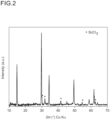
- XRD patterns were obtained in Debye-Scherrer geometry, with samples sealed in 0.5 mm (diameter) glass capillaries under argon. Additional XRD pattern for phase identification ( fig. 2 ) was obtained in Bragg-Brentano geometry, with the sample placed on a zero-background sample holder in an Ar-filled glovebox and protected by Kapton film.
- the time-of-flight (TOF) powder neutron diffraction pattern was collected on POWGEN at the Spallation Neutron Source (SNS) at the Oak Ridge National Laboratory.
- the sample ( ⁇ 1 g) was loaded into a vanadium can under an argon atmosphere and sealed with a copper gasket and aluminum lid.
- the samples were measured at 300 K, and a single bank wave with a center wavelength of 1.5 ⁇ was used.
- Structure analysis was performed in the TOPAS V6 software package.
- the unit cell of Li 2 Sc 2 / 3 Cl 4 was identified through indexing the powder X-ray diffraction data, followed by locating the CI and Sc positions.
- the neutron pattern was refined using the Rietveld method based on the structural model from powder X-ray data and difference Fourier mapping to locate the Li positions.
- Fig. 1a shows powder X-ray diffraction patterns of Li 2.08 Sc 0.64 Cl 4 (bottom), Li 2 Sc 2/3 Cl 4 (center) and Li 1.9 Sc 0.7 Cl 4 (top). All reflections correspond to the respective spinel phase except for the unknown impurity as marked; arrows indicate LiCI impurity.
- the X-ray diffraction pattern of Li 2 Sc 2/3 Cl 4 ( Fig. 1a , center) corresponds to an almost phase-pure polycrystalline powder with only a trace amount of unknown impurities.
- the pattern was indexed in the same cubic space group, Fd -3 m which is adopted by other spinel materials.
- a lower Sc 3+ content leads to increasing amounts of LiCl impurity, as shown by the pattern of Li 2.08 Sc 0.64 Cl 4 in Fig. 1a .
- a slightly higher Sc 3+ content leads to lower ionic conductivity (see below) and even higher Sc 3+ content leads to a ScCl 3 impurity ( Fig. 2 ).
- the structure of spinel Li 2 Sc 2/3 Cl 4 was determined from Rietveld refinement of the time of flight powder neutron diffraction pattern, as shown in Fig. 1b and the crystallographic details are summarized in Table 2.
- the framework is somewhat similar to known spinel Li 2 MgCl 4 .
- the important difference is that the disordered spinel Li 2 Sc 2/3 Cl 4 exhibits 4 Li positions; Li2 and Li3 are not present in spinel Li 2 MgCl 4 while Li1 and Li4 are also present in spinel Li 2 MgCl 4 .
- Li 2 MgCl 4 is constructed from edge-sharing (Mg1/Li2)Cl 6 octahedra and Li1 fills the corner-sharing tetrahedral sites.
- Li 2 Sc 2/3 Cl 4 also contains edge-sharing (Sc1/Li4)Cl 6 octahedra, Li1,2,3 fill the face-sharing octahedral and tetrahedral sites.
- the disordered spinel Li 2 Sc 2/3 Cl 4 exhibits multiple Li sites (two new Li sites as explained above) compared to the other Li halide spinel materials.
- Li 2 MgCl 4 Li + ions would likely diffuse through the faces of edge-shared Li(2)Cl 6 octahedra that border an empty tetrahedral site.
- the Li2 site is also a shared site with Mg 2+ (half occupied by both Mg 2+ and Li + )
- both Li1 and Li2 sites are fully occupied and hence a defect formation step is necessary to sustain macroscopic Li + ion diffusion.
- Li 2 MgCl 4 divalent Mg 2+ is present within the main diffusion pathway, which will hinder Li + ion diffusion due to its presumed low mobility. The sum of these factors result in the high activation energy and low ionic conductivity of Li 2 MgCl 4 as previously reported.
- the same potential (Sc1/Li4)Cl 6 octahedral pathway via empty face-shared sites as described for Li 2 MgCl 4 ) also exists.
- trivalent Sc 3+ ions also sit within the pathway and are anticipated to block Li + ion diffusion; thus Li + ions in this site will have very low mobility, which is supported by their low atomic displacement parameter (Table 2).
- this Li/Sc shared site forms a rigid framework that allows the diffusion of Li + ions resident on the other sites.
- the additional Li + ions are spread over the other face-sharing octahedral and tetrahedral Li1,2,3 sites, which form an infinite 3D Li + ion diffusion pathway.
- the relatively low occupancy of the Li1,2,3 sites result in vacancies which help eliminate the defect formation step for Li + ion diffusion.
- the re-distribution of Li + -ion density over available tetrahedral and octahedral sites within the lattice suggests the Li site energies are relatively similar which may lead to a flat energy landscape for Li + ion diffusion.
- the new Li + ion diffusion pathway with considerable vacancies promotes Li + ion diffusion with relatively low activation energy.
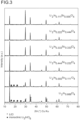
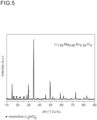
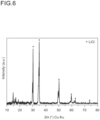
- XRD pattern obtained in Bragg-Brentano geometry of further materials listed in table 1 are shown in figs. 3 to 5 .
- the materials Li 2 In 0.555 Sc 0.111 Cl 4 Li 1.65 Mg 0.65 In 0.35 Cl 4 (see fig. 3 resp. 5) contain traces of a monoclinic phase.
- the material with the target stoichiometry L i2 In 2/3 Cl 4 ( fig. 3 ) contains a main phase having spinel structure beside minor phases of monoclinic Li 3 InCl 6 and LiCI
- ASSB means all solid state battery.
- Li 2 Sc 2/3 Cl 4 For linear sweep voltammetry (LSV) measurements, 90 mg of Li 2 Sc 2/3 Cl 4 was filled into a polyether ether ketone (PEEK) cylinder (10 mm diameter) and pressed at 2 tons for 1 min.
- PEEK polyether ether ketone
- Super P Li 2 Sc 2/3 Cl 4 and carbon
- a thin indium foil (10 mm diameter, Alfa Aesar, 99.99%, 0.125 mm thickness) was attached and ⁇ 0.3 mg Li powder (FMC Lithium) was spread over the indium foil.
- the cell was then placed into a stainless steel casing with a constant applied pressure of ⁇ 1.5 tons.
- the LSV measurement was performed with a scan rate of 0.01 mV ⁇ s -1 .
- LiCoO 2 and NMC622 powders were dried in Buechi oven under vacuum at 200 °C for 20 h before use.
- Li 6.7 Si 0.7 Sb 0.3 S 5 I powder (a state of the art sulfide-based electrolyte) was placed into a PEEK cylinder and pressed at 2 tons for 1 min (10 mm diameter), then ⁇ 40 mg of Li 2 Sc 2/3 Cl 4 was spread over one side of the solid electrolyte (SE) pellet and pressed at 2 tons for another 1 min.
- the composite cathode mixtures were prepared by mixing the cathode active material (LCO or NMC622 resp. NMC85) and Li 2 Sc 2/3 Cl 4 in an agate mortar in a weight ratio of 8:2.
- ⁇ 6-9 mg of the composite cathode mixture (corresponding to a capacity of ⁇ 1-1.25 mAh ⁇ cm -2 ) was spread and pressed at 3 tons for 3 min.
- a thin indium foil (10 mm diameter, Alfa Aesar, 99.99%, 0.125 mm thickness) was attached and ⁇ 1 mg Li powder (FMC Lithium) was spread over the indium foil in order to create a Li-In alloy.
- the ASSB was placed into a stainless steel casing with a constant applied pressure of ⁇ 1.5 tons.
- the ASSBs comprise
- ASSBs prepared as described above having a cathode comprising LiCoOz are herein referred to as "LCO ASSB", and ASSBs prepared as described above having a cathode comprising NMC622 as “NMC622 ASSB”, and ASSBs prepared as described above having a cathode comprising NMC85 as “NMC85 ASSB”.
- Schemes of the cell configurations "LCO ASSB” and “NMC622 ASSB” are shown in the insets of figs. 7b and 7c .
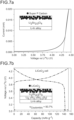
- Fig. 7a shows a linear sweep voltammogram at a scan rate of 0.01 mV ⁇ s -1 of a cell with Li-In alloy as the reference, Li 2 Sc 2/3 Cl 4 /carbon mixture (70:30wt%) as the counter electrode and Li 2 Sc 2/3 Cl 4 as the solid electrolyte layer (see configuration scheme in the inset of fig. 7a).
- Fig. 7a demonstrates that Li 2 Sc 2/3 Cl 4 has an oxidative stability of -4.3 V vs Li+/Li, which is significantly higherthan the oxidative stability of state of the art sulfide based solid electrolytes.
- Figs. 7b , c show initial charge/discharge curves of bulk-type ASSBs having a cathode comprising LiCoOz ("LCO ASSB", fig. 7b ) cycled between 3V and 4.3V vs Li + /Li and having a cathode comprising NMC622 ("NMC622 ASSB", fig. 7c ) cycled between 2.8V and 4.3V and between 2.8V and 4.5V vs Li + /Li at room temperature at 0.1 C.
- the insets in Fig. 7b , c show schemes of the cell configurations.
- the anode is in each case a Li-ln alloy.
- the separator is formed of Li 6.7 Si 0.7 Sb 0.3 S 5 I (a state of the art sulfide-based electrolyte).
- the cathode active material is covered by Li 2 Sc 2/3 Cl 4 , so that direct contact between the cathode active material and the sulfide-based solid electrolyte of the separator is prevented.
- Fig. 8a shows cross-sectional SEM images of the NMC622/Li 2 Sc 2/3 Cl 4 cathode composite and Li 2 Sc 2/3 Cl 4 electrolyte section of the NMC622 ASSB (schematically shown in the inset of fig. 7c ) after cycling (fully discharged state).
- Fig. 8b shows an enlarged section of the cathode composite of the NMC622 ASSB, showing that the NMC622 particles (spheres) are well embedded in the Li 2 Sc 2/3 Cl 4 matrix, providing for excellent contact between NMC622 and Li 2 Sc 2/3 Cl 4 .
- Fig. 8c show SEM cross-sectional images and fig. 8d shows EDX mapping of the LiCoOz cathode composite of the LCO ASSB (schematically shown in the inset of fig. 7b ) after cycling, illustrating that the LCO cannot be distinguished from the solid electrolyte Li 2 Sc 2/3 Cl 4 .
- the EDX mapping in fig. 8d (Cl and Co) shows the LCO particles and Li 2 Sc 2/3 Cl 4 are well mixed.
- fig. 8 shows that the NMC622 and LCO particles are well embedded in the Li 2 Sc 2/3 Cl 4 matrix with excellent contact which explains the excellent cycling performance (see below).
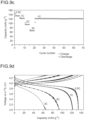
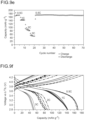
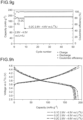
- Fig. 9 shows electrochemical performance of "LCO ASSB” resp. "NMC622 ASSB” and in each case Li 2 Sc 2/3 Cl 4 as the solid electrolyte at room temperature.
- fig. 9 shows the charge-discharge capacity and the Coulombic efficiency (CE) as a function of cycle number for (a) the LCO ASSB cycled at 0.1C, 0.2C and 0.5C between 3.0V and 4.3V vs Li + /Li and (b) the NMC622 ASSB cycled at 0.1C between 2.8 V and 4.3V vs Li + /Li, the charge-discharge capacity as a function of cycle number at different C-rates for (c) the LCO ASSB and (e) the NMC622 ASSB and corresponding charge-discharge curves at different C-rates for (d) the LCO ASSB and (f) the NMC622 ASSB, and (g) the charge-discharge capacity and the Coulombic efficiency
- Fig. 10 shows charge-discharge curves of (a) the LCO ASSB cycled at 0.1C, 0.2C and 0.5C and (b) the NMC622 ASSB cycled at 0.1C (1st, 40th and 80th cycles are shown here).
- Fig. 11 shows 21st-70th cycles charge-discharge curves of rate cycling for (a) the LCO ASSB cycled at 1C and (b) the NMC622 ASSB cycled at 0.5C.
- Fig. 12 shows Nyquist plots of a LCO ASSB cycled at (a) slow rates (long-term cycling) and (b) fast rates (rate cycling).
- Fig. 13 presents SEM images of pristine (a,b) LCO particles and (d,e) NMC622 particles showing the particle size distribution and microstructure, and SEM images (c,f) of the particle morphology after hand-grinding with 20 wt% Li 2 Sc 2/3 Cl 4 showing that the particle surfaces of (c) LCO resp. (f) NMC622 are covered with the Li 2 Sc 2/3 Cl 4 solid electrolyte.
- ASSBs Bulk-type all solid state batteries having a high voltage cathode active material (LiCoOz resp. NMC622) in direct contact with Li 2 Sc 2/3 Cl 4 which prevents direct contact between the cathode active material and the sulfide-based solid electrolyte of the separator, show good performance in terms of Coulombic efficiency and cycling performance.
- the initial charge/discharge curves of LCO ASSB and NMC622 ASSB cycled in different voltage ranges are shown in Figs. 7 b , c . All ASSBs exhibit high initial Coulombic efficiency above 93.7%.
- the long-term cycling performance of LCO ASSB at rates of 0.1 C, 0.2 C and 0.5 C and room temperature are shown in figs. 9a and 10a .
- the LCO ASSB With an upper cutoff voltage of 4.3 V vs Li + /Li, the LCO ASSB exhibits a high initial discharge capacity of 143 mAh ⁇ g -1 at 0.1 C ( fig. 10a ) and 135 mAh g -1 at 0.5 C ( fig. 9d ) and good capacity retention.
- the LCO ASSB also exhibits excellent rate capacity as shown in figs. 9 c,d . Even at 1 C, the LCO ASSB still retains a reversible capacity over 120 mAh ⁇ g- 1 ( fig.
- Fig. 12 shows the initial and final EIS data of the corresponding LCO ASSBs of Figs. 9a and 9c .
- the total impedance of the ASSB cycled at fast-rates is almost the same as the initial state ( Fig. 12b ), but the total impedance clearly increases after cycling at slow-rates ( Fig. 12a ).
- Figs 9b and 10b shows the long-term cycling of the NMC622 ASSB at 0.1 C between 2.8 V and 4.3 V vs Li + /Li. It exhibits very stable capacity retention with virtually no capacity fade, maintaining a capacity of ⁇ 175 mAh ⁇ g -1 with high Coulombic efficiency ⁇ 99.8% on average over 80 cycles (cycling still in progress).
- the NMC622 ASSB also exhibits good rate capacity (Figs. 9 e,.f and 11b ), although not as promising as the LCO ASSB, possibly due to the microstructure of NMC622 particles with randomly oriented grains (i.e., small primary particles aggregated into large secondary particles).
- LCO is comprised of large single LiCoOz crystallites ( Fig. 13 ). Tuning cathode particle size and microstructure will potentially further improve the electrochemical performance.
- the NMC622 ASSB also exhibits excellent cycling performance with a cutoff voltage of 4.6 V (vs. Li + /Li) with nearly no capacity fade, maintaining a capacity of ⁇ 190 mAh ⁇ g -1 with high Coulombic efficiency ⁇ 99.5% on average at 0.2 C over 50 cycles ( Fig. 9g ); typical voltage profiles are shown in Fig. 9h , which are also significantly better than those previously reported for ASSBs with an NMC cathode.
- a cathode active material having a higher content of Ni provides higher capacity, thus allowing for a higher energy density.
- cathode active materials generally are known to exhibit poor stability.
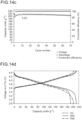
- NMC85 ASSBs exhibit stable cycling, as shown in Fig. 14 .
- an upper cutoff voltage ( fig. 14 a,b) of 4.3 V vs Li + /Li the NMC85 ASSB exhibits a stable discharge capacity >190 mAh ⁇ g -1 at 0.2C and good capacity retention for 90 cycles.
- a NMC85 ASSB cycled with high upper cutoff voltage of 4.5 V ( fig.
- NMC85 cell with liquid electrolyte show fast capacity fade when charged only to 4.3 V, which is due to the surface of NMC85 particles converted to spinel and rock-salt types phases and solid electrolyte interface formed due to the oxidation of liquid electrolyte by the strongly oxidizing Ni 3+ / 4+ sites which impedes the Li ion diffusion.
- the excellent cycling of NMC85 ASSBs is possible due to the high oxidative stability of Li 2 Sc 2/3 Cl 4 , as no Li ion blocking interface will be build up between NMC85 and Li 2 Sc 2/3 Cl 4 .
- NMC cathode active materials having a high Ni content (like NMC 85) and micro-cracks formed in cycled NMC particles due to volume change during cycling (loss of contact) potentially lead to the slow capacity fading in NMC ASSBs, as shown in figs. 9 , 10b and 14 .
Landscapes
- Chemical & Material Sciences (AREA)
- Electrochemistry (AREA)
- General Chemical & Material Sciences (AREA)
- Chemical Kinetics & Catalysis (AREA)
- Inorganic Chemistry (AREA)
- Engineering & Computer Science (AREA)
- Organic Chemistry (AREA)
- Manufacturing & Machinery (AREA)
- Materials Engineering (AREA)
- General Physics & Mathematics (AREA)
- Physics & Mathematics (AREA)
- Condensed Matter Physics & Semiconductors (AREA)
- Life Sciences & Earth Sciences (AREA)
- Geology (AREA)
- Ceramic Engineering (AREA)
- Battery Electrode And Active Subsutance (AREA)
- Secondary Cells (AREA)
- Conductive Materials (AREA)
- Inorganic Compounds Of Heavy Metals (AREA)
- Compounds Of Alkaline-Earth Elements, Aluminum Or Rare-Earth Metals (AREA)
Description
- Described are a solid material which has ionic conductivity for lithium ions, a process for preparing said solid material, a use of said solid material as a solid electrolyte for an electrochemical cell, a solid structure selected from the group consisting of a cathode, an anode and a separator for an electrochemical cell comprising the solid material, and an electro-chemical cell comprising such solid structure.
- Due to the wide-spread use of all-solid-state lithium batteries, there is an increasing demand for solid state electrolytes having a high conductivity for lithium ions. An important class of such solid electrolytes are lithium transition metal halides. Such solid electrolytes are disclosed e.g. in
US 2019/0088995 A1 ,WO 2019/135343 A1 andWO 2019/135345 A1 . - There is an ongoing need for lithium ion conductors which exhibit suitable ionic conductivity for application as solid electrolyte in an all-solid-state lithium battery, as well as electro-chemical oxidative stability up to 4 V vs. Li/Li+ or more, preferably up to 4.5 V vs. Li/Li+, in order to enable application of cathode active materials having a redox potential of 4 V or more vs. Li/Li+ (cathode active material of the "4 V class"), so that a high cell voltage is obtainable.
- The publication "Site-Occupation-Tuned Superionic LixScCl3+x Halide Solid Electrolytes for All-Solid-State Batteries" by Liang et al., (J. Am. Chem. Soc., DOI: 10.1021/jacs.0c00134, Publication Date (Web): 26 Mar 2020) discloses solid electrolytes LixScCl3+x(x = 1, 1.5, 2, 2.5, 3, 3.5, and 4) based on the cubic close-packed anion sublattice. When x ≥ 2.5, the XRD patterns can be indexed well with Li3ScCl6, (C2/m, ICSD No. 04-009-8885) which is a monoclinic structure. According to said publication, due to a low eutectic temperature between LiCI and ScCl3, LixScCl3+x can be synthesized by a simple co-melting strategy. Further details of the material synthesis are not given.
- In April 2020, a "Supporting Information" related to the above-mentioned paper was published online which provides complete experimental details, electrochemical/interface stability calculation, ab initio molecular dynamics simulations, supplementary figures and tables.
- It is an objective of the present disclosure to provide a solid material which may be used as a solid electrolyte for an electrochemical cell. In addition, there is provided a process for preparing said solid material, a use of said solid material as a solid electrolyte for an electrochemical cell, a solid structure selected from the group consisting of a cathode, an anode and a separator for an electrochemical cell comprising the solid material, and an electro-chemical cell comprising such solid structure, wherein said solid structure comprises said solid material.
- According to a first aspect, there is provided a solid material having a composition according to general formula (I)
LiaAX4 (I)
wherein
X is one or more selected from the group consisting of Cl, F, Br and I - (a) A is M1bM2c
wherein
M1 is a first trivalent metal and M2 is a second trivalent metal different from M1,


- (b) A is M1dM3e
wherein
M1 is a trivalent metal and M3 is a divalent metal,


- As used herein "tri-valent" means that in the solid material according to general formula (I) the metals M1 and -if present- M2 are in the oxidation state +3, and "di-valent" means that in the solid material according to general formula (I) the metal M3 is in the oxidation state +2.
- In formula (I), X is either one selected from the group consisting of Cl, F, Br and I, or X is more than one selected from the group consisting of Cl, F, Br and I so that the sum of all X is 4. Preferably X is one selected from the group consisting of Cl, F, Br and I, preferably Cl.
- When A is M1 bM2c as defined above, M1 is a first trivalent metal and M2 is a second trivalent metal different from M1, or M1 is a trivalent metal, and M2 is not present. M1 and -if present- M2 may be selected from the group consisting of Sb, Nb and Mo (antimony, niobium and molybdenum, in each case in the oxidation state +3), and Sc, Al, In and Y (scandium, aluminium, indium and yttrium). Preferably, M1 and M2 are different trivalent metals selected from the group consisting of Sc, Al, In and Y, or M1 is a trivalent metal selected from the group consisting of Sc, Al, In and Y, and M2 is not present.
- When A is M1bM2c as defined above, the following definitions apply to formula (I) as defined above


- When A is M1dM3e as defined above, M1 is a trivalent metal and M3 is a divalent metal. M1 may be selected from the group consisting of Sb, Nb and Mo (antimony, niobium and molybdenum, in each case in the oxidation state +3), and Sc, Al, In and Y (scandium, aluminium, indium and yttrium). M3 may be selected from the group consisting of Mg, Ca, and Zn (magnesium, calcium and zinc). Preferably M1 is selected from the group consisting of Sc, Al, In and Y, and M3 is selected from the group consisting of Mg, Ca and Zn.
- When A is M1dM3e as defined above, the following definitions apply to formula (I) as defined above


- Irrespective of the selection of A, X is preferably Cl.
- When A is M1bM2c as defined above, a solid material according to the first aspect described herein has a composition according to formula (la)
LiaM1bM2cX4 (Ia)
wherein


- In certain cases, a solid material according to the first aspect as disclosed herein has a composition according to formula (la)
LiaM1bM2cX4 (Ia)
wherein


- Thus formula (la) may be rewritten as formula (la')
LiaM1bX4 (Ia')
wherein M1, X, a and b are as defined above. - M1 may be selected from the group consisting of Sb, Nb and Mo (antimony, niobium and molybdenum, in each case in the oxidation state +3), and Sc, Al, In and Y (scandium, aluminium, indium and yttrium in each case in the oxidation state +3). Preferably, M1 is a trivalent metal selected from the group consisting of Sc, Al, In and Y.
- Preferably, X is Cl.
- Further preferably, M1 is a trivalent metal selected from the group consisting of Sc, Al, In and Y, and X is Cl. For instance, M1 is Sc and X is Cl, or M1 is In and X is Cl.
- Preferably, 0.6 ≤ b ≤ 0.75, more preferably, 0.65 ≤ b ≤ 0.7.
- Further preferably, 0.65 ≤ b ≤ 0.7, M1 is a trivalent metal selected from the group consisting of Sc, Al, In and Y, and X is Cl. Still further preferably, 0.65 ≤ b ≤ 0.7, M is Sc and X is Cl.
- Exemplary solid materials having a composition according to formula (la) wherein c = 0 (i.e. solid materials having a composition according to formula (la')) are:
Li2.08Sc0.64Cl4
Li2Sc2/3Cl4
Li1.9Sc0.7Cl4
Li2In2/3Cl4.
- In certain other cases a solid material according to the first aspect as disclosed herein has a has a composition according to formula (la)
LiaM1bM2cX4 (Ia)
wherein



- M1 is a first trivalent metal, M2 is a second trivalent metal different from M1, and X is selected from the group consisting of Cl, F, Br and I.
- M1 and M2 may be selected from the group consisting of Sb, Nb and Mo (antimony, niobium and molybdenum, in each case in the oxidation state +3), and Sc, Al, In and Y (scandium, aluminium, indium and yttrium). Preferably, M1 and M2 are different trivalent metals selected from the group consisting of Sc, Al, In and Y.
- Preferably, X is Cl.
- Further preferably, M1 and M2 are different trivalent metals selected from the group consisting of Sc, Al, In and Y, and X is Cl. For instance, M1 is Sc, M2 is In and X is Cl.
- Preferably


- For instance, M1 is Sc, M2 is In, X is Cl, 0.1 ≤ b ≤ 0.6, 0.1 ≤ c ≤ 0.6, and 0.6 ≤ (b+c) ≤ 0.75.
- For instance, M1 is Sc, M2 is In, X is Cl, 0.1 ≤ b ≤ 0.58, 0.1 ≤ c ≤ 0.58, and 0.65 ≤ (b+c) ≤ 0.7.
- Exemplary solid materials having a composition according to formula (la) wherein 0.1 ≤ c ≤ 0.7 are
Li2In0.555Sc0.111Cl4 (Li2In5/9Sc1/9Cl4)
Li2In0.444Sc0.222Cl4 (Li2In4/9Sc2/9Cl4)
Li2In0.333Sc0.333Cl4 (Li2In1/3Sc1/3Cl4)
Li2In0.222Sc0.444Cl4 (Li2In2/9Sc4/9Cl4)
Li2In0.111Sc0.555Cl4 (Li2In1/9Sc5/9Cl4).
- In yet other cases a solid material according to the first aspect as defined herein has a composition according to formula (I) as defined above, wherein A is M1dM3e as defined above. Thus, the solid material has a composition according to formula (lb)
LiaM1dM3eX4 (Ib)
wherein


- M1 is a trivalent metal, M3 is a divalent metal, and X is selected from the group consisting of Cl, F, Br and I.
- M1 may be selected from the group consisting of Sb, Nb and Mo (antimony, niobium and molybdenum, in each case in the oxidation state +3), and Sc, Al, In and Y (scandium, aluminium, indium and yttrium in each case in the oxidation state +3). Preferably, M1 is a trivalent metal selected from the group consisting of Sc, Al, In and Y.
- M3 may be selected from the group consisting of Mg, Ca, and Zn (magnesium, calcium and zinc).
- Preferably, X is Cl.
- Further preferably, M1 is selected from the group consisting of Sc, Al, In and Y, M3 is selected from the group consisting of Mg, Ca and Zn, and X is Cl. For instance, M1 is Sc, M3 is Mg and X is Cl, or M1 is In, M3 is Mg and X is Cl.
- Preferably
- 0.35 ≤ d ≤ 0.8, more preferably 0.4 ≤ d ≤ 0.8, further preferably 0.46 ≤ d ≤ 0.78, and
- 0.2 ≤ e ≤ 0.65, more preferably 0.2 ≤ e ≤ 0.55, further preferably 0.22 ≤ e ≤ 0.52, and
- 0.9 ≤ (d+e) ≤ 1.1, more preferably 0.95 ≤ (d+e) ≤ to 1.05, further preferably 0.98 ≤ (d+e) ≤ 1.02.
- For instance, M1 is Sc, M3 is Mg and X is Cl, and 0.35 ≤ d ≤ 0.8, 0.2 ≤ e ≤ 0.65 and 0.9 ≤ (d+e) ≤ 1.1.
- For instance, M1 is Sc, M3 is Mg and X is Cl, and 0.4 ≤ d ≤ 0.8, 0.2 ≤ e ≤ 0.55 and 0.95 ≤ (d+e) ≤ 1.05.
- For instance, M1 is Sc, M3 is Mg and X is Cl, and 0.46 ≤ d ≤ 0.78, 0.2 ≤ e ≤ 0.52 and 0.98 ≤ (d+e) ≤ 1.02.
- Exemplary solid materials having a composition according to formula (lb) are
Li1.65Mg0.65Sc0.35Cl4 (Li165Sc0.35Mg0.65Cl4)
Li1.5Mg0.5Sc0.5Cl4 (Li1.5Sc0.5Mg0.5Cl4)
Li1.35Mg0.35Sc0.65Cl4 (Li1.35Sc0.65Mg0.35Cl4)
Li1.3Mg0.3Sc0.7Cl4 (Li1.3Sc0.7 Mg0.3Cl4)
Li1.25Mg0.25Sc0.75Cl4 (Li1.25Sc0.75Mg0.25Cl4)
Li1.65Mg0.65In0.35Cl4 (Li1.65In0.35Mg0.65Cl4).
- Surprisingly it has been found that solid materials having a composition according to general formula (I) as defined above may exhibit favorable lithium ion conductivity as well as electrochemical oxidation stability in contact with a cathode active material having a redox potential of 4 V or more vs. Li/Li+, and also in contact with electron-conducting materials comprising or consisting of elemental carbon (e.g. carbon black, graphite) which are typical electrode additives in electrochemical cells. This is an important advantage over state-of-the-art solid electrolytes which contain sulfur.
- A solid material according to the above-defined first aspect may be crystalline as detectable by the X-ray diffraction technique. A solid material is referred to as crystalline when it exhibits a long range order that is characteristic of a crystal, as indicated by the presence of clearly defined reflections in its X-ray diffraction pattern. In this context, a reflection is considered as clearly defined if its intensity is more than 10% above the background.
- A solid material according to the above-defined first aspect may consist of a single phase or of more than one phase, e.g. a main phase (primary phase) and minor amounts of impurities and secondary phases. It is understood that formula (I) is an empirical formula (gross formula) as determinable by means of elemental analysis. Accordingly, formula (I) defines a composition which is averaged over all phases present in the solid material. However, a solid material according to the above-defined first aspect comprises at least one phase which as such has a composition according to formula (I). In case a crystalline solid material according to the above-defined first aspect contains more than one phase, than the weight fraction of phases which as such do not have a composition according to formula (I) (e.g. impurity phases, secondary phases) is so small that the composition averaged over all phases is according to formula (I). The total weight fraction of secondary phases and impurity phases may be 20 % or less, preferably 10 % or less, further preferably 5 % or less, most preferably 3 % or less, based on the total weight of the solid material.
- If present, the secondary phases and impurity phases mainly consist of the precursors used for preparing the solid material, e.g. LiX and MX3 (wherein X and M are as defined above), and sometimes impurity phases which may originate from impurities of the precursors. For details of preparing a solid material according to the above defined first aspect, see the information provided below in the context of the second aspect disclosure.
- In certain cases, a solid material according to the above-defined first aspect is in the form of a polycrystalline powder, or in the form of single crystals.
- A crystalline solid material according to the above-defined first aspect may comprise or consist of a phase having a spinel structure characterized by the cubic space group Fd-3m, wherein said spinel structure exhibits a disordered lithium ion distribution over available tetrahedral and octahedral sites within the lattice.
- The phase having said spinel structure may be present in an amount of 80 % or more, preferably 90 % or more, further preferably 95 % or more, most preferably 98 % or more, based on the total weight of the solid material (including secondary phases and impurity phases).
- The spinel structure is determined by powder X-ray diffraction (XRD) measurements as generally known in the art. X-ray diffraction (XRD) measurements were conducted at room temperature on a PANalytical Empyrean diffractometer with Cu-Kα radiation that was equipped with a PIXcel bidimensional detector. XRD patterns are obtained in Debye-Scherrer geometry, with samples sealed in 0.5 mm (diameter) glass capillaries under argon. XRD patterns for phase identification are obtainable in Bragg-Brentano geometry, with sample placed on a zero-background sample holder in an Ar-filled glovebox and protected by Kapton film.
- Without wishing to be bound by any theory, it is presently assumed that the disordered spinel structure provides for a significantly disordered Li+ ion distribution over available tetrahedral and octahedral sites within the lattice so that solid materials having a composition according to general formula (I) may provide favourable conditions for lithium ion conductivity.
- Thus, a solid material according to the first aspect described herein may be selected rom the group consisting of
- (i) solid materials having a spinel structure characterized by the cubic space group, Fd-3m and a composition according to general formula (la)
LiaM1bM2cX4 (Ia)
wherein


- (ii) solid materials having a spinel structure characterized by the cubic space group Fd-3m and a composition according to general formula (la)
LiaM1bM2cX4 (Ia)
wherein


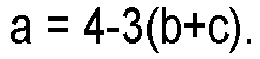
- (iii) solid materials having a spinel structure characterized by the cubic space group Fd-3m and a composition according to general formula (lb)
LiaM1dM3eX4 (Ib)
wherein- M1 is a trivalent metal selected from the group consisting of Sc, Al, In and Y and
- M3 is a divalent metal selected from the group consisting of Mg, Ca and Zn


- In certain other cases, a solid material according to the above-defined first aspect may have a glassy ceramic structure, i.e. is a polycrystalline solid having at least 30 % by volume of a glassy phase.
- The structure of a solid material according to the above-defined first aspect depends on the way how it is prepared. For details of preparing a solid material according to the above defined first aspect, see the information provided below in the context of the second aspect of this disclosure.
- A solid material according to the above-defined first aspect may have an ionic conductivity of 0.1 mS/cm or more, preferably 1 mS or more at a temperature of 25 °C. The ionic conductivity is determined in the usual manner known in the field of battery materials development by means of electro-chemical impedance spectroscopy (for details see examples section below).
- At the same time, a solid material according to the above-defined first aspect may have an almost negligible electronic conductivity. More specifically the electronic conductivity may be at least 3 orders of magnitude lower than the ionic conductivity, preferably at least 5 orders of magnitude lower than the ionic conductivity. In certain cases, a solid material according to the above-defined first aspect exhibits an electronic conductivity of 10-10 S/cm or less. The electronic conductivity is determined in the usual manner known in the field of battery materials development by means of direct-current (DC) polarization measurements at different voltages.
- Preferred solid materials according to the first aspect as defined above are those having one or more of the specific features disclosed above.
- According to a second aspect, there is provided a process for obtaining a solid material according to the above-defined first aspect. Said process comprises the following steps
- a) preparing or providing a reaction mixture comprising the precursors
- (1) LiX
- (2) a compound M1X3 wherein M1 is a trivalent metal
and optionally - (3) a compound selected from the group consisting of compounds M2X3 wherein M2 is a trivalent metal different from M1 and compounds M3Xzwherein M3 is a divalent metal
- wherein in each precursor, independently from the other precursors, X is selected from the group consisting of Cl, F, Br, I
- wherein in said reaction mixture the molar ratio of the elements Li, M1, X resp. Li, M1, X and one of M2 and M3 matches general formula (I);
- b) reacting the reaction mixture so that a solid material having a composition according to general formula (I) is obtained.
- In step a) of the process according to the above-defined second aspect, a reaction mixture comprising precursors of the solid material having a composition according to general formula (I) to be formed in step b) is prepared or provided. Said precursors are
- (1) LiX
- (2) a compound M1X3 wherein M1 is a trivalent metal
and optionally - (3) a compound selected from the group consisting of compounds M2X3 wherein M2 is a trivalent metal different from M1 and compounds M3X2 wherein M3 is a divalent metal
- wherein in each precursor, independently from the other precursors, X is selected from the group consisting of Cl, F, Br, I
- wherein in said reaction mixture the molar ratio of the elements Li, M1, X resp. Li, M1, X and one of M2 and M3 matches general formula (I).
- Preferably the reaction mixture prepared or provided in step (a) consists of the precursors (1) and (2) resp. (1), (2) and (3) as defined above.
- In each of precursors (1), (2) and (3) X may be selected independently. Preferably, in each compound of precursors (1) and (2) of a reaction mixture, X is the same, preferably Cl.
- Preferably, precursor (1) is LiCI.
- When precursor (3) is M2X3, then in precursors (2) M1X3 and (3) M2X3, M1 and M2 are different trivalent metals. M1 and M2 may be selected from the group consisting of Sb, Nb and Mo (antimony, niobium and molybdenum, in each case in the oxidation state +3), and Sc, Al, In and Y (scandium, aluminium, indium and yttrium). Preferably, M1 and M2 are different trivalent metals selected from the group consisting of Sc, Al, In and Y. Preferably, the precursors (2) M1X3 and (3) M2X3 are selected from the group consisting of ScX3, AlX3, InX3 and YX3 wherein the precursors M1X3 and M2X3 are different. Most preferably, the precursors (2) M1X3 and (3) M2X3 are selected from the group consisting of ScCl3, AlCl3, InCl3 and YCl3 wherein the precursors M1X3 and M2X3 are different.
- When precursor (3) is M3X2, M3 may be selected from the group consisting of Mg, Ca, and Zn (magnesium, calcium and zinc). Preferably, the precursor M3X2 is selected from the group consisting of MgX2, CaX2 and ZnX2, more preferably from the group consisting of MgCl2, CaCl2 and ZnCl2.
- In certain cases, the reaction mixture prepared or provided in step a) of the process according to the above-defined second aspect consists of the precursors
- (1) LiX
- (2) a compound M1X3 wherein M1 is a trivalent metal
- In said reaction mixture, precursor (3) as defined above is not present. Such reaction mixtures are suitable for preparing solid materials having a composition according to general formula (la) as defined above wherein c = 0. Thus, a reaction mixture suitable for preparing a solid material having a composition according to general formula (la) wherein c = 0 consists of the precursors
- (1) LiX
- (2) a compound M1X3 wherein M1 is a trivalent metal
- wherein in each compound of precursors (1) and (2), X is independently selected from the group consisting of Cl, F, Br, I,
- wherein in said reaction mixture the molar ratio of the elements Li, M1, and X matches general formula (la) wherein c = 0.
- In each of precursors (1) and (2), X may be selected independently. Preferably, in each precursor of a reaction mixture, X is the same, preferably Cl.
- Preferably, precursor (1) is LiCI.
- In precursor (2) M1X3, M1 may be selected from the group consisting of Sb, Nb and Mo (antimony, niobium and molybdenum, in each case in the oxidation state +3), and Sc, Al, In and Y (scandium, aluminium, indium and yttrium). Preferably, M1 is a trivalent metal selected from the group consisting of Sc, Al, In and Y.
- Thus, in certain processes according to the above-defined second aspect, the reaction mixture consists of precursors (1) and (2) as defined above, wherein precursor (2) is a compound M1X3 wherein M1 is a trivalent metal selected from the group consisting of Sc, Al, In and Y, wherein in said reaction mixture the molar ratio of the elements Li, M1 and X matches general formula (I).
- Preferably, precursor (2) M1X3 is selected from the group consisting of ScX3, AlX3, InX3 and YX3. More preferably, precursor (2) M1X3 is selected from the group consisting of ScCl3, AlCl3, InCl3 and YCl3. For instance, precursor (2) M1X3 is ScCl3 or InCl3.
- Especially preferably, precursor (1) is LiCI and precursor (2) is selected from the group consisting of ScCl3, AlCl3, InCl3 and YCl3. For instance, precursor (1) is LiCI and precursor (2) is ScCl3 or InCl3.
- In other cases, the reaction mixture prepared or provided in step a) of the process according to the above-defined second aspect consists of the precursors
- (1) LiX
- (2) a compound M1X3 wherein M1 is a trivalent metal
- (3) a compound M2X3 wherein M2 is a trivalent metal different from M1
- Such reaction mixtures are suitable for preparing solid materials having a composition according to general formula (la) as defined above wherein c > 0. Thus, a reaction mixture suitable for preparing a solid material having a composition according to general formula (Ia) wherein c > 0 consists of the precursors
- (1) LiX
- (2) a compound M1X3 wherein M1 is a trivalent metal
and - (3) a compound M2X3 wherein M2 is a trivalent metal different from M1
- wherein in each compound of precursors (1) and (2) X is independently selected from the group consisting of Cl, F, Br, I,
- wherein in said reaction mixture the molar ratio of the elements Li, M1, M2 and X matches general formula (la) wherein c > 0.
- In each of precursors (1), (2) and (3), X may be selected independently. Preferably, in each precursor of a reaction mixture, X is the same, preferably Cl.
- Preferably, precursor (1) is LiCI.
- In precursors (2) M1X3 and (3) M2X3, M1 and M2 are different trivalent metals. M1 and M2 may be selected from the group consisting of Sb, Nb and Mo (antimony, niobium and molybdenum, in each case in the oxidation state +3), and Sc, Al, In and Y (scandium, aluminium, indium and yttrium). Preferably, M1 and M2 are trivalent metals selected from the group consisting of Sc, Al, In and Y.
- Thus, in certain processes according to the above-defined second aspect, the reaction mixture consists of precursors (1) and (2) and (3) as defined above, wherein precursor (3) consists of a compound M2X3 wherein M2 is a trivalent metal selected from the group consisting of Sc, Al, In and Y with the proviso that M2 is different from M1, wherein in said reaction mixture the molar ratio of the elements Li, M1, M2 and X matches general formula (la).
- Preferably, the precursors (2) M1Xs and (3) M2X3 are selected from the group consisting of ScX3, AlX3, InX3 and YX3 wherein the precursors (2) M1Xs and (3) M2X3 are different.
- Most preferably, the precursors (2) M1X3 and (3) M2X3 are selected from the group consisting of ScCl3, AlCl3, InCl3 and YCl3 wherein the precursors (2) M1X3 and (3) M2X3 are different. For instance, precursor (2) is ScCl3 and precursor (3) is InCl3.
- Especially preferably, precursor (1) is LiCI and precursors (2) and (3) are different compounds selected from the group consisting of ScCl3, AlCl3, InCl3 and YCl3. For instance, precursor (1) is LiCI, precursor (2) is ScCl3 and precursor (3) is InCl3.
- In yet other cases, the reaction mixture prepared or provided in step a) of the process according to the above-defined second aspect consists of the precursors
- (1) LiX
- (2) a compound M1X3 wherein M1 is a trivalent metal
- (3) a compound M3X2 wherein M3 is a divalent metal
- Such reaction mixtures are suitable for preparing solid materials having a composition according to general formula (lb) as defined above. Thus, a reaction mixture suitable for preparing a solid material having a composition according to general formula (lb) consists of the precursors
- (1) LiX
- (2) a compound M1X3 wherein M1 is a trivalent metal
and - (3) a compound M3X2 wherein M3 is a divalent metal
- wherein in each compound of precursors (1) and (2), X is independently selected from the group consisting of Cl, F, Br, I,
- wherein in said reaction mixture the molar ratio of the elements Li, M1, M3, and X matches general formula (lb).
- In each of precursors (1), (2) and (3), X may be selected independently. Preferably, in each precursor of a reaction mixture, X is the same, preferably Cl.
- Preferably, precursor (1) is LiCI.
- In precursor (2) M1X3 M1 may be selected from the group consisting of Sb, Nb and Mo (antimony, niobium and molybdenum, in each case in the oxidation state +3), and Sc, Al, In and Y (scandium, aluminium, indium and yttrium). Preferably, M1 is a trivalent metal selected from the group consisting of Sc, Al, In and Y.
- In precursor (3) M3X2, M3 may be selected from the group consisting of Mg, Ca, and Zn (magnesium, calcium and zinc).
- Thus, in certain processes according to the above-defined second aspect, the reaction mixture consists of precursors (1) and (2) and (3) as defined above, wherein precursor (3) consists of a compound M3X2 wherein M3 is a divalent metal selected from the group consisting of Mg, Ca and Zn, wherein in said reaction mixture the molar ratio of the elements Li, M1, X and M3 matches general formula (lb).
- Preferably, precursor (2) M1X3 is selected from the group consisting of ScX3, AlX3, InX3 and YX3. More preferably, precursor (2) M1X3 is selected from the group consisting of ScCl3, AlCl3, InCl3 and YCl3. For instance, precursor (2) M1X3 is ScCl3 or InCl3.
- Preferably, precursor (3) M3X2 is selected from the group consisting of MgX2, CaX2 and ZnX2, more preferably from the group consisting of MgCl2, CaCl2 and ZnCl2.
- Especially preferably, precursor (1) is LiCI and precursor (2) is selected from the group consisting of ScCl3, AlCl3, InCl3 and YCl3 and precursor (3) is selected from the group consisting of MgCl2, CaCl3, and ZnCl2. For instance, precursor (1) is LiCI and precursor (2) is ScCl3 and precursor (3) is MgCl2, or precursor (1) is LiCI and precursor (2) is InCl3 and precursor (3) is MgCl2.
- The reaction mixture may be obtained by grinding together the precursors so that a powder is obtained, and optionally pressing the powder into pellets.
- In step b) of the process according to the above-defined second aspect, the reaction mixture is allowed to react so that a solid material having a composition according to general formula (I) is obtained. In otherwords, in step b) the precursors in the reaction mixture react with each other to obtain a solid material having a composition according to general formula (I).
- In step (b) reacting the reaction mixture may be achieved by
- (b-1) heat-treating the reaction mixture in a temperature range of from 300 °C to 700 °C for a total duration of from 30 hours to 100 hours so that a reaction product is formed, and cooling the obtained reaction product so that a solid material having a composition according to general formula (I) is obtained
or - (b-2) ball-milling the reaction mixture at a rate of 300 to 500 rpm for 20 to 40 hours so that a solid material having a composition according to general formula (I) is obtained.
- In certain processes according to the above-defined second aspect, the reaction mixture prepared or provided in process step a) is heat-treated in step b) to enable the reaction of the precursors. The reaction mixture may be in the form of a powder, or in the form of pellets.
- Heat-treating may be performed in a closed vessel. The closed vessel may be a sealed quartz tube or any other type of container which is capable of withstanding the temperature of the thermal treatment and is not subject to reaction with any of the precursors, such as a glassy carbon crucible or a tantalum crucible.
- In step b) the reaction mixture may be heat-treated in a temperature range of from 300 °C to 700 °C for a total duration of from 30 hours to 100 hours so that a reaction product is formed. More specifically, in step b) the reaction mixture may be heat-treated in a temperature range of from 500 °C to 700 °C for a total duration of 40 hours to 80 hours.
- Most preferably in step (b) the reaction mixture is heated to a heat treating temperature in the range of from 600 °C to 700 °C, more preferably 620 °C to 680 °C with a ramp rate in the range of
rom 2 to 10 °C/min and heat treated at said temperature for a total duration of from 30 hours to 60 hours so that a reaction product is formed, and the obtained reaction product is cooled so that a solid material having a composition according to general formula (I) and a spinel structure as explained above is obtained. - The heat treating temperature is preferably selected slightly above the melting point of precursor (1) so that precursor (1) is in the molten state. It appears that the reaction of the reaction mixture is promoted when precursor (1) is in the molten state. Herein precursor (1) is preferably LiCl.
- When the duration of the heat treatment of step b) is completed, the formed reaction product is allowed to cool down. Thus, a solid material having a composition according to general formula (I) is obtained. Cooling of the reaction product is preferably performed using a cooling rate of from 0.1 to 10 °C per minute, or by quenching with water.
- Reacting the reaction mixture prepared or provided in step a) by means of heat-treating in step b) as described above results in formation of a solid material having a composition according to general formula (I) which has a spinel structure as defined above. Such materials having a spinel structure can be obtained from any of the reaction mixtures described above, especially from the preferred ones, especially those wherein X in all precursors is Cl.
- In certain other processes according to the above-defined second aspect, the reaction mixture prepared or provided in process step a) is ball-milled in step b) to enable the reaction of the precursors. The reaction mixture may be in the form of a powder, or in the form of pellets.
- Ball-milling of the reaction mixture is preferably carried out at a rate of 300 to 500 rpm for 20 to 40 hours. Preparation of lithium-conducting solid electrolytes by ball milling a reaction mixture comprising appropriate precursors is known in the art.
- Reacting the reaction mixture prepared or provided in step a) by means of ball-milling in step b) as described above results in formation of a solid material having a composition according to general formula (I) which has a glassy ceramic structure, i.e. is a polycrystalline solid having at least 30 % by volume of a glassy phase.
- Preferred processes according to the second aspect as defined herein are those having one or more of the specific features disclosed above.
- A solid material according to the above-defined first aspect resp. obtained by the process according to the above-defined second aspect can be used as a solid electrolyte for an electrochemical cell. Herein the solid electrolyte may form a component of a solid structure for an electrochemical cell, wherein said solid structure is selected from the group consisting of cathode, anode and separator. Accordingly, a solid material according to the above-defined first aspect resp. obtained by the process according to the above-defined second aspect can be used (if necessary in combination with additional components) for producing a solid structure for an electrochemical cell, such as a cathode, an anode or a separator.
- Thus, the present disclosure further provides the use of a solid material according to the above-defined first aspect resp. obtained by the process according to the above-defined second aspect as a solid electrolyte for an electrochemical cell. Herein, the solid material according to the above-defined first aspect resp. obtained by the process according to the above-defined second aspect may have a composition according to formula (la) as defined above resp. according to formula (lb) as defined above. In certain cases, the solid material may have a composition according to formula (la) wherein c = 0. Regarding specific and preferred solid materials according to the above-defined first aspect resp. obtained by the process according to the above-defined second aspect, the same applies as disclosed above in the context of the first aspect.
- More specifically, the present disclosure further provides the use of a solid material according to the above-defined first aspect resp. obtained by the process according to the above-defined second aspect as a component of a solid structure for an electrochemical cell, wherein said solid structure is selected from the group consisting of cathode, anode and separator.
- In the context of the present disclosure, the electrode where during discharging a net negative charge occurs is called the anode and the electrode where during discharging a net positive charge occurs is called the cathode. Suitable electrochemically active cathode materials (cathode active materials) and suitable electrochemically active anode materials (anode active materials) are known in the art and described above. Preferably the cathode active material is a cathode active material according to general formula (II) resp. (Ila) as defined below which contains at least one of Ni and Mn.
- The separator electronically separates a cathode and an anode from each other in an electrochemical cell.
- The cathode of an all-solid-state electrochemical cell usually comprises beside an active cathode material as a further component a solid electrolyte. Also the anode of an all-solid-state electrochemical cell usually comprises a solid electrolyte as a further component beside an active anode material. Said solid electrolyte may be a solid material according to the above-defined first aspect resp. obtained by the process according to the above-defined second aspect.
- The present disclosure further provides a solid structure for an electrochemical cell, wherein the solid structure is selected from the group consisting of cathode, anode and separator, wherein the solid structure for an electrochemical cell comprises a solid material according to the above-defined first aspect resp. obtained by the process according to the above-defined second aspect. Herein, the solid material according to the above-defined first aspect resp. obtained by the process according to the above-defined second aspect may have a composition according to formula (la) as defined above resp. according to formula (lb) as defined above. In certain cases, the solid material may have a composition according to formula (la) wherein c = 0. Regarding specific and preferred solid materials according to the above-defined first aspect resp. obtained by the process according to the above-defined second aspect, the same applies as disclosed above in the context of the first aspect.
- In certain cases, said solid structure is a cathode. Such cathode may comprise a mixture comprising one or more cathode active materials and a solid material according to the above-defined first aspect resp. obtained by the process according to the above-defined second aspect. Further constituents of said mixture are one or more selected from the group consisting of electron conducting materials and binding agents.
- In certain cases, said cathode comprises a cathode active material having a redox potential of 4 V or more vs. Li/Li+ (cathode active material of the "4 V class"). Due to its favorable oxidation stability, a solid material according to the above-defined first aspect resp. obtained by the process according to the above-defined second aspect may be applied as a solid electrolyte in direct contact with a cathode active material having a redox potential of 4 V or more, preferably of 4.5 V or more vs. Li/Li+. Herein, the solid material according to the above-defined first aspect resp. obtained by the process according to the above-defined second aspect may have a composition according to formula (la) as defined above resp. according to formula (lb) as defined above. In certain cases, the solid material may have a composition according to formula (la) wherein c = 0. Regarding specific and preferred solid materials according to the above-defined first aspect resp. obtained by the process according to the above-defined second aspect, the same applies as disclosed above in the context of the first aspect.
- For instance, a solid material according to the above-defined first aspect resp. obtained by the process according to the above-defined second aspect may form a layer covering particles of one or more cathode active materials.
- For instance, a solid material according to the above-defined first aspect resp. obtained by the process according to the above-defined second aspect may form a matrix wherein particles of one or more cathode active materials are embedded.
- More specifically, in such cathode, a solid material according to the above-defined first aspect resp. obtained by the process according to the above-defined second aspect may form a coating on the surface of the cathode active material which may protect the solid electrolyte material of the separator layer of a cell comprising such cathode from being oxidized by the cathode active material.
- A cathode as described herein may comprise
- cathode active materials in a total amount of from 50 % to 99 %, more preferably of from 70 % to 97 %, relative to the total mass of the cathode
- a solid material according to the above-defined first aspect resp. obtained by the process according to the above-defined second aspect in a total amount of from 1 % to 50 %, more preferably of from 10 % to 30 %, further preferably of from 15 % to 25 %, relative to the total mass of the cathode
- optionally, electron conducting materials in a total amount of from 1 % to 5%, more preferably from 1 % to 2 %, relative to the total mass of the cathode.
- optionally, binding agents in a total amount of from 0.1 % to 3 %, relative to the total mass of the cathode.
- Herein, the solid material according to the above-defined first aspect resp. obtained by the process according to the above-defined second aspect may have a composition according to formula (la) as defined above resp. according to formula (lb) as defined above. In certain cases, the solid material may have a composition according to formula (la) wherein c = 0. Regarding specific and preferred solid materials according to the above-defined first aspect resp. obtained by the process according to the above-defined second aspect, the same applies as disclosed above in the context of the first aspect.
- Typical electron-conducting materials are those comprising or consisting of elemental carbon, e.g. carbon black and graphite. Typical binding agents are poly(vinylidenefluroride) (PVDF), styrene-butadiene rubber (SBR), polyisobutene, polyethylene vinyl acetate), polyacrylonitrile butadiene).
- Suitable electrochemically active cathode materials (cathode active materials) are known in the art. Preferred cathode active materials are those having a redox potential of 4 V or more vs. Li/Li+ (cathode active material of the "4 V class"), which enable obtaining a high cell voltage. Many such cathode active materials are known in the art.
- A class of suitable cathode active materials are oxides comprising lithium and one or more members of the group consisting of nickel, cobalt and manganese. Preferred cathode active materials are oxides comprising lithium and at least one of nickel, cobalt and manganese.
- In certain cases, the above-defined solid structure is a cathode comprising one or more cathode active materials selected from the group consisting of materials having a composition according to general formula (II)
Li1+t[CoxMnyNizMu]1-tO2 (II)
wherein


- Preferably, the cathode active material according to general formula (II) contains at least one of Ni and Mn.
- In certain cathode active materials according to formula (II), M may be one of Al, Mg, Ti, Mo, Nb, W and Zr. Exemplary cathode active materials of formula (II) are Li1+t[Ni0.88Co0.08Al0.04]1-tO2, Li1+t[Ni0.905Co0.0475Al0.0475]1-tO2, and Li1+t[Ni0.91Co0.045Al0.045]1-tO2, wherein in each case -0.05 ≤ t ≤ 0.2.
- In other cathode active materials according to formula (II), M is not present. Those cathode active materials have a composition according to general formula (Ila):
Li1+t[CoxMnyNiz]1-tO2 (IIa)
wherein


- Exemplary cathode active materials according to formula (Ila) are LiCoOz, Li1+t[Ni0.85Co0.10Mn0.05]1-tO2, Li1+t[Ni0.85Mn0.10Co0.05]1-tO2, Li1+t[Ni0.87Co0.05Mn0.08]1-tO2, Li1+t[Ni0.83Co0.12Mn0.05]1--tO2, and Li1+t[Ni0.6 Mn0.2CO0.2]1-tO2(NMC622).
- Preferably, the cathode active material according to general formula (Ila) contains at least one of Ni and Mn.
- The present disclosure further provides an electrochemical cell comprising
- a solid material according to the above-defined first aspect resp. obtained by the process according to the above-defined second aspect
- or a solid structure as defined above, preferably a cathode as defined above.
- Herein, the solid material according to the above-defined first aspect resp. obtained by the process according to the above-defined second aspect may have a composition according to formula (la) as defined above resp. according to formula (lb) as defined above. In certain cases, the solid material may have a composition according to formula (la) wherein c = 0. Regarding specific and preferred solid materials according to the above-defined first aspect resp. obtained by the process according to the above-defined second aspect, the same applies as disclosed above in the context of the first aspect.
- In said electrochemical cell, the solid material according to the above-defined first aspect resp. obtained by the process according to the above-defined second aspect may form a component of one or more solid structures selected from the group consisting of cathode, anode and separator. Preferably said solid structure is a cathode as defined above.
- More specifically, there is provided an electrochemical cell as defined above wherein in certain preferred cases a solid material according to the above-defined first aspect resp. obtained by the process according to the above-defined second aspect may be in direct contact with a cathode active material having a redox potential of 4 V or more, preferably of 4.5 V or more vs. Li/Li+. Preferably the cathode active material is a cathode active material according to general formula (II) resp. (Ila) as defined above which contains at least one of Ni and Mn.
- Herein, the solid material according to the above-defined first aspect resp. obtained by the process according to the above-defined second aspect may have a composition according to formula (la) as defined above resp. according to formula (lb) as defined above). In certain cases, the solid material may have a composition according to formula (la) wherein c = 0. Regarding specific and preferred solid materials according to the above-defined first aspect resp. obtained by the process according to the above-defined second aspect, the same applies as disclosed above in the context of the first aspect.
- The above-defined electrochemical cell may be a rechargeable electrochemical cell comprising the following constituents
- α) at least one anode,
- β) at least one cathode, preferably a cathode comprising a mixture comprising one or more cathode active materials and a solid material according to the above-defined first aspect resp. obtained by the process according to the above-defined second aspect, and one or more selected from the group consisting of electron conducting materials and binding agents (as defined above)
- γ) at least one separator,
- Preferably, in such electrochemical cell
β) the cathode comprises a mixture comprising one or more cathode active materials and a solid material according to the above-defined first aspect resp. obtained by the process according to the above-defined second aspect, and one or more selected from the group consisting of electron conducting materials and binding agents (as defined above). - Further preferably, in such electrochemical cell
- β) the cathode comprises a mixture comprising one or more cathode active materials and a solid material according to the above-defined first aspect resp. obtained by the process according to the above-defined second aspect, and one or more selected from the group consisting of electron conducting materials and binding agents (as defined above)
and - γ) the separator comprises a lithium ion conducting layer which does not comprise a solid material according to formula (I).
- Herein, the solid material according to the above-defined first aspect resp. obtained by the process according to the above-defined second aspect may have a composition according to formula (la) as defined above resp. according to formula (lb) as defined above. In certain cases, the solid material may have a composition according to formula (la) wherein c = 0.
- In certain cases, said electrochemical cell comprises
- a cathode comprising a cathode active material coated with or covered by or embedded in a solid material according to the first aspect described herein resp. obtained by the process prepared by the second aspect described herein,
- a lithium ion conducting layer which does not comprise a solid material according to formula (I)
- an anode.
- Said anode is capable of reversibly plating and stripping lithium, e.g. an anode comprising lithium metal or a metal alloy comprising lithium or a metal capable of alloying with lithium or an electronically conductive material capable of reversibly plating and stripping lithium.
- In said electrochemical cell, the solid material according to the above-defined first aspect resp. obtained by the process according to the above-defined second aspect separates the cathode active material from the lithium ion conducting layer which does not comprise a solid material according to formula (I). Since the cathode active material is coated with or embedded in or covered by a solid material according to the above-defined first aspect resp. obtained by the process according to the above-defined second aspect, direct contact between the cathode active material and the lithium ion conducting layer which does not comprise a solid material according to formula (I) is prevented. Thus, coating the cathode active material with a solid material according to the above-defined first aspect resp. obtained by the process according to the above-defined second aspect, or covering the cathode active material by a layer comprising or consisting of a solid material according to the above-defined first aspect resp. obtained by the process according to the above-defined second aspect, or embedding the cathode active material in a matrix formed of a solid material according to the above-defined first aspect resp. obtained by the process according to the above-defined second aspect, allows for implementing electrochemical cells, especially all-solid-state lithium batteries, wherein a cathode active material having a redox potential of 4 V or more vs. Li/Li+ is combined with a solid electrolyte layer resp. separator layer comprising or consisting of a lithium ion conducting material which as such does not exhibit oxidation stability at a redox potential of 4 V or more vs. Li/Li+, e.g. a sulfide-based or oxysulfide-based solid electrolyte. On the other hand, many lithium ion conducting materials which do not have such oxidation stability exhibit one or more favourable properties like stability in the presence of lithium metal or of a metal alloy comprising lithium and ionic conductivity, easy processability, superior ionic conductivity and/or low cost which render them suitable for forming a solid electrolyte layer resp. a separator layer. Thus, the materials of the lithium ion conducting layer (which does not comprise a solid material according to formula (I)) may be suitably selected according to the criteria of stability in the presence of lithium metal or a metal alloy comprising lithium, ionic conductivity, processability and costs, while oxidation stability is not an issue.
- The lithium ion conducting layer which does not comprise a solid material according to formula (I) may comprise or consist of one or more lithium ion conducting materials selected from the group consisting of
- lithium-containing garnets,
- lithium containing sulfides (e.g. lithium-containing argyrodites),
- lithium containing oxysulfides,
- lithium-containing phosphates (e.g. lithium aluminum titanium phosphates, lithium aluminum germanium phosphates)
- lithium containing oxyphosphates (e.g. lithium aluminum titanium oxy-phosphates)
- lithium containing oxyphosphonitrides
- lithium aluminum titanium oxides,
- lithium aluminum silicon oxides,
- lithium lanthanum titanium oxide perovskites,
- lithium lanthanum tantalum oxide perovskites,
- antiperovskites (family of materials with an antiperovskite crystal structure and the composition LiaObXcHdMe where X is selected from Cl, Br, I, and F and mixtures thereof, and M is selected from Al, Ge, and Ga; 2<a<4, 0.7<b<1.3, 0.7<c<1.3, 0≤d<1, 0≤e<1)
- lithium-containing borohydrides,
- gel electrolytes including a lithium salt (e.g. selected from LiPF6, lithium bis(oxalato)borate (LiBOB), lithium bis(perfluoroethanesulfonyl)imide (LIBETI), lithium bis(trifluoromethanesulfonyl)imide (LiTFSi), LiBF4, LiClO4, LiAsF6, lithium bis(fluorosulfonyl)imide (LiFSI), LiAsF6, and Lil), a polymer (e.g. selected from the group consisting of polyacrylonitrile (PAN), polypropylene, polyethylene oxide (PEG), polymethyl methacrylate (PMMA), polyvinyl chloride (PVC), polyvinyl pyrrolidone (PVP), polyethylene oxide poly(allyl glycidyl ether) PEO-AGE, polyethylene oxide 2-methoxyethoxy)ethyl glycidyl ether (PEO-MEEGE), polyethylene oxide 2-methoxyethoxy)ethyl glycidyl poly(allyl glycidyl ether) (PEO-MEEGE-AGE), polysiloxane, polyvinylidene fluoride (PVDF), polyvinylidene fluoride hexafluoropropylene (PVDF-F1FP), ethylene propylene (EPR), nitrile rubber (NPR), styrene-butadiene-rubber (SBR), polybutadiene polymer, polybutadiene rubber (PB), polyisobutadiene rubber (PIB), polyisoprene rubber (PI), polychloroprene rubber (CR), acrylonitrilebutadiene rubber (NBR), polyethyl acrylate (PEA), polyvinylidene fluoride (PVDF), and polyethylene), and a solvent (e.g. selected from the group consisting of ethylene carbonate (EC), diethylene carbonate or diethyl carbonate (DC), dimethyl carbonate (DMC), ethyl-methyl carbonate (EMC), tetrahydrofuran (THF),gamma-Butyrolactone (GBL), fluoroethylene carbonate (FEC), fluoromethyl ethylene carbonate (FMEC), trifluoroethyl methyl carbonate (F-EMC), fluorinated 3-(1,1,2,2-tetrafluoroethoxy)-1,1,2,2-tetrafluoropropane(F-EPE), fluorinated cyclic carbonate (F-AEC), propylene carbonate (PC), dioxolane, acetonitrile (ACN), succinonitrile, adiponitrile, hexanedinitrile, pentanedinitrile, acetophenone, isophorone, benzonitrile, dimethyl sulfate, prop-1-ene-1,3-sultone (PES), dimethyl sulfoxide (DMSO), ethyl-methyl carbonate, ethyl acetate, methyl butyrate, dimethyl ether (DME), diethyl ether, propylene carbonate, dioxolane, glutaronitrile, gamma butyllactone, and combinations thereof).
- These and other lithium ion conducting materials are known in the art. For further details, see e.g.
US 2017/0331092 A1 . - For instance, said lithium ion conducting layer which does not comprise a solid material according to formula (I) comprises or consists of one or more of lithium containing sulfides, lithium containing oxysulfides, lithium-containing oxyphosphates and lithium containing oxyphosphonitrides.
- More specifically, an electrochemical cell comprising a solid material according to the above-defined first aspect resp. obtained by the process according to the above-defined second aspect may have a structure wherein
- (a) a layer comprising or consisting of a solid material according to formula (I) (i.e. a solid material according to the above-defined first aspect resp. obtained by the process according to the above-defined second aspect)
is sandwiched between and is in direct contact with - (b) a layer comprising a cathode active material
- (c) a lithium ion conducting layer which does not comprise a solid material according to formula (I), said lithium ion conducting layer (c) being in direct contact with an anode, e.g. an anode comprising lithium metal or a metal alloy comprising lithium.
- Said anode is capable of reversibly plating and stripping lithium, e.g. an anode comprising lithium metal or a metal alloy comprising lithium or a metal capable of alloying with lithium or an electronically conductive material capable of reversibly plating and stripping lithium.
- In other words, said electrochemical cell comprises a sequence of layers which in the order of stacking consists of
- a layer (b) comprising a cathode active material
- a layer (a) comprising or consisting of a solid material according to formula (I) (i.e. a solid material according to the above-defined first aspect resp. obtained by the process according to the above-defined second aspect)
- a lithium ion conducting layer (c) which does not comprise a solid material according to formula (I),
- an anode, e.g. an anode comprising lithium metal or a metal alloy comprising lithium.
- In said layer (a), the solid material according to the above-defined first aspect resp. obtained by the process according to the above-defined second aspect may have a composition according to formula (la) as defined above resp. according to formula (lb) as defined above. In certain cases, the solid material may have a composition according to formula (Ia) wherein c = 0. Regarding specific and preferred solid materials according to the above-defined first aspect resp. obtained by the process according to the above-defined second aspect, the same applies as disclosed above in the context of the first aspect.
- In layer (b), the cathode active material is preferably a cathode active material according to general formula (II) resp. (Ila) which contains at least one of Ni and Mn. Beside a cathode active material, layer (b) may comprise a solid electrolyte, and one or more selected from the group consisting of electron conducting materials and binding agents. In certain cases, the solid electrolyte in layer (b) is a solid material according to formula (I) (i.e. a solid material according to the above-defined first aspect resp. obtained by the process according to the above-defined second aspect). Preferably, the solid material according to formula (I) (i.e. a solid material according to the above-defined first aspect resp. obtained by the process according to the above-defined second aspect) in layer (a) and in layer (b) has the same composition.
- In the above-described electrochemical cell, layer (c) acts as a solid electrolyte layer resp. separator layer.
- In layer (b), the cathode active material is preferably selected from cathode active materials having a redox potential of 4 V or more vs. Li/Li+ (cathode active material of the "4 V class"). In case that the cathode active material has a redox potential of 4 V or more vs. Li/Li+ while the lithium ion conducting layer (c) does not have electrochemical oxidation stability up to 4 V vs Li/Li+, the layer (a) comprising or consisting of a solid material according to formula (I) (i.e. a solid material according to the above-defined first aspect resp. obtained by the process according to the above-defined second aspect) serves as a protection layer protecting the solid electrolyte in layer (c) from being oxidized by the cathode material. Thus, the material of the lithium ion conducting layer (c) (which does not comprise a solid material according to formula (I)) may be suitably selected according to the criteria of stability in the presence of lithium metal or a metal alloy comprising lithium, ionic conductivity, processability and costs, while oxidation stability is not an issue.
- Thus, coating the cathode active material with a solid material according to formula (I) or covering the cathode active material by a layer comprising or consisting of a solid material according to formula (I) allows for implementing electrochemical cells, especially all-solid-state lithium batteries, wherein a cathode active materials having a redox potential of 4 V or more vs. Li/Li+ is combined with a solid electrolyte layer resp. separator layer comprising or consisting of a lithium ion conducting material which as such does not exhibit oxidation stability at a redox potential of 4 V or more vs. Li/Li+, e.g. sulfide-based solid electrolytes. On the other hand, many lithium ion conducting materials which do not have oxidation stability exhibit one or more favourable properties like stability in the presence of lithium metal or a metal alloy comprising lithium and ionic conductivity, easy processability, superior ionic conductivity and/or low cost which render them suitable for forming a solid electrolyte layer resp. a separator layer.
- Electrochemical cells as described above may be alkali metal containing cells, especially lithium-ion containing cells. In lithium-ion containing cells, the charge transport is effected by Li+ ions.
- Suitable electrochemically active cathode materials (cathode active materials) and suitable electrochemically active anode materials (anode active materials) are known in the art. Exemplary cathode active materials are disclosed above. Preferably the cathode active material is a cathode active material according to general formula (II) resp. (Ila) which contains at least one of Ni and Mn. Exemplary anode active materials are graphitic carbon, metallic lithium and metal alloys comprising lithium.
- The electrochemical cell may have a disc-like or a prismatic shape. The electrochemical cells can include a housing that can be from steel or aluminum.
- A plurality of electrochemical cells as described above may be combined to an all-solid-state battery, which has both solid electrodes and solid electrolytes. A further aspect of the present disclosure refers to batteries, more specifically to an alkali metal ion battery, in particular to a lithium ion battery comprising at least one electrochemical cell as described above, for example two or more electrochemical cells as described above. Electrochemical cells as described above can be combined with one another in alkali metal ion batteries, for example in series connection or in parallel connection. Series connection is preferred.
- The electrochemical cells resp. batteries described herein can be used for making or operating cars, computers, personal digital assistants, mobile telephones, watches, camcorders, digital cameras, thermometers, calculators, laptop BIOS, communication equipment or remote car locks, and stationary applications such as energy storage devices for power plants. A further aspect of this disclosure is a method of making or operating cars, computers, personal digital assistants, mobile telephones, watches, camcorders, digital cameras, thermometers, calculators, laptop BIOS, communication equipment, remote car locks, and stationary applications such as energy storage devices for power plants by employing at least one inventive battery or at least one inventive electrochemical cell.
- A further aspect of the present disclosure is the use of the electrochemical cell as described above in motor vehicles, bicycles operated by electric motor, robots, aircraft (for example unmanned aerial vehicles including drones), ships or stationary energy stores.
- The present disclosure further provides a device comprising at least one inventive electro-chemical cell as described above. Preferred are mobile devices such as are vehicles, for example automobiles, bicycles, aircraft, or water vehicles such as boats or ships. Other examples of mobile devices are those which are portable, for example computers, especially laptops, telephones or electrical power tools, for example from the construction sector, especially drills, battery-driven screwdrivers or battery-driven tackers.
- The invention is illustrated further by the following examples which are not limiting.
- Materials having the compositions indicated in table 1 were obtained by mixing stoichiometric amounts of precursor (1) LiCI (Sigma-Aldrich, 99.9%) and precursor (2) and optionally precursor (3) together at the targeted ratio. The obtained reaction mixtures were pelletized and placed in sealed quartz tubes under vacuum. The quartz tubes were heated to 650 °C with an increasing rate of 5 °C·min-1 heat treated at said temperature for a total duration of 48 hours and cooled with a cooling rate of 10 °C·h-1.
- The ionic conductivity was measured by electrochemical impedance spectroscopy (EIS). Typically, 150 mg powder of the material to be tested was placed between two stainless steel rods and pressed into a 10 mm diameter pellet by a hydraulic press at 3 tons for 1 min in an Ar-filled glovebox. EIS experiments were performed with 100 mV amplitude within a frequency range of 1 MHz-100 mHz using a VMP3 potentiostat/galvanostat (Bio-Logic). The conductivities of the tested materials are compiled in table 1.
Table 1 Material composition Precursor (2) Precursor (3) Ionic conductivity [mS/cm] Materials according to formula (la) wherein c=0 Li2.08Sc0.64Cl4 ScCl3 - 1.09 Li2Sc2/3Cl4 ScCl3 - 1.5 Li1.9Sc0.7Cl4 ScCl3 - 1.22 Li1.6Sc0.8Cl4 ScCl3 Li2In2/3Cl4 InCl3 1.12 Materials according to formula (la) wherein 0.1 ≤ c ≤ 0.7 Li2In0.555Sc0.111Cl4 ScCl3 InCl3 1.89 Li2In0.444Sc0.222Cl4 ScCl3 InCl3 2.05 Li2In0.333Sc0.333Cl4 ScCl3 InCl3 1.99 Li2In0.222Sc0.444Cl4 ScCl3 InCl3 1.83 Li2In0.111Sc0.555Cl4 ScCl3 InCl3 1.93 Materials according to formula (lb) Li1.65Mg0.65Sc0.35Cl4 ScCl3 MgCl2 0.10 Li1.5Mg0.5Sc0.5Cl4 ScCl3 MgCl2 0.23 Li1.35Mg0.35Sc0.65Cl4 ScCl3 MgCl2 0.43 Li1.3Mg0.3Sc0.7Cl4 ScCl3 MgCl2 0.31 Li1.25Mg0.25Sc0.75Cl4 ScCl3 MgCl2 0.25 Li1.65Mg0.65In0.35Cl4 InCl3 MgCl2 0.036 Comparison material LiCl/ScCI3 molar ratio 9/1 ScCl3 - - - Powder X-ray diffraction (XRD) measurements on all materials were conducted at room temperature on a PANalytical Empyrean diffractometer with Cu-Kα radiation that was equipped with a PIXcel bidimensional detector. XRD patterns were obtained in Debye-Scherrer geometry, with samples sealed in 0.5 mm (diameter) glass capillaries under argon. Additional XRD pattern for phase identification (
fig. 2 ) was obtained in Bragg-Brentano geometry, with the sample placed on a zero-background sample holder in an Ar-filled glovebox and protected by Kapton film. - The time-of-flight (TOF) powder neutron diffraction pattern was collected on POWGEN at the Spallation Neutron Source (SNS) at the Oak Ridge National Laboratory. The sample (~1 g) was loaded into a vanadium can under an argon atmosphere and sealed with a copper gasket and aluminum lid. The samples were measured at 300 K, and a single bank wave with a center wavelength of 1.5 Å was used. Structure analysis was performed in the TOPAS V6 software package. The unit cell of Li2Sc2/3Cl4 was identified through indexing the powder X-ray diffraction data, followed by locating the CI and Sc positions. As Li possesses a negative neutron scattering length, the neutron pattern was refined using the Rietveld method based on the structural model from powder X-ray data and difference Fourier mapping to locate the Li positions.
-
Fig. 1a shows powder X-ray diffraction patterns of Li2.08Sc0.64Cl4 (bottom), Li2Sc2/3Cl4 (center) and Li1.9Sc0.7Cl4 (top). All reflections correspond to the respective spinel phase except for the unknown impurity as marked; arrows indicate LiCI impurity.Fig. 1b shows the time-of-flight neutron diffraction and the corresponding Rietveld refinement fit of Li2Sc2/3Cl4, excluded regions (Q = 2.28, 3.01, 4.11 and 4.56 Å-1) correspond to traces of unknown impurity phases. Experimental data are shown in circles; the line close to the circles denotes the calculated pattern; the difference profile is shown as a line below the experimental data and the calculated pattern, and calculated positions of the Bragg reflections are shown as vertical ticks. Rwp and GoF are the weighted profile R-factor and goodness of fit respectively. - The X-ray diffraction pattern of Li2Sc2/3Cl4 (
Fig. 1a , center) corresponds to an almost phase-pure polycrystalline powder with only a trace amount of unknown impurities. The pattern was indexed in the same cubic space group, Fd-3m which is adopted by other spinel materials. A lower Sc3+ content leads to increasing amounts of LiCl impurity, as shown by the pattern of Li2.08Sc0.64Cl4 inFig. 1a . A slightly higher Sc3+ content leads to lower ionic conductivity (see below) and even higher Sc3+ content leads to a ScCl3 impurity (Fig. 2 ). - The structure of spinel Li2Sc2/3Cl4 was determined from Rietveld refinement of the time of flight powder neutron diffraction pattern, as shown in
Fig. 1b and the crystallographic details are summarized in Table 2. The framework is somewhat similar to known spinel Li2MgCl4. The important difference is that the disordered spinel Li2Sc2/3Cl4 exhibits 4 Li positions; Li2 and Li3 are not present in spinel Li2MgCl4 while Li1 and Li4 are also present in spinel Li2MgCl4. Li2MgCl4 is constructed from edge-sharing (Mg1/Li2)Cl6 octahedra and Li1 fills the corner-sharing tetrahedral sites. In contrast, while Li2Sc2/3Cl4 also contains edge-sharing (Sc1/Li4)Cl6 octahedra, Li1,2,3 fill the face-sharing octahedral and tetrahedral sites.Table 2. Atomic coordinates, occupation factor, and isotropic displacement parameter of Li2Sc2/3Cl4 obtained from time-of-flight powder neutron diffraction at 300 K a = 10.4037 (5) Å, Space group : Fd-3m atom Wyckoff site x y z Occupancy Uiso (Å2) Li1 tet 8a 0.125 0.125 0.125 0.141(27) 0.025(20) Li2 oct 16c 0 0 0 0.218(13) 0.038(5) Li3 tet 48f 0.125 0.125 0.886(16) 0.0282(63) 0.025 Li4 oct 16d 0.5 0.5 0.5 0.689(2) 0.0029(6) Sc1 16d 0.5 0.5 0.5 0.311 (2) 0.0029(6) Cl1 32e 0.25435(6) 0.25435(6) 0.25435(6) 1 0.0208(2) - Without wishing to be bound by theory, it is concluded that the disordered spinel Li2Sc2/3Cl4 exhibits multiple Li sites (two new Li sites as explained above) compared to the other Li halide spinel materials. Taking Li2MgCl4 as an example, Li+ ions would likely diffuse through the faces of edge-shared Li(2)Cl6 octahedra that border an empty tetrahedral site. While the Li2 site is also a shared site with Mg2+ (half occupied by both Mg2+ and Li+), both Li1 and Li2 sites are fully occupied and hence a defect formation step is necessary to sustain macroscopic Li+ ion diffusion. Furthermore, in Li2MgCl4 divalent Mg2+ is present within the main diffusion pathway, which will hinder Li+ ion diffusion due to its presumed low mobility. The sum of these factors result in the high activation energy and low ionic conductivity of Li2MgCl4 as previously reported. For the disordered spinel Li2Sc2/3Cl4, the same potential (Sc1/Li4)Cl6 octahedral pathway (via empty face-shared sites as described for Li2MgCl4) also exists. However, trivalent Sc3+ ions also sit within the pathway and are anticipated to block Li+ ion diffusion; thus Li+ ions in this site will have very low mobility, which is supported by their low atomic displacement parameter (Table 2). In short, this Li/Sc shared site forms a rigid framework that allows the diffusion of Li+ ions resident on the other sites. The additional Li+ ions are spread over the other face-sharing octahedral and tetrahedral Li1,2,3 sites, which form an infinite 3D Li+ ion diffusion pathway. The relatively low occupancy of the Li1,2,3 sites result in vacancies which help eliminate the defect formation step for Li+ ion diffusion. The re-distribution of Li+-ion density over available tetrahedral and octahedral sites within the lattice suggests the Li site energies are relatively similar which may lead to a flat energy landscape for Li+ ion diffusion. Overall, the new Li+ ion diffusion pathway with considerable vacancies promotes Li+ ion diffusion with relatively low activation energy.
- XRD pattern obtained in Bragg-Brentano geometry of further materials listed in table 1 are shown in
figs. 3 to 5 . The materials
Li2In0.444Sc0.222Cl4,
Li2In0.333Sc0.333Cl4,
Li2In0.222Sc0.444Cl4,
Li2In0.111Sc0.555Cl4
Li1.65Mg0.65Sc0.35Cl4,
Li1.5Mg0.5Sc0.5Cl4,
Li1.35Mg0.35Sc0.65Cl4,
Li1.3Mg0.3Sc0.7Cl4,
Li1.25Mg0.25Sc0.75Cl4
(figs. 3 and4 ) are substantially phase pure spinels. - The materials
Li2In0.555Sc0.111Cl4
Li1.65Mg0.65In0.35Cl4
(seefig. 3 resp. 5) contain traces of a monoclinic phase. - The material with the target stoichiometry Li2In2/3Cl4 (
fig. 3 ) contains a main phase having spinel structure beside minor phases of monoclinic Li3InCl6 and LiCI - Interestingly a material having a no spinel phase, but a main phase of monoclinic Li3ScCl6 (
fig. 6 , XRD pattern obtained in Bragg-Brentano geometry) was obtainable only from a reaction mixture containing a large excess of LiCI (mole ratio LiCl/ScCl3= 9/1, resulting in a stoichiometry (gross formula) Li9ScCl12 (not according to the invention). - ASSB means all solid state battery.
- For linear sweep voltammetry (LSV) measurements, 90 mg of Li2Sc2/3Cl4 was filled into a polyether ether ketone (PEEK) cylinder (10 mm diameter) and pressed at 2 tons for 1 min. To prepare the Li2Sc2/3Cl4-carbon composite, Li2Sc2/3Cl4 and carbon ("Super P") were mixed in a weight ratio of 7:3 and hand-ground in an agate mortar for 15 min. A mass of 5 mg of the composite was put onto one side of the solid electrolyte (SE) pellet to serve as a working electrode and pressed at 2 tons for another 1 min. On the other side of the pellet, a thin indium foil (10 mm diameter, Alfa Aesar, 99.99%, 0.125 mm thickness) was attached and ~0.3 mg Li powder (FMC Lithium) was spread over the indium foil. The cell was then placed into a stainless steel casing with a constant applied pressure of ~1.5 tons. The LSV measurement was performed with a scan rate of 0.01 mV·s-1.
- All-solid-state batteries having cathodes employing Li2Sc2/3Cl4 as solid electrolyte (SE) in combination with one of LiCoOz (LCO), LiNi0.6Mn0.2Co0.2O2 (NMC622) and LiNi0.85Mn0.1Co0.05O2 (NMC85) as the cathode active material, a separator layer consisting of Li6.7Si0.7Sb0.3S5I, and a Li-ln alloy anode were assembled in an argon filled glovebox. LiCoO2 and NMC622 powders were dried in Buechi oven under vacuum at 200 °C for 20 h before use. First, ∼ 60 mg of Li6.7Si0.7Sb0.3S5I powder (a state of the art sulfide-based electrolyte) was placed into a PEEK cylinder and pressed at 2 tons for 1 min (10 mm diameter), then ∼ 40 mg of Li2Sc2/3Cl4 was spread over one side of the solid electrolyte (SE) pellet and pressed at 2 tons for another 1 min. The composite cathode mixtures were prepared by mixing the cathode active material (LCO or NMC622 resp. NMC85) and Li2Sc2/3Cl4 in an agate mortar in a weight ratio of 8:2. On the Li2Sc2/3Cl4 side of the SE pellet, ∼ 6-9 mg of the composite cathode mixture (corresponding to a capacity of ~1-1.25 mAh·cm-2) was spread and pressed at 3 tons for 3 min. On the other side of the pellet, a thin indium foil (10 mm diameter, Alfa Aesar, 99.99%, 0.125 mm thickness) was attached and ~1 mg Li powder (FMC Lithium) was spread over the indium foil in order to create a Li-In alloy. The ASSB was placed into a stainless steel casing with a constant applied pressure of ~1.5 tons. Galvanostatic cycling of the ASSB was carried out in the voltage range of 3 - 4.3 V vs Li+/Li for the LCO ASSB (1C = 137 mAh·g-1) and 2.8 - 4.3 V or 2.8 - 4.6 V vs Li+/Li for the NMC622 (1C = 180 mAh·g-1) ASSB using a VMP3 (Bio-Logic) cycler.
- Thus, the ASSBs comprise
- an anode comprising a lithium-indium alloy
- in contact with the anode, a separator layer consisting of Li6.7Si0.7Sb0.3S5I
- a cathode comprising a composite of a cathode active material (LCO or NMC622 resp. NMC85) and Li2Sc2/3Cl4, wherein said composite is covered by a layer consisting of Li2Sc2/3Cl4, wherein said layer consisting of Li2Sc2/3Cl4 is in contact with the separator.
- ASSBs prepared as described above having a cathode comprising LiCoOz are herein referred to as "LCO ASSB", and ASSBs prepared as described above having a cathode comprising NMC622 as "NMC622 ASSB", and ASSBs prepared as described above having a cathode comprising NMC85 as "NMC85 ASSB". Schemes of the cell configurations "LCO ASSB" and "NMC622 ASSB" are shown in the insets of
figs. 7b and7c . - The oxidative stability voltage window of Li2Sc2/3Cl4 was probed by linear sweep voltammetry (LSV).
Fig. 7a shows a linear sweep voltammogram at a scan rate of 0.01 mV·s-1 of a cell with Li-In alloy as the reference, Li2Sc2/3Cl4/carbon mixture (70:30wt%) as the counter electrode and Li2Sc2/3Cl4 as the solid electrolyte layer (see configuration scheme in the inset offig. 7a). Fig. 7a demonstrates that Li2Sc2/3Cl4 has an oxidative stability of -4.3 V vs Li+/Li, which is significantly higherthan the oxidative stability of state of the art sulfide based solid electrolytes. -
Figs. 7b ,c show initial charge/discharge curves of bulk-type ASSBs having a cathode comprising LiCoOz ("LCO ASSB",fig. 7b ) cycled between 3V and 4.3V vs Li+/Li and having a cathode comprising NMC622 ("NMC622 ASSB",fig. 7c ) cycled between 2.8V and 4.3V and between 2.8V and 4.5V vs Li+/Li at room temperature at 0.1 C. The insets inFig. 7b ,c show schemes of the cell configurations. The anode is in each case a Li-ln alloy. The separator is formed of Li6.7Si0.7Sb0.3S5I (a state of the art sulfide-based electrolyte). The cathode active material is covered by Li2Sc2/3Cl4, so that direct contact between the cathode active material and the sulfide-based solid electrolyte of the separator is prevented. -
Fig. 8a shows cross-sectional SEM images of the NMC622/Li2Sc2/3Cl4 cathode composite and Li2Sc2/3Cl4 electrolyte section of the NMC622 ASSB (schematically shown in the inset offig. 7c ) after cycling (fully discharged state).Fig. 8b shows an enlarged section of the cathode composite of the NMC622 ASSB, showing that the NMC622 particles (spheres) are well embedded in the Li2Sc2/3Cl4 matrix, providing for excellent contact between NMC622 and Li2Sc2/3Cl4. -
Fig. 8c show SEM cross-sectional images andfig. 8d shows EDX mapping of the LiCoOz cathode composite of the LCO ASSB (schematically shown in the inset offig. 7b ) after cycling, illustrating that the LCO cannot be distinguished from the solid electrolyte Li2Sc2/3Cl4. The EDX mapping infig. 8d (Cl and Co) shows the LCO particles and Li2Sc2/3Cl4 are well mixed. Thus,fig. 8 shows that the NMC622 and LCO particles are well embedded in the Li2Sc2/3Cl4 matrix with excellent contact which explains the excellent cycling performance (see below). -
Fig. 9 shows electrochemical performance of "LCO ASSB" resp. "NMC622 ASSB" and in each case Li2Sc2/3Cl4 as the solid electrolyte at room temperature. In detail,fig. 9 shows the charge-discharge capacity and the Coulombic efficiency (CE) as a function of cycle number for (a) the LCO ASSB cycled at 0.1C, 0.2C and 0.5C between 3.0V and 4.3V vs Li+/Li and (b) the NMC622 ASSB cycled at 0.1C between 2.8 V and 4.3V vs Li+/Li, the charge-discharge capacity as a function of cycle number at different C-rates for (c) the LCO ASSB and (e) the NMC622 ASSB and corresponding charge-discharge curves at different C-rates for (d) the LCO ASSB and (f) the NMC622 ASSB, and (g) the charge-discharge capacity and the Coulombic efficiency (CE) as a function of cycle number for NMC622 ASSB cycled at 0.1C, 0.2C between 2.8V and 4.5V and 4.6V vs Li+/Li and (h) corresponding charge-discharge curves. For further details offig. 9 , see below. -
Fig. 10 shows charge-discharge curves of (a) the LCO ASSB cycled at 0.1C, 0.2C and 0.5C and (b) the NMC622 ASSB cycled at 0.1C (1st, 40th and 80th cycles are shown here). -
Fig. 11 shows 21st-70th cycles charge-discharge curves of rate cycling for (a) the LCO ASSB cycled at 1C and (b) the NMC622 ASSB cycled at 0.5C. -
Fig. 12 shows Nyquist plots of a LCO ASSB cycled at (a) slow rates (long-term cycling) and (b) fast rates (rate cycling). - Material morphologies and elemental analysis studies were examined using a Zeiss field emission scanning electron microscope (SEM) equipped with an energy dispersive X-ray spectroscopy detector (EDX).
Fig. 13 presents SEM images of pristine (a,b) LCO particles and (d,e) NMC622 particles showing the particle size distribution and microstructure, and SEM images (c,f) of the particle morphology after hand-grinding with 20 wt% Li2Sc2/3Cl4 showing that the particle surfaces of (c) LCO resp. (f) NMC622 are covered with the Li2Sc2/3Cl4 solid electrolyte. - Bulk-type all solid state batteries (ASSBs) having a high voltage cathode active material (LiCoOz resp. NMC622) in direct contact with Li2Sc2/3Cl4 which prevents direct contact between the cathode active material and the sulfide-based solid electrolyte of the separator, show good performance in terms of Coulombic efficiency and cycling performance. The initial charge/discharge curves of LCO ASSB and NMC622 ASSB cycled in different voltage ranges are shown in
Figs. 7 b ,c . All ASSBs exhibit high initial Coulombic efficiency above 93.7%. Even for the NMC622 ASSB cycled between 2.8 V and 4.5 V vs Li+/Li, there is still a high initial Coulombic efficiency of 93.9%, which indicates that Li2Sc2/3Cl4 is stable with these high voltage cathode materials. - The long-term cycling performance of LCO ASSB at rates of 0.1 C, 0.2 C and 0.5 C and room temperature are shown in
figs. 9a and10a . With an upper cutoff voltage of 4.3 V vs Li+/Li, the LCO ASSB exhibits a high initial discharge capacity of 143 mAh·g-1 at 0.1 C (fig. 10a ) and 135 mAh g-1 at 0.5 C (fig. 9d ) and good capacity retention. The LCO ASSB also exhibits excellent rate capacity as shown infigs. 9 c,d . Even at 1 C, the LCO ASSB still retains a reversible capacity over 120 mAh·g-1 (fig. 11a ), which is significantly better than those of state-of-art LiCoOz ASSBs (not containing Li2Sc2/3Cl4). The LCO ASSB cycled at faster C-rates (≥ 0.5 C) exhibits significantly better stable capacity retention compared to cycling at a slower rate of 0.1 C or 0.2 C, which suggests possible Co diffusion to the surface of LiCoOz at slow rate cycling. -
Fig. 12 shows the initial and final EIS data of the corresponding LCO ASSBs ofFigs. 9a and9c . The total impedance of the ASSB cycled at fast-rates is almost the same as the initial state (Fig. 12b ), but the total impedance clearly increases after cycling at slow-rates (Fig. 12a ). -
Figs 9b and10b shows the long-term cycling of the NMC622 ASSB at 0.1 C between 2.8 V and 4.3 V vs Li+/Li. It exhibits very stable capacity retention with virtually no capacity fade, maintaining a capacity of ~175 mAh·g-1 with high Coulombic efficiency ~ 99.8% on average over 80 cycles (cycling still in progress). The NMC622 ASSB also exhibits good rate capacity(Figs. 9 e,.f and11b ), although not as promising as the LCO ASSB, possibly due to the microstructure of NMC622 particles with randomly oriented grains (i.e., small primary particles aggregated into large secondary particles). In comparison, LCO is comprised of large single LiCoOz crystallites (Fig. 13 ). Tuning cathode particle size and microstructure will potentially further improve the electrochemical performance. - The NMC622 ASSB also exhibits excellent cycling performance with a cutoff voltage of 4.6 V (vs. Li+/Li) with nearly no capacity fade, maintaining a capacity of ~190 mAh·g-1 with high Coulombic efficiency ~ 99.5% on average at 0.2 C over 50 cycles (
Fig. 9g ); typical voltage profiles are shown inFig. 9h , which are also significantly better than those previously reported for ASSBs with an NMC cathode. - Since linear sweep voltammetry (
fig. 7a ) shows that the oxidative stability of Li2Sc2/3Cl4 is ~ 4.3 V vs Li+/Li, a stable interface should form between NMC622 and Li2Sc2/3Cl4 for NMC622 ASSBs charged to 4.6 V, as proved by stable cycling with no significant increase of overpotential (fig. 10b ). - A cathode active material having a higher content of Ni (LiNi0.85Mn0.1Co0.05O2, NMC85) provides higher capacity, thus allowing for a higher energy density. However, such cathode active materials generally are known to exhibit poor stability. Surprisingly, NMC85 ASSBs exhibit stable cycling, as shown in
Fig. 14 . With an upper cutoff voltage (fig. 14 a,b) of 4.3 V vs Li+/Li, the NMC85 ASSB exhibits a stable discharge capacity >190 mAh·g-1 at 0.2C and good capacity retention for 90 cycles. A NMC85 ASSB cycled with high upper cutoff voltage of 4.5 V (fig. 14 c,d ) also exhibits stable cycling with high discharge capacity up to 214 mAh·g-1 at 0.2C and good capacity retention for 70 cycles. Typically, NMC85 cell with liquid electrolyte show fast capacity fade when charged only to 4.3 V, which is due to the surface of NMC85 particles converted to spinel and rock-salt types phases and solid electrolyte interface formed due to the oxidation of liquid electrolyte by the strongly oxidizing Ni3+/4+ sites which impedes the Li ion diffusion. The excellent cycling of NMC85 ASSBs is possible due to the high oxidative stability of Li2Sc2/3Cl4, as no Li ion blocking interface will be build up between NMC85 and Li2Sc2/3Cl4. The intrinsic nature of unstable layer structure for NMC cathode active materials having a high Ni content (like NMC 85) and micro-cracks formed in cycled NMC particles due to volume change during cycling (loss of contact) potentially lead to the slow capacity fading in NMC ASSBs, as shown infigs. 9 ,10b and14 . - The results presented here show that in an all-solid state battery (ASSBs) Li2Sc2/3Cl4 can be applied as a high voltage cathode coating material so that the coated cathode materials can be used in combination with lower-cost sulfide solid electrolytes as separators.
- The other solid materials listed in table 1 exhibit a similar electrochemical behavior.
Claims (15)
- Solid material having a spinel structure and a composition according to general formula (I)
LiaAX4 (I)
wherein
X is selected from the group consisting of Cl, F, Br and I(a) A is M1bM2c
wherein M1 is a first trivalent metal and M2 is a second trivalent metal different from M1


 (b) A is M1dM3e
wherein M1 is a trivalent metal and M3 is a divalent metal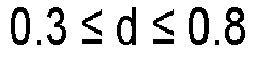


- Solid material according to claim 1 having a composition according to general formula (la)
LiaM1bM2cX4 (Ia)
wherein


- Solid material according to claim 1 having a composition according to general formula (la)
LiaM1bM2cX4 (Ia)
wherein


- Solid material according to claim 1 having a composition according to general formula (lb)
LiaM1dM3eX4 (Ib)
whereinM1 is a trivalent metal selected from the group consisting of Sc, Al, In and Y andM3 is a divalent metal selected from the group consisting of Mg, Ca and Zn


- Solid material according to any of claims 1 to 4, wherein X is Cl.
- Process for preparing a solid material according to any of claims 1 to 5, said process comprising the steps ofa) preparing or providing a reaction mixture comprising the precursors(1) LiX(2) a compound M1X3 wherein M1 is a trivalent metal and optionally(3) a compound selected from the group consisting of compounds M2X3 wherein M2 is a trivalent metal different from M1 and compounds M3X2 wherein M3 is a divalent metalwherein in each precursor, independently from the other precursors, X is selected from the group consisting of Cl, F, Br, Iwherein in said reaction mixture the molar ratio of the elements Li, M1, X resp. Li, M1, X and one of M2 and M3 matches general formula (I);b) heat-treating the reaction mixture in a temperature range of from 300 °C to 700 °C for a total duration of from 30 hours to 100 hours so that a reaction product is formed, and cooling the obtained reaction product so that a solid material having a composition according to general formula (I) is obtained.
- Process according to claim 6 wherein(i) the reaction mixture consists of precursors (1) and (2)wherein precursor (2) is a compound M1X3 wherein M1 is a trivalent metal selected from the group consisting of Sc, Al, In and Ywherein in said reaction mixture the molar ratio of the elements Li, M1 and X matches general formula (I)or(ii) the reaction mixture consists of precursors (1) and (2) and (3), wherein precursor (3) consists ofa compound M2X3 wherein M2 is a trivalent metal selected from the group consisting of Sc, Al, In and Y with the proviso that M2 is different from M1
ora compound M3X2 wherein M3 is a divalent metal selected from the group consisting of Mg, Ca and Zn,wherein in said reaction mixture the molar ratio of the elements Li, M1, X and M2 resp. M3 matches general formula (I). - Use of a solid material according to any of claims 1 to 5 as a solid electrolyte for an electrochemical cell, wherein preferably the solid electrolyte is a component of a solid structure for an electrochemical cell selected from the group consisting of cathode, anode and separator.
- Solid structure for an electrochemical cell, wherein said solid structure is selected from the group consisting of cathode, anode and separator, wherein said solid structure comprises a solid material according to any of claims 1 to 5.
- Solid structure according to claim 9, wherein said solid structure is a cathode comprising a mixture comprising- a cathode active material and- a solid material according to any of claims 1 to 5- and one or more selected from the group consisting of electron conducting materials and binding agents.
- Solid structure according to claim 10, wherein said cathode active material is selected from the group consisting of materials having a composition according to general formula (II)
Li1+t[CoxMnyNizMu]1-tO2 (II)
wherein


- Electrochemical cell comprising a solid material according to any of claims 1 to 5 or a solid structure as defined in any of claims 9 to 11.
- Electrochemical cell according to claim 12 comprising- a cathode comprising a cathode active material coated with or covered by or embedded in a solid material according to any of claims 1 to 5- a lithium ion conducting layer which does not comprise a solid material according to formula (I)- an anode.
- Electrochemical cell according to claim 13,
wherein(a) a layer comprising a solid material according to any of claims 1 to 5 is sandwiched between and is in direct contact with(b) a layer comprising a cathode active material(c) a lithium ion conducting layer which does not comprise a solid material according to formula (I), said lithium ion conducting layer (c) being in direct contact with an anode comprising lithium metal or a metal alloy comprising lithium. - Electrochemical cell according to claim 13 or 14, wherein said lithium ion conducting layer which does not comprise a solid material according to formula (I) comprises one or more of lithium containing sulfides, lithium containing oxysulfides, lithium-containing oxyphosphates and lithium containing oxyphosphonitrides.
Applications Claiming Priority (3)
| Application Number | Priority Date | Filing Date | Title |
|---|---|---|---|
| EP20166835 | 2020-03-30 | ||
| EP20170190 | 2020-04-17 | ||
| PCT/EP2021/058167 WO2021198183A1 (en) | 2020-03-30 | 2021-03-29 | Solid electrolyte for energy storage application |
Publications (2)
| Publication Number | Publication Date |
|---|---|
| EP4126765A1 EP4126765A1 (en) | 2023-02-08 |
| EP4126765B1 true EP4126765B1 (en) | 2023-11-22 |
Family
ID=75267515
Family Applications (1)
| Application Number | Title | Priority Date | Filing Date |
|---|---|---|---|
| EP21714891.5A Active EP4126765B1 (en) | 2020-03-30 | 2021-03-29 | Solid electrolyte for energy storage application |
Country Status (6)
| Country | Link |
|---|---|
| US (1) | US20230140434A1 (en) |
| EP (1) | EP4126765B1 (en) |
| JP (1) | JP2023520060A (en) |
| KR (1) | KR20220163405A (en) |
| CN (1) | CN115335327A (en) |
| WO (1) | WO2021198183A1 (en) |
Families Citing this family (6)
| Publication number | Priority date | Publication date | Assignee | Title |
|---|---|---|---|---|
| US10763491B2 (en) | 2014-04-01 | 2020-09-01 | The Research Foundation For The State University Of New York | Low-temperature synthesis process of making MgzMxOy, where M is Mn, V or Fe, for manufacture of electrode materials for group II cation-based batteries |
| WO2019135336A1 (en) * | 2018-01-05 | 2019-07-11 | パナソニックIpマネジメント株式会社 | Solid electrolyte material and battery |
| US12567586B2 (en) * | 2023-02-06 | 2026-03-03 | Ut-Battelle, Llc | Facile surface coatings for performance improvement of battery material |
| CN121666624A (en) * | 2023-08-10 | 2026-03-13 | 住友化学株式会社 | Ion conductive material, solid electrolyte, and battery |
| US20250070128A1 (en) * | 2023-08-24 | 2025-02-27 | Nissan North America, Inc. | ASSB Composite Cathode Having a Halide-Based and a Sulfide-Based Material |
| CN117602665A (en) * | 2023-11-28 | 2024-02-27 | 厦门大学 | A kind of preparation method of inorganic solid electrolyte |
Family Cites Families (14)
| Publication number | Priority date | Publication date | Assignee | Title |
|---|---|---|---|---|
| WO2000028608A1 (en) * | 1998-11-10 | 2000-05-18 | Matsushita Electric Industrial Co., Ltd. | Lithium secondary cell |
| WO2017197406A1 (en) | 2016-05-13 | 2017-11-16 | Quantumscape Corporation | Solid electrolyte separator bonding agent |
| KR101792800B1 (en) * | 2016-07-13 | 2017-11-02 | 한국과학기술연구원 | Color tunable upconversion nanophosphor and method of fabricating the same |
| CN115036565B (en) | 2016-08-04 | 2025-02-28 | 松下知识产权经营株式会社 | Solid electrolyte materials and batteries |
| JP2018106974A (en) * | 2016-12-27 | 2018-07-05 | 三星電子株式会社Samsung Electronics Co.,Ltd. | Lithium ion secondary battery, method for producing electrode active material particles, and method for producing lithium ion secondary battery |
| CN110291675B (en) * | 2017-02-16 | 2023-02-21 | 富士胶片株式会社 | Solid electrolyte composition, solid electrolyte-containing sheet, all-solid-state secondary battery, and methods for producing both |
| EP3736834A4 (en) | 2018-01-05 | 2021-03-10 | Panasonic Intellectual Property Management Co., Ltd. | Solid electrolyte material, and battery |
| WO2019135345A1 (en) | 2018-01-05 | 2019-07-11 | パナソニックIpマネジメント株式会社 | Solid electrolyte material, and battery |
| JP7611524B2 (en) * | 2018-01-05 | 2025-01-10 | パナソニックIpマネジメント株式会社 | Solid electrolyte material and battery |
| US12293852B2 (en) * | 2018-09-21 | 2025-05-06 | Massachusetts Institute Of Technology | Mixed ionic-electronic conductive materials for alkali metal transport during battery cycling, and batteries incorporating same |
| JP7624630B2 (en) * | 2019-02-28 | 2025-01-31 | パナソニックIpマネジメント株式会社 | Electrolyte material and battery using same |
| EP3951973A4 (en) * | 2019-03-26 | 2022-04-27 | Panasonic Intellectual Property Management Co., Ltd. | SOLID ELECTROLYTE MATERIAL AND BATTERY WITH USE THEREOF |
| EP3954673A1 (en) * | 2020-08-14 | 2022-02-16 | Paul Scherrer Institut | A method for preparing surface fluorinated battery materials |
| US20220399569A1 (en) * | 2021-06-14 | 2022-12-15 | The Regents Of The University Of California | High-energy and high power composite cathodes for all solid-state batteries |
-
2021
- 2021-03-29 KR KR1020227037948A patent/KR20220163405A/en not_active Withdrawn
- 2021-03-29 WO PCT/EP2021/058167 patent/WO2021198183A1/en not_active Ceased
- 2021-03-29 EP EP21714891.5A patent/EP4126765B1/en active Active
- 2021-03-29 CN CN202180024510.0A patent/CN115335327A/en active Pending
- 2021-03-29 JP JP2022559912A patent/JP2023520060A/en active Pending
- 2021-03-29 US US17/914,791 patent/US20230140434A1/en active Pending
Also Published As
| Publication number | Publication date |
|---|---|
| EP4126765A1 (en) | 2023-02-08 |
| WO2021198183A1 (en) | 2021-10-07 |
| JP2023520060A (en) | 2023-05-15 |
| CN115335327A (en) | 2022-11-11 |
| KR20220163405A (en) | 2022-12-09 |
| US20230140434A1 (en) | 2023-05-04 |
Similar Documents
| Publication | Publication Date | Title |
|---|---|---|
| EP4126765B1 (en) | Solid electrolyte for energy storage application | |
| KR101056463B1 (en) | Lithium Metal Oxide Materials, Synthesis Methods and Uses | |
| EP3595058A1 (en) | Positive electrode active material and battery | |
| EP3745421A1 (en) | Solid electrolyte material and battery | |
| JP7060776B2 (en) | Positive electrode active material for non-aqueous electrolyte secondary battery and its manufacturing method, positive electrode mixture paste for non-aqueous electrolyte secondary battery and non-aqueous electrolyte secondary battery | |
| US20030180616A1 (en) | Layered electrodes for lithium cells and batteries | |
| EP3633773B1 (en) | Positive-electrode active material and battery | |
| EP3736832B1 (en) | Solid electrolyte material, and battery | |
| EP3370295A1 (en) | Sulfide solid electrolyte material, battery, and producing method for sulfide solid electrolyte material | |
| EP3819964A1 (en) | Solid electrolyte, electrochemical cell including solid electrolyte, and method of preparing solid electrolyte | |
| EP3595059A1 (en) | Positive electrode active material, and cell | |
| EP3736823A1 (en) | Solid electrolyte material, and battery | |
| EP4224588A1 (en) | Solid ion conductor compound, solid electrolyte comprising same, electrochemical cell comprising same, and manufacturing method thereof | |
| EP4001218A1 (en) | Solid ion conductor compound, solid electrolyte comprising the same, electrochemical cell comprising the same, and method of preparing the same | |
| US20220289590A1 (en) | Lithium transition metal halides | |
| CN111919317A (en) | Positive electrode active material for non-aqueous electrolyte secondary battery | |
| EP4456238A1 (en) | Solid electrolyte, method of manufacturing same, and lithium secondary battery comprising same | |
| EP4614607A1 (en) | Method for manufacturing positive electrode active material for lithium-ion secondary battery | |
| US20250192224A1 (en) | Solid-state conductor materials | |
| US20230080081A1 (en) | Sulfide solid electrolyte, method of producing the same and all-solid-state battery comprising the same | |
| EP4614613A1 (en) | Method for producing positive electrode active material for lithium ion secondary batteries | |
| EP4593038A1 (en) | Solid electrolyte, electrode material, lithium-ion battery, and method for producing solid electrolyte | |
| WO2024226611A1 (en) | Titanium niobium oxide and molybdenum oxide multicomponent electrodes for thick all active material lithium ion electrodes | |
| CN121569385A (en) | All-solid-state battery | |
| EP4541772A1 (en) | Positive electrode active material and lithium secondary battery comprising the same |
Legal Events
| Date | Code | Title | Description |
|---|---|---|---|
| STAA | Information on the status of an ep patent application or granted ep patent |
Free format text: STATUS: UNKNOWN |
|
| STAA | Information on the status of an ep patent application or granted ep patent |
Free format text: STATUS: THE INTERNATIONAL PUBLICATION HAS BEEN MADE |
|
| PUAI | Public reference made under article 153(3) epc to a published international application that has entered the european phase |
Free format text: ORIGINAL CODE: 0009012 |
|
| STAA | Information on the status of an ep patent application or granted ep patent |
Free format text: STATUS: REQUEST FOR EXAMINATION WAS MADE |
|
| 17P | Request for examination filed |
Effective date: 20221031 |
|
| AK | Designated contracting states |
Kind code of ref document: A1 Designated state(s): AL AT BE BG CH CY CZ DE DK EE ES FI FR GB GR HR HU IE IS IT LI LT LU LV MC MK MT NL NO PL PT RO RS SE SI SK SM TR |
|
| DAV | Request for validation of the european patent (deleted) | ||
| DAX | Request for extension of the european patent (deleted) | ||
| GRAP | Despatch of communication of intention to grant a patent |
Free format text: ORIGINAL CODE: EPIDOSNIGR1 |
|
| STAA | Information on the status of an ep patent application or granted ep patent |
Free format text: STATUS: GRANT OF PATENT IS INTENDED |
|
| INTG | Intention to grant announced |
Effective date: 20230809 |
|
| GRAS | Grant fee paid |
Free format text: ORIGINAL CODE: EPIDOSNIGR3 |
|
| GRAA | (expected) grant |
Free format text: ORIGINAL CODE: 0009210 |
|
| STAA | Information on the status of an ep patent application or granted ep patent |
Free format text: STATUS: THE PATENT HAS BEEN GRANTED |
|
| AK | Designated contracting states |
Kind code of ref document: B1 Designated state(s): AL AT BE BG CH CY CZ DE DK EE ES FI FR GB GR HR HU IE IS IT LI LT LU LV MC MK MT NL NO PL PT RO RS SE SI SK SM TR |
|
| REG | Reference to a national code |
Ref country code: GB Ref legal event code: FG4D |
|
| REG | Reference to a national code |
Ref country code: CH Ref legal event code: EP |
|
| REG | Reference to a national code |
Ref country code: DE Ref legal event code: R096 Ref document number: 602021007091 Country of ref document: DE |
|
| REG | Reference to a national code |
Ref country code: IE Ref legal event code: FG4D |
|
| REG | Reference to a national code |
Ref country code: LT Ref legal event code: MG9D |
|
| REG | Reference to a national code |
Ref country code: NL Ref legal event code: MP Effective date: 20231122 |
|
| PG25 | Lapsed in a contracting state [announced via postgrant information from national office to epo] |
Ref country code: GR Free format text: LAPSE BECAUSE OF FAILURE TO SUBMIT A TRANSLATION OF THE DESCRIPTION OR TO PAY THE FEE WITHIN THE PRESCRIBED TIME-LIMIT Effective date: 20240223 |
|
| PG25 | Lapsed in a contracting state [announced via postgrant information from national office to epo] |
Ref country code: IS Free format text: LAPSE BECAUSE OF FAILURE TO SUBMIT A TRANSLATION OF THE DESCRIPTION OR TO PAY THE FEE WITHIN THE PRESCRIBED TIME-LIMIT Effective date: 20240322 |
|
| PG25 | Lapsed in a contracting state [announced via postgrant information from national office to epo] |
Ref country code: LT Free format text: LAPSE BECAUSE OF FAILURE TO SUBMIT A TRANSLATION OF THE DESCRIPTION OR TO PAY THE FEE WITHIN THE PRESCRIBED TIME-LIMIT Effective date: 20231122 |
|
| REG | Reference to a national code |
Ref country code: AT Ref legal event code: MK05 Ref document number: 1633688 Country of ref document: AT Kind code of ref document: T Effective date: 20231122 |
|
| PG25 | Lapsed in a contracting state [announced via postgrant information from national office to epo] |
Ref country code: NL Free format text: LAPSE BECAUSE OF FAILURE TO SUBMIT A TRANSLATION OF THE DESCRIPTION OR TO PAY THE FEE WITHIN THE PRESCRIBED TIME-LIMIT Effective date: 20231122 |
|
| PG25 | Lapsed in a contracting state [announced via postgrant information from national office to epo] |
Ref country code: AT Free format text: LAPSE BECAUSE OF FAILURE TO SUBMIT A TRANSLATION OF THE DESCRIPTION OR TO PAY THE FEE WITHIN THE PRESCRIBED TIME-LIMIT Effective date: 20231122 |
|
| PG25 | Lapsed in a contracting state [announced via postgrant information from national office to epo] |
Ref country code: ES Free format text: LAPSE BECAUSE OF FAILURE TO SUBMIT A TRANSLATION OF THE DESCRIPTION OR TO PAY THE FEE WITHIN THE PRESCRIBED TIME-LIMIT Effective date: 20231122 |
|
| PG25 | Lapsed in a contracting state [announced via postgrant information from national office to epo] |
Ref country code: NL Free format text: LAPSE BECAUSE OF FAILURE TO SUBMIT A TRANSLATION OF THE DESCRIPTION OR TO PAY THE FEE WITHIN THE PRESCRIBED TIME-LIMIT Effective date: 20231122 Ref country code: LT Free format text: LAPSE BECAUSE OF FAILURE TO SUBMIT A TRANSLATION OF THE DESCRIPTION OR TO PAY THE FEE WITHIN THE PRESCRIBED TIME-LIMIT Effective date: 20231122 Ref country code: IS Free format text: LAPSE BECAUSE OF FAILURE TO SUBMIT A TRANSLATION OF THE DESCRIPTION OR TO PAY THE FEE WITHIN THE PRESCRIBED TIME-LIMIT Effective date: 20240322 Ref country code: GR Free format text: LAPSE BECAUSE OF FAILURE TO SUBMIT A TRANSLATION OF THE DESCRIPTION OR TO PAY THE FEE WITHIN THE PRESCRIBED TIME-LIMIT Effective date: 20240223 Ref country code: ES Free format text: LAPSE BECAUSE OF FAILURE TO SUBMIT A TRANSLATION OF THE DESCRIPTION OR TO PAY THE FEE WITHIN THE PRESCRIBED TIME-LIMIT Effective date: 20231122 Ref country code: BG Free format text: LAPSE BECAUSE OF FAILURE TO SUBMIT A TRANSLATION OF THE DESCRIPTION OR TO PAY THE FEE WITHIN THE PRESCRIBED TIME-LIMIT Effective date: 20240222 Ref country code: AT Free format text: LAPSE BECAUSE OF FAILURE TO SUBMIT A TRANSLATION OF THE DESCRIPTION OR TO PAY THE FEE WITHIN THE PRESCRIBED TIME-LIMIT Effective date: 20231122 Ref country code: PT Free format text: LAPSE BECAUSE OF FAILURE TO SUBMIT A TRANSLATION OF THE DESCRIPTION OR TO PAY THE FEE WITHIN THE PRESCRIBED TIME-LIMIT Effective date: 20240322 |
|
| PG25 | Lapsed in a contracting state [announced via postgrant information from national office to epo] |
Ref country code: SE Free format text: LAPSE BECAUSE OF FAILURE TO SUBMIT A TRANSLATION OF THE DESCRIPTION OR TO PAY THE FEE WITHIN THE PRESCRIBED TIME-LIMIT Effective date: 20231122 Ref country code: RS Free format text: LAPSE BECAUSE OF FAILURE TO SUBMIT A TRANSLATION OF THE DESCRIPTION OR TO PAY THE FEE WITHIN THE PRESCRIBED TIME-LIMIT Effective date: 20231122 Ref country code: PL Free format text: LAPSE BECAUSE OF FAILURE TO SUBMIT A TRANSLATION OF THE DESCRIPTION OR TO PAY THE FEE WITHIN THE PRESCRIBED TIME-LIMIT Effective date: 20231122 Ref country code: NO Free format text: LAPSE BECAUSE OF FAILURE TO SUBMIT A TRANSLATION OF THE DESCRIPTION OR TO PAY THE FEE WITHIN THE PRESCRIBED TIME-LIMIT Effective date: 20240222 Ref country code: LV Free format text: LAPSE BECAUSE OF FAILURE TO SUBMIT A TRANSLATION OF THE DESCRIPTION OR TO PAY THE FEE WITHIN THE PRESCRIBED TIME-LIMIT Effective date: 20231122 Ref country code: HR Free format text: LAPSE BECAUSE OF FAILURE TO SUBMIT A TRANSLATION OF THE DESCRIPTION OR TO PAY THE FEE WITHIN THE PRESCRIBED TIME-LIMIT Effective date: 20231122 |
|
| PG25 | Lapsed in a contracting state [announced via postgrant information from national office to epo] |
Ref country code: DK Free format text: LAPSE BECAUSE OF FAILURE TO SUBMIT A TRANSLATION OF THE DESCRIPTION OR TO PAY THE FEE WITHIN THE PRESCRIBED TIME-LIMIT Effective date: 20231122 |
|
| PG25 | Lapsed in a contracting state [announced via postgrant information from national office to epo] |
Ref country code: CZ Free format text: LAPSE BECAUSE OF FAILURE TO SUBMIT A TRANSLATION OF THE DESCRIPTION OR TO PAY THE FEE WITHIN THE PRESCRIBED TIME-LIMIT Effective date: 20231122 |
|
| PG25 | Lapsed in a contracting state [announced via postgrant information from national office to epo] |
Ref country code: SK Free format text: LAPSE BECAUSE OF FAILURE TO SUBMIT A TRANSLATION OF THE DESCRIPTION OR TO PAY THE FEE WITHIN THE PRESCRIBED TIME-LIMIT Effective date: 20231122 |
|
| PG25 | Lapsed in a contracting state [announced via postgrant information from national office to epo] |
Ref country code: SM Free format text: LAPSE BECAUSE OF FAILURE TO SUBMIT A TRANSLATION OF THE DESCRIPTION OR TO PAY THE FEE WITHIN THE PRESCRIBED TIME-LIMIT Effective date: 20231122 Ref country code: SK Free format text: LAPSE BECAUSE OF FAILURE TO SUBMIT A TRANSLATION OF THE DESCRIPTION OR TO PAY THE FEE WITHIN THE PRESCRIBED TIME-LIMIT Effective date: 20231122 Ref country code: RO Free format text: LAPSE BECAUSE OF FAILURE TO SUBMIT A TRANSLATION OF THE DESCRIPTION OR TO PAY THE FEE WITHIN THE PRESCRIBED TIME-LIMIT Effective date: 20231122 Ref country code: EE Free format text: LAPSE BECAUSE OF FAILURE TO SUBMIT A TRANSLATION OF THE DESCRIPTION OR TO PAY THE FEE WITHIN THE PRESCRIBED TIME-LIMIT Effective date: 20231122 Ref country code: DK Free format text: LAPSE BECAUSE OF FAILURE TO SUBMIT A TRANSLATION OF THE DESCRIPTION OR TO PAY THE FEE WITHIN THE PRESCRIBED TIME-LIMIT Effective date: 20231122 Ref country code: CZ Free format text: LAPSE BECAUSE OF FAILURE TO SUBMIT A TRANSLATION OF THE DESCRIPTION OR TO PAY THE FEE WITHIN THE PRESCRIBED TIME-LIMIT Effective date: 20231122 |
|
| REG | Reference to a national code |
Ref country code: DE Ref legal event code: R097 Ref document number: 602021007091 Country of ref document: DE |
|
| PLBE | No opposition filed within time limit |
Free format text: ORIGINAL CODE: 0009261 |
|
| STAA | Information on the status of an ep patent application or granted ep patent |
Free format text: STATUS: NO OPPOSITION FILED WITHIN TIME LIMIT |
|
| PG25 | Lapsed in a contracting state [announced via postgrant information from national office to epo] |
Ref country code: SI Free format text: LAPSE BECAUSE OF FAILURE TO SUBMIT A TRANSLATION OF THE DESCRIPTION OR TO PAY THE FEE WITHIN THE PRESCRIBED TIME-LIMIT Effective date: 20231122 |
|
| 26N | No opposition filed |
Effective date: 20240823 |
|
| PG25 | Lapsed in a contracting state [announced via postgrant information from national office to epo] |
Ref country code: SI Free format text: LAPSE BECAUSE OF FAILURE TO SUBMIT A TRANSLATION OF THE DESCRIPTION OR TO PAY THE FEE WITHIN THE PRESCRIBED TIME-LIMIT Effective date: 20231122 |
|
| REG | Reference to a national code |
Ref country code: CH Ref legal event code: PL |
|
| PG25 | Lapsed in a contracting state [announced via postgrant information from national office to epo] |
Ref country code: LU Free format text: LAPSE BECAUSE OF NON-PAYMENT OF DUE FEES Effective date: 20240329 |
|
| PG25 | Lapsed in a contracting state [announced via postgrant information from national office to epo] |
Ref country code: MC Free format text: LAPSE BECAUSE OF FAILURE TO SUBMIT A TRANSLATION OF THE DESCRIPTION OR TO PAY THE FEE WITHIN THE PRESCRIBED TIME-LIMIT Effective date: 20231122 |
|
| PG25 | Lapsed in a contracting state [announced via postgrant information from national office to epo] |
Ref country code: MC Free format text: LAPSE BECAUSE OF FAILURE TO SUBMIT A TRANSLATION OF THE DESCRIPTION OR TO PAY THE FEE WITHIN THE PRESCRIBED TIME-LIMIT Effective date: 20231122 Ref country code: LU Free format text: LAPSE BECAUSE OF NON-PAYMENT OF DUE FEES Effective date: 20240329 |
|
| REG | Reference to a national code |
Ref country code: BE Ref legal event code: MM Effective date: 20240331 |
|
| PG25 | Lapsed in a contracting state [announced via postgrant information from national office to epo] |
Ref country code: BE Free format text: LAPSE BECAUSE OF NON-PAYMENT OF DUE FEES Effective date: 20240331 |
|
| PG25 | Lapsed in a contracting state [announced via postgrant information from national office to epo] |
Ref country code: IE Free format text: LAPSE BECAUSE OF NON-PAYMENT OF DUE FEES Effective date: 20240329 |
|
| PG25 | Lapsed in a contracting state [announced via postgrant information from national office to epo] |
Ref country code: IE Free format text: LAPSE BECAUSE OF NON-PAYMENT OF DUE FEES Effective date: 20240329 Ref country code: BE Free format text: LAPSE BECAUSE OF NON-PAYMENT OF DUE FEES Effective date: 20240331 Ref country code: CH Free format text: LAPSE BECAUSE OF NON-PAYMENT OF DUE FEES Effective date: 20240331 |
|
| PGFP | Annual fee paid to national office [announced via postgrant information from national office to epo] |
Ref country code: DE Payment date: 20250327 Year of fee payment: 5 |
|
| PGFP | Annual fee paid to national office [announced via postgrant information from national office to epo] |
Ref country code: FR Payment date: 20250324 Year of fee payment: 5 |
|
| PGFP | Annual fee paid to national office [announced via postgrant information from national office to epo] |
Ref country code: IT Payment date: 20250321 Year of fee payment: 5 |
|
| PG25 | Lapsed in a contracting state [announced via postgrant information from national office to epo] |
Ref country code: CY Free format text: LAPSE BECAUSE OF FAILURE TO SUBMIT A TRANSLATION OF THE DESCRIPTION OR TO PAY THE FEE WITHIN THE PRESCRIBED TIME-LIMIT; INVALID AB INITIO Effective date: 20210329 |
|
| PG25 | Lapsed in a contracting state [announced via postgrant information from national office to epo] |
Ref country code: HU Free format text: LAPSE BECAUSE OF FAILURE TO SUBMIT A TRANSLATION OF THE DESCRIPTION OR TO PAY THE FEE WITHIN THE PRESCRIBED TIME-LIMIT; INVALID AB INITIO Effective date: 20210329 |
|
| PG25 | Lapsed in a contracting state [announced via postgrant information from national office to epo] |
Ref country code: FI Free format text: LAPSE BECAUSE OF FAILURE TO SUBMIT A TRANSLATION OF THE DESCRIPTION OR TO PAY THE FEE WITHIN THE PRESCRIBED TIME-LIMIT Effective date: 20231122 |
|
| GBPC | Gb: european patent ceased through non-payment of renewal fee |
Effective date: 20250329 |
|
| PG25 | Lapsed in a contracting state [announced via postgrant information from national office to epo] |
Ref country code: TR Free format text: LAPSE BECAUSE OF FAILURE TO SUBMIT A TRANSLATION OF THE DESCRIPTION OR TO PAY THE FEE WITHIN THE PRESCRIBED TIME-LIMIT Effective date: 20231122 |
|
| PG25 | Lapsed in a contracting state [announced via postgrant information from national office to epo] |
Ref country code: GB Free format text: LAPSE BECAUSE OF NON-PAYMENT OF DUE FEES Effective date: 20250329 |