EP4126570B1 - Primärkopplungsvorrichtung, sekundärkopplungsvorrichtung, sattelkupplungsanordnung und automatisches kupplungssystem - Google Patents
Primärkopplungsvorrichtung, sekundärkopplungsvorrichtung, sattelkupplungsanordnung und automatisches kupplungssystem Download PDFInfo
- Publication number
- EP4126570B1 EP4126570B1 EP21713901.3A EP21713901A EP4126570B1 EP 4126570 B1 EP4126570 B1 EP 4126570B1 EP 21713901 A EP21713901 A EP 21713901A EP 4126570 B1 EP4126570 B1 EP 4126570B1
- Authority
- EP
- European Patent Office
- Prior art keywords
- plug
- cover
- coupling
- coupling device
- drive
- Prior art date
- Legal status (The legal status is an assumption and is not a legal conclusion. Google has not performed a legal analysis and makes no representation as to the accuracy of the status listed.)
- Active
Links
Images


Classifications
-
- B—PERFORMING OPERATIONS; TRANSPORTING
- B62—LAND VEHICLES FOR TRAVELLING OTHERWISE THAN ON RAILS
- B62D—MOTOR VEHICLES; TRAILERS
- B62D53/00—Tractor-trailer combinations; Road trains
- B62D53/04—Tractor-trailer combinations; Road trains comprising a vehicle carrying an essential part of the other vehicle's load by having supporting means for the front or rear part of the other vehicle
- B62D53/08—Fifth wheel traction couplings
- B62D53/12—Fifth wheel traction couplings engaging automatically
-
- B—PERFORMING OPERATIONS; TRANSPORTING
- B60—VEHICLES IN GENERAL
- B60D—VEHICLE CONNECTIONS
- B60D1/00—Traction couplings; Hitches; Draw-gear; Towing devices
- B60D1/58—Auxiliary devices
- B60D1/62—Auxiliary devices involving supply lines, electric circuits or the like
- B60D1/64—Couplings or joints therefor
-
- B—PERFORMING OPERATIONS; TRANSPORTING
- B62—LAND VEHICLES FOR TRAVELLING OTHERWISE THAN ON RAILS
- B62D—MOTOR VEHICLES; TRAILERS
- B62D53/00—Tractor-trailer combinations; Road trains
- B62D53/04—Tractor-trailer combinations; Road trains comprising a vehicle carrying an essential part of the other vehicle's load by having supporting means for the front or rear part of the other vehicle
- B62D53/08—Fifth wheel traction couplings
- B62D53/12—Fifth wheel traction couplings engaging automatically
- B62D53/125—Fifth wheel traction couplings engaging automatically with simultaneous coupling of the service lines
Definitions
- the invention relates to a fifth wheel coupling arrangement and an automatic coupling system for a commercial vehicle.
- Automatic coupling systems are already known from the prior art; these serve to realize an energy flow between a towing vehicle and a semi-trailer or trailer.
- These automatic coupling systems usually have a plug on the towing vehicle side and a socket on the trailer side.
- the plug and socket also have movable covering elements to prevent interference with the plug or socket before coupling and to protect them from environmental influences.
- the socket and the plug are aligned with one another, the movable covering elements are moved and the plug and the socket are connected to one another so that energy, in particular a current, can flow from the towing vehicle to the trailer .
- this process of automatically coupling the socket and the plug due to the approach of the towing vehicle to the trailer is relatively fragile due to the high contact forces between the plug and the socket and often leads to damage, especially to the covering elements of the plug.
- the US 4,156,551 shows a connection means for vehicles, which vehicles may include rail vehicles, tractors and trailers and the like, for automatically connecting fluid-carrying lines and electrical connections when the towing or towed vehicles are connected.
- the DE 10 2015 226 049 A1 relates to a coupling component of a coupling device for temporarily connecting a towing vehicle to a trailing vehicle to form a vehicle train, the device having at least one coupling component body with a coupling member provided thereon for producing a coupling connection engagement with a coupling member of the further coupling component and a plug component with at least a connector formation is present.
- the DE 101 55 056 A1 discloses a generic fifth wheel coupling arrangement.
- the invention relates to a fifth wheel coupling arrangement
- a primary coupling device and a fifth wheel coupling plate comprising a primary coupling device and a fifth wheel coupling plate, the fifth wheel coupling plate having a support surface, the support surface having an outwardly pointing normal, the fifth wheel coupling plate having an entry opening, the entry opening extending in a retraction direction, the primary coupling device having a base body , a drive, a coupling mechanism, a cover device and a plug element, wherein the base body is designed to be fixed to the fifth wheel assembly and / or the trailer, wherein the plug element has energy-conducting contacts, which in particular point in a plug-in direction, the drive via the coupling mechanism is mechanically connected to the covering device, the covering device having at least one covering element, wherein the Covering element can be displaced by the drive between a first position and a second position, the plug element being released in the first position of the covering element, and the covering element of the plug element being covered in the second position.
- the primary coupling device is in particular a primary coupling device for a commercial vehicle.
- a commercial vehicle in the sense of the invention is in particular a roadworthy vehicle with a permissible total weight of at least 3.51 tons, preferably at least 7.51 tons and particularly preferably at least 15.01 tons.
- the primary coupling device can be part of an automatic coupling system, which serves to automatically connect a trailer vehicle to a towing vehicle in terms of energy technology and/or information technology.
- the primary coupling device according to the invention is that part of the automatic coupling system which is arranged on the fifth wheel coupling arrangement.
- the primary coupling device of the fifth wheel coupling arrangement comprises a base body, a drive, a coupling mechanism, a cover device and a plug element.
- the base body serves to be attached to the fifth wheel assembly or the trailer.
- the base body can, for example, be fixed reversibly, in particular by means of screws, so that it can be easily replaced.
- the base body can be arranged on the fifth wheel coupling plate if it is fixed to the fifth wheel coupling arrangement.
- the base body is preferably arranged below the entry opening of the fifth wheel coupling plate.
- the entry opening of the fifth wheel coupling plate is the opening into which the king pin to be coupled or engaged is inserted when it is moved from a decoupled position to the engaged position.
- the entry opening extends in particular in an entry direction.
- This retraction direction is in particular the direction in which the king pin moves relative to the fifth wheel coupling plate when the king pin is engaged.
- the entry opening is the opening of the fifth wheel coupling plate into which the kingpin is inserted in order to achieve coupling of the kingpin.
- the entry opening is defined/formed by a space between the coupling horns of the fifth wheel coupling plate.
- the plug-in direction is at least essentially parallel to the retraction direction in order to achieve a particularly compact and operationally reliable primary coupling device.
- Essentially parallel is understood to mean that the smallest angle included between the two essentially parallel directions is a maximum of 10°, preferably a maximum of 5° and particularly preferably a maximum of 1°. However, it is particularly preferred if the essentially parallel directions are exactly parallel.
- the base body of the primary coupling device can in particular be designed as a sheet metal part, as this can save manufacturing costs.
- the primary coupling device also has a plug element.
- the plug element serves to be connectable and/or connected to a correspondingly designed element, in particular to a plug connector of a secondary coupling device, so that electrical signals and/or information and/or energy can be transmitted between the plug element and the correspondingly designed element.
- the plug element can form an automatic coupling system with, for example, a plug connector of a secondary coupling device, so that in particular electrical signals and/or energy and/or information can be transmitted between a towing vehicle and a trailer.
- the plug element has in particular hydraulic and/or pneumatic and/or electrical energy-conducting contacts, these energy-conducting contacts being designed in particular to be connectable and/or connected to corresponding contacts of a plug connector of a secondary coupling device.
- the energy-conducting contacts of the plug element extend in the plug-in direction. This insertion direction is advantageously the direction in which in which the plug element - theoretically - has to move relative to the plug connector in order to realize a plug connection.
- the primary coupling device has a covering device which has at least one covering element.
- the cover element can be a flap or a fall mechanism or a folding mechanism or a lamella-like cover unit; in other words, the cover element can be designed in one piece or in several pieces.
- the cover element of the cover device can be displaced by the drive between a first position and a second position, with the plug element being released in the first position of the cover element. In other words, this can mean that in the first position it is possible to insert a plug connector into the plug element or a plug connection between the plug element and the plug connector of a secondary coupling device. In the second position, the cover element is positioned such that the plug element is covered.
- the primary coupling device has a drive and a coupling mechanism.
- the drive can be, for example, a linear drive, a hydraulic or a pneumatic drive, in particular a cylinder.
- this drive can also preferably be an electric motor.
- This drive is mechanically connected to the covering device via the coupling mechanism, so that mechanical energy can be transferred from the drive to the covering device via the coupling mechanism.
- the coupling mechanism can be a hydraulic or pneumatic cylinder can be a piston rod and/or a piston rod extension.
- the coupling mechanism can be designed in one piece or in several parts.
- a one-piece design of the coupling mechanism, in particular in the form of a piston rod, results in a particularly mechanically resilient device.
- a certain compensation and a certain damping effect can be achieved, so that the device can both compensate for certain tolerances and / or is able to provide a high level of damping.
- the inventive design of the primary coupling device ensures that the contact forces during coupling are significantly reduced by the displacement of the cover element - by the drive. In this way, damage to the primary coupling device, in particular to the covering device, can be prevented.
- the primary coupling device is expediently designed such that the cover element can be displaced indirectly by the drive.
- the drive is designed in such a way that it displaces the plug element when actuated and the plug element displaces or displaces the covering device.
- the primary coupling device can therefore be designed such that the drive does not directly displace the cover element but rather only indirectly, in particular via the plug element. In this way, in particular, a separate drive for the plug element can be saved, so that a cost-effective, space-saving and lightweight primary coupling device is achieved.
- the drive advantageously has a power connection.
- an energy connection can be, for example, a power connection, an oil connection and/or an air pressure connection.
- the drive is preferably a pneumatic, electric or hydraulic drive.
- Designing the drive as a hydraulic drive ensures that large forces can also be exerted.
- designing the drive as a pneumatic drive it can be achieved that no environmental pollution occurs, especially in the event of leaks.
- designing the drive as a pneumatic drive also has the advantage that, in particular, existing (supply) systems of the commercial vehicle (towing vehicle or trailer) can be used to operate the drive.
- the provision of a hydraulic or a pneumatic drive also has the further advantage that, due to the compressibility of the working media, the drive can be given a certain spring stiffness, so that the drive and/or the base body and/or the plug element are not overloaded by the Spring stiffness of the working fluid can be prevented.
- the use of an electric drive also enables the use of energy sources, such as batteries, the trailer or the towing vehicle, to operate the drive. This results in a particularly cost-effective system because the energy supply to the drive can be retrofitted and/or designed particularly easily.
- the drive is a compressed air cylinder. Designing it as a compressed air cylinder results in a particularly space-saving primary coupling device, which is also not susceptible to leakage in terms of environmental pollution.
- a compressed air cylinder makes it possible to move particularly quickly from the first to the second position and that existing systems can be used to operate or supply the drive, such as. B. compressors and/or compressed air tanks of the towing vehicle or trailer.
- the primary coupling device advantageously has a second drive.
- the use of a second drive can, for example, serve to provide a redundant system, so that even if a drive fails, the cover element can still be moved safely from the first position to the second position.
- the plug element preferably comprises hydraulic and/or pneumatic and/or electrical energy-conducting contacts, wherein the energy-conducting contacts are designed to be connectable and/or connected to corresponding contacts of a plug connector of a secondary coupling device, wherein the energy-conducting contacts preferably extend in the plug-in direction.
- the plug element therefore comprises hydraulic and/or pneumatic and/or electrical contacts, which can interact and/or be connected to corresponding contacts of a plug connector of a secondary coupling device in such a way that energy and/or information in the form of electrical, pneumatic and/or Hydraulic energy can be transferred from the plug element to the plug connector and thus in a later installation position from the trailer to the towing vehicle or from the towing vehicle to the trailer.
- the secondary coupling device with its plug connector therefore forms, in other words, an automatic plug connection system of an automatic coupling system with the primary coupling device, the primary coupling device being arranged on the trailer or on the towing vehicle and the secondary coupling device correspondingly on the towing vehicle or on the trailer.
- the plug element can be displaced relative to the base body by means of the drive, in particular in the plugging direction.
- the possibility of being able to displace the plug element relative to the base body by means of the drive means that the actual insertion or coupling of the plug element can be carried out with a plug connector of a secondary coupling device can be done independently of the actual coupling process of the trailer with the towing vehicle and only a small amount of space is required.
- the coupling mechanism can be stored in the plug-in direction by the drive.
- This allows the covering device to be operated particularly easily and compactly.
- the drive is designed as a cylinder, in particular as a double-acting cylinder, and the coupling mechanism forms part of the piston rod of the cylinder or a piston rod extension.
- the coupling mechanism can in particular mechanically connect the drive with a displacement device of the covering device. “Mechanically connecting” is to be understood in particular as meaning that mechanical energy is transmitted from the drive via the coupling mechanism to the covering device.
- the primary coupling device is expediently designed such that the cover element in the first position is at least partially displaced in a height direction relative to the position of the cover element in the second position, the height direction being essentially perpendicular to the insertion direction.
- An at least partial displacement in the height direction can be understood to mean that the cover element must be at least partially displaced in a height direction from the first position relative to the second position.
- the center of gravity of the cover element is particularly important.
- such a displacement of the cover element from the first position relative to the second position in the height direction can be achieved by a rotation of the cover element and / or by a translational movement of the cover element, the center of gravity of the cover element in the first position relative to the second position having at least one displacement component must have, which has a portion in the height direction. Therefore, in particular, there is no displacement of the cover element "at least partially in a height direction" if the cover element is only in the insertion direction is relocated.
- the height direction is in particular essentially perpendicular to the insertion direction.
- substantially perpendicular is understood to mean that the smaller included angle between the height direction and the insertion direction is between 80° and 90°, preferably between 85° and 90° and particularly preferably between 88° and 90°. Due to the displaceability of the cover element from the first position relative to the second position - at least partially in the height direction - a particularly compact primary coupling device in the plug-in direction can be achieved.
- the covering device advantageously has a plurality of covering elements, in particular two covering elements.
- the cover elements can in particular be designed as flaps, lamella structures or other closure means.
- the travel path of the individual cover elements can be reduced, so that a particularly quick transfer of the cover elements from their respective first position to their respective second position is possible.
- the plurality of cover elements are designed such that in the first state the cover elements do not contact each other and in the second state they contact each other. In particular, this can be achieved, for example, by the cover elements moving towards one another during the transfer from the first position to the second position.
- the cover elements are arranged in such a way that the center of gravity of the first cover element moves from the first state to the second state in the positive height direction and the center of gravity of the second cover element moves from the first state to the second state moved in the negative height direction.
- a particularly compact and simple design of the cover elements results when the first and second cover elements form a mouth flap mechanism with one another.
- Mouth flap mechanism is particularly characterized in that the cover elements provided are pivotable relative to one another, in particular about a common pivot axis, and - similar to the upper jaw and lower jaw - can be opened and closed like a mouth.
- the covering device in particular the cover element or elements, expediently has a seal, in particular a sealing lip.
- a seal or a sealing lip By providing a seal or a sealing lip, particularly good protection against environmental influences such as rain or storms as well as against a water jet from a high-pressure cleaner can be achieved.
- the seal is in particular arranged on the cover element in such a way that the seal only contacts the cover element in the first position and the seal contacts another element, in particular another part of the cover device, in the second position. In other words, this can mean that the seal is arranged in particular in such a way that it is contactless in the released position and contacting in the covering position.
- the covering device advantageously has a displacement device, in particular a spreading device or a scissor joint.
- a displacement device is a device through which, in particular, the mechanical energy transmitted by the coupling mechanism is transferred from the drive to the covering device.
- this displacement device can be a spreading device, such as a linear guide or a guide link or a scissor joint.
- a scissor joint is characterized in particular by two different legs, which are rotatably mounted to one another at a common point, similar to a pair of scissors.
- the displacement device in particular the scissor joint
- the displacement device is connected indirectly and/or directly to the coupling mechanism or contacts it.
- the displacement device in particular the scissor joint, forms a stop for the coupling mechanism.
- the maximum displacement of the coupling mechanism can be limited by the displacement device. This allows the maximum travel path of the coupling mechanism to be limited in a particularly compact manner.
- At least one cover element, preferably all cover elements, of the cover device is expediently mounted so that it can rotate about an axis of rotation, the axis of rotation advantageously being essentially perpendicular to the insertion direction and/or to the height direction.
- this can mean that at least one cover element is mounted so that it can rotate about an axis of rotation.
- the cover element can be designed as a rotatable flap about this axis of rotation.
- the coupling mechanism and the displacement device are used to transfer the mechanical energy from the drive to the cover element.
- the axis of rotation is advantageously at least substantially perpendicular to the insertion direction and/or the height direction. This allows a particularly compact design of the primary coupling device to be achieved.
- the plug element is rotatably mounted about an axis of rotation, the axis of rotation corresponding in particular to the axis of rotation.
- the ability of the plug element to rotate about an axis of rotation makes it possible to provide a particularly effective way of compensating for certain positional tolerances or offsets, particularly in relation to a secondary coupling device. Therefore, this can reduce the forces that occur Coupling process of the primary coupling device can be reduced relative to the secondary coupling device and / or damage can be avoided or at least reduced.
- the plug element is prestressed in a centering position via centering prestressing means, such as springs.
- this can mean that the plug element is mounted rotatably about an axis of rotation, but that the plug element is held in a central position by the pretensioning means in a centering manner by these pretensioning means. If the axis of rotation and the axis of rotation match, a particularly space-saving storage of the plug element and the cover device can be carried out, since this axis of rotation and the axis of rotation can serve as a common axis of rotation for both the plug element itself and for the cover elements in relation to the plug element.
- At least one cover element is prestressed into the first and/or second position by a prestressing means, in particular a tension band and/or a spring element.
- a prestressing means in particular a tension band and/or a spring element.
- the cover element can also be prestressed into the first position.
- the prestressing means are designed or arranged in such a way that the cover element tries to transfer it into the first position using the mechanical energy stored in the prestressing means. This can achieve, among other things, that energy can be saved because this allows the drive to be switched off in the first position when the primary coupling device is coupled to the secondary coupling device.
- the primary coupling device in particular the plug element, expediently has an activator and / or a guide mandrel, which protrudes beyond at least one cover element, preferably over all cover elements, both in the first position and in the second position in the plug-in direction.
- Protruding of the activator and the guide mandrel can be understood to mean, among other things, that in the insertion direction, in particular away from the cover element, the activator and/or the guide mandrel protrudes beyond the cover element. This ensures that the activator and/or the guide mandrel is permanently able to interact with other elements - regardless of the position of the cover element in the first position or the second position.
- the guide mandrels are designed, for example, to be able to engage in guide recesses in order to align the primary coupling device relative to the secondary coupling device.
- the activator is an element which serves to shift a cover element of a secondary coupling device from a concealing to an opening or opened position, in particular in that the activator interacts with an adjusting piece of the secondary coupling device.
- the plug element is mounted in such a way that the plug element is translationally displaceable in three axes that are perpendicular to one another relative to the coupling mechanism or a part of the coupling mechanism, in particular in a maximum of +/- 0.5 mm and/or the plug element is mounted in such a way that the plug element is rotatably displaceable relative to the coupling mechanism in three axes that are perpendicular to one another.
- this can mean that the plug element is mounted in relation to the coupling mechanism or a part of the coupling mechanism in such a way that the plug element can be displaced relative to at least a part of the coupling mechanism by a maximum of +/- 0.5 mm.
- This relative displaceability allows a certain balance to be achieved between the plug element and the coupling mechanism.
- the plug element can therefore be displaced relative to the coupling mechanism in three spatial directions that are perpendicular to one another.
- the relevant part of the coupling mechanism is in particular that part of the coupling mechanism which is directly connected to the drive.
- the coupling mechanism includes a piston rod extension
- the relevant part of the coupling mechanism is the piston rod.
- the plug element can also be mounted in such a way that it can be rotated relative to the coupling mechanism in three axes that are perpendicular to one another.
- the plug element can be displaceable not only translationally in three spatial directions relative to a significant part of the coupling mechanism, but also rotationally. This achieves a particularly high degree of adaptability of the plug element, so that it can compensate for certain height and/or rotational alignment differences when coupled to a plug connector of a secondary coupling device.
- the base body of the primary coupling device can be firmly mounted, so that the primary coupling device can be securely mounted, for example, on a fifth wheel coupling plate or a trailer.
- a further aspect of the invention relates to an automatic coupling system comprising a fifth wheel coupling arrangement and a secondary coupling device, wherein the secondary coupling device has a support arm, a plug connector and a top element, wherein the top element is designed to cover the plug connector in a top position and in a release position or opening position to release connectors.
- the secondary coupling device therefore essentially forms the counterpart to the primary coupling device.
- the secondary coupling device therefore serves to be arranged on a commercial vehicle which is to be coupled to a commercial vehicle on which a primary coupling device is present. In other words, this can mean that the primary coupling device can be arranged on a towing vehicle or trailer and the secondary coupling device can be arranged on a trailer or a towing vehicle.
- the secondary coupling device has a support arm for attachment to a commercial vehicle.
- the secondary coupling device also has a plug connector and a top element.
- the plug connector in particular has energy-conducting contacts which can be brought into energy-conducting engagement with corresponding energy-conducting contacts of the plug element of the primary coupling device.
- the top element of the secondary coupling device serves to cover the plug connector in a top position in such a way that a plug connection between the plug connector and the plug element of a primary coupling device is not possible, and wherein the top element can be moved into a release position in such a way that the plug connector is released in such a way that a Plug connection between a plug element and the plug connector is possible.
- this can mean that the plug element covers or exposes the plug connector in such a way that a plug connection is not possible or is not possible.
- This covering is carried out particularly flatly and advantageously in such a way that all energy-conducting contacts of the plug connector are covered in their extension direction by the top element in the top position and are visible from the outside in the release position or opening position, in particular in the direction of extension of the energy-conducting contacts.
- this can mean that when the top element is in a top position, the energy-conducting contacts of the connector are not visible and are visible in the release position. This can ensure that the secondary coupling device and its energy-conducting contacts are reliably protected from external environmental influences.
- the top element and/or the plug connector is rotatably mounted relative to the support arm, in particular about a transverse direction, wherein advantageously the transverse direction in a coupled state is essentially parallel to the axis of rotation and/or to the transverse axis.
- the transverse direction is in particular the direction in which the width of the vehicle on which the secondary coupling device is mounted is measured.
- this transverse direction is parallel or at least substantially parallel to the axis of rotation and/or to the axis of rotation.
- the relevant state when assessing the essentially parallelism of the transverse direction to the axis of rotation or to the axis of rotation is the coupled state of the primary and secondary coupling devices.
- the secondary coupling device in particular the convertible top element, has an adjusting piece, wherein the adjusting piece is designed to interact with an activator of a primary coupling device, the convertible top element being displaceable from the convertible top position into the release position through this interaction.
- the adjusting piece serves to interact with an activator of a primary coupling device in such a way, in particular through direct contact, that a displacement of the top element from the top position into the release position is achieved by an approach of the secondary coupling device relative to the primary coupling device.
- the adjusting piece can itself be part of the top element or can be mechanically connected to the top element. For example, the adjusting piece can be attached to the side of the top element.
- the adjusting piece advantageously has an engagement recess for the activator.
- the top element of the secondary coupling device is expediently a flap and/or comprises a flap.
- a flap is in particular an element which is rotatably mounted about an axis of rotation, with the flap being displaceable from the top position into the release position by a rotational movement of this flap.
- the top element can therefore be a rotary flap.
- the top element can also be designed as a translationally displaceable flap.
- the top element of the secondary coupling device is expediently designed in several parts.
- the top element can be manufactured particularly cost-effectively.
- the secondary coupling device expediently has a guide pin which extends beyond the cover element both in the top position and in the release position.
- this can mean that the guide pin protrudes beyond the top element both in the top position and in the release position.
- This can ensure that the guide pin can safely interact with a guide structure even in the top position.
- This guide structure is in particular part of a primary coupling device.
- the guide pin is designed to be at least partially rotationally symmetrical, in particular in the direction in which the guide pin protrudes beyond the top element.
- the secondary coupling device is driveless. In this way, a particularly cost-effective and lightweight secondary coupling device can be achieved.
- a driveless secondary coupling device is present in particular when the secondary coupling device does not have a drive to displace the plug connector of the secondary coupling device.
- This fifth wheel coupling arrangement comprises a primary coupling device as described above and below, and a fifth wheel coupling plate, wherein the fifth wheel coupling plate has a support surface, wherein the support surface has an outwardly pointing normal, wherein advantageously the plug element and/or the base body in a direction perpendicular to the plugging direction, in particular in the direction of a normal of the trailer surface and / or in a direction perpendicular to the plug-in direction and to the normal is mounted displaceably, in particular by +/- 0.5 mm.
- the fifth wheel coupling arrangement has a primary coupling device and a fifth wheel coupling plate, the primary coupling device being connected in particular directly or indirectly to the fifth wheel coupling plate.
- the support surface of the fifth wheel coupling plate is designed so that a trailer rests on this trailer surface when coupled.
- this trailer surface can serve to at least partially support the trailer in a coupled state.
- the outward-pointing normal is directed, in particular, essentially parallel to the vector of the acceleration due to gravity. In other words, this can mean that the trailer surface can be aligned horizontally in this normal state.
- the plug element and/or the base body of the primary coupling device is displaceably mounted in such a way that it can be displaced in a direction perpendicular to the plug-in direction, in particular in the direction of the outward-pointing normal of the trailer surface, and/or in a direction perpendicular to the plug-in direction and to the normal is.
- a particularly high degree of adaptability of the plug element and/or the base body can be achieved.
- Decisive for the The displaceability of the bearing is the displaceability of the plug element relative to the base body and/or relative to the fifth wheel coupling plate or the displaceability of the base body relative to the fifth wheel coupling plate.
- This displaceability is in particular designed in such a way that it should be displaceable by at least +/-0.5 mm. Alternatively preferably or additionally preferred, however, this displaceability should not be greater than 2 mm.
- Another aspect of the invention may relate to an automatic coupling system comprising a primary coupling device as described above and a fifth wheel assembly as described above.
- the automatic coupling system includes a primary coupling device and a secondary coupling device and a fifth wheel assembly as described above.
- the plug element of the primary coupling device and the plug connector of the secondary coupling device are arranged in the automatic coupling system in such a way that the plug element or the plug connector can be displaced and/or rotated along or around three spatial directions, these three directions being perpendicular to one another.
- this can mean that the plug element or the plug connector are arranged in such a way that in the sum of the displaceability directions of the plug elements or the plug connections, at least the plug element or the plug connector can be displaced in one direction, and this direction of displacement forms a total of three directions, which are perpendicular to each other.
- the primary coupling device can therefore be designed such that the plug element is displaceable in an X direction and the plug connector in a Y and Z direction, with the Y and Z directions respectively facing the other direction and the stand vertically.
- this arrangement of relocatability applies not only for the translational but also for the rotational movements. In other words, if the plug element can be rotated about an -Axis is vertical.
- This type of storage of the plug element and the plug connector allows a particularly high degree of adaptability to be achieved with regard to a compensating movement if the plug element is not “perfectly” aligned in comparison to the plug connector.
- Prestressing means such as springs, are advantageously arranged on the plug element and/or on the plug connector or interact with these components in such a way that the plug element or the plug connector are each centered in a central position in their displaceable directions and/or directions of rotation by these means.
- the primary coupling device 1 has a base body 10 and at least one drive 12, the drive 12 in the illustrated embodiment being at least partially enclosed by the base body 10 and being fixed to this base body 10.
- the base body 10 is designed to be fixed to a fifth wheel coupling arrangement and/or to a trailer, whereby this fixing can take place indirectly or directly.
- the drive 12 is mechanically connected to the covering device 20 via the coupling mechanism 24.
- the coupling mechanism 24 is in the Figure 1 illustrated embodiment formed by a piston rod of the drive 12 and by a transmission element and a biasing means in the form of a spring 70 and contacts the scissor joint 26.
- the scissor joint 26 has two legs, which are rotatably connected to one another at a point relative to one another, the other end the leg is each rotatably connected to a cover element 22.
- the cover elements 22 are rotatably mounted about the axis of rotation Q and the axis of rotation R.
- the cover elements 22 form a mouth flap mechanism with one another. From this mouth flap mechanism, the plug element 14 can be extended in the plugging direction V by the drive 12 and the coupling mechanism 24. In the Figure 1 the first position of the cover element 22 is shown, so that the plug element 14 is released in the illustrated embodiment or situation.
- cover elements 22 In order to transfer the cover elements 22 from the first position (shown) into the second position (not shown), these cover elements 22 must be at least partially displaced relative to one another in the height direction H.
- the activator 28 projects beyond the cover elements 22 in the insertion direction V, not only in the first position shown but also in the second position, not shown.
- the activator 28 serves to interact with the adjusting piece 52 of the secondary coupling device 2 in order to achieve a displacement of the top element 50.
- the top element 50 is rotatably mounted about the transverse direction Q2, with the plug connector 40 of the secondary coupling device 2 in the illustrated embodiment the springs 70 are centered relative to the support arm 30.
- the transverse direction Q2 can be parallel to the axis of rotation Q and/or the axis of rotation R.
- FIG. 2 a parametric view of a primary coupling device 1 and a secondary coupling device 2 is shown shortly before coupling.
- the primary coupling device 1 has a base body 10 to which drives 12 and 13 are fixed.
- the primary coupling device 1 has two cover elements 22, which form a mouth flap mechanism which can be actuated via a scissor joint 26. This actuation takes place in such a way that one of the drives 12, 13 interacts mechanically with the covering device 20 and its scissor joint 26 via a coupling mechanism 24, not shown.
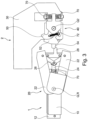
- FIG 3 a further embodiment of a primary coupling device 1 and a secondary coupling device 2 is shown.
- the coupling mechanism 24 is formed by a piston rod, which mechanically interacts directly with the scissor joint 26. Therefore, the coupling mechanism 24 is the one in the Figure 3 illustrated embodiment formed in one piece.
- Figure 3 removable - the top element 50 of the secondary coupling device 2 is pretensioned via a tension band 72, so that this tension band 72 biases the top element 50 into the top position. In other words, this can mean that the tension band 72 would move the top element 50 into the top position without further mechanical impairment.
- the adjusting piece 52 of the secondary coupling device 2 has an engagement trough and contact surfaces which are designed to contact the activator 28 of the primary coupling device 1 in order to achieve a displacement of the top element 50 from the top position to the release position.
- the secondary coupling device 2 has at least one, preferably a plurality, of guide mandrels 54, which are designed to interact with guide structures of the primary coupling device 1 in order to achieve an alignment of the primary coupling device 1 relative to the secondary coupling device 2.
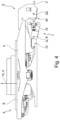
- FIG 4 a basic embodiment of a fifth wheel coupling arrangement 3 and a secondary coupling device 2, as well as a primary coupling device 1 is shown.
- the fifth wheel coupling arrangement 3 has a fifth wheel coupling plate 4, which has a trailer surface 6.
- This trailer surface 6 has an outward-pointing normal N. In the illustrated embodiment, this outward-pointing normal N is essentially parallel to the height direction H.
- the primary coupling device 1 is arranged on the fifth wheel assembly 3.
- the primary coupling device 1 has a base body 10 and a plug element 14. This plug element 14 serves to be connected to a plug connector 40 in such a way that energy can be exchanged between the primary coupling device 1 and the secondary coupling device 2.
- the secondary coupling device 2 is designed such that the plug connector 40 is mounted rotatably about the transverse direction Q2.
Landscapes
- Engineering & Computer Science (AREA)
- Transportation (AREA)
- Mechanical Engineering (AREA)
- Chemical & Material Sciences (AREA)
- Combustion & Propulsion (AREA)
- Electric Propulsion And Braking For Vehicles (AREA)
- Details Of Connecting Devices For Male And Female Coupling (AREA)
- Arrangement And Mounting Of Devices That Control Transmission Of Motive Force (AREA)
Description
- Die Erfindung betrifft eine Sattelkupplungsanordnung und ein automatisches Kupplungssystem für ein Nutzfahrzeug.
- Automatische Kupplungssysteme sind bereits aus dem Stand der Technik bekannt, diese dienen dazu, einen Energiefluss zwischen einem Zugfahrzeug und einem Auflieger oder Anhänger zu realisieren. Diese automatischen Kupplungssysteme verfügen meist auf der Zugfahrzeugseite über einen Stecker und auf der Anhängerseite über eine Steckdose. Teilweise verfügen der Stecker und die Steckdose auch über verschiebliche abdeckende Elemente, um ein Eingreifen in den Stecker oder die Steckdose vor dem Ankuppeln zu verhindern und diese vor Umwelteinflüssen zu schützen. Durch das Annähern des Zugfahrzeugs relativ zum Anhänger - während des Ankuppelvorgangs - werden die Steckdose und der Stecker zueinander ausgerichtet, die verschieblichen abdeckenden Elemente verschoben und der Stecker und die Steckdose miteinander verbunden, sodass Energie, insbesondere ein Strom, vom Zugfahrzeug auf den Anhänger fließen kann. Dieser Prozess des automatischen Koppelns der Steckdose und des Steckers aufgrund der Annäherung des Zugfahrzeugs an den Anhänger ist jedoch aufgrund der hohen Kontaktkräfte zwischen dem Stecker und der Steckdose relativ anfällig und führt häufig zu Beschädigungen, insbesondere bei den abdeckenden Elementen des Steckers.
- Die
US 4,156,551 zeigt ein Verbindungsmittel für Fahrzeuge, wobei die Fahrzeuge schienengebundene Fahrzeuge, Traktoren und Anhänger und ähnliche inkludieren können, zum automatischen Verbinden von fluidtragenden Leitungen und elektrischen Verbindungen, wenn die ziehenden oder gezogenen Fahrzeuge verbunden sind. - Die
DE 10 2015 226 049 A1 betrifft ein Kupplungsbauteil einer Kupplungsvorrichtung zum vorübergehenden Verbinden eines Zugfahrzeugs mit einem Nachlauffahrzeug zur Bildung eines Fahrzeugzuges, wobei die Vorrichtung zumindest einen Kupplungsbau-teilkörper mit einem an diesem vorgesehenen Kupplungsglied zur Herstellung eines Kupplungsverbindungseingriffs mit einem Kupplungsglied des weiteren Kupplungsbau-teils aufweist und ein Steckerbauteil mit wenigstens einer Steckerformation vorhanden ist. DieDE 101 55 056 A1 offenbart eine gattungsgemäße Sattelkupplungsanordnung. - Es ist daher Aufgabe der vorliegenden Erfindung, die Kontaktkraft beim Ankuppelvorgang zu reduzieren und um gleichzeitig den Steckverbinder vor Verschmutzungen zu schützen.
- Diese Aufgabe wird durch eine Sattelkupplungsanordnung gemäß dem Anspruch 1 und durch ein automatisches Kupplungssystem gemäß dem Anspruch 11 gelöst.
- Die Erfindung betrifft eine Sattelkupplungsanordnung umfassend eine Primärkopplungsvorrichtung und eine Sattelkupplungsplatte,wobei die Sattelkupplungsplatte eine Aufliegerfläche aufweist, wobei die Aufliegerfläche eine nach außen weisende Normale aufweist,wobei die Sattelkupplungsplatte eine Einfahröffnung aufweist,wobei die Einfahröffnung sich in eine Einfahrrichtung erstreckt, wobei die Primärkopplungsvorrichtung einen Grundkörper, einen Antrieb, einen Koppelmechanismus, eine Abdeckvorrichtung und ein Steckerelement umfasst, wobei der Grundkörper dazu ausgelegt ist, an der Sattelkupplungsanordnung und/oder dem Anhänger festgelegt zu sein, wobei das Steckerelement Energieleitkontakte aufweist, welche insbesondere in eine Steckrichtung weisen, wobei der Antrieb über den Koppelmechanismus mit der Abdeckvorrichtung mechanisch verbunden ist, wobei die Abdeckvorrichtung zumindest ein Abdeckelement aufweist, wobei das Abdeckelement durch den Antrieb zwischen einer ersten Stellung und einer zweiten Stellung verlagerbar ist, wobei in der ersten Stellung des Abdeckelements das Steckerelement freigegeben ist, und wobei in der zweiten Stellung das Abdeckelement des Steckerelements abgedeckt ist. Die Primärkopplungsvorrichtung ist insbesondere eine Primärkopplungsvorrichtung für ein Nutzfahrzeug. Ein Nutzfahrzeug im Sinne der Erfindung ist insbesondere ein straßentaugliches Fahrzeug mit einem zulässigen Gesamtgewicht von mindestens 3,51 Tonnen, bevorzugt von mindestens 7,51 Tonnen und besonders bevorzugt von mindestens 15,01 Tonnen. In anderen Worten kann die Primärkopplungsvorrichtung Teil eines automatischen Kupplungssystems sein, welches dazu dient, ein Anhängerfahrzeug energietechnisch und/oder informationstechnisch automatisch mit einem Zugfahrzeug zu verbinden. Die erfindungsgemäße Primärkopplungsvorrichtung ist dabei derjenige Anteil des automatischen Kupplungssystems, welcher an der Sattelkupplungsanordnung angeordnet ist.
- Die Primärkopplungsvorrichtung der erfindungsgemäßen Sattelkupplungsanordnung umfasst einen Grundkörper, einen Antrieb, ein Koppelmechanismus, eine Abdeckvorrichtung und ein Steckerelement. Der Grundkörper dient dazu, an der Sattelkupplungsanordnung oder dem Anhänger festgelegt zu sein. Der Grundkörper kann beispielsweise reversibel, insbesondere mittels Schrauben, festgelegt sein, sodass dieser in einfacher Weise ausgetauscht werden kann. Beispielsweise kann der Grundkörper, wenn dieser an der Sattelkupplungsanordnung festgelegt ist, an der Sattelkupplungsplatte angeordnet sein. Bevorzugt ist der Grundkörper unterhalb der Einfahröffnung der Sattelkupplungsplatte angeordnet. Die Einfahröffnung der Sattelkupplungsplatte ist diejenige Öffnung, in welche der anzukuppelnde bzw. einzukuppelnde Königszapfen eingeführt wird, wenn dieser von einer entkoppelten Stellung in die eingekuppelte Stellung verlagert wird. Die Einfahröffnung erstreckt sich dabei insbesondere in eine Einfahrrichtung. Diese Einfahrrichtung ist insbesondere diejenige Richtung, in welche der Königszapfen sich relativ zur Sattelkupplungsplatte bei einem Einkuppeln des Königszapfens bewegt. Beispielsweise ist die Einfahröffnung diejenige Öffnung der Sattelkupplungsplatte, in welche der Königszapfen eingeführt wird um ein Einkuppeln des Königszapfens zu erreichen. Vorteilhafterweise wird die Einfahröffnung durch einen Raum zwischen den Kupplungshörnern der Sattelkupplungsplatte definiert/ausgebildet. Erfindungsgemäß ist dabei die Steckrichtung zumindest im Wesentlichen parallel zur Einfahrrichtung, um eine besonders kompakte und betriebssichere Primärkoppelvorrichtung zu erreichen. Unter einem im Wesentlichen parallel ist dabei zu verstehen, dass der kleinste zwischen den beiden im Wesentlichen parallelen Richtungen eingeschlossene Winkel maximal 10°, bevorzugt maximal 5° und besonders bevorzugt maximal 1 ° beträgt. Besonders stark bevorzugt ist es jedoch, wenn die im Wesentlichen parallelen Richtungen genau parallel sind. Der Grundkörper der Primärkopplungsvorrichtung kann insbesondere als ein Blechteil ausgestaltet sein, denn hierdurch können Fertigungskosten gespart werden. Neben dem Grundkörper verfügt die Primärkopplungsvorrichtung auch über ein Steckerelement. Das Steckerelement dient dazu, mit einem korrespondierend ausgebildeten Element, insbesondere mit einem Steckverbinder einer Sekundärkopplungsvorrichtung, verbindbar und/oder verbunden zu sein, sodass elektrische Signale und/oder Informationen und/oder Energie zwischen dem Steckerelement und dem korrespondierend ausgebildeten Element übertragen werden können. In anderen Worten kann dies bedeuten, dass das Steckerelement mit beispielsweise einem Steckverbinder einer Sekundärkopplungsvorrichtung ein automatisches Kupplungssystem ausbilden kann, sodass insbesondere elektrische Signale und/oder Energie und/oder Informationen zwischen einem Zugfahrzeug und einem Anhänger übertragen werden können. Für die Informations- und/oder Energieübertragung verfügt das Steckerelement insbesondere über hydraulische und/oder pneumatische und/oder elektrische Energieleitkontakte, wobei diese Energieleitkontakte insbesondere dazu ausgelegt sind, mit korrespondierenden Kontakten eines Steckverbinders einer Sekundärkopplungsvorrichtung verbindbar und/oder verbunden zu sein. Vorteilhafterweise erstrecken sich die Energieleitkontakte des Steckerelements in die Steckrichtung. Vorteilhafterweise ist diese Steckrichtung dabei diejenige Richtung, in welche sich das Steckerelement - theoretisch - relativ zum Steckverbinder bewegen muss, um eine Steckverbindung zu realisieren. Um die Energieleitkontakte gegen Umwelteinflüsse zu schützen, verfügt die Primärkopplungsvorrichtung über eine Abdeckvorrichtung, welche zumindest ein Abdeckelement aufweist. Das Abdeckelement kann dabei eine Klappe oder ein Fallmechanismus oder ein Klappmechanismus sein oder eine lamellenartige Abdeckeinheit, in anderen Worten kann das Abdeckelement ein oder mehrstückig ausgebildet sein. Das Abdeckelement der Abdeckvorrichtung ist dabei durch den Antrieb zwischen einer ersten Stellung und einer zweiten Stellung verlagerbar, wobei in der ersten Stellung des Abdeckelements das Steckerelement freigegeben ist. In anderen Worten kann dies bedeuten, dass in der ersten Stellung ein Einstecken eines Steckverbinders in das Steckerelement bzw. eine Steckverbindung zwischen dem Steckerelement und dem Steckverbinder einer Sekundärkopplungsvorrichtung möglich ist. In der zweiten Stellung ist das Abdeckelement derart positioniert, dass das Steckerelement abgedeckt ist. In anderen Worten kann dies bedeuten, dass in der zweiten Stellung das Abdeckelement derart positioniert ist, dass ein Steckverbinder einer Sekundärkopplungsvorrichtung nicht mit dem Steckerelement stecktechnisch verbunden werden kann. Um das Abdeckelement der Abdeckvorrichtung von der ersten Stellung in die zweite Stellung und/oder von der zweiten Stellung in die erste Stellung zu verlagern, verfügt die Primärkopplungsvorrichtung über einen Antrieb und einen Koppelmechanismus. Der Antrieb kann dabei beispielsweise ein linearantrieb, ein hydraulischer oder ein pneumatischer Antrieb, insbesondere ein Zylinder sein. Alternativ bevorzugt kann es sich bei diesem Antrieb auch um einen Elektromotor handeln. Dieser Antrieb ist über den Koppelmechanismus mit der Abdeckvorrichtung mechanisch verbunden, so dass mechanische Energie von dem Antrieb über den Koppelmechanismus auf die Abdeckvorrichtung übertragbar ist. Wobei durch diese mechanische Energie das Abdeckelement der Abdeckvorrichtung von der ersten in die zweite Stellung und/oder von der zweiten Stellung in die erste Stellung verlagert wird bzw. verlagert werden kann. Beispielsweise kann der Koppelmechanismus bei der Ausbildung des Antriebs als ein hydraulischer oder pneumatischer Zylinder eine Kolbenstange und/oder eine Kolbenstangenverlängerung sein. Insbesondere kann der Koppelmechanismus dabei einteilig oder mehrteilig ausgebildet sein. Bei einer einteiligen Ausbildung des Koppelmechanismus, insbesondere in Form einer Kolbenstange, resultiert eine besonders mechanisch belastbare Vorrichtung. Bei einer mehrteiligen Ausbildung des Koppelmechanismus kann ein gewisser Ausgleich sowie eine gewisse Dämpfungswirkung erreicht werden, so dass die Vorrichtung sowohl gewisse Toleranzen ausgleichen kann und/oder dazu in der Lage ist, ein hohes Maß an Dämpfung bereitzustellen. Durch die erfindungsgemäße Ausgestaltung der Primärkopplungsvorrichtung wird erreicht, dass durch die Verlagerung des Abdeckelements - durch den Antrieb - die Kontaktkräfte während des Einkuppelns deutlich reduziert werden. Hierdurch können insbesondere Beschädigungen an der Primärkopplungsvorrichtung, insbesondere an der Abdeckvorrichtung, verhindert werden.
- Zweckmäßigerweise ist die Primärkopplungsvorrichtung derart ausgestaltet, dass das Abdeckelement mittelbar durch den Antrieb verlagerbar ist. Insbesondere derart, dass der Antrieb derart ausgestaltet ist, dass dieser das Steckerelement bei einer Betätigung verlagert und das Steckerelement die Abdeckvorrichtung verlagert bzw. verschiebt. In anderen Worten kann die Primärkopplungsvorrichtung daher derart gestaltet sein, dass der Antrieb nicht direkt das Abdeckelement verlagert sondern vielmehr nur mittelbar, insbesondere über das Steckerelement. Hierdurch kann insbesondere ein separater Antrieb für das Steckerelement eingespart werden, sodass eine kostengünstige und bauraumsparende sowie leichte Primärkopplungsvorrichtung erreicht wird.
- Vorteilhafterweise weist der Antrieb einen Energieanschluss auf. Ein solcher Energieanschluss kann beispielsweise ein Strom-, ein Öl- und/oder ein Luftdruckanschluss sein. Durch das Vorsehen des Energieanschlusses ist es möglich, gezielt ein Betätigen des Antriebs herbeizuführen, um eine Verlagerung des Abdeckelements von der ersten Stellen in die zweite Stellung oder umgekehrt zu erreichen und/oder um das Steckerelement relativ zum Grundkörper, insbesondere in die Steckrichtung, zu verlagern. Des Weiteren wird hierdurch vermieden, dass der Antrieb einen eigenen schweren Energiespeicher aufweisen muss, sodass Bauraum und Gewicht gespart werden kann.
- Bevorzugt ist der Antrieb ein pneumatischer, ein elektrischer oder ein hydraulischer Antrieb. Durch das Ausbilden des Antriebs als ein hydraulischer Antrieb wird erreicht, dass auch große Kräfte ausgeübt werden können. Bei der Ausgestaltung des Antriebs als ein pneumatischer Antrieb kann erreicht werden, dass insbesondere auch bei Leckagen keine Umweltverschmutzung stattfindet. Darüber hinaus hat das Ausbilden des Antriebs als ein pneumatischer Antrieb auch noch den Vorteil, dass insbesondere vorhandene (Versorgungs-)Systeme des Nutzfahrzeugs (Zugfahrzeug oder Anhänger) genutzt werden können, um den Antrieb zu betreiben. Das Vorsehen eines hydraulischen oder eines pneumatischen Antriebs hat darüber hinaus auch noch den weiteren Vorteil, dass aufgrund der Kompressibilität der Arbeitsmedien dem Antrieb eine gewisse Federsteifigkeit verliehen werden kann, sodass hierdurch eine Überbelastung des Antriebs und/oder des Grundkörpers und/oder des Steckerelements durch die Federsteifigkeit des Arbeitsfluids verhindert werden kann. Die Verwendung eines elektrischen Antriebs ermöglicht ebenfalls die Nutzung von Energiequellen, wie z.B. Batterien, des Anhängers oder des Zugfahrzeugs, um ein Betreiben des Antriebs zu erreichen. Hierdurch resultiert ein besonders kostengünstiges System, denn die Energieversorgung des Antriebs kann besonders einfach nachgerüstet und/oder ausgestaltet werden.
- In einer bevorzugten Ausführungsform ist der Antrieb ein Druckluftzylinder. Durch das Ausbilden als ein Druckluftzylinder resultiert eine besonders bauraumsparende Primärkopplungsvorrichtung, welche darüber hinaus auch noch in Hinblick auf eine Umweltbelastung leckage-unanfällig ist. Zusätzlich ermöglicht der Einsatz eines Druckluftzylinders, dass ein besonders schnelles Verlagern von der ersten in die zweite Stellung möglich ist und dass bereits vorhandene Systeme zum Betreiben bzw. zum Versorgen des Antriebs eingesetzt werden können, wie z. B. Kompressoren und/oder Drucklufttanks des Zugfahrzeugs oder des Anhängers.
- Vorteilhafterweise weist die Primärkopplungsvorrichtung einen zweiten Antrieb auf. Die Verwendung eines zweiten Antriebs kann beispielsweise dazu dienen, ein redundantes System bereitzustellen, sodass auch beim Ausfall eines Antriebs weiter eine sichere Verlagerung des Abdeckelements von der ersten Stellung in die zweite Stellung stattfinden kann.
- Bevorzugt umfasst das Steckerelement hydraulische und/oder pneumatische und/oder elektrische Energieleitkontakte, wobei die Energieleitkontakte dazu ausgelegt sind, mit korrespondierenden Kontakten eines Steckverbinder einer Sekundärkopplungsvorrichtung verbindbar und/oder verbunden zu sein, wobei die Energieleitkontakte sich bevorzugt in die Steckrichtung erstrecken. Das Steckerelement umfasst daher in anderen Worten hydraulische und/oder pneumatische und/oder elektrische Kontakte, welche mit korrespondierenden Kontakten eines Steckverbindes einer Sekundärkopplungsvorrichtung derart zusammenwirken und/oder verbunden werden können, sodass Energie und/oder Informationen in Form von elektrischer, pneumatischer und/oder hydraulischer Energie vom Steckerelement auf die Steckverbinder und damit in einer späteren Einbauposition vom Anhänger auf das Zugfahrzeug oder vom Zugfahrzeug auf den Anhänger übertragen werden können. Die Sekundärkopplungsvorrichtung mit ihrem Steckverbinder bildet daher in anderen Worten ein automatisches Steckverbindungssystem eines automatischen Kupplungssystems mit der Primärkopplungsvorrichtung aus, wobei die Primärkopplungsvorrichtung am Anhänger oder am Zugfahrzeug angeordnet ist und die Sekundärkopplungsvorrichtung entsprechend am Zugfahrzeug oder am Anhänger.
- Vorteilhafterweise ist das Steckerelement relativ zum Grundkörper mittels des Antriebs, insbesondere in die Steckrichtung, verlagerbar. Durch die Möglichkeit das Steckerelement relativ zum Grundkörper mittels des Antriebs verlagern zu können, wird erreicht, dass das eigentliche Einstecken bzw. das Verkuppeln des Steckerelements mit einem Steckverbinder einer Sekundärkopplungsvorrichtung unabhängig von dem eigentlichen Einkuppelvorgang des Anhängers mit dem Zugfahrzeugs erfolgen kann und auch ein nur geringer Bauraum benötigt wird.
- Vorteilhafterweise ist der Koppelmechanismus durch den Antrieb in Steckrichtung lagerbar. Hierdurch kann eine besonders leichte und kompakte Betätigung der Abdeckvorrichtung erfolgen. Beispielsweise kann dies dadurch erreicht werden, dass der Antrieb als ein Zylinder ausgebildet ist, insbesondere als ein doppelt wirkender Zylinder, und der Koppelmechanismus einen Teil der Kolbenstange des Zylinders bildet oder eine Kolbenstangenverlängerung. Der Koppelmechanismus kann dabei insbesondere den Antrieb mit einer Verlagerungsvorrichtung der Abdeckvorrichtung mechanisch verbinden. Unter "mechanisch verbinden" ist dabei insbesondere zu verstehen, dass mechanische Energie von dem Antrieb über den Koppelmechanismus zu der Abdeckvorrichtung übertragen wird.
- Zweckmäßigerweise ist die Primärkopplungsvorrichtung derart ausgebildet, dass das Abdeckelement in der ersten Stellung relativ zu der Position des Abdeckelements in der zweiten Stellung zumindest teilweise in eine Höhenrichtung verlagert ist, wobei die Höhenrichtung im Wesentlichen senkrecht auf der Steckrichtung steht. Unter einer zumindest teilweisen Verlagerung in Höhenrichtung kann dabei verstanden werden, dass das Abdeckelement von der ersten Stellung relativ zur zweiten Stellung zumindest teilweise in eine Höhenrichtung verlagert werden muss. Insbesondere ist diesbezüglich der Schwerpunkt des Abdeckelements maßgeblich. Beispielsweise kann eine derartige Verlagerung des Abdeckelements von der ersten Stellung relativ zur zweiten Stellung in Höhenrichtung durch eine Rotation des Abdeckelements und/oder durch eine translatorische Bewegung des Abdeckelements erreicht werden, wobei der Schwerpunkt des Abdeckelements in der ersten Stellung relativ zur zweiten Stellung zumindest eine Verlagerungskomponente aufweisen muss, welche einen Anteil in Höhenrichtung hat. Daher ist insbesondere keine Verlagerung des Abdeckelements "zumindest teilweise in eine Höhenrichtung" gegeben, wenn das Abdeckelement lediglich in die Steckrichtung verlagert wird. Die Höhenrichtung steht insbesondere im Wesentlichen senkrecht auf der Steckrichtung. Unter "im Wesentlichen senkrecht" ist dabei zu verstehen, dass der kleinere eingeschlossene Winkel zwischen der Höhenrichtung und der Steckrichtung zwischen 80° und 90° liegt, bevorzugt zwischen 85° und 90° und besonders bevorzugt zwischen 88° und 90° liegt. Durch die Verlagerbarkeit des Abdeckelements von der ersten Stellung relativ zur zweiten Stellung - zumindest teilweise in die Höhenrichtung - kann eine besonders kompakte Primärkopplungsvorrichtung in Steckrichtung erreicht werden.
- Vorteilhafterweise weist die Abdeckvorrichtung mehrere Abdeckelemente, insbesondere zwei Abdeckelemente, auf. In anderen Worten kann dies bedeuten, dass die Abdeckvorrichtung nicht nur ein Abdeckelement, sondern eine Vielzahl von Abdeckelementen aufweist. Die Abdeckelemente können dabei insbesondere als Klappen, Lamellenkonstruktionen oder andere Verschlussmittel ausgebildet sein. Durch das Vorsehen von mehreren Abdeckelementen kann der Verfahrweg der einzelnen Abdeckelemente reduziert werden, so dass ein besonders schnelles Überführen der Abdeckelemente von deren jeweiligen ersten Stellung in deren jeweilige zweite Stellung möglich ist. Vorteilhafterweise sind die mehreren Abdeckelemente derart ausgebildet, dass in dem ersten Zustand die Abdeckelemente sich nicht kontaktieren und in dem zweiten Zustand sich gegenseitig kontaktieren. Insbesondere kann dies beispielsweise dadurch erreicht werden, dass die Abdeckelemente bei der Überführung von der ersten Stellung in die zweite Stellung aufeinander zufahren. Bei der Verwendung von zwei Abdeckelementen ist es besonders bauraumsparend, wenn die Abdeckelemente derart angeordnet sind, dass der Schwerpunkt des ersten Abdeckelements sich von dem ersten Zustand in den zweiten Zustand in die positive Höhenrichtung bewegt und der Schwerpunkt des zweiten Abdeckelements sich vom ersten Zustand in den zweiten Zustand in die negative Höhenrichtung bewegt. Eine besonders kompakte und einfache Ausgestaltung der Abdeckelemente ergibt sich, wenn das erste und das zweite Abdeckelement einen Maulklappenmechanismus miteinander bilden. Ein derartiger Maulklappenmechanismus ist insbesondere dadurch gekennzeichnet, dass die dabei vorgesehenen Abdeckelemente relativ zueinander, insbesondere um eine gemeinsame Schwenkachse, schwenkbar zueinander sind und - ähnlich wie der Oberkiefer und Unterkiefer - maulähnlich geöffnet und geschlossen werden können.
- Zweckmäßigerweise weist die Abdeckvorrichtung, insbesondere das Abdeckelement oder die Abdeckelemente, eine Dichtung, insbesondere eine Dichtlippe auf. Durch das Vorsehen einer Dichtung oder einer Dichtlippe kann ein besonders guter Schutz gegen Umwelteinflüsse wie z.B. Regen oder Sturm sowie gegen einen Wasserstrahl eines Hochdruckreinigers erreicht werden. Die Dichtung ist dabei insbesondere derart an dem Abdeckelement angeordnet, dass die Dichtung in der ersten Stellung lediglich mit dem Abdeckelement kontaktiert und wobei die Dichtung in der zweiten Stellung mit einem weiteren Element, insbesondere einem weiteren Teil der Abdeckvorrichtung, kontaktiert. In anderen Worten kann dies bedeuten, dass die Dichtung insbesondere derart angeordnet ist, dass diese in der freigegebenen Stelle kontaktlos ist und in der abdeckenden Stellung kontaktierend ist.
- Vorteilhafterweise weist die Abdeckvorrichtung eine Verlagerungsvorrichtung auf, insbesondere eine Spreizvorrichtung oder ein Scherengelenk. Eine Verlagerungsvorrichtung ist dabei eine Vorrichtung, durch die insbesondere die von dem Koppelmechanismus übertragene mechanische Energie von dem Antrieb auf die Abdeckvorrichtung übertragen wird. Beispielsweise kann diese Verlagerungsvorrichtung eine Spreizvorrichtung sein, wie eine Linearführung oder eine Führungskullise oder ein Scherengelenk. Ein Scherengelenk zeichnet sich insbesondere durch zwei verschiedene Schenkel aus, welche an einem gemeinsamen Punkt rotatorisch zueinander gelagert sind, ähnlich wie bei einer Schere.
- In einer vorteilhaften Ausführungsform ist die Verlagerungsvorrichtung, insbesondere das Scherengelenk, mittel- und/oder unmittelbar mit dem Koppelmechanismus verbunden oder kontaktiert diesen. Durch die direkte und/oder mittel- oder unmittelbare Verbindung des Koppelmechanismus mit der Verlagerungsvorrichtung, insbesondere mit dem Scherengelenk, resultiert ein besonders kompakter Öffnungs- bzw. Überführungsmechanismus der Abdeckelemente von der ersten Stellung in die zweite Stellung. Besonders vorteilhaft ist es dabei, wenn die Verlagerungsvorrichtung, insbesondere das Scherengelenk, einen Anschlag für den Koppelmechanismus ausbildet. In anderen Worten kann die maximale Verlagerbarkeit des Koppelmechanismus durch die Verlagerungsvorrichtung begrenzt werden. Hierdurch kann in besonders kompakter Weise der maximale Verfahrweg des Koppelmechanismus begrenzt werden.
- Zweckmäßigerweise ist zumindest ein Abdeckelement, bevorzugt alle Abdeckelemente, der Abdeckvorrichtung um eine Drehachse rotierbar gelagert, wobei die Drehachse vorteilhafterweise im Wesentlichen senkrecht auf der Steckrichtung und/oder auf der Höhenrichtung steht. In anderen Worten kann dies bedeuten, dass zumindest ein Abdeckelement um eine Drehachse rotierbar gelagert ist. Beispielsweise kann das Abdeckelement dabei als eine rotierbare Klappe um diese Drehachse ausgebildet sein. Um eine Bewegung bzw. eine mechanische Energie von dem Antrieb auf das Abdeckelement zu übertragen und eine rotierbare Verlagerung des Abdeckelements zu erreichen, wird insbesondere der Koppelmechanismus und die Verlagerungsvorrichtung eingesetzt, um die mechanische Energie von dem Antrieb auf das Abdeckelement zu übertragen. Die Drehachse steht vorteilhafterweise zumindest im Wesentlichen senkrecht auf der Steckrichtung und/oder der Höhenrichtung. Hierdurch kann eine besonders kompakte Bauweise der Primärkopplungsvorrichtung erreicht werden.
- Vorteilhafterweise ist das Steckerelement um eine Rotationsachse rotierbar gelagert, wobei die Rotationsachse insbesondere der Drehachse entspricht. Durch die Rotationsfähigkeit des Steckerelements um eine Rotationsachse kann eine besonders effektive Möglichkeit bereitgestellt werden, gewisse Lagetoleranzen bzw. Versätze ausgleichen zu können, insbesondere in Relation zu einer Sekundärkopplungsvorrichtung. Daher können hierdurch die auftretenden Kräfte bei dem Einkoppelvorgang der Primärkopplungsvorrichtung relativ zur Sekundärkopplungsvorrichtung reduziert werden und/oder Beschädigungen vermieden oder zumindest reduziert werden. Vorteilhafterweise ist das Steckerelement dabei über zentrierende Vorspannmittel, wie zum Beispiel Federn, in einer zentrierenden Lage vorgespannt. In anderen Worten kann dies bedeuten, dass das Steckerelement zwar um eine Rotationsachse rotierbar gelagert ist, dass jedoch durch die Vorspannmittel das Steckerelement in einer Zentrallage zentrierend durch diese Vorspannmittel gehalten ist. Bei einer Übereinstimmung der Rotationsachse und der Drehachse kann eine besonders bauraumsparende Lagerung des Steckerelements und der Abdeckvorrichtung vorgenommen werden, da diese Rotationsachse und die Drehachse als eine gemeinsame Rotationslagerungsachse sowohl für das Steckerelement selbst als auch für die Abdeckelemente in Relation zu dem Steckerelement dienen können.
- Vorteilhafterweise ist zumindest ein Abdeckelement, bevorzugt alle Abdeckelemente, durch ein Vorspannmittel, insbesondere ein Spannband und/oder ein Federelement, in die erste und/oder in die zweite Stellung vorgespannt. Hierdurch wird der Vorteil erreicht, dass zumindest ein Abdeckelement, bevorzugt alle Abdeckelemente, sich in einem definierten Zustand befinden, auch dann wenn ein Ausfall des Antriebs erfolgt. Beispielsweise können diese Abdeckelemente dabei relativ zueinander durch die Vorspannmittel vorgespannt sein. In anderen Worten kann dies bedeuten, dass bei mehreren Abdeckelementen die Vorspannmittel die Abdeckelemente relativ zueinander vorspannen. Beispielsweise kann dies dadurch erreicht werden, dass zwei Abdeckelemente über ein Spannband oder eine Feder mechanisch miteinander verbunden sind. Besonders vorteilhaft ist es, wenn das Abdeckelement bzw. die Abdeckelemente über die Vorspannmittel in die zweite Stellung vorgespannt sind. Hierdurch kann insbesondere erreicht werden, dass bei einem Ausfall des Antriebs weiterhin die Energieleitkontakte des Steckerelements gegen Umwelteinflüsse geschützt sind. Alternativ bevorzugt kann das Abdeckelement auch in die erste Stellung vorgespannt sein. In anderen Worten kann dies bedeuten, dass die Vorspannmittel derart ausgebildet bzw. angeordnet sind, dass das Abdeckelement durch die in den Vorspannmitteln gespeicherte mechanische Energie diese versucht in die erste Stellung zu überführen. Hierdurch kann unter anderem erreicht werden, dass Energie eingespart werden kann, denn dies erlaubt das Abschalten des Antriebs in der ersten Stellung, wenn die Primärkopplungsvorrichtung mit der Sekundärkopplungsvorrichtung verkuppelt ist.
- Zweckmäßigerweise weist die Primärkopplungsvorrichtung, insbesondere das Steckerelement, einen Aktivator und/oder einen Führungsdorn auf, der sowohl in der ersten Stellung als auch in der zweiten Stellung in Steckrichtung über zumindest ein Abdeckelement, bevorzugt über alle Abdeckelemente, hinaus steht. Unter einem Hinausstehen des Aktivators und des Führungsdorns kann dabei unter anderem verstanden werden, dass in Steckrichtung, insbesondere weg vom Abdeckelement, der Aktivator und/oder der Führungsdorn das Abdeckelement überragt. Hierdurch wird erreicht, dass der Aktivator und/oder der Führungsdorn dauerhaft in der Lage ist, mit anderen Elementen - unabhängig von der Stellung des Abdeckelements in der ersten Stellung oder der zweiten Stellung - interagieren zu können. Die Führungsdorne sind beispielsweise dazu ausgelegt, in Führungsausnehmungen eingreifen zu können, um so eine Ausrichtung der Primärkopplungsvorrichtung relativ zu der Sekundärkopplungsvorrichtung vorzunehmen. Der Aktivator hingegen ist ein Element, welches dazu dient, ein Verdeckelement einer Sekundärkopplungsvorrichtung von einer verdeckenden in eine öffnende bzw. geöffnete Stellung zu verlagern, insbesondere dadurch, dass der Aktivator mit einem Stellstück der Sekundärkopplungsvorrichtung interagiert.
- Vorteilhafterweise ist das Steckerelement derart gelagert, dass das Steckerelement in drei relativ zueinander senkrecht stehenden Achsen translatorisch verschiebbar zu dem Koppelmechanismus oder einem Teil des Koppelmechanismus ist, insbesondere in maximal +/- 0,5 mm und/oder wobei das Steckerelement derart gelagert ist, dass das Steckerelement in drei relativ zueinander senkrecht stehenden Achsen rotatorisch gegenüber dem Koppelmechanismus verschiebbar ist.
- In anderen Worten kann dies bedeuten, dass das Steckerelement derart in Relation zum Koppelmechanismus oder einem Teil des Koppelmechanismus gelagert ist, dass das Steckerelement relativ zu zumindest einem Teil des Koppelmechanismus um maximal +/- 0,5 mm verlagerbar ist. Durch diese relative Verlagerbarkeit kann ein gewisser Ausgleich zwischen dem Steckerelement und dem Koppelmechanismus erreicht werden. In anderen Worten kann daher das Steckerelement relativ zum Koppelmechanismus in drei senkrecht zueinander stehenden Raumrichtungen verlagert werden. Der maßgebliche Teil des Koppelmechanismus ist dabei insbesondere derjenige Teil des Koppelmechanismus, welcher direkt mit dem Antrieb verbunden ist. Beispielsweise ist der maßgebliche Teil des Koppelmechanismus bei einer Ausgestaltung, bei der der Koppelmechanismus eine Kolbenstangenverlängerung umfasst, die Kolbenstange. Alternativ oder zusätzlich bevorzugt kann das Steckerelement gerade auch derart gelagert sein, dass dieses in drei senkrecht relativ zueinander stehenden Achsen rotatorisch gegenüber dem Koppelmechanismus verschiebbar ist. In anderen Worten kann das Steckerelement nicht nur translatorisch in drei Raumrichtungen relativ zu einem maßgeblichen Teil des Koppelmechanismus verschiebbar sein, sondern auch rotatorisch. Hierdurch wird ein besonders hohes Maß an Adaptionsfähigkeit des Steckerelements erreicht, so dass dieses bei einer Kopplung mit einem Steckverbinder einer Sekundärkopplungsvorrichtung gewisse Höhen- und/oder Rotationsausrichtungsunterschiede ausgleichen kann. Hierdurch kann insbesondere auch erreicht werden, dass der Grundkörper der Primärkopplungsvorrichtung fest montiert werden kann, so dass die Primärkopplungsvorrichtung sicher beispielsweise an einer Sattelkupplungsplatte oder einem Anhänger montiert werden kann.
- Ein weiterer Aspekt der Erfindung betrifft ein automatisches Kupplungssystem umfassend eine Sattelkupplungsanordnung und eine Sekundärkopplungsvorrichtung, wobei die Sekundärkopplungsvorrichtung ein Tragarm, einen Steckverbinder und ein Verdeckelement aufweist, wobei das Verdeckelement dazu ausgelegt ist, in einer Verdeckstellung den Steckverbinder abzudecken und in einer Freigabestellung bzw. Öffnungsstellung den Steckverbinder freizugeben. Die Sekundärkopplungsvorrichtung bildet daher quasi das Pendant zu der Primärkopplungsvorrichtung. Die Sekundärkopplungsvorrichtung dient daher dazu, an einem Nutzfahrzeug angeordnet zu sein, welches mit einem Nutzfahrzeug gekoppelt werden soll, an dem eine Primärkopplungsvorrichtung vorhanden ist. In anderen Worten kann dies bedeuten, dass die Primärkopplungsvorrichtung an einem Zugfahrzeug oder Anhänger angeordnet sein kann und die Sekundärkopplungsvorrichtung entsprechend an einem Anhänger oder einem Zugfahrzeug. Die Sekundärkopplungsvorrichtung verfügt über einen Tragarm zur Festlegung an einem Nutzfahrzeug. Darüber hinaus weist die Sekundärkopplungsvorrichtung auch einen Steckverbinder und ein Verdeckelement auf. Der Steckverbinder weist insbesondere energieleitende Kontakte auf, welche mit entsprechenden Energieleitkontakten des Steckerelements der Primärkopplungsvorrichtung energieleitend in Eingriff bringbar sind. Das Verdeckelement der Sekundärkopplungsvorrichtung dient dazu, den Steckverbinder derart in einer Verdeckstellung abzudecken, dass eine Steckverbindung zwischen dem Steckverbinder und dem Steckerelement einer Primärkopplungsvorrichtrung nicht möglich ist, und wobei das Verdeckelement derart in eine Freigabestellung verlagerbar ist, dass der Steckverbinder derart freigegeben ist, dass eine Steckverbindung zwischen einem Steckerelement und dem Steckverbinder möglich ist. In anderen Worten kann dies bedeuten, dass das Steckerelement den Steckverbinder derart abdeckt bzw. freigibt, dass eine Steckverbindung nicht bzw. möglich ist. Dieses Abdecken erfolgt dabei insbesondere flächig und vorteilhafterweise derart, dass sämtliche energieleitenden Kontakte des Steckverbinders in deren Erstreckungsrichtung durch das Verdeckelement in der Verdeckstellung abgedeckt sind und in der Freigabestellung bzw. Öffnungsstellung von außen sichtbar, insbesondere in die Erstreckungsrichtung der energieleitenden Kontakte, freigegeben sind. In anderen Worten kann dies bedeuten, dass bei einer Verdeckstellung des Verdeckelements die energieleitenden Kontakte des Steckverbinders nicht sichtbar sind und in der Freigabestellung sichtbar sind. Hierdurch kann erreicht werden, dass die Sekundärkopplungsvorrichtung und dessen energieleitende Kontakte gegenüber äußeren Umwelteinflüssen sicher geschützt sind.
- In einer vorteilhaften Ausgestaltung der Sekundärkopplungsvorrichtung ist das Verdeckelement und/oder der Steckverbinder rotatorisch zum Tragarm, insbesondere um eine Querrichtung, gelagert, wobei vorteilhafterweise die Querrichtung in einem eingekuppelten Zustand im Wesentlichen parallel zur Rotationsachse und/oder zur Querachse ist. Die Querrichtung ist insbesondere diejenige Richtung, in welche sich die Breite des Fahrzeugs bemisst, an dem die Sekundärkopplungsvorrichtung montiert ist. Durch die rotatorische Lagerung des Steckverbinders in Relation zum Tragarm kann erreicht werden, dass eine gewisse Ausgleichsbewegung auch auf Seiten der Sekundärkopplungsvorrichtung möglich ist. Hierzu weist diese - ausgleichende - Rotierbarkeit beispielsweise zumindest eine Rotationsmöglichkeit um die Querrichtung auf. Besonders bevorzugt ist es, wenn diese Querrichtung parallel oder zu mindestens im Wesentlichen parallel zu der Rotationsachse und/oder zu der Drehachse ist. Der maßgebliche Zustand bei der Beurteilung der im Wesentlichen Parallelität der Querrichtung zu der Rotationsachse bzw. zu der Drehachse ist dabei der eingekoppelte Zustand der Primär- und der Sekundärkopplungsvorrichtung.
- Vorteilhafterweise weist die Sekundärkopplungsvorrichtung, insbesondere das Verdeckelement, ein Stellstück auf, wobei das Stellstück dazu ausgelegt ist, mit einem Aktivator einer Primärkopplungsvorrichtung zu interagieren, wobei durch diese Interaktion das Verdeckelement von der Verdeckstellung in die Freigabestellung verlagerbar ist. In anderen Worten kann dies bedeuten, dass das Stellstück dazu dient, mit einem Aktivator einer Primärkopplungsvorrichtung derart zu interagieren, insbesondere durch einen unmittelbaren Kontakt, dass durch eine Annäherung der Sekundärkopplungsvorrichtung relativ zur Primärkopplungsvorrichtung eine Verlagerung des Verdeckelements von der Verdeckstellung in die Freigabestellung erreicht wird. Das Stellstück kann dabei selbst ein Teil des Verdeckelements sein oder mechanisch mit dem Verdeckelement verbunden sein. Beispielsweise kann das Stellstück seitlich an dem Verdeckelement angebracht sein.
- Vorteilhafterweise weist das Stellstück dabei eine Eingriffsmulde für den Aktivator auf. In anderen Worten bedeutet dies, dass das Stellstück als ein weibliches Interaktionselement und der Aktivator als ein dementsprechend korrespondierendes männliches Interaktionselement ausgebildet sein kann.
- Zweckmäßigerweise ist das Verdeckelement der Sekundärkopplungsvorrichtung eine Klappe und/oder umfasst eine Klappe. Hierdurch kann ein besonders einfaches und leichtes Verdeckelement erreicht werden. Eine Klappe ist dabei insbesondere ein Element, welches um eine Rotationsachse rotatorisch gelagert ist, wobei durch eine rotatorische Bewegung dieser Klappe die Klappe von der Verdeckstellung in die Freigabestellung verlagerbar ist. In anderen Worten kann das Verdeckelement daher eine Rotationsklappe sein. Alternativ oder zusätzlich bevorzugt kann das Verdeckelement auch als eine translatorisch verlagerbare Klappe ausgebildet sein.
- Zweckmäßigerweise ist das Verdeckelement der Sekundärkopplungsvorrichtung mehrteilig ausgebildet. Kann das Verdeckelement besonders kostengünstig hergestellt werden.
- Zweckmäßigerweise weist die Sekundärkopplungsvorrichtung einen Führungsdorn auf, der sowohl in der Verdeckstellung als auch in der Freigabestellung über das Abdeckelement hinaus steht. In anderen Worten kann dies bedeuten, dass der Führungsdorn sowohl in der Verdeckstellung als auch in der Freigabestellung des Verdeckelements, über dieses hinausragt. Hierdurch kann erreicht werden, dass auch in der Verdeckstellung eine sicher Interaktion des Führungsdorns mit einer Führungsstruktur erfolgen kann. Diese Führungsstruktur ist dabei insbesondere Teil einer Primärkopplungsvorrichtung. Vorteilhafterweise ist der Führungsdorn dabei zumindest teilweise rotationssymmetrisch ausgebildet, insbesondere in der Richtung, in welcher der Führungsdorn über das Verdeckelement hinaussteht.
- Vorteilhafterweise ist die Sekundärkopplungsvorrichtung dabei antriebslos. Hierdurch kann eine besonders kostengünstige und leichte Sekundärkopplungsvorrichtung erreicht werden. Eine antriebslose Sekundärkopplungsvorrichtung liegt insbesondere dann vor, wenn die Sekundärkopplungsvorrichtung keinen Antrieb aufweist, um den Steckverbinder der Sekundärkopplungsvorrichtung zu verlagern.
- Erfindungsgemäß ist eine Sattelkupplungsanordnung. Diese Sattelkupplungsanordnung umfasst dabei eine Primärkopplungsvorrichtung wie vorgehend und nachfolgend beschrieben, und eine Sattelkupplungsplatte, wobei die Sattelkupplungsplatte eine Aufliegerfläche aufweist, wobei die Aufliegerfläche eine nach außen weisende Normale aufweist, wobei vorteilhafterweise das Steckerelement und/oder der Grundkörper in einer Richtung senkrecht zu der Steckrichtung, insbesondere in Richtung einer Normalen der Aufliegerfläche und/oder in eine Richtung senkrecht zur Steckrichtung und zu der Normalen verschiebbar gelagert ist, insbesondere um +/- 0,5 mm. Die Sattelkupplungsanordnung weist dabei eine Primärkopplungsvorrichtung und eine Sattelkupplungsplatte auf, wobei die Primärkopplungsvorrichtung insbesondere mittel- oder unmittelbar mit der Sattelkupplungsplatte verbunden ist. Die Aufliegefläche der Sattelkupplungsplatte ist dazu ausgelegt, dass in einem eingekuppelten Zustand ein Auflieger auf dieser Aufliegerfläche aufliegt. In anderen Worten kann diese Aufliegerfläche dazu dienen, in einem eingekoppelten Zustand den Auflieger zumindest teilweise abzustützen. Vorteilhafterweise ist in einem Idealzustand die nach außen weisende Normale insbesondere im Wesentlichen parallel zu dem Vektor der Erdbeschleunigung gerichtet. In anderen Worten kann dies bedeuten, dass die Aufliegerfläche in diesem Normalzustand horizontal ausgerichtet sein kann. Vorteilhafterwiese ist das Steckerelement und/oder der Grundkörper der Primärkopplungsvorrichtung derart verschiebbar gelagert, dass diese in eine Richtung senkrecht zu der Steckrichtung, insbesondere in Richtung der nach außen weisenden Normalen der Aufliegerfläche, und/oder in eine Richtung senkrecht zur Steckrichtung und zu der Normalen verschiebbar ist. Hierdurch kann ein besonders hohes Maß an Adaptionsfähigkeit des Steckerelements und/oder des Grundkörpers erreicht werden. Maßgeblich für die Verschiebbarkeit der Lagerung ist dabei die Verschiebbarkeit des Steckerelements relativ zum Grundkörper und/oder relativ zur Sattelkupplungsplatte oder die Verschiebbarkeit des Grundkörpers relativ zur Sattelkupplungsplatte. Diese Verlagerbarkeit ist dabei insbesondere derart ausgestaltet, dass diese zumindest um +/-0,5 mm verlagerbar sein sollten. Alternativ bevorzugt oder zusätzlich bevorzugt sollte diese Verschiebbarkeit jedoch nicht größer sein als 2 mm.
- Ein weiterer Aspekt der Erfindung kann ein automatisches Kupplungssystem betreffen, welches eine Primärkupplungsvorrichtung, wie vorgehend beschrieben, und eine Sattelkupplungsanordnung, wie vorgehend beschrieben, umfasst. In anderen Worten weist das automatische Kupplungssystem eine Primärkopplungsvorrichtung und eine Sekundärkopplungsvorrichtung und eine Sattelkupplungsanordnung wie vorgehend beschrieben auf.
- Die obig aufgeführten Merkmale und Vorteile können daher sinngemäß auch in diesem automatischen Kupplungssystem, insbesondere für ein Nutzfahrzeug, Einsatz finden.
- In einer vorteilhaften Ausbildung ist in dem automatischen Kupplungssystem das Steckerelement der Primärkopplungsvorrichtung und der Steckverbinder der Sekundärkopplungsvorrichtung derart angeordnet, dass jeweils das Steckerelement oder der Steckverbinder verlagerbar und/oder rotierbar entlang bzw. um drei Raumrichtungen sind, wobei diese drei Richtungen senkrecht zueinander stehen. In anderen Worten kann dies bedeuten, dass das Steckerelement oder der Steckverbinder dabei derart angeordnet sind, dass in der Summe der Verlagerbarkeitsrichtungen der Steckerelemente oder der Steckverbindungen jeweils zumindest das Steckerelement oder den Steckverbinder in eine Richtung verlagerbar ist, und diese Verlagerungsrichtung insgesamt drei Richtungen ausbilden, welche zueinander senkrecht stehen. Beispielsweise kann daher die Primärkopplungsvorrichtung derart ausgebildet sein, dass das Steckerelement in eine X-Richtung verlagerbar ist und der Steckverbinder in eine Y- und Z-Richtung, wobei die Y- und Z-Richtung jeweils zu der anderen Richtung und zu der X-Richtung senkrecht stehen. Zusätzlich oder alternativ bevorzugt gilt diese Anordnung der Verlagerbarkeit nicht nur für die translatorischen sondern auch für die rotatorischen Bewegungen. In anderen Worten kann daher bei einer Rotierbarkeit des Steckerelements um eine X-Achse der Steckverbinder derart ausgebildet sein, dass dieser um eine Y- und um eine Z-Achse rotierbar ist, wobei die Y- und Z-Achsen jeweils zueinander und gegenüber der X-Achse senkrecht stehen. Durch diese Art der Lagerbarkeit des Steckerelements und des Steckerverbinders kann ein besonders hohes Maß an Adaptionsfähigkeit im Hinblick auf eine Ausgleichsbewegung bei einer nicht "perfekten" Ausrichtung des Steckerelements im Vergleich zum Steckverbinder erreicht werden.
- Vorteilhafterweise sind dabei Vorspannmittel, wie Federn, am Steckerelement und/oder am Steckverbinder angeordnet oder interagieren mit diesen Bestanteilen derart, dass das Steckerelement oder der Steckverbinder jeweils in deren verlagerbaren Richtungen und/oder Rotationsrichtungen durch diese Mittel in einer Zentralposition zentriert vorgespannt sind.
- Weitere Vorteile und Merkmale der vorliegenden Erfindung ergeben sich aus der nachfolgenden Beschreibung mit Bezug auf die Figuren. Es zeigen:
- Figur 1
- eine Seitenansicht einer Primärkopplungsvorrichtung und einer Sekundärkopplungsvorrichtung;
- Figur 2
- eine parametrische Ansicht einer Primärkopplungsvorrichtung und einer Sekundärkopplungsvorrichtung;
- Figur 3
- eine weitere Ansicht einer Primärkopplungsvorrichtung und einer Sekundärkopplungsvorrichtung; und
- Figur 4
- eine Ansicht einer Sattelkupplungsanordnung;
- In der
Figur 1 ist eine Primärkopplungsvorrichtung 1 und eine Sekundärkopplungsvorrichtung 2 gezeigt. Die Primärkopplungsvorrichtung 1 verfügt über einen Grundkörper 10 und zumindest einen Antrieb 12, wobei der Antrieb 12 in der dargestellten Ausführungsform zumindest teilweise vom Grundkörper 10 umschlossen ist und an diesem Grundkörper 10 festgelegt ist. Der Grundkörper 10 ist dabei dazu ausgelegt, an einer Sattelkupplungsanordnung und/oder an einem Anhänger festgelegt zu sein, wobei diese Festlegung mittel- oder unmittelbar erfolgen kann. Der Antrieb 12 ist mechanisch über den Koppelmechanismus 24 mit der Abdeckvorrichtung 20 mechanisch verbunden. Der Koppelmechanismus 24 ist dabei in der in derFigur 1 dargestellten Ausführungsform durch eine Kolbenstange des Antriebs 12 und durch ein Übertragungselement und ein Vorspannmittel in Form einer Feder 70 gebildet und kontaktiert das Scherengelenk 26. Das Scherengelenk 26 weist zwei Schenkel auf, welche an einem Punkt relativ zueinander rotatorisch miteinander verbunden sind, wobei das andere Ende der Schenkel jeweils rotatorisch mit einem Abdeckelement 22 verbunden ist. Die Abdeckelemente 22 sind rotatorisch um die Drehachse Q und die Rotationsachse R gelagert. In der dargestellten Ausführungsform bilden die Abdeckelemente 22 ein Maulklappenmechanismus miteinander aus. Aus diesem Maulklappenmechanismus ist durch den Antrieb 12 und den Koppelmechanismus 24 das Steckerelement 14 in Steckrichtung V ausfahrbar. In derFigur 1 ist dabei die erste Stellung des Abdeckelements 22 gezeigt, so dass das Steckerelement 14 in der dargestellten Ausführungsform bzw. Situation freigegeben ist. Um die Abdeckelemente 22 von der - dargestellten - ersten Stellung in die - nicht dargestellte - zweite Stellung zu überführen, müssen diese Abdeckelemente 22 relativ zueinander zumindest teilweise in die Höhenrichtung H verlagert werden. Der Aktivator 28 ragt in Steckrichtung V über die Abdeckelemente 22 hinaus, nicht nur in der dargestellten ersten Stellung sondern auch in der nicht dargestellten zweiten Stellung. Der Aktivator 28 dient dazu, mit dem Stellstück 52 der Sekundärkopplungsvorrichtung 2 zu interagieren, um so eine Verlagerung des Verdeckelements 50 zu erreichen. Das Verdeckelement 50 ist dabei rotatorisch um die Querrichtung Q2 gelagert, wobei der Steckverbinder 40 der Sekundärkopplungsvorrichtung 2 in der dargestellten Ausführungsform über die Federn 70 zentrieren gegenüber dem Tragarm 30 gelagert ist. Die Querrichtung Q2 kann dabei parallel zu der Drehachse Q und/oder der Rotationsachse R sein. - In der
Figur 2 ist eine parametrische Ansicht einer Primärkopplungsvorrichtung 1 und einer Sekundärkopplungsvorrichtung 2 kurz vor dem Einkoppeln gezeigt. Die Primärkopplungsvorrichtung 1 verfügt über einen Grundkörper 10, an welchem Antriebe 12 und 13 festgelegt sind. Die Primärkopplungsvorrichtung 1 verfügt über zwei Abdeckelemente 22, welche ein Maulklappenmechanismus bilden, welcher über ein Scherengelenk 26 betätigbar ist. Diese Betätigung erfolgt dabei derart, dass einer der Antriebe 12, 13 über einen nicht dargestellten Kopplungsmechanismus 24 mit der Abdeckvorrichtung 20 und dessen Scherengelenk 26 mechanisch interagiert. - In der
Figur 3 ist eine weitere Ausgestaltung einer Primärkopplungsvorrichtung 1 und einer Sekundärkopplungsvorrichtung 2 gezeigt. Prinzipiell ähnelt diese in derFigur 3 dargestellte Ausführungsform der in derFigur 1 dargestellten Ausführungsform. Bei der in derFigur 3 dargestellten Ausführungsform ist der Kopplungsmechanismus 24 jedoch durch eine Kolbenstange gebildet, welche unmittelbar mit dem Scherengelenk 26 mechanisch interagiert. Daher ist der Kopplungsmechanismus 24 der in derFigur 3 dargestellten Ausführungsform einteilig ausgebildet. Wie derFigur 3 entnehmbar - ist das Verdeckelement 50 der Sekundärkopplungsvorrichtung 2 über ein Spannband 72 vorbespannt, so dass dieses Spannband 72 das Verdeckelement 50 in die Verdeckstellung vorspannt. In anderen Worten kann dies bedeuten, dass ohne weitere mechanische Beeinträchtigung das Spannband 72 das Verdeckelement 50 in die Verdeckstellung überführen würde. Das Stellstück 52 der Sekundärkopplungsvorrichtung 2 verfügt über eine Eingriffsmulde und Kontaktflächen, welche dazu ausgelegt sind, mit dem Aktivator 28 der Primärkopplungsvorrichtung 1 zu kontaktieren, um so eine Verlagerung des Verdeckelements 50 von der Verdeckstellung in die Freigabestellung zu erreichen. Die Sekundärkopplungsvorrichtung 2 verfügt über zumindest einen, bevorzugt eine Vielzahl, von Führungsdornen 54, welche dazu ausgelegt sind, mit Führungsstrukturen der Primärkopplungsvorrichtung 1 zu interagieren, um so eine Ausrichtung der Primärkopplungsvorrichtung 1 relativ zur Sekundärkopplungsvorrichtung 2 zu erreichen. - In der
Figur 4 ist eine prinzipielle Ausgestaltung einer Sattelkupplungsanordnung 3 und einer Sekundärkopplungsvorrichtung 2, sowie einer Primärkopplungsvorrichtung 1 gezeigt. In anderen Worten kann die in derFigur 4 dargestellte Ausführungsform ein automatisches Kupplungssystem darstellen. Die Sattelkupplungsanordnung 3 verfügt über eine Sattelkupplungsplatte 4, welche eine Aufliegerfläche 6 aufweist. Diese Aufliegerfläche 6 verfügt über eine nach außen weisende Normale N. In der dargestellten Ausführungsform ist diese nach außen weisende Normale N im Wesentlichen parallel zu der Höhenrichtung H. An der Sattelkupplungsanordnung 3 angeordnet ist die Primärkopplungsvorrichtung 1. Die Primärkopplungsvorrichtung 1 verfügt über einen Grundkörper 10 und ein Steckerelement 14. Dieses Steckerelement 14 dient dabei dazu, mit einem Steckverbinder 40 derart verbunden zu werden, so dass Energie zwischen der Primärkopplungsvorrichtung 1 und der Sekundärkopplungsvorrichtung 2 ausgetauscht werden kann. Die Sekundärkopplungsvorrichtung 2 ist dabei derart gestaltet, dass der Steckverbinder 40 um die Querrichtung Q2 drehbar gelagert ist. -
- 1
- - Primärkopplungsvorrichtung
- 2
- - Sekundärkopplungsvorrichtung
- 3
- - Sattelkupplungsanordnung
- 4
- - Sattelaufliegerplatte
- 6
- - Aufliegerfläche
- 10
- - Grundkörper
- 12
- - Antrieb
- 13
- - Zweiter Antrieb
- 14
- - Steckerelement
- 20
- - Abdeckvorrichtung
- 22
- - Abdeckelement
- 24
- - Koppelmechanismus
- 26
- - Scherengelenk
- 28
- - Aktivator
- 30
- - Tragarm
- 40
- - Steckverbinder
- 50
- - Verdeckelement
- 52
- - Stellstück
- 54
- - Führungsdorn
- 70
- - Feder
- 72
- - Spannband
- H
- - Höhenrichtung
- Q
- - Drehachse
- Q2
- - Querrichtung
- R
- - Rotationsachse
- V
- - Steckrichtung
Claims (12)
- Sattelkupplungsanordnung (3) umfassend eine Primärkopplungsvorrichtung (1) und eine Sattelkupplungsplatte (4),wobei die Sattelkupplungsplatte (4) eine Aufliegerfläche (6) aufweist,wobei die Aufliegerfläche (6) eine nach außen weisende Normale (N) aufweist,wobei die Sattelkupplungsplatte (4) eine Einfahröffnung aufweist,wobei die Einfahröffnung sich in eine Einfahrrichtung erstreckt,wobei die Primärkopplungsvorrichtung (1) einen Grundkörper (10), einen Antrieb (12), ein Koppelmechanismus (24), eine Abdeckvorrichtung (20) und ein Steckerelement (14) umfasst,wobei der Grundkörper (10) dazu ausgelegt ist, an der Sattelkupplungsanordnung (3) und/oder dem Anhänger festgelegt zu sein,wobei das Steckerelement (14) Energieleitkontakte aufweist, welche insbesondere in eine Steckrichtung (V) weisen,wobei der Antrieb (12) über den Koppelmechanismus (24) mit der Abdeckvorrichtung (20) mechanisch verbunden ist,wobei die Abdeckvorrichtung (20) zumindest ein Abdeckelement (22) aufweist,wobei das Abdeckelement (22) durch den Antrieb (12) zwischen einer ersten Stellung und einer zweiten Stellung verlagerbar ist,wobei in der ersten Stellung des Abdeckelements (22) das Steckerelement (14) freigegeben ist, undwobei in der zweiten Stellung des Abdeckelements (22) das Steckerelement (14) abgedeckt ist,dadurch gekennzeichnet, dass die Einfahrrichtung zumindest im Wesentlichen parallel zur Steckrichtung (V) ist.
- Sattelkupplungsanordnung (3) gemäß Anspruch 1,
wobei das Steckerelement (14) relativ zum Grundkörper (10) mittels des Antriebs (12), insbesondere in die Steckrichtung (V), verlagerbar ist. - Sattelkupplungsanordnung (3) gemäß einem der vorhergehenden Ansprüche,
wobei der Koppelmechanismus (24) durch den Antrieb (12) in die Steckrichtung (V) verlagerbar ist. - Sattelkupplungsanordnung (3) gemäß einem der vorhergehenden Ansprüche,wobei das Abdeckelement (22) von der ersten Stellung relativ zur zweiten Stellung zumindest teilweise in eine Höhenrichtung (H) verlagerbar ist,wobei die Höhenrichtung (H) im Wesentlichen senkrecht auf der Steckrichtung (V) steht.
- Sattelkupplungsanordnung (3) gemäß einem der vorhergehenden Ansprüche,
wobei die Abdeckvorrichtung (20) mehrere Abdeckelemente (22), insbesondere zwei Abdeckelemente (22), aufweist. - Sattelkupplungsanordnung (3) gemäß einem der vorhergehenden Ansprüche,
wobei die Abdeckvorrichtung (20), insbesondere das Abdeckelement (22) oder die Abdeckelemente (22), eine Dichtung, insbesondere eine Dichtlippe, aufweist. - Sattelkupplungsanordnung (3) gemäß einem der vorhergehenden Ansprüche,
wobei die Abdeckvorrichtung (20) eine Verlagerungsvorrichtung, insbesondere eine Spreizvorrichtung oder ein Scherengelenk (26) aufweist. - Sattelkupplungsanordnung (3) gemäß einem der vorhergehenden Ansprüche,
wobei zumindest ein Abdeckelement (22), bevorzugt alle Abdeckelemente (22), durch ein Vorspannmittel, insbesondere ein Spannband (72) und/oder eine Feder (70), in die erste oder in die zweite Stellung vorgespannt ist. - Sattelkupplungsanordnung (3) gemäß einem der vorhergehenden Ansprüche,
wobei die Primärkopplungsvorrichtung (1), insbesondere das Steckerelement (14), einen Aktivator (28) und/oder einen Führungsdorn aufweist, der sowohl in der ersten Stellung als auch in der zweiten Stellung in Steckrichtung (V) über zumindest ein Abdeckelement (22), bevorzugt über alle Abdeckelemente (22), hinaus steht. - Sattelkupplungsanordnung (3) gemäß einem der vorhergehenden Ansprüche,wobei vorteilhafterweise das Steckerelement (14) und/oder der Grundkörper (10) in einer Richtung senkrecht zu der Steckrichtung (V), insbesondere in Richtung einer Normalen (N) der Aufliegerfläche (6) und/oder in eine Richtung senkrecht zur Steckrichtung (V) und zu der Normalen (N), verschiebbar gelagert ist,insbesondere um +/- 0,5 mm.
- Automatisches Kupplungssystem (4) umfassend eine Sattelkupplungsanordnung (3) gemäß einem der vorhergehenden Ansprüche und eine Sekundärkopplungsvorrichtung (2),wobei die Sekundärkopplungsvorrichtung (2) einen Tragarm (30), einen Steckverbinder (40) und ein Verdeckelement (50) aufweist,wobei das Verdeckelement (50) dazu ausgelegt ist, in einer Verdeckstellung den Steckverbinder (40) abzudecken und in einer Freigabestellung den Steckverbinder (40) freizugeben.
- Automatisches Kupplungssystem (2) gemäß Anspruch 11,wobei das Steckerelement (14) und der Steckverbinder (40) derart angeordnet sind,dass jeweils das Steckerelement (14) oder der Steckverbinder (40) verlagerbar und/oder rotierbar entlang bzw. um drei Richtungen sind,wobei diese drei Richtungen senkrecht zu einander stehen.
Applications Claiming Priority (2)
| Application Number | Priority Date | Filing Date | Title |
|---|---|---|---|
| DE102020108004.2A DE102020108004B4 (de) | 2020-03-24 | 2020-03-24 | Primärkopplungsvorrichtung, Sattelkupplungsanordnung und automatisches Kupplungssystem |
| PCT/EP2021/056761 WO2021191008A1 (de) | 2020-03-24 | 2021-03-17 | Primärkopplungsvorrichtung, sekundärkopplungsvorrichtung, sattelkupplungsanordnung und automatisches kupplungssystem |
Publications (2)
| Publication Number | Publication Date |
|---|---|
| EP4126570A1 EP4126570A1 (de) | 2023-02-08 |
| EP4126570B1 true EP4126570B1 (de) | 2023-10-18 |
Family
ID=75173271
Family Applications (1)
| Application Number | Title | Priority Date | Filing Date |
|---|---|---|---|
| EP21713901.3A Active EP4126570B1 (de) | 2020-03-24 | 2021-03-17 | Primärkopplungsvorrichtung, sekundärkopplungsvorrichtung, sattelkupplungsanordnung und automatisches kupplungssystem |
Country Status (5)
| Country | Link |
|---|---|
| US (1) | US12403964B2 (de) |
| EP (1) | EP4126570B1 (de) |
| CN (1) | CN115315363B (de) |
| DE (1) | DE102020108004B4 (de) |
| WO (1) | WO2021191008A1 (de) |
Families Citing this family (2)
| Publication number | Priority date | Publication date | Assignee | Title |
|---|---|---|---|---|
| DE102019108953B4 (de) * | 2019-04-05 | 2024-10-02 | Saf-Holland Gmbh | Primärkopplungsvorrichtung und verfahren zum verbinden einer primärkopplungsvorrichtung |
| DE102022123660A1 (de) * | 2022-09-15 | 2024-03-21 | Zf Cv Systems Global Gmbh | Vorrichtung zum automatischen Herstellen von Verbindungen zwischen einem Zugfahrzeug und einem Anhängerfahrzeug sowie ein System und Verfahren dafür |
Citations (1)
| Publication number | Priority date | Publication date | Assignee | Title |
|---|---|---|---|---|
| DE10155056A1 (de) * | 2001-11-09 | 2003-06-05 | Jaeger Erich Gmbh & Co Kg | Steckkupplungssystem zum Verbinen von Leitungen zweier Fahrzeuge |
Family Cites Families (27)
| Publication number | Priority date | Publication date | Assignee | Title |
|---|---|---|---|---|
| GB835653A (en) * | 1957-05-03 | 1960-05-25 | Tatra Np | Improvements in articulating couplings for articulated vehicles |
| JPS53102518A (en) * | 1977-02-21 | 1978-09-06 | Nippon Air Brake Co | Apparatus for automatically coupling and releasing piping and wiring between vehicles |
| DE3725414A1 (de) * | 1987-07-31 | 1989-02-16 | Walter Hunger | Sattelkupplung |
| DE4135795A1 (de) | 1991-10-30 | 1993-05-06 | Rockinger Spezialfabrik Fuer Anhaengerkupplungen Gmbh & Co, 8000 Muenchen, De | Sattelzug stichwort: multikupplung fuer sattelauflieger |
| ITVR20030141A1 (it) * | 2003-12-19 | 2005-06-20 | H T S Hydro Tech Systems S R L | Dispositivo a cuneo magnetico applicato alla ralla dei |
| DE102006033899B4 (de) * | 2006-07-18 | 2009-01-29 | Jost-Werke Gmbh | Steckerkonsole für einen Auflieger eines Sattelzuges |
| DE102008001349B4 (de) | 2008-04-23 | 2011-02-24 | Jost-Werke Gmbh | Steckerkonsole für ein Anhängerfahrzeug eines Lastzuges |
| US8308181B2 (en) * | 2010-05-13 | 2012-11-13 | Gary Riibe | Means for electrically connecting a vehicle electrical system to a trailer |
| US9327782B2 (en) * | 2013-12-09 | 2016-05-03 | Fontaine Fifth Wheel | Fifth wheel locking mechanism |
| DE102014100255B3 (de) * | 2014-01-10 | 2015-02-19 | Frank Walter Zimmeck | Kupplungsaufnahme zum Anhängen eines Anhängers an ein Zugfahrzeug |
| US9085208B1 (en) * | 2014-11-10 | 2015-07-21 | Gary Riibe | Means for electrically connecting a vehicle electrical system to a trailer |
| DE102015226094A1 (de) * | 2015-12-18 | 2017-06-22 | Jost-Werke Deutschland Gmbh | Kupplungsbauteil mit relativ zum Kupplungsbauteilkörper beweglichem Stecker- und Ausrichtbauteil zur automatisierten Herstellung einer Steckerverbindung |
| DE202016102707U1 (de) | 2016-05-20 | 2016-07-13 | Heinz-Rüdiger Metternich | Sattelkupplung |
| EP3458341B1 (de) * | 2016-05-20 | 2020-12-09 | Hamburger Patent Schmiede GmbH | Sattelkupplung und kupplungsverfahren dafür |
| DE202017101339U1 (de) | 2017-03-09 | 2017-05-22 | Heinz-Rüdiger Metternich | Schmutzdeckelanordnung sowie Schmutzdeckelvorrichtung für diese Anordnung |
| DE102017130957A1 (de) * | 2017-12-21 | 2019-06-27 | Saf-Holland Gmbh | Kupplungssystem |
| DE102018101169B3 (de) * | 2018-01-19 | 2019-05-29 | Saf-Holland Gmbh | Kopplungskomponente, System zum Koppeln und Verfahren zur Montage einer Kopplungskomponente |
| DE102018105998B3 (de) * | 2018-03-15 | 2019-05-16 | Saf-Holland Gmbh | Kupplungssystem |
| DE102018106677B3 (de) * | 2018-03-21 | 2019-06-19 | Saf-Holland Gmbh | System und Verfahren zum Verschwenken einer Kopplungskomponente |
| DE102018106676C5 (de) * | 2018-03-21 | 2024-05-23 | Saf-Holland Gmbh | System und Verfahren zum Verschwenken einer Kopplungskomponente |
| DE102018117584A1 (de) | 2018-07-20 | 2020-01-23 | Jost-Werke Deutschland Gmbh | Steckkupplungssystem sowie kupplungssystem |
| DE102018120470B4 (de) * | 2018-08-22 | 2021-04-01 | Saf-Holland Gmbh | Verbindungssystem und Verbindungseinheit |
| US10608386B2 (en) * | 2018-08-31 | 2020-03-31 | Erich Jaeger Gmbh + Co. Kg | Socket for connecting a trailer plug connector |
| DE102018122577B4 (de) * | 2018-09-14 | 2023-03-23 | Saf-Holland Gmbh | Verbindungssystem, Kupplungssystem und Verfahren zur Verbindung eines Zugfahrzeugs mit einem Auflieger |
| US11524536B2 (en) * | 2019-02-14 | 2022-12-13 | Fontaine Fifth Wheel Company | Apparatuses, systems, and methods for determining and verifying operational states of fifth wheels |
| DE102019108953B4 (de) * | 2019-04-05 | 2024-10-02 | Saf-Holland Gmbh | Primärkopplungsvorrichtung und verfahren zum verbinden einer primärkopplungsvorrichtung |
| DE102019108954B4 (de) * | 2019-04-05 | 2022-06-30 | Saf-Holland Gmbh | Sattelkupplungsanordnung mit Verschleißdetektion |
-
2020
- 2020-03-24 DE DE102020108004.2A patent/DE102020108004B4/de active Active
-
2021
- 2021-03-17 US US17/906,803 patent/US12403964B2/en active Active
- 2021-03-17 WO PCT/EP2021/056761 patent/WO2021191008A1/de not_active Ceased
- 2021-03-17 EP EP21713901.3A patent/EP4126570B1/de active Active
- 2021-03-17 CN CN202180023326.4A patent/CN115315363B/zh active Active
Patent Citations (1)
| Publication number | Priority date | Publication date | Assignee | Title |
|---|---|---|---|---|
| DE10155056A1 (de) * | 2001-11-09 | 2003-06-05 | Jaeger Erich Gmbh & Co Kg | Steckkupplungssystem zum Verbinen von Leitungen zweier Fahrzeuge |
Also Published As
| Publication number | Publication date |
|---|---|
| WO2021191008A1 (de) | 2021-09-30 |
| CN115315363B (zh) | 2025-01-03 |
| CN115315363A (zh) | 2022-11-08 |
| EP4126570A1 (de) | 2023-02-08 |
| US12403964B2 (en) | 2025-09-02 |
| US20230211837A1 (en) | 2023-07-06 |
| DE102020108004B4 (de) | 2023-05-11 |
| DE102020108004A1 (de) | 2021-09-30 |
Similar Documents
| Publication | Publication Date | Title |
|---|---|---|
| DE102019203193B4 (de) | Steckverbinderanordnung zum Verbinden und Trennen elektrischer Leitungen | |
| EP2431201B1 (de) | Kupplungskopf einer Kupplungsvorrichtung zum mechanischen Verbinden von zwei Einheiten, insbesondere Fahrzeugeinheiten | |
| EP3867083B1 (de) | Primärkopplungsvorrichtung und verfahren zum verbinden einer primärkopplungsvorrichtung | |
| EP4126570B1 (de) | Primärkopplungsvorrichtung, sekundärkopplungsvorrichtung, sattelkupplungsanordnung und automatisches kupplungssystem | |
| EP2045882B1 (de) | Selbstjustierender Gerätesteckverbinder | |
| DE102018120470B4 (de) | Verbindungssystem und Verbindungseinheit | |
| DE102021130602A1 (de) | Ladeeinrichtung und Verfahren zum Öffnen einer Schutzklappe einer Ladeeinrichtung | |
| DE202016102707U1 (de) | Sattelkupplung | |
| EP4091218B1 (de) | Verbindungsteil für ein steckverbindungssystem | |
| DE102019216266A1 (de) | Elektrisch betriebenes Fahrzeug mit einer wechselbaren Traktionsbatterie | |
| DE102019114414A1 (de) | Elektrozugkupplungssteckkontakt, Elektrozugkupplungshälfte mit einem Elektrozugkupplungssteckkontakt, Elektrozugkupplung sowie Zugkupplungshälfte und Zugkupplung | |
| WO2023175000A2 (de) | Kupplungseinrichtung für versorgungsleitungen insbesondere zum fördern von medien von einer sattelzugmaschine zu einem sattelanhänger | |
| EP4013659A1 (de) | Elektrozugkupplung und zugkupplung mit einer solchen elektrozugkupplung | |
| EP2072384B1 (de) | Sattelkupplung mit Verbindungsanordnung | |
| EP2169776A1 (de) | Elektrische Steckverbindung | |
| EP1602547B1 (de) | Automatische Mittelpufferkupplung für ein mehrgliedriges Schienenfahrzeug | |
| WO2015090587A1 (de) | Automatisches kupplungssystem und fahrzeug mit einem solchen kupplungssystem | |
| WO2023012070A1 (de) | Sattelkupplung, sattelkupplungssystem, nutzfahrzeug und nutzfahrzeuggespann | |
| EP3735372B1 (de) | Vorrichtung zum überführen einer leitung zwischen einem eingefahrenen zustand und einem ausgefahrenen zustand sowie entsprechendes system, entsprechende verwendung und entsprechendes verfahren | |
| DE102022108916A1 (de) | Elektrokontaktkupplung für eine automatische mittelkupplung oder mittelpufferkupplung eines spurgeführten fahrzeugs | |
| EP4493420A2 (de) | Kupplungseinrichtung für versorgungsleitungen insbesondere zum fördern von medien von einer sattelzugmaschine zu einem sattelanhänger | |
| EP4507946A1 (de) | Elektrokontaktkupplung und mittelpufferkupplung für ein schienenfahrzeug | |
| DD278469A3 (de) | Leitungskupplung an automatischen mittelpufferkupplungen fuer schienenfahrzeuge | |
| WO2009080520A1 (de) | Steckverbindungsanordnung für sattelkupplungen |
Legal Events
| Date | Code | Title | Description |
|---|---|---|---|
| STAA | Information on the status of an ep patent application or granted ep patent |
Free format text: STATUS: UNKNOWN |
|
| STAA | Information on the status of an ep patent application or granted ep patent |
Free format text: STATUS: THE INTERNATIONAL PUBLICATION HAS BEEN MADE |
|
| PUAI | Public reference made under article 153(3) epc to a published international application that has entered the european phase |
Free format text: ORIGINAL CODE: 0009012 |
|
| STAA | Information on the status of an ep patent application or granted ep patent |
Free format text: STATUS: REQUEST FOR EXAMINATION WAS MADE |
|
| 17P | Request for examination filed |
Effective date: 20221021 |
|
| AK | Designated contracting states |
Kind code of ref document: A1 Designated state(s): AL AT BE BG CH CY CZ DE DK EE ES FI FR GB GR HR HU IE IS IT LI LT LU LV MC MK MT NL NO PL PT RO RS SE SI SK SM TR |
|
| GRAP | Despatch of communication of intention to grant a patent |
Free format text: ORIGINAL CODE: EPIDOSNIGR1 |
|
| STAA | Information on the status of an ep patent application or granted ep patent |
Free format text: STATUS: GRANT OF PATENT IS INTENDED |
|
| DAV | Request for validation of the european patent (deleted) | ||
| DAX | Request for extension of the european patent (deleted) | ||
| INTG | Intention to grant announced |
Effective date: 20230628 |
|
| GRAS | Grant fee paid |
Free format text: ORIGINAL CODE: EPIDOSNIGR3 |
|
| GRAA | (expected) grant |
Free format text: ORIGINAL CODE: 0009210 |
|
| STAA | Information on the status of an ep patent application or granted ep patent |
Free format text: STATUS: THE PATENT HAS BEEN GRANTED |
|
| AK | Designated contracting states |
Kind code of ref document: B1 Designated state(s): AL AT BE BG CH CY CZ DE DK EE ES FI FR GB GR HR HU IE IS IT LI LT LU LV MC MK MT NL NO PL PT RO RS SE SI SK SM TR |
|
| REG | Reference to a national code |
Ref country code: GB Ref legal event code: FG4D Free format text: NOT ENGLISH |
|
| REG | Reference to a national code |
Ref country code: CH Ref legal event code: EP |
|
| REG | Reference to a national code |
Ref country code: IE Ref legal event code: FG4D Free format text: LANGUAGE OF EP DOCUMENT: GERMAN |
|
| REG | Reference to a national code |
Ref country code: DE Ref legal event code: R096 Ref document number: 502021001743 Country of ref document: DE |
|
| P01 | Opt-out of the competence of the unified patent court (upc) registered |
Effective date: 20231025 |
|
| REG | Reference to a national code |
Ref country code: NL Ref legal event code: FP |
|
| REG | Reference to a national code |
Ref country code: SE Ref legal event code: TRGR |
|
| REG | Reference to a national code |
Ref country code: LT Ref legal event code: MG9D |
|
| PG25 | Lapsed in a contracting state [announced via postgrant information from national office to epo] |
Ref country code: GR Free format text: LAPSE BECAUSE OF FAILURE TO SUBMIT A TRANSLATION OF THE DESCRIPTION OR TO PAY THE FEE WITHIN THE PRESCRIBED TIME-LIMIT Effective date: 20240119 |
|
| PG25 | Lapsed in a contracting state [announced via postgrant information from national office to epo] |
Ref country code: IS Free format text: LAPSE BECAUSE OF FAILURE TO SUBMIT A TRANSLATION OF THE DESCRIPTION OR TO PAY THE FEE WITHIN THE PRESCRIBED TIME-LIMIT Effective date: 20240218 |
|
| PG25 | Lapsed in a contracting state [announced via postgrant information from national office to epo] |
Ref country code: LT Free format text: LAPSE BECAUSE OF FAILURE TO SUBMIT A TRANSLATION OF THE DESCRIPTION OR TO PAY THE FEE WITHIN THE PRESCRIBED TIME-LIMIT Effective date: 20231018 |
|
| PG25 | Lapsed in a contracting state [announced via postgrant information from national office to epo] |
Ref country code: ES Free format text: LAPSE BECAUSE OF FAILURE TO SUBMIT A TRANSLATION OF THE DESCRIPTION OR TO PAY THE FEE WITHIN THE PRESCRIBED TIME-LIMIT Effective date: 20231018 |
|
| PG25 | Lapsed in a contracting state [announced via postgrant information from national office to epo] |
Ref country code: LT Free format text: LAPSE BECAUSE OF FAILURE TO SUBMIT A TRANSLATION OF THE DESCRIPTION OR TO PAY THE FEE WITHIN THE PRESCRIBED TIME-LIMIT Effective date: 20231018 Ref country code: IS Free format text: LAPSE BECAUSE OF FAILURE TO SUBMIT A TRANSLATION OF THE DESCRIPTION OR TO PAY THE FEE WITHIN THE PRESCRIBED TIME-LIMIT Effective date: 20240218 Ref country code: GR Free format text: LAPSE BECAUSE OF FAILURE TO SUBMIT A TRANSLATION OF THE DESCRIPTION OR TO PAY THE FEE WITHIN THE PRESCRIBED TIME-LIMIT Effective date: 20240119 Ref country code: ES Free format text: LAPSE BECAUSE OF FAILURE TO SUBMIT A TRANSLATION OF THE DESCRIPTION OR TO PAY THE FEE WITHIN THE PRESCRIBED TIME-LIMIT Effective date: 20231018 Ref country code: BG Free format text: LAPSE BECAUSE OF FAILURE TO SUBMIT A TRANSLATION OF THE DESCRIPTION OR TO PAY THE FEE WITHIN THE PRESCRIBED TIME-LIMIT Effective date: 20240118 Ref country code: PT Free format text: LAPSE BECAUSE OF FAILURE TO SUBMIT A TRANSLATION OF THE DESCRIPTION OR TO PAY THE FEE WITHIN THE PRESCRIBED TIME-LIMIT Effective date: 20240219 |
|
| PG25 | Lapsed in a contracting state [announced via postgrant information from national office to epo] |
Ref country code: RS Free format text: LAPSE BECAUSE OF FAILURE TO SUBMIT A TRANSLATION OF THE DESCRIPTION OR TO PAY THE FEE WITHIN THE PRESCRIBED TIME-LIMIT Effective date: 20231018 Ref country code: PL Free format text: LAPSE BECAUSE OF FAILURE TO SUBMIT A TRANSLATION OF THE DESCRIPTION OR TO PAY THE FEE WITHIN THE PRESCRIBED TIME-LIMIT Effective date: 20231018 Ref country code: NO Free format text: LAPSE BECAUSE OF FAILURE TO SUBMIT A TRANSLATION OF THE DESCRIPTION OR TO PAY THE FEE WITHIN THE PRESCRIBED TIME-LIMIT Effective date: 20240118 Ref country code: LV Free format text: LAPSE BECAUSE OF FAILURE TO SUBMIT A TRANSLATION OF THE DESCRIPTION OR TO PAY THE FEE WITHIN THE PRESCRIBED TIME-LIMIT Effective date: 20231018 Ref country code: HR Free format text: LAPSE BECAUSE OF FAILURE TO SUBMIT A TRANSLATION OF THE DESCRIPTION OR TO PAY THE FEE WITHIN THE PRESCRIBED TIME-LIMIT Effective date: 20231018 |
|
| PG25 | Lapsed in a contracting state [announced via postgrant information from national office to epo] |
Ref country code: DK Free format text: LAPSE BECAUSE OF FAILURE TO SUBMIT A TRANSLATION OF THE DESCRIPTION OR TO PAY THE FEE WITHIN THE PRESCRIBED TIME-LIMIT Effective date: 20231018 |
|
| REG | Reference to a national code |
Ref country code: DE Ref legal event code: R097 Ref document number: 502021001743 Country of ref document: DE |
|
| PG25 | Lapsed in a contracting state [announced via postgrant information from national office to epo] |
Ref country code: CZ Free format text: LAPSE BECAUSE OF FAILURE TO SUBMIT A TRANSLATION OF THE DESCRIPTION OR TO PAY THE FEE WITHIN THE PRESCRIBED TIME-LIMIT Effective date: 20231018 |
|
| PG25 | Lapsed in a contracting state [announced via postgrant information from national office to epo] |
Ref country code: SK Free format text: LAPSE BECAUSE OF FAILURE TO SUBMIT A TRANSLATION OF THE DESCRIPTION OR TO PAY THE FEE WITHIN THE PRESCRIBED TIME-LIMIT Effective date: 20231018 |
|
| PG25 | Lapsed in a contracting state [announced via postgrant information from national office to epo] |
Ref country code: SM Free format text: LAPSE BECAUSE OF FAILURE TO SUBMIT A TRANSLATION OF THE DESCRIPTION OR TO PAY THE FEE WITHIN THE PRESCRIBED TIME-LIMIT Effective date: 20231018 Ref country code: SK Free format text: LAPSE BECAUSE OF FAILURE TO SUBMIT A TRANSLATION OF THE DESCRIPTION OR TO PAY THE FEE WITHIN THE PRESCRIBED TIME-LIMIT Effective date: 20231018 Ref country code: RO Free format text: LAPSE BECAUSE OF FAILURE TO SUBMIT A TRANSLATION OF THE DESCRIPTION OR TO PAY THE FEE WITHIN THE PRESCRIBED TIME-LIMIT Effective date: 20231018 Ref country code: EE Free format text: LAPSE BECAUSE OF FAILURE TO SUBMIT A TRANSLATION OF THE DESCRIPTION OR TO PAY THE FEE WITHIN THE PRESCRIBED TIME-LIMIT Effective date: 20231018 Ref country code: DK Free format text: LAPSE BECAUSE OF FAILURE TO SUBMIT A TRANSLATION OF THE DESCRIPTION OR TO PAY THE FEE WITHIN THE PRESCRIBED TIME-LIMIT Effective date: 20231018 Ref country code: CZ Free format text: LAPSE BECAUSE OF FAILURE TO SUBMIT A TRANSLATION OF THE DESCRIPTION OR TO PAY THE FEE WITHIN THE PRESCRIBED TIME-LIMIT Effective date: 20231018 |
|
| PLBE | No opposition filed within time limit |
Free format text: ORIGINAL CODE: 0009261 |
|
| STAA | Information on the status of an ep patent application or granted ep patent |
Free format text: STATUS: NO OPPOSITION FILED WITHIN TIME LIMIT |
|
| 26N | No opposition filed |
Effective date: 20240719 |
|
| PG25 | Lapsed in a contracting state [announced via postgrant information from national office to epo] |
Ref country code: SI Free format text: LAPSE BECAUSE OF FAILURE TO SUBMIT A TRANSLATION OF THE DESCRIPTION OR TO PAY THE FEE WITHIN THE PRESCRIBED TIME-LIMIT Effective date: 20231018 |
|
| PG25 | Lapsed in a contracting state [announced via postgrant information from national office to epo] |
Ref country code: SI Free format text: LAPSE BECAUSE OF FAILURE TO SUBMIT A TRANSLATION OF THE DESCRIPTION OR TO PAY THE FEE WITHIN THE PRESCRIBED TIME-LIMIT Effective date: 20231018 |
|
| REG | Reference to a national code |
Ref country code: CH Ref legal event code: PL |
|
| PG25 | Lapsed in a contracting state [announced via postgrant information from national office to epo] |
Ref country code: LU Free format text: LAPSE BECAUSE OF NON-PAYMENT OF DUE FEES Effective date: 20240317 |
|
| PG25 | Lapsed in a contracting state [announced via postgrant information from national office to epo] |
Ref country code: MC Free format text: LAPSE BECAUSE OF FAILURE TO SUBMIT A TRANSLATION OF THE DESCRIPTION OR TO PAY THE FEE WITHIN THE PRESCRIBED TIME-LIMIT Effective date: 20231018 |
|
| PG25 | Lapsed in a contracting state [announced via postgrant information from national office to epo] |
Ref country code: MC Free format text: LAPSE BECAUSE OF FAILURE TO SUBMIT A TRANSLATION OF THE DESCRIPTION OR TO PAY THE FEE WITHIN THE PRESCRIBED TIME-LIMIT Effective date: 20231018 Ref country code: LU Free format text: LAPSE BECAUSE OF NON-PAYMENT OF DUE FEES Effective date: 20240317 |
|
| REG | Reference to a national code |
Ref country code: BE Ref legal event code: MM Effective date: 20240331 |
|
| PG25 | Lapsed in a contracting state [announced via postgrant information from national office to epo] |
Ref country code: BE Free format text: LAPSE BECAUSE OF NON-PAYMENT OF DUE FEES Effective date: 20240331 |
|
| PG25 | Lapsed in a contracting state [announced via postgrant information from national office to epo] |
Ref country code: IE Free format text: LAPSE BECAUSE OF NON-PAYMENT OF DUE FEES Effective date: 20240317 |
|
| PG25 | Lapsed in a contracting state [announced via postgrant information from national office to epo] |
Ref country code: IE Free format text: LAPSE BECAUSE OF NON-PAYMENT OF DUE FEES Effective date: 20240317 Ref country code: BE Free format text: LAPSE BECAUSE OF NON-PAYMENT OF DUE FEES Effective date: 20240331 Ref country code: CH Free format text: LAPSE BECAUSE OF NON-PAYMENT OF DUE FEES Effective date: 20240331 |
|
| PGFP | Annual fee paid to national office [announced via postgrant information from national office to epo] |
Ref country code: AT Payment date: 20250417 Year of fee payment: 5 |
|
| PGFP | Annual fee paid to national office [announced via postgrant information from national office to epo] |
Ref country code: IT Payment date: 20250331 Year of fee payment: 5 |
|
| PG25 | Lapsed in a contracting state [announced via postgrant information from national office to epo] |
Ref country code: CY Free format text: LAPSE BECAUSE OF FAILURE TO SUBMIT A TRANSLATION OF THE DESCRIPTION OR TO PAY THE FEE WITHIN THE PRESCRIBED TIME-LIMIT; INVALID AB INITIO Effective date: 20210317 |
|
| PG25 | Lapsed in a contracting state [announced via postgrant information from national office to epo] |
Ref country code: HU Free format text: LAPSE BECAUSE OF FAILURE TO SUBMIT A TRANSLATION OF THE DESCRIPTION OR TO PAY THE FEE WITHIN THE PRESCRIBED TIME-LIMIT; INVALID AB INITIO Effective date: 20210317 |
|
| PG25 | Lapsed in a contracting state [announced via postgrant information from national office to epo] |
Ref country code: FI Free format text: LAPSE BECAUSE OF FAILURE TO SUBMIT A TRANSLATION OF THE DESCRIPTION OR TO PAY THE FEE WITHIN THE PRESCRIBED TIME-LIMIT Effective date: 20231019 |
|
| PGFP | Annual fee paid to national office [announced via postgrant information from national office to epo] |
Ref country code: SE Payment date: 20260323 Year of fee payment: 6 |
|
| PGFP | Annual fee paid to national office [announced via postgrant information from national office to epo] |
Ref country code: GB Payment date: 20260324 Year of fee payment: 6 |
|
| PGFP | Annual fee paid to national office [announced via postgrant information from national office to epo] |
Ref country code: DE Payment date: 20251204 Year of fee payment: 6 |
|
| PGFP | Annual fee paid to national office [announced via postgrant information from national office to epo] |
Ref country code: NL Payment date: 20260323 Year of fee payment: 6 |
|
| PGFP | Annual fee paid to national office [announced via postgrant information from national office to epo] |
Ref country code: FR Payment date: 20260325 Year of fee payment: 6 |
|
| PGFP | Annual fee paid to national office [announced via postgrant information from national office to epo] |
Ref country code: TR Payment date: 20260309 Year of fee payment: 6 |