EP4124752B1 - Windturbinenverdeck mit kühlfluidauslass - Google Patents
Windturbinenverdeck mit kühlfluidauslass Download PDFInfo
- Publication number
- EP4124752B1 EP4124752B1 EP21188121.4A EP21188121A EP4124752B1 EP 4124752 B1 EP4124752 B1 EP 4124752B1 EP 21188121 A EP21188121 A EP 21188121A EP 4124752 B1 EP4124752 B1 EP 4124752B1
- Authority
- EP
- European Patent Office
- Prior art keywords
- canopy
- cooling fluid
- wind turbine
- outlet
- generator
- Prior art date
- Legal status (The legal status is an assumption and is not a legal conclusion. Google has not performed a legal analysis and makes no representation as to the accuracy of the status listed.)
- Active
Links
Images



Classifications
-
- F—MECHANICAL ENGINEERING; LIGHTING; HEATING; WEAPONS; BLASTING
- F03—MACHINES OR ENGINES FOR LIQUIDS; WIND, SPRING, OR WEIGHT MOTORS; PRODUCING MECHANICAL POWER OR A REACTIVE PROPULSIVE THRUST, NOT OTHERWISE PROVIDED FOR
- F03D—WIND MOTORS
- F03D15/00—Transmission of mechanical power
- F03D15/20—Gearless transmission, i.e. direct-drive
-
- F—MECHANICAL ENGINEERING; LIGHTING; HEATING; WEAPONS; BLASTING
- F03—MACHINES OR ENGINES FOR LIQUIDS; WIND, SPRING, OR WEIGHT MOTORS; PRODUCING MECHANICAL POWER OR A REACTIVE PROPULSIVE THRUST, NOT OTHERWISE PROVIDED FOR
- F03D—WIND MOTORS
- F03D80/00—Details, components or accessories not provided for in groups F03D1/00 - F03D17/00
- F03D80/60—Cooling or heating of wind motors
-
- F—MECHANICAL ENGINEERING; LIGHTING; HEATING; WEAPONS; BLASTING
- F03—MACHINES OR ENGINES FOR LIQUIDS; WIND, SPRING, OR WEIGHT MOTORS; PRODUCING MECHANICAL POWER OR A REACTIVE PROPULSIVE THRUST, NOT OTHERWISE PROVIDED FOR
- F03D—WIND MOTORS
- F03D15/00—Transmission of mechanical power
-
- H—ELECTRICITY
- H02—GENERATION; CONVERSION OR DISTRIBUTION OF ELECTRIC POWER
- H02K—DYNAMO-ELECTRIC MACHINES
- H02K7/00—Arrangements for handling mechanical energy structurally associated with dynamo-electric machines, e.g. structural association with mechanical driving motors or auxiliary dynamo-electric machines
- H02K7/18—Structural association of electric generators with mechanical driving motors, e.g. with turbines
- H02K7/1807—Rotary generators
- H02K7/1823—Rotary generators structurally associated with turbines or similar engines
- H02K7/183—Rotary generators structurally associated with turbines or similar engines wherein the turbine is a wind turbine
- H02K7/1838—Generators mounted in a nacelle or similar structure of a horizontal axis wind turbine
-
- F—MECHANICAL ENGINEERING; LIGHTING; HEATING; WEAPONS; BLASTING
- F05—INDEXING SCHEMES RELATING TO ENGINES OR PUMPS IN VARIOUS SUBCLASSES OF CLASSES F01-F04
- F05B—INDEXING SCHEME RELATING TO WIND, SPRING, WEIGHT, INERTIA OR LIKE MOTORS, TO MACHINES OR ENGINES FOR LIQUIDS COVERED BY SUBCLASSES F03B, F03D AND F03G
- F05B2220/00—Application
- F05B2220/70—Application in combination with
- F05B2220/706—Application in combination with an electrical generator
-
- F—MECHANICAL ENGINEERING; LIGHTING; HEATING; WEAPONS; BLASTING
- F05—INDEXING SCHEMES RELATING TO ENGINES OR PUMPS IN VARIOUS SUBCLASSES OF CLASSES F01-F04
- F05B—INDEXING SCHEME RELATING TO WIND, SPRING, WEIGHT, INERTIA OR LIKE MOTORS, TO MACHINES OR ENGINES FOR LIQUIDS COVERED BY SUBCLASSES F03B, F03D AND F03G
- F05B2260/00—Function
- F05B2260/20—Heat transfer, e.g. cooling
-
- H—ELECTRICITY
- H02—GENERATION; CONVERSION OR DISTRIBUTION OF ELECTRIC POWER
- H02K—DYNAMO-ELECTRIC MACHINES
- H02K2205/00—Specific aspects not provided for in the other groups of this subclass relating to casings, enclosures, supports
- H02K2205/09—Machines characterised by drain passages or by venting, breathing or pressure compensating means
-
- Y—GENERAL TAGGING OF NEW TECHNOLOGICAL DEVELOPMENTS; GENERAL TAGGING OF CROSS-SECTIONAL TECHNOLOGIES SPANNING OVER SEVERAL SECTIONS OF THE IPC; TECHNICAL SUBJECTS COVERED BY FORMER USPC CROSS-REFERENCE ART COLLECTIONS [XRACs] AND DIGESTS
- Y02—TECHNOLOGIES OR APPLICATIONS FOR MITIGATION OR ADAPTATION AGAINST CLIMATE CHANGE
- Y02E—REDUCTION OF GREENHOUSE GAS [GHG] EMISSIONS, RELATED TO ENERGY GENERATION, TRANSMISSION OR DISTRIBUTION
- Y02E10/00—Energy generation through renewable energy sources
- Y02E10/70—Wind energy
- Y02E10/72—Wind turbines with rotation axis in wind direction
Definitions
- the present invention relates to the field of wind turbines, in particular a canopy for a direct drive wind turbine. Furthermore, the present invention relates to a direct drive wind turbine comprising such a canopy.
- the generator in a wind turbine is usually equipped with some kind of cooling system, e.g., in the form of a ventilation system that blows a cooling fluid through the stator cavity before it is exhausted to the surroundings.
- some kind of cooling system e.g., in the form of a ventilation system that blows a cooling fluid through the stator cavity before it is exhausted to the surroundings.
- cooling system e.g., in the form of a ventilation system that blows a cooling fluid through the stator cavity before it is exhausted to the surroundings.
- some known solutions involve an extensive amount of ducts and piping that is guided from the generator and through the nacelle in complicated ways such that it does not interfere with other parts and/or prevents access thereto. Relevant background-art examples of such solutions are disclosed in for instance EP2587052A1 and EP3270491A1 .
- a canopy for a direct drive wind turbine comprises an interface section configured for mechanically coupling the canopy to a generator, wherein the interface section comprises at least one outlet configured to receive cooling fluid exhausted by the generator and eject the received cooling fluid.
- This aspect of the invention is based on the idea that at least one outlet is formed in the interface section such that the cooling fluid exhausted by the generator can be ejected directly to the outside surroundings of the wind turbine without the need for long and complex arrangements of ducts.
- the exhausted cooling fluid is not guided into the nacelle.
- the interface section forms a circumferential shape about an axial direction of the wind turbine.
- the interface section surrounds the axial direction and may in particular be formed as a round or circular section capable of being mechanically coupled to the generator of the direct drive wind turbine.
- the interface section comprises a tubular member extending in the axial direction of the wind turbine.
- the tubular member may extend from the main part of the canopy towards the generator.
- the length (in the axial direction) of the tubular member is generally kept as short as possible in order to not extend the axial dimensions of the canopy more than necessary.
- the at least one outlet is formed in the tubular member and configured to eject the received cooling fluid in a radial direction.
- the short tubular member provides a surface in which the at least one outlet is formed, such that the cooling fluid is ejected radially outwards.
- the outlet may have a circular, elliptic, rectangular or any other shape that provides a sufficient cross-sectional area for ejecting the used cooling fluid.
- This embodiment is particularly advantageous as it does not require any modification of the cross-sectional shape of the interface section of the canopy.
- the interface section comprises at least one radial protrusion in which the at least one outlet is formed.
- the interface section is extended (in comparison to known interface sections) with at least one protrusion in the radial direction.
- the at least one protrusion allows forming of the at least one outlet.
- This embodiment is particularly advantageous as it does not require any substantive extension of the interface section of the canopy in the axial direction.
- the at least one outlet is configured to eject the received cooling fluid in the axial direction.
- the at least one outlet takes up a minimum of space in the axial direction.
- a cavity is formed between the canopy and the at least one radial protrusion, and the at least one outlet is configured to eject the received cooling fluid into the cavity.
- the cavity assures that the used cooling fluid is ejected to the surroundings of the wind turbine generator.
- the at least one outlet comprises a plurality of outlets.
- the plurality of outlets may in particular be arranged along the perimeter of the interface section with equal spacing between each outlet.
- the plurality of outlets may comprise any number of outlets, such as in particular two, three, four, five, six, eight, 12 or 16 outlets.
- a direct drive wind turbine comprising a rotor, a generator, and a nacelle arranged at an upper end of a tower.
- the nacelle comprises a canopy according to the first aspect or any of the above embodiments thereof.
- This aspect of the invention is generally based on the same idea as the first and second aspect and provides a wind turbine which benefits from the advantageous canopy of the first aspect as discussed above.
- the generator comprises at least one ventilation unit adapted to exhaust the cooling fluid towards the at least one outlet of the canopy.
- the at least one ventilation unit such as a fan or blower, is preferably arranged close to the periphery of the generator and close to the corresponding at least one outlet of the canopy.
- the wind turbine further comprises at least one duct arranged to guide the exhausted cooling fluid to the at least one outlet.
- the duct may in particular be arranged between the at least one ventilation unit and the at least one outlet.
- the duct may comprise the at least one ventilation unit.
- the cooling fluid is air.
- the cooling air is sucked in from the surroundings of the wind turbine generator and blown and/or sucked through the stator cavity before it is exhausted from the generator and ejected through the at least one outlet in the canopy.
- FIG. 1 shows a direct drive wind turbine 101 according to an exemplary embodiment of the present invention.
- the wind turbine 101 comprises a nacelle enclosed in a canopy 110 and arranged at the upper end of tower 170.
- the canopy 110 comprises an interface section 120 which is mechanically coupled to generator 150 which is arranged between the canopy 110 and the rotor 160 of the wind turbine 101.
- the interface section 120 of the canopy 110 comprises several outlets 122 for ejecting cooling fluid exhausted by the generator 150.
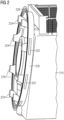
- FIG. 2 shows a partial view of a canopy 210 according to an exemplary embodiment of the present invention.
- the canopy 210 comprises an interface section formed as a relatively short tubular member 220 with outlets 222 in the tubular surface of the interface section 220.
- a short duct 224 is inserted in each outlet opening 222.
- the ducts 224 are formed to receive used cooling fluid, e.g. hot air, exhausted by the generator (not shown) in the axial direction eject the fluid through the corresponding outlet opening 222 in the radial direction.
- the interface section 220 also comprises a flange or lip 228 configured to engage with a corresponding structure in the generator.
- outlets 222 and corresponding ducts 224 are arranged around the circumference of the tubular member 220.
- any number of outlets 222 such as one, two, three, four, six, 12 or 16 outlets 222, may be feasible and used in other embodiments of the present invention.
- FIG 3 shows the set of ducts 224 used in the exemplary embodiment shown in Figure 2 .
- each duct 224 comprises an inlet opening 225 pointing in the axial direction of the wind turbine and thereby configured to receive cooling fluid from the generator (not shown).
- each duct 224 comprises a bent duct portion 226 shaped to change the flow direction of the exhaust cooling fluid from the axial to a radial direction corresponding to the orientation of the duct outlet 227 which fits into the outlet opening 222 shown in Figure 2 .
- FIG 4 shows a partial view of the canopy 210 and a generator 450 according to the exemplary embodiment shown in Figure 2 .
- the generator 450 comprises a ventilation unit (fan or blower) 452 arranged to convey exhausted cooling fluid from inside the generator 450 to the duct 224 such that it can be ejected in the radial direction through the duct outlet 227.
- a ventilation unit fan or blower
- Figure 5 shows a first partial view of a canopy 510 according to a further exemplary embodiment of the present invention.
- This embodiment differs from the one discussed above in conjunction with Figure 2 to Figure 4 in the shape of the interface structure 530 which comprises radial protrusions 531 extending inwards towards the axis of the wind turbine in order to accommodate axial fluid outlets (not shown in Figure 5 but discussed further below in conjunction with Figure 6 ) that are in communication with ducts 532 providing the exhaust cooling fluid from the generator (not shown).
- Figure 6 shows a second partial view of the canopy 610 according to the further exemplary embodiment shown in Figure 5 .
- this second partial view one of the outlets 633 can be seen.
- the outlet 633 ends in a small pocket formed in the protrusion 531 (see Figure 5 ) and thus ejects the received cooling fluid in the axial direction.
- FIG 7 shows a partial view of canopy 710 and generator 750 according to the further exemplary embodiment shown in Figure 5 and Figure 6 .
- the generator 750 comprises a ventilation unit (fan or blower) 752 arranged to convey exhausted cooling fluid from inside the generator 750 to the duct 732 such that it can be ejected in the axial direction through the duct outlet 733 and into the pocket formed in the protrusion 731 before escaping to the surroundings of the wind turbine.
- a ventilation unit fan or blower
- FIG 8 shows a cross-sectional view of the generator 850 shown in Figure 7 .
- the generator 850 comprises a total of eight ventilation units 852 arranged close to the outer circumference of the generator 850 such that they can be connected to corresponding ducts (e.g., ducts 732 in Figure 7 ) which are in communication with corresponding outlets.
- ducts e.g., ducts 732 in Figure 7
- any other number of ventilation units 852 may be used in other exemplary embodiments, such as one, two, three, four, six, 12 or 16 ventilation units 852.
- both exemplary embodiments provide simple and compact structures for ejecting used generator cooling fluid through outlets formed in the interface section of the canopy. While the embodiment shown in Figure 2 to Figure 4 relies on a short tubular member adding a bit to the length of the canopy but without affecting the cross-section of the interface between canopy and generator, the embodiment shown in Figure 5 to Figure 8 avoids any axial extension by instead adding protrusions along the circumference of the interface section.
Landscapes
- Engineering & Computer Science (AREA)
- Life Sciences & Earth Sciences (AREA)
- Sustainable Energy (AREA)
- Sustainable Development (AREA)
- Combustion & Propulsion (AREA)
- Chemical & Material Sciences (AREA)
- Mechanical Engineering (AREA)
- General Engineering & Computer Science (AREA)
- Physics & Mathematics (AREA)
- Thermal Sciences (AREA)
- Power Engineering (AREA)
- Wind Motors (AREA)
- Motor Or Generator Cooling System (AREA)
Claims (10)
- Abdeckung (110, 210) für eine Windturbine mit Direktantrieb, wobei die Abdeckung einen Grenzflächenabschnitt (120, 220) umfasst, der dazu ausgelegt ist, die Abdeckung mechanisch mit einem Generator (150) zu koppeln, wobei der Grenzflächenabschnitt mindestens einen Auslass (122, 222) umfasst, der dazu ausgelegt ist, ein von dem Generator abgelassenes Kühlfluid aufzunehmen und das aufgenommene Kühlfluid auszustoßen, wobei der Grenzflächenabschnitt ein rohrförmiges Bauteil umfasst, das sich in der axialen Richtung der Windturbine erstreckt.
- Abdeckung nach dem vorhergehenden Anspruch, wobei der Grenzflächenabschnitt eine Umfangsform um eine axiale Richtung der Windturbine bildet.
- Abdeckung nach einem der vorhergehenden Ansprüche, wobei der mindestens eine Auslass in dem rohrförmigen Bauteil gebildet und dazu ausgelegt ist, das aufgenommene Kühlfluid in einer radialen Richtung auszustoßen.
- Abdeckung (510, 610, 710) für eine Windturbine mit Direktantrieb, wobei die Abdeckung einen Grenzflächenabschnitt (530, 730) umfasst, der dazu ausgelegt ist, die Abdeckung mechanisch mit einem Generator (750) zu koppeln, wobei der Grenzflächenabschnitt mindestens einen Auslass (633, 733) umfasst, der dazu ausgelegt ist, ein von dem Generator abgelassenes Kühlfluid aufzunehmen und das aufgenommene Kühlfluid auszustoßen, wobei der Grenzflächenabschnitt mindestens einen radialen Vorsprung (531, 731) umfasst, in dem der mindestens eine Auslass gebildet ist, wobei zwischen der Abdeckung und dem mindestens einen radialen Vorsprung ein Hohlraum gebildet ist, und wobei der mindestens eine Auslass dazu ausgelegt ist, das aufgenommene Kühlfluid in den Hohlraum auszustoßen.
- Abdeckung nach dem vorhergehenden Anspruch, wobei der mindestens eine Auslass dazu ausgelegt ist, das aufgenommene Kühlfluid in der axialen Richtung auszustoßen.
- Abdeckung nach einem der vorhergehenden Ansprüche, wobei der mindestens eine Auslass (122, 222, 633, 733) eine Vielzahl von Auslässen umfasst.
- Windturbine mit Direktantrieb, die einen Rotor (160), einen Generator (150) und eine an einem oberen Ende eines Turms (170) angeordnete Gondel umfasst, wobei die Gondel eine Abdeckung (110, 210, 510, 610, 710) nach einem der vorhergehenden Ansprüche umfasst.
- Windturbine nach dem vorhergehenden Anspruch, wobei der Generator mindestens eine Lüftungseinheit (452, 752, 852) umfasst, die dazu angepasst ist, das Kühlfluid zu dem mindestens einen Auslass der Abdeckung hin abzulassen.
- Windturbine nach Anspruch 7 oder 8, die ferner mindestens einen Kanal (224, 532, 632, 732) umfasst, der angeordnet ist, um das abgelassene Kühlfluid zu dem mindestens einen Auslass hin zu führen.
- Windturbine nach einem der Ansprüche 7 bis 9, wobei das Kühlfluid Luft ist.
Priority Applications (3)
| Application Number | Priority Date | Filing Date | Title |
|---|---|---|---|
| EP21188121.4A EP4124752B1 (de) | 2021-07-28 | 2021-07-28 | Windturbinenverdeck mit kühlfluidauslass |
| US17/863,482 US12104579B2 (en) | 2021-07-28 | 2022-07-13 | Wind turbine canopy with cooling fluid outlet |
| CN202210898826.9A CN115681024B (zh) | 2021-07-28 | 2022-07-28 | 带有冷却流体出口的风力涡轮机罩盖 |
Applications Claiming Priority (1)
| Application Number | Priority Date | Filing Date | Title |
|---|---|---|---|
| EP21188121.4A EP4124752B1 (de) | 2021-07-28 | 2021-07-28 | Windturbinenverdeck mit kühlfluidauslass |
Publications (3)
| Publication Number | Publication Date |
|---|---|
| EP4124752A1 EP4124752A1 (de) | 2023-02-01 |
| EP4124752B1 true EP4124752B1 (de) | 2025-04-30 |
| EP4124752C0 EP4124752C0 (de) | 2025-04-30 |
Family
ID=77103930
Family Applications (1)
| Application Number | Title | Priority Date | Filing Date |
|---|---|---|---|
| EP21188121.4A Active EP4124752B1 (de) | 2021-07-28 | 2021-07-28 | Windturbinenverdeck mit kühlfluidauslass |
Country Status (3)
| Country | Link |
|---|---|
| US (1) | US12104579B2 (de) |
| EP (1) | EP4124752B1 (de) |
| CN (1) | CN115681024B (de) |
Family Cites Families (10)
| Publication number | Priority date | Publication date | Assignee | Title |
|---|---|---|---|---|
| US7427814B2 (en) * | 2006-03-22 | 2008-09-23 | General Electric Company | Wind turbine generators having wind assisted cooling systems and cooling methods |
| DE102008050848A1 (de) * | 2008-10-08 | 2010-04-15 | Wobben, Aloys | Ringgenerator |
| ITMI20110376A1 (it) * | 2011-03-10 | 2012-09-11 | Wilic Sarl | Aerogeneratore raffreddato a fluido |
| EP2587052A1 (de) * | 2011-10-25 | 2013-05-01 | Ewt Ip B.V. | Windturbine mit einem Kühlsystem |
| EP2806542B1 (de) * | 2013-05-22 | 2016-09-14 | Siemens Aktiengesellschaft | Luftströmungskontrollanordnung |
| KR101521828B1 (ko) * | 2013-10-18 | 2015-05-20 | 대우조선해양 주식회사 | 풍력발전기 나셀의 냉각장치 |
| EP2902619B1 (de) * | 2014-01-29 | 2018-01-17 | Siemens Aktiengesellschaft | Kühlanordnung für eine Direktantrieb- Windenergieanlage |
| EP2958217B1 (de) * | 2014-06-18 | 2018-01-31 | Siemens Aktiengesellschaft | Generatorkühlanordnung |
| EP3270491A1 (de) * | 2016-07-15 | 2018-01-17 | Siemens Aktiengesellschaft | Kühlanordnung eines windturbinengenerators |
| CN208057312U (zh) * | 2018-04-23 | 2018-11-06 | 北京金风科创风电设备有限公司 | 风力发电机组 |
-
2021
- 2021-07-28 EP EP21188121.4A patent/EP4124752B1/de active Active
-
2022
- 2022-07-13 US US17/863,482 patent/US12104579B2/en active Active
- 2022-07-28 CN CN202210898826.9A patent/CN115681024B/zh active Active
Also Published As
| Publication number | Publication date |
|---|---|
| CN115681024A (zh) | 2023-02-03 |
| US20230036882A1 (en) | 2023-02-02 |
| CN115681024B (zh) | 2026-01-23 |
| US12104579B2 (en) | 2024-10-01 |
| EP4124752A1 (de) | 2023-02-01 |
| EP4124752C0 (de) | 2025-04-30 |
Similar Documents
| Publication | Publication Date | Title |
|---|---|---|
| EP2976829B1 (de) | Luftströmungskontrollanordnung | |
| US6672070B2 (en) | Gas turbine with a compressor for air | |
| CN102536911B (zh) | 空气循环机压缩机扩散器 | |
| EP2357366B1 (de) | Wärmetauschmodul für ein fahrzeug und fahrzeug damit | |
| EP1057974A3 (de) | Gasturbinenleitapparat | |
| US20180245598A1 (en) | Turbo Fan | |
| EP3575609B1 (de) | System mit maschine und lüfter | |
| US7374396B2 (en) | Bolt-on radial bleed manifold | |
| CN111092385A (zh) | 一种基于伯努利效应的主变压器室通风系统 | |
| CN109217535B (zh) | 电机端盖及具有其的电机 | |
| EP4124752B1 (de) | Windturbinenverdeck mit kühlfluidauslass | |
| US6155777A (en) | Removal of cooling air on the housing side of a diffuser of a compressor stage of gas turbines | |
| US8286430B2 (en) | Steam turbine two flow low pressure configuration | |
| CN107005106A (zh) | 旋转电机的定子的轴向的端部区域的冷却 | |
| CN109707574A (zh) | 具有包括水排放装置的机舱的风力涡轮机 | |
| EP4183996A1 (de) | Kühlsystem für einen heckkonusmontierten generator | |
| US6037684A (en) | HVLP motor assembly | |
| EP4160002B1 (de) | Windturbine mit deflektorverkleidung | |
| US20190145657A1 (en) | Blower assembly for use in an air handling system and method for assembling the same | |
| CN210509722U (zh) | 风机组件及具有其的空调柜机 | |
| CN112283157A (zh) | 压气机引气结构和航空发动机 | |
| TWI812263B (zh) | 風機及清潔設備 | |
| EP3342991B1 (de) | Prallplatten für kühlung in einer gasturbine | |
| CN210780410U (zh) | 风冷式电机 | |
| EP2623721B1 (de) | Dampfturbine mit einschaligem Gehäuse, Trommelrotor und individuellen Leitschaufelringen |
Legal Events
| Date | Code | Title | Description |
|---|---|---|---|
| PUAI | Public reference made under article 153(3) epc to a published international application that has entered the european phase |
Free format text: ORIGINAL CODE: 0009012 |
|
| STAA | Information on the status of an ep patent application or granted ep patent |
Free format text: STATUS: THE APPLICATION HAS BEEN PUBLISHED |
|
| AK | Designated contracting states |
Kind code of ref document: A1 Designated state(s): AL AT BE BG CH CY CZ DE DK EE ES FI FR GB GR HR HU IE IS IT LI LT LU LV MC MK MT NL NO PL PT RO RS SE SI SK SM TR |
|
| STAA | Information on the status of an ep patent application or granted ep patent |
Free format text: STATUS: REQUEST FOR EXAMINATION WAS MADE |
|
| 17P | Request for examination filed |
Effective date: 20230801 |
|
| RBV | Designated contracting states (corrected) |
Designated state(s): AL AT BE BG CH CY CZ DE DK EE ES FI FR GB GR HR HU IE IS IT LI LT LU LV MC MK MT NL NO PL PT RO RS SE SI SK SM TR |
|
| GRAP | Despatch of communication of intention to grant a patent |
Free format text: ORIGINAL CODE: EPIDOSNIGR1 |
|
| STAA | Information on the status of an ep patent application or granted ep patent |
Free format text: STATUS: GRANT OF PATENT IS INTENDED |
|
| INTG | Intention to grant announced |
Effective date: 20241219 |
|
| GRAS | Grant fee paid |
Free format text: ORIGINAL CODE: EPIDOSNIGR3 |
|
| GRAA | (expected) grant |
Free format text: ORIGINAL CODE: 0009210 |
|
| STAA | Information on the status of an ep patent application or granted ep patent |
Free format text: STATUS: THE PATENT HAS BEEN GRANTED |
|
| AK | Designated contracting states |
Kind code of ref document: B1 Designated state(s): AL AT BE BG CH CY CZ DE DK EE ES FI FR GB GR HR HU IE IS IT LI LT LU LV MC MK MT NL NO PL PT RO RS SE SI SK SM TR |
|
| REG | Reference to a national code |
Ref country code: CH Ref legal event code: EP Ref country code: GB Ref legal event code: FG4D |
|
| REG | Reference to a national code |
Ref country code: IE Ref legal event code: FG4D |
|
| REG | Reference to a national code |
Ref country code: DE Ref legal event code: R096 Ref document number: 602021029895 Country of ref document: DE |
|
| U01 | Request for unitary effect filed |
Effective date: 20250520 |
|
| U07 | Unitary effect registered |
Designated state(s): AT BE BG DE DK EE FI FR IT LT LU LV MT NL PT RO SE SI Effective date: 20250528 |
|
| U20 | Renewal fee for the european patent with unitary effect paid |
Year of fee payment: 5 Effective date: 20250828 |
|
| PG25 | Lapsed in a contracting state [announced via postgrant information from national office to epo] |
Ref country code: ES Free format text: LAPSE BECAUSE OF FAILURE TO SUBMIT A TRANSLATION OF THE DESCRIPTION OR TO PAY THE FEE WITHIN THE PRESCRIBED TIME-LIMIT Effective date: 20250430 |
|
| PG25 | Lapsed in a contracting state [announced via postgrant information from national office to epo] |
Ref country code: GR Free format text: LAPSE BECAUSE OF FAILURE TO SUBMIT A TRANSLATION OF THE DESCRIPTION OR TO PAY THE FEE WITHIN THE PRESCRIBED TIME-LIMIT Effective date: 20250731 Ref country code: NO Free format text: LAPSE BECAUSE OF FAILURE TO SUBMIT A TRANSLATION OF THE DESCRIPTION OR TO PAY THE FEE WITHIN THE PRESCRIBED TIME-LIMIT Effective date: 20250730 |
|
| PG25 | Lapsed in a contracting state [announced via postgrant information from national office to epo] |
Ref country code: PL Free format text: LAPSE BECAUSE OF FAILURE TO SUBMIT A TRANSLATION OF THE DESCRIPTION OR TO PAY THE FEE WITHIN THE PRESCRIBED TIME-LIMIT Effective date: 20250430 |
|
| PGFP | Annual fee paid to national office [announced via postgrant information from national office to epo] |
Ref country code: GB Payment date: 20250722 Year of fee payment: 5 |
|
| PG25 | Lapsed in a contracting state [announced via postgrant information from national office to epo] |
Ref country code: HR Free format text: LAPSE BECAUSE OF FAILURE TO SUBMIT A TRANSLATION OF THE DESCRIPTION OR TO PAY THE FEE WITHIN THE PRESCRIBED TIME-LIMIT Effective date: 20250430 |
|
| PG25 | Lapsed in a contracting state [announced via postgrant information from national office to epo] |
Ref country code: RS Free format text: LAPSE BECAUSE OF FAILURE TO SUBMIT A TRANSLATION OF THE DESCRIPTION OR TO PAY THE FEE WITHIN THE PRESCRIBED TIME-LIMIT Effective date: 20250731 |
|
| PG25 | Lapsed in a contracting state [announced via postgrant information from national office to epo] |
Ref country code: IS Free format text: LAPSE BECAUSE OF FAILURE TO SUBMIT A TRANSLATION OF THE DESCRIPTION OR TO PAY THE FEE WITHIN THE PRESCRIBED TIME-LIMIT Effective date: 20250830 |
|
| PG25 | Lapsed in a contracting state [announced via postgrant information from national office to epo] |
Ref country code: SM Free format text: LAPSE BECAUSE OF FAILURE TO SUBMIT A TRANSLATION OF THE DESCRIPTION OR TO PAY THE FEE WITHIN THE PRESCRIBED TIME-LIMIT Effective date: 20250430 |
|
| PG25 | Lapsed in a contracting state [announced via postgrant information from national office to epo] |
Ref country code: CZ Free format text: LAPSE BECAUSE OF FAILURE TO SUBMIT A TRANSLATION OF THE DESCRIPTION OR TO PAY THE FEE WITHIN THE PRESCRIBED TIME-LIMIT Effective date: 20250430 |
|
| PG25 | Lapsed in a contracting state [announced via postgrant information from national office to epo] |
Ref country code: SK Free format text: LAPSE BECAUSE OF FAILURE TO SUBMIT A TRANSLATION OF THE DESCRIPTION OR TO PAY THE FEE WITHIN THE PRESCRIBED TIME-LIMIT Effective date: 20250430 |