EP4122880B1 - Sulfide-based solid electrolyte and all-solid-state lithium ion battery - Google Patents
Sulfide-based solid electrolyte and all-solid-state lithium ion battery Download PDFInfo
- Publication number
- EP4122880B1 EP4122880B1 EP21871880.7A EP21871880A EP4122880B1 EP 4122880 B1 EP4122880 B1 EP 4122880B1 EP 21871880 A EP21871880 A EP 21871880A EP 4122880 B1 EP4122880 B1 EP 4122880B1
- Authority
- EP
- European Patent Office
- Prior art keywords
- sulfide
- solid electrolyte
- based solid
- lithium ion
- ion battery
- Prior art date
- Legal status (The legal status is an assumption and is not a legal conclusion. Google has not performed a legal analysis and makes no representation as to the accuracy of the status listed.)
- Active
Links
Images

Classifications
-
- C—CHEMISTRY; METALLURGY
- C01—INORGANIC CHEMISTRY
- C01B—NON-METALLIC ELEMENTS; COMPOUNDS THEREOF; METALLOIDS OR COMPOUNDS THEREOF NOT COVERED BY SUBCLASS C01C
- C01B19/00—Selenium; Tellurium; Compounds thereof
- C01B19/007—Tellurides or selenides of metals
-
- H—ELECTRICITY
- H01—ELECTRIC ELEMENTS
- H01B—CABLES; CONDUCTORS; INSULATORS; SELECTION OF MATERIALS FOR THEIR CONDUCTIVE, INSULATING OR DIELECTRIC PROPERTIES
- H01B1/00—Conductors or conductive bodies characterised by the conductive materials; Selection of materials as conductors
- H01B1/06—Conductors or conductive bodies characterised by the conductive materials; Selection of materials as conductors mainly consisting of other non-metallic substances
- H01B1/10—Conductors or conductive bodies characterised by the conductive materials; Selection of materials as conductors mainly consisting of other non-metallic substances sulfides
-
- H—ELECTRICITY
- H01—ELECTRIC ELEMENTS
- H01M—PROCESSES OR MEANS, e.g. BATTERIES, FOR THE DIRECT CONVERSION OF CHEMICAL ENERGY INTO ELECTRICAL ENERGY
- H01M10/00—Secondary cells; Manufacture thereof
- H01M10/05—Accumulators with non-aqueous electrolyte
- H01M10/052—Li-accumulators
-
- H—ELECTRICITY
- H01—ELECTRIC ELEMENTS
- H01M—PROCESSES OR MEANS, e.g. BATTERIES, FOR THE DIRECT CONVERSION OF CHEMICAL ENERGY INTO ELECTRICAL ENERGY
- H01M10/00—Secondary cells; Manufacture thereof
- H01M10/05—Accumulators with non-aqueous electrolyte
- H01M10/052—Li-accumulators
- H01M10/0525—Rocking-chair batteries, i.e. batteries with lithium insertion or intercalation in both electrodes; Lithium-ion batteries
-
- H—ELECTRICITY
- H01—ELECTRIC ELEMENTS
- H01M—PROCESSES OR MEANS, e.g. BATTERIES, FOR THE DIRECT CONVERSION OF CHEMICAL ENERGY INTO ELECTRICAL ENERGY
- H01M10/00—Secondary cells; Manufacture thereof
- H01M10/05—Accumulators with non-aqueous electrolyte
- H01M10/056—Accumulators with non-aqueous electrolyte characterised by the materials used as electrolytes, e.g. mixed inorganic/organic electrolytes
- H01M10/0561—Accumulators with non-aqueous electrolyte characterised by the materials used as electrolytes, e.g. mixed inorganic/organic electrolytes the electrolyte being constituted of inorganic materials only
- H01M10/0562—Solid materials
-
- H—ELECTRICITY
- H01—ELECTRIC ELEMENTS
- H01M—PROCESSES OR MEANS, e.g. BATTERIES, FOR THE DIRECT CONVERSION OF CHEMICAL ENERGY INTO ELECTRICAL ENERGY
- H01M2300/00—Electrolytes
- H01M2300/0017—Non-aqueous electrolytes
- H01M2300/0065—Solid electrolytes
- H01M2300/0068—Solid electrolytes inorganic
-
- Y—GENERAL TAGGING OF NEW TECHNOLOGICAL DEVELOPMENTS; GENERAL TAGGING OF CROSS-SECTIONAL TECHNOLOGIES SPANNING OVER SEVERAL SECTIONS OF THE IPC; TECHNICAL SUBJECTS COVERED BY FORMER USPC CROSS-REFERENCE ART COLLECTIONS [XRACs] AND DIGESTS
- Y02—TECHNOLOGIES OR APPLICATIONS FOR MITIGATION OR ADAPTATION AGAINST CLIMATE CHANGE
- Y02E—REDUCTION OF GREENHOUSE GAS [GHG] EMISSIONS, RELATED TO ENERGY GENERATION, TRANSMISSION OR DISTRIBUTION
- Y02E60/00—Enabling technologies; Technologies with a potential or indirect contribution to GHG emissions mitigation
- Y02E60/10—Energy storage using batteries
Definitions
- the present invention relates to a sulfide-based solid electrolyte and an all-solid lithium ion battery.
- lithium ion batteries are attracting attention in terms of high energy density. Further, the high energy density and improvement of battery characteristics are also required for lithium secondary batteries for large-scale applications such as on-board power sources and road leveling.
- Non-Patent Literature 1 discloses a technique of substituting pentavalent P in argyrodite-type Li 7 PS 6 with tetravalent
- Patent Literature 1 discloses an all-solid-state secondary battery comprising Te. Ge.
- Patent Literature J. Mater. Chem. A, 7 (2019 ) Patent Literature US2019260065 A1 2717.
- Non-Patent Literature 1 When an amount of pentavalent P in the sulfide-based solid electrolyte substituted with a tetravalent element is increased, the ionic conductivity is accordingly improved.
- the technique described in Non-Patent Literature 1 as described above substitutes the pentavalent P in the argyrodite-type Li 7 PS 6 with tetravalent Ge, but only 35% of P is substituted, which cannot be completely substituted. Therefore, there is still room for improvement of the ionic conductivity of the sulfide-based solid electrolytes.
- An object of an embodiment of the present invention is to provide a sulfide-based solid electrolyte with good ionic conductivity and an all-solid lithium ion battery using the same.
- the present inventors have found that, by modifying a lithium ion conductor having an argyrodite-type structure to a structure containing tellurium (Te), 100% of phosphorus (P) can be substituted with germanium (Ge), thereby improving the ionic conductivity. Then, the present inventors have found that the above problems can be solved by a sulfide-based solid electrolyte having an argyrodite-type structure and having a predetermined composition.
- the present invention that has been completed based on the above findings relates to a sulfide-based solid electrolyte having an argyrodite-type structure, wherein a composition of the sulfide-based solid electrolyte is represented by the formula: Li 8 GeS 5 - x Te 1 + x in which: -0.5 ⁇ x ⁇ 0, 0 ⁇ x ⁇ 0.375.
- the sulfide-based solid electrolyte according the present invention satisfies -0.375 ⁇ x ⁇ 0 in the above formula.
- the present invention relates to an all-solid lithium ion battery comprising: a solid electrolyte layer made of the sulfide-based solid electrolyte according to the embodiment of the present invention; a positive electrode layer; and a negative electrode layer.
- the positive electrode layer of the lithium ion battery is obtained by forming a positive electrode mixture into a layer, which is obtained by mixing a known positive electrode active material for lithium ion batteries and the sulfide-based solid electrolyte according to the embodiment of the present invention or other sulfide-based solid electrolyte.
- the positive electrode mixture may further contain a conductive aid.
- the conductive aid that can be used herein include carbon materials, metal materials, or mixtures thereof.
- the conductive aid may contain at least one element selected from the group consisting of, for example, carbon, nickel, copper, aluminum, indium, silver, cobalt, magnesium, lithium, chromium, gold, ruthenium, platinum, beryllium, iridium, molybdenum, niobium, osmium, rhodium, tungsten and zinc.
- the conductive aid is preferably a highly conductive carbon single substance, a metal simple substance, a mixture or a compound including carbon, nickel, copper, silver, cobalt, magnesium, lithium, ruthenium, gold, platinum, niobium, osmium or rhodium.
- Examples of the carbon material that can be used herein include carbon black such as Ketjen black, acetylene black, Denka black, thermal black and channel black, graphite, carbon fiber, activated carbon and the like.
- the negative electrode layer of the lithium ion battery may be obtained by forming a known negative electrode active material for lithium ion batteries into a layer. Further, the negative electrode layer may be obtained by forming a negative electrode mixture into a layer, which is obtained by mixing a known negative electrode active material for lithium ion batteries with the sulfide-based solid electrolyte according to the embodiment of the present invention or other sulfide-based solid electrolyte. As with the positive electrode layer, the negative electrode layer may contain a conductive aid. The conductive aid may employ the same material as that described for the positive electrode layer.
- Examples of the negative electrode active material that can be used herein include carbon materials, more particularly, artificial graphite, graphite carbon fiber, resin baked carbon, pyrolytic vapor grown carbon, coke, mesocarbon microbeads (MCMB), furfuryl alcohol resin baked carbon, polyacene, pitch-based carbon fiber, vapor grown carbon fiber, natural graphite, hardly graphitizable carbon, and the like, or a mixture thereof.
- the negative electrode material may employ, for example, a metal itself such as metallic lithium, metallic indium, metallic aluminum, and metallic silicon, or an alloy combined with other elements or compounds.
- Raw materials were weighed so as to have a predetermined composition in a glove box having an argon atmosphere, and mixed for 15 minutes using a mortar to prepare a mixed powder.
- the mixed powder was then formed into 1 g of pellet, sealed in quartz ampoules in vacuum, and fired for each quartz ampoule at 700°C for 8 hours to obtain a sulfide-based solid electrolyte having a composition of Li 8 GeS 5.5 Te 0.5 .
- 0.2 g of the sulfide-based solid electrolyte powder was pressed at a pressure of 550 MPa to form a plate, and a pellet having a diameter of 10 mm, which attached gold electrodes to both sides of the plate, was then prepared, and AC impedance measurements were performed from 1 to 10 MHz at 25°C to determine ionic conductivity.
- an X-ray diffraction (XRD: X-Ray Diffraction) graph was obtained by X-ray diffraction measurement using CuK ⁇ rays.
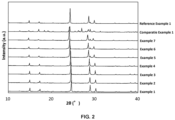
- FIG. 2 shows XRD graphs according to Examples 1 to 7, Comparative Example 1, and Reference Example 1.
- the intensity of "Intensity (a.u.)" represents an intensity of the X-ray detected by XRD measurement, and a. u. is an abbreviation of arbitrary unit.
- "2 ⁇ " indicates an angle (diffraction angle) formed by a direction of incident X-ray and a direction of diffracted X-ray.
- Example 2 The procedure was carried out by the same method as that of Example 1, with the exception that the composition of the prepared sulfide-based solid electrolyte was Li 8 GeS 5.375 Te 0.625 .
- Example 2 The procedure was carried out by the same method as that of Example 1, with the exception that the composition of the prepared sulfide-based solid electrolyte was Li 8 GeS 5.125 Te 0.875 .
- Example 2 The procedure was carried out by the same method as that of Example 1, with the exception that the composition of the prepared sulfide-based solid electrolyte was Li 8 GeS 5.625 Te 0.375 .
- Example 2 The procedure was carried out by the same method as that of Example 1, with the exception that the composition of the prepared sulfide-based solid electrolyte was Li 8 GeS 5 Te.
- each of the solid electrolytes according to Examples 1 to 7 and Reference Example 1 had the composition represented by the formula: Li 8 GeS 5-x Te 1+x in which: -0.5 ⁇ x ⁇ 0, 0 ⁇ x ⁇ 0.375.
- Comparative Example 1 did not have the composition.
- the solid electrolytes according to Examples 1 to 7 and Reference Example 1 had better ion conductivity than that of Comparative Example 1 which did not have the argyrodite-type structure and did not have the above composition. Therefore, the improvement of the battery capacity of the all-solid lithium ion batteries using the solid electrolytes according to Examples 1 to 7 and Reference Example 1 can be expected.
Landscapes
- Chemical & Material Sciences (AREA)
- Engineering & Computer Science (AREA)
- General Chemical & Material Sciences (AREA)
- Manufacturing & Machinery (AREA)
- Chemical Kinetics & Catalysis (AREA)
- Electrochemistry (AREA)
- Inorganic Chemistry (AREA)
- Materials Engineering (AREA)
- Physics & Mathematics (AREA)
- Condensed Matter Physics & Semiconductors (AREA)
- General Physics & Mathematics (AREA)
- Organic Chemistry (AREA)
- Conductive Materials (AREA)
- Secondary Cells (AREA)
Description
- The present invention relates to a sulfide-based solid electrolyte and an all-solid lithium ion battery.
- With rapidly spreading of information relational devices and communication devices such as personal computers, video cameras, and mobile phones in recent years, development of batteries used as their power sources has been emphasized. Among the batteries, lithium ion batteries are attracting attention in terms of high energy density. Further, the high energy density and improvement of battery characteristics are also required for lithium secondary batteries for large-scale applications such as on-board power sources and road leveling.
- However, for the lithium ion batteries, most of the electrolytes are organic compounds, and even if a flame-retardant compound is used, any risk of causing a fire could not be completely eliminated. As an alternative candidate for such liquid-type lithium ion batteries, all-solid lithium ion batteries having a solid electrolyte have been attracting attention in recent years. Among others, an all-solid lithium ion battery containing a sulfide such as Li2S-P2S5 or the sulfide to which a lithium halide is added, as a solid electrolyte, is becoming mainstream.
- Further, solid electrolytes with high ionic conductivity are required to improve the characteristics of all-solid lithium ion batteries. In general, by increasing lithium ions which are charge carriers, the improvement of lithium ion conductivity can be expected. As such a technique, for example, Non-Patent
Literature 1 discloses a technique of substituting pentavalent P in argyrodite-type Li7PS6 with tetravalent -
Patent Literature 1 discloses an all-solid-state secondary battery comprising Te. Ge. - [Non-Patent Literature] J. Mater. Chem. A, 7 (2019) Patent Literature
US2019260065 A1 2717. - When an amount of pentavalent P in the sulfide-based solid electrolyte substituted with a tetravalent element is increased, the ionic conductivity is accordingly improved. In this regard, the technique described in
Non-Patent Literature 1 as described above substitutes the pentavalent P in the argyrodite-type Li7PS6 with tetravalent Ge, but only 35% of P is substituted, which cannot be completely substituted. Therefore, there is still room for improvement of the ionic conductivity of the sulfide-based solid electrolytes. An object of an embodiment of the present invention is to provide a sulfide-based solid electrolyte with good ionic conductivity and an all-solid lithium ion battery using the same. - As a result of various studies, the present inventors have found that, by modifying a lithium ion conductor having an argyrodite-type structure to a structure containing tellurium (Te), 100% of phosphorus (P) can be substituted with germanium (Ge), thereby improving the ionic conductivity. Then, the present inventors have found that the above problems can be solved by a sulfide-based solid electrolyte having an argyrodite-type structure and having a predetermined composition.
- In an embodiment, the present invention that has been completed based on the above findings relates to a sulfide-based solid electrolyte having an argyrodite-type structure, wherein a composition of the sulfide-based solid electrolyte is represented by the formula:
Li8 GeS5 - x Te1 + x
in which: -0.5 ≤ x < 0, 0 < x ≤ 0.375. - In another embodiment, the sulfide-based solid electrolyte according the present invention satisfies -0.375 ≤ x < 0 in the above formula.
- In still another embodiment, the present invention relates to an all-solid lithium ion battery comprising: a solid electrolyte layer made of the sulfide-based solid electrolyte according to the embodiment of the present invention; a positive electrode layer; and a negative electrode layer.
- According to the present invention, it is possible to provide a sulfide-based solid electrolyte with good ionic conductivity and an all-solid lithium ion battery using the same.
-
-
FIG.1 is a schematic view of an all-solid lithium ion battery according to an embodiment of the present invention; and -
FIG. 2 is X-ray diffraction (XRD) graphs according to Examples 1 to 7, Comparative Example 1, and Reference Example 1. - The sulfide-based solid electrolyte according to this embodiment is a sulfide-based solid electrolyte having an argyrodite-type structure. It can be confirmed by, for example, X-ray diffraction measurement using CuKα rays that the sulfide-based solid electrolyte has the argyrodite-type structure. The argyrodite-type structure has strong diffraction peaks at 2θ = 24.3 ± 1.0° and 28.7 ± 1.0°. The diffraction peaks of the argyrodite-type structure may also appear at, for example, 2θ = 14.8 ± 1.0°, 17.2 ± 1.0°, 30.0 ± 1.0°, 42.9 ± 1.0° or 45.6 ± 1.0°. The sulfide-based solid electrolyte according to the present embodiment may have these peaks.
- The sulfide-based solid electrolyte according to the present embodiment may partially contain an amorphous component(s) as long as it has the X-ray diffraction pattern of the argyrodite-type structure.
- The composition of the sulfide-based solid electrolyte according to this embodiment is represented by the formula: Li8GeS5-xTe1+x in which: -0.5 ≤ x < 0, 0 < x ≤ 0.375. In the sulfide-based solid electrolyte according to the present embodiment, sulfur (S) in the solid electrolyte is substituted with Te having a larger ionic radius, so that the stability of the crystal structure is increased, and complete (100%) phosphorus (P) is substituted with germanium (Ge). According to such a structure, an substituting amount of germanium (Ge) is increased, so that the sulfide-based solid electrolyte having good ionic conductivity can be obtained.
- In the sulfide-based solid electrolyte according to the present embodiment, x of less than -0.5 in the above compositional formula may generate a Li4GeS4 phase with lower ion conductivity. On the other hand, x of more than 0.375 results in a large crystal lattice, so that a distance between Li sites may become long, and the ionic conductivity may decrease. The sulfide-based solid electrolyte according to the present embodiment preferably satisfies -0.375 ≤ x < 0 in the above compositional formula. According to such a composition, the sulfide-based solid electrolyte having better ionic conductivity can be obtained. Such good ion conductivity of the sulfide-based solid electrolyte results in a decreased voltage drop (IR drop) during discharge, so that the battery capacity of the all-solid lithium ion battery using it can be increased. Further, this effect becomes remarkable especially when the all-solid lithium ion battery has a high rate. In the above formula, "-0.5 ≤ x < 0, 0 < x ≤ 0.375" means -0.5 ≤ x < 0, or 0 < x ≤ 0.375.
- The average particle diameter of the sulfide-based solid electrolyte according to the embodiment of the present invention is not particularly limited, but it may be 0.01 to 100 µm, or 0.1 to 100 µm, or 0.1 to 50 µm.
- The ion conductivity of the sulfide-based solid electrolyte according to the embodiment of the present invention is preferably 10-4 S/cm or more, and more preferably 10-3 S/cm or more. The ionic conductivity of the sulfide-based solid electrolyte is determined by, for example, pressing 0.2 g of sulfide-based solid electrolyte powder at a pressure of 550 MPa to form a plate, and then preparing a pellet having a diameter of 10 mm, which has attached gold electrodes to both sides of the plate, and carrying out AC impedance measurement from 1 Hz to 10 MHz at 25°C.
- Next, a method for producing a sulfide-based solid electrolyte according to an embodiment of the present invention will be described.
- First, raw materials are weighed so as to have a predetermined composition in a glove box having an inert gas atmosphere such as an argon gas or a nitrogen gas. Examples of the raw materials used herein include Li, Li2S, Li2Te, LiTe3, Ge, GeS, GeS2, GeTe, S, and Te.
- These are then mixed for 5 to 30 minutes using a mortar or the like to prepare a mixed powder. At this time, it is preferable to mix them for a period of time such that an average particle diameter of the mixed powder is 5 to 40 µm.
- The mixed powder can be then formed into pellets, sealed in quartz ampoules in vacuum, and fired for each quartz ampoule at 400 to 800°C for 1 to 20 hours to prepare the sulfide-based solid electrolyte in which the composition is represented by the formula: Li8GeS5-xTe1+x in which: -0.5 ≤ x < 0, 0 < x ≤ 0.375.
- The solid electrolyte layer can be formed from the sulfide-based solid electrolyte according to the embodiment of the present invention, and an all-solid lithium ion battery including the solid electrolyte layer, a positive electrode layer, and a negative electrode layer can be produced. The positive electrode layer and negative electrode layer that form the all-solid lithium ion battery according to the embodiment of the present invention are not particularly limited, but they may be formed of known materials, and may have known structures as shown in
FIG. 1 . - The positive electrode layer of the lithium ion battery is obtained by forming a positive electrode mixture into a layer, which is obtained by mixing a known positive electrode active material for lithium ion batteries and the sulfide-based solid electrolyte according to the embodiment of the present invention or other sulfide-based solid electrolyte. The positive electrode mixture may further contain a conductive aid. The conductive aid that can be used herein include carbon materials, metal materials, or mixtures thereof. The conductive aid may contain at least one element selected from the group consisting of, for example, carbon, nickel, copper, aluminum, indium, silver, cobalt, magnesium, lithium, chromium, gold, ruthenium, platinum, beryllium, iridium, molybdenum, niobium, osmium, rhodium, tungsten and zinc. The conductive aid is preferably a highly conductive carbon single substance, a metal simple substance, a mixture or a compound including carbon, nickel, copper, silver, cobalt, magnesium, lithium, ruthenium, gold, platinum, niobium, osmium or rhodium. Examples of the carbon material that can be used herein include carbon black such as Ketjen black, acetylene black, Denka black, thermal black and channel black, graphite, carbon fiber, activated carbon and the like.
- The negative electrode layer of the lithium ion battery may be obtained by forming a known negative electrode active material for lithium ion batteries into a layer. Further, the negative electrode layer may be obtained by forming a negative electrode mixture into a layer, which is obtained by mixing a known negative electrode active material for lithium ion batteries with the sulfide-based solid electrolyte according to the embodiment of the present invention or other sulfide-based solid electrolyte. As with the positive electrode layer, the negative electrode layer may contain a conductive aid. The conductive aid may employ the same material as that described for the positive electrode layer. Examples of the negative electrode active material that can be used herein include carbon materials, more particularly, artificial graphite, graphite carbon fiber, resin baked carbon, pyrolytic vapor grown carbon, coke, mesocarbon microbeads (MCMB), furfuryl alcohol resin baked carbon, polyacene, pitch-based carbon fiber, vapor grown carbon fiber, natural graphite, hardly graphitizable carbon, and the like, or a mixture thereof. The negative electrode material may employ, for example, a metal itself such as metallic lithium, metallic indium, metallic aluminum, and metallic silicon, or an alloy combined with other elements or compounds.
- Hereinafter, Examples are provided for better understanding of the present invention and its advantages, but the present invention is not limited to these Examples.
- Raw materials were weighed so as to have a predetermined composition in a glove box having an argon atmosphere, and mixed for 15 minutes using a mortar to prepare a mixed powder. The mixed powder was then formed into 1 g of pellet, sealed in quartz ampoules in vacuum, and fired for each quartz ampoule at 700°C for 8 hours to obtain a sulfide-based solid electrolyte having a composition of Li8GeS5.5Te0.5.
- 0.2 g of the sulfide-based solid electrolyte powder was pressed at a pressure of 550 MPa to form a plate, and a pellet having a diameter of 10 mm, which attached gold electrodes to both sides of the plate, was then prepared, and AC impedance measurements were performed from 1 to 10 MHz at 25°C to determine ionic conductivity.
- Also, for the sample sulfide-based solid electrolyte, an X-ray diffraction (XRD: X-Ray Diffraction) graph was obtained by X-ray diffraction measurement using CuKα rays.
FIG. 2 shows XRD graphs according to Examples 1 to 7, Comparative Example 1, and Reference Example 1. In the XRD graph, the intensity of "Intensity (a.u.)" represents an intensity of the X-ray detected by XRD measurement, and a. u. is an abbreviation of arbitrary unit. In the XRD graph, "2θ" indicates an angle (diffraction angle) formed by a direction of incident X-ray and a direction of diffracted X-ray. Based on the XRD graph, whether or not the sample sulfide-based solid electrolyte had the argyrodite-type structure was evaluated by confirming the presence or absence of the diffraction peaks of the argyrodite-type structure. - The procedure was carried out by the same method as that of Example 1, with the exception that the composition of the prepared sulfide-based solid electrolyte was Li8GeS5.375Te0.625.
- The procedure was carried out by the same method as that of Example 1, with the exception that the composition of the prepared sulfide-based solid electrolyte was Li8GeS5.25Te0.75.
- The procedure was carried out by the same method as that of Example 1, with the exception that the composition of the prepared sulfide-based solid electrolyte was Li8GeS5.125Te0.875 .
- The procedure was carried out by the same method as that of Example 1, with the exception that the composition of the prepared sulfide-based solid electrolyte was Li8GeS4.875Te1.125 .
- The procedure was carried out by the same method as that of Example 1, with the exception that the composition of the prepared sulfide-based solid electrolyte was Li8GeS4.75Te1.25.
- The procedure was carried out by the same method as that of Example 1, with the exception that the composition of the prepared sulfide-based solid electrolyte was Li8GeS4.625Te1.375.
- The procedure was carried out by the same method as that of Example 1, with the exception that the composition of the prepared sulfide-based solid electrolyte was Li8GeS5.625Te0.375 .
- The procedure was carried out by the same method as that of Example 1, with the exception that the composition of the prepared sulfide-based solid electrolyte was Li8GeS5 Te.
- The above results are shown in Table 1.
[Table 1] Ionic Conductivity of Solid Electrolyte (S/cm) Example 1 3.0 × 10⁻³ Example 2 3.8 × 10⁻³ Example 3 3.4 × 10⁻³ Example 4 3.4 × 10⁻³ Example 5 3.1 × 10⁻³ Example 6 3.0 × 10⁻³ Example 7 2.8 × 10⁻³ Comparative Example 1 2.0 × 10⁻³ Reference Example 1 3.3 × 10⁻³ - In the XRD graphs of each of the solid electrolytes according to Examples 1 to 7 and Reference Example 1, strong diffraction peaks were confirmed at 2θ = 24.3 ± 1.0° and 28.7 ± 1.0°, and each solid electrolytes had the argyrodite-type structure. In the XRD graph of the solid electrolyte according to Comparative Example 1, diffraction peaks as strong as those of Examples 1 to 7 and Reference Example 1 were not confirmed at 2θ = 24.3 ± 1.0° and 28.7 ± 1.0°.
- Further, each of the solid electrolytes according to Examples 1 to 7 and Reference Example 1 had the composition represented by the formula: Li8GeS5-xTe1+x in which: -0.5 ≤ x < 0, 0 < x ≤ 0.375. However, Comparative Example 1 did not have the composition.
- Therefore, the solid electrolytes according to Examples 1 to 7 and Reference Example 1 had better ion conductivity than that of Comparative Example 1 which did not have the argyrodite-type structure and did not have the above composition. Therefore, the improvement of the battery capacity of the all-solid lithium ion batteries using the solid electrolytes according to Examples 1 to 7 and Reference Example 1 can be expected.
Claims (3)
- A sulfide-based solid electrolyte having an argyrodite-type structure, wherein a composition of the sulfide-based solid electrolyte is represented by the formula:
Li8GeS5- xTe1 + x
in which: -0.5 ≤ x < 0, 0 < x ≤ 0.375. - The sulfide-based solid electrolyte according claim 1, wherein the sulfide-based solid electrolyte satisfies -0.375 ≤ x < 0 in the formula.
- An all-solid lithium ion battery comprising: a solid electrolyte layer made of the sulfide-based solid electrolyte according to claim 1 or 2; a positive electrode layer; and a negative electrode layer.
Applications Claiming Priority (2)
| Application Number | Priority Date | Filing Date | Title |
|---|---|---|---|
| JP2020160154A JP7477414B2 (en) | 2020-09-24 | 2020-09-24 | Sulfide-based solid electrolytes and all-solid-state lithium-ion batteries |
| PCT/JP2021/015220 WO2022064744A1 (en) | 2020-09-24 | 2021-04-12 | Sulfide-based solid electrolyte and all-solid-state lithium ion battery |
Publications (3)
| Publication Number | Publication Date |
|---|---|
| EP4122880A1 EP4122880A1 (en) | 2023-01-25 |
| EP4122880A4 EP4122880A4 (en) | 2024-05-29 |
| EP4122880B1 true EP4122880B1 (en) | 2025-03-26 |
Family
ID=80845151
Family Applications (1)
| Application Number | Title | Priority Date | Filing Date |
|---|---|---|---|
| EP21871880.7A Active EP4122880B1 (en) | 2020-09-24 | 2021-04-12 | Sulfide-based solid electrolyte and all-solid-state lithium ion battery |
Country Status (6)
| Country | Link |
|---|---|
| US (1) | US12438185B2 (en) |
| EP (1) | EP4122880B1 (en) |
| JP (1) | JP7477414B2 (en) |
| KR (1) | KR102859434B1 (en) |
| CN (1) | CN115699391B (en) |
| WO (1) | WO2022064744A1 (en) |
Family Cites Families (7)
| Publication number | Priority date | Publication date | Assignee | Title |
|---|---|---|---|---|
| JP5873533B2 (en) * | 2014-07-16 | 2016-03-01 | 三井金属鉱業株式会社 | Sulfide-based solid electrolyte for lithium-ion battery |
| JP6678405B2 (en) | 2015-07-09 | 2020-04-08 | 国立大学法人東京工業大学 | Lithium solid electrolyte |
| CN109526242B (en) | 2016-08-10 | 2022-04-15 | 出光兴产株式会社 | Sulfide solid electrolyte |
| JP6936073B2 (en) * | 2016-08-12 | 2021-09-15 | 出光興産株式会社 | Sulfide solid electrolyte |
| KR102114228B1 (en) * | 2017-02-27 | 2020-05-22 | 울산과학기술원 | Solid electrolyte film, manufacturing method of the same, and all-solid-state-battery including the same |
| US11437643B2 (en) * | 2018-02-20 | 2022-09-06 | Samsung Electronics Co., Ltd. | All-solid-state secondary battery |
| US11411246B2 (en) * | 2018-12-06 | 2022-08-09 | Samsung Electronics Co., Ltd. | All-solid secondary battery and method of manufacturing all-solid secondary battery |
-
2020
- 2020-09-24 JP JP2020160154A patent/JP7477414B2/en active Active
-
2021
- 2021-04-12 KR KR1020237008654A patent/KR102859434B1/en active Active
- 2021-04-12 US US17/925,206 patent/US12438185B2/en active Active
- 2021-04-12 WO PCT/JP2021/015220 patent/WO2022064744A1/en not_active Ceased
- 2021-04-12 EP EP21871880.7A patent/EP4122880B1/en active Active
- 2021-04-12 CN CN202180039056.6A patent/CN115699391B/en active Active
Also Published As
| Publication number | Publication date |
|---|---|
| JP2022053358A (en) | 2022-04-05 |
| JP7477414B2 (en) | 2024-05-01 |
| US12438185B2 (en) | 2025-10-07 |
| CN115699391A (en) | 2023-02-03 |
| EP4122880A4 (en) | 2024-05-29 |
| CN115699391B (en) | 2025-07-11 |
| WO2022064744A1 (en) | 2022-03-31 |
| US20230198006A1 (en) | 2023-06-22 |
| KR20230051249A (en) | 2023-04-17 |
| KR102859434B1 (en) | 2025-09-12 |
| EP4122880A1 (en) | 2023-01-25 |
Similar Documents
| Publication | Publication Date | Title |
|---|---|---|
| KR102162070B1 (en) | Sulfide-based solid electrolyte for lithium secondary batteries | |
| KR101826407B1 (en) | Sulfide solid electrolyte material, battery, and method for producing sulfide solid electrolyte material | |
| KR101665465B1 (en) | Sulfide-based solid electrolyte for lithium ion battery | |
| KR101807583B1 (en) | Sulfide-based solid electrolyte for lithium ion batteries | |
| EP3736822A1 (en) | Solid electrolyte material and battery | |
| US20210020984A1 (en) | Sulfide-Type Compound Particles, Solid Electrolyte, and Lithium Secondary Battery | |
| KR20200003929A (en) | Solid electrolyte of lithium secondary battery and sulfide compound for solid electrolyte | |
| KR102848594B1 (en) | Sulfide based solid electrolyte doped with metal halide, manufacturing method thereof and all-solid-state lithium battery comprising the same | |
| KR20170020267A (en) | Sulfide barrier coating or Solid electrolyte | |
| EP3716389B1 (en) | Sulfide solid electrolyte, precursor of sulfide solid electrolyte, all solid state battery and method for producing sulfide solid electrolyte | |
| JP7031553B2 (en) | Solid electrolyte | |
| JP7301013B2 (en) | Sulfide-based solid electrolyte and all-solid lithium-ion battery | |
| JP7301005B2 (en) | Sulfide-based solid electrolyte and all-solid lithium-ion battery | |
| EP4122880B1 (en) | Sulfide-based solid electrolyte and all-solid-state lithium ion battery | |
| JP7529968B2 (en) | Solid electrolyte material, its manufacturing method and battery | |
| JP2024166916A (en) | Solid electrolyte and all-solid-state lithium-ion batteries | |
| JP7535959B2 (en) | Sulfide-based solid electrolytes and all-solid-state lithium-ion batteries | |
| JP7648494B2 (en) | Sulfide-based solid electrolytes and all-solid-state lithium-ion batteries | |
| KR20230040519A (en) | Sulfide solid electrolyte, producing method thereof and all solid state battery comprising the same | |
| EP4550358A1 (en) | Sulfide-based solid electrolyte and all-solid-state lithium ion battery | |
| JP2024166922A (en) | Solid electrolyte and all-solid-state lithium-ion batteries | |
| JP2020525398A (en) | A novel lithium mixed metal sulfide with high ionic conductivity | |
| KR20250038196A (en) | Solid electrolyte composition, solid electrolyte layer or electrode composite, and lithium ion battery | |
| WO2024047912A1 (en) | Method for evaluating all-solid-state lithium ion batteries | |
| TW202126575A (en) | Sulfide compound particle, solid electrolyte and lithium secondary battery |
Legal Events
| Date | Code | Title | Description |
|---|---|---|---|
| STAA | Information on the status of an ep patent application or granted ep patent |
Free format text: STATUS: THE INTERNATIONAL PUBLICATION HAS BEEN MADE |
|
| PUAI | Public reference made under article 153(3) epc to a published international application that has entered the european phase |
Free format text: ORIGINAL CODE: 0009012 |
|
| STAA | Information on the status of an ep patent application or granted ep patent |
Free format text: STATUS: REQUEST FOR EXAMINATION WAS MADE |
|
| 17P | Request for examination filed |
Effective date: 20221018 |
|
| AK | Designated contracting states |
Kind code of ref document: A1 Designated state(s): AL AT BE BG CH CY CZ DE DK EE ES FI FR GB GR HR HU IE IS IT LI LT LU LV MC MK MT NL NO PL PT RO RS SE SI SK SM TR |
|
| DAV | Request for validation of the european patent (deleted) | ||
| DAX | Request for extension of the european patent (deleted) | ||
| A4 | Supplementary search report drawn up and despatched |
Effective date: 20240426 |
|
| RIC1 | Information provided on ipc code assigned before grant |
Ipc: H01B 1/10 20060101ALI20240422BHEP Ipc: H01B 1/06 20060101ALI20240422BHEP Ipc: H01M 10/0562 20100101ALI20240422BHEP Ipc: H01M 10/052 20100101ALI20240422BHEP Ipc: C01B 19/00 20060101AFI20240422BHEP |
|
| GRAP | Despatch of communication of intention to grant a patent |
Free format text: ORIGINAL CODE: EPIDOSNIGR1 |
|
| STAA | Information on the status of an ep patent application or granted ep patent |
Free format text: STATUS: GRANT OF PATENT IS INTENDED |
|
| INTG | Intention to grant announced |
Effective date: 20241113 |
|
| RAP3 | Party data changed (applicant data changed or rights of an application transferred) |
Owner name: JX ADVANCED METALS CORPORATION |
|
| GRAS | Grant fee paid |
Free format text: ORIGINAL CODE: EPIDOSNIGR3 |
|
| GRAA | (expected) grant |
Free format text: ORIGINAL CODE: 0009210 |
|
| STAA | Information on the status of an ep patent application or granted ep patent |
Free format text: STATUS: THE PATENT HAS BEEN GRANTED |
|
| AK | Designated contracting states |
Kind code of ref document: B1 Designated state(s): AL AT BE BG CH CY CZ DE DK EE ES FI FR GB GR HR HU IE IS IT LI LT LU LV MC MK MT NL NO PL PT RO RS SE SI SK SM TR |
|
| REG | Reference to a national code |
Ref country code: GB Ref legal event code: FG4D |
|
| REG | Reference to a national code |
Ref country code: CH Ref legal event code: EP |
|
| REG | Reference to a national code |
Ref country code: DE Ref legal event code: R096 Ref document number: 602021028298 Country of ref document: DE |
|
| REG | Reference to a national code |
Ref country code: IE Ref legal event code: FG4D |
|
| PG25 | Lapsed in a contracting state [announced via postgrant information from national office to epo] |
Ref country code: RS Free format text: LAPSE BECAUSE OF FAILURE TO SUBMIT A TRANSLATION OF THE DESCRIPTION OR TO PAY THE FEE WITHIN THE PRESCRIBED TIME-LIMIT Effective date: 20250626 |
|
| PG25 | Lapsed in a contracting state [announced via postgrant information from national office to epo] |
Ref country code: FI Free format text: LAPSE BECAUSE OF FAILURE TO SUBMIT A TRANSLATION OF THE DESCRIPTION OR TO PAY THE FEE WITHIN THE PRESCRIBED TIME-LIMIT Effective date: 20250326 |
|
| PGFP | Annual fee paid to national office [announced via postgrant information from national office to epo] |
Ref country code: DE Payment date: 20250422 Year of fee payment: 5 |
|
| REG | Reference to a national code |
Ref country code: LT Ref legal event code: MG9D |
|
| PG25 | Lapsed in a contracting state [announced via postgrant information from national office to epo] |
Ref country code: NO Free format text: LAPSE BECAUSE OF FAILURE TO SUBMIT A TRANSLATION OF THE DESCRIPTION OR TO PAY THE FEE WITHIN THE PRESCRIBED TIME-LIMIT Effective date: 20250626 |
|
| PG25 | Lapsed in a contracting state [announced via postgrant information from national office to epo] |
Ref country code: HR Free format text: LAPSE BECAUSE OF FAILURE TO SUBMIT A TRANSLATION OF THE DESCRIPTION OR TO PAY THE FEE WITHIN THE PRESCRIBED TIME-LIMIT Effective date: 20250326 |
|
| PG25 | Lapsed in a contracting state [announced via postgrant information from national office to epo] |
Ref country code: LV Free format text: LAPSE BECAUSE OF FAILURE TO SUBMIT A TRANSLATION OF THE DESCRIPTION OR TO PAY THE FEE WITHIN THE PRESCRIBED TIME-LIMIT Effective date: 20250326 |
|
| PGFP | Annual fee paid to national office [announced via postgrant information from national office to epo] |
Ref country code: FR Payment date: 20250528 Year of fee payment: 6 |
|
| PG25 | Lapsed in a contracting state [announced via postgrant information from national office to epo] |
Ref country code: GR Free format text: LAPSE BECAUSE OF FAILURE TO SUBMIT A TRANSLATION OF THE DESCRIPTION OR TO PAY THE FEE WITHIN THE PRESCRIBED TIME-LIMIT Effective date: 20250627 Ref country code: BG Free format text: LAPSE BECAUSE OF FAILURE TO SUBMIT A TRANSLATION OF THE DESCRIPTION OR TO PAY THE FEE WITHIN THE PRESCRIBED TIME-LIMIT Effective date: 20250326 |
|
| PGFP | Annual fee paid to national office [announced via postgrant information from national office to epo] |
Ref country code: AT Payment date: 20250721 Year of fee payment: 5 |
|
| REG | Reference to a national code |
Ref country code: NL Ref legal event code: MP Effective date: 20250326 |
|
| PG25 | Lapsed in a contracting state [announced via postgrant information from national office to epo] |
Ref country code: NL Free format text: LAPSE BECAUSE OF FAILURE TO SUBMIT A TRANSLATION OF THE DESCRIPTION OR TO PAY THE FEE WITHIN THE PRESCRIBED TIME-LIMIT Effective date: 20250326 |
|
| PG25 | Lapsed in a contracting state [announced via postgrant information from national office to epo] |
Ref country code: SE Free format text: LAPSE BECAUSE OF FAILURE TO SUBMIT A TRANSLATION OF THE DESCRIPTION OR TO PAY THE FEE WITHIN THE PRESCRIBED TIME-LIMIT Effective date: 20250326 |
|
| REG | Reference to a national code |
Ref country code: AT Ref legal event code: MK05 Ref document number: 1778908 Country of ref document: AT Kind code of ref document: T Effective date: 20250326 |
|
| PG25 | Lapsed in a contracting state [announced via postgrant information from national office to epo] |
Ref country code: SM Free format text: LAPSE BECAUSE OF FAILURE TO SUBMIT A TRANSLATION OF THE DESCRIPTION OR TO PAY THE FEE WITHIN THE PRESCRIBED TIME-LIMIT Effective date: 20250326 |
|
| PG25 | Lapsed in a contracting state [announced via postgrant information from national office to epo] |
Ref country code: ES Free format text: LAPSE BECAUSE OF FAILURE TO SUBMIT A TRANSLATION OF THE DESCRIPTION OR TO PAY THE FEE WITHIN THE PRESCRIBED TIME-LIMIT Effective date: 20250326 Ref country code: PT Free format text: LAPSE BECAUSE OF FAILURE TO SUBMIT A TRANSLATION OF THE DESCRIPTION OR TO PAY THE FEE WITHIN THE PRESCRIBED TIME-LIMIT Effective date: 20250728 |
|
| PG25 | Lapsed in a contracting state [announced via postgrant information from national office to epo] |
Ref country code: IT Free format text: LAPSE BECAUSE OF FAILURE TO SUBMIT A TRANSLATION OF THE DESCRIPTION OR TO PAY THE FEE WITHIN THE PRESCRIBED TIME-LIMIT Effective date: 20250326 Ref country code: PL Free format text: LAPSE BECAUSE OF FAILURE TO SUBMIT A TRANSLATION OF THE DESCRIPTION OR TO PAY THE FEE WITHIN THE PRESCRIBED TIME-LIMIT Effective date: 20250326 |
|
| PG25 | Lapsed in a contracting state [announced via postgrant information from national office to epo] |
Ref country code: AT Free format text: LAPSE BECAUSE OF FAILURE TO SUBMIT A TRANSLATION OF THE DESCRIPTION OR TO PAY THE FEE WITHIN THE PRESCRIBED TIME-LIMIT Effective date: 20250326 |
|
| PG25 | Lapsed in a contracting state [announced via postgrant information from national office to epo] |
Ref country code: EE Free format text: LAPSE BECAUSE OF FAILURE TO SUBMIT A TRANSLATION OF THE DESCRIPTION OR TO PAY THE FEE WITHIN THE PRESCRIBED TIME-LIMIT Effective date: 20250326 |
|
| PG25 | Lapsed in a contracting state [announced via postgrant information from national office to epo] |
Ref country code: RO Free format text: LAPSE BECAUSE OF FAILURE TO SUBMIT A TRANSLATION OF THE DESCRIPTION OR TO PAY THE FEE WITHIN THE PRESCRIBED TIME-LIMIT Effective date: 20250326 |
|
| PG25 | Lapsed in a contracting state [announced via postgrant information from national office to epo] |
Ref country code: SK Free format text: LAPSE BECAUSE OF FAILURE TO SUBMIT A TRANSLATION OF THE DESCRIPTION OR TO PAY THE FEE WITHIN THE PRESCRIBED TIME-LIMIT Effective date: 20250326 |
|
| PG25 | Lapsed in a contracting state [announced via postgrant information from national office to epo] |
Ref country code: IS Free format text: LAPSE BECAUSE OF FAILURE TO SUBMIT A TRANSLATION OF THE DESCRIPTION OR TO PAY THE FEE WITHIN THE PRESCRIBED TIME-LIMIT Effective date: 20250726 |
|
| REG | Reference to a national code |
Ref country code: CH Ref legal event code: H13 Free format text: ST27 STATUS EVENT CODE: U-0-0-H10-H13 (AS PROVIDED BY THE NATIONAL OFFICE) Effective date: 20251125 |
|
| PG25 | Lapsed in a contracting state [announced via postgrant information from national office to epo] |
Ref country code: LU Free format text: LAPSE BECAUSE OF NON-PAYMENT OF DUE FEES Effective date: 20250412 |
|
| PG25 | Lapsed in a contracting state [announced via postgrant information from national office to epo] |
Ref country code: MC Free format text: LAPSE BECAUSE OF FAILURE TO SUBMIT A TRANSLATION OF THE DESCRIPTION OR TO PAY THE FEE WITHIN THE PRESCRIBED TIME-LIMIT Effective date: 20250326 |
|
| REG | Reference to a national code |
Ref country code: BE Ref legal event code: MM Effective date: 20250430 |
|
| REG | Reference to a national code |
Ref country code: DE Ref legal event code: R097 Ref document number: 602021028298 Country of ref document: DE |
|
| PG25 | Lapsed in a contracting state [announced via postgrant information from national office to epo] |
Ref country code: DK Free format text: LAPSE BECAUSE OF FAILURE TO SUBMIT A TRANSLATION OF THE DESCRIPTION OR TO PAY THE FEE WITHIN THE PRESCRIBED TIME-LIMIT Effective date: 20250326 |
|
| PG25 | Lapsed in a contracting state [announced via postgrant information from national office to epo] |
Ref country code: BE Free format text: LAPSE BECAUSE OF NON-PAYMENT OF DUE FEES Effective date: 20250430 |
|
| PG25 | Lapsed in a contracting state [announced via postgrant information from national office to epo] |
Ref country code: CH Free format text: LAPSE BECAUSE OF NON-PAYMENT OF DUE FEES Effective date: 20250430 |
|
| PG25 | Lapsed in a contracting state [announced via postgrant information from national office to epo] |
Ref country code: CZ Free format text: LAPSE BECAUSE OF FAILURE TO SUBMIT A TRANSLATION OF THE DESCRIPTION OR TO PAY THE FEE WITHIN THE PRESCRIBED TIME-LIMIT Effective date: 20250326 |
|
| PLBE | No opposition filed within time limit |
Free format text: ORIGINAL CODE: 0009261 |
|
| STAA | Information on the status of an ep patent application or granted ep patent |
Free format text: STATUS: NO OPPOSITION FILED WITHIN TIME LIMIT |
|
| REG | Reference to a national code |
Ref country code: CH Ref legal event code: L10 Free format text: ST27 STATUS EVENT CODE: U-0-0-L10-L00 (AS PROVIDED BY THE NATIONAL OFFICE) Effective date: 20260211 |
|
| 26N | No opposition filed |
Effective date: 20260105 |
|
| PGFP | Annual fee paid to national office [announced via postgrant information from national office to epo] |
Ref country code: GB Payment date: 20260313 Year of fee payment: 6 |
|
| PG25 | Lapsed in a contracting state [announced via postgrant information from national office to epo] |
Ref country code: IE Free format text: LAPSE BECAUSE OF NON-PAYMENT OF DUE FEES Effective date: 20250412 |