EP4122585A1 - Methods for increasing the capacity of flow-through processes - Google Patents
Methods for increasing the capacity of flow-through processes Download PDFInfo
- Publication number
- EP4122585A1 EP4122585A1 EP22195919.0A EP22195919A EP4122585A1 EP 4122585 A1 EP4122585 A1 EP 4122585A1 EP 22195919 A EP22195919 A EP 22195919A EP 4122585 A1 EP4122585 A1 EP 4122585A1
- Authority
- EP
- European Patent Office
- Prior art keywords
- tff
- chromatography
- target proteins
- sample
- feed
- Prior art date
- Legal status (The legal status is an assumption and is not a legal conclusion. Google has not performed a legal analysis and makes no representation as to the accuracy of the status listed.)
- Ceased
Links
Images


Classifications
-
- C—CHEMISTRY; METALLURGY
- C07—ORGANIC CHEMISTRY
- C07K—PEPTIDES
- C07K1/00—General methods for the preparation of peptides, i.e. processes for the organic chemical preparation of peptides or proteins of any length
- C07K1/14—Extraction; Separation; Purification
- C07K1/16—Extraction; Separation; Purification by chromatography
- C07K1/18—Ion-exchange chromatography
-
- C—CHEMISTRY; METALLURGY
- C07—ORGANIC CHEMISTRY
- C07K—PEPTIDES
- C07K1/00—General methods for the preparation of peptides, i.e. processes for the organic chemical preparation of peptides or proteins of any length
- C07K1/14—Extraction; Separation; Purification
- C07K1/16—Extraction; Separation; Purification by chromatography
-
- B—PERFORMING OPERATIONS; TRANSPORTING
- B01—PHYSICAL OR CHEMICAL PROCESSES OR APPARATUS IN GENERAL
- B01D—SEPARATION
- B01D15/00—Separating processes involving the treatment of liquids with solid sorbents; Apparatus therefor
- B01D15/08—Selective adsorption, e.g. chromatography
-
- B—PERFORMING OPERATIONS; TRANSPORTING
- B01—PHYSICAL OR CHEMICAL PROCESSES OR APPARATUS IN GENERAL
- B01D—SEPARATION
- B01D15/00—Separating processes involving the treatment of liquids with solid sorbents; Apparatus therefor
- B01D15/08—Selective adsorption, e.g. chromatography
- B01D15/10—Selective adsorption, e.g. chromatography characterised by constructional or operational features
- B01D15/12—Selective adsorption, e.g. chromatography characterised by constructional or operational features relating to the preparation of the feed
-
- B—PERFORMING OPERATIONS; TRANSPORTING
- B01—PHYSICAL OR CHEMICAL PROCESSES OR APPARATUS IN GENERAL
- B01D—SEPARATION
- B01D35/00—Filtering devices having features not specifically covered by groups B01D24/00 - B01D33/00, or for applications not specifically covered by groups B01D24/00 - B01D33/00; Auxiliary devices for filtration; Filter housing constructions
- B01D35/02—Filters adapted for location in special places, e.g. pipe-lines, pumps, stop-cocks
-
- B—PERFORMING OPERATIONS; TRANSPORTING
- B01—PHYSICAL OR CHEMICAL PROCESSES OR APPARATUS IN GENERAL
- B01D—SEPARATION
- B01D61/00—Processes of separation using semi-permeable membranes, e.g. dialysis, osmosis or ultrafiltration; Apparatus, accessories or auxiliary operations specially adapted therefor
- B01D61/14—Ultrafiltration; Microfiltration
- B01D61/145—Ultrafiltration
-
- C—CHEMISTRY; METALLURGY
- C07—ORGANIC CHEMISTRY
- C07K—PEPTIDES
- C07K1/00—General methods for the preparation of peptides, i.e. processes for the organic chemical preparation of peptides or proteins of any length
- C07K1/12—General methods for the preparation of peptides, i.e. processes for the organic chemical preparation of peptides or proteins of any length by hydrolysis, i.e. solvolysis in general
- C07K1/122—Hydrolysis with acids different from HF
-
- C—CHEMISTRY; METALLURGY
- C07—ORGANIC CHEMISTRY
- C07K—PEPTIDES
- C07K1/00—General methods for the preparation of peptides, i.e. processes for the organic chemical preparation of peptides or proteins of any length
- C07K1/14—Extraction; Separation; Purification
- C07K1/16—Extraction; Separation; Purification by chromatography
- C07K1/20—Partition-, reverse-phase or hydrophobic interaction chromatography
-
- C—CHEMISTRY; METALLURGY
- C07—ORGANIC CHEMISTRY
- C07K—PEPTIDES
- C07K1/00—General methods for the preparation of peptides, i.e. processes for the organic chemical preparation of peptides or proteins of any length
- C07K1/14—Extraction; Separation; Purification
- C07K1/16—Extraction; Separation; Purification by chromatography
- C07K1/22—Affinity chromatography or related techniques based upon selective absorption processes
-
- C—CHEMISTRY; METALLURGY
- C07—ORGANIC CHEMISTRY
- C07K—PEPTIDES
- C07K1/00—General methods for the preparation of peptides, i.e. processes for the organic chemical preparation of peptides or proteins of any length
- C07K1/14—Extraction; Separation; Purification
- C07K1/34—Extraction; Separation; Purification by filtration, ultrafiltration or reverse osmosis
-
- C—CHEMISTRY; METALLURGY
- C07—ORGANIC CHEMISTRY
- C07K—PEPTIDES
- C07K1/00—General methods for the preparation of peptides, i.e. processes for the organic chemical preparation of peptides or proteins of any length
- C07K1/14—Extraction; Separation; Purification
- C07K1/36—Extraction; Separation; Purification by a combination of two or more processes of different types
-
- C—CHEMISTRY; METALLURGY
- C07—ORGANIC CHEMISTRY
- C07K—PEPTIDES
- C07K16/00—Immunoglobulins [IG], e.g. monoclonal or polyclonal antibodies
-
- C—CHEMISTRY; METALLURGY
- C07—ORGANIC CHEMISTRY
- C07K—PEPTIDES
- C07K16/00—Immunoglobulins [IG], e.g. monoclonal or polyclonal antibodies
- C07K16/06—Immunoglobulins [IG], e.g. monoclonal or polyclonal antibodies from serum
- C07K16/065—Purification, fragmentation
-
- C—CHEMISTRY; METALLURGY
- C12—BIOCHEMISTRY; BEER; SPIRITS; WINE; VINEGAR; MICROBIOLOGY; ENZYMOLOGY; MUTATION OR GENETIC ENGINEERING
- C12N—MICROORGANISMS OR ENZYMES; COMPOSITIONS THEREOF; PROPAGATING, PRESERVING, OR MAINTAINING MICROORGANISMS; MUTATION OR GENETIC ENGINEERING; CULTURE MEDIA
- C12N7/00—Viruses; Bacteriophages; Compositions thereof; Preparation or purification thereof
- C12N7/02—Recovery or purification
-
- A—HUMAN NECESSITIES
- A61—MEDICAL OR VETERINARY SCIENCE; HYGIENE
- A61L—METHODS OR APPARATUS FOR STERILISING MATERIALS OR OBJECTS IN GENERAL; DISINFECTION, STERILISATION OR DEODORISATION OF AIR; CHEMICAL ASPECTS OF BANDAGES, DRESSINGS, ABSORBENT PADS OR SURGICAL ARTICLES; MATERIALS FOR BANDAGES, DRESSINGS, ABSORBENT PADS OR SURGICAL ARTICLES
- A61L2/00—Disinfection or sterilisation of materials or objects, in general; Accessories therefor
- A61L2/02—Disinfection or sterilisation of materials or objects, in general; Accessories therefor using physical processes
- A61L2/022—Filtration
-
- A—HUMAN NECESSITIES
- A61—MEDICAL OR VETERINARY SCIENCE; HYGIENE
- A61L—METHODS OR APPARATUS FOR STERILISING MATERIALS OR OBJECTS IN GENERAL; DISINFECTION, STERILISATION OR DEODORISATION OF AIR; CHEMICAL ASPECTS OF BANDAGES, DRESSINGS, ABSORBENT PADS OR SURGICAL ARTICLES; MATERIALS FOR BANDAGES, DRESSINGS, ABSORBENT PADS OR SURGICAL ARTICLES
- A61L2103/00—Materials or objects being the target of disinfection or sterilisation
- A61L2103/05—Living organisms or biological materials
-
- B—PERFORMING OPERATIONS; TRANSPORTING
- B01—PHYSICAL OR CHEMICAL PROCESSES OR APPARATUS IN GENERAL
- B01D—SEPARATION
- B01D2311/00—Details relating to membrane separation process operations and control
- B01D2311/08—Specific process operations in the concentrate stream
-
- B—PERFORMING OPERATIONS; TRANSPORTING
- B01—PHYSICAL OR CHEMICAL PROCESSES OR APPARATUS IN GENERAL
- B01D—SEPARATION
- B01D2311/00—Details relating to membrane separation process operations and control
- B01D2311/26—Further operations combined with membrane separation processes
- B01D2311/2697—Chromatography
-
- B—PERFORMING OPERATIONS; TRANSPORTING
- B01—PHYSICAL OR CHEMICAL PROCESSES OR APPARATUS IN GENERAL
- B01D—SEPARATION
- B01D2313/00—Details relating to membrane modules or apparatus
- B01D2313/58—Parts of membrane modules specifically adapted for single use
-
- B—PERFORMING OPERATIONS; TRANSPORTING
- B01—PHYSICAL OR CHEMICAL PROCESSES OR APPARATUS IN GENERAL
- B01D—SEPARATION
- B01D2315/00—Details relating to the membrane module operation
- B01D2315/10—Cross-flow filtration
-
- B—PERFORMING OPERATIONS; TRANSPORTING
- B01—PHYSICAL OR CHEMICAL PROCESSES OR APPARATUS IN GENERAL
- B01D—SEPARATION
- B01D2315/00—Details relating to the membrane module operation
- B01D2315/16—Diafiltration
-
- C—CHEMISTRY; METALLURGY
- C07—ORGANIC CHEMISTRY
- C07K—PEPTIDES
- C07K2317/00—Immunoglobulins specific features
- C07K2317/10—Immunoglobulins specific features characterized by their source of isolation or production
- C07K2317/14—Specific host cells or culture conditions, e.g. components, pH or temperature
Definitions
- Process-scale applications for the purification of monoclonal antibodies (MAbs) or virus filtration typically utilize bind-and-elute processes, and flow-through processes, such as anion exchange (AEX) and hydrophobic interaction (HIC) chromatography processes, to remove host cell proteins (HCP) and other impurities from a liquid sample, or feed.
- flow-through processes such as anion exchange (AEX) and hydrophobic interaction (HIC) chromatography processes, to remove host cell proteins (HCP) and other impurities from a liquid sample, or feed.
- AEX anion exchange
- HIC hydrophobic interaction
- HCP host cell proteins
- the operating conditions for these flow-through processes are chosen such that the target proteins (e.g., MAbs) are not retained on the chromatography surface and, as a result, flow through the chromatography device.
- the operating conditions for bind-and-elute processes are chosen such that the target proteins (e.g., MAbs) are retained or bound on the chromatography surface and then recovered by an elution step, wherein the bound target protein is displaced from the chromatography surface and recovered.
- target proteins e.g., MAbs
- the present invention provides, in one embodiment, a process for separating target proteins from non-target proteins in a liquid sample, comprising obtaining a liquid sample containing target proteins and non-target proteins; increasing the concentration of the target proteins and non-target proteins in the sample to produce a concentrated feed for delivery to a chromatography device; delivering the concentrated feed to the chromatography device; separating the target proteins from the non-target proteins in the chromatography device; and recovering the target proteins from the chromatography device.
- the target proteins are monoclonal antibodies (MAbs).
- the invention in another embodiment, relates to a process for increasing the capacity of a chromatography device for a target protein, comprising obtaining a liquid sample containing target proteins and non-target proteins; increasing the concentration of the target proteins and non-target proteins in the sample to produce a concentrated feed for delivery to a chromatography device; and delivering the concentrated feed to the chromatography device, wherein the capacity of the chromatography device for the target protein is increased.
- the target proteins are monoclonal antibodies (MAbs).
- the present invention provides, in one embodiment, a process for separating target proteins from non-target proteins in a liquid sample. In another embodiment, the invention relates to a process for increasing the capacity of a chromatography device for a target protein. These processes are referred to collectively herein as processes of the invention.
- increasing the concentration of both target and non-target proteins in a feed sample prior to delivery to a chromatography device will increase the capacity of the device for the target protein.
- increasing the capacity of a chromatography device means increasing the mass loading per volume of media in the device.
- the processes described herein can increase the capacity of a chromatography device to a range of at least about 10 to about 15 kg target protein/L chromatography media, or greater.
- the processes of the invention generally can comprise the steps of obtaining a liquid sample containing target proteins and non-target proteins; increasing the concentration of the target proteins and non-target proteins in the sample to produce a concentrated feed for delivery to a chromatography device; and delivering the concentrated feed to the chromatography device.
- the processes of the invention can also include the steps of separating the target proteins from the non-target proteins in the chromatography device and recovering the target proteins from the chromatography device.
- the liquid sample also referred to herein as a "liquid feed” or “feed sample,” can be any liquid that contains a target protein of interest (e.g., MAbs) and one or more impurities (e.g., non-target proteins).
- the liquid sample is obtained from a source of the target protein (e.g., a hybridoma or other host cell expressing a MAb).
- the target protein in the liquid sample is a monoclonal antibody (MAb) and the non-target proteins are host cell proteins (HCPs) (e.g., proteins from host hybridoma cells).
- HCPs host cell proteins
- Non-target proteins are generally a heterogeneous mixture of proteins of varying sizes, hydrophobicities and charge densities.
- the processes of the invention include the step of increasing the concentration of the target proteins and non-target proteins in the sample to produce a concentrated feed for delivery to a chromatography device.
- Concentration of the sample will generally increase the concentration of both the target protein and non-target proteins in the sample.
- the overall protein concentration can be increased, for example, about 1.5x, 2x, 2.5x, 5x or 10x prior to loading onto a chromatography device compared to a liquid feed that has not been subjected to a concentration step prior to loading onto a chromatography device.
- the concentration may be increased more than 10x, provided that the target and non-target proteins remain soluble.
- TFF tangential flow filtration
- ultrafiltration processes using centrifugal filters
- ultrafiltration processes using stirred cells lyophilization
- evaporation precipitation
- crystallization aqueous two-phase separation and dialysis.
- concentration of the target proteins and non-target proteins in the sample is increased using a tangential flow filtration (TFF) process.
- the TFF process can be a recirculation TFF process, a single-pass TFF (SPTFF) process where the retentate and permeate are recovered from the system in separate containers without recirculation through the TFF system, or a TFF process operated in single-pass TFF mode where the permeate and a portion of the retentate from the system are recovered in separate containers without recirculation through the TFF system, and the remainder of the retentate is recirculated through the TFF system at least once.
- the retentate that is being recirculated can be returned to any upstream location in or before the TFF system.
- the retentate is recirculated to the feed tank.
- the retentate is recirculated to the feed line near the feed pump before the feed inlet on the TFF system.
- Single-pass TFF mode refers to operating conditions for a TFF system under which all or a portion of the retentate is not recirculated through the system.
- the TFF process is a SPTFF process.
- TFF processes are well known. TFF is a separation process that uses membranes to separate components in a liquid solution or suspension on the basis of size, molecular weight or other differences. In traditional TFF processes, the fluid is pumped tangentially along the membrane surface and particles or molecules which are too large to pass through the membrane are rejected and returned to a process tank for additional passes across the membrane (e.g., recirculation) until the process fluid is sufficiently concentrated or purified. The cross-flow nature of TFF minimizes membrane fouling, thus permitting high volume processing per batch.
- SPTFF Single-Pass TFF
- SPTFF Single-Pass TFF
- SPTFF allows direct flow-through concentration of a product (e.g., protein) in the absence of recirculation, which reduces overall system size and permits continuous operation at high conversion levels.
- TFF processes can further comprise performing diafiltration (e.g., to remove or lower the concentration of salts or solvents in the liquid feed, or to accomplish buffer exchange).
- the diafiltration is performed by concentrating the liquid feed (e.g., by TFF) to reduce the diafiltration volume and then restoring the feed to its starting volume by adding diafiltration solution (e.g., diafiltration buffer), a process which is known in the art as discontinuous, or batch, diafiltration.
- the diafiltration is performed by adding the diafiltrate solution to retentate to increase the diafiltration volume followed by concentrating the sample to restore it to its original volume.
- the diafiltration is performed by adding the diafiltration solution to unfiltered feed at the same rate that permeate is removed from the TFF system, a process which is known in the art as continuous, or constant-volume, diafiltration.
- Suitable diafiltration solutions are well known and include, for example, water and various aqueous buffer solutions.
- Suitable TFF systems capable of being used in TFF processes are well known in the art to which the present invention pertains and include, but are not limited to, those described in U.S. Patent No. 5,147,542 , the contents of which are incorporated herein by reference in their entirety, and commercially available TFF systems from EMD Millipore Corporation (Billerica, MA) including, for example, Labscale TM TFF Systems, Cogent ® M1 TFF Systems, Cogent ® ⁇ Scale TFF Systems, Flexware ® Assemblies for TFF, ProFlux ® TFF Systems, and Prostak TM TFF Systems.
- the sample is diluted to produce a diluted feed (e.g., to lower the conductivity of the sample) prior to increasing the concentration of the target proteins and non-target proteins in the sample.
- a feed dilution step is particularly desirable when using a chromatography device that contains a standard AEX medium that lacks a salt-tolerant membrane adsorber.
- the dilution can be performed in-line with a subsequent concentration of the sample (e.g., by SPTFF) prior to loading the concentrated sample onto the chromatography device.
- a sample will be diluted 2-3x for most ion exchange applications.
- the processes of the invention include the step of delivering a concentrated feed to a chromatography device.
- Suitable chromatography devices for use in the processes of the invention are well known in the art.
- Exemplary chromatography devices include, but are not limited to, membrane adsorbers, such as ChromaSorb TM devices, Mobius ® FlexReady Solution, IsoPak ® Columns, HIBAR ® Columns, RoboColumns and MiniChrom columns, K-Prime ® Systems, Vantage ® Columns, and QuikScale ® Columns, all of which are available commercially from EMD Millipore Corporation (Billerica, MA).
- membrane adsorbers such as ChromaSorb TM devices, Mobius ® FlexReady Solution, IsoPak ® Columns, HIBAR ® Columns, RoboColumns and MiniChrom columns, K-Prime ® Systems, Vantage ® Columns, and QuikScale ® Columns,
- a chromatography device e.g., a chromatography column, a chromatography cartridge
- a chromatography medium that is suitable for separation/purification of a particular target protein.
- Typical separation media include, but are not limited to, anion-exchange (AEX) chromatography media, hydrophobic interaction chromatography (HIC) media, size-exclusion chromatography media, cation-exchange chromatography (CEX) media, affinity chromatography media (protein A affinity media, protein G affinity media, immobilized metal ion affinity media) and mixed-mode media.
- AEX anion-exchange
- HIC hydrophobic interaction chromatography
- CEX cation-exchange chromatography
- affinity chromatography media protein A affinity media, protein G affinity media, immobilized metal ion affinity media
- mixed-mode media e.g., mixed-mode media.
- the chromatography device includes an anion-exchange (AEX) chromatography medium.
- AEX anion-exchange
- Suitable AEX chromatography devices for use in the processes described herein include, for example, ChromaSorb TM devices available from EMD Millipore Corporation (Billerica, MA).
- An exemplary AEC medium for a chromatography device is Eshmuno ® Q Resin (EMD Millipore Corporation, Billerica, MA).
- the chromatography device includes a hydrophobic interaction chromatography (HIC) medium.
- HIC media includes, e.g., Fractogel ® EMD Propyl and Phenyl resins (EMD Millipore Corporation).
- the chromatography device used in the processes of the invention includes a size-exclusion chromatography medium.
- the chromatography device used in the processes of the invention can include a salt-tolerant membrane adsorber (e.g., a ChromaSorb TM Membrane Adsorber, available from EMD Millipore Corporation).
- a salt-tolerant membrane adsorber e.g., a ChromaSorb TM Membrane Adsorber, available from EMD Millipore Corporation.
- the chromatography device used in the processes of the invention is disposable (e.g., a single-use chromatography device).
- exemplary disposable chromatography devices include, for example, ChromaSorb TM devices, available from EMD Millipore Corporation).
- Example 1 Concentrating a liquid feed sample containing target MAbs and host cell proteins prior to chromatographic separation increases processing capacity
- a cation exchange (CEX) (Eshmuno ® S Resin, EMD Millipore Corporation, Billerica, MA) elution pool of a target monoclonal antibody (MAb04) was divided into two aliquots. Aliquot 1 had a MAb04 concentration of 3.6 g/L. Aliquot 2 was concentrated using a Centriprep ® 30K centrifugal filter device (30 kDA Regenerated cellulose membrane) to yield a MAb04 concentration of ⁇ 5.8 g/L. The host cell protein (HCP) concentrations in the two feed streams were ⁇ 600 ng/ml in Aliquot 1 and ⁇ 820 ng/ml in Aliquot 2.
- HCP host cell protein
- HCP levels in the filtrate in the Centriprep ® device were below the level of detection.
- the increase in HCP levels was not the same as the increase in the MAb concentration. This is most probably a reflection of the variability and sensitivity of the HCP ELISA assay.
- the use of ultrafiltration could also cause removal of HCP species (e.g., based on size). This may have a beneficial effect on capacity.
- AEX membrane-based anion exchange
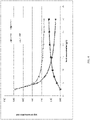
- FIG. 2 illustrates the cumulative HCP (ppm) as a function of MAb loading. This type of graph is typically generated to identify the loading on the AEX device.
- the typical HCP target for AEX process is 10-20 ppm. For a 10 ppm target, the loading with Aliquot 1 would be restricted to 2 kg/L. However, with the more concentrated feed in Aliquot 2, the loading capacity increases to 4 kg/L.
- Example 2 Concentrating a liquid feed prior to protein A affinity chromatography lowers chromatography media costs
- Example 3 Concentrating a liquid feed prior to virus filtration lowers virus filter costs
- VPro Viresolve ® Pro
- EMD Millipore viral filtration devices
Landscapes
- Chemical & Material Sciences (AREA)
- Organic Chemistry (AREA)
- Health & Medical Sciences (AREA)
- Life Sciences & Earth Sciences (AREA)
- Genetics & Genomics (AREA)
- Medicinal Chemistry (AREA)
- Biochemistry (AREA)
- General Health & Medical Sciences (AREA)
- Analytical Chemistry (AREA)
- Biophysics (AREA)
- Proteomics, Peptides & Aminoacids (AREA)
- Molecular Biology (AREA)
- Engineering & Computer Science (AREA)
- Chemical Kinetics & Catalysis (AREA)
- Water Supply & Treatment (AREA)
- Immunology (AREA)
- Wood Science & Technology (AREA)
- Bioinformatics & Cheminformatics (AREA)
- Zoology (AREA)
- Biotechnology (AREA)
- Microbiology (AREA)
- Biomedical Technology (AREA)
- General Engineering & Computer Science (AREA)
- Virology (AREA)
- Peptides Or Proteins (AREA)
- Treatment Of Liquids With Adsorbents In General (AREA)
- Preparation Of Compounds By Using Micro-Organisms (AREA)
Abstract
Description
- This application claims the benefit of
U.S. Provisional Application No. 62/012,788, filed on June 16, 2014 - Process-scale applications for the purification of monoclonal antibodies (MAbs) or virus filtration typically utilize bind-and-elute processes, and flow-through processes, such as anion exchange (AEX) and hydrophobic interaction (HIC) chromatography processes, to remove host cell proteins (HCP) and other impurities from a liquid sample, or feed. Typically, the operating conditions for these flow-through processes are chosen such that the target proteins (e.g., MAbs) are not retained on the chromatography surface and, as a result, flow through the chromatography device. Typically, the operating conditions for bind-and-elute processes are chosen such that the target proteins (e.g., MAbs) are retained or bound on the chromatography surface and then recovered by an elution step, wherein the bound target protein is displaced from the chromatography surface and recovered.
- For traditional AEX chromatography resins, it is often necessary to dilute the feed prior to loading the chromatography device to reduce solution conductivities to levels that promote the binding of impurities. The inconvenience and time commitment required for such feed dilution has provided the impetus to develop salt-tolerant functionalities that do not require feed dilution for efficient adsorption of impurities. While the capacities for traditional AEX membranes are typically in the range of about 100-200 g MAb/mL resin, corresponding capacities for salt-tolerant membrane adsorbers are greater and range, for example, from about 4-7 kg MAb/L resin. However, for a chromatography process to be economical at a process scale, the capacity of the chromatography resin should preferably be about 10-15 kg MAb/L membrane or greater.
- Thus, there is a current need to develop methods for increasing the capacity of existing chromatography resins and devices to levels that would render flow-through processes, bind-and-elute processes, and simulated flow-through processes more economical at a process scale.
- The present invention provides, in one embodiment, a process for separating target proteins from non-target proteins in a liquid sample, comprising obtaining a liquid sample containing target proteins and non-target proteins; increasing the concentration of the target proteins and non-target proteins in the sample to produce a concentrated feed for delivery to a chromatography device; delivering the concentrated feed to the chromatography device; separating the target proteins from the non-target proteins in the chromatography device; and recovering the target proteins from the chromatography device. In a particular embodiment, the target proteins are monoclonal antibodies (MAbs).
- In another embodiment, the invention relates to a process for increasing the capacity of a chromatography device for a target protein, comprising obtaining a liquid sample containing target proteins and non-target proteins; increasing the concentration of the target proteins and non-target proteins in the sample to produce a concentrated feed for delivery to a chromatography device; and delivering the concentrated feed to the chromatography device, wherein the capacity of the chromatography device for the target protein is increased. In a particular embodiment, the target proteins are monoclonal antibodies (MAbs).
- The foregoing will be apparent from the following more particular description of example embodiments of the invention, as illustrated in the accompanying drawings in which like reference characters refer to the same parts throughout the different views. The drawings are not necessarily to scale, emphasis instead being placed upon illustrating embodiments of the present invention.
-
FIG. 1 is a graph showing host cell protein (HCP) breakthrough for two feed streams as a function of volume loaded.Aliquot 2 was approximately 1.5x more concentrated than Aliquot 1. -
FIG. 2 is a graph showing a breakthrough curve of HCP removal as a function of MAb loading. -
FIG. 3 is a graph plotting feed concentration in g/L against the cost of separation media in U.S. dollars/gram of media. -
FIG. 4 is a graph plotting feed concentration in g/L against the cost of virus filters in U.S. dollars/gram of consumeable. - A description of example embodiments of the invention follows.
- The present invention provides, in one embodiment, a process for separating target proteins from non-target proteins in a liquid sample. In another embodiment, the invention relates to a process for increasing the capacity of a chromatography device for a target protein. These processes are referred to collectively herein as processes of the invention.
- Without wishing to be bound by any one particular theory, it is believed that increasing the concentration of both target and non-target proteins in a feed sample prior to delivery to a chromatography device will increase the capacity of the device for the target protein. As used herein, "increasing the capacity of a chromatography device" means increasing the mass loading per volume of media in the device. Preferably, the processes described herein can increase the capacity of a chromatography device to a range of at least about 10 to about 15 kg target protein/L chromatography media, or greater.
- The processes of the invention generally can comprise the steps of obtaining a liquid sample containing target proteins and non-target proteins; increasing the concentration of the target proteins and non-target proteins in the sample to produce a concentrated feed for delivery to a chromatography device; and delivering the concentrated feed to the chromatography device. In some embodiments, the processes of the invention can also include the steps of separating the target proteins from the non-target proteins in the chromatography device and recovering the target proteins from the chromatography device.
- The liquid sample, also referred to herein as a "liquid feed" or "feed sample," can be any liquid that contains a target protein of interest (e.g., MAbs) and one or more impurities (e.g., non-target proteins). Typically, the liquid sample is obtained from a source of the target protein (e.g., a hybridoma or other host cell expressing a MAb). In a particular embodiment, the target protein in the liquid sample is a monoclonal antibody (MAb) and the non-target proteins are host cell proteins (HCPs) (e.g., proteins from host hybridoma cells). Non-target proteins are generally a heterogeneous mixture of proteins of varying sizes, hydrophobicities and charge densities.
- The processes of the invention include the step of increasing the concentration of the target proteins and non-target proteins in the sample to produce a concentrated feed for delivery to a chromatography device. Concentration of the sample will generally increase the concentration of both the target protein and non-target proteins in the sample. The overall protein concentration can be increased, for example, about 1.5x, 2x, 2.5x, 5x or 10x prior to loading onto a chromatography device compared to a liquid feed that has not been subjected to a concentration step prior to loading onto a chromatography device. In certain embodiments, the concentration may be increased more than 10x, provided that the target and non-target proteins remain soluble.
- A variety of methods and techniques for increasing the concentration of proteins in a sample are well known to those of ordinary skill in the art to which this invention pertains. Such methods include, but are not limited to, tangential flow filtration (TFF) processes (e.g., TFF ultrafiltration), ultrafiltration processes using centrifugal filters, ultrafiltration processes using stirred cells, lyophilization, evaporation, precipitation, crystallization, aqueous two-phase separation and dialysis. In a particular embodiment, the concentration of the target proteins and non-target proteins in the sample is increased using a tangential flow filtration (TFF) process. The TFF process can be a recirculation TFF process, a single-pass TFF (SPTFF) process where the retentate and permeate are recovered from the system in separate containers without recirculation through the TFF system, or a TFF process operated in single-pass TFF mode where the permeate and a portion of the retentate from the system are recovered in separate containers without recirculation through the TFF system, and the remainder of the retentate is recirculated through the TFF system at least once. The retentate that is being recirculated can be returned to any upstream location in or before the TFF system. In one embodiment, the retentate is recirculated to the feed tank. In another embodiment, the retentate is recirculated to the feed line near the feed pump before the feed inlet on the TFF system. "Single-pass TFF mode" refers to operating conditions for a TFF system under which all or a portion of the retentate is not recirculated through the system. Preferably, the TFF process is a SPTFF process.
- TFF processes are well known. TFF is a separation process that uses membranes to separate components in a liquid solution or suspension on the basis of size, molecular weight or other differences. In traditional TFF processes, the fluid is pumped tangentially along the membrane surface and particles or molecules which are too large to pass through the membrane are rejected and returned to a process tank for additional passes across the membrane (e.g., recirculation) until the process fluid is sufficiently concentrated or purified. The cross-flow nature of TFF minimizes membrane fouling, thus permitting high volume processing per batch. Single-Pass TFF (SPTFF) allows direct flow-through concentration of a product (e.g., protein) in the absence of recirculation, which reduces overall system size and permits continuous operation at high conversion levels.
- TFF processes can further comprise performing diafiltration (e.g., to remove or lower the concentration of salts or solvents in the liquid feed, or to accomplish buffer exchange). In a preferred embodiment, the diafiltration is performed by concentrating the liquid feed (e.g., by TFF) to reduce the diafiltration volume and then restoring the feed to its starting volume by adding diafiltration solution (e.g., diafiltration buffer), a process which is known in the art as discontinuous, or batch, diafiltration. In another embodiment, the diafiltration is performed by adding the diafiltrate solution to retentate to increase the diafiltration volume followed by concentrating the sample to restore it to its original volume. In yet another embodiment, the diafiltration is performed by adding the diafiltration solution to unfiltered feed at the same rate that permeate is removed from the TFF system, a process which is known in the art as continuous, or constant-volume, diafiltration. Suitable diafiltration solutions are well known and include, for example, water and various aqueous buffer solutions.
- Suitable TFF systems capable of being used in TFF processes are well known in the art to which the present invention pertains and include, but are not limited to, those described in
U.S. Patent No. 5,147,542 , the contents of which are incorporated herein by reference in their entirety, and commercially available TFF systems from EMD Millipore Corporation (Billerica, MA) including, for example, Labscale™ TFF Systems, Cogent® M1 TFF Systems, Cogent® µScale TFF Systems, Flexware® Assemblies for TFF, ProFlux® TFF Systems, and Prostak™ TFF Systems. - In certain embodiments, the sample is diluted to produce a diluted feed (e.g., to lower the conductivity of the sample) prior to increasing the concentration of the target proteins and non-target proteins in the sample. Such a feed dilution step is particularly desirable when using a chromatography device that contains a standard AEX medium that lacks a salt-tolerant membrane adsorber. The dilution can be performed in-line with a subsequent concentration of the sample (e.g., by SPTFF) prior to loading the concentrated sample onto the chromatography device. Typically, a sample will be diluted 2-3x for most ion exchange applications.
- The processes of the invention include the step of delivering a concentrated feed to a chromatography device. Suitable chromatography devices for use in the processes of the invention are well known in the art. Exemplary chromatography devices include, but are not limited to, membrane adsorbers, such as ChromaSorb™ devices, Mobius® FlexReady Solution, IsoPak® Columns, HIBAR® Columns, RoboColumns and MiniChrom columns, K-Prime® Systems, Vantage® Columns, and QuikScale® Columns, all of which are available commercially from EMD Millipore Corporation (Billerica, MA).
- Typically, a chromatography device (e.g., a chromatography column, a chromatography cartridge) will be selected based on the chromatography medium. A person of ordinary skill in the art can readily determine a chromatography medium that is suitable for separation/purification of a particular target protein. Typical separation media (e.g., chromatography resins, chromatography beads, chromatography membranes, chromatography fibers) include, but are not limited to, anion-exchange (AEX) chromatography media, hydrophobic interaction chromatography (HIC) media, size-exclusion chromatography media, cation-exchange chromatography (CEX) media, affinity chromatography media (protein A affinity media, protein G affinity media, immobilized metal ion affinity media) and mixed-mode media.
- In a particular embodiment, the chromatography device includes an anion-exchange (AEX) chromatography medium. Suitable AEX chromatography devices for use in the processes described herein include, for example, ChromaSorb™ devices available from EMD Millipore Corporation (Billerica, MA). An exemplary AEC medium for a chromatography device is Eshmuno® Q Resin (EMD Millipore Corporation, Billerica, MA).
- In another embodiment, the chromatography device includes a hydrophobic interaction chromatography (HIC) medium. Exemplary HIC media includes, e.g., Fractogel® EMD Propyl and Phenyl resins (EMD Millipore Corporation).
- In yet another embodiment, the chromatography device used in the processes of the invention includes a size-exclusion chromatography medium. An exemplary size-exclusion medium for a chromatography device Fractogel® EMD BioSEC Media (EMD Millipore Corporation, Billerica, MA)
- The need for sample dilution to lower conductivity for ion exchange chromatography using traditional ion exchange resins has led to the development of chromatography media having salt-tolerant functionalities that provide robust impurity removal over a wider conductivity range. The use of such salt-tolerant functionalities allows for the efficient adsorption of impurities without requiring dilution of the sample. Accordingly, in another embodiment, the chromatography device used in the processes of the invention can include a salt-tolerant membrane adsorber (e.g., a ChromaSorb™ Membrane Adsorber, available from EMD Millipore Corporation).
- Preferably, the chromatography device used in the processes of the invention is disposable (e.g., a single-use chromatography device). Exemplary disposable chromatography devices include, for example, ChromaSorb™ devices, available from EMD Millipore Corporation).
- A cation exchange (CEX) (Eshmuno® S Resin, EMD Millipore Corporation, Billerica, MA) elution pool of a target monoclonal antibody (MAb04) was divided into two aliquots.
Aliquot 1 had a MAb04 concentration of 3.6 g/L. Aliquot 2 was concentrated using a Centriprep® 30K centrifugal filter device (30 kDA Regenerated cellulose membrane) to yield a MAb04 concentration of ~ 5.8 g/L. The host cell protein (HCP) concentrations in the two feed streams were ~ 600 ng/ml inAliquot 1 and ~ 820 ng/ml inAliquot 2. The HCP levels in the filtrate in the Centriprep® device were below the level of detection. The increase in HCP levels was not the same as the increase in the MAb concentration. This is most probably a reflection of the variability and sensitivity of the HCP ELISA assay. In addition, the use of ultrafiltration could also cause removal of HCP species (e.g., based on size). This may have a beneficial effect on capacity. - Each of the aliquots was then processed using a single-use membrane-based anion exchange (AEX) chromatography device (0.08 ml ChromaSorb™ Device, EMD Millipore Corporation).
- The breakthrough curves at the two concentrations are very similar, as expected for linear isotherms (
FIG. 1 ).FIG. 2 illustrates the cumulative HCP (ppm) as a function of MAb loading. This type of graph is typically generated to identify the loading on the AEX device. The typical HCP target for AEX process is 10-20 ppm. For a 10 ppm target, the loading withAliquot 1 would be restricted to 2 kg/L. However, with the more concentrated feed inAliquot 2, the loading capacity increases to 4 kg/L. - The effect of concentrating a liquid feed sample by SPTFF on the cost of chromatography media for bind-and-elute processes was calculated for ProSep® Ultra Plus (PUP) media (EMD Millipore), a protein A-based affinity chromatography media. The results show that the cost per gram of PUP media was significantly reduced by increasing the protein concentration in the liquid feed to about 5 g/L using SPTFF (
FIG. 3 ). - The effect of concentrating a liquid feed sample by SPTFF on the cost of non-fouling/flux-limited filters for virus filtration processes was determined. Viresolve® Pro (VPro) viral filtration devices (EMD Millipore) were chosen as the virus filter. Concentrating the liquid feed prior to VPro filtration reduced both filter (VPro) costs per gram of consumeable and total costs (SPTFF+VPro) per gram of consumeable (
FIG. 4 ). Similar results are expected for filters that are not flux-limited. - The relevant teachings of all patents, published applications and references cited herein are incorporated by reference in their entirety.
- While this invention has been particularly shown and described with references to example embodiments thereof, it will be understood by those skilled in the art that various changes in form and details may be made therein without departing from the scope of the invention encompassed by the appended claims.
- The claims of the parent application are reproduced below. These clauses define preferable combinations of features. The applicant reserves the right to pursue protection for these combination of features, and/or any other subject-matter contained in the parent application as filed, either in the present divisional application or in a further application divided from the present divisional application. The claims of the parent application are not the claims of the present divisional application, which are contained in a separate section headed "claims".
- 1. A process for separating target proteins from non-target proteins, comprising:
- a) obtaining a liquid sample containing target proteins and non-target proteins;
- b) increasing the concentration of the target proteins and non-target proteins in the sample to produce a concentrated feed for delivery to a chromatography device;
- c) delivering the concentrated feed to the chromatography device;
- d) separating the target proteins from the non-target proteins in the chromatography device; and
- e) recovering the target proteins from the chromatography device.
- 2. The process of
Claim 1, wherein the concentration of the target proteins and non-target proteins in the sample is increased using a tangential flow filtration (TFF) process, and optionally wherein the TFF process is a single-pass TFF (SPTFF) process or a recirculating TFF process. - 3. The process of
Claim 1 orClaim 2, wherein the sample is diluted to produce a diluted feed, prior to increasing the concentration of the target proteins and non-target proteins in the sample in step b). - 4. The process of any one of
Claims 1 to 3, wherein the target proteins are monoclonal antibodies. - 5. The process of any one of
Claims 1 to 4, wherein the non-target proteins are host cell proteins from hybridoma cells expressing the target protein. - 6. The process of any one of
Claims 1 to 5, wherein the chromatography device includes 1) an anion-exchange chromatography medium or a hydrophobic interaction chromatography medium; 2) a size-exclusion chromatography medium; 3) a salt-tolerant membrane adsorber; or 4) an affinity chromatography medium, optionally a protein A medium, a protein G medium or an immobilized metal ion medium. - 7. The process of any one of
Claims 1 to 6, wherein the chromatography device is disposable. - 8. A process for increasing the capacity of a chromatography device for a target protein, comprising:
- a) obtaining a liquid sample containing target proteins and non-target proteins;
- b) increasing the concentration of the target proteins and non-target proteins in the sample to produce a concentrated feed for delivery to a chromatography device; and
- c) delivering the concentrated feed to the chromatography device,
- 9. The process of Claim 8, wherein the concentration of the target proteins and non-target proteins in the sample is increased using a tangential flow filtration (TFF) process, and optionally wherein the TFF process is a single-pass TFF (SPTFF) process or a recirculating TFF process.
- 10. The process of Claim 8 or Claim 9, wherein the sample is diluted to produce a diluted feed, prior to increasing the concentration of the target proteins and non-target proteins in the sample in step b).
- 11. The process of any one of Claims 8 to 10, wherein:
- the target proteins are monoclonal antibodies;
and/or - the non-target proteins are host cell proteins from hybridoma cells expressing the target protein.
- the target proteins are monoclonal antibodies;
- 12. The process of any one of Claims 8 to 11, wherein the chromatography device includes 1) an anion-exchange chromatography medium; 2) a hydrophobic interaction chromatography medium; 3) a size-exclusion chromatography medium; or 4) a salt-tolerant membrane adsorber.
- 13. A process for filtering viruses from a liquid sample, comprising:
- a) obtaining a liquid sample containing viruses;
- b) increasing the protein concentration of the sample to produce a concentrated feed for delivery to a viral filtration device;
- c) delivering the concentrated feed to the viral filtration device; and
- d) removing viruses from the feed in the viral filtration device.
- 14. The process of Claim 13, wherein the protein concentration of the sample is increased using a tangential flow filtration (TFF) process, and optionally the TFF process is a single-pass TFF (SPTFF) process or a recirculating TFF process.
- 15. The process of Claim 13 or Claim 14, wherein the viral filtration device includes a flux-limited filter.
Claims (5)
- A process for filtering viruses from a liquid sample, comprising:a) obtaining a liquid sample containing viruses;b) increasing the protein concentration of the sample to produce a concentrated feed for delivery to a viral filtration device;c) delivering the concentrated feed to the viral filtration device; andd) removing viruses from the feed in the viral filtration device.
- The process of claim 1, wherein the protein concentration of the sample is increased using a tangential flow filtration (TFF) process.
- The process of claim 2, wherein the TFF process is a single-pass TFF (SPTFF) process, a TFF process where at least a portion of the retentate is recirculated after the first pass through the TFF system or a recirculating TFF process.
- The process of any of claims 1-3, wherein the viral filtration device is a flux-limited filter.
- The process of any of claims 1-4, further comprising performing continuous diafiltration or discontinuous diafiltration.
Applications Claiming Priority (3)
| Application Number | Priority Date | Filing Date | Title |
|---|---|---|---|
| US201462012788P | 2014-06-16 | 2014-06-16 | |
| EP19163829.5A EP3527282A1 (en) | 2014-06-16 | 2015-06-15 | Methods for increasing the capacity of flow-through processes |
| EP15172146.1A EP2957336A3 (en) | 2014-06-16 | 2015-06-15 | Methods for increasing the capacity of flow-through processes |
Related Parent Applications (2)
| Application Number | Title | Priority Date | Filing Date |
|---|---|---|---|
| EP19163829.5A Division EP3527282A1 (en) | 2014-06-16 | 2015-06-15 | Methods for increasing the capacity of flow-through processes |
| EP15172146.1A Division EP2957336A3 (en) | 2014-06-16 | 2015-06-15 | Methods for increasing the capacity of flow-through processes |
Publications (1)
| Publication Number | Publication Date |
|---|---|
| EP4122585A1 true EP4122585A1 (en) | 2023-01-25 |
Family
ID=53433076
Family Applications (3)
| Application Number | Title | Priority Date | Filing Date |
|---|---|---|---|
| EP15172146.1A Withdrawn EP2957336A3 (en) | 2014-06-16 | 2015-06-15 | Methods for increasing the capacity of flow-through processes |
| EP22195919.0A Ceased EP4122585A1 (en) | 2014-06-16 | 2015-06-15 | Methods for increasing the capacity of flow-through processes |
| EP19163829.5A Ceased EP3527282A1 (en) | 2014-06-16 | 2015-06-15 | Methods for increasing the capacity of flow-through processes |
Family Applications Before (1)
| Application Number | Title | Priority Date | Filing Date |
|---|---|---|---|
| EP15172146.1A Withdrawn EP2957336A3 (en) | 2014-06-16 | 2015-06-15 | Methods for increasing the capacity of flow-through processes |
Family Applications After (1)
| Application Number | Title | Priority Date | Filing Date |
|---|---|---|---|
| EP19163829.5A Ceased EP3527282A1 (en) | 2014-06-16 | 2015-06-15 | Methods for increasing the capacity of flow-through processes |
Country Status (6)
| Country | Link |
|---|---|
| US (3) | US10550148B2 (en) |
| EP (3) | EP2957336A3 (en) |
| KR (4) | KR101790700B1 (en) |
| CN (1) | CN105254702A (en) |
| SG (1) | SG10201504674TA (en) |
| WO (1) | WO2015195453A2 (en) |
Families Citing this family (22)
| Publication number | Priority date | Publication date | Assignee | Title |
|---|---|---|---|---|
| US10704021B2 (en) | 2012-03-15 | 2020-07-07 | Flodesign Sonics, Inc. | Acoustic perfusion devices |
| CA2935960C (en) | 2014-01-08 | 2023-01-10 | Bart Lipkens | Acoustophoresis device with dual acoustophoretic chamber |
| WO2015195452A2 (en) | 2014-06-16 | 2015-12-23 | Emd Millipore Corporation | Single-pass filtration systems and processes |
| US10550148B2 (en) | 2014-06-16 | 2020-02-04 | Emd Millipore Corporation | Methods for increasing the capacity of flow-through processes |
| CN115463546A (en) | 2014-06-25 | 2022-12-13 | Emd 密理博公司 | Filter element, tangential flow filtration system, method of producing a feed screen |
| ES2935333T3 (en) | 2014-08-29 | 2023-03-06 | Emd Millipore Corp | Processes for filtering liquids using single pass tangential flow filtration systems and tangential flow filtration systems with recirculation of retentate |
| CN105745009B (en) | 2014-08-29 | 2018-09-28 | Emd 密理博公司 | Single-pass tangential flow filtration systems and tangential flow filtration systems with recirculation of retentate |
| US11708572B2 (en) | 2015-04-29 | 2023-07-25 | Flodesign Sonics, Inc. | Acoustic cell separation techniques and processes |
| US11377651B2 (en) | 2016-10-19 | 2022-07-05 | Flodesign Sonics, Inc. | Cell therapy processes utilizing acoustophoresis |
| US11214789B2 (en) | 2016-05-03 | 2022-01-04 | Flodesign Sonics, Inc. | Concentration and washing of particles with acoustics |
| CA3023486C (en) | 2016-06-09 | 2022-03-29 | Emd Millipore Corporation | Radial-path filter elements, systems and methods of using same |
| CN110241012B (en) * | 2018-03-09 | 2022-11-01 | 嘉和生物药业有限公司 | Production method and production module for upstream staged interception of biomacromolecules and application of production module in production |
| WO2019183334A1 (en) | 2018-03-21 | 2019-09-26 | Waters Technologies Corporation | Non-antibody high-affinity-based sample preparation, sorbents, devices and methods |
| IL267923B2 (en) * | 2018-08-02 | 2023-06-01 | Grifols Worldwide Operations Ltd | Composition comprising highly-concentrated alpha-1 proteinase inhibitor and method for obtaining thereof |
| US20210355159A1 (en) * | 2018-12-20 | 2021-11-18 | Emd Millipore Corporation | In-line product concentration to reduce volumetric load flow rate and increase productivity of a bind and elute chromatography purification |
| JP7737374B2 (en) * | 2019-12-12 | 2025-09-10 | イー・エム・デイー・ミリポア・コーポレイシヨン | Enhanced viral filtration using diafiltration buffer |
| BR112022016234A2 (en) * | 2020-02-25 | 2022-10-11 | Grifols Worldwide Operations Ltd | METHOD FOR OBTAINING A PROTEINASE ALPHA-1 INHIBITOR |
| JP2023528776A (en) * | 2020-06-11 | 2023-07-06 | 2セブンティ バイオ インコーポレイテッド | Viral vector production method |
| KR200493691Y1 (en) | 2020-06-15 | 2021-05-17 | 남상범 | Oil fence made from plastic cylindrical floater |
| EP4291568A4 (en) * | 2021-02-12 | 2025-01-22 | Council of Scientific & Industrial Research | Process for the purification of monoclonal antibodies |
| KR200494012Y1 (en) | 2021-02-22 | 2021-07-14 | 남상범 | Oil fence floater and the oil fence thereof |
| EP4252882A1 (en) * | 2022-03-31 | 2023-10-04 | Sartorius Stedim Biotech GmbH | Separation system for separating and purifying a target component |
Citations (3)
| Publication number | Priority date | Publication date | Assignee | Title |
|---|---|---|---|---|
| US5147542A (en) | 1991-02-04 | 1992-09-15 | Millipore Corporation | Manifold and manifold segment for tangential flow filtration apparatus |
| US20060292672A1 (en) * | 2005-06-24 | 2006-12-28 | Unigene Laboratories Inc. | Cell lines for expressing enzyme useful in the preparation of amidated products |
| EP2682168A1 (en) * | 2012-07-02 | 2014-01-08 | Millipore Corporation | Purification of biological molecules |
Family Cites Families (133)
| Publication number | Priority date | Publication date | Assignee | Title |
|---|---|---|---|---|
| US3540595A (en) | 1965-05-18 | 1970-11-17 | Miles Lowell Edwards | Membrane fluid diffusion exchange device |
| DE2322044C2 (en) | 1973-05-02 | 1983-02-03 | Eberhard Hoesch & Söhne GmbH & Co, 5160 Düren | Press membrane for membrane plates |
| DE2358578C3 (en) | 1973-11-24 | 1980-01-24 | Lenser Kunststoff-Presswerk Gmbh + Co Kg, 7913 Senden | Filter plate for a filter press |
| US4028250A (en) | 1975-05-30 | 1977-06-07 | Amerace Corporation | Filtration apparatus |
| JPS5371686A (en) | 1976-12-09 | 1978-06-26 | Efu Konerii Robaato | Tubular molecule filtering apparatus |
| JPS54149384A (en) | 1978-05-15 | 1979-11-22 | Nitto Electric Ind Co Ltd | Liquid separator |
| JPS55109407A (en) | 1979-02-13 | 1980-08-22 | Nitto Electric Ind Co Ltd | Liquid separating apparatus and manufacture thereof |
| US4765906A (en) | 1985-03-12 | 1988-08-23 | Epoc Limited | Cross-flow filtration |
| US4874507A (en) | 1986-06-06 | 1989-10-17 | Whitlock David R | Separating constituents of a mixture of particles |
| US4756835A (en) | 1986-08-29 | 1988-07-12 | Advanced Polymer Technology, Inc. | Permeable membranes having high flux-density and low fouling-propensity |
| USD357059S (en) | 1994-03-01 | 1995-04-04 | Kopf Henry B | Flat sheet membrane mass transfer module |
| NL8702149A (en) | 1987-09-09 | 1989-04-03 | Tno | MEMBRANE MODULE FOR HYPERFILTRATION OR ULTRAFILTRATION OF POLLUTION LIQUID FLOWS. |
| US4956085A (en) | 1987-10-02 | 1990-09-11 | Kopf Henry B | Filter plate, filter plate element and filter comprising same |
| US5310688A (en) * | 1988-10-31 | 1994-05-10 | Sepracor Inc. | Method and apparatus for eluting proteins in affinity membrane process |
| USD325070S (en) | 1989-06-09 | 1992-03-31 | Kopf Henry B | Filter sheet |
| USD327313S (en) | 1989-09-01 | 1992-06-23 | Kopf Henry B | Filter plate |
| US5096584A (en) | 1990-01-29 | 1992-03-17 | The Dow Chemical Company | Spiral-wound membrane separation device with feed and permeate/sweep fluid flow control |
| US5114582A (en) | 1991-04-12 | 1992-05-19 | W. R. Grace & Co.-Conn. | Filter element and spiral-wound membrane cartridge containing same |
| JP2575158Y2 (en) | 1991-12-13 | 1998-06-25 | 東洋濾紙株式会社 | Filter element |
| EP0640006B1 (en) | 1992-05-01 | 1998-04-29 | Filmtec Corporation | Spiral wound membrane element |
| DK170035B1 (en) | 1992-05-04 | 1995-05-08 | Md Foods Amba | Process for regulating milk solids in concentrated milk products in connection with ultrafiltration |
| US5470468A (en) | 1993-10-12 | 1995-11-28 | Koch Membrane Systems, Inc. | Spiral filtration module having bypass prevention flange |
| US5599447A (en) | 1995-06-06 | 1997-02-04 | Millipore Investment Holdings Limited | Manifold apparatus for tangential flow filtration apparatus |
| US5654025A (en) | 1995-10-30 | 1997-08-05 | Raghunath; Bala | Ultrafiltration of cooled milk |
| US6054051A (en) | 1996-01-17 | 2000-04-25 | Genentech, Inc. | Tangential-flow filtration system |
| US6077991A (en) | 1996-03-28 | 2000-06-20 | Washington State University Research Foundation | Compositions and methods for production of male-sterile plants |
| DE19711083C2 (en) | 1997-03-18 | 1999-04-29 | Sartorius Gmbh | Device and method for adsorptive material separation with adsorption membranes |
| US5886154A (en) | 1997-06-20 | 1999-03-23 | Lebing; Wytold R. | Chromatographic method for high yield purification and viral inactivation of antibodies |
| EP1029583B1 (en) | 1998-06-18 | 2010-09-15 | Toray Industries, Inc. | Spiral reverse osmosis membrane element, reverse osmosis membrane module using it, device and method for reverse osmosis separation incorporating the module |
| JP3052958B1 (en) | 1999-04-09 | 2000-06-19 | 東レ株式会社 | Spiral reverse osmosis membrane element and separation method |
| WO2000030742A1 (en) | 1998-11-23 | 2000-06-02 | Zenon Environmental Inc. | Water filtration using immersed membranes |
| JP2000271460A (en) | 1999-01-22 | 2000-10-03 | Nitto Denko Corp | Processing system and processing method using spiral membrane module |
| AU756832B2 (en) | 1999-02-22 | 2003-01-23 | Ncsrt, Inc. | Purification of biological substances |
| US6214221B1 (en) * | 1999-02-22 | 2001-04-10 | Henry B. Kopf | Method and apparatus for purification of biological substances |
| DE10000186C2 (en) | 2000-01-05 | 2003-09-04 | Sartorius Gmbh | Device and system for crossflow filtration |
| JP2001252543A (en) | 2000-03-10 | 2001-09-18 | Toray Ind Inc | Reverse osmosis composite membrane |
| US6365395B1 (en) | 2000-11-03 | 2002-04-02 | Millipore Corporation | Process for removing protein aggregates and virus from a protein solution |
| US7101561B2 (en) * | 2000-12-01 | 2006-09-05 | Innogenetics N.V. | Purified hepatitis C virus envelope proteins for diagnostic and therapeutic use |
| US6645380B2 (en) | 2001-12-19 | 2003-11-11 | Petro Sep International Ltd. | Membrane separation apparatus |
| LT1543038T (en) | 2002-09-11 | 2017-07-10 | Genentech, Inc. | Protein purification |
| JP2006515227A (en) | 2003-02-24 | 2006-05-25 | ジーティーシー バイオセラピューティックス インコーポレイテッド | Cross-flow filtration method and apparatus therefor |
| KR100531670B1 (en) | 2003-12-03 | 2005-11-28 | 씨제이 주식회사 | Processes for preparing interferon alpha |
| US7220358B2 (en) | 2004-02-23 | 2007-05-22 | Ecolab Inc. | Methods for treating membranes and separation facilities and membrane treatment composition |
| ES2407380T5 (en) | 2004-02-27 | 2017-07-07 | Octapharma Ag | Procedure to provide a purified antibody preparation, with no risk for viruses |
| US20050197496A1 (en) | 2004-03-04 | 2005-09-08 | Gtc Biotherapeutics, Inc. | Methods of protein fractionation using high performance tangential flow filtration |
| US20050218057A1 (en) | 2004-03-31 | 2005-10-06 | Ngee Lee C | Filter plate assembly |
| US20060051347A1 (en) | 2004-09-09 | 2006-03-09 | Winter Charles M | Process for concentration of antibodies and therapeutic products thereof |
| DK1807101T3 (en) | 2004-09-30 | 2016-05-23 | Bayer Healthcare Llc | Devices and methods for integrated continuous production of biological molecules |
| US7608188B2 (en) | 2004-12-03 | 2009-10-27 | Board Of Regents Of The Nevada System Of Higher Education | Vacuum enhanced direct contact membrane distillation |
| JP2006247453A (en) | 2005-03-08 | 2006-09-21 | Toray Ind Inc | Liquid separation element, reverse osmosis apparatus using the same, and reverse osmosis membrane treatment method |
| WO2006105556A1 (en) | 2005-03-29 | 2006-10-05 | Grahamtek Technologies Singapore Pte Ltd | Manufacture of casings for use in the desalination of water and the filtration of liquids |
| US20060219635A1 (en) | 2005-03-30 | 2006-10-05 | Special Membrane Technologies, Inc. | High-density filtration module |
| DE202005006286U1 (en) | 2005-04-20 | 2006-08-24 | Jvk Filtration Systems Gmbh | Chamber filter plate |
| DE202005006535U1 (en) | 2005-04-22 | 2006-08-31 | Jvk Filtration Systems Gmbh | Chamber filter plate |
| JP4587937B2 (en) | 2005-10-31 | 2010-11-24 | 日東電工株式会社 | Spiral type separation membrane element |
| EP1973635B1 (en) | 2005-12-20 | 2011-06-08 | Tangenx Technology Corporation | Filtration assembly and methods for making and using same |
| US8747669B1 (en) | 2005-12-29 | 2014-06-10 | Spf Innovations, Llc | Method and apparatus for the filtration of biological samples |
| US7510654B2 (en) | 2005-12-29 | 2009-03-31 | Spf Innovations, Llc | Method and apparatus for the filtration of biological samples |
| KR101376927B1 (en) | 2006-02-13 | 2014-03-27 | 도날드슨 컴파니, 인코포레이티드 | Filter web comprising fine fiber and reactive, adsorptive or absorptive particulate |
| US7531632B2 (en) | 2006-02-16 | 2009-05-12 | Gtc Biotherapeutics, Inc. | Clarification of transgenic milk using depth filtration |
| US20070246406A1 (en) | 2006-03-31 | 2007-10-25 | Dibel Kevin R | Tangential flow filtration apparatuses, systems, and processes for the separation of compounds |
| JP4730236B2 (en) | 2006-07-18 | 2011-07-20 | 栗田工業株式会社 | Spiral membrane module and water treatment method |
| US7959805B2 (en) | 2006-07-28 | 2011-06-14 | Millipore Corporation | Manifold adaptor plate for filtration apparatus |
| US7918999B2 (en) | 2006-12-11 | 2011-04-05 | Pall Corporation | Filtration assemblies, filtration manifolds, filtration units, and methods of channeling permeate |
| US8210042B2 (en) | 2007-02-22 | 2012-07-03 | Dow Global Technologies Llc | Use of acoustic signals for measuring membrane fouling in spiral wound modules |
| SG146558A1 (en) | 2007-03-26 | 2008-10-30 | Millipore Corp | Cassette-style filtration apparatus |
| KR101320719B1 (en) | 2007-08-16 | 2013-10-29 | 코오롱인더스트리 주식회사 | An Apparatus for Cleaning Hollow Fiber Membrane and A Method Therefor |
| ES2437850T3 (en) | 2007-09-12 | 2014-01-14 | Danisco Us Inc. | Filtration with internal embedding control |
| US7632404B2 (en) | 2007-11-15 | 2009-12-15 | Dionex Corporation | Barrier with a seated ion exchange bead and method |
| US8668828B2 (en) | 2007-12-05 | 2014-03-11 | Trisep Corporation | Sanitary spiral wound filtration cartridge |
| JP2009178915A (en) | 2008-01-30 | 2009-08-13 | Tokushu Paper Mfg Co Ltd | Sheet |
| DE102008015387B4 (en) | 2008-03-20 | 2019-01-10 | Sartorius Stedim Biotech Gmbh | Pre-sterilizable filtration system for single use |
| DE102008020478B4 (en) | 2008-04-23 | 2011-07-21 | Sartorius Stedim Biotech GmbH, 37079 | Filter module and filter unit |
| US8231787B2 (en) | 2008-05-06 | 2012-07-31 | Spf Innovations, Llc | Tangential flow filtration system |
| US8147735B2 (en) | 2008-07-09 | 2012-04-03 | Eltron Research & Development, Inc. | Semipermeable polymers and method for producing same |
| US8961790B2 (en) | 2008-10-17 | 2015-02-24 | General Electric Company | Separator assembly |
| US8295561B2 (en) | 2008-11-04 | 2012-10-23 | Signal Processing, Inc. | Knowledge learning system and process for fingerprint verifications |
| EP2393579B1 (en) | 2009-01-21 | 2017-03-08 | Smartflow Technologies, Inc. | Optimization of separation for viscous suspensions |
| JP5755136B2 (en) | 2009-03-27 | 2015-07-29 | 旭化成メディカル株式会社 | Virus removal method in high concentration monoclonal antibody solution |
| USD651280S1 (en) | 2009-11-12 | 2011-12-27 | Hitachi Plant Technologies, Ltd. | Immersion flat filter membrane element |
| IT1397061B1 (en) | 2009-12-28 | 2012-12-28 | Kedrion Spa | NEW PROCESS OF PURIFICATION ON INDUSTRIAL SCALE OF GAMMAGLOBULINE FROM HUMAN PLASMA FOR INDUSTRIAL USE. |
| WO2011082363A1 (en) | 2009-12-30 | 2011-07-07 | Cargill, Incorporated | Membrane separation and purification of monatin |
| US8506802B1 (en) | 2010-01-25 | 2013-08-13 | Gaston De Los Reyes | Stackable planar adsorptive devices |
| WO2011094236A2 (en) | 2010-02-01 | 2011-08-04 | Rodney Herrington | Systems and methods for filtration |
| US8661648B2 (en) | 2010-03-24 | 2014-03-04 | Dow Global Technologies Llc | Spiral wound filtration module |
| WO2012039675A1 (en) | 2010-09-20 | 2012-03-29 | Lee Hock Teo | Home and commercial water filtration with online self-cleaning system |
| CA2810909A1 (en) | 2010-09-20 | 2012-03-29 | Abbvie Inc. | Purification of antibodies using simulated moving bed chromatography |
| USD655779S1 (en) | 2010-10-26 | 2012-03-13 | Ishigaki Company Limited | Filter plate for a filter press |
| USD655780S1 (en) | 2010-10-26 | 2012-03-13 | Ishigaki Company Limited | Filter plate for a filter press |
| US20120166332A1 (en) | 2010-12-22 | 2012-06-28 | Ebay Inc. | Bill splitting system |
| EP2659952A4 (en) | 2010-12-28 | 2014-09-17 | Toray Industries | Separation membrane element |
| CN103415329B (en) | 2011-03-11 | 2015-05-13 | 汾沃有限公司 | Membrane separation device, system and method using same, and data management system and method |
| US20140048483A1 (en) | 2011-04-25 | 2014-02-20 | Toray Industries, Inc. | Method for cleaning membrane module |
| EP2741836B1 (en) | 2011-08-12 | 2019-04-24 | Pall Corporation | Fluid treatment assemblies comprising manifold, and methods for treating fluids |
| EP2735357B1 (en) | 2011-09-29 | 2020-04-08 | Toray Industries, Inc. | Separation membrane and separation membrane element |
| US20140251896A1 (en) | 2011-09-29 | 2014-09-11 | Toray Industries, Inc. | Separation membrane, separation membrane element and method for producing separation membrane |
| US20130098829A1 (en) | 2011-10-19 | 2013-04-25 | General Electric Company | Spiral wound membrane element and permeate carrier |
| US9675937B2 (en) | 2011-10-19 | 2017-06-13 | General Electric Company | Spiral wound membrane permeate carrier with thin border |
| US20130146531A1 (en) | 2011-12-09 | 2013-06-13 | General Electric Company | Feed spacers for spiral wound membrane element |
| WO2013085755A2 (en) | 2011-12-09 | 2013-06-13 | General Electric Company | Feed spacers for spiral wound membrane element |
| SG11201403891SA (en) | 2012-01-09 | 2014-08-28 | Sanofi Pasteur Biologics Llc | Purification of flaviviruses |
| KR101938611B1 (en) | 2012-02-24 | 2019-01-15 | 도레이 카부시키가이샤 | Separation membrane and separation membrane element |
| JP6109492B2 (en) | 2012-05-22 | 2017-04-05 | 株式会社ダイセル | NF flat membrane and its manufacturing method |
| EP2857359A4 (en) | 2012-06-04 | 2016-01-27 | Toray Industries | Separation membrane unit and desalination method using same |
| CA149539S (en) | 2012-07-31 | 2013-12-17 | Roberto Marchetti | Filter for preparing drinks |
| ES2706190T3 (en) * | 2012-10-30 | 2019-03-27 | Hoffmann La Roche | Purification of polypeptides using two-phase tangential flow ultrafiltration |
| USD729897S1 (en) | 2013-02-19 | 2015-05-19 | General Electric Company | Endplate |
| US9376595B2 (en) | 2013-06-21 | 2016-06-28 | General Electric Company | Method and apparatus for fabricating separator assembly |
| JP2015009182A (en) | 2013-06-27 | 2015-01-19 | 住友電気工業株式会社 | Spiral type separation membrane element and spiral type separation membrane module |
| JP6602765B2 (en) | 2013-09-05 | 2019-11-06 | ジェネンテック, インコーポレイテッド | Method for chromatographic reuse |
| JP5606615B1 (en) | 2013-12-05 | 2014-10-15 | 三菱重工業株式会社 | Membrane separator, circulating water utilization system |
| EP2907565A1 (en) | 2014-02-17 | 2015-08-19 | Bayer Technology Services GmbH | Dialysis unit for continuous buffer or media exchange from a protein solution |
| KR20160133489A (en) | 2014-03-07 | 2016-11-22 | 에이전시 포 사이언스, 테크놀로지 앤드 리서치 | Apparatus and methods for fractionation of biological products |
| JP6661547B2 (en) | 2014-05-13 | 2020-03-11 | アムジエン・インコーポレーテツド | Process control systems and methods for use in filters and filtration processes |
| WO2015195452A2 (en) | 2014-06-16 | 2015-12-23 | Emd Millipore Corporation | Single-pass filtration systems and processes |
| US10550148B2 (en) | 2014-06-16 | 2020-02-04 | Emd Millipore Corporation | Methods for increasing the capacity of flow-through processes |
| CN115463546A (en) | 2014-06-25 | 2022-12-13 | Emd 密理博公司 | Filter element, tangential flow filtration system, method of producing a feed screen |
| USD741983S1 (en) | 2014-08-12 | 2015-10-27 | Sartorius Stedim Biotech Gmbh | Filter assembly |
| ES2935333T3 (en) | 2014-08-29 | 2023-03-06 | Emd Millipore Corp | Processes for filtering liquids using single pass tangential flow filtration systems and tangential flow filtration systems with recirculation of retentate |
| CN105745009B (en) | 2014-08-29 | 2018-09-28 | Emd 密理博公司 | Single-pass tangential flow filtration systems and tangential flow filtration systems with recirculation of retentate |
| USD761381S1 (en) | 2014-12-18 | 2016-07-12 | Emd Millipore Corporation | Retentate plate |
| USD762811S1 (en) | 2014-12-18 | 2016-08-02 | Emd Millipore Corporation | Diverter plate |
| CA2884314A1 (en) | 2015-03-03 | 2016-09-03 | Derek J. Hengen | Method and apparatus for removing sludge deposits from oil storage tanks |
| ES2913118T3 (en) | 2015-06-30 | 2022-05-31 | Emd Millipore Corp | Sealing box for filter cassette |
| US20200246761A1 (en) | 2015-11-16 | 2020-08-06 | Basf Se | Nanofiltration composite membranes comprising self-assembled supramolecular separation layer |
| CN105435504A (en) | 2015-12-02 | 2016-03-30 | 王刚 | Microparticle separator for water treatment |
| WO2017132426A2 (en) | 2016-01-27 | 2017-08-03 | Schlumberger Technology Corporation | Modular configurable wellsite surface equipment |
| KR20170135567A (en) | 2016-05-31 | 2017-12-08 | 광운대학교 산학협력단 | Method for controlling growth of Pt nanoparticles on sapphire |
| CA3023486C (en) | 2016-06-09 | 2022-03-29 | Emd Millipore Corporation | Radial-path filter elements, systems and methods of using same |
| SE541870C2 (en) | 2017-12-21 | 2020-01-02 | Stora Enso Oyj | Improved process for manufacturing composite product |
| DE202018100564U1 (en) | 2018-02-01 | 2019-02-04 | Jvk Filtration Systems Gmbh | Arrangement of a filter plate for a filter press and a sealing device and filter plate |
| JP2024109407A (en) | 2023-02-01 | 2024-08-14 | Eneosテクノマテリアル株式会社 | Ultra-thin pallet |
| JP2024149384A (en) | 2023-04-07 | 2024-10-18 | 株式会社アイ・ティ・シ・コンサルティング | Tower-like structure |
-
2015
- 2015-06-11 US US14/736,596 patent/US10550148B2/en active Active
- 2015-06-11 WO PCT/US2015/035251 patent/WO2015195453A2/en not_active Ceased
- 2015-06-12 SG SG10201504674TA patent/SG10201504674TA/en unknown
- 2015-06-15 KR KR1020150084191A patent/KR101790700B1/en active Active
- 2015-06-15 EP EP15172146.1A patent/EP2957336A3/en not_active Withdrawn
- 2015-06-15 EP EP22195919.0A patent/EP4122585A1/en not_active Ceased
- 2015-06-15 CN CN201510329086.7A patent/CN105254702A/en active Pending
- 2015-06-15 EP EP19163829.5A patent/EP3527282A1/en not_active Ceased
-
2017
- 2017-10-19 KR KR1020170135567A patent/KR20170121731A/en not_active Ceased
-
2019
- 2019-01-28 US US16/259,489 patent/US12297229B2/en active Active
- 2019-12-09 KR KR1020190162529A patent/KR102168377B1/en active Active
-
2020
- 2020-10-13 KR KR1020200131640A patent/KR102253465B1/en active Active
-
2025
- 2025-04-08 US US19/172,842 patent/US20250236641A1/en active Pending
Patent Citations (3)
| Publication number | Priority date | Publication date | Assignee | Title |
|---|---|---|---|---|
| US5147542A (en) | 1991-02-04 | 1992-09-15 | Millipore Corporation | Manifold and manifold segment for tangential flow filtration apparatus |
| US20060292672A1 (en) * | 2005-06-24 | 2006-12-28 | Unigene Laboratories Inc. | Cell lines for expressing enzyme useful in the preparation of amidated products |
| EP2682168A1 (en) * | 2012-07-02 | 2014-01-08 | Millipore Corporation | Purification of biological molecules |
Non-Patent Citations (3)
| Title |
|---|
| CATHERINE CASEY ET AL: "Protein concentration with single-pass tangential flow filtration (SPTFF)", JOURNAL OF MEMBRANE SCIENCE, ELSEVIER BV, NL, vol. 384, no. 1, 10 September 2011 (2011-09-10), pages 82 - 88, XP028319561, ISSN: 0376-7388, [retrieved on 20110910], DOI: 10.1016/J.MEMSCI.2011.09.004 * |
| JEMELLE DIZON-MASPAT ET AL: "Single pass tangential flow filtration to debottleneck downstream processing for therapeutic antibody production", BIOTECHNOLOGY AND BIOENGINEERING, vol. 109, no. 4, 17 November 2011 (2011-11-17), pages 962 - 970, XP055050387, ISSN: 0006-3592, DOI: 10.1002/bit.24377 * |
| TESKE C A ET AL: "Inline Ultrafiltration", BIOTECHNOLOGY PROGRESS, AMERICAN CHEMICAL SOCIETY, vol. 26, no. 4, 1 March 2010 (2010-03-01), pages 1068 - 1072, XP002743123, ISSN: 8756-7938, [retrieved on 20100301], DOI: 10.1002/BTPR.404 * |
Also Published As
| Publication number | Publication date |
|---|---|
| KR20170121731A (en) | 2017-11-02 |
| KR20200120592A (en) | 2020-10-21 |
| EP3527282A1 (en) | 2019-08-21 |
| US20250236641A1 (en) | 2025-07-24 |
| KR101790700B1 (en) | 2017-10-26 |
| EP2957336A3 (en) | 2016-03-30 |
| KR20190139814A (en) | 2019-12-18 |
| US20150361129A1 (en) | 2015-12-17 |
| KR102253465B1 (en) | 2021-05-18 |
| CN105254702A (en) | 2016-01-20 |
| KR102168377B1 (en) | 2020-10-22 |
| WO2015195453A2 (en) | 2015-12-23 |
| US10550148B2 (en) | 2020-02-04 |
| WO2015195453A4 (en) | 2016-04-21 |
| US12297229B2 (en) | 2025-05-13 |
| KR20160019049A (en) | 2016-02-18 |
| EP2957336A2 (en) | 2015-12-23 |
| SG10201504674TA (en) | 2016-01-28 |
| US20190153027A1 (en) | 2019-05-23 |
| WO2015195453A3 (en) | 2016-02-18 |
Similar Documents
| Publication | Publication Date | Title |
|---|---|---|
| US20250236641A1 (en) | Methods for increasing the capacity of purification processes | |
| CN102762585B (en) | Single unit antibody purification | |
| EP3130384B1 (en) | Purification of biological molecules | |
| US20150065696A1 (en) | Apparatus and process for purification of proteins | |
| CN112588116A (en) | Process control system and method for filter and filtering process | |
| CN103189390A (en) | Single unit ion exchange chromatography antibody purification | |
| CN112979785B (en) | Method for preparing high-purity lactoferrin | |
| KR102932208B1 (en) | Enhanced virus filtration using diafiltration buffer | |
| JP2023145471A (en) | In-line product concentration to reduce volumetric load flow rate and increase productivity of bind and elute chromatography purification | |
| US20250179116A1 (en) | Methods for the selective removal of contaminants during a process of purifying biologic agents | |
| JP2012214408A (en) | Method for refining protein by removing impurity aggregate dispersed in clear liquid | |
| WO2020183332A1 (en) | Purification of adalimumab using tandem chromatography | |
| CN105001305A (en) | Method for extracting high-purity daptomycin by utilizing chromatographic technique | |
| WO2024217979A1 (en) | A method for purification of extracellular vesicles or enveloped viruses by means of size exclusion chromatography | |
| CN114395539A (en) | Method for removing residual host DNA and host protein of Japanese encephalitis vaccine product | |
| Ghosh | Bioseparations using integrated membrane processes | |
| Wahab | Membrane Chromatography for Biopharmaceutical Manufacturing | |
| HK1183890A (en) | Apparatus and process of purification of proteins |
Legal Events
| Date | Code | Title | Description |
|---|---|---|---|
| PUAI | Public reference made under article 153(3) epc to a published international application that has entered the european phase |
Free format text: ORIGINAL CODE: 0009012 |
|
| STAA | Information on the status of an ep patent application or granted ep patent |
Free format text: STATUS: THE APPLICATION HAS BEEN PUBLISHED |
|
| AC | Divisional application: reference to earlier application |
Ref document number: 2957336 Country of ref document: EP Kind code of ref document: P Ref document number: 3527282 Country of ref document: EP Kind code of ref document: P |
|
| AK | Designated contracting states |
Kind code of ref document: A1 Designated state(s): AL AT BE BG CH CY CZ DE DK EE ES FI FR GB GR HR HU IE IS IT LI LT LU LV MC MK MT NL NO PL PT RO RS SE SI SK SM TR |
|
| P01 | Opt-out of the competence of the unified patent court (upc) registered |
Effective date: 20230602 |
|
| STAA | Information on the status of an ep patent application or granted ep patent |
Free format text: STATUS: REQUEST FOR EXAMINATION WAS MADE |
|
| 17P | Request for examination filed |
Effective date: 20230718 |
|
| RBV | Designated contracting states (corrected) |
Designated state(s): AL AT BE BG CH CY CZ DE DK EE ES FI FR GB GR HR HU IE IS IT LI LT LU LV MC MK MT NL NO PL PT RO RS SE SI SK SM TR |
|
| STAA | Information on the status of an ep patent application or granted ep patent |
Free format text: STATUS: EXAMINATION IS IN PROGRESS |
|
| 17Q | First examination report despatched |
Effective date: 20231206 |
|
| STAA | Information on the status of an ep patent application or granted ep patent |
Free format text: STATUS: THE APPLICATION HAS BEEN REFUSED |
|
| 18R | Application refused |
Effective date: 20250320 |