EP4122483B1 - Oral pharmaceutical composition - Google Patents
Oral pharmaceutical composition Download PDFInfo
- Publication number
- EP4122483B1 EP4122483B1 EP21772438.4A EP21772438A EP4122483B1 EP 4122483 B1 EP4122483 B1 EP 4122483B1 EP 21772438 A EP21772438 A EP 21772438A EP 4122483 B1 EP4122483 B1 EP 4122483B1
- Authority
- EP
- European Patent Office
- Prior art keywords
- compound
- pharmaceutical composition
- oral pharmaceutical
- sodium
- preferably selected
- Prior art date
- Legal status (The legal status is an assumption and is not a legal conclusion. Google has not performed a legal analysis and makes no representation as to the accuracy of the status listed.)
- Active
Links
Classifications
-
- A—HUMAN NECESSITIES
- A61—MEDICAL OR VETERINARY SCIENCE; HYGIENE
- A61K—PREPARATIONS FOR MEDICAL, DENTAL OR TOILETRY PURPOSES
- A61K31/00—Medicinal preparations containing organic active ingredients
- A61K31/33—Heterocyclic compounds
- A61K31/395—Heterocyclic compounds having nitrogen as a ring hetero atom, e.g. guanethidine or rifamycins
- A61K31/435—Heterocyclic compounds having nitrogen as a ring hetero atom, e.g. guanethidine or rifamycins having six-membered rings with one nitrogen as the only ring hetero atom
- A61K31/438—The ring being spiro-condensed with carbocyclic or heterocyclic ring systems
-
- A—HUMAN NECESSITIES
- A61—MEDICAL OR VETERINARY SCIENCE; HYGIENE
- A61K—PREPARATIONS FOR MEDICAL, DENTAL OR TOILETRY PURPOSES
- A61K38/00—Medicinal preparations containing peptides
- A61K38/04—Peptides having up to 20 amino acids in a fully defined sequence; Derivatives thereof
- A61K38/07—Tetrapeptides
-
- A—HUMAN NECESSITIES
- A61—MEDICAL OR VETERINARY SCIENCE; HYGIENE
- A61K—PREPARATIONS FOR MEDICAL, DENTAL OR TOILETRY PURPOSES
- A61K47/00—Medicinal preparations characterised by the non-active ingredients used, e.g. carriers or inert additives; Targeting or modifying agents chemically bound to the active ingredient
- A61K47/06—Organic compounds, e.g. natural or synthetic hydrocarbons, polyolefins, mineral oil, petrolatum or ozokerite
- A61K47/16—Organic compounds, e.g. natural or synthetic hydrocarbons, polyolefins, mineral oil, petrolatum or ozokerite containing nitrogen, e.g. nitro-, nitroso-, azo-compounds, nitriles, cyanates
- A61K47/18—Amines; Amides; Ureas; Quaternary ammonium compounds; Amino acids; Oligopeptides having up to five amino acids
- A61K47/183—Amino acids, e.g. glycine, EDTA or aspartame
-
- A—HUMAN NECESSITIES
- A61—MEDICAL OR VETERINARY SCIENCE; HYGIENE
- A61K—PREPARATIONS FOR MEDICAL, DENTAL OR TOILETRY PURPOSES
- A61K47/00—Medicinal preparations characterised by the non-active ingredients used, e.g. carriers or inert additives; Targeting or modifying agents chemically bound to the active ingredient
- A61K47/06—Organic compounds, e.g. natural or synthetic hydrocarbons, polyolefins, mineral oil, petrolatum or ozokerite
- A61K47/20—Organic compounds, e.g. natural or synthetic hydrocarbons, polyolefins, mineral oil, petrolatum or ozokerite containing sulfur, e.g. dimethyl sulfoxide [DMSO], docusate, sodium lauryl sulfate or aminosulfonic acids
-
- A—HUMAN NECESSITIES
- A61—MEDICAL OR VETERINARY SCIENCE; HYGIENE
- A61K—PREPARATIONS FOR MEDICAL, DENTAL OR TOILETRY PURPOSES
- A61K9/00—Medicinal preparations characterised by special physical form
- A61K9/0012—Galenical forms characterised by the site of application
- A61K9/0053—Mouth and digestive tract, i.e. intraoral and peroral administration
-
- A—HUMAN NECESSITIES
- A61—MEDICAL OR VETERINARY SCIENCE; HYGIENE
- A61K—PREPARATIONS FOR MEDICAL, DENTAL OR TOILETRY PURPOSES
- A61K9/00—Medicinal preparations characterised by special physical form
- A61K9/0087—Galenical forms not covered by A61K9/02 - A61K9/7023
- A61K9/0095—Drinks; Beverages; Syrups; Compositions for reconstitution thereof, e.g. powders or tablets to be dispersed in a glass of water; Veterinary drenches
-
- A—HUMAN NECESSITIES
- A61—MEDICAL OR VETERINARY SCIENCE; HYGIENE
- A61K—PREPARATIONS FOR MEDICAL, DENTAL OR TOILETRY PURPOSES
- A61K9/00—Medicinal preparations characterised by special physical form
- A61K9/08—Solutions
-
- A—HUMAN NECESSITIES
- A61—MEDICAL OR VETERINARY SCIENCE; HYGIENE
- A61K—PREPARATIONS FOR MEDICAL, DENTAL OR TOILETRY PURPOSES
- A61K9/00—Medicinal preparations characterised by special physical form
- A61K9/14—Particulate form, e.g. powders, Processes for size reducing of pure drugs or the resulting products, Pure drug nanoparticles
- A61K9/16—Agglomerates; Granulates; Microbeadlets ; Microspheres; Pellets; Solid products obtained by spray drying, spray freeze drying, spray congealing,(multiple) emulsion solvent evaporation or extraction
- A61K9/1605—Excipients; Inactive ingredients
- A61K9/1617—Organic compounds, e.g. phospholipids, fats
-
- A—HUMAN NECESSITIES
- A61—MEDICAL OR VETERINARY SCIENCE; HYGIENE
- A61K—PREPARATIONS FOR MEDICAL, DENTAL OR TOILETRY PURPOSES
- A61K9/00—Medicinal preparations characterised by special physical form
- A61K9/14—Particulate form, e.g. powders, Processes for size reducing of pure drugs or the resulting products, Pure drug nanoparticles
- A61K9/16—Agglomerates; Granulates; Microbeadlets ; Microspheres; Pellets; Solid products obtained by spray drying, spray freeze drying, spray congealing,(multiple) emulsion solvent evaporation or extraction
- A61K9/1605—Excipients; Inactive ingredients
- A61K9/1629—Organic macromolecular compounds
- A61K9/1635—Organic macromolecular compounds obtained by reactions only involving carbon-to-carbon unsaturated bonds, e.g. polyvinyl pyrrolidone, poly(meth)acrylates
-
- A—HUMAN NECESSITIES
- A61—MEDICAL OR VETERINARY SCIENCE; HYGIENE
- A61K—PREPARATIONS FOR MEDICAL, DENTAL OR TOILETRY PURPOSES
- A61K9/00—Medicinal preparations characterised by special physical form
- A61K9/14—Particulate form, e.g. powders, Processes for size reducing of pure drugs or the resulting products, Pure drug nanoparticles
- A61K9/16—Agglomerates; Granulates; Microbeadlets ; Microspheres; Pellets; Solid products obtained by spray drying, spray freeze drying, spray congealing,(multiple) emulsion solvent evaporation or extraction
- A61K9/1605—Excipients; Inactive ingredients
- A61K9/1629—Organic macromolecular compounds
- A61K9/1641—Organic macromolecular compounds obtained otherwise than by reactions only involving carbon-to-carbon unsaturated bonds, e.g. polyethylene glycol, poloxamers
-
- A—HUMAN NECESSITIES
- A61—MEDICAL OR VETERINARY SCIENCE; HYGIENE
- A61K—PREPARATIONS FOR MEDICAL, DENTAL OR TOILETRY PURPOSES
- A61K9/00—Medicinal preparations characterised by special physical form
- A61K9/14—Particulate form, e.g. powders, Processes for size reducing of pure drugs or the resulting products, Pure drug nanoparticles
- A61K9/16—Agglomerates; Granulates; Microbeadlets ; Microspheres; Pellets; Solid products obtained by spray drying, spray freeze drying, spray congealing,(multiple) emulsion solvent evaporation or extraction
- A61K9/1605—Excipients; Inactive ingredients
- A61K9/1629—Organic macromolecular compounds
- A61K9/1652—Polysaccharides, e.g. alginate, cellulose derivatives; Cyclodextrin
-
- A—HUMAN NECESSITIES
- A61—MEDICAL OR VETERINARY SCIENCE; HYGIENE
- A61K—PREPARATIONS FOR MEDICAL, DENTAL OR TOILETRY PURPOSES
- A61K9/00—Medicinal preparations characterised by special physical form
- A61K9/20—Pills, tablets, discs, rods
- A61K9/2004—Excipients; Inactive ingredients
- A61K9/2013—Organic compounds, e.g. phospholipids, fats
-
- A—HUMAN NECESSITIES
- A61—MEDICAL OR VETERINARY SCIENCE; HYGIENE
- A61K—PREPARATIONS FOR MEDICAL, DENTAL OR TOILETRY PURPOSES
- A61K9/00—Medicinal preparations characterised by special physical form
- A61K9/20—Pills, tablets, discs, rods
- A61K9/2004—Excipients; Inactive ingredients
- A61K9/2022—Organic macromolecular compounds
- A61K9/2027—Organic macromolecular compounds obtained by reactions only involving carbon-to-carbon unsaturated bonds, e.g. polyvinyl pyrrolidone, poly(meth)acrylates
-
- A—HUMAN NECESSITIES
- A61—MEDICAL OR VETERINARY SCIENCE; HYGIENE
- A61K—PREPARATIONS FOR MEDICAL, DENTAL OR TOILETRY PURPOSES
- A61K9/00—Medicinal preparations characterised by special physical form
- A61K9/20—Pills, tablets, discs, rods
- A61K9/2004—Excipients; Inactive ingredients
- A61K9/2022—Organic macromolecular compounds
- A61K9/2031—Organic macromolecular compounds obtained otherwise than by reactions only involving carbon-to-carbon unsaturated bonds, e.g. polyethylene glycol, polyethylene oxide, poloxamers
-
- A—HUMAN NECESSITIES
- A61—MEDICAL OR VETERINARY SCIENCE; HYGIENE
- A61K—PREPARATIONS FOR MEDICAL, DENTAL OR TOILETRY PURPOSES
- A61K9/00—Medicinal preparations characterised by special physical form
- A61K9/20—Pills, tablets, discs, rods
- A61K9/2004—Excipients; Inactive ingredients
- A61K9/2022—Organic macromolecular compounds
- A61K9/205—Polysaccharides, e.g. alginate, gums; Cyclodextrin
- A61K9/2054—Cellulose; Cellulose derivatives, e.g. hydroxypropyl methylcellulose
-
- A—HUMAN NECESSITIES
- A61—MEDICAL OR VETERINARY SCIENCE; HYGIENE
- A61K—PREPARATIONS FOR MEDICAL, DENTAL OR TOILETRY PURPOSES
- A61K9/00—Medicinal preparations characterised by special physical form
- A61K9/48—Preparations in capsules, e.g. of gelatin, of chocolate
- A61K9/4841—Filling excipients; Inactive ingredients
- A61K9/485—Inorganic compounds
-
- A—HUMAN NECESSITIES
- A61—MEDICAL OR VETERINARY SCIENCE; HYGIENE
- A61K—PREPARATIONS FOR MEDICAL, DENTAL OR TOILETRY PURPOSES
- A61K9/00—Medicinal preparations characterised by special physical form
- A61K9/48—Preparations in capsules, e.g. of gelatin, of chocolate
- A61K9/4841—Filling excipients; Inactive ingredients
- A61K9/4858—Organic compounds
-
- A—HUMAN NECESSITIES
- A61—MEDICAL OR VETERINARY SCIENCE; HYGIENE
- A61K—PREPARATIONS FOR MEDICAL, DENTAL OR TOILETRY PURPOSES
- A61K9/00—Medicinal preparations characterised by special physical form
- A61K9/48—Preparations in capsules, e.g. of gelatin, of chocolate
- A61K9/4841—Filling excipients; Inactive ingredients
- A61K9/4866—Organic macromolecular compounds
-
- A—HUMAN NECESSITIES
- A61—MEDICAL OR VETERINARY SCIENCE; HYGIENE
- A61P—SPECIFIC THERAPEUTIC ACTIVITY OF CHEMICAL COMPOUNDS OR MEDICINAL PREPARATIONS
- A61P1/00—Drugs for disorders of the alimentary tract or the digestive system
-
- A—HUMAN NECESSITIES
- A61—MEDICAL OR VETERINARY SCIENCE; HYGIENE
- A61P—SPECIFIC THERAPEUTIC ACTIVITY OF CHEMICAL COMPOUNDS OR MEDICINAL PREPARATIONS
- A61P1/00—Drugs for disorders of the alimentary tract or the digestive system
- A61P1/14—Prodigestives, e.g. acids, enzymes, appetite stimulants, antidyspeptics, tonics, antiflatulents
-
- A—HUMAN NECESSITIES
- A61—MEDICAL OR VETERINARY SCIENCE; HYGIENE
- A61P—SPECIFIC THERAPEUTIC ACTIVITY OF CHEMICAL COMPOUNDS OR MEDICINAL PREPARATIONS
- A61P11/00—Drugs for disorders of the respiratory system
- A61P11/14—Antitussive agents
-
- A—HUMAN NECESSITIES
- A61—MEDICAL OR VETERINARY SCIENCE; HYGIENE
- A61P—SPECIFIC THERAPEUTIC ACTIVITY OF CHEMICAL COMPOUNDS OR MEDICINAL PREPARATIONS
- A61P13/00—Drugs for disorders of the urinary system
- A61P13/04—Drugs for disorders of the urinary system for urolithiasis
-
- A—HUMAN NECESSITIES
- A61—MEDICAL OR VETERINARY SCIENCE; HYGIENE
- A61P—SPECIFIC THERAPEUTIC ACTIVITY OF CHEMICAL COMPOUNDS OR MEDICINAL PREPARATIONS
- A61P15/00—Drugs for genital or sexual disorders; Contraceptives
-
- A—HUMAN NECESSITIES
- A61—MEDICAL OR VETERINARY SCIENCE; HYGIENE
- A61P—SPECIFIC THERAPEUTIC ACTIVITY OF CHEMICAL COMPOUNDS OR MEDICINAL PREPARATIONS
- A61P17/00—Drugs for dermatological disorders
- A61P17/04—Antipruritics
-
- A—HUMAN NECESSITIES
- A61—MEDICAL OR VETERINARY SCIENCE; HYGIENE
- A61P—SPECIFIC THERAPEUTIC ACTIVITY OF CHEMICAL COMPOUNDS OR MEDICINAL PREPARATIONS
- A61P25/00—Drugs for disorders of the nervous system
- A61P25/04—Centrally acting analgesics, e.g. opioids
-
- A—HUMAN NECESSITIES
- A61—MEDICAL OR VETERINARY SCIENCE; HYGIENE
- A61P—SPECIFIC THERAPEUTIC ACTIVITY OF CHEMICAL COMPOUNDS OR MEDICINAL PREPARATIONS
- A61P27/00—Drugs for disorders of the senses
- A61P27/02—Ophthalmic agents
- A61P27/06—Antiglaucoma agents or miotics
-
- A—HUMAN NECESSITIES
- A61—MEDICAL OR VETERINARY SCIENCE; HYGIENE
- A61P—SPECIFIC THERAPEUTIC ACTIVITY OF CHEMICAL COMPOUNDS OR MEDICINAL PREPARATIONS
- A61P29/00—Non-central analgesic, antipyretic or antiinflammatory agents, e.g. antirheumatic agents; Non-steroidal antiinflammatory drugs [NSAID]
-
- A—HUMAN NECESSITIES
- A61—MEDICAL OR VETERINARY SCIENCE; HYGIENE
- A61P—SPECIFIC THERAPEUTIC ACTIVITY OF CHEMICAL COMPOUNDS OR MEDICINAL PREPARATIONS
- A61P3/00—Drugs for disorders of the metabolism
- A61P3/12—Drugs for disorders of the metabolism for electrolyte homeostasis
-
- A—HUMAN NECESSITIES
- A61—MEDICAL OR VETERINARY SCIENCE; HYGIENE
- A61P—SPECIFIC THERAPEUTIC ACTIVITY OF CHEMICAL COMPOUNDS OR MEDICINAL PREPARATIONS
- A61P7/00—Drugs for disorders of the blood or the extracellular fluid
- A61P7/10—Antioedematous agents; Diuretics
Definitions
- the present invention relates to an oral pharmaceutical composition of a peptide amide compound.
- the present invention further relates to a method for preparing the oral pharmaceutical composition and the use thereof.
- Polypeptide drugs can be used for treating various diseases due to its wide indications, high safety, remarkable selectivity and effectiveness. With the development of biotechnology, a large number of peptide drugs have entered the market.
- the commercially available peptide preparations are mainly in the form of injections and nasal sprays, which bring great inconvenience to patients.
- the oral administration is simpler and does not directly damage the skin or mucous membranes, thereby reducing patients' pain and improving patient compliance.
- the oral administration of polypeptide drugs is limited by a series of barriers, specifically, the polypeptide drugs are easily degraded and destroyed by proteolytic enzymes in the digestive tract, and are difficult to pass through the epithelial cell layer of the inner wall of the small intestine due to the large molecular weight, resulting in low oral bioavailability and limiting the clinical use thereof.
- the absolute bioavailability of the listed semaglutide tablets is only 0.4%-1%.
- the oral dose is relatively high, and it is difficult to achieve oral administration of some polypeptide drugs with a high cost or a narrow therapeutic window. Therefore, improving the oral bioavailability of polypeptide drugs is the key to achieving the oral administration of polypeptide drugs.
- polypeptide drugs are susceptible to degradation by a protease activated by gastric acid, resulting in a decrease in the activity thereof.
- Enteric coating technology is usually used to protect polypeptides, which, however, requires complicated process and is of high cost.
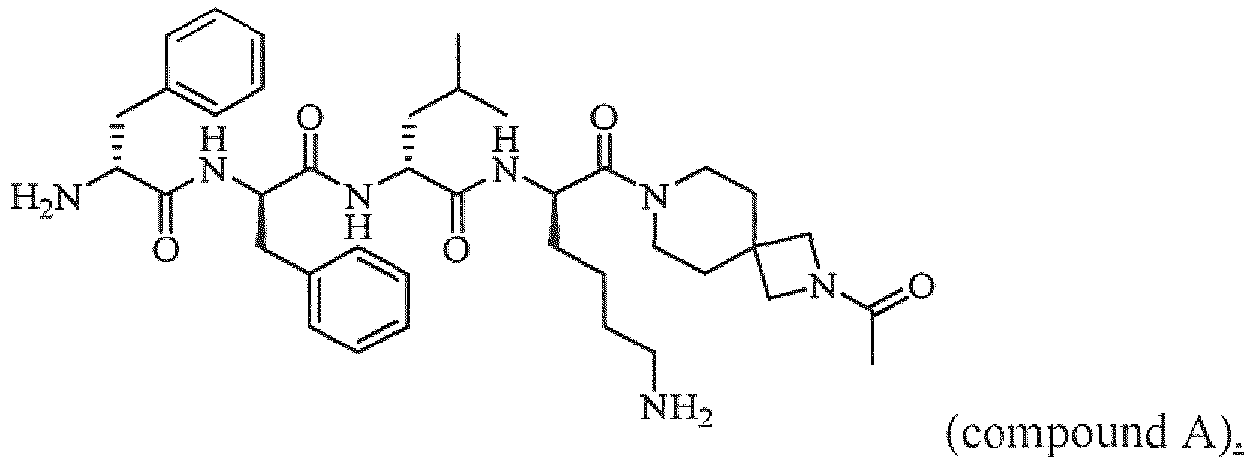
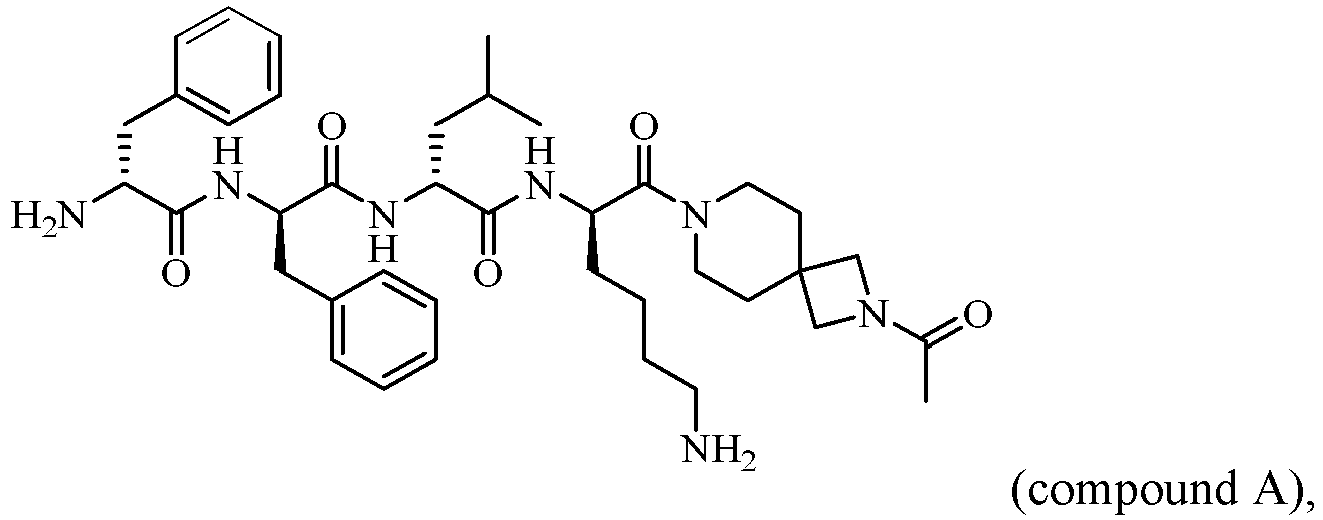
- WO 2019/015644 discloses a class of peptide amide compounds with novel structure and good analgesic effect, and the general formula thereof is as follows: Such compounds have a significant agonizing effect on human ⁇ -opioid receptors. Specifically, compound A is disclosed therein: with a chemical name of 7-(D-phenylalanyl-D-phenylalanyl-D-leucyl-D-lysyl)-2-acetyl-2,7-diazaspiro[3.5]nonane.
- the present invention provides an oral polypeptide pharmaceutical composition, which is prepared by combining a polypeptide drug with a specific absorption enhancer and other non-active ingredients, thereby promoting the permeability of the polypeptide drug in the gastrointestinal tract, improving the oral bioavailability of the polypeptide drug, and achieving the oral administration so as to improve patient compliance.
- the present invention provides a simple intragastric administration technology, which greatly simplifies the technological process and can greatly improve the oral bioavailability of the polypeptide compound A.
- One object of the present invention is to provide an oral pharmaceutical composition of compound A:
- the present invention significantly improves the oral bioavailability of compound A, and is more favorable to develop a drug with the compound A.
- Another object of the present invention is to provide a method for preparing the oral pharmaceutical composition.
- Another object of the present invention is to provide the use of the oral pharmaceutical composition.
- the present invention provides an oral pharmaceutical composition comprising:
- the oral pharmaceutical composition comprises:
- the weight ratio of compound A to N-[8-(2-hydroxybenzoyl)amino]octanoic acid or a pharmaceutically acceptable salt thereof is 1 : 20-1 : 80, preferably 1 : 40-1 : 60, further preferably 1 : 40.
- the weight ratio of compound A to N-[8-(2-hydroxybenzoyl)amino]octanoic acid or a pharmaceutically acceptable salt thereof is 1 : 20.
- the weight ratio of compound A to N-[8-(2-hydroxybenzoyl)amino]octanoic acid or a pharmaceutically acceptable salt thereof is 1 : 30.
- the weight ratio of compound A to N-[8-(2-hydroxybenzoyl)amino]octanoic acid or a pharmaceutically acceptable salt thereof is 1 : 40.
- the weight ratio of compound A to N-[8-(2-hydroxybenzoyl)amino]octanoic acid or a pharmaceutically acceptable salt thereof is 1 : 80.
- the absorption enhancer is N-[8-(2-hydroxybenzoyl)amino]sodium caprylate.
- the absorption enhancer is N-[8-(2-hydroxybenzoyl)amino]potassium caprylate.
- the absorption enhancer is N-[8-(2-hydroxybenzoyl)amino]calcium caprylate.
- the oral pharmaceutical composition comprises:
- the oral pharmaceutical composition comprises:
- the weight ratio of compound A to 4-[(4-chloro-2-hydroxy-benzoyl)amino]butyric acid or a pharmaceutically acceptable salt thereof is 1 : 20-1 : 200, preferably 1 : 40-1 : 80, further preferably 1 : 40.
- the weight ratio of compound A to 4-[(4-chloro-2-hydroxy-benzoyl)amino]butyric acid or a pharmaceutically acceptable salt thereof is 1 : 20.
- the weight ratio of compound A to 4-[(4-chloro-2-hydroxy-benzoyl)amino]butyric acid or a pharmaceutically acceptable salt thereof is 1 : 40.
- the weight ratio of compound A to 4-[(4-chloro-2-hydroxy-benzoyl)amino]butyric acid or a pharmaceutically acceptable salt thereof is 1 : 80.
- the weight ratio of compound A to 4-[(4-chloro-2-hydroxy-benzoyl)amino]butyric acid or a pharmaceutically acceptable salt thereof is 1 : 100.
- the weight ratio of compound A to 4-[(4-chloro-2-hydroxy-benzoyl)amino]butyric acid or a pharmaceutically acceptable salt thereof is 1 : 200.
- the weight ratio of compound A to 4-[(4-chloro-2-hydroxy-benzoyl)amino]butyric acid or a pharmaceutically acceptable salt thereof is 3 : 200.
- the absorption enhancer is 4-[(4-chloro-2-hydroxy-benzoyl)amino]sodium butyrate.
- the absorption enhancer is 4-[(4-chloro-2-hydroxy-benzoyl)amino]potassium butyrate.
- the absorption enhancer is 4-[(4-chloro-2-hydroxy-benzoyl)amino]calcium butyrate.
- the oral pharmaceutical composition comprises:
- the lubricant is magnesium stearate.
- the filler is microcrystalline cellulose and/or anhydrous calcium hydrogenphosphate.
- the binder is povidone.
- the oral pharmaceutical composition comprises:
- the weight ratio of compound A : 4-[(4-chloro-2-hydroxy-benzoyl)amino]butyric acid or a pharmaceutically acceptable salt thereof : the lubricant is 1 : (20-200) : (0.2-2).
- the weight ratio of compound A : 4-[(4-chloro-2-hydroxy-benzoyl)amino]butyric acid or a pharmaceutically acceptable salt thereof : the lubricant is 1 : 200 : 2.
- the oral pharmaceutical composition comprises:
- the weight ratio of compound A : 4-[(4-chloro-2-hydroxy-benzoyl)amino]butyric acid or a pharmaceutically acceptable salt thereof : magnesium stearate is 1 : (20-200) : (0.2-2).
- the weight ratio of compound A : 4-[(4-chloro-2-hydroxy-benzoyl)amino]butyric acid or a pharmaceutically acceptable salt thereof : magnesium stearate is 1 : 200 : 2.
- the oral pharmaceutical composition comprises:
- the weight ratio of compound A : 4-[(4-chloro-2-hydroxy-benzoyl)amino]butyric acid or a pharmaceutically acceptable salt thereof : the filler : the binder is 1 : (20-200) : 200 : 5.
- the weight ratio of compound A : 4-[(4-chloro-2-hydroxy-benzoyl)amino]butyric acid or a pharmaceutically acceptable salt thereof : the filler : the binder is 1 : 200 : 200 : 5.
- the oral pharmaceutical composition comprises:
- the weight ratio of compound A : 4-[(4-chloro-2-hydroxy-benzoyl)amino]butyric acid or a pharmaceutically acceptable salt thereof : microcrystalline cellulose : povidone is 1 : (20-200) : 200 : 5.
- the weight ratio of compound A : 4-[(4-chloro-2-hydroxy-benzoyl)amino]butyric acid or a pharmaceutically acceptable salt thereof : microcrystalline cellulose : povidone is 1 : 200 : 200 : 5.
- the oral pharmaceutical composition comprises:
- the weight ratio of compound A : 4-[(4-chloro-2-hydroxy-benzoyl)amino]butyric acid or a pharmaceutically acceptable salt thereof : the filler : the binder : the lubricant is 1 : (20-200) : 200 : 5 : (1-5).
- the weight ratio of compound A : 4-[(4-chloro-2-hydroxy-benzoyl)amino]butyric acid or a pharmaceutically acceptable salt thereof : the filler : the binder : the lubricant is 1 : 200 : 200 : 5 : (4-5), for example 1 : 200 : 200 : 5 : 4.06.
- the weight ratio of compound A : 4-[(4-chloro-2-hydroxy-benzoyl)amino]butyric acid or a pharmaceutically acceptable salt thereof : the filler : the binder : the lubricant is 3 : 200 : 200 : 5 : 1.
- the weight ratio of compound A : 4-[(4-chloro-2-hydroxy-benzoyl)amino]butyric acid or a pharmaceutically acceptable salt thereof : the filler : the binder : the lubricant is 3 : 200 : 200 : 5 : 4.
- the oral pharmaceutical composition comprises:
- the weight ratio of compound A : 4-[(4-chloro-2-hydroxy-benzoyl)amino]butyric acid or a pharmaceutically acceptable salt thereof : microcrystalline cellulose : povidone : magnesium stearate is (1-3) : (20-200) : 200 : 5 : (1-5).
- the weight ratio of compound A : 4-[(4-chloro-2-hydroxy-benzoyl)amino]butyric acid or a pharmaceutically acceptable salt thereof : microcrystalline cellulose : povidone : magnesium stearate is 1 : 200 : 200 : 5 : (4-5), for example 1 : 200 : 200 : 5 : 4.06.
- the weight ratio of compound A : 4-[(4-chloro-2-hydroxy-benzoyl)amino]butyric acid or a pharmaceutically acceptable salt thereof : microcrystalline cellulose : povidone : magnesium stearate is 3 : 200 : 200 : 5 : 4.
- the oral pharmaceutical composition comprises:
- the weight ratio of compound A : 4-[(4-chloro-2-hydroxy-benzoyl)amino]butyric acid or a pharmaceutically acceptable salt thereof : povidone : anhydrous calcium hydrogenphosphate : magnesium stearate is (1-3) : (20-200) : 5 : 200 : (1-5).
- the weight ratio of compound A : 4-[(4-chloro-2-hydroxy-benzoyl)amino]butyric acid or a pharmaceutically acceptable salt thereof : povidone : anhydrous calcium hydrogenphosphate : magnesium stearate is 3 : 200 : 5 : 200 : 4.
- the oral pharmaceutical composition comprises:
- the weight ratio of compound A : 4-[(4-chloro-2-hydroxy-benzoyl)amino]butyric acid or a pharmaceutically acceptable salt thereof : the surfactant : the filler : the lubricant is (1-3) : (20-200) : (3-9) : 200 : (1-5), for example 3 : 200 : 6 : 200 : 1.
- the oral pharmaceutical composition comprises:
- the oral pharmaceutical composition comprises:
- the weight ratio of compound A : 4-[(4-chloro-2-hydroxy-benzoyl)amino]butyric acid or a pharmaceutically acceptable salt thereof : propylene glycol monolaurate : polyethylene glycol 300 : anhydrous calcium hydrogenphosphate : magnesium stearate is (1-3) : (20-200) : (3-9) : (3-9) : 200 : (1-5), for example 3 : 200 : 3 : 3 : 200 : 1.
- the oral pharmaceutical composition comprises:
- the weight ratio of compound A to lauroyl-L-carnitine or a hydrochloride thereof is 1 : 10-1 : 150, for example 1 : 10, 1 : 15, 1 : 20, 1 : 30, 1 : 50, 1 : 75, 1 : 100 or 1 : 150.
- the weight ratio of compound A to lauroyl-L-carnitine is 1 : 10-1 : 50, preferably 1 : 10-1 : 20, further preferably 1 : 10.
- the weight ratio of compound A to lauroyl-L-carnitine is 1 : 10.
- the weight ratio of compound A to lauroyl-L-carnitine is 1 : 20.
- the weight ratio of compound A to lauroyl-L-carnitine is 1 : 50.
- the oral pharmaceutical composition comprises:
- the weight ratio of compound A to lauroyl-L-carnitine hydrochloride is 1 : 15-1 : 150, preferably lauroyl-L-carnitine hydrochloride is used in an amount of 75-150 mg, further preferably lauroyl-L-carnitine hydrochloride is used in an amount of 75 mg.
- the weight ratio of compound A to lauroyl-L-carnitine hydrochloride is 1 : 15.
- the weight ratio of compound A to lauroyl-L-carnitine hydrochloride is 1 : 20.
- the weight ratio of compound A to lauroyl-L-carnitine hydrochloride is 1 : 30.
- the weight ratio of compound A to lauroyl-L-carnitine hydrochloride is 1 : 75.
- the weight ratio of compound A to lauroyl-L-carnitine hydrochloride is 1 : 100.
- the weight ratio of compound A to lauroyl-L-carnitine hydrochloride is 1 : 150.
- the absorption enhancer in the oral pharmaceutical composition when selected from lauroyl-L-carnitine or a hydrochloride thereof, the pharmaceutical composition does not comprise enteric coated excipients.
- the absorption enhancer in the oral pharmaceutical composition when the absorption enhancer in the oral pharmaceutical composition is selected from lauroyl-L-carnitine or a hydrochloride thereof, the pharmaceutical composition is not in the form of an enteric coated tablet or an enteric coated capsule.
- the absorption enhancer in the oral pharmaceutical composition when selected from lauroyl-L-carnitine or a hydrochloride thereof, the pharmaceutical composition is in the form of a gastric coated capsule, gastric coated tablet or gastric coated granule.
- the oral pharmaceutical composition comprises:
- the oral pharmaceutical composition comprises:
- the weight ratio of compound A : lauroyl-L-carnitine : the pH regulator is 1 : (10-50) : 24.
- the oral pharmaceutical composition comprises:
- the weight ratio of compound A : lauroyl-L-carnitine : citric acid is 1 : (10-50) : 24.
- the weight ratio of compound A : lauroyl-L-carnitine : citric acid is 1 : 50 : 24.
- the oral pharmaceutical composition comprises:
- the weight ratio of compound A to sodium caprate is 1 : 50-1 : 200, preferably 1 : 100-1 : 200, most preferably 1 : 100.
- the weight ratio of compound A to sodium caprate is 1 : 50.
- the weight ratio of compound A to sodium caprate is 1 : 100.
- the weight ratio of compound A to sodium caprate is 1 : 200.
- the oral pharmaceutical composition comprises:
- the binder is povidone.
- the oral pharmaceutical composition comprises:
- the weight ratio of compound A : sodium caprate : povidone is 1 : (50-200) : 50, for example 1 : 50 : 50, 1 : 100 : 50 or 1 : 200 : 50.
- the oral pharmaceutical composition comprises:
- the oral pharmaceutical composition comprises:
- the weight ratio of compound A to caprylocaproyl macrogolglyceride is 1 : 600-1 : 3600, preferably 1 : 2400-1 : 3600, most preferably 1 : 2400.
- the weight ratio of compound A to caprylocaproyl macrogolglyceride is 1 : 600.
- the weight ratio of compound A to caprylocaproyl macrogolglyceride is 1 : 1200.
- the weight ratio of compound A to caprylocaproyl macrogolglyceride is 1 : 1800.
- the weight ratio of compound A to caprylocaproyl macrogolglyceride is 1 : 2400.
- the weight ratio of compound A to caprylocaproyl macrogolglyceride is 1 : 3600.
- the oral pharmaceutical composition comprises:
- the oral pharmaceutical composition comprises:
- the oral pharmaceutical composition comprises:
- the weight ratio of compound A : caprylocaproyl macrogolglyceride : capric acid is 1 : (3000-6000) : (50-200), for example 1 : 3000 : (50-100) or 1 : (4000-6000) : 200, for example 1 : 3000 : 50, 1 : 3000 : 75, 1 : 3000 : 100, 1 : 4000 : 200 or 1 : 6000 : 200.
- the oral pharmaceutical composition is in the form of a solution, a suspension, a granule, a powder, a capsule, a tablet or other oral dosage forms.
- the oral pharmaceutical composition is in the form of a gastric coated capsule, a gastric coated tablet or a gastric coated granule.
- compound (A) is present in the oral pharmaceutical composition at a therapeutically effective amount or unit dose. In some embodiments of the present invention, compound (A) is present in the oral pharmaceutical composition at a does of less than 1 mg, 1-3 mg, 3-5 mg, 5-10 mg, 10-25 mg, 25-32 mg, 32-100 mg, or more than 100 mg.
- the above-mentioned oral pharmaceutical composition is prepared as follows: compound A, the absorption enhancer and other non-active ingredients are mixed directly, and then filled into capsules or compressed into tablets.
- the above-mentioned oral pharmaceutical composition is prepared as follows: compound A, the absorption enhancer and other non-active ingredients are wet granulated and then filled into capsules or compressed into tablets.
- the above-mentioned oral pharmaceutical composition is prepared as follows: compound A, the absorption enhancer and the hydrophilic non-active ingredients are wet granulated, then dispersed in a hydrophobic medium, and filled into capsules.
- the oral pharmaceutical composition can also be prepared as a solution, a suspension, a granule, a powder or other oral dosage forms using a conventional preparation process.
- the capsule may be a hard capsule or a soft capsule.
- the present invention also provides the use of the oral pharmaceutical composition in preparing a drug for treating diseases or conditions related to the ⁇ -opioid receptor.
- the present invention also provides a method for treating diseases or conditions related to the x-opioid receptor in a subject, comprising administering the oral pharmaceutical composition of any one of the foregoing embodiments to the subject.
- the diseases or conditions related to the ⁇ -opioid receptor are selected from pain, inflammation, itching, edema, hyponatremia, hypokalemia, intestinal obstruction, cough and glaucoma.
- the pain is selected from neuropathic pain, somatic pain, visceral pain and skin pain.
- the diseases or conditions are selected from arthritis pain, kidney stone pain, hysterotrismus, dysmenorrhea, endometriosis, dyspepsia, pain after surgery, pain after medical treatment, ocular pain, otitis pain, breakthrough cancer pain, and pain associated with GI disorders (gastrointestinal disorders).
- the oral pharmaceutical composition can be used for treating acute and chronic pain and itching.
- the oral pharmaceutical composition is administered to the subject 1, 2, or 3 times daily.
- the subject is a mammal, such as a bovine, an equine, a porcine, a canine, a feline, a rodent, a primate animal, wherein, particularly preferred subjects are humans.
- the raw materials/reagents used in the examples are commercially available or self-prepared, and the formulations in the examples are all at single preparation dosage.
- 0# capsule in the following examples refers to the shell that can be used to prepare gastric coated hard capsules with the specification of 0#.
- Compound A was prepared with reference to the method disclosed in WO 2019/015644 .
- the physiological saline solution of compound A obtained in Example 1 was orally administered at a single dose to male Beagle dogs (3 for each preparation), venous blood was taken at 0, 0.25, 0.5, 1, 2, 4, 6, 8, 10, 12 and 24 h, and the absolute bioavailability (F%) (relative to intravenous dose of compound A) was calculated from the area under the curve obtained from the points where the plasma concentration of compound A was taken as a function of time.
- Example 2 After a single oral administration of the capsules obtained in Example 2 to male Beagle dogs (3 for each preparation) with 5 tablets of the samples for each dog, venous blood was taken at 0, 0.083, 0.25, 0.5, 1, 2, 4, 6, 8 and 24 h, and the absolute bioavailability (F%) (relative to intravenous dose of compound A) was calculated from the area under the curve obtained from the points where the plasma concentration of compound A was taken as a function of time.
- Table 1 Effect of SNAC on absorption of compound A Formula C max (ng/ml) F%
- Example 1 2.60 ⁇ 0.49 1.81 ⁇ 0.01
- Example 2 125 ⁇ 47 3.46 ⁇ 1.62
- the bioavailability is significantly improved, and the absolute bioavailability is up to 3.46%.
- the bioavailability of compound A can be significantly improved, and the absolute bioavailability is better when the weight ratio thereof is 1 : 40.
- Example 6 After a single oral administration of the capsules obtained in Example 6 to male Beagle dogs (3 for each preparation) with 5 tablets of the samples for each dog, venous blood was taken at 0, 0.25, 0.5, 1, 2, 4, 6, 8, 12, 24, 28, 48 and 72 h, and the absolute bioavailability (F%) (relative to intravenous dose of compound A) was calculated from the area under the curve obtained from the points where the plasma concentration of compound A was taken as a function of time.
- Table 3 Effect of formula on absorption of compound A Formula C max (ng/ml) F%
- Example 1 2.60 ⁇ 0.49 1.81 ⁇ 0.01
- Example 6 451 ⁇ 384 6.62 ⁇ 5.3
- Example 1 Dissolving in physiological saline 2.60 ⁇ 0.49 1.81 ⁇ 0.01
- Example 10 Mixing uniformly and then filling into capsules 15.8 ⁇ 11 6.14 ⁇ 4.1
- Example 11 Mixing uniformly and then compressing into tablets 14.5 ⁇ 15 5.57 ⁇ 5.5
- Example 12 Mixing uniformly and then filling into capsules 24.1 ⁇ 19 8.57 ⁇ 7.1
- Example 13 Mixing uniformly and then compressing into tablets 22.0 ⁇ 7.4 7.91 ⁇ 2.9
- Example 14 Compound A and 4-CNAB were dissolved in water, subjected to rotary evaporation, dried, ground and pulverized, and same were mixed with other excipients and then filled into capsules 18.4 ⁇ 3.2 5.70 ⁇ 0.46
- Example 15 Compound A and 4-CNAB were dissolved in water, subjected to rotary evaporation, dried, ground and pulverized, and same were mixed with other excipients and
- the bioavailability of compound A is improved by sodium caprate in a dose-response manner.
- the weight ratio of compound A to sodium caprate is 1 : 50
- the bioavailability does not change significantly
- the weight ratio of compound A to sodium caprate is 1 : 100 and 1 : 200
- the bioavailability is increased significantly.
- the bioavailability is significantly improved when the weight ratio of compound A to caprylocaproyl macrogolglyceride is 1 : 600-1 : 3600, and the absolute bioavailability is better when the weight ratio is 1 : 2400.
- venous blood was taken at 0, 0.25, 0.5, 1, 2, 4, 6, 8, 10, 12 and 24 h, and the absolute bioavailability (F%) (relative to intravenous dose of compound A) was calculated from the area under the curve obtained from the points where the plasma concentration of compound A was taken as a function of time.
- Both solutions and capsules obtained by adding caprylocaproyl macrogolglyceride to the formulations can significantly improve the bioavailability of compound A, and the improvement levels of the bioavailability of compound A are similar at the specification of 1 mg and 5 mg.
- the bioavailability of compound A is significantly improved when the weight ratio of compound A : caprylocaproyl macrogolglyceride : sodium caprate is 1 : 3000 : 50-100, and the bioavailability is better when the weight ratio is 1 : 3000 : 100.
- the bioavailability of compound A is significantly improved when the weight ratio of compound A : caprylocaproyl macrogolglyceride : capric acid is 1 : (4000-6000) : 200, and the bioavailability is better when the weight ratio is 1 : 6000 : 200.
- the bioavailability of compound A is significantly improved when the weight ratio of compound A to lauroyl-L-carnitine is 1 : 10-1 : 50, and the bioavailability is better when the weight ratio is 1 : 20.
- the bioavailability of the gastric coated capsule preparation is 4 times that of the enteric coated capsule preparation.
- the bioavailability of compound A is significantly improved when the weight ratio of compound A to lauroyl-L-carnitine hydrochloride is 1 : 15-1 : 150, and the bioavailability is better when the weight ratio is 1 : 15 and 1 : 75.
- Example 1 2.60 ⁇ 0.49 1.81 ⁇ 0.01
- Example 24 15.9 ⁇ 14 5.73 ⁇ 3.3
- Example 48 1.80 ⁇ 1.1 0.792 ⁇ 0.31
- Example 49 13.7 ⁇ 4.11 1.58 ⁇ 1.11
- Example 50 3.54 ⁇ 1.1 1.53 ⁇ 0.31
- Example 51 0.837 ⁇ 0.48 1.22 ⁇ 0.38
- Example 52 1.48 ⁇ 1.0 1.36 ⁇ 0.22
- Fatty acid salts with different aliphatic chain lengths have different effects on bioavailability.
- fatty acid salts with aliphatic chain lengths of C 6 -C 16 only the fatty acid salts with aliphatic chain length of C 10 can significantly increase the bioavailability of compound A.
Landscapes
- Health & Medical Sciences (AREA)
- Life Sciences & Earth Sciences (AREA)
- Chemical & Material Sciences (AREA)
- Medicinal Chemistry (AREA)
- Veterinary Medicine (AREA)
- Public Health (AREA)
- General Health & Medical Sciences (AREA)
- Animal Behavior & Ethology (AREA)
- Pharmacology & Pharmacy (AREA)
- Epidemiology (AREA)
- Engineering & Computer Science (AREA)
- Bioinformatics & Cheminformatics (AREA)
- General Chemical & Material Sciences (AREA)
- Chemical Kinetics & Catalysis (AREA)
- Organic Chemistry (AREA)
- Nuclear Medicine, Radiotherapy & Molecular Imaging (AREA)
- Biophysics (AREA)
- Molecular Biology (AREA)
- Proteomics, Peptides & Aminoacids (AREA)
- Gastroenterology & Hepatology (AREA)
- Immunology (AREA)
- Pain & Pain Management (AREA)
- Nutrition Science (AREA)
- Diabetes (AREA)
- Oil, Petroleum & Natural Gas (AREA)
- Ophthalmology & Optometry (AREA)
- Hematology (AREA)
- Biomedical Technology (AREA)
- Neurology (AREA)
- Neurosurgery (AREA)
- Urology & Nephrology (AREA)
- Endocrinology (AREA)
- Obesity (AREA)
- Dermatology (AREA)
- Rheumatology (AREA)
- Reproductive Health (AREA)
- Inorganic Chemistry (AREA)
- Physiology (AREA)
- Pulmonology (AREA)
- Medicinal Preparation (AREA)
Description
- The present invention relates to an oral pharmaceutical composition of a peptide amide compound. The present invention further relates to a method for preparing the oral pharmaceutical composition and the use thereof.
- Polypeptide drugs can be used for treating various diseases due to its wide indications, high safety, remarkable selectivity and effectiveness. With the development of biotechnology, a large number of peptide drugs have entered the market. Currently, the commercially available peptide preparations are mainly in the form of injections and nasal sprays, which bring great inconvenience to patients. For patients, the oral administration is simpler and does not directly damage the skin or mucous membranes, thereby reducing patients' pain and improving patient compliance. However, the oral administration of polypeptide drugs is limited by a series of barriers, specifically, the polypeptide drugs are easily degraded and destroyed by proteolytic enzymes in the digestive tract, and are difficult to pass through the epithelial cell layer of the inner wall of the small intestine due to the large molecular weight, resulting in low oral bioavailability and limiting the clinical use thereof. For example, the absolute bioavailability of the listed semaglutide tablets is only 0.4%-1%. In order to achieve the blood concentration required for the onset of action, the oral dose is relatively high, and it is difficult to achieve oral administration of some polypeptide drugs with a high cost or a narrow therapeutic window. Therefore, improving the oral bioavailability of polypeptide drugs is the key to achieving the oral administration of polypeptide drugs.
- Most polypeptide drugs are susceptible to degradation by a protease activated by gastric acid, resulting in a decrease in the activity thereof. Enteric coating technology is usually used to protect polypeptides, which, however, requires complicated process and is of high cost.
-
WO 2019/015644 discloses a class of peptide amide compounds with novel structure and good analgesic effect, and the general formula thereof is as follows:

- The present invention provides an oral polypeptide pharmaceutical composition, which is prepared by combining a polypeptide drug with a specific absorption enhancer and other non-active ingredients, thereby promoting the permeability of the polypeptide drug in the gastrointestinal tract, improving the oral bioavailability of the polypeptide drug, and achieving the oral administration so as to improve patient compliance.
- The present invention provides a simple intragastric administration technology, which greatly simplifies the technological process and can greatly improve the oral bioavailability of the polypeptide compound A.
- One object of the present invention is to provide an oral pharmaceutical composition of compound A:
- The present invention significantly improves the oral bioavailability of compound A, and is more favorable to develop a drug with the compound A.
- Another object of the present invention is to provide a method for preparing the oral pharmaceutical composition.
- Another object of the present invention is to provide the use of the oral pharmaceutical composition.
- The present invention provides an oral pharmaceutical composition comprising:
- a) compound A:

- b) an absorption enhancer wherein the absorption enhancer is selected from one or more of N-[8-(2-hydroxybenzoyl)amino]octanoic acid or a pharmaceutically acceptable salt thereof, 4-[(4-chloro-2-hydroxybenzoyl)amino]butyric acid or a pharmaceutically acceptable salt thereof, lauroyl-L-carnitine or a hydrochloride thereof, sodium caprylate, sodium caprate, capric acid, caprylocaproyl macrogolglyceride; preferably, the pharmaceutically acceptable salt is selected from sodium salt, potassium salt or calcium salt.
- In some embodiments of the present invention, the oral pharmaceutical composition comprises:
- a) compound A:

- b) an absorption enhancer selected from N-[8-(2-hydroxybenzoyl)amino]octanoic acid or a pharmaceutically acceptable salt thereof.
- In some embodiments of the present invention, the weight ratio of compound A to N-[8-(2-hydroxybenzoyl)amino]octanoic acid or a pharmaceutically acceptable salt thereof is 1 : 20-1 : 80, preferably 1 : 40-1 : 60, further preferably 1 : 40.
- In some embodiments of the present invention, the weight ratio of compound A to N-[8-(2-hydroxybenzoyl)amino]octanoic acid or a pharmaceutically acceptable salt thereof is 1 : 20.
- In some embodiments of the present invention, the weight ratio of compound A to N-[8-(2-hydroxybenzoyl)amino]octanoic acid or a pharmaceutically acceptable salt thereof is 1 : 30.
- In some embodiments of the present invention, the weight ratio of compound A to N-[8-(2-hydroxybenzoyl)amino]octanoic acid or a pharmaceutically acceptable salt thereof is 1 : 40.
- In some embodiments of the present invention, the weight ratio of compound A to N-[8-(2-hydroxybenzoyl)amino]octanoic acid or a pharmaceutically acceptable salt thereof is 1 : 80.
- In some embodiments of the present invention, the absorption enhancer is N-[8-(2-hydroxybenzoyl)amino]sodium caprylate.
- In some embodiments of the present invention, the absorption enhancer is N-[8-(2-hydroxybenzoyl)amino]potassium caprylate.
- In some embodiments of the present invention, the absorption enhancer is N-[8-(2-hydroxybenzoyl)amino]calcium caprylate.
- In some embodiments of the present invention, the oral pharmaceutical composition comprises:
- a) compound A:

- b) an absorption enhancer selected from N-[8-(2-hydroxybenzoyl)amino]octanoic acid or a pharmaceutically acceptable salt thereof;
- c) one or more non-active ingredients selected from:
- (1) a filler, which is preferably selected from one or more of microcrystalline cellulose, lactose, mannitol, anhydrous calcium hydrogenphosphate, pregelatinized starch, calcium hydrogenphosphate dihydrate;
- (2) a binder, which is preferably selected from one or more of povidone, copovidone, a cellulose derivative, wherein the cellulose derivative is selected from one or more of hydroxypropylcellulose, hypromellose, methyl cellulose;
- (3) a disintegrant, which is preferably selected from one or more of crospovidone, low substituted hydroxypropyl cellulose, croscarmellose sodium, sodium carboxymethyl starch;
- (4) a pH regulator, which is preferably selected from one or more of citric acid, anhydrous citric acid, tartaric acid, fumaric acid, sodium citrate, calcium hydrogenphosphate, calcium carbonate;
- (5) a surfactant, which is preferably selected from one or more of polyethylene glycol, poloxamer, phospholipid, Tween 80, Span 40, propylene glycol monolaurate, sodium dodecyl sulfate;
- (6) a lubricant, which is preferably selected from one or more of magnesium stearate, stearic acid, sodium stearyl fumarate, glyceryl behenate.
- In some embodiments of the present invention, the oral pharmaceutical composition comprises:
- a) compound A:

- b) an absorption enhancer selected from 4-[(4-chloro-2-hydroxybenzoyl)amino]butyric acid or a pharmaceutically acceptable salt thereof.
- In some embodiments of the present invention, the weight ratio of compound A to 4-[(4-chloro-2-hydroxy-benzoyl)amino]butyric acid or a pharmaceutically acceptable salt thereof is 1 : 20-1 : 200, preferably 1 : 40-1 : 80, further preferably 1 : 40.
- In some embodiments of the present invention, the weight ratio of compound A to 4-[(4-chloro-2-hydroxy-benzoyl)amino]butyric acid or a pharmaceutically acceptable salt thereof is 1 : 20.
- In some embodiments of the present invention, the weight ratio of compound A to 4-[(4-chloro-2-hydroxy-benzoyl)amino]butyric acid or a pharmaceutically acceptable salt thereof is 1 : 40.
- In some embodiments of the present invention, the weight ratio of compound A to 4-[(4-chloro-2-hydroxy-benzoyl)amino]butyric acid or a pharmaceutically acceptable salt thereof is 1 : 80.
- In some embodiments of the present invention, the weight ratio of compound A to 4-[(4-chloro-2-hydroxy-benzoyl)amino]butyric acid or a pharmaceutically acceptable salt thereof is 1 : 100.
- In some embodiments of the present invention, the weight ratio of compound A to 4-[(4-chloro-2-hydroxy-benzoyl)amino]butyric acid or a pharmaceutically acceptable salt thereof is 1 : 200.
- In some embodiments of the present invention, the weight ratio of compound A to 4-[(4-chloro-2-hydroxy-benzoyl)amino]butyric acid or a pharmaceutically acceptable salt thereof is 3 : 200.
- In some embodiments of the present invention, the absorption enhancer is 4-[(4-chloro-2-hydroxy-benzoyl)amino]sodium butyrate.
- In some embodiments of the present invention, the absorption enhancer is 4-[(4-chloro-2-hydroxy-benzoyl)amino]potassium butyrate.
- In some embodiments of the present invention, the absorption enhancer is 4-[(4-chloro-2-hydroxy-benzoyl)amino]calcium butyrate.
- In some embodiments of the present invention, the oral pharmaceutical composition comprises:
- a) compound A:

- b) an absorption enhancer selected from 4-[(4-chloro-2-hydroxybenzoyl)amino]butyric acid or a pharmaceutically acceptable salt thereof;
- c) one or more non-active ingredients selected from:
- (1) a filler, which is preferably selected from one or more of microcrystalline cellulose, lactose, mannitol, anhydrous calcium hydrogenphosphate, pregelatinized starch, calcium hydrogenphosphate dihydrate;
- (2) a binder, which is preferably selected from one or more of povidone, copovidone, a cellulose derivative, wherein the cellulose derivative is selected from one or more of hydroxypropylcellulose, hypromellose, methyl cellulose;
- (3) a disintegrant, which is preferably selected from one or more of crospovidone, low substituted hydroxypropyl cellulose, croscarmellose sodium, sodium carboxymethyl starch;
- (4) a pH regulator, which is preferably selected from one or more of citric acid, anhydrous citric acid, tartaric acid, fumaric acid, sodium citrate, calcium hydrogenphosphate, calcium carbonate;
- (5) a surfactant, which is preferably selected from one or more of polyethylene glycol, poloxamer, phospholipid, Tween 80, Span 40, propylene glycol monolaurate, sodium dodecyl sulfate;
- (6) a lubricant, which is preferably selected from one or more of magnesium stearate, stearic acid, sodium stearyl fumarate, glyceryl behenate.
- In some embodiments of the present invention, the lubricant is magnesium stearate.
- In some embodiments of the present invention, the filler is microcrystalline cellulose and/or anhydrous calcium hydrogenphosphate.
- In some embodiments of the present invention, the binder is povidone.
- In some embodiments of the present invention, the oral pharmaceutical composition comprises:
- a) compound A:

- b) 4-[(4-chloro-2-hydroxy-benzoyl)amino]butyric acid or a pharmaceutically acceptable salt thereof;
- c) a lubricant.
- In some embodiments of the present invention, the weight ratio of compound A : 4-[(4-chloro-2-hydroxy-benzoyl)amino]butyric acid or a pharmaceutically acceptable salt thereof : the lubricant is 1 : (20-200) : (0.2-2).
- In some embodiments of the present invention, the weight ratio of compound A : 4-[(4-chloro-2-hydroxy-benzoyl)amino]butyric acid or a pharmaceutically acceptable salt thereof : the lubricant is 1 : 200 : 2.
- In some embodiments of the present invention, the oral pharmaceutical composition comprises:
- a) compound A:

- b) 4-[(4-chloro-2-hydroxy-benzoyl)amino]butyric acid or a pharmaceutically acceptable salt thereof;
- c) magnesium stearate.
- In some embodiments of the present invention, the weight ratio of compound A : 4-[(4-chloro-2-hydroxy-benzoyl)amino]butyric acid or a pharmaceutically acceptable salt thereof : magnesium stearate is 1 : (20-200) : (0.2-2).
- In some embodiments of the present invention, the weight ratio of compound A : 4-[(4-chloro-2-hydroxy-benzoyl)amino]butyric acid or a pharmaceutically acceptable salt thereof : magnesium stearate is 1 : 200 : 2.
- In some embodiments of the present invention, the oral pharmaceutical composition comprises:
- a) compound A:

- b) 4-[(4-chloro-2-hydroxy-benzoyl)amino]butyric acid or a pharmaceutically acceptable salt thereof;
- c) a filler;
- d) a binder.
- In some embodiments of the present invention, the weight ratio of compound A : 4-[(4-chloro-2-hydroxy-benzoyl)amino]butyric acid or a pharmaceutically acceptable salt thereof : the filler : the binder is 1 : (20-200) : 200 : 5.
- In some embodiments of the present invention, the weight ratio of compound A : 4-[(4-chloro-2-hydroxy-benzoyl)amino]butyric acid or a pharmaceutically acceptable salt thereof : the filler : the binder is 1 : 200 : 200 : 5.
- In some embodiments of the present invention, the oral pharmaceutical composition comprises:
- a) compound A:

- b) 4-[(4-chloro-2-hydroxy-benzoyl)amino]butyric acid or a pharmaceutically acceptable salt thereof;
- c) microcrystalline cellulose;
- d) povidone.
- In some embodiments of the present invention, the weight ratio of compound A : 4-[(4-chloro-2-hydroxy-benzoyl)amino]butyric acid or a pharmaceutically acceptable salt thereof : microcrystalline cellulose : povidone is 1 : (20-200) : 200 : 5.
- In some embodiments of the present invention, the weight ratio of compound A : 4-[(4-chloro-2-hydroxy-benzoyl)amino]butyric acid or a pharmaceutically acceptable salt thereof : microcrystalline cellulose : povidone is 1 : 200 : 200 : 5.
- In some embodiments of the present invention, the oral pharmaceutical composition comprises:
- a) compound A:

- b) 4-[(4-chloro-2-hydroxy-benzoyl)amino]butyric acid or a pharmaceutically acceptable salt thereof;
- c) a filler;
- d) a binder;
- e) a lubricant.
- In some embodiments of the present invention, the weight ratio of compound A : 4-[(4-chloro-2-hydroxy-benzoyl)amino]butyric acid or a pharmaceutically acceptable salt thereof : the filler : the binder : the lubricant is 1 : (20-200) : 200 : 5 : (1-5).
- In some embodiments of the present invention, the weight ratio of compound A : 4-[(4-chloro-2-hydroxy-benzoyl)amino]butyric acid or a pharmaceutically acceptable salt thereof : the filler : the binder : the lubricant is 1 : 200 : 200 : 5 : (4-5), for example 1 : 200 : 200 : 5 : 4.06.
- In some embodiments of the present invention, the weight ratio of compound A : 4-[(4-chloro-2-hydroxy-benzoyl)amino]butyric acid or a pharmaceutically acceptable salt thereof : the filler : the binder : the lubricant is 3 : 200 : 200 : 5 : 1.
- In some embodiments of the present invention, the weight ratio of compound A : 4-[(4-chloro-2-hydroxy-benzoyl)amino]butyric acid or a pharmaceutically acceptable salt thereof : the filler : the binder : the lubricant is 3 : 200 : 200 : 5 : 4.
- In some embodiments of the present invention, the oral pharmaceutical composition comprises:
- a) compound A:

- b) 4-[(4-chloro-2-hydroxy-benzoyl)amino]butyric acid or a pharmaceutically acceptable salt thereof;
- c) microcrystalline cellulose;
- d) povidone;
- e) magnesium stearate.
- In some embodiments of the present invention, the weight ratio of compound A : 4-[(4-chloro-2-hydroxy-benzoyl)amino]butyric acid or a pharmaceutically acceptable salt thereof : microcrystalline cellulose : povidone : magnesium stearate is (1-3) : (20-200) : 200 : 5 : (1-5).
- In some embodiments of the present invention, the weight ratio of compound A : 4-[(4-chloro-2-hydroxy-benzoyl)amino]butyric acid or a pharmaceutically acceptable salt thereof : microcrystalline cellulose : povidone : magnesium stearate is 1 : 200 : 200 : 5 : (4-5), for example 1 : 200 : 200 : 5 : 4.06.
- In some embodiments of the present invention, the weight ratio of compound A : 4-[(4-chloro-2-hydroxy-benzoyl)amino]butyric acid or a pharmaceutically acceptable salt thereof : microcrystalline cellulose : povidone : magnesium stearate is 3 : 200 : 200 : 5 : 4.
- In some embodiments of the present invention, the oral pharmaceutical composition comprises:
- a) compound A:

- b) 4-[(4-chloro-2-hydroxy-benzoyl)amino]butyric acid or a pharmaceutically acceptable salt thereof;
- c) povidone;
- d) anhydrous calcium hydrogenphosphate;
- e) magnesium stearate.
- In some embodiments of the present invention, the weight ratio of compound A : 4-[(4-chloro-2-hydroxy-benzoyl)amino]butyric acid or a pharmaceutically acceptable salt thereof : povidone : anhydrous calcium hydrogenphosphate : magnesium stearate is (1-3) : (20-200) : 5 : 200 : (1-5).
- In some embodiments of the present invention, the weight ratio of compound A : 4-[(4-chloro-2-hydroxy-benzoyl)amino]butyric acid or a pharmaceutically acceptable salt thereof : povidone : anhydrous calcium hydrogenphosphate : magnesium stearate is 3 : 200 : 5 : 200 : 4.
- In some embodiments of the present invention, the oral pharmaceutical composition comprises:
- a) compound A:

- b) 4-[(4-chloro-2-hydroxy-benzoyl)amino]butyric acid or a pharmaceutically acceptable salt thereof;
- c) a surfactant;
- d) a filler;
- e) a lubricant.
- In some embodiments of the present invention, the weight ratio of compound A : 4-[(4-chloro-2-hydroxy-benzoyl)amino]butyric acid or a pharmaceutically acceptable salt thereof : the surfactant : the filler : the lubricant is (1-3) : (20-200) : (3-9) : 200 : (1-5), for example 3 : 200 : 6 : 200 : 1.
- In some embodiments of the present invention, the oral pharmaceutical composition comprises:
- a) compound A:

- b) 4-[(4-chloro-2-hydroxy-benzoyl)amino]butyric acid or a pharmaceutically acceptable salt thereof;
- c) propylene glycol monolaurate and/or polyethylene glycol (for example polyethylene glycol 300);
- d) anhydrous calcium hydrogenphosphate;
- e) magnesium stearate.
- In some embodiments of the present invention, the oral pharmaceutical composition comprises:
- a) compound A:

- b) 4-[(4-chloro-2-hydroxy-benzoyl)amino]butyric acid or a pharmaceutically acceptable salt thereof;
- c) propylene glycol monolaurate;
- d) polyethylene glycol 300;
- e) anhydrous calcium hydrogenphosphate;
- f) magnesium stearate.
- In some embodiments of the present invention, the weight ratio of compound A : 4-[(4-chloro-2-hydroxy-benzoyl)amino]butyric acid or a pharmaceutically acceptable salt thereof : propylene glycol monolaurate : polyethylene glycol 300 : anhydrous calcium hydrogenphosphate : magnesium stearate is (1-3) : (20-200) : (3-9) : (3-9) : 200 : (1-5), for example 3 : 200 : 3 : 3 : 200 : 1.
- In some embodiments of the present invention, the oral pharmaceutical composition comprises:
- a) compound A:

- b) an absorption enhancer selected from lauroyl-L-carnitine or a hydrochloride thereof.
- In some embodiments of the present invention, the weight ratio of compound A to lauroyl-L-carnitine or a hydrochloride thereof is 1 : 10-1 : 150, for example 1 : 10, 1 : 15, 1 : 20, 1 : 30, 1 : 50, 1 : 75, 1 : 100 or 1 : 150.
- In some embodiments of the present invention, the oral pharmaceutical composition comprises:
- a) compound A:
- b) an absorption enhancer selected from lauroyl-L-carnitine.
- In some embodiments of the present invention, the weight ratio of compound A to lauroyl-L-carnitine is 1 : 10-1 : 50, preferably 1 : 10-1 : 20, further preferably 1 : 10.
- In some embodiments of the present invention, the weight ratio of compound A to lauroyl-L-carnitine is 1 : 10.
- In some embodiments of the present invention, the weight ratio of compound A to lauroyl-L-carnitine is 1 : 20.
- In some embodiments of the present invention, the weight ratio of compound A to lauroyl-L-carnitine is 1 : 50.
- In some embodiments of the present invention, the oral pharmaceutical composition comprises:
- a) compound A:

- b) an absorption enhancer selected from lauroyl-L-carnitine hydrochloride.
- In some embodiments of the present invention, the weight ratio of compound A to lauroyl-L-carnitine hydrochloride is 1 : 15-1 : 150, preferably lauroyl-L-carnitine hydrochloride is used in an amount of 75-150 mg, further preferably lauroyl-L-carnitine hydrochloride is used in an amount of 75 mg.
- In some embodiments of the present invention, the weight ratio of compound A to lauroyl-L-carnitine hydrochloride is 1 : 15.
- In some embodiments of the present invention, the weight ratio of compound A to lauroyl-L-carnitine hydrochloride is 1 : 20.
- In some embodiments of the present invention, the weight ratio of compound A to lauroyl-L-carnitine hydrochloride is 1 : 30.
- In some embodiments of the present invention, the weight ratio of compound A to lauroyl-L-carnitine hydrochloride is 1 : 75.
- In some embodiments of the present invention, the weight ratio of compound A to lauroyl-L-carnitine hydrochloride is 1 : 100.
- In some embodiments of the present invention, the weight ratio of compound A to lauroyl-L-carnitine hydrochloride is 1 : 150.
- In some embodiments of the present invention, when the absorption enhancer in the oral pharmaceutical composition is selected from lauroyl-L-carnitine or a hydrochloride thereof, the pharmaceutical composition does not comprise enteric coated excipients.
- In some embodiments of the present invention, when the absorption enhancer in the oral pharmaceutical composition is selected from lauroyl-L-carnitine or a hydrochloride thereof, the pharmaceutical composition is not in the form of an enteric coated tablet or an enteric coated capsule.
- In some embodiments of the present invention, when the absorption enhancer in the oral pharmaceutical composition is selected from lauroyl-L-carnitine or a hydrochloride thereof, the pharmaceutical composition is in the form of a gastric coated capsule, gastric coated tablet or gastric coated granule.
- In some embodiments of the present invention, the oral pharmaceutical composition comprises:
- a) compound A:

- b) an absorption enhancer selected from lauroyl-L-carnitine or a hydrochloride thereof;
- c) one or more non-active ingredients selected from:
- (1) a filler, which is preferably selected from one or more of microcrystalline cellulose, lactose, mannitol, anhydrous calcium hydrogenphosphate, pregelatinized starch, calcium hydrogenphosphate dihydrate;
- (2) a binder, which is preferably selected from one or more of povidone, copovidone, a cellulose derivative, the cellulose derivative is selected from one or more of hydroxypropylcellulose, hypromellose, methyl cellulose;
- (3) a disintegrant, which is preferably selected from one or more of crospovidone, low substituted hydroxypropyl cellulose, croscarmellose sodium, sodium carboxymethyl starch;
- (4) a pH regulator, which is preferably selected from one or more of citric acid, anhydrous citric acid, tartaric acid, fumaric acid, sodium citrate, calcium hydrogenphosphate, calcium carbonate;
- (5) a surfactant, which is preferably selected from one or more of polyethylene glycol, poloxamer, phospholipid, Tween 80, Span 40, propylene glycol monolaurate, sodium dodecyl sulfate;
- (6) a lubricant, which is preferably selected from one or more of magnesium stearate, stearic acid, sodium stearyl fumarate, glyceryl behenate.
- In some embodiments of the present invention, the oral pharmaceutical composition comprises:
- a) compound A:

- b) lauroyl-L-carnitine;
- c) a pH regulator.
- In some embodiments of the present invention, the weight ratio of compound A : lauroyl-L-carnitine : the pH regulator is 1 : (10-50) : 24.
- In some embodiments of the present invention, the oral pharmaceutical composition comprises:
- a) compound A:

- b) lauroyl-L-carnitine;
- c) citric acid.
- In some embodiments of the present invention, the weight ratio of compound A : lauroyl-L-carnitine : citric acid is 1 : (10-50) : 24.
- In some embodiments of the present invention, the weight ratio of compound A : lauroyl-L-carnitine : citric acid is 1 : 50 : 24.
- In some embodiments of the present invention, the oral pharmaceutical composition comprises:
- a) compound A:

- b) an absorption enhancer selected from sodium caprate.
- In some embodiments of the present invention, the weight ratio of compound A to sodium caprate is 1 : 50-1 : 200, preferably 1 : 100-1 : 200, most preferably 1 : 100.
- In some embodiments of the present invention, the weight ratio of compound A to sodium caprate is 1 : 50.
- In some embodiments of the present invention, the weight ratio of compound A to sodium caprate is 1 : 100.
- In some embodiments of the present invention, the weight ratio of compound A to sodium caprate is 1 : 200.
- In some embodiments of the present invention, the oral pharmaceutical composition comprises:
- a) compound A:

- b) an absorption enhancer selected from sodium caprate;
- c) one or more non-active ingredients selected from:
- (1) a filler, which is preferably selected from one or more of microcrystalline cellulose, lactose, mannitol, anhydrous calcium hydrogenphosphate, pregelatinized starch, calcium hydrogenphosphate dihydrate;
- (2) a binder, which is preferably selected from one or more of povidone, copovidone, a cellulose derivative, wherein the cellulose derivative is selected from one or more of hydroxypropylcellulose, hypromellose, methyl cellulose;
- (3) a disintegrant, which is preferably selected from one or more of crospovidone, low substituted hydroxypropyl cellulose, croscarmellose sodium, sodium carboxymethyl starch;
- (4) a glyceride, which is preferably selected from one or more of monocaprylin, tricaprylin.
- (5) a surfactant, which is preferably selected from one or more of caprylocaproyl macrogolglyceride, polyethylene glycol, poloxamer, phospholipid, Tween 80, Span 40, propylene glycol monolaurate, sodium dodecyl sulfate;
- (6) a lubricant, which is preferably selected from one or more of magnesium stearate, stearic acid, sodium stearyl fumarate, glyceryl behenate.
- In some embodiments of the present invention, the binder is povidone.
- In some embodiments of the present invention, the oral pharmaceutical composition comprises:
- a) compound A:

- b) sodium caprate;
- c) povidone.
- In some embodiments of the present invention, the weight ratio of compound A : sodium caprate : povidone is 1 : (50-200) : 50, for example 1 : 50 : 50, 1 : 100 : 50 or 1 : 200 : 50.
- In some embodiments of the present invention, the oral pharmaceutical composition comprises:
- a) compound A:

- b) an absorption enhancer selected from capric acid;
- c) one or more non-active ingredients selected from:
- (1) a filler, preferably the filler is selected from one or more of microcrystalline cellulose, lactose, mannitol, anhydrous calcium hydrogenphosphate, pregelatinized starch, calcium hydrogenphosphate dihydrate;
- (2) a binder, which is preferably selected from one or more of povidone, copovidone, a cellulose derivative, wherein the cellulose derivative is selected from one or more of hydroxypropylcellulose, hypromellose, methyl cellulose;
- (3) a disintegrant, which is preferably selected from one or more of crospovidone, low substituted hydroxypropyl cellulose, croscarmellose sodium, sodium carboxymethyl starch;
- (4) a glyceride, which is preferably selected from one or more of monocaprylin, tricaprylin. (5) a surfactant, preferably the surfactant is selected from one or more of caprylocaproyl macrogolglyceride, polyethylene glycol, poloxamer, phospholipid, Tween 80, Span 40, propylene glycol monolaurate, sodium dodecyl sulfate;
- (6) a lubricant, which is preferably selected from one or more of magnesium stearate, stearic acid, sodium stearyl fumarate, glyceryl behenate.
- In some embodiments of the present invention, the oral pharmaceutical composition comprises:
- a) compound A:

- b) an absorption enhancer selected from caprylocaproyl macrogolglyceride.
- In some embodiments of the present invention, the weight ratio of compound A to caprylocaproyl macrogolglyceride is 1 : 600-1 : 3600, preferably 1 : 2400-1 : 3600, most preferably 1 : 2400.
- In some embodiments of the present invention, the weight ratio of compound A to caprylocaproyl macrogolglyceride is 1 : 600.
- In some embodiments of the present invention, the weight ratio of compound A to caprylocaproyl macrogolglyceride is 1 : 1200.
- In some embodiments of the present invention, the weight ratio of compound A to caprylocaproyl macrogolglyceride is 1 : 1800.
- In some embodiments of the present invention, the weight ratio of compound A to caprylocaproyl macrogolglyceride is 1 : 2400.
- In some embodiments of the present invention, the weight ratio of compound A to caprylocaproyl macrogolglyceride is 1 : 3600.
- In some embodiments of the present invention, the oral pharmaceutical composition comprises:
- a) compound A:

- b) an absorption enhancer selected from caprylocaproyl macrogolglyceride;
- c) one or more non-active ingredients selected from:
- (1) a hydrophobic medium, which is preferably selected from one or more of coconut oil, castor oil, olive oil;
- (2) a surfactant, which is preferably selected from one or more of polyethylene glycol, poloxamer, phospholipid, Tween 80, Span 40, propylene glycol monolaurate, sodium dodecyl sulfate;
- (3) a glyceride, which is preferably selected from one or more of monocaprylin, tricaprylin.
- In some embodiments of the present invention, the oral pharmaceutical composition comprises:
- a) compound A:

- b) an absorption enhancer selected from caprylocaproyl macrogolglyceride;
- c) one or more non-active ingredients selected from:
- (1) a hydrophobic medium, which is preferably selected from one or more of coconut oil, castor oil, olive oil;
- (2) a surfactant, which is preferably selected from one or more of polyethylene glycol, poloxamer, phospholipid, Tween 80, Span 40, propylene glycol monolaurate, sodium dodecyl sulfate;
- (3) a glyceride other than caprylocaproyl macrogolglyceride, preferably the glyceride is selected from one or more of monocaprylin, tricaprylin.
- In some embodiments of the present invention, the oral pharmaceutical composition comprises:
- a) compound A:

- b) caprylocaproyl macrogolglyceride;
- c) capric acid.
- In some embodiments of the present invention, the weight ratio of compound A : caprylocaproyl macrogolglyceride : capric acid is 1 : (3000-6000) : (50-200), for example 1 : 3000 : (50-100) or 1 : (4000-6000) : 200, for example 1 : 3000 : 50, 1 : 3000 : 75, 1 : 3000 : 100, 1 : 4000 : 200 or 1 : 6000 : 200.
- In some embodiments of the present invention, the oral pharmaceutical composition is in the form of a solution, a suspension, a granule, a powder, a capsule, a tablet or other oral dosage forms.
- In some embodiments of the present invention, the oral pharmaceutical composition is in the form of a gastric coated capsule, a gastric coated tablet or a gastric coated granule.
- In some embodiments of the present invention, compound (A) is present in the oral pharmaceutical composition at a therapeutically effective amount or unit dose. In some embodiments of the present invention, compound (A) is present in the oral pharmaceutical composition at a does of less than 1 mg, 1-3 mg, 3-5 mg, 5-10 mg, 10-25 mg, 25-32 mg, 32-100 mg, or more than 100 mg.
- In some embodiments of the present invention, the above-mentioned oral pharmaceutical composition is prepared as follows: compound A, the absorption enhancer and other non-active ingredients are mixed directly, and then filled into capsules or compressed into tablets.
- In some embodiments of the present invention, the above-mentioned oral pharmaceutical composition is prepared as follows: compound A, the absorption enhancer and other non-active ingredients are wet granulated and then filled into capsules or compressed into tablets.
- In some embodiments of the present invention, the above-mentioned oral pharmaceutical composition is prepared as follows: compound A, the absorption enhancer and the hydrophilic non-active ingredients are wet granulated, then dispersed in a hydrophobic medium, and filled into capsules.
- In the present invention, the oral pharmaceutical composition can also be prepared as a solution, a suspension, a granule, a powder or other oral dosage forms using a conventional preparation process.
- In the present invention, the capsule may be a hard capsule or a soft capsule.
- The present invention also provides the use of the oral pharmaceutical composition in preparing a drug for treating diseases or conditions related to the κ-opioid receptor.
- The present invention also provides a method for treating diseases or conditions related to the x-opioid receptor in a subject, comprising administering the oral pharmaceutical composition of any one of the foregoing embodiments to the subject.
- In some embodiments of the present invention, the diseases or conditions related to the κ-opioid receptor are selected from pain, inflammation, itching, edema, hyponatremia, hypokalemia, intestinal obstruction, cough and glaucoma.
- In some embodiments of the present invention, the pain is selected from neuropathic pain, somatic pain, visceral pain and skin pain.
- In some embodiments of the present invention, the diseases or conditions are selected from arthritis pain, kidney stone pain, hysterotrismus, dysmenorrhea, endometriosis, dyspepsia, pain after surgery, pain after medical treatment, ocular pain, otitis pain, breakthrough cancer pain, and pain associated with GI disorders (gastrointestinal disorders).
- In one embodiment of the present invention, the oral pharmaceutical composition can be used for treating acute and chronic pain and itching.
- In certain embodiments, the oral pharmaceutical composition is administered to the subject 1, 2, or 3 times daily.
- In certain embodiments, the subject is a mammal, such as a bovine, an equine, a porcine, a canine, a feline, a rodent, a primate animal, wherein, particularly preferred subjects are humans.
- Unless stated to the contrary, the terms used in the description and claims have the following meanings.
- (1) SNAC: sodium N-[8-(2-hydroxybenzoyl)amino]octanoate.
- (2) 4-CNAB: sodium 4-[(4-chloro-2-hydroxy-benzoyl)amino]butyrate.
- The implementation process and beneficial effects of the present invention are described in detail below through specific examples, which are intended to help readers better understand the essence and characteristics of the present invention, and are not intended to limit the scope of implementation of the present invention.
- The raw materials/reagents used in the examples are commercially available or self-prepared, and the formulations in the examples are all at single preparation dosage.
- Unless otherwise specified, "0# capsule" in the following examples refers to the shell that can be used to prepare gastric coated hard capsules with the specification of 0#.
- Compound A was prepared with reference to the method disclosed in
WO 2019/015644 . - 3 mg of compound A was dissolved in physiological saline to prepare 0.06 mg/ml physiological saline solution.
- 5 mg of compound A and 150 mg of SNAC were mixed uniformly and then filled into 0# capsules.
- 5 mg of compound A and 100 mg of SNAC were mixed uniformly and then filled into 0# capsules.
- 5 mg of compound A and 200 mg of SNAC were mixed uniformly and then filled into 0# capsules.
- 5 mg of compound A and 400 mg of SNAC were mixed uniformly and then filled into 0# capsules.
- 5 mg of compound A, 50 mg of lauroyl-L-carnitine and 120 mg of citric acid were mixed uniformly and then filled into 0# capsules.
- 5 mg of compound A and 100 mg of 4-CNAB were mixed uniformly and then filled into 0# capsules.
- 5 mg of compound A and 200 mg of 4-CNAB were mixed uniformly and then filled into 0# capsules.
- 5 mg of compound A and 400 mg of 4-CNAB were mixed uniformly and then filled into 0# capsules.
- 1 mg of compound A and 200 mg of 4-CNAB were mixed uniformly and then filled into 0# capsules.
- 1 mg of compound A, 200 mg of 4-CNAB and 2 mg of magnesium stearate were mixed uniformly and then compressed into tablets.
- 1 mg of compound A, 200 mg of 4-CNAB, 200 mg of microcrystalline cellulose, and 5 mg of povidone were mixed uniformly and then filled into 0# capsules.
- 1 mg of compound A, 200 mg of 4-CNAB, 200 mg of microcrystalline cellulose, 5 mg of povidone, and 4.06 mg of magnesium stearate were mixed uniformly and then compressed into tablets.
- 1 mg of compound A, 200 mg of 4-CNAB, 200 mg of microcrystalline cellulose, and 5 mg of povidone were weighed; compound A and 4-CNAB were dissolved in water, subjected to rotary evaporation, dried, ground and pulverized; and same were mixed with the other non-active ingredients uniformly and then filled into 0# capsules.
- 1 mg of compound A, 200 mg of 4-CNAB, 200 mg of microcrystalline cellulose, 5 mg of povidone, and 4.06 mg of magnesium stearate were weighed; compound A and 4-CNAB were dissolved in water, subjected to rotary evaporation, dried, ground and pulverized; and same were mixed with the other non-active ingredients and then compressed into tablets.
- 2 mg of compound A and 200 mg of 4-CNAB were mixed uniformly and then filled into 0# capsules.
- 3 mg of compound A and 200 mg of 4-CNAB were mixed uniformly and then filled into 0# capsules.
- 10 mg of compound A and 200 mg of 4-CNAB were mixed uniformly and then filled into 0# capsules.
- 3 mg of compound A, 200 mg of 4-CNAB, 5 mg of povidone, 200 mg of microcrystalline cellulose, and 4 mg of magnesium stearate were mixed uniformly and then filled into 0# capsules.
- 3 mg of compound A, 200 mg of 4-CNAB, 5 mg of povidone, 200 mg of anhydrous calcium hydrogenphosphate, and 4 mg of magnesium stearate were mixed uniformly and then filled into 0# capsules.
-
- ① 3 mg of compound A and 200 mg of 4-CNAB were mixed uniformly.
- ② 3 mg of propylene glycol monolaurate and 3 mg of polyethylene glycol 300 were absorbed by and dispersed with 200 mg of anhydrous calcium hydrogenphosphate.
- ③ The samples from the above two steps were mixed uniformly.
- ④ 1 mg of magnesium stearate was added, and the mixture was mixed uniformly and then filled into 0# capsules.
- 100 mg of compound A, 5 g of povidone K12 and 5 g of sodium caprate were completely dissolved in 100 g of purified water, then freeze-dried and passed through a 120-mesh sieve and then filled into 0# capsules.
- 100 mg of compound A, 5 g of povidone K12 and 10 g of sodium caprate were completely dissolved in 100 g of purified water, then freeze-dried and passed through a 120-mesh sieve and then filled into 0# capsules.
- 25 mg of compound A, 1.25 g of povidone K12 and 5 g of sodium caprate were completely dissolved in 100 g of purified water, then freeze-dried and passed through a 120-mesh sieve and then filled into 00# capsules.
- 1 mg of compound A and 0.6 g of caprylocaproyl macrogolglyceride were completely dissolved in purified water to obtain a 10 ml solution.
- 1 mg of compound A and 1.2 g of caprylocaproyl macrogolglyceride were completely dissolved in purified water to obtain a 10 ml solution.
- 1 mg of compound A and 1.8 g of caprylocaproyl macrogolglyceride were completely dissolved in purified water to obtain a 10 ml solution.
- 1 mg of compound A and 2.4 g of caprylocaproyl macrogolglyceride were completely dissolved in purified water to obtain a 10 ml solution.
- 1 mg of compound A and 3.6 g of caprylocaproyl macrogolglyceride were completely dissolved in purified water to obtain a 10 ml solution.
- 1 mg of compound A and 0.6 g of caprylocaproyl macrogolglyceride were mixed and suspended uniformly by ultrasonic dispersion, and then filled into 0# capsules.
- 1 mg of compound A and 1.8 g of caprylocaproyl macrogolglyceride were mixed and suspended uniformly by ultrasonic dispersion, and then filled into 0# capsules.
- 5 mg of compound A and 3.0 g of caprylocaproyl macrogolglyceride were mixed and suspended uniformly by ultrasonic dispersion, and then filled into 0# capsules.
- 1 mg of compound A, 3 g of caprylocaproyl macrogolglyceride and 50 mg of sodium caprate were completely dissolved in purified water to obtain a 10 ml solution.
- 1 mg of compound A, 3 g of caprylocaproyl macrogolglyceride and 75 mg of sodium caprate were completely dissolved in purified water to obtain a 10 ml solution.
- 1 mg of compound A, 3 g of caprylocaproyl macrogolglyceride and 100 mg of sodium caprate were completely dissolved in purified water to obtain a 10 ml solution.
- 1 mg of compound A, 4 g of caprylocaproyl macrogolglyceride and 200 mg of mgcapric acid were completely dissolved in purified water to obtain a 10 ml solution.
- 1 mg of compound A, 6 g of caprylocaproyl macrogolglyceride and 200 mg of mgcapric acid were completely dissolved in purified water to obtain a 10 ml solution.
- 5 mg of compound A and 50 mg of lauroyl-L-carnitine were filled into 0# capsules.
- 5 mg of compound A and 100 mg of lauroyl-L-carnitine were filled into 0# capsules.
- 5 mg of compound A and 250 mg of lauroyl-L-carnitine were filled into 0# capsules.
- 5 mg of compound A and 100 mg of lauroyl-L-carnitine were filled into 0# enteric coated capsules.
- 5 mg of compound A and 75 mg of lauroyl-L-carnitine hydrochloride were filled into 0# capsules.
- 5 mg of compound A and 100 mg of lauroyl-L-carnitine hydrochloride were filled into 0# capsules.
- 5 mg of compound A and 150 mg of lauroyl-L-carnitine hydrochloride were filled into 0# capsules.
- 1 mg of compound A and 75 mg of lauroyl-L-carnitine hydrochloride were filled into 0# capsules.
- 1 mg of compound A and 100 mg of lauroyl-L-carnitine hydrochloride were filled into 0# capsules.
- 1 mg of compound A and 150 mg of lauroyl-L-carnitine hydrochloride were filled into 0# capsules.
- 1 mg of compound A and 200 mg of sodium caproate were filled into 0# capsules.
- 1 mg of compound A and 100 mg of sodium caprylate were filled into 0# capsules.
- 1 mg of compound A and 200 mg of sodium laurate were filled into 0# capsules.
- 1 mg of compound A and 200 mg of sodium myristate were filled into 0# capsules.
- 1 mg of compound A and 200 mg of sodium palmitate were filled into 0# capsules.
- The physiological saline solution of compound A obtained in Example 1 was orally administered at a single dose to male Beagle dogs (3 for each preparation), venous blood was taken at 0, 0.25, 0.5, 1, 2, 4, 6, 8, 10, 12 and 24 h, and the absolute bioavailability (F%) (relative to intravenous dose of compound A) was calculated from the area under the curve obtained from the points where the plasma concentration of compound A was taken as a function of time.
- After a single oral administration of the capsules obtained in Example 2 to male Beagle dogs (3 for each preparation) with 5 tablets of the samples for each dog, venous blood was taken at 0, 0.083, 0.25, 0.5, 1, 2, 4, 6, 8 and 24 h, and the absolute bioavailability (F%) (relative to intravenous dose of compound A) was calculated from the area under the curve obtained from the points where the plasma concentration of compound A was taken as a function of time.
Table 1 Effect of SNAC on absorption of compound A Formula Cmax (ng/ml) F% Example 1 2.60 ± 0.49 1.81 ± 0.01 Example 2 125 ± 47 3.46 ± 1.62 - By means of adding 150 mg of SNAC to the formulations, the bioavailability is significantly improved, and the absolute bioavailability is up to 3.46%.
- After a single oral administration of the capsules obtained in Examples 3-5 to male Beagle dogs (3 for each preparation) with 1 tablet of the samples for each dog, venous blood was taken at 0, 0.083, 0.25, 0.5, 0.75, 1, 2, 4, 8, 10, 12 and 24 h, and the absolute bioavailability (F%) (relative to intravenous dose of compound A) was calculated from the area under the curve obtained from the points where the plasma concentration of compound A was taken as a function of time.
Table 2 Effect of dosage of SNAC on absorption of compound A Formula Cmax (ng/ml) F% Example 1 2.60 ± 0.49 1.81 ± 0.01 Example 3 6.88 ± 5.8 2.18 ± 1.3 Example 4 109 ± 56 9.82 ± 3.8 Example 5 41.2 ± 22 5.60 ± 3.3 - In the case of the weight ratio of compound A to SNAC being in the range of 1 : 20-1 : 80, the bioavailability of compound A can be significantly improved, and the absolute bioavailability is better when the weight ratio thereof is 1 : 40.
- After a single oral administration of the capsules obtained in Example 6 to male Beagle dogs (3 for each preparation) with 5 tablets of the samples for each dog, venous blood was taken at 0, 0.25, 0.5, 1, 2, 4, 6, 8, 12, 24, 28, 48 and 72 h, and the absolute bioavailability (F%) (relative to intravenous dose of compound A) was calculated from the area under the curve obtained from the points where the plasma concentration of compound A was taken as a function of time.
Table 3 Effect of formula on absorption of compound A Formula Cmax (ng/ml) F% Example 1 2.60 ± 0.49 1.81 ± 0.01 Example 6 451 ± 384 6.62 ± 5.3 - Adding 50 mg of lauroyl-L-carnitine and 120 mg of citric acid to the formulations provides a good absorption promoting effect, and the absolute bioavailability of compound A is up to 6.62%.
- After a single oral administration of the capsules obtained in Examples 7-9 to male Beagle dogs (3 for each preparation) with 1 tablet of the samples for each dog, venous blood was taken at 0, 0.083, 0.25, 0.5, 0.75, 1, 2, 4, 8, 10, 12 and 24 h, and the absolute bioavailability (F%) (relative to intravenous dose of compound A) was calculated from the area under the curve obtained from the points where the plasma concentration of compound A was taken as a function of time.
Table 4 Effect of dosage of 4-CNAB on absorption of compound A Formula Cmax (ng/ml) F% Example 1 2.60 ± 0.49 1.81 ± 0.01 Example 7 61.7 ± 48 4.83 ± 2.7 Example 8 166 ± 54 10.5 ± 1.6 Example 9 80.7 ± 70 6.63 ± 4.5 - In the case of the weight ratio of compound A to 4-CNAB being in the range of 1 : 20-1 : 80, the bioavailability of compound A can be significantly improved, and the absolute bioavailability is better when the weight ratio thereof is 1 : 40.
- After a single oral administration of the preparation samples prepared in Examples 10-15 by different processes to male Beagle dogs (3 for each preparation) with 1 tablet of the samples for each dog, venous blood was taken at 0, 0.083, 0.25, 0.5, 1, 2, 4, 6, 8, 12, 24, 28 and 48 h, and the absolute bioavailability (F%) (relative to intravenous dose of compound A) was calculated from the area under the curve obtained from the points where the plasma concentration of compound A was taken as a function of time.
Table 5 Effect of different preparation processes on absorption of compound A Formula Preparation method Cmax (ng/ml) F% Example 1 Dissolving in physiological saline 2.60 ± 0.49 1.81 ± 0.01 Example 10 Mixing uniformly and then filling into capsules 15.8 ± 11 6.14 ± 4.1 Example 11 Mixing uniformly and then compressing into tablets 14.5 ± 15 5.57 ± 5.5 Example 12 Mixing uniformly and then filling into capsules 24.1 ± 19 8.57 ± 7.1 Example 13 Mixing uniformly and then compressing into tablets 22.0 ± 7.4 7.91 ± 2.9 Example 14 Compound A and 4-CNAB were dissolved in water, subjected to rotary evaporation, dried, ground and pulverized, and same were mixed with other excipients and then filled into capsules 18.4 ± 3.2 5.70 ± 0.46 Example 15 Compound A and 4-CNAB were dissolved in water, subjected to rotary evaporation, dried, ground and pulverized, and same were mixed with other excipients and then compressed into tablets 14.2 ± 3.6 6.28 ± 1.9 - By means of adding 4-CNAB to the formulations, the absolute bioavailability of samples at different dosage forms and prepared by different preparation processes is increased significantly.
- After a single oral administration of the preparation samples obtained in Examples 22-24 to male Beagle dogs (3 for each preparation) with 1 tablet of the samples for each dog, venous blood was taken at 0, 0.25, 0.5, 1, 2, 4, 6, 8, 10, 12 and 24 h, and the absolute bioavailability (F%) (relative to intravenous dose of compound A) was calculated from the area under the curve obtained from the points where the plasma concentration of compound A was taken as a function of time.
Table 6 Effect of dosage of sodium caprate on absorption of compound A Formula Cmax (ng/ml) F% Example 1 2.60 ± 0.49 1.81 ± 0.01 Example 22 1.53 ± 0.19 1.36 ± 0.15 Example 23 9.10 ± 3.7 5.59 ± 2.0 Example 24 15.9 ± 14 5.73 ± 3.3 - In the formulations, the bioavailability of compound A is improved by sodium caprate in a dose-response manner. When the weight ratio of compound A to sodium caprate is 1 : 50, the bioavailability does not change significantly, while the weight ratio of compound A to sodium caprate is 1 : 100 and 1 : 200, the bioavailability is increased significantly.
- After a single oral administration of the preparation samples obtained in Examples 25-29 to male Beagle dogs (3 for each preparation) with 10 ml of the samples for each dog, venous blood was taken at 0, 0.25, 0.5, 1, 2, 4, 6, 8, 10, 12 and 24 h, and the absolute bioavailability (F%) (relative to intravenous dose of compound A) was calculated from the area under the curve obtained from the points where the plasma concentration of compound A was taken as a function of time.
Table 7 Effect of dosage of caprylocaproyl macrogolglyceride on absorption of compound A Formula Cmax (ng/ml) F% Example 1 2.60 ± 0.49 1.81 ± 0.01 Example 25 20.0 ± 3.4 6.97 ± 2.7 Example 26 16.3 ± 4.0 6.53 ± 1.4 Example 27 17.4 ± 7.5 6.75 ± 2.6 Example 28 20.6 ± 4.9 9.38 ± 1.6 Example 29 21.9 ± 18 7.73 ± 4.6 - In the formulations, the bioavailability is significantly improved when the weight ratio of compound A to caprylocaproyl macrogolglyceride is 1 : 600-1 : 3600, and the absolute bioavailability is better when the weight ratio is 1 : 2400.
- After a single oral administration of the preparation samples obtained in Examples 25, 27 and 30-32 to male Beagle dogs (3 for each preparation), venous blood was taken at 0, 0.25, 0.5, 1, 2, 4, 6, 8, 10, 12 and 24 h, and the absolute bioavailability (F%) (relative to intravenous dose of compound A) was calculated from the area under the curve obtained from the points where the plasma concentration of compound A was taken as a function of time.
Table 8 Effect of dosage forms and specification on absorption of compound A Formula Cmax (ng/ml) F% Example 1 2.60 ± 0.49 1.81 ± 0.01 Example 25 20.0 ± 3.4 6.97 ± 2.7 Example 30 28.0 ± 11 8.63 ± 2.5 Example 27 17.4 ± 7.5 6.75 ± 2.6 Example 31 17.8 ± 4.7 6.47 ± 1.8 Example 32 65.1 ± 40 6.97 ± 4.7 - Both solutions and capsules obtained by adding caprylocaproyl macrogolglyceride to the formulations can significantly improve the bioavailability of compound A, and the improvement levels of the bioavailability of compound A are similar at the specification of 1 mg and 5 mg.
- After a single oral administration of the preparation samples obtained in Examples 33-35 to male Beagle dogs (3 for each preparation) with 10 ml of the samples for each dog, venous blood was taken at 0, 0.25, 0.5, 1, 2, 4, 6, 8, 10, 12 and 24 h, and the absolute bioavailability (F%) (relative to intravenous dose of compound A) was calculated from the area under the curve obtained from the points where the plasma concentration of compound A was taken as a function of time.
Table 9 Effect of dosage of caprylocaproyl macrogolglyceride and sodium caprate on absorption of compound A Formula Cmax (ng/ml) F% Example 1 2.60 ± 0.49 1.81 ± 0.01 Example 33 17.9 ± 12 7.52 ± 5.1 Example 34 16.1 ± 7.3 6.95 ± 2.6 Example 35 23.2 ± 4.5 12.2 ± 2.9 - In the formulations, the bioavailability of compound A is significantly improved when the weight ratio of compound A : caprylocaproyl macrogolglyceride : sodium caprate is 1 : 3000 : 50-100, and the bioavailability is better when the weight ratio is 1 : 3000 : 100.
- After a single oral administration of the preparation samples obtained in Examples 36-37 to male Beagle dogs (3 for each preparation) with 10 ml of the samples for each dog, venous blood was taken at 0, 0.25, 0.5, 1, 2, 4, 6, 8, 10, 12 and 24 h, and the absolute bioavailability (F%) (relative to intravenous dose of compound A) was calculated from the area under the curve obtained from the points where the plasma concentration of compound A was taken as a function of time.
Table 10 Effect of dosage of caprylocaproyl macrogolglyceride and capric acid on absorption of compound A Formula Cmax (ng/ml) F% Example 1 2.60 ± 0.49 1.81 ± 0.01 Example 36 15.0 ± 5.8 6.02 ± 1.7 Example 37 15.1 ± 1.7 7.86 ± 1.6 - In the formulations, the bioavailability of compound A is significantly improved when the weight ratio of compound A : caprylocaproyl macrogolglyceride : capric acid is 1 : (4000-6000) : 200, and the bioavailability is better when the weight ratio is 1 : 6000 : 200.
- After a single oral administration of the preparation samples obtained in Examples 43-45 to male Beagle dogs (3 for each preparation) with 1 tablet of the samples for each dog, venous blood was taken at 0, 0.25, 0.5, 1, 2, 4, 6, 8, 10, 12 and 24 h, and the absolute bioavailability (F%) (relative to intravenous dose of compound A) was calculated from the area under the curve obtained from the points where the plasma concentration of compound A was taken as a function of time.
Table 11 Effect of dosage of lauroyl-L-carnitine on absorption of compound A Formula Cmax (ng/ml) F% Example 1 2.60 ± 0.49 1.81 ± 0.01 Example 38 56.6 ± 82 5.33 ± 5.9 Example 39 232 ± 124 16.7 ± 5.2 Example 40 105 ± 103 8.92 ± 8.0 Example 41 62.8 ± 13 4.05 ± 0.48 - In the formulations, the bioavailability of compound A is significantly improved when the weight ratio of compound A to lauroyl-L-carnitine is 1 : 10-1 : 50, and the bioavailability is better when the weight ratio is 1 : 20.
- When the weight ratio of compound A to lauroyl-L-carnitine is 1 : 20, the bioavailability of the gastric coated capsule preparation is 4 times that of the enteric coated capsule preparation.
- After a single oral administration of the preparation samples obtained in Examples 42-47 to male Beagle dogs (3 for each preparation) 1 tablet of the samples for each dog, venous blood was taken at 0, 0.25, 0.5, 1, 2, 4, 6, 8, 10, 12 and 24 h, and the absolute bioavailability (F%) (relative to intravenous dose of compound A) was calculated from the area under the curve obtained from the points where the plasma concentration of compound A was taken as a function of time.
Table 12 Effect of dosage of lauroyl-L-carnitine hydrochloride on absorption of compound A Formula Cmax (ng/ml) F% Example 1 2.60 ± 0.49 1.81 ± 0.01 Example 42 117 ± 49 11.8 ± 6.1 Example 43 90.1 ± 107 8.32 ± 9.3 Example 44 125 ± 33 8.30 ± 1.3 Example 45 25.4 ± 25 12.4 ± 8.9 Example 46 16.5 ± 8.3 9.17 ± 5.3 Example 47 24.1 ± 20 6.04 ± 4.1 - The bioavailability of compound A is significantly improved when the weight ratio of compound A to lauroyl-L-carnitine hydrochloride is 1 : 15-1 : 150, and the bioavailability is better when the weight ratio is 1 : 15 and 1 : 75.
- After a single oral administration of the preparation samples obtained in Examples 24 and 48-52 to male Beagle dogs (3 for each preparation) 1 tablet of the samples for each dog, venous blood was taken at 0, 0.25, 0.5, 1, 2, 4, 6, 8, 10, 12 and 24 h, and the absolute bioavailability (F%) (relative to intravenous dose of compound A) was calculated from the area under the curve obtained from the points where the plasma concentration of compound A was taken as a function of time.
Table 13 Effect of types of fatty acid salts on absorption of compound A Formula Cmax (ng/ml) F% Example 1 2.60 ± 0.49 1.81 ± 0.01 Example 24 15.9 ± 14 5.73 ± 3.3 Example 48 1.80 ± 1.1 0.792 ± 0.31 Example 49 13.7 ± 4.11 1.58 ± 1.11 Example 50 3.54 ± 1.1 1.53 ± 0.31 Example 51 0.837 ± 0.48 1.22 ± 0.38 Example 52 1.48 ± 1.0 1.36 ± 0.22 - Fatty acid salts with different aliphatic chain lengths have different effects on bioavailability. Among the fatty acid salts with aliphatic chain lengths of C6-C16, only the fatty acid salts with aliphatic chain length of C10 can significantly increase the bioavailability of compound A.
Claims (14)
- An oral pharmaceutical composition, comprising:a) compound A:
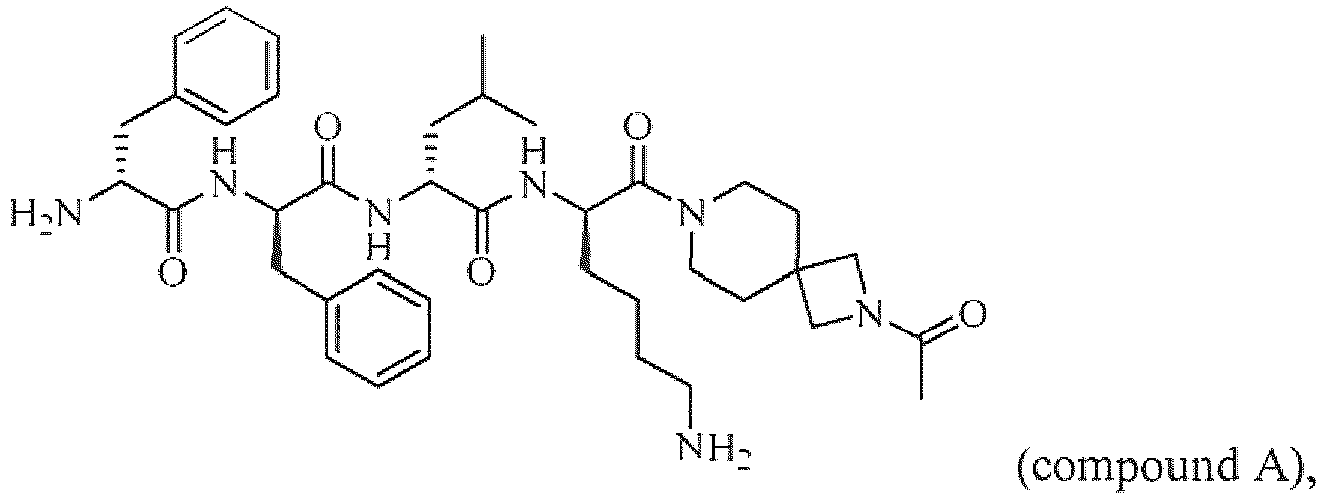 b) an absorption enhancer;wherein the absorption enhancer is selected from one or more of N-[8-(2-hydroxybenzoyl)amino]octanoic acid or a pharmaceutically acceptable salt thereof, 4-[(4-chloro-2-hydroxy-benzoyl)amino]butyric acid or a pharmaceutically acceptable salt thereof, lauroyl-L-carnitine or a hydrochloride thereof, sodium caprylate, sodium caprate, capric acid, caprylocaproyl macrogolglyceride; preferably, the pharmaceutically acceptable salt is selected from sodium salt, potassium salt or calcium salt.
 - The oral pharmaceutical composition of claim 1, wherein the absorption enhancer is selected from N-[8-(2-hydroxybenzoyl)amino]octanoic acid or a pharmaceutically acceptable salt thereof;preferably, the weight ratio of compound A to N-[8-(2-hydroxybenzoyl)amino]octanoic acid or a pharmaceutically acceptable salt thereof is 1 : 20-1 : 80, preferably 1 : 40-1 : 60, further preferably 1 : 40;preferably, the oral pharmaceutical composition further comprises one or more non-active ingredients selected from(1) a filler, which is preferably selected from one or more of microcrystalline cellulose, lactose, mannitol, anhydrous calcium hydrogenphosphate, pregelatinized starch, calcium hydrogenphosphate dihydrate;(2) a binder, which is preferably selected from one or more of povidone, copovidone, a cellulose derivative, wherein the cellulose derivative is selected from one or more of hydroxypropylcellulose, hypromellose, methyl cellulose;(3) a disintegrant, which is preferably selected from one or more of crospovidone, low substituted hydroxypropyl cellulose, croscarmellose sodium, sodium carboxymethyl starch;(4) a pH regulator, which is preferably selected from one or more of citric acid, anhydrous citric acid, tartaric acid, fumaric acid, sodium citrate, calcium hydrogenphosphate, calcium carbonate;(5) a surfactant, which is preferably selected from one or more of polyethylene glycol, poloxamer, phospholipid, Tween 80, Span 40, propylene glycol monolaurate, sodium dodecyl sulfate;(6) a lubricant, which is preferably selected from one or more of magnesium stearate, stearic acid, sodium stearyl fumarate, glyceryl behenate.
- The oral pharmaceutical composition of claim 1, wherein the absorption enhancer is selected from 4-[(4-chloro-2-hydroxy-benzoyl)amino]butyric acid or a pharmaceutically acceptable salt thereof;
preferably, the weight ratio of compound A to 4-[(4-chloro-2-hydroxybenzoyl)amino]butyric acid or a pharmaceutically acceptable salt thereof is 1 : 20-1 : 200, further preferably 1 : 40-1 : 80, more further preferably 1 : 40 or 3 : 200. - The oral pharmaceutical composition of claim 3, further comprising one or more non-active ingredients selected from(1) a filler, which is preferably selected from one or more of microcrystalline cellulose, lactose, mannitol, anhydrous calcium hydrogenphosphate, pregelatinized starch, calcium hydrogenphosphate dihydrate;(2) a binder, which is preferably selected from one or more of povidone, copovidone, a cellulose derivative, wherein the cellulose derivative is selected from one or more of hydroxypropylcellulose, hypromellose, methyl cellulose;(3) a disintegrant, which is preferably selected from one or more of crospovidone, low substituted hydroxypropyl cellulose, croscarmellose sodium, sodium carboxymethyl starch;(4) a pH regulator, which is preferably selected from one or more of citric acid, anhydrous citric acid, tartaric acid, fumaric acid, sodium citrate, calcium hydrogenphosphate, calcium carbonate;(5) a surfactant, which is preferably selected from one or more of polyethylene glycol, poloxamer, phospholipid, Tween 80, Span 40, propylene glycol monolaurate, sodium dodecyl sulfate;(6) a lubricant, which is preferably selected from one or more of magnesium stearate, stearic acid, sodium stearyl fumarate, glyceryl behenate.
- The oral pharmaceutical composition of claim 4, wherein the non-active ingredient is a lubricant; preferably, the weight ratio of compound A: 4-[(4-chloro-2-hydroxybenzoyl)amino]butyric acid or a pharmaceutically acceptable salt thereof: the lubricant is 1 : (20-200) : (0.2-2), preferably 1 : 200 : 2;
preferably, the lubricant is magnesium stearate. - The oral pharmaceutical composition of claim 4, wherein the non-active ingredient is a filler and a binder; preferably, the weight ratio of compound A: 4-[(4-chloro-2-hydroxy-benzoyl)amino]butyric acid or a pharmaceutically acceptable salt thereof : the filler : the binder is 1 : (20-200) : 200 : 5, preferably 1 : 200 : 200 : 5;
preferably, the filler is microcrystalline cellulose, and the binder is povidone. - The oral pharmaceutical composition of claim 4, wherein the non-active ingredient is a filler, a binder and a lubricant; preferably, the weight ratio of compound A: 4-[(4-chloro-2-hydroxy-benzoyl)amino]butyric acid or a pharmaceutically acceptable salt thereof : the filler : the binder : the lubricant is 1 : (20-200) : 200 : 5 : (1-5), preferably 3 : 200 : 200 : 5 : 4,1 : 200 : 200 : 5 : 4 or 3 : 200 : 200 : 5 : 1;
preferably, the filler is selected from microcrystalline cellulose or anhydrous calcium hydrogenphosphate, the binder is povidone, and the lubricant is magnesium stearate. - The oral pharmaceutical composition of claim 4, wherein the non-active ingredient is a surfactant, a filler and a lubricant; preferably, the weight ratio of compound A: 4-[(4-chloro-2-hydroxy-benzoyl)amino]butyric acid or a pharmaceutically acceptable salt thereof : the surfactant : the filler : the lubricant is 3 : 200 : 6 : 200 : 1;
preferably, the surfactant is propylene glycol monolaurate and/or polyethylene glycol, the filler is anhydrous calcium hydrogenphosphate, and the lubricant is magnesium stearate. - The oral pharmaceutical composition of claim 1, wherein the absorption enhancer is selected from lauroyl-L-carnitine or a hydrochloride thereof;preferably, the weight ratio of compound A to lauroyl-L-carnitine or a hydrochloride thereof is 1 : 10-1 : 150, preferably 1 : 10-1 : 100, further preferably 1 : 10-1 : 75;preferably, the oral pharmaceutical compositionfurther comprises one or more non-active ingredients selected from(1) a filler, which is preferably selected from one or more of microcrystalline cellulose, lactose, mannitol, anhydrous calcium hydrogenphosphate, pregelatinized starch, calcium hydrogenphosphate dihydrate;(2) a binder, which is preferably selected from one or more of povidone, copovidone, a cellulose derivative, wherein the cellulose derivative is selected from one or more of hydroxypropylcellulose, hypromellose, methyl cellulose;(3) a disintegrant, which is preferably selected from one or more of crospovidone, low substituted hydroxypropyl cellulose, croscarmellose sodium, sodium carboxymethyl starch;(4) a pH regulator, which is preferably selected from one or more of citric acid, anhydrous citric acid, tartaric acid, fumaric acid, sodium citrate, calcium hydrogenphosphate, calcium carbonate;(5) a surfactant, which is preferably selected from one or more of polyethylene glycol, poloxamer, phospholipid, Tween 80, Span 40, propylene glycol monolaurate, sodium dodecyl sulfate;(6) a lubricant, which is preferably selected from one or more of magnesium stearate, stearic acid, sodium stearyl fumarate, glyceryl behenate;preferably, the non-active ingredient is a pH regulator; preferably, the weight ratio of compound A : lauroyl-L-carnitine or a hydrochloride thereof : the pH regulator is 1 : (10-50) : 24;preferably, the pH regulator is citric acid.
- The oral pharmaceutical composition of claim 1, wherein the absorption enhancer is sodium caprate;preferably, the weight ratio of compound A to sodium caprate is 1 : 50-1 : 200, preferably 1 : 100-1 : 200, further preferably 1 : 100;preferably, the oral pharmaceutical composition further comprises one or more non-active ingredients selected from(1) a filler, which is preferably selected from one or more of microcrystalline cellulose, lactose, mannitol, anhydrous calcium hydrogenphosphate, pregelatinized starch, calcium hydrogenphosphate dihydrate;(2) a binder, which is preferably selected from one or more of povidone, copovidone, a cellulose derivative, wherein the cellulose derivative is selected from one or more of hydroxypropylcellulose, hypromellose, methyl cellulose;(3) a disintegrant, which is preferably selected from one or more of crospovidone, low substituted hydroxypropyl cellulose, croscarmellose sodium, sodium carboxymethyl starch;(4) a glyceride, which is preferably selected from one or more of monocaprylin, tricaprylin;(5) a surfactant, which is preferably selected from one or more of polyethylene glycol, poloxamer, phospholipid, Tween 80, Span 40, propylene glycol monolaurate, sodium dodecyl sulfate;(6) a lubricant, which is preferably selected from one or more of magnesium stearate, stearic acid, sodium stearyl fumarate, glyceryl behenate.
- The oral pharmaceutical composition of claim 1, wherein the absorption enhancer is capric acid;
preferably, the oral pharmaceutical composition further comprises one or more non-active ingredients selected from(1) a filler, which is preferably selected from one or more of microcrystalline cellulose, lactose, mannitol, anhydrous calcium hydrogenphosphate, pregelatinized starch, calcium hydrogenphosphate dihydrate;(2) a binder, which is preferably selected from one or more of povidone, copovidone, a cellulose derivative, wherein the cellulose derivative is selected from one or more of hydroxypropylcellulose, hypromellose, methyl cellulose;(3) a hydrophobic medium, which is preferably selected from one or more of coconut oil, castor oil, olive oil;(4) a surfactant, which is preferably selected from one or more of caprylocaproyl macrogolglyceride, polyethylene glycol, poloxamer, phospholipid, Tween 80, Span 40, propylene glycol monolaurate, sodium dodecyl sulfate;(5) a glyceride, which is preferably selected from one or more of monocaprylin, tricaprylin. - The oral pharmaceutical composition of claim 1, wherein the absorption enhancer is caprylocaproyl macrogolglyceride;preferably, the weight ratio of compound A to caprylocaproyl macrogolglyceride is 1 : 600-1 : 3600, preferably 1 : 2400-1 : 3600, further preferably 1 : 2400.preferably, the oral pharmaceutical composition further comprises one or more non-active ingredients selected from(1) a hydrophobic medium, which is preferably selected from one or more of coconut oil, castor oil, olive oil;(2) a surfactant, which is preferably selected from one or more of polyethylene glycol, poloxamer, phospholipid, Tween 80, Span 40, propylene glycol monolaurate, sodium dodecyl sulfate;(3) a glyceride, which is preferably selected from one or more of monocaprylin, tricaprylin.
- A method for preparing the oral pharmaceutical composition of any one of claims 1-12, comprising the following step: compound A, the absorption enhancer and other non-active ingredients are mixed directly, and then filled into capsules or compressed into tablets; or compound A, the absorption enhancer and other non-active ingredients are wet granulated and then filled into capsules or compressed into tablets; or compound A, the absorption enhancer and other hydrophilic non-active ingredients are wet granulated, then dispersed in a hydrophobic medium, and filled into capsules; or compound A, the absorption enhancer and other non-active ingredients are dissolved in purified water to prepare a solution; or compound A, the absorption enhancer and other non-active ingredients are dissolved, dried and pulverized, and then filled into capsules or compressed into tablets.
- The oral pharmaceutical composition of any one of claims 1-12 for use in treating diseases or conditions related to the κ-opioid receptor;preferably, the diseases or conditions related to the κ-opioid receptor are selected from pain, inflammation, itching, edema, hyponatremia, hypokalemia, intestinal obstruction, cough and glaucoma;preferably, the pain is selected from neuropathic pain, somatic pain, visceral pain and skin pain;preferably, the diseases or conditions are selected from arthritis pain, kidney stone pain, hysterotrismus, dysmenorrhea, endometriosis, dyspepsia, pain after surgery, pain after medical treatment, ocular pain, otitis pain, breakthrough cancer pain, and pain associated with GI disorders.
Applications Claiming Priority (3)
| Application Number | Priority Date | Filing Date | Title |
|---|---|---|---|
| CN202010179149 | 2020-03-18 | ||
| CN202110268405 | 2021-03-12 | ||
| PCT/CN2021/081224 WO2021185265A1 (en) | 2020-03-18 | 2021-03-17 | Oral pharmaceutical composition |
Publications (3)
| Publication Number | Publication Date |
|---|---|
| EP4122483A1 EP4122483A1 (en) | 2023-01-25 |
| EP4122483A4 EP4122483A4 (en) | 2024-03-27 |
| EP4122483B1 true EP4122483B1 (en) | 2025-04-30 |
Family
ID=77770153
Family Applications (1)
| Application Number | Title | Priority Date | Filing Date |
|---|---|---|---|
| EP21772438.4A Active EP4122483B1 (en) | 2020-03-18 | 2021-03-17 | Oral pharmaceutical composition |
Country Status (5)
| Country | Link |
|---|---|
| US (1) | US20230172866A1 (en) |
| EP (1) | EP4122483B1 (en) |
| CN (2) | CN118873509A (en) |
| TW (1) | TW202143997A (en) |
| WO (1) | WO2021185265A1 (en) |
Families Citing this family (7)
| Publication number | Priority date | Publication date | Assignee | Title |
|---|---|---|---|---|
| JP2024517396A (en) * | 2021-04-12 | 2024-04-22 | シーザン ハイスーク ファーマシューティカル カンパニー リミテッド | Use of peptide amide compounds in the manufacture of a medicament for treating pruritus |
| KR20240152395A (en) * | 2022-03-23 | 2024-10-21 | 지앙수 엔화 파마수티컬 컴퍼니 리미티드 | Polyamide compounds, their preparation methods and their medicinal uses |
| TW202500144A (en) * | 2023-06-15 | 2025-01-01 | 大陸商西藏海思科製藥有限公司 | Oral pharmaceutical composition of peptide amide compound and preparation method thereof |
| CN116785412B (en) * | 2023-07-27 | 2025-02-28 | 重庆宸安生物制药有限公司 | A GLP-1 analog oral delivery composition |
| CN121941695A (en) * | 2023-09-22 | 2026-04-28 | 江苏恩华药业股份有限公司 | A polyamide salt, its preparation method and application |
| CN117180251A (en) * | 2023-10-19 | 2023-12-08 | 上海市第六人民医院 | Applications of L-carnitine or L-carnitine acetylated derivatives |
| CN121398805A (en) * | 2024-01-05 | 2026-01-23 | 成都国为生物医药有限公司 | Illegal forest oral pharmaceutical composition |
Citations (9)
| Publication number | Priority date | Publication date | Assignee | Title |
|---|---|---|---|---|
| US20020094346A1 (en) * | 1995-05-17 | 2002-07-18 | M. D. Henry C. Lin | Method and compositions for improving digestion and absorption in the small intestine |
| US20090263479A1 (en) * | 2008-04-22 | 2009-10-22 | Solvay Phamaceuticals Gmbh | Formulations for poorly permeable active pharmaceutical ingredients |
| CN101574343A (en) * | 2008-05-07 | 2009-11-11 | 吉林大学 | Medicament composition for treating sugar diabetes |
| CN101627049A (en) * | 2006-11-10 | 2010-01-13 | 卡拉治疗学股份有限公司 | Synthesis of phthalamides |
| WO2010020978A1 (en) * | 2008-08-18 | 2010-02-25 | Oramed Pharmaceuticals Ltd | Methods and compositions for oral administration of proteins |
| CN108135962A (en) * | 2015-10-07 | 2018-06-08 | 塞浦路迈德有限责任公司 | For the pharmaceutical preparation of oral delivery peptide medicament |
| WO2019015644A1 (en) * | 2017-07-21 | 2019-01-24 | 四川海思科制药有限公司 | Peptide amide compound and preparation method and medical use thereof |
| WO2019042247A1 (en) * | 2017-08-28 | 2019-03-07 | 江苏恒瑞医药股份有限公司 | Pharmaceutical composition of cyp17 inhibitor and preparation method therefor |
| CN109862906A (en) * | 2016-08-17 | 2019-06-07 | 安提拉生物有限公司 | Formulations of active agents for oral administration |
Family Cites Families (2)
| Publication number | Priority date | Publication date | Assignee | Title |
|---|---|---|---|---|
| US20040072796A1 (en) * | 2002-04-18 | 2004-04-15 | Embury Stephen H. | Method and composition for preventing pain in sickle cell patients |
| WO2011084618A2 (en) * | 2009-12-16 | 2011-07-14 | Nod Pharmaceuticals, Inc. | Compositions and methods for oral drug delivery |
-
2021
- 2021-03-17 CN CN202410955388.4A patent/CN118873509A/en active Pending
- 2021-03-17 US US17/906,555 patent/US20230172866A1/en active Pending
- 2021-03-17 EP EP21772438.4A patent/EP4122483B1/en active Active
- 2021-03-17 WO PCT/CN2021/081224 patent/WO2021185265A1/en not_active Ceased
- 2021-03-17 CN CN202180017925.5A patent/CN115209910A/en active Pending
- 2021-03-17 TW TW110109517A patent/TW202143997A/en unknown
Patent Citations (9)
| Publication number | Priority date | Publication date | Assignee | Title |
|---|---|---|---|---|
| US20020094346A1 (en) * | 1995-05-17 | 2002-07-18 | M. D. Henry C. Lin | Method and compositions for improving digestion and absorption in the small intestine |
| CN101627049A (en) * | 2006-11-10 | 2010-01-13 | 卡拉治疗学股份有限公司 | Synthesis of phthalamides |
| US20090263479A1 (en) * | 2008-04-22 | 2009-10-22 | Solvay Phamaceuticals Gmbh | Formulations for poorly permeable active pharmaceutical ingredients |
| CN101574343A (en) * | 2008-05-07 | 2009-11-11 | 吉林大学 | Medicament composition for treating sugar diabetes |
| WO2010020978A1 (en) * | 2008-08-18 | 2010-02-25 | Oramed Pharmaceuticals Ltd | Methods and compositions for oral administration of proteins |
| CN108135962A (en) * | 2015-10-07 | 2018-06-08 | 塞浦路迈德有限责任公司 | For the pharmaceutical preparation of oral delivery peptide medicament |
| CN109862906A (en) * | 2016-08-17 | 2019-06-07 | 安提拉生物有限公司 | Formulations of active agents for oral administration |
| WO2019015644A1 (en) * | 2017-07-21 | 2019-01-24 | 四川海思科制药有限公司 | Peptide amide compound and preparation method and medical use thereof |
| WO2019042247A1 (en) * | 2017-08-28 | 2019-03-07 | 江苏恒瑞医药股份有限公司 | Pharmaceutical composition of cyp17 inhibitor and preparation method therefor |
Non-Patent Citations (3)
| Title |
|---|
| CAROLINE TWAROG ET AL: "Intestinal Permeation Enhancers for Oral Delivery of Macromolecules: A Comparison between Salcaprozate Sodium (SNAC) and Sodium Caprate (C10)", PHARMACEUTICS, vol. 11, no. 2, 13 February 2019 (2019-02-13), pages 78, XP055634457, DOI: 10.3390/pharmaceutics11020078 * |
| DOI NOBUYUKI ET AL: "Absorption Enhancement Effect of Acylcarnitines through Changes in Tight Junction Protein in Caco-2 Cell Monolayers", DRUG METABOLISM AND PHARMACOKINETICS, vol. 26, no. 2, 1 January 2011 (2011-01-01), JP, pages 162 - 170, XP93129477, ISSN: 1347-4367, DOI: 10.2133/dmpk.DMPK-10-RG-071 * |
| MORTEN ASSER KARSDAL ET AL: "Lessons learned from the clinical development of oral peptides", BRITISH JOURNAL OF CLINICAL PHARMACOLOGY, BLACKWELL SCIENTIFIC PUBL, GB, vol. 79, no. 5, 22 April 2015 (2015-04-22), pages 720 - 732, XP071601829, ISSN: 0306-5251, DOI: 10.1111/BCP.12557 * |
Also Published As
| Publication number | Publication date |
|---|---|
| WO2021185265A1 (en) | 2021-09-23 |
| CN118873509A (en) | 2024-11-01 |
| EP4122483A4 (en) | 2024-03-27 |
| TW202143997A (en) | 2021-12-01 |
| US20230172866A1 (en) | 2023-06-08 |
| CN115209910A (en) | 2022-10-18 |
| EP4122483A1 (en) | 2023-01-25 |
Similar Documents
| Publication | Publication Date | Title |
|---|---|---|
| EP4122483A1 (en) | Oral pharmaceutical composition | |
| US10201519B2 (en) | Stabilized pediatric suspension of carisbamate | |
| ES2259981T3 (en) | LAXANT COMPOSITION CONTAINING SIMETICONE. | |
| EP2956149B1 (en) | Pharmaceutical compositions for the treatment of helicobacter pylori | |
| CN100389751C (en) | Swallow tablet containing paracetamol | |
| SK104895A3 (en) | Pharmaceutical composition and its use | |
| ES3058528T3 (en) | Process for producing a tablet comprising glp-1 peptides | |
| TW201302198A (en) | Pharmaceutical composition containing nalbuphine and use thereof | |
| US20100209511A1 (en) | sustained release pharmaceutical formulation | |
| TWI461226B (en) | a pharmaceutical composition comprising at least one protein active ingredient that is protected from digestive enzymes | |
| US20090075950A1 (en) | Dosage Forms Containing A PPI, NSAID And A Buffer | |
| CA3055777A1 (en) | Deuterated domperidone compositions, methods, and preparation | |
| EA028749B1 (en) | Solubilized capsule formulation of 1,1-dimethylethyl [(1s)-1-{[(2s,4r)-4-(7-chloro-4-methoxyisoquinolin-1-yloxy)-2-({(1r,2s)-1-[(cyclopropylsulfonyl)carbamoyl]-2-ethenylcyclopropyl}carbamoyl)pyrrolidin-1-yl]carbonyl}-2,2-dimethylpropyl]carbamate | |
| US20230381265A1 (en) | Oligosaccharide formulations of kappa opioid receptor agonists | |
| AU780151B2 (en) | Pharmaceutical agent comprising a benzamide derivative as active ingredient | |
| WO2023247949A1 (en) | An orodispersible pharmaceutical composition of baclofen and its process of preparation | |
| WO2018185669A1 (en) | Effervescent compositions comprising saxagliptin or salt thereof | |
| HK40073810A (en) | Oral pharmaceutical composition | |
| RU2836568C1 (en) | Oligosaccharide formulations based on kappa-opioid receptor agonists | |
| JP2688266B2 (en) | Pharmaceutical composition having aldose reductase inhibitory action and good absorbability | |
| CN109381466A (en) | Promote the therapeutic agent of diabetic wound healing | |
| PT85135B (en) | PROCESS FOR THE PREPARATION OF DIFLUNISAL AND TROMETAMINE MIXTURES | |
| CN121265799A (en) | Losartan potassium pharmaceutical composition and preparation method and application thereof | |
| HK40029064A (en) | Deuterated domperidone compounds for use in ameliorating gastroesophageal reflux disease | |
| HK40029064B (en) | Deuterated domperidone compounds for use in ameliorating gastroesophageal reflux disease |
Legal Events
| Date | Code | Title | Description |
|---|---|---|---|
| STAA | Information on the status of an ep patent application or granted ep patent |
Free format text: STATUS: THE INTERNATIONAL PUBLICATION HAS BEEN MADE |
|
| PUAI | Public reference made under article 153(3) epc to a published international application that has entered the european phase |
Free format text: ORIGINAL CODE: 0009012 |
|
| STAA | Information on the status of an ep patent application or granted ep patent |
Free format text: STATUS: REQUEST FOR EXAMINATION WAS MADE |
|
| 17P | Request for examination filed |
Effective date: 20220907 |
|
| AK | Designated contracting states |
Kind code of ref document: A1 Designated state(s): AL AT BE BG CH CY CZ DE DK EE ES FI FR GB GR HR HU IE IS IT LI LT LU LV MC MK MT NL NO PL PT RO RS SE SI SK SM TR |
|
| DAV | Request for validation of the european patent (deleted) | ||
| DAX | Request for extension of the european patent (deleted) | ||
| RAP1 | Party data changed (applicant data changed or rights of an application transferred) |
Owner name: XIZANG HAISCO PHARMACEUTICAL CO., LTD. |
|
| REG | Reference to a national code |
Free format text: PREVIOUS MAIN CLASS: A61K0038070000 Ipc: A61K0009000000 Ref country code: DE Ref legal event code: R079 Ref document number: 602021030072 Country of ref document: DE Free format text: PREVIOUS MAIN CLASS: A61K0038070000 Ipc: A61K0009000000 |
|
| A4 | Supplementary search report drawn up and despatched |
Effective date: 20240222 |
|
| RIC1 | Information provided on ipc code assigned before grant |
Ipc: A61K 31/438 20060101ALI20240216BHEP Ipc: A61K 9/08 20060101ALI20240216BHEP Ipc: A61K 47/18 20170101ALI20240216BHEP Ipc: A61P 25/04 20060101ALI20240216BHEP Ipc: A61K 47/20 20060101ALI20240216BHEP Ipc: A61K 9/48 20060101ALI20240216BHEP Ipc: A61K 9/20 20060101ALI20240216BHEP Ipc: A61K 38/07 20060101ALI20240216BHEP Ipc: A61K 9/00 20060101AFI20240216BHEP |
|
| GRAP | Despatch of communication of intention to grant a patent |
Free format text: ORIGINAL CODE: EPIDOSNIGR1 |
|
| STAA | Information on the status of an ep patent application or granted ep patent |
Free format text: STATUS: GRANT OF PATENT IS INTENDED |
|
| INTG | Intention to grant announced |
Effective date: 20241107 |
|
| GRAS | Grant fee paid |
Free format text: ORIGINAL CODE: EPIDOSNIGR3 |
|
| GRAA | (expected) grant |
Free format text: ORIGINAL CODE: 0009210 |
|
| STAA | Information on the status of an ep patent application or granted ep patent |
Free format text: STATUS: THE PATENT HAS BEEN GRANTED |
|
| AK | Designated contracting states |
Kind code of ref document: B1 Designated state(s): AL AT BE BG CH CY CZ DE DK EE ES FI FR GB GR HR HU IE IS IT LI LT LU LV MC MK MT NL NO PL PT RO RS SE SI SK SM TR |
|
| REG | Reference to a national code |
Ref country code: CH Ref legal event code: EP Ref country code: GB Ref legal event code: FG4D |
|
| P01 | Opt-out of the competence of the unified patent court (upc) registered |
Free format text: CASE NUMBER: APP_18439/2025 Effective date: 20250416 |
|
| REG | Reference to a national code |
Ref country code: IE Ref legal event code: FG4D |
|
| REG | Reference to a national code |
Ref country code: DE Ref legal event code: R096 Ref document number: 602021030072 Country of ref document: DE |
|
| REG | Reference to a national code |
Ref country code: NL Ref legal event code: MP Effective date: 20250430 |
|
| REG | Reference to a national code |
Ref country code: AT Ref legal event code: MK05 Ref document number: 1789392 Country of ref document: AT Kind code of ref document: T Effective date: 20250430 |
|
| PG25 | Lapsed in a contracting state [announced via postgrant information from national office to epo] |
Ref country code: ES Free format text: LAPSE BECAUSE OF FAILURE TO SUBMIT A TRANSLATION OF THE DESCRIPTION OR TO PAY THE FEE WITHIN THE PRESCRIBED TIME-LIMIT Effective date: 20250430 Ref country code: PT Free format text: LAPSE BECAUSE OF FAILURE TO SUBMIT A TRANSLATION OF THE DESCRIPTION OR TO PAY THE FEE WITHIN THE PRESCRIBED TIME-LIMIT Effective date: 20250901 Ref country code: FI Free format text: LAPSE BECAUSE OF FAILURE TO SUBMIT A TRANSLATION OF THE DESCRIPTION OR TO PAY THE FEE WITHIN THE PRESCRIBED TIME-LIMIT Effective date: 20250430 |
|
| REG | Reference to a national code |
Ref country code: LT Ref legal event code: MG9D |
|
| PG25 | Lapsed in a contracting state [announced via postgrant information from national office to epo] |
Ref country code: GR Free format text: LAPSE BECAUSE OF FAILURE TO SUBMIT A TRANSLATION OF THE DESCRIPTION OR TO PAY THE FEE WITHIN THE PRESCRIBED TIME-LIMIT Effective date: 20250731 Ref country code: NO Free format text: LAPSE BECAUSE OF FAILURE TO SUBMIT A TRANSLATION OF THE DESCRIPTION OR TO PAY THE FEE WITHIN THE PRESCRIBED TIME-LIMIT Effective date: 20250730 |
|
| PG25 | Lapsed in a contracting state [announced via postgrant information from national office to epo] |
Ref country code: NL Free format text: LAPSE BECAUSE OF FAILURE TO SUBMIT A TRANSLATION OF THE DESCRIPTION OR TO PAY THE FEE WITHIN THE PRESCRIBED TIME-LIMIT Effective date: 20250430 Ref country code: PL Free format text: LAPSE BECAUSE OF FAILURE TO SUBMIT A TRANSLATION OF THE DESCRIPTION OR TO PAY THE FEE WITHIN THE PRESCRIBED TIME-LIMIT Effective date: 20250430 |
|
| PG25 | Lapsed in a contracting state [announced via postgrant information from national office to epo] |
Ref country code: BG Free format text: LAPSE BECAUSE OF FAILURE TO SUBMIT A TRANSLATION OF THE DESCRIPTION OR TO PAY THE FEE WITHIN THE PRESCRIBED TIME-LIMIT Effective date: 20250430 |
|
| PG25 | Lapsed in a contracting state [announced via postgrant information from national office to epo] |
Ref country code: HR Free format text: LAPSE BECAUSE OF FAILURE TO SUBMIT A TRANSLATION OF THE DESCRIPTION OR TO PAY THE FEE WITHIN THE PRESCRIBED TIME-LIMIT Effective date: 20250430 |
|
| PG25 | Lapsed in a contracting state [announced via postgrant information from national office to epo] |
Ref country code: AT Free format text: LAPSE BECAUSE OF FAILURE TO SUBMIT A TRANSLATION OF THE DESCRIPTION OR TO PAY THE FEE WITHIN THE PRESCRIBED TIME-LIMIT Effective date: 20250430 |
|
| PG25 | Lapsed in a contracting state [announced via postgrant information from national office to epo] |
Ref country code: RS Free format text: LAPSE BECAUSE OF FAILURE TO SUBMIT A TRANSLATION OF THE DESCRIPTION OR TO PAY THE FEE WITHIN THE PRESCRIBED TIME-LIMIT Effective date: 20250731 |
|
| PG25 | Lapsed in a contracting state [announced via postgrant information from national office to epo] |
Ref country code: IS Free format text: LAPSE BECAUSE OF FAILURE TO SUBMIT A TRANSLATION OF THE DESCRIPTION OR TO PAY THE FEE WITHIN THE PRESCRIBED TIME-LIMIT Effective date: 20250830 |
|
| PG25 | Lapsed in a contracting state [announced via postgrant information from national office to epo] |
Ref country code: LV Free format text: LAPSE BECAUSE OF FAILURE TO SUBMIT A TRANSLATION OF THE DESCRIPTION OR TO PAY THE FEE WITHIN THE PRESCRIBED TIME-LIMIT Effective date: 20250430 |
|
| PG25 | Lapsed in a contracting state [announced via postgrant information from national office to epo] |
Ref country code: DK Free format text: LAPSE BECAUSE OF FAILURE TO SUBMIT A TRANSLATION OF THE DESCRIPTION OR TO PAY THE FEE WITHIN THE PRESCRIBED TIME-LIMIT Effective date: 20250430 Ref country code: SM Free format text: LAPSE BECAUSE OF FAILURE TO SUBMIT A TRANSLATION OF THE DESCRIPTION OR TO PAY THE FEE WITHIN THE PRESCRIBED TIME-LIMIT Effective date: 20250430 |
|
| PG25 | Lapsed in a contracting state [announced via postgrant information from national office to epo] |
Ref country code: CZ Free format text: LAPSE BECAUSE OF FAILURE TO SUBMIT A TRANSLATION OF THE DESCRIPTION OR TO PAY THE FEE WITHIN THE PRESCRIBED TIME-LIMIT Effective date: 20250430 |
|
| PG25 | Lapsed in a contracting state [announced via postgrant information from national office to epo] |
Ref country code: EE Free format text: LAPSE BECAUSE OF FAILURE TO SUBMIT A TRANSLATION OF THE DESCRIPTION OR TO PAY THE FEE WITHIN THE PRESCRIBED TIME-LIMIT Effective date: 20250430 |
|
| PG25 | Lapsed in a contracting state [announced via postgrant information from national office to epo] |
Ref country code: SK Free format text: LAPSE BECAUSE OF FAILURE TO SUBMIT A TRANSLATION OF THE DESCRIPTION OR TO PAY THE FEE WITHIN THE PRESCRIBED TIME-LIMIT Effective date: 20250430 |
|
| PG25 | Lapsed in a contracting state [announced via postgrant information from national office to epo] |
Ref country code: IT Free format text: LAPSE BECAUSE OF FAILURE TO SUBMIT A TRANSLATION OF THE DESCRIPTION OR TO PAY THE FEE WITHIN THE PRESCRIBED TIME-LIMIT Effective date: 20250430 |
|
| REG | Reference to a national code |
Ref country code: DE Ref legal event code: R097 Ref document number: 602021030072 Country of ref document: DE |
|
| PLBE | No opposition filed within time limit |
Free format text: ORIGINAL CODE: 0009261 |
|
| STAA | Information on the status of an ep patent application or granted ep patent |
Free format text: STATUS: NO OPPOSITION FILED WITHIN TIME LIMIT |
|
| REG | Reference to a national code |
Ref country code: CH Ref legal event code: L10 Free format text: ST27 STATUS EVENT CODE: U-0-0-L10-L00 (AS PROVIDED BY THE NATIONAL OFFICE) Effective date: 20260311 |
|
| 26N | No opposition filed |
Effective date: 20260202 |
|
| PGFP | Annual fee paid to national office [announced via postgrant information from national office to epo] |
Ref country code: GB Payment date: 20260323 Year of fee payment: 6 |
|
| PGFP | Annual fee paid to national office [announced via postgrant information from national office to epo] |
Ref country code: DE Payment date: 20260313 Year of fee payment: 6 |
|
| PGFP | Annual fee paid to national office [announced via postgrant information from national office to epo] |
Ref country code: FR Payment date: 20260330 Year of fee payment: 6 |