EP4121716B1 - Self-leveling system for rotating laser systems - Google Patents
Self-leveling system for rotating laser systems Download PDFInfo
- Publication number
- EP4121716B1 EP4121716B1 EP21705403.0A EP21705403A EP4121716B1 EP 4121716 B1 EP4121716 B1 EP 4121716B1 EP 21705403 A EP21705403 A EP 21705403A EP 4121716 B1 EP4121716 B1 EP 4121716B1
- Authority
- EP
- European Patent Office
- Prior art keywords
- tilt
- rotation head
- accelerometer
- adjusting
- acceleration
- Prior art date
- Legal status (The legal status is an assumption and is not a legal conclusion. Google has not performed a legal analysis and makes no representation as to the accuracy of the status listed.)
- Active
Links
Images





Classifications
-
- G—PHYSICS
- G01—MEASURING; TESTING
- G01C—MEASURING DISTANCES, LEVELS OR BEARINGS; SURVEYING; NAVIGATION; GYROSCOPIC INSTRUMENTS; PHOTOGRAMMETRY OR VIDEOGRAMMETRY
- G01C15/00—Surveying instruments or accessories not provided for in groups G01C1/00 - G01C13/00
- G01C15/002—Active optical surveying means
- G01C15/008—Active optical surveying means combined with inclination sensor
-
- G—PHYSICS
- G01—MEASURING; TESTING
- G01B—MEASURING LENGTH, THICKNESS OR SIMILAR LINEAR DIMENSIONS; MEASURING ANGLES; MEASURING AREAS; MEASURING IRREGULARITIES OF SURFACES OR CONTOURS
- G01B11/00—Measuring arrangements characterised by the use of optical techniques
- G01B11/002—Measuring arrangements characterised by the use of optical techniques for measuring two or more coordinates
-
- G—PHYSICS
- G01—MEASURING; TESTING
- G01C—MEASURING DISTANCES, LEVELS OR BEARINGS; SURVEYING; NAVIGATION; GYROSCOPIC INSTRUMENTS; PHOTOGRAMMETRY OR VIDEOGRAMMETRY
- G01C15/00—Surveying instruments or accessories not provided for in groups G01C1/00 - G01C13/00
- G01C15/002—Active optical surveying means
- G01C15/004—Reference lines, planes or sectors
-
- G—PHYSICS
- G01—MEASURING; TESTING
- G01C—MEASURING DISTANCES, LEVELS OR BEARINGS; SURVEYING; NAVIGATION; GYROSCOPIC INSTRUMENTS; PHOTOGRAMMETRY OR VIDEOGRAMMETRY
- G01C15/00—Surveying instruments or accessories not provided for in groups G01C1/00 - G01C13/00
- G01C15/002—Active optical surveying means
- G01C15/004—Reference lines, planes or sectors
- G01C15/006—Detectors therefor
-
- G—PHYSICS
- G01—MEASURING; TESTING
- G01S—RADIO DIRECTION-FINDING; RADIO NAVIGATION; DETERMINING DISTANCE OR VELOCITY BY USE OF RADIO WAVES; LOCATING OR PRESENCE-DETECTING BY USE OF THE REFLECTION OR RERADIATION OF RADIO WAVES; ANALOGOUS ARRANGEMENTS USING OTHER WAVES
- G01S17/00—Systems using the reflection or reradiation of electromagnetic waves other than radio waves, e.g. lidar systems
- G01S17/02—Systems using the reflection of electromagnetic waves other than radio waves
- G01S17/06—Systems determining position data of a target
- G01S17/08—Systems determining position data of a target for measuring distance only
Definitions
- the present invention relates generally to rotating laser systems, and more particularly to a self-leveling laser transmitter for rotating laser systems.
- Preparation of worksites typically involves grading and excavating portions of the worksite into desired topologies.
- Positional measuring is an important aspect in worksite preparation in order to improve the accuracy of such grading and excavating.
- Laser measuring systems are commonly used by construction machines (e.g., dozers, scrapers, excavators, etc.) to facilitate positional measuring.
- a laser transmitter of a laser measuring system will transmit a laser signal and a laser receiver of the laser measuring system will receive the laser signal to determine positional measurements of the laser receiver.
- the laser transmitter must be leveled.
- laser measuring systems are self-leveled by measuring tilt angles using two non-rotating inclinometers either of vial type or MEMS (microelectromechanical systems) type and adjusting the tilt using one or more motors.
- MEMS microelectromechanical systems
- One disadvantage of such conventional laser measuring systems is that the assembly of the inclinometers must be calibrated so that the zero angles of the inclinometers exactly correspond to the vertical axis of rotation. Such calibration is typically performed during manufacturing by applying additional calibration steps to align the inclinometers to the rotational axis.
- Such conventional laser measuring systems are also prone to losing calibration due to, e.g., the laser transmitter being dropped.
- CN 208 012 530 U discloses the following: It is disclosed a laser leveling device suitable for ultra-high collision avoidance of bridges, comprising a laser range finder, a controller and a power supply for supplying power to the laser leveling instrument and characterized in that it further comprises a driving mechanism and a single degree of freedom gravity accelerometer and a horizontal positioning locking mechanism for fixing the position of a laser emitting head of the laser range finder, wherein the driving mechanism comprises a driver, a laser emitting head rotating seat, wherein the output end of the driver is connected to the laser emitting head rotating seat, wherein the laser emitting head rotating seat is mounted on the rotating base of the laser emitting head, wherein the gravity accelerometer is mounted coaxially with the laser emitting head of the laser range finder, wherein the controller controls the driver to drive the rotation of the laser emitting head, and wherein the acceleration signal of the gravity accelerometer is fed back to the controller.
- the driving mechanism comprises a driver, a laser emitting head rotating seat, wherein the output end of
- a laser surveying system comprises a leveling unit having a motor for leveling, a light source unit for emitting a laser beam, a light projecting optical system installed on the leveling unit and for projecting the laser beam, a power supply unit for supplying electric power to each of component sites, a control unit for driving and controlling each of the component sites, a storage unit, a tilt detecting means installed on the leveling unit and used for detecting leveling conditions, a rotation number detecting means for detecting number of rotations of the motor, a light source detecting means for detecting light emitting condition of the light source unit, a voltage detecting means for detecting output voltage of the power source unit, and an abnormality detecting means for detecting operational abnormality, and in the laser surveying system, the control unit monitors whether there is abnormality or not by the abnormality detecting means, samples a detection signal from each of the detecting means at a predetermined time interval, and stores signal groups thus detected in the storage unit in time series as sampling data,
- a self-leveling laser transmitter is provided.
- the self-leveling laser transmitter achieves a high degree of accuracy without the use of expensive inclinometers.
- a laser transmitter comprises a rotation head and an accelerometer mounted on the rotation head.
- An acceleration signal is received from the accelerometer and one or more tilt adjustment signals for adjusting a tilt of the rotation head to a leveled orientation are generated based on the acceleration signal.
- One or more actuators adjust the tilt of the rotation head based on the one or more tilt adjustment signals.
- the acceleration signal represents at least one of acceleration on a tangential axis of the accelerometer and acceleration on a radius axis of the accelerometer as the accelerometer rotates.
- the one or more tilt adjustment signals are determined to substantially eliminate a sinusoidal component from the acceleration signal. In one embodiment, the one or more tilt adjustment signals are determined based on an angle of misalignment between a reference angle of an encoder of the laser transmitter and a reference angle of the one or more actuators. In another embodiment, the one or more tilt adjustment signals are determined to minimize an amplitude of the acceleration signal.
- a first tilt adjustment signal for adjusting a tilt of the rotation head in a first dimension and a second tilt adjustment signal for adjusting a tilt of the rotation head in a second dimension are determined.
- a first actuator adjusts the tilt of the rotation head in the first dimension based on the first tilt adjustment signal and a second actuator adjusts the tilt of the rotation head in the second dimension based on the second tilt adjustment signal.
- a self-leveling apparatus such as, e.g., a laser transmitter.
- the self-leveling apparatus comprises a rotation head and an accelerometer mounted on the rotation head.
- An acceleration signal is received from the accelerometer and one or more tilt adjustment signals for adjusting a tilt of the rotation head to a leveled orientation are generated based on the acceleration signal.
- the acceleration signal represents at least one of acceleration on a tangential axis of the accelerometer and acceleration on a radial axis of the accelerometer as the accelerometer rotates;
- One or more actuators adjust the tilt of the rotation head based on the one or more tilt adjustment signals.
- FIG. 1 shows a laser measuring system 100, in accordance with one or more embodiments.
- Laser measuring system 100 includes a laser transmitter 102 and a laser receiver 104.
- laser receiver 104 is configured to be attached to a surveying pole 106.
- laser receiver 104 may be configured to be attached to a construction machine (e.g., excavator, dump truck, bull dozer, etc.) or may be a hand held device.
- laser measuring system 100 may include any number of laser receivers for calculating position and orientation information for each laser receiver 104 based on laser beams received from laser transmitter 102.
- Laser Transmitter 102 comprises a rotation head 110 mounted on a tripod 108 or any other base (e.g., surveying pole, construction machine, etc.) on which rotation head 110 rotates.
- Laser transmitter 102 projects laser signal 112 in rotary irradiation at a constant speed to laser receiver 104.
- laser signal 112 is an N-shaped beam, as described in U.S. Patent No. 7,196,302, issued March 27, 2007 , the disclosure of which is incorporated herein by reference in its entirety.
- laser beam 112 may be any suitable laser beam (e.g., an I-shaped beam).
- laser transmitter 102 is laser transmitter 200 shown in FIG. 2 , described in detail below.
- Positional measurements of laser receiver 104 are determined based on laser signals transmitted by laser transmitter 102 and received by laser receiver 104.
- rotation head 110 of laser transmitter 102 must be leveled.
- Rotation head 110 is leveled when the rotation axis of rotation head 110 is substantially parallel to the vector of gravity.
- rotation head 110 of laser transmitter 102 is configured with an accelerometer and rotation head 110 is leveled by determining tilt adjustment signals based on an acceleration measured by the accelerometer and adjusting the tilt of rotation head 110 to a leveled orientation based on the one or more tilt adjustment signals.
- Embodiments of the present invention may be applied for leveling a laser transmitter, such as, e.g., a 3D laser transmitter as described in U.S. Patent No. 10,145,671, issued December 4, 2018 , or an N-beam laser transmitter.
- a laser transmitter such as, e.g., a 3D laser transmitter as described in U.S. Patent No. 10,145,671, issued December 4, 2018
- an N-beam laser transmitter such as, e.g., a 3D laser transmitter as described in U.S. Patent No. 10,145,671, issued December 4, 2018
- N-beam laser transmitter such as, e.g., N-beam laser transmitter.
- embodiments of the present invention may be applied for leveling rotational systems of any type, such as, e.g., for leveling a reference plane of a laser system or for a high-accuracy plumb tool for construction.
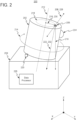
- FIG. 2 shows a detailed view of a laser transmitter 200, in accordance with one or more embodiments.
- laser transmitter 200 is laser transmitter 102 of FIG. 1 .
- Laser transmitter 200 comprises a rotation head 202 mounted on a base 204 attached to, e.g., tripod, surveying pole, construction machine, etc.
- Rotation head 202 rotates about rotation axis 212 in a clockwise direction 214 (or a counter-clockwise direction in some embodiments).
- one or more laser diodes (not shown), or other laser sources, project laser signals through transmitter lens 224.
- Rotation head 202 includes an accelerometer 206 to facilitate leveling of rotation head 202.
- Accelerometer 206 may be any suitable accelerometer having at least one sensing axis and having a suitable minimum sampling frequency and noise density.
- the minimum sampling frequency is preferably at least twice bigger than the output bandwidth of accelerometer 206.
- the output bandwidth of accelerometer 206 is preferably bigger than the rotation rate of rotation head 202.
- the output bandwidth of accelerometer 206 is at least twice bigger that the rotation rate of rotation head 202.
- Accelerometer 206 may be positioned at any location on or in rotation head 202. In an advantageous embodiment, accelerometer 206 is placed as close as possible to rotation axis 212.
- accelerometer 206 is a single axis accelerometer having sensing axis 228 oriented to measure tangential acceleration of accelerometer 206 as accelerometer 206 rotates (via rotation head 202, e.g., during rotary irradiation) about rotation axis 212.
- accelerometer 206 rotates (via rotation head 202) about rotation axis 212 along a circular path 218.
- Accelerometer 206 is oriented such that its sensing axis 228 is aligned with a tangential axis 208 of circular path 218 of accelerometer 206.
- Tangential axis 208 of accelerometer 206 is perpendicular to rotation axis 212 and perpendicular to a radial axis 216 of accelerometer 206.
- Radial axis 216 is the axis formed between rotation axis 212 and accelerometer 206 and corresponds to the radius of circular path 218 at the location of accelerometer 206.
- Axes 208, 212, and 216 are perpendicular to each other and form an orthogonal 3D system.
- accelerometer 206 is a three axis accelerometer having a first sensing axis 230 oriented to measure radial acceleration of accelerometer 206, a second sensing axis 228 oriented to measure tangential acceleration of accelerometer 206, and a third sensing axis 232 oriented to measure a gravitational acceleration of accelerometer 206. Accordingly, accelerometer 206 is oriented such that the first sensing axis 230 is aligned with radial axis 216, the second sensing axis 228 is aligned with tangential axis 208, and the third sensing axis 232 is aligned with a gravitational axis 222 parallel to rotation axis 212.
- An exemplary output of acceleration signals from a three axis accelerometer is illustratively shown in graph 300 of FIG. 3 , described in more detail below.
- accelerometer 206 may be any suitable accelerometer having at least one sensing axis that is not parallel to rotation axis 212. If the at least one sensing axis of accelerometer 206 is parallel to rotation axis 212, the at least one accelerometer will sense only the DC (direct current) component and no AC (alternating current) component and, thus, cannot be used for self-leveling. In one example, accelerometer 206 may be an inertial measurement unit.
- Accelerometer 206 generates acceleration signals representing acceleration on tangential axis 208 (and, in some embodiments, radial acceleration signals and/or gravitational acceleration signals) and transmits the acceleration signals to a data processor 226 using any suitable data transmission mechanism.
- Data processor 226 may be implemented using any computing device, such as, e.g., computer 1102 of FIG. 11 , and may be integrated within base 204 as shown in FIG. 2 or may be integrated within rotation head 202.
- the data transmission mechanism may transmit acceleration signals between accelerometer 206 and data processor 226, e.g., where data processor 226 is integrated in base 204.
- the data transmission mechanism may also transmits actuator control signals between one or more actuators 220 and data processor 226, e.g., where data processor 226 is integrated in rotation head 202.
- the data transmission mechanism may be based on a wired connection implemented using, e.g., a slip ring. Additionally or alternatively, the data transmission mechanism may be based on a wireless connection implemented using, e.g., radio frequency (RF) transmission or optical transmission using separate simplex channels in both directions. Other data transmission mechanisms may also be employed.
- RF radio frequency
- Data processor 226 receives the acceleration signals from accelerometer 206, generates tilt adjustment signals for adjusting a tilt of rotation head 202 to a leveled orientation, and outputs the tilt adjustment signals to (e.g., two) actuators 220 for adjusting the tilt of rotation head 202 based on the tilt adjustment signals. Data processor 226 determines the tilt adjustment signals to remove any sinusoidal component from the acceleration signals to thereby level rotation head 202. When rotation head 202 is level, rotation axis 212 is parallel to gravitational vector 210. In one embodiment, data processor 226 determines the tilt adjustment signals for leveling rotation head 202 according to method 500 of FIG. 5 . Actuators 220 are coupled between rotation head 202 and base 204 to adjust the tilt of rotation head 202 in two dimensions. In one embodiment, actuators 220 include first and second actuators for adjusting the tilt of rotation head 202 in an X dimension and a Y dimension, respectively. Actuators 220 may include one or more stepper motors with lead screws or any other suitable actuators.
- Accelerometer 206 may be powered via any suitable power transmission mechanism (not shown in FIG. 2 ).
- the power transmission mechanism may be based on a wired connection implemented using, e.g., a slip ring. Additionally or alternatively, the power transmission mechanism may be based on a wireless connection implemented using, e.g., RF power transmission with antennas on the rotation head 202 and base 204 or optical power transmission with light emitting diodes (LEDs) mounted on base 204 and photo diodes or solar cells mounted on rotation head 202 to collect light from the LEDs and convert the light into electricity. Other power transmission mechanisms may also be employed.
- FIG. 3 shows an exemplary graph 300 of acceleration signals generated and output by a three axis accelerometer, in accordance with one or more embodiments.
- the acceleration signals in graph 300 represent acceleration (in m/s 2 ) over time (in seconds). FIG. 3 will be described with reference to FIG. 2 .
- the acceleration signals in graph 300 may be output by accelerometer 206 of FIG. 2 mounted on rotation head 202 of a laser transmitter 200.
- Accelerometer 206 is oriented such that its first sensing axis 230 is aligned with radial axis 216, its second sensing axis 228 is aligned with a tangential axis 208, and its third sensing axis 232 is aligned with gravitational axis 222 (parallel to rotation axis 212). Some misalignment of the sensing axes is acceptable as long as clipping does not occur. An example of clipping is illustratively shown in FIG. 4 , described below.
- Radial acceleration signal 302 represents radial acceleration measured along the radial axis 216 by the first sensing axis 230 when rotation head 202 is not level and radial acceleration signal 304 represents radial acceleration measured along the radial axis 216 by the first sensing axis 230 when rotation head 202 is level.
- Tangential acceleration signal 306 represents tangential acceleration measured along the tangential axis 208 by the second sensing axis 228 when rotation head 202 is not level and tangential acceleration signal 308 represents tangential acceleration measured along the tangential axis 208 by the second sensing axis 228 when rotation head 202 is level.
- Gravitational acceleration signal 310 represents gravitational acceleration measured along the gravitational axis 222 by the third sensing axis 232 when rotation head 202 is not level and gravitational acceleration signal 312 represents gravitational acceleration measured along the gravitational axis 222 by the third sensing axis 232 when rotation head 202 is level.
- Tangential acceleration signals 306 and 308 are not subject to a bias.
- Acceleration signals 302 and 306 are sinusoidal due to the non-level orientation of rotation head 202.
- Gravitational acceleration signals 310 and 312 represent acceleration due to gravity and are not sensitive to the level or non-level orientation of rotation head 202.
- FIG. 4 shows an exemplary graph 400 of a clipping effect of an acceleration signal output by a three axis accelerometer, in accordance with one or more embodiments.
- the acceleration signals in graph 400 represent acceleration (in m/s 2 ) over time (in seconds). FIG. 4 will be described with reference to FIG. 2 .
- the acceleration signals in graph 400 may be output by accelerometer 206 of FIG. 2 mounted and oriented as described above with respect to FIG. 3 .
- Radial acceleration signal 402 represents radial acceleration measured along radial axis 216
- tangential acceleration signal 404 represents tangential acceleration measured along tangential axis 208
- gravitational acceleration signal 406 represents gravitational acceleration measured along gravitational axis 222.
- the clipping results in a flat cutoff at, e.g., 1.5 times gravitational acceleration in radial acceleration signal 402 due to data range constraints of accelerometer 206.
- Some misalignment of the sensing axes is acceptable as long as clipping does not occur, particularly in tangential acceleration signal 404.
- FIG. 5 shows a method 500 for leveling a rotation head of a laser transmitter, in accordance with one or more embodiments. Method 500 will be described with reference to FIG. 2 . In one embodiment, method 500 is performed by data processor 226.
- an acceleration signal is received from an accelerometer 206 mounted on a rotation head 202 of a laser transmitter 200.
- the acceleration signal represents an acceleration on accelerometer 206 measured by a sensing axis 228 of accelerometer 206 aligned with tangential axis 208 as accelerometer 206 rotates about rotation axis 212.
- the acceleration signal represents an acceleration on accelerometer 206 measured by a sensing axis 230 of accelerometer 206 aligned with radial axis 216 as accelerometer 206 rotates about rotation axis 212.
- the acceleration signal represents a linear combination of an acceleration on accelerometer 206 measured by a sensing axis 228 of accelerometer 206 aligned with tangential axis 208 and by a sensing axis 230 of accelerometer 206 aligned with radial axis 216.
- one or more tilt adjustment signals for adjusting a tilt of the rotation head 202 to a leveled orientation are determined based on the acceleration signal.
- the tilt adjustment signals adjust the tilt of rotation head 202 in two dimensions to substantially eliminate a sinusoidal component in the acceleration signal.
- a first tilt adjustment signal is generated for adjusting the tilt of the rotation head 202 in a first dimension (e.g., X dimension) and a second tilt adjustment signal is generated for adjusting the tilt of the rotation head 202 in a second dimension (e.g., Y dimension).
- the tilt adjustment signals are determined as described with respect to FIG. 6 .
- the tilt adjustment signals are determined as described with respect to FIG. 8 .
- the acceleration signal represents (at least in part) acceleration measured by a sensing axis 230 on radial axis 216
- the tilt of the rotation head 202 is adjusted based on the one or more tilt adjustment signals.
- a first actuator adjusts the tilt of rotation head 202 in the first dimension based on the first tilt adjustment signal and a second actuator adjusts the tilt of rotation head 202 in a second dimension based on the second tilt adjustment signal to bring rotation head 202 to a leveled orientation.
- FIG. 6 shows a functional diagram 600 for determining tilt adjustment signals for adjusting a tilt of a rotation head of a laser transmitter to a leveled orientation, in accordance with one or more embodiments.
- Step 504 of FIG. 5 may be implemented according to functional diagram 600, e.g., where the laser transmitter is equipped with an encoder.
- an encoder 604 of a laser transmitter provides an angular position of the rotation head of the laser transmitter.
- Encoder 604 may be any suitable encoder, such as, e.g., an absolute or incremental rotary encoder.
- the angular position is converted to a sine and a cosine signals by sin/cos converter 606, e.g., using a sine look up table or by performing direct calculation of sin(x) and cos(x) functions, where x is the angular position in radians or degrees.
- Multipliers 608 and 610 multiply an acceleration a t 602 with the sine and the cosine respectively to perform a frequency shift.
- Tangential acceleration a t 602 is received from an accelerator mounted on the rotation head and represents acceleration on the accelerator as the accelerator rotates.
- Results of multipliers 608 and 610 are accumulated by integrators 612 and 614 respectively over a period of time for an integer number of rotations of the rotation head. Then the output of integrators 612 and 614 (e.g., a 2D vector) is rotated to an angle of misalignment ⁇ by multiplying the output with a rotation matrix cos ⁇ ⁇ sin ⁇ sin ⁇ cos ⁇ in following steps.
- the integrated results from integrator 612 are multiplied by sin ( ⁇ ) and cos ( ⁇ ) by multipliers 616 and 620 respectively and the integrated results from integrator 614 are multiplied by cos ( ⁇ ) and -sin ( ⁇ ) by multipliers 618 and 622 respectively, where ⁇ is the angle of misalignment between one or more actuators and the reference angle of encoder 604 of the laser transmitter.
- the angle ⁇ of misalignment is further described below with respect to FIG. 7 .
- the results of multipliers 616 and 618 are combined by adder 624 to provide tilt adjustment signals for adjusting the tilt of the rotation head in an X dimension, which are output to an actuator 628.
- multipliers 620 and 622 are combined by adder 626 to provide tilt adjustment signals for adjusting the tilt of the rotation head in a Y dimension, which are output to an actuator 630.
- the tilt adjustment signals eliminate any sinusoidal component on acceleration a t 602.
- Actuators 628 and 630 adjust the tilt of the rotation head in the X and Y dimension respectively according to the tilt adjustment signals to level the rotation head of the laser transmitter.
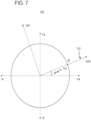
- FIG. 7 shows a graph 700 showing an angle of misalignment between a reference angle of one or more actuators adjusting a tilt of a rotation head of a laser transmitter and a reference angle of an encoder of the laser transmitter, in accordance with one or more embodiments.
- the reference angle (zero) of the encoder is represented by line 702 and corresponds to the cos line.
- the reference angle (zero) of the actuators is represented by the +x axis.
- the angle ⁇ 704 of misalignment is shown as the angle formed by the +x axis and line 702.
- FIG. 8 shows a functional diagram 800 for determining tilt adjustment signals for adjusting a tilt of a rotation head of a laser transmitter to a leveled orientation, in accordance with one or more embodiments.
- Step 504 of FIG. 5 may be implemented according to functional diagram 800, e.g., where the laser transmitter is not equipped with an encoder.
- Local oscillator 804 outputs sin and cos signals at an approximate rate of rotation, which are multiplied with an acceleration a t 802 (e.g., tangential or radial acceleration) by multipliers 806 and 808 respectively.
- Acceleration a t 802 is received from an accelerator mounted on the rotation head and represents acceleration on the accelerator as the accelerator rotates.
- the results of multipliers 806 and 808 are respectively processed by low pass filters 810 and 814 with a bandwidth larger than the difference between the actual rate of rotation and the approximate rate of rotation and squared functions 812 and 816, and are combined by adder 818.
- a minimum search logic block 820 determines tilt adjustment signals for adjusting the tilt of the rotation head in an X dimension and a Y dimension from results of adder 818, which are then output to actuators 822 and 824 to adjust the tilt of the rotation head in the X and Y dimension respectively to a leveled orientation by eliminating sinusoidal component on tangential acceleration a t 802.
- Minimum search logic block 820 determines tilt adjustment signals that substantially eliminate any sinusoidal component from tangential acceleration a t 802.
- minimum search logic block 820 may implemented to apply an algorithm (e.g., minimum search algorithm) to minimize the amplitude of tangential acceleration a t 802.
- Exemplary minimum search algorithms include gradient descent algorithm or an eight point approximation algorithm, as described below with respect to Figures 9 and 10 respectively.
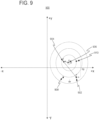
- FIG. 9 shows a high-level diagram 900 for determining tilt adjustment signals to level a rotation head of a laser transmitter using a gradient descent algorithm, in accordance with one or more embodiments.
- the gradient descent algorithm determines tilt adjustment signals to provide a minimum amplitude for the acceleration signal (e.g., tangential or radial acceleration signal).
- the acceleration signal e.g., tangential or radial acceleration signal.
- the amplitude a 0 of the acceleration signal is measured for initial point (x, y) 902 and a dx for point (x+dx, y) 908 and a dy for point (x, y+dy) 910.
- Initial steps dx and dy can be selected arbitrarily or based on the total range of actuator adjustment, e.g. 10% or 5% of total range.
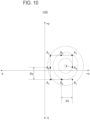
- FIG. 10 shows a high-level diagram 1000 for determining tilt adjustment signals to level a rotation head of a laser transmitter using an eight point approximation algorithm, in accordance with one or more embodiments.
- the eight point approximation algorithm determines tilt adjustment signals to provide a minimum amplitude for the tangential acceleration.
- an initial point (x, y) e.g., determined as the output of adder 818
- an arbitrary dx and dy (dx may equal dy) is determined (e.g., as 5% of the total actuator range).
- the amplitude of the tangential acceleration is measured for eight points: A 1 (x+dx, y-dy), A 2 (x, y-dy), A 3 (x-dx, y-dy), A 4 (x-dx, y), A 5 (x-dx, y+dy), A 6 (x, y+dy), A 7 (x+dx, y+dy), and A 8 (x+dx, y).
- the tilt adjustment signals are determined as ( x + ⁇ x ) and ( y + ⁇ y ), which correspond to the leveled orientation of the rotation head of the laser transmitter.
- Systems, apparatuses, and methods described herein may be implemented using digital circuitry, or using one or more computers using well-known computer processors, memory units, storage devices, computer software, and other components.
- a computer includes a processor for executing instructions and one or more memories for storing instructions and data.
- a computer may also include, or be coupled to, one or more mass storage devices, such as one or more magnetic disks, internal hard disks and removable disks, magneto-optical disks, optical disks, etc.
- Systems, apparatus, and methods described herein may be implemented using a computer program product tangibly embodied in an information carrier, e.g., in a non-transitory machine-readable storage device, for execution by a programmable processor; and the method and workflow steps described herein, including one or more of the steps or functions of FIG. 5 , may be implemented using one or more computer programs that are executable by such a processor.
- a computer program is a set of computer program instructions that can be used, directly or indirectly, in a computer to perform a certain activity or bring about a certain result.
- a computer program can be written in any form of programming language, including compiled or interpreted languages, and it can be deployed in any form, including as a stand-alone program or as a module, component, subroutine, or other unit suitable for use in a computing environment.
- Computer 1102 includes a processor 1104 operatively coupled to a data storage device 1112 and a memory 1110.
- Processor 1104 controls the overall operation of computer 1102 by executing computer program instructions that define such operations.
- the computer program instructions may be stored in data storage device 1112, or other computer readable medium, and loaded into memory 1110 when execution of the computer program instructions is desired.
- FIG. 5 can be defined by the computer program instructions stored in memory 1110 and/or data storage device 1112 and controlled by processor 1104 executing the computer program instructions.
- the computer program instructions can be implemented as computer executable code programmed by one skilled in the art to perform the method and workflow steps or functions of FIG. 5 . Accordingly, by executing the computer program instructions, the processor 1104 executes the method and workflow steps or functions of FIG. 5 .
- Computer 1104 may also include one or more network interfaces 1106 for communicating with other devices via a network.
- Computer 1102 may also include one or more input/output devices 1108 that enable user interaction with computer 1102 (e.g., display, keyboard, mouse, speakers, buttons, etc.).
- Processor 1104 may include both general and special purpose microprocessors, and may be the sole processor or one of multiple processors of computer 1102.
- Processor 1104 may include one or more central processing units (CPUs), for example.
- Processor 1104, data storage device 1112, and/or memory 1110 may include, be supplemented by, or incorporated in, one or more application-specific integrated circuits (ASICs) and/or one or more field programmable gate arrays (FPGAs).
- ASICs application-specific integrated circuits
- FPGAs field programmable gate arrays
- Data storage device 1112 and memory 1110 each include a tangible non-transitory computer readable storage medium.
- Data storage device 1112, and memory 1110 may each include high-speed random access memory, such as dynamic random access memory (DRAM), static random access memory (SRAM), double data rate synchronous dynamic random access memory (DDR RAM), or other random access solid state memory devices, and may include non-volatile memory, such as one or more magnetic disk storage devices such as internal hard disks and removable disks, magneto-optical disk storage devices, optical disk storage devices, flash memory devices, semiconductor memory devices, such as erasable programmable read-only memory (EPROM), electrically erasable programmable read-only memory (EEPROM), compact disc read-only memory (CD-ROM), digital versatile disc read-only memory (DVD-ROM) disks, or other non-volatile solid state storage devices.
- DRAM dynamic random access memory
- SRAM static random access memory
- DDR RAM double data rate synchronous dynamic random access memory
- non-volatile memory such as one
- Input/output devices 1108 may include peripherals, such as a printer, scanner, display screen, etc.
- input/output devices 1108 may include a display device such as a cathode ray tube (CRT) or liquid crystal display (LCD) monitor for displaying information to the user, a keyboard, and a pointing device such as a mouse or a trackball by which the user can provide input to computer 1102.
- display device such as a cathode ray tube (CRT) or liquid crystal display (LCD) monitor for displaying information to the user
- keyboard such as a keyboard
- pointing device such as a mouse or a trackball by which the user can provide input to computer 1102.
- FIG. 11 is a high level representation of some of the components of such a computer for illustrative purposes.
Landscapes
- Physics & Mathematics (AREA)
- Engineering & Computer Science (AREA)
- General Physics & Mathematics (AREA)
- Radar, Positioning & Navigation (AREA)
- Remote Sensing (AREA)
- Electromagnetism (AREA)
- Computer Networks & Wireless Communication (AREA)
- Length Measuring Devices By Optical Means (AREA)
- Optical Communication System (AREA)
Description
- This application claims priority to
United States Utility Patent Application No. 16/821,855, filed March 17, 2020 - The present invention relates generally to rotating laser systems, and more particularly to a self-leveling laser transmitter for rotating laser systems.
- Preparation of worksites, such as, e.g., construction and agricultural worksites, typically involves grading and excavating portions of the worksite into desired topologies. Positional measuring is an important aspect in worksite preparation in order to improve the accuracy of such grading and excavating. Laser measuring systems are commonly used by construction machines (e.g., dozers, scrapers, excavators, etc.) to facilitate positional measuring. Specifically, a laser transmitter of a laser measuring system will transmit a laser signal and a laser receiver of the laser measuring system will receive the laser signal to determine positional measurements of the laser receiver. However, in order to provide accurate measurement results, the laser transmitter must be leveled.
- Conventionally, laser measuring systems are self-leveled by measuring tilt angles using two non-rotating inclinometers either of vial type or MEMS (microelectromechanical systems) type and adjusting the tilt using one or more motors. One disadvantage of such conventional laser measuring systems is that the assembly of the inclinometers must be calibrated so that the zero angles of the inclinometers exactly correspond to the vertical axis of rotation. Such calibration is typically performed during manufacturing by applying additional calibration steps to align the inclinometers to the rotational axis. Such conventional laser measuring systems are also prone to losing calibration due to, e.g., the laser transmitter being dropped.
-
CN 208 012 530 U discloses the following: It is disclosed a laser leveling device suitable for ultra-high collision avoidance of bridges, comprising a laser range finder, a controller and a power supply for supplying power to the laser leveling instrument and characterized in that it further comprises a driving mechanism and a single degree of freedom gravity accelerometer and a horizontal positioning locking mechanism for fixing the position of a laser emitting head of the laser range finder, wherein the driving mechanism comprises a driver, a laser emitting head rotating seat, wherein the output end of the driver is connected to the laser emitting head rotating seat, wherein the laser emitting head rotating seat is mounted on the rotating base of the laser emitting head, wherein the gravity accelerometer is mounted coaxially with the laser emitting head of the laser range finder, wherein the controller controls the driver to drive the rotation of the laser emitting head, and wherein the acceleration signal of the gravity accelerometer is fed back to the controller. -
US 2013/152412 A1 discloses the following: A laser surveying system comprises a leveling unit having a motor for leveling, a light source unit for emitting a laser beam, a light projecting optical system installed on the leveling unit and for projecting the laser beam, a power supply unit for supplying electric power to each of component sites, a control unit for driving and controlling each of the component sites, a storage unit, a tilt detecting means installed on the leveling unit and used for detecting leveling conditions, a rotation number detecting means for detecting number of rotations of the motor, a light source detecting means for detecting light emitting condition of the light source unit, a voltage detecting means for detecting output voltage of the power source unit, and an abnormality detecting means for detecting operational abnormality, and in the laser surveying system, the control unit monitors whether there is abnormality or not by the abnormality detecting means, samples a detection signal from each of the detecting means at a predetermined time interval, and stores signal groups thus detected in the storage unit in time series as sampling data, and when the stored sampling data exceeds a predetermined amount, older data are deleted, and new sampling data are sequentially overwritten, and when at least one of the detection signals for monitoring indicates abnormality, using a point to indicate the abnormality as a base point, the sampling data in a range of a predetermined time period are exempted from the objects of deletion and are preserved as data for analysis of the cause of abnormality. - The invention is defined by the appended claims.
- In accordance with one or more embodiments, a self-leveling laser transmitter is provided. The self-leveling laser transmitter achieves a high degree of accuracy without the use of expensive inclinometers.
- In one embodiment, a laser transmitter comprises a rotation head and an accelerometer mounted on the rotation head. An acceleration signal is received from the accelerometer and one or more tilt adjustment signals for adjusting a tilt of the rotation head to a leveled orientation are generated based on the acceleration signal. One or more actuators adjust the tilt of the rotation head based on the one or more tilt adjustment signals.
- The acceleration signal represents at least one of acceleration on a tangential axis of the accelerometer and acceleration on a radius axis of the accelerometer as the accelerometer rotates. The one or more tilt adjustment signals are determined to substantially eliminate a sinusoidal component from the acceleration signal. In one embodiment, the one or more tilt adjustment signals are determined based on an angle of misalignment between a reference angle of an encoder of the laser transmitter and a reference angle of the one or more actuators. In another embodiment, the one or more tilt adjustment signals are determined to minimize an amplitude of the acceleration signal.
- In one embodiment, a first tilt adjustment signal for adjusting a tilt of the rotation head in a first dimension and a second tilt adjustment signal for adjusting a tilt of the rotation head in a second dimension are determined. A first actuator adjusts the tilt of the rotation head in the first dimension based on the first tilt adjustment signal and a second actuator adjusts the tilt of the rotation head in the second dimension based on the second tilt adjustment signal.
- In accordance with one or more embodiments, a self-leveling apparatus is provided, such as, e.g., a laser transmitter. The self-leveling apparatus comprises a rotation head and an accelerometer mounted on the rotation head. An acceleration signal is received from the accelerometer and one or more tilt adjustment signals for adjusting a tilt of the rotation head to a leveled orientation are generated based on the acceleration signal. The acceleration signal represents at least one of acceleration on a tangential axis of the accelerometer and acceleration on a radial axis of the accelerometer as the accelerometer rotates; One or more actuators adjust the tilt of the rotation head based on the one or more tilt adjustment signals.
- These and other advantages of the invention will be apparent to those of ordinary skill in the art by reference to the following detailed description and the accompanying drawings.
-
-
FIG. 1 shows a high-level overview of a laser measuring system; -
FIG. 2 shows a detailed view of a laser transmitter; -
FIG. 3 shows an exemplary graph of acceleration signals output by a three axis accelerometer; -
FIG. 4 shows an exemplary graph of a clipping effect of an acceleration signal; -
FIG. 5 shows a method for leveling a rotation head of a laser transmitter; -
FIG. 6 shows a functional diagram for determining tilt adjustment signals for adjusting a tilt of a rotation head of a laser transmitter to a leveled orientation where the laser transmitter is equipped with a rotary encoder; -
FIG. 7 shows an exemplary graph depicting an angle of misalignment between a reference angle of one or more actuators and a reference angle of an encoder; -
FIG. 8 shows a functional diagram for determining tilt adjustment signals for adjusting a tilt of a rotation head of a laser transmitter to a leveled orientation where the laser transmitter is not equipped with an encoder; -
FIG. 9 shows a high-level diagram for determining tilt adjustment signals to level a rotation head of a laser transmitter using a gradient descent algorithm; -
FIG. 10 shows a high-level diagram for determining tilt adjustment signals to level a rotation head of a laser transmitter using an eight point approximation algorithm; and -
FIG. 11 shows a high-level block diagram of a computer for implementing aspects of the present invention. -
FIG. 1 shows alaser measuring system 100, in accordance with one or more embodiments.Laser measuring system 100 includes alaser transmitter 102 and alaser receiver 104. As illustratively shown inFIG. 1 ,laser receiver 104 is configured to be attached to asurveying pole 106. However, it should be understood that various configurations oflaser receiver 104 are possible. For example,laser receiver 104 may be configured to be attached to a construction machine (e.g., excavator, dump truck, bull dozer, etc.) or may be a hand held device. It should be understood thatlaser measuring system 100 may include any number of laser receivers for calculating position and orientation information for eachlaser receiver 104 based on laser beams received fromlaser transmitter 102. -
Laser Transmitter 102 comprises arotation head 110 mounted on atripod 108 or any other base (e.g., surveying pole, construction machine, etc.) on whichrotation head 110 rotates.Laser transmitter 102projects laser signal 112 in rotary irradiation at a constant speed tolaser receiver 104. In one embodiment,laser signal 112 is an N-shaped beam, as described inU.S. Patent No. 7,196,302, issued March 27, 2007 , the disclosure of which is incorporated herein by reference in its entirety. However,laser beam 112 may be any suitable laser beam (e.g., an I-shaped beam). In one embodiment,laser transmitter 102 islaser transmitter 200 shown inFIG. 2 , described in detail below. - Positional measurements of
laser receiver 104 are determined based on laser signals transmitted bylaser transmitter 102 and received bylaser receiver 104. However, in order forlaser measuring system 100 to provide accurate positional measurements oflaser receiver 104,rotation head 110 oflaser transmitter 102 must be leveled.Rotation head 110 is leveled when the rotation axis ofrotation head 110 is substantially parallel to the vector of gravity. In accordance with embodiments of the present invention,rotation head 110 oflaser transmitter 102 is configured with an accelerometer androtation head 110 is leveled by determining tilt adjustment signals based on an acceleration measured by the accelerometer and adjusting the tilt ofrotation head 110 to a leveled orientation based on the one or more tilt adjustment signals. - Embodiments of the present invention may be applied for leveling a laser transmitter, such as, e.g., a 3D laser transmitter as described in
U.S. Patent No. 10,145,671, issued December 4, 2018 -
FIG. 2 shows a detailed view of alaser transmitter 200, in accordance with one or more embodiments. In one embodiment,laser transmitter 200 islaser transmitter 102 ofFIG. 1 .Laser transmitter 200 comprises arotation head 202 mounted on a base 204 attached to, e.g., tripod, surveying pole, construction machine, etc.Rotation head 202 rotates aboutrotation axis 212 in a clockwise direction 214 (or a counter-clockwise direction in some embodiments). Asrotation head 202 rotates, one or more laser diodes (not shown), or other laser sources, project laser signals throughtransmitter lens 224. -
Rotation head 202 includes anaccelerometer 206 to facilitate leveling ofrotation head 202.Accelerometer 206 may be any suitable accelerometer having at least one sensing axis and having a suitable minimum sampling frequency and noise density. Leveling accuracy ofrotation head 202 can be estimated according to Equation (1) as follows:
accelerometer 206 in
accelerometer 206. The output bandwidth ofaccelerometer 206 is preferably bigger than the rotation rate ofrotation head 202. In an advantageous embodiment, the output bandwidth ofaccelerometer 206 is at least twice bigger that the rotation rate ofrotation head 202.Accelerometer 206 may be positioned at any location on or inrotation head 202. In an advantageous embodiment,accelerometer 206 is placed as close as possible torotation axis 212. - In one embodiment,
accelerometer 206 is a single axis accelerometer having sensing axis 228 oriented to measure tangential acceleration ofaccelerometer 206 asaccelerometer 206 rotates (viarotation head 202, e.g., during rotary irradiation) aboutrotation axis 212. As illustratively shown inFIG. 2 ,accelerometer 206 rotates (via rotation head 202) aboutrotation axis 212 along acircular path 218.Accelerometer 206 is oriented such that its sensing axis 228 is aligned with a tangential axis 208 ofcircular path 218 ofaccelerometer 206. Tangential axis 208 ofaccelerometer 206 is perpendicular torotation axis 212 and perpendicular to a radial axis 216 ofaccelerometer 206. Radial axis 216 is the axis formed betweenrotation axis 212 andaccelerometer 206 and corresponds to the radius ofcircular path 218 at the location ofaccelerometer 206.Axes 208, 212, and 216 are perpendicular to each other and form an orthogonal 3D system. - In one embodiment,
accelerometer 206 is a three axis accelerometer having a first sensing axis 230 oriented to measure radial acceleration ofaccelerometer 206, a second sensing axis 228 oriented to measure tangential acceleration ofaccelerometer 206, and a third sensing axis 232 oriented to measure a gravitational acceleration ofaccelerometer 206. Accordingly,accelerometer 206 is oriented such that the first sensing axis 230 is aligned with radial axis 216, the second sensing axis 228 is aligned with tangential axis 208, and the third sensing axis 232 is aligned with a gravitational axis 222 parallel torotation axis 212. An exemplary output of acceleration signals from a three axis accelerometer is illustratively shown ingraph 300 ofFIG. 3 , described in more detail below. - It should be understood that
accelerometer 206 may be any suitable accelerometer having at least one sensing axis that is not parallel torotation axis 212. If the at least one sensing axis ofaccelerometer 206 is parallel torotation axis 212, the at least one accelerometer will sense only the DC (direct current) component and no AC (alternating current) component and, thus, cannot be used for self-leveling. In one example,accelerometer 206 may be an inertial measurement unit. -
Accelerometer 206 generates acceleration signals representing acceleration on tangential axis 208 (and, in some embodiments, radial acceleration signals and/or gravitational acceleration signals) and transmits the acceleration signals to adata processor 226 using any suitable data transmission mechanism.Data processor 226 may be implemented using any computing device, such as, e.g.,computer 1102 ofFIG. 11 , and may be integrated withinbase 204 as shown inFIG. 2 or may be integrated withinrotation head 202. The data transmission mechanism may transmit acceleration signals betweenaccelerometer 206 anddata processor 226, e.g., wheredata processor 226 is integrated inbase 204. The data transmission mechanism may also transmits actuator control signals between one ormore actuators 220 anddata processor 226, e.g., wheredata processor 226 is integrated inrotation head 202. The data transmission mechanism may be based on a wired connection implemented using, e.g., a slip ring. Additionally or alternatively, the data transmission mechanism may be based on a wireless connection implemented using, e.g., radio frequency (RF) transmission or optical transmission using separate simplex channels in both directions. Other data transmission mechanisms may also be employed. -
Data processor 226 receives the acceleration signals fromaccelerometer 206, generates tilt adjustment signals for adjusting a tilt ofrotation head 202 to a leveled orientation, and outputs the tilt adjustment signals to (e.g., two)actuators 220 for adjusting the tilt ofrotation head 202 based on the tilt adjustment signals.Data processor 226 determines the tilt adjustment signals to remove any sinusoidal component from the acceleration signals to therebylevel rotation head 202. Whenrotation head 202 is level,rotation axis 212 is parallel togravitational vector 210. In one embodiment,data processor 226 determines the tilt adjustment signals for levelingrotation head 202 according tomethod 500 ofFIG. 5 .Actuators 220 are coupled betweenrotation head 202 andbase 204 to adjust the tilt ofrotation head 202 in two dimensions. In one embodiment,actuators 220 include first and second actuators for adjusting the tilt ofrotation head 202 in an X dimension and a Y dimension, respectively.Actuators 220 may include one or more stepper motors with lead screws or any other suitable actuators. -
Accelerometer 206 may be powered via any suitable power transmission mechanism (not shown inFIG. 2 ). The power transmission mechanism may be based on a wired connection implemented using, e.g., a slip ring. Additionally or alternatively, the power transmission mechanism may be based on a wireless connection implemented using, e.g., RF power transmission with antennas on therotation head 202 andbase 204 or optical power transmission with light emitting diodes (LEDs) mounted onbase 204 and photo diodes or solar cells mounted onrotation head 202 to collect light from the LEDs and convert the light into electricity. Other power transmission mechanisms may also be employed. -
FIG. 3 shows anexemplary graph 300 of acceleration signals generated and output by a three axis accelerometer, in accordance with one or more embodiments. The acceleration signals ingraph 300 represent acceleration (in m/s2) over time (in seconds).FIG. 3 will be described with reference toFIG. 2 . In one embodiment, the acceleration signals ingraph 300 may be output byaccelerometer 206 ofFIG. 2 mounted onrotation head 202 of alaser transmitter 200.Accelerometer 206 is oriented such that its first sensing axis 230 is aligned with radial axis 216, its second sensing axis 228 is aligned with a tangential axis 208, and its third sensing axis 232 is aligned with gravitational axis 222 (parallel to rotation axis 212). Some misalignment of the sensing axes is acceptable as long as clipping does not occur. An example of clipping is illustratively shown inFIG. 4 , described below. -
Radial acceleration signal 302 represents radial acceleration measured along the radial axis 216 by the first sensing axis 230 whenrotation head 202 is not level andradial acceleration signal 304 represents radial acceleration measured along the radial axis 216 by the first sensing axis 230 whenrotation head 202 is level.Tangential acceleration signal 306 represents tangential acceleration measured along the tangential axis 208 by the second sensing axis 228 whenrotation head 202 is not level andtangential acceleration signal 308 represents tangential acceleration measured along the tangential axis 208 by the second sensing axis 228 whenrotation head 202 is level.Gravitational acceleration signal 310 represents gravitational acceleration measured along the gravitational axis 222 by the third sensing axis 232 whenrotation head 202 is not level andgravitational acceleration signal 312 represents gravitational acceleration measured along the gravitational axis 222 by the third sensing axis 232 whenrotation head 202 is level. - As shown in
graph 300, radial acceleration signals 302 and 304 are subject to a bias of a = 4π2f2r, where f is the frequency of rotation in Hertz and r is the accelerometer offset radius in meters. Tangential acceleration signals 306 and 308 are not subject to a bias. Acceleration signals 302 and 306 are sinusoidal due to the non-level orientation ofrotation head 202. Gravitational acceleration signals 310 and 312 represent acceleration due to gravity and are not sensitive to the level or non-level orientation ofrotation head 202. - When
rotation head 202 is level,accelerometer 206 will output a radial acceleration of the bias of a = 4π2f 2r, a tangential acceleration of zero, and a gravitational acceleration approximately equal to the acceleration of gravity. In practice, acceleration signals fromaccelerometer 206 may have noise and drift offset. -
FIG. 4 shows anexemplary graph 400 of a clipping effect of an acceleration signal output by a three axis accelerometer, in accordance with one or more embodiments. The acceleration signals ingraph 400 represent acceleration (in m/s2) over time (in seconds).FIG. 4 will be described with reference toFIG. 2 . In one embodiment, the acceleration signals ingraph 400 may be output byaccelerometer 206 ofFIG. 2 mounted and oriented as described above with respect toFIG. 3 . -
Radial acceleration signal 402 represents radial acceleration measured along radial axis 216,tangential acceleration signal 404 represents tangential acceleration measured along tangential axis 208, andgravitational acceleration signal 406 represents gravitational acceleration measured along gravitational axis 222. As illustratively shown inFIG. 4 ,radial acceleration signal 402 experiences clipping due to the output range ofaccelerometer 206 being too small for a given radial offset and for a given rotation rate, so the bias of a = 4π2f2r offsets the signal to the edge of output range. The clipping results in a flat cutoff at, e.g., 1.5 times gravitational acceleration inradial acceleration signal 402 due to data range constraints ofaccelerometer 206. Some misalignment of the sensing axes is acceptable as long as clipping does not occur, particularly intangential acceleration signal 404. -
FIG. 5 shows amethod 500 for leveling a rotation head of a laser transmitter, in accordance with one or more embodiments.Method 500 will be described with reference toFIG. 2 . In one embodiment,method 500 is performed bydata processor 226. - At
step 502, an acceleration signal is received from anaccelerometer 206 mounted on arotation head 202 of alaser transmitter 200. In one embodiment, the acceleration signal represents an acceleration onaccelerometer 206 measured by a sensing axis 228 ofaccelerometer 206 aligned with tangential axis 208 asaccelerometer 206 rotates aboutrotation axis 212. In another embodiment, the acceleration signal represents an acceleration onaccelerometer 206 measured by a sensing axis 230 ofaccelerometer 206 aligned with radial axis 216 asaccelerometer 206 rotates aboutrotation axis 212. In another embodiment, the acceleration signal represents a linear combination of an acceleration onaccelerometer 206 measured by a sensing axis 228 ofaccelerometer 206 aligned with tangential axis 208 and by a sensing axis 230 ofaccelerometer 206 aligned with radial axis 216. - At step 504, one or more tilt adjustment signals for adjusting a tilt of the
rotation head 202 to a leveled orientation are determined based on the acceleration signal. The tilt adjustment signals adjust the tilt ofrotation head 202 in two dimensions to substantially eliminate a sinusoidal component in the acceleration signal. In one embodiment, a first tilt adjustment signal is generated for adjusting the tilt of therotation head 202 in a first dimension (e.g., X dimension) and a second tilt adjustment signal is generated for adjusting the tilt of therotation head 202 in a second dimension (e.g., Y dimension). In one embodiment, for example wherelaser transmitter 200 is equipped with an encoder, the tilt adjustment signals are determined as described with respect toFIG. 6 . In another embodiment, for example wherelaser transmitter 200 is not equipped with an encoder, the tilt adjustment signals are determined as described with respect toFIG. 8 . In one embodiment, where the acceleration signal represents (at least in part) acceleration measured by a sensing axis 230 on radial axis 216, in order to avoid clipping of the acceleration signal, the output range ofaccelerometer 206 is bigger than a = 4π2f2r oraccelerometer 206 must be placed close enough to the center so the bias is within the range ofaccelerometer 206. - At
step 506, the tilt of therotation head 202 is adjusted based on the one or more tilt adjustment signals. In one embodiment, a first actuator adjusts the tilt ofrotation head 202 in the first dimension based on the first tilt adjustment signal and a second actuator adjusts the tilt ofrotation head 202 in a second dimension based on the second tilt adjustment signal to bringrotation head 202 to a leveled orientation. -
FIG. 6 shows a functional diagram 600 for determining tilt adjustment signals for adjusting a tilt of a rotation head of a laser transmitter to a leveled orientation, in accordance with one or more embodiments. Step 504 ofFIG. 5 may be implemented according to functional diagram 600, e.g., where the laser transmitter is equipped with an encoder. - In functional diagram 600, an
encoder 604 of a laser transmitter provides an angular position of the rotation head of the laser transmitter.Encoder 604 may be any suitable encoder, such as, e.g., an absolute or incremental rotary encoder. The angular position is converted to a sine and a cosine signals by sin/cos converter 606, e.g., using a sine look up table or by performing direct calculation of sin(x) and cos(x) functions, where x is the angular position in radians or degrees.Multipliers multipliers integrators integrators 612 and 614 (e.g., a 2D vector) is rotated to an angle of misalignment α by multiplying the output with a rotation matrix
integrator 612 are multiplied by sin(α) and cos(α) bymultipliers integrator 614 are multiplied by cos(α) and -sin(α) bymultipliers encoder 604 of the laser transmitter. The angle α of misalignment is further described below with respect toFIG. 7 . The results ofmultipliers adder 624 to provide tilt adjustment signals for adjusting the tilt of the rotation head in an X dimension, which are output to anactuator 628. The results ofmultipliers adder 626 to provide tilt adjustment signals for adjusting the tilt of the rotation head in a Y dimension, which are output to anactuator 630. The tilt adjustment signals eliminate any sinusoidal component on acceleration at 602.Actuators -
FIG. 7 shows agraph 700 showing an angle of misalignment between a reference angle of one or more actuators adjusting a tilt of a rotation head of a laser transmitter and a reference angle of an encoder of the laser transmitter, in accordance with one or more embodiments. The reference angle (zero) of the encoder is represented byline 702 and corresponds to the cos line. The reference angle (zero) of the actuators is represented by the +x axis. The angle α 704 of misalignment is shown as the angle formed by the +x axis andline 702. -
FIG. 8 shows a functional diagram 800 for determining tilt adjustment signals for adjusting a tilt of a rotation head of a laser transmitter to a leveled orientation, in accordance with one or more embodiments. Step 504 ofFIG. 5 may be implemented according to functional diagram 800, e.g., where the laser transmitter is not equipped with an encoder. -
Local oscillator 804 outputs sin and cos signals at an approximate rate of rotation, which are multiplied with an acceleration at 802 (e.g., tangential or radial acceleration) bymultipliers multipliers functions adder 818. A minimumsearch logic block 820 determines tilt adjustment signals for adjusting the tilt of the rotation head in an X dimension and a Y dimension from results ofadder 818, which are then output to actuators 822 and 824 to adjust the tilt of the rotation head in the X and Y dimension respectively to a leveled orientation by eliminating sinusoidal component on tangential acceleration at 802. Minimumsearch logic block 820 determines tilt adjustment signals that substantially eliminate any sinusoidal component from tangential acceleration at 802. In one embodiment, minimumsearch logic block 820 may implemented to apply an algorithm (e.g., minimum search algorithm) to minimize the amplitude of tangential acceleration at 802. Exemplary minimum search algorithms include gradient descent algorithm or an eight point approximation algorithm, as described below with respect toFigures 9 and10 respectively. -
FIG. 9 shows a high-level diagram 900 for determining tilt adjustment signals to level a rotation head of a laser transmitter using a gradient descent algorithm, in accordance with one or more embodiments. The gradient descent algorithm determines tilt adjustment signals to provide a minimum amplitude for the acceleration signal (e.g., tangential or radial acceleration signal). Starting at an initial point (x, y) 902 (e.g., determined as the output of adder 818), the amplitude a 0 of the acceleration signal is measured for initial point (x, y) 902 and adx for point (x+dx, y) 908 and ady for point (x, y+dy) 910. Initial steps dx and dy can be selected arbitrarily or based on the total range of actuator adjustment, e.g. 10% or 5% of total range. The gradient is calculated ∇ =
point 906. -
FIG. 10 shows a high-level diagram 1000 for determining tilt adjustment signals to level a rotation head of a laser transmitter using an eight point approximation algorithm, in accordance with one or more embodiments. The eight point approximation algorithm determines tilt adjustment signals to provide a minimum amplitude for the tangential acceleration. Starting from an initial point (x, y) (e.g., determined as the output of adder 818), an arbitrary dx and dy (dx may equal dy) is determined (e.g., as 5% of the total actuator range). The amplitude of the tangential acceleration is measured for eight points: A1(x+dx, y-dy), A2(x, y-dy), A3(x-dx, y-dy), A4(x-dx, y), A5(x-dx, y+dy), A6(x, y+dy), A7(x+dx, y+dy), and A8(x+dx, y). Coefficient k is calculated as k = A1+A3+A5+A7-A2-A4-A6-A8. Δx and Δy are calculated as

- Systems, apparatuses, and methods described herein may be implemented using digital circuitry, or using one or more computers using well-known computer processors, memory units, storage devices, computer software, and other components. Typically, a computer includes a processor for executing instructions and one or more memories for storing instructions and data. A computer may also include, or be coupled to, one or more mass storage devices, such as one or more magnetic disks, internal hard disks and removable disks, magneto-optical disks, optical disks, etc.
- Systems, apparatus, and methods described herein may be implemented using a computer program product tangibly embodied in an information carrier, e.g., in a non-transitory machine-readable storage device, for execution by a programmable processor; and the method and workflow steps described herein, including one or more of the steps or functions of
FIG. 5 , may be implemented using one or more computer programs that are executable by such a processor. A computer program is a set of computer program instructions that can be used, directly or indirectly, in a computer to perform a certain activity or bring about a certain result. A computer program can be written in any form of programming language, including compiled or interpreted languages, and it can be deployed in any form, including as a stand-alone program or as a module, component, subroutine, or other unit suitable for use in a computing environment. - A high-level block diagram of an
example computer 1102 that may be used to implement systems, apparatus, and methods described herein is depicted inFIG. 11 .Computer 1102 includes aprocessor 1104 operatively coupled to adata storage device 1112 and amemory 1110.Processor 1104 controls the overall operation ofcomputer 1102 by executing computer program instructions that define such operations. The computer program instructions may be stored indata storage device 1112, or other computer readable medium, and loaded intomemory 1110 when execution of the computer program instructions is desired. Thus, the method and workflow steps or functions ofFIG. 5 can be defined by the computer program instructions stored inmemory 1110 and/ordata storage device 1112 and controlled byprocessor 1104 executing the computer program instructions. For example, the computer program instructions can be implemented as computer executable code programmed by one skilled in the art to perform the method and workflow steps or functions ofFIG. 5 . Accordingly, by executing the computer program instructions, theprocessor 1104 executes the method and workflow steps or functions ofFIG. 5 .Computer 1104 may also include one ormore network interfaces 1106 for communicating with other devices via a network.Computer 1102 may also include one or more input/output devices 1108 that enable user interaction with computer 1102 (e.g., display, keyboard, mouse, speakers, buttons, etc.). -
Processor 1104 may include both general and special purpose microprocessors, and may be the sole processor or one of multiple processors ofcomputer 1102.Processor 1104 may include one or more central processing units (CPUs), for example.Processor 1104,data storage device 1112, and/ormemory 1110 may include, be supplemented by, or incorporated in, one or more application-specific integrated circuits (ASICs) and/or one or more field programmable gate arrays (FPGAs). -
Data storage device 1112 andmemory 1110 each include a tangible non-transitory computer readable storage medium.Data storage device 1112, andmemory 1110, may each include high-speed random access memory, such as dynamic random access memory (DRAM), static random access memory (SRAM), double data rate synchronous dynamic random access memory (DDR RAM), or other random access solid state memory devices, and may include non-volatile memory, such as one or more magnetic disk storage devices such as internal hard disks and removable disks, magneto-optical disk storage devices, optical disk storage devices, flash memory devices, semiconductor memory devices, such as erasable programmable read-only memory (EPROM), electrically erasable programmable read-only memory (EEPROM), compact disc read-only memory (CD-ROM), digital versatile disc read-only memory (DVD-ROM) disks, or other non-volatile solid state storage devices. - Input/
output devices 1108 may include peripherals, such as a printer, scanner, display screen, etc. For example, input/output devices 1108 may include a display device such as a cathode ray tube (CRT) or liquid crystal display (LCD) monitor for displaying information to the user, a keyboard, and a pointing device such as a mouse or a trackball by which the user can provide input tocomputer 1102. - Any or all of the systems and apparatus discussed herein, including elements of
data processor 226 ofFIG. 2 , may be implemented using one or more computers such ascomputer 1102. - One skilled in the art will recognize that an implementation of an actual computer or computer system may have other structures and may contain other components as well, and that
FIG. 11 is a high level representation of some of the components of such a computer for illustrative purposes. - The foregoing Detailed Description is to be understood as being in every respect illustrative and exemplary, but not restrictive, and the scope of the invention according to the appended claims disclosed herein is not to be determined from the Detailed Description, but rather from the claims as interpreted according to the full breadth permitted by the patent laws. It is to be understood that the embodiments shown and described herein are only illustrative of the principles of the present invention and that various modifications may be implemented by those skilled in the art without departing from the scope of the invention according to the appended claims. Those skilled in the art could implement various other feature combinations without departing from the scope of the invention according to the appended claims.
Claims (10)
- A method comprising:receiving (502) an acceleration signal (802) from an accelerometer (206) mounted on a rotation head (110, 202) of a laser transmitter (102, 200), wherein the acceleration signal represents at least one of acceleration on a tangential axis (208) of the accelerometer and acceleration on a radial axis (216) of the accelerometer as the accelerometer rotates;generating (504) one or more tilt adjustment signals for adjusting a tilt of the rotation head to a leveled orientation based on the acceleration signal; andadjusting (506) the tilt of the rotation head based on the one or more tilt adjustment signals.
- The method of claim 1, wherein:generating one or more tilt adjustment signals for adjusting a tilt of the rotation head to a leveled orientation based on the acceleration signal comprises:
generating a first tilt adjustment signal for adjusting a tilt of the rotation head in a first dimension and a second tilt adjustment signal for adjusting a tilt of the rotation head in a second dimension, andadjusting the tilt of the rotation head based on the one or more tilt adjustment signals comprises:adjusting the tilt of the rotation head in the first dimension based on the first tilt adjustment signal, andadjusting the tilt of the rotation head in the second dimension based on the second tilt adjustment signal. - A self-leveling apparatus, comprising:means for receiving (502) an acceleration signal (802) from an accelerometer (206) mounted on a rotation head (110, 202) of a laser transmitter, wherein the acceleration signal represents at least one of acceleration on a tangential axis (208) of the accelerometer (206) and acceleration on a radial axis (216) of the accelerometer (206) as the accelerometer (206) rotates;means for generating (504) one or more tilt adjustment signals for adjusting a tilt of the rotation head (110, 202) to a leveled orientation based on the acceleration signal (802); andmeans for adjusting (506) the tilt of the rotation head (110, 202) based on the one or more tilt adjustment signals.
- The self-leveling apparatus of claim 3, wherein:the means for generating (504) one or more tilt adjustment signals for adjusting (506) a tilt of the rotation head (110, 202) to a leveled orientation based on the acceleration signal comprises:
means for generating a first tilt adjustment signal for adjusting (506) a tilt of the rotation head (110, 202) in a first dimension and a second tilt adjustment signal for adjusting (506) a tilt of the rotation head (110, 202) in a second dimension, andthe means for adjusting (506) the tilt of the rotation head (110, 202) based on the one or more tilt adjustment signals comprises:
means for adjusting (506) the tilt of the rotation head (110, 202) in the first dimension based on the first tilt adjustment signal, andmeans for adjusting (506) the tilt of the rotation head (110, 202) in the second dimension based on the second tilt adjustment signal. - The self-leveling apparatus of claim 3, comprising:a rotation head (110, 202);an accelerometer (206) mounted on the rotation head;a processor (226, 1104);a memory (1110, 1112) to store computer program instructions, the computer program instructions when executed on the processor cause the processor to perform operations comprising:receiving (502) an acceleration signal (802) from the accelerometer, wherein the acceleration signal represents at least one of acceleration on a tangential axis (208) of the accelerometer and acceleration on a radial axis (216) of the accelerometer as the accelerometer rotates, andgenerating (504) one or more tilt adjustment signals for adjusting a tilt of the rotation head to a leveled orientation based on the acceleration signal; andone or more actuators (220, 822, 824) for adjusting (506) the tilt of the rotation head based on the one or more tilt adjustment signals.
- The self-leveling apparatus of claim 3, wherein the self-leveling apparatus is a laser transmitter (102, 200).
- The method of claim 1 or the self-leveling apparatus of claim 3, wherein generating one or more tilt adjustment signals for adjusting a tilt of the rotation head to a leveled orientation based on the acceleration signal comprises:
generating the one or more tilt adjustment signals to substantially eliminate a sinusoidal component from the acceleration signal. - The method or the self-leveling apparatus of claim 7, wherein generating the one or more tilt adjustment signals to substantially eliminate a sinusoidal component from the acceleration signal comprises:
generating the one or more tilt adjustment signals based on an angle of misalignment between a reference angle of an encoder of the laser transmitter and a reference angle of the one or more actuators. - The method or the self-leveling apparatus of claim 7, wherein generating the one or more tilt adjustment signals to substantially eliminate a sinusoidal component from the acceleration signal comprises:
generating the one or more tilt adjustment signals to minimize an amplitude of the acceleration signal. - The self-leveling apparatus of claim 5, wherein:generating one or more tilt adjustment signals for adjusting a tilt of the rotation head to a leveled orientation based on the acceleration signal comprises:
generating a first tilt adjustment signal for adjusting a tilt of the rotation head in a first dimension and a second tilt adjustment signal for adjusting a tilt of the rotation head in a second dimension, andthe one or more actuators comprises a first actuator for adjusting the tilt of the rotation head in the first dimension based on the first tilt adjustment signal and a second actuator for adjusting the tilt of the rotation head in the second dimension based on the second tilt adjustment signal.
Applications Claiming Priority (2)
| Application Number | Priority Date | Filing Date | Title |
|---|---|---|---|
| US16/821,855 US11549800B2 (en) | 2020-03-17 | 2020-03-17 | Self-leveling system for rotating laser systems |
| PCT/US2021/015149 WO2021188201A1 (en) | 2020-03-17 | 2021-01-27 | Self-leveling system for rotating laser systems |
Publications (2)
| Publication Number | Publication Date |
|---|---|
| EP4121716A1 EP4121716A1 (en) | 2023-01-25 |
| EP4121716B1 true EP4121716B1 (en) | 2024-10-30 |
Family
ID=74595474
Family Applications (1)
| Application Number | Title | Priority Date | Filing Date |
|---|---|---|---|
| EP21705403.0A Active EP4121716B1 (en) | 2020-03-17 | 2021-01-27 | Self-leveling system for rotating laser systems |
Country Status (5)
| Country | Link |
|---|---|
| US (1) | US11549800B2 (en) |
| EP (1) | EP4121716B1 (en) |
| JP (1) | JP7522849B2 (en) |
| CN (1) | CN115335661A (en) |
| WO (1) | WO2021188201A1 (en) |
Families Citing this family (3)
| Publication number | Priority date | Publication date | Assignee | Title |
|---|---|---|---|---|
| US11320263B2 (en) | 2019-01-25 | 2022-05-03 | Stanley Black & Decker Inc. | Laser level system |
| CN112033384A (en) * | 2020-09-03 | 2020-12-04 | 珠海镭沃科技有限公司 | Laser demarcation device with angle detection function |
| EP4354084A1 (en) * | 2022-10-10 | 2024-04-17 | Hexagon Technology Center GmbH | In-the-field leveling calibration of a surveying instrument |
Family Cites Families (28)
| Publication number | Priority date | Publication date | Assignee | Title |
|---|---|---|---|---|
| JP3582918B2 (en) * | 1995-02-14 | 2004-10-27 | 株式会社トプコン | Laser surveying machine |
| JP3816807B2 (en) * | 2002-01-21 | 2006-08-30 | 株式会社トプコン | Position measuring device and rotating laser device used therefor |
| US6810739B1 (en) * | 2003-07-30 | 2004-11-02 | The Boeing Company | Accelerometer augmented leveling device |
| JP4328654B2 (en) | 2004-03-23 | 2009-09-09 | 株式会社トプコン | Laser measuring method and laser measuring system |
| DE102005000048A1 (en) | 2005-04-29 | 2006-11-02 | Hilti Ag | Tiltable construction laser |
| JP5145013B2 (en) | 2007-11-01 | 2013-02-13 | 株式会社トプコン | Surveying instrument |
| EP2144037A1 (en) * | 2008-07-10 | 2010-01-13 | Leica Geosystems AG | Construction laser, in particular a self-compensating rotating construction laser, and method for measuring a tilt of an axis of rotation of a construction laser |
| CN101581221B (en) * | 2009-06-19 | 2013-04-24 | 重庆邮电大学 | Measurement-while-drilling system |
| DE102009042123B3 (en) * | 2009-09-18 | 2011-02-10 | Trimble Jena Gmbh | Geodetic instrument and method for this |
| US9400170B2 (en) * | 2010-04-21 | 2016-07-26 | Faro Technologies, Inc. | Automatic measurement of dimensional data within an acceptance region by a laser tracker |
| JP5616174B2 (en) * | 2010-09-14 | 2014-10-29 | 株式会社トプコン | Laser surveying equipment |
| US8537376B2 (en) * | 2011-04-15 | 2013-09-17 | Faro Technologies, Inc. | Enhanced position detector in laser tracker |
| EP2522954A1 (en) | 2011-05-11 | 2012-11-14 | Leica Geosystems AG | Tiltable rotating construction laser with a grade mechanism and method for determining a position of a grade arm of the grade mechanism |
| EP2639549A1 (en) * | 2012-03-15 | 2013-09-18 | Leica Geosystems AG | Laser receiver |
| US8699005B2 (en) * | 2012-05-27 | 2014-04-15 | Planitar Inc | Indoor surveying apparatus |
| GB2518676B (en) * | 2013-09-28 | 2019-04-10 | Quartix Ltd | Telematics system and associated method |
| EP3173737A1 (en) | 2015-11-30 | 2017-05-31 | HILTI Aktiengesellschaft | Method for aligning a device axis in a defined state |
| US10145671B2 (en) | 2016-03-31 | 2018-12-04 | Topcon Positioning Systems, Inc. | Three dimensional laser measuring system and method |
| JP6224177B2 (en) * | 2016-06-24 | 2017-11-01 | 株式会社小糸製作所 | Control device for vehicular lamp |
| US10809379B2 (en) * | 2016-07-04 | 2020-10-20 | Topcon Corporation | Three-dimensional position measuring system, three-dimensional position measuring method, and measuring module |
| WO2019103154A1 (en) | 2017-11-27 | 2019-05-31 | 株式会社トプコン | Surveying device, surveying system, surveying method, and surveying program |
| CN208012530U (en) | 2018-03-14 | 2018-10-26 | 中山北京理工大学研究院 | Laser leveling instrument suitable for bridge superelevation anticollision |
| CN208420005U (en) * | 2018-07-16 | 2019-01-22 | 中国船舶重工集团公司第七0七研究所 | A kind of apparatus for leveling applied to vehicle-mounted gyrocompass |
| US11982746B2 (en) * | 2019-02-08 | 2024-05-14 | Topcon Positioning Systems, Inc. | System and method for tracking a reference laser |
| EP3812701B1 (en) * | 2019-10-23 | 2022-08-24 | Hexagon Technology Center GmbH | Online leveling calibration of a geodetic instrument |
| US11644548B2 (en) * | 2019-10-28 | 2023-05-09 | Topcon Positioning Systems, Inc. | Laser measuring system |
| CN116391107A (en) * | 2020-12-01 | 2023-07-04 | 米沃奇电动工具公司 | Laser level interface and controls |
| JP2022120895A (en) * | 2021-02-08 | 2022-08-19 | 株式会社トプコン | Three-dimensional position measurement system, measurement method, and measurement marker |
-
2020
- 2020-03-17 US US16/821,855 patent/US11549800B2/en active Active
-
2021
- 2021-01-27 WO PCT/US2021/015149 patent/WO2021188201A1/en not_active Ceased
- 2021-01-27 JP JP2022556195A patent/JP7522849B2/en active Active
- 2021-01-27 EP EP21705403.0A patent/EP4121716B1/en active Active
- 2021-01-27 CN CN202180021564.1A patent/CN115335661A/en active Pending
Also Published As
| Publication number | Publication date |
|---|---|
| CN115335661A (en) | 2022-11-11 |
| EP4121716A1 (en) | 2023-01-25 |
| JP2023518766A (en) | 2023-05-08 |
| WO2021188201A1 (en) | 2021-09-23 |
| US11549800B2 (en) | 2023-01-10 |
| US20210293527A1 (en) | 2021-09-23 |
| JP7522849B2 (en) | 2024-07-25 |
Similar Documents
| Publication | Publication Date | Title |
|---|---|---|
| EP4121716B1 (en) | Self-leveling system for rotating laser systems | |
| US7742176B2 (en) | Method and system for determining the spatial position of a hand-held measuring appliance | |
| EP1918732B1 (en) | Method and apparatus for accurately determining height coordinates in a satellite/laser positioning system | |
| JP2008164590A (en) | System and method for augmenting inertial navigation system | |
| EP1434029B1 (en) | Position measuring system comprising a rotary laser | |
| EP2841874B1 (en) | Estimation of the relative attitude and position between a vehicle body and an implement operably coupled to the vehicle body | |
| US8705022B2 (en) | Navigation system using both GPS and laser reference | |
| US8463569B2 (en) | Method of operating a magnetic compass on a machine | |
| US20060230645A1 (en) | Method and apparatus for satellite positioning of earth-moving equipment | |
| EP0892245A2 (en) | Survey apparatus and survey method | |
| JP2010160157A (en) | Controlling solution latency in global navigation satellite receiver | |
| CN101095061A (en) | Method and rotating laser for determining an item of position information of at least one object | |
| EP3123209B1 (en) | Absolute vector gravimeter and methods of measuring an absolute gravity vector | |
| JP7408786B2 (en) | laser measurement system | |
| Pırtı et al. | Evaluating the accuracy of determining coordinates of corners of the building surveyed in tilt technology | |
| JP4477209B2 (en) | Direction angle measuring device for construction machinery | |
| CN114787649A (en) | Laser measuring system with multiple synchronous base stations | |
| JP2609976B2 (en) | Compass | |
| JP3062027B2 (en) | Rolling measuring device | |
| Pırtı et al. | Accuracy of the corner coordinates of a building surveyed with nine points in RTK GNSS method | |
| RU2606673C1 (en) | Device for determining direction to geographic north | |
| Zobl et al. | Development of a digital geological compass | |
| RU2495374C1 (en) | Measurement device of spatial angular deviations |
Legal Events
| Date | Code | Title | Description |
|---|---|---|---|
| STAA | Information on the status of an ep patent application or granted ep patent |
Free format text: STATUS: UNKNOWN |
|
| STAA | Information on the status of an ep patent application or granted ep patent |
Free format text: STATUS: THE INTERNATIONAL PUBLICATION HAS BEEN MADE |
|
| PUAI | Public reference made under article 153(3) epc to a published international application that has entered the european phase |
Free format text: ORIGINAL CODE: 0009012 |
|
| STAA | Information on the status of an ep patent application or granted ep patent |
Free format text: STATUS: REQUEST FOR EXAMINATION WAS MADE |
|
| 17P | Request for examination filed |
Effective date: 20220819 |
|
| AK | Designated contracting states |
Kind code of ref document: A1 Designated state(s): AL AT BE BG CH CY CZ DE DK EE ES FI FR GB GR HR HU IE IS IT LI LT LU LV MC MK MT NL NO PL PT RO RS SE SI SK SM TR |
|
| DAV | Request for validation of the european patent (deleted) | ||
| DAX | Request for extension of the european patent (deleted) | ||
| P01 | Opt-out of the competence of the unified patent court (upc) registered |
Effective date: 20230525 |
|
| STAA | Information on the status of an ep patent application or granted ep patent |
Free format text: STATUS: EXAMINATION IS IN PROGRESS |
|
| 17Q | First examination report despatched |
Effective date: 20231218 |
|
| GRAP | Despatch of communication of intention to grant a patent |
Free format text: ORIGINAL CODE: EPIDOSNIGR1 |
|
| STAA | Information on the status of an ep patent application or granted ep patent |
Free format text: STATUS: GRANT OF PATENT IS INTENDED |
|
| INTG | Intention to grant announced |
Effective date: 20240513 |
|
| GRAJ | Information related to disapproval of communication of intention to grant by the applicant or resumption of examination proceedings by the epo deleted |
Free format text: ORIGINAL CODE: EPIDOSDIGR1 |
|
| STAA | Information on the status of an ep patent application or granted ep patent |
Free format text: STATUS: EXAMINATION IS IN PROGRESS |
|
| GRAJ | Information related to disapproval of communication of intention to grant by the applicant or resumption of examination proceedings by the epo deleted |
Free format text: ORIGINAL CODE: EPIDOSDIGR1 |
|
| STAA | Information on the status of an ep patent application or granted ep patent |
Free format text: STATUS: GRANT OF PATENT IS INTENDED |
|
| GRAP | Despatch of communication of intention to grant a patent |
Free format text: ORIGINAL CODE: EPIDOSNIGR1 |
|
| INTC | Intention to grant announced (deleted) | ||
| INTG | Intention to grant announced |
Effective date: 20240708 |
|
| GRAS | Grant fee paid |
Free format text: ORIGINAL CODE: EPIDOSNIGR3 |
|
| GRAA | (expected) grant |
Free format text: ORIGINAL CODE: 0009210 |
|
| STAA | Information on the status of an ep patent application or granted ep patent |
Free format text: STATUS: THE PATENT HAS BEEN GRANTED |
|
| AK | Designated contracting states |
Kind code of ref document: B1 Designated state(s): AL AT BE BG CH CY CZ DE DK EE ES FI FR GB GR HR HU IE IS IT LI LT LU LV MC MK MT NL NO PL PT RO RS SE SI SK SM TR |
|
| REG | Reference to a national code |
Ref country code: GB Ref legal event code: FG4D |
|
| REG | Reference to a national code |
Ref country code: CH Ref legal event code: EP |
|
| REG | Reference to a national code |
Ref country code: IE Ref legal event code: FG4D |
|
| REG | Reference to a national code |
Ref country code: DE Ref legal event code: R096 Ref document number: 602021020983 Country of ref document: DE |
|
| REG | Reference to a national code |
Ref country code: LT Ref legal event code: MG9D |
|
| REG | Reference to a national code |
Ref country code: NL Ref legal event code: MP Effective date: 20241030 |
|
| PG25 | Lapsed in a contracting state [announced via postgrant information from national office to epo] |
Ref country code: IS Free format text: LAPSE BECAUSE OF FAILURE TO SUBMIT A TRANSLATION OF THE DESCRIPTION OR TO PAY THE FEE WITHIN THE PRESCRIBED TIME-LIMIT Effective date: 20250228 Ref country code: HR Free format text: LAPSE BECAUSE OF FAILURE TO SUBMIT A TRANSLATION OF THE DESCRIPTION OR TO PAY THE FEE WITHIN THE PRESCRIBED TIME-LIMIT Effective date: 20241030 Ref country code: PT Free format text: LAPSE BECAUSE OF FAILURE TO SUBMIT A TRANSLATION OF THE DESCRIPTION OR TO PAY THE FEE WITHIN THE PRESCRIBED TIME-LIMIT Effective date: 20250228 |
|
| PG25 | Lapsed in a contracting state [announced via postgrant information from national office to epo] |
Ref country code: FI Free format text: LAPSE BECAUSE OF FAILURE TO SUBMIT A TRANSLATION OF THE DESCRIPTION OR TO PAY THE FEE WITHIN THE PRESCRIBED TIME-LIMIT Effective date: 20241030 Ref country code: NL Free format text: LAPSE BECAUSE OF FAILURE TO SUBMIT A TRANSLATION OF THE DESCRIPTION OR TO PAY THE FEE WITHIN THE PRESCRIBED TIME-LIMIT Effective date: 20241030 |
|
| REG | Reference to a national code |
Ref country code: AT Ref legal event code: MK05 Ref document number: 1737253 Country of ref document: AT Kind code of ref document: T Effective date: 20241030 |
|
| PG25 | Lapsed in a contracting state [announced via postgrant information from national office to epo] |
Ref country code: BG Free format text: LAPSE BECAUSE OF FAILURE TO SUBMIT A TRANSLATION OF THE DESCRIPTION OR TO PAY THE FEE WITHIN THE PRESCRIBED TIME-LIMIT Effective date: 20241030 |
|
| PG25 | Lapsed in a contracting state [announced via postgrant information from national office to epo] |
Ref country code: ES Free format text: LAPSE BECAUSE OF FAILURE TO SUBMIT A TRANSLATION OF THE DESCRIPTION OR TO PAY THE FEE WITHIN THE PRESCRIBED TIME-LIMIT Effective date: 20241030 |
|
| PG25 | Lapsed in a contracting state [announced via postgrant information from national office to epo] |
Ref country code: NO Free format text: LAPSE BECAUSE OF FAILURE TO SUBMIT A TRANSLATION OF THE DESCRIPTION OR TO PAY THE FEE WITHIN THE PRESCRIBED TIME-LIMIT Effective date: 20250130 |
|
| PG25 | Lapsed in a contracting state [announced via postgrant information from national office to epo] |
Ref country code: GR Free format text: LAPSE BECAUSE OF FAILURE TO SUBMIT A TRANSLATION OF THE DESCRIPTION OR TO PAY THE FEE WITHIN THE PRESCRIBED TIME-LIMIT Effective date: 20250131 Ref country code: LV Free format text: LAPSE BECAUSE OF FAILURE TO SUBMIT A TRANSLATION OF THE DESCRIPTION OR TO PAY THE FEE WITHIN THE PRESCRIBED TIME-LIMIT Effective date: 20241030 Ref country code: AT Free format text: LAPSE BECAUSE OF FAILURE TO SUBMIT A TRANSLATION OF THE DESCRIPTION OR TO PAY THE FEE WITHIN THE PRESCRIBED TIME-LIMIT Effective date: 20241030 |
|
| PG25 | Lapsed in a contracting state [announced via postgrant information from national office to epo] |
Ref country code: PL Free format text: LAPSE BECAUSE OF FAILURE TO SUBMIT A TRANSLATION OF THE DESCRIPTION OR TO PAY THE FEE WITHIN THE PRESCRIBED TIME-LIMIT Effective date: 20241030 |
|
| PG25 | Lapsed in a contracting state [announced via postgrant information from national office to epo] |
Ref country code: RS Free format text: LAPSE BECAUSE OF FAILURE TO SUBMIT A TRANSLATION OF THE DESCRIPTION OR TO PAY THE FEE WITHIN THE PRESCRIBED TIME-LIMIT Effective date: 20250130 |
|
| PG25 | Lapsed in a contracting state [announced via postgrant information from national office to epo] |
Ref country code: SM Free format text: LAPSE BECAUSE OF FAILURE TO SUBMIT A TRANSLATION OF THE DESCRIPTION OR TO PAY THE FEE WITHIN THE PRESCRIBED TIME-LIMIT Effective date: 20241030 |
|
| PG25 | Lapsed in a contracting state [announced via postgrant information from national office to epo] |
Ref country code: DK Free format text: LAPSE BECAUSE OF FAILURE TO SUBMIT A TRANSLATION OF THE DESCRIPTION OR TO PAY THE FEE WITHIN THE PRESCRIBED TIME-LIMIT Effective date: 20241030 |
|
| PG25 | Lapsed in a contracting state [announced via postgrant information from national office to epo] |
Ref country code: EE Free format text: LAPSE BECAUSE OF FAILURE TO SUBMIT A TRANSLATION OF THE DESCRIPTION OR TO PAY THE FEE WITHIN THE PRESCRIBED TIME-LIMIT Effective date: 20241030 |
|
| PG25 | Lapsed in a contracting state [announced via postgrant information from national office to epo] |
Ref country code: RO Free format text: LAPSE BECAUSE OF FAILURE TO SUBMIT A TRANSLATION OF THE DESCRIPTION OR TO PAY THE FEE WITHIN THE PRESCRIBED TIME-LIMIT Effective date: 20241030 |
|
| PG25 | Lapsed in a contracting state [announced via postgrant information from national office to epo] |
Ref country code: SK Free format text: LAPSE BECAUSE OF FAILURE TO SUBMIT A TRANSLATION OF THE DESCRIPTION OR TO PAY THE FEE WITHIN THE PRESCRIBED TIME-LIMIT Effective date: 20241030 |
|
| PG25 | Lapsed in a contracting state [announced via postgrant information from national office to epo] |
Ref country code: CZ Free format text: LAPSE BECAUSE OF FAILURE TO SUBMIT A TRANSLATION OF THE DESCRIPTION OR TO PAY THE FEE WITHIN THE PRESCRIBED TIME-LIMIT Effective date: 20241030 |
|
| PG25 | Lapsed in a contracting state [announced via postgrant information from national office to epo] |
Ref country code: IT Free format text: LAPSE BECAUSE OF FAILURE TO SUBMIT A TRANSLATION OF THE DESCRIPTION OR TO PAY THE FEE WITHIN THE PRESCRIBED TIME-LIMIT Effective date: 20241030 |
|
| REG | Reference to a national code |
Ref country code: DE Ref legal event code: R097 Ref document number: 602021020983 Country of ref document: DE |
|
| REG | Reference to a national code |
Ref country code: CH Ref legal event code: PL |
|
| PLBE | No opposition filed within time limit |
Free format text: ORIGINAL CODE: 0009261 |
|
| STAA | Information on the status of an ep patent application or granted ep patent |
Free format text: STATUS: NO OPPOSITION FILED WITHIN TIME LIMIT |
|
| PG25 | Lapsed in a contracting state [announced via postgrant information from national office to epo] |
Ref country code: SE Free format text: LAPSE BECAUSE OF FAILURE TO SUBMIT A TRANSLATION OF THE DESCRIPTION OR TO PAY THE FEE WITHIN THE PRESCRIBED TIME-LIMIT Effective date: 20241030 |
|
| PG25 | Lapsed in a contracting state [announced via postgrant information from national office to epo] |
Ref country code: MC Free format text: LAPSE BECAUSE OF FAILURE TO SUBMIT A TRANSLATION OF THE DESCRIPTION OR TO PAY THE FEE WITHIN THE PRESCRIBED TIME-LIMIT Effective date: 20241030 Ref country code: LU Free format text: LAPSE BECAUSE OF NON-PAYMENT OF DUE FEES Effective date: 20250127 |
|
| 26N | No opposition filed |
Effective date: 20250731 |
|
| PG25 | Lapsed in a contracting state [announced via postgrant information from national office to epo] |
Ref country code: BE Free format text: LAPSE BECAUSE OF NON-PAYMENT OF DUE FEES Effective date: 20250131 |
|
| PG25 | Lapsed in a contracting state [announced via postgrant information from national office to epo] |
Ref country code: FR Free format text: LAPSE BECAUSE OF NON-PAYMENT OF DUE FEES Effective date: 20250131 |
|
| PG25 | Lapsed in a contracting state [announced via postgrant information from national office to epo] |
Ref country code: CH Free format text: LAPSE BECAUSE OF NON-PAYMENT OF DUE FEES Effective date: 20250131 |
|
| REG | Reference to a national code |
Ref country code: BE Ref legal event code: MM Effective date: 20250131 |
|
| PG25 | Lapsed in a contracting state [announced via postgrant information from national office to epo] |
Ref country code: IE Free format text: LAPSE BECAUSE OF NON-PAYMENT OF DUE FEES Effective date: 20250127 |
|
| PGFP | Annual fee paid to national office [announced via postgrant information from national office to epo] |
Ref country code: GB Payment date: 20260126 Year of fee payment: 6 |
|
| PGFP | Annual fee paid to national office [announced via postgrant information from national office to epo] |
Ref country code: DE Payment date: 20260127 Year of fee payment: 6 |