EP4121156B1 - Medical devices with deflective distal ends - Google Patents
Medical devices with deflective distal ends Download PDFInfo
- Publication number
- EP4121156B1 EP4121156B1 EP21715706.4A EP21715706A EP4121156B1 EP 4121156 B1 EP4121156 B1 EP 4121156B1 EP 21715706 A EP21715706 A EP 21715706A EP 4121156 B1 EP4121156 B1 EP 4121156B1
- Authority
- EP
- European Patent Office
- Prior art keywords
- segment
- elongated member
- medical device
- distal portion
- guidewire
- Prior art date
- Legal status (The legal status is an assumption and is not a legal conclusion. Google has not performed a legal analysis and makes no representation as to the accuracy of the status listed.)
- Active
Links
Images



Classifications
-
- A—HUMAN NECESSITIES
- A61—MEDICAL OR VETERINARY SCIENCE; HYGIENE
- A61B—DIAGNOSIS; SURGERY; IDENTIFICATION
- A61B17/00—Surgical instruments, devices or methods
- A61B17/00234—Surgical instruments, devices or methods for minimally invasive surgery
-
- A—HUMAN NECESSITIES
- A61—MEDICAL OR VETERINARY SCIENCE; HYGIENE
- A61M—DEVICES FOR INTRODUCING MEDIA INTO, OR ONTO, THE BODY; DEVICES FOR TRANSDUCING BODY MEDIA OR FOR TAKING MEDIA FROM THE BODY; DEVICES FOR PRODUCING OR ENDING SLEEP OR STUPOR
- A61M25/00—Catheters; Hollow probes
- A61M25/01—Introducing, guiding, advancing, emplacing or holding catheters
- A61M25/0105—Steering means as part of the catheter or advancing means; Markers for positioning
- A61M25/0133—Tip steering devices
- A61M25/0158—Tip steering devices with magnetic or electrical means, e.g. by using piezo materials, electroactive polymers, magnetic materials or by heating of shape memory materials
-
- A—HUMAN NECESSITIES
- A61—MEDICAL OR VETERINARY SCIENCE; HYGIENE
- A61M—DEVICES FOR INTRODUCING MEDIA INTO, OR ONTO, THE BODY; DEVICES FOR TRANSDUCING BODY MEDIA OR FOR TAKING MEDIA FROM THE BODY; DEVICES FOR PRODUCING OR ENDING SLEEP OR STUPOR
- A61M25/00—Catheters; Hollow probes
- A61M25/01—Introducing, guiding, advancing, emplacing or holding catheters
- A61M25/09—Guide wires
-
- A—HUMAN NECESSITIES
- A61—MEDICAL OR VETERINARY SCIENCE; HYGIENE
- A61B—DIAGNOSIS; SURGERY; IDENTIFICATION
- A61B17/00—Surgical instruments, devices or methods
- A61B17/34—Trocars; Puncturing needles
- A61B17/3468—Trocars; Puncturing needles for implanting or removing devices, e.g. prostheses, implants, seeds, wires
-
- A—HUMAN NECESSITIES
- A61—MEDICAL OR VETERINARY SCIENCE; HYGIENE
- A61B—DIAGNOSIS; SURGERY; IDENTIFICATION
- A61B17/00—Surgical instruments, devices or methods
- A61B2017/00017—Electrical control of surgical instruments
- A61B2017/00199—Electrical control of surgical instruments with a console, e.g. a control panel with a display
-
- A—HUMAN NECESSITIES
- A61—MEDICAL OR VETERINARY SCIENCE; HYGIENE
- A61B—DIAGNOSIS; SURGERY; IDENTIFICATION
- A61B17/00—Surgical instruments, devices or methods
- A61B17/00234—Surgical instruments, devices or methods for minimally invasive surgery
- A61B2017/00292—Surgical instruments, devices or methods for minimally invasive surgery mounted on or guided by flexible, e.g. catheter-like, means
-
- A—HUMAN NECESSITIES
- A61—MEDICAL OR VETERINARY SCIENCE; HYGIENE
- A61B—DIAGNOSIS; SURGERY; IDENTIFICATION
- A61B17/00—Surgical instruments, devices or methods
- A61B17/00234—Surgical instruments, devices or methods for minimally invasive surgery
- A61B2017/00292—Surgical instruments, devices or methods for minimally invasive surgery mounted on or guided by flexible, e.g. catheter-like, means
- A61B2017/003—Steerable
- A61B2017/00305—Constructional details of the flexible means
- A61B2017/00309—Cut-outs or slits
-
- A—HUMAN NECESSITIES
- A61—MEDICAL OR VETERINARY SCIENCE; HYGIENE
- A61B—DIAGNOSIS; SURGERY; IDENTIFICATION
- A61B17/00—Surgical instruments, devices or methods
- A61B17/00234—Surgical instruments, devices or methods for minimally invasive surgery
- A61B2017/00292—Surgical instruments, devices or methods for minimally invasive surgery mounted on or guided by flexible, e.g. catheter-like, means
- A61B2017/003—Steerable
- A61B2017/00318—Steering mechanisms
- A61B2017/00323—Cables or rods
-
- A—HUMAN NECESSITIES
- A61—MEDICAL OR VETERINARY SCIENCE; HYGIENE
- A61B—DIAGNOSIS; SURGERY; IDENTIFICATION
- A61B17/00—Surgical instruments, devices or methods
- A61B17/00234—Surgical instruments, devices or methods for minimally invasive surgery
- A61B2017/00292—Surgical instruments, devices or methods for minimally invasive surgery mounted on or guided by flexible, e.g. catheter-like, means
- A61B2017/003—Steerable
- A61B2017/00318—Steering mechanisms
- A61B2017/00331—Steering mechanisms with preformed bends
-
- A—HUMAN NECESSITIES
- A61—MEDICAL OR VETERINARY SCIENCE; HYGIENE
- A61B—DIAGNOSIS; SURGERY; IDENTIFICATION
- A61B17/00—Surgical instruments, devices or methods
- A61B2017/00367—Details of actuation of instruments, e.g. relations between pushing buttons, or the like, and activation of the tool, working tip, or the like
- A61B2017/00398—Details of actuation of instruments, e.g. relations between pushing buttons, or the like, and activation of the tool, working tip, or the like using powered actuators, e.g. stepper motors, solenoids
-
- A—HUMAN NECESSITIES
- A61—MEDICAL OR VETERINARY SCIENCE; HYGIENE
- A61B—DIAGNOSIS; SURGERY; IDENTIFICATION
- A61B17/00—Surgical instruments, devices or methods
- A61B2017/00367—Details of actuation of instruments, e.g. relations between pushing buttons, or the like, and activation of the tool, working tip, or the like
- A61B2017/00411—Details of actuation of instruments, e.g. relations between pushing buttons, or the like, and activation of the tool, working tip, or the like actuated by application of energy from an energy source outside the body
-
- A—HUMAN NECESSITIES
- A61—MEDICAL OR VETERINARY SCIENCE; HYGIENE
- A61B—DIAGNOSIS; SURGERY; IDENTIFICATION
- A61B17/00—Surgical instruments, devices or methods
- A61B2017/00831—Material properties
- A61B2017/00867—Material properties shape memory effect
-
- A—HUMAN NECESSITIES
- A61—MEDICAL OR VETERINARY SCIENCE; HYGIENE
- A61B—DIAGNOSIS; SURGERY; IDENTIFICATION
- A61B90/00—Instruments, implements or accessories specially adapted for surgery or diagnosis and not covered by any of the groups A61B1/00 - A61B50/00, e.g. for luxation treatment or for protecting wound edges
- A61B90/39—Markers, e.g. radio-opaque or breast lesions markers
- A61B2090/3966—Radiopaque markers visible in an X-ray image
-
- A—HUMAN NECESSITIES
- A61—MEDICAL OR VETERINARY SCIENCE; HYGIENE
- A61M—DEVICES FOR INTRODUCING MEDIA INTO, OR ONTO, THE BODY; DEVICES FOR TRANSDUCING BODY MEDIA OR FOR TAKING MEDIA FROM THE BODY; DEVICES FOR PRODUCING OR ENDING SLEEP OR STUPOR
- A61M25/00—Catheters; Hollow probes
- A61M25/01—Introducing, guiding, advancing, emplacing or holding catheters
- A61M25/09—Guide wires
- A61M2025/09133—Guide wires having specific material compositions or coatings; Materials with specific mechanical behaviours, e.g. stiffness, strength to transmit torque
- A61M2025/09141—Guide wires having specific material compositions or coatings; Materials with specific mechanical behaviours, e.g. stiffness, strength to transmit torque made of shape memory alloys which take a particular shape at a certain temperature
Definitions
- Minimally invasive delivery systems include catheters, push or delivery wires, and the like, are percutaneously introduced into the patient's vasculature over a guidewire.
- Commonly used vascular application to access a target site in a patient involves inserting a guidewire through an incision in the femoral artery near the groin, and advancing the guidewire until it reaches the target site. Then, a catheter is advanced over the guidewire until an open distal end of the catheter is disposed at the target site. Simultaneously or after placement of the distal end of the catheter at the target site, an intravascular implant is advanced through the catheter via a push or delivery wire.
- the guidewires, pushwires, and delivery wires are required to navigate tortuous and intricate vasculature, including travel within relatively fragile blood vessels in the brain, and are often required to change direction and to even double back on themselves.
- these wires i.e., guidewires, pushwires, and delivery wires
- Suitable flexibility and kink resistance of these wires allow them to navigate through a relatively tight bend without breaking or permanently deforming.
- the forces applied at the proximal end of these wires should be transferred to the distal ends for suitable pushability (axial rigidity) and torqueability (rotation).
- the guidewires, push and/or delivery wires may comprise variable stiffness sections (e.g., varying ratio of material, including selective reinforcement, such as braids, coils, or the like) suitable to provide sufficient flexibility, kink resistance, pushability, and torqueability to allow navigation through vasculature.
- variable stiffness sections e.g., varying ratio of material, including selective reinforcement, such as braids, coils, or the like
- guidewires, pushwires, and/or delivery wires may be configured to deflect or bend during navigation through blood vessels, and/or when near a target site in the vasculature, which allows them to access the target site.
- Some guidewires, pushwires, and/or delivery wires have a pre-bent distal end to reach particular tight bends in the vasculature.
- these pre-bent wires may end up inadvertently colliding into, catching and/or scraping the inner wall of the vessel, especially in a tortuous and intricate vascular system, and at bifurcated vessels walls, aneurysms, and other anatomical features, during navigation and advancement of the wires.
- Such navigational difficulties may undesirably increase the time needed for performing a medical procedure, and may further increase the risk of trauma or damage to the blood vessels.
- US 4944727 A describes a maneuverable distal apparatus including a temperature-activated memory element moving in a first direction to assume a predetermined shape when heated to a predetermined temperature and control means for selectively heating the memory element so that the memory element is moved in the first direction.
- a spring is provided for yieldably urging the memory element in a second direction away from the first direction upon cooling of the memory element to a temperature less than the predetermined temperature so that the memory element is moved to assume a shape other than the predetermined shape.
- US 2019374746 A1 describes a steerable surgical device including a flexible joint positioned between first and second tubular elements, with multiple shape memory alloy wire elements extending across or through the joint being circumferentially spaced relative to one another and independently actuatable to effectuate pivotal movement between the first and second tubular elements to provide enhanced maneuverability relative to single degree of freedom steerable devices.
- US 5025799 A describes a medical guide wire or the like that is comprised in part or entirely of one or more heat activated memory alloys alone or in conjunction with one or more non-heat activated memory materials.
- the tip or any portion of a guide wire comprised of memory alloy or components thereof can be aimed, deflected or steered on command by applying heat to the alloy.
- the actuating medical device may include a proximal shaft portion having a distal end region, an actuating shaft portion attached to the distal end region, one or more actuating members coupled to or otherwise disposed adjacent the actuating shaft portion, and a distal shaft portion attached to the actuating shaft portion.
- the actuating shaft portion may include a shape memory material and may be adapted to shift between a first configuration and a second configuration.
- Using the actuating medical device may include positioning the actuating medical device in a blood vessel and shifting the actuating shaft portion between the first and second configurations.
- the invention is based on the task of providing an improved medical device of the type described above.
- the task is solved by a device according to claim 1.
- Advantageous embodiments are indicated in the dependent claims.
- the invention is defined by a medical device according to claim 1.
- a medical device includes: an elongated member having a proximal end, a distal end, and a body extending between the proximal end and the distal end; wherein at least a first portion of the elongated member comprises a first segment made from a shape-memory material, and a second segment made from a non-shape-memory material, the first portion being a distal portion of the elongated member; wherein the first segment and the second segment of the distal portion of the elongated member are secured to each other along their respective longitudinal sides; and wherein the first segment is configured to undergo length change to cause the distal portion of the elongated member to bend.
- the first segment is configured to change length in response to a temperature that is above a body temperature.
- the temperature is at least ten degrees Fahrenheit (5,55°C) above the body temperature.
- the medical device further includes an energy source coupled to the elongated member, wherein the energy source is configured to deliver a current to the elongated member to increase a temperature of the distal portion of the elongated member.
- the medical device further includes a user interface configured to allow a user to adjust the current from the energy source to affect a corresponding change in a curvature of a bending of the distal portion of the elongated member.
- the shape-memory material of the first segment comprises shape-memory Nitinol.
- the non-shape-memory material of the second segment comprises non-shape-memory Nitinol.
- the elongated member comprises a second portion proximal to the distal portion.
- the second portion and the distal portion of the elongated member are made from different materials.
- the second portion comprises stainless steel, and the distal portion comprises Nitinol.
- the second portion of the elongated member comprises non-shape-memory Nitinol
- the first segment of the distal portion of the elongated member comprises shape-memory Nitinol.
- the medical device further includes a coil coupled to the elongated member.
- the medical device further includes a jacket or a slotted tube disposed around at least the distal portion of the elongated member.
- the medical device further includes a marker coupled to the distal portion of the elongated member.
- a medical device includes: an elongated member having a proximal end, a distal end, and a body extending between the proximal end and the distal end; wherein at least a first portion of the elongated member comprises a first segment and a second segment, the first portion being a distal portion of the elongated member; wherein the first segment and the second segment of the distal portion of the elongated member are secured to each other along their respective longitudinal sides; and wherein the first segment is configured to undergo length change in response to a temperature that is above a body temperature, and wherein the second segment is configured to undergo zero length change or less length change compared to the first segment in response to the temperature.
- the temperature is at least ten degrees Fahrenheit (5,55°C) above the body temperature.
- the first segment is configured to undergo the length change to cause the distal portion of the elongated member to bend.
- the medical device further includes an energy source coupled to the elongated member, wherein the energy source is configured to deliver a current to the elongated member to increase a temperature of the distal portion of the elongated member.
- the medical device further includes a user interface configured to allow a user to adjust the current from the energy source to affect a corresponding change in a curvature of a bending of the distal portion of the elongated member.
- the first segment comprises a shape-memory material
- the second segment comprises a non-shape-memory material
- the shape-memory material of the first segment comprises shape-memory Nitinol
- the non-shape-memory material of the second segment comprises non-shape-memory Nitinol
- the elongated member comprises a second portion proximal to the distal portion.
- the second portion and the distal portion of the elongated member are made from different materials.
- the second portion comprises stainless steel, and the distal portion comprises Nitinol.
- the second portion of the elongated member comprises non-shape-memory Nitinol
- the first segment of the distal portion of the elongated member comprises shape-memory Nitinol.
- the medical device further includes a coil coupled to the elongated member.
- the medical device further includes a jacket or a slotted tube disposed around at least the distal portion of the elongated member.
- the medical device further includes a marker coupled to the distal portion of the elongated member.
- FIGS. 1A-1B illustrate a method of accessing a bifurcated vasculature 10 using a guidewire 30 having a distal end 34.
- a distal segment (including the distal end 34) of the guidewire 30 is composed of a single material (e.g., Nitinol) with shape-memory properties, which can be thermally or electrically activated.
- the bifurcated vasculature 10 includes a main blood vessel 20, a first blood vessel branch 22, a second blood vessel branch 26, and a bifurcated angle 24 between the first branch 22 and the second 26 branch.
- the guidewire 30 is advanced through the main blood vessel 20 and maneuvered to access a target site within the first blood vessel branch 22.
- FIGS. 2A-2B illustrate a method of accessing the bifurcated vasculature 10, which involves use of a guidewire 40 having a pre-bent distal segment 44.
- the guidewire 40 may favor access to the unintended second blood vessel branch 26 due to the geometry of the bifurcated vasculature 10.
- the pre-bent distal segment 44 of the guidewire 40 may catch and cause trauma to the inner walls 21 of the blood vessel 20 ( FIG.
- FIG. 2A may catch and cause trauma to the bifurcated angle 24 ( FIG. 2B ).
- FIG. 2B after the pre-bent distal segment 44 abuts against the bifurcated angle 24, further attempts to advance the distal segment 44 distally may deflect the distal segment 44 towards the proximal end, and may further increase the risk of trauma to the blood vessel.
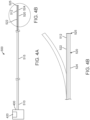
- the implant delivery system 100 also includes a handle 400 coupled to the proximal end of the guidewire 500 ( FIG. 4A ).
- the handle 400 of the implant delivery system 100 includes a user interface 420 configured for allowing a user (e.g., physician, technician or the like) to control a bending of the guidewire 500.
- the user interface 420 is illustrated as being implemented at the handle 400, but in other embodiments, the user interface 420 may be implemented as another device that is separate from the handle 400.
- the user interface 420 may be a computer or any electronic device (e.g., cell phone, tablet, etc.) that is capable of generating electrical signals and/or radiofrequency signals.
- the user interface 420 may include an electrical controller, power supply or the like, configured to deliver current to the components of the implant delivery system 100 (e.g., to the guidewire 500).
- the user interface 420 may include one or more controls, which may be one or more physical button(s), knob(s), switch(es), etc.
- the one or more controls may be a touch screen with graphical elements configured to allow the user to selectively activate the guidewire 500 for bending the guidewire 500.
- the handle 400 may also be optionally coupled to the proximal end 130 of the elongated member 120, and/or to a proximal end 113 of the elongated sheath 110.
- the user interface 420 may also allow a user to control a bending of the elongated member 120, and/or the elongated sheath 110.
- the elongated member 120 and/or the elongated sheath 110 may include actuation elements (e.g., steering wires), which are actuatable in response to tension forces provided by the user interface 420, to thereby bend the elongated member 120 and/or elongated sheath 110.
- the user interface 420 may include one or more controls for allowing the user to apply tension to the steering wires.
- the one or more controls may be one or more physical button(s), knob(s), switch(es), etc.
- the one or more controls may be a touch screen with graphical elements configured to allow the user to activate the actuating element(s) of the elongated member 120 and/or elongated sheath 110.
- the elongated member 120 and/or the elongated sheath 110 may not include any steering wires. In such cases, the bending of the elongated member 120 and/or the elongated sheath 110 may be controlled by the guidewire 500.
- the delivery system 100 may not include the sheath 110 and/or the elongated member 120.
- the system 100 may not be an implant delivery system. Instead, the system 100 may be other types of medical devices, or components of other types of medical devices.
- the system 100 with the guidewire 500 may be a part of a drug delivery system, a biopsy system, a treatment system that includes an energy source, etc.
- FIGS. 4A-4B illustrate the guidewire 500 in accordance with some embodiments.
- the guidewire 500 includes a proximal end 510, a distal end 512, and a body 515 extending between the proximal end 510 and the distal end 512.
- the guidewire 500 also includes a distal portion 520 having the distal end 512.
- the guidewire 500 has a linear configuration that is relatively straight (compared to a bent configuration) at room and/or body temperature, yet flexible to bend when subjected to external forces.
- the guidewire 500 further includes variable stiffness sections from higher stiffness at a proximal portion, while gradually reducing stiffness along the body 515, to a lower stiffness along the distal portion 520.
- variable stiffness sections of the guidewire 500 may be distinct instead of gradual.
- a first portion of the guidewire 500 that is closer to the proximal end 510 than to the distal end 512 may have a first stiffness
- a second portion of the guidewire 500 that is distal to the second portion may have a second stiffness
- a third portion of the guidewire 500 that is distal to the second portion may have a third stiffness.
- the third portion may be the distal portion 520.
- the first stiffness may be higher than the second stiffness
- the second stiffness may be higher than the first stiffness.
- body temperature may refer to a range of temperatures, such as a temperature range of 95° to 107° Fahrenheit (35°C to 41,6667°C), or more preferably a temperature range of 96° to 100° Fahrenheit (35.5556°C to 37.7778°C), or more preferably a temperature range of 97° to 99° Fahrenheit (36.1111°C to 37.2222°C).
- room temperature may refer to any temperature that is different from the body temperature.
- room temperature may be any temperature that is lower than body temperature.
- the room temperature may be any temperature that is at least 10° Fahrenheit (5,55°C) below the body temperature, or that is at least 20° Fahrenheit (11.11°C) below the body temperature.
- the distal portion 520 of the guidewire 500 comprises a first segment 522 and a second segment 524, wherein the first segment 522 is coupled to the second segment 524.
- the distal portion 520 of the guidewire 500 may optionally also include a radio-opaque marker 525.
- the first segment 522 of the distal portion 520 of the guidewire 500 is configured to change to a more curvilinear configuration from its relatively straight configuration in response to temperature change(s), while the second segment 524 is independent of temperature changes.
- the first segment 522 When the first segment 522 changes its shape from its relatively straight configuration in response to temperature change(s), the first segment 522 displaces or moves the second segment 524 along with it, so that the distal end 512 of the distal portion 520 of the guidewire 500 deflects, as represented by the broken lines in FIG. 4B , which will be described in further details below.
- the first segment 522 is configured to contract in response to temperature change(s). In such cases, a contraction of the first segment 522 will cause the distal portion 520 of the guidewire 500 to bend in a direction that is towards the side of the first segment 522.
- the first segment 522 is configured to extend or elongate in response to temperature change(s). In such cases, an extension of the first segment 522 will cause the distal portion 520 of the guidewire 500 to bend in a direction that is towards the side of the second segment 524.
- the first segment 522 of the distal portion 520 of the guidewire 500 is composed of shape-memory Nitinol
- the second segment 524 of the distal portion 520 of the guidewire 500 is composed non-shape-memory Nitinol.
- the first segment 522 may be made from other shape-memory materials, such as shape-memory metal, shape-memory alloy, etc.
- the second segment 524 may be made from other non-shape-memory materials, such as non-shape-memory metal, non-shape memory alloy, etc.
- first segment 522 and second segment 524 of the distal portion 520 are fixedly attached (e.g., laminated) at one or more points along a longitudinal axis of the guidewire 500 by suitable techniques, such as solder, adhesive, laser spot welds, or their like.
- the first segment 522 of the distal portion 520 is configured to be thermo-electrically actuated to deflect the distal portion 520 of the guidewire 500.
- the first segment 522 has been thermo-mechanically processed so that it will shorten (e.g., contracts) when heated above an activation temperature.
- the second segment 524 does not include a shape memory behavior, and thus, when the distal portion 520 of the guidewire 500 is heated above the activation temperature, the first segment 522 shortens while the second segment 524 retains its length.
- the shortening of the first segment 522 relative to the second segment 524 will cause the distal portion 520 of the guidewire 500 to bend.
- the shortening/contraction of the first segment 522 creates a deflection of the distal portion 520 of the guidewire 500, as represented by the broken lines in FIG. 4B .
- the activation temperature may be an Austenite finish temperature (AF).
- Austenite finish temperature (Af) is the temperature at which martensite to austenite transformation is completed on heating of a material, such as metal alloy (e.g., Nitinol). When the material is fully martensite and is subjected to heating, austenite starts to form at the austenite start temperature (As), and finishes at the austenite finish temperature (Af).
- heating the distal portion 520 of the guidewire 500 can be affected by running current through the guidewire 500 via the user interface 420 at handle 400 ( FIG. 4A ).
- the resistivity of the material forming the distal portion 520 creates heating which can be controlled with electrical power modulation in the user interface 420.
- the Af temperature of the first segment 522 can be selected to be slightly above body temperature so that the actuation of the distal portion 520 of the guidewire 500 does not require heating above a safe limit for blood contact. In such cases, the distal portion 520 of the guidewire 500 will not deflect during storage or advancing of the guidewire until a current is applied to the guidewire 500 and the Af temperature of the first segment 522 is reached to be slightly raised above body temperature.
- first segment 522 and second segment 524 of the distal portion 520 coupled in a laminated configuration allows the distal portion 520 of the guidewire 500 to achieve larger deflections with a substantially short first segment 522.
- the amount of deflection of the distal portion 520 of the guidewire 500 is governed by the differential properties of the first segment 522 and second segment 524, and/or an amount of current being delivered to the distal portion 520 of the guidewire 500.
- the non-shape-memory second segment 524 may have mechanical properties independently tuned and/or selected to also provide shapeability and functionality of the distal portion 520 of the guidewire 500.
- the first segment 522 of the distal portion 520 of the guidewire 500 may have a length that is anywhere between 5 mm to 15 mm, or that is anywhere between 5 mm to 20 mm, or that is anywhere between 5 mm to 3,400 mm (e.g., approximately, the full length the guidewire).
- the second segment 524 may be shorter than the first segment 522, the same length as the first segment 522, or longer than the first segment 522.
- the deflection of the distal portion 520 of the guidewire 500 is produced due to the magnitude of differences between the coefficient of thermal actuation of the first segment 522 and the non-thermal actuation of the second segment 524.
- the thermal/electrical actuation of the distal portion 520 of the guidewire 500 creates a four percent or greater ( ⁇ 4%) shorten/contraction or length change differential over a relatively small change in temperature range (e.g., 5° Fahrenheit (2.77°C) or higher, 10° Fahrenheit (5.55°C) or higher, 15° Fahrenheit (8.33°C) or higher, etc.), such that large distal portion 520 deflection may be achieved with small temperature changes.
- the tightest achievable radius of curvature for the distal portion 520 of the guidewire 500 is in the range of 0.05" (e.g. 0.05" +/- 0.02") (1.27mm +/- 0.508mm).
- the radius of curvature for the distal portion 520 of the guidewire 500 may be higher, such as 0.1", 0.2", 0.4", 0.6", etc., +/- 0.05") (0.254mm, 0.508mm, 1.016mm, 1.524mm, etc,, +/- 1.27mm).
- the deflection angle of the distal portion 520 of the guidewire 500 may be controlled by thermal/current modulation applied to the guidewire 500.
- the current may be applied using a monopolar technique, where the current passes from the guidewire 500, through the patient's tissue to a return pad to complete the electric current circuit, or using a bipolar technique, where the current return path is along the guidewire 500 back to the electrical controller at the user interface 420.
- the curvature of the bending of the distal portion 520 may be selectively adjusted using the control at the handle 400. The control may be manipulated to change an amount of current applied to the distal portion 520 of the guidewire 500.
- the amount of current may be increased to increase a curvature of the bending at the distal portion 520 of the guidewire 500. In another mode of operation, the amount of current may be decreased in decrease a curvature of the bending at the distal portion 520 of the guidewire 500.
- annealing parameters may be tuned to achieve a desired level of elasticity and shapeability in the material (e.g., Nitinol) forming the distal portion 520 of the guidewire 500.
- the second segment 524 of the distal portion 520 of the guidewire 500 may be heat treated to a semi or partially annealed condition, such that the second segment 524 may be shapeable and could retain a standard-like shapeable tip guidewire, yet the distal portion 520 of the guidewire 500 still includes the thermo-electrically actuated first segment 522 to actively deflect the distal portion 520 when needed.
- active deflection e.g., applying current or heat to the guidewire 500
- active deflection may not be required for one usage of the guidewire 500, but the active deflection may be used when navigating the guidewire 500 through more challenging and tortuous vasculature in another usage.
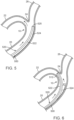
- FIGS. 5-6 illustrate a method, not forming part of the present invention, of accessing a bifurcated vasculature 10 using the guidewire 500.
- the bifurcated vasculature 10 includes a main blood vessel 20, a first blood vessel branch 22, a second blood vessel branch 26, and a bifurcated angle 24 between the first 22 and second 26 branches.
- the guidewire 500 having the distal portion 520 is advanced through the main blood vessel 20 and maneuvered to access a target site within the first blood vessel branch 22.
- the user interface 420 may be operated by the user to actuate the guidewire 500 to bend in a desired manner.
- the user can determine the location of the distal portion 520 of the guidewire 500 within the main blood vessel 20 ( FIG. 5 ). If the user determines that bending of the distal portion 520 is desired, the user may operate the user interface 420 to apply heat or current to the distal portion 520 of the guidewire 500 to thermally or electrically actuate the first segment 522 composed of shape-memory material, such that the distal portion 520 of the guidewire 500 deflects towards the desired first blood vessel branch 22 ( FIG.
- the distal portion 520 of the guidewire 500 may then be advanced distally into the first blood vessel branch 22.
- the angle of distal portion 520 relative to the longitudinal axis of elongate body of the guidewire 500 as illustrated by angle " ⁇ " can range from about five degrees to about 60 degrees, or more.
- the bending of the distal portion 520 allows the distal end 512 of the guidewire 500 to be steered through different curvatures along a passage way (e.g., blood vessel) inside the patient.
- the guidewire body 515 may be rotated about its longitudinal axis to allow the bending to occur at different bending planes.
- a degree (e.g., curvature, angle, etc.) of bending of the guidewire 500 may be adjusted by varying a magnitude of the heat or current provided by the user interface 420.
- the elongated member 120 and/or sheath 110 of FIG. 3 may then be advanced over the guidewire 500, and may be utilized in a medical procedure to diagnose and/or treat the patient.
- the elongated member 120 and/or the sheath 110 may be used to deliver a substance (e.g., drug, medicine, contrast, saline, etc.), deploy a device (e.g., implant, tissue dissector, imaging scope, treatment energy source, etc.), or perform other functions in different embodiments.
- a substance e.g., drug, medicine, contrast, saline, etc.
- a device e.g., implant, tissue dissector, imaging scope, treatment energy source, etc.
- the guidewire 500 is not limited to the examples of FIGS. 4A-4B , and that the guidewire 500 may have other configurations in other embodiments.
- the guidewire 500 may include more than two distal segments that are coupled to form the distal portion 520 of the guidewire 500.
- the distal portion 520 may have three distal segments that are stacked and coupled together to form the distal portion 520 of the guidewire 500.
- the guidewire 500 may include other components along a longitudinal axis of the guidewire 500, such as an outer jacket, sleeve, reinforcement segments, coils, radiopaque coatings, markers, or the like.
- the wire 500 may be a pushwire, or a delivery wire.
- the wire 500 may have a stiffer proximal portion compared to the distal portion 520.
- the stiffer proximal portion may be at least 30%, at least 50%, at least 70%, or at least 80%, of an entire length of the wire 500.
- the wire 500 may have a proximal portion that is proximal to the distal portion 520, wherein the proximal portion may be made from stainless steel, Nitinol, Cobalt-Chromium alloy (e.g., MP35N alloy), other alloys, or combination thereof.
- the wire 500 may be formed of stainless steel (or other rigid alloy) along a proximal portion, and having nitinol at the distal portion 520.
- the wire 500 may include a hybrid core.
- a portion of the body 515 that is proximal to the distal portion 520 may be made from Nitinol and another material (e.g., stainless steel) to provide a stiffer proximal portion for the wire 500.
- the wire 500 may have a Nitinol segment that extends the full length of the wire 500.
- one or more portions of the Nitinol core may be heat treated to provide shape-memory characteristics, as similarly described herein.
- the wire 500 may function as a core wire or backbone for a variety of elongated medical devices, such as complex guidewires, sheath, catheters, or the like.
- the compact size of the wire 500 allows incorporation of it as a core wire into sheath, catheters or their like without impacting other performance characteristics (torque transmission, stiffness, tip shapeability, etc.).
- FIGS. 7A-9 illustrate different examples of medical devices that incorporate the wire 500 described herein.
- the wire 500 in FIGS. 7A-9 include a reduced diameter (i.e., taper) from the proximal end (not shown) and/or the body 515 towards the distal end 512 of the wire 500.
- the tapering of the wire 500 may be a constant reduction of diameter of the wire 500 along a longitudinal axis 550 (as shown in FIG. 7A ), or may have distinct transitions between tapered sections (as shown in FIGS. 8-9 ), or a combination thereof.
- the medical device 580 includes the wire 500 and an outer jacket 700 disposed around at least a portion of the distal portion 520 of the wire 500.
- the outer jacket 700 may be any tubular member, and may be made from any suitable materials, such as metal, polymer, etc. In some embodiments, the outer jacket 700 may be made from nitinol.
- the outer jacket 700 includes a plurality of slots and/or openings to increase flexibility. By way of nonlimiting examples, the outer jacket 700 may be implemented using slotted hypotube, coiled sleeve, tungsten-loaded polymer sleeve, or a combination thereof.
- the medical device 580 may further include a coil 720 disposed around the distal portion 520 of the wire 500 and concentrically disposed between the distal portion 520 of the wire 500 and the outer jacket 700.
- the coil 720 may be made of radiopaque material and/or platinum tungsten.
- the medical device 580 further includes a blunt atraumatic tip 600 coupled to the distal portion 520 of the wire 500.
- FIG. 8 illustrates another medical device 580 having the wire 500 and an outer jacket 800 concentrically disposed around at least the distal portion 520 of the wire 500.
- the outer jacket 800 is composed of suitable polymeric material. In other embodiments, the outer jacket 800 may be made from other materials.
- the medical device 580 further includes a blunt atraumatic tip 600 coupled to the distal portion 520 of the wire 500.
- FIG. 9 illustrates another medical device 580 having the wire 500 and a coil 900 concentrically disposed around at least the distal portion 520 of the wire 500.
- a proximal end 920 of the coil 900 is secured to the body 515 of the wire 500, while the distal end 940 of the coil 900 is secured to the distal portion 520 of the wire 500.
- the securing may be accomplished using an adhesive, welding, mechanical connector, fusion, etc.
- the medical device 580 further includes a blunt atraumatic tip 600 coupled to the distal portion 520 of the wire 500.
Landscapes
- Health & Medical Sciences (AREA)
- Life Sciences & Earth Sciences (AREA)
- General Health & Medical Sciences (AREA)
- Veterinary Medicine (AREA)
- Engineering & Computer Science (AREA)
- Biomedical Technology (AREA)
- Heart & Thoracic Surgery (AREA)
- Public Health (AREA)
- Animal Behavior & Ethology (AREA)
- Surgery (AREA)
- Anesthesiology (AREA)
- Hematology (AREA)
- Pulmonology (AREA)
- Biophysics (AREA)
- Nuclear Medicine, Radiotherapy & Molecular Imaging (AREA)
- Medical Informatics (AREA)
- Molecular Biology (AREA)
- Media Introduction/Drainage Providing Device (AREA)
- Materials For Medical Uses (AREA)
- Orthopedics, Nursing, And Contraception (AREA)
Applications Claiming Priority (2)
| Application Number | Priority Date | Filing Date | Title |
|---|---|---|---|
| US16/820,616 US20210282759A1 (en) | 2020-03-16 | 2020-03-16 | Medical devices with deflective distal ends |
| PCT/US2021/021313 WO2021188314A2 (en) | 2020-03-16 | 2021-03-08 | Medical devices with deflective distal ends |
Publications (2)
| Publication Number | Publication Date |
|---|---|
| EP4121156A2 EP4121156A2 (en) | 2023-01-25 |
| EP4121156B1 true EP4121156B1 (en) | 2025-02-26 |
Family
ID=75302638
Family Applications (1)
| Application Number | Title | Priority Date | Filing Date |
|---|---|---|---|
| EP21715706.4A Active EP4121156B1 (en) | 2020-03-16 | 2021-03-08 | Medical devices with deflective distal ends |
Country Status (6)
| Country | Link |
|---|---|
| US (1) | US20210282759A1 (https=) |
| EP (1) | EP4121156B1 (https=) |
| JP (1) | JP7655934B2 (https=) |
| CN (1) | CN115279443B (https=) |
| ES (1) | ES3015395T3 (https=) |
| WO (1) | WO2021188314A2 (https=) |
Families Citing this family (11)
| Publication number | Priority date | Publication date | Assignee | Title |
|---|---|---|---|---|
| US9233225B2 (en) | 2012-11-10 | 2016-01-12 | Curvo Medical, Inc. | Coaxial bi-directional catheter |
| WO2016149653A2 (en) | 2015-03-19 | 2016-09-22 | Prytime Medical Devices, Inc. | System and method for low-profile occlusion balloon catheter |
| US20210402156A1 (en) * | 2020-06-30 | 2021-12-30 | Becton, Dickinson And Company | Catheter tip passive control device and related systems and methods |
| EP4240460A4 (en) | 2020-11-09 | 2024-05-08 | Agile Devices, Inc. | CATHETER CONTROL DEVICES |
| EP4084703B1 (en) * | 2021-03-18 | 2024-03-13 | Prytime Medical Devices, Inc. | Vascular occlusion catheter |
| JP2025526412A (ja) * | 2022-07-25 | 2025-08-13 | テルモ株式会社 | インプラント送達デバイス |
| WO2024182582A1 (en) * | 2023-03-02 | 2024-09-06 | Merit Medical Systems, Inc. | Medical grasping device with slide actuator |
| CN117018395A (zh) * | 2023-08-07 | 2023-11-10 | 南京航空航天大学 | 一种基于形状记忆合金的变刚度可调弯导丝 |
| US20250090812A1 (en) * | 2023-09-15 | 2025-03-20 | Boston Scientific Scimed, Inc. | Actively steerable guidewire |
| US20250195827A1 (en) | 2023-12-15 | 2025-06-19 | DeepIn Technologies, LLC | Guidewire and medical device including laser cut tube |
| US20250262411A1 (en) | 2024-02-15 | 2025-08-21 | DeepIn Technologies, LLC | Intravascular medical devices including laser cut tube |
Citations (2)
| Publication number | Priority date | Publication date | Assignee | Title |
|---|---|---|---|---|
| JPH08141971A (ja) * | 1994-11-21 | 1996-06-04 | Olympus Optical Co Ltd | マニピュレータ |
| US20050283095A1 (en) * | 2004-06-22 | 2005-12-22 | Scimed Life Systems, Inc. | Medical device including actuator |
Family Cites Families (12)
| Publication number | Priority date | Publication date | Assignee | Title |
|---|---|---|---|---|
| US4944727A (en) * | 1986-06-05 | 1990-07-31 | Catheter Research, Inc. | Variable shape guide apparatus |
| US4799474A (en) * | 1986-03-13 | 1989-01-24 | Olympus Optical Co., Ltd. | Medical tube to be inserted in body cavity |
| US5025799A (en) * | 1987-05-13 | 1991-06-25 | Wilson Bruce C | Steerable memory alloy guide wires |
| US5019040A (en) * | 1989-08-31 | 1991-05-28 | Koshin Sangyo Kabushiki Kaisha | Catheter |
| JPH0683726B2 (ja) * | 1990-10-12 | 1994-10-26 | 日本精線株式会社 | カテーテル用ガイドワイヤ |
| US5423771A (en) * | 1992-12-01 | 1995-06-13 | Intelliwire, Inc. | Flexible elongate device having a distal extremity of adjustable stiffness and method |
| US5531685A (en) * | 1993-06-11 | 1996-07-02 | Catheter Research, Inc. | Steerable variable stiffness device |
| US5931819A (en) * | 1996-04-18 | 1999-08-03 | Advanced Cardiovascular Systems, Inc. | Guidewire with a variable stiffness distal portion |
| US9084610B2 (en) * | 2010-10-21 | 2015-07-21 | Medtronic Ardian Luxembourg S.A.R.L. | Catheter apparatuses, systems, and methods for renal neuromodulation |
| EP3277360B1 (en) * | 2015-04-02 | 2018-11-28 | Koninklijke Philips N.V. | Deflectable medical device |
| US10806898B2 (en) * | 2017-03-30 | 2020-10-20 | University Of Hawaii | Steerable surgical devices with shape memory alloy wires |
| EP3700614B1 (en) | 2017-10-24 | 2024-10-16 | Ecole Polytechnique Fédérale de Lausanne (EPFL) | Steerable device and system |
-
2020
- 2020-03-16 US US16/820,616 patent/US20210282759A1/en active Pending
-
2021
- 2021-03-08 ES ES21715706T patent/ES3015395T3/es active Active
- 2021-03-08 WO PCT/US2021/021313 patent/WO2021188314A2/en not_active Ceased
- 2021-03-08 EP EP21715706.4A patent/EP4121156B1/en active Active
- 2021-03-08 CN CN202180020810.1A patent/CN115279443B/zh active Active
- 2021-03-08 JP JP2022555747A patent/JP7655934B2/ja active Active
Patent Citations (2)
| Publication number | Priority date | Publication date | Assignee | Title |
|---|---|---|---|---|
| JPH08141971A (ja) * | 1994-11-21 | 1996-06-04 | Olympus Optical Co Ltd | マニピュレータ |
| US20050283095A1 (en) * | 2004-06-22 | 2005-12-22 | Scimed Life Systems, Inc. | Medical device including actuator |
Also Published As
| Publication number | Publication date |
|---|---|
| EP4121156A2 (en) | 2023-01-25 |
| CN115279443B (zh) | 2024-05-28 |
| US20210282759A1 (en) | 2021-09-16 |
| WO2021188314A3 (en) | 2021-12-02 |
| JP2023518056A (ja) | 2023-04-27 |
| WO2021188314A2 (en) | 2021-09-23 |
| ES3015395T3 (en) | 2025-05-05 |
| JP7655934B2 (ja) | 2025-04-02 |
| CN115279443A (zh) | 2022-11-01 |
Similar Documents
| Publication | Publication Date | Title |
|---|---|---|
| EP4121156B1 (en) | Medical devices with deflective distal ends | |
| US10172638B2 (en) | Multiple function vascular device | |
| JP6820611B2 (ja) | 二重同心のガイドワイヤ | |
| EP3442641B1 (en) | Guide extension catheter with helically-shaped entry port | |
| US8360995B2 (en) | Wire guide | |
| EP1803484B1 (en) | Variable stiffness guidewire | |
| EP2391417B1 (en) | Guidewire | |
| US9173696B2 (en) | Self-positioning electrode system and method for renal nerve modulation | |
| US20080269641A1 (en) | Method of using a guidewire with stiffened distal section | |
| US20110301502A1 (en) | In-vessel positioning device | |
| KR20210069122A (ko) | 조직을 천공하기 위한 방법 및 장치 | |
| US12201792B2 (en) | Method for making a guidewire from a drawn-filled tube of a stainless steel sheath jacketing a nitinol core wire | |
| WO2015031525A1 (en) | Shapeable re-entry devices and associated systems and methods | |
| CN120641164A (zh) | 可转向医疗装置及其相关方法 | |
| WO1997024978A1 (en) | Guide wire with adjustable stiffness and method | |
| US20110202038A1 (en) | Guidewire positioning device | |
| US20170120018A1 (en) | Guidewire | |
| US20200054859A1 (en) | Intra-Balloon Deflection Mechanism for Enhanced Balloon Maneuverability |
Legal Events
| Date | Code | Title | Description |
|---|---|---|---|
| STAA | Information on the status of an ep patent application or granted ep patent |
Free format text: STATUS: UNKNOWN |
|
| STAA | Information on the status of an ep patent application or granted ep patent |
Free format text: STATUS: THE INTERNATIONAL PUBLICATION HAS BEEN MADE |
|
| PUAI | Public reference made under article 153(3) epc to a published international application that has entered the european phase |
Free format text: ORIGINAL CODE: 0009012 |
|
| STAA | Information on the status of an ep patent application or granted ep patent |
Free format text: STATUS: REQUEST FOR EXAMINATION WAS MADE |
|
| 17P | Request for examination filed |
Effective date: 20221006 |
|
| AK | Designated contracting states |
Kind code of ref document: A2 Designated state(s): AL AT BE BG CH CY CZ DE DK EE ES FI FR GB GR HR HU IE IS IT LI LT LU LV MC MK MT NL NO PL PT RO RS SE SI SK SM TR |
|
| STAA | Information on the status of an ep patent application or granted ep patent |
Free format text: STATUS: EXAMINATION IS IN PROGRESS |
|
| 17Q | First examination report despatched |
Effective date: 20230321 |
|
| DAV | Request for validation of the european patent (deleted) | ||
| DAX | Request for extension of the european patent (deleted) | ||
| GRAP | Despatch of communication of intention to grant a patent |
Free format text: ORIGINAL CODE: EPIDOSNIGR1 |
|
| STAA | Information on the status of an ep patent application or granted ep patent |
Free format text: STATUS: GRANT OF PATENT IS INTENDED |
|
| INTG | Intention to grant announced |
Effective date: 20240927 |
|
| P01 | Opt-out of the competence of the unified patent court (upc) registered |
Free format text: CASE NUMBER: APP_60287/2024 Effective date: 20241108 |
|
| RAP3 | Party data changed (applicant data changed or rights of an application transferred) |
Owner name: STRYKER EUROPEAN OPERATIONS LIMITED Owner name: STRYKER CORPORATION |
|
| GRAS | Grant fee paid |
Free format text: ORIGINAL CODE: EPIDOSNIGR3 |
|
| GRAA | (expected) grant |
Free format text: ORIGINAL CODE: 0009210 |
|
| STAA | Information on the status of an ep patent application or granted ep patent |
Free format text: STATUS: THE PATENT HAS BEEN GRANTED |
|
| AK | Designated contracting states |
Kind code of ref document: B1 Designated state(s): AL AT BE BG CH CY CZ DE DK EE ES FI FR GB GR HR HU IE IS IT LI LT LU LV MC MK MT NL NO PL PT RO RS SE SI SK SM TR |
|
| REG | Reference to a national code |
Ref country code: GB Ref legal event code: FG4D |
|
| REG | Reference to a national code |
Ref country code: CH Ref legal event code: EP |
|
| REG | Reference to a national code |
Ref country code: DE Ref legal event code: R096 Ref document number: 602021026761 Country of ref document: DE |
|
| REG | Reference to a national code |
Ref country code: IE Ref legal event code: FG4D |
|
| REG | Reference to a national code |
Ref country code: NL Ref legal event code: FP |
|
| PGFP | Annual fee paid to national office [announced via postgrant information from national office to epo] |
Ref country code: AT Payment date: 20250417 Year of fee payment: 5 |
|
| PG25 | Lapsed in a contracting state [announced via postgrant information from national office to epo] |
Ref country code: RS Free format text: LAPSE BECAUSE OF FAILURE TO SUBMIT A TRANSLATION OF THE DESCRIPTION OR TO PAY THE FEE WITHIN THE PRESCRIBED TIME-LIMIT Effective date: 20250526 |
|
| PG25 | Lapsed in a contracting state [announced via postgrant information from national office to epo] |
Ref country code: FI Free format text: LAPSE BECAUSE OF FAILURE TO SUBMIT A TRANSLATION OF THE DESCRIPTION OR TO PAY THE FEE WITHIN THE PRESCRIBED TIME-LIMIT Effective date: 20250226 |
|
| PG25 | Lapsed in a contracting state [announced via postgrant information from national office to epo] |
Ref country code: PL Free format text: LAPSE BECAUSE OF FAILURE TO SUBMIT A TRANSLATION OF THE DESCRIPTION OR TO PAY THE FEE WITHIN THE PRESCRIBED TIME-LIMIT Effective date: 20250226 |
|
| PGFP | Annual fee paid to national office [announced via postgrant information from national office to epo] |
Ref country code: ES Payment date: 20250410 Year of fee payment: 5 |
|
| REG | Reference to a national code |
Ref country code: LT Ref legal event code: MG9D |
|
| PG25 | Lapsed in a contracting state [announced via postgrant information from national office to epo] |
Ref country code: NO Free format text: LAPSE BECAUSE OF FAILURE TO SUBMIT A TRANSLATION OF THE DESCRIPTION OR TO PAY THE FEE WITHIN THE PRESCRIBED TIME-LIMIT Effective date: 20250526 Ref country code: IS Free format text: LAPSE BECAUSE OF FAILURE TO SUBMIT A TRANSLATION OF THE DESCRIPTION OR TO PAY THE FEE WITHIN THE PRESCRIBED TIME-LIMIT Effective date: 20250626 |
|
| PG25 | Lapsed in a contracting state [announced via postgrant information from national office to epo] |
Ref country code: HR Free format text: LAPSE BECAUSE OF FAILURE TO SUBMIT A TRANSLATION OF THE DESCRIPTION OR TO PAY THE FEE WITHIN THE PRESCRIBED TIME-LIMIT Effective date: 20250226 |
|
| PG25 | Lapsed in a contracting state [announced via postgrant information from national office to epo] |
Ref country code: LV Free format text: LAPSE BECAUSE OF FAILURE TO SUBMIT A TRANSLATION OF THE DESCRIPTION OR TO PAY THE FEE WITHIN THE PRESCRIBED TIME-LIMIT Effective date: 20250226 Ref country code: PT Free format text: LAPSE BECAUSE OF FAILURE TO SUBMIT A TRANSLATION OF THE DESCRIPTION OR TO PAY THE FEE WITHIN THE PRESCRIBED TIME-LIMIT Effective date: 20250626 |
|
| PG25 | Lapsed in a contracting state [announced via postgrant information from national office to epo] |
Ref country code: GR Free format text: LAPSE BECAUSE OF FAILURE TO SUBMIT A TRANSLATION OF THE DESCRIPTION OR TO PAY THE FEE WITHIN THE PRESCRIBED TIME-LIMIT Effective date: 20250527 Ref country code: BG Free format text: LAPSE BECAUSE OF FAILURE TO SUBMIT A TRANSLATION OF THE DESCRIPTION OR TO PAY THE FEE WITHIN THE PRESCRIBED TIME-LIMIT Effective date: 20250226 |
|
| REG | Reference to a national code |
Ref country code: AT Ref legal event code: MK05 Ref document number: 1770057 Country of ref document: AT Kind code of ref document: T Effective date: 20250226 |
|
| PG25 | Lapsed in a contracting state [announced via postgrant information from national office to epo] |
Ref country code: SE Free format text: LAPSE BECAUSE OF FAILURE TO SUBMIT A TRANSLATION OF THE DESCRIPTION OR TO PAY THE FEE WITHIN THE PRESCRIBED TIME-LIMIT Effective date: 20250226 |
|
| PG25 | Lapsed in a contracting state [announced via postgrant information from national office to epo] |
Ref country code: SM Free format text: LAPSE BECAUSE OF FAILURE TO SUBMIT A TRANSLATION OF THE DESCRIPTION OR TO PAY THE FEE WITHIN THE PRESCRIBED TIME-LIMIT Effective date: 20250226 |
|
| PG25 | Lapsed in a contracting state [announced via postgrant information from national office to epo] |
Ref country code: DK Free format text: LAPSE BECAUSE OF FAILURE TO SUBMIT A TRANSLATION OF THE DESCRIPTION OR TO PAY THE FEE WITHIN THE PRESCRIBED TIME-LIMIT Effective date: 20250226 |
|
| PG25 | Lapsed in a contracting state [announced via postgrant information from national office to epo] |
Ref country code: AT Free format text: LAPSE BECAUSE OF FAILURE TO SUBMIT A TRANSLATION OF THE DESCRIPTION OR TO PAY THE FEE WITHIN THE PRESCRIBED TIME-LIMIT Effective date: 20250226 |
|
| PG25 | Lapsed in a contracting state [announced via postgrant information from national office to epo] |
Ref country code: CZ Free format text: LAPSE BECAUSE OF FAILURE TO SUBMIT A TRANSLATION OF THE DESCRIPTION OR TO PAY THE FEE WITHIN THE PRESCRIBED TIME-LIMIT Effective date: 20250226 Ref country code: EE Free format text: LAPSE BECAUSE OF FAILURE TO SUBMIT A TRANSLATION OF THE DESCRIPTION OR TO PAY THE FEE WITHIN THE PRESCRIBED TIME-LIMIT Effective date: 20250226 |
|
| PG25 | Lapsed in a contracting state [announced via postgrant information from national office to epo] |
Ref country code: RO Free format text: LAPSE BECAUSE OF FAILURE TO SUBMIT A TRANSLATION OF THE DESCRIPTION OR TO PAY THE FEE WITHIN THE PRESCRIBED TIME-LIMIT Effective date: 20250226 |
|
| REG | Reference to a national code |
Ref country code: CH Ref legal event code: H13 Free format text: ST27 STATUS EVENT CODE: U-0-0-H10-H13 (AS PROVIDED BY THE NATIONAL OFFICE) Effective date: 20251023 |
|
| PG25 | Lapsed in a contracting state [announced via postgrant information from national office to epo] |
Ref country code: SK Free format text: LAPSE BECAUSE OF FAILURE TO SUBMIT A TRANSLATION OF THE DESCRIPTION OR TO PAY THE FEE WITHIN THE PRESCRIBED TIME-LIMIT Effective date: 20250226 |
|
| PG25 | Lapsed in a contracting state [announced via postgrant information from national office to epo] |
Ref country code: LU Free format text: LAPSE BECAUSE OF NON-PAYMENT OF DUE FEES Effective date: 20250308 |
|
| REG | Reference to a national code |
Ref country code: DE Ref legal event code: R097 Ref document number: 602021026761 Country of ref document: DE |
|
| REG | Reference to a national code |
Ref country code: BE Ref legal event code: MM Effective date: 20250331 |
|
| PG25 | Lapsed in a contracting state [announced via postgrant information from national office to epo] |
Ref country code: MC Free format text: LAPSE BECAUSE OF FAILURE TO SUBMIT A TRANSLATION OF THE DESCRIPTION OR TO PAY THE FEE WITHIN THE PRESCRIBED TIME-LIMIT Effective date: 20250226 |
|
| PLBE | No opposition filed within time limit |
Free format text: ORIGINAL CODE: 0009261 |
|
| STAA | Information on the status of an ep patent application or granted ep patent |
Free format text: STATUS: NO OPPOSITION FILED WITHIN TIME LIMIT |
|
| PGFP | Annual fee paid to national office [announced via postgrant information from national office to epo] |
Ref country code: FR Payment date: 20251231 Year of fee payment: 6 |
|
| PG25 | Lapsed in a contracting state [announced via postgrant information from national office to epo] |
Ref country code: BE Free format text: LAPSE BECAUSE OF NON-PAYMENT OF DUE FEES Effective date: 20250331 |
|
| PG25 | Lapsed in a contracting state [announced via postgrant information from national office to epo] |
Ref country code: CH Free format text: LAPSE BECAUSE OF NON-PAYMENT OF DUE FEES Effective date: 20250331 |
|
| 26N | No opposition filed |
Effective date: 20251127 |
|
| PGFP | Annual fee paid to national office [announced via postgrant information from national office to epo] |
Ref country code: NL Payment date: 20260106 Year of fee payment: 6 |
|
| PGFP | Annual fee paid to national office [announced via postgrant information from national office to epo] |
Ref country code: GB Payment date: 20260106 Year of fee payment: 6 |
|
| PGFP | Annual fee paid to national office [announced via postgrant information from national office to epo] |
Ref country code: IE Payment date: 20260102 Year of fee payment: 6 Ref country code: DE Payment date: 20260102 Year of fee payment: 6 |
|
| PGFP | Annual fee paid to national office [announced via postgrant information from national office to epo] |
Ref country code: IT Payment date: 20260220 Year of fee payment: 6 |