EP4120769B1 - Kommunikationsverfahren und -vorrichtung - Google Patents
Kommunikationsverfahren und -vorrichtung Download PDFInfo
- Publication number
- EP4120769B1 EP4120769B1 EP21785495.9A EP21785495A EP4120769B1 EP 4120769 B1 EP4120769 B1 EP 4120769B1 EP 21785495 A EP21785495 A EP 21785495A EP 4120769 B1 EP4120769 B1 EP 4120769B1
- Authority
- EP
- European Patent Office
- Prior art keywords
- time
- frequency resource
- symbols
- group
- transmission
- Prior art date
- Legal status (The legal status is an assumption and is not a legal conclusion. Google has not performed a legal analysis and makes no representation as to the accuracy of the status listed.)
- Active
Links
Images






Classifications
-
- H—ELECTRICITY
- H04—ELECTRIC COMMUNICATION TECHNIQUE
- H04W—WIRELESS COMMUNICATION NETWORKS
- H04W72/00—Local resource management
- H04W72/04—Wireless resource allocation
- H04W72/044—Wireless resource allocation based on the type of the allocated resource
- H04W72/0446—Resources in time domain, e.g. slots or frames
-
- H—ELECTRICITY
- H04—ELECTRIC COMMUNICATION TECHNIQUE
- H04W—WIRELESS COMMUNICATION NETWORKS
- H04W72/00—Local resource management
- H04W72/12—Wireless traffic scheduling
- H04W72/121—Wireless traffic scheduling for groups of terminals or users
-
- H—ELECTRICITY
- H04—ELECTRIC COMMUNICATION TECHNIQUE
- H04L—TRANSMISSION OF DIGITAL INFORMATION, e.g. TELEGRAPHIC COMMUNICATION
- H04L5/00—Arrangements affording multiple use of the transmission path
- H04L5/0001—Arrangements for dividing the transmission path
- H04L5/0014—Three-dimensional division
- H04L5/0023—Time-frequency-space
-
- H—ELECTRICITY
- H04—ELECTRIC COMMUNICATION TECHNIQUE
- H04L—TRANSMISSION OF DIGITAL INFORMATION, e.g. TELEGRAPHIC COMMUNICATION
- H04L5/00—Arrangements affording multiple use of the transmission path
- H04L5/003—Arrangements for allocating sub-channels of the transmission path
- H04L5/0044—Allocation of payload; Allocation of data channels, e.g. PDSCH or PUSCH
-
- H—ELECTRICITY
- H04—ELECTRIC COMMUNICATION TECHNIQUE
- H04W—WIRELESS COMMUNICATION NETWORKS
- H04W72/00—Local resource management
- H04W72/12—Wireless traffic scheduling
- H04W72/1263—Mapping of traffic onto schedule, e.g. scheduled allocation or multiplexing of flows
-
- H—ELECTRICITY
- H04—ELECTRIC COMMUNICATION TECHNIQUE
- H04W—WIRELESS COMMUNICATION NETWORKS
- H04W72/00—Local resource management
- H04W72/04—Wireless resource allocation
- H04W72/044—Wireless resource allocation based on the type of the allocated resource
- H04W72/0453—Resources in frequency domain, e.g. a carrier in FDMA
-
- H—ELECTRICITY
- H04—ELECTRIC COMMUNICATION TECHNIQUE
- H04W—WIRELESS COMMUNICATION NETWORKS
- H04W72/00—Local resource management
- H04W72/20—Control channels or signalling for resource management
- H04W72/23—Control channels or signalling for resource management in the downlink direction of a wireless link, i.e. towards a terminal
Definitions
- This application relates to the field of communications technologies, and in particular, to a communication method and apparatus.
- Ultra-reliable and low-latency communications is one of three typical services of the 5 th generation (5 th generation, 5G) mobile communication system, and main application scenarios of the ultra-reliable and low latency communications include self-driving, telemedicine, and the like. Stricter requirements on reliability and a latency are raised in these application scenarios. Specific requirements of the URLLC service are as follows: Data transmission reliability reaches 99.999%, a transmission latency is less than 1 ms, and signaling overheads are reduced as much as possible while requirements of high reliability and a low latency are met.
- DCI downlink control information
- a DCI format 2_4 Such DCI can be used to indicate whether a terminal device cancels uplink transmission on a corresponding time-frequency resource, and therefore, may also be referred to as an uplink cancellation indication (cancellation indication, CI).
- CI uplink cancellation indication
- a time-frequency resource scheduled to a terminal device for uplink transmission may be canceled, and is granted to another terminal device that has a more urgent uplink transmission service.
- Document WO2020033660 relates to a method for causing a user equipment device to receive a configuration signaling to monitor for uplink (UL) cancellation indications; monitor a search space for an UL cancellation indication; detect an UL cancellation indication in the search space; and in response, cancel at least a portion of a scheduled UL transmission.
- UL uplink
- time division duplex time division duplex, TDD
- uplink and downlink symbols occur at different times, and a time-frequency resource for uplink transmission whose cancellation is indicated by using the uplink CI is separated by the downlink symbol in time domain.
- the time-frequency resource for uplink transmission whose cancellation is indicated by using the uplink CI crosses the downlink symbols in time domain.
- the URLLC service generally does not use a time-frequency resource that crosses several downlink symbols. Otherwise, uplink transmission that could have been performed is canceled. Consequently, a network capacity is reduced.
- Embodiments of this application provide a communication method and apparatus, to resolve a problem of unnecessary uplink transmission cancellation or downlink transmission interruption caused by discontinuity of a time-frequency resource (group) in time domain, to increase a network capacity.
- an embodiment of this application provides a communication method.
- the method may be performed by a terminal device, and includes (as claimed): determining N time-frequency resource groups, where each of the N time-frequency resource groups includes at least one time-frequency resource, and N is a positive integer greater than or equal to 2; receives transmission indication information from a network device, where the transmission indication information includes a bit sequence used to indicate transmission statuses of the N time-frequency resource groups, N bit groups in the bit sequence are in a one-to-one correspondence with the N time-frequency resource groups, and each of the N bit groups includes at least one bit; and performing data transmission with the network device based on the transmission status of each of the N time-frequency resource groups, where when an i th time-frequency resource group among the N time-frequency resource groups is separated by M first symbols in time domain, where M is a positive integer, an (i-1) th bit group in the bit sequence indicates a transmission status of an (i-1) th time-frequency resource group and a transmission status of
- the transmission indication information may be used to cancel uplink transmission or downlink transmission.
- the transmission indication information may be an uplink cancellation indication used to indicate whether the terminal device cancels uplink transmission on a corresponding time-frequency resource.
- a determined time-frequency resource group usually includes only an uplink symbol, and a first symbol separating the time-frequency resource group in time domain is generally a downlink symbol.
- the transmission indication information may be a downlink interrupted transmission indication used to indicate whether the terminal device has downlink transmission on a corresponding time-frequency resource.
- a determined time-frequency resource group usually includes only a downlink symbol, and a first symbol separating the time-frequency resource group in time domain is generally an uplink symbol.
- the former half of the time-frequency resource group may be combined into a previous time-frequency resource group of the time-frequency resource group, or the latter half of the time-frequency resource group may be combined into a next time-frequency resource group of the time-frequency resource group, to determine a transmission status, so that continuity, in time domain, of the time-frequency resource group indicated by the transmission indication information is ensured, unnecessary uplink transmission cancellation or downlink transmission interruption can be avoided, and a network capacity is increased.
- the (i-1) th bit group in the bit sequence indicates the transmission status of the (i-1) th time-frequency resource group and the transmission status of the time-frequency resource before the M first symbols in the i th time-frequency resource group
- the i th bit group in the bit sequence indicates the transmission status of the time-frequency resource after the M first symbols in the i th time-frequency resource group, where i is a positive integer greater than or equal to 2 and less than or equal to N; or when a quantity of symbols of the i th time-frequency resource group that are before the M first symbols is greater than or equal to a quantity of symbols of the i th time-frequency resource group that are after the M first symbols, the i th bit group in the bit sequence indicates the transmission status of the time-frequency resource before the M first symbols
- a half in which a quantity of included symbols is relatively small may be selected based on quantities of symbols respectively included in the former half and the latter half of the time-frequency resource group, and is combined into a time-frequency resource group adjacent to the half, to determine a transmission status, thereby facilitating ensuring continuity, in time domain, of the time-frequency resource group indicated by the transmission indication information, and avoiding unnecessary uplink transmission cancellation or downlink transmission interruption.
- the (i-1) th bit group in the bit sequence indicates the transmission status of the (i-1) th time-frequency resource group and the transmission status of the time-frequency resource before the M first symbols in the i th time-frequency resource group
- the i th bit group in the bit sequence indicates the transmission status of the time-frequency resource after the M first symbols in the i th time-frequency resource group, where i is a positive integer greater than or equal to 2 and less than or equal to N.
- the i th bit group in the bit sequence indicates the transmission status of the time-frequency resource before the M first symbols in the i th time-frequency resource group
- the (i+1) th bit group in the bit sequence indicates the transmission status of the time-frequency resource after the M first symbols in the i th time-frequency resource group and the transmission status of the (i+1) th time-frequency resource group, where i is a positive integer less than or equal to N-1.
- a half in which a quantity of included symbols conforms to a combination quantity may be selected based on quantities of symbols respectively included in the former half and the latter half of the time-frequency resource group, and is combined into a time-frequency resource group adjacent to the half, to determine a transmission status, thereby facilitating ensuring continuity, in time domain, of the time-frequency resource group indicated by the transmission indication information, and avoiding unnecessary uplink transmission cancellation or downlink transmission interruption.
- the i th bit group in the bit sequence indicates the transmission status of the time-frequency resource before the M first symbols in the i th time-frequency resource group
- the (i+1) th bit group in the bit sequence indicates the transmission status of the time-frequency resource after the M first symbols in the i th time-frequency resource group and the transmission status of the (i+1) th time-frequency resource group.
- a latter half of the time-frequency resource group may be combined into the second time-frequency resource group in time domain, to determine a transmission status, to ensure continuity, in time domain, of the time-frequency resource group indicated by the transmission indication information.
- the (i-1) th bit group in the bit sequence indicates the transmission status of the (i-1) th time-frequency resource group and the transmission status of the time-frequency resource before the M first symbols in the i th time-frequency resource group
- the i th bit group in the bit sequence indicates the transmission status of the time-frequency resource after the M first symbols in the i th time-frequency resource group.
- a former half of the time-frequency resource group may be combined into the penultimate time-frequency resource group in time domain, to determine a transmission status, to ensure continuity, in time domain, of the time-frequency resource group indicated by the transmission indication information.
- a former half or a latter half of a time-frequency resource group separated by a first symbol in time domain can be combined into an adjacent time-frequency resource group, to determine a transmission status.
- the transmission status of the time-frequency resource before the M downlink symbols in the time-frequency resource group is usually consistent with the transmission status of the time-frequency resource after the M downlink symbols.
- M is less than or equal to the first threshold, the former half or the latter half of the time-frequency resource group separated by the first symbol in time domain may not be combined into the adjacent time-frequency resource group, thereby facilitating reduction of a calculation quantity.
- the method further includes: The terminal device receives data scheduling information from the network device, where the data scheduling information indicates a first time-frequency resource for data transmission; and the performing data transmission with the network device based on the transmission status of each of the N time-frequency resource groups includes: performing data transmission with the network device based on the transmission status of each of the N time-frequency resource groups and the first time-frequency resource.
- the terminal device may perform data transmission with the network device based on a transmission status of a time-frequency resource after adjustment, thereby facilitating increasing a network capacity.
- an embodiment of this application provides a communication method.
- the method may be performed by a network device, and includes (as claimed): determining N time-frequency resource groups, where each of the N time-frequency resource groups includes at least one time-frequency resource, and N is a positive integer greater than or equal to 2; sends transmission indication information to a terminal device, where the transmission indication information includes a bit sequence used to indicate transmission statuses of the N time-frequency resource groups, N bit groups in the bit sequence are in a one-to-one correspondence with the N time-frequency resource groups, and each of the N bit groups includes at least one bit; and performing data transmission with the terminal device based on the transmission status of each of the N time-frequency resource groups, where when an i th time-frequency resource group among the N time-frequency resource groups is separated by M first symbols in time domain, where M is a positive integer, an (i-1) th bit group in the bit sequence indicates a transmission status of an (i-1) th time-frequency resource group and a transmission status of
- the transmission indication information may be used to cancel uplink transmission or downlink transmission.
- the transmission indication information may be an uplink cancellation indication used to indicate whether the terminal device cancels uplink transmission on a corresponding time-frequency resource.
- a determined time-frequency resource group usually includes only an uplink symbol, and a first symbol separating the time-frequency resource group in time domain is generally a downlink symbol.
- the transmission indication information may be a downlink interrupted transmission indication used to indicate whether the terminal device has downlink transmission on a corresponding time-frequency resource.
- a determined time-frequency resource group usually includes only a downlink symbol, and a first symbol separating the time-frequency resource group in time domain is generally an uplink symbol.
- the (i-1) th bit group in the bit sequence indicates the transmission status of the (i-1) th time-frequency resource group and the transmission status of the time-frequency resource before the M first symbols in the i th time-frequency resource group
- the i th bit group in the bit sequence indicates the transmission status of the time-frequency resource after the M first symbols in the i th time-frequency resource group, where i is a positive integer greater than or equal to 2 and less than or equal to N; or when a quantity of symbols of the i th time-frequency resource group that are before the M first symbols is greater than or equal to a quantity of symbols of the i th time-frequency resource group that are after the M first symbols, the i th bit group in the bit sequence indicates the transmission status of the time-frequency resource before the M first symbols
- the (i-1) th bit group in the bit sequence indicates the transmission status of the (i-1) th time-frequency resource group and the transmission status of the time-frequency resource before the M first symbols in the i th time-frequency resource group
- the i th bit group in the bit sequence indicates the transmission status of the time-frequency resource after the M first symbols in the i th time-frequency resource group, where i is a positive integer greater than or equal to 2 and less than or equal to N.
- the i th bit group in the bit sequence indicates the transmission status of the time-frequency resource before the M first symbols in the i th time-frequency resource group
- the (i+1) th bit group in the bit sequence indicates the transmission status of the time-frequency resource after the M first symbols in the i th time-frequency resource group and the transmission status of the (i+1) th time-frequency resource group, where i is a positive integer less than or equal to N-1.
- the i th bit group in the bit sequence indicates the transmission status of the time-frequency resource before the M first symbols in the i th time-frequency resource group
- the (i+1) th bit group in the bit sequence indicates the transmission status of the time-frequency resource after the M first symbols in the i th time-frequency resource group and the transmission status of the (i+1) th time-frequency resource group.
- the (i-1) th bit group in the bit sequence indicates the transmission status of the (i-1) th time-frequency resource group and the transmission status of the time-frequency resource before the M first symbols in the i th time-frequency resource group
- the i th bit group in the bit sequence indicates the transmission status of the time-frequency resource after the M first symbols in the i th time-frequency resource group.
- a former half or a latter half of a time-frequency resource group separated by a first symbol in time domain can be combined into an adjacent time-frequency resource group, to indicate a transmission status.
- the method further includes: The network device sends data scheduling information to the terminal device, where the data scheduling information indicates a first time-frequency resource for data transmission; and the performing data transmission with the terminal device based on the transmission status of each of the N time-frequency resource groups includes: performing data transmission with the terminal device based on the transmission status of each of the N time-frequency resource groups and the first time-frequency resource.
- an embodiment of this application provides (as claimed) a communication apparatus.
- the apparatus has a function of implementing the method in any one of the first aspect or the possible designs of the first aspect.
- the function may be implemented by hardware, or may be implemented by hardware executing corresponding software.
- the hardware or software includes one or more units (modules) corresponding to the foregoing function, for example, includes a transceiver unit and a processing unit.
- the apparatus may be a chip or an integrated circuit.
- the apparatus includes a processor and an interface circuit.
- the processor and the interface circuit are coupled, and are configured to implement the function of the method in any one of the first aspect or the possible designs of the first aspect.
- the interface circuit may be a transceiver or an input/output interface.
- the apparatus may further include a memory.
- the memory stores a program that can be executed by the processor and that is used to implement the function of the method in any one of the first aspect or the possible designs of the first aspect.
- the apparatus may be a terminal device.
- an embodiment of this application provides a communication apparatus.
- the apparatus has a function of implementing the method in any one of the second aspect or the possible designs of the second aspect.
- the function may be implemented by hardware, or may be implemented by hardware executing corresponding software.
- the hardware or software includes one or more units (modules) corresponding to the foregoing function, for example, includes a transceiver unit and a processing unit.
- the apparatus includes a processor and an interface circuit.
- the processor and the interface circuit are coupled, and are configured to implement the function of the method in any one of the second aspect or the possible designs of the second aspect.
- the interface circuit may be a transceiver or an input/output interface.
- the apparatus may further include a memory.
- the memory stores a program that can be executed by the processor and that is used to implement the function of the method in any one of the second aspect or the possible designs of the second aspect.
- the apparatus may be a network device.
- an embodiment of this application provides a communication system.
- the communication system may include a network device and a terminal device.
- the terminal device may perform the method in any one of the first aspect or the possible designs of the first aspect.
- the network device may perform the method in any one of the second aspect or the possible designs of the second aspect.
- an embodiment of this application further provides a computer program product, including a computer program or instructions.
- the computer program or the instructions are executed by a communication apparatus, the method in any one of the first aspect or the possible designs of the first aspect may be implemented, or the method in any one of the second aspect or the possible designs of the second aspect may be implemented.
- this application further provides a chip.
- the chip is configured to: implement the method in any one of the first aspect or the possible designs of the first aspect, or implement the method in any one of the second aspect or the possible designs of the second aspect.
- a long term evolution (long term evolution, LTE) system for example, a long term evolution (long term evolution, LTE) system, an LTE time division duplex (time division duplex, TDD) system, a 5 th generation (5 th generation, 5G) mobile communication system, or a new radio (new radio, NR) system, or may be applied to a future communication system or another similar communication system, such as a 6G system.
- LTE long term evolution
- TDD time division duplex
- 5G 5 th generation
- NR new radio
- NR new radio
- FIG. 1 a structure of the communication system to which the embodiments of this application are applied may be shown in FIG. 1
- the communication system includes a network device and at least one terminal device (such as terminal devices 1 to 6 shown in FIG. 1 ).
- the network device can communicate with the at least one terminal device (for example, the terminal device 1) by using an uplink (uplink, UL) and a downlink (downlink, DL).
- a plurality of network devices may alternatively exist in the communication system, and one network device may provide a service for a plurality of terminal devices.
- Both a quantity of network devices and a quantity of terminal devices included in the communication system are not limited in the embodiments of this application.
- the network device and each of some or all terminal devices among the at least one terminal device in FIG. 1 may implement the technical solutions provided in the embodiments of this application.
- various terminal devices shown in FIG. 1 are merely some examples of the terminal device. It should be understood that the terminal device in the embodiments of this application is not limited thereto.
- the terminal device may alternatively be a wearable device.
- the wearable device may also be referred to as a wearable intelligent device, an intelligent wearable device, or the like, and is a general term of wearable devices that are intelligently designed and developed for daily wear by using a wearable technology, for example, glasses, gloves, watches, clothes, and shoes.
- the wearable device is a portable device that is directly worn on a body or integrated into clothes or an accessory of a user.
- the wearable device is not merely a hardware device, but is used to implement a powerful function through software support, data interaction, and cloud interaction.
- wearable intelligent devices include full-featured and large-sized devices that can implement complete or partial functions without depending on smartphones, for example, smart watches or smart glasses, and devices that focus on only one type of application function and need to work with other devices such as smartphones, such as various smart bands, smart helmets, or smart jewelry for monitoring physical signs.
- the terminal device in the embodiments of this application may be an in-vehicle module, an in-vehicle component, an in-vehicle chip, or an in-vehicle unit that is built into a vehicle as one or more components or units.
- the vehicle may implement the method in this application by using the built-in in-vehicle module, in-vehicle component, in-vehicle chip, or in-vehicle unit.
- a network device also referred to as an access network device, is a device that is in a network and that is configured to connect a terminal device to a wireless network.
- the network device may be a node in a radio access network, may be referred to as a base station, or may be referred to as a RAN node (or device).
- the network device may be an evolved NodeB (evolved NodeB, eNodeB) in an LTE system or an LTE-advanced system (LTE-advanced, LTE-A), may be a next generation NodeB (next generation NodeB, gNodeB) in a 5G NR system, may be a transmission reception point (transmission reception point, TRP), a baseband unit (baseband unit, BBU), a Wi-Fi access point (access point, AP), or the like, or may be a central unit (central unit, CU) and a distributed unit (distributed unit, DU). This is not limited in the embodiments of this application.
- the CU supports radio resource control (radio resource control, RRC), a packet data convergence protocol (packet data convergence protocol, PDCP), a service data adaptation protocol (service data adaptation protocol, SDAP), and the like.
- RRC radio resource control
- PDCP packet data convergence protocol
- SDAP service data adaptation protocol
- the DU mainly supports a radio link control (radio link control, RLC) layer protocol, a medium access control (medium access control, MAC) layer protocol, and a physical layer protocol.
- the transmission indication information is downlink control information (downlink control information, DCI), and may be an uplink cancellation indication used to indicate whether the terminal device cancels uplink transmission on a corresponding time-frequency resource, or may be a downlink interrupted transmission indication (interrupted transmission indication, INT) used to indicate whether the terminal device performs downlink transmission on a corresponding time-frequency resource.
- the network device may send the transmission indication information to the terminal device through a downlink control channel, for example, a physical downlink control channel (physical downlink control channel, PDCCH).
- either of the uplink cancellation indication (UL CI) and the downlink interrupted transmission indication (DL INT) may include a bit sequence used to indicate a transmission status of a time-frequency resource.
- the transmission status corresponding to the uplink cancellation indication is whether to cancel uplink transmission
- the transmission status corresponding to the downlink interrupted transmission indication is whether there is downlink transmission.
- an i th bit in a bit sequence included in the uplink cancellation indication indicates whether there is downlink transmission of the terminal device on the time-frequency resource of the i th time-frequency resource.
- data corresponding to the i th time-frequency resource may be discarded from received data, or data corresponding to the i th time-frequency resource may be partially set to zero (when the DL INT is sent after the i th time-frequency resource).
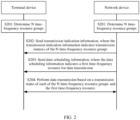
- FIG. 2 is a schematic diagram of a communication process according to an embodiment of this application. The process includes the following steps.
- a network device and a terminal device determine N time-frequency resource groups, where each of the N time-frequency resource groups includes at least one time-frequency resource, and N is a positive integer greater than or equal to 2.
- the network device may send higher layer signaling to the terminal device for configuring the N time-frequency resource groups.
- the network device may configure, for the terminal device by using the higher layer signaling (for example, RRC signaling), a time-frequency resource region indicated by transmission indication information (such as an uplink cancellation indication or a downlink interrupted transmission indication).
- the higher layer signaling for example, RRC signaling
- a time-frequency resource region indicated by transmission indication information such as an uplink cancellation indication or a downlink interrupted transmission indication.
- the network device configures, for the terminal device by using the higher layer signaling (for example, timeFrequencyRegion), a time-frequency resource region indicated by the uplink cancellation indication.
- the network device may configure a quantity B CI of physical resource blocks (physical resource block, PRB) based on a frequencyRegionforCI parameter in timeFrequencyRegion, and configure a quantity T CI of orthogonal frequency division multiplexing (orthogonal frequency division multiplexing, OFDM) symbols based on a timeDurationforCI parameter in timeFrequencyRegion.
- OFDM orthogonal frequency division multiplexing
- the OFDM symbol may be referred to as a symbol.
- a monitoring cycle of the uplink cancellation indication is longer than one slot (slot), or a monitoring cycle of the uplink cancellation indication is equal to one slot and there is only one monitoring occasion in one slot, there is only one monitoring occasion at most of the uplink cancellation indication in each slot.
- a time region indicated by T CI is equal to the monitoring cycle of the uplink cancellation indication, and may be equal to one slot, or may be longer than one slot.
- the monitoring cycle of the uplink cancellation indication is longer than one slot and there is only one monitoring occasion in one slot, and a time region indicated by T CI is equal to the monitoring cycle of the uplink cancellation indication, and is longer than one slot.
- a quantity of monitoring occasion of the uplink cancellation indication in one slot may be greater than 1.
- a time region indicated by T CI may be not longer than one slot
- a value of T CI may be one value in a set ⁇ 2, 4, 7, 14 ⁇
- a unit is a symbol.
- the monitoring cycle of the uplink cancellation indication is equal to one slot (slot) and there is more than one monitoring occasion in one slot
- a time region indicated by T CI may be less than a quantity of symbols corresponding to one slot.
- TA may represent time alignment (time alignment), for example, may be a timing advance, and is used for downlink and uplink time alignment.
- X represents an effective time of the uplink cancellation indication, that is, a time interval between a time when the terminal device receives the uplink cancellation indication (or the monitoring occasion) and a time-frequency resource indicated by the uplink cancellation indication.
- X may be understood as a time interval between an end symbol of the uplink cancellation indication (or the monitoring occasion) and a start symbol of a time-frequency resource indicated by the uplink cancellation indication.
- the network device may further configure, for the terminal device by using the higher layer signaling (for example, CI-PayloadSize), a quantity X of bits included in a bit sequence in the uplink cancellation indication, a value of X may be one value in a set ⁇ 1, 2, 4, 5, 7, 8, 10, 14, 16, 20, 25, 28, 32, 35, 56, 112 ⁇ , and a unit is a bit.
- the higher layer signaling for example, CI-PayloadSize
- one time-frequency resource region may be indicated for a monitoring occasion of each uplink cancellation indication of the terminal device.
- a time-frequency resource region indicated for a monitoring occasion 1 of the uplink cancellation indication includes, in time domain, T CI symbols starting from the first symbol after the effective time of the uplink cancellation indication and after the monitoring occasion 1 of the uplink cancellation indication, and includes B CI PRBs in frequency domain.
- the effective time of the uplink cancellation indication may be represented as T, and a value of T is correlated with a time T proc,2 corresponding to a processing capability 2 of a physical uplink shared channel (physical uplink shared channel, PUSCH).
- the network device may further configure, based on a timeGranularityforCI parameter in timeFrequencyRegion, a quantity G CI of groups into which the T CI symbols are grouped.
- a value of G CI may be a value in a set ⁇ 1, 2, 4, 7, 14, 28 ⁇ .
- each of the former G CI ⁇ T CI + ⁇ T CI / G CI ⁇ ⁇ G CI groups includes ⁇ T CI / G CI ⁇ symbols
- each of remaining T CI ⁇ ⁇ T CI / G CI ⁇ ⁇ G CI groups includes ⁇ T CI / G CI ⁇ symbols.
- each of the former N BI ⁇ B CI + ⁇ B CI / N BI ⁇ ⁇ N BI groups includes ⁇ B CI / N BI ⁇ PRBs
- each of remaining B CI ⁇ ⁇ B CI / N BI ⁇ ⁇ N BI groups includes ⁇ B CI / N BI ⁇ PRBs.
- " ⁇ ⁇ " represents rounding up
- " ⁇ ⁇ " represents rounding down.
- 10 PRBs are grouped into three frequency domain groups, either of the former two frequency domain groups includes three PRBs, and the latter one frequency domain group includes four PRBs.
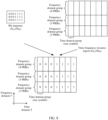
- one time-frequency resource region indicated for the monitoring occasion of each uplink cancellation indication of the terminal device based on T CI , B CI , G CI , and N BI can be grouped into a plurality of time-frequency resources, and one or more time-frequency resources corresponding to a same time domain range constitute one time-frequency resource group. That is, one or more time-frequency resources belonging to a same time domain group constitute one time-frequency resource group.
- one time-frequency resource region indicated by the monitoring occasion of the uplink cancellation indication can be grouped into a form shown in FIG. 7 .
- Each block in FIG. 7 may represent one time-frequency resource, and one or more time-frequency resources corresponding to a same time domain range constitute one time-frequency resource group. That is, time-frequency resources in each column constitute one time-frequency resource group.
- the network device may also separately send higher layer signaling for monitoring occasions of different uplink cancellation indications of the terminal device.
- Each piece of the higher layer signaling sent by the network device is used to only configure one time-frequency resource region corresponding to a monitoring occasion of an upcoming uplink cancellation indication of the terminal device, and is used for grouping of a time-frequency resource and a time-frequency resource group in the time-frequency resource region.
- the network device may also configure, for the terminal device by using higher layer signaling similar to that of the uplink cancellation indication, a time-frequency resource region indicated by the downlink interrupted transmission indication, and the higher layer signaling is used for grouping of a time-frequency resource and a time-frequency resource group in the time-frequency resource region. Details are not described herein again.
- S202 The network device sends the transmission indication information to the terminal device, and the terminal device receives the transmission indication information.
- the transmission indication information includes a bit sequence used to indicate transmission statuses of the N time-frequency resource groups, N bit groups in the bit sequence are in a one-to-one correspondence with the N time-frequency resource groups, and each of the N bit groups includes at least one bit.
- the bit sequence included in the uplink cancellation indication information may be a sequence including X bits. Each bit in the bit sequence corresponds to one time-frequency resource, and is used to indicate whether to cancel uplink transmission of the terminal device on the time-frequency resource. Whether to cancel uplink transmission of the terminal device on the time-frequency resource may also be understood as whether to allow the terminal device to perform uplink transmission on the time-frequency resource, or whether the terminal device may perform uplink transmission on the time-frequency resource.
- the X bits correspond to the N bit groups
- the N bit groups correspond one-to-one to the N time-frequency resource groups.
- the bit sequence may exist in a form of a two-dimensional bitmap (bitmap).
- bitmap bitmap
- the X bits in the bit sequence correspond one-to-one to the X time-frequency resources. If a value of a bit is set to 1, it may indicate that uplink transmission of the terminal device on a time-frequency resource corresponding to the bit is canceled. In other words, the terminal device may not perform uplink transmission on the time-frequency resource corresponding to the bit. If a value of a bit is set to 0, it may indicate that uplink transmission of the terminal device on a time-frequency resource corresponding to the bit is not canceled. In other words, the terminal device may perform uplink transmission on the time-frequency resource corresponding to the bit.
- the bit sequence is grouped based on grouping of the indicated time-frequency resource region.
- each column is one bit group, and each bit group corresponds to one time domain group.
- each bit group corresponds to one time-frequency resource group.
- the uplink cancellation indication sent by the network device to the terminal device may be an uplink cancellation indication for one terminal device group, and the terminal device group may include one or more terminal devices.
- Each terminal device in the terminal device group may correspond to one indication region in the uplink cancellation indication, and is used to carry the uplink cancellation indication information sent to the terminal device.
- the uplink cancellation indication includes one or more information blocks, each terminal device in the terminal device group corresponds to one information block in the uplink cancellation indication, and each information block includes uplink cancellation indication information corresponding to the terminal device.
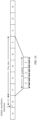
- F represents a flexible slot (flexible slot)
- U represents an uplink slot (uplink slot)
- D represents a downlink slot (downlink slot).
- a real time domain resource region of the uplink cancellation indication (UL CI time domain resource region) is formed.
- the time domain group (that is, the time-frequency resource group) obtained through grouping according to the higher layer signaling may be separated by M downlink symbols in time domain. That is, a plurality of time-frequency resources in a time domain group are separated by M downlink symbols in time domain, and M is a positive integer.
- the network device usually does not perform cross-symbol scheduling on the time-frequency resource of the terminal device.
- an indication of the bit group in the bit sequence to the time-frequency resource group may be adjusted.
- An example in which the time-frequency resource group separated by the M downlink symbols in time domain is an i th time-frequency resource group is used.
- Manner 1 Combine a former half (a time-frequency resource before the M downlink symbols) of the i th time-frequency resource group with an adjacent time-frequency resource group, to indicate (or determine) a transmission status.
- an (i-1) th bit group in the bit sequence indicates a transmission status of an (i-1) th time-frequency resource group and a transmission status of the time-frequency resource before the M downlink symbols in the i th time-frequency resource group
- an i th bit group in the bit sequence indicates a transmission status of a time-frequency resource after the M downlink symbols in the i th time-frequency resource group.
- the third time-frequency resource group is separated by the M downlink symbols in time domain, there are two uplink symbols before the M downlink symbols, and there are two uplink symbols after the M downlink symbols. Therefore, the second bit group in the bit sequence indicates a transmission status of the second time-frequency resource group and a transmission status of the two uplink symbols before the M downlink symbols in the third time-frequency resource group, and the third bit group in the bit sequence indicates a transmission status of the two uplink symbols after the M downlink symbols in the third time-frequency resource group.
- Manner 2 Combine a latter half (a time-frequency resource after the M downlink symbols) of the i th time-frequency resource group with an adjacent time-frequency resource group, to indicate (or determine) a transmission status.
- an i th bit group in the bit sequence indicates a transmission status of a time-frequency resource before the M downlink symbols in the i th time-frequency resource group
- an (i+1) th bit group in the bit sequence indicates a transmission status of the time-frequency resource after the M downlink symbols in the i th time-frequency resource group and a transmission status of an (i+1) th time-frequency resource group.
- the third time-frequency resource group is separated by the M downlink symbols in time domain, there are two uplink symbols before the M downlink symbols, and there are two uplink symbols after the M downlink symbols. Therefore, the third bit group in the bit sequence indicates a transmission status of the two uplink symbols before the M downlink symbols in the third time-frequency resource group, and the fourth bit group in the bit sequence indicates a transmission status of the two uplink symbols after the M downlink symbols in the third time-frequency resource group and a transmission status of the fourth time-frequency resource group.
- Manner 3 Select, based on quantities of symbols respectively included in a former half and a latter half of the i th time-frequency resource group, a half that includes a relatively small quantity of symbols, and combine the half into a time-frequency resource group adjacent to the half, to indicate (or determine) a transmission status.
- an (i-1) th bit group in the bit sequence may indicate a transmission status of an (i-1) th time-frequency resource group and a transmission status of a time-frequency resource before the M downlink symbols in the i th time-frequency resource group, and an i th bit group in the bit sequence indicates a transmission status of a time-frequency resource after the M downlink symbols in the i th time-frequency resource group; or when a quantity of symbols of the i th time-frequency resource group that are before the M downlink symbols is greater than or equal to a quantity of symbols of the i th time-frequency resource group that are after the M downlink symbols, an i th bit group in the bit sequence indicates a transmission status of a time-frequency resource before the M downlink symbols in the i th time-frequency
- the (i-1) th bit group in the bit sequence may indicate the transmission status of the (i-1) th time-frequency resource group and the transmission status of the time-frequency resource before the M downlink symbols in the i th time-frequency resource group, and the i th bit group in the bit sequence indicates the transmission status of the time-frequency resource after the M downlink symbols in the i th time-frequency resource group; or when the quantity of symbols of the i th time-frequency resource group that are before the M downlink symbols is greater than the quantity of symbols of the i th time-frequency resource group that are after the M downlink symbols, the i th bit group in the bit sequence indicates the transmission status of the time-frequency resource before the M downlink symbols in the i th time-frequency resource group, and the (i+1
- Manner 4 Select, based on quantities of symbols respectively included in a former half and a latter half of the i th time-frequency resource group, a half in which a quantity of included symbols conforms to a combination quantity (for example, one or two), and combine the half into a time-frequency resource group adjacent to the half, to indicate (or determine) a transmission status.
- an (i-1) th bit group in the bit sequence indicates a transmission status of an (i-1) th time-frequency resource group and a transmission status of a time-frequency resource before the M first symbols in the i th time-frequency resource group
- an i th bit group in the bit sequence indicates a transmission status of a time-frequency resource after the M first symbols in the i th time-frequency resource group, where i is a positive integer greater than or equal to 2 and less than or equal to N.
- an i th bit group in the bit sequence indicates a transmission status of a time-frequency resource before the M first symbols in the i th time-frequency resource group
- an (i+1) th bit group in the bit sequence indicates a transmission status of a time-frequency resource after the M first symbols in the i th time-frequency resource group and a transmission status of an (i+1) th time-frequency resource group, where i is a positive integer less than or equal to N-1.
- the i th time-frequency resource group is the first time-frequency resource group in time domain or the last time-frequency resource group in time domain
- the i th bit group in the bit sequence indicates the transmission status of the time-frequency resource before the M downlink symbols in the i th time-frequency resource group
- the (i+1) th bit group in the bit sequence indicates the transmission status of the time-frequency resource after the M downlink symbols in the i th time-frequency resource group and the transmission status of the (i+1) th time-frequency resource group.
- the (i-1) th bit group in the bit sequence indicates the transmission status of the (i-1) th time-frequency resource group and the transmission status of the time-frequency resource before the M downlink symbols in the i th time-frequency resource group
- the i th bit group in the bit sequence indicates the transmission status of the time-frequency resource after the M downlink symbols in the i th time-frequency resource group.
- a time domain group that is, a time-frequency resource group
- M a transmission status of a time-frequency resource in the time-frequency resource group before the M downlink symbols and a transmission status of a time-frequency resource after the M downlink symbols
- M whether M is greater than or equal to a first threshold may be further determined.
- the indication of the bit group in the bit sequence to the time-frequency resource group is adjusted only when M is greater than or equal to the first threshold, where the first threshold may be one or more symbols, or may be a quantity of symbols corresponding to one or more slots.
- the first threshold is predefined by a protocol. Alternatively, the first threshold is configured for the terminal device by using signaling after being determined by the network device.
- types of the M downlink symbols may be further specified, and may be semi-persistent downlink symbols configured by the network device for the terminal device by using higher layer signaling, or may be downlink symbols corresponding to SS/PBCH blocks (blocks) configured by the network device for the terminal device.
- the SS is a synchronization signal (synchronization signal)
- the PBCH is a physical broadcast channel (physical broadcast channel)
- the SS/PBCH blocks are a group of time-frequency resources used to send the SS and the PBCH.
- the indication of the bit group in the bit sequence to the time-frequency resource group is adjusted, so that the uplink cancellation indication sent by the network device can be effectively prevented from performing cross-symbol indication on the transmission status of the time-frequency resource in the time-frequency resource group.
- the time-frequency resource region indicated by the downlink interrupted transmission indication configured by the network device for the terminal device generally includes only a downlink symbol, and there is a problem that a time-frequency resource group crosses M uplink symbols.
- adjustment of the indication, included in the downlink interrupted transmission indication, of the bit group in the bit sequence to the time-frequency resource group refer to the adjustment of the indication, included in the uplink cancellation indication, of the bit group in the bit sequence to the time-frequency resource group. Repeated descriptions are not described again.
- the terminal device or the network device may determine the N time-frequency resource groups based on the higher layer signaling before the transmission indication information is received or after the transmission indication information is received, for example, after transmission indication information A is received, determine, based on the higher layer signaling, N time-frequency resource groups indicated by the transmission indication information A.
- S203 The network device sends data scheduling information to the terminal device, and the terminal device receives the data scheduling information.
- the data scheduling information indicates a first time-frequency resource for data transmission.
- the network device may send the data scheduling information to the terminal device before the network device sends the transmission indication information to the terminal device, or after the network device sends the transmission indication information to the terminal device, or the network device may send the data scheduling information and the transmission indication information to the terminal device at the same time. This is not limited in this embodiment of this application.
- the terminal device performs data transmission with the network device based on the transmission status of each of the N time-frequency resource groups and the first time-frequency resource.
- the network device indicates that the first time-frequency resource is a time-frequency resource corresponding to a PUSCH 1, and in a time-frequency resource group corresponding to the PUSCH 1, only a transmission status of the third time-frequency resource group is that uplink transmission of the terminal device is not canceled, and the terminal device sends uplink data only on a PRB occupied by the PUSCH 1 in the third time-frequency resource group.
- the network device receives, on the PRB occupied by the PUSCH 1 in the third time-frequency resource group, the uplink data sent by the terminal device.
- the terminal device may receive downlink data only on a time-frequency resource whose transmission status is that the terminal device has downlink transmission.
- each network element includes a hardware structure and/or a software module (or unit) corresponding to each function.
- a person skilled in the art should be easily aware that units, algorithms, and steps in the examples described with reference to the embodiments disclosed in this specification can be implemented in a form of hardware or a combination of hardware and computer software in this application. Whether a function is performed by hardware or hardware driven by computer software depends on a particular application and a design constraint of the technical solutions. A person skilled in the art may use different methods to implement the described functions for each particular application, but it should not be considered that the implementation goes beyond the scope of this application.
- FIG. 14 and FIG. 15 are schematic diagrams of structures of possible communication apparatuses according to embodiments of this application. These communication apparatuses may be configured to implement a function of the terminal device or the network device in the foregoing method embodiment, and therefore, can also implement a beneficial effect of the method embodiment.
- the communication apparatus may be any terminal device in FIG. 1 , may be the network device in FIG. 1 , or may be a module (chip) applied to the terminal device or the network device.
- a communication apparatus 1400 may include: a processing unit 1402 and a transceiver unit 1403, and may further include a storage unit 1401.
- the communication apparatus 1400 is configured to implement a function of the terminal device or the network device in the foregoing method embodiment shown in FIG. 2 .
- the processing unit 1402 is configured to implement a corresponding processing function.
- the transceiver unit 1403 is configured to support communication between the communication apparatus 1400 and another network entity.
- the storage unit 1401 is configured to store program code and/or data of the communication apparatus 1400.
- the transceiver unit 1403 may include a receiving unit and/or a sending unit that are respectively configured to perform a receiving operation and a sending operation.
- the processing unit 1402 is configured to determine N time-frequency resource groups, where each of the N time-frequency resource groups includes at least one time-frequency resource, and N is a positive integer greater than or equal to 2; and the transceiver unit 1403 is configured to: receive transmission indication information from the network device, where the transmission indication information includes a bit sequence used to indicate transmission statuses of the N time-frequency resource groups, N bit groups in the bit sequence are in a one-to-one correspondence with the N time-frequency resource groups, and each of the N bit groups includes at least one bit; and perform data transmission with the network device based on the transmission status of each of the N time-frequency resource groups.
- an (i-1) th bit group in the bit sequence indicates a transmission status of an (i-1) th time-frequency resource group and a transmission status of a time-frequency resource before the M first symbols in the i th time-frequency resource group
- an i th bit group in the bit sequence indicates a transmission status of a time-frequency resource after the M first symbols in the i th time-frequency resource group, where i is a positive integer greater than or equal to 2 and less than or equal to N.
- an i th bit group in the bit sequence indicates a transmission status of a time-frequency resource before the M first symbols in the i th time-frequency resource group
- an (i+1) th bit group in the bit sequence indicates a transmission status of a time-frequency resource after the M first symbols in the i th time-frequency resource group and a transmission status of an (i+1) th time-frequency resource group, where i is a positive integer less than or equal to N-1.
- the transmission indication information may be used to cancel uplink transmission or downlink transmission.
- the transmission indication information may be an uplink cancellation indication used to indicate whether the terminal device cancels uplink transmission on a corresponding time-frequency resource.
- a determined time-frequency resource group usually includes only an uplink symbol, and a first symbol separating the time-frequency resource group in time domain is generally a downlink symbol.
- the transmission indication information may be a downlink interrupted transmission indication used to indicate whether the terminal device has downlink transmission on a corresponding time-frequency resource.
- a determined time-frequency resource group usually includes only a downlink symbol, and a first symbol separating the time-frequency resource group in time domain is generally an uplink symbol.
- the (i-1) th bit group in the bit sequence indicates the transmission status of the (i-1) th time-frequency resource group and the transmission status of the time-frequency resource before the M first symbols in the i th time-frequency resource group
- the i th bit group in the bit sequence indicates the transmission status of the time-frequency resource after the M first symbols in the i th time-frequency resource group
- the i th bit group in the bit sequence indicates the transmission status of the time-frequency resource before the M first symbols in the i th time-frequency resource group
- the (i+1) th bit group in the bit sequence indicates the transmission status of the time-frequency resource after the M first symbols in the i th time-frequency resource group and the transmission status of the (i+1) th time-frequency resource group, where i is a positive integer less than or equal to N-1.
- the (i-1) th bit group in the bit sequence indicates the transmission status of the (i-1) th time-frequency resource group and the transmission status of the time-frequency resource before the M first symbols in the i th time-frequency resource group
- the i th bit group in the bit sequence indicates the transmission status of the time-frequency resource after the M first symbols in the i th time-frequency resource group, where i is a positive integer greater than or equal to 2 and less than or equal to N.
- the i th bit group in the bit sequence indicates the transmission status of the time-frequency resource before the M first symbols in the i th time-frequency resource group
- the (i+1) th bit group in the bit sequence indicates the transmission status of the time-frequency resource after the M first symbols in the i th time-frequency resource group and the transmission status of the (i+1) th time-frequency resource group, where i is a positive integer less than or equal to N-1.
- the i th bit group in the bit sequence indicates the transmission status of the time-frequency resource before the M first symbols in the i th time-frequency resource group
- the (i+1) th bit group in the bit sequence indicates the transmission status of the time-frequency resource after the M first symbols in the i th time-frequency resource group and the transmission status of the (i+1) th time-frequency resource group.
- the (i-1) th bit group in the bit sequence indicates the transmission status of the (i-1) th time-frequency resource group and the transmission status of the time-frequency resource before the M first symbols in the i th time-frequency resource group
- the i th bit group in the bit sequence indicates the transmission status of the time-frequency resource after the M first symbols in the i th time-frequency resource group.
- a former half or a latter half of a time-frequency resource group separated by a first symbol in time domain can be combined into an adjacent time-frequency resource group, to determine a transmission status.
- the transceiver unit 1403 is further configured to receive data scheduling information from the network device, where the data scheduling information indicates a first time-frequency resource for data transmission; and when performing data transmission with the network device based on the transmission status of each of the N time-frequency resource groups, the processing unit 1402 is specifically configured to perform data transmission with the network device based on the transmission status of each of the N time-frequency resource groups and the first time-frequency resource.
- the processing unit 1402 is configured to determine N time-frequency resource groups, where each of the N time-frequency resource groups includes at least one time-frequency resource, and N is a positive integer greater than or equal to 2; the transceiver unit 1403 is configured to: send transmission indication information to the terminal device, where the transmission indication information includes a bit sequence used to indicate transmission statuses of the N time-frequency resource groups, N bit groups in the bit sequence are in a one-to-one correspondence with the N time-frequency resource groups, and each of the N bit groups includes at least one bit; and perform data transmission with the terminal device based on the transmission status of each of the N time-frequency resource groups.
- an (i-1) th bit group in the bit sequence indicates a transmission status of an (i-1) th time-frequency resource group and a transmission status of a time-frequency resource before the M first symbols in the i th time-frequency resource group
- an i th bit group in the bit sequence indicates a transmission status of a time-frequency resource after the M first symbols in the i th time-frequency resource group, where i is a positive integer greater than or equal to 2 and less than or equal to N.
- an i th bit group in the bit sequence indicates a transmission status of a time-frequency resource before the M first symbols in the i th time-frequency resource group
- an (i+1) th bit group in the bit sequence indicates a transmission status of a time-frequency resource after the M first symbols in the i th time-frequency resource group and a transmission status of an (i+1) th time-frequency resource group, where i is a positive integer less than or equal to N-1.
- the transmission indication information may be used to cancel uplink transmission or downlink transmission.
- the transmission indication information may be an uplink cancellation indication used to indicate whether the terminal device cancels uplink transmission on a corresponding time-frequency resource.
- a determined time-frequency resource group usually includes only an uplink symbol, and a first symbol separating the time-frequency resource group in time domain is generally a downlink symbol.
- the transmission indication information may be a downlink interrupted transmission indication used to indicate whether the terminal device has downlink transmission on a corresponding time-frequency resource.
- a determined time-frequency resource group usually includes only a downlink symbol, and a first symbol separating the time-frequency resource group in time domain is generally an uplink symbol.
- the (i-1) th bit group in the bit sequence indicates the transmission status of the (i-1) th time-frequency resource group and the transmission status of the time-frequency resource before the M first symbols in the i th time-frequency resource group
- the i th bit group in the bit sequence indicates the transmission status of the time-frequency resource after the M first symbols in the i th time-frequency resource group
- the i th bit group in the bit sequence indicates the transmission status of the time-frequency resource before the M first symbols in the i th time-frequency resource group
- the (i+1) th bit group in the bit sequence indicates the transmission status of the time-frequency resource after the M first symbols in the i th time-frequency resource group and the transmission status of the (i+1) th time-frequency resource group, where i is a positive integer less than or equal to N-1.
- the (i-1) th bit group in the bit sequence indicates the transmission status of the (i-1) th time-frequency resource group and the transmission status of the time-frequency resource before the M first symbols in the i th time-frequency resource group
- the i th bit group in the bit sequence indicates the transmission status of the time-frequency resource after the M first symbols in the i th time-frequency resource group, where i is a positive integer greater than or equal to 2 and less than or equal to N.
- the i th bit group in the bit sequence indicates the transmission status of the time-frequency resource before the M first symbols in the i th time-frequency resource group
- the (i+1) th bit group in the bit sequence indicates the transmission status of the time-frequency resource after the M first symbols in the i th time-frequency resource group and the transmission status of the (i+1) th time-frequency resource group, where i is a positive integer less than or equal to N-1.
- the i th bit group in the bit sequence indicates the transmission status of the time-frequency resource before the M first symbols in the i th time-frequency resource group
- the (i+1) th bit group in the bit sequence indicates the transmission status of the time-frequency resource after the M first symbols in the i th time-frequency resource group and the transmission status of the (i+1) th time-frequency resource group.
- the (i-1) th bit group in the bit sequence indicates the transmission status of the (i-1) th time-frequency resource group and the transmission status of the time-frequency resource before the M first symbols in the i th time-frequency resource group
- the i th bit group in the bit sequence indicates the transmission status of the time-frequency resource after the M first symbols in the i th time-frequency resource group.
- a former half or a latter half of a time-frequency resource group separated by a first symbol in time domain can be combined into an adjacent time-frequency resource group, to indicate a transmission status.
- the transceiver unit 1403 is further configured to send data scheduling information to the terminal device, where the data scheduling information indicates a first time-frequency resource for data transmission; and when performing data transmission with the terminal device based on the transmission status of each of the N time-frequency resource groups, the processing unit 1402 is specifically configured to perform data transmission with the terminal device based on the transmission status of each of the N time-frequency resource groups and the first time-frequency resource.
- processing unit 1402 and the transceiver unit 1403 directly refer to the related descriptions in the method embodiment shown in FIG. 2 . Details are not described herein again.
- a communication apparatus 1500 includes a processor 1510 and an interface circuit 1520.
- the processor 1510 and the interface circuit 1520 are coupled to each other.
- the interface circuit 1520 may be a transceiver or an input/output interface.
- the communication apparatus 1500 may further include a memory 1530, configured to: store instructions executed by the processor 1510, or store input data required by the processor 1510 to run instructions, or store data generated after the processor 1510 runs instructions.
- the processor 1510 is configured to implement a function of the processing unit 1402
- the interface circuit 1520 is configured to implement a function of the transceiver unit 1403.
- the terminal device chip When the communication apparatus is a chip applied to a terminal device, the terminal device chip implements a function of the terminal device in the foregoing method embodiment.
- the terminal device chip receives information from another module (such as a radio frequency module or an antenna) in the terminal device, where the information is sent by a network device to the terminal device.
- the terminal device chip sends information to another module (such as a radio frequency module or an antenna) in the terminal device, where the information is sent by the terminal device to the network device.
- the network device chip When the communication apparatus is a chip applied to the network device, the network device chip implements a function of the network device in the foregoing method embodiment.
- the network device chip receives information from another module (such as a radio frequency module or an antenna) in the network device, where the information is sent by the terminal device to the network device.
- the network device chip sends information to another module (such as a radio frequency module or an antenna) in the network device, where the information is sent by the network device to the terminal device.
- the processor in embodiments of this application may be a central processing unit (central processing unit, CPU), a general-purpose processor, a digital signal processor (digital signal processing, DSP), an application-specific integrated circuit (application-specific integrated circuit, ASIC), a field programmable gate array (field programmable gate array, FPGA), or another programmable logic device, a transistor logic device, a hardware component, or any combination thereof.
- the general purpose processor may be a microprocessor or any regular processor or the like.
- the method steps in the embodiments of this application may be implemented in a hardware manner, or may be implemented in a manner of executing software instructions by the processor.
- the software instructions may include corresponding software modules, and the software modules may be stored in a random access memory (random access memory, RAM), a flash memory, a read-only memory (read-only memory, ROM), a programmable read-only memory (programmable ROM, PROM), an erasable programmable read-only memory (erasable PROM, EPROM), an electrically erasable programmable read-only memory (electrically EPROM, EEPROM), a register, a hard disk, a removable hard disk, a CD-ROM, or any other form of storage medium well known in the art.
- a storage medium is coupled to a processor, so that the processor can read information from the storage medium or write information into the storage medium.
- the storage medium may be a component of the processor.
- the processor and the storage medium may be disposed in an ASIC.
- the ASIC may be located in the network device or the terminal device.
- the processor and the storage medium may exist in network equipment as discrete components.
- All or some of the foregoing embodiments may be implemented by using software, hardware, firmware, or any combination thereof.
- software is used to implement the embodiments, all or a part of the embodiments may be implemented in a form of a computer program product.
- the computer program product includes one or more computer instructions.
- the computer may be a general-purpose computer, a dedicated computer, a computer network, a network device, user equipment, or another programmable apparatus.
- the computer instructions may be stored in a computer-readable storage medium or may be transmitted from a computer-readable storage medium to another computer-readable storage medium.
- the computer instructions may be transmitted from a website, computer, server, or data center to another website, computer, server, or data center in a wired or wireless manner.
- the computer-readable storage medium may be any usable medium accessible by the computer, or a data storage device, for example, a server or a data center, integrating one or more usable media.
- the usable medium may be a magnetic medium, such as a floppy disk, a hard disk, or a magnetic tape, may be an optical medium, such as a digital video disc (digital video disc, DVD), or may be a semiconductor medium, for example, a solid state drive (solid state drive, SSD).
- At least one means one or more, and a plurality of means two or more. And/or describes an association relationship between associated objects, and represents that three relationships may exist.
- a and/or B may represent the following cases: Only A exists, both A and B exist, and only B exists, where A and B may be singular or plural.
- the character "/" generally indicates that associated objects are in an "or” relationship.
- the character "/" indicates that associated objects are in a "division" relationship.
- ordinal numerals such as “first” and “second” mentioned in the embodiments of this application are used to distinguish between a plurality of objects, but are not used to limit an order, a sequence, a priority, or an importance degree of the plurality of objects.
- that the objects are necessarily different is not limited in descriptions of "first” and "second”.
- sequence numbers in the embodiments of this application are merely used for differentiation for ease of description.
- sequence numbers of the foregoing processes do not mean the sequence of execution, and a sequence of execution of each process should be determined based on a function and internal logic of the process.
Landscapes
- Engineering & Computer Science (AREA)
- Signal Processing (AREA)
- Computer Networks & Wireless Communication (AREA)
- Mobile Radio Communication Systems (AREA)
Claims (14)
- Kommunikationsverfahren, wobei das Verfahren umfasst:Bestimmen von N Zeit-Frequenz-Ressourcen-Gruppen, wobei jede der N Zeit-Frequenz-Ressourcen-Gruppen zumindest eine Zeit-Frequenz-Ressource umfasst und N eine positive Ganzzahl größer oder gleich 2 ist;Empfangen von Übertragungsangabeinformationen von einem Netzwerkgerät, wobei die Übertragungsangabeinformationen eine Bit-Sequenz umfassen, die zum Angeben von Übertragungsstatus der N Zeit-Frequenz-Ressourcen-Gruppen verwendet wird, N Bit-Gruppen in der Bit-Sequenz in einer Eins-zu-eins-Entsprechung mit den N Zeit-Frequenz-Ressourcen-Gruppen sind und jede der N Bit-Gruppen zumindest ein Bit umfasst; undDurchführen einer Datenübertragung mit dem Netzwerkgerät basierend auf einem Übertragungsstatus jeder der N Zeit-Frequenz-Ressourcen-Gruppen, wobeiwenn eine i-te Zeit-Frequenz-Ressourcen-Gruppe in den N Zeit-Frequenz-Ressourcen-Gruppen durch M erste Symbole im Zeitbereich getrennt ist und M eine positive Ganzzahl ist,eine (i-1)-te Bit-Gruppe in der Bit-Sequenz einen Übertragungsstatus einer (i-1)-ten Zeit-Frequenz-Ressourcen-Gruppe und einen Übertragungsstatus einer Zeit-Frequenz-Ressource vor den M ersten Symbolen in der i-ten Zeit-Frequenz-Ressourcen-Gruppe angibt und eine i-te Bit-Gruppe in der Bit-Sequenz einen Übertragungsstatus einer Zeit-Frequenz-Ressource nach den M ersten Symbolen in der i-ten Zeit-Frequenz-Ressourcen-Gruppe angibt, wobei i eine positive Ganzzahl größer oder gleich 2 und kleiner oder gleich N ist; odereine i-te Bit-Gruppe in der Bit-Sequenz einen Übertragungsstatus einer Zeit-Frequenz-Ressource vor den M ersten Symbolen in der i-ten Zeit-Frequenz-Ressourcen-Gruppe angibt und eine (i+1)-te Bit-Gruppe in der Bit-Sequenz einen Übertragungsstatus einer Zeit-Frequenz-Ressource nach den M ersten Symbolen in der i-ten Zeit-Frequenz-Ressourcen-Gruppe und einen Übertragungsstatus einer (i+1)-ten Zeit-Frequenz-Ressourcen-Gruppe angibt, wobei i eine positive Ganzzahl kleiner oder gleich N-1 ist.
- Verfahren nach Anspruch 1, wobei, wenn eine Menge von Symbolen der i-ten Zeit-Frequenz-Ressourcen-Gruppe, die vor den M ersten Symbolen sind, kleiner als eine Menge von Symbolen der i-ten Zeit-Frequenz-Ressourcen-Gruppe, die nach den M ersten Symbolen sind, ist, die (i-1)-te Bit-Gruppe in der Bit-Sequenz den Übertragungsstatus der (i-1)-ten Zeit-Frequenz-Ressourcen-Gruppe und den Übertragungsstatus der Zeit-Frequenz-Ressource vor den M ersten Symbolen in der i-ten Zeit-Frequenz-Ressourcen-Gruppe angibt und die i-te Bit-Gruppe in der Bit-Sequenz den Übertragungsstatus der Zeit-Frequenz-Ressource nach den M ersten Symbolen in der i-ten Zeit-Frequenz-Ressourcen-Gruppe angibt, wobei i eine positive Ganzzahl größer oder gleich 2 und kleiner oder gleich N ist.
- Verfahren nach Anspruch 1, wobei, wenn eine Menge von Symbolen der i-ten Zeit-Frequenz-Ressourcen-Gruppe, die vor den M ersten Symbolen sind, größer oder gleich einer Menge von Symbolen der i-ten Zeit-Frequenz-Ressourcen-Gruppe, die nach den M ersten Symbolen sind, ist, die i-te Bit-Gruppe in der Bit-Sequenz den Übertragungsstatus der Zeit-Frequenz-Ressource vor den M ersten Symbolen in der i-ten Zeit-Frequenz-Ressourcen-Gruppe angibt und die (i+1)-te Bit-Gruppe in der Bit-Sequenz den Übertragungsstatus der Zeit-Frequenz-Ressource nach den M ersten Symbolen in der i-ten Zeit-Frequenz-Ressourcen-Gruppe und den Übertragungsstatus der (i+1)-ten Zeit-Frequenz-Ressourcen-Gruppe angibt, wobei i eine positive Ganzzahl kleiner oder gleich N-1 ist.
- Verfahren nach einem der Ansprüche 1 bis 3, wobei M größer oder gleich einer ersten Schwelle ist.
- Verfahren nach einem der Ansprüche 1 bis 4, wobei, wenn die Übertragungsangabeinformationen zum Beenden einer Uplink-Übertragung verwendet werden, die M ersten Symbole Downlink-Symbole sind.
- Verfahren nach einem der Ansprüche 1 bis 5, wobei das Verfahren ferner umfasst:Empfangen von Datenplanungsinformationen vom Netzwerkgerät, wobei die Datenplanungsinformationen eine erste Zeit-Frequenz-Ressource zur Datenübertragung angeben; undwobei das Durchführen einer Datenübertragung mit dem Netzwerkgerät basierend auf einem Übertragungsstatus jeder der N Zeit-Frequenz-Ressourcen-Gruppen umfasst:
Durchführen einer Datenübertragung mit dem Netzwerkgerät basierend auf dem Übertragungsstatus jeder der N Zeit-Frequenz-Ressourcen-Gruppen und der ersten Zeit-Frequenz-Ressource. - Kommunikationsverfahren, wobei das Verfahren umfasst:Bestimmen von N Zeit-Frequenz-Ressourcen-Gruppen, wobei jede der N Zeit-Frequenz-Ressourcen-Gruppen zumindest eine Zeit-Frequenz-Ressource umfasst und N eine positive Ganzzahl größer oder gleich 2 ist;Senden von Übertragungsangabeinformationen an ein Endgerät, wobei die Übertragungsangabeinformationen eine Bit-Sequenz umfassen, die zum Angeben von Übertragungsstatus der N Zeit-Frequenz-Ressourcen-Gruppen verwendet wird, N Bit-Gruppen in der Bit-Sequenz in einer Eins-zu-eins-Entsprechung mit den N Zeit-Frequenz-Ressourcen-Gruppen sind und jede der N Bit-Gruppen zumindest ein Bit umfasst; undDurchführen einer Datenübertragung mit dem Endgerät basierend auf einem Übertragungsstatus jeder der N Zeit-Frequenz-Ressourcen-Gruppen, wobeiwenn eine i-te Zeit-Frequenz-Ressourcen-Gruppe in den N Zeit-Frequenz-Ressourcen-Gruppen durch M erste Symbole im Zeitbereich getrennt ist und M eine positive Ganzzahl ist,eine (i-1)-te Bit-Gruppe in der Bit-Sequenz einen Übertragungsstatus einer (i-1)-ten Zeit-Frequenz-Ressourcen-Gruppe und einen Übertragungsstatus einer Zeit-Frequenz-Ressource vor den M ersten Symbolen in der i-ten Zeit-Frequenz-Ressourcen-Gruppe angibt und eine i-te Bit-Gruppe in der Bit-Sequenz einen Übertragungsstatus einer Zeit-Frequenz-Ressource nach den M ersten Symbolen in der i-ten Zeit-Frequenz-Ressourcen-Gruppe angibt, wobei i eine positive Ganzzahl größer oder gleich 2 und kleiner oder gleich N ist; odereine i-te Bit-Gruppe in der Bit-Sequenz einen Übertragungsstatus einer Zeit-Frequenz-Ressource vor den M ersten Symbolen in der i-ten Zeit-Frequenz-Ressourcen-Gruppe angibt und eine (i+1)-te Bit-Gruppe in der Bit-Sequenz einen Übertragungsstatus einer Zeit-Frequenz-Ressource nach den M ersten Symbolen in der i-ten Zeit-Frequenz-Ressourcen-Gruppe und einen Übertragungsstatus einer (i+1)-ten Zeit-Frequenz-Ressourcen-Gruppe angibt, wobei i eine positive Ganzzahl kleiner oder gleich N-1 ist.
- Verfahren nach Anspruch 7, wobei, wenn eine Menge von Symbolen der i-ten Zeit-Frequenz-Ressourcen-Gruppe, die vor den M ersten Symbolen sind, kleiner als eine Menge von Symbolen der i-ten Zeit-Frequenz-Ressourcen-Gruppe, die nach den M ersten Symbolen sind, ist, die (i-1)-te Bit-Gruppe in der Bit-Sequenz den Übertragungsstatus der (i-1)-ten Zeit-Frequenz-Ressourcen-Gruppe und den Übertragungsstatus der Zeit-Frequenz-Ressource vor den M ersten Symbolen in der i-ten Zeit-Frequenz-Ressourcen-Gruppe angibt und die i-te Bit-Gruppe in der Bit-Sequenz den Übertragungsstatus einer Zeit-Frequenz-Ressource nach den M ersten Symbolen in der i-ten Zeit-Frequenz-Ressourcen-Gruppe angibt, wobei i eine positive Ganzzahl größer oder gleich 2 und kleiner oder gleich N ist.
- Verfahren nach Anspruch 7, wobei, wenn eine Menge von Symbolen der i-ten Zeit-Frequenz-Ressourcen-Gruppe, die vor den M ersten Symbolen sind, größer oder gleich einer Menge von Symbolen der i-ten Zeit-Frequenz-Ressourcen-Gruppe, die nach den M ersten Symbolen sind, ist, die i-te Bit-Gruppe in der Bit-Sequenz den Übertragungsstatus der Zeit-Frequenz-Ressource vor den M ersten Symbolen in der i-ten Zeit-Frequenz-Ressourcen-Gruppe angibt und die (i+1)-te Bit-Gruppe in der Bit-Sequenz den Übertragungsstatus der Zeit-Frequenz-Ressource nach den M ersten Symbolen in der i-ten Zeit-Frequenz-Ressourcen-Gruppe und den Übertragungsstatus der (i+1)-ten Zeit-Frequenz-Ressourcen-Gruppe angibt, wobei i eine positive Ganzzahl kleiner oder gleich N-1 ist.
- Verfahren nach einem der Ansprüche 7 bis 9, wobei M größer oder gleich einer ersten Schwelle ist.
- Verfahren nach einem der Ansprüche 7 bis 10, wobei, wenn die Übertragungsangabeinformationen zum Beenden einer Uplink-Übertragung verwendet werden, die M ersten Symbole Downlink-Symbole sind.
- Verfahren nach einem der Ansprüche 7 bis 11, wobei das Verfahren ferner umfasst:Senden von Datenplanungsinformationen an das Endgerät, wobei die Datenplanungsinformationen eine erste Zeit-Frequenz-Ressource zur Datenübertragung angeben; undwobei das Durchführen einer Datenübertragung mit dem Endgerät basierend auf einem Übertragungsstatus jeder der N Zeit-Frequenz-Ressourcen-Gruppen umfasst:
Durchführen einer Datenübertragung mit dem Endgerät basierend auf dem Übertragungsstatus jeder der N Zeit-Frequenz-Ressourcen-Gruppen und der ersten Zeit-Frequenz-Ressource. - Kommunikationsvorrichtung, die zum Durchführen des Verfahrens nach einem der Ansprüche 1 bis 6 ausgelegt ist oder zum Durchführen des Verfahrens nach einem der Ansprüche 7 bis 12 ausgelegt ist.
- Computerlesbares Speichermedium, wobei das Speichermedium ein Computerprogramm oder Anweisungen speichert; und wenn das Computerprogramm oder die Anweisungen durch eine Kommunikationsvorrichtung ausgeführt werden, das Verfahren nach einem der Ansprüche 1 bis 6 oder das Verfahren nach einem der Ansprüche 7 bis 12 implementiert wird.
Applications Claiming Priority (2)
| Application Number | Priority Date | Filing Date | Title |
|---|---|---|---|
| CN202010281404.8A CN113518451B (zh) | 2020-04-10 | 2020-04-10 | 一种通信方法及装置 |
| PCT/CN2021/082168 WO2021203957A1 (zh) | 2020-04-10 | 2021-03-22 | 一种通信方法及装置 |
Publications (3)
| Publication Number | Publication Date |
|---|---|
| EP4120769A1 EP4120769A1 (de) | 2023-01-18 |
| EP4120769A4 EP4120769A4 (de) | 2023-08-23 |
| EP4120769B1 true EP4120769B1 (de) | 2024-09-18 |
Family
ID=78022828
Family Applications (1)
| Application Number | Title | Priority Date | Filing Date |
|---|---|---|---|
| EP21785495.9A Active EP4120769B1 (de) | 2020-04-10 | 2021-03-22 | Kommunikationsverfahren und -vorrichtung |
Country Status (4)
| Country | Link |
|---|---|
| US (1) | US12245216B2 (de) |
| EP (1) | EP4120769B1 (de) |
| CN (1) | CN113518451B (de) |
| WO (1) | WO2021203957A1 (de) |
Families Citing this family (4)
| Publication number | Priority date | Publication date | Assignee | Title |
|---|---|---|---|---|
| CN117200952B (zh) * | 2022-05-28 | 2026-02-06 | 华为技术有限公司 | 侧行定位参考信号资源分配方法、装置、系统及存储介质 |
| CN117676865A (zh) * | 2022-08-11 | 2024-03-08 | 维沃移动通信有限公司 | 中断传输指示方法、取消指示方法、终端及网络侧设备 |
| US20240113835A1 (en) * | 2022-09-29 | 2024-04-04 | Qualcomm Incorporated | Uplink cancellation indication for srs muting |
| CN120934714A (zh) * | 2024-05-10 | 2025-11-11 | 华为技术有限公司 | 通信方法和通信装置 |
Family Cites Families (11)
| Publication number | Priority date | Publication date | Assignee | Title |
|---|---|---|---|---|
| US9525466B2 (en) * | 2014-04-14 | 2016-12-20 | Lg Electronics Inc. | Method of performing interference cancellation and apparatus therefor |
| US10979988B2 (en) * | 2017-11-07 | 2021-04-13 | Apple Inc. | Methods of limited buffer rate-matching (LBRM), pre-emption, and sidelink synchronization in new radio (NR) systems |
| US10873423B2 (en) * | 2018-02-15 | 2020-12-22 | Huawei Technologies Co., Ltd. | Systems and methods for allocation of uplink control channel resources in unlicensed spectrum |
| CN110366246A (zh) * | 2018-03-26 | 2019-10-22 | 维沃移动通信有限公司 | 取消上行传输的方法和终端设备 |
| CN110351867B (zh) * | 2018-04-04 | 2022-01-14 | 华为技术有限公司 | 通信方法和通信装置 |
| CN110636610B (zh) * | 2018-06-21 | 2022-08-26 | 华为技术有限公司 | 一种通信方法及装置 |
| CN112019315B (zh) * | 2018-08-08 | 2025-02-14 | 荣耀终端有限公司 | 一种被用于无线通信的用户设备、基站中的方法和装置 |
| US12016030B2 (en) * | 2018-08-10 | 2024-06-18 | Apple Inc. | Downlink control channel signaling for uplink coexistance of multiple service types |
| GB2576217A (en) * | 2018-08-10 | 2020-02-12 | Nec Corp | Communication system |
| WO2020069428A1 (en) * | 2018-09-28 | 2020-04-02 | Intel Corporation | Sequence-based uplink (ul) transmission cancellation for new radio (nr) |
| WO2020262202A1 (en) * | 2019-06-26 | 2020-12-30 | Sharp Kabushiki Kaisha | User equipment and base stations that achieve uplink multiplexing |
-
2020
- 2020-04-10 CN CN202010281404.8A patent/CN113518451B/zh active Active
-
2021
- 2021-03-22 EP EP21785495.9A patent/EP4120769B1/de active Active
- 2021-03-22 WO PCT/CN2021/082168 patent/WO2021203957A1/zh not_active Ceased
-
2022
- 2022-09-27 US US17/935,920 patent/US12245216B2/en active Active
Also Published As
| Publication number | Publication date |
|---|---|
| CN113518451B (zh) | 2025-08-05 |
| US20230014045A1 (en) | 2023-01-19 |
| US12245216B2 (en) | 2025-03-04 |
| CN113518451A (zh) | 2021-10-19 |
| EP4120769A4 (de) | 2023-08-23 |
| WO2021203957A1 (zh) | 2021-10-14 |
| EP4120769A1 (de) | 2023-01-18 |
Similar Documents
| Publication | Publication Date | Title |
|---|---|---|
| EP4120769B1 (de) | Kommunikationsverfahren und -vorrichtung | |
| US11871427B2 (en) | Data transmission method, terminal device and network device | |
| EP3949229B1 (de) | Verfahren und vorrichtung zur überwachung von steuerkanalkandidaten | |
| EP3703450B1 (de) | Verfahren und vorrichtung zur ressourcenkonfiguration und speichermedium | |
| US12520312B2 (en) | Method for data transmission, terminal device and network device | |
| WO2021164482A1 (zh) | 信息接收方法、信息发送方法及设备 | |
| US11706786B2 (en) | Wireless communication method, terminal device, and network device | |
| JP2019527944A (ja) | 通信方法、ネットワーク機器及び端末装置 | |
| TWI754052B (zh) | 傳輸信號的方法、網絡設備和終端設備 | |
| CN120710646A (zh) | 数据传输方法、终端和基站 | |
| US11191066B2 (en) | Method for transmitting data, terminal device and network device | |
| AU2017418439A1 (en) | Data transmission method, terminal device, and network device | |
| US11770834B2 (en) | Data transmission method, terminal device, and network device | |
| CN116033576A (zh) | 控制信道检测方法、装置及设备 | |
| EP3742692A1 (de) | Ressourcenkartierungsverfahren und kommunikationsvorrichtung |
Legal Events
| Date | Code | Title | Description |
|---|---|---|---|
| STAA | Information on the status of an ep patent application or granted ep patent |
Free format text: STATUS: THE INTERNATIONAL PUBLICATION HAS BEEN MADE |
|
| PUAI | Public reference made under article 153(3) epc to a published international application that has entered the european phase |
Free format text: ORIGINAL CODE: 0009012 |
|
| STAA | Information on the status of an ep patent application or granted ep patent |
Free format text: STATUS: REQUEST FOR EXAMINATION WAS MADE |
|
| 17P | Request for examination filed |
Effective date: 20221011 |
|
| AK | Designated contracting states |
Kind code of ref document: A1 Designated state(s): AL AT BE BG CH CY CZ DE DK EE ES FI FR GB GR HR HU IE IS IT LI LT LU LV MC MK MT NL NO PL PT RO RS SE SI SK SM TR |
|
| DAV | Request for validation of the european patent (deleted) | ||
| DAX | Request for extension of the european patent (deleted) | ||
| REG | Reference to a national code |
Ref country code: DE Ref legal event code: R079 Free format text: PREVIOUS MAIN CLASS: H04W0072040000 Ipc: H04L0005000000 Ref country code: DE Ref legal event code: R079 Ref document number: 602021019037 Country of ref document: DE Free format text: PREVIOUS MAIN CLASS: H04W0072040000 Ipc: H04L0005000000 |
|
| A4 | Supplementary search report drawn up and despatched |
Effective date: 20230726 |
|
| RIC1 | Information provided on ipc code assigned before grant |
Ipc: H04W 72/0453 20230101ALN20230720BHEP Ipc: H04W 72/23 20230101ALN20230720BHEP Ipc: H04W 72/0446 20230101ALI20230720BHEP Ipc: H04L 5/00 20060101AFI20230720BHEP |
|
| GRAP | Despatch of communication of intention to grant a patent |
Free format text: ORIGINAL CODE: EPIDOSNIGR1 |
|
| STAA | Information on the status of an ep patent application or granted ep patent |
Free format text: STATUS: GRANT OF PATENT IS INTENDED |
|
| RIC1 | Information provided on ipc code assigned before grant |
Ipc: H04W 72/0453 20230101ALN20240403BHEP Ipc: H04W 72/23 20230101ALN20240403BHEP Ipc: H04W 72/0446 20230101ALI20240403BHEP Ipc: H04L 5/00 20060101AFI20240403BHEP |
|
| INTG | Intention to grant announced |
Effective date: 20240429 |
|
| GRAS | Grant fee paid |
Free format text: ORIGINAL CODE: EPIDOSNIGR3 |
|
| GRAA | (expected) grant |
Free format text: ORIGINAL CODE: 0009210 |
|
| STAA | Information on the status of an ep patent application or granted ep patent |
Free format text: STATUS: THE PATENT HAS BEEN GRANTED |
|
| AK | Designated contracting states |
Kind code of ref document: B1 Designated state(s): AL AT BE BG CH CY CZ DE DK EE ES FI FR GB GR HR HU IE IS IT LI LT LU LV MC MK MT NL NO PL PT RO RS SE SI SK SM TR |
|
| REG | Reference to a national code |
Ref country code: GB Ref legal event code: FG4D |
|
| REG | Reference to a national code |
Ref country code: CH Ref legal event code: EP |
|
| REG | Reference to a national code |
Ref country code: IE Ref legal event code: FG4D |
|
| REG | Reference to a national code |
Ref country code: DE Ref legal event code: R096 Ref document number: 602021019037 Country of ref document: DE |
|
| REG | Reference to a national code |
Ref country code: LT Ref legal event code: MG9D |
|
| PG25 | Lapsed in a contracting state [announced via postgrant information from national office to epo] |
Ref country code: NO Free format text: LAPSE BECAUSE OF FAILURE TO SUBMIT A TRANSLATION OF THE DESCRIPTION OR TO PAY THE FEE WITHIN THE PRESCRIBED TIME-LIMIT Effective date: 20241218 |
|
| PG25 | Lapsed in a contracting state [announced via postgrant information from national office to epo] |
Ref country code: GR Free format text: LAPSE BECAUSE OF FAILURE TO SUBMIT A TRANSLATION OF THE DESCRIPTION OR TO PAY THE FEE WITHIN THE PRESCRIBED TIME-LIMIT Effective date: 20241219 Ref country code: FI Free format text: LAPSE BECAUSE OF FAILURE TO SUBMIT A TRANSLATION OF THE DESCRIPTION OR TO PAY THE FEE WITHIN THE PRESCRIBED TIME-LIMIT Effective date: 20240918 |
|
| PG25 | Lapsed in a contracting state [announced via postgrant information from national office to epo] |
Ref country code: BG Free format text: LAPSE BECAUSE OF FAILURE TO SUBMIT A TRANSLATION OF THE DESCRIPTION OR TO PAY THE FEE WITHIN THE PRESCRIBED TIME-LIMIT Effective date: 20240918 |
|
| PG25 | Lapsed in a contracting state [announced via postgrant information from national office to epo] |
Ref country code: LV Free format text: LAPSE BECAUSE OF FAILURE TO SUBMIT A TRANSLATION OF THE DESCRIPTION OR TO PAY THE FEE WITHIN THE PRESCRIBED TIME-LIMIT Effective date: 20240918 |
|
| PG25 | Lapsed in a contracting state [announced via postgrant information from national office to epo] |
Ref country code: HR Free format text: LAPSE BECAUSE OF FAILURE TO SUBMIT A TRANSLATION OF THE DESCRIPTION OR TO PAY THE FEE WITHIN THE PRESCRIBED TIME-LIMIT Effective date: 20240918 |
|
| REG | Reference to a national code |
Ref country code: NL Ref legal event code: MP Effective date: 20240918 |
|
| PG25 | Lapsed in a contracting state [announced via postgrant information from national office to epo] |
Ref country code: RS Free format text: LAPSE BECAUSE OF FAILURE TO SUBMIT A TRANSLATION OF THE DESCRIPTION OR TO PAY THE FEE WITHIN THE PRESCRIBED TIME-LIMIT Effective date: 20241218 |
|
| PG25 | Lapsed in a contracting state [announced via postgrant information from national office to epo] |
Ref country code: RS Free format text: LAPSE BECAUSE OF FAILURE TO SUBMIT A TRANSLATION OF THE DESCRIPTION OR TO PAY THE FEE WITHIN THE PRESCRIBED TIME-LIMIT Effective date: 20241218 Ref country code: NO Free format text: LAPSE BECAUSE OF FAILURE TO SUBMIT A TRANSLATION OF THE DESCRIPTION OR TO PAY THE FEE WITHIN THE PRESCRIBED TIME-LIMIT Effective date: 20241218 Ref country code: LV Free format text: LAPSE BECAUSE OF FAILURE TO SUBMIT A TRANSLATION OF THE DESCRIPTION OR TO PAY THE FEE WITHIN THE PRESCRIBED TIME-LIMIT Effective date: 20240918 Ref country code: HR Free format text: LAPSE BECAUSE OF FAILURE TO SUBMIT A TRANSLATION OF THE DESCRIPTION OR TO PAY THE FEE WITHIN THE PRESCRIBED TIME-LIMIT Effective date: 20240918 Ref country code: GR Free format text: LAPSE BECAUSE OF FAILURE TO SUBMIT A TRANSLATION OF THE DESCRIPTION OR TO PAY THE FEE WITHIN THE PRESCRIBED TIME-LIMIT Effective date: 20241219 Ref country code: FI Free format text: LAPSE BECAUSE OF FAILURE TO SUBMIT A TRANSLATION OF THE DESCRIPTION OR TO PAY THE FEE WITHIN THE PRESCRIBED TIME-LIMIT Effective date: 20240918 Ref country code: BG Free format text: LAPSE BECAUSE OF FAILURE TO SUBMIT A TRANSLATION OF THE DESCRIPTION OR TO PAY THE FEE WITHIN THE PRESCRIBED TIME-LIMIT Effective date: 20240918 |
|
| REG | Reference to a national code |
Ref country code: AT Ref legal event code: MK05 Ref document number: 1725595 Country of ref document: AT Kind code of ref document: T Effective date: 20240918 |
|
| PG25 | Lapsed in a contracting state [announced via postgrant information from national office to epo] |
Ref country code: NL Free format text: LAPSE BECAUSE OF FAILURE TO SUBMIT A TRANSLATION OF THE DESCRIPTION OR TO PAY THE FEE WITHIN THE PRESCRIBED TIME-LIMIT Effective date: 20240918 |
|
| PG25 | Lapsed in a contracting state [announced via postgrant information from national office to epo] |
Ref country code: IS Free format text: LAPSE BECAUSE OF FAILURE TO SUBMIT A TRANSLATION OF THE DESCRIPTION OR TO PAY THE FEE WITHIN THE PRESCRIBED TIME-LIMIT Effective date: 20250118 Ref country code: PT Free format text: LAPSE BECAUSE OF FAILURE TO SUBMIT A TRANSLATION OF THE DESCRIPTION OR TO PAY THE FEE WITHIN THE PRESCRIBED TIME-LIMIT Effective date: 20250120 |
|
| PG25 | Lapsed in a contracting state [announced via postgrant information from national office to epo] |
Ref country code: RO Free format text: LAPSE BECAUSE OF FAILURE TO SUBMIT A TRANSLATION OF THE DESCRIPTION OR TO PAY THE FEE WITHIN THE PRESCRIBED TIME-LIMIT Effective date: 20240918 Ref country code: SM Free format text: LAPSE BECAUSE OF FAILURE TO SUBMIT A TRANSLATION OF THE DESCRIPTION OR TO PAY THE FEE WITHIN THE PRESCRIBED TIME-LIMIT Effective date: 20240918 |
|
| PG25 | Lapsed in a contracting state [announced via postgrant information from national office to epo] |
Ref country code: ES Free format text: LAPSE BECAUSE OF FAILURE TO SUBMIT A TRANSLATION OF THE DESCRIPTION OR TO PAY THE FEE WITHIN THE PRESCRIBED TIME-LIMIT Effective date: 20240918 |
|
| PG25 | Lapsed in a contracting state [announced via postgrant information from national office to epo] |
Ref country code: AT Free format text: LAPSE BECAUSE OF FAILURE TO SUBMIT A TRANSLATION OF THE DESCRIPTION OR TO PAY THE FEE WITHIN THE PRESCRIBED TIME-LIMIT Effective date: 20240918 Ref country code: EE Free format text: LAPSE BECAUSE OF FAILURE TO SUBMIT A TRANSLATION OF THE DESCRIPTION OR TO PAY THE FEE WITHIN THE PRESCRIBED TIME-LIMIT Effective date: 20240918 |
|
| PG25 | Lapsed in a contracting state [announced via postgrant information from national office to epo] |
Ref country code: PL Free format text: LAPSE BECAUSE OF FAILURE TO SUBMIT A TRANSLATION OF THE DESCRIPTION OR TO PAY THE FEE WITHIN THE PRESCRIBED TIME-LIMIT Effective date: 20240918 Ref country code: CZ Free format text: LAPSE BECAUSE OF FAILURE TO SUBMIT A TRANSLATION OF THE DESCRIPTION OR TO PAY THE FEE WITHIN THE PRESCRIBED TIME-LIMIT Effective date: 20240918 |
|
| PG25 | Lapsed in a contracting state [announced via postgrant information from national office to epo] |
Ref country code: IT Free format text: LAPSE BECAUSE OF FAILURE TO SUBMIT A TRANSLATION OF THE DESCRIPTION OR TO PAY THE FEE WITHIN THE PRESCRIBED TIME-LIMIT Effective date: 20240918 Ref country code: SK Free format text: LAPSE BECAUSE OF FAILURE TO SUBMIT A TRANSLATION OF THE DESCRIPTION OR TO PAY THE FEE WITHIN THE PRESCRIBED TIME-LIMIT Effective date: 20240918 |
|
| REG | Reference to a national code |
Ref country code: DE Ref legal event code: R097 Ref document number: 602021019037 Country of ref document: DE |
|
| PG25 | Lapsed in a contracting state [announced via postgrant information from national office to epo] |
Ref country code: DK Free format text: LAPSE BECAUSE OF FAILURE TO SUBMIT A TRANSLATION OF THE DESCRIPTION OR TO PAY THE FEE WITHIN THE PRESCRIBED TIME-LIMIT Effective date: 20240918 |
|
| PLBE | No opposition filed within time limit |
Free format text: ORIGINAL CODE: 0009261 |
|
| STAA | Information on the status of an ep patent application or granted ep patent |
Free format text: STATUS: NO OPPOSITION FILED WITHIN TIME LIMIT |
|
| 26N | No opposition filed |
Effective date: 20250619 |
|
| PG25 | Lapsed in a contracting state [announced via postgrant information from national office to epo] |
Ref country code: SE Free format text: LAPSE BECAUSE OF FAILURE TO SUBMIT A TRANSLATION OF THE DESCRIPTION OR TO PAY THE FEE WITHIN THE PRESCRIBED TIME-LIMIT Effective date: 20240918 |
|
| REG | Reference to a national code |
Ref country code: DE Ref legal event code: R119 Ref document number: 602021019037 Country of ref document: DE |
|
| PG25 | Lapsed in a contracting state [announced via postgrant information from national office to epo] |
Ref country code: MC Free format text: LAPSE BECAUSE OF FAILURE TO SUBMIT A TRANSLATION OF THE DESCRIPTION OR TO PAY THE FEE WITHIN THE PRESCRIBED TIME-LIMIT Effective date: 20240918 |
|
| REG | Reference to a national code |
Ref country code: CH Ref legal event code: H13 Free format text: ST27 STATUS EVENT CODE: U-0-0-H10-H13 (AS PROVIDED BY THE NATIONAL OFFICE) Effective date: 20251023 |
|
| PG25 | Lapsed in a contracting state [announced via postgrant information from national office to epo] |
Ref country code: LU Free format text: LAPSE BECAUSE OF NON-PAYMENT OF DUE FEES Effective date: 20250322 |
|
| REG | Reference to a national code |
Ref country code: BE Ref legal event code: MM Effective date: 20250331 |
|
| PG25 | Lapsed in a contracting state [announced via postgrant information from national office to epo] |
Ref country code: DE Free format text: LAPSE BECAUSE OF NON-PAYMENT OF DUE FEES Effective date: 20251001 |
|
| PG25 | Lapsed in a contracting state [announced via postgrant information from national office to epo] |
Ref country code: FR Free format text: LAPSE BECAUSE OF NON-PAYMENT OF DUE FEES Effective date: 20250331 |
|
| PG25 | Lapsed in a contracting state [announced via postgrant information from national office to epo] |
Ref country code: BE Free format text: LAPSE BECAUSE OF NON-PAYMENT OF DUE FEES Effective date: 20250331 |
|
| PG25 | Lapsed in a contracting state [announced via postgrant information from national office to epo] |
Ref country code: CH Free format text: LAPSE BECAUSE OF NON-PAYMENT OF DUE FEES Effective date: 20250331 |
|
| PG25 | Lapsed in a contracting state [announced via postgrant information from national office to epo] |
Ref country code: IE Free format text: LAPSE BECAUSE OF NON-PAYMENT OF DUE FEES Effective date: 20250322 |
|
| PGFP | Annual fee paid to national office [announced via postgrant information from national office to epo] |
Ref country code: GB Payment date: 20260202 Year of fee payment: 6 |