EP4120625B1 - System, vorrichtung und verfahren zur erkennung von social-engineering-angriffen in der digitalen kommunikation - Google Patents
System, vorrichtung und verfahren zur erkennung von social-engineering-angriffen in der digitalen kommunikation Download PDFInfo
- Publication number
- EP4120625B1 EP4120625B1 EP22158177.0A EP22158177A EP4120625B1 EP 4120625 B1 EP4120625 B1 EP 4120625B1 EP 22158177 A EP22158177 A EP 22158177A EP 4120625 B1 EP4120625 B1 EP 4120625B1
- Authority
- EP
- European Patent Office
- Prior art keywords
- message
- cleaned
- suspicious
- token
- token list
- Prior art date
- Legal status (The legal status is an assumption and is not a legal conclusion. Google has not performed a legal analysis and makes no representation as to the accuracy of the status listed.)
- Active
Links
Images

Classifications
-
- H—ELECTRICITY
- H04—ELECTRIC COMMUNICATION TECHNIQUE
- H04L—TRANSMISSION OF DIGITAL INFORMATION, e.g. TELEGRAPHIC COMMUNICATION
- H04L63/00—Network architectures or network communication protocols for network security
- H04L63/14—Network architectures or network communication protocols for network security for detecting or protecting against malicious traffic
- H04L63/1441—Countermeasures against malicious traffic
- H04L63/1466—Active attacks involving interception, injection, modification, spoofing of data unit addresses, e.g. hijacking, packet injection or TCP sequence number attacks
-
- G—PHYSICS
- G06—COMPUTING OR CALCULATING; COUNTING
- G06F—ELECTRIC DIGITAL DATA PROCESSING
- G06F40/00—Handling natural language data
- G06F40/20—Natural language analysis
- G06F40/232—Orthographic correction, e.g. spell checking or vowelisation
-
- G—PHYSICS
- G06—COMPUTING OR CALCULATING; COUNTING
- G06F—ELECTRIC DIGITAL DATA PROCESSING
- G06F40/00—Handling natural language data
- G06F40/20—Natural language analysis
- G06F40/263—Language identification
-
- G—PHYSICS
- G06—COMPUTING OR CALCULATING; COUNTING
- G06F—ELECTRIC DIGITAL DATA PROCESSING
- G06F40/00—Handling natural language data
- G06F40/20—Natural language analysis
- G06F40/279—Recognition of textual entities
- G06F40/284—Lexical analysis, e.g. tokenisation or collocates
-
- G—PHYSICS
- G06—COMPUTING OR CALCULATING; COUNTING
- G06F—ELECTRIC DIGITAL DATA PROCESSING
- G06F40/00—Handling natural language data
- G06F40/30—Semantic analysis
-
- H—ELECTRICITY
- H04—ELECTRIC COMMUNICATION TECHNIQUE
- H04L—TRANSMISSION OF DIGITAL INFORMATION, e.g. TELEGRAPHIC COMMUNICATION
- H04L41/00—Arrangements for maintenance, administration or management of data switching networks, e.g. of packet switching networks
- H04L41/16—Arrangements for maintenance, administration or management of data switching networks, e.g. of packet switching networks using machine learning or artificial intelligence
-
- H—ELECTRICITY
- H04—ELECTRIC COMMUNICATION TECHNIQUE
- H04L—TRANSMISSION OF DIGITAL INFORMATION, e.g. TELEGRAPHIC COMMUNICATION
- H04L61/00—Network arrangements, protocols or services for addressing or naming
- H04L61/09—Mapping addresses
- H04L61/25—Mapping addresses of the same type
- H04L61/2503—Translation of Internet protocol [IP] addresses
-
- H—ELECTRICITY
- H04—ELECTRIC COMMUNICATION TECHNIQUE
- H04L—TRANSMISSION OF DIGITAL INFORMATION, e.g. TELEGRAPHIC COMMUNICATION
- H04L63/00—Network architectures or network communication protocols for network security
- H04L63/08—Network architectures or network communication protocols for network security for authentication of entities
- H04L63/0807—Network architectures or network communication protocols for network security for authentication of entities using tickets, e.g. Kerberos
-
- H—ELECTRICITY
- H04—ELECTRIC COMMUNICATION TECHNIQUE
- H04L—TRANSMISSION OF DIGITAL INFORMATION, e.g. TELEGRAPHIC COMMUNICATION
- H04L63/00—Network architectures or network communication protocols for network security
- H04L63/14—Network architectures or network communication protocols for network security for detecting or protecting against malicious traffic
- H04L63/1408—Network architectures or network communication protocols for network security for detecting or protecting against malicious traffic by monitoring network traffic
- H04L63/1425—Traffic logging, e.g. anomaly detection
-
- H—ELECTRICITY
- H04—ELECTRIC COMMUNICATION TECHNIQUE
- H04L—TRANSMISSION OF DIGITAL INFORMATION, e.g. TELEGRAPHIC COMMUNICATION
- H04L63/00—Network architectures or network communication protocols for network security
- H04L63/14—Network architectures or network communication protocols for network security for detecting or protecting against malicious traffic
- H04L63/1441—Countermeasures against malicious traffic
- H04L63/1483—Countermeasures against malicious traffic service impersonation, e.g. phishing, pharming or web spoofing
Definitions
- the present disclosure relates to cybersecurity and, more specifically, to a system, device and method for detecting social engineering attacks.
- Cybersecurity attacks using digital communications are rampant. No matter how many layers of security solutions are implemented, organizations and their networks are still vulnerable. A targeted attack can breach purportedly secure networks, steal the data contained therein or otherwise cause great harm.
- Messages appearing in an e-mail, SMS message or other communication can appear as an authoritative action request, a call to action request, a credentials information or update request, a payment or invoice related message, a personal information request, a secrecy request, an urgent action request, an unexpected prize or award offer, a report of suspicious activity or other seemingly innocent form.
- Such messages may also include a malicious payload, such as files, links, etc. Regardless, such messages often succeed in prompting a recipient to click a link, input sensitive information or credentials and take other action that can lead to harm.
- Method and cognitive system for creating and updating 'User E-mail Writing Profile' describes a technique for creating a unique "User E-mail writing profile" that can be treated as a user's biometric template that leverages machine learning, data mining, natural language processing and human-computer interaction pertaining to e-mail writing to provide higher degree of predictability based on anomaly and behavioural scoring system and thresholds that can be defined and modified in real time.
- various embodiments of the present disclosure provide a system, device and method that detect social engineering attacks across digital communications channels and can protect digital accounts from business communication compromise (BCC).
- Embodiments of the present disclosure use natural language processing, machine learning and relevant corpora to detect social engineering attacks with a high degree of accuracy.
- lexical features, spelling features and topical features are automatically analyzed from a source text and a model is employed to assess the likelihood that the source message is a social engineering attack.
- references to "a”, “an” or other indefinite article in the present disclosure encompasses one or a plurality of the described element.
- reference to a processor may encompass one or more processors, a message may encompass one or more messages, a topic may encompass one or more topics and so forth.
- Fig. 1 is a schematic diagram of a system 10 for detecting social engineering attacks in accordance with various embodiments as described herein.
- system 10 includes a host 40 which can receive messages in many forms from a computing device 30 over a network 20.
- the computing device 30 need not be considered part of the system 10 and/or may be an e-mail server or the like that may process incoming messages through the host 40 prior to dissemination to intended recipients.
- the host 40 and its various components can incorporate necessary processing power and memory for storing data and programming that can be employed by the processor(s) to carry out the functions and communications necessary to facilitate the processes and functionalities described herein.
- system processing is separated into three phases of evaluation.
- the first phase is pre-processing and text preparation.
- the input message goes through initial attributes extraction and token extraction.
- features are extracted from the original message or the message tokens to be passed to a trained machine model.
- all features are extracted from the message and scored using the model.
- the output of the model is a final risk assessment indicating if the analyzed message is potentially a social engineering attack, and such risk assessment can be followed by appropriate remedial action.
- the host 40 can include components that automate and/or assist with the above-described phases of detection of social engineering threats and attacks.
- the host 40 includes a preprocessor component 42, which can receive the original text message being analyzed and can preprocess the message such as by extracting one or more key attributes before future actions modify the text for further analysis.
- This processing leverages custom expressions that are used to identify and remove attributes from the text, such as uniform resource locators (URLs), e-mail addresses and Internet protocol (IP) addresses, for example.
- URLs uniform resource locators
- IP Internet protocol
- Such removed attributes can be assembled in an attributes list.
- the text preparation portion of the first phase of processing begins by detecting what language the source message is in through language detector 43. This is important to ensure that text tokenization is done in the appropriate manner. For example, languages like Japanese do not use spacing the way western languages do and must be processed appropriately. This is a requirement for all advanced natural language processing (NLP) processing steps.
- NLP advanced natural language processing
- the text tokenization can begin via the text preparer 44.
- the text preparer 44 receives the input text and breaks it up into logical tokens that are to be evaluated in the feature extraction phase.
- the text preparer 44 can include programming for updating the text message to include Part of Speech (POS) tags for each word in the text. This includes labels like noun, proper noun, verb, adverb, etc. Further, the text preparer 44 can remove stop words from the text. These are words like "is”, “the”, "a” and others that are not needed for future action.
- the text preparer 44 also lemmatizes the tokenized words so as to group similar words with different inflections into a single term for further processing and analysis.
- a tokenized word "has” may have a lemma of "have” or a tokenized word “required” may have a lemma of "require”.
- the text preparer 44 can send the prepared text to the spelling feature extractor 46 and topics feature extractor 47.
- the lexical feature extractor 45 can receive the attributes list generated in the pre-processing phase and evaluate whether any elements within these attributes may be a sign of attack. For example, the inclusion of a URL that has an IP address instead of a domain name is not normal in business communications. The use of an unusually long URL in the message is a strategy to mask a suspicious domain or subdomain of the URL. A domain name in a URL or e-mail address that has more than three dots is uncommon and a sign of a potential risk. Further, the Levenshtein distance between domains found in text and popular domains can be calculated by the lexical feature extractor 45 to determine if possible fake domains are in use. For instance, "facebok.com” or "amazn.com” may be employed in an attack.
- the spelling feature extractor 46 can receive the list of cleaned tokens and analyze them for spelling errors. For example, the spelling feature extractor 46 can count the number of misspelled words in a message or document and then generate a normalized metric for this count based on the length of the message. This normalized misspelled word count can be used in conjunction with other extracted features by the model. In various embodiments, the spelling feature extractor 46 outputs a ratio of spelling mistakes for further processing.
- the topics feature extractor 47 can analyze the cleaned tokens list and evaluate the list for common topics included in social engineering attack messages. These topics can be processed using a combination of NLP techniques as described herein to detect meaning such as (i) urgency, where the message recipient is being pressured to do something; (ii) surprise/award, where there is some sort of gift or unexpected award detailed in the message; (iii) privacy/secrecy, where there is pressure to keep the communication private; (iv) credentials, where the message recipient is being asked to verify or change their password or credentials; (v) suspicious activity, where an attacker is trying to get the recipient to believe that there is something wrong with their account or that they have been attacked; (vi) payment/invoice, where the intent is to get the message recipient to make a payment on a fake invoice; (vii) authority/boss, where the sender attempts to impersonate an individual with authority; and/or (viii) call to action, where the message asks the recipient to do something.
- meaning such as (i) urgency, where the message recipient
- each token created by the text preparer can be transformed into an embeddings representation using state of the art NLP techniques based on bidirectional transformers that are trained on unannotated text from the web.
- correlations are calculated between the token embedding and topic embeddings that can be generated from a lexicon for each topic. It will be appreciated that the embeddings can be generated for token lemmas and token parts of speech (POS) tags according to different embodiments of the present disclosure.
- topic reference data is employed and the topic reference data can be stored in a database 60 accessible by the host 40 and/or provided through an external system 50 accessible by the host 40 over network 20.
- a maximum correlation score of all topics is generated, and the correlation score is compared to a minimum threshold. If the correlation score is below a threshold, the topic score can be set to 0.
- a sum total of correlations of all tokens per topic can then be generated, and the totals can be normalized by the length of the message.
- the output of the topics feature extraction can be a vector of topics and the normalized correlation scores from the source text. This vector can be combined with the lexical features and misspelled word feature vectors to generate one final vector of feature values passed to the model at 85 for final analysis. It will be appreciated that each of the vectors described herein can have a single value or multiple values in a string, for example.
- the final phase of the process is the model analysis phase.
- the combined features vector is passed to a pre-trained model evaluator 48 to predict the overall risk score of the received message.
- the risk score is calculated as a value between zero and one, and any score above a 0.5 is considered a possible social engineering attack.
- the risk score can be considered output of the model evaluator 48.
- model evaluator 48 can be trained using various corpora that provide a vast data set of normal business communications and other data sets of exemplary or manually generated known social engineering attack messages. Each of these samples can then have the features detailed above extracted and used to train the model on "benign" and "potential attack” classes of messages.
- the host 40 receives a source message, extracts an initial attribute from the source message to present a pre-processed version of the source message, determines whether the extracted initial attribute is or includes a special feature so as to generate a lexical feature vector, detects a language of the pre-processed version of the source message and based on the detected language, tokenizes the pre-processed version of the source message to generate a cleaned token list including one or more tokens. The host can then extract a number of misspelled words from the cleaned token list to generate a spelling feature vector and, based on determining whether the cleaned token list includes one or more suspicious topics, generate a topics vector and a correlation score for each token in the cleaned token list. Further, the host can, based on the lexical feature vector, the spelling vector and the topics vector, apply the model to predict a risk score for the source message, and upon the risk score exceeding a risk threshold, classify the source message as a social engineering attack.
- determining whether the extracted initial attribute includes a special feature involves determining whether the extracted initial attribute is (i) a URL with an IP address, (ii) a URL having a threshold minimum number of characters, (iii) a URL having a threshold minimum number of periods, (iv) a fake domain and (v) a URL comprising a brand name.
- extracting a number of misspelled words from the cleaned token list includes generating a normalized metric based on a length of the pre-processed version of the source message.
- determining whether the cleaned token list includes one or more suspicious topics can involve processing the cleaned token list to determine if an underlying message in the cleaned token list is an authoritative action request, a call to action request, a credentials information or update request, a payment or invoice related message, a personal information request, a secrecy request, an urgent action request, an unexpected prize or award offer and a report of suspicious activity. It will further be appreciated that determining whether the cleaned token list includes one or more suspicious topics includes transforming each token from the cleaned token list into an embeddings representation by applying an NLP bidirectional transformer.
- determining whether the cleaned token list includes one or more suspicious topics further involves calculating a correlation between the embedded representation for each token and a topic embedding generated from a lexicon for each message of a suspicious message type, where the suspicious message type is any of: (i) an urgent message, (ii) a surprise message, (iii) a gift message, (iv) a private message, (v) a message pertaining to a credential, (vi) a fear message, (vii) a payment message, (viii) an invoice message, (ix) an impersonation message and (x) a call to action message.
- determining whether the cleaned token list includes one or more suspicious topics further involves generating a maximum correlation score of all suspicious message types for each token and upon the generated score being below a minimum threshold, setting the suspicious message type score to zero.
- Such approach can further involve generating a sum total of correlations of all tokens per suspicious message type and normalizing the totals by the length of the message.
- the system and method for detecting social engineering attacks involves receiving a source message from a computing device such as an individual computer, a host, a server, a portable communications device or other computing device, extracting initial attributes from the source message, preparing a cleaned token list including one or more tokens based upon the source message, extracting a lexical feature, a spelling feature and a topic feature from the cleaned token list and based on the lexical feature, the spelling feature and the topic feature, applying a model to predict a risk score for the source message.
- a risk threshold upon the risk score exceeding a risk threshold, the source message is classified as a social engineering attack upon the risk score exceeding a risk threshold.
- data storage 60 can comprise an internal store of information related to the functions provided by the preprocessor 42, language detector 43, text preparer 44, lexical feature extractor 45, spelling feature extractor 46, topics feature extractor 47 and model evaluator 48.
- the database 60 can store multiple different models for use as model evaluators 48. Such models can be provided as independent and/or interoperable software components in various embodiments of the present disclosure.
- An exemplary environment is an electronic mail environment for an organization where hundreds, thousands or even millions of e-mail messages are received on a daily basis.
- E-mails may be sent to one or more employees of the organization, where the e-mail contains a sender e-mail address, a subject matter description and an e-mail body.
- the address, subject matter description and e-mail body may be considered an electronic message or source message for purposes of the present disclosure.
- the source message includes message metadata.
- CEO chief executive officer
- a first spear phishing e-mail may be sent to Employee A purporting to be sent by the CEO.
- the message may include an e-mail sender's name in the sender e-mail address, the subject matter description and/or the e-mail body.
- the e-mail body may include a long description explaining a scenario whereby the organization's CEO purportedly needs access credentials from Employee A in order to access certain proprietary documents related to a large transaction, financial information or other important information that is not for public consumption.
- the e-mail body may include a hyperlink labeled as "Link" that, when hovered over using a mouse, for example, may identify a URL or IP address associated with the true sender, such as a URL www.x1abc.com/this-is-a-spearphishing-message/lft9438/signup/ Agent93233801, which has a second level domain that differs from the second level domain for XABC Co. by a single character and is lengthy compared to typically legitimate URL links.
- the purported sender's name may also be spelled as Suzie Quintillon, which is a misspelling of the true company CEO.
- the sender's e-mail address may be provided in the e-mail sender information or in the e-mail body without a second level domain that matches the organization's second level domain. For example, if the organization's domain is Queuecompany.biz, where "biz" is the top level domain and Queuecompany is the second level domain, the sender's e-mail address may be provided in the electronic message as SQ@Quuecompany.biz, which would not be the same as the organization's second level domain.
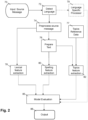
- embodiments of the present disclosure receive the source message as at 70 in Fig. 2 .
- the language detector 43 can detect the language of the source message.
- the electronic message is preprocessed such as by extracting one or more key attributes.
- extracted key attributes can be the URL www.x1abc.com/this-is-a-spearphishing-message/lft9438/signup/Agent93233801 and the e-mail address SQ@Quuecompany.biz.
- the preprocessed message is passed to the text preparer 44 as at 76.
- the language detector 43 can optionally be employed before or after the message is preprocessed, such that either the language of the source message is detected or the language of the preprocessed message is detected.
- the extracted key attributes can be sent to the lexical feature extractor 45 as at 78.
- a language specific processor 79 is optionally employed as indicated by dashed lines after the language detection at 72.
- the language specific processor 79 is a NLP language model that has been trained with target language reference corpora to identify social engineering attacks using reference corpora based on the topics identified as described elsewhere herein. When invoked with the input text, it will evaluate the risk and provide a score representing overall text risk.
- This output score can also be used in conjunction with the output of the separate path(s) illustrated at 78, 80 and/or 82 to combine a risk score as described elsewhere herein.
- the risk score provided by language specific processor 79 can be the final risk score.
- language specific processor 79 is employed if the language of the input text is English as determined by the language detector 43.
- the text preparer 44 can receive the source message and break it up into logical tokens for evaluation in the feature extraction phase.
- the message may state:
- the message may contain several spelling errors as shown above.
- the " link " in the above message can be a hyperlink to a URL such as the lengthy URL described above. If clicked, the link may open a disguised HTML file with code that may trigger a notification telling the user they have been logged out of their system and need to log back in. If the user attempts to log back in, the fraudulent web interface collects the user's credentials and sends them to the perpetrator for nefarious activities.
- the text preparer 44 can tokenize the message, label parts of speech and/or remove stop words as noted above.
- the text preparer 44 sends the prepared message to spelling feature extractor 46 as at 80 and to topics feature extractor 47 as at 82.
- the spelling feature extractor 46 can extract and/or count spelling errors in the cleaned tokens such as "doig” and "meting" as at 80 in Fig. 2 , for example.
- the spelling feature extractor 46 can be trained on an organization's key words and/or names, such that the spelling feature extractor 46 may note that the CEO's name was misspelled or the company name was misspelled in the sender's email address in the above example.
- the spelling feature extractor 46 can thus determine that the seventy-one words in the above message contain six (or more) spelling errors, resulting in at least eight percent of the words being misspelled. In various embodiments where stop words are removed, the percentage of misspelled words may be higher.
- the spelling feature extractor 46 can generate a spelling feature vector for use by the model 48 as described elsewhere herein.
- the spelling feature vector is a single value between zero and one determined by dividing the total number of words by the number of misspelled words.
- the lexical feature extractor 45 can receive the attribute list from the preprocessor 42 and evaluate the elements of the attributes that may indicate an attack. For example, the URL and the e-mail attributes noted above can be identified and stored for use in the overall risk assessment.
- the lexical feature extractor 45 can generate a lexical feature vector for use by the model 48 as described elsewhere herein. As an example, the lexical feature list can appear as:
- the topics feature extractor 47 evaluates the cleaned tokens to assess for topics such as urgency, awards and other topics as described above.
- the topics feature extractor 47 can determine that the message contains an urgent topic given the purported urgent message from the CEO, and a secrecy topic, given the purported secure nature of the files to be accessed.
- the message further contains a request for credentials and a message of suspicious activity in the form of a message indicating the user has been logged out of a computer system.
- the message further contains an authority topic as it is being purportedly sent by the organization's CEO and a call to action, as it requests the recipient to take action.
- the topics feature extractor 47 may identify several topics included in social engineering attacks.
- topics feature extractor 47 may scan the text of a source message or processed message to identify one or more terms such as “urgent”, “secret”, “credential”, “help” and other terms, or may scan the text to identify particular root words.
- each token created by the text preparer 44 can be transformed by the topics feature extractor 47 into an embeddings representation using state of the art NLP techniques based on bidirectional transformers that rely on unannotated text drawn from the web.
- correlations e.g., cosine similarity
- topic reference data is employed as at 77 in Fig. 2 .
- a maximum correlation score of all topics is generated, and the correlation score is compared to a minimum threshold. If the correlation score is below a threshold, the topic score can be set to zero, for example.
- a sum total of correlations of all tokens per topic can then be generated, and the totals can be normalized by the length of the message.
- the number of categorized topics is six based on the message containing an urgent topic, a secret topic, a credential request topic, a suspicious activity topic, an authority topic and a call to action topic.
- the topics feature extractor 47 may provide a relatively higher score for the example message indicating a likely social engineering attack.
- the output of the topics feature extraction can be a vector of topics and the normalized correlation scores from the source text.
- the lexical feature extractor 45, spelling feature extractor 46 and topics feature extractor 47 send the results of their evaluation to a model evaluator 48 as at 85.
- the model evaluator 48 can be a pretrained NLP model that has been trained on a large corpus of feature vectors extracted from both normal communications as well as social engineering attack messages. It can predict the overall risk score of the received message based on these inputs using logistic regression to determine which class it most resembles, normal communication or social engineering. The risk score can be considered output as at 88 in Fig. 2 .
- the calculations to determine risk are rather complex and dependent on the machine learning (ML) algorithm used.
- logistic regression can be employed.
- the system as described herein can process hundreds, thousands or even millions of messages in near real-time as they are received by a computing device such as an e-mail server, for example.
- a computing device such as an e-mail server
- Any source messages that are flagged as meeting a risk threshold can be withheld from immediate transmission to the intended recipient or otherwise processed in an effort to thwart or minimize the perceived risk. In this way, only messages that are not perceived to be risky can be passed to the intended recipients.
- Source messages that are considered a risk can be evaluated further and deleted, transmitted to proper authorities or otherwise acted upon as deemed appropriate.
- the lexical score can then be generated with a value of " 1".
- each tokenized word may have a lemma that is the same or a different form or inflection of the tokenized word.
- the tokenized word "has” may have a lemma of "have” and the tokenized word “required” may have a lemma of "require”.
- Example embeddings for each lemma from the input text are shown in Table 2 below. As can be seen, the embeddings for each lemma are strings of lengthy numbers. Table 2.
- Lemma Embedding Sample amazonid [ 9.50036719e-02 -7.66026527e-02 -2.63965353e-02 -2.57854722e-02 ...] : [ 1.30602449e-01 3.48239578e-02 3.12353428e-02 -9.84880421e-03... -PRON- [0.12062442 0.02145381 -0.00951916 0.02242718 0.08400631...
- Example embeddings for each part of speech (POS) from the input text are shown in Table 3 below, and it will be appreciated that the embeddings for each POS tag are strings of lengthy numbers.
- Table 3 POS Tag Embedding Sample ADV [ 0.10580494, -0.02518838, 0.04894039, -0.02921778, ...
- PUNCT [ 1.40120998e-01, -1.15442381e-03, 5.33083938e-02, 4.06831615e-02 .. DET [ 1.18066952e-01, -9.58943681e-04, 2.67030019e-02, 1.40884612e-02 ..
- NOUN [ 0.12382878, -0.04522786, 0.02235749, 0.02085628, ... AUX [ 1.15828715e-01, -9.13494155e-02, -2.19421717e-03,-1.42395673e-02..
- VERB [ 1.20264068e-01, -2.37794910e-02,1.15521839e-02, 2.29941458e-02 ..
- ADJ [ 1.02984577e-01, 3.53354029e-02, 5.23073412e-02, -1.09475816e-03 ..
- ADP [ 1.02937788e-01, -2.33283956e-02, 4.45511937e-02, -2.55675558e-02..
- SPACE [ 0.10580513, -0.03927498, 0.04885805, -0.07894014, ...
- PRON [ 1.35786220e-01, 3.91078107e-02, 3.22274603e-02, -4.30890247e-02 ..
- INTJ [ 8.40357393e-02, -3.40338377e-03,-5.62375002e-02, 1.23742130e-02 ..
- PROPN [ 1.29361615e-01, 4.07005735e-02, 2.65965965e-02, -5.61000519e-02 ..
- analysis of the text-based features can yield different assessment or risk scores for different topics.
- An example list of scores for a variety of topics is provided below.
- an overall model risk score can be generated as discussed elsewhere herein.
- an exemplary model risk score can be 0.9203894397743921.
- the lexical score e.g., "1” above
- the model score e.g., 0.9203894397743921
- an overall confidence rating or score e.g., "1"
- a system in accordance with the present disclosure provides a technical solution to the challenge of identifying social engineering attacks from digital communications.
- the system can be provided as a computer-based system, where the components can be implemented in hardware, software, firmware, or combinations thereof, as illustrated in Fig. 1 , for example.
- access can be provided over a public or private network 20, including the Internet, in various embodiments of the present invention.
- external systems 50 can be accessed via the present system for temporary storage of files, for reference data or other functions consistent with the present disclosure.
- Embodiments of the system and method can process large volumes of messages in near real-time while flagging individual messages as risks suitable for removal, deletion or further action as appropriate. Such actions as described herein facilitate and improve computing operations for those desiring to avoid social engineering attacks.
- a “system” as used herein refers to various configurations of: (a) one or more hosts; and optionally (b) other computing devices, such as servers, desktop computers, laptop computers, tablet computers, personal digital assistants, mobile phones, and other mobile computing devices.
- the host(s) and/or other computing devices can be any suitable computing device (such as a server) that includes at least one processor and at least one memory device or data storage device.
- the processor can be configured to transmit and receive data or signals representing events, messages, commands, or any other suitable information.
- the data network can be a local area network (LAN), a wide area network (WAN), a public network such as the Internet, or a private network.
- the host and the computing device are configured to connect to the data network or remote communications link in any suitable manner.
- such a connection is accomplished via: a conventional phone line or other data transmission line, a digital subscriber line (DSL), a T-1 line, a coaxial cable, a fiber optic cable, a wireless or wired routing device, a mobile communications network connection (such as a cellular network or mobile Internet network), or any other suitable medium.
- the computer readable media may be a computer readable signal medium or a computer readable storage medium.
- a computer readable storage medium may be, for example, but not limited to, an electronic, magnetic, optical, electromagnetic, or semiconductor system, apparatus, or device, or any suitable combination of the foregoing, including a portable computer diskette, a hard disk, a random access memory (RAM), a read-only memory (ROM), an erasable programmable read-only memory (EPROM or Flash memory), an appropriate optical fiber with a repeater, a portable compact disc read-only memory (CD-ROM), an optical storage device, a magnetic storage device, or any suitable combination of the foregoing.
- a computer readable storage medium may be any tangible medium that can contain or store a program for use by or in connection with an instruction execution system, apparatus, or device.
- a computer readable signal medium may include a propagated data signal with computer readable program code embodied therein, for example, in baseband or as part of a carrier wave. Such a propagated signal may take any of a variety of forms, including, but not limited to, electro-magnetic, optical, or any suitable combination thereof.
- a computer readable signal medium may be any computer readable medium that is not a computer readable storage medium and that can communicate, propagate, or transport a program for use by or in connection with an instruction execution system, apparatus, or device.
- Program code embodied on a computer readable signal medium may be transmitted using any appropriate medium, including but not limited to wireless, wireline, optical fiber cable, RF, etc., or any suitable combination of the foregoing.
- aspects of the present disclosure may be illustrated and described herein in any of a number of patentable classes or context including any new and useful process, machine, manufacture, or composition of matter, or any new and useful improvement thereof. Accordingly, aspects of the present disclosure may be implemented as entirely hardware, entirely software (including firmware, resident software, micro-code, etc.) or combining software and hardware implementation that may all generally be referred to herein as a "circuit,” “module,” “component,” or “system.” Furthermore, aspects of the present disclosure may take the form of a computer program product embodied in one or more computer readable media having computer readable program code embodied thereon.
- devices or components of the present disclosure that are in communication with each other do not need to be in continuous communication with each other. Further, devices or components in communication with other devices or components can communicate directly or indirectly through one or more intermediate devices, components or other intermediaries. Further, descriptions of embodiments of the present disclosure herein wherein several devices and/or components are described as being in communication with one another does not imply that all such components are required, or that each of the disclosed components must communicate with every other component.
- algorithms, process steps and/or method steps may be described in a sequential order, such approaches can be configured to work in different orders. In other words, any ordering of steps described herein does not, standing alone, dictate that the steps be performed in that order. The steps associated with methods and/or processes as described herein can be performed in any order practical. Additionally, some steps can be performed simultaneously or substantially simultaneously despite being described or implied as occurring non-simultaneously.
- a processor e.g., a microprocessor or controller device
- receives instructions from a memory or like storage device that contains and/or stores the instructions, and the processor executes those instructions, thereby performing a process defined by those instructions.
- aspects of the present disclosure may take the form of a computer program product embodied in one or more computer readable media having computer readable program code embodied thereon.
- Computer program code for carrying out operations for aspects of the present disclosure may be written in any combination of one or more programming languages, including an object oriented programming language such as Java, Scala, Smalltalk, Eiffel, JADE, Emerald, C++, C#, VB.NET, Python or the like, conventional procedural programming languages, such as the "C" programming language, Visual Basic, Fortran 2003, Perl, COBOL 2002, PHP, ABAP, dynamic programming languages such as Python, Ruby and Groovy, or other programming languages.
- the program code may execute entirely on a user's computer, partly on a user's computer, as a stand-alone software package, partly on a user's computer and partly on a remote computer or entirely on the remote computer or server.
- the remote computer may be connected to the user's computer through any type of network, including a local area network (LAN) or a wide area network (WAN), or the connection may be made to an external computer (for example, through the Internet using an Internet Service Provider) or in a cloud computing environment or offered as a service such as a Software as a Service (SaaS).
- LAN local area network
- WAN wide area network
- SaaS Software as a Service
- any exemplary entries of tables and parameter data represent example information only, and, despite any depiction of the databases as tables, other formats (including relational databases, object-based models and/or distributed databases) can be used to store, process and otherwise manipulate the data types described herein.
- Electronic storage can be local or remote storage, as will be understood to those skilled in the art.
- Appropriate encryption and other security methodologies can also be employed by the system of the present disclosure, as will be understood to one of ordinary skill in the art.
Landscapes
- Engineering & Computer Science (AREA)
- Computer Security & Cryptography (AREA)
- General Engineering & Computer Science (AREA)
- Computer Networks & Wireless Communication (AREA)
- Signal Processing (AREA)
- Theoretical Computer Science (AREA)
- Computer Hardware Design (AREA)
- Computing Systems (AREA)
- Artificial Intelligence (AREA)
- Computational Linguistics (AREA)
- Health & Medical Sciences (AREA)
- Audiology, Speech & Language Pathology (AREA)
- General Health & Medical Sciences (AREA)
- Physics & Mathematics (AREA)
- General Physics & Mathematics (AREA)
- Evolutionary Computation (AREA)
- Medical Informatics (AREA)
- Software Systems (AREA)
- Databases & Information Systems (AREA)
- Computer Vision & Pattern Recognition (AREA)
- Information Transfer Between Computers (AREA)
Claims (10)
- Computer-implementiertes Verfahren, umfassend:Empfangen (70), durch einen Host, einer Quellnachricht;Entnehmen (74), durch den Host, eines Anfangsattributs von der Quellnachricht, um eine vorprozessierte Version der Quellnachricht zu präsentieren;Bestimmen (78), durch den Host, ob das entnommene Anfangsattribut ein spezielles Merkmal umfasst, um daraufhin einen lexikalischen Merkmalsvektor zu generieren, wobei der lexikalische Merkmalsvektor eine Kette von Werten umfasst, die zu mindestens einem lexikalischem Merkmal in dem Anfangsattribut korrespondieren;Erkennen (72), durch den Host, einer Sprache der Quellnachricht oder der vorprozessierten Version der Quellnachricht;basierend auf der erkannten Sprache, Tokenisieren (76), durch den Host, der vorprozessierten Version der Quellnachricht, um eine bereinigte Tokenliste zu generieren, die eine Mehrzahl an Token umfasst;Entnehmen (80), durch den Host, einer Anzahl an falsch geschriebenen Worten aus der bereinigten Tokenliste, um einen Rechtschreibmerkmalsvektor zu generieren, wobei der Rechtschreibmerkmalsvektor einen Wert basierend auf der Anzahl an falsch geschriebenen Worten umfasst;basierend auf dem Bestimmen, ob die bereinigte Tokenliste einen verdächtigen Inhalt oder mehrere verdächtige Inhalte beinhaltet, Generieren (82), durch den Host, eines Inhaltevektors und eines Korrelationswertes für jeden Token der Mehrzahl an Token in der bereinigten Tokenliste, wobei der Inhaltevektor einen Inhaltswert basierend auf einer Anzahl an verdächtigen Inhalten in der bereinigten Tokenliste umfasst;basierend auf dem lexikalischen Merkmalsvektor, dem Rechtschreibvektor und dem Inhaltevektor, Anwenden (85), durch den Host, eines Modells, um einen Risikowert für die Quellnachricht vorherzusagen;sofern der Risikowert einen Risikoschwellenwert überschreitet, Klassifizieren der Quellnachricht als einen Social-Engineering-Angriff; undZurückhalten (88), durch den Host, der sofortigen Übermittlung der Quellnachricht an einen beabsichtigten Empfänger, wenn die Quellnachricht als ein Social-Engineering-Angriff klassifiziert ist.
- Verfahren nach Anspruch 1, wobei:- das Entnehmen (74) des Anfangsattributs ein Identifizieren und Entfernen von mindestens einem umfasst aus: einer URL, einer Emailadresse und einer IP-Adresse; und/oder- das Bestimmen (78), ob das entnommene Anfangsattribut ein spezielles Merkmal umfasst, ein Bestimmen umfasst, ob das entnommene Anfangsattribut eines umfasst aus: einer URL mit einer IP-Adresse, einer URL, die eine schwellenwert-minimale Anzahl an Zeichen umfasst, einer URL, die eine schwellenwert-minimale Anzahl an Punkten umfasst, einer Fake-Domain und einer URL, die einen Markennamen umfasst.
- Verfahren nach Anspruch 1 oder 2, wobei:- das Entnehmen (80) der Anzahl an falsch geschriebenen Worten aus der bereinigten Tokenliste ein Generieren einer normalisierten Metrik basierend auf einer Länge der vorprozessierten Version der Quellnachricht umfasst; und/oder- das Bestimmen (82), ob die bereinigte Tokenliste den einen verdächtigen Inhalt oder die mehreren verdächtigen Inhalte beinhaltet, ein Prozessieren der bereinigten Tokenliste umfasst, um zu bestimmen, ob eine zugrundeliegende Nachricht in der bereinigten Tokenliste umfasst: eine autoritative Handlungsaufforderung, eine Aufruf-zum-Handeln-Aufforderung, eine Legitimationsinformations- oder Aktualisierungsaufforderung, eine zahlungs- oder rechnungsbezogene Nachricht, eine Persönliche-Information-Aufforderung, eine Verschwiegenheitsaufforderung, eine dringliche Handlungsaufforderung, ein unerwartetes Preis- oder Verleihungsangebot und einen Bericht verdächtiger Aktivität.
- Verfahren nach einem der Ansprüche 1 bis 3, wobei das Bestimmen (82), ob die bereinigte Tokenliste den einen verdächtigen Inhalt oder die mehreren verdächtigen Inhalte beinhaltet, umfasst:
Transformieren jedes Tokens der Mehrzahl an Token der bereinigten Tokenliste durch Anwenden eines universellen Satzkodierers in eine eingebettete Repräsentation. - Verfahren nach Anspruch 4, wobei das Bestimmen (82), ob die bereinigte Tokenliste den einen verdächtigen Inhalt oder die mehreren verdächtigen Inhalte beinhaltet, weiterhin umfasst:Berechnen einer Korrelation zwischen der eingebetteten Repräsentation für jeden Token der Mehrzahl an Token von der bereinigten Tokenliste und einem Inhalt-Einbetten generiert aus einem Lexikon für die Quellnachricht, wenn die Quellnachricht von einem Verdächtige-Nachricht-Typ ist, der eines umfasst aus: einer eiligen Nachricht, einer Überraschungsnachricht, einer Geschenknachricht, einer privaten Nachricht, einer Nachricht betreffend eine Legitimation, einer Angstnachricht, einer Zahlungsnachricht, einer Rechnungsnachricht, einer Nachahmungsnachricht und einer Aufruf-zum-Handeln-Nachricht,wobei, optional, das Bestimmen, ob die bereinigte Tokenliste einen verdächtigen Inhalt oder mehrere verdächtige Inhalte beinhaltet, weiterhin umfasst:Generieren eines maximalen Korrelationswertes aller Verdächtige-Nachricht-Typen für jeden Token der Mehrzahl an Token der bereinigten Tokenliste;sofern der generierte Wert unter einem Minimum-Schwellenwert liegt, Setzen des Verdächtige-Nachricht-Typ-Wertes auf Null;Generieren einer Gesamtsumme von Korrelationen all der Token pro Verdächtige-Nachricht-Typ; undNormalisieren der Gesamtsummen durch die Länge der Quellnachricht.
- System (40) zum Erkennen eines Social-Engineering-Angriffs, umfassend:einen Prozessor; undeine Speichervorrichtung, die eine Mehrzahl an Instruktionen speichert, die, unter Ausführung durch den Prozessor, den Prozessor veranlassen zum:Empfangen einer Quellnachricht;Entnehmen eines Anfangsattributs von der Quellnachricht, um eine vorprozessierte Version der Quellnachricht zu präsentieren;Bestimmen, ob das entnommene Anfangsattribut ein spezielles Merkmal umfasst, um daraufhin einen lexikalischen Merkmalsvektor zu generieren, wobei der lexikalische Merkmalsvektor eine Kette von Werten umfasst, die zu mindestens einem lexikalischen Merkmal in dem Anfangsattribut korrespondieren;Erkennen einer Sprache der Quellnachricht oder der vorprozessierten Version der Quellnachricht;basierend auf der erkannten Sprache, Tokenisieren der vorprozessierten Version der Quellnachricht, um eine bereinigte Tokenliste zu generieren, die eine Mehrzahl an Token umfasst;Entnehmen einer Anzahl an falsch geschriebenen Worten aus der bereinigten Tokenliste, um einen Rechschreibmerkmalsvektor zu generieren, wobei der Rechtschreibmerkmalsvektor einen Wert basierend auf der Anzahl an falsch geschriebenen Worten umfasst;basierend auf dem Bestimmen, ob die bereinigte Tokenliste einen verdächtigen Inhalt beinhaltet, Generieren eines Inhaltevektors und eines Korrelationswertes für jeden Token der Mehrzahl an Token in der bereinigten Tokenliste, wobei der Inhaltevektor einen Inhaltswert basierend auf einer Anzahl an verdächtigen Inhalten in der bereinigten Tokenliste umfasst;basierend auf dem lexikalischen Merkmalsvektor, dem Rechtschreibvektor und dem Inhaltevektor, Anwenden eines Modells, um einen Risikowert für die Quellnachricht vorherzusagen;sofern der Risikowert einen Risikoschwellenwert überschreitet, Klassifizieren der Quellnachricht als einen Social-Engineering-Angriff; undZurückhalten der sofortigen Übermittlung der Quellnachricht an einen beabsichtigten Empfänger, wenn die Quellnachricht als ein Social-Engineering-Angriff klassifiziert ist.
- System nach Anspruch 6, wobei:- das Entnehmen des Anfangsattributs ein Identifizieren und Entfernen von mindestens einem umfasst aus: einer URL, einer Emailadresse und einer IP-Adresse; und/oder- das Bestimmen, ob das entnommene Anfangsattribut ein spezielles Merkmal umfasst, ein Bestimmen umfasst, ob das entnommene Anfangsattribut eines umfasst aus: einer URL mit einer IP-Adresse, einer URL, die eine schwellenwert-minimale Anzahl an Zeichen umfasst, einer URL, die eine schwellenwert-minimale Anzahl an Punkten umfasst, einer Fake-Domain und einer URL, die einen Markennamen umfasst.
- System nach Anspruch 6 oder 7, wobei:- das Entnehmen der Anzahl an falsch geschriebenen Worten aus der bereinigten Tokenliste ein Generieren einer normalisierten Metrik basierend auf einer Länge der vorprozessierten Version der Quellnachricht umfasst; und/oder- das Bestimmen, ob die bereinigte Tokenliste den verdächtigen Inhalt beinhaltet, ein Prozessieren der bereinigten Tokenliste umfasst, um zu bestimmen, ob eine zugrundeliegende Nachricht in der bereinigten Tokenliste eines umfasst aus: einer autoritativen Handlungsaufforderung, einer Aufruf-zum-Handeln-Aufforderung, einer Legitimationsinformations- oder Aktualisierungsaufforderung, einer zahlungs- oder rechnungsbezogenen Nachricht, einer Persönliche-Information-Aufforderung, einer Verschwiegenheitsaufforderung, einer dringlichen Handlungsaufforderung, einem unerwarteten Preis- oder Verleihungsangebot und einem Bericht verdächtiger Aktivität.
- System nach einem der Ansprüche 6 bis 8, wobei das Bestimmen, ob die bereinigte Tokenliste den verdächtigen Inhalt beinhaltet, umfasst:
Transformieren jedes Tokens der Mehrzahl an Token der bereinigten Tokenliste durch Anwenden eines universellen Satzkodierers in eine eingebettete Repräsentation. - System nach Anspruch 9, wobei das Bestimmen, ob die bereinigte Tokenliste den verdächtigen Inhalt beinhaltet, weiterhin umfasst:Berechnen einer Korrelation zwischen der eingebetteten Repräsentation für jeden Token der Mehrzahl an Token von der bereinigten Tokenliste und einem Inhalt-Einbetten generiert aus einem Lexikon für die Quellnachricht, wenn die Quellnachricht von einem Verdächtige-Nachricht-Typ ist, der eines umfasset aus: einer eiligen Nachricht, einer Überraschungsnachricht, einer Geschenknachricht, einer privaten Nachricht, einer Nachricht betreffend eine Legitimation, einer Angstnachricht, einer Zahlungsnachricht, einer Rechnungsnachricht, einer Nachahmungsnachricht und einer Aufruf-zum-Handeln-Nachricht,wobei, optional, das Bestimmen, ob die bereinigte Tokenliste den verdächtigen Inhalt beinhaltet, weiterhin umfasst:Generieren eines maximalen Korrelationswertes aller Verdächtige-Nachricht-Typen für jeden Token der Mehrzahl an Token der bereinigten Tokenliste;sofern der generierte Wert unter einem Minimum-Schwellenwert liegt, Setzen des Verdächtige-Nachricht-Typ-Wertes auf Null;Generieren einer Gesamtsumme von Korrelationen all der Token pro Verdächtige-Nachricht-Typ; undNormalisieren der Gesamtsummen durch die Länge der Quellnachricht.
Applications Claiming Priority (1)
| Application Number | Priority Date | Filing Date | Title |
|---|---|---|---|
| US17/377,919 US11240266B1 (en) | 2021-07-16 | 2021-07-16 | System, device and method for detecting social engineering attacks in digital communications |
Publications (3)
| Publication Number | Publication Date |
|---|---|
| EP4120625A1 EP4120625A1 (de) | 2023-01-18 |
| EP4120625B1 true EP4120625B1 (de) | 2024-04-03 |
| EP4120625C0 EP4120625C0 (de) | 2024-04-03 |
Family
ID=80034569
Family Applications (1)
| Application Number | Title | Priority Date | Filing Date |
|---|---|---|---|
| EP22158177.0A Active EP4120625B1 (de) | 2021-07-16 | 2022-02-23 | System, vorrichtung und verfahren zur erkennung von social-engineering-angriffen in der digitalen kommunikation |
Country Status (2)
| Country | Link |
|---|---|
| US (2) | US11240266B1 (de) |
| EP (1) | EP4120625B1 (de) |
Families Citing this family (3)
| Publication number | Priority date | Publication date | Assignee | Title |
|---|---|---|---|---|
| US12047393B2 (en) * | 2021-08-13 | 2024-07-23 | Sap Se | Computer system attack detection |
| US12627708B2 (en) * | 2022-11-07 | 2026-05-12 | Bank Of America Corporation | Systems, methods, and apparatuses for detection of data misappropriation attempts across electronic communication platforms |
| US20240403420A1 (en) * | 2023-06-02 | 2024-12-05 | Darktrace Holdings Limited | System and method for adjusting or creating ai models based on model breach alerts |
Family Cites Families (40)
| Publication number | Priority date | Publication date | Assignee | Title |
|---|---|---|---|---|
| US5794177A (en) * | 1995-07-19 | 1998-08-11 | Inso Corporation | Method and apparatus for morphological analysis and generation of natural language text |
| US6721697B1 (en) * | 1999-10-18 | 2004-04-13 | Sony Corporation | Method and system for reducing lexical ambiguity |
| US20030125927A1 (en) * | 2001-12-28 | 2003-07-03 | Microsoft Corporation | Method and system for translating instant messages |
| JP2003223437A (ja) * | 2002-01-29 | 2003-08-08 | Internatl Business Mach Corp <Ibm> | 正解語の候補の表示方法、スペルチェック方法、コンピュータ装置、プログラム |
| US20100235313A1 (en) * | 2009-03-16 | 2010-09-16 | Tim Rea | Media information analysis and recommendation platform |
| US8468606B2 (en) * | 2009-12-08 | 2013-06-18 | Verizon Patent And Licensing Inc. | Security handling based on risk management |
| US20120254333A1 (en) * | 2010-01-07 | 2012-10-04 | Rajarathnam Chandramouli | Automated detection of deception in short and multilingual electronic messages |
| US8332206B1 (en) * | 2011-08-31 | 2012-12-11 | Google Inc. | Dictionary and translation lookup |
| US8713433B1 (en) * | 2012-10-16 | 2014-04-29 | Google Inc. | Feature-based autocorrection |
| US9027134B2 (en) * | 2013-03-15 | 2015-05-05 | Zerofox, Inc. | Social threat scoring |
| US20160063122A1 (en) * | 2013-04-16 | 2016-03-03 | Hewlett-Packard Development Company, L.P. | Event summarization |
| US9852129B2 (en) * | 2013-11-26 | 2017-12-26 | International Business Machines Corporation | Language independent processing of logs in a log analytics system |
| US9332025B1 (en) * | 2013-12-23 | 2016-05-03 | Symantec Corporation | Systems and methods for detecting suspicious files |
| CN104780038B (zh) * | 2014-01-15 | 2018-02-23 | 中国移动通信集团内蒙古有限公司 | 一种分布式协同加密方法及装置 |
| US20150262238A1 (en) * | 2014-03-17 | 2015-09-17 | Adobe Systems Incorporated | Techniques for Topic Extraction Using Targeted Message Characteristics |
| US20150334458A1 (en) * | 2014-05-14 | 2015-11-19 | Cisco Technology Inc. | Audience Segmentation Using Machine-Learning |
| US20160078016A1 (en) * | 2014-09-12 | 2016-03-17 | General Electric Company | Intelligent ontology update tool |
| US20200067861A1 (en) * | 2014-12-09 | 2020-02-27 | ZapFraud, Inc. | Scam evaluation system |
| US9912681B1 (en) * | 2015-03-31 | 2018-03-06 | Fireeye, Inc. | Injection of content processing delay in an endpoint |
| US9767285B2 (en) * | 2015-06-04 | 2017-09-19 | Accenture Global Services Limited | Process categorization using crowdsourcing |
| US10104113B1 (en) * | 2016-05-26 | 2018-10-16 | Area 1 Security, Inc. | Using machine learning for classification of benign and malicious webpages |
| AU2017268570A1 (en) * | 2016-06-07 | 2017-12-21 | Jophiel Pty Ltd | Cyber security system and method |
| US20180033089A1 (en) * | 2016-07-27 | 2018-02-01 | Intuit Inc. | Method and system for identifying and addressing potential account takeover activity in a financial system |
| US10992700B2 (en) * | 2016-10-03 | 2021-04-27 | Telepathy Ip Holdings | System and method for enterprise authorization for social partitions |
| US11256812B2 (en) * | 2017-01-31 | 2022-02-22 | Zerofox, Inc. | End user social network protection portal |
| US11165801B2 (en) * | 2017-08-15 | 2021-11-02 | Zerofox, Inc. | Social threat correlation |
| US11403400B2 (en) * | 2017-08-31 | 2022-08-02 | Zerofox, Inc. | Troll account detection |
| US10552547B2 (en) * | 2017-10-10 | 2020-02-04 | International Business Machines Corporation | Real-time translation evaluation services for integrated development environments |
| RU2692049C1 (ru) * | 2017-12-29 | 2019-06-19 | Общество С Ограниченной Ответственностью "Яндекс" | Способ и система перевода исходного предложения на первом языке целевым предложением на втором языке |
| EP3788512A4 (de) * | 2017-12-30 | 2022-03-09 | Target Brands, Inc. | Hierarchische parallele modelle zur extraktion in echtzeit von hochwertigen informationen aus datenströmen sowie system und verfahren zur herstellung derselben |
| US11176589B2 (en) * | 2018-04-10 | 2021-11-16 | Ebay Inc. | Dynamically generated machine learning models and visualization thereof |
| US11283840B2 (en) * | 2018-06-20 | 2022-03-22 | Tugboat Logic, Inc. | Usage-tracking of information security (InfoSec) entities for security assurance |
| EP3599753A1 (de) | 2018-07-25 | 2020-01-29 | Cyren Inc. | System und verfahren zur detektion von phishing |
| US10761838B2 (en) * | 2018-07-31 | 2020-09-01 | Dell Products L.P. | Generating unified and dynamically updatable application programming interface documentation from different sources |
| US20200104635A1 (en) * | 2018-09-28 | 2020-04-02 | Konica Minolta Laboratory U.S.A., Inc. | Invertible text embedding for lexicon-free offline handwriting recognition |
| US11163777B2 (en) * | 2018-10-18 | 2021-11-02 | Oracle International Corporation | Smart content recommendations for content authors |
| US11372868B2 (en) * | 2019-01-14 | 2022-06-28 | Oracle International Corporation | Parsing of unstructured log data into structured data and creation of schema |
| US20200234109A1 (en) * | 2019-01-22 | 2020-07-23 | International Business Machines Corporation | Cognitive Mechanism for Social Engineering Communication Identification and Response |
| CN112507065B (zh) * | 2020-11-18 | 2022-07-12 | 电子科技大学 | 一种基于注释语义信息的代码搜索方法 |
| WO2023023171A1 (en) * | 2021-08-18 | 2023-02-23 | KnowBe4, Inc. | Auto smart groups trend analytics |
-
2021
- 2021-07-16 US US17/377,919 patent/US11240266B1/en not_active Expired - Fee Related
-
2022
- 2022-01-21 US US17/581,296 patent/US11936686B2/en active Active
- 2022-02-23 EP EP22158177.0A patent/EP4120625B1/de active Active
Also Published As
| Publication number | Publication date |
|---|---|
| EP4120625A1 (de) | 2023-01-18 |
| US11240266B1 (en) | 2022-02-01 |
| EP4120625C0 (de) | 2024-04-03 |
| US11936686B2 (en) | 2024-03-19 |
| US20230025446A1 (en) | 2023-01-26 |
Similar Documents
| Publication | Publication Date | Title |
|---|---|---|
| Ismail et al. | Efficient E‐Mail Spam Detection Strategy Using Genetic Decision Tree Processing with NLP Features | |
| US11924245B2 (en) | Message phishing detection using machine learning characterization | |
| US10063584B1 (en) | Advanced processing of electronic messages with attachments in a cybersecurity system | |
| JP7466711B2 (ja) | 電子メール分類のために人間関係構造を使用するシステムおよび方法 | |
| Tan et al. | PhishWHO: Phishing webpage detection via identity keywords extraction and target domain name finder | |
| US10027701B1 (en) | Method and system for reducing reporting of non-malicious electronic messages in a cybersecurity system | |
| US20200067861A1 (en) | Scam evaluation system | |
| US8255572B1 (en) | Method and system to detect and prevent e-mail scams | |
| Ramanathan et al. | Phishing detection and impersonated entity discovery using Conditional Random Field and Latent Dirichlet Allocation | |
| EP4120625A1 (de) | System, vorrichtung und verfahren zur erkennung von social-engineering-angriffen in der digitalen kommunikation | |
| US10944749B1 (en) | Data scrubbing via template generation and matching | |
| US20090089859A1 (en) | Method and apparatus for detecting phishing attempts solicited by electronic mail | |
| US20150067833A1 (en) | Automatic phishing email detection based on natural language processing techniques | |
| Balim et al. | Automatic detection of smishing attacks by machine learning methods | |
| Ghourabi | SM‐Detector: A security model based on BERT to detect SMiShing messages in mobile environments | |
| US20240015176A1 (en) | Domain Age-Based Security System | |
| Purba et al. | Extracting actionable cyber threat intelligence from twitter stream | |
| Alanazi et al. | A hybrid NLP and domain validation technique for disposable email detection | |
| Park et al. | Towards text-based phishing detection | |
| Almousa et al. | Anti-spoofing in medical employee's email using machine learning uclassify algorithm | |
| Kim et al. | Scam detection assistant: Automated protection from scammers | |
| El Karhani et al. | Phishing and smishing detection using machine learning | |
| CN121077796A (zh) | 一种钓鱼邮件处理方法、装置、设备及介质 | |
| US11757816B1 (en) | Systems and methods for detecting scam emails | |
| Yao et al. | The Psychological Manipulation of Phishing Emails: A Cognitive Bias Approach. |
Legal Events
| Date | Code | Title | Description |
|---|---|---|---|
| PUAI | Public reference made under article 153(3) epc to a published international application that has entered the european phase |
Free format text: ORIGINAL CODE: 0009012 |
|
| STAA | Information on the status of an ep patent application or granted ep patent |
Free format text: STATUS: THE APPLICATION HAS BEEN PUBLISHED |
|
| AK | Designated contracting states |
Kind code of ref document: A1 Designated state(s): AL AT BE BG CH CY CZ DE DK EE ES FI FR GB GR HR HU IE IS IT LI LT LU LV MC MK MT NL NO PL PT RO RS SE SI SK SM TR |
|
| STAA | Information on the status of an ep patent application or granted ep patent |
Free format text: STATUS: REQUEST FOR EXAMINATION WAS MADE |
|
| 17P | Request for examination filed |
Effective date: 20230602 |
|
| RBV | Designated contracting states (corrected) |
Designated state(s): AL AT BE BG CH CY CZ DE DK EE ES FI FR GB GR HR HU IE IS IT LI LT LU LV MC MK MT NL NO PL PT RO RS SE SI SK SM TR |
|
| GRAP | Despatch of communication of intention to grant a patent |
Free format text: ORIGINAL CODE: EPIDOSNIGR1 |
|
| STAA | Information on the status of an ep patent application or granted ep patent |
Free format text: STATUS: GRANT OF PATENT IS INTENDED |
|
| RIC1 | Information provided on ipc code assigned before grant |
Ipc: G06F 40/30 20200101ALI20230830BHEP Ipc: G06F 40/263 20200101ALI20230830BHEP Ipc: G06F 40/232 20200101ALI20230830BHEP Ipc: H04L 41/16 20220101ALI20230830BHEP Ipc: H04L 9/40 20220101AFI20230830BHEP |
|
| INTG | Intention to grant announced |
Effective date: 20231002 |
|
| GRAS | Grant fee paid |
Free format text: ORIGINAL CODE: EPIDOSNIGR3 |
|
| GRAA | (expected) grant |
Free format text: ORIGINAL CODE: 0009210 |
|
| STAA | Information on the status of an ep patent application or granted ep patent |
Free format text: STATUS: THE PATENT HAS BEEN GRANTED |
|
| AK | Designated contracting states |
Kind code of ref document: B1 Designated state(s): AL AT BE BG CH CY CZ DE DK EE ES FI FR GB GR HR HU IE IS IT LI LT LU LV MC MK MT NL NO PL PT RO RS SE SI SK SM TR |
|
| REG | Reference to a national code |
Ref country code: CH Ref legal event code: EP |
|
| REG | Reference to a national code |
Ref country code: IE Ref legal event code: FG4D |
|
| REG | Reference to a national code |
Ref country code: DE Ref legal event code: R096 Ref document number: 602022002618 Country of ref document: DE |
|
| U01 | Request for unitary effect filed |
Effective date: 20240503 |
|
| U07 | Unitary effect registered |
Designated state(s): AT BE BG DE DK EE FI FR IT LT LU LV MT NL PT SE SI Effective date: 20240514 |
|
| PG25 | Lapsed in a contracting state [announced via postgrant information from national office to epo] |
Ref country code: IS Free format text: LAPSE BECAUSE OF FAILURE TO SUBMIT A TRANSLATION OF THE DESCRIPTION OR TO PAY THE FEE WITHIN THE PRESCRIBED TIME-LIMIT Effective date: 20240803 |
|
| PG25 | Lapsed in a contracting state [announced via postgrant information from national office to epo] |
Ref country code: HR Free format text: LAPSE BECAUSE OF FAILURE TO SUBMIT A TRANSLATION OF THE DESCRIPTION OR TO PAY THE FEE WITHIN THE PRESCRIBED TIME-LIMIT Effective date: 20240403 |
|
| PG25 | Lapsed in a contracting state [announced via postgrant information from national office to epo] |
Ref country code: GR Free format text: LAPSE BECAUSE OF FAILURE TO SUBMIT A TRANSLATION OF THE DESCRIPTION OR TO PAY THE FEE WITHIN THE PRESCRIBED TIME-LIMIT Effective date: 20240704 |
|
| PG25 | Lapsed in a contracting state [announced via postgrant information from national office to epo] |
Ref country code: ES Free format text: LAPSE BECAUSE OF FAILURE TO SUBMIT A TRANSLATION OF THE DESCRIPTION OR TO PAY THE FEE WITHIN THE PRESCRIBED TIME-LIMIT Effective date: 20240403 |
|
| PG25 | Lapsed in a contracting state [announced via postgrant information from national office to epo] |
Ref country code: CZ Free format text: LAPSE BECAUSE OF FAILURE TO SUBMIT A TRANSLATION OF THE DESCRIPTION OR TO PAY THE FEE WITHIN THE PRESCRIBED TIME-LIMIT Effective date: 20240403 |
|
| PG25 | Lapsed in a contracting state [announced via postgrant information from national office to epo] |
Ref country code: PL Free format text: LAPSE BECAUSE OF FAILURE TO SUBMIT A TRANSLATION OF THE DESCRIPTION OR TO PAY THE FEE WITHIN THE PRESCRIBED TIME-LIMIT Effective date: 20240403 |
|
| PG25 | Lapsed in a contracting state [announced via postgrant information from national office to epo] |
Ref country code: PL Free format text: LAPSE BECAUSE OF FAILURE TO SUBMIT A TRANSLATION OF THE DESCRIPTION OR TO PAY THE FEE WITHIN THE PRESCRIBED TIME-LIMIT Effective date: 20240403 Ref country code: NO Free format text: LAPSE BECAUSE OF FAILURE TO SUBMIT A TRANSLATION OF THE DESCRIPTION OR TO PAY THE FEE WITHIN THE PRESCRIBED TIME-LIMIT Effective date: 20240703 Ref country code: IS Free format text: LAPSE BECAUSE OF FAILURE TO SUBMIT A TRANSLATION OF THE DESCRIPTION OR TO PAY THE FEE WITHIN THE PRESCRIBED TIME-LIMIT Effective date: 20240803 Ref country code: HR Free format text: LAPSE BECAUSE OF FAILURE TO SUBMIT A TRANSLATION OF THE DESCRIPTION OR TO PAY THE FEE WITHIN THE PRESCRIBED TIME-LIMIT Effective date: 20240403 Ref country code: GR Free format text: LAPSE BECAUSE OF FAILURE TO SUBMIT A TRANSLATION OF THE DESCRIPTION OR TO PAY THE FEE WITHIN THE PRESCRIBED TIME-LIMIT Effective date: 20240704 Ref country code: ES Free format text: LAPSE BECAUSE OF FAILURE TO SUBMIT A TRANSLATION OF THE DESCRIPTION OR TO PAY THE FEE WITHIN THE PRESCRIBED TIME-LIMIT Effective date: 20240403 Ref country code: CZ Free format text: LAPSE BECAUSE OF FAILURE TO SUBMIT A TRANSLATION OF THE DESCRIPTION OR TO PAY THE FEE WITHIN THE PRESCRIBED TIME-LIMIT Effective date: 20240403 Ref country code: RS Free format text: LAPSE BECAUSE OF FAILURE TO SUBMIT A TRANSLATION OF THE DESCRIPTION OR TO PAY THE FEE WITHIN THE PRESCRIBED TIME-LIMIT Effective date: 20240703 |
|
| REG | Reference to a national code |
Ref country code: DE Ref legal event code: R097 Ref document number: 602022002618 Country of ref document: DE |
|
| PG25 | Lapsed in a contracting state [announced via postgrant information from national office to epo] |
Ref country code: SK Free format text: LAPSE BECAUSE OF FAILURE TO SUBMIT A TRANSLATION OF THE DESCRIPTION OR TO PAY THE FEE WITHIN THE PRESCRIBED TIME-LIMIT Effective date: 20240403 Ref country code: RO Free format text: LAPSE BECAUSE OF FAILURE TO SUBMIT A TRANSLATION OF THE DESCRIPTION OR TO PAY THE FEE WITHIN THE PRESCRIBED TIME-LIMIT Effective date: 20240403 |
|
| PG25 | Lapsed in a contracting state [announced via postgrant information from national office to epo] |
Ref country code: SM Free format text: LAPSE BECAUSE OF FAILURE TO SUBMIT A TRANSLATION OF THE DESCRIPTION OR TO PAY THE FEE WITHIN THE PRESCRIBED TIME-LIMIT Effective date: 20240403 |
|
| PG25 | Lapsed in a contracting state [announced via postgrant information from national office to epo] |
Ref country code: SM Free format text: LAPSE BECAUSE OF FAILURE TO SUBMIT A TRANSLATION OF THE DESCRIPTION OR TO PAY THE FEE WITHIN THE PRESCRIBED TIME-LIMIT Effective date: 20240403 Ref country code: SK Free format text: LAPSE BECAUSE OF FAILURE TO SUBMIT A TRANSLATION OF THE DESCRIPTION OR TO PAY THE FEE WITHIN THE PRESCRIBED TIME-LIMIT Effective date: 20240403 Ref country code: RO Free format text: LAPSE BECAUSE OF FAILURE TO SUBMIT A TRANSLATION OF THE DESCRIPTION OR TO PAY THE FEE WITHIN THE PRESCRIBED TIME-LIMIT Effective date: 20240403 |
|
| PLBE | No opposition filed within time limit |
Free format text: ORIGINAL CODE: 0009261 |
|
| STAA | Information on the status of an ep patent application or granted ep patent |
Free format text: STATUS: NO OPPOSITION FILED WITHIN TIME LIMIT |
|
| 26N | No opposition filed |
Effective date: 20250106 |
|
| PG25 | Lapsed in a contracting state [announced via postgrant information from national office to epo] |
Ref country code: MC Free format text: LAPSE BECAUSE OF FAILURE TO SUBMIT A TRANSLATION OF THE DESCRIPTION OR TO PAY THE FEE WITHIN THE PRESCRIBED TIME-LIMIT Effective date: 20240403 |
|
| REG | Reference to a national code |
Ref country code: CH Ref legal event code: PL |
|
| U90 | Renewal fees not paid: noting of loss of rights |
Free format text: RENEWAL FEE NOT PAID FOR YEAR 04 Effective date: 20250918 |
|
| PG25 | Lapsed in a contracting state [announced via postgrant information from national office to epo] |
Ref country code: CH Free format text: LAPSE BECAUSE OF NON-PAYMENT OF DUE FEES Effective date: 20250228 |
|
| U93 | Unitary patent lapsed |
Free format text: RENEWAL FEE NOT PAID Effective date: 20250228 |
|
| PG25 | Lapsed in a contracting state [announced via postgrant information from national office to epo] |
Ref country code: IE Free format text: LAPSE BECAUSE OF NON-PAYMENT OF DUE FEES Effective date: 20250223 |