EP4120436A1 - Battery pack - Google Patents
Battery pack Download PDFInfo
- Publication number
- EP4120436A1 EP4120436A1 EP21792523.9A EP21792523A EP4120436A1 EP 4120436 A1 EP4120436 A1 EP 4120436A1 EP 21792523 A EP21792523 A EP 21792523A EP 4120436 A1 EP4120436 A1 EP 4120436A1
- Authority
- EP
- European Patent Office
- Prior art keywords
- thermally conductive
- conductive member
- batteries
- parts
- battery pack
- Prior art date
- Legal status (The legal status is an assumption and is not a legal conclusion. Google has not performed a legal analysis and makes no representation as to the accuracy of the status listed.)
- Granted
Links
Images



Classifications
-
- H—ELECTRICITY
- H01—ELECTRIC ELEMENTS
- H01M—PROCESSES OR MEANS, e.g. BATTERIES, FOR THE DIRECT CONVERSION OF CHEMICAL ENERGY INTO ELECTRICAL ENERGY
- H01M10/00—Secondary cells; Manufacture thereof
- H01M10/60—Heating or cooling; Temperature control
- H01M10/61—Types of temperature control
- H01M10/613—Cooling or keeping cold
-
- H—ELECTRICITY
- H01—ELECTRIC ELEMENTS
- H01M—PROCESSES OR MEANS, e.g. BATTERIES, FOR THE DIRECT CONVERSION OF CHEMICAL ENERGY INTO ELECTRICAL ENERGY
- H01M50/00—Constructional details or processes of manufacture of the non-active parts of electrochemical cells other than fuel cells, e.g. hybrid cells
- H01M50/20—Mountings; Secondary casings or frames; Racks, modules or packs; Suspension devices; Shock absorbers; Transport or carrying devices; Holders
- H01M50/204—Racks, modules or packs for multiple batteries or multiple cells
-
- H—ELECTRICITY
- H01—ELECTRIC ELEMENTS
- H01M—PROCESSES OR MEANS, e.g. BATTERIES, FOR THE DIRECT CONVERSION OF CHEMICAL ENERGY INTO ELECTRICAL ENERGY
- H01M10/00—Secondary cells; Manufacture thereof
- H01M10/60—Heating or cooling; Temperature control
- H01M10/62—Heating or cooling; Temperature control specially adapted for specific applications
- H01M10/625—Vehicles
-
- H—ELECTRICITY
- H01—ELECTRIC ELEMENTS
- H01M—PROCESSES OR MEANS, e.g. BATTERIES, FOR THE DIRECT CONVERSION OF CHEMICAL ENERGY INTO ELECTRICAL ENERGY
- H01M10/00—Secondary cells; Manufacture thereof
- H01M10/60—Heating or cooling; Temperature control
- H01M10/64—Heating or cooling; Temperature control characterised by the shape of the cells
- H01M10/643—Cylindrical cells
-
- H—ELECTRICITY
- H01—ELECTRIC ELEMENTS
- H01M—PROCESSES OR MEANS, e.g. BATTERIES, FOR THE DIRECT CONVERSION OF CHEMICAL ENERGY INTO ELECTRICAL ENERGY
- H01M10/00—Secondary cells; Manufacture thereof
- H01M10/60—Heating or cooling; Temperature control
- H01M10/65—Means for temperature control structurally associated with the cells
- H01M10/653—Means for temperature control structurally associated with the cells characterised by electrically insulating or thermally conductive materials
-
- H—ELECTRICITY
- H01—ELECTRIC ELEMENTS
- H01M—PROCESSES OR MEANS, e.g. BATTERIES, FOR THE DIRECT CONVERSION OF CHEMICAL ENERGY INTO ELECTRICAL ENERGY
- H01M10/00—Secondary cells; Manufacture thereof
- H01M10/60—Heating or cooling; Temperature control
- H01M10/65—Means for temperature control structurally associated with the cells
- H01M10/655—Solid structures for heat exchange or heat conduction
- H01M10/6551—Surfaces specially adapted for heat dissipation or radiation, e.g. fins or coatings
-
- H—ELECTRICITY
- H01—ELECTRIC ELEMENTS
- H01M—PROCESSES OR MEANS, e.g. BATTERIES, FOR THE DIRECT CONVERSION OF CHEMICAL ENERGY INTO ELECTRICAL ENERGY
- H01M10/00—Secondary cells; Manufacture thereof
- H01M10/60—Heating or cooling; Temperature control
- H01M10/65—Means for temperature control structurally associated with the cells
- H01M10/655—Solid structures for heat exchange or heat conduction
- H01M10/6554—Rods or plates
- H01M10/6555—Rods or plates arranged between the cells
-
- H—ELECTRICITY
- H01—ELECTRIC ELEMENTS
- H01M—PROCESSES OR MEANS, e.g. BATTERIES, FOR THE DIRECT CONVERSION OF CHEMICAL ENERGY INTO ELECTRICAL ENERGY
- H01M50/00—Constructional details or processes of manufacture of the non-active parts of electrochemical cells other than fuel cells, e.g. hybrid cells
- H01M50/20—Mountings; Secondary casings or frames; Racks, modules or packs; Suspension devices; Shock absorbers; Transport or carrying devices; Holders
- H01M50/258—Modular batteries; Casings provided with means for assembling
-
- H—ELECTRICITY
- H01—ELECTRIC ELEMENTS
- H01M—PROCESSES OR MEANS, e.g. BATTERIES, FOR THE DIRECT CONVERSION OF CHEMICAL ENERGY INTO ELECTRICAL ENERGY
- H01M2220/00—Batteries for particular applications
- H01M2220/20—Batteries in motive systems, e.g. vehicle, ship, plane
-
- H—ELECTRICITY
- H01—ELECTRIC ELEMENTS
- H01M—PROCESSES OR MEANS, e.g. BATTERIES, FOR THE DIRECT CONVERSION OF CHEMICAL ENERGY INTO ELECTRICAL ENERGY
- H01M50/00—Constructional details or processes of manufacture of the non-active parts of electrochemical cells other than fuel cells, e.g. hybrid cells
- H01M50/20—Mountings; Secondary casings or frames; Racks, modules or packs; Suspension devices; Shock absorbers; Transport or carrying devices; Holders
- H01M50/204—Racks, modules or packs for multiple batteries or multiple cells
- H01M50/207—Racks, modules or packs for multiple batteries or multiple cells characterised by their shape
- H01M50/213—Racks, modules or packs for multiple batteries or multiple cells characterised by their shape adapted for cells having curved cross-section, e.g. round or elliptic
-
- Y—GENERAL TAGGING OF NEW TECHNOLOGICAL DEVELOPMENTS; GENERAL TAGGING OF CROSS-SECTIONAL TECHNOLOGIES SPANNING OVER SEVERAL SECTIONS OF THE IPC; TECHNICAL SUBJECTS COVERED BY FORMER USPC CROSS-REFERENCE ART COLLECTIONS [XRACs] AND DIGESTS
- Y02—TECHNOLOGIES OR APPLICATIONS FOR MITIGATION OR ADAPTATION AGAINST CLIMATE CHANGE
- Y02E—REDUCTION OF GREENHOUSE GAS [GHG] EMISSIONS, RELATED TO ENERGY GENERATION, TRANSMISSION OR DISTRIBUTION
- Y02E60/00—Enabling technologies; Technologies with a potential or indirect contribution to GHG emissions mitigation
- Y02E60/10—Energy storage using batteries
Definitions
- the present disclosure relates to a battery pack.
- Patent Literature 1 discloses a temperature management system which includes thermally conductive members in contact with each of the plurality of batteries aligned in two rows, and dissipates heat of the batteries to an outside by a refrigerant flowing inside the thermally conductive members.
- Patent Literature 2 discloses a battery module which dissipates heat generated by cylindrical batteries to an outside by using a thermally conductive material filled between the plurality of cylindrical batteries.
- Non-Patent Literature 1 discloses a heat management system in which both end parts of thermally conductive members in contact with each of a plurality of batteries are connected with a case, and which dissipates heat generated by the batteries to an outside.
- Non-Patent Literature 1 Suman Basu et al., Applied Energy 181, 1-13 (2016 )
- the above prior arts still have a room for improvement to improve cooling efficiency of batteries of a battery pack while reducing manufacturing cost of the battery pack.
- the refrigerant which cools the batteries flows inside the thermally conductive members, and then flows in flow passages formed inside a case.
- the thermally conductive members and the case need to be connected so as not to cause leakage of a liquid.
- the thermally conductive members need to be precisely manufactured, and manufacturing cost is high.
- Non-Patent Literature 1 in a case where the length of the thermally conductive member is shorter than an internal dimension of the case due to a manufacturing error, the both end parts of the thermally conductive member cannot be connected with the case. Therefore, heat of the batteries is hardly dissipated at the end parts which are not connected with the case. Therefore, it is concerned that cooling efficiency varies between the different batteries, and it is not possible to obtain desired cooling efficiency.
- the present disclosure has been made to handle with at least part of the above-described issue, and an object of the present disclosure is to provide a technique which improves cooling efficiency of batteries of a battery pack while reducing manufacturing cost of the battery pack.
- the present disclosure has been made to solve at least part of the above-described issue, and can be realized as following aspects.
- This battery pack includes: a plurality of batteries; a thermally conductive member which is in contact with the plurality of batteries; and a case which houses the plurality of batteries and the thermally conductive member.
- the case includes a holding part which is not in contact with an end surface of the thermally conductive member.
- the holding part regulates displacement of two surfaces of the thermally conductive member in a direction vertical to each of the two surfaces which are connected with the end surface and positioned on opposite sides.
- the holding part is in contact with at least one of the two surfaces. The holding part thereby holds an end part of the thermally conductive member.
- the thermally conductive member in contact with the batteries, and the holding part in contact with at least one of the two surfaces of the thermally conductive member. Furthermore, even in a case where a position of the end surface of the thermally conductive member with respect to the holding part is displaced from a designed position due to a manufacturing error of one or both of the thermally conductive member and the case, it is possible to regulate the displacement in the direction vertical to each of the two surfaces of the end part of the thermally conductive member, and transfer to the case the heat generated by the batteries through the holding part in contact with at least one of these two surfaces.
- the battery pack according to the above aspect can also adopt an aspect where the case includes a pair of side surface parts, the plurality of batteries and the thermally conductive member are arranged between the pair of side surface parts, the holding part is provided to one of the pair of side surface parts, and the case further includes another holding part which is provided to other one of the pair of side surface parts, wherein the another holding part is not in contact with an other end surface of the thermally conductive member, the another holding part regulates the displacement of the two surfaces of the thermally conductive member in the direction vertical to each of the two surfaces which are connected with the other end surface and positioned on the opposite sides, the another holding part is in contact with at least one of the two surfaces, and thereby the another holding part holds an other end part of the thermally conductive member.
- the battery pack according to the above aspect can also employ an aspect where the thermally conductive member includes a recessed part, and is in contact with one battery of the plurality of batteries in the recessed part.
- the thermally conductive member can efficiently take heat from the battery compared to an aspect where the thermally conductive member is in planar contact with a battery. Furthermore, according to this aspect, it is possible to reduce a dimension of a range occupied by the thermally conductive member and the batteries in a recess direction of the recessed part compared to an aspect where the thermally conductive member does not include the recessed part. Consequently, it is possible to more highly densely arrange the batteries in the case.
- the battery pack according to the above aspect can also employ an aspect where the thermally conductive member further includes a plurality of other recessed parts on a surface opposite to a surface of the thermally conductive member provided with the recessed part, and is in contact with one battery of the plurality of batteries in each of the plurality of other recessed parts, and the recessed part is provided between two other neighboring recessed parts of the plurality of other recessed parts in a direction in which the plurality of other recessed parts are aligned.
- the battery pack according to the above aspect can also employ an aspect where the battery pack further includes: a plurality of other batteries; another thermally conductive member which is in contact with the plurality of other batteries; and a heat shielding member which is made of a material having lower thermal conductivity than thermal conductivity of the thermally conductive member and the other thermally conductive member, and the heat shielding member is arranged between a combination of the thermally conductive member and the plurality of batteries, and a combination of the other thermally conductive member and the plurality of other batteries.
- the battery pack according to the above aspect can also employ an aspect where the holding part includes a slit in which the end part of the thermally conductive member is inserted, wherein the holding part is in contact with at least one of two surfaces of the thermally conductive member positioned on the opposite sides via at least one of two facing surfaces of the holding part, wherein the two facing surfaces define the slit, wherein the holding part is not in contact with the end surface via a surface of the holding part which connects the two facing surfaces which define the slit, and the thermally conductive member and the holding part are configured such that the thermally conductive member is detachable from the holding part by sliding in the slit the thermally conductive member with respect to the holding part.
- the thermally conductive member and the plurality of batteries in contact with the thermally conductive member cause abnormalities, it is possible to easily detach from the case the thermally conductive member and the plurality of batteries in contact with the thermally conductive member to exchange with a new thermally conductive member and a plurality of new batteries in contact with the new thermally conductive member.
- the battery pack according to the above aspect can also employ an aspect where the battery pack further includes a grease which connects the surface which connects the two facing surfaces which define the slit, and the end surface of the thermally conductive member.
- This battery pack includes: a plurality of batteries; a thermally conductive member which is in contact with the plurality of batteries; and a case which houses the plurality of batteries and the thermally conductive member inside, and is provided with a grip part which grips an end part of the thermally conductive member by sandwiching the end part of the thermally conductive member.
- the thermally conductive member in contact with the plurality of batteries is gripped by the grip part provided to the case, and heat generated by the batteries transfers to the case through the thermally conductive member, and is thereby dissipated from the case to an outside of the battery pack.
- the grip part grips the thermally conductive member by sandwiching the end part of the thermally conductive member, and consequently can grip the thermally conductive member even when a sandwiching position of the grip part is displaced due to a variation of the length of the thermally conductive member.
- the case may include a pair of side surface parts, the plurality of batteries and the thermally conductive member may be arranged between the pair of side surface parts, the grip part may be provided to each of the pair of side surface parts, one of the end parts of the thermally conductive member may be gripped by the grip part provided to one of the pair of side surface parts, and other one of the end parts of the thermally conductive member may be gripped by the grip part provided to other one of the pair of side surface parts.
- each of the both end parts of the thermally conductive member is gripped by each of the two grip parts provided to the pair of side surface parts.
- the thermally conductive member may have a plate shape, and have a principal surface on which recessed and protrusion parts are formed, and the battery may be in contact with the recessed part of the recessed and protrusion parts of the thermally conductive member.
- the battery is in contact with the recessed part of the recessed and protrusion parts of the thermally conductive member having the plate shape. Consequently, in a case where the batteries have cylindrical shapes, a volume occupied by the thermally conductive member and the batteries is small compared to a volume occupied by the thermally conductive member and the batteries in a case where the batteries are in contact with a principal surface of a thermally conductive member of a flat plate shape. Consequently, it is possible to house more batteries inside the case, so that it is possible to improve a packing density of the batteries while improving the cooling efficiency of the batteries.
- the thermally conductive member may include the recessed part of an other principal surface which is formed at a position at which the protrusion part of one principal surface is formed, and the recessed part may be in contact with the battery on both sides of the one principal surface and the other principal surface.
- the thermally conductive member includes the recessed part of the other principal part which is formed at the position at which the protrusion part of the one principal surface is formed.
- the batteries arranged on the one principal surface side of the thermally conductive member are in contact with the recessed parts of the one principal surface, and the batteries arranged on the other principal surface side of the thermally conductive member are in contact with the recessed parts of the other principal surface on a back side of the protrusion parts of the one principal surface. Consequently, according to the battery pack 1, in a case where the batteries have the cylindrical shapes, a volume occupied by the thermally conductive member and the batteries is further small compared to a volume occupied by the thermally conductive member and the batteries in a case where the batteries are respectively in contact with two principal surfaces included in a thermally conductive member of a flat plate shape. Consequently, it is possible to house more batteries inside the case, so that it is possible to further improve the packing density of the batteries while improving the cooling efficiency of the batteries.
- one thermally conductive member, and a plurality of batteries in contact with the one thermally conductive member may constitute a battery module
- the battery pack may include a plurality of the battery modules
- the battery pack may further include a heat shielding member which is arranged between the neighboring battery modules.
- the battery pack includes the plurality of battery modules which are each constituted by the one thermally conductive member and the plurality of batteries in contact with the one thermally conductive member.
- the heat shielding member is arranged between the neighboring battery modules.
- one thermally conductive member and a plurality of batteries fixed to the one thermally conductive member may constitute a battery module
- the grip part may include a slit in which the end part of the thermally conductive member is inserted, and may be configured to enable attachment and detachment by sliding the battery module with respect to the slit.
- the battery pack includes the plurality of battery modules which are each constituted by the one thermally conductive member and the plurality of batteries fixed to the one thermally conductive member.
- the grip part may include the slit in which the end part of the thermally conductive member included in the battery module can be inserted, and may be configured to enable attachment and detachment by sliding the battery module with respect to the slit. Consequently, when one battery module causes an abnormality, it is possible to return the battery pack to a normal state only by exchanging only the battery module which has caused the abnormality instead of the whole battery pack. Furthermore, it is possible to attach or detach the battery module by sliding the battery module with respect to the slit, so that it is possible to easily exchange the battery module.
- the battery pack according to the above aspect may include in the slit a thermally conductive grease which fills a gap between the end part of the thermally conductive member gripped by the grip part, and the grip part.
- the gap between the end part of the thermally conductive member gripped by the grip part, and the grip part is filled by the thermally conductive grease. Consequently, in a case where the length of the thermally conductive member is relatively short, even when there is a gap between the end part of the thermally conductive member and the grip part, the thermally conductive grease which fills the gap can transfer heat from the thermally conductive member to the case through the grip part. Consequently, it is possible to further improve the cooling efficiency of the batteries.
- the present disclosure can be realized as various aspects, and can be realized as forms such as a system including the battery pack, a battery pack manufacturing method, a computer program which causes manufacturing of the battery pack to be executed, a server apparatus which distributes this computer program, and a non-transitory storage medium which stores this computer program.
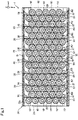
- Fig. 1 is a schematic view illustrating a schematic configuration of a battery pack 1 according to a first embodiment.
- the battery pack 1 according to the first embodiment is used as, for example, an in-vehicle battery of an electric vehicle for which high output is requested.
- the battery pack 1 includes a plurality of batteries 10, a plurality of thermally conductive members 20 and a case 30.
- an x axis direction, a y axis direction and a z axis direction are defined as follows for convenience of description.
- a direction in which the thermally conductive members 20 extend is the x axis direction.
- the x axis direction is also a direction in which the batteries 10 in contact with one surface of the thermally conductive member 20 are aligned.
- a direction vertical to an x axis on a horizontal plane which passes all the batteries 10 housed in the case 30 is the y axis direction. Furthermore, the direction vertical to the x axis direction and the y axis direction is the z axis direction.
- the battery 10 is a lithium ion battery having a cylindrical shape.
- the battery pack 1 includes the plurality of batteries 10. According to the present embodiment, respective center axes of the plurality of batteries 10 are arranged in substantially parallel to a z axis.
- the batteries 10 are electrically connected with an unillustrated input/output unit of the battery pack 1.
- the batteries 10 receive and store, for example, electrical energy supplied from an external power supply of an electric vehicle and electrical energy generated by deceleration of the running electrical vehicle via this input/output unit. Furthermore, the batteries 10 output the electrical energy for driving a motor included in the electrical vehicle via the input/output unit.
- the battery pack 1 includes rows B1 in which the six batteries 10 are aligned along the x axis direction, and rows B2 in which the five batteries 10 are aligned along the x axis direction.
- the rows B1 of the batteries 10 are referred to as the "battery rows B1" in this description.
- the rows B2 of the batteries 10 are referred to as the "battery rows B2" in this description.
- the battery pack 1 includes the eight battery rows B1 and the eight battery rows B2.
- the battery rows B1 and the battery rows B2 are alternately arranged in the y axis direction (see Fig. 1 ).
- the thermally conductive member 20 is a member of a plate shape formed by a material having high thermal conductivity such as metal. Note that a shape whose dimension in a thickness direction is 1/4 or less than a smaller dimension of a dimension in a vertical direction and a dimension in a horizontal direction is referred to as a "plate shape" in this description.
- the plate shape includes a corrugated plate.
- the battery pack 1 includes the eight thermally conductive members 20. Two surfaces of the largest plates are referred to as "principal surfaces" in this description.
- the thermally conductive member 20 includes two principal surfaces 21 and 22 to each of which the plurality of batteries 10 are fixed. A plurality of recessed and protrusion parts are formed on the principal surfaces 21 and 22 of the thermally conductive member 20.
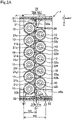
- Fig. 2A is a partial enlarged view of the battery pack 1.
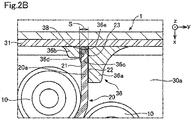
- Fig. 2B is an enlarged view illustrating an enlarged A part in Fig. 2A .
- the thermally conductive member 20 includes recessed parts 21b, 21d, 21f and 21h.
- the thermally conductive member 20 is in contact with the one battery 10 of the plurality of batteries 10 in each of the recessed parts 21b, 21d, 21f and 21h.
- the thermally conductive member 20 further includes a plurality of other recessed parts 22a, 22c, 22e, 22g and 22i on the surface 22 opposite to the surface 21 provided with the recessed parts 21b, 21d, 21f and 21h of the thermally conductive member 20.
- the thermally conductive member 20 is in contact with the one battery 10 of the plurality of batteries 10 in each of the plurality of other recessed parts 22a, 22c, 22e, 22g and 22i.
- the five protrusion parts and the four recessed parts are formed along the x axis direction and between one end part 20a on a minus x axis side and an other end part 20b on a plus x axis side on the principal surface 21 on a minus y axis side of the thermally conductive member 20.
- protrusion parts and recessed parts are aligned and arranged in order of a protrusion part 21a, the recessed part 21b, a protrusion part 21c, the recessed part 21d, a protrusion part 21e, the recessed part 21f, a protrusion part 21g, the recessed part 21h and a protrusion part 21i from the one end part 20a side.
- the batteries 10 of the battery row B1 are fixed to the principal surface 21.
- the four batteries 10 of the six batteries 10 of the battery row B1 are respectively fixed to the recessed part 21b, the recessed part 21d, the recessed part 21f and the recessed part 21h.
- the principal surface 21 on the minus y axis side of the thermally conductive member 20 is also referred to as "one principal surface”.
- the curvatures of recessed surfaces of the recessed parts 21b, 21d, 21f and 21h substantially match with curvatures of outer circumferential surfaces of the batteries 10 of the columnar shapes.
- the thermally conductive member 20 can efficiently take heat from the batteries compared to an aspect where the thermally conductive member 20 is in planar contact with the batteries.
- the five recessed parts and the four protrusion parts are formed along the x axis direction and between the one end part 20a on the minus x axis side and the other end part 20b on the plus x axis side on the principal surface 22 on a plus y axis side of the thermally conductive member 20.
- These recessed parts and protrusion parts are aligned and arranged in order of the recessed part 22a, a protrusion part 22b, the recessed part 22c, a protrusion part 22d, the recessed part 22e, a protrusion part 22f, the recessed part 22g, a protrusion part 22h and the recessed part 22i from the one end part 20a side.
- Each of the recessed part 22a, the recessed part 22c, the recessed part 22e, the recessed part 22g and the recessed part 22i of the principal surface 22 is formed at a position at which each of the protrusion part 21a, the protrusion part 21c, the protrusion part 21e, the protrusion part 21g and the protrusion part 21i of the principal surface 21 is formed.
- Each of the protrusion part 22b, the protrusion part 22d, the protrusion part 22f and the protrusion part 22h of the principal surface 22 is formed at a position at which each of the recessed part 21b, the recessed part 21d, the recessed part 21f and the recessed part 21h of the principal surface 21 is formed.
- the recessed parts 21b, 21d, 21f and 21h are positioned between the two neighboring recessed parts of the other recessed parts 22a, 22c, 22e, 22g and 22i in the x axis direction in which the other recessed parts 22a, 22c, 22e, 22g and 22i are aligned.
- the batteries 10 of the battery row B2 are fixed to the principal surface 22.
- the five batteries 10 of the battery row B2 are respectively fixed to the recessed part 22a, the recessed part 22c, the recessed part 22e, the recessed part 22g and the recessed part 22i.
- the principal surface 22 on the plus y axis side of the thermally conductive member 20 is also referred to as an "other principal surface”.
- the curvatures of recessed surfaces of the recessed parts 22a, 22c, 22e, 22g and 22i substantially match with curvatures of outer circumferential surfaces of the batteries 10 of the columnar shapes.
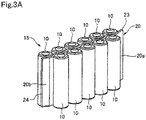
- Fig. 3A is a perspective view of a battery module 15 included in the battery pack 1.
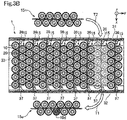
- Fig. 3B is an explanatory view illustrating processing of exchanging the battery modules 15 in the battery pack 1.
- the one thermally conductive member 20 and the 11 batteries 10 fixed to this one thermally conductive member 20, i.e., the one battery row B1 and the one battery row B2 constitute the one battery module 15 illustrated in Fig. 3A .
- the battery pack 1 includes the eight battery modules 15.
- a battery module 15o including the battery 10d which has caused this failure is detached (an outlined arrow T1 in Fig. 3B ).
- a new battery module 15n is attached to a place at which the battery module 15o has been detached (an outlined arrow T2 in Fig. 3B ).
- the case 30 houses the plurality of batteries 10 and the plurality of thermally conductive members 20 inside (see Fig. 1 ).
- the case 30 is formed by, for example, metal having high thermal conductivity.
- the case 30 includes a plurality of wall parts 31, 32, 33 and 34 which form a housing space 30a for housing the plurality of batteries 10 and the plurality of thermally conductive members 20, a plurality of grip parts 36, and a plurality of grip parts 37.
- Fig. 1 illustrates the battery pack 1 in a state where the wall part 34 has been detached from the case 30 for ease of understanding of the technique.
- the case 30 is connected with an unillustrated external heat dissipation device.
- the case 30 transfers heat generated by the batteries 10 to this heat dissipation device.
- the wall part 31 and the wall part 32 are arranged at positions facing each other (see an upper stage center part and a lower stage center part in Fig. 1 ).
- the wall part 31 and the wall part 32 form the housing space 30a in which the plurality of batteries 10 and the plurality of thermally conductive members 20 are arranged.
- a surface on the housing space 30a side of the wall part 31 is provided with the plurality of grip parts 36 (see an upper stage in Fig. 1 and an upper stage in Fig. 2 ).
- a surface on the housing space 30a side of the wall part 32 is provided with the plurality of grip parts 37 (see a lower stage in Fig. 1 and a lower stage in Fig. 2 ). Details of configurations of the grip parts 36 and 37 will be described later.
- the wall part 31 and the wall part 32 are also referred to as "a pair of side surface parts".
- Fig. 4 is a perspective view of the battery pack 1 according to the present embodiment from which part of the components of the battery pack 1 have been removed.
- the wall part 33 is connected with an end part on a minus z axis direction side of the wall part 31, and an end part on the minus z axis direction side of the wall part 32 (see a lower stage center part in Fig. 4 ).
- the wall part 33 corresponds to a bottom part of the case 30.
- the plurality of batteries 10 housed in the housing space 30a is placed on the wall part 33.
- the wall part 34 is connected with an end part on a plus z axis direction side of the wall part 31, and an end part on the plus z axis direction side of the wall part 32.
- the wall part 34 is arranged at a position which faces the wall part 33. As illustrated in Fig. 4 , a plurality of fins 34a are formed in an outer wall surface of the wall part 34. Consequently, the case 30 can dissipate heat to the above-described heat dissipation device and, in addition, efficiently dissipate heat generated by the batteries 10 to an outside by using the fins 34a.
- the grip part 36 is arranged on a surface on the housing space 30a side of the wall part 31.
- the grip part 36 includes two slit formation parts 36a and 36b.
- the two slit formation parts 36a and 36b each protrude from the surface on the housing space 30a side of the wall part 31 to a plus x axis direction.
- the two slit formation parts 36a and 36b are arranged so as to form a gap of a certain interval.
- inner wall surfaces 36c and 36d of planar shapes which face each other in the y axis direction are formed.
- a space between the inner wall surface 36c and the inner wall surface 36d is a slit S which penetrates the grip part 36 in the z axis direction.
- the grip part 36 is not in contact with an end surface 23 of the thermally conductive member 20 in a minus x axis direction.
- the wall part 31 which supports the grip part 36 is not in contact with the end surface 23 of the thermally conductive member 20, either.
- the grip part 36 regulates displacement of each of the surfaces 21 and 22 of the thermally conductive member 20 in the y axis direction vertical to each of the surfaces 21 and 22 which are connected with the end surface 23 and positioned on sides opposite to each other. That is, the surfaces 21 and 22 of the thermally conductive member 20 are positioned within a range defined by the grip part 36 in the y axis direction.
- the grip part 36 is in contact with at least one of the two surfaces 21 and 22, and thereby holds the end part 20a of the thermally conductive member 20. According to the present embodiment, the grip part 36 is substantially in contact with the two surfaces 21 and 22, and thereby determines the position of the end part 20a of the thermally conductive member 20.
- the inner wall surface 36c and the inner wall surface 36d of the grip part 36 sandwich the one end part 20a of the thermally conductive member 20, and thereby grip the one end part 20a of the thermally conductive member 20.
- the one end part 20a of the thermally conductive member 20 is gripped by the grip part 36 in the slit S.
- At least one of the two facing surfaces 36c and 36d of the grip part 36 which define the slit S is in contact with at least one of the two surfaces 21 and 22 of the thermally conductive member 20 positioned on the sides opposite to each other.
- the wall part 31 is not in contact with the end surface 23 of the thermally conductive member 20 via a surface 36e which connects the two facing surfaces 36c and 36d in the slit S.
- a gap between the one end part 20a of the thermally conductive member 20 and the grip part 36 is filled by a thermally conductive grease 38.
- the surface 36e which connects the two facing surfaces 36c and 36d in the slit S and the end surface 23 of the thermally conductive member 20 are connected by the thermally conductive grease 38 (see an upper stage center part in Fig. 2B ).
- sizes of the two slit formation parts 36a and 36b in the x axis direction are different to prevent an interference with the batteries 10 fixed to the thermally conductive member 20. More specifically, the dimension of the slit formation part 36b in the x axis direction is smaller than the dimension of the slit formation part 36a in the x axis direction. As a result, an interference between the battery 10 at an end of the battery row B1 and the slit formation part 36b is prevented.
- Fig. 2B illustrates the enlarged width of the slit S compared to the width of the one end part 20a of the thermally conductive member 20 to clarify a positional relationship between the principal surface 21 of the thermally conductive member 20, the inner wall surface 36d of the slit formation part 36b and the thermally conductive grease 38 in the slit S.
- the inner wall surfaces 36c and 36d are actually substantially in contact with the principal surfaces 21 and 22 of the thermally conductive member 20, respectively.
- the thermally conductive grease 38 fills minute gaps of various portions between the inner wall surface 36d and the principal surface 21.
- the thermally conductive grease 38 functions to increase an area of a part at which heat is transferred between the inner wall surface 36d and the principal surface 21.
- the thermally conductive member 20 and the grip part 36 are configured such that the thermally conductive member 20 can be detached from the grip part 36 by sliding in the slit S the thermally conductive member 20 with respect to the grip part 36.
- the abnormalities can be dealt with as follows. That is, it is possible to easily detach the thermally conductive member 20 and the plurality of batteries 10 in contact with the thermally conductive member 20 from the case 30 to exchange with the new thermally conductive member 20 and the plurality of new batteries 10 in contact with the new thermally conductive member 20 (see Fig. 3B ).
- the grip part 37 is arranged on a surface on the housing space 30a side of the wall part 32 (see a lower stage in Fig. 2A ).
- the grip part 37 is provided in a shape symmetrical to that of the grip part 36 around an axis parallel to the y axis direction. As a result, the grip part 37 exhibits the same function as that of the grip part 36.
- the grip part 37 includes two slit formation parts 37a and 37b.
- the two slit formation parts 37a and 37b each protrude from the surface on the housing space 30a side of the wall part 32 to the minus x axis direction.
- the two slit formation parts 37a and 37b are arranged so as to form a gap of a certain interval substantially equal to the gap of the grip part 36.
- inner wall surfaces of planar shapes which face each other in the y axis direction are formed. A space between these inner wall surfaces is a slit which penetrates the grip part 36 in the z axis direction.
- the grip part 37 is not in contact with the end surface 24 of the thermally conductive member 20 in the plus x axis direction.
- the wall part 32 which supports the grip part 37 is not in contact with the end surface 24 of the thermally conductive member 20, either.
- the grip part 37 regulates displacement of each of the surfaces 21 and 22 of the thermally conductive member 20 in the y axis direction vertical to each of the surfaces 21 and 22 which are connected with the end surface 24 and positioned on the sides opposite to each other, is in contact with at least one of the two surfaces, and thereby holds the end part 20b of the thermally conductive member 20.
- the two inner wall surfaces respectively formed on the two slit formation parts 37a and 37b of the grip part 37 sandwich the other end part 20b of the thermally conductive member 20, and thereby grip the other end part 20b of the thermally conductive member 20.
- a gap between the other end part 20b of the thermally conductive member 20 gripped by the grip part 37, and the grip part 37 in the slit formed in the grip part 37 is filled by the same thermally conductive grease as that of the grip part 36 (see Fig. 2B ).
- sizes of the two slit formation parts 37a and 37b in the x axis direction are different to prevent an interference with the batteries 10 fixed to thermally conductive member 20. More specifically, the dimension of the slit formation part 37b in the x axis direction is smaller than the dimension of the slit formation part 37a in the x axis direction. As a result, an interference between the battery 10 at an end of the battery row B1 and the slit formation part 37b is prevented.
- the both end parts 20a and 20b are inserted in the respective slits of the two grip parts 36 and 37 such that each of the eight battery modules 15 included in the battery pack 1 is gripped by the grip parts 36 and 37 (see Fig. 3B ).
- the arbitrary battery module 15 can be detached from the case 30 (see the arrow T1 in Fig. 3B ).
- this new battery module 15 is attached to the case 30 (see the arrow T2 in Fig. 3B ). Consequently, it is possible to easily exchange the battery module 15 as described above.
- Figs. 5A and 5B are explanatory views for explaining the issue of the battery pack 90 according to the comparative example.
- the plurality of batteries 10 are aligned in a row and arranged between a pair of wall parts 92 and 93 of a case of the battery pack 90.
- Thermally conductive members 91 in contact with the plurality of these batteries 10 are arranged on both sides of the plurality of batteries 10, and are formed to surround the batteries 10.
- the thermally conductive member 91 is arranged between the pair of wall parts 92 and 93.
- both end parts of the thermally conductive member 91 are respectively fixed by, for example, welding to the wall parts 92 and 93.
- An actual size of the thermally conductive member 91 is determined at a manufacturing stage.
- the length of the thermally conductive member 91 in a direction in which the plurality of batteries 10 are aligned may differ per individual thermally conductive member 91 due to a manufacturing error in some cases.
- the plurality of thermally conductive members 91 include the relatively short thermally conductive members 91 illustrated in Fig. 5A , and the relatively long thermally conductive members 91 illustrated in Fig. 5B .
- a length L01 of the thermally conductive member 91 in a direction in which the batteries 10 in contact with the thermally conductive member 91 are aligned is shorter than a distance L0 between the pair of wall parts 92 and 93 as illustrated in Fig. 5A , while one end part 94 of the thermally conductive member 91 can be connected with the wall part 92, an other end part 95 cannot be connected with the wall part 93. Consequently, heat of the batteries 10 on the end part 95 side of the thermally conductive member 91 is hardly dissipated to an outside through the case in the manufactured battery pack 90.
- the thermally conductive member 91 to which the batteries 10 are fixed cannot be arrange between the pair of wall parts 92 and 93 (see the thermally conductive member 91 indicated by a broken line in Fig. 5B ). Consequently, it is necessary to manufacture the thermally conductive member 91 such that the length of the thermally conductive member 91 in the direction in which the batteries 10 are aligned is not longer than the distance L0 between the pair of wall parts 92 and 93.
- cooling efficiency differs between the plurality of thermally conductive members 91 depending on the lengths of the thermally conductive members 91.
- the cooling efficiency varies per thermally conductive member 91, and the cooling efficiency of the overall battery pack 90 lowers.
- the lengths of the thermally conductive members 91 need to be accurately managed to match with or become slightly shorter than the distance L0 between the pair of wall parts 92 and 93 which is an upper limit. That is, it is necessary to set a small manufacturing tolerance for the thermally conductive members 91. Therefore, manufacturing cost of the battery pack 90 increases.
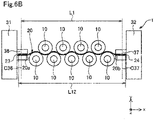
- Figs. 6A and 6B are explanatory views for explaining the effect of the battery pack 1 according to the present embodiment.
- the pair of wall parts 31 and 32 are provided with the grip parts 36 and 37, respectively, which grip the two end parts 20a and 20b of the thermally conductive member 20, respectively (see Figs. 1 and 2A ).
- a reference dimension of the length of the thermally conductive member 20 can be set to the distance L1 between a center line C36 of the grip part 36 and a center line C37 of the grip part 37 (see an upper stage in Fig. 6A ).
- the center line C36 is a line which indicates a center position of the slit S of the grip part 36 in the x axis direction.
- the center line C37 is a line which indicates a center position of the slit of the grip part 37 in the x axis direction.
- the thermally conductive member 20 can be arranged in the case 30. Consequently, the manufacturing tolerance of the thermally conductive member 20 can be made greater than the manufacturing tolerance of the thermally conductive member 91 according to the comparative example. Consequently, the manufacturing cost of the battery pack 1 is reduced.
- the two end parts 20a and 20b of the thermally conductive member 20 are gripped by the two grip parts 36 and 37, respectively, so that heat generated by the batteries 10 transfers to the case 30 through the thermally conductive member 20 (see Figs. 5A and 6A ). Consequently, the cooling efficiency varies becomes less between the plurality of thermally conductive members 20, so that it is possible to improve the cooling efficiency.
- the thermally conductive members 20 to which the plurality of batteries 10 are fixed are gripped by the grip parts 36 and 37 provided to the case 30. Consequently, the heat generated by the batteries 10 transfers to the case 30 through the thermally conductive members 20, and thereby is dissipated from the case 30 to the outside of the battery pack 1.
- the grip parts 36 and 37 grip the thermally conductive members 20 by sandwiching the two end parts 20a and 20b of the thermally conductive members 20.
- the grip parts 36 and 37 can grip the thermally conductive members 20. Consequently, even in a case where the manufacturing tolerance of the length is made great compared to the comparative example where the manufacturing tolerance of the length of the thermally conductive members needs to be strictly managed to connect the both end parts with the case, it is possible to transfer the heat generated by the batteries 10 to the case 30. Consequently, it is possible to improve the cooling efficiency of the batteries 10 while reducing the manufacturing cost of the battery pack 1.
- the two end parts 20a and 20b of the thermally conductive member 20 are gripped by the grip parts 36 and 37, respectively, which are provided to the pair of wall parts 31 and 32. Consequently, compared to the thermally conductive member whose one end part is fixed and whose other end part is fixed to the case, it is possible to make the manufacturing tolerance of the thermally conductive member 20 greater. Consequently, it is possible to further reduce the manufacturing cost of the battery pack 1.
- the batteries 10 have the columnar shapes.
- the nine batteries 10 are in contact with the recessed parts 21b, 21d, 21f, 21h, 22a, 22c, 22e, 22g and 22i of the thermally conductive member 20 having the plate shape. More specifically, part of each of the nine batteries 10 is positioned in the recessed parts 21b, 21d, 21f, 21h, 22a, 22c, 22e, 22g and 22i of the thermally conductive member 20.
- a volume of a minimum cuboid surrounding a space occupied by the one thermally conductive member 20 and the plurality of batteries 10 in contact with this thermally conductive member 20 is smaller than a volume of a minimum cuboid surrounding a space occupied by one thermally conductive member and a plurality of batteries in contact with this one thermally conductive member in a case where the batteries of cylindrical shapes are in contact with principal surfaces of the thermally conductive member of flat plate shapes. Consequently, it is possible to house the more batteries 10 inside the case 30. Consequently, it is possible to improve a packing density of the batteries 10 while improving the cooling efficiency of the batteries 10.
- each of the recessed part 22a, the recessed part 22c, the recessed part 22e, the recessed part 22g and the recessed part 22i of the principal surface 22 of the thermally conductive member 20 is formed at a position at which each of the protrusion part 21a, the protrusion part 21c, the protrusion part 21e, the protrusion part 21g and the protrusion part 21i of the principal surface 21 is formed.
- the batteries 10 arranged on the principal surface 21 side of the thermally conductive member 20 are fixed to the recessed parts 21b, 21d, 21f and 21h of the principal surface 21.
- the batteries 10 arranged on the principal surface 22 side of the thermally conductive member 20 are fixed to the recessed parts 22a, 22c, 22e, 22g and 22i of the principal surface 22. More specifically, the nine batteries 10 are arranged in a zig-zag pattern along a longitudinal direction of the thermally conductive member 20 while being in contact with the recessed parts 21b, 21d, 21f, 21h, 22a, 22c, 22e, 22g and 22i of the thermally conductive member 20.
- the volume of the minimum cuboid surrounding the space occupied by the one thermally conductive member and the plurality of batteries in contact with this one thermally conductive member is much smaller than the volume of the minimum cuboid surrounding the space occupied by the one thermally conductive member and the plurality of batteries in contact with this one thermally conductive member in a case where the batteries are in contact with each of the two principal surfaces included in the thermally conductive member of the flat plate shape. Consequently, it is possible to house the much more batteries 10 inside the case 30. Consequently, it is possible to improve the packing density of the batteries 10 while improving the cooling efficiency of the batteries 10.
- the battery pack 1 includes the plurality of battery modules 15.
- the one battery module 15 is constituted by the one thermally conductive member 20, and the plurality of batteries 10 fixed to the one thermally conductive member 20.
- the grip parts 36 and 37 include the slits in which one of the two end parts 20a and 20b of the thermally conductive member 20 included in the battery module 15 can be inserted, and are configured to enable attachment and detachment of the battery module 15 by sliding the battery module 15 with respect to the slit. Consequently, it is possible to return the battery pack 1 to a normal state by exchanging only the battery module 15 which has caused an abnormality instead of the whole battery pack 1 when the one battery module 15 causes the abnormality. Furthermore, by sliding the battery module 15 with respect to the slit, the battery module 15 can be attached and detached, so that it is possible to easily exchange the battery module 15.
- the gaps between the two end parts 20a and 20b of the thermally conductive member 20 gripped by the grip parts 36 and 37, and the grip parts 36 and 37 are filled by the thermally conductive grease 38. Consequently, even when relatively short length of the thermally conductive member 20 creates the gaps between the end parts 20a and 20b of the thermally conductive member 20 and the grip parts 36 and 37 , the thermally conductive grease 38 which fills the gaps can transfer heat from the thermally conductive member 20 to the case 30 through the grip parts 36 and 37. Consequently, it is possible to further improve the cooling efficiency of the batteries 10.
- the grip part 36 , the part of the wall part 31 which supports the grip part 36, and the part of the wall part 31 which forms the inner wall surface 36e of the slit S in the present embodiment are also referred to as a "holding part”.
- the grip part 37, the part of the wall part 32 which supports the grip part 37, and the part of the wall part 32 which forms the inner wall surface of the slit of the grip part 37 are also referred to as an "other holding part”.
- the thermally conductive grease 38 is also referred to as a "grease”.
- Fig. 7 is a schematic view illustrating a schematic configuration of a battery pack 2 according to a second embodiment.
- the battery pack 2 according to the second embodiment differs from the battery pack 1 according to the first embodiment illustrated in Fig. 1 in including heat shielding members.
- Other points of the battery pack 2 according to the second embodiment are the same as those of the battery pack 1 according to the first embodiment.
- the battery pack 2 includes the plurality of batteries 10, the thermally conductive members 20, heat shielding members 25 and a case 40.
- the heat shielding member 25 is a member of a plate shape arranged between the neighboring battery modules 15 among the plurality of battery modules 15 arranged in the case 40.
- the heat shielding member 25 has low thermal conductivity, and is formed by a material having fire retardancy. More specifically, the heat shielding member 25 is made of a material having lower thermal conductivity than that of the material of the thermally conductive member 20.
- the thermal conductivity of the material of the heat shielding member 25 is lower than thermal conductivity of the material of the case 30 and thermal conductivity of the thermally conductive grease 38.
- the battery pack 2 includes the six heat shielding members 25.
- the heat shielding member 25 is arranged between a combination of the thermally conductive member 20 and the plurality of batteries 10 which constitute the certain battery module 15, and a combination of the another thermally conductive member 20 and the plurality of other batteries 10 which constitute the another battery module 15.
- the case 40 includes the plurality of wall parts 31, 32, 33 and 34 which form a housing space 40a which houses the plurality of batteries 10, the plurality of thermally conductive members 20 and the plurality of heat shielding members 25, the plurality of grip parts 36 and the plurality of grip parts 37 which respectively grip the thermally conductive members 20, and the plurality of grip parts 48 and the plurality of grip parts 49 which respectively grip the heat shielding members 25.
- the grip part 48 is arranged between the neighboring grip parts 36 on the surface on the housing space 40a side of the wall part 31 (see an upper stage in Fig. 7 ).
- the grip part 48 protrudes from the surface on the housing space 30a of the wall part 31 side to the plus x axis direction.
- the grip part 48 includes a slit in which an end part of the heat shielding member 25 can be inserted.
- the grip part 48 grips the end part of the heat shielding member 25 when the end part of the heat shielding member 25 is inserted therein.
- the grip part 49 is arranged between the neighboring grip parts 37 on the surface on the housing space 40a side of the wall part 32 (see a lower stage in Fig. 7 ).
- the grip part 49 protrudes from the surface on the housing space 30a side of the wall part 32 to the minus x axis direction.
- the grip part 49 includes a slit in which an end part of the heat shielding member 25 can be inserted.
- the grip part 49 grips the end part of the heat shielding member 25 when the end part of the heat shielding member 25 is inserted therein.
- the two end parts of the heat shielding member 25 are respectively held in the slits included in the two grip parts 48 and 49, and thereby supported. As a result, the heat shielding member 25 shields between the neighboring battery module 15 and battery module 15.
- the heat shielding member 25 is configured to be exchangeable by being slid with respect to the grip parts 48 and 49.
- the battery pack 2 includes the plurality of battery modules 15 which are each constituted by the one thermally conductive member 20 and the plurality of batteries 10 in contact with the one thermally conductive member 20, and the heat shielding members 25 are arranged between the neighboring battery modules 15. Consequently, it is possible to prevent heat exchange between the neighboring battery modules 15, and prevent an abnormality of the one battery module 15 from influencing the neighboring battery module 15 of the one battery module 15 when the abnormality occurs in an external appearance of the battery 10 included in the one battery module 15. Consequently, it is possible to prevent the abnormality of the one battery module 15 from influencing the overall battery pack 2.
- the batteries 10 are fixed to the thermally conductive members 20.
- the batteries do not necessarily need to be fixed to the thermally conductive members, and only need to be in contact with the thermally conductive members.
- the batteries and the thermally conductive members are in contact, so that it is possible to transfer heat generated by the batteries to the case through the thermally conductive members. Consequently, it is possible to improve the cooling efficiency.
- the grip parts 36 and 37 are provided to the pairs of the wall parts 31 and 32 of the case 30, respectively.
- the grip parts may be provided to one of the wall parts.
- the one grip part can grip one end part of the thermally conductive member, it is possible to transfer heat of the batteries to the case while making the manufacturing tolerance of the thermally conductive member greater.
- the plurality of recessed and protrusion parts are formed on the principal surfaces 21 and 22 of the thermally conductive members 20, and the batteries 10 are fixed to the recessed parts.
- the shape of the thermally conductive member 20 is not limited to this.
- the thermally conductive member 20 may have a flat plate shape.
- part of the batteries 10 of the plurality of batteries 10 may be in contact with and fixed to the recessed parts of the thermally conductive member, and part of the other batteries 10 may be in contact with and fixed to flat plate parts of the thermally conductive member.
- each of the recessed part 22a, the recessed part 22c, the recessed part 22e, the recessed part 22g and the recessed part 22i of the principal surface 22 is formed at a position at which each of the protrusion part 21a, the protrusion part 21c, the protrusion part 21e, the protrusion part 21g and the protrusion part 21i of the principal surface 21 is formed.
- the thermally conductive member 20 is a member of a plate shape whose thickness is substantially uniform, and is corrugated in the y axis direction.
- the shape of the thermally conductive member 20 is not limited to this.
- the batteries 10 are arranged on the both sides of the thermally conductive member 20, yet may be arranged on one side.
- the battery pack 1 includes the plurality of battery modules 15. By sliding the individual battery module 15 in the z axis direction with respect to the grip parts 36 and 37, it is possible to attach and detach the battery module 15 to and from the case 30.
- the battery modules 15 may be housed in the case in a mode that the battery modules 15 are fixed to the case by bolts or nuts, that is, the battery modules 15 cannot be detached from the case only by sliding the battery modules 15.
- the gap between the one end part 20a of the thermally conductive member 20 gripped by the grip part 36, and the grip part 36 is filled by the thermally conductive grease 38.
- a material which fills the gap between the end part of the thermally conductive member 20 and the grip part is not limited to this.
- a gap between an external surface of the end part of the thermally conductive member and the grip part may be filled by an adhesive material, and the end part of the thermally conductive member and the grip part may be fixed. Furthermore, there may not be a material which fills the gap.
Landscapes
- Chemical & Material Sciences (AREA)
- Chemical Kinetics & Catalysis (AREA)
- Electrochemistry (AREA)
- General Chemical & Material Sciences (AREA)
- Engineering & Computer Science (AREA)
- Manufacturing & Machinery (AREA)
- Secondary Cells (AREA)
- Battery Mounting, Suspending (AREA)
Abstract
Description
- This application is based upon and claims benefit of priority from
Japanese Patent Application No. 2020-076589, filed on April 23, 2020 - The present disclosure relates to a battery pack.
- Conventionally, a battery pack including a plurality of batteries housed in a case is known. The battery pack needs to dissipate heat generated by each of the plurality of batteries to an outside of the battery pack. For example,
Patent Literature 1 discloses a temperature management system which includes thermally conductive members in contact with each of the plurality of batteries aligned in two rows, and dissipates heat of the batteries to an outside by a refrigerant flowing inside the thermally conductive members. Furthermore,Patent Literature 2 discloses a battery module which dissipates heat generated by cylindrical batteries to an outside by using a thermally conductive material filled between the plurality of cylindrical batteries. Furthermore, Non-PatentLiterature 1 discloses a heat management system in which both end parts of thermally conductive members in contact with each of a plurality of batteries are connected with a case, and which dissipates heat generated by the batteries to an outside. -
- Patent Literature 1:
US 2011/0212356 A1 - Patent Literature 2:
JP 2018-060594 A - Non-Patent Literature 1: Suman Basu et al., Applied Energy 181, 1-13 (2016)
- However, the above prior arts still have a room for improvement to improve cooling efficiency of batteries of a battery pack while reducing manufacturing cost of the battery pack. According to, for example, a technique disclosed in
Patent Literature 1, the refrigerant which cools the batteries flows inside the thermally conductive members, and then flows in flow passages formed inside a case. Hence, the thermally conductive members and the case need to be connected so as not to cause leakage of a liquid. Hence, the thermally conductive members need to be precisely manufactured, and manufacturing cost is high. Furthermore, according to a technique disclosed inPatent Literature 2, it is necessary to fill the thermally conductive material between the plurality of cylindrical batteries without gaps. This filling process requires a time. Therefore, manufacturing cost increases. Furthermore, in a case where the thermally conductive material is not sufficiently filled between the plurality of cylindrical batteries, cooling efficiency is concerned to lower. Furthermore, according to a technique disclosed in Non-PatentLiterature 1, in a case where the length of the thermally conductive member is shorter than an internal dimension of the case due to a manufacturing error, the both end parts of the thermally conductive member cannot be connected with the case. Therefore, heat of the batteries is hardly dissipated at the end parts which are not connected with the case. Therefore, it is concerned that cooling efficiency varies between the different batteries, and it is not possible to obtain desired cooling efficiency. - The present disclosure has been made to handle with at least part of the above-described issue, and an object of the present disclosure is to provide a technique which improves cooling efficiency of batteries of a battery pack while reducing manufacturing cost of the battery pack.
- The present disclosure has been made to solve at least part of the above-described issue, and can be realized as following aspects.
- (1) One aspect of the present disclosure provides a battery pack. This battery pack includes: a plurality of batteries; a thermally conductive member which is in contact with the plurality of batteries; and a case which houses the plurality of batteries and the thermally conductive member. The case includes a holding part which is not in contact with an end surface of the thermally conductive member. The holding part regulates displacement of two surfaces of the thermally conductive member in a direction vertical to each of the two surfaces which are connected with the end surface and positioned on opposite sides. The holding part is in contact with at least one of the two surfaces. The holding part thereby holds an end part of the thermally conductive member.
- According to this aspect, it is possible to transfer, to the case, heat generated by the batteries through the thermally conductive member in contact with the batteries, and the holding part in contact with at least one of the two surfaces of the thermally conductive member. Furthermore, even in a case where a position of the end surface of the thermally conductive member with respect to the holding part is displaced from a designed position due to a manufacturing error of one or both of the thermally conductive member and the case, it is possible to regulate the displacement in the direction vertical to each of the two surfaces of the end part of the thermally conductive member, and transfer to the case the heat generated by the batteries through the holding part in contact with at least one of these two surfaces.
- (2) The battery pack according to the above aspect can also adopt an aspect where the case includes a pair of side surface parts, the plurality of batteries and the thermally conductive member are arranged between the pair of side surface parts, the holding part is provided to one of the pair of side surface parts, and the case further includes another holding part which is provided to other one of the pair of side surface parts, wherein the another holding part is not in contact with an other end surface of the thermally conductive member, the another holding part regulates the displacement of the two surfaces of the thermally conductive member in the direction vertical to each of the two surfaces which are connected with the other end surface and positioned on the opposite sides, the another holding part is in contact with at least one of the two surfaces, and thereby the another holding part holds an other end part of the thermally conductive member.
- According to this aspect, it is possible to efficiently transfer the heat of the batteries to the case through the both end parts of the thermally conductive member. Furthermore, even in a case where positions of the end surfaces of the both ends of the thermally conductive member with respect to the holding part are displaced due to a manufacturing error of one or both of the thermally conductive member and the case, or an assembly error of the thermally conductive member and the case, it is possible to transfer the heat generated by the batteries to the case.
- (3) The battery pack according to the above aspect can also employ an aspect where the thermally conductive member includes a recessed part, and is in contact with one battery of the plurality of batteries in the recessed part.
- According to this aspect, it is possible to place a larger area of the thermally conductive member in contact with the battery in the recessed part compared to an aspect where the thermally conductive member is in planar contact with a battery. Consequently, the thermally conductive member can efficiently take heat from the battery compared to an aspect where the thermally conductive member is in planar contact with a battery. Furthermore, according to this aspect, it is possible to reduce a dimension of a range occupied by the thermally conductive member and the batteries in a recess direction of the recessed part compared to an aspect where the thermally conductive member does not include the recessed part. Consequently, it is possible to more highly densely arrange the batteries in the case.
- (4) The battery pack according to the above aspect can also employ an aspect where the thermally conductive member further includes a plurality of other recessed parts on a surface opposite to a surface of the thermally conductive member provided with the recessed part, and is in contact with one battery of the plurality of batteries in each of the plurality of other recessed parts, and the recessed part is provided between two other neighboring recessed parts of the plurality of other recessed parts in a direction in which the plurality of other recessed parts are aligned.
- According to this aspect, it is possible to reduce a dimension of a range occupied by the thermally conductive member and the batteries in contact with the both sides of the thermally conductive member in the direction vertical to a direction in which the plurality of other recessed parts are aligned while arranging the batteries on the both sides of the thermally conductive member. Consequently, it is possible to more highly densely arrange the batteries in the case.
- (5) The battery pack according to the above aspect can also employ an aspect where the battery pack further includes: a plurality of other batteries; another thermally conductive member which is in contact with the plurality of other batteries; and a heat shielding member which is made of a material having lower thermal conductivity than thermal conductivity of the thermally conductive member and the other thermally conductive member, and the heat shielding member is arranged between a combination of the thermally conductive member and the plurality of batteries, and a combination of the other thermally conductive member and the plurality of other batteries.
- According to this aspect, it is possible to prevent heat from being transferred between the plurality of batteries which transfer heat to each other through the thermally conductive member, and the plurality of other batteries which transfer heat to each other through the other thermally conductive member. As a result, when one or more batteries of the plurality of batteries cause abnormal heating, it is possible to reduce a probability that this heat causes a negative influence on the plurality of other batteries. When one or more batteries of the plurality of other batteries cause abnormal heating, it is possible to reduce a probability that this heat causes a negative influence on the plurality of batteries.
- (6) The battery pack according to the above aspect can also employ an aspect where the holding part includes a slit in which the end part of the thermally conductive member is inserted, wherein the holding part is in contact with at least one of two surfaces of the thermally conductive member positioned on the opposite sides via at least one of two facing surfaces of the holding part, wherein the two facing surfaces define the slit, wherein the holding part is not in contact with the end surface via a surface of the holding part which connects the two facing surfaces which define the slit, and the thermally conductive member and the holding part are configured such that the thermally conductive member is detachable from the holding part by sliding in the slit the thermally conductive member with respect to the holding part.
- According to this aspect, when the thermally conductive member and the plurality of batteries in contact with the thermally conductive member cause abnormalities, it is possible to easily detach from the case the thermally conductive member and the plurality of batteries in contact with the thermally conductive member to exchange with a new thermally conductive member and a plurality of new batteries in contact with the new thermally conductive member.
- (7) The battery pack according to the above aspect can also employ an aspect where the battery pack further includes a grease which connects the surface which connects the two facing surfaces which define the slit, and the end surface of the thermally conductive member.
- According to this aspect, it is possible to transfer heat from the end surface of the thermally conductive member to the surface which connects the two facing surfaces which define the slit through the grease. Consequently, even in a case where the positions of the end surfaces of the both ends of the thermally conductive member with respect to the holding part are displaced due to a manufacturing error of one or both of the thermally conductive member and the case, or an assembly error of the thermally conductive member and the case, it is possible to transfer heat from the end surface of the thermally conductive member to the holding part.
- (8) One aspect of the present disclosure provides a battery pack. This battery pack includes: a plurality of batteries; a thermally conductive member which is in contact with the plurality of batteries; and a case which houses the plurality of batteries and the thermally conductive member inside, and is provided with a grip part which grips an end part of the thermally conductive member by sandwiching the end part of the thermally conductive member.
- According to this configuration, the thermally conductive member in contact with the plurality of batteries is gripped by the grip part provided to the case, and heat generated by the batteries transfers to the case through the thermally conductive member, and is thereby dissipated from the case to an outside of the battery pack. The grip part grips the thermally conductive member by sandwiching the end part of the thermally conductive member, and consequently can grip the thermally conductive member even when a sandwiching position of the grip part is displaced due to a variation of the length of the thermally conductive member. Consequently, it is possible to transfer heat generated by the batteries to the case even when a manufacturing tolerance of the length of the thermally conductive member is made great compared to a case where, for example, the manufacturing tolerance of the length needs to be made strict to connect both end parts with the case. Consequently, it is possible to improve cooling efficiency of the batteries while reducing manufacturing cost of the battery pack.
- (9) In the battery pack according to the above aspect, the case may include a pair of side surface parts, the plurality of batteries and the thermally conductive member may be arranged between the pair of side surface parts, the grip part may be provided to each of the pair of side surface parts, one of the end parts of the thermally conductive member may be gripped by the grip part provided to one of the pair of side surface parts, and other one of the end parts of the thermally conductive member may be gripped by the grip part provided to other one of the pair of side surface parts. According to this configuration, each of the both end parts of the thermally conductive member is gripped by each of the two grip parts provided to the pair of side surface parts. Consequently, it is possible to further make the manufacturing tolerance of the thermally conductive member great compared to a thermally conductive member whose one end part is fixed and whose other end part is gripped by the grip part. Consequently, it is possible to further reduce the manufacturing cost of the battery pack.
- (10) In the battery pack according to the above aspect, the thermally conductive member may have a plate shape, and have a principal surface on which recessed and protrusion parts are formed, and the battery may be in contact with the recessed part of the recessed and protrusion parts of the thermally conductive member. According to this configuration, the battery is in contact with the recessed part of the recessed and protrusion parts of the thermally conductive member having the plate shape. Consequently, in a case where the batteries have cylindrical shapes, a volume occupied by the thermally conductive member and the batteries is small compared to a volume occupied by the thermally conductive member and the batteries in a case where the batteries are in contact with a principal surface of a thermally conductive member of a flat plate shape. Consequently, it is possible to house more batteries inside the case, so that it is possible to improve a packing density of the batteries while improving the cooling efficiency of the batteries.
- (11) In the battery pack according to the above aspect, the thermally conductive member may include the recessed part of an other principal surface which is formed at a position at which the protrusion part of one principal surface is formed, and the recessed part may be in contact with the battery on both sides of the one principal surface and the other principal surface. According to this configuration, the thermally conductive member includes the recessed part of the other principal part which is formed at the position at which the protrusion part of the one principal surface is formed. The batteries arranged on the one principal surface side of the thermally conductive member are in contact with the recessed parts of the one principal surface, and the batteries arranged on the other principal surface side of the thermally conductive member are in contact with the recessed parts of the other principal surface on a back side of the protrusion parts of the one principal surface. Consequently, according to the
battery pack 1, in a case where the batteries have the cylindrical shapes, a volume occupied by the thermally conductive member and the batteries is further small compared to a volume occupied by the thermally conductive member and the batteries in a case where the batteries are respectively in contact with two principal surfaces included in a thermally conductive member of a flat plate shape. Consequently, it is possible to house more batteries inside the case, so that it is possible to further improve the packing density of the batteries while improving the cooling efficiency of the batteries. - (12) In the battery pack according to the above aspect, one thermally conductive member, and a plurality of batteries in contact with the one thermally conductive member may constitute a battery module, the battery pack may include a plurality of the battery modules, and the battery pack may further include a heat shielding member which is arranged between the neighboring battery modules. According to this configuration, the battery pack includes the plurality of battery modules which are each constituted by the one thermally conductive member and the plurality of batteries in contact with the one thermally conductive member. The heat shielding member is arranged between the neighboring battery modules. Consequently, it is possible to prevent heat exchange between the neighboring battery modules, and prevent an abnormality of one battery module from influencing the neighboring battery modules of the one battery module when a battery included in the one battery module causes the abnormality of an external appearance. Consequently, it is possible to prevent an abnormality of the one battery module from influencing the overall battery pack.
- (13) In the battery pack according to the above aspect, one thermally conductive member and a plurality of batteries fixed to the one thermally conductive member may constitute a battery module, and the grip part may include a slit in which the end part of the thermally conductive member is inserted, and may be configured to enable attachment and detachment by sliding the battery module with respect to the slit. According to this configuration, the battery pack includes the plurality of battery modules which are each constituted by the one thermally conductive member and the plurality of batteries fixed to the one thermally conductive member. The grip part may include the slit in which the end part of the thermally conductive member included in the battery module can be inserted, and may be configured to enable attachment and detachment by sliding the battery module with respect to the slit. Consequently, when one battery module causes an abnormality, it is possible to return the battery pack to a normal state only by exchanging only the battery module which has caused the abnormality instead of the whole battery pack. Furthermore, it is possible to attach or detach the battery module by sliding the battery module with respect to the slit, so that it is possible to easily exchange the battery module.
- (14) The battery pack according to the above aspect may include in the slit a thermally conductive grease which fills a gap between the end part of the thermally conductive member gripped by the grip part, and the grip part. According to this configuration, the gap between the end part of the thermally conductive member gripped by the grip part, and the grip part is filled by the thermally conductive grease. Consequently, in a case where the length of the thermally conductive member is relatively short, even when there is a gap between the end part of the thermally conductive member and the grip part, the thermally conductive grease which fills the gap can transfer heat from the thermally conductive member to the case through the grip part. Consequently, it is possible to further improve the cooling efficiency of the batteries.
- Note that the present disclosure can be realized as various aspects, and can be realized as forms such as a system including the battery pack, a battery pack manufacturing method, a computer program which causes manufacturing of the battery pack to be executed, a server apparatus which distributes this computer program, and a non-transitory storage medium which stores this computer program.
-
-
Fig. 1 is a schematic view illustrating a schematic configuration of a battery pack according to a first embodiment. -
Fig. 2A is a partial enlarged view of the battery pack. -
Fig. 2B is an enlarged view illustrating an enlarged A part inFig. 2A . -
Fig. 3A is a perspective view of battery modules included in the battery pack. -
Fig. 3B is an explanatory view illustrating processing of exchanging abattery module 15 in abattery pack 1. -
Fig. 4 is a partial cross-sectional view of a battery pack according to the present embodiment. -
Fig. 5A is a view for explaining an issue of a battery pack according to a comparative example. -
Fig. 5B is a view for explaining the issue of the battery pack according to the comparative example. -
Fig. 6A is a view for explaining an effect of the battery pack according to the present embodiment. -
Fig. 6B is a view for explaining the effect of the battery pack according to the present embodiment. -
Fig. 7 is a schematic view illustrating a schematic configuration of a battery pack according to a second embodiment. -
Fig. 1 is a schematic view illustrating a schematic configuration of abattery pack 1 according to a first embodiment. Thebattery pack 1 according to the first embodiment is used as, for example, an in-vehicle battery of an electric vehicle for which high output is requested. Thebattery pack 1 includes a plurality ofbatteries 10, a plurality of thermallyconductive members 20 and acase 30. Note that an x axis direction, a y axis direction and a z axis direction are defined as follows for convenience of description. A direction in which the thermallyconductive members 20 extend is the x axis direction. The x axis direction is also a direction in which thebatteries 10 in contact with one surface of the thermallyconductive member 20 are aligned. A direction vertical to an x axis on a horizontal plane which passes all thebatteries 10 housed in thecase 30 is the y axis direction. Furthermore, the direction vertical to the x axis direction and the y axis direction is the z axis direction. - The
battery 10 is a lithium ion battery having a cylindrical shape. Thebattery pack 1 includes the plurality ofbatteries 10. According to the present embodiment, respective center axes of the plurality ofbatteries 10 are arranged in substantially parallel to a z axis. Thebatteries 10 are electrically connected with an unillustrated input/output unit of thebattery pack 1. Thebatteries 10 receive and store, for example, electrical energy supplied from an external power supply of an electric vehicle and electrical energy generated by deceleration of the running electrical vehicle via this input/output unit. Furthermore, thebatteries 10 output the electrical energy for driving a motor included in the electrical vehicle via the input/output unit. - As illustrated in
Fig. 1 , thebattery pack 1 includes rows B1 in which the sixbatteries 10 are aligned along the x axis direction, and rows B2 in which the fivebatteries 10 are aligned along the x axis direction. The rows B1 of thebatteries 10 are referred to as the "battery rows B1" in this description. The rows B2 of thebatteries 10 are referred to as the "battery rows B2" in this description. Thebattery pack 1 includes the eight battery rows B1 and the eight battery rows B2. The battery rows B1 and the battery rows B2 are alternately arranged in the y axis direction (seeFig. 1 ). - The thermally
conductive member 20 is a member of a plate shape formed by a material having high thermal conductivity such as metal. Note that a shape whose dimension in a thickness direction is 1/4 or less than a smaller dimension of a dimension in a vertical direction and a dimension in a horizontal direction is referred to as a "plate shape" in this description. The plate shape includes a corrugated plate. - As illustrated in
Fig. 1 , thebattery pack 1 includes the eight thermallyconductive members 20. Two surfaces of the largest plates are referred to as "principal surfaces" in this description. The thermallyconductive member 20 includes twoprincipal surfaces batteries 10 are fixed. A plurality of recessed and protrusion parts are formed on the principal surfaces 21 and 22 of the thermallyconductive member 20. -
Fig. 2A is a partial enlarged view of thebattery pack 1.Fig. 2B is an enlarged view illustrating an enlarged A part inFig. 2A . The thermallyconductive member 20 includes recessedparts conductive member 20 is in contact with the onebattery 10 of the plurality ofbatteries 10 in each of the recessedparts conductive member 20 further includes a plurality of other recessedparts surface 22 opposite to thesurface 21 provided with the recessedparts conductive member 20. The thermallyconductive member 20 is in contact with the onebattery 10 of the plurality ofbatteries 10 in each of the plurality of other recessedparts - More specifically, as illustrated in
Fig. 2A , the five protrusion parts and the four recessed parts are formed along the x axis direction and between oneend part 20a on a minus x axis side and another end part 20b on a plus x axis side on theprincipal surface 21 on a minus y axis side of the thermallyconductive member 20. These protrusion parts and recessed parts are aligned and arranged in order of aprotrusion part 21a, the recessedpart 21b, aprotrusion part 21c, the recessedpart 21d, aprotrusion part 21e, the recessedpart 21f, aprotrusion part 21g, the recessedpart 21h and aprotrusion part 21i from the oneend part 20a side. - The
batteries 10 of the battery row B1 are fixed to theprincipal surface 21. The fourbatteries 10 of the sixbatteries 10 of the battery row B1 are respectively fixed to the recessedpart 21b, the recessedpart 21d, the recessedpart 21f and the recessedpart 21h. Theprincipal surface 21 on the minus y axis side of the thermallyconductive member 20 is also referred to as "one principal surface". The curvatures of recessed surfaces of the recessedparts batteries 10 of the columnar shapes. - According to this configuration, it is possible to place a larger area of the thermally
conductive member 20 in contact with the batteries in the recessedparts conductive member 20 is in planar contact with thebatteries 10. Consequently, the thermallyconductive member 20 can efficiently take heat from the batteries compared to an aspect where the thermallyconductive member 20 is in planar contact with the batteries. - Furthermore, according to this configuration, it is possible to reduce a dimension of a range W1 occupied by the thermally
conductive member 20 and thebatteries 10 in a recess direction of the recessedparts conductive member 20 does not include the recessedparts Fig. 2A ). Consequently, it is possible to more densely arrange thebatteries 10 in thecase 30. - As illustrated in
Fig. 2A , the five recessed parts and the four protrusion parts are formed along the x axis direction and between the oneend part 20a on the minus x axis side and theother end part 20b on the plus x axis side on theprincipal surface 22 on a plus y axis side of the thermallyconductive member 20. These recessed parts and protrusion parts are aligned and arranged in order of the recessedpart 22a, aprotrusion part 22b, the recessedpart 22c, aprotrusion part 22d, the recessedpart 22e, aprotrusion part 22f, the recessedpart 22g, aprotrusion part 22h and the recessedpart 22i from the oneend part 20a side. Each of the recessedpart 22a, the recessedpart 22c, the recessedpart 22e, the recessedpart 22g and the recessedpart 22i of theprincipal surface 22 is formed at a position at which each of theprotrusion part 21a, theprotrusion part 21c, theprotrusion part 21e, theprotrusion part 21g and theprotrusion part 21i of theprincipal surface 21 is formed. Each of theprotrusion part 22b, theprotrusion part 22d, theprotrusion part 22f and theprotrusion part 22h of theprincipal surface 22 is formed at a position at which each of the recessedpart 21b, the recessedpart 21d, the recessedpart 21f and the recessedpart 21h of theprincipal surface 21 is formed. As a result, the recessedparts parts parts - The
batteries 10 of the battery row B2 are fixed to theprincipal surface 22. The fivebatteries 10 of the battery row B2 are respectively fixed to the recessedpart 22a, the recessedpart 22c, the recessedpart 22e, the recessedpart 22g and the recessedpart 22i. Theprincipal surface 22 on the plus y axis side of the thermallyconductive member 20 is also referred to as an "other principal surface". The curvatures of recessed surfaces of the recessedparts batteries 10 of the columnar shapes. - According to this aspect, it is possible to reduce a dimension of a range W2 occupied by the thermally
conductive member 20 and thebatteries 10 in contact with the both sides of the thermallyconductive member 20 in the y axis direction vertical to the x axis direction in which the plurality of recessedparts batteries 10 on the both sides of the thermally conductive member 20 (see the lower stage inFig. 2A ). Consequently, it is possible to more densely arrange thebatteries 10 in thecase 30. -
Fig. 3A is a perspective view of abattery module 15 included in thebattery pack 1.Fig. 3B is an explanatory view illustrating processing of exchanging thebattery modules 15 in thebattery pack 1. According to the present embodiment, the one thermallyconductive member 20 and the 11batteries 10 fixed to this one thermallyconductive member 20, i.e., the one battery row B1 and the one battery row B2 constitute the onebattery module 15 illustrated inFig. 3A . As illustrated inFig. 3B , thebattery pack 1 includes the eightbattery modules 15. - According to the present embodiment, as illustrated in
Fig. 3B , when a failure occurs in onebattery 10d, a battery module 15o including thebattery 10d which has caused this failure is detached (an outlined arrow T1 inFig. 3B ). Subsequently, anew battery module 15n is attached to a place at which the battery module 15o has been detached (an outlined arrow T2 inFig. 3B ). - The
case 30 houses the plurality ofbatteries 10 and the plurality of thermallyconductive members 20 inside (seeFig. 1 ). Thecase 30 is formed by, for example, metal having high thermal conductivity. Thecase 30 includes a plurality ofwall parts housing space 30a for housing the plurality ofbatteries 10 and the plurality of thermallyconductive members 20, a plurality ofgrip parts 36, and a plurality ofgrip parts 37. Note thatFig. 1 illustrates thebattery pack 1 in a state where thewall part 34 has been detached from thecase 30 for ease of understanding of the technique. Thecase 30 is connected with an unillustrated external heat dissipation device. Thecase 30 transfers heat generated by thebatteries 10 to this heat dissipation device. - As illustrated in
Fig. 1 , thewall part 31 and thewall part 32 are arranged at positions facing each other (see an upper stage center part and a lower stage center part inFig. 1 ). Thewall part 31 and thewall part 32 form thehousing space 30a in which the plurality ofbatteries 10 and the plurality of thermallyconductive members 20 are arranged. A surface on thehousing space 30a side of thewall part 31 is provided with the plurality of grip parts 36 (see an upper stage inFig. 1 and an upper stage inFig. 2 ). A surface on thehousing space 30a side of thewall part 32 is provided with the plurality of grip parts 37 (see a lower stage inFig. 1 and a lower stage inFig. 2 ). Details of configurations of thegrip parts wall part 31 and thewall part 32 are also referred to as "a pair of side surface parts". -
Fig. 4 is a perspective view of thebattery pack 1 according to the present embodiment from which part of the components of thebattery pack 1 have been removed. Thewall part 33 is connected with an end part on a minus z axis direction side of thewall part 31, and an end part on the minus z axis direction side of the wall part 32 (see a lower stage center part inFig. 4 ). Thewall part 33 corresponds to a bottom part of thecase 30. As illustrated inFig. 4 , the plurality ofbatteries 10 housed in thehousing space 30a is placed on thewall part 33. Thewall part 34 is connected with an end part on a plus z axis direction side of thewall part 31, and an end part on the plus z axis direction side of thewall part 32. Thewall part 34 is arranged at a position which faces thewall part 33. As illustrated inFig. 4 , a plurality offins 34a are formed in an outer wall surface of thewall part 34. Consequently, thecase 30 can dissipate heat to the above-described heat dissipation device and, in addition, efficiently dissipate heat generated by thebatteries 10 to an outside by using thefins 34a. - As illustrated in the upper stage in
Fig. 2A , thegrip part 36 is arranged on a surface on thehousing space 30a side of thewall part 31. Thegrip part 36 includes two slitformation parts slit formation parts housing space 30a side of thewall part 31 to a plus x axis direction. As illustrated inFig. 2B , the twoslit formation parts slit formation parts grip part 36 in the z axis direction. - The
grip part 36 is not in contact with anend surface 23 of the thermallyconductive member 20 in a minus x axis direction. Thewall part 31 which supports thegrip part 36 is not in contact with theend surface 23 of the thermallyconductive member 20, either. Thegrip part 36 regulates displacement of each of thesurfaces conductive member 20 in the y axis direction vertical to each of thesurfaces end surface 23 and positioned on sides opposite to each other. That is, thesurfaces conductive member 20 are positioned within a range defined by thegrip part 36 in the y axis direction. Thegrip part 36 is in contact with at least one of the twosurfaces end part 20a of the thermallyconductive member 20. According to the present embodiment, thegrip part 36 is substantially in contact with the twosurfaces end part 20a of the thermallyconductive member 20. - According to this configuration, it is possible to transfer heat generated by the
batteries 10 to thecase 30 through the thermallyconductive member 20 which is in contact with thebatteries 10, and thegrip part 36 which is in contact with at least one of the twosurfaces conductive member 20. Furthermore, even in a case where the position of theend surface 23 of the thermallyconductive member 20 with respect to thegrip part 36 is displaced from a designed position due to a manufacturing error of one or both of the thermallyconductive member 20 and thecase 30, it is possible to transfer the heat generated by the batteries to thecase 30. - More specifically, as illustrated in
Fig. 2B , the inner wall surface 36c and the inner wall surface 36d of thegrip part 36 sandwich the oneend part 20a of the thermallyconductive member 20, and thereby grip the oneend part 20a of the thermallyconductive member 20. According to the present embodiment, as illustrated inFig. 2B , the oneend part 20a of the thermallyconductive member 20 is gripped by thegrip part 36 in the slit S. - In this state, at least one of the two facing surfaces 36c and 36d of the
grip part 36 which define the slit S is in contact with at least one of the twosurfaces conductive member 20 positioned on the sides opposite to each other. Thewall part 31 is not in contact with theend surface 23 of the thermallyconductive member 20 via a surface 36e which connects the two facing surfaces 36c and 36d in the slit S. - A gap between the one
end part 20a of the thermallyconductive member 20 and thegrip part 36 is filled by a thermally conductive grease 38. As a result, the surface 36e which connects the two facing surfaces 36c and 36d in the slit S and theend surface 23 of the thermallyconductive member 20 are connected by the thermally conductive grease 38 (see an upper stage center part inFig. 2B ). - According to this configuration, it is possible to transfer heat from the
end surface 23 of the thermallyconductive member 20 to the surface 36e which connects the two facing surfaces 36c and 36d in the slit S through the thermally conductive grease 38. Consequently, even in a case where the position of theend surface 23 of the thermallyconductive member 20 with respect to thegrip part 36 is displaced due to a manufacturing error of one or both of the thermallyconductive member 20 and thecase 30 or an assembly error of the thermallyconductive member 20 and thecase 30, it is possible to transfer heat from theend surface 23 of the thermallyconductive member 20 to thegrip part 36. - According to the present embodiment, sizes of the two
slit formation parts batteries 10 fixed to the thermallyconductive member 20. More specifically, the dimension of theslit formation part 36b in the x axis direction is smaller than the dimension of theslit formation part 36a in the x axis direction. As a result, an interference between thebattery 10 at an end of the battery row B1 and theslit formation part 36b is prevented. - Note that
Fig. 2B illustrates the enlarged width of the slit S compared to the width of the oneend part 20a of the thermallyconductive member 20 to clarify a positional relationship between theprincipal surface 21 of the thermallyconductive member 20, the inner wall surface 36d of theslit formation part 36b and the thermally conductive grease 38 in the slit S. However, the inner wall surfaces 36c and 36d are actually substantially in contact with theprincipal surfaces conductive member 20, respectively. The thermally conductive grease 38 fills minute gaps of various portions between the inner wall surface 36d and theprincipal surface 21. As a result, the thermally conductive grease 38 functions to increase an area of a part at which heat is transferred between the inner wall surface 36d and theprincipal surface 21. - The thermally
conductive member 20 and thegrip part 36 are configured such that the thermallyconductive member 20 can be detached from thegrip part 36 by sliding in the slit S the thermallyconductive member 20 with respect to thegrip part 36. - According to this configuration, when the thermally
conductive member 20 and the plurality ofbatteries 10 in contact with the thermallyconductive member 20 cause abnormalities, the abnormalities can be dealt with as follows. That is, it is possible to easily detach the thermallyconductive member 20 and the plurality ofbatteries 10 in contact with the thermallyconductive member 20 from thecase 30 to exchange with the new thermallyconductive member 20 and the plurality ofnew batteries 10 in contact with the new thermally conductive member 20 (seeFig. 3B ). - The
grip part 37 is arranged on a surface on thehousing space 30a side of the wall part 32 (see a lower stage inFig. 2A ). Thegrip part 37 is provided in a shape symmetrical to that of thegrip part 36 around an axis parallel to the y axis direction. As a result, thegrip part 37 exhibits the same function as that of thegrip part 36. - According to this configuration, it is possible to efficiently transfer heat of the
batteries 10 to thecase 30 through the bothend parts conductive member 20. Furthermore, even in a case where the positions of the end surfaces 23 and 24 at the both ends of the thermallyconductive member 20 in the x axis direction with respect to thegrip part 36 are displaced due to a manufacturing error of one or both of the thermallyconductive member 20 and thecase 30 or an assembly error of the thermallyconductive member 20 and thecase 30, it is possible to transfer heat generated by thebatteries 10 to thecase 30. - More specifically, the
grip part 37 includes two slitformation parts slit formation parts housing space 30a side of thewall part 32 to the minus x axis direction. The twoslit formation parts grip part 36. On each of the twoslit formation parts grip part 36 in the z axis direction. - The
grip part 37 is not in contact with theend surface 24 of the thermallyconductive member 20 in the plus x axis direction. Thewall part 32 which supports thegrip part 37 is not in contact with theend surface 24 of the thermallyconductive member 20, either. Thegrip part 37 regulates displacement of each of thesurfaces conductive member 20 in the y axis direction vertical to each of thesurfaces end surface 24 and positioned on the sides opposite to each other, is in contact with at least one of the two surfaces, and thereby holds theend part 20b of the thermallyconductive member 20. - More specifically, as illustrated in
Fig. 2A , the two inner wall surfaces respectively formed on the twoslit formation parts grip part 37 sandwich theother end part 20b of the thermallyconductive member 20, and thereby grip theother end part 20b of the thermallyconductive member 20. According to the present embodiment, a gap between theother end part 20b of the thermallyconductive member 20 gripped by thegrip part 37, and thegrip part 37 in the slit formed in thegrip part 37 is filled by the same thermally conductive grease as that of the grip part 36 (seeFig. 2B ). Similar to thegrip part 36, sizes of the twoslit formation parts batteries 10 fixed to thermallyconductive member 20. More specifically, the dimension of theslit formation part 37b in the x axis direction is smaller than the dimension of theslit formation part 37a in the x axis direction. As a result, an interference between thebattery 10 at an end of the battery row B1 and theslit formation part 37b is prevented. - The both
end parts grip parts battery modules 15 included in thebattery pack 1 is gripped by thegrip parts 36 and 37 (seeFig. 3B ). By detaching thewall part 34 from thecase 30 and then sliding thearbitrary battery module 15 in the plus z axis direction with respect to thegrip parts arbitrary battery module 15 can be detached from the case 30 (see the arrow T1 inFig. 3B ). Then, by sliding thenew battery module 15 in the minus z axis direction with respect to thegrip part new battery module 15 is attached to the case 30 (see the arrow T2 inFig. 3B ). Consequently, it is possible to easily exchange thebattery module 15 as described above. - Next, an effect of the
battery pack 1 according to the present embodiment will be described. First, an issue of abattery pack 90 according to a comparative example will be described with reference toFigs. 5A and5B . -
Figs. 5A and5B are explanatory views for explaining the issue of thebattery pack 90 according to the comparative example. In thebattery pack 90 according to the comparative example illustrated inFig. 5A , the plurality ofbatteries 10 are aligned in a row and arranged between a pair ofwall parts battery pack 90. Thermallyconductive members 91 in contact with the plurality of thesebatteries 10 are arranged on both sides of the plurality ofbatteries 10, and are formed to surround thebatteries 10. The thermallyconductive member 91 is arranged between the pair ofwall parts battery pack 90 according to the comparative example, both end parts of the thermallyconductive member 91 are respectively fixed by, for example, welding to thewall parts - An actual size of the thermally
conductive member 91 is determined at a manufacturing stage. The length of the thermallyconductive member 91 in a direction in which the plurality ofbatteries 10 are aligned may differ per individual thermallyconductive member 91 due to a manufacturing error in some cases. Hence, the plurality of thermallyconductive members 91 include the relatively short thermallyconductive members 91 illustrated inFig. 5A , and the relatively long thermallyconductive members 91 illustrated inFig. 5B . In a case where, for example, a length L01 of the thermallyconductive member 91 in a direction in which thebatteries 10 in contact with the thermallyconductive member 91 are aligned is shorter than a distance L0 between the pair ofwall parts Fig. 5A , while oneend part 94 of the thermallyconductive member 91 can be connected with thewall part 92, another end part 95 cannot be connected with thewall part 93. Consequently, heat of thebatteries 10 on theend part 95 side of the thermallyconductive member 91 is hardly dissipated to an outside through the case in the manufacturedbattery pack 90. - Furthermore, in a case where a length L02 of the thermally
conductive member 91 in the direction in which thebatteries 10 in contact with the thermallyconductive member 91 are aligned is longer than the distance L0 between the pair ofwall parts Fig. 5B , the thermallyconductive member 91 to which thebatteries 10 are fixed cannot be arrange between the pair ofwall parts 92 and 93 (see the thermallyconductive member 91 indicated by a broken line inFig. 5B ). Consequently, it is necessary to manufacture the thermallyconductive member 91 such that the length of the thermallyconductive member 91 in the direction in which thebatteries 10 are aligned is not longer than the distance L0 between the pair ofwall parts Fig. 5A , in the case where the length of the thermallyconductive member 91 is shorter than the distance L0 between the pair ofwall parts end parts wall parts - Therefore, cooling efficiency differs between the plurality of thermally
conductive members 91 depending on the lengths of the thermallyconductive members 91. As a result, the cooling efficiency varies per thermallyconductive member 91, and the cooling efficiency of theoverall battery pack 90 lowers. To prevent the variation of the cooling efficiency, the lengths of the thermallyconductive members 91 need to be accurately managed to match with or become slightly shorter than the distance L0 between the pair ofwall parts conductive members 91. Therefore, manufacturing cost of thebattery pack 90 increases. -
Figs. 6A and6B are explanatory views for explaining the effect of thebattery pack 1 according to the present embodiment. As described above, according to thebattery pack 1 according to the present embodiment, the pair ofwall parts grip parts end parts conductive member 20, respectively (seeFigs. 1 and2A ). In, for example, a manufacturing process of the thermallyconductive member 20, a reference dimension of the length of the thermallyconductive member 20 can be set to the distance L1 between a center line C36 of thegrip part 36 and a center line C37 of the grip part 37 (see an upper stage inFig. 6A ). Note that the center line C36 is a line which indicates a center position of the slit S of thegrip part 36 in the x axis direction. The center line C37 is a line which indicates a center position of the slit of thegrip part 37 in the x axis direction. According to this aspect, even in a case where a length L11 of the thermallyconductive member 20 in a direction in which thebatteries 10 in contact with the thermallyconductive member 20 are aligned is shorter than the length L1 as illustrated inFig. 6A , the thermallyconductive member 20 can be held by thegrip parts conductive member 20 in the direction in which thebatteries 10 in contact with the thermallyconductive member 20 are aligned is longer than the length L1 as illustrated inFig. 6B , the thermallyconductive member 20 can be arranged in thecase 30. Consequently, the manufacturing tolerance of the thermallyconductive member 20 can be made greater than the manufacturing tolerance of the thermallyconductive member 91 according to the comparative example. Consequently, the manufacturing cost of thebattery pack 1 is reduced. Furthermore, in the both cases, the twoend parts conductive member 20 are gripped by the twogrip parts batteries 10 transfers to thecase 30 through the thermally conductive member 20 (seeFigs. 5A and6A ). Consequently, the cooling efficiency varies becomes less between the plurality of thermallyconductive members 20, so that it is possible to improve the cooling efficiency. - According to the above-described
battery pack 1 according to the present embodiment, the thermallyconductive members 20 to which the plurality ofbatteries 10 are fixed are gripped by thegrip parts case 30. Consequently, the heat generated by thebatteries 10 transfers to thecase 30 through the thermallyconductive members 20, and thereby is dissipated from thecase 30 to the outside of thebattery pack 1. Thegrip parts conductive members 20 by sandwiching the twoend parts conductive members 20. Consequently, even in a case where the positions of the twoend parts conductive members 20 with respect to thegrip parts conductive member 20, thegrip parts conductive members 20. Consequently, even in a case where the manufacturing tolerance of the length is made great compared to the comparative example where the manufacturing tolerance of the length of the thermally conductive members needs to be strictly managed to connect the both end parts with the case, it is possible to transfer the heat generated by thebatteries 10 to thecase 30. Consequently, it is possible to improve the cooling efficiency of thebatteries 10 while reducing the manufacturing cost of thebattery pack 1. - Furthermore, according to the
battery pack 1 according to the present embodiment, the twoend parts conductive member 20 are gripped by thegrip parts wall parts conductive member 20 greater. Consequently, it is possible to further reduce the manufacturing cost of thebattery pack 1. - Furthermore, in the
battery pack 1 according to the present embodiment, thebatteries 10 have the columnar shapes. The ninebatteries 10 are in contact with the recessedparts conductive member 20 having the plate shape. More specifically, part of each of the ninebatteries 10 is positioned in the recessedparts conductive member 20. Consequently, a volume of a minimum cuboid surrounding a space occupied by the one thermallyconductive member 20 and the plurality ofbatteries 10 in contact with this thermallyconductive member 20 is smaller than a volume of a minimum cuboid surrounding a space occupied by one thermally conductive member and a plurality of batteries in contact with this one thermally conductive member in a case where the batteries of cylindrical shapes are in contact with principal surfaces of the thermally conductive member of flat plate shapes. Consequently, it is possible to house themore batteries 10 inside thecase 30. Consequently, it is possible to improve a packing density of thebatteries 10 while improving the cooling efficiency of thebatteries 10. - Furthermore, according to the
battery pack 1 according to the present embodiment, each of the recessedpart 22a, the recessedpart 22c, the recessedpart 22e, the recessedpart 22g and the recessedpart 22i of theprincipal surface 22 of the thermallyconductive member 20 is formed at a position at which each of theprotrusion part 21a, theprotrusion part 21c, theprotrusion part 21e, theprotrusion part 21g and theprotrusion part 21i of theprincipal surface 21 is formed. Thebatteries 10 arranged on theprincipal surface 21 side of the thermallyconductive member 20 are fixed to the recessedparts principal surface 21. Furthermore, thebatteries 10 arranged on theprincipal surface 22 side of the thermallyconductive member 20 are fixed to the recessedparts principal surface 22. More specifically, the ninebatteries 10 are arranged in a zig-zag pattern along a longitudinal direction of the thermallyconductive member 20 while being in contact with the recessedparts conductive member 20. Consequently, according to thebattery pack 1, the volume of the minimum cuboid surrounding the space occupied by the one thermally conductive member and the plurality of batteries in contact with this one thermally conductive member is much smaller than the volume of the minimum cuboid surrounding the space occupied by the one thermally conductive member and the plurality of batteries in contact with this one thermally conductive member in a case where the batteries are in contact with each of the two principal surfaces included in the thermally conductive member of the flat plate shape. Consequently, it is possible to house the muchmore batteries 10 inside thecase 30. Consequently, it is possible to improve the packing density of thebatteries 10 while improving the cooling efficiency of thebatteries 10. - Furthermore, according to the
battery pack 1 according to the present embodiment, thebattery pack 1 includes the plurality ofbattery modules 15. The onebattery module 15 is constituted by the one thermallyconductive member 20, and the plurality ofbatteries 10 fixed to the one thermallyconductive member 20. Thegrip parts end parts conductive member 20 included in thebattery module 15 can be inserted, and are configured to enable attachment and detachment of thebattery module 15 by sliding thebattery module 15 with respect to the slit. Consequently, it is possible to return thebattery pack 1 to a normal state by exchanging only thebattery module 15 which has caused an abnormality instead of thewhole battery pack 1 when the onebattery module 15 causes the abnormality. Furthermore, by sliding thebattery module 15 with respect to the slit, thebattery module 15 can be attached and detached, so that it is possible to easily exchange thebattery module 15. - Furthermore, according to the
battery pack 1 according to the present embodiment, the gaps between the twoend parts conductive member 20 gripped by thegrip parts grip parts conductive member 20 creates the gaps between theend parts conductive member 20 and thegrip parts conductive member 20 to thecase 30 through thegrip parts batteries 10. - The
grip part 36 , the part of thewall part 31 which supports thegrip part 36, and the part of thewall part 31 which forms the inner wall surface 36e of the slit S in the present embodiment are also referred to as a "holding part". Thegrip part 37, the part of thewall part 32 which supports thegrip part 37, and the part of thewall part 32 which forms the inner wall surface of the slit of thegrip part 37 are also referred to as an "other holding part". The thermally conductive grease 38 is also referred to as a "grease". -
Fig. 7 is a schematic view illustrating a schematic configuration of abattery pack 2 according to a second embodiment. Thebattery pack 2 according to the second embodiment differs from thebattery pack 1 according to the first embodiment illustrated inFig. 1 in including heat shielding members. Other points of thebattery pack 2 according to the second embodiment are the same as those of thebattery pack 1 according to the first embodiment. - The
battery pack 2 according to the present embodiment includes the plurality ofbatteries 10, the thermallyconductive members 20,heat shielding members 25 and acase 40. - The
heat shielding member 25 is a member of a plate shape arranged between the neighboringbattery modules 15 among the plurality ofbattery modules 15 arranged in thecase 40. Theheat shielding member 25 has low thermal conductivity, and is formed by a material having fire retardancy. More specifically, theheat shielding member 25 is made of a material having lower thermal conductivity than that of the material of the thermallyconductive member 20. The thermal conductivity of the material of theheat shielding member 25 is lower than thermal conductivity of the material of thecase 30 and thermal conductivity of the thermally conductive grease 38. According to the present embodiment, thebattery pack 2 includes the sixheat shielding members 25. - That is, the
heat shielding member 25 is arranged between a combination of the thermallyconductive member 20 and the plurality ofbatteries 10 which constitute thecertain battery module 15, and a combination of the another thermallyconductive member 20 and the plurality ofother batteries 10 which constitute the anotherbattery module 15. - According to this configuration, it is possible to prevent heat from being transferred between the plurality of
batteries 10 which transfer heat to each other through the thermallyconductive member 20, and the plurality ofother batteries 10 which transfer heat to each other through the another thermallyconductive member 20. As a result, when the one or more batteries of the plurality ofbatteries 10 cause abnormal heating, it is possible to reduce a probability that this heat causes a negative influence on the plurality ofother batteries 10. Furthermore, when the one or more batteries of the plurality ofother batteries 10 cause abnormal heating, it is possible to reduce a probability that this heat causes a negative influence on the plurality ofbatteries 10. - The
case 40 includes the plurality ofwall parts housing space 40a which houses the plurality ofbatteries 10, the plurality of thermallyconductive members 20 and the plurality ofheat shielding members 25, the plurality ofgrip parts 36 and the plurality ofgrip parts 37 which respectively grip the thermallyconductive members 20, and the plurality ofgrip parts 48 and the plurality ofgrip parts 49 which respectively grip theheat shielding members 25. - The
grip part 48 is arranged between the neighboringgrip parts 36 on the surface on thehousing space 40a side of the wall part 31 (see an upper stage inFig. 7 ). Thegrip part 48 protrudes from the surface on thehousing space 30a of thewall part 31 side to the plus x axis direction. Thegrip part 48 includes a slit in which an end part of theheat shielding member 25 can be inserted. Thegrip part 48 grips the end part of theheat shielding member 25 when the end part of theheat shielding member 25 is inserted therein. - The
grip part 49 is arranged between the neighboringgrip parts 37 on the surface on thehousing space 40a side of the wall part 32 (see a lower stage inFig. 7 ). Thegrip part 49 protrudes from the surface on thehousing space 30a side of thewall part 32 to the minus x axis direction. Thegrip part 49 includes a slit in which an end part of theheat shielding member 25 can be inserted. Thegrip part 49 grips the end part of theheat shielding member 25 when the end part of theheat shielding member 25 is inserted therein. - The two end parts of the
heat shielding member 25 are respectively held in the slits included in the twogrip parts heat shielding member 25 shields between the neighboringbattery module 15 andbattery module 15. Theheat shielding member 25 is configured to be exchangeable by being slid with respect to thegrip parts - According to the above-described
battery pack 2 according to the present embodiment, thebattery pack 2 includes the plurality ofbattery modules 15 which are each constituted by the one thermallyconductive member 20 and the plurality ofbatteries 10 in contact with the one thermallyconductive member 20, and theheat shielding members 25 are arranged between the neighboringbattery modules 15. Consequently, it is possible to prevent heat exchange between the neighboringbattery modules 15, and prevent an abnormality of the onebattery module 15 from influencing the neighboringbattery module 15 of the onebattery module 15 when the abnormality occurs in an external appearance of thebattery 10 included in the onebattery module 15. Consequently, it is possible to prevent the abnormality of the onebattery module 15 from influencing theoverall battery pack 2. - The present disclosure is not limited to the above embodiments, can be carried out as various aspects without departing from the spirit of the present disclosure, and can be also modified as follows, for example.
- According to the above-described embodiments, the
batteries 10 are fixed to the thermallyconductive members 20. However, the batteries do not necessarily need to be fixed to the thermally conductive members, and only need to be in contact with the thermally conductive members. The batteries and the thermally conductive members are in contact, so that it is possible to transfer heat generated by the batteries to the case through the thermally conductive members. Consequently, it is possible to improve the cooling efficiency. - According to the above-described embodiments, the
grip parts wall parts case 30, respectively. However, the grip parts may be provided to one of the wall parts. In a case where the one grip part can grip one end part of the thermally conductive member, it is possible to transfer heat of the batteries to the case while making the manufacturing tolerance of the thermally conductive member greater. - According to the above-described embodiments, the plurality of recessed and protrusion parts are formed on the principal surfaces 21 and 22 of the thermally
conductive members 20, and thebatteries 10 are fixed to the recessed parts. However, the shape of the thermallyconductive member 20 is not limited to this. The thermallyconductive member 20 may have a flat plate shape. Furthermore, part of thebatteries 10 of the plurality ofbatteries 10 may be in contact with and fixed to the recessed parts of the thermally conductive member, and part of theother batteries 10 may be in contact with and fixed to flat plate parts of the thermally conductive member. - According to the above-described embodiments, each of the recessed
part 22a, the recessedpart 22c, the recessedpart 22e, the recessedpart 22g and the recessedpart 22i of theprincipal surface 22 is formed at a position at which each of theprotrusion part 21a, theprotrusion part 21c, theprotrusion part 21e, theprotrusion part 21g and theprotrusion part 21i of theprincipal surface 21 is formed. In other words, the thermallyconductive member 20 is a member of a plate shape whose thickness is substantially uniform, and is corrugated in the y axis direction. However, the shape of the thermallyconductive member 20 is not limited to this. Furthermore, thebatteries 10 are arranged on the both sides of the thermallyconductive member 20, yet may be arranged on one side. - According to the above-described embodiments, the
battery pack 1 includes the plurality ofbattery modules 15. By sliding theindividual battery module 15 in the z axis direction with respect to thegrip parts battery module 15 to and from thecase 30. However, thebattery modules 15 may be housed in the case in a mode that thebattery modules 15 are fixed to the case by bolts or nuts, that is, thebattery modules 15 cannot be detached from the case only by sliding thebattery modules 15. - According to the above-described embodiments, the gap between the one
end part 20a of the thermallyconductive member 20 gripped by thegrip part 36, and thegrip part 36 is filled by the thermally conductive grease 38. However, a material which fills the gap between the end part of the thermallyconductive member 20 and the grip part is not limited to this. A gap between an external surface of the end part of the thermally conductive member and the grip part may be filled by an adhesive material, and the end part of the thermally conductive member and the grip part may be fixed. Furthermore, there may not be a material which fills the gap. - Although the present embodiment has been described above based on the embodiments and the modified examples, the above-described embodiments of the present embodiment help to easily understand the present embodiment, and do not limit the present embodiment. The present embodiment can be changed and improved without departing from the spirit of the present embodiment and the claims, and the present embodiment includes equivalents of the changed and improved embodiments. Furthermore, unless technical features of the present embodiment are described as indispensable in this description, the technical features can be deleted as appropriate.
-
- 1
- BATTERY PACK
- 2
- BATTERY PACK
- 10
- BATTERY
- 10d
- BATTERY
- 15
- BATTERY MODULE
- 15n
- BATTERY MODULE
- 15o
- BATTERY MODULE
- 20
- THERMALLY CONDUCTIVE MEMBER
- 20a
- END PART
- 20b
- END PART
- 21
- PRINCIPAL SURFACE
- 21a
- PROTRUSION PART
- 21b
- RECESSED PART
- 21c
- PROTRUSION PART
- 21d
- RECESSED PART
- 21e
- PROTRUSION PART
- 21f
- RECESSED PART
- 21g
- PROTRUSION PART
- 21h
- RECESSED PART
- 21i
- PROTRUSION PART
- 22
- PRINCIPAL SURFACE
- 22a
- RECESSED PART
- 22b
- PROTRUSION PART
- 22c
- RECESSED PART
- 22d
- PROTRUSION PART
- 22e
- RECESSED PART
- 22f
- PROTRUSION PART
- 22g
- RECESSED PART
- 22h
- PROTRUSION PART
- 22i
- RECESSED PART
- 23
- END SURFACE
- 24
- END SURFACE
- 25
- HEAT SHIELDING MEMBER
- 30
- CASE
- 30a
- HOUSING SPACE
- 31
- WALL PART
- 32
- WALL PART
- 33
- WALL PART
- 34
- WALL PART
- 34a
- FIN
- 36
- GRIP PART
- 36a
- SLIT FORMATION PART
- 36b
- SLIT FORMATION PART
- 36c
- INNER WALL SURFACE
- 36d
- INNER WALL SURFACE
- 36e
- SURFACE
- 37
- GRIP PART
- 37a
- SLIT FORMATION PART
- 37b
- SLIT FORMATION PART
- 38
- THERMALLY CONDUCTIVE GREASE
- 40
- CASE
- 40a
- HOUSING SPACE
- 48
- GRIP PART
- 49
- GRIP PART
- 90
- BATTERY PACK
- 91
- THERMALLY CONDUCTIVE MEMBER
- 92
- WALL PART
- 93
- WALL PART
- 94
- END PART
- 95
- END PART
- A
- RANGE ILLUSTRATED IN
FIG. 2B - B1
- BATTERY ROW
- B2
- BATTERY ROW
- C36
- CENTER LINE
- C37
- CENTER LINE
- L0
- DISTANCE BETWEEN
WALL PARTS 92 AND 93 - L01
- LENGTH OF
THERMALLY CONDUCTIVE MEMBER 91 - L02
- LENGTH OF
THERMALLY CONDUCTIVE MEMBER 91 - L1
- DISTANCE BETWEEN CENTER LINE C36 OF
GRIP PART 36 AND CENTER LINE C37 OFGRIP PART 37 - L11
- LENGTH OF
THERMALLY CONDUCTIVE MEMBER 20 - L12
- LENGTH OF
THERMALLY CONDUCTIVE MEMBER 20 - S
- SLIT
- T1
- ARROW INDICATING DETACHMENT OF BATTERY MODULE 15o
- T2
- ARROW INDICATING ATTACHMENT OF
BATTERY MODULE 15n - W1
- RANGE OCCUPIED BY
THERMALLY CONDUCTIVE MEMBER 20 ANDBATTERIES 10 - W2
- RANGE OCCUPIED BY
THERMALLY CONDUCTIVE MEMBER 20 ANDBATTERIES 10 IN CONTACT WITH BOTH SIDES OFTHERMALLY CONDUCTIVE MEMBER 20
Claims (7)
- A battery pack comprising:a plurality of batteries;a thermally conductive member which is in contact with the plurality of batteries; anda case which houses the plurality of batteries and the thermally conductive member,wherein the case includes a holding part which is not in contact with an end surface of the thermally conductive member, wherein the holding part regulates displacement of two surfaces of the thermally conductive member in a direction vertical to each of the two surfaces which are connected with the end surface and positioned on opposite sides , the holding part is in contact with at least one of the two surfaces, and thereby the holding part holds an end part of the thermally conductive member.
- The battery pack according to claim 1, whereinthe case includes a pair of side surface parts,the plurality of batteries and the thermally conductive member are arranged between the pair of side surface parts,the holding part is provided to one of the pair of side surface parts, andthe case further includes another holding part which is provided to other one of the pair of side surface parts, wherein the another holding part is not in contact with an other end surface of the thermally conductive member, the another holding part regulates the displacement of the two surfaces of the thermally conductive member in the direction vertical to each of the two surfaces which are connected with the other end surface and positioned on the opposite sides, the another holding part is in contact with at least one of the two surfaces, and thereby the another holding part holds an other end part of the thermally conductive member.
- The battery pack according to claim 1 or 2, wherein the thermally conductive member includes a recessed part, and is in contact with one battery of the plurality of batteries in the recessed part.
- The battery pack according to claim 3, whereinthe thermally conductive member further includes a plurality of other recessed parts on a surface opposite to a surface of the thermally conductive member provided with the recessed part, and is in contact with one battery of the plurality of batteries in each of the plurality of other recessed parts, andthe recessed part is provided between two other neighboring recessed parts of the plurality of other recessed parts in a direction in which the plurality of other recessed parts are aligned.
- The battery pack according to any one of claims 1 to 4, further comprising:a plurality of other batteries;another thermally conductive member which is in contact with the plurality of other batteries; anda heat shielding member which is made of a material having lower thermal conductivity than thermal conductivity of the thermally conductive member and the other thermally conductive member,wherein the heat shielding member is arranged between a combination of the thermally conductive member and the plurality of batteries, and a combination of the other thermally conductive member and the plurality of other batteries.
- The battery pack according to any one of claims 1 to 4, whereinthe holding part includes a slit in which the end part of the thermally conductive member is inserted, wherein the holding part is in contact with at least one of two surfaces of the thermally conductive member positioned on opposite sides via at least one of two facing surfaces of the holding part, wherein the two facing surfaces define the slit, wherein the holding part is not in contact with the end surface via a surface of the holding part which connects the two facing surfaces which define the slit, andthe thermally conductive member and the holding part are configured such that the thermally conductive member is detachable from the holding part by sliding in the slit the thermally conductive member with respect to the holding part.
- The battery pack according to claim 6, further comprising a grease which connects the surface which connects the two facing surfaces which define the slit, and the end surface of the thermally conductive member.
Applications Claiming Priority (2)
| Application Number | Priority Date | Filing Date | Title |
|---|---|---|---|
| JP2020076589A JP7503933B2 (en) | 2020-04-23 | 2020-04-23 | Battery pack |
| PCT/JP2021/013235 WO2021215197A1 (en) | 2020-04-23 | 2021-03-29 | Battery pack |
Publications (3)
| Publication Number | Publication Date |
|---|---|
| EP4120436A1 true EP4120436A1 (en) | 2023-01-18 |
| EP4120436A4 EP4120436A4 (en) | 2024-04-10 |
| EP4120436B1 EP4120436B1 (en) | 2025-04-30 |
Family
ID=78270651
Family Applications (1)
| Application Number | Title | Priority Date | Filing Date |
|---|---|---|---|
| EP21792523.9A Active EP4120436B1 (en) | 2020-04-23 | 2021-03-29 | Battery pack |
Country Status (5)
| Country | Link |
|---|---|
| US (1) | US20230133221A1 (en) |
| EP (1) | EP4120436B1 (en) |
| JP (1) | JP7503933B2 (en) |
| CN (1) | CN115485910A (en) |
| WO (1) | WO2021215197A1 (en) |
Families Citing this family (5)
| Publication number | Priority date | Publication date | Assignee | Title |
|---|---|---|---|---|
| DE102021124621A1 (en) * | 2021-09-23 | 2023-03-23 | Fränkische Industrial Pipes GmbH & Co. KG | HEAT SINK |
| JP7618095B2 (en) * | 2021-12-07 | 2025-01-20 | エルジー エナジー ソリューション リミテッド | Alignment device and battery module assembly assembly system including the same |
| CN114628834B (en) * | 2022-03-29 | 2023-10-20 | 蜂巢能源科技股份有限公司 | Cylindrical battery module |
| KR102925688B1 (en) * | 2022-08-24 | 2026-02-11 | 주식회사 엘지에너지솔루션 | A charging/discharging device that is an adiabatic condition in which there is no temperature difference between the cells in the chamber |
| DE102023130442A1 (en) * | 2023-11-03 | 2025-05-08 | Bayerische Motoren Werke Aktiengesellschaft | Battery module for a battery, in particular a traction battery of a motor vehicle, motor vehicle, method and modular system |
Family Cites Families (14)
| Publication number | Priority date | Publication date | Assignee | Title |
|---|---|---|---|---|
| JP2002373708A (en) | 2001-06-15 | 2002-12-26 | Hitachi Koki Co Ltd | Battery pack |
| US8758924B2 (en) | 2007-06-18 | 2014-06-24 | Tesla Motors, Inc. | Extruded and ribbed thermal interface for use with a battery cooling system |
| DE102008061277A1 (en) * | 2008-12-10 | 2010-06-24 | Conti Temic Microelectronic Gmbh | energy storage |
| JP2013242979A (en) | 2012-05-18 | 2013-12-05 | Hitachi Ltd | Power storage module and manufacturing method therefor |
| JP2014191968A (en) | 2013-03-27 | 2014-10-06 | Toyoda Gosei Co Ltd | Battery device |
| DE102013218527A1 (en) | 2013-09-16 | 2015-04-02 | Robert Bosch Gmbh | battery pack |
| JP2018060594A (en) | 2015-02-25 | 2018-04-12 | パナソニックIpマネジメント株式会社 | Battery module |
| US20160294025A1 (en) * | 2015-03-31 | 2016-10-06 | Innotm Usa, Inc. | Cooler for secondary battery |
| WO2018003478A1 (en) | 2016-06-29 | 2018-01-04 | パナソニックIpマネジメント株式会社 | Battery module |
| CN206471454U (en) * | 2017-01-12 | 2017-09-05 | 江乐新 | A kind of batteries of electric automobile heat management system |
| JP2018116813A (en) * | 2017-01-17 | 2018-07-26 | 株式会社東芝 | Battery module and battery device |
| JP6946083B2 (en) | 2017-07-12 | 2021-10-06 | 矢崎総業株式会社 | Vehicle battery pack |
| KR102201332B1 (en) * | 2017-10-24 | 2021-01-08 | 주식회사 엘지화학 | Battery pack and vehicle comprising the same |
| JP2019109968A (en) | 2017-12-15 | 2019-07-04 | 信越ポリマー株式会社 | Heat dissipation structure and battery provided with the same |
-
2020
- 2020-04-23 JP JP2020076589A patent/JP7503933B2/en active Active
-
2021
- 2021-03-29 EP EP21792523.9A patent/EP4120436B1/en active Active
- 2021-03-29 US US17/920,110 patent/US20230133221A1/en active Pending
- 2021-03-29 CN CN202180029838.1A patent/CN115485910A/en active Pending
- 2021-03-29 WO PCT/JP2021/013235 patent/WO2021215197A1/en not_active Ceased
Also Published As
| Publication number | Publication date |
|---|---|
| JP2021174647A (en) | 2021-11-01 |
| US20230133221A1 (en) | 2023-05-04 |
| EP4120436A4 (en) | 2024-04-10 |
| WO2021215197A1 (en) | 2021-10-28 |
| EP4120436B1 (en) | 2025-04-30 |
| CN115485910A (en) | 2022-12-16 |
| JP7503933B2 (en) | 2024-06-21 |
Similar Documents
| Publication | Publication Date | Title |
|---|---|---|
| EP4120436B1 (en) | Battery pack | |
| US9246147B2 (en) | Battery retainment block and battery module | |
| CN104823302B (en) | Electrical storage device | |
| CN104064701B (en) | Electrical storage device and accumulator unit | |
| EP2911233A1 (en) | Battery block and battery module having same | |
| CN113889714B (en) | Bus structure, serial-parallel connection module, battery pack, battery system and method | |
| US20130045411A1 (en) | Cooling device | |
| EP3920314B1 (en) | Battery pack and vehicle including same | |
| CN103518274A (en) | Energy storage device | |
| KR102807505B1 (en) | Battery module, battery pack including the same and method of manufacturing battery pack | |
| CN115000568A (en) | Battery cell module and power battery assembly | |
| CN116387678A (en) | Battery module and power battery | |
| WO2013080338A1 (en) | Cell block and cell module having same | |
| JP2022545032A (en) | Battery packs and devices containing them | |
| CN219801040U (en) | Battery module and battery pack | |
| CN210403868U (en) | Battery module and battery | |
| JP7427110B2 (en) | Air-cooled battery module with individual battery cell cooling structure | |
| US12583336B2 (en) | Battery module and electric vehicle | |
| CN210136918U (en) | Cooling device and battery module | |
| CN115621656B (en) | A battery assembly and an electric vehicle having the same. | |
| JP7643799B2 (en) | Battery pack | |
| JP2017069068A (en) | Power storage device | |
| CN220770436U (en) | Connectors, battery packs and power devices | |
| CN222705598U (en) | Module frame, battery module, battery pack and new energy automobile | |
| CN222463083U (en) | Liquid cooling type battery pack |
Legal Events
| Date | Code | Title | Description |
|---|---|---|---|
| STAA | Information on the status of an ep patent application or granted ep patent |
Free format text: STATUS: THE INTERNATIONAL PUBLICATION HAS BEEN MADE |
|
| PUAI | Public reference made under article 153(3) epc to a published international application that has entered the european phase |
Free format text: ORIGINAL CODE: 0009012 |
|
| STAA | Information on the status of an ep patent application or granted ep patent |
Free format text: STATUS: REQUEST FOR EXAMINATION WAS MADE |
|
| 17P | Request for examination filed |
Effective date: 20221014 |
|
| AK | Designated contracting states |
Kind code of ref document: A1 Designated state(s): AL AT BE BG CH CY CZ DE DK EE ES FI FR GB GR HR HU IE IS IT LI LT LU LV MC MK MT NL NO PL PT RO RS SE SI SK SM TR |
|
| DAV | Request for validation of the european patent (deleted) | ||
| DAX | Request for extension of the european patent (deleted) | ||
| A4 | Supplementary search report drawn up and despatched |
Effective date: 20240313 |
|
| RIC1 | Information provided on ipc code assigned before grant |
Ipc: H01M 10/6555 20140101ALI20240306BHEP Ipc: H01M 10/6551 20140101ALI20240306BHEP Ipc: H01M 10/643 20140101ALI20240306BHEP Ipc: H01M 10/625 20140101ALI20240306BHEP Ipc: H01M 10/613 20140101AFI20240306BHEP |
|
| GRAP | Despatch of communication of intention to grant a patent |
Free format text: ORIGINAL CODE: EPIDOSNIGR1 |
|
| STAA | Information on the status of an ep patent application or granted ep patent |
Free format text: STATUS: GRANT OF PATENT IS INTENDED |
|
| GRAS | Grant fee paid |
Free format text: ORIGINAL CODE: EPIDOSNIGR3 |
|
| INTG | Intention to grant announced |
Effective date: 20250224 |
|
| RIN1 | Information on inventor provided before grant (corrected) |
Inventor name: YOSHIDA, SATOSHI Inventor name: KUSABA, KOSUKE Inventor name: ISHIGAKI, MASANORI Inventor name: KUSAKABE, MAKOTO Inventor name: OYAKE, TAKAFUMI Inventor name: FUJII, KOHEI |
|
| GRAA | (expected) grant |
Free format text: ORIGINAL CODE: 0009210 |
|
| STAA | Information on the status of an ep patent application or granted ep patent |
Free format text: STATUS: THE PATENT HAS BEEN GRANTED |
|
| AK | Designated contracting states |
Kind code of ref document: B1 Designated state(s): AL AT BE BG CH CY CZ DE DK EE ES FI FR GB GR HR HU IE IS IT LI LT LU LV MC MK MT NL NO PL PT RO RS SE SI SK SM TR |
|
| REG | Reference to a national code |
Ref country code: CH Ref legal event code: EP Ref country code: GB Ref legal event code: FG4D |
|
| REG | Reference to a national code |
Ref country code: IE Ref legal event code: FG4D |
|
| REG | Reference to a national code |
Ref country code: DE Ref legal event code: R096 Ref document number: 602021030097 Country of ref document: DE |
|
| REG | Reference to a national code |
Ref country code: NL Ref legal event code: MP Effective date: 20250430 |
|
| REG | Reference to a national code |
Ref country code: AT Ref legal event code: MK05 Ref document number: 1790952 Country of ref document: AT Kind code of ref document: T Effective date: 20250430 |
|
| PG25 | Lapsed in a contracting state [announced via postgrant information from national office to epo] |
Ref country code: PT Free format text: LAPSE BECAUSE OF FAILURE TO SUBMIT A TRANSLATION OF THE DESCRIPTION OR TO PAY THE FEE WITHIN THE PRESCRIBED TIME-LIMIT Effective date: 20250901 Ref country code: ES Free format text: LAPSE BECAUSE OF FAILURE TO SUBMIT A TRANSLATION OF THE DESCRIPTION OR TO PAY THE FEE WITHIN THE PRESCRIBED TIME-LIMIT Effective date: 20250430 Ref country code: FI Free format text: LAPSE BECAUSE OF FAILURE TO SUBMIT A TRANSLATION OF THE DESCRIPTION OR TO PAY THE FEE WITHIN THE PRESCRIBED TIME-LIMIT Effective date: 20250430 |
|
| REG | Reference to a national code |
Ref country code: LT Ref legal event code: MG9D |
|
| PG25 | Lapsed in a contracting state [announced via postgrant information from national office to epo] |
Ref country code: GR Free format text: LAPSE BECAUSE OF FAILURE TO SUBMIT A TRANSLATION OF THE DESCRIPTION OR TO PAY THE FEE WITHIN THE PRESCRIBED TIME-LIMIT Effective date: 20250731 Ref country code: NO Free format text: LAPSE BECAUSE OF FAILURE TO SUBMIT A TRANSLATION OF THE DESCRIPTION OR TO PAY THE FEE WITHIN THE PRESCRIBED TIME-LIMIT Effective date: 20250730 |
|
| PG25 | Lapsed in a contracting state [announced via postgrant information from national office to epo] |
Ref country code: NL Free format text: LAPSE BECAUSE OF FAILURE TO SUBMIT A TRANSLATION OF THE DESCRIPTION OR TO PAY THE FEE WITHIN THE PRESCRIBED TIME-LIMIT Effective date: 20250430 Ref country code: PL Free format text: LAPSE BECAUSE OF FAILURE TO SUBMIT A TRANSLATION OF THE DESCRIPTION OR TO PAY THE FEE WITHIN THE PRESCRIBED TIME-LIMIT Effective date: 20250430 |
|
| PG25 | Lapsed in a contracting state [announced via postgrant information from national office to epo] |
Ref country code: BG Free format text: LAPSE BECAUSE OF FAILURE TO SUBMIT A TRANSLATION OF THE DESCRIPTION OR TO PAY THE FEE WITHIN THE PRESCRIBED TIME-LIMIT Effective date: 20250430 |
|
| PG25 | Lapsed in a contracting state [announced via postgrant information from national office to epo] |
Ref country code: HR Free format text: LAPSE BECAUSE OF FAILURE TO SUBMIT A TRANSLATION OF THE DESCRIPTION OR TO PAY THE FEE WITHIN THE PRESCRIBED TIME-LIMIT Effective date: 20250430 |
|
| PG25 | Lapsed in a contracting state [announced via postgrant information from national office to epo] |
Ref country code: AT Free format text: LAPSE BECAUSE OF FAILURE TO SUBMIT A TRANSLATION OF THE DESCRIPTION OR TO PAY THE FEE WITHIN THE PRESCRIBED TIME-LIMIT Effective date: 20250430 |
|
| PG25 | Lapsed in a contracting state [announced via postgrant information from national office to epo] |
Ref country code: RS Free format text: LAPSE BECAUSE OF FAILURE TO SUBMIT A TRANSLATION OF THE DESCRIPTION OR TO PAY THE FEE WITHIN THE PRESCRIBED TIME-LIMIT Effective date: 20250731 |
|
| PG25 | Lapsed in a contracting state [announced via postgrant information from national office to epo] |
Ref country code: IS Free format text: LAPSE BECAUSE OF FAILURE TO SUBMIT A TRANSLATION OF THE DESCRIPTION OR TO PAY THE FEE WITHIN THE PRESCRIBED TIME-LIMIT Effective date: 20250830 |
|
| PG25 | Lapsed in a contracting state [announced via postgrant information from national office to epo] |
Ref country code: LV Free format text: LAPSE BECAUSE OF FAILURE TO SUBMIT A TRANSLATION OF THE DESCRIPTION OR TO PAY THE FEE WITHIN THE PRESCRIBED TIME-LIMIT Effective date: 20250430 |
|
| PG25 | Lapsed in a contracting state [announced via postgrant information from national office to epo] |
Ref country code: SM Free format text: LAPSE BECAUSE OF FAILURE TO SUBMIT A TRANSLATION OF THE DESCRIPTION OR TO PAY THE FEE WITHIN THE PRESCRIBED TIME-LIMIT Effective date: 20250430 Ref country code: DK Free format text: LAPSE BECAUSE OF FAILURE TO SUBMIT A TRANSLATION OF THE DESCRIPTION OR TO PAY THE FEE WITHIN THE PRESCRIBED TIME-LIMIT Effective date: 20250430 |
|
| PG25 | Lapsed in a contracting state [announced via postgrant information from national office to epo] |
Ref country code: CZ Free format text: LAPSE BECAUSE OF FAILURE TO SUBMIT A TRANSLATION OF THE DESCRIPTION OR TO PAY THE FEE WITHIN THE PRESCRIBED TIME-LIMIT Effective date: 20250430 |
|
| PG25 | Lapsed in a contracting state [announced via postgrant information from national office to epo] |
Ref country code: EE Free format text: LAPSE BECAUSE OF FAILURE TO SUBMIT A TRANSLATION OF THE DESCRIPTION OR TO PAY THE FEE WITHIN THE PRESCRIBED TIME-LIMIT Effective date: 20250430 |
|
| PG25 | Lapsed in a contracting state [announced via postgrant information from national office to epo] |
Ref country code: SK Free format text: LAPSE BECAUSE OF FAILURE TO SUBMIT A TRANSLATION OF THE DESCRIPTION OR TO PAY THE FEE WITHIN THE PRESCRIBED TIME-LIMIT Effective date: 20250430 |
|
| PG25 | Lapsed in a contracting state [announced via postgrant information from national office to epo] |
Ref country code: IT Free format text: LAPSE BECAUSE OF FAILURE TO SUBMIT A TRANSLATION OF THE DESCRIPTION OR TO PAY THE FEE WITHIN THE PRESCRIBED TIME-LIMIT Effective date: 20250430 |
|
| REG | Reference to a national code |
Ref country code: DE Ref legal event code: R097 Ref document number: 602021030097 Country of ref document: DE |
|
| PLBE | No opposition filed within time limit |
Free format text: ORIGINAL CODE: 0009261 |
|
| STAA | Information on the status of an ep patent application or granted ep patent |
Free format text: STATUS: NO OPPOSITION FILED WITHIN TIME LIMIT |
|
| REG | Reference to a national code |
Ref country code: CH Ref legal event code: L10 Free format text: ST27 STATUS EVENT CODE: U-0-0-L10-L00 (AS PROVIDED BY THE NATIONAL OFFICE) Effective date: 20260311 |
|
| 26N | No opposition filed |
Effective date: 20260202 |
|
| PGFP | Annual fee paid to national office [announced via postgrant information from national office to epo] |
Ref country code: DE Payment date: 20260204 Year of fee payment: 6 |