EP4120150B1 - Berechnungsverfahren für vertikales föderiertes lernen, vorrichtung, vorrichtung und medium - Google Patents
Berechnungsverfahren für vertikales föderiertes lernen, vorrichtung, vorrichtung und medium Download PDFInfo
- Publication number
- EP4120150B1 EP4120150B1 EP21874236.9A EP21874236A EP4120150B1 EP 4120150 B1 EP4120150 B1 EP 4120150B1 EP 21874236 A EP21874236 A EP 21874236A EP 4120150 B1 EP4120150 B1 EP 4120150B1
- Authority
- EP
- European Patent Office
- Prior art keywords
- layer
- participation node
- node
- layer participation
- participation
- Prior art date
- Legal status (The legal status is an assumption and is not a legal conclusion. Google has not performed a legal analysis and makes no representation as to the accuracy of the status listed.)
- Active
Links
Images



Classifications
-
- G—PHYSICS
- G06—COMPUTING OR CALCULATING; COUNTING
- G06N—COMPUTING ARRANGEMENTS BASED ON SPECIFIC COMPUTATIONAL MODELS
- G06N3/00—Computing arrangements based on biological models
- G06N3/02—Neural networks
- G06N3/08—Learning methods
- G06N3/098—Distributed learning, e.g. federated learning
-
- H—ELECTRICITY
- H04—ELECTRIC COMMUNICATION TECHNIQUE
- H04L—TRANSMISSION OF DIGITAL INFORMATION, e.g. TELEGRAPHIC COMMUNICATION
- H04L9/00—Cryptographic mechanisms or cryptographic arrangements for secret or secure communications; Network security protocols
- H04L9/08—Key distribution or management, e.g. generation, sharing or updating, of cryptographic keys or passwords
- H04L9/0816—Key establishment, i.e. cryptographic processes or cryptographic protocols whereby a shared secret becomes available to two or more parties, for subsequent use
- H04L9/0819—Key transport or distribution, i.e. key establishment techniques where one party creates or otherwise obtains a secret value, and securely transfers it to the other(s)
-
- G—PHYSICS
- G06—COMPUTING OR CALCULATING; COUNTING
- G06N—COMPUTING ARRANGEMENTS BASED ON SPECIFIC COMPUTATIONAL MODELS
- G06N20/00—Machine learning
- G06N20/20—Ensemble learning
-
- G—PHYSICS
- G06—COMPUTING OR CALCULATING; COUNTING
- G06N—COMPUTING ARRANGEMENTS BASED ON SPECIFIC COMPUTATIONAL MODELS
- G06N3/00—Computing arrangements based on biological models
- G06N3/02—Neural networks
- G06N3/04—Architecture, e.g. interconnection topology
- G06N3/045—Combinations of networks
-
- G—PHYSICS
- G06—COMPUTING OR CALCULATING; COUNTING
- G06N—COMPUTING ARRANGEMENTS BASED ON SPECIFIC COMPUTATIONAL MODELS
- G06N3/00—Computing arrangements based on biological models
- G06N3/02—Neural networks
- G06N3/08—Learning methods
-
- G—PHYSICS
- G06—COMPUTING OR CALCULATING; COUNTING
- G06N—COMPUTING ARRANGEMENTS BASED ON SPECIFIC COMPUTATIONAL MODELS
- G06N3/00—Computing arrangements based on biological models
- G06N3/02—Neural networks
- G06N3/08—Learning methods
- G06N3/084—Backpropagation, e.g. using gradient descent
-
- H—ELECTRICITY
- H04—ELECTRIC COMMUNICATION TECHNIQUE
- H04L—TRANSMISSION OF DIGITAL INFORMATION, e.g. TELEGRAPHIC COMMUNICATION
- H04L9/00—Cryptographic mechanisms or cryptographic arrangements for secret or secure communications; Network security protocols
- H04L9/008—Cryptographic mechanisms or cryptographic arrangements for secret or secure communications; Network security protocols involving homomorphic encryption
-
- H—ELECTRICITY
- H04—ELECTRIC COMMUNICATION TECHNIQUE
- H04L—TRANSMISSION OF DIGITAL INFORMATION, e.g. TELEGRAPHIC COMMUNICATION
- H04L9/00—Cryptographic mechanisms or cryptographic arrangements for secret or secure communications; Network security protocols
- H04L9/08—Key distribution or management, e.g. generation, sharing or updating, of cryptographic keys or passwords
- H04L9/0861—Generation of secret information including derivation or calculation of cryptographic keys or passwords
- H04L9/0869—Generation of secret information including derivation or calculation of cryptographic keys or passwords involving random numbers or seeds
-
- H—ELECTRICITY
- H04—ELECTRIC COMMUNICATION TECHNIQUE
- H04L—TRANSMISSION OF DIGITAL INFORMATION, e.g. TELEGRAPHIC COMMUNICATION
- H04L9/00—Cryptographic mechanisms or cryptographic arrangements for secret or secure communications; Network security protocols
- H04L9/14—Cryptographic mechanisms or cryptographic arrangements for secret or secure communications; Network security protocols using a plurality of keys or algorithms
-
- H—ELECTRICITY
- H04—ELECTRIC COMMUNICATION TECHNIQUE
- H04L—TRANSMISSION OF DIGITAL INFORMATION, e.g. TELEGRAPHIC COMMUNICATION
- H04L9/00—Cryptographic mechanisms or cryptographic arrangements for secret or secure communications; Network security protocols
- H04L9/30—Public key, i.e. encryption algorithm being computationally infeasible to invert or user's encryption keys not requiring secrecy
-
- G—PHYSICS
- G06—COMPUTING OR CALCULATING; COUNTING
- G06N—COMPUTING ARRANGEMENTS BASED ON SPECIFIC COMPUTATIONAL MODELS
- G06N20/00—Machine learning
- G06N20/10—Machine learning using kernel methods, e.g. support vector machines [SVM]
-
- H—ELECTRICITY
- H04—ELECTRIC COMMUNICATION TECHNIQUE
- H04L—TRANSMISSION OF DIGITAL INFORMATION, e.g. TELEGRAPHIC COMMUNICATION
- H04L2209/00—Additional information or applications relating to cryptographic mechanisms or cryptographic arrangements for secret or secure communication H04L9/00
- H04L2209/04—Masking or blinding
Definitions
- Embodiments of this disclosure relate to the field of federated learning, and particularly to a calculation method for vertical federated learning, apparatus, device, and medium.
- Federated learning may train a machine learning model by combining data sources of multiple participants and provide model-based reasoning service while keeping data within the domain. It makes multi-department, multi-company, and even multi-industry data cooperation possible, and may also meet requirements of data protection laws and regulations.
- Multi-participant vertical federated learning in the related art depends on the participation of a trusted central node.
- the central node keeps a private key, and each participant keeps a public key, so as to implement encrypted transmission of data between the participants.
- Keeping a private key by a central node may bring a high security risk concentrated in the central node.
- STEPHEN HARDY ET AL "Private federated learning on vertically partitioned data via entity resolution and additively homomorphic encryption", ARXIV.
- Federated learning may be divided into three types: horizontal federated learning, vertical federated learning, and federated transfer learning.
- Vertical federated learning it is federated learning used when training sample Identifiers (IDs) of participants overlap more while data features overlap less.
- IDs Identifiers
- a bank and e-commerce merchant of the same region have different feature data of the same customer A.
- the bank has financial data of the customer A
- the e-commerce merchant has shopping data of the customer A.
- "Vertical” is derived from "vertical partitioning" of data. As shown in FIG. 1 , different feature data of user samples with overlaps in multiple participants is combined for federated learning. That is, training samples of each participant are vertically partitioned.
- Homomorphic encryption it is a cryptographic technology based on based on the computational complexity theory of mathematical problems. A result obtained by processing data subjected to homomorphic encryption to obtain an output and decrypting the output is the same as an output result obtained by processing unencrypted original data by the same method.
- the AI technology is studied and applied in a plurality of fields such as a common smart home, a smart wearable device, a virtual assistant, a smart speaker, smart marketing, unmanned driving, automatic driving, an unmanned aerial vehicle, a robot, smart medical care, smart customer service, digital credit, and financial credit. It is believed that with the development of technologies, the AI technology will be applied to more fields, and play an increasingly important role.
- the vertical federated learning does not need a central node for keeping a private key, and each participant may complete model training service by a central-node-free solution.
- the vertical federated learning may support vertical federated learning of any multiple parties for model training service and model reasoning service of a federated learning task.
- FIG. 2 is a block diagram of a vertical federated learning system 100 according to an exemplary embodiment of this disclosure.
- the vertical federated learning system supports vertical federated learning collaboratively implemented by N participation nodes (also referred to as participants).
- the vertical federated learning system 100 includes: an upper-layer participation node P 0 , and a lower-layer participation node P 1 to a lower-layer participation node P N-1 .
- the upper-layer partition node P 0 and the lower-layer participation nodes are deployed in a multi-way tree topology.
- Any participation node may be a server, or multiple servers, or a logical computation module in cloud computing service. Any two participation nodes belong to different data sources, such as data sources of different companies or data sources of different subsidiary companies of the same company.
- the lower-layer participation node P i may have label information y, or may not have label information y.
- the vertical federated learning system 100 supports collaboration of N participation nodes for safe training of a neural network model.
- the neural network model includes, but not limited to: a linear regression (LR) model, or a logistic regression (LogR) model, or a support vector machine (SVM) model.
- LR linear regression
- LogR logistic regression
- SVM support vector machine
- the neural network model is also referred to as a federated model.
- the federated model includes N submodels.
- a submodel is locally deployed in each participation node.
- Network parameters in each submodel may be different.
- the submodel deployed in the first participation node has a first part of network parameter W 0 of the multiple linear regression model
- the submodel deployed in the second participation node has a second part of parameters W 1 and W 2 of the multiple linear regression model
- the submodel deployed in the third participation node has a third part of network parameters W 3 and W 4 of the multiple linear regression model, and so on.
- the network parameters of the submodels deployed in all the participation nodes form all network parameters of the multiple linear regression model.
- the second public keys PK i of different lower-layer participation nodes are different.
- Each lower-layer participation node has the same first public key PK 0 . Any participation node does not disclose its own private key to the other participation nodes.
- the public key is used for encrypting an intermediate computation result in model training.
- An encryption algorithm used in this disclosure is an additive homomorphic encryption algorithm.
- the additive homomorphic encryption algorithm may be a Paillier homomorphic encryption algorithm.
- Different lower-layer participation nodes correspond to different first random masks.
- Different lower-layer participation nodes correspond to different second random masks. Any participation node does not disclose a plain text of any random mask to the other participation nodes.
- the random mask is used for protecting the intermediate computation result in model training to avoid the network parameters of the neural network model being reversely computed according to model output values of multiple sets of training samples.
- a weight 1 N ⁇ 1 in the above implementation is an optional weight.
- An upper-layer participation node P 0 generates a first public key PK 0 and a first private key SK 0 , and transmits the first public key PK 0 to N-1 lower-layer participation nodes P i .
- the first public key PK 0 and the first private key SK 0 form a key pair.
- a cipher text obtained by encryption with the first pubic key PK 0 may be decrypted with the first private key SK 0 to obtain an original text.
- a cipher text obtained by encryption with the first private key SK 0 may be decrypted with the first public key PK 0 to obtain an original text.
- the first public key PK 0 is visible to the lower-layer participation node P i
- the first private key SK 0 is invisible to the lower-layer participation node P i .
- N is the total number of participation nodes, k is a positive integer greater than N, and N is a positive integer greater than 1.
- step 302 the k lower-layer participation nodes report second public keys to the upper-layer participation node, and the upper-layer participation node acquires the k second public keys corresponding to the k lower-layer participation nodes respectively.
- Each lower-layer participation node P i generates a second public key PK i and a second private key SK i , and transmits the second public key PK i to the upper-layer participation node P 0 .
- the second public key PK i and the second private key SK i form a key pair.
- a cipher text obtained by encryption with the second pubic key PK i may be decrypted with the second private key SK i to obtain an original text.
- a cipher text obtained by encryption with the second private key SK i may be decrypted with the second public key PK i to obtain an original text.
- the second public key PK i is visible to the lower-layer participation node, and the second private key SK i is invisible to the lower-layer participation node.
- a value of i ranges from 1 to k.
- Steps 301 and 302 may be performed at the same time. Alternatively, step 302 may be performed before or after step 301.
- the upper-layer participation node performs secure two-party joint computation with the k lower-layer participation nodes respectively taking the first public key and the second public keys as encryption parameters to obtain k two-party joint outputs of a federated model;
- each lower-layer participation node performs secure two-party joint computation with the upper-layer participation node taking the first public key and the second public key as encryption parameters to obtain a two-party joint output of the federated model.
- the secure two-party joint computation includes forward computation performed on submodels of the two nodes by the upper-layer participation node and the lower-layer participation node by use of respective data in a manner of homomorphic encryption.
- data refers to feature data X that the participation node has.
- data refers to data to be predicted of the participation node.
- the upper-layer participation node aggregates the k two-party joint outputs to obtain a first joint model output corresponding to the upper-layer participation node and the k lower-layer participation nodes.
- the first joint model output is an output obtained by performing forward computation on k submodels according to feature data X corresponding to the upper-layer participation node and the k lower-layer participation nodes.
- an upper-layer participation node corresponds to k lower-layer participation nodes.
- the upper-layer participation node performs secure two-party j oint computation with the lower-layer participation nodes taking a first public key and second public keys as encryption parameters to obtain k two-party joint outputs of a federated model.
- the upper-layer participation node aggregates the k two-party joint outputs to obtain a first joint model output corresponding to the federated model.
- a multi-way tree topology deployment-based vertical federated learning architecture is provided, improving the equality of each participation node in a vertical federated learning process.
- the upper-layer participation node and the lower-layer participation node exchange the public keys with each other, and keep their own private keys, so that the security risk may be shared by each participation node.
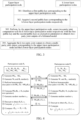
- FIG. 4 is a flowchart of secure joint computation between two participation nodes according to an exemplary embodiment of this disclosure.
- An upper-layer participation node P 0 performs secure two-party j oint computation with an i th lower-layer participation node P i ( FIG. 4 takes a first lower-layer participation node as an example), a value of i ranging from 1 to k.
- the method includes the following substeps:
- step 1 the upper-layer participation node P 0 generates a first public key PK 0 and a first private key SK 0
- the i th lower-layer participation node P i generates a second public key PK i and a second private key SK i .
- step 2 the upper-layer participation node P 0 transmits the first public key PK 0 to the i th lower-layer participation node P i , and the i th lower-layer participation node P i transmits the second public key PK i to the upper-layer participation node P 0 ;
- the i th lower-layer participation node P i stores the first public key PK 0
- the upper-layer participation node P 0 stores the second public key PK i .
- Steps 1 and 2 complete the processes of steps 301 and 302, and will not be elaborated.
- Step 303 optionally includes the following substeps:
- step 3 the upper-layer participation node P 0 generates a first network parameter W 0 and a first random mask R i randomly, and the i th lower-layer participation node P i generates a second network parameter W i and a second random mask R 0,i randomly.
- the first network parameter W 0 is a network parameter of a submodel locally deployed in the upper-layer participation node P 0 .
- the second network parameter W i is a network parameter of a submodel locally deployed in the i th lower-layer participation node P i .
- the first random mask R i is generated by the upper-layer participation node P 0 , so the first random masks generated by the upper-layer participation node P 0 for different lower-layer participation nodes may be the same or different.
- the second random mask R 0,i is generated by each lower-layer participation node, so second random masks generated by different lower-layer participation nodes for the upper-layer participation node P 0 are generally different.
- step 4 the upper-layer participation node P 0 encrypts the first random mask R i with the first public key PK 0 in a manner of homomorphic encryption to obtain a first encrypted value PK 0 (R i ); and the i th lower-layer participation node P i encrypts the second random mask R 0,i with the second public key PK i in a manner of homomorphic encryption to obtain a second encrypted value PK i (R 0,i ).
- step 5 the upper-layer participation node P 0 transmits the first encrypted value PK 0 (R i ) to the i th lower-layer participation node P i , and the i th lower-layer participation node P i transmits the second encrypted value PK i (R 0,i ) to the upper-layer participation node;
- the i th lower-layer participation node P i receives the first encrypted value PK 0 (R i ) transmitted by the upper-layer participation node P 0
- the upper-layer participation node P 0 receives the second encrypted value PK i (R 0,i ) transmitted by the i th lower-layer participation node P i .
- step 6 the upper-layer participation node P 0 computes a product PK i (R 0,i ) ⁇ W 0 of the second encrypted value PK i (R 0,i ) and the first network parameter W 0
- the i th lower-layer participation node computes a product PK i (R 0,i ) ⁇ W i of the first encrypted value PK 0 (R i ) and the second network parameter W i .
- the second network parameter is a network parameter of the submodel locally deployed in the i th lower-layer participation node.
- step 7 the upper-layer participation node P 0 generates a second random number r 0,i , and the i th lower-layer participation node P i generates a first random number r i .
- the second random number is generated by the upper-layer participation node P 0 , so the second random numbers generated by the upper-layer participation node P 0 for different lower-layer participation nodes may be the same or different.
- the first random number is generated by each lower-layer participation node, so first random numbers generated by different lower-layer participation nodes for the upper-layer participation node P 0 are generally different.
- step 8 the upper-layer participation node P 0 transmits a third encrypted value to the i th lower-layer participation node P i , and the upper-layer participation node receives a fourth encrypted value transmitted by the i th lower-layer participation node P i .
- the third encrypted value is a value obtained by encrypting first data X 0 with the second encrypted value PK i (R 0,i ) and the second random number r 0,1 .
- the third encrypted value is PK i (R 0,i ) ⁇ X 0 -r 0,i .
- the fourth encrypted value is a value obtained by the i th lower-layer participation node P i by encrypting second data X i with the first encrypted value PK 0 (R i ) and the first random number r i .
- the fourth encrypted value is PK 0 (R i ) ⁇ X i -r i .
- step 9 the upper-layer participation node P 0 decrypts the fourth encrypted value PK i (R 0,i ) ⁇ X i -r i with the first private key to obtain a masked value R;X;-r; of the second data, and the i th lower-layer participation node P i decrypts the third encrypted value with the second private key to obtain a masked value R 0 X 0 -r 0,i of the first data.
- step 11 the i th lower-layer participation node P i reports the second local output s 2 to the upper-layer participation node P 0 .
- the secure two-party joint computation between the upper-layer participation node and the k lower-layer participation nodes is performed in parallel.
- the upper-layer participation node obtains totally k two-party joint outputs of a federated model.
- a multiple encryption mechanism of public key, random mask and random number is used, so that there is provided a secure two-party joint calculation method where an upper-layer participation node and a lower-layer participation node are substantially in an equal relationship, and in addition, the security of feature data between the upper-layer participation node and a lower-layer participation node may be ensured.
- the upper-layer participation node is a root node in two layers of participation nodes.
- the lower-layer participation node is a leaf node in the two layers of participation nodes. Each leaf node is connected with the root node.
- a participation node P 0 serves as an upper-layer participation node, i.e., a root node.
- the N participation nodes are deployed in a multi-way topology of at least three layers.
- Two adjacent layers of participation nodes include upper-layer participation nodes and lower-layer participation nodes.
- the upper-layer participation node is a participation node of the higher layer in the two adjacent layers of participation nodes.
- the lower-layer participation node is a participation layer of the lower layer in the two adjacent layers of participation nodes.
- Each lower-layer participation node is connected with the corresponding upper-layer participation node.
- Each upper-layer participation node corresponds to at least two lower-layer participation nodes. As shown in FIG.
- a participation node P 0 is a first-layer participation node, i.e., a root node
- a participation node P 1 and a participation node P 2 are second-layer participation nodes
- a participation node P 3 , a participation node P 4 , a participation node P 5 , and a participation node P 6 are third-layer participation nodes.
- the participation node P 0 is an upper-layer participation node (or referred to as a higher-layer participation node) of the participation node P 1 and the participation node P 2 .
- the participation node P 1 and the participation node P 2 are lower-layer participation nodes of the participation node P 0 .
- the participation node P 1 is an upper-layer participation node of the participation node P 3 and the participation node P 4 .
- the participation node P 3 and the participation node P 4 are lower-layer participation nodes of the participation node P 1 .
- the participation node P 2 is an upper-layer participation node of the participation node P 5 and the participation node P 6 .
- the participation node P 5 and the participation node P 6 are lower-layer participation nodes of the participation node P 1 .
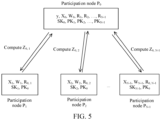
- FIG. 7 is a flowchart of a calculation method for vertical federated learning according to an exemplary embodiment of this disclosure. The method is applied to the upper-layer participation node and N-1 lower-layer participation nodes shown in FIG. 5 . Taking a federated model being a logistic regression (LogR) model as an example, the method includes the following steps:
- Phase 1 public key distribution
- step 701 the upper-layer participation node P 0 generates a first public key PK 0 and a first private key SK 0 , and transmits the first public key PK 0 to the N-1 lower-layer participation nodes P i .
- the upper-layer participation node P 0 generates a public key and private key pair (PK 0 , SK 0 ), and transmits a first public key PK 0 to each lower-layer participation node P i .
- the N-1 lower-layer participation nodes Pi receive the first public key PK 0 transmitted by the upper-layer participation node P 0 .
- the N-1 lower-layer participation nodes P i store the first public key PK 0 .
- the first public key PK 0 is used for performing additive homomorphic encryption on an intermediate computation result.
- a Paillier homomorphic encryption algorithm is used.
- each lower-layer participation node P i generates a second public key PK i and a second private key SK i , and transmits the second public key PK i to the upper-layer participation node P 0 ;
- each participation node performs encrypted sample alignment.
- the participation node P 0 has label information y.
- the participation node P 0 may have no feature data, namely X 0 is null.
- An algorithm for the secure two-party joint computation between the upper-layer participation node P 0 and each lower-layer participation node P i is not limited. Any secure two-party joint calculation method is available. In this disclosure, the secure two-party joint computation is exemplified with steps 3 to 12 shown in FIG. 4 .
- step 705 the upper-layer participation node P 0 computes a multi-party joint output z 0,i .
- 1 N ⁇ 1 in the above implementation is an optional weight.
- the upper-layer participation node P i After obtaining the forward prediction error ⁇ , the upper-layer participation node P i locally computes a gradient of a loss function of the federated model for a first network parameter W 0 .
- step 708 the upper-layer participation node P 0 transmits the forward prediction error ⁇ ; to each lower-layer participation node P i .
- the lower-layer participation node P i After obtaining the forward prediction error ⁇ , the lower-layer participation node P i locally computes a gradient of the loss function of the federated model for a first network parameter W i .
- step 704 is performed when an iteration ending condition is not satisfied.
- the iteration ending condition includes that: an iteration count is greater than a maximum iteration count, or, the network parameter of the federated model converges.
- step 711 the training process is stopped when the iteration ending condition is satisfied.
- a multi-way tree topology deployment-based vertical federated learning architecture is provided, improving the equality of each participation node in a vertical federated learning process.
- the upper-layer participation node and the lower-layer participation node exchange the public keys with each other, and keep their own private keys, so that the security risk may be shared by each participation node.
- a root node and N-1 leaf nodes are constructed in a star topology, which is prone to the implementation of the service in actual scenarios.
- the whole vertical federated learning process may be completed equally only if any participation node with label information communicates with the other participation nodes as a root node.
- multiple different upper-layer participation nodes may be used to share computation and communication tasks. Multiple participation nodes are organized according to a topological structure like a multilayer multi-way tree.
- FIG. 8 is a flowchart of a calculation method for vertical federated learning according to an exemplary embodiment of this disclosure. The method is applied to the upper-layer participation node and lower-layer participation nodes shown in FIG. 6 . The method includes the following steps:
- Phase 1 public key distribution
- the upper-layer participation node generates a first public key and a first private key, and transmits the first public key to the k lower-layer participation nodes.
- the upper-layer participation node P 1 For the upper-layer participation node P 1 , the upper-layer participation node P 1 generates a public key and private key pair (PK 1 , SK 1 ), and transmits a first public key PK 1 to the lower-layer participation node P 3 and P 4 .
- the lower-layer participation nodes P 3 and P 4 receive the first public key PK 1 transmitted by the upper-layer participation node P 1 .
- the lower-layer participation nodes P 3 and P 4 store the first public key PK 1 .
- the first public key PK 1 is used for performing additive homomorphic encryption on an intermediate computation result.
- a Paillier homomorphic encryption algorithm is used.
- the upper-layer participation node P 2 For the upper-layer participation node P 2 , the upper-layer participation node P 2 generates a public key and private key pair (PK 2 , SK 2 ), and transmits a first public key PK 2 to the lower-layer participation node P 5 and P 6 .
- the lower-layer participation nodes P 5 and P 6 receive the first public key PK 2 transmitted by the upper-layer participation node P 2 .
- the lower-layer participation nodes P 5 and P 6 store the first public key PK 2 .
- the first public key PK 2 is used for performing additive homomorphic encryption on an intermediate computation result.
- a Paillier homomorphic encryption algorithm is used.
- each lower-layer participation node P i generates a second public key PK i and a second private key SK i , and transmits the second public key PK i to the upper-layer participation node.
- the lower-layer participation node P 3 For the upper-layer participation node P 1 , the lower-layer participation node P 3 generates a public key and private key pair (PK 3 , SK 3 ), and transmits a second public key PK 3 to the upper-layer participation node P 1 .
- the lower-layer participation node P 4 generates a public key and private key pair (PK 4 , SK 4 ), and transmits a second public key PK 4 to the upper-layer participation node P 1 .
- the upper-layer participation nodes P 1 receives the second public key PK 3 transmitted by the lower-layer participation node P 3 and the second public key PK 4 transmitted by the lower-layer participation node P 4 .
- the upper-layer participation node P 1 stores the second public keys PK 3 and PK 4 .
- the second public keys PK 3 and PK 4 are used for performing additive homomorphic encryption on an intermediate computation result.
- the Paillier homomorphic encryption algorithm is used.
- the lower-layer participation node P 5 For the upper-layer participation node P 2 , the lower-layer participation node P 5 generates a public key and private key pair (PK 5 , SK 5 ), and transmits a second public key PK 5 to the upper-layer participation node P 2 .
- the lower-layer participation node P 6 generates a public key and private key pair (PK 6 , SK 6 ), and transmits a second public key PK 6 to the upper-layer participation node P 2 .
- the upper-layer participation node P 2 receives the second public key PK 5 transmitted by the lower-layer participation node P 5 and the second public key PK 6 transmitted by the lower-layer participation node P 6 .
- the upper-layer participation node P 2 stores the second public keys PK 5 and PK 6 .
- the second public keys PK 5 and PK 6 are used for performing additive homomorphic encryption on an intermediate computation result.
- the Paillier homomorphic encryption algorithm is used.
- each participation node performs encrypted sample alignment.
- a participation node P 0 has label information y.
- the participation node P 0 may have no feature data, namely X 0 is null.
- This step is to align training samples of multiple participation nodes by use of a Freedman-protocol-based algorithm.
- An algorithm for the secure two-party joint computation between the upper-layer participation node P j and each lower-layer participation node P i is not limited. Any secure two-party joint calculation method is available. In this disclosure, the secure two-party joint computation is exemplified with steps 3 to 12 shown in FIG. 4 .
- the process of performing the secure two-party joint computation by the upper-layer participation node and each lower-layer participation node may be performed in parallel at the k lower-layer participation nodes, so as to reduce training time of the federated model and improve the efficiency of multi-participant federated learning.
- step 805 the upper-layer participation node computes a multi-party joint output.
- the upper-layer participation node P 1 aggregates the submodel outputs z 1,3 and z 1,4 to obtain a multi-party joint output Z 1 corresponding to the participation node P 1 , the participation node P 3 , and the participation node P 4 .
- the upper-layer participation node P 2 aggregates the submodel outputs z 2,5 and z 2,6 to obtain a multi-party j oint output Z 2 corresponding to the participation node P 2 , the participation node P 5 , and the participation node P 6 .
- step 806 the multi-party joint output is reported, when the upper-layer participation node is a lower-layer participation node of a higher-layer participation node in the multi-way tree topology, to the higher-layer participation node.
- the higher-layer participation node is an upper-layer participation node of the upper-layer participation node.
- the upper-layer participation node reports the first joint output to the higher-layer participation node in a plain text or cipher text form.
- the upper-layer participation node P 1 reports the first joint output Z 1 to the higher-layer participation node P 0 .
- the upper-layer participation node P 2 reports the first joint output Z 2 to the higher-layer participation node P 0 .
- the multi-party joint output represents a joint output corresponding to seven participation nodes.
- sigmoid is an S function, also referred to as an activation function.
- E is a natural constant.
- the upper-layer participation node computes, when the upper-layer participation node is a root node with label information, a forward prediction error of a federated model according to a difference between the multi-party joint output and the label information.
- step 809 the upper-layer participation node P 0 updates a first network parameter iteratively according to the forward prediction error ⁇ .
- the upper-layer participation node P i After obtaining the forward prediction error ⁇ , the upper-layer participation node P i locally computes a gradient of a loss function of the federated model for a first network parameter W 0 .
- step 810 the upper-layer participation node P 0 transmits the forward prediction error ⁇ ; to each lower-layer participation node P i .
- step 811 the lower-layer participation node P i updates a second network parameter iteratively according to the forward prediction error ⁇ .
- the lower-layer participation node P i After obtaining the forward prediction error ⁇ , the lower-layer participation node P i locally computes a gradient of the loss function of the federated model for a first network parameter W i .
- step 806 is performed when an iteration ending condition is not satisfied.
- the iteration ending condition includes that: an iteration count is greater than a maximum iteration count, or, the network parameter of the federated model converges.
- step 813 the training process is stopped when the iteration ending condition is satisfied.
- the participation node P 0 may implement computation with the participation nodes P 1 and P 2 directly in the plain text form without sharing the public keys and using additive homomorphic encryption or random masks. Certainly, the participation node P 0 may still select to compute z with the participation nodes P 1 and P 2 by secure two-party joint computation. That is, the participation node P 0 still shares the public keys and random masks with the participation nodes P 1 and P 2 to compute z by secure two-party joint computation shown in FIG.
- the participation node P 1 determines the three-party joint output corresponding to the "participation nodes P 1 , P 3 , and P 4 " as its own model output and the participation node P 2 determines the three-party joint output corresponding to the "participation nodes P 2 , P 5 , and P 6 " as its own model output.
- N participation nodes are deployed in a multilayer multi-way tree topology, so that computation and communication are shared by different upper-layer participation nodes. Therefore, the computation and communication pressure of a participation node serving as a root node is alleviated.
- an upper-layer participation node since an upper-layer participation node has collects a multi-party joint output of k+1 parties, communication between the upper-layer participation node and a higher-layer participation node does not need encrypted communication and encrypted computation. Therefore, the computation overhead and communication overhead of each upper-layer participation node are reduced.
- the model training process is illustrated in the embodiments shown in FIGS. 7 and 8 .
- the model prediction phase it is only necessary to replace the feature data X with input data and perform the same process ending with the forward computation process, and it is unnecessary to perform the error back propagation process.
- the method is applied to the field of finance, and the federated model is a financial risk control model constructed by use of a multiple linear regression equation.
- the label information is whether there is any overdue payment record of a user.
- the participation nodes represent different companies, such as a bank, an e-commerce company, an instant messaging company, and an enterprise the user works for.
- the feature data includes, but not limited to: basic attribute information and deposit record of the user (bank), a shopping record of the user (e-commerce company), a social relation chain of the user (instant messaging company), and salary data of the user (enterprise the user works for).
- Vertical federated learning makes multi-department, multi-company, and even multi-industry data cooperation possible, and may also meet requirements of data protection laws and regulations. Therefore, an application scenario of vertical federated learning is not limited in this disclosure.
- FIG. 9 shows a vertical federated learning system involved in an exemplary embodiment of this disclosure.
- the system may be a distributed system formed by connecting a client and multiple participation nodes (computation devices in any form in an access network, such as servers and user terminals) in a network communication form.
- the distributed system is a blockchain system.
- FIG. 9 is a schematic structural diagram of a distributed system 100 applied to a blockchain system according to an exemplary embodiment of this disclosure.
- the distributed system is formed of a plurality of participation nodes (computing devices in any form in an access network, such as, servers and user terminals) 200 and a client 300.
- a peer-to-peer (P2P) network is formed between the participation nodes 200.
- P2P peer-to-peer
- the P2P protocol is an application-layer protocol running over the Transmission Control Protocol (TCP). Any machine such as a server or a terminal may be added to the distributed system to become a participation node.
- the participation nodes include a hardware layer, an intermediate layer, an operating system layer, and an application layer.
- the related functions include the following:
- the participation node 200 may further have the following functions: (2) Application: which is deployed in a blockchain, and is used for implementing a particular service according to an actual service requirement, recording data related to function implementation to form recorded data, adding a digital signature to the recorded data to indicate a source of task data, and transmitting the recorded data to another participation node 200 in the blockchain system, so that the another participation node 200 adds the recorded data to a temporary block when successfully verifying a source and integrity of the recorded data.
- Application which is deployed in a blockchain, and is used for implementing a particular service according to an actual service requirement, recording data related to function implementation to form recorded data, adding a digital signature to the recorded data to indicate a source of task data, and transmitting the recorded data to another participation node 200 in the blockchain system, so that the another participation node 200 adds the recorded data to a temporary block when successfully verifying a source and integrity of the recorded data.
- FIG. 10 is an optional schematic diagram of a block structure according to an exemplary embodiment of this disclosure.
- Each block includes a hash value of a transaction record stored in the current block (a hash value of the current block) and a hash value of a previous block.
- Blocks are connected according to hash values to form a blockchain.
- the block may further include information such as a timestamp indicating a block generation time.
- a blockchain is a decentralized database essentially, and is a series of associated data blocks generated by using a cryptographic method.
- Each data block includes related information, and is configured to verify the validity (anti-counterfeiting) of the information of the data block, and generate a next block.
- FIG. 11 is a block diagram of an upper-layer participation node (or referred to as an upper-layer participation apparatus) according to an exemplary embodiment of this disclosure.
- the upper-layer participation node corresponds to k lower-layer participation nodes in multiple participation nodes deployed in a multi-way tree topology, and a submodel in a federated model is locally deployed in each participation node, k being an integer greater than 1.
- the upper-layer participation node includes:
- the joint computation module 1140 is configured to:
- the secure two-party joint computation between the upper-layer participation node and the k lower-layer participation nodes is performed in parallel.
- the upper-layer participation node is a root node with label information
- the apparatus further includes: an error back propagation module 1160, configured to compute a forward prediction error of the federated model according to a difference between the multi-party joint model output and the label information, and transmit the forward prediction error to the k lower-layer participation nodes, the forward prediction error being used for the k lower-layer participation nodes to perform back propagation to update second network parameters of the submodels in the k lower-layer participation nodes.
- the upper-layer participation node is a lower-layer participation node of a higher-layer participation node in the multi-way tree topology.
- the communication module 1120 is further configured to report the multi-party joint model output to the higher-layer participation node, the higher-layer participation node being configured to obtain a multi-party joint model output corresponding to the higher-layer participation node by aggregating according to the multi-party joint model output, a single-party model output corresponding to the higher-layer participation node, and a multi-party joint model output corresponding to another lower-layer participation node subordinate to the higher-layer participation node.
- the upper-layer participation node is a lower-layer participation node of a higher-layer participation node in the multi-way tree topology.
- the communication module 1120 is further configured to report the first public key to the higher-layer participation node, and acquire a third public key corresponding to the higher-layer participation node.
- the joint computation module 1140 is configured to perform, by the upper-layer participation node as a lower-layer participation node, secure two-party j oint computation with the higher-layer participation node taking the first public key and the third public key as encryption parameters to obtain a two-party joint output of the federated model.
- FIG. 12 is a block diagram of a lower-layer participation node (or referred to as a lower-layer participation apparatus) according to an exemplary embodiment of this disclosure.
- the lower-layer participation node corresponds to an upper-layer participation node in multiple participation nodes deployed in a multi-way tree topology, and a submodel in a federated model is locally deployed in each participation node.
- the lower-layer participation node includes:
- the joint computation module 1240 is configured to generate a second network parameter and a second random mask, the second network parameter being a network parameter of the submodel locally deployed in the lower-layer participation node;
- the communication module 1220 is configured to receive a forward prediction error transmitted by the upper-layer participation node.
- the error back propagation module 1260 is configured to perform back propagation according to the forward prediction error to update the second network parameter of the submodel in the lower-layer participation node.
- the upper-layer participation node and the lower-layer participation node provided in the foregoing embodiments is described only by using division into the foregoing functional modules as an example.
- the foregoing functions may be allocated to and completed by different functional modules according to requirements, that is, the internal structure of the device is divided into different functional modules, to complete all or some of the foregoing described functions.
- the upper-layer participation node and the lower-layer participation node provided in the foregoing embodiments and the embodiments of the calculation method for vertical federated learning belong to the same concept.
- the computer device may be implemented as the above-mentioned participation node.
- the computer device includes a processor and a memory, the memory storing at least one instruction, the at least one instruction being loaded and executed by the processor to implement the calculation method for vertical federated learning provided in the foregoing method embodiments.
- FIG. 13 is a structural block diagram of a computer device 1300 according to an exemplary embodiment of this disclosure.
- the computer device 1300 may be: a smartphone, a tablet computer, a moving picture experts group audio layer III (MP3) player, a moving picture experts group audio layer IV (MP4) player, a notebook computer, or a desktop computer.
- MP3 moving picture experts group audio layer III
- MP4 moving picture experts group audio layer IV
- the computer device 1300 may also be referred to as user equipment (UE), a portable computer device, a laptop computer device, a desktop computer device, or another name.
- UE user equipment
- the computer device 1300 usually includes: a processor 1301 and a memory 1302.
- the processor 1301 may include one or more processing cores, and may be, for example, a 4-core processor or an 8-core processor.
- the processor 1301 may be implemented by at least one hardware form in a digital signal processing (DSP), a field-programmable gate array (FPGA), and a programmable logic array (PLA).
- the processor 1301 may also include a main processor and a co-processor.
- the main processor is a processor for processing data in a wake-up state, also referred to as a central processing unit (CPU).
- the coprocessor is a low power consumption processor configured to process data in a standby state.
- the processor 1301 may be integrated with a GPU.
- the GPU is configured to be responsible for rendering and drawing content that a display needs to display.
- the processor 1301 may further include an artificial intelligence (AI) processor.
- the AI processor is configured to process a calculation operation related to machine learning.
- the memory 1302 may include one or more computer-readable storage media that may be non-transitory.
- the memory 1302 may further include a high-speed random access memory and a non-transitory memory, for example, one or more magnetic disk storage devices or flash storage devices.
- the non-transitory computer-readable storage medium in the memory 1302 is configured to store at least one instruction, and the at least one instruction being configured to be executed by the processor 1301 to implement the calculation method for vertical federated learning provided in the method embodiments of this disclosure.
- FIG. 13 does not constitute any limitation on the computer device 1300, and the computer device may include more components or fewer components than those shown in the figure, or some components may be combined, or a different component deployment may be used.
- the memory further includes one or more programs.
- the one or more programs are stored in the memory.
- the one or more programs include a program for performing the calculation method for vertical federated learning provided in the embodiments of this disclosure.
- This disclosure further provides a computer-readable storage medium, the storage medium storing at least one instruction, the at least one instruction being loaded and executed by a processor to implement the calculation method for vertical federated learning provided in the foregoing method embodiments.
- This disclosure further provides a computer program product, the computer program product, when run on a computer, causing the computer to perform the calculation method for vertical federated learning provided in the foregoing method embodiments.
Landscapes
- Engineering & Computer Science (AREA)
- Theoretical Computer Science (AREA)
- Physics & Mathematics (AREA)
- Software Systems (AREA)
- Signal Processing (AREA)
- Computer Networks & Wireless Communication (AREA)
- Computer Security & Cryptography (AREA)
- Computing Systems (AREA)
- Evolutionary Computation (AREA)
- Data Mining & Analysis (AREA)
- General Engineering & Computer Science (AREA)
- General Physics & Mathematics (AREA)
- Mathematical Physics (AREA)
- Artificial Intelligence (AREA)
- Life Sciences & Earth Sciences (AREA)
- Biomedical Technology (AREA)
- Biophysics (AREA)
- Computational Linguistics (AREA)
- General Health & Medical Sciences (AREA)
- Molecular Biology (AREA)
- Health & Medical Sciences (AREA)
- Computer Vision & Pattern Recognition (AREA)
- Medical Informatics (AREA)
- Information Retrieval, Db Structures And Fs Structures Therefor (AREA)
- Data Exchanges In Wide-Area Networks (AREA)
Claims (14)
- Ein Berechnungsverfahren für vertikales föderiertes Lernen, angewendet auf einen oberen Beteiligungsknoten (P0) in mehreren Beteiligungsknoten, die in einer mehrstufigen Baumtopologie eingesetzt sind, wobei der obere Beteiligungsknoten (P0) k unteren Beteiligungsknoten (P1, P2,..., PN-1) entspricht, wobei ein Untermodell in einem föderierten Modell lokal in jedem Beteiligungsknoten bereitgestellt wird, wobei k eine ganze Zahl größer als 1 ist, wobei das Verfahren umfasst:Verteilen (301, 701) eines ersten öffentlichen Schlüssels (PK0), der dem oberen Beteiligungsknoten (P0) entspricht, an die k unteren Beteiligungsknoten (P1, P2,..., PN-1) und Erfassen von k zweiten öffentlichen Schlüsseln (PK1, PK2,..., PKN-1), die jeweils den k unteren Beteiligungsknoten (P1, P2,..., PN-1) entsprechen;Durchführen (303, 704) einer sicheren Zwei-Parteien-Gemeinschaftsberechnung durch den oberen Beteiligungsknoten (P0) mit den k unteren Beteiligungsknoten (P1, P2,..., PN-1), wobei der erste öffentliche Schlüssel (PK0) und die k zweiten öffentlichen Schlüssel (PK1, PK2,..., PKN-1) als Verschlüsselungsparameter verwendet werden, um k Zwei-Parteien-Gemeinschaftsergebnisse (Z0,1, Z0,2,..., Z0,N-1) des föderierten Modells zu erhalten, wobei die sichere Zwei-Parteien-Gemeinschaftsberechnung eine Vorwärtsberechnung für das Untermodell in Form von homomorpher Verschlüsselung umfasst, die vom oberen Beteiligungsknoten (P0) und einem unteren Beteiligungsknoten gemeinsam unter Verwendung der jeweiligen Daten des oberen Beteiligungsknotens (P0) und des unteren Beteiligungsknotens durchgeführt wird;
undAggregieren (304) der k Zwei-Parteien-Gemeinschaftsergebnisse (Z0,1, Z0,2,..., Z0,N-1), um (705) ein Mehrparteien-Gemeinschaftsergebnis zu erhalten, das dem oberen Beteiligungsknoten (P0) und den k unteren Beteiligungsknoten (P1, P2,..., PN-1) entspricht. - Das Verfahren nach Anspruch 1, wobei das Durchführen der sicheren Zwei-Parteien-Gemeinschaftsberechnung durch den oberen Beteiligungsknoten mit den k unteren Beteiligungsknoten unter Verwendung des ersten öffentlichen Schlüssels und der k zweiten öffentlichen Schlüssel als Verschlüsselungsparameter, um k Zwei-Parteien-Gemeinschaftsergebnisse des föderierten Modells zu erhalten, umfasst:Erzeugen eines ersten Netzparameter (W0) und einer ersten zufälligen Maske, wobei der erste Netzparameter (W0) ein Netzparameter des Untermodells ist, das lokal im oberen Beteiligungsknoten (P0) bereitgestellt wird;Senden eines ersten verschlüsselten Wertes an einen i-ten unteren Beteiligungsknoten und Empfangen eines zweiten verschlüsselten Wertes von dem i-ten unteren Beteiligungsknoten, wobei der erste verschlüsselte Wert durch Verschlüsseln der ersten zufälligen Maske mit dem ersten öffentlichen Schlüssel (PK0) in der Form der homomorphen Verschlüsselung erhalten wird, und der zweite verschlüsselte Wert durch Verschlüsseln einer zweiten zufälligen Maske mit einem i-ten zweiten öffentlichen Schlüssel in der Form der homomorphen Verschlüsselung erhalten wird, wobei der Wert von i von 1 bis k reicht;Senden eines dritten verschlüsselten Wertes an den i-ten unteren Beteiligungsknoten und Empfangen eines vierten verschlüsselten Wertes von dem i-ten unteren Beteiligungsknoten, wobei der dritte verschlüsselte Wert ein Wert ist, der durch Verschlüsseln der ersten Daten mit dem zweiten verschlüsselten Wert und einer zweiten Zufallszahl erhalten wird, und der vierte verschlüsselte Wert ein Wert ist, der vom i-ten unteren Beteiligungsknoten durch Verschlüsseln der zweiten Daten mit dem ersten verschlüsselten Wert und einer ersten Zufallszahl erhalten wird, wobei die ersten Daten Daten im oberen Beteiligungsknoten (P0) sind, die zweiten Daten Daten im i-ten unteren Beteiligungsknoten sind, die zweite Zufallszahl vom oberen Beteiligungsknoten (P0) generiert wird und die erste Zufallszahl vom unteren Beteiligungsknoten generiert wird;Berechnen eines ersten lokalen Ergebnisses (S1) und Empfangen eines zweiten lokalen Ergebnisses (S2) vom i-ten unteren Beteiligungsknoten, wobei das erste lokale Ergebnis (S1) gemäß einem entschlüsselten Wert des vierten verschlüsselten Wertes, den Daten des oberen Beteiligungsknotens (P0), dem ersten Netzparameter (W0) und der zweiten Zufallszahl berechnet wird, und das zweite lokale Ergebnis (S2) durch den i-ten unteren Beteiligungsknoten gemäß einem entschlüsselten Wert des dritten verschlüsselten Wertes, den Daten des i-ten unteren Beteiligungsknotens, eines zweiten Netzparameters und der ersten Zufallszahl berechnet wird; undHinzufügen des ersten lokalen Ergebnisses (S1) und des zweiten lokalen Ergebnisses (S2), um ein i-tes Zwei-Parteien-Gemeinschaftsergebnis zu erhalten, um so die insgesamt k Zwei-Parteien-Gemeinschaftsergebnisse (Z0,1, Z0,2,..., Z0,N-1) des föderierten Modells zu erhalten.
- Das Verfahren nach Anspruch 2, wobei die sichere Zwei-Parteien-Gemeinschaftsberechnung zwischen dem oberen Beteiligungsknoten (P0) und den k unteren Beteiligungsknoten (P1, P2,..., PN-1) parallel durchgeführt wird.
- Das Verfahren nach einem der Ansprüche 1-3, wobei die mehrstufige Baumtopologie umfasst:
zwei Schichten von Beteiligungsknoten, wobei der obere Beteiligungsknoten (P0) ein Wurzelknoten in den zwei Schichten von Beteiligungsknoten ist, der untere Beteiligungsknoten ein Blattknoten in den zwei Schichten von Beteiligungsknoten ist und jeder Blattknoten mit dem Wurzelknoten verbunden ist. - Das Verfahren nach Anspruch 1, wobei die mehrstufige Baumtopologie umfasst:
drei oder mehr Schichten von Beteiligungsknoten, wobei der obere Beteiligungsknoten ein Beteiligungsknoten der höheren Schicht in zwei benachbarten Schichten von Beteiligungsknoten ist, der untere Beteiligungsknoten ein Beteiligungsknoten der unteren Schicht in zwei benachbarten Schichten von Beteiligungsknoten ist, und jeder untere Beteiligungsknoten mit einem entsprechenden oberen Beteiligungsknoten verbunden ist. - Das Verfahren nach einem der Ansprüche 1-3, wobei der obere Beteiligungsknoten (P0) ein Wurzelknoten mit Beschriftungsinformationen (y) ist, und das Verfahren ferner umfasst:Berechnen (706) eines Vorhersagefehlers des föderierten Modells gemäß einer Differenz zwischen einem Mehrparteien-Gemeinschaftsmodellergebnis und den Beschriftungsinformationen (y); undSenden (708) des Vorhersagefehlers an die k unteren Beteiligungsknoten (P1, P2,..., PN-1), wobei der Vorhersagefehler verwendet wird, um für die k unteren Beteiligungsknoten (P1, P2,..., PN-1) eine Rückwärtsausbreitung durchzuführen, um zweite Netzparameter (W1, W2,..., WN-1) der Untermodelle in den k unteren Beteiligungsknoten (P1, P2,..., PN-1) zu aktualisieren.
- Das Verfahren nach einem der Ansprüche 1-3, wobei der obere Beteiligungsknoten ein unterer Beteiligungsknoten eines höhergelegenen Beteiligungsknotens in der mehrstufigen Baumtopologie ist, und das Verfahren ferner umfasst:
Melden (806) eines Mehrparteien-Gemeinschaftsmodellergebnisses durch den oberen Beteiligungsknoten an den höhergelegenen Beteiligungsknoten, wobei der höhergelegene Beteiligungsknoten konfiguriert ist, (807) das Mehrparteien-Gemeinschaftsmodellergebnis zu erhalten, das dem höhergelegenen Beteiligungsknoten entspricht, indem das Mehrparteien-Gemeinschaftsmodellergebnis, ein Einzelparteien-Modellergebnis, das dem höhergelegenen Beteiligungsknoten entspricht, und ein Mehrparteien-Gemeinschaftsmodellergebnis, das einem anderen unteren Beteiligungsknoten untergeordnet zum höhergelegenen Beteiligungsknoten entspricht, aggregiert werden. - Das Verfahren nach einem der Ansprüche 1-3, wobei der obere Beteiligungsknoten ein unterer Beteiligungsknoten eines höhergelegenen Beteiligungsknotens in der mehrstufigen Baumtopologie ist, und das Verfahren ferner umfasst:Melden des ersten öffentlichen Schlüssels (PK0) durch den oberen Beteiligungsknoten an den höhergelegenen Beteiligungsknoten und Erfassen eines dritten öffentlichen Schlüssels, der dem höhergelegenen Beteiligungsknoten entspricht; undDurchführen einer sicheren Zwei-Parteien-Gemeinschaftsberechnung durch den oberen Beteiligungsknoten als unterer Beteiligungsknoten mit dem höhergelegenen Beteiligungsknoten unter Verwendung des ersten öffentlichen Schlüssels (PK0) und des dritten öffentlichen Schlüssels als Verschlüsselungsparameter, um ein Zwei-Parteien-Gemeinschaftsergebnis des föderierten Modells zu erhalten.
- Ein Berechnungsverfahren für vertikales föderiertes Lernen, angewendet auf einen unteren Beteiligungsknoten in mehreren Beteiligungsknoten, die in einer mehrstufigen Baumtopologie eingesetzt sind, wobei der untere Beteiligungsknoten einem oberen Beteiligungsknoten (P0) entspricht, wobei ein Untermodell in einem föderierten Modell lokal in jedem Beteiligungsknoten bereitgestellt wird, wobei das Verfahren umfasst:Melden (702) eines zweiten öffentlichen Schlüssels des unteren Beteiligungsknotens an den oberen Beteiligungsknoten (P0) und Erfassen (701) eines ersten öffentlichen Schlüssels (PK0), der dem oberen Beteiligungsknoten (P0) entspricht, wobei der obere Beteiligungsknoten (P0) k unteren Beteiligungsknoten (P1, P2,..., PN-1) entspricht und k eine positive ganze Zahl ist; undDurchführen (704) einer sicheren Zwei-Parteien-Gemeinschaftsberechnung durch den unteren Beteiligungsknoten mit dem oberen Beteiligungsknoten (P0) unter Verwendung des ersten öffentlichen Schlüssels (PK0) und des zweiten öffentlichen Schlüssels als Verschlüsselungsparameter, um ein Zwei-Parteien-Gemeinschaftsergebnis des föderierten Modells zu erhalten, wobei die sichere Zwei-Parteien-Gemeinschaftsberechnung eine Vorwärtsberechnung für das Untermodell umfasst, die in Form von homomorpher Verschlüsselung vom oberen Beteiligungsknoten (P0) und dem unteren Beteiligungsknoten gemeinsam unter Verwendung der jeweiligen Daten des oberen Beteiligungsknotens (P0) und des unteren Beteiligungsknotens durchgeführt wird.
- Das Verfahren nach Anspruch 9, wobei das Durchführen der sicheren Zwei-Parteien-Gemeinschaftsberechnung durch den unteren Beteiligungsknoten mit dem oberen Beteiligungsknoten unter Verwendung des ersten öffentlichen Schlüssels und des zweiten öffentlichen Schlüssels als Verschlüsselungsparameter umfasst:Erzeugen eines zweiten Netzparameters und einer zweiten zufälligen Maske, wobei der zweite Netzparameter ein Netzparameter des Untermodells ist, das lokal im unteren Beteiligungsknoten bereitgestellt wird;Empfangen eines ersten verschlüsselten Wertes vom oberen Beteiligungsknoten (P0) und Senden eines zweiten verschlüsselten Wertes an den oberen Beteiligungsknoten (P0), wobei der erste verschlüsselte Wert durch Verschlüsseln einer ersten zufälligen Maske mit dem ersten öffentlichen Schlüssel (PK0) in der Form der homomorphen Verschlüsselung erhalten wird, und der zweite verschlüsselte Wert durch Verschlüsseln der zweiten zufälligen Maske mit dem zweiten öffentlichen Schlüssel in der Form der homomorphen Verschlüsselung erhalten wird;Empfangen eines dritten verschlüsselten Wertes vom oberen Beteiligungsknoten (P0) und Senden eines vierten verschlüsselten Wertes an den oberen Beteiligungsknoten (P0), wobei der dritte verschlüsselte Wert ein Wert ist, der durch Verschlüsseln der ersten Daten mit dem zweiten verschlüsselten Wert und einer zweiten Zufallszahl erhalten wird, und der vierte verschlüsselte Wert ein Wert ist, der vom unteren Beteiligungsknoten durch Verschlüsseln der zweiten Daten mit dem ersten verschlüsselten Wert und einer ersten Zufallszahl erhalten wird, wobei die ersten Daten Daten im oberen Beteiligungsknoten (P0) sind, die zweiten Daten Daten im unteren Beteiligungsknoten sind, die zweite Zufallszahl vom oberen Beteiligungsknoten (P0) generiert wird und die erste Zufallszahl vom unteren Beteiligungsknoten generiert wird; undSenden eines zweiten lokalen Ergebnisses an den oberen Beteiligungsknoten (P0), so dass der obere Beteiligungsknoten (P0) das erste lokale Ergebnis und das zweite lokale Ergebnis addiert, um das Zwei-Parteien-Gemeinschaftsergebnis zu erhalten, wobei das erste lokale Ergebnis gemäß einem entschlüsselten Wert des vierten verschlüsselten Wertes, den Daten des oberen Beteiligungsknotens (P0), einem ersten Netzparameter (W0) und der zweiten Zufallszahl berechnet wird, und das zweite lokale Ergebnis durch den unteren Beteiligungsknoten gemäß einem entschlüsselten Wert des dritten verschlüsselten Wertes, den Daten des unteren Beteiligungsknotens, dem zweiten Netzparameter und der ersten Zufallszahl berechnet wird.
- Das Verfahren nach Anspruch 9 oder 10, ferner umfassend:Empfangen eines Vorhersagefehlers vom oberen Beteiligungsknoten (P0); undDurchführen einer Rückwärtsausbreitung gemäß dem Vorhersagefehler, um den zweiten Netzparameter des Untermodells im unteren Beteiligungsknoten zu aktualisieren.
- Eine Vorrichtung (1300), umfassend einen Prozessor (1301) und einen Speicher (1302), wobei der Speicher (1302) mindestens eine Anweisung, mindestens ein Programm, einen Codesatz oder einen Anweisungssatz speichert, wobei die mindestens eine Anweisung, das mindestens eine Programm, der Codesatz oder der Anweisungssatz vom Prozessor (1301) geladen und ausgeführt wird, um das Berechnungsverfahren für vertikales föderiertes Lernen nach einem der Ansprüche 1 bis 11 zu implementieren.
- Ein computerlesbares Speichermedium, das mindestens eine Anweisung, mindestens ein Programm, einen Codesatz oder einen Anweisungssatz speichert, wobei die mindestens eine Anweisung, das mindestens eine Programm, der Codesatz oder der Anweisungssatz von einem Prozessor (1301) geladen und ausgeführt wird, um das Berechnungsverfahren für vertikales föderiertes Lernen nach einem der Ansprüche 1 bis 11 zu implementieren.
- Ein Computerprogrammprodukt, umfassend Computeranweisungen, wobei die Computeranweisungen in einem computerlesbaren Speichermedium gespeichert sind, ein Prozessor einer Vorrichtung die Computeranweisungen aus dem computerlesbaren Speichermedium liest und der Prozessor die Computeranweisungen ausführt, um die Vorrichtung zu veranlassen, das Berechnungsverfahren für vertikales föderiertes Lernen nach einem der Ansprüche 1 bis 11 auszuführen.
Applications Claiming Priority (2)
| Application Number | Priority Date | Filing Date | Title |
|---|---|---|---|
| CN202011064959.3A CN112132293B (zh) | 2020-09-30 | 2020-09-30 | 纵向联邦学习中的计算方法、装置、设备及介质 |
| PCT/CN2021/118259 WO2022068575A1 (zh) | 2020-09-30 | 2021-09-14 | 纵向联邦学习中的计算方法、装置、设备及介质 |
Publications (3)
| Publication Number | Publication Date |
|---|---|
| EP4120150A1 EP4120150A1 (de) | 2023-01-18 |
| EP4120150A4 EP4120150A4 (de) | 2023-08-16 |
| EP4120150B1 true EP4120150B1 (de) | 2024-12-25 |
Family
ID=73844922
Family Applications (1)
| Application Number | Title | Priority Date | Filing Date |
|---|---|---|---|
| EP21874236.9A Active EP4120150B1 (de) | 2020-09-30 | 2021-09-14 | Berechnungsverfahren für vertikales föderiertes lernen, vorrichtung, vorrichtung und medium |
Country Status (4)
| Country | Link |
|---|---|
| US (1) | US12244689B2 (de) |
| EP (1) | EP4120150B1 (de) |
| CN (1) | CN112132293B (de) |
| WO (1) | WO2022068575A1 (de) |
Families Citing this family (25)
| Publication number | Priority date | Publication date | Assignee | Title |
|---|---|---|---|---|
| CN112132293B (zh) | 2020-09-30 | 2025-07-29 | 腾讯科技(深圳)有限公司 | 纵向联邦学习中的计算方法、装置、设备及介质 |
| CA3143855A1 (en) * | 2020-12-30 | 2022-06-30 | Atb Financial | Systems and methods for federated learning on blockchain |
| CN112863175B (zh) * | 2020-12-31 | 2022-11-22 | 平安科技(深圳)有限公司 | 汽车道路监测数据处理方法、装置、设备及存储介质 |
| CN112906745B (zh) * | 2021-01-21 | 2022-03-29 | 天津大学 | 基于边缘协同的诚信智能网络训练方法 |
| US12229280B2 (en) * | 2021-03-16 | 2025-02-18 | Accenture Global Solutions Limited | Privacy preserving cooperative learning in untrusted environments |
| CN113159333B (zh) * | 2021-03-27 | 2022-10-11 | 北京邮电大学 | 一种基于分层分片区块链的联邦学习方法、系统及装置 |
| WO2022222152A1 (zh) * | 2021-04-23 | 2022-10-27 | Oppo广东移动通信有限公司 | 联邦学习方法、联邦学习系统、第一设备和第三设备 |
| CN113268920B (zh) * | 2021-05-11 | 2022-12-09 | 西安交通大学 | 一种基于联邦学习的无人机群感知数据安全共享方法 |
| US20230084507A1 (en) * | 2021-09-08 | 2023-03-16 | Zirui ZHOU | Servers, methods and systems for fair and secure vertical federated learning |
| CN113950046B (zh) * | 2021-10-19 | 2022-05-03 | 北京工商大学 | 一种基于联邦学习的异构拓扑网络可信加密定位方法 |
| US20230229640A1 (en) * | 2021-12-14 | 2023-07-20 | Vmware, Inc. | Collaborative data schema management for federated learning |
| CN114298331B (zh) * | 2021-12-29 | 2025-02-18 | 中国电信股份有限公司 | 数据处理方法及装置、设备、存储介质 |
| CN116419209A (zh) * | 2021-12-30 | 2023-07-11 | 维沃移动通信有限公司 | 数据处理的方法、装置及通信设备 |
| CN114048515B (zh) * | 2022-01-11 | 2022-03-22 | 四川大学 | 一种基于联邦学习和区块链的医疗大数据共享方法 |
| CN114611128B (zh) * | 2022-03-15 | 2023-06-06 | 抖音视界有限公司 | 一种纵向联邦学习方法、装置、系统、设备及存储介质 |
| CN114756895B (zh) * | 2022-06-16 | 2022-08-26 | 深圳市洞见智慧科技有限公司 | 基于同态加密的匿踪数据核验方法及系统 |
| CN115277015B (zh) * | 2022-07-16 | 2025-09-16 | 西安邮电大学 | 异步联邦学习隐私保护方法、系统、介质、设备及终端 |
| US12192321B2 (en) * | 2022-07-28 | 2025-01-07 | International Business Machines Corporation | Private vertical federated learning |
| CN115829051B (zh) * | 2022-11-17 | 2026-04-28 | 福州启元信息科技有限责任公司 | 一种纵向联邦逻辑回归算法 |
| CN116612595A (zh) * | 2023-02-15 | 2023-08-18 | 南京林业大学 | 一种基于联邦学习的森林火灾预测方法及系统 |
| US20240413969A1 (en) * | 2023-06-12 | 2024-12-12 | Leidos, Inc. | System and process for securing client data during federated learning |
| CN117077816B (zh) * | 2023-10-13 | 2024-03-29 | 杭州金智塔科技有限公司 | 联邦模型的训练方法及系统 |
| CN120434615A (zh) * | 2024-02-05 | 2025-08-05 | 维沃移动通信有限公司 | 信息传输方法、装置、通信设备及可读存储介质 |
| CN117708887B (zh) * | 2024-02-05 | 2024-04-30 | 智慧眼科技股份有限公司 | 一种基于纵向逻辑回归的联邦学习模型获取方法及系统 |
| CN118153113B (zh) * | 2024-05-11 | 2024-07-30 | 泉州师范学院 | 一种增强深度学习模型的隐私保护方法及系统 |
Family Cites Families (14)
| Publication number | Priority date | Publication date | Assignee | Title |
|---|---|---|---|---|
| CN109002861B (zh) * | 2018-08-10 | 2021-11-09 | 深圳前海微众银行股份有限公司 | 联邦建模方法、设备及存储介质 |
| US11853891B2 (en) * | 2019-03-11 | 2023-12-26 | Sharecare AI, Inc. | System and method with federated learning model for medical research applications |
| US11139961B2 (en) * | 2019-05-07 | 2021-10-05 | International Business Machines Corporation | Private and federated learning |
| CN112182595B (zh) * | 2019-07-03 | 2024-03-26 | 北京百度网讯科技有限公司 | 基于联邦学习的模型训练方法及装置 |
| CN110633805B (zh) * | 2019-09-26 | 2024-04-26 | 深圳前海微众银行股份有限公司 | 纵向联邦学习系统优化方法、装置、设备及可读存储介质 |
| CN110728376B (zh) * | 2019-10-21 | 2024-05-03 | 深圳前海微众银行股份有限公司 | 一种基于树状拓扑结构的联邦学习方法及装置 |
| US12160504B2 (en) * | 2019-11-13 | 2024-12-03 | International Business Machines Corporation | Privacy-preserving federated learning |
| US11588621B2 (en) * | 2019-12-06 | 2023-02-21 | International Business Machines Corporation | Efficient private vertical federated learning |
| US12026219B2 (en) * | 2019-12-13 | 2024-07-02 | TripleBlind, Inc. | Systems and methods for efficient computations on split data and split algorithms |
| US11429903B2 (en) * | 2020-06-24 | 2022-08-30 | Jingdong Digits Technology Holding Co., Ltd. | Privacy-preserving asynchronous federated learning for vertical partitioned data |
| CN111680676B (zh) * | 2020-08-14 | 2020-11-03 | 支付宝(杭州)信息技术有限公司 | 训练人脸识别模型、图像注册、人脸识别方法和装置 |
| CN112132293B (zh) * | 2020-09-30 | 2025-07-29 | 腾讯科技(深圳)有限公司 | 纵向联邦学习中的计算方法、装置、设备及介质 |
| US20220255764A1 (en) * | 2021-02-06 | 2022-08-11 | SoterOne, Inc. | Federated learning platform and machine learning framework |
| US11979174B1 (en) * | 2022-07-13 | 2024-05-07 | Ansys, Inc. | Systems and methods for providing simulation data compression, high speed interchange, and storage |
-
2020
- 2020-09-30 CN CN202011064959.3A patent/CN112132293B/zh active Active
-
2021
- 2021-09-14 WO PCT/CN2021/118259 patent/WO2022068575A1/zh not_active Ceased
- 2021-09-14 EP EP21874236.9A patent/EP4120150B1/de active Active
-
2022
- 2022-09-30 US US17/957,740 patent/US12244689B2/en active Active
Also Published As
| Publication number | Publication date |
|---|---|
| EP4120150A4 (de) | 2023-08-16 |
| EP4120150A1 (de) | 2023-01-18 |
| US20230028606A1 (en) | 2023-01-26 |
| US12244689B2 (en) | 2025-03-04 |
| WO2022068575A1 (zh) | 2022-04-07 |
| CN112132293B (zh) | 2025-07-29 |
| CN112132293A (zh) | 2020-12-25 |
Similar Documents
| Publication | Publication Date | Title |
|---|---|---|
| US12244689B2 (en) | Method and apparatus for vertical federated learning | |
| Paul et al. | Blockchain technology and its types–A short review | |
| EP3933642B1 (de) | Verwaltung von transaktionen in mehreren blockchain-netzwerken | |
| US11057217B2 (en) | Performing parallel execution of transactions in a distributed ledger system | |
| US11106487B2 (en) | Performing parallel execution of transactions in a distributed ledger system | |
| US20200327545A1 (en) | Performing parallel execution of transactions in a distributed ledger system | |
| US11372848B2 (en) | Managing transactions in multiple blockchain networks | |
| EP3933641B1 (de) | Verwaltung von transaktionen in mehreren blockchain-netzwerken | |
| KR20180115764A (ko) | 블록체인에서 교환을 구현하기 위한 토큰화 방법 및 시스템 | |
| WO2021220062A1 (zh) | 区块链交易 | |
| CN113657994A (zh) | 基于联盟链的借贷风险管理控制方法及装置 | |
| CN111461712A (zh) | 区块链供应链金融场景下的交易隐私保护和分层监管 | |
| US20230385446A1 (en) | Privacy-preserving clustering methods and apparatuses | |
| CN113657609A (zh) | 基于区块链与联邦迁移学习的数据管理方法及系统 | |
| CN116975918A (zh) | 基于隐私保护的模型训练方法及装置 | |
| CN113450226A (zh) | 基于区块链的结售汇交易数据处理方法、系统和相关节点 | |
| Yang et al. | PPEC: A Privacy-Preserving, Cost-Effective Incremental Density Peak Clustering Analysis on Encrypted Outsourced Data | |
| Karikari et al. | Blockchain: The next step in the development of The Internet of Things | |
| Hu et al. | Multi-party secure computing financial shared platform based on lightweight privacy protection under fhe | |
| Mijoska et al. | Blockchain Technology and its Application in the Finance and Economics | |
| CN116455618B (zh) | 基于区块链的数据求交方法和装置 | |
| US20220309492A1 (en) | Privacy-Preserving Decentralized Multi-Party Netting | |
| Polisetti et al. | zkSHIELD–A Web-Based Cross-Chain Zero Knowledge Asset Proof | |
| CN119359439A (zh) | 一种基于区块链隐私保护计算的现货交易管理方法 | |
| CN121864284A (zh) | 一种商业金融大数据安全处理方法及系统 |
Legal Events
| Date | Code | Title | Description |
|---|---|---|---|
| STAA | Information on the status of an ep patent application or granted ep patent |
Free format text: STATUS: THE INTERNATIONAL PUBLICATION HAS BEEN MADE |
|
| PUAI | Public reference made under article 153(3) epc to a published international application that has entered the european phase |
Free format text: ORIGINAL CODE: 0009012 |
|
| STAA | Information on the status of an ep patent application or granted ep patent |
Free format text: STATUS: REQUEST FOR EXAMINATION WAS MADE |
|
| 17P | Request for examination filed |
Effective date: 20221012 |
|
| AK | Designated contracting states |
Kind code of ref document: A1 Designated state(s): AL AT BE BG CH CY CZ DE DK EE ES FI FR GB GR HR HU IE IS IT LI LT LU LV MC MK MT NL NO PL PT RO RS SE SI SK SM TR |
|
| A4 | Supplementary search report drawn up and despatched |
Effective date: 20230713 |
|
| RIC1 | Information provided on ipc code assigned before grant |
Ipc: G06N 3/084 20230101ALI20230707BHEP Ipc: G06N 3/098 20230101ALI20230707BHEP Ipc: H04L 9/00 20220101ALI20230707BHEP Ipc: G06N 20/20 20190101AFI20230707BHEP |
|
| DAV | Request for validation of the european patent (deleted) | ||
| DAX | Request for extension of the european patent (deleted) | ||
| REG | Reference to a national code |
Ref legal event code: R079 Ipc: G06N0003084000 Ref country code: DE Ref legal event code: R079 Ref document number: 602021024036 Country of ref document: DE Free format text: PREVIOUS MAIN CLASS: G06N0020200000 Ipc: G06N0003084000 |
|
| GRAP | Despatch of communication of intention to grant a patent |
Free format text: ORIGINAL CODE: EPIDOSNIGR1 |
|
| STAA | Information on the status of an ep patent application or granted ep patent |
Free format text: STATUS: GRANT OF PATENT IS INTENDED |
|
| RIC1 | Information provided on ipc code assigned before grant |
Ipc: H04L 9/00 20220101ALI20240916BHEP Ipc: G06N 20/10 20190101ALI20240916BHEP Ipc: H04L 9/14 20060101ALI20240916BHEP Ipc: G06N 3/098 20230101ALI20240916BHEP Ipc: G06N 3/084 20230101AFI20240916BHEP |
|
| INTG | Intention to grant announced |
Effective date: 20240927 |
|
| GRAS | Grant fee paid |
Free format text: ORIGINAL CODE: EPIDOSNIGR3 |
|
| GRAA | (expected) grant |
Free format text: ORIGINAL CODE: 0009210 |
|
| STAA | Information on the status of an ep patent application or granted ep patent |
Free format text: STATUS: THE PATENT HAS BEEN GRANTED |
|
| AK | Designated contracting states |
Kind code of ref document: B1 Designated state(s): AL AT BE BG CH CY CZ DE DK EE ES FI FR GB GR HR HU IE IS IT LI LT LU LV MC MK MT NL NO PL PT RO RS SE SI SK SM TR |
|
| REG | Reference to a national code |
Ref country code: GB Ref legal event code: FG4D |
|
| REG | Reference to a national code |
Ref country code: CH Ref legal event code: EP |
|
| REG | Reference to a national code |
Ref country code: DE Ref legal event code: R096 Ref document number: 602021024036 Country of ref document: DE |
|
| REG | Reference to a national code |
Ref country code: IE Ref legal event code: FG4D |
|
| REG | Reference to a national code |
Ref country code: LT Ref legal event code: MG9D |
|
| PG25 | Lapsed in a contracting state [announced via postgrant information from national office to epo] |
Ref country code: HR Free format text: LAPSE BECAUSE OF FAILURE TO SUBMIT A TRANSLATION OF THE DESCRIPTION OR TO PAY THE FEE WITHIN THE PRESCRIBED TIME-LIMIT Effective date: 20241225 |
|
| PG25 | Lapsed in a contracting state [announced via postgrant information from national office to epo] |
Ref country code: FI Free format text: LAPSE BECAUSE OF FAILURE TO SUBMIT A TRANSLATION OF THE DESCRIPTION OR TO PAY THE FEE WITHIN THE PRESCRIBED TIME-LIMIT Effective date: 20241225 |
|
| PG25 | Lapsed in a contracting state [announced via postgrant information from national office to epo] |
Ref country code: BG Free format text: LAPSE BECAUSE OF FAILURE TO SUBMIT A TRANSLATION OF THE DESCRIPTION OR TO PAY THE FEE WITHIN THE PRESCRIBED TIME-LIMIT Effective date: 20241225 |
|
| PG25 | Lapsed in a contracting state [announced via postgrant information from national office to epo] |
Ref country code: NO Free format text: LAPSE BECAUSE OF FAILURE TO SUBMIT A TRANSLATION OF THE DESCRIPTION OR TO PAY THE FEE WITHIN THE PRESCRIBED TIME-LIMIT Effective date: 20250325 |
|
| PG25 | Lapsed in a contracting state [announced via postgrant information from national office to epo] |
Ref country code: GR Free format text: LAPSE BECAUSE OF FAILURE TO SUBMIT A TRANSLATION OF THE DESCRIPTION OR TO PAY THE FEE WITHIN THE PRESCRIBED TIME-LIMIT Effective date: 20250326 Ref country code: LV Free format text: LAPSE BECAUSE OF FAILURE TO SUBMIT A TRANSLATION OF THE DESCRIPTION OR TO PAY THE FEE WITHIN THE PRESCRIBED TIME-LIMIT Effective date: 20241225 |
|
| PG25 | Lapsed in a contracting state [announced via postgrant information from national office to epo] |
Ref country code: RS Free format text: LAPSE BECAUSE OF FAILURE TO SUBMIT A TRANSLATION OF THE DESCRIPTION OR TO PAY THE FEE WITHIN THE PRESCRIBED TIME-LIMIT Effective date: 20250325 |
|
| REG | Reference to a national code |
Ref country code: NL Ref legal event code: MP Effective date: 20241225 |
|
| PG25 | Lapsed in a contracting state [announced via postgrant information from national office to epo] |
Ref country code: NL Free format text: LAPSE BECAUSE OF FAILURE TO SUBMIT A TRANSLATION OF THE DESCRIPTION OR TO PAY THE FEE WITHIN THE PRESCRIBED TIME-LIMIT Effective date: 20241225 |
|
| REG | Reference to a national code |
Ref country code: AT Ref legal event code: MK05 Ref document number: 1754811 Country of ref document: AT Kind code of ref document: T Effective date: 20241225 |
|
| PG25 | Lapsed in a contracting state [announced via postgrant information from national office to epo] |
Ref country code: SM Free format text: LAPSE BECAUSE OF FAILURE TO SUBMIT A TRANSLATION OF THE DESCRIPTION OR TO PAY THE FEE WITHIN THE PRESCRIBED TIME-LIMIT Effective date: 20241225 |
|
| PG25 | Lapsed in a contracting state [announced via postgrant information from national office to epo] |
Ref country code: PL Free format text: LAPSE BECAUSE OF FAILURE TO SUBMIT A TRANSLATION OF THE DESCRIPTION OR TO PAY THE FEE WITHIN THE PRESCRIBED TIME-LIMIT Effective date: 20241225 |
|
| PG25 | Lapsed in a contracting state [announced via postgrant information from national office to epo] |
Ref country code: ES Free format text: LAPSE BECAUSE OF FAILURE TO SUBMIT A TRANSLATION OF THE DESCRIPTION OR TO PAY THE FEE WITHIN THE PRESCRIBED TIME-LIMIT Effective date: 20241225 |
|
| PG25 | Lapsed in a contracting state [announced via postgrant information from national office to epo] |
Ref country code: IS Free format text: LAPSE BECAUSE OF FAILURE TO SUBMIT A TRANSLATION OF THE DESCRIPTION OR TO PAY THE FEE WITHIN THE PRESCRIBED TIME-LIMIT Effective date: 20250425 |
|
| PG25 | Lapsed in a contracting state [announced via postgrant information from national office to epo] |
Ref country code: PT Free format text: LAPSE BECAUSE OF FAILURE TO SUBMIT A TRANSLATION OF THE DESCRIPTION OR TO PAY THE FEE WITHIN THE PRESCRIBED TIME-LIMIT Effective date: 20250428 |
|
| PG25 | Lapsed in a contracting state [announced via postgrant information from national office to epo] |
Ref country code: EE Free format text: LAPSE BECAUSE OF FAILURE TO SUBMIT A TRANSLATION OF THE DESCRIPTION OR TO PAY THE FEE WITHIN THE PRESCRIBED TIME-LIMIT Effective date: 20241225 |
|
| PG25 | Lapsed in a contracting state [announced via postgrant information from national office to epo] |
Ref country code: RO Free format text: LAPSE BECAUSE OF FAILURE TO SUBMIT A TRANSLATION OF THE DESCRIPTION OR TO PAY THE FEE WITHIN THE PRESCRIBED TIME-LIMIT Effective date: 20241225 Ref country code: AT Free format text: LAPSE BECAUSE OF FAILURE TO SUBMIT A TRANSLATION OF THE DESCRIPTION OR TO PAY THE FEE WITHIN THE PRESCRIBED TIME-LIMIT Effective date: 20241225 |
|
| PG25 | Lapsed in a contracting state [announced via postgrant information from national office to epo] |
Ref country code: SK Free format text: LAPSE BECAUSE OF FAILURE TO SUBMIT A TRANSLATION OF THE DESCRIPTION OR TO PAY THE FEE WITHIN THE PRESCRIBED TIME-LIMIT Effective date: 20241225 |
|
| PG25 | Lapsed in a contracting state [announced via postgrant information from national office to epo] |
Ref country code: CZ Free format text: LAPSE BECAUSE OF FAILURE TO SUBMIT A TRANSLATION OF THE DESCRIPTION OR TO PAY THE FEE WITHIN THE PRESCRIBED TIME-LIMIT Effective date: 20241225 |
|
| PG25 | Lapsed in a contracting state [announced via postgrant information from national office to epo] |
Ref country code: IT Free format text: LAPSE BECAUSE OF FAILURE TO SUBMIT A TRANSLATION OF THE DESCRIPTION OR TO PAY THE FEE WITHIN THE PRESCRIBED TIME-LIMIT Effective date: 20241225 |
|
| PG25 | Lapsed in a contracting state [announced via postgrant information from national office to epo] |
Ref country code: SE Free format text: LAPSE BECAUSE OF FAILURE TO SUBMIT A TRANSLATION OF THE DESCRIPTION OR TO PAY THE FEE WITHIN THE PRESCRIBED TIME-LIMIT Effective date: 20241225 |
|
| REG | Reference to a national code |
Ref country code: DE Ref legal event code: R097 Ref document number: 602021024036 Country of ref document: DE |
|
| PG25 | Lapsed in a contracting state [announced via postgrant information from national office to epo] |
Ref country code: DK Free format text: LAPSE BECAUSE OF FAILURE TO SUBMIT A TRANSLATION OF THE DESCRIPTION OR TO PAY THE FEE WITHIN THE PRESCRIBED TIME-LIMIT Effective date: 20241225 |
|
| PGFP | Annual fee paid to national office [announced via postgrant information from national office to epo] |
Ref country code: DE Payment date: 20250919 Year of fee payment: 5 |
|
| PGFP | Annual fee paid to national office [announced via postgrant information from national office to epo] |
Ref country code: GB Payment date: 20250923 Year of fee payment: 5 |
|
| PGFP | Annual fee paid to national office [announced via postgrant information from national office to epo] |
Ref country code: FR Payment date: 20250924 Year of fee payment: 5 |
|
| PLBE | No opposition filed within time limit |
Free format text: ORIGINAL CODE: 0009261 |
|
| STAA | Information on the status of an ep patent application or granted ep patent |
Free format text: STATUS: NO OPPOSITION FILED WITHIN TIME LIMIT |
|
| REG | Reference to a national code |
Ref country code: CH Ref legal event code: L10 Free format text: ST27 STATUS EVENT CODE: U-0-0-L10-L00 (AS PROVIDED BY THE NATIONAL OFFICE) Effective date: 20251105 |
|
| 26N | No opposition filed |
Effective date: 20250926 |
|
| REG | Reference to a national code |
Ref country code: CH Ref legal event code: H13 Free format text: ST27 STATUS EVENT CODE: U-0-0-H10-H13 (AS PROVIDED BY THE NATIONAL OFFICE) Effective date: 20260504 |