EP4119607A1 - Adhesive for tennis ball - Google Patents
Adhesive for tennis ball Download PDFInfo
- Publication number
- EP4119607A1 EP4119607A1 EP22183418.7A EP22183418A EP4119607A1 EP 4119607 A1 EP4119607 A1 EP 4119607A1 EP 22183418 A EP22183418 A EP 22183418A EP 4119607 A1 EP4119607 A1 EP 4119607A1
- Authority
- EP
- European Patent Office
- Prior art keywords
- adhesive
- rubber
- mass
- filler
- less
- Prior art date
- Legal status (The legal status is an assumption and is not a legal conclusion. Google has not performed a legal analysis and makes no representation as to the accuracy of the status listed.)
- Granted
Links
Images

Classifications
-
- C—CHEMISTRY; METALLURGY
- C09—DYES; PAINTS; POLISHES; NATURAL RESINS; ADHESIVES; COMPOSITIONS NOT OTHERWISE PROVIDED FOR; APPLICATIONS OF MATERIALS NOT OTHERWISE PROVIDED FOR
- C09J—ADHESIVES; NON-MECHANICAL ASPECTS OF ADHESIVE PROCESSES IN GENERAL; ADHESIVE PROCESSES NOT PROVIDED FOR ELSEWHERE; USE OF MATERIALS AS ADHESIVES
- C09J123/00—Adhesives based on homopolymers or copolymers of unsaturated aliphatic hydrocarbons having only one carbon-to-carbon double bond; Adhesives based on derivatives of such polymers
- C09J123/02—Adhesives based on homopolymers or copolymers of unsaturated aliphatic hydrocarbons having only one carbon-to-carbon double bond; Adhesives based on derivatives of such polymers not modified by chemical after-treatment
- C09J123/18—Homopolymers or copolymers of hydrocarbons having four or more carbon atoms
- C09J123/20—Homopolymers or copolymers of hydrocarbons having four or more carbon atoms having four to nine carbon atoms
- C09J123/22—Copolymers of isobutene; Butyl rubber ; Homo- or copolymers of other iso-olefines
-
- C—CHEMISTRY; METALLURGY
- C08—ORGANIC MACROMOLECULAR COMPOUNDS; THEIR PREPARATION OR CHEMICAL WORKING-UP; COMPOSITIONS BASED THEREON
- C08K—Use of inorganic or non-macromolecular organic substances as compounding ingredients
- C08K3/00—Use of inorganic substances as compounding ingredients
- C08K3/02—Elements
- C08K3/04—Carbon
-
- A—HUMAN NECESSITIES
- A63—SPORTS; GAMES; AMUSEMENTS
- A63B—APPARATUS FOR PHYSICAL TRAINING, GYMNASTICS, SWIMMING, CLIMBING, OR FENCING; BALL GAMES; TRAINING EQUIPMENT
- A63B39/00—Hollow non-inflatable balls, i.e. having no valves
-
- C—CHEMISTRY; METALLURGY
- C08—ORGANIC MACROMOLECULAR COMPOUNDS; THEIR PREPARATION OR CHEMICAL WORKING-UP; COMPOSITIONS BASED THEREON
- C08K—Use of inorganic or non-macromolecular organic substances as compounding ingredients
- C08K5/00—Use of organic ingredients
- C08K5/0008—Organic ingredients according to more than one of the "one dot" groups of C08K5/01 - C08K5/59
- C08K5/0025—Crosslinking or vulcanising agents; including accelerators
-
- C—CHEMISTRY; METALLURGY
- C09—DYES; PAINTS; POLISHES; NATURAL RESINS; ADHESIVES; COMPOSITIONS NOT OTHERWISE PROVIDED FOR; APPLICATIONS OF MATERIALS NOT OTHERWISE PROVIDED FOR
- C09J—ADHESIVES; NON-MECHANICAL ASPECTS OF ADHESIVE PROCESSES IN GENERAL; ADHESIVE PROCESSES NOT PROVIDED FOR ELSEWHERE; USE OF MATERIALS AS ADHESIVES
- C09J109/00—Adhesives based on homopolymers or copolymers of conjugated diene hydrocarbons
-
- C—CHEMISTRY; METALLURGY
- C09—DYES; PAINTS; POLISHES; NATURAL RESINS; ADHESIVES; COMPOSITIONS NOT OTHERWISE PROVIDED FOR; APPLICATIONS OF MATERIALS NOT OTHERWISE PROVIDED FOR
- C09J—ADHESIVES; NON-MECHANICAL ASPECTS OF ADHESIVE PROCESSES IN GENERAL; ADHESIVE PROCESSES NOT PROVIDED FOR ELSEWHERE; USE OF MATERIALS AS ADHESIVES
- C09J11/00—Features of adhesives not provided for in group C09J9/00, e.g. additives
- C09J11/02—Non-macromolecular additives
- C09J11/04—Non-macromolecular additives inorganic
-
- A—HUMAN NECESSITIES
- A63—SPORTS; GAMES; AMUSEMENTS
- A63B—APPARATUS FOR PHYSICAL TRAINING, GYMNASTICS, SWIMMING, CLIMBING, OR FENCING; BALL GAMES; TRAINING EQUIPMENT
- A63B39/00—Hollow non-inflatable balls, i.e. having no valves
- A63B2039/006—Hollow non-inflatable balls, i.e. having no valves pressurised
-
- A—HUMAN NECESSITIES
- A63—SPORTS; GAMES; AMUSEMENTS
- A63B—APPARATUS FOR PHYSICAL TRAINING, GYMNASTICS, SWIMMING, CLIMBING, OR FENCING; BALL GAMES; TRAINING EQUIPMENT
- A63B2102/00—Application of clubs, bats, rackets or the like to the sporting activity ; particular sports involving the use of balls and clubs, bats, rackets, or the like
- A63B2102/02—Tennis
-
- A—HUMAN NECESSITIES
- A63—SPORTS; GAMES; AMUSEMENTS
- A63B—APPARATUS FOR PHYSICAL TRAINING, GYMNASTICS, SWIMMING, CLIMBING, OR FENCING; BALL GAMES; TRAINING EQUIPMENT
- A63B2209/00—Characteristics of used materials
-
- C—CHEMISTRY; METALLURGY
- C08—ORGANIC MACROMOLECULAR COMPOUNDS; THEIR PREPARATION OR CHEMICAL WORKING-UP; COMPOSITIONS BASED THEREON
- C08K—Use of inorganic or non-macromolecular organic substances as compounding ingredients
- C08K2201/00—Specific properties of additives
- C08K2201/002—Physical properties
- C08K2201/006—Additives being defined by their surface area
-
- C—CHEMISTRY; METALLURGY
- C08—ORGANIC MACROMOLECULAR COMPOUNDS; THEIR PREPARATION OR CHEMICAL WORKING-UP; COMPOSITIONS BASED THEREON
- C08K—Use of inorganic or non-macromolecular organic substances as compounding ingredients
- C08K2201/00—Specific properties of additives
- C08K2201/019—Specific properties of additives the composition being defined by the absence of a certain additive
Definitions
- the present specification discloses an adhesive. More specifically, the present specification discloses an adhesive for use in producing tennis balls.
- a tennis ball includes a core made of a rubber material.
- the core is a hollow sphere.
- the core is formed by adhering two hemispherical half cores to each other.
- An adhesive is used for adhering the two half cores to each other.
- the outer surface of the core is covered with two pieces of dumbbell-shaped felt (also referred to as "melton").
- the adhesive is used also for adhering the melton to the outer surface of the core.
- a seam portion is formed in a gap between the two pieces of the melton. Seam glue made of a rubber composition is used for forming the seam portion.
- Patent Literature 1 discloses solvent-based seam glue that is obtained by dissolving a rubber composition in an organic solvent such as naphtha.
- the rubber composition contains, for example, base rubber such as natural rubber, titanium oxide, and sulfur.
- a solvent-based adhesive for use on rubber is obtained in a liquid form in the following manner: kneading solid rubber such as natural rubber together with a filler, a vulcanization accelerator, and so forth by a mixer to reduce the molecular weight of the solid rubber; and dissolving the resulting kneaded mixture in an organic solvent for liquefaction.
- a large amount of the organic solvent is necessary to dissolve the kneaded mixture in the organic solvent. Since the organic solvent is highly volatile, the viscosity of the adhesive gradually increases while the adhesive is in storage and while the adhesive is being used in adhering work. Therefore, such a solvent-based adhesive cannot be used in a stable manner.
- a worker is exposed to the volatilizing solvent. Furthermore, reflecting the growing concern for the environment in recent years, there has been a demand for reduction in the use of volatile organic compounds (VOC).
- VOC volatile organic compounds
- Patent Literature 2 discloses a melton-seaming adhesive in which depolymerized natural rubber latex or synthetic rubber latex is used as a base material.
- Patent Literature 3 proposes a melton dumbbell adhesive in which a high-temperature decomposing vulcanizing agent is blended with rubber latex.
- Patent Literature 4 proposes an aqueous adhesive containing rubber latex and a sulfenamide-based vulcanization accelerator. The aqueous adhesive is used for adhering the half cores to each other by vulcanization adhesion.
- Patent Literatures 2 to 4 in the case of an adhesive containing rubber latex as its main component, the usage amount of the organic solvent is reduced, and consequently, the load on the environment and the load on the worker are reduced.
- the molecular weight of the base rubber is reduced, and for this reason, there are cases where necessary adhesive strength for the core cannot be obtained.
- rubber latex contains a large amount of low-volatile moisture. For this reason, there are cases where, after the vulcanization adhesion, residual moisture in the cured adhesive affects the adhesive strength, causing degradation in the durability of the tennis ball.
- the adhesive for a tennis ball includes base rubber and a filler.
- the base rubber contains, as a main component thereof, liquid rubber having a number average molecular weight of not less than 10,000.
- the filler has an average nitrogen specific surface area of not less than 40 m 2 /g.
- the adhesive for a tennis ball contains substantially no organic solvent, which is highly volatile. This makes it possible to reduce the load on the work environment, and also, while the adhesive is in storage and while the adhesive is being used in adhering work, the adhesive can maintain its suitable fluidity for application. Moreover, according to the adhesive, owing to the filler having a suitable average nitrogen specific surface area, the adhesive strength obtained from the adhesive is improved significantly. A tennis ball that is obtained by using the adhesive to adhere two half cores of the core of the tennis ball to each other has excellent durability.
- a range of "X to Y” means “not less than X and not greater than Y"
- a test temperature is always a room temperature (20°C ⁇ 5°C) unless otherwise specified.
- An adhesive for a tennis ball contains base rubber and a filler.
- the base rubber contains, as a main component thereof, liquid rubber having a number average molecular weight of not less than 10,000.
- the filler has an average nitrogen specific surface area (N 2 SA) of not less than 40 m 2 /g.
- liquid rubber means rubber having fluidity at normal temperature under atmospheric pressure. Since the main component of the base rubber of the adhesive is liquid rubber, no highly volatile organic solvent is used in the adhesive, and yet the adhesive has such fluidity as to be applicable to a surface to be adhered. In other words, the adhesive contains substantially no organic solvent, namely the adhesive is substantially free of any organic solvent. As used herein, the term “substantially free of any organic solvent” means that the amount of organic solvent present in the adhesive composition is no more than 0.5% by weight, preferably no more than 0.1% by weight, more preferably no more than 0.05% by weight, especially preferably no more than 0.01% by weight, based on the total weight of the adhesive.
- highly volatile organic solvent means any organic compound used as a solvent having a boiling point of less than 100°C, preferably less than 75°C, more preferably less than 50°C, especially preferably less than 25°C measured at a standard atmospheric pressure of 101.3 kPa.
- the boiling point of the highly volatile organic solvent is preferably more than 0°C measured at a standard atmospheric pressure of 101.3 kPa.
- the filler interacts with the base rubber, thereby exerting an effect of reinforcing an adhesive layer after vulcanization adhesion.
- the reinforcing effect exerted by the filler having an average nitrogen specific surface area of not less than 40 m 2 /g is great. Since the adhesive contains the filler having an average nitrogen specific surface area of not less than 40 m 2 /g, significantly high adhesive strength can be obtained from the adhesive even though the main component of the base rubber is liquid rubber whose molecular weight is relatively low.
- the ratio of the liquid rubber to the base rubber is preferably not less than 90% by mass, more preferably not less than 95% by mass, yet more preferably not less than 98% by mass, and particularly preferably not less than 99% by mass.
- the entire base rubber may be liquid rubber.
- the base rubber may contain solid rubber within such a range as not to inhibit the effects of the adhesive for a tennis ball. It should be noted that, in the present specification, the term "solid rubber” means rubber having no fluidity at normal temperature under atmospheric pressure.
- the number average molecular weight of the liquid rubber is preferably not less than 15,000, more preferably not less than 20,000, and yet more preferably not less than 26,000. In light of application properties, the number average molecular weight of the liquid rubber is preferably not greater than 60,000, and more preferably not greater than 40,000.
- the number average molecular weight of the liquid rubber is measured by gel permeation chromatography, and is calculated as a value expressed in terms of standard polystyrene.
- the liquid rubber is not particularly limited to a specific kind of liquid rubber, so long as the effects of the adhesive for a tennis ball can be obtained.
- the liquid rubber include isoprene rubber, butadiene rubber, styrene-butadiene rubber, acrylonitrile-butadiene rubber, chloroprene rubber, isobutylene-isoprene rubber, ethylene-propylene rubber, and modified products thereof.
- the modified products include rubber modified with a functional group, such as a carboxyl group, an amine group, or a hydroxyl group.
- the average nitrogen specific surface area (N 2 SA) of the filler is preferably not less than 70 m 2 /g, and more preferably not less than 100 m 2 /g. In light of the dispersibility of the filler in the base rubber, the average nitrogen specific surface area of the filler is preferably not greater than 300 m 2 /g. It should be noted that the average nitrogen specific surface area of the filler is measured in compliance with JIS Z8830 "Determination of the specific surface area of powders (solids) by gas adsorption -- BET method.”
- the filler is not particularly limited to a specific kind of filler, so long as the average nitrogen specific surface area of the filler is not less than 40 m 2 /g.
- the filler include carbon black, activated carbon, carbon fiber, graphite, graphene, fullerene, carbon nanotube, silica, calcium carbonate, calcium hydroxide, magnesium hydroxide, talc, mica, diatomaceous earth, titanium oxide, zinc oxide, bismuth oxide, barium sulfate, magnesium carbonate, and alumina. Two or more of these fillers may be used in combination.
- One or more fillers, including carbon black, are preferably selected for use.
- a particularly preferable filler is carbon black.
- Carbon black is, based on its production method, referred to as, for example, KetjenBlack, acetylene black, furnace black, oil furnace black, channel black, or thermal black.
- Specific examples of carbon black include SAF (Super Abrasion Furnace), ISAF (Intermediate Super Abrasion Furnace), HAF (High Abrasion Furnace), FF (Fine Furnace), and FEF (Fast Extruding Furnace).
- SAF Super Abrasion Furnace
- ISAF Intermediate Super Abrasion Furnace
- HAF High Abrasion Furnace
- FF Full Abrasion Furnace
- FEF Fest Extruding Furnace
- Carbon black is not particularly limited to a specific kind of carbon black, so long as the effects of the adhesive can be obtained. Carbon black is suitably selected for use from among these examples.
- the amount of the filler in the adhesive is preferably not less than 15 parts by mass, and more preferably not less than 20 parts by mass, with respect to 100 parts by mass of the base rubber. In light of fluidity, the amount of the filler in the adhesive is preferably not greater than 50 parts by mass with respect to 100 parts by mass of the base rubber. In the case of using a plurality of fillers in combination, it is preferred that the total amount of the plurality of fillers be within this preferable range.
- the adhesive for a tennis ball contains a vulcanization accelerator in addition to the base rubber and the filler.
- the vulcanization accelerator is not particularly limited to a specific kind of vulcanization accelerator, so long as the effects of the adhesive are not inhibited.
- the vulcanization accelerator can be suitably selected for use from among, for example, aldehyde-ammonia-based vulcanization accelerators, aldehyde-amine-based vulcanization accelerators, thiazole-based vulcanization accelerators, sulfenamide-based vulcanization accelerators, thiuram-based vulcanization accelerators, dithiocarbamate-based vulcanization accelerators, guanidine-based vulcanization accelerators, thiourea-based vulcanization accelerators, and xanthate-based vulcanization accelerators.
- One of these vulcanization accelerators may be used, or two or more of these vulcanization accelerators may be used in combination.
- the adhesive for a tennis ball contains a vulcanization accelerator selected from among sulfenamide-based vulcanization accelerators and guanidine-based vulcanization accelerators.
- the amount of the vulcanization accelerator contained in the adhesive is preferably not less than 1.5 parts by mass, and more preferably not less than 2.5 parts by mass, with respect to 100 parts by mass of the base rubber.
- the amount of the vulcanization accelerator contained in the adhesive is preferably not greater than 5.0 parts by mass, and more preferably not greater than 4.0 parts by mass, with respect to 100 parts by mass of the base rubber.
- the adhesive may contain a vulcanizing agent as necessary.
- a vulcanizing agent include: sulfur such as powdery sulfur, insoluble sulfur, precipitated sulfur, and colloidal sulfur; and sulfur compounds such as morpholine disulfide and alkylphenol disulfide.
- the adhesive may further contain various additives, such as a vulcanization acceleration aid, a thickener, a tackifier, an anti-aging agent, an antioxidant, a light stabilizer, a softener, a processing aid, and a colorant, so long as the effects of the adhesive for a tennis ball are not inhibited.
- various additives such as a vulcanization acceleration aid, a thickener, a tackifier, an anti-aging agent, an antioxidant, a light stabilizer, a softener, a processing aid, and a colorant, so long as the effects of the adhesive for a tennis ball are not inhibited.
- the adhesive for a tennis ball has a shear viscosity of not greater than 2,000 Pa ⁇ s.
- the adhesive having a shear viscosity of not greater than 2,000 Pa ⁇ s can be uniformly applied in a suitable amount to a surface to be adhered. Uniform application of the adhesive further improves the adhesive strength obtained from the adhesive.
- the shear viscosity of the adhesive is preferably not greater than 1,800 Pa ⁇ s, and more preferably not greater than 1,500 Pa ⁇ s.
- the shear viscosity of the adhesive is preferably not less than 200 Pa ⁇ s, and more preferably not less than 500 Pa ⁇ s. It should be noted that the shear viscosity of the adhesive is measured at a temperature of 23°C and a shear rate of 10 (1/s) by using a known rheometer.
- a method of producing the adhesive for a tennis ball is not particularly limited.
- the adhesive may be produced by a method including: sequentially adding a filler having an average nitrogen specific surface area of not less than 40 m 2 /g and additives, such as a vulcanization accelerator, to base rubber that is liquid rubber having a number average molecular weight of not less than 10,000; and mixing them.
- the mixing can be performed by using a known kneader, such as a roll mill.
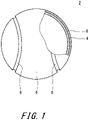
- FIG. 1 shows a tennis ball 2 obtained by using the adhesive for a tennis ball according to one embodiment.
- the tennis ball 2 includes: a hollow core 4 made of a rubber material; two felt portions 6 covering the core 4; and a seam portion 8 positioned in a gap between the two felt portions 6.
- the thickness of the core 4 is about 3 mm to 4 mm.
- the inside of the core 4 is filled with compressed gas.
- the two felt portions 6 are adhered to the surface of the core 4 by the adhesive.
- FIGS. 2A and 2B are each a cross-sectional view illustrating a step of forming the core 4 of the tennis ball 2 of FIG. 1 .
- the step of forming the core 4 in the step of forming the core 4, first, two half cores 20 are prepared. Each of the half cores 20 is hemispherical-shell-shaped, and includes an annular edge portion 21. Next, the adhesive for a tennis ball is applied to the edge portion 21 of each half core 20, and water and tablets of sodium chloride and sodium nitrite are put into one of the half cores 20. Thereafter, as shown in FIG. 2B , the two half cores 20 are adhered to each other at their respective edge portions 21, and thereby a spherical body is formed. The spherical body formed by the two half cores 20 is put into a predetermined mold, heated and pressurized therein, and thereby the hollow core 4 is formed.
- the core 4 which is made of a rubber material, is formed by crosslinking a rubber composition that contains, for example, base rubber, a vulcanizing agent, a vulcanization accelerator, and a filler.
- a rubber composition that contains, for example, base rubber, a vulcanizing agent, a vulcanization accelerator, and a filler.
- the base rubber include natural rubber, polybutadiene, polyisoprene, styrene-butadiene copolymers, acrylonitrile-butadiene copolymers, polychloroprene, ethylene-propylene copolymers, ethylene-propylene-diene copolymers, isobutylene-isoprene copolymers, and acrylic rubber.
- the base rubber two or more kinds of these rubbers may be used in combination.
- the base rubber is more preferably natural rubber.
- the rubber composition for the core 4 may further contain additives, such as a vulcanization aid, an anti
- a method of producing the rubber composition for the core is not particularly limited, so long as the intention of the applicant is satisfied.
- the rubber composition may be produced by a method including: putting and kneading the base rubber and suitably selected additives in a known kneading machine such as a Banbury mixer, a kneader, or a roll, thereby obtaining a kneaded mixture; and heating and pressurizing the kneaded mixture.
- Conditions for kneading and vulcanization are selected in accordance with the blending of the rubber composition.
- a preferable kneading temperature is not lower than 50°C and not higher than 180°C.
- a preferable vulcanization temperature is not lower than 140°C and not higher than 180°C.
- a preferable vulcanization time is not less than two minutes and not greater than 60 minutes.
- a method of producing the tennis ball 2 including the core 4 obtained by using the rubber composition for the core is not particularly limited.
- the adhesive is applied to the back surface of each of the felt portions 6, each of which has previously been cut into a dumbbell shape, and seam glue is applied to the cross-sectional surface of each felt portion 6. Then, these felt portions 6 with the adhesive and the seam glue applied thereto are adhered to the surface of the core 4, and thereby the tennis ball 2 is obtained. Before the felt portions 6 are adhered to the surface of the core 4, the adhesive may be applied to the surface of the core 4.
- a known adhesive may be suitably selected and used for the adhesion of the felt portions 6, and may be used as the seam glue.
- the adhesive for a tennis ball has high adhesive strength. Moreover, since the adhesive has favorable workability, the adhesive in a suitable amount can be uniformly applied to the edge portion 21 of each half core 20. Uniform application of the adhesive further improves the adhesive strength of the core 4.
- the tennis ball 2 including the core 4 has high durability.
- liquid rubber having a number average molecular weight of 28,000; trade name “LIR30” available from Kuraray Co., Ltd.), 20 parts by mass of carbon black (ISAF; trade name “SEAST 6” available from Tokai Carbon Co., Ltd.), 5 parts by mass of zinc oxide (trade name "GINREI R” available from Toho Zinc Co., Ltd.), 1 part by mass of stearic acid (trade name “STEARIC ACID CAMELLIA” available from NOF CORPORATION), 5.26 parts by mass of sulfur (sulfur containing 5% of oil; trade name “5% OIL TREATED SULFUR POWDER (200 mesh)” available from Tsurumi Chemical Industry Co., Ltd.), 1.50 parts by mass of a vulcanization accelerator CBS (N-cyclohexyl-2-benzothiazolyl sulfenamide; trade name "NOCCELER CZ-G” available from OUCHI SHINKO CHEMICAL INDUSTRIAL CO.,
- Adhesives of Examples 2 to 10 and Comparative Examples 1 to 4 were obtained in the same manner as in Example 1 except that the blending ratios of the base rubber and the additives were changed as shown in Tables 1 and 2 below.
- the obtained rubber composition was put into a mold, heated and pressurized therein at 150°C for 4 minutes, and thereby two half cores (each having a thickness of 3.2 mm ⁇ 0.4 mm) were formed.
- the edge portion of each half core was sandpapered (#100).
- the adhesive of Example 1 was applied to the edge portion of each half core, which was then dried at room temperature for two hours or more.
- ammonium chloride, sodium nitrite, and water were put into one of the half cores.
- the one half core was adhered to the other half core, and the half cores thus adhered to each other were heated at 150°C for 6 minutes, and thereby a test core was prepared.
- Other test cores were also prepared in the same manner except that, for each of the other test cores, a corresponding one of the adhesives of Examples 2 to 10 and Comparative Examples 1 to 4 was used instead of the adhesive of Example 1.
- test core thus obtained was repeatedly brought into collision against a metal wall from a distance of 1 meter at a speed of 50 m/s, and how many times each test core was brought into the collision until the test core was broken was measured.
- Ten pieces of each test core were prepared. The measurement was performed on each of the ten pieces of the test core, and the average measurement value for the ten pieces was calculated. The calculation results are shown in Tables 1 and 2 below. (Table 1) Ex. 1 Ex. 2 Ex. 3 Comp. Ex. 1 Comp. Ex.
- An adhesive for a tennis ball including base rubber and a filler, wherein the base rubber contains, as a main component thereof, liquid rubber having a number average molecular weight of not less than 10,000, and the filler has an average nitrogen specific surface area of not less than 40 m 2 /g.
- a tennis ball including a hollow core made of a rubber material, wherein the core includes two hemispherical half cores, and the two half cores are adhered to each other by using the adhesive according to any one of Items 1 to 5.
Landscapes
- Chemical & Material Sciences (AREA)
- Organic Chemistry (AREA)
- Health & Medical Sciences (AREA)
- Chemical Kinetics & Catalysis (AREA)
- Medicinal Chemistry (AREA)
- Polymers & Plastics (AREA)
- Inorganic Chemistry (AREA)
- General Health & Medical Sciences (AREA)
- Physical Education & Sports Medicine (AREA)
- Adhesives Or Adhesive Processes (AREA)
Abstract
Description
- This application claims priority to and the benefit of
Japanese Patent Application No. 2021-116341, filed on July 14, 2021 - The present specification discloses an adhesive. More specifically, the present specification discloses an adhesive for use in producing tennis balls.
- A tennis ball includes a core made of a rubber material. The core is a hollow sphere. The core is formed by adhering two hemispherical half cores to each other. An adhesive is used for adhering the two half cores to each other. The outer surface of the core is covered with two pieces of dumbbell-shaped felt (also referred to as "melton"). The adhesive is used also for adhering the melton to the outer surface of the core. A seam portion is formed in a gap between the two pieces of the melton. Seam glue made of a rubber composition is used for forming the seam portion.
- Conventionally, in light of affinity with the core made of a rubber material and also in light of adhesive strength, a solvent-based adhesive has been used, which is obtained by dissolving a rubber component, a vulcanizing agent, a vulcanization accelerator, etc., in an organic solvent such as naphtha. For example,
Japanese Laid-Open Patent Application Publication No. 2004-148022 - Normally, a solvent-based adhesive for use on rubber is obtained in a liquid form in the following manner: kneading solid rubber such as natural rubber together with a filler, a vulcanization accelerator, and so forth by a mixer to reduce the molecular weight of the solid rubber; and dissolving the resulting kneaded mixture in an organic solvent for liquefaction. A large amount of the organic solvent is necessary to dissolve the kneaded mixture in the organic solvent. Since the organic solvent is highly volatile, the viscosity of the adhesive gradually increases while the adhesive is in storage and while the adhesive is being used in adhering work. Therefore, such a solvent-based adhesive cannot be used in a stable manner. Moreover, in a work environment where the adhesive is used, a worker is exposed to the volatilizing solvent. Furthermore, reflecting the growing concern for the environment in recent years, there has been a demand for reduction in the use of volatile organic compounds (VOC).
- For example,
Japanese Laid-Open Patent Application Publication No. S57-179265 Japanese Laid-Open Patent Application Publication No. S58-98372 Japanese Laid-Open Patent Application Publication No. 2020-059838 - While tennis is being played, a tennis ball is hit repeatedly. If the tennis ball has a core that is obtained by using an adhesive having low adhesive strength, the core may get damaged as a result of being hit repeatedly. Thus, an adhesive having excellent adhesive strength is necessary for producing the core, which is required to have high durability.
- As proposed in Patent Literatures 2 to 4, in the case of an adhesive containing rubber latex as its main component, the usage amount of the organic solvent is reduced, and consequently, the load on the environment and the load on the worker are reduced. However, in the depolymerization disclosed in Patent Literature 2, the molecular weight of the base rubber is reduced, and for this reason, there are cases where necessary adhesive strength for the core cannot be obtained. Also, rubber latex contains a large amount of low-volatile moisture. For this reason, there are cases where, after the vulcanization adhesion, residual moisture in the cured adhesive affects the adhesive strength, causing degradation in the durability of the tennis ball.
- In recent years, the speed of shots hit by tennis players has been getting faster. Therefore, there is a demand for further improvement in the durability of tennis balls. It is the intention of the applicant to provide an adhesive that has excellent workability and that makes it possible to produce a tennis ball having improved durability.
- The applicant conducted diligent studies, and as a result of the studies, the applicant focused on the fact that by using liquid rubber, which has fluidity, instead of rubber latex, which contains a large amount of moisture, the aforementioned problem of residual moisture in an adhesive layer after the vulcanization adhesion can be avoided. The applicant has also found that by blending a particular filler in the adhesive, the adhesive strength obtained from the adhesive can be improved significantly. Then, consequently, the applicant has completed an adhesive for a tennis ball, which is disclosed herein.
- Specifically, the adhesive for a tennis ball includes base rubber and a filler. The base rubber contains, as a main component thereof, liquid rubber having a number average molecular weight of not less than 10,000. The filler has an average nitrogen specific surface area of not less than 40 m2/g.
- The adhesive for a tennis ball contains substantially no organic solvent, which is highly volatile. This makes it possible to reduce the load on the work environment, and also, while the adhesive is in storage and while the adhesive is being used in adhering work, the adhesive can maintain its suitable fluidity for application. Moreover, according to the adhesive, owing to the filler having a suitable average nitrogen specific surface area, the adhesive strength obtained from the adhesive is improved significantly. A tennis ball that is obtained by using the adhesive to adhere two half cores of the core of the tennis ball to each other has excellent durability.
-
-
FIG. 1 is a partially cutaway cross-sectional view of a tennis ball that is obtained by using an adhesive according to one embodiment of the present disclosure. -
FIGS. 2A and 2B are each a cross-sectional view illustrating a step of forming the core of the tennis ball ofFIG. 1 . - Hereinafter, preferred embodiments of the present disclosure are described in detail with reference to the accompanying drawings as necessary. In the present specification, a range of "X to Y" means "not less than X and not greater than Y" Also, in the present specification, a test temperature is always a room temperature (20°C ± 5°C) unless otherwise specified.
- An adhesive for a tennis ball according to one embodiment contains base rubber and a filler. The base rubber contains, as a main component thereof, liquid rubber having a number average molecular weight of not less than 10,000. The filler has an average nitrogen specific surface area (N2SA) of not less than 40 m2/g.
- In the present specification, the term "liquid rubber" means rubber having fluidity at normal temperature under atmospheric pressure. Since the main component of the base rubber of the adhesive is liquid rubber, no highly volatile organic solvent is used in the adhesive, and yet the adhesive has such fluidity as to be applicable to a surface to be adhered. In other words, the adhesive contains substantially no organic solvent, namely the adhesive is substantially free of any organic solvent. As used herein, the term "substantially free of any organic solvent" means that the amount of organic solvent present in the adhesive composition is no more than 0.5% by weight, preferably no more than 0.1% by weight, more preferably no more than 0.05% by weight, especially preferably no more than 0.01% by weight, based on the total weight of the adhesive. The term "highly volatile organic solvent" means any organic compound used as a solvent having a boiling point of less than 100°C, preferably less than 75°C, more preferably less than 50°C, especially preferably less than 25°C measured at a standard atmospheric pressure of 101.3 kPa. The boiling point of the highly volatile organic solvent is preferably more than 0°C measured at a standard atmospheric pressure of 101.3 kPa. This adhesive makes it possible to reduce the load on the environment as well as the load on the worker using the adhesive. Since the number average molecular weight of the liquid rubber serving as the main component of the base rubber of the adhesive is not less than 10,000, excellent adhesive strength suitable for adhering two half cores of a
core 4 to each other is obtained. - The filler interacts with the base rubber, thereby exerting an effect of reinforcing an adhesive layer after vulcanization adhesion. The reinforcing effect exerted by the filler having an average nitrogen specific surface area of not less than 40 m2/g is great. Since the adhesive contains the filler having an average nitrogen specific surface area of not less than 40 m2/g, significantly high adhesive strength can be obtained from the adhesive even though the main component of the base rubber is liquid rubber whose molecular weight is relatively low.
- In order to improve the workability of the adhesive, the ratio of the liquid rubber to the base rubber is preferably not less than 90% by mass, more preferably not less than 95% by mass, yet more preferably not less than 98% by mass, and particularly preferably not less than 99% by mass. The entire base rubber may be liquid rubber. The base rubber may contain solid rubber within such a range as not to inhibit the effects of the adhesive for a tennis ball. It should be noted that, in the present specification, the term "solid rubber" means rubber having no fluidity at normal temperature under atmospheric pressure.
- In order to improve the adhesive strength, the number average molecular weight of the liquid rubber is preferably not less than 15,000, more preferably not less than 20,000, and yet more preferably not less than 26,000. In light of application properties, the number average molecular weight of the liquid rubber is preferably not greater than 60,000, and more preferably not greater than 40,000. The number average molecular weight of the liquid rubber is measured by gel permeation chromatography, and is calculated as a value expressed in terms of standard polystyrene.
- The liquid rubber is not particularly limited to a specific kind of liquid rubber, so long as the effects of the adhesive for a tennis ball can be obtained. Examples of the liquid rubber include isoprene rubber, butadiene rubber, styrene-butadiene rubber, acrylonitrile-butadiene rubber, chloroprene rubber, isobutylene-isoprene rubber, ethylene-propylene rubber, and modified products thereof. Examples of the modified products include rubber modified with a functional group, such as a carboxyl group, an amine group, or a hydroxyl group.
- In order to achieve significant improvement in the adhesive strength, the average nitrogen specific surface area (N2SA) of the filler is preferably not less than 70 m2/g, and more preferably not less than 100 m2/g. In light of the dispersibility of the filler in the base rubber, the average nitrogen specific surface area of the filler is preferably not greater than 300 m2/g. It should be noted that the average nitrogen specific surface area of the filler is measured in compliance with JIS Z8830 "Determination of the specific surface area of powders (solids) by gas adsorption -- BET method."
- The filler is not particularly limited to a specific kind of filler, so long as the average nitrogen specific surface area of the filler is not less than 40 m2/g. Examples of the filler include carbon black, activated carbon, carbon fiber, graphite, graphene, fullerene, carbon nanotube, silica, calcium carbonate, calcium hydroxide, magnesium hydroxide, talc, mica, diatomaceous earth, titanium oxide, zinc oxide, bismuth oxide, barium sulfate, magnesium carbonate, and alumina. Two or more of these fillers may be used in combination. One or more fillers, including carbon black, are preferably selected for use. A particularly preferable filler is carbon black.
- Carbon black is, based on its production method, referred to as, for example, KetjenBlack, acetylene black, furnace black, oil furnace black, channel black, or thermal black. Specific examples of carbon black include SAF (Super Abrasion Furnace), ISAF (Intermediate Super Abrasion Furnace), HAF (High Abrasion Furnace), FF (Fine Furnace), and FEF (Fast Extruding Furnace). Carbon black is not particularly limited to a specific kind of carbon black, so long as the effects of the adhesive can be obtained. Carbon black is suitably selected for use from among these examples.
- In light of adhesive strength, the amount of the filler in the adhesive is preferably not less than 15 parts by mass, and more preferably not less than 20 parts by mass, with respect to 100 parts by mass of the base rubber. In light of fluidity, the amount of the filler in the adhesive is preferably not greater than 50 parts by mass with respect to 100 parts by mass of the base rubber. In the case of using a plurality of fillers in combination, it is preferred that the total amount of the plurality of fillers be within this preferable range.
- Preferably, the adhesive for a tennis ball contains a vulcanization accelerator in addition to the base rubber and the filler. The vulcanization accelerator is not particularly limited to a specific kind of vulcanization accelerator, so long as the effects of the adhesive are not inhibited. The vulcanization accelerator can be suitably selected for use from among, for example, aldehyde-ammonia-based vulcanization accelerators, aldehyde-amine-based vulcanization accelerators, thiazole-based vulcanization accelerators, sulfenamide-based vulcanization accelerators, thiuram-based vulcanization accelerators, dithiocarbamate-based vulcanization accelerators, guanidine-based vulcanization accelerators, thiourea-based vulcanization accelerators, and xanthate-based vulcanization accelerators. One of these vulcanization accelerators may be used, or two or more of these vulcanization accelerators may be used in combination. Preferably, the adhesive for a tennis ball contains a vulcanization accelerator selected from among sulfenamide-based vulcanization accelerators and guanidine-based vulcanization accelerators.
- In order to achieve an appropriate cure rate and high adhesive strength, the amount of the vulcanization accelerator contained in the adhesive is preferably not less than 1.5 parts by mass, and more preferably not less than 2.5 parts by mass, with respect to 100 parts by mass of the base rubber. In light of fluidity during vulcanization, the amount of the vulcanization accelerator contained in the adhesive is preferably not greater than 5.0 parts by mass, and more preferably not greater than 4.0 parts by mass, with respect to 100 parts by mass of the base rubber.
- The adhesive may contain a vulcanizing agent as necessary. Preferable examples of the vulcanizing agent include: sulfur such as powdery sulfur, insoluble sulfur, precipitated sulfur, and colloidal sulfur; and sulfur compounds such as morpholine disulfide and alkylphenol disulfide.
- The adhesive may further contain various additives, such as a vulcanization acceleration aid, a thickener, a tackifier, an anti-aging agent, an antioxidant, a light stabilizer, a softener, a processing aid, and a colorant, so long as the effects of the adhesive for a tennis ball are not inhibited.
- Preferably, the adhesive for a tennis ball has a shear viscosity of not greater than 2,000 Pa·s. The adhesive having a shear viscosity of not greater than 2,000 Pa·s can be uniformly applied in a suitable amount to a surface to be adhered. Uniform application of the adhesive further improves the adhesive strength obtained from the adhesive. In light of this, the shear viscosity of the adhesive is preferably not greater than 1,800 Pa·s, and more preferably not greater than 1,500 Pa·s. In order to achieve a suitable amount of adhesion of the adhesive to an application surface, the shear viscosity of the adhesive is preferably not less than 200 Pa·s, and more preferably not less than 500 Pa·s. It should be noted that the shear viscosity of the adhesive is measured at a temperature of 23°C and a shear rate of 10 (1/s) by using a known rheometer.
- A method of producing the adhesive for a tennis ball is not particularly limited. As one example, the adhesive may be produced by a method including: sequentially adding a filler having an average nitrogen specific surface area of not less than 40 m2/g and additives, such as a vulcanization accelerator, to base rubber that is liquid rubber having a number average molecular weight of not less than 10,000; and mixing them. The mixing can be performed by using a known kneader, such as a roll mill.
- The adhesive for a tennis ball can be suitably used in the production of, for example, regulation tennis balls.
FIG. 1 shows a tennis ball 2 obtained by using the adhesive for a tennis ball according to one embodiment. The tennis ball 2 includes: ahollow core 4 made of a rubber material; two feltportions 6 covering thecore 4; and aseam portion 8 positioned in a gap between the two feltportions 6. In general, the thickness of thecore 4 is about 3 mm to 4 mm. The inside of thecore 4 is filled with compressed gas. The two feltportions 6 are adhered to the surface of thecore 4 by the adhesive. -
FIGS. 2A and 2B are each a cross-sectional view illustrating a step of forming thecore 4 of the tennis ball 2 ofFIG. 1 . As shown inFIG. 2A , in the step of forming thecore 4, first, twohalf cores 20 are prepared. Each of thehalf cores 20 is hemispherical-shell-shaped, and includes anannular edge portion 21. Next, the adhesive for a tennis ball is applied to theedge portion 21 of eachhalf core 20, and water and tablets of sodium chloride and sodium nitrite are put into one of thehalf cores 20. Thereafter, as shown inFIG. 2B , the twohalf cores 20 are adhered to each other at theirrespective edge portions 21, and thereby a spherical body is formed. The spherical body formed by the twohalf cores 20 is put into a predetermined mold, heated and pressurized therein, and thereby thehollow core 4 is formed. - The
core 4, which is made of a rubber material, is formed by crosslinking a rubber composition that contains, for example, base rubber, a vulcanizing agent, a vulcanization accelerator, and a filler. Preferable examples of the base rubber include natural rubber, polybutadiene, polyisoprene, styrene-butadiene copolymers, acrylonitrile-butadiene copolymers, polychloroprene, ethylene-propylene copolymers, ethylene-propylene-diene copolymers, isobutylene-isoprene copolymers, and acrylic rubber. As the base rubber, two or more kinds of these rubbers may be used in combination. The base rubber is more preferably natural rubber. The rubber composition for thecore 4 may further contain additives, such as a vulcanization aid, an anti-aging agent, an antioxidant, a light stabilizer, a softener, a processing aid, and a colorant. - A method of producing the rubber composition for the core is not particularly limited, so long as the intention of the applicant is satisfied. For example, the rubber composition may be produced by a method including: putting and kneading the base rubber and suitably selected additives in a known kneading machine such as a Banbury mixer, a kneader, or a roll, thereby obtaining a kneaded mixture; and heating and pressurizing the kneaded mixture. Conditions for kneading and vulcanization are selected in accordance with the blending of the rubber composition. A preferable kneading temperature is not lower than 50°C and not higher than 180°C. A preferable vulcanization temperature is not lower than 140°C and not higher than 180°C. A preferable vulcanization time is not less than two minutes and not greater than 60 minutes.
- A method of producing the tennis ball 2 including the
core 4 obtained by using the rubber composition for the core is not particularly limited. For example, the adhesive is applied to the back surface of each of the feltportions 6, each of which has previously been cut into a dumbbell shape, and seam glue is applied to the cross-sectional surface of each feltportion 6. Then, these feltportions 6 with the adhesive and the seam glue applied thereto are adhered to the surface of thecore 4, and thereby the tennis ball 2 is obtained. Before the feltportions 6 are adhered to the surface of thecore 4, the adhesive may be applied to the surface of thecore 4. A known adhesive may be suitably selected and used for the adhesion of the feltportions 6, and may be used as the seam glue. - The adhesive for a tennis ball has high adhesive strength. Moreover, since the adhesive has favorable workability, the adhesive in a suitable amount can be uniformly applied to the
edge portion 21 of eachhalf core 20. Uniform application of the adhesive further improves the adhesive strength of thecore 4. The tennis ball 2 including thecore 4 has high durability. - The following elucidates the effects of the adhesive for a tennis ball according to Examples. However, the scope of the disclosure in the present specification should not be restrictively construed based on the description of the Examples.
- 100 parts by mass of liquid rubber (having a number average molecular weight of 28,000; trade name "LIR30" available from Kuraray Co., Ltd.), 20 parts by mass of carbon black (ISAF; trade name "
SEAST 6" available from Tokai Carbon Co., Ltd.), 5 parts by mass of zinc oxide (trade name "GINREI R" available from Toho Zinc Co., Ltd.), 1 part by mass of stearic acid (trade name "STEARIC ACID CAMELLIA" available from NOF CORPORATION), 5.26 parts by mass of sulfur (sulfur containing 5% of oil; trade name "5% OIL TREATED SULFUR POWDER (200 mesh)" available from Tsurumi Chemical Industry Co., Ltd.), 1.50 parts by mass of a vulcanization accelerator CBS (N-cyclohexyl-2-benzothiazolyl sulfenamide; trade name "NOCCELER CZ-G" available from OUCHI SHINKO CHEMICAL INDUSTRIAL CO., LTD.), and 1.74 parts by mass of a vulcanization accelerator DPG (1,3-Diphenylguanidine, trade name "NOCCELER D" available from OUCHI SHINKO CHEMICAL INDUSTRIAL CO., LTD.) were put into a three-roll mill, and kneaded therein at 35 to 40°C for 0.5 hours. In this manner, an adhesive of Example 1 was obtained. - Adhesives of Examples 2 to 10 and Comparative Examples 1 to 4 were obtained in the same manner as in Example 1 except that the blending ratios of the base rubber and the additives were changed as shown in Tables 1 and 2 below.
- 100 parts by mass of natural rubber (trade name "SMR CV60" available from Astlett Rubber Inc.), 15 parts by mass of carbon black (trade name "N330" available from Cabot Japan K.K.), 4 parts by mass of silica (trade name "Nipsil VN3" available from Tosoh Silica Corporation), 30 parts by mass of kaolin clay (trade name "ECKALITE 120" available from Imerys S.A.), 17 parts by mass of magnesium carbonate (trade name "KINBOSHI" available from Konoshima Chemical Co., Ltd.), and 5 parts by mass of zinc oxide (trade name "Zinc Oxide II" available from SEIDO CHEMICAL INDUSTRY CO., LTD.) were put into a Banbury mixer, kneaded therein at 90°C for 5 minutes, and thereby a kneaded mixture was obtained. To the kneaded mixture, the following additives were added: 0.5 parts by mass of salicylic acid (available from Tokyo Chemical Industry Co., Ltd.); 2.3 parts by mass of 1,3-Diphenylguanidine (trade name "SANCELER D" available from SANSHIN CHEMICAL INDUSTRY CO., LTD.); and 3.5 parts by mass of sulfur (trade name "SANFEL EX" available from SANSHIN CHEMICAL INDUSTRY CO., LTD.). The mixture was kneaded with these additives at 50°C for 3 minutes by using an open roll, and thereby a rubber composition was obtained.
- The obtained rubber composition was put into a mold, heated and pressurized therein at 150°C for 4 minutes, and thereby two half cores (each having a thickness of 3.2 mm ± 0.4 mm) were formed. The edge portion of each half core was sandpapered (#100). Thereafter, the adhesive of Example 1 was applied to the edge portion of each half core, which was then dried at room temperature for two hours or more. Then, ammonium chloride, sodium nitrite, and water were put into one of the half cores. Subsequently, the one half core was adhered to the other half core, and the half cores thus adhered to each other were heated at 150°C for 6 minutes, and thereby a test core was prepared. Other test cores were also prepared in the same manner except that, for each of the other test cores, a corresponding one of the adhesives of Examples 2 to 10 and Comparative Examples 1 to 4 was used instead of the adhesive of Example 1.
- Each test core thus obtained was repeatedly brought into collision against a metal wall from a distance of 1 meter at a speed of 50 m/s, and how many times each test core was brought into the collision until the test core was broken was measured. Ten pieces of each test core were prepared. The measurement was performed on each of the ten pieces of the test core, and the average measurement value for the ten pieces was calculated. The calculation results are shown in Tables 1 and 2 below.
(Table 1) Ex. 1 Ex. 2 Ex. 3 Comp. Ex. 1 Comp. Ex. 2 LIR30 (Mn 28000) 100.00 50.00 0 0 0 LIR50 (Mn 54000) 0 50.00 0 0 0 LBR305 (Mn 26000) 0 0 100.00 0 0 LBR307 (Mn 8000) 0 0 0 100.00 0 LBR352 (Mn 9000) 0 0 0 0 100.00 ISAF (N2SA: 100 to 120) 20.00 20.00 20.00 20.00 20.00 HAF (N2SA:70 to 99) 0 0 0 0 0 FEF (N2SA: 40 to 49) 0 0 0 0 0 GPF (N2SA: 33 to 39) 0 0 0 0 0 ZnO (N2SA: 1 to 8) 5.00 5.00 5.00 5.00 5.00 Stearic Acid 1.00 1.00 1.00 1.00 1.00 5% oil S 5.26 5.26 5.26 5.26 5.26 CBS 1.50 1.50 1.50 1.50 1.50 DPG 1.74 1.74 1.74 1.74 1.74 Durability 53 64 49 1 1 (Table 2) Ex. 4 Ex. 5 Comp. Ex. 3 Comp. Ex. 4 Ex. 6 LIR30 (Mn 28000) 100.00 100.00 100.00 100.00 100 LIR50 (Mn 54000) 0 0 0 0 0 LBR305 (Mn 26000) 0 0 0 0 0 LBR307 (Mn 8000) 0 0 0 0 0 LBR352 (Mn 9000) 0 0 0 0 0 ISAF (N2SA: 100 to 120) 0 0 0 0 8.00 HAF (N2SA: 70 to 99) 20.00 0 0 0 0 FEF (N2SA: 40 to 49) 0 20.00 0 0 0 GPF (N2SA: 33 to 39) 0 0 20.00 0 0 ZnO (N2SA: 1 to 8) 5.00 5.00 5.00 5.00 5.00 Stearic Acid 1.00 1.00 1.00 1.00 1.00 5% oil S 5.26 5.26 5.26 5.26 5.26 CBS 1.50 1.50 1.50 1.50 1.50 DPG 1.74 1.74 1.74 1.74 1.74 Durability 44 34 28 21 30 - The details of the compounds indicated in Tables 1 and 2 are as follows.
- LIR30: liquid polyisoprene rubber (having a number average molecular weight of 28,000) available from Kuraray Co., Ltd.
- LIR50: liquid polyisoprene rubber (having a number average molecular weight of 54,000) available from Kuraray Co., Ltd.
- LBR305: liquid polybutadiene rubber (having a number average molecular weight of 26,000) available from Kuraray Co., Ltd.
- LBR307: liquid polybutadiene rubber (having a number average molecular weight of 8,000) available from Kuraray Co., Ltd.
- LBR352: liquid polybutadiene rubber (having a number average molecular weight of 9,000) available from Kuraray Co., Ltd.
- ISAF: carbon black having an average nitrogen specific surface area of 100 to 120 m2/g; trade name "
SEAST 6" available from Tokai Carbon Co., Ltd. - HAF: carbon black having an average nitrogen specific surface area of 70 to 99 m2/g; trade name "SEAST 3" available from Tokai Carbon Co., Ltd.
- FEF: carbon black having an average nitrogen specific surface area of 40 to 49 m2/g; trade name "SEAST SO" available from Tokai Carbon Co., Ltd.
- GPF: carbon black having an average nitrogen specific surface area of 33 to 39 m2/g; trade name "DIABLACK G" available from Mitsubishi Chemical Corporation
- ZnO: zinc oxide having an average nitrogen specific surface area of 1 to 8 m2/g; trade name "GINREI R" available from Toho Zinc Co., Ltd.
- Stearic acid: trade name "STEARIC ACID CAMELLIA" available from NOF CORPORATION
- Sulfur: sulfur containing 5% of oil; trade name "5% OIL TREATED SULFUR POWDER (200 mesh)" available from Tsurumi Chemical Industry Co., Ltd.
- CBS: N-CYCLOHEXYL-2-BENZOTHIAZOLYL SULFENAMIDE; trade name "NOCCELER CZ-G" available from OUCHI SHINKO CHEMICAL INDUSTRIAL CO., LTD.
- DPG: 1,3-Diphenylguanidine; trade name "NOCCELER D" available from OUCHI SHINKO CHEMICAL INDUSTRIAL CO., LTD.
- As shown in Tables 1 and 2, evaluations for the adhesives of the Examples were higher than evaluations for the adhesives of the Comparative Examples. These evaluation results clearly indicate the superiority of the adhesive for a tennis ball of the present disclosure.
- The following items each disclose a preferred embodiment.
- An adhesive for a tennis ball, including base rubber and a filler, wherein the base rubber contains, as a main component thereof, liquid rubber having a number average molecular weight of not less than 10,000, and the filler has an average nitrogen specific surface area of not less than 40 m2/g.
- The adhesive according to Item 1, wherein an amount of the filler in the adhesive is not less than 15 parts by mass with respect to 100 parts by mass of the base rubber.
- The adhesive according to Item 1 or 2, wherein one or more fillers, including carbon black, are selected as the filler in the adhesive.
- The adhesive according to any one of Items 1 to 3, wherein the liquid rubber is isoprene rubber or butadiene rubber.
- The adhesive according to any one of Items 1 to 4, further comprising a vulcanization accelerator, wherein an amount of the vulcanization accelerator in the adhesive is not less than 1.5 parts by mass and not greater than 5.0 parts by mass with respect to 100 parts by mass of the base rubber.
- A tennis ball including a hollow core made of a rubber material, wherein the core includes two hemispherical half cores, and the two half cores are adhered to each other by using the adhesive according to any one of Items 1 to 5.
- The above-described adhesive is applicable to the production of not only tennis balls, but also various rubber products. The foregoing description is in all aspects illustrative, and various modifications can be made without departing from the essential features disclosed in the present specification.
Claims (15)
- An adhesive for a tennis ball, comprising base rubber and a filler, whereinthe base rubber contains, as a main component thereof, liquid rubber having a number average molecular weight of not less than 10,000, andthe filler has an average nitrogen specific surface area of not less than 40 m2/g.
- The adhesive according to claim 1, wherein
an amount of the filler in the adhesive is not less than 15 parts by mass with respect to 100 parts by mass of the base rubber. - The adhesive according to claim 1 or 2, wherein
an amount of the filler in the adhesive is not greater than 50 parts by mass with respect to 100 parts by mass of the base rubber. - The adhesive according to any one of claims 1 to 3, wherein
one or more fillers, including carbon black, are selected as the filler in the adhesive. - The adhesive according to any one of claims 1 to 4, wherein
the filler has an average nitrogen specific surface area of not greater than 300 m2/g. - The adhesive according to any one of claims 1 to 5, wherein
the liquid rubber is isoprene rubber or butadiene rubber. - The adhesive according to any one of claims 1 to 6, further comprising a vulcanization accelerator, wherein
an amount of the vulcanization accelerator in the adhesive is not less than 1.5 parts by mass and not greater than 5.0 parts by mass with respect to 100 parts by mass of the base rubber. - The adhesive according to claim 7, wherein
the vulcanization accelerator is selected from sulfenamide-based vulcanization accelerators, guanidine-based vulcanization accelerators and combinations thereof. - The adhesive according to any one of claims 1 to 8, wherein
the ratio of the liquid rubber to the base rubber is preferably not less than 90% by mass. - The adhesive according to any one of claims 1 to 9, wherein
the adhesive is substantially free of any organic solvent. - The adhesive according to any one of claims 1 to 9, wherein
the adhesive is substantially free of highly volatile organic solvents. - The adhesive according to any one of claims 1 to 11, wherein
the number average molecular weight of the liquid rubber is not greater than 60,000. - A method of producing the adhesive for a tennis ball according to any of claims 1 to 12, the method comprising sequentially adding a filler having an average nitrogen specific surface area of not less than 40 m2/g and an additive to a base rubber that is liquid rubber having a number average molecular weight of not less than 10,000; and mixing them.
- The method according to claim 13, wherein the additive is a vulcanization accelerator.
- A tennis ball comprising a hollow core made of a rubber material, whereinthe core includes two hemispherical half cores, andthe two half cores are adhered to each other by using the adhesive according to any one of claims 1 to 12.
Applications Claiming Priority (1)
| Application Number | Priority Date | Filing Date | Title |
|---|---|---|---|
| JP2021116341A JP7721998B2 (en) | 2021-07-14 | 2021-07-14 | Tennis ball adhesive |
Publications (2)
| Publication Number | Publication Date |
|---|---|
| EP4119607A1 true EP4119607A1 (en) | 2023-01-18 |
| EP4119607B1 EP4119607B1 (en) | 2025-09-03 |
Family
ID=82399349
Family Applications (1)
| Application Number | Title | Priority Date | Filing Date |
|---|---|---|---|
| EP22183418.7A Active EP4119607B1 (en) | 2021-07-14 | 2022-07-06 | Adhesive for tennis ball |
Country Status (3)
| Country | Link |
|---|---|
| US (1) | US12415902B2 (en) |
| EP (1) | EP4119607B1 (en) |
| JP (1) | JP7721998B2 (en) |
Families Citing this family (1)
| Publication number | Priority date | Publication date | Assignee | Title |
|---|---|---|---|---|
| JP7690797B2 (en) * | 2021-07-14 | 2025-06-11 | 住友ゴム工業株式会社 | Water-based adhesive for rubber |
Citations (11)
| Publication number | Priority date | Publication date | Assignee | Title |
|---|---|---|---|---|
| US3909281A (en) * | 1973-02-06 | 1975-09-30 | Mitsubishi Chem Ind | Process for preparing a carbon black composition |
| JPS57179265A (en) | 1981-04-27 | 1982-11-04 | Sumitomo Rubber Ind Ltd | Adhesive for tennis ball melt seaming |
| JPS5898372A (en) | 1981-12-08 | 1983-06-11 | Sumitomo Rubber Ind Ltd | Adhesive for tennis ball melton dumbbell |
| EP1022322A1 (en) * | 1999-01-25 | 2000-07-26 | Omnova Solutions Inc. | Aqueous rubber adhesive composition |
| US20040052951A1 (en) * | 2000-12-16 | 2004-03-18 | Ralf Sauer | Rubber composition comprising plastisol formed flow properties |
| JP2004148022A (en) | 2002-11-01 | 2004-05-27 | Sumitomo Rubber Ind Ltd | Tennis ball |
| EP2014710A1 (en) * | 2007-06-13 | 2009-01-14 | Sumitomo Rubber Industries, Ltd. | Rubber composition for carcass ply or band and pneumatic tire using the same |
| EP2848642A1 (en) * | 2012-05-08 | 2015-03-18 | Bridgestone Corporation | Rubber sheet, pneumatic tire using same, and method for producing rubber sheet |
| JP2020059838A (en) | 2018-10-09 | 2020-04-16 | 住友ゴム工業株式会社 | Adhesive for tennis ball |
| CN112011290A (en) * | 2020-09-09 | 2020-12-01 | 青岛三祥科技股份有限公司 | Solvent-free mucilage and preparation method thereof |
| EP3816224A1 (en) * | 2018-06-29 | 2021-05-05 | Kuraray Co., Ltd. | Rubber composition |
Family Cites Families (9)
| Publication number | Priority date | Publication date | Assignee | Title |
|---|---|---|---|---|
| EP0476224A1 (en) * | 1990-08-21 | 1992-03-25 | Ricon Resins, Inc. | Adhesive rubber compositions |
| DE69704184T2 (en) * | 1996-07-12 | 2001-06-21 | Sumitomo Rubber Industries Ltd., Kobe | Surface treatment agent for soot |
| US7989541B2 (en) * | 2008-12-04 | 2011-08-02 | Nanotech Industries, Inc. | Liquid solventless synthetic-rubber-based composition |
| JP2015131926A (en) | 2014-01-15 | 2015-07-23 | 株式会社ブリヂストン | Rubber composition and tire prepared using the same |
| US20200109318A1 (en) * | 2018-10-09 | 2020-04-09 | Sumitomo Rubber Industries, Ltd. | Adhesive for tennis ball |
| JP7225765B2 (en) | 2018-12-18 | 2023-02-21 | 住友ゴム工業株式会社 | Rubber composition for tennis balls |
| JP7314696B2 (en) | 2019-08-02 | 2023-07-26 | 住友ゴム工業株式会社 | Water-based adhesive for rubber |
| JP7356008B2 (en) | 2019-10-03 | 2023-10-04 | 横浜ゴム株式会社 | Rubber composition for adhering steel cords and conveyor belts |
| JP2024179265A (en) | 2023-06-14 | 2024-12-26 | 株式会社アドマテックス | High-purity alumina particles and their manufacturing method, and resin composition for electronic devices and their manufacturing method |
-
2021
- 2021-07-14 JP JP2021116341A patent/JP7721998B2/en active Active
-
2022
- 2022-06-23 US US17/847,785 patent/US12415902B2/en active Active
- 2022-07-06 EP EP22183418.7A patent/EP4119607B1/en active Active
Patent Citations (11)
| Publication number | Priority date | Publication date | Assignee | Title |
|---|---|---|---|---|
| US3909281A (en) * | 1973-02-06 | 1975-09-30 | Mitsubishi Chem Ind | Process for preparing a carbon black composition |
| JPS57179265A (en) | 1981-04-27 | 1982-11-04 | Sumitomo Rubber Ind Ltd | Adhesive for tennis ball melt seaming |
| JPS5898372A (en) | 1981-12-08 | 1983-06-11 | Sumitomo Rubber Ind Ltd | Adhesive for tennis ball melton dumbbell |
| EP1022322A1 (en) * | 1999-01-25 | 2000-07-26 | Omnova Solutions Inc. | Aqueous rubber adhesive composition |
| US20040052951A1 (en) * | 2000-12-16 | 2004-03-18 | Ralf Sauer | Rubber composition comprising plastisol formed flow properties |
| JP2004148022A (en) | 2002-11-01 | 2004-05-27 | Sumitomo Rubber Ind Ltd | Tennis ball |
| EP2014710A1 (en) * | 2007-06-13 | 2009-01-14 | Sumitomo Rubber Industries, Ltd. | Rubber composition for carcass ply or band and pneumatic tire using the same |
| EP2848642A1 (en) * | 2012-05-08 | 2015-03-18 | Bridgestone Corporation | Rubber sheet, pneumatic tire using same, and method for producing rubber sheet |
| EP3816224A1 (en) * | 2018-06-29 | 2021-05-05 | Kuraray Co., Ltd. | Rubber composition |
| JP2020059838A (en) | 2018-10-09 | 2020-04-16 | 住友ゴム工業株式会社 | Adhesive for tennis ball |
| CN112011290A (en) * | 2020-09-09 | 2020-12-01 | 青岛三祥科技股份有限公司 | Solvent-free mucilage and preparation method thereof |
Also Published As
| Publication number | Publication date |
|---|---|
| JP7721998B2 (en) | 2025-08-13 |
| US12415902B2 (en) | 2025-09-16 |
| EP4119607B1 (en) | 2025-09-03 |
| US20230024062A1 (en) | 2023-01-26 |
| JP2023012719A (en) | 2023-01-26 |
Similar Documents
| Publication | Publication Date | Title |
|---|---|---|
| US9109102B2 (en) | Rubber composition for use in tire side walls and pneumatic tire using the same | |
| EP3636701B1 (en) | Adhesive for tennis ball | |
| US11618813B2 (en) | Rubber composition for hollow ball and hollow ball | |
| US9382408B2 (en) | Rubber composition for tire rim cushion or rubber finishing and pneumatic tire using the same | |
| US20200109318A1 (en) | Adhesive for tennis ball | |
| US10792545B2 (en) | Golf club grip and golf club | |
| JP5353050B2 (en) | Rubber composition for bead filler | |
| EP4119607B1 (en) | Adhesive for tennis ball | |
| EP4119203B1 (en) | Adhesive for tennis ball | |
| EP3263363B1 (en) | Pneumatic radial tire | |
| JP2004099804A (en) | Rubber composition for tire and pneumatic tire using the same | |
| AU2015344658A1 (en) | Rubber composition for conveyor belts, and conveyor belt using same | |
| EP3252098B1 (en) | Rubber composition for vibration damping rubbers, and vibration damping rubber | |
| JP2019044078A (en) | Rubber composition, inner peripheral cover rubber, conveyor belt, and belt conveyor | |
| JP6933042B2 (en) | Rubber composition for side tread | |
| EP4119629A1 (en) | Aqueous adhesive for rubber | |
| JP6988303B2 (en) | Pneumatic tires | |
| JP2022174902A (en) | Vulcanizing agent, rubber composition and vulcanized rubber | |
| JP2022174835A (en) | Vulcanizing agent, rubber composition and vulcanized rubber | |
| JP2025154275A (en) | Rubber composition and conveyor belt | |
| EP4671321A1 (en) | RUBBER COMPOSITION FOR HOSES AND TUBE | |
| JP2019085755A (en) | Fender and manufacturing method therefor |
Legal Events
| Date | Code | Title | Description |
|---|---|---|---|
| PUAI | Public reference made under article 153(3) epc to a published international application that has entered the european phase |
Free format text: ORIGINAL CODE: 0009012 |
|
| STAA | Information on the status of an ep patent application or granted ep patent |
Free format text: STATUS: THE APPLICATION HAS BEEN PUBLISHED |
|
| AK | Designated contracting states |
Kind code of ref document: A1 Designated state(s): AL AT BE BG CH CY CZ DE DK EE ES FI FR GB GR HR HU IE IS IT LI LT LU LV MC MK MT NL NO PL PT RO RS SE SI SK SM TR |
|
| STAA | Information on the status of an ep patent application or granted ep patent |
Free format text: STATUS: REQUEST FOR EXAMINATION WAS MADE |
|
| P01 | Opt-out of the competence of the unified patent court (upc) registered |
Effective date: 20230510 |
|
| 17P | Request for examination filed |
Effective date: 20230603 |
|
| RBV | Designated contracting states (corrected) |
Designated state(s): AL AT BE BG CH CY CZ DE DK EE ES FI FR GB GR HR HU IE IS IT LI LT LU LV MC MK MT NL NO PL PT RO RS SE SI SK SM TR |
|
| GRAP | Despatch of communication of intention to grant a patent |
Free format text: ORIGINAL CODE: EPIDOSNIGR1 |
|
| STAA | Information on the status of an ep patent application or granted ep patent |
Free format text: STATUS: GRANT OF PATENT IS INTENDED |
|
| INTG | Intention to grant announced |
Effective date: 20250514 |
|
| GRAS | Grant fee paid |
Free format text: ORIGINAL CODE: EPIDOSNIGR3 |
|
| GRAA | (expected) grant |
Free format text: ORIGINAL CODE: 0009210 |
|
| STAA | Information on the status of an ep patent application or granted ep patent |
Free format text: STATUS: THE PATENT HAS BEEN GRANTED |
|
| AK | Designated contracting states |
Kind code of ref document: B1 Designated state(s): AL AT BE BG CH CY CZ DE DK EE ES FI FR GB GR HR HU IE IS IT LI LT LU LV MC MK MT NL NO PL PT RO RS SE SI SK SM TR |
|
| REG | Reference to a national code |
Ref country code: CH Ref legal event code: EP |
|
| REG | Reference to a national code |
Ref country code: DE Ref legal event code: R096 Ref document number: 602022020586 Country of ref document: DE |
|
| REG | Reference to a national code |
Ref country code: IE Ref legal event code: FG4D |
|
| REG | Reference to a national code |
Ref country code: NL Ref legal event code: MP Effective date: 20250903 |
|
| PG25 | Lapsed in a contracting state [announced via postgrant information from national office to epo] |
Ref country code: NO Free format text: LAPSE BECAUSE OF FAILURE TO SUBMIT A TRANSLATION OF THE DESCRIPTION OR TO PAY THE FEE WITHIN THE PRESCRIBED TIME-LIMIT Effective date: 20251203 |
|
| REG | Reference to a national code |
Ref country code: LT Ref legal event code: MG9D |
|
| PG25 | Lapsed in a contracting state [announced via postgrant information from national office to epo] |
Ref country code: FI Free format text: LAPSE BECAUSE OF FAILURE TO SUBMIT A TRANSLATION OF THE DESCRIPTION OR TO PAY THE FEE WITHIN THE PRESCRIBED TIME-LIMIT Effective date: 20250903 |
|
| PG25 | Lapsed in a contracting state [announced via postgrant information from national office to epo] |
Ref country code: HR Free format text: LAPSE BECAUSE OF FAILURE TO SUBMIT A TRANSLATION OF THE DESCRIPTION OR TO PAY THE FEE WITHIN THE PRESCRIBED TIME-LIMIT Effective date: 20250903 |
|
| PG25 | Lapsed in a contracting state [announced via postgrant information from national office to epo] |
Ref country code: GR Free format text: LAPSE BECAUSE OF FAILURE TO SUBMIT A TRANSLATION OF THE DESCRIPTION OR TO PAY THE FEE WITHIN THE PRESCRIBED TIME-LIMIT Effective date: 20251204 |
|
| PG25 | Lapsed in a contracting state [announced via postgrant information from national office to epo] |
Ref country code: SE Free format text: LAPSE BECAUSE OF FAILURE TO SUBMIT A TRANSLATION OF THE DESCRIPTION OR TO PAY THE FEE WITHIN THE PRESCRIBED TIME-LIMIT Effective date: 20250903 |
|
| PG25 | Lapsed in a contracting state [announced via postgrant information from national office to epo] |
Ref country code: LV Free format text: LAPSE BECAUSE OF FAILURE TO SUBMIT A TRANSLATION OF THE DESCRIPTION OR TO PAY THE FEE WITHIN THE PRESCRIBED TIME-LIMIT Effective date: 20250903 |
|
| PG25 | Lapsed in a contracting state [announced via postgrant information from national office to epo] |
Ref country code: BG Free format text: LAPSE BECAUSE OF FAILURE TO SUBMIT A TRANSLATION OF THE DESCRIPTION OR TO PAY THE FEE WITHIN THE PRESCRIBED TIME-LIMIT Effective date: 20250903 Ref country code: PL Free format text: LAPSE BECAUSE OF FAILURE TO SUBMIT A TRANSLATION OF THE DESCRIPTION OR TO PAY THE FEE WITHIN THE PRESCRIBED TIME-LIMIT Effective date: 20250903 |
|
| PG25 | Lapsed in a contracting state [announced via postgrant information from national office to epo] |
Ref country code: RS Free format text: LAPSE BECAUSE OF FAILURE TO SUBMIT A TRANSLATION OF THE DESCRIPTION OR TO PAY THE FEE WITHIN THE PRESCRIBED TIME-LIMIT Effective date: 20251203 |
|
| PG25 | Lapsed in a contracting state [announced via postgrant information from national office to epo] |
Ref country code: ES Free format text: LAPSE BECAUSE OF FAILURE TO SUBMIT A TRANSLATION OF THE DESCRIPTION OR TO PAY THE FEE WITHIN THE PRESCRIBED TIME-LIMIT Effective date: 20250903 |
|
| REG | Reference to a national code |
Ref country code: AT Ref legal event code: MK05 Ref document number: 1833017 Country of ref document: AT Kind code of ref document: T Effective date: 20250903 |
|
| PG25 | Lapsed in a contracting state [announced via postgrant information from national office to epo] |
Ref country code: NL Free format text: LAPSE BECAUSE OF FAILURE TO SUBMIT A TRANSLATION OF THE DESCRIPTION OR TO PAY THE FEE WITHIN THE PRESCRIBED TIME-LIMIT Effective date: 20250903 |
|
| PG25 | Lapsed in a contracting state [announced via postgrant information from national office to epo] |
Ref country code: SM Free format text: LAPSE BECAUSE OF FAILURE TO SUBMIT A TRANSLATION OF THE DESCRIPTION OR TO PAY THE FEE WITHIN THE PRESCRIBED TIME-LIMIT Effective date: 20250903 |
|
| PG25 | Lapsed in a contracting state [announced via postgrant information from national office to epo] |
Ref country code: AT Free format text: LAPSE BECAUSE OF FAILURE TO SUBMIT A TRANSLATION OF THE DESCRIPTION OR TO PAY THE FEE WITHIN THE PRESCRIBED TIME-LIMIT Effective date: 20250903 |
|
| PG25 | Lapsed in a contracting state [announced via postgrant information from national office to epo] |
Ref country code: IT Free format text: LAPSE BECAUSE OF FAILURE TO SUBMIT A TRANSLATION OF THE DESCRIPTION OR TO PAY THE FEE WITHIN THE PRESCRIBED TIME-LIMIT Effective date: 20250903 |
|
| PG25 | Lapsed in a contracting state [announced via postgrant information from national office to epo] |
Ref country code: IS Free format text: LAPSE BECAUSE OF FAILURE TO SUBMIT A TRANSLATION OF THE DESCRIPTION OR TO PAY THE FEE WITHIN THE PRESCRIBED TIME-LIMIT Effective date: 20260103 |
|
| PG25 | Lapsed in a contracting state [announced via postgrant information from national office to epo] |
Ref country code: CZ Free format text: LAPSE BECAUSE OF FAILURE TO SUBMIT A TRANSLATION OF THE DESCRIPTION OR TO PAY THE FEE WITHIN THE PRESCRIBED TIME-LIMIT Effective date: 20250903 Ref country code: PT Free format text: LAPSE BECAUSE OF FAILURE TO SUBMIT A TRANSLATION OF THE DESCRIPTION OR TO PAY THE FEE WITHIN THE PRESCRIBED TIME-LIMIT Effective date: 20260105 |
|
| PG25 | Lapsed in a contracting state [announced via postgrant information from national office to epo] |
Ref country code: SK Free format text: LAPSE BECAUSE OF FAILURE TO SUBMIT A TRANSLATION OF THE DESCRIPTION OR TO PAY THE FEE WITHIN THE PRESCRIBED TIME-LIMIT Effective date: 20250903 Ref country code: EE Free format text: LAPSE BECAUSE OF FAILURE TO SUBMIT A TRANSLATION OF THE DESCRIPTION OR TO PAY THE FEE WITHIN THE PRESCRIBED TIME-LIMIT Effective date: 20250903 |