EP4117133B1 - An arrangement for signal transmission between a plurality of electrical units of a daisy chain - Google Patents
An arrangement for signal transmission between a plurality of electrical units of a daisy chain Download PDFInfo
- Publication number
- EP4117133B1 EP4117133B1 EP22180612.8A EP22180612A EP4117133B1 EP 4117133 B1 EP4117133 B1 EP 4117133B1 EP 22180612 A EP22180612 A EP 22180612A EP 4117133 B1 EP4117133 B1 EP 4117133B1
- Authority
- EP
- European Patent Office
- Prior art keywords
- signal
- electrical units
- connectors
- arrangement
- interfaces
- Prior art date
- Legal status (The legal status is an assumption and is not a legal conclusion. Google has not performed a legal analysis and makes no representation as to the accuracy of the status listed.)
- Active
Links
Images







Classifications
-
- H—ELECTRICITY
- H01—ELECTRIC ELEMENTS
- H01R—ELECTRICALLY-CONDUCTIVE CONNECTIONS; STRUCTURAL ASSOCIATIONS OF A PLURALITY OF MUTUALLY-INSULATED ELECTRICAL CONNECTING ELEMENTS; COUPLING DEVICES; CURRENT COLLECTORS
- H01R31/00—Coupling parts supported only by co-operation with counterpart
- H01R31/005—Intermediate parts for distributing signals
-
- H—ELECTRICITY
- H02—GENERATION; CONVERSION OR DISTRIBUTION OF ELECTRIC POWER
- H02J—ELECTRIC POWER NETWORKS; CIRCUIT ARRANGEMENTS OR SYSTEMS FOR SUPPLYING OR DISTRIBUTING ELECTRIC POWER; SYSTEMS FOR STORING ELECTRIC ENERGY
- H02J13/00—Circuit arrangements for providing remote monitoring or remote control of equipment in a power distribution network
- H02J13/13—Circuit arrangements for providing remote monitoring or remote control of equipment in a power distribution network characterised by the transmission of data to equipment in the power network
-
- B—PERFORMING OPERATIONS; TRANSPORTING
- B60—VEHICLES IN GENERAL
- B60R—VEHICLES, VEHICLE FITTINGS, OR VEHICLE PARTS, NOT OTHERWISE PROVIDED FOR
- B60R16/00—Electric or fluid circuits specially adapted for vehicles and not otherwise provided for; Arrangement of elements of electric or fluid circuits specially adapted for vehicles and not otherwise provided for
- B60R16/02—Electric or fluid circuits specially adapted for vehicles and not otherwise provided for; Arrangement of elements of electric or fluid circuits specially adapted for vehicles and not otherwise provided for electric constitutive elements
- B60R16/023—Electric or fluid circuits specially adapted for vehicles and not otherwise provided for; Arrangement of elements of electric or fluid circuits specially adapted for vehicles and not otherwise provided for electric constitutive elements for transmission of signals between vehicle parts or subsystems
-
- B—PERFORMING OPERATIONS; TRANSPORTING
- B60—VEHICLES IN GENERAL
- B60R—VEHICLES, VEHICLE FITTINGS, OR VEHICLE PARTS, NOT OTHERWISE PROVIDED FOR
- B60R16/00—Electric or fluid circuits specially adapted for vehicles and not otherwise provided for; Arrangement of elements of electric or fluid circuits specially adapted for vehicles and not otherwise provided for
- B60R16/02—Electric or fluid circuits specially adapted for vehicles and not otherwise provided for; Arrangement of elements of electric or fluid circuits specially adapted for vehicles and not otherwise provided for electric constitutive elements
- B60R16/03—Electric or fluid circuits specially adapted for vehicles and not otherwise provided for; Arrangement of elements of electric or fluid circuits specially adapted for vehicles and not otherwise provided for electric constitutive elements for supply of electrical power to vehicle subsystems or for
-
- H—ELECTRICITY
- H02—GENERATION; CONVERSION OR DISTRIBUTION OF ELECTRIC POWER
- H02J—ELECTRIC POWER NETWORKS; CIRCUIT ARRANGEMENTS OR SYSTEMS FOR SUPPLYING OR DISTRIBUTING ELECTRIC POWER; SYSTEMS FOR STORING ELECTRIC ENERGY
- H02J3/00—Circuit arrangements for AC mains or AC distribution networks
- H02J3/001—Arrangements for handling faults or abnormalities, e.g. emergencies or contingencies
- H02J3/0012—Arrangements for handling faults or abnormalities, e.g. emergencies or contingencies characterised by the contingency detection means in AC networks, e.g. using phasor measurement units [PMU], synchrophasors or contingency analysis
Definitions
- aspects of the present invention relate to a vehicle arrangement for signal transmission between a plurality of electrical units of a daisy chain. Further, aspects of the present invention relate to a method for a process of fault detection in a vehicle arrangement comprising a plurality of electrical units and one or more signal wires interconnecting the electrical units of the plurality of electrical units to form a daisy chain.
- Electrical units such as electric lights or control units, may be interconnected to form a daisy chain, i.e. the electrical units are connected together in sequence or in a ring, such as connected in series, for example similar to a garland of daisy flowers.
- a daisy chain may be used for electric power signals, communication signals, or a combination thereof.
- US2017356243 describe a control system comprising an intelligent hub for shade control providing a signal or power to a number of nodes in a daisy-chain network.
- EP2869091 describe a streamer towed by a vessel and a method of sensing a fault condition in an interconnection between two network units being towed by the vessel.
- the inventor of the present invention has found drawbacks in conventional solutions for connecting electrical units to form a daisy chain. For example, the inventor of the present invention has found it to be difficult to detect a fault, such as the location of the fault, in faulty conventional daisy chains including a plurality of electric units.
- An object of the invention is to provide a solution which mitigates or solves the drawbacks and problems of conventional solutions.
- the above mentioned and other objects are achieved with a vehicle arrangement for signal transmission between a plurality of electrical units of a daisy chain,
- An advantage of the arrangement according to the first aspect is that fault detection in a daisy chain including a plurality of interconnected electrical units is improved and made more efficient, since a device configured to monitor signal transmission is connectable to the connector which is external to, i.e. located outside, the electrical units of the plurality of electrical units. Since the interface, which includes the connector, is external to the electrical units, also the connector is external to the electrical units. When the connector is external to the electrical units and thus not part of any one of the electrical units, it is easier and more efficient to detect, or identify, the location of a fault in the daisy chain.
- a first sequence, or part, of the daisy chain may be isolated and subjected to fault detection, and subsequently a second sequence, or part, of the daisy chain may be isolated and subjected to fault detection, and so on.
- a second sequence, or part, of the daisy chain may be isolated and subjected to fault detection, and so on.
- An advantage of the arrangement according to the first aspect is that the efficiency of the interconnection of the electrical units and/or the efficiency of the daisy chain is/are improved.
- the connector being external to the electrical units, the fault detection is made more flexible. For example, there is no need to cut a signal wire for the connection of a device configured to monitor signal transmission, and there is no need to dismantle one or more electrical units for the connection of a device configured to monitor signal transmission.
- a plurality of electrical units comprises two or more electrical units.
- the connector may be referred to as a signal connector.
- the connector may comprise an electrical connector.
- the signal wire may comprise an electrical wire.
- Each electrical unit of the plurality of electrical units may comprise any one of the group of:
- the arrangement comprises a plurality of signal wires for interconnecting the electrical units of the plurality of electrical units to form a daisy chain,
- An advantage of this is that fault detection in a daisy chain including a plurality of interconnected electrical units is further improved and made even more efficient, since a first sequence, or part, of the daisy chain may be easily disconnected, isolated and subjected to fault detection, and then a second sequence, or part, of the daisy chain may be easily disconnected, isolated and subjected to fault detection, and so on.
- the location of a fault in the daisy chain is detected in an even more efficient and even easier manner.
- there is no need to dispose of a faulty daisy chain since the faulty sequence, or section, of the daisy chain can be easily replaced, and a new flawless sequence may be connected instead.
- An advantage of this is that a more flexible interconnection of electrical units is attained.
- an advantage of this is that the flexibility of the daisy chain is improved. Further, the flexibility of the interconnection of electrical units is also improved because of the modular concept of using two or more connectors, since additional sequences can be added and connected when required or desired, for example when additional electrical units are to be subsequently installed or connected at a later stage. Thus, the number of connectors can be adapted to the number of electrical units to be connected in a modular manner. Thus, as a consequence, the overall cost for the electrical installation may be reduced.
- the modular concept in this context may be understood as using a plurality of standardized connectors for flexibility and variety in use. An advantage of this is that the efficiency of the interconnection of the electrical units is further improved in an optimal manner. It is to be understood that a plurality of signal wires comprises two or more signal wires.
- two connectors of a first group of connectors of the two or more connectors of the interface are detachably connectable to one another so as to provide a signal connection between two signal wires of a first group of signal wires of the plurality of signal wires for providing a signal connection between two electrical units of the plurality of electrical units.
- the first group of signal wires may be part of, or represent, a first signal line, which, for example, may transmit one or more first signals, for example an electric power signal, an electrical ground signal, or a communication signal.
- the two connectors of the first group of connectors are detachably connectable to one another so as to provide a signal connection between two signal wires of a second group of signal wires of the plurality of signal wires for providing a signal connection between two electrical units of the plurality of electrical units.
- the second group of signal wires may be part of, or represent, a second signal line, which, for example, may transmit one or more second signals, for example different from the one or more first signals, for example an electric power signal, an electrical ground signal, or a communication signal.
- An advantage of this embodiment is that the signal transmission between a plurality of electrical units of a daisy chain is improved.
- An advantage of this embodiment is that the efficiency of the interconnection of the electrical units is further improved.
- An advantage of this embodiment is that the flexibility of the interconnection of the electrical units is further improved.
- the two connectors of the first group of connectors are detachably connectable to one another so as to provide a signal connection between two signal wires of a third group of signal wires of the plurality of signal wires for providing a signal connection between two electrical units of the plurality of electrical units.
- the third group of signal wires may be part of, or represent, a third signal line, which, for example, may transmit one or more third signals, for example different from the one or more first and second signals, for example an electric power signal, an electrical ground signal, or a communication signal.
- An advantage of this embodiment is that the signal transmission between a plurality of electrical units of a daisy chain is further improved.
- An advantage of this embodiment is that the efficiency of the interconnection of the electrical units is further improved.
- An advantage of this embodiment is that the flexibility of the interconnection of the electrical units is further improved.
- connectors of a second group of connectors of the two or more connectors of the interface are detachably connectable to one another so as to provide a signal connection between two signal wires of a second group of signal wires of the plurality of signal wires for providing a signal connection between two electrical units of the plurality of electrical units.
- the second group of connectors may be part of a second signal line, which, for example, may transmit one or more second signals, for example different from the one or more first signals, for example an electric power signal, an electrical ground signal, or a communication signal.
- two connectors of a third group of connectors of the two or more connectors of the interface are detachably connectable to one another so as to provide a signal connection between two signal wires of a third group of signal wires of the plurality of signal wires for providing a signal connection between two electrical units of the plurality of electrical units.
- the third group of connectors may be part of a third signal line, which, for example, may transmit one or more third signals, for example different from the one or more first and second signals, for example an electric power signal, an electrical ground signal, or a communication signal.
- An advantage of this embodiment is that the signal transmission between a plurality of electrical units of a daisy chain is further improved.
- An advantage of this embodiment is that the efficiency of the interconnection of the electrical units is further improved.
- An advantage of this embodiment is that the flexibility of the interconnection of the electrical units is further improved.
- the two connectors detachably connectable to one another so as to provide a signal connection between signal wires of the plurality of signal wires are directly detachably connectable to one another.
- the two connectors detachably connectable to one another so as to provide a signal connection between signal wires of the plurality of signal wires comprise one or more female receptacles and one or more male receptacles.
- the arrangement comprises a plurality of signal cables for interconnecting the electrical units of the plurality of electrical units to form the daisy chain,
- An advantage of this embodiment is that the signal transmission between a plurality of electrical units of a daisy chain is further improved.
- An advantage of this embodiment is that the efficiency of the interconnection of the electrical units is further improved.
- An advantage of this embodiment is that the flexibility of the interconnection of the electrical units is further improved.
- the connector comprises one or more wire-to-wire connector units.
- An advantage of this embodiment is that the signal transmission between a plurality of electrical units of a daisy chain is further improved.
- An advantage of this embodiment is that the efficiency of the interconnection of the electrical units is further improved.
- An advantage of this embodiment is that the flexibility of the interconnection of the electrical units is further improved.
- the one or more interfaces is/are configured to provide one or more signal connections between every two electrical units of the plurality of electrical units.
- the arrangement comprises three or more electrical units included in the plurality of electrical units.
- the signal wire is configured to transmit one or more signals comprising one or more of the group of:
- the one or more transmitted signals may be applied to provide electric power to the electrical units, to transmit information and/or data to the electrical units and/or to receive information and/or data from the electrical units.
- the above mentioned and other objects are achieved with a method for a process of fault detection in an arrangement comprising a plurality of electrical units and one or more signal wires interconnecting the electrical units of the plurality of electrical units to form a daisy chain,
- the arrangement comprises a plurality of signal wires interconnecting the electrical units of the plurality of electrical units to form a daisy chain,
- the plurality of electrical units is daisy-chained by way of two or more interfaces configured to provide a signal connection between two electrical units of the plurality of electrical units, wherein the method comprises:
- two connectors of a first group of connectors of the two or more connectors of the interface are detachably connectable to one another so as to provide a signal connection between two signal wires of a first group of signal wires of the plurality of signal wires for providing a signal connection between two electrical units of the plurality of electrical units, wherein the method comprises:
- two connectors of a second group of connectors of the two or more connectors of the interface are detachably connectable to one another so as to provide a signal connection between two signal wires of a second group of signal wires of the plurality of signal wires for providing a signal connection between two electrical units of the plurality of electrical units, wherein the method comprises:
- a vehicle arrangement or an in-vehicle arrangement, comprising an arrangement according to any one of the embodiments disclosed above or below.
- Advantages of the vehicle arrangement according to the third aspect and its embodiments correspond advantages of the arrangement according to the first aspect and its embodiments mentioned above or below.
- a vehicle comprising one or more arrangements according to any one of the embodiments disclosed above or below.
- Advantages of the vehicle according to the fourth aspect and its embodiments correspond advantages of the arrangement according to the first aspect and its embodiments mentioned above or below.
- the vehicle may be a wheeled vehicle, i.e. a vehicle having wheels.
- the vehicle may for example be a bus, a tractor vehicle, a heavy vehicle, a truck, or a car.
- the tractor vehicle, and/or the truck may, or may be configured to, haul, or pull, a trailer.
- the vehicle may be referred to as a motor vehicle.
- the vehicle may be an electric vehicle, EV, for example a hybrid vehicle or a hybrid electric vehicle, HEV, or a battery electric vehicle, BEV.
- a hybrid electric vehicle, HEV, and a battery electric vehicle, BEV are versions, or examples, of an electric vehicle, EV.
- the EV may comprise one or more electric motors or electrical machines.
- the vehicle may comprise a combustion engine.
- the vehicle may include only a combustion engine for the propulsion of the vehicle.
- the vehicle may comprise a powertrain.
- the powertrain may be configured in accordance with any one of the embodiments disclosed above or below.
- the vehicle may comprise one or more of the group of: a combustion engine; an electric battery; and an electric battery pack.
- the powertrain of the vehicle may comprise one or more of the group of: a combustion engine; an electric battery; and an electric battery pack.
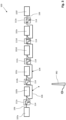
- a conventional daisy chain 10 including a plurality of electrical units 12a-f interconnected by way of signal wires 14, 16 to form the daisy chain 10 is illustrated.
- Each electrical unit 12a-f of the plurality of electrical units 12a-f may, for example, be in the form of an electric light or a control unit.
- Signal wires 14 of a first set of signal wires 14 may form a first signal line 18 for one or more first signals, while signal wires 16 of a second set of signals wires 16 may form a second signal line 19 for one or more second signals.
- two signal wires 14, 16 are double-crimped to form the daisy chain 10.
- the signal wires 14, 16 are included in one or more signal cables including a surrounding and electrically insulating outer sheath.
- the cross-section of the signal wire may vary and may, for example, be 0.5 mm 2 , or 0.75 mm 2 .
- the signal wire may be formed by one or more strands.
- a signal cable including two or more signal wires may have an electrically insulating outer sheath surrounding all signals wires, and the signal wires of the signal cable may have different cross-sections.
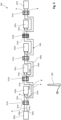
- FIG. 2 another conventional daisy chain 20 including a plurality of electrical units 22a-f interconnected by way of signal wires 24, 26 to form the daisy chain 20 is illustrated.
- Signal wires 24 of a first set of signal wires 24 may form a first signal line 28 for one or more first signals, while signal wires 26 of a second set of signals wires 26 may form a second signal line 29 for one or more second signals.
- every two signal wires 24, 26 are welded to one another, as indicated by black dots, for example ultrasonically welded together.
- a fault for example a short-circuit, such as detect, or identify, the location of the fault, in faulty conventional daisy chains 10, 20 including a plurality of electric units 12a-f, 22a-f.
- a fault such as short-circuit
- one or more signals may be sent from the first electrical unit 12a, 22a and no signal is detected at the last electrical unit 12f, 22f because of the fault.
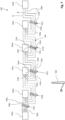
- a first embodiment of the arrangement 100 for signal transmission between a plurality of electrical units 102a-f of a daisy chain 104 according to the first aspect of the invention is schematically illustrated in the form of a circuit diagram.
- the arrangement 100 includes a plurality of electrical units 102a-f, i.e. two or more electrical units102a-f.
- the arrangement 100 may include three, four, five, or six, electrical units102a-f, or more electrical units102a-f.
- each electrical unit 1 02a-f of the plurality of electrical units 102a-f may comprise any one of the group of:
- the arrangement 100 includes one or more signal wires 106 for interconnecting the electrical units 102a-f of the plurality of electrical units 1 02a-f to form a daisy chain 104.
- the one or more signal wires 106 interconnects/interconnect the electrical units 102a-f of the plurality of electrical units 102a-f to form the daisy chain 104.
- the one or more signal wires 106 may electrically interconnect the electrical units 102a-f of the plurality of electrical units 102a-f, or the one or more signal wires 106 may signal-connect the electrical units 102a-f of the plurality of electrical units 102a-f to one another.
- the arrangement 100 includes one or more interfaces 112a-e for providing a signal connection between two electrical units 1 02a-f of the plurality of electrical units 102a-f.
- the interface 112a-e comprises one or more connectors 114.
- the connector 114 may be referred to as a signal connector.
- the connector 114 is connected to a signal wire 106, such as to one or more signal wires 106, of the one or more signal wires 106.
- it may be defined that the connector 114 is joined to the signal wire 106.
- the connector 114 is signal-connected to the signal wire 106, or that the that the connector 114 is connected the signal wire 106 for signal transmission.
- the interface 112a-e is external to, such as located outside, the electrical units 1 02a-f of the plurality of electrical units 102a-f. Since the interface 112a-e is external to electrical units 102a-f of the plurality of electrical units 102a-f, and the interface 112a-e includes the connector 114, it is implied that the connector 114 is external to, such as located outside, the electrical units 102a-f of the plurality of electrical units 102a-f.
- the connector 114 is connectable to a device 982 configured to monitor signal transmission, or signaling, between two electrical units 102a-f of the plurality of electrical units 102a-f.
- the device 982 may be described as an electrical device. Examples of devices 982, such as electrical devices, for monitoring signal transmission between two electrical units 102a-f are known to the person skilled in the art and are thus not disclosed in further detail herein.
- each electrical unit 102a-f of the plurality of electrical units 102a-f may comprise a sensor, or a detector.
- a second embodiment of the arrangement 200 for signal transmission between a plurality of electrical units 102a-f of a daisy chain 204 according to the first aspect of the invention is schematically illustrated in the form of a circuit diagram.
- the arrangement 200 includes a plurality of electrical units 102a-f.
- the arrangement 200 includes a plurality of signal wires 206, i.e. two or more signal wires 206, for interconnecting the electrical units 102a-f of the plurality of electrical units 102a-f to form a daisy chain 204.
- Several features of the arrangement 200 of figure 4 may correspond to features of the arrangement 100 of figure 3 and are thus not described in further detail here to avoid repetition.
- the arrangement 200 of figure 4 differs from the arrangement 100 of figure 3 in that the interface 212a-e of the arrangement 200 of figure 4 includes two or more connectors 214, 216, wherein the connector 214, 216 is connected to one or more signal wires 206 of the plurality of signal wires 206. Further, the arrangement 200 of figure 4 differs from the arrangement 100 of figure 3 in that two connectors 214, 216 of the two or more connectors 214, 216 of the interface 212a-e, i.e.
- the two connectors 214, 216 of the two or more connectors 214, 216 of the interface 212a-e i.e.
- detachably connectable to one another are mechanically detachably connectable to one another, for example detachably connectable in a mechanical sense, so as to provide a signal connection between two signal wires 206 of the plurality of signal wires 206 for providing the signal connection between two electrical units 102a-f of the plurality of electrical units 102a-f.
- the two connectors 214, 216 detachably connectable to one another may be described to be configured for detachable engagement.
- detachable sequences of the daisy chain 204 are provided, which may be disconnected from the daisy chain 204 in an easy manner. Each detached and disconnected sequence of the daisy chain 204 may be individually troubleshot for detecting a fault, for example a short-circuit, and/or the remaining daisy chain 204 not including the detached and disconnected sequence may be troubleshot.
- the connector 214, 216 may include one or more wire-to-wire connector units.
- the two connectors 214, 216 detachably connectable to one another so as to provide a signal connection between signal wires 206 of the plurality of signal wires 206 are directly detachably connectable to one another, such as directly mechanically detachably connectable to one another.
- the connectors 214, 216 and the signal wires 206 may be described to be part of, or represent, a signal line x, or signal path, which, for example, may transmit one or more signals, for example sensor signals.
- the arrangement 200 may include a plurality of signal cables 224 (illustrated by dotted lines in figure 4 ), i.e. two or more signal cables 224, for interconnecting the electrical units 102a-f of the plurality of electrical units 102a-f to form the daisy chain 204.
- each signal cable 224 of the plurality of signal cables 224 includes one or more signal wires 206 of the plurality of signal wires 206, and the connector 214, 216 is connected to one or more signal cables 224 of the plurality of signal cables 224.
- the signal cable 224 may include an electrically insulating outer sheath surrounding the one or more signal wires 206 belonging to the signal cable 224. Otherwise, embodiments of the signal cable 224 may include one or more additional cable-related items or features.
- the signal cable 224 may comprise an electrical cable.
- the embodiments disclosed below may also include a plurality of signal cables including one or more signal wires 306x, 306y, 506x, 506y, 506z of a plurality of signal wires 306x, 306y, 506x, 506y, 506z.
- the one or more interfaces 112a-e, 212a-e may be configured to provide one or more signal connections between every two electrical units 102a-f of the plurality of electrical units 102a-f.
- a third embodiment of the arrangement 300 for signal transmission between a plurality of electrical units 302a-f of a daisy chain 304 according to the first aspect of the invention is schematically illustrated in the form of a circuit diagram.
- the arrangement 300 includes a plurality of electrical units 302a-f, for example of any one of the sorts mentioned above.
- the arrangement 300 includes a plurality of signal wires 306x, 306y for interconnecting the electrical units 302a-f of the plurality of electrical units 302a-f to form a daisy chain 304.
- Several features of the arrangement 300 of figure 5 may correspond to features of the arrangement 200 of figure 4 and are thus not described in further detail here to avoid repetition.
- the arrangement 300 of figure 5 differs from the arrangement 200 of figure 4 in that the daisy chain 304 comprises two signal lines x, y, or signal paths, which, for example, may transmit one or more signals.
- the arrangement 300 of figure 5 includes an additional signal line y compared to the arrangement 200 of figure 4 .
- two connectors 314x, 316x of a first group of connectors 314x, 316x of the two or more connectors 314x, 316x, 314y, 316y of the interface 312a-e are detachably connectable to one another so as to provide a signal connection between two signal wires 306x of a first group of signal wires 306x of the plurality of signal wires 306x, 306y for providing a signal connection between two electrical units 302a-f of the plurality of electrical units 302a-f.
- the first group of signal wires 306x may be part of, or represent, a first signal line x, which, for example, may transmit one or more first signals, for example an electric power signal, an electrical ground signal, or a communication signal.
- the two connectors 314x, 316x (illustrated by dotted lines in figure 5 ) of the first group of connectors 314x, 316x are detachably connectable to one another so as to provide a signal connection between two signal wires 306y of a second group of signal wires 306y of the plurality of signal wires 306x, 306y for providing a signal connection between two electrical units 302a-f of the plurality of electrical units 302a-f.
- the second group of signal wires 306y may be part of, or represent, a second signal line y , which, for example, may transmit one or more second signals, for example different from the one or more first signals, for example an electric power signal, an electrical ground signal, or a communication signal.
- two connectors 314y, 316y of a second group of connectors 314y, 316y of the two or more connectors 314x, 316x, 314y, 316y of the interface 312a-e are detachably connectable to one another so as to provide a signal connection between two signal wires 306y of the second group of signal wires 306y of the plurality of signal wires 306x, 306y for providing a signal connection between two electrical units 302a-f of the plurality of electrical units 302a-f.
- the second group of connectors 314y, 316y may be part of the second signal line y , which, for example, may transmit one or more second signals, for example different from the one or more first signals, for example an electric power signal, an electrical ground signal, or a communication signal.
- one x of the first and second signal lines x, y may be configured to transmit one or more electric power signals while the other one y of the first and second signal lines x, y may be configured to transmit one or more electrical ground signals.
- each one 302a-f of the electrical unit 302a-f of the plurality of electrical units 302a-f may comprise an electric light, or any other electrical unit 302a-f requiring electric power.
- one or more electrical units 302a of the plurality of electrical units 302a-f may comprise an electric power source, for example any kind of electrical unit, circuit, apparatus, device, or system, producing or providing electrical energy, for example one or more of a group of: an electric battery; an electrical generator; an electric power converter, such as a DC-to-DC converter; and a fuel cell.
- an electric power source for example any kind of electrical unit, circuit, apparatus, device, or system, producing or providing electrical energy, for example one or more of a group of: an electric battery; an electrical generator; an electric power converter, such as a DC-to-DC converter; and a fuel cell.
- the signal wire 306x, 306y may then comprise an electrical wire, or an electrical conductor, for example made of a metal or a metal alloy, such as copper.
- the connector 314x, 316x may comprise an electrical connector.
- the first and second signal lines x, y may be configured to transmit one or more communication signals, for example one or more message-based communication signals.
- each one 302a-f of the electrical unit 302a-f of the plurality of electrical units 302a-f may comprise a communication unit or a control unit, for example an electronic control unit (ECU).
- the signal wire 306x, 306y may then comprise a fibre optic wire, or an electrical wire, or an electrical conductor, for example made of a metal or a metal alloy, such as copper.
- other materials of the signal wires 306x, 306y are possible.
- the one or more interfaces 312a-e may be configured to provide one or more signal connections between every two electrical units 302a-f of the plurality of electrical units 302a-f.
- the one or more interfaces may be configured to provide one or more signal connections between every three electrical units 302a-f, or between every four electrical units 302a-f, and so on, depending on the requirements.
- a fourth embodiment of the arrangement 400 for signal transmission between a plurality of electrical units 302a-f of a daisy chain 404 according to the first aspect of the invention is schematically illustrated in the form of a circuit diagram.
- the arrangement 400 includes a plurality of electrical units 302a-f.
- the arrangement 300 includes a plurality of signal wires 306x, 306y for interconnecting the electrical units 302a-f of the plurality of electrical units 302a-f to form a daisy chain 404.
- Several features of the arrangement 400 of figure 6 may correspond to features of the arrangement 300 of figure 5 and are thus not described in further detail here to avoid repetition.
- the arrangement 400 of figure 6 differs from the arrangement 300 of figure 5 in that the one or more interfaces 412a-b is/are not configured to provide one or more signal connections between every two electrical units 302a-f of the plurality of electrical units 302a-f.
- an interface 412a-b is not connected between every two electrical units 302a-f, but two electrical units 302a-f of the plurality of electrical units 302a-f may be directly connected to one another without any intermediate interface 412a-b. In this manner, longer detachable sequences of the daisy chain 404 are provided.
- a fifth embodiment of the arrangement 500 for signal transmission between a plurality of electrical units 502a-f of a daisy chain 504 according to the first aspect of the invention is schematically illustrated in the form of a circuit diagram.
- the arrangement 500 includes a plurality of electrical units 502a-f, for example of any one of the sorts mentioned above, such as a plurality of control units, for example a plurality of electronic control units (ECU).
- each electrical unit 502a-f of the plurality of electrical units 502a-f may be configured for communication, for example message-based communication, and may be configured for communication with a controller area network, CAN, protocol communication system, a local interconnect network, LIN, communication system, or an Ethernet communication system.
- the arrangement 500 includes a plurality of signal wires 506x, 506y, 506z for interconnecting the electrical units 502a-f of the plurality of electrical units 502a-f to form a daisy chain 504.
- the arrangement 500 of figure 7 differs from the arrangement 300 of figure 5 in that the daisy chain 504 comprises three signal lines x , y, z, or signal paths, which, for example, may transmit one or more signals.
- the arrangement 500 of figure 7 includes an additional signal line z compared to the arrangement 300 of figure 5 .
- the two connectors 514x, 516x of the first group of connectors 514x, 516x of the two or more connectors 514x, 516x of the interface 512a-e are detachably connectable to one another so as to provide a signal connection between two signal wires 506z of a third group of signal wires 506z of the plurality of signal wires 506x, 506y, 506z for providing a signal connection between two electrical units 502a-f of the plurality of electrical units 502a-f.
- the third group of signal wires 506z may be part of, or represent, a third signal line z, which, for example, may transmit one or more first signals, for example different from the one or more first and second signals.
- the first signal line x may be configured to transmit CAN-High (CAN H) via the first group of signal wires 506x
- the second signal line y may be configured to transmit CAN-Low (CAN L) via the second group of signal wires 506y
- the third signal line z may be configured to transmit CAN-Shield (CAN S) via the third group of signal wires 506z.
- the signal wire 506x, 506y, 506z may comprise a fibre optic wire, or an electrical wire, or an electrical conductor, for example made of a metal or a metal alloy, such as copper. However, other materials of the signal wires 506x, 506y, 506z are possible.
- two connectors 514z, 516z of a third group of connectors 514z, 516z of the two or more connectors 514x, 516x, 514y, 516y, 514z, 516z of the interface 512a-e i.e. the same interface 512a-e
- the third group of connectors 514z, 516z may be part of the third signal line z, which, for example, may transmit one or more third signals, for example different from the one or more first and second signals.
- the one or more interfaces 512a-e may be configured to provide one or more signal connections between every two electrical units 502a-f of the plurality of electrical units 502a-f. However, for alternative embodiments, this may not be the case.
- one or more additional signal lines may be added and that additional signal wires associated with the one or more additional signal lines may be added.
- embodiments of the arrangement may be provided with any number of signal lines depending on the requirements.
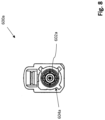
- the connector 600a illustrated in figure 8 may be referred to as a one-pole connector.
- the connector 600a is connected and adjoined to one signal wire 106, 206, 306x, 306y, 506x, 506y, 506z.
- the connector 600a may include one 602a of a female receptacle 602a, which may be configured for the connection to a male receptacle for providing a signal connection, and a male receptacle, which may be configured for the connection to a female receptacle for providing a signal connection.
- the two connectors 600a detachably connectable to one another so as to provide a signal connection between signal wires 106, 206, 306x, 306y, 506x, 506y, 506z of the plurality of signal wires 106, 206, 306x, 306y, 506x, 506y, 506z may include one or more female receptacles 602a and one or more male receptacles.
- the connector 600a may be described to include a wire-to-wire connector unit 604a.
- FIG. 9 a second embodiment of the connector 600b and a third embodiment of the connector 600e of embodiments of the arrangement 300, 400, 500 are schematically illustrated.
- the connector 600b, 600e illustrated in figures 9 and 10 may be referred to as a two-poles connector.
- the connector 600b, 600e is connected and adjoined to two signal wires 306x, 306y, 506x, 506y, 506z.
- the connector 600b, 600e may include one 602b, 602e or two 602b, 602e of a female receptacle 602e, which may be configured for the connection to a male receptacle for providing a signal connection, and a male receptacle 602b, which may be configured for the connection to a female receptacle for providing a signal connection.
- the two connectors 600b, 600e detachably connectable to one another so as to provide a signal connection between signal wires 306x, 306y, 506x, 506y, 506z of the plurality of signal wires 306x, 306y, 506x, 506y, 506z may include one or more female receptacles 602e and one or more male receptacles 602b.
- the connector 600b, 600e may be described to include two wire-to-wire connector units 604b, 604e.
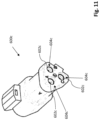
- the connector 600c illustrated in figure 11 may be referred to as a three-poles connector.
- the connector 600c is connected and adjoined to three signal wires 506x, 506y, 506z.
- the connector 600c may include one 602c or more of a female receptacle 602c, which may be configured for the connection to a male receptacle for providing a signal connection, and a male receptacle, which may be configured for the connection to a female receptacle for providing a signal connection.
- the connector 600c may be described to include three wire-to-wire connector units 604c.
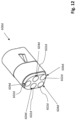
- the connector 600d illustrated in figure 12 may be referred to as a five-poles connector.
- the connector 600d is connected and adjoined to five signal wires.
- the connector 600d may include one 602d or more of a female receptacle 602d, which may be configured for the connection to a male receptacle for providing a signal connection, and a male receptacle, which may be configured for the connection to a female receptacle for providing a signal connection.
- the connector 600d may be described to include five wire-to-wire connector units 604d.
- each one 600a-e of the connectors 600a-e disclosed above may comprise one or more additional connector-related items or features. It is to be understood that other connectors, in addition to the connectors 600a-e illustrated in figures 8 to 12 , are possible.
- the signal wire 106, 206, 306x, 306y, 506x, 506y, 506z may be configured to transmit one or more signals comprising one or more of the group of:
- three sets of two one-pole connectors 600a may be provided for the three signal lines x, y, z.
- one set of two one-pole connectors 600a and one set of two two-poles connectors 600b, 600e may be provided for the three signal lines x, y, z.
- one set of two three-poles connectors 600c may be provided for the three signal lines x , y, z.
- each interface 212a-e one set of two one-pole connectors 600a may be provided for the signal line x.
- two sets of two one-pole connectors 600a, or one set of two two-poles connectors 600b, 600e may be provided for the two signal lines x, y.
- each set of two connectors disclosed above may include both female and male receptacles.
- Different sets of two connectors may be applied in a corresponding manner for any number of signal lines.
- one set of two five-poles connectors 600d may be used, however with both female and male receptacles, or one set of two three-poles connectors 600c combined with one set of two two-poles connectors 600b, 600e, or three sets of two one-pole connectors 600a combined with one set of two two-poles connectors 600b, 600e, or five sets of two one-pole connectors 600a etc. It is to be understood that several more combinations of sets of two connectors may be used depending on requirements and the number of signal lines.
- the plurality of electrical units 102a-f, 302a-f, 502a-f is daisy-chained by way of one or more interfaces 112a-e, 212a-e, 312a-e, 412a-b, 512a-e configured to provide a signal connection between two electrical units 102a-f, 302a-f, 502a-f of the plurality of electrical units 102a-f, 302a-f, 502a-f.
- the interface 112a-e, 212a-e, 312a-e, 412a-b, 512a-e may correspond to any one of the interfaces 112a-e, 212a-e, 312a-e, 412a-b, 512a-e disclosed above or below.
- Embodiments of the method include the step of connecting 701 the connector 114, 214, 216, 314x, 316x, 314y, 316y, 514x, 516x, 514y, 516y, 514z, 516z to a device 982 for monitoring signal transmission between two electrical units 102a-f, 302a-f, 502a-f of the plurality of electrical units 102a-f, 302a-f, 502a-f.
- Examples of devices 982 for monitoring signal transmission between two electrical units 102a-f, 302a-f, 502a-f are known to the person skilled in the art and are thus not disclosed in further detail herein.
- the plurality of electrical units 102a-f, 302a-f, 502a-f is daisy-chained by way of two or more interfaces 112a-e, 212a-e, 312a-e, 412a-b, 512a-e configured to provide a signal connection between two electrical units 102a-f, 302a-f, 502a-f of the plurality of electrical units 102a-f, 302a-f, 502a-f.
- the embodiment of the method of figure 14 includes:
- the arrangement 200, 300, 400, 500 comprises a plurality of signal wires 206, 306x, 306y, 506x, 506y, 506z interconnecting the electrical units 102a-f, 302a-f, 502a-f of the plurality of electrical units 102a-f, 302a-f, 502a-f to form a daisy chain 204, 304, 404, 504, wherein the interface 212a-e, 312a-e, 412a-b, 512a-e comprises two or more connectors 214, 216, 314x, 316x, 314y, 316y, 514x, 516x, 514y, 516y, 514z, 516z, wherein the connector 214, 216, 314x, 316x, 314y, 316y, 514x, 516x, 516x, 516x, 514z, 516z, wherein the connector 214, 216, 314x, 316x, 3
- the embodiment of the method of figure 15 includes:
- the vehicle 900 includes one or more arrangements 100, 200, 300, 400, 500 according to any one of the embodiments disclosed above or below.
- the vehicle 950 is illustrated as a tractor vehicle.
- the vehicle 950 may, for example, be a bus, a truck, a heavy truck, or a car.
- Other types of vehicles are also possible.
- the vehicle 950 may be an electric vehicle, EV, for example a hybrid vehicle or a hybrid electric vehicle, HEV, or a battery electric vehicle, BEV.
- the vehicle 950 may be an internal combustion engine, ICE, vehicle.
- the vehicle 950 may include wheels 952, for example six wheels 952. Only the wheels 952 on the left-hand side of the vehicle 950 are visible in figure 16 . It is to be understood that the vehicle 950 may have fewer or more wheels than what is shown in figure 16 .
- the vehicle 950 may comprise a powertrain 954, which may comprise a combustion engine 956, for example an internal combustion engine or any another combustion engine, and at least two driven wheels 952, or drive wheels 952, driven by the combustion engine 956.
- the vehicle may be an electric vehicle, EV.
- the vehicle 950 may include one or more electrical machines and may thus be a so-called hybrid electric vehicle, HEV.
- the powertrain 954 comprising the combustion engine 956 may be replaced by an electrical powertrain including one or more electrical machines for driving the drive wheels 952, whereby the vehicle may be a battery electric vehicle, BEV.
- embodiments of the arrangement according to the first aspect and embodiments of the method according to the second aspect may be applied to configurations, structures, or apparatuses, different from a vehicle 950.
Landscapes
- Engineering & Computer Science (AREA)
- Power Engineering (AREA)
- Mechanical Engineering (AREA)
- Small-Scale Networks (AREA)
- Bus Control (AREA)
- Selective Calling Equipment (AREA)
- Details Of Connecting Devices For Male And Female Coupling (AREA)
Description
- Aspects of the present invention relate to a vehicle arrangement for signal transmission between a plurality of electrical units of a daisy chain. Further, aspects of the present invention relate to a method for a process of fault detection in a vehicle arrangement comprising a plurality of electrical units and one or more signal wires interconnecting the electrical units of the plurality of electrical units to form a daisy chain.
- Electrical units, such as electric lights or control units, may be interconnected to form a daisy chain, i.e. the electrical units are connected together in sequence or in a ring, such as connected in series, for example similar to a garland of daisy flowers. A daisy chain may be used for electric power signals, communication signals, or a combination thereof.
-
US2017356243 describe a control system comprising an intelligent hub for shade control providing a signal or power to a number of nodes in a daisy-chain network. -
EP2869091 describe a streamer towed by a vessel and a method of sensing a fault condition in an interconnection between two network units being towed by the vessel. - The inventor of the present invention has found drawbacks in conventional solutions for connecting electrical units to form a daisy chain. For example, the inventor of the present invention has found it to be difficult to detect a fault, such as the location of the fault, in faulty conventional daisy chains including a plurality of electric units.
- An object of the invention is to provide a solution which mitigates or solves the drawbacks and problems of conventional solutions.
- The above and further objects are solved by the subject matter of the independent claims which define the invention.
- Further advantageous embodiments of the invention can be found in the dependent claims. The embodiments hereafter are not necessarily including all the claimed essential features that define the invention.
- According to a first aspect of the invention, the above mentioned and other objects are achieved with a vehicle arrangement for signal transmission between a plurality of electrical units of a daisy chain,
- wherein the arrangement comprises a plurality of electrical units,
- wherein the arrangement comprises one or more signal wires for interconnecting the electrical units of the plurality of electrical units to form a daisy chain,
- wherein the arrangement comprises one or more interfaces for providing a signal connection between two electrical units of the plurality of electrical units,
- wherein the one or more interfaces comprise one or more connectors,
- wherein the one or more connectors are connected to a signal wire of the one or more signal wires,
- wherein the one or more interfaces are external to the electrical units of the plurality of electrical units, and
- wherein the one or more connectors are connectable to a device configured to monitor signal transmission, or signaling, between two electrical units of the plurality of electrical units.
- An advantage of the arrangement according to the first aspect is that fault detection in a daisy chain including a plurality of interconnected electrical units is improved and made more efficient, since a device configured to monitor signal transmission is connectable to the connector which is external to, i.e. located outside, the electrical units of the plurality of electrical units. Since the interface, which includes the connector, is external to the electrical units, also the connector is external to the electrical units. When the connector is external to the electrical units and thus not part of any one of the electrical units, it is easier and more efficient to detect, or identify, the location of a fault in the daisy chain. For example, a first sequence, or part, of the daisy chain may be isolated and subjected to fault detection, and subsequently a second sequence, or part, of the daisy chain may be isolated and subjected to fault detection, and so on. Thus, the location of a fault in the daisy chain is detected in a more efficient and easier manner. Further, there is no need to discard of a faulty daisy chain, since the location of the fault be identified, and the fault may be addressed and corrected or rectified.
- An advantage of the arrangement according to the first aspect is that the efficiency of the interconnection of the electrical units and/or the efficiency of the daisy chain is/are improved. By way of the connector being external to the electrical units, the fault detection is made more flexible. For example, there is no need to cut a signal wire for the connection of a device configured to monitor signal transmission, and there is no need to dismantle one or more electrical units for the connection of a device configured to monitor signal transmission.
- It is to be understood that a plurality of electrical units comprises two or more electrical units. For some embodiments, the connector may be referred to as a signal connector. For some embodiments, the connector may comprise an electrical connector. For some embodiments, the signal wire may comprise an electrical wire.
- Each electrical unit of the plurality of electrical units may comprise any one of the group of:
- an electrical system, such as a control system, or a communication system, for example a message-based communication system, such as a controller area network, CAN, protocol communication system, a local interconnect network, LIN, communication system, or an Ethernet communication system;
- a control unit, for example an electronic control unit, ECU;
- a physical unit including one or more computer programs comprising instructions which, when the program is executed by a computer, cause the computer to carry out a method or one or more steps of a procedure or process;
- one or more computer-readable mediums comprising software and/or instructions which, when the instructions are executed by a computer, cause the computer to carry out a method or one or more steps of a procedure or process;
- an electrical apparatus or an electrical device;
- an electric light, for example a lamp;
- a loudspeaker;
- a fan;
- a sensor, for example a pressure sensor, a temperature sensor, a vibration sensor, a velocity sensor, a flow sensor, or a position sensor etc.; and
- an electric power source or an electrical energy source.
- Other electrical units in additional to the electrical units mentioned above are also possible.
- The arrangement comprises a plurality of signal wires for interconnecting the electrical units of the plurality of electrical units to form a daisy chain,
- wherein the interface comprises two or more connectors,
- wherein the connector is connected to one or more signal wires of the plurality of signal wires, and
- wherein two connectors of the two or more connectors of the interface are detachably connectable to one another so as to provide a signal connection between two signal wires of the plurality of signal wires for providing a signal connection between two electrical units of the plurality of electrical units.
- An advantage of this is that fault detection in a daisy chain including a plurality of interconnected electrical units is further improved and made even more efficient, since a first sequence, or part, of the daisy chain may be easily disconnected, isolated and subjected to fault detection, and then a second sequence, or part, of the daisy chain may be easily disconnected, isolated and subjected to fault detection, and so on. Thus, the location of a fault in the daisy chain is detected in an even more efficient and even easier manner. Further, there is no need to dispose of a faulty daisy chain, since the faulty sequence, or section, of the daisy chain can be easily replaced, and a new flawless sequence may be connected instead. An advantage of this is that a more flexible interconnection of electrical units is attained. An advantage of this is that the flexibility of the daisy chain is improved. Further, the flexibility of the interconnection of electrical units is also improved because of the modular concept of using two or more connectors, since additional sequences can be added and connected when required or desired, for example when additional electrical units are to be subsequently installed or connected at a later stage. Thus, the number of connectors can be adapted to the number of electrical units to be connected in a modular manner. Thus, as a consequence, the overall cost for the electrical installation may be reduced. For some embodiments, the modular concept in this context may be understood as using a plurality of standardized connectors for flexibility and variety in use. An advantage of this is that the efficiency of the interconnection of the electrical units is further improved in an optimal manner. It is to be understood that a plurality of signal wires comprises two or more signal wires.
- According to a further advantageous embodiment of the arrangement according to the first aspect, two connectors of a first group of connectors of the two or more connectors of the interface are detachably connectable to one another so as to provide a signal connection between two signal wires of a first group of signal wires of the plurality of signal wires for providing a signal connection between two electrical units of the plurality of electrical units. The first group of signal wires may be part of, or represent, a first signal line, which, for example, may transmit one or more first signals, for example an electric power signal, an electrical ground signal, or a communication signal.
- According to another advantageous embodiment of the arrangement according to the first aspect, the two connectors of the first group of connectors are detachably connectable to one another so as to provide a signal connection between two signal wires of a second group of signal wires of the plurality of signal wires for providing a signal connection between two electrical units of the plurality of electrical units. The second group of signal wires may be part of, or represent, a second signal line, which, for example, may transmit one or more second signals, for example different from the one or more first signals, for example an electric power signal, an electrical ground signal, or a communication signal. An advantage of this embodiment is that the signal transmission between a plurality of electrical units of a daisy chain is improved. An advantage of this embodiment is that the efficiency of the interconnection of the electrical units is further improved. An advantage of this embodiment is that the flexibility of the interconnection of the electrical units is further improved.
- According to yet another advantageous embodiment of the arrangement according to the first aspect, the two connectors of the first group of connectors are detachably connectable to one another so as to provide a signal connection between two signal wires of a third group of signal wires of the plurality of signal wires for providing a signal connection between two electrical units of the plurality of electrical units. The third group of signal wires may be part of, or represent, a third signal line, which, for example, may transmit one or more third signals, for example different from the one or more first and second signals, for example an electric power signal, an electrical ground signal, or a communication signal. An advantage of this embodiment is that the signal transmission between a plurality of electrical units of a daisy chain is further improved. An advantage of this embodiment is that the efficiency of the interconnection of the electrical units is further improved. An advantage of this embodiment is that the flexibility of the interconnection of the electrical units is further improved.
- According to still another advantageous embodiment of the arrangement according to the first aspect, connectors of a second group of connectors of the two or more connectors of the interface are detachably connectable to one another so as to provide a signal connection between two signal wires of a second group of signal wires of the plurality of signal wires for providing a signal connection between two electrical units of the plurality of electrical units. The second group of connectors may be part of a second signal line, which, for example, may transmit one or more second signals, for example different from the one or more first signals, for example an electric power signal, an electrical ground signal, or a communication signal. An advantage of this embodiment is that the signal transmission between a plurality of electrical units of a daisy chain is further improved. An advantage of this embodiment is that the efficiency of the interconnection of the electrical units is further improved. An advantage of this embodiment is that the flexibility of the interconnection of the electrical units is further improved.
- According to an advantageous embodiment of the arrangement according to the first aspect, two connectors of a third group of connectors of the two or more connectors of the interface are detachably connectable to one another so as to provide a signal connection between two signal wires of a third group of signal wires of the plurality of signal wires for providing a signal connection between two electrical units of the plurality of electrical units. The third group of connectors may be part of a third signal line, which, for example, may transmit one or more third signals, for example different from the one or more first and second signals, for example an electric power signal, an electrical ground signal, or a communication signal. An advantage of this embodiment is that the signal transmission between a plurality of electrical units of a daisy chain is further improved. An advantage of this embodiment is that the efficiency of the interconnection of the electrical units is further improved. An advantage of this embodiment is that the flexibility of the interconnection of the electrical units is further improved.
- According to a further advantageous embodiment of the arrangement according to the first aspect, the two connectors detachably connectable to one another so as to provide a signal connection between signal wires of the plurality of signal wires are directly detachably connectable to one another. An advantage of this embodiment is that the efficiency of the interconnection of the electrical units is further improved. An advantage of this embodiment is that the flexibility of the interconnection of the electrical units is further improved.
- According to another advantageous embodiment of the arrangement according to the first aspect, the two connectors detachably connectable to one another so as to provide a signal connection between signal wires of the plurality of signal wires comprise one or more female receptacles and one or more male receptacles. An advantage of this embodiment is that the efficiency of the interconnection of the electrical units is further improved. An advantage of this embodiment is that the flexibility of the interconnection of the electrical units is further improved.
- According to yet another advantageous embodiment of the arrangement according to the first aspect, the arrangement comprises a plurality of signal cables for interconnecting the electrical units of the plurality of electrical units to form the daisy chain,
- wherein each signal cable of the plurality of signal cables comprises one or more signal wires of the plurality of signal wires, and
- wherein the connector is connected to one or more signal cables of the plurality of signal cables.
- An advantage of this embodiment is that the signal transmission between a plurality of electrical units of a daisy chain is further improved. An advantage of this embodiment is that the efficiency of the interconnection of the electrical units is further improved. An advantage of this embodiment is that the flexibility of the interconnection of the electrical units is further improved.
- According to still another advantageous embodiment of the arrangement according to the first aspect, the connector comprises one or more wire-to-wire connector units. An advantage of this embodiment is that the signal transmission between a plurality of electrical units of a daisy chain is further improved. An advantage of this embodiment is that the efficiency of the interconnection of the electrical units is further improved. An advantage of this embodiment is that the flexibility of the interconnection of the electrical units is further improved.
- According to an advantageous embodiment of the arrangement according to the first aspect, the one or more interfaces is/are configured to provide one or more signal connections between every two electrical units of the plurality of electrical units. An advantage of this embodiment is that fault detection in a daisy chain including a plurality of interconnected electrical units is further improved and made even more efficient, since more sequences of the daisy chain may be isolated and individually subjected to fault detection. Thus, the location of a fault in the daisy chain is detected in an even more efficient and even easier manner. An advantage of this embodiment is that the efficiency of the interconnection of the electrical units is further improved. An advantage of this embodiment is that the flexibility of the interconnection of the electrical units is further improved.
- According to a further advantageous embodiment of the arrangement according to the first aspect, the arrangement comprises three or more electrical units included in the plurality of electrical units.
- According to another advantageous embodiment of the arrangement according to the first aspect, the signal wire is configured to transmit one or more signals comprising one or more of the group of:
- an electric power signal;
- an electrical ground signal;
- a communication system signal; and
- a message-based communication system signal.
- Thus, for example, the one or more transmitted signals may be applied to provide electric power to the electrical units, to transmit information and/or data to the electrical units and/or to receive information and/or data from the electrical units.
- According to a second aspect of the invention, the above mentioned and other objects are achieved with a method for a process of fault detection in an arrangement comprising a plurality of electrical units and one or more signal wires interconnecting the electrical units of the plurality of electrical units to form a daisy chain,
- wherein the plurality of electrical units is daisy-chained by way of one or more interfaces configured to provide a signal connection between two electrical units of the plurality of electrical units,
- wherein the one or more interfaces comprise one or more connectors,
- wherein the one or more connectors are connected a signal wire of the one or more of signal wires,
- wherein the one or more interfaces are external to the electrical units of the plurality of electrical units, wherein the method comprises:
connecting the one or more connectors to a device for monitoring signal transmission between two electrical units of the plurality of electrical units. - Advantages of the method according to the second aspect correspond to advantages of the arrangement according to the first aspect and its embodiments mentioned above or below and are thus not repeated here.
- Advantages of the below-mentioned embodiments of the method according to the second aspect correspond to advantages of the embodiments of the arrangement according to the first aspect mentioned above or below and are thus not repeated hereinbelow.
- The arrangement comprises a plurality of signal wires interconnecting the electrical units of the plurality of electrical units to form a daisy chain,
- wherein the interface comprises two or more connectors,
- wherein the connector is connected to one or more signal wires of the plurality of signal wires, and
- wherein two connectors of the two or more connectors of the interface are detachably connectable to one another so as to provide a signal connection between two signal wires of the plurality of signal wires for providing a signal connection between two electrical units of the plurality of electrical units, wherein the method comprises:
- disconnecting two connectors of one of the two or more interfaces and disconnecting two connectors of another one of the two or more interfaces; and
- feeding one or more signals to one of the two or more interfaces having disconnected connectors, wherein the method further comprises:
- if no signal is detected at the other one of the two or more interfaces having disconnected connectors, determining that a fault is located between the two interfaces having disconnected connectors, or the method further comprises:
- if a signal is detected at the other one of the two or more interfaces having disconnected connectors, determining that no fault is located between the two interfaces having disconnected connectors and that a fault is located elsewhere in the arrangement.
- According to an advantageous embodiment of the method according to the second aspect, the plurality of electrical units is daisy-chained by way of two or more interfaces configured to provide a signal connection between two electrical units of the plurality of electrical units, wherein the method comprises:
- feeding one or more signals to one of the two or more interfaces, wherein the method further comprises:
- if no signal is detected at the other one of the two or more interfaces by way of the device, determining that a fault is located between the two interfaces, or the method further comprises:
- if a signal is detected at the other one of the two or more interfaces by way of the device, determining that no fault is located between the two interfaces and that a fault is located elsewhere in the arrangement.
- According to another advantageous embodiment of the method according to the second aspect, two connectors of a first group of connectors of the two or more connectors of the interface are detachably connectable to one another so as to provide a signal connection between two signal wires of a first group of signal wires of the plurality of signal wires for providing a signal connection between two electrical units of the plurality of electrical units, wherein the method comprises:
- disconnecting two connectors of the first group of connectors of one of the two or more interfaces and disconnecting two connectors of the first group of connectors of another one of the two or more interfaces; and
- feeding one or more signals to one of the two or more interfaces having disconnected connectors of the first group of connectors, wherein the method further comprises:
- if no signal is detected at the other one of the two or more interfaces having disconnected connectors of the first group of connectors, determining that a fault is located between the two interfaces having disconnected connectors of the first group of connectors, or the method further comprises:
- if a signal is detected at the other one of the two or more interfaces having disconnected connectors of the first group of connectors, determining that no fault is located between the two interfaces having disconnected connectors of the first group of connectors and that a fault is located elsewhere in the arrangement.
- According to yet another advantageous embodiment of the method according to the second aspect, two connectors of a second group of connectors of the two or more connectors of the interface are detachably connectable to one another so as to provide a signal connection between two signal wires of a second group of signal wires of the plurality of signal wires for providing a signal connection between two electrical units of the plurality of electrical units, wherein the method comprises:
- disconnecting the connectors of the second group of connectors of one of the two or more interfaces and disconnecting the connectors of the second group of connectors of another one of the two or more interfaces; and
- feeding one or more signals to one of the two or more interfaces having disconnected connectors of the second group of connectors, wherein the method further comprises:
- if no signal is detected at the other one of the two or more interfaces having disconnected connectors of the second group of connectors, determining that a fault is located between the two interfaces having disconnected connectors of the second group of connectors, or the method further comprises:
- if a signal is detected at the other one of the two or more interfaces having disconnected connectors of the second group of connectors, determining that no fault is located between the two interfaces having disconnected connectors of the second group of connectors and that a fault is located elsewhere in the arrangement.
- According to a third aspect of the invention, the above mentioned and other objects are achieved with a vehicle arrangement, or an in-vehicle arrangement, comprising an arrangement according to any one of the embodiments disclosed above or below.
- Advantages of the vehicle arrangement according to the third aspect and its embodiments correspond advantages of the arrangement according to the first aspect and its embodiments mentioned above or below.
- According to a fourth aspect of the invention, the above mentioned and other objects are achieved with a vehicle comprising one or more arrangements according to any one of the embodiments disclosed above or below.
- Advantages of the vehicle according to the fourth aspect and its embodiments correspond advantages of the arrangement according to the first aspect and its embodiments mentioned above or below.
- The vehicle may be a wheeled vehicle, i.e. a vehicle having wheels. The vehicle may for example be a bus, a tractor vehicle, a heavy vehicle, a truck, or a car. The tractor vehicle, and/or the truck, may, or may be configured to, haul, or pull, a trailer. However, other types of vehicles are possible. The vehicle may be referred to as a motor vehicle. The vehicle may be an electric vehicle, EV, for example a hybrid vehicle or a hybrid electric vehicle, HEV, or a battery electric vehicle, BEV. Thus, a hybrid electric vehicle, HEV, and a battery electric vehicle, BEV, are versions, or examples, of an electric vehicle, EV. The EV may comprise one or more electric motors or electrical machines. The vehicle may comprise a combustion engine. For some embodiments, the vehicle may include only a combustion engine for the propulsion of the vehicle.
- The vehicle may comprise a powertrain. The powertrain may be configured in accordance with any one of the embodiments disclosed above or below. The vehicle may comprise one or more of the group of: a combustion engine; an electric battery; and an electric battery pack. The powertrain of the vehicle may comprise one or more of the group of: a combustion engine; an electric battery; and an electric battery pack.
- The above-mentioned features and embodiments of the arrangement, the method, the vehicle arrangement and the vehicle, respectively, may be combined in various possible ways providing further advantageous embodiments.
- Further advantageous embodiments of the arrangement, the method, the vehicle arrangement and the vehicle according to the present invention and further advantages with the embodiments of the present invention emerge from the detailed description of embodiments.
- Embodiments of the invention will now be illustrated, for exemplary purposes, in more detail by way of embodiments and with reference to the enclosed drawings, where similar references are used for similar parts, in which:
- Figure 1
- is a schematic diagram illustrating a conventional interconnection of electrical units of a daisy chain;
- Figure 2
- is a schematic diagram illustrating another conventional interconnection of electrical units of a daisy chain;
- Figure 3
- is a schematic diagram illustrating a first embodiment of the arrangement according to the first aspect of the invention;
- Figure 4
- is a schematic diagram illustrating a second embodiment of the arrangement according to the first aspect of the invention;
- Figure 5
- is a schematic diagram illustrating a third embodiment of the arrangement according to the first aspect of the invention;
- Figure 6
- is a schematic diagram illustrating a fourth embodiment of the arrangement according to the first aspect of the invention;
- Figure 7
- is a schematic diagram illustrating a fifth embodiment of the arrangement according to the first aspect of the invention;
- Figure 8
- is a schematic front view of a first embodiment of the connector of embodiments of the arrangement according to the first aspect of the invention;
- Figure 9
- is a schematic perspective view of a second embodiment of the connector of embodiments of the arrangement according to the first aspect of the invention;
- Figure 10
- is a schematic front view of a third embodiment of the connector of embodiments of the arrangement according to the first aspect of the invention;
- Figure 11
- is a schematic perspective view of a fourth embodiment of the connector of embodiments of the arrangement according to the first aspect of the invention;
- Figure 12
- is a schematic perspective view of a fifth embodiment of the connector of embodiments of the arrangement according to the first aspect of the invention;
- Figure 13
- is a schematic flow chart illustrating aspects of embodiments of the method according to the first aspect of the invention;
- Figure 14
- is a schematic flow chart illustrating further aspects of embodiments of the method according to the first aspect of the invention;
- Figure 15
- is a schematic flow chart illustrating further aspects of embodiments of the method according to the first aspect of the invention; and
- Figure 16
- is a schematic side view of an embodiment of the vehicle according to the fourth aspect.
- With reference to
figure 1 , aconventional daisy chain 10 including a plurality ofelectrical units 12a-f interconnected by way ofsignal wires daisy chain 10 is illustrated. Eachelectrical unit 12a-f of the plurality ofelectrical units 12a-f may, for example, be in the form of an electric light or a control unit.Signal wires 14 of a first set ofsignal wires 14 may form afirst signal line 18 for one or more first signals, whilesignal wires 16 of a second set ofsignals wires 16 may form asecond signal line 19 for one or more second signals. At theelectrical units 12b-e, twosignal wires daisy chain 10. Conventionally, thesignal wires - With reference to
figure 2 , anotherconventional daisy chain 20 including a plurality ofelectrical units 22a-f interconnected by way ofsignal wires daisy chain 20 is illustrated.Signal wires 24 of a first set ofsignal wires 24 may form afirst signal line 28 for one or more first signals, whilesignal wires 26 of a second set ofsignals wires 26 may form asecond signal line 29 for one or more second signals. Between theelectrical units 22a-f, every twosignal wires - With reference to
figures 1 and2 , the inventor of the present invention has found it to be difficult to detect a fault, for example a short-circuit, such as detect, or identify, the location of the fault, in faultyconventional daisy chains electric units 12a-f, 22a-f. For example, if there is a fault, such as short-circuit, somewhere in theconventional daisy chain electrical unit electrical unit conventional daisy chain electrical units conventional daisy chain signal wires signal wires conventional daisy chain wires conventional daisy chain signals wires conventional daisy chain conventional daisy chain signals wires signals wires wires arrangement - With reference to
figure 3 , a first embodiment of thearrangement 100 for signal transmission between a plurality ofelectrical units 102a-f of adaisy chain 104 according to the first aspect of the invention is schematically illustrated in the form of a circuit diagram. Thearrangement 100 includes a plurality ofelectrical units 102a-f, i.e. two or more electrical units102a-f. For some embodiments, thearrangement 100 may include three, four, five, or six, electrical units102a-f, or more electrical units102a-f. - With reference to
figure 3 , each electrical unit 1 02a-f of the plurality ofelectrical units 102a-f may comprise any one of the group of: - an electrical system, such as a control system, or a communication system, for example a message-based communication system, such as a controller area network, CAN, protocol communication system, a local interconnect network, LIN, communication system, or an Ethernet communication system;
- a control unit, for example an electronic control unit, ECU;
- a physical unit including one or more computer programs comprising instructions which, when the program is executed by a computer, cause the computer to carry out a method or one or more steps of a procedure or process;
- one or more computer-readable mediums comprising software and/or instructions which, when the instructions are executed by a computer, cause the computer to carry out a method or one or more steps of a procedure or process;
- an electrical apparatus or an electrical device;
- an electric light, for example a lamp;
- a loudspeaker;
- a fan;
- a sensor, for example a pressure sensor, a temperature sensor, a vibration sensor, a velocity sensor, a flow sensor, or a position sensor etc.; and
- an electric power source or an electrical energy source.
- Other
electrical units 102a-f in additional to theelectrical units 102a-f mentioned above are also possible. - With reference to
figure 3 , thearrangement 100 includes one ormore signal wires 106 for interconnecting theelectrical units 102a-f of the plurality of electrical units 1 02a-f to form adaisy chain 104. For some embodiments, it may be defined that the one ormore signal wires 106 interconnects/interconnect theelectrical units 102a-f of the plurality ofelectrical units 102a-f to form thedaisy chain 104. For some embodiments, the one ormore signal wires 106 may electrically interconnect theelectrical units 102a-f of the plurality ofelectrical units 102a-f, or the one ormore signal wires 106 may signal-connect theelectrical units 102a-f of the plurality ofelectrical units 102a-f to one another. - With reference to
figure 3 , thearrangement 100 includes one ormore interfaces 112a-e for providing a signal connection between two electrical units 1 02a-f of the plurality ofelectrical units 102a-f. Theinterface 112a-e comprises one ormore connectors 114. For some embodiments, theconnector 114 may be referred to as a signal connector. Theconnector 114 is connected to asignal wire 106, such as to one ormore signal wires 106, of the one ormore signal wires 106. For some embodiments, it may be defined that theconnector 114 is joined to thesignal wire 106. For some embodiments, it may be defined that theconnector 114 is signal-connected to thesignal wire 106, or that the that theconnector 114 is connected thesignal wire 106 for signal transmission. Thus, it may be described that there is a signal connection between theconnector 114 and the one ormore signals wire 106 joined and/or connected to theconnector 114. - With reference to
figure 3 , theinterface 112a-e is external to, such as located outside, the electrical units 1 02a-f of the plurality ofelectrical units 102a-f. Since theinterface 112a-e is external toelectrical units 102a-f of the plurality ofelectrical units 102a-f, and theinterface 112a-e includes theconnector 114, it is implied that theconnector 114 is external to, such as located outside, theelectrical units 102a-f of the plurality ofelectrical units 102a-f. Theconnector 114 is connectable to adevice 982 configured to monitor signal transmission, or signaling, between twoelectrical units 102a-f of the plurality ofelectrical units 102a-f. Thedevice 982 may be described as an electrical device. Examples ofdevices 982, such as electrical devices, for monitoring signal transmission between twoelectrical units 102a-f are known to the person skilled in the art and are thus not disclosed in further detail herein. - With reference to
figure 3 , theconnectors 114 and thesignal wires 106 may be described to be part of, or represent, a signal line x, or signal path, which, for example, may transmit one or more signals, for example sensor signals, for example transmit one or more signals to or from theelectrical unit 102a-f. Thus, for some embodiments, eachelectrical unit 102a-f of the plurality ofelectrical units 102a-f may comprise a sensor, or a detector. - With reference to
figure 4 , a second embodiment of thearrangement 200 for signal transmission between a plurality ofelectrical units 102a-f of adaisy chain 204 according to the first aspect of the invention is schematically illustrated in the form of a circuit diagram. Thearrangement 200 includes a plurality ofelectrical units 102a-f. Thearrangement 200 includes a plurality ofsignal wires 206, i.e. two ormore signal wires 206, for interconnecting theelectrical units 102a-f of the plurality ofelectrical units 102a-f to form adaisy chain 204. Several features of thearrangement 200 offigure 4 may correspond to features of thearrangement 100 offigure 3 and are thus not described in further detail here to avoid repetition. Thearrangement 200 offigure 4 differs from thearrangement 100 offigure 3 in that theinterface 212a-e of thearrangement 200 offigure 4 includes two ormore connectors connector more signal wires 206 of the plurality ofsignal wires 206. Further, thearrangement 200 offigure 4 differs from thearrangement 100 offigure 3 in that twoconnectors more connectors interface 212a-e, i.e. of thesame interface 212a-e, are detachably connectable to one another so as to provide a signal connection between twosignal wires 206 of the plurality ofsignal wires 206 for providing a signal connection between twoelectrical units 102a-f of the plurality ofelectrical units 102a-f. For some embodiments, it may be described that the twoconnectors more connectors interface 212a-e, i.e. of thesame interface 212a-e, are mechanically detachably connectable to one another, for example detachably connectable in a mechanical sense, so as to provide a signal connection between twosignal wires 206 of the plurality ofsignal wires 206 for providing the signal connection between twoelectrical units 102a-f of the plurality ofelectrical units 102a-f. The twoconnectors daisy chain 204 are provided, which may be disconnected from thedaisy chain 204 in an easy manner. Each detached and disconnected sequence of thedaisy chain 204 may be individually troubleshot for detecting a fault, for example a short-circuit, and/or the remainingdaisy chain 204 not including the detached and disconnected sequence may be troubleshot. - Embodiments of the
connector figures 8 to 12 . With reference tofigure 4 , for some embodiments, theconnector connectors signal wires 206 of the plurality ofsignal wires 206 are directly detachably connectable to one another, such as directly mechanically detachably connectable to one another. - With reference to
figure 4 , theconnectors signal wires 206 may be described to be part of, or represent, a signal line x, or signal path, which, for example, may transmit one or more signals, for example sensor signals. For some embodiments, thearrangement 200 may include a plurality of signal cables 224 (illustrated by dotted lines infigure 4 ), i.e. two ormore signal cables 224, for interconnecting theelectrical units 102a-f of the plurality ofelectrical units 102a-f to form thedaisy chain 204. When thearrangement 200 includes the plurality ofsignal cables 224, eachsignal cable 224 of the plurality ofsignal cables 224 includes one ormore signal wires 206 of the plurality ofsignal wires 206, and theconnector more signal cables 224 of the plurality ofsignal cables 224. For some embodiments, thesignal cable 224 may include an electrically insulating outer sheath surrounding the one ormore signal wires 206 belonging to thesignal cable 224. Otherwise, embodiments of thesignal cable 224 may include one or more additional cable-related items or features. For some embodiments, thesignal cable 224 may comprise an electrical cable. Although not illustrated, the embodiments disclosed below may also include a plurality of signal cables including one ormore signal wires signal wires - With reference to
figures 3 and4 , for some embodiments, the one ormore interfaces 112a-e, 212a-e may be configured to provide one or more signal connections between every twoelectrical units 102a-f of the plurality ofelectrical units 102a-f. - With reference to
figure 5 , a third embodiment of thearrangement 300 for signal transmission between a plurality ofelectrical units 302a-f of adaisy chain 304 according to the first aspect of the invention is schematically illustrated in the form of a circuit diagram. Thearrangement 300 includes a plurality ofelectrical units 302a-f, for example of any one of the sorts mentioned above. Thearrangement 300 includes a plurality ofsignal wires electrical units 302a-f of the plurality ofelectrical units 302a-f to form adaisy chain 304. Several features of thearrangement 300 offigure 5 may correspond to features of thearrangement 200 offigure 4 and are thus not described in further detail here to avoid repetition. Thearrangement 300 offigure 5 differs from thearrangement 200 offigure 4 in that thedaisy chain 304 comprises two signal lines x, y, or signal paths, which, for example, may transmit one or more signals. Thus, thearrangement 300 offigure 5 includes an additional signal line y compared to thearrangement 200 offigure 4 . - With reference to
figure 5 , for some embodiments, it may be described that twoconnectors connectors more connectors interface 312a-e, i.e. thesame interface 312a-e, are detachably connectable to one another so as to provide a signal connection between twosignal wires 306x of a first group ofsignal wires 306x of the plurality ofsignal wires electrical units 302a-f of the plurality ofelectrical units 302a-f. The first group ofsignal wires 306x may be part of, or represent, a first signal line x, which, for example, may transmit one or more first signals, for example an electric power signal, an electrical ground signal, or a communication signal. - Further, with reference to
figure 5 , for some embodiments, it may be defined that the twoconnectors figure 5 ) of the first group ofconnectors signal wires 306y of a second group ofsignal wires 306y of the plurality ofsignal wires electrical units 302a-f of the plurality ofelectrical units 302a-f. The second group ofsignal wires 306y may be part of, or represent, a second signal line y, which, for example, may transmit one or more second signals, for example different from the one or more first signals, for example an electric power signal, an electrical ground signal, or a communication signal. - However, with reference to
figure 5 , for alternative embodiments, it may be defined that twoconnectors connectors more connectors interface 312a-e, i.e. thesame interface 312a-e, are detachably connectable to one another so as to provide a signal connection between twosignal wires 306y of the second group ofsignal wires 306y of the plurality ofsignal wires electrical units 302a-f of the plurality ofelectrical units 302a-f. The second group ofconnectors - With reference to
figure 5 , for some embodiments, one x of the first and second signal lines x, y may be configured to transmit one or more electric power signals while the other one y of the first and second signal lines x, y may be configured to transmit one or more electrical ground signals. Thus, for some embodiments, each one 302a-f of theelectrical unit 302a-f of the plurality ofelectrical units 302a-f may comprise an electric light, or any otherelectrical unit 302a-f requiring electric power. For some embodiments, one or moreelectrical units 302a of the plurality ofelectrical units 302a-f may comprise an electric power source, for example any kind of electrical unit, circuit, apparatus, device, or system, producing or providing electrical energy, for example one or more of a group of: an electric battery; an electrical generator; an electric power converter, such as a DC-to-DC converter; and a fuel cell. However, other types of electric power sources, or electrical energy sources, are possible. Thesignal wire signal wires connector - With reference to
figure 5 , for some embodiments, the first and second signal lines x, y may be configured to transmit one or more communication signals, for example one or more message-based communication signals. Thus, for some embodiments, each one 302a-f of theelectrical unit 302a-f of the plurality ofelectrical units 302a-f may comprise a communication unit or a control unit, for example an electronic control unit (ECU). Thesignal wire signal wires - With reference to
figure 5 , for some embodiments, the one ormore interfaces 312a-e may be configured to provide one or more signal connections between every twoelectrical units 302a-f of the plurality ofelectrical units 302a-f. For other embodiments, the one or more interfaces may be configured to provide one or more signal connections between every threeelectrical units 302a-f, or between every fourelectrical units 302a-f, and so on, depending on the requirements. - With reference to
figure 6 , a fourth embodiment of thearrangement 400 for signal transmission between a plurality ofelectrical units 302a-f of adaisy chain 404 according to the first aspect of the invention is schematically illustrated in the form of a circuit diagram. Thearrangement 400 includes a plurality ofelectrical units 302a-f. Thearrangement 300 includes a plurality ofsignal wires electrical units 302a-f of the plurality ofelectrical units 302a-f to form adaisy chain 404. Several features of thearrangement 400 offigure 6 may correspond to features of thearrangement 300 offigure 5 and are thus not described in further detail here to avoid repetition. Thearrangement 400 offigure 6 differs from thearrangement 300 offigure 5 in that the one ormore interfaces 412a-b is/are not configured to provide one or more signal connections between every twoelectrical units 302a-f of the plurality ofelectrical units 302a-f. Thus, aninterface 412a-b is not connected between every twoelectrical units 302a-f, but twoelectrical units 302a-f of the plurality ofelectrical units 302a-f may be directly connected to one another without anyintermediate interface 412a-b. In this manner, longer detachable sequences of thedaisy chain 404 are provided. - With reference to
figure 7 , a fifth embodiment of thearrangement 500 for signal transmission between a plurality ofelectrical units 502a-f of adaisy chain 504 according to the first aspect of the invention is schematically illustrated in the form of a circuit diagram. Thearrangement 500 includes a plurality ofelectrical units 502a-f, for example of any one of the sorts mentioned above, such as a plurality of control units, for example a plurality of electronic control units (ECU). For some embodiments, eachelectrical unit 502a-f of the plurality ofelectrical units 502a-f may be configured for communication, for example message-based communication, and may be configured for communication with a controller area network, CAN, protocol communication system, a local interconnect network, LIN, communication system, or an Ethernet communication system. Thearrangement 500 includes a plurality ofsignal wires electrical units 502a-f of the plurality ofelectrical units 502a-f to form adaisy chain 504. Several features of thearrangement 500 offigure 7 may correspond to features of thearrangement 300 offigure 5 and are thus not described in further detail here to avoid repetition. Thearrangement 500 offigure 7 differs from thearrangement 300 offigure 5 in that thedaisy chain 504 comprises three signal lines x, y, z, or signal paths, which, for example, may transmit one or more signals. Thus, thearrangement 500 offigure 7 includes an additional signal line z compared to thearrangement 300 offigure 5 . - With reference to
figure 7 , in addition to the first and second groups ofsignal wires figure 5 , for some embodiments, it may be defined that the twoconnectors connectors more connectors interface 512a-e are detachably connectable to one another so as to provide a signal connection between twosignal wires 506z of a third group ofsignal wires 506z of the plurality ofsignal wires electrical units 502a-f of the plurality ofelectrical units 502a-f. The third group ofsignal wires 506z may be part of, or represent, a third signal line z, which, for example, may transmit one or more first signals, for example different from the one or more first and second signals. For example, for some embodiments, when a controller area network, CAN, protocol communication system is involved, the first signal line x may be configured to transmit CAN-High (CAN H) via the first group ofsignal wires 506x, the second signal line y may be configured to transmit CAN-Low (CAN L) via the second group ofsignal wires 506y, and the third signal line z may be configured to transmit CAN-Shield (CAN S) via the third group ofsignal wires 506z. Thesignal wire signal wires - However, with reference to
figure 7 , for alternative embodiments, it may be defined that twoconnectors connectors more connectors interface 512a-e, i.e. thesame interface 512a-e, are detachably connectable to one another so as to provide a signal connection between twosignal wires 506z of the third group ofsignal wires 506z of the plurality ofsignal wires electrical units 502a-f of the plurality ofelectrical units 502a-f. The third group ofconnectors - With reference to
figure 7 , for some embodiments, the one ormore interfaces 512a-e may be configured to provide one or more signal connections between every twoelectrical units 502a-f of the plurality ofelectrical units 502a-f. However, for alternative embodiments, this may not be the case. - With reference to
figure 7 , it is to be understood that, for some embodiments, one or more additional signal lines may be added and that additional signal wires associated with the one or more additional signal lines may be added. Thus, with reference tofigures 3 to 7 , embodiments of the arrangement may be provided with any number of signal lines depending on the requirements. - With reference to
figure 8 , a first embodiment of theconnector 600a of embodiments of thearrangement connector 600a illustrated infigure 8 may be referred to as a one-pole connector. Theconnector 600a is connected and adjoined to onesignal wire connector 600a may include one 602a of afemale receptacle 602a, which may be configured for the connection to a male receptacle for providing a signal connection, and a male receptacle, which may be configured for the connection to a female receptacle for providing a signal connection. Thus, for some embodiments of thearrangement connectors 600a detachably connectable to one another so as to provide a signal connection betweensignal wires signal wires female receptacles 602a and one or more male receptacles. For some embodiments, theconnector 600a may be described to include a wire-to-wire connector unit 604a. - With reference to
figures 9 and 10 , a second embodiment of theconnector 600b and a third embodiment of theconnector 600e of embodiments of thearrangement connector figures 9 and 10 may be referred to as a two-poles connector. Theconnector signal wires connector female receptacle 602e, which may be configured for the connection to a male receptacle for providing a signal connection, and amale receptacle 602b, which may be configured for the connection to a female receptacle for providing a signal connection. Thus, for some embodiments of thearrangement connectors signal wires signal wires female receptacles 602e and one or moremale receptacles 602b. For some embodiments, theconnector wire connector units - With reference to
figure 11 , a fourth embodiment of theconnector 600c of an embodiment of thearrangement 500 is schematically illustrated. Theconnector 600c illustrated infigure 11 may be referred to as a three-poles connector. Theconnector 600c is connected and adjoined to threesignal wires connector 600c may include one 602c or more of afemale receptacle 602c, which may be configured for the connection to a male receptacle for providing a signal connection, and a male receptacle, which may be configured for the connection to a female receptacle for providing a signal connection. For some embodiments, theconnector 600c may be described to include three wire-to-wire connector units 604c. - With reference to
figure 12 , a fifth embodiment of theconnector 600d of an embodiment of the arrangement is schematically illustrated. Theconnector 600d illustrated infigure 12 may be referred to as a five-poles connector. Theconnector 600d is connected and adjoined to five signal wires. Theconnector 600d may include one 602d or more of afemale receptacle 602d, which may be configured for the connection to a male receptacle for providing a signal connection, and a male receptacle, which may be configured for the connection to a female receptacle for providing a signal connection. For some embodiments, theconnector 600d may be described to include five wire-to-wire connector units 604d. - It is to be understood that that each one 600a-e of the
connectors 600a-e disclosed above may comprise one or more additional connector-related items or features. It is to be understood that other connectors, in addition to theconnectors 600a-e illustrated infigures 8 to 12 , are possible. - With reference to
figures 3 to 12 , for some embodiments, and as disclosed above, thesignal wire - an electric power signal;
- an electrical ground signal;
- a communication system signal; and
- a message-based communication system signal.
- With reference to the embodiments of connectors of
figures 8 to 12 discussed above, and with reference to thearrangement 500 offigure 7 , for eachinterface 512a-e, three sets of two one-pole connectors 600a may be provided for the three signal lines x, y, z. Alternatively, for eachinterface 512a-e, one set of two one-pole connectors 600a and one set of two two-poles connectors interface 512a-e, one set of two three-poles connectors 600c may be provided for the three signal lines x, y, z. For the alternatives with sets of two one-pole connectors 600a and a set of two two-poles connectors arrangement 200 offigure 4 , for eachinterface 212a-e, one set of two one-pole connectors 600a may be provided for the signal line x. With reference to thearrangements figures 5 and6 , for eachinterface 312a-e,412a-e, two sets of two one-pole connectors 600a, or one set of two two-poles connectors poles connectors 600d may be used, however with both female and male receptacles, or one set of two three-poles connectors 600c combined with one set of two two-poles connectors pole connectors 600a combined with one set of two two-poles connectors pole connectors 600a etc. It is to be understood that several more combinations of sets of two connectors may be used depending on requirements and the number of signal lines. - With reference to
figure 13 , aspects of embodiments of the method for a process of fault detection in anarrangement electrical units 102a-f, 302a-f, 502a-f and one ormore signal wires electrical units 102a-f, 302a-f, 502a-f of the plurality ofelectrical units 102a-f, 302a-f, 502a-f to form adaisy chain electrical units 102a-f, 302a-f, 502a-f is daisy-chained by way of one ormore interfaces 112a-e, 212a-e, 312a-e, 412a-b, 512a-e configured to provide a signal connection between twoelectrical units 102a-f, 302a-f, 502a-f of the plurality ofelectrical units 102a-f, 302a-f, 502a-f. Theinterface 112a-e, 212a-e, 312a-e, 412a-b, 512a-e may correspond to any one of theinterfaces 112a-e, 212a-e, 312a-e, 412a-b, 512a-e disclosed above or below. Embodiments of the method include the step of connecting 701 theconnector device 982 for monitoring signal transmission between twoelectrical units 102a-f, 302a-f, 502a-f of the plurality ofelectrical units 102a-f, 302a-f, 502a-f. Examples ofdevices 982 for monitoring signal transmission between twoelectrical units 102a-f, 302a-f, 502a-f are known to the person skilled in the art and are thus not disclosed in further detail herein. - With reference to
figure 14 , further aspects of embodiments of the method according to the second aspect of the invention are schematically illustrated in a flow chart. For this embodiment, the plurality ofelectrical units 102a-f, 302a-f, 502a-f is daisy-chained by way of two ormore interfaces 112a-e, 212a-e, 312a-e, 412a-b, 512a-e configured to provide a signal connection between twoelectrical units 102a-f, 302a-f, 502a-f of the plurality ofelectrical units 102a-f, 302a-f, 502a-f. The embodiment of the method offigure 14 includes: - feeding 801 one or more signals to one 112a-e, 212a-e, 312a-e, 412a-b, 512a-e of the two or
more interfaces 112a-e, 212a-e, 312a-e, 412a-b, 512a-e, wherein the method further comprises: - if no signal is detected at the
other one 112a-e, 212a-e, 312a-e, 412a-b, 512a-e of the two ormore interfaces 112a-e, 212a-e, 312a-e, 412a-b, 512a-e by way of thedevice 982, determining 802 that a fault is located between the twointerfaces 112a-e, 212a-e, 312a-e, 412a-b, 512a-e, or the method further comprises: - if a signal is detected at the
other one 112a-e, 212a-e, 312a-e, 412a-b, 512a-e of the two ormore interfaces 112a-e, 212a-e, 312a-e, 412a-b, 512a-e by way of thedevice 982, determining 803 that no fault is located between the twointerfaces 112a-e, 212a-e, 312a-e, 412a-b, 512a-e and that a fault is located elsewhere in thearrangement figure 14 may be repeated for another sequence of thedaisy chain - With reference to
figure 15 , further aspects of embodiments of the method according to the second aspect of the invention are schematically illustrated in a flow chart. For this embodiment, the arrangement 200, 300, 400, 500 comprises a plurality of signal wires 206, 306x, 306y, 506x, 506y, 506z interconnecting the electrical units 102a-f, 302a-f, 502a-f of the plurality of electrical units 102a-f, 302a-f, 502a-f to form a daisy chain 204, 304, 404, 504, wherein the interface 212a-e, 312a-e, 412a-b, 512a-e comprises two or more connectors 214, 216, 314x, 316x, 314y, 316y, 514x, 516x, 514y, 516y, 514z, 516z, wherein the connector 214, 216, 314x, 316x, 314y, 316y, 514x, 516x, 514y, 516y, 514z, 516z is connected to one or more signal wires 206, 306x, 306y, 506x, 506y, 506z of the plurality of signal wires 206, 306x, 306y, 506x, 506y, 506z, and wherein two connectors 214, 216, 314x, 316x, 314y, 316y, 514x, 516x, 514y, 516y, 514z, 516z of the two or more connectors 214, 216, 314x, 316x, 314y, 316y, 514x, 516x, 514y, 516y, 514z, 516z of the interface 212a-e, 312a-e, 412a-b, 512a-e, i.e. of the same interface 212a-e, 312a-e, 412a-b, 512a-e, are detachably connectable to one another so as to provide a signal connection between two signal wires 206, 306x, 306y, 506x, 506y, 506z of the plurality of signal wires 206, 306x, 306y, 506x, 506y, 506z for providing a signal connection between two electrical units 102a-f, 302a-f, 502a-f of the plurality of electrical units 102a-f, 302a-f, 502a-f. The embodiment of the method offigure 15 includes: - disconnecting 901 two
connectors more interfaces 212a-e, 312a-e, 412a-b, 512a-e and disconnecting twoconnectors more interfaces 212a-e, 312a-e, 412a-b, 512a-e; and - feeding 902 one or more signals to one 212a-e, 312a-e, 412a-b, 512a-e of the two or
more interfaces 212a-e, 312a-e, 412a-b, 512a-e having disconnectedconnectors - if no signal is detected at the
other one 212a-e, 312a-e, 412a-b, 512a-e of the two ormore interfaces 212a-e, 312a-e, 412a-b, 512a-e having disconnectedconnectors interfaces 212a-e, 312a-e, 412a-b, 512a-e having disconnectedconnectors - if a signal is detected at the
other one 212a-e, 312a-e, 412a-b, 512a-e of the two ormore interfaces 212a-e, 312a-e, 412a-b, 512a-e having disconnectedconnectors interfaces 212a-e, 312a-e, 412a-b, 512a-e having disconnectedconnectors arrangement figure 15 may be repeated for another sequence of thedaisy chain - Unless disclosed otherwise, it should be noted that the method steps illustrated in
figures 13 to 15 and described herein do not necessarily have to be executed in the order illustrated infigures 13 to 15 . The steps may essentially be executed in any suitable order. Further, one or more steps may be added without departing from the scope of the appended claims. - With reference to
figure 16 , an embodiment of thevehicle 950 according to the fourth aspect of the invention is schematically illustrated. The vehicle 900 includes one ormore arrangements - With reference to
figure 16 , thevehicle 950 is illustrated as a tractor vehicle. However, for other embodiments, thevehicle 950 may, for example, be a bus, a truck, a heavy truck, or a car. Other types of vehicles are also possible. Thevehicle 950 may be an electric vehicle, EV, for example a hybrid vehicle or a hybrid electric vehicle, HEV, or a battery electric vehicle, BEV. Thevehicle 950 may be an internal combustion engine, ICE, vehicle. - With reference to
figure 16 , thevehicle 950 may includewheels 952, for example sixwheels 952. Only thewheels 952 on the left-hand side of thevehicle 950 are visible infigure 16 . It is to be understood that thevehicle 950 may have fewer or more wheels than what is shown infigure 16 . Thevehicle 950 may comprise apowertrain 954, which may comprise acombustion engine 956, for example an internal combustion engine or any another combustion engine, and at least two drivenwheels 952, or drivewheels 952, driven by thecombustion engine 956. Alternatively, the vehicle may be an electric vehicle, EV. For example, in addition to thepowertrain 954 comprising thecombustion engine 956, thevehicle 950 may include one or more electrical machines and may thus be a so-called hybrid electric vehicle, HEV. Alternatively, thepowertrain 954 comprising thecombustion engine 956 may be replaced by an electrical powertrain including one or more electrical machines for driving thedrive wheels 952, whereby the vehicle may be a battery electric vehicle, BEV. - It is to be understood that embodiments of the arrangement according to the first aspect and embodiments of the method according to the second aspect may be applied to configurations, structures, or apparatuses, different from a
vehicle 950. - The present invention is not limited to the above-described embodiments. Instead, the present invention relates to, and encompasses all different embodiments being included within the scope of the independent claims.
Claims (13)
- A vehicle arrangement (100; 200; 300; 400; 500) for signal transmission between a plurality of electrical units (102a-f) of a daisy chain (104), wherein the arrangement (100) comprisesa plurality of electrical units (102a-f),a plurality of signal wires (106) for interconnecting the electrical units (102a-f) of the plurality of electrical units (102a-f) to form a daisy chain (104), andone or more interfaces (112a-e) for providing a signal connection between two electrical units (102a-f) of the plurality of electrical units (102a-f),wherein the one or more interfaces (112a-e) comprise two or more connectors (114),wherein the two or more connectors (114) are connected to a signal wire (106) of the one or more signal wires (106),wherein the one or more interfaces (112a-e) are external to the electrical units (102a-f) of the plurality of electrical units (102a-f), andwherein the two or more connectors (114) are connectable to a device (982) configured to monitor signal transmission between two electrical units (102a-f) of the plurality of electrical units (102a-f), and wherein two connectors (214, 216) of the two or more connectors (214, 216) of the interface (212a-e) are detachably connectable to one another so as to provide a signal connection between two signal wires (206) of the plurality of signal wires (206) for providing a signal connection between two electrical units (102a-f) of the plurality of electrical units (102a-f).
- An arrangement (200; 300; 400; 500) according to claim 1, wherein two connectors (314x, 316x) of a first group of connectors (314x, 316x) of the two or more connectors (314x, 316x, 314y, 316y) of the interface (312a-e) are detachably connectable to one another so as to provide a signal connection between two signal wires (306x) of a first group of signal wires (306x) of the plurality of signal wires (306x, 306y) for providing a signal connection between two electrical units (302a-f) of the plurality of electrical units (302a-f).
- An arrangement (300; 400; 500) according to claim 1 or 2, wherein the two connectors (314x, 316x) of the first group of connectors (314x, 316x) are detachably connectable to one another so as to provide a signal connection between two signal wires (306y) of a second group of signal wires (306y) of the plurality of signal wires (306x, 506y) for providing a signal connection between two electrical units (302a-f) of the plurality of electrical units (302a-f).
- An arrangement (300; 400; 500) according to claim 2 or 3, wherein two connectors (314y, 316y) of a second group of connectors (314y, 316y) of the two or more connectors (314x, 316x, 314y, 316y) of the interface (312a-e) are detachably connectable to one another so as to provide a signal connection between two signal wires (306y) of a second group of signal wires (306y) of the plurality of signal wires (306x, 306y) for providing a signal connection between two electrical units (302a-f) of the plurality of electrical units (302a-f).
- An arrangement (200; 300; 400; 500) according to any one of the preceding claims, wherein the two connectors (214, 216) detachably connectable to one another so as to provide a signal connection between signal wires (206) of the plurality of signal wires (206) are directly detachably connectable to one another.
- An arrangement (200; 300; 400; 500) according to any one of the preceding claims, wherein the arrangement (200; 300; 400; 500) comprises a plurality of signal cables (224) for interconnecting the electrical units (102a-f) of the plurality of electrical units 102a-f to form the daisy chain (204),wherein each signal cable (224) of the plurality of signal cables (224) comprises one or more signal wires (206) of the plurality of signal wires (206), andwherein the two or more connectors (214, 216) are connected to one or more signal cables (224) of the plurality of signal cables (224).
- An arrangement (200; 300; 400; 500) according to any one of the preceding claims, wherein the one or more connectors (600a-e) comprise one or more wire-to-wire connector units (604a-e).
- An arrangement (100; 200; 300; 500) according to any one of the preceding claims, wherein the one or more interfaces (112a-e) is/are configured to provide one or more signal connections between every two electrical units (102a-f) of the plurality of electrical units (102a-f).
- An arrangement (100; 200; 300; 400; 500) according to any one of the preceding claims, wherein the arrangement (100) comprises three or more electrical units (102a-f) included in the plurality of electrical units (102a-f).
- An arrangement (100; 200; 300; 400; 500) according to any one of the preceding claims, wherein the signal wire (106; 206; 306x, 306y; 506x, 506y, 506z) is configured to transmit one or more signals comprising one or more of the group of:• an electric power signal;• an electrical ground signal;• a communication system signal; and• a message-based communication system signal.
- A method for a process of fault detection in a vehicle arrangement comprising a plurality of electrical units and a plurality of signal wires interconnecting the electrical units of the plurality of electrical units to form a daisy chain,wherein the plurality of electrical units is daisy-chained by way of one or more interfaces configured to provide a signal connection between two electrical units of the plurality of electrical units,wherein the one or more interfaces comprise two or more connectors,wherein the two or more connectors are connected one or more signal wires of the plurality of signal wires,wherein the one or more interfaces are external to the electrical units of the plurality of electrical units, ,wherein two connectors of the two or more connectors of the interface are detachably connectable to one another so as to provide a signal connection between two signal wires of the plurality of signal wires for providing a signal connection between two electrical units of the plurality of electrical units, wherein the method comprises:• connecting (701) the one or more connectors to a device for monitoring signal transmission between two electrical units of the plurality of electrical units,• disconnecting (901) two connectors of one of the two or more interfaces and disconnecting two connectors of another one of the two or more interfaces; and• feeding (902) one or more signals to one of the two or more interfaces having disconnected connectors, wherein the method further comprises:• if no signal is detected at the other one of the two or more interfaces having disconnected connectors, determining (903) that a fault is located between the two interfaces having disconnected connectors, or the method further comprises:• if a signal is detected at the other one of the two or more interfaces having disconnected connectors, determining (904) that no fault is located between the two interfaces having disconnected connectors and that a fault is located elsewhere in the arrangement.
- A method according to claim 11, wherein the plurality of electrical units is daisy-chained by way of two or more interfaces configured to provide a signal connection between two electrical units of the plurality of electrical units, wherein the method comprises:• feeding (801) one or more signals to one of the two or more interfaces, wherein the method further comprises:• if no signal is detected at the other one of the two or more interfaces by way of the device, determining (802) that a fault is located between the two interfaces, or the method further comprises:• if a signal is detected at the other one of the two or more interfaces by way of the device, determining (803) that no fault is located between the two interfaces and that a fault is located elsewhere in the arrangement.
- A vehicle (950) comprising one or more arrangements (100; 200; 300; 400; 500) according to any one of the claims 1 to 10.
Applications Claiming Priority (1)
| Application Number | Priority Date | Filing Date | Title |
|---|---|---|---|
| SE2150883A SE545230C2 (en) | 2021-07-06 | 2021-07-06 | An arrangement for signal transmission between a plurality of electrical units of a daisy chain |
Publications (2)
| Publication Number | Publication Date |
|---|---|
| EP4117133A1 EP4117133A1 (en) | 2023-01-11 |
| EP4117133B1 true EP4117133B1 (en) | 2024-04-03 |
Family
ID=82258492
Family Applications (1)
| Application Number | Title | Priority Date | Filing Date |
|---|---|---|---|
| EP22180612.8A Active EP4117133B1 (en) | 2021-07-06 | 2022-06-23 | An arrangement for signal transmission between a plurality of electrical units of a daisy chain |
Country Status (3)
| Country | Link |
|---|---|
| EP (1) | EP4117133B1 (en) |
| BR (1) | BR102022012667A2 (en) |
| SE (1) | SE545230C2 (en) |
Cited By (1)
| Publication number | Priority date | Publication date | Assignee | Title |
|---|---|---|---|---|
| EP4711210A1 (en) * | 2024-09-13 | 2026-03-18 | Volvo Penta Corporation | Modular harness system |
Family Cites Families (9)
| Publication number | Priority date | Publication date | Assignee | Title |
|---|---|---|---|---|
| FR2794904B1 (en) * | 1999-06-11 | 2001-07-13 | Schneider Automation | DEVICE FOR CONNECTING ELECTRONIC DEVICES OR MODULES |
| WO2006055001A1 (en) * | 2004-11-19 | 2006-05-26 | Uponor Innovations Ab | Method and apparatus for control of a network in hvac and other applications |
| EP1696519A1 (en) * | 2005-02-25 | 2006-08-30 | High Performance Enterprise Public Limited Company | A cable arrangement |
| TWI338986B (en) * | 2006-02-02 | 2011-03-11 | Watlow Electric Mfg | Power controller coupling assemblies |
| US8210868B1 (en) * | 2009-04-02 | 2012-07-03 | Robling Jason O | Daisy chain cable |
| WO2011089536A1 (en) * | 2010-01-22 | 2011-07-28 | Koninklijke Philips Electronics N.V. | Lighting device comprising a plurality of light emitting tiles |
| US9459944B2 (en) * | 2013-10-30 | 2016-10-04 | Pgs Geophysical As | Method and system for streamer redundancy |
| US10202801B2 (en) * | 2014-06-17 | 2019-02-12 | Crestron Electronics, Inc. | Shading and lighting control using a control network |
| JP6965767B2 (en) * | 2018-01-23 | 2021-11-10 | 株式会社デンソー | In-vehicle communication system |
-
2021
- 2021-07-06 SE SE2150883A patent/SE545230C2/en unknown
-
2022
- 2022-06-23 EP EP22180612.8A patent/EP4117133B1/en active Active
- 2022-06-24 BR BR102022012667-4A patent/BR102022012667A2/en unknown
Cited By (1)
| Publication number | Priority date | Publication date | Assignee | Title |
|---|---|---|---|---|
| EP4711210A1 (en) * | 2024-09-13 | 2026-03-18 | Volvo Penta Corporation | Modular harness system |
Also Published As
| Publication number | Publication date |
|---|---|
| SE545230C2 (en) | 2023-05-30 |
| EP4117133A1 (en) | 2023-01-11 |
| BR102022012667A2 (en) | 2023-01-17 |
| SE2150883A1 (en) | 2023-01-07 |
Similar Documents
| Publication | Publication Date | Title |
|---|---|---|
| JP7323662B2 (en) | Circuit body for vehicle | |
| CN109415027B (en) | Vehicle circuit body | |
| EP4117133B1 (en) | An arrangement for signal transmission between a plurality of electrical units of a daisy chain | |
| CN112864536B (en) | High-voltage battery module connecting device and connecting structure of electric automobile | |
| US6906261B2 (en) | Wiring system for interconnecting vehicle-mounted electronic devices through a wiring harness | |
| CN102753380A (en) | Electric energy storage system for a vehicle | |
| CN109969018A (en) | A kind of vehicle DC charging unit and vehicle | |
| CN101741308A (en) | Controller of current vortex retarder and control method | |
| JP5543337B2 (en) | Hybrid cable for sending data and power | |
| CN104797464B (en) | Method for producing a wire harness with busbars for a vehicle | |
| CN114556116A (en) | Device for indicating the state of a cable | |
| US12509007B2 (en) | Method and an arrangement for signal transmission between a plurality of electrical units | |
| US20120143438A1 (en) | Fiber optic vehicle communication system | |
| CN210258309U (en) | Vehicle body controller | |
| CN223414372U (en) | Wiring harness connector, wiring harness assembly and vehicle | |
| CN220884058U (en) | Vehicle power harness system and vehicle | |
| CN119872443B (en) | Vehicle and vehicle detection method | |
| CN224013541U (en) | An electrical system and a new energy electric forklift | |
| CN219268082U (en) | A main cable assembly for low-light assisted driving of a vehicle at night | |
| CN219760200U (en) | Multifunctional patch cord for vehicle and vehicle with multifunctional patch cord | |
| CN101056782A (en) | Systems and methods for power and data transmission on machines | |
| CN215576172U (en) | Mining dump truck and power control system thereof | |
| CN111883858B (en) | Battery cell and communication method in a battery cell | |
| CN215989552U (en) | Adapter, device and system for wire harness test | |
| CN101327768A (en) | Unchanging wiring harness based on automotive intelligent electrical system |
Legal Events
| Date | Code | Title | Description |
|---|---|---|---|
| PUAI | Public reference made under article 153(3) epc to a published international application that has entered the european phase |
Free format text: ORIGINAL CODE: 0009012 |
|
| STAA | Information on the status of an ep patent application or granted ep patent |
Free format text: STATUS: THE APPLICATION HAS BEEN PUBLISHED |
|
| AK | Designated contracting states |
Kind code of ref document: A1 Designated state(s): AL AT BE BG CH CY CZ DE DK EE ES FI FR GB GR HR HU IE IS IT LI LT LU LV MC MK MT NL NO PL PT RO RS SE SI SK SM TR |
|
| P01 | Opt-out of the competence of the unified patent court (upc) registered |
Effective date: 20230516 |
|
| STAA | Information on the status of an ep patent application or granted ep patent |
Free format text: STATUS: REQUEST FOR EXAMINATION WAS MADE |
|
| 17P | Request for examination filed |
Effective date: 20230711 |
|
| RBV | Designated contracting states (corrected) |
Designated state(s): AL AT BE BG CH CY CZ DE DK EE ES FI FR GB GR HR HU IE IS IT LI LT LU LV MC MK MT NL NO PL PT RO RS SE SI SK SM TR |
|
| GRAP | Despatch of communication of intention to grant a patent |
Free format text: ORIGINAL CODE: EPIDOSNIGR1 |
|
| STAA | Information on the status of an ep patent application or granted ep patent |
Free format text: STATUS: GRANT OF PATENT IS INTENDED |
|
| RIC1 | Information provided on ipc code assigned before grant |
Ipc: H02J 13/00 20060101ALI20231023BHEP Ipc: H02J 3/00 20060101AFI20231023BHEP |
|
| INTG | Intention to grant announced |
Effective date: 20231108 |
|
| GRAS | Grant fee paid |
Free format text: ORIGINAL CODE: EPIDOSNIGR3 |
|
| GRAA | (expected) grant |
Free format text: ORIGINAL CODE: 0009210 |
|
| STAA | Information on the status of an ep patent application or granted ep patent |
Free format text: STATUS: THE PATENT HAS BEEN GRANTED |
|
| AK | Designated contracting states |
Kind code of ref document: B1 Designated state(s): AL AT BE BG CH CY CZ DE DK EE ES FI FR GB GR HR HU IE IS IT LI LT LU LV MC MK MT NL NO PL PT RO RS SE SI SK SM TR |
|
| REG | Reference to a national code |
Ref country code: CH Ref legal event code: EP |
|
| REG | Reference to a national code |
Ref country code: DE Ref legal event code: R096 Ref document number: 602022002659 Country of ref document: DE |
|
| REG | Reference to a national code |
Ref country code: IE Ref legal event code: FG4D |
|
| REG | Reference to a national code |
Ref country code: LT Ref legal event code: MG9D |
|
| REG | Reference to a national code |
Ref country code: NL Ref legal event code: MP Effective date: 20240403 |
|
| REG | Reference to a national code |
Ref country code: AT Ref legal event code: MK05 Ref document number: 1673461 Country of ref document: AT Kind code of ref document: T Effective date: 20240403 |
|
| PG25 | Lapsed in a contracting state [announced via postgrant information from national office to epo] |
Ref country code: NL Free format text: LAPSE BECAUSE OF FAILURE TO SUBMIT A TRANSLATION OF THE DESCRIPTION OR TO PAY THE FEE WITHIN THE PRESCRIBED TIME-LIMIT Effective date: 20240403 |
|
| PG25 | Lapsed in a contracting state [announced via postgrant information from national office to epo] |
Ref country code: NL Free format text: LAPSE BECAUSE OF FAILURE TO SUBMIT A TRANSLATION OF THE DESCRIPTION OR TO PAY THE FEE WITHIN THE PRESCRIBED TIME-LIMIT Effective date: 20240403 |
|
| PG25 | Lapsed in a contracting state [announced via postgrant information from national office to epo] |
Ref country code: IS Free format text: LAPSE BECAUSE OF FAILURE TO SUBMIT A TRANSLATION OF THE DESCRIPTION OR TO PAY THE FEE WITHIN THE PRESCRIBED TIME-LIMIT Effective date: 20240803 |
|
| PG25 | Lapsed in a contracting state [announced via postgrant information from national office to epo] |
Ref country code: BG Free format text: LAPSE BECAUSE OF FAILURE TO SUBMIT A TRANSLATION OF THE DESCRIPTION OR TO PAY THE FEE WITHIN THE PRESCRIBED TIME-LIMIT Effective date: 20240403 |
|
| PG25 | Lapsed in a contracting state [announced via postgrant information from national office to epo] |
Ref country code: HR Free format text: LAPSE BECAUSE OF FAILURE TO SUBMIT A TRANSLATION OF THE DESCRIPTION OR TO PAY THE FEE WITHIN THE PRESCRIBED TIME-LIMIT Effective date: 20240403 Ref country code: FI Free format text: LAPSE BECAUSE OF FAILURE TO SUBMIT A TRANSLATION OF THE DESCRIPTION OR TO PAY THE FEE WITHIN THE PRESCRIBED TIME-LIMIT Effective date: 20240403 |
|
| PG25 | Lapsed in a contracting state [announced via postgrant information from national office to epo] |
Ref country code: GR Free format text: LAPSE BECAUSE OF FAILURE TO SUBMIT A TRANSLATION OF THE DESCRIPTION OR TO PAY THE FEE WITHIN THE PRESCRIBED TIME-LIMIT Effective date: 20240704 |
|
| PG25 | Lapsed in a contracting state [announced via postgrant information from national office to epo] |
Ref country code: PT Free format text: LAPSE BECAUSE OF FAILURE TO SUBMIT A TRANSLATION OF THE DESCRIPTION OR TO PAY THE FEE WITHIN THE PRESCRIBED TIME-LIMIT Effective date: 20240805 |
|
| PG25 | Lapsed in a contracting state [announced via postgrant information from national office to epo] |
Ref country code: ES Free format text: LAPSE BECAUSE OF FAILURE TO SUBMIT A TRANSLATION OF THE DESCRIPTION OR TO PAY THE FEE WITHIN THE PRESCRIBED TIME-LIMIT Effective date: 20240403 |
|
| PG25 | Lapsed in a contracting state [announced via postgrant information from national office to epo] |
Ref country code: CZ Free format text: LAPSE BECAUSE OF FAILURE TO SUBMIT A TRANSLATION OF THE DESCRIPTION OR TO PAY THE FEE WITHIN THE PRESCRIBED TIME-LIMIT Effective date: 20240403 |
|
| PG25 | Lapsed in a contracting state [announced via postgrant information from national office to epo] |
Ref country code: AT Free format text: LAPSE BECAUSE OF FAILURE TO SUBMIT A TRANSLATION OF THE DESCRIPTION OR TO PAY THE FEE WITHIN THE PRESCRIBED TIME-LIMIT Effective date: 20240403 |
|
| PG25 | Lapsed in a contracting state [announced via postgrant information from national office to epo] |
Ref country code: PL Free format text: LAPSE BECAUSE OF FAILURE TO SUBMIT A TRANSLATION OF THE DESCRIPTION OR TO PAY THE FEE WITHIN THE PRESCRIBED TIME-LIMIT Effective date: 20240403 |
|
| PG25 | Lapsed in a contracting state [announced via postgrant information from national office to epo] |
Ref country code: LV Free format text: LAPSE BECAUSE OF FAILURE TO SUBMIT A TRANSLATION OF THE DESCRIPTION OR TO PAY THE FEE WITHIN THE PRESCRIBED TIME-LIMIT Effective date: 20240403 |
|
| PG25 | Lapsed in a contracting state [announced via postgrant information from national office to epo] |
Ref country code: PT Free format text: LAPSE BECAUSE OF FAILURE TO SUBMIT A TRANSLATION OF THE DESCRIPTION OR TO PAY THE FEE WITHIN THE PRESCRIBED TIME-LIMIT Effective date: 20240805 Ref country code: PL Free format text: LAPSE BECAUSE OF FAILURE TO SUBMIT A TRANSLATION OF THE DESCRIPTION OR TO PAY THE FEE WITHIN THE PRESCRIBED TIME-LIMIT Effective date: 20240403 Ref country code: NO Free format text: LAPSE BECAUSE OF FAILURE TO SUBMIT A TRANSLATION OF THE DESCRIPTION OR TO PAY THE FEE WITHIN THE PRESCRIBED TIME-LIMIT Effective date: 20240703 Ref country code: LV Free format text: LAPSE BECAUSE OF FAILURE TO SUBMIT A TRANSLATION OF THE DESCRIPTION OR TO PAY THE FEE WITHIN THE PRESCRIBED TIME-LIMIT Effective date: 20240403 Ref country code: IS Free format text: LAPSE BECAUSE OF FAILURE TO SUBMIT A TRANSLATION OF THE DESCRIPTION OR TO PAY THE FEE WITHIN THE PRESCRIBED TIME-LIMIT Effective date: 20240803 Ref country code: HR Free format text: LAPSE BECAUSE OF FAILURE TO SUBMIT A TRANSLATION OF THE DESCRIPTION OR TO PAY THE FEE WITHIN THE PRESCRIBED TIME-LIMIT Effective date: 20240403 Ref country code: GR Free format text: LAPSE BECAUSE OF FAILURE TO SUBMIT A TRANSLATION OF THE DESCRIPTION OR TO PAY THE FEE WITHIN THE PRESCRIBED TIME-LIMIT Effective date: 20240704 Ref country code: FI Free format text: LAPSE BECAUSE OF FAILURE TO SUBMIT A TRANSLATION OF THE DESCRIPTION OR TO PAY THE FEE WITHIN THE PRESCRIBED TIME-LIMIT Effective date: 20240403 Ref country code: ES Free format text: LAPSE BECAUSE OF FAILURE TO SUBMIT A TRANSLATION OF THE DESCRIPTION OR TO PAY THE FEE WITHIN THE PRESCRIBED TIME-LIMIT Effective date: 20240403 Ref country code: CZ Free format text: LAPSE BECAUSE OF FAILURE TO SUBMIT A TRANSLATION OF THE DESCRIPTION OR TO PAY THE FEE WITHIN THE PRESCRIBED TIME-LIMIT Effective date: 20240403 Ref country code: BG Free format text: LAPSE BECAUSE OF FAILURE TO SUBMIT A TRANSLATION OF THE DESCRIPTION OR TO PAY THE FEE WITHIN THE PRESCRIBED TIME-LIMIT Effective date: 20240403 Ref country code: AT Free format text: LAPSE BECAUSE OF FAILURE TO SUBMIT A TRANSLATION OF THE DESCRIPTION OR TO PAY THE FEE WITHIN THE PRESCRIBED TIME-LIMIT Effective date: 20240403 Ref country code: RS Free format text: LAPSE BECAUSE OF FAILURE TO SUBMIT A TRANSLATION OF THE DESCRIPTION OR TO PAY THE FEE WITHIN THE PRESCRIBED TIME-LIMIT Effective date: 20240703 |
|
| REG | Reference to a national code |
Ref country code: DE Ref legal event code: R097 Ref document number: 602022002659 Country of ref document: DE |
|
| PG25 | Lapsed in a contracting state [announced via postgrant information from national office to epo] |
Ref country code: DK Free format text: LAPSE BECAUSE OF FAILURE TO SUBMIT A TRANSLATION OF THE DESCRIPTION OR TO PAY THE FEE WITHIN THE PRESCRIBED TIME-LIMIT Effective date: 20240403 |
|
| PG25 | Lapsed in a contracting state [announced via postgrant information from national office to epo] |
Ref country code: EE Free format text: LAPSE BECAUSE OF FAILURE TO SUBMIT A TRANSLATION OF THE DESCRIPTION OR TO PAY THE FEE WITHIN THE PRESCRIBED TIME-LIMIT Effective date: 20240403 |
|
| PG25 | Lapsed in a contracting state [announced via postgrant information from national office to epo] |
Ref country code: RO Free format text: LAPSE BECAUSE OF FAILURE TO SUBMIT A TRANSLATION OF THE DESCRIPTION OR TO PAY THE FEE WITHIN THE PRESCRIBED TIME-LIMIT Effective date: 20240403 Ref country code: SK Free format text: LAPSE BECAUSE OF FAILURE TO SUBMIT A TRANSLATION OF THE DESCRIPTION OR TO PAY THE FEE WITHIN THE PRESCRIBED TIME-LIMIT Effective date: 20240403 |
|
| PG25 | Lapsed in a contracting state [announced via postgrant information from national office to epo] |
Ref country code: SM Free format text: LAPSE BECAUSE OF FAILURE TO SUBMIT A TRANSLATION OF THE DESCRIPTION OR TO PAY THE FEE WITHIN THE PRESCRIBED TIME-LIMIT Effective date: 20240403 |
|
| PG25 | Lapsed in a contracting state [announced via postgrant information from national office to epo] |
Ref country code: SM Free format text: LAPSE BECAUSE OF FAILURE TO SUBMIT A TRANSLATION OF THE DESCRIPTION OR TO PAY THE FEE WITHIN THE PRESCRIBED TIME-LIMIT Effective date: 20240403 Ref country code: SK Free format text: LAPSE BECAUSE OF FAILURE TO SUBMIT A TRANSLATION OF THE DESCRIPTION OR TO PAY THE FEE WITHIN THE PRESCRIBED TIME-LIMIT Effective date: 20240403 Ref country code: RO Free format text: LAPSE BECAUSE OF FAILURE TO SUBMIT A TRANSLATION OF THE DESCRIPTION OR TO PAY THE FEE WITHIN THE PRESCRIBED TIME-LIMIT Effective date: 20240403 Ref country code: EE Free format text: LAPSE BECAUSE OF FAILURE TO SUBMIT A TRANSLATION OF THE DESCRIPTION OR TO PAY THE FEE WITHIN THE PRESCRIBED TIME-LIMIT Effective date: 20240403 Ref country code: DK Free format text: LAPSE BECAUSE OF FAILURE TO SUBMIT A TRANSLATION OF THE DESCRIPTION OR TO PAY THE FEE WITHIN THE PRESCRIBED TIME-LIMIT Effective date: 20240403 Ref country code: MC Free format text: LAPSE BECAUSE OF FAILURE TO SUBMIT A TRANSLATION OF THE DESCRIPTION OR TO PAY THE FEE WITHIN THE PRESCRIBED TIME-LIMIT Effective date: 20240403 |
|
| PLBE | No opposition filed within time limit |
Free format text: ORIGINAL CODE: 0009261 |
|
| STAA | Information on the status of an ep patent application or granted ep patent |
Free format text: STATUS: NO OPPOSITION FILED WITHIN TIME LIMIT |
|
| PG25 | Lapsed in a contracting state [announced via postgrant information from national office to epo] |
Ref country code: LU Free format text: LAPSE BECAUSE OF NON-PAYMENT OF DUE FEES Effective date: 20240623 |
|
| 26N | No opposition filed |
Effective date: 20250106 |
|
| PG25 | Lapsed in a contracting state [announced via postgrant information from national office to epo] |
Ref country code: IE Free format text: LAPSE BECAUSE OF NON-PAYMENT OF DUE FEES Effective date: 20240623 |
|
| PG25 | Lapsed in a contracting state [announced via postgrant information from national office to epo] |
Ref country code: SI Free format text: LAPSE BECAUSE OF FAILURE TO SUBMIT A TRANSLATION OF THE DESCRIPTION OR TO PAY THE FEE WITHIN THE PRESCRIBED TIME-LIMIT Effective date: 20240403 Ref country code: BE Free format text: LAPSE BECAUSE OF NON-PAYMENT OF DUE FEES Effective date: 20240630 |
|
| PG25 | Lapsed in a contracting state [announced via postgrant information from national office to epo] |
Ref country code: FR Free format text: LAPSE BECAUSE OF NON-PAYMENT OF DUE FEES Effective date: 20240630 |
|
| REG | Reference to a national code |
Ref country code: BE Ref legal event code: MM Effective date: 20240630 |
|
| PGFP | Annual fee paid to national office [announced via postgrant information from national office to epo] |
Ref country code: DE Payment date: 20250429 Year of fee payment: 4 |
|
| PG25 | Lapsed in a contracting state [announced via postgrant information from national office to epo] |
Ref country code: SE Free format text: LAPSE BECAUSE OF FAILURE TO SUBMIT A TRANSLATION OF THE DESCRIPTION OR TO PAY THE FEE WITHIN THE PRESCRIBED TIME-LIMIT Effective date: 20240403 |
|
| PG25 | Lapsed in a contracting state [announced via postgrant information from national office to epo] |
Ref country code: CY Free format text: LAPSE BECAUSE OF FAILURE TO SUBMIT A TRANSLATION OF THE DESCRIPTION OR TO PAY THE FEE WITHIN THE PRESCRIBED TIME-LIMIT; INVALID AB INITIO Effective date: 20220623 |
|
| REG | Reference to a national code |
Ref country code: CH Ref legal event code: H13 Free format text: ST27 STATUS EVENT CODE: U-0-0-H10-H13 (AS PROVIDED BY THE NATIONAL OFFICE) Effective date: 20260127 |
|
| PG25 | Lapsed in a contracting state [announced via postgrant information from national office to epo] |
Ref country code: IT Free format text: LAPSE BECAUSE OF FAILURE TO SUBMIT A TRANSLATION OF THE DESCRIPTION OR TO PAY THE FEE WITHIN THE PRESCRIBED TIME-LIMIT Effective date: 20240403 |
|
| PG25 | Lapsed in a contracting state [announced via postgrant information from national office to epo] |
Ref country code: HU Free format text: LAPSE BECAUSE OF FAILURE TO SUBMIT A TRANSLATION OF THE DESCRIPTION OR TO PAY THE FEE WITHIN THE PRESCRIBED TIME-LIMIT; INVALID AB INITIO Effective date: 20220623 |
|
| PG25 | Lapsed in a contracting state [announced via postgrant information from national office to epo] |
Ref country code: CH Free format text: LAPSE BECAUSE OF NON-PAYMENT OF DUE FEES Effective date: 20250630 |