EP4116259A1 - Method for producing lithium hydroxide - Google Patents
Method for producing lithium hydroxide Download PDFInfo
- Publication number
- EP4116259A1 EP4116259A1 EP20923150.5A EP20923150A EP4116259A1 EP 4116259 A1 EP4116259 A1 EP 4116259A1 EP 20923150 A EP20923150 A EP 20923150A EP 4116259 A1 EP4116259 A1 EP 4116259A1
- Authority
- EP
- European Patent Office
- Prior art keywords
- lithium
- hydroxide
- sulfate
- lithium hydroxide
- waste liquid
- Prior art date
- Legal status (The legal status is an assumption and is not a legal conclusion. Google has not performed a legal analysis and makes no representation as to the accuracy of the status listed.)
- Pending
Links
- WMFOQBRAJBCJND-UHFFFAOYSA-M Lithium hydroxide Chemical compound [Li+].[OH-] WMFOQBRAJBCJND-UHFFFAOYSA-M 0.000 title claims abstract description 212
- 238000004519 manufacturing process Methods 0.000 title claims abstract description 19
- 229910052744 lithium Inorganic materials 0.000 claims abstract description 66
- WHXSMMKQMYFTQS-UHFFFAOYSA-N Lithium Chemical compound [Li] WHXSMMKQMYFTQS-UHFFFAOYSA-N 0.000 claims abstract description 64
- 239000007788 liquid Substances 0.000 claims abstract description 40
- 239000002699 waste material Substances 0.000 claims abstract description 39
- INHCSSUBVCNVSK-UHFFFAOYSA-L lithium sulfate Inorganic materials [Li+].[Li+].[O-]S([O-])(=O)=O INHCSSUBVCNVSK-UHFFFAOYSA-L 0.000 claims description 54
- RBTVSNLYYIMMKS-UHFFFAOYSA-N tert-butyl 3-aminoazetidine-1-carboxylate;hydrochloride Chemical compound Cl.CC(C)(C)OC(=O)N1CC(N)C1 RBTVSNLYYIMMKS-UHFFFAOYSA-N 0.000 claims description 54
- 238000000034 method Methods 0.000 claims description 41
- AXCZMVOFGPJBDE-UHFFFAOYSA-L calcium dihydroxide Chemical compound [OH-].[OH-].[Ca+2] AXCZMVOFGPJBDE-UHFFFAOYSA-L 0.000 claims description 32
- 239000000920 calcium hydroxide Substances 0.000 claims description 31
- 229910001861 calcium hydroxide Inorganic materials 0.000 claims description 31
- PEDCQBHIVMGVHV-UHFFFAOYSA-N Glycerine Chemical compound OCC(O)CO PEDCQBHIVMGVHV-UHFFFAOYSA-N 0.000 claims description 25
- PXHVJJICTQNCMI-UHFFFAOYSA-N Nickel Chemical compound [Ni] PXHVJJICTQNCMI-UHFFFAOYSA-N 0.000 claims description 24
- 229910052751 metal Inorganic materials 0.000 claims description 15
- 239000002184 metal Substances 0.000 claims description 15
- 239000000843 powder Substances 0.000 claims description 15
- PMZURENOXWZQFD-UHFFFAOYSA-L Sodium Sulfate Chemical compound [Na+].[Na+].[O-]S([O-])(=O)=O PMZURENOXWZQFD-UHFFFAOYSA-L 0.000 claims description 13
- 229910052938 sodium sulfate Inorganic materials 0.000 claims description 13
- 235000011187 glycerol Nutrition 0.000 claims description 12
- 229910052759 nickel Inorganic materials 0.000 claims description 11
- 239000007832 Na2SO4 Substances 0.000 claims description 8
- 229910017052 cobalt Inorganic materials 0.000 claims description 7
- 239000010941 cobalt Substances 0.000 claims description 7
- GUTLYIVDDKVIGB-UHFFFAOYSA-N cobalt atom Chemical compound [Co] GUTLYIVDDKVIGB-UHFFFAOYSA-N 0.000 claims description 7
- 238000001816 cooling Methods 0.000 claims description 7
- WPBNNNQJVZRUHP-UHFFFAOYSA-L manganese(2+);methyl n-[[2-(methoxycarbonylcarbamothioylamino)phenyl]carbamothioyl]carbamate;n-[2-(sulfidocarbothioylamino)ethyl]carbamodithioate Chemical compound [Mn+2].[S-]C(=S)NCCNC([S-])=S.COC(=O)NC(=S)NC1=CC=CC=C1NC(=S)NC(=O)OC WPBNNNQJVZRUHP-UHFFFAOYSA-L 0.000 claims description 7
- 150000003839 salts Chemical class 0.000 claims description 7
- 239000002904 solvent Substances 0.000 claims description 7
- 238000001704 evaporation Methods 0.000 claims description 5
- 230000008020 evaporation Effects 0.000 claims description 5
- 235000011152 sodium sulphate Nutrition 0.000 claims description 5
- 230000001376 precipitating effect Effects 0.000 claims description 3
- 125000003158 alcohol group Chemical group 0.000 claims 1
- 239000000243 solution Substances 0.000 description 30
- 230000008569 process Effects 0.000 description 26
- 239000000463 material Substances 0.000 description 24
- 239000000654 additive Substances 0.000 description 22
- OKTJSMMVPCPJKN-UHFFFAOYSA-N Carbon Chemical compound [C] OKTJSMMVPCPJKN-UHFFFAOYSA-N 0.000 description 16
- OSGAYBCDTDRGGQ-UHFFFAOYSA-L calcium sulfate Chemical compound [Ca+2].[O-]S([O-])(=O)=O OSGAYBCDTDRGGQ-UHFFFAOYSA-L 0.000 description 15
- -1 sulfur ions Chemical class 0.000 description 15
- XLYOFNOQVPJJNP-UHFFFAOYSA-N water Substances O XLYOFNOQVPJJNP-UHFFFAOYSA-N 0.000 description 15
- 230000000996 additive effect Effects 0.000 description 14
- 230000009257 reactivity Effects 0.000 description 13
- HEMHJVSKTPXQMS-UHFFFAOYSA-M Sodium hydroxide Chemical compound [OH-].[Na+] HEMHJVSKTPXQMS-UHFFFAOYSA-M 0.000 description 12
- 229910001868 water Inorganic materials 0.000 description 12
- 230000000052 comparative effect Effects 0.000 description 11
- 230000007423 decrease Effects 0.000 description 11
- QAOWNCQODCNURD-UHFFFAOYSA-N Sulfuric acid Chemical compound OS(O)(=O)=O QAOWNCQODCNURD-UHFFFAOYSA-N 0.000 description 10
- 229910052799 carbon Inorganic materials 0.000 description 9
- KFZMGEQAYNKOFK-UHFFFAOYSA-N Isopropanol Chemical compound CC(C)O KFZMGEQAYNKOFK-UHFFFAOYSA-N 0.000 description 8
- SECXISVLQFMRJM-UHFFFAOYSA-N N-Methylpyrrolidone Chemical compound CN1CCCC1=O SECXISVLQFMRJM-UHFFFAOYSA-N 0.000 description 8
- 239000007773 negative electrode material Substances 0.000 description 8
- 239000007774 positive electrode material Substances 0.000 description 8
- 239000007784 solid electrolyte Substances 0.000 description 8
- RQPZNWPYLFFXCP-UHFFFAOYSA-L barium dihydroxide Chemical compound [OH-].[OH-].[Ba+2] RQPZNWPYLFFXCP-UHFFFAOYSA-L 0.000 description 7
- 239000011230 binding agent Substances 0.000 description 7
- 239000003792 electrolyte Substances 0.000 description 7
- 239000012535 impurity Substances 0.000 description 7
- 230000001965 increasing effect Effects 0.000 description 7
- 238000001556 precipitation Methods 0.000 description 7
- 229910001863 barium hydroxide Inorganic materials 0.000 description 6
- 239000004020 conductor Substances 0.000 description 6
- 150000002739 metals Chemical class 0.000 description 6
- 230000035484 reaction time Effects 0.000 description 6
- 229910001220 stainless steel Inorganic materials 0.000 description 6
- 239000010935 stainless steel Substances 0.000 description 6
- 229920001577 copolymer Polymers 0.000 description 5
- 239000002245 particle Substances 0.000 description 5
- 229920000642 polymer Polymers 0.000 description 5
- CSCPPACGZOOCGX-UHFFFAOYSA-N Acetone Chemical compound CC(C)=O CSCPPACGZOOCGX-UHFFFAOYSA-N 0.000 description 4
- 229920002943 EPDM rubber Polymers 0.000 description 4
- 239000004698 Polyethylene Substances 0.000 description 4
- 229920002125 Sokalan® Polymers 0.000 description 4
- QAOWNCQODCNURD-UHFFFAOYSA-L Sulfate Chemical compound [O-]S([O-])(=O)=O QAOWNCQODCNURD-UHFFFAOYSA-L 0.000 description 4
- RTAQQCXQSZGOHL-UHFFFAOYSA-N Titanium Chemical compound [Ti] RTAQQCXQSZGOHL-UHFFFAOYSA-N 0.000 description 4
- 239000003575 carbonaceous material Substances 0.000 description 4
- 238000006243 chemical reaction Methods 0.000 description 4
- 238000011156 evaluation Methods 0.000 description 4
- 238000010438 heat treatment Methods 0.000 description 4
- TZIHFWKZFHZASV-UHFFFAOYSA-N methyl formate Chemical compound COC=O TZIHFWKZFHZASV-UHFFFAOYSA-N 0.000 description 4
- 239000004584 polyacrylic acid Substances 0.000 description 4
- 229920000573 polyethylene Polymers 0.000 description 4
- 229920002981 polyvinylidene fluoride Polymers 0.000 description 4
- 239000002244 precipitate Substances 0.000 description 4
- 239000002002 slurry Substances 0.000 description 4
- 238000000638 solvent extraction Methods 0.000 description 4
- 239000000126 substance Substances 0.000 description 4
- 239000000758 substrate Substances 0.000 description 4
- 229910052719 titanium Inorganic materials 0.000 description 4
- 239000010936 titanium Substances 0.000 description 4
- 229920000049 Carbon (fiber) Polymers 0.000 description 3
- RYGMFSIKBFXOCR-UHFFFAOYSA-N Copper Chemical compound [Cu] RYGMFSIKBFXOCR-UHFFFAOYSA-N 0.000 description 3
- HBBGRARXTFLTSG-UHFFFAOYSA-N Lithium ion Chemical compound [Li+] HBBGRARXTFLTSG-UHFFFAOYSA-N 0.000 description 3
- 239000002033 PVDF binder Substances 0.000 description 3
- 229920003171 Poly (ethylene oxide) Polymers 0.000 description 3
- 239000004372 Polyvinyl alcohol Substances 0.000 description 3
- KWYUFKZDYYNOTN-UHFFFAOYSA-M Potassium hydroxide Chemical compound [OH-].[K+] KWYUFKZDYYNOTN-UHFFFAOYSA-M 0.000 description 3
- 239000003513 alkali Substances 0.000 description 3
- 229910052782 aluminium Inorganic materials 0.000 description 3
- XAGFODPZIPBFFR-UHFFFAOYSA-N aluminium Chemical compound [Al] XAGFODPZIPBFFR-UHFFFAOYSA-N 0.000 description 3
- 239000011575 calcium Substances 0.000 description 3
- 239000004917 carbon fiber Substances 0.000 description 3
- 239000002131 composite material Substances 0.000 description 3
- 229910052802 copper Inorganic materials 0.000 description 3
- 239000010949 copper Substances 0.000 description 3
- 238000001035 drying Methods 0.000 description 3
- 238000005516 engineering process Methods 0.000 description 3
- 238000000605 extraction Methods 0.000 description 3
- 238000001914 filtration Methods 0.000 description 3
- 229910002804 graphite Inorganic materials 0.000 description 3
- 239000010439 graphite Substances 0.000 description 3
- 230000005484 gravity Effects 0.000 description 3
- 229910003480 inorganic solid Inorganic materials 0.000 description 3
- 229910001416 lithium ion Inorganic materials 0.000 description 3
- 239000011572 manganese Substances 0.000 description 3
- VNWKTOKETHGBQD-UHFFFAOYSA-N methane Chemical compound C VNWKTOKETHGBQD-UHFFFAOYSA-N 0.000 description 3
- 238000002156 mixing Methods 0.000 description 3
- 239000000203 mixture Substances 0.000 description 3
- 239000004745 nonwoven fabric Substances 0.000 description 3
- 229920001451 polypropylene glycol Polymers 0.000 description 3
- 229920002689 polyvinyl acetate Polymers 0.000 description 3
- 229920002451 polyvinyl alcohol Polymers 0.000 description 3
- 239000011734 sodium Substances 0.000 description 3
- ZZXUZKXVROWEIF-UHFFFAOYSA-N 1,2-butylene carbonate Chemical compound CCC1COC(=O)O1 ZZXUZKXVROWEIF-UHFFFAOYSA-N 0.000 description 2
- VAYTZRYEBVHVLE-UHFFFAOYSA-N 1,3-dioxol-2-one Chemical compound O=C1OC=CO1 VAYTZRYEBVHVLE-UHFFFAOYSA-N 0.000 description 2
- XMWRBQBLMFGWIX-UHFFFAOYSA-N C60 fullerene Chemical compound C12=C3C(C4=C56)=C7C8=C5C5=C9C%10=C6C6=C4C1=C1C4=C6C6=C%10C%10=C9C9=C%11C5=C8C5=C8C7=C3C3=C7C2=C1C1=C2C4=C6C4=C%10C6=C9C9=C%11C5=C5C8=C3C3=C7C1=C1C2=C4C6=C2C9=C5C3=C12 XMWRBQBLMFGWIX-UHFFFAOYSA-N 0.000 description 2
- 229920002134 Carboxymethyl cellulose Polymers 0.000 description 2
- OIFBSDVPJOWBCH-UHFFFAOYSA-N Diethyl carbonate Chemical compound CCOC(=O)OCC OIFBSDVPJOWBCH-UHFFFAOYSA-N 0.000 description 2
- LFQSCWFLJHTTHZ-UHFFFAOYSA-N Ethanol Chemical compound CCO LFQSCWFLJHTTHZ-UHFFFAOYSA-N 0.000 description 2
- KMTRUDSVKNLOMY-UHFFFAOYSA-N Ethylene carbonate Chemical compound O=C1OCCO1 KMTRUDSVKNLOMY-UHFFFAOYSA-N 0.000 description 2
- RJUFJBKOKNCXHH-UHFFFAOYSA-N Methyl propionate Chemical compound CCC(=O)OC RJUFJBKOKNCXHH-UHFFFAOYSA-N 0.000 description 2
- LRHPLDYGYMQRHN-UHFFFAOYSA-N N-Butanol Chemical compound CCCCO LRHPLDYGYMQRHN-UHFFFAOYSA-N 0.000 description 2
- AMQJEAYHLZJPGS-UHFFFAOYSA-N N-Pentanol Chemical compound CCCCCO AMQJEAYHLZJPGS-UHFFFAOYSA-N 0.000 description 2
- NBIIXXVUZAFLBC-UHFFFAOYSA-N Phosphoric acid Chemical compound OP(O)(O)=O NBIIXXVUZAFLBC-UHFFFAOYSA-N 0.000 description 2
- 239000004696 Poly ether ether ketone Substances 0.000 description 2
- 229930182556 Polyacetal Natural products 0.000 description 2
- 239000004952 Polyamide Substances 0.000 description 2
- 239000004695 Polyether sulfone Substances 0.000 description 2
- 229920002873 Polyethylenimine Polymers 0.000 description 2
- 239000004642 Polyimide Substances 0.000 description 2
- 239000004721 Polyphenylene oxide Substances 0.000 description 2
- 239000004743 Polypropylene Substances 0.000 description 2
- XBDQKXXYIPTUBI-UHFFFAOYSA-M Propionate Chemical compound CCC([O-])=O XBDQKXXYIPTUBI-UHFFFAOYSA-M 0.000 description 2
- BQCADISMDOOEFD-UHFFFAOYSA-N Silver Chemical compound [Ag] BQCADISMDOOEFD-UHFFFAOYSA-N 0.000 description 2
- 229920002472 Starch Polymers 0.000 description 2
- KXKVLQRXCPHEJC-UHFFFAOYSA-N acetic acid trimethyl ester Natural products COC(C)=O KXKVLQRXCPHEJC-UHFFFAOYSA-N 0.000 description 2
- 239000006230 acetylene black Substances 0.000 description 2
- 229910052925 anhydrite Inorganic materials 0.000 description 2
- 239000012298 atmosphere Substances 0.000 description 2
- 229920002678 cellulose Polymers 0.000 description 2
- 239000001913 cellulose Substances 0.000 description 2
- 239000011248 coating agent Substances 0.000 description 2
- 238000000576 coating method Methods 0.000 description 2
- 238000002425 crystallisation Methods 0.000 description 2
- 230000008025 crystallization Effects 0.000 description 2
- 230000003247 decreasing effect Effects 0.000 description 2
- 239000008367 deionised water Substances 0.000 description 2
- 229910021641 deionized water Inorganic materials 0.000 description 2
- 238000011161 development Methods 0.000 description 2
- 230000018109 developmental process Effects 0.000 description 2
- RKGLUDFWIKNKMX-UHFFFAOYSA-L dilithium;sulfate;hydrate Chemical compound [Li+].[Li+].O.[O-]S([O-])(=O)=O RKGLUDFWIKNKMX-UHFFFAOYSA-L 0.000 description 2
- 239000002270 dispersing agent Substances 0.000 description 2
- 239000011883 electrode binding agent Substances 0.000 description 2
- JBTWLSYIZRCDFO-UHFFFAOYSA-N ethyl methyl carbonate Chemical compound CCOC(=O)OC JBTWLSYIZRCDFO-UHFFFAOYSA-N 0.000 description 2
- 239000000706 filtrate Substances 0.000 description 2
- 229920001973 fluoroelastomer Polymers 0.000 description 2
- 239000006260 foam Substances 0.000 description 2
- 239000011888 foil Substances 0.000 description 2
- 229910003472 fullerene Inorganic materials 0.000 description 2
- 239000006232 furnace black Substances 0.000 description 2
- BHEPBYXIRTUNPN-UHFFFAOYSA-N hydridophosphorus(.) (triplet) Chemical compound [PH] BHEPBYXIRTUNPN-UHFFFAOYSA-N 0.000 description 2
- 230000001939 inductive effect Effects 0.000 description 2
- AMXOYNBUYSYVKV-UHFFFAOYSA-M lithium bromide Chemical compound [Li+].[Br-] AMXOYNBUYSYVKV-UHFFFAOYSA-M 0.000 description 2
- KWGKDLIKAYFUFQ-UHFFFAOYSA-M lithium chloride Chemical compound [Li+].[Cl-] KWGKDLIKAYFUFQ-UHFFFAOYSA-M 0.000 description 2
- 229910003002 lithium salt Inorganic materials 0.000 description 2
- 159000000002 lithium salts Chemical class 0.000 description 2
- 238000007885 magnetic separation Methods 0.000 description 2
- 229940017219 methyl propionate Drugs 0.000 description 2
- 238000003801 milling Methods 0.000 description 2
- 239000003002 pH adjusting agent Substances 0.000 description 2
- 229920002647 polyamide Polymers 0.000 description 2
- 229920000515 polycarbonate Polymers 0.000 description 2
- 239000004417 polycarbonate Substances 0.000 description 2
- 229920000728 polyester Polymers 0.000 description 2
- 229920006393 polyether sulfone Polymers 0.000 description 2
- 229920002530 polyetherether ketone Polymers 0.000 description 2
- 229920001721 polyimide Polymers 0.000 description 2
- 229920006324 polyoxymethylene Polymers 0.000 description 2
- 229920006380 polyphenylene oxide Polymers 0.000 description 2
- 229920001155 polypropylene Polymers 0.000 description 2
- 229920000036 polyvinylpyrrolidone Polymers 0.000 description 2
- 239000001267 polyvinylpyrrolidone Substances 0.000 description 2
- 235000013855 polyvinylpyrrolidone Nutrition 0.000 description 2
- RUOJZAUFBMNUDX-UHFFFAOYSA-N propylene carbonate Chemical compound CC1COC(=O)O1 RUOJZAUFBMNUDX-UHFFFAOYSA-N 0.000 description 2
- 239000004627 regenerated cellulose Substances 0.000 description 2
- 229910052709 silver Inorganic materials 0.000 description 2
- 239000004332 silver Substances 0.000 description 2
- 239000007921 spray Substances 0.000 description 2
- 238000001694 spray drying Methods 0.000 description 2
- 239000008107 starch Substances 0.000 description 2
- 235000019698 starch Nutrition 0.000 description 2
- 238000003756 stirring Methods 0.000 description 2
- 229920003048 styrene butadiene rubber Polymers 0.000 description 2
- 229920005608 sulfonated EPDM Polymers 0.000 description 2
- BFKJFAAPBSQJPD-UHFFFAOYSA-N tetrafluoroethene Chemical group FC(F)=C(F)F BFKJFAAPBSQJPD-UHFFFAOYSA-N 0.000 description 2
- DFTMMVSDKIXUIX-KQQUZDAGSA-N (NE)-N-[(4E)-4-hydroxyiminohexan-3-ylidene]hydroxylamine Chemical compound CC\C(=N/O)\C(\CC)=N\O DFTMMVSDKIXUIX-KQQUZDAGSA-N 0.000 description 1
- OFOUIYGUOUTLLP-UHFFFAOYSA-N 2,4,4-trimethyl-1-(2,4,4-trimethylpentoxyphosphonoyloxy)pentane Chemical compound CC(C)(C)CC(C)COP(=O)OCC(C)CC(C)(C)C OFOUIYGUOUTLLP-UHFFFAOYSA-N 0.000 description 1
- HZIUHEQKVCPTAJ-UHFFFAOYSA-N 3-(2-ethylhexoxyphosphonoyloxymethyl)heptane Chemical compound CCCCC(CC)COP(=O)OCC(CC)CCCC HZIUHEQKVCPTAJ-UHFFFAOYSA-N 0.000 description 1
- YEJRWHAVMIAJKC-UHFFFAOYSA-N 4-Butyrolactone Chemical compound O=C1CCCO1 YEJRWHAVMIAJKC-UHFFFAOYSA-N 0.000 description 1
- YPIFGDQKSSMYHQ-UHFFFAOYSA-N 7,7-dimethyloctanoic acid Chemical compound CC(C)(C)CCCCCC(O)=O YPIFGDQKSSMYHQ-UHFFFAOYSA-N 0.000 description 1
- VHUUQVKOLVNVRT-UHFFFAOYSA-N Ammonium hydroxide Chemical compound [NH4+].[OH-] VHUUQVKOLVNVRT-UHFFFAOYSA-N 0.000 description 1
- 229910001558 CF3SO3Li Inorganic materials 0.000 description 1
- OYPRJOBELJOOCE-UHFFFAOYSA-N Calcium Chemical compound [Ca] OYPRJOBELJOOCE-UHFFFAOYSA-N 0.000 description 1
- 229910000925 Cd alloy Inorganic materials 0.000 description 1
- VGGSQFUCUMXWEO-UHFFFAOYSA-N Ethene Chemical compound C=C VGGSQFUCUMXWEO-UHFFFAOYSA-N 0.000 description 1
- 239000005977 Ethylene Substances 0.000 description 1
- 229910004320 Li(NixCoyMnz)O2 Inorganic materials 0.000 description 1
- 229910007558 Li2SiS3 Inorganic materials 0.000 description 1
- 229910012722 Li3N-LiI-LiOH Inorganic materials 0.000 description 1
- 229910012716 Li3N-LiI—LiOH Inorganic materials 0.000 description 1
- 229910012734 Li3N—LiI—LiOH Inorganic materials 0.000 description 1
- 229910013043 Li3PO4-Li2S-SiS2 Inorganic materials 0.000 description 1
- 229910013035 Li3PO4-Li2S—SiS2 Inorganic materials 0.000 description 1
- 229910012810 Li3PO4—Li2S-SiS2 Inorganic materials 0.000 description 1
- 229910012797 Li3PO4—Li2S—SiS2 Inorganic materials 0.000 description 1
- 229910012047 Li4SiO4-LiI-LiOH Inorganic materials 0.000 description 1
- 229910012075 Li4SiO4-LiI—LiOH Inorganic materials 0.000 description 1
- 229910012057 Li4SiO4—LiI—LiOH Inorganic materials 0.000 description 1
- 229910010739 Li5Ni2 Inorganic materials 0.000 description 1
- 229910003253 LiB10Cl10 Inorganic materials 0.000 description 1
- 229910000552 LiCF3SO3 Inorganic materials 0.000 description 1
- 229910032387 LiCoO2 Inorganic materials 0.000 description 1
- 229910011279 LiCoPO4 Inorganic materials 0.000 description 1
- 229910052493 LiFePO4 Inorganic materials 0.000 description 1
- 229910002993 LiMnO2 Inorganic materials 0.000 description 1
- 229910016106 LiNi1-aCoaO2 Inorganic materials 0.000 description 1
- 229910003005 LiNiO2 Inorganic materials 0.000 description 1
- 229910001290 LiPF6 Inorganic materials 0.000 description 1
- 229910002097 Lithium manganese(III,IV) oxide Inorganic materials 0.000 description 1
- AACZKKTXNWTCOF-UHFFFAOYSA-N N-(2-hydroxyiminopentan-3-ylidene)hydroxylamine Chemical compound CCC(=NO)C(C)=NO AACZKKTXNWTCOF-UHFFFAOYSA-N 0.000 description 1
- WXRLRVISPKDAAE-UHFFFAOYSA-N N-(5-hydroxyiminooctan-4-ylidene)hydroxylamine Chemical compound CCCC(=NO)C(CCC)=NO WXRLRVISPKDAAE-UHFFFAOYSA-N 0.000 description 1
- 229910006145 SO3Li Inorganic materials 0.000 description 1
- UCKMPCXJQFINFW-UHFFFAOYSA-N Sulphide Chemical compound [S-2] UCKMPCXJQFINFW-UHFFFAOYSA-N 0.000 description 1
- ATJFFYVFTNAWJD-UHFFFAOYSA-N Tin Chemical compound [Sn] ATJFFYVFTNAWJD-UHFFFAOYSA-N 0.000 description 1
- BEKPOUATRPPTLV-UHFFFAOYSA-N [Li].BCl Chemical compound [Li].BCl BEKPOUATRPPTLV-UHFFFAOYSA-N 0.000 description 1
- 239000000853 adhesive Substances 0.000 description 1
- 230000001070 adhesive effect Effects 0.000 description 1
- 150000001298 alcohols Chemical class 0.000 description 1
- 150000007933 aliphatic carboxylic acids Chemical class 0.000 description 1
- 229910000147 aluminium phosphate Inorganic materials 0.000 description 1
- 229910052788 barium Inorganic materials 0.000 description 1
- DSAJWYNOEDNPEQ-UHFFFAOYSA-N barium atom Chemical compound [Ba] DSAJWYNOEDNPEQ-UHFFFAOYSA-N 0.000 description 1
- 230000008901 benefit Effects 0.000 description 1
- 229910052791 calcium Inorganic materials 0.000 description 1
- 125000003178 carboxy group Chemical group [H]OC(*)=O 0.000 description 1
- 239000011294 coal tar pitch Substances 0.000 description 1
- 239000000571 coke Substances 0.000 description 1
- 230000002950 deficient Effects 0.000 description 1
- 238000009831 deintercalation Methods 0.000 description 1
- SEGLCEQVOFDUPX-UHFFFAOYSA-N di-(2-ethylhexyl)phosphoric acid Chemical compound CCCCC(CC)COP(O)(=O)OCC(CC)CCCC SEGLCEQVOFDUPX-UHFFFAOYSA-N 0.000 description 1
- IEJIGPNLZYLLBP-UHFFFAOYSA-N dimethyl carbonate Chemical compound COC(=O)OC IEJIGPNLZYLLBP-UHFFFAOYSA-N 0.000 description 1
- JGUQDUKBUKFFRO-CIIODKQPSA-N dimethylglyoxime Chemical compound O/N=C(/C)\C(\C)=N\O JGUQDUKBUKFFRO-CIIODKQPSA-N 0.000 description 1
- 238000007599 discharging Methods 0.000 description 1
- 239000012153 distilled water Substances 0.000 description 1
- 230000000694 effects Effects 0.000 description 1
- 238000004146 energy storage Methods 0.000 description 1
- 230000002708 enhancing effect Effects 0.000 description 1
- 150000002148 esters Chemical class 0.000 description 1
- 230000001747 exhibiting effect Effects 0.000 description 1
- 229910021385 hard carbon Inorganic materials 0.000 description 1
- 229920001519 homopolymer Polymers 0.000 description 1
- 238000002347 injection Methods 0.000 description 1
- 239000007924 injection Substances 0.000 description 1
- 239000010954 inorganic particle Substances 0.000 description 1
- 229910052909 inorganic silicate Inorganic materials 0.000 description 1
- 238000009830 intercalation Methods 0.000 description 1
- 238000010030 laminating Methods 0.000 description 1
- 229910001547 lithium hexafluoroantimonate(V) Inorganic materials 0.000 description 1
- 229910001540 lithium hexafluoroarsenate(V) Inorganic materials 0.000 description 1
- HSZCZNFXUDYRKD-UHFFFAOYSA-M lithium iodide Inorganic materials [Li+].[I-] HSZCZNFXUDYRKD-UHFFFAOYSA-M 0.000 description 1
- MHCFAGZWMAWTNR-UHFFFAOYSA-M lithium perchlorate Chemical compound [Li+].[O-]Cl(=O)(=O)=O MHCFAGZWMAWTNR-UHFFFAOYSA-M 0.000 description 1
- 229910001486 lithium perchlorate Inorganic materials 0.000 description 1
- 229910001537 lithium tetrachloroaluminate Inorganic materials 0.000 description 1
- 229910001496 lithium tetrafluoroborate Inorganic materials 0.000 description 1
- 229910021437 lithium-transition metal oxide Inorganic materials 0.000 description 1
- HSFDLPWPRRSVSM-UHFFFAOYSA-M lithium;2,2,2-trifluoroacetate Chemical compound [Li+].[O-]C(=O)C(F)(F)F HSFDLPWPRRSVSM-UHFFFAOYSA-M 0.000 description 1
- 238000003701 mechanical milling Methods 0.000 description 1
- 239000002931 mesocarbon microbead Substances 0.000 description 1
- 239000011302 mesophase pitch Substances 0.000 description 1
- 229910021382 natural graphite Inorganic materials 0.000 description 1
- 239000011255 nonaqueous electrolyte Substances 0.000 description 1
- 239000005486 organic electrolyte Substances 0.000 description 1
- 150000002923 oximes Chemical class 0.000 description 1
- 239000011301 petroleum pitch Substances 0.000 description 1
- 239000011295 pitch Substances 0.000 description 1
- 229920003229 poly(methyl methacrylate) Polymers 0.000 description 1
- 229920005569 poly(vinylidene fluoride-co-hexafluoropropylene) Polymers 0.000 description 1
- 229920002239 polyacrylonitrile Polymers 0.000 description 1
- 239000005518 polymer electrolyte Substances 0.000 description 1
- 239000004926 polymethyl methacrylate Substances 0.000 description 1
- 229920000098 polyolefin Polymers 0.000 description 1
- 239000011118 polyvinyl acetate Substances 0.000 description 1
- 239000011148 porous material Substances 0.000 description 1
- 239000000047 product Substances 0.000 description 1
- 229920001384 propylene homopolymer Polymers 0.000 description 1
- 239000002296 pyrolytic carbon Substances 0.000 description 1
- 239000002994 raw material Substances 0.000 description 1
- 238000011084 recovery Methods 0.000 description 1
- 238000004064 recycling Methods 0.000 description 1
- 238000012958 reprocessing Methods 0.000 description 1
- 238000007086 side reaction Methods 0.000 description 1
- 239000010703 silicon Substances 0.000 description 1
- 229910052710 silicon Inorganic materials 0.000 description 1
- 229910021384 soft carbon Inorganic materials 0.000 description 1
- 239000007858 starting material Substances 0.000 description 1
- HXJUTPCZVOIRIF-UHFFFAOYSA-N sulfolane Chemical compound O=S1(=O)CCCC1 HXJUTPCZVOIRIF-UHFFFAOYSA-N 0.000 description 1
- 239000011593 sulfur Substances 0.000 description 1
- 229910052717 sulfur Inorganic materials 0.000 description 1
- 229910052718 tin Inorganic materials 0.000 description 1
- 239000011135 tin Substances 0.000 description 1
- BHZCMUVGYXEBMY-UHFFFAOYSA-N trilithium;azanide Chemical compound [Li+].[Li+].[Li+].[NH2-] BHZCMUVGYXEBMY-UHFFFAOYSA-N 0.000 description 1
- 238000004804 winding Methods 0.000 description 1
Images
Classifications
-
- C—CHEMISTRY; METALLURGY
- C01—INORGANIC CHEMISTRY
- C01D—COMPOUNDS OF ALKALI METALS, i.e. LITHIUM, SODIUM, POTASSIUM, RUBIDIUM, CAESIUM, OR FRANCIUM
- C01D15/00—Lithium compounds
- C01D15/02—Oxides; Hydroxides
-
- C—CHEMISTRY; METALLURGY
- C01—INORGANIC CHEMISTRY
- C01D—COMPOUNDS OF ALKALI METALS, i.e. LITHIUM, SODIUM, POTASSIUM, RUBIDIUM, CAESIUM, OR FRANCIUM
- C01D15/00—Lithium compounds
- C01D15/06—Sulfates; Sulfites
-
- C—CHEMISTRY; METALLURGY
- C01—INORGANIC CHEMISTRY
- C01F—COMPOUNDS OF THE METALS BERYLLIUM, MAGNESIUM, ALUMINIUM, CALCIUM, STRONTIUM, BARIUM, RADIUM, THORIUM, OR OF THE RARE-EARTH METALS
- C01F11/00—Compounds of calcium, strontium, or barium
- C01F11/46—Sulfates
-
- C—CHEMISTRY; METALLURGY
- C22—METALLURGY; FERROUS OR NON-FERROUS ALLOYS; TREATMENT OF ALLOYS OR NON-FERROUS METALS
- C22B—PRODUCTION AND REFINING OF METALS; PRETREATMENT OF RAW MATERIALS
- C22B26/00—Obtaining alkali, alkaline earth metals or magnesium
- C22B26/10—Obtaining alkali metals
- C22B26/12—Obtaining lithium
-
- C—CHEMISTRY; METALLURGY
- C22—METALLURGY; FERROUS OR NON-FERROUS ALLOYS; TREATMENT OF ALLOYS OR NON-FERROUS METALS
- C22B—PRODUCTION AND REFINING OF METALS; PRETREATMENT OF RAW MATERIALS
- C22B7/00—Working up raw materials other than ores, e.g. scrap, to produce non-ferrous metals and compounds thereof; Methods of a general interest or applied to the winning of more than two metals
- C22B7/006—Wet processes
-
- H—ELECTRICITY
- H01—ELECTRIC ELEMENTS
- H01M—PROCESSES OR MEANS, e.g. BATTERIES, FOR THE DIRECT CONVERSION OF CHEMICAL ENERGY INTO ELECTRICAL ENERGY
- H01M10/00—Secondary cells; Manufacture thereof
- H01M10/54—Reclaiming serviceable parts of waste accumulators
-
- C—CHEMISTRY; METALLURGY
- C01—INORGANIC CHEMISTRY
- C01P—INDEXING SCHEME RELATING TO STRUCTURAL AND PHYSICAL ASPECTS OF SOLID INORGANIC COMPOUNDS
- C01P2006/00—Physical properties of inorganic compounds
- C01P2006/80—Compositional purity
-
- Y—GENERAL TAGGING OF NEW TECHNOLOGICAL DEVELOPMENTS; GENERAL TAGGING OF CROSS-SECTIONAL TECHNOLOGIES SPANNING OVER SEVERAL SECTIONS OF THE IPC; TECHNICAL SUBJECTS COVERED BY FORMER USPC CROSS-REFERENCE ART COLLECTIONS [XRACs] AND DIGESTS
- Y02—TECHNOLOGIES OR APPLICATIONS FOR MITIGATION OR ADAPTATION AGAINST CLIMATE CHANGE
- Y02P—CLIMATE CHANGE MITIGATION TECHNOLOGIES IN THE PRODUCTION OR PROCESSING OF GOODS
- Y02P10/00—Technologies related to metal processing
- Y02P10/20—Recycling
-
- Y—GENERAL TAGGING OF NEW TECHNOLOGICAL DEVELOPMENTS; GENERAL TAGGING OF CROSS-SECTIONAL TECHNOLOGIES SPANNING OVER SEVERAL SECTIONS OF THE IPC; TECHNICAL SUBJECTS COVERED BY FORMER USPC CROSS-REFERENCE ART COLLECTIONS [XRACs] AND DIGESTS
- Y02—TECHNOLOGIES OR APPLICATIONS FOR MITIGATION OR ADAPTATION AGAINST CLIMATE CHANGE
- Y02W—CLIMATE CHANGE MITIGATION TECHNOLOGIES RELATED TO WASTEWATER TREATMENT OR WASTE MANAGEMENT
- Y02W30/00—Technologies for solid waste management
- Y02W30/50—Reuse, recycling or recovery technologies
- Y02W30/84—Recycling of batteries or fuel cells
Definitions
- the present disclosure relates to a method for producing high-purity lithium hydroxide from a lithium-containing waste liquid of a spent lithium secondary battery.
- lithium secondary batteries exhibiting high energy density and operating potential, and having a long cycle lifetime and a low self-discharge rate have been commercialized and widely used.
- Korean Patent Application Laid-Open No. 10-2016-0002578 discloses a method for producing lithium hydroxide from lithium sulfate using barium hydroxide.
- recovery of lithium hydroxide from a lithium waste liquid is not disclosed therein, and using barium hydroxide to remove sulfate ions has problems of long reaction time, and reducing purity and yield of obtained lithium hydroxide due to remaining barium in the solution.
- calcium hydroxide used for sulfate ion precipitation in the art has low solubility for water, and has a problem in that forming precipitates with sulfate ions is difficult unless a separate treatment is conducted to enhance solubility.
- Patent Document 1 Korean Patent Application Laid-Open No. 10-2016-0002578
- the present disclosure has been made in order to improve technical problems in the art described above, and is directed to providing a method for producing high-purity lithium hydroxide in a high yield from a lithium-containing waste liquid without using separate additives.
- one embodiment of the present disclosure provides a method for producing lithium hydroxide, the method including obtaining lithium sulfate from a lithium-containing waste liquid; and obtaining lithium hydroxide by reacting the lithium sulfate with calcium hydroxide, wherein the lithium sulfate obtained from the lithium-containing waste liquid has a pH of 6 or less.
- a method for producing lithium hydroxide according to the present disclosure is capable of producing high-purity lithium hydroxide in a high yield from a lithium-containing waste liquid without using separate additives such as a phosphorous-containing material, a pH adjusting agent or glycerin.
- the process for producing lithium hydroxide can be simplified since there is no separate process for removing additives.
- an aqueous lithium sulfate solution having the pH adjusted to 6 or less can be obtained without a separate additive for adjusting the pH through a process of evaporation concentrating and then cooling crystallizing the lithium-containing waste liquid from which valuable metals such as manganese, cobalt and nickel are separated and recovered.
- the aqueous lithium sulfate solution and calcium hydroxide are reacted to obtain an aqueous lithium hydroxide solution, and from the aqueous lithium hydroxide solution, lithium hydroxide powder can be obtained by a low-temperature process using an alcohol precipitant such as isopropanol.
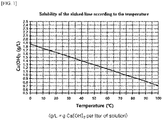
- FIG. 1 shows solubility of calcium hydroxide depending on a temperature.
- the present disclosure relates to, as a method for obtaining high-purity lithium hydroxide in a high yield from a spent lithium secondary battery, a method for producing lithium hydroxide, the method including obtaining lithium sulfate from a lithium-containing waste liquid of a spent lithium secondary battery, and obtaining lithium hydroxide by reacting the lithium sulfate with calcium hydroxide.
- the method for producing lithium hydroxide according to the present disclosure is capable of producing high-purity lithium hydroxide in a high yield from a lithium-containing waste liquid without using separate additives such as a phosphorous-containing material, a pH adjusting agent or glycerin, and the process for producing lithium hydroxide may be simplified since there is no separate process for removing additives.
- an aqueous lithium sulfate solution having the pH adjusted to 6 or less may be obtained without a separate additive for adjusting the pH through a process of evaporation concentrating and then cooling crystallizing the lithium-containing waste liquid from which valuable metals such as manganese, cobalt and nickel are separated and recovered.
- the aqueous lithium sulfate solution and calcium hydroxide are reacted to obtain an aqueous lithium hydroxide solution, and from the aqueous lithium hydroxide solution, lithium hydroxide powder may be obtained by a low-temperature process using an alcohol precipitant such as isopropanol.
- the method for producing lithium hydroxide of the present disclosure includes obtaining lithium sulfate from a lithium-containing waste liquid; and obtaining lithium hydroxide by reacting the lithium sulfate with calcium hydroxide, wherein the lithium sulfate obtained from the lithium-containing waste liquid has a pH of 6 or less.
- the method for producing lithium hydroxide of the present disclosure may further include obtaining the lithium-containing waste liquid from a spent lithium secondary battery, pretreating the lithium-containing waste liquid, and preparing lithium hydroxide powder.
- the method for producing lithium hydroxide of the present disclosure includes obtaining lithium sulfate from a lithium-containing waste liquid.
- the method may further include, before the obtaining of lithium sulfate, recovering one or more types of metal salts selected from among manganese, nickel and cobalt from the lithium-containing waste liquid.
- the lithium-containing waste liquid may mean valuable metals such as manganese, cobalt and nickel being separated and recovered from a spent lithium secondary battery.
- the metal salt may be recovered by solvent extraction or precipitation in the present disclosure, and in the solvent extraction, a phosphoric acid-based material such as di-(2-ethylhexyl)phosphoric acid, di-(2-ethylhexyl)phosphonic acid or bis-(2,4,4-trimethylpentyl)phosphonic acid, or a carboxyl-based material such as neodecanoic acid may be used, and in the precipitation, an oxime-based material such as dimethylglyoxime, diethylglyoxime, dipropylglyoxime or ethylmethylglyoxime may be used, however, the materials are not limited thereto.
- a phosphoric acid-based material such as di-(2-ethylhexyl)phosphoric acid, di-(2-ethylhexyl)phosphonic acid or bis-(2,4,4-trimethylpentyl)phosphonic acid, or a carboxyl-based material such as neo
- an alkali material and sulfuric acid are used for recovering metal salts and the like, and the lithium sulfate obtained through the above-mentioned process may have a pH value of 6 or less without special treatment.
- Artificially lowering the pH results in decreases in purity and yield, and artificially increasing the pH leads to an increase in the Na content, resulting in problems of impurities and decreases in purity/yield.
- at least one or more types selected from the group consisting of NaOH, KOH, Ca(OH) 2 and NH 4 OH may be used as the alkali material, and using NaOH is most preferred.
- the sulfuric acid solution and the sodium hydroxide may react to produce sodium sulfate, an impurity.
- the obtaining of lithium sulfate from a lithium-containing waste liquid may further include removing the sodium sulfate (Na 2 SO 4 ) by evaporation concentrating and then cooling crystallizing the metal salt-recovered lithium-containing waste liquid.
- the concentration is preferably concentrating to 70%, but is not limited thereto.
- the cooling crystallization uses a difference in the solubility between sodium sulfate and lithium sulfate, and may be conducted without treating with additional materials.
- the cooling crystallization for removing the sodium sulfate may be conducted in a temperature range of 0°C to 10°C, and is preferably conducted in a temperature range of 2°C to 5°C.
- solubility of Na 2 SO 4 increases making it difficult to separate Na 2 SO 4 , and therefore, it is preferred to remove Na 2 SO 4 through precipitation filter after lowering solubility of Na 2 SO 4 at a temperature of 10°C or lower.
- the method for producing lithium hydroxide of the present disclosure includes obtaining lithium hydroxide by reacting the lithium sulfate with calcium hydroxide.
- the lithium sulfate and the calcium hydroxide are added in the same number of moles and reacted at room temperature.
- solubility of the calcium hydroxide decreases, and large quantities of unreacted substances are present due to the undissolved calcium hydroxide, which reduces the final yield.
- the calcium hydroxide has better reactivity with lithium than barium hydroxide, resulting in a short reaction time, no unreacted calcium materials remaining, and a high yield of produced lithium hydroxide.
- the lithium sulfate obtained from the lithium-containing waste liquid may have a pH of 6 or less, preferably has a pH of 4.5 to 6, and most preferably has a pH of 5 to 6. Since an additional step for adjusting the pH is not required in this step, there is an advantage of simplifying the process of the method for producing lithium hydroxide of the present disclosure. Calcium hydroxide has low solubility for water, however, when the aqueous lithium sulfate solution satisfies the pH of 6 or less, excellent solubility and reactivity may be obtained without adding an additional solvent such as glycerin.
- the lithium sulfate has a pH of greater than 6, the calcium hydroxide added to be reacted with the lithium sulfate is not dissolved, rapidly reducing reactivity with sulfur ions, and accordingly, yield and purity of lithium hydroxide are reduced.
- artificially lowering the pH results in decreases in purity and yield, and artificially increasing the pH leads to an increase in the Na content, resulting in problems of impurities and decreases in purity/yield.
- solubility of calcium hydroxide for water decreases as a temperature increases and reactivity with lithium sulfate increases, and therefore, the reaction of the lithium sulfate with calcium hydroxide is preferably conducted at room temperature, and is most preferably conducted at approximately 20°C.
- the obtaining of lithium hydroxide may further include producing an aqueous lithium hydroxide solution and calcium sulfate by reacting the lithium sulfate with calcium hydroxide, and removing the calcium sulfate by a filtration process.
- the obtaining of lithium hydroxide may further include obtaining lithium hydroxide powder by precipitating the lithium hydroxide using a precipitant, and specifically, a precipitant may be added to the aqueous lithium hydroxide solution for precipitation, and the result is dried to obtain lithium hydroxide powder.
- the precipitation and the drying may be conducted in a temperature range of 10°C to 30°C, preferably conducted in a temperature range of 15°C to 25°C, and most preferably conducted at room temperature of approximately 20°C.
- the temperature of higher than 30°C is not preferred since solubility of the calcium sulfate increases making it difficult to separate the calcium sulfate, and the temperature of lower than 10°C is not preferred since materials other than the calcium sulfate such as metal salts may be precipitated together.
- Examples of the precipitant may include alcohols such as isopropanol, butanol and pentanol.
- the lithium-containing waste liquid may be obtained from a spent lithium secondary battery, and, in order to obtain the lithium-containing waste liquid, a process of immediately crushing a spent lithium secondary battery and then heat treating the result may be further included.
- the pretreatment process may further include discharging the spent lithium secondary battery before crushing.
- the subsequent process of recovering valuable metals may also be stably conducted in the atmosphere rather than in the inert atmosphere.
- the discharge may be conducted in a discharge solution.
- As the discharge solution distilled water may be used.
- the degree of completion of the discharge may be identified through a decrease in the voltage with time. An electrolyte in the spent lithium secondary battery is mostly removed in the discharge process.
- the crushing may be conducted by milling.
- the milling may be mechanical milling, and specifically, may be one or more types selected from the group consisting of roll-mill, ball-mill, jet-mill, planetary-mill and attrition-mill.
- the crushed material may have a particle diameter of 1 ⁇ m to 15 ⁇ m, may preferably have a particle diameter of 1 ⁇ m to 7 ⁇ m and may more preferably have a particle diameter of 2 ⁇ m to 5 ⁇ m.
- the pretreatment process may further include sorting after the crushing.
- the crushed material is separated into a large fraction of fine electrode composite powder and other components (positive electrode, negative electrode, separator) by the sorting process, preferably by sorting with a sieve, and the electrode composite powder is recovered from the crushed material.
- the pretreatment process may further include gravity separating after the sorting.
- gravity separating the crushed material using, preferably, a water level-installed rinse tank, a separator in the crushed material is removed, and an electrode composite, a separator, a current collector and the like may be separated.
- the pretreatment process may further include magnetic separating after the gravity separating.
- the spent lithium secondary battery further includes stainless steel (SUS)
- the stainless steel (SUS) is selectively removed from the crushed material by the magnetic separation.
- heat treatment may be conducted after the magnetic separation.
- the heat treatment is to remove impurities other than the positive electrode active material included in the spent lithium secondary battery such as a positive electrode binder, a positive electrode conductor, a negative electrode active material, a negative electrode binder, a negative electrode conductor and a pouch, and may be conducted in a temperature range of 600°C to lower than 1000°C, may be preferably conducted in a temperature range of 700°C to 900°C and may be more preferably conducted in a temperature range of 800°C to 900°C.
- the heat treatment temperature is higher than 1000°C, even lithium of the positive electrode active material may be removed.
- the pretreatment process may include, after the heat treatment, a process of further removing remaining impurities such as a carbon material (negative electrode active material) and copper by mixing sulfuric acid with the pretreated material.
- the spent lithium secondary battery includes a positive electrode, a negative electrode, a separator and an electrolyte, and may further include a pouch.
- the spent lithium secondary battery includes a separator provided between a negative electrode and a positive electrode, and an electrolyte liquid including an electrolyte supplied thereto.
- the spent lithium secondary battery described above may be manufactured by, for example, consecutively laminating the negative electrode, the separator and the positive electrode, then winding or folding the result to put into a cylindrical or prismatic battery case or pouch, and then injection an organic electrolyte liquid to the battery case or pouch.
- the positive electrode of the spent lithium secondary battery may include lithium metal or a lithium transition metal oxide, and may be prepared using methods commonly known in the art.
- the positive electrode may be prepared by mixing a solvent, and, as necessary, a binder, a conductor and a dispersant to a positive electrode active material and stirring the result to prepare slurry, then applying (coating) the slurry on a positive electrode current collector, and compressing and then drying the result.
- LiCoO 2 LiNiO 2
- NMP N-methyl-2-pyrrolidone
- acetone water or a mixture thereof
- a conductive auxiliary material such as polyacrylic acid, acetylene black, furnace black, graphite, carbon fiber or fullerene, and the like may be used.
- the binder of the positive electrode performs a role of fully attaching particles of the positive electrode active material and also fully attaching the positive electrode active material to the positive electrode current collector
- examples of the binder may include polyacrylic acid, polyvinylidene fluoride, polyvinyl alcohol, carboxyl methyl cellulose (CMC), starch, hydroxyl propyl cellulose, regenerated cellulose, polyvinyl pyrrolidone, tetrafluoroethylene, polyethylene, polypropylene, an ethylene-propylene-diene terpolymer (EPDM), a sulfonated EPDM, styrene-butadiene rubber, fluoro rubber, various copolymers or the like.
- the positive electrode current collector has a thickness of approximately 3 ⁇ m to approximately 500 ⁇ m, and is not particularly limited as long as it has high conductivity without inducing chemical changes to the corresponding battery.
- stainless steel, aluminum, nickel, titanium, heat treated carbon, aluminum or stainless steel of which surface is treated with a material selected from the group consisting of carbon, nickel, titanium, silver and combinations thereof may be used.
- the current collector may increase adhesive strength with the positive electrode active material by forming micro unevenness on the surface, and various forms such as films, sheets, foil, nets, porous bodies, foams or non-woven fabrics may be used.
- the negative electrode of the spent lithium secondary battery may be prepared using methods commonly known in the art.
- the negative electrode may be prepared by mixing a solvent, and, as necessary, a binder, a conductor and a dispersant to a negative electrode active material and stirring the result to prepare slurry, then applying (coating) the slurry on a negative electrode current collector, and compressing and then drying the result.
- the negative electrode active material may commonly be a carbon material capable of intercalating and deintercalating lithium ions, lithium metal, silicon, tin or the like.
- the negative electrode active material may preferably be a carbon material, and as the carbon material, low crystalline carbon, high crystalline carbon and the like may be included.
- Representative examples of the low crystalline carbon may include soft carbon and hard carbon
- representative examples of the high crystalline carbon may include natural graphite, kish graphite, pyrolytic carbon, mesophase pitch-based carbon fiber, meso-carbon microbeads, mesophase pitches and high temperature baked carbon such as petroleum or coal tar pitch derived cokes.
- NMP N-methyl-2-pyrrolidone
- acetone water or a mixture thereof
- a conductive auxiliary material such as polyacrylic acid, acetylene black, furnace black, graphite, carbon fiber or fullerene, and the like may be used.
- the binder of the negative electrode performs a role of fully attaching particles of the negative electrode active material and also fully attaching the negative electrode active material to the current collector
- examples of the binder may include polyacrylic acid, polyvinylidene fluoride, polyvinyl alcohol, carboxyl methyl cellulose (CMC), starch, hydroxyl propyl cellulose, regenerated cellulose, polyvinyl pyrrolidone, tetrafluoroethylene, polyethylene, polypropylene, an ethylene-propylene-diene terpolymer (EPDM), a sulfonated EPDM, styrene-butadiene rubber, fluoro rubber, various copolymers or the like.
- the negative electrode current collector is generally made to have a thickness of approximately 3 ⁇ m to approximately 500 ⁇ m.
- a negative electrode current collector is not particularly limited as long as it has conductivity without inducing chemical changes to the corresponding battery.
- copper, stainless steel, aluminum, nickel, titanium, heat treated carbon, copper or stainless steel of which surface is treated with carbon, nickel, titanium or silver, or aluminum-cadmium alloys may be included.
- the negative electrode current collector may also strengthen binding strength with the negative electrode active material by forming micro unevenness on the surface, and various forms such as films, sheets, foil, nets, porous bodies, foams or non-woven fabrics may be used.
- the separator of the spent lithium secondary battery is not limited in the type, and, for example, a porous substrate prepared with a polyolefin-based polymer selected from the group consisting of an ethylene homopolymer, a propylene homopolymer, an ethylene-butene copolymer, an ethylene-hexene copolymer and an ethylene-methacrylate copolymer; a porous substrate prepared with a polymer selected from the group consisting of polyester, polyacetal, polyamide, polycarbonate, polyimide, polyetheretherketone, polyethersulfone, polyphenylene oxide, polyphenylene sulfite and polyethylene naphthalene; a porous substrate formed with a mixture of inorganic particles and a binder polymer, or the like, may be used.
- a porous substrate prepared with a polyolefin-based polymer selected from the group consisting of an ethylene homopolymer, a propylene homopolymer, an ethylene
- a separator made of non-woven fabrics corresponding to the porous substrate prepared with a polymer selected from the group consisting of polyester, polyacetal, polyamide, polycarbonate, polyimide, polyetheretherketone, polyethersulfone, polyphenylene oxide, polyphenylene sulfite, polyethylene naphthalene and combinations thereof is preferably used.
- the separator has a pore size of approximately 0.01 ⁇ m to approximately 10 ⁇ m, and generally has a thickness of approximately 5 ⁇ m to approximately 300 ⁇ m.
- a gel-type polymer electrolyte using PEO, PVdF, PVdF-HFP, PMMA, PAN or PVAC As the electrolyte of the spent lithium secondary battery, a gel-type polymer electrolyte using PEO, PVdF, PVdF-HFP, PMMA, PAN or PVAC; a solid electrolyte using PEO, PPO (polypropylene oxide), PEI (polyethylene imine), PES (polyethylene sulfide) or PVAc (polyvinyl acetate), or the like, may be used as an example.
- a non-aqueous electrolyte liquid using ethylene carbonate (EC), propylene carbonate (PC), butylene carbonate (BC), vinylene carbonate (VC), diethyl carbonate (DEC), dimethyl carbonate (DMC), ethylmethyl carbonate (EMC), methyl formate (MF), gamma ( ⁇ )-butyrolactone ( ⁇ -BL), sulfolane, methyl acetate (MA) or methyl propionate (MP) may also be used.
- the electrolyte may further include a lithium salt, and examples of such a lithium salt may include LiCl, LiBr, LiI, LiClO 4 , LiBF 4 , LiB 10 Cl 10 , LiPF 6 , LiCF 3 SO 3 , LiCF 3 CO 2 , LiAsF 6 , LiSbF 6 , LiAlCl 4 , CH 3 SO 3 Li, CF 3 SO 3 Li, (CF 3 SO 2 ) 2 NLi, chloroborane lithium, lower aliphatic carboxylic acid lithium, lithium tetraphenylborate or the like.
- a lithium salt may include LiCl, LiBr, LiI, LiClO 4 , LiBF 4 , LiB 10 Cl 10 , LiPF 6 , LiCF 3 SO 3 , LiCF 3 CO 2 , LiAsF 6 , LiSbF 6 , LiAlCl 4 , CH 3 SO 3 Li, CF 3 SO 3 Li, (CF 3 SO 2 ) 2 NLi
- an organic solid electrolyte and/or an inorganic solid electrolyte may be used in addition to the separator in the spent lithium secondary battery, however, the use is not limited thereto.
- the solid electrolyte when using the organic solid electrolyte and/or the inorganic solid electrolyte, the solid electrolyte may also serve as a separator in some cases, and the separator described above may not be used.
- organic solid electrolyte may include polyethylene derivatives, polyethylene oxide derivatives, polypropylene oxide derivatives, phosphoric ester polymers, polyvinyl alcohol or polyvinylidene fluoride, but are not limited thereto.
- the inorganic solid electrolyte may be selected from the group consisting of, for example, Li 3 N, Lil, Li 5 NI 2 , Li 3 N-LiI-LiOH, Li 2 SiS 3 , Li 4 SiO 4 , Li 4 SiO 4 -LiI-LiOH, Li 3 PO 4 -Li 2 S-SiS 2 and combinations thereof, but is not limited thereto.
- a positive electrode material separated from a spent lithium secondary battery was crushed and pulverized.
- the obtained powder was reacted with a sulfuric acid solution for 6 hours or longer to obtain a leachate including Li.
- leachate including Li manganese, cobalt and nickel were separated and recovered through solvent extraction and precipitation methods, and a lithium-containing waste liquid was obtained.
- the optimum extraction condition was obtained at ⁇ pH 4 for Mn, the optimum extraction condition was identified at ⁇ pH 5 for Co, and the optimum extraction condition was obtained at ⁇ pH 6 for Ni. Accordingly, manganese, cobalt or nickel was extracted under the above-mentioned pH conditions, and herein, the obtained lithium-containing waste liquid had the pH adjusted to each of pH 5.5, 4.5 and 4 by the sulfuric acid solution used when extracting the metal salts.
- the obtained lithium-containing waste liquid was evaporation concentrated to 70 w/v% and then cooling crystallized at 5C to precipitate Na 2 SO 4 , and the Na 2 SO 4 was filtered and removed to obtain an aqueous lithium sulfate (LiSO 4 ⁇ H 2 O) solution.
- the obtained aqueous lithium sulfate solution having a pH of 5.5 was employed as Example 1
- having a pH of 4.5 was employed as Example 2
- having a pH of 4 was employed as Example 3.
- aqueous lithium sulfate solution Using the obtained aqueous lithium sulfate solution as a starting material, calcium hydroxide (Ca(OH) 2 ) powder (4.0 g) was added to the aqueous lithium sulfate solution (1000 mL) as an additive, and they were reacted at room temperature. By the reaction, calcium sulfate (CaSO 4 ⁇ H 2 O) precipitates and lithium hydroxide (LiOH) solution were obtained. The precipitated calcium sulfate was removed by filtration, and after precipitating lithium hydroxide by adding isopropanol thereto at room temperature, the result was dried to obtain lithium hydroxide powder.
- Ca(OH) 2 calcium hydroxide
- LiOH lithium hydroxide
- Lithium sulfate monohydrate and deionized water were stirred to obtain an aqueous lithium sulfate solution.
- barium hydroxide (13.8 g)
- the aqueous lithium sulfate solution 1000 mL
- the barium hydroxide was introduced in the same number of moles as the lithium sulfate.
- the filtrate was spray dried at 150°C to 200°C to obtain lithium hydroxide powder.
- Lithium sulfate monohydrate and deionized water were stirred to obtain an aqueous lithium sulfate solution.
- aqueous lithium sulfate solution 1000 mL
- glycerin was added to enhance calcium hydroxide solubility
- calcium hydroxide powder 4.0 g was added thereto as an additive.
- the result was stirred and produced precipitates were separated.
- the filtrate from which the precipitates were removed was spray dried at a temperature of 290°C or higher to remove the glycerin, and lithium hydroxide powder was obtained.
- Lithium hydroxide powder was prepared under the same condition as in the examples except that an aqueous lithium sulfate solution having a pH of 6.5 was used.
- Comparative Example 1 using barium hydroxide as an additive had a problem of Ba remaining in the solution since the reaction time is long
- Comparative Example 2 in which glycerin was added had a problem of Ca remaining since CaSO 4 produced after the reaction was partially dissolved in the added glycerol, and it was identified that both Comparative Examples 1 and 2 had problems of decreases in the lithium hydroxide purity and yield.
- the pH was 6.5 or greater as in Comparative Example 3 Ca(OH) 2 was not favorably dissolved, and it was identified that the yield of the lithium hydroxide decreased since reactivity of lithium sulfate and calcium hydroxide rapidly decreased, and the purity of the lithium hydroxide was also reduced by unreacted substances.
- lithium sulfate and calcium hydroxide had superior reactivity without an additive such as glycerin, and accordingly, a high yield was obtained since there was no decrease in the purity caused by remaining metals or remaining additives and there was no side reaction. Particularly, purity and yield were most superior when using the aqueous lithium sulfate solution having a pH of 5.5.
Landscapes
- Chemical & Material Sciences (AREA)
- Engineering & Computer Science (AREA)
- Organic Chemistry (AREA)
- Materials Engineering (AREA)
- Inorganic Chemistry (AREA)
- Manufacturing & Machinery (AREA)
- General Chemical & Material Sciences (AREA)
- Electrochemistry (AREA)
- Chemical Kinetics & Catalysis (AREA)
- Life Sciences & Earth Sciences (AREA)
- Geology (AREA)
- Environmental & Geological Engineering (AREA)
- General Life Sciences & Earth Sciences (AREA)
- Mechanical Engineering (AREA)
- Metallurgy (AREA)
- Secondary Cells (AREA)
- Inorganic Compounds Of Heavy Metals (AREA)
- Manufacture And Refinement Of Metals (AREA)
Abstract
Description
- The present disclosure relates to a method for producing high-purity lithium hydroxide from a lithium-containing waste liquid of a spent lithium secondary battery.
- As technology developments and demands for various types of energy storage devices from ultra-small to medium-large such as mobile devices, notebook computers, wireless devices, electric vehicles and electric motorcycles increase, demands for secondary batteries as an energy source is rapidly increasing. Among such secondary batteries, lithium secondary batteries exhibiting high energy density and operating potential, and having a long cycle lifetime and a low self-discharge rate have been commercialized and widely used.
- As lithium secondary batteries are increasingly produced and used, the amount of waste will increase, and the need for technologies of reprocessing and recycling spent lithium secondary batteries to treat the waste is emerging. In addition, the secondary battery and material-related industry is in desperate need for efforts such as low-priced raw materials, low-priced processes and yield improvements due to intense competition in price, and demands for secondary batteries are increasing. Accordingly, attempts to recycle spent batteries after use, and defective products, electrodes and the like generated in the manufacturing process have increased, and as demands for lithium rapidly increase as well, technology developments for methods of recovering high-purity lithium hydroxide, an essential material of lithium secondary batteries, in a high yield have been required.
- In order to produce lithium hydroxide from a lithium waste liquid, sulfate ion removal is essential. In this regard,
Korean Patent Application Laid-Open No. 10-2016-0002578 - (Patent Document 1)
Korean Patent Application Laid-Open No. 10-2016-0002578 - The present disclosure has been made in order to improve technical problems in the art described above, and is directed to providing a method for producing high-purity lithium hydroxide in a high yield from a lithium-containing waste liquid without using separate additives.
- However, the problems that the present application is seeking to address are not limited to the problems described above, and other problems not mentioned herein will be clearly understood by those skilled in the art from the following descriptions.
- In view of the above, one embodiment of the present disclosure provides a method for producing lithium hydroxide, the method including obtaining lithium sulfate from a lithium-containing waste liquid; and obtaining lithium hydroxide by reacting the lithium sulfate with calcium hydroxide, wherein the lithium sulfate obtained from the lithium-containing waste liquid has a pH of 6 or less.
- A method for producing lithium hydroxide according to the present disclosure is capable of producing high-purity lithium hydroxide in a high yield from a lithium-containing waste liquid without using separate additives such as a phosphorous-containing material, a pH adjusting agent or glycerin. In addition, the process for producing lithium hydroxide can be simplified since there is no separate process for removing additives.
- In addition, with the lithium-containing waste liquid of the present disclosure, an aqueous lithium sulfate solution having the pH adjusted to 6 or less can be obtained without a separate additive for adjusting the pH through a process of evaporation concentrating and then cooling crystallizing the lithium-containing waste liquid from which valuable metals such as manganese, cobalt and nickel are separated and recovered. In addition, the aqueous lithium sulfate solution and calcium hydroxide are reacted to obtain an aqueous lithium hydroxide solution, and from the aqueous lithium hydroxide solution, lithium hydroxide powder can be obtained by a low-temperature process using an alcohol precipitant such as isopropanol.
-
FIG. 1 shows solubility of calcium hydroxide depending on a temperature. - The present disclosure relates to, as a method for obtaining high-purity lithium hydroxide in a high yield from a spent lithium secondary battery, a method for producing lithium hydroxide, the method including obtaining lithium sulfate from a lithium-containing waste liquid of a spent lithium secondary battery, and obtaining lithium hydroxide by reacting the lithium sulfate with calcium hydroxide.
- The method for producing lithium hydroxide according to the present disclosure is capable of producing high-purity lithium hydroxide in a high yield from a lithium-containing waste liquid without using separate additives such as a phosphorous-containing material, a pH adjusting agent or glycerin, and the process for producing lithium hydroxide may be simplified since there is no separate process for removing additives.
- In addition, with the lithium-containing waste liquid of the present disclosure, an aqueous lithium sulfate solution having the pH adjusted to 6 or less may be obtained without a separate additive for adjusting the pH through a process of evaporation concentrating and then cooling crystallizing the lithium-containing waste liquid from which valuable metals such as manganese, cobalt and nickel are separated and recovered. In addition, the aqueous lithium sulfate solution and calcium hydroxide are reacted to obtain an aqueous lithium hydroxide solution, and from the aqueous lithium hydroxide solution, lithium hydroxide powder may be obtained by a low-temperature process using an alcohol precipitant such as isopropanol.
- Hereinafter, the method for producing lithium hydroxide according to the present disclosure will be described in detail. However, the present disclosure is not limited thereto.
- The method for producing lithium hydroxide of the present disclosure includes obtaining lithium sulfate from a lithium-containing waste liquid; and obtaining lithium hydroxide by reacting the lithium sulfate with calcium hydroxide, wherein the lithium sulfate obtained from the lithium-containing waste liquid has a pH of 6 or less.
In addition, the method for producing lithium hydroxide of the present disclosure may further include obtaining the lithium-containing waste liquid from a spent lithium secondary battery, pretreating the lithium-containing waste liquid, and preparing lithium hydroxide powder. - The method for producing lithium hydroxide of the present disclosure includes obtaining lithium sulfate from a lithium-containing waste liquid.
- The method may further include, before the obtaining of lithium sulfate, recovering one or more types of metal salts selected from among manganese, nickel and cobalt from the lithium-containing waste liquid. Herein, the lithium-containing waste liquid may mean valuable metals such as manganese, cobalt and nickel being separated and recovered from a spent lithium secondary battery.
- As one example, the metal salt may be recovered by solvent extraction or precipitation in the present disclosure, and in the solvent extraction, a phosphoric acid-based material such as di-(2-ethylhexyl)phosphoric acid, di-(2-ethylhexyl)phosphonic acid or bis-(2,4,4-trimethylpentyl)phosphonic acid, or a carboxyl-based material such as neodecanoic acid may be used, and in the precipitation, an oxime-based material such as dimethylglyoxime, diethylglyoxime, dipropylglyoxime or ethylmethylglyoxime may be used, however, the materials are not limited thereto.
- In the process of obtaining lithium sulfate from a lithium-containing waste liquid, an alkali material and sulfuric acid are used for recovering metal salts and the like, and the lithium sulfate obtained through the above-mentioned process may have a pH value of 6 or less without special treatment. Artificially lowering the pH results in decreases in purity and yield, and artificially increasing the pH leads to an increase in the Na content, resulting in problems of impurities and decreases in purity/yield. For example, at least one or more types selected from the group consisting of NaOH, KOH, Ca(OH)2 and NH4OH may be used as the alkali material, and using NaOH is most preferred.
- In one embodiment, when using sodium hydroxide as the alkali material to separate and recover metal salts in the process of obtaining lithium sulfate from a lithium-containing waste liquid, the sulfuric acid solution and the sodium hydroxide may react to produce sodium sulfate, an impurity.
- The obtaining of lithium sulfate from a lithium-containing waste liquid may further include removing the sodium sulfate (Na2SO4) by evaporation concentrating and then cooling crystallizing the metal salt-recovered lithium-containing waste liquid. The concentration is preferably concentrating to 70%, but is not limited thereto.
- The cooling crystallization uses a difference in the solubility between sodium sulfate and lithium sulfate, and may be conducted without treating with additional materials. The cooling crystallization for removing the sodium sulfate may be conducted in a temperature range of 0°C to 10°C, and is preferably conducted in a temperature range of 2°C to 5°C. When the temperature is higher than 10°C, solubility of Na2SO4 increases making it difficult to separate Na2SO4, and therefore, it is preferred to remove Na2SO4 through precipitation filter after lowering solubility of Na2SO4 at a temperature of 10°C or lower.
- The method for producing lithium hydroxide of the present disclosure includes obtaining lithium hydroxide by reacting the lithium sulfate with calcium hydroxide.
- In the present disclosure, it is preferred that the lithium sulfate and the calcium hydroxide are added in the same number of moles and reacted at room temperature. When increasing the temperature for enhancing reactivity, solubility of the calcium hydroxide decreases, and large quantities of unreacted substances are present due to the undissolved calcium hydroxide, which reduces the final yield.
- In the present disclosure, the calcium hydroxide has better reactivity with lithium than barium hydroxide, resulting in a short reaction time, no unreacted calcium materials remaining, and a high yield of produced lithium hydroxide.
- The lithium sulfate obtained from the lithium-containing waste liquid may have a pH of 6 or less, preferably has a pH of 4.5 to 6, and most preferably has a pH of 5 to 6. Since an additional step for adjusting the pH is not required in this step, there is an advantage of simplifying the process of the method for producing lithium hydroxide of the present disclosure. Calcium hydroxide has low solubility for water, however, when the aqueous lithium sulfate solution satisfies the pH of 6 or less, excellent solubility and reactivity may be obtained without adding an additional solvent such as glycerin. When the lithium sulfate has a pH of greater than 6, the calcium hydroxide added to be reacted with the lithium sulfate is not dissolved, rapidly reducing reactivity with sulfur ions, and accordingly, yield and purity of lithium hydroxide are reduced. In addition, artificially lowering the pH results in decreases in purity and yield, and artificially increasing the pH leads to an increase in the Na content, resulting in problems of impurities and decreases in purity/yield.
- In the present disclosure, there are no separate additives for dissolving the calcium hydroxide in water, and therefore, an additional process for removing additives is not required, which simplifies the process. For example, when adding glycerin to dissolve the calcium hydroxide in water, spray drying is required at a high temperature of 290°C or higher to remove the glycerin, and since it is difficult to completely remove the glycerin even by spray drying, purity of lithium hydroxide may be reduced.
- As shown in
FIG. 1 , solubility of calcium hydroxide for water decreases as a temperature increases and reactivity with lithium sulfate increases, and therefore, the reaction of the lithium sulfate with calcium hydroxide is preferably conducted at room temperature, and is most preferably conducted at approximately 20°C. - The obtaining of lithium hydroxide may further include producing an aqueous lithium hydroxide solution and calcium sulfate by reacting the lithium sulfate with calcium hydroxide, and removing the calcium sulfate by a filtration process.
- The obtaining of lithium hydroxide may further include obtaining lithium hydroxide powder by precipitating the lithium hydroxide using a precipitant, and specifically, a precipitant may be added to the aqueous lithium hydroxide solution for precipitation, and the result is dried to obtain lithium hydroxide powder.
- In addition, the precipitation and the drying may be conducted in a temperature range of 10°C to 30°C, preferably conducted in a temperature range of 15°C to 25°C, and most preferably conducted at room temperature of approximately 20°C. The temperature of higher than 30°C is not preferred since solubility of the calcium sulfate increases making it difficult to separate the calcium sulfate, and the temperature of lower than 10°C is not preferred since materials other than the calcium sulfate such as metal salts may be precipitated together.
- Examples of the precipitant may include alcohols such as isopropanol, butanol and pentanol.
- In the method for producing lithium hydroxide of the present disclosure, the lithium-containing waste liquid may be obtained from a spent lithium secondary battery, and, in order to obtain the lithium-containing waste liquid, a process of immediately crushing a spent lithium secondary battery and then heat treating the result may be further included.
- The pretreatment process may further include discharging the spent lithium secondary battery before crushing. When completing the discharge, the subsequent process of recovering valuable metals may also be stably conducted in the atmosphere rather than in the inert atmosphere. The discharge may be conducted in a discharge solution. As the discharge solution, distilled water may be used. The degree of completion of the discharge may be identified through a decrease in the voltage with time. An electrolyte in the spent lithium secondary battery is mostly removed in the discharge process.
- The crushing may be conducted by milling. The milling may be mechanical milling, and specifically, may be one or more types selected from the group consisting of roll-mill, ball-mill, jet-mill, planetary-mill and attrition-mill.
- The crushed material may have a particle diameter of 1 µm to 15 µm, may preferably have a particle diameter of 1 µm to 7 µm and may more preferably have a particle diameter of 2 µm to 5 µm.
- The pretreatment process may further include sorting after the crushing. The crushed material is separated into a large fraction of fine electrode composite powder and other components (positive electrode, negative electrode, separator) by the sorting process, preferably by sorting with a sieve, and the electrode composite powder is recovered from the crushed material.
- The pretreatment process may further include gravity separating after the sorting. By gravity separating the crushed material using, preferably, a water level-installed rinse tank, a separator in the crushed material is removed, and an electrode composite, a separator, a current collector and the like may be separated.
- The pretreatment process may further include magnetic separating after the gravity separating. When the spent lithium secondary battery further includes stainless steel (SUS), the stainless steel (SUS) is selectively removed from the crushed material by the magnetic separation.
- In the pretreatment process, heat treatment may be conducted after the magnetic separation. The heat treatment is to remove impurities other than the positive electrode active material included in the spent lithium secondary battery such as a positive electrode binder, a positive electrode conductor, a negative electrode active material, a negative electrode binder, a negative electrode conductor and a pouch, and may be conducted in a temperature range of 600°C to lower than 1000°C, may be preferably conducted in a temperature range of 700°C to 900°C and may be more preferably conducted in a temperature range of 800°C to 900°C. When the heat treatment temperature is higher than 1000°C, even lithium of the positive electrode active material may be removed.
- In addition, the pretreatment process may include, after the heat treatment, a process of further removing remaining impurities such as a carbon material (negative electrode active material) and copper by mixing sulfuric acid with the pretreated material.
- The spent lithium secondary battery includes a positive electrode, a negative electrode, a separator and an electrolyte, and may further include a pouch. Specifically, the spent lithium secondary battery includes a separator provided between a negative electrode and a positive electrode, and an electrolyte liquid including an electrolyte supplied thereto. More specifically, the spent lithium secondary battery described above may be manufactured by, for example, consecutively laminating the negative electrode, the separator and the positive electrode, then winding or folding the result to put into a cylindrical or prismatic battery case or pouch, and then injection an organic electrolyte liquid to the battery case or pouch.
- The positive electrode of the spent lithium secondary battery may include lithium metal or a lithium transition metal oxide, and may be prepared using methods commonly known in the art. For example, the positive electrode may be prepared by mixing a solvent, and, as necessary, a binder, a conductor and a dispersant to a positive electrode active material and stirring the result to prepare slurry, then applying (coating) the slurry on a positive electrode current collector, and compressing and then drying the result.
- Examples of the positive electrode active material may include one or more types selected from the group consisting of LiCoO2, LiNiO2, LiMnO2, LiMn2O4, Li(NixCoyMnz)O2 (herein, 0 < x < 1, 0 < y < 1, 0 < z < 1, and x+y+z=1), LiNi1-aCoaO2 (herein, 0≤a < 1), LiCo1-bMnbO2 (herein, 0≤b < 1), LiNi1-cMncO2 (herein, 0≤c < 1), LiMn2-dNidO4 (herein, 0 < d < 2), LiMn2-eCoeO4 (herein, 0 < e < 2), LiCoPO4, LiFePO4 and combinations thereof, but are not limited thereto.
- As the solvent of the positive electrode, N-methyl-2-pyrrolidone (NMP), acetone, water or a mixture thereof may be used, and as the conductor of the positive electrode, a conductive auxiliary material such as polyacrylic acid, acetylene black, furnace black, graphite, carbon fiber or fullerene, and the like may be used.
- The binder of the positive electrode performs a role of fully attaching particles of the positive electrode active material and also fully attaching the positive electrode active material to the positive electrode current collector, and examples of the binder may include polyacrylic acid, polyvinylidene fluoride, polyvinyl alcohol, carboxyl methyl cellulose (CMC), starch, hydroxyl propyl cellulose, regenerated cellulose, polyvinyl pyrrolidone, tetrafluoroethylene, polyethylene, polypropylene, an ethylene-propylene-diene terpolymer (EPDM), a sulfonated EPDM, styrene-butadiene rubber, fluoro rubber, various copolymers or the like.
- The positive electrode current collector has a thickness of approximately 3 µm to approximately 500 µm, and is not particularly limited as long as it has high conductivity without inducing chemical changes to the corresponding battery. For example, stainless steel, aluminum, nickel, titanium, heat treated carbon, aluminum or stainless steel of which surface is treated with a material selected from the group consisting of carbon, nickel, titanium, silver and combinations thereof may be used. The current collector may increase adhesive strength with the positive electrode active material by forming micro unevenness on the surface, and various forms such as films, sheets, foil, nets, porous bodies, foams or non-woven fabrics may be used.
- The negative electrode of the spent lithium secondary battery may be prepared using methods commonly known in the art. For example, the negative electrode may be prepared by mixing a solvent, and, as necessary, a binder, a conductor and a dispersant to a negative electrode active material and stirring the result to prepare slurry, then applying (coating) the slurry on a negative electrode current collector, and compressing and then drying the result.
- The negative electrode active material may commonly be a carbon material capable of intercalating and deintercalating lithium ions, lithium metal, silicon, tin or the like. The negative electrode active material may preferably be a carbon material, and as the carbon material, low crystalline carbon, high crystalline carbon and the like may be included. Representative examples of the low crystalline carbon may include soft carbon and hard carbon, and representative examples of the high crystalline carbon may include natural graphite, kish graphite, pyrolytic carbon, mesophase pitch-based carbon fiber, meso-carbon microbeads, mesophase pitches and high temperature baked carbon such as petroleum or coal tar pitch derived cokes.
- As the solvent of the negative electrode, N-methyl-2-pyrrolidone (NMP), acetone, water or a mixture thereof may be used, and as the conductor of the negative electrode, a conductive auxiliary material such as polyacrylic acid, acetylene black, furnace black, graphite, carbon fiber or fullerene, and the like may be used.
- The binder of the negative electrode performs a role of fully attaching particles of the negative electrode active material and also fully attaching the negative electrode active material to the current collector, and examples of the binder may include polyacrylic acid, polyvinylidene fluoride, polyvinyl alcohol, carboxyl methyl cellulose (CMC), starch, hydroxyl propyl cellulose, regenerated cellulose, polyvinyl pyrrolidone, tetrafluoroethylene, polyethylene, polypropylene, an ethylene-propylene-diene terpolymer (EPDM), a sulfonated EPDM, styrene-butadiene rubber, fluoro rubber, various copolymers or the like.
- The negative electrode current collector is generally made to have a thickness of approximately 3 µm to approximately 500 µm. Such a negative electrode current collector is not particularly limited as long as it has conductivity without inducing chemical changes to the corresponding battery. For example, copper, stainless steel, aluminum, nickel, titanium, heat treated carbon, copper or stainless steel of which surface is treated with carbon, nickel, titanium or silver, or aluminum-cadmium alloys may be included. In addition, like the positive electrode current collector, the negative electrode current collector may also strengthen binding strength with the negative electrode active material by forming micro unevenness on the surface, and various forms such as films, sheets, foil, nets, porous bodies, foams or non-woven fabrics may be used.
- The separator of the spent lithium secondary battery is not limited in the type, and, for example, a porous substrate prepared with a polyolefin-based polymer selected from the group consisting of an ethylene homopolymer, a propylene homopolymer, an ethylene-butene copolymer, an ethylene-hexene copolymer and an ethylene-methacrylate copolymer; a porous substrate prepared with a polymer selected from the group consisting of polyester, polyacetal, polyamide, polycarbonate, polyimide, polyetheretherketone, polyethersulfone, polyphenylene oxide, polyphenylene sulfite and polyethylene naphthalene; a porous substrate formed with a mixture of inorganic particles and a binder polymer, or the like, may be used. Particularly, in order for lithium ions of the lithium ion supply core portion to be readily transferred to the external electrode, a separator made of non-woven fabrics corresponding to the porous substrate prepared with a polymer selected from the group consisting of polyester, polyacetal, polyamide, polycarbonate, polyimide, polyetheretherketone, polyethersulfone, polyphenylene oxide, polyphenylene sulfite, polyethylene naphthalene and combinations thereof is preferably used.
- The separator has a pore size of approximately 0.01 µm to approximately 10 µm, and generally has a thickness of approximately 5 µm to approximately 300 µm.
As the electrolyte of the spent lithium secondary battery, a gel-type polymer electrolyte using PEO, PVdF, PVdF-HFP, PMMA, PAN or PVAC; a solid electrolyte using PEO, PPO (polypropylene oxide), PEI (polyethylene imine), PES (polyethylene sulfide) or PVAc (polyvinyl acetate), or the like, may be used as an example. In addition, as the electrolyte, a non-aqueous electrolyte liquid using ethylene carbonate (EC), propylene carbonate (PC), butylene carbonate (BC), vinylene carbonate (VC), diethyl carbonate (DEC), dimethyl carbonate (DMC), ethylmethyl carbonate (EMC), methyl formate (MF), gamma (γ)-butyrolactone (γ-BL), sulfolane, methyl acetate (MA) or methyl propionate (MP) may also be used. In addition, the electrolyte may further include a lithium salt, and examples of such a lithium salt may include LiCl, LiBr, LiI, LiClO4, LiBF4, LiB10Cl10, LiPF6, LiCF3SO3, LiCF3CO2, LiAsF6, LiSbF6, LiAlCl4, CH3SO3Li, CF3SO3Li, (CF3SO2)2NLi, chloroborane lithium, lower aliphatic carboxylic acid lithium, lithium tetraphenylborate or the like. - In one embodiment of the present application, an organic solid electrolyte and/or an inorganic solid electrolyte may be used in addition to the separator in the spent lithium secondary battery, however, the use is not limited thereto. Herein, when using the organic solid electrolyte and/or the inorganic solid electrolyte, the solid electrolyte may also serve as a separator in some cases, and the separator described above may not be used.
- Examples of the organic solid electrolyte may include polyethylene derivatives, polyethylene oxide derivatives, polypropylene oxide derivatives, phosphoric ester polymers, polyvinyl alcohol or polyvinylidene fluoride, but are not limited thereto. The inorganic solid electrolyte may be selected from the group consisting of, for example, Li3N, Lil, Li5NI2, Li3N-LiI-LiOH, Li2SiS3, Li4SiO4, Li4SiO4-LiI-LiOH, Li3PO4-Li2S-SiS2 and combinations thereof, but is not limited thereto.
- Hereinafter, the present disclosure will be described in more detail with reference to examples. However, the following examples are for more specifically describing the present disclosure, and the scope of the present disclosure is not limited to the following examples.
- A positive electrode material separated from a spent lithium secondary battery was crushed and pulverized. The obtained powder was reacted with a sulfuric acid solution for 6 hours or longer to obtain a leachate including Li. From the leachate including Li, manganese, cobalt and nickel were separated and recovered through solvent extraction and precipitation methods, and a lithium-containing waste liquid was obtained.
- When recovering the necessary metals through solvent extraction, the optimum extraction condition was obtained at ≒pH 4 for Mn, the optimum extraction condition was identified at ≒pH 5 for Co, and the optimum extraction condition was obtained at <pH 6 for Ni. Accordingly, manganese, cobalt or nickel was extracted under the above-mentioned pH conditions, and herein, the obtained lithium-containing waste liquid had the pH adjusted to each of pH 5.5, 4.5 and 4 by the sulfuric acid solution used when extracting the metal salts.
- Subsequently, the obtained lithium-containing waste liquid was evaporation concentrated to 70 w/v% and then cooling crystallized at 5C to precipitate Na2SO4, and the Na2SO4 was filtered and removed to obtain an aqueous lithium sulfate (LiSO4·H2O) solution. Herein, the obtained aqueous lithium sulfate solution having a pH of 5.5 was employed as Example 1, having a pH of 4.5 was employed as Example 2, and having a pH of 4 was employed as Example 3.
- Using the obtained aqueous lithium sulfate solution as a starting material, calcium hydroxide (Ca(OH)2) powder (4.0 g) was added to the aqueous lithium sulfate solution (1000 mL) as an additive, and they were reacted at room temperature. By the reaction, calcium sulfate (CaSO4·H2O) precipitates and lithium hydroxide (LiOH) solution were obtained. The precipitated calcium sulfate was removed by filtration, and after precipitating lithium hydroxide by adding isopropanol thereto at room temperature, the result was dried to obtain lithium hydroxide powder.
- Lithium sulfate monohydrate and deionized water (demineralized water) were stirred to obtain an aqueous lithium sulfate solution. After adding barium hydroxide (13.8 g) to the aqueous lithium sulfate solution (1000 mL) as an additive, the result was stirred and reacted, and then filtered. Herein, the barium hydroxide was introduced in the same number of moles as the lithium sulfate. After the filtration, the filtrate was spray dried at 150°C to 200°C to obtain lithium hydroxide powder.
- Lithium sulfate monohydrate and deionized water (demineralized water) were stirred to obtain an aqueous lithium sulfate solution. To the aqueous lithium sulfate solution (1000 mL), glycerin was added to enhance calcium hydroxide solubility, and calcium hydroxide powder (4.0 g) was added thereto as an additive. The result was stirred and produced precipitates were separated. The filtrate from which the precipitates were removed was spray dried at a temperature of 290°C or higher to remove the glycerin, and lithium hydroxide powder was obtained.
- In Comparative Examples 1 and 2, artificially lowering the pH results in decreases in purity and yield, and increasing the pH leads to an increase in the Na content, resulting in problems of impurities and decreases in purity/yield.
- Lithium hydroxide powder was prepared under the same condition as in the examples except that an aqueous lithium sulfate solution having a pH of 6.5 was used.
- In this experimental example, purity and yield of the lithium hydroxide depending on the type of the additive added for the reaction with the lithium sulfate, and reactivity of the lithium sulfate and the additive were evaluated, and the results are shown in the following Table 1.
[Table 1] Additive Purity (%) Yield (%) Purity Yield Reactivity Comparative Example 1 Ba(OH)2 94.9 64.1 △ △ △ Comparative Example 2 Ca(OH)2 97.4 90.6 △ ∘ ∘ Example 1 Ca(OH)2 99.9 95.1 ⊚ ⊚ ⊚ - In this experimental example, purity and yield of the lithium hydroxide depending on the pH condition of the lithium sulfate, and reactivity of the lithium sulfate and the additive were evaluated, and the results are shown in the following Table 2.
[Table 2] Additive pH Purity (%) Yield (%) Purity Yield Reactivity Comparative Example 3 Ca(OH)2 6.5 97.3 62.8 △ △ △ Example 1 5.5 99.9 95.1 ⊚ ⊚ ⊚ Example 2 4.5 98.2 76.9 ∘ ∘ ∘ Example 3 4 98.0 75.4 ∘ ∘ ∘ - Evaluation criteria for purity, yield and reactivity of Table 1 and Table 2 are as follows. Herein, purity means excluding the content of Ca, an impurity, from the total content.
-
- ⊚: when purity of lithium hydroxide is 99.9% or greater
- ∘: when purity of lithium hydroxide is from 98.0% to 99.8%
- △: when purity of lithium hydroxide is less than 98.0%
-
- ⊚ : when yield of lithium hydroxide is greater than 95.0%
- ∘: when yield of lithium hydroxide is from 75.0% to 95.0%
- △: when yield of lithium hydroxide is less than 75%
-
- ⊚: yield of greater than 95% in 4 hours of reaction time
- ∘: yield of 75% to 95% in 4 hours of reaction time
- △: yield of less than 75% in 4 hours of reaction time
- Referring to Tables 1 and 2, Comparative Example 1 using barium hydroxide as an additive had a problem of Ba remaining in the solution since the reaction time is long, and Comparative Example 2 in which glycerin was added had a problem of Ca remaining since CaSO4 produced after the reaction was partially dissolved in the added glycerol, and it was identified that both Comparative Examples 1 and 2 had problems of decreases in the lithium hydroxide purity and yield. Meanwhile, when the pH was 6.5 or greater as in Comparative Example 3, Ca(OH)2 was not favorably dissolved, and it was identified that the yield of the lithium hydroxide decreased since reactivity of lithium sulfate and calcium hydroxide rapidly decreased, and the purity of the lithium hydroxide was also reduced by unreacted substances.
- On the other hand, when calcium hydroxide was as an additive and the aqueous lithium sulfate solution had a pH of 6 or less as in Examples 1 to 3 of the present disclosure, lithium sulfate and calcium hydroxide had superior reactivity without an additive such as glycerin, and accordingly, a high yield was obtained since there was no decrease in the purity caused by remaining metals or remaining additives and there was no side reaction. Particularly, purity and yield were most superior when using the aqueous lithium sulfate solution having a pH of 5.5.
Claims (7)
- A method for producing lithium hydroxide, the method comprising:obtaining lithium sulfate from a lithium-containing waste liquid; andobtaining lithium hydroxide by reacting the lithium sulfate with calcium hydroxide,wherein the lithium sulfate obtained from the lithium-containing waste liquid has a pH of 6 or less.
- The method of claim 1, wherein a solvent is not added in the obtaining of lithium hydroxide.
- The method of claim 2, wherein the solvent includes glycerin.
- The method of claim 1, further comprising obtaining lithium hydroxide powder by precipitating the obtained lithium hydroxide using a precipitant.
- The method of claim 4, wherein the precipitant is an alcohol.
- The method of claim 1, further comprising, prior to the obtaining of lithium sulfate, one or more steps of recovering one or more types of metal salts selected from among manganese, nickel and cobalt from the lithium-containing waste liquid.
- The method of claim 6, further comprising removing sodium sulfate (Na2SO4) by evaporation concentrating and then cooling crystallizing the metal salt-recovered lithium-containing waste liquid.
Applications Claiming Priority (2)
| Application Number | Priority Date | Filing Date | Title |
|---|---|---|---|
| KR1020200027656A KR102243820B1 (en) | 2020-03-05 | 2020-03-05 | Method of producing lithium hydroxide |
| PCT/KR2020/014255 WO2021177537A1 (en) | 2020-03-05 | 2020-10-19 | Method for producing lithium hydroxide |
Publications (2)
| Publication Number | Publication Date |
|---|---|
| EP4116259A1 true EP4116259A1 (en) | 2023-01-11 |
| EP4116259A4 EP4116259A4 (en) | 2023-08-30 |
Family
ID=75738031
Family Applications (1)
| Application Number | Title | Priority Date | Filing Date |
|---|---|---|---|
| EP20923150.5A Pending EP4116259A4 (en) | 2020-03-05 | 2020-10-19 | PROCESS FOR PRODUCTION OF LITHIUM HYDROXIDE |
Country Status (6)
| Country | Link |
|---|---|
| US (1) | US20230093576A1 (en) |
| EP (1) | EP4116259A4 (en) |
| JP (1) | JP7379724B2 (en) |
| KR (1) | KR102243820B1 (en) |
| CN (1) | CN115210182B (en) |
| WO (1) | WO2021177537A1 (en) |
Families Citing this family (12)
| Publication number | Priority date | Publication date | Assignee | Title |
|---|---|---|---|---|
| KR102680508B1 (en) | 2020-08-24 | 2024-07-01 | 그린 라이온 피티이. 리미티드 | Impurity removal process in recycling of lithium-ion batteries |
| CN114149015A (en) * | 2021-12-14 | 2022-03-08 | 江西思远再生资源有限公司 | Method for preparing battery-grade lithium hydroxide monohydrate |
| CN116802886A (en) | 2022-01-17 | 2023-09-22 | 绿狮私人有限公司 | Methods for recycling lithium iron phosphate batteries |
| AU2023223959B2 (en) | 2022-02-23 | 2025-04-03 | Green Li-Ion Pte. Ltd | Processes and systems for purifying and recycling lithium-ion battery waste streams |
| CN114477240A (en) * | 2022-03-10 | 2022-05-13 | 宁波容百新能源科技股份有限公司 | A kind of preparation method of battery grade lithium hydroxide |
| KR102525089B1 (en) * | 2022-03-11 | 2023-04-24 | 한국선별기 주식회사 | Method For Recovery Of Ni, Co, Li From Waste-Sagger |
| KR102637251B1 (en) * | 2022-03-20 | 2024-02-15 | 전성호 | Method of extracting lithium hydroxide from mixtures containing lithium |
| TWI890995B (en) * | 2022-04-18 | 2025-07-21 | 新加坡商綠色鋰離子私人有限公司 | Process and system for recovering lithium from lithium-ion batteries |
| CN116639724A (en) * | 2023-06-25 | 2023-08-25 | 西安交通大学 | Residual lithium recycling system and method for hydrothermal synthesis of lithium iron phosphate |
| KR20250028909A (en) | 2023-08-22 | 2025-03-04 | 주식회사 엘지화학 | A preparation method of lithium hydroxide with high purity and aprparation system therefor |
| US12322771B2 (en) | 2023-08-23 | 2025-06-03 | Green Li-Ion Pte. Ltd. | Adaptable processes and systems for purifying co-precipitated or independent streams of manganese, nickel, and cobalt from lithium-ion battery waste streams |
| KR20250105003A (en) * | 2023-12-29 | 2025-07-08 | (주)이녹스리튬 | Preparation method of lithium hydroxide |
Family Cites Families (18)
| Publication number | Priority date | Publication date | Assignee | Title |
|---|---|---|---|---|
| JP5077788B2 (en) * | 2001-07-18 | 2012-11-21 | ティーエムシー株式会社 | Method for recovering battery electrode material |
| KR100725589B1 (en) * | 2006-04-19 | 2007-06-08 | 한밭대학교 산학협력단 | Manufacturing method of high purity lithium hydroxide monohydrate from lithium waste |
| JP5138640B2 (en) * | 2009-07-06 | 2013-02-06 | Jx日鉱日石金属株式会社 | Method for producing lithium carbonate from recovered lithium ion secondary battery |
| JP2012106874A (en) * | 2010-11-15 | 2012-06-07 | Sumitomo Metal Mining Co Ltd | Method for purifying lithium hydroxide |
| CN102659144B (en) * | 2012-04-26 | 2014-02-12 | 雅安华汇锂业科技材料有限公司 | Method for preparing high purity level lithium hydroxide monohydrate |
| CN102676827B (en) | 2012-06-01 | 2015-06-10 | 奇瑞汽车股份有限公司 | Method for recovering valuable metal from nickel cobalt lithium manganate batteries and positive pole materials |
| CN102786069B (en) * | 2012-09-07 | 2014-02-12 | 雅安华汇锂业科技材料有限公司 | Preparation method of dust-free-level lithium hydroxide monohydrate |
| KR101975468B1 (en) | 2014-06-30 | 2019-05-07 | 재단법인 포항산업과학연구원 | Mehtod of preparing lithium hydroxide |
| CN104538696B (en) | 2015-01-08 | 2017-04-05 | 兰州理工大学 | The method that metal is reclaimed from the used Li ion cell of nickel-cobalt lithium manganate cathode material |
| KR101634752B1 (en) * | 2015-10-12 | 2016-06-29 | 주식회사 엘지화학 | Method for Recovering of Lithium Hydroxide from Spent Liquor from Manufacturing of Lithium Iron Phosphate |
| KR20170052012A (en) * | 2015-11-03 | 2017-05-12 | 주식회사 엘지화학 | Recycling method for waste electrode of lithium secondary battery |
| CN108002410B (en) | 2016-10-31 | 2019-10-18 | 湖南金源新材料股份有限公司 | Lithium recovery from low content extraction tail water and recycling method of extraction tail water |
| KR101835038B1 (en) * | 2017-12-15 | 2018-03-08 | 한국지질자원연구원 | Method of preparing lithium hydroxide |
| CN110013822B (en) * | 2018-01-07 | 2020-02-14 | 中南大学 | Method for recycling waste lithium ion batteries and co-producing lithium adsorbent |
| CN109449523B (en) * | 2018-10-31 | 2021-09-10 | 天齐锂业资源循环技术研发(江苏)有限公司 | Comprehensive recovery method for waste lithium ion battery |
| CN109761251A (en) * | 2019-04-11 | 2019-05-17 | 天齐锂业资源循环技术研发(江苏)有限公司 | A method of lithium hydroxide is prepared using waste and old lithium ion battery |
| CN110127729A (en) * | 2019-05-27 | 2019-08-16 | 四川思达能环保科技有限公司 | Lithium hydroxide production technology |
| CN110790289A (en) * | 2019-10-24 | 2020-02-14 | 自贡同发荣新材料有限公司 | Method for producing lithium hydroxide by using waste lithium iron phosphate cathode material |
-
2020
- 2020-03-05 KR KR1020200027656A patent/KR102243820B1/en active Active
- 2020-10-19 WO PCT/KR2020/014255 patent/WO2021177537A1/en not_active Ceased
- 2020-10-19 CN CN202080098044.6A patent/CN115210182B/en active Active
- 2020-10-19 EP EP20923150.5A patent/EP4116259A4/en active Pending
- 2020-10-19 JP JP2022553052A patent/JP7379724B2/en active Active
- 2020-10-19 US US17/909,042 patent/US20230093576A1/en active Pending
Also Published As
| Publication number | Publication date |
|---|---|
| US20230093576A1 (en) | 2023-03-23 |
| EP4116259A4 (en) | 2023-08-30 |
| JP2023510027A (en) | 2023-03-10 |
| CN115210182A (en) | 2022-10-18 |
| JP7379724B2 (en) | 2023-11-14 |
| KR102243820B1 (en) | 2021-04-23 |
| WO2021177537A1 (en) | 2021-09-10 |
| CN115210182B (en) | 2025-05-02 |
Similar Documents
| Publication | Publication Date | Title |
|---|---|---|
| EP4116259A1 (en) | Method for producing lithium hydroxide | |
| EP4503263A1 (en) | Method for recycling positive electrode active material and positive electrode active material recycled therefrom | |
| KR102245002B1 (en) | Method of preparing cathodic active material precursor material and cathodic active material for lithum secondary battery, and cathodic active material for lithum secondary battery preparing therefrom | |
| US20110147679A1 (en) | Method for recovering oxide-containing battery material from waste battery material | |
| KR101548255B1 (en) | Method for Recovering of Lithium Carbonate from Spent Liquor from Manufacturing of Lithium Iron Phosphate and Lithium Carbonate Prepared Therefrom | |
| KR102063898B1 (en) | Positive Electrode Material for Lithium-Ion Batteries and Lithium-Ion Battery Having the Same | |
| EP1952459A1 (en) | Secondary battery of improved life characteristics | |
| CN101601163A (en) | Lithium secondary battery with improved high-temperature cycle life characteristics | |
| KR101589738B1 (en) | Method of preparing positive active material precursor | |
| CN114206781A (en) | Nickel composite hydroxide, positive electrode active material using nickel composite hydroxide as precursor, and method for producing same | |
| CN107074588A (en) | Precursor, the compound of lithium and transition metal oxide, the positive pole and secondary cell comprising the compound of transition metal oxide | |
| US11444275B2 (en) | Method for manufacturing positive active material, and positive active material and lithium secondary battery using same | |
| KR102242170B1 (en) | Method of preparing cathodic active material precursor material and cathodic active material for lithum secondary battery, and cathodic active material for lithum secondary battery preparing therefrom | |
| KR101634752B1 (en) | Method for Recovering of Lithium Hydroxide from Spent Liquor from Manufacturing of Lithium Iron Phosphate | |
| KR101521086B1 (en) | Positive Active Material for Secondary Battery Having High Temperature Storage Performance and Method for Preparation of the Same | |
| US20260106159A1 (en) | Lithium supplement and manufacturing method therefor, cathode plate, and secondary battery | |
| EP4588545A1 (en) | Method of recovering lithium precursor, method of preparing positive electrode active material, and rechargeable lithium battery | |
| KR20140071541A (en) | Method for Recovering of Lithium Hydroxide from Spent Liquor from Manufacturing of Lithium Iron Phosphate and Lithium Hydroxide Prepared Therefrom | |
| CA3256412A1 (en) | Method of recycling cathode active material and recycled cathode active material prepared using method |
Legal Events
| Date | Code | Title | Description |
|---|---|---|---|
| STAA | Information on the status of an ep patent application or granted ep patent |
Free format text: STATUS: THE INTERNATIONAL PUBLICATION HAS BEEN MADE |
|
| PUAI | Public reference made under article 153(3) epc to a published international application that has entered the european phase |
Free format text: ORIGINAL CODE: 0009012 |
|
| STAA | Information on the status of an ep patent application or granted ep patent |
Free format text: STATUS: REQUEST FOR EXAMINATION WAS MADE |
|
| 17P | Request for examination filed |
Effective date: 20221005 |
|
| AK | Designated contracting states |
Kind code of ref document: A1 Designated state(s): AL AT BE BG CH CY CZ DE DK EE ES FI FR GB GR HR HU IE IS IT LI LT LU LV MC MK MT NL NO PL PT RO RS SE SI SK SM TR |
|
| DAV | Request for validation of the european patent (deleted) | ||
| DAX | Request for extension of the european patent (deleted) | ||
| A4 | Supplementary search report drawn up and despatched |
Effective date: 20230731 |
|
| RIC1 | Information provided on ipc code assigned before grant |
Ipc: C01D 15/06 20060101ALI20230725BHEP Ipc: C01D 15/02 20060101AFI20230725BHEP |