EP4115335B1 - Verfahren und system zur modellierung und steuerung teilweise messbarer systeme - Google Patents
Verfahren und system zur modellierung und steuerung teilweise messbarer systeme Download PDFInfo
- Publication number
- EP4115335B1 EP4115335B1 EP21766011.7A EP21766011A EP4115335B1 EP 4115335 B1 EP4115335 B1 EP 4115335B1 EP 21766011 A EP21766011 A EP 21766011A EP 4115335 B1 EP4115335 B1 EP 4115335B1
- Authority
- EP
- European Patent Office
- Prior art keywords
- policy
- model
- vehicle
- state
- learning module
- Prior art date
- Legal status (The legal status is an assumption and is not a legal conclusion. Google has not performed a legal analysis and makes no representation as to the accuracy of the status listed.)
- Active
Links
Images










Classifications
-
- G—PHYSICS
- G05—CONTROLLING; REGULATING
- G05D—SYSTEMS FOR CONTROLLING OR REGULATING NON-ELECTRIC VARIABLES
- G05D1/00—Control of position, course, altitude or attitude of land, water, air or space vehicles, e.g. using automatic pilots
- G05D1/02—Control of position or course in two dimensions
- G05D1/021—Control of position or course in two dimensions specially adapted to land vehicles
-
- G—PHYSICS
- G06—COMPUTING OR CALCULATING; COUNTING
- G06N—COMPUTING ARRANGEMENTS BASED ON SPECIFIC COMPUTATIONAL MODELS
- G06N3/00—Computing arrangements based on biological models
- G06N3/004—Artificial life, i.e. computing arrangements simulating life
- G06N3/006—Artificial life, i.e. computing arrangements simulating life based on simulated virtual individual or collective life forms, e.g. social simulations or particle swarm optimisation [PSO]
-
- B—PERFORMING OPERATIONS; TRANSPORTING
- B60—VEHICLES IN GENERAL
- B60W—CONJOINT CONTROL OF VEHICLE SUB-UNITS OF DIFFERENT TYPE OR DIFFERENT FUNCTION; CONTROL SYSTEMS SPECIALLY ADAPTED FOR HYBRID VEHICLES; ROAD VEHICLE DRIVE CONTROL SYSTEMS FOR PURPOSES NOT RELATED TO THE CONTROL OF A PARTICULAR SUB-UNIT
- B60W10/00—Conjoint control of vehicle sub-units of different type or different function
- B60W10/22—Conjoint control of vehicle sub-units of different type or different function including control of suspension systems
-
- B—PERFORMING OPERATIONS; TRANSPORTING
- B60—VEHICLES IN GENERAL
- B60W—CONJOINT CONTROL OF VEHICLE SUB-UNITS OF DIFFERENT TYPE OR DIFFERENT FUNCTION; CONTROL SYSTEMS SPECIALLY ADAPTED FOR HYBRID VEHICLES; ROAD VEHICLE DRIVE CONTROL SYSTEMS FOR PURPOSES NOT RELATED TO THE CONTROL OF A PARTICULAR SUB-UNIT
- B60W30/00—Purposes of road vehicle drive control systems not related to the control of a particular sub-unit, e.g. of systems using conjoint control of vehicle sub-units
-
- G—PHYSICS
- G05—CONTROLLING; REGULATING
- G05B—CONTROL OR REGULATING SYSTEMS IN GENERAL; FUNCTIONAL ELEMENTS OF SUCH SYSTEMS; MONITORING OR TESTING ARRANGEMENTS FOR SUCH SYSTEMS OR ELEMENTS
- G05B13/00—Adaptive control systems, i.e. systems automatically adjusting themselves to have a performance which is optimum according to some preassigned criterion
- G05B13/02—Adaptive control systems, i.e. systems automatically adjusting themselves to have a performance which is optimum according to some preassigned criterion electric
- G05B13/0265—Adaptive control systems, i.e. systems automatically adjusting themselves to have a performance which is optimum according to some preassigned criterion electric the criterion being a learning criterion
-
- G—PHYSICS
- G05—CONTROLLING; REGULATING
- G05D—SYSTEMS FOR CONTROLLING OR REGULATING NON-ELECTRIC VARIABLES
- G05D1/00—Control of position, course, altitude or attitude of land, water, air or space vehicles, e.g. using automatic pilots
- G05D1/40—Control within particular dimensions
- G05D1/43—Control of position or course in two dimensions [2D]
-
- G—PHYSICS
- G06—COMPUTING OR CALCULATING; COUNTING
- G06N—COMPUTING ARRANGEMENTS BASED ON SPECIFIC COMPUTATIONAL MODELS
- G06N20/00—Machine learning
- G06N20/10—Machine learning using kernel methods, e.g. support vector machines [SVM]
-
- G—PHYSICS
- G06—COMPUTING OR CALCULATING; COUNTING
- G06N—COMPUTING ARRANGEMENTS BASED ON SPECIFIC COMPUTATIONAL MODELS
- G06N3/00—Computing arrangements based on biological models
- G06N3/02—Neural networks
- G06N3/04—Architecture, e.g. interconnection topology
- G06N3/048—Activation functions
-
- G—PHYSICS
- G06—COMPUTING OR CALCULATING; COUNTING
- G06N—COMPUTING ARRANGEMENTS BASED ON SPECIFIC COMPUTATIONAL MODELS
- G06N3/00—Computing arrangements based on biological models
- G06N3/02—Neural networks
- G06N3/08—Learning methods
- G06N3/082—Learning methods modifying the architecture, e.g. adding, deleting or silencing nodes or connections
-
- G—PHYSICS
- G06—COMPUTING OR CALCULATING; COUNTING
- G06N—COMPUTING ARRANGEMENTS BASED ON SPECIFIC COMPUTATIONAL MODELS
- G06N3/00—Computing arrangements based on biological models
- G06N3/02—Neural networks
- G06N3/08—Learning methods
- G06N3/092—Reinforcement learning
-
- G—PHYSICS
- G06—COMPUTING OR CALCULATING; COUNTING
- G06N—COMPUTING ARRANGEMENTS BASED ON SPECIFIC COMPUTATIONAL MODELS
- G06N7/00—Computing arrangements based on specific mathematical models
- G06N7/01—Probabilistic graphical models, e.g. probabilistic networks
-
- B—PERFORMING OPERATIONS; TRANSPORTING
- B60—VEHICLES IN GENERAL
- B60W—CONJOINT CONTROL OF VEHICLE SUB-UNITS OF DIFFERENT TYPE OR DIFFERENT FUNCTION; CONTROL SYSTEMS SPECIALLY ADAPTED FOR HYBRID VEHICLES; ROAD VEHICLE DRIVE CONTROL SYSTEMS FOR PURPOSES NOT RELATED TO THE CONTROL OF A PARTICULAR SUB-UNIT
- B60W10/00—Conjoint control of vehicle sub-units of different type or different function
- B60W10/04—Conjoint control of vehicle sub-units of different type or different function including control of propulsion units
- B60W10/08—Conjoint control of vehicle sub-units of different type or different function including control of propulsion units including control of electric propulsion units, e.g. motors or generators
-
- G—PHYSICS
- G05—CONTROLLING; REGULATING
- G05D—SYSTEMS FOR CONTROLLING OR REGULATING NON-ELECTRIC VARIABLES
- G05D2101/00—Details of software or hardware architectures used for the control of position
- G05D2101/10—Details of software or hardware architectures used for the control of position using artificial intelligence [AI] techniques
- G05D2101/15—Details of software or hardware architectures used for the control of position using artificial intelligence [AI] techniques using machine learning, e.g. neural networks
-
- G—PHYSICS
- G06—COMPUTING OR CALCULATING; COUNTING
- G06N—COMPUTING ARRANGEMENTS BASED ON SPECIFIC COMPUTATIONAL MODELS
- G06N3/00—Computing arrangements based on biological models
- G06N3/02—Neural networks
- G06N3/08—Learning methods
- G06N3/084—Backpropagation, e.g. using gradient descent
Definitions
- the present invention is related generally to a method and system for modelling and controlling partially and fully measurable systems, which include mechanical systems.
- Gal Yarin ET AL "Improving PILCO with Bayesian Neural Network Dynamics Models",Data-Efficient Machine Learning workshop, ICML, volume 4, page 34, 2016, 24 June 2016 (2016-06-24), pages 1-7, Retrieved from the Internet:URL:http://mlg.eng.cam.ac.uk/yarin/PDFs/ DeepPILCO.pdf describes an improved PILCO method applied to a cartpole swing-up task.
- An object of the invention is to provide a promising way to overcome the limit described above is model-based reinforcement learning (MBRL), which is based on the use of data from interactions to build a predictive model of the environment and to exploit it to plan control actions.
- MBRL increases data efficiency by using the model to extract more valuable information from the available data.
- the present invention is based on recognition that MBRL methods are effective only inasmuch as their models resemble accurately the real systems. Hence, deterministic models might suffer dramatically from model inaccuracy, and the use of stochastic models becomes necessary in order to capture uncertainty.
- Gaussian Processes GPs
- PILCO Probabilistic Inference for Learning COntrol
- the present invention is based on recognition that PILCO has inspired several other MBRL algorithms, which try to improve it in different ways.
- Limitations due to the use of SE kernels have been addressed in Deep-PILCO, where the system evolution can be modeled using Bayesian Neural Networks, and long-term predictions are computed combining particle-based methods and moment matching. Results show that, compared to PILCO, Deep-PILCO requires a larger number of interactions with the system in order to learn the task. This fact suggests that using neural networks (NNs) might not be advantageous in terms of data-efficiency, due to the considerably high amount of parameters needed to characterize the model.
- a more articulated approach may use a probabilistic ensemble of NNs to model the uncertainty of the system dynamics.
- the present invention is based on recognition that there are other approaches focused on improving the accuracy of long-term predictions, overcoming approximations due to moment matching.
- An attempt can be an approach where long-term distributions are computed relying on particle-based methods.
- the policy gradient can be computed using a strategy, where by fixing the initial random seed, a probabilistic Markov decision process (MDP) is transformed into an equivalent partially observable MDP with deterministic transitions. Compared to PILCO, results obtained where not satisfactory.
- MDP probabilistic Markov decision process
- the poor performance was attributed to the policy optimization method, in particular, to inability to escape from the numerous local minima generated by the multimodal distribution.
- Another particle-based approach can be PIPPS, where the policy gradient is computed with the so-called reparameterization trick instead of the PEGASUS strategy.
- the reparameterization trick Given a distribution p ⁇ ( ⁇ ), parameterized by ⁇ , the reparameterization trick provides an alternative method for generating samples from p ⁇ ( ⁇ ) such that those samples are differentiable w.r.t. ⁇ .
- the reparameterization trick has been introduced with successful results in stochastic variational inference (SVI).
- MC-PILCO Monte Carlo Probabilistic Inference for Learning Control
- PILCO Monte Carlo Probabilistic Inference for Learning Control
- MC-PILCO is a policy gradient algorithm, which uses GPs to describe the one-step-ahead system dynamics and relies on a particle-based method to approximate the long-term state distribution instead than using moment matching.
- the gradient of the expected cumulative cost w.r.t. the policy parameters is obtained by backpropagation on the associated stochastic computational graph, exploiting the reparameterization trick.
- SGD stochastic gradient descent
- MC-PILCO is applied and analyzed in partially measurable systems, and takes the name of MC-PILCO4PMS.
- the state of real systems might be partially measurable.
- estimators such as state observers, Kalman filters, and numerical differentiation with low-pass filters.
- the controller i.e., the policy, works with the output of online state estimators which, due to noise and real-time computation constraints, might introduce significant delays and discrepancies w.r.t. to the filtered data used during policy training.
- the invention is based on recognition that a controller can be provided for controlling a system that includes a policy configured to control the system.
- the controller may include an interface connected to the system, the interface being configured to acquire an action state and a measurement state via sensors measuring the system; a memory to store computer-executable program modules including a model learning module and a policy learning module; a processor configured to perform steps of the program modules.
- the steps include offline-modeling to generate offline-learning states based on the action state and measurement state using the model learning program
- the model learning module includes an offline state estimator and a model-learning program, wherein the offline state estimator estimates and provides the offline state estimates to the model-learning program
- the policy learning module includes a system model, a model of the sensor a model of the online state estimator and a policy optimization program, wherein the system model generates the particle states that approximate the state of the real system, wherein the model of the sensor approximates the particle measurements that approximate the measurements on the real system based on the particle states, wherein the model of the online state estimator is configured to generate particle online estimates based on the particle measurements and possibly prior particle online estimates, wherein the policy optimization program generates the policy parameters; providing the offline states to the policy learning module to generate policy parameters; and updating the policy of the system to operate the system based on the policy parameters.
- a vehicle control system for controlling motions of a vehicle.
- the vehicle control system may include the controller that may include an interface connected to the system, the interface being configured to acquire an action state and a measurement state via sensors measuring the system; a memory to store computer-executable program modules including a model learning module and a policy learning module; a processor configured to perform steps of the program modules.
- the steps include offline-modeling to generate offline-learning states based on the action state and measurement state using the model learning program
- the model learning module includes an offline state estimator and a model-learning module, wherein the offline state estimator estimates and provides the offline state estimates to the model-learning program
- the policy learning module includes a system model, a model of the sensor a model of the online state estimator and a policy optimization program, wherein the system model generates the particle states that approximate the state of the real system, wherein the model of the sensor approximates the particle measurements that approximate the measurements on the real system based on the particle states, wherein the model of the online state estimator is configured to generate particle online estimates based on the particle measurements and possibly prior particle online estimates, wherein the policy optimization program generates the policy parameters; providing the offline states to the policy learning program to generate policy parameters; and updating the policy of the system to operate the system based on the policy parameters, wherein the controller is connected to a motion controller of the vehicle and vehicle motion sensors that measure the motions of the vehicle, wherein the
- the robotic control system may include an interface connected to the system, the interface being configured to acquire an action state and a measurement state via sensors measuring the system; a memory to store computer-executable program modules including a model learning module and a policy learning module; a processor configured to perform steps of the program modules.
- the steps include offline-modeling to generate offline-learning states based on the action state and measurement state using the model learning program
- the model learning module includes an offline state estimator and a model-learning module, wherein the offline state estimator estimates and provides the offline state estimates to the model-learning program
- the policy learning module includes a system model, a model of the sensor a model of the online state estimator and a policy optimization program, wherein the system model generates the particle states that approximate the state of the real system, wherein the model of the sensor approximates the particle measurements that approximate the measurements on the real system based on the particle states, wherein the model of the online state estimator is configured to generate particle online estimates based on the particle measurements and possibly prior particle online estimates, wherein the policy optimization program generates the policy parameters; providing the offline states to the policy learning program to generate policy parameters; and updating the policy of the system to operate the system based on the policy parameters
- the controller is connected to an actuator controller of the robot and sensors that is configured to measure states of the robot, wherein the control system
- Partially measurable systems are systems where only a subset of the state components can be directly measured, and the remaining components can be estimated through proper state estimators.
- Partially measurable systems are particularly relevant in real world applications, as they include for example mechanical systems (e.g., vehicles and robotic systems) where, typically, only positions are measured, while velocities are estimated thorough numerical differentiation or more complex filters.
- Some embodiments of the present invention model the presence of two different state estimators, wherein the model learning module an offline state estimator and wherein the policy learning module a model of the sensor and a model of the online state estimator.
- the presence of the offline state estimator improves the accuracy of the model learning module and the presence of a model of the sensor and a model of the online state estimator improves the performance of the policy learning module.
- Figure 1A shows a block diagram illustrating a system module 10 being controlled via a controller 100.
- the component of the system module 10 is illustrated by a block diagram of a general example application to which the controller 100 according to some embodiment of the present invention can be applied.
- the controller 100 represents a block diagram.
- the components 11, 12, 13 and 14 represent the schematic of the policy execution and data collection of a real system 11.
- the component 11 represents a real physical system 11 that can be controlled by the controller 100.
- Example of the components 11 may be vehicle systems, robot systems and suspension systems.
- the real system 11 may be subject to a control signal u (action state u) which makes the real system 11 move into a state.
- the state is then measured by a sensor 12.
- the state definition varies according to the real system 11.
- the state can be the orientation of the vehicle, the steering angle and the velocities along the two axes of the vehicle.
- the state can be the joint positions and joint velocities.
- the state can be the displacement and the velocity of the displacement of the suspension system from the resting position.
- the sensor 12 measures the state and outputs a measurement of the state. Most common sensors can measure only some part of the state but not all the components of the state.
- positioning sensors like encoders, potentiometers, proximity sensors and cameras can measure only the positions components of the state; other sensors like tachometers, laser surface velocimeters, piezoelectric sensors can measure only the velocity components of the state; other sensors like accelerometers can only measure the acceleration of the system. All these sensors do not output the full state and for this reason the measurements, the output of the sensor 12, are only a part of the state.
- the controller 100 can control the real system 11 based on handling partially measurable state of the systems.
- the online state estimator 13 takes as input the measurements and estimates the state, called state estimates, trying to approximate the part of the state that is not present in the measurements.
- the policy 14 is a controller parameterized by some policy parameters.
- the policy 14 takes as input the state estimates and outputs the control signal in order to control the real system 11.
- Examples of a policy can be a gaussian process, a neural network, a deep neural network, a Proportional-Integral-Differential (PID) controller, etc.
- the controller 100 includes an interface controller (hardware circuit), a processor, and a memory unit.
- the processor may be one or more than one processor units, and the memory unit may be memory devices, a data storage device or the like.
- the interface controller can be an interface circuit, which may include analogue/digital (A/D) and digital/analogue (D/A) converters to make signal/data communication with the sensors 12 arranged in the system module 10. Further, the interface controller may include a memory to store data to be used by the A/D or D/A converters.
- the sensors 12 are arranged in the system module 10 to measure stats of the real system 11.
- the controller 100 composed of a model learning module 1300 and of a policy learning module 1400 represents some embodiments of the present invention.
- the measurements and the control signal are collected as data. These data are processed by the offline state estimator 131, the offline state estimator filters the data and outputs the offline state estimates.
- the offline state estimates approximate the state of the real system 11 which are not accessible directly because the sensor 12 outputs only the measurements.
- Example of offline state estimators 131 can be acausal filters, Kalman smoother, central difference velocity approximators, etc.
- the model learning module (program module) 132 takes as input the offline state estimates and learns a system model that emulates the real system.
- the model learning module 132 could be a gaussian process, a neural network, a physical model or any machine learning model.
- the output of the model learning module 132 is a system model 141 that approximate the real system 11.
- the components 141, 142, 143 of the policy learning module 1400 approximate the components, the real system 11, the sensor 12 and the online state estimator 13 of the system module 10, respectively.
- the component 141 may be a system model 141 that is configured to approximate the real system 11, the sensor model 142 approximates the sensor 12, the component 143 approximates the online state estimator 13 and the policy optimization 144 is configured to optimize the policy parameters that defines the policy block 14 in the system module 10.
- the system model 141 is configured to approximate the real system 11 and when a control signal is applied to the system model 141, the particle states are generated by the policy optimization module 144.
- the particle states generated by the system model 141 are an approximation of the state of the real system 11.
- the model of the sensor 142 from the particle states computes the particle measurements that are an approximation of the measurements in the system module 10 and the model of the online state estimator 143 from the particle measurements and previous particles online estimates computes the online estimates.
- the online estimates are an approximation of the state estimates in the system module 10.
- the policy optimization block 144 takes as input the particle online estimates and the particle measurements and learns the optimal policy parameters for the policy 14. During learning (training) the policy optimization 144 generates control signals that are sent to the system model 141, when the learning is finished the policy parameters can be used to define the policy 14 in order to control the real system.
- FIG. 1B shows a block diagram illustrating a vehicle motion controller 100B configured to control a motion system of a vehicle.
- the controller 100 can be applied to a vehicle control system 100B for controlling motions of a vehicle.
- the vehicle control system 100B which includes a model learning module and a policy learning module, is connected to a motion controller of the vehicle and vehicle motion sensors that measure the motions of the vehicle, wherein the control system generates policy parameters based on measurement data of the motion, wherein the control system provides the policy parameters to a motion controller of the vehicle to update a policy unit of the motion controller.
- the vehicle motion controller 100B may include an interface controller 110B, a processor 120, and a memory unit 130B.
- the processor 120 may be one or more than one processor units, and the memory unit 130B may be memory devices, a data storage device or the like.
- the interface controller 110B can be an interface circuit, which may include analogue/digital (A/D) and digital/analogue (D/A) converters to make signal/data communication with vehicle motion sensors 1101, road roughness sensors 1102, and a motion controller 150B of a vehicle. Further, the interface controller may include a memory to store data to be used by the A/D or D/A converters.
- the vehicle motion sensors 1101 and road roughness sensors 1102 are arranged on the vehicle to measure motion stats of the vehicle.
- the vehicle includes a motion controller device/circuit that includes a policy unit 151B to generate action parameters to control a suspension system 1103 that controls suspension devices 1103-1, 1103-2, 1103-3 and 1103-4.
- the suspension devices may be 1103-1, 1103-2, 1103-3, ... 1103-#N, according to the number of whiles.
- the vehicle motion sensors 1101 may include acceleration sensors, positioning sensors or global positioning system (GPS) device to measure motion states of the vehicle.
- GPS global positioning system
- the road roughness sensors 1102 may include acceleration sensors, positioning sensors or the like.
- the interface controller 110B is also connected to vehicle sensors 1101 that measure states of the motion of the vehicle. Further, the interface controller 110B may be connected to road roughness sensors 1102 mounted on the vehicle to acquire information of the roughness of a road on which the vehicle is driving. In some case, when the vehicle is an electrical drive care, the motion controller 150B may control individual electric motors that drive the whiles of the vehicle. In some case, the motion controller 150B may control the rotations of individual whiles to smoothly accelerate or safely decelerate the vehicle in response to the policy parameters generated from the policy learning module 1400B. Further, depending to the design of vehicle driving operations, the motion controller 150B may control the angles of the whiles in response to the policy parameters generated from the policy learning module 1400B.
- the memory unit 130B can store computer-executable program modules including a model learning module 1300B and a policy learning module 1400B.
- the processor 120 is configured to perform steps of the program modules 1300B and 1400B.
- the steps may include offline-modeling to generate offline-learning states based on the action state (motion states) of the vehicle and measurement state from the vehicle motion sensors 1101, the road roughness sensors 1102 or the combination of the vehicle motion sensors 1101, the road roughness sensors 1102 using the model learning module 1300B.
- the steps further perform providing the offline states to the policy learning module 1400B to generate policy parameters and updating the policy 151B of the motion controller 150B of the vehicle to operate the actuators or suspension system 1103 based on the policy parameters.
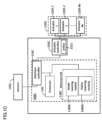
- Figure 1C shows a block diagram illustrating a robotic control system 100C for controlling motions of a robot.
- the robotic control system 100C is configured to control an actuator system 1203 of the robot.
- the controller 100 can be applied to the robotic control system 100C for controlling motions of the robot.
- the robotic control system 100C which includes a model learning module 1300C and a policy learning module 1400C, is connected to an actuator controller 150C of the robot and sensors 1201 that measure the motions of the robot, wherein the robotic control system 100C generates policy parameters based on measurement data of the motion, wherein the control system 100C provides the policy parameters to the actuator controller 150C of the robot to update a policy unit 151C of the actuator controller.
- the robotic control system 100C may include an interface controller 1 10C, a processor 120, and a memory unit 130C.
- the processor 120 may be one or more than one processor units, and the memory unit 130C may be memory devices, a data storage device or the like.
- the interface controller 110C can be an interface circuit, which may include analogue/digital (A/D) and digital/analogue (D/A) converters to make signal/data communication with sensors 1201 and a motion controller 150C of the robot. Further, the interface controller 110C may include a memory to store data to be used by the A/D or D/A converters.
- the sensors 1201 are arranged at joints of the robot (robot arm(s)) or picking object mechanism (e. g. fingers) to measure the stats of the robot.
- the robot includes an actuator controller (device/circuit) 150C that includes a policy unit 151C to generate action parameters to control a robotic system 1203 that controls robot arms, handling mechanism or combinations of the arms and the handling mechanism 1203-1, 1203-2, 1203-3 and 1203-#N, according to the number of joints or handling fingers.
- the sensors 1201 may include acceleration sensors, positioning sensors or global positioning system (GPS) device to measure motion states of the vehicle.
- the sensors 1201 may include acceleration sensors, positioning sensors or the like.
- the interface controller 110C is also connected to the sensors 1201 that measure/ acquire states of the motion of the robot mounted on the robot.
- the actuator controller 150C may control individual electric motors that drive the angles of the robot arms or handling of the object by the handling mechanism.
- the actuator controller 150C may control the rotations of individual motors arranged in the arms to smoothly accelerate or safely decelerate the motion of the robot in response to the policy parameters generated from the policy learning module 1400C.
- the actuator controller 150C may control the lengths of the actuators in response to the policy parameters generated from the policy learning module 1400C.
- the memory unit 130C can store computer-executable program modules including a model learning module 1300C and a policy learning module 1400C.
- the processor 120 is configured to perform steps of the program modules 1300C and 1400C.
- the steps may include offline-modeling to generate offline-learning states based on the action state (motion states) of the robot and measurement state from the sensors 1201 using the model learning module 1300C.
- the steps further perform providing the offline states to the policy learning module 1400C to generate policy parameters and updating the policy 151C of the motion controller 150C of the robot to operate the actuator system 1203 based on the policy parameters.
- Figure 1D shows a schematic diagram illustrating a Particle-based method for policy optimization to control a system.
- the component 1301 represents a schematic of the initial state distribution of the system.
- the components 1302 and 1312 are named particles and are examples of the initial conditions sampled accordingly to the initial state distribution.
- the particles state evolution of particle 1302 is represented by 1303, 1304, 1305. Starting from 1302 the system model estimates the distribution of the particle state at the following steps represented by 1303 at the first step, by 1304 at the second step and by 1305 at the third step. The state evolution continues for how many steps the simulation is decided to last. Analogously, the particles state evolution of particle 1312 is represented by 1313, 1314, 1315.
- Inputs are chosen according to a policy function ⁇ ⁇ : x ⁇ u that depends on the parameter vector ⁇ .
- a model-based approach for learning a policy consists, generally, of the succession of several trials; i.e. attempts to solve the desired task. Each trial consists of three main phases:
- Model-based policy gradient methods use the learned model to predict the state evolution when the current policy is applied. These predictions are used to estimate J ( ⁇ ) and its gradient ⁇ ⁇ J , in order to update the policy parameters ⁇ following a gradient-descent approach.
- GPR Gaussian Process Regression
- a common strategy with GPR-based approaches consists of modeling the evolution of each state dimension with a distinct GP.
- Let's denote by ⁇ t 1 x t + 1 i ⁇ x t i the difference between the value of the i-th component at time t + 1 and t, and by y t i the noisy measurement of ⁇ t i with i ⁇ ⁇ 1,..., d x ⁇ .
- x ⁇ t [x t ,u t ] be the vector that includes the state and the input at time t, also called the GP input.
- h ( i ) ( ⁇ ) is an unknown function modeled a priori as a zero-mean Gaussian Process and i ⁇ ⁇ 1,..., d x ⁇ .
- h ( i ) ⁇ (0, K i ( X ⁇ , X ⁇ ))
- K i ( X ⁇ , X ⁇ ) ⁇ R n ⁇ n defined element-wise through a kernel function k i ( ⁇ , ⁇ ) namely, the element in j-th row and k-th column is given by k i (x ⁇ tj ,x tk ).
- the kernel function encodes prior assumptions about the process.
- ⁇ is assumed to be diagonal, with the diagonal elements named lengthscales.
- the posterior distribution of h ( i ) ( ⁇ ) can be computed in closed form.
- x ⁇ i be a general GP input at time t.
- the posterior distribution for the estimated state at time t + 1 is p x ⁇ t + 1
- the policy ⁇ ⁇ is evaluated and improved based on long-term predictions of the state evolution: p (x ⁇ 1 ),..., p (x T ).
- the first and the second moments of p (x ⁇ 1 ) can be computed in closed form.
- the distribution p (x ⁇ 1 ) is approximated to be a Gaussian distribution, whose mean and variance correspond to the moments computed previously.
- the subsequent probability distributions are computed iterating the procedure for each time step of the prediction horizon. For details about the computation of the first and second moments.
- Moment matching offers the advantage of providing a closed form solution for handling uncertainty propagation through the GP dynamics model. Thus, in this setting, it is possible to analytically compute the policy gradient from long-term predictions.
- the integral in (8) can be approximated relying on Monte Carlo approaches, in particular on particle-based methods.
- M particles are sampled from the initial state distribution p(x 0 ).
- Each one of the M particles is propagated using the one-step-ahead GP models (5).
- the actual policy ⁇ ⁇ is evaluated to compute the associated control.
- the GP model provides the Gaussian distribution p x t + 1 m
- ⁇ i ⁇ 1 y i is computed a single time offline during the training of the GP model (same computation is needed in the moment matching case), and the number of operations required to compute (3) is linear w.r.t. the number of samples n .
- the computational bottleneck is the computation of (4), which is O ( n 2 ).
- the cost of a single state prediction is O ( d x n 2 ), leading to a total computational cost of O ( d x MTn 2 ).
- the computational burden can be substantially mitigated via GPU parallel computing, due to the possibility of computing the evolution of each particle in parallel.
- MC-PILCO relies on GPR for model learning and follows a Monte Carlo sampling method to estimate the expected cumulative cost from particles trajectories propagated through the learned model. We exploit the reparameterization trick to obtain the policy gradient from the sampled particles and optimize the policy. This way of proceeding is very flexible, and allows using any kind of kernels for the GPs, as well as providing more reliable approximations of the system's behaviour.
- MC-PILCO in broad terms, consists of the iteration of three main steps, namely, update the GP models, update the policy parameters, and execute the policy on the system. In its turn, the policy update is composed of three steps, iterated for a maximum of N opt times:
- MC-PILCO adopts a one-step-ahead model, hereafter denoted as speed-integration dynamical model, which exploits the intrinsic correlation between the state components q and q . Indeed, when considering a sufficiently small sampling time T s (small w.r.t.
- I q (respectively I q ) be the ordered set of the dimension indices of the state x associated with q (respectively q ⁇ ).
- the proposed speed-integration model learns only d x /2 GPs, each of which models the evolution of a distinct velocity component ⁇ t i k , with i k ⁇ I q ⁇ . Then, the evolution of the position change, ⁇ t i k , with i k ⁇ I q is computed according to (9) and the predicted change in velocity.
- Many previous MBRL algorithms adopted the standard model described above, and hereafter denoted as full-state dynamical model. The full-state model predicts the change of each state component with a distinct and independent GP.
- the MP kernel allows capturing possible modes of the system that are polynomial functions in x ⁇ , which are typical in mechanical systems, while the SE kernel models more complex behaviors not captured by the polynomial kernel.
- k PI encodes the prior information given by the physics
- k SE compensates for the dynamical components unmodeled in k PI .
- the GP hyperparameters are optimized by maximizing the marginal likelihood (ML) of the training samples.
- ML marginal likelihood
- This procedure first initializes D r with the first sample in D, then, it computes iteratively the GP estimates of all the remaining samples in D, using D r as training samples. Each sample in D is either added to D r if the uncertainty of the estimate is higher than a threshold ⁇ ( i ) or it is discarded. The GP estimator is updated every time a sample is added to D r .
- the trade-off between the reduction of the computational complexity and the severity of the approximation introduced is regulated by tuning ⁇ ( i ) . The higher the ⁇ ( i ) , the smaller the number of samples in D r . On the other hand, using values of ⁇ ( i ) too high might compromise the accuracy of GP predictions.
- the maximum control action u max is constant and chosen depending on the system to control. It is worth mentioning that MC-PILCO can deal with any differentiable policy, so more complex functions, such as deep neural networks could be considered too.
- MC-PILCO derives the policy gradient by applying the reparameterization trick to the computation of the estimated expected cumulative cost in (1), obtained relying on Monte Carlo sampling.
- the sample mean of the costs incurred by the particles at time step t approximates each E x t [ c (x t )] .
- This operation is performed by scaling each weight w, with a random variable r i ⁇ Bernoulli (1 - p d ), where Bernoulli (1- p d ) denotes a Bernoulli distribution, assuming value 1 / (1-p d ) with probability 1 - p d , and 0 with probability p d .
- This operation is equivalent to defining a probability distribution for w, obtaining a parameterized stochastic policy.
- each w i can be approximated with a bimodal distribution, defined by the sum of two properly scaled Gaussian distributions with infinitely small variance ⁇ 2 , namely, p d N 0 ⁇ 2 + 1 ⁇ p d N w i 1 ⁇ p d ⁇ 2 .
- s is computed as a filtered version of the ratio between E[ ⁇ ⁇ j ] and V ⁇ J ⁇ j , that are, respectively, the mean and the standard deviation of ⁇ ⁇ j computed with an Exponential Moving Average (EMA) filter.
- EMA Exponential Moving Average
- the algorithm checks if the absolute value of the monitoring signal s in the last n s iterations is below the threshold ⁇ s , namely, s j ⁇ n s ... s j ⁇ ⁇ s , where ⁇ is an element-wise operator, and the condition in (14) is true if it is verified for all the elements. If the condition is verified, p d is decreased by the quantity ⁇ p d , and both the learning rate of the optimizer, ⁇ lr , and ⁇ s , are scaled by an arbitrary factor ⁇ s .
- the rationale behind this heuristic scaling procedure is the following.
- the s j signal is small, if E[ ⁇ ⁇ j ] is close to zero, or if V[ ⁇ ⁇ j ] is particularly high.
- the first case happens when the optimization reaches a minimum, while the high variance denotes that the particles' trajectories cross regions of the workspace where the uncertainty of the GPs predictions is high.
- we are interested in testing the policy on the real system in the first case to verify if the configuration reached solves the task, and in the second case to collect data where predictions are uncertain, and so to improve model accuracy.
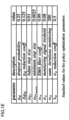
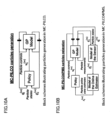
- the algorithm MC-PILCO with dropout is summarized in pseudo-code in Fig. 1F .
- MC-PILCO has been implemented in Python, exploiting the PyTorch library automatic differentiation functionalities; the code is publicly available. We considered the swing-up of a simulated cart-pole, a classical benchmark problem, to perform the ablation studies. The system and the experiments are described in the following.
- ⁇ [rad].
- the control action is the force that pushes the cart horizontally.
- the sampling time is 0.05 seconds.
- the exploration trajectory is obtained by applying at each time step t a random control action sampled from U(-10,10) .
- GP reduction techniques have not been adopted.
- the absolute value on ⁇ t is needed to allow different swing-up solutions to both the equivalent target angles of the pole ⁇ and - ⁇ .
- the first test regards the performance obtained varying the lengthscales of the cost function in (19).
- Reward shaping is a known important aspect of RL and here we will analyze it for MCPILCO.
- the latter set of length-scales defines a more selective cost as the function shape becomes more skewed.
- the speed-integration model may reduce uncertainty in long-term predictions and facilitate the learning w.r.t. the counterpart when few data points have been collected.
- the full-state model could face some difficulties in learning the connection between positions and respective velocities from a limited amount of data. This reduction of the uncertainty may explain the narrower confidence intervals observed during the first trials of the experiment.
- the improvement in precision obtained by full-state model is not very significant. Even with comparable performance, the choice of the speed-integration model is justified since it halves the number of GPs to learn, hence this structure is also improving the computational time.
- MC-PILCO is tested on a cart-pole system and compared to other policy gradient algorithms, namely PILCO and Black-DROPS. In the same environment, we tested the capability of MC-PILCO to handle bimodal probability distributions. Second, MC-PILCO learns a controller in joint space of a UR5 robot arm, considered as an example of a higher DoF system.
- MC-PILCO is able to handle the initial high variance. It learned a bimodal policy that pushes the cart in two opposite directions, depending on the cart's initial position, and stabilizes the system in all the experiments. On the contrary, PILCO's policy is not able to control the cart-pole for all the tested starting conditions. Its strategy is always to push the cart in the same direction, and it cannot stabilize the system when the cart starts far away from the zero position.
- the state evolution under MC-PILCO's policy is bimodal, while PILCO cannot find this type of solutions because of the unimodal approximation enforced by moment matching.
- the objective of this experiment is to test MC-PILCO in a more complex system with higher DoF.
- Let the state at time t be x t q t q ⁇ t T T , where q t ,q ⁇ t ⁇ R 6 are joint angles and velocities, respectively.
- the control scheme is represented in Fig. 8 .
- c x t 1 ⁇ exp ⁇ ⁇ q t r ⁇ q t ⁇ 0.5 2 ⁇ ⁇ q ⁇ t r ⁇ q ⁇ t ⁇ 1 2 .
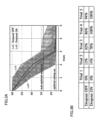
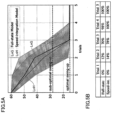
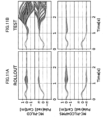
- Fig. 9A and Fig. 9B we report the trajectory followed by the end-effector at each trial, together with the desired trajectory.
- MC-PILCO considerably improved the high tracking error obtained with the PD controller after only 2 trials (corresponding to 8 seconds of interaction with the system).
- the learned control policy followed the reference trajectory for the end-effector with a mean error of 0.65 ⁇ 0.69 [mm] (confidence interval computed as 3 ⁇ standard deviation), and a maximum error of 1.08 [mm].
- MC-PILCO for partially measurable systems
- MC-PILCO4PMS partially measurable systems
- the algorithm MC-PILCO4PMS is validated in simulation as a proof of concept.
- MC-PILCO4PMS a modified version of MC-PILCO.
- MC-PILCO4PMS we propose the two following additions w.r.t. MC-PILCO.
- z t m ⁇ z q ⁇ t m ... q ⁇ t ⁇ m q m , z t ⁇ 1 m ... z t ⁇ 1 ⁇ m z m , where f z denotes the online state estimator, with memory m q and m z , and q ⁇ t m is a fictitious noisy measurement of the m-th particle positions.
- MC-PILCO does not solve the task, due to delays and discrepancies introduced by the online filter and not considered during policy optimization. We believe that these considerations on how to manipulate the data during model learning and policy optimization might be beneficial for other MBRL algorithms different from MC-PILCO.
- the Furuta pendulum is a popular benchmark system used in nonlinear control and reinforcement learning.
- the system is composed of two revolute joints and three links.
- the first link called the base link
- the second link called arm
- the FP is an under-actuated system as only the first joint is actuated.
- the horizontal joint is actuated by a DC servomotor, and the two angles are measured by optical encoders with 4096 [ppr].
- the control variable is the motor voltage.
- the trial length is 3 seconds with a sampling frequency of 30 [Hz].
- c b ( x t ) penalizes solutions where ⁇ t h ⁇ ⁇ 3 4 ⁇ or ⁇ t h ⁇ 3 4 ⁇ .
- Offline estimates of velocities for the GP model have been computed by the offline state estimator using central differences.
- we used causal numerical differentiation: q ⁇ t ( q t - q t -1 )/( T s ), where T s is the sampling time.
- the exploration trajectory has been obtained using as input a sum often sine waves of random frequencies and same amplitudes.
- the initial state distribution is assumed to be N([0,0,0,0] T , diag([5 ⁇ 10 -3 ,5 ⁇ 10 -3 ,5 ⁇ 10 -3 ,5 ⁇ 10 -3 ]).
- M 400 particles were used for gradient estimation, and the GP reduction thresholds were set to 10 -3 .
- SE squared exponential
- SE+P ( d ) squared exponential + polynomial of degree d
- SP semi-parametrical
- MC-PILCO4PMS managed to learn how to swing up the Furuta pendulum in all cases. It succeeded at trial 6 with kernel SE, at trial 4 with kernel SE+P (2) , and at trial 3 with SP kernel. These experimental results confirm the higher data efficiency of more structured kernels and the advantage that MC-PILCO4PMS offers by allowing any kind of kernel function. Moreover, we can observe the effectiveness of the cost function (20) in keeping ⁇ t h always inside the desired boundaries in all the trials and for any kernel tested. Considering penalties similar to c b ( x t ) inside the cost function could be enough to handle soft constraints also in other scenarios. A video of the FP experiment is available in the supplementary material.
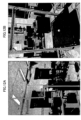
- the ball-and-plate system is composed of a square plate that can be tilted in two orthogonal directions by means of two motors. On top of it, there is a camera to track the ball and measure its position on the plate. Let ( b t x , b t y ) be the position of the center of the ball along X-axis and Y-axis, while ⁇ t 1 and ⁇ t 2 are the angles of the two motors tilting the plate, at time t .
- the drivers of the motors allow only position control, and do not provide feedback about the motors angles.
- the control actions as the difference between two consecutive reference values sent to the motor controllers, and we limited the maximum input to a sufficiently small value, such that the motor controllers are able to reach the target angle within the sampling time.
- the trial length is 3 seconds, with a sampling frequency of 30 [Hz]. Measurements provided by the camera are very noisy, and cannot be used directly to estimate velocities from positions.
- simulating the online estimator during policy optimization we tried both to perturb and to not perturb the positions of the predicted particles with some additive noise. We obtained similar performance in the two cases, this result may be due to the fact that the Kalman filter is able to effectively filter out the white noise added to particles.
- GP inputs [ x t , u t ]
- the GP reduction threshold is reduced to 10 -4 because of the small distances that the ball can cover in one time step.
- M 400 particles for policy gradient estimation.
- Initial exploration is given by two different trials, in which the control signals are two triangular waves perturbed by white noise. Usually during exploration and initial trials, the ball might touch the borders of the plate. In those cases, we kept data up to the collision instant. A peculiarity of this experiment in comparison to the others seen before is a wide range of initial conditions. In fact, the ball could be positioned anywhere on the plate's surface, and the policy must control it to the center.
- the initial distribution of b 0 x and b 0 y is a uniform U(-0.15,0.15), which covers almost the entire surface (the plate is a square with sides of about 0.20 [m]).
- ⁇ t 1 and ⁇ t 2 we assumed tighter initial distributions U(-10 -6 ,10 -6 ).
- MC-PILCO4PMS managed to learn a policy able to control the ball around the center starting from any initial position after the third trial, 11.33 seconds of interaction with the system, see Fig. 14 .
- the proposed framework can use GPs to derive a probabilistic model of the system dynamics, and updates the policy parameters through a gradient-based optimization; the optimization exploits the reparameterization trick and approximates the expected cumulative cost relying on a Monte Carlo approach.
- the Monte Carlo approach worked by focusing on two aspects, that are (i) proper selection of the cost function, and (ii) introduction of exploration during the policy optimization through the use of dropout.
- MC-PILCO with PILCO and Black-DROPS that are two state-of-the-art GP-based MBRL algorithms.
- MC-PILCO outperforms both the algorithms, exhibiting better data-efficiency and asymptotic performance.
- the results obtained in simulation confirm the effectiveness of the proposed solution, and show the relevance of the two aforementioned aspects when optimizing the policy combining the reparameterization trick with particles-based approaches.
- results obtained in simulation and with real systems show that the use of structured kernels can increase data-efficiency, reducing the interaction-time required to learn the task.
- Some embodiments show systems with partially measurable states, which are particularly relevant in real applications. Further, some embodiments can provide a modified algorithm called MC-PILCO4PMS, where we verified the importance of taking into account the state estimators used in the real system during policy optimization. Some results show different simulated scenarios, namely a cart-pole and a robotic manipulator, and also on real systems, such as a Furuta pendulum and a ball-and-plate setup.
- the above-described embodiments of the present invention can be implemented in any of numerous ways.
- the embodiments may be implemented using hardware, software or a combination thereof.
- the software code can be executed on any suitable processor or collection of processors, whether provided in a single computer or distributed among multiple computers.
- processors may be implemented as integrated circuits, with one or more processors in an integrated circuit component.
- a processor may be implemented using circuitry in any suitable format.
- embodiments of the invention may be embodied as a method, of which an example has been provided.
- the acts performed as part of the method may be ordered in any suitable way. Accordingly, embodiments may be constructed in which acts are performed in an order different than illustrated, which may include performing some acts simultaneously, even though shown as sequential acts in illustrative embodiments.
Landscapes
- Engineering & Computer Science (AREA)
- Physics & Mathematics (AREA)
- Theoretical Computer Science (AREA)
- General Physics & Mathematics (AREA)
- Artificial Intelligence (AREA)
- Software Systems (AREA)
- Evolutionary Computation (AREA)
- General Engineering & Computer Science (AREA)
- Data Mining & Analysis (AREA)
- Mathematical Physics (AREA)
- Computing Systems (AREA)
- Health & Medical Sciences (AREA)
- Automation & Control Theory (AREA)
- Biophysics (AREA)
- Computational Linguistics (AREA)
- Biomedical Technology (AREA)
- Molecular Biology (AREA)
- General Health & Medical Sciences (AREA)
- Life Sciences & Earth Sciences (AREA)
- Mechanical Engineering (AREA)
- Transportation (AREA)
- Medical Informatics (AREA)
- Computer Vision & Pattern Recognition (AREA)
- Remote Sensing (AREA)
- Aviation & Aerospace Engineering (AREA)
- Radar, Positioning & Navigation (AREA)
- Chemical & Material Sciences (AREA)
- Combustion & Propulsion (AREA)
- Algebra (AREA)
- Computational Mathematics (AREA)
- Pure & Applied Mathematics (AREA)
- Mathematical Analysis (AREA)
- Probability & Statistics with Applications (AREA)
- Mathematical Optimization (AREA)
- Feedback Control In General (AREA)
Claims (9)
- Fahrzeugsteuerungssystem (100B) zum Steuern von Bewegungen eines Fahrzeugs, umfassend:eine Steuerungseinheit (100), welche mit einer Bewegungs-Steuerungseinheit (150B) des Fahrzeugs verbunden ist, und Fahrzeugbewegungssensoren (1101), die einen Beschleunigungssensor und/oder einen Positionierungssensor und/oder ein globales Positionsbestimmungssystem (GPS) umfassen, um Bewegungszustände des Fahrzeugs zu messen, wobei das Steuerungssystem Richtlinienparameter auf der Grundlage von Messdaten der Bewegung erzeugt, wobei das Steuerungssystem die Richtlinienparameter einer Bewegungs-Steuerungseinheit (150B) des Fahrzeugs bereitstellt, um eine Richtlinien-Einheit der Bewegungs-Steuerungseinheit (150B) zu aktualisieren, wobei die Bewegungs-Steuerungseinheit (150B) eingerichtet ist, Aufhängungen des Fahrzeugs zu steuern, so dass der Bewegungszustand die Verdrängung und die Geschwindigkeit der Verdrängung des Aufhängungssystems aus der Ruheposition ist, und/oder wobei die Bewegungs-Steuerungseinheit (150B) eingerichtet ist, Aktuatoren des Fahrzeugs zu steuern, so dass der Bewegungszustand die Ausrichtung des Fahrzeugs, der Lenkeinschlagswinkel und die Geschwindigkeiten entlang der zwei Achsen des Fahrzeugs ist, wobeidie Steuerungseinheit (100) aufweist:eine Schnittstelle, die mit dem Fahrzeug verbunden ist, wobei die Schnittstelle eingerichtet ist, den Bewegungszustand des Fahrzeugs und einen Messzustand über die Fahrzeugbewegungssensoren (1101), die das Fahrzeug messen, zu erlangen;einen Speicher, um computerausführbare Programmmodule einschließlich eines Erstes-Modell-Lernmoduls (1300, 1300B, 1300C) und eines Richtlinien-Lernmoduls (1400, 1400B, 1400C) zu speichern;einen Prozessor (120), der eingerichtet ist, Schritte der Programmmodule auszuführen, wobei die Schritte umfassen:Offline-Modellierung, um Offline-Lernzustände auf der Grundlage des Bewegungszustands des Fahrzeugs und des Messzustands unter Verwendung eines Modell-Lernprogramms zu generieren, wobeidas Modell-Lernprogramm ausgelegt ist, einen quadratischen exponentiellen (SE) Kernel und einen multiplikativen polynomialen (MP) Kernel oder einen semiparametrischen (SP) Kernel auszuwählen, um die Weiterentwicklung des Fahrzeugs zu modellieren, wobeider SE-Kernel und der MP-Kernel und der SP-Kernel zur Verwendung mit der Gauß-Prozessregression (GPR) mit Gauß-Prozess-(GP)-Eingabe für Modell-Lernen ausgelegt sind, wobei die GP-Eingabe den Bewegungszustand und die Eingabe zum Zeitpunkt t des Fahrzeugs, die von den Fahrzeugbewegungssensoren (1101) gemessen werden, umfasst,wobeidas Erste-Modell-Lernmodul (1300, 1300B, 1300C) einen Offline-Zustandsschätzer (131) und ein Zweites-Modell-Lernmodul (132) enthält, wobei der Offline-Zustandsschätzer (131) die Offline-Zustände schätzt und dem Zweites-Modell-Lernmodul (132) bereitstellt, wobei das Richtlinien-Lernmodul (1400, 1400B, 1400C) Monte-Carlo-(MC)-ba-sierte Partikel generiert, die durch Sampling aus einer Wahrscheinlichkeitsverteilung unter Verwendung eines Monte-Carlo-Ansatzes erhalten werden, um erwartete kumulative Kosten aus Partikeltrajektorien zu schätzen, die durch ein gelerntes Modell propagieren, und ein Modell eines Online-Zustandsschätzers (143) enthält, der eingerichtet ist, Partikel-Online-Schätzungen auf der Grundlage von Partikelmessungen und vorherigen Partikel-Online-Schätzungen zu generieren, wobei die Partikel-Online-Schätzungen eine Annäherung an die Messungen sind; Bereitstellen der Offline-Zustände an das Richtlinien-Lernmodul (1400, 1400B, 1400C), um Richtlinienparameter zu generieren, die in den MCbasierten Partikeln genutzt werden; Aktualisieren der Richtlinien des Fahrzeugs, um das Fahrzeug auf der Grundlage der aktualisierten Richtlinienparameter zu betreiben; undAnwenden der aktualisierten Richtlinien auf das Fahrzeug.
- Fahrzeugsteuerungssystem (100B) nach Anspruch 1, wobei das Zweite-Modell-Lernmodul (132) das Verhalten des realen Systems mit einem Geschwindigkeits-Integrationsmodell lernt, und/oder wobei das Zweite-Modell-Lernmodul (132) offline gelernte Zustände generiert und dem Richtlinien-Lernmodul (1400, 1400B, 1400C) bereitstellt, und/oder wobei das Richtlinien-Lernmodul (1400, 1400B, 1400C) ein Richtlinien-Optimierungsprogramm enthält, wobei das Richtlinien-Optimierungsprogramm eine Richtlinien-Optimierung auf der Grundlage von Offline-Zuständen aus dem Erstes-Modell-Lernmodul (1300, 1300B, 1300C) durchführt und die Richtlinienparameter generiert.
- Fahrzeugsteuerungssystem (100B) nach Anspruch 2, wobei, wenn das Richtlinien-Lernmodul (1400, 1400B, 1400C) ein Richtlinien-Optimierungsprogramm enthält, wobei das Richtlinien-Optimierungsprogramm eine Richtlinien-Optimierung auf der Grundlage von Offline-Zuständen von dem Erstes-Modell-Lernmodul (1300, 1300B, 1300C) durchführt, und das Richtlinien-Optimierungsprogramm die Richtlinienparameter generiert, das Richtlinien-Lernmodul (1400, 1400B, 1400C) ein System-Modell enthält, wobei das System-Modell Partikelzustände auf der Grundlage von vorherigen Partikelzuständen und dem Aktionszustand erzeugt, wobei die Partikelzustände eine Annäherung an den Zustand des Fahrzeugs sind.
- Fahrzeugsteuerungssystem (100B) nach Anspruch 3, wobei das Richtlinien-Lernmodul (1400, 1400B, 1400C) ein Sensor-Modell enthält, das eingerichtet ist, auf der Grundlage der Partikelzustände Partikelmessungen zu generieren.
- Fahrzeugsteuerungssystem (100B) nach Anspruch 1, wobei das Richtlinien-Lernmodul (1400, 1400B, 1400C) eine Richtlinien-Optimierungseinheit enthält, die eingerichtet ist, die Richtlinienparameter auf der Grundlage der Partikelmessungen und der Partikel-Online-Schätzungen zu generieren, wobei die Richtlinien-Optimierungseinheit die Richtlinienparameter bereitstellt, um die Richtlinien-Einheit des realen Systems zu aktualisieren, und/oder wobei die Richtlinien-Optimierungseinheit ein Dropout-Verfahren und eine Frühstopp-Strategie enthält, die eingerichtet sind, die von einer Richtlinien-Optimierungseinheit generierten Richtlinienparameter zu verbessern, und/oder wobei der Offline-Zustandsschätzer (131) aus akausalen Filtern, Kalman-Smoother- oder Zentral-Differenz-Geschwindigkeitsapproximatoren gebildet ist.
- Fahrzeugsteuerungssystem (100B) nach Anspruch 1, wobei das Zweites-Modell-Lernmodul (132) eingerichtet ist, offline gelernte Zustände zu generieren und dem Richtlinien-Lernmodul (1400, 1400B, 1400C) bereitzustellen, wobei das Richtlinien-Lernmodul (1400, 1400B, 1400C) Richtlinienparameter generiert.
- Fahrzeugsteuerungssystem (100B) nach Anspruch 6, wobei das Richtlinien-Lernmodul (1400, 1400B, 1400C) einen Online-Zustandsschätzer (13) enthält, wobei der Online-Zustandsschätzer (13) eine Richtlinien-Optimierung auf der Grundlage der offline gelernten Zustände des Erstes-Modell-Lernmoduls (1300, 1300B, 1300C) durchführt und die Richtlinienparameter generiert.
- Fahrzeugsteuerungssystem (100B) nach Anspruch 6, wobei das Richtlinien-Lernmodul (1400, 1400B, 1400C) ein System-Modell und ein Sensor-Modell enthält, wobei das System-Modell auf der Grundlage der Partikelzustände Partikelmessungen generiert.
- Fahrzeugsteuerungssystem (100B) nach Anspruch 8, wobei das Richtlinien-Lernmodul (1400, 1400B, 1400C) ein Online-Zustandsschätzermodell enthält, das eingerichtet ist, Online-Partikelschätzungen auf der Grundlage der Partikelmessungen und einer vorherigen Partikel-Online-Schätzung zu generieren.
Applications Claiming Priority (2)
| Application Number | Priority Date | Filing Date | Title |
|---|---|---|---|
| US17/112,531 US12346115B2 (en) | 2020-12-04 | 2020-12-04 | Method and system for modelling and control partially measurable systems |
| PCT/JP2021/029038 WO2022118498A1 (en) | 2020-12-04 | 2021-07-21 | Method and system for modelling and control partially measurable systems |
Publications (2)
| Publication Number | Publication Date |
|---|---|
| EP4115335A1 EP4115335A1 (de) | 2023-01-11 |
| EP4115335B1 true EP4115335B1 (de) | 2024-07-17 |
Family
ID=77640720
Family Applications (1)
| Application Number | Title | Priority Date | Filing Date |
|---|---|---|---|
| EP21766011.7A Active EP4115335B1 (de) | 2020-12-04 | 2021-07-21 | Verfahren und system zur modellierung und steuerung teilweise messbarer systeme |
Country Status (5)
| Country | Link |
|---|---|
| US (1) | US12346115B2 (de) |
| EP (1) | EP4115335B1 (de) |
| JP (1) | JP7699660B2 (de) |
| CN (1) | CN116583855A (de) |
| WO (1) | WO2022118498A1 (de) |
Families Citing this family (8)
| Publication number | Priority date | Publication date | Assignee | Title |
|---|---|---|---|---|
| DE102018215061A1 (de) * | 2018-09-05 | 2020-03-05 | Robert Bosch Gmbh | Verfahren zum sicheren Trainieren eines dynamischen Modells |
| US20250181079A1 (en) * | 2020-03-19 | 2025-06-05 | ANDRO Computational Solutions, LLC | Machine learning framework for control of autonomous agent operating in dynamic environment |
| EP4500400A1 (de) * | 2022-03-31 | 2025-02-05 | Sony Group Corporation | Verfahren, computerprogramm und vorrichtung zur bestimmung einer aktion für eine automatisierte vorrichtung auf basis von unsicherheiten eines zustands einer umgebung der automatisierten vorrichtung |
| US20240119275A1 (en) * | 2022-09-28 | 2024-04-11 | International Business Machines Corporation | Contrastive learning by dynamically selecting dropout ratios and locations based on reinforcement learning |
| CN115865129B (zh) * | 2022-12-01 | 2024-03-29 | 电子科技大学 | 一种基于去噪自编码器的窄带干扰智能消除方法 |
| CN116582207A (zh) * | 2023-06-05 | 2023-08-11 | 电子科技大学 | 一种分布式状态估计方法 |
| CN117313826B (zh) * | 2023-11-30 | 2024-02-23 | 安徽大学 | 一种基于强化学习的任意角度倒立摆模型训练方法 |
| CN119692183A (zh) * | 2024-12-03 | 2025-03-25 | 华侨大学 | 基于物理信息神经网络的车辆建模预测方法 |
Citations (2)
| Publication number | Priority date | Publication date | Assignee | Title |
|---|---|---|---|---|
| WO2019235551A1 (en) * | 2018-06-05 | 2019-12-12 | Okinawa Institute Of Science And Technology School Corporation | Total stochastic gradient estimation method, device and computer program |
| US20210334630A1 (en) * | 2020-04-28 | 2021-10-28 | Nvidia Corporation | Model predictive control techniques for autonomous systems |
Family Cites Families (13)
| Publication number | Priority date | Publication date | Assignee | Title |
|---|---|---|---|---|
| EP1205877A1 (de) * | 2000-11-14 | 2002-05-15 | Honda R&D Europe (Deutschland) GmbH | Approximative Angepasstheitsfunktionen |
| GB0613955D0 (en) * | 2006-07-13 | 2007-01-10 | Bae Systems Plc | Controller |
| CA2659698C (en) * | 2008-03-21 | 2020-06-16 | Dressbot Inc. | System and method for collaborative shopping, business and entertainment |
| US20130215116A1 (en) * | 2008-03-21 | 2013-08-22 | Dressbot, Inc. | System and Method for Collaborative Shopping, Business and Entertainment |
| US8326780B2 (en) * | 2008-10-14 | 2012-12-04 | Honda Motor Co., Ltd. | Smoothed sarsa: reinforcement learning for robot delivery tasks |
| US20110246409A1 (en) * | 2010-04-05 | 2011-10-06 | Indian Statistical Institute | Data set dimensionality reduction processes and machines |
| WO2012113732A1 (en) * | 2011-02-25 | 2012-08-30 | Fraunhofer-Gesellschaft Zur Foerderung Der Angewandten Forschung E.V. | Determining model parameters based on transforming a model of an object |
| US20140235474A1 (en) * | 2011-06-24 | 2014-08-21 | Sequenom, Inc. | Methods and processes for non invasive assessment of a genetic variation |
| US10839302B2 (en) * | 2015-11-24 | 2020-11-17 | The Research Foundation For The State University Of New York | Approximate value iteration with complex returns by bounding |
| US10754334B2 (en) * | 2016-05-09 | 2020-08-25 | Strong Force Iot Portfolio 2016, Llc | Methods and systems for industrial internet of things data collection for process adjustment in an upstream oil and gas environment |
| CN106683118B (zh) * | 2016-12-30 | 2020-02-14 | 北京航空航天大学 | 一种基于分层模型的无人机目标跟踪方法 |
| EP3467717A1 (de) * | 2017-10-04 | 2019-04-10 | Prowler.io Limited | Maschinenlernsystem |
| CN110531620B (zh) * | 2019-09-02 | 2020-09-18 | 常熟理工学院 | 基于高斯过程近似模型的小车上山系统自适应控制方法 |
-
2020
- 2020-12-04 US US17/112,531 patent/US12346115B2/en active Active
-
2021
- 2021-07-21 JP JP2023550751A patent/JP7699660B2/ja active Active
- 2021-07-21 EP EP21766011.7A patent/EP4115335B1/de active Active
- 2021-07-21 WO PCT/JP2021/029038 patent/WO2022118498A1/en not_active Ceased
- 2021-07-21 CN CN202180080443.4A patent/CN116583855A/zh active Pending
Patent Citations (2)
| Publication number | Priority date | Publication date | Assignee | Title |
|---|---|---|---|---|
| WO2019235551A1 (en) * | 2018-06-05 | 2019-12-12 | Okinawa Institute Of Science And Technology School Corporation | Total stochastic gradient estimation method, device and computer program |
| US20210334630A1 (en) * | 2020-04-28 | 2021-10-28 | Nvidia Corporation | Model predictive control techniques for autonomous systems |
Non-Patent Citations (4)
| Title |
|---|
| CHATZILYGEROUDIS KONSTANTINOS ET AL: "A Survey on Policy Search Algorithms for Learning Robot Controllers in a Handful of Trials", IEEE TRANSACTIONS ON ROBOTICS, IEEE SERVICE CENTER, PISCATAWAY, NJ, US, vol. 36, no. 2, 1 April 2020 (2020-04-01), pages 328 - 347, XP011781869, ISSN: 1552-3098, [retrieved on 20200402], DOI: 10.1109/TRO.2019.2958211 * |
| GAMBOA HIGUERA JUAN CAMILO ET AL: "Synthesizing Neural Network Controllers with Probabilistic Model-Based Reinforcement Learning", 2018 IEEE/RSJ INTERNATIONAL CONFERENCE ON INTELLIGENT ROBOTS AND SYSTEMS (IROS), IEEE, 1 October 2018 (2018-10-01), pages 2538 - 2544, XP033491303, DOI: 10.1109/IROS.2018.8594018 * |
| MARC PETER DEISENROTH ET AL: "PILCO: A Model-Based and Data-Efficient Approach to Policy Search", NEURAL NETWORKS., vol. 84, 2 July 2011 (2011-07-02), GB, pages 1 - 16, XP055486833, ISSN: 0893-6080, DOI: 10.1016/j.neunet.2016.08.005 * |
| MARINO DANIEL L ET AL: "Modeling and Planning Under Uncertainty Using Deep Neural Networks", IEEE TRANSACTIONS ON INDUSTRIAL INFORMATICS, IEEE SERVICE CENTER, NEW YORK, NY, US, vol. 15, no. 8, 1 August 2019 (2019-08-01), pages 4442 - 4454, XP011739150, ISSN: 1551-3203, [retrieved on 20190806], DOI: 10.1109/TII.2019.2917520 * |
Also Published As
| Publication number | Publication date |
|---|---|
| US20220179419A1 (en) | 2022-06-09 |
| WO2022118498A1 (en) | 2022-06-09 |
| JP7699660B2 (ja) | 2025-06-27 |
| EP4115335A1 (de) | 2023-01-11 |
| CN116583855A (zh) | 2023-08-11 |
| JP2023548964A (ja) | 2023-11-21 |
| US12346115B2 (en) | 2025-07-01 |
Similar Documents
| Publication | Publication Date | Title |
|---|---|---|
| EP4115335B1 (de) | Verfahren und system zur modellierung und steuerung teilweise messbarer systeme | |
| Amadio et al. | Model-based policy search using monte carlo gradient estimation with real systems application | |
| Bhardwaj et al. | Storm: An integrated framework for fast joint-space model-predictive control for reactive manipulation | |
| Xu et al. | Compare contact model-based control and contact model-free learning: A survey of robotic peg-in-hole assembly strategies | |
| Franceschetti et al. | Robotic arm control and task training through deep reinforcement learning | |
| Fu et al. | One-shot learning of manipulation skills with online dynamics adaptation and neural network priors | |
| Caporali et al. | Deformable linear objects manipulation with online model parameters estimation | |
| Chavan-Dafle et al. | Sampling-based planning of in-hand manipulation with external pushes | |
| US12393175B2 (en) | Systems and methods for skill learning with multiple critics | |
| Amadio et al. | Learning control from raw position measurements | |
| Campos et al. | Online measuring of robot positions using inertial measurement units, sensor fusion and artificial intelligence | |
| Anand et al. | Data-Efficient reinforcement learning for variable impedance control | |
| Kasaei et al. | A data-efficient neural ode framework for optimal control of soft manipulators | |
| Singh et al. | Adaptive Koopman embedding for robust control of complex nonlinear dynamical systems | |
| Licher et al. | Adaptive model-predictive control of a soft continuum robot using a physics-informed neural network based on cosserat rod theory | |
| EP2359989B1 (de) | Robotersteuerung mit Bootstrapping Inverse Kinematik | |
| Senda et al. | Approximate Bayesian reinforcement learning based on estimation of plant | |
| Deng et al. | Adaptive gait modeling and optimization for principally kinematic systems | |
| Rigatos | Particle Filtering for state estimation in industrial robotic systems | |
| Baressi Šegota | Determining the Energy-Optimal Path of Six-Axis Industrial Robotic manipulators Using Machine Learning and Memetic Algorithms: doctoral thesis | |
| Jia et al. | A decoupled Bayesian method for snake robot control in unstructured environment | |
| Grimes et al. | Learning nonparametric policies by imitation | |
| Amadio | Processi Gaussiani per Modellizzazione e Controllo Data-Driven in Applicazioni Robotiche | |
| Amadio | Gaussian Processes for Data-Driven Modeling and Control in Robotic Applications | |
| Amadio et al. | Model-based Policy Search for Partially Measurable Systems |
Legal Events
| Date | Code | Title | Description |
|---|---|---|---|
| STAA | Information on the status of an ep patent application or granted ep patent |
Free format text: STATUS: UNKNOWN |
|
| STAA | Information on the status of an ep patent application or granted ep patent |
Free format text: STATUS: THE INTERNATIONAL PUBLICATION HAS BEEN MADE |
|
| PUAI | Public reference made under article 153(3) epc to a published international application that has entered the european phase |
Free format text: ORIGINAL CODE: 0009012 |
|
| STAA | Information on the status of an ep patent application or granted ep patent |
Free format text: STATUS: REQUEST FOR EXAMINATION WAS MADE |
|
| 17P | Request for examination filed |
Effective date: 20221007 |
|
| AK | Designated contracting states |
Kind code of ref document: A1 Designated state(s): AL AT BE BG CH CY CZ DE DK EE ES FI FR GB GR HR HU IE IS IT LI LT LU LV MC MK MT NL NO PL PT RO RS SE SI SK SM TR |
|
| STAA | Information on the status of an ep patent application or granted ep patent |
Free format text: STATUS: EXAMINATION IS IN PROGRESS |
|
| 17Q | First examination report despatched |
Effective date: 20230202 |
|
| REG | Reference to a national code |
Ref country code: DE Ref legal event code: R079 Free format text: PREVIOUS MAIN CLASS: G06N0003000000 Ipc: G06N0003006000 Ref country code: DE Ref legal event code: R079 Ref document number: 602021015906 Country of ref document: DE Free format text: PREVIOUS MAIN CLASS: G06N0003000000 Ipc: G06N0003006000 |
|
| GRAP | Despatch of communication of intention to grant a patent |
Free format text: ORIGINAL CODE: EPIDOSNIGR1 |
|
| STAA | Information on the status of an ep patent application or granted ep patent |
Free format text: STATUS: GRANT OF PATENT IS INTENDED |
|
| DAV | Request for validation of the european patent (deleted) | ||
| DAX | Request for extension of the european patent (deleted) | ||
| INTG | Intention to grant announced |
Effective date: 20240222 |
|
| RIC1 | Information provided on ipc code assigned before grant |
Ipc: G06N 3/084 20230101ALN20240209BHEP Ipc: G06N 20/10 20190101ALI20240209BHEP Ipc: G06N 7/01 20230101ALI20240209BHEP Ipc: G06N 3/082 20230101ALI20240209BHEP Ipc: G06N 3/048 20230101ALI20240209BHEP Ipc: G06N 3/092 20230101ALI20240209BHEP Ipc: G06N 3/006 20230101AFI20240209BHEP |
|
| GRAS | Grant fee paid |
Free format text: ORIGINAL CODE: EPIDOSNIGR3 |
|
| GRAA | (expected) grant |
Free format text: ORIGINAL CODE: 0009210 |
|
| STAA | Information on the status of an ep patent application or granted ep patent |
Free format text: STATUS: THE PATENT HAS BEEN GRANTED |
|
| AK | Designated contracting states |
Kind code of ref document: B1 Designated state(s): AL AT BE BG CH CY CZ DE DK EE ES FI FR GB GR HR HU IE IS IT LI LT LU LV MC MK MT NL NO PL PT RO RS SE SI SK SM TR |
|
| REG | Reference to a national code |
Ref country code: CH Ref legal event code: EP |
|
| REG | Reference to a national code |
Ref country code: DE Ref legal event code: R096 Ref document number: 602021015906 Country of ref document: DE |
|
| REG | Reference to a national code |
Ref country code: IE Ref legal event code: FG4D |
|
| REG | Reference to a national code |
Ref country code: LT Ref legal event code: MG9D |
|
| REG | Reference to a national code |
Ref country code: NL Ref legal event code: MP Effective date: 20240717 |
|
| PG25 | Lapsed in a contracting state [announced via postgrant information from national office to epo] |
Ref country code: PT Free format text: LAPSE BECAUSE OF FAILURE TO SUBMIT A TRANSLATION OF THE DESCRIPTION OR TO PAY THE FEE WITHIN THE PRESCRIBED TIME-LIMIT Effective date: 20241118 |
|
| REG | Reference to a national code |
Ref country code: AT Ref legal event code: MK05 Ref document number: 1704831 Country of ref document: AT Kind code of ref document: T Effective date: 20240717 |
|
| PG25 | Lapsed in a contracting state [announced via postgrant information from national office to epo] |
Ref country code: NL Free format text: LAPSE BECAUSE OF FAILURE TO SUBMIT A TRANSLATION OF THE DESCRIPTION OR TO PAY THE FEE WITHIN THE PRESCRIBED TIME-LIMIT Effective date: 20240717 |
|
| PG25 | Lapsed in a contracting state [announced via postgrant information from national office to epo] |
Ref country code: PT Free format text: LAPSE BECAUSE OF FAILURE TO SUBMIT A TRANSLATION OF THE DESCRIPTION OR TO PAY THE FEE WITHIN THE PRESCRIBED TIME-LIMIT Effective date: 20241118 Ref country code: NL Free format text: LAPSE BECAUSE OF FAILURE TO SUBMIT A TRANSLATION OF THE DESCRIPTION OR TO PAY THE FEE WITHIN THE PRESCRIBED TIME-LIMIT Effective date: 20240717 |
|
| PG25 | Lapsed in a contracting state [announced via postgrant information from national office to epo] |
Ref country code: NO Free format text: LAPSE BECAUSE OF FAILURE TO SUBMIT A TRANSLATION OF THE DESCRIPTION OR TO PAY THE FEE WITHIN THE PRESCRIBED TIME-LIMIT Effective date: 20241017 |
|
| PG25 | Lapsed in a contracting state [announced via postgrant information from national office to epo] |
Ref country code: GR Free format text: LAPSE BECAUSE OF FAILURE TO SUBMIT A TRANSLATION OF THE DESCRIPTION OR TO PAY THE FEE WITHIN THE PRESCRIBED TIME-LIMIT Effective date: 20241018 Ref country code: FI Free format text: LAPSE BECAUSE OF FAILURE TO SUBMIT A TRANSLATION OF THE DESCRIPTION OR TO PAY THE FEE WITHIN THE PRESCRIBED TIME-LIMIT Effective date: 20240717 Ref country code: PL Free format text: LAPSE BECAUSE OF FAILURE TO SUBMIT A TRANSLATION OF THE DESCRIPTION OR TO PAY THE FEE WITHIN THE PRESCRIBED TIME-LIMIT Effective date: 20240717 |
|
| PG25 | Lapsed in a contracting state [announced via postgrant information from national office to epo] |
Ref country code: BG Free format text: LAPSE BECAUSE OF FAILURE TO SUBMIT A TRANSLATION OF THE DESCRIPTION OR TO PAY THE FEE WITHIN THE PRESCRIBED TIME-LIMIT Effective date: 20240717 |
|
| PG25 | Lapsed in a contracting state [announced via postgrant information from national office to epo] |
Ref country code: LV Free format text: LAPSE BECAUSE OF FAILURE TO SUBMIT A TRANSLATION OF THE DESCRIPTION OR TO PAY THE FEE WITHIN THE PRESCRIBED TIME-LIMIT Effective date: 20240717 |
|
| PG25 | Lapsed in a contracting state [announced via postgrant information from national office to epo] |
Ref country code: IS Free format text: LAPSE BECAUSE OF FAILURE TO SUBMIT A TRANSLATION OF THE DESCRIPTION OR TO PAY THE FEE WITHIN THE PRESCRIBED TIME-LIMIT Effective date: 20241117 Ref country code: AT Free format text: LAPSE BECAUSE OF FAILURE TO SUBMIT A TRANSLATION OF THE DESCRIPTION OR TO PAY THE FEE WITHIN THE PRESCRIBED TIME-LIMIT Effective date: 20240717 |
|
| PG25 | Lapsed in a contracting state [announced via postgrant information from national office to epo] |
Ref country code: HR Free format text: LAPSE BECAUSE OF FAILURE TO SUBMIT A TRANSLATION OF THE DESCRIPTION OR TO PAY THE FEE WITHIN THE PRESCRIBED TIME-LIMIT Effective date: 20240717 |
|
| PG25 | Lapsed in a contracting state [announced via postgrant information from national office to epo] |
Ref country code: RS Free format text: LAPSE BECAUSE OF FAILURE TO SUBMIT A TRANSLATION OF THE DESCRIPTION OR TO PAY THE FEE WITHIN THE PRESCRIBED TIME-LIMIT Effective date: 20241017 Ref country code: ES Free format text: LAPSE BECAUSE OF FAILURE TO SUBMIT A TRANSLATION OF THE DESCRIPTION OR TO PAY THE FEE WITHIN THE PRESCRIBED TIME-LIMIT Effective date: 20240717 |
|
| PG25 | Lapsed in a contracting state [announced via postgrant information from national office to epo] |
Ref country code: RS Free format text: LAPSE BECAUSE OF FAILURE TO SUBMIT A TRANSLATION OF THE DESCRIPTION OR TO PAY THE FEE WITHIN THE PRESCRIBED TIME-LIMIT Effective date: 20241017 Ref country code: PL Free format text: LAPSE BECAUSE OF FAILURE TO SUBMIT A TRANSLATION OF THE DESCRIPTION OR TO PAY THE FEE WITHIN THE PRESCRIBED TIME-LIMIT Effective date: 20240717 Ref country code: NO Free format text: LAPSE BECAUSE OF FAILURE TO SUBMIT A TRANSLATION OF THE DESCRIPTION OR TO PAY THE FEE WITHIN THE PRESCRIBED TIME-LIMIT Effective date: 20241017 Ref country code: LV Free format text: LAPSE BECAUSE OF FAILURE TO SUBMIT A TRANSLATION OF THE DESCRIPTION OR TO PAY THE FEE WITHIN THE PRESCRIBED TIME-LIMIT Effective date: 20240717 Ref country code: IS Free format text: LAPSE BECAUSE OF FAILURE TO SUBMIT A TRANSLATION OF THE DESCRIPTION OR TO PAY THE FEE WITHIN THE PRESCRIBED TIME-LIMIT Effective date: 20241117 Ref country code: HR Free format text: LAPSE BECAUSE OF FAILURE TO SUBMIT A TRANSLATION OF THE DESCRIPTION OR TO PAY THE FEE WITHIN THE PRESCRIBED TIME-LIMIT Effective date: 20240717 Ref country code: GR Free format text: LAPSE BECAUSE OF FAILURE TO SUBMIT A TRANSLATION OF THE DESCRIPTION OR TO PAY THE FEE WITHIN THE PRESCRIBED TIME-LIMIT Effective date: 20241018 Ref country code: FI Free format text: LAPSE BECAUSE OF FAILURE TO SUBMIT A TRANSLATION OF THE DESCRIPTION OR TO PAY THE FEE WITHIN THE PRESCRIBED TIME-LIMIT Effective date: 20240717 Ref country code: ES Free format text: LAPSE BECAUSE OF FAILURE TO SUBMIT A TRANSLATION OF THE DESCRIPTION OR TO PAY THE FEE WITHIN THE PRESCRIBED TIME-LIMIT Effective date: 20240717 Ref country code: BG Free format text: LAPSE BECAUSE OF FAILURE TO SUBMIT A TRANSLATION OF THE DESCRIPTION OR TO PAY THE FEE WITHIN THE PRESCRIBED TIME-LIMIT Effective date: 20240717 Ref country code: AT Free format text: LAPSE BECAUSE OF FAILURE TO SUBMIT A TRANSLATION OF THE DESCRIPTION OR TO PAY THE FEE WITHIN THE PRESCRIBED TIME-LIMIT Effective date: 20240717 |
|
| REG | Reference to a national code |
Ref country code: CH Ref legal event code: PL |
|
| PG25 | Lapsed in a contracting state [announced via postgrant information from national office to epo] |
Ref country code: LU Free format text: LAPSE BECAUSE OF NON-PAYMENT OF DUE FEES Effective date: 20240721 |
|
| PG25 | Lapsed in a contracting state [announced via postgrant information from national office to epo] |
Ref country code: LU Free format text: LAPSE BECAUSE OF NON-PAYMENT OF DUE FEES Effective date: 20240721 |
|
| PG25 | Lapsed in a contracting state [announced via postgrant information from national office to epo] |
Ref country code: RO Free format text: LAPSE BECAUSE OF FAILURE TO SUBMIT A TRANSLATION OF THE DESCRIPTION OR TO PAY THE FEE WITHIN THE PRESCRIBED TIME-LIMIT Effective date: 20240717 Ref country code: DK Free format text: LAPSE BECAUSE OF FAILURE TO SUBMIT A TRANSLATION OF THE DESCRIPTION OR TO PAY THE FEE WITHIN THE PRESCRIBED TIME-LIMIT Effective date: 20240717 Ref country code: SM Free format text: LAPSE BECAUSE OF FAILURE TO SUBMIT A TRANSLATION OF THE DESCRIPTION OR TO PAY THE FEE WITHIN THE PRESCRIBED TIME-LIMIT Effective date: 20240717 |
|
| REG | Reference to a national code |
Ref country code: DE Ref legal event code: R097 Ref document number: 602021015906 Country of ref document: DE |
|
| PG25 | Lapsed in a contracting state [announced via postgrant information from national office to epo] |
Ref country code: CH Free format text: LAPSE BECAUSE OF NON-PAYMENT OF DUE FEES Effective date: 20240731 Ref country code: MC Free format text: LAPSE BECAUSE OF FAILURE TO SUBMIT A TRANSLATION OF THE DESCRIPTION OR TO PAY THE FEE WITHIN THE PRESCRIBED TIME-LIMIT Effective date: 20240717 Ref country code: EE Free format text: LAPSE BECAUSE OF FAILURE TO SUBMIT A TRANSLATION OF THE DESCRIPTION OR TO PAY THE FEE WITHIN THE PRESCRIBED TIME-LIMIT Effective date: 20240717 Ref country code: BE Free format text: LAPSE BECAUSE OF NON-PAYMENT OF DUE FEES Effective date: 20240731 |
|
| PG25 | Lapsed in a contracting state [announced via postgrant information from national office to epo] |
Ref country code: CZ Free format text: LAPSE BECAUSE OF FAILURE TO SUBMIT A TRANSLATION OF THE DESCRIPTION OR TO PAY THE FEE WITHIN THE PRESCRIBED TIME-LIMIT Effective date: 20240717 |
|
| PG25 | Lapsed in a contracting state [announced via postgrant information from national office to epo] |
Ref country code: SK Free format text: LAPSE BECAUSE OF FAILURE TO SUBMIT A TRANSLATION OF THE DESCRIPTION OR TO PAY THE FEE WITHIN THE PRESCRIBED TIME-LIMIT Effective date: 20240717 |
|
| PLBE | No opposition filed within time limit |
Free format text: ORIGINAL CODE: 0009261 |
|
| STAA | Information on the status of an ep patent application or granted ep patent |
Free format text: STATUS: NO OPPOSITION FILED WITHIN TIME LIMIT |
|
| REG | Reference to a national code |
Ref country code: BE Ref legal event code: MM Effective date: 20240731 |
|
| 26N | No opposition filed |
Effective date: 20250422 |
|
| PG25 | Lapsed in a contracting state [announced via postgrant information from national office to epo] |
Ref country code: FR Free format text: LAPSE BECAUSE OF NON-PAYMENT OF DUE FEES Effective date: 20240917 |
|
| PG25 | Lapsed in a contracting state [announced via postgrant information from national office to epo] |
Ref country code: IE Free format text: LAPSE BECAUSE OF NON-PAYMENT OF DUE FEES Effective date: 20240721 |
|
| PG25 | Lapsed in a contracting state [announced via postgrant information from national office to epo] |
Ref country code: SE Free format text: LAPSE BECAUSE OF FAILURE TO SUBMIT A TRANSLATION OF THE DESCRIPTION OR TO PAY THE FEE WITHIN THE PRESCRIBED TIME-LIMIT Effective date: 20240717 |
|
| P01 | Opt-out of the competence of the unified patent court (upc) registered |
Free format text: CASE NUMBER: UPC_APP_4948_4115335/2025 Effective date: 20250827 |
|
| PGFP | Annual fee paid to national office [announced via postgrant information from national office to epo] |
Ref country code: DE Payment date: 20250528 Year of fee payment: 5 |
|
| PG25 | Lapsed in a contracting state [announced via postgrant information from national office to epo] |
Ref country code: IT Free format text: LAPSE BECAUSE OF FAILURE TO SUBMIT A TRANSLATION OF THE DESCRIPTION OR TO PAY THE FEE WITHIN THE PRESCRIBED TIME-LIMIT Effective date: 20240717 Ref country code: CY Free format text: LAPSE BECAUSE OF FAILURE TO SUBMIT A TRANSLATION OF THE DESCRIPTION OR TO PAY THE FEE WITHIN THE PRESCRIBED TIME-LIMIT; INVALID AB INITIO Effective date: 20210721 |
|
| PG25 | Lapsed in a contracting state [announced via postgrant information from national office to epo] |
Ref country code: HU Free format text: LAPSE BECAUSE OF FAILURE TO SUBMIT A TRANSLATION OF THE DESCRIPTION OR TO PAY THE FEE WITHIN THE PRESCRIBED TIME-LIMIT; INVALID AB INITIO Effective date: 20210721 |
|
| GBPC | Gb: european patent ceased through non-payment of renewal fee |
Effective date: 20250721 |
|
| PG25 | Lapsed in a contracting state [announced via postgrant information from national office to epo] |
Ref country code: GB Free format text: LAPSE BECAUSE OF NON-PAYMENT OF DUE FEES Effective date: 20250721 |