EP4113139B1 - Lithium battery soc estimation method and computer-readable storage medium - Google Patents
Lithium battery soc estimation method and computer-readable storage medium Download PDFInfo
- Publication number
- EP4113139B1 EP4113139B1 EP22773375.5A EP22773375A EP4113139B1 EP 4113139 B1 EP4113139 B1 EP 4113139B1 EP 22773375 A EP22773375 A EP 22773375A EP 4113139 B1 EP4113139 B1 EP 4113139B1
- Authority
- EP
- European Patent Office
- Prior art keywords
- sample
- sub
- model
- test
- state data
- Prior art date
- Legal status (The legal status is an assumption and is not a legal conclusion. Google has not performed a legal analysis and makes no representation as to the accuracy of the status listed.)
- Active
Links
Images


Classifications
-
- G—PHYSICS
- G01—MEASURING; TESTING
- G01R—MEASURING ELECTRIC VARIABLES; MEASURING MAGNETIC VARIABLES
- G01R31/00—Arrangements for testing electric properties; Arrangements for locating electric faults; Arrangements for electrical testing characterised by what is being tested not provided for elsewhere
- G01R31/36—Arrangements for testing, measuring or monitoring the electrical condition of accumulators or electric batteries, e.g. capacity or state of charge [SoC]
- G01R31/367—Software therefor, e.g. for battery testing using modelling or look-up tables
-
- G—PHYSICS
- G06—COMPUTING OR CALCULATING; COUNTING
- G06N—COMPUTING ARRANGEMENTS BASED ON SPECIFIC COMPUTATIONAL MODELS
- G06N7/00—Computing arrangements based on specific mathematical models
- G06N7/01—Probabilistic graphical models, e.g. probabilistic networks
-
- H—ELECTRICITY
- H01—ELECTRIC ELEMENTS
- H01M—PROCESSES OR MEANS, e.g. BATTERIES, FOR THE DIRECT CONVERSION OF CHEMICAL ENERGY INTO ELECTRICAL ENERGY
- H01M10/00—Secondary cells; Manufacture thereof
- H01M10/42—Methods or arrangements for servicing or maintenance of secondary cells or secondary half-cells
- H01M10/44—Methods for charging or discharging
- H01M10/443—Methods for charging or discharging in response to temperature
-
- G—PHYSICS
- G01—MEASURING; TESTING
- G01R—MEASURING ELECTRIC VARIABLES; MEASURING MAGNETIC VARIABLES
- G01R31/00—Arrangements for testing electric properties; Arrangements for locating electric faults; Arrangements for electrical testing characterised by what is being tested not provided for elsewhere
- G01R31/36—Arrangements for testing, measuring or monitoring the electrical condition of accumulators or electric batteries, e.g. capacity or state of charge [SoC]
- G01R31/378—Arrangements for testing, measuring or monitoring the electrical condition of accumulators or electric batteries, e.g. capacity or state of charge [SoC] specially adapted for the type of battery or accumulator
-
- G—PHYSICS
- G01—MEASURING; TESTING
- G01R—MEASURING ELECTRIC VARIABLES; MEASURING MAGNETIC VARIABLES
- G01R31/00—Arrangements for testing electric properties; Arrangements for locating electric faults; Arrangements for electrical testing characterised by what is being tested not provided for elsewhere
- G01R31/36—Arrangements for testing, measuring or monitoring the electrical condition of accumulators or electric batteries, e.g. capacity or state of charge [SoC]
- G01R31/382—Arrangements for monitoring battery or accumulator variables, e.g. SoC
- G01R31/3842—Arrangements for monitoring battery or accumulator variables, e.g. SoC combining voltage and current measurements
Definitions
- the present application relates to the technical field of SOC estimation of lithium batteries, and for example, relates to a method, device and computer readable storage medium for estimating SOC of a lithium battery.
- mapping relationships between battery voltage, current, temperature or the like and SOC are usually obtained by off-line training with machine learning algorithms, and then the measured data is substituted into the model to calculate the estimated SOC value.
- this method usually constructs a single global model, which is not conducive to representing the local process characteristics of SOC under multiple working conditions, and leads to insufficient accuracy and poor reliability of SOC estimation.
- a technical problem to be solved by the present application is to provide a method and a computer readable storage medium for estimating SOC of a lithium battery, so as to improve the accuracy and reliability of the estimated SOC value of the lithium battery.
- a technical solution adopted by an embodiment of the present application is to provide a method for estimating SOC of a lithium battery as defined in independent claim 1, and the method comprises steps of:
- the state data of the lithium battery comprises at least one of charging and discharging current, terminal voltage and temperature of the lithium battery.
- the step of performing clustering analysis on the sample set to obtain a plurality of sample subsets comprises: performing clustering analysis on the sample set to obtain a plurality of sample subsets by using the K-means algorithm, which comprises steps of:
- the step of establishing a corresponding sub-model for each of the sample subsets to obtain sub-model functions of the plurality of sample subsets comprises:
- the operation of adding the state data of a sample to be tested respectively into the state data of each of the sample subsets and calculating a change value of the state data of each of the sample subsets before and after the adding operation comprises:
- the step of selecting at least one sub-model close to the sample to be tested as the selected sub-model according to the change value comprises:
- the step of assigning a weight to the selected sub-model comprises:
- yet another technical solution adopted by an embodiment of the present application is to provide a computer readable storage medium having computer executable instructions stored therein, and the computer executable instructions enable a computer to execute the method described above.
- yet another technical solution adopted by an embodiment of the present application is to provide a computer program product comprising a computer program stored on a nonvolatile computer readable storage medium, the computer program comprises program instructions which, when executed by an electronic equipment, enable the electronic equipment to execute the method as described above.
- Embodiments of the present application provide a method and a computer readable storage medium for estimating SOC of a lithium battery.
- state data and corresponding SOC values of lithium batteries under different working conditions are collected to establish a sample set, and clustering analysis is performed on the sample set to obtain a plurality of sample subsets; then a corresponding sub-model is established for each of the sample subsets to obtain sub-model functions of the plurality of sample subsets.
- Piecewise approximate linearization is performed on the nonlinear lithium battery system by clustering analysis to obtain a multi-segment local linear sub-model, thereby avoiding the defect of low generalization performance of a single global model.
- the state data of a sample to be tested is respectively added into the state data of each of the sample subsets to calculate a change value of the state data of each of the sample subsets before and after the adding operation, and at least one sub-model close to the sample to be tested is selected as the selected sub-model according to the change value; and finally, a weight is assigned to the selected sub-model to calculate the SOC value of the sample to be tested.
- the relevant sub-models are selected from the perspective of probability density distribution of samples, the difference of probability density distribution among sample sets is taken into full consideration to accordingly assign weights to the relevant sub-models, and the final SOC estimation is output so that the SOC estimation result has higher accuracy and reliability.
- FIG. 1 is a flowchart diagram of a method for estimating SOC of a lithium battery provided according to an embodiment of the present application.
- steps of the method comprise: S1: collecting state data and corresponding SOC values of lithium batteries under different working conditions and establishing a sample set, and performing clustering analysis on the sample set to obtain a plurality of sample subsets.
- the sample subsets comprise (X 1 ,Y 1 ), (X 2 ,Y 2 ),...,(X j ,Y j ),...,(X N ,Y N ), wherein 1 ⁇ j ⁇ N, N represents the total number of sample subsets, X represents the state data of the sample subsets, and Y represents the SOC value of the sample subsets.
- the state data comprises at least one of charging and discharging current, terminal voltage and temperature of the lithium battery
- the SOC value refers to the ratio of the remaining capacity of the lithium battery to the capacity of the lithium battery in a fully charged state, and the SOC value ranges from 0% to 100%. When the SOC value is equal to 0%, it means that the lithium battery is fully discharged, and when the SOC value is 100%, it means that the lithium battery is fully charged. By knowing the SOC value, the operation of the lithium battery can be controlled.
- each group of state data x corresponds to an SOC value y
- the state data x is an independent variable
- the corresponding SOC value y is a dependent variable.
- the independent variable x is taken as an input model and the dependent variable y is taken as an output model, and the relationship between the independent variable x and the dependent variable y is calculated to acquire an SOC estimation model of the lithium battery.
- sample sets collected during the above steps are all used as training sets to obtain the SOC estimation model.
- the clustering analysis is used for performing piecewise analysis on the nonlinear lithium battery system for approximate linearization.
- the clustering analysis may adopt any clustering analysis algorithm currently available.
- the K-means clustering algorithm is used to perform clustering analysis on the sample set, and the specific steps are as follows:
- S2 establishing a corresponding sub-model for each of the sample subsets to obtain sub-model functions of the plurality of sample subsets.
- Linear regression operation is performed on the sample subsets (X 1 ,Y 1 ), (X 2 ,Y 2 ),...,(X j ,Y j ),...,(X N ,Y N ) after the clustering analysis in the step S1 to acquire a regression classification model for SOC of the lithium battery.
- PLS partial least squares regression method
- PLS is a kind of statistical method which mainly uses the characteristics of principal component analysis to respectively project predicted variables and observed variables into a new space so as to find one linear regression model.
- the diagonal matrix refers to a matrix in which all elements other than the main diagonal are 0.
- PCR principal component regression
- S3 adding the state data of a sample to be tested respectively into the state data of each of the sample subsets, calculating a change value of the state data of each of the sample subsets before and after the adding operation, and selecting at least one sub-model close to the sample to be tested as the selected sub-model according to the change value.
- the step of calculating a change value of the state data of each of the sample subsets before and after the adding operation may be performed by KL divergence K j ′ , which measures the difference of probability density distribution before and after the change of state data.
- the second divergence information value K j ′ is compared with a preset divergence information value ⁇ , and the sub-model which corresponds to K j ′ not less than the preset divergence information value ⁇ is taken as the selected sub-model close to the sample to be tested.
- the output result of SOC integration estimation corresponding to the test sample x test is obtained according to the weight assigned to each selected sub-model and in combination with the sub-model function thereof.
- the method for estimating SOC of the lithium battery further comprises verifying the SOC estimation model of the lithium battery after acquiring the SOC estimation model. After acquiring the SOC estimation model of the lithium battery, the SOC value obtained by the SOC estimation model of the lithium battery may be verified by root mean square error and average relative error, so as to determine whether the SOC value obtained by the SOC estimation model of the lithium battery is accurate or not.
- FIG. 2 is a diagram illustrating an estimation result of a method for estimating SOC of a lithium battery provided according to an embodiment of the present application.
- the straight line represents the true value of SOC of the lithium battery
- the dotted line represents the estimated value obtained according to the SOC estimation model of the lithium battery.
- the true value of SOC of the lithium battery and the estimated value of SOC of the lithium battery are approximately on the same straight line.
- At least one of the terminal voltage, charging and discharging current and temperature of the lithium battery is acquired in real time, and input into the SOC estimation model of the lithium battery, so as to acquire the corresponding SOC values of the lithium battery corresponding to the terminal voltage, charging and discharging current and temperature.
- the embodiments of the present application provide a method for estimating SOC of a lithium battery, in the method for estimating SOC of the lithium battery, state data and corresponding SOC values of lithium batteries under different working conditions are collected to establish a sample set, and clustering analysis is performed on the sample set to obtain a plurality of sample subsets; then a corresponding sub-model is established for each of the sample subsets to obtain sub-model functions of the plurality of sample subsets; next, the state data of a sample to be tested is respectively added into the state data of each of the sample subsets to calculate a change value of the state data of each of the sample subsets before and after the adding operation, and at least one sub-model close to the sample to be tested is selected as the selected sub-model according to the change value; and finally, a weight is assigned to the selected sub-model to calculate the SOC value of the sample to be tested.
- FIG. 3 is a structural block diagram of a device for estimating SOC of a lithium battery provided according to an embodiment of the present application.
- the device 1 for estimating SOC of the lithium battery comprises an acquisition module 11, a model establishing module 12, a selection module 13 and an SOC calculating module 14.
- the acquisition module 11 is configured to collect state data and corresponding SOC values of lithium batteries under different working conditions and establish a sample set, and perform clustering analysis on the sample set to obtain a plurality of sample subsets.
- the model establishing module 12 is configured to establish a corresponding sub-model for each of the sample subsets to obtain sub-model functions of the plurality of sample subsets.
- the selection module 13 is configured to add the state data of a sample to be tested respectively into the state data of each of the sample subsets, calculate a change value of the state data of each of the sample subsets before and after the adding operation, and select at least one sub-model close to the sample to be tested as the selected sub-model according to the change value.
- the SOC calculating module 14 is configured to assign a weight to the selected sub-model, and calculate the SOC value of the sample to be tested.
- the device for estimating SOC of the lithium battery described above can execute the method for estimating SOC of the lithium battery provided according to the embodiment of the present application, and has corresponding functional modules and beneficial effects for executing the method.
- the method for estimating SOC of the lithium battery provided according to the embodiment of the present application please refer to the method for estimating SOC of the lithium battery provided according to the embodiment of the present application.
- the embodiments of the device described above are only for illustrative purpose.
- the units illustrated as separate components may be or may not be physically separated, and components displayed as units may be or may not be physical units. That is, these units and components may be located in one place or distributed over multiple network units. Some or all of the modules may be selected according to actual needs to achieve the purpose of the solution of the embodiments.
- an embodiment of the present application provides an electronic equipment 30, which comprises: at least one processor 31, one processor 31 being taken as an example in FIG. 4 ; and a memory 32 communicatively connected to the at least one processor 31, connection through a bus being taken as an example in FIG. 4 .
- the memory 32 stores instructions that can be executed by the at least one processor 31, and the instructions are executed by the at least one processor 31 to enable the at least one processor 31 to execute the method for estimating SOC of the lithium battery described above.
- the memory 32 may be used to store nonvolatile software programs, nonvolatile computer executable programs and modules, such as program instructions/modules corresponding to the method for estimating SOC of the lithium battery in the embodiments of the present application.
- the processor 31 runs the nonvolatile software programs, instructions and modules stored in the memory 32, thereby executing various functional applications and data processing of the electronic equipment 30, i.e., implementing the method for estimating SOC of the lithium battery provided by the embodiments of the method described above.
- the memory 32 may comprise a program storage area and a data storage area, wherein the program storage area may store operating systems and application programs required by at least one function.
- the memory 32 may comprise a high-speed random access memory, and may also comprise a nonvolatile memory.
- the memory 32 comprises at least one magnetic disk memory device, flash memory device, or other nonvolatile solid-state memory device.
- the memory 32 optionally comprises memories remotely provided relative to the processor 31.
- the one or more modules are stored in the memory 32, and when executed by the one or more processors 31, the one or more modules execute the method for estimating SOC of the lithium battery in any of the embodiments of the method described above, e.g., execute the steps of the method of FIG. 1 described above.
- the electronic equipment described above may execute the method provided according to the embodiments of the present application, and have corresponding functional modules for executing the method.
- the method provided according to the embodiments of the present application may execute the method provided according to the embodiments of the present application, and have corresponding functional modules for executing the method.
- technical details not described in detail in this embodiment please refer to the method provided according to the embodiments of the present application.
- the electronic equipment of the embodiment of the present application exists in various forms, including but not limited to:
- An embodiment of the present application further provides a computer readable storage medium, in which computer executable instructions are stored.
- the computer executable instructions are executed by one or more processors to for example execute the steps of the method of FIG. 1 described above and implement the functions of the modules in FIG. 3 .
- An embodiment of the present invention provides a computer program product, which comprises a computer program stored on a nonvolatile computer readable storage medium.
- the computer program comprises program instructions which, when executed by the electronic equipment, enable the electronic equipment to execute the method for estimating SOC of the lithium battery in any of the embodiments of the method described above, e.g., execute the steps S1 to S4 of the method of FIG. 1 described above and implement the function of modules 11 to 14 in FIG. 3 .
- the embodiments of the device described above are only for illustrative purpose.
- the units illustrated as separate components may be or may not be physically separated, and components displayed as units may be or may not be physical units. That is, these units and components may be located in one place or distributed over multiple network units. Some or all of the modules may be selected according to actual needs to achieve the purpose of the solution of the embodiments.
- each embodiment may be realized by means of software plus a general hardware platform, and of course, it may also be realized by hardware.
- the implementation of all or part of the processes in the embodiments of the method described above may be completed by instructing related hardware through a computer program, and the program may be stored in a computer readable storage medium.
- the program may comprise the processes of the embodiments of the methods described above.
- the storage medium may be a magnetic disk, an optical disk, a Read-Only Memory (ROM) or a Random Access Memory (RAM) or the like.
Landscapes
- Physics & Mathematics (AREA)
- Engineering & Computer Science (AREA)
- General Physics & Mathematics (AREA)
- Theoretical Computer Science (AREA)
- Manufacturing & Machinery (AREA)
- Chemical & Material Sciences (AREA)
- Chemical Kinetics & Catalysis (AREA)
- Electrochemistry (AREA)
- General Chemical & Material Sciences (AREA)
- Evolutionary Computation (AREA)
- Pure & Applied Mathematics (AREA)
- Data Mining & Analysis (AREA)
- Artificial Intelligence (AREA)
- Algebra (AREA)
- Mathematical Analysis (AREA)
- Mathematical Optimization (AREA)
- Computational Mathematics (AREA)
- Computing Systems (AREA)
- General Engineering & Computer Science (AREA)
- Mathematical Physics (AREA)
- Software Systems (AREA)
- Probability & Statistics with Applications (AREA)
- Tests Of Electric Status Of Batteries (AREA)
- Secondary Cells (AREA)
- Management, Administration, Business Operations System, And Electronic Commerce (AREA)
Description
- The present application claims priority to
Chinese Patent Application No. 202111215850.X, filed with the Chinese Patent Office on October 19, 2021 - The present application relates to the technical field of SOC estimation of lithium batteries, and for example, relates to a method, device and computer readable storage medium for estimating SOC of a lithium battery.
- With the development of lithium battery manufacturing and integration technology, advantages of lithium-ion batteries, such as a high energy density, a high unit voltage and a long cycle life, have been continuously excavated, and thus lithium-ion batteries have become the mainstream choice of new energy vehicles, energy storage power supplies and other systems. For energy storage power supplies, how to estimate the state of charge (SOC) of lithium batteries accurately and in real time is one of the core technologies of the energy storage power supplies. Accurate SOC estimation can avoid abnormal working modes such as over-charge and over-discharge of batteries, prolong the service life of batteries and reduce the incidence of safety accidents.
- However, in the prior art, mapping relationships between battery voltage, current, temperature or the like and SOC are usually obtained by off-line training with machine learning algorithms, and then the measured data is substituted into the model to calculate the estimated SOC value. However, this method usually constructs a single global model, which is not conducive to representing the local process characteristics of SOC under multiple working conditions, and leads to insufficient accuracy and poor reliability of SOC estimation.
- Relevant prior art is disclosed in
CN 111 693 868 A ,CN 107 367 693 B ,US 2015/362559 A1 ,US 9 244 129 B2 CN 107 741 568 A . - A technical problem to be solved by the present application is to provide a method and a computer readable storage medium for estimating SOC of a lithium battery, so as to improve the accuracy and reliability of the estimated SOC value of the lithium battery.
- To solve the above technical problem, a technical solution adopted by an embodiment of the present application is to provide a method for estimating SOC of a lithium battery as defined in
independent claim 1, and the method comprises steps of: - collecting state data and corresponding SOC values of lithium batteries under different working conditions and establishing a sample set, and performing clustering analysis on the sample set to obtain a plurality of sample subsets;
- establishing a corresponding sub-model for each of the sample subsets to obtain sub-model functions of the plurality of sample subsets;
- adding the state data of a sample to be tested respectively into the state data of each of the sample subsets, calculating a change value of the state data of each of the sample subsets before and after the adding operation, and selecting at least one sub-model close to the sample to be tested as the selected sub-model according to the change value;
- assigning a weight to the selected sub-model, and calculating the SOC value of the sample to be tested.
- Preferably, the state data of the lithium battery comprises at least one of charging and discharging current, terminal voltage and temperature of the lithium battery.
- Preferably, the step of performing clustering analysis on the sample set to obtain a plurality of sample subsets comprises:
performing clustering analysis on the sample set to obtain a plurality of sample subsets by using the K-means algorithm, which comprises steps of: - initializing the number N of sample subsets and the maximum iteration number Ninter;
- randomly selecting the state data of N samples from the sample set as centers µ1, µ2,...,µj,...,µN of N sample subsets (X1,Y1), (X2,Y2),...,(Xj,Yj),...,(XN,YN), wherein X represents the state data, Y represents the SOC value, and µ represents the cluster center, 1≤j≤N;
- setting k = 1, 2,...,Ninter;
- initializing each of the N sample subsets (X1,Y1), (X2,Y2),...,(Xj,Yj),...,(XN,YN) into an empty set (Xj,Yj)=ϕ, j=1,2,...,N;
- calculating the distance between the state data xi of each sample (xi,yi) and each cluster center µj, wherein xi represents the state data of a certain sample and yi represents the SOC value of a certain sample; and the formula for calculation is as follows:

- putting the sample (xi,yi) into the sample subset (Xj,Yj) corresponding to the smallest di,j, and updating the sample subset (Xj,Yj) =(Xj,Yj) ∪ (xi,yi);
- calculating the cluster center

- if

- otherwise, making k←k+1 until the iteration number reaches the maximum iteration number Ninter.
- Preferably, the step of establishing a corresponding sub-model for each of the sample subsets to obtain sub-model functions of the plurality of sample subsets comprises:
- establishing a corresponding PLS sub-model for each of the sample subsets by using a partial least squares regression method to obtain PLS sub-model functions of the plurality of sample subsets;
- the PLS sub-model is expressed as follows:

- wherein Tj and Uj are the score matrices of the jth PLS sub-model, Pj and Qj are the load matrices of the jth PLS sub-model, and EXj and EYj are the residual matrices of the jth PLS sub-model;
- the score matrices are linked by linear regression:

- wherein Bj and Ej are the diagonal matrix and regression residual matrix of the jth PLS sub-model respectively;
- the PLS sub-model functions of the plurality of sample subsets are expressed as follows:

- wherein f represents the sub-model function.
- Preferably, the operation of adding the state data of a sample to be tested respectively into the state data of each of the sample subsets and calculating a change value of the state data of each of the sample subsets before and after the adding operation comprises:
- adding the state data xtest of the sample to be tested respectively into the state data x1,...,xj,..., xN of each of the sample subsets to obtain new state data (X1, xtest),..., (Xj, xtest),..., (XN, xtest);
- calculating a first divergence information value Kj between Xj and (Xj, xtest), wherein the formula of the first divergence information value Kj is as follows:

- wherein Σ1 and σ1 are respectively the covariance matrix and mean of Xj, Σ2 and σ2 are respectively the covariance matrix and mean of (Xj, xtest), and trace is the matrix tracing operator;
- performing normalization processing on the first divergence information value Kj to obtain a second divergence information value


- Preferably, the step of selecting at least one sub-model close to the sample to be tested as the selected sub-model according to the change value comprises:
- comparing


- wherein Nc is the total number of the selected sub-models.
- As defined in
independent claim 1, the step of assigning a weight to the selected sub-model comprises: - making the weight of each selected sub-model in the selected sub-models be P(Xs |x test), s = q 1,q 2,...,qN
c ; the expression formula of the weight is as follows:
- wherein


- Preferably, the step of calculating the SOC value of the sample to be tested is to calculate the SOC value through the following formula:

- To solve the above technical problem, another technical solution adopted by an embodiment of the present application, which is not encompassed by the wording of the claims but is considered as useful for understanding the invention, is to provide a device for estimating SOC of a lithium battery, and the device comprises:
- an acquisition module, being configured to collect state data and corresponding SOC values of lithium batteries under different working conditions and establish a sample set, and perform clustering analysis on the sample set to obtain a plurality of sample subsets;
- a model establishing module, be configured to establish a corresponding sub-model for each of the sample subsets to obtain sub-model functions of the plurality of sample subsets;
- a selection module, being configured to add the state data of a sample to be tested respectively into the state data of each of the sample subsets, calculate a change value of the state data of each of the sample subsets before and after the adding operation, and select at least one sub-model close to the sample to be tested as the selected sub-model according to the change value;
- an SOC calculating module, being configured to assign a weight to the selected sub-model, and calculate the SOC value of the sample to be tested.
- To solve the above technical problem, yet another technical solution adopted by an embodiment of the present application is to provide a computer readable storage medium having computer executable instructions stored therein, and the computer executable instructions enable a computer to execute the method described above.
- To solve the above technical problem, which is not encompassed by the wording of the claims but is considered as useful for understanding the invention, yet another technical solution adopted by an embodiment of the present application is to provide an electronic equipment which comprises:
- at least one processor; and
- a memory communicatively connected with the at least one processor; wherein
- the memory stores instructions executable by the at least one processor, and the instructions are executed by the at least one processor to enable the at least one processor to execute the method as described above.
- To solve the above technical problem, yet another technical solution adopted by an embodiment of the present application is to provide a computer program product comprising a computer program stored on a nonvolatile computer readable storage medium, the computer program comprises program instructions which, when executed by an electronic equipment, enable the electronic equipment to execute the method as described above.
- Embodiments of the present application provide a method and a computer readable storage medium for estimating SOC of a lithium battery. For the method, device and computer readable storage medium for estimating SOC of the lithium battery, state data and corresponding SOC values of lithium batteries under different working conditions are collected to establish a sample set, and clustering analysis is performed on the sample set to obtain a plurality of sample subsets; then a corresponding sub-model is established for each of the sample subsets to obtain sub-model functions of the plurality of sample subsets. Piecewise approximate linearization is performed on the nonlinear lithium battery system by clustering analysis to obtain a multi-segment local linear sub-model, thereby avoiding the defect of low generalization performance of a single global model. The state data of a sample to be tested is respectively added into the state data of each of the sample subsets to calculate a change value of the state data of each of the sample subsets before and after the adding operation, and at least one sub-model close to the sample to be tested is selected as the selected sub-model according to the change value; and finally, a weight is assigned to the selected sub-model to calculate the SOC value of the sample to be tested. The relevant sub-models are selected from the perspective of probability density distribution of samples, the difference of probability density distribution among sample sets is taken into full consideration to accordingly assign weights to the relevant sub-models, and the final SOC estimation is output so that the SOC estimation result has higher accuracy and reliability.
- One or more embodiments are illustrated by corresponding attached drawings, and this does not constitute limitation of the embodiments. Element labeled with the same reference numerals in the attached drawings represent similar elements, and unless otherwise stated, figures in the attached drawings do not constitute scale limitation.
-
FIG. 1 is a flowchart diagram of a method for estimating SOC of a lithium battery provided according to an embodiment of the present application. -
FIG. 2 is a diagram illustrating an estimation result of a method for estimating SOC of a lithium battery provided according to an embodiment of the present application. -
FIG. 3 is a structural block diagram of a device for estimating SOC of a lithium battery provided according to an embodiment of the present application. -
FIG. 4 is a schematic view illustrating the hardware structure of an electronic equipment adapted to a method for estimating SOC of a lithium battery provided according to an embodiment of the present application. - In order to make objectives, technical solutions and advantages of the present application clearer, the present application will be further described in detail hereinafter with reference to attached drawings and embodiments. It shall be appreciated that, the specific embodiments described herein are only used to explain the present application, and are not used to limit the present application.
- It shall be noted that, all features in the embodiments of the present application may be combined with each other without conflict as long as all the combinations are within the scope claimed in the present application. In addition, although functional module division is made in the schematic diagrams of the device and logical sequences are shown in the flowchart diagrams, in some cases, the steps shown or described can be executed with module division or sequences different from those in the schematic diagrams of the device and the flowchart diagrams.
- Unless otherwise defined, all technical and scientific terms used in this specification have the same meanings as commonly understood by those skilled in the art of the present application. The terms used in the specification of the present application are only for the purpose of describing specific embodiments, and are not intended to limit the present application. The term "and/or" used in this specification comprises any and all combinations of one or more associated items listed.
- Please refer to
FIG. 1 , which is a flowchart diagram of a method for estimating SOC of a lithium battery provided according to an embodiment of the present application. As shown inFIG. 1 , steps of the method comprise:
S1: collecting state data and corresponding SOC values of lithium batteries under different working conditions and establishing a sample set, and performing clustering analysis on the sample set to obtain a plurality of sample subsets. - The sample subsets comprise (X1,Y1), (X2,Y2),...,(Xj,Yj),...,(XN,YN), wherein 1≤j≤N, N represents the total number of sample subsets, X represents the state data of the sample subsets, and Y represents the SOC value of the sample subsets. (X1,Y1), (X2,Y2),...,(Xj,Yj),...,(XN,YN) are respectively sets of a plurality of samples, i.e., (X1,Y1)={ (x11,y11), (x12,y12),..., (x1a,y1a)}, (X2,Y2)= { (x21,y21), (x22,y22),..., (x2b,y2b)},..., (Xj,Yj) ={ (xj1,yj1), (xj2,yj2),..., (xjc,yjc)},..., (XN,YN)= { (xN1,yN1), (xN2,yN2),..., (xNn,yNn)}. X represents the state data of a certain sample, y represents the SOC value of a certain sample, A = a + b + c... + n, and A represents the total number of samples in the sample set.
- Specifically, the state data comprises at least one of charging and discharging current, terminal voltage and temperature of the lithium battery, and the expression formula of state data x of a certain sample is x=[I,U,T], wherein I, U, and T are respectively sampling values of charging and discharging current, terminal voltage and temperature of the lithium battery.
- The SOC value refers to the ratio of the remaining capacity of the lithium battery to the capacity of the lithium battery in a fully charged state, and the SOC value ranges from 0% to 100%. When the SOC value is equal to 0%, it means that the lithium battery is fully discharged, and when the SOC value is 100%, it means that the lithium battery is fully charged. By knowing the SOC value, the operation of the lithium battery can be controlled.
- Under each working condition, each group of state data x corresponds to an SOC value y, the state data x is an independent variable, and the corresponding SOC value y is a dependent variable. The independent variable x is taken as an input model and the dependent variable y is taken as an output model, and the relationship between the independent variable x and the dependent variable y is calculated to acquire an SOC estimation model of the lithium battery.
- The sample sets collected during the above steps are all used as training sets to obtain the SOC estimation model. In the specific application process, in order to test the accuracy of the established SOC estimation model, the sample sets under different working conditions may be divided into training sets and test sets. For example, 75% of the sample sets are used as training sets Dtrain={Xtrain,Ytrain} and the other 25% are used as test sets Dtest={Xtest,Ytest}.
- Specifically, the clustering analysis is used for performing piecewise analysis on the nonlinear lithium battery system for approximate linearization.
- Specifically, the clustering analysis may adopt any clustering analysis algorithm currently available. In one implementation, the K-means clustering algorithm is used to perform clustering analysis on the sample set, and the specific steps are as follows:
- S11: initializing the number N of sample subsets and the maximum iteration number Ninter;
- S12: randomly selecting the state data of N samples from the sample set as initial cluster centers µ1, µ2,...,µj,...,µN of N sample subsets (X1,Y1), (X2,Y2),...,(Xj,Yj),...,(XN,YN), wherein µ represents the cluster center, 1≤j≤N;
- S13: setting k = 1, 2,...,Ninter;
- (a) initializing each of the N sample subsets (X1,Y1), (X2,Y2),...,(Xj,Yj),...,(XN,YN) into an empty set (Xj,Yj)=ϕ, j=1,2,...,N;
- (b) calculating the distance between the state data xi of each sample (xi,yi) and each cluster center µj, wherein xi represents the state data of a certain sample and yi represents the SOC value of a certain sample; and the formula for calculation is as follows:

- (c) putting the sample (xi,yi) into the sample subset (Xj,Yj) corresponding to the smallest di,j, and updating the sample subset (Xj,Yj) =(Xj,Yj) ∪ (xi,yi);
- (d) calculating the cluster center

- (e) if

- (f) otherwise, making k←k+1 until the iteration number reaches the maximum iteration number Ninter.
- S2: establishing a corresponding sub-model for each of the sample subsets to obtain sub-model functions of the plurality of sample subsets.
- Linear regression operation is performed on the sample subsets (X1,Y1), (X2,Y2),...,(Xj,Yj),...,(XN,YN) after the clustering analysis in the step S1 to acquire a regression classification model for SOC of the lithium battery.
- Preferably, partial least squares (PLS) regression method is used to establish a corresponding PLS sub-model for each sample subset so as to obtain PLS sub-model functions of the plurality of sample subsets. PLS is a kind of statistical method which mainly uses the characteristics of principal component analysis to respectively project predicted variables and observed variables into a new space so as to find one linear regression model.
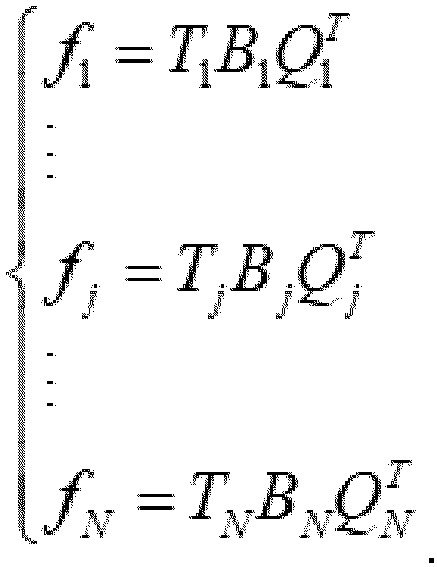
- The PLS sub-model is expressed as follows:

- wherein Tj and Uj are the score matrices of the jth PLS sub-model, Pj and Qj are the load matrices of the jth PLS sub-model, and EXj and EYj are the residual matrices of the jth PLS sub-model;
- The score matrices Tj and Uj represent the relationship between each index variable and the extracted common factor. If the score on a certain common factor is high, then it indicates that the relationship between the index variable and the common factor is closer. The load matrices Pj and Qj refer to the coefficients of the factor expressions of various original variables, which mainly represent the degree of influence of the extracted common factor on the original variables. The residual matrices EXj and EYj refer to subtracting the estimated value of a sample from the observed value of the sample.
- The score matrices are linked by linear regression:

- Finally, the PLS sub-model functions of the plurality of sample subsets are expressed as follows:
- Preferably, principal component regression (PCR) is used to establish a corresponding PCR sub-model for each sample subset so as to obtain PCR sub-model functions of the plurality of sample subsets. The PCR sub-model is expressed as follows:

- Specifically, according to the jth sample subset (Xj,Yj), after the sample matrix Xj is standardized, the covariance matrix Σj thereof may be expressed as follows:

- ΣjPi,j=λi,jPi,j, i=1,2,3,...h;
- wherein h is the number of principal components, Pi,j is the eigenvector of the covariance matrix, and λi,j are eigenvalues sorted in the descending order. Representative principal components are extracted to explain most of the changes in the original data:

- wherein ti,j=XjPi,j is the principal component vector. Finally, the PCR sub-model functions of the plurality of sample subsets are expressed as follows:
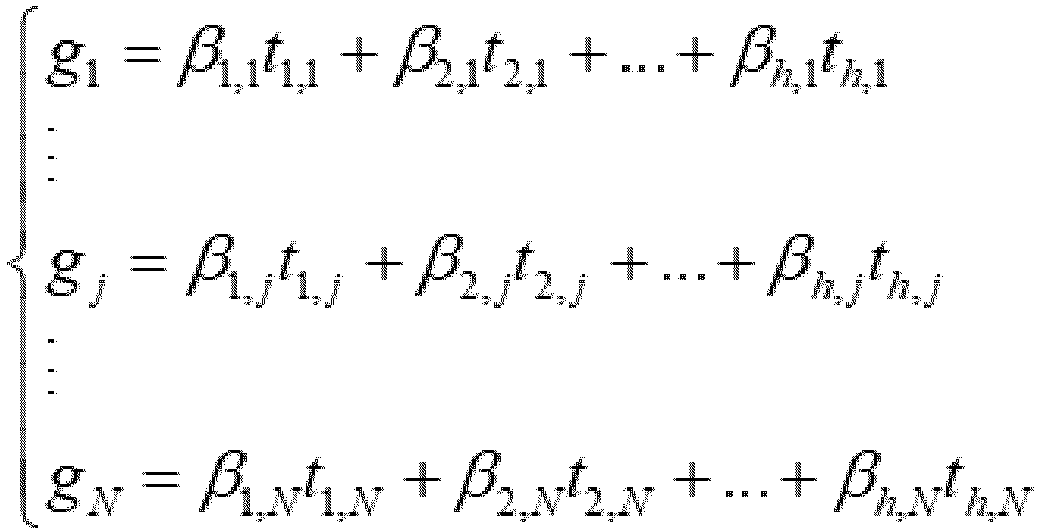
- wherein βi,j is the regression coefficient, and N is the number of sample subsets.
- S3: adding the state data of a sample to be tested respectively into the state data of each of the sample subsets, calculating a change value of the state data of each of the sample subsets before and after the adding operation, and selecting at least one sub-model close to the sample to be tested as the selected sub-model according to the change value.
- The step of calculating a change value of the state data of each of the sample subsets before and after the adding operation may be performed by KL divergence

- Specifically, the data state xtest of the sample to be tested is acquired, and the data state xtest of the sample to be tested is added to the state data x1,...,xj,..., xN of each of the sample subsets to obtain new state data (X1, xtest),..., (Xj, xtest),..., (XN, xtest), and a first divergence information value Kj (KL divergence) between Xj and (Xj, xtest) is calculated, wherein the formula of the first divergence information value Kj is as follows:

- Normalization processing is performed on the first divergence information value Kj to acquire a second divergence information value


- Specifically, the second divergence information value


c }, Qc is determined by the following formula:
- S4: assigning a weight to the selected sub-model, and calculating the SOC value of the sample to be tested.
- The weight of each selected sub-model is related to the second divergence information value

- according to Bayes' total probability formula, the weight thereof may be further expressed as follows:

- wherein

- wherein P(Xs | xtest ) is the posterior probability that the test sample xtest belongs to Xs, P(Xs) is the prior probability that Xs can describe the current working condition of the lithium battery, and P(xtest | Xs ) represents the probability that xtest may be generated by Xs.
- It is assumed that the probability of each sub-model being selected for integration is equal, then:

- The output result of SOC integration estimation corresponding to the test sample xtest is obtained according to the weight assigned to each selected sub-model and in combination with the sub-model function thereof.
- Preferably, when partial least squares (PLS) regression method is used to establish a corresponding PLS sub-model for each sample subset, the output result of SOC integration estimation corresponding to the test sample xtest is as follows:

- When principal component regression (PCR) is used to establish a corresponding PCR sub-model for each sample subset, the output result of SOC integration estimation corresponding to the test sample xtest is as follows:

- In some embodiments, the method for estimating SOC of the lithium battery further comprises verifying the SOC estimation model of the lithium battery after acquiring the SOC estimation model. After acquiring the SOC estimation model of the lithium battery, the SOC value obtained by the SOC estimation model of the lithium battery may be verified by root mean square error and average relative error, so as to determine whether the SOC value obtained by the SOC estimation model of the lithium battery is accurate or not.
- Specifically, the formula of the error term is:


- The verification results of the SOC estimation model of the lithium battery are shown in the following table.
Error items RMSE ARE/% Results 0.767 2.63 - Please refer to
FIG. 2 , which is a diagram illustrating an estimation result of a method for estimating SOC of a lithium battery provided according to an embodiment of the present application. The straight line represents the true value of SOC of the lithium battery, and the dotted line represents the estimated value obtained according to the SOC estimation model of the lithium battery. As shown inFIG. 2 , the true value of SOC of the lithium battery and the estimated value of SOC of the lithium battery are approximately on the same straight line. - In actual measurement, at least one of the terminal voltage, charging and discharging current and temperature of the lithium battery is acquired in real time, and input into the SOC estimation model of the lithium battery, so as to acquire the corresponding SOC values of the lithium battery corresponding to the terminal voltage, charging and discharging current and temperature.
- Different from the situation of related technologies, the embodiments of the present application provide a method for estimating SOC of a lithium battery, in the method for estimating SOC of the lithium battery, state data and corresponding SOC values of lithium batteries under different working conditions are collected to establish a sample set, and clustering analysis is performed on the sample set to obtain a plurality of sample subsets; then a corresponding sub-model is established for each of the sample subsets to obtain sub-model functions of the plurality of sample subsets; next, the state data of a sample to be tested is respectively added into the state data of each of the sample subsets to calculate a change value of the state data of each of the sample subsets before and after the adding operation, and at least one sub-model close to the sample to be tested is selected as the selected sub-model according to the change value; and finally, a weight is assigned to the selected sub-model to calculate the SOC value of the sample to be tested. By obtaining the estimated SOC value of the lithium battery in the aforementioned manner, the accuracy and reliability of the estimated SOC value of the lithium battery are improved.
- Please refer to
FIG. 3 , which is a structural block diagram of a device for estimating SOC of a lithium battery provided according to an embodiment of the present application. As shown inFIG. 3 , thedevice 1 for estimating SOC of the lithium battery comprises anacquisition module 11, amodel establishing module 12, aselection module 13 and anSOC calculating module 14. - The
acquisition module 11 is configured to collect state data and corresponding SOC values of lithium batteries under different working conditions and establish a sample set, and perform clustering analysis on the sample set to obtain a plurality of sample subsets. - The
model establishing module 12 is configured to establish a corresponding sub-model for each of the sample subsets to obtain sub-model functions of the plurality of sample subsets. - The
selection module 13 is configured to add the state data of a sample to be tested respectively into the state data of each of the sample subsets, calculate a change value of the state data of each of the sample subsets before and after the adding operation, and select at least one sub-model close to the sample to be tested as the selected sub-model according to the change value. - The
SOC calculating module 14 is configured to assign a weight to the selected sub-model, and calculate the SOC value of the sample to be tested. - It shall be noted that the device for estimating SOC of the lithium battery described above can execute the method for estimating SOC of the lithium battery provided according to the embodiment of the present application, and has corresponding functional modules and beneficial effects for executing the method. For the technical details not described in detail in the embodiment of the device for estimating SOC of the lithium battery, please refer to the method for estimating SOC of the lithium battery provided according to the embodiment of the present application.
- The embodiments of the device described above are only for illustrative purpose. The units illustrated as separate components may be or may not be physically separated, and components displayed as units may be or may not be physical units. That is, these units and components may be located in one place or distributed over multiple network units. Some or all of the modules may be selected according to actual needs to achieve the purpose of the solution of the embodiments.
- Referring to
FIG. 4 , an embodiment of the present application provides anelectronic equipment 30, which comprises: at least oneprocessor 31, oneprocessor 31 being taken as an example inFIG. 4 ; and amemory 32 communicatively connected to the at least oneprocessor 31, connection through a bus being taken as an example inFIG. 4 . - The
memory 32 stores instructions that can be executed by the at least oneprocessor 31, and the instructions are executed by the at least oneprocessor 31 to enable the at least oneprocessor 31 to execute the method for estimating SOC of the lithium battery described above. - As a nonvolatile computer readable storage medium, the
memory 32 may be used to store nonvolatile software programs, nonvolatile computer executable programs and modules, such as program instructions/modules corresponding to the method for estimating SOC of the lithium battery in the embodiments of the present application. Theprocessor 31 runs the nonvolatile software programs, instructions and modules stored in thememory 32, thereby executing various functional applications and data processing of theelectronic equipment 30, i.e., implementing the method for estimating SOC of the lithium battery provided by the embodiments of the method described above. - The
memory 32 may comprise a program storage area and a data storage area, wherein the program storage area may store operating systems and application programs required by at least one function. In addition, thememory 32 may comprise a high-speed random access memory, and may also comprise a nonvolatile memory. For example, thememory 32 comprises at least one magnetic disk memory device, flash memory device, or other nonvolatile solid-state memory device. In some embodiments, thememory 32 optionally comprises memories remotely provided relative to theprocessor 31. - The one or more modules are stored in the
memory 32, and when executed by the one ormore processors 31, the one or more modules execute the method for estimating SOC of the lithium battery in any of the embodiments of the method described above, e.g., execute the steps of the method ofFIG. 1 described above. - The electronic equipment described above may execute the method provided according to the embodiments of the present application, and have corresponding functional modules for executing the method. For technical details not described in detail in this embodiment, please refer to the method provided according to the embodiments of the present application.
- The electronic equipment of the embodiment of the present application exists in various forms, including but not limited to:
- (1) an ultra-mobile personal computer equipment: this kind of equipment belongs to the category of personal computers, which have the functions of calculating and processing, and generally also have the characteristics of mobile Internet access. Such terminals comprise PDA, MID and UMPC equipments, such as iPad.
- (2) a server: it is an equipment that provides computing services, and the components of the server comprise processor, hard disk, memory, system bus or the like. The architecture of the server is similar to that of a general computer, but due to the need of providing highly reliable services, it requires higher processing power, stability, reliability, security, scalability, manageability or the like.
- (3) Other electronic devices with data interaction function.
- An embodiment of the present application further provides a computer readable storage medium, in which computer executable instructions are stored. The computer executable instructions are executed by one or more processors to for example execute the steps of the method of
FIG. 1 described above and implement the functions of the modules inFIG. 3 . - An embodiment of the present invention provides a computer program product, which comprises a computer program stored on a nonvolatile computer readable storage medium. The computer program comprises program instructions which, when executed by the electronic equipment, enable the electronic equipment to execute the method for estimating SOC of the lithium battery in any of the embodiments of the method described above, e.g., execute the steps S1 to S4 of the method of
FIG. 1 described above and implement the function ofmodules 11 to 14 inFIG. 3 . - The embodiments of the device described above are only for illustrative purpose. The units illustrated as separate components may be or may not be physically separated, and components displayed as units may be or may not be physical units. That is, these units and components may be located in one place or distributed over multiple network units. Some or all of the modules may be selected according to actual needs to achieve the purpose of the solution of the embodiments.
- From the description of the above embodiments, those of ordinary skill in the art may clearly appreciate that each embodiment may be realized by means of software plus a general hardware platform, and of course, it may also be realized by hardware. As shall be appreciated by those of ordinary skill in the art, the implementation of all or part of the processes in the embodiments of the method described above may be completed by instructing related hardware through a computer program, and the program may be stored in a computer readable storage medium. When it is executed, the program may comprise the processes of the embodiments of the methods described above. The storage medium may be a magnetic disk, an optical disk, a Read-Only Memory (ROM) or a Random Access Memory (RAM) or the like.
- Finally, it shall be noted that, the above embodiments are only used to illustrate the technical solutions of the present application, and are not intended to limit the present application. Under the idea of the present application, technical features in the above embodiments or different embodiments may also be combined, the steps may be implemented in any order, and many other variations in different aspects of the present application as described above are possible, and these variations are not provided in details for conciseness. Although the present application has been described in detail with reference to the foregoing embodiments, those of ordinary skill in the art shall appreciate that, the technical solutions described in the foregoing embodiments may still be modified or some of the technical features may be equivalently replaced within the scope of the present invention which is defined by the appended claims.
Claims (7)
- A method for estimating SOC of a lithium battery, comprising steps of:collecting state data and corresponding SOC values of lithium batteries under different working conditions and establishing a sample set, and performing clustering analysis on the sample set to obtain a plurality of sample subsets;establishing a corresponding sub-model for each of the sample subsets by performing linear regression operation to obtain sub-model functions of the plurality of sample subsets;characterized byadding the state data of a sample to be tested respectively into the state data of each of the sample subsets, calculating a change value of the state data of each of the sample subsets before and after the adding operation, and selecting at least one sub-model close to the sample to be tested as the selected sub-model according to the change value;assigning a weight to the selected sub-model, and calculating the SOC value of the sample to be tested;the step of assigning a weight to the selected sub-model comprises:making the weight of each selected sub-model in the selected sub-models be P(Xs |x test), , s=q1, q2, ..., qNc;the expression formula of the weight is as follows:
 wherein
 wherein P(Xs) is the prior probability that Xs can describe the current working condition of the lithium battery, P(xtest | Xs ) represents the probability that xtest may be generated by Xs;the step of calculating the SOC value of the sample to be tested is to calculate the SOC value through the following formula:
 wherein ytest is the estimated value of SOC, xtest is the state data of a sample to be tested, q1 is the selected 1st sub-model, qNc is the selected Ncst P(Xs|xtest) sub-model, s is the selected sst sub-model, is the weight of the selected sst sub-model, fs(xtest) is the sub-model function of the selected sst sub-model,
- The method according to Claim 1, being characterized in that, the state data of the lithium battery comprises at least one of charging and discharging current, terminal voltage and temperature of the lithium battery.
- The method according to Claim 1, being characterized in that, the step of performing clustering analysis on the sample set to obtain a plurality of sample subsets comprises: performing clustering analysis on the sample set to obtain a plurality of sample subsets by using the K-means algorithm, which comprises steps of:initializing the number N of sample subsets and the maximum iteration number Ninter;randomly selecting the state data of N samples from the sample set as centers µ1, µ2,...,µj,...,µN of N sample subsets (X1,Y1), (X2,Y2),...,(Xj,Yj),...,(XN,YN), wherein X represents the state data, Y represents the SOC value, and µ represents the cluster center, 1≤j≤N;setting k = 1, 2,...,Ninter;initializing each of the N sample subsets (X1,Y1), (X2,Y2),...,(Xj,Yj),...,(XN,YN) into an empty set (Xj,Yj)=ϕ, j=1,2,...,N;calculating the distance between the state data xi of each sample (xi,yi) and each cluster center µj, wherein xi represents the state data of a certain sample and yi represents the SOC value of a certain sample; and the formula for calculation is as follows:
 putting the sample (xi,yi) into the sample subset (Xj,Yj) corresponding to the smallest di,j, and updating the sample subset (Xj,Yj) =(Xj,Yj) ∪ (xi,yi);calculating the cluster center
 if
if otherwise, making k←k + 1 until the iteration number reaches the maximum iteration number Ninter.
 - The method according to Claim 1, being characterized in that, the step of establishing a corresponding sub-model for each of the sample subsets to obtain sub-model functions of the plurality of sample subsets comprises: establishing a corresponding PLS sub-model for each of the sample subsets by using a partial least squares regression method to obtain PLS sub-model functions of the plurality of sample subsets;the PLS sub-model is expressed as follows:
 wherein Tj and Uj are the score matrices of the jth PLS sub-model, Pj and Qj are the load matrices of the jth PLS sub-model, and EXj and EYj are the residual matrices of the jth PLS sub-model;the score matrices are linked by linear regression:
 wherein Bj and Ej are the diagonal matrix and regression residual matrix of the jth PLS sub-model respectively;the PLS sub-model functions of the plurality of sample subsets are expressed as follows:
 wherein f represents the sub-model function.
 - The method according to Claim 1, being characterized in that, the operation of adding the state data of a sample to be tested respectively into the state data of each of the sample subsets and calculating a change value of the state data of each of the sample subsets before and after the adding operation comprises:adding the state data xtest of the sample to be tested respectively into the state data x1,...,xj,..., xN of each of the sample subsets to obtain new state data (X1, xtest),..., (Xj, xtest),..., (XN, xtest);calculating a first divergence information value Kj between Xj and (Xj, xtest), wherein the formula of the first divergence information value Kj is as follows:
 wherein Σ1 and σ1 are respectively the covariance matrix and mean of Xj, Σ2 and σ2 are respectively the covariance matrix and mean of (Xj, xtest), and trace is the matrix tracing operator;performing normalization processing on the first divergence information value Kj to obtain a second divergence information value

- The method according to Claim 5, being characterized in that, the step of selecting at least one sub-model close to the sample to be tested as the selected sub-model according to the change value comprises:comparing

 and the expression formula of a set of the selected sub-models is as follows:
 wherein Nc is the total number of the selected sub-models, q1,q2,...,qNc is the 1st ,second, ..., Ncst sub-model.
 - A computer readable storage medium, being characterized in that, having computer executable instructions stored therein, the computer executable instructions causing a computer to execute the method according to any of Claims 1 to 6.
Applications Claiming Priority (2)
| Application Number | Priority Date | Filing Date | Title |
|---|---|---|---|
| CN202111215850.XA CN113655385B (en) | 2021-10-19 | 2021-10-19 | Lithium battery SOC estimation method and device and computer readable storage medium |
| PCT/CN2022/081476 WO2022213789A1 (en) | 2021-10-19 | 2022-03-17 | Lithium battery soc estimation method and apparatus, and computer-readable storage medium |
Publications (4)
| Publication Number | Publication Date |
|---|---|
| EP4113139A1 EP4113139A1 (en) | 2023-01-04 |
| EP4113139A4 EP4113139A4 (en) | 2023-11-08 |
| EP4113139C0 EP4113139C0 (en) | 2025-01-29 |
| EP4113139B1 true EP4113139B1 (en) | 2025-01-29 |
Family
ID=78494656
Family Applications (1)
| Application Number | Title | Priority Date | Filing Date |
|---|---|---|---|
| EP22773375.5A Active EP4113139B1 (en) | 2021-10-19 | 2022-03-17 | Lithium battery soc estimation method and computer-readable storage medium |
Country Status (5)
| Country | Link |
|---|---|
| US (1) | US20230118702A1 (en) |
| EP (1) | EP4113139B1 (en) |
| JP (1) | JP7450741B2 (en) |
| CN (1) | CN113655385B (en) |
| WO (1) | WO2022213789A1 (en) |
Families Citing this family (7)
| Publication number | Priority date | Publication date | Assignee | Title |
|---|---|---|---|---|
| CN113655385B (en) * | 2021-10-19 | 2022-02-08 | 深圳市德兰明海科技有限公司 | Lithium battery SOC estimation method and device and computer readable storage medium |
| CN114264957B (en) * | 2021-12-02 | 2024-05-07 | 东软集团股份有限公司 | Abnormal monomer detection method and related equipment thereof |
| CN114047452B (en) * | 2022-01-13 | 2022-05-13 | 浙江玥视科技有限公司 | Method and device for determining cycle life of battery |
| CN115524615A (en) * | 2022-10-08 | 2022-12-27 | 深圳先进技术研究院 | Method for predicting battery performance based on material parameter combination of battery pulping process |
| CN116298933B (en) * | 2023-05-18 | 2023-08-08 | 西南交通大学 | SOC estimation method for series battery pack |
| CN116449221B (en) * | 2023-06-14 | 2023-09-29 | 浙江天能新材料有限公司 | Lithium battery state of charge prediction method, device, equipment and storage medium |
| CN119827990B (en) * | 2024-12-16 | 2025-11-21 | 国网江苏省电力有限公司电力科学研究院 | A method and system for early warning of battery thermal runaway based on stress and temperature |
Family Cites Families (54)
| Publication number | Priority date | Publication date | Assignee | Title |
|---|---|---|---|---|
| US6377028B1 (en) * | 1990-10-23 | 2002-04-23 | Texas Instruments Incorporated | System for charging monitoring batteries for a microprocessor based method |
| US6060864A (en) * | 1994-08-08 | 2000-05-09 | Kabushiki Kaisha Toshiba | Battery set structure and charge/discharge control apparatus for lithium-ion battery |
| US5761072A (en) * | 1995-11-08 | 1998-06-02 | Ford Global Technologies, Inc. | Battery state of charge sensing system |
| US5729116A (en) * | 1996-12-20 | 1998-03-17 | Total Battery Management, Inc. | Shunt recognition in lithium batteries |
| TW530429B (en) * | 2001-12-24 | 2003-05-01 | Avid Electronics Corp | Intelligent secondary battery management method and device |
| US7567057B2 (en) * | 2003-08-11 | 2009-07-28 | Reserve Power Cell, Llc | Multiple battery management system, auxiliary battery attachment system, and network controlled multiple battery system |
| JP4275078B2 (en) * | 2005-01-13 | 2009-06-10 | 三洋電機株式会社 | Battery current limit control method |
| KR100793616B1 (en) * | 2005-06-13 | 2008-01-10 | 주식회사 엘지화학 | Apparatus and method for testing state of charge in battery |
| JP4866187B2 (en) * | 2006-09-05 | 2012-02-01 | プライムアースEvエナジー株式会社 | Battery control device, electric vehicle, and program for causing computer to execute processing for estimating charge state of secondary battery |
| TW200933181A (en) * | 2008-01-30 | 2009-08-01 | Inventec Appliances Corp | A method for estimating lithium battery lifetime of portable electronic products |
| US7957921B2 (en) * | 2008-02-19 | 2011-06-07 | GM Global Technology Operations LLC | Model-based estimation of battery hysteresis |
| JP4469000B2 (en) * | 2008-04-18 | 2010-05-26 | トヨタ自動車株式会社 | Power supply system, vehicle equipped with the same, and control method of power supply system |
| JP5431842B2 (en) * | 2008-10-21 | 2014-03-05 | セイコーインスツル株式会社 | Battery state monitoring circuit and battery device |
| CN102859381A (en) * | 2010-04-22 | 2013-01-02 | 埃纳德尔公司 | Monitoring of battery state of charge |
| WO2012043134A1 (en) * | 2010-09-30 | 2012-04-05 | 三洋電機株式会社 | Storage battery charging/discharging control device and storage battery charging/discharging control method |
| JP2012189373A (en) * | 2011-03-09 | 2012-10-04 | Furukawa Electric Co Ltd:The | Secondary battery condition detection device and secondary battery condition detection method |
| US9157966B2 (en) * | 2011-11-25 | 2015-10-13 | Honeywell International Inc. | Method and apparatus for online determination of battery state of charge and state of health |
| JP2014059206A (en) * | 2012-09-18 | 2014-04-03 | Toyota Industries Corp | Charge state estimation device and charge state estimation method |
| US9658291B1 (en) * | 2012-10-06 | 2017-05-23 | Hrl Laboratories, Llc | Methods and apparatus for dynamic estimation of battery open-circuit voltage |
| KR101547005B1 (en) * | 2012-10-26 | 2015-08-24 | 주식회사 엘지화학 | Apparatus and method for estimating state of charging of battery |
| JP5388078B1 (en) * | 2012-11-14 | 2014-01-15 | レーザーテック株式会社 | Analysis apparatus and analysis method |
| AT512003A3 (en) * | 2013-01-23 | 2014-05-15 | Avl List Gmbh | Method for determining a control-technical observer for the SoC |
| US9244129B2 (en) * | 2013-01-29 | 2016-01-26 | Mitsubishi Electronic Research Laboratories, Inc. | Method for estimating a state of charge of batteries |
| US9077182B2 (en) * | 2013-01-29 | 2015-07-07 | Mitsubishi Electric Research Laboratories, Inc. | Method for estimating state of charge for lithium-ion batteries |
| US10664562B2 (en) * | 2013-02-24 | 2020-05-26 | Fairchild Semiconductor Corporation and University of Connecticut | Battery state of charge tracking, equivalent circuit selection and benchmarking |
| US8972091B2 (en) * | 2013-03-12 | 2015-03-03 | Ford Global Technologies, Llc | Reduced central processing unit load and memory usage battery state of charge calculation |
| CN105556323B (en) * | 2013-10-29 | 2019-01-04 | 松下知识产权经营株式会社 | Battery status estimation device |
| CN103640569B (en) * | 2013-11-28 | 2016-04-27 | 江苏大学 | Based on the hybrid vehicle energy management method of multi-agent Technology |
| US9989595B1 (en) * | 2013-12-31 | 2018-06-05 | Hrl Laboratories, Llc | Methods for on-line, high-accuracy estimation of battery state of power |
| US10074996B2 (en) * | 2014-08-29 | 2018-09-11 | The Regents Of The University Of Michigan | Bulk force in a battery pack and its application to state of charge estimation |
| KR102468895B1 (en) * | 2015-07-21 | 2022-11-21 | 삼성전자주식회사 | Method and apparatus for estimating state of battery |
| KR102441335B1 (en) * | 2015-08-13 | 2022-09-06 | 삼성전자주식회사 | Apparatus and method for SOC estimation of battery |
| CN105807231B (en) * | 2016-03-14 | 2018-10-19 | 深圳供电局有限公司 | Method and system for detecting residual capacity of storage battery |
| US10324135B2 (en) * | 2016-06-06 | 2019-06-18 | Mitsubishi Electric Research Laboratories, Inc. | Methods and systems for data-driven battery state of charge (SoC) estimation |
| CN107367693B (en) * | 2017-07-07 | 2018-05-29 | 淮阴工学院 | SOC detection system for power battery of electric vehicle |
| CN107688343B (en) * | 2017-08-01 | 2019-12-06 | 北京理工大学 | Energy control method of hybrid power vehicle |
| CN107656210B (en) * | 2017-09-14 | 2020-01-21 | 广州市香港科大霍英东研究院 | Method for estimating battery electric quantity state |
| US11226374B2 (en) * | 2017-10-17 | 2022-01-18 | The Board Of Trustees Of The Leland Stanford Junior University | Data-driven model for lithium-ion battery capacity fade and lifetime prediction |
| CN107741568B (en) * | 2017-11-08 | 2019-12-31 | 中南大学 | A lithium battery SOC estimation method based on state transition optimization RBF neural network |
| KR102296993B1 (en) * | 2017-11-17 | 2021-09-01 | 주식회사 엘지에너지솔루션 | Apparatus and Method for Estimating Resistance of Secondary Battery |
| CN109615014B (en) * | 2018-12-17 | 2023-08-22 | 清华大学 | KL divergence optimization-based 3D object data classification system and method |
| CN109586373B (en) * | 2018-12-27 | 2024-05-17 | 华为技术有限公司 | Battery charging method and device |
| CN111693868A (en) * | 2019-03-12 | 2020-09-22 | 天津工业大学 | Lithium battery state of charge estimation method based on density feature clustering integration |
| US20220065935A1 (en) * | 2019-05-08 | 2022-03-03 | Hewlett-Packard Development Company, L.P. | Predicting future battery safety threat events with causal models |
| CN110646737B (en) * | 2019-09-20 | 2022-04-22 | 广州市香港科大霍英东研究院 | Battery SOC dynamic estimation method and system based on multiple models and storage medium |
| JP2021071321A (en) * | 2019-10-29 | 2021-05-06 | 株式会社Gsユアサ | Soc estimating device, power storage device, and soc estimating method |
| CN110687462B (en) * | 2019-11-04 | 2020-09-04 | 北京理工大学 | A joint estimation method of power battery SOC and capacity full life cycle |
| WO2021171333A1 (en) * | 2020-02-25 | 2021-09-02 | 三菱電機株式会社 | Storage battery state estimation device and storage battery state estimation method |
| CN111323719A (en) * | 2020-03-18 | 2020-06-23 | 北京理工大学 | A method and system for online determination of health status of electric vehicle power battery pack |
| US11385292B2 (en) * | 2020-09-10 | 2022-07-12 | Volkswagen Aktiengesellschaft | Battery materials screening |
| CN111999657B (en) * | 2020-10-29 | 2021-01-29 | 北京航空航天大学 | Method for evaluating driving mileage of lithium ion battery of electric vehicle in residual life |
| WO2022157802A1 (en) * | 2021-01-21 | 2022-07-28 | Kpit Technologies Limited | A system and method for estimating a state of charge (soc) of a battery |
| CN113206307B (en) * | 2021-05-06 | 2022-08-09 | 福建工程学院 | Redundancy balancing lithium battery management circuit and method of genetic algorithm combined with K-means clustering |
| CN113655385B (en) * | 2021-10-19 | 2022-02-08 | 深圳市德兰明海科技有限公司 | Lithium battery SOC estimation method and device and computer readable storage medium |
-
2021
- 2021-10-19 CN CN202111215850.XA patent/CN113655385B/en active Active
-
2022
- 2022-03-17 EP EP22773375.5A patent/EP4113139B1/en active Active
- 2022-03-17 WO PCT/CN2022/081476 patent/WO2022213789A1/en not_active Ceased
- 2022-03-17 JP JP2022549542A patent/JP7450741B2/en active Active
- 2022-08-23 US US17/893,416 patent/US20230118702A1/en not_active Abandoned
Also Published As
| Publication number | Publication date |
|---|---|
| EP4113139C0 (en) | 2025-01-29 |
| EP4113139A1 (en) | 2023-01-04 |
| JP2023520970A (en) | 2023-05-23 |
| WO2022213789A1 (en) | 2022-10-13 |
| EP4113139A4 (en) | 2023-11-08 |
| CN113655385B (en) | 2022-02-08 |
| US20230118702A1 (en) | 2023-04-20 |
| CN113655385A (en) | 2021-11-16 |
| JP7450741B2 (en) | 2024-03-15 |
Similar Documents
| Publication | Publication Date | Title |
|---|---|---|
| EP4113139B1 (en) | Lithium battery soc estimation method and computer-readable storage medium | |
| Tian et al. | Consistency evaluation and cluster analysis for lithium-ion battery pack in electric vehicles | |
| CN111707951B (en) | Battery pack consistency evaluation method and system | |
| Zhang et al. | State‐of‐health estimation for the lithium‐ion battery based on gradient boosting decision tree with autonomous selection of excellent features | |
| CN113805064B (en) | Lithium ion battery pack health state prediction method based on deep learning | |
| US20260003003A1 (en) | Method and system for estimating state of charge in battery clusters, electronic device, and storage media | |
| Duong et al. | Heuristic Kalman optimized particle filter for remaining useful life prediction of lithium-ion battery | |
| US10209314B2 (en) | Systems and methods for estimation and prediction of battery health and performance | |
| Huang et al. | A comprehensively optimized lithium-ion battery state-of-health estimator based on Local Coulomb Counting Curve | |
| WO2022198616A1 (en) | Battery life prediction method and system, electronic device, and storage medium | |
| CN109596985B (en) | Online estimation method for internal resistance of power battery pack and battery management system | |
| CN112305423A (en) | Lithium ion power battery state of charge estimation method, device, medium and equipment | |
| CN111930839A (en) | Matching method of retired power battery energy storage device | |
| CN110806540B (en) | Cell test data processing method, device, system and storage medium | |
| CN115248393A (en) | Battery consistency sorting method, device, equipment and storage medium | |
| CN116581883A (en) | A method and device for evaluating distribution network line loss based on neural network | |
| CN118604632A (en) | A method for predicting the service life of lithium batteries for embedded devices | |
| CN119575199A (en) | SOC fast estimation system and method combined with lightweight neural network | |
| CN119471382A (en) | Battery cell capacity prediction method and device, electronic device and storage medium | |
| CN117200406B (en) | Battery voltage balance control method, device, equipment and storage medium | |
| CN118478695A (en) | Safety early warning method and device for power battery and electronic equipment | |
| CN115952895A (en) | A wind power device power prediction method, system and storage medium | |
| CN115980583A (en) | Four-step method for parameter identification of lithium battery equivalent circuit model based on differential algebraic equations | |
| CN117254475A (en) | A distribution network voltage control method and system based on the orderly charging of electric vehicles | |
| CN112505551B (en) | Screening method for retired power battery |
Legal Events
| Date | Code | Title | Description |
|---|---|---|---|
| STAA | Information on the status of an ep patent application or granted ep patent |
Free format text: STATUS: UNKNOWN |
|
| STAA | Information on the status of an ep patent application or granted ep patent |
Free format text: STATUS: THE INTERNATIONAL PUBLICATION HAS BEEN MADE |
|
| PUAI | Public reference made under article 153(3) epc to a published international application that has entered the european phase |
Free format text: ORIGINAL CODE: 0009012 |
|
| STAA | Information on the status of an ep patent application or granted ep patent |
Free format text: STATUS: REQUEST FOR EXAMINATION WAS MADE |
|
| 17P | Request for examination filed |
Effective date: 20220929 |
|
| AK | Designated contracting states |
Kind code of ref document: A1 Designated state(s): AL AT BE BG CH CY CZ DE DK EE ES FI FR GB GR HR HU IE IS IT LI LT LU LV MC MK MT NL NO PL PT RO RS SE SI SK SM TR |
|
| A4 | Supplementary search report drawn up and despatched |
Effective date: 20231011 |
|
| RIC1 | Information provided on ipc code assigned before grant |
Ipc: G01R 31/367 20190101AFI20231005BHEP |
|
| GRAP | Despatch of communication of intention to grant a patent |
Free format text: ORIGINAL CODE: EPIDOSNIGR1 |
|
| STAA | Information on the status of an ep patent application or granted ep patent |
Free format text: STATUS: GRANT OF PATENT IS INTENDED |
|
| INTG | Intention to grant announced |
Effective date: 20240618 |
|
| GRAJ | Information related to disapproval of communication of intention to grant by the applicant or resumption of examination proceedings by the epo deleted |
Free format text: ORIGINAL CODE: EPIDOSDIGR1 |
|
| STAA | Information on the status of an ep patent application or granted ep patent |
Free format text: STATUS: REQUEST FOR EXAMINATION WAS MADE |
|
| GRAP | Despatch of communication of intention to grant a patent |
Free format text: ORIGINAL CODE: EPIDOSNIGR1 |
|
| STAA | Information on the status of an ep patent application or granted ep patent |
Free format text: STATUS: GRANT OF PATENT IS INTENDED |
|
| INTC | Intention to grant announced (deleted) | ||
| INTG | Intention to grant announced |
Effective date: 20241017 |
|
| GRAS | Grant fee paid |
Free format text: ORIGINAL CODE: EPIDOSNIGR3 |
|
| GRAA | (expected) grant |
Free format text: ORIGINAL CODE: 0009210 |
|
| STAA | Information on the status of an ep patent application or granted ep patent |
Free format text: STATUS: THE PATENT HAS BEEN GRANTED |
|
| DAV | Request for validation of the european patent (deleted) | ||
| DAX | Request for extension of the european patent (deleted) | ||
| AK | Designated contracting states |
Kind code of ref document: B1 Designated state(s): AL AT BE BG CH CY CZ DE DK EE ES FI FR GB GR HR HU IE IS IT LI LT LU LV MC MK MT NL NO PL PT RO RS SE SI SK SM TR |
|
| REG | Reference to a national code |
Ref country code: GB Ref legal event code: FG4D |
|
| REG | Reference to a national code |
Ref country code: CH Ref legal event code: EP |
|
| REG | Reference to a national code |
Ref country code: DE Ref legal event code: R096 Ref document number: 602022010272 Country of ref document: DE |
|
| REG | Reference to a national code |
Ref country code: IE Ref legal event code: FG4D |
|
| U01 | Request for unitary effect filed |
Effective date: 20250225 |
|
| U07 | Unitary effect registered |
Designated state(s): AT BE BG DE DK EE FI FR IT LT LU LV MT NL PT RO SE SI Effective date: 20250304 |
|
| U20 | Renewal fee for the european patent with unitary effect paid |
Year of fee payment: 4 Effective date: 20250325 |
|
| PG25 | Lapsed in a contracting state [announced via postgrant information from national office to epo] |
Ref country code: RS Free format text: LAPSE BECAUSE OF FAILURE TO SUBMIT A TRANSLATION OF THE DESCRIPTION OR TO PAY THE FEE WITHIN THE PRESCRIBED TIME-LIMIT Effective date: 20250429 |
|
| PG25 | Lapsed in a contracting state [announced via postgrant information from national office to epo] |
Ref country code: PL Free format text: LAPSE BECAUSE OF FAILURE TO SUBMIT A TRANSLATION OF THE DESCRIPTION OR TO PAY THE FEE WITHIN THE PRESCRIBED TIME-LIMIT Effective date: 20250129 |
|
| PG25 | Lapsed in a contracting state [announced via postgrant information from national office to epo] |
Ref country code: ES Free format text: LAPSE BECAUSE OF FAILURE TO SUBMIT A TRANSLATION OF THE DESCRIPTION OR TO PAY THE FEE WITHIN THE PRESCRIBED TIME-LIMIT Effective date: 20250129 |
|
| PG25 | Lapsed in a contracting state [announced via postgrant information from national office to epo] |
Ref country code: NO Free format text: LAPSE BECAUSE OF FAILURE TO SUBMIT A TRANSLATION OF THE DESCRIPTION OR TO PAY THE FEE WITHIN THE PRESCRIBED TIME-LIMIT Effective date: 20250429 Ref country code: IS Free format text: LAPSE BECAUSE OF FAILURE TO SUBMIT A TRANSLATION OF THE DESCRIPTION OR TO PAY THE FEE WITHIN THE PRESCRIBED TIME-LIMIT Effective date: 20250529 |
|
| PG25 | Lapsed in a contracting state [announced via postgrant information from national office to epo] |
Ref country code: HR Free format text: LAPSE BECAUSE OF FAILURE TO SUBMIT A TRANSLATION OF THE DESCRIPTION OR TO PAY THE FEE WITHIN THE PRESCRIBED TIME-LIMIT Effective date: 20250129 |
|
| PG25 | Lapsed in a contracting state [announced via postgrant information from national office to epo] |
Ref country code: GR Free format text: LAPSE BECAUSE OF FAILURE TO SUBMIT A TRANSLATION OF THE DESCRIPTION OR TO PAY THE FEE WITHIN THE PRESCRIBED TIME-LIMIT Effective date: 20250430 |
|
| PG25 | Lapsed in a contracting state [announced via postgrant information from national office to epo] |
Ref country code: SM Free format text: LAPSE BECAUSE OF FAILURE TO SUBMIT A TRANSLATION OF THE DESCRIPTION OR TO PAY THE FEE WITHIN THE PRESCRIBED TIME-LIMIT Effective date: 20250129 |
|
| PG25 | Lapsed in a contracting state [announced via postgrant information from national office to epo] |
Ref country code: MC Free format text: LAPSE BECAUSE OF FAILURE TO SUBMIT A TRANSLATION OF THE DESCRIPTION OR TO PAY THE FEE WITHIN THE PRESCRIBED TIME-LIMIT Effective date: 20250129 |
|
| PG25 | Lapsed in a contracting state [announced via postgrant information from national office to epo] |
Ref country code: CZ Free format text: LAPSE BECAUSE OF FAILURE TO SUBMIT A TRANSLATION OF THE DESCRIPTION OR TO PAY THE FEE WITHIN THE PRESCRIBED TIME-LIMIT Effective date: 20250129 |
|
| REG | Reference to a national code |
Ref country code: CH Ref legal event code: H13 Free format text: ST27 STATUS EVENT CODE: U-0-0-H10-H13 (AS PROVIDED BY THE NATIONAL OFFICE) Effective date: 20251023 |
|
| PG25 | Lapsed in a contracting state [announced via postgrant information from national office to epo] |
Ref country code: SK Free format text: LAPSE BECAUSE OF FAILURE TO SUBMIT A TRANSLATION OF THE DESCRIPTION OR TO PAY THE FEE WITHIN THE PRESCRIBED TIME-LIMIT Effective date: 20250129 |
|
| U1N | Appointed representative for the unitary patent procedure changed after the registration of the unitary effect |
Representative=s name: SANTARELLI; FR |
|
| PLBE | No opposition filed within time limit |
Free format text: ORIGINAL CODE: 0009261 |
|
| STAA | Information on the status of an ep patent application or granted ep patent |
Free format text: STATUS: NO OPPOSITION FILED WITHIN TIME LIMIT |
|
| 26N | No opposition filed |
Effective date: 20251030 |
|
| PG25 | Lapsed in a contracting state [announced via postgrant information from national office to epo] |
Ref country code: CH Free format text: LAPSE BECAUSE OF NON-PAYMENT OF DUE FEES Effective date: 20250331 |
|
| PG25 | Lapsed in a contracting state [announced via postgrant information from national office to epo] |
Ref country code: IE Free format text: LAPSE BECAUSE OF NON-PAYMENT OF DUE FEES Effective date: 20250317 |
|
| U20 | Renewal fee for the european patent with unitary effect paid |
Year of fee payment: 5 Effective date: 20260226 |