EP4112344B1 - Emergency release mechanism and window comprising same - Google Patents
Emergency release mechanism and window comprising same Download PDFInfo
- Publication number
- EP4112344B1 EP4112344B1 EP21183574.9A EP21183574A EP4112344B1 EP 4112344 B1 EP4112344 B1 EP 4112344B1 EP 21183574 A EP21183574 A EP 21183574A EP 4112344 B1 EP4112344 B1 EP 4112344B1
- Authority
- EP
- European Patent Office
- Prior art keywords
- window
- handle
- arcuate member
- frame
- release mechanism
- Prior art date
- Legal status (The legal status is an assumption and is not a legal conclusion. Google has not performed a legal analysis and makes no representation as to the accuracy of the status listed.)
- Active
Links
Images




Classifications
-
- B—PERFORMING OPERATIONS; TRANSPORTING
- B60—VEHICLES IN GENERAL
- B60J—WINDOWS, WINDSCREENS, NON-FIXED ROOFS, DOORS, OR SIMILAR DEVICES FOR VEHICLES; REMOVABLE EXTERNAL PROTECTIVE COVERINGS SPECIALLY ADAPTED FOR VEHICLES
- B60J9/00—Devices not provided for in one of main groups B60J1/00 - B60J7/00
- B60J9/02—Entrance or exit closures other than windows, doors, or in roofs, e.g. emergency escape closures in vehicle bottom
-
- B—PERFORMING OPERATIONS; TRANSPORTING
- B60—VEHICLES IN GENERAL
- B60J—WINDOWS, WINDSCREENS, NON-FIXED ROOFS, DOORS, OR SIMILAR DEVICES FOR VEHICLES; REMOVABLE EXTERNAL PROTECTIVE COVERINGS SPECIALLY ADAPTED FOR VEHICLES
- B60J1/00—Windows; Windscreens; Accessories therefor
- B60J1/08—Windows; Windscreens; Accessories therefor arranged at vehicle sides
- B60J1/085—Windows; Windscreens; Accessories therefor arranged at vehicle sides removably mounted
-
- B—PERFORMING OPERATIONS; TRANSPORTING
- B60—VEHICLES IN GENERAL
- B60J—WINDOWS, WINDSCREENS, NON-FIXED ROOFS, DOORS, OR SIMILAR DEVICES FOR VEHICLES; REMOVABLE EXTERNAL PROTECTIVE COVERINGS SPECIALLY ADAPTED FOR VEHICLES
- B60J1/00—Windows; Windscreens; Accessories therefor
- B60J1/08—Windows; Windscreens; Accessories therefor arranged at vehicle sides
- B60J1/10—Windows; Windscreens; Accessories therefor arranged at vehicle sides fixedly mounted
Definitions
- the present invention relates to the field of emergency escape windows in vehicles, and more specifically to non-openable emergency windows.
- end windows are often the principle escape route for vehicle occupants since doors may be difficult or impossible to open. End windows are often manually or electrically operated to open. In case of failure (e.g. electric switches do not work under water), the occupant can break the glass to escape. This is also the case with bus windows which are designed not to be opened during normal operation. However, windows made of e.g. laminated glass, plastic or other materials required by the specific construction are more difficult to break.
- KR 10-2047462 B1 relates to a window opening and closing device for emergency escape from large-sized vehicles, comprising at least one connecting ring attached to the vehicle toward the top of the upper window, a frame that meshes with a window on the vehicle and seals the interior, a control box disposed in the interior of the vehicle and outputting a signal according to an operation, and an opening/closing member fixed to the connection ring on the frame to fix the window.
- the opening/closing member is arranged to release the connection with the connection ring in response to a signal of the control box to remove the window from the vehicle to allow escape.
- Patent publication CN 205858036 U discloses an emergency escape door window having a hinged configuration and a linkage device for opening the window.
- a non-openable window comprising an emergency release mechanism, where the non-openable window is arranged to be mounted to a frame, the release mechanism comprising a handle having a first end releasably attachable to a lower end of the window, wherein the handle is arranged to be attached to the frame and to be rotated about an axis of rotation which is substantially parallel to a bottom edge of the window, wherein the point of attachment between the handle and the window is offset from the axis of rotation of the handle such that an upwards rotation of the handle causes a substantially concomitant downward and outward movement of the window in relation to the frame.
- An upper end of the window comprises frangible fasteners and the upper end of the window is arranged to be mounted to the frame along an upper edge by means of the frangible fasteners arranged to be broken by downwards movement of the window.
- the offset between the axis of rotation of the handle and the point of attachment with the window provides leverage to reduce the force required to open the window in an emergency situation, for instance if a vehicle is under water. Thereby, emergency release of the window is facilitated.
- the frangible fasteners allow for quick and safe release of the window during operation of the emergency release mechanism, whilst securing the window to the frame during normal operation.
- the emergency release mechanism comprises a first arcuate member extending from a first end of the handle.
- a distal end of the first arcuate member comprises a recess arranged to receive a protruding member of the window in a snap-fit connection.
- the window may be released from attachment with the handle.
- the handle is arranged to be attached to the frame at a proximal end of the first arcuate member.
- the attachment provides optimal positioning of the handle and arcuate member to create leverage for rotation.
- the emergency release mechanism comprises at least one additional arcuate member arranged parallel to and spaced apart from the first arcuate member, wherein a distal end of the at least one additional arcuate member comprises a recess arranged to receive a respective protruding member of the window in a snap-fit connection, wherein the first and additional arcuate members are linked together to move in concert when the handle is rotated.
- the additional arcuate members ensure that the whole lower end of the window is moved downwards and outwards during operation of the emergency release mechanism, and also provides for a more secure attachment of the window to the frame in a non-deployed state of the emergency release mechanism.
- the first and additional arcuate members are linked together by means of one or more rods passing through one or more plates.
- the plates ensures that the rods are held in place and rotate in concert to avoid twisting during rotation of the handle.
- a vehicle comprising a non-openable window according to the first aspect.
- FIG. 1 there is shown an external view of a cut-away portion of a vehicle door comprising a window 1 mounted in a frame 2 of the door.
- An emergency release mechanism for the window 1 is shown in hatched lines.
- the window 1 may have a curved, non-planar shape dictated by the overall design of the vehicle and the frame 2. As such, the shape of the window 1 and/or other criteria including safety, manufacturing, performance etc. dictate that the window 1 is non-openable during normal operation of the vehicle.
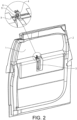
- an emergency release mechanism including a handle 3 is attached to the window 1 and to the frame 2.
- the handle 3 is attached to the frame 2 to be rotated about an axis of rotation X which is substantially parallel to the lower end of the window 1, extending substantially along a horizontal longitudinal extension of the vehicle. In this case, substantially parallel should be interpreted as lying within a range of ⁇ 10°.
- the handle 3 comprises an arcuate member 4 extending from a first end of the handle 3 towards the window 1.
- the distal end of the arcuate member 4 is releasably attached to the window 1 via a protruding member 6.
- the protruding member 6 may be a rod or pin fastened to the internal pane of the window 1 and oriented parallel to the axis of rotation X of the handle 3.
- the handle 3 is attached to the frame 2 in a rotatable manner to allow rotation about the axis of rotation X.
- the frame 2 comprises a bracket 9 arranged to receive a proximal end of the arcuate member 4.
- the point of attachment between the handle 3 and the window 1 is offset from the axis of rotation X, both in a vertical and a horizontal direction.
- Figs 3a and 3b the upper and lower ends of the window 1, respectively, are shown mounted in the frame 2 in a non-deployed state of the emergency release mechanism, wherein the handle 3 is in a lowermost position oriented downwards and accommodated within the panel of the vehicle door. In this position, the lower end of the window 1 is held tightly against the frame 2 by the handle 3 as shown in Fig. 3b .
- a sealing profile (not shown) may be arranged along the circumference between the window 1 and the frame 2 to provide a water-tight seal to prevent water leakage inside the vehicle.
- the upper end of the window 1 is received in a recess formed by the frame 2 and held in place by one or more fasteners 8.
- the fastener 8 may be a clip or pin attached to the frame 2 and extending through an opening in the window 1.
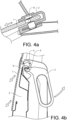
- Figs. 4a and 4b illustrating the upper and lower ends of the window 1, respectively, in an initial state of deployment of the emergency release mechanism, wherein the handle 3 has been rotated upward in a counterclockwise direction as indicated by the arrow.
- the upward rotation of the handle causes an outward and downward rotation of the arcuate member 4 which transfers the downward and outward movement to the window 1 as shown by the arrows in Fig. 4a , due to the vertical and horizontal offset between the point of attachment between the window 1 and the handle 3 near the distal end of the arcuate member 4.
- the upper end of the window 1 is pulled out of the recess in the frame 2, breaking the fastener 8 in the process as indicated by the arrow in Fig. 4a .
- the fastener 8 is frangible and configured to break when a predetermined amount of force is applied through rotation of the handle 3.
- Figs. 5a and 5b illustrating the upper and lower ends of the window 1, respectively, in a final state of deployment of the emergency release mechanism, wherein the handle 3 has been rotated to its uppermost position. Likewise, the window 1 has moved downwards and outwards to the maximum extent allowed by the emergency release mechanism. As shown in Fig. 5a , the upper end of the window 1 is fully pulled out of the recess in the frame 2.
- Figs. 6a and 6b illustrating the upper and lower ends of the window 1, respectively, after being released from the frame 2 and the emergency release mechanism.
- a vehicle passenger may push the window 1 outwardly until the attachment between the protruding member 6 of the window 1 is released from the arcuate member 4.
- a recess 5 is formed near the distal end of the arcuate member 4 to receive the protruding member 6 in a snap-fit connection, as illustrated in Fig. 6c .
- the arcuate member 4 may be manufactured in a resilient material which allows for sufficient deformation of the snap to enable the protruding member 6 to pop out of the recess 5.
- the arcuate member 4 may be configured to break when a predetermined amount of force is applied to release the window 1 from the handle 3.
- the recess 5 is circular in shape to enable rotation in relation to the protruding member 6 when the handle 3 is rotated.
- the emergency release mechanism comprises additional arcuate members 4a and 4b arranged to co-rotate with the first arcuate member 4 when the handle 3 is rotated.
- the additional arcuate members 4a and 4b are substantially identical to the first arcuate member 4, each arranged at a distance from the first arcuate member 4 and mounted in respective brackets 9a and 9b on the frame 2 to rotate about the axis of rotation X.
- the additional arcuate members 4a and 4b are releasably attached to the window 1 by means of protruding members 6a and 6b.
- the arcuate members 4, 4a and 4b are linked together by one or more rods 10 passing through plates 11 to avoid twisting of the rods 10 during rotation of the handle 3.
- the additional arcuate members 4a and 4b ensure that the whole lower end of the window 1 is moved downwards and outwards during operation of the emergency release mechanism, and also provides for a more secure attachment of the window 1 to the frame 2 in a non-deployed state of the emergency release mechanism.
- the window and emergency release mechanism may be arranged in a building or other structure instead of a vehicle.
Landscapes
- Engineering & Computer Science (AREA)
- Mechanical Engineering (AREA)
- Window Of Vehicle (AREA)
Description
- The present invention relates to the field of emergency escape windows in vehicles, and more specifically to non-openable emergency windows.
- During vehicle emergency situations (accident, fire, drowning), end windows are often the principle escape route for vehicle occupants since doors may be difficult or impossible to open. End windows are often manually or electrically operated to open. In case of failure (e.g. electric switches do not work under water), the occupant can break the glass to escape. This is also the case with bus windows which are designed not to be opened during normal operation. However, windows made of e.g. laminated glass, plastic or other materials required by the specific construction are more difficult to break.
-
KR 10-2047462 B1 - However, this solution is adapted for large vehicles and relies on battery-powered control of an electromagnetic actuator to release the window.
- Patent publication
CN 205858036 U discloses an emergency escape door window having a hinged configuration and a linkage device for opening the window. - An objective of the present disclosure is to provide a simple and secure solution for releasing an emergency window. This objective is achieved in a first aspect by a non-openable window comprising an emergency release mechanism, where the non-openable window is arranged to be mounted to a frame, the release mechanism comprising a handle having a first end releasably attachable to a lower end of the window, wherein the handle is arranged to be attached to the frame and to be rotated about an axis of rotation which is substantially parallel to a bottom edge of the window, wherein the point of attachment between the handle and the window is offset from the axis of rotation of the handle such that an upwards rotation of the handle causes a substantially concomitant downward and outward movement of the window in relation to the frame. An upper end of the window comprises frangible fasteners and the upper end of the window is arranged to be mounted to the frame along an upper edge by means of the frangible fasteners arranged to be broken by downwards movement of the window.
- The offset between the axis of rotation of the handle and the point of attachment with the window provides leverage to reduce the force required to open the window in an emergency situation, for instance if a vehicle is under water. Thereby, emergency release of the window is facilitated. The frangible fasteners allow for quick and safe release of the window during operation of the emergency release mechanism, whilst securing the window to the frame during normal operation.
- In one embodiment, the emergency release mechanism comprises a first arcuate member extending from a first end of the handle. By means of the arcuate member a simple and robust solution for achieving the offset is achieved.
- In one embodiment, a distal end of the first arcuate member comprises a recess arranged to receive a protruding member of the window in a snap-fit connection. By means of the snap-fit connection, the window may be released from attachment with the handle.
- In one embodiment, the handle is arranged to be attached to the frame at a proximal end of the first arcuate member. The attachment provides optimal positioning of the handle and arcuate member to create leverage for rotation.
- In one embodiment, the emergency release mechanism comprises at least one additional arcuate member arranged parallel to and spaced apart from the first arcuate member, wherein a distal end of the at least one additional arcuate member comprises a recess arranged to receive a respective protruding member of the window in a snap-fit connection, wherein the first and additional arcuate members are linked together to move in concert when the handle is rotated. The additional arcuate members ensure that the whole lower end of the window is moved downwards and outwards during operation of the emergency release mechanism, and also provides for a more secure attachment of the window to the frame in a non-deployed state of the emergency release mechanism.
- In one embodiment, the first and additional arcuate members are linked together by means of one or more rods passing through one or more plates. The plates ensures that the rods are held in place and rotate in concert to avoid twisting during rotation of the handle.
- In a second aspect of the present disclosure, there is provided a vehicle comprising a non-openable window according to the first aspect.
- Further features and advantages of the present disclosure will become apparent when studying the appended claims and the following description. The person skilled in the art realizes that different features of the present disclosure may be combined to create embodiments other than those described hereinabove, without departing from the scope of the present disclosure.
- With reference to the appended drawings, below follows a more detailed description of example embodiments of the invention, wherein:
-
Fig. 1 is a perspective external view of a vehicle door; -
Fig. 2 is a perspective internal view of a vehicle door showing an emergency release mechanism according to one embodiment of the present disclosure; -
Figs. 3a-6a and 3b-6b are cross-sectional views of upper and lower ends of a vehicle window, respectively, during different stages of deployment of the emergency release mechanism; -
Fig. 6c is a close-up view of the emergency release mechanism shown inFig. 6b ; -
Fig. 7 is a perspective internal view of a vehicle door showing an emergency release mechanism according to another embodiment of the present disclosure; and -
Fig. 8 is a close-up view of the emergency release mechanism shown inFig. 7 . - In the following, a detailed description of an emergency release mechanism for a non-openable window according to the present disclosure is presented. In the drawing figures, like reference numerals designate identical or corresponding elements throughout the several figures. It will be appreciated that these figures are for illustration only and do not in any way restrict the scope of the present disclosure.
- With reference to
Fig. 1 , there is shown an external view of a cut-away portion of a vehicle door comprising awindow 1 mounted in aframe 2 of the door. An emergency release mechanism for thewindow 1 is shown in hatched lines. Thewindow 1 may have a curved, non-planar shape dictated by the overall design of the vehicle and theframe 2. As such, the shape of thewindow 1 and/or other criteria including safety, manufacturing, performance etc. dictate that thewindow 1 is non-openable during normal operation of the vehicle. - Referring now to
Fig. 2 , the vehicle door is shown in an internal view. Near the lower end of thewindow 1, an emergency release mechanism including ahandle 3 is attached to thewindow 1 and to theframe 2. Thehandle 3 is attached to theframe 2 to be rotated about an axis of rotation X which is substantially parallel to the lower end of thewindow 1, extending substantially along a horizontal longitudinal extension of the vehicle. In this case, substantially parallel should be interpreted as lying within a range of ± 10°. - In a close-up view in
Fig. 2 , the attachment is shown more in detail. Thehandle 3 comprises anarcuate member 4 extending from a first end of thehandle 3 towards thewindow 1. The distal end of thearcuate member 4 is releasably attached to thewindow 1 via a protrudingmember 6. The protrudingmember 6 may be a rod or pin fastened to the internal pane of thewindow 1 and oriented parallel to the axis of rotation X of thehandle 3. Thehandle 3 is attached to theframe 2 in a rotatable manner to allow rotation about the axis of rotation X. To this end, theframe 2 comprises abracket 9 arranged to receive a proximal end of thearcuate member 4. As will be further noted below, the point of attachment between thehandle 3 and thewindow 1 is offset from the axis of rotation X, both in a vertical and a horizontal direction. - Referring now to
Figs 3a and 3b , the upper and lower ends of thewindow 1, respectively, are shown mounted in theframe 2 in a non-deployed state of the emergency release mechanism, wherein thehandle 3 is in a lowermost position oriented downwards and accommodated within the panel of the vehicle door. In this position, the lower end of thewindow 1 is held tightly against theframe 2 by thehandle 3 as shown inFig. 3b . A sealing profile (not shown) may be arranged along the circumference between thewindow 1 and theframe 2 to provide a water-tight seal to prevent water leakage inside the vehicle. The upper end of thewindow 1 is received in a recess formed by theframe 2 and held in place by one ormore fasteners 8. Thefastener 8 may be a clip or pin attached to theframe 2 and extending through an opening in thewindow 1. - Referring now to
Figs. 4a and 4b , illustrating the upper and lower ends of thewindow 1, respectively, in an initial state of deployment of the emergency release mechanism, wherein thehandle 3 has been rotated upward in a counterclockwise direction as indicated by the arrow. The upward rotation of the handle causes an outward and downward rotation of thearcuate member 4 which transfers the downward and outward movement to thewindow 1 as shown by the arrows inFig. 4a , due to the vertical and horizontal offset between the point of attachment between thewindow 1 and thehandle 3 near the distal end of thearcuate member 4. At the same time, the upper end of thewindow 1 is pulled out of the recess in theframe 2, breaking thefastener 8 in the process as indicated by the arrow inFig. 4a . To this end, thefastener 8 is frangible and configured to break when a predetermined amount of force is applied through rotation of thehandle 3. - Referring now to
Figs. 5a and 5b , illustrating the upper and lower ends of thewindow 1, respectively, in a final state of deployment of the emergency release mechanism, wherein thehandle 3 has been rotated to its uppermost position. Likewise, thewindow 1 has moved downwards and outwards to the maximum extent allowed by the emergency release mechanism. As shown inFig. 5a , the upper end of thewindow 1 is fully pulled out of the recess in theframe 2. - Referring now to
Figs. 6a and 6b , illustrating the upper and lower ends of thewindow 1, respectively, after being released from theframe 2 and the emergency release mechanism. With thehandle 3 in the uppermost position, a vehicle passenger may push thewindow 1 outwardly until the attachment between the protrudingmember 6 of thewindow 1 is released from thearcuate member 4. To this end, arecess 5 is formed near the distal end of thearcuate member 4 to receive the protrudingmember 6 in a snap-fit connection, as illustrated inFig. 6c . Thearcuate member 4 may be manufactured in a resilient material which allows for sufficient deformation of the snap to enable the protrudingmember 6 to pop out of therecess 5. Alternatively, thearcuate member 4 may be configured to break when a predetermined amount of force is applied to release thewindow 1 from thehandle 3. Therecess 5 is circular in shape to enable rotation in relation to the protrudingmember 6 when thehandle 3 is rotated. - Referring now to
Figs. 7 and8 , there is shown an interior view of a vehicle door with an emergency release mechanism according to another embodiment of the present disclosure. In this embodiment, the emergency release mechanism comprises additionalarcuate members arcuate member 4 when thehandle 3 is rotated. As may be seen inFig. 8 , the additionalarcuate members arcuate member 4, each arranged at a distance from the firstarcuate member 4 and mounted inrespective brackets frame 2 to rotate about the axis of rotation X. The additionalarcuate members window 1 by means of protrudingmembers 6a and 6b. Thearcuate members more rods 10 passing throughplates 11 to avoid twisting of therods 10 during rotation of thehandle 3. The additionalarcuate members window 1 is moved downwards and outwards during operation of the emergency release mechanism, and also provides for a more secure attachment of thewindow 1 to theframe 2 in a non-deployed state of the emergency release mechanism. - Although the invention has been illustrated and described in detail in the drawings and foregoing description, such illustration and description are to be considered illustrative or exemplary and the invention is not limited to the disclosed embodiments, but by the subject-matter defined in the appended claims. For example, the window and emergency release mechanism may be arranged in a building or other structure instead of a vehicle.
Claims (7)
- A non-openable window (1) comprising an emergency release mechanism,wherein the non-openable window (1) is arranged to be mounted to a frame (2), the release mechanism comprising a handle (3) having a first end releasably attachable to a lower end of the window (1), wherein the handle (3) is arranged to be attached to the frame (2) and to be rotated about an axis of rotation (X) which is substantially parallel to a bottom edge of the window (1),wherein the point of attachment between the handle (3) and the window (1) is offset from the axis of rotation (X) of the handle (3) such that an upwards rotation of the handle (3) causes a substantially concomitant downward and outward movement of the window (1) in relation to the frame (2),characterized in that an upper end of the window (1) comprises frangible fasteners and that the upper end of the window (1) is arranged to be mounted to the frame (2) along an upper edge by means of the frangible fasteners (8) arranged to be broken by downwards movement of the window (1).
- The non-openable window (1) according to claim 1, comprising a first arcuate member (4) extending from a first end of the handle (3).
- The non-openable window (1) according to claim 2, wherein a distal end of the first arcuate member (4) comprises a recess (5) arranged to receive a protruding member (6) of the window (1) in a snap-fit connection.
- The non-openable window (1) according to claim 2 or 3, wherein the handle (3) is arranged to be attached to the frame (2) at a proximal end of the first arcuate member (4).
- The non-openable window (1) according to any one of claims 2-4, comprising at least one additional arcuate member (4a, 4b) arranged parallel to and spaced apart from the first arcuate member (4), wherein a distal end of the at least one additional arcuate member (4a, 4b) comprises a recess arranged to receive a respective protruding member (6a, 6b) of the window (1) in a snap-fit connection, wherein the first arcuate member (4) and the at least one additional arcuate member (4a, 4b) are linked together to move in concert when the handle (3) is rotated.
- The non-openable window (1) according to claim 5, wherein the first arcuate member (4) and the at least one additional arcuate member (4a, 4b) are linked together by means of one or more rods (10) passing through one or more plates (11).
- A vehicle comprising a non-openable window according to any one of claims 1 to 6.
Priority Applications (4)
| Application Number | Priority Date | Filing Date | Title |
|---|---|---|---|
| EP21183574.9A EP4112344B1 (en) | 2021-07-02 | 2021-07-02 | Emergency release mechanism and window comprising same |
| PCT/CN2022/099138 WO2023273902A1 (en) | 2021-07-02 | 2022-06-16 | Emergency release mechanism and window comprising same |
| CN202280045850.6A CN117580722A (en) | 2021-07-02 | 2022-06-16 | Emergency release mechanism and window including the emergency release mechanism |
| US18/523,496 US12330488B2 (en) | 2021-07-02 | 2023-11-29 | Emergency release mechanism and window comprising same |
Applications Claiming Priority (1)
| Application Number | Priority Date | Filing Date | Title |
|---|---|---|---|
| EP21183574.9A EP4112344B1 (en) | 2021-07-02 | 2021-07-02 | Emergency release mechanism and window comprising same |
Publications (2)
| Publication Number | Publication Date |
|---|---|
| EP4112344A1 EP4112344A1 (en) | 2023-01-04 |
| EP4112344B1 true EP4112344B1 (en) | 2024-10-16 |
Family
ID=76764979
Family Applications (1)
| Application Number | Title | Priority Date | Filing Date |
|---|---|---|---|
| EP21183574.9A Active EP4112344B1 (en) | 2021-07-02 | 2021-07-02 | Emergency release mechanism and window comprising same |
Country Status (4)
| Country | Link |
|---|---|
| US (1) | US12330488B2 (en) |
| EP (1) | EP4112344B1 (en) |
| CN (1) | CN117580722A (en) |
| WO (1) | WO2023273902A1 (en) |
Families Citing this family (2)
| Publication number | Priority date | Publication date | Assignee | Title |
|---|---|---|---|---|
| US20250065695A1 (en) * | 2023-08-24 | 2025-02-27 | Rivian Ip Holdings, Llc | Adjustable and removable rear vehicle panel |
| US20260061959A1 (en) * | 2024-08-30 | 2026-03-05 | Inteva Products, Llc | Vehicle emergency glass breaker system |
Family Cites Families (22)
| Publication number | Priority date | Publication date | Assignee | Title |
|---|---|---|---|---|
| FR572623A (en) * | 1923-11-03 | 1924-06-10 | Removable cowling device without visible compass for motor vehicles and others | |
| US3396489A (en) * | 1966-04-18 | 1968-08-13 | Cirone Joseph | Fire escape window |
| US3739527A (en) * | 1971-11-26 | 1973-06-19 | Rohr Industries Inc | Knockout window for vehicle |
| AT360072B (en) * | 1979-01-24 | 1980-12-29 | Vmw Ranshofen Berndorf Ag | WINDOWS, IN PARTICULAR FOR RAIL VEHICLES |
| US4497512A (en) * | 1983-09-19 | 1985-02-05 | The Budd Company | Emergency release handle |
| US5169205A (en) * | 1991-08-06 | 1992-12-08 | Blue Bird Body Company | Emergency exit window |
| US5255479A (en) * | 1991-12-06 | 1993-10-26 | Carl H. Shepherd | Emergency escape hatch |
| FR2771055B1 (en) * | 1997-11-18 | 1999-12-17 | Saint Gobain Vitrage | QUICKLY REMOVABLE GLAZING |
| CA2224981A1 (en) * | 1998-01-23 | 1999-07-23 | Rejean Beauregard | Flush-mounted frameless vehicle window |
| US6688659B2 (en) * | 2001-12-07 | 2004-02-10 | Atwood Mobile Products Inc. | Egress window latching mechanism |
| US20030110703A1 (en) * | 2001-12-18 | 2003-06-19 | Dura Global Technologies, Inc. | Flush egress window assembly |
| US6932395B1 (en) * | 2003-05-07 | 2005-08-23 | Se-Gi Products, Inc. | Window assembly with release mechanism |
| CA2537368C (en) * | 2006-02-10 | 2011-03-08 | Peters, Timothy | Emergency escape window |
| US8632120B2 (en) * | 2006-12-01 | 2014-01-21 | Bae Systems Land & Armaments L.P. | Universal latch mechanism |
| US8322091B2 (en) * | 2010-02-09 | 2012-12-04 | Atwood Mobile Products, Llc | Window frame assembly with integral seals |
| US8333036B2 (en) * | 2010-05-28 | 2012-12-18 | Ibis Tek, Llc | Emergency egress assembly embedded in a vehicle door |
| WO2012052944A1 (en) * | 2010-10-19 | 2012-04-26 | Bae Systems Land Systems South Africa (Pty) Limited | Release assembly for a vehicle emergency escape hatch |
| IL209642A (en) * | 2010-11-30 | 2015-08-31 | Oran Palmach Tzuba A C C Ltd | Escape window assembly and mechanism therefor |
| US9551179B2 (en) * | 2015-04-11 | 2017-01-24 | Tata Technologiė Pte Limited | Emergency exit arrangement |
| US20200317322A1 (en) * | 2016-05-31 | 2020-10-08 | Bombardier Inc. | Emergency exit assembly for an aircraft |
| CN205858036U (en) * | 2016-08-10 | 2017-01-04 | 陈适宜 | Coordinated type emergency escape vehicle window |
| KR102047462B1 (en) | 2019-03-29 | 2019-11-21 | 배명숙 | Emergency escape window opening and closing device |
-
2021
- 2021-07-02 EP EP21183574.9A patent/EP4112344B1/en active Active
-
2022
- 2022-06-16 WO PCT/CN2022/099138 patent/WO2023273902A1/en not_active Ceased
- 2022-06-16 CN CN202280045850.6A patent/CN117580722A/en active Pending
-
2023
- 2023-11-29 US US18/523,496 patent/US12330488B2/en active Active
Also Published As
| Publication number | Publication date |
|---|---|
| US12330488B2 (en) | 2025-06-17 |
| EP4112344A1 (en) | 2023-01-04 |
| WO2023273902A1 (en) | 2023-01-05 |
| US20240100923A1 (en) | 2024-03-28 |
| CN117580722A (en) | 2024-02-20 |
Similar Documents
| Publication | Publication Date | Title |
|---|---|---|
| US12330488B2 (en) | Emergency release mechanism and window comprising same | |
| CN108349582B (en) | Aircraft emergency escape door with integrated mechanism and method for opening/closing the escape door | |
| US8757682B2 (en) | Motor vehicle door lock | |
| US8196974B2 (en) | Vehicle door latch assembly | |
| EP3168138B1 (en) | Aircraft door assembly | |
| US6945497B2 (en) | Cockpit door of aircraft | |
| JP5628113B2 (en) | Mounting structure of front pillar trim with assist grip that houses airbag bag | |
| US20010030449A1 (en) | Quickly detachable glazing sheet | |
| US9567769B2 (en) | Door structure having a locking element that inhibits the door release | |
| ITMI961392A1 (en) | VEHICLE CLOSING DEVICE | |
| CN102361782B (en) | Fasteners for curtain airbags | |
| EP2599924B1 (en) | Apparatus for fixing the rear glass of an operator cab on construction machinery | |
| CN108082441A (en) | Actuatable emergency exit door and its related aircraft or aircraft with pressurized cabin | |
| US20200332574A1 (en) | Service override for electric release latching system | |
| CN110984730A (en) | Closure latch assembly for a motor vehicle closure panel | |
| US20210262257A1 (en) | Smart hatch actuation and locking systems for hatches windows and doors | |
| CN112900994B (en) | Door leaf handle for a motor vehicle | |
| KR100343569B1 (en) | Roof ventilators for closed vehicle | |
| US20210371078A1 (en) | Device for releasing an aircraft panel and associated aircraft | |
| US6079768A (en) | School bus escape door system | |
| EP0449372A2 (en) | Tilting window for vehicles with improved spring system allowing positive setting of the moving window open and closed positions | |
| US20040004159A1 (en) | Lock mechanism for securing a door kinematics system and process of operating same | |
| JP2005271670A (en) | Window device for vehicle | |
| JP5146818B2 (en) | Vehicle door structure | |
| WO2005120872A1 (en) | Emergency lowering device for a vehicle window |
Legal Events
| Date | Code | Title | Description |
|---|---|---|---|
| PUAI | Public reference made under article 153(3) epc to a published international application that has entered the european phase |
Free format text: ORIGINAL CODE: 0009012 |
|
| STAA | Information on the status of an ep patent application or granted ep patent |
Free format text: STATUS: REQUEST FOR EXAMINATION WAS MADE |
|
| 17P | Request for examination filed |
Effective date: 20210702 |
|
| AK | Designated contracting states |
Kind code of ref document: A1 Designated state(s): AL AT BE BG CH CY CZ DE DK EE ES FI FR GB GR HR HU IE IS IT LI LT LU LV MC MK MT NL NO PL PT RO RS SE SI SK SM TR |
|
| REG | Reference to a national code |
Ref country code: DE Ref legal event code: R079 Free format text: PREVIOUS MAIN CLASS: B60J0001100000 Ipc: B60J0001080000 Ref country code: DE Ref legal event code: R079 Ref document number: 602021020243 Country of ref document: DE Free format text: PREVIOUS MAIN CLASS: B60J0001100000 Ipc: B60J0001080000 |
|
| GRAP | Despatch of communication of intention to grant a patent |
Free format text: ORIGINAL CODE: EPIDOSNIGR1 |
|
| STAA | Information on the status of an ep patent application or granted ep patent |
Free format text: STATUS: GRANT OF PATENT IS INTENDED |
|
| RIC1 | Information provided on ipc code assigned before grant |
Ipc: B60J 1/08 20060101AFI20240417BHEP |
|
| INTG | Intention to grant announced |
Effective date: 20240510 |
|
| GRAS | Grant fee paid |
Free format text: ORIGINAL CODE: EPIDOSNIGR3 |
|
| GRAA | (expected) grant |
Free format text: ORIGINAL CODE: 0009210 |
|
| STAA | Information on the status of an ep patent application or granted ep patent |
Free format text: STATUS: THE PATENT HAS BEEN GRANTED |
|
| AK | Designated contracting states |
Kind code of ref document: B1 Designated state(s): AL AT BE BG CH CY CZ DE DK EE ES FI FR GB GR HR HU IE IS IT LI LT LU LV MC MK MT NL NO PL PT RO RS SE SI SK SM TR |
|
| REG | Reference to a national code |
Ref country code: GB Ref legal event code: FG4D |
|
| REG | Reference to a national code |
Ref country code: CH Ref legal event code: EP |
|
| REG | Reference to a national code |
Ref country code: IE Ref legal event code: FG4D |
|
| REG | Reference to a national code |
Ref country code: DE Ref legal event code: R096 Ref document number: 602021020243 Country of ref document: DE |
|
| REG | Reference to a national code |
Ref country code: LT Ref legal event code: MG9D |
|
| REG | Reference to a national code |
Ref country code: NL Ref legal event code: MP Effective date: 20241016 |
|
| REG | Reference to a national code |
Ref country code: AT Ref legal event code: MK05 Ref document number: 1732669 Country of ref document: AT Kind code of ref document: T Effective date: 20241016 |
|
| PG25 | Lapsed in a contracting state [announced via postgrant information from national office to epo] |
Ref country code: NL Free format text: LAPSE BECAUSE OF FAILURE TO SUBMIT A TRANSLATION OF THE DESCRIPTION OR TO PAY THE FEE WITHIN THE PRESCRIBED TIME-LIMIT Effective date: 20241016 |
|
| PG25 | Lapsed in a contracting state [announced via postgrant information from national office to epo] |
Ref country code: NL Free format text: LAPSE BECAUSE OF FAILURE TO SUBMIT A TRANSLATION OF THE DESCRIPTION OR TO PAY THE FEE WITHIN THE PRESCRIBED TIME-LIMIT Effective date: 20241016 |
|
| PG25 | Lapsed in a contracting state [announced via postgrant information from national office to epo] |
Ref country code: IS Free format text: LAPSE BECAUSE OF FAILURE TO SUBMIT A TRANSLATION OF THE DESCRIPTION OR TO PAY THE FEE WITHIN THE PRESCRIBED TIME-LIMIT Effective date: 20250216 Ref country code: HR Free format text: LAPSE BECAUSE OF FAILURE TO SUBMIT A TRANSLATION OF THE DESCRIPTION OR TO PAY THE FEE WITHIN THE PRESCRIBED TIME-LIMIT Effective date: 20241016 Ref country code: PT Free format text: LAPSE BECAUSE OF FAILURE TO SUBMIT A TRANSLATION OF THE DESCRIPTION OR TO PAY THE FEE WITHIN THE PRESCRIBED TIME-LIMIT Effective date: 20250217 |
|
| PG25 | Lapsed in a contracting state [announced via postgrant information from national office to epo] |
Ref country code: FI Free format text: LAPSE BECAUSE OF FAILURE TO SUBMIT A TRANSLATION OF THE DESCRIPTION OR TO PAY THE FEE WITHIN THE PRESCRIBED TIME-LIMIT Effective date: 20241016 |
|
| PG25 | Lapsed in a contracting state [announced via postgrant information from national office to epo] |
Ref country code: BG Free format text: LAPSE BECAUSE OF FAILURE TO SUBMIT A TRANSLATION OF THE DESCRIPTION OR TO PAY THE FEE WITHIN THE PRESCRIBED TIME-LIMIT Effective date: 20241016 |
|
| PG25 | Lapsed in a contracting state [announced via postgrant information from national office to epo] |
Ref country code: ES Free format text: LAPSE BECAUSE OF FAILURE TO SUBMIT A TRANSLATION OF THE DESCRIPTION OR TO PAY THE FEE WITHIN THE PRESCRIBED TIME-LIMIT Effective date: 20241016 |
|
| PG25 | Lapsed in a contracting state [announced via postgrant information from national office to epo] |
Ref country code: NO Free format text: LAPSE BECAUSE OF FAILURE TO SUBMIT A TRANSLATION OF THE DESCRIPTION OR TO PAY THE FEE WITHIN THE PRESCRIBED TIME-LIMIT Effective date: 20250116 |
|
| PG25 | Lapsed in a contracting state [announced via postgrant information from national office to epo] |
Ref country code: AT Free format text: LAPSE BECAUSE OF FAILURE TO SUBMIT A TRANSLATION OF THE DESCRIPTION OR TO PAY THE FEE WITHIN THE PRESCRIBED TIME-LIMIT Effective date: 20241016 Ref country code: LV Free format text: LAPSE BECAUSE OF FAILURE TO SUBMIT A TRANSLATION OF THE DESCRIPTION OR TO PAY THE FEE WITHIN THE PRESCRIBED TIME-LIMIT Effective date: 20241016 |
|
| PG25 | Lapsed in a contracting state [announced via postgrant information from national office to epo] |
Ref country code: PL Free format text: LAPSE BECAUSE OF FAILURE TO SUBMIT A TRANSLATION OF THE DESCRIPTION OR TO PAY THE FEE WITHIN THE PRESCRIBED TIME-LIMIT Effective date: 20241016 |
|
| PG25 | Lapsed in a contracting state [announced via postgrant information from national office to epo] |
Ref country code: RS Free format text: LAPSE BECAUSE OF FAILURE TO SUBMIT A TRANSLATION OF THE DESCRIPTION OR TO PAY THE FEE WITHIN THE PRESCRIBED TIME-LIMIT Effective date: 20250116 |
|
| PG25 | Lapsed in a contracting state [announced via postgrant information from national office to epo] |
Ref country code: SM Free format text: LAPSE BECAUSE OF FAILURE TO SUBMIT A TRANSLATION OF THE DESCRIPTION OR TO PAY THE FEE WITHIN THE PRESCRIBED TIME-LIMIT Effective date: 20241016 |
|
| PG25 | Lapsed in a contracting state [announced via postgrant information from national office to epo] |
Ref country code: DK Free format text: LAPSE BECAUSE OF FAILURE TO SUBMIT A TRANSLATION OF THE DESCRIPTION OR TO PAY THE FEE WITHIN THE PRESCRIBED TIME-LIMIT Effective date: 20241016 |
|
| PGFP | Annual fee paid to national office [announced via postgrant information from national office to epo] |
Ref country code: GB Payment date: 20250604 Year of fee payment: 5 |
|
| REG | Reference to a national code |
Ref country code: DE Ref legal event code: R097 Ref document number: 602021020243 Country of ref document: DE |
|
| PG25 | Lapsed in a contracting state [announced via postgrant information from national office to epo] |
Ref country code: EE Free format text: LAPSE BECAUSE OF FAILURE TO SUBMIT A TRANSLATION OF THE DESCRIPTION OR TO PAY THE FEE WITHIN THE PRESCRIBED TIME-LIMIT Effective date: 20241016 |
|
| PGFP | Annual fee paid to national office [announced via postgrant information from national office to epo] |
Ref country code: FR Payment date: 20250603 Year of fee payment: 5 |
|
| PG25 | Lapsed in a contracting state [announced via postgrant information from national office to epo] |
Ref country code: RO Free format text: LAPSE BECAUSE OF FAILURE TO SUBMIT A TRANSLATION OF THE DESCRIPTION OR TO PAY THE FEE WITHIN THE PRESCRIBED TIME-LIMIT Effective date: 20241016 |
|
| PG25 | Lapsed in a contracting state [announced via postgrant information from national office to epo] |
Ref country code: SK Free format text: LAPSE BECAUSE OF FAILURE TO SUBMIT A TRANSLATION OF THE DESCRIPTION OR TO PAY THE FEE WITHIN THE PRESCRIBED TIME-LIMIT Effective date: 20241016 |
|
| PG25 | Lapsed in a contracting state [announced via postgrant information from national office to epo] |
Ref country code: CZ Free format text: LAPSE BECAUSE OF FAILURE TO SUBMIT A TRANSLATION OF THE DESCRIPTION OR TO PAY THE FEE WITHIN THE PRESCRIBED TIME-LIMIT Effective date: 20241016 |
|
| PG25 | Lapsed in a contracting state [announced via postgrant information from national office to epo] |
Ref country code: IT Free format text: LAPSE BECAUSE OF FAILURE TO SUBMIT A TRANSLATION OF THE DESCRIPTION OR TO PAY THE FEE WITHIN THE PRESCRIBED TIME-LIMIT Effective date: 20241016 |
|
| PLBE | No opposition filed within time limit |
Free format text: ORIGINAL CODE: 0009261 |
|
| STAA | Information on the status of an ep patent application or granted ep patent |
Free format text: STATUS: NO OPPOSITION FILED WITHIN TIME LIMIT |
|
| PG25 | Lapsed in a contracting state [announced via postgrant information from national office to epo] |
Ref country code: SE Free format text: LAPSE BECAUSE OF FAILURE TO SUBMIT A TRANSLATION OF THE DESCRIPTION OR TO PAY THE FEE WITHIN THE PRESCRIBED TIME-LIMIT Effective date: 20241016 |
|
| 26N | No opposition filed |
Effective date: 20250717 |
|
| PGFP | Annual fee paid to national office [announced via postgrant information from national office to epo] |
Ref country code: DE Payment date: 20250722 Year of fee payment: 5 |
|
| REG | Reference to a national code |
Ref country code: CH Ref legal event code: H13 Free format text: ST27 STATUS EVENT CODE: U-0-0-H10-H13 (AS PROVIDED BY THE NATIONAL OFFICE) Effective date: 20260224 |
|
| PG25 | Lapsed in a contracting state [announced via postgrant information from national office to epo] |
Ref country code: LU Free format text: LAPSE BECAUSE OF NON-PAYMENT OF DUE FEES Effective date: 20250702 |
|
| REG | Reference to a national code |
Ref country code: BE Ref legal event code: MM Effective date: 20250731 |
|
| PG25 | Lapsed in a contracting state [announced via postgrant information from national office to epo] |
Ref country code: BE Free format text: LAPSE BECAUSE OF NON-PAYMENT OF DUE FEES Effective date: 20250731 |
|
| PG25 | Lapsed in a contracting state [announced via postgrant information from national office to epo] |
Ref country code: CH Free format text: LAPSE BECAUSE OF NON-PAYMENT OF DUE FEES Effective date: 20250731 |