EP4112302A1 - Multilayer body - Google Patents
Multilayer body Download PDFInfo
- Publication number
- EP4112302A1 EP4112302A1 EP21760748.0A EP21760748A EP4112302A1 EP 4112302 A1 EP4112302 A1 EP 4112302A1 EP 21760748 A EP21760748 A EP 21760748A EP 4112302 A1 EP4112302 A1 EP 4112302A1
- Authority
- EP
- European Patent Office
- Prior art keywords
- laminate
- film
- polyester film
- layer
- polyester
- Prior art date
- Legal status (The legal status is an assumption and is not a legal conclusion. Google has not performed a legal analysis and makes no representation as to the accuracy of the status listed.)
- Pending
Links
Images
Classifications
-
- B—PERFORMING OPERATIONS; TRANSPORTING
- B32—LAYERED PRODUCTS
- B32B—LAYERED PRODUCTS, i.e. PRODUCTS BUILT-UP OF STRATA OF FLAT OR NON-FLAT, e.g. CELLULAR OR HONEYCOMB, FORM
- B32B27/00—Layered products comprising a layer of synthetic resin
- B32B27/06—Layered products comprising a layer of synthetic resin as the main or only constituent of a layer, which is next to another layer of the same or of a different material
- B32B27/08—Layered products comprising a layer of synthetic resin as the main or only constituent of a layer, which is next to another layer of the same or of a different material of synthetic resin
-
- B—PERFORMING OPERATIONS; TRANSPORTING
- B32—LAYERED PRODUCTS
- B32B—LAYERED PRODUCTS, i.e. PRODUCTS BUILT-UP OF STRATA OF FLAT OR NON-FLAT, e.g. CELLULAR OR HONEYCOMB, FORM
- B32B27/00—Layered products comprising a layer of synthetic resin
- B32B27/36—Layered products comprising a layer of synthetic resin comprising polyesters
-
- B—PERFORMING OPERATIONS; TRANSPORTING
- B32—LAYERED PRODUCTS
- B32B—LAYERED PRODUCTS, i.e. PRODUCTS BUILT-UP OF STRATA OF FLAT OR NON-FLAT, e.g. CELLULAR OR HONEYCOMB, FORM
- B32B7/00—Layered products characterised by the relation between layers; Layered products characterised by the relative orientation of features between layers, or by the relative values of a measurable parameter between layers, i.e. products comprising layers having different physical, chemical or physicochemical properties; Layered products characterised by the interconnection of layers
- B32B7/02—Physical, chemical or physicochemical properties
- B32B7/022—Mechanical properties
-
- B—PERFORMING OPERATIONS; TRANSPORTING
- B32—LAYERED PRODUCTS
- B32B—LAYERED PRODUCTS, i.e. PRODUCTS BUILT-UP OF STRATA OF FLAT OR NON-FLAT, e.g. CELLULAR OR HONEYCOMB, FORM
- B32B7/00—Layered products characterised by the relation between layers; Layered products characterised by the relative orientation of features between layers, or by the relative values of a measurable parameter between layers, i.e. products comprising layers having different physical, chemical or physicochemical properties; Layered products characterised by the interconnection of layers
- B32B7/04—Interconnection of layers
- B32B7/12—Interconnection of layers using interposed adhesives or interposed materials with bonding properties
-
- B—PERFORMING OPERATIONS; TRANSPORTING
- B32—LAYERED PRODUCTS
- B32B—LAYERED PRODUCTS, i.e. PRODUCTS BUILT-UP OF STRATA OF FLAT OR NON-FLAT, e.g. CELLULAR OR HONEYCOMB, FORM
- B32B2250/00—Layers arrangement
- B32B2250/02—2 layers
-
- B—PERFORMING OPERATIONS; TRANSPORTING
- B32—LAYERED PRODUCTS
- B32B—LAYERED PRODUCTS, i.e. PRODUCTS BUILT-UP OF STRATA OF FLAT OR NON-FLAT, e.g. CELLULAR OR HONEYCOMB, FORM
- B32B2250/00—Layers arrangement
- B32B2250/24—All layers being polymeric
- B32B2250/244—All polymers belonging to those covered by group B32B27/36
-
- B—PERFORMING OPERATIONS; TRANSPORTING
- B32—LAYERED PRODUCTS
- B32B—LAYERED PRODUCTS, i.e. PRODUCTS BUILT-UP OF STRATA OF FLAT OR NON-FLAT, e.g. CELLULAR OR HONEYCOMB, FORM
- B32B2255/00—Coating on the layer surface
- B32B2255/10—Coating on the layer surface on synthetic resin layer or on natural or synthetic rubber layer
-
- B—PERFORMING OPERATIONS; TRANSPORTING
- B32—LAYERED PRODUCTS
- B32B—LAYERED PRODUCTS, i.e. PRODUCTS BUILT-UP OF STRATA OF FLAT OR NON-FLAT, e.g. CELLULAR OR HONEYCOMB, FORM
- B32B2255/00—Coating on the layer surface
- B32B2255/20—Inorganic coating
-
- B—PERFORMING OPERATIONS; TRANSPORTING
- B32—LAYERED PRODUCTS
- B32B—LAYERED PRODUCTS, i.e. PRODUCTS BUILT-UP OF STRATA OF FLAT OR NON-FLAT, e.g. CELLULAR OR HONEYCOMB, FORM
- B32B2255/00—Coating on the layer surface
- B32B2255/26—Polymeric coating
-
- B—PERFORMING OPERATIONS; TRANSPORTING
- B32—LAYERED PRODUCTS
- B32B—LAYERED PRODUCTS, i.e. PRODUCTS BUILT-UP OF STRATA OF FLAT OR NON-FLAT, e.g. CELLULAR OR HONEYCOMB, FORM
- B32B2307/00—Properties of the layers or laminate
- B32B2307/30—Properties of the layers or laminate having particular thermal properties
- B32B2307/31—Heat sealable
-
- B—PERFORMING OPERATIONS; TRANSPORTING
- B32—LAYERED PRODUCTS
- B32B—LAYERED PRODUCTS, i.e. PRODUCTS BUILT-UP OF STRATA OF FLAT OR NON-FLAT, e.g. CELLULAR OR HONEYCOMB, FORM
- B32B2307/00—Properties of the layers or laminate
- B32B2307/50—Properties of the layers or laminate having particular mechanical properties
- B32B2307/514—Oriented
-
- B—PERFORMING OPERATIONS; TRANSPORTING
- B32—LAYERED PRODUCTS
- B32B—LAYERED PRODUCTS, i.e. PRODUCTS BUILT-UP OF STRATA OF FLAT OR NON-FLAT, e.g. CELLULAR OR HONEYCOMB, FORM
- B32B2307/00—Properties of the layers or laminate
- B32B2307/50—Properties of the layers or laminate having particular mechanical properties
- B32B2307/54—Yield strength; Tensile strength
-
- B—PERFORMING OPERATIONS; TRANSPORTING
- B32—LAYERED PRODUCTS
- B32B—LAYERED PRODUCTS, i.e. PRODUCTS BUILT-UP OF STRATA OF FLAT OR NON-FLAT, e.g. CELLULAR OR HONEYCOMB, FORM
- B32B2307/00—Properties of the layers or laminate
- B32B2307/50—Properties of the layers or laminate having particular mechanical properties
- B32B2307/582—Tearability
-
- B—PERFORMING OPERATIONS; TRANSPORTING
- B32—LAYERED PRODUCTS
- B32B—LAYERED PRODUCTS, i.e. PRODUCTS BUILT-UP OF STRATA OF FLAT OR NON-FLAT, e.g. CELLULAR OR HONEYCOMB, FORM
- B32B2307/00—Properties of the layers or laminate
- B32B2307/70—Other properties
- B32B2307/704—Crystalline
-
- B—PERFORMING OPERATIONS; TRANSPORTING
- B32—LAYERED PRODUCTS
- B32B—LAYERED PRODUCTS, i.e. PRODUCTS BUILT-UP OF STRATA OF FLAT OR NON-FLAT, e.g. CELLULAR OR HONEYCOMB, FORM
- B32B2307/00—Properties of the layers or laminate
- B32B2307/70—Other properties
- B32B2307/72—Density
-
- B—PERFORMING OPERATIONS; TRANSPORTING
- B32—LAYERED PRODUCTS
- B32B—LAYERED PRODUCTS, i.e. PRODUCTS BUILT-UP OF STRATA OF FLAT OR NON-FLAT, e.g. CELLULAR OR HONEYCOMB, FORM
- B32B2307/00—Properties of the layers or laminate
- B32B2307/70—Other properties
- B32B2307/724—Permeability to gases, adsorption
- B32B2307/7242—Non-permeable
- B32B2307/7244—Oxygen barrier
-
- B—PERFORMING OPERATIONS; TRANSPORTING
- B32—LAYERED PRODUCTS
- B32B—LAYERED PRODUCTS, i.e. PRODUCTS BUILT-UP OF STRATA OF FLAT OR NON-FLAT, e.g. CELLULAR OR HONEYCOMB, FORM
- B32B2307/00—Properties of the layers or laminate
- B32B2307/70—Other properties
- B32B2307/724—Permeability to gases, adsorption
- B32B2307/7242—Non-permeable
- B32B2307/7246—Water vapor barrier
-
- B—PERFORMING OPERATIONS; TRANSPORTING
- B32—LAYERED PRODUCTS
- B32B—LAYERED PRODUCTS, i.e. PRODUCTS BUILT-UP OF STRATA OF FLAT OR NON-FLAT, e.g. CELLULAR OR HONEYCOMB, FORM
- B32B2307/00—Properties of the layers or laminate
- B32B2307/70—Other properties
- B32B2307/732—Dimensional properties
- B32B2307/734—Dimensional stability
-
- B—PERFORMING OPERATIONS; TRANSPORTING
- B32—LAYERED PRODUCTS
- B32B—LAYERED PRODUCTS, i.e. PRODUCTS BUILT-UP OF STRATA OF FLAT OR NON-FLAT, e.g. CELLULAR OR HONEYCOMB, FORM
- B32B2307/00—Properties of the layers or laminate
- B32B2307/70—Other properties
- B32B2307/732—Dimensional properties
- B32B2307/737—Dimensions, e.g. volume or area
- B32B2307/7375—Linear, e.g. length, distance or width
- B32B2307/7376—Thickness
-
- B—PERFORMING OPERATIONS; TRANSPORTING
- B32—LAYERED PRODUCTS
- B32B—LAYERED PRODUCTS, i.e. PRODUCTS BUILT-UP OF STRATA OF FLAT OR NON-FLAT, e.g. CELLULAR OR HONEYCOMB, FORM
- B32B2367/00—Polyesters, e.g. PET, i.e. polyethylene terephthalate
-
- B—PERFORMING OPERATIONS; TRANSPORTING
- B32—LAYERED PRODUCTS
- B32B—LAYERED PRODUCTS, i.e. PRODUCTS BUILT-UP OF STRATA OF FLAT OR NON-FLAT, e.g. CELLULAR OR HONEYCOMB, FORM
- B32B2439/00—Containers; Receptacles
- B32B2439/02—Open containers
- B32B2439/06—Bags, sacks, sachets
-
- B—PERFORMING OPERATIONS; TRANSPORTING
- B32—LAYERED PRODUCTS
- B32B—LAYERED PRODUCTS, i.e. PRODUCTS BUILT-UP OF STRATA OF FLAT OR NON-FLAT, e.g. CELLULAR OR HONEYCOMB, FORM
- B32B2553/00—Packaging equipment or accessories not otherwise provided for
-
- Y—GENERAL TAGGING OF NEW TECHNOLOGICAL DEVELOPMENTS; GENERAL TAGGING OF CROSS-SECTIONAL TECHNOLOGIES SPANNING OVER SEVERAL SECTIONS OF THE IPC; TECHNICAL SUBJECTS COVERED BY FORMER USPC CROSS-REFERENCE ART COLLECTIONS [XRACs] AND DIGESTS
- Y02—TECHNOLOGIES OR APPLICATIONS FOR MITIGATION OR ADAPTATION AGAINST CLIMATE CHANGE
- Y02W—CLIMATE CHANGE MITIGATION TECHNOLOGIES RELATED TO WASTEWATER TREATMENT OR WASTE MANAGEMENT
- Y02W30/00—Technologies for solid waste management
- Y02W30/50—Reuse, recycling or recovery technologies
- Y02W30/80—Packaging reuse or recycling, e.g. of multilayer packaging
-
- Y—GENERAL TAGGING OF NEW TECHNOLOGICAL DEVELOPMENTS; GENERAL TAGGING OF CROSS-SECTIONAL TECHNOLOGIES SPANNING OVER SEVERAL SECTIONS OF THE IPC; TECHNICAL SUBJECTS COVERED BY FORMER USPC CROSS-REFERENCE ART COLLECTIONS [XRACs] AND DIGESTS
- Y10—TECHNICAL SUBJECTS COVERED BY FORMER USPC
- Y10T—TECHNICAL SUBJECTS COVERED BY FORMER US CLASSIFICATION
- Y10T428/00—Stock material or miscellaneous articles
- Y10T428/31504—Composite [nonstructural laminate]
- Y10T428/31551—Of polyamidoester [polyurethane, polyisocyanate, polycarbamate, etc.]
- Y10T428/31565—Next to polyester [polyethylene terephthalate, etc.]
-
- Y—GENERAL TAGGING OF NEW TECHNOLOGICAL DEVELOPMENTS; GENERAL TAGGING OF CROSS-SECTIONAL TECHNOLOGIES SPANNING OVER SEVERAL SECTIONS OF THE IPC; TECHNICAL SUBJECTS COVERED BY FORMER USPC CROSS-REFERENCE ART COLLECTIONS [XRACs] AND DIGESTS
- Y10—TECHNICAL SUBJECTS COVERED BY FORMER USPC
- Y10T—TECHNICAL SUBJECTS COVERED BY FORMER US CLASSIFICATION
- Y10T428/00—Stock material or miscellaneous articles
- Y10T428/31504—Composite [nonstructural laminate]
- Y10T428/31678—Of metal
- Y10T428/31681—Next to polyester, polyamide or polyimide [e.g., alkyd, glue, or nylon, etc.]
-
- Y—GENERAL TAGGING OF NEW TECHNOLOGICAL DEVELOPMENTS; GENERAL TAGGING OF CROSS-SECTIONAL TECHNOLOGIES SPANNING OVER SEVERAL SECTIONS OF THE IPC; TECHNICAL SUBJECTS COVERED BY FORMER USPC CROSS-REFERENCE ART COLLECTIONS [XRACs] AND DIGESTS
- Y10—TECHNICAL SUBJECTS COVERED BY FORMER USPC
- Y10T—TECHNICAL SUBJECTS COVERED BY FORMER US CLASSIFICATION
- Y10T428/00—Stock material or miscellaneous articles
- Y10T428/31504—Composite [nonstructural laminate]
- Y10T428/31786—Of polyester [e.g., alkyd, etc.]
Definitions
- the present invention relates to a laminate. More specifically, the present invention relates to a laminate for forming a packaging bag.
- a laminate soft packaging material
- a biaxially oriented PET (polyethylene terephthalate) film and a polyolefin film is known (for example, PTLs 1 and 2).
- the biaxially oriented PET film is excellent in heat resistance and toughness as a base film.
- the polyolefin film such as polyethylene or polypropylene serves as a sealant layer.
- the present invention was made in view of the above circumstances, and it is an object to provide a laminate having easy tearing properties.
- the laminate for forming a packaging bag is provided with a substrate layer including a crystalline polyester film, an adhesive layer, and a sealant layer including the polyester film arranged in this order.
- the sealant layer has a ratio of a fracture elongation thereof to a thickness thereof which is 13%/ ⁇ m or less.
- the fracture elongation is a fracture elongation of the sealant layer as measured in a unit of 15 mm width thereof in an MD direction.
- the sealant layer may have a plane orientation coefficient of 0.08 or less.
- the substrate layer may include a vapor-deposition layer of inorganic oxide on at least one surface of the substrate layer.
- the laminate may have a water vapor permeability of 10 g/m 2 /day or less.
- the laminate may have an oxygen permeability of 5 cc/m 2 /day or less.
- the laminate may have a ratio of a total mass of a polyester component to a total mass of the laminate of 90 mass% or more.
- a laminate having easy tearing properties can be provided.
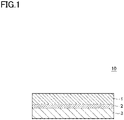
- Fig. 1 is a schematic cross-sectional view of a laminate according to an embodiment.
- FIG. 1 is a schematic cross-sectional view of a laminate according to an embodiment.
- a laminate 10 according to an embodiment includes a substrate layer 1, an adhesive layer 2, and a sealant layer 3 arranged in this order.
- the substrate layer is a film (base film) serving as a support and contains a crystalline polyester film.
- the substrate layer may be made of a crystalline polyester film.
- the crystalline polyester film may be a stretched film or a non-stretched film.
- the crystalline polyester can be obtained, for example, by condensation polymerization of a diol and a dicarboxylic acid.
- the diols include aliphatic diols and alicyclic diols, and include compounds such as ethylene glycol, diethylene glycol, triethylene glycol, 1,2-propylene glycol, 1,3-propylene glycol, dipropylene glycol, trimethylene glycol, tetramethylene glycol, pentamethylene glycol, hexamethylene glycol, octamethylene glycol, nonamethylene glycol, decamethylene glycol, neopentyl glycol, 1,4-butanediol, and 1,4-cyclohexanedimethanol. These compounds may be used singly or in combination of two or more. Ethylene glycol derived from biomass may also be used.
- dicarboxylic acids include aliphatic dicarboxylic acids, alicyclic dicarboxylic acids, and aromatic dicarboxylic acids, and include compounds such as oxalic acid, malonic acid, succinic acid, glutaric acid, adipic acid, pimelic acid, suberic acid, glutaconic acid, azelaic acid, sebacic acid, nonane dicarboxylic acid, decane dicarboxylic acid, undecane dicarboxylic acid, dodecane dicarboxylic acid, maleic acid, fumaric acid, mesaconic acid, citraconic acid, itaconic acid, isophthalic acid, terephthalic acid, n-dodecyl succinic acid, n-dedocenyl succinic acid, cyclohexane dicarboxylic acid, and anhydrides or lower alkyl esters of these acids. These compounds may be used singly or in combination of two or more.
- polybutylene terephthalate polybutylene naphthalate, polyethylene terephthalate or the like can be used from the viewpoint of fully developing the function as a substrate layer of the packaging material.
- the substrate layer may contain recycled polyester from the perspective of reducing environmental impact.
- the recycled polyester include a chemically recycled polyester obtained by chemically recycling a container made of polyester mainly composed of ethylene terephthalate units, and a mechanically recycled polyester obtained by mechanically recycling a container made of polyester mainly composed of ethylene terephthalate units.
- the substrate layer may be provided with a vapor-deposition layer of inorganic oxide on at least one surface of the base layer, for example from the viewpoint of improving gas barrier properties against water vapor and oxygen.
- a vapor-deposition layer of inorganic oxide enables high barrier properties to be obtained with a very thin layer that does not affect the recyclability of the laminate.
- the inorganic oxide include aluminum oxide, silicon oxide, magnesium oxide, and tin oxide. From the viewpoint of transparency and barrier properties of the inorganic vapor-deposition layer, the inorganic oxide may be selected from the group consisting of aluminum oxide, silicon oxide, and magnesium oxide.
- the vapor-deposition layer of inorganic oxide may have a thickness of, for example, 5 nm or more and 100 nm or less, or 10 nm or more and 50 nm or less. A thickness of 5 nm or more facilitates good barrier properties, and a thickness of 100 nm or less facilitates maintaining the flexibility of the laminate.
- the vapor-deposition layer can be formed, for example, by physical vapor deposition or chemical vapor deposition.
- the substrate layer may include a film other than a crystalline polyester film, or may include a plurality of crystalline polyester films.
- each of the crystalline polyester films may be the same or different.
- at least one layer of polyester film may have a vapor-deposition layer of inorganic oxide on the surface of the vapor-deposition layer.
- the thickness of the substrate layer is not limited, and may be, for example, in the range of 5 ⁇ m to 1 mm, or may be in the range of 5 to 800 ⁇ m, or alternatively, in the range of 5 to 500 ⁇ m.
- the total thickness thereof may be in the above range.
- the adhesive component of the adhesive layer may, for example, be a two-part curable polyurethane adhesive, in which a bifunctional or higher aromatic or aliphatic isocyanate compound as curing agent is reacted with a base resin, such as polyester polyol, polyether polyol, or acrylic polyol.
- a base resin such as polyester polyol, polyether polyol, or acrylic polyol.
- the adhesive layer can be formed by applying the adhesive component to the substrate layer, followed by drying.
- the polyurethane adhesive is applied to the substrate layer, followed by aging at 40°C for 4 days or more, for example. This advances the reaction of the hydroxyl group of the interview with the isocyanate group of the curing agent to achieve strong adhesion.
- the adhesive layer may have a thickness in the range of 2 to 50 ⁇ m, or 3 to 20 ⁇ m, in terms of adhesion, followability, and processability.
- the sealant layer imparts sealability to the laminate by heat sealing and includes a polyester film.
- the sealant layer may include a plurality of polyester films or may comprise a polyester film.
- the sealant layer has a ratio of a fracture elongation thereof to a thickness thereof which is 13%/ ⁇ m or less.
- the fracture elongation is a fracture elongation of the sealant layer as measured in a unit of 15 mm width thereof in an MD direction.
- the use of the sealant layer having the above value of 13%/ ⁇ m or less allows elongation due to the viscosity of the resin to less likely occur when the laminate is torn, thereby suppressing the tear strength of the laminate.
- the sealant layer may have a ratio of a fracture elongation thereof to a thickness thereof which is preferably 12%/ ⁇ m or less, and more preferably 11%/ ⁇ m or less.
- the fracture elongation is a fracture elongation of the sealant layer as measured in a unit of 15 mm width thereof in an MD direction.
- the minimum ratio of a fracture elongation thereof to a thickness thereof is not particularly limited, but may be, for example, 0.1%/ ⁇ m or more.
- the fracture elongation is a fracture elongation of the sealant layer as measured in a unit of 15 mm width thereof in an MD direction.
- the fracture elongation can be adjusted according to a material such as a film which forms the sealant layer, a stretch ratio during film formation, or the like.
- the stretch ratio during film formation may be appropriately changed depending on the material of the film or the like, but may be, for example, 1.1 times or more in the MD direction, and more specifically 1.5 times or more.
- the maximum stretch ratio is not particularly limited, and may be, for example, 6 times or less in the MD direction.
- the plane orientation coefficient of the sealant layer is preferably 0.08 or less.
- films tend to tear easily in the orientation direction of the film, but not in directions other than the orientation direction of the film. Therefore, in the case of a laminate formed of two or more oriented films arbitrarily joined together, tearing inhibition may occur due to delamination of the films when tearing, resulting in a large rip in the laminate.
- rip refers to a phenomenon in which when two or more kinds of films are simultaneously torn from each other, the respective torn edges (tear lines) of the films are displaced from each other.
- the plane orientation coefficient of the sealant layer is 0.08 or less, the influence of the orientation in the sealant layer is reduced when the laminate is torn, and the occurrence of a rip is suppressed.
- the plane orientation coefficient of the sealant layer is preferably 0.05 or less, and more preferably 0.01 or less.
- the lower limit of the plane orientation coefficient of the sealant layer is not particularly limited, but may be, for example, 0 or more, and more specifically 0.001 or more.
- a polyester film contained in the sealant layer can be obtained by, for example, condensation polymerization of diols and dicarboxylic acids.
- Examples of the diol and the dicarboxylic acid include compounds exemplified in the substrate layer.
- the polyester film can be obtained, for example, by extruding a resin for forming the polyester film containing diols and dicarboxylic acids by a casting method or the like, and then stretching the resin in the film conveying direction at a desired stretch ratio.
- Polybutylene terephthalate, polybutylene naphthalate, polyethylene terephthalate, or the like can be used as the polyester from the viewpoint of sufficiently developing the function as the sealant layer of the packaging material.
- the sealant layer may contain a recycled polyester resin from the viewpoint of reducing environmental load.
- the recycled polyester resin include a chemically recycled polyester resin obtained by chemically recycling a container made of polyester resin mainly composed of ethylene terephthalate units, and a mechanically recycled polyester resin obtained by mechanically recycling a container made of polyester resin mainly composed of ethylene terephthalate units.
- the polyester film constituting the sealant layer may be applied with various types of additives such as a flame retardant, a slip agent, an anti-blocking agent, an antioxidant, a light stabilizer, a tackifier and the like.
- additives such as a flame retardant, a slip agent, an anti-blocking agent, an antioxidant, a light stabilizer, a tackifier and the like.
- the sealant layer may have a thickness of 15 to 100 ⁇ m or 20 to 60 ⁇ m, in terms of seal strength. If the thickness of the sealant layer is less than 15 ⁇ m, the seal strength tends to be insufficient depending on the size of the laminate and the amount of contents. In addition, the mass ratio occupied by an adhesive or an ink in the laminate tends to be high. If the sealant layer includes a plurality of polyester films, the total thickness may be within the above range.
- the water vapor permeability of the laminate is preferably, for example, 10 g/(m 2 day) or less.
- the oxygen permeability of the laminate may be, for example, 5 cc/m 2 day or less. This protects the contents from deterioration due to steam or oxygen, and makes it easy to maintain the quality for a long time. From this viewpoint, the water vapor permeability may be 7.5 g/m 2 day or less, 5 g/m 2 day or less, 1 g/m 2 day or less, and 0.5 g/m 2 day or less.
- the oxygen permeability may be 4 cc/m 2 day or less, 3 cc/m 2 day or less, 0.5 cc/m 2 day or less, and 0.2 cc/m 2 day or less.
- the laminate preferably has a polyester component as a main component.
- a polyester component as a main component.
- at least a part of the constituent film of the laminate is preferably a polyester film, and more preferably substantially all of the constituent film of the laminate is a polyester film.
- Such a laminate may be a laminate of substantially a single material (monomaterial), and packaging bags formed from the laminate are expected to have excellent recyclability.
- the laminate mainly composed of the polyester component refers to a laminate in which the total mass of the polyester component exceeds 50 mass% based on the total mass of the laminate.
- the total mass of the polyester component may be, for example, 60 mass% or more, 70 mass% or more, 80 mass% or more, 90 mass% or more, 92.5 mass% or more, or 95 mass% or more based on the total mass of the laminate.
- polyester component examples include a crystalline polyester film contained in the substrate layer described above and a polyester film contained in the sealant layer.
- components other than the polyester include an adhesive component or an ink component in the above adhesive layer.
- the laminate can be suitably used to form a packaging bag for packaging contents.
- the contents include liquid seasonings, toiletries, soups, liquids such as liquid detergents, solids such as boiled foods, and solid-liquid mixtures of liquids and solids, such as curries.
- the laminate described above has easy tearing properties, and thus a packaging bag which can be easily opened can be formed.
- the packaging bag is obtained by heat-sealing the sealant layers of the laminate facing each other.
- the packaging bag can be obtained, for example, by heat-sealing the three sides of the laminate with the sealant layers of the laminate facing each other.
- a package is obtained by filling the contents in the packaging bag and then sealing the packaging bag.
- the package can be obtained, for example, by filling the contents from the remaining side which is not heat-sealed, and then heat-sealing the remaining side.
- Resins 1 and 2 for forming polyester films were prepared using the monomers listed in Table 1 as starting materials.
- TPA is terephthalic acid
- EG is ethylene glycol
- NPG is neopentyl glycol
- BDO 1,4-butanediol
- DEG is diethylene glycol
- CHDM 1,4-cyclohexanedimethanol.
- the units in the table represent mol%.
- Polyester film A
- the resin 1 thus obtained was extruded by the casting method and then stretched in the film conveying direction (hereinafter referred to as "MD") at a stretch ratio of 2 times to obtain a polyester film A.
- MD film conveying direction
- Polyester film B
- the polyester film B was obtained in a manner similar to the polyester film A, except that the stretch ratio was 1.1 times.
- the thickness after stretching was 30 ⁇ m.
- a polyester film C was obtained in a manner similar to the polyester film A, except that the thickness after stretching was 50 ⁇ m.
- Polyester film D
- a polyester film D was obtained in a manner similar to the polyester film A, except that the stretch ratio was 3 times.
- the thickness after stretching was 30 ⁇ m.
- a polyester film E was obtained in a manner similar to the polyester film B, except that the resin 1 was changed to resin 2.
- the thickness after stretching was 30 ⁇ m.
- Fracture elongation in the MD direction of polyester film was measured in accordance with JIS K 7127.
- the width of a specimen was 15 mm
- the initial distance between chucks was 100 mm
- the test speed was 300 mm/min.
- a common urethane resin adhesive was used as the adhesive for dry lamination. The coating amount of the urethane resin adhesive after drying was adjusted to 3 g/m 2 (3 ⁇ m in thickness).
- a laminate was obtained in a manner similar to Example 1, except that a polyester film B was used instead of the polyester film A.
- a laminate was obtained in a manner similar to Example 1, except that a polyester film C was used instead of the polyester film A.
- a laminate was obtained in a manner similar to Example 1, except that a polyester film D was used instead of the polyester film A.
- a laminate was obtained in a manner similar to Example 1, except that a polyester film E was used instead of the polyester film A.
- a laminate was obtained in the manner similar to Example 1, except that a silica-deposited film was provided as a barrier layer on one surface of the stretched PET film as the base film, and the silica deposited side of the barrier film and the polyester film A were laminated by the dry lamination method.
- a laminate was obtained in a manner similar to Example 6, except that the base film was replaced with a stretched PET film (trade name: "EMBLET PC", manufactured by UNITIKA LTD.) which is a crystalline polyester film.
- EMBLET PC manufactured by UNITIKA LTD.
- a laminated body was obtained in the same manner as in Example 6, except that a stretched PET film having a thickness of 12 ⁇ m, which is a crystalline polyester film, was further laminated on the barrier film, and the coating amount of the urethane resin adhesive after drying was adjusted to 4 g/m2 (4 ⁇ m in thickness).
- the above urethane resin adhesive was also used in the lamination of the stretched PET film, and the amount of the adhesive applied after drying was adjusted to 4 g/m 2 (4 ⁇ m in thickness).
- a laminate was obtained in a manner similar to Example 1, except that a polyester film G-13 (manufactured by Kurabo Industries Ltd.) having a thickness of 30 ⁇ m was used instead of the polyester film A.
- a laminate was obtained in a manner similar to Example 1, except that a polypropylene film ZK207 (manufactured by Toray Advanced Film Co., Ltd) having a thickness of 60 ⁇ m was used instead of the polyester film A.
- a laminate was obtained in a manner similar to Example 7, except that a polyester film G-13 (manufactured by Kurabo Industries Ltd.) having a thickness of 30 ⁇ m was used instead of the polyester film A.
- a sample was prepared by cutting two 90-mm square pieces of laminate, placing the sealant layers face to face and sealing three outer edges, filling them with 30 ml of water, and then sealing the remaining one edge.
- the sealing conditions were a thickness of 0.2 MPa, temperature of 190°C, and 1 second duration.
- the width of the seal was 5 mm from the outer circumference.
- the prepared sample was torn open in the MD direction by hand by a tester, and the amount of displacement between the torn edge of the front sheet and the torn edge of the back sheet among the sheets that overlapped each other (hereinafter referred to as "step") was measured.
- the step was measured by applying a scale in a direction perpendicular to the tearing direction. The maximum value of the step created along the opening line was used as the measured value of the rip width.
- Oxygen permeability and water vapor permeability of the laminate were measured in accordance with JIS K 7126B.
- Example 1 Example 2
- Example 3 Example 4
- Example 5 Example 6
- Example 7 Example 8 Substrate layer Type (Thickness ( ⁇ m)) PET (12) PET (12) PET (12) PET (12) Inorganic deposition PET (12) Inorganic deposition PET (12) PET (12) Inorganic deposition PET (12) Adhesive layer Thickness ( ⁇ m) 3 3 3 3 3 3 3 3 3 4 Sealant layer Film type (Thickness ( ⁇ m)) A (30) B (30) C (50) D (30) E (30) A (30) A (30) A (30) A (30) A (30) A (30) A (30) Fracture elongation / Thickness (%/ ⁇ m) 6.7 11 6.9 5 10 6.7 6.7 6.7 Plane orientation coefficient 0.08 0.007 0.08 0.1 0.003 0.08 0.08 0.08 Tear strength (N) 0.3 0.4 0.3 0.2 0.5 0.3 0.2 0.6 Rip width (mm) 16 10 19 22 7 16 3 18 Ox
- the laminate according to the present invention has excellent tearing properties as a packaging material.
- Substantially all the constituent films can be polyester films.
- Such a laminate may be a packaging material made of a single material (monomaterial), and excellent recyclability is expected.
Landscapes
- Engineering & Computer Science (AREA)
- Mechanical Engineering (AREA)
- Laminated Bodies (AREA)
- Wrappers (AREA)
Abstract
Description
- The present invention relates to a laminate. More specifically, the present invention relates to a laminate for forming a packaging bag.
- For example, as a packaging bag used for packaging food, a laminate (soft packaging material) including a biaxially oriented PET (polyethylene terephthalate) film and a polyolefin film is known (for example,
PTLs 1 and 2). The biaxially oriented PET film is excellent in heat resistance and toughness as a base film. The polyolefin film such as polyethylene or polypropylene serves as a sealant layer. -
- [PTL 1]
JP 2017-178357 A - [PTL 2]
JP 5933309 B - Due to the spread of universal design, consideration for consumers is required also for packaging bags. For example, it is desired to use a laminate having easy tearing properties as a packaging bag that is easy to open. However, the laminate used in previous packaging bags still has room for improvement in easy tearing properties of the packaging bags.
- The present invention was made in view of the above circumstances, and it is an object to provide a laminate having easy tearing properties.
- The laminate for forming a packaging bag is provided with a substrate layer including a crystalline polyester film, an adhesive layer, and a sealant layer including the polyester film arranged in this order. In the laminate, the sealant layer has a ratio of a fracture elongation thereof to a thickness thereof which is 13%/µm or less. The fracture elongation is a fracture elongation of the sealant layer as measured in a unit of 15 mm width thereof in an MD direction.
- The sealant layer may have a plane orientation coefficient of 0.08 or less.
- The substrate layer may include a vapor-deposition layer of inorganic oxide on at least one surface of the substrate layer.
- The laminate may have a water vapor permeability of 10 g/m2/day or less.
- The laminate may have an oxygen permeability of 5 cc/m2/day or less.
- The laminate may have a ratio of a total mass of a polyester component to a total mass of the laminate of 90 mass% or more.
- According to the present invention, a laminate having easy tearing properties can be provided.
-
Fig. 1 is a schematic cross-sectional view of a laminate according to an embodiment. - Hereinafter, embodiments of the present invention will be described in detail with reference to the accompanying drawings. The present invention is not limited to the following embodiments.
-
Fig. 1 is a schematic cross-sectional view of a laminate according to an embodiment. Alaminate 10 according to an embodiment includes asubstrate layer 1, anadhesive layer 2, and asealant layer 3 arranged in this order. - The substrate layer is a film (base film) serving as a support and contains a crystalline polyester film. The substrate layer may be made of a crystalline polyester film. The crystalline polyester film may be a stretched film or a non-stretched film.
- The crystalline polyester can be obtained, for example, by condensation polymerization of a diol and a dicarboxylic acid.
- The diols include aliphatic diols and alicyclic diols, and include compounds such as ethylene glycol, diethylene glycol, triethylene glycol, 1,2-propylene glycol, 1,3-propylene glycol, dipropylene glycol, trimethylene glycol, tetramethylene glycol, pentamethylene glycol, hexamethylene glycol, octamethylene glycol, nonamethylene glycol, decamethylene glycol, neopentyl glycol, 1,4-butanediol, and 1,4-cyclohexanedimethanol. These compounds may be used singly or in combination of two or more. Ethylene glycol derived from biomass may also be used.
- Examples of the dicarboxylic acids include aliphatic dicarboxylic acids, alicyclic dicarboxylic acids, and aromatic dicarboxylic acids, and include compounds such as oxalic acid, malonic acid, succinic acid, glutaric acid, adipic acid, pimelic acid, suberic acid, glutaconic acid, azelaic acid, sebacic acid, nonane dicarboxylic acid, decane dicarboxylic acid, undecane dicarboxylic acid, dodecane dicarboxylic acid, maleic acid, fumaric acid, mesaconic acid, citraconic acid, itaconic acid, isophthalic acid, terephthalic acid, n-dodecyl succinic acid, n-dedocenyl succinic acid, cyclohexane dicarboxylic acid, and anhydrides or lower alkyl esters of these acids. These compounds may be used singly or in combination of two or more.
- As the crystalline polyester, polybutylene terephthalate, polybutylene naphthalate, polyethylene terephthalate or the like can be used from the viewpoint of fully developing the function as a substrate layer of the packaging material.
- The substrate layer may contain recycled polyester from the perspective of reducing environmental impact. Examples of the recycled polyester include a chemically recycled polyester obtained by chemically recycling a container made of polyester mainly composed of ethylene terephthalate units, and a mechanically recycled polyester obtained by mechanically recycling a container made of polyester mainly composed of ethylene terephthalate units.
- The substrate layer may be provided with a vapor-deposition layer of inorganic oxide on at least one surface of the base layer, for example from the viewpoint of improving gas barrier properties against water vapor and oxygen. The application of a vapor-deposition layer of inorganic oxide enables high barrier properties to be obtained with a very thin layer that does not affect the recyclability of the laminate. Examples of the inorganic oxide include aluminum oxide, silicon oxide, magnesium oxide, and tin oxide. From the viewpoint of transparency and barrier properties of the inorganic vapor-deposition layer, the inorganic oxide may be selected from the group consisting of aluminum oxide, silicon oxide, and magnesium oxide. The vapor-deposition layer of inorganic oxide may have a thickness of, for example, 5 nm or more and 100 nm or less, or 10 nm or more and 50 nm or less. A thickness of 5 nm or more facilitates good barrier properties, and a thickness of 100 nm or less facilitates maintaining the flexibility of the laminate. The vapor-deposition layer can be formed, for example, by physical vapor deposition or chemical vapor deposition.
- The substrate layer may include a film other than a crystalline polyester film, or may include a plurality of crystalline polyester films. When the substrate layer includes a plurality of crystalline polyester films, each of the crystalline polyester films may be the same or different. When the substrate layer contains multiple layers of crystalline polyester film, at least one layer of polyester film may have a vapor-deposition layer of inorganic oxide on the surface of the vapor-deposition layer.
- The thickness of the substrate layer is not limited, and may be, for example, in the range of 5 µm to 1 mm, or may be in the range of 5 to 800 µm, or alternatively, in the range of 5 to 500 µm. When the substrate layer includes a plurality of the above films, the total thickness thereof may be in the above range.
- The adhesive component of the adhesive layer may, for example, be a two-part curable polyurethane adhesive, in which a bifunctional or higher aromatic or aliphatic isocyanate compound as curing agent is reacted with a base resin, such as polyester polyol, polyether polyol, or acrylic polyol.
- The adhesive layer can be formed by applying the adhesive component to the substrate layer, followed by drying. When a polyurethane adhesive is used, the polyurethane adhesive is applied to the substrate layer, followed by aging at 40°C for 4 days or more, for example. This advances the reaction of the hydroxyl group of the interview with the isocyanate group of the curing agent to achieve strong adhesion.
- The adhesive layer may have a thickness in the range of 2 to 50 µm, or 3 to 20 µm, in terms of adhesion, followability, and processability.
- The sealant layer imparts sealability to the laminate by heat sealing and includes a polyester film. The sealant layer may include a plurality of polyester films or may comprise a polyester film.
- In the present embodiment, the sealant layer has a ratio of a fracture elongation thereof to a thickness thereof which is 13%/µm or less. The fracture elongation is a fracture elongation of the sealant layer as measured in a unit of 15 mm width thereof in an MD direction. The use of the sealant layer having the above value of 13%/µm or less allows elongation due to the viscosity of the resin to less likely occur when the laminate is torn, thereby suppressing the tear strength of the laminate. From such a viewpoint, the sealant layer may have a ratio of a fracture elongation thereof to a thickness thereof which is preferably 12%/µm or less, and more preferably 11%/µm or less. The fracture elongation is a fracture elongation of the sealant layer as measured in a unit of 15 mm width thereof in an MD direction. The minimum ratio of a fracture elongation thereof to a thickness thereof is not particularly limited, but may be, for example, 0.1%/µm or more. The fracture elongation is a fracture elongation of the sealant layer as measured in a unit of 15 mm width thereof in an MD direction.
- The fracture elongation can be adjusted according to a material such as a film which forms the sealant layer, a stretch ratio during film formation, or the like. The stretch ratio during film formation may be appropriately changed depending on the material of the film or the like, but may be, for example, 1.1 times or more in the MD direction, and more specifically 1.5 times or more. The maximum stretch ratio is not particularly limited, and may be, for example, 6 times or less in the MD direction.
- The plane orientation coefficient of the sealant layer is preferably 0.08 or less. Generally, films tend to tear easily in the orientation direction of the film, but not in directions other than the orientation direction of the film. Therefore, in the case of a laminate formed of two or more oriented films arbitrarily joined together, tearing inhibition may occur due to delamination of the films when tearing, resulting in a large rip in the laminate. The term "rip" refers to a phenomenon in which when two or more kinds of films are simultaneously torn from each other, the respective torn edges (tear lines) of the films are displaced from each other. If the plane orientation coefficient of the sealant layer is 0.08 or less, the influence of the orientation in the sealant layer is reduced when the laminate is torn, and the occurrence of a rip is suppressed. From this viewpoint, the plane orientation coefficient of the sealant layer is preferably 0.05 or less, and more preferably 0.01 or less. The lower limit of the plane orientation coefficient of the sealant layer is not particularly limited, but may be, for example, 0 or more, and more specifically 0.001 or more.
- A polyester film contained in the sealant layer can be obtained by, for example, condensation polymerization of diols and dicarboxylic acids. Examples of the diol and the dicarboxylic acid include compounds exemplified in the substrate layer. The polyester film can be obtained, for example, by extruding a resin for forming the polyester film containing diols and dicarboxylic acids by a casting method or the like, and then stretching the resin in the film conveying direction at a desired stretch ratio.
- Polybutylene terephthalate, polybutylene naphthalate, polyethylene terephthalate, or the like can be used as the polyester from the viewpoint of sufficiently developing the function as the sealant layer of the packaging material.
- The sealant layer may contain a recycled polyester resin from the viewpoint of reducing environmental load. Examples of the recycled polyester resin include a chemically recycled polyester resin obtained by chemically recycling a container made of polyester resin mainly composed of ethylene terephthalate units, and a mechanically recycled polyester resin obtained by mechanically recycling a container made of polyester resin mainly composed of ethylene terephthalate units.
- The polyester film constituting the sealant layer may be applied with various types of additives such as a flame retardant, a slip agent, an anti-blocking agent, an antioxidant, a light stabilizer, a tackifier and the like.
- The sealant layer may have a thickness of 15 to 100 µm or 20 to 60 µm, in terms of seal strength. If the thickness of the sealant layer is less than 15 µm, the seal strength tends to be insufficient depending on the size of the laminate and the amount of contents. In addition, the mass ratio occupied by an adhesive or an ink in the laminate tends to be high. If the sealant layer includes a plurality of polyester films, the total thickness may be within the above range.
- The water vapor permeability of the laminate is preferably, for example, 10 g/(m2 day) or less. The oxygen permeability of the laminate may be, for example, 5 cc/m2 day or less. This protects the contents from deterioration due to steam or oxygen, and makes it easy to maintain the quality for a long time. From this viewpoint, the water vapor permeability may be 7.5 g/m2 day or less, 5 g/m2 day or less, 1 g/m2 day or less, and 0.5 g/m2 day or less. The oxygen permeability may be 4 cc/m2 day or less, 3 cc/m2 day or less, 0.5 cc/m2 day or less, and 0.2 cc/m2 day or less.
- The laminate preferably has a polyester component as a main component. In other words, at least a part of the constituent film of the laminate is preferably a polyester film, and more preferably substantially all of the constituent film of the laminate is a polyester film. Such a laminate may be a laminate of substantially a single material (monomaterial), and packaging bags formed from the laminate are expected to have excellent recyclability. Here, the laminate mainly composed of the polyester component refers to a laminate in which the total mass of the polyester component exceeds 50 mass% based on the total mass of the laminate. From the viewpoint of recyclability, the total mass of the polyester component may be, for example, 60 mass% or more, 70 mass% or more, 80 mass% or more, 90 mass% or more, 92.5 mass% or more, or 95 mass% or more based on the total mass of the laminate.
- Examples of the polyester component include a crystalline polyester film contained in the substrate layer described above and a polyester film contained in the sealant layer. Examples of components other than the polyester include an adhesive component or an ink component in the above adhesive layer.
- The laminate can be suitably used to form a packaging bag for packaging contents. The contents include liquid seasonings, toiletries, soups, liquids such as liquid detergents, solids such as boiled foods, and solid-liquid mixtures of liquids and solids, such as curries. The laminate described above has easy tearing properties, and thus a packaging bag which can be easily opened can be formed.
- The packaging bag is obtained by heat-sealing the sealant layers of the laminate facing each other. The packaging bag can be obtained, for example, by heat-sealing the three sides of the laminate with the sealant layers of the laminate facing each other. A package is obtained by filling the contents in the packaging bag and then sealing the packaging bag. The package can be obtained, for example, by filling the contents from the remaining side which is not heat-sealed, and then heat-sealing the remaining side.
- While the present invention will be described in more detail using the following examples, it should be understood that the present invention is not limited to the following examples.
-
Resins [Table 1] Carboxylic acid component Diol component TPA EG NPG BDO DEG CHDM Resin 1 100 70 19 9 2 - Resin 2100 60 - - 5 35 - The
resin 1 thus obtained was extruded by the casting method and then stretched in the film conveying direction (hereinafter referred to as "MD") at a stretch ratio of 2 times to obtain a polyester film A. The thickness after stretching was 30 µm. - The polyester film B was obtained in a manner similar to the polyester film A, except that the stretch ratio was 1.1 times. The thickness after stretching was 30 µm.
- A polyester film C was obtained in a manner similar to the polyester film A, except that the thickness after stretching was 50 µm.
- A polyester film D was obtained in a manner similar to the polyester film A, except that the stretch ratio was 3 times. The thickness after stretching was 30 µm.
- A polyester film E was obtained in a manner similar to the polyester film B, except that the
resin 1 was changed toresin 2. - The thickness after stretching was 30 µm.
- Fracture elongation in the MD direction of polyester film was measured in accordance with JIS K 7127. The width of a specimen was 15 mm, the initial distance between chucks was 100 mm, and the test speed was 300 mm/min.
- The plane orientation coefficient of the polyester film was measured and calculated as follows. First, the refractive index was measured in accordance with JIS K 7142 "Plastics-Determination of refractive index" (Method A). A KOBRA-WR manufactured by Oji Scientific Instruments Co., Ltd. was used as the measuring instrument. The refractive index (nx) in the longitudinal direction of the film, the refractive index (ny) in the width direction of the film, and the refractive index (nz) in the thickness direction of the film were measured, and the plane orientation coefficient (ΔP) was calculated by the following equation.

- A stretched PET film having a thickness of 12 µm, which is a crystalline polyester film and oriented in a direction of 30 degrees with respect to the MD direction, was prepared as a base film. Then, the stretched PET film and the polyester film A were bonded together by a dry lamination method to obtain a laminate. A common urethane resin adhesive was used as the adhesive for dry lamination. The coating amount of the urethane resin adhesive after drying was adjusted to 3 g/m2 (3 µm in thickness).
- A laminate was obtained in a manner similar to Example 1, except that a polyester film B was used instead of the polyester film A.
- A laminate was obtained in a manner similar to Example 1, except that a polyester film C was used instead of the polyester film A.
- A laminate was obtained in a manner similar to Example 1, except that a polyester film D was used instead of the polyester film A.
- A laminate was obtained in a manner similar to Example 1, except that a polyester film E was used instead of the polyester film A.
- A laminate was obtained in the manner similar to Example 1, except that a silica-deposited film was provided as a barrier layer on one surface of the stretched PET film as the base film, and the silica deposited side of the barrier film and the polyester film A were laminated by the dry lamination method.
- A laminate was obtained in a manner similar to Example 6, except that the base film was replaced with a stretched PET film (trade name: "EMBLET PC", manufactured by UNITIKA LTD.) which is a crystalline polyester film.
- A laminated body was obtained in the same manner as in Example 6, except that a stretched PET film having a thickness of 12 µm, which is a crystalline polyester film, was further laminated on the barrier film, and the coating amount of the urethane resin adhesive after drying was adjusted to 4 g/m2 (4 µm in thickness). The above urethane resin adhesive was also used in the lamination of the stretched PET film, and the amount of the adhesive applied after drying was adjusted to 4 g/m2 (4 µm in thickness).
- A laminate was obtained in a manner similar to Example 1, except that a polyester film G-13 (manufactured by Kurabo Industries Ltd.) having a thickness of 30 µm was used instead of the polyester film A.
- A laminate was obtained in a manner similar to Example 1, except that a polypropylene film ZK207 (manufactured by Toray Advanced Film Co., Ltd) having a thickness of 60 µm was used instead of the polyester film A.
- A laminate was obtained in a manner similar to Example 7, except that a polyester film G-13 (manufactured by Kurabo Industries Ltd.) having a thickness of 30 µm was used instead of the polyester film A.
- The obtained laminate was evaluated. The results are shown in Tables 2 and 3.
- Tear strength in the MD direction of the laminate was measured in accordance with the Trouser tear method described in JIS K 7128.
- A sample was prepared by cutting two 90-mm square pieces of laminate, placing the sealant layers face to face and sealing three outer edges, filling them with 30 ml of water, and then sealing the remaining one edge. The sealing conditions were a thickness of 0.2 MPa, temperature of 190°C, and 1 second duration. The width of the seal was 5 mm from the outer circumference.
- The prepared sample was torn open in the MD direction by hand by a tester, and the amount of displacement between the torn edge of the front sheet and the torn edge of the back sheet among the sheets that overlapped each other (hereinafter referred to as "step") was measured. The step was measured by applying a scale in a direction perpendicular to the tearing direction. The maximum value of the step created along the opening line was used as the measured value of the rip width.
- Oxygen permeability and water vapor permeability of the laminate were measured in accordance with JIS K 7126B.
- The mass ratio of the polyester component (polyester film) was calculated based on the total mass of the material forming the laminate.
[Table 2] Example 1 Example 2 Example 3 Example 4 Example 5 Example 6 Example 7 Example 8 Substrate layer Type (Thickness (µm)) PET (12) PET (12) PET (12) PET (12) PET (12) Inorganic deposition PET (12) Inorganic deposition PET (12) PET (12) Inorganic deposition PET (12) Adhesive layer Thickness (µm) 3 3 3 3 3 3 3 4 Sealant layer Film type (Thickness (µm)) A (30) B (30) C (50) D (30) E (30) A (30) A (30) A (30) Fracture elongation / Thickness (%/µm) 6.7 11 6.9 5 10 6.7 6.7 6.7 Plane orientation coefficient 0.08 0.007 0.08 0.1 0.003 0.08 0.08 0.08 Tear strength (N) 0.3 0.4 0.3 0.2 0.5 0.3 0.2 0.6 Rip width (mm) 16 10 19 22 7 16 3 18 Oxygen permeability (cc/m2/day) 100 100 100 100 100 0.2 0.2 0.2 Water vapor permeability (cc/m2/day) 50 50 50 50 50 0.5 0.5 0.5 Polyester component (%) 95 95 96.7 95 95 95 95 86 [Table 3] Comparative Example 1 Comparative Example 2 Comparative Example 3 Substrate layer Type (Thickness (µm)) PET (12) PET (12) Inorganic deposition PET (12) Adhesive layer Thickness (µm) 3 3 3 Sealant layer Film type (Thickness (µm)) G-13 (30) ZK207 (60) G-13 (30) Fracture elongation / Thickness (%/µm) 30< 15 30< Plane orientation coefficient 0.09 0.07 0.09 Tear strength (N) 6.1 1.2 5.9 Rip width (mm) -∗1 19 -∗1 Oxygen permeability (cc/m2/day) 100 100 0.2 Water vapor permeability (cc/m2/day) 50 50 0.5 Polyester component (%) 95 22.8 95 ∗1: Unable to measure due to unopening - The laminate according to the present invention has excellent tearing properties as a packaging material. Substantially all the constituent films can be polyester films. Such a laminate may be a packaging material made of a single material (monomaterial), and excellent recyclability is expected.
-
- 1
- Substrate layer
- 2
- Adhesive layer
- 3
- Sealant layer
- 10
- Laminate
Claims (6)
- A laminate for forming a packaging bag, the laminate comprising:a substrate layer containing a crystalline polyester film, an adhesive layer, and a sealant layer containing a polyester film, arranged in this order, whereinthe sealant layer has a ratio of a fracture elongation thereof to a thickness thereof which is 13%/um or less, the fracture elongation being a fracture elongation of the sealant layer as measured in a unit of 15 mm width thereof in an MD direction.
- The laminate according to claim 1, wherein the sealant layer has a plane orientation coefficient of 0.08 or less.
- The laminate according to claim 1 or 2, wherein the substrate layer includes a vapor-deposition layer of inorganic oxide on at least one surface of the substrate layer.
- The laminate according to any one of claims 1 to 3, wherein the laminate has a water vapor permeability of 10 g/m2 day or less.
- The laminate according to any one of claims 1 to 4, wherein the laminate has an oxygen permeability of 5 cc/m2 day or less.
- The laminate according to any one of claims 1 to 5, wherein a ratio of a total mass of a polyester component to a total mass of the laminate is 90 mass% or more.
Applications Claiming Priority (2)
| Application Number | Priority Date | Filing Date | Title |
|---|---|---|---|
| JP2020033186A JP7532807B2 (en) | 2020-02-28 | 2020-02-28 | Laminate |
| PCT/JP2021/006124 WO2021172161A1 (en) | 2020-02-28 | 2021-02-18 | Multilayer body |
Publications (2)
| Publication Number | Publication Date |
|---|---|
| EP4112302A1 true EP4112302A1 (en) | 2023-01-04 |
| EP4112302A4 EP4112302A4 (en) | 2023-08-02 |
Family
ID=77490994
Family Applications (1)
| Application Number | Title | Priority Date | Filing Date |
|---|---|---|---|
| EP21760748.0A Pending EP4112302A4 (en) | 2020-02-28 | 2021-02-18 | Multilayer body |
Country Status (5)
| Country | Link |
|---|---|
| US (1) | US12280570B2 (en) |
| EP (1) | EP4112302A4 (en) |
| JP (3) | JP7532807B2 (en) |
| CN (1) | CN115151422A (en) |
| WO (1) | WO2021172161A1 (en) |
Family Cites Families (33)
| Publication number | Priority date | Publication date | Assignee | Title |
|---|---|---|---|---|
| JP2513669B2 (en) | 1987-03-26 | 1996-07-03 | 東レ株式会社 | Biaxially stretched polyester film with tear linearity |
| US5532058A (en) * | 1990-12-10 | 1996-07-02 | H. B. Fuller Licensing & Financing, Inc. | Dry-bonded film laminate employing polyurethane dispersion adhesives with improved crosslinkers |
| US5310787A (en) * | 1991-06-04 | 1994-05-10 | Du Pont-Mitsui Polychemicals Co., Ltd. | Polyester packaging material |
| WO1994011420A1 (en) * | 1992-11-06 | 1994-05-26 | Daicel Chemical Industries, Ltd. | Easily tearable film and method of manufacturing the same |
| JPH07186318A (en) * | 1993-12-27 | 1995-07-25 | Dainippon Printing Co Ltd | Evaporated film |
| JP3544231B2 (en) * | 1994-10-20 | 2004-07-21 | 大日本印刷株式会社 | Packaging material |
| WO1996028299A1 (en) * | 1995-03-14 | 1996-09-19 | Daicel Chemical Industries, Ltd. | Barrier composite film and process for the production thereof |
| EP0812874B1 (en) * | 1995-12-28 | 2004-06-30 | Gunze Limited | Easy-to-break-through film |
| AU781686B2 (en) * | 1999-08-09 | 2005-06-09 | E.I. Du Pont De Nemours And Company | Biodegradable oriented aromatic polyester film and method of manufacture |
| US6534137B1 (en) * | 1999-10-12 | 2003-03-18 | Cryovac, Inc. | Two-component, heat-sealable films |
| JP2002105293A (en) | 2000-10-04 | 2002-04-10 | Toray Ind Inc | Resin sheet for card |
| ATE310062T1 (en) * | 2001-03-16 | 2005-12-15 | Toyo Boseki | COMPOSITE SLIDE |
| US20050078890A1 (en) * | 2001-12-26 | 2005-04-14 | Kenjiro Abe | Easy-to-unseal packaging bag |
| JP3914440B2 (en) | 2002-01-17 | 2007-05-16 | ユニチカ株式会社 | Overwrap package |
| KR100909752B1 (en) * | 2002-03-07 | 2009-07-29 | 도레이 카부시키가이샤 | Polyester film and gas barrier polyester film |
| JP2004284036A (en) * | 2003-03-19 | 2004-10-14 | Konica Minolta Holdings Inc | Biaxially stretched polyester film |
| JP4710271B2 (en) | 2004-07-27 | 2011-06-29 | 東洋製罐株式会社 | Container lid |
| JP2006175625A (en) | 2004-12-21 | 2006-07-06 | Mitsubishi Polyester Film Copp | Biaxially stretched polyester film |
| WO2006016569A1 (en) * | 2004-08-11 | 2006-02-16 | Mitsubishi Polyester Film Corporation | Biaxially oriented polyester films |
| JP2006247870A (en) * | 2005-03-08 | 2006-09-21 | Teijin Dupont Films Japan Ltd | Heat-sealable biaxially stretched laminated film |
| EP1870350B1 (en) * | 2005-04-04 | 2013-04-03 | Dai Nippon Printing Co., Ltd. | Packaging bag for microwave oven |
| CN101954771B (en) * | 2009-07-17 | 2013-06-05 | 中国石油化工股份有限公司 | Heat-sealing polyester composite film and preparation method thereof |
| KR101707875B1 (en) * | 2009-10-27 | 2017-02-17 | 도레이 카부시키가이샤 | Polyethylene terephthalate composition, manufacturing method therefor, and polyethylene terephthalate film |
| JP5933309B2 (en) | 2012-03-28 | 2016-06-08 | ユニチカ株式会社 | Straight cut gas barrier package |
| JP6653516B2 (en) | 2013-09-30 | 2020-02-26 | 大日本印刷株式会社 | Non-adsorptive sealant film and laminate for packaging material comprising the same |
| JP6852268B2 (en) | 2016-03-16 | 2021-03-31 | 住友ベークライト株式会社 | Unstretched sealant film and packaging |
| EP3434442A4 (en) * | 2016-03-22 | 2019-08-07 | Kuraray Co., Ltd. | SEALING FILM AND MANUFACTURING METHOD THEREFOR |
| JP2017178357A (en) | 2016-03-30 | 2017-10-05 | 東洋製罐株式会社 | Packaging bag |
| JP6890587B2 (en) * | 2016-07-15 | 2021-06-18 | 株式会社クラレ | Sealant film and its manufacturing method |
| JP6159494B1 (en) * | 2017-01-27 | 2017-07-05 | 清二 加川 | Easy tear plastic film and manufacturing apparatus thereof |
| CN110382232B (en) * | 2017-03-01 | 2021-09-28 | 东洋纺株式会社 | Laminate comprising polyester film having furandicarboxylic acid unit and heat-sealable resin layer, and packaging bag |
| JP2019038182A (en) | 2017-08-25 | 2019-03-14 | 大日本印刷株式会社 | Low adsorbent laminate for hand-cutting opening, and packaging material and package using the laminate |
| WO2020241272A1 (en) * | 2019-05-29 | 2020-12-03 | 凸版印刷株式会社 | Method for selecting polyester film, method for producing multilayer body, method for producing package, and multilayer body |
-
2020
- 2020-02-28 JP JP2020033186A patent/JP7532807B2/en active Active
-
2021
- 2021-02-18 WO PCT/JP2021/006124 patent/WO2021172161A1/en not_active Ceased
- 2021-02-18 CN CN202180016812.3A patent/CN115151422A/en active Pending
- 2021-02-18 EP EP21760748.0A patent/EP4112302A4/en active Pending
-
2022
- 2022-08-25 US US17/895,327 patent/US12280570B2/en active Active
-
2024
- 2024-07-23 JP JP2024117649A patent/JP7750344B2/en active Active
-
2025
- 2025-09-24 JP JP2025157625A patent/JP2025175130A/en active Pending
Also Published As
| Publication number | Publication date |
|---|---|
| JP7750344B2 (en) | 2025-10-07 |
| EP4112302A4 (en) | 2023-08-02 |
| WO2021172161A1 (en) | 2021-09-02 |
| JP2025175130A (en) | 2025-11-28 |
| US20220410547A1 (en) | 2022-12-29 |
| CN115151422A (en) | 2022-10-04 |
| JP2024138076A (en) | 2024-10-07 |
| JP2021133637A (en) | 2021-09-13 |
| US12280570B2 (en) | 2025-04-22 |
| JP7532807B2 (en) | 2024-08-14 |
Similar Documents
| Publication | Publication Date | Title |
|---|---|---|
| EP3590711B1 (en) | Laminate provided with heat-sealable resin layer and polyester film having furandicarboxylic acid unit, and packaging bag | |
| WO2020080131A1 (en) | Layered film | |
| JP7439492B2 (en) | Method for selecting polyester film, method for manufacturing laminate, method for manufacturing package, and laminate | |
| WO2018181405A1 (en) | Laminate, and bag composed of said laminate | |
| WO2018062331A1 (en) | Laminated body | |
| EP4578648A1 (en) | Coextruded multilayer film, laminate, and packaging bag | |
| US12226980B2 (en) | Laminate | |
| EP3957479A1 (en) | Method for selecting polyester film, method for producing multilayer body, method for producing package, and multilayer body | |
| US12280570B2 (en) | Laminate | |
| JP7056175B2 (en) | Laminated body and bag composed of the laminated body | |
| JP7056174B2 (en) | Laminated body and bag composed of the laminated body | |
| JP3801165B2 (en) | Transparent gas barrier film | |
| EP4596239A1 (en) | Stretched polyethylene film, packaging material, and food packaged body | |
| EP4316836A1 (en) | Biaxially-oriented polyester film and layered body | |
| JP2021143246A (en) | Sealant film, laminate and package | |
| CN119585111A (en) | Compostable films for packaging perishable fluids | |
| EP4674620A1 (en) | Layered article, packaging material and package | |
| CN121368524A (en) | Compostable films for packaging with improved barrier properties | |
| JP2024051698A (en) | Stretched polyethylene film, packaging material and food packaging body | |
| JP2024051697A (en) | Drawn polyethylene film, packaging material, and food package | |
| JP2024066888A (en) | Coextruded multilayer films, laminates and packaging bags |
Legal Events
| Date | Code | Title | Description |
|---|---|---|---|
| STAA | Information on the status of an ep patent application or granted ep patent |
Free format text: STATUS: THE INTERNATIONAL PUBLICATION HAS BEEN MADE |
|
| PUAI | Public reference made under article 153(3) epc to a published international application that has entered the european phase |
Free format text: ORIGINAL CODE: 0009012 |
|
| STAA | Information on the status of an ep patent application or granted ep patent |
Free format text: STATUS: REQUEST FOR EXAMINATION WAS MADE |
|
| 17P | Request for examination filed |
Effective date: 20220719 |
|
| AK | Designated contracting states |
Kind code of ref document: A1 Designated state(s): AL AT BE BG CH CY CZ DE DK EE ES FI FR GB GR HR HU IE IS IT LI LT LU LV MC MK MT NL NO PL PT RO RS SE SI SK SM TR |
|
| DAV | Request for validation of the european patent (deleted) | ||
| DAX | Request for extension of the european patent (deleted) | ||
| A4 | Supplementary search report drawn up and despatched |
Effective date: 20230704 |
|
| RIC1 | Information provided on ipc code assigned before grant |
Ipc: B32B 27/08 20060101ALI20230628BHEP Ipc: B32B 7/12 20060101ALI20230628BHEP Ipc: B65D 65/40 20060101ALI20230628BHEP Ipc: B32B 27/36 20060101AFI20230628BHEP |