EP4111325B1 - Generating rules for data processing values of data fields from semantic labels of the data fields - Google Patents
Generating rules for data processing values of data fields from semantic labels of the data fields Download PDFInfo
- Publication number
- EP4111325B1 EP4111325B1 EP21714721.4A EP21714721A EP4111325B1 EP 4111325 B1 EP4111325 B1 EP 4111325B1 EP 21714721 A EP21714721 A EP 21714721A EP 4111325 B1 EP4111325 B1 EP 4111325B1
- Authority
- EP
- European Patent Office
- Prior art keywords
- data
- field
- values
- label
- value
- Prior art date
- Legal status (The legal status is an assumption and is not a legal conclusion. Google has not performed a legal analysis and makes no representation as to the accuracy of the status listed.)
- Active
Links
Images








Classifications
-
- G—PHYSICS
- G06—COMPUTING OR CALCULATING; COUNTING
- G06F—ELECTRIC DIGITAL DATA PROCESSING
- G06F16/00—Information retrieval; Database structures therefor; File system structures therefor
- G06F16/20—Information retrieval; Database structures therefor; File system structures therefor of structured data, e.g. relational data
- G06F16/21—Design, administration or maintenance of databases
- G06F16/215—Improving data quality; Data cleansing, e.g. de-duplication, removing invalid entries or correcting typographical errors
-
- G—PHYSICS
- G06—COMPUTING OR CALCULATING; COUNTING
- G06F—ELECTRIC DIGITAL DATA PROCESSING
- G06F16/00—Information retrieval; Database structures therefor; File system structures therefor
- G06F16/20—Information retrieval; Database structures therefor; File system structures therefor of structured data, e.g. relational data
- G06F16/22—Indexing; Data structures therefor; Storage structures
- G06F16/2228—Indexing structures
-
- G—PHYSICS
- G06—COMPUTING OR CALCULATING; COUNTING
- G06F—ELECTRIC DIGITAL DATA PROCESSING
- G06F16/00—Information retrieval; Database structures therefor; File system structures therefor
- G06F16/20—Information retrieval; Database structures therefor; File system structures therefor of structured data, e.g. relational data
- G06F16/28—Databases characterised by their database models, e.g. relational or object models
- G06F16/284—Relational databases
- G06F16/285—Clustering or classification
-
- G—PHYSICS
- G06—COMPUTING OR CALCULATING; COUNTING
- G06N—COMPUTING ARRANGEMENTS BASED ON SPECIFIC COMPUTATIONAL MODELS
- G06N20/00—Machine learning
-
- G—PHYSICS
- G06—COMPUTING OR CALCULATING; COUNTING
- G06N—COMPUTING ARRANGEMENTS BASED ON SPECIFIC COMPUTATIONAL MODELS
- G06N5/00—Computing arrangements using knowledge-based models
- G06N5/04—Inference or reasoning models
-
- G—PHYSICS
- G06—COMPUTING OR CALCULATING; COUNTING
- G06N—COMPUTING ARRANGEMENTS BASED ON SPECIFIC COMPUTATIONAL MODELS
- G06N5/00—Computing arrangements using knowledge-based models
- G06N5/04—Inference or reasoning models
- G06N5/046—Forward inferencing; Production systems
- G06N5/047—Pattern matching networks; Rete networks
Definitions
- This disclosure relates to generating data quality rules for processing data of data fields based on using a label index that associates a label with a field and using a data dictionary that associates an attribute value for the label.
- Computer systems can be used to transmit, receive, and/or process data.
- a server computer system can be used to receive and store resources (e.g., web content, such as a webpage), and make the content available to one or more client computer systems.
- resources e.g., web content, such as a webpage
- the server computer system can retrieve the requested content, and transmit the content to the client computer system to fulfill the request.
- a set of data can include data values stored in data fields.
- a data field can include one or more of the data values. Many instances of the data field can exist in the dataset (e.g., in different fields).
- a computer-implemented method for performing a data quality function includes receiving, at a data quality function process, at least one record from a source, where the record includes data, semantic annotations and data quality annotations associated with the data in the record.
- the semantic annotations are attributes that define the data including input format and output format and the data quality annotations are attributes that define data quality rules to be applied to the data.
- the data quality function process automatically maps the semantic annotations to data quality input fields and to data quality output fields.
- the data quality function process applies the data quality rules to the data using the data quality annotations to perform a data quality function.
- the data quality function process performs the data quality function on the data and outputs the data to a destination in a format defined by the data quality output fields.
- the system described in this document is configured for generating one or more rules for processing data from semantic labels of the data being processed.
- the labels indicate the semantic meaning of the data being labeled.
- the semantic meaning of data is what the data represents in practical terms. For example, the semantic meaning may indicate that a particular field represents a date, and that the data represented is a date of birth for a user profile.
- the semantic meaning of the data can indicate how the data are handled by the data processing system. More specifically, the data processing system is configured to receive data values of data fields that are labeled with semantic labels.
- the data processing system is configured to generate one or more rules for processing the data values of a data field depending on what the label is for that data field.
- the rules can include data masking rules, data quality rules, rules for generating test data, rules for determining a schema, or other such rules.
- the rules that are applied to the labeled data depend on the semantic meaning of the data, even if the overall class of rules (e.g., data quality rules) are being applied to all the data. For example, data quality rules for dates of birth can be different than data quality rules for dates of expiration, though both are dates and have similar formats.
- the data processing system determines the semantic meaning of data, labels the data with a label indicating the semantic meaning, and generates one or more rules for processing that data based on the label.
- the data processing system can mask sensitive data that is stored in data fields that are not intended to include sensitive data.
- the data processing system also determines which data fields do not need to be processed in accordance with the data processing rules. For example, the data processing system can determine that a data field does not need to be masked. Determining which data fields need not be processed by data processing operations saves processing time of the entire dataset for ensuring that the specified goal (e.g., masking) of an application is satisfied.
- the specified goal e.g., masking
- the data processing system overcomes at least one or more of the following challenges for applying rules to datasets.
- data fields of a dataset are not named in a standardized manner such that the names of the data fields are reliable indicators of the content of the data fields.
- PII personally identifying information
- a particular data field may require application of a particular masking function (e.g., to satisfy a security requirement for the data values of that data field).
- the data processing system is configured to determine the meaning of the data values for a data field, which can be difficult because the meaning is not always apparent from the field name, the format of the data values of the field, or the data values themselves.
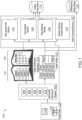
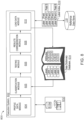
- FIG. 1 is a block diagram of a data processing system 100.
- the data processing system 100 is configured to process data records from input data 112.
- the data processing system includes a semantic discovery system 602 and a data processing device 102.
- the semantic discovery system 602 is configured to determine a meaning (e.g., a semantic meaning) of values for one or more fields of the data records.
- the semantic discovery system 602 can label each of the fields with a semantic label 118 that is selected from a data dictionary database 614.
- the semantic label 118 (also called a label) is associated with one or more attributes 120 in the data dictionary database 614.
- the attributes associated with the semantic label 118 define a semantic meaning of the label.
- the data processing device 102 is configured to receive the label index 610 and the data dictionary database 614 from the semantic discovery system 602, as well as the input data 112.
- the data processing device 102 is configured to process the input data 112 based on labels of the label index 614 and the labels and attributes 120 of the data dictionary database 614.
- the label 118 of the database 614 and the label index 610 are generated by the semantic discovery process of the semantic discovery system 602.
- the semantic discovery system 602 is configured to receive the input data 112 and determine a semantic meaning of fields of the input data.
- the semantic meaning of a field is a description of the practical (e.g., business) meaning of the values of the field, and is subsequently described in further detail.
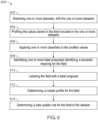
- the semantic discovery system 602 profiles the input data 112 and performs a plurality of classifications that analyze the profile data and the values of the fields.
- the classifications of the profile data and the values of the fields enable the semantic discovery system 602 to determine what attributes are most associated with a field.
- Attributes 120 include metadata (or other data) that indicate properties of a given field.
- attributes 120 can indicate a particular format, a particular relationship of the field with another field or fields, allowed or prohibited values for the field, associated key terms or business terms, statistical criteria for the value(s) of the associated field (either individually, in relation to other values of the field, or for the values of the field as a group), and so forth.
- the semantic discovery system 602 is configured to generate the label index 610 that associates fields of the data records of the input data 112 with labels 118 in the data dictionary database 614.
- semantic labels 118 associated with the field can be retrieved using the label index 610.
- a semantic label (e.g., of labels 118) includes a term or set of terms (generally a string of words or alphanumeric characters) that indicate a semantic meaning of the data of a field labeled by the semantic label.
- the semantic label 118 is a recognized term or set of terms that appear in a data dictionary associated with the data processing system.
- Each semantic label 1118 is associated with one or more fields of the dataset. For example, a table can relate the semantic label 118 to each field (or each instance of each field) in the dataset that have data values with the meaning of the semantic label.
- the semantic discovery system 602 does not necessarily generate an actual label to identify the semantic meaning of the field, but rather associates the field with corresponding attributes 120 indicating the semantic meaning.
- the label index 610 can associate the field with an entry in the data dictionary database 614 including one or more attributes 120, without including a specified label for the field.
- a label is used as shorthand indicating a set of one or more of the attributes 120 of the data dictionary database 614 that represent the semantic meaning of the field.
- a semantic meaning for a field can correspond to a practical meaning or a contextual meaning of the values of the field.
- the practical meaning e.g., a business meaning
- contextual meaning represents one or more syntactical characteristics of the data values and/or contextual indicators of the data values in the data record.
- the one or more syntactical characteristics when interpreted together, convey how the values are processed by one or more modules of the data processing device 102 that are using the values of the data records for various applications.
- the syntactical characteristics are indicated by the attributes 120 associated with each label 118 in the data dictionary database 614. For example, for data values that correspond to dates, the semantic meaning can indicate that the date values represent dates of birth (e.g., for customers or users associated with the data records).
- the semantic meaning can indicate that a numerical identifier represents a social security number, which is a particular kind of numerical identifier and which has particular properties unique to social security numbers.
- a semantic meaning can indicate that values of two different fields together convey a business meaning when grouped together. For example, if a number is identified as a zip code, and that number is paired with other fields that have been identified as representing city names and state names, the semantic discovery system 602 is configured to determine that a semantic meaning of all three fields together is an address. Further examples of semantic meaning are subsequently described in detail.
- the semantic label 118 is associated with one or more attributes 120 in the data dictionary database 116.
- the attributes 120 indicate the meaning of the data values in the data field.
- the attributes 120 can indicate that the data values have particular properties.
- the attributes 120 can indicate that the data values include personally identifiable information (PII).
- the attributes 120 can indicate that the data values of the data field have a particular relationship to other data fields.
- the attributes 120 can indicate that the data field includes key values for a database.
- the attributes 120 can indicate a specific meaning of the data values in the fields implied by the formats of the data values, by the data values themselves, by the name of the data field, and by comparisons of the data values of the data field to other values of other data fields in the dataset.
- the attributes 120 can indicate that the data values of a data field include dates of birth (rather than merely dates or dates for some other purpose).
- the semantic discovery process of the semantic discovery system 602 is subsequently described in greater detail with respect to FIG. 8 .
- the semantic label (or attributes 120 associated with a label) can be associated with a group of fields, rather than a single field. For example, if fields in a group of fields are determined to represent a street name, a street number, a zip code, and a city, respectively, the semantic discovery process can determine that this group of fields together represents addresses, and associate address attributes with the group of fields. For example, the attributes 120 can indicate that all of these fields should be included in the group in a set of given data (e.g., for data quality checks for missing portions of addresses). In some implementations, the attributes 120 can indicate that the fields together represent PII, but individually do not represent PII. This can be useful for data masking checks.
- a data masking module 108 can determine that data masking is needed, wherein data masking is not needed if only one of the fields is included in a dataset. This can also be useful for schema analysis, in which the attributes indicate that each field in the group is correlated with the other fields. Other such examples are possible for multi-field analysis, which is described in detail below.
- the field is associated with the attributes 120 of the semantic label.
- the rules modules 104, 106, 108, and 110 of the data processing device 102 use the attributes 120 to determine what rule(s) to apply to a given field of the dataset or what rules to generate for a given field of the dataset.
- the data processing device 102 is able to process the data of each field in a unique way automatically by applying different rules to each field.
- the data processing device 102 is able to generate rules for processing the given field of a dataset.
- the modules 104, 106, 108, and 1 10 of the data processing device 102 are configured to process the input data in accordance with one or more processing rules.
- a rule for processing data values of the dataset can include one or more data processing operations that are performed on the data values when the data values are in a field associated with a particular semantic label.
- the rule can include a single operation or a list of more than one operation.
- the semantic label 118 can indicate to the data processing system which rule(s) (e.g., of a library of rules) should be applied to the data values of a given data field for an application, or whether any rule should be applied to the data values of the given field.
- the rule can include a data quality rule that imposes a data requirement on each data value of the given field.
- the data requirement can be a format requirement, range requirement for the value, and so forth.
- the rule can include a data masking rule requiring that a data value be transformed to a different format before downstream applications can process the data value.
- Many other types of rules are possible, as subsequently described.
- the data processing device 102 is configured to receive data from the data dictionary 614 and the label index 610 for processing the input data 112.
- the data processing device 102 is configured to use the semantic labels 118 for one or more of several different applications.
- the data processing device 102 includes a data quality rule module 104 (also called a data quality rule module 104).
- the data quality rule module 104 is configured to generate data quality rules for fields of data records (e.g., of input data 112) based on the semantic label(s) associated with each of the fields.
- a first set of data quality rules can be automatically generated for (and used to process) a first field with a first semantic label.
- the data quality rule module 104 can be configured to generate data quality rule model 104 can be configured to generate a first set of data quality rules configured to test whether values of that field are actually valid social security numbers.
- a second field can be labeled as a data of birth field.
- the data quality rule module 104 can be configured to generate a second, different set of data quality rules that are configured to test whether values of that second field are actually valid dates of birth (rather than other dates or other kinds of data).
- the data quality rule module 104 is described in further detail in relation to FIGS. 2A-3C .
- the data processing device 102 includes a test dataset module 106.
- the test dataset module 106 is configured to generate test datasets for testing data processing applications. Generally, to test an application, realistic test data are used to ensure that all features of the application are functioning as intended Generating test data that tests all functionality of the application can be difficult and time consuming, because there can be many processing permutations, case structures, etc. that need to be tested. Furthermore, test data should function in a similar way to real data in that it should comply with referential integrity and internal logical consistency. For example, links in the test data should point to valid data that is also testable. The test dataset module 106 is configured to ensure that test data satisfy these requirements.
- the test dataset module 106 is configured to generate test data in which the test data are satisfy referential integrity (e.g., pointers point to valid fields), that the correct data are included (e.g., a social security number field is included in the test data if needed), that extraneous data are not included (e.g., fields that are not needed in the test data are excluded from the test data), and so forth.
- referential integrity e.g., pointers point to valid fields
- the correct data e.g., a social security number field is included in the test data if needed
- extraneous data e.g., fields that are not needed in the test data are excluded from the test data
- a data masking module 108 is configured to generate rules for masking data fields in the input data 112.
- Data masking can be used to ensure that sensitive data, such as personally identifiable information (PII), is masked such that the data is no longer representing real people or genuine entries in data records.
- data masking can involve anonymizing values of the fields of a data record.
- Data masking can include encrypting values of particular fields. Numerous other methods for masking data are also possible, as subsequently described.
- the data masking module 106 is configured to mask fields using particular masking functions. The particular masking function for a field can be chosen based on the semantic label of the field.
- the semantic label associated with a field can specify how the data are to be masked (e.g., which masking function or masking technique should be used for that field).
- the semantic label can specify not only that a field should be masked, but also how the field should be masked.
- a dataset schema analysis module 110 is configured to identify relationships among fields of the input data 112 and from these relationships determine a schema of the input data 112.
- a schema indicates a structure of the input data 112.
- a schema of the input data 112 can indicate key-value relationships among fields, field dependencies on other fields, value correlation between and among fields, and so forth.
- One or more of the other modules 104, 106, 108 of the data processing device 102 process input data 112 based on the identified schema, including generating or applying data quality rules, generating or applying data masking policies, and generating test datasets.
- the schema of the input data 112 is determined in parallel with the processes of the semantic discovery system 602.
- the semantic labels generated by the semantic discovery system 602 are used to determine the schema of the input data 112 by the dataset schema analysis module 110.
- the data processing device 102 receives datasets from an input data store 112, and outputs processed data to an output data store 114.
- the input data store 112 and the output data store 114 are included in the same data store.
- the input data store 112 and the output data store 114 are databases.
- the datasets received by the data processing device 102 can include data records, data tables, or other data in which groups of one or more values are associated with a name or label.
- the dataset can include one or more fields each including one or more values.
- Each field can include a field name.
- the field name can be a technical name, coded name, business term, numerical value, or any other value.
- the fields do not have field names.
- one or more of the fields of the input data 112 are associated with respective semantic labels. Each semantic label indicates what the syntactical or semantic meaning of the field is, as previously described.
- the data processing system 100 includes a reference data store 116.
- the reference data store 116 stores data that are used by the data processing system 100 to operate the modules 104, 106, 108, and 110. For example, if data quality rules from a data quality rules library are needed by the data quality rule module 104, the data processing device 102 retrieves the data quality rules from the reference data store 116 based on criteria described below.
- the reference data store 116 stores information such as masking functions for use during data masking processes.
- the reference data store 116 can store the label index 610 and data dictionary database 614 data.
- the reference data store 116 can include an in-memory data store or a persistent data store.
- the reference data store 116 can be a single data store or a distributed network of data stores. Essentially, the reference data store 116 is a place to hold data for use in the various processes of the data processing system 100.
- FIGS. 2A-7B are block diagrams each describing a data processing module of the data processing device 102 of FIG. 1 .
- the data quality rule module 104 is configured to generate data quality rules for datasets or apply data quality rules to datasets (such as input data 112), using the semantic meanings of the fields of the datasets.
- the semantic meanings for the fields is determined by the semantic discovery system 602, as previously described in relation to FIG. 1 , and as subsequently described in detail in relation to FIG. 8 .
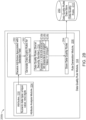
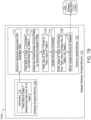
- FIG. 2A shows a process 200a executed by an attribute analysis module 204 of the data quality rule engine 104.
- the attribute analysis module 204 is configured to determine what attributes are associated with a field which has values being processed by the data quality rule module 104 so that one or more data quality rules can be generated by the module 104 for the field.
- the attribute analysis module 204 receives a dataset 201 that includes fields associated with attributes of the data dictionary 614 by the label index 610.
- a semantic label 228 can associate the attributes and the fields, but an actual label is not required.
- subsequent examples include semantic labels to associate the semantic meaning indicated by the attributes with the fields, but in each of the subsequent examples, an actual label (e.g., descriptive word or term) is not required.
- the attribute analysis module 204 determines what the attributes are for a given field for which data quality rules are to be generated or to which data quality rules are to be applied.
- the attribute analysis module 204 is configured to receive (250) the dataset 201.
- the attribute analysis module selects (252) a field of the dataset 201.
- the field 218 selected is named "SSN,” though a field name is not required.
- the value 220 of the field "SSN” is "55-555-5555.”
- the attribute analysis module uses the label index 610 to look up (254) a semantic label 228 in the label index 610.
- a label is not received, but an entry identifier in the data dictionary database 614 (or some other indicator of which attributes relate to the selected field, without using a label).
- the attribute analysis module 204 performs a look up (256) to determine which attributes are related to the label 228a "Social Security Number.”
- attributes 230 are related to label 228a in the data dictionary database 614.
- the attributes 230 are then stored (e.g., in memory) for generation or application of data quality rules by a rule generation module 206 or a rule application module 208 of the data quality rule generation module 104.
- the rule generation module 206 is configured to determine, based on the semantic meaning for a field (e.g., indicated by the attributes 230), one or more data quality rules for the field.
- a particular attribute may indicate one or more rules that can apply to the selected field.
- the attributes 230 can indicate sets or ranges of allowed values, relationships of the values of the field to values of one or more other fields (e.g., always greater than, always less than, equal to, a function of, and so forth), data type, expected value length, or other characteristics of the values of the field.
- the attributes can indicate what values are permitted in the field and what values are not permitted in the field.
- a given range indicated in the attributes associated with a label of a field can also be a data quality rule for that field.
- the attributes associated with the field and the rules being generated for the field do not necessarily match.
- a data quality rule for the field can require that there are no duplicative values or no empty values, while the attributes 230 need not indicate this rule.
- the attributes may indicate that the selected field conform to a particular requirement, but the data quality rules being generated need not enforce this requirement.
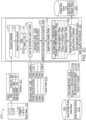
- the rule generation module 206 is configured to receive (260) the attributes 230 associated with the field.
- the rule generation is configured to generate (262) data quality rules for the selected field based on the attributes as previously described. Any number of data quality rules can be generated using any combination of the attributes 230.
- the rules can enforce a requirement for each value of the field independently from any other fields or values of the dataset 201. For example, a data quality rule 214a can require that a format of a value of the field associated with the label "Social Security Number" have the format "XXX-XX-XXX,” where X can be any digit from 0-9. This requirement is based on each individual value and requires no further analysis to enforce.
- the rule 214b can check the type of each character in the value, ensuring that all the X values are indeed digits from 0-9, rather than other characters.
- the data quality rule can require a check on the entire selected field. For example, data quality rule 214c requires that each value in the selected field be unique. This requires checking the values in the selected field in addition to the currently processed value to determine whether each value is unique.
- a rule to be used to characterize the quality of a set of data can indicate an allowable attribute or a prohibited attribute of a profile of the data records in the set of data.
- An attribute of a profile can be a value or range of values.
- a rule indicating an allowable attribute of a profile is satisfied when the profile includes the allowable attribute.
- An example of an allowable attribute for a field can be allowable maximum and minimum values for that field; if the average value for the field falls between the allowable maximum and minimum values, the rule is satisfied.
- a rule indicating a prohibited attribute of a profile is satisfied as long as the profile does not include the prohibited attribute.
- An example of a prohibited attribute for a field can be a list of values that are prohibited for that field; if the field includes any of the prohibited values, the rule is not satisfied.
- a data quality rule can indicate an allowable deviation between a value or values of a field and a profile for the field.
- a deviation between the profile and the values of the field that is greater than the allowable deviation indicated by the corresponding rule can be an indication of a data quality issue in the dataset, and thus an indication that the dataset is a possible root cause of an existing or potential data quality issue in a downstream set of data.
- the allowable deviation can be specified as a range of values, such as a maximum allowable value and a minimum allowable value.
- the allowable deviation can be specified as a standard deviation from a single value, which can be an average value (e.g., a mean or median of values in past datasets).
- a rule to be used to characterize the quality of a set of data can indicate allowed or prohibited characteristics of the value in each of one or more fields of a data record, such as based on the validity of the value in a field.
- a rule indicating an allowed characteristic for a field is satisfied when the value in the field meets the allowed characteristic.
- a rule indicating a prohibited characteristic for a field is satisfied as long as the value in the field does not meet the prohibited characteristic.
- a value that satisfies a rule is sometimes referred to as a valid value; a value that does not satisfy a rule is sometimes referred to as an invalid value.
- Various characteristics of values in the fields can be indicated as allowed or prohibited characteristics by the rule.
- An example rule can indicate allowed or prohibited characteristics of the content of a field, such as an allowed or prohibited range of values, an allowable maximum value, an allowable minimum value, or a list of one or more particular values that are allowed or prohibited. For instance, a birth_year field having a value less than 1900 or greater than 2016 may be considered invalid.
- An example rule can indicate allowed or prohibited characteristics of the data type of a field.
- An example rule can indicate a whether the absence of a value (or the presence of a NULL) in a certain field is allowed or prohibited. For instance, a last _ name field including a string value (e.g., "Smith") may be considered valid, while a last_name field that is blank or that includes a numerical value may be considered invalid.
- An example rule can indicate an allowed or prohibited relationship among two or more fields in the same data record. For instance, a rule may specify a list of values for a ZIP field that correspond to each possible value for a state field and may specify that any combination of values for the ZIP and state fields that is not supported by the list is invalid.
- a rule can be generated based on an analysis of historical data.
- a rule generated by the rule generation module 206 can indicate an allowable attribute or a prohibited attribute of a profile of the data records in a set of data.
- a rule for a profile can be indicative of an allowable deviation between the profile of a field of a particular set of data and a determined historical profile of the field of the set of data.
- the historical profile for a dataset can be based on historical data, for instance, the historical profile can be a profile of the same dataset from a previous day, an average profile of the same dataset from multiple previous days (e.g., over the past week or month), a lifetime average profile of the same dataset.
- the profile can retain a wide variety of reference information to take advantage of various kinds of statistical analyses.
- the profile can include information about standard deviations or other indications of a distribution of values.
- the profile can include a numerical average of prior datasets, and possibly also a standard deviation.
- a generated rule can indicate a determined allowed or prohibited characteristic of the value in a field of a data record.
- a generated rule for a field can indicate an allowable maximum or minimum value for the field based on an analysis of historical maximum or minimum values for the field.
- a generated rule for a field can indicate a list of allowed values for a field based on an analysis of values that have occurred previously for the field.
- a possible data quality issue is detected in a set of data, such as in a new version of a set of reference data or in a set of source data
- an identifier of the set of data having the possible data quality issue is placed on a list of root cause datasets stored in a database. If a data quality issue with a set of output data is later detected, the database can be queried to identify the upstream data lineage elements for the set of output data and to determine which, if any, of those upstream data lineage elements are included on the list of root cause datasets.
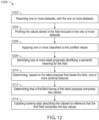
- the data quality rule module 104 is configured to automatically generate data quality rules using the attribute(s) associated with the semantic label 228.
- the rule generation module 206 transforms one or more of the attributes into logical rules. For example, if an attribute indicates that all values of the field are between 1 and 100, a data quality rule can be generated that requires all values are between 1 and 100. However, such a data quality rule need not necessarily be generated.
- another attribute associated with semantic label 228 may indicate that the final digit of each value of the field end in 7. As such, a data quality rule can be generated requiring both that the value be between 1 and 100 and end in a 7. These can also be expressed as two different rules.
- the attributes may indicate a particular format for a value, such as that the value has a format like ###-##-####, which is the format of a social security number.
- the data quality rule generator may generate a data quality rule requiring values to comply with this exact format, a portion thereof, or a common variation (e.g., nine digits without any dashes).
- the semantic label 228 may indicate a relationship of the values of the field to values of another field.
- the rule generation module 206 can generate data quality rules based on these relationships. For example, if the field is a first field, and the dataset comprises a second field, the rule generation module can be configured to generate data quality rule for the first field based on the relationship between the second field and the first field. For example, the second field may be associated with a semantic label indicating that the field is populated with user names. The data quality rule can require that the valid name in the second field be associated with each value in the first field for the first field to pass the data quality test.
- a combination of rules 214a-c can be used.
- This combines two of the three proposed rules (which can also be called constraints), including constraints 214a and 214c.
- the rules can be based on how the data values of a field change over time. For example, a profile for the field can be selected based on a historical trend for values in the field. In another example, the profile for the field is determined based on identifying a historical average of a value in the field.
- the rule generation module 206 can generate data for requesting approval of the data quality rule. For example, a user can approve or deny rules in a user interface. The rule generation module 206 can approve the data quality rule for application in response to obtaining approval data indicative of approval of the data quality rule. In some implementations, no approval data is needed to apply the rule.
- the rules generation module 206 generates the rules (e.g., rules 214a-c)
- the rules 214 are stored (264) in a data store, such as a data quality rules data store 250.
- a rule application module 208 is configured to apply the generated data quality rules 214 to any data 112 received based on the semantic meaning associated with the received data, such as by the attributes 230 associated with the fields using the semantic label 228.
- the rule application module 208 is configured to receive (270) the dataset 201.
- the rule application selects (272) a field of the dataset 201, such as field 218 named "SSN" having a location 221 in the dataset of table 1, column 1.
- the rule application module 208 references (274) the label index 610 and finds which rules are associated with the field at table 1, column 1 in the dataset 201.
- a semantic label 228 "Social Security Number” is used to represent the field.
- the rule application module 208 accesses (276) the data quality rules data store 250 and retrieves the data quality rules 214 for the field labeled "Social Security Number.”
- the rule application module 208 applies (278) the data quality rules to the values of the field 218.
- a value 555-55-5555 passes a format rule, a character limit rule, and a unique value rule.
- the result of passing all of rules 214a-c is a PASS.
- the application module 208 stores (280) the result 224 of the data quality rule application in an output data store 114.
- the data quality rules generated for a field associated with a label 228 can be applied to any field associated with the same label, either in a second instance of dataset 201 or in a new, different dataset.
- the label 228 Social Security Number labels the field for which the rule generation module 206 has generated one or more data quality rules.
- the generated data quality rules can be applied to any field with the same label 228 because the fields have the same semantic meaning. This can also be the case for different fields labeled with the label 228 across datasets. For example, if a new field in a new dataset has the label 228 Social Security Number, the data quality rules generated for data record 202 are still applicable to that new field in the new dataset.
- a data quality rule can be generated based on a relationship between multiple fields or data records, such as data records 202 and 203.
- the relationship between fields can be indicative of a dependency of a value of the second field on a value of the first field or the value of the first field on the value of the second field.
- the relationship can be indicative of a correlation between a value of the first field and a value of the second field.
- the data quality rule module 104 validates the relationship between or among fields by obtaining validation data confirming the relationship.
- the attributes 231 indicate that the field 218 named "SSN" of table 1 (e.g., of record 202) references a field named "USER ID” of table 2 (in record 203).
- the data quality rule generation module 206 can use this information (which can be discovered during schema analysis, described in relation to FIGS. 7A-7B ) to generate data quality rules based on the relationships among fields of the records 202, 203.
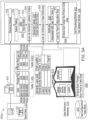
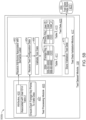
- FIG. 3B shows a process 300b for generating data quality rules by the module 206, similar to process 200b of FIG. 2B .
- a data quality rule can be configured by the rule generation module 206 to enforce a constraint on a value of the second field (e.g., of record 201) based on a value of the first field (e.g., of record 203). For example, determining that the relationship exists between the first field and the second field can include determining that a value of the second field comprises a key value referenced by a value of the first field.
- the data quality rule generation module 206 is configured to generate a data quality rule that is configured to require that each value of the second field is a valid key value.
- the rule generation module 206 can be configured to determine that the relationship exists between the first field and the second field by an output of the semantic discovery process executed by system 602, or by the schema analysis described in relation to FIGS. 7A-7B .
- the relationship among fields of records 202, 203 can be determined using at least one classifier configured by a machine learning process. For example, one or more tests (subsequently described) that are used to determine the semantic labels for fields can also determine the relationships among the fields.
- the relationships among the fields are included in the attributes 231 associated with the semantic labels for each of the fields.
- the attributes can indicate that determining that the semantic label of the field indicates that the field includes primary key values for the dataset.
- the rule generation module 206 configures the data quality rule to require that the primary key values are each unique in the field.
- the attributes 231 include a multi-table constraint, unlike single-field constraints described in relation to FIGS. 2A-2C .
- Multiple records 202 and 203 are analyzed by the attribute analysis module 204 to determine the multi-table attributes 231 relevant to the records 202, 203.
- the schema analysis performed by the dataset schema analysis module 110 (subsequently described in relation to FIGS. 7A-7B ) is used to determine the multi-table attributes 231.
- multi-table attributes 231 can be determined during the semantic discovery process described in relation to FIG. 8 .
- the rule generation module 206 uses the multi-table attributes 231 in similar way as it uses the attributes 230 described previously with respect to FIG. 2A .
- the multi-table constraints are found by the rule generation module 206.
- the multi-table constraints can include any constraint applying to multiple fields.
- the rule generation module 206 can be configured to generate a data quality rule 233b that checks the relationships between and among multiple fields.
- multi-table attributes 231 show that field SSN references field User ID.
- the rule generation module 206 generates a data quality rule 233b. For example, data quality rule 233b checks to determine whether a corresponding value exists (for each value of the selected field) in a USER ID field that is related to the selected field.
- This data quality rule 233b requires determining that the corresponding field USER ID is related to the selected field and that each value has a corresponding existing value in the USER ID field. If no value exists in the field User ID, the data quality rule 233 for the field SSN is failed.
- This example rule only checks the existence of a value in the related field.
- the rule generation module 206 for each value in the field SNN, can check to see whether a valid corresponding user ID exists in the User ID field. This can be done by checking data quality rules associated with the field User ID, such as that the ID is unique, within a given numerical range, and so forth. If any of the data quality rules applying to the User ID field are failed, the data quality rule for the field SSN is also failed in this example.
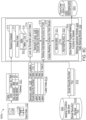
- FIG. 3C a process 300c for application of a multi-filed data quality rule 233b is shown.
- the rule application module 208 is configured to receive (271) the record 202 including table 1.
- the rule application selects (273) a field of the datasets 202-203, such as field 218 named "SSN" having a location 221 in the dataset of table 1, column 1.
- the rule application module 208 references (275) the label index 610 and finds which rules are associated with the field at table 1, column 1 in the dataset 201.
- a semantic label 228 "Social Security Number" is used to represent the field.
- the rule application module 208 accesses (277) the data quality rules data store 250 and retrieves the data quality rules 214 for the field labeled "Social Security Number.”
- the rule application module 208 applies (279) the data quality rules to the values of the field 218.
- a value 555-55-5555 passes a format rule 233a, a character limit rule, and a unique value rule.
- the rule application module 208 access the second field and checks that field in order to apply the rule 233b.
- the rule 233b is failed.
- field 202 passed all the single field data quality rules, it has failed a multi-table data quality rule 233b. This can show a user how a system is failing data quality checks more clearly than simply checking each individual field.
- the result of passing all of rules 233a-b-c is a FAIL.
- the application module 208 stores (281) the result 224 of the data quality rule application in an output data store 114.
- the data quality rules generated for a field associated with a label 228 can be applied to any field associated with the same label, either in a second instance of dataset 201 or in a new, different dataset.
- the label 228 Social Security Number labels the field for which the rule generation module 206 has generated one or more data quality rules.
- the generated data quality rules can be applied to any field with the same label 228 because the fields have the same semantic meaning. This can also be the case for different fields labeled with the label 228 across datasets. For example, if a new field in a new dataset has the label 228 Social Security Number, the data quality rules generated for data record 202 are still applicable to that new field in the new dataset.
- an attribute can indicate that a value is based on values of a corresponding field, such as at least one of an average of the values in the field, a maximum length of the values, a minimum length of the values, a data type of the values, and a format of the values.
- one or more allowable values or prohibited values in the field are associated with the field name that labels the field.
- one or more allowable values or prohibited values in the field are determined based on a value in a second field in the dataset, the second field being related to the first field of the dataset.
- one or more allowable values or prohibited values are based on a combination of the value in the second field and the values in the first field.
- FIGS. 4A-4B show processes 400a and 400b for generating test data using the result of the semantic discovery process of the system 602.
- the test data are generated by the test dataset module 106.
- the test dataset module 106 includes test processing module 304 and a test data generation module 306.
- FIG. 4A shows a test processing module 405 that is configured to generate test data from datasets (e.g., dataset 401) for testing logic of an application using the semantic meaning for fields of the datasets.
- the semantic meaning is represented by attributes 430 and in some aspects a semantic label, as described previously.
- the test dataset module 106 is configured to generate a set of test data for an application.
- the test data is generated such that it represents real data to be processed by the application, tests as much functionality of the application as possible (e.g., all functionality of the application), and so that the test data is valid (e.g., all keys are valid, fields include valid values, and so forth).
- the selection of fields to include in the test data, and the validation of the test data can be performed based on the semantic meaning of each of the fields of the dataset 401.
- the test dataset module 106 receives (402) a dataset 401 that includes fields that are labeled with the semantic labels (or otherwise associated with attributes 430 that indicate a semantic meaning for each of the fields of the dataset 401).
- the test processing module 405 selects (404) one or more fields of the dataset 401, such as a field 418 named "SSN" that includes a value 420 of "12-22-1960.”
- the test processing module 405 performs a look up (406) of the semantic labels 428 in index 610.
- the label 428a is found as labeling field 418.
- the attributes 430 of the label 428a are received (408) by the test processing module 405.
- the attributes 430 indicate that the field 418 includes numeric characters including 10 digits and a MM/DD/YYYY format.
- the test processing module 405 retrieves (410) test configuration data 407 from a test configuration data store 403.
- the test configuration data store 403 can be associated with an application to be tested.
- the test configuration 407 includes a specification of requirements for the test data to be generated.
- the test configuration 407 can include a list of fields to ignore.
- the fields to ignore can be based on the semantic meaning of the fields, as the application may not have data indicating the field names in advance of receiving the dataset 401.
- a user can specify that social security fields should be ignored for the test.
- the test dataset module 106 can determine which fields represent social security numbers and remove those from the teste data. This can reduce a data footprint of the test data, saving storage space.
- test configuration data 407 can indicate that social security numbers in the test data should be unique.
- the test dataset module 106 can find which fields of the dataset 401 represent social security numbers and remove duplicate entries in the field to reduce the test data size.
- the test configuration data 407 may indicate which fields should be key values and what fields they should point to in other datasets.
- the test dataset module 106 can enforce that structure in the generated test data, as subsequently described. Any other similar requirements can be included in the test configuration data 407, and can include schema requirements, data quality requirements, field inclusion requirements, and so forth.
- the test processing module 405 after performing a lookup (410) of the test configuration data 407, enforces the requirements indicated in the test configuration data on the fields of the dataset 401 based on the identified semantic meaning for each of the fields.
- the requirements 412 in FIG. 4A include a requirement to ignore a date of birth field in the dataset 401, and to enforce unique social security numbers.
- the test processing module 405 associates the attributes 430 with the requirements 412 of the test configuration data 407.
- the attributes 430 of a semantic label 428 can include what relationship the field having the semantic label should be to another field having another particular semantic label.
- the attribute 430 for a field 418 labeled "date of birth” may indicate that the value for the date of birth field of a given data entry should always be earlier in time than another value in a field labeled "date of registration.”
- the attributes 430 of a semantic label 428 can indicate what the format of the data values for a field are, what values are permitted (e.g., the attribute may reference a lookup table that includes all possible values for the field).
- the attributes 430 can indicate how common a value of the field should be, an expected range of values for the field, and other such features of the data values of the field.
- the attributes 430 are used during the test generation process 400b.
- FIG. 4B shows a process 400b for test data 422 generation by a test data generation module 415.
- the test data generation module 415 receives (440) the attributes 430 associated with the selected field.
- the test data generation module 415 can also determine how processing rules have processed the field in a prior test, if applicable. For example, processing rule data can be received that indicates how many times a processing rule was executed on fields labeled with the semantic label 428. In some implementations, this data is indicated in the test configuration data 407. In some implementations, for example, if the field has not been tested in prior tests, the field may be removed from the test data.
- the test data generation module 415 receives (442) the test configuration data 407 and generates (446) the test data based on the requirements of the test configuration data 407 and the attributes 430. In an example, two values are included in the SSN field 418 that are each unique and that conform to the format requirements 412 of the test configuration data 407. The values in the SSN field are "555-55-5555,” associated with a first user ID value (value 1) and "666-66-6666,” associated with a second user ID value (value 2). The test data generation module 415 stores (448) the test data 422 in a test data data store 450 for use by one or more applications.
- the test configuration data 407 can indicate subsetting rules for the test data 422.
- the test data generation module 415 receives the attribute values and processing rule data and determines what subsetting rules should apply to that field.
- the test data generation module 415 determines, based on the semantic label 428 for a field, a subsetting rule for the field.
- the subsetting rule indicates whether all the values or a portion of the values of a field should be included in test data for testing an application. For example, a particular semantic label can be used to determine whether the values of the field would be useful for testing in a given test, or whether the field should be ignored during a test. For example, fields that are not of interest for a particular application can be ignored when testing the application.
- the semantic label is associated with one or more attributes in a data dictionary.
- the attributes indicate what the characteristics of the field should be. For example, the attributes together can indicate what the real world meaning is of the field is for the data.
- a user can indicate what real world data are relevant from a larger dataset for the test.
- the test dataset module 106 can automatically select the relevant fields, and ignore the non-relevant fields.
- the test data generation module 415 selects subsettting rules based on the attributes of the semantic label 428.
- the subsetting rules can be directly associated with the semantic label 428.
- the subsetting rules can indicate whether particular fields should be included or not included in test data based on values included in the configuration data 407. For example, if the configuration data 407 indicates an execution count of operations on the field below a threshold number, the field can be removed from the test data.
- the data 407 may specify that if the field fails one or more data quality rule tests, the field can be removed from test data. For example, empty values in the field, values that have data in the wrong format, or other such data can be removed from the field.
- the attributes 430 indicate that the field includes PII, the field can be removed from the test data.
- values that fall outside a particular range can be removed from the test data.
- the subsetting rules can extract a set of data records having unique values. Ensuring that test data has a few duplicative values as possible ensures that a footprint of the test data is as small as possible while representing a full selection of possible test inputs for a system.
Landscapes
- Engineering & Computer Science (AREA)
- Theoretical Computer Science (AREA)
- Databases & Information Systems (AREA)
- Data Mining & Analysis (AREA)
- Physics & Mathematics (AREA)
- General Engineering & Computer Science (AREA)
- General Physics & Mathematics (AREA)
- Software Systems (AREA)
- Artificial Intelligence (AREA)
- Evolutionary Computation (AREA)
- Computing Systems (AREA)
- Mathematical Physics (AREA)
- Quality & Reliability (AREA)
- Computer Vision & Pattern Recognition (AREA)
- Medical Informatics (AREA)
- Computational Linguistics (AREA)
- Information Retrieval, Db Structures And Fs Structures Therefor (AREA)
- Machine Translation (AREA)
Priority Applications (1)
| Application Number | Priority Date | Filing Date | Title |
|---|---|---|---|
| EP25153769.2A EP4521261A3 (en) | 2020-02-26 | 2021-02-25 | Generating rules for data processing values of data fields from semantic labels of the data fields |
Applications Claiming Priority (3)
| Application Number | Priority Date | Filing Date | Title |
|---|---|---|---|
| US202062981646P | 2020-02-26 | 2020-02-26 | |
| US17/006,504 US11886399B2 (en) | 2020-02-26 | 2020-08-28 | Generating rules for data processing values of data fields from semantic labels of the data fields |
| PCT/US2021/019572 WO2021173777A1 (en) | 2020-02-26 | 2021-02-25 | Generating rules for data processing values of data fields from semantic labels of the data fields |
Related Child Applications (2)
| Application Number | Title | Priority Date | Filing Date |
|---|---|---|---|
| EP25153769.2A Division EP4521261A3 (en) | 2020-02-26 | 2021-02-25 | Generating rules for data processing values of data fields from semantic labels of the data fields |
| EP25153769.2A Division-Into EP4521261A3 (en) | 2020-02-26 | 2021-02-25 | Generating rules for data processing values of data fields from semantic labels of the data fields |
Publications (2)
| Publication Number | Publication Date |
|---|---|
| EP4111325A1 EP4111325A1 (en) | 2023-01-04 |
| EP4111325B1 true EP4111325B1 (en) | 2025-04-02 |
Family
ID=77366048
Family Applications (2)
| Application Number | Title | Priority Date | Filing Date |
|---|---|---|---|
| EP21714721.4A Active EP4111325B1 (en) | 2020-02-26 | 2021-02-25 | Generating rules for data processing values of data fields from semantic labels of the data fields |
| EP25153769.2A Pending EP4521261A3 (en) | 2020-02-26 | 2021-02-25 | Generating rules for data processing values of data fields from semantic labels of the data fields |
Family Applications After (1)
| Application Number | Title | Priority Date | Filing Date |
|---|---|---|---|
| EP25153769.2A Pending EP4521261A3 (en) | 2020-02-26 | 2021-02-25 | Generating rules for data processing values of data fields from semantic labels of the data fields |
Country Status (8)
| Country | Link |
|---|---|
| US (4) | US11886399B2 (enExample) |
| EP (2) | EP4111325B1 (enExample) |
| JP (2) | JP7512402B2 (enExample) |
| CN (1) | CN115380281B (enExample) |
| AR (1) | AR121459A1 (enExample) |
| AU (1) | AU2021226330B2 (enExample) |
| CA (1) | CA3167627A1 (enExample) |
| WO (1) | WO2021173777A1 (enExample) |
Families Citing this family (72)
| Publication number | Priority date | Publication date | Assignee | Title |
|---|---|---|---|---|
| US11194845B2 (en) | 2019-04-19 | 2021-12-07 | Tableau Software, LLC | Interactive lineage analyzer for data assets |
| US11704494B2 (en) | 2019-05-31 | 2023-07-18 | Ab Initio Technology Llc | Discovering a semantic meaning of data fields from profile data of the data fields |
| US11651003B2 (en) | 2019-09-27 | 2023-05-16 | Tableau Software, LLC | Interactive data visualization interface for data and graph models |
| US11423217B2 (en) | 2019-11-07 | 2022-08-23 | Tableau Software, LLC | Flexible table based visualizations |
| US12264301B2 (en) | 2019-11-08 | 2025-04-01 | Coors Brewing Company | Method of brewing non-alcoholic beer |
| US11886399B2 (en) | 2020-02-26 | 2024-01-30 | Ab Initio Technology Llc | Generating rules for data processing values of data fields from semantic labels of the data fields |
| US11422985B2 (en) * | 2020-07-30 | 2022-08-23 | Tableau Software, LLC | Interactive data modeling |
| JP2022033625A (ja) * | 2020-08-17 | 2022-03-02 | 富士フイルムビジネスイノベーション株式会社 | 情報処理装置 |
| US11698906B2 (en) * | 2020-08-26 | 2023-07-11 | Jpmorgan Chase Bank, N.A. | Method and apparatus for automatically mapping physical data models/objects to logical data models and business terms |
| US11514109B2 (en) | 2020-10-29 | 2022-11-29 | Google Llc | Inferring semantic label(s) for assistant device(s) based on device-specific signal(s) |
| US12141323B2 (en) * | 2020-11-25 | 2024-11-12 | Anonomatic, Inc. | Processing personally identifiable information from a schema |
| US11520929B2 (en) * | 2020-12-15 | 2022-12-06 | Netapp, Inc. | Methods and systems for securely storing unstructured data in a storage system |
| US20220215107A1 (en) * | 2021-01-07 | 2022-07-07 | Salesforce.Com, Inc. | System and methods to perform row level field masking leveraging attribute based access control in a multi tenant environment |
| US20220300707A1 (en) * | 2021-03-18 | 2022-09-22 | Capital One Services, Llc | Systems and methods for generating term definitions using recurrent neural networks |
| US12001416B1 (en) | 2021-04-20 | 2024-06-04 | The Travelers Indemnity Company | Systems and methods for generic data parsing applications |
| US12321583B1 (en) | 2021-04-20 | 2025-06-03 | The Travelers Indemnity Company | Systems and methods for artificial intelligence (AI)-driven data mapping user-interface (UI) generation |
| US20220366341A1 (en) * | 2021-05-17 | 2022-11-17 | Dataworkz Inc | System and method for managing dataset quality in a computing environment |
| US20220383283A1 (en) * | 2021-05-27 | 2022-12-01 | Mastercard International Incorporated | Systems and methods for rules management for a data processing network |
| US12229145B2 (en) | 2021-06-01 | 2025-02-18 | Tableau Software, LLC | Metadata inheritance for data assets |
| EP4102424A1 (en) * | 2021-06-09 | 2022-12-14 | ABB Schweiz AG | Broker entity to bridge semantic gaps for information produced in industrial plants |
| US12229555B2 (en) * | 2021-06-20 | 2025-02-18 | International Business Machines Corporation | Generating masks for formats including masking restrictions |
| US12423333B2 (en) | 2021-07-08 | 2025-09-23 | Tableau Software, LLC | Data processing for visualizing hierarchical data |
| US11941151B2 (en) * | 2021-07-16 | 2024-03-26 | International Business Machines Corporation | Dynamic data masking for immutable datastores |
| US20230059083A1 (en) | 2021-08-23 | 2023-02-23 | Tableau Software, LLC | Generating shortcut paths between related data types |
| US12346297B2 (en) * | 2021-08-29 | 2025-07-01 | Technion Research & Development Foundation Limited | Database record lineage and vector search |
| US12105742B2 (en) | 2021-08-31 | 2024-10-01 | Tableau Software, LLC | Providing data flow directions for data objects |
| US12105687B2 (en) * | 2021-09-29 | 2024-10-01 | Jpmorgan Chase Bank, N.A. | Systems and methods for automated data quality semantic constraint identification using rich data type inferences |
| CN113836146B (zh) * | 2021-09-29 | 2024-04-26 | 五八同城信息技术有限公司 | 一种特征标签生成方法、装置、电子设备及存储介质 |
| CN113642030B (zh) * | 2021-10-14 | 2022-02-15 | 广东鸿数科技有限公司 | 敏感数据多层识别方法 |
| US11567975B1 (en) * | 2021-11-05 | 2023-01-31 | NVISNX, Inc. | System and method for user interactive contextual model classification based on metadata |
| KR102622434B1 (ko) * | 2021-11-12 | 2024-01-09 | 주식회사 스타캣 | 데이터의 타입을 자동으로 판별하여 메타데이터를 생성하는 방법 및 이를 위한 머신러닝/딥러닝 모델을 이용한 데이터 타입 판별 장치 |
| US11797430B2 (en) * | 2021-12-03 | 2023-10-24 | T-Mobile Usa, Inc. | Configuration-driven data conversion and hosting for software development systems and methods |
| US20230177379A1 (en) * | 2021-12-06 | 2023-06-08 | Microsoft Technology Licensing, Llc | Data quality machine learning model |
| US20230177026A1 (en) * | 2021-12-06 | 2023-06-08 | Microsoft Technology Licensing, Llc | Data quality specification for database |
| CN114722103A (zh) * | 2022-05-12 | 2022-07-08 | 江苏数兑科技有限公司 | 一种基于人口法人基础库的智能数据治理方法 |
| US11875017B2 (en) * | 2022-05-17 | 2024-01-16 | Sap Se | Intelligent adjustment of documents via machine learning |
| CN115080616B (zh) * | 2022-06-13 | 2025-09-02 | 京东方科技集团股份有限公司 | 字典数据获取方法、装置、存储介质及电子设备 |
| DE102022207482B4 (de) * | 2022-07-21 | 2024-03-07 | Zf Friedrichshafen Ag | Computerimplementiertes Verfahren zum Bestimmen eines Datenqualitätsindex, Computerprogramm und Steuereinheit |
| US12361414B2 (en) * | 2022-08-23 | 2025-07-15 | Plaid Inc. | Parsing event data for clustering and classification |
| AU2023347913B2 (en) | 2022-09-20 | 2025-12-11 | Ab Initio Technology Llc | Techniques for discovering and updating semantic meaning of data fields |
| CN115543977B (zh) * | 2022-09-29 | 2024-07-19 | 河北雄安睿天科技有限公司 | 一种供水行业数据清洗方法 |
| US12271355B2 (en) * | 2022-09-30 | 2025-04-08 | Bmc Software, Inc. | Semantic classification for data management |
| TWI822388B (zh) * | 2022-10-12 | 2023-11-11 | 財團法人資訊工業策進會 | 資安防護偵測規則的標示方法及資安威脅策略、技術與攻擊流程標示裝置 |
| CN115840748A (zh) * | 2022-12-15 | 2023-03-24 | 金蝶软件(中国)有限公司 | 数据处理方法、系统及相关设备 |
| US20240211800A1 (en) * | 2022-12-23 | 2024-06-27 | The Johns Hopkins University | Processing event data based on machine learning |
| US12706191B2 (en) | 2022-12-23 | 2026-08-11 | The Johns Hopkins Health System Corporation | Parsing audit records stored in a hardware storage device |
| CN116126704B (zh) * | 2023-01-03 | 2026-01-30 | 四川新网银行股份有限公司 | 一种基于语义识别的mock自动造数方法、装置及介质 |
| CN116150225B (zh) * | 2023-01-04 | 2025-08-26 | 建信金融科技有限责任公司 | 数据字段处理方法、装置、设备、介质和程序产品 |
| US12393903B2 (en) | 2023-01-27 | 2025-08-19 | Tableau Software, LLC | Determining shortcut relationships in data models |
| US20240257122A1 (en) * | 2023-01-31 | 2024-08-01 | Mastercard International Incorporated | Expert systems implementing prioritization techniques for improved transaction categorization |
| CN115827644B (zh) * | 2023-02-13 | 2023-06-09 | 明度智云(浙江)科技有限公司 | 一种基于可视化视图配置的报表生成方法、系统和服务器 |
| CN115952174B (zh) * | 2023-03-13 | 2023-05-30 | 青岛庚泽信息技术有限公司 | 一种数据表联接方法、系统、终端及存储介质 |
| US12182176B2 (en) * | 2023-03-28 | 2024-12-31 | Accenture Global Solutions Limited | System and method for intelligent synthetic test data generation |
| WO2024205582A1 (en) * | 2023-03-29 | 2024-10-03 | Pricewaterhousecoopers Llp | Ai-augmented composable and configurable microservices for record linkage and reconciliation |
| US12265553B2 (en) | 2023-03-29 | 2025-04-01 | PwC Product Sales LLC | AI-augmented composable and configurable microservices for record linkage and reconciliation |
| CN116028481B (zh) * | 2023-03-30 | 2023-06-27 | 紫金诚征信有限公司 | 一种数据质量检测方法、装置、设备和存储介质 |
| CN116415199B (zh) * | 2023-04-13 | 2023-10-20 | 广东铭太信息科技有限公司 | 基于审计中间表的业务数据离群分析方法 |
| CN116501811B (zh) * | 2023-04-27 | 2026-05-01 | 长沙军民先进技术研究有限公司 | 一种基于标签管理的数据管理方法及管理系统 |
| US12327282B2 (en) * | 2023-06-07 | 2025-06-10 | Wells Fargo Bank, N.A. | User interface for identifying and correcting results of data processing rules preventing transmission of data |
| US12518052B2 (en) * | 2023-08-04 | 2026-01-06 | Dell Products L.P. | Automated privacy profiling framework for machine learning workspaces |
| US12450289B2 (en) * | 2023-08-31 | 2025-10-21 | International Business Machines Corporation | Dataset preparation |
| US12705395B2 (en) * | 2023-09-27 | 2026-08-11 | Acronis International Gmbh | Systems and methods for applying data anonymization schemes based on versions of a software |
| US12579116B2 (en) * | 2023-12-29 | 2026-03-17 | Truist Bank | Database and data structure management systems |
| US12566878B2 (en) | 2024-01-01 | 2026-03-03 | Bank Of America Corporation | Data sanitizer |
| CN117668090B (zh) * | 2024-02-01 | 2024-06-04 | 安徽容知日新科技股份有限公司 | 数据交换方法、装置、电子设备和计算机可读存储介质 |
| US12561297B2 (en) * | 2024-04-03 | 2026-02-24 | Sap Se | Rule remediation actions |
| US12608352B2 (en) | 2024-04-19 | 2026-04-21 | Anomalo, Inc. | Injecting synthetic anomalies into data for benchmarking data quality monitoring algorithms |
| CN119127864B (zh) * | 2024-11-08 | 2025-01-28 | 云南省大数据有限公司 | 关联数据源跨数据层库和表的数据质量检测方法、系统 |
| CN120277509B (zh) * | 2025-06-10 | 2025-09-02 | 山东泰开互感器有限公司 | 输变电装备制造全流程数据检核方法、系统、终端及介质 |
| CN120849471B (zh) * | 2025-09-24 | 2026-01-27 | 北京科杰科技有限公司 | 一种基于人工智能的质量规则配置方法及其相关装置 |
| CN120850352B (zh) * | 2025-09-25 | 2026-01-27 | 浪潮云信息技术股份公司 | 一种多字段数据脱敏方法、装置、设备及介质 |
| CN121387831A (zh) * | 2025-11-26 | 2026-01-23 | 北京中数睿智科技有限公司 | 自动化元数据管理及用于数据编织治理的装置 |
Family Cites Families (62)
| Publication number | Priority date | Publication date | Assignee | Title |
|---|---|---|---|---|
| US7426520B2 (en) | 2003-09-10 | 2008-09-16 | Exeros, Inc. | Method and apparatus for semantic discovery and mapping between data sources |
| KR100922141B1 (ko) | 2003-09-15 | 2009-10-19 | 아브 이니티오 소프트웨어 엘엘시 | 데이터 프로파일링 방법 및 시스템 |
| US7912904B2 (en) * | 2004-03-31 | 2011-03-22 | Google Inc. | Email system with conversation-centric user interface |
| US9792351B2 (en) | 2005-06-10 | 2017-10-17 | International Business Machines Corporation | Tolerant and extensible discovery of relationships in data using structural information and data analysis |
| CA2604136A1 (en) | 2005-06-20 | 2006-12-28 | Future Route Limited | Analytical system for discovery and generation of rules to predict and detect anomalies in data and financial fraud |
| US7587636B2 (en) | 2005-08-04 | 2009-09-08 | Microsoft Corporation | Unit test generalization |
| US20080201319A1 (en) | 2006-04-25 | 2008-08-21 | Mcnamar Richard Timothy | Method, system and computer software for using an XBRL medical record for diagnosis, treatment, and insurance coverage |
| US7783564B2 (en) | 2006-07-25 | 2010-08-24 | Visa U.S.A. Inc. | Compliance control in a card based program |
| AU2008321382A1 (en) | 2007-11-12 | 2009-05-22 | Bipar Sciences, Inc. | Treatment of uterine cancer and ovarian cancer with a PARP inhibitor alone or in combination with anti-tumor agents |
| US8140531B2 (en) | 2008-05-02 | 2012-03-20 | International Business Machines Corporation | Process and method for classifying structured data |
| EP2307951A4 (en) | 2008-07-29 | 2012-12-19 | Textwise Llc | METHOD AND APPARATUS FOR ASSOCIATING DATA SETS USING SEMANTIC VECTORS AND KEYWORD ANALYSIS |
| US8176072B2 (en) | 2009-07-28 | 2012-05-08 | Vulcan Technologies Llc | Method and system for tag suggestion in a tag-associated data-object storage system |
| US8379939B1 (en) | 2009-09-08 | 2013-02-19 | Adobe Systems Incorporated | Efficient and scalable face recognition in photo albums |
| US20120254333A1 (en) | 2010-01-07 | 2012-10-04 | Rajarathnam Chandramouli | Automated detection of deception in short and multilingual electronic messages |
| US8751218B2 (en) | 2010-02-09 | 2014-06-10 | Siemens Aktiengesellschaft | Indexing content at semantic level |
| US8719207B2 (en) | 2010-07-27 | 2014-05-06 | Oracle International Corporation | Method and system for providing decision making based on sense and respond |
| US20130006914A1 (en) | 2011-06-28 | 2013-01-03 | Microsoft Corporation | Exposing search history by category |
| US10248672B2 (en) * | 2011-09-19 | 2019-04-02 | Citigroup Technology, Inc. | Methods and systems for assessing data quality |
| CN107451225B (zh) | 2011-12-23 | 2021-02-05 | 亚马逊科技公司 | 用于半结构化数据的可缩放分析平台 |
| US9461876B2 (en) | 2012-08-29 | 2016-10-04 | Loci | System and method for fuzzy concept mapping, voting ontology crowd sourcing, and technology prediction |
| CA2886603A1 (en) | 2012-09-28 | 2014-04-03 | Alkis Papadopoullos | A method and system for monitoring social media and analyzing text to automate classification of user posts using a facet based relevance assessment model |
| US20140095296A1 (en) * | 2012-10-01 | 2014-04-03 | Ebay Inc. | Systems and methods for analyzing and reporting geofence performance metrics |
| US9613125B2 (en) | 2012-10-11 | 2017-04-04 | Nuance Communications, Inc. | Data store organizing data using semantic classification |
| US10489360B2 (en) | 2012-10-17 | 2019-11-26 | Ab Initio Technology Llc | Specifying and applying rules to data |
| US20140115013A1 (en) | 2012-10-22 | 2014-04-24 | Arlen Anderson | Characterizing data sources in a data storage system |
| US9239889B2 (en) | 2013-03-15 | 2016-01-19 | Sugarcrm Inc. | Adaptive search and navigation through semantically aware searching |
| US9836986B2 (en) | 2013-05-21 | 2017-12-05 | Pearson Education, Inc. | Dynamic response entry |
| US20150032609A1 (en) | 2013-07-29 | 2015-01-29 | International Business Machines Corporation | Correlation of data sets using determined data types |
| US10528718B2 (en) * | 2013-09-27 | 2020-01-07 | Paypal, Inc. | Method and apparatus for a data confidence index |
| WO2015084408A1 (en) | 2013-12-06 | 2015-06-11 | Hewlett-Packard Development Company, L.P. | Flexible schema table |
| GB201322057D0 (en) * | 2013-12-13 | 2014-01-29 | Qatar Foundation | Descriptive and prescriptive data cleaning |
| GB2521198A (en) | 2013-12-13 | 2015-06-17 | Ibm | Refactoring of databases to include soft type information |
| US10198460B2 (en) | 2014-06-04 | 2019-02-05 | Waterline Data Science, Inc. | Systems and methods for management of data platforms |
| US10346358B2 (en) | 2014-06-04 | 2019-07-09 | Waterline Data Science, Inc. | Systems and methods for management of data platforms |
| US10169642B2 (en) | 2014-08-06 | 2019-01-01 | Facebook, Inc. | Systems and methods for face alert |
| US20160055427A1 (en) | 2014-10-15 | 2016-02-25 | Brighterion, Inc. | Method for providing data science, artificial intelligence and machine learning as-a-service |
| US10210246B2 (en) | 2014-09-26 | 2019-02-19 | Oracle International Corporation | Techniques for similarity analysis and data enrichment using knowledge sources |
| US10409802B2 (en) | 2015-06-12 | 2019-09-10 | Ab Initio Technology Llc | Data quality analysis |
| US9910842B2 (en) | 2015-08-12 | 2018-03-06 | Captricity, Inc. | Interactively predicting fields in a form |
| US20170068891A1 (en) | 2015-09-04 | 2017-03-09 | Infotech Soft, Inc. | System for rapid ingestion, semantic modeling and semantic querying over computer clusters |
| US10067972B2 (en) | 2015-11-17 | 2018-09-04 | International Business Machines Corporation | Semantic database driven form validation |
| WO2018025706A1 (ja) | 2016-08-05 | 2018-02-08 | 日本電気株式会社 | テーブル意味推定システム、方法およびプログラム |
| US10838940B1 (en) * | 2016-08-11 | 2020-11-17 | MuleSoft, Inc. | Balanced key range based retrieval of key-value database |
| US20180060404A1 (en) | 2016-08-29 | 2018-03-01 | Linkedin Corporation | Schema abstraction in data ecosystems |
| US11151100B2 (en) | 2016-10-17 | 2021-10-19 | Sap Se | Performing data quality functions using annotations |
| US10565177B2 (en) * | 2016-11-14 | 2020-02-18 | At&T Intellectual Property I, L.P. | Software defined entities for digital service transactions |
| CN106528874B (zh) | 2016-12-08 | 2019-07-19 | 重庆邮电大学 | 基于Spark内存计算大数据平台的CLR多标签数据分类方法 |
| CN106897424A (zh) | 2017-02-24 | 2017-06-27 | 北京时间股份有限公司 | 信息标注系统及方法 |
| JP7235269B2 (ja) | 2017-03-13 | 2023-03-08 | 日本電気株式会社 | データ項目名推定装置、データ項目名推定プログラム、及びデータ項目名推定方法 |
| WO2019138294A1 (en) | 2018-01-10 | 2019-07-18 | AVAST Software s.r.o. | Cloud-based anomalous traffic detection and protection in a remote network via dns properties |
| US20200110736A1 (en) * | 2018-03-29 | 2020-04-09 | Robert Paul Bauman | Natural language, flat field, record management and file system that defines, integrates and operates records comprising best practices and establishes collaborative peer networks to evolve new best practice records |
| US10635939B2 (en) | 2018-07-06 | 2020-04-28 | Capital One Services, Llc | System, method, and computer-accessible medium for evaluating multi-dimensional synthetic data using integrated variants analysis |
| US11474978B2 (en) | 2018-07-06 | 2022-10-18 | Capital One Services, Llc | Systems and methods for a data search engine based on data profiles |
| CN109191030B (zh) * | 2018-11-21 | 2022-05-06 | 深圳越海全球供应链股份有限公司 | 一种提升数据质量的方法及提高仓库运作效率的方法 |
| CN109635288B (zh) | 2018-11-29 | 2023-05-23 | 东莞理工学院 | 一种基于深度神经网络的简历抽取方法 |
| US11328004B2 (en) | 2019-03-22 | 2022-05-10 | Microsoft Technology Licensing, Llc | Method and system for intelligently suggesting tags for documents |
| US11704494B2 (en) * | 2019-05-31 | 2023-07-18 | Ab Initio Technology Llc | Discovering a semantic meaning of data fields from profile data of the data fields |
| CN110442568A (zh) * | 2019-07-30 | 2019-11-12 | 北京明略软件系统有限公司 | 字段标签的获取方法及装置、存储介质、电子装置 |
| EP4078474A4 (en) * | 2019-12-19 | 2024-01-10 | Alegion, Inc. | SELF-OPTIMIZING LABELING PLATFORM |
| US11886399B2 (en) | 2020-02-26 | 2024-01-30 | Ab Initio Technology Llc | Generating rules for data processing values of data fields from semantic labels of the data fields |
| US11630853B2 (en) | 2021-01-29 | 2023-04-18 | Snowflake Inc. | Metadata classification |
| AU2023347913B2 (en) | 2022-09-20 | 2025-12-11 | Ab Initio Technology Llc | Techniques for discovering and updating semantic meaning of data fields |
-
2020
- 2020-08-28 US US17/006,504 patent/US11886399B2/en active Active
-
2021
- 2021-02-25 EP EP21714721.4A patent/EP4111325B1/en active Active
- 2021-02-25 EP EP25153769.2A patent/EP4521261A3/en active Pending
- 2021-02-25 AU AU2021226330A patent/AU2021226330B2/en active Active
- 2021-02-25 CA CA3167627A patent/CA3167627A1/en active Pending
- 2021-02-25 WO PCT/US2021/019572 patent/WO2021173777A1/en not_active Ceased
- 2021-02-25 CN CN202180022638.3A patent/CN115380281B/zh active Active
- 2021-02-25 JP JP2022550704A patent/JP7512402B2/ja active Active
- 2021-02-26 AR ARP210100521A patent/AR121459A1/es active IP Right Grant
-
2023
- 2023-12-19 US US18/545,416 patent/US12242444B2/en active Active
- 2023-12-28 US US18/399,522 patent/US12242442B2/en active Active
- 2023-12-28 US US18/399,545 patent/US12242443B2/en active Active
-
2024
- 2024-06-26 JP JP2024102886A patent/JP7806137B2/ja active Active
Also Published As
| Publication number | Publication date |
|---|---|
| EP4521261A3 (en) | 2025-05-07 |
| US20240152495A1 (en) | 2024-05-09 |
| US20240126734A1 (en) | 2024-04-18 |
| US12242444B2 (en) | 2025-03-04 |
| JP2024144425A (ja) | 2024-10-11 |
| EP4521261A2 (en) | 2025-03-12 |
| US11886399B2 (en) | 2024-01-30 |
| JP7512402B2 (ja) | 2024-07-08 |
| US20240126735A1 (en) | 2024-04-18 |
| JP2023516139A (ja) | 2023-04-18 |
| AU2021226330B2 (en) | 2025-02-27 |
| BR112022016716A2 (pt) | 2022-10-11 |
| WO2021173777A1 (en) | 2021-09-02 |
| CA3167627A1 (en) | 2021-09-02 |
| US12242443B2 (en) | 2025-03-04 |
| CN115380281A (zh) | 2022-11-22 |
| AR121459A1 (es) | 2022-06-08 |
| US12242442B2 (en) | 2025-03-04 |
| JP7806137B2 (ja) | 2026-01-26 |
| EP4111325A1 (en) | 2023-01-04 |
| US20210263900A1 (en) | 2021-08-26 |
| CN115380281B (zh) | 2026-06-02 |
| AU2021226330A1 (en) | 2022-08-25 |
Similar Documents
| Publication | Publication Date | Title |
|---|---|---|
| US12242444B2 (en) | Generating rules for data processing values of data fields from semantic labels of the data fields | |
| US12456016B2 (en) | Discovering a semantic meaning of data fields from profile data of the data fields | |
| Ilyas et al. | Trends in cleaning relational data: Consistency and deduplication | |
| CN102197406B (zh) | 模糊数据操作 | |
| US12141107B2 (en) | Techniques for discovering and updating semantic meaning of data fields | |
| De Bruin | Record linkage toolkit documentation | |
| US20250036602A1 (en) | Machine learning techniques for discovering keys in relational datasets | |
| Bhadauria et al. | A Catalog of Data Errors | |
| HK40079584B (en) | Generating rules for data processing values of data fields from semantic labels of the data fields | |
| HK40079584A (en) | Generating rules for data processing values of data fields from semantic labels of the data fields | |
| CA3268252C (en) | Techniques for discovering and updating semantic meaning of data fields | |
| Huang | Relational Data Curation by Deduplication, Anonymization, and Diversification | |
| HK40039381A (en) | Discovering a semantic meaning of data fields from profile data of the data fields |
Legal Events
| Date | Code | Title | Description |
|---|---|---|---|
| STAA | Information on the status of an ep patent application or granted ep patent |
Free format text: STATUS: UNKNOWN |
|
| STAA | Information on the status of an ep patent application or granted ep patent |
Free format text: STATUS: THE INTERNATIONAL PUBLICATION HAS BEEN MADE |
|
| PUAI | Public reference made under article 153(3) epc to a published international application that has entered the european phase |
Free format text: ORIGINAL CODE: 0009012 |
|
| STAA | Information on the status of an ep patent application or granted ep patent |
Free format text: STATUS: REQUEST FOR EXAMINATION WAS MADE |
|
| 17P | Request for examination filed |
Effective date: 20220914 |
|
| AK | Designated contracting states |
Kind code of ref document: A1 Designated state(s): AL AT BE BG CH CY CZ DE DK EE ES FI FR GB GR HR HU IE IS IT LI LT LU LV MC MK MT NL NO PL PT RO RS SE SI SK SM TR |
|
| REG | Reference to a national code |
Ref country code: HK Ref legal event code: DE Ref document number: 40079584 Country of ref document: HK |
|
| DAV | Request for validation of the european patent (deleted) | ||
| DAX | Request for extension of the european patent (deleted) | ||
| P01 | Opt-out of the competence of the unified patent court (upc) registered |
Effective date: 20230512 |
|
| STAA | Information on the status of an ep patent application or granted ep patent |
Free format text: STATUS: EXAMINATION IS IN PROGRESS |
|
| 17Q | First examination report despatched |
Effective date: 20231025 |
|
| REG | Reference to a national code |
Ref country code: DE Ipc: G06F0016280000 Ref country code: DE Ref legal event code: R079 Ref document number: 602021028508 Country of ref document: DE Free format text: PREVIOUS MAIN CLASS: G06F0016215000 Ipc: G06F0016280000 |
|
| GRAP | Despatch of communication of intention to grant a patent |
Free format text: ORIGINAL CODE: EPIDOSNIGR1 |
|
| STAA | Information on the status of an ep patent application or granted ep patent |
Free format text: STATUS: GRANT OF PATENT IS INTENDED |
|
| RIC1 | Information provided on ipc code assigned before grant |
Ipc: G06F 16/215 20190101ALI20241122BHEP Ipc: G06F 16/28 20190101AFI20241122BHEP |
|
| INTG | Intention to grant announced |
Effective date: 20241212 |
|
| GRAS | Grant fee paid |
Free format text: ORIGINAL CODE: EPIDOSNIGR3 |
|
| GRAA | (expected) grant |
Free format text: ORIGINAL CODE: 0009210 |
|
| STAA | Information on the status of an ep patent application or granted ep patent |
Free format text: STATUS: THE PATENT HAS BEEN GRANTED |
|
| AK | Designated contracting states |
Kind code of ref document: B1 Designated state(s): AL AT BE BG CH CY CZ DE DK EE ES FI FR GB GR HR HU IE IS IT LI LT LU LV MC MK MT NL NO PL PT RO RS SE SI SK SM TR |
|
| REG | Reference to a national code |
Ref country code: GB Ref legal event code: FG4D |
|
| REG | Reference to a national code |
Ref country code: CH Ref legal event code: EP |
|
| REG | Reference to a national code |
Ref country code: IE Ref legal event code: FG4D |
|
| REG | Reference to a national code |
Ref country code: DE Ref legal event code: R096 Ref document number: 602021028508 Country of ref document: DE |
|
| REG | Reference to a national code |
Ref country code: NL Ref legal event code: MP Effective date: 20250402 |
|
| PG25 | Lapsed in a contracting state [announced via postgrant information from national office to epo] |
Ref country code: NL Free format text: LAPSE BECAUSE OF FAILURE TO SUBMIT A TRANSLATION OF THE DESCRIPTION OR TO PAY THE FEE WITHIN THE PRESCRIBED TIME-LIMIT Effective date: 20250402 |
|
| REG | Reference to a national code |
Ref country code: AT Ref legal event code: MK05 Ref document number: 1781953 Country of ref document: AT Kind code of ref document: T Effective date: 20250402 |
|
| PG25 | Lapsed in a contracting state [announced via postgrant information from national office to epo] |
Ref country code: FI Free format text: LAPSE BECAUSE OF FAILURE TO SUBMIT A TRANSLATION OF THE DESCRIPTION OR TO PAY THE FEE WITHIN THE PRESCRIBED TIME-LIMIT Effective date: 20250402 Ref country code: PT Free format text: LAPSE BECAUSE OF FAILURE TO SUBMIT A TRANSLATION OF THE DESCRIPTION OR TO PAY THE FEE WITHIN THE PRESCRIBED TIME-LIMIT Effective date: 20250804 Ref country code: ES Free format text: LAPSE BECAUSE OF FAILURE TO SUBMIT A TRANSLATION OF THE DESCRIPTION OR TO PAY THE FEE WITHIN THE PRESCRIBED TIME-LIMIT Effective date: 20250402 |
|
| REG | Reference to a national code |
Ref country code: LT Ref legal event code: MG9D |
|
| PG25 | Lapsed in a contracting state [announced via postgrant information from national office to epo] |
Ref country code: GR Free format text: LAPSE BECAUSE OF FAILURE TO SUBMIT A TRANSLATION OF THE DESCRIPTION OR TO PAY THE FEE WITHIN THE PRESCRIBED TIME-LIMIT Effective date: 20250703 Ref country code: NO Free format text: LAPSE BECAUSE OF FAILURE TO SUBMIT A TRANSLATION OF THE DESCRIPTION OR TO PAY THE FEE WITHIN THE PRESCRIBED TIME-LIMIT Effective date: 20250702 |
|
| PG25 | Lapsed in a contracting state [announced via postgrant information from national office to epo] |
Ref country code: PL Free format text: LAPSE BECAUSE OF FAILURE TO SUBMIT A TRANSLATION OF THE DESCRIPTION OR TO PAY THE FEE WITHIN THE PRESCRIBED TIME-LIMIT Effective date: 20250402 |
|
| PG25 | Lapsed in a contracting state [announced via postgrant information from national office to epo] |
Ref country code: BG Free format text: LAPSE BECAUSE OF FAILURE TO SUBMIT A TRANSLATION OF THE DESCRIPTION OR TO PAY THE FEE WITHIN THE PRESCRIBED TIME-LIMIT Effective date: 20250402 |
|
| PG25 | Lapsed in a contracting state [announced via postgrant information from national office to epo] |
Ref country code: HR Free format text: LAPSE BECAUSE OF FAILURE TO SUBMIT A TRANSLATION OF THE DESCRIPTION OR TO PAY THE FEE WITHIN THE PRESCRIBED TIME-LIMIT Effective date: 20250402 |
|
| PG25 | Lapsed in a contracting state [announced via postgrant information from national office to epo] |
Ref country code: AT Free format text: LAPSE BECAUSE OF FAILURE TO SUBMIT A TRANSLATION OF THE DESCRIPTION OR TO PAY THE FEE WITHIN THE PRESCRIBED TIME-LIMIT Effective date: 20250402 |
|
| PG25 | Lapsed in a contracting state [announced via postgrant information from national office to epo] |
Ref country code: RS Free format text: LAPSE BECAUSE OF FAILURE TO SUBMIT A TRANSLATION OF THE DESCRIPTION OR TO PAY THE FEE WITHIN THE PRESCRIBED TIME-LIMIT Effective date: 20250702 |
|
| PG25 | Lapsed in a contracting state [announced via postgrant information from national office to epo] |
Ref country code: IS Free format text: LAPSE BECAUSE OF FAILURE TO SUBMIT A TRANSLATION OF THE DESCRIPTION OR TO PAY THE FEE WITHIN THE PRESCRIBED TIME-LIMIT Effective date: 20250802 |
|
| PG25 | Lapsed in a contracting state [announced via postgrant information from national office to epo] |
Ref country code: LV Free format text: LAPSE BECAUSE OF FAILURE TO SUBMIT A TRANSLATION OF THE DESCRIPTION OR TO PAY THE FEE WITHIN THE PRESCRIBED TIME-LIMIT Effective date: 20250402 |
|
| REG | Reference to a national code |
Ref country code: DE Ref legal event code: R097 Ref document number: 602021028508 Country of ref document: DE |
|
| PG25 | Lapsed in a contracting state [announced via postgrant information from national office to epo] |
Ref country code: SM Free format text: LAPSE BECAUSE OF FAILURE TO SUBMIT A TRANSLATION OF THE DESCRIPTION OR TO PAY THE FEE WITHIN THE PRESCRIBED TIME-LIMIT Effective date: 20250402 Ref country code: DK Free format text: LAPSE BECAUSE OF FAILURE TO SUBMIT A TRANSLATION OF THE DESCRIPTION OR TO PAY THE FEE WITHIN THE PRESCRIBED TIME-LIMIT Effective date: 20250402 |
|
| PG25 | Lapsed in a contracting state [announced via postgrant information from national office to epo] |
Ref country code: CZ Free format text: LAPSE BECAUSE OF FAILURE TO SUBMIT A TRANSLATION OF THE DESCRIPTION OR TO PAY THE FEE WITHIN THE PRESCRIBED TIME-LIMIT Effective date: 20250402 |
|
| PG25 | Lapsed in a contracting state [announced via postgrant information from national office to epo] |
Ref country code: EE Free format text: LAPSE BECAUSE OF FAILURE TO SUBMIT A TRANSLATION OF THE DESCRIPTION OR TO PAY THE FEE WITHIN THE PRESCRIBED TIME-LIMIT Effective date: 20250402 |
|
| PG25 | Lapsed in a contracting state [announced via postgrant information from national office to epo] |
Ref country code: SK Free format text: LAPSE BECAUSE OF FAILURE TO SUBMIT A TRANSLATION OF THE DESCRIPTION OR TO PAY THE FEE WITHIN THE PRESCRIBED TIME-LIMIT Effective date: 20250402 |
|
| PG25 | Lapsed in a contracting state [announced via postgrant information from national office to epo] |
Ref country code: IT Free format text: LAPSE BECAUSE OF FAILURE TO SUBMIT A TRANSLATION OF THE DESCRIPTION OR TO PAY THE FEE WITHIN THE PRESCRIBED TIME-LIMIT Effective date: 20250402 |
|
| PLBE | No opposition filed within time limit |
Free format text: ORIGINAL CODE: 0009261 |
|
| STAA | Information on the status of an ep patent application or granted ep patent |
Free format text: STATUS: NO OPPOSITION FILED WITHIN TIME LIMIT |
|
| REG | Reference to a national code |
Ref country code: CH Ref legal event code: L10 Free format text: ST27 STATUS EVENT CODE: U-0-0-L10-L00 (AS PROVIDED BY THE NATIONAL OFFICE) Effective date: 20260211 |
|
| 26N | No opposition filed |
Effective date: 20260105 |
|
| PGFP | Annual fee paid to national office [announced via postgrant information from national office to epo] |
Ref country code: GB Payment date: 20260202 Year of fee payment: 6 |
|
| PGFP | Annual fee paid to national office [announced via postgrant information from national office to epo] |
Ref country code: DE Payment date: 20260128 Year of fee payment: 6 |
|
| PGFP | Annual fee paid to national office [announced via postgrant information from national office to epo] |
Ref country code: FR Payment date: 20260209 Year of fee payment: 6 |
|
| PG25 | Lapsed in a contracting state [announced via postgrant information from national office to epo] |
Ref country code: LT Free format text: LAPSE BECAUSE OF FAILURE TO SUBMIT A TRANSLATION OF THE DESCRIPTION OR TO PAY THE FEE WITHIN THE PRESCRIBED TIME-LIMIT Effective date: 20250402 |
|
| PG25 | Lapsed in a contracting state [announced via postgrant information from national office to epo] |
Ref country code: SE Free format text: LAPSE BECAUSE OF FAILURE TO SUBMIT A TRANSLATION OF THE DESCRIPTION OR TO PAY THE FEE WITHIN THE PRESCRIBED TIME-LIMIT Effective date: 20250402 |