EP4110694B1 - Tethered unmanned aerial vehicle system - Google Patents
Tethered unmanned aerial vehicle system Download PDFInfo
- Publication number
- EP4110694B1 EP4110694B1 EP21706325.4A EP21706325A EP4110694B1 EP 4110694 B1 EP4110694 B1 EP 4110694B1 EP 21706325 A EP21706325 A EP 21706325A EP 4110694 B1 EP4110694 B1 EP 4110694B1
- Authority
- EP
- European Patent Office
- Prior art keywords
- tether
- ground station
- angle
- unmanned aerial
- aerial vehicle
- Prior art date
- Legal status (The legal status is an assumption and is not a legal conclusion. Google has not performed a legal analysis and makes no representation as to the accuracy of the status listed.)
- Active
Links
Images



Classifications
-
- G—PHYSICS
- G01—MEASURING; TESTING
- G01C—MEASURING DISTANCES, LEVELS OR BEARINGS; SURVEYING; NAVIGATION; GYROSCOPIC INSTRUMENTS; PHOTOGRAMMETRY OR VIDEOGRAMMETRY
- G01C21/00—Navigation; Navigational instruments not provided for in groups G01C1/00 - G01C19/00
- G01C21/20—Instruments for performing navigational calculations
-
- B—PERFORMING OPERATIONS; TRANSPORTING
- B64—AIRCRAFT; AVIATION; COSMONAUTICS
- B64U—UNMANNED AERIAL VEHICLES [UAV]; EQUIPMENT THEREFOR
- B64U10/00—Type of UAV
- B64U10/60—Tethered aircraft
-
- G—PHYSICS
- G05—CONTROLLING; REGULATING
- G05D—SYSTEMS FOR CONTROLLING OR REGULATING NON-ELECTRIC VARIABLES
- G05D1/00—Control of position, course, altitude or attitude of land, water, air or space vehicles, e.g. using automatic pilots
- G05D1/08—Control of attitude, i.e. control of roll, pitch, or yaw
- G05D1/0808—Control of attitude, i.e. control of roll, pitch, or yaw specially adapted for aircraft
- G05D1/0866—Control of attitude, i.e. control of roll, pitch, or yaw specially adapted for aircraft specially adapted to captive aircraft
-
- B—PERFORMING OPERATIONS; TRANSPORTING
- B64—AIRCRAFT; AVIATION; COSMONAUTICS
- B64U—UNMANNED AERIAL VEHICLES [UAV]; EQUIPMENT THEREFOR
- B64U2101/00—UAVs specially adapted for particular uses or applications
- B64U2101/30—UAVs specially adapted for particular uses or applications for imaging, photography or videography
-
- B—PERFORMING OPERATIONS; TRANSPORTING
- B64—AIRCRAFT; AVIATION; COSMONAUTICS
- B64U—UNMANNED AERIAL VEHICLES [UAV]; EQUIPMENT THEREFOR
- B64U2201/00—UAVs characterised by their flight controls
- B64U2201/20—Remote controls
- B64U2201/202—Remote controls using tethers for connecting to ground station
Definitions
- the invention relates to a tethered automatic unmanned aerial vehicle system.
- US 2015/212391 A1 discloses a multi-copter that is attached to a tether, wherein an evaluation unit determines a tension in the tether and an acceleration of the multi-copter to derive an elevation angle. Further, an angle of incidence of the tether and gravity may be determined at the multi-copter, such as to determine from the detected angle an angular position of the multi-copter with respect to an operator.
- GPS global positioning system
- a drawback on such UAVs is that electromagnetic noise, e.g. due to signal jamming or spoofing, or bad signal transmission due to physical obstructions can cause the electric components for navigation to fail or can impair communication with the remote control for the UAV.
- An object of the present invention is to provide an aerial system that is capable to perform flight missions independent of environmental conditions.
- the object is achieved by the system having the features of claim 1 and a method with the features of claim 12.
- a tethered automatic unmanned aerial vehicle system comprises at least the components:
- the ground station comprises a preload assembly with a movable member that is arranged in contact with the tether and that is configured to alter a tether path length of an adjustable tether path in the ground station, particularly wherein the movable member is rotatably mounted such that the member can rotate around an axis of the member, wherein the movable member is arranged translationally movable on a guide of the preload assembly that allows the tether path length in the ground station to be adjusted in length by moving the movable member along the guide, such that a load on the tether can be adjusted by moving the movable member.
- the system according to the invention is capable for flight missions independent of an electromagnetic noise environment and/or an availability of a satellite-based positioning signal, such as a GPS signal. Moreover, even in strong wind conditions, the danger of a loss of the UAV is greatly reduced, as the tether connection secures the UAV against being blown away.
- unmanned aerial vehicle short UAV, such as the term “multi-copter” particularly refer to a powered, aerial vehicle that does not carry a human operator and has rotary wings to provide vehicle lift.
- the UAV is configured to be piloted remotely and to carry a payload, such as a camera, a heat sensor, a communication sensor, a laser and the like for aerial monitoring, situational awareness, target acquisition and inspection.
- the angle-sensor is arranged on the UAV - and not at the ground station - a solid angle providing information about a three-dimensional angle of incidence of the tether, particularly with respect to a horizontal plane, and thus a direction towards the ground station can be determined by the UAV.
- the angle-sensor is further arranged and configured to determine a yaw angle with respect to a yaw axis of the UAV relative to the tether and thus relative to the direction of the ground station.
- the yaw axis particularly points vertically away with respect to the UAV, particularly opposite the gravitational pull. This embodiment particularly allows for compensating a flight attitude of the UAV relative to the horizontal plane and thus to determine the angle of incidence relative to the horizontal plane by adjusting for the determined yaw angle.
- ground station particularly refers to a system comprising a landing platform and/or a remote control system for the UAV.
- the ground station can comprise an evaluation module, such as a computer, for evaluating sensor data and/or signals of the components of the aerial system.
- the UAV comprises a data storage configured to store and/or update a position of the ground station.
- the tether is longer than 5m, particularly longer than 20 m, particularly longer than 100m, wherein a free tether length can be automatically adjusted by the system.
- the tether has essentially no stiffness such that it is very flexible. Particularly, the tether is so flexible that it generates or has essentially no restoring forces when bent.
- the UAV and/or the ground station is configured to determine a relative altitude of the particularly flying UAV with respect to the ground station.
- Spherical coordinates can be used for determining the altitude of the UAV.
- a height sensor and /or an ambient pressure sensor can be used for determining the flight altitude of the UAV.
- the system particularly the UAV and/or the ground station is configured to autonomously determine a three-dimensional position of the UAV with respect to the ground station, with the information about the free tether length and the angle of incidence.
- no global or external positioning signals are needed to determine the relative position if the UAV.
- the tether is connected to the unmanned aerial vehicle by an angle-adjustable mount assembly, such as a pivot assembly or a swivel assembly, wherein the angle-adjustable mount assembly comprises an inertial measurement unit, short IMU, wherein the angle-adjustable mount assembly is configured to map, particularly by means of a rigid mechanical connection or relation of the IMU and the mount assembly, the angle of incidence to the IMU such that the IMU assumes a corresponding angle with the angle-adjustable mount assembly, particularly wherein the IMU is connected to the tether.
- an angle-adjustable mount assembly such as a pivot assembly or a swivel assembly
- the angle-adjustable mount assembly comprises an inertial measurement unit, short IMU
- the angle-adjustable mount assembly is configured to map, particularly by means of a rigid mechanical connection or relation of the IMU and the mount assembly, the angle of incidence to the IMU such that the IMU assumes a corresponding angle with the angle-adjust
- the IMU is particularly not configured and arranged in the UAV to determine an orientation of the UAV in space, for which IMUs are used typically in UAVs.
- the IMU is configured to determine the angle of incidence.
- the IMU is particularly configured to provide IMU data comprising the information about the angle of incidence to an evaluation on the UAV for further processing of IMU data.
- the mount assembly and particularly the IMU is arranged rotatably on a ball-bearing and/or a gimbal that is configured to rotate at least around a roll and a pitch axis of the UAV.
- This allows compensating for a pitch and roll angle the UAV might assume, leaving the mount assembly unaltered and non-sensitive to the pitch and roll angle of the UAV.
- the UAV can for example adopt roll and pitch angles due to wind or its own flying motion.
- the roll and pitch angle of the UAV are well-defined axis of the UAV and known the person skilled in the art.
- the roll axis particularly extends along a forward direction of the UAV, wherein the pitch axis particularly extends orthogonally to the roll and aw axis.
- This embodiment allows for a quick, economic and reliable determination of the angle of incidence.
- the optical sensor comprises an illumination module, such as an LED and a detection module, such as a quadrant diode.
- the tether comprises a data cable for transmitting an angle-sensor signal, IMU data and/or angle-sensor data to the ground station.
- the tether comprises a communication cable for transmitting control signals from a remote control that is particularly operated by an operator to the UAV.
- This embodiment allows for secure and interference-free transmission of control signals to the UAV.
- the UAV is capable to receive and detect the control signals from the remote control.
- the communication and/or the data cable might comprise a coating for shielding the communication and/or data cable from electromagnetic noise.
- the tether comprises an electricity supply cable that is configured to provide electricity to the UAV for flying and operation.
- the evaluation module arranged on the UAV is configured to evaluate the angle-sensor data and/or the IMU data.
- the evaluated data are then transmitted via the appropriate cable or by a RF-transmission module to the ground station and/or to the remote control to adjust a position and/or orientation of the UAV.
- the tether is configured to transmit sensor data from an additional sensor such as a camera or a telemetry-system to the ground station.
- the ground station comprises a rotatably mounted tether drum configured to roll up and to roll off the tether from the tether drum such as to adjust the free tether length of the tether between the unmanned aerial vehicle and the ground station.
- This embodiment allows for a variable use of the system and also for compact storage of the tether.
- the preload assembly with the movable member is arranged in contact with the tether.
- the preload assembly may serve for an ordered winding and unwinding from a tether drum, which allows for a faultless functioning for the system during operation.
- the movable member is rotatably mounted such that the member can rotate around an axis of the member, particularly wherein the movable member is arranged between an opening of the ground station through which the tether exits the ground station towards the unmanned aerial vehicle and the tether drum.
- the guide extends vertically and the movable member moves vertically along the guide of the preload assembly that allows the tether path length in the ground station, particularly the tether path length between tether the drum and the opening in the ground station to be adjusted in length by moving the movable member along the guide, such that a load on the tether can be adjusted by moving the movable member.
- This embodiment allows for facile, robust and efficient realization of the movable member.
- the movable member is rotatably mounted such that the member can rotate around an axis of the member, particularly wherein the movable member is arranged between an opening of the ground station through which the tether exits the ground station towards the unmanned aerial vehicle and the tether drum, wherein the movable member is arranged translationally movable on the guide, particularly wherein the guide extends vertically and the movable member moves vertically along the guide of the preload assembly that allows the tether path length in the ground station, particularly the tether path length between tether the drum and the opening in the ground station to be adjusted in length by moving the movable member along the guide, such that a load on the tether can be adjusted by moving the movable member.
- This embodiment provides a robust and easy way to precisely control a preload of the tether with a short reaction time.
- this embodiment allows for adjusting the preload of the tether without the need to engage in a tether drum activation (roll up or roll down), which renders the system more energy efficient.
- the movable member is formed as an elongated shaft.
- the movable member is a wheel that is in contact with the tether at a rim portion of the wheel, particularly wherein the wheel comprises a circumferential recess that serves as a guide for the tether.
- the tether is arranged such in the ground station that it extends from the tether drum downward, then extends around a lower portion, i.e. a ground facing portion of the movable member, particularly wherein the tether extends between ground and the axis of the movable member, and then upwards through the receiving opening of the ground station.
- the movable member is spring loaded, such that a spring force from a spring of the preload assembly pushes the movable member onto the tether.
- the preload assembly is particularly a spring assembly.
- the preload assembly comprises a load sensor configured to determine a tether load of the tether between the ground station and the UAV, wherein the system is configured to adjust the tether load for example by moving the movable member the along the guide, or by rolling up or rolling down the tether from the tether drum, particularly in response to the determined tether load, such that the tether load remains higher than a predefined minimum tether load.
- the preload of the tether is adjusted by a weight of the movable member weight in connection with gravity.
- the preload assembly comprises a load sensor, wherein the load sensor is configured such that the tether load is determined with the load sensor arranged at the ground station.
- the preload assembly comprises a spring damping assembly, wherein the spring damping assembly is configured such that the tether load is determined with the load sensor arranged at the ground station.
- the tether path inside the ground station exhibits a local minimum located such in the tether path that a fluid, such as water, on the tether accumulates at the minimum for dripping off at the minimum, particularly wherein said minimum is located between the tether drum and the receiving opening of the ground station, particularly wherein the local minimum is adopted at the movable member.
- the ground station is arranged or comprised by a vehicle, such as a car or a ship.
- This embodiment provides a versatile aerial system that can be transported to an operation site by the vehicle.
- the system is particularly further configured to be operatable with the ground station on the vehicle.
- the system is configured to be operated during motion of the vehicle comprising the ground station.
- operable in the context of this embodiment particularly includes a state of the system during which the unmanned aerial vehicle is flying.
- An operator for the UAV can in the vehicle.
- the system is configured to drag the unmanned aerial vehicle in the air behind the vehicle comprising the ground station.
- the ground station comprises a receiving opening for the tether through which the tether exits (and enters) the ground station towards the unmanned aerial vehicle, wherein at the receiving opening the ground station comprises a centering channel extending essentially vertically from the receiving opening, wherein the centering channel is configured to receive an elongated member attached to the unmanned aerial vehicle such that a lateral position of the unmanned aerial vehicle is stabilized during landing, particularly wherein the centering channel is a funnel.
- the elongated member of the UAV extends essentially downwards form the UAV, i.e. towards the ground, particularly when no force is applied to the elongated member.
- the assembly formed by the centering channel and the elongated member of the UAV allows for a landing aid for the UAV on the ground station even during adverse, i.e. gusty weather conditions.
- the elongated member is rigidly coupled to the angle-sensor, particularly the IMU such that the angle-sensor adopts the same or a corresponding orientation as the elongated member.
- the elongated member is attached to a bearing, particularly a ball-bearing or a gimbal such that it can assume any angle of incidence.
- the tether is attached, particularly with a first end to the elongated member, particularly to a first end of the elongated member, such that the landing procedure can be performed by shortening the free tether path length. Centering of the UAV with respect to the ground station is facilitated by design of said assembly.
- the elongated member has a length between 20 cm and 100 cm.
- the centering channel comprises a ball bearing at the channel walls for holding the elongated member at reduced friction.
- a method for operating a tethered unmanned aerial vehicle, particularly a multi-copter, with a system according the invention comprises at least the steps of:
- the method further comprises the step of adjusting a determined tether load such that the determined tether load is larger than a minimum tether load.
- the system and method according to the invention solves several problems in the art. For example, there is no limitation of operation environments due to weather or electromagnetic noise or due to the absence of a global positioning system signal e.g. due to buildings or other physical obstructions.
- the system according to the invention is particularly well-suited for applications in the civil and military sector. Moreover, in the field of physical security, the system can be used to protect critical infrastructure, such as chemical plants, power stations and wastewater treatment plants, as well as pipelines, railway lines and borders, with a minimum of personnel. Inspection and monitoring tasks for wind farms or railway lines are also conceivable.
- the UAV can be automatically pulled behind a vehicle while keeping a predefined position relative to the vehicle / ground station on the vehicle.
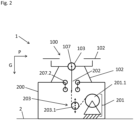
- the system 1 comprises an unmanned aerial vehicle (UAV) 100 in form of a multi-copter 100.
- the multi-copter 100 is configured to hover ( Fig. 1 ) as well as to fly directionally.
- the multi-copter 100 can be a quadro-, hexa-, octa-, or a multi-copter with even more rotors 102 or rotor bearing arms 101.
- the UAV can also be a VTOL (Vertical Take-Off and Landing vehicle), i.e. a multi-copter having non-rotatory wings for directional flight.
- the multi-copter 100 can have a landing gear 108 (cf. Fig. 2 ), wherein said landing gear 108 is particularly automatically raised or stowed once the multi-copter 100 is in the air.
- the multi-copter 100 is tethered to a ground station 200 be means of a tether 300 that extends between the multi-copter 100 and the ground station 200.
- the tether 300 is connected with a first end 301 to a body 103 of the multi-copter 100 and with a second end 302 to the ground station 200.
- the connection of the tether 300 to the multi-copter 100 is such that the multi-copter 100 can determine an angle of incidence 400 of the tether 300 relative to a horizontal plane P or gravity G, which is equivalent.
- the tether 300 is mechanically connected with the first end 301 to an angle-sensor 104 that is configured to determine the angle of incidence 400 (cf. Fig. 4 , panel B). From the determined angle of incidence 400 a position of the multi-copter 100 with respect to the ground station 200 is determined.
- the angle of incidence is determined for example by an inertial measurement unit 104 (IMU), i.e. the angle-sensor can be an IMU.
- the IMU 104 comprises a three axes gyroscope and a three axes accelerometer and might also comprise a compass.
- the three axes gyroscope is used for determining the angle of incidence 400 of the tether 300 (cf. Fig. 4 ).
- the compass is configured to determine the yaw axis 403 of the UAV 100.
- the tether 300 is connected to the angle-sensor 104 for example by means of an angle-adjustable mount assembly 105 that is configured to swivel or pivot for adopting the angle of incidence 400 without contributing or causing resistance or friction that could influence the angle of incidence 400.
- the angle-adjustable mount assembly 105 automatically, particularly by design, decouples the flight attitude of the UAV 100 from the angle-sensor 104. For example, during strong side winds the multi-copter might assume an angle 401 relative to the horizon, i.e. the multi-copter is tilted around the roll and/or the pitch axis such that the yaw axis 401 is not pointing along gravity G anymore. Nonetheless, due to the mount assembly 105, the angle of incidence can be still determined correctly as the tilt around the roll and/or pitch axis is compensated at the mount assembly 105 such that the angle-sensor 104 remains unaffected.
- the angle of incidence 400 is for example defined by an angle of the tether 300 with respect to a horizontal plane P that extends orthogonal to the gravitational pull G.
- the angle of incidence 400 can also be measured with respect to the body 103 of the multi-copter 100. However, this might require an additional instrument for taking into account an angle 401 of the body 103 of the multi-copter 100 with respect to the horizontal plane P, as the body 103 of the multi-copter 100 might not extend parallel to the horizontal plane P at all times during flight. From both angles the angles the angle of incidence 400 relative to the horizontal plane P can be determined.
- the mount assembly 105 comprises a rigid elongated member 106 that points essentially downwards from the multi-copter 100 towards the ground 2.
- the tether 300 is attached with its first end 301 to the first (lower) end 106.1 of the elongated member 106.
- the elongated member 106 is pivotally and rotatably connected to the body 103 of the multi-copter 100 at a pivot portion or pivot point 107.
- the elongated member 106 has an upper end 106.2 that is located at the multi-copter body 103, wherein the pivot point 107 is arranged between the first, i.e. lower end 106.1 and the second, i.e. upper end 106.2 of the elongated member 106.
- any change of the angle of incidence 400 of the tether 300 causes the elongated member 106 to pivot or rotate around the pivot point 107.
- the second end 106.2 of the elongated member 106 will adopt a different position and can thus be used as an indicator of the angle of incidence 400.
- the inertial measurement unit 104 IMU is rigidly connected to the second end 106.2 of the elongated member 106 such that the IMU 104 is sensitive to the position, particularly the angle of the second end 106.2 of the elongated member 106 with respect to the pivot point 107 and therefore to the angle of incidence 400.
- the angle-sensor in this embodiment is the IMU 104.
- the IMU 104 is sensitive, particularly only sensitive to the angle of incidence 400 relative to the horizontal plane P. This is particularly advantageous as the body 103 of the UAV 100 might adopt an angle 401 with respect to the horizontal plane P during flight, e.g. due to wind conditions or active flight (cf. Fig. 4 , panel B).
- the pivot portion 107 for example comprises a ball-bearing 107.1 that allows for an adoption of any solid angle of the elongated member 106 and the body 103 of the UAV 100.
- the pivot portion 107 comprises a two axes gimbal 107.1 that pivotally holds the elongated member 106.
- the mount assembly 105 maps the angle of incidence 400 to the IMU 104 by means of the elongated member 106 and its relative arrangement with respect to the pivot portion 107.
- the elongated member 106 is particularly a stiff straight rod that extends between 20 cm to 100 cm downwards from the multi-copter 100.
- the data of the IMU 104 might be processed and/or evaluated by an evaluation module (not shown) on the multi-copter 100, particularly by a processor or a computer arranged on the multi-copter 100.
- the multi-copter 100 has a further IMU (not shown) that can be used for gathering flight and pose information, i.e. flight attitude and velocity of the multi-copter 100.
- This second IMU is mandatorily rigidly connected to the body of the multi-copter 100 (and not a movable portion of the UAV).
- the flexible tether 300 can be a simple rope, a nylon thread and/or comprises various different functionalities that might be comprised in dedicated cables (not shown) that are comprised by said tether 300.
- the tether 300 can comprise a communication cable that is configured to transmit control commands from the ground station 200 to the multi-copter 100.
- This communication cable can be additionally shielded or configured such that electromagnetic interference from the environment is reduced.
- the tether 300 can comprise a data cable that is configured to transmit the IMU data and other data generated by the multi-copter 100 to the ground station 200 or a remote control.
- the data cable can be the communication cable, particularly a glass-fiber cable.
- the tether 300 can comprise an electric cable configured to provide electricity to the multi-copter 100.
- the ground station 200 comprises or is connected to an electric energy source (not shown) that is connected to said electric cable.
- the electric cable in turn connects to the multi-copter 100 and provides electricity to the electric components of the multi-copter 100, such as the motors for the rotors 102 and the electronic and electric components on the multi-copter 100.
- the ground station 200 comprises a tether drum 201 for rolling up and down the tether 300 such that a free length 3 of the tether 300 is adjustable.
- the tether drum 201 can be motorized.
- the tether drum 201 comprises a wheel or a drum 201.1 for storing the rolled-up tether 300. From the tether drum 201 the tether 300 is guided to a receiving opening 202 of the ground station 200 through which the tether 300 exits and enters the ground station 200 for connecting with the multi-copter 100.
- a preload assembly 203 (cf. Fig. 6 ) arranged that is configured to automatically adjust a load on the tether 300 extending between the multi-copter 100 and the ground station 200.
- the preload assembly 203 comprises a movable member 203.1 that is in constant contact with the tether 300 and that can move such that the free path length between the tether drum 201 and the multi-copter 100 can be adjusted, i.e. elongated or shortened, by particularly translationally moving the movable member 203.1.
- the movable member 203.1 is particularly a wheel that folds the tether path inside the ground station 200.
- the movable member 203.1 is particularly arranged on a guide (indicated by two arrows at the movable member 203.1) that allows for translational movement
- the movable member 203.1 is vertically movable wherein in another embodiment the movable member 203.1 is horizontally movable.
- the ground station 200 can comprise additional components 204 for guiding a defining a path of the tether 300 inside the ground station 200.
- the preload assembly 203 allows for adjusting the free tether length 3 without activating the tether drum 201.
- the tether drum 201 is usually a comparably heavy device which needs a strong motor to turn the drum 201.1, any actuation involving the tether drum 201 is usually only suitable for a coarse actuation of the tether length 3.
- the preload assembly 203 therefor allows for a more precise actuation as it comprises light weight components and does not carry any unrolled tether portions.
- the preload assembly 203 allows the system to quickly adjust rapidly changing loads on the tether 300, for example due to wind gusts or uneven terrain, in case the ground station is mounted on a vehicle.
- the control of the preload assembly 203, and thus the load that is put on the tether 300, can be implemented in at least two ways according to the invention.
- the movable member 203.1 is guided vertically and the tether 300 extends between the ground 2 and a ground-facing portion of the movable member 203. Then, the tether 300 extends upwards towards the receiving opening 202 of the ground station 200.
- the movable member 203 is pulled by means of gravity G and thus puts a load on the tether 300 that is determined by the weight of the movable member 203. This is a passive load control of the tether 300. Additionally, the movable member 203 can be attached to a spring damping assembly 205 that can compensate for sudden load changes on the tether 300. The spring damping assembly 205 can also be configured to for provide a preload on the tether 300.
- control of the preload can be achieved with a motorized movable member 203 that adopts a position along the guide by means of a motor control.
- the preload assembly 203 might comprise a force sensor for determining a load on the tether 300.
- the force sensor can be implemented or comprised by the spring damping assembly 205.
- the preload assembly can comprise a position sensor 206 that is configured to determine a position of the movable member 203.1 along the guide. Any adjustment of the position of the movable member 203.1 can be determined based on the position sensor's signals. For increased redundancy and precision two position sensors 206 can be used for determining the position of the movable member 203.1.
- the position sensor 206 is particularly an optical sensor.
- a delicate phase during operation of aerial systems is the landing of the multi-copter.
- the invention offers an elegant solution that makes use of the elongated member 106 in a second way which is shown in detail in Fig 1 and Fig. 5 .
- the ground station 200 has a centering structure 207 arranged at the receiving opening 202 for the tether 300.
- the centering structure 207 comprises a centering channel 207.1 that extends along a vertical direction, i.e. parallel to gravity G (cf. Fig. 5 , panel B).
- the centering channel 207.1 may protrude upwards, while its upper opening corresponds to the receiving opening 202, or form a recess starting at the receiving opening 202 and extending inward the ground station 200.
- the centering channel 207.1 is for example a rigid pipe structure having an essentially cylindrical cross-section through which the tether 300 extends ( Fig. 5 panel B).
- the centering channel 207.1 is a funnel with a wider opening (i.e. the receiving opening) pointing upwards and the smaller opening being closer to ground 2.
- the elongated member 106 During landing the elongated member 106 has to be brought to the receiving opening 202 of the centering channel 207.1 and then the tether 300 can be rolled-up such that the multi-copter 100 is pulled towards the centering channel 207.1, while the elongated member 106 limits lateral motion of the multi-copter 100 due to the engagement in the centering channel 207.1, which provides secure guidance during landing.
- the elongated member 106 is automatically pulled in the centering channel 207.1, particularly when the free length 3 of the tether 300 is shorter than the centering channel 207.1.
- the centering structure 207 can comprise a ball bearing 207.2 arranged at receiving opening 202 (cf. Fig. 5 , panel A). Said ball bearing 207.2 reduces friction of the tether 300 when an angle 402 between ground station 200 and tether 300 becomes too small. The angle 402 between ground station 200 is particularly measured with respect to the horizontal plane P.
- the angle 402 between the tether 300 and the ground station 200 can also be measured with a sensor (not shown) arranged at the receiving opening 202.
- a position of the multi-copter 100 relative to the ground station 200 can be determined.
- a yaw angle of the multi-copter 100 can be determined at least relative to the ground station 200.
- the multi-copter 100 is configured to carry a payload such as a camera or other sensors during flight and acquired data that is sent to the ground station 200.
- a payload such as a camera or other sensors during flight and acquired data that is sent to the ground station 200.
- the system 1 can comprise a remote control (not shown) for control the multi-copter 100 and its components as well as the free tether length 3, such that with the remote control the position and orientation of the multi-copter 100 can be controlled. Additionally, the remote control can comprise a real-time data transmission from the payload sensors.
- the remote control can be comprised by the ground station 200 or form a separate component of the system 1.
- the invention provides an aerial system 1 that is capable to operate in adverse environments in a safe, reliable, and secure fashion.
Landscapes
- Engineering & Computer Science (AREA)
- Remote Sensing (AREA)
- Radar, Positioning & Navigation (AREA)
- Aviation & Aerospace Engineering (AREA)
- Automation & Control Theory (AREA)
- Physics & Mathematics (AREA)
- General Physics & Mathematics (AREA)
- Mechanical Engineering (AREA)
- Control Of Position, Course, Altitude, Or Attitude Of Moving Bodies (AREA)
Description
- This application claims the benefit of the European patent application No.
EP20159013.0 filed on February 24, 2020 - The invention relates to a tethered automatic unmanned aerial vehicle system.
-
US 2015/212391 A1 discloses a multi-copter that is attached to a tether, wherein an evaluation unit determines a tension in the tether and an acceleration of the multi-copter to derive an elevation angle. Further, an angle of incidence of the tether and gravity may be determined at the multi-copter, such as to determine from the detected angle an angular position of the multi-copter with respect to an operator. -
US 2017/0147007 A1 discloses an unmanned aerial vehicle tethered to a substrate, wherein a tether sensor is mounted on the substrate. The tether sensor determines an orientation of the tether relative to the substrate. A micro controller, receiving the measured orientation from the tether sensor, determines an orientation of the tether relative to the substrate, and as a function of the orientation, determines a corrective value and outputs the corrective value to the unmanned aerial vehicle as at least one of a roll output and a pitch output control signal. - Unmanned aerial vehicles (UAV) for civil and military use are known in the art. For example, remote controlled multi-copters can be equipped with a variety of functional payloads such as cameras, heat sensors, communication sensors, lasers and the like for aerial monitoring, situational awareness, target acquisition and inspection.
- These multi-copters have the advantage that they are easy to use, less expensive than manned aerial vehicles and require comparably little storage space.
- Navigation typically relies on satellite-based positioning systems such as the global positioning system (GPS).
- The UAV also comprises electronic components that are sensitive to the magnetic field such as a compass. The compass is of key importance for safe and controlled flight.
- A drawback on such UAVs is that electromagnetic noise, e.g. due to signal jamming or spoofing, or bad signal transmission due to physical obstructions can cause the electric components for navigation to fail or can impair communication with the remote control for the UAV.
- Under such circumstances the UAV becomes uncontrollable. Moreover, strong winds might be prohibitive for safe flight of the UAV.
- In emergency applications however, it is crucial that a UAV can lift off independent of GPS signal reception, winds or electromagnetic noise.
- An object of the present invention is to provide an aerial system that is capable to perform flight missions independent of environmental conditions. The object is achieved by the system having the features of
claim 1 and a method with the features of claim 12. - Advantageous embodiments are provided by the dependent claims.
- According to
claim 1, a tethered automatic unmanned aerial vehicle system comprises at least the components: - an unmanned aerial vehicle, wherein the unmanned aerial vehicle is a multi-copter,
- a ground station, particularly in form of a landing platform,
- a flexible tether such as a cable that is repeatedly connectable or that is mechanically connected, particularly tethered to the unmanned aerial vehicle and to the ground station, such that the unmanned aerial vehicle is tethered to the ground station,
- wherein the unmanned aerial vehicle comprises an angle-sensor configured and arranged for determining an angle of incidence between the tether and gravity or a horizontal plane, when the tether is connected to the unmanned aerial vehicle, such that the angle-sensor and/or an evaluation module connected to said angle/sensor can determine at least an angular position of the unmanned aerial vehicle with respect to the ground station from the detected angle of incidence, particularly independent of an flight attitude of the unmanned aerial vehicle,
- wherein the ground station is configured to preload the tether, when the system is in operation, such that the detected angle of incidence is indicative of the angular position of the unmanned aerial vehicle with respect to the ground station or gravity.
- The system is characterized in that the ground station comprises a preload assembly with a movable member that is arranged in contact with the tether and that is configured to alter a tether path length of an adjustable tether path in the ground station, particularly wherein the movable member is rotatably mounted such that the member can rotate around an axis of the member, wherein the movable member is arranged translationally movable on a guide of the preload assembly that allows the tether path length in the ground station to be adjusted in length by moving the movable member along the guide, such that a load on the tether can be adjusted by moving the movable member.
- The system according to the invention is capable for flight missions independent of an electromagnetic noise environment and/or an availability of a satellite-based positioning signal, such as a GPS signal. Moreover, even in strong wind conditions, the danger of a loss of the UAV is greatly reduced, as the tether connection secures the UAV against being blown away.
- The term "unmanned aerial vehicle", short UAV, such as the term "multi-copter" particularly refer to a powered, aerial vehicle that does not carry a human operator and has rotary wings to provide vehicle lift. Particularly, the UAV is configured to be piloted remotely and to carry a payload, such as a camera, a heat sensor, a communication sensor, a laser and the like for aerial monitoring, situational awareness, target acquisition and inspection.
- As the angle-sensor is arranged on the UAV - and not at the ground station - a solid angle providing information about a three-dimensional angle of incidence of the tether, particularly with respect to a horizontal plane, and thus a direction towards the ground station can be determined by the UAV.
- According to another embodiment of the invention, the angle-sensor is further arranged and configured to determine a yaw angle with respect to a yaw axis of the UAV relative to the tether and thus relative to the direction of the ground station. The yaw axis particularly points vertically away with respect to the UAV, particularly opposite the gravitational pull. This embodiment particularly allows for compensating a flight attitude of the UAV relative to the horizontal plane and thus to determine the angle of incidence relative to the horizontal plane by adjusting for the determined yaw angle.
- The term "ground station" particularly refers to a system comprising a landing platform and/or a remote control system for the UAV. Also, the ground station can comprise an evaluation module, such as a computer, for evaluating sensor data and/or signals of the components of the aerial system.
- According to another embodiment of the invention, the UAV comprises a data storage configured to store and/or update a position of the ground station.
- According to another embodiment of the invention, the tether is longer than 5m, particularly longer than 20 m, particularly longer than 100m, wherein a free tether length can be automatically adjusted by the system.
- The tether has essentially no stiffness such that it is very flexible. Particularly, the tether is so flexible that it generates or has essentially no restoring forces when bent.
- By preloading the tether, it is possible to increase the accuracy of the determined angle of incidence and thus the angular position determination.
- According to another embodiment of the invention, the UAV and/or the ground station is configured to determine a relative altitude of the particularly flying UAV with respect to the ground station.
- This is particularly possible by accounting for a free length of the tether between the UAV and the ground station and the angle of incidence.
- Spherical coordinates can be used for determining the altitude of the UAV.
- According to another embodiment, a height sensor and /or an ambient pressure sensor can be used for determining the flight altitude of the UAV.
- According to another embodiment, the system, particularly the UAV and/or the ground station is configured to autonomously determine a three-dimensional position of the UAV with respect to the ground station, with the information about the free tether length and the angle of incidence.
- According to this embodiment, no global or external positioning signals are needed to determine the relative position if the UAV.
- According to another embodiment of the invention, the tether is connected to the unmanned aerial vehicle by an angle-adjustable mount assembly, such as a pivot assembly or a swivel assembly, wherein the angle-adjustable mount assembly comprises an inertial measurement unit, short IMU, wherein the angle-adjustable mount assembly is configured to map, particularly by means of a rigid mechanical connection or relation of the IMU and the mount assembly, the angle of incidence to the IMU such that the IMU assumes a corresponding angle with the angle-adjustable mount assembly, particularly wherein the IMU is connected to the tether.
- This embodiment allows for precise determination of the angle of incidence. It is noted that the IMU is particularly not configured and arranged in the UAV to determine an orientation of the UAV in space, for which IMUs are used typically in UAVs.
- The IMU is configured to determine the angle of incidence. The IMU is particularly configured to provide IMU data comprising the information about the angle of incidence to an evaluation on the UAV for further processing of IMU data.
- According to another embodiment of the invention, the mount assembly and particularly the IMU is arranged rotatably on a ball-bearing and/or a gimbal that is configured to rotate at least around a roll and a pitch axis of the UAV. This allows compensating for a pitch and roll angle the UAV might assume, leaving the mount assembly unaltered and non-sensitive to the pitch and roll angle of the UAV. The UAV can for example adopt roll and pitch angles due to wind or its own flying motion.
- The roll and pitch angle of the UAV are well-defined axis of the UAV and known the person skilled in the art. The roll axis particularly extends along a forward direction of the UAV, wherein the pitch axis particularly extends orthogonally to the roll and aw axis.
- According to another embodiment of the invention, the angle-sensor comprises aa gyroscope and/or an optical sensor, particularly wherein the sensor is not an image sensor.
- This embodiment allows for a quick, economic and reliable determination of the angle of incidence.
- According to another embodiment of the invention, the optical sensor comprises an illumination module, such as an LED and a detection module, such as a quadrant diode.
- According to another embodiment of the invention, the tether comprises a data cable for transmitting an angle-sensor signal, IMU data and/or angle-sensor data to the ground station.
- According to another embodiment of the invention, the tether comprises a communication cable for transmitting control signals from a remote control that is particularly operated by an operator to the UAV.
- This embodiment allows for secure and interference-free transmission of control signals to the UAV. Thus, even in high-electromagnetic noise environments the UAV is capable to receive and detect the control signals from the remote control.
- The communication and/or the data cable might comprise a coating for shielding the communication and/or data cable from electromagnetic noise.
- According to another embodiment of the invention, the tether comprises an electricity supply cable that is configured to provide electricity to the UAV for flying and operation.
- This allows for an extended and temporal almost unlimited use of the UAV, as compared to battery-driven UAVs.
- According to another embodiment of the invention, the evaluation module arranged on the UAV is configured to evaluate the angle-sensor data and/or the IMU data. The evaluated data are then transmitted via the appropriate cable or by a RF-transmission module to the ground station and/or to the remote control to adjust a position and/or orientation of the UAV.
- According to another embodiment of the invention, the tether is configured to transmit sensor data from an additional sensor such as a camera or a telemetry-system to the ground station.
- According to another embodiment of the invention, the ground station comprises a rotatably mounted tether drum configured to roll up and to roll off the tether from the tether drum such as to adjust the free tether length of the tether between the unmanned aerial vehicle and the ground station.
- This embodiment allows for a variable use of the system and also for compact storage of the tether.
- According to another embodiment of the invention, the preload assembly with the movable member is arranged in contact with the tether.
- The preload assembly may serve for an ordered winding and unwinding from a tether drum, which allows for a faultless functioning for the system during operation.
- According to a further embodiment of the invention, the movable member is rotatably mounted such that the member can rotate around an axis of the member, particularly wherein the movable member is arranged between an opening of the ground station through which the tether exits the ground station towards the unmanned aerial vehicle and the tether drum.
- According to another embodiment of the invention, the guide extends vertically and the movable member moves vertically along the guide of the preload assembly that allows the tether path length in the ground station, particularly the tether path length between tether the drum and the opening in the ground station to be adjusted in length by moving the movable member along the guide, such that a load on the tether can be adjusted by moving the movable member.
- This embodiment allows for facile, robust and efficient realization of the movable member.
- According to another embodiment of the invention, the movable member, particularly a shaft or a wheel, is rotatably mounted such that the member can rotate around an axis of the member, particularly wherein the movable member is arranged between an opening of the ground station through which the tether exits the ground station towards the unmanned aerial vehicle and the tether drum, wherein the movable member is arranged translationally movable on the guide, particularly wherein the guide extends vertically and the movable member moves vertically along the guide of the preload assembly that allows the tether path length in the ground station, particularly the tether path length between tether the drum and the opening in the ground station to be adjusted in length by moving the movable member along the guide, such that a load on the tether can be adjusted by moving the movable member.
- Particularly, the movable member is in constant contact with the tether independent of the position of the tether.
- This embodiment provides a robust and easy way to precisely control a preload of the tether with a short reaction time.
- Moreover, this embodiment allows for adjusting the preload of the tether without the need to engage in a tether drum activation (roll up or roll down), which renders the system more energy efficient.
- According to another embodiment of the invention, the movable member is formed as an elongated shaft.
- According to another embodiment of the invention, the movable member is a wheel that is in contact with the tether at a rim portion of the wheel, particularly wherein the wheel comprises a circumferential recess that serves as a guide for the tether.
- According to another embodiment of the invention, the tether is arranged such in the ground station that it extends from the tether drum downward, then extends around a lower portion, i.e. a ground facing portion of the movable member, particularly wherein the tether extends between ground and the axis of the movable member, and then upwards through the receiving opening of the ground station.
- According to another embodiment of the invention, the movable member is spring loaded, such that a spring force from a spring of the preload assembly pushes the movable member onto the tether. The preload assembly is particularly a spring assembly.
- According to another embodiment of the invention, the preload assembly comprises at least one position sensor for example in form of a distance sensor or an infrared sensor configured to determine a position of the movable member in the guide.
- According to another embodiment of the invention, the preload assembly comprises a load sensor configured to determine a tether load of the tether between the ground station and the UAV, wherein the system is configured to adjust the tether load for example by moving the movable member the along the guide, or by rolling up or rolling down the tether from the tether drum, particularly in response to the determined tether load, such that the tether load remains higher than a predefined minimum tether load.
- According to another embodiment of the invention, the preload of the tether is adjusted by a weight of the movable member weight in connection with gravity.
- According to another embodiment of the invention, the preload assembly comprises a load sensor, wherein the load sensor is configured such that the tether load is determined with the load sensor arranged at the ground station.
- According to another embodiment of the invention, the preload assembly comprises a spring damping assembly, wherein the spring damping assembly is configured such that the tether load is determined with the load sensor arranged at the ground station.
- According to another embodiment of the invention, the tether path inside the ground station exhibits a local minimum located such in the tether path that a fluid, such as water, on the tether accumulates at the minimum for dripping off at the minimum, particularly wherein said minimum is located between the tether drum and the receiving opening of the ground station, particularly wherein the local minimum is adopted at the movable member.
- This embodiment combines the preload control with a fluid drop-off arrangement.
- According to another embodiment of the invention, the ground station is arranged or comprised by a vehicle, such as a car or a ship.
- This embodiment provides a versatile aerial system that can be transported to an operation site by the vehicle.
- The system is particularly further configured to be operatable with the ground station on the vehicle.
- According to another embodiment of the invention, the system is configured to be operated during motion of the vehicle comprising the ground station.
- The term "operated" in the context of this embodiment particularly includes a state of the system during which the unmanned aerial vehicle is flying. An operator for the UAV can in the vehicle.
- According to another embodiment of the invention, the system is configured to drag the unmanned aerial vehicle in the air behind the vehicle comprising the ground station.
- According to another embodiment of the invention, the ground station comprises a receiving opening for the tether through which the tether exits (and enters) the ground station towards the unmanned aerial vehicle, wherein at the receiving opening the ground station comprises a centering channel extending essentially vertically from the receiving opening, wherein the centering channel is configured to receive an elongated member attached to the unmanned aerial vehicle such that a lateral position of the unmanned aerial vehicle is stabilized during landing, particularly wherein the centering channel is a funnel.
- The elongated member of the UAV extends essentially downwards form the UAV, i.e. towards the ground, particularly when no force is applied to the elongated member.
- The assembly formed by the centering channel and the elongated member of the UAV allows for a landing aid for the UAV on the ground station even during adverse, i.e. gusty weather conditions.
- According to another embodiment of the invention, the elongated member is rigidly coupled to the angle-sensor, particularly the IMU such that the angle-sensor adopts the same or a corresponding orientation as the elongated member.
- According to another embodiment of the invention, the elongated member is attached to a bearing, particularly a ball-bearing or a gimbal such that it can assume any angle of incidence.
- According to another embodiment of the invention, the tether is attached, particularly with a first end to the elongated member, particularly to a first end of the elongated member, such that the landing procedure can be performed by shortening the free tether path length. Centering of the UAV with respect to the ground station is facilitated by design of said assembly.
- According to another embodiment of the invention, the elongated member has a length between 20 cm and 100 cm.
- According to another embodiment of the invention, the centering channel comprises a ball bearing at the channel walls for holding the elongated member at reduced friction.
- According to another aspect of the invention, a method for operating a tethered unmanned aerial vehicle, particularly a multi-copter, with a system according the invention is provided, wherein the method comprises at least the steps of:
- Particularly taking-off with the UAV from the ground station,
- Determining an angle of incident of the tether on the UAV,
- Determining a free tether length between the UAV and the ground station at the ground station and/or at the UAV,
- Determining from the angle of incidence and the free tether length a three-dimensional position of the UAV with respect to the ground station.
- According to another embodiment of the invention, the method further comprises the step of adjusting a determined tether load such that the determined tether load is larger than a minimum tether load.
- According to another embodiment of the invention, the tether load is adjusted with the preload assembly of the ground station.
- Terms and definitions provided for the system are particularly applicable to the method in the same fashion and vice versa.
- The system and method according to the invention solves several problems in the art. For example, there is no limitation of operation environments due to weather or electromagnetic noise or due to the absence of a global positioning system signal e.g. due to buildings or other physical obstructions.
- The system according to the invention is particularly well-suited for applications in the civil and military sector. Moreover, in the field of physical security, the system can be used to protect critical infrastructure, such as chemical plants, power stations and wastewater treatment plants, as well as pipelines, railway lines and borders, with a minimum of personnel. Inspection and monitoring tasks for wind farms or railway lines are also conceivable.
- For the vehicle-associated field of application, i.e. the ground station being arranged on or attached to a vehicle, the application areas cover for example situation overview, e.g. major events, driving patrol, as well as communication intelligence or electronic intelligence, target detection, as well as monitoring and inspection. The system according to the invention is configured to operate independently of GPS positioning or image positioning and is not disturbed by signal jamming or spoofing.
- Furthermore, during flight the UAV can be automatically pulled behind a vehicle while keeping a predefined position relative to the vehicle / ground station on the vehicle.
- Particularly, exemplary embodiments are described below in conjunction with the Figures. The Figures are appended to the claims and are accompanied by text explaining individual features of the shown embodiments and aspects of the present invention. Each individual feature shown in the Figures and/or mentioned in said text of the Figures may be incorporated (also in an isolated fashion) into a claim relating to the device according to the present invention.
- Fig. 1
- a schematic drawing of the aerial system according to the invention when the multi-copter is flying;
- Fig. 2
- a schematic drawing of the aerial system according to the invention when the multi-copter is landed;
- Fig. 3
- a schematic drawing of the aerial system according to the invention with a different preload assembly;
- Fig. 4
- a detailed schematic view of the angle-adjustable mount assembly for two different situations;
- Fig. 5
- a schematic drawing of a centering structure; and
- Fig. 6
- a schematic drawing of the preload assembly.
- In
Figs 1 to 4 several embodiments of thesystem 1 according to the invention is shown. Thesystem 1 comprises an unmanned aerial vehicle (UAV) 100 in form of amulti-copter 100. Themulti-copter 100 is configured to hover (Fig. 1 ) as well as to fly directionally. Themulti-copter 100 can be a quadro-, hexa-, octa-, or a multi-copter with evenmore rotors 102 orrotor bearing arms 101. The UAV can also be a VTOL (Vertical Take-Off and Landing vehicle), i.e. a multi-copter having non-rotatory wings for directional flight. Themulti-copter 100 can have a landing gear 108 (cf.Fig. 2 ), wherein said landing gear 108 is particularly automatically raised or stowed once the multi-copter 100 is in the air. - The
multi-copter 100 is tethered to aground station 200 be means of atether 300 that extends between the multi-copter 100 and theground station 200. - The
tether 300 is connected with afirst end 301 to abody 103 of themulti-copter 100 and with asecond end 302 to theground station 200. The connection of thetether 300 to themulti-copter 100 is such that themulti-copter 100 can determine an angle ofincidence 400 of thetether 300 relative to a horizontal plane P or gravity G, which is equivalent. For this purpose, thetether 300 is mechanically connected with thefirst end 301 to an angle-sensor 104 that is configured to determine the angle of incidence 400 (cf.Fig. 4 , panel B). From the determined angle of incidence 400 a position of the multi-copter 100 with respect to theground station 200 is determined. The angle of incidence is determined for example by an inertial measurement unit 104 (IMU), i.e. the angle-sensor can be an IMU. TheIMU 104 comprises a three axes gyroscope and a three axes accelerometer and might also comprise a compass. The three axes gyroscope is used for determining the angle ofincidence 400 of the tether 300 (cf.Fig. 4 ). The compass is configured to determine theyaw axis 403 of theUAV 100. - In order for the angle-
sensor 104 to detect and determine the angle ofincidence 400, thetether 300 is connected to the angle-sensor 104 for example by means of an angle-adjustable mount assembly 105 that is configured to swivel or pivot for adopting the angle ofincidence 400 without contributing or causing resistance or friction that could influence the angle ofincidence 400. The angle-adjustable mount assembly 105 automatically, particularly by design, decouples the flight attitude of theUAV 100 from the angle-sensor 104. For example, during strong side winds the multi-copter might assume anangle 401 relative to the horizon, i.e. the multi-copter is tilted around the roll and/or the pitch axis such that theyaw axis 401 is not pointing along gravity G anymore. Nonetheless, due to themount assembly 105, the angle of incidence can be still determined correctly as the tilt around the roll and/or pitch axis is compensated at themount assembly 105 such that the angle-sensor 104 remains unaffected. - The angle of
incidence 400 is for example defined by an angle of thetether 300 with respect to a horizontal plane P that extends orthogonal to the gravitational pull G. - The angle of
incidence 400 can also be measured with respect to thebody 103 of themulti-copter 100. However, this might require an additional instrument for taking into account anangle 401 of thebody 103 of the multi-copter 100 with respect to the horizontal plane P, as thebody 103 of themulti-copter 100 might not extend parallel to the horizontal plane P at all times during flight. From both angles the angles the angle ofincidence 400 relative to the horizontal plane P can be determined. - The
mount assembly 105 comprises a rigidelongated member 106 that points essentially downwards from themulti-copter 100 towards theground 2. Thetether 300 is attached with itsfirst end 301 to the first (lower) end 106.1 of theelongated member 106. Theelongated member 106 is pivotally and rotatably connected to thebody 103 of themulti-copter 100 at a pivot portion orpivot point 107. Theelongated member 106 has an upper end 106.2 that is located at themulti-copter body 103, wherein thepivot point 107 is arranged between the first, i.e. lower end 106.1 and the second, i.e. upper end 106.2 of theelongated member 106. Therefore, any change of the angle ofincidence 400 of thetether 300 causes theelongated member 106 to pivot or rotate around thepivot point 107. As a consequence, the second end 106.2 of theelongated member 106 will adopt a different position and can thus be used as an indicator of the angle ofincidence 400. In the example, the inertial measurement unit 104 (IMU) is rigidly connected to the second end 106.2 of theelongated member 106 such that theIMU 104 is sensitive to the position, particularly the angle of the second end 106.2 of theelongated member 106 with respect to thepivot point 107 and therefore to the angle ofincidence 400. The angle-sensor in this embodiment is theIMU 104. Moreover, theIMU 104 is sensitive, particularly only sensitive to the angle ofincidence 400 relative to the horizontal plane P. This is particularly advantageous as thebody 103 of theUAV 100 might adopt anangle 401 with respect to the horizontal plane P during flight, e.g. due to wind conditions or active flight (cf.Fig. 4 , panel B). - The
pivot portion 107 for example comprises a ball-bearing 107.1 that allows for an adoption of any solid angle of theelongated member 106 and thebody 103 of theUAV 100. - Alternatively, the
pivot portion 107 comprises a two axes gimbal 107.1 that pivotally holds theelongated member 106. - Therefore, the
mount assembly 105 maps the angle ofincidence 400 to theIMU 104 by means of theelongated member 106 and its relative arrangement with respect to thepivot portion 107. - The
elongated member 106 is particularly a stiff straight rod that extends between 20 cm to 100 cm downwards from themulti-copter 100. - The data of the
IMU 104 might be processed and/or evaluated by an evaluation module (not shown) on themulti-copter 100, particularly by a processor or a computer arranged on themulti-copter 100. - The
multi-copter 100 has a further IMU (not shown) that can be used for gathering flight and pose information, i.e. flight attitude and velocity of themulti-copter 100. This second IMU is mandatorily rigidly connected to the body of the multi-copter 100 (and not a movable portion of the UAV). - The
flexible tether 300 can be a simple rope, a nylon thread and/or comprises various different functionalities that might be comprised in dedicated cables (not shown) that are comprised by saidtether 300. - For example, the
tether 300 can comprise a communication cable that is configured to transmit control commands from theground station 200 to themulti-copter 100. - This communication cable can be additionally shielded or configured such that electromagnetic interference from the environment is reduced.
- Additionally, the
tether 300 can comprise a data cable that is configured to transmit the IMU data and other data generated by themulti-copter 100 to theground station 200 or a remote control. - The data cable can be the communication cable, particularly a glass-fiber cable.
- Also, the
tether 300 can comprise an electric cable configured to provide electricity to themulti-copter 100. In this embodiment, theground station 200 comprises or is connected to an electric energy source (not shown) that is connected to said electric cable. The electric cable in turn connects to themulti-copter 100 and provides electricity to the electric components of themulti-copter 100, such as the motors for therotors 102 and the electronic and electric components on themulti-copter 100. - This allows for a dramatically reduced weight of the
multi-copter 100 while gaining an essentially unlimited operational flight time allowing long-term missions. - The
ground station 200 comprises atether drum 201 for rolling up and down thetether 300 such that afree length 3 of thetether 300 is adjustable. Thetether drum 201 can be motorized. - The
tether drum 201 comprises a wheel or a drum 201.1 for storing the rolled-uptether 300. From thetether drum 201 thetether 300 is guided to a receivingopening 202 of theground station 200 through which thetether 300 exits and enters theground station 200 for connecting with themulti-copter 100. - Along the path of the
tether 300 inside theground station 200 there is a preload assembly 203 (cf.Fig. 6 ) arranged that is configured to automatically adjust a load on thetether 300 extending between the multi-copter 100 and theground station 200. - The
preload assembly 203 comprises a movable member 203.1 that is in constant contact with thetether 300 and that can move such that the free path length between thetether drum 201 and themulti-copter 100 can be adjusted, i.e. elongated or shortened, by particularly translationally moving the movable member 203.1. - The movable member 203.1 is particularly a wheel that folds the tether path inside the
ground station 200. The movable member 203.1 is particularly arranged on a guide (indicated by two arrows at the movable member 203.1) that allows for translational movement - In one embodiment the movable member 203.1 is vertically movable wherein in another embodiment the movable member 203.1 is horizontally movable.
- The
ground station 200 can compriseadditional components 204 for guiding a defining a path of thetether 300 inside theground station 200. - The
preload assembly 203 allows for adjusting thefree tether length 3 without activating thetether drum 201. As thetether drum 201 is usually a comparably heavy device which needs a strong motor to turn the drum 201.1, any actuation involving thetether drum 201 is usually only suitable for a coarse actuation of thetether length 3. Thepreload assembly 203 therefor allows for a more precise actuation as it comprises light weight components and does not carry any unrolled tether portions. Thepreload assembly 203 allows the system to quickly adjust rapidly changing loads on thetether 300, for example due to wind gusts or uneven terrain, in case the ground station is mounted on a vehicle. - The control of the
preload assembly 203, and thus the load that is put on thetether 300, can be implemented in at least two ways according to the invention. - According to a first embodiment of the control of the
preload assembly 203, the movable member 203.1 is guided vertically and thetether 300 extends between theground 2 and a ground-facing portion of themovable member 203. Then, thetether 300 extends upwards towards the receivingopening 202 of theground station 200. - The
movable member 203 is pulled by means of gravity G and thus puts a load on thetether 300 that is determined by the weight of themovable member 203. This is a passive load control of thetether 300. Additionally, themovable member 203 can be attached to aspring damping assembly 205 that can compensate for sudden load changes on thetether 300. Thespring damping assembly 205 can also be configured to for provide a preload on thetether 300. - Alternatively, the control of the preload can be achieved with a motorized
movable member 203 that adopts a position along the guide by means of a motor control. - For this purpose, the
preload assembly 203 might comprise a force sensor for determining a load on thetether 300. - The force sensor can be implemented or comprised by the
spring damping assembly 205. - Additionally, the preload assembly can comprise a
position sensor 206 that is configured to determine a position of the movable member 203.1 along the guide. Any adjustment of the position of the movable member 203.1 can be determined based on the position sensor's signals. For increased redundancy and precision twoposition sensors 206 can be used for determining the position of the movable member 203.1. Theposition sensor 206 is particularly an optical sensor. - A delicate phase during operation of aerial systems is the landing of the multi-copter.
- In order to provide an automated and facile landing mechanism the invention offers an elegant solution that makes use of the
elongated member 106 in a second way which is shown in detail inFig 1 andFig. 5 . - For this purpose, the
ground station 200 has a centering structure 207 arranged at the receivingopening 202 for thetether 300. - In a first embodiment, the centering structure 207 comprises a centering channel 207.1 that extends along a vertical direction, i.e. parallel to gravity G (cf.
Fig. 5 , panel B). - The centering channel 207.1 may protrude upwards, while its upper opening corresponds to the receiving
opening 202, or form a recess starting at the receivingopening 202 and extending inward theground station 200. - The centering channel 207.1 is for example a rigid pipe structure having an essentially cylindrical cross-section through which the
tether 300 extends (Fig. 5 panel B). - Preferably, the centering channel 207.1 is a funnel with a wider opening (i.e. the receiving opening) pointing upwards and the smaller opening being closer to
ground 2. - During landing the
elongated member 106 has to be brought to the receivingopening 202 of the centering channel 207.1 and then thetether 300 can be rolled-up such that themulti-copter 100 is pulled towards the centering channel 207.1, while theelongated member 106 limits lateral motion of themulti-copter 100 due to the engagement in the centering channel 207.1, which provides secure guidance during landing. - It is noted that the
elongated member 106 is automatically pulled in the centering channel 207.1, particularly when thefree length 3 of thetether 300 is shorter than the centering channel 207.1. - Alternatively, or additionally to the centering channel 207.1, the centering structure 207 can comprise a ball bearing 207.2 arranged at receiving opening 202 (cf.
Fig. 5 , panel A). Said ball bearing 207.2 reduces friction of thetether 300 when anangle 402 betweenground station 200 andtether 300 becomes too small. Theangle 402 betweenground station 200 is particularly measured with respect to the horizontal plane P. - The
angle 402 between thetether 300 and theground station 200 can also be measured with a sensor (not shown) arranged at the receivingopening 202. - From the
free length 3 of thetether 300 and the angle ofincidence 400 measured at themulti-copter 100, a position of themulti-copter 100 relative to theground station 200 can be determined. - Moreover, from the angle of
incidence 400 also a yaw angle of themulti-copter 100 can be determined at least relative to theground station 200. - The
multi-copter 100 is configured to carry a payload such as a camera or other sensors during flight and acquired data that is sent to theground station 200. - The
system 1 can comprise a remote control (not shown) for control themulti-copter 100 and its components as well as thefree tether length 3, such that with the remote control the position and orientation of themulti-copter 100 can be controlled. Additionally, the remote control can comprise a real-time data transmission from the payload sensors. - The remote control can be comprised by the
ground station 200 or form a separate component of thesystem 1. - The invention provides an
aerial system 1 that is capable to operate in adverse environments in a safe, reliable, and secure fashion. -
- 1
- system
- 2
- ground
- 3
- free length of tether
- P
- horizontal plane
- G
- Gravity
- 100
- UAV
- 101
- rotor arm
- 102
- rotor
- 103
- body of UAV
- 104
- angle-sensor/lMU
- 105
- mount assembly
- 106
- elongated member
- 106.1
- lower end of elongated member
- 106.2
- upper end of elongated member
- 107
- pivot point
- 107.1
- ball bearing or gimbal
- 108
- landing gear
- 200
- ground station
- 201
- tether drum
- 201.1
- wheel/drum
- 202
- receiving opening
- 203
- preload assembly
- 203.1
- movable member
- 204
- additional components of preload assembly
- 205
- spring damping assembly
- 206
- position sensor
- 207
- centering structure
- 207.1
- centering channel
- 207.2
- ball bearing of centering structure
- 300
- tether
- 301
- first end of tether
- 302
- second end of tether
- 400
- angle of incidence
- 401
- angle of UAV body
- 402
- angle between tether and ground station
- 403
- yaw axis of the UAV
Claims (13)
- A tethered automatic unmanned aerial vehicle system (1) comprising at least the components:- an unmanned aerial vehicle (100), wherein the unmanned aerial vehicle (100) is a multi-copter with a body (103),- a ground station (200),- a flexible tether (300) that is connectable or that is connected to the unmanned aerial vehicle (100) and to the ground station (200), such that the unmanned aerial vehicle (100) is tethered to the ground station (200),wherein the unmanned aerial vehicle (100) comprises an angle-sensor (104) configured and arranged to determine an angle of incidence (400) between the tether (300) and gravity (G) or a horizontal plane (P) or the body (103) of the multi-copter, such as to determine from the detected angle of incidence (400) at least an angular position of the unmanned aerial vehicle (100) with respect to the ground station (200), wherein the ground station (200) is configured to preload the tether (300), when the system (1) is in operation, such that the detected angle of incidence (400) is indicative of the angular position of the unmanned aerial vehicle (100) with respect to the ground station (200) or gravity (G),characterized in thatthe ground station (200) comprises a preload assembly (203) with a movable member (203.1) that is arranged in contact with the tether (300) and that is configured to alter a tether path length of an adjustable tether path in the ground station (200), wherein the movable member (203.1) is arranged translationally movable on a guide of the preload assembly (203) that allows the tether path length in the ground station (200) to be adjusted in length by moving the movable member (203.1) along the guide, such that a load on the tether (300) can be adjusted by moving the movable member (203.1).
- The system (1) according to claim 1, wherein the tether (300) is connected to the unmanned aerial vehicle (100) by an angle-adjustable mount assembly (105), such as a pivot assembly or a swivel assembly, wherein the angle-adjustable mount assembly (105) comprises an inertial measurement unit (104, IMU), wherein the angle-adjustable mount assembly (105) is configured to map the angle of incidence (400) to the IMU (104) such that the IMU (104) assumes a corresponding angle with the angle-adjustable mount assembly (105).
- The system (1) according to one of the preceding claims, wherein the angle-sensor (104) is arranged to detect the angle of incidence (400), wherein the angle-sensor (104) is a gyroscope and/or an optical sensor.
- The system (1) according to one of the preceding claims, wherein the tether (300) comprises a data cable for transmitting a sensor signal or sensor data to the ground station (200).
- The system (1) according to one of the preceding claims, wherein the ground station (200) comprises a rotatably mounted tether drum (201) configured to roll up and to roll off the tether (300) from the tether drum (201) such as to adjust a free tether length (3) of the tether (300) between the unmanned aerial vehicle (100) and the ground station (200).
- The system (1) according to one of the preceding claims, wherein the preload assembly (105) comprises a position sensor (206) configured to determine a position of the movable member (203.1) in the guide.
- The system (1) according to one of the preceding claims, wherein the preload assembly (105) comprises a load sensor (205) configured to determine a tether load of the tether (300) between the ground station (200) and the unmanned aerial vehicle (100), wherein the system (1) is configured to adjust the tether load, such that the tether load remains higher than a predefined minimum tether load.
- The system (1) according to one of the preceding claims, wherein the tether path inside the ground station (200) exhibits a local minimum located such in the tether path that a fluid, such as water, on the tether accumulates at the minimum for dripping off at the minimum.
- The system (1) according to one of the preceding claims, wherein the ground station (200) is arranged or comprised by a ground vehicle, such as a car or a ship.
- The system (1) according to any of the preceding claims, wherein the ground station (200) comprises a receiving opening (202) for the tether (300) through which the tether (300) exits the ground station (200) towards the unmanned aerial vehicle (100), wherein at the receiving opening (202) the ground station (200) comprises a centering channel (207.1) extending essentially vertically from the receiving opening (202), wherein the centering channel (207.1) is configured to receive an elongated member (106) of the unmanned aerial vehicle (100) such that a lateral position of the unmanned aerial vehicle (100) is stabilized during landing.
- The system (1) according to claim 10, wherein the centering channel (207.1) or the receiving opening (202) comprises a ball bearing (207.2) for guiding the elongated member (106) at reduced friction.
- Method for operating a tethered unmanned aerial vehicle (100) with a system (1) according any of the preceding claims, the method comprising the steps of:- Determining an angle of incidence (400) of the tether (300) and the unmanned aerial vehicle (100) on the unmanned aerial vehicle (100),- Determining a free tether length (3) between the unmanned aerial vehicle (100) and the ground station (200),- Determining from the angle of incidence (400) and the free tether length (3) a three-dimensional position of the unmanned aerial vehicle (100) with respect to the ground station (200).
- Method according to claim 12, wherein the method comprises the step of adjusting a determined tether load such that the determined tether load is larger than a minimum tether load.
Applications Claiming Priority (2)
| Application Number | Priority Date | Filing Date | Title |
|---|---|---|---|
| EP20159013 | 2020-02-24 | ||
| PCT/EP2021/054579 WO2021170667A1 (en) | 2020-02-24 | 2021-02-24 | Tethered unmanned aerial vehicle system |
Publications (3)
| Publication Number | Publication Date |
|---|---|
| EP4110694A1 EP4110694A1 (en) | 2023-01-04 |
| EP4110694C0 EP4110694C0 (en) | 2025-01-15 |
| EP4110694B1 true EP4110694B1 (en) | 2025-01-15 |
Family
ID=69726485
Family Applications (1)
| Application Number | Title | Priority Date | Filing Date |
|---|---|---|---|
| EP21706325.4A Active EP4110694B1 (en) | 2020-02-24 | 2021-02-24 | Tethered unmanned aerial vehicle system |
Country Status (2)
| Country | Link |
|---|---|
| EP (1) | EP4110694B1 (en) |
| WO (1) | WO2021170667A1 (en) |
Families Citing this family (4)
| Publication number | Priority date | Publication date | Assignee | Title |
|---|---|---|---|---|
| US11453510B1 (en) * | 2020-02-21 | 2022-09-27 | Opti-Logic Corporation | Apparatuses, systems, and methods for improved landing of aerial vehicles |
| KR20250017206A (en) | 2022-05-27 | 2025-02-04 | 필립모리스 프로덕츠 에스.에이. | Article for use as a dry powder inhaler having a marking on the upstream end |
| CN117485628B (en) * | 2023-12-29 | 2024-03-26 | 沈阳汇达丰生物科技有限公司 | Automatic monitoring and controlling system for crop diseases and insect pests |
| CN118295242B (en) * | 2024-02-19 | 2026-04-17 | 中山大学 | Adaptive Control Method and System for Automatic Arm Changing and Multi-Mission Aerial Operation of Unmanned Aerial Vehicles |
Family Cites Families (4)
| Publication number | Priority date | Publication date | Assignee | Title |
|---|---|---|---|---|
| FR2941921B1 (en) * | 2009-02-12 | 2012-07-06 | Geocean | AERODYNE CAPTIF AND ITS RECOVERY METHOD |
| EP2885676B1 (en) * | 2012-08-17 | 2020-01-08 | Perspective Robotics AG | Flying camera with string assembly for localization and interaction |
| ES2482265B1 (en) * | 2012-12-31 | 2015-05-20 | Universidad Pablo De Olavide | CONTROL SYSTEM OF UNTRIPULATED AIRCRAFT OF ROTARY WING FOR VERTICAL LANDING ON MOBILE SURFACES THROUGH PRE-FEEDING OF FORCES IN THE CONTROL SYSTEM |
| US10365663B2 (en) * | 2015-11-06 | 2019-07-30 | Hoverfly Technologies, Inc. | Tether orientation sensor for controlling the position of a tethered aircraft |
-
2021
- 2021-02-24 WO PCT/EP2021/054579 patent/WO2021170667A1/en not_active Ceased
- 2021-02-24 EP EP21706325.4A patent/EP4110694B1/en active Active
Also Published As
| Publication number | Publication date |
|---|---|
| WO2021170667A1 (en) | 2021-09-02 |
| EP4110694C0 (en) | 2025-01-15 |
| EP4110694A1 (en) | 2023-01-04 |
Similar Documents
| Publication | Publication Date | Title |
|---|---|---|
| EP4110694B1 (en) | Tethered unmanned aerial vehicle system | |
| US11042074B2 (en) | Flying camera with string assembly for localization and interaction | |
| EP3015148B1 (en) | Control device, control system, and control method of aircraft | |
| US7410125B2 (en) | Robotically assisted launch/capture platform for an unmanned air vehicle | |
| JP2018005914A (en) | Autonomous movement control system, traveling unit, unmanned aircraft, and autonomous movement control method | |
| US12209884B2 (en) | Using unwound tether length to measure altitude | |
| US20260035060A1 (en) | UAV Having Lower Cargo Bay Door(s) | |
| US12198422B2 (en) | Stereo abort of unmanned aerial vehicle deliveries | |
| US20260104713A1 (en) | UAV Autoloader Systems and Methods | |
| US12515794B2 (en) | UAV having a rotatable cargo bay | |
| US20250053175A1 (en) | Tether-Based Wind Estimation | |
| AU2023306987B2 (en) | Tether-based wind estimation | |
| CN113137965B (en) | Fly height estimation system and method | |
| KR20210058065A (en) | Environmental observation device using drone | |
| HK40010657B (en) | Equipment for controlling flight and operation method thereof | |
| HK40010657A (en) | Equipment for controlling flight and operation method thereof |
Legal Events
| Date | Code | Title | Description |
|---|---|---|---|
| STAA | Information on the status of an ep patent application or granted ep patent |
Free format text: STATUS: UNKNOWN |
|
| STAA | Information on the status of an ep patent application or granted ep patent |
Free format text: STATUS: THE INTERNATIONAL PUBLICATION HAS BEEN MADE |
|
| PUAI | Public reference made under article 153(3) epc to a published international application that has entered the european phase |
Free format text: ORIGINAL CODE: 0009012 |
|
| STAA | Information on the status of an ep patent application or granted ep patent |
Free format text: STATUS: REQUEST FOR EXAMINATION WAS MADE |
|
| 17P | Request for examination filed |
Effective date: 20220916 |
|
| AK | Designated contracting states |
Kind code of ref document: A1 Designated state(s): AL AT BE BG CH CY CZ DE DK EE ES FI FR GB GR HR HU IE IS IT LI LT LU LV MC MK MT NL NO PL PT RO RS SE SI SK SM TR |
|
| DAV | Request for validation of the european patent (deleted) | ||
| DAX | Request for extension of the european patent (deleted) | ||
| GRAP | Despatch of communication of intention to grant a patent |
Free format text: ORIGINAL CODE: EPIDOSNIGR1 |
|
| STAA | Information on the status of an ep patent application or granted ep patent |
Free format text: STATUS: GRANT OF PATENT IS INTENDED |
|
| INTG | Intention to grant announced |
Effective date: 20231212 |
|
| GRAJ | Information related to disapproval of communication of intention to grant by the applicant or resumption of examination proceedings by the epo deleted |
Free format text: ORIGINAL CODE: EPIDOSDIGR1 |
|
| STAA | Information on the status of an ep patent application or granted ep patent |
Free format text: STATUS: REQUEST FOR EXAMINATION WAS MADE |
|
| REG | Reference to a national code |
Ref country code: DE Ref legal event code: R079 Free format text: PREVIOUS MAIN CLASS: B64C0039020000 Ipc: G01C0021200000 Ref document number: 602021024945 Country of ref document: DE |
|
| GRAP | Despatch of communication of intention to grant a patent |
Free format text: ORIGINAL CODE: EPIDOSNIGR1 |
|
| INTC | Intention to grant announced (deleted) | ||
| RIC1 | Information provided on ipc code assigned before grant |
Ipc: B64U 10/60 20230101ALI20240411BHEP Ipc: G05D 1/00 20060101ALI20240411BHEP Ipc: G01C 21/20 20060101AFI20240411BHEP |
|
| STAA | Information on the status of an ep patent application or granted ep patent |
Free format text: STATUS: GRANT OF PATENT IS INTENDED |
|
| GRAJ | Information related to disapproval of communication of intention to grant by the applicant or resumption of examination proceedings by the epo deleted |
Free format text: ORIGINAL CODE: EPIDOSDIGR1 |
|
| GRAP | Despatch of communication of intention to grant a patent |
Free format text: ORIGINAL CODE: EPIDOSNIGR1 |
|
| INTG | Intention to grant announced |
Effective date: 20240516 |
|
| INTG | Intention to grant announced |
Effective date: 20240528 |
|
| GRAS | Grant fee paid |
Free format text: ORIGINAL CODE: EPIDOSNIGR3 |
|
| GRAA | (expected) grant |
Free format text: ORIGINAL CODE: 0009210 |
|
| STAA | Information on the status of an ep patent application or granted ep patent |
Free format text: STATUS: THE PATENT HAS BEEN GRANTED |
|
| AK | Designated contracting states |
Kind code of ref document: B1 Designated state(s): AL AT BE BG CH CY CZ DE DK EE ES FI FR GB GR HR HU IE IS IT LI LT LU LV MC MK MT NL NO PL PT RO RS SE SI SK SM TR |
|
| REG | Reference to a national code |
Ref country code: CH Ref legal event code: EP Ref country code: GB Ref legal event code: FG4D |
|
| REG | Reference to a national code |
Ref country code: DE Ref legal event code: R096 Ref document number: 602021024945 Country of ref document: DE |
|
| REG | Reference to a national code |
Ref country code: IE Ref legal event code: FG4D |
|
| U01 | Request for unitary effect filed |
Effective date: 20250217 |
|
| U07 | Unitary effect registered |
Designated state(s): AT BE BG DE DK EE FI FR IT LT LU LV MT NL PT RO SE SI Effective date: 20250221 |
|
| U20 | Renewal fee for the european patent with unitary effect paid |
Year of fee payment: 5 Effective date: 20250327 |
|
| PG25 | Lapsed in a contracting state [announced via postgrant information from national office to epo] |
Ref country code: RS Free format text: LAPSE BECAUSE OF FAILURE TO SUBMIT A TRANSLATION OF THE DESCRIPTION OR TO PAY THE FEE WITHIN THE PRESCRIBED TIME-LIMIT Effective date: 20250415 |
|
| PG25 | Lapsed in a contracting state [announced via postgrant information from national office to epo] |
Ref country code: PL Free format text: LAPSE BECAUSE OF FAILURE TO SUBMIT A TRANSLATION OF THE DESCRIPTION OR TO PAY THE FEE WITHIN THE PRESCRIBED TIME-LIMIT Effective date: 20250115 |
|
| PG25 | Lapsed in a contracting state [announced via postgrant information from national office to epo] |
Ref country code: ES Free format text: LAPSE BECAUSE OF FAILURE TO SUBMIT A TRANSLATION OF THE DESCRIPTION OR TO PAY THE FEE WITHIN THE PRESCRIBED TIME-LIMIT Effective date: 20250115 |
|
| PG25 | Lapsed in a contracting state [announced via postgrant information from national office to epo] |
Ref country code: IS Free format text: LAPSE BECAUSE OF FAILURE TO SUBMIT A TRANSLATION OF THE DESCRIPTION OR TO PAY THE FEE WITHIN THE PRESCRIBED TIME-LIMIT Effective date: 20250515 Ref country code: NO Free format text: LAPSE BECAUSE OF FAILURE TO SUBMIT A TRANSLATION OF THE DESCRIPTION OR TO PAY THE FEE WITHIN THE PRESCRIBED TIME-LIMIT Effective date: 20250415 |
|
| PG25 | Lapsed in a contracting state [announced via postgrant information from national office to epo] |
Ref country code: HR Free format text: LAPSE BECAUSE OF FAILURE TO SUBMIT A TRANSLATION OF THE DESCRIPTION OR TO PAY THE FEE WITHIN THE PRESCRIBED TIME-LIMIT Effective date: 20250115 |
|
| PG25 | Lapsed in a contracting state [announced via postgrant information from national office to epo] |
Ref country code: GR Free format text: LAPSE BECAUSE OF FAILURE TO SUBMIT A TRANSLATION OF THE DESCRIPTION OR TO PAY THE FEE WITHIN THE PRESCRIBED TIME-LIMIT Effective date: 20250416 |
|
| REG | Reference to a national code |
Ref country code: CH Ref legal event code: PL |
|
| PG25 | Lapsed in a contracting state [announced via postgrant information from national office to epo] |
Ref country code: SM Free format text: LAPSE BECAUSE OF FAILURE TO SUBMIT A TRANSLATION OF THE DESCRIPTION OR TO PAY THE FEE WITHIN THE PRESCRIBED TIME-LIMIT Effective date: 20250115 |
|
| PG25 | Lapsed in a contracting state [announced via postgrant information from national office to epo] |
Ref country code: MC Free format text: LAPSE BECAUSE OF FAILURE TO SUBMIT A TRANSLATION OF THE DESCRIPTION OR TO PAY THE FEE WITHIN THE PRESCRIBED TIME-LIMIT Effective date: 20250115 |
|
| PG25 | Lapsed in a contracting state [announced via postgrant information from national office to epo] |
Ref country code: CH Free format text: LAPSE BECAUSE OF NON-PAYMENT OF DUE FEES Effective date: 20250228 |
|
| PG25 | Lapsed in a contracting state [announced via postgrant information from national office to epo] |
Ref country code: CZ Free format text: LAPSE BECAUSE OF FAILURE TO SUBMIT A TRANSLATION OF THE DESCRIPTION OR TO PAY THE FEE WITHIN THE PRESCRIBED TIME-LIMIT Effective date: 20250115 |
|
| PG25 | Lapsed in a contracting state [announced via postgrant information from national office to epo] |
Ref country code: SK Free format text: LAPSE BECAUSE OF FAILURE TO SUBMIT A TRANSLATION OF THE DESCRIPTION OR TO PAY THE FEE WITHIN THE PRESCRIBED TIME-LIMIT Effective date: 20250115 |
|
| PLBE | No opposition filed within time limit |
Free format text: ORIGINAL CODE: 0009261 |
|
| STAA | Information on the status of an ep patent application or granted ep patent |
Free format text: STATUS: NO OPPOSITION FILED WITHIN TIME LIMIT |
|
| 26N | No opposition filed |
Effective date: 20251016 |
|
| GBPC | Gb: european patent ceased through non-payment of renewal fee |
Effective date: 20250415 |
|
| PG25 | Lapsed in a contracting state [announced via postgrant information from national office to epo] |
Ref country code: GB Free format text: LAPSE BECAUSE OF NON-PAYMENT OF DUE FEES Effective date: 20250415 |
|
| PG25 | Lapsed in a contracting state [announced via postgrant information from national office to epo] |
Ref country code: IE Free format text: LAPSE BECAUSE OF NON-PAYMENT OF DUE FEES Effective date: 20250224 |