EP4109423A1 - Money information generation device, money processing system, money processing device, money information generation system, money information generation method, and money information generation program - Google Patents
Money information generation device, money processing system, money processing device, money information generation system, money information generation method, and money information generation program Download PDFInfo
- Publication number
- EP4109423A1 EP4109423A1 EP21775901.8A EP21775901A EP4109423A1 EP 4109423 A1 EP4109423 A1 EP 4109423A1 EP 21775901 A EP21775901 A EP 21775901A EP 4109423 A1 EP4109423 A1 EP 4109423A1
- Authority
- EP
- European Patent Office
- Prior art keywords
- money
- information
- damage
- pattern
- virtual
- Prior art date
- Legal status (The legal status is an assumption and is not a legal conclusion. Google has not performed a legal analysis and makes no representation as to the accuracy of the status listed.)
- Pending
Links
- 238000000034 method Methods 0.000 title claims description 35
- 238000012545 processing Methods 0.000 title description 41
- 230000006378 damage Effects 0.000 claims abstract description 358
- 230000004927 fusion Effects 0.000 claims abstract description 62
- 239000000463 material Substances 0.000 claims description 139
- 238000010801 machine learning Methods 0.000 claims description 86
- 230000006870 function Effects 0.000 claims description 25
- 238000013527 convolutional neural network Methods 0.000 description 22
- 238000006243 chemical reaction Methods 0.000 description 18
- 230000015572 biosynthetic process Effects 0.000 description 14
- 238000003786 synthesis reaction Methods 0.000 description 14
- 238000010586 diagram Methods 0.000 description 12
- 239000000284 extract Substances 0.000 description 10
- 235000019557 luminance Nutrition 0.000 description 10
- 238000004364 calculation method Methods 0.000 description 7
- 238000013461 design Methods 0.000 description 5
- 239000010956 nickel silver Substances 0.000 description 4
- 229920000642 polymer Polymers 0.000 description 4
- 229910000570 Cupronickel Inorganic materials 0.000 description 3
- 230000007547 defect Effects 0.000 description 3
- 238000012549 training Methods 0.000 description 3
- 239000003086 colorant Substances 0.000 description 2
- 230000008878 coupling Effects 0.000 description 2
- 238000010168 coupling process Methods 0.000 description 2
- 238000005859 coupling reaction Methods 0.000 description 2
- 238000013135 deep learning Methods 0.000 description 2
- 230000000007 visual effect Effects 0.000 description 2
- 238000013528 artificial neural network Methods 0.000 description 1
- 230000007797 corrosion Effects 0.000 description 1
- 238000005260 corrosion Methods 0.000 description 1
- 230000006866 deterioration Effects 0.000 description 1
- 230000000694 effects Effects 0.000 description 1
- 238000004519 manufacturing process Methods 0.000 description 1
- 238000012986 modification Methods 0.000 description 1
- 230000004048 modification Effects 0.000 description 1
- 238000000465 moulding Methods 0.000 description 1
- 230000002194 synthesizing effect Effects 0.000 description 1
Images







Classifications
-
- G—PHYSICS
- G07—CHECKING-DEVICES
- G07D—HANDLING OF COINS OR VALUABLE PAPERS, e.g. TESTING, SORTING BY DENOMINATIONS, COUNTING, DISPENSING, CHANGING OR DEPOSITING
- G07D5/00—Testing specially adapted to determine the identity or genuineness of coins, e.g. for segregating coins which are unacceptable or alien to a currency
- G07D5/005—Testing the surface pattern, e.g. relief
-
- G—PHYSICS
- G07—CHECKING-DEVICES
- G07D—HANDLING OF COINS OR VALUABLE PAPERS, e.g. TESTING, SORTING BY DENOMINATIONS, COUNTING, DISPENSING, CHANGING OR DEPOSITING
- G07D5/00—Testing specially adapted to determine the identity or genuineness of coins, e.g. for segregating coins which are unacceptable or alien to a currency
- G07D5/02—Testing the dimensions, e.g. thickness, diameter; Testing the deformation
-
- G—PHYSICS
- G07—CHECKING-DEVICES
- G07D—HANDLING OF COINS OR VALUABLE PAPERS, e.g. TESTING, SORTING BY DENOMINATIONS, COUNTING, DISPENSING, CHANGING OR DEPOSITING
- G07D7/00—Testing specially adapted to determine the identity or genuineness of valuable papers or for segregating those which are unacceptable, e.g. banknotes that are alien to a currency
- G07D7/20—Testing patterns thereon
- G07D7/202—Testing patterns thereon using pattern matching
- G07D7/206—Matching template patterns
-
- G—PHYSICS
- G07—CHECKING-DEVICES
- G07D—HANDLING OF COINS OR VALUABLE PAPERS, e.g. TESTING, SORTING BY DENOMINATIONS, COUNTING, DISPENSING, CHANGING OR DEPOSITING
- G07D7/00—Testing specially adapted to determine the identity or genuineness of valuable papers or for segregating those which are unacceptable, e.g. banknotes that are alien to a currency
- G07D7/20—Testing patterns thereon
- G07D7/2075—Setting acceptance levels or parameters
- G07D7/2083—Learning
Definitions
- the present disclosure relates to money information generation devices, money handling systems, money handling devices, money information generation systems, money information generation methods, and money information generation programs.
- the present disclosure specifically relates to a money information generation device, a money handling system, a money handling device, a money information generation system, a money information generation method, and a money information generation program capable of generating image information of a virtual money.
- Money handling devices for handling moneys such as coins or notes (banknotes) utilize a plurality of types of sensors mounted on a money recognition unit to acquire features of moneys. Typically, based on comparison of the acquired features of the moneys with template information that serves as a reference of recognition, the types, authenticity, fitness, and the like of the moneys are recognized.
- Patent Literatures 1 and 2 disclose an image collation device that collates an image of a money and a plurality of template images corresponding to a variety of moneys to determine the authenticity of the money.
- this device uses an averaged image obtained by synthesizing a plurality of images of coins of the same type as a template image in order to reduce variation due to individual differences of coins.
- Patent Literatures 1 and 2 require obtaining a plurality of images for each denomination from coins circulating in the market in advance and generating a template image from the obtained images.
- a plurality of images is obtained for each denomination from soiled moneys circulating in the market in advance and template information is generated from the obtained images.
- the present disclosure has been made in view of the above current state of the art and aims to provide a money information generation device, a money handling system, a money handling device, a money information generation system, a money information generation method, and a money information generation program capable of generating coin information of a virtual money corresponding to a money having a desired damage condition even in a situation where no real one of such a money is available.
- a money information generation device includes a control unit configured to: generate, from money information of a first money, damage information relating to damage of the first money; generate, from money information of a second money, pattern information relating to a pattern of the second money; and generate, from the damage information and the pattern information, money information of a virtual money as a fusion of the damage information and the pattern information.
- control unit may be configured to provide machine learning of a machine-learning algorithm relating to generation of the damage information, a machine-learning algorithm relating to generation of the pattern information, and a machine-learning algorithm relating to generation of the money information of the virtual money so as to make the money information of the virtual money look like a real one.
- the first money may be an unfit money and the second money may be a new money.
- the first money may be a new money
- the second money may be an unfit money
- a type of the first money may be different from a type of the second money.
- a material of the first money may be the same as a material of the second money.
- the second money may include a first region containing a first material that is the same as a material of the first money and a second region containing a second material
- the control unit may be configured to: generate, from money information of the first region, pattern information relating to a pattern of the first region; and generate, from the damage information and the pattern information of the first region, money information of a virtual first region as a fusion of the damage information and the pattern information of the first region.
- the second material may be different from the material of the first money and may be the same as a material of a third money
- the control unit may be configured to: generate, from money information of the third money, damage information relating to damage of the third money; generate, from money information of the second region, pattern information relating to a pattern of the second region; and generate, from the damage information of the third money and the pattern information of the second region, money information of a virtual second region as a fusion of the damage information of the third money and the pattern information of the second region.
- the money information generation device may further include a storage unit, wherein the second money may include a first region containing a first material that is the same as a material of the first money and a second region containing a second material that is different from the material of the first money and is the same as a material of a third money, the storage unit may be configured to store a correlation between a feature of a third region and a feature of a fourth region generated from money information of a fourth money that includes the third region containing the first material and the fourth region containing the second material, and the control unit may be configured to generate the money information of the virtual money based on the correlation.
- the control unit may be configured to: generate, from pieces of money information of a plurality of first moneys containing the same material and having different damage conditions, a plurality of pieces of damage information relating to the first moneys; generate, from pieces of money information of a plurality of third moneys containing the same material and having different damage conditions, a plurality of pieces of damage information relating to the third moneys; generate, from the pieces of damage information relating to the first moneys and the pattern information, pieces of money information of a plurality of first virtual moneys each as a fusion of a respective one of the pieces of damage information relating to the first moneys and the pattern information; generate, from the pieces of damage information relating to the third moneys and the pattern information, pieces of money information of a plurality of second virtual moneys each as a fusion of a respective one of the pieces of damage information relating to the third moneys and the pattern information; calculate, from each of the pieces of money information of the first virtual moneys, a
- the damage information may be information relating to damage of a base of the first money.
- a type of the first money may be the same as a type of the second money
- the control unit may be configured to: generate, from money information of a first side of the first money, damage information relating to damage of the first side; generate, from money information of a second side that is different from the first side of the second money, pattern information relating to a pattern of the second side; and generate, from the damage information of the first side and the pattern information of the second side, money information of a virtual second side as a fusion of the damage information of the first side and the pattern information of the second side.
- the money information may be image information.
- a money handling system includes the money information generation device according to any one of the above (1) to (13); and a money handling device including a storage unit configured to store template information based on the money information of the virtual money.
- a money handling device includes the money information generation device according to any one of the above (1) to (13); and a storage unit configured to store template information based on the money information of the virtual money.
- a money information generation system includes a damage information generation unit configured to generate, from money information of a first money, damage information relating to damage of the first money;
- machine learning may be provided for a machine-learning algorithm relating to generation of the damage information, a machine-learning algorithm relating to generation of the pattern information, and a machine-learning algorithm relating to generation of the money information of the virtual money so as to make the money information of the virtual money look like a real one.
- the first money may be an unfit money
- the second money may be a new money
- the first money may be a new money
- the second money may be an unfit money
- a type of the first money may be different from a type of the second money.
- a material of the first money may be the same as a material of the second money.
- the second money may include a first region containing a first material that is the same as a material of the first money and a second region containing a second material;
- the pattern information generation unit may be configured to generate, from money information of the first region, pattern information relating to a pattern of the first region;
- the virtual money information generation unit may be configured to generate, from the damage information and the pattern information of the first region, money information of a virtual first region as a fusion of the damage information and the pattern information of the first region.
- the second material may be different from the material of the first money and may be the same as a material of a third money;
- the damage information generation unit may be configured to generate, from money information of the third money, damage information relating to damage of the third money;
- the pattern information generation unit may be configured to generate, from money information of the second region, pattern information relating to a pattern of the second region;
- the virtual money information generation unit may be configured to generate, from the damage information of the third money and the pattern information of the second region, money information of a virtual second region as a fusion of the damage information of the third money and the pattern information of the second region.
- the money information generation system may further include a storage unit, wherein the second money may include a first region containing a first material that is the same as a material of the first money and a second region containing a second material that is different from the material of the first money and is the same as a material of a third money; the storage unit may be configured to store a correlation between a feature of a third region and a feature of a fourth region generated from money information of a fourth money that includes the third region containing the first material and the fourth region containing the second material; and the virtual money information generation unit may be configured to generate the money information of the virtual money based on the correlation.
- the damage information generation unit may be configured to generate, from pieces of money information of a plurality of first moneys containing the same material and having different damage conditions, a plurality of pieces of damage information relating to the first moneys and may be configured to generate, from pieces of money information of a plurality of third moneys containing the same material and having different damage conditions, a plurality of pieces of damage information relating to the third moneys;
- the virtual money information generation unit may be configured to generate, from the pieces of damage information relating to the first moneys and the pattern information, pieces of money information of a plurality of first virtual moneys each as a fusion of a respective one of the pieces of damage information relating to the first moneys and the pattern information, and may be configured to generate, from the pieces of damage information relating to the third moneys and the pattern information, pieces of money information of a plurality of second virtual moneys each as a fusion of a respective one of the pieces of damage information relating to the third moneys and the pattern
- the damage information may be information relating to damage of a base of the first money.
- a type of the first money may be the same as a type of the second money;
- the damage information generation unit may be configured to generate, from money information of a first side of the first money, damage information relating to damage of the first side;
- the pattern information generation unit may be configured to generate, from money information of a second side that is different from the first side of the second money, pattern information relating to a pattern of the second side;
- the virtual money information generation unit may be configured to generate, from the damage information of the first side and the pattern information of the second side, money information of a virtual second side as a fusion of the damage information of the first side and the pattern information of the second side.
- the money information may be image information.
- a money information generation method includes generating, from money information of a first money, damage information relating to damage of the first money; generating, from money information of a second money, pattern information relating to a pattern of the second money; and generating, from the damage information and the pattern information, money information of a virtual money as a fusion of the damage information and the pattern information.
- the money information generation method according to the above (29) may further include providing machine learning of a machine-learning algorithm relating to generation of the damage information, a machine-learning algorithm relating to generation of the pattern information, and a machine-learning algorithm relating to generation of the money information of the virtual money so as to make the money information of the virtual money look like a real one.
- the first money may be an unfit money
- the second money may be a new money
- the first money may be a new money
- the second money may be an unfit money
- a type of the first money may be different from a type of the second money.
- a material of the first money may be the same as a material of the second money.
- the second money may include a first region containing a first material that is the same as a material of the first money and a second region containing a second material; the step of generating pattern information may generate, from money information of the first region, pattern information relating to a pattern of the first region; and the step of generating money information may generate, from the damage information and the pattern information of the first region, money information of a virtual first region as a fusion of the damage information and the pattern information of the first region.
- the second material may be different from the material of the first money and may be the same as a material of a third money;
- the step of generating damage information may generate, from money information of the third money, damage information relating to damage of the third money;
- the step of generating pattern information may generate, from money information of the second region, pattern information relating to a pattern of the second region;
- the step of generating money information may generate, from the damage information of the third money and the pattern information of the second region, money information of a virtual second region as a fusion of the damage information of the third money and the pattern information of the second region.
- the second money may include a first region containing a first material that is the same as a material of the first money and a second region containing a second material that is different from the material of the first money and is the same as a material of a third money; and the step of generating money information may generate the money information of the virtual money based on a correlation between a feature of a third region and a feature of a fourth region generated from money information of a fourth money that includes the third region containing the first material and the fourth region containing the second material.
- the step of generating damage information may generate, from pieces of money information of a plurality of first moneys containing the same material and having different damage conditions, a plurality of pieces of damage information relating to the first moneys and may generate, from pieces of money information of a plurality of third moneys containing the same material and having different damage conditions, a plurality of pieces of damage information relating to the third moneys;
- the damage information may be information relating to damage of a base of the first money.
- a type of the first money may be the same as a type of the second money;
- the step of generating damage information may generate, from money information of a first side of the first money, damage information relating to damage of the first side;
- the step of generating pattern information may generate, from money information of a second side that is different from the first side of the second money, pattern information relating to a pattern of the second side;
- the step of generating money information may generate, from the damage information of the first side and the pattern information of the second side, money information of a virtual second side as a fusion of the damage information of the first side and the pattern information of the second side.
- the money information may be image information.
- a money information generation program causes a computer to function as: a means for generating, from money information of a first money, damage information relating to damage of the first money; a means for generating, from money information of a second money, pattern information relating to a pattern of the second money; and a means for generating, from the damage information and the pattern information, money information of a virtual money as a fusion of the damage information and the pattern information.
- the computer may be further caused to function as a means for providing machine learning of a machine-learning algorithm relating to generation of the damage information, a machine-learning algorithm relating to generation of the pattern information, and a machine-learning algorithm relating to generation of the money information of the virtual money so as to make the money information of the virtual money look like a real one.
- the first money may be an unfit money
- the second money may be a new money
- the first money may be a new money
- the second money may be an unfit money
- a type of the first money may be different from a type of the second money.
- a material of the first money may be the same as a material of the second money.
- the second money may include a first region containing a first material that is the same as a material of the first money and a second region containing a second material; the means for generating pattern information may generate, from money information of the first region, pattern information relating to a pattern of the first region; and the means for generating money information may be configured to generate, from the damage information and the pattern information of the first region, money information of a virtual first region as a fusion of the damage information and the pattern information of the first region.
- the second material may be different from the material of the first money and may be the same as a material of a third money;
- the means for generating damage information may be configured to generate, from money information of the third money, damage information relating to damage of the third money;
- the means for generating pattern information may be configured to generate, from money information of the second region, pattern information relating to a pattern of the second region;
- the means for generating money information may be configured to generate, from the damage information of the third money and the pattern information of the second region, money information of a virtual second region as a fusion of the damage information of the third money and the pattern information of the second region.
- the second money may include a first region containing a first material that is the same as a material of the first money and a second region containing a second material that is different from the material of the first money and is the same as a material of a third money; and the means for generating money information may be configured to generate the money information of the virtual money based on a correlation between a feature of a third region and a feature of a fourth region generated from money information of a fourth money that includes the third region containing the first material and the fourth region containing the second material.
- the means for generating damage information may be configured to generate, from pieces of money information of a plurality of first moneys containing the same material and having different damage conditions, a plurality of pieces of damage information relating to the first moneys and may be configured to generate, from pieces of money information of a plurality of third moneys containing the same material and having different damage conditions, a plurality of pieces of damage information relating to the third moneys;
- the means for generating money information may be configured to generate, from the pieces of damage information relating to the first moneys and the pattern information, pieces of money information of a plurality of first virtual moneys each as a fusion of a respective one of the pieces of damage information relating to the first moneys and the pattern information, and may be configured to generate, from the pieces of damage information relating to the third moneys and the pattern information, pieces of money information of a plurality of second virtual moneys each as a fusion of a respective one of the pieces of damage information relating to the third moneys
- the damage information may be information relating to damage of a base of the first money.
- a type of the first money may be the same as a type of the second money;
- the means for generating damage information may be configured to generate, from money information of a first side of the first money, damage information relating to damage of the first side;
- the means for generating pattern information may be configured to generate, from money information of a second side that is different from the first side of the second money, pattern information relating to a pattern of the second side;
- the means for generating money information may be configured to generate, from the damage information of the first side and the pattern information of the second side, money information of a virtual second side as a fusion of the damage information of the first side and the pattern information of the second side.
- the money information may be image information.
- a money information generation device includes a control unit configured to: generate, from money information of a first money, counterfeit information relating to counterfeit of the first money; generate, from money information of a second money, pattern information relating to a pattern of the second money; and generate, from the counterfeit information and the pattern information, money information of a virtual money as a fusion of the counterfeit information and the pattern information.
- control unit may be configured to provide machine learning of a machine-learning algorithm relating to generation of the counterfeit information, a machine-learning algorithm relating to generation of the pattern information, and a machine-learning algorithm relating to generation of the money information of the virtual money so as to make the money information of the virtual money look like an actually existing counterfeit money.
- the first money may be a counterfeit money and the second money may be a genuine money.
- a type of the first money may be different from a type of the second money.
- the money information may be image information.
- a money handling system includes the money information generation device according to any one of the above (55) to (59); and a money handling device including a storage unit configured to store template information based on the money information of the virtual money.
- a money handling device includes the money information generation device according to any one of the above (55) to (59); and a storage unit configured to store template information based on the money information of the virtual money.
- a money information generation system includes: a counterfeit information generation unit configured to generate, from money information of a first money, counterfeit information relating to counterfeit of the first money; a pattern information generation unit configured to generate, from money information of a second money, pattern information relating to a pattern of the second money; and a virtual money information generation unit configured to generate, from the counterfeit information and the pattern information, money information of a virtual money as a fusion of the counterfeit information and the pattern information.
- machine learning may be provided for a machine-learning algorithm relating to generation of the counterfeit information, a machine-learning algorithm relating to generation of the pattern information, and a machine-learning algorithm relating to generation of the money information of the virtual money so as to make the money information of the virtual money look like an actually existing counterfeit money.
- the first money may be a counterfeit money and the second money may be a genuine money.
- a type of the first money may be different from a type of the second money.
- the money information may be image information.
- a money information generation method includes generating, from money information of a first money, counterfeit information relating to counterfeit of the first money; generating, from money information of a second money, pattern information relating to a pattern of the second money; and generating, from the counterfeit information and the pattern information, money information of a virtual money as a fusion of the counterfeit information and the pattern information.
- the money information generation method according to the above (67) may further include providing machine learning of a machine-learning algorithm relating to generation of the counterfeit information, a machine-learning algorithm relating to generation of the pattern information, and a machine-learning algorithm relating to generation of the money information of the virtual money so as to make the money information of the virtual money look like an actually existing counterfeit money.
- the first money may be a counterfeit money and the second money may be a genuine money.
- a type of the first money may be different from a type of the second money.
- the money information may be image information.
- a money information generation program causes a computer to function as: a means for generating, from money information of a first money, counterfeit information relating to counterfeit of the first money; a means for generating, from money information of a second money, pattern information relating to a pattern of the second money; and a means for generating, from the counterfeit information and the pattern information, money information of a virtual money as a fusion of the counterfeit information and the pattern information.
- the computer may be further caused to function as a means for providing machine learning of a machine-learning algorithm relating to generation of the counterfeit information, a machine-learning algorithm relating to generation of the pattern information, and a machine-learning algorithm relating to generation of the money information of the virtual money so as to make the money information of the virtual money look like an actually existing counterfeit money.
- the first money may be a counterfeit money and the second money may be a genuine money.
- a type of the first money may be different from a type of the second money.
- the money information may be image information.
- the money information generation devices, the money handling systems, the money handling devices, the money information generation systems, the money information generation methods, and the money information generation programs of the present disclosure can generate coin information of a virtual money corresponding to a money having a desired damage condition even in a situation where no real one of such a money is available.
- money herein encompasses both coins and sheets such as banknotes.
- Various sheets such as notes (banknotes), checks, vouchers, bills, business forms, documents of value, and card-like media are applicable as sheets to be used in the disclosure.
- money information means predetermined information relating to a money. Specific examples thereof include images (image data) of the money and template information obtainable from the coin. In the following embodiments, examples are described where the moneys used are coins and the money information used is image information of the moneys (hereinafter, also referred to simply as images).
- Examples of types of moneys damaged and factors for recognizing moneys as being damaged include the following.
- the term “damage” herein collectively refers to any change of a money from its normal state, and may be used in the expression “have damage” and others, for example.
- Moneys without damage and moneys having damage are also respectively referred to as normal moneys and damaged moneys or fit moneys and unfit moneys; for coins, also respectively referred to as normal coins and damaged coins or fit coins and unfit coins; and for banknotes, also respectively referred to as normal notes and damaged notes or fit notes and unfit notes.
- Recognizing (or determining) whether a money has damage, whether a money meets the standards, and/or whether a money is suitable for circulation are/is referred to as fitness recognition (or fitness determination).
- the money information generation device 10a has functions equivalent to those of a typical personal computer and includes a control unit (processing unit) 20a as shown in FIG. 1 .
- control unit 20a has functions of a damage information generation unit 21a, a pattern information generation unit 22a, and a virtual money information generation unit 23a.
- the control unit 20a includes, for example, software programs for achieving a variety of processing, a central processing unit (CPU) that executes the software programs, and a variety of hardware devices controlled by the CPU.
- the software programs and data for running the control unit 20a may be stored in a storage unit.
- the units of the control unit 20a shown in FIG. 1 are embodied by causing the CPU of the control unit 20a to execute a money information generation program according to the present embodiment.
- the money information generation program according to the present embodiment may be preinstalled in the money information generation device 10a, or may be provided to a user as an application program that can run on a general-purpose OS, the application program being stored in a computer-readable recording medium or being provided via a network.
- the storage unit includes a storage device such as a hard disk device or a non-volatile memory, and may store a learned model that executes processing relating to generation of damage information, a learned model that executes processing relating to generation of pattern information, and a learned model that executes processing relating to generation of money information of a virtual money.
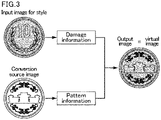
- the damage information generation unit 21a generates (extracts), from an image (input image for style) of a first coin input to the money information generation device 10a, damage information relating to damage of the first coin.
- the input image for style (image of the first coin) may be an image of the first coin having a desired damage condition, i.e., a damage condition that the coin is desired to have, and may have any pattern (design, marking).
- the input image for style may be an image of a coin in circulation having a certain degree of damage (e.g., a damaged coin) or may be an image of a coin without damage (e.g., a new coin).
- the pattern information generation unit 22a generates (extracts), from an image (conversion source image) of a second coin input to the money information generation device 10a, pattern information (pattern characteristics) relating to the pattern of the second coin.
- the conversion source image may be an image of the second coin that is desired to have the damage condition of the input image for style, and may have any damage condition.
- the conversion source image (image of the second coin) may be an image of a coin without damage (e.g., new coin) or may be an image of a coin in circulation having a certain degree of damage (e.g., damaged coin).
- the damage information generated by the damage information generation unit 21a may be information relating to damage of a base of the first coin.
- the damage information generation unit 21a may generate (extract) information relating to damage of the base of the first coin from an image (input image for style) of the first coin.
- base herein commonly refers to the portion excluding the marking of a coin.
- a coin commonly includes a base and a marking.
- the virtual money information generation unit 23a generates, from the damage information generated by the damage information generation unit 21a and the pattern information generated by the pattern information generation unit 22a, an image (image information) of a virtual coin as a fusion (synthesis) of the damage information and the pattern information. This results in generation of an image of a coin (not an actually existing one but a virtual one) having a damage condition at a degree similar to that of the first coin and having the pattern of the second coin. In other words, even when no second coin having a damage condition at a degree similar to that of the first coin is available, template information relating to the second coin can be generated based on the image of a virtual coin generated as described above.
- damaged information may refer to information relating to the presence of damage or may refer to information relating to the absence of damage. In the former case, the information may be used to deteriorate the marking or base of the coin.
- damage condition is a term indicating the degree of damage and encompasses not only the cases where damage is present but also the cases where damage is absent.
- the first coin may be a coin having damage while the second coin may be a coin having no or little damage and the second coin may be damaged, as a virtual coin, to a degree similar to that of the first coin (the damage condition may be worsened).
- the first coin may be a coin having no or little damage while the second coin may be a coin having damage and the second coin may not be damaged, as a virtual coin, to a degree similar to that of the first coin (the damage condition may be lessened).
- the term "pattern information (information relating to the pattern)” may refer to information relating to the marking of a coin (e.g., 3D information).
- the term “marking” herein may refer to something that may change when a coin is damaged or may be something that does not change even when a coin is damaged.
- Specific examples of the pattern information include information relating to a portion where the way the light hits changes in accordance with the degree of damage, information relating to a portion where the edge information changes in accordance with the degree of damage, and information relating to a portion where the material is changed by damage.
- an image may be used as money information. This enables generation of an image of a virtual money corresponding to a second money (real one) having a desired damage condition and enables visual check of the quality of the image.
- the damage information generation unit 21a, the pattern information generation unit 22a, and the virtual money information generation unit 23a each may be constructed of a learned model, for example, a learned model utilizing a convolutional neural network (CNN).
- CNN convolutional neural network
- the CNN of the virtual money information generation unit 23a may be coupled with the respective CNNs of the damage information generation unit 21a and the pattern information generation unit 22a.
- the learned models of the damage information generation unit 21a, the pattern information generation unit 22a, and the virtual money information generation unit 23a each may function as an inference program including learned parameters (coefficients) obtained as a result of learning with a data set.
- Each learned model may be provided with additional learning.
- each learned model may be provided with a data set different from that of the previous learning and undergo further learning, generating new learned parameters.
- the learned models incorporated with these new learned parameters may be used.
- the first coin (money) may be a damaged coin (damaged money) while the second coin (money) may be a new coin (new money).
- the first coin (money) may be a damaged coin (damaged money)
- the second coin (money) may be a new coin (new money).
- an image of a virtual coin corresponding to a damaged second coin can be generated even in a situation where a new series second coin is introduced and only new second coins are present.
- the first coin (money) may be a new coin (new money) and the second coin (money) may be a damaged coin (damaged money).
- the first coin (money) may be a new coin (new money)
- the second coin (money) may be a damaged coin (damaged money).
- an image of a virtual coin corresponding to a new second coin can be generated even in a situation where only damaged second coins are present.
- the type, i.e., the denomination, of the first coin (money) may be different from the type, i.e., the denomination, of the second coin (money). Even in this case, an image of a virtual coin corresponding to the second coin having a desired damage condition can be generated.
- the material of the first coin (money) may be the same as the material of the second coin (money) (including the cases where they are substantially the same as each other). This can make a generated image of a virtual coin look more like a real one. This is because moneys of the same material are damaged in a similar manner even when they are different in type.
- the materials of the first and second coins may be the coin materials of the surfaces of the respective coins.
- banknotes are commonly damaged in different manners depending on their materials.
- a paper banknote and a polymer sheet banknote are soiled in different manners.
- the color of the first coin (money) may be similar to the color of the second coin (money). This can also make a generated image of a virtual coin look more like a real one. This is because moneys of similar colors are damaged in a similar way even when they are different in type.
- the type, i.e., the denomination, of the first coin (money) may be the same as the type, i.e., the denomination, of the second coin (money).
- the damage information generation unit 21a may generate damage information of a first side (e.g., front side) of the first coin (e.g., 10 yen coin) from an image of the first side.
- the pattern information generation unit 22a may generate, from an image of a second side (e.g., back side), which is different from the first side, among the images of the second coin (e.g., a 10 yen coin different from the first coin), pattern information of the second side.
- the virtual money information generation unit 23a may generate, from the damage information of the first side generated by the damage information generation unit 21a and the pattern information of the second side generated by the pattern information generation unit 22a, an image of a virtual second side as a fusion of the damage information and the pattern information. This enables generation of an image of a virtual second side that looks more like a real one. This is because moneys of the same type are damaged in a similar manner even on different sides.
- This coin may be a bicolor coin.
- a specific example thereof may be a new series 500 yen coin to be issued in the first half of fiscal 2021.
- the pattern information generation unit 22a may generate, from an image of the first region of the second coin, pattern information of the first region.
- the virtual money information generation unit 23a may generate, from the damage information generated by the damage information generation unit 21a and the pattern information of the first region generated by the pattern information generation unit 22a, an image of a virtual first region as a fusion of the damage information and the pattern information.
- the damage information generation unit 21a may generate, from an image of the third coin, damage information of the third coin.
- the pattern information generation unit 22a may generate, from an image of the second region of the second coin, pattern information of the second region.
- the virtual money information generation unit 23a may generate, from the damage information of the third coin generated by the damage information generation unit 21a and the pattern information of the second region generated by the pattern information generation unit 22a, an image of a virtual second region as a fusion of the damage information and the pattern information. This enables generation of an image of not only the first region (e.g., a ring portion) but also a virtual second region corresponding to the second region (e.g., a central portion) formed from the second material that is the same as the material of the third coin and having a desired damage condition.
- control unit 20a may be provided with a money information synthesis unit that synthesizes an image of a virtual first region (e.g., a ring portion) and an image of a virtual second region (e.g., a central portion) to generate an image of the whole coin.
- a virtual first region e.g., a ring portion
- a virtual second region e.g., a central portion
- the following describes the steps of processing executed by the money information generation device 10a.
- the damage information generation unit 21a generates damage information of a first coin from an image (input image for style) of the first coin input to the money information generation device 10a (Step S1).
- the pattern information generation unit 22a generates pattern information of a second coin from an image (conversion source image) of the second coin input to the money information generation device 10a (Step S2).
- Steps S1 and S2 may be executed in the order of Steps S1 and S2 as shown in FIG. 2 , or may be executed in the order of Steps S2 and S1, or may be executed in parallel.
- the virtual money information generation unit 23a generates, from the damage information generated in Step S1 and the pattern information generated in Step S2, an image of a virtual coin as a fusion of the damage information and the pattern information (Step S3).
- Steps S1 to S3 may be executed on predetermined samples to generate images of a plurality of virtual coins having different damage conditions and having the same pattern as the second coin.
- an input image for style and a conversion source image are first prepared respectively as an image of a first coin and an image of a second coin.
- the input image for style is an image of the first coin having a desired damage condition, i.e., a damage condition that the coin is desired to have, and has any pattern (design, marking).
- the input image for style is commonly an image of a coin in circulation having a certain degree of damage (e.g., a damaged coin), but may be an image of a coin without damage (e.g., a new coin).
- the conversion source image is an image of the second coin that is desired to have the damage condition of the input image for style, and has any damage condition.
- the conversion source image (image of the second coin) is commonly an image of a coin without damage (e.g., new coin), but may be an image of a coin in circulation having a certain degree of damage (e.g., damaged coin).
- the input image for style is used to generate (extract) damage information, which is information relating to damage of the first coin, while the conversion source image is used to generate (extract) pattern information, which is information relating to the pattern of the second coin.
- the damage information and the pattern information are used to generate an image of a virtual coin as a fusion of the damage information and the pattern information.
- template information relating to the second coin can be generated based on the image of a virtual coin generated as described above.
- damaged information may refer to information relating to the presence of damage or may refer to information relating to the absence of damage. In the former case, the information may be used to deteriorate the marking or base of the coin.
- damage condition is a term indicating the degree of damage and encompasses not only the cases where damage is present but also the cases where damage is absent.
- the first coin may be a coin having damage while the second coin may be a coin having no or little damage and the second coin may be damaged, as a virtual coin, to a degree similar to that of the first coin (the damage condition may be worsened).
- the first coin may be a coin having no or little damage while the second coin may be a coin having damage and the second coin may not be damaged, as a virtual coin, to a degree similar to that of the first coin (the damage condition may be lessened).
- the term "pattern information (information relating to the pattern)” may refer to information relating to the marking of a coin (e.g., 3D information).
- the term “marking” herein may refer to something that may change when a coin is damaged or may be something that does not change even when a coin is damaged.
- Specific examples of the pattern information include information relating to a portion where the way the light hits changes in accordance with the degree of damage, information relating to a portion where the edge information changes in accordance with the degree of damage, and information relating to a portion where the material is changed by damage.
- machine learning e.g., deep learning
- machine learning may be performed using a machine-learning algorithm relating to generation of the damage information, a machine-learning algorithm relating to generation of the pattern information, and a machine-learning algorithm relating to generation of the money information of the virtual money.
- This can provide a more realistic image of a virtual coin.
- an image of a virtual coin generated can be made closer to an image of a real second money having a desired damage condition.
- an image may be used as money information to generate an image of a virtual money corresponding to a second money (real one) having a desired damage condition and enables visual check of the quality of the image.
- the money information generation device 10A has functions equivalent to a typical personal computer and includes a control unit (processing unit) 20 as shown in FIG. 4 and FIG. 5 and a storage unit (not shown in FIG. 4 and FIG. 5 ).
- the control unit 20 has functions of a damage information generation unit 21, a pattern information generation unit 22, a virtual money information generation unit 23, and a learning unit 24 during machine learning, and has functions of the damage information generation unit 21, the pattern information generation unit 22, the virtual money information generation unit 23, and a template generation unit 25 after machine learning (e.g., at practical use).
- the control unit 20 includes, for example, software programs for achieving a variety of processing, a CPU that executes the software programs, and a variety of hardware devices controlled by the CPU.
- the software programs and data for running the control unit 20 are stored in the storage unit.
- the units of the control unit 20 shown in FIG. 4 and FIG. 5 are embodied by causing the CPU of the control unit 20 to execute a money information generation program according to the present embodiment.
- the money information generation program according to the present embodiment may be preinstalled in the money information generation device 10a, or may be provided to a user as an application program that can run on a general-purpose OS, the application program being stored in a computer-readable recording medium or being provided via a network.
- the storage unit includes a storage device such as a hard disk device or a non-volatile memory, and stores a learned model that executes processing relating to generation of the damage information, a learned model that executes processing relating to generation of the pattern information, and a learned model that executes processing relating to generation of the money information of a virtual money.
- a storage device such as a hard disk device or a non-volatile memory
- the damage information generation unit 21 generates (extracts), from an image (input image for style) of a first coin input to the money information generation device 10A, damage information relating to damage of the first coin.
- the pattern information generation unit 22 generates (extracts), from an image (conversion source image) of a second coin input to the money information generation device 10A, pattern information (pattern characteristics) relating to the pattern of the second coin.
- the damage information generated by the damage information generation unit 21 may be information relating to damage of a base of the first coin.
- the damage information generation unit 21 may generate (extract) information relating to damage of the base of the first coin from an image (input image for style) of the first coin.
- base herein commonly refers to the portion excluding the marking of a coin.
- a coin commonly includes a base and a marking.
- the virtual money information generation unit 23 generates, from the damage information generated by the damage information generation unit 21 and the pattern information generated by the pattern information generation unit 22, an image (image information) of a virtual coin as a fusion (synthesis) of the damage information and the pattern information. This results in generation of an image of a coin (not an actually existing one but a virtual one) having a damage condition at a degree similar to that of the first coin and having the pattern of the second coin.
- the damage information generation unit 21, the pattern information generation unit 22, and the virtual money information generation unit 23 are each constructed of a learned model, for example, a learned model utilizing a convolutional neural network (CNN).
- the CNN of the virtual money information generation unit 23 is coupled with the respective CNNs of the damage information generation unit 21 and the pattern information generation unit 22.
- the learning unit 24 provides machine learning of a machine-learning algorithm relating to generation of damage information by the damage information generation unit 21, a machine-learning algorithm relating to generation of pattern information by the pattern information generation unit 22, and a machine-learning algorithm relating to generation of money information of a virtual money by the virtual money information generation unit 23.
- This machine-learning results in learned models of the damage information generation unit 21, the pattern information generation unit 22, and the virtual money information generation unit 23.
- Each machine-learning algorithm may utilize a CNN like the aforementioned learned models.
- the learning unit 24 also includes a machine-learning algorithm (e.g., one utilizing a CNN) and executes machine learning based on an image of a virtual coin (output image) generated by the virtual money information generation unit 23 and an image of a real coin (training data).
- a machine-learning algorithm e.g., one utilizing a CNN
- an image of a virtual coin and an image of a real coin are used in learning so as to more accurately determine whether an image of a virtual coin generated by the virtual money information generation unit 23 is a virtual one or a real one (an actually existing one).
- the learning unit 24 then provides an error between the output from the learning unit 24 and a desired output (correct answer) as a teaching signal to the respective machine-learning algorithms relating to the learning unit 24, the damage information generation unit 21, the pattern information generation unit 22, and the virtual money information generation unit 23, which gradually changes the coupling coefficients of the respective CNNs and finally enables a correct output.
- the learned models of the damage information generation unit 21, the pattern information generation unit 22, and the virtual money information generation unit 23 each function as an inference program including learned parameters (coefficients) obtained as a result of learning with a data set.
- Each learned model may be provided with additional learning.
- each learned model may be provided with a data set different from that of the previous learning and undergo further learning, generating new learned parameters.
- the learned models incorporated with these new learned parameters may be used.
- the template generation unit 25 generates template information from images of a plurality of virtual coins having different damage conditions and having the same pattern as the second coin generated using the machinelearned damage information generation unit 21, pattern information generation unit 22, and virtual money information generation unit 23.
- the first coin (money) may be a damaged coin (damaged money) while the second coin (money) may be a new coin (new money).
- the first coin (money) may be a damaged coin (damaged money)
- the second coin (money) may be a new coin (new money).
- an image of a virtual coin corresponding to a damaged second coin can be generated even in a situation where a new series second coin is introduced and only new second coins are present.
- the first coin (money) may be a new coin (new money) and the second coin (money) may be a damaged coin (damaged money).
- the first coin (money) may be a new coin (new money)
- the second coin (money) may be a damaged coin (damaged money).
- an image of a virtual coin corresponding to a new second coin can be generated even in a situation where only damaged second coins are present.
- the type, i.e., the denomination, of the first coin (money) may be different from the type, i.e., the denomination, of the second coin (money). Even in this case, an image of a virtual coin corresponding to the second coin having a desired damage condition can be generated.
- the material of the first coin (money) may be the same as the material of the second coin (money) (including the cases where they are substantially the same as each other). This can make a generated image of a virtual coin look more like a real one. This is because moneys of the same material are damaged in a similar manner even when they are different in type.
- the materials of the first and second coins may refer to the coin materials of the surfaces of the respective coins.
- banknotes are commonly damaged in different manners depending on their materials.
- a paper banknote and a polymer sheet banknote are soiled in different manners.
- the color of the first coin (money) may be similar to the color of the second coin (money). This can also make a generated image of a virtual coin look more like a real one. This is because moneys of similar colors are damaged in a similar way even when they are different in type.
- the type, i.e., the denomination, of the first coin (money) may be the same as the type, i.e., the denomination, of the second coin (money).
- the damage information generation unit 21 generates damage information of a first side (e.g., front side) of the first coin (e.g., 10 yen coin) from an image of the first side.
- the pattern information generation unit 22 generates, from an image of a second side (e.g., back side), which is different from the first side, among the images of the second coin (e.g., a 10 yen coin different from the first coin), pattern information of the second side.
- the virtual money information generation unit 23 generates, from the damage information of the first side generated by the damage information generation unit 21 and the pattern information of the second side generated by the pattern information generation unit 22, an image of a virtual second side as a fusion of the damage information and the pattern information. This enables generation of an image of a virtual second side that looks more like a real one. This is because moneys of the same type are damaged in a similar manner even on different sides.
- This coin may be a bicolor coin.
- a specific example thereof may be a new series 500 yen coin to be issued in the first half of fiscal 2021.
- the second coin e.g., a new series 500 yen coin
- the pattern information generation unit 22 generates, from an image of the first region of the second coin, pattern information of the first region.
- the virtual money information generation unit 23 generates, from the damage information generated by the damage information generation unit 21 and the pattern information of the first region generated by the pattern information generation unit 22, an image of a virtual first region as a fusion of the damage information and the pattern information.
- the second coin e.g., a new series 500 yen coin
- the damage information generation unit 21 generates, from an image of the third coin, damage information of the third coin.
- the pattern information generation unit 22 generates, from an image of the second region of the second coin, pattern information of the second region.
- the virtual money information generation unit 23 generates, from the damage information of the third coin generated by the damage information generation unit 21 and the pattern information of the second region generated by the pattern information generation unit 22, an image of a virtual second region as a fusion of the damage information and the pattern information. This enables generation of an image of not only the first region (e.g., a ring portion) but also a virtual second region corresponding to the second region (e.g., a central portion) formed from the second material that is the same as the material of the third coin and having a desired damage condition.
- control unit 20 may be provided with a money information synthesis unit that synthesizes an image of a virtual first region (e.g., a ring portion) and an image of a virtual second region (e.g., a central portion) to generate an image of the whole coin, and the template generation unit 25 may generate template information from an image generated by the money information synthesis unit.
- a money information synthesis unit that synthesizes an image of a virtual first region (e.g., a ring portion) and an image of a virtual second region (e.g., a central portion) to generate an image of the whole coin
- the template generation unit 25 may generate template information from an image generated by the money information synthesis unit.
- the damage information generation unit 21 first generates damage information of a first coin from an image (input image for style) of the first coin input to the money information generation device 10A (Step S11).
- the pattern information generation unit 22 generates pattern information of a second coin from an image (conversion source image) of the second coin input to the money information generation device 10A (Step S12).
- Steps S11 and S12 may be executed in the order of Steps S11 and S12 as shown in FIG. 6 , or may be executed in the order of Steps S12 and S11, or may be executed in parallel.
- the virtual money information generation unit 23 generates, from the damage information generated in Step S11 and the pattern information generated in Step S12, an image of a virtual coin as a fusion of the damage information and the pattern information (Step S13).
- the learning unit 24 provides machine learning of the respective machine-learning algorithms relating to the damage information generation unit 21, the pattern information generation unit 22, and the virtual money information generation unit 23.
- each machine-learning algorithm relating to the learning unit 24 itself also learns based on the image of the virtual coin generated in Step S13 and the image of the real coin (training data) (Step S14).
- Steps S11 to S14 are executed for a predetermined data set, whereby the processing relating to machine learning is completed.
- the damage information generation unit 21 first generates damage information of a first coin from an image (input image for style) of the first coin input to the money information generation device 10A (Step S21).
- the pattern information generation unit 22 generates pattern information of a second coin from an image (conversion source image) of the second coin input to the money information generation device 10A (Step S22).
- Steps S21 and S22 may be executed in the order of Steps S21 and S22 as shown in FIG. 7 , or may be executed in the order of Steps S22 and S21, or may be executed in parallel.
- the virtual money information generation unit 23 generates, from the damage information generated in Step S21 and the pattern information generated in Step S22, an image of a virtual coin as a fusion of the damage information and the pattern information (Step S23).
- Steps S21 to S23 are executed on predetermined samples to generate images of a plurality of virtual coins having different damage conditions and having the same pattern as the second coin.
- the template generation unit 25 then generates template information from the images of the virtual coins generated (Step S24). Thereby, the processing is completed.
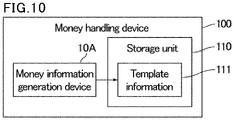
- a money handling system 200 of the present embodiment is constructed for business branches of financial institutions such as banks, and includes the money information generation device 10A and a money handling device 100 communicably connected to the money information generation device 10A.
- the money handling device 100 may be a teller machine that executes a variety of processing including deposit and withdrawal.
- the money handling device 100 includes a storage unit 110 that includes a storage device such as a hard disk device or a non-volatile memory.
- the storage unit 110 stores template information 111 generated by the money information generation device 10A, and the money handling device 100, in particular a built-in money recognition unit (not shown), can execute processing of recognizing a money to be handled, in particular processing of recognizing the fitness, using the template information 111 stored in the storage unit 110.
- the money information generation device 10A of the money handling system 200 may be provided in the cloud and a plurality of money handling devices 100 in the market may be communicably connected to the money information generation device 10A in the cloud.
- money information an image of a money
- the money information generation device 10A in the cloud may use this money information to execute machine learning and template generation as described above, and then may send the resulting template information to one or more money handling devices 100.
- the money handling device(s) 100 then may use this template information to execute processing of recognizing a money.
- the template information generated in the cloud may be used in the money handling device(s) 100 that has provided the money information (the image of the money) used to generate the template information, or may be shared by other money handling devices 100 in addition to the former money handling device 100.
- the money handling system 200 may include the money information generation device 10a instead of the money information generation device 10A.
- the money handling device 100 may acquire, from the money information generation device 10a, images of a plurality of virtual coins generated by the money information generation device 10a. In this case, the money handling device 100 may generate template information based on the images of the virtual coins acquired and store it in the storage unit 110.
- the aforementioned money handling device 100 may incorporate the money information generation device 10A. Also in this case, the template information 111 stored in the storage unit 110 of the money handling device 100 (money recognition device) may be used to execute processing of recognizing a money to be handled, in particular processing of recognizing the fitness.
- the money handling device 100 shown in FIG. 10 may include the money information generation device 10a instead of the money information generation device 10A.
- the money handling device 100 may acquire, from the money information generation device 10a, images of a plurality of virtual coins generated by the money information generation device 10a.
- the money handling device 100 may generate template information based on the acquired images of the virtual coins and store it in the storage unit 110.
- the present embodiment is substantially the same as Embodiments 1 and 2 except for difference in the method of generating virtual first and second regions in the case where the second coin (in particular, a surface thereof) includes a plurality of regions formed from a plurality of materials.
- the contents overlapping those in the above embodiments are not elaborated upon here.
- the second coin e.g., a new series 500 yen coin
- the second coin in particular a surface thereof, includes a first region (e.g., a ring portion) formed from a first material that is the same as the material (e.g., nickel brass) of the first coin (e.g., a current 500 yen coin) and a second region (e.g., a central portion) formed from a second material that is different from the material of the first coin but is the same as the material (e.g., cupronickel) of the third coin (e.g., an old series 500 yen coin).
- a first region e.g., a ring portion
- a second region e.g., a central portion formed from a second material that is different from the material of the first coin but is the same as the material (e.g., cupronickel) of the third coin (e.g., an old series 500 yen coin).
- a virtual image can be generated using images of the first and third coins for each of the first and second regions.
- the first and second regions are formed from different materials and are therefore unclear whether these regions change over time in the same manner.
- the manner of soiling of the second region relative to the manner of soiling of the first region is unclear, and vice versa. This makes it difficult to generate a virtual image that takes into consideration the difference in change of damage over time.
- a plurality of fourth coins is prepared each including a third region (e.g., a ring portion) formed from the first material and a fourth region (e.g., a central portion) formed from the second material.
- the third region of the fourth coin is formed from the same material as the first money and the first region of the second money
- the fourth region of the fourth coin is formed from the same material as the third money and the second region of the second money.
- an image of a virtual second coin is generated.
- This correlation reflects changes of damage over time in the case where the material of the third region, i.e., the first coin, and the material of the fourth region, i.e., the third coin, are present in a single coin. This therefore enables generation of a virtual image that reflects the difference in change of damage over time.
- the fourth coins may have different damage conditions.
- the present embodiment is particularly applicable to a situation where the fourth coin is not available in large quantities.
- Embodiments 1 and 2 are applicable to a situation where no fourth coin is available. The following more specifically describes the present embodiment.
- the control unit 20 of the money information generation device 10B has functions of the damage information generation unit 21, the pattern information generation unit 22, the virtual money information generation unit 23, and the template generation unit 25, as well as functions of a feature calculation unit 26, a combination determination unit 27, and a money information synthesis unit 28.
- the storage unit (shown in FIG. 11 with the reference sign 30) of the money information generation device 10B stores a correlation 31, such as a relational formula, created from the features of the third regions and the features of the fourth regions of the fourth coins.
- the relational formula used may be a subspace, for example.
- the damage information generation unit 21 generates a plurality of pieces of damage information relating to the first coin from images of a plurality of the first coins (e.g., current 500 yen coins) formed from the same material and having different damage conditions.
- the damage information generation unit 21 also generates a plurality of pieces of damage information relating to the third coin from images of a plurality of the third coins (e.g., old series 500 yen coins) formed from the same material and having different damage conditions.
- the third coin is a coin formed from a material different from that of the first coin.
- the first coins may be of the same type (denomination) or may be of different types (denominations).
- the third coins may be of the same type (denomination) or may be of different types (denominations).
- the pattern information generation unit 22 generates pattern information of the second coin (e.g., a new series 500 yen coin) from an image of the second coin.
- the second coin e.g., a new series 500 yen coin
- the virtual money information generation unit 23 generates, from the pieces of the damage information relating to the first coin and the pattern information, images of a plurality of first virtual coins (the entire coins or only regions corresponding to the first region) each as a fusion of a respective piece of the damage information relating to the first coin and the pattern information. This results in generation of images of a plurality of coins (not actually existing ones but virtual ones) each having a damage condition at a degree similar to that of a respective first coin and having the pattern of the second coin.
- the virtual money information generation unit 23 also generates, from the pieces of the damage information relating to the third coin and the pattern information, images of a plurality of second virtual coins (the entire coins or only regions corresponding to the second region) each as a fusion of a respective piece of the damage information relating to the third coin and the pattern information. This results in generation of images of a plurality of coins (not actually existing ones but virtual ones) each having a damage condition at a degree similar to that of a respective third coin and having the pattern of the second coin.
- the feature calculation unit 26 calculates a first feature of a region corresponding to the first region (e.g., a ring portion) from each of the images of the first virtual coins generated by the virtual money information generation unit 23.
- the feature calculation unit 26 also calculates a second feature of a region corresponding to the second region (e.g., a central portion) from each of the images of the second virtual coins generated by the virtual money information generation unit 23.
- the aforementioned features each may be, but are not limited to, the average of the luminances (pixel values), for example.
- the variance of the luminances (pixel values) or the average and variance of the edge intensities may be used.
- the combination determination unit 27 determines optimal combinations of a first feature and a second feature respectively among the first features relating to the first virtual coins and the second features relating to the second virtual coins based on the correlation 31 (e.g., relational formula). For example, a combination having the smallest distance from the relational formula (subspace) may be determined.
- the correlation 31 e.g., relational formula
- the money information synthesis unit 28 synthesizes, from the image of the first virtual coin and the image of the second virtual coin respectively corresponding to the optimal first feature and the optimal second feature determined by the combination determination unit 27, an image of the first virtual coin at a region corresponding to the first region (e.g., an image of a ring portion) and an image of the second virtual coin at a region corresponding to the second region (e.g., an image of a central portion), and generates an image of a third virtual coin containing both images.
- the money information synthesis unit 28 generates an image of the third virtual coin from an image of the first virtual coin and an image of the second virtual coin for the respective combinations determined by the combination determination unit 27.
- the template generation unit 25 then generates template information from the images of the third virtual coins generated by the money information synthesis unit 28.
- images of a plurality of commemorative coins as fourth coins having different damage conditions are first prepared.
- These commemorative coins are bicolor coins each including a ring portion formed from the same material as the current 500 yen coin and a central portion formed from the same material as the old series 500 yen coin.
- the denominations and designs of the commemorative coins are not limited and may be the same as or different from each other.
- one side of a commemorative coin is separated into four regions (white regions in the figure): the marking portion, the base portion, the central portion (inner), and the ring portion (outer).
- the correlation 31 is created in the form of a 4-dimensional subspace where the feature is the average of the luminances (pixel values) of the respective regions (learning with the commemorative coins).
- images for style of a plurality of current 500 yen coins having different damage conditions and images for style of a plurality of old series 500 yens coins having different damage conditions are prepared and the damage information generation unit 21 generates a plurality of pieces of damage information relating to the current 500 yen coins and a plurality of pieces of damage information relating to the old series 500 yen coins.
- a conversion source image of a new series 500 yen coin is prepared and the pattern information generation unit 22 generates pattern information of the new series 500 yen coin.
- the virtual money information generation unit 23 then generates images of a plurality of first virtual coins (first output images) each having a damage condition at a degree similar to that of a respective current 500 yen coin and having the pattern of the new series 500 yen coin, and generates images of a plurality of second virtual coins (second output images) each having a damage condition at a degree similar to that of a respective old series 500 yen coin and having the pattern of the new series 500 yen coin.
- the feature calculation unit 26 calculates the averages of the luminances (pixel values) for the markings and bases of the ring portions of the images of the first virtual coins and calculates the averages of the luminances (pixel values) of the markings and bases of the central portions of the images of the second virtual coins.
- the combination determination unit 27 determines optimal combinations of an image of a first virtual coin and an image of a second virtual coin each having the optimal averages of the luminances. Specifically, between the images of the first virtual coins and the images of the second virtual coins, optimal combinations are determined in each of which the averages of the luminances each have the smallest distance from the 4-dimensional subspace. This results in one-toone correspondences between the images of the first virtual coins and the images of the second virtual coins.
- the money information synthesis unit 28 then synthesizes an image of the ring portion of the first virtual coin and an image of the central portion of the second virtual coin of a respective combination to generate an image (inner-outer synthesized image) of a third virtual coin.
- the damage information generation unit 21 first generates, from images (input images for style) of a plurality of the first coins input to the money information generation device 10B, a plurality of pieces of damage information of the first coins, and generates, from images (input images for style) of a plurality of the third coins input to the money information generation device 10B, a plurality of pieces of damage information of the third coins (Step S31).
- the pattern information generation unit 22 generates, from an image (conversion source image) of the second coin input to the money information generation device 10B, pattern information of the second coin (Step S32).
- Steps S31 and S32 may be executed in the order of Steps S31 and S32 as shown in FIG. 13 , or may be executed in the order of Steps S32 and S31, or may be executed in parallel.
- the virtual money information generation unit 23 generates, from the pieces of the damage information relating to the first coins generated in Step S31 and the pattern information generated in Step S32, images of a plurality of first virtual coins each as a fusion of a respective piece of the damage information and the pattern information, and generates, from the pieces of the damage information relating to the third coins generated in Step S31 and the pattern information generated in Step S32, images of a plurality of second virtual coins each as a fusion of a respective piece of the damage information and the pattern information (Step S33).
- the feature calculation unit 26 calculates a first feature of a region corresponding to the first region (e.g., a ring portion) from each of the images of the first virtual coins generated in Step S33, and calculates a second feature of a region corresponding to the second region (e.g., a central portion) from each of the images of the second virtual coins generated in Step S33 (Step S34).
- the combination determination unit 27 determines optimal combinations of a first feature and a second feature based on the correlation 31 (Step S35).
- the money information synthesis unit 28 synthesizes, from the image of the first virtual coin and the image of the second virtual coin respectively corresponding to the optimal first feature and the optimal second feature determined in Step S35, an image of the first virtual coin at a region corresponding to the first region and an image of the second virtual coin at a region corresponding to the second region, and generates an image of a third virtual coin (Step S36).
- This step S36 is executed for each of the combinations determined in Step S35.
- the template generation unit 25 then generates template information from the images of the third virtual coins generated in Step S36 (Step S37). Thereby, the processing is completed.
- the images of the third virtual coins may be generated by the following processing.
- a 4-dimensional subspace is first created as the correlation 31 (learning with the commemorative coins), and a plurality of pieces of damage information relating to the current 500 yen coin and a plurality of pieces of damage information relating to the old series 500 yen coin are generated. Also, the pattern information generation unit 22 generates pattern information of the new series 500 yen coin.
- the feature calculation unit 26 calculates the averages of the luminances (pixel values) for the markings and bases of the ring portions of the images of the current 500 yen coins and calculates the averages of the luminances (pixel values) of the markings and bases of the central portions of the images of the old series 500 yen coins.
- the combination determination unit 27 determines combinations in each of which the averages of the luminances each have the smallest distance from the correlation 31 (4-dimensional subspace).
- the virtual money information generation unit 23 then generates, from the damage information of the current 500 yen coin and the damage information of the old series 500 yen coin relating to a respective optimal combination and the pattern information of the new series 500 yen coin, an image (output image) of a virtual coin that has a damage condition at a degree similar to that of the current 500 yen coin for the ring portion and a damage condition at a degree similar to that of the old series 500 yen coin for the central portion, and that has the pattern of the new series 500 yen coin.
- the damage information of the first coin is generated from the image of the first coin
- the pattern information of the second coin is generated from the image of the second coin
- the image of the virtual coin as a fusion of the damage information and the pattern information is generated from the damage information and the pattern information.
- a second coin having a plurality of regions formed from a plurality of respective materials
- the following method may be used instead of the method described in the aforementioned embodiments.
- a plurality of fourth coins e.g., commemorative coins
- images input images for style
- the first coins may be used as images (input images for style) of the first coins to directly generate images of virtual coins each having a damage condition at a degree similar to that of a respective fourth coin and having the pattern of the second coin (e.g., a new series 500 yen coin).
- This method is particularly applicable to the situation where the fourth coin is available in large quantities.
- counterfeit information which is information relating to counterfeit of the first coin, may be generated from the image (input image for style) of the first coin.
- a control unit 20c of a money information generation device 10c has a function of a counterfeit information generation unit 29c instead of the damage information generation unit 21a of Embodiment 1.
- the counterfeit information generation unit 29c generates (extracts), from an image (input image for style) of a first money, counterfeit information relating to counterfeit of the first money, specifically a feature relating to counterfeit, for example.
- the first money may be a counterfeit money.
- the input image for style (image of the first money) may be an image of the first money having any counterfeit characteristic and may have any pattern (design, marking).
- the conversion source image (image of a second money) may be an image of the second money to which the counterfeit characteristic of the input image for style is to be given, and may be one having no counterfeit characteristic.
- the second money may be not a counterfeit money but a genuine money.
- the type, i.e., the denomination, of the first money may be different from the type, i.e., the denomination, of the second money. Even in this case, an image of a virtual money corresponding to the second coin having a desired counterfeit characteristic can be generated.
- the virtual money information generation unit 23a generates, from the counterfeit information generated by the counterfeit information generation unit 29c and the pattern information generated by the pattern information generation unit 22a, an image (image information) of a virtual money as a fusion (synthesis) of the counterfeit information and the pattern information. This results in generation of an image of a money (not an actually existing one but a virtual one) having a counterfeit characteristic similar to that of the first money and having the pattern of the second money.
- the counterfeit information generation unit 29c may also be constructed of a learned model, for example, a learned model utilizing a CNN.
- the CNN of the virtual money information generation unit 23c may be coupled with the respective CNNs of the counterfeit information generation unit 29c and the pattern information generation unit 22c.
- the learned models of the counterfeit information generation unit 29c, the pattern information generation unit 22a, and the virtual money information generation unit 23a each may function as an inference program including learned parameters (coefficients) obtained as a result of learning with a data set.
- Each learned model may be provided with additional learning.
- each learned model may be provided with a data set different from that of the previous learning and undergo further learning, generating new learned parameters.
- the learned models incorporated with these new learned parameters may be used.
- the counterfeit information generation unit 29c generates counterfeit information of a first coin from an image (input image for style) of the first coin input to the money information generation device 10c (Step S41).
- the pattern information generation unit 22a generates pattern information of a second coin from an image (conversion source image) of the second coin input to the money information generation device 10c (Step S42).
- Steps S41 and S42 may be executed in the order of Steps S41 and S42 as shown in FIG. 15 , or may be executed in the order of Steps S42 and S41, or may be executed in parallel.
- the virtual money information generation unit 23a generates, from the counterfeit information generated in Step S41 and the pattern information generated in Step S42, an image of a virtual coin as a fusion of the counterfeit information and the pattern information (Step S43). Thereby, the processing is completed.
- Steps S41 to S43 may be executed on predetermined samples to generate images of a plurality of virtual coins counterfeited by different techniques and having the same pattern as the second coin.
- An example of generating counterfeit information may be a money information generation device 10C shown in FIG. 16 and FIG. 17 , for example.
- the control unit 20 of the money information generation device 10C has a function of a counterfeit information generation unit 29 instead of the damage information generation unit 21 of Embodiment 2.
- the counterfeit information generation unit 29 generates (extracts), from an image (input image for style) of a first money, counterfeit information relating to counterfeit of the first money, specifically a feature relating to counterfeit, for example.
- the first money is a counterfeit money.
- the input image for style is an image of the first money having any counterfeit characteristic and may have any pattern (design, marking).
- the conversion source image is an image of the second money to which the counterfeit characteristic of the input image for style is to be given, and is one having no counterfeit characteristic.
- the second money is not a counterfeit money but a genuine money.
- the type, i.e., the denomination, of the first money may be different from the type, i.e., the denomination, of the second money. Even in this case, an image of a virtual money corresponding to the second coin having a desired counterfeit characteristic can be generated.
- the virtual money information generation unit 23 generates, from the counterfeit information generated by the counterfeit information generation unit 29 and the pattern information generated by the pattern information generation unit 22, an image (image information) of a virtual money as a fusion (synthesis) of the counterfeit information and the pattern information. This results in generation of an image of a money (not an actually existing one but a virtual one) having a counterfeit characteristic similar to that of the first money and having the pattern of the second money.
- the counterfeit information generation unit 29 is also constructed of a learned model, for example, a learned model utilizing a CNN.
- the CNN of the virtual money information generation unit 23 is coupled with the respective CNNs of the counterfeit information generation unit 29 and the pattern information generation unit 22.
- the learned models of the counterfeit information generation unit 29, the pattern information generation unit 22, and the virtual money information generation unit 23 each function as an inference program including learned parameters (coefficients) obtained as a result of learning with a data set.
- Each learned model may be provided with additional learning.
- each learned model may be provided with a data set different from that of the previous learning and undergo further learning, generating new learned parameters.
- the learned models incorporated with these new learned parameters may be used.
- the learning unit 24 provides machine learning of a machine-learning algorithm relating to generation of counterfeit information by the counterfeit information generation unit 29, a machine-learning algorithm relating to generation of pattern information by the pattern information generation unit 22, and a machine-learning algorithm relating to generation of money information of a virtual money by the virtual money information generation unit 23.
- This machine-learning results in learned models of the counterfeit information generation unit 29, the pattern information generation unit 22, and the virtual money information generation unit 23.
- Each machine-learning algorithm may utilize a CNN like the aforementioned learned models.
- the learning unit 24 includes a machine-learning algorithm (e.g., one utilizing a CNN), and executes machine learning based on an image of a virtual money (output image) generated by the virtual money information generation unit 23 and an image of an actually existing counterfeit money (training data).
- a machine-learning algorithm e.g., one utilizing a CNN
- an image of a virtual coin and an image of a real coin are used in learning so as to more accurately determine whether an image of a virtual money generated by the virtual money information generation unit 23 is a virtual one or an actually existing one.
- the learning unit 24 then provides an error between the output from the learning unit 24 and a desired output (correct answer) as a teaching signal to the respective machine-learning algorithms relating to the learning unit 24, the counterfeit information generation unit 29, the pattern information generation unit 22, and the virtual money information generation unit 23, which gradually changes the coupling coefficients of the respective CNNs and finally enables a correct output.
- the template generation unit 25 generates template information from images of a plurality of virtual moneys having different features relating to counterfeit and having the same pattern as the second coin generated using the machine-learned counterfeit information generation unit 29, pattern information generation unit 22, and virtual money information generation unit 23.
- the money handling device in particular the built-in coin recognition device, can execute processing of recognizing a coin to be handled, in particular processing of recognizing the authenticity, using the template information stored in the storage unit.
- This money handling system or money handling device may include the money information generation device 10c instead of the money information generation device 10C. Images of a plurality of virtual coins generated by the money information generation device 10c may be acquired from the money information generation device 10c. In this case, the money handling system or money handling device may generate template information based on the images of the virtual coins acquired and store it in the storage unit.
- the learned models and the machine-learning algorithms are each based on a CNN.
- the learned models and the machine-learning algorithms may be any of those utilized in machine learning (e.g., deep learning), and may be those utilizing a deep neural network (DNN) or ResNet (deep residual network) other than the CNNs.
- DNN deep neural network
- ResNet deep residual network
- each money information generation device is configured as a single device.
- the device may be embodied as a distributed handling system in which the functions of the money information generation device are distributed to a plurality of devices as appropriate.
- the functions of the damage information generation unit 21, the pattern information generation unit 22, and the virtual money information generation unit 23 and the function of the learning unit 24 may be distributed to different devices.
- the functions of the pattern information generation unit 22 and the virtual money information generation unit 23 and the function of the template generation unit 25 may be distributed to different devices.
- the present disclosure relates to a technique useful for generating coin information of a virtual money corresponding to a money having a desired damage condition even in a situation where no real one of such a money is available.
Landscapes
- Physics & Mathematics (AREA)
- General Physics & Mathematics (AREA)
- Engineering & Computer Science (AREA)
- Computer Vision & Pattern Recognition (AREA)
- Testing Of Coins (AREA)
- Inspection Of Paper Currency And Valuable Securities (AREA)
- Image Analysis (AREA)
- Processing Or Creating Images (AREA)
Abstract
Description
- The present disclosure relates to money information generation devices, money handling systems, money handling devices, money information generation systems, money information generation methods, and money information generation programs. The present disclosure specifically relates to a money information generation device, a money handling system, a money handling device, a money information generation system, a money information generation method, and a money information generation program capable of generating image information of a virtual money.
- Money handling devices for handling moneys such as coins or notes (banknotes) utilize a plurality of types of sensors mounted on a money recognition unit to acquire features of moneys. Typically, based on comparison of the acquired features of the moneys with template information that serves as a reference of recognition, the types, authenticity, fitness, and the like of the moneys are recognized.
- For example, Patent Literatures 1 and 2 disclose an image collation device that collates an image of a money and a plurality of template images corresponding to a variety of moneys to determine the authenticity of the money. In the case of determining the authenticity of coins, this device uses an averaged image obtained by synthesizing a plurality of images of coins of the same type as a template image in order to reduce variation due to individual differences of coins.
-
- Patent Literature 1:
JP 4563740 B - Patent Literature 2:
JP 4563741 B - The image collation devices disclosed in Patent Literatures 1 and 2 require obtaining a plurality of images for each denomination from coins circulating in the market in advance and generating a template image from the obtained images.
- Also, in the case of determining not the authenticity but the fitness of moneys, a plurality of images is obtained for each denomination from soiled moneys circulating in the market in advance and template information is generated from the obtained images.
- When a new series coin is introduced, money handling devices require immediate modification to recognize the new series coin. This causes a demand for immediate generation of template information of the new series coin and application thereof to the money handling devices in the market.
- However, in the case of generating template information from real moneys, as in the case of the image collation devices of Patent Literatures 1 and 2, no template information corresponding to soiled moneys can be generated because only new, unused moneys (hereinafter, also referred to as new moneys) are present immediately after introduction of a new series money. This situation after introduction of a new series money prevents recognition of soiled moneys with a high degree of soiling.
- Accordingly, even a situation where no real soiled money is available causes a demand for generation of money information (image information and template information) of such a soiled money, i.e., money information of a virtual money corresponding to the soiled money.
- The opposite situation where only real soiled moneys are available may cause a demand for generation of template information from a new money.
- The present disclosure has been made in view of the above current state of the art and aims to provide a money information generation device, a money handling system, a money handling device, a money information generation system, a money information generation method, and a money information generation program capable of generating coin information of a virtual money corresponding to a money having a desired damage condition even in a situation where no real one of such a money is available.
- In order to solve the above issue and achieve the above object, (1) a money information generation device according to a first aspect of the present disclosure includes a control unit configured to: generate, from money information of a first money, damage information relating to damage of the first money; generate, from money information of a second money, pattern information relating to a pattern of the second money; and generate, from the damage information and the pattern information, money information of a virtual money as a fusion of the damage information and the pattern information.
- (2) In the money information generation device according to the above (1), the control unit may be configured to provide machine learning of a machine-learning algorithm relating to generation of the damage information, a machine-learning algorithm relating to generation of the pattern information, and a machine-learning algorithm relating to generation of the money information of the virtual money so as to make the money information of the virtual money look like a real one.
- (3) In the money information generation device according to the above (1) or (2), the first money may be an unfit money and the second money may be a new money.
- (4) In the money information generation device according to the above (1) or (2), the first money may be a new money, and the second money may be an unfit money.
- (5) In the money information generation device according to any one of the above (1) to (4), a type of the first money may be different from a type of the second money.
- (6) In the money information generation device according to any one of the above (1) to (5), a material of the first money may be the same as a material of the second money.
- (7) In the money information generation device according to any one of the above (1) to (5), the second money may include a first region containing a first material that is the same as a material of the first money and a second region containing a second material, and the control unit may be configured to: generate, from money information of the first region, pattern information relating to a pattern of the first region; and generate, from the damage information and the pattern information of the first region, money information of a virtual first region as a fusion of the damage information and the pattern information of the first region.
- (8) In the money information generation device according to the above (7), the second material may be different from the material of the first money and may be the same as a material of a third money, and the control unit may be configured to: generate, from money information of the third money, damage information relating to damage of the third money; generate, from money information of the second region, pattern information relating to a pattern of the second region; and generate, from the damage information of the third money and the pattern information of the second region, money information of a virtual second region as a fusion of the damage information of the third money and the pattern information of the second region.
- (9) The money information generation device according to any one of the above (1) to (5) may further include a storage unit, wherein the second money may include a first region containing a first material that is the same as a material of the first money and a second region containing a second material that is different from the material of the first money and is the same as a material of a third money, the storage unit may be configured to store a correlation between a feature of a third region and a feature of a fourth region generated from money information of a fourth money that includes the third region containing the first material and the fourth region containing the second material, and the control unit may be configured to generate the money information of the virtual money based on the correlation.
- (10) In the money information generation device according to the above (9), the control unit may be configured to: generate, from pieces of money information of a plurality of first moneys containing the same material and having different damage conditions, a plurality of pieces of damage information relating to the first moneys; generate, from pieces of money information of a plurality of third moneys containing the same material and having different damage conditions, a plurality of pieces of damage information relating to the third moneys; generate, from the pieces of damage information relating to the first moneys and the pattern information, pieces of money information of a plurality of first virtual moneys each as a fusion of a respective one of the pieces of damage information relating to the first moneys and the pattern information; generate, from the pieces of damage information relating to the third moneys and the pattern information, pieces of money information of a plurality of second virtual moneys each as a fusion of a respective one of the pieces of damage information relating to the third moneys and the pattern information; calculate, from each of the pieces of money information of the first virtual moneys, a first feature of a region corresponding to the first region; calculate, from each of the pieces of money information of the second virtual moneys, a second feature of a region corresponding to the second region; determine a combination of an optimal first feature and an optimal second feature among a plurality of the first features and a plurality of the second features based on the correlation; and generate, from a piece of money information of a first virtual money and a piece of money information of a second virtual money respectively corresponding to the optimal first feature and the optimal second feature, money information of a third virtual money including the piece of money information of the first virtual money at a region corresponding to the first region and the piece of money information of the second virtual money at a region corresponding to the second region.
- (11) In the money information generation device according to any one of the above (1) to (10), the damage information may be information relating to damage of a base of the first money.
- (12) In the money information generation device according to any one of the above (1) to (11), a type of the first money may be the same as a type of the second money, and the control unit may be configured to: generate, from money information of a first side of the first money, damage information relating to damage of the first side; generate, from money information of a second side that is different from the first side of the second money, pattern information relating to a pattern of the second side; and generate, from the damage information of the first side and the pattern information of the second side, money information of a virtual second side as a fusion of the damage information of the first side and the pattern information of the second side.
- (13) In the money information generation device according to any one of the above (1) to (12), the money information may be image information.
- (14) A money handling system according to a second aspect of the present disclosure includes the money information generation device according to any one of the above (1) to (13); and a money handling device including a storage unit configured to store template information based on the money information of the virtual money.
- (15) A money handling device according to a third aspect of the present disclosure includes the money information generation device according to any one of the above (1) to (13); and a storage unit configured to store template information based on the money information of the virtual money.
- (16) A money information generation system according to a fourth aspect of the present disclosure includes a damage information generation unit configured to generate, from money information of a first money, damage information relating to damage of the first money;
- a pattern information generation unit configured to generate, from money information of a second money, pattern information relating to a pattern of the second money; and
- a virtual money information generation unit configured to generate, from the damage information and the pattern information, money information of a virtual money as a fusion of the damage information and the pattern information.
- (17) In the money information generation system according to the above (16), machine learning may be provided for a machine-learning algorithm relating to generation of the damage information, a machine-learning algorithm relating to generation of the pattern information, and a machine-learning algorithm relating to generation of the money information of the virtual money so as to make the money information of the virtual money look like a real one.
- (18) In the money information generation system according to the above (16) or (17), the first money may be an unfit money, and the second money may be a new money.
- (19) In the money information generation system according to the above (16) or (17), the first money may be a new money, and the second money may be an unfit money.
- (20) In the money information generation system according to any one of the above (16) to (19), a type of the first money may be different from a type of the second money.
- (21) In the money information generation system according to any one of the above (16) to (20), a material of the first money may be the same as a material of the second money.
- (22) In the money information generation system according to any one of the above (16) to (20), the second money may include a first region containing a first material that is the same as a material of the first money and a second region containing a second material; the pattern information generation unit may be configured to generate, from money information of the first region, pattern information relating to a pattern of the first region; and the virtual money information generation unit may be configured to generate, from the damage information and the pattern information of the first region, money information of a virtual first region as a fusion of the damage information and the pattern information of the first region.
- (23) In the money information generation system according to the above (22), the second material may be different from the material of the first money and may be the same as a material of a third money; the damage information generation unit may be configured to generate, from money information of the third money, damage information relating to damage of the third money; the pattern information generation unit may be configured to generate, from money information of the second region, pattern information relating to a pattern of the second region; and the virtual money information generation unit may be configured to generate, from the damage information of the third money and the pattern information of the second region, money information of a virtual second region as a fusion of the damage information of the third money and the pattern information of the second region.
- (24) The money information generation system according to any one of the above (16) to (20) may further include a storage unit, wherein the second money may include a first region containing a first material that is the same as a material of the first money and a second region containing a second material that is different from the material of the first money and is the same as a material of a third money; the storage unit may be configured to store a correlation between a feature of a third region and a feature of a fourth region generated from money information of a fourth money that includes the third region containing the first material and the fourth region containing the second material; and the virtual money information generation unit may be configured to generate the money information of the virtual money based on the correlation.
- (25) In the money information generation system according to the above (24), the damage information generation unit may be configured to generate, from pieces of money information of a plurality of first moneys containing the same material and having different damage conditions, a plurality of pieces of damage information relating to the first moneys and may be configured to generate, from pieces of money information of a plurality of third moneys containing the same material and having different damage conditions, a plurality of pieces of damage information relating to the third moneys; the virtual money information generation unit may be configured to generate, from the pieces of damage information relating to the first moneys and the pattern information, pieces of money information of a plurality of first virtual moneys each as a fusion of a respective one of the pieces of damage information relating to the first moneys and the pattern information, and may be configured to generate, from the pieces of damage information relating to the third moneys and the pattern information, pieces of money information of a plurality of second virtual moneys each as a fusion of a respective one of the pieces of damage information relating to the third moneys and the pattern information; and the money information generation system may further include: a feature calculation unit configured to calculate, from each of the pieces of money information of the first virtual moneys, a first feature of a region corresponding to the first region, and configured to calculate, from each of the pieces of money information of the second virtual moneys, a second feature of a region corresponding to the second region; a combination determination unit configured to determine a combination of an optimal first feature and an optimal second feature among a plurality of the first features and a plurality of the second features based on the correlation; and a money information synthesis unit configured to generate, from a piece of money information of a first virtual money and a piece of money information of a second virtual money respectively corresponding to the optimal first feature and the optimal second feature, money information of a third virtual money including the piece of money information of the first virtual money at a region corresponding to the first region and the piece of money information of the second virtual money at a region corresponding to the second region.
- (26) In the money information generation system according to any one of the above (16) to (25), the damage information may be information relating to damage of a base of the first money.
- (27) In the money information generation system according to any one of the above (16) to (26), a type of the first money may be the same as a type of the second money; the damage information generation unit may be configured to generate, from money information of a first side of the first money, damage information relating to damage of the first side; the pattern information generation unit may be configured to generate, from money information of a second side that is different from the first side of the second money, pattern information relating to a pattern of the second side; and the virtual money information generation unit may be configured to generate, from the damage information of the first side and the pattern information of the second side, money information of a virtual second side as a fusion of the damage information of the first side and the pattern information of the second side.
- (28) In the money information generation system according to any one of the above (16) to (27), the money information may be image information.
- (29) A money information generation method according to a fifth aspect of the present disclosure includes generating, from money information of a first money, damage information relating to damage of the first money; generating, from money information of a second money, pattern information relating to a pattern of the second money; and generating, from the damage information and the pattern information, money information of a virtual money as a fusion of the damage information and the pattern information.
- (30) The money information generation method according to the above (29) may further include providing machine learning of a machine-learning algorithm relating to generation of the damage information, a machine-learning algorithm relating to generation of the pattern information, and a machine-learning algorithm relating to generation of the money information of the virtual money so as to make the money information of the virtual money look like a real one.
- (31) In the money information generation method according to the above (29) or (30), the first money may be an unfit money, and the second money may be a new money.
- (32) In the money information generation method according to the above (29) or (30), the first money may be a new money, and the second money may be an unfit money.
- (33) In the money information generation method according to any one of the above (29) to (32), a type of the first money may be different from a type of the second money.
- (34) In the money information generation method according to any one of the above (29) to (33), a material of the first money may be the same as a material of the second money.
- (35) In the money information generation method according to any one of the above (29) to (33), the second money may include a first region containing a first material that is the same as a material of the first money and a second region containing a second material; the step of generating pattern information may generate, from money information of the first region, pattern information relating to a pattern of the first region; and the step of generating money information may generate, from the damage information and the pattern information of the first region, money information of a virtual first region as a fusion of the damage information and the pattern information of the first region.
- (36) In the money information generation method according to the above (35), the second material may be different from the material of the first money and may be the same as a material of a third money; the step of generating damage information may generate, from money information of the third money, damage information relating to damage of the third money; the step of generating pattern information may generate, from money information of the second region, pattern information relating to a pattern of the second region; and the step of generating money information may generate, from the damage information of the third money and the pattern information of the second region, money information of a virtual second region as a fusion of the damage information of the third money and the pattern information of the second region.
- (37) In the money information generation method according to any one of the above (29) to (33), the second money may include a first region containing a first material that is the same as a material of the first money and a second region containing a second material that is different from the material of the first money and is the same as a material of a third money; and the step of generating money information may generate the money information of the virtual money based on a correlation between a feature of a third region and a feature of a fourth region generated from money information of a fourth money that includes the third region containing the first material and the fourth region containing the second material.
- (38) In the money information generation method according to the above (37), the step of generating damage information may generate, from pieces of money information of a plurality of first moneys containing the same material and having different damage conditions, a plurality of pieces of damage information relating to the first moneys and may generate, from pieces of money information of a plurality of third moneys containing the same material and having different damage conditions, a plurality of pieces of damage information relating to the third moneys; the step of generating money information may generate, from the pieces of damage information relating to the first moneys and the pattern information, pieces of money information of a plurality of first virtual moneys each as a fusion of a respective one of the pieces of damage information relating to the first moneys and the pattern information, and may generate, from the pieces of damage information relating to the third moneys and the pattern information, pieces of money information of a plurality of second virtual moneys each as a fusion of a respective one of the pieces of damage information relating to the third moneys and the pattern information; and the money information generation method may further include: calculating, from each of the pieces of money information of the first virtual moneys, a first feature of a region corresponding to the first region; calculating, from each of the pieces of money information of the second virtual moneys, a second feature of a region corresponding to the second region; determining a combination of an optimal first feature and an optimal second feature among a plurality of the first features and a plurality of the second features based on the correlation; and generating, from a piece of money information of a first virtual money and a piece of money information of a second virtual money respectively corresponding to the optimal first feature and the optimal second feature, money information of a third virtual money including the piece of money information of the first virtual money at a region corresponding to the first region and the piece of money information of the second virtual money at a region corresponding to the second region.
- (39) In the money information generation method according to any one of the above (29) to (38), the damage information may be information relating to damage of a base of the first money.
- (40) In the money information generation method according to any one of the above (29) to (39), a type of the first money may be the same as a type of the second money; the step of generating damage information may generate, from money information of a first side of the first money, damage information relating to damage of the first side; the step of generating pattern information may generate, from money information of a second side that is different from the first side of the second money, pattern information relating to a pattern of the second side; and the step of generating money information may generate, from the damage information of the first side and the pattern information of the second side, money information of a virtual second side as a fusion of the damage information of the first side and the pattern information of the second side.
- (41) In the money information generation method according to any one of the above (29) to (40), the money information may be image information.
- (42) A money information generation program according to a sixth aspect of the present disclosure causes a computer to function as: a means for generating, from money information of a first money, damage information relating to damage of the first money; a means for generating, from money information of a second money, pattern information relating to a pattern of the second money; and a means for generating, from the damage information and the pattern information, money information of a virtual money as a fusion of the damage information and the pattern information.
- (43) In the money information generation program according to the above (42), the computer may be further caused to function as a means for providing machine learning of a machine-learning algorithm relating to generation of the damage information, a machine-learning algorithm relating to generation of the pattern information, and a machine-learning algorithm relating to generation of the money information of the virtual money so as to make the money information of the virtual money look like a real one.
- (44) In the money information generation program according to the above (42) or (43), the first money may be an unfit money, and the second money may be a new money.
- (45) In the money information generation program according to the above (42) or (43), the first money may be a new money, and the second money may be an unfit money.
- (46) In the money information generation program according to any one of the above (42) to (45), a type of the first money may be different from a type of the second money.
- (47) In the money information generation program according to any one of the above (42) to (46), a material of the first money may be the same as a material of the second money.
- (48) In the money information generation program according to any one of the above (42) to (46), the second money may include a first region containing a first material that is the same as a material of the first money and a second region containing a second material; the means for generating pattern information may generate, from money information of the first region, pattern information relating to a pattern of the first region; and the means for generating money information may be configured to generate, from the damage information and the pattern information of the first region, money information of a virtual first region as a fusion of the damage information and the pattern information of the first region.
- (49) In the money information generation program according to the above (48), the second material may be different from the material of the first money and may be the same as a material of a third money; the means for generating damage information may be configured to generate, from money information of the third money, damage information relating to damage of the third money; the means for generating pattern information may be configured to generate, from money information of the second region, pattern information relating to a pattern of the second region; and the means for generating money information may be configured to generate, from the damage information of the third money and the pattern information of the second region, money information of a virtual second region as a fusion of the damage information of the third money and the pattern information of the second region.
- (50) In the money information generation program according to any one of the above (42) to (46), the second money may include a first region containing a first material that is the same as a material of the first money and a second region containing a second material that is different from the material of the first money and is the same as a material of a third money; and the means for generating money information may be configured to generate the money information of the virtual money based on a correlation between a feature of a third region and a feature of a fourth region generated from money information of a fourth money that includes the third region containing the first material and the fourth region containing the second material.
- (51) In the money information generation program according to the above (50), the means for generating damage information may be configured to generate, from pieces of money information of a plurality of first moneys containing the same material and having different damage conditions, a plurality of pieces of damage information relating to the first moneys and may be configured to generate, from pieces of money information of a plurality of third moneys containing the same material and having different damage conditions, a plurality of pieces of damage information relating to the third moneys; the means for generating money information may be configured to generate, from the pieces of damage information relating to the first moneys and the pattern information, pieces of money information of a plurality of first virtual moneys each as a fusion of a respective one of the pieces of damage information relating to the first moneys and the pattern information, and may be configured to generate, from the pieces of damage information relating to the third moneys and the pattern information, pieces of money information of a plurality of second virtual moneys each as a fusion of a respective one of the pieces of damage information relating to the third moneys and the pattern information; and the money information generation program may further cause the computer to function as a means for calculating, from each of the pieces of money information of the first virtual moneys, a first feature of a region corresponding to the first region, and calculating, from each of the pieces of money information of the second virtual moneys, a second feature of a region corresponding to the second region; a means for determining a combination of an optimal first feature and an optimal second feature among a plurality of the first features and a plurality of the second features based on the correlation; and a means for generating, from a piece of money information of a first virtual money and a piece of money information of a second virtual money respectively corresponding to the optimal first feature and the optimal second feature, money information of a third virtual money including the piece of money information of the first virtual money at a region corresponding to the first region and the piece of money information of the second virtual money at a region corresponding to the second region.
- (52) In the money information generation program according to any one of the above (42) to (51), the damage information may be information relating to damage of a base of the first money.
- (53) In the money information generation program according to any one of the above (42) to (52), a type of the first money may be the same as a type of the second money; the means for generating damage information may be configured to generate, from money information of a first side of the first money, damage information relating to damage of the first side; the means for generating pattern information may be configured to generate, from money information of a second side that is different from the first side of the second money, pattern information relating to a pattern of the second side; and the means for generating money information may be configured to generate, from the damage information of the first side and the pattern information of the second side, money information of a virtual second side as a fusion of the damage information of the first side and the pattern information of the second side.
- (54) In the money information generation program according to any one of the above (42) to (53), the money information may be image information.
- (55) A money information generation device according to a seventh aspect of the present disclosure includes a control unit configured to: generate, from money information of a first money, counterfeit information relating to counterfeit of the first money; generate, from money information of a second money, pattern information relating to a pattern of the second money; and generate, from the counterfeit information and the pattern information, money information of a virtual money as a fusion of the counterfeit information and the pattern information.
- (56) In the money information generation device according to the above (55), the control unit may be configured to provide machine learning of a machine-learning algorithm relating to generation of the counterfeit information, a machine-learning algorithm relating to generation of the pattern information, and a machine-learning algorithm relating to generation of the money information of the virtual money so as to make the money information of the virtual money look like an actually existing counterfeit money.
- (57) In the money information generation device according to the above (55) or (56), the first money may be a counterfeit money and the second money may be a genuine money.
- (58) In the money information generation device according to any one of the above (55) to (57), a type of the first money may be different from a type of the second money.
- (59) In the money information generation device according to any one of the above (55) to (58), the money information may be image information.
- (60) A money handling system according to an eighth aspect of the present disclosure includes the money information generation device according to any one of the above (55) to (59); and a money handling device including a storage unit configured to store template information based on the money information of the virtual money.
- (61) A money handling device according to a ninth aspect of the present disclosure includes the money information generation device according to any one of the above (55) to (59); and a storage unit configured to store template information based on the money information of the virtual money.
- (62) A money information generation system according to a tenth aspect of the present disclosure includes: a counterfeit information generation unit configured to generate, from money information of a first money, counterfeit information relating to counterfeit of the first money; a pattern information generation unit configured to generate, from money information of a second money, pattern information relating to a pattern of the second money; and a virtual money information generation unit configured to generate, from the counterfeit information and the pattern information, money information of a virtual money as a fusion of the counterfeit information and the pattern information.
- (63) In the money information generation system according to the above (62), machine learning may be provided for a machine-learning algorithm relating to generation of the counterfeit information, a machine-learning algorithm relating to generation of the pattern information, and a machine-learning algorithm relating to generation of the money information of the virtual money so as to make the money information of the virtual money look like an actually existing counterfeit money.
- (64) In the money information generation system according to the above (62) or (63), the first money may be a counterfeit money and the second money may be a genuine money.
- (65) In the money information generation system according to any one of the above (62) to (64), a type of the first money may be different from a type of the second money.
- (66) In the money information generation system according to any one of the above (62) to (65), the money information may be image information.
- (67) A money information generation method according to an eleventh aspect of the present disclosure includes generating, from money information of a first money, counterfeit information relating to counterfeit of the first money; generating, from money information of a second money, pattern information relating to a pattern of the second money; and generating, from the counterfeit information and the pattern information, money information of a virtual money as a fusion of the counterfeit information and the pattern information.
- (68) The money information generation method according to the above (67) may further include providing machine learning of a machine-learning algorithm relating to generation of the counterfeit information, a machine-learning algorithm relating to generation of the pattern information, and a machine-learning algorithm relating to generation of the money information of the virtual money so as to make the money information of the virtual money look like an actually existing counterfeit money.
- (69) In the money information generation method according to the above (67) or (68), the first money may be a counterfeit money and the second money may be a genuine money.
- (70) In the money information generation method according to any one of the above (67) to (69), a type of the first money may be different from a type of the second money.
- (71) In the money information generation method according to any one of the above (67) to (70), the money information may be image information.
- (72) A money information generation program according to a twelfth aspect of the present disclosure causes a computer to function as: a means for generating, from money information of a first money, counterfeit information relating to counterfeit of the first money; a means for generating, from money information of a second money, pattern information relating to a pattern of the second money; and a means for generating, from the counterfeit information and the pattern information, money information of a virtual money as a fusion of the counterfeit information and the pattern information.
- (73) In the money information generation program according to the above (72), the computer may be further caused to function as a means for providing machine learning of a machine-learning algorithm relating to generation of the counterfeit information, a machine-learning algorithm relating to generation of the pattern information, and a machine-learning algorithm relating to generation of the money information of the virtual money so as to make the money information of the virtual money look like an actually existing counterfeit money.
- (74) In the money information generation program according to the above (72) or (73), the first money may be a counterfeit money and the second money may be a genuine money.
- (75) In the money information generation program according to any one of the above (72) to (74), a type of the first money may be different from a type of the second money.
- (76) In the money information generation program according to any one of the above (72) to (75), the money information may be image information.
- The money information generation devices, the money handling systems, the money handling devices, the money information generation systems, the money information generation methods, and the money information generation programs of the present disclosure can generate coin information of a virtual money corresponding to a money having a desired damage condition even in a situation where no real one of such a money is available.
-
-
FIG. 1 is a block diagram of the structure of a money information generation device according to Embodiment 1. -
FIG. 2 is a flowchart of an example of steps of processing executed by the money information generation device according to Embodiment 1. -
FIG. 3 is a schematic diagram of the outline of a method for generating money information in Embodiment 2. -
FIG. 4 is a block diagram of a structure of a money information generation device according to Embodiment 2, illustrating the structure during machine learning. -
FIG. 5 is a block diagram of a structure of the money information generation device according to Embodiment 2, illustrating the structure after machine learning. -
FIG. 6 is a flowchart of an example of steps of processing executed by the money information generation device according to Embodiment 2 during machine learning. -
FIG. 7 is a flowchart of an example of steps of processing executed by the money information generation device according to Embodiment 2 after machine learning. -
FIG. 8 is a block diagram of an example of the overall structure of a money handling system including the money information generation device according to Embodiment 2. -
FIG. 9 is a block diagram of another example of the overall structure of a money handling system including the money information generation device according to Embodiment 2. -
FIG. 10 is a block diagram of the overall structure of a money handling device including the money information generation device according to Embodiment 2. -
FIG. 11 is a block diagram of a structure of a money information generation device according to Embodiment 3, illustrating the structure after machine learning. -
FIG. 12 is a schematic diagram of an example of a specific processing executed by the money information generation device according to Embodiment 3. -
FIG. 13 is a flowchart of an example of steps of processing executed by the money information generation device according to Embodiment 3 after machine learning. -
FIG. 14 is a block diagram of the structure of a money information generation device according to Modified Embodiment 1. -
FIG. 15 is a flowchart of an example of steps of processing executed by the money information generation device according to Modified Embodiment 1. -
FIG. 16 is a block diagram of a structure of a money information generation device according to Modified Embodiment 2, illustrating the structure during machine learning. -
FIG. 17 is a block diagram of a structure of the money information generation device according to Modified Embodiment 2, illustrating the structure after machine learning. - The following describes embodiments of the money information generation device, the money information generation system, the money information generation method, and the money information generation program according to the present disclosure with reference to the drawings.
- The term "money" herein encompasses both coins and sheets such as banknotes. Various sheets such as notes (banknotes), checks, vouchers, bills, business forms, documents of value, and card-like media are applicable as sheets to be used in the disclosure.
- The term "money information" means predetermined information relating to a money. Specific examples thereof include images (image data) of the money and template information obtainable from the coin. In the following embodiments, examples are described where the moneys used are coins and the money information used is image information of the moneys (hereinafter, also referred to simply as images).
- Examples of types of moneys damaged and factors for recognizing moneys as being damaged include the following.
- Coins: "soiling", " corrosion (deterioration)", "mechanical damage (e.g., scratches, holes, wear)", "deformation", "defects (e.g., defects formed during manufacturing, marking errors, molding defects", etc.
- Banknotes: "soiling", "scribbles," "losses (e.g., missing of corners, holes, other partial losses)", "tear or crack", "fold", "fatigue", "attachment of tape", etc.
- As described above for the types and factors, the term "damage" herein collectively refers to any change of a money from its normal state, and may be used in the expression "have damage" and others, for example. Moneys without damage and moneys having damage are also respectively referred to as normal moneys and damaged moneys or fit moneys and unfit moneys; for coins, also respectively referred to as normal coins and damaged coins or fit coins and unfit coins; and for banknotes, also respectively referred to as normal notes and damaged notes or fit notes and unfit notes.
- Recognizing (or determining) whether a money has damage, whether a money meets the standards, and/or whether a money is suitable for circulation are/is referred to as fitness recognition (or fitness determination).
- With reference to
FIG. 1 , the following describes the structure of a moneyinformation generation device 10a of the present embodiment. The moneyinformation generation device 10a has functions equivalent to those of a typical personal computer and includes a control unit (processing unit) 20a as shown inFIG. 1 . - As shown in
FIG. 1 , thecontrol unit 20a has functions of a damageinformation generation unit 21a, a patterninformation generation unit 22a, and a virtual moneyinformation generation unit 23a. - The
control unit 20a includes, for example, software programs for achieving a variety of processing, a central processing unit (CPU) that executes the software programs, and a variety of hardware devices controlled by the CPU. The software programs and data for running thecontrol unit 20a may be stored in a storage unit. - The units of the
control unit 20a shown inFIG. 1 are embodied by causing the CPU of thecontrol unit 20a to execute a money information generation program according to the present embodiment. The money information generation program according to the present embodiment may be preinstalled in the moneyinformation generation device 10a, or may be provided to a user as an application program that can run on a general-purpose OS, the application program being stored in a computer-readable recording medium or being provided via a network. - The storage unit includes a storage device such as a hard disk device or a non-volatile memory, and may store a learned model that executes processing relating to generation of damage information, a learned model that executes processing relating to generation of pattern information, and a learned model that executes processing relating to generation of money information of a virtual money.
- The damage
information generation unit 21a generates (extracts), from an image (input image for style) of a first coin input to the moneyinformation generation device 10a, damage information relating to damage of the first coin. - The input image for style (image of the first coin) may be an image of the first coin having a desired damage condition, i.e., a damage condition that the coin is desired to have, and may have any pattern (design, marking). The input image for style may be an image of a coin in circulation having a certain degree of damage (e.g., a damaged coin) or may be an image of a coin without damage (e.g., a new coin).
- The pattern
information generation unit 22a generates (extracts), from an image (conversion source image) of a second coin input to the moneyinformation generation device 10a, pattern information (pattern characteristics) relating to the pattern of the second coin. - The conversion source image (image of the second coin) may be an image of the second coin that is desired to have the damage condition of the input image for style, and may have any damage condition. The conversion source image (image of the second coin) may be an image of a coin without damage (e.g., new coin) or may be an image of a coin in circulation having a certain degree of damage (e.g., damaged coin).
- The damage information generated by the damage
information generation unit 21a may be information relating to damage of a base of the first coin. In other words, the damageinformation generation unit 21a may generate (extract) information relating to damage of the base of the first coin from an image (input image for style) of the first coin. - For coins, the term "base" herein commonly refers to the portion excluding the marking of a coin. In other words, a coin commonly includes a base and a marking.
- The virtual money
information generation unit 23a generates, from the damage information generated by the damageinformation generation unit 21a and the pattern information generated by the patterninformation generation unit 22a, an image (image information) of a virtual coin as a fusion (synthesis) of the damage information and the pattern information. This results in generation of an image of a coin (not an actually existing one but a virtual one) having a damage condition at a degree similar to that of the first coin and having the pattern of the second coin. In other words, even when no second coin having a damage condition at a degree similar to that of the first coin is available, template information relating to the second coin can be generated based on the image of a virtual coin generated as described above. - The term "damage information (information relating to damage)" may refer to information relating to the presence of damage or may refer to information relating to the absence of damage. In the former case, the information may be used to deteriorate the marking or base of the coin.
- The term "damage condition" is a term indicating the degree of damage and encompasses not only the cases where damage is present but also the cases where damage is absent.
- In other words, in the present embodiment, the first coin may be a coin having damage while the second coin may be a coin having no or little damage and the second coin may be damaged, as a virtual coin, to a degree similar to that of the first coin (the damage condition may be worsened). Alternatively, the first coin may be a coin having no or little damage while the second coin may be a coin having damage and the second coin may not be damaged, as a virtual coin, to a degree similar to that of the first coin (the damage condition may be lessened).
- For coins, the term "pattern information (information relating to the pattern)" may refer to information relating to the marking of a coin (e.g., 3D information). The term "marking" herein may refer to something that may change when a coin is damaged or may be something that does not change even when a coin is damaged. Specific examples of the pattern information include information relating to a portion where the way the light hits changes in accordance with the degree of damage, information relating to a portion where the edge information changes in accordance with the degree of damage, and information relating to a portion where the material is changed by damage.
- Also, in the present embodiment, an image (image information) may be used as money information. This enables generation of an image of a virtual money corresponding to a second money (real one) having a desired damage condition and enables visual check of the quality of the image.
- The damage
information generation unit 21a, the patterninformation generation unit 22a, and the virtual moneyinformation generation unit 23a each may be constructed of a learned model, for example, a learned model utilizing a convolutional neural network (CNN). In this case, the CNN of the virtual moneyinformation generation unit 23a may be coupled with the respective CNNs of the damageinformation generation unit 21a and the patterninformation generation unit 22a. - The learned models of the damage
information generation unit 21a, the patterninformation generation unit 22a, and the virtual moneyinformation generation unit 23a each may function as an inference program including learned parameters (coefficients) obtained as a result of learning with a data set. - Each learned model may be provided with additional learning. In other words, each learned model may be provided with a data set different from that of the previous learning and undergo further learning, generating new learned parameters. The learned models incorporated with these new learned parameters may be used.
- For the first coin used for an input image for style and the second coin used for a conversion source image, the first coin (money) may be a damaged coin (damaged money) while the second coin (money) may be a new coin (new money). In this case, an image of a virtual coin corresponding to a damaged second coin can be generated even in a situation where a new series second coin is introduced and only new second coins are present.
- Conversely, the first coin (money) may be a new coin (new money) and the second coin (money) may be a damaged coin (damaged money). In this case, an image of a virtual coin corresponding to a new second coin can be generated even in a situation where only damaged second coins are present.
- The type, i.e., the denomination, of the first coin (money) may be different from the type, i.e., the denomination, of the second coin (money). Even in this case, an image of a virtual coin corresponding to the second coin having a desired damage condition can be generated.
- The material of the first coin (money) may be the same as the material of the second coin (money) (including the cases where they are substantially the same as each other). This can make a generated image of a virtual coin look more like a real one. This is because moneys of the same material are damaged in a similar manner even when they are different in type. The materials of the first and second coins may be the coin materials of the surfaces of the respective coins.
- Also, banknotes are commonly damaged in different manners depending on their materials. For example, a paper banknote and a polymer sheet banknote (polymer banknote) are soiled in different manners.
- The color of the first coin (money) may be similar to the color of the second coin (money). This can also make a generated image of a virtual coin look more like a real one. This is because moneys of similar colors are damaged in a similar way even when they are different in type.
- The type, i.e., the denomination, of the first coin (money) may be the same as the type, i.e., the denomination, of the second coin (money). In this case, the damage
information generation unit 21a may generate damage information of a first side (e.g., front side) of the first coin (e.g., 10 yen coin) from an image of the first side. The patterninformation generation unit 22a may generate, from an image of a second side (e.g., back side), which is different from the first side, among the images of the second coin (e.g., a 10 yen coin different from the first coin), pattern information of the second side. The virtual moneyinformation generation unit 23a may generate, from the damage information of the first side generated by the damageinformation generation unit 21a and the pattern information of the second side generated by the patterninformation generation unit 22a, an image of a virtual second side as a fusion of the damage information and the pattern information. This enables generation of an image of a virtual second side that looks more like a real one. This is because moneys of the same type are damaged in a similar manner even on different sides. - The following describes processing applicable to the case where the second coin, in particular a surface thereof, has a plurality of regions formed from different materials. This coin may be a bicolor coin. A specific example thereof may be a
new series 500 yen coin to be issued in the first half of fiscal 2021. - In the case where the second coin (e.g., a
new series 500 yen coin), in particular a surface thereof, includes a first region (e.g., a ring portion) formed from a first material that is the same as the material (e.g., nickel brass) of the first coin (e.g., a current 500 yen coin), the patterninformation generation unit 22a may generate, from an image of the first region of the second coin, pattern information of the first region. The virtual moneyinformation generation unit 23a may generate, from the damage information generated by the damageinformation generation unit 21a and the pattern information of the first region generated by the patterninformation generation unit 22a, an image of a virtual first region as a fusion of the damage information and the pattern information. This enables generation of an image of a virtual first region corresponding to the first region (e.g., ring portion) formed from the first material that is the same as the material of the first coin and having a desired damage condition even when the second coin is a bicolor coin. - In the case where the second coin (e.g., a
new series 500 yen coin), in particular a surface thereof, includes a second region (e.g., a central portion) formed from a second material that is different from the material of the first coin (e.g., a current 500 yen coin) but is the same as the material (e.g., cupronickel) of a third coin (e.g., anold series 500 yen coin), the damageinformation generation unit 21a may generate, from an image of the third coin, damage information of the third coin. The patterninformation generation unit 22a may generate, from an image of the second region of the second coin, pattern information of the second region. The virtual moneyinformation generation unit 23a may generate, from the damage information of the third coin generated by the damageinformation generation unit 21a and the pattern information of the second region generated by the patterninformation generation unit 22a, an image of a virtual second region as a fusion of the damage information and the pattern information. This enables generation of an image of not only the first region (e.g., a ring portion) but also a virtual second region corresponding to the second region (e.g., a central portion) formed from the second material that is the same as the material of the third coin and having a desired damage condition. - In this case, the
control unit 20a may be provided with a money information synthesis unit that synthesizes an image of a virtual first region (e.g., a ring portion) and an image of a virtual second region (e.g., a central portion) to generate an image of the whole coin. - With reference to
FIG. 2 , the following describes the steps of processing executed by the moneyinformation generation device 10a. - As shown in
FIG. 2 , first, the damageinformation generation unit 21a generates damage information of a first coin from an image (input image for style) of the first coin input to the moneyinformation generation device 10a (Step S1). - The pattern
information generation unit 22a generates pattern information of a second coin from an image (conversion source image) of the second coin input to the moneyinformation generation device 10a (Step S2). - Steps S1 and S2 may be executed in the order of Steps S1 and S2 as shown in
FIG. 2 , or may be executed in the order of Steps S2 and S1, or may be executed in parallel. - Next, the virtual money
information generation unit 23a generates, from the damage information generated in Step S1 and the pattern information generated in Step S2, an image of a virtual coin as a fusion of the damage information and the pattern information (Step S3). - Thereby, the processing is completed.
- The aforementioned Steps S1 to S3 may be executed on predetermined samples to generate images of a plurality of virtual coins having different damage conditions and having the same pattern as the second coin.
- First, the outline of a method for generating money information in Embodiment 2 is described. As shown in
FIG. 3 , in the present embodiment, an input image for style and a conversion source image are first prepared respectively as an image of a first coin and an image of a second coin. - The input image for style (image of the first coin) is an image of the first coin having a desired damage condition, i.e., a damage condition that the coin is desired to have, and has any pattern (design, marking). The input image for style is commonly an image of a coin in circulation having a certain degree of damage (e.g., a damaged coin), but may be an image of a coin without damage (e.g., a new coin).
- The conversion source image (image of the second coin) is an image of the second coin that is desired to have the damage condition of the input image for style, and has any damage condition. The conversion source image (image of the second coin) is commonly an image of a coin without damage (e.g., new coin), but may be an image of a coin in circulation having a certain degree of damage (e.g., damaged coin).
- Next, the input image for style is used to generate (extract) damage information, which is information relating to damage of the first coin, while the conversion source image is used to generate (extract) pattern information, which is information relating to the pattern of the second coin.
- Then, the damage information and the pattern information are used to generate an image of a virtual coin as a fusion of the damage information and the pattern information. This results in generation of an image of a coin (not an actually existing one but a virtual one) having a damage condition at a degree similar to that of the first coin and having the pattern of the second coin. In other words, even when no second coin having a damage condition at a degree similar to that of the first coin is available, template information relating to the second coin can be generated based on the image of a virtual coin generated as described above.
- The term "damage information (information relating to damage)" may refer to information relating to the presence of damage or may refer to information relating to the absence of damage. In the former case, the information may be used to deteriorate the marking or base of the coin.
- The term "damage condition" is a term indicating the degree of damage and encompasses not only the cases where damage is present but also the cases where damage is absent.
- In other words, in the present embodiment, the first coin may be a coin having damage while the second coin may be a coin having no or little damage and the second coin may be damaged, as a virtual coin, to a degree similar to that of the first coin (the damage condition may be worsened). Alternatively, the first coin may be a coin having no or little damage while the second coin may be a coin having damage and the second coin may not be damaged, as a virtual coin, to a degree similar to that of the first coin (the damage condition may be lessened).
- For coins, the term "pattern information (information relating to the pattern)" may refer to information relating to the marking of a coin (e.g., 3D information). The term "marking" herein may refer to something that may change when a coin is damaged or may be something that does not change even when a coin is damaged. Specific examples of the pattern information include information relating to a portion where the way the light hits changes in accordance with the degree of damage, information relating to a portion where the edge information changes in accordance with the degree of damage, and information relating to a portion where the material is changed by damage.
- In the present embodiment, to make an image of a virtual money look like a real one, machine learning (e.g., deep learning) may be performed using a machine-learning algorithm relating to generation of the damage information, a machine-learning algorithm relating to generation of the pattern information, and a machine-learning algorithm relating to generation of the money information of the virtual money. This can provide a more realistic image of a virtual coin. In other words, an image of a virtual coin generated can be made closer to an image of a real second money having a desired damage condition.
- Also, in the present embodiment, an image (image information) may be used as money information to generate an image of a virtual money corresponding to a second money (real one) having a desired damage condition and enables visual check of the quality of the image.
- With reference to
FIG. 4 andFIG. 5 , the following then describes the structure of a moneyinformation generation device 10A of the present embodiment. The moneyinformation generation device 10A has functions equivalent to a typical personal computer and includes a control unit (processing unit) 20 as shown inFIG. 4 andFIG. 5 and a storage unit (not shown inFIG. 4 andFIG. 5 ). - As shown in
FIG. 4 , thecontrol unit 20 has functions of a damageinformation generation unit 21, a patterninformation generation unit 22, a virtual moneyinformation generation unit 23, and alearning unit 24 during machine learning, and has functions of the damageinformation generation unit 21, the patterninformation generation unit 22, the virtual moneyinformation generation unit 23, and atemplate generation unit 25 after machine learning (e.g., at practical use). - The
control unit 20 includes, for example, software programs for achieving a variety of processing, a CPU that executes the software programs, and a variety of hardware devices controlled by the CPU. The software programs and data for running thecontrol unit 20 are stored in the storage unit. - The units of the
control unit 20 shown inFIG. 4 andFIG. 5 are embodied by causing the CPU of thecontrol unit 20 to execute a money information generation program according to the present embodiment. The money information generation program according to the present embodiment may be preinstalled in the moneyinformation generation device 10a, or may be provided to a user as an application program that can run on a general-purpose OS, the application program being stored in a computer-readable recording medium or being provided via a network. - The storage unit includes a storage device such as a hard disk device or a non-volatile memory, and stores a learned model that executes processing relating to generation of the damage information, a learned model that executes processing relating to generation of the pattern information, and a learned model that executes processing relating to generation of the money information of a virtual money.
- The damage
information generation unit 21 generates (extracts), from an image (input image for style) of a first coin input to the moneyinformation generation device 10A, damage information relating to damage of the first coin. - The pattern
information generation unit 22 generates (extracts), from an image (conversion source image) of a second coin input to the moneyinformation generation device 10A, pattern information (pattern characteristics) relating to the pattern of the second coin. - The damage information generated by the damage
information generation unit 21 may be information relating to damage of a base of the first coin. In other words, the damageinformation generation unit 21 may generate (extract) information relating to damage of the base of the first coin from an image (input image for style) of the first coin. - For coins, the term "base" herein commonly refers to the portion excluding the marking of a coin. In other words, a coin commonly includes a base and a marking.
- The virtual money
information generation unit 23 generates, from the damage information generated by the damageinformation generation unit 21 and the pattern information generated by the patterninformation generation unit 22, an image (image information) of a virtual coin as a fusion (synthesis) of the damage information and the pattern information. This results in generation of an image of a coin (not an actually existing one but a virtual one) having a damage condition at a degree similar to that of the first coin and having the pattern of the second coin. - The damage
information generation unit 21, the patterninformation generation unit 22, and the virtual moneyinformation generation unit 23 are each constructed of a learned model, for example, a learned model utilizing a convolutional neural network (CNN). The CNN of the virtual moneyinformation generation unit 23 is coupled with the respective CNNs of the damageinformation generation unit 21 and the patterninformation generation unit 22. - To make an image of a virtual coin generated by the virtual money
information generation unit 23 look like a real one, thelearning unit 24 provides machine learning of a machine-learning algorithm relating to generation of damage information by the damageinformation generation unit 21, a machine-learning algorithm relating to generation of pattern information by the patterninformation generation unit 22, and a machine-learning algorithm relating to generation of money information of a virtual money by the virtual moneyinformation generation unit 23. This machine-learning results in learned models of the damageinformation generation unit 21, the patterninformation generation unit 22, and the virtual moneyinformation generation unit 23. Each machine-learning algorithm may utilize a CNN like the aforementioned learned models. - The
learning unit 24 also includes a machine-learning algorithm (e.g., one utilizing a CNN) and executes machine learning based on an image of a virtual coin (output image) generated by the virtual moneyinformation generation unit 23 and an image of a real coin (training data). In other words, an image of a virtual coin and an image of a real coin are used in learning so as to more accurately determine whether an image of a virtual coin generated by the virtual moneyinformation generation unit 23 is a virtual one or a real one (an actually existing one). Thelearning unit 24 then provides an error between the output from thelearning unit 24 and a desired output (correct answer) as a teaching signal to the respective machine-learning algorithms relating to thelearning unit 24, the damageinformation generation unit 21, the patterninformation generation unit 22, and the virtual moneyinformation generation unit 23, which gradually changes the coupling coefficients of the respective CNNs and finally enables a correct output. - The learned models of the damage
information generation unit 21, the patterninformation generation unit 22, and the virtual moneyinformation generation unit 23 each function as an inference program including learned parameters (coefficients) obtained as a result of learning with a data set. - Each learned model may be provided with additional learning. In other words, each learned model may be provided with a data set different from that of the previous learning and undergo further learning, generating new learned parameters. The learned models incorporated with these new learned parameters may be used.
- The
template generation unit 25 generates template information from images of a plurality of virtual coins having different damage conditions and having the same pattern as the second coin generated using the machinelearned damageinformation generation unit 21, patterninformation generation unit 22, and virtual moneyinformation generation unit 23. - For the first coin used for an input image for style and the second coin used for a conversion source image, the first coin (money) may be a damaged coin (damaged money) while the second coin (money) may be a new coin (new money). In this case, an image of a virtual coin corresponding to a damaged second coin can be generated even in a situation where a new series second coin is introduced and only new second coins are present.
- Conversely, the first coin (money) may be a new coin (new money) and the second coin (money) may be a damaged coin (damaged money). In this case, an image of a virtual coin corresponding to a new second coin can be generated even in a situation where only damaged second coins are present.
- The type, i.e., the denomination, of the first coin (money) may be different from the type, i.e., the denomination, of the second coin (money). Even in this case, an image of a virtual coin corresponding to the second coin having a desired damage condition can be generated.
- The material of the first coin (money) may be the same as the material of the second coin (money) (including the cases where they are substantially the same as each other). This can make a generated image of a virtual coin look more like a real one. This is because moneys of the same material are damaged in a similar manner even when they are different in type. The materials of the first and second coins may refer to the coin materials of the surfaces of the respective coins.
- Also, banknotes are commonly damaged in different manners depending on their materials. For example, a paper banknote and a polymer sheet banknote (polymer banknote) are soiled in different manners.
- The color of the first coin (money) may be similar to the color of the second coin (money). This can also make a generated image of a virtual coin look more like a real one. This is because moneys of similar colors are damaged in a similar way even when they are different in type.
- As shown in
FIG. 3 , the type, i.e., the denomination, of the first coin (money) may be the same as the type, i.e., the denomination, of the second coin (money). In this case, the damageinformation generation unit 21 generates damage information of a first side (e.g., front side) of the first coin (e.g., 10 yen coin) from an image of the first side. The patterninformation generation unit 22 generates, from an image of a second side (e.g., back side), which is different from the first side, among the images of the second coin (e.g., a 10 yen coin different from the first coin), pattern information of the second side. The virtual moneyinformation generation unit 23 generates, from the damage information of the first side generated by the damageinformation generation unit 21 and the pattern information of the second side generated by the patterninformation generation unit 22, an image of a virtual second side as a fusion of the damage information and the pattern information. This enables generation of an image of a virtual second side that looks more like a real one. This is because moneys of the same type are damaged in a similar manner even on different sides. - The following describes processing applicable to the case where the second coin, in particular a surface thereof, has a plurality of regions formed from different materials. This coin may be a bicolor coin. A specific example thereof may be a
new series 500 yen coin to be issued in the first half of fiscal 2021. - In the case where the second coin (e.g., a
new series 500 yen coin), in particular a surface thereof, includes a first region (e.g., a ring portion) formed from a first material that is the same as the material (e.g., nickel brass) of the first coin (e.g., a current 500 yen coin), the patterninformation generation unit 22 generates, from an image of the first region of the second coin, pattern information of the first region. The virtual moneyinformation generation unit 23 generates, from the damage information generated by the damageinformation generation unit 21 and the pattern information of the first region generated by the patterninformation generation unit 22, an image of a virtual first region as a fusion of the damage information and the pattern information. This enables generation of an image of a virtual first region corresponding to the first region (e.g., ring portion) formed from the first material that is the same as the material of the first coin and having a desired damage condition even when the second coin is a bicolor coin. - In the case where the second coin (e.g., a
new series 500 yen coin), in particular a surface thereof, includes a second region (e.g., a central portion) formed from a second material that is different from the material (e.g., nickel brass) of the first coin (e.g., a current 500 yen coin) but is the same as the material (e.g., cupronickel) of a third coin (e.g., anold series 500 yen coin), the damageinformation generation unit 21 generates, from an image of the third coin, damage information of the third coin. The patterninformation generation unit 22 generates, from an image of the second region of the second coin, pattern information of the second region. The virtual moneyinformation generation unit 23 generates, from the damage information of the third coin generated by the damageinformation generation unit 21 and the pattern information of the second region generated by the patterninformation generation unit 22, an image of a virtual second region as a fusion of the damage information and the pattern information. This enables generation of an image of not only the first region (e.g., a ring portion) but also a virtual second region corresponding to the second region (e.g., a central portion) formed from the second material that is the same as the material of the third coin and having a desired damage condition. - In this case, the
control unit 20 may be provided with a money information synthesis unit that synthesizes an image of a virtual first region (e.g., a ring portion) and an image of a virtual second region (e.g., a central portion) to generate an image of the whole coin, and thetemplate generation unit 25 may generate template information from an image generated by the money information synthesis unit. - With reference to
FIG. 6 and FIG. 7 , the following describes the steps of processing executed by the moneyinformation generation device 10A. - As shown in
FIG. 6 , during machine learning, the damageinformation generation unit 21 first generates damage information of a first coin from an image (input image for style) of the first coin input to the moneyinformation generation device 10A (Step S11). - The pattern
information generation unit 22 generates pattern information of a second coin from an image (conversion source image) of the second coin input to the moneyinformation generation device 10A (Step S12). - Steps S11 and S12 may be executed in the order of Steps S11 and S12 as shown in
FIG. 6 , or may be executed in the order of Steps S12 and S11, or may be executed in parallel. - Next, the virtual money
information generation unit 23 generates, from the damage information generated in Step S11 and the pattern information generated in Step S12, an image of a virtual coin as a fusion of the damage information and the pattern information (Step S13). - Next, the
learning unit 24 provides machine learning of the respective machine-learning algorithms relating to the damageinformation generation unit 21, the patterninformation generation unit 22, and the virtual moneyinformation generation unit 23. At this time, each machine-learning algorithm relating to thelearning unit 24 itself also learns based on the image of the virtual coin generated in Step S13 and the image of the real coin (training data) (Step S14). - The aforementioned Steps S11 to S14 are executed for a predetermined data set, whereby the processing relating to machine learning is completed.
- As shown in
FIG. 7 , after machine learning, the damageinformation generation unit 21 first generates damage information of a first coin from an image (input image for style) of the first coin input to the moneyinformation generation device 10A (Step S21). - The pattern
information generation unit 22 generates pattern information of a second coin from an image (conversion source image) of the second coin input to the moneyinformation generation device 10A (Step S22). - Steps S21 and S22 may be executed in the order of Steps S21 and S22 as shown in
FIG. 7 , or may be executed in the order of Steps S22 and S21, or may be executed in parallel. - Next, the virtual money
information generation unit 23 generates, from the damage information generated in Step S21 and the pattern information generated in Step S22, an image of a virtual coin as a fusion of the damage information and the pattern information (Step S23). - The aforementioned Steps S21 to S23 are executed on predetermined samples to generate images of a plurality of virtual coins having different damage conditions and having the same pattern as the second coin.
- The
template generation unit 25 then generates template information from the images of the virtual coins generated (Step S24). Thereby, the processing is completed. - With reference to
FIG. 8 to FIG. 10 , the following describes the overall structures of a money handling system and money handling device each including the money information generation device of Embodiment 2. As shown inFIG. 8 , amoney handling system 200 of the present embodiment is constructed for business branches of financial institutions such as banks, and includes the moneyinformation generation device 10A and amoney handling device 100 communicably connected to the moneyinformation generation device 10A. - The
money handling device 100 may be a teller machine that executes a variety of processing including deposit and withdrawal. Themoney handling device 100 includes astorage unit 110 that includes a storage device such as a hard disk device or a non-volatile memory. Thestorage unit 110stores template information 111 generated by the moneyinformation generation device 10A, and themoney handling device 100, in particular a built-in money recognition unit (not shown), can execute processing of recognizing a money to be handled, in particular processing of recognizing the fitness, using thetemplate information 111 stored in thestorage unit 110. - As shown in
FIG. 9 , the moneyinformation generation device 10A of themoney handling system 200 may be provided in the cloud and a plurality ofmoney handling devices 100 in the market may be communicably connected to the moneyinformation generation device 10A in the cloud. In this case, for example, money information (an image of a money) acquired by one or moremoney handling devices 100 may be sent from the coin handling device(s) 100 to the moneyinformation generation device 10A in the cloud. The moneyinformation generation device 10A in the cloud may use this money information to execute machine learning and template generation as described above, and then may send the resulting template information to one or moremoney handling devices 100. The money handling device(s) 100 then may use this template information to execute processing of recognizing a money. The template information generated in the cloud may be used in the money handling device(s) 100 that has provided the money information (the image of the money) used to generate the template information, or may be shared by othermoney handling devices 100 in addition to the formermoney handling device 100. - The
money handling system 200 may include the moneyinformation generation device 10a instead of the moneyinformation generation device 10A. Themoney handling device 100 may acquire, from the moneyinformation generation device 10a, images of a plurality of virtual coins generated by the moneyinformation generation device 10a. In this case, themoney handling device 100 may generate template information based on the images of the virtual coins acquired and store it in thestorage unit 110. - As shown in
FIG. 10 , the aforementionedmoney handling device 100 may incorporate the moneyinformation generation device 10A. Also in this case, thetemplate information 111 stored in thestorage unit 110 of the money handling device 100 (money recognition device) may be used to execute processing of recognizing a money to be handled, in particular processing of recognizing the fitness. - The
money handling device 100 shown inFIG. 10 may include the moneyinformation generation device 10a instead of the moneyinformation generation device 10A. Themoney handling device 100 may acquire, from the moneyinformation generation device 10a, images of a plurality of virtual coins generated by the moneyinformation generation device 10a. In this case, themoney handling device 100 may generate template information based on the acquired images of the virtual coins and store it in thestorage unit 110. - The present embodiment is substantially the same as Embodiments 1 and 2 except for difference in the method of generating virtual first and second regions in the case where the second coin (in particular, a surface thereof) includes a plurality of regions formed from a plurality of materials. Thus, the contents overlapping those in the above embodiments are not elaborated upon here.
- In other words, in the present embodiment, the case mainly considered is such that the second coin (e.g., a
new series 500 yen coin), in particular a surface thereof, includes a first region (e.g., a ring portion) formed from a first material that is the same as the material (e.g., nickel brass) of the first coin (e.g., a current 500 yen coin) and a second region (e.g., a central portion) formed from a second material that is different from the material of the first coin but is the same as the material (e.g., cupronickel) of the third coin (e.g., anold series 500 yen coin). - In this case, as described in Embodiments 1 and 2, a virtual image can be generated using images of the first and third coins for each of the first and second regions. Still, the first and second regions are formed from different materials and are therefore unclear whether these regions change over time in the same manner. For example, the manner of soiling of the second region relative to the manner of soiling of the first region is unclear, and vice versa. This makes it difficult to generate a virtual image that takes into consideration the difference in change of damage over time.
- Accordingly, in the present embodiment, a plurality of fourth coins (e.g., commemorative coins) is prepared each including a third region (e.g., a ring portion) formed from the first material and a fourth region (e.g., a central portion) formed from the second material. In other words, the third region of the fourth coin is formed from the same material as the first money and the first region of the second money, while the fourth region of the fourth coin is formed from the same material as the third money and the second region of the second money. Then, from each of these images of the fourth coins, the feature of the third region and the feature of the fourth region are calculated and the correlation between the calculated features (e.g., a relational formula indicating the relationship between the calculated features) is created. Based on this correlation, an image of a virtual second coin is generated. This correlation reflects changes of damage over time in the case where the material of the third region, i.e., the first coin, and the material of the fourth region, i.e., the third coin, are present in a single coin. This therefore enables generation of a virtual image that reflects the difference in change of damage over time. The fourth coins may have different damage conditions. The present embodiment is particularly applicable to a situation where the fourth coin is not available in large quantities. Embodiments 1 and 2 are applicable to a situation where no fourth coin is available. The following more specifically describes the present embodiment.
- With reference to
FIG. 11 , the following first describes the structure of a moneyinformation generation device 10B of the present embodiment. The structure during machine learning is the same as in Embodiment 2 and therefore the description thereof is not elaborated upon here. As shown inFIG. 11 , after machine learning, thecontrol unit 20 of the moneyinformation generation device 10B has functions of the damageinformation generation unit 21, the patterninformation generation unit 22, the virtual moneyinformation generation unit 23, and thetemplate generation unit 25, as well as functions of afeature calculation unit 26, acombination determination unit 27, and a moneyinformation synthesis unit 28. In addition, the storage unit (shown inFIG. 11 with the reference sign 30) of the moneyinformation generation device 10B stores acorrelation 31, such as a relational formula, created from the features of the third regions and the features of the fourth regions of the fourth coins. The relational formula used may be a subspace, for example. - In the present embodiment, the damage
information generation unit 21 generates a plurality of pieces of damage information relating to the first coin from images of a plurality of the first coins (e.g., current 500 yen coins) formed from the same material and having different damage conditions. The damageinformation generation unit 21 also generates a plurality of pieces of damage information relating to the third coin from images of a plurality of the third coins (e.g.,old series 500 yen coins) formed from the same material and having different damage conditions. The third coin is a coin formed from a material different from that of the first coin. The first coins may be of the same type (denomination) or may be of different types (denominations). Similarly, the third coins may be of the same type (denomination) or may be of different types (denominations). - As in Embodiment 2, the pattern
information generation unit 22 generates pattern information of the second coin (e.g., anew series 500 yen coin) from an image of the second coin. - The virtual money
information generation unit 23 generates, from the pieces of the damage information relating to the first coin and the pattern information, images of a plurality of first virtual coins (the entire coins or only regions corresponding to the first region) each as a fusion of a respective piece of the damage information relating to the first coin and the pattern information. This results in generation of images of a plurality of coins (not actually existing ones but virtual ones) each having a damage condition at a degree similar to that of a respective first coin and having the pattern of the second coin. The virtual moneyinformation generation unit 23 also generates, from the pieces of the damage information relating to the third coin and the pattern information, images of a plurality of second virtual coins (the entire coins or only regions corresponding to the second region) each as a fusion of a respective piece of the damage information relating to the third coin and the pattern information. This results in generation of images of a plurality of coins (not actually existing ones but virtual ones) each having a damage condition at a degree similar to that of a respective third coin and having the pattern of the second coin. - The
feature calculation unit 26 calculates a first feature of a region corresponding to the first region (e.g., a ring portion) from each of the images of the first virtual coins generated by the virtual moneyinformation generation unit 23. Thefeature calculation unit 26 also calculates a second feature of a region corresponding to the second region (e.g., a central portion) from each of the images of the second virtual coins generated by the virtual moneyinformation generation unit 23. - The aforementioned features (the first and second features, the feature of the third region, and the feature of the fourth region) each may be, but are not limited to, the average of the luminances (pixel values), for example. Alternatively, the variance of the luminances (pixel values) or the average and variance of the edge intensities may be used.
- The
combination determination unit 27 determines optimal combinations of a first feature and a second feature respectively among the first features relating to the first virtual coins and the second features relating to the second virtual coins based on the correlation 31 (e.g., relational formula). For example, a combination having the smallest distance from the relational formula (subspace) may be determined. - The money
information synthesis unit 28 synthesizes, from the image of the first virtual coin and the image of the second virtual coin respectively corresponding to the optimal first feature and the optimal second feature determined by thecombination determination unit 27, an image of the first virtual coin at a region corresponding to the first region (e.g., an image of a ring portion) and an image of the second virtual coin at a region corresponding to the second region (e.g., an image of a central portion), and generates an image of a third virtual coin containing both images. The moneyinformation synthesis unit 28 generates an image of the third virtual coin from an image of the first virtual coin and an image of the second virtual coin for the respective combinations determined by thecombination determination unit 27. - The
template generation unit 25 then generates template information from the images of the third virtual coins generated by the moneyinformation synthesis unit 28. - With reference to
FIG. 12 , the following describes an example of a more specific processing in the present embodiment. In this example, as shown inFIG. 12 , images of a plurality of commemorative coins as fourth coins having different damage conditions are first prepared. These commemorative coins are bicolor coins each including a ring portion formed from the same material as the current 500 yen coin and a central portion formed from the same material as theold series 500 yen coin. The denominations and designs of the commemorative coins are not limited and may be the same as or different from each other. Then, one side of a commemorative coin is separated into four regions (white regions in the figure): the marking portion, the base portion, the central portion (inner), and the ring portion (outer). Thecorrelation 31 is created in the form of a 4-dimensional subspace where the feature is the average of the luminances (pixel values) of the respective regions (learning with the commemorative coins). - Next, images for style of a plurality of current 500 yen coins having different damage conditions and images for style of a plurality of
old series 500 yens coins having different damage conditions are prepared and the damageinformation generation unit 21 generates a plurality of pieces of damage information relating to the current 500 yen coins and a plurality of pieces of damage information relating to theold series 500 yen coins. - Also, a conversion source image of a
new series 500 yen coin is prepared and the patterninformation generation unit 22 generates pattern information of thenew series 500 yen coin. - The virtual money
information generation unit 23 then generates images of a plurality of first virtual coins (first output images) each having a damage condition at a degree similar to that of a respective current 500 yen coin and having the pattern of thenew series 500 yen coin, and generates images of a plurality of second virtual coins (second output images) each having a damage condition at a degree similar to that of a respectiveold series 500 yen coin and having the pattern of thenew series 500 yen coin. - Then, the
feature calculation unit 26 calculates the averages of the luminances (pixel values) for the markings and bases of the ring portions of the images of the first virtual coins and calculates the averages of the luminances (pixel values) of the markings and bases of the central portions of the images of the second virtual coins. - Then, based on the
correlation 31, thecombination determination unit 27 determines optimal combinations of an image of a first virtual coin and an image of a second virtual coin each having the optimal averages of the luminances. Specifically, between the images of the first virtual coins and the images of the second virtual coins, optimal combinations are determined in each of which the averages of the luminances each have the smallest distance from the 4-dimensional subspace. This results in one-toone correspondences between the images of the first virtual coins and the images of the second virtual coins. - The money
information synthesis unit 28 then synthesizes an image of the ring portion of the first virtual coin and an image of the central portion of the second virtual coin of a respective combination to generate an image (inner-outer synthesized image) of a third virtual coin. - With reference to
FIG. 13 , the following describes the steps of processing executed by the moneyinformation generation device 10B. The processing during machine learning is the same as in Embodiment 2 and therefore the description thereof is not elaborated upon here. - In the present embodiment, as shown in
FIG. 13 , after machine learning, the damageinformation generation unit 21 first generates, from images (input images for style) of a plurality of the first coins input to the moneyinformation generation device 10B, a plurality of pieces of damage information of the first coins, and generates, from images (input images for style) of a plurality of the third coins input to the moneyinformation generation device 10B, a plurality of pieces of damage information of the third coins (Step S31). - The pattern
information generation unit 22 generates, from an image (conversion source image) of the second coin input to the moneyinformation generation device 10B, pattern information of the second coin (Step S32). - Steps S31 and S32 may be executed in the order of Steps S31 and S32 as shown in
FIG. 13 , or may be executed in the order of Steps S32 and S31, or may be executed in parallel. - Next, the virtual money
information generation unit 23 generates, from the pieces of the damage information relating to the first coins generated in Step S31 and the pattern information generated in Step S32, images of a plurality of first virtual coins each as a fusion of a respective piece of the damage information and the pattern information, and generates, from the pieces of the damage information relating to the third coins generated in Step S31 and the pattern information generated in Step S32, images of a plurality of second virtual coins each as a fusion of a respective piece of the damage information and the pattern information (Step S33). - Next, the
feature calculation unit 26 calculates a first feature of a region corresponding to the first region (e.g., a ring portion) from each of the images of the first virtual coins generated in Step S33, and calculates a second feature of a region corresponding to the second region (e.g., a central portion) from each of the images of the second virtual coins generated in Step S33 (Step S34). - Next, the
combination determination unit 27 determines optimal combinations of a first feature and a second feature based on the correlation 31 (Step S35). - Next, the money
information synthesis unit 28 synthesizes, from the image of the first virtual coin and the image of the second virtual coin respectively corresponding to the optimal first feature and the optimal second feature determined in Step S35, an image of the first virtual coin at a region corresponding to the first region and an image of the second virtual coin at a region corresponding to the second region, and generates an image of a third virtual coin (Step S36). This step S36 is executed for each of the combinations determined in Step S35. - The
template generation unit 25 then generates template information from the images of the third virtual coins generated in Step S36 (Step S37). Thereby, the processing is completed. - In the present Embodiment, the images of the third virtual coins may be generated by the following processing.
- In this case, as in the case shown in
FIG. 11 , a 4-dimensional subspace is first created as the correlation 31 (learning with the commemorative coins), and a plurality of pieces of damage information relating to the current 500 yen coin and a plurality of pieces of damage information relating to theold series 500 yen coin are generated. Also, the patterninformation generation unit 22 generates pattern information of thenew series 500 yen coin. - Then, the
feature calculation unit 26 calculates the averages of the luminances (pixel values) for the markings and bases of the ring portions of the images of the current 500 yen coins and calculates the averages of the luminances (pixel values) of the markings and bases of the central portions of the images of theold series 500 yen coins. - Next, between the images of the current 500 yen coins and the images of the
old series 500 yen coins, thecombination determination unit 27 determines combinations in each of which the averages of the luminances each have the smallest distance from the correlation 31 (4-dimensional subspace). - The virtual money
information generation unit 23 then generates, from the damage information of the current 500 yen coin and the damage information of theold series 500 yen coin relating to a respective optimal combination and the pattern information of thenew series 500 yen coin, an image (output image) of a virtual coin that has a damage condition at a degree similar to that of the current 500 yen coin for the ring portion and a damage condition at a degree similar to that of theold series 500 yen coin for the central portion, and that has the pattern of thenew series 500 yen coin. - As described above, in the aforementioned embodiments, the damage information of the first coin is generated from the image of the first coin, the pattern information of the second coin is generated from the image of the second coin, and the image of the virtual coin as a fusion of the damage information and the pattern information is generated from the damage information and the pattern information. Thus, based on the images of the real first and second coins, the image of the virtual coin having a damage condition at a degree similar to that of the first coin and having the pattern of the second coin can be generated. Therefore, even in a situation where no real second coin having a desired damage condition is available, an image of a virtual coin corresponding thereto can be generated.
- In the case of a second coin having a plurality of regions formed from a plurality of respective materials, the following method may be used instead of the method described in the aforementioned embodiments. Specifically, a plurality of fourth coins (e.g., commemorative coins) formed from the same materials as the second coin may be used as images (input images for style) of the first coins to directly generate images of virtual coins each having a damage condition at a degree similar to that of a respective fourth coin and having the pattern of the second coin (e.g., a
new series 500 yen coin). This method is particularly applicable to the situation where the fourth coin is available in large quantities. - Described in the above embodiments is the case of generating the damage information of the first coin from the image (input image for style) of the first coin. Alternatively, counterfeit information, which is information relating to counterfeit of the first coin, may be generated from the image (input image for style) of the first coin.
- Specifically, for example, as shown in
FIG. 14 , acontrol unit 20c of a moneyinformation generation device 10c has a function of a counterfeitinformation generation unit 29c instead of the damageinformation generation unit 21a of Embodiment 1. - The counterfeit
information generation unit 29c generates (extracts), from an image (input image for style) of a first money, counterfeit information relating to counterfeit of the first money, specifically a feature relating to counterfeit, for example. In other words, the first money may be a counterfeit money. - In this case, the input image for style (image of the first money) may be an image of the first money having any counterfeit characteristic and may have any pattern (design, marking). The conversion source image (image of a second money) may be an image of the second money to which the counterfeit characteristic of the input image for style is to be given, and may be one having no counterfeit characteristic. In other words, the second money may be not a counterfeit money but a genuine money.
- The type, i.e., the denomination, of the first money may be different from the type, i.e., the denomination, of the second money. Even in this case, an image of a virtual money corresponding to the second coin having a desired counterfeit characteristic can be generated.
- The virtual money
information generation unit 23a generates, from the counterfeit information generated by the counterfeitinformation generation unit 29c and the pattern information generated by the patterninformation generation unit 22a, an image (image information) of a virtual money as a fusion (synthesis) of the counterfeit information and the pattern information. This results in generation of an image of a money (not an actually existing one but a virtual one) having a counterfeit characteristic similar to that of the first money and having the pattern of the second money. - The counterfeit
information generation unit 29c may also be constructed of a learned model, for example, a learned model utilizing a CNN. The CNN of the virtual money information generation unit 23c may be coupled with the respective CNNs of the counterfeitinformation generation unit 29c and the pattern information generation unit 22c. - The learned models of the counterfeit
information generation unit 29c, the patterninformation generation unit 22a, and the virtual moneyinformation generation unit 23a each may function as an inference program including learned parameters (coefficients) obtained as a result of learning with a data set. - Each learned model may be provided with additional learning. In other words, each learned model may be provided with a data set different from that of the previous learning and undergo further learning, generating new learned parameters. The learned models incorporated with these new learned parameters may be used.
- With reference to
FIG. 15 , the following describes the steps of processing executed by the moneyinformation generation device 10c. - As shown in
FIG. 15 , first, the counterfeitinformation generation unit 29c generates counterfeit information of a first coin from an image (input image for style) of the first coin input to the moneyinformation generation device 10c (Step S41). - The pattern
information generation unit 22a generates pattern information of a second coin from an image (conversion source image) of the second coin input to the moneyinformation generation device 10c (Step S42). - Steps S41 and S42 may be executed in the order of Steps S41 and S42 as shown in
FIG. 15 , or may be executed in the order of Steps S42 and S41, or may be executed in parallel. - Next, the virtual money
information generation unit 23a generates, from the counterfeit information generated in Step S41 and the pattern information generated in Step S42, an image of a virtual coin as a fusion of the counterfeit information and the pattern information (Step S43). Thereby, the processing is completed. - The aforementioned Steps S41 to S43 may be executed on predetermined samples to generate images of a plurality of virtual coins counterfeited by different techniques and having the same pattern as the second coin.
- An example of generating counterfeit information may be a money
information generation device 10C shown inFIG. 16 andFIG. 17 , for example. In this case, during machine learning and after machine learning, thecontrol unit 20 of the moneyinformation generation device 10C has a function of a counterfeitinformation generation unit 29 instead of the damageinformation generation unit 21 of Embodiment 2. - The counterfeit
information generation unit 29 generates (extracts), from an image (input image for style) of a first money, counterfeit information relating to counterfeit of the first money, specifically a feature relating to counterfeit, for example. In other words, the first money is a counterfeit money. - In this case, the input image for style (image of the first money) is an image of the first money having any counterfeit characteristic and may have any pattern (design, marking). The conversion source image (image of a second money) is an image of the second money to which the counterfeit characteristic of the input image for style is to be given, and is one having no counterfeit characteristic. In other words, the second money is not a counterfeit money but a genuine money.
- The type, i.e., the denomination, of the first money may be different from the type, i.e., the denomination, of the second money. Even in this case, an image of a virtual money corresponding to the second coin having a desired counterfeit characteristic can be generated.
- The virtual money
information generation unit 23 generates, from the counterfeit information generated by the counterfeitinformation generation unit 29 and the pattern information generated by the patterninformation generation unit 22, an image (image information) of a virtual money as a fusion (synthesis) of the counterfeit information and the pattern information. This results in generation of an image of a money (not an actually existing one but a virtual one) having a counterfeit characteristic similar to that of the first money and having the pattern of the second money. - The counterfeit
information generation unit 29 is also constructed of a learned model, for example, a learned model utilizing a CNN. The CNN of the virtual moneyinformation generation unit 23 is coupled with the respective CNNs of the counterfeitinformation generation unit 29 and the patterninformation generation unit 22. - The learned models of the counterfeit
information generation unit 29, the patterninformation generation unit 22, and the virtual moneyinformation generation unit 23 each function as an inference program including learned parameters (coefficients) obtained as a result of learning with a data set. - Each learned model may be provided with additional learning. In other words, each learned model may be provided with a data set different from that of the previous learning and undergo further learning, generating new learned parameters. The learned models incorporated with these new learned parameters may be used.
- To make an image of a virtual money generated by the virtual money
information generation unit 23 look like an actually existing counterfeit money, thelearning unit 24 provides machine learning of a machine-learning algorithm relating to generation of counterfeit information by the counterfeitinformation generation unit 29, a machine-learning algorithm relating to generation of pattern information by the patterninformation generation unit 22, and a machine-learning algorithm relating to generation of money information of a virtual money by the virtual moneyinformation generation unit 23. This machine-learning results in learned models of the counterfeitinformation generation unit 29, the patterninformation generation unit 22, and the virtual moneyinformation generation unit 23. Each machine-learning algorithm may utilize a CNN like the aforementioned learned models. - The
learning unit 24 includes a machine-learning algorithm (e.g., one utilizing a CNN), and executes machine learning based on an image of a virtual money (output image) generated by the virtual moneyinformation generation unit 23 and an image of an actually existing counterfeit money (training data). In other words, an image of a virtual coin and an image of a real coin are used in learning so as to more accurately determine whether an image of a virtual money generated by the virtual moneyinformation generation unit 23 is a virtual one or an actually existing one. Thelearning unit 24 then provides an error between the output from thelearning unit 24 and a desired output (correct answer) as a teaching signal to the respective machine-learning algorithms relating to thelearning unit 24, the counterfeitinformation generation unit 29, the patterninformation generation unit 22, and the virtual moneyinformation generation unit 23, which gradually changes the coupling coefficients of the respective CNNs and finally enables a correct output. - The
template generation unit 25 generates template information from images of a plurality of virtual moneys having different features relating to counterfeit and having the same pattern as the second coin generated using the machine-learned counterfeitinformation generation unit 29, patterninformation generation unit 22, and virtual moneyinformation generation unit 23. - In the money handling system or money handling device (both not shown) including the money
information generation device 10C, like themoney handling system 100 or themoney handling device 200 of Embodiment 2, the money handling device, in particular the built-in coin recognition device, can execute processing of recognizing a coin to be handled, in particular processing of recognizing the authenticity, using the template information stored in the storage unit. - This money handling system or money handling device may include the money
information generation device 10c instead of the moneyinformation generation device 10C. Images of a plurality of virtual coins generated by the moneyinformation generation device 10c may be acquired from the moneyinformation generation device 10c. In this case, the money handling system or money handling device may generate template information based on the images of the virtual coins acquired and store it in the storage unit. - Described in the above embodiments and modified embodiments is the case where the learned models and the machine-learning algorithms are each based on a CNN. Alternatively, the learned models and the machine-learning algorithms may be any of those utilized in machine learning (e.g., deep learning), and may be those utilizing a deep neural network (DNN) or ResNet (deep residual network) other than the CNNs.
- Described in the above embodiments and modified embodiments is the case where each money information generation device is configured as a single device. Alternatively, the device may be embodied as a distributed handling system in which the functions of the money information generation device are distributed to a plurality of devices as appropriate. For example, during machine learning, the functions of the damage
information generation unit 21, the patterninformation generation unit 22, and the virtual moneyinformation generation unit 23 and the function of thelearning unit 24 may be distributed to different devices. After machine learning, the functions of the patterninformation generation unit 22 and the virtual moneyinformation generation unit 23 and the function of thetemplate generation unit 25 may be distributed to different devices. - Hereinabove, embodiments of the disclosure have been described with reference to the drawings. The present disclosure is not limited to the above embodiments. The structures of the embodiments may be combined or modified as appropriate within the range not departing from the gist of the disclosure.
- As described above, the present disclosure relates to a technique useful for generating coin information of a virtual money corresponding to a money having a desired damage condition even in a situation where no real one of such a money is available.
Claims (24)
- A money information generation device comprising a control unit configured to:generate, from money information of a first money, damage information relating to damage of the first money;generate, from money information of a second money, pattern information relating to a pattern of the second money; andgenerate, from the damage information and the pattern information, money information of a virtual money as a fusion of the damage information and the pattern information.
- The money information generation device according to claim 1,
wherein the control unit is configured to provide machine learning of a machine-learning algorithm relating to generation of the damage information, a machine-learning algorithm relating to generation of the pattern information, and a machine-learning algorithm relating to generation of the money information of the virtual money so as to make the money information of the virtual money look like a real one. - The money information generation device according to claim 1 or 2,wherein the first money is an unfit money, andthe second money is a new money.
- The money information generation device according to claim 1 or 2,wherein the first money is a new money, andthe second money is an unfit money.
- The money information generation device according to any one of claims 1 to 4,
wherein a type of the first money is different from a type of the second money. - The money information generation device according to any one of claims 1 to 5,
wherein a material of the first money is the same as a material of the second money. - The money information generation device according to any one of claims 1 to 5,wherein the second money includes a first region comprising a first material that is the same as a material of the first money and a second region comprising a second material, andthe control unit is configured to:generate, from money information of the first region, pattern information relating to a pattern of the first region; andgenerate, from the damage information and the pattern information of the first region, money information of a virtual first region as a fusion of the damage information and the pattern information of the first region.
- The money information generation device according to claim 7,wherein the second material is different from the material of the first money and is the same as a material of a third money, andthe control unit is configured to:generate, from money information of the third money, damage information relating to damage of the third money;generate, from money information of the second region, pattern information relating to a pattern of the second region; andgenerate, from the damage information of the third money and the pattern information of the second region, money information of a virtual second region as a fusion of the damage information of the third money and the pattern information of the second region.
- The money information generation device according to any one of claims 1 to 5, further comprising a storage unit,wherein the second money includes a first region comprising a first material that is the same as a material of the first money and a second region comprising a second material that is different from the material of the first money and is the same as a material of a third money,the storage unit is configured to store a correlation between a feature of a third region and a feature of a fourth region generated from money information of a fourth money that includes the third region comprising the first material and the fourth region comprising the second material, andthe control unit is configured to generate the money information of the virtual money based on the correlation.
- The money information generation device according to claim 9,
wherein the control unit is configured to:generate, from pieces of money information of a plurality of first moneys comprising the same material and having different damage conditions, a plurality of pieces of damage information relating to the first moneys;generate, from pieces of money information of a plurality of third moneys comprising the same material and having different damage conditions, a plurality of pieces of damage information relating to the third moneys;generate, from the pieces of damage information relating to the first moneys and the pattern information, pieces of money information of a plurality of first virtual moneys each as a fusion of a respective one of the pieces of damage information relating to the first moneys and the pattern information;generate, from the pieces of damage information relating to the third moneys and the pattern information, pieces of money information of a plurality of second virtual moneys each as a fusion of a respective one of the pieces of damage information relating to the third moneys and the pattern information;calculate, from each of the pieces of money information of the first virtual moneys, a first feature of a region corresponding to the first region;calculate, from each of the pieces of money information of the second virtual moneys, a second feature of a region corresponding to the second region;determine a combination of an optimal first feature and an optimal second feature among a plurality of the first features and a plurality of the second features based on the correlation; andgenerate, from a piece of money information of a first virtual money and a piece of money information of a second virtual money respectively corresponding to the optimal first feature and the optimal second feature, money information of a third virtual money including the piece of money information of the first virtual money at a region corresponding to the first region and the piece of money information of the second virtual money at a region corresponding to the second region. - The money information generation device according to any one of claims 1 to 10,
wherein the damage information is information relating to damage of a base of the first money. - The money information generation device according to any one of claims 1 to 11,wherein a type of the first money is the same as a type of the second money,the control unit is configured to:generate, from money information of a first side of the first money, damage information relating to damage of the first side;generate, from money information of a second side that is different from the first side of the second money, pattern information relating to a pattern of the second side; andgenerate, from the damage information of the first side and the pattern information of the second side, money information of a virtual second side as a fusion of the damage information of the first side and the pattern information of the second side.
- The money information generation device according to any one of claims 1 to 12,
wherein the money information is image information. - A money handling system comprising:the money information generation device according to any one of claims 1 to 13; anda money handling device comprising a storage unit configured to store template information based on the money information of the virtual money.
- A money handling device comprising:the money information generation device according to any one of claims 1 to 13; anda storage unit configured to store template information based on the money information of the virtual money.
- A money information generation system comprising:a damage information generation unit configured to generate, from money information of a first money, damage information relating to damage of the first money;a pattern information generation unit configured to generate, from money information of a second money, pattern information relating to a pattern of the second money; anda virtual money information generation unit configured to generate, from the damage information and the pattern information, money information of a virtual money as a fusion of the damage information and the pattern information.
- A money information generation method comprising:generating, from money information of a first money, damage information relating to damage of the first money;generating, from money information of a second money, pattern information relating to a pattern of the second money; andgenerating, from the damage information and the pattern information, money information of a virtual money as a fusion of the damage information and the pattern information.
- A money information generation program causing a computer to function as:a means for generating, from money information of a first money, damage information relating to damage of the first money;a means for generating, from money information of a second money, pattern information relating to a pattern of the second money; anda means for generating, from the damage information and the pattern information, money information of a virtual money as a fusion of the damage information and the pattern information.
- A money information generation device comprising a control unit configured to:generate, from money information of a first money, counterfeit information relating to counterfeit of the first money;generate, from money information of a second money, pattern information relating to a pattern of the second money; andgenerate, from the counterfeit information and the pattern information, money information of a virtual money as a fusion of the counterfeit information and the pattern information.
- A money handling system comprising:the money information generation device according to claim 19; anda money handling device comprising a storage unit configured to store template information based on the money information of the virtual money.
- A money handling device comprising:the money information generation device according to claim 19; anda storage unit configured to store template information based on the money information of the virtual money.
- A money information generation system comprising:a counterfeit information generation unit configured to generate, from money information of a first money, counterfeit information relating to counterfeit of the first money;a pattern information generation unit configured to generate, from money information of a second money, pattern information relating to a pattern of the second money; anda virtual money information generation unit configured to generate, from the counterfeit information and the pattern information, money information of a virtual money as a fusion of the counterfeit information and the pattern information.
- A money information generation method comprising:generating, from money information of a first money, counterfeit information relating to counterfeit of the first money;generating, from money information of a second money, pattern information relating to a pattern of the second money; andgenerating, from the counterfeit information and the pattern information, money information of a virtual money as a fusion of the counterfeit information and the pattern information.
- A money information generation program causing a computer to function as:a means for generating, from money information of a first money, counterfeit information relating to counterfeit of the first money;a means for generating, from money information of a second money, pattern information relating to a pattern of the second money; anda means for generating, from the counterfeit information and the pattern information, money information of a virtual money as a fusion of the counterfeit information and the pattern information.
Applications Claiming Priority (2)
| Application Number | Priority Date | Filing Date | Title |
|---|---|---|---|
| JP2020051466A JP7359728B2 (en) | 2020-03-23 | 2020-03-23 | Money information generation device, money processing device, money information generation system, money information generation method, and money information generation program |
| PCT/JP2021/011747 WO2021193550A1 (en) | 2020-03-23 | 2021-03-22 | Money information generation device, money processing system, money processing device, money information generation system, money information generation method, and money information generation program |
Publications (2)
| Publication Number | Publication Date |
|---|---|
| EP4109423A1 true EP4109423A1 (en) | 2022-12-28 |
| EP4109423A4 EP4109423A4 (en) | 2024-05-01 |
Family
ID=77849162
Family Applications (1)
| Application Number | Title | Priority Date | Filing Date |
|---|---|---|---|
| EP21775901.8A Pending EP4109423A4 (en) | 2020-03-23 | 2021-03-22 | Money information generation device, money processing system, money processing device, money information generation system, money information generation method, and money information generation program |
Country Status (3)
| Country | Link |
|---|---|
| EP (1) | EP4109423A4 (en) |
| JP (1) | JP7359728B2 (en) |
| WO (1) | WO2021193550A1 (en) |
Family Cites Families (10)
| Publication number | Priority date | Publication date | Assignee | Title |
|---|---|---|---|---|
| JP2816129B2 (en) * | 1996-01-25 | 1998-10-27 | 三洋電機株式会社 | Banknote identification method |
| JPH10171993A (en) * | 1996-12-10 | 1998-06-26 | Oki Electric Ind Co Ltd | Media authenticity discrimination device |
| JP2002109596A (en) * | 2000-09-28 | 2002-04-12 | Nippon Conlux Co Ltd | Method and device for identifying coin |
| JP2002109598A (en) * | 2000-10-02 | 2002-04-12 | Fuji Electric Co Ltd | Bill validator |
| JP2004246714A (en) * | 2003-02-14 | 2004-09-02 | Nidec Copal Corp | Pearl ink detection device and pearl ink detection method |
| JP4563741B2 (en) | 2004-07-13 | 2010-10-13 | グローリー株式会社 | Image collation device, image collation method, and image collation program. |
| JP4563740B2 (en) | 2004-07-13 | 2010-10-13 | グローリー株式会社 | Image collation device, image collation method, and image collation program. |
| WO2006006356A1 (en) * | 2004-07-13 | 2006-01-19 | Glory Ltd. | Image checking device, image checking method, and image checking program |
| JP5257663B2 (en) * | 2008-07-22 | 2013-08-07 | 日立オムロンターミナルソリューションズ株式会社 | Paper sheet identification device |
| JP6361305B2 (en) * | 2014-06-13 | 2018-07-25 | オムロン株式会社 | Model image generating apparatus and model image generating method |
-
2020
- 2020-03-23 JP JP2020051466A patent/JP7359728B2/en active Active
-
2021
- 2021-03-22 WO PCT/JP2021/011747 patent/WO2021193550A1/en not_active Ceased
- 2021-03-22 EP EP21775901.8A patent/EP4109423A4/en active Pending
Also Published As
| Publication number | Publication date |
|---|---|
| JP7359728B2 (en) | 2023-10-11 |
| JP2021149834A (en) | 2021-09-27 |
| WO2021193550A1 (en) | 2021-09-30 |
| EP4109423A4 (en) | 2024-05-01 |
Similar Documents
| Publication | Publication Date | Title |
|---|---|---|
| Alekhya et al. | Fake currency detection using image processing and other standard methods | |
| Ahmed et al. | Image processing based Feature extraction of Bangladeshi banknotes | |
| Gunaratna et al. | ANN based currency recognition system using compressed gray scale and application for Sri Lankan currency notes-SLCRec | |
| Mian et al. | Bank note authentication using deep learning | |
| Murthy et al. | Design and implementation of paper currency recognition with counterfeit detection | |
| CN106934915A (en) | Bank note treatment device | |
| Zarin et al. | A hybrid fake banknote detection model using OCR, face recognition and hough features | |
| Mirza et al. | Paper currency verification system based on characteristic extraction using image processing | |
| Chandrappa et al. | Machine learning algorithms for identifying fake currencies | |
| Kim et al. | The next generation banknote project | |
| CN103646464B (en) | The method of smart point cash inspecting machine identification counterfeit money auto-update | |
| Sumalatha et al. | Identification of fake Indian currency using convolutional neural network | |
| CN106898078A (en) | A kind of recognition methods of Hongkong dollar version and device | |
| EP4109423A1 (en) | Money information generation device, money processing system, money processing device, money information generation system, money information generation method, and money information generation program | |
| WO2023214546A1 (en) | Computer program, authenticity determination device, and authenticity determination method | |
| Desai et al. | Implementation of multiple kernel support vector machine for automatic recognition and classification of counterfeit notes | |
| Smitha et al. | Indian Currency Classification and Fake Note Identification using Deep Learning | |
| Shamini et al. | Fake currency detection | |
| Upadhyaya et al. | Counterfeit currency detection techniques | |
| Srarka et al. | Paper Currency: A systematic review of design, security features, and counterfeit detection | |
| JP5083937B2 (en) | Banknote handling equipment | |
| CN115346306B (en) | Method and device for identifying stained paper money | |
| KR101812206B1 (en) | Counterfeit discrimnation and tracking system and method performing thereof | |
| Kumar et al. | Fake Currency Detection using Ensemble Learning | |
| Chambers | Digital currency forensics |
Legal Events
| Date | Code | Title | Description |
|---|---|---|---|
| STAA | Information on the status of an ep patent application or granted ep patent |
Free format text: STATUS: THE INTERNATIONAL PUBLICATION HAS BEEN MADE |
|
| PUAI | Public reference made under article 153(3) epc to a published international application that has entered the european phase |
Free format text: ORIGINAL CODE: 0009012 |
|
| STAA | Information on the status of an ep patent application or granted ep patent |
Free format text: STATUS: REQUEST FOR EXAMINATION WAS MADE |
|
| 17P | Request for examination filed |
Effective date: 20220923 |
|
| AK | Designated contracting states |
Kind code of ref document: A1 Designated state(s): AL AT BE BG CH CY CZ DE DK EE ES FI FR GB GR HR HU IE IS IT LI LT LU LV MC MK MT NL NO PL PT RO RS SE SI SK SM TR |
|
| DAV | Request for validation of the european patent (deleted) | ||
| DAX | Request for extension of the european patent (deleted) | ||
| P01 | Opt-out of the competence of the unified patent court (upc) registered |
Effective date: 20230531 |
|
| A4 | Supplementary search report drawn up and despatched |
Effective date: 20240402 |
|
| RIC1 | Information provided on ipc code assigned before grant |
Ipc: G07D 5/00 20060101ALI20240325BHEP Ipc: G07D 7/20 20160101ALI20240325BHEP Ipc: G07D 7/206 20160101ALI20240325BHEP Ipc: G07D 7/00 20160101ALI20240325BHEP Ipc: G06T 7/00 20170101ALI20240325BHEP Ipc: G07D 5/02 20060101AFI20240325BHEP |