EP4108950B1 - Working vehicle and tractor - Google Patents
Working vehicle and tractor Download PDFInfo
- Publication number
- EP4108950B1 EP4108950B1 EP22174884.1A EP22174884A EP4108950B1 EP 4108950 B1 EP4108950 B1 EP 4108950B1 EP 22174884 A EP22174884 A EP 22174884A EP 4108950 B1 EP4108950 B1 EP 4108950B1
- Authority
- EP
- European Patent Office
- Prior art keywords
- clutch
- value
- threshold
- state
- operation member
- Prior art date
- Legal status (The legal status is an assumption and is not a legal conclusion. Google has not performed a legal analysis and makes no representation as to the accuracy of the status listed.)
- Active
Links
Images






Classifications
-
- F—MECHANICAL ENGINEERING; LIGHTING; HEATING; WEAPONS; BLASTING
- F16—ENGINEERING ELEMENTS AND UNITS; GENERAL MEASURES FOR PRODUCING AND MAINTAINING EFFECTIVE FUNCTIONING OF MACHINES OR INSTALLATIONS; THERMAL INSULATION IN GENERAL
- F16D—COUPLINGS FOR TRANSMITTING ROTATION; CLUTCHES; BRAKES
- F16D48/00—External control of clutches
- F16D48/02—Control by fluid pressure
-
- B—PERFORMING OPERATIONS; TRANSPORTING
- B60—VEHICLES IN GENERAL
- B60K—ARRANGEMENT OR MOUNTING OF PROPULSION UNITS OR OF TRANSMISSIONS IN VEHICLES; ARRANGEMENT OR MOUNTING OF PLURAL DIVERSE PRIME-MOVERS IN VEHICLES; AUXILIARY DRIVES FOR VEHICLES; INSTRUMENTATION OR DASHBOARDS FOR VEHICLES; ARRANGEMENTS IN CONNECTION WITH COOLING, AIR INTAKE, GAS EXHAUST OR FUEL SUPPLY OF PROPULSION UNITS IN VEHICLES
- B60K35/00—Instruments specially adapted for vehicles; Arrangement of instruments in or on vehicles
- B60K35/10—Input arrangements, i.e. from user to vehicle, associated with vehicle functions or specially adapted therefor
-
- B—PERFORMING OPERATIONS; TRANSPORTING
- B60—VEHICLES IN GENERAL
- B60K—ARRANGEMENT OR MOUNTING OF PROPULSION UNITS OR OF TRANSMISSIONS IN VEHICLES; ARRANGEMENT OR MOUNTING OF PLURAL DIVERSE PRIME-MOVERS IN VEHICLES; AUXILIARY DRIVES FOR VEHICLES; INSTRUMENTATION OR DASHBOARDS FOR VEHICLES; ARRANGEMENTS IN CONNECTION WITH COOLING, AIR INTAKE, GAS EXHAUST OR FUEL SUPPLY OF PROPULSION UNITS IN VEHICLES
- B60K35/00—Instruments specially adapted for vehicles; Arrangement of instruments in or on vehicles
- B60K35/20—Output arrangements, i.e. from vehicle to user, associated with vehicle functions or specially adapted therefor
- B60K35/21—Output arrangements, i.e. from vehicle to user, associated with vehicle functions or specially adapted therefor using visual output, e.g. blinking lights or matrix displays
- B60K35/215—Output arrangements, i.e. from vehicle to user, associated with vehicle functions or specially adapted therefor using visual output, e.g. blinking lights or matrix displays characterised by the combination of multiple visual outputs, e.g. combined instruments with analogue meters and additional displays
-
- B—PERFORMING OPERATIONS; TRANSPORTING
- B60—VEHICLES IN GENERAL
- B60K—ARRANGEMENT OR MOUNTING OF PROPULSION UNITS OR OF TRANSMISSIONS IN VEHICLES; ARRANGEMENT OR MOUNTING OF PLURAL DIVERSE PRIME-MOVERS IN VEHICLES; AUXILIARY DRIVES FOR VEHICLES; INSTRUMENTATION OR DASHBOARDS FOR VEHICLES; ARRANGEMENTS IN CONNECTION WITH COOLING, AIR INTAKE, GAS EXHAUST OR FUEL SUPPLY OF PROPULSION UNITS IN VEHICLES
- B60K35/00—Instruments specially adapted for vehicles; Arrangement of instruments in or on vehicles
- B60K35/20—Output arrangements, i.e. from vehicle to user, associated with vehicle functions or specially adapted therefor
- B60K35/21—Output arrangements, i.e. from vehicle to user, associated with vehicle functions or specially adapted therefor using visual output, e.g. blinking lights or matrix displays
- B60K35/22—Display screens
-
- B—PERFORMING OPERATIONS; TRANSPORTING
- B60—VEHICLES IN GENERAL
- B60K—ARRANGEMENT OR MOUNTING OF PROPULSION UNITS OR OF TRANSMISSIONS IN VEHICLES; ARRANGEMENT OR MOUNTING OF PLURAL DIVERSE PRIME-MOVERS IN VEHICLES; AUXILIARY DRIVES FOR VEHICLES; INSTRUMENTATION OR DASHBOARDS FOR VEHICLES; ARRANGEMENTS IN CONNECTION WITH COOLING, AIR INTAKE, GAS EXHAUST OR FUEL SUPPLY OF PROPULSION UNITS IN VEHICLES
- B60K35/00—Instruments specially adapted for vehicles; Arrangement of instruments in or on vehicles
- B60K35/20—Output arrangements, i.e. from vehicle to user, associated with vehicle functions or specially adapted therefor
- B60K35/28—Output arrangements, i.e. from vehicle to user, associated with vehicle functions or specially adapted therefor characterised by the type of the output information, e.g. video entertainment or vehicle dynamics information; characterised by the purpose of the output information, e.g. for attracting the attention of the driver
-
- B—PERFORMING OPERATIONS; TRANSPORTING
- B60—VEHICLES IN GENERAL
- B60K—ARRANGEMENT OR MOUNTING OF PROPULSION UNITS OR OF TRANSMISSIONS IN VEHICLES; ARRANGEMENT OR MOUNTING OF PLURAL DIVERSE PRIME-MOVERS IN VEHICLES; AUXILIARY DRIVES FOR VEHICLES; INSTRUMENTATION OR DASHBOARDS FOR VEHICLES; ARRANGEMENTS IN CONNECTION WITH COOLING, AIR INTAKE, GAS EXHAUST OR FUEL SUPPLY OF PROPULSION UNITS IN VEHICLES
- B60K35/00—Instruments specially adapted for vehicles; Arrangement of instruments in or on vehicles
- B60K35/80—Arrangements for controlling instruments
- B60K35/81—Arrangements for controlling instruments for controlling displays
-
- B—PERFORMING OPERATIONS; TRANSPORTING
- B62—LAND VEHICLES FOR TRAVELLING OTHERWISE THAN ON RAILS
- B62D—MOTOR VEHICLES; TRAILERS
- B62D49/00—Tractors
- B62D49/06—Tractors adapted for multi-purpose use
-
- F—MECHANICAL ENGINEERING; LIGHTING; HEATING; WEAPONS; BLASTING
- F16—ENGINEERING ELEMENTS AND UNITS; GENERAL MEASURES FOR PRODUCING AND MAINTAINING EFFECTIVE FUNCTIONING OF MACHINES OR INSTALLATIONS; THERMAL INSULATION IN GENERAL
- F16D—COUPLINGS FOR TRANSMITTING ROTATION; CLUTCHES; BRAKES
- F16D48/00—External control of clutches
- F16D48/06—Control by electric or electronic means, e.g. of fluid pressure
-
- F—MECHANICAL ENGINEERING; LIGHTING; HEATING; WEAPONS; BLASTING
- F16—ENGINEERING ELEMENTS AND UNITS; GENERAL MEASURES FOR PRODUCING AND MAINTAINING EFFECTIVE FUNCTIONING OF MACHINES OR INSTALLATIONS; THERMAL INSULATION IN GENERAL
- F16D—COUPLINGS FOR TRANSMITTING ROTATION; CLUTCHES; BRAKES
- F16D67/00—Combinations of couplings and brakes; Combinations of clutches and brakes
- F16D67/02—Clutch-brake combinations
-
- B—PERFORMING OPERATIONS; TRANSPORTING
- B60—VEHICLES IN GENERAL
- B60K—ARRANGEMENT OR MOUNTING OF PROPULSION UNITS OR OF TRANSMISSIONS IN VEHICLES; ARRANGEMENT OR MOUNTING OF PLURAL DIVERSE PRIME-MOVERS IN VEHICLES; AUXILIARY DRIVES FOR VEHICLES; INSTRUMENTATION OR DASHBOARDS FOR VEHICLES; ARRANGEMENTS IN CONNECTION WITH COOLING, AIR INTAKE, GAS EXHAUST OR FUEL SUPPLY OF PROPULSION UNITS IN VEHICLES
- B60K2360/00—Indexing scheme associated with groups B60K35/00 or B60K37/00 relating to details of instruments or dashboards
- B60K2360/126—Rotatable input devices for instruments
-
- B—PERFORMING OPERATIONS; TRANSPORTING
- B60—VEHICLES IN GENERAL
- B60K—ARRANGEMENT OR MOUNTING OF PROPULSION UNITS OR OF TRANSMISSIONS IN VEHICLES; ARRANGEMENT OR MOUNTING OF PLURAL DIVERSE PRIME-MOVERS IN VEHICLES; AUXILIARY DRIVES FOR VEHICLES; INSTRUMENTATION OR DASHBOARDS FOR VEHICLES; ARRANGEMENTS IN CONNECTION WITH COOLING, AIR INTAKE, GAS EXHAUST OR FUEL SUPPLY OF PROPULSION UNITS IN VEHICLES
- B60K2360/00—Indexing scheme associated with groups B60K35/00 or B60K37/00 relating to details of instruments or dashboards
- B60K2360/143—Touch sensitive instrument input devices
- B60K2360/1434—Touch panels
-
- B—PERFORMING OPERATIONS; TRANSPORTING
- B60—VEHICLES IN GENERAL
- B60K—ARRANGEMENT OR MOUNTING OF PROPULSION UNITS OR OF TRANSMISSIONS IN VEHICLES; ARRANGEMENT OR MOUNTING OF PLURAL DIVERSE PRIME-MOVERS IN VEHICLES; AUXILIARY DRIVES FOR VEHICLES; INSTRUMENTATION OR DASHBOARDS FOR VEHICLES; ARRANGEMENTS IN CONNECTION WITH COOLING, AIR INTAKE, GAS EXHAUST OR FUEL SUPPLY OF PROPULSION UNITS IN VEHICLES
- B60K2360/00—Indexing scheme associated with groups B60K35/00 or B60K37/00 relating to details of instruments or dashboards
- B60K2360/16—Type of output information
- B60K2360/168—Target or limit values
-
- F—MECHANICAL ENGINEERING; LIGHTING; HEATING; WEAPONS; BLASTING
- F16—ENGINEERING ELEMENTS AND UNITS; GENERAL MEASURES FOR PRODUCING AND MAINTAINING EFFECTIVE FUNCTIONING OF MACHINES OR INSTALLATIONS; THERMAL INSULATION IN GENERAL
- F16D—COUPLINGS FOR TRANSMITTING ROTATION; CLUTCHES; BRAKES
- F16D25/00—Fluid-actuated clutches
- F16D25/12—Details not specific to one of the before-mentioned types
-
- F—MECHANICAL ENGINEERING; LIGHTING; HEATING; WEAPONS; BLASTING
- F16—ENGINEERING ELEMENTS AND UNITS; GENERAL MEASURES FOR PRODUCING AND MAINTAINING EFFECTIVE FUNCTIONING OF MACHINES OR INSTALLATIONS; THERMAL INSULATION IN GENERAL
- F16D—COUPLINGS FOR TRANSMITTING ROTATION; CLUTCHES; BRAKES
- F16D2500/00—External control of clutches by electric or electronic means
- F16D2500/10—System to be controlled
- F16D2500/104—Clutch
- F16D2500/10406—Clutch position
- F16D2500/10412—Transmission line of a vehicle
-
- F—MECHANICAL ENGINEERING; LIGHTING; HEATING; WEAPONS; BLASTING
- F16—ENGINEERING ELEMENTS AND UNITS; GENERAL MEASURES FOR PRODUCING AND MAINTAINING EFFECTIVE FUNCTIONING OF MACHINES OR INSTALLATIONS; THERMAL INSULATION IN GENERAL
- F16D—COUPLINGS FOR TRANSMITTING ROTATION; CLUTCHES; BRAKES
- F16D2500/00—External control of clutches by electric or electronic means
- F16D2500/10—System to be controlled
- F16D2500/11—Application
- F16D2500/1107—Vehicles
- F16D2500/111—Agricultural
-
- F—MECHANICAL ENGINEERING; LIGHTING; HEATING; WEAPONS; BLASTING
- F16—ENGINEERING ELEMENTS AND UNITS; GENERAL MEASURES FOR PRODUCING AND MAINTAINING EFFECTIVE FUNCTIONING OF MACHINES OR INSTALLATIONS; THERMAL INSULATION IN GENERAL
- F16D—COUPLINGS FOR TRANSMITTING ROTATION; CLUTCHES; BRAKES
- F16D2500/00—External control of clutches by electric or electronic means
- F16D2500/10—System to be controlled
- F16D2500/11—Application
- F16D2500/1107—Vehicles
- F16D2500/1112—Heavy vehicle
-
- F—MECHANICAL ENGINEERING; LIGHTING; HEATING; WEAPONS; BLASTING
- F16—ENGINEERING ELEMENTS AND UNITS; GENERAL MEASURES FOR PRODUCING AND MAINTAINING EFFECTIVE FUNCTIONING OF MACHINES OR INSTALLATIONS; THERMAL INSULATION IN GENERAL
- F16D—COUPLINGS FOR TRANSMITTING ROTATION; CLUTCHES; BRAKES
- F16D2500/00—External control of clutches by electric or electronic means
- F16D2500/30—Signal inputs
- F16D2500/314—Signal inputs from the user
- F16D2500/31406—Signal inputs from the user input from pedals
- F16D2500/31413—Clutch pedal position
-
- F—MECHANICAL ENGINEERING; LIGHTING; HEATING; WEAPONS; BLASTING
- F16—ENGINEERING ELEMENTS AND UNITS; GENERAL MEASURES FOR PRODUCING AND MAINTAINING EFFECTIVE FUNCTIONING OF MACHINES OR INSTALLATIONS; THERMAL INSULATION IN GENERAL
- F16D—COUPLINGS FOR TRANSMITTING ROTATION; CLUTCHES; BRAKES
- F16D2500/00—External control of clutches by electric or electronic means
- F16D2500/30—Signal inputs
- F16D2500/314—Signal inputs from the user
- F16D2500/31406—Signal inputs from the user input from pedals
- F16D2500/31426—Brake pedal position
-
- F—MECHANICAL ENGINEERING; LIGHTING; HEATING; WEAPONS; BLASTING
- F16—ENGINEERING ELEMENTS AND UNITS; GENERAL MEASURES FOR PRODUCING AND MAINTAINING EFFECTIVE FUNCTIONING OF MACHINES OR INSTALLATIONS; THERMAL INSULATION IN GENERAL
- F16D—COUPLINGS FOR TRANSMITTING ROTATION; CLUTCHES; BRAKES
- F16D2500/00—External control of clutches by electric or electronic means
- F16D2500/70—Details about the implementation of the control system
- F16D2500/704—Output parameters from the control unit; Target parameters to be controlled
- F16D2500/70402—Actuator parameters
- F16D2500/7041—Position
-
- F—MECHANICAL ENGINEERING; LIGHTING; HEATING; WEAPONS; BLASTING
- F16—ENGINEERING ELEMENTS AND UNITS; GENERAL MEASURES FOR PRODUCING AND MAINTAINING EFFECTIVE FUNCTIONING OF MACHINES OR INSTALLATIONS; THERMAL INSULATION IN GENERAL
- F16D—COUPLINGS FOR TRANSMITTING ROTATION; CLUTCHES; BRAKES
- F16D2500/00—External control of clutches by electric or electronic means
- F16D2500/70—Details about the implementation of the control system
- F16D2500/704—Output parameters from the control unit; Target parameters to be controlled
- F16D2500/70402—Actuator parameters
- F16D2500/7041—Position
- F16D2500/70414—Quick displacement to clutch touch point
-
- F—MECHANICAL ENGINEERING; LIGHTING; HEATING; WEAPONS; BLASTING
- F16—ENGINEERING ELEMENTS AND UNITS; GENERAL MEASURES FOR PRODUCING AND MAINTAINING EFFECTIVE FUNCTIONING OF MACHINES OR INSTALLATIONS; THERMAL INSULATION IN GENERAL
- F16D—COUPLINGS FOR TRANSMITTING ROTATION; CLUTCHES; BRAKES
- F16D2500/00—External control of clutches by electric or electronic means
- F16D2500/70—Details about the implementation of the control system
- F16D2500/704—Output parameters from the control unit; Target parameters to be controlled
- F16D2500/7049—Brake parameters
-
- F—MECHANICAL ENGINEERING; LIGHTING; HEATING; WEAPONS; BLASTING
- F16—ENGINEERING ELEMENTS AND UNITS; GENERAL MEASURES FOR PRODUCING AND MAINTAINING EFFECTIVE FUNCTIONING OF MACHINES OR INSTALLATIONS; THERMAL INSULATION IN GENERAL
- F16D—COUPLINGS FOR TRANSMITTING ROTATION; CLUTCHES; BRAKES
- F16D2500/00—External control of clutches by electric or electronic means
- F16D2500/70—Details about the implementation of the control system
- F16D2500/706—Strategy of control
- F16D2500/70673—Statistical calculations
- F16D2500/70689—Statistical calculations using maximum or minimum values
Definitions
- the present invention relates to a working vehicle and a tractor, for example.
- Japanese Unexamined Patent Application Publication No. 2017-62009 describes a tractor including a potentiometer that detects a depressed amount of a clutch pedal. The tractor detects, by using the potentiometer, the half-clutch state in which the clutch pedal is in an intermediate position between a maximum depressed position and a released position and outputs a warning when the half-clutch state continues for a predetermined time period. See also prior art WO2018/172512 .
- the tractor described in Japanese Unexamined Patent Application Publication No. 2017-62009 merely has a configuration that detects the half-clutch state and outputs a warning when the half-clutch state continues for a predetermined time period.
- the galling of the clutch mechanism may be induced.
- the present invention has been made so as to solve the above problem of the related art, and an object of the present invention is to provide a working vehicle that can improve operability of a clutch operation.
- a working vehicle includes: a prime mover that outputs power; a drive driven by the power output from the prime mover; a transmission mechanism that transmits the power output from the prime mover to the drive; a clutch provided in the transmission mechanism and displaceable to a connected state in which the power is transmitted to the drive, a disconnected state in which transmission of the power to the drive is disconnected, and a half-clutch state in which the power is slidably and partly transmitted to the drive; a clutch pedal; a detector that detects an operation position of the clutch pedal and outputs a detected value corresponding to the operation position detected; a control device that brings the clutch into the half-clutch state if the detected value from the detector corresponds with a predetermined threshold, brings the clutch into the disconnected state if the detected value is either one of a value less than the threshold and a value greater than the threshold, and brings the clutch into the connected state if the detected value is the other of the value less than the threshold and the value greater than the threshold; an operation
- the detector may output a predetermined first detected value as the detected value. If the clutch pedal is in an unoperated position, where no operation is performed, the detector may output a predetermined second detected value, which is a value separated from the first detected value by a certain value range, as the detected value.
- the threshold may be a predetermined single value among a plurality of values that are present between the first detected value and the second detected value. In accordance with the operation on the operation member, the change unit may change the value of the threshold to a value closer to the first detected value than a default value is or a value closer to the second detected value than the default value is.
- the working vehicle may further include a display device, in which the control device may cause the display device to display the threshold that is set and may cause the display device to display the threshold to be changed by the change unit in accordance with the operation on the operation member.
- the working vehicle may further include a display device, in which the control device may cause the display device to display, as a sensitivity of the clutch pedal, the threshold that is set, and may cause the display device to display, as the sensitivity of the clutch pedal, the threshold to be changed by the change unit in accordance with the operation on the operation member.
- the control device may cause the display device to display, as a sensitivity of the clutch pedal, the threshold that is set, and may cause the display device to display, as the sensitivity of the clutch pedal, the threshold to be changed by the change unit in accordance with the operation on the operation member.
- the operation member may be a dial switch provided on an operation lever, and the change unit may change the value of the threshold to a different value in accordance with an operation on the dial switch.
- the operation member may be a display device including a display panel and a touch panel that is disposed on a surface of the display panel, and the change unit may change the value of the threshold to a different value in accordance with a touch operation on the touch panel.
- the working vehicle may further include a brake operation member; a brake device capable of braking the drive in accordance with an operation on the brake operation member; and a switching unit that selects whether automatic switch control is valid or invalid, the automatic switch control being control for switching the clutch from the connected state to the disconnected state, in which the control device may, if the automatic switch control is invalid, upon an operation on the brake operation member, perform brake control for braking the drive in accordance with the operation on the brake operation member, and, if the automatic switch control is valid, upon an operation on the brake operation member, perform the brake control and disconnection control for switching the clutch from the connected state to the disconnected state, and, when the operation on the brake operation member is released after the disconnection control, perform connection control for switching the clutch from the disconnected state to the connected state through the half-clutch state by using the threshold whose value is changed by the change unit.
- the detector may output a predetermined first detected value as the detected value. If the clutch pedal is in an unoperated position, where no operation is performed, the detector may output a predetermined second detected value, which is a value separated from the first detected value by a certain value range, as the detected value.
- the threshold may be a predetermined single value among a plurality of values that are present between the first detected value and the second detected value. In accordance with the operation on the operation member, the change unit may change the value of the threshold to a value closer to the first detected value than a default value is.
- the working vehicle may further include: a second operation member that is different from the operation member serving as a first operation member, in which if the first operation member and the second operation member are operated, the change unit may change the value of the threshold to a different value in accordance with the operation on the first operation member, and, if the first operation member is operated in a state where the second operation member is not operated, the change unit may not change the value of the threshold to a different value regardless of the operation on the first operation member.
- the working vehicle may be a tractor including: a vehicle body; and a coupler that is provided for the vehicle body and that couples a working device for working to the vehicle body.
- the drive may be a traveling device that gives a propelling force to the vehicle body
- the clutch may be provided in the transmission mechanism and may be displaceable to a connected state in which the power is transmitted to the traveling device, a disconnected state in which transmission of the power to the traveling device is disconnected, and a half-clutch state in which the power is slidably and partly transmitted to the traveling device.
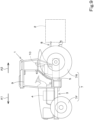
- FIG. 9 is a side view illustrating an embodiment of a working vehicle 1.
- the working vehicle 1 is a tractor.
- the working vehicle 1 is not limited to a tractor and may be an agricultural machine (agricultural vehicle) such as a combine or a transplanter, a construction machine (construction vehicle) such as a loader working machine, and the like.
- a direction in which an operator who is seated on an operator's seat 10 of the working vehicle (tractor) 1 is oriented is referred to as "front”, while the opposite direction thereof (direction of arrow A2 in FIG. 9 ) is referred to as "back”.
- the left of the operator is referred to as “left”
- the right of the operator is referred to as "right”.
- a horizontal direction orthogonal to the front-back direction of the working vehicle 1 is referred to as "vehicle-body width direction”.
- the working vehicle (tractor) 1 includes a vehicle body 3, a prime mover 4, and a transmission 5.
- the vehicle body 3 has a traveling device 7 and is capable of traveling.
- the traveling device 7 is a drive driven by power output from the prime mover 4 and has front wheels 7F and rear wheels 7R.
- the front wheels 7F may be of a tire type or a crawler type.
- the rear wheels 7R may also be of a tire type or a crawler type.
- the prime mover 4 is a diesel engine, an electric prime mover, or the like and is a machine that outputs power.
- the prime mover 4 is a diesel engine.
- the transmission 5 is a transmission mechanism that transmits power output from the prime mover 4 to the traveling device 7 (drive).
- the transmission 5 can switch a propelling force of the traveling device 7 by changing gears and can switch the traveling device 7 between forward travel and reverse travel.
- the vehicle body 3 is provided with the operator's seat 10.
- a coupler 8 is provided in a rear portion of the vehicle body 3.
- a working device 2 can be attached to and detached from the coupler 8. By the working device 2 being coupled to the coupler 8, the vehicle body 3 can tract the working device 2.
- the working device 2 include a cultivator for cultivation, a fertilizer spreader for spreading a fertilizer, an agricultural chemical spreader for spreading an agricultural chemical, a harvester for harvesting, a mower for mowing grass or the like, a tedder for tedding grass or the like, a rake for raking grass or the like, and a baler for baling grass or the like.
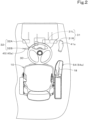
- a steering wheel 30 for steering the vehicle body 3, a brake operation member 31, and a clutch switch member 32 are provided around the operator's seat 10.
- the brake operation member 31 includes a plurality of operation units, for example, a brake pedal 31L provided on the left and a brake pedal 31R provided on the right.
- the brake pedal 31L and the brake pedal 31R are supported by the vehicle body 3 in a swingable manner and can be operated by the operator seated on the operator's seat 10.
- the clutch switch member 32 includes a clutch pedal 32A and a clutch lever 32B.
- the clutch pedal 32A is supported by the vehicle body 3 in a swingable manner and can be operated by the operator seated on the operator's seat 10, similarly to the brake pedal 31L and the brake pedal 31R.
- the clutch lever 32B is supported in a swingable manner near the steering wheel 30 and is switchable among a forward-travel position (F), a reverse-travel position (R), or a neutral position (N).
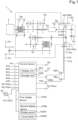
- the transmission 5 includes a main shaft (propeller shaft) 5a, a main transmission unit 5b, a sub-transmission unit 5c, a traveling clutch 5d, and a power take-off (PTO) power transmission unit 5e.
- the propeller shaft 5a is rotatably supported by a housing case (transmission case) of the transmission 5, and power from a crankshaft of the prime mover 4 is transmitted to the propeller shaft 5a.
- the main transmission unit 5b has a plurality of gears and a gearshift that changes connection of the gears.
- the main transmission unit 5b changes connection (engagement) of the plurality of gears by using the gearshift as appropriate to change and output rotation input from the propeller shaft 5a (change gears).
- the sub-transmission unit 5c also has a plurality of gears and a gearshift that changes connection of the gears.
- the sub-transmission unit 5c changes connection (engagement) of the plurality of gears by using the gearshift as appropriate to change and output rotation input from the main transmission unit 5b (change gears).
- the traveling clutch 5d is a traveling device that is switchable between a connected state in which power is transmitted to the traveling device 7 (the front wheels 7F and the rear wheels 7R) and a disconnected state in which transmission of power to the traveling device 7 is disconnected.
- the traveling clutch 5d can be displaced to a half-clutch state in which power is slidably and partly transmitted to the traveling device 7 in response to the disconnected state being switched to the connected state.
- the traveling clutch 5d has a shuttle shaft 12 and a clutch switch unit 13. Power output from the prime mover 4 is transmitted to the shuttle shaft 12.
- the clutch switch unit 13 is a hydraulic clutch that is switched to a forward-driving clutch state, a reverse-driving clutch state, or a neutral state.
- the clutch switch unit 13 is connected to a forward-travel switching valve 26 and a reverse-travel switching valve 27 connected via a fluid passage (omitted from illustration) or the like.
- Each of the forward-travel switching valve 26 and the reverse-travel switching valve 27 is a two-position electromagnetic switching valve, for example. If a solenoid of the forward-travel switching valve 26 is energized, the clutch switch unit 13 is switched to the forward-driving clutch state. If a solenoid of the reverse-travel switching valve 27 is energized, the clutch switch unit 13 is switched to the reverse-driving clutch state. If each of the solenoids of the forward-travel switching valve 26 and the reverse-travel switching valve 27 is deenergized, the clutch switch unit 13 is switched to the neutral state.
- the clutch switch unit 13 is switchable by using the clutch switch member 32. If the clutch lever 32B is in the forward-travel position (F), while the solenoid of the forward-travel switching valve 26 is energized, the solenoid of the reverse-travel switching valve 27 remains deenergized, and the clutch switch unit 13 is switched to the forward-driving clutch state. If the clutch lever 32B is in the reverse-travel position (R), while the solenoid of the reverse-travel switching valve 27 is energized, the solenoid of the forward-travel switching valve 26 remains deenergized, and the clutch switch unit 13 is switched to the reverse-driving clutch state. If the clutch lever 32B is in the neutral position (N), the solenoids of the forward-travel switching valve 26 and the reverse-travel switching valve 27 remain deenergized, and the clutch switch unit 13 is switched to the neutral state.
- the shuttle shaft 12 is connected to the propeller shaft 5a. Power of the propeller shaft 5a is transmitted to the main transmission unit 5b and the sub-transmission unit 5c, and power output from the sub-transmission unit 5c is transmitted to a rear-wheel differential 20R.
- the rear-wheel differential 20R rotatably supports a rear axle 21R to which the rear wheels 7R are attached. That is, if the clutch switch unit 13 is switched to either of the forward-driving clutch state and the reverse-driving clutch state and the clutch pedal 32A is not operated, the traveling clutch 5d is in the connected state and transmits power to the traveling device 7 (the front wheels 7F and the rear wheels 7R). If the clutch switch unit 13 is switched to the neutral state, the traveling clutch 5d is in the disconnected state and disconnects transmission of power to the traveling device 7.
- the PTO power transmission unit 5e has a PTO propeller shaft 14 and a PTO clutch 15.
- the PTO propeller shaft 14 is rotatably supported and can transmit power from the propeller shaft 5a.
- the PTO propeller shaft 14 is connected to a PTO shaft 16 via a gear or the like.
- the PTO clutch 15 includes, for example, a hydraulic clutch or the like, and is switched between a state where power of the propeller shaft 5a is transmitted to the PTO propeller shaft 14 and a state where power of the propeller shaft 5a is not transmitted to the PTO propeller shaft 14 by engaging/disengaging of the hydraulic clutch.
- the working vehicle 1 includes a brake device 46.
- the brake device 46 has a left brake device 46a and a right brake device 46b.
- Each of the left brake device 46a and the right brake device 46b is a disc-type brake device and is switchable between a brake state for braking and a release state for releasing the brake.
- the left brake device 46a is provided on the left of the rear axle 21R, while the right brake device 46b is provided on the right of the rear axle 21R.
- a left coupling member 47a coupled to the brake pedal 31L can be moved in a braking direction, and the left brake device 46a can be brought into a brake state.
- a right coupling member 47b coupled to the brake pedal 31R can be moved in a braking direction, and the right brake device 46b can be brought into a brake state.
- a left hydraulic actuation unit 48a that is actuated by a hydraulic fluid is coupled to the left coupling member 47a.
- a left braking valve 49a is connected to the left hydraulic actuation unit 48a via a fluid passage. By actuating the left hydraulic actuation unit 48a by using the left braking valve 49a, the left coupling member 47a can be moved in the braking direction.
- a right hydraulic actuation unit 48b that is actuated by a hydraulic fluid is coupled to the right coupling member 47b.
- a right braking valve 49b is connected to the right hydraulic actuation unit 48b via a fluid passage. By actuating the right hydraulic actuation unit 48b by using the right braking valve 49b, the right coupling member 47b can be moved in the braking direction.
- the left brake device 46a and the right brake device 46b can independently bring the left rear wheel 7R and the right rear wheel 7R into the braking state.
- a plurality of display devices 50 are provided around the operator's seat 10.
- the plurality of display devices 50 include a first display device 50A provided in front of the operator's seat 10 (the steering wheel 30) and a second display device 50B provided on a side of the operator's seat 10 (the steering wheel 30).
- the first display device 50A is a meter panel or the like that mainly displays various kinds of driving information and includes a prime mover tachometer 51a that displays the rotation speed of the prime mover 4, a water temperature gauge 51b, and a fuel gauge 51c.
- the first display device 50A further has a notifier 52 including at least one indicator lamp 52A that notifies various kinds of information by being turned on/off or the like.
- the first display device 50A illustrated in FIG. 3 is an example and is not limited to the above configuration.
- the second display device 50B is a device that mainly displays various kinds of driving information and includes a display panel 50B1 and a touch panel 50B2 that is disposed on a surface of the display panel 50B1.
- Various menu items are displayed on the second display device 50B, and various settings of the working vehicle 1 can be performed by a predetermined operation.
- the working vehicle 1 includes a control device 40.
- the control device 40 includes a central processing unit (CPU), electrical and electronic circuitry, or the like and controls the working vehicle 1 in various manners.
- the control device 40 includes a change unit 40A and a storage unit 40B.
- the storage unit 40B is a storage device and stores various control programs and data tables regarding operations of the working vehicle 1.
- an accelerator sensor 42a an ignition switch 42b, a raising/lowering switch 42c, a vehicle speed detection sensor 42d, a brake-operation detection sensor 42e, a clutch lever sensor 42f, a detector 53, and the like are connected.
- the accelerator sensor 42a detects an operation amount of an accelerator 41a ( FIG. 2 ).
- the vehicle speed detection sensor 42d detects the vehicle speed (velocity).
- the brake-operation detection sensor 42e detects an operation amount of the brake operation member 31 (the brake pedal 31L and the brake pedal 31R).
- the clutch lever sensor 42f detects the position of the clutch lever 32B.
- the detector 53 detects an operation position of the clutch pedal 32A and outputs a detected value corresponding to the detected operation position.
- the detector 53 is, for example, a clutch-operation detection sensor 53a that detects an operation amount of the clutch pedal 32A.
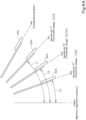
- the clutch-operation detection sensor 53a is a detection sensor whose detection method is such that a detected value decreases in accordance with the operation amount (depressed amount) of the clutch pedal 32A. For example, in a state where the clutch pedal 32A is depressed to a maximum depression position PMAX (see FIG. 6A described later), the detected voltage value of the clutch-operation detection sensor 53a is "0 volts". Then, as the clutch pedal 32A becomes away from the maximum depression position PMAX, the detected voltage value of the clutch-operation detection sensor 53a increases.
- the detected voltage value of the clutch-operation detection sensor 53a becomes a maximum (e.g., "5 volts").
- the control device 40 changes the rotation speed of the prime mover 4 (referred to as "prime mover rotation speed") in accordance with the operation amount. If the ignition switch 42b is operated to be turned on, the control device 40 starts the prime mover 4 through a predetermined process; if the ignition switch 42b is operated to be turned off, the control device 40 stops driving the prime mover 4.
- the control device 40 controls a control valve to extend a lift cylinder and to raise the working device 2. If the raising/lowering switch 42c is operated in a lowering direction, the control device 40 controls the control valve to contract the lift cylinder to lower the working device 2.
- the control device 40 performs a brake control on the basis of the brake-operation detection sensor 42e.
- the control device 40 actuates the left hydraulic actuation unit 48a to operate the left brake device 46a for braking.
- the control device 40 actuates the right hydraulic actuation unit 48b to operate the right brake device 46b for braking.
- the control device 40 actuates the left hydraulic actuation unit 48a and the right hydraulic actuation unit 48b to operate the left brake device 46a and the right brake device 46b for braking.
- the control device 40 Upon the clutch lever sensor 42f detecting that the clutch lever 32B has been switched to the forward-travel position (F), the control device 40 energizes the solenoid of the forward-travel switching valve 26 to switch the clutch switch unit 13 to the forward-driving clutch state.
- the control device 40 Upon the clutch lever sensor 42f detecting that the clutch lever 32B has been switched to the reverse-travel position (R), the control device 40 energizes the solenoid of the reverse-travel switching valve 27 to switch the clutch switch unit 13 to the reverse-driving clutch state.
- the control device 40 deenergizes the solenoids of the forward-travel switching valve 26 and the reverse-travel switching valve 27 to switch the clutch switch unit 13 to the neutral state.
- a detected value from the detector 53 corresponds with a predetermined threshold (e.g., threshold voltage)
- a predetermined threshold e.g., threshold voltage
- the control device 40 brings the traveling clutch 5d into the half-clutch state. If the detected value is less than the threshold, the control device 40 brings the traveling clutch 5d into the disconnected state. If the detected value exceeds the threshold, the control device 40 brings the traveling clutch 5d into the connected state.
- the control device 40 brings the traveling clutch 5d into the disconnected state. Then, if the operator restores the clutch pedal 32A from the maximum depression position PMAX to a position denoting the half-clutch state, the detected voltage value from the clutch-operation detection sensor 53a corresponds with the threshold voltage, and thus, the control device 40 brings the traveling clutch 5d into the half-clutch state.
- the control device 40 brings the traveling clutch 5d into the connected state.
- the operator performs a series of operations of depressing the clutch pedal 32A to the maximum depression position PMAX and then restoring the clutch pedal 32A to the position denoting the half-clutch state and further restoring the clutch pedal 32A to the unoperated position P0.
- the working vehicle 1 can change a half-clutch stroke length of the clutch pedal 32A.
- the half-clutch stroke length is the length of displacement of the clutch pedal 32A from the maximum depression position PMAX, in which the clutch pedal 32A is operated so that the traveling clutch 5d is brought into the disconnected state, to the operation position of the clutch pedal 32A, in which the traveling clutch 5d is brought into the half-clutch state.
- the clutch lever 32B (operation lever) includes an operation member 45 that is operable by the operator or the like.
- the operation member 45 is a dial switch 45a, for example, provided at the tip of the clutch lever 32B and rotatable around the longitudinal direction of the clutch lever 32B as an axial center.
- an armrest 18 is provided on the right of the operator's seat 10.
- the armrest 18 extends in the front-back direction of the operator's seat 10.
- the operator can operate the steering wheel 30 with the right arm rested on the armrest 18.
- a second operation member 54 is provided on the right side surface of the armrest 18.
- the second operation member 54 is different from the operation member 45 disposed on the clutch lever 32B and serving as a first operation member.
- the second operation member 54 is a sensitivity setting button 54a, for example.
- the sensitivity setting button 54a is a push-button switch, for example.
- the sensitivity setting button 54a is an operation switch that is turned on while the operator or the like is operating it and is turned off while the operator or the like is not performing it.
- the control device 40 includes the change unit 40A.
- the control device 40 functions as the change unit 40A by, for example, the CPU executing a control program stored in the storage unit 40B.
- the change unit 40A changes the value of the threshold voltage (threshold) to a different value in accordance with an operation on the operation member 45.
- the detector 53 outputs a predetermined first detected value (e.g., minimum, which is "0 volts") as the detected value; if the clutch pedal 32A is in the unoperated position P0, where no operation is performed, the detector 53 outputs a predetermined second detected value (e.g., maximum, which is "5 volts"), which is a value separated from the first detected value by a certain value range, as the detected value.
- the threshold voltage is a predetermined single value among a plurality of values that are present between the first detected value (0 volts) and the second detected value (5 volts).
- the threshold voltage is set to, for example, 2.5 volts as a default value (initial value).
- the change unit 40A can change the value of the threshold to a value (e.g., 1 volt) closer to the first detected value (0 volts) than the default value (2.5 volts) is or a value (e.g., 4 volts) closer to the second detected value (5 volts) than the default value (2.5 volts) is.
- a value e.g., 1 volt
- the first detected value, the second detected value, the value of the threshold, and the changed value of the threshold are not limited to the above values and may be values other than the above values.
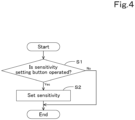
- the control device 40 Upon determining that the sensitivity setting button 54a is operated (Yes in S1), the control device 40 changes a mode of the working vehicle 1 from a normal mode to a setting changing mode. The setting changing mode is maintained throughout the operation on the sensitivity setting button 54a by an operator or the like. Upon the operator or the like stopping the operation on the sensitivity setting button 54a, the control device 40 returns the mode of the working vehicle 1 from the setting changing mode to the normal mode. On the other hand, as long as the operator or the like does not operate the sensitivity setting button 54a (No in S1), the control device 40 ends this process without changing the mode of the working vehicle 1 to the setting changing mode.
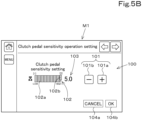
- the change unit 40A executes sensitivity setting for changing the value of the threshold voltage (threshold) to a different value in accordance with the operation on the operation member 45 (the dial switch 45a) (S2). Specifically, as illustrated in FIG. 5A , the control device 40 causes the second display device 50B to display a setting screen M1 for setting the sensitivity of the clutch pedal 32A. In FIG. 5A , it is assumed that the sensitivity "3" (default value) of the clutch pedal 32A is indicated. In accordance with the operation on the dial switch 45a provided on the clutch lever 32B (operation lever), the change unit 40A changes the sensitivity of the clutch pedal 32A. In this embodiment, the sensitivity of the clutch pedal 32A is changeable within a predetermined range (range of sensitivity from "1" to "5") in units of one decimal place.
- the sensitivity of the clutch pedal 32A is increased.
- the sensitivity of the clutch pedal 32A is displayed in an indicator portion 102b and a numerical value display portion 103.
- the sensitivity of the clutch pedal 32A is decreased. In FIG. 5B , the sensitivity of the clutch pedal 32A is set to the maximum "5".
- the change unit 40A changes the sensitivity from “3" to "5", changes the value of the threshold voltage from the threshold voltage corresponding to the sensitivity "3” to a threshold voltage corresponding to the sensitivity "5", and stores the changed sensitivity and the changed value of the threshold voltage in the storage unit 40B.
- the control device 40 restores the mode of the working vehicle 1 from the setting changing mode to the normal mode and ends this process.
- a button 104a indicating "CANCEL" being touched in a state where the setting screen M1 illustrated in FIG.
- the change unit 40A displays the unchanged sensitivity (the sensitivity "3" illustrated in FIG. 5A in this example) without changing the sensitivity to "5", and the control device 40 returns the mode of the working vehicle 1 from the setting changing mode to the normal mode and ends this process.
- the storage unit 40B maintains the unchanged sensitivity and the unchanged value of the threshold voltage.
- the stroke length of the clutch pedal 32A is a length L3.
- the detected voltage value of the clutch-operation detection sensor 53a when the clutch pedal 32A is set in a position P3 by being restored from the maximum depression position PMAX by the length L3 is "2.5 volts”
- the detected voltage value corresponds with the threshold voltage
- the traveling clutch 5d is brought into the half-clutch state.
- the position of the clutch pedal 32A in which the traveling clutch 5d is brought into the half-clutch state is the position of the length L3. That is, the stroke length of the clutch pedal 32A is the length L3.
- the stroke length of the clutch pedal 32A is a length L5.
- the detected voltage value of the clutch-operation detection sensor 53a when the clutch pedal 32A is set in a position P5 by being restored from the maximum depression position PMAX by the length L5 is "1 volt”
- the detected voltage value corresponds with the threshold voltage
- the traveling clutch 5d is brought into the half-clutch state.
- the position of the clutch pedal 32A in which the traveling clutch 5d is brought into the half-clutch state is the position of the length L5. That is, the stroke length of the clutch pedal 32A is the length L5.
- the stroke length of the clutch pedal 32A is a length L1.
- the detected voltage value of the clutch-operation detection sensor 53a when the clutch pedal 32A is set in a position P1 by being restored from the maximum depression position PMAX by the length L1 is "4 volts”
- the detected voltage value corresponds with the threshold voltage
- the traveling clutch 5d is brought into the half-clutch state.
- the position of the clutch pedal 32A in which the traveling clutch 5d is brought into the half-clutch state is the position of the length L1. That is, the stroke length of the clutch pedal 32A is the length L1.
- the above three stroke lengths have the relationship of "L5 ⁇ L3 ⁇ L1".
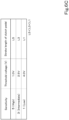
- the threshold voltage is also associated with each of the sensitivities other than the sensitivities "1", “3", and "5" in advance, and the stroke length of the clutch pedal 32A is a corresponding length. That is, the sensitivity, the threshold voltage, and the stroke length have a relationship (proportional relationship) such that the threshold voltage and the stroke length are decreased as the sensitivity is increased.
- the threshold voltage is 2.5 volts and the stroke length of the clutch pedal 32A is the length L3.
- the threshold voltage becomes 1 volt, and the stroke length of the clutch pedal 32A becomes the length L5.
- the stroke length is decreased, and the response of the vehicle body 3 is faster.
- the sensitivity is changed to "1”
- the threshold voltage becomes 4 volts, and the stroke length of the clutch pedal 32A becomes the length L1.
- the stroke length is increased, and the response of the vehicle body 3 is slower.
- the stroke length of the clutch pedal 32A differs depending on the operator's preference.
- the storage unit 40B stores the relationship among the sensitivity, the threshold voltage, and the stroke length of the clutch pedal 32A illustrated in FIG. 6C in advance. Note that the storage unit 40B may store the relationship between the sensitivity and the threshold voltage and does not necessarily store the stroke length of the clutch pedal 32A.
- the second display device 50B Since the second display device 50B has a touch panel function, the sensitivity of the clutch pedal 32A can be set thereon. As illustrated in FIG. 5A , the second display device 50B displays a sensitivity input portion 100 on the setting screen M1.
- the sensitivity input portion 100 is a portion where the sensitivity of the clutch pedal 32A is input and has a button input portion 101, a slide input portion 102, and the numerical value display portion 103.
- the button input portion 101 is a portion where the sensitivity of the clutch pedal 32A is input by a pressing operation and includes an increase input portion 101a for increasing the sensitivity and a decrease input portion 101b for decreasing the sensitivity.
- the slide input portion 102 is a portion where the sensitivity is input by a sliding operation and includes a scale portion 102a and the indicator portion 102b.
- the scale portion 102a is a scale indicating the magnitude of the sensitivity and includes, for example, a plurality of vertical bars (gauges) arranged side by side horizontally. In the scale portion 102a, one end of the arranged vertical bars is the minimum, while the other end of the arranged vertical bars is the maximum. For example, the left end is the minimum, while the right end is the maximum.
- the indicator portion 102b is a portion that indicates the sensitivity on the scale portion 102a and can move in the arrangement direction of the vertical bars. The indicator portion 102b can move in response to a touch operation or the like along the scale portion 102a. In addition, the indicator portion 102b moves along the scale portion 102a in conjunction with the sensitivity input in the button input portion 101.
- the indicator portion 102b moves in the increasing direction along the scale portion 102a. If the sensitivity is decreased in the decrease input portion 101b, the indicator portion 102b moves in the decreasing direction along the scale portion 102a.
- the numerical value display portion 103 displays the sensitivity set in the button input portion 101 and the slide input portion 102 as numerical values.
- a lower limit and an upper limit of the sensitivity are set in advance in the sensitivity input portion 100, and it is not possible to set the sensitivity to values lower than the predetermined lower limit and values higher than the predetermined upper limit.
- the lower limit of the sensitivity is set to "1”
- the upper limit of the sensitivity is set to "5".
- control device 40 causes the second display device 50B to display the setting screen M1 illustrated in FIG. 5A and FIG. 5B , that is, a screen for setting the sensitivity of the clutch pedal 32A
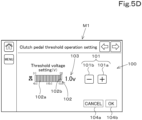
- the control device 40 may also cause the second display device 50B to display the setting screen M1 for setting the threshold voltage of the clutch pedal 32A as illustrated in FIG. 5C and FIG. 5D .
- the default value of the threshold voltage is set to "2.5 volts”
- the lower limit of the threshold voltage is set to "1 volt”
- the upper limit of the threshold voltage is set to "4 volts”.
- control device 40 may further cause the stroke length of the clutch pedal 32A illustrated in FIG. 6A to be displayed on the setting screen M1 illustrated in FIG. 5A in the sensitivity setting (S2) illustrated in FIG. 4 . That is, the control device 40 causes the sensitivity setting of the clutch pedal 32A and the stroke length of the clutch pedal 32A illustrated in FIG. 6A to be displayed in association with each other. For example, if the sensitivity is "3" as illustrated in FIG. 5A , as illustrated in FIG.
- an image of the clutch pedal 32A in a state where the stroke length is the length L3 and supplementary information thereof are displayed on the setting screen M1 of the second display device 50B.
- the control device 40 causes an image of the clutch pedal 32A in a state where the stroke length is changed and the supplementary information thereof to be displayed on the setting screen M1. For example, if the sensitivity is changed to "5" as illustrated in FIG.
- the control device 40 can perform automatic switch control.
- the automatic switch control is disconnection control (first process) for switching the traveling clutch 5d from the connected state to the disconnected state in accordance with an operation on the brake operation member 31 (the brake pedal 31L and the brake pedal 31R). That is, in a situation where the traveling clutch 5d is switched to the forward-driving clutch state and in a situation where the traveling clutch 5d is switched to the reverse-driving clutch state, the automatic switch control can switch the traveling clutch 5d to the disconnected state by using the brake operation member 31 for braking.
- a switching unit 43 that selects whether the automatic switch control is valid or invalid is connected to the control device 40.
- the switching unit 43 includes a switch 44.
- the switch 44 is provided around the operator's seat 10 and can be turned on/off. If at least the automatic switch control is invalid, by turning on the switch 44 from off state, the automatic switch control is switched from invalid to valid.
- the clutch pedal 32A is part of the switching unit 43, and if at least the automatic switch control is valid, by operating the switching unit 43, the automatic switch control is switched from valid to invalid.
- Whether the automatic switch control is valid or invalid can be displayed on either of the first display device 50A and the second display device 50B. As illustrated in FIG. 3 , for example, among a plurality of indicator lamps 52A of the notifier 52, a first indicator lamp 52A1 corresponding to the automatic switch control is turned on while the automatic switch control is valid and is turned off while the automatic switch control is invalid. Alternatively, on the second display device 50B, a display portion on a predetermined screen corresponding to the automatic switch control is turned on while the automatic switch control is valid and is turned off while the automatic switch control is invalid.
- the control device 40 performs the first process (disconnection control) as the automatic switch control.
- the control device 40 performs the first process. If the operation amount (depressed amount) W1 is less than the threshold E2, the control device 40 does not perform the first process.
- the storage unit 40B stores the threshold E2 of the operation amount (depressed amount) W1 of each of the brake pedal 31L and the brake pedal 31R in advance.
- the notifier 52 notifies that the first process is performed. For example, among the plurality of indicator lamps 52A of the notifier 52, a second indicator lamp 52A2 corresponding to the automatic switch control is turned on when the first process is performed and is turned off when the first process is not performed. Thus, since the first display device 50A has the first indicator lamp 52A1 and the second indicator lamp 52A2, whether the automatic switch control is valid or invalid can be displayed and whether the first process is performed can be displayed.
- FIG. 7A to FIG. 7C are flowcharts of the automatic switch control and the like performed by the control device 40.
- the control device 40 determines whether the automatic switch control is valid (S11). If the automatic switch control is valid (Yes in S11), the control device 40 determines whether the clutch pedal 32A is operated (S12). If the clutch pedal 32A is operated (Yes in S 12), the control device 40 controls the traveling clutch 5d (S 13). The control device 40 determines whether the operation amount W1 of the brake pedal (each of the brake pedal 31L and the brake pedal 31R) is greater than or equal to the threshold E2 (S 14).
- the control device 40 performs the first process for switching the traveling clutch 5d from the connected state to the disconnected state (S 15). If the first process is performed, the control device 40 temporarily stores the position of the clutch lever 32B prior to the first process (position storing process). On the other hand, if the operation amount W1 is not greater than or equal to the threshold E2 (No in S14), the process returns to S11.
- the control device 40 advances to a post-disconnection process illustrated in FIG. 7B and FIG. 7C .
- the control device 40 determines whether the operation amount W1 of the brake pedal becomes less than the threshold E2 (S21: brake pedal determination).
- S21 brake pedal determination
- the control device 40 determines whether depression of the brake pedal is released, that is, whether the brake pedal is released.
- the control device 40 performs a restore process (S22) for restoring the traveling clutch 5d to the state prior to the first process. On the other hand, if the operation amount W1 is greater than or equal to the threshold E2 (No in S21), the process returns to S21.
- the control device 40 performs connection control for switching the traveling clutch 5d to the connected state through the half-clutch state by using the threshold with the default value (e.g., the threshold voltage is 2.5 volts: the sensitivity "3") if the threshold is not changed, or by using the threshold whose value is changed by the change unit 40A (e.g., the threshold voltage is 1 volt: the sensitivity "5" or the threshold voltage is 4 volts: the sensitivity "1").
- the control device 40 performs control as if the detected voltage value of the clutch-operation detection sensor 53a corresponds with and exceeds the threshold with the default value or the changed threshold.
- the control device 40 determines whether the clutch pedal 32A is operated (S31: clutch pedal determination). In S31 (clutch pedal determination), for example, after the first process is performed (after S15) in a state where the clutch pedal 32A is not depressed, the control device 40 determines whether the clutch pedal 32A is depressed.
- the control device 40 keeps the disconnected state of the traveling clutch 5d (S32) and switches the automatic switch control from valid to invalid (S33). On the other hand, if the clutch pedal 32A is not operated (No in S31), the process returns to S31.
- the process returns to S11, and thus, the automatic switch control is not performed. If the automatic switch control is not valid (No in S 11), the control device 40 may end this process and may skip S12 to S15 in FIG. 7A and the processes in FIG. 7B and FIG. 7C .
- FIG. 8A and FIG. 8B are diagrams illustrating an overall relationship among whether the automatic switch control is valid/invalid, the position of the clutch lever 32B, the operation on the clutch pedal 32A, the operation on the brake pedals 31L and 31R, and the like.
- a state where the clutch lever 32B is switched to either of the forward-travel position (F) and the reverse-travel position (R) is referred to as "forward-travel/reverse-travel period".
- "OFF" of the clutch pedal 32A indicates that the operation amount of the clutch pedal 32A is less than a predetermined amount (less than the threshold) and indicates, for example, an unoperated state.
- "ON" of the clutch pedal 32A indicates that the operation amount of the clutch pedal 32A is greater than or equal to the predetermined amount (greater than or equal to the threshold) and indicates, for example, a depressed state.
- “OFF” of the brake pedal indicates that the operation amount W1 of the brake pedal is less than the threshold E2 and indicates, for example, a released state.
- "ON" of the brake pedal indicates that the operation amount W1 of the brake pedal is greater than or equal to the threshold E2, and indicates, for example, a depressed state.
- a previous state indicates a state when an initial operation is performed, while a subsequent state indicates a state when the clutch pedal 32A, the brake pedal, or the like is operated after the previous state.
- the working vehicle 1 includes the prime mover 4 that outputs power; the traveling device 7 (drive) driven by the power output from the prime mover 4; the transmission 5 (transmission mechanism) that transmits the power output from the prime mover 4 to the traveling device 7; the traveling clutch 5d (clutch) provided in the transmission 5 and displaceable to a connected state in which the power is transmitted to the traveling device 7, a disconnected state in which transmission of the power to the traveling device 7 is disconnected, and a half-clutch state in which the power is slidably and partly transmitted to the traveling device 7; the clutch pedal 32A; the detector 53 that detects an operation position of the clutch pedal 32A and outputs a detected value corresponding to the operation position detected; the control device 40 that brings the traveling clutch 5d into the half-clutch state if the detected value from the detector 53 corresponds with a predetermined threshold, brings the traveling clutch 5d into the disconnected state if the detected value is either one of a value less than the threshold and a value greater than
- the operation position of the clutch pedal 32A corresponding to the half-clutch state can be changed. That is, the operation position of the clutch pedal 32A indicating a detected value from the detector 53 corresponding with the changed threshold becomes the changed operation position corresponding to the half-clutch state.
- the operation position of the clutch pedal 32A corresponding to the half-clutch state can be changed to any given position within the range of the positions P1 to P5 illustrated in FIG. 6A .
- the half-clutch stroke length can be adjusted. That is, it is possible to provide the working vehicle 1 that can improve operability of a clutch operation.
- the detector 53 outputs the predetermined first detected value as the detected value
- the detector 53 outputs the predetermined second detected value, which is a value separated from the first detected value by a certain value range, as the detected value
- the threshold is a predetermined single value among a plurality of values that are present between the first detected value and the second detected value, and in accordance with the operation on the operation member 45, the change unit 40A changes the value of the threshold to a value closer to the first detected value than a default value is or a value closer to the second detected value than the default value is.
- the half-clutch stroke length can be made shorter than that before change.
- the half-clutch stroke length can be made longer than that before change.
- the working vehicle 1 further includes the display device 50, in which, as illustrated in FIG. 5C and FIG. 5D , the control device 40 causes the display device 50 to display the threshold that is set and causes the display device 50 to display the threshold to be changed by the change unit 40A in accordance with the operation on the operation member 45.
- the threshold that is set can be checked on the display devices 50.
- the threshold to be changed by the change unit 40A in accordance with the operation on the operation member 45 by the operator is displayed on the display devices 50, the threshold to be changed can be checked on the display devices 50 when changing the threshold.
- the working vehicle 1 further includes the display device 50, in which, as illustrated in FIG. 5A and FIG. 5B , the control device 40 causes the display device 50 to display, as a sensitivity of the clutch pedal 32A, the threshold that is set, and causes the display device 50 to display, as the sensitivity of the clutch pedal 32A, the threshold to be changed by the change unit 40A in accordance with the operation on the operation member 45.
- the operator can grasp the sensitivity of the clutch pedal 32A by viewing the sensitivity of the clutch pedal 32A displayed on the display devices 50.
- the operator can grasp the sensitivity of the clutch pedal 32A to be changed in accordance with the operation on the operation member 45 by the operator.
- the operator can change the sensitivity of the clutch pedal 32A intuitively.
- the operation member 45 is the dial switch 45a provided on the clutch lever 32B (operation lever), and the change unit 40A changes the value of the threshold to a different value in accordance with an operation on the dial switch 45a.
- the value of the threshold can be changed to a different value with a pitch in accordance with the operation on the dial switch 45a by the operation on the dial switch 45a by the operator.
- the half-clutch stroke length can be adjusted with a pitch in accordance with the operation on the dial switch 45a by the operator.
- the operation member 45 is the second display device 50B (display device) including the display panel 50B1 and the touch panel 50B2 that is disposed on a surface of the display panel 50B 1, and the change unit 40A changes the value of the threshold to a different value in accordance with a touch operation on the touch panel 50B2.
- the value of the threshold can be changed to a different value in accordance with the touch operation by the operator.
- the half-clutch stroke length can be adjusted in accordance with the touch operation by the operator.
- the working vehicle 1 further includes: the brake operation member 31; the brake device 46 capable of braking the traveling device 7 in accordance with an operation on the brake operation member 31; and the switching unit 43 that selects whether the automatic switch control is valid or invalid, the automatic switch control being control for switching the traveling clutch 5d from the connected state to the disconnected state, in which the control device 40, if the automatic switch control is invalid, upon an operation on the brake operation member 31, performs brake control for braking the traveling device 7 in accordance with the operation on the brake operation member 31, and, if the automatic switch control is valid, upon an operation on the brake operation member 31, performs the brake control and disconnection control for switching the traveling clutch 5d from the connected state to the disconnected state, and, when the operation on the brake operation member 31 is released after the disconnection control, performs connection control for switching the traveling clutch 5d from the disconnected state to the connected state through the half-clutch state by using the threshold whose value is changed by the change unit 40A.
- the traveling clutch 5d can be automatically switched from the connected state to the disconnected state, and the working vehicle 1 can be smoothly stopped without manually switching the traveling clutch 5d. Furthermore, if the operation on the brake operation member 31 is released, the traveling clutch 5d can be switched from the disconnected state to the connected state through the half-clutch state using the changed threshold, and thus, the working vehicle 1 can be started at a clutch connection timing changed by the operator, realizing a start familiar with the operator's driving feeling.
- the detector 53 outputs the predetermined first detected value as the detected value
- the detector 53 outputs the predetermined second detected value, which is a value separated from the first detected value by a certain value range, as the detected value
- the threshold is a predetermined single value among a plurality of values that are present between the first detected value and the second detected value, and in accordance with the operation on the operation member 45, the change unit 40A changes the value of the threshold to a value closer to the first detected value than a default value is.
- the traveling clutch 5d can be switched from the disconnected state to the connected state through the half-clutch state using the changed threshold. Since the changed threshold is a shorter half-clutch stroke length, that is, the clutch connection timing is an earlier timing changed by the operator, the time for the traveling clutch 5d to be brought into the half-clutch state from the disconnected state can be shortened, the working vehicle 1 can be started with the clutch connection timing shortened, and the work efficiency of the working vehicle 1 can be improved.
- the working vehicle 1 further includes the second operation member 54 that is different from the operation member 45, in which if the second operation member 54 and the operation member 45 are operated, the change unit 40A changes the value of the threshold to a different value in accordance with the operation on the operation member 45, and, if the operation member 45 is operated in a state where the second operation member 54 is not operated, the change unit 40A does not change the value of the threshold to a different value regardless of the operation on the operation member 45.
- the second operation member 54 and the operation member 45 are operated, the value of the threshold can be changed to a different value in accordance with the operation on the operation member 45.
- the threshold can be prevented from being changed by an erroneous operation.
- the working vehicle 1 is a tractor including: the vehicle body 3; and the coupler 8 that is provided for the vehicle body 3 and that couples a working device for working to the vehicle body 3. According to this configuration, the tractor having the above special effects can be realized.
- the drive is the traveling device 7 that gives a propelling force to the vehicle body 3, and the traveling clutch 5d (clutch) is provided in the transmission 5 (transmission mechanism) and is displaceable to a connected state in which the power is transmitted to the traveling device, a disconnected state in which transmission of the power to the traveling device is disconnected, and a half-clutch state in which the power is slidably and partly transmitted to the traveling device.
- the traveling clutch 5d is provided in the transmission 5 (transmission mechanism) and is displaceable to a connected state in which the power is transmitted to the traveling device, a disconnected state in which transmission of the power to the traveling device is disconnected, and a half-clutch state in which the power is slidably and partly transmitted to the traveling device.
- the detector 53 employs the detection method such that the detected value decreases in accordance with the operation amount (depressed amount) of the clutch pedal 32A in the above embodiment
- the present invention is not limited to this.
- the clutch-operation detection sensor 53a may be a detection sensor whose detection method is such that the detected value increases in accordance with the operation amount (depressed amount) of the clutch pedal 32A.
- the control device 40 brings the traveling clutch 5d to the half-clutch state; if the detected value exceeds the threshold, the control device 40 brings the traveling clutch 5d into the disconnected state; if the detected value is less than the threshold, the control device 40 brings the traveling clutch 5d into the connected state.
- the operation member 45 (e.g., the dial switch 45a) is provided on the clutch lever 32B (operation lever) in the above embodiment, the present invention is not limited to this.
- the operation member 45 may be provided on any of various operation levers (e.g., gear shift and multi-function operation lever) disposed around the operator's seat 10.
- the working vehicle 1 is a construction machine (construction vehicle) such as a loader working machine
- the operation member 45 may be provided on a loader operation lever for operating a front loader.
- the operation member 45 may also be provided on a member other than the operation lever around the operator's seat 10.
- the operation member 45 is the dial switch 45a in the above embodiment, the present invention is not limited to this.
- the operation member 45 may also be any of various operation switches such as a rotary switch, a button switch, and a slide switch.
- the present invention is not limited to this.
- the present invention is also applicable to adjustment of the half-clutch stroke length of a clutch pedal (POT clutch pedal) for operating the PTO clutch 15.
- the storage unit 40B may store names of a plurality of operators and changed sensitivities or changed values of the threshold voltage for each of the plurality of operators in association with one another, and upon the second display device 50B receiving input of identification information (e.g., name, operator number, or password) of an operator, the control device 40 may read, from the storage unit 40B, and set the changed sensitivity or changed value of the threshold voltage corresponding to the input identification information the operator.
- identification information e.g., name, operator number, or password
- the single working vehicle 1 (tractor) can be shared by the plurality of operators, clutch operations can be performed by using the half-clutch stroke length corresponding to the changed sensitivity or changed value of the threshold voltage set by each operator, and the highly convenient working vehicle 1 (tractor) for the plurality of operators can be provided.
Landscapes
- Engineering & Computer Science (AREA)
- Mechanical Engineering (AREA)
- Chemical & Material Sciences (AREA)
- Combustion & Propulsion (AREA)
- Transportation (AREA)
- General Engineering & Computer Science (AREA)
- Physics & Mathematics (AREA)
- Fluid Mechanics (AREA)
- Arrangement And Mounting Of Devices That Control Transmission Of Motive Force (AREA)
- Hydraulic Clutches, Magnetic Clutches, Fluid Clutches, And Fluid Joints (AREA)
Description
- The present invention relates to a working vehicle and a tractor, for example.
- In the related art, there is a technique for preventing galling of a clutch mechanism due to excessively long continuation of a so-called half-clutch state in a tractor including the clutch mechanism that works together with a clutch pedal.
Japanese Unexamined Patent Application Publication No. 2017-62009 WO2018/172512 . - The tractor described in
Japanese Unexamined Patent Application Publication No. 2017-62009 - The present invention has been made so as to solve the above problem of the related art, and an object of the present invention is to provide a working vehicle that can improve operability of a clutch operation.
- Technical means of the present invention for solving the technical problem is as follows.
- A working vehicle according to an aspect of the present invention includes: a prime mover that outputs power; a drive driven by the power output from the prime mover; a transmission mechanism that transmits the power output from the prime mover to the drive; a clutch provided in the transmission mechanism and displaceable to a connected state in which the power is transmitted to the drive, a disconnected state in which transmission of the power to the drive is disconnected, and a half-clutch state in which the power is slidably and partly transmitted to the drive; a clutch pedal; a detector that detects an operation position of the clutch pedal and outputs a detected value corresponding to the operation position detected; a control device that brings the clutch into the half-clutch state if the detected value from the detector corresponds with a predetermined threshold, brings the clutch into the disconnected state if the detected value is either one of a value less than the threshold and a value greater than the threshold, and brings the clutch into the connected state if the detected value is the other of the value less than the threshold and the value greater than the threshold; an operation member; and a change unit that changes a value of the threshold to a different value in accordance with an operation on the operation member.
- If the clutch pedal is in a maximum operation position, the detector may output a predetermined first detected value as the detected value. If the clutch pedal is in an unoperated position, where no operation is performed, the detector may output a predetermined second detected value, which is a value separated from the first detected value by a certain value range, as the detected value. The threshold may be a predetermined single value among a plurality of values that are present between the first detected value and the second detected value. In accordance with the operation on the operation member, the change unit may change the value of the threshold to a value closer to the first detected value than a default value is or a value closer to the second detected value than the default value is.
- The working vehicle may further include a display device, in which the control device may cause the display device to display the threshold that is set and may cause the display device to display the threshold to be changed by the change unit in accordance with the operation on the operation member.
- The working vehicle may further include a display device, in which the control device may cause the display device to display, as a sensitivity of the clutch pedal, the threshold that is set, and may cause the display device to display, as the sensitivity of the clutch pedal, the threshold to be changed by the change unit in accordance with the operation on the operation member.
- The operation member may be a dial switch provided on an operation lever, and the change unit may change the value of the threshold to a different value in accordance with an operation on the dial switch.
- The operation member may be a display device including a display panel and a touch panel that is disposed on a surface of the display panel, and the change unit may change the value of the threshold to a different value in accordance with a touch operation on the touch panel.
- The working vehicle may further include a brake operation member; a brake device capable of braking the drive in accordance with an operation on the brake operation member; and a switching unit that selects whether automatic switch control is valid or invalid, the automatic switch control being control for switching the clutch from the connected state to the disconnected state, in which the control device may, if the automatic switch control is invalid, upon an operation on the brake operation member, perform brake control for braking the drive in accordance with the operation on the brake operation member, and, if the automatic switch control is valid, upon an operation on the brake operation member, perform the brake control and disconnection control for switching the clutch from the connected state to the disconnected state, and, when the operation on the brake operation member is released after the disconnection control, perform connection control for switching the clutch from the disconnected state to the connected state through the half-clutch state by using the threshold whose value is changed by the change unit.
- If the clutch pedal is in a maximum operation position, the detector may output a predetermined first detected value as the detected value. If the clutch pedal is in an unoperated position, where no operation is performed, the detector may output a predetermined second detected value, which is a value separated from the first detected value by a certain value range, as the detected value. The threshold may be a predetermined single value among a plurality of values that are present between the first detected value and the second detected value. In accordance with the operation on the operation member, the change unit may change the value of the threshold to a value closer to the first detected value than a default value is.
- The working vehicle may further include: a second operation member that is different from the operation member serving as a first operation member, in which if the first operation member and the second operation member are operated, the change unit may change the value of the threshold to a different value in accordance with the operation on the first operation member, and, if the first operation member is operated in a state where the second operation member is not operated, the change unit may not change the value of the threshold to a different value regardless of the operation on the first operation member.
- The working vehicle may be a tractor including: a vehicle body; and a coupler that is provided for the vehicle body and that couples a working device for working to the vehicle body.
- The drive may be a traveling device that gives a propelling force to the vehicle body, and the clutch may be provided in the transmission mechanism and may be displaceable to a connected state in which the power is transmitted to the traveling device, a disconnected state in which transmission of the power to the traveling device is disconnected, and a half-clutch state in which the power is slidably and partly transmitted to the traveling device.
- According to the present invention, it is possible to provide a working vehicle that can improve operability of a clutch operation.
- A more complete appreciation of preferred embodiments of the present invention and many of the attendant advantages thereof will be readily obtained as the same becomes better understood by reference to the following detailed description when considered in connection with the accompanying drawings described below.
-
FIG. 1 is a block diagram illustrating a configuration and control of a tractor. -
FIG. 2 is a diagram illustrating an operator's seat and its surroundings. -
FIG. 3 is a diagram illustrating a first display device. -
FIG. 4 is a flowchart illustrating an example of a sensitivity setting process. -
FIG. 5A is a diagram illustrating an example of a setting screen. -
FIG. 5B is a diagram illustrating an example of the setting screen. -
FIG. 5C is a diagram illustrating an example of the setting screen. -
FIG. 5D is a diagram illustrating an example of the setting screen. -
FIG. 6A is a diagram illustrating that a stroke length of a clutch pedal is changeable by changing a sensitivity or a threshold voltage. -
FIG. 6B is a diagram illustrating a relationship between the stroke length and a shuttle clutch pressure. -
FIG. 6C is a diagram illustrating a relationship among the sensitivity, the threshold voltage, and the stroke length of the clutch pedal. -
FIG. 7A is a flowchart up to a first process in automatic switch control. -
FIG. 7B is a flowchart of an operation performed when a brake pedal is operated after the first process. -
FIG. 7C is a flowchart of an operation performed when the clutch pedal is operated after the first process. -
FIG. 8A is a diagram illustrating a relationship among operations on a clutch lever, the clutch pedal, and the brake pedal and a state of a traveling clutch when the automatic switch control is invalid. -
FIG. 8B is a diagram illustrating a relationship among operations on the clutch lever, the clutch pedal, and the brake pedal and the state of the traveling clutch when the automatic switch control is valid. -
FIG. 9 is an overall view of the tractor. - The preferred embodiments will now be described with reference to the accompanying drawings, wherein like reference numerals designate corresponding or identical elements throughout the various drawings. The drawings are to be viewed in an orientation in which the reference numerals are viewed correctly.
- An embodiment of the present invention will be described below with reference to the drawings.
-
FIG. 9 is a side view illustrating an embodiment of a workingvehicle 1. In a case of this embodiment, the workingvehicle 1 is a tractor. However, the workingvehicle 1 is not limited to a tractor and may be an agricultural machine (agricultural vehicle) such as a combine or a transplanter, a construction machine (construction vehicle) such as a loader working machine, and the like. - Hereinafter, a direction in which an operator who is seated on an operator's
seat 10 of the working vehicle (tractor) 1 is oriented (direction of arrow A1 inFIG. 9 ) is referred to as "front", while the opposite direction thereof (direction of arrow A2 inFIG. 9 ) is referred to as "back". In addition, the left of the operator is referred to as "left", while the right of the operator is referred to as "right". Furthermore, a horizontal direction orthogonal to the front-back direction of the workingvehicle 1 is referred to as "vehicle-body width direction". - As illustrated in
FIG. 9 , the working vehicle (tractor) 1 includes avehicle body 3, aprime mover 4, and atransmission 5. Thevehicle body 3 has a travelingdevice 7 and is capable of traveling. The travelingdevice 7 is a drive driven by power output from theprime mover 4 and hasfront wheels 7F andrear wheels 7R. Thefront wheels 7F may be of a tire type or a crawler type. Therear wheels 7R may also be of a tire type or a crawler type. - The
prime mover 4 is a diesel engine, an electric prime mover, or the like and is a machine that outputs power. In this embodiment, theprime mover 4 is a diesel engine. Thetransmission 5 is a transmission mechanism that transmits power output from theprime mover 4 to the traveling device 7 (drive). Thetransmission 5 can switch a propelling force of the travelingdevice 7 by changing gears and can switch the travelingdevice 7 between forward travel and reverse travel. Thevehicle body 3 is provided with the operator'sseat 10. - A
coupler 8 is provided in a rear portion of thevehicle body 3. A workingdevice 2 can be attached to and detached from thecoupler 8. By the workingdevice 2 being coupled to thecoupler 8, thevehicle body 3 can tract the workingdevice 2. Examples of the workingdevice 2 include a cultivator for cultivation, a fertilizer spreader for spreading a fertilizer, an agricultural chemical spreader for spreading an agricultural chemical, a harvester for harvesting, a mower for mowing grass or the like, a tedder for tedding grass or the like, a rake for raking grass or the like, and a baler for baling grass or the like. - As illustrated in
FIG. 2 , asteering wheel 30 for steering thevehicle body 3, abrake operation member 31, and aclutch switch member 32 are provided around the operator'sseat 10. Thebrake operation member 31 includes a plurality of operation units, for example, abrake pedal 31L provided on the left and abrake pedal 31R provided on the right. Thebrake pedal 31L and thebrake pedal 31R are supported by thevehicle body 3 in a swingable manner and can be operated by the operator seated on the operator'sseat 10. - The
clutch switch member 32 includes aclutch pedal 32A and aclutch lever 32B. Theclutch pedal 32A is supported by thevehicle body 3 in a swingable manner and can be operated by the operator seated on the operator'sseat 10, similarly to thebrake pedal 31L and thebrake pedal 31R. For example, theclutch lever 32B is supported in a swingable manner near thesteering wheel 30 and is switchable among a forward-travel position (F), a reverse-travel position (R), or a neutral position (N). - As illustrated in
FIG. 1 , thetransmission 5 includes a main shaft (propeller shaft) 5a, amain transmission unit 5b, asub-transmission unit 5c, a traveling clutch 5d, and a power take-off (PTO)power transmission unit 5e. Thepropeller shaft 5a is rotatably supported by a housing case (transmission case) of thetransmission 5, and power from a crankshaft of theprime mover 4 is transmitted to thepropeller shaft 5a. Themain transmission unit 5b has a plurality of gears and a gearshift that changes connection of the gears. Themain transmission unit 5b changes connection (engagement) of the plurality of gears by using the gearshift as appropriate to change and output rotation input from thepropeller shaft 5a (change gears). - Similarly to the
main transmission unit 5b, thesub-transmission unit 5c also has a plurality of gears and a gearshift that changes connection of the gears. Thesub-transmission unit 5c changes connection (engagement) of the plurality of gears by using the gearshift as appropriate to change and output rotation input from themain transmission unit 5b (change gears). - The traveling clutch 5d is a traveling device that is switchable between a connected state in which power is transmitted to the traveling device 7 (the
front wheels 7F and therear wheels 7R) and a disconnected state in which transmission of power to the travelingdevice 7 is disconnected. In addition, the traveling clutch 5d can be displaced to a half-clutch state in which power is slidably and partly transmitted to the travelingdevice 7 in response to the disconnected state being switched to the connected state. The traveling clutch 5d has ashuttle shaft 12 and aclutch switch unit 13. Power output from theprime mover 4 is transmitted to theshuttle shaft 12. Theclutch switch unit 13 is a hydraulic clutch that is switched to a forward-driving clutch state, a reverse-driving clutch state, or a neutral state. - The
clutch switch unit 13 is connected to a forward-travel switching valve 26 and a reverse-travel switching valve 27 connected via a fluid passage (omitted from illustration) or the like. Each of the forward-travel switching valve 26 and the reverse-travel switching valve 27 is a two-position electromagnetic switching valve, for example. If a solenoid of the forward-travel switching valve 26 is energized, theclutch switch unit 13 is switched to the forward-driving clutch state. If a solenoid of the reverse-travel switching valve 27 is energized, theclutch switch unit 13 is switched to the reverse-driving clutch state. If each of the solenoids of the forward-travel switching valve 26 and the reverse-travel switching valve 27 is deenergized, theclutch switch unit 13 is switched to the neutral state. - The
clutch switch unit 13 is switchable by using theclutch switch member 32. If theclutch lever 32B is in the forward-travel position (F), while the solenoid of the forward-travel switching valve 26 is energized, the solenoid of the reverse-travel switching valve 27 remains deenergized, and theclutch switch unit 13 is switched to the forward-driving clutch state. If theclutch lever 32B is in the reverse-travel position (R), while the solenoid of the reverse-travel switching valve 27 is energized, the solenoid of the forward-travel switching valve 26 remains deenergized, and theclutch switch unit 13 is switched to the reverse-driving clutch state. If theclutch lever 32B is in the neutral position (N), the solenoids of the forward-travel switching valve 26 and the reverse-travel switching valve 27 remain deenergized, and theclutch switch unit 13 is switched to the neutral state. - If the
clutch pedal 32A is operated in a state where theclutch lever 32B is in the forward-travel position (F) and if theclutch pedal 32A is operated in a state where theclutch lever 32B is in the reverse-travel position (R), either of the solenoids of the forward-travel switching valve 26 and the reverse-travel switching valve 27 is energized, and theclutch switch unit 13 is switched to the neutral state from either of the forward-driving clutch state and the reverse-driving clutch state. - The
shuttle shaft 12 is connected to the propeller shaft 5a. Power of thepropeller shaft 5a is transmitted to themain transmission unit 5b and thesub-transmission unit 5c, and power output from thesub-transmission unit 5c is transmitted to a rear-wheel differential 20R. The rear-wheel differential 20R rotatably supports arear axle 21R to which therear wheels 7R are attached. That is, if theclutch switch unit 13 is switched to either of the forward-driving clutch state and the reverse-driving clutch state and theclutch pedal 32A is not operated, the traveling clutch 5d is in the connected state and transmits power to the traveling device 7 (thefront wheels 7F and therear wheels 7R). If theclutch switch unit 13 is switched to the neutral state, the traveling clutch 5d is in the disconnected state and disconnects transmission of power to the travelingdevice 7. - The PTO
power transmission unit 5e has aPTO propeller shaft 14 and a PTO clutch 15. ThePTO propeller shaft 14 is rotatably supported and can transmit power from thepropeller shaft 5a. ThePTO propeller shaft 14 is connected to aPTO shaft 16 via a gear or the like. The PTO clutch 15 includes, for example, a hydraulic clutch or the like, and is switched between a state where power of thepropeller shaft 5a is transmitted to thePTO propeller shaft 14 and a state where power of thepropeller shaft 5a is not transmitted to thePTO propeller shaft 14 by engaging/disengaging of the hydraulic clutch. - As illustrated in
FIG. 1 , the workingvehicle 1 includes abrake device 46. Thebrake device 46 has aleft brake device 46a and aright brake device 46b. Each of theleft brake device 46a and theright brake device 46b is a disc-type brake device and is switchable between a brake state for braking and a release state for releasing the brake. Theleft brake device 46a is provided on the left of therear axle 21R, while theright brake device 46b is provided on the right of therear axle 21R. Upon the operator who operates the workingvehicle 1 operating (depressing) thebrake pedal 31L, aleft coupling member 47a coupled to thebrake pedal 31L can be moved in a braking direction, and theleft brake device 46a can be brought into a brake state. Upon the operator operating (depressing) thebrake pedal 31R, aright coupling member 47b coupled to thebrake pedal 31R can be moved in a braking direction, and theright brake device 46b can be brought into a brake state. - A left
hydraulic actuation unit 48a that is actuated by a hydraulic fluid is coupled to theleft coupling member 47a. Aleft braking valve 49a is connected to the lefthydraulic actuation unit 48a via a fluid passage. By actuating the lefthydraulic actuation unit 48a by using theleft braking valve 49a, theleft coupling member 47a can be moved in the braking direction. A righthydraulic actuation unit 48b that is actuated by a hydraulic fluid is coupled to theright coupling member 47b. Aright braking valve 49b is connected to the righthydraulic actuation unit 48b via a fluid passage. By actuating the righthydraulic actuation unit 48b by using theright braking valve 49b, theright coupling member 47b can be moved in the braking direction. - In the above manner, by operating the
brake pedal 31L and thebrake pedal 31R, theleft brake device 46a and theright brake device 46b can independently bring the leftrear wheel 7R and the rightrear wheel 7R into the braking state. - As illustrated in
FIG. 2 , a plurality ofdisplay devices 50 are provided around the operator'sseat 10. The plurality ofdisplay devices 50 include afirst display device 50A provided in front of the operator's seat 10 (the steering wheel 30) and asecond display device 50B provided on a side of the operator's seat 10 (the steering wheel 30). - As illustrated in
FIG. 3 , thefirst display device 50A is a meter panel or the like that mainly displays various kinds of driving information and includes aprime mover tachometer 51a that displays the rotation speed of theprime mover 4, awater temperature gauge 51b, and afuel gauge 51c. Thefirst display device 50A further has anotifier 52 including at least oneindicator lamp 52A that notifies various kinds of information by being turned on/off or the like. Thefirst display device 50A illustrated inFIG. 3 is an example and is not limited to the above configuration. - Similarly to the
first display device 50A, thesecond display device 50B is a device that mainly displays various kinds of driving information and includes a display panel 50B1 and a touch panel 50B2 that is disposed on a surface of the display panel 50B1. Various menu items are displayed on thesecond display device 50B, and various settings of the workingvehicle 1 can be performed by a predetermined operation. - As illustrated in
FIG. 1 , the workingvehicle 1 includes acontrol device 40. Thecontrol device 40 includes a central processing unit (CPU), electrical and electronic circuitry, or the like and controls the workingvehicle 1 in various manners. Thecontrol device 40 includes achange unit 40A and astorage unit 40B. Thestorage unit 40B is a storage device and stores various control programs and data tables regarding operations of the workingvehicle 1. To thecontrol device 40, anaccelerator sensor 42a, an ignition switch 42b, a raising/loweringswitch 42c, a vehiclespeed detection sensor 42d, a brake-operation detection sensor 42e, aclutch lever sensor 42f, adetector 53, and the like are connected. Theaccelerator sensor 42a detects an operation amount of anaccelerator 41a (FIG. 2 ). The vehiclespeed detection sensor 42d detects the vehicle speed (velocity). The brake-operation detection sensor 42e detects an operation amount of the brake operation member 31 (thebrake pedal 31L and thebrake pedal 31R). Theclutch lever sensor 42f detects the position of theclutch lever 32B. Thedetector 53 detects an operation position of theclutch pedal 32A and outputs a detected value corresponding to the detected operation position. - The
detector 53 is, for example, a clutch-operation detection sensor 53a that detects an operation amount of theclutch pedal 32A. The clutch-operation detection sensor 53a is a detection sensor whose detection method is such that a detected value decreases in accordance with the operation amount (depressed amount) of theclutch pedal 32A. For example, in a state where theclutch pedal 32A is depressed to a maximum depression position PMAX (seeFIG. 6A described later), the detected voltage value of the clutch-operation detection sensor 53a is "0 volts". Then, as theclutch pedal 32A becomes away from the maximum depression position PMAX, the detected voltage value of the clutch-operation detection sensor 53a increases. Then, in a state where a foot is detached from theclutch pedal 32A, that is, in a state where theclutch pedal 32A is in an unoperated position P0 (seeFIG. 6A described later), the detected voltage value of the clutch-operation detection sensor 53a becomes a maximum (e.g., "5 volts"). - If the operation amount of the
accelerator 41a is detected by theaccelerator sensor 42a, thecontrol device 40 changes the rotation speed of the prime mover 4 (referred to as "prime mover rotation speed") in accordance with the operation amount. If the ignition switch 42b is operated to be turned on, thecontrol device 40 starts theprime mover 4 through a predetermined process; if the ignition switch 42b is operated to be turned off, thecontrol device 40 stops driving theprime mover 4. - If the raising/lowering
switch 42c is operated in a raising direction, thecontrol device 40 controls a control valve to extend a lift cylinder and to raise the workingdevice 2. If the raising/loweringswitch 42c is operated in a lowering direction, thecontrol device 40 controls the control valve to contract the lift cylinder to lower the workingdevice 2. - The
control device 40 performs a brake control on the basis of the brake-operation detection sensor 42e. During the brake control, upon the brake-operation detection sensor 42e detecting an operation on thebrake pedal 31L, thecontrol device 40 actuates the lefthydraulic actuation unit 48a to operate theleft brake device 46a for braking. In addition, during the brake control, upon the brake-operation detection sensor 42e detecting an operation on thebrake pedal 31R, thecontrol device 40 actuates the righthydraulic actuation unit 48b to operate theright brake device 46b for braking. Furthermore, during the brake control, upon the brake-operation detection sensor 42e detecting operations on thebrake pedal 31L and thebrake pedal 31R, thecontrol device 40 actuates the lefthydraulic actuation unit 48a and the righthydraulic actuation unit 48b to operate theleft brake device 46a and theright brake device 46b for braking. - Upon the
clutch lever sensor 42f detecting that theclutch lever 32B has been switched to the forward-travel position (F), thecontrol device 40 energizes the solenoid of the forward-travel switching valve 26 to switch theclutch switch unit 13 to the forward-driving clutch state. Upon theclutch lever sensor 42f detecting that theclutch lever 32B has been switched to the reverse-travel position (R), thecontrol device 40 energizes the solenoid of the reverse-travel switching valve 27 to switch theclutch switch unit 13 to the reverse-driving clutch state. Upon theclutch lever sensor 42f detecting that theclutch lever 32B has been switched to the neutral position (N), thecontrol device 40 deenergizes the solenoids of the forward-travel switching valve 26 and the reverse-travel switching valve 27 to switch theclutch switch unit 13 to the neutral state. - If a detected value from the detector 53 (the clutch-
operation detection sensor 53a) (e.g., detected voltage value) corresponds with a predetermined threshold (e.g., threshold voltage), thecontrol device 40 brings the traveling clutch 5d into the half-clutch state. If the detected value is less than the threshold, thecontrol device 40 brings the traveling clutch 5d into the disconnected state. If the detected value exceeds the threshold, thecontrol device 40 brings the traveling clutch 5d into the connected state. - For example, if the operator depresses the
clutch pedal 32A to the maximum depression position PMAX, the detected voltage value from the clutch-operation detection sensor 53a exceeds the threshold voltage, and thus, thecontrol device 40 brings the traveling clutch 5d into the disconnected state. Then, if the operator restores theclutch pedal 32A from the maximum depression position PMAX to a position denoting the half-clutch state, the detected voltage value from the clutch-operation detection sensor 53a corresponds with the threshold voltage, and thus, thecontrol device 40 brings the traveling clutch 5d into the half-clutch state. Then, if the operator further restores theclutch pedal 32A, the detected voltage value from the clutch-operation detection sensor 53a becomes less than the threshold voltage, and thus, thecontrol device 40 brings the traveling clutch 5d into the connected state. In the above manner, the operator performs a series of operations of depressing theclutch pedal 32A to the maximum depression position PMAX and then restoring theclutch pedal 32A to the position denoting the half-clutch state and further restoring theclutch pedal 32A to the unoperated position P0. - The working
vehicle 1 according to this embodiment can change a half-clutch stroke length of theclutch pedal 32A. Note that the half-clutch stroke length is the length of displacement of theclutch pedal 32A from the maximum depression position PMAX, in which theclutch pedal 32A is operated so that the traveling clutch 5d is brought into the disconnected state, to the operation position of theclutch pedal 32A, in which the traveling clutch 5d is brought into the half-clutch state. - The
clutch lever 32B (operation lever) includes anoperation member 45 that is operable by the operator or the like. Theoperation member 45 is adial switch 45a, for example, provided at the tip of theclutch lever 32B and rotatable around the longitudinal direction of theclutch lever 32B as an axial center. - As illustrated in
FIG. 2 , anarmrest 18 is provided on the right of the operator'sseat 10. Thearmrest 18 extends in the front-back direction of the operator'sseat 10. The operator can operate thesteering wheel 30 with the right arm rested on thearmrest 18. On the right side surface of the armrest 18, asecond operation member 54 is provided. Thesecond operation member 54 is different from theoperation member 45 disposed on theclutch lever 32B and serving as a first operation member. Thesecond operation member 54 is asensitivity setting button 54a, for example. Thesensitivity setting button 54a is a push-button switch, for example. Thesensitivity setting button 54a is an operation switch that is turned on while the operator or the like is operating it and is turned off while the operator or the like is not performing it. - As illustrated in
FIG. 1 , thecontrol device 40 includes thechange unit 40A. Thecontrol device 40 functions as thechange unit 40A by, for example, the CPU executing a control program stored in thestorage unit 40B. Thechange unit 40A changes the value of the threshold voltage (threshold) to a different value in accordance with an operation on theoperation member 45. - Specifically, if the
clutch pedal 32A is in the maximum depression position PMAX (i.e., maximum operation position), thedetector 53 outputs a predetermined first detected value (e.g., minimum, which is "0 volts") as the detected value; if theclutch pedal 32A is in the unoperated position P0, where no operation is performed, thedetector 53 outputs a predetermined second detected value (e.g., maximum, which is "5 volts"), which is a value separated from the first detected value by a certain value range, as the detected value. The threshold voltage is a predetermined single value among a plurality of values that are present between the first detected value (0 volts) and the second detected value (5 volts). The threshold voltage is set to, for example, 2.5 volts as a default value (initial value). - If the
second operation member 54 and theoperation member 45 are operated (e.g., if thedial switch 45a is operated while thesensitivity setting button 54a is pressed), in accordance with the operation on thedial switch 45a, thechange unit 40A can change the value of the threshold to a value (e.g., 1 volt) closer to the first detected value (0 volts) than the default value (2.5 volts) is or a value (e.g., 4 volts) closer to the second detected value (5 volts) than the default value (2.5 volts) is. Note that the first detected value, the second detected value, the value of the threshold, and the changed value of the threshold are not limited to the above values and may be values other than the above values. - Here, a sensitivity setting process performed by the
control device 40 will be described with reference toFIG. 4 . Upon determining that thesensitivity setting button 54a is operated (Yes in S1), thecontrol device 40 changes a mode of the workingvehicle 1 from a normal mode to a setting changing mode. The setting changing mode is maintained throughout the operation on thesensitivity setting button 54a by an operator or the like. Upon the operator or the like stopping the operation on thesensitivity setting button 54a, thecontrol device 40 returns the mode of the workingvehicle 1 from the setting changing mode to the normal mode. On the other hand, as long as the operator or the like does not operate thesensitivity setting button 54a (No in S1), thecontrol device 40 ends this process without changing the mode of the workingvehicle 1 to the setting changing mode. - If the mode of the working
vehicle 1 is the setting changing mode, thechange unit 40A executes sensitivity setting for changing the value of the threshold voltage (threshold) to a different value in accordance with the operation on the operation member 45 (thedial switch 45a) (S2). Specifically, as illustrated inFIG. 5A , thecontrol device 40 causes thesecond display device 50B to display a setting screen M1 for setting the sensitivity of theclutch pedal 32A. InFIG. 5A , it is assumed that the sensitivity "3" (default value) of theclutch pedal 32A is indicated. In accordance with the operation on thedial switch 45a provided on theclutch lever 32B (operation lever), thechange unit 40A changes the sensitivity of theclutch pedal 32A. In this embodiment, the sensitivity of theclutch pedal 32A is changeable within a predetermined range (range of sensitivity from "1" to "5") in units of one decimal place. - If the operator or the like rotates the
dial switch 45a to the back (i.e., counterclockwise in a left side view of theclutch lever 32B), the sensitivity of theclutch pedal 32A is increased. The sensitivity of theclutch pedal 32A is displayed in anindicator portion 102b and a numericalvalue display portion 103. On the other hand, if the operator or the like rotates thedial switch 45a to the front (i.e., clockwise in a left side view of theclutch lever 32B), the sensitivity of theclutch pedal 32A is decreased. InFIG. 5B , the sensitivity of theclutch pedal 32A is set to the maximum "5". Upon abutton 104b indicating "OK" being touched in this state, if the mode of the workingvehicle 1 is the setting changing mode, thechange unit 40A changes the sensitivity from "3" to "5", changes the value of the threshold voltage from the threshold voltage corresponding to the sensitivity "3" to a threshold voltage corresponding to the sensitivity "5", and stores the changed sensitivity and the changed value of the threshold voltage in thestorage unit 40B. Subsequently, thecontrol device 40 restores the mode of the workingvehicle 1 from the setting changing mode to the normal mode and ends this process. In addition, upon abutton 104a indicating "CANCEL" being touched in a state where the setting screen M1 illustrated inFIG. 5B is displayed, thechange unit 40A displays the unchanged sensitivity (the sensitivity "3" illustrated inFIG. 5A in this example) without changing the sensitivity to "5", and thecontrol device 40 returns the mode of the workingvehicle 1 from the setting changing mode to the normal mode and ends this process. Thestorage unit 40B maintains the unchanged sensitivity and the unchanged value of the threshold voltage. - As illustrated in
FIG. 6A andFIG. 6C , the sensitivity "3" and the value of the threshold voltage "2.5 volts" are associated with each other in advance. In this case, the stroke length of theclutch pedal 32A is a length L3. This means that the detected voltage value of the clutch-operation detection sensor 53a when theclutch pedal 32A is set in a position P3 by being restored from the maximum depression position PMAX by the length L3 is "2.5 volts", the detected voltage value corresponds with the threshold voltage, and the traveling clutch 5d is brought into the half-clutch state. The position of theclutch pedal 32A in which the traveling clutch 5d is brought into the half-clutch state is the position of the length L3. That is, the stroke length of theclutch pedal 32A is the length L3. - In addition, the sensitivity "5" and the value of the threshold voltage "1 volt" are associated with each other in advance. In this case, the stroke length of the
clutch pedal 32A is a length L5. This means that the detected voltage value of the clutch-operation detection sensor 53a when theclutch pedal 32A is set in a position P5 by being restored from the maximum depression position PMAX by the length L5 is "1 volt", the detected voltage value corresponds with the threshold voltage, and the traveling clutch 5d is brought into the half-clutch state. The position of theclutch pedal 32A in which the traveling clutch 5d is brought into the half-clutch state is the position of the length L5. That is, the stroke length of theclutch pedal 32A is the length L5. - Furthermore, the sensitivity "1" and the value of the threshold voltage "4 volts" are associated with each other in advance. In this case, the stroke length of the
clutch pedal 32A is a length L1. This means that the detected voltage value of the clutch-operation detection sensor 53a when theclutch pedal 32A is set in a position P1 by being restored from the maximum depression position PMAX by the length L1 is "4 volts", the detected voltage value corresponds with the threshold voltage, and the traveling clutch 5d is brought into the half-clutch state. The position of theclutch pedal 32A in which the traveling clutch 5d is brought into the half-clutch state is the position of the length L1. That is, the stroke length of theclutch pedal 32A is the length L1. - The above three stroke lengths have the relationship of "L5 < L3 < L1". In addition, within the sensitivity range from "1" to "5", the threshold voltage is also associated with each of the sensitivities other than the sensitivities "1", "3", and "5" in advance, and the stroke length of the
clutch pedal 32A is a corresponding length. That is, the sensitivity, the threshold voltage, and the stroke length have a relationship (proportional relationship) such that the threshold voltage and the stroke length are decreased as the sensitivity is increased. - As illustrated in
FIG. 6B , if the sensitivity is "3" (default value), the threshold voltage is 2.5 volts and the stroke length of theclutch pedal 32A is the length L3. However, if the sensitivity is changed to "5", the threshold voltage becomes 1 volt, and the stroke length of theclutch pedal 32A becomes the length L5. Thus, the stroke length is decreased, and the response of thevehicle body 3 is faster. On the other hand, if the sensitivity is changed to "1", the threshold voltage becomes 4 volts, and the stroke length of theclutch pedal 32A becomes the length L1. Thus, the stroke length is increased, and the response of thevehicle body 3 is slower. The stroke length of theclutch pedal 32A differs depending on the operator's preference. For example, operators with driving skills may prefer a short stroke length. On the other hand, novice operators may prefer a long stroke length. By changing the sensitivity of theclutch pedal 32A in the above manner, the stroke length of theclutch pedal 32A can be changed in accordance with the operator's preference. - The
storage unit 40B stores the relationship among the sensitivity, the threshold voltage, and the stroke length of theclutch pedal 32A illustrated inFIG. 6C in advance. Note that thestorage unit 40B may store the relationship between the sensitivity and the threshold voltage and does not necessarily store the stroke length of theclutch pedal 32A. - Since the
second display device 50B has a touch panel function, the sensitivity of theclutch pedal 32A can be set thereon. As illustrated inFIG. 5A , thesecond display device 50B displays asensitivity input portion 100 on the setting screen M1. Thesensitivity input portion 100 is a portion where the sensitivity of theclutch pedal 32A is input and has abutton input portion 101, aslide input portion 102, and the numericalvalue display portion 103. Thebutton input portion 101 is a portion where the sensitivity of theclutch pedal 32A is input by a pressing operation and includes anincrease input portion 101a for increasing the sensitivity and adecrease input portion 101b for decreasing the sensitivity. Theslide input portion 102 is a portion where the sensitivity is input by a sliding operation and includes ascale portion 102a and theindicator portion 102b. - The
scale portion 102a is a scale indicating the magnitude of the sensitivity and includes, for example, a plurality of vertical bars (gauges) arranged side by side horizontally. In thescale portion 102a, one end of the arranged vertical bars is the minimum, while the other end of the arranged vertical bars is the maximum. For example, the left end is the minimum, while the right end is the maximum. Theindicator portion 102b is a portion that indicates the sensitivity on thescale portion 102a and can move in the arrangement direction of the vertical bars. Theindicator portion 102b can move in response to a touch operation or the like along thescale portion 102a. In addition, theindicator portion 102b moves along thescale portion 102a in conjunction with the sensitivity input in thebutton input portion 101. For example, if the sensitivity is increased in theincrease input portion 101a, theindicator portion 102b moves in the increasing direction along thescale portion 102a. If the sensitivity is decreased in thedecrease input portion 101b, theindicator portion 102b moves in the decreasing direction along thescale portion 102a. The numericalvalue display portion 103 displays the sensitivity set in thebutton input portion 101 and theslide input portion 102 as numerical values. - Note that a lower limit and an upper limit of the sensitivity are set in advance in the
sensitivity input portion 100, and it is not possible to set the sensitivity to values lower than the predetermined lower limit and values higher than the predetermined upper limit. For example, the lower limit of the sensitivity is set to "1", while the upper limit of the sensitivity is set to "5". - Although the
control device 40 causes thesecond display device 50B to display the setting screen M1 illustrated inFIG. 5A andFIG. 5B , that is, a screen for setting the sensitivity of theclutch pedal 32A, thecontrol device 40 may also cause thesecond display device 50B to display the setting screen M1 for setting the threshold voltage of theclutch pedal 32A as illustrated inFIG. 5C andFIG. 5D . For example, the default value of the threshold voltage is set to "2.5 volts", the lower limit of the threshold voltage is set to "1 volt", and the upper limit of the threshold voltage is set to "4 volts". - Note that the
control device 40 may further cause the stroke length of theclutch pedal 32A illustrated inFIG. 6A to be displayed on the setting screen M1 illustrated inFIG. 5A in the sensitivity setting (S2) illustrated inFIG. 4 . That is, thecontrol device 40 causes the sensitivity setting of theclutch pedal 32A and the stroke length of theclutch pedal 32A illustrated inFIG. 6A to be displayed in association with each other. For example, if the sensitivity is "3" as illustrated inFIG. 5A , as illustrated inFIG. 6A , in the range from the unoperated position P0 to the maximum depression position PMAX, an image of theclutch pedal 32A in a state where the stroke length is the length L3 and supplementary information thereof (information indicating the sensitivity "3", the value of the threshold voltage (2.5 volts), and the position P3) are displayed on the setting screen M1 of thesecond display device 50B. Then, in conjunction with the change in the sensitivity setting of theclutch pedal 32A, thecontrol device 40 causes an image of theclutch pedal 32A in a state where the stroke length is changed and the supplementary information thereof to be displayed on the setting screen M1. For example, if the sensitivity is changed to "5" as illustrated inFIG. 5B , an image of theclutch pedal 32A in a state where the stroke length is the length L5 illustrated inFIG. 6A and related information (information indicating the sensitivity "5", the value of the threshold voltage (1 volt), and the position P5) are displayed on the setting screen M1 of thesecond display device 50B. In this case, it becomes easier to grasp a correspondence between the sensitivity setting of theclutch pedal 32A and the stroke length, and thus, the sensitivity can be set easier. - The
control device 40 can perform automatic switch control. The automatic switch control is disconnection control (first process) for switching the traveling clutch 5d from the connected state to the disconnected state in accordance with an operation on the brake operation member 31 (thebrake pedal 31L and thebrake pedal 31R). That is, in a situation where the traveling clutch 5d is switched to the forward-driving clutch state and in a situation where the traveling clutch 5d is switched to the reverse-driving clutch state, the automatic switch control can switch the traveling clutch 5d to the disconnected state by using thebrake operation member 31 for braking. - A switching
unit 43 that selects whether the automatic switch control is valid or invalid is connected to thecontrol device 40. The switchingunit 43 includes aswitch 44. Theswitch 44 is provided around the operator'sseat 10 and can be turned on/off. If at least the automatic switch control is invalid, by turning on theswitch 44 from off state, the automatic switch control is switched from invalid to valid. Theclutch pedal 32A is part of the switchingunit 43, and if at least the automatic switch control is valid, by operating the switchingunit 43, the automatic switch control is switched from valid to invalid. - Whether the automatic switch control is valid or invalid can be displayed on either of the
first display device 50A and thesecond display device 50B. As illustrated inFIG. 3 , for example, among a plurality ofindicator lamps 52A of thenotifier 52, a first indicator lamp 52A1 corresponding to the automatic switch control is turned on while the automatic switch control is valid and is turned off while the automatic switch control is invalid. Alternatively, on thesecond display device 50B, a display portion on a predetermined screen corresponding to the automatic switch control is turned on while the automatic switch control is valid and is turned off while the automatic switch control is invalid. - The
control device 40 performs the first process (disconnection control) as the automatic switch control. During the first process, when an operation amount (depressed amount) W1 of each of thebrake pedal 31L and thebrake pedal 31R is greater than or equal to a predetermined threshold E2, thecontrol device 40 performs the first process. If the operation amount (depressed amount) W1 is less than the threshold E2, thecontrol device 40 does not perform the first process. Thestorage unit 40B stores the threshold E2 of the operation amount (depressed amount) W1 of each of thebrake pedal 31L and thebrake pedal 31R in advance. - If the first process is performed, the
notifier 52 notifies that the first process is performed. For example, among the plurality ofindicator lamps 52A of thenotifier 52, a second indicator lamp 52A2 corresponding to the automatic switch control is turned on when the first process is performed and is turned off when the first process is not performed. Thus, since thefirst display device 50A has the first indicator lamp 52A1 and the second indicator lamp 52A2, whether the automatic switch control is valid or invalid can be displayed and whether the first process is performed can be displayed. -
FIG. 7A to FIG. 7C are flowcharts of the automatic switch control and the like performed by thecontrol device 40. - As illustrated in
FIG. 7A , in a situation where theclutch pedal 32A is not operated and theclutch lever 32B is switched to either of the forward-travel position (F) and the reverse-travel position (R), thecontrol device 40 determines whether the automatic switch control is valid (S11). If the automatic switch control is valid (Yes in S11), thecontrol device 40 determines whether theclutch pedal 32A is operated (S12). If theclutch pedal 32A is operated (Yes in S 12), thecontrol device 40 controls the traveling clutch 5d (S 13). Thecontrol device 40 determines whether the operation amount W1 of the brake pedal (each of thebrake pedal 31L and thebrake pedal 31R) is greater than or equal to the threshold E2 (S 14). If the operation amount W1 is greater than or equal to the threshold E2 (Yes in S 14), thecontrol device 40 performs the first process for switching the traveling clutch 5d from the connected state to the disconnected state (S 15). If the first process is performed, thecontrol device 40 temporarily stores the position of theclutch lever 32B prior to the first process (position storing process). On the other hand, if the operation amount W1 is not greater than or equal to the threshold E2 (No in S14), the process returns to S11. - After the first process is performed, the
control device 40 advances to a post-disconnection process illustrated inFIG. 7B andFIG. 7C . As illustrated inFIG. 7B , during the post-disconnection process, thecontrol device 40 determines whether the operation amount W1 of the brake pedal becomes less than the threshold E2 (S21: brake pedal determination). In S21 (brake pedal determination), for example, after the first process (S 15) is performed in a state where the brake pedal is depressed, thecontrol device 40 determines whether depression of the brake pedal is released, that is, whether the brake pedal is released. If the operation amount W1 of the brake pedal becomes less than the threshold E2 by releasing the brake pedal or the like (Yes in S21), thecontrol device 40 performs a restore process (S22) for restoring the traveling clutch 5d to the state prior to the first process. On the other hand, if the operation amount W1 is greater than or equal to the threshold E2 (No in S21), the process returns to S21. In S22 (restore process), if theclutch lever 32B in the forward-travel position (F) is stored in the position storing process, thecontrol device 40 restores the traveling clutch 5d to the forward-driving clutch state; if theclutch lever 32B in the reverse-travel position (R) is stored in the position storing process, thecontrol device 40 restores the traveling clutch 5d to the reverse-driving clutch state. Here, in restoring the traveling clutch 5d to the forward-driving clutch state or the reverse-driving clutch state, thecontrol device 40 performs connection control for switching the traveling clutch 5d to the connected state through the half-clutch state by using the threshold with the default value (e.g., the threshold voltage is 2.5 volts: the sensitivity "3") if the threshold is not changed, or by using the threshold whose value is changed by thechange unit 40A (e.g., the threshold voltage is 1 volt: the sensitivity "5" or the threshold voltage is 4 volts: the sensitivity "1"). Although the series of operations by the operator on theclutch pedal 32A are not performed here, thecontrol device 40 performs control as if the detected voltage value of the clutch-operation detection sensor 53a corresponds with and exceeds the threshold with the default value or the changed threshold. - As illustrated in
FIG. 7C , thecontrol device 40 determines whether theclutch pedal 32A is operated (S31: clutch pedal determination). In S31 (clutch pedal determination), for example, after the first process is performed (after S15) in a state where theclutch pedal 32A is not depressed, thecontrol device 40 determines whether theclutch pedal 32A is depressed. - If the
clutch pedal 32A is changed from a released state to a depressed state (Yes in S31) in S31 (clutch pedal determination), thecontrol device 40 keeps the disconnected state of the traveling clutch 5d (S32) and switches the automatic switch control from valid to invalid (S33). On the other hand, if theclutch pedal 32A is not operated (No in S31), the process returns to S31. - If the automatic switch control is not valid (No in S11) in S11 in
FIG. 7A , the process returns to S11, and thus, the automatic switch control is not performed. If the automatic switch control is not valid (No in S 11), thecontrol device 40 may end this process and may skip S12 to S15 inFIG. 7A and the processes inFIG. 7B andFIG. 7C . -
FIG. 8A andFIG. 8B are diagrams illustrating an overall relationship among whether the automatic switch control is valid/invalid, the position of theclutch lever 32B, the operation on theclutch pedal 32A, the operation on thebrake pedals - For the convenience of description, a state where the
clutch lever 32B is switched to either of the forward-travel position (F) and the reverse-travel position (R) is referred to as "forward-travel/reverse-travel period". In addition, "OFF" of theclutch pedal 32A indicates that the operation amount of theclutch pedal 32A is less than a predetermined amount (less than the threshold) and indicates, for example, an unoperated state. "ON" of theclutch pedal 32A indicates that the operation amount of theclutch pedal 32A is greater than or equal to the predetermined amount (greater than or equal to the threshold) and indicates, for example, a depressed state. "OFF" of the brake pedal indicates that the operation amount W1 of the brake pedal is less than the threshold E2 and indicates, for example, a released state. "ON" of the brake pedal indicates that the operation amount W1 of the brake pedal is greater than or equal to the threshold E2, and indicates, for example, a depressed state. InFIG. 8B , a previous state indicates a state when an initial operation is performed, while a subsequent state indicates a state when theclutch pedal 32A, the brake pedal, or the like is operated after the previous state. - In
FIG. 8A andFIG. 8B , "connected" indicates that the traveling clutch 5d is in the connected state, while "disconnected" means that the traveling clutch 5d is in the disconnected state. In addition, "keep disconnected" indicates that the disconnected state is kept in the subsequent state if at least the traveling clutch 5d is brought into the disconnected state in the previous state. Furthermore, "keep connected" indicates that the connected state is kept in the subsequent state if at least the traveling clutch 5d is brought into the connected state in the previous state. "Keep valid" indicates that the automatic switch control is kept valid in the subsequent state if at least the automatic switch control is valid in the previous state. "Switch to invalid" indicates that the automatic switch control is switched from valid to invalid in the subsequent state if at least the automatic switch control is valid in the previous state. - As illustrated in No. 1 to No. 4 in
FIG. 8A , in a state where the automatic switch control is invalid and during the forward-travel/reverse-travel period, upon theclutch pedal 32A being operated, the traveling clutch 5d is switched to either of the connected state and the disconnected state regardless of the brake pedal. - As illustrated in No. 5 to No. 8 in
FIG. 8A , in a state where the automatic switch control is invalid and theclutch lever 32B is in the neutral position (N), the traveling clutch 5d is maintained in the disconnected state even if theclutch pedal 32A is operated. - As illustrated in "previous state" in No. 11 in
FIG. 8B , in a state where the automatic switch control is valid and during the forward-travel/reverse-travel period, the traveling clutch 5d is brought into the connected state unless theclutch pedal 32A and the brake pedal are operated. Subsequently, as illustrated in "subsequent state" in No. 11 inFIG. 8 , upon theclutch pedal 32A being operated (ON), although the traveling clutch 5d is switched to the disconnected state, the automatic switch control is kept valid (keep valid). In addition, as illustrated in "subsequent state" in No. 11 inFIG. 8B , upon the brake pedal being operated, the first process is performed, and the traveling clutch 5d can be brought into the disconnected state. The automatic switch control is kept valid (keep valid). - As illustrated in "previous state" in No. 12 in
FIG. 8B , upon the brake pedal being operated in a state where theclutch pedal 32A is not operated, the first process is performed, and the traveling clutch 5d can be brought into the disconnected state. Subsequently, as illustrated in "subsequent state" in No. 12 inFIG. 8B , upon theclutch pedal 32A being operated (ON), the disconnected state of the traveling clutch 5d is kept (keep disconnected), and the automatic switch control is switched to invalid (switch to invalid). In addition, as illustrated in "subsequent state" in No. 12 inFIG. 8B , upon the operation on the brake pedal being released, the traveling clutch 5d is brought into the connected state, and the automatic switch control is kept valid (keep valid). - As illustrated in "previous state" in No. 13 in
FIG. 8B , in a state where the automatic switch control is valid and during the forward-travel/reverse-travel period, upon theclutch pedal 32A being operated without an operation on the brake pedal, the traveling clutch 5d is brought into the disconnected state. Subsequently, with theclutch pedal 32A being operated in "previous state" in No. 13, upon the brake pedal being operated as illustrated in "subsequent state" in No. 13, that is, upon both theclutch pedal 32A and the brake pedal being operated, the automatic switch control is switched from valid to invalid (switch to invalid). In addition, as illustrated in "subsequent state" in No. 13 inFIG. 8B , upon the operation on theclutch pedal 32A being released, the traveling clutch 5d is brought into the connected state, and the automatic switch control is kept valid (keep valid). - As illustrated in "previous state" in No. 14 in
FIG. 8B , in a state where the automatic switch control is valid and during the forward-travel/reverse-travel period, upon the brake pedal and theclutch pedal 32A being operated, the traveling clutch 5d is brought into the disconnected state. Subsequently, as illustrated in "subsequent state" in No. 14, unless the brake pedal and theclutch pedal 32A are operated, the disconnected state of the traveling clutch 5d is kept, and the automatic switch control is kept valid (keep valid) - In the above manner, the working vehicle 1 according to the above embodiment includes the prime mover 4 that outputs power; the traveling device 7 (drive) driven by the power output from the prime mover 4; the transmission 5 (transmission mechanism) that transmits the power output from the prime mover 4 to the traveling device 7; the traveling clutch 5d (clutch) provided in the transmission 5 and displaceable to a connected state in which the power is transmitted to the traveling device 7, a disconnected state in which transmission of the power to the traveling device 7 is disconnected, and a half-clutch state in which the power is slidably and partly transmitted to the traveling device 7; the clutch pedal 32A; the detector 53 that detects an operation position of the clutch pedal 32A and outputs a detected value corresponding to the operation position detected; the control device 40 that brings the traveling clutch 5d into the half-clutch state if the detected value from the detector 53 corresponds with a predetermined threshold, brings the traveling clutch 5d into the disconnected state if the detected value is either one of a value less than the threshold and a value greater than the threshold, and brings the traveling clutch 5d into the connected state if the detected value is the other of the value less than the threshold and the value greater than the threshold; the operation member 45; and the change unit 40A that changes a value of the threshold to a different value in accordance with an operation on the operation member 45. According to this configuration, by merely changing the value of the threshold to a different value by the operation on the
operation member 45 by the operator, the operation position of theclutch pedal 32A corresponding to the half-clutch state can be changed. That is, the operation position of theclutch pedal 32A indicating a detected value from thedetector 53 corresponding with the changed threshold becomes the changed operation position corresponding to the half-clutch state. The operation position of theclutch pedal 32A corresponding to the half-clutch state can be changed to any given position within the range of the positions P1 to P5 illustrated inFIG. 6A . Thus, the half-clutch stroke length can be adjusted. That is, it is possible to provide the workingvehicle 1 that can improve operability of a clutch operation. - In addition, if the
clutch pedal 32A is in the maximum operation position, thedetector 53 outputs the predetermined first detected value as the detected value, if theclutch pedal 32A is in the unoperated position P0, where no operation is performed, thedetector 53 outputs the predetermined second detected value, which is a value separated from the first detected value by a certain value range, as the detected value, the threshold is a predetermined single value among a plurality of values that are present between the first detected value and the second detected value, and in accordance with the operation on theoperation member 45, thechange unit 40A changes the value of the threshold to a value closer to the first detected value than a default value is or a value closer to the second detected value than the default value is. According to this configuration, by changing the value of the threshold to the value closer to the first detected value than a default value is by the operation on theoperation member 45 by the operator, the half-clutch stroke length can be made shorter than that before change. In addition, by changing the value of the threshold to the value closer to the second detected value than the default value is by the operation on theoperation member 45 by the operator, the half-clutch stroke length can be made longer than that before change. - The working
vehicle 1 further includes thedisplay device 50, in which, as illustrated inFIG. 5C andFIG. 5D , thecontrol device 40 causes thedisplay device 50 to display the threshold that is set and causes thedisplay device 50 to display the threshold to be changed by thechange unit 40A in accordance with the operation on theoperation member 45. According to this configuration, the threshold that is set can be checked on thedisplay devices 50. In addition, since the threshold to be changed by thechange unit 40A in accordance with the operation on theoperation member 45 by the operator is displayed on thedisplay devices 50, the threshold to be changed can be checked on thedisplay devices 50 when changing the threshold. - The working
vehicle 1 further includes thedisplay device 50, in which, as illustrated inFIG. 5A andFIG. 5B , thecontrol device 40 causes thedisplay device 50 to display, as a sensitivity of theclutch pedal 32A, the threshold that is set, and causes thedisplay device 50 to display, as the sensitivity of theclutch pedal 32A, the threshold to be changed by thechange unit 40A in accordance with the operation on theoperation member 45. According to this configuration, the operator can grasp the sensitivity of theclutch pedal 32A by viewing the sensitivity of theclutch pedal 32A displayed on thedisplay devices 50. In addition, the operator can grasp the sensitivity of theclutch pedal 32A to be changed in accordance with the operation on theoperation member 45 by the operator. Thus, the operator can change the sensitivity of theclutch pedal 32A intuitively. - In addition, the
operation member 45 is thedial switch 45a provided on theclutch lever 32B (operation lever), and thechange unit 40A changes the value of the threshold to a different value in accordance with an operation on thedial switch 45a. According to this configuration, the value of the threshold can be changed to a different value with a pitch in accordance with the operation on thedial switch 45a by the operation on thedial switch 45a by the operator. Thus, the half-clutch stroke length can be adjusted with a pitch in accordance with the operation on thedial switch 45a by the operator. - In addition, the
operation member 45 is thesecond display device 50B (display device) including the display panel 50B1 and the touch panel 50B2 that is disposed on a surface of thedisplay panel 50Bchange unit 40A changes the value of the threshold to a different value in accordance with a touch operation on the touch panel 50B2. According to this configuration, the value of the threshold can be changed to a different value in accordance with the touch operation by the operator. Thus, the half-clutch stroke length can be adjusted in accordance with the touch operation by the operator. - The working
vehicle 1 further includes: thebrake operation member 31; thebrake device 46 capable of braking the travelingdevice 7 in accordance with an operation on thebrake operation member 31; and the switchingunit 43 that selects whether the automatic switch control is valid or invalid, the automatic switch control being control for switching the traveling clutch 5d from the connected state to the disconnected state, in which thecontrol device 40, if the automatic switch control is invalid, upon an operation on thebrake operation member 31, performs brake control for braking the travelingdevice 7 in accordance with the operation on thebrake operation member 31, and, if the automatic switch control is valid, upon an operation on thebrake operation member 31, performs the brake control and disconnection control for switching the traveling clutch 5d from the connected state to the disconnected state, and, when the operation on thebrake operation member 31 is released after the disconnection control, performs connection control for switching the traveling clutch 5d from the disconnected state to the connected state through the half-clutch state by using the threshold whose value is changed by thechange unit 40A. According to this configuration, if the automatic switch control is valid, by the operation on thebrake operation member 31, the brake control and the disconnection control are performed, and thus, the traveling clutch 5d can be automatically switched from the connected state to the disconnected state, and the workingvehicle 1 can be smoothly stopped without manually switching the traveling clutch 5d. Furthermore, if the operation on thebrake operation member 31 is released, the traveling clutch 5d can be switched from the disconnected state to the connected state through the half-clutch state using the changed threshold, and thus, the workingvehicle 1 can be started at a clutch connection timing changed by the operator, realizing a start familiar with the operator's driving feeling. - In addition, if the
clutch pedal 32A is in the maximum operation position, thedetector 53 outputs the predetermined first detected value as the detected value, if theclutch pedal 32A is in the unoperated position P0, where no operation is performed, thedetector 53 outputs the predetermined second detected value, which is a value separated from the first detected value by a certain value range, as the detected value, the threshold is a predetermined single value among a plurality of values that are present between the first detected value and the second detected value, and in accordance with the operation on theoperation member 45, thechange unit 40A changes the value of the threshold to a value closer to the first detected value than a default value is. If the automatic switch control is valid, after an operation on thebrake operation member 31, upon the operation on thebrake operation member 31 being released, the traveling clutch 5d can be switched from the disconnected state to the connected state through the half-clutch state using the changed threshold. Since the changed threshold is a shorter half-clutch stroke length, that is, the clutch connection timing is an earlier timing changed by the operator, the time for the traveling clutch 5d to be brought into the half-clutch state from the disconnected state can be shortened, the workingvehicle 1 can be started with the clutch connection timing shortened, and the work efficiency of the workingvehicle 1 can be improved. - The working
vehicle 1 further includes thesecond operation member 54 that is different from theoperation member 45, in which if thesecond operation member 54 and theoperation member 45 are operated, thechange unit 40A changes the value of the threshold to a different value in accordance with the operation on theoperation member 45, and, if theoperation member 45 is operated in a state where thesecond operation member 54 is not operated, thechange unit 40A does not change the value of the threshold to a different value regardless of the operation on theoperation member 45. According to this configuration, only when thesecond operation member 54 and theoperation member 45 are operated, the value of the threshold can be changed to a different value in accordance with the operation on theoperation member 45. Thus, the threshold can be prevented from being changed by an erroneous operation. - The working
vehicle 1 is a tractor including: thevehicle body 3; and thecoupler 8 that is provided for thevehicle body 3 and that couples a working device for working to thevehicle body 3. According to this configuration, the tractor having the above special effects can be realized. - The drive is the traveling
device 7 that gives a propelling force to thevehicle body 3, and the traveling clutch 5d (clutch) is provided in the transmission 5 (transmission mechanism) and is displaceable to a connected state in which the power is transmitted to the traveling device, a disconnected state in which transmission of the power to the traveling device is disconnected, and a half-clutch state in which the power is slidably and partly transmitted to the traveling device. According to this configuration, by merely changing the value of the threshold to a different value by the operation on theoperation member 45 by the operator, the operation position of theclutch pedal 32A corresponding to the half-clutch state can be changed, and the tractor with high operability, which can be smoothly started regardless of a physique or experience of the operator, can be realized. - Although the
detector 53 employs the detection method such that the detected value decreases in accordance with the operation amount (depressed amount) of theclutch pedal 32A in the above embodiment, the present invention is not limited to this. For example, the clutch-operation detection sensor 53a may be a detection sensor whose detection method is such that the detected value increases in accordance with the operation amount (depressed amount) of theclutch pedal 32A. In this case, if the detected value from the detector 53 (the clutch-operation detection sensor 53a) corresponds with the predetermined threshold, thecontrol device 40 brings the traveling clutch 5d to the half-clutch state; if the detected value exceeds the threshold, thecontrol device 40 brings the traveling clutch 5d into the disconnected state; if the detected value is less than the threshold, thecontrol device 40 brings the traveling clutch 5d into the connected state. - Although the operation member 45 (e.g., the
dial switch 45a) is provided on theclutch lever 32B (operation lever) in the above embodiment, the present invention is not limited to this. For example, theoperation member 45 may be provided on any of various operation levers (e.g., gear shift and multi-function operation lever) disposed around the operator'sseat 10. In addition, if the workingvehicle 1 is a construction machine (construction vehicle) such as a loader working machine, theoperation member 45 may be provided on a loader operation lever for operating a front loader. In addition, theoperation member 45 may also be provided on a member other than the operation lever around the operator'sseat 10. - Although the
operation member 45 is thedial switch 45a in the above embodiment, the present invention is not limited to this. For example, theoperation member 45 may also be any of various operation switches such as a rotary switch, a button switch, and a slide switch. - Although the half-clutch stroke length of the
clutch pedal 32A is adjusted in the above embodiment, the present invention is not limited to this. For example, the present invention is also applicable to adjustment of the half-clutch stroke length of a clutch pedal (POT clutch pedal) for operating the PTO clutch 15. - In addition, the
storage unit 40B may store names of a plurality of operators and changed sensitivities or changed values of the threshold voltage for each of the plurality of operators in association with one another, and upon thesecond display device 50B receiving input of identification information (e.g., name, operator number, or password) of an operator, thecontrol device 40 may read, from thestorage unit 40B, and set the changed sensitivity or changed value of the threshold voltage corresponding to the input identification information the operator. Accordingly, the single working vehicle 1 (tractor) can be shared by the plurality of operators, clutch operations can be performed by using the half-clutch stroke length corresponding to the changed sensitivity or changed value of the threshold voltage set by each operator, and the highly convenient working vehicle 1 (tractor) for the plurality of operators can be provided. - While preferred embodiments of the present invention have been described above, it is to be understood that variations and modifications will be apparent to those skilled in the art without departing from the scope of the present invention. The scope of the present invention, therefore, is to be determined solely by the following claims.
Claims (11)
- A working vehicle (1) comprising:a prime mover (4) configured to outputs power;a drive (7) configured to be driven by the power output from the prime mover (4);a transmission mechanism (5) configured to transmit the power output from the prime mover (4) to the drive (7);a clutch (5d) provided in the transmission mechanism (5) and displaceable to a connected state in which the power is transmitted to the drive (7), a disconnected state in which transmission of the power to the drive (7) is disconnected, and a half-clutch state in which the power is slidably and partly transmitted to the drive (7);a clutch pedal (32A);a detector (53) configured to detects an operation position of the clutch pedal (32A) and outputs a detected value corresponding to the operation position detected; characterised in that it further comprisesa control device (40) configured to bring the clutch (5d) into the half-clutch state if the detected value from the detector (53) corresponds with a predetermined threshold, to bring the clutch (5d) into the disconnected state if the detected value is either one of a value less than the threshold and a value greater than the threshold, and to bring the clutch (5d) into the connected state if the detected value is the other of the value less than the threshold and the value greater than the threshold;an operation member (45); anda change unit (40A) configured to change a value of the threshold to a different value in accordance with an operation on the operation member (45).
- The working vehicle (1) according to claim 1, whereinthe detector (53) is configured to, if the clutch pedal (32A) is in a maximum operation position, output a predetermined first detected value as the detected value,the detector (53) is configured to, if the clutch pedal (32A) is in an unoperated position, where no operation is performed, output a predetermined second detected value, which is a value separated from the first detected value by a certain value range, as the detected value,the threshold is a predetermined single value among a plurality of values that are present between the first detected value and the second detected value, andin accordance with the operation on the operation member (45), the change unit (40A) is configured to change the value of the threshold to a value closer to the first detected value than a default value is or a value closer to the second detected value than the default value is.
- The working vehicle (1) according to claim 1 or 2, further comprising:a display device (50), whereinthe control device (40) is configured to cause the display device (50) to display the threshold that is set, and to cause the display device (50) to display the threshold to be changed by the change unit (40A) in accordance with the operation on the operation member (45).
- The working vehicle (1) according to claim 1 or 2, further comprising:a display device (50), whereinthe control device (40) is configured to cause the display device (50) to display, as a sensitivity of the clutch pedal (32A), the threshold that is set, and to cause the display device (50) to display, as the sensitivity of the clutch pedal (32A), the threshold to be changed by the change unit (40A) in accordance with the operation on the operation member (45).
- The working vehicle (1) according to any one of claims 1 to 4, whereinthe operation member (45) is a dial switch (45a) provided on an operation lever (32B), andthe change unit (40A) is configured to change the value of the threshold to a different value in accordance with an operation on the dial switch (45a).
- The working vehicle (1) according to any one of claims 1 to 4, whereinthe operation member (45) is a display device (50) including a display panel (50B 1) and a touch panel (50B2) that is disposed on a surface of the display panel (50B 1), andthe change unit (40A) is configured to change the value of the threshold to a different value in accordance with a touch operation on the touch panel (50B2).
- The working vehicle (1) according to any one of claims 1 to 6, further comprising:a brake operation member (31);a brake device (46) configured to brake the drive (7) in accordance with an operation on the brake operation member (31); anda switching unit (43) configured to select whether automatic switch control is valid or invalid, the automatic switch control being a control for switching the clutch (5d) from the connected state to the disconnected state,wherein the control device (40) is configured to,if the automatic switch control is invalid, upon an operation on the brake operation member (31), perform brake control for braking the drive (7) in accordance with the operation on the brake operation member (31), andif the automatic switch control is valid, upon an operation on the brake operation member (31), perform the brake control and disconnection control for switching the clutch (5d) from the connected state to the disconnected state, and, when the operation on the brake operation member (31) is released after the disconnection control, perform connection control for switching the clutch (5d) from the disconnected state to the connected state through the half-clutch state by using the threshold whose value is changed by the change unit (40A).
- The working vehicle (1) according to claim 7, whereinthe detector (53) is configured to, if the clutch pedal (32A) is in a maximum operation position, output a predetermined first detected value as the detected value,the detector (53) is configured to, if the clutch pedal (32A) is in an unoperated position, where no operation is performed, output a predetermined second detected value, which is a value separated from the first detected value by a certain value range, as the detected value,the threshold is a predetermined single value among a plurality of values that are present between the first detected value and the second detected value, andthe change unit (40A) is configured to, in accordance with the operation on the operation member (45), change the value of the threshold to a value closer to the first detected value than a default value is.
- The working vehicle (1) according to any one of claims 1 to 8, further comprising:a second operation member (54) that is different from the operation member (45) serving as a first operation member, whereinthe change unit (40A) is configured to, if the first operation member (45) and the second operation member (54) are operated, change the value of the threshold to a different value in accordance with the operation on the first operation member (45), and, if the first operation member (45) is operated in a state where the second operation member (54) is not operated, the change unit (40A) is configured to not change the value of the threshold to a different value regardless of the operation on the first operation member (45).
- A tractor (1) that is the working vehicle (1) according to any one of claims 1 to 9, wherein
the tractor (1) includes:a vehicle body (3); anda coupler (8) that is provided for the vehicle body (3) and that couples a working device (2) for working to the vehicle body (3). - The tractor (1) according to claim 10, whereinthe drive (7) is a traveling device (7) configured to give a propelling force to the vehicle body (3), andthe clutch (5d) is provided in the transmission mechanism (5) and is displaceable to a connected state in which the power is transmitted to the traveling device (7), a disconnected state in which transmission of the power to the traveling device (7) is disconnected, and a half-clutch state in which the power is slidably and partly transmitted to the traveling device (7).
Applications Claiming Priority (1)
| Application Number | Priority Date | Filing Date | Title |
|---|---|---|---|
| JP2021098794A JP7516316B2 (en) | 2021-06-14 | 2021-06-14 | Work vehicles and tractors |
Publications (2)
| Publication Number | Publication Date |
|---|---|
| EP4108950A1 EP4108950A1 (en) | 2022-12-28 |
| EP4108950B1 true EP4108950B1 (en) | 2023-11-22 |
Family
ID=81842010
Family Applications (1)
| Application Number | Title | Priority Date | Filing Date |
|---|---|---|---|
| EP22174884.1A Active EP4108950B1 (en) | 2021-06-14 | 2022-05-23 | Working vehicle and tractor |
Country Status (3)
| Country | Link |
|---|---|
| US (1) | US11859678B2 (en) |
| EP (1) | EP4108950B1 (en) |
| JP (1) | JP7516316B2 (en) |
Family Cites Families (11)
| Publication number | Priority date | Publication date | Assignee | Title |
|---|---|---|---|---|
| US4967385A (en) * | 1987-05-29 | 1990-10-30 | J.I. Case Company | Electronic control system for powershift transmission |
| JP3461455B2 (en) * | 1999-01-28 | 2003-10-27 | 株式会社クボタ | Pressure control method for hydraulic clutch device |
| JP2010270804A (en) * | 2009-05-20 | 2010-12-02 | Aisin Seiki Co Ltd | Clutch-by-wire system |
| JP5696453B2 (en) | 2010-11-30 | 2015-04-08 | 井関農機株式会社 | Braking control device for powered vehicle |
| US9759275B2 (en) * | 2014-12-10 | 2017-09-12 | Ford Global Technologies, Llc | Electronic control of manual transmission clutch |
| JP5997757B2 (en) * | 2014-12-18 | 2016-09-28 | ヤマハ発動機株式会社 | Transmission |
| JP2017062009A (en) | 2015-09-25 | 2017-03-30 | 井関農機株式会社 | Tractor |
| IT201700032736A1 (en) * | 2017-03-24 | 2018-09-24 | Cnh Ind Italia Spa | AUTOMATIC CLUTCH SYSTEM FOR A WORKING MACHINE |
| JP2020034143A (en) | 2018-08-31 | 2020-03-05 | トヨタ自動車株式会社 | Vehicle controller |
| JP7112594B2 (en) | 2019-04-19 | 2022-08-03 | 本田技研工業株式会社 | clutch controller |
| DE102019214517A1 (en) * | 2019-09-24 | 2021-03-25 | Zf Friedrichshafen Ag | Transmission device for a motor vehicle |
-
2021
- 2021-06-14 JP JP2021098794A patent/JP7516316B2/en active Active
-
2022
- 2022-05-20 US US17/749,556 patent/US11859678B2/en active Active
- 2022-05-23 EP EP22174884.1A patent/EP4108950B1/en active Active
Also Published As
| Publication number | Publication date |
|---|---|
| EP4108950A1 (en) | 2022-12-28 |
| US20220397165A1 (en) | 2022-12-15 |
| US11859678B2 (en) | 2024-01-02 |
| JP7516316B2 (en) | 2024-07-16 |
| JP2022190462A (en) | 2022-12-26 |
Similar Documents
| Publication | Publication Date | Title |
|---|---|---|
| CN106414142B (en) | Working truck | |
| US20220410987A1 (en) | Work machine | |
| JP3783630B2 (en) | Work vehicle | |
| JP6224540B2 (en) | Work vehicle | |
| EP1595734A1 (en) | Vehicle control system, in particular agricultural vehicle | |
| JP4044710B2 (en) | Work vehicle | |
| EP4108950B1 (en) | Working vehicle and tractor | |
| JP3950273B2 (en) | Switch operation of work vehicle | |
| JP4182664B2 (en) | Work vehicle | |
| US11268614B2 (en) | Working vehicle | |
| GB2267685A (en) | Operator interface for controlling a drive engine and a steplessly adjustable gearbox. | |
| JP2008281204A (en) | Work vehicle | |
| JP4479325B2 (en) | PTO control device for tractor | |
| JP2010019401A (en) | Transmission device for work vehicle | |
| JP7527861B2 (en) | Work vehicles | |
| JP3031879B2 (en) | Vehicle speed change control device | |
| JP2002188713A (en) | Work vehicle shift control device | |
| JPH10129292A (en) | Automatic transmission control device for work vehicles | |
| JP2022186393A (en) | work vehicle | |
| JP2000046178A (en) | Work vehicle alarm | |
| JP2002104003A (en) | Work vehicle traveling speed change structure | |
| JP2005080513A (en) | Work vehicle control setting device | |
| JPH0820254A (en) | Work vehicle traveling speed change structure | |
| JP2001239926A (en) | Work vehicle forward / backward switching control device | |
| JP2009156310A (en) | Work vehicle |
Legal Events
| Date | Code | Title | Description |
|---|---|---|---|
| PUAI | Public reference made under article 153(3) epc to a published international application that has entered the european phase |
Free format text: ORIGINAL CODE: 0009012 |
|
| STAA | Information on the status of an ep patent application or granted ep patent |
Free format text: STATUS: REQUEST FOR EXAMINATION WAS MADE |
|
| 17P | Request for examination filed |
Effective date: 20220523 |
|
| AK | Designated contracting states |
Kind code of ref document: A1 Designated state(s): AL AT BE BG CH CY CZ DE DK EE ES FI FR GB GR HR HU IE IS IT LI LT LU LV MC MK MT NL NO PL PT RO RS SE SI SK SM TR |
|
| GRAP | Despatch of communication of intention to grant a patent |
Free format text: ORIGINAL CODE: EPIDOSNIGR1 |
|
| STAA | Information on the status of an ep patent application or granted ep patent |
Free format text: STATUS: GRANT OF PATENT IS INTENDED |
|
| INTG | Intention to grant announced |
Effective date: 20230622 |
|
| GRAS | Grant fee paid |
Free format text: ORIGINAL CODE: EPIDOSNIGR3 |
|
| GRAA | (expected) grant |
Free format text: ORIGINAL CODE: 0009210 |
|
| STAA | Information on the status of an ep patent application or granted ep patent |
Free format text: STATUS: THE PATENT HAS BEEN GRANTED |
|
| AK | Designated contracting states |
Kind code of ref document: B1 Designated state(s): AL AT BE BG CH CY CZ DE DK EE ES FI FR GB GR HR HU IE IS IT LI LT LU LV MC MK MT NL NO PL PT RO RS SE SI SK SM TR |
|
| REG | Reference to a national code |
Ref country code: GB Ref legal event code: FG4D |
|
| REG | Reference to a national code |
Ref country code: CH Ref legal event code: EP Ref country code: DE Ref legal event code: R096 Ref document number: 602022001070 Country of ref document: DE |
|
| REG | Reference to a national code |
Ref country code: IE Ref legal event code: FG4D |
|
| REG | Reference to a national code |
Ref country code: LT Ref legal event code: MG9D |
|
| REG | Reference to a national code |
Ref country code: NL Ref legal event code: MP Effective date: 20231122 |
|
| PG25 | Lapsed in a contracting state [announced via postgrant information from national office to epo] |
Ref country code: GR Free format text: LAPSE BECAUSE OF FAILURE TO SUBMIT A TRANSLATION OF THE DESCRIPTION OR TO PAY THE FEE WITHIN THE PRESCRIBED TIME-LIMIT Effective date: 20240223 |
|
| PG25 | Lapsed in a contracting state [announced via postgrant information from national office to epo] |
Ref country code: IS Free format text: LAPSE BECAUSE OF FAILURE TO SUBMIT A TRANSLATION OF THE DESCRIPTION OR TO PAY THE FEE WITHIN THE PRESCRIBED TIME-LIMIT Effective date: 20240322 |
|
| PG25 | Lapsed in a contracting state [announced via postgrant information from national office to epo] |
Ref country code: LT Free format text: LAPSE BECAUSE OF FAILURE TO SUBMIT A TRANSLATION OF THE DESCRIPTION OR TO PAY THE FEE WITHIN THE PRESCRIBED TIME-LIMIT Effective date: 20231122 |
|
| REG | Reference to a national code |
Ref country code: AT Ref legal event code: MK05 Ref document number: 1634109 Country of ref document: AT Kind code of ref document: T Effective date: 20231122 |
|
| PG25 | Lapsed in a contracting state [announced via postgrant information from national office to epo] |
Ref country code: NL Free format text: LAPSE BECAUSE OF FAILURE TO SUBMIT A TRANSLATION OF THE DESCRIPTION OR TO PAY THE FEE WITHIN THE PRESCRIBED TIME-LIMIT Effective date: 20231122 |
|
| PG25 | Lapsed in a contracting state [announced via postgrant information from national office to epo] |
Ref country code: AT Free format text: LAPSE BECAUSE OF FAILURE TO SUBMIT A TRANSLATION OF THE DESCRIPTION OR TO PAY THE FEE WITHIN THE PRESCRIBED TIME-LIMIT Effective date: 20231122 |
|
| PG25 | Lapsed in a contracting state [announced via postgrant information from national office to epo] |
Ref country code: ES Free format text: LAPSE BECAUSE OF FAILURE TO SUBMIT A TRANSLATION OF THE DESCRIPTION OR TO PAY THE FEE WITHIN THE PRESCRIBED TIME-LIMIT Effective date: 20231122 |
|
| PG25 | Lapsed in a contracting state [announced via postgrant information from national office to epo] |
Ref country code: NL Free format text: LAPSE BECAUSE OF FAILURE TO SUBMIT A TRANSLATION OF THE DESCRIPTION OR TO PAY THE FEE WITHIN THE PRESCRIBED TIME-LIMIT Effective date: 20231122 Ref country code: LT Free format text: LAPSE BECAUSE OF FAILURE TO SUBMIT A TRANSLATION OF THE DESCRIPTION OR TO PAY THE FEE WITHIN THE PRESCRIBED TIME-LIMIT Effective date: 20231122 Ref country code: IS Free format text: LAPSE BECAUSE OF FAILURE TO SUBMIT A TRANSLATION OF THE DESCRIPTION OR TO PAY THE FEE WITHIN THE PRESCRIBED TIME-LIMIT Effective date: 20240322 Ref country code: GR Free format text: LAPSE BECAUSE OF FAILURE TO SUBMIT A TRANSLATION OF THE DESCRIPTION OR TO PAY THE FEE WITHIN THE PRESCRIBED TIME-LIMIT Effective date: 20240223 Ref country code: ES Free format text: LAPSE BECAUSE OF FAILURE TO SUBMIT A TRANSLATION OF THE DESCRIPTION OR TO PAY THE FEE WITHIN THE PRESCRIBED TIME-LIMIT Effective date: 20231122 Ref country code: BG Free format text: LAPSE BECAUSE OF FAILURE TO SUBMIT A TRANSLATION OF THE DESCRIPTION OR TO PAY THE FEE WITHIN THE PRESCRIBED TIME-LIMIT Effective date: 20240222 Ref country code: AT Free format text: LAPSE BECAUSE OF FAILURE TO SUBMIT A TRANSLATION OF THE DESCRIPTION OR TO PAY THE FEE WITHIN THE PRESCRIBED TIME-LIMIT Effective date: 20231122 Ref country code: PT Free format text: LAPSE BECAUSE OF FAILURE TO SUBMIT A TRANSLATION OF THE DESCRIPTION OR TO PAY THE FEE WITHIN THE PRESCRIBED TIME-LIMIT Effective date: 20240322 |
|
| PG25 | Lapsed in a contracting state [announced via postgrant information from national office to epo] |
Ref country code: SE Free format text: LAPSE BECAUSE OF FAILURE TO SUBMIT A TRANSLATION OF THE DESCRIPTION OR TO PAY THE FEE WITHIN THE PRESCRIBED TIME-LIMIT Effective date: 20231122 Ref country code: RS Free format text: LAPSE BECAUSE OF FAILURE TO SUBMIT A TRANSLATION OF THE DESCRIPTION OR TO PAY THE FEE WITHIN THE PRESCRIBED TIME-LIMIT Effective date: 20231122 Ref country code: PL Free format text: LAPSE BECAUSE OF FAILURE TO SUBMIT A TRANSLATION OF THE DESCRIPTION OR TO PAY THE FEE WITHIN THE PRESCRIBED TIME-LIMIT Effective date: 20231122 Ref country code: NO Free format text: LAPSE BECAUSE OF FAILURE TO SUBMIT A TRANSLATION OF THE DESCRIPTION OR TO PAY THE FEE WITHIN THE PRESCRIBED TIME-LIMIT Effective date: 20240222 Ref country code: LV Free format text: LAPSE BECAUSE OF FAILURE TO SUBMIT A TRANSLATION OF THE DESCRIPTION OR TO PAY THE FEE WITHIN THE PRESCRIBED TIME-LIMIT Effective date: 20231122 Ref country code: HR Free format text: LAPSE BECAUSE OF FAILURE TO SUBMIT A TRANSLATION OF THE DESCRIPTION OR TO PAY THE FEE WITHIN THE PRESCRIBED TIME-LIMIT Effective date: 20231122 |
|
| PG25 | Lapsed in a contracting state [announced via postgrant information from national office to epo] |
Ref country code: DK Free format text: LAPSE BECAUSE OF FAILURE TO SUBMIT A TRANSLATION OF THE DESCRIPTION OR TO PAY THE FEE WITHIN THE PRESCRIBED TIME-LIMIT Effective date: 20231122 |
|
| PG25 | Lapsed in a contracting state [announced via postgrant information from national office to epo] |
Ref country code: CZ Free format text: LAPSE BECAUSE OF FAILURE TO SUBMIT A TRANSLATION OF THE DESCRIPTION OR TO PAY THE FEE WITHIN THE PRESCRIBED TIME-LIMIT Effective date: 20231122 |
|
| PG25 | Lapsed in a contracting state [announced via postgrant information from national office to epo] |
Ref country code: SK Free format text: LAPSE BECAUSE OF FAILURE TO SUBMIT A TRANSLATION OF THE DESCRIPTION OR TO PAY THE FEE WITHIN THE PRESCRIBED TIME-LIMIT Effective date: 20231122 |
|
| PG25 | Lapsed in a contracting state [announced via postgrant information from national office to epo] |
Ref country code: SM Free format text: LAPSE BECAUSE OF FAILURE TO SUBMIT A TRANSLATION OF THE DESCRIPTION OR TO PAY THE FEE WITHIN THE PRESCRIBED TIME-LIMIT Effective date: 20231122 Ref country code: SK Free format text: LAPSE BECAUSE OF FAILURE TO SUBMIT A TRANSLATION OF THE DESCRIPTION OR TO PAY THE FEE WITHIN THE PRESCRIBED TIME-LIMIT Effective date: 20231122 Ref country code: RO Free format text: LAPSE BECAUSE OF FAILURE TO SUBMIT A TRANSLATION OF THE DESCRIPTION OR TO PAY THE FEE WITHIN THE PRESCRIBED TIME-LIMIT Effective date: 20231122 Ref country code: IT Free format text: LAPSE BECAUSE OF FAILURE TO SUBMIT A TRANSLATION OF THE DESCRIPTION OR TO PAY THE FEE WITHIN THE PRESCRIBED TIME-LIMIT Effective date: 20231122 Ref country code: EE Free format text: LAPSE BECAUSE OF FAILURE TO SUBMIT A TRANSLATION OF THE DESCRIPTION OR TO PAY THE FEE WITHIN THE PRESCRIBED TIME-LIMIT Effective date: 20231122 Ref country code: DK Free format text: LAPSE BECAUSE OF FAILURE TO SUBMIT A TRANSLATION OF THE DESCRIPTION OR TO PAY THE FEE WITHIN THE PRESCRIBED TIME-LIMIT Effective date: 20231122 Ref country code: CZ Free format text: LAPSE BECAUSE OF FAILURE TO SUBMIT A TRANSLATION OF THE DESCRIPTION OR TO PAY THE FEE WITHIN THE PRESCRIBED TIME-LIMIT Effective date: 20231122 |
|
| REG | Reference to a national code |
Ref country code: DE Ref legal event code: R097 Ref document number: 602022001070 Country of ref document: DE |
|
| PLBE | No opposition filed within time limit |
Free format text: ORIGINAL CODE: 0009261 |
|
| STAA | Information on the status of an ep patent application or granted ep patent |
Free format text: STATUS: NO OPPOSITION FILED WITHIN TIME LIMIT |
|
| PG25 | Lapsed in a contracting state [announced via postgrant information from national office to epo] |
Ref country code: SI Free format text: LAPSE BECAUSE OF FAILURE TO SUBMIT A TRANSLATION OF THE DESCRIPTION OR TO PAY THE FEE WITHIN THE PRESCRIBED TIME-LIMIT Effective date: 20231122 |
|
| 26N | No opposition filed |
Effective date: 20240823 |
|
| PG25 | Lapsed in a contracting state [announced via postgrant information from national office to epo] |
Ref country code: SI Free format text: LAPSE BECAUSE OF FAILURE TO SUBMIT A TRANSLATION OF THE DESCRIPTION OR TO PAY THE FEE WITHIN THE PRESCRIBED TIME-LIMIT Effective date: 20231122 |
|
| PG25 | Lapsed in a contracting state [announced via postgrant information from national office to epo] |
Ref country code: MC Free format text: LAPSE BECAUSE OF FAILURE TO SUBMIT A TRANSLATION OF THE DESCRIPTION OR TO PAY THE FEE WITHIN THE PRESCRIBED TIME-LIMIT Effective date: 20231122 |
|
| PG25 | Lapsed in a contracting state [announced via postgrant information from national office to epo] |
Ref country code: LU Free format text: LAPSE BECAUSE OF NON-PAYMENT OF DUE FEES Effective date: 20240523 |
|
| PG25 | Lapsed in a contracting state [announced via postgrant information from national office to epo] |
Ref country code: MC Free format text: LAPSE BECAUSE OF FAILURE TO SUBMIT A TRANSLATION OF THE DESCRIPTION OR TO PAY THE FEE WITHIN THE PRESCRIBED TIME-LIMIT Effective date: 20231122 Ref country code: LU Free format text: LAPSE BECAUSE OF NON-PAYMENT OF DUE FEES Effective date: 20240523 |
|
| REG | Reference to a national code |
Ref country code: BE Ref legal event code: MM Effective date: 20240531 |
|
| PG25 | Lapsed in a contracting state [announced via postgrant information from national office to epo] |
Ref country code: IE Free format text: LAPSE BECAUSE OF NON-PAYMENT OF DUE FEES Effective date: 20240523 |
|
| PG25 | Lapsed in a contracting state [announced via postgrant information from national office to epo] |
Ref country code: BE Free format text: LAPSE BECAUSE OF NON-PAYMENT OF DUE FEES Effective date: 20240531 |
|
| PGFP | Annual fee paid to national office [announced via postgrant information from national office to epo] |
Ref country code: DE Payment date: 20250402 Year of fee payment: 4 |
|
| PGFP | Annual fee paid to national office [announced via postgrant information from national office to epo] |
Ref country code: FR Payment date: 20250401 Year of fee payment: 4 |
|
| PG25 | Lapsed in a contracting state [announced via postgrant information from national office to epo] |
Ref country code: CY Free format text: LAPSE BECAUSE OF FAILURE TO SUBMIT A TRANSLATION OF THE DESCRIPTION OR TO PAY THE FEE WITHIN THE PRESCRIBED TIME-LIMIT; INVALID AB INITIO Effective date: 20220523 |
|
| PG25 | Lapsed in a contracting state [announced via postgrant information from national office to epo] |
Ref country code: HU Free format text: LAPSE BECAUSE OF FAILURE TO SUBMIT A TRANSLATION OF THE DESCRIPTION OR TO PAY THE FEE WITHIN THE PRESCRIBED TIME-LIMIT; INVALID AB INITIO Effective date: 20220523 |
|
| PG25 | Lapsed in a contracting state [announced via postgrant information from national office to epo] |
Ref country code: FI Free format text: LAPSE BECAUSE OF FAILURE TO SUBMIT A TRANSLATION OF THE DESCRIPTION OR TO PAY THE FEE WITHIN THE PRESCRIBED TIME-LIMIT Effective date: 20231122 |
|
| REG | Reference to a national code |
Ref country code: CH Ref legal event code: H13 Free format text: ST27 STATUS EVENT CODE: U-0-0-H10-H13 (AS PROVIDED BY THE NATIONAL OFFICE) Effective date: 20251223 |
|
| PG25 | Lapsed in a contracting state [announced via postgrant information from national office to epo] |
Ref country code: CH Free format text: LAPSE BECAUSE OF NON-PAYMENT OF DUE FEES Effective date: 20250531 |