EP4108738A1 - Process for conversion of waste plastics into hydrocarbons - Google Patents
Process for conversion of waste plastics into hydrocarbons Download PDFInfo
- Publication number
- EP4108738A1 EP4108738A1 EP21180964.5A EP21180964A EP4108738A1 EP 4108738 A1 EP4108738 A1 EP 4108738A1 EP 21180964 A EP21180964 A EP 21180964A EP 4108738 A1 EP4108738 A1 EP 4108738A1
- Authority
- EP
- European Patent Office
- Prior art keywords
- stream
- process according
- waste plastics
- furnace
- supplied
- Prior art date
- Legal status (The legal status is an assumption and is not a legal conclusion. Google has not performed a legal analysis and makes no representation as to the accuracy of the status listed.)
- Withdrawn
Links
Images
Classifications
-
- C—CHEMISTRY; METALLURGY
- C10—PETROLEUM, GAS OR COKE INDUSTRIES; TECHNICAL GASES CONTAINING CARBON MONOXIDE; FUELS; LUBRICANTS; PEAT
- C10B—DESTRUCTIVE DISTILLATION OF CARBONACEOUS MATERIALS FOR PRODUCTION OF GAS, COKE, TAR, OR SIMILAR MATERIALS
- C10B55/00—Coking mineral oils, bitumen, tar, and the like or mixtures thereof with solid carbonaceous material
-
- C—CHEMISTRY; METALLURGY
- C10—PETROLEUM, GAS OR COKE INDUSTRIES; TECHNICAL GASES CONTAINING CARBON MONOXIDE; FUELS; LUBRICANTS; PEAT
- C10B—DESTRUCTIVE DISTILLATION OF CARBONACEOUS MATERIALS FOR PRODUCTION OF GAS, COKE, TAR, OR SIMILAR MATERIALS
- C10B53/00—Destructive distillation, specially adapted for particular solid raw materials or solid raw materials in special form
- C10B53/07—Destructive distillation, specially adapted for particular solid raw materials or solid raw materials in special form of solid raw materials consisting of synthetic polymeric materials, e.g. tyres
-
- C—CHEMISTRY; METALLURGY
- C10—PETROLEUM, GAS OR COKE INDUSTRIES; TECHNICAL GASES CONTAINING CARBON MONOXIDE; FUELS; LUBRICANTS; PEAT
- C10B—DESTRUCTIVE DISTILLATION OF CARBONACEOUS MATERIALS FOR PRODUCTION OF GAS, COKE, TAR, OR SIMILAR MATERIALS
- C10B57/00—Other carbonising or coking processes; Features of destructive distillation processes in general
- C10B57/04—Other carbonising or coking processes; Features of destructive distillation processes in general using charges of special composition
- C10B57/06—Other carbonising or coking processes; Features of destructive distillation processes in general using charges of special composition containing additives
-
- C—CHEMISTRY; METALLURGY
- C10—PETROLEUM, GAS OR COKE INDUSTRIES; TECHNICAL GASES CONTAINING CARBON MONOXIDE; FUELS; LUBRICANTS; PEAT
- C10G—CRACKING HYDROCARBON OILS; PRODUCTION OF LIQUID HYDROCARBON MIXTURES, e.g. BY DESTRUCTIVE HYDROGENATION, OLIGOMERISATION, POLYMERISATION; RECOVERY OF HYDROCARBON OILS FROM OIL-SHALE, OIL-SAND, OR GASES; REFINING MIXTURES MAINLY CONSISTING OF HYDROCARBONS; REFORMING OF NAPHTHA; MINERAL WAXES
- C10G1/00—Production of liquid hydrocarbon mixtures from oil-shale, oil-sand, or non-melting solid carbonaceous or similar materials, e.g. wood, coal
- C10G1/002—Production of liquid hydrocarbon mixtures from oil-shale, oil-sand, or non-melting solid carbonaceous or similar materials, e.g. wood, coal in combination with oil conversion- or refining processes
-
- C—CHEMISTRY; METALLURGY
- C10—PETROLEUM, GAS OR COKE INDUSTRIES; TECHNICAL GASES CONTAINING CARBON MONOXIDE; FUELS; LUBRICANTS; PEAT
- C10G—CRACKING HYDROCARBON OILS; PRODUCTION OF LIQUID HYDROCARBON MIXTURES, e.g. BY DESTRUCTIVE HYDROGENATION, OLIGOMERISATION, POLYMERISATION; RECOVERY OF HYDROCARBON OILS FROM OIL-SHALE, OIL-SAND, OR GASES; REFINING MIXTURES MAINLY CONSISTING OF HYDROCARBONS; REFORMING OF NAPHTHA; MINERAL WAXES
- C10G1/00—Production of liquid hydrocarbon mixtures from oil-shale, oil-sand, or non-melting solid carbonaceous or similar materials, e.g. wood, coal
- C10G1/10—Production of liquid hydrocarbon mixtures from oil-shale, oil-sand, or non-melting solid carbonaceous or similar materials, e.g. wood, coal from rubber or rubber waste
Definitions
- the present invention relates to a process for conversion of waste plastics into hydrocarbons, such as hydrocarbons that may be used to form new plastics.
- the invention relates to a process for conversion of waste plastics into hydrocarbons via delayed coking.
- waste plastics streams can be obtained from consumer waste collection, from industrial waste collection, or by collection of waste as littered in the environment, either as aquatic littering or as land-based littering.
- waste plastics streams are mixtures of various types and qualities of plastics.
- sorting certain streams may be obtained that qualify for re-use as thermoplastics, either by directly subjecting them to thermal shaping processes or via blending them with high-quality virgin-type plastic materials to compensate for loss of properties.
- Such way of re-use of material however is only appropriate for a limited fraction of waste plastics that can be sorted out of the mixed waste streams as provided from waste collection so that the obtained stream has high uniformity of material composition.
- waste plastics typically a significant portion of the waste plastics as provided by collection, if not a major portion, is not suitable for such direct re-use as polymer.
- Such mixed plastic waste commonly is discarded of by processes like waste incineration.
- One route for doing so is by means of chemical recycling, wherein the polymer materials that constitute the waste plastics streams are depolymerised to provide hydrocarbon materials that, directly or indirectly, can by once again be converted into polymers through polymerisation processes.
- Such chemical conversion processes provide certain benefits, amongst others in that they may be operated using waste plastic compositions of varying nature, including waste plastic compositions that show particularly large variation in batch-to-batch composition.
- a process for production of chemical feedstocks from waste plastics comprising providing a process configuration comprising a fractionation tower (1), a furnace (2) and one or more coke drum(s) (3) configured so that a bottoms stream (A) from the fractionation tower is supplied to the furnace, the product stream from the furnace (C) is supplied to a coke drum, and an overhead stream (D) from the coke drum is supplied back to the fractionation tower; wherein further a waste plastics stream (B) is supplied to the furnace, preferably via injecting the stream (B) into stream (A) prior to supplying it to the furnace; and wherein a conversion of a hydrocarbon composition comprising the bottoms stream (A) and the waste plastics stream (B) in the presence of a catalyst is performed.
- Such process allows for the conversion of a wide variety of waste plastics into valuable chemical products. Furthermore, such process allows for the increase in production of naphtha-range hydrocarbon products that may be used for production of, for example, new polymer products via conversion in steam cracker facilities.
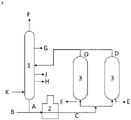
- the unit (1) represents the fractionation tower.
- the furnace is represented by unit (2).
- the coke drum(s) are represented by units (3).
- This configuration presents a representative embodiment of the invention, but does not limit the invention thereto.
- the process according to the present invention may comprise one single coke drum (3), or multiple coke drums.
- Figure 1 presents a particular embodiment of the invention, wherein two coke drums are present. Such configuration allows for switching operations between the coke drums so that one drum can be used in operation whilst the other drum can be cleaned out.
- a bottoms stream (A) is provided to feed the furnace.
- the bottoms stream (A) may for example be supplied at a temperature of ⁇ 300 and ⁇ 400 °C.
- a furnace product stream (C) is provided to coke drum(s).
- Feed (B) is a waste plastics stream, which is fed into the furnace, preferably via injecting into stream (A).
- a cracked overhead product (D) is obtained that is to be supplied to the fractionation tower for fractionation, with a fraction residual oil (K), into typically a top gaseous stream (F), a naphtha-range stream (G), a light gas oil stream (J), a heavy gas oil stream (H), and a bottoms stream (A).
- a coke stream (E) is obtained, which accumulates in the drum, to be evacuated therefrom upon discontinuation of the operation of that drum.
- the furnace (2) that may be used in the process according to the present invention may for example be a furnace in which multiple feed tubes are passed through a heating chamber, also referred to as a firebox, so that the feed is heated by external heating.
- the tubes may be passed through the firebox multiple times, for example two or four times.
- the heat may for example be provided by burners placed below the tubes. The burners may be controlled in such way to provide the required heating of the feed in the tubes to obtain the desired temperature of the feed exiting the furnace.
- the mass velocity of the feed through the furnace is preferably greater than 1800 kg/s/m 2 .
- a quantity of steam may be added to the feed tubes, such as for example between 0.1 and 2.0 wt% of steam with regard to the total weight of the feed. Such addition of steam contributes to increase of velocity in the tubes.
- the combined feed (A) and (B) may be heated in the furnace by passing the feed through heating tubes and subjecting it to external heat energy to obtain a furnace product stream (C) having a temperature of ⁇ 450°C and ⁇ 550°C, preferably of ⁇ 475°C and ⁇ 500°C.
- the feed exits the furnace at a temperature of preferably ⁇ 450°C and ⁇ 550°C, more preferably of ⁇ 475°C and ⁇ 500°C.
- the heated furnace product stream (C) is transported via a transfer line into a coke drum. It is desirable that the residence time in the transfer line is kept as short as possible, to avoid occurrence of coking prior to reaching the coke drum. Accordingly, it is desirable to keep the transfer line as short as possible.
- a switch valve may be present in the transfer line, to allow directing the feed to a desired coke drum.
- a typical coke drum that may be used in the process according to the present invention may have a diameter of between 4 and 9 m., and a length of between 20 and 30 m.
- the drum typically is positioned vertically.
- the drum may be operated at a pressure of between 100 and 600 kPa, such as between 200 and 300 kPa.
- a typical configuration may involve two or more, often two, coke drums, so that one drum may be in operation whilst the other drum(s) may be subjected to coke removal and cleaning before switching back in operation again.
- the drum needs to be evacuated from time to time in a batch operation.
- a cracking process occurs that in the coke drum results in a top product that is continuously removed from the drum as overhead stream (D), and a bottoms product, being the coke, that is removed as stream (E), typically at the end of the run.
- the overhead stream (D) may be removed from the drum at a temperature of below 500°C, such as between 475°C and 500°C, to avoid coke formation in the transport line.
- the overhead stream (D) is supplied to the fractionation tower (1).
- a separation process is performed so that a gaseous stream (F), a naphtha-range stream (G), a light gas-oil stream (J), and a heavy gas-oil steam (H) are obtained.
- a bottoms steam (A) is obtained that is recycled to the furnace (2).
- the fractionation tower is further fed with fresh residual oil (K), which preferably is fed towards the bottom part of the fractionation tower to avoid condensation of vapours in the upper parts of the tower.
- the fractionation tower may for example be operated so that the temperature in the bottom section of the tower is between 340°C and 385°C.
- a fractionation of a mixture comprising the overhead stream (D) and a residual oil (K) is performed to result in a gaseous output stream (F) obtained as overhead stream from the fractionation tower, a naphtha-range stream (G), a light gas oil stream (J), a heavy gas oil stream (H), and a bottoms stream (A).
- a residual oil stream obtained from refinery operations may be used.
- the residual oil may be a residual oil from atmospheric distillation (ADR), or may be a residual oil from vacuum distillation in a refinery (VDR).
- ADR is to be understood to be the fraction of crude oil having an initial boiling point of above 340 °C.
- VDR is to be understood to be the fraction of crude oil having an initial boiling point of above 535°C.
- the waste plastics stream (B) may for example be provided at a temperature of ⁇ 300 and ⁇ 450°C, preferably of ⁇ 300 and ⁇ 400°C.
- the waste plastics stream (B) may be prepared by converting solid waste plastics into a molten stream via one of more melt extruder(s).
- the waste plastics stream may for example by supplied by a one or more melt extruders that are connected to the feed line to the furnace.
- the melt extruder is operated under such conditions that the waste plastics stream (B) has a weight average molecular weight of between 5,000 and 10,000 g/mol. This involves operating the melt extruder under such conditions that certain degradation of the waste plastic material that is supplied to the extruder occurs during the melt extrusion operation. During the melt extrusion operation, in such circumstances, the waste plastic material may be subjected to each or both of high temperature and high shear which result in chain fission.
- Such chain fission leads to reduction of the weight average molecular weight of the plastic material, such that the waste plastics stream (B) that, upon exiting the melt extruder, is supplied as feed to the furnace (2) has a reduced weight average molecular weight, such as a weight average molecular weight of between 5,000 and 10,000 g/mol.
- the weight average molecular weight of the waste plastics stream (B) may for example be determined according to the method of ASTM D6474-12.
- the melt extruder may be operated at a temperature of ⁇ 350 and ⁇ 450 °C.
- the melt extruder is operated at a temperature of ⁇ 400 and ⁇ 450°C.
- the waste plastic is subjected to a certain lengthy residence time in the melt extruder.
- the waste plastic may be subjected to a residence time of ⁇ 10 min, preferably of ⁇ 10 and ⁇ 15 min.
- the waste plastics stream that is subjected to the process of the present invention preferably comprises a major quantity of polyolefin plastics.
- the waste plastics stream may comprise ⁇ 60.0 wt% of polyolefin plastics, preferably ⁇ 75.0 wt%.
- a quantity of a catalyst may be added to support the cracking process that is to occur.
- the catalyst may be an acid catalyst.
- the conversion of the mixture of bottoms stream (A) and waste plastic stream (B) is performed in the presence of a catalyst comprising trimetaphosphoric acid.
- the catalyst may for example be a supported catalyst.
- the support may be any typical catalyst support material, such as such as silica, alumina, or carbon.
- a particularly desirable support is calcium sulphate.
- the catalyst is a supported catalyst comprising trimetaphosphoric acid, preferably wherein the support is a calcium sulphate support.
- the catalyst may for example be supplied in a quantity of 0.01-25.0 wt% with regard to the weight of the waste plastics stream (B), preferably wherein the catalyst is supplied to the process together with the waste plastics stream (B), preferably in a quantity of 1.0-10.0 wt%, more preferably of 2.0-5.0 wt%.
- the catalyst is produced by a synthesis involving the reaction of calcium phosphate with sulphuric acid to obtain calcium sulphate and orthophosphoric acid.
- the calcium phosphate is provided in fine powder form, such as in the form of a powder having an average particle size of ⁇ 10 ⁇ m , such as of ⁇ 5 and ⁇ 10 ⁇ m. in the context of the present invention, the average particle size may be understood to be the D 50 as determine in accordance with ISO13320 (2009).
- the obtained calcium sulphate is a calcium sulphate coated with orthophosphoric acid.
- the orthophosphoric acid When subjected to calcination, the orthophosphoric acid is then converted to tri-metaphosphoric acid, to obtain a calcium sulphate-supported tri-metaphosphoric acid (TMPA) catalyst.
- TMPA calcium sulphate-supported tri-metaphosphoric acid
- the TMPA catalyst may be supplied to the process by mixing the catalyst with the waste plastics stream prior to supplying the waste plastics stream to the process.
Landscapes
- Chemical & Material Sciences (AREA)
- Engineering & Computer Science (AREA)
- Oil, Petroleum & Natural Gas (AREA)
- Organic Chemistry (AREA)
- Materials Engineering (AREA)
- Chemical Kinetics & Catalysis (AREA)
- General Chemical & Material Sciences (AREA)
- Life Sciences & Earth Sciences (AREA)
- Wood Science & Technology (AREA)
- Separation, Recovery Or Treatment Of Waste Materials Containing Plastics (AREA)
Abstract
The present invention relates to a process for production of chemical feedstocks from waste plastics, the process comprising providing a process configuration comprising a fractionation tower (1), a furnace (2) and one or more coke drum(s) (3) configured so that a bottoms stream (A) from the fractionation tower is supplied to the furnace, the product stream from the furnace (C) is supplied to a coke drum, and an overhead stream (D) from the coke drum is supplied back to the fractionation tower;wherein further a waste plastics stream (B) is supplied to the furnace; andwherein a conversion of a hydrocarbon composition comprising the bottoms stream (A) and the waste plastics stream (B) in the presence of a catalyst is performed.Such process allows for the conversion of a wide variety of waste plastics into valuable chemical products. Furthermore, such process allows for the increase in production of naphtha-range hydrocarbon products that may be used for production of for example new thermoplastic polymer product via conversion in steam cracker facilities.
Description
- The present invention relates to a process for conversion of waste plastics into hydrocarbons, such as hydrocarbons that may be used to form new plastics. In particular, the invention relates to a process for conversion of waste plastics into hydrocarbons via delayed coking.
- To the background of the present global developments to reduce energy and material footprint in amongst others the manufacturing of materials such as polymers and chemicals, there is a clear driver to seek reduction of energy and raw materials that are used in manufacturing of such materials. Particularly, there is a driver to enhance circularity of use of materials, after having arrived at end-of-life for a certain application, thereby reducing the use of virgin raw materials in the manufacturing of polymers and chemicals, which typically are fossil-feed based raw materials, obtained from crude oil or natural gas feedstocks. By increasing the circularity, the use of virgin raw materials is reduced, and thereby the materials footprint associated with the manufacturing of polymers and chemicals.
- A promising way of increasing the circularity is by re-using end-of-life plastics, collected and made available as waste plastics streams. Such waste plastics streams can be obtained from consumer waste collection, from industrial waste collection, or by collection of waste as littered in the environment, either as aquatic littering or as land-based littering. Typically, such waste plastics streams are mixtures of various types and qualities of plastics. Through sorting, certain streams may be obtained that qualify for re-use as thermoplastics, either by directly subjecting them to thermal shaping processes or via blending them with high-quality virgin-type plastic materials to compensate for loss of properties. Such way of re-use of material however is only appropriate for a limited fraction of waste plastics that can be sorted out of the mixed waste streams as provided from waste collection so that the obtained stream has high uniformity of material composition.
- Still, typically a significant portion of the waste plastics as provided by collection, if not a major portion, is not suitable for such direct re-use as polymer. Such mixed plastic waste commonly is discarded of by processes like waste incineration. In order to increase material circularity, there is a desire to develop alternative processing methods for such mixed waste plastic streams. One route for doing so is by means of chemical recycling, wherein the polymer materials that constitute the waste plastics streams are depolymerised to provide hydrocarbon materials that, directly or indirectly, can by once again be converted into polymers through polymerisation processes.
- Such chemical conversion processes provide certain benefits, amongst others in that they may be operated using waste plastic compositions of varying nature, including waste plastic compositions that show particularly large variation in batch-to-batch composition.
- It is particularly desirable for one to be able to utilise existing chemical conversion process technologies for the purpose of converting waste plastic streams into valuable hydrocarbon materials. Therefore, where a technology would be made available via which existing petrochemical assets would be rendered suitable for use in conversion of waste plastics streams into hydrocarbons, such would be broadly desirable.
- One such opportunity now is presented by certain refinery assets. In view of reduced hydrocarbon consumption for energy and transport, which is a current and expectedly further developing trend, a certain fraction of the ubiquitously present refinery assets may well become underutilised or even idled, and therefore available for alternative uses. One such use may well be the conversion of waste plastics into hydrocarbons that can serve as feedstocks for making chemical and/or polymer products, thereby creating a circular economy of plastics materials and reducing the material footprint.
- In accordance with the present invention, this has now been provided by a process for production of chemical feedstocks from waste plastics, the process comprising providing a process configuration comprising a fractionation tower (1), a furnace (2) and one or more coke drum(s) (3) configured so that a bottoms stream (A) from the fractionation tower is supplied to the furnace, the product stream from the furnace (C) is supplied to a coke drum, and an overhead stream (D) from the coke drum is supplied back to the fractionation tower;
wherein further a waste plastics stream (B) is supplied to the furnace, preferably via injecting the stream (B) into stream (A) prior to supplying it to the furnace; and
wherein a conversion of a hydrocarbon composition comprising the bottoms stream (A) and the waste plastics stream (B) in the presence of a catalyst is performed. - Such process allows for the conversion of a wide variety of waste plastics into valuable chemical products. Furthermore, such process allows for the increase in production of naphtha-range hydrocarbon products that may be used for production of, for example, new polymer products via conversion in steam cracker facilities.
- The process in accordance with the present invention is further elucidated by the
Figure 1 . InFigure 1 , the unit (1) represents the fractionation tower. The furnace is represented by unit (2). The coke drum(s) are represented by units (3). This configuration presents a representative embodiment of the invention, but does not limit the invention thereto. The process according to the present invention may comprise one single coke drum (3), or multiple coke drums.Figure 1 presents a particular embodiment of the invention, wherein two coke drums are present. Such configuration allows for switching operations between the coke drums so that one drum can be used in operation whilst the other drum can be cleaned out. From the fractionation tower, a bottoms stream (A) is provided to feed the furnace. The bottoms stream (A) may for example be supplied at a temperature of ≥ 300 and ≤ 400 °C. Out of the furnace, a furnace product stream (C) is provided to coke drum(s). Feed (B) is a waste plastics stream, which is fed into the furnace, preferably via injecting into stream (A). Out of the coke drums, a cracked overhead product (D) is obtained that is to be supplied to the fractionation tower for fractionation, with a fraction residual oil (K), into typically a top gaseous stream (F), a naphtha-range stream (G), a light gas oil stream (J), a heavy gas oil stream (H), and a bottoms stream (A). Further, out of the coke drums, a coke stream (E) is obtained, which accumulates in the drum, to be evacuated therefrom upon discontinuation of the operation of that drum. - The furnace (2) that may be used in the process according to the present invention may for example be a furnace in which multiple feed tubes are passed through a heating chamber, also referred to as a firebox, so that the feed is heated by external heating. The tubes may be passed through the firebox multiple times, for example two or four times. The heat may for example be provided by burners placed below the tubes. The burners may be controlled in such way to provide the required heating of the feed in the tubes to obtain the desired temperature of the feed exiting the furnace. In order to ensure that the coke formation of the feed does not occur in the furnace tubes, but is delayed until the feed materials reach the coke drum, the mass velocity of the feed through the furnace is preferably greater than 1800 kg/s/m2. A quantity of steam may be added to the feed tubes, such as for example between 0.1 and 2.0 wt% of steam with regard to the total weight of the feed. Such addition of steam contributes to increase of velocity in the tubes. The combined feed (A) and (B) may be heated in the furnace by passing the feed through heating tubes and subjecting it to external heat energy to obtain a furnace product stream (C) having a temperature of ≥ 450°C and ≤ 550°C, preferably of ≥ 475°C and ≤ 500°C.
- The feed exits the furnace at a temperature of preferably ≥ 450°C and ≤ 550°C, more preferably of ≥ 475°C and ≤ 500°C. Upon exiting the furnace, the heated furnace product stream (C) is transported via a transfer line into a coke drum. It is desirable that the residence time in the transfer line is kept as short as possible, to avoid occurrence of coking prior to reaching the coke drum. Accordingly, it is desirable to keep the transfer line as short as possible. Furthermore, as typically a furnace is connected to multiple coke drums to ensure continuous operations, a switch valve may be present in the transfer line, to allow directing the feed to a desired coke drum.
- A typical coke drum that may be used in the process according to the present invention may have a diameter of between 4 and 9 m., and a length of between 20 and 30 m. The drum typically is positioned vertically. The drum may be operated at a pressure of between 100 and 600 kPa, such as between 200 and 300 kPa.
- A typical configuration may involve two or more, often two, coke drums, so that one drum may be in operation whilst the other drum(s) may be subjected to coke removal and cleaning before switching back in operation again. As coke is formed in the drum, the drum needs to be evacuated from time to time in a batch operation.
- As a result of the temperature and the presence of a catalyst, a cracking process occurs that in the coke drum results in a top product that is continuously removed from the drum as overhead stream (D), and a bottoms product, being the coke, that is removed as stream (E), typically at the end of the run. The overhead stream (D) may be removed from the drum at a temperature of below 500°C, such as between 475°C and 500°C, to avoid coke formation in the transport line.
- The overhead stream (D) is supplied to the fractionation tower (1). In the fractionation tower, a separation process is performed so that a gaseous stream (F), a naphtha-range stream (G), a light gas-oil stream (J), and a heavy gas-oil steam (H) are obtained. Furthermore, a bottoms steam (A) is obtained that is recycled to the furnace (2). The fractionation tower is further fed with fresh residual oil (K), which preferably is fed towards the bottom part of the fractionation tower to avoid condensation of vapours in the upper parts of the tower. The fractionation tower may for example be operated so that the temperature in the bottom section of the tower is between 340°C and 385°C.
- In an embodiment according to the invention, in the fractionation tower a fractionation of a mixture comprising the overhead stream (D) and a residual oil (K) is performed to result in a gaseous output stream (F) obtained as overhead stream from the fractionation tower, a naphtha-range stream (G), a light gas oil stream (J), a heavy gas oil stream (H), and a bottoms stream (A).
- As feed (K) to the fractionation tower, a residual oil stream obtained from refinery operations may be used. The residual oil may be a residual oil from atmospheric distillation (ADR), or may be a residual oil from vacuum distillation in a refinery (VDR). Preferably, the residual oil is a residual oil from vacuum distillation. In the context of the present invention, ADR is to be understood to be the fraction of crude oil having an initial boiling point of above 340 °C. In the context of the present invention, VDR is to be understood to be the fraction of crude oil having an initial boiling point of above 535°C.
- The waste plastics stream (B) may for example be provided at a temperature of ≥ 300 and ≤ 450°C, preferably of ≥ 300 and ≤ 400°C. The waste plastics stream (B) may be prepared by converting solid waste plastics into a molten stream via one of more melt extruder(s).The waste plastics stream may for example by supplied by a one or more melt extruders that are connected to the feed line to the furnace.
- In certain embodiments of the invention, the melt extruder is operated under such conditions that the waste plastics stream (B) has a weight average molecular weight of between 5,000 and 10,000 g/mol. This involves operating the melt extruder under such conditions that certain degradation of the waste plastic material that is supplied to the extruder occurs during the melt extrusion operation. During the melt extrusion operation, in such circumstances, the waste plastic material may be subjected to each or both of high temperature and high shear which result in chain fission. Such chain fission leads to reduction of the weight average molecular weight of the plastic material, such that the waste plastics stream (B) that, upon exiting the melt extruder, is supplied as feed to the furnace (2) has a reduced weight average molecular weight, such as a weight average molecular weight of between 5,000 and 10,000 g/mol. In the context of the present invention, the weight average molecular weight of the waste plastics stream (B) may for example be determined according to the method of ASTM D6474-12.
- For example, the melt extruder may be operated at a temperature of ≥ 350 and ≤ 450 °C. Preferably, the melt extruder is operated at a temperature of ≥ 400 and ≤ 450°C. In order to adequately perform the chain fission process, it is desirable that the waste plastic is subjected to a certain lengthy residence time in the melt extruder. For example, the waste plastic may be subjected to a residence time of ≥ 10 min, preferably of ≥ 10 and ≤ 15 min.
- The waste plastics stream that is subjected to the process of the present invention preferably comprises a major quantity of polyolefin plastics. For example, the waste plastics stream may comprise ≥ 60.0 wt% of polyolefin plastics, preferably ≥ 75.0 wt%.
- To the feed stream (A) + (B) that enters the furnace, a quantity of a catalyst may be added to support the cracking process that is to occur. The catalyst may be an acid catalyst. In particular, the conversion of the mixture of bottoms stream (A) and waste plastic stream (B) is performed in the presence of a catalyst comprising trimetaphosphoric acid. The catalyst may for example be a supported catalyst. The support may be any typical catalyst support material, such as such as silica, alumina, or carbon. A particularly desirable support is calcium sulphate. In a particular embodiment of the invention, the catalyst is a supported catalyst comprising trimetaphosphoric acid, preferably wherein the support is a calcium sulphate support.
- The catalyst may for example be supplied in a quantity of 0.01-25.0 wt% with regard to the weight of the waste plastics stream (B), preferably wherein the catalyst is supplied to the process together with the waste plastics stream (B), preferably in a quantity of 1.0-10.0 wt%, more preferably of 2.0-5.0 wt%.
- In a particular embodiment of the invention, the catalyst is produced by a synthesis involving the reaction of calcium phosphate with sulphuric acid to obtain calcium sulphate and orthophosphoric acid. In particular, it is preferred that the calcium phosphate is provided in fine powder form, such as in the form of a powder having an average particle size of ≤ 10 µm , such as of ≥ 5 and ≤ 10 µm. in the context of the present invention, the average particle size may be understood to be the D50 as determine in accordance with ISO13320 (2009). When reacting such particulate calcium phosphate with sulphuric acid, the obtained calcium sulphate is a calcium sulphate coated with orthophosphoric acid. When subjected to calcination, the orthophosphoric acid is then converted to tri-metaphosphoric acid, to obtain a calcium sulphate-supported tri-metaphosphoric acid (TMPA) catalyst. The TMPA catalyst may be supplied to the process by mixing the catalyst with the waste plastics stream prior to supplying the waste plastics stream to the process.
Claims (15)
- Process for production of chemical feedstocks from waste plastics, the process comprising providing a process configuration comprising a fractionation tower (1), a furnace (2) and one or more coke drum(s) (3) configured so that a bottoms stream (A) from the fractionation tower is supplied to the furnace, the product stream from the furnace (C) is supplied to a coke drum, and an overhead stream (D) from the coke drum is supplied back to the fractionation tower;
wherein further a waste plastics stream (B) is supplied to the furnace; and
wherein a conversion of a hydrocarbon composition comprising the bottoms stream (A) and the waste plastics stream (B) in the presence of a catalyst is performed. - Process according to claim 1, wherein in the fractionation tower a fractionation of a mixture comprising the overhead stream (D) and a residual oil (K) is performed to result in a gaseous output stream (F) obtained as overhead stream from the fractionation tower, a naphtha-range stream (G), a light gas oil stream (J), a heavy gas oil stream (H), and a bottoms stream (A).
- Process according to any of claims 1-2, wherein the waste plastics stream (B) is supplied at a temperature of ≥ 300 and ≤ 450°C.
- Process according to any of claims 1-3, wherein the bottoms stream (A) is supplied at a temperature of ≥ 300 and ≤ 400 °C.
- Process according to any of claims 1-4, wherein the combined feed (A) and (B) are heated in the furnace by passing the feed through heating tubes and subjecting it to external heat energy to obtain a furnace product stream (C) having a temperature of ≥ 450°C and ≤ 550°C, preferably of ≥ 475°C and ≤ 500°C.
- Process according to any of claims 1-5, wherein the bottoms stream (A) has a boiling point of ≥ 400°C.
- Process according to any of claims 1-6, wherein the waste plastics stream (B) is prepared by converting solid waste plastics into a molten stream via one of more melt extruder(s).
- Process according to claim 7, wherein the melt extruder is operated under such conditions that the waste plastics stream (B) has a weight average molecular weight of between 5,000 and 10,000 g/mol.
- Process according to any one of claims 7-8, wherein the melt extruder is operated at a temperature of ≥ 350 and ≤ 450 °C, and/or wherein the waste plastic is subjected to a residence time in the melt extruder of ≥ 10 min., preferably ≥ 10 and ≤ 15 min.
- Process according to any of claims 1-9, wherein the conversion of the mixture of bottoms stream (A) and waste plastic stream (B) is performed in the presence of a catalyst comprising trimetaphosphoric acid, preferably wherein the catalyst is a supported catalyst comprising trimetaphosphoric acid, preferably wherein the support is a calcium sulphate support.
- Process according to any of claims 1-10, wherein the catalyst is supplied in a quantity of 0.01-25.0 wt% with regard to the weight of the waste plastics stream (B), preferably wherein the catalyst is supplied to the process together with the waste plastics stream (B).
- Process according to any of claims 2-11, wherein the residual oil (K) is a residual oil obtained from atmospheric distillation of crude oil, or a residual oil obtained from vacuum distillation of the residual oil obtained from atmospheric distillation of crude oil.
- Process according to any of claims 1-12, wherein the coke drum is operated at a pressure of between 100 and 600 kPa.
- Process according to any of claims 1-13, wherein the fractionation tower operated so that the temperature in the bottom section of the tower is between 340°C and 385°C.
- Process according to any of claims 1-14, wherein the furnace product stream (C) 5omprises ≥ 0.1 and ≤ 50.0 wt% of the waste plastic stream (B), with regard to the total weight of the stream (C), preferably ≥ 5.0 and ≤ 30.0 wt%, more preferably ≥ 5.0 and ≤ 20.0 wt%.
Priority Applications (2)
| Application Number | Priority Date | Filing Date | Title |
|---|---|---|---|
| EP21180964.5A EP4108738A1 (en) | 2021-06-22 | 2021-06-22 | Process for conversion of waste plastics into hydrocarbons |
| PCT/EP2022/066611 WO2022268664A1 (en) | 2021-06-22 | 2022-06-17 | Process for conversion of waste plastics into hydrocarbons |
Applications Claiming Priority (1)
| Application Number | Priority Date | Filing Date | Title |
|---|---|---|---|
| EP21180964.5A EP4108738A1 (en) | 2021-06-22 | 2021-06-22 | Process for conversion of waste plastics into hydrocarbons |
Publications (1)
| Publication Number | Publication Date |
|---|---|
| EP4108738A1 true EP4108738A1 (en) | 2022-12-28 |
Family
ID=76553647
Family Applications (1)
| Application Number | Title | Priority Date | Filing Date |
|---|---|---|---|
| EP21180964.5A Withdrawn EP4108738A1 (en) | 2021-06-22 | 2021-06-22 | Process for conversion of waste plastics into hydrocarbons |
Country Status (2)
| Country | Link |
|---|---|
| EP (1) | EP4108738A1 (en) |
| WO (1) | WO2022268664A1 (en) |
Cited By (1)
| Publication number | Priority date | Publication date | Assignee | Title |
|---|---|---|---|---|
| US12203039B2 (en) | 2022-03-10 | 2025-01-21 | Amec Foster Wheeler Usa Corporation | Fouling mitigation of delayed coker heaters |
Citations (3)
| Publication number | Priority date | Publication date | Assignee | Title |
|---|---|---|---|---|
| CN101230284A (en) * | 2007-01-25 | 2008-07-30 | 华东理工大学 | Delayed coking treatment method and treatment device for waste plastics |
| CN106554796A (en) * | 2015-09-25 | 2017-04-05 | 中国石油天然气股份有限公司 | A catalytic coking method for increasing liquid product yield |
| US10968396B1 (en) * | 2020-01-29 | 2021-04-06 | Saudi Arabian Oil Company | Method and process for producing needle coke from aromatic polymer material and aromatic bottoms of an aromatic recovery complex |
-
2021
- 2021-06-22 EP EP21180964.5A patent/EP4108738A1/en not_active Withdrawn
-
2022
- 2022-06-17 WO PCT/EP2022/066611 patent/WO2022268664A1/en not_active Ceased
Patent Citations (3)
| Publication number | Priority date | Publication date | Assignee | Title |
|---|---|---|---|---|
| CN101230284A (en) * | 2007-01-25 | 2008-07-30 | 华东理工大学 | Delayed coking treatment method and treatment device for waste plastics |
| CN106554796A (en) * | 2015-09-25 | 2017-04-05 | 中国石油天然气股份有限公司 | A catalytic coking method for increasing liquid product yield |
| US10968396B1 (en) * | 2020-01-29 | 2021-04-06 | Saudi Arabian Oil Company | Method and process for producing needle coke from aromatic polymer material and aromatic bottoms of an aromatic recovery complex |
Non-Patent Citations (3)
| Title |
|---|
| "Ullmann's Encyclopedia of Industrial Chemistry", 23 September 2014, WILEY-VCH, Weinheim, ISBN: 978-3-527-30673-2, article HEINRICH PREDEL: "Petroleum Coke", pages: 1 - 21, XP055559241, DOI: 10.1002/14356007.a19_235.pub3 * |
| VESPER D E ET AL: "ROHSTOFFLICHE VERWERTUNG - EIEN UBERSICHT", KUNSTSTOFFE, CARL HANSER VERLAG, MUNCHEN, DE, vol. 83, no. 11, 1 November 1993 (1993-11-01), pages 905 - 909, XP000399974, ISSN: 0023-5563 * |
| WANJEK H ET AL: "ROHSTOFFRECYCLING - DIE VERFAHRENSTECHNIK. RECYCLING OF RAW MATERIALS - THE PROCESS TECHNOLOGY", KUNSTSTOFFE, CARL HANSER VERLAG, MUNCHEN, DE, vol. 84, no. 2, 1 February 1994 (1994-02-01), pages 109 - 112, XP000433552, ISSN: 0023-5563 * |
Cited By (1)
| Publication number | Priority date | Publication date | Assignee | Title |
|---|---|---|---|---|
| US12203039B2 (en) | 2022-03-10 | 2025-01-21 | Amec Foster Wheeler Usa Corporation | Fouling mitigation of delayed coker heaters |
Also Published As
| Publication number | Publication date |
|---|---|
| WO2022268664A1 (en) | 2022-12-29 |
Similar Documents
| Publication | Publication Date | Title |
|---|---|---|
| US20230265351A1 (en) | Process for the preparation of polymers from waste plastic feedstocks | |
| US12152001B2 (en) | Process for the preparation of butenes and butadienes from waste plastic feedstocks | |
| WO2022017902A1 (en) | Process for the preparation of butenes and butadienes from waste plastic feedstocks | |
| WO2022017899A1 (en) | Process for the preparation of aromatics from waste plastic feedstocks. | |
| WO2022017904A1 (en) | Process for the preparation of chemical products from waste plastic feedstocks. | |
| WO2022017901A1 (en) | Process for the preparation of aromatics from waste plastic feedstocks | |
| US20230279179A1 (en) | Process for the preparation of polycarbonates from waste plastic feedstocks | |
| US20250034466A1 (en) | Methods and systems for conversion of mixed plastics to high value chemicals | |
| US20240409829A1 (en) | Methods for conversion of mixed plastic wastes to a liquid hydrocarbon product | |
| WO2022268664A1 (en) | Process for conversion of waste plastics into hydrocarbons | |
| EP3959294A1 (en) | Depolymerisation method | |
| EP4182407A1 (en) | Process for the preparation of polycarbonates from waste plastic feedstocks | |
| US20240279553A1 (en) | Process for conversion of waste plastics into hydrocarbons | |
| JP2025510551A (en) | Process for catalytic conversion of plastic waste to olefins. | |
| EP4453138B1 (en) | Process for conversion of waste plastics into chemicals | |
| EP4453137B1 (en) | Process for conversion of waste plastics into chemicals | |
| TW202413608A (en) | Recycled content parayxlene and related chemical compounds from waste plastic |
Legal Events
| Date | Code | Title | Description |
|---|---|---|---|
| PUAI | Public reference made under article 153(3) epc to a published international application that has entered the european phase |
Free format text: ORIGINAL CODE: 0009012 |
|
| STAA | Information on the status of an ep patent application or granted ep patent |
Free format text: STATUS: THE APPLICATION HAS BEEN PUBLISHED |
|
| AK | Designated contracting states |
Kind code of ref document: A1 Designated state(s): AL AT BE BG CH CY CZ DE DK EE ES FI FR GB GR HR HU IE IS IT LI LT LU LV MC MK MT NL NO PL PT RO RS SE SI SK SM TR |
|
| STAA | Information on the status of an ep patent application or granted ep patent |
Free format text: STATUS: THE APPLICATION IS DEEMED TO BE WITHDRAWN |
|
| 18D | Application deemed to be withdrawn |
Effective date: 20230629 |