EP4106254A1 - Method and system for determining reference signal or resources or set, device and medium - Google Patents
Method and system for determining reference signal or resources or set, device and medium Download PDFInfo
- Publication number
- EP4106254A1 EP4106254A1 EP21754041.8A EP21754041A EP4106254A1 EP 4106254 A1 EP4106254 A1 EP 4106254A1 EP 21754041 A EP21754041 A EP 21754041A EP 4106254 A1 EP4106254 A1 EP 4106254A1
- Authority
- EP
- European Patent Office
- Prior art keywords
- reference signal
- signal resource
- determining
- qcl
- resource set
- Prior art date
- Legal status (The legal status is an assumption and is not a legal conclusion. Google has not performed a legal analysis and makes no representation as to the accuracy of the status listed.)
- Pending
Links
Images





Classifications
-
- H—ELECTRICITY
- H04—ELECTRIC COMMUNICATION TECHNIQUE
- H04L—TRANSMISSION OF DIGITAL INFORMATION, e.g. TELEGRAPHIC COMMUNICATION
- H04L5/00—Arrangements affording multiple use of the transmission path
- H04L5/0091—Signalling for the administration of the divided path, e.g. signalling of configuration information
-
- H—ELECTRICITY
- H04—ELECTRIC COMMUNICATION TECHNIQUE
- H04L—TRANSMISSION OF DIGITAL INFORMATION, e.g. TELEGRAPHIC COMMUNICATION
- H04L27/00—Modulated-carrier systems
- H04L27/26—Systems using multi-frequency codes
- H04L27/2601—Multicarrier modulation systems
- H04L27/2602—Signal structure
- H04L27/261—Details of reference signals
-
- H—ELECTRICITY
- H04—ELECTRIC COMMUNICATION TECHNIQUE
- H04L—TRANSMISSION OF DIGITAL INFORMATION, e.g. TELEGRAPHIC COMMUNICATION
- H04L5/00—Arrangements affording multiple use of the transmission path
- H04L5/003—Arrangements for allocating sub-channels of the transmission path
- H04L5/0044—Allocation of payload; Allocation of data channels, e.g. PDSCH or PUSCH
-
- H—ELECTRICITY
- H04—ELECTRIC COMMUNICATION TECHNIQUE
- H04L—TRANSMISSION OF DIGITAL INFORMATION, e.g. TELEGRAPHIC COMMUNICATION
- H04L5/00—Arrangements affording multiple use of the transmission path
- H04L5/003—Arrangements for allocating sub-channels of the transmission path
- H04L5/0048—Allocation of pilot signals, i.e. of signals known to the receiver
-
- H—ELECTRICITY
- H04—ELECTRIC COMMUNICATION TECHNIQUE
- H04L—TRANSMISSION OF DIGITAL INFORMATION, e.g. TELEGRAPHIC COMMUNICATION
- H04L5/00—Arrangements affording multiple use of the transmission path
- H04L5/0001—Arrangements for dividing the transmission path
- H04L5/0014—Three-dimensional division
- H04L5/0023—Time-frequency-space
-
- H—ELECTRICITY
- H04—ELECTRIC COMMUNICATION TECHNIQUE
- H04L—TRANSMISSION OF DIGITAL INFORMATION, e.g. TELEGRAPHIC COMMUNICATION
- H04L5/00—Arrangements affording multiple use of the transmission path
- H04L5/003—Arrangements for allocating sub-channels of the transmission path
- H04L5/0032—Distributed allocation, i.e. involving a plurality of allocating devices, each making partial allocation
Definitions
- the disclosure belongs to the technical field of information response methods, and in particular, relates to a method and system for determining a reference signal or reference signal resource or reference signal resource set, a device, and a medium.
- a user equipment When a user equipment (UE) is in an idle mode (RRC_IDLE state), the UE needs to monitor a paging physical downlink control channel (PDCCH). Generally, the UE needs to determine the paging PDCCH monitoring occasion through configuration of paging frame (PF), paging occasion (PO), and paging search space set.
- the UE In the communication standard such as 5th generation (5G) new radio (NR), the UE can perform automatic gain control (AGC) adjustment, channel tracking (including time-frequency tracking and/or time-frequency synchronization, etc.), and measurement through synchronization signal/physical broadcast channel block (SS/PBCH block) or synchronization signal/physical broadcast channel block burst (SS/PBCH block burst).
- AGC automatic gain control
- SS/PBCH block synchronization signal/physical broadcast channel block
- SS/PBCH block burst synchronization signal/physical broadcast channel block burst
- one SS/PBCH block burst can include multiple SS/PBCH blocks.
- the SS/PBCH block burst does not exist in every sub frame or every time slot, and the SS/PBCH block burst is transmitted in one kind of time period, such as 5 milliseconds, 10 milliseconds, 20 milliseconds, and the like.
- the UE needs to wake up at least before the last one SS/PBCH block burst before the PO, and uses the last one SS/PBCH block burst for AGC adjustment and channel tracking, or for AGC adjustment, channel tracking, and measurement.
- the UE may need to wake up before the last two SS/PBCH block bursts before the PO.
- the UE uses one SS/PBCH block burst for AGC adjustment and the other SS/PBCH block burst for channel tracking, or uses one SS/PBCH block burst for AGC adjustment and channel tracking and the other SS/PBCH block burst for measurement. This will cause the UE to wake up in advance for a long time, which consumes more power.
- the disclosure provides a method and system for determining a reference signal or reference signal resource or reference signal resource set, a device, and a medium, to overcome the technical problems in the related art that a user equipment (UE) wakes up in advance for a long time in response to a synchronization signal/physical broadcast channel block burst (SS/PBCH block burst) and consumes more power.
- UE user equipment
- the disclosure overcomes the above technical problems through the following technical solutions.
- the disclosure provides a method for determining a reference signal or reference signal resource or reference signal resource set.
- the method includes: obtaining configuration information; and determining, based on the configuration information, a synchronization signal/physical broadcast channel block (SS/PBCH block) associated with the reference signal or reference signal resource or reference signal resource set.
- SS/PBCH block synchronization signal/physical broadcast channel block
- the method further includes: determining that the reference signal or reference signal resource or reference signal resource set and the associated SS/PBCH block are in a quasi co-location (QCL) relation, or in a quasi co-location type A (QCL-type A) relation, or in a quasi co-location type D (QCL-type D) relation.
- QCL quasi co-location
- QCL-type A quasi co-location type A
- QCL-type D quasi co-location type D
- the method further includes: determining that the reference signal or reference signal resource or reference signal resource set is transmitted in response to determining that the SS/PBCH block associated with the reference signal or reference signal resource or reference signal resource set is transmitted.
- the method further includes: determining that a resource element (RE) in the reference signal or reference signal resource or reference signal resource set is not for physical downlink share channel (PDSCH) resource mapping in response to determining that the reference signal or reference signal resource or reference signal resource set is transmitted.
- a resource element (RE) in the reference signal or reference signal resource or reference signal resource set is not for physical downlink share channel (PDSCH) resource mapping in response to determining that the reference signal or reference signal resource or reference signal resource set is transmitted.
- PDSCH physical downlink share channel
- the method further includes: determining that a RE in the reference signal or reference signal resource or reference signal resource set is not for PDSCH resource mapping in response to determining that the SS/PBCH block associated with the reference signal or reference signal resource or reference signal resource set is transmitted.
- the method further includes: determining that a RE in the reference signal or reference signal resource or reference signal resource set is not for PDSCH resource mapping in response to detection of the SS/PBCH block associated with the reference signal or reference signal resource or reference signal resource set.
- the method further includes: determining that a RE in the reference signal or reference signal resource or reference signal resource set associated with the detected SS/PBCH block is not for PDSCH resource mapping.
- the method further includes: determining that multiple reference signals or reference signal resources or reference signal resource sets associated with multiple SS/PBCH blocks are in the QCL relation in response to determining that the multiple SS/PBCH blocks are in the QCL relation.
- the method further includes: determining that multiple reference signals or reference signal resources or reference signal resource sets associated with multiple SS/PBCH blocks are in the QCL-type A relation in response to determining that the multiple SS/PBCH blocks are in the QCL-type A relation.
- the method further includes: determining that multiple reference signals or reference signal resources or reference signal resource sets associated with multiple SS/PBCH blocks are in the QCL-type D relation in response to determining that the multiple SS/PBCH blocks are in the QCL-type D relation.
- the method further includes: determining that a type of multiple reference signals or reference signal resources or reference signal resource sets associated with multiple SS/PBCH blocks is repeated in response to determining that the multiple SS/PBCH blocks are repeated.
- the disclosure provides a system for determining a reference signal or reference signal resource or reference signal resource set.
- the system includes an information obtaining unit and a signal determining unit.
- the information obtaining unit is configured to obtain configuration information.
- the signal determining unit is configured to determine, based on the configuration information, a number or index of an SS/PBCH block associated with the reference signal or reference signal resource or reference signal resource set.
- the signal determining unit is further configured to: determine that the reference signal or reference signal resource or reference signal resource set and the associated SS/PBCH block are in a QCL relation, or in a QCL-type A relation, or in a QCL-type D relation.
- the signal determining unit is further configured to: determine that the reference signal or reference signal resource or reference signal resource set is transmitted in response to determining that the SS/PBCH block associated with the reference signal or reference signal resource or reference signal resource set is transmitted.
- the signal determining unit is further configured to: determine that a RE in the reference signal or reference signal resource or reference signal resource set is not for PDSCH resource mapping in response to determining that the reference signal or reference signal resource or reference signal resource set is transmitted.
- the signal determining unit is further configured to: determine that a RE in the reference signal or reference signal resource or reference signal resource set is not for PDSCH resource mapping in response to determining that the SS/PBCH block associated with the reference signal or reference signal resource or reference signal resource set is transmitted.
- the signal determining unit is further configured to: determine that a RE in the reference signal or reference signal resource or reference signal resource set is not for PDSCH resource mapping in response to detection of the SS/PBCH block associated with the reference signal or reference signal resource or reference signal resource set.
- the signal determining unit is further configured to: determine that a RE in the reference signal or reference signal resource or reference signal resource set associated with the detected SS/PBCH block is not for PDSCH resource mapping.
- the signal determining unit is further configured to: determine that multiple reference signals or reference signal resources or reference signal resource sets associated with multiple SS/PBCH blocks are in the QCL relation in response to determining that the multiple SS/PBCH blocks are in the QCL relation.
- the signal determining unit is further configured to: determine that multiple reference signals or reference signal resources or reference signal resource sets associated with multiple SS/PBCH blocks are in the QCL-type A relation in response to determining that the multiple SS/PBCH blocks are in the QCL-type A relation.
- the signal determining unit is further configured to: determine that multiple reference signals or reference signal resources or reference signal resource sets associated with multiple SS/PBCH blocks are in the QCL-type D relation in response to determining that the multiple SS/PBCH blocks are in the QCL-type D relation.
- the signal determining unit is further configured to: determine that a type of multiple reference signals or reference signal resources or reference signal resource sets associated with multiple SS/PBCH blocks is repeated in response to determining that the multiple SS/PBCH blocks are repeated.
- the disclosure further provides an electronic device.
- the electronic device includes a memory, a processor, and a computer program stored in the memory and executable on the processor.
- the processor When executing the computer program, the processor implements the method for determining a reference signal or reference signal resource or reference signal resource set of the disclosure.
- the disclosure further provides a computer-readable storage medium.
- the computer-readable storage medium stores a computer program thereon. When executed by a processor, the computer program implements operations of the method for determining a reference signal or reference signal resource or reference signal resource set of the disclosure.
- the progressive advantageous effect of the disclosure is that: energy of the UE can be saved by configuring the reference signal or reference signal resource or reference signal resource set.
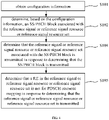
- This embodiment provides a method for determining a reference signal or reference signal resource or reference signal resource set. Referring to FIG. 1 , the method includes the following.
- S102 determine, based on the configuration information, a synchronization signal/physical broadcast channel block (SS/PBCH block) associated with the reference signal or reference signal resource or reference signal resource set.
- SS/PBCH block synchronization signal/physical broadcast channel block
- the user equipment obtains the configuration information, and determines the SS/PBCH block associated with the reference signal or reference signal resource or reference signal resource set based on the configuration information, for example, information on a number or index of the SS/PBCH block associated with the reference signal or reference signal resource or reference signal resource set. In other words, the UE obtains the configuration information, and determines the number or index of the SS/PBCH block associated with the reference signal or reference signal resource or reference signal resource set based on the configuration information.
- determining the SS/PBCH block associated with the reference signal or reference signal resource or reference signal resource set can be equivalent to the following. Determine that the SS/PBCH block and the reference signal or reference signal resource or reference signal resource set are in a quasi co-location (QCL) relation, or in a quasi co-location type A (QCL-type A) relation, or in a quasi co-location type D (QCL-type D) relation.
- the determining the SS/PBCH block associated with the reference signal or reference signal resource or reference signal resource set can also be equivalent to the following.
- an SS/PBCH block having a QCL relation with the reference signal or reference signal resource or reference signal resource set or an SS/PBCH block having a QCL-type A relation with the reference signal or reference signal resource or reference signal resource set, an SS/PBCH block having a QCL-type D relation with the reference signal or reference signal resource or reference signal resource set.
- two signals (which can be SS/PBCH block(s) and/or reference signal(s) or reference signal resource(s) or reference signal resource set(s)) being in the QCL relation indicates that these two signals have some same large-scale properties, so that one signal can be used as a reference for channel estimation of the other signal.
- the QCL-type A and the QCL-type D are two QCL types.
- signals having the QCL relation also includes signals having the same average gain, having the QCL-type A relation, and having the QCL-type D relation.
- a base station may transmit an additional reference signal after the last one SS/PBCH block burst before the PF or PO or the first paging physical downlink control channel (PDCCH) monitoring occasion.
- the UE can use the SS/PBCH block burst for automatic gain control (AGC) adjustment and channel tracking and use the additional reference signal for measurement.
- AGC automatic gain control
- the additional reference signal can be used for measurement, so the additional reference signal can be a channel state information-reference signal (CSI-RS) or a synchronization signal (SS).
- the additional reference signal may be used for mobility or for radio resource management (RRM)/radio link monitoring (RLM) measurement, and thus may be CSI-RS for mobility or CSI-RS for RRM/RLM measurement.
- CSI-RS for mobility or CSI-RS for RRM/RLM measurement may use non zero power (NZP) CSI-RS resource.
- NZP non zero power
- the base station may transmit two additional reference signals before the PF or PO or the first paging PDCCH monitoring occasion. In this way, the UE can use the first additional reference signal for AGC adjustment and channel tracking and the second additional reference signal for measurement.
- the additional reference signal can be used for AGC adjustment and channel tracking, so the additional reference signal may be a tracking reference signal (TRS) or an SS.
- TRS may use NZP-CSI-RS-ResourceSet.
- the TRS can include four NZP CSI-RS resources in two consecutive time slots and there are two NZP CSI-RS resources in each time slot; or the TRS can include two NZP CSI-RS resources in one time slot.
- the TRS can be periodic or aperiodic. When the TRS is periodic, CSI-RS resources in the NZP-CSI-RS-ResourceSet have the same periodicity, bandwidth, and subcarrier location.
- periodic CSI-RS resources are in one NZP-CSI-RS-ResourceSet, and aperiodic CSI-RS resources are in another NZP-CSI-RS-ResourceSet, the periodic CSI-RS resources and the aperiodic CSI-RS resources have the same bandwidth (same resource block location), and the aperiodic CSI-RS resources and the periodic CSI-RS resources are in QCL-type A and QCL-type D.
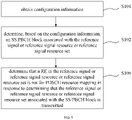
- this embodiment provides a method for determining a reference signal or reference signal resource or reference signal resource set. Referring to FIG. 2 , the method further includes the following.
- the UE determines that the reference signal or reference signal resource or reference signal resource set and the SS/PBCH block have the QCL relation, or the QCL-type A relation, or the QCL-type D relation.
- two signals (which can be SS/PBCH block(s) and/or reference signal(s) or reference signal resource(s) or reference signal resource set(s)) being in the QCL relation indicates that these two signals have some same large-scale properties, so that one signal can be used as a reference for channel estimation of the other signal.
- the QCL-type A and the QCL-type D are two QCL types.
- signals having the QCL relation also includes signals having the same average gain, having the QCL-type A relation, and having the QCL-type D relation.
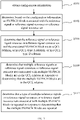
- this embodiment provides a method for determining a reference signal or reference signal resource or reference signal resource set. Referring to FIG. 3 , the method further includes the following.
- S104 determine that the reference signal or reference signal resource or reference signal resource set associated with the SS/PBCH block is transmitted in response to determining that the SS/PBCH block is transmitted.
- the UE determines that the reference signal or reference signal resource or reference signal resource set associated with the SS/PBCH block is transmitted if the UE determines that the SS/PBCH block is transmitted. Alternatively, if the UE detects the SS/PBCH block, the UE determines that the reference signal or reference signal resource or reference signal resource set associated with the SS/PBCH block is transmitted. It is noted that, the UE determines whether the SS/PBCH block is transmitted, based on the higher layer parameter ssb-PositionInBurst (one higher layer parameter).
- the ssb-PositionInBurst may be a bitmap, where bit "1" indicates that the corresponding SS/PBCH block is transmitted, and bit "0" indicates that the corresponding SS/PBCH block is not transmitted.
- the UE can determine whether the reference signal or reference signal resource or reference signal resource set is transmitted and determine the physical downlink share channel (PDSCH) resource mapping, which reduces signaling overhead.
- PDSCH physical downlink share channel
- determining that the reference signal or reference signal resource or reference signal resource set associated with the SS/PBCH block is transmitted is equivalent to determining that the reference signal or reference signal resource or reference signal resource set associated with the SS/PBCH block is valid or existing.
- this embodiment provides a method for determining a reference signal or reference signal resource or reference signal resource set. Referring to FIG. 4 , the method further includes the following.
- the UE determines that the reference signal or reference signal resource or reference signal resource set is transmitted, the UE determines that the RE in the reference signal or reference signal resource or reference signal resource set is not for PDSCH resource mapping.
- this embodiment provides a method for determining a reference signal or reference signal resource or reference signal resource set. Referring to FIG. 5 , the method further includes the following.
- the UE determines that the RE in the reference signal or reference signal resource or reference signal resource set is not for PDSCH resource mapping. It is noted that, the UE determines whether the SS/PBCH block is transmitted, based on the higher layer parameter ssb-PositionInBurst.
- the ssb-PositionInBurst may be a bitmap, where bit "1" indicates that the corresponding SS/PBCH block is transmitted, and bit "0" indicates that the corresponding SS/PBCH block is not transmitted.
- the UE can determine whether the reference signal or reference signal resource or reference signal resource set is transmitted and determine the PDSCH resource mapping, which reduces signaling overhead.
- the performance of the UE in detecting the SS/PBCH block is better, which can improve the system performance.
- this embodiment provides a method for determining a reference signal or reference signal resource or reference signal resource set. Referring to FIG. 6 , the method further includes the following.
- the UE determines that the RE in the reference signal or reference signal resource or reference signal resource set is not for PDSCH resource mapping. It is noted that, the UE determines whether the SS/PBCH block is transmitted, based on the higher layer parameter ssb-PositionInBurst.
- the ssb-PositionInBurst may be a bitmap, where bit "1" indicates that the corresponding SS/PBCH block is transmitted, and bit "0" indicates that the corresponding SS/PBCH block is not transmitted.
- the UE can determine whether the reference signal or reference signal resource or reference signal resource set is transmitted and determine the PDSCH resource mapping, which reduces signaling overhead.
- the performance of the UE in detecting the SS/PBCH block is better, which can improve the system performance.
- this embodiment provides a method for determining a reference signal or reference signal resource or reference signal resource set. Referring to FIG. 7 , the method further includes the following.
- the UE determines that the RE in the reference signal or reference signal resource or reference signal resource set associated with the detected SS/PBCH block is not for PDSCH resource mapping. It is noted that, the UE determines whether the SS/PBCH block is transmitted, based on the higher layer parameter ssb-PositionInBurst.
- the ssb-PositionInBurst may be a bitmap, where bit "1" indicates that the corresponding SS/PBCH block is transmitted, and bit "0" indicates that the corresponding SS/PBCH block is not transmitted. In this way, through the existing higher layer parameter, the UE can determine whether the reference signal or reference signal resource or reference signal resource set is transmitted and determine the PDSCH resource mapping, which reduces signaling overhead. In addition, the performance of the UE in detecting the SS/PBCH block is better, which can improve the system performance.
- this embodiment provides a method for determining a reference signal or reference signal resource or reference signal resource set. Referring to FIG. 8 , the method further includes the following.
- the base station can configure multiple SS/PBCH blocks to have the QCL relation, and inform the UE which SS/PBCH blocks are in the QCL relation through signaling.
- the UE knows which SS/PBCH blocks are in the QCL relation, the UE can perform measurement averaging and select to monitor multiple type0-PDCCH monitoring occasions associated with the multiple SS/PBCH blocks having the QCL relation. As such, system performance can be improved.
- this embodiment provides a method for determining a reference signal or reference signal resource or reference signal resource set. Referring to FIG. 9 , the method further includes the following.
- this embodiment provides a method for determining a reference signal or reference signal resource or reference signal resource set. Referring to FIG. 10 , the method further includes the following.
- Sill determine that multiple reference signals or reference signal resources or reference signal resource sets associated with multiple SS/PBCH blocks are in the QCL-type D relation in response to determining that the multiple SS/PBCH blocks are in the QCL-type D relation. In this way, the QCL is further refined to be the QCL-type D.
- the multiple reference signals or reference signal resources or reference signal resource sets associated with the multiple SS/PBCH blocks are determined to have the same average gain.
- this embodiment provides a method for determining a reference signal or reference signal resource or reference signal resource set. Referring to FIG. 11 , the method further includes the following.
- the base station can repeatedly transmit the SS/PBCH blocks (using the same beam to transmit different SS/PBCH blocks), and inform the UE which SS/PBCH blocks are repeatedly transmitted through signaling.
- the UE knows which SS/PBCH blocks are transmitted repeatedly, the UE can perform measurement averaging and select the type0-PDCCH monitoring occasion. As such, system performance can be improved.
- FIG. 12 is a schematic structural diagram of an electronic device of this embodiment of the disclosure.
- the electronic device includes a memory, a processor, and a computer program stored in the memory and executable on the processor.
- the processor When executing the computer program, the processor implements the method for determining a reference signal or reference signal resource or reference signal resource set of any of embodiment 1 to embodiment 11.
- the electronic device 30 illustrated in FIG. 12 is merely an example, and should not impose any limitation on the function and use scope of the embodiments of the disclosure.
- the electronic device 30 may in the form of a general-purpose computing device, for example, it may be a server device.
- Components of the electronic device 30 may include, but are not limited to, the above at least one processor 31, the above at least one memory 32, and a bus 33 connecting different system components (including the memory 32 and the processor 31).
- the bus 33 includes a data bus, an address bus, and a control bus.
- the memory 32 may include volatile memory, such as random access memory (RAM) 321 and/or cache memory 322, and may further include read only memory (ROM) 323.
- RAM random access memory
- ROM read only memory
- the memory 32 may also include a program/utility 325 having a set (at least one) of program modules 324.
- the program modules 324 include, but not limited to, an operating system, one or more application programs, other program modules, and program data. Each or some combination of the examples may include implementation of a network environment.
- the processor 31 executes various functional applications and data processing by running the computer program stored in the memory 32, such as the method for determining a reference signal or reference signal resource or reference signal resource set of any of embodiment 1 to embodiment 11 of the disclosure.
- the electronic device 30 may also communicate with one or more external devices 34 (e.g., keyboards, pointing devices, etc.). Such communication may be carried out through input/output (I/O) interface 35. Further, the model generating device 30 may also communicate with one or more networks (e.g., a local area network (LAN), a wide area network (WAN), and/or a public network, such as the Internet) through a network adapter 36. As shown in FIG. 12 , the network adapter 36 communicates with other modules of the model generating device 30 via the bus 33.
- networks e.g., a local area network (LAN), a wide area network (WAN), and/or a public network, such as the Internet
- This embodiment provides a computer-readable storage medium.
- the computer-readable storage medium stores a computer program thereon. When executed by a processor, the computer program implements operations of the method for determining a reference signal or reference signal resource or reference signal resource set of any of embodiment 1 to embodiment 11.
- the readable storage medium may include, but is not limited to, portable disk, hard disk, random access memory, read only memory, erasable programmable read only memory, optical storage device, magnetic storage device, or any suitable combination of the above.
- the disclosure may also be implemented in the form of a program product.
- the program product includes a program code.
- the program code is used to cause the terminal device to execute operations of the method for determining a reference signal or reference signal resource or reference signal resource set of any of embodiment 1 to embodiment 11.
- the program code for carrying out the disclosure may be written in any combination of one or more programming languages.
- the program code may be executed entirely on the user equipment, partly on the user equipment, as a stand-alone software package, partly on the user equipment and partly on a remote device, or entirely on the remote device.
- This embodiment provides a system for determining a reference signal or reference signal resource or reference signal resource set.
- the system includes an information obtaining unit 201 and a signal determining unit 202.
- the information obtaining unit 201 is configured to obtain configuration information.
- the signal determining unit 202 is configured to determine, based on the configuration information, a number or index of an SS/PBCH block associated with the reference signal or reference signal resource or reference signal resource set.
- the SS/PBCH block burst and the reference signal or reference signal resource or reference signal resource set can be used cooperatively, the SS/PBCH block burst and the reference signal or reference signal resource or reference signal resource set can be associated.
- the UE obtains the configuration information, and determines the SS/PBCH block associated with the reference signal or reference signal resource or reference signal resource set based on the configuration information, for example, information on the number or index of the SS/PBCH block associated with the reference signal or reference signal resource or reference signal resource set. In other words, the UE obtains the configuration information, and determines the number or index of the SS/PBCH block associated with the reference signal or reference signal resource or reference signal resource set based on the configuration information.
- determining the SS/PBCH block associated with the reference signal or reference signal resource or reference signal resource set can be equivalent to the following. Determine that the SS/PBCH block and the reference signal or reference signal resource or reference signal resource set are in a quasi co-location (QCL) relation, or in a quasi co-location type A (QCL-type A) relation, or in a quasi co-location type D (QCL-type D) relation.
- the determining the SS/PBCH block associated with the reference signal or reference signal resource or reference signal resource set can also be equivalent to the following.
- an SS/PBCH block having a QCL relation with the reference signal or reference signal resource or reference signal resource set or an SS/PBCH block having a QCL-type A relation with the reference signal or reference signal resource or reference signal resource set, an SS/PBCH block having a QCL-type D relation with the reference signal or reference signal resource or reference signal resource set.
- two signals (which can be SS/PBCH block(s) and/or reference signal(s) or reference signal resource(s) or reference signal resource set(s)) being in the QCL relation indicates that these two signals have some same large-scale properties, so that one signal can be used as a reference for channel estimation of the other signal.
- the QCL-type A and the QCL-type D are two QCL types.
- signals having the QCL relation also includes signals having the same average gain, having the QCL-type A relation, and having the QCL-type D relation.
- a base station may transmit an additional reference signal after the last one SS/PBCH block burst before the PF or PO or the first paging PDCCH monitoring occasion. In this way, the UE can use the SS/PBCH block burst for AGC adjustment and channel tracking and use the additional reference signal for measurement.
- the additional reference signal can be used for measurement, so the additional reference signal can be a CSI-RS or an SS.
- the additional reference signal may be used for mobility or for RRM/RLM measurement, and thus may be CSI-RS for mobility or CSI-RS for RRM/RLM measurement.
- CSI-RS for mobility or CSI-RS for RRM/RLM measurement may use NZP CSI-RS resource.
- the base station may transmit two additional reference signals before the PF or PO or the first paging PDCCH monitoring occasion. In this way, the UE can use the first additional reference signal for AGC adjustment and channel tracking and the second additional reference signal for measurement.
- the additional reference signal can be used for AGC adjustment and channel tracking, so the additional reference signal may be a TRS or an SS.
- the TRS may use NZP-CSI-RS-ResourceSet.
- the TRS can include four NZP CSI-RS resources in two consecutive time slots and there are two NZP CSI-RS resources in each time slot; or the TRS can include two NZP CSI-RS resources in one time slot.
- the TRS can be periodic or aperiodic. When the TRS is periodic, CSI-RS resources in the NZP-CSI-RS-ResourceSet have the same periodicity, bandwidth, and subcarrier location.
- periodic CSI-RS resources are in one NZP-CSI-RS-ResourceSet, and aperiodic CSI-RS resources are in another NZP-CSI-RS-ResourceSet, the periodic CSI-RS resources and the aperiodic CSI-RS resources have the same bandwidth (same resource block location), and the aperiodic CSI-RS resources and the periodic CSI-RS resources are in QCL-type A and QCL-type D.
- this embodiment provides a system for determining a reference signal or reference signal resource or reference signal resource set.
- the signal determining unit 202 is further configured to: determine that the reference signal or reference signal resource or reference signal resource set and the associated SS/PBCH block are in a QCL relation, or in a QCL-type A relation, or in a QCL-type D relation.
- the UE determines that the reference signal or reference signal resource or reference signal resource set and the SS/PBCH block have the QCL relation, or the QCL-type A relation, or the QCL-type D relation.
- two signals (which can be SS/PBCH block(s) and/or reference signal(s) or reference signal resource(s) or reference signal resource set(s)) being in the QCL relation indicates that these two signals have some same large-scale properties, so that one signal can be used as a reference for channel estimation of the other signal.
- the QCL-type A and the QCL-type D are two QCL types.
- signals having the QCL relation also includes signals having the same average gain, having the QCL-type A relation, and having the QCL-type D relation.
- this embodiment provides a system for determining a reference signal or reference signal resource or reference signal resource set.
- the signal determining unit 202 is further configured to: determine that the reference signal or reference signal resource or reference signal resource set associated with the SS/PBCH block is transmitted in response to determining that the SS/PBCH block is transmitted.
- the UE determines that the reference signal or reference signal resource or reference signal resource set associated with the SS/PBCH block is transmitted if the UE determines that the SS/PBCH block is transmitted. Alternatively, if the UE detects the SS/PBCH block, the UE determines that the reference signal or reference signal resource or reference signal resource set associated with the SS/PBCH block is transmitted. It is noted that, the UE determines whether the SS/PBCH block is transmitted, based on the higher layer parameter ssb-PositionInBurst.
- the ssb-PositionInBurst may be a bitmap, where bit "1" indicates that the corresponding SS/PBCH block is transmitted, and bit "0" indicates that the corresponding SS/PBCH block is not transmitted.
- the UE can determine whether the reference signal or reference signal resource or reference signal resource set is transmitted and determine the PDSCH resource mapping, which reduces signaling overhead.
- the performance of the UE in detecting the SS/PBCH block is better, which can improve the system performance.
- determining that the reference signal or reference signal resource or reference signal resource set associated with the SS/PBCH block is transmitted is equivalent to determining that the reference signal or reference signal resource or reference signal resource set associated with the SS/PBCH block is valid or existing.
- this embodiment provides a system for determining a reference signal or reference signal resource or reference signal resource set.
- the signal determining unit 202 is further configured to: determine that an RE in the reference signal or reference signal resource or reference signal resource set is not for PDSCH resource mapping in response to determining that the reference signal or reference signal resource or reference signal resource set is transmitted.
- the UE determines that the reference signal or reference signal resource or reference signal resource set is transmitted, the UE determines that the RE in the reference signal or reference signal resource or reference signal resource set is not for PDSCH resource mapping.
- this embodiment provides a system for determining a reference signal or reference signal resource or reference signal resource set.
- the signal determining unit 202 is further configured to: determine that a RE in the reference signal or reference signal resource or reference signal resource set is not for PDSCH resource mapping in response to determining that the reference signal or reference signal resource or reference signal resource set associated with the SS/PBCH block is transmitted.
- the UE determines that the RE in the reference signal or reference signal resource or reference signal resource set is not for PDSCH resource mapping. It is noted that, the UE determines whether the SS/PBCH block is transmitted, based on the higher layer parameter ssb-PositionInBurst.
- the ssb-PositionInBurst may be a bitmap, where bit "1" indicates that the corresponding SS/PBCH block is transmitted, and bit "0" indicates that the corresponding SS/PBCH block is not transmitted.
- the UE can determine whether the reference signal or reference signal resource or reference signal resource set is transmitted and determine the PDSCH resource mapping, which reduces signaling overhead.
- the performance of the UE in detecting the SS/PBCH block is better, which can improve the system performance.
- this embodiment provides a system for determining a reference signal or reference signal resource or reference signal resource set.
- the signal determining unit 202 is further configured to: determine that a RE in the reference signal or reference signal resource or reference signal resource set is not for PDSCH resource mapping in response to detection of the reference signal or reference signal resource or reference signal resource set associated with the SS/PBCH block.
- the UE determines that the RE in the reference signal or reference signal resource or reference signal resource set is not for PDSCH resource mapping. It is noted that, the UE determines whether the SS/PBCH block is transmitted, based on the higher layer parameter ssb-PositionInBurst.
- the ssb-PositionInBurst may be a bitmap, where bit "1" indicates that the corresponding SS/PBCH block is transmitted, and bit "0" indicates that the corresponding SS/PBCH block is not transmitted.
- the UE can determine whether the reference signal or reference signal resource or reference signal resource set is transmitted and determine the PDSCH resource mapping, which reduces signaling overhead.
- the performance of the UE in detecting the SS/PBCH block is better, which can improve the system performance.
- this embodiment provides a system for determining a reference signal or reference signal resource or reference signal resource set.
- the signal determining unit 202 is further configured to: determine that a RE in the reference signal or reference signal resource or reference signal resource set associated with the detected SS/PBCH block is not for PDSCH resource mapping.
- the UE determines that the RE in the reference signal or reference signal resource or reference signal resource set associated with the detected SS/PBCH block is not for PDSCH resource mapping. It is noted that, the UE determines whether the SS/PBCH block is transmitted, based on the higher layer parameter ssb-PositionInBurst.
- the ssb-PositionInBurst may be a bitmap, where bit "1" indicates that the corresponding SS/PBCH block is transmitted, and bit "0" indicates that the corresponding SS/PBCH block is not transmitted. In this way, through the existing higher layer parameter, the UE can determine whether the reference signal or reference signal resource or reference signal resource set is transmitted and determine the PDSCH resource mapping, which reduces signaling overhead. In addition, the performance of the UE in detecting the SS/PBCH block is better, which can improve the system performance.
- this embodiment provides a system for determining a reference signal or reference signal resource or reference signal resource set.
- the signal determining unit 202 is further configured to: determine that multiple reference signals or reference signal resources or reference signal resource sets associated with multiple SS/PBCH blocks are in the QCL relation in response to determining that the multiple SS/PBCH blocks are in the QCL relation.
- the base station can configure multiple SS/PBCH blocks to have the QCL relation, and inform the UE which SS/PBCH blocks have the QCL relation through signaling.
- the UE knows which SS/PBCH blocks have the QCL relation, the UE can perform measurement averaging and select to monitor multiple type0-PDCCH monitoring occasions associated with the multiple SS/PBCH blocks having the QCL relation. As such, system performance can be improved.
- this embodiment provides a system for determining a reference signal or reference signal resource or reference signal resource set.
- the signal determining unit 202 is further configured to: determine that multiple reference signals or reference signal resources or reference signal resource sets associated with multiple SS/PBCH blocks are in the QCL-type A relation in response to determining that the multiple SS/PBCH blocks are in the QCL-type A relation. In this way, the QCL is further refined to be the QCL-type A.
- this embodiment provides a system for determining a reference signal or reference signal resource or reference signal resource set.
- the signal determining unit 202 is further configured to: determine that multiple reference signals or reference signal resources or reference signal resource sets associated with multiple SS/PBCH blocks are in the QCL-type D relation in response to determining that the multiple SS/PBCH blocks are in the QCL-type D relation. In this way, the QCL is further refined to be the QCL-type D.
- the multiple reference signals or reference signal resources or reference signal resource sets associated with the multiple SS/PBCH blocks are determined to have the same average gain.
- this embodiment provides a system for determining a reference signal or reference signal resource or reference signal resource set.
- the signal determining unit 202 is further configured to: determine that a type of multiple reference signals or reference signal resources or reference signal resource sets associated with multiple SS/PBCH blocks is repeated in response to determining that the multiple SS/PBCH blocks are repeated.
- the base station can repeatedly transmit the SS/PBCH blocks (using the same beam to transmit different SS/PBCH blocks), and inform the UE which SS/PBCH blocks are repeatedly transmitted through signaling.
- the UE knows which SS/PBCH blocks are transmitted repeatedly, the UE can perform measurement averaging and select the type0-PDCCH monitoring occasion. As such, system performance can be improved.
Landscapes
- Engineering & Computer Science (AREA)
- Signal Processing (AREA)
- Computer Networks & Wireless Communication (AREA)
- Mobile Radio Communication Systems (AREA)
Abstract
Description
- This application claims priority to
Chinese Patent Application No. 202010093484.4, filed on February 14, 2020 - The disclosure belongs to the technical field of information response methods, and in particular, relates to a method and system for determining a reference signal or reference signal resource or reference signal resource set, a device, and a medium.
- When a user equipment (UE) is in an idle mode (RRC_IDLE state), the UE needs to monitor a paging physical downlink control channel (PDCCH). Generally, the UE needs to determine the paging PDCCH monitoring occasion through configuration of paging frame (PF), paging occasion (PO), and paging search space set. In the communication standard such as 5th generation (5G) new radio (NR), the UE can perform automatic gain control (AGC) adjustment, channel tracking (including time-frequency tracking and/or time-frequency synchronization, etc.), and measurement through synchronization signal/physical broadcast channel block (SS/PBCH block) or synchronization signal/physical broadcast channel block burst (SS/PBCH block burst). Generally, one SS/PBCH block burst can include multiple SS/PBCH blocks. The SS/PBCH block burst does not exist in every sub frame or every time slot, and the SS/PBCH block burst is transmitted in one kind of time period, such as 5 milliseconds, 10 milliseconds, 20 milliseconds, and the like. Thus, in general, the UE needs to wake up at least before the last one SS/PBCH block burst before the PO, and uses the last one SS/PBCH block burst for AGC adjustment and channel tracking, or for AGC adjustment, channel tracking, and measurement. When the UE sleeps for a long time, for example, the interval between two POs that need to be monitored by the UE is large due to the configuration of PO, the UE may need to wake up before the last two SS/PBCH block bursts before the PO. The UE uses one SS/PBCH block burst for AGC adjustment and the other SS/PBCH block burst for channel tracking, or uses one SS/PBCH block burst for AGC adjustment and channel tracking and the other SS/PBCH block burst for measurement. This will cause the UE to wake up in advance for a long time, which consumes more power.
- The disclosure provides a method and system for determining a reference signal or reference signal resource or reference signal resource set, a device, and a medium, to overcome the technical problems in the related art that a user equipment (UE) wakes up in advance for a long time in response to a synchronization signal/physical broadcast channel block burst (SS/PBCH block burst) and consumes more power.
- The disclosure overcomes the above technical problems through the following technical solutions.
- The disclosure provides a method for determining a reference signal or reference signal resource or reference signal resource set. The method includes: obtaining configuration information; and determining, based on the configuration information, a synchronization signal/physical broadcast channel block (SS/PBCH block) associated with the reference signal or reference signal resource or reference signal resource set.
- Optionally, the method further includes: determining that the reference signal or reference signal resource or reference signal resource set and the associated SS/PBCH block are in a quasi co-location (QCL) relation, or in a quasi co-location type A (QCL-type A) relation, or in a quasi co-location type D (QCL-type D) relation.
- Optionally, the method further includes: determining that the reference signal or reference signal resource or reference signal resource set is transmitted in response to determining that the SS/PBCH block associated with the reference signal or reference signal resource or reference signal resource set is transmitted.
- Optionally, the method further includes: determining that a resource element (RE) in the reference signal or reference signal resource or reference signal resource set is not for physical downlink share channel (PDSCH) resource mapping in response to determining that the reference signal or reference signal resource or reference signal resource set is transmitted.
- Optionally, the method further includes: determining that a RE in the reference signal or reference signal resource or reference signal resource set is not for PDSCH resource mapping in response to determining that the SS/PBCH block associated with the reference signal or reference signal resource or reference signal resource set is transmitted.
- Optionally, the method further includes: determining that a RE in the reference signal or reference signal resource or reference signal resource set is not for PDSCH resource mapping in response to detection of the SS/PBCH block associated with the reference signal or reference signal resource or reference signal resource set.
- Optionally, the method further includes: determining that a RE in the reference signal or reference signal resource or reference signal resource set associated with the detected SS/PBCH block is not for PDSCH resource mapping.
- Optionally, the method further includes: determining that multiple reference signals or reference signal resources or reference signal resource sets associated with multiple SS/PBCH blocks are in the QCL relation in response to determining that the multiple SS/PBCH blocks are in the QCL relation.
- Optionally, the method further includes: determining that multiple reference signals or reference signal resources or reference signal resource sets associated with multiple SS/PBCH blocks are in the QCL-type A relation in response to determining that the multiple SS/PBCH blocks are in the QCL-type A relation.
- Optionally, the method further includes: determining that multiple reference signals or reference signal resources or reference signal resource sets associated with multiple SS/PBCH blocks are in the QCL-type D relation in response to determining that the multiple SS/PBCH blocks are in the QCL-type D relation.
- Optionally, the method further includes: determining that a type of multiple reference signals or reference signal resources or reference signal resource sets associated with multiple SS/PBCH blocks is repeated in response to determining that the multiple SS/PBCH blocks are repeated.
- The disclosure provides a system for determining a reference signal or reference signal resource or reference signal resource set. The system includes an information obtaining unit and a signal determining unit.
- The information obtaining unit is configured to obtain configuration information. The signal determining unit is configured to determine, based on the configuration information, a number or index of an SS/PBCH block associated with the reference signal or reference signal resource or reference signal resource set.
- Optionally, the signal determining unit is further configured to: determine that the reference signal or reference signal resource or reference signal resource set and the associated SS/PBCH block are in a QCL relation, or in a QCL-type A relation, or in a QCL-type D relation.
- Optionally, the signal determining unit is further configured to: determine that the reference signal or reference signal resource or reference signal resource set is transmitted in response to determining that the SS/PBCH block associated with the reference signal or reference signal resource or reference signal resource set is transmitted.
- Optionally, the signal determining unit is further configured to: determine that a RE in the reference signal or reference signal resource or reference signal resource set is not for PDSCH resource mapping in response to determining that the reference signal or reference signal resource or reference signal resource set is transmitted.
- Optionally, the signal determining unit is further configured to: determine that a RE in the reference signal or reference signal resource or reference signal resource set is not for PDSCH resource mapping in response to determining that the SS/PBCH block associated with the reference signal or reference signal resource or reference signal resource set is transmitted.
- Optionally, the signal determining unit is further configured to: determine that a RE in the reference signal or reference signal resource or reference signal resource set is not for PDSCH resource mapping in response to detection of the SS/PBCH block associated with the reference signal or reference signal resource or reference signal resource set.
- Optionally, the signal determining unit is further configured to: determine that a RE in the reference signal or reference signal resource or reference signal resource set associated with the detected SS/PBCH block is not for PDSCH resource mapping.
- Optionally, the signal determining unit is further configured to: determine that multiple reference signals or reference signal resources or reference signal resource sets associated with multiple SS/PBCH blocks are in the QCL relation in response to determining that the multiple SS/PBCH blocks are in the QCL relation.
- Optionally, the signal determining unit is further configured to: determine that multiple reference signals or reference signal resources or reference signal resource sets associated with multiple SS/PBCH blocks are in the QCL-type A relation in response to determining that the multiple SS/PBCH blocks are in the QCL-type A relation.
- Optionally, the signal determining unit is further configured to: determine that multiple reference signals or reference signal resources or reference signal resource sets associated with multiple SS/PBCH blocks are in the QCL-type D relation in response to determining that the multiple SS/PBCH blocks are in the QCL-type D relation.
- Optionally, the signal determining unit is further configured to: determine that a type of multiple reference signals or reference signal resources or reference signal resource sets associated with multiple SS/PBCH blocks is repeated in response to determining that the multiple SS/PBCH blocks are repeated.
- The disclosure further provides an electronic device. The electronic device includes a memory, a processor, and a computer program stored in the memory and executable on the processor. When executing the computer program, the processor implements the method for determining a reference signal or reference signal resource or reference signal resource set of the disclosure.
- The disclosure further provides a computer-readable storage medium. The computer-readable storage medium stores a computer program thereon. When executed by a processor, the computer program implements operations of the method for determining a reference signal or reference signal resource or reference signal resource set of the disclosure.
- The progressive advantageous effect of the disclosure is that: energy of the UE can be saved by configuring the reference signal or reference signal resource or reference signal resource set.
-
-
FIG. 1 is a flow chart of a method for determining a reference signal or reference signal resource or reference signal resource set of embodiment 1 of the disclosure. -
FIG. 2 is a flow chart of a method for determining a reference signal or reference signal resource or reference signal resource set of embodiment 2 of the disclosure. -
FIG. 3 is a flow chart of a method for determining a reference signal or reference signal resource or reference signal resource set of embodiment 3 of the disclosure. -
FIG. 4 is a flow chart of a method for determining a reference signal or reference signal resource or reference signal resource set of embodiment 4 of the disclosure. -
FIG. 5 is a flow chart of a method for determining a reference signal or reference signal resource or reference signal resource set of embodiment 5 of the disclosure. -
FIG. 6 is a flow chart of a method for determining a reference signal or reference signal resource or reference signal resource set of embodiment 6 of the disclosure. -
FIG. 7 is a flow chart of a method for determining a reference signal or reference signal resource or reference signal resource set of embodiment 7 of the disclosure. -
FIG. 8 is a flow chart of a method for determining a reference signal or reference signal resource or reference signal resource set of embodiment 8 of the disclosure. -
FIG. 9 is a flow chart of a method for determining a reference signal or reference signal resource or reference signal resource set of embodiment 9 of the disclosure. -
FIG. 10 is a flow chart of a method for determining a reference signal or reference signal resource or reference signal resource set of embodiment 10 of the disclosure. -
FIG. 11 is a flow chart of a method for determining a reference signal or reference signal resource or reference signal resource set of embodiment 11 of the disclosure. -
FIG. 12 is a schematic structural diagram of an electronic device of embodiment 13 of the disclosure. -
FIG. 13 is a schematic structural diagram of a system for determining a reference signal or reference signal resource or reference signal resource set of embodiment 14 of the disclosure. - The disclosure is further described below by way of embodiments, but the disclosure is not limited to the scope of the described embodiments.
- This embodiment provides a method for determining a reference signal or reference signal resource or reference signal resource set. Referring to
FIG. 1 , the method includes the following. - S101, obtain configuration information.
- S102, determine, based on the configuration information, a synchronization signal/physical broadcast channel block (SS/PBCH block) associated with the reference signal or reference signal resource or reference signal resource set.
- Since the synchronization signal/physical broadcast channel block burst (SS/PBCH block burst) and the reference signal or reference signal resource or reference signal resource set can be used cooperatively, the SS/PBCH block burst and the reference signal or reference signal resource or reference signal resource set can be associated. The user equipment (UE) obtains the configuration information, and determines the SS/PBCH block associated with the reference signal or reference signal resource or reference signal resource set based on the configuration information, for example, information on a number or index of the SS/PBCH block associated with the reference signal or reference signal resource or reference signal resource set. In other words, the UE obtains the configuration information, and determines the number or index of the SS/PBCH block associated with the reference signal or reference signal resource or reference signal resource set based on the configuration information.
- In this embodiment, determining the SS/PBCH block associated with the reference signal or reference signal resource or reference signal resource set can be equivalent to the following. Determine that the SS/PBCH block and the reference signal or reference signal resource or reference signal resource set are in a quasi co-location (QCL) relation, or in a quasi co-location type A (QCL-type A) relation, or in a quasi co-location type D (QCL-type D) relation. The determining the SS/PBCH block associated with the reference signal or reference signal resource or reference signal resource set can also be equivalent to the following. Determine an SS/PBCH block having a QCL relation with the reference signal or reference signal resource or reference signal resource set, or an SS/PBCH block having a QCL-type A relation with the reference signal or reference signal resource or reference signal resource set, an SS/PBCH block having a QCL-type D relation with the reference signal or reference signal resource or reference signal resource set. Generally, two signals (which can be SS/PBCH block(s) and/or reference signal(s) or reference signal resource(s) or reference signal resource set(s)) being in the QCL relation indicates that these two signals have some same large-scale properties, so that one signal can be used as a reference for channel estimation of the other signal. The QCL-type A and the QCL-type D are two QCL types. In general, two signals being in the QCL-type A relation indicates that these two signals have the same average delay, delay spread, Doppler shift, and Doppler spread; two signals being in the QCL-type D relation indicates that these two signals have the same spatial Rx parameter. In this way, the UE can determine the property of the reference signal by determining the property of the SS/PBCH block, or determine the property of the reference signal by detecting the SS/PBCH block. In the disclosure, signals having the QCL relation also includes signals having the same average gain, having the QCL-type A relation, and having the QCL-type D relation.
- To shorten the time the UE wakes up in advance, a base station may transmit an additional reference signal after the last one SS/PBCH block burst before the PF or PO or the first paging physical downlink control channel (PDCCH) monitoring occasion. In this way, the UE can use the SS/PBCH block burst for automatic gain control (AGC) adjustment and channel tracking and use the additional reference signal for measurement.
- The additional reference signal can be used for measurement, so the additional reference signal can be a channel state information-reference signal (CSI-RS) or a synchronization signal (SS). The additional reference signal may be used for mobility or for radio resource management (RRM)/radio link monitoring (RLM) measurement, and thus may be CSI-RS for mobility or CSI-RS for RRM/RLM measurement. CSI-RS for mobility or CSI-RS for RRM/RLM measurement may use non zero power (NZP) CSI-RS resource.
- To shorten the time the UE wakes up in advance, the base station may transmit two additional reference signals before the PF or PO or the first paging PDCCH monitoring occasion. In this way, the UE can use the first additional reference signal for AGC adjustment and channel tracking and the second additional reference signal for measurement.
- The additional reference signal can be used for AGC adjustment and channel tracking, so the additional reference signal may be a tracking reference signal (TRS) or an SS. The TRS may use NZP-CSI-RS-ResourceSet.
- Generally, the TRS can include four NZP CSI-RS resources in two consecutive time slots and there are two NZP CSI-RS resources in each time slot; or the TRS can include two NZP CSI-RS resources in one time slot. The TRS can be periodic or aperiodic. When the TRS is periodic, CSI-RS resources in the NZP-CSI-RS-ResourceSet have the same periodicity, bandwidth, and subcarrier location. When the TRS is aperiodic, periodic CSI-RS resources are in one NZP-CSI-RS-ResourceSet, and aperiodic CSI-RS resources are in another NZP-CSI-RS-ResourceSet, the periodic CSI-RS resources and the aperiodic CSI-RS resources have the same bandwidth (same resource block location), and the aperiodic CSI-RS resources and the periodic CSI-RS resources are in QCL-type A and QCL-type D.
- Based on embodiment 1, this embodiment provides a method for determining a reference signal or reference signal resource or reference signal resource set. Referring to
FIG. 2 , the method further includes the following. - S103, determine that the reference signal or reference signal resource or reference signal resource set and the associated SS/PBCH block are in a QCL relation, or in a QCL-type A relation, or in a QCL-type D relation.
- The UE determines that the reference signal or reference signal resource or reference signal resource set and the SS/PBCH block have the QCL relation, or the QCL-type A relation, or the QCL-type D relation. Generally, two signals (which can be SS/PBCH block(s) and/or reference signal(s) or reference signal resource(s) or reference signal resource set(s)) being in the QCL relation indicates that these two signals have some same large-scale properties, so that one signal can be used as a reference for channel estimation of the other signal. The QCL-type A and the QCL-type D are two QCL types. In general, two signals being in the QCL-type A relation indicates that these two signals have the same average delay, delay spread, Doppler shift, and Doppler spread; two signals being in the QCL-type D relation indicates that these two signals have the same spatial Rx parameter. In this way, the UE can determine the property of the reference signal by determining the property of the SS/PBCH block, or determine the property of the reference signal by detecting the SS/PBCH block. In the disclosure, signals having the QCL relation also includes signals having the same average gain, having the QCL-type A relation, and having the QCL-type D relation.
- Based on embodiment 1, this embodiment provides a method for determining a reference signal or reference signal resource or reference signal resource set. Referring to
FIG. 3 , the method further includes the following. - S104, determine that the reference signal or reference signal resource or reference signal resource set associated with the SS/PBCH block is transmitted in response to determining that the SS/PBCH block is transmitted.
- The UE determines that the reference signal or reference signal resource or reference signal resource set associated with the SS/PBCH block is transmitted if the UE determines that the SS/PBCH block is transmitted. Alternatively, if the UE detects the SS/PBCH block, the UE determines that the reference signal or reference signal resource or reference signal resource set associated with the SS/PBCH block is transmitted. It is noted that, the UE determines whether the SS/PBCH block is transmitted, based on the higher layer parameter ssb-PositionInBurst (one higher layer parameter). The ssb-PositionInBurst may be a bitmap, where bit "1" indicates that the corresponding SS/PBCH block is transmitted, and bit "0" indicates that the corresponding SS/PBCH block is not transmitted. In this way, through the existing higher layer parameter, the UE can determine whether the reference signal or reference signal resource or reference signal resource set is transmitted and determine the physical downlink share channel (PDSCH) resource mapping, which reduces signaling overhead. In addition, the performance of the UE in detecting the SS/PBCH block is better, which can improve the system performance.
- It is noted that, determining that the reference signal or reference signal resource or reference signal resource set associated with the SS/PBCH block is transmitted is equivalent to determining that the reference signal or reference signal resource or reference signal resource set associated with the SS/PBCH block is valid or existing.
- Based on embodiment 3, this embodiment provides a method for determining a reference signal or reference signal resource or reference signal resource set. Referring to
FIG. 4 , the method further includes the following. - S105, determine that a resource element (RE) in the reference signal or reference signal resource or reference signal resource set is not for PDSCH resource mapping in response to determining that the reference signal or reference signal resource or reference signal resource set is transmitted.
- If the UE determines that the reference signal or reference signal resource or reference signal resource set is transmitted, the UE determines that the RE in the reference signal or reference signal resource or reference signal resource set is not for PDSCH resource mapping.
- Based on embodiment 1, this embodiment provides a method for determining a reference signal or reference signal resource or reference signal resource set. Referring to
FIG. 5 , the method further includes the following. - S106, determine that a RE in the reference signal or reference signal resource or reference signal resource set is not for PDSCH resource mapping in response to determining that the reference signal or reference signal resource or reference signal resource set associated with the SS/PBCH block is transmitted.
- If the UE determines that the reference signal or reference signal resource or reference signal resource set associated with the SS/PBCH block is transmitted, the UE determines that the RE in the reference signal or reference signal resource or reference signal resource set is not for PDSCH resource mapping. It is noted that, the UE determines whether the SS/PBCH block is transmitted, based on the higher layer parameter ssb-PositionInBurst. The ssb-PositionInBurst may be a bitmap, where bit "1" indicates that the corresponding SS/PBCH block is transmitted, and bit "0" indicates that the corresponding SS/PBCH block is not transmitted. In this way, through the existing higher layer parameter, the UE can determine whether the reference signal or reference signal resource or reference signal resource set is transmitted and determine the PDSCH resource mapping, which reduces signaling overhead. In addition, the performance of the UE in detecting the SS/PBCH block is better, which can improve the system performance.
- Based on embodiment 1, this embodiment provides a method for determining a reference signal or reference signal resource or reference signal resource set. Referring to
FIG. 6 , the method further includes the following. - S107, determine that a RE in the reference signal or reference signal resource or reference signal resource set is not for PDSCH resource mapping in response to detection of the reference signal or reference signal resource or reference signal resource set associated with the SS/PBCH block.
- If the UE determines that the reference signal or reference signal resource or reference signal resource set associated with the SS/PBCH block is detected, the UE determines that the RE in the reference signal or reference signal resource or reference signal resource set is not for PDSCH resource mapping. It is noted that, the UE determines whether the SS/PBCH block is transmitted, based on the higher layer parameter ssb-PositionInBurst. The ssb-PositionInBurst may be a bitmap, where bit "1" indicates that the corresponding SS/PBCH block is transmitted, and bit "0" indicates that the corresponding SS/PBCH block is not transmitted. In this way, through the existing higher layer parameter, the UE can determine whether the reference signal or reference signal resource or reference signal resource set is transmitted and determine the PDSCH resource mapping, which reduces signaling overhead. In addition, the performance of the UE in detecting the SS/PBCH block is better, which can improve the system performance.
- Based on embodiment 1, this embodiment provides a method for determining a reference signal or reference signal resource or reference signal resource set. Referring to
FIG. 7 , the method further includes the following. - S108, determine that a RE in the reference signal or reference signal resource or reference signal resource set associated with the detected SS/PBCH block is not for PDSCH resource mapping.
- The UE determines that the RE in the reference signal or reference signal resource or reference signal resource set associated with the detected SS/PBCH block is not for PDSCH resource mapping. It is noted that, the UE determines whether the SS/PBCH block is transmitted, based on the higher layer parameter ssb-PositionInBurst. The ssb-PositionInBurst may be a bitmap, where bit "1" indicates that the corresponding SS/PBCH block is transmitted, and bit "0" indicates that the corresponding SS/PBCH block is not transmitted. In this way, through the existing higher layer parameter, the UE can determine whether the reference signal or reference signal resource or reference signal resource set is transmitted and determine the PDSCH resource mapping, which reduces signaling overhead. In addition, the performance of the UE in detecting the SS/PBCH block is better, which can improve the system performance.
- Based on embodiment 2, this embodiment provides a method for determining a reference signal or reference signal resource or reference signal resource set. Referring to
FIG. 8 , the method further includes the following. - S109, determine that multiple reference signals or reference signal resources or reference signal resource sets associated with multiple SS/PBCH blocks are in the QCL relation in response to determining that the multiple SS/PBCH blocks are in the QCL relation.
- In the shared spectrum access or unlicensed spectrum access in Release 16, the base station can configure multiple SS/PBCH blocks to have the QCL relation, and inform the UE which SS/PBCH blocks are in the QCL relation through signaling. When the UE knows which SS/PBCH blocks are in the QCL relation, the UE can perform measurement averaging and select to monitor multiple type0-PDCCH monitoring occasions associated with the multiple SS/PBCH blocks having the QCL relation. As such, system performance can be improved.
- Based on embodiment 8, this embodiment provides a method for determining a reference signal or reference signal resource or reference signal resource set. Referring to
FIG. 9 , the method further includes the following. - S110, determine that multiple reference signals or reference signal resources or reference signal resource sets associated with multiple SS/PBCH blocks are in the QCL-type A relation in response to determining that the multiple SS/PBCH blocks are in the QCL-type A relation. In this way, the QCL is further refined to be the QCL-type A.
- Based on embodiment 8, this embodiment provides a method for determining a reference signal or reference signal resource or reference signal resource set. Referring to
FIG. 10 , the method further includes the following. - Sill, determine that multiple reference signals or reference signal resources or reference signal resource sets associated with multiple SS/PBCH blocks are in the QCL-type D relation in response to determining that the multiple SS/PBCH blocks are in the QCL-type D relation. In this way, the QCL is further refined to be the QCL-type D.
- Furthermore, if the multiple SS/PBCH blocks have the same average gain, the multiple reference signals or reference signal resources or reference signal resource sets associated with the multiple SS/PBCH blocks are determined to have the same average gain.
- Based on embodiment 8, this embodiment provides a method for determining a reference signal or reference signal resource or reference signal resource set. Referring to
FIG. 11 , the method further includes the following. - S 112, determine that a type of multiple reference signals or reference signal resources or reference signal resource sets associated with multiple SS/PBCH blocks is repeated in response to determining that the multiple SS/PBCH blocks are repeated.
- In the shared spectrum access or unlicensed spectrum access in Release 16, the base station can repeatedly transmit the SS/PBCH blocks (using the same beam to transmit different SS/PBCH blocks), and inform the UE which SS/PBCH blocks are repeatedly transmitted through signaling. When the UE knows which SS/PBCH blocks are transmitted repeatedly, the UE can perform measurement averaging and select the type0-PDCCH monitoring occasion. As such, system performance can be improved.
-
FIG. 12 is a schematic structural diagram of an electronic device of this embodiment of the disclosure. The electronic device includes a memory, a processor, and a computer program stored in the memory and executable on the processor. When executing the computer program, the processor implements the method for determining a reference signal or reference signal resource or reference signal resource set of any of embodiment 1 to embodiment 11. Theelectronic device 30 illustrated inFIG. 12 is merely an example, and should not impose any limitation on the function and use scope of the embodiments of the disclosure. - The
electronic device 30 may in the form of a general-purpose computing device, for example, it may be a server device. Components of theelectronic device 30 may include, but are not limited to, the above at least oneprocessor 31, the above at least onememory 32, and abus 33 connecting different system components (including thememory 32 and the processor 31). - The
bus 33 includes a data bus, an address bus, and a control bus. - The
memory 32 may include volatile memory, such as random access memory (RAM) 321 and/orcache memory 322, and may further include read only memory (ROM) 323. - The
memory 32 may also include a program/utility 325 having a set (at least one) ofprogram modules 324. Theprogram modules 324 include, but not limited to, an operating system, one or more application programs, other program modules, and program data. Each or some combination of the examples may include implementation of a network environment. - The
processor 31 executes various functional applications and data processing by running the computer program stored in thememory 32, such as the method for determining a reference signal or reference signal resource or reference signal resource set of any of embodiment 1 to embodiment 11 of the disclosure. - The
electronic device 30 may also communicate with one or more external devices 34 (e.g., keyboards, pointing devices, etc.). Such communication may be carried out through input/output (I/O)interface 35. Further, themodel generating device 30 may also communicate with one or more networks (e.g., a local area network (LAN), a wide area network (WAN), and/or a public network, such as the Internet) through anetwork adapter 36. As shown inFIG. 12 , thenetwork adapter 36 communicates with other modules of themodel generating device 30 via thebus 33. It should be understood that, although not shown, in conjunction with the model-generatingdevice 30, other hardware and/or software modules may be used, including but not limited to: microcode, device drivers, redundant processors, external disk drive arrays, redundant array of independent disks (RAID) systems, tape drives, and data backup storage systems. - It should be noted that, although several units/modules or sub-units/modules of the electronic device are mentioned in the above detailed description, this division is merely exemplary and not mandatory. Indeed, the features and functions of two or more units/modules described above may be embodied in one unit/module, based on implementations of the disclosure. Conversely, the features and functions of one unit/module described above may be further divided to be embodied in multiple units/modules.
- This embodiment provides a computer-readable storage medium. The computer-readable storage medium stores a computer program thereon. When executed by a processor, the computer program implements operations of the method for determining a reference signal or reference signal resource or reference signal resource set of any of embodiment 1 to embodiment 11.
- More specifically, the readable storage medium may include, but is not limited to, portable disk, hard disk, random access memory, read only memory, erasable programmable read only memory, optical storage device, magnetic storage device, or any suitable combination of the above.
- In possible implementations, the disclosure may also be implemented in the form of a program product. The program product includes a program code. When the program product runs on a terminal device, the program code is used to cause the terminal device to execute operations of the method for determining a reference signal or reference signal resource or reference signal resource set of any of embodiment 1 to embodiment 11.
- The program code for carrying out the disclosure may be written in any combination of one or more programming languages. The program code may be executed entirely on the user equipment, partly on the user equipment, as a stand-alone software package, partly on the user equipment and partly on a remote device, or entirely on the remote device.
- This embodiment provides a system for determining a reference signal or reference signal resource or reference signal resource set. Referring to
FIG. 13 , the system includes aninformation obtaining unit 201 and asignal determining unit 202. Theinformation obtaining unit 201 is configured to obtain configuration information. Thesignal determining unit 202 is configured to determine, based on the configuration information, a number or index of an SS/PBCH block associated with the reference signal or reference signal resource or reference signal resource set. - Since the SS/PBCH block burst and the reference signal or reference signal resource or reference signal resource set can be used cooperatively, the SS/PBCH block burst and the reference signal or reference signal resource or reference signal resource set can be associated. The UE obtains the configuration information, and determines the SS/PBCH block associated with the reference signal or reference signal resource or reference signal resource set based on the configuration information, for example, information on the number or index of the SS/PBCH block associated with the reference signal or reference signal resource or reference signal resource set. In other words, the UE obtains the configuration information, and determines the number or index of the SS/PBCH block associated with the reference signal or reference signal resource or reference signal resource set based on the configuration information.
- In this embodiment, determining the SS/PBCH block associated with the reference signal or reference signal resource or reference signal resource set can be equivalent to the following. Determine that the SS/PBCH block and the reference signal or reference signal resource or reference signal resource set are in a quasi co-location (QCL) relation, or in a quasi co-location type A (QCL-type A) relation, or in a quasi co-location type D (QCL-type D) relation. The determining the SS/PBCH block associated with the reference signal or reference signal resource or reference signal resource set can also be equivalent to the following. Determine an SS/PBCH block having a QCL relation with the reference signal or reference signal resource or reference signal resource set, or an SS/PBCH block having a QCL-type A relation with the reference signal or reference signal resource or reference signal resource set, an SS/PBCH block having a QCL-type D relation with the reference signal or reference signal resource or reference signal resource set. Generally, two signals (which can be SS/PBCH block(s) and/or reference signal(s) or reference signal resource(s) or reference signal resource set(s)) being in the QCL relation indicates that these two signals have some same large-scale properties, so that one signal can be used as a reference for channel estimation of the other signal. The QCL-type A and the QCL-type D are two QCL types. In general, two signals being in the QCL-type A relation indicates that these two signals have the same average delay, delay spread, Doppler shift, and Doppler spread; two signals being in the QCL-type D relation indicates that these two signals have the same spatial Rx parameter. In this way, the UE can determine the property of the reference signal by determining the property of the SS/PBCH block, or determine the property of the reference signal by detecting the SS/PBCH block. In the disclosure, signals having the QCL relation also includes signals having the same average gain, having the QCL-type A relation, and having the QCL-type D relation.
- To shorten the time the UE wakes up in advance, a base station may transmit an additional reference signal after the last one SS/PBCH block burst before the PF or PO or the first paging PDCCH monitoring occasion. In this way, the UE can use the SS/PBCH block burst for AGC adjustment and channel tracking and use the additional reference signal for measurement.
- The additional reference signal can be used for measurement, so the additional reference signal can be a CSI-RS or an SS. The additional reference signal may be used for mobility or for RRM/RLM measurement, and thus may be CSI-RS for mobility or CSI-RS for RRM/RLM measurement. CSI-RS for mobility or CSI-RS for RRM/RLM measurement may use NZP CSI-RS resource.
- To shorten the time the UE wakes up in advance, the base station may transmit two additional reference signals before the PF or PO or the first paging PDCCH monitoring occasion. In this way, the UE can use the first additional reference signal for AGC adjustment and channel tracking and the second additional reference signal for measurement.
- The additional reference signal can be used for AGC adjustment and channel tracking, so the additional reference signal may be a TRS or an SS. The TRS may use NZP-CSI-RS-ResourceSet.
- Generally, the TRS can include four NZP CSI-RS resources in two consecutive time slots and there are two NZP CSI-RS resources in each time slot; or the TRS can include two NZP CSI-RS resources in one time slot. The TRS can be periodic or aperiodic. When the TRS is periodic, CSI-RS resources in the NZP-CSI-RS-ResourceSet have the same periodicity, bandwidth, and subcarrier location. When the TRS is aperiodic, periodic CSI-RS resources are in one NZP-CSI-RS-ResourceSet, and aperiodic CSI-RS resources are in another NZP-CSI-RS-ResourceSet, the periodic CSI-RS resources and the aperiodic CSI-RS resources have the same bandwidth (same resource block location), and the aperiodic CSI-RS resources and the periodic CSI-RS resources are in QCL-type A and QCL-type D.
- Based on embodiment 14, this embodiment provides a system for determining a reference signal or reference signal resource or reference signal resource set. As an optional implementation, the
signal determining unit 202 is further configured to: determine that the reference signal or reference signal resource or reference signal resource set and the associated SS/PBCH block are in a QCL relation, or in a QCL-type A relation, or in a QCL-type D relation. - The UE determines that the reference signal or reference signal resource or reference signal resource set and the SS/PBCH block have the QCL relation, or the QCL-type A relation, or the QCL-type D relation. Generally, two signals (which can be SS/PBCH block(s) and/or reference signal(s) or reference signal resource(s) or reference signal resource set(s)) being in the QCL relation indicates that these two signals have some same large-scale properties, so that one signal can be used as a reference for channel estimation of the other signal. The QCL-type A and the QCL-type D are two QCL types. In general, two signals being in the QCL-type A relation indicates that these two signals have the same average delay, delay spread, Doppler shift, and Doppler spread; two signals being in the QCL-type D relation indicates that these two signals have the same spatial Rx parameter. In this way, the UE can determine the property of the reference signal by determining the property of the SS/PBCH block, or determine the property of the reference signal by detecting the SS/PBCH block. In the disclosure, signals having the QCL relation also includes signals having the same average gain, having the QCL-type A relation, and having the QCL-type D relation.
- Based on embodiment 14, this embodiment provides a system for determining a reference signal or reference signal resource or reference signal resource set. As an optional implementation, the
signal determining unit 202 is further configured to: determine that the reference signal or reference signal resource or reference signal resource set associated with the SS/PBCH block is transmitted in response to determining that the SS/PBCH block is transmitted. - The UE determines that the reference signal or reference signal resource or reference signal resource set associated with the SS/PBCH block is transmitted if the UE determines that the SS/PBCH block is transmitted. Alternatively, if the UE detects the SS/PBCH block, the UE determines that the reference signal or reference signal resource or reference signal resource set associated with the SS/PBCH block is transmitted. It is noted that, the UE determines whether the SS/PBCH block is transmitted, based on the higher layer parameter ssb-PositionInBurst. The ssb-PositionInBurst may be a bitmap, where bit "1" indicates that the corresponding SS/PBCH block is transmitted, and bit "0" indicates that the corresponding SS/PBCH block is not transmitted. In this way, through the existing higher layer parameter, the UE can determine whether the reference signal or reference signal resource or reference signal resource set is transmitted and determine the PDSCH resource mapping, which reduces signaling overhead. In addition, the performance of the UE in detecting the SS/PBCH block is better, which can improve the system performance.
- It is noted that, determining that the reference signal or reference signal resource or reference signal resource set associated with the SS/PBCH block is transmitted is equivalent to determining that the reference signal or reference signal resource or reference signal resource set associated with the SS/PBCH block is valid or existing.
- Based on embodiment 16, this embodiment provides a system for determining a reference signal or reference signal resource or reference signal resource set. As an optional implementation, the
signal determining unit 202 is further configured to: determine that an RE in the reference signal or reference signal resource or reference signal resource set is not for PDSCH resource mapping in response to determining that the reference signal or reference signal resource or reference signal resource set is transmitted. - If the UE determines that the reference signal or reference signal resource or reference signal resource set is transmitted, the UE determines that the RE in the reference signal or reference signal resource or reference signal resource set is not for PDSCH resource mapping.
- Based on embodiment 14, this embodiment provides a system for determining a reference signal or reference signal resource or reference signal resource set. As an optional implementation, the
signal determining unit 202 is further configured to: determine that a RE in the reference signal or reference signal resource or reference signal resource set is not for PDSCH resource mapping in response to determining that the reference signal or reference signal resource or reference signal resource set associated with the SS/PBCH block is transmitted. - If the UE determines that the reference signal or reference signal resource or reference signal resource set associated with the SS/PBCH block is transmitted, the UE determines that the RE in the reference signal or reference signal resource or reference signal resource set is not for PDSCH resource mapping. It is noted that, the UE determines whether the SS/PBCH block is transmitted, based on the higher layer parameter ssb-PositionInBurst. The ssb-PositionInBurst may be a bitmap, where bit "1" indicates that the corresponding SS/PBCH block is transmitted, and bit "0" indicates that the corresponding SS/PBCH block is not transmitted. In this way, through the existing higher layer parameter, the UE can determine whether the reference signal or reference signal resource or reference signal resource set is transmitted and determine the PDSCH resource mapping, which reduces signaling overhead. In addition, the performance of the UE in detecting the SS/PBCH block is better, which can improve the system performance.
- Based on embodiment 14, this embodiment provides a system for determining a reference signal or reference signal resource or reference signal resource set. As an optional implementation, the
signal determining unit 202 is further configured to: determine that a RE in the reference signal or reference signal resource or reference signal resource set is not for PDSCH resource mapping in response to detection of the reference signal or reference signal resource or reference signal resource set associated with the SS/PBCH block. - If the UE determines that the reference signal or reference signal resource or reference signal resource set associated with the SS/PBCH block is detected, the UE determines that the RE in the reference signal or reference signal resource or reference signal resource set is not for PDSCH resource mapping. It is noted that, the UE determines whether the SS/PBCH block is transmitted, based on the higher layer parameter ssb-PositionInBurst. The ssb-PositionInBurst may be a bitmap, where bit "1" indicates that the corresponding SS/PBCH block is transmitted, and bit "0" indicates that the corresponding SS/PBCH block is not transmitted. In this way, through the existing higher layer parameter, the UE can determine whether the reference signal or reference signal resource or reference signal resource set is transmitted and determine the PDSCH resource mapping, which reduces signaling overhead. In addition, the performance of the UE in detecting the SS/PBCH block is better, which can improve the system performance.
- Based on embodiment 14, this embodiment provides a system for determining a reference signal or reference signal resource or reference signal resource set. As an optional implementation, the
signal determining unit 202 is further configured to: determine that a RE in the reference signal or reference signal resource or reference signal resource set associated with the detected SS/PBCH block is not for PDSCH resource mapping. - The UE determines that the RE in the reference signal or reference signal resource or reference signal resource set associated with the detected SS/PBCH block is not for PDSCH resource mapping. It is noted that, the UE determines whether the SS/PBCH block is transmitted, based on the higher layer parameter ssb-PositionInBurst. The ssb-PositionInBurst may be a bitmap, where bit "1" indicates that the corresponding SS/PBCH block is transmitted, and bit "0" indicates that the corresponding SS/PBCH block is not transmitted. In this way, through the existing higher layer parameter, the UE can determine whether the reference signal or reference signal resource or reference signal resource set is transmitted and determine the PDSCH resource mapping, which reduces signaling overhead. In addition, the performance of the UE in detecting the SS/PBCH block is better, which can improve the system performance.
- Based on embodiment 15, this embodiment provides a system for determining a reference signal or reference signal resource or reference signal resource set. As an optional implementation, the
signal determining unit 202 is further configured to: determine that multiple reference signals or reference signal resources or reference signal resource sets associated with multiple SS/PBCH blocks are in the QCL relation in response to determining that the multiple SS/PBCH blocks are in the QCL relation. - In the shared spectrum access or unlicensed spectrum access in Release 16, the base station can configure multiple SS/PBCH blocks to have the QCL relation, and inform the UE which SS/PBCH blocks have the QCL relation through signaling. When the UE knows which SS/PBCH blocks have the QCL relation, the UE can perform measurement averaging and select to monitor multiple type0-PDCCH monitoring occasions associated with the multiple SS/PBCH blocks having the QCL relation. As such, system performance can be improved.
- Based on embodiment 21, this embodiment provides a system for determining a reference signal or reference signal resource or reference signal resource set. As an optional implementation, the
signal determining unit 202 is further configured to: determine that multiple reference signals or reference signal resources or reference signal resource sets associated with multiple SS/PBCH blocks are in the QCL-type A relation in response to determining that the multiple SS/PBCH blocks are in the QCL-type A relation. In this way, the QCL is further refined to be the QCL-type A. - Based on embodiment 21, this embodiment provides a system for determining a reference signal or reference signal resource or reference signal resource set. As an optional implementation, the
signal determining unit 202 is further configured to: determine that multiple reference signals or reference signal resources or reference signal resource sets associated with multiple SS/PBCH blocks are in the QCL-type D relation in response to determining that the multiple SS/PBCH blocks are in the QCL-type D relation. In this way, the QCL is further refined to be the QCL-type D. - Furthermore, if the multiple SS/PBCH blocks have the same average gain, the multiple reference signals or reference signal resources or reference signal resource sets associated with the multiple SS/PBCH blocks are determined to have the same average gain.
- Based on embodiment 21, this embodiment provides a system for determining a reference signal or reference signal resource or reference signal resource set. As an optional implementation, the
signal determining unit 202 is further configured to: determine that a type of multiple reference signals or reference signal resources or reference signal resource sets associated with multiple SS/PBCH blocks is repeated in response to determining that the multiple SS/PBCH blocks are repeated. - In the shared spectrum access or unlicensed spectrum access in Release 16, the base station can repeatedly transmit the SS/PBCH blocks (using the same beam to transmit different SS/PBCH blocks), and inform the UE which SS/PBCH blocks are repeatedly transmitted through signaling. When the UE knows which SS/PBCH blocks are transmitted repeatedly, the UE can perform measurement averaging and select the type0-PDCCH monitoring occasion. As such, system performance can be improved.
- Although the specific implementations of the disclosure are described above, those skilled in the art should understand that these are merely for illustration, and the protection scope of the disclosure is defined by the appended claims. Those skilled in the art can make various changes or modifications to these implementations without departing from the principle and essence of the disclosure, but these changes and modifications all fall within the protection scope of the disclosure.
Claims (24)
- A method for determining a reference signal or reference signal resource or reference signal resource set, comprising:obtaining configuration information; anddetermining, based on the configuration information, a synchronization signal/physical broadcast channel block (SS/PBCH block) associated with the reference signal or reference signal resource or reference signal resource set.
- The method of claim 1, further comprising:
determining that the reference signal or reference signal resource or reference signal resource set and the associated SS/PBCH block are in a quasi co-location (QCL) relation, or in a quasi co-location type A (QCL-type A) relation, or in a quasi co-location type D (QCL-type D) relation. - The method of claim 1, further comprising:
determining that the reference signal or reference signal resource or reference signal resource set is transmitted in response to determining that the SS/PBCH block associated with the reference signal or reference signal resource or reference signal resource set is transmitted. - The method of claim 3, further comprising:
determining that a resource element (RE) in the reference signal or reference signal resource or reference signal resource set is not for physical downlink share channel (PDSCH) resource mapping in response to determining that the reference signal or reference signal resource or reference signal resource set is transmitted. - The method of claim 1, further comprising:
determining that a RE in the reference signal or reference signal resource or reference signal resource set is not for PDSCH resource mapping in response to determining that the SS/PBCH block associated with the reference signal or reference signal resource or reference signal resource set is transmitted. - The method of claim 1, further comprising:
determining that a RE in the reference signal or reference signal resource or reference signal resource set is not for PDSCH resource mapping in response to detection of the SS/PBCH block associated with the reference signal or reference signal resource or reference signal resource set. - The method of claim 1, further comprising:
determining that a RE in the reference signal or reference signal resource or reference signal resource set associated with the detected SS/PBCH block is not for PDSCH resource mapping. - The method of claim 2, further comprising:
determining that a plurality of reference signals or reference signal resources or reference signal resource sets associated with a plurality of SS/PBCH blocks are in the QCL relation in response to determining that the plurality of SS/PBCH blocks are in the QCL relation. - The method of claim 2, further comprising:
determining that a plurality of reference signals or reference signal resources or reference signal resource sets associated with a plurality of SS/PBCH blocks are in the QCL-type A relation in response to determining that the plurality of SS/PBCH blocks are in the QCL-type A relation. - The method of claim 2, further comprising:
determining that a plurality of reference signals or reference signal resources or reference signal resource sets associated with a plurality of SS/PBCH blocks are in the QCL-type D relation in response to determining that the plurality of SS/PBCH blocks are in the QCL-type D relation. - The method of claim 2, further comprising:
determining that a type of a plurality of reference signals or reference signal resources or reference signal resource sets associated with a plurality of SS/PBCH blocks is repeated in response to determining that the plurality of SS/PBCH blocks are repeated. - A system for determining a reference signal or reference signal resource or reference signal resource set, comprising:an information obtaining unit configured to obtain configuration information; anda signal determining unit configured to determine, based on the configuration information, a synchronization signal/physical broadcast channel block (SS/PBCH block) associated with the reference signal or reference signal resource or reference signal resource set.
- The system of claim 12, wherein the signal determining unit is further configured to:
determine that the reference signal or reference signal resource or reference signal resource set and the associated SS/PBCH block are in a quasi co-location (QCL) relation, or in a quasi co-location type A (QCL-type A) relation, or in a quasi co-location type D (QCL-type D) relation. - The system of claim 12, wherein the signal determining unit is further configured to:
determine that the reference signal or reference signal resource or reference signal resource set is transmitted in response to determining that the SS/PBCH block associated with the reference signal or reference signal resource or reference signal resource set is transmitted. - The system of claim 14, wherein the signal determining unit is further configured to:
determine that a resource element (RE) in the reference signal or reference signal resource or reference signal resource set is not for physical downlink share channel (PDSCH) resource mapping in response to determining that the reference signal or reference signal resource or reference signal resource set is transmitted. - The system of claim 12, wherein the signal determining unit is further configured to:
determine that a RE in the reference signal or reference signal resource or reference signal resource set is not for PDSCH resource mapping in response to determining that the SS/PBCH block associated with the reference signal or reference signal resource or reference signal resource set is transmitted. - The system of claim 12, wherein the signal determining unit is further configured to:
determine that a RE in the reference signal or reference signal resource or reference signal resource set is not for PDSCH resource mapping in response to detection of the SS/PBCH block associated with the reference signal or reference signal resource or reference signal resource set. - The system of claim 12, wherein the signal determining unit is further configured to:
determine that a RE in the reference signal or reference signal resource or reference signal resource set associated with the detected SS/PBCH block is not for PDSCH resource mapping. - The system of claim 13, wherein the signal determining unit is further configured to:
determine that a plurality of reference signals or reference signal resources or reference signal resource sets associated with a plurality of SS/PBCH blocks are in the QCL relation in response to determining that the plurality of SS/PBCH blocks are in the QCL relation. - The system of claim 13, wherein the signal determining unit is further configured to:
determine that a plurality of reference signals or reference signal resources or reference signal resource sets associated with a plurality of SS/PBCH blocks are in the QCL-type A relation in response to determining that the plurality of SS/PBCH blocks are in the QCL-type A relation. - The system of claim 13, wherein the signal determining unit is further configured to:
determine that a plurality of reference signals or reference signal resources or reference signal resource sets associated with a plurality of SS/PBCH blocks are in the QCL-type D relation in response to determining that the plurality of SS/PBCH blocks are in the QCL-type D relation. - The system of claim 13, wherein the signal determining unit is further configured to:
determine that a type of a plurality of reference signals or reference signal resources or reference signal resource sets associated with a plurality of SS/PBCH blocks is repeated in response to determining that the plurality of SS/PBCH blocks are repeated. - An electronic device, comprising a memory, a processor, and a computer program stored in the memory and executable on the processor, wherein when executing the computer program, the processor implements the method for determining a reference signal or reference signal resource or reference signal resource set of any of claims 1-11.
- A computer-readable storage medium storing a computer program thereon, wherein when executed by a processor, the computer program implements operations of the method for determining a reference signal or reference signal resource or reference signal resource set of any of claims 1-11.
Applications Claiming Priority (2)
| Application Number | Priority Date | Filing Date | Title |
|---|---|---|---|
| CN202010093484.4A CN113271187A (en) | 2020-02-14 | 2020-02-14 | Methods, systems, devices, and media for determining reference signals or resources or sets |
| PCT/CN2021/075639 WO2021160045A1 (en) | 2020-02-14 | 2021-02-05 | Method and system for determining reference signal or resources or set, device and medium |
Publications (2)
| Publication Number | Publication Date |
|---|---|
| EP4106254A1 true EP4106254A1 (en) | 2022-12-21 |
| EP4106254A4 EP4106254A4 (en) | 2024-03-20 |
Family
ID=77227239
Family Applications (1)
| Application Number | Title | Priority Date | Filing Date |
|---|---|---|---|
| EP21754041.8A Pending EP4106254A4 (en) | 2020-02-14 | 2021-02-05 | Method and system for determining reference signal or resources or set, device and medium |
Country Status (4)
| Country | Link |
|---|---|
| US (1) | US20230077543A1 (en) |
| EP (1) | EP4106254A4 (en) |
| CN (1) | CN113271187A (en) |
| WO (1) | WO2021160045A1 (en) |
Families Citing this family (1)
| Publication number | Priority date | Publication date | Assignee | Title |
|---|---|---|---|---|
| WO2024026693A1 (en) * | 2022-08-02 | 2024-02-08 | Nec Corporation | Method, device and computer readable medium for communications |
Family Cites Families (17)
| Publication number | Priority date | Publication date | Assignee | Title |
|---|---|---|---|---|
| JP6844006B2 (en) * | 2017-01-06 | 2021-03-17 | エルジー エレクトロニクス インコーポレイティド | Reference signal reception method in wireless communication system and equipment for that purpose |
| CN109699067B (en) * | 2017-10-20 | 2020-10-27 | 维沃移动通信有限公司 | Synchronization signal block processing method, synchronization signal block indication method and device |
| US10764896B2 (en) * | 2017-11-08 | 2020-09-01 | Samsung Electronics Co., Ltd. | Method and apparatus for beam management in the unlicensed spectrum |
| EP3711386A1 (en) * | 2017-11-17 | 2020-09-23 | Nokia Technologies Oy | Methods and apparatuses for time and frequency tracking reference signal use in new radio |
| KR20220066200A (en) * | 2017-11-27 | 2022-05-23 | 노키아 테크놀로지스 오와이 | Joint beam reporting for wireless networks |
| CN110034872B (en) * | 2018-01-11 | 2021-09-07 | 维沃移动通信有限公司 | Resource and QCL relationship indication method, determination method and related equipment |
| CN110299978B (en) * | 2018-03-23 | 2020-10-02 | 维沃移动通信有限公司 | Information transmission method, terminal and network device |
| US11206634B2 (en) * | 2018-06-21 | 2021-12-21 | Qualcomm Incorporated | Paging configuration in beamformed wireless communications |
| CN110690950B (en) * | 2018-07-06 | 2020-08-11 | 维沃移动通信有限公司 | Positioning reference signal configuration, receiving method and device |
| US10972244B2 (en) * | 2018-08-01 | 2021-04-06 | Samsung Electronics Co., Ltd. | Method and apparatus for low-overhead and low latency multi-beam operation |
| CN117318906A (en) * | 2018-08-10 | 2023-12-29 | 苹果公司 | TCI and QCL configuration in 5G network |
| US11234145B2 (en) * | 2018-11-01 | 2022-01-25 | Hyundai Motor Company | Method and apparatus for beam management in communication system supporting vehicle-to-everything communication |
| KR102819196B1 (en) * | 2019-03-28 | 2025-06-11 | 광동 오포 모바일 텔레커뮤니케이션즈 코포레이션 리미티드 | Method for transmitting downlink data, terminal device and storage medium |
| US11582733B2 (en) * | 2019-06-19 | 2023-02-14 | Samsung Electronics Co., Ltd. | Method and apparatus for SS/PBCH block repetition |
| US11018946B1 (en) * | 2019-11-06 | 2021-05-25 | PanPsy Technologies, LLC | Wireless device feedback for semi-persistent scheduling release |
| CN111385826B (en) * | 2020-01-09 | 2023-09-05 | 展讯通信(上海)有限公司 | Reference signal determination method, device, electronic equipment and storage medium |
| US11937208B2 (en) * | 2020-01-17 | 2024-03-19 | Qualcomm Incorporated | Reference signal monitoring occasion updates for idle and inactive user equipment |
-
2020
- 2020-02-14 CN CN202010093484.4A patent/CN113271187A/en active Pending
-
2021
- 2021-02-05 US US17/799,289 patent/US20230077543A1/en active Pending
- 2021-02-05 WO PCT/CN2021/075639 patent/WO2021160045A1/en not_active Ceased
- 2021-02-05 EP EP21754041.8A patent/EP4106254A4/en active Pending
Also Published As
| Publication number | Publication date |
|---|---|
| CN113271187A (en) | 2021-08-17 |
| EP4106254A4 (en) | 2024-03-20 |
| WO2021160045A1 (en) | 2021-08-19 |
| US20230077543A1 (en) | 2023-03-16 |
Similar Documents
| Publication | Publication Date | Title |
|---|---|---|
| EP4092945A1 (en) | Srs resource configuration method and system, device, medium and base station | |
| KR102795657B1 (en) | Link management method, wake-up signal detection method, terminal equipment and network equipment | |
| KR20220045218A (en) | Energy saving display method and device thereof | |
| US11910317B2 (en) | Signal monitoring method and apparatus | |
| US12309102B2 (en) | Information sending method and apparatus, storage medium, and electronic apparatus | |
| EP4009710A1 (en) | Power-saving signal configuration and transmission methods and apparatuses | |
| TW202005465A (en) | Reference signal transmitting and receiving method and device | |
| US12302156B2 (en) | Method for processing CSI for non-serving cell, electronic device, and medium | |
| EP3860187A1 (en) | Information sending and receiving method and device, terminal, and base station | |
| EP3860296B1 (en) | Method for transmitting downlink control channel, terminal and network side device | |
| CN113271662B (en) | Reference signal time-frequency resource allocation method, system, electronic device and medium | |
| US20240244530A1 (en) | Wake-up signal sending method and apparatus | |
| WO2020173915A1 (en) | Method for beam failure detection | |
| CN112867048A (en) | Measurement method, terminal equipment and network equipment | |
| US12150052B2 (en) | Power efficient beam recovery procedures | |
| WO2020253641A1 (en) | Channel state measurement parameter indication method and apparatus | |
| WO2024258600A1 (en) | Management of antenna eirp | |
| US20230077543A1 (en) | Method for determining reference signal or reference signal resource or reference signal resource set, electronic device, and medium | |
| CN114503684B (en) | Information transmission method and related equipment | |
| CN111262654A (en) | Method, system, electronic device and medium for responding to aperiodic CSI request | |
| US20240364471A1 (en) | Resource determining method, resource monitoring method, apparatus, device, and storage medium | |
| US20250142374A1 (en) | Wireless communication method and apparatus thereof | |
| CN111417134A (en) | Method and equipment for reporting interference measurement | |
| US20260058854A1 (en) | Method for signal processing, method for channel processing, and communication apparatus | |
| CN113271159B (en) | Method, system, medium and electronic device for selecting reference signal of RLM |
Legal Events
| Date | Code | Title | Description |
|---|---|---|---|
| STAA | Information on the status of an ep patent application or granted ep patent |
Free format text: STATUS: THE INTERNATIONAL PUBLICATION HAS BEEN MADE |
|
| PUAI | Public reference made under article 153(3) epc to a published international application that has entered the european phase |
Free format text: ORIGINAL CODE: 0009012 |
|
| STAA | Information on the status of an ep patent application or granted ep patent |
Free format text: STATUS: REQUEST FOR EXAMINATION WAS MADE |
|
| 17P | Request for examination filed |
Effective date: 20220914 |
|
| AK | Designated contracting states |
Kind code of ref document: A1 Designated state(s): AL AT BE BG CH CY CZ DE DK EE ES FI FR GB GR HR HU IE IS IT LI LT LU LV MC MK MT NL NO PL PT RO RS SE SI SK SM TR |
|
| DAV | Request for validation of the european patent (deleted) | ||
| DAX | Request for extension of the european patent (deleted) | ||
| A4 | Supplementary search report drawn up and despatched |
Effective date: 20240215 |
|
| RIC1 | Information provided on ipc code assigned before grant |
Ipc: H04L 5/00 20060101AFI20240209BHEP |