EP4106050A1 - Anode for secondary battery, preparation method therefor, and lithium secondary battery comprising same - Google Patents
Anode for secondary battery, preparation method therefor, and lithium secondary battery comprising same Download PDFInfo
- Publication number
- EP4106050A1 EP4106050A1 EP22759990.9A EP22759990A EP4106050A1 EP 4106050 A1 EP4106050 A1 EP 4106050A1 EP 22759990 A EP22759990 A EP 22759990A EP 4106050 A1 EP4106050 A1 EP 4106050A1
- Authority
- EP
- European Patent Office
- Prior art keywords
- negative electrode
- active material
- secondary battery
- rolling
- material layer
- Prior art date
- Legal status (The legal status is an assumption and is not a legal conclusion. Google has not performed a legal analysis and makes no representation as to the accuracy of the status listed.)
- Pending
Links
- 239000011149 active material Substances 0.000 claims abstract description 81
- 229910052751 metal Inorganic materials 0.000 claims abstract description 54
- 239000002184 metal Substances 0.000 claims abstract description 54
- WHXSMMKQMYFTQS-UHFFFAOYSA-N Lithium Chemical compound [Li] WHXSMMKQMYFTQS-UHFFFAOYSA-N 0.000 claims abstract description 33
- 229910052744 lithium Inorganic materials 0.000 claims abstract description 33
- 239000004020 conductor Substances 0.000 claims abstract description 28
- 239000007773 negative electrode material Substances 0.000 claims abstract description 25
- 239000011230 binding agent Substances 0.000 claims abstract description 22
- 238000004519 manufacturing process Methods 0.000 claims abstract description 19
- 238000005096 rolling process Methods 0.000 claims description 84
- 238000005520 cutting process Methods 0.000 claims description 65
- 239000000203 mixture Substances 0.000 claims description 39
- 239000002002 slurry Substances 0.000 claims description 34
- 238000000034 method Methods 0.000 claims description 14
- 239000002904 solvent Substances 0.000 claims description 14
- OKTJSMMVPCPJKN-UHFFFAOYSA-N Carbon Chemical group [C] OKTJSMMVPCPJKN-UHFFFAOYSA-N 0.000 claims description 13
- RYGMFSIKBFXOCR-UHFFFAOYSA-N Copper Chemical compound [Cu] RYGMFSIKBFXOCR-UHFFFAOYSA-N 0.000 claims description 7
- 229910052802 copper Inorganic materials 0.000 claims description 7
- 239000010949 copper Substances 0.000 claims description 7
- PXHVJJICTQNCMI-UHFFFAOYSA-N Nickel Chemical compound [Ni] PXHVJJICTQNCMI-UHFFFAOYSA-N 0.000 claims description 6
- 238000001035 drying Methods 0.000 claims description 6
- 239000002391 graphite-based active material Substances 0.000 claims description 6
- -1 polyethylene Polymers 0.000 claims description 6
- 229910021383 artificial graphite Inorganic materials 0.000 claims description 5
- 229920002134 Carboxymethyl cellulose Polymers 0.000 claims description 3
- 239000002033 PVDF binder Substances 0.000 claims description 3
- XAGFODPZIPBFFR-UHFFFAOYSA-N aluminium Chemical compound [Al] XAGFODPZIPBFFR-UHFFFAOYSA-N 0.000 claims description 3
- 229910052782 aluminium Inorganic materials 0.000 claims description 3
- 229910021382 natural graphite Inorganic materials 0.000 claims description 3
- 229910052759 nickel Inorganic materials 0.000 claims description 3
- 229920002981 polyvinylidene fluoride Polymers 0.000 claims description 3
- 229920003048 styrene butadiene rubber Polymers 0.000 claims description 3
- 229910052719 titanium Inorganic materials 0.000 claims description 3
- 239000010936 titanium Substances 0.000 claims description 3
- 229920002153 Hydroxypropyl cellulose Polymers 0.000 claims description 2
- 239000004698 Polyethylene Substances 0.000 claims description 2
- 239000004743 Polypropylene Substances 0.000 claims description 2
- 239000004372 Polyvinyl alcohol Substances 0.000 claims description 2
- 229920002125 Sokalan® Polymers 0.000 claims description 2
- 229920002472 Starch Polymers 0.000 claims description 2
- RTAQQCXQSZGOHL-UHFFFAOYSA-N Titanium Chemical compound [Ti] RTAQQCXQSZGOHL-UHFFFAOYSA-N 0.000 claims description 2
- 239000006230 acetylene black Substances 0.000 claims description 2
- 239000006231 channel black Substances 0.000 claims description 2
- 239000006232 furnace black Substances 0.000 claims description 2
- 239000001863 hydroxypropyl cellulose Substances 0.000 claims description 2
- 235000010977 hydroxypropyl cellulose Nutrition 0.000 claims description 2
- 239000003273 ketjen black Substances 0.000 claims description 2
- 239000006233 lamp black Substances 0.000 claims description 2
- 239000002121 nanofiber Substances 0.000 claims description 2
- 229920003229 poly(methyl methacrylate) Polymers 0.000 claims description 2
- 229920005569 poly(vinylidene fluoride-co-hexafluoropropylene) Polymers 0.000 claims description 2
- 239000004584 polyacrylic acid Substances 0.000 claims description 2
- 229920002239 polyacrylonitrile Polymers 0.000 claims description 2
- 229920000573 polyethylene Polymers 0.000 claims description 2
- 239000004926 polymethyl methacrylate Substances 0.000 claims description 2
- 229920001155 polypropylene Polymers 0.000 claims description 2
- 229920002451 polyvinyl alcohol Polymers 0.000 claims description 2
- 229920000036 polyvinylpyrrolidone Polymers 0.000 claims description 2
- 239000001267 polyvinylpyrrolidone Substances 0.000 claims description 2
- 235000013855 polyvinylpyrrolidone Nutrition 0.000 claims description 2
- 239000004627 regenerated cellulose Substances 0.000 claims description 2
- 229910001220 stainless steel Inorganic materials 0.000 claims description 2
- 239000010935 stainless steel Substances 0.000 claims description 2
- 239000008107 starch Substances 0.000 claims description 2
- 235000019698 starch Nutrition 0.000 claims description 2
- BFKJFAAPBSQJPD-UHFFFAOYSA-N tetrafluoroethene Chemical group FC(F)=C(F)F BFKJFAAPBSQJPD-UHFFFAOYSA-N 0.000 claims description 2
- 239000006234 thermal black Substances 0.000 claims description 2
- 230000000052 comparative effect Effects 0.000 description 24
- 239000003792 electrolyte Substances 0.000 description 11
- 239000000853 adhesive Substances 0.000 description 7
- 230000001070 adhesive effect Effects 0.000 description 7
- 238000000576 coating method Methods 0.000 description 7
- 229910003002 lithium salt Inorganic materials 0.000 description 7
- 159000000002 lithium salts Chemical class 0.000 description 7
- 238000005259 measurement Methods 0.000 description 7
- 229920001577 copolymer Polymers 0.000 description 5
- 229920000642 polymer Polymers 0.000 description 5
- VGGSQFUCUMXWEO-UHFFFAOYSA-N Ethene Chemical compound C=C VGGSQFUCUMXWEO-UHFFFAOYSA-N 0.000 description 4
- 239000005977 Ethylene Substances 0.000 description 4
- 238000004364 calculation method Methods 0.000 description 4
- 239000011248 coating agent Substances 0.000 description 4
- 239000003960 organic solvent Substances 0.000 description 4
- 238000011160 research Methods 0.000 description 4
- VZSRBBMJRBPUNF-UHFFFAOYSA-N 2-(2,3-dihydro-1H-inden-2-ylamino)-N-[3-oxo-3-(2,4,6,7-tetrahydrotriazolo[4,5-c]pyridin-5-yl)propyl]pyrimidine-5-carboxamide Chemical compound C1C(CC2=CC=CC=C12)NC1=NC=C(C=N1)C(=O)NCCC(N1CC2=C(CC1)NN=N2)=O VZSRBBMJRBPUNF-UHFFFAOYSA-N 0.000 description 3
- DEXFNLNNUZKHNO-UHFFFAOYSA-N 6-[3-[4-[2-(2,3-dihydro-1H-inden-2-ylamino)pyrimidin-5-yl]piperidin-1-yl]-3-oxopropyl]-3H-1,3-benzoxazol-2-one Chemical compound C1C(CC2=CC=CC=C12)NC1=NC=C(C=N1)C1CCN(CC1)C(CCC1=CC2=C(NC(O2)=O)C=C1)=O DEXFNLNNUZKHNO-UHFFFAOYSA-N 0.000 description 3
- WEVYAHXRMPXWCK-UHFFFAOYSA-N Acetonitrile Chemical compound CC#N WEVYAHXRMPXWCK-UHFFFAOYSA-N 0.000 description 3
- 239000006229 carbon black Substances 0.000 description 3
- 239000011267 electrode slurry Substances 0.000 description 3
- 239000000835 fiber Substances 0.000 description 3
- 229910002804 graphite Inorganic materials 0.000 description 3
- 239000010439 graphite Substances 0.000 description 3
- 238000000691 measurement method Methods 0.000 description 3
- 239000010409 thin film Substances 0.000 description 3
- DHKHKXVYLBGOIT-UHFFFAOYSA-N 1,1-Diethoxyethane Chemical compound CCOC(C)OCC DHKHKXVYLBGOIT-UHFFFAOYSA-N 0.000 description 2
- YEJRWHAVMIAJKC-UHFFFAOYSA-N 4-Butyrolactone Chemical compound O=C1CCCO1 YEJRWHAVMIAJKC-UHFFFAOYSA-N 0.000 description 2
- CSCPPACGZOOCGX-UHFFFAOYSA-N Acetone Chemical compound CC(C)=O CSCPPACGZOOCGX-UHFFFAOYSA-N 0.000 description 2
- BVKZGUZCCUSVTD-UHFFFAOYSA-L Carbonate Chemical compound [O-]C([O-])=O BVKZGUZCCUSVTD-UHFFFAOYSA-L 0.000 description 2
- OIFBSDVPJOWBCH-UHFFFAOYSA-N Diethyl carbonate Chemical compound CCOC(=O)OCC OIFBSDVPJOWBCH-UHFFFAOYSA-N 0.000 description 2
- IAZDPXIOMUYVGZ-UHFFFAOYSA-N Dimethylsulphoxide Chemical compound CS(C)=O IAZDPXIOMUYVGZ-UHFFFAOYSA-N 0.000 description 2
- KMTRUDSVKNLOMY-UHFFFAOYSA-N Ethylene carbonate Chemical compound O=C1OCCO1 KMTRUDSVKNLOMY-UHFFFAOYSA-N 0.000 description 2
- AFCARXCZXQIEQB-UHFFFAOYSA-N N-[3-oxo-3-(2,4,6,7-tetrahydrotriazolo[4,5-c]pyridin-5-yl)propyl]-2-[[3-(trifluoromethoxy)phenyl]methylamino]pyrimidine-5-carboxamide Chemical compound O=C(CCNC(=O)C=1C=NC(=NC=1)NCC1=CC(=CC=C1)OC(F)(F)F)N1CC2=C(CC1)NN=N2 AFCARXCZXQIEQB-UHFFFAOYSA-N 0.000 description 2
- WYURNTSHIVDZCO-UHFFFAOYSA-N Tetrahydrofuran Chemical compound C1CCOC1 WYURNTSHIVDZCO-UHFFFAOYSA-N 0.000 description 2
- XLOMVQKBTHCTTD-UHFFFAOYSA-N Zinc monoxide Chemical compound [Zn]=O XLOMVQKBTHCTTD-UHFFFAOYSA-N 0.000 description 2
- 150000005676 cyclic carbonates Chemical class 0.000 description 2
- 238000011161 development Methods 0.000 description 2
- 238000010586 diagram Methods 0.000 description 2
- IEJIGPNLZYLLBP-UHFFFAOYSA-N dimethyl carbonate Chemical compound COC(=O)OC IEJIGPNLZYLLBP-UHFFFAOYSA-N 0.000 description 2
- 230000000694 effects Effects 0.000 description 2
- 238000002474 experimental method Methods 0.000 description 2
- 238000010030 laminating Methods 0.000 description 2
- 238000002156 mixing Methods 0.000 description 2
- 239000004745 nonwoven fabric Substances 0.000 description 2
- 229920006254 polymer film Polymers 0.000 description 2
- 239000007774 positive electrode material Substances 0.000 description 2
- 239000000843 powder Substances 0.000 description 2
- 238000003825 pressing Methods 0.000 description 2
- RUOJZAUFBMNUDX-UHFFFAOYSA-N propylene carbonate Chemical compound CC1COC(=O)O1 RUOJZAUFBMNUDX-UHFFFAOYSA-N 0.000 description 2
- 239000007787 solid Substances 0.000 description 2
- 239000000126 substance Substances 0.000 description 2
- 238000012360 testing method Methods 0.000 description 2
- XLYOFNOQVPJJNP-UHFFFAOYSA-N water Substances O XLYOFNOQVPJJNP-UHFFFAOYSA-N 0.000 description 2
- VAYTZRYEBVHVLE-UHFFFAOYSA-N 1,3-dioxol-2-one Chemical compound O=C1OC=CO1 VAYTZRYEBVHVLE-UHFFFAOYSA-N 0.000 description 1
- SJHAYVFVKRXMKG-UHFFFAOYSA-N 4-methyl-1,3,2-dioxathiolane 2-oxide Chemical compound CC1COS(=O)O1 SJHAYVFVKRXMKG-UHFFFAOYSA-N 0.000 description 1
- 229920000049 Carbon (fiber) Polymers 0.000 description 1
- XTHFKEDIFFGKHM-UHFFFAOYSA-N Dimethoxyethane Chemical compound COCCOC XTHFKEDIFFGKHM-UHFFFAOYSA-N 0.000 description 1
- 229910005143 FSO2 Inorganic materials 0.000 description 1
- 229910032387 LiCoO2 Inorganic materials 0.000 description 1
- 229910011279 LiCoPO4 Inorganic materials 0.000 description 1
- 229910052493 LiFePO4 Inorganic materials 0.000 description 1
- 229910014327 LiNi1-x-yCoxM1yM2zO2 Inorganic materials 0.000 description 1
- 229910003005 LiNiO2 Inorganic materials 0.000 description 1
- 229910002097 Lithium manganese(III,IV) oxide Inorganic materials 0.000 description 1
- SECXISVLQFMRJM-UHFFFAOYSA-N N-Methylpyrrolidone Chemical compound CN1CCCC1=O SECXISVLQFMRJM-UHFFFAOYSA-N 0.000 description 1
- 229920000265 Polyparaphenylene Polymers 0.000 description 1
- GWEVSGVZZGPLCZ-UHFFFAOYSA-N Titan oxide Chemical compound O=[Ti]=O GWEVSGVZZGPLCZ-UHFFFAOYSA-N 0.000 description 1
- 239000000654 additive Substances 0.000 description 1
- 230000000996 additive effect Effects 0.000 description 1
- 150000001450 anions Chemical class 0.000 description 1
- 238000007611 bar coating method Methods 0.000 description 1
- 230000005540 biological transmission Effects 0.000 description 1
- 230000015572 biosynthetic process Effects 0.000 description 1
- IAQRGUVFOMOMEM-UHFFFAOYSA-N butene Natural products CC=CC IAQRGUVFOMOMEM-UHFFFAOYSA-N 0.000 description 1
- 239000004917 carbon fiber Substances 0.000 description 1
- 238000005266 casting Methods 0.000 description 1
- 229910010293 ceramic material Inorganic materials 0.000 description 1
- 229910001914 chlorine tetroxide Inorganic materials 0.000 description 1
- 229910052804 chromium Inorganic materials 0.000 description 1
- 238000009795 derivation Methods 0.000 description 1
- 238000003618 dip coating Methods 0.000 description 1
- NJLLQSBAHIKGKF-UHFFFAOYSA-N dipotassium dioxido(oxo)titanium Chemical compound [K+].[K+].[O-][Ti]([O-])=O NJLLQSBAHIKGKF-UHFFFAOYSA-N 0.000 description 1
- VUPKGFBOKBGHFZ-UHFFFAOYSA-N dipropyl carbonate Chemical compound CCCOC(=O)OCCC VUPKGFBOKBGHFZ-UHFFFAOYSA-N 0.000 description 1
- 238000004146 energy storage Methods 0.000 description 1
- JBTWLSYIZRCDFO-UHFFFAOYSA-N ethyl methyl carbonate Chemical compound CCOC(=O)OC JBTWLSYIZRCDFO-UHFFFAOYSA-N 0.000 description 1
- 230000008020 evaporation Effects 0.000 description 1
- 238000001704 evaporation Methods 0.000 description 1
- 230000001747 exhibiting effect Effects 0.000 description 1
- 239000010408 film Substances 0.000 description 1
- 238000007429 general method Methods 0.000 description 1
- 239000011521 glass Substances 0.000 description 1
- 239000003365 glass fiber Substances 0.000 description 1
- 238000007756 gravure coating Methods 0.000 description 1
- 229920001519 homopolymer Polymers 0.000 description 1
- 238000007603 infrared drying Methods 0.000 description 1
- 239000003112 inhibitor Substances 0.000 description 1
- 230000010220 ion permeability Effects 0.000 description 1
- 229910052742 iron Inorganic materials 0.000 description 1
- 238000011068 loading method Methods 0.000 description 1
- 229910052748 manganese Inorganic materials 0.000 description 1
- 238000002844 melting Methods 0.000 description 1
- 230000008018 melting Effects 0.000 description 1
- 229910044991 metal oxide Inorganic materials 0.000 description 1
- 150000004706 metal oxides Chemical class 0.000 description 1
- 150000002739 metals Chemical class 0.000 description 1
- VNWKTOKETHGBQD-UHFFFAOYSA-N methane Chemical compound C VNWKTOKETHGBQD-UHFFFAOYSA-N 0.000 description 1
- KKQAVHGECIBFRQ-UHFFFAOYSA-N methyl propyl carbonate Chemical compound CCCOC(=O)OC KKQAVHGECIBFRQ-UHFFFAOYSA-N 0.000 description 1
- 229910052750 molybdenum Inorganic materials 0.000 description 1
- 239000002245 particle Substances 0.000 description 1
- VLTRZXGMWDSKGL-UHFFFAOYSA-M perchlorate Chemical compound [O-]Cl(=O)(=O)=O VLTRZXGMWDSKGL-UHFFFAOYSA-M 0.000 description 1
- 229920000139 polyethylene terephthalate Polymers 0.000 description 1
- 239000005020 polyethylene terephthalate Substances 0.000 description 1
- 229920005596 polymer binder Polymers 0.000 description 1
- 239000002491 polymer binding agent Substances 0.000 description 1
- 229920000098 polyolefin Polymers 0.000 description 1
- 229920001384 propylene homopolymer Polymers 0.000 description 1
- 230000005855 radiation Effects 0.000 description 1
- 238000007789 sealing Methods 0.000 description 1
- 239000002409 silicon-based active material Substances 0.000 description 1
- 238000005507 spraying Methods 0.000 description 1
- 238000003756 stirring Methods 0.000 description 1
- 238000003860 storage Methods 0.000 description 1
- HXJUTPCZVOIRIF-UHFFFAOYSA-N sulfolane Chemical compound O=S1(=O)CCCC1 HXJUTPCZVOIRIF-UHFFFAOYSA-N 0.000 description 1
- TXEYQDLBPFQVAA-UHFFFAOYSA-N tetrafluoromethane Chemical compound FC(F)(F)F TXEYQDLBPFQVAA-UHFFFAOYSA-N 0.000 description 1
- YLQBMQCUIZJEEH-UHFFFAOYSA-N tetrahydrofuran Natural products C=1C=COC=1 YLQBMQCUIZJEEH-UHFFFAOYSA-N 0.000 description 1
- 239000002562 thickening agent Substances 0.000 description 1
- OGIDPMRJRNCKJF-UHFFFAOYSA-N titanium oxide Inorganic materials [Ti]=O OGIDPMRJRNCKJF-UHFFFAOYSA-N 0.000 description 1
- 229910052721 tungsten Inorganic materials 0.000 description 1
- 229910052720 vanadium Inorganic materials 0.000 description 1
- 235000015041 whisky Nutrition 0.000 description 1
- 238000004804 winding Methods 0.000 description 1
- 239000011787 zinc oxide Substances 0.000 description 1
Images
Classifications
-
- H—ELECTRICITY
- H01—ELECTRIC ELEMENTS
- H01M—PROCESSES OR MEANS, e.g. BATTERIES, FOR THE DIRECT CONVERSION OF CHEMICAL ENERGY INTO ELECTRICAL ENERGY
- H01M4/00—Electrodes
- H01M4/02—Electrodes composed of, or comprising, active material
- H01M4/13—Electrodes for accumulators with non-aqueous electrolyte, e.g. for lithium-accumulators; Processes of manufacture thereof
- H01M4/133—Electrodes based on carbonaceous material, e.g. graphite-intercalation compounds or CFx
-
- H—ELECTRICITY
- H01—ELECTRIC ELEMENTS
- H01M—PROCESSES OR MEANS, e.g. BATTERIES, FOR THE DIRECT CONVERSION OF CHEMICAL ENERGY INTO ELECTRICAL ENERGY
- H01M4/00—Electrodes
- H01M4/02—Electrodes composed of, or comprising, active material
- H01M4/36—Selection of substances as active materials, active masses, active liquids
- H01M4/58—Selection of substances as active materials, active masses, active liquids of inorganic compounds other than oxides or hydroxides, e.g. sulfides, selenides, tellurides, halogenides or LiCoFy; of polyanionic structures, e.g. phosphates, silicates or borates
- H01M4/583—Carbonaceous material, e.g. graphite-intercalation compounds or CFx
-
- H—ELECTRICITY
- H01—ELECTRIC ELEMENTS
- H01M—PROCESSES OR MEANS, e.g. BATTERIES, FOR THE DIRECT CONVERSION OF CHEMICAL ENERGY INTO ELECTRICAL ENERGY
- H01M10/00—Secondary cells; Manufacture thereof
- H01M10/05—Accumulators with non-aqueous electrolyte
- H01M10/052—Li-accumulators
-
- H—ELECTRICITY
- H01—ELECTRIC ELEMENTS
- H01M—PROCESSES OR MEANS, e.g. BATTERIES, FOR THE DIRECT CONVERSION OF CHEMICAL ENERGY INTO ELECTRICAL ENERGY
- H01M10/00—Secondary cells; Manufacture thereof
- H01M10/05—Accumulators with non-aqueous electrolyte
- H01M10/052—Li-accumulators
- H01M10/0525—Rocking-chair batteries, i.e. batteries with lithium insertion or intercalation in both electrodes; Lithium-ion batteries
-
- H—ELECTRICITY
- H01—ELECTRIC ELEMENTS
- H01M—PROCESSES OR MEANS, e.g. BATTERIES, FOR THE DIRECT CONVERSION OF CHEMICAL ENERGY INTO ELECTRICAL ENERGY
- H01M4/00—Electrodes
- H01M4/02—Electrodes composed of, or comprising, active material
- H01M4/04—Processes of manufacture in general
- H01M4/0402—Methods of deposition of the material
- H01M4/0416—Methods of deposition of the material involving impregnation with a solution, dispersion, paste or dry powder
-
- H—ELECTRICITY
- H01—ELECTRIC ELEMENTS
- H01M—PROCESSES OR MEANS, e.g. BATTERIES, FOR THE DIRECT CONVERSION OF CHEMICAL ENERGY INTO ELECTRICAL ENERGY
- H01M4/00—Electrodes
- H01M4/02—Electrodes composed of, or comprising, active material
- H01M4/04—Processes of manufacture in general
- H01M4/043—Processes of manufacture in general involving compressing or compaction
- H01M4/0435—Rolling or calendering
-
- H—ELECTRICITY
- H01—ELECTRIC ELEMENTS
- H01M—PROCESSES OR MEANS, e.g. BATTERIES, FOR THE DIRECT CONVERSION OF CHEMICAL ENERGY INTO ELECTRICAL ENERGY
- H01M4/00—Electrodes
- H01M4/02—Electrodes composed of, or comprising, active material
- H01M4/13—Electrodes for accumulators with non-aqueous electrolyte, e.g. for lithium-accumulators; Processes of manufacture thereof
- H01M4/139—Processes of manufacture
- H01M4/1393—Processes of manufacture of electrodes based on carbonaceous material, e.g. graphite-intercalation compounds or CFx
-
- H—ELECTRICITY
- H01—ELECTRIC ELEMENTS
- H01M—PROCESSES OR MEANS, e.g. BATTERIES, FOR THE DIRECT CONVERSION OF CHEMICAL ENERGY INTO ELECTRICAL ENERGY
- H01M4/00—Electrodes
- H01M4/02—Electrodes composed of, or comprising, active material
- H01M4/62—Selection of inactive substances as ingredients for active masses, e.g. binders, fillers
- H01M4/621—Binders
- H01M4/622—Binders being polymers
- H01M4/623—Binders being polymers fluorinated polymers
-
- H—ELECTRICITY
- H01—ELECTRIC ELEMENTS
- H01M—PROCESSES OR MEANS, e.g. BATTERIES, FOR THE DIRECT CONVERSION OF CHEMICAL ENERGY INTO ELECTRICAL ENERGY
- H01M4/00—Electrodes
- H01M4/02—Electrodes composed of, or comprising, active material
- H01M4/64—Carriers or collectors
- H01M4/66—Selection of materials
- H01M4/661—Metal or alloys, e.g. alloy coatings
-
- H—ELECTRICITY
- H01—ELECTRIC ELEMENTS
- H01M—PROCESSES OR MEANS, e.g. BATTERIES, FOR THE DIRECT CONVERSION OF CHEMICAL ENERGY INTO ELECTRICAL ENERGY
- H01M4/00—Electrodes
- H01M4/02—Electrodes composed of, or comprising, active material
- H01M4/64—Carriers or collectors
- H01M4/66—Selection of materials
- H01M4/669—Steels
-
- H—ELECTRICITY
- H01—ELECTRIC ELEMENTS
- H01M—PROCESSES OR MEANS, e.g. BATTERIES, FOR THE DIRECT CONVERSION OF CHEMICAL ENERGY INTO ELECTRICAL ENERGY
- H01M4/00—Electrodes
- H01M4/02—Electrodes composed of, or comprising, active material
- H01M2004/021—Physical characteristics, e.g. porosity, surface area
-
- H—ELECTRICITY
- H01—ELECTRIC ELEMENTS
- H01M—PROCESSES OR MEANS, e.g. BATTERIES, FOR THE DIRECT CONVERSION OF CHEMICAL ENERGY INTO ELECTRICAL ENERGY
- H01M4/00—Electrodes
- H01M4/02—Electrodes composed of, or comprising, active material
- H01M2004/026—Electrodes composed of, or comprising, active material characterised by the polarity
- H01M2004/027—Negative electrodes
-
- H—ELECTRICITY
- H01—ELECTRIC ELEMENTS
- H01M—PROCESSES OR MEANS, e.g. BATTERIES, FOR THE DIRECT CONVERSION OF CHEMICAL ENERGY INTO ELECTRICAL ENERGY
- H01M4/00—Electrodes
- H01M4/02—Electrodes composed of, or comprising, active material
- H01M4/62—Selection of inactive substances as ingredients for active masses, e.g. binders, fillers
- H01M4/621—Binders
- H01M4/622—Binders being polymers
-
- H—ELECTRICITY
- H01—ELECTRIC ELEMENTS
- H01M—PROCESSES OR MEANS, e.g. BATTERIES, FOR THE DIRECT CONVERSION OF CHEMICAL ENERGY INTO ELECTRICAL ENERGY
- H01M4/00—Electrodes
- H01M4/02—Electrodes composed of, or comprising, active material
- H01M4/62—Selection of inactive substances as ingredients for active masses, e.g. binders, fillers
- H01M4/624—Electric conductive fillers
- H01M4/625—Carbon or graphite
-
- Y—GENERAL TAGGING OF NEW TECHNOLOGICAL DEVELOPMENTS; GENERAL TAGGING OF CROSS-SECTIONAL TECHNOLOGIES SPANNING OVER SEVERAL SECTIONS OF THE IPC; TECHNICAL SUBJECTS COVERED BY FORMER USPC CROSS-REFERENCE ART COLLECTIONS [XRACs] AND DIGESTS
- Y02—TECHNOLOGIES OR APPLICATIONS FOR MITIGATION OR ADAPTATION AGAINST CLIMATE CHANGE
- Y02E—REDUCTION OF GREENHOUSE GAS [GHG] EMISSIONS, RELATED TO ENERGY GENERATION, TRANSMISSION OR DISTRIBUTION
- Y02E60/00—Enabling technologies; Technologies with a potential or indirect contribution to GHG emissions mitigation
- Y02E60/10—Energy storage using batteries
-
- Y—GENERAL TAGGING OF NEW TECHNOLOGICAL DEVELOPMENTS; GENERAL TAGGING OF CROSS-SECTIONAL TECHNOLOGIES SPANNING OVER SEVERAL SECTIONS OF THE IPC; TECHNICAL SUBJECTS COVERED BY FORMER USPC CROSS-REFERENCE ART COLLECTIONS [XRACs] AND DIGESTS
- Y02—TECHNOLOGIES OR APPLICATIONS FOR MITIGATION OR ADAPTATION AGAINST CLIMATE CHANGE
- Y02P—CLIMATE CHANGE MITIGATION TECHNOLOGIES IN THE PRODUCTION OR PROCESSING OF GOODS
- Y02P70/00—Climate change mitigation technologies in the production process for final industrial or consumer products
- Y02P70/50—Manufacturing or production processes characterised by the final manufactured product
Definitions
- the present disclosure relates to a negative electrode for a secondary battery that is improved in the peeling resistance and adhesiveness of the active material layer and thus can improve the life characteristics of the negative electrode and the lithium secondary battery, a method of manufacturing the same and a lithium secondary battery including same.
- lithium secondary batteries have a structure in which an electrolyte containing lithium salt is impregnated into an electrode assembly in which a porous separator is interposed between a positive electrode and a negative electrode, each of which is coated with an active material on a metal current collector, and each of the electrodes is manufactured by applying onto a metal current collector a slurry composition in which an active material, a binder, and a conductive material are dispersed in a solvent, pressing and drying the applied slurry composition.
- the life characteristics of the lithium secondary battery can be mainly determined depending on how long the electrochemical characteristics of the electrode, especially the active material layer, are maintained.
- the active material layer is peeled off from the metal current collector in the negative electrode, and the life characteristics of the lithium secondary battery are deteriorated frequently.
- the active material layer of the negative electrode contains, as a main component, a graphite-based negative electrode active material having properties different from those of metals, so that it is difficult to ensure sufficient adhesiveness, close adhesion, and peeling resistance to the metal current collector. Due to such poor close adhesion of the active material layer of the negative electrode, there is a drawback that the active material layer is easily peeled off from the metal current collector after the lapse of the usage period of the lithium secondary battery, and the peeled active material layer can no longer function as an active region of the lithium secondary battery, which causes a problem that the charge/discharge cycle characteristics of the lithium secondary battery are rapidly deteriorated.
- a negative electrode for a secondary battery comprising: A metal current collector; and
- a method of manufacturing the negative electrode for a secondary battery comprising the steps of:
- a lithium secondary battery comprising the negative electrode for the secondary battery.
- a negative electrode for a secondary battery having greatly improved peeling resistance and adhesiveness of the active material layer to the metal current collector can be manufactured and provided by a simple method of controlling the progress conditions of the rolling step during the manufacturing process of the negative electrode.
- the lithium secondary battery including the negative electrode for the secondary battery exhibits greatly improved life characteristics and thus ,can be very preferably used as a power supply means such as mobile devices and electric vehicles.
- a negative electrode for a secondary battery comprising: A metal current collector; and
- the present inventors continued their research to improve the adhesiveness and peeling resistance of the active material layer of the negative electrode to the metal current collector by a simplified method that does not significantly change the existing negative electrode manufacturing process.
- the present inventors have found that except for the surface portion of the active material layer containing the negative electrode active material, the binder and the conductive material, and the interface portion with the metal current collector, the shear strength against cutting measured at the central portion of the active material layer (i.e., a cutting depth of 10 to 40 ⁇ mof the active material layer) can be achieved above a certain level, thereby greatly improving the adhesiveness and peeling resistance of the active material layer to the metal current collector. This seems to be because the active material layer having high shear strength against cutting at the central portion can be closely adhered to the surface of the metal current collector with higher bonding force as the binder, the conductive material, and the negative active material are physically bonded more tightly.
- the present inventors continued their research about a method for manufacturing a negative electrode that enables the formation of an active material layer having a higher shear strength against cutting at the central portion.
- the rolling is performed plural times including a first step and a second step, but the rolling step is performed plural times so that the first and second rolling ratio ranges are in a certain range, whereby an active material layer having a higher shear strength and a negative electrode including the same can be prepared, and completed the present disclosure.
- a negative electrode for a secondary battery having greatly improved peeling resistance and adhesiveness of the active material layer to the metal current collector can be manufactured and provided by a relatively simple method.
- a negative electrode for a secondary battery even when a lithium secondary battery is used for a long period of time, it is possible to greatly reduce the phenomenon that the active material layer is peeled off from the metal current collector, and as a result, the life characteristics of the lithium secondary battery can be greatly improved.
- the negative electrode for a secondary battery of one embodiment basically includes a metal current collector and an active material layer formed on the metal current collector.
- any metal current collector already used before as an electrode current collector such as a lithium secondary battery, for example, a metal current collector having conductivity without causing a chemical change in the battery can be used without particular limitation.
- the metal current collector include a current collector including at least one metal selected from the group consisting of copper, stainless steel, aluminum, nickel, and titanium.
- a copper current collector can be used in consideration of the excellent conductivity of the negative electrode for secondary batteries and excellent adhesiveness with the active material layer.
- the thickness of the metal current collector is not particularly limited, but may have a thickness of 3 to 500 ⁇ m, or 5 to 100 ⁇ m, or 7 to 50 ⁇ m, which is usually applied.
- the active material layer may include, for example, a negative electrode active material including a graphite-based active material, a binder, and a conductive material.
- the negative electrode active material include at least one graphite-based active material selected from the group consisting of natural graphite, artificial graphite, fibrous artificial graphite, graphitized black and graphitized nanofibers, and in addition to the graphite-based active material, an additional active material such as a silicon-based active material may be further included.
- various polymer binders such as polyvinylidenefluoride-hexafluoropropylene copolymer (PVDF-co-HFP), polyvinylidenefluoride, polyacrylonitrile, polymethylmethacrylate, polyvinyl alcohol, carboxymethyl cellulose (CMC), starch, hydroxypropyl cellulose, regenerated cellulose, polyvinylpyrrolidone, tetrafluoroethylene, polyethylene, polypropylene, polyacrylic acid, styrene-butadiene rubber (SBR), or various other copolymers, etc may be used.
- PVDF-co-HFP polyvinylidenefluoride-hexafluoropropylene copolymer
- PVDF-co-HFP polyvinylidenefluoride-hexafluoropropylene copolymer
- polyacrylonitrile polymethylmethacrylate
- polyvinyl alcohol carboxymethyl cellulose (CMC)
- CMC
- the conductive material is not particularly limited as long as it has high conductivity without causing a chemical change in the corresponding battery, and for example, graphite such as natural graphite and artificial graphite; carbon black-based conductive materials such as carbon black, acetylene black, ketjen black, channel black, furnace black, lamp black, and thermal black; conductive fibers such as carbon fiber and metal fiber; metal powders such as carbon fluoride powder, aluminum powder, and nickel powder; conductive whiskey such as zinc oxide and potassium titanate; conductive metal oxides such as titanium oxide; conductive materials such as polyphenylene derivatives can be used.
- graphite such as natural graphite and artificial graphite
- carbon black-based conductive materials such as carbon black, acetylene black, ketjen black, channel black, furnace black, lamp black, and thermal black
- conductive fibers such as carbon fiber and metal fiber
- metal powders such as carbon fluoride powder, aluminum powder, and nickel powder
- conductive whiskey such as zinc oxide and potassium titanate
- a carbon black-based conductive material can be appropriately used in consideration of its excellent dispersibility and electrical properties.
- the active material layer may contain 80 to 98% by weight, or 85 to 98% by weight, or 90 to 97% by weight of the negative electrode active material, 0.5 to 15% by weight, or 0.7 to 10% by weight, or 1 to 5% by weight of the binder, and 0.1 to 10% by weight, or 0.2 to 5% by weight, or 0.3 to 2% by weight of the conductive material.
- the active material layer contains the negative active material
- the binder and the conductive material in such a content range, uniform dispersibility of the negative electrode active material and the conductive material can be achieved, while the adhesiveness of the active material layer to the metal current collector can be further improved, and excellent electrochemical properties of the negative electrode for a secondary battery can be achieved.
- the negative electrode for a secondary battery of one embodiment is formed by a process which include coating onto the metal current collector a slurry composition including the above-mentioned negative active material, binder and conductive material, and a solvent for dispersing them, and then rolling and drying the applied slurry composition through pluralalrolling steps described later.
- the active material layer is formed so as to have an average value of shear strength of 1.6 MPa or more, or 1.6 to 3MPa, or 1.65 to 2 MPa as measured at a cutting depth of 10 to 40 ⁇ m.
- the active material layer may exhibit excellent peeling resistance and adhesiveness to the metal current collector, and as a result, it was confirmed that the active material layer maintains electrochemical properties for a long period of time, so that a lithium secondary battery including the same can exhibit excellent life characteristics.
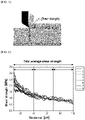
- Fig. 1 is a schematic diagram showing an example of measuring shear strength for each cutting depth while cutting an active material layer with a microblade using a SAICAS instrument.
- the active material layer can be cut at a constant cutting speed by giving a constant shear angle ( ⁇ ) using a microblade provided in SAICAS instrument. While performing such cutting, the horizontal force (Fh) and the vertical force (Fv) applied to the microblade are respectively measured in order to maintain a constant cutting speed, and from these measurement results, the shear strength ( ⁇ s) for each cutting depth can be calculated according to Equation 1.
- the relationship of shear strength for each cutting depth can be derived in the form shown in Fig. 2 .
- Such measurement is repeated a plurality of times, for example, 3 to 5 times, the average shear strength for each cutting depth can be derived.
- the negative electrode of one embodiment including the active material layer having a high average shear strength value derived in the thickness (cutting depth) section of 10 to 40 ⁇ m is excellent in adhesiveness between the metal current collector and the active material layer and in peel resistance, and thus can significantly improve the life characteristics of the lithium secondary battery.
- the average shear strength value is too high, this indicates that the rolling step proceeds excessively, and it was confirmed that the electrochemical properties of the active material layer itself can be deteriorated, and the effect of further improving the adhesiveness is not substantially observed.
- the negative electrode of one embodiment includes an active material layer satisfying an average shear strength range for each predetermined cutting depth, the active material layer can exhibit excellent adhesiveness and peeling resistance to the metal current collector.
- the active material layer is adhered to the metal current collector with an adhesive force of 30gf/20mm to 50gf/20mm, or 31gf/20mm to 40gf/20mm, and can maintain excellent electrochemical properties for a long time and can guarantee excellent long-life characteristics of the lithium secondary battery.
- the negative electrode of the above-described embodiment may be manufactured by a manufacturing method including predetermined rolling conditions.
- a method of manufacturing the negative electrode for a secondary battery of the above-described embodiment comprising the steps of:
- the slurry composition for forming the active material layer is applied to the metal current collector, and then the rolling step is performed a plurality of times including a first step and a second step, wherein the rolling step are performed a plurality of times so that a ratio of the first and second rolling ratio ranges defined by Equation 2 are 5 or more, or 5 to 30 or 5 to 25, thereby forming a negative electrode for a secondary battery.
- the active material layer is densified while suppressing damage to the negative electrode active material and the conductive material and maintaining excellent electrochemical properties, whereby an active material layer and a negative electrode having the average shear strength range of one embodiment and exhibiting excellent adhesiveness and peeling resistance resulting therefrom can be prepared.
- the first and second rolling ratio ranges are too small, excellent adhesiveness due to the negative electrode of one embodiment cannot be properly achieved.
- the first and second rolling ratio ranges are excessively large, the negative electrode active material can be damaged, and the electrochemical properties of the negative electrodecan be deteriorated.
- the above-mentioned negative electrode active material, the conductive material and the binder are mixed with a solvent for dispersing them to form a slurry composition.
- the types of the negative electrode active material, the conductive material and the binder are the same as those described above, and their content ranges are also the same as those described above for the content ranges of each component contained in the finally formed active material layer, and therefore, an additional description thereof will be omitted.
- a general solvent previously used to use the negative electrode slurry composition for example, N-methylpyrrolidone, acetone, water, etc. may be used, and the slurry composition can be formed by mixing and stirring such a solvent so that the solid content concentration is 30 to 70% by weight, or 40 to 60% by weight.
- the slurry composition can be applied to the negative electrode current collector by a general coating method.
- a coating method is not particularly limited, and for example, a coating method using a slot die may be applied, or other Mayer bar coating method, gravure coating method, dip coating method, spray coating method, etc., can be applied without any particular limitation.
- the slurry composition can be applied onto the metal current collector to a thickness of the active material layer to be finally formed, for example, in the thickness range of 50 to 400 ⁇ m, or 100 to 300 ⁇ m, and to a thickness of 100 to 500 ⁇ m or 150 to 400 ⁇ m, in consideration of the above-mentioned first and second rolling ratio range.
- the slurry composition is subjected to a plurality of rolling steps including first and second rolling steps using a rolling apparatus such as roll press.
- the rolling ratio which is defined as the ratio of the thickness decrease after the rolling step to the initial thickness before the rolling step as in Equation 2
- the first and second rolling steps are performed so that the first rolling ratio / second rolling ratio is 5 or more, or 5 or more, or 5 to 30 or 5 to 25.
- the pressure applied to the slurry composition in the first and second rolling steps can be controlled, for example, each rolling step can be performed so that the first rolling ratio is 20 to 40%, or 22 to 35%, or 25 to 30%, and the second rolling ratio is 0.5 to 6%, or 0.7 to 5.5%, or 0.9 to 5.2%.
- a pressure of 0.5 to 50 MPa, or 1 to 20 MPa can be applied to the slurry composition.
- the pressure can be applied at a reduced ratio than in the first rolling step, for example, at a pressure of 1/3 or less, or 1/5 or less of the pressure applied in the first rolling step.
- the applied pressure range in each of these rolling steps can be differently controlled in consideration of the composition of each slurry composition, characteristics of the rolling apparatus, and the like. This can be adjusted in an obvious manner to those skilled in the art.
- a plurality of rolling steps including the first and second rolling steps can be performed at a temperature of 15 to 30°C.
- the step of drying the slurry composition to remove the solvent may be further performed, and such drying step can be performed, for example, by a general method to which an infrared drying device or the like is applied.
- the active material layer can exhibit excellent adhesiveness and peeling resistance to the metal current collector, and as a result, a lithium secondary battery including the same can exhibit significantly improved life characteristics.
- a lithium secondary battery including the above-mentioned negative electrode for a secondary battery is provided.
- Such a lithium secondary battery can be manufactured and provided by injecting a lithium salt-containing electrolyte into an electrode assembly containing a positive electrode, a negative electrode as described above, and a separator interposed therebetween.
- the positive electrode can be manufactured by mixing a positive electrode active material, a conductive material, a binder and a solvent to prepare a slurry composition, and then directly coating it onto a metal current collector, or casting on a separate support and laminating the positive electrode active material film peeled from the support on a metal current collector.
- the active materials used in the positive electrode may include any one active material particle selected from the group consisting of LiCoO 2 , LiNiO 2 , LiMn 2 O 4 , LiCoPO 4 , LiFePO 4 and LiNi 1-x-y Co x M1 y M2 z O 2
- M1 and M2 are each independently any one selected from the group consisting of Al, Ni, Co, Fe, Mn, V, Cr, Ti, W, Ta, Mg and Mo
- x, y and z are, independently of each other, the atomic fractions of the elements of the oxide composition, which is 0 ⁇ x ⁇ 0.5, 0 ⁇ y ⁇ 0.5, 0 ⁇ z ⁇ 0.5, 0 ⁇ x+y+z ⁇ 1),or a mixture of two or more thereof.
- the conductive material, the binder and the solvent may be used in the same manner as those used for the manufacture of the negative electrode.
- a conventional porous polymer film used as a separator for example, a porous polymer film made of a polyolefin-based polymer such as an ethylene homopolymer, a propylene homopolymer, an ethylene/butene copolymer, an ethylene/hexene copolymer, and an ethylene/methacrylate copolymer can be used alone, or these can be laminated and used. Further, an insulating thin film having high ion permeability and mechanical strength can be used.
- the separator may include a safety-reinforced separator (SRS) in which a ceramic material is thinly coated onto a surface of the separator.
- a conventional porous nonwoven fabric for example, a nonwoven fabric made of high melting point glass fiber, polyethylene terephthalate fiber, etc. may be used, but is not limited thereto.
- the electrolyte may include a lithium salt and an organic solvent for dissolving the lithium salt.
- the lithium salt can be used without limitation as long as it is commonly used in electrolytes for secondary batteries.
- an anion of the lithium salt one selected from the group consisting of F - , Cl - , I - , NO 3 - , N(CN) 2 - , BF4-, ClO 4 - , PF 6 - , (CF 3 ) 2 PF 4 - , (CF 3 ) 3 PF 3 - , (CF 3 ) 4 PF 2 - , (CF 3 ) 5 PF - , (CF 3 ) 6 P - , CF 3 SO 3 - , CF 3 CF 2 SO 3 - , (CF 3 SO 2 ) 2 N - , (FSO 2 ) 2 N - , CF 3 CF 2 (CF 3 ) 2 CO - , (CF 3 SO 2 ) 2 CH - , (SF 5 ) 3 C - , (CF 3 SO 2 ) 3 C - , CF 3
- the organic solvent contained in the electrolyte can be used without limitation as long as it is commonly used.
- at least one selected from the group consisting of propylene carbonate, ethylene carbonate, diethyl carbonate, dimethyl carbonate, ethyl methyl carbonate, methyl propyl carbonate, dipropyl carbonate, dimethyl sulfoxide, acetonitrile, dimethoxyethane, diethoxyethane, vinylene carbonate, sulfolane, gammabutyrolactone, propylene sulfite and tetrahydrofuran can be used.
- ethylene carbonate and propylene carbonate which are cyclic carbonates
- a cyclic carbonate is mixed with a low-viscosity, low-dielectric constant linear carbonate such as dimethyl carbonate and diethyl carbonate in an appropriate ratio, an electrolyte having high electrical conductivity can be produced, and thus can be used more preferably.
- the electrolyte may further include an additive such as an overcharge inhibitor included in a conventional electrolyte.
- an additive such as an overcharge inhibitor included in a conventional electrolyte.
- the lithium secondary battery can be manufactured by placing a separator between the positive electrode and the negative electrode to form an electrode assembly, and placing the electrode assembly in, for example, a pouch, a cylindrical battery case or a prismatic battery case, and then injecting an electrolyte.
- a lithium secondary battery can be completed by laminating the electrode assembly and then impregnating it with the electrolyte, and putting the obtained result in a battery case and sealing the case.
- the lithium secondary battery may be of a stack type, a winding type, a stack and folding type, or a cable type.
- the above-mentioned lithium secondary battery not only can be used in a battery cell used as a power source for small devices, but also can be preferably used as a unit cell in a medium or large-sized battery module including a plurality of battery cells.
- Preferred examples of the medium or large-sized devices include electric vehicles, hybrid electric vehicles,plug-in hybrid electric vehicles, power storage systems, and the like. In particular, it can be usefully used in hybrid electric vehicles and new and renewable energy storage batteries, which are areas where high output is required.
- Graphite-based active material (QCG-X2; graphite), carbon black (Super C65) as a negative electrode conductive material, thickener (Daicel2200: carboxymethyl cellulose (CMC)) and binder (ADB22D; styrene butadiene rubber (SBR)-based polymer) were mixed at a ratio of 96.5:0.5:1.1:2.8 for 85 minutes, and then a solvent (water) for forming a slurry was added thereto to form a negative electrode slurry composition having a solid content of 55.5 wt%.
- CMC carboxymethyl cellulose
- ADB22D styrene butadiene rubber
- a copper current collector (thickness 8 ⁇ m, width 260 mm) was used as the negative electrode current collector, and the negative electrode slurry composition was coated onto one surface thereof at a loading amount of 15 mg/cm 2 (thickness 300 ⁇ m after coating).
- the slurry composition applied onto the copper current collector in this way was subjected to the first and second rolling steps at room temperature under the conditions summarized in Table 1 below, respectively (Comparative Example 1 performed only the first rolling step).
- Table 1 the initial coating thickness of the slurry composition, the thickness of the slurry composition after the first and second rolling steps, and each rolling ratio range calculated according to Equation 2 are shown together in Table 1 below.
- Test Example 1 Derivation of shear strength and average shear strength for each cutting depth
- the shear strength and average shear strength for each cutting depth of the active material layer were measured and calculated by the following method.
- Equation 1 F h cos ⁇ sin ⁇ ⁇ F v sin 2 ⁇ bt 0
- the first rolling ratio / second rolling ratio range is 5 or more, or 5 to 30, and the average value of the shear strength of 1.6 MPa or more is finally achieved in Examples 1 to 3 in which the first and second rolling steps have been performed.
- Test Example 2 Measurement of the adhesive force of the active material layer
- the adhesive force between the active material layer and the metal current collector was measured by the following method.
- each negative electrode sample was cut into a predetermined size (20 mm x 100 mm) and fixed on a slide glass, and then 180° adhesive force to the negative electrode active material layer from the copper current collector was measured.- The adhesive force of each sample was measured three times, and the average value was calculated. The adhesive force thus calculated is summarized in Table 3 below. [Table 3] Sample No.
Landscapes
- Chemical & Material Sciences (AREA)
- Chemical Kinetics & Catalysis (AREA)
- Electrochemistry (AREA)
- General Chemical & Material Sciences (AREA)
- Engineering & Computer Science (AREA)
- Manufacturing & Machinery (AREA)
- Materials Engineering (AREA)
- Inorganic Chemistry (AREA)
- Dispersion Chemistry (AREA)
- Battery Electrode And Active Subsutance (AREA)
- Cell Electrode Carriers And Collectors (AREA)
- Inorganic Compounds Of Heavy Metals (AREA)
Abstract
Description
- This application claims the benefit of
Korean Patent Application No. 10-2021-0026804 filed on February 26, 2021 - The present disclosure relates to a negative electrode for a secondary battery that is improved in the peeling resistance and adhesiveness of the active material layer and thus can improve the life characteristics of the negative electrode and the lithium secondary battery, a method of manufacturing the same and a lithium secondary battery including same.
- Along with the increase of the technological development and demand for mobile devices, electric vehicles and the like, the demand for secondary batteries has also sharply increased as an energy source. Among such secondary batteries, a lithium secondary battery that exhibits high energy density and voltage, has a long cycle life and a low discharge rate is now commercialized and widely used.
- Generally, lithium secondary batteries have a structure in which an electrolyte containing lithium salt is impregnated into an electrode assembly in which a porous separator is interposed between a positive electrode and a negative electrode, each of which is coated with an active material on a metal current collector, and each of the electrodes is manufactured by applying onto a metal current collector a slurry composition in which an active material, a binder, and a conductive material are dispersed in a solvent, pressing and drying the applied slurry composition.
- Therefore, the life characteristics of the lithium secondary battery can be mainly determined depending on how long the electrochemical characteristics of the electrode, especially the active material layer, are maintained. However, in the case of an existing lithium secondary battery, as the period of use elapses, the active material layer is peeled off from the metal current collector in the negative electrode, and the life characteristics of the lithium secondary battery are deteriorated frequently.
- This seems to be because the active material layer of the negative electrode contains, as a main component, a graphite-based negative electrode active material having properties different from those of metals, so that it is difficult to ensure sufficient adhesiveness, close adhesion, and peeling resistance to the metal current collector. Due to such poor close adhesion of the active material layer of the negative electrode, there is a drawback that the active material layer is easily peeled off from the metal current collector after the lapse of the usage period of the lithium secondary battery, and the peeled active material layer can no longer function as an active region of the lithium secondary battery, which causes a problem that the charge/discharge cycle characteristics of the lithium secondary battery are rapidly deteriorated.
- Due to these problems, there is still a need for continuous development of a technique capable of further improving the adhesivenessor the like of the active material layer contained in the negative electrode and improving the life characteristics of the lithium secondary battery.
- It is an object of the present disclosure to provide a negative electrodefor a secondary battery that is improved in the peeling resistance and adhesiveness of the active material layer to the metal current collectorand thus can improve the life characteristics of the negative electrode and the lithium secondary battery, and a method of manufacturing the same.
- It is another object of the present disclosure to provide alithium secondary battery that includes the negative electrodefor the secondary battery and thus exhibits improved life characteristics.
- According to one embodiment of the present disclosure, there is provided a negative electrode for a secondary battery comprising:
A metal current collector; and - an active material layer formed on the metal current collector and containing a negative electrode active material, a binder, and a conductive material,
- wherein when the shear strength for each cutting depth is calculated according to the following
Equation 1 while cutting the active material layer at a constant cutting speed with a microblade using a SAICAS instrument,the active material layer has an average value of shear strength of 1.6 MPa or more as measured at a cutting depth of 10 to 40 µm.
- in
Equation 1, τs represents the shear strength for each cutting depth,b represents the width of the microblade,torepresents the cutting depth, ϕ represents the shear angle, and - Fh and Fv represent measured values of horizontal and vertical forces respectively applied to the microblade to maintain the constant cutting speed.
- According to another embodiment of the present disclosure, there is provided a method of manufacturing the negative electrode for a secondary battery, the method comprising the steps of:
- applying a slurry composition containing a negative electrode active material, a binder, a conductive material and a solvent onto a metal current collector; and
- rolling the slurry composition over a first step and a second step,
- wherein when the rolling ratio defined by the
following Equation 2 is calculated, the first and second rolling are performed so that the first rolling ratio / second rolling ratio is 5 or more.
- According to yet another embodiment of the present disclosure, there is provided a lithium secondary battery comprising the negative electrode for the secondary battery.
- According to the present disclosure, a negative electrode for a secondary battery having greatly improved peeling resistance and adhesiveness of the active material layer to the metal current collector can be manufactured and provided by a simple method of controlling the progress conditions of the rolling step during the manufacturing process of the negative electrode.
- In such a negative electrode for a secondary battery, even when a lithium secondary battery is used for a long period of time, the phenomenon where the active material layer is peeled off from the metal current collector can be greatly reduced, and as a result, excellent charge/discharge cycle characteristics of the lithium secondary battery can be maintained for a long time.
- Therefore, the lithium secondary battery including the negative electrode for the secondary battery exhibits greatly improved life characteristics and thus ,can be very preferably used as a power supply means such as mobile devices and electric vehicles.
-
-
Fig. 1 is a schematic diagram showing an example of measuring shear strength for each cutting depth while cutting an active material layer with a microblade using a SAICAS instrument; and -
Fig. 2 is a graph showing the result of the measurement of the shear strength of the active material layer for each cutting depth with respect to the negative electrode prepared in Comparative Examples 1 to 5 (Sample Nos: 1 and 5 to 8) and Examples 1 to 3 (Sample Nos: 2 to 4), respectively. - Hereinafter, a negative electrode for a secondary battery according to an embodiment of the present disclosure, a method of manufacturing the same, and a lithium secondary battery including the same will be described in more detail with reference to the accompanying drawings.
- According to one embodiment of the disclosure, there is provided a negative electrode for a secondary battery comprising:
A metal current collector; and - an active material layer formed on the metal current collector and containing a negative electrode active material, a binder, and a conductive material,
- wherein when the shear strength for each cutting depth is calculated according to the following
Equation 1 while cutting the active material layer at a constant cutting speed with a microblade using a SAICAS instrument, the active material layer has an average value of shear strength of 1.6 MPa or more as measured at a cutting depth of 10 to 40 µm.
- in
Equation 1, τs represents the shear strength for each cutting depth, b represents the width of the microblade,torepresents the cutting depth, ϕ represents the shear angle, and - Fh and Fv represent measured values of horizontal and vertical forces respectively applied to the microblade to maintain the constant cutting speed.
- The present inventors continued their research to improve the adhesiveness and peeling resistance of the active material layer of the negative electrode to the metal current collector by a simplified method that does not significantly change the existing negative electrode manufacturing process.
- As a result of such continuous research, the present inventors have found that except for the surface portion of the active material layer containing the negative electrode active material, the binder and the conductive material, and the interface portion with the metal current collector, the shear strength against cutting measured at the central portion of the active material layer (i.e., a cutting depth of 10 to 40 µmof the active material layer) can be achieved above a certain level, thereby greatly improving the adhesiveness and peeling resistance of the active material layer to the metal current collector. This seems to be because the active material layer having high shear strength against cutting at the central portion can be closely adhered to the surface of the metal current collector with higher bonding force as the binder, the conductive material, and the negative active material are physically bonded more tightly.
- In addition, based on the above findings, the present inventors continued their research about a method for manufacturing a negative electrode that enables the formation of an active material layer having a higher shear strength against cutting at the central portion. As a result of such continuous research, the present inventors have found that during the manufacturing process of the negative electrode, the rolling is performed plural times including a first step and a second step, but the rolling step is performed plural times so that the first and second rolling ratio ranges are in a certain range, whereby an active material layer having a higher shear strength and a negative electrode including the same can be prepared, and completed the present disclosure.
- As described above, according to the embodiment of the present disclosure, a negative electrode for a secondary battery having greatly improved peeling resistance and adhesiveness of the active material layer to the metal current collector can be manufactured and provided by a relatively simple method. In such a negative electrode for a secondary battery, even when a lithium secondary battery is used for a long period of time, it is possible to greatly reduce the phenomenon that the active material layer is peeled off from the metal current collector, and as a result, the life characteristics of the lithium secondary battery can be greatly improved.
- Now, the negative electrode for a secondary battery of one embodiment will be described in more detail.
- The negative electrode for a secondary battery of one embodiment basically includes a metal current collector and an active material layer formed on the metal current collector.
- As the metal current collector, any metal current collector already used before as an electrode current collector, such as a lithium secondary battery, for example, a metal current collector having conductivity without causing a chemical change in the battery can be used without particular limitation. Specific examples of the metal current collector include a current collector including at least one metal selected from the group consisting of copper, stainless steel, aluminum, nickel, and titanium. Among these metal current collectors, a copper current collector can be used in consideration of the excellent conductivity of the negative electrode for secondary batteries and excellent adhesiveness with the active material layer.
- The thickness of the metal current collector is not particularly limited, but may have a thickness of 3 to 500 µm, or 5 to 100 µm, or 7 to 50 µm, which is usually applied.
- Further, the active material layer may include, for example, a negative electrode active material including a graphite-based active material, a binder, and a conductive material.
- Among these, specific examples of the negative electrode active material include at least one graphite-based active material selected from the group consisting of natural graphite, artificial graphite, fibrous artificial graphite, graphitized black and graphitized nanofibers, and in addition to the graphite-based active material, an additional active material such as a silicon-based active material may be further included.
- Further, as the binder, various polymer binders, such as polyvinylidenefluoride-hexafluoropropylene copolymer (PVDF-co-HFP), polyvinylidenefluoride, polyacrylonitrile, polymethylmethacrylate, polyvinyl alcohol, carboxymethyl cellulose (CMC), starch, hydroxypropyl cellulose, regenerated cellulose, polyvinylpyrrolidone, tetrafluoroethylene, polyethylene, polypropylene, polyacrylic acid, styrene-butadiene rubber (SBR), or various other copolymers, etc may be used. Among them, in consideration of excellent adhesiveness to the metal current collector, and excellent dispersibility to the negative electrode active material and conductive material, a polyvinylidene fluoride-based polymer or copolymer can be preferably used.
- The conductive material is not particularly limited as long as it has high conductivity without causing a chemical change in the corresponding battery, and for example, graphite such as natural graphite and artificial graphite; carbon black-based conductive materials such as carbon black, acetylene black, ketjen black, channel black, furnace black, lamp black, and thermal black; conductive fibers such as carbon fiber and metal fiber; metal powders such as carbon fluoride powder, aluminum powder, and nickel powder; conductive whiskey such as zinc oxide and potassium titanate; conductive metal oxides such as titanium oxide; conductive materials such as polyphenylene derivatives can be used.
- However, when a graphite-based active material is mainly used as the negative active material, a carbon black-based conductive material can be appropriately used in consideration of its excellent dispersibility and electrical properties.
- On the other hand, the active material layer may contain 80 to 98% by weight, or 85 to 98% by weight, or 90 to 97% by weight of the negative electrode active material, 0.5 to 15% by weight, or 0.7 to 10% by weight, or 1 to 5% by weight of the binder, and 0.1 to 10% by weight, or 0.2 to 5% by weight, or 0.3 to 2% by weight of the conductive material.
- As the active material layer contains the negative active material, the binder and the conductive material in such a content range, uniform dispersibility of the negative electrode active material and the conductive material can be achieved, while the adhesiveness of the active material layer to the metal current collector can be further improved, and excellent electrochemical properties of the negative electrode for a secondary battery can be achieved.
- On the other hand, the negative electrode for a secondary battery of one embodiment is formed by a process which include coating onto the metal current collector a slurry composition including the above-mentioned negative active material, binder and conductive material, and a solvent for dispersing them, and then rolling and drying the applied slurry composition through pluralalrolling steps described later.
- By such a process, when the shear strength for each cutting depth is calculated according to the
Equation 1 while cutting the active material layer at a constant cutting speed with a microblade using a SAICAS instrument, the active material layer is formed so as to have an average value of shear strength of 1.6 MPa or more, or 1.6 to 3MPa, or 1.65 to 2 MPa as measured at a cutting depth of 10 to 40 µm. - As already described above, as the active material layer is formed to have such an average shear strength for each cutting depth, the active material layer may exhibit excellent peeling resistance and adhesiveness to the metal current collector, and as a result, it was confirmed that the active material layer maintains electrochemical properties for a long period of time, so that a lithium secondary battery including the same can exhibit excellent life characteristics.
-
Fig. 1 is a schematic diagram showing an example of measuring shear strength for each cutting depth while cutting an active material layer with a microblade using a SAICAS instrument. - As shown in
Fig. 1 , for the measurement of the shear strength for each cutting depth of the active material layer, the active material layer can be cut at a constant cutting speed by giving a constant shear angle (ϕ) using a microblade provided in SAICAS instrument. While performing such cutting, the horizontal force (Fh) and the vertical force (Fv) applied to the microblade are respectively measured in order to maintain a constant cutting speed, and from these measurement results, the shear strength (τs) for each cutting depth can be calculated according toEquation 1. - From such a calculation result, for example, the relationship of shear strength for each cutting depth can be derived in the form shown in
Fig. 2 . Such measurement is repeated a plurality of times, for example, 3 to 5 times, the average shear strength for each cutting depth can be derived. - As a result of continuous experiments by the inventors, it was confirmed that in the section where the cutting depth is 10 µm or less, the reliability of the data is reduced as pressing and cutting resistance before cutting occur. In addition, as a result of continuous experiments by the inventors, it was confirmed that as the average shear strength value derived in the central portion of the active material layer, that is, in the thickness (cutting depth) section of 10 to 40 µm, is higher, the peeling resistance and adhesiveness of the active material layer to the metal current collector are most excellent.
- Therefore, the negative electrode of one embodiment including the active material layer having a high average shear strength value derived in the thickness (cutting depth) section of 10 to 40 µm is excellent in adhesiveness between the metal current collector and the active material layer and in peel resistance, and thus can significantly improve the life characteristics of the lithium secondary battery. However, when the average shear strength value is too high, this indicates that the rolling step proceeds excessively, and it was confirmed that the electrochemical properties of the active material layer itself can be deteriorated, and the effect of further improving the adhesiveness is not substantially observed.
- On the other hand, the detailed measurement method of the above-mentioned average shear strength is also described in "2019 Korean Society of Automotive Engineers, Gwangju Honam Branch, Spring Conference, SAICAS measurement method of polymer thin film", etc. and it can be measured using general SAICAS equipment commercially available from Daipla and others.
- As described above, since the negative electrode of one embodiment includes an active material layer satisfying an average shear strength range for each predetermined cutting depth, the active material layer can exhibit excellent adhesiveness and peeling resistance to the metal current collector.
- For example, the active material layer is adhered to the metal current collector with an adhesive force of 30gf/20mm to 50gf/20mm, or 31gf/20mm to 40gf/20mm, and can maintain excellent electrochemical properties for a long time and can guarantee excellent long-life characteristics of the lithium secondary battery.
- The negative electrode of the above-described embodiment may be manufactured by a manufacturing method including predetermined rolling conditions. Thus, according to another embodiment of the present disclosure, there is provided a method of manufacturing the negative electrode for a secondary battery of the above-described embodiment, the method comprising the steps of:
- applying a slurry composition containing a negative electrode active material, a binder, a conductive material and a solvent onto a metal current collector;and
- rolling the slurry composition over a first step and a second step,
- wherein when the rolling ratio defined by the following
Equation 2 is calculated, the first and second rolling are performed so that the first rolling ratio / second rolling ratio is 5 or more.
- According to another embodiment of the present disclosure, the slurry composition for forming the active material layer is applied to the metal current collector, and then the rolling step is performed a plurality of times including a first step and a second step, wherein the rolling step are performed a plurality of times so that a ratio of the first and second rolling ratio ranges defined by
Equation 2 are 5 or more, or 5 to 30 or 5 to 25, thereby forming a negative electrode for a secondary battery. - As the rolling step is performed a plurality of times under these conditions, it was confirmed that the active material layer is densified while suppressing damage to the negative electrode active material and the conductive material and maintaining excellent electrochemical properties, whereby an active material layer and a negative electrode having the average shear strength range of one embodiment and exhibiting excellent adhesiveness and peeling resistance resulting therefrom can be prepared. However, when the first and second rolling ratio ranges are too small, excellent adhesiveness due to the negative electrode of one embodiment cannot be properly achieved. Conversely, when the first and second rolling ratio ranges are excessively large, the negative electrode active material can be damaged, and the electrochemical properties of the negative electrodecan be deteriorated.
- On the other hand, in the production method of the other embodiment, first, the above-mentioned negative electrode active material, the conductive material and the binder are mixed with a solvent for dispersing them to form a slurry composition. At this time, the types of the negative electrode active material, the conductive material and the binder are the same as those described above, and their content ranges are also the same as those described above for the content ranges of each component contained in the finally formed active material layer, and therefore, an additional description thereof will be omitted.
- Further, as the solvent, a general solvent previously used to use the negative electrode slurry composition, for example, N-methylpyrrolidone, acetone, water, etc. may be used, and the slurry composition can be formed by mixing and stirring such a solvent so that the solid content concentration is 30 to 70% by weight, or 40 to 60% by weight.
- After forming the slurry composition, the slurry composition can be applied to the negative electrode current collector by a general coating method. Such a coating method is not particularly limited, and for example, a coating method using a slot die may be applied, or other Mayer bar coating method, gravure coating method, dip coating method, spray coating method, etc., can be applied without any particular limitation.
- Further, the slurry composition can be applied onto the metal current collector to a thickness of the active material layer to be finally formed, for example, in the thickness range of 50 to 400µm, or 100 to 300µm, and to a thickness of 100 to 500 µm or 150 to 400 µm, in consideration of the above-mentioned first and second rolling ratio range.
- After such application step, for example, the slurry composition is subjected to a plurality of rolling steps including first and second rolling steps using a rolling apparatus such as roll press. In particular, in the manufacturing method of another embodiment, when the rolling ratio, which is defined as the ratio of the thickness decrease after the rolling step to the initial thickness before the rolling step as in
Equation 2, is calculated for the first and second rolling steps, respectively, the first and second rolling steps are performed so that the first rolling ratio / second rolling ratio is 5 or more, or 5 or more, or 5 to 30 or 5 to 25. - In order to achieve these first and second rolling ratio ratios, the pressure applied to the slurry composition in the first and second rolling steps can be controlled, for example, each rolling step can be performed so that the first rolling ratio is 20 to 40%, or 22 to 35%, or 25 to 30%, and the second rolling ratio is 0.5 to 6%, or 0.7 to 5.5%, or 0.9 to 5.2%.
- In order to achieve these first and second rolling ratios, for example, in the first rolling step, a pressure of 0.5 to 50 MPa, or 1 to 20 MPa can be applied to the slurry composition. Further, in consideration of the rolling ratio ranges of the first and second rolling steps, in the second rolling step, the pressure can be applied at a reduced ratio than in the first rolling step, for example, at a pressure of 1/3 or less, or 1/5 or less of the pressure applied in the first rolling step.However, the applied pressure range in each of these rolling stepscan be differently controlled in consideration of the composition of each slurry composition, characteristics of the rolling apparatus, and the like. This can be adjusted in an obvious manner to those skilled in the art.
- Further, a plurality of rolling steps including the first and second rolling stepscan be performed at a temperature of 15 to 30°C.
- After performing the above-mentioned rolling step, the step of drying the slurry composition to remove the solvent may be further performed, and such drying step can be performed, for example, by a general method to which an infrared drying device or the like is applied.
- In the negative electrode for a secondary battery manufactured by the above method, the active material layer can exhibit excellent adhesiveness and peeling resistance to the metal current collector, and as a result, a lithium secondary battery including the same can exhibit significantly improved life characteristics.
- On the other hand, according to another embodiment of the present disclosure, a lithium secondary battery including the above-mentioned negative electrode for a secondary battery is provided. Such a lithium secondary battery can be manufactured and provided by injecting a lithium salt-containing electrolyte into an electrode assembly containing a positive electrode, a negative electrode as described above, and a separator interposed therebetween.
- The positive electrode can be manufactured by mixing a positive electrode active material, a conductive material, a binder and a solvent to prepare a slurry composition, and then directly coating it onto a metal current collector, or casting on a separate support and laminating the positive electrode active material film peeled from the support on a metal current collector.
- The active materials used in the positive electrode may include any one active material particle selected from the group consisting of LiCoO2, LiNiO2, LiMn2O4, LiCoPO4, LiFePO4 and LiNi1-x-yCoxM1yM2zO2 (M1 and M2 are each independently any one selected from the group consisting of Al, Ni, Co, Fe, Mn, V, Cr, Ti, W, Ta, Mg and Mo, x, y and z are, independently of each other, the atomic fractions of the elements of the oxide composition, which is 0≤x<0.5, 0≤y<0.5, 0≤z<0.5, 0<x+y+z≤ 1),or a mixture of two or more thereof.
- On the other hand, the conductive material, the binder and the solvent may be used in the same manner as those used for the manufacture of the negative electrode.
- As the separator, a conventional porous polymer film used as a separator, for example, a porous polymer film made of a polyolefin-based polymer such as an ethylene homopolymer, a propylene homopolymer, an ethylene/butene copolymer, an ethylene/hexene copolymer, and an ethylene/methacrylate copolymer can be used alone, or these can be laminated and used. Further, an insulating thin film having high ion permeability and mechanical strength can be used.The separator may include a safety-reinforced separator (SRS) in which a ceramic material is thinly coated onto a surface of the separator. In addition, a conventional porous nonwoven fabric, for example, a nonwoven fabric made of high melting point glass fiber, polyethylene terephthalate fiber, etc. may be used, but is not limited thereto.
- The electrolyte may include a lithium salt and an organic solvent for dissolving the lithium salt.
- The lithium salt can be used without limitation as long as it is commonly used in electrolytes for secondary batteries. For example, as an anion of the lithium salt, one selected from the group consisting of F-, Cl-, I-, NO3 -, N(CN)2 -, BF4-, ClO4 -, PF6 -, (CF3)2PF4 -, (CF3)3PF3 -, (CF3)4PF2 -, (CF3)5PF-, (CF3)6P-, CF3SO3 -, CF3CF2SO3 -, (CF3SO2)2N-, (FSO2)2N-, CF3CF2(CF3)2CO-, (CF3SO2)2CH-, (SF5)3C-, (CF3SO2)3C-, CF3(CF2)7SO3 -, CF3CO2 -, CH3CO2 -, SCN- and (CF3CF2SO2)2N- can be used.
- The organic solvent contained in the electrolyte can be used without limitation as long as it is commonly used. Typically, at least one selected from the group consisting of propylene carbonate, ethylene carbonate, diethyl carbonate, dimethyl carbonate, ethyl methyl carbonate, methyl propyl carbonate, dipropyl carbonate, dimethyl sulfoxide, acetonitrile, dimethoxyethane, diethoxyethane, vinylene carbonate, sulfolane, gammabutyrolactone, propylene sulfite and tetrahydrofuran can be used.
- In particular, among the carbonate-based organic solvents, ethylene carbonate and propylene carbonate, which are cyclic carbonates, are organic solvents with high viscosity and have a high dielectric constant and thus well dissociate lithium salts in the electrolyte, so that they can be preferably used. When such a cyclic carbonate is mixed with a low-viscosity, low-dielectric constant linear carbonate such as dimethyl carbonate and diethyl carbonate in an appropriate ratio, an electrolyte having high electrical conductivity can be produced, and thus can be used more preferably.
- Optionally, the electrolyte may further include an additive such as an overcharge inhibitor included in a conventional electrolyte.
- The lithium secondary battery can be manufactured by placing a separator between the positive electrode and the negative electrode to form an electrode assembly, and placing the electrode assembly in, for example, a pouch, a cylindrical battery case or a prismatic battery case, and then injecting an electrolyte.Alternatively, a lithium secondary battery can be completed by laminating the electrode assembly and then impregnating it with the electrolyte, and putting the obtained result in a battery case and sealing the case.
- The lithium secondary battery may be of a stack type, a winding type, a stack and folding type, or a cable type.
- The above-mentioned lithium secondary battery not only can be used in a battery cell used as a power source for small devices, but also can be preferably used as a unit cell in a medium or large-sized battery module including a plurality of battery cells. Preferred examples of the medium or large-sized devices include electric vehicles, hybrid electric vehicles,plug-in hybrid electric vehicles, power storage systems, and the like. In particular, it can be usefully used in hybrid electric vehicles and new and renewable energy storage batteries, which are areas where high output is required.
- Hereinafter, preferred embodiments are presented to aid the understanding of the disclosure. However, the following examples are for illustrative purposes only, and are not intended to limit the present disclosure.
- Graphite-based active material (QCG-X2; graphite), carbon black (Super C65) as a negative electrode conductive material, thickener (Daicel2200: carboxymethyl cellulose (CMC)) and binder (ADB22D; styrene butadiene rubber (SBR)-based polymer) were mixed at a ratio of 96.5:0.5:1.1:2.8 for 85 minutes, and then a solvent (water) for forming a slurry was added thereto to form a negative electrode slurry composition having a solid content of 55.5 wt%.
- A copper current collector (
thickness 8 µm, width 260 mm) was used as the negative electrode current collector, and the negative electrode slurry composition was coated onto one surface thereof at a loading amount of 15 mg/cm2 (thickness 300 µm after coating). - The slurry composition applied onto the copper current collector in this way was subjected to the first and second rolling steps at room temperature under the conditions summarized in Table 1 below, respectively (Comparative Example 1 performed only the first rolling step).For reference, the initial coating thickness of the slurry composition, the thickness of the slurry composition after the first and second rolling steps, and each rolling ratio range calculated according to
Equation 2 are shown together in Table 1 below. - After such rolling steps, mid-infrared radiation drying was performed at a rate of evaporation of 605 g/min at 50 to 100°C for 15 to 100 minutes. Thereby, negative electrodes of Examples 1 to 3 (Sample Nos: 2 to 4) and Comparative Examples 1 to 5 (Sample Nos: 1 and 5 to 8) were manufactured.
[Table 1] Sample No. Initial thickness Thickness after first rolling (µm) Thickness after second rolling (µm) First rolling ratio (%; Equation 2) Second rolling ratio (%; Equation 2) First rolling ratio / Second rolling ratio Comparative Example 1 1 300 208 208 31 0 - Example 1 2 300 211 208 30 1 21.4 Example 2 3 300 217 208 28 4 6.8 Example 3 4 300 220 208 27 5 5.0 Comparative Example 2 5 300 223 208 26 7 3.9 Comparative Example 3 6 300 226 208 25 8 3.2 Comparative Example 4 7 300 229 208 24 9 2.7 Comparative Example 5 8 300 232 208 23 10 2.3 - In the negative electrodesmanufactured in Examples and Comparative Examples, the shear strength and average shear strength for each cutting depth of the active material layer were measured and calculated by the following method.
- First, a SAICAS (Daipla, Japan) equipment was used. Each negative electrode sample was placed on the sample stage of such SAICAS instrument. Then, in a state in which the microblade edge having a width of 1 mm was brought into contact with the surface of the active material layer at a relief angle of 10° and a cutting angle of 20°, the active material layer was cut while moving the microblade at constant vertical speed (0.05 µm/sec) and horizontal speed (0.5 µm/sec). At this time, the definitions of margin angle and cutting angle are known through "2019 Korea Society of Automotive Engineers, Gwangju Honam Branch, Spring Conference, SAICAS Measurement Method of Polymer Thin Film", etc. and the shear angle during the cutting step can be calculated from the margin angle and the cutting angle, as known through the above literature.
- In order to maintain the horizontal and vertical speed for cutting constant while proceeding with such cutting, the vertical force (FV) and horizontal force (FH) applied to the microblade were measured, respectively.
- From the measurement results of these vertical force and the horizontal force, the shear strength for each cutting depth was calculated according to
Equation 1 below.
- in
Equation 1, τs represents the shear strength for each cutting depth,b represents the width of the microblade,torepresents the cutting depth, ϕ represents the shear angle, and - Fh and Fv represent measured values of horizontal and vertical forces respectively applied to the microblade to maintain the constant cutting speed.
- The measurement and calculation of the shear strength for each cutting depth were repeated 3 times for each sample, and these calculation results are shown in
Fig. 2 .For reference, inFig. 2 , the negative electrode of eachExample and Comparative Example is summarized with the sample numbers of Tables 1 and 2. - From the calculation result of the shear strength for each cutting depth, except for the depth of cut (thickness) region, which has poor correlation between quantitative data and adhesiveness of the active material layer,the average value of the measured and calculated shear strength for a cutting depth of 10 to 40 µm was taken, and the average value of the shear strength of the active material layer for each Example and Comparative Example was calculated and summarized in Table 2 below.
[Table 2] Sample No. First rolling ratio / Second rolling ratio Average value of shear strength (cutting depth of 10 ~ 40 µm; MPa) Comparative Example 1 1 - 1.59 Example 1 2 21.4 1.81 Example 2 3 6.8 1.80 Example 3 4 5.0 1.69 Comparative Example 2 5 3.9 1.44 Comparative Example 3 6 3.2 1.55 Comparative Example 4 7 2.7 1.57 Comparative Example 5 8 2.3 1.52 - Referring to Table 2, it was confirmed that the first rolling ratio / second rolling ratio range is 5 or more, or 5 to 30, and the average value of the shear strength of 1.6 MPa or more is finally achieved in Examples 1 to 3 in which the first and second rolling steps have been performed.
- In the negative electrodes manufactured in Examples and Comparative Examples, the adhesive force between the active material layer and the metal current collector was measured by the following method.
- First, each negative electrode sample was cut into a predetermined size (20 mm x 100 mm) and fixed on a slide glass, and then 180° adhesive force to the negative electrode active material layer from the copper current collector was measured.- The adhesive force of each sample was measured three times, and the average value was calculated.The adhesive force thus calculated is summarized in Table 3 below.
[Table 3] Sample No. Average value of shear strength (cutting depth of 10 ~ 40 µm; MPa) Adhesive force [gf/20mm] Comparative Example 1 1 1.59 29.1 Example 1 2 1.81 32.1 Example 2 3 1.8 32.1 Example 3 4 1.69 31.7 Comparative Example 2 5 1.44 28.8 Comparative Example 3 6 1.55 27.6 Comparative Example 4 7 1.57 28.3 Comparative Example 5 8 1.52 28.5 - Referring to Table 3, it was confirmed that the active material layers of Examples exhibit excellent adhesiveness to the copper current collector as compared with Comparative Examples. Thereby, it is considered that while increasing the fracture resistance and mechanical durability of the active material layer due to external force, the external force transmission to the active material layer/metal current collector interface is reduced, and the peeling resistance of the active material layer is increased.
Claims (12)
- A negative electrode for a secondary battery comprising:
A metal current collector; andan active material layer formed on the metal current collector and containing a negative electrode active material, a binder, and a conductive material,wherein when the shear strength for each cutting depth is calculated according to the following Equation 1 while cutting the active material layer at a constant cutting speed with a microblade using a SAICAS instrument, the active material layer has an average value of shear strength of 1.6 MPa or more as measured at a cutting depth of 10 to 40 µm, in Equation 1, τs represents the shear strength for each cutting depth, b represents the width of the microblade, to represents the cutting depth, ϕ represents the shear angle, andFh and Fv represent measured values of horizontal and vertical forces respectively applied to the microblade to maintain the constant cutting speed.
 - The negative electrode for a secondary battery according to claim 1, wherein the negative electrode active material comprises at least one graphite-based active material selected from the group consisting of natural graphite, artificial graphite, fibrous artificial graphite, graphitized black, and graphitized nanofibers.
- The negative electrode for a secondary battery according to claim 1, wherein the conductive material comprises at least one selected from the group consisting of carbon black, acetylene black, ketjen black, channel black, furnace black, lamp black, and thermal black.
- The negative electrode for a secondary battery according to claim 1, wherein the binder comprises at least one selected from the group consisting of polyvinylidenefluoride-hexafluoropropylene copolymer (PVDF-co-HFP), polyvinylidenefluoride, polyacrylonitrile, polymethylmethacrylate, polyvinyl alcohol, carboxymethyl cellulose (CMC), starch, hydroxypropyl cellulose, regenerated cellulose, polyvinylpyrrolidone, tetrafluoroethylene, polyethylene, polypropylene, polyacrylic acid and styrene-butadiene rubber (SBR).
- The negative electrode for a secondary battery according to claim 1, wherein the active material layer contains 80 to 98% by weight of the negative electrode active material, 0.5 to 15% by weight of the binder, and 0.1 to 10% by weight of the conductive material.
- The negative electrode for a secondary battery according to claim 1, wherein the active material layer has a thickness of 50 to 400 µm.
- The negative electrode for a secondary battery according to claim 1, wherein the metal current collector comprises at least one selected from the group consisting of copper, stainless steel, aluminum, nickel and titanium.
- A method of manufacturing the negative electrode for a secondary battery as set forth in claim 1, the method comprising the steps of:applying a slurry composition containing a negative electrode active material, a binder, a conductive material and a solvent onto a metal current collector; androlling the slurry composition over a first step and a second step,wherein when the rolling ratio defined by the following Equation 2 is calculated, the first and second rolling are performed so that the first rolling ratio / second rolling ratio is 5 or more,

- The method of manufacturing the negative electrode for a secondary battery according to claim 8, wherein the first rolling ratio is 20 to 40%, and the second rolling ratio is 0.5 to 6%.
- The method of manufacturing the negative electrode for a secondary battery according to claim 8, wherein the slurry composition is applied onto a metal current collector to a thickness of 100 to 500 µm.
- The method of manufacturing the negative electrode for a secondary battery according to claim 8, wherein after the first and second rolling steps, the method further comprises drying the slurry composition to remove a solvent.
- A lithium secondary battery comprising:a positive electrode;the negative electrode as set forth in claim 1; anda separator interposed between the positive electrode and the negative electrode.
Applications Claiming Priority (2)
| Application Number | Priority Date | Filing Date | Title |
|---|---|---|---|
| KR1020210026804A KR102773733B1 (en) | 2021-02-26 | 2021-02-26 | Anode for secondary battery, its preparation method, and lithium secondary battery comprising the same |
| PCT/KR2022/002474 WO2022182072A1 (en) | 2021-02-26 | 2022-02-21 | Anode for secondary battery, preparation method therefor, and lithium secondary battery comprising same |
Publications (2)
| Publication Number | Publication Date |
|---|---|
| EP4106050A1 true EP4106050A1 (en) | 2022-12-21 |
| EP4106050A4 EP4106050A4 (en) | 2023-10-18 |
Family
ID=83049415
Family Applications (1)
| Application Number | Title | Priority Date | Filing Date |
|---|---|---|---|
| EP22759990.9A Pending EP4106050A4 (en) | 2021-02-26 | 2022-02-21 | Anode for secondary battery, preparation method therefor, and lithium secondary battery comprising same |
Country Status (6)
| Country | Link |
|---|---|
| US (1) | US20230178734A1 (en) |
| EP (1) | EP4106050A4 (en) |
| JP (1) | JP7468966B2 (en) |
| KR (1) | KR102773733B1 (en) |
| CN (1) | CN115315830B (en) |
| WO (1) | WO2022182072A1 (en) |
Family Cites Families (14)
| Publication number | Priority date | Publication date | Assignee | Title |
|---|---|---|---|---|
| JP3693827B2 (en) | 1998-10-27 | 2005-09-14 | 日本碍子株式会社 | Electrode plate fabrication method |
| CN101207195A (en) * | 2006-12-22 | 2008-06-25 | 比亚迪股份有限公司 | A kind of preparation method of battery pole piece |
| JP2008204829A (en) | 2007-02-21 | 2008-09-04 | Mitsui Chemicals Inc | Binder for electrochemical cell electrode |
| JP2013109853A (en) * | 2011-11-17 | 2013-06-06 | Toyota Motor Corp | Manufacturing method of lithium ion secondary battery |
| JP6523608B2 (en) | 2013-03-26 | 2019-06-05 | 株式会社東芝 | Electrode for non-aqueous electrolyte secondary battery, non-aqueous electrolyte secondary battery and battery pack |
| CN105489832A (en) * | 2015-11-25 | 2016-04-13 | 百顺松涛(天津)动力电池科技发展有限公司 | Method for solving serious roll sticking problem of aqueous cathode slurry in rolling process |
| KR101966144B1 (en) * | 2016-09-29 | 2019-04-05 | 주식회사 엘지화학 | Multi-layer Anode Comprising Natural Graphite and Artificial Graphite and Lithium Secondary Battery Comprising the Same |
| JP6583337B2 (en) | 2017-03-30 | 2019-10-02 | トヨタ自動車株式会社 | Electrode manufacturing method |
| KR102358446B1 (en) * | 2017-05-12 | 2022-02-04 | 주식회사 엘지에너지솔루션 | Negative electrode for lithium secondary battery, and lithium secondary battery comprising the same |
| JP7154807B2 (en) | 2018-04-19 | 2022-10-18 | 株式会社エンビジョンAescジャパン | METHOD FOR MANUFACTURING ELECTRODE SHEET FOR LITHIUM ION SECONDARY BATTERY |
| KR102251112B1 (en) * | 2018-04-26 | 2021-05-11 | 삼성에스디아이 주식회사 | Negative electrode for rechargeable lithium battery, and rechargeable lithium battery including same |
| KR102262044B1 (en) * | 2018-08-31 | 2021-06-09 | 에스케이이노베이션 주식회사 | Anode for secondary battery having controlled binder distribution property and secondary battery comprising the same |
| CN111868972B (en) * | 2018-11-22 | 2024-02-27 | Sk新能源株式会社 | Manufacturing method of negative electrode and secondary battery with improved fast charging performance including the negative electrode |
| ES2975435T3 (en) * | 2019-08-19 | 2024-07-05 | Lg Energy Solution Ltd | Electrode for secondary battery and secondary lithium battery comprising the same |
-
2021
- 2021-02-26 KR KR1020210026804A patent/KR102773733B1/en active Active
-
2022
- 2022-02-21 US US17/919,074 patent/US20230178734A1/en active Pending
- 2022-02-21 WO PCT/KR2022/002474 patent/WO2022182072A1/en not_active Ceased
- 2022-02-21 JP JP2022556652A patent/JP7468966B2/en active Active
- 2022-02-21 EP EP22759990.9A patent/EP4106050A4/en active Pending
- 2022-02-21 CN CN202280003224.0A patent/CN115315830B/en active Active
Also Published As
| Publication number | Publication date |
|---|---|
| CN115315830A (en) | 2022-11-08 |
| CN115315830B (en) | 2025-09-09 |
| EP4106050A4 (en) | 2023-10-18 |
| US20230178734A1 (en) | 2023-06-08 |
| JP2023519568A (en) | 2023-05-11 |
| WO2022182072A1 (en) | 2022-09-01 |
| KR102773733B1 (en) | 2025-02-25 |
| JP7468966B2 (en) | 2024-04-16 |
| KR20220122320A (en) | 2022-09-02 |
Similar Documents
| Publication | Publication Date | Title |
|---|---|---|
| KR102417200B1 (en) | Negative electrode for lithium secondary battery, method of manufacturing the same and lithium secondary battery comprising the same | |
| EP3285324B1 (en) | Polymer electrolyte having multi-layer structure, and all-solid battery comprising same | |
| KR102564970B1 (en) | Negative electrode and secondary battery comprising the same | |
| CN114207866B (en) | Method for pre-sodiumization of negative electrode, pre-sodiumized negative electrode and lithium secondary battery comprising the pre-sodiumized negative electrode | |
| KR102530157B1 (en) | Pre-lithiation Method of Negative Electrode for secondary battery | |
| EP3783727A1 (en) | Method for activating secondary battery | |
| EP3605670A2 (en) | Method for forming lithium metal and inorganic material composite thin film and method for pre-lithiation of negative electrode for lithium secondary battery by using same | |
| KR20200038168A (en) | Multi-layered Anode Comprising Silicon-based Compound and Lithium Secondary Battery Comprising the Same | |
| EP3846257A1 (en) | Anode active material for lithium secondary battery, and anode and lithium secondary battery which comprise same | |
| KR102567400B1 (en) | Secondary battery | |
| EP4207359A1 (en) | Positive electrode and lithium secondary battery comprising same | |
| KR20200040489A (en) | Method for preparing negative electrode of lithium secondary battery | |
| KR20190096817A (en) | Solid polymer electrolyte and lithium secondary battery comprising the same | |
| KR102554229B1 (en) | Method for preparing negative electrode for lithium secondary battery | |
| JP2023543242A (en) | Lithium secondary battery manufacturing method and lithium secondary battery manufactured thereby | |
| JP2022547501A (en) | Method for manufacturing secondary battery | |
| KR20200093472A (en) | Anode and Lithium Secondary Battery Comprising the Same | |
| KR20240088617A (en) | Positive electrode and lithium secondary battery comprising the same | |
| KR20200071622A (en) | Lithium secondary battery and manufacturing method thereof | |
| KR20210120686A (en) | Method for manufacturing negative electrode | |
| KR20210030010A (en) | Pre-lithiation Method of Negative Electrode for secondary battery | |
| KR102130052B1 (en) | Negative electrode for lithium secondary battery and lithium secondary battery comprising the same | |
| EP4106050A1 (en) | Anode for secondary battery, preparation method therefor, and lithium secondary battery comprising same | |
| KR102854278B1 (en) | Electrode for secondary battery and secondary battery comprising the same | |
| EP4207333A1 (en) | Method for producing negative electrode |
Legal Events
| Date | Code | Title | Description |
|---|---|---|---|
| STAA | Information on the status of an ep patent application or granted ep patent |
Free format text: STATUS: THE INTERNATIONAL PUBLICATION HAS BEEN MADE |
|
| PUAI | Public reference made under article 153(3) epc to a published international application that has entered the european phase |
Free format text: ORIGINAL CODE: 0009012 |
|
| STAA | Information on the status of an ep patent application or granted ep patent |
Free format text: STATUS: REQUEST FOR EXAMINATION WAS MADE |
|
| 17P | Request for examination filed |
Effective date: 20220916 |
|
| AK | Designated contracting states |
Kind code of ref document: A1 Designated state(s): AL AT BE BG CH CY CZ DE DK EE ES FI FR GB GR HR HU IE IS IT LI LT LU LV MC MK MT NL NO PL PT RO RS SE SI SK SM TR |
|
| A4 | Supplementary search report drawn up and despatched |
Effective date: 20230919 |
|
| RIC1 | Information provided on ipc code assigned before grant |
Ipc: H01M 4/02 20060101ALI20230913BHEP Ipc: H01M 4/62 20060101ALI20230913BHEP Ipc: H01M 10/0525 20100101ALI20230913BHEP Ipc: H01M 4/1393 20100101ALI20230913BHEP Ipc: H01M 4/04 20060101ALI20230913BHEP Ipc: H01M 4/133 20100101AFI20230913BHEP |
|
| DAV | Request for validation of the european patent (deleted) | ||
| DAX | Request for extension of the european patent (deleted) |