EP4105091B1 - Controller and control method for a rider-assistance system on a straddle-type vehicle - Google Patents
Controller and control method for a rider-assistance system on a straddle-type vehicle Download PDFInfo
- Publication number
- EP4105091B1 EP4105091B1 EP21709466.3A EP21709466A EP4105091B1 EP 4105091 B1 EP4105091 B1 EP 4105091B1 EP 21709466 A EP21709466 A EP 21709466A EP 4105091 B1 EP4105091 B1 EP 4105091B1
- Authority
- EP
- European Patent Office
- Prior art keywords
- straddle
- type vehicle
- haptic motion
- warning
- rider
- Prior art date
- Legal status (The legal status is an assumption and is not a legal conclusion. Google has not performed a legal analysis and makes no representation as to the accuracy of the status listed.)
- Active
Links
Images

Classifications
-
- B—PERFORMING OPERATIONS; TRANSPORTING
- B60—VEHICLES IN GENERAL
- B60T—VEHICLE BRAKE CONTROL SYSTEMS OR PARTS THEREOF; BRAKE CONTROL SYSTEMS OR PARTS THEREOF, IN GENERAL; ARRANGEMENT OF BRAKING ELEMENTS ON VEHICLES IN GENERAL; PORTABLE DEVICES FOR PREVENTING UNWANTED MOVEMENT OF VEHICLES; VEHICLE MODIFICATIONS TO FACILITATE COOLING OF BRAKES
- B60T7/00—Brake-action initiating means
- B60T7/12—Brake-action initiating means for automatic initiation; for initiation not subject to will of driver or passenger
- B60T7/22—Brake-action initiating means for automatic initiation; for initiation not subject to will of driver or passenger initiated by contact of vehicle, e.g. bumper, with an external object, e.g. another vehicle, or by means of contactless obstacle detectors mounted on the vehicle
-
- B—PERFORMING OPERATIONS; TRANSPORTING
- B60—VEHICLES IN GENERAL
- B60T—VEHICLE BRAKE CONTROL SYSTEMS OR PARTS THEREOF; BRAKE CONTROL SYSTEMS OR PARTS THEREOF, IN GENERAL; ARRANGEMENT OF BRAKING ELEMENTS ON VEHICLES IN GENERAL; PORTABLE DEVICES FOR PREVENTING UNWANTED MOVEMENT OF VEHICLES; VEHICLE MODIFICATIONS TO FACILITATE COOLING OF BRAKES
- B60T8/00—Arrangements for adjusting wheel-braking force to meet varying vehicular or ground-surface conditions, e.g. limiting or varying distribution of braking force
- B60T8/17—Using electrical or electronic regulation means to control braking
- B60T8/1701—Braking or traction control means specially adapted for particular types of vehicles
- B60T8/1706—Braking or traction control means specially adapted for particular types of vehicles for single-track vehicles, e.g. motorcycles
-
- B—PERFORMING OPERATIONS; TRANSPORTING
- B60—VEHICLES IN GENERAL
- B60T—VEHICLE BRAKE CONTROL SYSTEMS OR PARTS THEREOF; BRAKE CONTROL SYSTEMS OR PARTS THEREOF, IN GENERAL; ARRANGEMENT OF BRAKING ELEMENTS ON VEHICLES IN GENERAL; PORTABLE DEVICES FOR PREVENTING UNWANTED MOVEMENT OF VEHICLES; VEHICLE MODIFICATIONS TO FACILITATE COOLING OF BRAKES
- B60T8/00—Arrangements for adjusting wheel-braking force to meet varying vehicular or ground-surface conditions, e.g. limiting or varying distribution of braking force
- B60T8/17—Using electrical or electronic regulation means to control braking
- B60T8/1755—Brake regulation specially adapted to control the stability of the vehicle, e.g. taking into account yaw rate or transverse acceleration in a curve
- B60T8/17558—Brake regulation specially adapted to control the stability of the vehicle, e.g. taking into account yaw rate or transverse acceleration in a curve specially adapted for collision avoidance or collision mitigation
-
- B—PERFORMING OPERATIONS; TRANSPORTING
- B60—VEHICLES IN GENERAL
- B60T—VEHICLE BRAKE CONTROL SYSTEMS OR PARTS THEREOF; BRAKE CONTROL SYSTEMS OR PARTS THEREOF, IN GENERAL; ARRANGEMENT OF BRAKING ELEMENTS ON VEHICLES IN GENERAL; PORTABLE DEVICES FOR PREVENTING UNWANTED MOVEMENT OF VEHICLES; VEHICLE MODIFICATIONS TO FACILITATE COOLING OF BRAKES
- B60T8/00—Arrangements for adjusting wheel-braking force to meet varying vehicular or ground-surface conditions, e.g. limiting or varying distribution of braking force
- B60T8/26—Arrangements for adjusting wheel-braking force to meet varying vehicular or ground-surface conditions, e.g. limiting or varying distribution of braking force characterised by producing differential braking between front and rear wheels
- B60T8/261—Arrangements for adjusting wheel-braking force to meet varying vehicular or ground-surface conditions, e.g. limiting or varying distribution of braking force characterised by producing differential braking between front and rear wheels specially adapted for use in motorcycles
-
- B—PERFORMING OPERATIONS; TRANSPORTING
- B60—VEHICLES IN GENERAL
- B60T—VEHICLE BRAKE CONTROL SYSTEMS OR PARTS THEREOF; BRAKE CONTROL SYSTEMS OR PARTS THEREOF, IN GENERAL; ARRANGEMENT OF BRAKING ELEMENTS ON VEHICLES IN GENERAL; PORTABLE DEVICES FOR PREVENTING UNWANTED MOVEMENT OF VEHICLES; VEHICLE MODIFICATIONS TO FACILITATE COOLING OF BRAKES
- B60T8/00—Arrangements for adjusting wheel-braking force to meet varying vehicular or ground-surface conditions, e.g. limiting or varying distribution of braking force
- B60T8/32—Arrangements for adjusting wheel-braking force to meet varying vehicular or ground-surface conditions, e.g. limiting or varying distribution of braking force responsive to a speed condition, e.g. acceleration or deceleration
- B60T8/321—Arrangements for adjusting wheel-braking force to meet varying vehicular or ground-surface conditions, e.g. limiting or varying distribution of braking force responsive to a speed condition, e.g. acceleration or deceleration deceleration
- B60T8/3225—Systems specially adapted for single-track vehicles, e.g. motorcycles
-
- B—PERFORMING OPERATIONS; TRANSPORTING
- B60—VEHICLES IN GENERAL
- B60W—CONJOINT CONTROL OF VEHICLE SUB-UNITS OF DIFFERENT TYPE OR DIFFERENT FUNCTION; CONTROL SYSTEMS SPECIALLY ADAPTED FOR HYBRID VEHICLES; ROAD VEHICLE DRIVE CONTROL SYSTEMS FOR PURPOSES NOT RELATED TO THE CONTROL OF A PARTICULAR SUB-UNIT
- B60W50/00—Details of control systems for road vehicle drive control not related to the control of a particular sub-unit, e.g. process diagnostic or vehicle driver interfaces
- B60W50/08—Interaction between the driver and the control system
- B60W50/14—Means for informing the driver, warning the driver or prompting a driver intervention
- B60W50/16—Tactile feedback to the driver, e.g. vibration or force feedback to the driver on the steering wheel or the accelerator pedal
-
- B—PERFORMING OPERATIONS; TRANSPORTING
- B60—VEHICLES IN GENERAL
- B60T—VEHICLE BRAKE CONTROL SYSTEMS OR PARTS THEREOF; BRAKE CONTROL SYSTEMS OR PARTS THEREOF, IN GENERAL; ARRANGEMENT OF BRAKING ELEMENTS ON VEHICLES IN GENERAL; PORTABLE DEVICES FOR PREVENTING UNWANTED MOVEMENT OF VEHICLES; VEHICLE MODIFICATIONS TO FACILITATE COOLING OF BRAKES
- B60T2201/00—Particular use of vehicle brake systems; Special systems using also the brakes; Special software modules within the brake system controller
- B60T2201/02—Active or adaptive cruise control system; Distance control
- B60T2201/022—Collision avoidance systems
-
- B—PERFORMING OPERATIONS; TRANSPORTING
- B60—VEHICLES IN GENERAL
- B60W—CONJOINT CONTROL OF VEHICLE SUB-UNITS OF DIFFERENT TYPE OR DIFFERENT FUNCTION; CONTROL SYSTEMS SPECIALLY ADAPTED FOR HYBRID VEHICLES; ROAD VEHICLE DRIVE CONTROL SYSTEMS FOR PURPOSES NOT RELATED TO THE CONTROL OF A PARTICULAR SUB-UNIT
- B60W2300/00—Indexing codes relating to the type of vehicle
- B60W2300/36—Cycles; Motorcycles; Scooters
Definitions
- the present invention relates to a controller and a control method for a rider-assistance system that is mounted to a straddle-type vehicle according to the preamble of independent claims 1 and 15, respectively, as known from WO 2018/185577 A1 .
- US 2016/090037 A1 discloses an approach notification device of a straddle type vehicle which can effectively notify a rider of an approaching state of an obstacle, the device including an obstacle detection device for detecting an obstacle located around a motorcycle as an vehicle, an approach determination device for detecting an approaching state that the obstacle is located within a predetermined distance from the vehicle, and a winker operation resistance increasing device for increasing operation resistance of a winker manipulator of a winker device provided in the vehicle.
- the winker operation resistance increasing device is operated to increase the operation resistance of the winker manipulator and vibrators located in a steering handle and a fuel tank are operated.
- WO 2019/087579 A1 discloses a saddled vehicle that imparts tactile stimulation to a rider using a technical idea different from that of imparting tactile stimulation via vibration of a conventional vibrating device.
- This saddled vehicle comprises a steering wheel and a tactile stimulation actuator.
- the steering wheel is supported by the vehicle body frame so as to be rotatable about the wheel axle.
- the steering wheel is steered to the left by means of the rider rotating the bar handle counterclockwise when viewed from above, and steered to the right by means of the rider rotating the bar handle clockwise when viewed from above.
- the tactile stimulation actuator transmits information to the rider by imparting, as tactile stimulation, forward or backward pressure to the left or right hand of the rider.
- a technique of providing a warning to a rider of a straddle-type vehicle by haptic motion has been known.
- a controller determines necessity of the warning.
- the controller performs the haptic motion at least once to reduce or increase acceleration/deceleration of the straddle-type vehicle only for a moment.
- the conventional controllers perform the same haptic motion regardless of a type of the warning.
- the rider himself/herself has to identify an object or an event that should be focused of many objects or events.
- an existing device for example, an instrument panel, a speaker, or the like.
- the present invention has been made in view of the above-described problem and therefore obtains a controller and a control method capable of hastening identification of an object or an event to be focused by a rider of a straddle-type vehicle, the rider having perceived haptic motion.
- a controller is a controller for a rider-assistance system that is mounted to a straddle-type vehicle including a front wheel and a rear wheel, and includes: a determination section that determines necessity of a warning that is given to a rider of the straddle-type vehicle during travel of the straddle-type vehicle; and a haptic motion performing section that performs haptic motion at least once to reduce or increase acceleration/deceleration of the straddle-type vehicle only for a moment in the case where the determination section determines that the warning is necessary.
- the haptic motion performing section changes a priority of each of the wheels at the time of changing a braking force to reduce or increase the acceleration/deceleration only for the moment in the haptic motion according to a focusing direction that is a direction in which the rider should focus by the warning.
- a control method is a control method for a rider-assistance system that is mounted to a straddle-type vehicle including a front wheel and a rear wheel, and includes: a determination step in which a determination section of a controller determines necessity of a warning that is given to a rider of the straddle-type vehicle during travel of the straddle-type vehicle; and a haptic motion performing step in which a haptic motion performing section of the controller performs haptic motion at least once to reduce or increase acceleration/deceleration of the straddle-type vehicle only for a moment in the case where it is determined in the determination step that the warning is necessary.
- the haptic motion performing section changes a priority of each of the wheels at the time of changing a braking force to reduce or increase the acceleration/deceleration only for the moment in the haptic motion according to a focusing direction that is a direction in which the rider should focus by the warning.
- the haptic motion performing section changes the priority of each of the wheels at the time of changing the braking force to reduce or increase the acceleration/deceleration only for the moment in the haptic motion according to the focusing direction that is the direction in which the rider should focus by the warning.
- the rider who has perceived the haptic motion can roughly recognize the direction in which an object or an event to be focused is located from a difference in performance of the haptic motion. Therefore, it is possible to hasten identification of the object or the event to be focused by the rider.
- the difference in the performance of the haptic motion which is caused by the change in the priority, can further be recognized easily. Therefore, it is possible to reliably hasten the identification of the object or the event to be focused by the rider.
- the rider-assistance system according to the present invention is not limited to a case with such a configuration, such operation, and the like.
- the rider-assistance system according to the present invention may be used for a straddle-type vehicle other than the two-wheeled motor vehicle.
- the straddle-type vehicle means a vehicle that a rider straddles.
- Examples of the straddle-type vehicle are motorcycles (the two-wheeled motor vehicle and a three-wheeled motor vehicle), an all-terrain vehicle, and a bicycle.
- Examples of the motorcycle are a motorbike, a scooter, and an electric scooter.
- the bicycle means a vehicle capable of traveling forward on a road by a depression force applied to pedals by the rider.
- the bicycles include a normal bicycle, an electrically-assisted bicycle, an electric bicycle, and the like.
- acceleration/deceleration in the present invention is a concept expressed such that acceleration has a positive value and deceleration has a negative value. That is, such expression that the "acceleration/deceleration is reduced” in the present invention means a state where the acceleration is reduced or a state where the deceleration is increased. Meanwhile, such expression that the "acceleration/deceleration is increased” in the present invention means a state where the acceleration is increased or a state where the deceleration is reduced.
- Fig. 1 is a view of a mounted state of the rider-assistance system according to the embodiment of the present invention to the straddle-type vehicle.
- Fig. 2 is a diagram for illustrating a schematic configuration of the rider-assistance system according to the embodiment of the present invention.
- a straddle-type vehicle 100 includes a trunk 1, a handlebar 2 that is held by the trunk 1 in a freely turnable manner, a front wheel 3 that is held by the trunk 1 in a freely turnable manner with the handlebar 2, a rear wheel 4 that is held by the trunk 1 in a freely rotatable manner, a brake system 10, a drive system 20, and a gearshift system 30.
- the straddle-type vehicle 100 also includes a rider-assistance system 50 that includes a controller 51.
- the brake system 10 includes a front-wheel brake mechanism 11 for braking the front wheel 3 and a rear-wheel brake mechanism 12 for braking the rear wheel 4.
- a front-wheel brake mechanism 11 for braking the front wheel 3
- a rear-wheel brake mechanism 12 for braking the rear wheel 4.
- the controller 51 can separately control braking forces generated by the front-wheel brake mechanism 11 and the rear-wheel brake mechanism 12. For example, the controller 51 controls the brake pad in the front-wheel brake mechanism 11 to separate from the rotor, and can thereby reduce the braking force generated on the front wheel 3. Meanwhile, the controller 51 controls the brake pad in the front-wheel brake mechanism 11 to be brought close to the rotor, and can thereby increase the braking force generated on the front wheel 3. In addition, the controller 51 controls the brake pad in the rear-wheel brake mechanism 12 to separate from the rotor, and can thereby reduce the braking force generated on the rear wheel 4. Meanwhile, the controller 51 controls the brake pad in the rear-wheel brake mechanism 12 to be brought close to the rotor, and can thereby increase the braking force generated on the rear wheel 4.
- the controller 51 can control acceleration/deceleration of the straddle-type vehicle 100 by controlling the braking forces generated on the front wheel 3 and the rear wheel 4. Furthermore, the controller 51 can control distribution of changes in the braking forces generated on the front wheel 3 and the rear wheel 4.
- the drive system 20 transmits output of a drive source (for example, an engine, a motor, or the like) 21 to the gearshift system 30.
- a drive source for example, an engine, a motor, or the like
- an input section for example, an accelerator grip 22
- output corresponding to an operation amount thereof is changed by the gearshift system 30 and transmitted to a drive wheel (for example, the rear wheel 4).
- the controller 51 can control the output of the drive source 21 in the drive system 20.
- the controller 51 can increase/reduce the output of the drive source 21 by controlling an opening degree of a throttle (not illustrated) .
- the controller 51 can also generate the braking force (so-called engine braking) on the drive wheel by controlling the throttle to be closed. That is, the controller 51 can control the acceleration/deceleration of the straddle-type vehicle 100 by controlling the output of the drive source 21.
- the controller 51 can also control the braking force that is generated on the drive wheel.
- the controller 51 can control the drive system 20 instead of or in addition to the brake system 10.
- the controller 51 can control a gear ratio of the gearshift system 30.
- the controller 51 can increase the gear ratio by executing control to step down a selected stage of a multistage gearshift mechanism 31.
- the braking force the so-called engine braking
- the controller 51 can reduce the gear ratio by executing control to step up the selected stage of the multistage gearshift mechanism 31.
- the gear ratio is reduced in the state where the throttle is closed, the braking force (the so-called engine braking) that is generated on the drive wheel is reduced.
- the controller 51 can control the acceleration/deceleration of the straddle-type vehicle 100 by controlling the gear ratio of the gearshift system 30.
- the controller 51 can also control the braking force that is generated on the drive wheel.
- the controller 51 can control the gearshift system 30 instead of or in addition to the brake system 10.
- the controller 51 includes a determination section 52 and a haptic motion performing section 53.
- the controller 51 may partially or entirely be constructed of a microcomputer, a microprocessor unit, or the like, may partially or entirely be constructed of a member in which firmware or the like can be updated, or may partially or entirely be a program module that is executed by a command from a CPU or the like, for example.
- the controller 51 may be provided as one unit or may be divided into multiple units, for example.
- the determination section 52 determines necessity of a warning that is given to the rider of the straddle-type vehicle 100 during travel of the straddle-type vehicle 100.
- the determination section 52 may determine the necessity of the warning on the basis of output of various sensors, each of which detects a state of the rider or each component of the straddle-type vehicle 100, may determine the necessity of the warning on the basis of output of a surrounding environment sensor that is mounted to the straddle-type vehicle 100, or may determine the necessity of the warning on the basis of information that is acquired via wireless communication with another vehicle or infrastructure equipment.
- the haptic motion performing section 53 performs haptic motion at least once to reduce or increase the acceleration/deceleration of the straddle-type vehicle 100 only for a moment.
- the acceleration/deceleration after having been reduced or increased only for the moment may be equal to or may not be equal to the acceleration/deceleration prior to such reduction or increase.
- the haptic motion performing section 53 reduces or increases the acceleration/deceleration only for the moment by increasing or reducing the braking force on the wheel (the front wheel 3 or the rear wheel 4) .
- An increased/reduced amount, a grade of the increase/reduction, and an interval of the increase/reduction are each set to a value with which the rider can perceive generation of the warning.
- the haptic motion may be performed in a state where the braking force is generated on each of the wheels, or may be performed in a state where the braking force is generated on none of the wheels.
- the haptic motion performing section 53 changes priorities of the front wheel 3 and the rear wheel 4 at the time of increasing/reducing the braking force according to a focusing direction that is a direction in which the rider should focus by the warning. That is, the haptic motion performing section 53 changes the priorities of the front wheel 3 and the rear wheel 4 at the time of increasing/reducing the braking force according to a type of the warning that is given to the rider.
- the haptic motion may be motion that changes the braking force of only one of the front wheel 3 and the rear wheel 4, or may be motion that changes the braking forces of both of the front wheel 3 and the rear wheel 4.
- the haptic motion is the motion that changes the braking force of only one of the front wheel 3 and the rear wheel 4
- the haptic motion performing section 53 selects one of the front wheel 3 and the rear wheel 4, the braking force of which is changed in the haptic motion, according to the focusing direction and thereby changes the priorities.
- the haptic motion performing section 53 changes allocation of the change in the braking force generated on the front wheel 3 and the change in the braking force generated on the rear wheel 4 in the haptic motion according to the focusing direction, and thereby changes the priorities.
- the haptic motion performing section 53 sets the priority of the front wheel 3 to be higher than that of the rear wheel 4. That is, in the case where the haptic motion is the motion that changes the braking force of only one of the front wheel 3 and the rear wheel 4, and the determination section 52 determines that the warning of the object or the event located in front of the straddle-type vehicle 100 is necessary, the haptic motion performing section 53 performs the haptic motion to change the braking force of the front wheel 3 only.
- the haptic motion is the motion that changes the braking forces of both of the front wheel 3 and the rear wheel 4
- the determination section 52 determines that the warning of the object or the event located in front of the straddle-type vehicle 100 is necessary
- the haptic motion performing section 53 performs the haptic motion in which the change in the braking force generated on the front wheel 3 is larger than the change in the braking force generated on the rear wheel 4.
- the haptic motion performing section 53 sets the priority of the front wheel 3 to be higher than that of the rear wheel 4. That is, when the determination section 52 determines that there is a high possibility of the occurrence of the frontal collision to the straddle-type vehicle 100, the haptic motion performing section 53 performs the haptic motion in which the priority of the front wheel 3 is higher than that of the rear wheel 4.
- the determination section 52 may determine the necessity of the warning of the frontal collision on the basis of output of a surrounding environment sensor that is mounted to the straddle-type vehicle 100, or may determine the necessity of the warning of the frontal collision on the basis of information that is acquired via wireless communication with another vehicle or infrastructure equipment.
- the haptic motion performing section 53 preferably performs the haptic motion to reduce the acceleration/deceleration of the straddle-type vehicle 100 only for the moment.
- the haptic motion performing section 53 sets the priority of the front wheel 3 to be higher than that of the rear wheel 4. That is, when the determination section 52 determines that the current traffic condition is a condition that the deceleration of the straddle-type vehicle 100 is possibly necessary, the haptic motion performing section 53 performs the haptic motion in which the priority of the front wheel 3 is higher than that of the rear wheel 4.
- the determination section 52 may determine the necessity of the warning of the traffic condition on the basis of the output of the surrounding environment sensor that is mounted to the straddle-type vehicle 100, or may determine the necessity of the warning of the traffic condition on the basis of the information that is acquired via the wireless communication with the other vehicle or the infrastructure equipment.
- the haptic motion performing section 53 sets the priority of the front wheel 3 to be higher than that of the rear wheel 4. That is, when the determination section 52 determines presence of the traffic sign that has an impact on a driving operation of the straddle-type vehicle 100, the haptic motion performing section 53 performs the haptic motion in which the priority of the front wheel 3 is higher than that of the rear wheel 4.
- the determination section 52 may determine the necessity of the warning of the traffic sign on the basis of the output of the surrounding environment sensor that is mounted to the straddle-type vehicle 100, or may determine the necessity of the warning of the traffic sign on the basis of the information that is acquired via the wireless communication with the other vehicle or the infrastructure equipment.
- the haptic motion performing section 53 sets the priority of the rear wheel 4 to be higher than that of the front wheel 3. That is, in the case where the haptic motion is the motion that changes the braking force of only one of the front wheel 3 and the rear wheel 4, and the determination section 52 determines that the warning of the object or the event located behind the straddle-type vehicle 100 is necessary, the haptic motion performing section 53 performs the haptic motion to change the braking force of the rear wheel 4 only.
- the haptic motion is the motion that changes the braking forces of both of the front wheel 3 and the rear wheel 4
- the determination section 52 determines that the warning of the object or the event located behind the straddle-type vehicle 100 is necessary
- the haptic motion performing section 53 performs the haptic motion in which the change in the braking force generated on the rear wheel 4 is larger than the change in the braking force generated on the front wheel 3.
- the haptic motion performing section 53 sets the priority of the rear wheel 4 to be higher than that of the front wheel 3. That is, when the determination section 52 determines that there is a high possibility of the occurrence of the rear collision to the straddle-type vehicle 100, the haptic motion performing section 53 performs the haptic motion in which the priority of the rear wheel 4 is higher than that of the front wheel 3.
- the determination section 52 may determine the necessity of the warning of the rear collision on the basis of the output of the surrounding environment sensor that is mounted to the straddle-type vehicle 100, or may determine the necessity of the warning of the rear collision on the basis of the information that is acquired via the wireless communication with the other vehicle or the infrastructure equipment.
- the haptic motion performing section 53 preferably performs the haptic motion to increase the acceleration/deceleration of the straddle-type vehicle 100 only for the moment.
- the haptic motion performing section 53 sets the priority of the rear wheel 4 to be higher than that of the front wheel 3. That is, when the determination section 52 determines that the other vehicle travels obliquely behind, the haptic motion performing section 53 performs the haptic motion in which the priority of the rear wheel 4 is higher than that of the front wheel 3.
- the determination section 52 may determine the necessity of the warning of the other vehicle located obliquely behind on the basis of the output of the surrounding environment sensor that is mounted to the straddle-type vehicle 100, or may determine the necessity of the warning of the other vehicle located obliquely behind on the basis of the information that is acquired via the wireless communication with the other vehicle or the infrastructure equipment.
- the haptic motion performing section 53 sets the priority of the front wheel 3 to be higher than that of the rear wheel 4. That is, in the case where the haptic motion is the motion that changes the braking force of only one of the front wheel 3 and the rear wheel 4, and the determination section 52 determines that the warning is necessary to urge the rider to perform the operation, the haptic motion performing section 53 performs the haptic motion to change the braking force of the front wheel 3 only.
- the haptic motion performing section 53 performs the haptic motion in which the change in the braking force generated on the front wheel 3 is larger than the change in the braking force generated on the rear wheel 4.
- the haptic motion performing section 53 sets the priority of the front wheel 3 to be higher than that of the rear wheel 4. That is, when the determination section 52 determines that it is necessary to urge the rider to perform the driving operation, the haptic motion performing section 53 performs the haptic motion in which the priority of the front wheel 3 is higher than that of the rear wheel 4.
- the determination section 52 may determine the necessity of the warning that urges the driving operation on the basis of output of various sensors, each of which detects a state of the rider or each component of the straddle-type vehicle 100, may determine the necessity of the warning that urges the driving operation on the basis of the output of the surrounding environment sensor that is mounted to the straddle-type vehicle 100, or may determine the necessity of the warning that urges the driving operation on the basis of the information that is acquired via the wireless communication with the other vehicle or the infrastructure equipment.
- the haptic motion performing section 53 sets the priority of the front wheel 3 to be higher than that of the rear wheel 4. That is, when the determination section 52 determines that it is necessary to urge the rider to perform the setting operation, the haptic motion performing section 53 performs the haptic motion in which the priority of the front wheel 3 is higher than that of the rear wheel 4.
- the determination section 52 may determine the necessity of the warning that urges the setting operation on the basis of the output of the various sensors, each of which detects the state of the rider or each of the components of the straddle-type vehicle 100, may determine the necessity of the warning that urges the setting operation on the basis of the output of the surrounding environment sensor that is mounted to the straddle-type vehicle 100, or may determine the necessity of the warning that urges the setting operation on the basis of the information that is acquired via the wireless communication with the other vehicle or the infrastructure equipment.
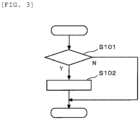
- Fig. 3 is a chart illustrating an example of a control flow by the controller in the rider-assistance system according to the embodiment of the present invention.
- the controller 51 repeatedly executes the control flow illustrated in Fig. 3 while the rider-assistance operation is valid and the straddle-type vehicle 100 travels.
- step S101 the determination section 52 in the controller 51 determines the necessity of the warning that is given to the rider of the straddle-type vehicle 100. If the determination section 52 determines that the warning is necessary, the processing proceeds to step S102. If not, the processing returns to step S101.
- step S102 the haptic motion performing section 53 in the controller 51 performs the haptic motion at least once to reduce or increase the acceleration/deceleration of the straddle-type vehicle 100 only for the moment.
- the haptic motion performing section 53 reduces or increases the acceleration/deceleration only for the moment by increasing or reducing the braking force on the wheel (the front wheel 3 or the rear wheel 4).
- the haptic motion performing section 53 changes the priorities of the front wheel 3 and the rear wheel 4 at the time of increasing/reducing the braking force according to the focusing direction that is the direction in which the rider should focus by the warning.
- the controller 51 includes: the determination section 52 that determines the necessity of the warning given to the rider of the straddle-type vehicle 100; and the haptic motion performing section 53 that performs the haptic motion at least once to reduce or increase the acceleration/deceleration of the straddle-type vehicle 100 only for the moment in the case where the determination section 52 determines that the warning is necessary.
- the haptic motion performing section 53 changes the priority of each of the wheels (the front wheel 3 or the rear wheel 4) at the time of changing the braking force to reduce or increase the acceleration/deceleration only for the moment in the haptic motion according to the focusing direction that is the direction in which the rider should focus by the warning.
- the rider who has perceived the haptic motion can roughly recognize the direction in which an object or an event to be focused is located from a difference in performance of the haptic motion. Therefore, it is possible to hasten identification of the object or the event to be focused by the rider.
- the difference in the performance of the haptic motion which is caused by the change in the priority, can further be recognized easily. Therefore, it is possible to reliably hasten the identification of the object or the event to be focused by the rider.
- the haptic motion performing section 53 sets the priority of the front wheel 3 to be higher than that of the rear wheel 4. With such control, the rider who has perceived the haptic motion can recognize that the object or the event to be focused is located in front. Thus, it is possible to hasten the identification of the object or the event to be focused by the rider.
- the haptic motion performing section 53 sets the priority of the rear wheel 4 to be higher than that of the front wheel 3. With such control, the rider who has perceived the haptic motion can recognize that the object or the event to be focused is located behind. Thus, it is possible to hasten the identification of the object or the event to be focused by the rider.
- the haptic motion performing section 53 sets the priority of the front wheel 3 to be higher than that of the rear wheel 4. With such control, the rider who has perceived the haptic motion performs the operation after focusing on the object or the event located in front at an early point. Thus, safety is improved.
Landscapes
- Engineering & Computer Science (AREA)
- Transportation (AREA)
- Mechanical Engineering (AREA)
- Automation & Control Theory (AREA)
- Human Computer Interaction (AREA)
- Regulating Braking Force (AREA)
- Traffic Control Systems (AREA)
- Control Of Driving Devices And Active Controlling Of Vehicle (AREA)
- Hydraulic Control Valves For Brake Systems (AREA)
Description
- The present invention relates to a controller and a control method for a rider-assistance system that is mounted to a straddle-type vehicle according to the preamble of
independent claims 1 and 15, respectively, as known fromWO 2018/185577 A1 . -
US 2016/090037 A1 discloses an approach notification device of a straddle type vehicle which can effectively notify a rider of an approaching state of an obstacle, the device including an obstacle detection device for detecting an obstacle located around a motorcycle as an vehicle, an approach determination device for detecting an approaching state that the obstacle is located within a predetermined distance from the vehicle, and a winker operation resistance increasing device for increasing operation resistance of a winker manipulator of a winker device provided in the vehicle. When the obstacle is determined to be within the predetermined distance by the approach determination device and the operation of the winker manipulator in the direction of the obstacle is detected, the winker operation resistance increasing device is operated to increase the operation resistance of the winker manipulator and vibrators located in a steering handle and a fuel tank are operated. -
WO 2019/087579 A1 discloses a saddled vehicle that imparts tactile stimulation to a rider using a technical idea different from that of imparting tactile stimulation via vibration of a conventional vibrating device. This saddled vehicle comprises a steering wheel and a tactile stimulation actuator. The steering wheel is supported by the vehicle body frame so as to be rotatable about the wheel axle. The steering wheel is steered to the left by means of the rider rotating the bar handle counterclockwise when viewed from above, and steered to the right by means of the rider rotating the bar handle clockwise when viewed from above. The tactile stimulation actuator transmits information to the rider by imparting, as tactile stimulation, forward or backward pressure to the left or right hand of the rider. - A technique of providing a warning to a rider of a straddle-type vehicle by haptic motion has been known. During travel of the straddle-type vehicle, a controller determines necessity of the warning. When determining that the warning is necessary, the controller performs the haptic motion at least once to reduce or increase acceleration/deceleration of the straddle-type vehicle only for a moment.
- PTL 1:
WO 2018/185577 - The conventional controllers perform the same haptic motion regardless of a type of the warning. Thus, after perceiving occurrence of the haptic motion, the rider himself/herself has to identify an object or an event that should be focused of many objects or events. In particular, compared to other vehicles (for example, an automobile, a truck, and the like), in the straddle-type vehicle, it is further difficult to assist with such identification by using an existing device (for example, an instrument panel, a speaker, or the like). Thus, there is a tendency that the identification of the object or the event to be focused delays.
- The present invention has been made in view of the above-described problem and therefore obtains a controller and a control method capable of hastening identification of an object or an event to be focused by a rider of a straddle-type vehicle, the rider having perceived haptic motion.
- A controller according to the present invention is a controller for a rider-assistance system that is mounted to a straddle-type vehicle including a front wheel and a rear wheel, and includes: a determination section that determines necessity of a warning that is given to a rider of the straddle-type vehicle during travel of the straddle-type vehicle; and a haptic motion performing section that performs haptic motion at least once to reduce or increase acceleration/deceleration of the straddle-type vehicle only for a moment in the case where the determination section determines that the warning is necessary. The haptic motion performing section changes a priority of each of the wheels at the time of changing a braking force to reduce or increase the acceleration/deceleration only for the moment in the haptic motion according to a focusing direction that is a direction in which the rider should focus by the warning.
- A control method according to the present invention is a control method for a rider-assistance system that is mounted to a straddle-type vehicle including a front wheel and a rear wheel, and includes: a determination step in which a determination section of a controller determines necessity of a warning that is given to a rider of the straddle-type vehicle during travel of the straddle-type vehicle; and a haptic motion performing step in which a haptic motion performing section of the controller performs haptic motion at least once to reduce or increase acceleration/deceleration of the straddle-type vehicle only for a moment in the case where it is determined in the determination step that the warning is necessary. In the haptic motion performing step, the haptic motion performing section changes a priority of each of the wheels at the time of changing a braking force to reduce or increase the acceleration/deceleration only for the moment in the haptic motion according to a focusing direction that is a direction in which the rider should focus by the warning.
- In the controller and the control method according to the present invention, the haptic motion performing section changes the priority of each of the wheels at the time of changing the braking force to reduce or increase the acceleration/deceleration only for the moment in the haptic motion according to the focusing direction that is the direction in which the rider should focus by the warning. With such control, the rider who has perceived the haptic motion can roughly recognize the direction in which an object or an event to be focused is located from a difference in performance of the haptic motion. Therefore, it is possible to hasten identification of the object or the event to be focused by the rider. In particular, in the straddle-type vehicle, due to a riding posture of the rider, the difference in the performance of the haptic motion, which is caused by the change in the priority, can further be recognized easily. Therefore, it is possible to reliably hasten the identification of the object or the event to be focused by the rider.
-
-
Fig. 1 is a view illustrating a mounted state of a rider-assistance system according to an embodiment of the present invention to a straddle-type vehicle. -
Fig. 2 is a diagram for illustrating a schematic configuration of the rider-assistance system according to the embodiment of the present invention. -
Fig. 3 is a chart illustrating an example of a control flow by a controller in the rider-assistance system according to the embodiment of the present invention. - A description will hereinafter be made on a rider-assistance system according to the present invention with reference to the drawings.
- A configuration, operation, and the like, which will be described below, merely constitute one example. The rider-assistance system according to the present invention is not limited to a case with such a configuration, such operation, and the like.
- For example, a description will hereinafter be made on a case where the rider-assistance system according to the present invention is used for a two-wheeled motor vehicle. However, the rider-assistance system according to the present invention may be used for a straddle-type vehicle other than the two-wheeled motor vehicle. The straddle-type vehicle means a vehicle that a rider straddles. Examples of the straddle-type vehicle are motorcycles (the two-wheeled motor vehicle and a three-wheeled motor vehicle), an all-terrain vehicle, and a bicycle. Examples of the motorcycle are a motorbike, a scooter, and an electric scooter. The bicycle means a vehicle capable of traveling forward on a road by a depression force applied to pedals by the rider. The bicycles include a normal bicycle, an electrically-assisted bicycle, an electric bicycle, and the like.
- The same or similar description will appropriately be simplified or will not be made below. In the drawings, the same or similar members or portions will be denoted by the same reference sign. In addition, a detailed structure will appropriately be illustrated in a simplified manner or will not be illustrated.
- In addition, "acceleration/deceleration" in the present invention is a concept expressed such that acceleration has a positive value and deceleration has a negative value. That is, such expression that the "acceleration/deceleration is reduced" in the present invention means a state where the acceleration is reduced or a state where the deceleration is increased. Meanwhile, such expression that the "acceleration/deceleration is increased" in the present invention means a state where the acceleration is increased or a state where the deceleration is reduced.
- A description will hereinafter be made on a rider-assistance system according to an embodiment.
- A description will be made on a configuration of the rider-assistance system according to the embodiment.
-
Fig. 1 is a view of a mounted state of the rider-assistance system according to the embodiment of the present invention to the straddle-type vehicle.Fig. 2 is a diagram for illustrating a schematic configuration of the rider-assistance system according to the embodiment of the present invention. - As illustrated in
Fig. 1 and Fig. 2 , a straddle-type vehicle 100 includes atrunk 1, ahandlebar 2 that is held by thetrunk 1 in a freely turnable manner, afront wheel 3 that is held by thetrunk 1 in a freely turnable manner with thehandlebar 2, a rear wheel 4 that is held by thetrunk 1 in a freely rotatable manner, abrake system 10, adrive system 20, and agearshift system 30. The straddle-type vehicle 100 also includes a rider-assistance system 50 that includes acontroller 51. - The
brake system 10 includes a front-wheel brake mechanism 11 for braking thefront wheel 3 and a rear-wheel brake mechanism 12 for braking the rear wheel 4. When the rider operates an input section (for example, a brake lever 13) that corresponds to the front-wheel brake mechanism 11, with a force corresponding to an operation amount thereof, a brake pad (not illustrated) in the front-wheel brake mechanism 11 is pressed against a rotor (not illustrated) that rotates with thefront wheel 3, and thefront wheel 3 is thereby braked. Meanwhile, when the rider operates an input section (for example, a brake pedal 14) that corresponds to the rear-wheel brake mechanism 12, with a force corresponding to an operation amount thereof, a brake pad (not illustrated) in the rear-wheel brake mechanism 12 is pressed against a rotor (not illustrated) that rotates with the rear wheel 4, and the rear wheel 4 is thereby braked. - The
controller 51 can separately control braking forces generated by the front-wheel brake mechanism 11 and the rear-wheel brake mechanism 12. For example, thecontroller 51 controls the brake pad in the front-wheel brake mechanism 11 to separate from the rotor, and can thereby reduce the braking force generated on thefront wheel 3. Meanwhile, thecontroller 51 controls the brake pad in the front-wheel brake mechanism 11 to be brought close to the rotor, and can thereby increase the braking force generated on thefront wheel 3. In addition, thecontroller 51 controls the brake pad in the rear-wheel brake mechanism 12 to separate from the rotor, and can thereby reduce the braking force generated on the rear wheel 4. Meanwhile, thecontroller 51 controls the brake pad in the rear-wheel brake mechanism 12 to be brought close to the rotor, and can thereby increase the braking force generated on the rear wheel 4. That is, thecontroller 51 can control acceleration/deceleration of the straddle-type vehicle 100 by controlling the braking forces generated on thefront wheel 3 and the rear wheel 4. Furthermore, thecontroller 51 can control distribution of changes in the braking forces generated on thefront wheel 3 and the rear wheel 4. - The
drive system 20 transmits output of a drive source (for example, an engine, a motor, or the like) 21 to thegearshift system 30. When the rider operates an input section (for example, an accelerator grip 22), output corresponding to an operation amount thereof is changed by thegearshift system 30 and transmitted to a drive wheel (for example, the rear wheel 4). - The
controller 51 can control the output of thedrive source 21 in thedrive system 20. For example, thecontroller 51 can increase/reduce the output of thedrive source 21 by controlling an opening degree of a throttle (not illustrated) . Thecontroller 51 can also generate the braking force (so-called engine braking) on the drive wheel by controlling the throttle to be closed. That is, thecontroller 51 can control the acceleration/deceleration of the straddle-type vehicle 100 by controlling the output of thedrive source 21. Thecontroller 51 can also control the braking force that is generated on the drive wheel. When controlling the distribution of the changes in the braking forces generated on thefront wheel 3 and the rear wheel 4, thecontroller 51 can control thedrive system 20 instead of or in addition to thebrake system 10. - The
controller 51 can control a gear ratio of thegearshift system 30. For example, thecontroller 51 can increase the gear ratio by executing control to step down a selected stage of amultistage gearshift mechanism 31. Here, in the case where the gear ratio is increased in a state where the throttle is closed, the braking force (the so-called engine braking) that is generated on the drive wheel is increased. In addition, thecontroller 51 can reduce the gear ratio by executing control to step up the selected stage of themultistage gearshift mechanism 31. Here, in the case where the gear ratio is reduced in the state where the throttle is closed, the braking force (the so-called engine braking) that is generated on the drive wheel is reduced. That is, thecontroller 51 can control the acceleration/deceleration of the straddle-type vehicle 100 by controlling the gear ratio of thegearshift system 30. Thecontroller 51 can also control the braking force that is generated on the drive wheel. When controlling the distribution of the changes in the braking forces generated on thefront wheel 3 and the rear wheel 4, thecontroller 51 can control thegearshift system 30 instead of or in addition to thebrake system 10. - The
controller 51 includes adetermination section 52 and a hapticmotion performing section 53. Thecontroller 51 may partially or entirely be constructed of a microcomputer, a microprocessor unit, or the like, may partially or entirely be constructed of a member in which firmware or the like can be updated, or may partially or entirely be a program module that is executed by a command from a CPU or the like, for example. Thecontroller 51 may be provided as one unit or may be divided into multiple units, for example. - The
determination section 52 determines necessity of a warning that is given to the rider of the straddle-type vehicle 100 during travel of the straddle-type vehicle 100. For example, thedetermination section 52 may determine the necessity of the warning on the basis of output of various sensors, each of which detects a state of the rider or each component of the straddle-type vehicle 100, may determine the necessity of the warning on the basis of output of a surrounding environment sensor that is mounted to the straddle-type vehicle 100, or may determine the necessity of the warning on the basis of information that is acquired via wireless communication with another vehicle or infrastructure equipment. - In the case where the
determination section 52 determines that the warning is necessary, the hapticmotion performing section 53 performs haptic motion at least once to reduce or increase the acceleration/deceleration of the straddle-type vehicle 100 only for a moment. The acceleration/deceleration after having been reduced or increased only for the moment may be equal to or may not be equal to the acceleration/deceleration prior to such reduction or increase. The hapticmotion performing section 53 reduces or increases the acceleration/deceleration only for the moment by increasing or reducing the braking force on the wheel (thefront wheel 3 or the rear wheel 4) . An increased/reduced amount, a grade of the increase/reduction, and an interval of the increase/reduction are each set to a value with which the rider can perceive generation of the warning. The haptic motion may be performed in a state where the braking force is generated on each of the wheels, or may be performed in a state where the braking force is generated on none of the wheels. - Here, the haptic
motion performing section 53 changes priorities of thefront wheel 3 and the rear wheel 4 at the time of increasing/reducing the braking force according to a focusing direction that is a direction in which the rider should focus by the warning. That is, the hapticmotion performing section 53 changes the priorities of thefront wheel 3 and the rear wheel 4 at the time of increasing/reducing the braking force according to a type of the warning that is given to the rider. - The haptic motion may be motion that changes the braking force of only one of the
front wheel 3 and the rear wheel 4, or may be motion that changes the braking forces of both of thefront wheel 3 and the rear wheel 4. In the case where the haptic motion is the motion that changes the braking force of only one of thefront wheel 3 and the rear wheel 4, the hapticmotion performing section 53 selects one of thefront wheel 3 and the rear wheel 4, the braking force of which is changed in the haptic motion, according to the focusing direction and thereby changes the priorities. Meanwhile, in the case where the haptic motion is the motion that changes the braking forces of both of thefront wheel 3 and the rear wheel 4, the hapticmotion performing section 53 changes allocation of the change in the braking force generated on thefront wheel 3 and the change in the braking force generated on the rear wheel 4 in the haptic motion according to the focusing direction, and thereby changes the priorities. - In the case where the warning, the necessity of which is determined by the
determination section 52, is a warning of an object or an event located in front of the straddle-type vehicle 100, the hapticmotion performing section 53 sets the priority of thefront wheel 3 to be higher than that of the rear wheel 4. That is, in the case where the haptic motion is the motion that changes the braking force of only one of thefront wheel 3 and the rear wheel 4, and thedetermination section 52 determines that the warning of the object or the event located in front of the straddle-type vehicle 100 is necessary, the hapticmotion performing section 53 performs the haptic motion to change the braking force of thefront wheel 3 only. Meanwhile, in the case where the haptic motion is the motion that changes the braking forces of both of thefront wheel 3 and the rear wheel 4, and thedetermination section 52 determines that the warning of the object or the event located in front of the straddle-type vehicle 100 is necessary, the hapticmotion performing section 53 performs the haptic motion in which the change in the braking force generated on thefront wheel 3 is larger than the change in the braking force generated on the rear wheel 4. - As an example, in the case where the warning, the necessity of which is determined by the
determination section 52, is a warning of a frontal collision that possibly occurs to the straddle-type vehicle 100 (for example, presence of an obstacle, moving out of an oncoming vehicle from a lane, or the like), the hapticmotion performing section 53 sets the priority of thefront wheel 3 to be higher than that of the rear wheel 4. That is, when thedetermination section 52 determines that there is a high possibility of the occurrence of the frontal collision to the straddle-type vehicle 100, the hapticmotion performing section 53 performs the haptic motion in which the priority of thefront wheel 3 is higher than that of the rear wheel 4. Thedetermination section 52 may determine the necessity of the warning of the frontal collision on the basis of output of a surrounding environment sensor that is mounted to the straddle-type vehicle 100, or may determine the necessity of the warning of the frontal collision on the basis of information that is acquired via wireless communication with another vehicle or infrastructure equipment. The hapticmotion performing section 53 preferably performs the haptic motion to reduce the acceleration/deceleration of the straddle-type vehicle 100 only for the moment. - As an example, in the case where the warning, the necessity of which is determined by the
determination section 52, is a warning of a traffic condition (for example, a traffic jam, an accident, or the like that occurs in an advancing direction of the straddle-type vehicle 100), the hapticmotion performing section 53 sets the priority of thefront wheel 3 to be higher than that of the rear wheel 4. That is, when thedetermination section 52 determines that the current traffic condition is a condition that the deceleration of the straddle-type vehicle 100 is possibly necessary, the hapticmotion performing section 53 performs the haptic motion in which the priority of thefront wheel 3 is higher than that of the rear wheel 4. Thedetermination section 52 may determine the necessity of the warning of the traffic condition on the basis of the output of the surrounding environment sensor that is mounted to the straddle-type vehicle 100, or may determine the necessity of the warning of the traffic condition on the basis of the information that is acquired via the wireless communication with the other vehicle or the infrastructure equipment. - As an example, in the case where the warning, the necessity of which is determined by the
determination section 52, is a warning of a traffic sign (for example, an upper limit speed, prohibition of entry, or the like), the hapticmotion performing section 53 sets the priority of thefront wheel 3 to be higher than that of the rear wheel 4. That is, when thedetermination section 52 determines presence of the traffic sign that has an impact on a driving operation of the straddle-type vehicle 100, the hapticmotion performing section 53 performs the haptic motion in which the priority of thefront wheel 3 is higher than that of the rear wheel 4. Thedetermination section 52 may determine the necessity of the warning of the traffic sign on the basis of the output of the surrounding environment sensor that is mounted to the straddle-type vehicle 100, or may determine the necessity of the warning of the traffic sign on the basis of the information that is acquired via the wireless communication with the other vehicle or the infrastructure equipment. - In the case where the warning, the necessity of which is determined by the
determination section 52, is a warning of an object or an event located behind the straddle-type vehicle 100, the hapticmotion performing section 53 sets the priority of the rear wheel 4 to be higher than that of thefront wheel 3. That is, in the case where the haptic motion is the motion that changes the braking force of only one of thefront wheel 3 and the rear wheel 4, and thedetermination section 52 determines that the warning of the object or the event located behind the straddle-type vehicle 100 is necessary, the hapticmotion performing section 53 performs the haptic motion to change the braking force of the rear wheel 4 only. Meanwhile, in the case where the haptic motion is the motion that changes the braking forces of both of thefront wheel 3 and the rear wheel 4, and thedetermination section 52 determines that the warning of the object or the event located behind the straddle-type vehicle 100 is necessary, the hapticmotion performing section 53 performs the haptic motion in which the change in the braking force generated on the rear wheel 4 is larger than the change in the braking force generated on thefront wheel 3. - As an example, in the case where the warning, the necessity of which is determined by the
determination section 52, is a warning of a rear collision that possibly occurs to the straddle-type vehicle 100 (for example, sudden approach of a following vehicle, tailgating by the following vehicle, or the like), the hapticmotion performing section 53 sets the priority of the rear wheel 4 to be higher than that of thefront wheel 3. That is, when thedetermination section 52 determines that there is a high possibility of the occurrence of the rear collision to the straddle-type vehicle 100, the hapticmotion performing section 53 performs the haptic motion in which the priority of the rear wheel 4 is higher than that of thefront wheel 3. Thedetermination section 52 may determine the necessity of the warning of the rear collision on the basis of the output of the surrounding environment sensor that is mounted to the straddle-type vehicle 100, or may determine the necessity of the warning of the rear collision on the basis of the information that is acquired via the wireless communication with the other vehicle or the infrastructure equipment. The hapticmotion performing section 53 preferably performs the haptic motion to increase the acceleration/deceleration of the straddle-type vehicle 100 only for the moment. - As an example, in the case where the warning, the necessity of which is determined by the
determination section 52, is a warning of travel of another vehicle that is located obliquely behind the straddle-type vehicle 100 (for example, parallel travel of a vehicle that travels in an adjacent lane, passing by the vehicle, or the like), the hapticmotion performing section 53 sets the priority of the rear wheel 4 to be higher than that of thefront wheel 3. That is, when thedetermination section 52 determines that the other vehicle travels obliquely behind, the hapticmotion performing section 53 performs the haptic motion in which the priority of the rear wheel 4 is higher than that of thefront wheel 3. Thedetermination section 52 may determine the necessity of the warning of the other vehicle located obliquely behind on the basis of the output of the surrounding environment sensor that is mounted to the straddle-type vehicle 100, or may determine the necessity of the warning of the other vehicle located obliquely behind on the basis of the information that is acquired via the wireless communication with the other vehicle or the infrastructure equipment. - In the case where the warning, the necessity of which is determined by the
determination section 52, is a warning that urges the rider to perform an operation, the hapticmotion performing section 53 sets the priority of thefront wheel 3 to be higher than that of the rear wheel 4. That is, in the case where the haptic motion is the motion that changes the braking force of only one of thefront wheel 3 and the rear wheel 4, and thedetermination section 52 determines that the warning is necessary to urge the rider to perform the operation, the hapticmotion performing section 53 performs the haptic motion to change the braking force of thefront wheel 3 only. Meanwhile, in the case where the haptic motion is the motion that changes the braking forces of both of thefront wheel 3 and the rear wheel 4, and thedetermination section 52 determines that the warning is necessary to urge the rider to perform the operation, the hapticmotion performing section 53 performs the haptic motion in which the change in the braking force generated on thefront wheel 3 is larger than the change in the braking force generated on the rear wheel 4. - As an example, in the case where the warning, the necessity of which is determined by the
determination section 52, is a warning that urges the rider to perform a driving operation (for example, acceleration/deceleration, turning, or the like) of the straddle-type vehicle 100, the hapticmotion performing section 53 sets the priority of thefront wheel 3 to be higher than that of the rear wheel 4. That is, when thedetermination section 52 determines that it is necessary to urge the rider to perform the driving operation, the hapticmotion performing section 53 performs the haptic motion in which the priority of thefront wheel 3 is higher than that of the rear wheel 4. For example, thedetermination section 52 may determine the necessity of the warning that urges the driving operation on the basis of output of various sensors, each of which detects a state of the rider or each component of the straddle-type vehicle 100, may determine the necessity of the warning that urges the driving operation on the basis of the output of the surrounding environment sensor that is mounted to the straddle-type vehicle 100, or may determine the necessity of the warning that urges the driving operation on the basis of the information that is acquired via the wireless communication with the other vehicle or the infrastructure equipment. - As an example, in the case where the warning, the necessity of which is determined by the
determination section 52, is a warning that urges the rider to perform a setting operation (for example, ON/OFF of the device or a function, switching of a mode, a parameter change, or the like) of the straddle-type vehicle 100, the hapticmotion performing section 53 sets the priority of thefront wheel 3 to be higher than that of the rear wheel 4. That is, when thedetermination section 52 determines that it is necessary to urge the rider to perform the setting operation, the hapticmotion performing section 53 performs the haptic motion in which the priority of thefront wheel 3 is higher than that of the rear wheel 4. For example, thedetermination section 52 may determine the necessity of the warning that urges the setting operation on the basis of the output of the various sensors, each of which detects the state of the rider or each of the components of the straddle-type vehicle 100, may determine the necessity of the warning that urges the setting operation on the basis of the output of the surrounding environment sensor that is mounted to the straddle-type vehicle 100, or may determine the necessity of the warning that urges the setting operation on the basis of the information that is acquired via the wireless communication with the other vehicle or the infrastructure equipment. - A description will be made on operation of the rider-assistance system according to the embodiment.
-
Fig. 3 is a chart illustrating an example of a control flow by the controller in the rider-assistance system according to the embodiment of the present invention. - The
controller 51 repeatedly executes the control flow illustrated inFig. 3 while the rider-assistance operation is valid and the straddle-type vehicle 100 travels. - In step S101, the
determination section 52 in thecontroller 51 determines the necessity of the warning that is given to the rider of the straddle-type vehicle 100. If thedetermination section 52 determines that the warning is necessary, the processing proceeds to step S102. If not, the processing returns to step S101. - In step S102, the haptic
motion performing section 53 in thecontroller 51 performs the haptic motion at least once to reduce or increase the acceleration/deceleration of the straddle-type vehicle 100 only for the moment. The hapticmotion performing section 53 reduces or increases the acceleration/deceleration only for the moment by increasing or reducing the braking force on the wheel (thefront wheel 3 or the rear wheel 4). Here, the hapticmotion performing section 53 changes the priorities of thefront wheel 3 and the rear wheel 4 at the time of increasing/reducing the braking force according to the focusing direction that is the direction in which the rider should focus by the warning. - A description will be made on effects of the rider-assistance system according to the embodiment.
- In the rider-
assistance system 50, thecontroller 51 includes: thedetermination section 52 that determines the necessity of the warning given to the rider of the straddle-type vehicle 100; and the hapticmotion performing section 53 that performs the haptic motion at least once to reduce or increase the acceleration/deceleration of the straddle-type vehicle 100 only for the moment in the case where thedetermination section 52 determines that the warning is necessary. The hapticmotion performing section 53 changes the priority of each of the wheels (thefront wheel 3 or the rear wheel 4) at the time of changing the braking force to reduce or increase the acceleration/deceleration only for the moment in the haptic motion according to the focusing direction that is the direction in which the rider should focus by the warning. With such control, the rider who has perceived the haptic motion can roughly recognize the direction in which an object or an event to be focused is located from a difference in performance of the haptic motion. Therefore, it is possible to hasten identification of the object or the event to be focused by the rider. In particular, in the straddle-type vehicle 100, due to a riding posture of the rider, the difference in the performance of the haptic motion, which is caused by the change in the priority, can further be recognized easily. Therefore, it is possible to reliably hasten the identification of the object or the event to be focused by the rider. - Preferably, in the case where the warning is the warning of the object or the event located in front of the traveling straddle-
type vehicle 100, in the haptic motion, the hapticmotion performing section 53 sets the priority of thefront wheel 3 to be higher than that of the rear wheel 4. With such control, the rider who has perceived the haptic motion can recognize that the object or the event to be focused is located in front. Thus, it is possible to hasten the identification of the object or the event to be focused by the rider. - Preferably, in the case where the warning is the warning of the object or the event located behind the traveling straddle-
type vehicle 100, in the haptic motion, the hapticmotion performing section 53 sets the priority of the rear wheel 4 to be higher than that of thefront wheel 3. With such control, the rider who has perceived the haptic motion can recognize that the object or the event to be focused is located behind. Thus, it is possible to hasten the identification of the object or the event to be focused by the rider. - Preferably, in the case where the warning is the warning that urges the rider to perform the operation, in the haptic motion, the haptic
motion performing section 53 sets the priority of thefront wheel 3 to be higher than that of the rear wheel 4. With such control, the rider who has perceived the haptic motion performs the operation after focusing on the object or the event located in front at an early point. Thus, safety is improved. - The description has been made so far on the embodiment. However, the present invention is not limited to the description of the embodiment. For example, the embodiment may only partially be implemented. Furthermore, for example, another step may be added to the control flow illustrated in
Fig. 3 . -
- 1: Trunk
- 2: Handlebar
- 3: Front wheel
- 4: Rear wheel
- 10: Brake system
- 11: Front-wheel brake mechanism
- 12: Rear-wheel brake mechanism
- 13: Brake lever
- 14: Brake pedal
- 20: Drive system
- 21: Drive source
- 22: Accelerator grip
- 30: Gearshift system
- 31: Multistage gearshift mechanism
- 50: Rider-assistance system
- 51: Controller
- 52: Determination section
- 53: Haptic motion performing section
- 100: Straddle-type vehicle
Claims (15)
- A controller (51) for a rider-assistance system (50) that is mounted to a straddle-type vehicle (100) including a front wheel (3) and a rear wheel (4), the controller comprising:a determination section (52) that determines necessity of a warning that is given to a rider of the straddle-type vehicle (100) during travel of said straddle-type vehicle (100); anda haptic motion performing section (53) that performs haptic motion at least once to reduce or increase acceleration/deceleration of the straddle-type vehicle (100) only for a moment in the case where the determination section (52) determines that the warning is necessary, whereinthe haptic motion performing section (53) changes a priority of each of the wheels at the time of changing a braking force to reduce or increase the acceleration/deceleration only for the moment in the haptic motion;characterized in thatthe priority of each of the wheels is changed according to a focusing direction that is a direction in which the rider should focus by the warning.
- The controller according to claim 1, whereinthe haptic motion is motion that changes the braking force of only one of the front wheel (3) and the rear wheel (4), andthe haptic motion performing section (53) selects one of the front wheel (3) and the rear wheel (4), the braking force of which is to be changed in the haptic motion, according to the focusing direction and thereby changes the priority.
- The controller according to claim 1, whereinthe haptic motion is motion that changes the braking forces of both of the front wheel (3) and the rear wheel (4), andthe haptic motion performing section (53) changes allocation of a change in the braking force generated on the front wheel (3) and a change in the braking force generated on the rear wheel (4) in the haptic motion according to the focusing direction, and thereby changes the priority.
- The controller according to any one of claims 1 to 3, wherein
in the case where the warning is a warning of an object or an event located in front of the traveling straddle-type vehicle (100), in the haptic motion, the haptic motion performing section (53) sets the priority of the front wheel (3) to be higher than that of the rear wheel (4). - The controller according to claim 4, wherein
the object or the event located in front is a frontal collision that possibly occurs to the straddle-type vehicle (100) . - The controller according to claim 4, wherein
the object or the event located in front is a traffic condition. - The controller according to claim 4, wherein
the object or the event located in front is a traffic sign. - The controller according to any one of claims 1 to 7, wherein
in the case where the warning is a warning of an object or an event located behind the traveling straddle-type vehicle (100), in the haptic motion, the haptic motion performing section (53) sets the priority of the rear wheel (4) to be higher than that of the front wheel (3). - The controller according to claim 8, wherein
the object or the event located behind is a rear collision that possibly occurs to the straddle-type vehicle (100). - The controller according to claim 8, wherein
the object or the event located behind is travel of another vehicle that is located obliquely behind the straddle-type vehicle (100). - The controller according to any one of claims 1 to 10, wherein
in the case where the warning is a warning that urges the rider to perform an operation, in the haptic motion, the haptic motion performing section (53) sets the priority of the front wheel (3) to be higher than that of the rear wheel (4) . - The controller according to claim 11, wherein
the operation is a driving operation of the straddle-type vehicle (100). - The controller according to claim 11, wherein
the operation is a setting operation of the straddle-type vehicle (100). - The controller according to any one of claims 1 to 13, wherein
in the haptic motion, the haptic motion performing section (53) controls at least one of a brake system (10), a drive system (20), and a gearshift system (30) of the straddle-type vehicle (100) so as to change the braking force. - A control method for a rider-assistance system (50) that is mounted to a straddle-type vehicle (100) including a front wheel (3) and a rear wheel (4), the control method comprising:a determination step (S101) in which a determination section (52) of a controller (51) determines necessity of a warning that is given to a rider of the straddle-type vehicle (100) during travel of said straddle-type vehicle (100); anda haptic motion performing step (S102) in which a haptic motion performing section (53) of the controller (51) performs haptic motion at least once to reduce or increase acceleration/deceleration of the straddle-type vehicle (100) only for a moment in the case where it is determined in the determination step (S101) that the warning is necessary, whereinin the haptic motion performing step (S102), the haptic motion performing section (53) changes a priority of each of the wheels at the time of changing a braking force to reduce or increase the acceleration/deceleration only for the moment in the haptic motioncharacterized in that
the priority of each of the wheels is changed according to a focusing direction that is a direction in which the rider should focus by the warning.
Applications Claiming Priority (2)
| Application Number | Priority Date | Filing Date | Title |
|---|---|---|---|
| JP2020023368A JP2021128591A (en) | 2020-02-14 | 2020-02-14 | Control device and control method |
| PCT/IB2021/050849 WO2021161135A1 (en) | 2020-02-14 | 2021-02-03 | Controller and control method for a rider-assistance system on a straddle-type vehicle |
Publications (2)
| Publication Number | Publication Date |
|---|---|
| EP4105091A1 EP4105091A1 (en) | 2022-12-21 |
| EP4105091B1 true EP4105091B1 (en) | 2024-12-11 |
Family
ID=74853675
Family Applications (1)
| Application Number | Title | Priority Date | Filing Date |
|---|---|---|---|
| EP21709466.3A Active EP4105091B1 (en) | 2020-02-14 | 2021-02-03 | Controller and control method for a rider-assistance system on a straddle-type vehicle |
Country Status (5)
| Country | Link |
|---|---|
| US (1) | US12090981B2 (en) |
| EP (1) | EP4105091B1 (en) |
| JP (2) | JP2021128591A (en) |
| CN (1) | CN115052794B (en) |
| WO (1) | WO2021161135A1 (en) |
Families Citing this family (3)
| Publication number | Priority date | Publication date | Assignee | Title |
|---|---|---|---|---|
| JP2021127069A (en) * | 2020-02-17 | 2021-09-02 | ロベルト・ボッシュ・ゲゼルシャフト・ミト・ベシュレンクテル・ハフツングRobert Bosch Gmbh | Control device and control method |
| JP2023093986A (en) * | 2021-12-23 | 2023-07-05 | ロベルト・ボッシュ・ゲゼルシャフト・ミト・ベシュレンクテル・ハフツング | Control device and control method |
| JP7601920B2 (en) * | 2023-01-30 | 2024-12-17 | 本田技研工業株式会社 | Saddle-type vehicle |
Family Cites Families (14)
| Publication number | Priority date | Publication date | Assignee | Title |
|---|---|---|---|---|
| JP5228716B2 (en) * | 2007-10-04 | 2013-07-03 | 日産自動車株式会社 | Information presentation system |
| JP5820591B2 (en) * | 2011-02-14 | 2015-11-24 | 本田技研工業株式会社 | Motorcycle brake equipment |
| CN106415078B (en) * | 2014-01-23 | 2018-04-17 | 株式会社F.C.C. | Straddle-type vehicle |
| JP6410509B2 (en) * | 2014-08-04 | 2018-10-24 | 株式会社エフ・シー・シー | Saddle riding |
| JP5972332B2 (en) * | 2014-09-26 | 2016-08-17 | 本田技研工業株式会社 | Approach notification device for saddle riding type vehicles |
| JP6214601B2 (en) * | 2015-07-27 | 2017-10-18 | 本田技研工業株式会社 | Automatic braking system for saddle-ride type vehicles |
| JP2017132363A (en) * | 2016-01-28 | 2017-08-03 | ローベルト ボッシュ ゲゼルシャフト ミット ベシュレンクテル ハフツング | Brake system control device for motorcycle, brake system for motorcycle, and control method for brake system for motorcycle |
| JP6181798B1 (en) * | 2016-03-31 | 2017-08-16 | 本田技研工業株式会社 | Saddle-type vehicle travel status notification device and straddle-type vehicle travel status detection device |
| US10029683B1 (en) * | 2017-01-25 | 2018-07-24 | Harley-Davidson Motor Company Group, LLC | Saddle-ride vehicle with autonomous braking and method of operating same |
| JP2018176861A (en) * | 2017-04-06 | 2018-11-15 | ローベルト ボッシュ ゲゼルシャフト ミット ベシュレンクテル ハフツング | Control device, control method and brake system |
| CA3079092A1 (en) * | 2017-11-02 | 2019-05-09 | Damon Motors Inc. | Anticipatory motorcycle safety system |
| WO2019087579A1 (en) * | 2017-11-02 | 2019-05-09 | ヤマハ発動機株式会社 | Saddled vehicle |
| JP7270346B2 (en) * | 2018-07-24 | 2023-05-10 | ロベルト・ボッシュ・ゲゼルシャフト・ミト・ベシュレンクテル・ハフツング | Control device and control method |
| JP7259356B2 (en) * | 2019-01-28 | 2023-04-18 | スズキ株式会社 | Control device and electric vehicle |
-
2020
- 2020-02-14 JP JP2020023368A patent/JP2021128591A/en active Pending
-
2021
- 2021-02-03 WO PCT/IB2021/050849 patent/WO2021161135A1/en not_active Ceased
- 2021-02-03 US US17/797,611 patent/US12090981B2/en active Active
- 2021-02-03 EP EP21709466.3A patent/EP4105091B1/en active Active
- 2021-02-03 JP JP2021577712A patent/JP7320089B2/en active Active
- 2021-02-03 CN CN202180014396.3A patent/CN115052794B/en active Active
Also Published As
| Publication number | Publication date |
|---|---|
| EP4105091A1 (en) | 2022-12-21 |
| CN115052794A (en) | 2022-09-13 |
| JPWO2021161135A1 (en) | 2021-08-19 |
| CN115052794B (en) | 2025-04-11 |
| US12090981B2 (en) | 2024-09-17 |
| US20230060955A1 (en) | 2023-03-02 |
| JP7320089B2 (en) | 2023-08-02 |
| WO2021161135A1 (en) | 2021-08-19 |
| JP2021128591A (en) | 2021-09-02 |
Similar Documents
| Publication | Publication Date | Title |
|---|---|---|
| JP7482226B2 (en) | Control device for straddle-type vehicle, rider support system, and control method for straddle-type vehicle | |
| EP4105091B1 (en) | Controller and control method for a rider-assistance system on a straddle-type vehicle | |
| EP4108528B1 (en) | Control device and control method | |
| US12097855B2 (en) | Controller and control method for operation of motorcycle | |
| JP7531400B2 (en) | Processing device and processing method for a rider support system of a saddle-ride type vehicle, rider support system of a saddle-ride type vehicle, and saddle-ride type vehicle | |
| EP3819179B1 (en) | Controller and control method for driver-assistance system used in motorcycle, and driver-assistance system used in motorcycle | |
| JP7656048B2 (en) | Device and method for controlling lean vehicle behavior | |
| JP7592717B2 (en) | Control device for straddle-type vehicle, rider support system, and control method for straddle-type vehicle | |
| JP7498572B2 (en) | Control device and control method | |
| EP4501727A1 (en) | Control device and control method for saddle riding type vehicle | |
| JP7656039B2 (en) | Control device and control method | |
| WO2024147051A1 (en) | Control device and control method | |
| JP7783976B2 (en) | Device and method for controlling the behavior of a saddle-ride type vehicle | |
| EP4014779B1 (en) | Helmet, rider support system, and control method | |
| EP4596349A1 (en) | Control device for saddled vehicle rider assistance system, and control method | |
| WO2024153997A1 (en) | Control device and control method | |
| JP2024166968A (en) | Control device and control method | |
| WO2024224186A1 (en) | Control device and control method | |
| WO2025125963A1 (en) | Control device and control method | |
| WO2024154029A1 (en) | Control device and control method | |
| WO2024213952A1 (en) | Control device and control method |
Legal Events
| Date | Code | Title | Description |
|---|---|---|---|
| STAA | Information on the status of an ep patent application or granted ep patent |
Free format text: STATUS: UNKNOWN |
|
| STAA | Information on the status of an ep patent application or granted ep patent |
Free format text: STATUS: THE INTERNATIONAL PUBLICATION HAS BEEN MADE |
|
| PUAI | Public reference made under article 153(3) epc to a published international application that has entered the european phase |
Free format text: ORIGINAL CODE: 0009012 |
|
| STAA | Information on the status of an ep patent application or granted ep patent |
Free format text: STATUS: REQUEST FOR EXAMINATION WAS MADE |
|
| 17P | Request for examination filed |
Effective date: 20220914 |
|
| AK | Designated contracting states |
Kind code of ref document: A1 Designated state(s): AL AT BE BG CH CY CZ DE DK EE ES FI FR GB GR HR HU IE IS IT LI LT LU LV MC MK MT NL NO PL PT RO RS SE SI SK SM TR |
|
| DAV | Request for validation of the european patent (deleted) | ||
| DAX | Request for extension of the european patent (deleted) | ||
| GRAP | Despatch of communication of intention to grant a patent |
Free format text: ORIGINAL CODE: EPIDOSNIGR1 |
|
| STAA | Information on the status of an ep patent application or granted ep patent |
Free format text: STATUS: GRANT OF PATENT IS INTENDED |
|
| RIC1 | Information provided on ipc code assigned before grant |
Ipc: B60T 8/1755 20060101ALI20240503BHEP Ipc: B60T 8/32 20060101ALI20240503BHEP Ipc: B60T 7/22 20060101ALI20240503BHEP Ipc: B60T 8/26 20060101ALI20240503BHEP Ipc: B60T 8/17 20060101AFI20240503BHEP |
|
| INTG | Intention to grant announced |
Effective date: 20240604 |
|
| GRAS | Grant fee paid |
Free format text: ORIGINAL CODE: EPIDOSNIGR3 |
|
| GRAA | (expected) grant |
Free format text: ORIGINAL CODE: 0009210 |
|
| STAA | Information on the status of an ep patent application or granted ep patent |
Free format text: STATUS: THE PATENT HAS BEEN GRANTED |
|
| AK | Designated contracting states |
Kind code of ref document: B1 Designated state(s): AL AT BE BG CH CY CZ DE DK EE ES FI FR GB GR HR HU IE IS IT LI LT LU LV MC MK MT NL NO PL PT RO RS SE SI SK SM TR |
|
| REG | Reference to a national code |
Ref country code: GB Ref legal event code: FG4D |
|
| REG | Reference to a national code |
Ref country code: CH Ref legal event code: EP |
|
| REG | Reference to a national code |
Ref country code: IE Ref legal event code: FG4D |
|
| REG | Reference to a national code |
Ref country code: DE Ref legal event code: R096 Ref document number: 602021023245 Country of ref document: DE |
|
| REG | Reference to a national code |
Ref country code: LT Ref legal event code: MG9D |
|
| PG25 | Lapsed in a contracting state [announced via postgrant information from national office to epo] |
Ref country code: HR Free format text: LAPSE BECAUSE OF FAILURE TO SUBMIT A TRANSLATION OF THE DESCRIPTION OR TO PAY THE FEE WITHIN THE PRESCRIBED TIME-LIMIT Effective date: 20241211 |
|
| PG25 | Lapsed in a contracting state [announced via postgrant information from national office to epo] |
Ref country code: FI Free format text: LAPSE BECAUSE OF FAILURE TO SUBMIT A TRANSLATION OF THE DESCRIPTION OR TO PAY THE FEE WITHIN THE PRESCRIBED TIME-LIMIT Effective date: 20241211 |
|
| PG25 | Lapsed in a contracting state [announced via postgrant information from national office to epo] |
Ref country code: BG Free format text: LAPSE BECAUSE OF FAILURE TO SUBMIT A TRANSLATION OF THE DESCRIPTION OR TO PAY THE FEE WITHIN THE PRESCRIBED TIME-LIMIT Effective date: 20241211 |
|
| REG | Reference to a national code |
Ref country code: NL Ref legal event code: MP Effective date: 20241211 |
|
| PG25 | Lapsed in a contracting state [announced via postgrant information from national office to epo] |
Ref country code: ES Free format text: LAPSE BECAUSE OF FAILURE TO SUBMIT A TRANSLATION OF THE DESCRIPTION OR TO PAY THE FEE WITHIN THE PRESCRIBED TIME-LIMIT Effective date: 20241211 |
|
| PG25 | Lapsed in a contracting state [announced via postgrant information from national office to epo] |
Ref country code: NO Free format text: LAPSE BECAUSE OF FAILURE TO SUBMIT A TRANSLATION OF THE DESCRIPTION OR TO PAY THE FEE WITHIN THE PRESCRIBED TIME-LIMIT Effective date: 20250311 |
|
| PG25 | Lapsed in a contracting state [announced via postgrant information from national office to epo] |
Ref country code: LV Free format text: LAPSE BECAUSE OF FAILURE TO SUBMIT A TRANSLATION OF THE DESCRIPTION OR TO PAY THE FEE WITHIN THE PRESCRIBED TIME-LIMIT Effective date: 20241211 Ref country code: GR Free format text: LAPSE BECAUSE OF FAILURE TO SUBMIT A TRANSLATION OF THE DESCRIPTION OR TO PAY THE FEE WITHIN THE PRESCRIBED TIME-LIMIT Effective date: 20250312 |
|
| PG25 | Lapsed in a contracting state [announced via postgrant information from national office to epo] |
Ref country code: RS Free format text: LAPSE BECAUSE OF FAILURE TO SUBMIT A TRANSLATION OF THE DESCRIPTION OR TO PAY THE FEE WITHIN THE PRESCRIBED TIME-LIMIT Effective date: 20250311 |
|
| PG25 | Lapsed in a contracting state [announced via postgrant information from national office to epo] |
Ref country code: NL Free format text: LAPSE BECAUSE OF FAILURE TO SUBMIT A TRANSLATION OF THE DESCRIPTION OR TO PAY THE FEE WITHIN THE PRESCRIBED TIME-LIMIT Effective date: 20241211 |
|
| REG | Reference to a national code |
Ref country code: AT Ref legal event code: MK05 Ref document number: 1750169 Country of ref document: AT Kind code of ref document: T Effective date: 20241211 |
|
| PG25 | Lapsed in a contracting state [announced via postgrant information from national office to epo] |
Ref country code: SM Free format text: LAPSE BECAUSE OF FAILURE TO SUBMIT A TRANSLATION OF THE DESCRIPTION OR TO PAY THE FEE WITHIN THE PRESCRIBED TIME-LIMIT Effective date: 20241211 |
|
| PG25 | Lapsed in a contracting state [announced via postgrant information from national office to epo] |
Ref country code: PL Free format text: LAPSE BECAUSE OF FAILURE TO SUBMIT A TRANSLATION OF THE DESCRIPTION OR TO PAY THE FEE WITHIN THE PRESCRIBED TIME-LIMIT Effective date: 20241211 |
|
| PGFP | Annual fee paid to national office [announced via postgrant information from national office to epo] |
Ref country code: DE Payment date: 20250422 Year of fee payment: 5 |
|
| PG25 | Lapsed in a contracting state [announced via postgrant information from national office to epo] |
Ref country code: IS Free format text: LAPSE BECAUSE OF FAILURE TO SUBMIT A TRANSLATION OF THE DESCRIPTION OR TO PAY THE FEE WITHIN THE PRESCRIBED TIME-LIMIT Effective date: 20250411 |
|
| PG25 | Lapsed in a contracting state [announced via postgrant information from national office to epo] |
Ref country code: PT Free format text: LAPSE BECAUSE OF FAILURE TO SUBMIT A TRANSLATION OF THE DESCRIPTION OR TO PAY THE FEE WITHIN THE PRESCRIBED TIME-LIMIT Effective date: 20250411 |
|
| PG25 | Lapsed in a contracting state [announced via postgrant information from national office to epo] |
Ref country code: EE Free format text: LAPSE BECAUSE OF FAILURE TO SUBMIT A TRANSLATION OF THE DESCRIPTION OR TO PAY THE FEE WITHIN THE PRESCRIBED TIME-LIMIT Effective date: 20241211 |
|
| PG25 | Lapsed in a contracting state [announced via postgrant information from national office to epo] |
Ref country code: RO Free format text: LAPSE BECAUSE OF FAILURE TO SUBMIT A TRANSLATION OF THE DESCRIPTION OR TO PAY THE FEE WITHIN THE PRESCRIBED TIME-LIMIT Effective date: 20241211 Ref country code: AT Free format text: LAPSE BECAUSE OF FAILURE TO SUBMIT A TRANSLATION OF THE DESCRIPTION OR TO PAY THE FEE WITHIN THE PRESCRIBED TIME-LIMIT Effective date: 20241211 |
|
| PG25 | Lapsed in a contracting state [announced via postgrant information from national office to epo] |
Ref country code: SK Free format text: LAPSE BECAUSE OF FAILURE TO SUBMIT A TRANSLATION OF THE DESCRIPTION OR TO PAY THE FEE WITHIN THE PRESCRIBED TIME-LIMIT Effective date: 20241211 |
|
| PG25 | Lapsed in a contracting state [announced via postgrant information from national office to epo] |
Ref country code: CZ Free format text: LAPSE BECAUSE OF FAILURE TO SUBMIT A TRANSLATION OF THE DESCRIPTION OR TO PAY THE FEE WITHIN THE PRESCRIBED TIME-LIMIT Effective date: 20241211 |
|
| PG25 | Lapsed in a contracting state [announced via postgrant information from national office to epo] |
Ref country code: SE Free format text: LAPSE BECAUSE OF FAILURE TO SUBMIT A TRANSLATION OF THE DESCRIPTION OR TO PAY THE FEE WITHIN THE PRESCRIBED TIME-LIMIT Effective date: 20241211 |
|
| REG | Reference to a national code |
Ref country code: DE Ref legal event code: R097 Ref document number: 602021023245 Country of ref document: DE |
|
| PG25 | Lapsed in a contracting state [announced via postgrant information from national office to epo] |
Ref country code: MC Free format text: LAPSE BECAUSE OF FAILURE TO SUBMIT A TRANSLATION OF THE DESCRIPTION OR TO PAY THE FEE WITHIN THE PRESCRIBED TIME-LIMIT Effective date: 20241211 |
|
| REG | Reference to a national code |
Ref country code: CH Ref legal event code: PL |
|
| PG25 | Lapsed in a contracting state [announced via postgrant information from national office to epo] |
Ref country code: DK Free format text: LAPSE BECAUSE OF FAILURE TO SUBMIT A TRANSLATION OF THE DESCRIPTION OR TO PAY THE FEE WITHIN THE PRESCRIBED TIME-LIMIT Effective date: 20241211 |
|
| PG25 | Lapsed in a contracting state [announced via postgrant information from national office to epo] |
Ref country code: LU Free format text: LAPSE BECAUSE OF NON-PAYMENT OF DUE FEES Effective date: 20250203 |
|
| PLBE | No opposition filed within time limit |
Free format text: ORIGINAL CODE: 0009261 |
|
| STAA | Information on the status of an ep patent application or granted ep patent |
Free format text: STATUS: NO OPPOSITION FILED WITHIN TIME LIMIT |
|
| PG25 | Lapsed in a contracting state [announced via postgrant information from national office to epo] |
Ref country code: CH Free format text: LAPSE BECAUSE OF NON-PAYMENT OF DUE FEES Effective date: 20250228 |
|
| 26N | No opposition filed |
Effective date: 20250912 |
|
| GBPC | Gb: european patent ceased through non-payment of renewal fee |
Effective date: 20250311 |
|
| REG | Reference to a national code |
Ref country code: BE Ref legal event code: MM Effective date: 20250228 |
|
| PG25 | Lapsed in a contracting state [announced via postgrant information from national office to epo] |
Ref country code: GB Free format text: LAPSE BECAUSE OF NON-PAYMENT OF DUE FEES Effective date: 20250311 |
|
| PG25 | Lapsed in a contracting state [announced via postgrant information from national office to epo] |
Ref country code: FR Free format text: LAPSE BECAUSE OF NON-PAYMENT OF DUE FEES Effective date: 20250211 |
|
| PG25 | Lapsed in a contracting state [announced via postgrant information from national office to epo] |
Ref country code: BE Free format text: LAPSE BECAUSE OF NON-PAYMENT OF DUE FEES Effective date: 20250228 |
|
| PG25 | Lapsed in a contracting state [announced via postgrant information from national office to epo] |
Ref country code: IE Free format text: LAPSE BECAUSE OF NON-PAYMENT OF DUE FEES Effective date: 20250203 |
|
| PGFP | Annual fee paid to national office [announced via postgrant information from national office to epo] |
Ref country code: IT Payment date: 20260227 Year of fee payment: 6 |