EP4103879B1 - System providing functional lighting through an opaque finish - Google Patents
System providing functional lighting through an opaque finish Download PDFInfo
- Publication number
- EP4103879B1 EP4103879B1 EP21754555.7A EP21754555A EP4103879B1 EP 4103879 B1 EP4103879 B1 EP 4103879B1 EP 21754555 A EP21754555 A EP 21754555A EP 4103879 B1 EP4103879 B1 EP 4103879B1
- Authority
- EP
- European Patent Office
- Prior art keywords
- apertures
- light
- optical elements
- modifier
- diversely
- Prior art date
- Legal status (The legal status is an assumption and is not a legal conclusion. Google has not performed a legal analysis and makes no representation as to the accuracy of the status listed.)
- Active
Links
Images




Classifications
-
- F—MECHANICAL ENGINEERING; LIGHTING; HEATING; WEAPONS; BLASTING
- F21—LIGHTING
- F21S—NON-PORTABLE LIGHTING DEVICES; SYSTEMS THEREOF; VEHICLE LIGHTING DEVICES SPECIALLY ADAPTED FOR VEHICLE EXTERIORS
- F21S43/00—Signalling devices specially adapted for vehicle exteriors, e.g. brake lamps, direction indicator lights or reversing lights
- F21S43/20—Signalling devices specially adapted for vehicle exteriors, e.g. brake lamps, direction indicator lights or reversing lights characterised by refractors, transparent cover plates, light guides or filters
- F21S43/2605—Refractors
-
- F—MECHANICAL ENGINEERING; LIGHTING; HEATING; WEAPONS; BLASTING
- F21—LIGHTING
- F21S—NON-PORTABLE LIGHTING DEVICES; SYSTEMS THEREOF; VEHICLE LIGHTING DEVICES SPECIALLY ADAPTED FOR VEHICLE EXTERIORS
- F21S43/00—Signalling devices specially adapted for vehicle exteriors, e.g. brake lamps, direction indicator lights or reversing lights
- F21S43/20—Signalling devices specially adapted for vehicle exteriors, e.g. brake lamps, direction indicator lights or reversing lights characterised by refractors, transparent cover plates, light guides or filters
- F21S43/26—Refractors, transparent cover plates, light guides or filters not provided in groups F21S43/235 - F21S43/255
-
- B—PERFORMING OPERATIONS; TRANSPORTING
- B60—VEHICLES IN GENERAL
- B60Q—ARRANGEMENT OF SIGNALLING OR LIGHTING DEVICES, THE MOUNTING OR SUPPORTING THEREOF OR CIRCUITS THEREFOR, FOR VEHICLES IN GENERAL
- B60Q1/00—Arrangement of optical signalling or lighting devices, the mounting or supporting thereof or circuits therefor
- B60Q1/26—Arrangement of optical signalling or lighting devices, the mounting or supporting thereof or circuits therefor the devices being primarily intended to indicate the vehicle, or parts thereof, or to give signals, to other traffic
- B60Q1/2607—Arrangement of optical signalling or lighting devices, the mounting or supporting thereof or circuits therefor the devices being primarily intended to indicate the vehicle, or parts thereof, or to give signals, to other traffic comprising at least two indicating lamps
-
- F—MECHANICAL ENGINEERING; LIGHTING; HEATING; WEAPONS; BLASTING
- F21—LIGHTING
- F21S—NON-PORTABLE LIGHTING DEVICES; SYSTEMS THEREOF; VEHICLE LIGHTING DEVICES SPECIALLY ADAPTED FOR VEHICLE EXTERIORS
- F21S41/00—Illuminating devices specially adapted for vehicle exteriors, e.g. headlamps
- F21S41/20—Illuminating devices specially adapted for vehicle exteriors, e.g. headlamps characterised by refractors, transparent cover plates, light guides or filters
- F21S41/28—Cover glass
-
- F—MECHANICAL ENGINEERING; LIGHTING; HEATING; WEAPONS; BLASTING
- F21—LIGHTING
- F21S—NON-PORTABLE LIGHTING DEVICES; SYSTEMS THEREOF; VEHICLE LIGHTING DEVICES SPECIALLY ADAPTED FOR VEHICLE EXTERIORS
- F21S41/00—Illuminating devices specially adapted for vehicle exteriors, e.g. headlamps
- F21S41/20—Illuminating devices specially adapted for vehicle exteriors, e.g. headlamps characterised by refractors, transparent cover plates, light guides or filters
- F21S41/2805—Cover glass
-
- F—MECHANICAL ENGINEERING; LIGHTING; HEATING; WEAPONS; BLASTING
- F21—LIGHTING
- F21S—NON-PORTABLE LIGHTING DEVICES; SYSTEMS THEREOF; VEHICLE LIGHTING DEVICES SPECIALLY ADAPTED FOR VEHICLE EXTERIORS
- F21S43/00—Signalling devices specially adapted for vehicle exteriors, e.g. brake lamps, direction indicator lights or reversing lights
- F21S43/10—Signalling devices specially adapted for vehicle exteriors, e.g. brake lamps, direction indicator lights or reversing lights characterised by the light source
- F21S43/13—Signalling devices specially adapted for vehicle exteriors, e.g. brake lamps, direction indicator lights or reversing lights characterised by the light source characterised by the type of light source
- F21S43/14—Light emitting diodes [LED]
-
- F—MECHANICAL ENGINEERING; LIGHTING; HEATING; WEAPONS; BLASTING
- F21—LIGHTING
- F21S—NON-PORTABLE LIGHTING DEVICES; SYSTEMS THEREOF; VEHICLE LIGHTING DEVICES SPECIALLY ADAPTED FOR VEHICLE EXTERIORS
- F21S43/00—Signalling devices specially adapted for vehicle exteriors, e.g. brake lamps, direction indicator lights or reversing lights
- F21S43/20—Signalling devices specially adapted for vehicle exteriors, e.g. brake lamps, direction indicator lights or reversing lights characterised by refractors, transparent cover plates, light guides or filters
- F21S43/255—Filters
-
- F—MECHANICAL ENGINEERING; LIGHTING; HEATING; WEAPONS; BLASTING
- F21—LIGHTING
- F21S—NON-PORTABLE LIGHTING DEVICES; SYSTEMS THEREOF; VEHICLE LIGHTING DEVICES SPECIALLY ADAPTED FOR VEHICLE EXTERIORS
- F21S43/00—Signalling devices specially adapted for vehicle exteriors, e.g. brake lamps, direction indicator lights or reversing lights
- F21S43/20—Signalling devices specially adapted for vehicle exteriors, e.g. brake lamps, direction indicator lights or reversing lights characterised by refractors, transparent cover plates, light guides or filters
- F21S43/281—Materials thereof; Structures thereof; Properties thereof; Coatings thereof
-
- F—MECHANICAL ENGINEERING; LIGHTING; HEATING; WEAPONS; BLASTING
- F21—LIGHTING
- F21S—NON-PORTABLE LIGHTING DEVICES; SYSTEMS THEREOF; VEHICLE LIGHTING DEVICES SPECIALLY ADAPTED FOR VEHICLE EXTERIORS
- F21S43/00—Signalling devices specially adapted for vehicle exteriors, e.g. brake lamps, direction indicator lights or reversing lights
- F21S43/50—Signalling devices specially adapted for vehicle exteriors, e.g. brake lamps, direction indicator lights or reversing lights characterised by aesthetic components not otherwise provided for, e.g. decorative trim, partition walls or covers
-
- F—MECHANICAL ENGINEERING; LIGHTING; HEATING; WEAPONS; BLASTING
- F21—LIGHTING
- F21W—INDEXING SCHEME ASSOCIATED WITH SUBCLASSES F21K, F21L, F21S and F21V, RELATING TO USES OR APPLICATIONS OF LIGHTING DEVICES OR SYSTEMS
- F21W2103/00—Exterior vehicle lighting devices for signalling purposes
- F21W2103/20—Direction indicator lights
-
- F—MECHANICAL ENGINEERING; LIGHTING; HEATING; WEAPONS; BLASTING
- F21—LIGHTING
- F21W—INDEXING SCHEME ASSOCIATED WITH SUBCLASSES F21K, F21L, F21S and F21V, RELATING TO USES OR APPLICATIONS OF LIGHTING DEVICES OR SYSTEMS
- F21W2103/00—Exterior vehicle lighting devices for signalling purposes
- F21W2103/35—Brake lights
Definitions
- This invention relates to lighting. More specifically, the invention relates to providing functional illumination through opaque components.
- DE 10 2018 002 721 A1 discloses a lighting system, particularly a vehicle taillight system according to the preamble of claim 1.
- This document shows the basic principle of such a system having a light source directed into a plurality of optical elements on a first side that faces the light source and an opaque or translucent covering on an opposite side, a plurality of apertures being formed in the opaque or translucent covering, and the plurality of optical elements being configured to direct light through each of the plurality of apertures, respectively.
- the apertures can be configured to yield graphical presentations of different patterns, designs, logos, symbols, numbers, letters or surface effects or even photographic illustrations.
- DE 197 53 762 A1 discloses a lighting system, particularly a vehicle taillight system also making use of the basic principle of focusing light by means of optical elements into apertures of an opaque covering. Similar solutions are known from US 4 241 388 A , WO 2019/158890 A1 , US 2018/149907 A1 , US 2008/030990 A1 , US 3 487 206 A , and EP 0 081 361 A1 .
- Embodiments include a system having a light source directed into a light modifier where a plurality of optical elements on the side of the modifier that facing the light source. An opaque or translucent covering on an opposite side of the modifier and a plurality of diversely-configured apertures located on the opposite side of the modifier.
- each aperture has a width, and the plurality of diversely-configured optical elements configured to direct light through each of the plurality of diversely-configured apertures for the purpose of accomplishing a lighting application.
- the apertures are slots, holes, or other shapes.
- the aperture is a hole, and the optical element is configured to focus on an area or point in the hole.
- a first of the plurality of apertures is a slot, and a first optical element in the plurality of optical elements is a flute configured to focus through the slot; and a second of the plurality of apertures is a hole, and a second optical element in the plurality of optical elements is configured to focus through the hole.
- the light source and light modifier are incorporated into a vehicle light.
- the vehicle light is a signal light.
- the plurality of optical elements and apertures enable a first mode wherein the light source is active and light is transmitted through the plurality of apertures and a second dark mode wherein the modifier creates a solid appearance.
- the solid appearance can be is metallic, e.g., resemble brushed aluminum.
- the plurality of optical elements and apertures include diverse patterns creating different optical effects at different locations on the modifier.
- the plurality of slots includes at least one curved slot
- the plurality of optical elements includes at least one curved flute following the curved slot, the curved flute being configured to emit light through the curved slot.
- the optical elements form concentric circles and the apertures are formed as concentric circles on the opposite side of the modifier.
- the optical elements and apertures form an upper portion of a taillight and are colored red configured to operate as a brake light.
- the optical elements and apertures can also be S-shaped.
- the optical elements and apertures form a central yellow colored portion of the system and are configured to operate as a turn signal.
- the aperture widths can be in the range of 10-250 microns; in the range of 10-100 microns; less than 20 microns; or about 63 microns.
- apertures means an opening formed through something. The term should not, without being further defined in the claims, be construed as requiring any particular shape.
- the outside opaque surface finish could be a paint (e.g., metallic, non-metallic, fully opaque, semi-transparent, etc.), a hard coating (e.g., UV hard coats, or numerous other protective coatings), a combination of a coating or paint, or any other opaque substance.
- a paint e.g., metallic, non-metallic, fully opaque, semi-transparent, etc.
- a hard coating e.g., UV hard coats, or numerous other protective coatings
- a combination of a coating or paint e.g., any other opaque substance.
- FIG. 1 is a perspective view of the exterior of the lighting unit, e.g., for use on a vehicle as a taillight system.
- a face 102 of the unit includes an upper concentric circular arrangement 104, a middle curved arrangement 106, and a lower diverse arrangement portion 108.
- the upper arrangement 104 is used to execute a stop lighting function
- the middle arrangement 106 is used to execute a turn/blinker function
- the lower arrangement 108 is used to execute a tail function.
- the FIG. 1 embodiment also includes an outwardly-angled side portion 110.
- the face 102 and angled side 110 are, in embodiments, designed to conform into a local and general automobile configuration.
- the top concentric-circular arrangement 104 is substantially occluded, but includes a plurality of concentrically-circular slots 112 used to transmit light, as will be discussed hereinafter. Each circular slot is separated from the next by concentric-circular opaque portions 115.
- the circular slots 112 and occluded portions 144 can be formed in a variety of ways.
- the lens is molded of clear material, and then masked with the occlusive portions via printing or the use of a molded mask.
- the complete unit both of outside face 102 and angled side 110
- the deposited material at the locations of slots 112 can be etched away (according to known processes) to provide the selected transparency.
- the lens material upon which opaque material is deposited can be formed of a functional color such that once the slots are formed, there is a match, e.g., the lens for the upper radial pattern 104 and the lower pattern 108 could be colored red (for stop and tail functions), whereas the lens material for the middle portion 106 could be formed of yellow material in order to execute a turn function.
- the coloration could be created by depositing transparent coatings on the slits (or holes) created.
- the reverse side of the top radial arrangement 104 can be seen in FIG. 2 , which reveals a perspective view from the inside of the bezel/lens arrangement for the taillight embodiment of FIG. 1 .
- the optical arrangement 114 extends out from an inside surface 120 of the housing in the form of a plurality of radiating flutes 122. Also extending out from the inside surface 120 are middle and lower optical arrangements 116 and 118, configured to focus light through the slits and/or apertures existing in the curved middle and diverse lower arrangements 106 and 108.
- Each of the flutes extends in line with and is centered over each radial slot 112.
- each flute 122 is optically rendered to focus light to create a line in the space defined by each slot 112.
- FIG. 3 is a representation of cross-sectional 3-3 (see FIG. 1 ) taken to some depth into the housing behind the lamp 100.
- a collimated source of light 202 is provided to the optical arrangement 122. More specifically, light is generated, in the FIG. 3 embodiment, using one or more LEDs 204 mounted on a substrate 206 (e.g., PCB). As those skilled in the art will be aware, LEDs typically emit light in a Lambertian pattern 208.
- a Fresnel lens 210 is fixed into the light housing using securement means 212 (but could be fixed in any number of ways) having a center axis in alignment with the center emission axis of the LED 204.
- the light 202 is modified using the optical elements 122 (e.g., circular flute-like elements). More specifically, each optical element 122 is focused such that the light passes through the slots 112 (or apertures depending on the embodiment).
- FIG. 4 is a front view of the upper arrangement 104.
- FIG. 4 shows a front view of the radial pattern revealing slots 112 through which focused light is emitted.
- the widths of the slots 112 are wide enough to allow for the focused passage of light, but minimized such that from a reasonable distance, the slot-including arrangement 104 (when not illuminated) appears the same as the surrounding portions 102 of the unit which are fully painted.
- the lamp allows for functional lighting by passing the light through the slots 112.
- FIG. 5 is a reproduction of a portion of Sectional 3-3 blown up to show more detail regarding the fluted optical elements, and how they focus the collimated light through the slots (or apertures).
- the boundaries 502 of a collimated portion of light emitted from the one or more LEDs is introduced into each optical element 122.
- the element then converges the light (see narrowing boundaries 504) towards a focal point 506.
- Focal point 506 for each optical element is located substantially at a point centered in the gap (slot) created between each of the occluding circles (appearing in rectangular cross section in FIG. 5 ).
- focal point 506 the light then diverges outward according to a boundary 508. This enables the light to be utilized to, e.g., signal, indicate a condition, or any other function.
- the middle arrangement 106 shown in FIG. 1 includes S-shaped slots 124 (or gaps) made inside corresponding S-shaped occluding strips 126.
- a corresponding S-shaped optical element 128 e.g., flute
- each corresponding S-shaped optical element 128 on the back focuses collimated light received through the middle of the gap.
- the middle arrangement is able to perform designated functionality (e.g., turn functions).
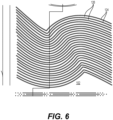
- FIG. 6 is a front view of these S-shaped patterns shown from the front (from the same side as the perspective view of FIG. 1 ).
- the operation of the middle arrangement 106 is very similar to what is described for the upper arrangement 104. More specifically, the broken out magnified cross section shown in FIG. 5 would be equally accurate for a similar broken out section taken from Section 3'-3' taken from the middle arrangement 106 in FIG. 1 .
- the focal point instead of the focal point of the optical elements being a substantial circle, the focal point would be S-shaped.
- FIG. 7A reveals a view from an inside vehicle light chamber 700 where a plurality of point-focused optical elements 702 (pillow-shaped in the disclosed embodiment) are provided with a collimated source of light 703. Each of optical elements 702 is focused on a corresponding aperture in a group of apertures 704.
- the broken out view of FIG. 7B shows how these apertures 704 appear on the front of the occlusive paint 706.
- the apertures 704 are made into a substantially occlusive paint or coating 706 as the paint is being deposited onto the forward face 708 of the lens 710, could be etched out of the painted portions after painting (or coating), or could be created by numerous other methods.
- a single optical element 702a can be seen having a focal point 712 existing substantially at a center of corresponding aperture 704a.
- Each of apertures 704 are sized to be nearly invisible when viewed from a reasonable distance, and the result is that the outer overall appearance of paint 706 (coating) is one of substantial homogeneity (the visibility of the apertures is minimized). Because the light 703 introduced to the optical elements 702 is focused to pass through the apertures 704, the area in which the apertures exist will provide functional lighting for any number of applications.
- FIG. 8A shows a diverse arrangement including both apertures and slots and flutes and pillow optical elements.
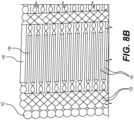
- FIG. 8B shows an opposite side of breakout portion 8B (shown in FIG. 8A ).
- the two views enable the matching up of apertures (from plurality 130) and slots (from plurality 132) with various point-focused optical elements 138 and line-focused optical elements 140 (e.g., flutes and pillows), respectively.
- a point-focused optical element 142 is focused on a center of an aperture 144 (see FIG. 8A ) in the embodiments shown ( FIGs. 1 , 2 , 8A and 8B ).
- line-focused optical elements 146 and 148 are focused on lines 150 and 152 in FIG. 8A .
- the focused light is allowed through the apertures 130 and slots 132 to allow for functional lighting, while when the light is not in use, the overall appearance appears as a solid continuous representation of the opaque finish, whatever that finish is (e.g., could be metallic).
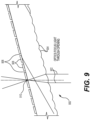
- FIG. 9 shows a cross section of an angled portion 900 of a lens which has been configured to have slots or apertures made therethrough.
- the FIG. 9 arrangement might be incorporated into the angled side of lens 110 (see FIG. 1 ).
- collimated light 902 is encountered by a plurality of optical elements 904, each of which is associated with either an aperture, slot, or some other opening 906 configured into the opaque material 908 existing on the lens.
- the optical elements 904 focus the collimated light towards a point 910 existing in the center of the opening created.
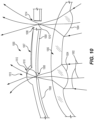
- FIG. 10 shows a cross section for an additional embodiment 1000.
- a source of collimated light 1002 is acted on by a plurality of optical elements 1004 existing on the side of an interior first lens 1005 closest to the light source (not shown).
- An outer second lens 1007 is located outside the first lens 1005 relative to the light source.
- a plurality of apertures (slots, holes) 1006 are made into an opaque coating/paint 1008 that is disposed on the interior surface 1009 of the outer lens 1007.
- the collimated light acted on by the optical elements 1004 of the first lens 1005 is focused on an area or point 1010 inside the aperture 1006.
- a plurality of optical elements 1012 further operate to control the light (e.g., create spread, diffuse, focus, etc.).
- a simple bare opening arrangement 1014 can be utilized to merely pass the light through.
- arrangement 1014 discloses the second lens material at the hole 1006 removed, it is also possible that the transparent material not be removed, but that the hole is created only by the removal of the opaque paint at that location.
- FIG. 10 embodiment shows both aperture arrangements 1013 and 1014 in the same figure, embodiments could exist where all the apertures have optical elements (e.g., like arrangement 1013), or where all of the apertures are like the one shown for the simple opening arrangement 1014.
- each of the slots, holes, and other disclosed light-allowing apertures have been chosen to allow the focused light there through, but the widths are at the same time minimized such that from a reasonable distance (or even close up in some instances), the occluded (or filtering) coating portions will appear as uniform (e.g., metalized in some embodiments; e.g., brushed aluminum) when the lamp is not illuminated. In other embodiments, the occluded (or filtered) coating portions are configured to blend into the surrounding areas of the vehicle when the lamp is off. Regardless, the arrangement appears to be substantially uniform. For slots, the widths would be the distance across the aperture. For holes, the width is herein interpreted as the diameter of the aperture.
- the widths are sized to create the desired appearance (albeit illusory) of uniformity (or homogeneity).
- the widths would be in the range of 10-250 microns. In more specific embodiments, the widths would be in the 10-100 micron range. In other embodiments, where greater uniformity is a priority, an artisan might size the widths to be less than 20 microns, a level at which apparent coating homogeneity is maintained even near vantagepoints. In some other embodiments, width sizing of about 63 microns is ideal for the purpose of conforming with an off the shelf optical element configuration. Regardless, embodiments should not be limited to any particular aperture width size unless otherwise specified in the claims.
Landscapes
- Engineering & Computer Science (AREA)
- General Engineering & Computer Science (AREA)
- Physics & Mathematics (AREA)
- Microelectronics & Electronic Packaging (AREA)
- Optics & Photonics (AREA)
- Mechanical Engineering (AREA)
- Non-Portable Lighting Devices Or Systems Thereof (AREA)
- Optical Elements Other Than Lenses (AREA)
Description
- This invention relates to lighting. More specifically, the invention relates to providing functional illumination through opaque components.
- It is known in the art to incorporate light blocking or filtering with a vehicle indicator or other lights. See, e.g.,
U.S. Patent Nos. 4,835,666 issued to Feger et al. ;5,555,492 issued to Feger ; and6,533,439 issued to Duflos et al. For example, the earlier Feger publication shows the use of an internal carrier disc that includes lenses intended to refract a maximum of the light emitted by the lamp through gaps created through opaque stripes. When the lamp is dark, the stripes create a diffuse effect, and the hue of the glass cover is reinforced by making it darker. The later Feger publication and the Duflos publication each disclose light filtering arrangements that take collimated light sources and then use optical elements to accomplish different objectives.DE 10 2018 002 721 A1 discloses a lighting system, particularly a vehicle taillight system according to the preamble of claim 1. This document shows the basic principle of such a system having a light source directed into a plurality of optical elements on a first side that faces the light source and an opaque or translucent covering on an opposite side, a plurality of apertures being formed in the opaque or translucent covering, and the plurality of optical elements being configured to direct light through each of the plurality of apertures, respectively. According to this document, the apertures can be configured to yield graphical presentations of different patterns, designs, logos, symbols, numbers, letters or surface effects or even photographic illustrations.DE 197 53 762 A1 discloses a lighting system, particularly a vehicle taillight system also making use of the basic principle of focusing light by means of optical elements into apertures of an opaque covering. Similar solutions are known fromUS 4 241 388 A ,WO 2019/158890 A1 ,US 2018/149907 A1 ,US 2008/030990 A1 ,US 3 487 206 A , andEP 0 081 361 A1 - This summary is provided to introduce a selection of concepts in a simplified form that are further described below in the detailed description. This summary is not intended to identify key features or essential features of the claimed subject matter, nor is it intended to be used to limit the scope of the claimed subject matter. Other aspects and advantages will be apparent from the following detailed description of the embodiments and the accompanying drawing figures.
- The present invention provides a vehicle taillight system according to claim 1. Embodiments include a system having a light source directed into a light modifier where a plurality of optical elements on the side of the modifier that facing the light source. An opaque or translucent covering on an opposite side of the modifier and a plurality of diversely-configured apertures located on the opposite side of the modifier. In embodiments, each aperture has a width, and the plurality of diversely-configured optical elements configured to direct light through each of the plurality of diversely-configured apertures for the purpose of accomplishing a lighting application.
- In some embodiments, the apertures are slots, holes, or other shapes. In yet other embodiments, the aperture is a hole, and the optical element is configured to focus on an area or point in the hole. In other embodiments a first of the plurality of apertures is a slot, and a first optical element in the plurality of optical elements is a flute configured to focus through the slot; and a second of the plurality of apertures is a hole, and a second optical element in the plurality of optical elements is configured to focus through the hole.
- In embodiments, the light source and light modifier are incorporated into a vehicle light. In more specific embodiments the vehicle light is a signal light. In some embodiments, the plurality of optical elements and apertures enable a first mode wherein the light source is active and light is transmitted through the plurality of apertures and a second dark mode wherein the modifier creates a solid appearance. The solid appearance can be is metallic, e.g., resemble brushed aluminum. In embodiments the plurality of optical elements and apertures include diverse patterns creating different optical effects at different locations on the modifier.
- According to the present invention, the plurality of slots includes at least one curved slot, and the plurality of optical elements includes at least one curved flute following the curved slot, the curved flute being configured to emit light through the curved slot. In embodiments, the optical elements form concentric circles and the apertures are formed as concentric circles on the opposite side of the modifier. In embodiments, the optical elements and apertures form an upper portion of a taillight and are colored red configured to operate as a brake light. The optical elements and apertures can also be S-shaped. In embodiments, the optical elements and apertures form a central yellow colored portion of the system and are configured to operate as a turn signal.
- In terms of size, the aperture widths can be in the range of 10-250 microns; in the range of 10-100 microns; less than 20 microns; or about 63 microns.
- The foregoing and other features and advantages will be apparent from the more particular description of preferred embodiments, as illustrated in the accompanying drawings, in which like reference characters refer to the same parts throughout the different views. The drawings are not necessarily to scale, emphasis instead being placed upon illustrating the principles of the preferred embodiments. In the drawings, the sizes and thicknesses of layers, regions, objects and features may be exaggerated for clarity.
-
FIG. 1 shows a perspective view of an exterior side of a bezel/lens arrangement for a tail-light embodiment; -
FIG. 2 shows a perspective view from the inside of the bezel/lens arrangement for the taillight embodiment ofFIG. 1 ; -
FIG. 3 is a cross-sectional view for an embodiment of the overall illumination system, including the components providing collimated light for supporting the radial pattern portion of the bezel/lens arrangement ofFIGs. 1 and2 ; -
FIG. 4 shows a front view of the radial pattern revealing slots through which focused light is emitted; -
FIG. 5 is a section functional view showing focusing of light through the openings in the opaque material deposited; -
FIG. 6 shows a front view of the squiggle/S-shaped (free form) pattern shown in the perspective view ofFIG. 1 ; -
FIG. 7A reveals a view from inside a vehicle light chamber where optical elements are focused on apertures, which can be seen inFIG. 7B which is a broken out view from the outside of the light; -
FIG. 8A shows the lower pattern fromFIG. 1 where slot arrangements are combined with apertures made through the opaque material to create a desired pattern; -
FIG. 8B shows an opposite side ofbreakout portion 8B revealing the optics established behind the slots and apertures; -
FIG. 9 shows a cross section of an angled portion of a lens which has been configured to have slots or apertures made therethrough; and -
FIG. 10 shows a cross section of an additional alternative dual-lens embodiment using slots or apertures made therethrough. - Disclosed are a system and a method for creating functional lighting through a seemingly opaque surface finish. While remaining substantially opaque, optical elements formed on the back of a lens focus light into apertures, which might be slots or holes formed into the opaque finish allowing passage therethrough to accomplish numerous functional, ornamental, as well as other objectives. The term "aperture" as used herein means an opening formed through something. The term should not, without being further defined in the claims, be construed as requiring any particular shape.
- The outside opaque surface finish could be a paint (e.g., metallic, non-metallic, fully opaque, semi-transparent, etc.), a hard coating (e.g., UV hard coats, or numerous other protective coatings), a combination of a coating or paint, or any other opaque substance. The terms "opaque" or "opacity" referred to hereinafter in general should be consider as also including arrangements where an item is substantially opaque, and even moderately opaque in some circumstances. The opaque substance discussed is merely meant as indication of opacity relative to some other thing, e.g., an opening or relatively transparent portion.
- A first embodiment of a lighting arrangement including a particular lens (bezel) is shown in
FIG. 1. FIG. 1 is a perspective view of the exterior of the lighting unit, e.g., for use on a vehicle as a taillight system. Aface 102 of the unit includes an upper concentriccircular arrangement 104, a middle curved arrangement 106, and a lowerdiverse arrangement portion 108. In embodiments, theupper arrangement 104 is used to execute a stop lighting function, the middle arrangement 106 is used to execute a turn/blinker function, and thelower arrangement 108 is used to execute a tail function. Those skilled in the art will recognize, however, that these technologies could be used for numerous other kinds of lighting applications, functional, ornamental, or otherwise, and theFIG. 1 version should not be considered in any way limiting. - The
FIG. 1 embodiment also includes an outwardly-angled side portion 110. Theface 102 andangled side 110 are, in embodiments, designed to conform into a local and general automobile configuration. - The top concentric-
circular arrangement 104 is substantially occluded, but includes a plurality of concentrically-circular slots 112 used to transmit light, as will be discussed hereinafter. Each circular slot is separated from the next by concentric-circularopaque portions 115. Thecircular slots 112 and occluded portions 144 can be formed in a variety of ways. In one embodiment, the lens is molded of clear material, and then masked with the occlusive portions via printing or the use of a molded mask. In other embodiments, the complete unit (both ofoutside face 102 and angled side 110) can be completely masked by a painting or printing process, then the deposited material at the locations ofslots 112 can be etched away (according to known processes) to provide the selected transparency. Additionally, the lens material upon which opaque material is deposited can be formed of a functional color such that once the slots are formed, there is a match, e.g., the lens for the upperradial pattern 104 and thelower pattern 108 could be colored red (for stop and tail functions), whereas the lens material for the middle portion 106 could be formed of yellow material in order to execute a turn function. Alternatively, the coloration could be created by depositing transparent coatings on the slits (or holes) created. - The reverse side of the top
radial arrangement 104 can be seen inFIG. 2 , which reveals a perspective view from the inside of the bezel/lens arrangement for the taillight embodiment ofFIG. 1 . Theoptical arrangement 114 extends out from aninside surface 120 of the housing in the form of a plurality of radiatingflutes 122. Also extending out from theinside surface 120 are middle and loweroptical arrangements lower arrangements 106 and 108. Each of the flutes extends in line with and is centered over eachradial slot 112. In the topoptical arrangement 104, eachflute 122 is optically rendered to focus light to create a line in the space defined by eachslot 112. - In embodiments, it is desirable to provide collimated light for supporting the radial pattern portions of the bezel/lens arrangement shown in
FIGs. 1 and2 .FIG. 3 is a representation of cross-sectional 3-3 (seeFIG. 1 ) taken to some depth into the housing behind thelamp 100. Referring toFIG. 3 , it can be seen how a collimated source oflight 202 is provided to theoptical arrangement 122. More specifically, light is generated, in theFIG. 3 embodiment, using one ormore LEDs 204 mounted on a substrate 206 (e.g., PCB). As those skilled in the art will be aware, LEDs typically emit light in aLambertian pattern 208. In order to createcollimated source 202, aFresnel lens 210 is fixed into the light housing using securement means 212 (but could be fixed in any number of ways) having a center axis in alignment with the center emission axis of theLED 204. Once collimated, the light 202 is modified using the optical elements 122 (e.g., circular flute-like elements). More specifically, eachoptical element 122 is focused such that the light passes through the slots 112 (or apertures depending on the embodiment). - The
slots 112 and occludingcircles 115 can be seen in greater detail inFIG. 4 , which is a front view of theupper arrangement 104.FIG. 4 shows a front view of the radialpattern revealing slots 112 through which focused light is emitted. The widths of theslots 112 are wide enough to allow for the focused passage of light, but minimized such that from a reasonable distance, the slot-including arrangement 104 (when not illuminated) appears the same as the surroundingportions 102 of the unit which are fully painted. At the same time, the lamp allows for functional lighting by passing the light through theslots 112. -
FIG. 5 is a reproduction of a portion of Sectional 3-3 blown up to show more detail regarding the fluted optical elements, and how they focus the collimated light through the slots (or apertures). Referring to the figure, it can be seen that theboundaries 502 of a collimated portion of light emitted from the one or more LEDs is introduced into eachoptical element 122. The element then converges the light (see narrowing boundaries 504) towards afocal point 506.Focal point 506 for each optical element is located substantially at a point centered in the gap (slot) created between each of the occluding circles (appearing in rectangular cross section inFIG. 5 ). Afterfocal point 506, the light then diverges outward according to aboundary 508. This enables the light to be utilized to, e.g., signal, indicate a condition, or any other function. - The middle arrangement 106 shown in
FIG. 1 includes S-shaped slots 124 (or gaps) made inside corresponding S-shaped occluding strips 126. In looking atFIG. 2 , it can be seen that a corresponding S-shaped optical element 128 (e.g., flute) follows exactly and is centered over each slot shown on the opposite side inFIG. 1 . And all along the length of each S-shapedslot 124, each corresponding S-shapedoptical element 128 on the back focuses collimated light received through the middle of the gap. Thus, like with thetop arrangement 104, the middle arrangement is able to perform designated functionality (e.g., turn functions). -
FIG. 6 is a front view of these S-shaped patterns shown from the front (from the same side as the perspective view ofFIG. 1 ). The operation of the middle arrangement 106 is very similar to what is described for theupper arrangement 104. More specifically, the broken out magnified cross section shown inFIG. 5 would be equally accurate for a similar broken out section taken from Section 3'-3' taken from the middle arrangement 106 inFIG. 1 . Here, however, instead of the focal point of the optical elements being a substantial circle, the focal point would be S-shaped. - It should be noted, that although the embodiments discussed so far are directed to circular (arrangement 104) or S-shaped (arrangement 106) lines, in other embodiments optical elements are used to focus light through apertures formed in opaque paints or coatings to accomplish similar functional objectives. For example,
FIG. 7A reveals a view from an inside vehiclelight chamber 700 where a plurality of point-focused optical elements 702 (pillow-shaped in the disclosed embodiment) are provided with a collimated source oflight 703. Each ofoptical elements 702 is focused on a corresponding aperture in a group ofapertures 704. The broken out view ofFIG. 7B shows how theseapertures 704 appear on the front of theocclusive paint 706. Theapertures 704 are made into a substantially occlusive paint orcoating 706 as the paint is being deposited onto theforward face 708 of thelens 710, could be etched out of the painted portions after painting (or coating), or could be created by numerous other methods. - A single
optical element 702a can be seen having afocal point 712 existing substantially at a center of corresponding aperture 704a. Each ofapertures 704 are sized to be nearly invisible when viewed from a reasonable distance, and the result is that the outer overall appearance of paint 706 (coating) is one of substantial homogeneity (the visibility of the apertures is minimized). Because the light 703 introduced to theoptical elements 702 is focused to pass through theapertures 704, the area in which the apertures exist will provide functional lighting for any number of applications. - Returning again to the embodiment shown in
FIGs. 1 and2 , it can be seen that in abottom arrangement 108, a diverse arrangement including both apertures and slots and flutes and pillow optical elements is disclosed. The details of this arrangement can be seen better inFIG. 8A where a plurality ofslots 132 are incorporated into theoccluded areas 133, along with a plurality ofapertures 130.FIG. 8B shows an opposite side ofbreakout portion 8B (shown inFIG. 8A ). The two views (FIG. 8A and8B ) enable the matching up of apertures (from plurality 130) and slots (from plurality 132) with various point-focusedoptical elements 138 and line-focused optical elements 140 (e.g., flutes and pillows), respectively. For example, a point-focused optical element 142 (seeFIG. 8B ) is focused on a center of an aperture 144 (seeFIG. 8A ) in the embodiments shown (FIGs. 1 ,2 ,8A and8B ). Similarly, line-focusedoptical elements 146 and 148 (seeFIG. 8B ) are focused onlines FIG. 8A . Thus, the focused light is allowed through theapertures 130 andslots 132 to allow for functional lighting, while when the light is not in use, the overall appearance appears as a solid continuous representation of the opaque finish, whatever that finish is (e.g., could be metallic). -
FIG. 9 shows a cross section of anangled portion 900 of a lens which has been configured to have slots or apertures made therethrough. For example, theFIG. 9 arrangement might be incorporated into the angled side of lens 110 (seeFIG. 1 ). As can be seen fromFIG. 9 ,collimated light 902 is encountered by a plurality ofoptical elements 904, each of which is associated with either an aperture, slot, or someother opening 906 configured into theopaque material 908 existing on the lens. Again here, theoptical elements 904 focus the collimated light towards apoint 910 existing in the center of the opening created. -
FIG. 10 shows a cross section for anadditional embodiment 1000. In this embodiment a source of collimated light 1002 is acted on by a plurality ofoptical elements 1004 existing on the side of an interiorfirst lens 1005 closest to the light source (not shown). An outersecond lens 1007 is located outside thefirst lens 1005 relative to the light source. A plurality of apertures (slots, holes) 1006 are made into an opaque coating/paint 1008 that is disposed on theinterior surface 1009 of theouter lens 1007. The collimated light acted on by theoptical elements 1004 of thefirst lens 1005 is focused on an area orpoint 1010 inside theaperture 1006. Thereafter, a plurality ofoptical elements 1012 further operate to control the light (e.g., create spread, diffuse, focus, etc.). Optionally, in the alternative or in addition to the areas including optical elements 1012 (in an arrangement 1013), a simplebare opening arrangement 1014 can be utilized to merely pass the light through. Althougharrangement 1014 discloses the second lens material at thehole 1006 removed, it is also possible that the transparent material not be removed, but that the hole is created only by the removal of the opaque paint at that location. It should also be understood that although theFIG. 10 embodiment shows bothaperture arrangements simple opening arrangement 1014. - The widths of each of the slots, holes, and other disclosed light-allowing apertures have been chosen to allow the focused light there through, but the widths are at the same time minimized such that from a reasonable distance (or even close up in some instances), the occluded (or filtering) coating portions will appear as uniform (e.g., metalized in some embodiments; e.g., brushed aluminum) when the lamp is not illuminated. In other embodiments, the occluded (or filtered) coating portions are configured to blend into the surrounding areas of the vehicle when the lamp is off. Regardless, the arrangement appears to be substantially uniform. For slots, the widths would be the distance across the aperture. For holes, the width is herein interpreted as the diameter of the aperture. The widths, in embodiments, are sized to create the desired appearance (albeit illusory) of uniformity (or homogeneity). In embodiments, the widths would be in the range of 10-250 microns. In more specific embodiments, the widths would be in the 10-100 micron range. In other embodiments, where greater uniformity is a priority, an artisan might size the widths to be less than 20 microns, a level at which apparent coating homogeneity is maintained even near vantagepoints. In some other embodiments, width sizing of about 63 microns is ideal for the purpose of conforming with an off the shelf optical element configuration. Regardless, embodiments should not be limited to any particular aperture width size unless otherwise specified in the claims.
- While the present invention has shown and described exemplary embodiments, it will be understood by those of ordinary skill in the art that various changes in form and details may be made therein without departing from the scope of the present invention, as defined by the following claims.
Claims (11)
- A vehicle taillight system comprising:a light source (204) directed into a light modifier, the light modifier including a plurality of optical elements (122, 128, 138, 140) on a side of the modifier that faces the light source (204), and an opaque or translucent covering on an opposite side of the modifier;a plurality of diversely-configured apertures (112, 124, 130, 132) located on the opposite side of the modifier, each aperture (112, 124, 130, 132) having a width and being formed in the opaque or translucent covering; whereinthe plurality of optical elements (122, 128, 138, 140) is configured to direct light through each of the plurality of diversely-configured apertures (112, 124, 130, 132), respectively, for the purpose of accomplishing a lighting function; characterized in thatthe plurality of optical elements (122, 128, 138, 140) and diversely-configured apertures (112, 124, 130, 132) include diverse patterns forming at least two different arrangements (114, 116, 118) at different locations on the modifier, each arrangement being configured to execute a designated vehicle taillight function, and in thatthe plurality of diversely-configured apertures includes at least one curved slot (112, 124), and the plurality of optical elements includes at least one curved flute (122, 128) following and being centered over the at least one curved slot, the curved flute being configured to emit light through the curved slot.
- The system of claim 1 wherein one of the plurality of diversely-configured apertures is a hole (130), and a corresponding optical element (138) is configured to focus light on an area or point in the hole.
- The system of claim 1 wherein:a first aperture of the plurality of diversely-configured apertures is a slot, and a first optical element in the plurality of optical elements is a flute configured to focus light through the slot; anda second aperture of the plurality of diversely-configured apertures is a hole, and a second optical element in the plurality of optical elements is configured to focus light through the hole.
- The system of claim 1 wherein the light source (204) and the light modifier are incorporated into a vehicle light.
- The system of claim 4 wherein the vehicle light is a signal light.
- The system of claim 5 wherein the plurality of optical elements and the plurality of diversely-configured apertures enable a first mode, wherein the light source is active and light is transmitted through the plurality of apertures, and a second dark mode wherein the modifier creates a solid appearance, particularlywherein the solid appearance is metallic, further particularlywherein the solid appearance resembles brushed aluminum.
- The system of claim 1 wherein the optical elements (122) form concentric circles and the apertures (112) are formed as concentric circles on the opposite side of the modifier.
- The system of claim 7 wherein the optical elements (122) and apertures (112) form an upper portion of a taillight, the aperture filters the light to the color red, and the system is configured to operate as a brake light.
- The system of claim 1 wherein the optical elements (128) and apertures (124) are S-shaped.
- The system of claim 9 wherein the optical elements (128) and apertures (124) form a central yellow-colored portion of the system, and the central yellow-colored portion is configured to operate as a turn signal.
- The system of claim 1 wherein the width of the apertures is in the range of 10-250 microns, particularlywherein the width of the apertures is in the range of 10-100 microns, further particularlywherein the apertures have a width less than 20 microns or about 63 microns.
Applications Claiming Priority (2)
| Application Number | Priority Date | Filing Date | Title |
|---|---|---|---|
| US202062972309P | 2020-02-10 | 2020-02-10 | |
| PCT/IB2021/000071 WO2021161098A1 (en) | 2020-02-10 | 2021-02-10 | System providing functional lighting through an opaque finish |
Publications (3)
| Publication Number | Publication Date |
|---|---|
| EP4103879A1 EP4103879A1 (en) | 2022-12-21 |
| EP4103879A4 EP4103879A4 (en) | 2023-08-23 |
| EP4103879B1 true EP4103879B1 (en) | 2025-04-30 |
Family
ID=77177401
Family Applications (1)
| Application Number | Title | Priority Date | Filing Date |
|---|---|---|---|
| EP21754555.7A Active EP4103879B1 (en) | 2020-02-10 | 2021-02-10 | System providing functional lighting through an opaque finish |
Country Status (4)
| Country | Link |
|---|---|
| US (1) | US11421848B2 (en) |
| EP (1) | EP4103879B1 (en) |
| ES (1) | ES3035919T3 (en) |
| WO (1) | WO2021161098A1 (en) |
Families Citing this family (2)
| Publication number | Priority date | Publication date | Assignee | Title |
|---|---|---|---|---|
| US11774073B1 (en) | 2022-10-28 | 2023-10-03 | Xiaohong Chen | Foldable clamp-on desk lamp with multi-angle adjustment function |
| FR3153397A1 (en) * | 2023-09-25 | 2025-03-28 | Flex-N-Gate France | Vehicle lighting device |
Family Cites Families (17)
| Publication number | Priority date | Publication date | Assignee | Title |
|---|---|---|---|---|
| US3487206A (en) * | 1967-04-10 | 1969-12-30 | Ford Motor Co | Concealed vehicle running light assembly |
| GB1591013A (en) | 1978-05-30 | 1981-06-10 | Lucas Industries Ltd | High contrast lamp assembly |
| EP0081361A1 (en) * | 1981-12-08 | 1983-06-15 | LUCAS INDUSTRIES public limited company | Lamp |
| GB8327529D0 (en) | 1983-10-14 | 1983-11-16 | Lucas Ind Plc | Indiscernible lamp |
| DE3636383A1 (en) | 1986-10-25 | 1988-04-28 | Swf Auto Electric Gmbh | SIGNAL LIGHT, ESPECIALLY FOR MOTOR VEHICLES |
| JP2507834B2 (en) | 1991-02-08 | 1996-06-19 | 株式会社小糸製作所 | Projection type automobile headlamp |
| FR2680862B1 (en) * | 1991-09-02 | 1997-08-08 | Valeo Vision | SIGNAL LIGHT WITH LIGHT EMITTING ELEMENTS, PARTICULARLY FOR MOTOR VEHICLE. |
| DE4228928C1 (en) | 1992-08-31 | 1993-12-16 | Swf Auto Electric Gmbh | Signal light |
| FR2763385B1 (en) | 1997-05-15 | 1999-08-06 | Valeo Vision | SIGNAL LIGHT FOR MOTOR VEHICLE WITH ADDITIVE SYNTHESIS |
| DE19753762A1 (en) | 1997-12-04 | 1999-06-10 | Itt Mfg Enterprises Inc | Combination rear signal lamp for automobile |
| FR2776595B1 (en) | 1998-03-31 | 2000-06-16 | Valeo Vision | SIGNAL LIGHT COMPRISING MULTIPLE LIGHT SOURCES |
| GB2417790B (en) | 2004-09-07 | 2006-11-08 | Set Europ Ltd | Lighting system |
| EP2347170A4 (en) | 2008-11-06 | 2017-12-27 | Innovations in Optics, Inc. | Light emitting diode emergency lighting module |
| JP2018526663A (en) | 2015-06-02 | 2018-09-13 | コーニング インコーポレイテッド | Aesthetic surface and display device having such a surface |
| FR3045781B1 (en) | 2015-12-18 | 2020-03-06 | Valeo Vision Belgique | LUMINOUS MODULE, PARTICULARLY FOR HIGH LIGHTS WITH SMOOTH APPEARANCE |
| WO2019158890A1 (en) | 2018-02-19 | 2019-08-22 | Automotive Lighting Rear Lamps France | Signaling device for a motor vehicle, comprising an opaque screen that can be penetrated by a greater amount of light emitted by a light source concealed behind said screen |
| DE102018002721B4 (en) | 2018-04-05 | 2022-03-10 | Daimler Ag | Lighting device for a vehicle |
-
2021
- 2021-02-10 US US17/172,656 patent/US11421848B2/en active Active
- 2021-02-10 WO PCT/IB2021/000071 patent/WO2021161098A1/en not_active Ceased
- 2021-02-10 EP EP21754555.7A patent/EP4103879B1/en active Active
- 2021-02-10 ES ES21754555T patent/ES3035919T3/en active Active
Also Published As
| Publication number | Publication date |
|---|---|
| ES3035919T3 (en) | 2025-09-11 |
| EP4103879A4 (en) | 2023-08-23 |
| US20210247045A1 (en) | 2021-08-12 |
| US11421848B2 (en) | 2022-08-23 |
| WO2021161098A1 (en) | 2021-08-19 |
| EP4103879A1 (en) | 2022-12-21 |
Similar Documents
| Publication | Publication Date | Title |
|---|---|---|
| US6296382B1 (en) | Multi-chamber lamp for vehicles | |
| EP4103879B1 (en) | System providing functional lighting through an opaque finish | |
| EP4034421B1 (en) | Light source including modified multi-layer lenses | |
| US4989967A (en) | Lens for spectacles | |
| CN112585031B (en) | Motor vehicle headlight with diffractive optical element | |
| JPH08500463A (en) | Signal lamp | |
| US6264347B1 (en) | Indicating light with homogeneous illumination, including smooth zones | |
| US20080030990A1 (en) | Lighting System Comprising a Mask with Small Apertures | |
| US11435049B2 (en) | Light device of a motor vehicle | |
| EP0922903B1 (en) | Automobile rear combination lamp | |
| WO2018168188A1 (en) | Display panel | |
| WO2016102468A1 (en) | Vehicle body element comprising a translucent body and method for producing such a body | |
| EP2181458B1 (en) | Apparatus and method for increasing signal visibility | |
| KR102882487B1 (en) | Garnishless Type Hidden Lamp for Vehicle | |
| US20160046239A1 (en) | Rearview mirror with selective refelction and method of manufacture | |
| GB2348273A (en) | Three colour vehicle lamp comprising two colours of lens and a dummy portion | |
| US10578269B2 (en) | Partial metallization of light guides for a binary aesthetic | |
| US10760764B2 (en) | Partial metallization of molded part using ablation | |
| CN216546032U (en) | Vehicle interior trim component | |
| US20240356207A1 (en) | System for backlighting a radome and radar device | |
| JP7541568B2 (en) | Vehicle design elements including light assemblies | |
| KR101959802B1 (en) | Bezel of lamp for vehivcle | |
| EP3620714B1 (en) | Vehicle lighting and/or signalling device | |
| US20250196762A1 (en) | Optical component with micro-optical features | |
| JP2019096462A (en) | Resin molding and vehicular lighting fixture |
Legal Events
| Date | Code | Title | Description |
|---|---|---|---|
| STAA | Information on the status of an ep patent application or granted ep patent |
Free format text: STATUS: THE INTERNATIONAL PUBLICATION HAS BEEN MADE |
|
| PUAI | Public reference made under article 153(3) epc to a published international application that has entered the european phase |
Free format text: ORIGINAL CODE: 0009012 |
|
| STAA | Information on the status of an ep patent application or granted ep patent |
Free format text: STATUS: REQUEST FOR EXAMINATION WAS MADE |
|
| 17P | Request for examination filed |
Effective date: 20220909 |
|
| AK | Designated contracting states |
Kind code of ref document: A1 Designated state(s): AL AT BE BG CH CY CZ DE DK EE ES FI FR GB GR HR HU IE IS IT LI LT LU LV MC MK MT NL NO PL PT RO RS SE SI SK SM TR |
|
| DAV | Request for validation of the european patent (deleted) | ||
| DAX | Request for extension of the european patent (deleted) | ||
| A4 | Supplementary search report drawn up and despatched |
Effective date: 20230724 |
|
| RIC1 | Information provided on ipc code assigned before grant |
Ipc: F21V 5/00 20180101ALI20230718BHEP Ipc: F21S 41/20 20180101ALI20230718BHEP Ipc: B60Q 1/26 20060101ALI20230718BHEP Ipc: F21S 43/20 20180101AFI20230718BHEP |
|
| STAA | Information on the status of an ep patent application or granted ep patent |
Free format text: STATUS: EXAMINATION IS IN PROGRESS |
|
| 17Q | First examination report despatched |
Effective date: 20240426 |
|
| GRAP | Despatch of communication of intention to grant a patent |
Free format text: ORIGINAL CODE: EPIDOSNIGR1 |
|
| STAA | Information on the status of an ep patent application or granted ep patent |
Free format text: STATUS: GRANT OF PATENT IS INTENDED |
|
| INTG | Intention to grant announced |
Effective date: 20241129 |
|
| GRAS | Grant fee paid |
Free format text: ORIGINAL CODE: EPIDOSNIGR3 |
|
| GRAA | (expected) grant |
Free format text: ORIGINAL CODE: 0009210 |
|
| STAA | Information on the status of an ep patent application or granted ep patent |
Free format text: STATUS: THE PATENT HAS BEEN GRANTED |
|
| AK | Designated contracting states |
Kind code of ref document: B1 Designated state(s): AL AT BE BG CH CY CZ DE DK EE ES FI FR GB GR HR HU IE IS IT LI LT LU LV MC MK MT NL NO PL PT RO RS SE SI SK SM TR |
|
| REG | Reference to a national code |
Ref country code: CH Ref legal event code: EP Ref country code: GB Ref legal event code: FG4D |
|
| REG | Reference to a national code |
Ref country code: IE Ref legal event code: FG4D |
|
| REG | Reference to a national code |
Ref country code: DE Ref legal event code: R096 Ref document number: 602021030046 Country of ref document: DE |
|
| REG | Reference to a national code |
Ref country code: NL Ref legal event code: MP Effective date: 20250430 |
|
| REG | Reference to a national code |
Ref country code: ES Ref legal event code: FG2A Ref document number: 3035919 Country of ref document: ES Kind code of ref document: T3 Effective date: 20250911 |
|
| REG | Reference to a national code |
Ref country code: AT Ref legal event code: MK05 Ref document number: 1790304 Country of ref document: AT Kind code of ref document: T Effective date: 20250430 |
|
| PG25 | Lapsed in a contracting state [announced via postgrant information from national office to epo] |
Ref country code: PT Free format text: LAPSE BECAUSE OF FAILURE TO SUBMIT A TRANSLATION OF THE DESCRIPTION OR TO PAY THE FEE WITHIN THE PRESCRIBED TIME-LIMIT Effective date: 20250901 Ref country code: FI Free format text: LAPSE BECAUSE OF FAILURE TO SUBMIT A TRANSLATION OF THE DESCRIPTION OR TO PAY THE FEE WITHIN THE PRESCRIBED TIME-LIMIT Effective date: 20250430 |
|
| REG | Reference to a national code |
Ref country code: LT Ref legal event code: MG9D |
|
| PG25 | Lapsed in a contracting state [announced via postgrant information from national office to epo] |
Ref country code: GR Free format text: LAPSE BECAUSE OF FAILURE TO SUBMIT A TRANSLATION OF THE DESCRIPTION OR TO PAY THE FEE WITHIN THE PRESCRIBED TIME-LIMIT Effective date: 20250731 Ref country code: NO Free format text: LAPSE BECAUSE OF FAILURE TO SUBMIT A TRANSLATION OF THE DESCRIPTION OR TO PAY THE FEE WITHIN THE PRESCRIBED TIME-LIMIT Effective date: 20250730 |
|
| PG25 | Lapsed in a contracting state [announced via postgrant information from national office to epo] |
Ref country code: NL Free format text: LAPSE BECAUSE OF FAILURE TO SUBMIT A TRANSLATION OF THE DESCRIPTION OR TO PAY THE FEE WITHIN THE PRESCRIBED TIME-LIMIT Effective date: 20250430 Ref country code: PL Free format text: LAPSE BECAUSE OF FAILURE TO SUBMIT A TRANSLATION OF THE DESCRIPTION OR TO PAY THE FEE WITHIN THE PRESCRIBED TIME-LIMIT Effective date: 20250430 |
|
| PG25 | Lapsed in a contracting state [announced via postgrant information from national office to epo] |
Ref country code: BG Free format text: LAPSE BECAUSE OF FAILURE TO SUBMIT A TRANSLATION OF THE DESCRIPTION OR TO PAY THE FEE WITHIN THE PRESCRIBED TIME-LIMIT Effective date: 20250430 |
|
| PG25 | Lapsed in a contracting state [announced via postgrant information from national office to epo] |
Ref country code: HR Free format text: LAPSE BECAUSE OF FAILURE TO SUBMIT A TRANSLATION OF THE DESCRIPTION OR TO PAY THE FEE WITHIN THE PRESCRIBED TIME-LIMIT Effective date: 20250430 |
|
| PG25 | Lapsed in a contracting state [announced via postgrant information from national office to epo] |
Ref country code: AT Free format text: LAPSE BECAUSE OF FAILURE TO SUBMIT A TRANSLATION OF THE DESCRIPTION OR TO PAY THE FEE WITHIN THE PRESCRIBED TIME-LIMIT Effective date: 20250430 |
|
| PG25 | Lapsed in a contracting state [announced via postgrant information from national office to epo] |
Ref country code: RS Free format text: LAPSE BECAUSE OF FAILURE TO SUBMIT A TRANSLATION OF THE DESCRIPTION OR TO PAY THE FEE WITHIN THE PRESCRIBED TIME-LIMIT Effective date: 20250731 |
|
| PG25 | Lapsed in a contracting state [announced via postgrant information from national office to epo] |
Ref country code: IS Free format text: LAPSE BECAUSE OF FAILURE TO SUBMIT A TRANSLATION OF THE DESCRIPTION OR TO PAY THE FEE WITHIN THE PRESCRIBED TIME-LIMIT Effective date: 20250830 |
|
| PG25 | Lapsed in a contracting state [announced via postgrant information from national office to epo] |
Ref country code: LV Free format text: LAPSE BECAUSE OF FAILURE TO SUBMIT A TRANSLATION OF THE DESCRIPTION OR TO PAY THE FEE WITHIN THE PRESCRIBED TIME-LIMIT Effective date: 20250430 |
|
| PG25 | Lapsed in a contracting state [announced via postgrant information from national office to epo] |
Ref country code: DK Free format text: LAPSE BECAUSE OF FAILURE TO SUBMIT A TRANSLATION OF THE DESCRIPTION OR TO PAY THE FEE WITHIN THE PRESCRIBED TIME-LIMIT Effective date: 20250430 Ref country code: SM Free format text: LAPSE BECAUSE OF FAILURE TO SUBMIT A TRANSLATION OF THE DESCRIPTION OR TO PAY THE FEE WITHIN THE PRESCRIBED TIME-LIMIT Effective date: 20250430 |
|
| PG25 | Lapsed in a contracting state [announced via postgrant information from national office to epo] |
Ref country code: CZ Free format text: LAPSE BECAUSE OF FAILURE TO SUBMIT A TRANSLATION OF THE DESCRIPTION OR TO PAY THE FEE WITHIN THE PRESCRIBED TIME-LIMIT Effective date: 20250430 |
|
| PG25 | Lapsed in a contracting state [announced via postgrant information from national office to epo] |
Ref country code: EE Free format text: LAPSE BECAUSE OF FAILURE TO SUBMIT A TRANSLATION OF THE DESCRIPTION OR TO PAY THE FEE WITHIN THE PRESCRIBED TIME-LIMIT Effective date: 20250430 |
|
| PG25 | Lapsed in a contracting state [announced via postgrant information from national office to epo] |
Ref country code: SK Free format text: LAPSE BECAUSE OF FAILURE TO SUBMIT A TRANSLATION OF THE DESCRIPTION OR TO PAY THE FEE WITHIN THE PRESCRIBED TIME-LIMIT Effective date: 20250430 |
|
| PG25 | Lapsed in a contracting state [announced via postgrant information from national office to epo] |
Ref country code: IT Free format text: LAPSE BECAUSE OF FAILURE TO SUBMIT A TRANSLATION OF THE DESCRIPTION OR TO PAY THE FEE WITHIN THE PRESCRIBED TIME-LIMIT Effective date: 20250430 |
|
| REG | Reference to a national code |
Ref country code: DE Ref legal event code: R097 Ref document number: 602021030046 Country of ref document: DE |
|
| PLBE | No opposition filed within time limit |
Free format text: ORIGINAL CODE: 0009261 |
|
| STAA | Information on the status of an ep patent application or granted ep patent |
Free format text: STATUS: NO OPPOSITION FILED WITHIN TIME LIMIT |
|
| REG | Reference to a national code |
Ref country code: CH Ref legal event code: L10 Free format text: ST27 STATUS EVENT CODE: U-0-0-L10-L00 (AS PROVIDED BY THE NATIONAL OFFICE) Effective date: 20260311 |
|
| 26N | No opposition filed |
Effective date: 20260202 |
|
| PGFP | Annual fee paid to national office [announced via postgrant information from national office to epo] |
Ref country code: GB Payment date: 20260218 Year of fee payment: 6 |
|
| PGFP | Annual fee paid to national office [announced via postgrant information from national office to epo] |
Ref country code: ES Payment date: 20260303 Year of fee payment: 6 |
|
| PGFP | Annual fee paid to national office [announced via postgrant information from national office to epo] |
Ref country code: DE Payment date: 20260217 Year of fee payment: 6 |
|
| PGFP | Annual fee paid to national office [announced via postgrant information from national office to epo] |
Ref country code: FR Payment date: 20260218 Year of fee payment: 6 |