EP4102045B1 - Fiber optic exit area sensing for gas turbine engine nozzles - Google Patents
Fiber optic exit area sensing for gas turbine engine nozzles Download PDFInfo
- Publication number
- EP4102045B1 EP4102045B1 EP22178240.2A EP22178240A EP4102045B1 EP 4102045 B1 EP4102045 B1 EP 4102045B1 EP 22178240 A EP22178240 A EP 22178240A EP 4102045 B1 EP4102045 B1 EP 4102045B1
- Authority
- EP
- European Patent Office
- Prior art keywords
- engine
- fiber optic
- gas turbine
- exit
- control
- Prior art date
- Legal status (The legal status is an assumption and is not a legal conclusion. Google has not performed a legal analysis and makes no representation as to the accuracy of the status listed.)
- Active
Links
Images



Classifications
-
- F—MECHANICAL ENGINEERING; LIGHTING; HEATING; WEAPONS; BLASTING
- F02—COMBUSTION ENGINES; HOT-GAS OR COMBUSTION-PRODUCT ENGINE PLANTS
- F02C—GAS-TURBINE PLANTS; AIR INTAKES FOR JET-PROPULSION PLANTS; CONTROLLING FUEL SUPPLY IN AIR-BREATHING JET-PROPULSION PLANTS
- F02C9/00—Controlling gas-turbine plants; Controlling fuel supply in air- breathing jet-propulsion plants
- F02C9/48—Control of fuel supply conjointly with another control of the plant
-
- F—MECHANICAL ENGINEERING; LIGHTING; HEATING; WEAPONS; BLASTING
- F02—COMBUSTION ENGINES; HOT-GAS OR COMBUSTION-PRODUCT ENGINE PLANTS
- F02C—GAS-TURBINE PLANTS; AIR INTAKES FOR JET-PROPULSION PLANTS; CONTROLLING FUEL SUPPLY IN AIR-BREATHING JET-PROPULSION PLANTS
- F02C9/00—Controlling gas-turbine plants; Controlling fuel supply in air- breathing jet-propulsion plants
- F02C9/26—Control of fuel supply
- F02C9/28—Regulating systems responsive to plant or ambient parameters, e.g. temperature, pressure, rotor speed
-
- F—MECHANICAL ENGINEERING; LIGHTING; HEATING; WEAPONS; BLASTING
- F02—COMBUSTION ENGINES; HOT-GAS OR COMBUSTION-PRODUCT ENGINE PLANTS
- F02K—JET-PROPULSION PLANTS
- F02K1/00—Plants characterised by the form or arrangement of the jet pipe or nozzle; Jet pipes or nozzles peculiar thereto
- F02K1/06—Varying effective area of jet pipe or nozzle
- F02K1/15—Control or regulation
-
- F—MECHANICAL ENGINEERING; LIGHTING; HEATING; WEAPONS; BLASTING
- F02—COMBUSTION ENGINES; HOT-GAS OR COMBUSTION-PRODUCT ENGINE PLANTS
- F02K—JET-PROPULSION PLANTS
- F02K1/00—Plants characterised by the form or arrangement of the jet pipe or nozzle; Jet pipes or nozzles peculiar thereto
- F02K1/06—Varying effective area of jet pipe or nozzle
- F02K1/15—Control or regulation
- F02K1/16—Control or regulation conjointly with another control
- F02K1/165—Control or regulation conjointly with another control with air intake control
-
- F—MECHANICAL ENGINEERING; LIGHTING; HEATING; WEAPONS; BLASTING
- F02—COMBUSTION ENGINES; HOT-GAS OR COMBUSTION-PRODUCT ENGINE PLANTS
- F02K—JET-PROPULSION PLANTS
- F02K1/00—Plants characterised by the form or arrangement of the jet pipe or nozzle; Jet pipes or nozzles peculiar thereto
- F02K1/06—Varying effective area of jet pipe or nozzle
- F02K1/15—Control or regulation
- F02K1/16—Control or regulation conjointly with another control
- F02K1/17—Control or regulation conjointly with another control with control of fuel supply
-
- F—MECHANICAL ENGINEERING; LIGHTING; HEATING; WEAPONS; BLASTING
- F02—COMBUSTION ENGINES; HOT-GAS OR COMBUSTION-PRODUCT ENGINE PLANTS
- F02K—JET-PROPULSION PLANTS
- F02K3/00—Plants including a gas turbine driving a compressor or a ducted fan
- F02K3/02—Plants including a gas turbine driving a compressor or a ducted fan in which part of the working fluid by-passes the turbine and combustion chamber
- F02K3/04—Plants including a gas turbine driving a compressor or a ducted fan in which part of the working fluid by-passes the turbine and combustion chamber the plant including ducted fans, i.e. fans with high volume, low pressure outputs, for augmenting the jet thrust, e.g. of double-flow type
- F02K3/06—Plants including a gas turbine driving a compressor or a ducted fan in which part of the working fluid by-passes the turbine and combustion chamber the plant including ducted fans, i.e. fans with high volume, low pressure outputs, for augmenting the jet thrust, e.g. of double-flow type with front fan
-
- F—MECHANICAL ENGINEERING; LIGHTING; HEATING; WEAPONS; BLASTING
- F04—POSITIVE - DISPLACEMENT MACHINES FOR LIQUIDS; PUMPS FOR LIQUIDS OR ELASTIC FLUIDS
- F04D—NON-POSITIVE-DISPLACEMENT PUMPS
- F04D27/00—Control, e.g. regulation, of pumps, pumping installations or pumping systems specially adapted for elastic fluids
- F04D27/001—Testing thereof; Determination or simulation of flow characteristics; Stall or surge detection, e.g. condition monitoring
-
- F—MECHANICAL ENGINEERING; LIGHTING; HEATING; WEAPONS; BLASTING
- F05—INDEXING SCHEMES RELATING TO ENGINES OR PUMPS IN VARIOUS SUBCLASSES OF CLASSES F01-F04
- F05D—INDEXING SCHEME FOR ASPECTS RELATING TO NON-POSITIVE-DISPLACEMENT MACHINES OR ENGINES, GAS-TURBINES OR JET-PROPULSION PLANTS
- F05D2220/00—Application
- F05D2220/30—Application in turbines
- F05D2220/32—Application in turbines in gas turbines
- F05D2220/323—Application in turbines in gas turbines for aircraft propulsion, e.g. jet engines
-
- F—MECHANICAL ENGINEERING; LIGHTING; HEATING; WEAPONS; BLASTING
- F05—INDEXING SCHEMES RELATING TO ENGINES OR PUMPS IN VARIOUS SUBCLASSES OF CLASSES F01-F04
- F05D—INDEXING SCHEME FOR ASPECTS RELATING TO NON-POSITIVE-DISPLACEMENT MACHINES OR ENGINES, GAS-TURBINES OR JET-PROPULSION PLANTS
- F05D2260/00—Function
- F05D2260/80—Diagnostics
-
- F—MECHANICAL ENGINEERING; LIGHTING; HEATING; WEAPONS; BLASTING
- F05—INDEXING SCHEMES RELATING TO ENGINES OR PUMPS IN VARIOUS SUBCLASSES OF CLASSES F01-F04
- F05D—INDEXING SCHEME FOR ASPECTS RELATING TO NON-POSITIVE-DISPLACEMENT MACHINES OR ENGINES, GAS-TURBINES OR JET-PROPULSION PLANTS
- F05D2270/00—Control
- F05D2270/30—Control parameters, e.g. input parameters
-
- F—MECHANICAL ENGINEERING; LIGHTING; HEATING; WEAPONS; BLASTING
- F05—INDEXING SCHEMES RELATING TO ENGINES OR PUMPS IN VARIOUS SUBCLASSES OF CLASSES F01-F04
- F05D—INDEXING SCHEME FOR ASPECTS RELATING TO NON-POSITIVE-DISPLACEMENT MACHINES OR ENGINES, GAS-TURBINES OR JET-PROPULSION PLANTS
- F05D2270/00—Control
- F05D2270/80—Devices generating input signals, e.g. transducers, sensors, cameras or strain gauges
- F05D2270/804—Optical devices
-
- F—MECHANICAL ENGINEERING; LIGHTING; HEATING; WEAPONS; BLASTING
- F05—INDEXING SCHEMES RELATING TO ENGINES OR PUMPS IN VARIOUS SUBCLASSES OF CLASSES F01-F04
- F05D—INDEXING SCHEME FOR ASPECTS RELATING TO NON-POSITIVE-DISPLACEMENT MACHINES OR ENGINES, GAS-TURBINES OR JET-PROPULSION PLANTS
- F05D2270/00—Control
- F05D2270/80—Devices generating input signals, e.g. transducers, sensors, cameras or strain gauges
- F05D2270/821—Displacement measuring means, e.g. inductive
-
- G—PHYSICS
- G01—MEASURING; TESTING
- G01L—MEASURING FORCE, STRESS, TORQUE, WORK, MECHANICAL POWER, MECHANICAL EFFICIENCY, OR FLUID PRESSURE
- G01L1/00—Measuring force or stress, in general
- G01L1/24—Measuring force or stress, in general by measuring variations of optical properties of material when it is stressed, e.g. by photoelastic stress analysis using infrared, visible light, ultraviolet
- G01L1/242—Measuring force or stress, in general by measuring variations of optical properties of material when it is stressed, e.g. by photoelastic stress analysis using infrared, visible light, ultraviolet the material being an optical fibre
Definitions
- This application relates to a method of determining an exit area at nozzles on gas turbine engines. An engine having such capability is also disclosed.
- Gas turbine engines typically include a fan delivering air into a fan case as bypass air.
- the fan also delivers air into a core housing which is radially inward of the fan case, and where it is delivered to a compressor.
- the compressor compresses the air and delivers it into a combustor where it is mixed with fuel and ignited. Products of this combustion pass downstream over turbine rotors, causing them to rotate and drive the fan and compressor.
- Modern gas turbine engines are controlled with very detailed control algorithms. The algorithms attempt to achieve the most efficient operation of the engine. However, gas turbine engines are subject to extreme changes in stress and strain dependent on operational conditions.
- Fiber optic shape sensing is known and can be used to monitor the changing shape of components.
- US 2017218882 A1 discloses a control system for variable area fan nozzles, including fiber optic shape sensors.
- US 2008302907 A1 discloses a fan variable area nozzle positional measurement system that remotely determines the position of flap(s) relative a core nacelle.
- US 9803586 B1 discloses a control system for a variable area fan nozzle.
- a gas turbine engine in one aspect, includes a fan surrounded by a fan case.
- An inner core housing is radially inward of the fan case.
- the fan delivers air into a bypass duct between the inner core housing and the fan case, and further delivering air into the inner core housing.
- the inner core housing including a compressor section, a turbine section and a combustor. There is a fan case exit at a downstream end of the fan case and an inner core housing exit at a downstream end of the inner core housing.
- Both the fan case exit and the inner core housing exit provide fixed nozzles, and at least one of the fan case exit and the inner core housing exit are provided with a fiber optic sensing unit.
- the fiber optic sensing unit includes a fiber optic sensing member surrounding a circumference of the at least one of the exits.
- the fiber optic sensing member communicates with a light source and a receiver.
- the light source is configured to deliver light into the fiber optic sensing member.
- the receiver is configured to receive reflected light information from the fiber optic sensing member.
- a control utilizes the received reflective light information, and measure strain from the information.
- the control is further programmed to determine a displacement of the fiber optic shape sensing member based upon the measured strain, and programmed to calculate a nozzle area at the at least one of the exits based upon the displacement.
- the calculated nozzle area is utilized to update nozzle area information at an electronic engine controller for the engine, and the electronic engine controller is programmed to control at least one associated component on a gas turbine engine based upon the updated
- the measured strain is measured in the receiver.
- the calculation of nozzle area is performed in the electronic engine control.
- the at least one component includes a fuel supply system.
- the at least one component also includes at least one variable angle guide vane.
- the at least one component also includes at least one of a shaft speed control and a turbine tip clearance bleed air control.
- the fan case exit includes one the fiber optic sensing unit.
- the updated nozzle area is updated in real time at the control.
- the calculated nozzle area is calculated on a first engine and utilized to program a controller for other engines.
- a method of operating a gas turbine engine includes providing a fiber optic sensing member around the circumference of on at least one of a fan case exit and an inner core housing exit in a gas turbine engine.
- the fan case exit and the inner core housing exit provide fixed nozzles.
- Light is transmitted from a light source through the fiber optic sensing member. Reflected light is received from the fiber optic sensing member at a receiver. Strain is measured from the reflected light, and determines displacement of the fiber optic sensing member. Displacement is determined of the at least one exit from the measured strain.
- a nozzle inner area is calculated at the at least one exit based upon the displacement. The calculated nozzle inner area is utilized to update a control for the gas turbine engine to control at least one component.
- the measured strain is measured in the receiver.
- the calculation of nozzle area is performed in an electronic engine controller.
- the at least one component includes a fuel supply system.
- the at least one component also includes at least one variable angle guide vane.
- the at least one component also includes at least one of a shaft speed control and a turbine tip clearance bleed air control.
- the fan case exit is operated with steps (a)-(g).
- steps (a)-(g) are performed on a first engine, and are utilized to program controls for other gas turbine engines.
- the first engine is flown through a series of changing conditions, and changes in the nozzle area are calculated and stored as the conditions change.
- the changing conditions include changes in at least one of Mach, altitude of an associated aircraft, and a speed of the engine.
- steps (b)-(g) occur in real time as an aircraft flying with the gas turbine engine.
- FIG. 1 schematically illustrates a gas turbine engine 20.
- the gas turbine engine 20 is disclosed herein as a two-spool turbofan that generally incorporates a fan section 22, a compressor section 24, a combustor section 26 and a turbine section 28.
- the fan section 22 drives air along a bypass flow path B in a bypass duct defined within a housing 15 such as a fan case or nacelle, and also drives air along a core flow path C for compression and communication into the combustor section 26 then expansion through the turbine section 28.
- a core outer housing 17 surrounds the core flow path.
- the exemplary engine 20 generally includes a low speed spool 30 and a high speed spool 32 mounted for rotation about an engine central longitudinal axis A relative to an engine static structure 36 via several bearing systems 38. It should be understood that various bearing systems 38 at various locations may alternatively or additionally be provided, and the location of bearing systems 38 may be varied as appropriate to the application.
- the low speed spool 30 generally includes an inner shaft 40 that interconnects, a first (or low) pressure compressor 44 and a first (or low) pressure turbine 46.
- the inner shaft 40 is connected to the fan 42 through a speed change mechanism, which in exemplary gas turbine engine 20 is illustrated as a geared architecture 48 to drive a fan 42 at a lower speed than the low speed spool 30.
- the high speed spool 32 includes an outer shaft 50 that interconnects a second (or high) pressure compressor 52 and a second (or high) pressure turbine 54.
- a combustor 56 is arranged in the exemplary gas turbine 20 between the high pressure compressor 52 and the high pressure turbine 54.
- a mid-turbine frame 57 of the engine static structure 36 may be arranged generally between the high pressure turbine 54 and the low pressure turbine 46.
- the mid-turbine frame 57 further supports bearing systems 38 in the turbine section 28.
- the inner shaft 40 and the outer shaft 50 are concentric and rotate via bearing systems 38 about the engine central longitudinal axis A which is collinear with their longitudinal axes.
- the core airflow is compressed by the low pressure compressor 44 then the high pressure compressor 52, mixed and burned with fuel in the combustor 56, then expanded through the high pressure turbine 54 and low pressure turbine 46.
- the mid-turbine frame 57 includes airfoils 59 which are in the core airflow path C.
- the turbines 46, 54 rotationally drive the respective low speed spool 30 and high speed spool 32 in response to the expansion.
- gear system 48 may be located aft of the low pressure compressor, or aft of the combustor section 26 or even aft of turbine section 28, and fan 42 may be positioned forward or aft of the location of gear system 48.
- the engine 20 in one example is a high-bypass geared aircraft engine.
- the engine 20 bypass ratio is greater than about six (6:1), with an example embodiment being greater than about ten (10:1), and can be less than or equal to about 18.0, or more narrowly can be less than or equal to 16.0.
- the geared architecture 48 is an epicyclic gear train, such as a planetary gear system or other gear system, with a gear reduction ratio of greater than about 2.3.
- the gear reduction ratio may be less than or equal to 4.0.
- the low pressure turbine 46 has a pressure ratio that is greater than about five.
- the low pressure turbine pressure ratio can be less than or equal to 13.0, or more narrowly less than or equal to 12.0.
- the engine 20 bypass ratio is greater than about ten (10:1)
- the fan diameter is significantly larger than that of the low pressure compressor 44
- the low pressure turbine 46 has a pressure ratio that is greater than about five (5:1).
- Low pressure turbine 46 pressure ratio is pressure measured prior to an inlet of low pressure turbine 46 as related to the pressure at the outlet of the low pressure turbine 46 prior to an exhaust nozzle.
- the geared architecture 48 may be an epicycle gear train, such as a planetary gear system or other gear system, with a gear reduction ratio of greater than about 2.3:1 and less than about 5:1. It should be understood, however, that the above parameters are only exemplary of one embodiment of a geared architecture engine and that the present invention is applicable to other gas turbine engines including direct drive turbofans.
- the fan section 22 of the engine 20 is designed for a particular flight condition -- typically cruise at about 0.8 Mach and about 35,000 feet (10,668 meters).
- the flight condition of 0.8 Mach and 35,000 ft (10,668 meters), with the engine at its best fuel consumption - also known as "bucket cruise Thrust Specific Fuel Consumption ('TSFC')" - is the industry standard parameter of lbm of fuel being burned divided by lbf of thrust the engine produces at that minimum point.
- 'TSFC' Thrust Specific Fuel Consumption
- “Low fan pressure ratio” is the pressure ratio across the fan blade alone, without a Fan Exit Guide Vane (“FEGV”) system.
- the low fan pressure ratio as disclosed herein according to one non-limiting embodiment is less than about 1.45, or more narrowly greater than or equal to 1.25.
- Low corrected fan tip speed is the actual fan tip speed in ft/sec divided by an industry standard temperature correction of [(Tram °R) / (518.7 °R)] 0.5 .
- the "Low corrected fan tip speed" as disclosed herein according to one non-limiting embodiment is less than about 1150.0 ft / second (350.5 meters/second), and can be greater than or equal to 1000.0 ft / second (304.8 meters/second).
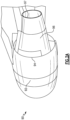
- FIG 2A shows an engine 90 having a fan case or outer housing 92.
- An exit 94 of the fan case defines an end of the bypass duct as explained above with regard to Figure 1 .
- a core housing 96 has an exit 97 which defines the end of the overall engine. Exits 94 and 97 each define a nozzle. These are "fixed" nozzles, as opposed to variable area nozzles.
- Figure 2B schematically discloses a system 79 that may be incorporated into the Figure 2A engine.
- a fiber optic sensing member 80 is placed at one, or both exits 94 and 97.
- the fiber optic sensing member communicates with a light source 82, and a receiver 84.
- fiber optic sensing member, light source 82 and receiver 84 could be called a shape sensing unit 85.
- the receiver communicates with a control such as the electronic engine control 86.
- the electronic engine control 86 may be a full authority digital electronic controller which is utilized to control the entire engine 90.
- the electronic engine control 86 may have a memory 88.
- the engine 90 has two shape sensing units 85 and 185.
- the exit 97 of the core housing is provided with a first fiber optic sensing unit 185.
- the exit 94 is provided with a shape sensing unit 85 which acts to determine the area 101 outward of the core housing 96, and inward of the fan outer housing 92.
- the fiber optic shape sensing member 100 communicates with control 100C.
- the control 100C may include a light source 100L and a receiver 100R.
- the fiber optic shape sensing member 98 communicates with a control 98C.
- Control 98C may have its own light source 98L and receiver 98B. Both controls 100C and 98C communicate with the electronic engine controller (EEC) 86.
- EEC electronic engine controller
- a control sensing system 79 includes the fiber optic shape sensing units 85 and 185.
- the light sources are configured to direct a light through the fiber optic sensing members.
- the light source may comprise a wavelength tunable laser. It should be understood that other types of lasers and light sources may be utilized.
- the receiver is configured to receive a reflective light from fiber optic sensing members 100 and 98, and measure a strain along the fiber optic sensing members based on the reflected light in real time.
- the fiber optic sensing members 100 and 98 are configured to transmit the light from the light sources, and they may each comprise an optical fiber that includes fiber optic sensing devices.
- a single optical fiber may include thousands of fiber sensing devices along a length of the fiber. Of course, more or less fiber optic sensing devices may be utilized.
- the sensing devices are used to obtain strain measurement data at several points along the length of the optical fiber.
- Fiber optic sensing devices may comprise a plurality of Fiber Bragg gratings, Optical Frequency Domain Reflectometry (OFDR) technology and alike.
- OFDR Optical Frequency Domain Reflectometry
- Fiber Bragg gratings are configured to reflect predetermined wavelengths of light.
- OFDR technology uses gratings disposed side by side along the optical fiber to provide a fully distributed sensing fiber. Changes in the reflective lights wavelength directly correspond to the implied strain on the fiber optic sensing member. That strain correlates to changes in position of the fiber optic sensing members 100 and 98, and may be utilized to in turn determine the area within the fiber optic sensing members.
- the reflected light from the fiber optic sensing members is detected from the receivers 100R and 98R.
- the receivers may comprise data acquisition hardware and a processor based device with an associated memory. Other types of receivers may be utilized. Software, such as strain to displacement algorithms may be programmed into the memory of the receivers (or the electronic engine control). From the light reflected by the fiber optic sensing member in the optical fiber of the fiber optic sensing member 98/100, the receivers 98R and 100R may detect wavelength shifts, time delays and other strain measurement data as light passes along the length of the fiber optic sensing members 98 and 100.
- the receiver can determine a displacement of the fiber optic sensing members, and thereby a displacement of the exits 94 and 97 of the fan case 92 and core housing 96. This can then be utilized to determine the areas within the fiber optic sensing members 98 and 100.
- This disclosure provides a designer the ability to accurately know the exit areas, and update the electronic engine controller 86 such that the most efficient operation of the engine can be achieved.
- the controls 98C and 100C, and in particular their receivers 100R and 98R communicate with the electronic engine control 86.
- the electronic engine control 86 is shown communicating with a fuel control. By knowing the exact areas 99 and 100 the electronic engine control 86 can determine the most desirable amount of fuel to be delivered to the combustor (see Figure 1 ) to achieve the most efficient operation of the engine dependent on the changing exit areas 99 and 101.
- the electronic engine control 86 is shown to optionally control turbine tip clearance bleed air, and the position of variable guide vanes for both the turbine and compressor.
- the electronic engine control 86 may change the speed of shafts based upon the information provided to it by the receivers 98R and 100R.
- fiber optic shape sensing has been proposed for gas turbine engines with variable area nozzles.
- the information has not been utilized for fixed nozzles, or to modify or update a control for the component such as the fuel pump, etc. Instead, it was simply utilized as feedback as the position of the pedals in the variable area nozzle change.
- a flow chart 104 is shown in Figure 3 .
- step 105 light is transmitted through the fiber optic sensing member.
- the reflected light is received at step 106.
- the strain from the reflected light is measured at step 107. Its displacement is determined from the measured strain at step 108.
- the nozzle area can be calculated based upon this displacement at step 110.
- the electronic engine control is updated with the displacement information at step 112.
- the step 112 has two distinct embodiments.
- the exit area sensor system 79 is provided on field gas turbine engines, and operate in real time to continuously update the electronic engine control on the respective engines. There may be a weight penalty for including this additional equipment, however, the improved fuel efficiency and other efficiencies achieved should justify this weight penalty.
- the method of Figure 3 may be performed on a test engine, to determine the expected change in the exit areas across various flight regimes. This can then be programmed into the electronic engine control on the field engines based upon the test findings.
- test gas turbine engine can operate at varying Mach altitude and speeds, along with other operational regimes, and the resultant changes in the exit areas can be determined.
- This test information can then be utilized when programming the electronic engine control for field engines, such that the electronic engine control for the field engines are not provided with changes of the exit areas in real time. Instead, the field engine controllers used stored changes that can be expected based upon the test engine information.
- controller 86 is programmed to control the engine using exit area information.
Landscapes
- Engineering & Computer Science (AREA)
- Chemical & Material Sciences (AREA)
- Combustion & Propulsion (AREA)
- Mechanical Engineering (AREA)
- General Engineering & Computer Science (AREA)
- Control Of Turbines (AREA)
- Length Measuring Devices By Optical Means (AREA)
Description
- This application relates to a method of determining an exit area at nozzles on gas turbine engines. An engine having such capability is also disclosed.
- Gas turbine engines are known, and typically include a fan delivering air into a fan case as bypass air. The fan also delivers air into a core housing which is radially inward of the fan case, and where it is delivered to a compressor. The compressor compresses the air and delivers it into a combustor where it is mixed with fuel and ignited. Products of this combustion pass downstream over turbine rotors, causing them to rotate and drive the fan and compressor.
- Modern gas turbine engines are controlled with very detailed control algorithms. The algorithms attempt to achieve the most efficient operation of the engine. However, gas turbine engines are subject to extreme changes in stress and strain dependent on operational conditions.
- Fiber optic shape sensing is known and can be used to monitor the changing shape of components.
- It has been proposed to use fiber optic shape sensing equipment on gas turbine engines that have a variable exit nozzle. In such a nozzle pedals pivot radially inwardly and outwardly to change an exit area. The fiber optic shape sensors monitor the actual position of the pedals relative to a desired position and communicate with a control. The control may then change the position of the pedals further to achieve the desired position.
-
US 2017218882 A1 discloses a control system for variable area fan nozzles, including fiber optic shape sensors.US 2008302907 A1 discloses a fan variable area nozzle positional measurement system that remotely determines the position of flap(s) relative a core nacelle.US 9803586 B1 - In one aspect, a gas turbine engine includes a fan surrounded by a fan case. An inner core housing is radially inward of the fan case. The fan delivers air into a bypass duct between the inner core housing and the fan case, and further delivering air into the inner core housing. The inner core housing including a compressor section, a turbine section and a combustor. There is a fan case exit at a downstream end of the fan case and an inner core housing exit at a downstream end of the inner core housing.
- Both the fan case exit and the inner core housing exit provide fixed nozzles, and at least one of the fan case exit and the inner core housing exit are provided with a fiber optic sensing unit. The fiber optic sensing unit includes a fiber optic sensing member surrounding a circumference of the at least one of the exits. The fiber optic sensing member communicates with a light source and a receiver. The light source is configured to deliver light into the fiber optic sensing member. The receiver is configured to receive reflected light information from the fiber optic sensing member. A control utilizes the received reflective light information, and measure strain from the information. The control is further programmed to determine a displacement of the fiber optic shape sensing member based upon the measured strain, and programmed to calculate a nozzle area at the at least one of the exits based upon the displacement. The calculated nozzle area is utilized to update nozzle area information at an electronic engine controller for the engine, and the electronic engine controller is programmed to control at least one associated component on a gas turbine engine based upon the updated nozzle area.
- In an embodiment according to the above, the measured strain is measured in the receiver.
- In another embodiment according to any of the above, the calculation of nozzle area is performed in the electronic engine control.
- In another embodiment according to any of the above, the at least one component includes a fuel supply system.
- In another embodiment according to any of the above, the at least one component also includes at least one variable angle guide vane.
- In another embodiment according to any of the above, the at least one component also includes at least one of a shaft speed control and a turbine tip clearance bleed air control.
- In another embodiment according to any of the above, the fan case exit includes one the fiber optic sensing unit.
- In another embodiment according to any of the above, the updated nozzle area is updated in real time at the control.
- In another embodiment according to any of the above, the calculated nozzle area is calculated on a first engine and utilized to program a controller for other engines.
- In another aspect, a method of operating a gas turbine engine includes providing a fiber optic sensing member around the circumference of on at least one of a fan case exit and an inner core housing exit in a gas turbine engine. The fan case exit and the inner core housing exit provide fixed nozzles. Light is transmitted from a light source through the fiber optic sensing member. Reflected light is received from the fiber optic sensing member at a receiver. Strain is measured from the reflected light, and determines displacement of the fiber optic sensing member. Displacement is determined of the at least one exit from the measured strain. A nozzle inner area is calculated at the at least one exit based upon the displacement. The calculated nozzle inner area is utilized to update a control for the gas turbine engine to control at least one component.
- In an embodiment according to any of the above, the measured strain is measured in the receiver.
- In another embodiment according to any of the above, the calculation of nozzle area is performed in an electronic engine controller.
- In another embodiment according to any of the above, the at least one component includes a fuel supply system.
- In another embodiment according to any of the above, the at least one component also includes at least one variable angle guide vane.
- In another embodiment according to any of the above, the at least one component also includes at least one of a shaft speed control and a turbine tip clearance bleed air control.
- In another embodiment according to any of the above, the fan case exit is operated with steps (a)-(g).
- In another embodiment according to any of the above, steps (a)-(g) are performed on a first engine, and are utilized to program controls for other gas turbine engines.
- In another embodiment according to any of the above, the first engine is flown through a series of changing conditions, and changes in the nozzle area are calculated and stored as the conditions change.
- In another embodiment according to any of the above, the changing conditions include changes in at least one of Mach, altitude of an associated aircraft, and a speed of the engine.
- In another embodiment according to any of the above, steps (b)-(g) occur in real time as an aircraft flying with the gas turbine engine.
- These and other features of the present invention can be best understood from the following specification and drawings, the following of which is a brief description.
-
-
Figure 1 schematically shows a gas turbine engine that may benefit from this disclosure. -
Figure 2A shows an outer view of a gas turbine engine. -
Figure 2B shows structure that may be incorporated into theFigure 2A engine, or theFigure 1 engine. -
Figure 2C is an end view of the engine. -
Figure 3 is a flowchart of a disclosed method. -
Figure 1 schematically illustrates agas turbine engine 20. Thegas turbine engine 20 is disclosed herein as a two-spool turbofan that generally incorporates afan section 22, a compressor section 24, a combustor section 26 and aturbine section 28. Thefan section 22 drives air along a bypass flow path B in a bypass duct defined within ahousing 15 such as a fan case or nacelle, and also drives air along a core flow path C for compression and communication into the combustor section 26 then expansion through theturbine section 28. A core outer housing 17 surrounds the core flow path. Although depicted as a two-spool turbofan gas turbine engine in the disclosed non-limiting embodiment, it should be understood that the concepts described herein are not limited to use with two-spool turbofans as the teachings may be applied to other types of turbine engines including three-spool architectures. - The
exemplary engine 20 generally includes alow speed spool 30 and ahigh speed spool 32 mounted for rotation about an engine central longitudinal axis A relative to an enginestatic structure 36 viaseveral bearing systems 38. It should be understood that various bearingsystems 38 at various locations may alternatively or additionally be provided, and the location of bearingsystems 38 may be varied as appropriate to the application. - The
low speed spool 30 generally includes aninner shaft 40 that interconnects, a first (or low)pressure compressor 44 and a first (or low)pressure turbine 46. Theinner shaft 40 is connected to thefan 42 through a speed change mechanism, which in exemplarygas turbine engine 20 is illustrated as a gearedarchitecture 48 to drive afan 42 at a lower speed than thelow speed spool 30. Thehigh speed spool 32 includes anouter shaft 50 that interconnects a second (or high)pressure compressor 52 and a second (or high)pressure turbine 54. Acombustor 56 is arranged in theexemplary gas turbine 20 between thehigh pressure compressor 52 and thehigh pressure turbine 54. Amid-turbine frame 57 of the enginestatic structure 36 may be arranged generally between thehigh pressure turbine 54 and thelow pressure turbine 46. Themid-turbine frame 57 furthersupports bearing systems 38 in theturbine section 28. Theinner shaft 40 and theouter shaft 50 are concentric and rotate via bearingsystems 38 about the engine central longitudinal axis A which is collinear with their longitudinal axes. - The core airflow is compressed by the
low pressure compressor 44 then thehigh pressure compressor 52, mixed and burned with fuel in thecombustor 56, then expanded through thehigh pressure turbine 54 andlow pressure turbine 46. Themid-turbine frame 57 includesairfoils 59 which are in the core airflow path C. Theturbines low speed spool 30 andhigh speed spool 32 in response to the expansion. It will be appreciated that each of the positions of thefan section 22, compressor section 24, combustor section 26,turbine section 28, and fandrive gear system 48 may be varied. For example,gear system 48 may be located aft of the low pressure compressor, or aft of the combustor section 26 or even aft ofturbine section 28, andfan 42 may be positioned forward or aft of the location ofgear system 48. - The
engine 20 in one example is a high-bypass geared aircraft engine. In a further example, theengine 20 bypass ratio is greater than about six (6:1), with an example embodiment being greater than about ten (10:1), and can be less than or equal to about 18.0, or more narrowly can be less than or equal to 16.0. The gearedarchitecture 48 is an epicyclic gear train, such as a planetary gear system or other gear system, with a gear reduction ratio of greater than about 2.3. The gear reduction ratio may be less than or equal to 4.0. Thelow pressure turbine 46 has a pressure ratio that is greater than about five. The low pressure turbine pressure ratio can be less than or equal to 13.0, or more narrowly less than or equal to 12.0. In one disclosed embodiment, theengine 20 bypass ratio is greater than about ten (10:1), the fan diameter is significantly larger than that of thelow pressure compressor 44, and thelow pressure turbine 46 has a pressure ratio that is greater than about five (5:1).Low pressure turbine 46 pressure ratio is pressure measured prior to an inlet oflow pressure turbine 46 as related to the pressure at the outlet of thelow pressure turbine 46 prior to an exhaust nozzle. The gearedarchitecture 48 may be an epicycle gear train, such as a planetary gear system or other gear system, with a gear reduction ratio of greater than about 2.3:1 and less than about 5:1. It should be understood, however, that the above parameters are only exemplary of one embodiment of a geared architecture engine and that the present invention is applicable to other gas turbine engines including direct drive turbofans. - A significant amount of thrust is provided by the bypass flow B due to the high bypass ratio. The
fan section 22 of theengine 20 is designed for a particular flight condition -- typically cruise at about 0.8 Mach and about 35,000 feet (10,668 meters). The flight condition of 0.8 Mach and 35,000 ft (10,668 meters), with the engine at its best fuel consumption - also known as "bucket cruise Thrust Specific Fuel Consumption ('TSFC')" - is the industry standard parameter of lbm of fuel being burned divided by lbf of thrust the engine produces at that minimum point. The engine parameters described above and those in this paragraph are measured at this condition unless otherwise specified. "Low fan pressure ratio" is the pressure ratio across the fan blade alone, without a Fan Exit Guide Vane ("FEGV") system. The low fan pressure ratio as disclosed herein according to one non-limiting embodiment is less than about 1.45, or more narrowly greater than or equal to 1.25. "Low corrected fan tip speed" is the actual fan tip speed in ft/sec divided by an industry standard temperature correction of [(Tram °R) / (518.7 °R)]0.5. The "Low corrected fan tip speed" as disclosed herein according to one non-limiting embodiment is less than about 1150.0 ft / second (350.5 meters/second), and can be greater than or equal to 1000.0 ft / second (304.8 meters/second). -
Figure 2A shows anengine 90 having a fan case orouter housing 92. Anexit 94 of the fan case defines an end of the bypass duct as explained above with regard toFigure 1 . Acore housing 96 has anexit 97 which defines the end of the overall engine.Exits -
Figure 2B schematically discloses asystem 79 that may be incorporated into theFigure 2A engine. A fiberoptic sensing member 80 is placed at one, or bothexits light source 82, and areceiver 84. In combination, fiber optic sensing member,light source 82 andreceiver 84 could be called ashape sensing unit 85. The receiver communicates with a control such as theelectronic engine control 86. Theelectronic engine control 86 may be a full authority digital electronic controller which is utilized to control theentire engine 90. Theelectronic engine control 86 may have amemory 88. - As shown in
Figure 2C , theengine 90 has twoshape sensing units exit 97 of the core housing is provided with a first fiberoptic sensing unit 185. There is aninternal area 99 within theexit 97 that will be calculated and sensed by theshape sensing unit 185, as explained below. Theexit 94 is provided with ashape sensing unit 85 which acts to determine thearea 101 outward of thecore housing 96, and inward of the fanouter housing 92. - While shape sensing units are disclosed and associated with both
nozzles - The fiber optic
shape sensing member 100 communicates withcontrol 100C. Thecontrol 100C may include alight source 100L and areceiver 100R. The fiber opticshape sensing member 98 communicates with acontrol 98C.Control 98C may have its ownlight source 98L and receiver 98B. Both controls 100C and 98C communicate with the electronic engine controller (EEC) 86. - A
control sensing system 79 includes the fiber opticshape sensing units - The light sources are configured to direct a light through the fiber optic sensing members. For example, the light source may comprise a wavelength tunable laser. It should be understood that other types of lasers and light sources may be utilized.
- The receiver is configured to receive a reflective light from fiber
optic sensing members - The fiber
optic sensing members - Fiber optic sensing devices may comprise a plurality of Fiber Bragg gratings, Optical Frequency Domain Reflectometry (OFDR) technology and alike. In fact, appropriate fiber optic shape sensing technologies are available from any number of companies, and a number of such companies are disclosed in an Information Disclosure Statement filed concurrently with this application. Fiber Bragg gratings are configured to reflect predetermined wavelengths of light. OFDR technology uses gratings disposed side by side along the optical fiber to provide a fully distributed sensing fiber. Changes in the reflective lights wavelength directly correspond to the implied strain on the fiber optic sensing member. That strain correlates to changes in position of the fiber
optic sensing members - The reflected light from the fiber optic sensing members is detected from the
receivers - The receivers may comprise data acquisition hardware and a processor based device with an associated memory. Other types of receivers may be utilized. Software, such as strain to displacement algorithms may be programmed into the memory of the receivers (or the electronic engine control). From the light reflected by the fiber optic sensing member in the optical fiber of the fiber
optic sensing member 98/100, thereceivers optic sensing members - By measuring real time strain in the fiber
optic sensing members exits fan case 92 andcore housing 96. This can then be utilized to determine the areas within the fiberoptic sensing members - This provides improved control of the gas turbine engine at the
electronic engine control 86. In particular, the exit area of the nozzles is an important factor in determining the thrust of an engine, and can also provide guidance as to position of a number of components in the engine such as the speed of the shafts, the position of variable compressor guide vanes or turbine guide vanes, and the operation of turbine tip clearance bleed air. The exit area also impacts on fuel control. - Historically, a so-called "fixed nozzle" has had its exit air assumed to be constant. In fact, modern gas turbine engine fan cases and core housings are somewhat flexible and their position can change and deform due to aerodynamic forces that are changing. As an example, the exit may deform to different positions based upon changes in Mach conditions, altitude and speed of the engine and associated aircraft.
- This disclosure provides a designer the ability to accurately know the exit areas, and update the
electronic engine controller 86 such that the most efficient operation of the engine can be achieved. - Now, returning to
Figure 2C , thecontrols receivers electronic engine control 86. Theelectronic engine control 86 is shown communicating with a fuel control. By knowing theexact areas electronic engine control 86 can determine the most desirable amount of fuel to be delivered to the combustor (seeFigure 1 ) to achieve the most efficient operation of the engine dependent on the changingexit areas electronic engine control 86 is shown to optionally control turbine tip clearance bleed air, and the position of variable guide vanes for both the turbine and compressor. In addition, theelectronic engine control 86 may change the speed of shafts based upon the information provided to it by thereceivers - Thus, the most efficient operation may be achieved.
- As mentioned above, fiber optic shape sensing has been proposed for gas turbine engines with variable area nozzles. However, the information has not been utilized for fixed nozzles, or to modify or update a control for the component such as the fuel pump, etc. Instead, it was simply utilized as feedback as the position of the pedals in the variable area nozzle change.
- A
flow chart 104 is shown inFigure 3 . - As shown at
step 105, light is transmitted through the fiber optic sensing member. The reflected light is received atstep 106. The strain from the reflected light is measured atstep 107. Its displacement is determined from the measured strain atstep 108. The nozzle area can be calculated based upon this displacement atstep 110. The electronic engine control is updated with the displacement information atstep 112. - The
step 112 has two distinct embodiments. - In one embodiment, the exit
area sensor system 79 is provided on field gas turbine engines, and operate in real time to continuously update the electronic engine control on the respective engines. There may be a weight penalty for including this additional equipment, however, the improved fuel efficiency and other efficiencies achieved should justify this weight penalty. - On the other hand, the method of
Figure 3 may be performed on a test engine, to determine the expected change in the exit areas across various flight regimes. This can then be programmed into the electronic engine control on the field engines based upon the test findings. - That is, a test gas turbine engine can operate at varying Mach altitude and speeds, along with other operational regimes, and the resultant changes in the exit areas can be determined. This test information can then be utilized when programming the electronic engine control for field engines, such that the electronic engine control for the field engines are not provided with changes of the exit areas in real time. Instead, the field engine controllers used stored changes that can be expected based upon the test engine information.
- In either embodiment the
controller 86 is programmed to control the engine using exit area information. - Although embodiments of this invention have been disclosed, a worker of ordinary skill in this art would recognize that certain modifications would come within the scope of this disclosure. For that reason, the following claims should be studied to determine the true scope and content of this disclosure.
Claims (14)
- A gas turbine engine (90) comprising:
a fan (42) surrounded by a fan case (92):an inner core housing (96) radially inward of said fan case (92), said fan (42) delivering air into a bypass duct between said inner core housing (96) and said fan case (92), and further delivering air into said inner core housing (96), said inner core housing (96) including a compressor section (24), a turbine section (28) and a combustor (56); anda fan case exit (94) at a downstream end of the fan case (92) and an inner core housing exit (97) at a downstream end of said inner core housing (96),characterised in that:both said fan case exit (94) and said inner core housing exit (97) provide fixed nozzles;at least one of said fan case exit (94) and said inner core housing exit (97) is provided with a fiber optic sensing unit (85, 185);said fiber optic sensing unit (85, 185) includes a fiber optic sensing member (98, 100) surrounding a circumference of said at least one of said exits (94, 97) and communicating with a light source (98L, 100L) and a receiver (98R, 100R), said light source (98L, 100L) configured to deliver light into said fiber optic sensing member (98, 100), and said receiver (98R, 100R) being configured to receive reflected light information from said fiber optic sensing member (98, 100); andthe engine (90) further comprises a control (98C, 100C) for utilizing the received reflected light information, and measure strain from the information, said control (98C, 100C) further programmed to determine a displacement of the fiber optic sensing member (98, 100) based upon the measured strain, and programmed to calculate a nozzle area (99, 101) at said at least one of said exits (94, 97) based upon the displacement, said calculated nozzle area being utilized to update nozzle area information at an electronic engine controller (86) of the engine (90), and said electronic engine controller (86) being programmed to control at least one associated component on the engine (90) based upon the updated nozzle area. - The gas turbine engine (90) of claim 1, wherein said measured strain is measured in said receiver (98R, 100R).
- The gas turbine engine of claim 1 or 2, wherein the calculation of nozzle area is performed in the electronic engine control (86).
- The gas turbine engine of any of claims 1 to 3, wherein said at least one component includes a fuel supply system.
- The gas turbine engine of claim 4, wherein said at least one component also includes at least one variable angle guide vane.
- The gas turbine engine of claim 4 or 5, wherein said at least one component also includes a shaft speed control and/or a turbine tip clearance bleed air control.
- The gas turbine engine of any preceding claim, wherein said fan case exit (94) includes one said fiber optic sensing unit (85).
- The gas turbine engine of any preceding claim, wherein the updated nozzle area is updated in real time at the control.
- A method of operating a gas turbine engine (90) comprising of:(a) providing a fiber optic sensing member (98, 100) around the circumference of at least one of a fan case exit (94) and an inner core housing exit (97) in a gas turbine engine (90), said fan case exit (94) and said inner core housing exit (97) providing fixed nozzles;(b) transmitting light from a light source (98L, 100L) through said fiber optic sensing member (98, 100);(c) receiving reflected light from said fiber optic sensing member (98, 100) at a receiver (98R, 100R);(d) measuring strain from the reflected light, and determining displacement of the fiber optic sensing member (98, 100);(e) determine displacement of the at least one exit (94, 97) from the measured strain;(f) calculating a nozzle inner area (99, 101) at the at least one exit (94, 97) based upon said displacement; and(g) utilize said calculated nozzle inner area to update a control for said gas turbine engine (90) to control at least one component.
- The method of claim 9, wherein said measured strain is measured in said receiver (8R, 100R), and optionally the calculation of nozzle area is performed in an electronic engine controller (86).
- The method of claim 9 or 10, wherein said at least one component includes a fuel supply system, and optionally also includes at least one variable angle guide vane, a shaft speed control and/or a turbine tip clearance bleed air control.
- The method of any of claims 9 to 11, wherein said fan case exit (94) is operated with steps (a)-(g).
- The method of any of claims 9 to 12, wherein steps (a)-(g) are performed on a first engine (90), and are utilized to program controls for other gas turbine engines (90), and optionally, wherein said first engine is flown through a series of changing conditions, and changes in the nozzle area (99, 101) are calculated and stored as the conditions change, and further optionally wherein said changing conditions include changes in Mach, altitude of an associated aircraft, and/or a speed of the engine.
- The method of any of claims 9 to 12, wherein steps (b)-(g) occur in real time as an aircraft flying with the gas turbine engine (90).
Applications Claiming Priority (1)
| Application Number | Priority Date | Filing Date | Title |
|---|---|---|---|
| US17/344,123 US11421607B1 (en) | 2021-06-10 | 2021-06-10 | Fiber optic exit area sensing for gas turbine engine nozzles |
Publications (2)
| Publication Number | Publication Date |
|---|---|
| EP4102045A1 EP4102045A1 (en) | 2022-12-14 |
| EP4102045B1 true EP4102045B1 (en) | 2024-08-21 |
Family
ID=82016229
Family Applications (1)
| Application Number | Title | Priority Date | Filing Date |
|---|---|---|---|
| EP22178240.2A Active EP4102045B1 (en) | 2021-06-10 | 2022-06-09 | Fiber optic exit area sensing for gas turbine engine nozzles |
Country Status (2)
| Country | Link |
|---|---|
| US (1) | US11421607B1 (en) |
| EP (1) | EP4102045B1 (en) |
Family Cites Families (10)
| Publication number | Priority date | Publication date | Assignee | Title |
|---|---|---|---|---|
| US3852741A (en) | 1973-06-11 | 1974-12-03 | Control Data Canada | Nozzle area measurement |
| US8235325B2 (en) * | 2005-10-04 | 2012-08-07 | United Technologies Corporation | Fan variable area nozzle positional measurement system |
| US9551295B2 (en) | 2012-07-24 | 2017-01-24 | Rohr, Inc. | Variable area fan nozzle position and skew sensing |
| US9890739B2 (en) | 2015-03-23 | 2018-02-13 | The Boeing Company | Controlling nozzle areas of variable area fan nozzles |
| US10184425B2 (en) * | 2016-01-28 | 2019-01-22 | The Boeing Company | Fiber optic sensing for variable area fan nozzles |
| US10295420B2 (en) | 2016-04-11 | 2019-05-21 | United Technologies Corporation | Nacelle deflection measurement assembly |
| US9803586B1 (en) * | 2016-05-31 | 2017-10-31 | The Boeing Company | Secondary systems and methods of control for variable area fan nozzles |
| US10914191B2 (en) * | 2018-05-04 | 2021-02-09 | Raytheon Technologies Corporation | System and method for in situ airfoil inspection |
| US11409022B2 (en) | 2019-10-30 | 2022-08-09 | General Electric Company | System and method for optical measurements in a rotary machine |
| US11428116B2 (en) * | 2019-11-29 | 2022-08-30 | Pratt & Whitney Canada Corp. | System and method for measuring an axial position of a rotating component of an engine |
-
2021
- 2021-06-10 US US17/344,123 patent/US11421607B1/en active Active
-
2022
- 2022-06-09 EP EP22178240.2A patent/EP4102045B1/en active Active
Also Published As
| Publication number | Publication date |
|---|---|
| EP4102045A1 (en) | 2022-12-14 |
| US11421607B1 (en) | 2022-08-23 |
Similar Documents
| Publication | Publication Date | Title |
|---|---|---|
| EP3284932B1 (en) | Fuel pump health detection | |
| EP3712403A1 (en) | Adaptive thermal management system for aircraft fuel system | |
| US10794286B2 (en) | Method and system for modulated turbine cooling as a function of engine health | |
| EP3228847B1 (en) | System and method for an adaptive fuel flow estimation with flow meter feedback | |
| EP3594474B1 (en) | Gas turbine engine with active variable turbine cooling | |
| US20160040550A1 (en) | Variable vane control system | |
| EP2809921B1 (en) | Gas turbine engine with compressor inlet guide vane positioned for starting | |
| EP3249199B1 (en) | Gas turbine engine inlet temperature sensor configuration and corresponding method | |
| EP3358144A1 (en) | Thrust rating dependent active tip clearance control system | |
| EP3014089B1 (en) | Excessive deformation monitoring using a fan drive gear system | |
| EP3352034A1 (en) | Classification of gas turbine engine components | |
| US11719169B2 (en) | Gas turbine engine with heat exchanger diagnostics | |
| EP3530911B1 (en) | Light-off detection for gas turbine engines | |
| EP2809924B1 (en) | Gas turbine engine with variable area fan nozzle positioned for starting | |
| EP3623584B1 (en) | Set screw gap control between fixed and variable vanes | |
| US20200070081A1 (en) | Monitoring servo-valve filter elements | |
| EP4102045B1 (en) | Fiber optic exit area sensing for gas turbine engine nozzles | |
| EP3557029B1 (en) | Intercooled cooling air fleet management system | |
| EP3318859B1 (en) | Cooled cooling air safety through a temperature-monitoring line replaceable unit | |
| EP4219911B1 (en) | System for active data acquisition management in a gas turbine engine | |
| US12378919B2 (en) | Direct horsepower and torque measurement system for gas turbine engine | |
| EP4524386A1 (en) | Built-in test of actively controlled fuel nozzles | |
| EP3502441A1 (en) | Light-off detection system for gas turbine engines | |
| EP3470651A1 (en) | Cooled combustor configuration |
Legal Events
| Date | Code | Title | Description |
|---|---|---|---|
| PUAI | Public reference made under article 153(3) epc to a published international application that has entered the european phase |
Free format text: ORIGINAL CODE: 0009012 |
|
| STAA | Information on the status of an ep patent application or granted ep patent |
Free format text: STATUS: THE APPLICATION HAS BEEN PUBLISHED |
|
| AK | Designated contracting states |
Kind code of ref document: A1 Designated state(s): AL AT BE BG CH CY CZ DE DK EE ES FI FR GB GR HR HU IE IS IT LI LT LU LV MC MK MT NL NO PL PT RO RS SE SI SK SM TR |
|
| STAA | Information on the status of an ep patent application or granted ep patent |
Free format text: STATUS: REQUEST FOR EXAMINATION WAS MADE |
|
| 17P | Request for examination filed |
Effective date: 20230614 |
|
| RBV | Designated contracting states (corrected) |
Designated state(s): AL AT BE BG CH CY CZ DE DK EE ES FI FR GB GR HR HU IE IS IT LI LT LU LV MC MK MT NL NO PL PT RO RS SE SI SK SM TR |
|
| RAP3 | Party data changed (applicant data changed or rights of an application transferred) |
Owner name: RTX CORPORATION |
|
| GRAP | Despatch of communication of intention to grant a patent |
Free format text: ORIGINAL CODE: EPIDOSNIGR1 |
|
| STAA | Information on the status of an ep patent application or granted ep patent |
Free format text: STATUS: GRANT OF PATENT IS INTENDED |
|
| RIC1 | Information provided on ipc code assigned before grant |
Ipc: F02K 3/06 20060101ALI20240209BHEP Ipc: F02K 1/15 20060101AFI20240209BHEP |
|
| INTG | Intention to grant announced |
Effective date: 20240313 |
|
| GRAS | Grant fee paid |
Free format text: ORIGINAL CODE: EPIDOSNIGR3 |
|
| GRAA | (expected) grant |
Free format text: ORIGINAL CODE: 0009210 |
|
| STAA | Information on the status of an ep patent application or granted ep patent |
Free format text: STATUS: THE PATENT HAS BEEN GRANTED |
|
| AK | Designated contracting states |
Kind code of ref document: B1 Designated state(s): AL AT BE BG CH CY CZ DE DK EE ES FI FR GB GR HR HU IE IS IT LI LT LU LV MC MK MT NL NO PL PT RO RS SE SI SK SM TR |
|
| REG | Reference to a national code |
Ref country code: GB Ref legal event code: FG4D |
|
| REG | Reference to a national code |
Ref country code: CH Ref legal event code: EP |
|
| REG | Reference to a national code |
Ref country code: IE Ref legal event code: FG4D |
|
| REG | Reference to a national code |
Ref country code: DE Ref legal event code: R096 Ref document number: 602022005435 Country of ref document: DE |
|
| REG | Reference to a national code |
Ref country code: LT Ref legal event code: MG9D |
|
| REG | Reference to a national code |
Ref country code: NL Ref legal event code: MP Effective date: 20240821 |
|
| PG25 | Lapsed in a contracting state [announced via postgrant information from national office to epo] |
Ref country code: NO Free format text: LAPSE BECAUSE OF FAILURE TO SUBMIT A TRANSLATION OF THE DESCRIPTION OR TO PAY THE FEE WITHIN THE PRESCRIBED TIME-LIMIT Effective date: 20241121 |
|
| REG | Reference to a national code |
Ref country code: AT Ref legal event code: MK05 Ref document number: 1715681 Country of ref document: AT Kind code of ref document: T Effective date: 20240821 |
|
| PG25 | Lapsed in a contracting state [announced via postgrant information from national office to epo] |
Ref country code: FI Free format text: LAPSE BECAUSE OF FAILURE TO SUBMIT A TRANSLATION OF THE DESCRIPTION OR TO PAY THE FEE WITHIN THE PRESCRIBED TIME-LIMIT Effective date: 20240821 Ref country code: PT Free format text: LAPSE BECAUSE OF FAILURE TO SUBMIT A TRANSLATION OF THE DESCRIPTION OR TO PAY THE FEE WITHIN THE PRESCRIBED TIME-LIMIT Effective date: 20241223 Ref country code: NL Free format text: LAPSE BECAUSE OF FAILURE TO SUBMIT A TRANSLATION OF THE DESCRIPTION OR TO PAY THE FEE WITHIN THE PRESCRIBED TIME-LIMIT Effective date: 20240821 Ref country code: GR Free format text: LAPSE BECAUSE OF FAILURE TO SUBMIT A TRANSLATION OF THE DESCRIPTION OR TO PAY THE FEE WITHIN THE PRESCRIBED TIME-LIMIT Effective date: 20241122 Ref country code: PL Free format text: LAPSE BECAUSE OF FAILURE TO SUBMIT A TRANSLATION OF THE DESCRIPTION OR TO PAY THE FEE WITHIN THE PRESCRIBED TIME-LIMIT Effective date: 20240821 |
|
| PG25 | Lapsed in a contracting state [announced via postgrant information from national office to epo] |
Ref country code: BG Free format text: LAPSE BECAUSE OF FAILURE TO SUBMIT A TRANSLATION OF THE DESCRIPTION OR TO PAY THE FEE WITHIN THE PRESCRIBED TIME-LIMIT Effective date: 20240821 |
|
| PG25 | Lapsed in a contracting state [announced via postgrant information from national office to epo] |
Ref country code: LV Free format text: LAPSE BECAUSE OF FAILURE TO SUBMIT A TRANSLATION OF THE DESCRIPTION OR TO PAY THE FEE WITHIN THE PRESCRIBED TIME-LIMIT Effective date: 20240821 |
|
| PG25 | Lapsed in a contracting state [announced via postgrant information from national office to epo] |
Ref country code: IS Free format text: LAPSE BECAUSE OF FAILURE TO SUBMIT A TRANSLATION OF THE DESCRIPTION OR TO PAY THE FEE WITHIN THE PRESCRIBED TIME-LIMIT Effective date: 20241221 Ref country code: AT Free format text: LAPSE BECAUSE OF FAILURE TO SUBMIT A TRANSLATION OF THE DESCRIPTION OR TO PAY THE FEE WITHIN THE PRESCRIBED TIME-LIMIT Effective date: 20240821 |
|
| PG25 | Lapsed in a contracting state [announced via postgrant information from national office to epo] |
Ref country code: HR Free format text: LAPSE BECAUSE OF FAILURE TO SUBMIT A TRANSLATION OF THE DESCRIPTION OR TO PAY THE FEE WITHIN THE PRESCRIBED TIME-LIMIT Effective date: 20240821 |
|
| PG25 | Lapsed in a contracting state [announced via postgrant information from national office to epo] |
Ref country code: RS Free format text: LAPSE BECAUSE OF FAILURE TO SUBMIT A TRANSLATION OF THE DESCRIPTION OR TO PAY THE FEE WITHIN THE PRESCRIBED TIME-LIMIT Effective date: 20241121 Ref country code: ES Free format text: LAPSE BECAUSE OF FAILURE TO SUBMIT A TRANSLATION OF THE DESCRIPTION OR TO PAY THE FEE WITHIN THE PRESCRIBED TIME-LIMIT Effective date: 20240821 |
|
| PG25 | Lapsed in a contracting state [announced via postgrant information from national office to epo] |
Ref country code: RS Free format text: LAPSE BECAUSE OF FAILURE TO SUBMIT A TRANSLATION OF THE DESCRIPTION OR TO PAY THE FEE WITHIN THE PRESCRIBED TIME-LIMIT Effective date: 20241121 Ref country code: PT Free format text: LAPSE BECAUSE OF FAILURE TO SUBMIT A TRANSLATION OF THE DESCRIPTION OR TO PAY THE FEE WITHIN THE PRESCRIBED TIME-LIMIT Effective date: 20241223 Ref country code: PL Free format text: LAPSE BECAUSE OF FAILURE TO SUBMIT A TRANSLATION OF THE DESCRIPTION OR TO PAY THE FEE WITHIN THE PRESCRIBED TIME-LIMIT Effective date: 20240821 Ref country code: NO Free format text: LAPSE BECAUSE OF FAILURE TO SUBMIT A TRANSLATION OF THE DESCRIPTION OR TO PAY THE FEE WITHIN THE PRESCRIBED TIME-LIMIT Effective date: 20241121 Ref country code: NL Free format text: LAPSE BECAUSE OF FAILURE TO SUBMIT A TRANSLATION OF THE DESCRIPTION OR TO PAY THE FEE WITHIN THE PRESCRIBED TIME-LIMIT Effective date: 20240821 Ref country code: LV Free format text: LAPSE BECAUSE OF FAILURE TO SUBMIT A TRANSLATION OF THE DESCRIPTION OR TO PAY THE FEE WITHIN THE PRESCRIBED TIME-LIMIT Effective date: 20240821 Ref country code: IS Free format text: LAPSE BECAUSE OF FAILURE TO SUBMIT A TRANSLATION OF THE DESCRIPTION OR TO PAY THE FEE WITHIN THE PRESCRIBED TIME-LIMIT Effective date: 20241221 Ref country code: HR Free format text: LAPSE BECAUSE OF FAILURE TO SUBMIT A TRANSLATION OF THE DESCRIPTION OR TO PAY THE FEE WITHIN THE PRESCRIBED TIME-LIMIT Effective date: 20240821 Ref country code: GR Free format text: LAPSE BECAUSE OF FAILURE TO SUBMIT A TRANSLATION OF THE DESCRIPTION OR TO PAY THE FEE WITHIN THE PRESCRIBED TIME-LIMIT Effective date: 20241122 Ref country code: FI Free format text: LAPSE BECAUSE OF FAILURE TO SUBMIT A TRANSLATION OF THE DESCRIPTION OR TO PAY THE FEE WITHIN THE PRESCRIBED TIME-LIMIT Effective date: 20240821 Ref country code: ES Free format text: LAPSE BECAUSE OF FAILURE TO SUBMIT A TRANSLATION OF THE DESCRIPTION OR TO PAY THE FEE WITHIN THE PRESCRIBED TIME-LIMIT Effective date: 20240821 Ref country code: BG Free format text: LAPSE BECAUSE OF FAILURE TO SUBMIT A TRANSLATION OF THE DESCRIPTION OR TO PAY THE FEE WITHIN THE PRESCRIBED TIME-LIMIT Effective date: 20240821 Ref country code: AT Free format text: LAPSE BECAUSE OF FAILURE TO SUBMIT A TRANSLATION OF THE DESCRIPTION OR TO PAY THE FEE WITHIN THE PRESCRIBED TIME-LIMIT Effective date: 20240821 |
|
| PG25 | Lapsed in a contracting state [announced via postgrant information from national office to epo] |
Ref country code: DK Free format text: LAPSE BECAUSE OF FAILURE TO SUBMIT A TRANSLATION OF THE DESCRIPTION OR TO PAY THE FEE WITHIN THE PRESCRIBED TIME-LIMIT Effective date: 20240821 Ref country code: SM Free format text: LAPSE BECAUSE OF FAILURE TO SUBMIT A TRANSLATION OF THE DESCRIPTION OR TO PAY THE FEE WITHIN THE PRESCRIBED TIME-LIMIT Effective date: 20240821 Ref country code: RO Free format text: LAPSE BECAUSE OF FAILURE TO SUBMIT A TRANSLATION OF THE DESCRIPTION OR TO PAY THE FEE WITHIN THE PRESCRIBED TIME-LIMIT Effective date: 20240821 |
|
| PG25 | Lapsed in a contracting state [announced via postgrant information from national office to epo] |
Ref country code: EE Free format text: LAPSE BECAUSE OF FAILURE TO SUBMIT A TRANSLATION OF THE DESCRIPTION OR TO PAY THE FEE WITHIN THE PRESCRIBED TIME-LIMIT Effective date: 20240821 |
|
| PG25 | Lapsed in a contracting state [announced via postgrant information from national office to epo] |
Ref country code: CZ Free format text: LAPSE BECAUSE OF FAILURE TO SUBMIT A TRANSLATION OF THE DESCRIPTION OR TO PAY THE FEE WITHIN THE PRESCRIBED TIME-LIMIT Effective date: 20240821 |
|
| PG25 | Lapsed in a contracting state [announced via postgrant information from national office to epo] |
Ref country code: SK Free format text: LAPSE BECAUSE OF FAILURE TO SUBMIT A TRANSLATION OF THE DESCRIPTION OR TO PAY THE FEE WITHIN THE PRESCRIBED TIME-LIMIT Effective date: 20240821 Ref country code: IT Free format text: LAPSE BECAUSE OF FAILURE TO SUBMIT A TRANSLATION OF THE DESCRIPTION OR TO PAY THE FEE WITHIN THE PRESCRIBED TIME-LIMIT Effective date: 20240821 |
|
| REG | Reference to a national code |
Ref country code: DE Ref legal event code: R097 Ref document number: 602022005435 Country of ref document: DE |
|
| PLBE | No opposition filed within time limit |
Free format text: ORIGINAL CODE: 0009261 |
|
| STAA | Information on the status of an ep patent application or granted ep patent |
Free format text: STATUS: NO OPPOSITION FILED WITHIN TIME LIMIT |
|
| PGFP | Annual fee paid to national office [announced via postgrant information from national office to epo] |
Ref country code: DE Payment date: 20250520 Year of fee payment: 4 |
|
| PGFP | Annual fee paid to national office [announced via postgrant information from national office to epo] |
Ref country code: FR Payment date: 20250520 Year of fee payment: 4 |
|
| 26N | No opposition filed |
Effective date: 20250522 |
|
| PG25 | Lapsed in a contracting state [announced via postgrant information from national office to epo] |
Ref country code: SE Free format text: LAPSE BECAUSE OF FAILURE TO SUBMIT A TRANSLATION OF THE DESCRIPTION OR TO PAY THE FEE WITHIN THE PRESCRIBED TIME-LIMIT Effective date: 20240821 |
|
| REG | Reference to a national code |
Ref country code: CH Ref legal event code: H13 Free format text: ST27 STATUS EVENT CODE: U-0-0-H10-H13 (AS PROVIDED BY THE NATIONAL OFFICE) Effective date: 20260127 |
|
| PG25 | Lapsed in a contracting state [announced via postgrant information from national office to epo] |
Ref country code: MC Free format text: LAPSE BECAUSE OF FAILURE TO SUBMIT A TRANSLATION OF THE DESCRIPTION OR TO PAY THE FEE WITHIN THE PRESCRIBED TIME-LIMIT Effective date: 20240821 |
|
| PG25 | Lapsed in a contracting state [announced via postgrant information from national office to epo] |
Ref country code: LU Free format text: LAPSE BECAUSE OF NON-PAYMENT OF DUE FEES Effective date: 20250609 |
|
| REG | Reference to a national code |
Ref country code: BE Ref legal event code: MM Effective date: 20250630 |
|
| PG25 | Lapsed in a contracting state [announced via postgrant information from national office to epo] |
Ref country code: IE Free format text: LAPSE BECAUSE OF NON-PAYMENT OF DUE FEES Effective date: 20250609 |
|
| PG25 | Lapsed in a contracting state [announced via postgrant information from national office to epo] |
Ref country code: BE Free format text: LAPSE BECAUSE OF NON-PAYMENT OF DUE FEES Effective date: 20250630 |
|
| PG25 | Lapsed in a contracting state [announced via postgrant information from national office to epo] |
Ref country code: CH Free format text: LAPSE BECAUSE OF NON-PAYMENT OF DUE FEES Effective date: 20250630 |