EP4101316A1 - Liquid composition for liquid heating-type thermal flavor inhaler - Google Patents
Liquid composition for liquid heating-type thermal flavor inhaler Download PDFInfo
- Publication number
- EP4101316A1 EP4101316A1 EP21750255.8A EP21750255A EP4101316A1 EP 4101316 A1 EP4101316 A1 EP 4101316A1 EP 21750255 A EP21750255 A EP 21750255A EP 4101316 A1 EP4101316 A1 EP 4101316A1
- Authority
- EP
- European Patent Office
- Prior art keywords
- acid
- benzoic acid
- organic acids
- liquid composition
- liquid
- Prior art date
- Legal status (The legal status is an assumption and is not a legal conclusion. Google has not performed a legal analysis and makes no representation as to the accuracy of the status listed.)
- Pending
Links
Classifications
-
- A—HUMAN NECESSITIES
- A24—TOBACCO; CIGARS; CIGARETTES; SIMULATED SMOKING DEVICES; SMOKERS' REQUISITES
- A24B—MANUFACTURE OR PREPARATION OF TOBACCO FOR SMOKING OR CHEWING; TOBACCO; SNUFF
- A24B15/00—Chemical features or treatment of tobacco; Tobacco substitutes, e.g. in liquid form
- A24B15/10—Chemical features of tobacco products or tobacco substitutes
- A24B15/16—Chemical features of tobacco products or tobacco substitutes of tobacco substitutes
- A24B15/167—Chemical features of tobacco products or tobacco substitutes of tobacco substitutes in liquid or vaporisable form, e.g. liquid compositions for electronic cigarettes
-
- A—HUMAN NECESSITIES
- A24—TOBACCO; CIGARS; CIGARETTES; SIMULATED SMOKING DEVICES; SMOKERS' REQUISITES
- A24B—MANUFACTURE OR PREPARATION OF TOBACCO FOR SMOKING OR CHEWING; TOBACCO; SNUFF
- A24B15/00—Chemical features or treatment of tobacco; Tobacco substitutes, e.g. in liquid form
- A24B15/18—Treatment of tobacco products or tobacco substitutes
- A24B15/28—Treatment of tobacco products or tobacco substitutes by chemical substances
- A24B15/30—Treatment of tobacco products or tobacco substitutes by chemical substances by organic substances
-
- A—HUMAN NECESSITIES
- A24—TOBACCO; CIGARS; CIGARETTES; SIMULATED SMOKING DEVICES; SMOKERS' REQUISITES
- A24F—SMOKERS' REQUISITES; MATCH BOXES; SIMULATED SMOKING DEVICES
- A24F40/00—Electrically operated smoking devices; Component parts thereof; Manufacture thereof; Maintenance or testing thereof; Charging means specially adapted therefor
- A24F40/10—Devices using liquid inhalable precursors
-
- A—HUMAN NECESSITIES
- A24—TOBACCO; CIGARS; CIGARETTES; SIMULATED SMOKING DEVICES; SMOKERS' REQUISITES
- A24F—SMOKERS' REQUISITES; MATCH BOXES; SIMULATED SMOKING DEVICES
- A24F42/00—Simulated smoking devices other than electrically operated; Component parts thereof; Manufacture or testing thereof
- A24F42/10—Devices with chemical heating means
Definitions
- the present invention relates to a liquid composition for a liquid heating-type flavor inhaler and a preparation method therefor.
- the present invention also relates to a liquid heating-type flavor inhaler including the liquid composition for a liquid heating-type flavor inhaler.
- the present invention further relates to a method of reducing the gunpowder-like odor of benzoic acid in a liquid composition for a liquid heating-type flavor inhaler.
- a liquid heating-type flavor inhaler is a flavor inhaler that directly or indirectly heats, by an electric heat source or a chemical reaction-based heat source, a liquid composition for a liquid heating-type flavor inhaler to generate an aerosol and delivers the aerosol into the mouth through a mouthpiece member.
- a typical liquid composition for a liquid heating-type flavor inhaler (a liquid for electronic cigarettes (commonly called as e-liquid or e-juice)) comprises propylene glycol (PG), glycerol (GL), nicotine, and a flavor.
- Japanese Unexamined Patent Application Publication (Translation of PCT Application) No. 2018-532377 describes a liquid formulation for e-vaping devices.
- the liquid formulation contains propylene glycol and substantially no amount of glycerol.
- Japanese Unexamined Patent Application Publication (Translation of PCT Application) No. 2016-520061 describes a nicotine salt formulation for aerosol devices and methods therefor.
- the document specifies, for example, by the vapor pressure, melting point, or boiling point, an acid used to form a nicotine salt in the nicotine salt formulation.
- PTL 1 Japanese Unexamined Patent Application Publication (Translation of PCT Application) No. 2018-532377
- PTL 2 Japanese Unexamined Patent Application Publication (Translation of PCT Application) No. 2016-520061
- the present inventors found problems that a product containing benzoic acid in an e-liquid for lowering smoke flavor inhibition caused by nicotine (nicotine impact) emits a smell peculiar to benzoic acid during heating (gunpowder-like; herein, referred to as "gunpowder-like odor” or “benzoic acid odor” in some cases), and the resulting benzoic acid odor interferes with the emission of a flavor in the e-liquid, thereby destroying smoking flavor.
- benzoic acid has low solubility in PG and GL and hence requires a prolonged stirring step or heating step for the dissolution during production of e-liquids. For this reason, there are concerns about adverse effects on product quality, such as volatilization or deterioration of the components as well as effects on production efficiency.
- the present inventors also found that smoke flavor inhibition caused by nicotine (nicotine impact) is lowered even when other organic acids alone are used without using benzoic acid in a liquid composition containing nicotine for a heating-type flavor inhaler, thereby arriving at the present invention concerning a liquid composition containing no benzoic acid.
- the present invention encompasses, but not limited to, the following embodiments.
- a liquid composition (I) for a liquid heating-type flavor inhaler of the present invention has excellent features of reduced smoke flavor inhibition caused by nicotine due to a mixture of benzoic acid and other organic acids as well as reduced gunpowder-like odor of benzoic acid to be generated during heating.
- a method of preparing the above-mentioned liquid composition includes dissolving benzoic acid first in propylene glycol in the presence of nicotine and then mixing with glycerol. This makes it possible to efficiently prepare, in a short time without heating treatment, a liquid composition for a liquid heating-type flavor inhaler containing benzoic acid, which is difficult to dissolve in glycerol.
- a liquid composition (II) for a liquid heating-type flavor inhaler of the present invention effectively reduces smoke flavor inhibition caused by nicotine solely by organic acids excluding benzoic acid without using benzoic acid. Since the liquid composition does not use benzoic acid, a preparation method therefor does not require a step of dissolving benzoic acid first in propylene glycol in the presence of nicotine. Nicotine may appropriately be mixed into, for example, after dissolving organic acids to be used in propylene glycol or glycerol.
- the present invention encompasses, in a non-limiting manner, the following embodiments.
- the present invention relates to a liquid composition for a liquid heating-type flavor inhaler.
- a liquid composition for a liquid heating-type flavor inhaler contains
- a non-combustion flavor inhaler is a flavor inhaler that enables inhalation of a flavor without involving combustion.
- Such non-combustion flavor inhalers include: heating-type flavor inhalers equipped with an electric heat source or a chemical reaction-based heat source; and non-heating flavor inhalers without heat source.
- a "liquid heating-type flavor inhaler,” as a form of non-combustion flavor inhalers, is a flavor inhaler that has a cartridge for holding a liquid composition (aerosol source) containing nicotine, heats directly or indirectly the aerosol source (liquid) by an electric heat source or a chemical reaction-based heat source to generate an aerosol containing nicotine and a flavor, and delivers the aerosol into the mouth through a mouthpiece member.
- a liquid composition aerosol source
- a porous or fibrous body impregnated with an aerosol source of a liquid, such as glycerol or propylene glycol, or a mixed solution thereof is electrically heated to generate a gas of mixed vapor and particulate substance, and the gas is then mixed into air drawn through the flavor inhaler.
- a consumer generally inhales the resulting mixed gas by drawing at the end of the flavor inhaler (mouth side end, filter end, or mouthpiece end).
- a liquid composition for a liquid heating-type flavor inhaler (2) nicotine, (3) benzoic acid, and (4) one or more organic acids excluding benzoic acid are dissolved in solvents of propylene glycol and glycerol.
- a liquid composition for a liquid heating-type flavor inhaler is referred to as "e-liquid” in some cases.
- benzoic acid reduces smoke flavor inhibition caused by nicotine, and other organic acids reduce the gunpowder-like odor of benzoic acid.
- a mole ratio of (2) nicotine to the total of (3) benzoic acid and (4) one or more organic acids excluding benzoic acid falls within a range of 3:0.1 to 0.1:3, 2:0.5 to 0.5:2, or 1:0.85 to 1:1.15.
- a mole ratio of (2) nicotine to the total of (3) benzoic acid and (4) one or more organic acids excluding benzoic acid falls within a range of 1:0.85 to 1:1.15.
- a liquid composition for a liquid heating-type flavor inhaler contains (4) one or more organic acids excluding benzoic acid.
- organic acids are a collective term for acids of organic compounds. The majority of organic acids are carboxylic acids having a carboxyl group or sulfonic acids having a sulfo group.
- the types of (4) organic acids excluding benzoic acid to be used for a liquid composition of the present invention are not particularly limited.
- the number of (4) organic acids excluding benzoic acid is also not particularly limited, and two or more (4) organic acids excluding benzoic acid may be contained.
- (4) organic acids excluding benzoic acid include lactic acid.
- the liquid composition for a liquid heating-type flavor inhaler may contain, in addition to lactic acid, any one selected from tartaric acid, fumaric acid, levulinic acid, malonic acid, acetic acid, adipic acid, citric acid, malic acid, pyruvic acid, sorbic acid, and mixtures thereof as (4) one or more organic acids excluding benzoic acid.
- the liquid composition may contain, in addition to lactic acid, any one selected from tartaric acid, fumaric acid, levulinic acid, malonic acid, and mixtures thereof as (4) one or more organic acids excluding benzoic acid.
- the liquid composition may contain, in addition to lactic acid, tartaric acid as (4) one or more organic acids excluding benzoic acid.
- Organic acids contained in a liquid composition for a liquid heating-type flavor inhaler are preferably organic acids, for which safety to organisms has been recognized, such as those approved as food additives.
- a mole ratio of lactic acid to organic acids excluding lactic acid is not particularly limited.
- a mole ratio of lactic acid to organic acids excluding lactic acid is 10:1 to 1:2, 5:1 to 1:1, or 4:1 to 2:1.
- a mole ratio of lactic acid to organic acids excluding lactic acid is about 3:1.
- organic acids excluding benzoic acid are preferably organic acids soluble in glycerol and/or propylene glycol.
- organic acids excluding benzoic acid have solubility in glycerol of 0.32 mol/kg or more in molality.
- Lactic acid has properties of relatively satisfactory solubility in glycerol and propylene glycol compared with benzoic acid and other organic acids.
- organic acids for example, there exist those having a higher dissolution rate in propylene glycol than in glycerol, such as tartaric acid and malic acid (Example 8).
- a mole ratio of (2) nicotine to (3) benzoic acid falls within a range of 1:0.9 to 1:0.1 or 1:0.7 to 1:0.15. In a preferable embodiment of the liquid composition for a liquid heating-type flavor inhaler, a mole ratio of (3) benzoic acid to (2) nicotine is 60% or less.
- a mole ratio of (2) nicotine to (4) organic acids excluding benzoic acid falls within a range of 2:1 to 1:0.1 or 1:0.9 to 1:0.3. In an embodiment of the liquid composition for a liquid heating-type flavor inhaler, a mole ratio of (2) nicotine to (4) organic acids excluding benzoic acid falls within a range of 1:0.9 to 1:0.3.
- a ratio of propylene glycol to glycerol is 1:1 to 1:3, more preferably 1:1 to 1:2.5, and further preferably 1:about 2.4.
- the liquid composition for a liquid heating-type flavor inhaler has a water content of 10 weight% or less, 5 weight% or less, 3 weight% or less, or 1.5 weight% or less. In an embodiment, the liquid composition for a liquid heating-type flavor inhaler contains substantially no water.
- the expression of"...contains substantially no water” means that "water” is not added in the steps of preparing the liquid composition.
- the liquid composition for a liquid heating-type flavor inhaler may further contain, in addition to components (1) to (4), other components for an aerosol source of the liquid heating-type flavor inhaler.
- the liquid composition contains a flavor.
- the present invention relates to a method of preparing a liquid composition for a liquid heating-type flavor inhaler.
- a method of preparing a liquid composition for a liquid heating-type flavor inhaler includes steps of:
- Benzoic acid has properties of being less soluble in glycerol. Meanwhile, lactic acid has properties of relatively satisfactory solubility in glycerol and propylene glycol compared with benzoic acid and other organic acids.
- organic acids for example, there exist those having a higher dissolution rate in propylene glycol than in glycerol, such as tartaric acid and malic acid.
- the preparation method of the present invention includes: first dissolving nicotine and benzoic acid in propylene glycol (solution (A)) (step (i)); separately dissolving lactic acid in glycerol (solution (B)) (step (ii)); further dissolving, as necessary, one or more organic acids excluding benzoic acid and lactic acid in propylene glycol or glycerol (solution (C)) (step (iii)); and after dissolving the respective organic acids, mixing solution (A), solution (B), and solution (C).
- This procedure makes it possible to prepare efficiently in a short time even a liquid composition for a liquid heating-type flavor inhaler containing benzoic acid, which is less soluble in glycerol.
- a method of preparing a liquid composition for a liquid heating-type flavor inhaler includes steps of:
- the method of preparing a liquid composition for a liquid heating-type flavor inhaler further includes adding a flavor in a step after step (i).
- a flavor after preparing solution (A) by dissolving nicotine and benzoic acid in propylene glycol in step (i), it is possible to shorten stirring time after the addition of a flavor, thereby preventing or reducing the loss of flavor components.
- the addition of components, such as a flavor may be performed before, simultaneously with, or after step (iv) of mixing solution (A), solution (B), and solution (C) or step (v) of dissolving glycerol, lactic acid, and so forth in solution (A) provided that the addition is performed after step (i).
- the present invention relates to a liquid heating-type flavor inhaler.
- the liquid heating-type flavor inhaler includes a liquid composition for a liquid heating-type flavor inhaler of the present invention.
- the present invention relates to a method of reducing a gunpowder-like odor of benzoic acid in a liquid composition for a liquid heating-type flavor inhaler.
- the method may include incorporating lactic acid as (4) one or more organic acids excluding benzoic acid.
- the order of incorporating (1) propylene glycol and glycerol, (2) nicotine, (3) benzoic acid, and (4) one or more organic acids excluding benzoic acid into the liquid composition for a heating-type flavor inhaler is not particularly limited.
- a liquid composition for a liquid heating-type flavor inhaler may be prepared in accordance with the method described in "2. Method of Preparing Liquid Composition for Liquid Heating-type Flavor Inhaler.”
- a method of preparing a liquid composition for a liquid heating-type flavor inhaler includes steps of:
- a method of preparing a liquid composition for a liquid heating-type flavor inhaler includes steps of:
- reducing a gunpowder-like odor of benzoic acid means that a weaker gunpowder-like odor of benzoic acid is sensed compared with a case in which (4) organic acids excluding benzoic acid are not contained.
- the present invention relates to a liquid composition for a liquid heating-type flavor inhaler.
- a liquid composition for a liquid heating-type flavor inhaler contains
- a liquid composition (II) for a liquid heating-type flavor inhaler is an embodiment (solely) containing, as organic acids, organic acids excluding benzoic acid without containing benzoic acid.
- liquid composition for a liquid heating-type flavor inhaler (2) nicotine and (4) one or more organic acids excluding benzoic acid are dissolved in solvents of propylene glycol and glycerol.
- a mole ratio of (2) nicotine to (4) one or more organic acids excluding benzoic acid falls within a range of 3:0.1 to 0.1:3, 2:0.5 to 0.5:2, or 1:0.85 to 1:1.15. In a preferable embodiment, a mole ratio of (2) nicotine to (4) one or more organic acids excluding benzoic acid falls within a range of 1:0.85 to 1:1.15.
- the liquid composition for a liquid heating-type flavor inhaler contains (4) one or more organic acids excluding benzoic acid.
- organic acids are a collective term for acids of organic compounds. The majority of organic acids are carboxylic acids having a carboxyl group or sulfonic acids having a sulfo group.
- the types of (4) organic acids excluding benzoic acid to be used for the liquid composition of the present invention are not particularly limited.
- the number of (4) organic acids excluding benzoic acid is also not particularly limited, and two or more (4) organic acids excluding benzoic acid may be contained.
- (4) organic acids excluding benzoic acid include lactic acid.
- any one selected from tartaric acid, fumaric acid, levulinic acid, malonic acid, acetic acid, adipic acid, citric acid, malic acid, pyruvic acid, sorbic acid, and mixtures thereof may be contained in addition to lactic acid as (4) organic acids excluding benzoic acid.
- organic acids excluding benzoic acid have solubility in glycerol of 0.32 mol/kg or more in molality.
- a ratio of propylene glycol to glycerol is 1:1 to 1:3, more preferably 1:1 to 1:2.5, and further preferably 1:about 2.4.
- the liquid composition for a liquid heating-type flavor inhaler has a water content of 10 weight% or less, 5 weight% or less, 3 weight% or less, or 1.5 weight% or less. In an embodiment, the liquid composition for a liquid heating-type flavor inhaler contains substantially no water.
- the expression of"...contains substantially no water” means that "water” is not added in the steps of preparing the liquid composition.
- the liquid composition for a liquid heating-type flavor inhaler may further contain, in addition to components (1), (2) and (4), other components for an aerosol source of the liquid heating-type flavor inhaler.
- the liquid composition contains a flavor.
- the present invention relates to a method of preparing a liquid composition for a liquid heating-type flavor inhaler.
- a method of preparing a liquid composition for a liquid heating-type flavor inhaler includes steps of:
- Lactic acid has properties of relatively satisfactory solubility in glycerol and propylene glycol compared with benzoic acid and other organic acids.
- organic acids for example, there exist those having a higher dissolution rate in propylene glycol than in glycerol, such as tartaric acid and malic acid.
- the preparation method of the present invention includes: first dissolving lactic acid in glycerol (solution (B)) (step (i'); further dissolving, as necessary, one or more organic acids excluding benzoic acid and lactic acid in propylene glycol or glycerol (solution (C)) (step (ii')); and after dissolving the respective organic acids, mixing nicotine, solution (B), and solution (C).
- benzoic acid is not used for a liquid composition (II) for a liquid heating-type flavor inhaler, the preparation method does not require a step of dissolving benzoic acid first in propylene glycol in the presence of nicotine.
- Nicotine may appropriately be mixed into, for example, after dissolving organic acids to be used in propylene glycol or glycerol.
- the method of preparing a liquid composition for a liquid heating-type flavor inhaler further includes adding a flavor.
- the preparation method (II) does not include a relatively time-consuming step of dissolving benzoic acid in propylene glycol. Accordingly, the timing of adding a flavor is not particularly limited and may be before, simultaneously with, or after step (i'), step (ii') or step (iii').
- the present invention relates to a liquid heating-type flavor inhaler.
- the liquid heating-type flavor inhaler includes a liquid composition for a liquid heating-type flavor inhaler of the present invention.
- liquid composition for a liquid heating-type flavor inhaler as well as a liquid heating-type flavor inhaler are as described in "1.
- Liquid Composition (I) for Liquid Heating-type Flavor Inhaler or "5.
- Liquid Composition (II) for Liquid Heating-type Flavor Inhaler are as described in "1.
- Liquid Composition (I) for Liquid Heating-type Flavor Inhaler or "5.
- Liquid Composition (II) for Liquid Heating-type Flavor Inhaler for Liquid Heating-type Flavor Inhaler.
- citric acid As acids satisfying these conditions, it was decided to employ two acids of acetic acid (AA) and citric acid (CA) for investigation.
- AA acetic acid
- CA citric acid
- Each e -liquid (a liquid composition for a liquid heating-type flavor inhaler) having the composition shown in Table 1 was prepared, and a capsule for a liquid heating-type flavor inhaler that heats a liquid at 200°C to 300°C was filled with 1.5 mL of the e-liquid.
- Sensory evaluation was conducted by a panel of seven experts (a panel that is routinely engaged in flavor development and has high ability in sensory evaluation) using a device for a liquid heating-type flavor inhaler that heats a liquid at 200°C to 300°C.
- Table 2 shows comments obtained in the sensory evaluation.
- Lot 1-1 in which the amount of benzoic acid is merely simply reduced, exhibits evidently weak effects of lowering smoke flavor inhibition caused by nicotine without satisfying the prerequisite for the development and hence is unsuitable.
- acetic acid has the following advantages when the physical/chemical characteristics are compared with other organic acids, such as citric acid.
- acetic acid was selected as the most promising candidate for an organic acid that replaces benzoic acid and used for the subsequent investigation.
- Each e -liquid having the composition shown in Table 3 was prepared, and a capsule for a liquid heating-type flavor inhaler that heats a liquid at 200°C to 300°C was filled with 1.5 mL of the e-liquid. Sensory evaluation was conducted by a panel of 14 experts using a device for a liquid heating-type flavor inhaler that heats a liquid at 200°C to 300°C.
- a comparative example an e-liquid solely containing, as an acid, benzoic acid in mole equal to nicotine was used.
- each evaluation item in Table 4 the intensity of each sensory evaluation item was determined as “strong,” “same,” or “weak” for each lot relative to the Comparative Example.
- a statistical significance level ⁇ was set to commonly employed 0.05 (significance level of 5%). When a value p calculated as a frequency of the distribution result of the panel is 0.05 or less, it is determined that the value exceeds the statistical significance level, in other words, is significant.
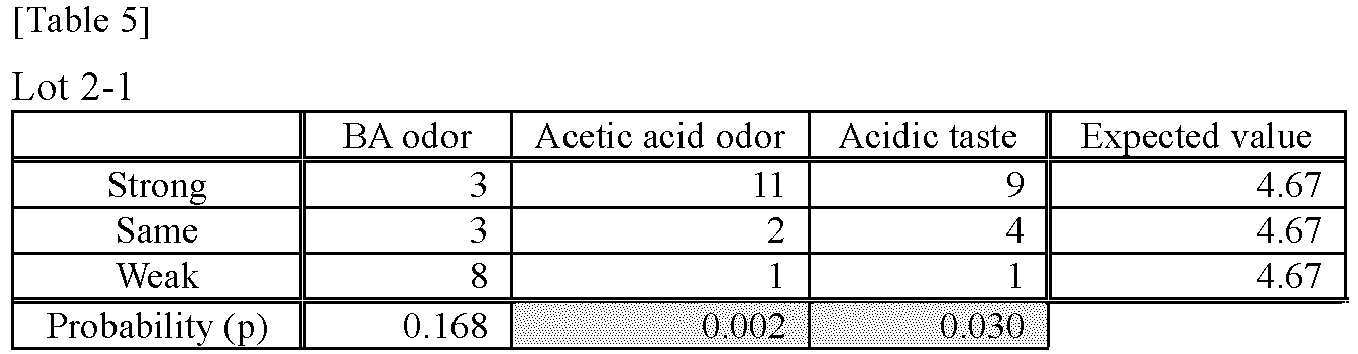
- Tables 5, 7, 9, 11, and 13 show results on whether the vote distribution for each lot is significantly deviated from the expected value.
- the numerical values for "strong,” “same,” and “weak” in the respective evaluation items of “benzoic acid odor,” “acetic acid odor,” and “acidic taste” represent the number of experts who chose each rating (14 experts in total).
- the probability (p) indicates the probability of such deviation for each evaluation item of "benzoic acid odor," “acetic acid odor,” and “acidic taste.” As the degree of deviation increases, the probability (p) decreases.
- the probability (p) of 0.05 or less means that the distribution of the panel experts is particularly concentrated on the corresponding item, in other words, the deviation is significant.
- Tables 6, 8, 10, 12, and 14 show the probability obtained by the ⁇ 2 test, which indicates whether the number of votes is significantly concentrated among “strong,” “same,” and “weak” relative to the expected value.
- Each numerical value in these tables indicates the probability of the number of experts who would choose “strong,” “same,” and “weak” in each evaluation of "benzoic acid odor,” “acetic acid odor,” and “acidic taste.”
- the numerical value of "0.001" in "strong” for "acetic acid odor” in Table 6 represents the probability in the ⁇ 2 test for the fact that 11 experts, among 14 experts of the panel, chose “strong” (from Table 5).
- the probability of 0.05 or less means that the distribution of the panel experts is particularly concentrated on the corresponding item, in other words, the choice is significant. Accordingly, the numerical value of "0.001" in “strong” for "acetic acid odor” in Table 6 is 0.05 or less and thus means that the choice made by 11 experts, among 14 experts of the panel, is significant.
- benzoic acid odor is considered as "weak" relative to the Comparative Example at a significance level of 5% for Lot 2-3, 2-4, and 2-5, in other words, in a mole ratio of acetic acid to benzoic acid within the range of 3:7 to 5:5 (i.e. 1:1). Consequently, it was confirmed that benzoic acid odor is effectively reduced through partial replacement of benzoic acid by acetic acid. Moreover, it is concluded that such effects are exhibited when 30% or more of benzoic acid in mole equal to nicotine is replaced by acetic acid.
- Example 2 it was confirmed that benzoic acid odor is effectively reduced through partial replacement of benzoic acid by acetic acid.
- excessively strong acetic acid odor or acidic taste could interfere with the emission of a flavor in an e-liquid containing the flavor.
- acetic acid odor or acidic taste per se would be perceived as off-note or off-taste to damage acceptance of/preference for an e-liquid itself.
- This Example investigated the reduction of acetic acid odor and acidic taste as much as possible while retaining the function in reducing gunpowder odor of benzoic acid.
- each e-liquid having the composition containing citric acid in addition to acetic acid and benzoic acid was prepared to confirm the effects through sensory evaluation.
- e-liquids of this Example were added with a flavor to reproduce the state close to an embodiment that is actually used for a liquid heating-type flavor inhaler.
- a tobacco-type flavor that is empirically considered less likely to exhibit such effects was used. Accordingly, sensory evaluation concerning acetic acid odor, benzoic acid odor, and acidic taste in this Example was not affected by the flavor.
- Each e-liquid having the composition shown in Table 15 was prepared. On this occasion, citric acid monohydrate (CA ⁇ H 2 O) was dissolved in GL in advance to form solution C. Moreover, the flavor was added at the end after mixing solution A and solution B.
- citric acid monohydrate CA ⁇ H 2 O
- Example 2 The preparation of evaluation samples and the sensory evaluation method are the same as in "2-2 Experimental Procedure" of Example 2, and sensory evaluation was conducted by the panel of 16 experts.
- a comparative example used was an e-liquid having the same organic acid composition as Lot 2-3, for which the effects of reducing benzoic acid odor had been confirmed in Example 2, in other words, having a mole ratio of acetic acid to benzoic acid of 3:7.
- Analysis results A are shown in Tables 16, 18, 20, 22, and 24, and analysis results B are shown in Tables 17, 19, 21, 23, and 25.
- Benzoic acid is a relatively hydrophobic substance with low solubility in water.
- Main solvents of an e-liquid are PG and GL.
- solubility of benzoic acid in these solvents is not so high. Consequently, prolonged stirring or heating is often required for dissolving benzoic acid alone in these solvents.
- the present inventors focused on the facts that benzoic acid neutralized with nicotine or in the state of nicotine benzoic acid salt exhibits enhanced hydrophilicity and that PG would be a more suitable solvent for dissolving a hydrophobic substance than GL in comparison of structures between PG having two hydrophilic hydroxy groups and GL having three such groups.
- the inventors made hypothesis based on the above consideration that two conditions for efficiently dissolving benzoic acid are (a) dissolving benzoic acid in a solvent in the presence of nicotine and (b) dissolving in PG alone, followed by investigation of mixing procedures in methods of preparing e-liquids.
- E-liquids of the composition shown in Table 26 were prepared through two mixing procedures of I and II below to compare the time required for completely dissolving benzoic acid.
- Each weighed raw material was fed into a beaker and stirred at 1000 rpm using a stir bar within the beaker and a magnetic stirrer. After the end of stirring, the presence or absence of dissolution residue was observed through visual inspection.
- organic acids third organic acids excluding benzoic acid and acetic acid (citric acid in Example 3)
- organic acids fed to PG (solution A) together with nicotine and benzoic acid compete for the neutralization reaction between benzoic acid and nicotine and thus impede dissolution of benzoic acid.
- organic acids excluding benzoic acid and acetic acid are presumably suitable for dissolving in GL solvent in advance separately from solution A.
- the organic acids may be fed into the system (solution A) directly without dissolving in GL in advance.
- citric acid was used in Example 3 as an organic acid (third organic acid) excluding benzoic acid and acetic acid
- any acid may be used in place of citric acid provided that a required amount of the acid can be dissolved in GL completely.
- Conditions for a possible embodiment of a case in which a third organic acid reaches the highest concentration when dissolved in GL in advance within the scope of the present invention are as follows.
- long-chain fatty acids such as stearic acid and palmitic acid, exhibit evidently high hydrophobicity and hence are considered unsuitable due to low solubility in PG and GL.
- organic acids having a short carbon chain or a plurality of polar functional groups are expected to have satisfactory solubility in PG and GL and thus can be candidate substances.
- Such examples include adipic acid, citric acid, fumaric acid, lactic acid, malic acid, malonic acid, pyruvic acid, sorbic acid, succinic acid, and tartaric acid.
- This Example investigated whether these organic acids as candidates for third organic acids can be used under the above-described conditions.
- solubility tests in GL were conducted.
- GL and each acid in the amounts shown in Table 28 were weighed into a beaker and stirred using a stir bar within the beaker and a magnetic stirrer at 500 rpm and room temperature for 12 hours. After the end of stirring, the presence or absence of dissolution residue was observed through visual inspection, and a solution with observed solid residue was determined as undissolved.
- This Example investigated the effects of lowering smoke flavor inhibition caused by nicotine (nicotine impact) by each organic acid alone.
- Each e-liquid (a liquid composition for a liquid heating-type flavor inhaler) having the composition shown in Table 29 was prepared, and a capsule for a liquid heating-type flavor inhaler that heats a liquid at 200°C to 300°C was filled with 1.5 mL of the e-liquid.
- Sensory evaluation was conducted by a panel of eight experts (a panel that is routinely engaged in flavor development and has high ability in sensory evaluation) using a device for a liquid heating-type flavor inhaler that heats a liquid at 200°C to 300°C.
- lactic acid As shown in Table 29, concerning the effects of lowering smoke flavor inhibition caused by nicotine (nicotine impact), a plurality of organic acids were found to exhibit such lowering effects comparable to benzoic acid. Among the organic acids tested in this Example, lactic acid attained particularly strong effects. Lactic acid, which is liquid and exhibits satisfactory solubility in PG and GL, has a great advantage of easy handling in production. Meanwhile, slightly negative sensory elements (slight acidic odor, slight oiliness) were perceived for lactic acid. Accordingly, it is considered further desirable to combine lactic acid with other organic acids.
- the present Example investigated the composition for liquid compositions containing benzoic acid, lactic acid, and other organic acids.
- a ratio of benzoic acid to nicotine was set to 0.6 or less.
- Tartaric acid, fumaric acid, levulinic acid, and malonic acid which lack strong negative elements and exhibit strong effects of lowering nicotine impact in Example 6, were investigated as candidates for combining with lactic acid.
- a ratio of lactic acid to organic acids excluding benzoic acid and lactic acid was set to 3:1.
- an e-liquid of the composition containing benzoic acid alone but neither lactic acid nor other organic acids was used.
- Table 31 shows the composition of each sample e-liquid subjected to sensory evaluation and the results of the sensory evaluation (by a panel of 14 experts).
- the p value for the number of votes for "strong” or “weak” indicates a statistical probability of the number of times in which "strong” was chosen to occur relative to the total number n.
- gunpowder odor benzoic acid odor
- the p value is 0.006, in other words, 0.6%. This means that when “strong” and “weak” are randomly chosen 14 times at a probability of 50% each, the statistical probability of a pattern in which "weak” is coincidentally chosen 11 times is 0.6%. This value of 0.6% is smaller than a typical significance level of 1%, and hence it is concluded that the deviation in which "weak” was chosen 11 times out of 14 times is meaningful deviation at a significance level of 1%.
Landscapes
- Chemical & Material Sciences (AREA)
- Chemical Kinetics & Catalysis (AREA)
- General Chemical & Material Sciences (AREA)
- Health & Medical Sciences (AREA)
- General Health & Medical Sciences (AREA)
- Toxicology (AREA)
- Medicinal Preparation (AREA)
- Seasonings (AREA)
- Manufacture Of Tobacco Products (AREA)
Abstract
Description
- The present invention relates to a liquid composition for a liquid heating-type flavor inhaler and a preparation method therefor. The present invention also relates to a liquid heating-type flavor inhaler including the liquid composition for a liquid heating-type flavor inhaler. The present invention further relates to a method of reducing the gunpowder-like odor of benzoic acid in a liquid composition for a liquid heating-type flavor inhaler.
- A liquid heating-type flavor inhaler is a flavor inhaler that directly or indirectly heats, by an electric heat source or a chemical reaction-based heat source, a liquid composition for a liquid heating-type flavor inhaler to generate an aerosol and delivers the aerosol into the mouth through a mouthpiece member. A typical liquid composition for a liquid heating-type flavor inhaler (a liquid for electronic cigarettes (commonly called as e-liquid or e-juice)) comprises propylene glycol (PG), glycerol (GL), nicotine, and a flavor.
-
Japanese Unexamined Patent Application Publication (Translation of PCT Application) No. 2018-532377 -
Japanese Unexamined Patent Application Publication (Translation of PCT Application) No. 2016-520061 - It is said that the role of nicotine in e-liquids is to impart sensory impact during inhalation. Meanwhile, as the nicotine concentration in an e-liquid increases, inhalation accompanies more irritation to the mouth and throat (herein, referred to as "smoke flavor inhibition" in some cases). Consequently, a user often feels uncomfortable during inhalation of an aerosol. As a method of resolving these problems, products containing benzoic acid (BA) in an e-liquid have become widely used in recent years. The mechanism is that nicotine as a basic substance is neutralized with benzoic acid as an acidic substance to affect the gas-liquid equilibrium of nicotine during heating, thereby lowering smoke flavor inhibition caused by nicotine.
- PTL 1:
Japanese Unexamined Patent Application Publication (Translation of PCT Application) No. 2018-532377 Japanese Unexamined Patent Application Publication (Translation of PCT Application) No. 2016-520061 - The present inventors found problems that a product containing benzoic acid in an e-liquid for lowering smoke flavor inhibition caused by nicotine (nicotine impact) emits a smell peculiar to benzoic acid during heating (gunpowder-like; herein, referred to as "gunpowder-like odor" or "benzoic acid odor" in some cases), and the resulting benzoic acid odor interferes with the emission of a flavor in the e-liquid, thereby destroying smoking flavor. Moreover, benzoic acid has low solubility in PG and GL and hence requires a prolonged stirring step or heating step for the dissolution during production of e-liquids. For this reason, there are concerns about adverse effects on product quality, such as volatilization or deterioration of the components as well as effects on production efficiency.
- The present inventors noticed that an e-liquid containing benzoic acid alone has such various problems with sensory characteristics, product quality, production efficiency, and so forth and conducted research to resolve these problems. Finally, the inventors arrived at the present invention through the development in view of the following.
- - to reduce the amount of benzoic acid to reduce benzoic acid odor
- - to use other organic acids for making up for the amount of benzoic acid reduced while ensuring sensory characteristics and effects of lowering smoke flavor inhibition caused by nicotine at levels comparable to a product using benzoic acid alone
- - to establish mixing procedures for efficiently formulating an e-liquid containing organic acids of the developed composition
- The present inventors also found that smoke flavor inhibition caused by nicotine (nicotine impact) is lowered even when other organic acids alone are used without using benzoic acid in a liquid composition containing nicotine for a heating-type flavor inhaler, thereby arriving at the present invention concerning a liquid composition containing no benzoic acid.
- The present invention encompasses, but not limited to, the following embodiments.
- [Embodiment 1] A liquid composition for a liquid heating-type flavor inhaler, containing
- (1) propylene glycol and glycerol,
- (2) nicotine,
- (3) benzoic acid, and
- (4) one or more organic acids excluding benzoic acid.
- [Embodiment 2] The liquid composition according to Embodiment 1, where a mole ratio of (2) nicotine to the total of (3) benzoic acid and (4) one or more organic acids excluding benzoic acid falls within a range of 1:0.85 to 1:1.15.
- [Embodiment 3] The liquid composition according to Embodiment 1 or 2 containing lactic acid as (4) one or more organic acids excluding benzoic acid.
- [Embodiment 4] The liquid composition according to Embodiment 3 containing, in addition to lactic acid, any one selected from tartaric acid, fumaric acid, levulinic acid, malonic acid, acetic acid, adipic acid, citric acid, malic acid, pyruvic acid, sorbic acid, and mixtures thereof as (4) one or more organic acids excluding benzoic acid.
- [Embodiment 5] The liquid composition according to Embodiment 3 containing, in addition to lactic acid, any one selected from tartaric acid, fumaric acid, levulinic acid, malonic acid, and mixtures thereof as (4) one or more organic acids excluding benzoic acid.
- [Embodiment 6] The liquid composition according to Embodiment 3 containing, in addition to lactic acid, tartaric acid as (4) one or more organic acids excluding benzoic acid.
- [Embodiment 7] The liquid composition according to any one of Embodiments 1 to 6, where a mole ratio of (2) nicotine to (3) benzoic acid falls within a range of 1:0.7 to 1:0.15.
- [Embodiment 8] The liquid composition according to any one of Embodiments 1 to 7, where a mole ratio of (2) nicotine to (4) one or more organic acids excluding benzoic acid falls within a range of 1:0.9 to 1:0.3.
- [Embodiment 9] The liquid composition according to any one of Embodiments 1 to 8, where (4) one or more organic acids excluding benzoic acid have solubility in glycerol of 0.32 mol/kg or more in molality.
- [Embodiment 10] The liquid composition according to any one of Embodiments 1 to 9 containing substantially no water.
- [Embodiment 11] The composition according to any one of Embodiments 1 to 10 further containing a flavor.
- [Embodiment 12] A method of preparing a liquid composition for a liquid heating-type flavor inhaler, including steps of:
- (i) preparing a solution (A) by dissolving nicotine and benzoic acid in propylene glycol;
- (ii) preparing a solution (B) by dissolving lactic acid in glycerol;
- (iii) preparing, as necessary, a solution (C) by dissolving one or more organic acids excluding benzoic acid and lactic acid in propylene glycol or glycerol; and
- (iv) mixing solution (A), solution (B), and solution (C).
- [Embodiment 13] A method of preparing a liquid composition for a liquid heating-type flavor inhaler, including steps of:
- (i) preparing a solution (A) by dissolving nicotine and benzoic acid in propylene glycol; and
- (v) dissolving glycerol, lactic acid, and, as necessary, one or more organic acids excluding benzoic acid and lactic acid in solution (A).
- [Embodiment 14] The method according to Embodiment 12 or 13 further including adding a flavor in a step after step (i).
- [Embodiment 15] A liquid heating-type flavor inhaler including the liquid composition according to any one of Embodiments 1 to 14.
- [Embodiment 16] A method of reducing a gunpowder-like odor of benzoic acid in a liquid composition for a heating-type flavor inhaler,
- where the liquid composition for a heating-type flavor inhaler contains (1) propylene glycol and glycerol, (2) nicotine, and (3) benzoic acid,
- the method including further incorporating (4) one or more organic acids excluding benzoic acid into the liquid composition for a heating-type flavor inhaler.
- [Embodiment 17] The method according to Embodiment 16 including incorporating lactic acid as (4) one or more organic acids excluding benzoic acid.
- [Embodiment 18] The method according to Embodiment 17 including incorporating, in addition to lactic acid, any one selected from tartaric acid, fumaric acid, levulinic acid, malonic acid, acetic acid, adipic acid, citric acid, malic acid, pyruvic acid, sorbic acid, and mixtures thereof as (4) one or more organic acids excluding benzoic acid.
- [Embodiment 19] A liquid composition for a liquid heating-type flavor inhaler, containing
- (1) propylene glycol and glycerol,
- (2) nicotine, and
- (4) one or more organic acids excluding benzoic acid.
- [Embodiment 20] The liquid composition according to Embodiment 19, where a mole ratio of (2) nicotine to (4) one or more organic acids excluding benzoic acid falls within a range of 1:0.85 to 1:1.15.
- [Embodiment 21] The liquid composition according to Embodiment 19 or 20 containing lactic acid as (4) one or more organic acids excluding benzoic acid.
- [Embodiment 22] The liquid composition according to Embodiment 21 containing, in addition to lactic acid, any one selected from tartaric acid, fumaric acid, levulinic acid, malonic acid, acetic acid, adipic acid, citric acid, malic acid, pyruvic acid, sorbic acid, and mixtures thereof as (4) one or more organic acids excluding benzoic acid.
- [Embodiment 23] The liquid composition according to any one of Embodiments 19 to 22, where (4) one or more organic acids excluding benzoic acid have solubility in glycerol of 0.32 mol/kg or more in molality.
- [Embodiment 24] A method of preparing a liquid composition for a liquid heating-type flavor inhaler, including steps of:
- (i') preparing a solution (B) by dissolving lactic acid in glycerol;
- (ii') preparing, as necessary, a solution (C) by dissolving one or more organic acids excluding benzoic acid and lactic acid in propylene glycol or glycerol; and
- (iii') mixing nicotine, solution (B), and solution (C).
- [Embodiment 25] The method according to Embodiment 24 further including adding a flavor.
- [Embodiment 26] A liquid heating-type flavor inhaler including the liquid composition according to any one of Embodiments 19 to 25.
- A liquid composition (I) for a liquid heating-type flavor inhaler of the present invention has excellent features of reduced smoke flavor inhibition caused by nicotine due to a mixture of benzoic acid and other organic acids as well as reduced gunpowder-like odor of benzoic acid to be generated during heating.
- Moreover, a method of preparing the above-mentioned liquid composition includes dissolving benzoic acid first in propylene glycol in the presence of nicotine and then mixing with glycerol. This makes it possible to efficiently prepare, in a short time without heating treatment, a liquid composition for a liquid heating-type flavor inhaler containing benzoic acid, which is difficult to dissolve in glycerol.
- A liquid composition (II) for a liquid heating-type flavor inhaler of the present invention effectively reduces smoke flavor inhibition caused by nicotine solely by organic acids excluding benzoic acid without using benzoic acid. Since the liquid composition does not use benzoic acid, a preparation method therefor does not require a step of dissolving benzoic acid first in propylene glycol in the presence of nicotine. Nicotine may appropriately be mixed into, for example, after dissolving organic acids to be used in propylene glycol or glycerol.
- The present invention encompasses, in a non-limiting manner, the following embodiments.
- The present invention relates to a liquid composition for a liquid heating-type flavor inhaler.
- In an embodiment, a liquid composition for a liquid heating-type flavor inhaler contains
- (1) propylene glycol and glycerol,
- (2) nicotine,
- (3) benzoic acid, and
- (4) one or more organic acids excluding benzoic acid.
- A non-combustion flavor inhaler is a flavor inhaler that enables inhalation of a flavor without involving combustion. Such non-combustion flavor inhalers include: heating-type flavor inhalers equipped with an electric heat source or a chemical reaction-based heat source; and non-heating flavor inhalers without heat source.
- A "liquid heating-type flavor inhaler," as a form of non-combustion flavor inhalers, is a flavor inhaler that has a cartridge for holding a liquid composition (aerosol source) containing nicotine, heats directly or indirectly the aerosol source (liquid) by an electric heat source or a chemical reaction-based heat source to generate an aerosol containing nicotine and a flavor, and delivers the aerosol into the mouth through a mouthpiece member.
- In an embodiment of a liquid heating-type flavor inhaler, a porous or fibrous body impregnated with an aerosol source of a liquid, such as glycerol or propylene glycol, or a mixed solution thereof is electrically heated to generate a gas of mixed vapor and particulate substance, and the gas is then mixed into air drawn through the flavor inhaler. A consumer generally inhales the resulting mixed gas by drawing at the end of the flavor inhaler (mouth side end, filter end, or mouthpiece end).
- In an embodiment of a liquid composition for a liquid heating-type flavor inhaler, (2) nicotine, (3) benzoic acid, and (4) one or more organic acids excluding benzoic acid are dissolved in solvents of propylene glycol and glycerol. Herein, a liquid composition for a liquid heating-type flavor inhaler is referred to as "e-liquid" in some cases. In a non-limiting manner, benzoic acid reduces smoke flavor inhibition caused by nicotine, and other organic acids reduce the gunpowder-like odor of benzoic acid.
- In an embodiment of the liquid composition for a liquid heating-type flavor inhaler, a mole ratio of (2) nicotine to the total of (3) benzoic acid and (4) one or more organic acids excluding benzoic acid falls within a range of 3:0.1 to 0.1:3, 2:0.5 to 0.5:2, or 1:0.85 to 1:1.15. In a preferable embodiment, a mole ratio of (2) nicotine to the total of (3) benzoic acid and (4) one or more organic acids excluding benzoic acid falls within a range of 1:0.85 to 1:1.15.
- In an embodiment, a liquid composition for a liquid heating-type flavor inhaler contains (4) one or more organic acids excluding benzoic acid. Here, "organic acids" are a collective term for acids of organic compounds. The majority of organic acids are carboxylic acids having a carboxyl group or sulfonic acids having a sulfo group. The types of (4) organic acids excluding benzoic acid to be used for a liquid composition of the present invention are not particularly limited. The number of (4) organic acids excluding benzoic acid is also not particularly limited, and two or more (4) organic acids excluding benzoic acid may be contained. In a non-limiting embodiment, (4) organic acids excluding benzoic acid include lactic acid.
- Further, in an embodiment, the liquid composition for a liquid heating-type flavor inhaler may contain, in addition to lactic acid, any one selected from tartaric acid, fumaric acid, levulinic acid, malonic acid, acetic acid, adipic acid, citric acid, malic acid, pyruvic acid, sorbic acid, and mixtures thereof as (4) one or more organic acids excluding benzoic acid. In a non-limiting manner, the liquid composition may contain, in addition to lactic acid, any one selected from tartaric acid, fumaric acid, levulinic acid, malonic acid, and mixtures thereof as (4) one or more organic acids excluding benzoic acid. In a non-limiting manner, the liquid composition may contain, in addition to lactic acid, tartaric acid as (4) one or more organic acids excluding benzoic acid. Organic acids contained in a liquid composition for a liquid heating-type flavor inhaler are preferably organic acids, for which safety to organisms has been recognized, such as those approved as food additives.
- In the liquid composition for a liquid heating-type flavor inhaler, a mole ratio of lactic acid to organic acids excluding lactic acid, both of which are (4) organic acids excluding benzoic acid, is not particularly limited. In an embodiment, a mole ratio of lactic acid to organic acids excluding lactic acid is 10:1 to 1:2, 5:1 to 1:1, or 4:1 to 2:1. In an embodiment, a mole ratio of lactic acid to organic acids excluding lactic acid is about 3:1.
- For preparing as a liquid composition, "organic acids excluding benzoic acid" are preferably organic acids soluble in glycerol and/or propylene glycol. In a non-limiting embodiment, organic acids excluding benzoic acid have solubility in glycerol of 0.32 mol/kg or more in molality. Lactic acid has properties of relatively satisfactory solubility in glycerol and propylene glycol compared with benzoic acid and other organic acids. Among other organic acids, for example, there exist those having a higher dissolution rate in propylene glycol than in glycerol, such as tartaric acid and malic acid (Example 8).
- In an embodiment of the liquid composition for a liquid heating-type flavor inhaler, a mole ratio of (2) nicotine to (3) benzoic acid falls within a range of 1:0.9 to 1:0.1 or 1:0.7 to 1:0.15. In a preferable embodiment of the liquid composition for a liquid heating-type flavor inhaler, a mole ratio of (3) benzoic acid to (2) nicotine is 60% or less.
- In an embodiment of the liquid composition for a liquid heating-type flavor inhaler, a mole ratio of (2) nicotine to (4) organic acids excluding benzoic acid falls within a range of 2:1 to 1:0.1 or 1:0.9 to 1:0.3. In an embodiment of the liquid composition for a liquid heating-type flavor inhaler, a mole ratio of (2) nicotine to (4) organic acids excluding benzoic acid falls within a range of 1:0.9 to 1:0.3.
- In a non-limiting manner, a ratio of propylene glycol to glycerol is 1:1 to 1:3, more preferably 1:1 to 1:2.5, and further preferably 1:about 2.4.
- In an embodiment, the liquid composition for a liquid heating-type flavor inhaler has a water content of 10 weight% or less, 5 weight% or less, 3 weight% or less, or 1.5 weight% or less. In an embodiment, the liquid composition for a liquid heating-type flavor inhaler contains substantially no water. The expression of"...contains substantially no water" means that "water" is not added in the steps of preparing the liquid composition.
- The liquid composition for a liquid heating-type flavor inhaler may further contain, in addition to components (1) to (4), other components for an aerosol source of the liquid heating-type flavor inhaler. In an embodiment, the liquid composition contains a flavor.
- The present invention relates to a method of preparing a liquid composition for a liquid heating-type flavor inhaler.
- In an embodiment, a method of preparing a liquid composition for a liquid heating-type flavor inhaler includes steps of:
- (i) preparing a solution (A) by dissolving nicotine and benzoic acid in propylene glycol;
- (ii) preparing a solution (B) by dissolving lactic acid in glycerol;
- (iii) preparing, as necessary, a solution (C) by dissolving one or more organic acids excluding benzoic acid and lactic acid in propylene glycol or glycerol; and
- (iv) mixing solution (A), solution (B), and solution (C).
- The matters concerning a liquid composition for a liquid heating-type flavor inhaler are as described in "1. Liquid Composition for Liquid Heating-type Flavor Inhaler."
- Benzoic acid has properties of being less soluble in glycerol. Meanwhile, lactic acid has properties of relatively satisfactory solubility in glycerol and propylene glycol compared with benzoic acid and other organic acids. Among other organic acids, for example, there exist those having a higher dissolution rate in propylene glycol than in glycerol, such as tartaric acid and malic acid. The preparation method of the present invention includes: first dissolving nicotine and benzoic acid in propylene glycol (solution (A)) (step (i)); separately dissolving lactic acid in glycerol (solution (B)) (step (ii)); further dissolving, as necessary, one or more organic acids excluding benzoic acid and lactic acid in propylene glycol or glycerol (solution (C)) (step (iii)); and after dissolving the respective organic acids, mixing solution (A), solution (B), and solution (C). This procedure makes it possible to prepare efficiently in a short time even a liquid composition for a liquid heating-type flavor inhaler containing benzoic acid, which is less soluble in glycerol.
- In an embodiment, when one or more organic acids excluding benzoic acid are acids readily soluble in glycerol and propylene glycol, such as lactic acid alone, for example, glycerol and such organic acids may be added directly to prepared solution (A) without preparing solution (B) separately from solution (A). In an embodiment, a method of preparing a liquid composition for a liquid heating-type flavor inhaler includes steps of:
- (i) preparing a solution (A) by dissolving nicotine and benzoic acid in propylene glycol; and
- (v) dissolving glycerol, lactic acid, and, as necessary, one or more organic acids excluding benzoic acid and lactic acid in solution (A).
- In a non-limiting manner, the method of preparing a liquid composition for a liquid heating-type flavor inhaler further includes adding a flavor in a step after step (i). Through addition of a flavor after preparing solution (A) by dissolving nicotine and benzoic acid in propylene glycol in step (i), it is possible to shorten stirring time after the addition of a flavor, thereby preventing or reducing the loss of flavor components. The addition of components, such as a flavor, may be performed before, simultaneously with, or after step (iv) of mixing solution (A), solution (B), and solution (C) or step (v) of dissolving glycerol, lactic acid, and so forth in solution (A) provided that the addition is performed after step (i).
- The present invention relates to a liquid heating-type flavor inhaler. The liquid heating-type flavor inhaler includes a liquid composition for a liquid heating-type flavor inhaler of the present invention.
- The matters concerning a liquid composition for a liquid heating-type flavor inhaler as well as a liquid heating-type flavor inhaler are as described in "1. Liquid Composition for Liquid Heating-type Flavor Inhaler."
- The present invention relates to a method of reducing a gunpowder-like odor of benzoic acid in a liquid composition for a liquid heating-type flavor inhaler.
- The method of reducing a gunpowder-like odor of benzoic acid in a liquid composition for a liquid heating-type flavor inhaler,
- where the liquid composition for a liquid heating-type flavor inhaler contains (1) propylene glycol and glycerol, (2) nicotine, and (3) benzoic acid,
- includes further incorporating (4) one or more organic acids excluding benzoic acid into the liquid composition for a liquid heating-type flavor inhaler.
- The method may include incorporating lactic acid as (4) one or more organic acids excluding benzoic acid.
- In an embodiment of the method of reducing a gunpowder-like odor of benzoic acid in a liquid composition for a liquid heating-type flavor inhaler, the matters concerning a liquid composition for a liquid heating-type flavor inhaler as well as a heating-type flavor inhaler are as described in "1. Liquid Composition for Liquid Heating-type Flavor Inhaler."
- In the method of reducing a gunpowder-like odor of benzoic acid in a liquid composition for a liquid heating-type flavor inhaler, it is important to incorporate (4) one or more organic acids excluding benzoic acid into the liquid composition for a liquid heating-type flavor inhaler. Here, the order of incorporating (1) propylene glycol and glycerol, (2) nicotine, (3) benzoic acid, and (4) one or more organic acids excluding benzoic acid into the liquid composition for a heating-type flavor inhaler is not particularly limited.
- In an embodiment, a liquid composition for a liquid heating-type flavor inhaler may be prepared in accordance with the method described in "2. Method of Preparing Liquid Composition for Liquid Heating-type Flavor Inhaler." In an embodiment, a method of preparing a liquid composition for a liquid heating-type flavor inhaler includes steps of:
- (i) preparing a solution (A) by dissolving nicotine and benzoic acid in propylene glycol;
- (ii) preparing a solution (B) by dissolving lactic acid in glycerol;
- (iii) preparing, as necessary, a solution (C) by dissolving one or more organic acids excluding benzoic acid and lactic acid in propylene glycol or glycerol; and
- (iv) mixing solution (A), solution (B), and solution (C).
- In an embodiment, a method of preparing a liquid composition for a liquid heating-type flavor inhaler includes steps of:
- (i) preparing a solution (A) by dissolving nicotine and benzoic acid in propylene glycol; and
- (v) dissolving glycerol, lactic acid, and, as necessary, one or more organic acids excluding benzoic acid and lactic acid in solution (A).
- The expression of "reducing a gunpowder-like odor of benzoic acid" means that a weaker gunpowder-like odor of benzoic acid is sensed compared with a case in which (4) organic acids excluding benzoic acid are not contained. In a non-limiting embodiment, this means that the gunpowder-like odor of benzoic acid is reduced when benzoic acid odor is determined as "weak" at a significance level of 1% or a significance level of 5% in a χ2 test (Pearson's χ2 test) or a binomial test, for example.
- The present invention relates to a liquid composition for a liquid heating-type flavor inhaler.
- In an embodiment, a liquid composition for a liquid heating-type flavor inhaler contains
- (1) propylene glycol and glycerol,
- (2) nicotine, and
- (4) one or more organic acids excluding benzoic acid.
- The matters concerning "non-combustion flavor inhaler" are as described in "1. Liquid Composition (I) for Liquid Heating-type Flavor Inhaler."
- As demonstrated in Example 6 of the present specification, a plurality of organic acids were found to exhibit effects of lowering smoke flavor inhibition caused by nicotine (nicotine impact) that are comparable to benzoic acid. Among the organic acids tested in this Example, lactic acid attained particularly strong effects. For this reason, a liquid composition (II) for a liquid heating-type flavor inhaler is an embodiment (solely) containing, as organic acids, organic acids excluding benzoic acid without containing benzoic acid.
- In an embodiment of the liquid composition for a liquid heating-type flavor inhaler, (2) nicotine and (4) one or more organic acids excluding benzoic acid are dissolved in solvents of propylene glycol and glycerol.
- In an embodiment of the liquid composition for a liquid heating-type flavor inhaler, a mole ratio of (2) nicotine to (4) one or more organic acids excluding benzoic acid falls within a range of 3:0.1 to 0.1:3, 2:0.5 to 0.5:2, or 1:0.85 to 1:1.15. In a preferable embodiment, a mole ratio of (2) nicotine to (4) one or more organic acids excluding benzoic acid falls within a range of 1:0.85 to 1:1.15.
- In an embodiment, the liquid composition for a liquid heating-type flavor inhaler contains (4) one or more organic acids excluding benzoic acid. Here, "organic acids" are a collective term for acids of organic compounds. The majority of organic acids are carboxylic acids having a carboxyl group or sulfonic acids having a sulfo group. The types of (4) organic acids excluding benzoic acid to be used for the liquid composition of the present invention are not particularly limited. The number of (4) organic acids excluding benzoic acid is also not particularly limited, and two or more (4) organic acids excluding benzoic acid may be contained. In a non-limiting embodiment, (4) organic acids excluding benzoic acid include lactic acid.
- By adding, in addition to lactic acid, other organic acids as (4) organic acids excluding benzoic acid, it is possible to reduce slightly negative sensory elements attributed to lactic acid (slight acidic odor, slight oiliness). In a non-limiting embodiment, any one selected from tartaric acid, fumaric acid, levulinic acid, malonic acid, acetic acid, adipic acid, citric acid, malic acid, pyruvic acid, sorbic acid, and mixtures thereof may be contained in addition to lactic acid as (4) organic acids excluding benzoic acid.
- In a non-limiting embodiment, organic acids excluding benzoic acid have solubility in glycerol of 0.32 mol/kg or more in molality.
- The matters concerning "(4) organic acids excluding benzoic acid" are as described in "1. Liquid Composition for Liquid Heating-type Flavor Inhaler" unless otherwise mentioned particularly in this section.
- In a non-limiting manner, a ratio of propylene glycol to glycerol is 1:1 to 1:3, more preferably 1:1 to 1:2.5, and further preferably 1:about 2.4.
- In an embodiment, the liquid composition for a liquid heating-type flavor inhaler has a water content of 10 weight% or less, 5 weight% or less, 3 weight% or less, or 1.5 weight% or less. In an embodiment, the liquid composition for a liquid heating-type flavor inhaler contains substantially no water. The expression of"...contains substantially no water" means that "water" is not added in the steps of preparing the liquid composition.
- The liquid composition for a liquid heating-type flavor inhaler may further contain, in addition to components (1), (2) and (4), other components for an aerosol source of the liquid heating-type flavor inhaler. In an embodiment, the liquid composition contains a flavor.
- The present invention relates to a method of preparing a liquid composition for a liquid heating-type flavor inhaler.
- In an embodiment, a method of preparing a liquid composition for a liquid heating-type flavor inhaler includes steps of:
- (i') preparing a solution (B) by dissolving lactic acid in glycerol;
- (ii') preparing, as necessary, a solution (C) by dissolving one or more organic acids excluding benzoic acid and lactic acid in propylene glycol or glycerol; and
- (iii') mixing nicotine, solution (B), and solution (C).
- The matters concerning a liquid composition for a liquid heating-type flavor inhaler are as described in "5. Liquid Composition (II) for Liquid Heating-type Flavor Inhaler."
- Lactic acid has properties of relatively satisfactory solubility in glycerol and propylene glycol compared with benzoic acid and other organic acids. Among other organic acids, for example, there exist those having a higher dissolution rate in propylene glycol than in glycerol, such as tartaric acid and malic acid. The preparation method of the present invention includes: first dissolving lactic acid in glycerol (solution (B)) (step (i'); further dissolving, as necessary, one or more organic acids excluding benzoic acid and lactic acid in propylene glycol or glycerol (solution (C)) (step (ii')); and after dissolving the respective organic acids, mixing nicotine, solution (B), and solution (C). Since benzoic acid is not used for a liquid composition (II) for a liquid heating-type flavor inhaler, the preparation method does not require a step of dissolving benzoic acid first in propylene glycol in the presence of nicotine. Nicotine may appropriately be mixed into, for example, after dissolving organic acids to be used in propylene glycol or glycerol.
- In a non-limiting manner, the method of preparing a liquid composition for a liquid heating-type flavor inhaler further includes adding a flavor. The preparation method (II) does not include a relatively time-consuming step of dissolving benzoic acid in propylene glycol. Accordingly, the timing of adding a flavor is not particularly limited and may be before, simultaneously with, or after step (i'), step (ii') or step (iii').
- The present invention relates to a liquid heating-type flavor inhaler. The liquid heating-type flavor inhaler includes a liquid composition for a liquid heating-type flavor inhaler of the present invention.
- The matters concerning a liquid composition for a liquid heating-type flavor inhaler as well as a liquid heating-type flavor inhaler are as described in "1. Liquid Composition (I) for Liquid Heating-type Flavor Inhaler" or "5. Liquid Composition (II) for Liquid Heating-type Flavor Inhaler."
- Hereinafter, the present invention will be described in detail on the basis of working examples. However, the present invention is by no means limited to these examples. A person skilled in the art would easily modify or change the present invention on the basis of the description in the present specification, but such modifications or changes are encompassed in the technical scope of the present invention.
- In this Example, reduction in the amount of benzoic acid to be used was investigated as an approach to reduced benzoic acid odor. Specifically, it was decided to inspect two approaches of 1) simply reducing the amount of benzoic acid to be used (resulting in mole not equal to nicotine) or 2) reducing benzoic acid while replacing by another organic acid to make up for the shortfall in acid. Moreover, the prerequisite for the development was to ensure the function in lowering smoke flavor inhibition caused by nicotine, which is expected as the intrinsic function of benzoic acid, at a level comparable to an equimolar mixture of benzoic acid and nicotine.
- For selecting organic acids excluding benzoic acid in 2), the following two points were taken into account.
- (i) common acids that are widely approved as food additives and preferably widely contained in food and that are of extremely low health concern
- (ii) acids having satisfactory solubility in PG and GL
- As acids satisfying these conditions, it was decided to employ two acids of acetic acid (AA) and citric acid (CA) for investigation. As for citric acid, experiments were conducted using citric acid monohydrate (CA·H2O), which is more common as a food additive, but not anhydrous citric acid.
- Each e -liquid (a liquid composition for a liquid heating-type flavor inhaler) having the composition shown in Table 1 was prepared, and a capsule for a liquid heating-type flavor inhaler that heats a liquid at 200°C to 300°C was filled with 1.5 mL of the e-liquid. Sensory evaluation was conducted by a panel of seven experts (a panel that is routinely engaged in flavor development and has high ability in sensory evaluation) using a device for a liquid heating-type flavor inhaler that heats a liquid at 200°C to 300°C.
- As a comparative example, an e-liquid solely containing, as an acid, benzoic acid in mole equal to nicotine was used. Table 1 shows the composition of each sample e-liquid subjected to the sensory evaluation.
-
[Table 1] Lot Weight% Mole ratio of Nic to organic acid(s) PG GL Nic AA BA CA·H2O TA Nic AA BA CA TA Comp. Ex. 27.37 63.87 5.00 - 3.76 - - 1.00 - 1.00 - - 1-1 27.65 64.52 5.00 - 2.82 - - 1.00 - 0.75 - - 1-2 27.60 64.40 5.00 0.74 2.26 - - 1.00 0.40 0.60 - - 1-3 27.05 63.11 5.00 - 2.26 2.59 - 1.00 - 0.60 0.40 - - Table 2 shows comments obtained in the sensory evaluation.
-
[Table 2] Lot Main comment in sensory evaluation (selected comment made by several experts) Number of experts who made the comment (among 7 experts) Comp. Ex. gunpowder-like smell 6 1-1 smoke flavor inhibition caused by nicotine stronger than Comp. Ex. 7 1-2 vinegar-like acidic smell (acetic acid odor) 5 sour taste 3 1-3 gunpowder-like smell 4 slightly acidic smell 3 - As the results shown in Table 2, Lot 1-1, in which the amount of benzoic acid is merely simply reduced, exhibits evidently weak effects of lowering smoke flavor inhibition caused by nicotine without satisfying the prerequisite for the development and hence is unsuitable.
- It was concluded that Lot 1-3 using citric acid exhibits weak effects of reducing benzoic acid odor and thus fails to exhibit the intended function in reducing benzoic acid odor satisfactorily.
- Since no comments of "strong" were made by the experts concerning benzoic acid odor or smoke flavor inhibition caused by nicotine, it is possible that Lot 1-2 using acetic acid would attain the original object and satisfy the prerequisite for the development. Although a plurality of experts made comments on acetic acid odor and acidic taste, it may be rather possible to mask gunpowder odor originating from benzoic acid when a substance having a readily detectable smell, such as acetic acid odor, coexists with benzoic acid.
- Here, acetic acid has the following advantages when the physical/chemical characteristics are compared with other organic acids, such as citric acid.
- due to its pKa, as an acidity indicator, close to benzoic acid (benzoic acid: 4.21, acetic acid: 4.76), it is possible that acetic acid would exhibit behavior close to benzoic acid in the neutralization reaction with nicotine.
- acetic acid has an advantage in production due to its extremely high solubility in PG and GL (dissolves in any proportion).
- the amount used is relatively small on a weight basis due to its small molecular weight.
- By taking into account the foregoing comprehensively, acetic acid (AA) was selected as the most promising candidate for an organic acid that replaces benzoic acid and used for the subsequent investigation.
- In this Example, the composition in which acetic acid exhibits effects of reducing benzoic acid odor was investigated. Specifically, each e-liquid of the composition containing both acetic acid and benzoic acid was prepared, and the effects were confirmed through sensory evaluation.
- Each e -liquid having the composition shown in Table 3 was prepared, and a capsule for a liquid heating-type flavor inhaler that heats a liquid at 200°C to 300°C was filled with 1.5 mL of the e-liquid. Sensory evaluation was conducted by a panel of 14 experts using a device for a liquid heating-type flavor inhaler that heats a liquid at 200°C to 300°C. As a comparative example, an e-liquid solely containing, as an acid, benzoic acid in mole equal to nicotine was used.
-
[Table 3] Lot Weight% Mole ratio of Nic to organic acid(s) PG GL Nic AA BA Nic AA BA Comp. Ex. 27.37 63.87 5.00 0.00 3.76 1.00 - 1.00 2-1 27.43 64.00 5.00 0.19 3.39 1.00 0.10 0.90 2-2 27.49 64.13 5.00 0.37 3.01 1.00 0.20 0.80 2-3 27.54 64.27 5.00 0.56 2.63 1.00 0.30 0.70 2-4 27.60 64.40 5.00 0.74 2.26 1.00 0.40 0.60 2-5 27.66 64.53 5.00 0.93 1.88 1.00 0.50 0.50 - According to the definition of each evaluation item in Table 4, the intensity of each sensory evaluation item was determined as "strong," "same," or "weak" for each lot relative to the Comparative Example.
-
[Table 4] Sensory evaluation item Definition BA odor gunpowder-like (smell after firing starting pistol for track and field races), burnt Acetic acid odor sour (vinegar-like acidic odor), acidic Acidic taste vinegar-like taste, sour - When any difference from the Comparative Example is not perceived, in other words, when acetic acid fails to act to reduce benzoic acid odor, it is expected that votes in the sensory evaluation would concentrate on "same" or the number of votes for three groups of "strong," "same," and "weak" would be distributed at N/3 = 4.67.
- In this Example, a common χ2 test (Pearson's χ2 test) (reference: Muto, Shinsuke. Tokei Kaiseki Handbook, second printing on October 1, 1996, Asakura Publishing Co., Ltd.) was employed to confirm the existence of any difference from the Comparative Example produced by using acetic acid or the existence of any significant difference in the actual number of votes relative to the expected value. When a probability value calculated in the χ2 test does not exceed a set statistical significance level, it is determined that the panel is randomly dispersed among the items of "strong," "same," and "weak," in other words, no significant difference exists. This indicates that the panel intentionally chooses certain items to concentrate thereon rather than the panel has difficulty in determining differences among "strong," "same," and "weak" through evaluation. In this Example, a statistical significance level α was set to commonly employed 0.05 (significance level of 5%). When a value p calculated as a frequency of the distribution result of the panel is 0.05 or less, it is determined that the value exceeds the statistical significance level, in other words, is significant.
- Tables 5, 7, 9, 11, and 13 (analysis results A) show results on whether the vote distribution for each lot is significantly deviated from the expected value. In analysis results A, the numerical values for "strong," "same," and "weak" in the respective evaluation items of "benzoic acid odor," "acetic acid odor," and "acidic taste" represent the number of experts who chose each rating (14 experts in total). The expected values are expected values when the number of votes is evenly distributed among three groups of "strong," "same," and "weak" at N/3 = 4.67. The probability (p) indicates the probability of such deviation for each evaluation item of "benzoic acid odor," "acetic acid odor," and "acidic taste." As the degree of deviation increases, the probability (p) decreases. The probability (p) of 0.05 or less means that the distribution of the panel experts is particularly concentrated on the corresponding item, in other words, the deviation is significant.
- Further, when analysis results A demonstrate significantly deviated distribution, Tables 6, 8, 10, 12, and 14 (analysis results B) show the probability obtained by the χ2 test, which indicates whether the number of votes is significantly concentrated among "strong," "same," and "weak" relative to the expected value. Each numerical value in these tables indicates the probability of the number of experts who would choose "strong," "same," and "weak" in each evaluation of "benzoic acid odor," "acetic acid odor," and "acidic taste." For example, the numerical value of "0.001" in "strong" for "acetic acid odor" in Table 6 represents the probability in the χ2 test for the fact that 11 experts, among 14 experts of the panel, chose "strong" (from Table 5). The probability of 0.05 or less means that the distribution of the panel experts is particularly concentrated on the corresponding item, in other words, the choice is significant. Accordingly, the numerical value of "0.001" in "strong" for "acetic acid odor" in Table 6 is 0.05 or less and thus means that the choice made by 11 experts, among 14 experts of the panel, is significant.
- Table 5 Lot 2-1 Analysis Results A
- Table 6 Lot 2-1 Analysis Results B

- Table 7 Lot 2-2 Analysis Results A

- Table 8 Lot 2-2 Analysis Results B

- Table 9 Lot 2-3 Analysis Results A

- Table 10 Lot 2-3 Analysis Results B

- Table 11 Lot 2-4 Analysis Results A

- Table 12 Lot 2-4 Analysis Results B

- Table 13 Lot 2-5 Analysis Results A

- Table 14 Lot 2-5 Analysis Results B

- From the results in Tables 5 to 14, benzoic acid odor is considered as "weak" relative to the Comparative Example at a significance level of 5% for Lot 2-3, 2-4, and 2-5, in other words, in a mole ratio of acetic acid to benzoic acid within the range of 3:7 to 5:5 (i.e. 1:1). Consequently, it was confirmed that benzoic acid odor is effectively reduced through partial replacement of benzoic acid by acetic acid. Moreover, it is concluded that such effects are exhibited when 30% or more of benzoic acid in mole equal to nicotine is replaced by acetic acid.
- Meanwhile, although natural since acetic acid is not contained in the Comparative Example, all the lots resulted in "strong" acetic acid odor and acidic taste relative to the Comparative Example at a significance level of 5%.
- In Example 2, it was confirmed that benzoic acid odor is effectively reduced through partial replacement of benzoic acid by acetic acid. However, excessively strong acetic acid odor or acidic taste could interfere with the emission of a flavor in an e-liquid containing the flavor. In addition, it is also possible that acetic acid odor or acidic taste per se would be perceived as off-note or off-taste to damage acceptance of/preference for an e-liquid itself. This Example investigated the reduction of acetic acid odor and acidic taste as much as possible while retaining the function in reducing gunpowder odor of benzoic acid.
- Specifically, to investigate to what extent the amount of acetic acid should be reduced to effectively reduce acetic acid odor/acidic taste, each e-liquid having the composition containing citric acid in addition to acetic acid and benzoic acid was prepared to confirm the effects through sensory evaluation. Here, e-liquids of this Example were added with a flavor to reproduce the state close to an embodiment that is actually used for a liquid heating-type flavor inhaler. However, to prevent acetic acid odor or benzoic acid odor itself from being masked with a scent from a flavor, a tobacco-type flavor that is empirically considered less likely to exhibit such effects was used. Accordingly, sensory evaluation concerning acetic acid odor, benzoic acid odor, and acidic taste in this Example was not affected by the flavor.
- Each e-liquid having the composition shown in Table 15 was prepared. On this occasion, citric acid monohydrate (CA·H2O) was dissolved in GL in advance to form solution C. Moreover, the flavor was added at the end after mixing solution A and solution B.
- The preparation of evaluation samples and the sensory evaluation method are the same as in "2-2 Experimental Procedure" of Example 2, and sensory evaluation was conducted by the panel of 16 experts. As a comparative example, used was an e-liquid having the same organic acid composition as Lot 2-3, for which the effects of reducing benzoic acid odor had been confirmed in Example 2, in other words, having a mole ratio of acetic acid to benzoic acid of 3:7.
-
[Table 15] Lot Weight% Mole ratio of Nic to organic acids PG GL Flavor Nic AA BA CA·H2O Nic AA BA CA Comp. Ex. 26.04 60.77 5.00 5.00 0.56 2.63 - 1.00 0.30 0.70 - 3-1 25.70 59.96 5.00 5.00 0.09 2.63 1.62 1.00 0.05 0.70 0.25 3-2 25.77 60.12 5.00 5.00 0.19 2.63 1.30 1.00 0.10 0.70 0.20 3-3 25.83 60.28 5.00 5.00 0.28 2.63 0.97 1.00 0.15 0.70 0.15 3-4 25.90 60.44 5.00 5.00 0.37 2.63 0.65 1.00 0.20 0.70 0.10 3-5 25.97 60.61 5.00 5.00 0.46 2.63 0.32 1.00 0.25 0.70 0.05 - Analysis was conducted using the statistical method by a χ2 test the same as in "2-3 Results and Discussion" of Example 2.
- Analysis results A: analysis whether the vote distribution for each lot is significantly deviated from the expected value (analysis on significance in deviation)
- Analysis results B: analysis on significance in each rating (the number of votes) for each item
- Analysis results A are shown in Tables 16, 18, 20, 22, and 24, and analysis results B are shown in Tables 17, 19, 21, 23, and 25.
- Table 16 Analysis Results A for Lot 3-1

- Table 17 Analysis Results B for Lot 3-1

- Table 18 Analysis Results A for Lot 3-2

- Table 19 Analysis Results B for Lot 3-2
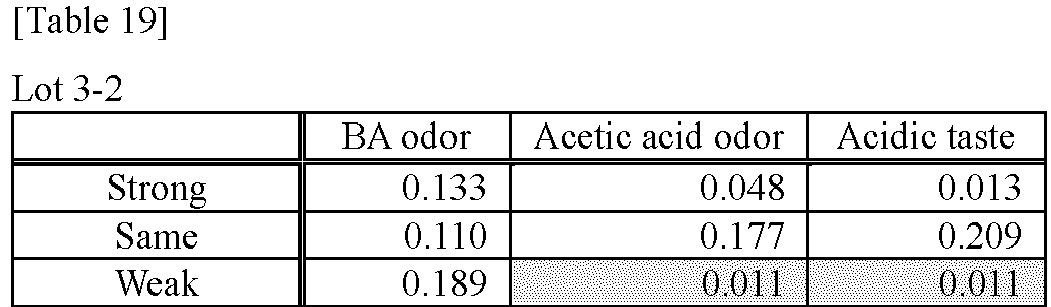
-
[Table 20] Lot 3-3 BA odor Acetic acid odor Acidic taste Expected value Strong 4 5 5 5.33 Same 5 3 3 5.33 Weak 7 8 8 5.33 Probability (p) 0.646 0.305 0.305 -
[Table 21] Lot 3-3 BA odor Acetic acid odor Acidic taste Strong 0.177 0.209 0.209 Same 0.209 0.110 0.110 Weak 0.133 0.074 0.074 -
[Table 22] Lot 3-4 BA odor Acetic acid odor Acidic taste Expected value Strong 6 7 7 5.33 Same 3 1 1 5.33 Weak 7 8 8 5.33 Probability (p) 0.444 0.068 0.068 -
[Table 23] Lot 3-4 BA odor Acetic acid odor Acidic taste Strong 0.189 0.133 0.133 Same 0.110 0.013 0.013 Weak 0.133 0.074 0.074 -
[Table 24] Lot 3-5 BA odor Acetic acid odor Acidic taste Expected value Strong 7 5 3 5.33 Same 5 2 4 5.33 Weak 4 9 9 5.33 Probability (p) 0.646 0.099 0.144 -
[Table 25] Lot 3-5 BA odor Acetic acid odor Acidic taste Strong 0.133 0.209 0.110 Same 0.209 0.048 0.177 Weak 0.177 0.032 0.032 - First, no significant difference, from the Comparative Example, in the intensity of benzoic acid odor was recognized for all the lots. Accordingly, it is concluded that the function in reducing benzoic acid odor can be ensured even if acetic acid is partially replaced by equimolar citric acid monohydrate.
- It is then considered from the results of lots 3-1 and 3-2 that acetic acid odor and acidic taste are "weak" relative to the Comparative Example at a significance level of 5% when a mole ratio of acetic acid, benzoic acid, and citric acid falls within the range of 0.05:0.70:0.25 to 0.10:0.70:0.20. Consequently, it was confirmed that partial replacement of acetic acid by citric acid effectively reduces acetic acid odor and acidic taste. Moreover, it is concluded that such effects are exhibited when a mole ratio of acetic acid falls within a certain range, for example, a mole ratio of acetic acid to nicotine within the range of 1/10 or less and a mole ratio of acetic acid to benzoic acid within the range of 1/7 or less.
- Benzoic acid is a relatively hydrophobic substance with low solubility in water. Main solvents of an e-liquid are PG and GL. However, the solubility of benzoic acid in these solvents is not so high. Consequently, prolonged stirring or heating is often required for dissolving benzoic acid alone in these solvents.
- To resolve these problems and invent further efficient methods of preparing e-liquids, the present inventors focused on the facts that benzoic acid neutralized with nicotine or in the state of nicotine benzoic acid salt exhibits enhanced hydrophilicity and that PG would be a more suitable solvent for dissolving a hydrophobic substance than GL in comparison of structures between PG having two hydrophilic hydroxy groups and GL having three such groups. Specifically in this Example, the inventors made hypothesis based on the above consideration that two conditions for efficiently dissolving benzoic acid are (a) dissolving benzoic acid in a solvent in the presence of nicotine and (b) dissolving in PG alone, followed by investigation of mixing procedures in methods of preparing e-liquids.
- E-liquids of the composition shown in Table 26 were prepared through two mixing procedures of I and II below to compare the time required for completely dissolving benzoic acid.
-
[Table 26] Solvent Nic:BA mole ratio Weight% PG GL Nic BA PG:GL = 3:7 (weight ratio) 1:1 27.37 63.87 5.00 3.76 - I. A procedure including feeding all of PG, GL, nicotine, and benzoic acid first and then stirring/mixing at room temperature
- II. A procedure including feeding only PG, nicotine, and benzoic acid, stirring/mixing at room temperature, adding GL (solution B) after confirming complete dissolution of benzoic acid (solution A), and stirring/mixing at room temperature again
- Each weighed raw material was fed into a beaker and stirred at 1000 rpm using a stir bar within the beaker and a magnetic stirrer. After the end of stirring, the presence or absence of dissolution residue was observed through visual inspection.
- In the case of procedure I, benzoic acid powder was observed even after stirring for 6 hours or more without complete dissolution.
- Meanwhile, in the case of procedure II, benzoic acid powder disappeared 30 minutes after starting the first stirring of only PG, nicotine, and benzoic acid to confirm the complete dissolution. Subsequently, the resulting solution was added with GL, stirred again, and observed as a uniform liquid after 10 minutes.
- From these results, it was confirmed possible to dissolve benzoic acid in a short time even under room temperature conditions through mixing procedure II, in which GL is added after completely dissolving benzoic acid in the presence of only PG and nicotine.
- It is considered that when preparing e-liquids using organic acids (third organic acids) excluding benzoic acid and acetic acid (citric acid in Example 3), such organic acids fed to PG (solution A) together with nicotine and benzoic acid compete for the neutralization reaction between benzoic acid and nicotine and thus impede dissolution of benzoic acid. Accordingly, such organic acids excluding benzoic acid and acetic acid are presumably suitable for dissolving in GL solvent in advance separately from solution A. Alternatively, it is presumed that when such organic acids are liquid organic acids with high solubility in PG and GL, such as acetic acid, the organic acids may be fed into the system (solution A) directly without dissolving in GL in advance.
- Although citric acid was used in Example 3 as an organic acid (third organic acid) excluding benzoic acid and acetic acid, any acid may be used in place of citric acid provided that a required amount of the acid can be dissolved in GL completely. Conditions for a possible embodiment of a case in which a third organic acid reaches the highest concentration when dissolved in GL in advance within the scope of the present invention are as follows.
- the amount of nicotine to be added is 5 weight%
- the amount of a flavor to be added is 5 weight%
- a weight ratio of PG:GL as solvents is 50:50
- one third organic acid is used
- a mole ratio of nicotine: acetic acid: benzoic acid: third organic acid is 1.00:0.05:0.50:0.45
- Candidates for those usable as third organic acids would be organic acids that have been approved as food additives as mentioned in 1-1 of Example 1 and that are expected to have moderate solubility in PG and GL (= those having a high proportion of polar functional group(s) within a molecule). For example, long-chain fatty acids, such as stearic acid and palmitic acid, exhibit evidently high hydrophobicity and hence are considered unsuitable due to low solubility in PG and GL. Meanwhile, organic acids having a short carbon chain or a plurality of polar functional groups are expected to have satisfactory solubility in PG and GL and thus can be candidate substances. Such examples include adipic acid, citric acid, fumaric acid, lactic acid, malic acid, malonic acid, pyruvic acid, sorbic acid, succinic acid, and tartaric acid. This Example investigated whether these organic acids as candidates for third organic acids can be used under the above-described conditions.
- The composition of e-liquids under the above-described conditions was simulated, and the molality of each third organic acid was calculated for the simulated composition on the premise that the third organic acid is dissolved only in the formulation amount of GL in advance. The results are shown in Table 27.
-
[Table 27] Third organic acid Weight% Molality [mol/kg] when third organic acid is dissolved in GL in advance for complete dissolution PG GL Flavor Nic AA BA Third organic acid Citric acid monohydrate 42.56 42.56 5.00 5.00 0.09 1.88 2.91 0.326 Lactic acid 43.39 43.39 5.00 5.00 0.09 1.88 1.25 0.320 Malic acid 43.08 43.08 5.00 5.00 0.09 1.88 1.86 0.322 Malonic acid 43.29 43.29 5.00 5.00 0.09 1.88 1.44 0.320 Pyruvic acid 43.40 43.40 5.00 5.00 0.09 1.88 1.22 0.320 Tartaric acid 42.97 42.97 5.00 5.00 0.09 1.88 2.08 0.323 - As understood from the simulated composition shown in Table 27, "solubility in GL of 0.32 mol/kg or more in molality" would be a guide to selecting third organic acids that can realize the composition of an e-liquid as well as a mixing method therefor anticipated within the scope of the present invention.
- Next, to verify whether such composition can actually be realized by the mixing methods of the present invention, solubility tests in GL were conducted. GL and each acid in the amounts shown in Table 28 were weighed into a beaker and stirred using a stir bar within the beaker and a magnetic stirrer at 500 rpm and room temperature for 12 hours. After the end of stirring, the presence or absence of dissolution residue was observed through visual inspection, and a solution with observed solid residue was determined as undissolved.
-
[Table 28] Third organic acid Weight% Molality [mol/kg] of organic acid in complete dissolution Observation of complete dissolution MW GL Third organic acid Citric acid monohydrate 93.50 6.50 0.331 observed 210.14 Lactic acid 97.20 2.80 0.320 observed 90.08 Malic acid 95.80 4.20 0.327 observed 134.09 Malonic acid 96.70 3.30 0.328 observed 104.06 Pyruvic acid 97.20 2.80 0.327 observed 88.06 Tartaric acid 95.30 4.70 0.329 observed 150.09 - Six organic acids of citric acid, lactic acid, malic acid, malonic acid, pyruvic acid, and tartaric acid exhibited solubility in GL of 0.32 mol/kg or more. In other words, it was revealed that these organic acids can be used for an e-liquid of the present invention even in an embodiment in which such a third organic acid is used at the highest concentration anticipated within the scope of the present invention.
- This Example investigated the effects of lowering smoke flavor inhibition caused by nicotine (nicotine impact) by each organic acid alone.
- Each e-liquid (a liquid composition for a liquid heating-type flavor inhaler) having the composition shown in Table 29 was prepared, and a capsule for a liquid heating-type flavor inhaler that heats a liquid at 200°C to 300°C was filled with 1.5 mL of the e-liquid. Sensory evaluation was conducted by a panel of eight experts (a panel that is routinely engaged in flavor development and has high ability in sensory evaluation) using a device for a liquid heating-type flavor inhaler that heats a liquid at 200°C to 300°C.
- As a negative comparative example, an e-liquid containing nicotine alone but not any organic acid was used. As a positive comparative example, an e-liquid containing, as an organic acid, benzoic acid in mole equal to nicotine was used. Table 29 shows the composition of each sample e-liquid subjected to sensory evaluation and the results of the sensory evaluation.
- Table 29 Effects of Lowering Smoke Flavor Inhibition caused by Nicotine by Each Organic acid Alone (Sensory Evaluation)

- Sensory evaluation items are as follows.
-
[Table 30] Item Definition Nic impact choking sensation in throat, irritation to throat, impact Gunpowder odor gunpowder-like (smell after firing starting pistol for track and field races), medicinal, burnt Acidic odor sour (vinegar-like acidic odor), acidic Acidic taste vinegar-like taste, sour Flavor intensity overall intensity of scent from flavor - As shown in Table 29, concerning the effects of lowering smoke flavor inhibition caused by nicotine (nicotine impact), a plurality of organic acids were found to exhibit such lowering effects comparable to benzoic acid. Among the organic acids tested in this Example, lactic acid attained particularly strong effects. Lactic acid, which is liquid and exhibits satisfactory solubility in PG and GL, has a great advantage of easy handling in production. Meanwhile, slightly negative sensory elements (slight acidic odor, slight oiliness) were perceived for lactic acid. Accordingly, it is considered further desirable to combine lactic acid with other organic acids.
- Example 7 Investigation of Liquid Compositions Containing Benzoic acid, Lactic acid, and Other Organic acids
- The present Example investigated the composition for liquid compositions containing benzoic acid, lactic acid, and other organic acids.
- A ratio of benzoic acid to nicotine was set to 0.6 or less.
- Tartaric acid, fumaric acid, levulinic acid, and malonic acid, which lack strong negative elements and exhibit strong effects of lowering nicotine impact in Example 6, were investigated as candidates for combining with lactic acid. A ratio of lactic acid to organic acids excluding benzoic acid and lactic acid was set to 3:1. As a comparative example, an e-liquid of the composition containing benzoic acid alone but neither lactic acid nor other organic acids was used.
- Table 31 shows the composition of each sample e-liquid subjected to sensory evaluation and the results of the sensory evaluation (by a panel of 14 experts).
-


- The results of the sensory evaluation in Table 31 analyzed by a binomial test are shown.
- Table 32 Results of Lowering Effects by Combinations of Benzoic acid, Lactic acid, and Other Organic acids (Sensory Evaluation) Analyzed by Binomial Test

- Concerning a binomial test, the p value for the number of votes for "strong" or "weak" indicates a statistical probability of the number of times in which "strong" was chosen to occur relative to the total number n. For example, gunpowder odor (benzoic acid odor) of sample FA 0.10 will be described. When the number of times in which "weak" was chosen is 11 out of n = 14, the p value is 0.006, in other words, 0.6%. This means that when "strong" and "weak" are randomly chosen 14 times at a probability of 50% each, the statistical probability of a pattern in which "weak" is coincidentally chosen 11 times is 0.6%. This value of 0.6% is smaller than a typical significance level of 1%, and hence it is concluded that the deviation in which "weak" was chosen 11 times out of 14 times is meaningful deviation at a significance level of 1%.
- All the lots in which lactic acid was combined with fumaric acid, levulinic acid, malonic acid, or tartaric acid in various proportions resulted in nicotine impact comparable to or weaker than the comparative example (Ref). Accordingly, it was confirmed that the effects of lowering nicotine impact are ensured even if benzoic acid is partially replaced by the combinations of lactic acid and other organic acids. Moreover, all the lots resulted in gunpowder odor weaker than the comparative example (the number of votes for "weak" is larger even in a lot without significant difference). Consequently, it was confirmed that gunpowder odor can be reduced, compared with the composition containing benzoic acid alone as an organic acid, through partial replacement of benzoic acid by the combinations of lactic acid and other organic acids.
- In this Example, the dissolution rate of malic acid and tartaric acid in propylene glycol and glycerol was examined by (1) weighing an organic acid and PG or GL into a glass screw tube; (2) continuing stirring at room temperature and a stirring rate of 500 rpm using a magnetic stirrer; and (3) visually observing whether the organic acid has dissolved completely. The results are shown in Table 33.


- In Table 33, "OK" represents those for which complete dissolution was confirmed without visible solids, and "NG" represents those determined as still undissolved with remaining solids. Both malic acid and tartaric acid had a faster dissolution rate in propylene glycol than in glycerol.
Claims (26)
- A liquid composition for a liquid heating-type flavor inhaler, comprising(1) propylene glycol and glycerol,(2) nicotine,(3) benzoic acid, and(4) one or more organic acids excluding benzoic acid.
- The liquid composition according to Claim 1, wherein a mole ratio of (2) nicotine to the total of (3) benzoic acid and (4) one or more organic acids excluding benzoic acid falls within a range of 1:0.85 to 1:1.15.
- The liquid composition according to Claim 1 or 2 comprising lactic acid as (4) one or more organic acids excluding benzoic acid.
- The liquid composition according to Claim 3 comprising, in addition to lactic acid, any one selected from tartaric acid, fumaric acid, levulinic acid, malonic acid, acetic acid, adipic acid, citric acid, malic acid, pyruvic acid, sorbic acid, and mixtures thereof as (4) one or more organic acids excluding benzoic acid.
- The liquid composition according to Claim 3 comprising, in addition to lactic acid, any one selected from tartaric acid, fumaric acid, levulinic acid, malonic acid, and mixtures thereof as (4) one or more organic acids excluding benzoic acid.
- The liquid composition according to Claim 3 comprising, in addition to lactic acid, tartaric acid as (4) one or more organic acids excluding benzoic acid.
- The liquid composition according to any one of Claims 1 to 6, wherein a mole ratio of (2) nicotine to (3) benzoic acid falls within a range of 1:0.7 to 1:0.15.
- The liquid composition according to any one of Claims 1 to 7, wherein a mole ratio of (2) nicotine to (4) one or more organic acids excluding benzoic acid falls within a range of 1:0.9 to 1:0.3.
- The liquid composition according to any one of Claims 1 to 8, wherein (4) one or more organic acids excluding benzoic acid have solubility in glycerol of 0.32 mol/kg or more in molality.
- The liquid composition according to any one of Claims 1 to 9 comprising substantially no water.
- The composition according to any one of Claims 1 to 10 further comprising a flavor.
- A method of preparing a liquid composition for a liquid heating-type flavor inhaler, comprising steps of:(i) preparing a solution (A) by dissolving nicotine and benzoic acid in propylene glycol;(ii) preparing a solution (B) by dissolving lactic acid in glycerol;(iii) preparing, as necessary, a solution (C) by dissolving one or more organic acids excluding benzoic acid and lactic acid in propylene glycol or glycerol; and(iv) mixing solution (A), solution (B), and solution (C).
- A method of preparing a liquid composition for a liquid heating-type flavor inhaler, comprising steps of:(i) preparing a solution (A) by dissolving nicotine and benzoic acid in propylene glycol; and(v) dissolving glycerol, lactic acid, and, as necessary, one or more organic acids excluding benzoic acid and lactic acid in solution (A).
- The method according to Claim 12 or 13 further comprising adding a flavor in a step after step (i).
- A liquid heating-type flavor inhaler comprising the liquid composition according to any one of Claims 1 to 14.
- A method of reducing a gunpowder-like odor of benzoic acid in a liquid composition for a heating-type flavor inhaler,wherein the liquid composition for a heating-type flavor inhaler comprises (1) propylene glycol and glycerol, (2) nicotine, and (3) benzoic acid,the method comprising further incorporating (4) one or more organic acids excluding benzoic acid into the liquid composition for a heating-type flavor inhaler.
- The method according to Claim 16 comprising incorporating lactic acid as (4) one or more organic acids excluding benzoic acid.
- The method according to Claim 17 comprising incorporating, in addition to lactic acid, any one selected from tartaric acid, fumaric acid, levulinic acid, malonic acid, acetic acid, adipic acid, citric acid, malic acid, pyruvic acid, sorbic acid, and mixtures thereof as (4) one or more organic acids excluding benzoic acid.
- A liquid composition for a liquid heating-type flavor inhaler, comprising(1) propylene glycol and glycerol,(2) nicotine, and(4) one or more organic acids excluding benzoic acid.
- The liquid composition according to Claim 19, wherein a mole ratio of (2) nicotine to (4) one or more organic acids excluding benzoic acid falls within a range of 1:0.85 to 1:1.15.
- The liquid composition according to Claim 19 or 20 comprising lactic acid as (4) one or more organic acids excluding benzoic acid.
- The liquid composition according to Claim 21 comprising, in addition to lactic acid, any one selected from tartaric acid, fumaric acid, levulinic acid, malonic acid, acetic acid, adipic acid, citric acid, malic acid, pyruvic acid, sorbic acid, and mixtures thereof as (4) one or more organic acids excluding benzoic acid.
- The liquid composition according to any one of Claims 19 to 22, wherein (4) one or more organic acids excluding benzoic acid have solubility in glycerol of 0.32 mol/kg or more in molality.
- A method of preparing a liquid composition for a liquid heating-type flavor inhaler, comprising steps of:(i') preparing a solution (B) by dissolving lactic acid in glycerol;(ii') preparing, as necessary, a solution (C) by dissolving one or more organic acids excluding benzoic acid and lactic acid in propylene glycol or glycerol; and(iii') mixing nicotine, solution (B), and solution (C).
- The method according to Claim 24 further comprising adding a flavor.
- A liquid heating-type flavor inhaler comprising the liquid composition according to any one of Claims 19 to 25.
Applications Claiming Priority (2)
| Application Number | Priority Date | Filing Date | Title |
|---|---|---|---|
| JP2020018073A JP7609561B2 (en) | 2020-02-05 | 2020-02-05 | Liquid composition for liquid heating type flavor inhaler |
| PCT/JP2021/000169 WO2021157268A1 (en) | 2020-02-05 | 2021-01-06 | Liquid composition for liquid heating-type thermal flavor inhaler |
Publications (2)
| Publication Number | Publication Date |
|---|---|
| EP4101316A1 true EP4101316A1 (en) | 2022-12-14 |
| EP4101316A4 EP4101316A4 (en) | 2024-01-24 |
Family
ID=77200569
Family Applications (1)
| Application Number | Title | Priority Date | Filing Date |
|---|---|---|---|
| EP21750255.8A Pending EP4101316A4 (en) | 2020-02-05 | 2021-01-06 | Liquid composition for liquid heating-type thermal flavor inhaler |
Country Status (4)
| Country | Link |
|---|---|
| US (1) | US20220369691A1 (en) |
| EP (1) | EP4101316A4 (en) |
| JP (2) | JP7609561B2 (en) |
| WO (1) | WO2021157268A1 (en) |
Cited By (1)
| Publication number | Priority date | Publication date | Assignee | Title |
|---|---|---|---|---|
| EP4297593A1 (en) * | 2021-02-24 | 2024-01-03 | RAI Strategic Holdings, Inc. | Aerosol precursor formulations |
Families Citing this family (5)
| Publication number | Priority date | Publication date | Assignee | Title |
|---|---|---|---|---|
| US20240389635A1 (en) * | 2021-09-30 | 2024-11-28 | Imperial Tobacco Limited | Vaporisable liquid for a smoking substitute apparatus |
| CN115918952A (en) * | 2023-01-04 | 2023-04-07 | 东莞市吉纯生物技术有限公司 | A kind of special nicotine salt for tobacco taste and its preparation method and application |
| CN116439403B (en) * | 2023-05-25 | 2026-07-07 | 常州市派腾电子技术服务有限公司 | Atomized liquid, atomizer and aerosol generating device |
| WO2024252652A1 (en) * | 2023-06-09 | 2024-12-12 | 日本たばこ産業株式会社 | Combustion type smoking article containing additive and method for producing same |
| CN118830649A (en) * | 2024-07-18 | 2024-10-25 | 东莞市吉纯生物技术有限公司 | Methyl nicotine salt and preparation method thereof, atomized liquid, atomizer and electronic atomization device |
Family Cites Families (9)
| Publication number | Priority date | Publication date | Assignee | Title |
|---|---|---|---|---|
| CA3208137A1 (en) * | 2013-05-06 | 2014-11-13 | Juul Labs, Inc. | Nicotine salt formulations for aerosol devices and methods thereof |
| US11202470B2 (en) * | 2013-05-22 | 2021-12-21 | Njoy, Inc. | Compositions, devices, and methods for nicotine aerosol delivery |
| CN119606056A (en) * | 2013-12-05 | 2025-03-14 | 尤尔实验室有限公司 | Nicotine liquid formulations for aerosol devices and methods thereof |
| US20150313275A1 (en) * | 2014-04-30 | 2015-11-05 | Altria Client Services, Inc. | Liquid aerosol formulation of an electronic smoking article |
| GB2535427A (en) * | 2014-11-07 | 2016-08-24 | Nicoventures Holdings Ltd | Solution |
| EP3574902A1 (en) * | 2018-06-01 | 2019-12-04 | Yatzz Limited | Nicotine formulation and mode of delivery |
| CN108887731A (en) * | 2018-08-21 | 2018-11-27 | 深圳瀚星翔科技有限公司 | Nicotine salt, electronics tobacco tar and preparation method thereof |
| WO2020161798A1 (en) * | 2019-02-05 | 2020-08-13 | 日本たばこ産業株式会社 | Liquid composition for liquid heating-type, heating-type flavor inhaler |
| FR3093405B1 (en) * | 2019-03-05 | 2022-07-29 | V F P France | VAPING COMPOSITIONS |
-
2020
- 2020-02-05 JP JP2020018073A patent/JP7609561B2/en active Active
-
2021
- 2021-01-06 WO PCT/JP2021/000169 patent/WO2021157268A1/en not_active Ceased
- 2021-01-06 EP EP21750255.8A patent/EP4101316A4/en active Pending
-
2022
- 2022-08-04 US US17/880,853 patent/US20220369691A1/en active Pending
-
2024
- 2024-10-08 JP JP2024176344A patent/JP2024180431A/en active Pending
Cited By (1)
| Publication number | Priority date | Publication date | Assignee | Title |
|---|---|---|---|---|
| EP4297593A1 (en) * | 2021-02-24 | 2024-01-03 | RAI Strategic Holdings, Inc. | Aerosol precursor formulations |
Also Published As
| Publication number | Publication date |
|---|---|
| US20220369691A1 (en) | 2022-11-24 |
| WO2021157268A1 (en) | 2021-08-12 |
| JP2024180431A (en) | 2024-12-26 |
| JP7609561B2 (en) | 2025-01-07 |
| EP4101316A4 (en) | 2024-01-24 |
| JP2021122237A (en) | 2021-08-30 |
Similar Documents
| Publication | Publication Date | Title |
|---|---|---|
| US20220369691A1 (en) | Liquid composition for liquid heating-type thermal flavor inhaler | |
| US12114689B2 (en) | Gel and crystalline powder | |
| DE60126433T2 (en) | PROCESS FOR PREPARING PHARMACEUTICAL COMPOSITIONS FOR USE WITH WEICHGELATINE FORMULATIONS | |
| CN108451002A (en) | The solution of nicotine containing non-protonated form and protonated form | |
| TWI383812B (en) | Aqueous solution suitable for the chemical sterilization of packaging materials, process for its preparation and its use | |
| IE43653B1 (en) | Improvements in and relating to the sequestration of oxygen dissolved in water | |
| WO2020161798A1 (en) | Liquid composition for liquid heating-type, heating-type flavor inhaler | |
| JP2009057372A (en) | Plant herbal extract extract solution | |
| CN112755050B (en) | Alcohol-free iodine-containing disinfectant with high component stability and preparation method thereof | |
| US10729799B2 (en) | Aqueous hydrogen peroxide solution comprising a specific stabilizer | |
| CN115251451B (en) | Electronic atomized liquid and preparation method thereof | |
| WO2003027008A1 (en) | Stabilized hydrogen peroxide | |
| EP2149308B1 (en) | Oxidation stability using natural antioxidants | |
| Browning et al. | Clinical Toxicology of Ethylene Glycol Monoal Ethers | |
| EP1598071A1 (en) | Superoxide anion decomposing agent | |
| CN110710530B (en) | Compound disinfectant composition and disinfection method | |
| AU2021101161A4 (en) | Injectable nutritional supplement | |
| CN114452250A (en) | Procaterol hydrochloride oral liquid and preparation method thereof | |
| CN103004871A (en) | Low-corrosiveness oxidation-potential sterilization water and preparation method thereof | |
| JP4895429B2 (en) | Liquid mixed feed and method for producing the same | |
| EP4338747A1 (en) | Alpha-synuclein aggregation inhibitor, pharmaceutical composition for alpha-synuclein disease, and use thereof | |
| CN112625798B (en) | A sucralose complex, its preparation method, and an atomized flavoring | |
| Okada | On the reaction of bile | |
| EA013405B1 (en) | Pharmaceutical aerosol composition for pressurized metered dose inhalers | |
| Hegazi et al. | Impact of N-acetyl cysteine (NAC) chit Nanocomposite as antioxidant on broiler chicks |
Legal Events
| Date | Code | Title | Description |
|---|---|---|---|
| STAA | Information on the status of an ep patent application or granted ep patent |
Free format text: STATUS: THE INTERNATIONAL PUBLICATION HAS BEEN MADE |
|
| PUAI | Public reference made under article 153(3) epc to a published international application that has entered the european phase |
Free format text: ORIGINAL CODE: 0009012 |
|
| STAA | Information on the status of an ep patent application or granted ep patent |
Free format text: STATUS: REQUEST FOR EXAMINATION WAS MADE |
|
| 17P | Request for examination filed |
Effective date: 20220901 |
|
| AK | Designated contracting states |
Kind code of ref document: A1 Designated state(s): AL AT BE BG CH CY CZ DE DK EE ES FI FR GB GR HR HU IE IS IT LI LT LU LV MC MK MT NL NO PL PT RO RS SE SI SK SM TR |
|
| DAV | Request for validation of the european patent (deleted) | ||
| DAX | Request for extension of the european patent (deleted) | ||
| REG | Reference to a national code |
Ref country code: DE Ref legal event code: R079 Free format text: PREVIOUS MAIN CLASS: A24B0015160000 Ipc: A24B0015167000 |
|
| A4 | Supplementary search report drawn up and despatched |
Effective date: 20240103 |
|
| RIC1 | Information provided on ipc code assigned before grant |
Ipc: A24B 15/30 20060101ALI20231220BHEP Ipc: A24B 15/167 20200101AFI20231220BHEP |