EP4101131B1 - Identifizieren einer instanz einer virtuellen netzwerkfunktion - Google Patents
Identifizieren einer instanz einer virtuellen netzwerkfunktion Download PDFInfo
- Publication number
- EP4101131B1 EP4101131B1 EP20704489.2A EP20704489A EP4101131B1 EP 4101131 B1 EP4101131 B1 EP 4101131B1 EP 20704489 A EP20704489 A EP 20704489A EP 4101131 B1 EP4101131 B1 EP 4101131B1
- Authority
- EP
- European Patent Office
- Prior art keywords
- vnfm
- nfvo
- vnf
- request
- instantiated
- Prior art date
- Legal status (The legal status is an assumption and is not a legal conclusion. Google has not performed a legal analysis and makes no representation as to the accuracy of the status listed.)
- Active
Links
Images


Classifications
-
- H—ELECTRICITY
- H04—ELECTRIC COMMUNICATION TECHNIQUE
- H04L—TRANSMISSION OF DIGITAL INFORMATION, e.g. TELEGRAPHIC COMMUNICATION
- H04L12/00—Data switching networks
- H04L12/28—Data switching networks characterised by path configuration, e.g. LAN [Local Area Networks] or WAN [Wide Area Networks]
- H04L12/46—Interconnection of networks
- H04L12/4604—LAN interconnection over a backbone network, e.g. Internet, Frame Relay
- H04L12/462—LAN interconnection over a bridge based backbone
- H04L12/4625—Single bridge functionality, e.g. connection of two networks over a single bridge
-
- H—ELECTRICITY
- H04—ELECTRIC COMMUNICATION TECHNIQUE
- H04L—TRANSMISSION OF DIGITAL INFORMATION, e.g. TELEGRAPHIC COMMUNICATION
- H04L41/00—Arrangements for maintenance, administration or management of data switching networks, e.g. of packet switching networks
- H04L41/08—Configuration management of networks or network elements
- H04L41/0895—Configuration of virtualised networks or elements, e.g. virtualised network function or OpenFlow elements
-
- H—ELECTRICITY
- H04—ELECTRIC COMMUNICATION TECHNIQUE
- H04L—TRANSMISSION OF DIGITAL INFORMATION, e.g. TELEGRAPHIC COMMUNICATION
- H04L41/00—Arrangements for maintenance, administration or management of data switching networks, e.g. of packet switching networks
- H04L41/08—Configuration management of networks or network elements
- H04L41/0803—Configuration setting
- H04L41/0806—Configuration setting for initial configuration or provisioning, e.g. plug-and-play
Definitions
- Examples of the present disclosure relate to identifying an instance of a virtual network function.
- VNFs virtual network functions
- the provision of network services by VNFs in the virtual network may be facilitated by a Network Functions Virtualisation Orchestrator (NFVO).
- NFVO Network Functions Virtualisation Orchestrator
- the NFVO conducts the orchestration and management of network functions virtualisation infrastructure (NFVI) and is responsible for network service management including, for example, instantiating, scaling, updating and terminating network services.
- NFVI network functions virtualisation infrastructure
- the NFVO may also support VNF lifecycle management, together with one or more VNF Managers (VNFMs).
- VNFMs VNF Managers
- a VNFM is responsible for VNF lifecycle management including, for example, instantiating, updating, querying, scaling and terminating VNFs.
- VNFs thus requires cooperation between the NFVO and any VNFMs in the virtual network.
- the new NFVO may not be aware of any VNFs that have already been instantiated at the VNFM.
- the solution in embodiments of the present disclosure provide the advantages of automating the discovery process and make the NFV MANO Units intelligent enough to find new VNF's for discovery.
- NFVOs and VNFMs compliance with this solution will enable the Telecom Service Providers and Enterprise customers to mix and match the NFVOs and VNFMs from different vendors and still have discovery feed technique automated. In consequence, product vendors will not have to spend time and effort to specify manually the VNF's to be discovered.
- Hardware implementation may include or encompass, without limitation, digital signal processor (DSP) hardware, a reduced instruction set processor, hardware (e.g., digital or analogue) circuitry including but not limited to application specific integrated circuit(s) (ASIC) and/or field programmable gate array(s) (FPGA(s)), and (where appropriate) state machines capable of performing such functions.
- DSP digital signal processor
- ASIC application specific integrated circuit
- FPGA field programmable gate array
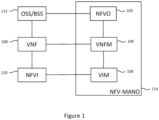
- FIG. 1 shows an example of a system 100 comprising a network function virtualisation management and orchestration framework (NFV-MANO) 114, a virtual network function (VNF) 108, a Network Functions Virtualisation Infrastructure (NFVI) 110 and an operations support system or business support system (OSS/BSS) 112.
- NFV-MANO network function virtualisation management and orchestration framework
- VNF virtual network function
- NFVI Network Functions Virtualisation Infrastructure
- OSS/BSS operations support system or business support system
- VNF 108 Only one VNF 108 is shown, although the skilled person will appreciate that the system 100 may comprise many more VNFs 108.
- a VNF referred to herein can be any implementation of a network function that can be deployed using software virtualisation techniques.
- a network function can be any functional building block within a network infrastructure.
- a functional building block may, for example, be a block within a network infrastructure that has well-defined external interfaces and a well-defined functional behaviour.
- a network function may, for example, be a network node, a physical appliance, or any other type of network function.
- the NFVI 110 comprises resources upon which VNFs (such as the VNF 108) may be deployed.
- VNFs such as the VNF 108
- the NFVI 110 may comprise one or more of: virtualisation software, hardware and system management software.
- the NFV-MANO 114 coordinates resources and manages the lifecycle of VNFs 108 in the system 100.
- the NFV-MANO 114 comprises a Network Function Virtualisation Orchestrator (NFVO) 102, a Virtual Network Function Manager (VNFM) 104 and a Virtualisation Infrastructure Manager (VIM) 106.
- NFVO Network Function Virtualisation Orchestrator
- VNFM Virtual Network Function Manager
- VIP Virtualisation Infrastructure Manager
- the NFVO 102 conducts the orchestration and management of NFVI and software resources, and is responsible for realising network services on NFVI. This may include, for example, on-boarding, instantiating, scaling, updating and terminating network services. For example, on receiving a request to instantiate a network service (e.g. from the OSS/BSS 112), the NFVO 102 may determine whether a VNF instance satisfying the requirements for providing the service has already been instantiated at the VNFM 104. If the VNF instance has been instantiated, it may be used to deliver the requested service. If the VNF instance has not already been instantiated, the NFVO 102 may initiate instantiation of the VNF instance at the VNFM 104.
- a network service e.g. from the OSS/BSS 112
- the NFVO 102 may determine whether a VNF instance satisfying the requirements for providing the service has already been instantiated at the VNFM 104. If the VNF instance has been instantiated, it may be used
- the VIM 106 controls and manages virtualisation infrastructure (e.g. the NFVI 110), including, for example computing, storage and networking resources.
- the VIM 106 may thus, for example, manage a repository of hardware and software, monitor resource usage, monitor and manage network connections and/or provide resource information to other nodes in the system 100.
- the VNFM 104 is responsible for lifecycle management for VNFs in the system (such as the VNF 108). This may include, for example, instantiating, scaling, updating and terminating VNFs. Although only one VNFM 104 is shown, the skilled person will appreciate that the system 100 may comprise one or more VNFMs.
- the NFVO 102 and the VNFM 104 may thus cooperate to manage the lifecycle of the VNF 108.
- situations may arise in which an NFVO may be deployed in a system with an existing VNFM.
- an NFVO may be deployed in a system that lacks an NFVO or a new NFVO may be deployed to replace an existing an NFVO.
- registration between the NFVO and the VNFM may be performed in order to establish an interface between the NFVO and the VNFM.
- Registration may be a manual process. For example, an operator or a user may configure the NFVO with registration information for the VNFM and configure the VNFM with registration information for the NFVO.
- the VNFM may register the NFVO by receiving one or more messages comprising registration information for the NFVO.
- the messages may be received from the NFVO, for example.
- the NFVO may register the VNFM by receiving one or more messages comprising registration information for the VNFM (e.g. from the VNFM).
- the registration information for the VNFM may comprise information enabling the NFVO to contact the VNFM.
- the registration information for the NFVO may comprise information enabling the VNFM to contact the NFVO.
- the registration information for the NFVO may comprise an Internet Protocol (IP) address and/or a port for the NFVO.
- IP Internet Protocol
- the NFVO may be considered to be registered at the VNFM when the VNFM obtains the registration information for the NFVO.
- the VNFM may be considered to be registered at the NFVO when the NFVO obtains the registration information for the VNFM.
- registration between the NFVO and the VNFM may establish a reference point between the NFVO and the VNFM on which one or more interfaces may be exposed.
- the NFVO may not be aware of any VNFs that have already been instantiated at the VNFM, which means that the NFVO and the VNFM may not be able to effectively cooperate to manage the lifecycle of VNFs that are already instantiated at the VNFM.
- the disclosure provides methods and apparatus for addressing these and other problems.
- the disclosure provides a method performed by an NFVO.
- the method comprises receiving, from a VNFM, identifying information for at least one VNF instance instantiated at the VNFM, wherein the identifying information is received from the VNFM in response to registration of one of the NFVO and the VNFM at the other of the NFVO and the VNFM.
- the method further comprises creating a record at the NFVO for the at least one VNF instance identified by the VNFM.
- the present disclosure thus provides a method for identifying existing instances of VNFs that have already been instantiated at the VNFM to the NFVO. This enables efficient deployment of NFVOs in virtual networks, thereby improving the provision of services in virtual networks.
- Figure 2 is a flowchart of an example of a method 200 performed by a NFVO.
- the method 200 may be, for example, performed by the NFVO 102 described above in respect of Figure 1 .
- the NFVO 102 receives, from a VNFM, identifying information for at least one VNF instance instantiated at the VNFM.
- the VNFM may be, for example, the VNFM 104 described above in respect of Figure 1 .
- the identifying information may comprise, for example, a unique identifier for each of the at least one VNF instances instantiated at the VNFM 104 (e.g. a VNF Instance Identifier or VNF ID).
- the identifying information may further comprise supplementary information for the instance of the VNF, including, for example, one or more of: a name or type of the VNF, a creation time and/or date, an owner etc.
- the identifying information may be comprised in a VnfldentifierNotification message.
- An example format for the VnfldentifierNotification is shown in Table 1. The skilled person will appreciate that the message may comprise any combination of the elements shown in Table 1.
- Table 1 Attribute Name Data Type Cardinality Description id Identifier 1 Identifier of this notification. If a notification is sent multiple times due to multiple subscriptions, the "id" attribute of all these notifications shall have the same value.
- notificationType String 1 Discriminator for the different notification types. Shall be set to "VnfldentifierNotification" for this notification type subscriptionld Identifier 1 Identifier of the subscription that this notification relates to. timestamp DateTime 1 Date-time of the generation of the notification.
- VNF instance identifier The created VNF instance identifier. links LccnLinks 1 Links to resources related to this notification. extensions KeyValuePairs 0..N VNF-Specific attributes that will help in discovery of the VNF at NFVO
- the identifying information for the at least one VNF instance is received from the VNFM 104 in response to registration of one of the NFVO 102 and the VNFM 104 at the other of the NFVO 102 and the VNFM 104.
- the identifying information may be received in response to registration of the NFVO 102 at the VNFM 104. That is, the VNFM 104 may send the identifying information upon registration of the NFVO 102 at the VNFM 104.
- the identifying information may be received in response to registration of the VNFM 104 at the NFVO 102.
- the NFVO 102 may, in response to registration of the VNFM 104 at the NFVO 102, send a request to the VNFM 104 to identify one or more VNF instances that are instantiated at the VNFM 104.
- the NFVO may thus receive the identifying information in step 202 in in response to the VNFM 104 receiving the request from the NFVO 102.
- the request may, for example, be sent over a lifecycle management (LCM) interface between the NFVO 102 and the VNFM 104.
- LCM lifecycle management
- the interface may be compliant with ETSI GS NFV-SOL 003.
- the request may be a request to identify all VNF instances that are instantiated at the VNFM 104.
- the NFVO 102 may thus, in step 202, receive identifying information for all the VNF instances that are instantiated at the VNFM 104.
- the request may specify one or more filters (e.g. criteria) for VNF instances to be identified to the NFVO 102.
- the NFVO 102 may thus, in step 202, receive identifying information only for VNF instances that satisfy the one or more filters.
- the one or more filters may comprise any combination of suitable filters.
- the request may be sent in one or more messages.
- the NFVO 102 may send the VNFM 104 a first message requesting that the VNFM 104 identify one or more VNF instances that are instantiated at the VNFM 104 and a second message indicating one or more filters to be used by the VNFM 104.
- the NFVO 102 thus receives identifying information for at least one VNF instance instantiated at the VNFM 104 in response to registration of one of the NFVO 102 and the VNFM 104 at the other of the NFVO 102 and the VNFM 104.
- the at least one VNF instances may have been instantiated at the VNFM 104 before the NFVO 102 registered at the VNFM 104.
- the NFVO 102 may receive identifying information only for VNF instances that were instantiated at the VNFM 104 before registration of the NFVO 102.
- the at least one VNF instances may be VNF instances that were instantiated at the VNFM 104 before the request was received by the VNFM 104.
- the VNF instance may not include VNF instances that were instantiated at the VNFM 104 after the request was received.
- the NFVO 102 creates a record at the NFVO 102 for the at least one VNF instance identified by the VNFM 104.
- the NFVO 102 may generate a VNF record for each of the at least one VNF instances identified in the identifying information received from the VNFM 104.
- the record may comprise the identifying information received from the VNFM 104.
- creating a record at the NFVO 102 may comprise generating a VNF identifier to identify the at least one VNF instance at the NFVO.
- the NFVO 102 may configure the record with a mapping between the identifying information received from the VNFM 104 and the VNF identifier generated at the NFVO 102.
- the record may comprise both the VNF identifier and the identifying information.
- the VNF identifier generated at the NFVO may serve as a local identifier for the VNF instance (e.g. an identifier for the VNF instance as instantiated at the NFVO 102).
- the NFVO 102 may thus receive identifying information for at least one VNF instance at the VNFM and create a record at the NFVO 102 for the identified VNF instance.
- the method 200 may further comprise receiving identifying information for a further VNF instance in response to the further VNF instance being instantiated at the VNFM 104.
- the NFVO 102 may send a subscription request to the VNFM 104, requesting to receive identifying information whenever a new VNF instance is instantiated at the VNFM 104.
- the subscription request may be comprised in the request described above.
- the subscription request may be sent in another message.
- the NFVO 102 may receive identifying information for any further VNF instances as they are instantiated at the VNFM 104.
- the NFVO 102 is thus kept informed of any VNF instances that are instantiated at the VNFM 104, which enables the NFVO 102 to determine which services may be provided by VNF instances that have already been instantiated at the VNFM 104 without requiring any further signalling (e.g. to query the VNFM 104).
- the NFVO 102 may use the identifying information for the at least one VNF instances to perform discovery for the at least one VNF instances. For example, the NFVO 102 may query the VNFM 104 and/or a VIM (such as the VIM 106 described above in respect of Figure 1 ) for resource information relating to each of the at least one VNF instances that are instantiated at the VNFM 104.
- VIM such as the VIM 106 described above in respect of Figure 1
- FIG 3 is a flowchart of an example of a method 300 performed by a VNFM.
- the method 300 may be, for example, performed by the VNFM 104 described above in respect of Figure 1 .
- the VNFM 104 sends, to an NFVO, identifying information for at least one VNF instance instantiated at the VNFM in response to registration of one of the NFVO and the VNFM 104 at the other of the NFVO and the VNFM 104.
- the NFVO may be, for example, the NFVO 102 described above in respect of Figure 1 .
- the identifying information may be, for example, the identifying information described above with respect to Figure 2 .
- the identifying information may be comprised in a VNFIdentifierNotification message as described above.
- sending identifying information for at least one VNF instance instantiated at the VNFM 104 in response to registration of one of the NFVO 102 and the VNFM 104 at the other of the NFVO and the VNFM 104 may comprise sending the identifying information in response to registration of the NFVO 102 at the VNFM 104.
- the VNFM 104 may send the identifying information to the NFVO 102 in response to the VNFM 104 obtaining registration information for the NFVO 102.
- the VNFM 104 may send the identifying information in response to registration of the VNFM 104 at the NFVO 102.
- the VNFM 104 may send the identifying information in response receiving a message from the NFVO 102 indicating that the VNFM 104 is registered at the NFVO 102.
- the message may, for example, form part of a registration procedure between the NFVO 102 and the VNFM 104.
- the VNFM 104 may send the identifying information in response to receiving a request, from the NFVO 102, to identify one or more VNF instances that are instantiated at the VNFM 104, wherein the request is received in response to registration of the VNFM 104 at the NFVO 102.
- the request may be the request described above in reference to Figure 2 .
- the request may be a request to identify all VNF instances that are instantiated at the VNFM 104.
- the VNFM 104 may send identifying information for all the VNF instances that are instantiated at the VNFM 104.
- the request may specify one or more filters for VNF instances to be identified to the NFVO 102.
- the VNFM 104 may thus send identifying information for only the VNF instances that are instantiated at the VNFM 104 that satisfy the filters.
- the one or more filters may be any combination of the filters described above in respect of Figure 2 .
- the request may be received in one or more messages.
- the VNFM 104 may receive a first message from the NFVO 102 requesting that the VNFM 104 identify one or more VNF instances that are instantiated at the VNFM 104 and a second message indicating one or more filters to be used by the VNFM 104.
- the at least one VNF instance may have been instantiated at the VNFM 104 before the VNFM 104 received the request from the NFVO 102.
- the VNFM may only identify VNF instances to the NFVO 102 that were instantiated at the VNFM 104 before the VNFM 104 received the request to identify one or more VNF instances.
- the at least one VNF instance may have been instantiated at the VNFM 104 before the NFVO 102 registered at the VNFM 104.
- the VNFM 104 may send identifying information for at least one VNF instance that had already been instantiated at the VNFM before the VNFM 104 registered the NFVO 102.
- the at least one VNF instance may have been instantiated at the VNFM 104 before the NFVO 102 was deployed and the VNFM 104 may only inform the NFVO 102 of VNF instances that were instantiated at the VNFM 104 before the NFVO 102 was deployed.
- the method 300 may further comprise sending identifying information for a further VNF instance to the NFVO 102 in response to the further VNF instance being instantiated at the VNFM 104.
- the VNFM 104 may thus send identifying information, to the NFVO 102, for any newly instantiated VNF instantiated VNF instances as they are instantiated at the NFVO 102.
- the VNFM 104 may receive a subscription request from the NFVO 102, requesting that the VNFM 104 sends identifying information whenever a new VNF instance is instantiated at the VNFM 104.
- the subscription request may, for example, be comprised in the request described above.
- aspects of the disclosure therefore provide methods for identifying, to an NFVO, an instance of a VNF that has already been instantiated at a VNFM.
- the skilled person will appreciate that the foregoing methods may, for example, form part of a registration process.
- a registration process may be performed at or between the NFVO 102 and the VNFM 104 and one or more of the steps of the methods 200 and 300 may be performed as part of that process.
- one or more of the foregoing methods 200 and 300 may be performed in response to completion of a registration process between the NFVO 102 and the VNFM 104.
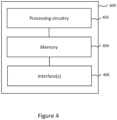
- Figure 4 shows a schematic diagram of an NFVO 400 according to embodiments of the disclosure.
- the NFVO 400 may be configured to perform the method 200 of Figure 2 .
- the NFVO 400 may be, for example, the NFVO 102 described above in respect of Figure 1 .
- the NFVO 400 comprises processing circuitry (or logic) 402.
- the processing circuitry 402 controls the operation of the NFVO 400 and can implement the method 200 described above with respect to Figure 2 , for example.
- the processing circuitry 402 can comprise one or more processors, processing units, multi-core processors or modules that are configured or programmed to control the NFVO in the manner described herein.
- the processing circuitry 402 can comprise a plurality of software and/or hardware modules that are each configured to perform, or are for performing, individual or multiple steps of the method described herein in relation to the NFVO 400.
- the processing circuitry 402 of the NFVO 400 is operable to: receive, from a VNFM identifying information for at least one VNF instance instantiated at the VNFM, wherein the NFVO is operable to: receive the identifying information from the VNFM in response to registration of one of the NFVO and the VNFM at the other of the NFVO and the VNFM; and create a record at the NFVO for the at least one VNF instance identified by the VNFM
- the NFVO 400 may comprise a machine-readable storage medium (e.g. a memory) 404.
- the memory 404 of the NFVO 400 can be configured to store instructions (e.g. program code) that can be executed by the processing circuitry 402 of the NFVO 400 to perform the method described herein in relation to the NFVO 400.
- the memory 404 of the NFVO 400 can be configured to store any requests, resources, information, data, signals, or similar that are described herein.
- the processing circuitry 402 of the NFVO 400 may be configured to control the memory 404 of the NFVO 400 to store any requests, resources, information, data, signals, or similar that are described herein.
- the NFVO 400 may optionally comprise a communications interface 406.
- the communications interface 406 of the NFVO 400 can be for use in communicating with other nodes, such as other virtual nodes.
- the communications interface 406 of the NFVO 400 can be configured to transmit to and/or receive from other nodes requests, resources, information, data, signals, or similar.
- the processing circuitry 402 of the NFVO 400 may be configured to control the communications interface 406 of the NFVO 400 to transmit to and/or receive from other nodes requests, resources, information, data, signals, or similar.
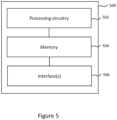
- FIG 5 shows a schematic diagram of a VNFM 500 according to embodiments of the disclosure.
- the VNFM 500 may be configured to perform the method 300 of Figure 3 .
- the VNFM 500 may be, for example, the VNFM 104 described above in respect of Figure 1 .
- the VNFM 500 comprises processing circuitry (or logic) 502.
- the processing circuitry 502 controls the operation of the VNFM 500 and can implement the method 300 described above with respect to Figure 3 , for example.
- the processing circuitry 502 can comprise one or more processors, processing units, multi-core processors or modules that are configured or programmed to control the VNFM in the manner described herein.
- the processing circuitry 502 can comprise a plurality of software and/or hardware modules that are each configured to perform, or are for performing, individual or multiple steps of the method described herein in relation to the VNFM 500.
- the processing circuitry 502 of the VNFM 500 is operable to: send, to an NFVO identifying information for at least one VNF instance instantiated at the VNFM in response to registration of one of the NFVO and the VNFM at the other of the NFVO and the VNFM.
- the VNFM 500 may comprise a machine-readable storage medium (e.g. a memory) 504.
- the memory 504 of the VNFM 500 can be configured to store instructions (e.g. program code) that can be executed by the processing circuitry 502 of the VNFM 500 to perform the method described herein in relation to the VNFM 500.
- the memory 504 of the VNFM 500 can be configured to store any requests, resources, information, data, signals, or similar that are described herein.
- the processing circuitry 502 of the VNFM 500 may be configured to control the memory 504 of the VNFM 500 to store any requests, resources, information, data, signals, or similar that are described herein.
- the VNFM 500 may optionally comprise a communications interface 506.
- the communications interface 506 of the VNFM 500 can be for use in communicating with other nodes, such as other virtual nodes.
- the communications interface 506 of the VNFM 500 can be configured to transmit to and/or receive from other nodes requests, resources, information, data, signals, or similar.
- the processing circuitry 502 of the VNFM 500 may be configured to control the communications interface 506 of the VNFM 500 to transmit to and/or receive from other nodes requests, resources, information, data, signals, or similar.
- the interfaces 406/506, the processor(s) 402/502, and the memory 404/504 may be connected in series. Alternatively, these components 402/502, 404/504 and 406/506 may be coupled to an internal bus system.
- the memory 404/504 may include a Read-Only-Memory (ROM), e.g., a flash ROM, a Random Access Memory (RAM), e.g., a Dynamic RAM (DRAM) or Static RAM (SRAM), a mass storage, e.g., a hard disk or solid state disk, or the like.
- the memory, 404/504 may include software and/or control parameters.
- the memory, 404/504 may include suitably configured program code to be executed by the processor(s), 402/502, so as to implement the above-described method.
Landscapes
- Engineering & Computer Science (AREA)
- Computer Networks & Wireless Communication (AREA)
- Signal Processing (AREA)
- Data Exchanges In Wide-Area Networks (AREA)
Claims (8)
- Verfahren, das von einem Netzwerkfunktionsvirtualisierungsorchestrator, NFVO, (102) durchgeführt wird, wobei das Verfahren Folgendes umfasst:Senden einer Anfrage an einen Verwalter virtueller Netzwerkfunktionen, VNFM, (104) in Reaktion auf ein Anmelden des VNFM bei dem NFVO (102), um eine oder mehrere Instanzen virtueller Netzwerkfunktionen, VNF, zu identifizieren, die an dem VNFM instanziiert werden, bevor die Anfrage durch den VNFM (104) empfangen wird;Empfangen (202) von Identifizierungsinformationen von dem VNFM für mindestens eine Instanz einer virtuellen Netzwerkfunktion, VNF, die an dem VNFM instanziiert wird, wobei die Identifizierungsinformationen von dem VNFM in Reaktion darauf empfangen werden, dass der VNFM die Anfrage von dem NFVO empfängt; undErstellen eines Datensatzes (204) an dem NFVO für die mindestens eine durch den VNFM identifizierte VNF-Instanz.
- Verfahren nach Anspruch 1, wobei das Erstellen eines Datensatzes (204) an dem NFVO für die mindestens eine VNF-Instanz Folgendes umfasst:Generieren einer VNF-Kennung, um die mindestens eine VNF-Instanz zu identifizieren, an dem NFVO (102); undKonfigurieren des Datensatzes mit einer Zuordnung zwischen den von dem VNFM (104) empfangenen Identifizierungsinformationen und der an dem NFVO (102) generierten VNF-Kennung.
- Verfahren, das von einem Verwalter virtueller Netzwerkfunktionen, VNFM, (104) durchgeführt wird, wobei das Verfahren Folgendes umfasst:Empfangen einer Anfrage von einem Netzwerkfunktionsvirtualisierungsorchestrator, NFVO, (102) zum Identifizieren einer oder mehrerer Instanzen virtueller Netzwerkfunktionen, VNF, die an dem VNFM (104) instanziiert werden, in Reaktion auf eine Anmeldung des VNFM (104) bei dem NFVO,Senden (302) von Identifizierungsinformationen für mindestens eine Instanz einer virtuellen Netzwerkfunktion, VNF, die an dem VNFM instanziiert wird, an den NFVO in Reaktion darauf, dass der VNFM die Anfrage empfängt, wobei die VNF-Instanz instanziiert wurde, bevor die Anfrage durch den VNFM (104) empfangen wurde.
- Verfahren nach Anspruch 3, wobei das Empfangen der Anfrage ein Empfangen einer Anfrage von dem NFVO (102) umfasst, um alle VNF-Instanzen zu identifizieren, die an dem VNFM (104) instanziiert werden.
- Verfahren nach Anspruch 3, wobei die Anfrage einen oder mehrere Filter für VNF-Instanzen spezifiziert, die für den NFVO (102) identifiziert werden sollen, und wobei die mindestens eine VNF-Instanz den einen oder die mehreren Filter erfüllt.
- Netzwerkfunktionsvirtualisierungsorchestrator, NFVO, (102), umfassend einen Prozessor (502) und einen Speicher (504), wobei der Speicher (504) Anweisungen enthält, die von dem Prozessor (502) ausgeführt werden können, sodass der NFVO (102) zu Folgendem ausgelegt ist:Senden einer Anfrage an einen Verwalter virtueller Netzwerkfunktionen, VNFM, (104) in Reaktion auf ein Anmelden des VNFM bei dem NFVO (102), um eine oder mehrere Instanzen virtueller Netzwerkfunktionen, VNF, zu identifizieren, die an dem VNFM instanziiert werden, bevor die Anfrage durch den VNFM (104) empfangen wird;Empfangen von Identifizierungsinformationen von dem VNFM (104) für mindestens eine Instanz virtueller Netzwerkfunktionen, VNF, die an dem VNFM (104) instanziiert wird, wobei der NFVO (102) so ausgelegt ist, dass er die Identifizierungsinformationen von dem VNFM (104) in Reaktion darauf empfängt, dass der VNFM (104) die Anfrage von dem NFVO (102) empfängt; undErstellen eines Datensatzes an dem NFVO (102) für die mindestens eine durch den VNFM (104) identifizierte VNF-Instanz.
- Verwalter virtueller Netzwerkfunktionen, VNFM, (104), umfassend einen Prozessor (502) und einen Speicher (504), wobei der Speicher (504) Anweisungen enthält, die von dem Prozessor (502) ausgeführt werden können, sodass der VNFM (104) zu Folgendem ausgelegt ist:Empfangen einer Anfrage von einem Netzwerkfunktionsvirtualisierungsorchestrator, NFVO, (102) zum Identifizieren einer oder mehrerer Instanzen virtueller Netzwerkfunktionen, VNF, die an dem VNFM (104) instanziiert werden, in Reaktion auf eine Anmeldung des VNFM (104) bei dem NFVO (102),Senden von Identifizierungsinformationen für mindestens eine Instanz einer virtuellen Netzwerkfunktion, VNF, die an dem VNFM (104) instanziiert wird, an den NFVO (102) in Reaktion darauf, dass der VNFM (104) die Anfrage empfängt, wobei die VNF-Instanz instanziiert wurde, bevor die Anfrage durch den VNFM (104) empfangen wurde.
- VNFM (104) nach Anspruch 7, wobei der Speicher Anweisungen enthält, die von dem Prozessor ausgeführt werden können, sodass der VNFM (104) zum Empfangen der Anfrage ausgelegt ist, indem er eine Anfrage von dem NFVO (102) empfängt, um alle VNF-Instanzen zu identifizieren, die an dem VNFM (104) identifiziert werden.
Applications Claiming Priority (1)
| Application Number | Priority Date | Filing Date | Title |
|---|---|---|---|
| PCT/EP2020/052905 WO2021155924A1 (en) | 2020-02-05 | 2020-02-05 | Identifying an instance of a virtual network function |
Publications (2)
| Publication Number | Publication Date |
|---|---|
| EP4101131A1 EP4101131A1 (de) | 2022-12-14 |
| EP4101131B1 true EP4101131B1 (de) | 2025-05-07 |
Family
ID=69528821
Family Applications (1)
| Application Number | Title | Priority Date | Filing Date |
|---|---|---|---|
| EP20704489.2A Active EP4101131B1 (de) | 2020-02-05 | 2020-02-05 | Identifizieren einer instanz einer virtuellen netzwerkfunktion |
Country Status (3)
| Country | Link |
|---|---|
| US (1) | US12047241B2 (de) |
| EP (1) | EP4101131B1 (de) |
| WO (1) | WO2021155924A1 (de) |
Families Citing this family (2)
| Publication number | Priority date | Publication date | Assignee | Title |
|---|---|---|---|---|
| WO2022160140A1 (en) * | 2021-01-27 | 2022-08-04 | Zte Corporation | A method for deployment multi-access edge computing application |
| KR20240124146A (ko) * | 2023-02-08 | 2024-08-16 | 삼성전자주식회사 | 네트워크 기능 가상화 환경에서 가상화된 네트워크 기능을 생성하기 위한 전자 장치 및 방법 |
Family Cites Families (22)
| Publication number | Priority date | Publication date | Assignee | Title |
|---|---|---|---|---|
| EP3249528A4 (de) * | 2015-01-23 | 2018-01-17 | Nec Corporation | Verfahren, vorrichtung und programm zur verwaltung und organisierung der virtualisierung von netzwerkfunktionen |
| EP3253005A4 (de) | 2015-01-29 | 2018-01-17 | Nec Corporation | System zur verwaltung von dateiregistrierung, verfahren, verwaltungsvorrichtung und programm |
| US10148493B1 (en) * | 2015-06-08 | 2018-12-04 | Infoblox Inc. | API gateway for network policy and configuration management with public cloud |
| WO2017035738A1 (zh) * | 2015-08-31 | 2017-03-09 | 华为技术有限公司 | 一种资源管理方法及装置 |
| WO2017035735A1 (zh) * | 2015-08-31 | 2017-03-09 | 华为技术有限公司 | 一种网络服务的部署方法及装置 |
| US20190052528A1 (en) * | 2016-03-28 | 2019-02-14 | Nec Corporation | Network function virtualization management orchestration apparatus, method |
| WO2017190357A1 (zh) * | 2016-05-06 | 2017-11-09 | 华为技术有限公司 | 一种网络功能实例的管理方法及相关设备 |
| WO2017196389A1 (en) * | 2016-05-11 | 2017-11-16 | Intel IP Corporation | Apparatus of performance measurement data subscription for nfv performance management |
| WO2018001475A1 (en) | 2016-06-29 | 2018-01-04 | Telefonaktiebolaget Lm Ericsson (Publ) | Network function virtualization |
| CN107689882B (zh) * | 2016-08-05 | 2020-04-21 | 华为技术有限公司 | 一种虚拟化网络中业务部署的方法和装置 |
| EP3501141B1 (de) * | 2016-08-18 | 2023-10-25 | Telefonaktiebolaget LM Ericsson (publ) | Netzwerkservice entwicklungs- und verteilungsprozess für nfv-systeme |
| WO2018084975A1 (en) * | 2016-11-02 | 2018-05-11 | Intel IP Corporation | Lifecycle management parameter modeling for virtual network functions |
| CN108023751B (zh) * | 2016-11-03 | 2020-02-14 | 华为技术有限公司 | 用于管理网络切片实例的方法和装置 |
| KR102105683B1 (ko) * | 2017-04-28 | 2020-05-29 | 한국전자통신연구원 | 유선 및 이동 통신 서비스의 통합 플랫폼 관리 장치 및 방법 |
| US20180324261A1 (en) * | 2017-05-08 | 2018-11-08 | Electronics And Telecommunications Research Institute | Method of network service descriptor management in a network functions virtualization |
| CN109379206B (zh) * | 2017-08-07 | 2022-04-22 | 华为技术有限公司 | 网络功能信息的管理方法及相关设备 |
| US20190104022A1 (en) * | 2017-09-29 | 2019-04-04 | Intel Corporation | Policy-based network service fingerprinting |
| US10833957B2 (en) * | 2018-01-16 | 2020-11-10 | Intel Corporation | Managing physical network function instances in a network service instance |
| WO2019174000A1 (zh) * | 2018-03-15 | 2019-09-19 | 华为技术有限公司 | 用于业务管理的方法和装置 |
| US10673618B2 (en) * | 2018-06-08 | 2020-06-02 | Cisco Technology, Inc. | Provisioning network resources in a wireless network using a native blockchain platform |
| CN118400267A (zh) * | 2019-02-08 | 2024-07-26 | 微软技术许可有限责任公司 | 用于模型驱动的服务回滚的计算设备和方法 |
| US20220116286A1 (en) * | 2021-12-22 | 2022-04-14 | Intel Corporation | Methods and apparatus to implement edge scalable adaptive-grained monitoring and telemetry processing for multi-qos services |
-
2020
- 2020-02-05 EP EP20704489.2A patent/EP4101131B1/de active Active
- 2020-02-05 US US17/791,631 patent/US12047241B2/en active Active
- 2020-02-05 WO PCT/EP2020/052905 patent/WO2021155924A1/en not_active Ceased
Also Published As
| Publication number | Publication date |
|---|---|
| WO2021155924A1 (en) | 2021-08-12 |
| EP4101131A1 (de) | 2022-12-14 |
| US12047241B2 (en) | 2024-07-23 |
| US20230041981A1 (en) | 2023-02-09 |
Similar Documents
| Publication | Publication Date | Title |
|---|---|---|
| US20230209408A1 (en) | Network slice deployment method and apparatus | |
| EP3675549B1 (de) | Verfahren, vorrichtung und system zur verwaltung von netzwerk-slices | |
| EP3595244B1 (de) | Verfahren, einheit und system zur verwaltung von netzwerk-slices | |
| CN104734931B (zh) | 一种虚拟网络功能间链路建立方法及装置 | |
| EP3291499B1 (de) | Verfahren und vorrichtung zur netzwerkdienstkapazitätserweiterung | |
| US11646939B2 (en) | Network function NF management method and NF management device | |
| WO2019137516A1 (zh) | 网络切片部署方法及其装置 | |
| EP3672314B1 (de) | Netzwerkverwaltungsverfahren, -vorrichtung und -system | |
| CN114710549B (zh) | 一种容器平台中网卡的动态管理方法、系统及业务节点 | |
| EP3629160B1 (de) | Verfahren und vorrichtung zur verwaltung von vnf-instanziierung | |
| WO2023035777A1 (zh) | 网络配置方法、代理组件、控制器、电子设备和存储介质 | |
| US20220350637A1 (en) | Virtual machine deployment method and related apparatus | |
| TWI707561B (zh) | 虛擬網路功能的管理系統和管理方法 | |
| US12047241B2 (en) | Identifying an instance of a virtual network function | |
| EP3975480B1 (de) | Kommunikationsverfahren und -vorrichtung | |
| WO2020177020A1 (zh) | 物联网设备的发现方法、装置及终端设备 | |
| CN113660121A (zh) | 基于分布式系统的信息管理方法、装置及计算机存储介质 | |
| WO2025241347A1 (zh) | 总线通信方法、装置、计算机设备和可读存储介质 | |
| WO2021121595A1 (en) | Discovering an instance of a virtual network function | |
| CN101390074B (zh) | 面向对象发现框架 | |
| EP4614925A1 (de) | Instanziierungsverfahren für virtualisierungsnetzwerkfunktion (vnf) und vorrichtung | |
| CN113347040B (zh) | 配置变更方法、装置及电子设备 | |
| EP4518247A1 (de) | Zertifizierungsverfahren und kommunikationsvorrichtung | |
| CN114765579A (zh) | 一种数据传输方法、装置、相关设备和存储介质 | |
| TW202312779A (zh) | 行固網整合ip位址資源管理系統、方法及電腦可讀媒介 |
Legal Events
| Date | Code | Title | Description |
|---|---|---|---|
| STAA | Information on the status of an ep patent application or granted ep patent |
Free format text: STATUS: UNKNOWN |
|
| STAA | Information on the status of an ep patent application or granted ep patent |
Free format text: STATUS: THE INTERNATIONAL PUBLICATION HAS BEEN MADE |
|
| PUAI | Public reference made under article 153(3) epc to a published international application that has entered the european phase |
Free format text: ORIGINAL CODE: 0009012 |
|
| STAA | Information on the status of an ep patent application or granted ep patent |
Free format text: STATUS: REQUEST FOR EXAMINATION WAS MADE |
|
| 17P | Request for examination filed |
Effective date: 20220803 |
|
| AK | Designated contracting states |
Kind code of ref document: A1 Designated state(s): AL AT BE BG CH CY CZ DE DK EE ES FI FR GB GR HR HU IE IS IT LI LT LU LV MC MK MT NL NO PL PT RO RS SE SI SK SM TR |
|
| STAA | Information on the status of an ep patent application or granted ep patent |
Free format text: STATUS: EXAMINATION IS IN PROGRESS |
|
| 17Q | First examination report despatched |
Effective date: 20230208 |
|
| DAV | Request for validation of the european patent (deleted) | ||
| DAX | Request for extension of the european patent (deleted) | ||
| GRAP | Despatch of communication of intention to grant a patent |
Free format text: ORIGINAL CODE: EPIDOSNIGR1 |
|
| STAA | Information on the status of an ep patent application or granted ep patent |
Free format text: STATUS: GRANT OF PATENT IS INTENDED |
|
| GRAS | Grant fee paid |
Free format text: ORIGINAL CODE: EPIDOSNIGR3 |
|
| INTG | Intention to grant announced |
Effective date: 20250219 |
|
| GRAA | (expected) grant |
Free format text: ORIGINAL CODE: 0009210 |
|
| STAA | Information on the status of an ep patent application or granted ep patent |
Free format text: STATUS: THE PATENT HAS BEEN GRANTED |
|
| AK | Designated contracting states |
Kind code of ref document: B1 Designated state(s): AL AT BE BG CH CY CZ DE DK EE ES FI FR GB GR HR HU IE IS IT LI LT LU LV MC MK MT NL NO PL PT RO RS SE SI SK SM TR |
|
| REG | Reference to a national code |
Ref country code: GB Ref legal event code: FG4D |
|
| REG | Reference to a national code |
Ref country code: CH Ref legal event code: EP |
|
| REG | Reference to a national code |
Ref country code: DE Ref legal event code: R096 Ref document number: 602020050765 Country of ref document: DE |
|
| REG | Reference to a national code |
Ref country code: IE Ref legal event code: FG4D |
|
| REG | Reference to a national code |
Ref country code: NL Ref legal event code: MP Effective date: 20250507 |
|
| PG25 | Lapsed in a contracting state [announced via postgrant information from national office to epo] |
Ref country code: PT Free format text: LAPSE BECAUSE OF FAILURE TO SUBMIT A TRANSLATION OF THE DESCRIPTION OR TO PAY THE FEE WITHIN THE PRESCRIBED TIME-LIMIT Effective date: 20250908 Ref country code: ES Free format text: LAPSE BECAUSE OF FAILURE TO SUBMIT A TRANSLATION OF THE DESCRIPTION OR TO PAY THE FEE WITHIN THE PRESCRIBED TIME-LIMIT Effective date: 20250507 Ref country code: FI Free format text: LAPSE BECAUSE OF FAILURE TO SUBMIT A TRANSLATION OF THE DESCRIPTION OR TO PAY THE FEE WITHIN THE PRESCRIBED TIME-LIMIT Effective date: 20250507 |
|
| REG | Reference to a national code |
Ref country code: LT Ref legal event code: MG9D |
|
| PG25 | Lapsed in a contracting state [announced via postgrant information from national office to epo] |
Ref country code: NO Free format text: LAPSE BECAUSE OF FAILURE TO SUBMIT A TRANSLATION OF THE DESCRIPTION OR TO PAY THE FEE WITHIN THE PRESCRIBED TIME-LIMIT Effective date: 20250807 Ref country code: GR Free format text: LAPSE BECAUSE OF FAILURE TO SUBMIT A TRANSLATION OF THE DESCRIPTION OR TO PAY THE FEE WITHIN THE PRESCRIBED TIME-LIMIT Effective date: 20250808 |
|
| PG25 | Lapsed in a contracting state [announced via postgrant information from national office to epo] |
Ref country code: NL Free format text: LAPSE BECAUSE OF FAILURE TO SUBMIT A TRANSLATION OF THE DESCRIPTION OR TO PAY THE FEE WITHIN THE PRESCRIBED TIME-LIMIT Effective date: 20250507 Ref country code: PL Free format text: LAPSE BECAUSE OF FAILURE TO SUBMIT A TRANSLATION OF THE DESCRIPTION OR TO PAY THE FEE WITHIN THE PRESCRIBED TIME-LIMIT Effective date: 20250507 |
|
| REG | Reference to a national code |
Ref country code: AT Ref legal event code: MK05 Ref document number: 1793718 Country of ref document: AT Kind code of ref document: T Effective date: 20250507 |
|
| PG25 | Lapsed in a contracting state [announced via postgrant information from national office to epo] |
Ref country code: BG Free format text: LAPSE BECAUSE OF FAILURE TO SUBMIT A TRANSLATION OF THE DESCRIPTION OR TO PAY THE FEE WITHIN THE PRESCRIBED TIME-LIMIT Effective date: 20250507 |
|
| PG25 | Lapsed in a contracting state [announced via postgrant information from national office to epo] |
Ref country code: HR Free format text: LAPSE BECAUSE OF FAILURE TO SUBMIT A TRANSLATION OF THE DESCRIPTION OR TO PAY THE FEE WITHIN THE PRESCRIBED TIME-LIMIT Effective date: 20250507 |
|
| PG25 | Lapsed in a contracting state [announced via postgrant information from national office to epo] |
Ref country code: AT Free format text: LAPSE BECAUSE OF FAILURE TO SUBMIT A TRANSLATION OF THE DESCRIPTION OR TO PAY THE FEE WITHIN THE PRESCRIBED TIME-LIMIT Effective date: 20250507 |
|
| PG25 | Lapsed in a contracting state [announced via postgrant information from national office to epo] |
Ref country code: RS Free format text: LAPSE BECAUSE OF FAILURE TO SUBMIT A TRANSLATION OF THE DESCRIPTION OR TO PAY THE FEE WITHIN THE PRESCRIBED TIME-LIMIT Effective date: 20250807 |
|
| PG25 | Lapsed in a contracting state [announced via postgrant information from national office to epo] |
Ref country code: IS Free format text: LAPSE BECAUSE OF FAILURE TO SUBMIT A TRANSLATION OF THE DESCRIPTION OR TO PAY THE FEE WITHIN THE PRESCRIBED TIME-LIMIT Effective date: 20250907 |
|
| PG25 | Lapsed in a contracting state [announced via postgrant information from national office to epo] |
Ref country code: LV Free format text: LAPSE BECAUSE OF FAILURE TO SUBMIT A TRANSLATION OF THE DESCRIPTION OR TO PAY THE FEE WITHIN THE PRESCRIBED TIME-LIMIT Effective date: 20250507 |
|
| PG25 | Lapsed in a contracting state [announced via postgrant information from national office to epo] |
Ref country code: DK Free format text: LAPSE BECAUSE OF FAILURE TO SUBMIT A TRANSLATION OF THE DESCRIPTION OR TO PAY THE FEE WITHIN THE PRESCRIBED TIME-LIMIT Effective date: 20250507 Ref country code: SM Free format text: LAPSE BECAUSE OF FAILURE TO SUBMIT A TRANSLATION OF THE DESCRIPTION OR TO PAY THE FEE WITHIN THE PRESCRIBED TIME-LIMIT Effective date: 20250507 |
|
| PG25 | Lapsed in a contracting state [announced via postgrant information from national office to epo] |
Ref country code: CZ Free format text: LAPSE BECAUSE OF FAILURE TO SUBMIT A TRANSLATION OF THE DESCRIPTION OR TO PAY THE FEE WITHIN THE PRESCRIBED TIME-LIMIT Effective date: 20250507 |
|
| PG25 | Lapsed in a contracting state [announced via postgrant information from national office to epo] |
Ref country code: EE Free format text: LAPSE BECAUSE OF FAILURE TO SUBMIT A TRANSLATION OF THE DESCRIPTION OR TO PAY THE FEE WITHIN THE PRESCRIBED TIME-LIMIT Effective date: 20250507 |
|
| PG25 | Lapsed in a contracting state [announced via postgrant information from national office to epo] |
Ref country code: SK Free format text: LAPSE BECAUSE OF FAILURE TO SUBMIT A TRANSLATION OF THE DESCRIPTION OR TO PAY THE FEE WITHIN THE PRESCRIBED TIME-LIMIT Effective date: 20250507 |
|
| PG25 | Lapsed in a contracting state [announced via postgrant information from national office to epo] |
Ref country code: IT Free format text: LAPSE BECAUSE OF FAILURE TO SUBMIT A TRANSLATION OF THE DESCRIPTION OR TO PAY THE FEE WITHIN THE PRESCRIBED TIME-LIMIT Effective date: 20250507 |
|
| REG | Reference to a national code |
Ref country code: DE Ref legal event code: R097 Ref document number: 602020050765 Country of ref document: DE |
|
| PLBE | No opposition filed within time limit |
Free format text: ORIGINAL CODE: 0009261 |
|
| STAA | Information on the status of an ep patent application or granted ep patent |
Free format text: STATUS: NO OPPOSITION FILED WITHIN TIME LIMIT |
|
| REG | Reference to a national code |
Ref country code: CH Ref legal event code: L10 Free format text: ST27 STATUS EVENT CODE: U-0-0-L10-L00 (AS PROVIDED BY THE NATIONAL OFFICE) Effective date: 20260318 |
|
| PGFP | Annual fee paid to national office [announced via postgrant information from national office to epo] |
Ref country code: GB Payment date: 20260227 Year of fee payment: 7 |
|
| PGFP | Annual fee paid to national office [announced via postgrant information from national office to epo] |
Ref country code: DE Payment date: 20260227 Year of fee payment: 7 |
|
| 26N | No opposition filed |
Effective date: 20260210 |