EP4100870B1 - Verfahren und vorrichtung zur identifizierung einer person aus einem biometrischen datum - Google Patents
Verfahren und vorrichtung zur identifizierung einer person aus einem biometrischen datum Download PDFInfo
- Publication number
- EP4100870B1 EP4100870B1 EP21702677.2A EP21702677A EP4100870B1 EP 4100870 B1 EP4100870 B1 EP 4100870B1 EP 21702677 A EP21702677 A EP 21702677A EP 4100870 B1 EP4100870 B1 EP 4100870B1
- Authority
- EP
- European Patent Office
- Prior art keywords
- index
- indexes
- fingerprint
- person
- biometric data
- Prior art date
- Legal status (The legal status is an assumption and is not a legal conclusion. Google has not performed a legal analysis and makes no representation as to the accuracy of the status listed.)
- Active
Links
Images


Classifications
-
- G—PHYSICS
- G06—COMPUTING OR CALCULATING; COUNTING
- G06V—IMAGE OR VIDEO RECOGNITION OR UNDERSTANDING
- G06V40/00—Recognition of biometric, human-related or animal-related patterns in image or video data
- G06V40/10—Human or animal bodies, e.g. vehicle occupants or pedestrians; Body parts, e.g. hands
- G06V40/12—Fingerprints or palmprints
- G06V40/1347—Preprocessing; Feature extraction
- G06V40/1353—Extracting features related to minutiae or pores
-
- G—PHYSICS
- G06—COMPUTING OR CALCULATING; COUNTING
- G06V—IMAGE OR VIDEO RECOGNITION OR UNDERSTANDING
- G06V40/00—Recognition of biometric, human-related or animal-related patterns in image or video data
- G06V40/10—Human or animal bodies, e.g. vehicle occupants or pedestrians; Body parts, e.g. hands
- G06V40/12—Fingerprints or palmprints
- G06V40/1365—Matching; Classification
- G06V40/1371—Matching features related to minutiae or pores
Definitions
- the invention relates to a method and a device for identifying an individual from biometric data.
- the biometric data may be fingerprints, a face, or an iris.
- the identification of an individual is usually done using data stored in a database which turns out to be large when using fingerprints, the size of the base (order of the scale of a country, number of individuals per country) can be of the order of 10 7 .
- the exhaustive comparison of the fingerprints of the individual sought with the N sets of fingerprints in the database is therefore very expensive in terms of calculation time.
- MCC 3D data structures
- MCC 3D data structures
- This method consists of representing each minutia of the imprint by considering its local neighborhood.
- the local neighborhood of a minutia presents the behavior of this central minutia with respect to its close neighbors.
- This local representation of the neighborhood of the minutia is done in binary format using only "0" and "1".
- the MCC indexing method therefore uses a binary representation of the templates by considering each minutia of the imprint as a binary sequence.
- An MCC template T is a collection of
- MCC indexing consists of building indexes on each minutia m i of the reference template received when enrolling individuals. For individual identification, the method extracts all these minutiae in binary format. Then, for each of these minutiae, the indexes are calculated using hash functions, and then the different collisions with individuals already enrolled in the database are counted.
- the loss of an index has a significant impact, as it corresponds to a loss of information and a possible increase in the rate error for identification.
- this method requires the creation of a very large index table. Such a method is therefore not really suitable for addressing identification problems on a large scale and in a constrained time frame.
- One of the objectives of the present invention is to provide a method for identifying an individual using biometric data that corrects in particular the possible loss of information on enrollment and identification of templates in order to optimize the chances of identifying an individual.
- this method due to the creation of class centers and synthetic indexes, allows for faster searching in large databases. These databases are on the order of the scale of a country, for example 10 7 individuals.
- the term "representative" means that the synthetic indexes created are sufficient in number to cover the space of all the indexes necessary to carry out the storage of a biometric database, for example fingerprints.
- discriminating means that the synthetic indices do not overlap, are unique and sufficiently distant two by two.
- template refers to the measurements that are stored when recording the morphological (fingerprint, hand shape, iris, etc.), biological or behavioral characteristics of the person concerned.
- biometric data By misuse of language, the expression "biometric data” will also be used to designate the behavioral characteristics of a person.
- the hash function is, for example, a similarity-sensitive hash function better known by the Anglo-Saxon abbreviation LSH (Locality Sensitive Hashing).
- the method may also include an additional step of transmitting a signal to open a gate following the identification of an individual.
- the invention also relates to a system for identifying an individual comprising a device for acquiring biometric data from said individual, connected to a data processing device comprising a database, a processor configured to execute the steps of the method according to the invention, a device for processing the identification result, said database comprising a table of synthetic indexes corresponding to a set of intervals around a class center.
- the device for processing the identification result is a display device or a device generating a control signal for opening a means of access to an area.
- the acquisition device is, for example, a fingerprint reading device and the biometric data is a fingerprint.
- the method according to the invention uses templates represented in binary form and is based in particular on the implementation of the following steps: during a first phase on the generation of a subset of representative and discriminating indexes, which leads to the creation of a table of synthetic indexes (this is the initialization of the system).
- the second phase consists of enrolling a fingerprint database by exploiting the table created in the initialization phase.
- the third phase is the identification of a fingerprint in the database of enrolled fingerprints.
- FIG. 1 illustrates an example of an identification system capable of implementing the method according to the invention.
- a system comprises, for example, a device 1 for acquiring biometric data, for example a fingerprint reader connected to a data processing device 2 comprising a database 3 in which the biometric data are stored, a processor 4 for executing the steps of the method according to the invention, a display device 5 for the identification result.
- the database also comprises the table generated after enrollment of a fingerprint database.
- a first application of the method according to the invention consists, for example, in verifying the uniqueness of an identity within a population, that is to say that a biometric data set is linked to only one civil status data set within a database.
- biometric data for example fingerprints
- biometric identification system which will search within the biometric data present in a database for fingerprints which would correspond to the new acquired fingerprints. If the fingerprints acquired during the process correspond to fingerprints contained in this database, the next step will be to check whether the "civil identity" recorded with these fingerprints corresponds to the identity of the person for whom the system has just acquired these fingerprints.
- the system will include a module configured to perform this comparison between the civil identity data and emit an alert signal, for example by displaying information of non-correspondence between the civil data already present in the database and the newly recorded civil data.
- the result of the comparison carried out at the processor 4 can generate a control signal for opening a gate allowing access 6 to a protected area when the identification result of the person is positive.
- the gate will receive a signal allowing its opening generated by the processor if the identification of an individual is validated.
- the biometric data acquisition sensor can also be an iris reading device, when the data processed are characteristics of an individual's iris.
- a camera configured to extract facial biometric data, or a voice sensor if the data used to identify the individual are voice parameters or cepstral vectors.
- FIG. 2 illustrates the principle of identifying an individual using specific indexes generated during the initialization phase of the method according to the invention. This initialization phase will be executed before the first enrollment.
- an identification request Rq is issued.
- the biometric data acquired by the fingerprint reader are transmitted, 21, to the processor 4 which will compare them using the database 3 of individuals already enrolled and known by the system.
- the enrollment phase consists of performing an interval enrollment for the template indexes. This interval enrollment exploits the synthetic indexes previously generated using the synthetic index generation algorithm of the initialization phase. During enrollment, the method will use all the generated synthetic indexes, then calculate the synthetic index intervals for each of the template minutiae in order to enroll them on the closest interval(s).
- the first phase of initialization of the method according to the invention comprises the steps detailed below.
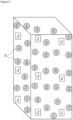
- indexes distant from each other These indexes constitute class centers represented by squares IC i (IC 1 ,....IC g ) on the Figure 3 and which cover the space of possible indexes.
- the phase includes a construction around each class center, of index intervals sufficiently close to each other, while avoiding overlap, represented by circles 31 on the Figure 3 .
- the values indicated in the circles are for example: (1,1), (1,2), ..., (9,4).
- FIG. 3 is a representative diagram of the distribution of synthetic indexes created by the execution of the steps of the initialization phase.
- the target indexes class centers are created by the execution of step 1 and indicated by their number, IC 1 ,..., IC 9 in this example.
- IC 1 the number of classes centers
- IC 9 the number of classes centers
- MaxDH the number of classes centers
- Synthetic indexes are characterized by a pair (a, b), a indicating the class center of origin and b its unique number in this class.
- Each synthetic index is unique, it delimits the extent of its class center and avoids the overlap respected by the minimum Hamming distance min in step 2.
- the synthetic index constitutes an interval bound.
- the MinimumNumberOf1 ( i ) function counts the number of '1's contained in a created index and uses the min variable as the minimum rejection threshold on the number of '1's.
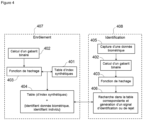
- FIG. 4 illustrates the steps enabling the use of synthetic indexes to carry out the enrollment and then the identification of an individual subsequently using the method of the invention.
- the second phase of the process is a phase of enrolling an individual 407. It is carried out using the synthetic indexes 401 generated during the initialization phase.
- the template T is in binary format with, for each minutia of the individual's fingerprint, a length n which can be up to more than 1500 bits.
- the initialization phase has already been executed at least once to initialize the system. The method will calculate for each minutia of the fingerprint, the two closest synthetic indexes in the sense of the Hamming distance compared to the synthetic indexes already generated (during the initialization phase). The method will enroll the minutia on two closest synthetic indexes, this is what is called "interval enrollment”.
- the third phase corresponds to a phase of identification of a fingerprint 408.
- the method will search for each index of each of the minutiae the two closest synthetic indexes. On the two synthetic indexes representing the found boundaries, the method consults each line of the index table and reads by counting on each of them the minutiae as well as the identifiers of corresponding and previously enrolled templates. The method will therefore increment a score table corresponding to the similarity score of each template found on the synthetic reading boundaries.
- the first part is an extraction step corresponding to a capture of biometric data 405, then a calculation of a binary template 402.
- the second part will read and count a set of collisions for the templates which belong to the same synthetic indexes for each of the hash functions by exploiting the result of the hash function 403, the search in the database of enrolled fingerprints 406 and in the table of synthetic indexes 404.
- the identification step is done in two steps which are the extraction of the binary template (biometric capture 405 and calculation of the binary template 402) then the identification itself.
- the method will extract the corresponding binary template, 402.
- the method will count the similarity score relating to each minutia through each of the hash functions. This is the similarity score expressed previously. It is also called collision in the description of the algorithm. Reading a collision consists for a minutia, after having found the synthetic indexes representing the limits, in counting all the minutiae of the templates previously enrolled in order to increment the score table.
- the collision is read by step 403 followed by the search step in the correspondence table and the generation of a signal 406 and finally the collision scores counted by this step 406 in the search step in the fingerprint table 404.
- the counter is, for example, a score accumulator matrix. It is initialized to store the total score at the end. The search for a template is done minute by minute. For each minute, the score is known by the accumulator matrix A, then transferred at the end of the minute loop to S to store the final result. This accumulator is updated for each minute traversed.
- the min 1 and min 2 functions calculate the first and second minimum indexes, respectively, in the sense of the Hamming distance dH between an input index and a collection of indices.
- the list of LC candidates in descending order allows the closest candidate to be found at the top of the search table.
- the processor will emit a signal for identification or refusal of identification of an individual.
- the signal can result in a display of the identification result on the screen of the display device 7. It can also take the form of a signal from a command which controls an access gate to an area or a site, 406.
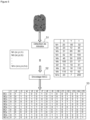
- phase 51 consists of extracting the different minutiae M i ( x i , y i , t i ) characterized by their x, y and t coordinates and their orientation, ten minutiae M 1 , .., M 10 , in the example.
- phase 52 is the creation of a binary template MCC.
- Each minutia M i is represented in the form of a binary code BC 1 , BC 2 ,..., BC 10 , (10100101), 53.
- the binary vector of a minutia of the fingerprint is long (up to more than 1500 bits).
- the second step illustrated in Figure 6 therefore consists of indexing the MCC template, 43.
- We then use several fixed hash functions, 51 which are sequences of bits placed at fixed positions for all binary minutiae. This makes it possible to represent a minutia by a subset of bits fixed by each of these functions, for example three hash functions H 1 , H 2 , and H 3 .
- the bits i 1 , i 5 and i 9 are those chosen for the function H 1 . Since each hash function uses three bits in the context of this example, the interval [0 ; (2 3 -1)] or [0 ; 7] is the total space of indexes for each hash function.
- the indexing of the fingerprint is done by creating an index for each of the minutiae that constitute it.
- id 1,1 corresponds to the index linked to minutia id 1 and the hash function f H1 , i.e. the value 1 in the array
- id 1,1 corresponds to the index linked to minutia id 2 and the hash function f H2 , i.e. the value 0 in the array, and so on for all indexes.
- Case 62 is the classical indexing of the MCC method existing in the state of the art and case 63 presents the indexing according to the invention.
- Method 62 classical MCC, after passing each binary code of the minutia through each of the hash functions, we obtain M*I possible index intervals represented on the interval of possible indexes for each function. In the example, we obtain a total of thirty indexes for the fingerprint represented in the index table. It should be noted that for each of the hash functions, the indexes are represented on the interval [0; 7] in the index table.
- Part 63 illustrates the method of indexing the minutiae of the fingerprint according to the invention.
- the space of possible indexes is checked.
- the method creates a set of fixed indexes on the space of possible indexes. These indexes are fixed and constitute the limits of representation of the indexes of the fingerprint. Indeed, no other additional index can be created by a minutia.
- the minutia is indexed on the two nearest bounds (interval indexing). This allows to control the index table over the global possible range; to generalize the creation of indexes for each of the binary minutiae; to reduce the loss of information in the event of a change in the value of a bit and to maximize the accuracy of the fingerprint identification.
- the index table 64 grows as a new possible index is generated for a fingerprint by a hash function.
- index 1 is only created for minutia 9 (id 9 in the index table). It is therefore impossible to predict or provide for a fixed size of the index table. We therefore have a large number of possible indexes to browse on the index table and above all, very sparsely populated indexes. This is why, in the method according to the invention 63, the number of index intervals is fixed and the size of the index table is completely controlled. This will make it possible to accelerate the indexing process.
- the minutiae are not absolutely identical bit by bit. 1, 2, 3... or several bits can be different depending on the acquisition conditions.
- the prior art does not allow such control and if a bit changes, the index generated is not identical for the two minutiae of the two fingerprint samples.
- the indexing of the exact minutia changes, however, the index remains valid on the same interval, 65.
- the method thus makes it possible to maintain the indexing by interval.
- the method according to the invention increases the accuracy rate by controlling the loss of information linked to the variations of the bits.
- the steps described above apply to the identification of an individual from the iris, or any other biometric characteristic of an individual, considering instead of the minutia used for the fingerprint a particularity of the biometric parameter used, such as the iris, or a morphological parameter.
- a person skilled in the art will adapt the template calculation methods to each application, for example, in the case of identification from the iris, a person skilled in the art will use a Daugmant algorithm to generate a binary code associated with the iris.
- the method according to the invention has the following advantages in particular: the use of an indexing table with a reduced number of entries, a synthetic generation of the indexes which makes it possible to ensure a discriminating and representative character of the indexes of the table.
- the method makes it possible to improve the processing performance in terms of speed and precision compared to the MCC indexing method, therefore a faster recognition of an individual.
Landscapes
- Engineering & Computer Science (AREA)
- Human Computer Interaction (AREA)
- Physics & Mathematics (AREA)
- General Physics & Mathematics (AREA)
- Multimedia (AREA)
- Theoretical Computer Science (AREA)
- Computer Vision & Pattern Recognition (AREA)
- Collating Specific Patterns (AREA)
Claims (12)
- Verfahren zum Identifizieren einer Person auf der Basis von in einer Datenbank enthaltenen Informationen, dadurch gekennzeichnet, dass es mindestens die folgenden Schritte beinhaltet:- Erzeugen oder Verwenden einer Tabelle mit synthetischen Indizes, die einem Satz von Intervallen um eine Klassenmitte herum entsprechen, (401),- Registrieren mehrerer biometrischer Daten (407) durch Ausführen der folgenden Schritte:- Berechnen, für jedes biometrische Datenelement, einer binären Schablone, die mit jedem charakteristischen Parameter eines biometrischen Datenelements verknüpft ist, (402),- Verwenden einer Hash-Methode, um mehrere Indizes für jede binäre Schablone zu erhalten, (403),- Einfügen, für jeden für ein biometrisches Datenelement erhaltenen Index, einer Kennung entsprechend dem biometrischen Datenelement, die die Hamming-Distanz zwischen dem betrachteten Index und den ein Feld begrenzenden synthetischen Indizes minimiert, um eine Tabelle zu erhalten, die Paare {Biometrisches-Datenelement-Kennung, Personenkennung} enthält, (404),- Aufnehmen mindestens eines der Person eigenen biometrischen Datenelements mittels eines geeigneten Sensors und Berechnen einer binären Schablone, (402, 405),- Durchsuchen (408) der Tabelle nach den ein oder mehreren nächstliegenden biometrischen Datenelementen, Vergleichen des aufgenommenen biometrischen Datenelements mit den biometrischen Datenelementen in der Datenbank, Erzeugen eines Identifikationsergebnisses im Fall einer Übereinstimmung zwischen den genannten verglichenen Daten oder einer Nicht-Identifikation der Person, (404, 406), und Verarbeiten des erhaltenen Ergebnisses.
- Identifikationsverfahren nach Anspruch 1, dadurch gekennzeichnet, dass Fingerabdrücke zum Identifizieren einer Person verwendet und die folgenden Schritte ausgeführt werden:- Registrieren mehrerer Fingerabdrücke durch Ausführen der folgenden Schritte:- Berechnen, für jeden Fingerabdruck, einer binären Schablone, die mit jeder Minutie eines Fingerabdrucks verknüpft ist, unter Anwendung einer Minutien-Zylinder-Code-Methode MCC,- Verwenden einer Hash-Methode, um mehrere Indizes für jede binäre Schablone zu erhalten,- Einfügen, für jeden für einen Fingerabdruck erhaltenen Index, einer Kennung entsprechend dem Fingerabdruck, die die Hamming-Distanz zwischen dem betrachteten Index und den das genannte Feld begrenzenden synthetischen Indizes minimiert, um eine Tabelle zu erhalten, die Paare {Minutienkennung, Personenkennung} enthält,- Aufnehmen mindestens eines der Person eigenen Fingerabdrucks mittels eines geeigneten Sensors, Umwandeln des genannten Fingerabdrucks in ein binäres digitales Format,- Durchsuchen der Tabelle nach den ein oder mehreren nächstliegenden Fingerabdrücken und Identifizieren der Person oder Zurückweisen der Identifizierung durch Vergleichen des erzeugten Binärcode mit den in der Indextabelle gespeicherten Minutien.
- Verfahren nach Anspruch 1 oder 2, dadurch gekennzeichnet, dass zum Erzeugen einer synthetische Indizes enthaltenden Tabelle die folgenden Schritte ausgeführt werden:Es sei h eine Hash-Funktion und die ParameterStopp-Bedingung1, Stopp-Bedingung2,τ,ε, MaxHD, min, ST, SI,wobeiStopp-Bedingung1 und Stopp-Bedingung2 zwei "Timer" mit vordefinierten Werten sind,ausgewählt als Kompromiss zwischen Rechenzeit und Genauigkeit des Ergebnisses bei der Fingerabdrucksuche,τ die Wahrscheinlichkeit der Erzeugung eines Bits bei '1' auf einem synthetischen Index unter Verwendung einer Bernoulli-Verteilung ist,ε der Abstand zwischen zwei benachbarten Indizes derselben Klassenmitte ist, wobei ε ∈ [3, 7] ist,MaxHD das Maximum der Hamming-Distanz ist,min ein Rückweisungsparameter oder minimaler Rückweisungsschwellenwert bei der Anzahl '1', der minimalen Anzahl von Bits bei '1', ist, um einen synthetischen Index zu validieren,ST der Satz der Klassenmitten ist,SI der Satz der synthetischen Indizes am Ausgang ist,h die Größe der Hash-Funktion ist,Initialisieren
 Schritt 1 - Erstellen von Zielklassenmitten-Indizes ICi, die weit voneinander entfernt sind,um den Indexraum abzudecken,solange der Parameter Stopp-Begingung1 nicht erreicht ist:Erstellen eines Index i durch Erzeugen von h Bits mit einer Bernoulli-Verteilung (τ),wenn
 min, dann den Index verwerfen, wobei HD(i, j) die Hamming-Distanz zwischen Index i und Index j ist, wobei die Gesamtzahl der Bits zwischen zwei Binärvektoren i divergiert,andernfalls Validieren von Index i als Klassenmitte {gültiger Klassenmitten-Index} und Hinzufügen desselben zum Satz der Klassenmitten ST ← ST + {i},Schritt 2 - Erstellen um jeden Klassenmitten-Index ICi herum naher, nicht überlappender Indizes:je nachdem, welcher j zu dem Satz der Klassenmitten ST gehörtIsolieren jeder Mitte i von ST, um Indizes STj= {j} zu konstruierensolange der Wert des Parameters Stopp-Bedingung2 nicht erreicht ist, Ausführen der folgenden Schritte:
Erstellen eines Index i durch Erzeugen von h Bits mit einer Bernoulli-Verteilung (τ) wenn min dann der Index i verwerfenandernfalls Betrachten des Index i als gültigen synthetischen Index {gültiger letzter synthetischer Index i}Aktualisieren des Satzes der Indizes, die Intervallen um eine Klassenmitte herum entsprechen
 Erzeugen eines Satzes SI der synthetischen Indizes, die Klassenmitten und Intervalle um diese Klassenmitten herum enthält, durch Hinzufügen der Werte STj für alle Werte von j zu dem Satz SI.
 - Verfahren nach Anspruch 2, dadurch gekennzeichnet, dass die Phase des Registrierens einer Person in einer Datenbank die in der synthetischen Indextabelle erstellten Indizes verwendet und die folgenden Schritte beinhaltet:
für jeden Fingerabdruck:- Berechnen der binären Schablonen, die mit jeder Minutie verknüpft sind, auf der Basis der MCC-Methode,- Erhalten mehrerer Indizes für jede binäre Schablone unter Verwendung einer Hash-Funktion,- Einfügen der Kennung des Fingerabdrucks in mehrere Felder einer Tabelle: Für jeden für einen Fingerabdruck erhaltenen Index Einfügen der Kennung des Fingerabdrucks, die die Hamming-Distanz zwischen dem betrachteten Index und den das Feld begrenzenden synthetischen Indizes minimiert, in ein Feld,- Ausfüllen, am Ende dieses Schritts, der Tabelle mit den Kennungen der tatsächlichen Fingerabdrücke von Personen, die eine Datenbank bilden. - Verfahren nach Anspruch 4, dadurch gekennzeichnet, dass es die folgenden Schritte beinhaltet:es sei T die Schablone, F = {fh1 ,..., fhl }, ein Satz von Hash-Funktionen, l die Anzahl der Hash-Funktionen, SI die Datenbank der synthetischen Indizes, die zuvor in der Initialisierungsphase erstellt wurde,SI ≠ Ø Initialisieren des Satzes der synthetischen Indizes,für jede Minutie mi von T,Berechnen, für jede Hash-Funktion fhk von F,


 Registrieren von mi auf b 1 und b 2 der Funktion fhk,b 1 und b 2 sind die Unter- und Obergrenze des Intervalls, das den Index b einrahmt, der für jede Minutie der zu registrierenden Schablone berechnet wurde.
 - Verfahren nach einem der Ansprüche 2 und 4 bis 5, dadurch gekennzeichnet, dass die Identifizierung eines Fingerabdrucks einer Person die folgenden Schritte beinhaltet:es sei T eine gesuchte Schablone, F = {fh1,..., fhl }; SI der zuvor erstellte Satz der synthetischen Indizes,BD = {T 1,...} der Satz der geprüften Schablonen,LC = {(Tk,sk )} die Liste der wahrscheinlichen Kandidaten, wobei sk die Akkumulationspunktzahl jeder Person ist,Initialisieren des Satzes von zuvor erstellten synthetischen Indizes und der Liste der wahrscheinlichen Kandidaten mit dem Wert NullInitialisieren eines Punktestandzählers,
 für jede Minutie mi von T,für jede Hash-Funktion fhk von F,Initialisieren eines Kollisionszählers A, Berechnen

 die Funktionen min 1 und min 2 berechnen das erste bzw. das zweite Indexminimum im Sinne der Hamming-Distanz HD zwischen einem Index am Eingang und einer Indexsammlung,für jede auf den Indizes b 1 und b 2 gefundene Schablone tfür jede auf b 1 , b 2 kollidierende Minutie j Lesen der Kollision durch Zählen jeder Zeile(j, t) von b 1 , b 2 und dann Eintragen in den KollisionszählerAZählen der kollidierenden SchablonenAktualisieren der Punktzahltabelle für eine Schablone i,
 Erstellen der Liste der Kandidaten LC durch Anordnen vonin absteigender Reihenfolge und Verwenden des Kandidaten mit der höchsten Punktzahl für den Identifikationsschritt.
 - Verfahren nach einem der vorherigen Ansprüche, dadurch gekennzeichnet, dass die Hash-Funktion eine LSH-Funktion ist.
- Verfahren nach einem der vorherigen Ansprüche, dadurch gekennzeichnet, dass es einen zusätzlichen Schritt des Sendens eines Signals zum Öffnen eines Portals nach der Identifizierung einer Person beinhaltet.
- System zum Identifizieren einer Person mit einem Gerät zur Erfassung eines biometrischen Datenelements der genannten Person, das mit einem Datenverarbeitungsgerät (2) verbunden ist, das eine Datenbank (3), einen zum Ausführen der Schritte des Verfahrens nach einem der Ansprüche 1 bis 8 konfigurierten Prozessor (4) und ein Gerät zum Verarbeiten des Identifizierungsergebnisses umfasst, wobei die genannte Datenbank (3) die Tabelle synthetischer Indizes umfasst, die einem Satz von Intervallen um eine Klassenmitte herum entsprechen.
- System nach Anspruch 9, dadurch gekennzeichnet, dass das Gerät zur Verarbeitung des Ergebnisses der Identifizierung ein Anzeigegerät (5) ist.
- System nach Anspruch 9, dadurch gekennzeichnet, dass das Gerät zur Verarbeitung des Ergebnisses der Identifizierung ein Gerät ist, das ein Steuersignal zum Öffnen eines Zugangsmittels zu einer Zone erzeugt.
- System nach einem der Ansprüche 10 und 11, dadurch gekennzeichnet, dass das Erfassungsgerät ein Fingerabdruck-Lesegerät ist und das biometrische Datenelement ein Fingerabdruck ist.
Applications Claiming Priority (2)
| Application Number | Priority Date | Filing Date | Title |
|---|---|---|---|
| FR2001172A FR3107132B1 (fr) | 2020-02-06 | 2020-02-06 | Procédé et dispositif pour identifier un individu à partir d’une donnée biométrique |
| PCT/EP2021/052500 WO2021156283A1 (fr) | 2020-02-06 | 2021-02-03 | Procede et dispositif pour identifier un individu a partir d'une donnee biometrique |
Publications (2)
| Publication Number | Publication Date |
|---|---|
| EP4100870A1 EP4100870A1 (de) | 2022-12-14 |
| EP4100870B1 true EP4100870B1 (de) | 2025-05-21 |
Family
ID=71575431
Family Applications (1)
| Application Number | Title | Priority Date | Filing Date |
|---|---|---|---|
| EP21702677.2A Active EP4100870B1 (de) | 2020-02-06 | 2021-02-03 | Verfahren und vorrichtung zur identifizierung einer person aus einem biometrischen datum |
Country Status (3)
| Country | Link |
|---|---|
| EP (1) | EP4100870B1 (de) |
| FR (1) | FR3107132B1 (de) |
| WO (1) | WO2021156283A1 (de) |
Family Cites Families (3)
| Publication number | Priority date | Publication date | Assignee | Title |
|---|---|---|---|---|
| US20060104484A1 (en) * | 2004-11-16 | 2006-05-18 | Bolle Rudolf M | Fingerprint biometric machine representations based on triangles |
| US8005277B2 (en) * | 2006-03-03 | 2011-08-23 | Research Foundation-State University of NY | Secure fingerprint matching by hashing localized information |
| FR2951842B1 (fr) * | 2009-10-28 | 2011-12-30 | Sagem Securite | Identification par controle de donnees d'utilisateur |
-
2020
- 2020-02-06 FR FR2001172A patent/FR3107132B1/fr active Active
-
2021
- 2021-02-03 EP EP21702677.2A patent/EP4100870B1/de active Active
- 2021-02-03 WO PCT/EP2021/052500 patent/WO2021156283A1/fr not_active Ceased
Also Published As
| Publication number | Publication date |
|---|---|
| EP4100870A1 (de) | 2022-12-14 |
| FR3107132A1 (fr) | 2021-08-13 |
| FR3107132B1 (fr) | 2022-03-25 |
| WO2021156283A1 (fr) | 2021-08-12 |
Similar Documents
| Publication | Publication Date | Title |
|---|---|---|
| EP3640843B1 (de) | Verfahren zur extraktion von merkmalen eines fingerabdrucks, der durch ein eingangsbild dargestellt wird | |
| US12222980B2 (en) | Generating congruous metadata for multimedia | |
| JP2016134175A (ja) | ワイルドカードを用いてテキスト−画像クエリを実施するための方法およびシステム | |
| WO2012038654A1 (fr) | Procede de classification de donnees biometriques | |
| FR3047688A1 (fr) | Procede de securisation et de verification d'un document | |
| US20240112486A1 (en) | Fake Signature Detection | |
| CN111353491A (zh) | 一种文字方向确定方法、装置、设备及存储介质 | |
| EP4124942B1 (de) | Verfahren und system zur verarbeitung von persönlichen daten unter verwendung von homomorphic verschlüsselung | |
| CN114596546A (zh) | 车辆重识别方法、装置及计算机、可读存储介质 | |
| EP3594850A1 (de) | Ein biometrisches erkennungsprozess | |
| US10423817B2 (en) | Latent fingerprint ridge flow map improvement | |
| EP1835444B1 (de) | Methode zur Zusammenlegung von OCR-Vorgängen bei Postsendungen durch Nutzung der Belief-Funktionen | |
| EP2537286B1 (de) | Verfahren zur biometrischen authentifizierung, authentifizierungssystem und zugehöriges programm | |
| Peer et al. | Strategies for exploiting independent cloud implementations of biometric experts in multibiometric scenarios | |
| US11755958B1 (en) | Systems and methods for detecting cryptocurrency wallet artifacts in a file system | |
| EP1990757A1 (de) | Verfahren und Vorrichtung zur automatisierten Authentifizierung einer Gruppe von Punkten | |
| EP3825915A1 (de) | Klassifizierung eines biometrischen drucks, der durch ein eintragsbild vertreten wird | |
| EP4100870A1 (de) | Verfahren und vorrichtung zur identifizierung einer person aus einem biometrischen datum | |
| Mustafa et al. | Handwritten signature recognition using deep learning | |
| CN116110132A (zh) | 活体检测方法和系统 | |
| CN115546846A (zh) | 图像识别处理方法、装置、电子设备及存储介质 | |
| WO2021209412A1 (fr) | Procede de detection d'attaque par presentation pour des empreintes digitales | |
| CN116246303B (en) | Sample construction method, device, equipment and medium for model cross-domain training | |
| CN116956052B (zh) | 应用匹配方法和应用匹配装置 | |
| US20240386351A1 (en) | Methods and systems for controlling a risk based on a distributed face library |
Legal Events
| Date | Code | Title | Description |
|---|---|---|---|
| STAA | Information on the status of an ep patent application or granted ep patent |
Free format text: STATUS: UNKNOWN |
|
| STAA | Information on the status of an ep patent application or granted ep patent |
Free format text: STATUS: THE INTERNATIONAL PUBLICATION HAS BEEN MADE |
|
| PUAI | Public reference made under article 153(3) epc to a published international application that has entered the european phase |
Free format text: ORIGINAL CODE: 0009012 |
|
| STAA | Information on the status of an ep patent application or granted ep patent |
Free format text: STATUS: REQUEST FOR EXAMINATION WAS MADE |
|
| 17P | Request for examination filed |
Effective date: 20220808 |
|
| AK | Designated contracting states |
Kind code of ref document: A1 Designated state(s): AL AT BE BG CH CY CZ DE DK EE ES FI FR GB GR HR HU IE IS IT LI LT LU LV MC MK MT NL NO PL PT RO RS SE SI SK SM TR |
|
| DAV | Request for validation of the european patent (deleted) | ||
| DAX | Request for extension of the european patent (deleted) | ||
| REG | Reference to a national code |
Ref legal event code: R079 Ipc: G06V0040120000 Ref country code: DE Ref legal event code: R079 Ref document number: 602021031078 Country of ref document: DE Free format text: PREVIOUS MAIN CLASS: G06K0009000000 Ipc: G06V0040120000 |
|
| GRAP | Despatch of communication of intention to grant a patent |
Free format text: ORIGINAL CODE: EPIDOSNIGR1 |
|
| STAA | Information on the status of an ep patent application or granted ep patent |
Free format text: STATUS: GRANT OF PATENT IS INTENDED |
|
| RIC1 | Information provided on ipc code assigned before grant |
Ipc: G06V 40/12 20220101AFI20241206BHEP |
|
| INTG | Intention to grant announced |
Effective date: 20241219 |
|
| GRAS | Grant fee paid |
Free format text: ORIGINAL CODE: EPIDOSNIGR3 |
|
| GRAA | (expected) grant |
Free format text: ORIGINAL CODE: 0009210 |
|
| STAA | Information on the status of an ep patent application or granted ep patent |
Free format text: STATUS: THE PATENT HAS BEEN GRANTED |
|
| AK | Designated contracting states |
Kind code of ref document: B1 Designated state(s): AL AT BE BG CH CY CZ DE DK EE ES FI FR GB GR HR HU IE IS IT LI LT LU LV MC MK MT NL NO PL PT RO RS SE SI SK SM TR |
|
| P01 | Opt-out of the competence of the unified patent court (upc) registered |
Free format text: CASE NUMBER: APP_18200/2025 Effective date: 20250415 |
|
| RAP3 | Party data changed (applicant data changed or rights of an application transferred) |
Owner name: IMPRIMERIE NATIONALE |
|
| REG | Reference to a national code |
Ref country code: GB Ref legal event code: FG4D Free format text: NOT ENGLISH |
|
| REG | Reference to a national code |
Ref country code: CH Ref legal event code: EP |
|
| REG | Reference to a national code |
Ref country code: DE Ref legal event code: R096 Ref document number: 602021031078 Country of ref document: DE |
|
| REG | Reference to a national code |
Ref country code: IE Ref legal event code: FG4D Free format text: LANGUAGE OF EP DOCUMENT: FRENCH |
|
| REG | Reference to a national code |
Ref country code: NL Ref legal event code: MP Effective date: 20250521 |
|
| PG25 | Lapsed in a contracting state [announced via postgrant information from national office to epo] |
Ref country code: PT Free format text: LAPSE BECAUSE OF FAILURE TO SUBMIT A TRANSLATION OF THE DESCRIPTION OR TO PAY THE FEE WITHIN THE PRESCRIBED TIME-LIMIT Effective date: 20250922 Ref country code: FI Free format text: LAPSE BECAUSE OF FAILURE TO SUBMIT A TRANSLATION OF THE DESCRIPTION OR TO PAY THE FEE WITHIN THE PRESCRIBED TIME-LIMIT Effective date: 20250521 Ref country code: ES Free format text: LAPSE BECAUSE OF FAILURE TO SUBMIT A TRANSLATION OF THE DESCRIPTION OR TO PAY THE FEE WITHIN THE PRESCRIBED TIME-LIMIT Effective date: 20250521 |
|
| REG | Reference to a national code |
Ref country code: LT Ref legal event code: MG9D |
|
| PG25 | Lapsed in a contracting state [announced via postgrant information from national office to epo] |
Ref country code: GR Free format text: LAPSE BECAUSE OF FAILURE TO SUBMIT A TRANSLATION OF THE DESCRIPTION OR TO PAY THE FEE WITHIN THE PRESCRIBED TIME-LIMIT Effective date: 20250822 Ref country code: NO Free format text: LAPSE BECAUSE OF FAILURE TO SUBMIT A TRANSLATION OF THE DESCRIPTION OR TO PAY THE FEE WITHIN THE PRESCRIBED TIME-LIMIT Effective date: 20250821 |
|
| PG25 | Lapsed in a contracting state [announced via postgrant information from national office to epo] |
Ref country code: PL Free format text: LAPSE BECAUSE OF FAILURE TO SUBMIT A TRANSLATION OF THE DESCRIPTION OR TO PAY THE FEE WITHIN THE PRESCRIBED TIME-LIMIT Effective date: 20250521 Ref country code: NL Free format text: LAPSE BECAUSE OF FAILURE TO SUBMIT A TRANSLATION OF THE DESCRIPTION OR TO PAY THE FEE WITHIN THE PRESCRIBED TIME-LIMIT Effective date: 20250521 |
|
| PG25 | Lapsed in a contracting state [announced via postgrant information from national office to epo] |
Ref country code: BG Free format text: LAPSE BECAUSE OF FAILURE TO SUBMIT A TRANSLATION OF THE DESCRIPTION OR TO PAY THE FEE WITHIN THE PRESCRIBED TIME-LIMIT Effective date: 20250521 |
|
| PG25 | Lapsed in a contracting state [announced via postgrant information from national office to epo] |
Ref country code: HR Free format text: LAPSE BECAUSE OF FAILURE TO SUBMIT A TRANSLATION OF THE DESCRIPTION OR TO PAY THE FEE WITHIN THE PRESCRIBED TIME-LIMIT Effective date: 20250521 |
|
| PG25 | Lapsed in a contracting state [announced via postgrant information from national office to epo] |
Ref country code: RS Free format text: LAPSE BECAUSE OF FAILURE TO SUBMIT A TRANSLATION OF THE DESCRIPTION OR TO PAY THE FEE WITHIN THE PRESCRIBED TIME-LIMIT Effective date: 20250821 |
|
| PG25 | Lapsed in a contracting state [announced via postgrant information from national office to epo] |
Ref country code: IS Free format text: LAPSE BECAUSE OF FAILURE TO SUBMIT A TRANSLATION OF THE DESCRIPTION OR TO PAY THE FEE WITHIN THE PRESCRIBED TIME-LIMIT Effective date: 20250921 |
|
| PG25 | Lapsed in a contracting state [announced via postgrant information from national office to epo] |
Ref country code: LV Free format text: LAPSE BECAUSE OF FAILURE TO SUBMIT A TRANSLATION OF THE DESCRIPTION OR TO PAY THE FEE WITHIN THE PRESCRIBED TIME-LIMIT Effective date: 20250521 |
|
| REG | Reference to a national code |
Ref country code: AT Ref legal event code: MK05 Ref document number: 1797468 Country of ref document: AT Kind code of ref document: T Effective date: 20250521 |
|
| PG25 | Lapsed in a contracting state [announced via postgrant information from national office to epo] |
Ref country code: AT Free format text: LAPSE BECAUSE OF FAILURE TO SUBMIT A TRANSLATION OF THE DESCRIPTION OR TO PAY THE FEE WITHIN THE PRESCRIBED TIME-LIMIT Effective date: 20250521 Ref country code: SM Free format text: LAPSE BECAUSE OF FAILURE TO SUBMIT A TRANSLATION OF THE DESCRIPTION OR TO PAY THE FEE WITHIN THE PRESCRIBED TIME-LIMIT Effective date: 20250521 Ref country code: DK Free format text: LAPSE BECAUSE OF FAILURE TO SUBMIT A TRANSLATION OF THE DESCRIPTION OR TO PAY THE FEE WITHIN THE PRESCRIBED TIME-LIMIT Effective date: 20250521 |
|
| PG25 | Lapsed in a contracting state [announced via postgrant information from national office to epo] |
Ref country code: CZ Free format text: LAPSE BECAUSE OF FAILURE TO SUBMIT A TRANSLATION OF THE DESCRIPTION OR TO PAY THE FEE WITHIN THE PRESCRIBED TIME-LIMIT Effective date: 20250521 |
|
| PG25 | Lapsed in a contracting state [announced via postgrant information from national office to epo] |
Ref country code: EE Free format text: LAPSE BECAUSE OF FAILURE TO SUBMIT A TRANSLATION OF THE DESCRIPTION OR TO PAY THE FEE WITHIN THE PRESCRIBED TIME-LIMIT Effective date: 20250521 |
|
| PG25 | Lapsed in a contracting state [announced via postgrant information from national office to epo] |
Ref country code: SK Free format text: LAPSE BECAUSE OF FAILURE TO SUBMIT A TRANSLATION OF THE DESCRIPTION OR TO PAY THE FEE WITHIN THE PRESCRIBED TIME-LIMIT Effective date: 20250521 |
|
| PG25 | Lapsed in a contracting state [announced via postgrant information from national office to epo] |
Ref country code: IT Free format text: LAPSE BECAUSE OF FAILURE TO SUBMIT A TRANSLATION OF THE DESCRIPTION OR TO PAY THE FEE WITHIN THE PRESCRIBED TIME-LIMIT Effective date: 20250521 |
|
| REG | Reference to a national code |
Ref country code: DE Ref legal event code: R097 Ref document number: 602021031078 Country of ref document: DE |
|
| PLBE | No opposition filed within time limit |
Free format text: ORIGINAL CODE: 0009261 |
|
| STAA | Information on the status of an ep patent application or granted ep patent |
Free format text: STATUS: NO OPPOSITION FILED WITHIN TIME LIMIT |
|
| REG | Reference to a national code |
Ref country code: CH Ref legal event code: L10 Free format text: ST27 STATUS EVENT CODE: U-0-0-L10-L00 (AS PROVIDED BY THE NATIONAL OFFICE) Effective date: 20260402 |
|
| PGFP | Annual fee paid to national office [announced via postgrant information from national office to epo] |
Ref country code: GB Payment date: 20260121 Year of fee payment: 6 |
|
| PGFP | Annual fee paid to national office [announced via postgrant information from national office to epo] |
Ref country code: DE Payment date: 20260121 Year of fee payment: 6 |
|
| PGFP | Annual fee paid to national office [announced via postgrant information from national office to epo] |
Ref country code: FR Payment date: 20260121 Year of fee payment: 6 |
|
| 26N | No opposition filed |
Effective date: 20260224 |