EP4100831B1 - Verfahren und systeme zur neuerstellung eines programmzustandes - Google Patents
Verfahren und systeme zur neuerstellung eines programmzustandes Download PDFInfo
- Publication number
- EP4100831B1 EP4100831B1 EP21703528.6A EP21703528A EP4100831B1 EP 4100831 B1 EP4100831 B1 EP 4100831B1 EP 21703528 A EP21703528 A EP 21703528A EP 4100831 B1 EP4100831 B1 EP 4100831B1
- Authority
- EP
- European Patent Office
- Prior art keywords
- program
- execution
- index reference
- evaluator
- point
- Prior art date
- Legal status (The legal status is an assumption and is not a legal conclusion. Google has not performed a legal analysis and makes no representation as to the accuracy of the status listed.)
- Active
Links
Images


Classifications
-
- G—PHYSICS
- G06—COMPUTING OR CALCULATING; COUNTING
- G06F—ELECTRIC DIGITAL DATA PROCESSING
- G06F11/00—Error detection; Error correction; Monitoring
- G06F11/07—Responding to the occurrence of a fault, e.g. fault tolerance
- G06F11/14—Error detection or correction of the data by redundancy in operations
- G06F11/1446—Point-in-time backing up or restoration of persistent data
-
- G—PHYSICS
- G06—COMPUTING OR CALCULATING; COUNTING
- G06F—ELECTRIC DIGITAL DATA PROCESSING
- G06F11/00—Error detection; Error correction; Monitoring
- G06F11/36—Prevention of errors by analysis, debugging or testing of software
- G06F11/362—Debugging of software
- G06F11/3636—Debugging of software by tracing the execution of the program
-
- G—PHYSICS
- G06—COMPUTING OR CALCULATING; COUNTING
- G06F—ELECTRIC DIGITAL DATA PROCESSING
- G06F9/00—Arrangements for program control, e.g. control units
- G06F9/06—Arrangements for program control, e.g. control units using stored programs, i.e. using an internal store of processing equipment to receive or retain programs
- G06F9/44—Arrangements for executing specific programs
-
- G—PHYSICS
- G06—COMPUTING OR CALCULATING; COUNTING
- G06F—ELECTRIC DIGITAL DATA PROCESSING
- G06F2201/00—Indexing scheme relating to error detection, to error correction, and to monitoring
- G06F2201/84—Using snapshots, i.e. a logical point-in-time copy of the data
Definitions
- This invention relates to a computer implemented method, a system for performing the method, and a computer program, whereby the exact provenance of any computed or retrieved value in the execution of an entire program can be determined.
- Computer systems execute 'programs' that perform calculations to provide answers to the users of the system.
- a program takes input data and a sequence of instructions and generates a result.
- the sequence of instructions may contain many different expression types including: conditional expressions, looping constructs and function calls, a "call" being the process of executing a function in a program.
- a program is a sequence of instructions which when executed with data perform some work.
- the program may exist as source, or partially compiled (e.g. bytecode).
- log statements In known approaches, programmers often insert log statements into the program to help explain how a program execution (i.e. the process of evaluating a program) arrived at its result and the decisions a program execution took.
- a log statement in a program When a log statement in a program is executed, a log message is appended to a log file. The consumer of log data is ultimately a human.
- the disadvantage of log statements is that, while providing a trace of program activity, they rely on programmer discipline to add them to the code. Logging may often be incomplete in a program, and it will only capture a subset of program activity. Additionally logging is costly in terms of developer resource and requires active maintenance as the program changes. Lastly logging does not provide the capability to rewind the program and re-create a past state.
- Event sourcing is a technique which overcomes some of the deficiencies in logging. Program outputs and inputs are recorded as structured events. These events can be later replayed to re-create a previous program state. However as with logging, event sourcing requires active programmer participation to actively record all events.
- Temporal databases which allow the user to query data as-of a point in time have existed for many years. Databases store data at rest, but do not encode how data itself was generated. The method of the claimed invention differs from temporal databases in this important regard.
- Document EP 3093768 A2 describes running a first instrumented version of machine code representing a program and capturing a log of non-deterministic event to reproduce states of a processor and memory. A second instrumented version is generated to replay execution of the machine code.
- the program state information comprises values of registers of the processor and memory locations and running the instrumented machine code reproducing non-deterministic events and capturing the program state information reproducing the reference execution to generate a program analysis data.
- Document US 2018/260302 A1 teaches to expand the utility of time travel debuggers by leveraging recoded trace file data to enable queries based on the lifetime of objects of the program upon which the recoded trace file data is based, with the queries enabled based on resources identifiable in the trace file data, and which include one or more conditions based on lifetime of those resources.
- the method allows the recreation of an earlier state of a program in its execution history
- the method may be used in methods for determining provenance of a program, such as program object provenance.
- the method may be performed by one or more programs, such as a first evaluator program.
- the evaluator program that evaluates the program during the first execution and determines and stores non-deterministic values may be a separate second program different to the program performing the claimed method.
- the subsequent claimed steps of recreating a state of the program may be implemented separately to the indexing steps using one or more separate programs. Embodiments may therefore implement the steps associated with subsequently recreating a state of the program based upon program snapshots previously, and separately, generated.
- Respective points in the progress of a program's execution may be implemented in various ways.
- the counter generally correlates with execution time of the program and increases with time as the program executes.
- a step counter is used in the examples of preferred embodiments.
- the snapshot allows for recreation of the program state at the corresponding index reference value with which it is associated.
- Executing the program from the recreated state associated with the snapshot to the point in the progress of the program execution associated with the second of the index reference values allows a program state of a particular index reference value to be recreated without needing to store the values associated with the states of each index reference value.
- a replay function that evaluates the program as it executes and logs such non-deterministic values.
- Non-deterministic values may include the current time, data read from an external database; and data retrieved via a network for example.
- index reference values associated with the point in the progress of the program execution at which a value is assigned to the program stack frame correspond to the stack counters described herein.
- the program stack frame may comprise local memory that stores parameters and variables required for the program to execute one or more functions.
- replay function described herein corresponds to logging each non-deterministic value that is computed or used by each non-deterministic call made by the program during execution.
- Embodiments of the claimed invention provide a technique which overcomes the current limitations of determining how a program arrives at a result, and enables much deeper and useful questions to be asked of program data.
- Embodiments of the claimed invention require no programmer intervention, unlike event sourcing and logging. Provenance becomes a by-product of program execution. This frees the programmer to concentrate on business logic, not on program accounting and tracing functionality.
- One of the ways that embodiments of the invention may be unique is that they attach provenance information to all values that are computed in a program. This provenance applies to not only outputs to a program but all intermediate values used to calculate the output.
- This capability is fundamentally different and more powerful than the ability to just replay a program using a recorded set of inputs. Merely replaying a program from a recorded set of inputs does not allow a user to tractably drill back on a data-value to find its point of creation or modification, this capability is termed 'Value-level provenance'.
- Value-level provenance is a novel concept that's described in this document.
- a running computer program at any point in time has a graph of reachable objects. As the program progresses, new objects are created, objects are modified and old unused objects are deleted.
- an object is a block of memory containing the fields of an entity.
- Value level provenance is the ability to trace the provenance for any value, at any point in a programs execution, back through time.
- the objective is to provide a system which enables the following question to be asked and answered: Given a value generated by a program execution, show how that value came into existence.
- the user may want to know the provenance of a value of a variable in scope which was used in the creation of the value. They should be able to select the value and drill-back again.
- the capability allows a user to interactively explore why a program arrived at a given state. This capability is of critical utility for debugging programs.
- Value-based provenance allows a user to select any variable in view and 'jump' to the source code and values at the time at which the value was created, modified or returned.
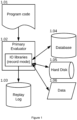
- FIG. 1 An example embodiment of a replay log is shown in Figure 1 .
- the program execution for which provenance is required may call non-deterministic functions. Examples include: getting the current time, reading from an external database or fetching data over the internet. These calls are identified and tagged, then the results of each call captured to a log for later replay.
- non-deterministic calls are calls which may return different results on subsequent invocations given the same input, for example: the current time, reading from an external database or many other types of calls.
- the evaluator process for which provenance is required is called the 'primary evaluator'.
- an evaluator is a program that evaluates another program and input data.
- the program code could call the function getCurrentSystemTime(). This call returns an integer representing the current system time on the host computer.
- the 'getCurrentSystemTime' function would be identified as non-deterministic and flagged.
- the primary evaluator made the 'getCurrentSystemTime' library call, the result would be both returned to the program, and logged to the replay log.
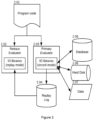
- FIG. 2 An example of a decoupled provenance evaluator is shown in Figure 2 .
- the retrace evaluator is the process which provides the actual provenance information.
- the retrace evaluator is provided with the same program for execution as the primary evaluator.
- the retrace evaluator consumes non-deterministic calls from the replay log, the retrace evaluator's execution is decoupled from the execution of the program evaluator.
- the execution of the retrace evaluator may happen at an indeterminate period after the primary evaluator has executed a portion of code, or even on another computer.
- a naive way of providing value level provenance is to attach to every value in a program, the inputs and function used to generate that value. This approach is not tractable for a real world program because the memory required for evaluation would be prohibitive. The runtime system could never free unused memory because no memory would ever become unused as it would be required for provenance. This precludes execution of all but the most trivial programs.
- Embodiments of the claimed invention use a novel and ingenious mechanism to overcome this limitation: As previously stated, value-level provenance allows a user the capability to find out exactly how any value came into existence.
- FIG. 3 An exemplary embodiment showing the use of a step counter is shown in Figure 3 .
- Each object in the system must have been created at a point in the program execution. Consequently there must be a unique 'step counter' for the point in the program execution at which a program value is created.
- step-counter for a value creation in every value of the program, so that every value in a program embeds the corresponding step counter of its creation.
- step-counter is retrieved from the value and the program reset to the state denoted by the step-counter. In this state the user can see the values of the inputs and the code used to create the original value.
- Each of these values also has an embedded step-counter, and so the process can be repeated.
- the step-counter which is embedded into a value at the value creation point is called the 'creation-counter'.
- the retrace evaluator may maintain the step counter as an integer per thread of execution.
- the step counter increments on execution of the code.
- the step-counter may increment on each instruction execution or on a subset of the execution instructions. What is important is that the step counter has a granularity whereby provenance events can be uniquely identified. This may be object creation, object modification and/or function return.
- any point of program execution relating to provenance can now be uniquely determined by the step counter.
- mutable values that is values whose content may change after their creation.
- mutable values include collection types which allow change to the underlying collection, for instance a set type which allows addition and removal from the set.
- a collection type is a type of program object which contains other objects, examples include: lists, maps and sets.
- the step-counters represents program state before the execution of the step to which they refer. Consequently replaying to a given step-counter will not execute the operation to which the step counter refers, but refers to the program state, just prior to execution of the operation to which the step counter refers.
- the program state may be replicated at the point just before the object was changed.
- the object in this state will contain the previous update counter, if there was no previous update, the update counter contains the same value as the creation counter.
- Figure 4 An exemplary embodiment showing the use of an update counter is shown in Figure 4 , which represents a sequence of operations on a set.
- the first operation is the set creation at step counter 1001, the element A is added at step counter 1100, and element B at step counter 1200 and element C at step counter 1300. Lastly element B is removed at step counter 1400.
- the program state would be set to step-counter 1400. In this state the set would have an update-counter of 1300 and content 'A', 'B' and 'C'. The program state would then be set to step counter 1300. In this state the set would then have an update counter of 1200 and content of 'A', and ⁇ B". The program state would then be set to step counter 1200 and in this state the set content would be 'A'.
- step counter 1100 The program state would then be set to step counter 1100 and in this state the set content would be empty, but the current step would be the addition of 'A'. The user would then see the exact point in the code that 'A' was added to set along with all the current values of the objects in the code at that point.
- This process incurs a linear search back through time to find the provenance of an arbitrary value contained within a composite object, where a composite object is one which contains two or more references to other objects.
- the system can immediately jump to the step counter where an object was inserted to another object. This optimization can save considerable compute time and lead to enhanced interactivity for the user.
- Insertion counters can be applied to any object which contains references to other objects which may change over time.
- program execution can be replicated to any step counter by re-executing the retrace evaluator from the start with the replay log and the program code.
- An additional problem is that the storage requirements for the replay log may become prohibitive for a long running program performing many non-deterministic operations.
- the snapshot is the complete serialized state of the Retrace evaluator. This can be thought of as the Retrace evaluator being 'frozen' mid execution, and this frozen image being transformed such that it can be written to storage.
- the reverse of this process, that is loading a frozen image from storage into the retrace evaluator and resuming execution is called 'deserializing'. By deserializing a snapshot and loading into memory, evaluation can resume exactly after the point of serialization.
- serialization is the process of taking a memory resident object (usually in the form of a directed graph) and transforming this for storage or transmission.
- Deserialization is the reverse of serialization, i.e. taking a linearized directed graph of objects and instantiating as a connected graph in computer memory.
- Any state given an instruction counter can now be re-created by loading the preceding snapshot into a new retrace evaluator and resume execution against the corresponding point in the replay log. Execution is continued until the required instruction counter.
- replay log can be deleted before the first snapshot for which provenance is required.
- performance of state creation can be traded against storage cost.
- a stack frame holds the parameters passed to the function and any local variables used by the function. In an object orientated language the stack frame may also hold a reference to the current object. If the called function executes another function, a new stack frame is created which references the calling stack frame.
- a stack is a contiguous block of memory or linked set of stack frames holding the variables of a set of nested function calls, and a stack frame is a portion of the stack, or object corresponding to a function call.
- a step counter represents a point in the program execution. At a point in a program's execution will be a series of linked stack frames. Each stack frame corresponds to a nested function invocation. A variable location in a stack frame is named a stack-frame slot.
- the systems and methods of embodiments of the invention allow the user to examine the provenance of all objects in the system at any given step counter.
- creation counters, update counters and insertions counters the provenance of all objects in the system can be determined, but one question may remain in some embodiments, namely what is the provenance of the stack frames themselves.
- the corresponding step counter would be the operation retrieving the attribute from the other object.
- 'c' is a variable and will have its own stack frame slot which is assigned to the result of 'a()' when 'a' is executed.
- Stack frame slot 'c' will also have a corresponding step counter. This step counter is set to the point at which execution of function 'a' returns value 1.
- a function may return predefined values.
- the boolean values: 'true' and 'false' are predefined.
- a function executes and returns a boolean, it is often not of much interest how the values 'true' and 'false' were created, but why the function in question returned either 'true' or 'false' value.
- Stack provenance answers this question.
- step-counters for the stack-slots could be maintained by the retrace evaluator:
- a user may want to ascertain the provenance on the result generated by a program.
- the program may run and produce one result, or it may produce many results during its execution, sometimes in response to user generated requests.
- To enable the user to generate the provenance on a result from a program there must be a way of identifying the result coming from the primary evaluator and correlating that to the same result being generated from the retrace evaluator.
- Certain functions' will be tagged as result generating. When the source program calls these functions a result is generated somewhere. This could be an output to a terminal, a write to a database row or a write to file.
- FIG. 7 An exemplary end-to-end workflow is shown in Figure 7 .
- the program is loaded by the Primary and Retrace evaluator for execution (7.02 and 7.04).
- the primary evaluator executes the program while logging the results of all non-deterministic calls to the Replay log (7.03).
- the Replay log appends all new items to the log file. Very old items predating the oldest retained snapshot may be deleted.
- the retrace evaluator runs in catch-up mode reading results of all flagged non-deterministic calls from the replay log. It also creates the counters (e.g. creation, update, stack) on all objects. Lastly it periodically writes out its state to a series of snapshot files, described in step (7.05).
- a series of snapshot objects are periodically created by the Retrace evaluator (detailed in step 7.04) containing the exact state of the retrace evaluator at a point in time.
- Intermediate snapshot files created after the oldest snapshot may be deleted to free space.
- the snapshot with Step Counter 100 is the oldest, this means that the Snapshots with step counters of 300 and 500 may be deleted with no loss of information. The tradeoff is that recreating a state for provenance may take longer.
- a user loads the retrace client, which connects to the Retrace server (7.07),
- the user enters a step counter representing a program state.
- the user may enter Step Counter 345.
- the retrace server selects the nearest preceding snapshot (7.09), and then starts a retrace evaluator (7.08) against this snapshot.
- the retrace evaluator loads its state against snapshot, that is Snapshot with Step counter of 300 (7.09) and proceeds to execute to the given step counter loading the results of any non-deterministic calls from the replay log (7.03).
- Step counter of 300
- the retrace evaluator has replicated the desired state, a subset of data representing the state is returned to the Retrace server (7.07).
- the retrace server formats the data and sends it back to the client (7.06).
- the end user may decide to drill back on the provenance of an object in the returned data.
- the user is interested in an object which was created at step counter 123.
- the client (7.06) sends a load request for step counter 123 to the server (7.07).
- the nearest preceding snapshot would be the snapshot created at Step Counter 100 (7.11).
- the Retrace Server starts a Retrace Evaluator from the snapshot and gives instruction to execute to Step Counter 123. The process repeats.
Landscapes
- Engineering & Computer Science (AREA)
- Theoretical Computer Science (AREA)
- Physics & Mathematics (AREA)
- General Engineering & Computer Science (AREA)
- General Physics & Mathematics (AREA)
- Quality & Reliability (AREA)
- Software Systems (AREA)
- Computer Hardware Design (AREA)
- Debugging And Monitoring (AREA)
Claims (11)
- Computerimplementiertes Verfahren, wobei das Verfahren die folgenden Schritte aufweist:- Zuordnen eines Indexreferenzwerts zu jedem Punkt im Verlauf der Ausführung eines Programms;- Zuweisen von einem oder mehr der Indexreferenzwerte zu jedem bei Ausführung des Programms erstellten Programmobjekt, wobei einer von den ein oder mehr Indexreferenzwerten dem Punkt im Verlauf der Programmausführung zugeordnet wird, an dem das Programmobjekt erstellt wurde;- Erzeugen eines ersten Programmschnappschusses durch Speichern eines serialisierten Zustands des einem ersten Indexreferenzwert zugeordneten Programms;- anschließendes Wiederherstellen eines Zustands des Programms durch:o Empfangen einer Anzeige eines zweiten Indexreferenzwerts, wobei der zweite Indexreferenzwert in einem ausgewählten Programmobjekt eingebettet ist;o Wiederherstellen des Zustands des Programms gemäß dem serialisierten Zustand des Programms, der dem ersten Indexreferenzwert zugeordnet ist, wobei der erste Indexreferenzwert einem Punkt im Verlauf der Programmausführung zugeordnet wird, der dem Punkt im Verlauf der Programmausführung vorangeht, der dem zweiten Indexreferenzwert zugeordnet ist; undo Ausführen des Programms von dem wiederhergestellten Zustand des Programms an dem Punkt im Verlauf der Programmausführung, der dem zweiten Indexreferenzwert zugeordnet ist, einschließlich Verwenden zuvor gespeicherter nichtdeterministischer Werte, die von einem ersten Auswerterprogramm bestimmt werden, das das Programm während einer ersten Ausführung des Programms auswertet und nichtdeterministische Werte bestimmt und speichert, wobei die nichtdeterministischen Werte von nichtdeterministischen Aufrufen berechnet oder verwendet werden, die während der Ausführung von dem Programm getätigt werden.
- Verfahren nach Anspruch 1, wobei einer der ein oder mehr Indexreferenzwerte, die jedem Programmobjekt zugewiesen sind, dem Punkt im Verlauf der Programmausführung zugeordnet wird, an dem das Programmobjekt modifiziert wurde.
- Verfahren nach einem der vorhergehenden Ansprüche, wobei einer der ein oder mehr Indexreferenzwerte, die jedem Programmobjekt zugewiesen sind, dem Punkt im Verlauf der Programmausführung zugeordnet wird, an dem ein weiteres Programmobjekt in das Programmobjekt eingefügt wird.
- Verfahren nach einem der vorhergehenden Ansprüche, wobei ein oder mehr Aufrufrahmen von dem Programm während der Ausführung erzeugt werden, wobei das Verfahren ferner den Schritt des Zuweisens des Indexreferenzwerts, der dem Punkt im Verlauf der Programmausführung zugeordnet ist, an dem ein Wert dem Programmaufrufrahmen zugewiesen wird, zu jedem während der Ausführung von dem Programm erzeugten Programmaufrufrahmen umfasst.
- Verfahren nach einem der vorhergehenden Ansprüche, das ferner das Erzeugen weiterer Programmschnappschüsse durch Speichern des serialisierten Zustands des weiteren Indexreferenzwerten zugeordneten Programms umfasst.
- Verfahren nach einem der vorhergehenden Ansprüche, ferner umfassend den Schritt des Löschens der gespeicherten nichtdeterministischen Werte, die zum Wiederherstellen des Zustands des Programms an dem Punkt im Verlauf der Programmausführung, der dem ersten Programmschnappschuss entspricht, erforderlich sind, sobald der erste Programmschnappschuss erzeugt worden ist.
- Verfahren nach einem der vorhergehenden Ansprüche, wobei das Verfahren von einem oder mehr weiteren Auswerterprogrammen durchgeführt wird und wobei das erste Auswerterprogramm, das das Programm während der ersten Ausführung des Programms auswertet und nichtdeterministische Werte bestimmt und speichert, unabhängig von den ein oder mehr weiteren Auswerterprogrammen ausgeführt wird.
- Verfahren nach einem der vorhergehenden Ansprüche, wobei ein zweites Auswerterprogramm jeden nichtdeterministischen Wert protokolliert, der von jedem von dem Programm während der Ausführung getätigten nichtdeterministischen Aufruf berechnet oder verwendet wird.
- Verfahren nach einem der vorhergehenden Ansprüche, wobei eine Vielzahl von Programmoperationen jeweils dem gleichen Indexreferenzwert zugeordnet werden.
- System, das zum Durchführen des Verfahrens nach einem der vorhergehenden Ansprüche konfiguriert ist.
- Computerprogramm, das bei Ausführung auf einem oder mehr Prozessoren die genannten Prozessoren zum Durchführen des Verfahrens nach einem der Ansprüche 1 bis 9 veranlasst.
Applications Claiming Priority (2)
| Application Number | Priority Date | Filing Date | Title |
|---|---|---|---|
| GB2001309.0A GB2593858B (en) | 2020-01-30 | 2020-01-30 | Methods and systems for recreating a program state. |
| PCT/GB2021/050196 WO2021152312A1 (en) | 2020-01-30 | 2021-01-28 | Methods and systems for recreating a program state |
Publications (3)
| Publication Number | Publication Date |
|---|---|
| EP4100831A1 EP4100831A1 (de) | 2022-12-14 |
| EP4100831C0 EP4100831C0 (de) | 2024-06-05 |
| EP4100831B1 true EP4100831B1 (de) | 2024-06-05 |
Family
ID=69800200
Family Applications (1)
| Application Number | Title | Priority Date | Filing Date |
|---|---|---|---|
| EP21703528.6A Active EP4100831B1 (de) | 2020-01-30 | 2021-01-28 | Verfahren und systeme zur neuerstellung eines programmzustandes |
Country Status (4)
| Country | Link |
|---|---|
| US (1) | US11880279B2 (de) |
| EP (1) | EP4100831B1 (de) |
| GB (1) | GB2593858B (de) |
| WO (1) | WO2021152312A1 (de) |
Family Cites Families (22)
| Publication number | Priority date | Publication date | Assignee | Title |
|---|---|---|---|---|
| US7287133B2 (en) * | 2004-08-24 | 2007-10-23 | Symantec Operating Corporation | Systems and methods for providing a modification history for a location within a data store |
| US7603589B2 (en) * | 2005-05-16 | 2009-10-13 | Texas Instruments Incorporated | Method and system for debugging a software program |
| US8078910B1 (en) * | 2008-12-15 | 2011-12-13 | Open Invention Network, Llc | Method and system for providing coordinated checkpointing to a group of independent computer applications |
| US20080046699A1 (en) * | 2006-08-21 | 2008-02-21 | International Business Machines Corporation | Method and apparatus for non-deterministic incremental program replay using checkpoints and syndrome tracking |
| US8429613B2 (en) * | 2006-10-31 | 2013-04-23 | Microsoft Corporation | Stepping and application state viewing between points |
| US9058420B2 (en) * | 2008-06-20 | 2015-06-16 | Vmware, Inc. | Synchronous decoupled program analysis in virtual environments |
| US9129056B2 (en) * | 2009-12-04 | 2015-09-08 | Sap Se | Tracing values of method parameters |
| US9122765B1 (en) * | 2010-12-22 | 2015-09-01 | Vmware, Inc. | Efficient overcommitment of main-memory based virtual database system to disk |
| US11625307B1 (en) * | 2011-04-28 | 2023-04-11 | International Business Machines Corporation | System and method for hybrid kernel- and user-space incremental and full checkpointing |
| US10223401B2 (en) * | 2013-08-15 | 2019-03-05 | International Business Machines Corporation | Incrementally retrieving data for objects to provide a desired level of detail |
| US10761941B1 (en) * | 2014-09-30 | 2020-09-01 | Acronis International Gmbh | Changed blocks tracking methods and systems for writable snapshots |
| CN105701006B (zh) * | 2014-11-28 | 2018-04-27 | 国际商业机器公司 | 用于程序调试中的变量跟踪的方法和系统 |
| US9588870B2 (en) * | 2015-04-06 | 2017-03-07 | Microsoft Technology Licensing, Llc | Time travel debugging for browser components |
| GB201508034D0 (en) * | 2015-05-12 | 2015-06-24 | Undo Ltd | Debugging systems |
| GB2552519A (en) * | 2016-07-27 | 2018-01-31 | Undo Ltd | Debugging Systems |
| GB201621776D0 (en) * | 2016-12-20 | 2017-02-01 | Undo Ltd | Debugging Method |
| US10185645B2 (en) * | 2017-03-08 | 2019-01-22 | Microsoft Technology Licensing, Llc | Resource lifetime analysis using a time-travel trace |
| US10963349B2 (en) * | 2017-08-25 | 2021-03-30 | Vmware, Inc. | Containerized application snapshots |
| US11003555B2 (en) * | 2017-12-16 | 2021-05-11 | Vmware, Inc. | Tracking and recovering a disk allocation state |
| US11113158B2 (en) * | 2019-10-04 | 2021-09-07 | Robin Systems, Inc. | Rolling back kubernetes applications |
| US11526358B2 (en) * | 2019-10-15 | 2022-12-13 | Raytheon Company | Deterministic execution replay for multicore systems |
| US11144233B1 (en) * | 2020-03-18 | 2021-10-12 | EMC IP Holding Company LLC | Efficiently managing point-in-time copies of data within a primary storage system |
-
2020
- 2020-01-30 GB GB2001309.0A patent/GB2593858B/en active Active
-
2021
- 2021-01-28 US US17/794,878 patent/US11880279B2/en active Active
- 2021-01-28 EP EP21703528.6A patent/EP4100831B1/de active Active
- 2021-01-28 WO PCT/GB2021/050196 patent/WO2021152312A1/en not_active Ceased
Also Published As
| Publication number | Publication date |
|---|---|
| GB2593858B (en) | 2023-03-22 |
| US20230080595A1 (en) | 2023-03-16 |
| WO2021152312A1 (en) | 2021-08-05 |
| EP4100831C0 (de) | 2024-06-05 |
| GB202001309D0 (en) | 2020-03-18 |
| EP4100831A1 (de) | 2022-12-14 |
| GB2593858A (en) | 2021-10-13 |
| US11880279B2 (en) | 2024-01-23 |
Similar Documents
| Publication | Publication Date | Title |
|---|---|---|
| US8776014B2 (en) | Software build analysis | |
| KR102012342B1 (ko) | 프로그램 실행의 기록 | |
| US6751789B1 (en) | Method and system for periodic trace sampling for real-time generation of segments of call stack trees augmented with call stack position determination | |
| US20080209436A1 (en) | Automated testing of programs using race-detection and flipping | |
| US7886281B2 (en) | System and methods for cross-tier transaction tracing | |
| US20060085798A1 (en) | Method and apparatus for correlation of events in a distributed multi-system computing environment | |
| US20030056200A1 (en) | Runtime monitoring in component-based systems | |
| US7716652B2 (en) | System and methods for tracing transactions | |
| US10545852B2 (en) | Diagnostics of state transitions | |
| US20050223368A1 (en) | Instrumented application for transaction tracing | |
| US20050223366A1 (en) | System and methods for transaction tracing | |
| Giachino et al. | Deadlock analysis of concurrent objects: theory and practice | |
| US20050223367A1 (en) | System and methods for instrumenting applications | |
| US8468505B2 (en) | State as a first-class citizen of an imperative language | |
| EP4100831B1 (de) | Verfahren und systeme zur neuerstellung eines programmzustandes | |
| Goswami et al. | Dynamic slicing of concurrent programs | |
| Damevski et al. | Automated provenance collection for cca component assemblies | |
| Akgul et al. | Instruction-level reverse execution for debugging | |
| Power | Design and use of a program execution analyzer | |
| US8819641B1 (en) | Program state reversing software development tool | |
| Köhler et al. | Improving workflow fault tolerance through provenance-based recovery | |
| Montanari et al. | Towards a Concurrent Semantics based Analysis of CC and CLP | |
| Zhou | A Novel Implementation Method of Delay. | |
| Goswami et al. | Static slicing in unix process environment | |
| Hurfin et al. | EREBUS: a debugger for asynchronous distributed computing systems |
Legal Events
| Date | Code | Title | Description |
|---|---|---|---|
| STAA | Information on the status of an ep patent application or granted ep patent |
Free format text: STATUS: UNKNOWN |
|
| STAA | Information on the status of an ep patent application or granted ep patent |
Free format text: STATUS: THE INTERNATIONAL PUBLICATION HAS BEEN MADE |
|
| PUAI | Public reference made under article 153(3) epc to a published international application that has entered the european phase |
Free format text: ORIGINAL CODE: 0009012 |
|
| STAA | Information on the status of an ep patent application or granted ep patent |
Free format text: STATUS: REQUEST FOR EXAMINATION WAS MADE |
|
| 17P | Request for examination filed |
Effective date: 20220826 |
|
| AK | Designated contracting states |
Kind code of ref document: A1 Designated state(s): AL AT BE BG CH CY CZ DE DK EE ES FI FR GB GR HR HU IE IS IT LI LT LU LV MC MK MT NL NO PL PT RO RS SE SI SK SM TR |
|
| DAV | Request for validation of the european patent (deleted) | ||
| DAX | Request for extension of the european patent (deleted) | ||
| GRAP | Despatch of communication of intention to grant a patent |
Free format text: ORIGINAL CODE: EPIDOSNIGR1 |
|
| STAA | Information on the status of an ep patent application or granted ep patent |
Free format text: STATUS: GRANT OF PATENT IS INTENDED |
|
| GRAJ | Information related to disapproval of communication of intention to grant by the applicant or resumption of examination proceedings by the epo deleted |
Free format text: ORIGINAL CODE: EPIDOSDIGR1 |
|
| STAA | Information on the status of an ep patent application or granted ep patent |
Free format text: STATUS: REQUEST FOR EXAMINATION WAS MADE |
|
| INTG | Intention to grant announced |
Effective date: 20231206 |
|
| GRAP | Despatch of communication of intention to grant a patent |
Free format text: ORIGINAL CODE: EPIDOSNIGR1 |
|
| STAA | Information on the status of an ep patent application or granted ep patent |
Free format text: STATUS: GRANT OF PATENT IS INTENDED |
|
| INTC | Intention to grant announced (deleted) | ||
| INTG | Intention to grant announced |
Effective date: 20240108 |
|
| GRAS | Grant fee paid |
Free format text: ORIGINAL CODE: EPIDOSNIGR3 |
|
| GRAA | (expected) grant |
Free format text: ORIGINAL CODE: 0009210 |
|
| STAA | Information on the status of an ep patent application or granted ep patent |
Free format text: STATUS: THE PATENT HAS BEEN GRANTED |
|
| AK | Designated contracting states |
Kind code of ref document: B1 Designated state(s): AL AT BE BG CH CY CZ DE DK EE ES FI FR GB GR HR HU IE IS IT LI LT LU LV MC MK MT NL NO PL PT RO RS SE SI SK SM TR |
|
| REG | Reference to a national code |
Ref country code: CH Ref legal event code: EP |
|
| REG | Reference to a national code |
Ref country code: DE Ref legal event code: R096 Ref document number: 602021014066 Country of ref document: DE |
|
| REG | Reference to a national code |
Ref country code: IE Ref legal event code: FG4D |
|
| U01 | Request for unitary effect filed |
Effective date: 20240705 |
|
| U07 | Unitary effect registered |
Designated state(s): AT BE BG DE DK EE FI FR IT LT LU LV MT NL PT SE SI Effective date: 20240806 |
|
| PG25 | Lapsed in a contracting state [announced via postgrant information from national office to epo] |
Ref country code: HR Free format text: LAPSE BECAUSE OF FAILURE TO SUBMIT A TRANSLATION OF THE DESCRIPTION OR TO PAY THE FEE WITHIN THE PRESCRIBED TIME-LIMIT Effective date: 20240605 |
|
| PG25 | Lapsed in a contracting state [announced via postgrant information from national office to epo] |
Ref country code: GR Free format text: LAPSE BECAUSE OF FAILURE TO SUBMIT A TRANSLATION OF THE DESCRIPTION OR TO PAY THE FEE WITHIN THE PRESCRIBED TIME-LIMIT Effective date: 20240906 |
|
| PG25 | Lapsed in a contracting state [announced via postgrant information from national office to epo] |
Ref country code: ES Free format text: LAPSE BECAUSE OF FAILURE TO SUBMIT A TRANSLATION OF THE DESCRIPTION OR TO PAY THE FEE WITHIN THE PRESCRIBED TIME-LIMIT Effective date: 20240605 |
|
| PG25 | Lapsed in a contracting state [announced via postgrant information from national office to epo] |
Ref country code: NO Free format text: LAPSE BECAUSE OF FAILURE TO SUBMIT A TRANSLATION OF THE DESCRIPTION OR TO PAY THE FEE WITHIN THE PRESCRIBED TIME-LIMIT Effective date: 20240905 Ref country code: HR Free format text: LAPSE BECAUSE OF FAILURE TO SUBMIT A TRANSLATION OF THE DESCRIPTION OR TO PAY THE FEE WITHIN THE PRESCRIBED TIME-LIMIT Effective date: 20240605 Ref country code: GR Free format text: LAPSE BECAUSE OF FAILURE TO SUBMIT A TRANSLATION OF THE DESCRIPTION OR TO PAY THE FEE WITHIN THE PRESCRIBED TIME-LIMIT Effective date: 20240906 Ref country code: ES Free format text: LAPSE BECAUSE OF FAILURE TO SUBMIT A TRANSLATION OF THE DESCRIPTION OR TO PAY THE FEE WITHIN THE PRESCRIBED TIME-LIMIT Effective date: 20240605 Ref country code: RS Free format text: LAPSE BECAUSE OF FAILURE TO SUBMIT A TRANSLATION OF THE DESCRIPTION OR TO PAY THE FEE WITHIN THE PRESCRIBED TIME-LIMIT Effective date: 20240905 |
|
| U20 | Renewal fee for the european patent with unitary effect paid |
Year of fee payment: 5 Effective date: 20241205 |
|
| PG25 | Lapsed in a contracting state [announced via postgrant information from national office to epo] |
Ref country code: PL Free format text: LAPSE BECAUSE OF FAILURE TO SUBMIT A TRANSLATION OF THE DESCRIPTION OR TO PAY THE FEE WITHIN THE PRESCRIBED TIME-LIMIT Effective date: 20240605 |
|
| PG25 | Lapsed in a contracting state [announced via postgrant information from national office to epo] |
Ref country code: IS Free format text: LAPSE BECAUSE OF FAILURE TO SUBMIT A TRANSLATION OF THE DESCRIPTION OR TO PAY THE FEE WITHIN THE PRESCRIBED TIME-LIMIT Effective date: 20241005 |
|
| PG25 | Lapsed in a contracting state [announced via postgrant information from national office to epo] |
Ref country code: CZ Free format text: LAPSE BECAUSE OF FAILURE TO SUBMIT A TRANSLATION OF THE DESCRIPTION OR TO PAY THE FEE WITHIN THE PRESCRIBED TIME-LIMIT Effective date: 20240605 |
|
| PG25 | Lapsed in a contracting state [announced via postgrant information from national office to epo] |
Ref country code: RO Free format text: LAPSE BECAUSE OF FAILURE TO SUBMIT A TRANSLATION OF THE DESCRIPTION OR TO PAY THE FEE WITHIN THE PRESCRIBED TIME-LIMIT Effective date: 20240605 Ref country code: SK Free format text: LAPSE BECAUSE OF FAILURE TO SUBMIT A TRANSLATION OF THE DESCRIPTION OR TO PAY THE FEE WITHIN THE PRESCRIBED TIME-LIMIT Effective date: 20240605 |
|
| PG25 | Lapsed in a contracting state [announced via postgrant information from national office to epo] |
Ref country code: SM Free format text: LAPSE BECAUSE OF FAILURE TO SUBMIT A TRANSLATION OF THE DESCRIPTION OR TO PAY THE FEE WITHIN THE PRESCRIBED TIME-LIMIT Effective date: 20240605 |
|
| PG25 | Lapsed in a contracting state [announced via postgrant information from national office to epo] |
Ref country code: SM Free format text: LAPSE BECAUSE OF FAILURE TO SUBMIT A TRANSLATION OF THE DESCRIPTION OR TO PAY THE FEE WITHIN THE PRESCRIBED TIME-LIMIT Effective date: 20240605 Ref country code: SK Free format text: LAPSE BECAUSE OF FAILURE TO SUBMIT A TRANSLATION OF THE DESCRIPTION OR TO PAY THE FEE WITHIN THE PRESCRIBED TIME-LIMIT Effective date: 20240605 Ref country code: RO Free format text: LAPSE BECAUSE OF FAILURE TO SUBMIT A TRANSLATION OF THE DESCRIPTION OR TO PAY THE FEE WITHIN THE PRESCRIBED TIME-LIMIT Effective date: 20240605 Ref country code: PL Free format text: LAPSE BECAUSE OF FAILURE TO SUBMIT A TRANSLATION OF THE DESCRIPTION OR TO PAY THE FEE WITHIN THE PRESCRIBED TIME-LIMIT Effective date: 20240605 Ref country code: IS Free format text: LAPSE BECAUSE OF FAILURE TO SUBMIT A TRANSLATION OF THE DESCRIPTION OR TO PAY THE FEE WITHIN THE PRESCRIBED TIME-LIMIT Effective date: 20241005 Ref country code: CZ Free format text: LAPSE BECAUSE OF FAILURE TO SUBMIT A TRANSLATION OF THE DESCRIPTION OR TO PAY THE FEE WITHIN THE PRESCRIBED TIME-LIMIT Effective date: 20240605 |
|
| PLBE | No opposition filed within time limit |
Free format text: ORIGINAL CODE: 0009261 |
|
| STAA | Information on the status of an ep patent application or granted ep patent |
Free format text: STATUS: NO OPPOSITION FILED WITHIN TIME LIMIT |
|
| 26N | No opposition filed |
Effective date: 20250306 |
|
| REG | Reference to a national code |
Ref country code: CH Ref legal event code: PL |
|
| PG25 | Lapsed in a contracting state [announced via postgrant information from national office to epo] |
Ref country code: MC Free format text: LAPSE BECAUSE OF FAILURE TO SUBMIT A TRANSLATION OF THE DESCRIPTION OR TO PAY THE FEE WITHIN THE PRESCRIBED TIME-LIMIT Effective date: 20240605 |
|
| GBPC | Gb: european patent ceased through non-payment of renewal fee |
Effective date: 20250128 |
|
| PG25 | Lapsed in a contracting state [announced via postgrant information from national office to epo] |
Ref country code: GB Free format text: LAPSE BECAUSE OF NON-PAYMENT OF DUE FEES Effective date: 20250128 |
|
| PG25 | Lapsed in a contracting state [announced via postgrant information from national office to epo] |
Ref country code: CH Free format text: LAPSE BECAUSE OF NON-PAYMENT OF DUE FEES Effective date: 20250131 |
|
| U20 | Renewal fee for the european patent with unitary effect paid |
Year of fee payment: 6 Effective date: 20251205 |
|
| PG25 | Lapsed in a contracting state [announced via postgrant information from national office to epo] |
Ref country code: IE Free format text: LAPSE BECAUSE OF NON-PAYMENT OF DUE FEES Effective date: 20250128 |