EP4100704B1 - An integrated photodetecting semiconductor optoelectronic component - Google Patents
An integrated photodetecting semiconductor optoelectronic component Download PDFInfo
- Publication number
- EP4100704B1 EP4100704B1 EP21703702.7A EP21703702A EP4100704B1 EP 4100704 B1 EP4100704 B1 EP 4100704B1 EP 21703702 A EP21703702 A EP 21703702A EP 4100704 B1 EP4100704 B1 EP 4100704B1
- Authority
- EP
- European Patent Office
- Prior art keywords
- spad
- component
- longpass filter
- light
- intensity
- Prior art date
- Legal status (The legal status is an assumption and is not a legal conclusion. Google has not performed a legal analysis and makes no representation as to the accuracy of the status listed.)
- Active
Links
Images



Classifications
-
- G—PHYSICS
- G01—MEASURING; TESTING
- G01J—MEASUREMENT OF INTENSITY, VELOCITY, SPECTRAL CONTENT, POLARISATION, PHASE OR PULSE CHARACTERISTICS OF INFRARED, VISIBLE OR ULTRAVIOLET LIGHT; COLORIMETRY; RADIATION PYROMETRY
- G01J1/00—Photometry, e.g. photographic exposure meter
- G01J1/02—Details
- G01J1/04—Optical or mechanical part supplementary adjustable parts
- G01J1/0488—Optical or mechanical part supplementary adjustable parts with spectral filtering
-
- G—PHYSICS
- G01—MEASURING; TESTING
- G01J—MEASUREMENT OF INTENSITY, VELOCITY, SPECTRAL CONTENT, POLARISATION, PHASE OR PULSE CHARACTERISTICS OF INFRARED, VISIBLE OR ULTRAVIOLET LIGHT; COLORIMETRY; RADIATION PYROMETRY
- G01J1/00—Photometry, e.g. photographic exposure meter
- G01J1/42—Photometry, e.g. photographic exposure meter using electric radiation detectors
- G01J1/4204—Photometry, e.g. photographic exposure meter using electric radiation detectors with determination of ambient light
-
- G—PHYSICS
- G01—MEASURING; TESTING
- G01J—MEASUREMENT OF INTENSITY, VELOCITY, SPECTRAL CONTENT, POLARISATION, PHASE OR PULSE CHARACTERISTICS OF INFRARED, VISIBLE OR ULTRAVIOLET LIGHT; COLORIMETRY; RADIATION PYROMETRY
- G01J1/00—Photometry, e.g. photographic exposure meter
- G01J1/42—Photometry, e.g. photographic exposure meter using electric radiation detectors
- G01J1/4228—Photometry, e.g. photographic exposure meter using electric radiation detectors arrangements with two or more detectors, e.g. for sensitivity compensation
-
- G—PHYSICS
- G01—MEASURING; TESTING
- G01S—RADIO DIRECTION-FINDING; RADIO NAVIGATION; DETERMINING DISTANCE OR VELOCITY BY USE OF RADIO WAVES; LOCATING OR PRESENCE-DETECTING BY USE OF THE REFLECTION OR RERADIATION OF RADIO WAVES; ANALOGOUS ARRANGEMENTS USING OTHER WAVES
- G01S17/00—Systems using the reflection or reradiation of electromagnetic waves other than radio waves, e.g. lidar systems
- G01S17/88—Lidar systems specially adapted for specific applications
- G01S17/89—Lidar systems specially adapted for specific applications for mapping or imaging
- G01S17/894—Three-dimensional [3D] imaging with simultaneous measurement of time-of-flight at a two-dimensional [2D] array of receiver pixels, e.g. time-of-flight cameras or flash lidar
-
- G—PHYSICS
- G01—MEASURING; TESTING
- G01S—RADIO DIRECTION-FINDING; RADIO NAVIGATION; DETERMINING DISTANCE OR VELOCITY BY USE OF RADIO WAVES; LOCATING OR PRESENCE-DETECTING BY USE OF THE REFLECTION OR RERADIATION OF RADIO WAVES; ANALOGOUS ARRANGEMENTS USING OTHER WAVES
- G01S7/00—Details of systems according to groups G01S13/00, G01S15/00, G01S17/00
- G01S7/48—Details of systems according to groups G01S13/00, G01S15/00, G01S17/00 of systems according to group G01S17/00
- G01S7/481—Constructional features, e.g. arrangements of optical elements
- G01S7/4814—Constructional features, e.g. arrangements of optical elements of transmitters alone
-
- G—PHYSICS
- G01—MEASURING; TESTING
- G01S—RADIO DIRECTION-FINDING; RADIO NAVIGATION; DETERMINING DISTANCE OR VELOCITY BY USE OF RADIO WAVES; LOCATING OR PRESENCE-DETECTING BY USE OF THE REFLECTION OR RERADIATION OF RADIO WAVES; ANALOGOUS ARRANGEMENTS USING OTHER WAVES
- G01S7/00—Details of systems according to groups G01S13/00, G01S15/00, G01S17/00
- G01S7/48—Details of systems according to groups G01S13/00, G01S15/00, G01S17/00 of systems according to group G01S17/00
- G01S7/481—Constructional features, e.g. arrangements of optical elements
- G01S7/4816—Constructional features, e.g. arrangements of optical elements of receivers alone
-
- G—PHYSICS
- G01—MEASURING; TESTING
- G01S—RADIO DIRECTION-FINDING; RADIO NAVIGATION; DETERMINING DISTANCE OR VELOCITY BY USE OF RADIO WAVES; LOCATING OR PRESENCE-DETECTING BY USE OF THE REFLECTION OR RERADIATION OF RADIO WAVES; ANALOGOUS ARRANGEMENTS USING OTHER WAVES
- G01S7/00—Details of systems according to groups G01S13/00, G01S15/00, G01S17/00
- G01S7/48—Details of systems according to groups G01S13/00, G01S15/00, G01S17/00 of systems according to group G01S17/00
- G01S7/481—Constructional features, e.g. arrangements of optical elements
- G01S7/4817—Constructional features, e.g. arrangements of optical elements relating to scanning
-
- G—PHYSICS
- G01—MEASURING; TESTING
- G01S—RADIO DIRECTION-FINDING; RADIO NAVIGATION; DETERMINING DISTANCE OR VELOCITY BY USE OF RADIO WAVES; LOCATING OR PRESENCE-DETECTING BY USE OF THE REFLECTION OR RERADIATION OF RADIO WAVES; ANALOGOUS ARRANGEMENTS USING OTHER WAVES
- G01S7/00—Details of systems according to groups G01S13/00, G01S15/00, G01S17/00
- G01S7/48—Details of systems according to groups G01S13/00, G01S15/00, G01S17/00 of systems according to group G01S17/00
- G01S7/483—Details of pulse systems
- G01S7/486—Receivers
- G01S7/4865—Time delay measurement, e.g. time-of-flight measurement, time of arrival measurement or determining the exact position of a peak
-
- G—PHYSICS
- G02—OPTICS
- G02B—OPTICAL ELEMENTS, SYSTEMS OR APPARATUS
- G02B27/00—Optical systems or apparatus not provided for by any of the groups G02B1/00 - G02B26/00, G02B30/00
- G02B27/10—Beam splitting or combining systems
- G02B27/14—Beam splitting or combining systems operating by reflection only
-
- G—PHYSICS
- G02—OPTICS
- G02B—OPTICAL ELEMENTS, SYSTEMS OR APPARATUS
- G02B5/00—Optical elements other than lenses
- G02B5/20—Filters
- G02B5/207—Filters comprising semiconducting materials
-
- G—PHYSICS
- G02—OPTICS
- G02B—OPTICAL ELEMENTS, SYSTEMS OR APPARATUS
- G02B5/00—Optical elements other than lenses
- G02B5/20—Filters
- G02B5/208—Filters for use with infrared or ultraviolet radiation, e.g. for separating visible light from infrared and/or ultraviolet radiation
-
- H—ELECTRICITY
- H10—SEMICONDUCTOR DEVICES; ELECTRIC SOLID-STATE DEVICES NOT OTHERWISE PROVIDED FOR
- H10F—INORGANIC SEMICONDUCTOR DEVICES SENSITIVE TO INFRARED RADIATION, LIGHT, ELECTROMAGNETIC RADIATION OF SHORTER WAVELENGTH OR CORPUSCULAR RADIATION
- H10F30/00—Individual radiation-sensitive semiconductor devices in which radiation controls the flow of current through the devices, e.g. photodetectors
- H10F30/20—Individual radiation-sensitive semiconductor devices in which radiation controls the flow of current through the devices, e.g. photodetectors the devices having potential barriers, e.g. phototransistors
- H10F30/21—Individual radiation-sensitive semiconductor devices in which radiation controls the flow of current through the devices, e.g. photodetectors the devices having potential barriers, e.g. phototransistors the devices being sensitive to infrared, visible or ultraviolet radiation
- H10F30/22—Individual radiation-sensitive semiconductor devices in which radiation controls the flow of current through the devices, e.g. photodetectors the devices having potential barriers, e.g. phototransistors the devices being sensitive to infrared, visible or ultraviolet radiation the devices having only one potential barrier, e.g. photodiodes
- H10F30/225—Individual radiation-sensitive semiconductor devices in which radiation controls the flow of current through the devices, e.g. photodetectors the devices having potential barriers, e.g. phototransistors the devices being sensitive to infrared, visible or ultraviolet radiation the devices having only one potential barrier, e.g. photodiodes the potential barrier working in avalanche mode, e.g. avalanche photodiodes
-
- H—ELECTRICITY
- H10—SEMICONDUCTOR DEVICES; ELECTRIC SOLID-STATE DEVICES NOT OTHERWISE PROVIDED FOR
- H10F—INORGANIC SEMICONDUCTOR DEVICES SENSITIVE TO INFRARED RADIATION, LIGHT, ELECTROMAGNETIC RADIATION OF SHORTER WAVELENGTH OR CORPUSCULAR RADIATION
- H10F30/00—Individual radiation-sensitive semiconductor devices in which radiation controls the flow of current through the devices, e.g. photodetectors
- H10F30/20—Individual radiation-sensitive semiconductor devices in which radiation controls the flow of current through the devices, e.g. photodetectors the devices having potential barriers, e.g. phototransistors
- H10F30/21—Individual radiation-sensitive semiconductor devices in which radiation controls the flow of current through the devices, e.g. photodetectors the devices having potential barriers, e.g. phototransistors the devices being sensitive to infrared, visible or ultraviolet radiation
- H10F30/288—Individual radiation-sensitive semiconductor devices in which radiation controls the flow of current through the devices, e.g. photodetectors the devices having potential barriers, e.g. phototransistors the devices being sensitive to infrared, visible or ultraviolet radiation the devices being sensitive to multiple wavelengths, e.g. multi-spectrum radiation detection devices
-
- H—ELECTRICITY
- H10—SEMICONDUCTOR DEVICES; ELECTRIC SOLID-STATE DEVICES NOT OTHERWISE PROVIDED FOR
- H10F—INORGANIC SEMICONDUCTOR DEVICES SENSITIVE TO INFRARED RADIATION, LIGHT, ELECTROMAGNETIC RADIATION OF SHORTER WAVELENGTH OR CORPUSCULAR RADIATION
- H10F77/00—Constructional details of devices covered by this subclass
- H10F77/30—Coatings
- H10F77/306—Coatings for devices having potential barriers
- H10F77/331—Coatings for devices having potential barriers for filtering or shielding light, e.g. multicolour filters for photodetectors
-
- H—ELECTRICITY
- H10—SEMICONDUCTOR DEVICES; ELECTRIC SOLID-STATE DEVICES NOT OTHERWISE PROVIDED FOR
- H10F—INORGANIC SEMICONDUCTOR DEVICES SENSITIVE TO INFRARED RADIATION, LIGHT, ELECTROMAGNETIC RADIATION OF SHORTER WAVELENGTH OR CORPUSCULAR RADIATION
- H10F77/00—Constructional details of devices covered by this subclass
- H10F77/30—Coatings
- H10F77/306—Coatings for devices having potential barriers
- H10F77/331—Coatings for devices having potential barriers for filtering or shielding light, e.g. multicolour filters for photodetectors
- H10F77/337—Coatings for devices having potential barriers for filtering or shielding light, e.g. multicolour filters for photodetectors using interference filters, e.g. multilayer dielectric filters
-
- H—ELECTRICITY
- H10—SEMICONDUCTOR DEVICES; ELECTRIC SOLID-STATE DEVICES NOT OTHERWISE PROVIDED FOR
- H10F—INORGANIC SEMICONDUCTOR DEVICES SENSITIVE TO INFRARED RADIATION, LIGHT, ELECTROMAGNETIC RADIATION OF SHORTER WAVELENGTH OR CORPUSCULAR RADIATION
- H10F77/00—Constructional details of devices covered by this subclass
- H10F77/40—Optical elements or arrangements
- H10F77/413—Optical elements or arrangements directly associated or integrated with the devices, e.g. back reflectors
-
- H—ELECTRICITY
- H10—SEMICONDUCTOR DEVICES; ELECTRIC SOLID-STATE DEVICES NOT OTHERWISE PROVIDED FOR
- H10F—INORGANIC SEMICONDUCTOR DEVICES SENSITIVE TO INFRARED RADIATION, LIGHT, ELECTROMAGNETIC RADIATION OF SHORTER WAVELENGTH OR CORPUSCULAR RADIATION
- H10F77/00—Constructional details of devices covered by this subclass
- H10F77/95—Circuit arrangements
- H10F77/953—Circuit arrangements for devices having potential barriers
- H10F77/959—Circuit arrangements for devices having potential barriers for devices working in avalanche mode
-
- G—PHYSICS
- G01—MEASURING; TESTING
- G01J—MEASUREMENT OF INTENSITY, VELOCITY, SPECTRAL CONTENT, POLARISATION, PHASE OR PULSE CHARACTERISTICS OF INFRARED, VISIBLE OR ULTRAVIOLET LIGHT; COLORIMETRY; RADIATION PYROMETRY
- G01J1/00—Photometry, e.g. photographic exposure meter
- G01J1/42—Photometry, e.g. photographic exposure meter using electric radiation detectors
- G01J1/44—Electric circuits
- G01J2001/4413—Type
- G01J2001/442—Single-photon detection or photon counting
-
- G—PHYSICS
- G01—MEASURING; TESTING
- G01J—MEASUREMENT OF INTENSITY, VELOCITY, SPECTRAL CONTENT, POLARISATION, PHASE OR PULSE CHARACTERISTICS OF INFRARED, VISIBLE OR ULTRAVIOLET LIGHT; COLORIMETRY; RADIATION PYROMETRY
- G01J1/00—Photometry, e.g. photographic exposure meter
- G01J1/42—Photometry, e.g. photographic exposure meter using electric radiation detectors
- G01J1/44—Electric circuits
- G01J2001/4446—Type of detector
- G01J2001/446—Photodiode
- G01J2001/4466—Avalanche
-
- G—PHYSICS
- G02—OPTICS
- G02B—OPTICAL ELEMENTS, SYSTEMS OR APPARATUS
- G02B5/00—Optical elements other than lenses
- G02B5/20—Filters
- G02B5/28—Interference filters
Definitions
- the present disclosure also pertains to optoelectronic photodetecting components, which are widely used as part of electronic devices, such as smart phones, wearables, tablets, displays and the like. Such components/optical sensors can extend the functionality and/or help improve the operation of the electronic device into which they are integrated.
- optical sensors should remain as simple, cheap and small as possible. Otherwise, they would no longer be adapted for mass manufacture and integration into consumer devices.
- this object is achieved with an integrated photodetecting semiconductor optoelectronic component for measuring the intensity of each of the two colour constituents of dichromatic light irradiating the optoelectronic component in accordance with claim 1.
- the component benefits from the SPADs' inherent high sensitivity, large gain and rapid response. Thanks to the specific longpass filter in combination with the differential analysis of the electronic circuitry, the component is able to provide an accurate measure of the intensity of both colour constituents. Semiconductor materials such as polycrystalline silicon are readily available at semiconductor fabrication plants. Accordingly, the featured longpass filter and thus the present photodetecting optoelectronic component are easy to manufacture with a standard CMOS fabrication process.
- the component of the present disclosure may include one, several or all of the following features, in all technically possible combinations:
- the present disclosure also relates to a method of manufacturing an optoelectronic component as defined above.
- the present disclosure also relates to an electronic device such as a smart phone, a gadget or a wearable, including an optoelectronic component as defined above.
- Figure 1 shows an integrated photodetecting semiconductor optoelectronic component 300 according to the present disclosure.
- the component 300 is delimited by the dashed polygon in figure 1 .
- the component 300 may also be qualified as a photodetector. These types of photodetectors may typically be built into various electronic devices, such as smart phones and wearables.
- the photodetector 300 is designed to measure the intensity of each of the two colour constituents of dichromatic light irradiating the photodetector 300.
- This dichromatic light DL may come from a dedicated light source 360.
- the light source 360 may include one or more light-emitting diodes (LEDs) and/or lasers.
- the one or more lasers may be of the vertical cavity surface emitting type (i.e. of the VCSEL - type).
- the two colour constituents C1, C2 of the dichromatic light DL which for example comes from the light source 360, are near infrared or NIR light (C1) and near ultraviolet - blue light (C2), respectively.
- C1 and C2 near ultraviolet - blue light
- the dichromatic light DL from the light source 360 is shone onto the surface S of the object, which is to be analysed.
- the dichromatic light DL reflecting off the surface S is then detected by the photodetector 300.
- the first colour constituent C1 of the dichromatic light DL e.g., near infrared or NIR
- the second colour constituent C2 e.g. blue - ultraviolet light
- the photodetector 300 comprises a SPAD assembly 302, which is triggered by incoming dichromatic light DL, and electronic circuitry 304 for the readout and processing of the detection signals S1 and S2 delivered by the SPAD assembly 302.
- the SPAD assembly 302 includes a first single photon avalanche diode or SPAD 306, a second single photon avalanche diode or SPAD 308 and a semiconductor optical longpass filter 310.
- Both SPADs 306, 308 are adapted to detect photons over a broad range of wavelengths. This means that the light sensitivity of both SPADs 306, 308 covers the spectrum from infrared via visible down to ultraviolet light.
- Both SPADs 306 and 308 are arranged in close proximity to each other.
- the SPAD assembly 302 may be replaced by a SPAD array assembly.
- each SPAD 306, 308 is replaced by a SPAD array, such as a SiPM.
- the semiconductor optical longpass filter 310 is associated with the first SPAD 306. It is permissive to the first one, C1, of the two colour constituents of the dichromatic light DL and blocks the second one, C2, of the two colour constituents of the dichromatic light DL.
- the electronic circuitry 304 includes readout electronics 312, a microprocessor 314 and a time-to-digital converter (TDC) 316.
- the readout electronics 312 conditions the two detection signals S1 and S2 delivered by the SPADs 306 and 308 and then transmits the conditioned signals N1, N2 to the processor 314 for analysis.
- the readout electronics 312 also delivers trigger signals T1 and T2 to the TDC 316, based on the detection signals S1 and S2.
- the readout electronics 312 comprises three stages, namely a splitter stage 318, a discriminator stage 320 and a converting stage 322.
- the function of the splitter stage 318 is to duplicate each detection signal S1 and S2 so that they are available to both the converting stage 322 as well as the TDC 316.
- the splitter stage 318 includes an individual and separate splitter for each of the two SPADs 306 and 308.
- the splitter stage 318 provides four signals S1.1, S1.2, S2.1 and S2.2 to the discriminator stage 320.
- the four signals undergo thresholding to improve the signal-to-noise ratio and prevent false detections.
- the discriminator stage 320 includes four individual discriminators.
- the discriminator stage 320 outputs four thresholded signals T1, T2, T3 and T4, two of which (T1, T2) are fed to the time-to-digital converter 316, while the other two (T3, T4) are fed to the converting stage 322.
- signals T3 and T4 are each converted into a preliminary intensity signal N1 and N2.
- the converting stage 322 may be implemented as a counter.
- the preliminary intensity signals N1, N2 correspond to the photon detection rate of each SPAD 306 and 308, i.e. how often each SPAD is triggered per unit time.
- the converting stage 322 is implemented as a charge-to-digital converter (QDC)
- the preliminary intensity signals N1, N2 are time-integrated signals.
- the conversion stage 322 is a digital counter and thus that the preliminary intensity signals N1, N2 are photon detection rates.
- the time-to-digital converter (TDC) 316 is an optional element of the electronic circuitry 304. It may be present to enable the photodetector 300 for time-of-flight measurements. If the photodetector 300 is provided with a TDC 316, the latter is preferably connected to the light source 360. Light emission by the light source 360 will then start time registration by the TDC 316. Time registration may stop when the TDC 316 receives the trigger signal T1 and/or T2 from the readout electronics 312.
- the processor 314 receives the photon detection rates N1, N2 from the readout electronics 312 as inputs. Optionally, it may also receive time measurements M from the TDC 316 as a further input.
- the processor 314 is adapted to provide a first intensity output signal I1 indicative of the intensity of the first colour constituent C1, and a second intensity output signal I2 indicative of the intensity of the second colour constituent C2 as a function of the two photon detection rates N1 and N2.
- I2 is determined by the processor 314 using a differential analysis, which will be explained further below.
- figure 2 shows a first possible embodiment of the structure of the SPAD assembly 302.
- the SPAD assembly 302 shown in figure 2 is a monolithic structure preferably fabricated with a CMOS process.
- the two SPADs 306 and 308 are arranged next to each other. Both SPADs 306 and 308 are identical. This means that they have the same PN junction structure.
- the structure of both SPADs 306 and 308 can be of any standard design.
- the design shown in figure 2 involves a shallow p+ anode 324 in a deep N well 326.
- Each SPAD 306, 308 may have a guard ring 328 and/or an enrichment layer 330 to prevent premature edge breakdown.
- Each SPAD 306, 308 also includes an inner anode contact 332, an intermediate cathode contact 334 and an outer substrate contact 336.
- the substrate 338 may be of a p- type.
- Each SPAD 306, 308 has an active surface area 340, allowing photons to be detected to enter the SPAD.
- the bulk B of each SPAD 306, 308 may include local enrichment areas 342, 344 to improve the electrical current flow between the bulk B and the substrate contact 336 or the bulk B and the cathode contact 334, respectively.
- the dopants used in the SPADs 306 and 308 may be boron and phosphor.
- the semiconductor optical longpass filter 310 completely covers the active surface area 340 of the first SPAD 306. Because of the longpass filter 310, the first SPAD 306 acts as a long wavelength sensitive sensor. In contrast thereto, the second SPAD 308 lacks a longpass filter and thus acts as a broad wavelength sensor.
- the longpass filter 310 shown in figure 2 is a single layer of semiconductor material. This single layer is deposited directly onto the active surface area 340 of the first SPAD 306.
- the inner anode contact 332 surrounds the longpass filter layer 310.
- Preferred semiconductor materials for the longpass filter 310 are silicon, germanium, gallium arsenide or gallium nitride.
- a particularly preferred material for the longpass filter 310 is polycrystalline silicon since it is readily available at semiconductor fabrication plants.
- the cut-off wavelength i.e. the wavelength below which the semiconductor filter 310 is opaque to electromagnetic radiation, depends on its thickness E. Accordingly, the cut-off wavelength of the longpass filter 310 can be calibrated by adjusting its thickness E.
- the longpass filter 310 may present itself as a semiconductor thin-film made of polycrystalline silicon with a thickness of around 500 nm. Such a filter has a cut-off wavelength of around 400 nm and thus blocks ultraviolet (UV) radiation.
- FIG. 3 relate to a possible second embodiment of the SPAD assembly 302.
- the second embodiment is in many respects similar to the first embodiment of figure 2 .
- the active surface area 340 of the first SPAD 306 is covered by a resistive filter stack 346.
- the resistive filter stack 346 comprises five layers: a bottom dielectric layer 348, a longpass filter layer 310 covering the bottom dielectric layer 348, an intermediate dielectric layer 350 covering the longpass filter layer 310, an electric contact layer 352, and a top patterned light masking layer 354 covering the intermediate dielectric layer 350.
- the longpass filter 310 doubles as a functional electric element that is part of an electric circuit. More precisely, the longpass filter 310 doubles as a passive quenching resistor for the first SPAD 306.
- the bottom dielectric layer 348 is a field oxide layer. It acts as an electrical isolator between the resistive longpass filter 310 and the shallow extrinsic semiconductor layer 324 of the PN junction of the first SPAD 306.
- the resistive longpass filter 310 is located on top of the bottom dielectric layer 348.
- figure 4 is a top view as indicated by the arrow VI in figure 3 .
- the intermediate dielectric layer 350 and the electric contact 352 are omitted to better show the relative arrangement of the optical mask 354 and the resistive longpass filter 310.
- longpass filter 310 has the shape of a meandering electrically conducting path, which forms an electric resistor.
- the meandering path may be a sequence of long tracks 357 and short tracks 355.
- the longpass filter 310 defines a set of non-filtering interstices 359 (see figure 3 ).
- a first end 356 of the resistive longpass filter 310 is electrically connected to the shallow extrinsic semiconductor layer 324 of the PN junction of the first SPAD 306.
- a second opposite end 358 of the resistive longpass filter 310 is electrically connected to the electric contact 352. Accordingly, the SPAD 306 and the resistive longpass filter 310 are connected in series.
- the semiconductor material of the longpass filter 310 is doped so that the electrical material properties of the longpass filter are adapted to its additional role as a quenching resistor.
- the doping of the semiconductor material of the longpass filter 310 may be a p+ type doping, and the dopant may be boron.
- the intermediate dielectric layer 350 covers the entire longpass filter structure 310.
- the intermediate dielectric layer 350 may for example be made of silicon nitride.
- the material of the intermediate dielectric layer 350 fills the interstices 359.
- the electrically isolating layer 350 is transparent to the dichromatic light DL. It also prevents short-circuits from occurring within the resistive longpass filter 310.
- the electric resistor contact 352 is preferably made of metal. It may take the form of a strip filling a gap in the intermediate dielectric layer 350.
- the optical mask 354 is preferably made of metal, and is opaque to the dichromatic light DL. In the embodiment shown in figures 3 and 4 , it consists of a set of strips 361. Each strip 361 lies straight above one of the interstices 359 (see figure 3 ). Hence, each strip 361 shields its underlying interstice 359 from the dichromatic light DL. In this way, the whole set of interstices 359 is covered by the set of strips 361, which form the optical mask.
- the set of masking strips 361 has an offset with respect to the set of long tracks 357 of the resistive longpass filter 310 in a direction X transverse to the main direction of light entry D into the SPAD assembly 302.
- An effect of the resistive filter stack 346 is that the impinging dichromatic light DL can only reach those regions of the active surface area 340 of the first SPAD 306, which are covered by long tracks 357 of the longpass filter 310. More exactly, only the first colour constituent C1 of the dichromatic light DL can reach said regions since the set of long tracks 357 absorbs the second constituent C2 of the dichromatic light DL. Accordingly, only the first colour constituent C1 is detected by the PN junction of the first SPAD 306.
- the processor 314 preferably operates as follows in order to generate the first intensity output signal I1 and the second intensity output signal 12:
- the processor 314 obtains the first photon detection rate N1 from the counter 322. It then divides this signal by the predetermined and known photon detection efficiency of the first SPAD 306 at the wavelength of the first colour constituent C1. The result is the first intensity output signal I1.
- the differential analysis to work out the second intensity output signal I2 includes the following steps:
- a and b are constants, which are predetermined by the photon detection efficiencies of the first and second SPAD 306, 308 at the wavelengths corresponding to the two colour constituents C1 and C2.
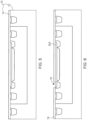
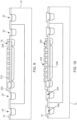
- Figures 5 to 10 show an exemplary method of forming the resistive filter stack 346 on the top surface of the first SPAD 306.
- the method starts at figure 5 .
- the basic SPAD structure (identified by the reference number 10), realised by implantation, annealing and etching processes, is already present. It includes a bulk 12 and a field oxide layer 14 covering the bulk 12.
- the single field oxide layer 14 may be replaced by a layer stack comprising several oxide and metal layers, preferably formed with a CMOS process.
- the first step is to etch a clearance 16 into the field oxide layer 14 to lay bare a section of the shallow extrinsic semiconductor layer 324.
- the result of this first step is shown in figure 6 .
- the next step is to form the resistive longpass filter 310. This is done by, first, the deposition of a polycrystalline silicon layer. This layer is then patterned to obtain an interdigitated stripe geometry. The result is shown in figure 7 .
- the next step is an etching step, which creates a clearance 18 in the intermediate dielectric layer 350.
- This clearance 18 uncovers the second end 358 of the longpass filter 310.
- further clearances 20 are etched into the field oxide layer 14 to provide access to the enrichment layers in the bulk 12. The result of this step is shown in figure 9 .
- the final step is a metallisation step.
- Metal for example, aluminium
- Metal is deposited on selected areas to obtain the cathode contact 334, the substrate contact 336, the resistor contact 352 and the set of masking strips 354. The result is shown in figure 10 .
- the metal layer 334, 336, 352 and 354 may be covered by a dielectric passivation layer (e.g. an oxide layer).
- a dielectric passivation layer e.g. an oxide layer
- the integrated photodetecting semiconductor optoelectronic component of the present disclosure may comprise one or more additional SPADs with one or more corresponding additional semiconductor optical longpass filters for measuring the intensity of one or more additional colour constituents of incident light.
- the additional longpass filters may have increasing cutoff wavelengths. This may be achieved by using absorbing layers of different thickness. The differential analysis may then be extended accordingly. Likewise, one would then also add one or more readout channels to the electronic circuitry.
Landscapes
- Physics & Mathematics (AREA)
- General Physics & Mathematics (AREA)
- Engineering & Computer Science (AREA)
- Remote Sensing (AREA)
- Computer Networks & Wireless Communication (AREA)
- Radar, Positioning & Navigation (AREA)
- Optics & Photonics (AREA)
- Spectroscopy & Molecular Physics (AREA)
- Health & Medical Sciences (AREA)
- Toxicology (AREA)
- Electromagnetism (AREA)
- Life Sciences & Earth Sciences (AREA)
- Sustainable Development (AREA)
- Photometry And Measurement Of Optical Pulse Characteristics (AREA)
- Optical Radar Systems And Details Thereof (AREA)
- Light Receiving Elements (AREA)
Description
- The present application claims the priority of the
German patent application No. 10 2020 201 453.1 . - Prior art devices are disclosed in
US 2018/308881 A1 and ZHU L ET AL: "FLUORESCENCE MULTIPLEXING WITH TIME-RESOLVED AND SPECTRAL DISCRIMINATION USING A NEAR-IR DETECTOR",ANALYTICAL CHEMISTRY, vol. 75, no. 10, 2003, pages 2280-2291. - The present disclosure also pertains to optoelectronic photodetecting components, which are widely used as part of electronic devices, such as smart phones, wearables, tablets, displays and the like. Such components/optical sensors can extend the functionality and/or help improve the operation of the electronic device into which they are integrated.
- It would be desirable to enhance these known optical sensors so that they become able to simultaneously and rapidly detect faint light signals in two different wavelength ranges. Rapid, simultaneous and highly sensitive detection in the near infrared and in the blue/ultraviolet range would be particularly desirable since it would make portable electronic devices equipped with such sensors better suited for use e.g. as optical spectrometers or vital signs monitors.
- At the same time, these optical sensors should remain as simple, cheap and small as possible. Otherwise, they would no longer be adapted for mass manufacture and integration into consumer devices.
- It is thus an object of the present disclosure to provide an integrated photodetecting semiconductor optoelectronic component, which is able to measure the intensity of each of the two colour constituents of dichromatic light rapidly, reliably and simultaneously, while being easy to mass-manufacture.
- According to the present disclosure, this object is achieved with an integrated photodetecting semiconductor optoelectronic component for measuring the intensity of each of the two colour constituents of dichromatic light irradiating the optoelectronic component in accordance with
claim 1. - By using SPADs as the component's light detecting elements, the component benefits from the SPADs' inherent high sensitivity, large gain and rapid response. Thanks to the specific longpass filter in combination with the differential analysis of the electronic circuitry, the component is able to provide an accurate measure of the intensity of both colour constituents. Semiconductor materials such as polycrystalline silicon are readily available at semiconductor fabrication plants. Accordingly, the featured longpass filter and thus the present photodetecting optoelectronic component are easy to manufacture with a standard CMOS fabrication process.
- According to preferred embodiments, the component of the present disclosure may include one, several or all of the following features, in all technically possible combinations:
- the longpass filter is a single layer of semiconductor material deposited above the active surface area of the first SPAD;
- the semiconductor material of the longpass filter is silicon, germanium, gallium arsenide or gallium nitride;
- the longpass filter doubles as a functional electric element that is part of an electric circuit;
- the semiconductor material of the longpass filter is doped so that the electrical material properties of the longpass filter are adapted to its additional role as said functional electric element;
- the longpass filter doubles as a passive quenching resistor for the first SPAD;
- the longpass filter has the shape of a meandering electrically conducting path that forms said passive quenching resistor;
- the meandering shape of the longpass filter defines a set of non-filtering interstices, and wherein said interstices are covered by an optical mask, preferably made of metal, which is opaque to the dichromatic light;
- the electronic circuitry includes a time-to-digital converter for time-of-flight measurements;
- the first SPAD and the second SPAD have the same p-n-junction structure;
- the two colour constituents of the dichromatic light are near infrared light and near ultraviolet-blue light, respectively;
- one or more additional SPADs with one or more corresponding additional semiconductor optical longpass filters for measuring the intensity of one or more additional colour constituents of incident light.
- The present disclosure also relates to a method of manufacturing an optoelectronic component as defined above.
- The present disclosure also relates to an electronic device such as a smart phone, a gadget or a wearable, including an optoelectronic component as defined above.
- Preferred embodiments of the present disclosure will now be described in detail with reference to the accompanying drawings, in which:
-
Figure 1 is a functional block diagram of one setup of a photodetecting optoelectronic component according to the present disclosure; -
Figure 2 is a cross-sectional view of a first embodiment of the SPAD assembly of the photodetecting optoelectronic component offigure 1 ; -
Figure 3 is a cross-sectional view of a second embodiment of the SPAD assembly of the photodetecting optoelectronic component offigure 1 ; -
Figure 4 is a top view as indicated by the arrow VI infigure 3 ; and -
Figures 5 to 10 show the different steps of a process of forming the resistive filter stack of the second embodiment offigure 3 . -
Figure 1 shows an integrated photodetecting semiconductoroptoelectronic component 300 according to the present disclosure. Thecomponent 300 is delimited by the dashed polygon infigure 1 . Thecomponent 300 may also be qualified as a photodetector. These types of photodetectors may typically be built into various electronic devices, such as smart phones and wearables. - The
photodetector 300 is designed to measure the intensity of each of the two colour constituents of dichromatic light irradiating thephotodetector 300. This dichromatic light DL may come from adedicated light source 360. Thelight source 360 may include one or more light-emitting diodes (LEDs) and/or lasers. The one or more lasers may be of the vertical cavity surface emitting type (i.e. of the VCSEL - type). - In a preferred application, the two colour constituents C1, C2 of the dichromatic light DL, which for example comes from the
light source 360, are near infrared or NIR light (C1) and near ultraviolet - blue light (C2), respectively. This might be the case, e.g. when thephotodetector 300 is used for vital signs monitoring or optical spectroscopy. In such a kind of application, the dichromatic light DL from thelight source 360 is shone onto the surface S of the object, which is to be analysed. The dichromatic light DL reflecting off the surface S is then detected by thephotodetector 300. Infigure 1 , the first colour constituent C1 of the dichromatic light DL (e.g., near infrared or NIR) is represented by the dotted arrow. The second colour constituent C2 (e.g. blue - ultraviolet light) is represented by the dash-dotted arrow. - The
photodetector 300 comprises aSPAD assembly 302, which is triggered by incoming dichromatic light DL, andelectronic circuitry 304 for the readout and processing of the detection signals S1 and S2 delivered by theSPAD assembly 302. - The
SPAD assembly 302 includes a first single photon avalanche diode or SPAD 306, a second single photon avalanche diode or SPAD 308 and a semiconductoroptical longpass filter 310. BothSPADs - In an alternative embodiment, the
SPAD assembly 302 may be replaced by a SPAD array assembly. In this alternative embodiment, each SPAD 306, 308 is replaced by a SPAD array, such as a SiPM. - The semiconductor
optical longpass filter 310 is associated with the first SPAD 306. It is permissive to the first one, C1, of the two colour constituents of the dichromatic light DL and blocks the second one, C2, of the two colour constituents of the dichromatic light DL. - The
electronic circuitry 304 includesreadout electronics 312, amicroprocessor 314 and a time-to-digital converter (TDC) 316. Thereadout electronics 312 conditions the two detection signals S1 and S2 delivered by theSPADs processor 314 for analysis. Thereadout electronics 312 also delivers trigger signals T1 and T2 to theTDC 316, based on the detection signals S1 and S2. - In the example shown in
figure 1 , thereadout electronics 312 comprises three stages, namely asplitter stage 318, adiscriminator stage 320 and a converting stage 322. The function of thesplitter stage 318 is to duplicate each detection signal S1 and S2 so that they are available to both the converting stage 322 as well as theTDC 316. Infigure 1 , thesplitter stage 318 includes an individual and separate splitter for each of the twoSPADs splitter stage 318 provides four signals S1.1, S1.2, S2.1 and S2.2 to thediscriminator stage 320. In thediscriminator stage 320 the four signals undergo thresholding to improve the signal-to-noise ratio and prevent false detections. Infigure 1 , thediscriminator stage 320 includes four individual discriminators. Thediscriminator stage 320 outputs four thresholded signals T1, T2, T3 and T4, two of which (T1, T2) are fed to the time-to-digital converter 316, while the other two (T3, T4) are fed to the converting stage 322. - In the converting stage 322, signals T3 and T4 are each converted into a preliminary intensity signal N1 and N2. The converting stage 322 may be implemented as a counter. In this case, the preliminary intensity signals N1, N2 correspond to the photon detection rate of each
SPAD - The time-to-digital converter (TDC) 316 is an optional element of the
electronic circuitry 304. It may be present to enable thephotodetector 300 for time-of-flight measurements. If thephotodetector 300 is provided with aTDC 316, the latter is preferably connected to thelight source 360. Light emission by thelight source 360 will then start time registration by theTDC 316. Time registration may stop when theTDC 316 receives the trigger signal T1 and/or T2 from thereadout electronics 312. - The
processor 314 receives the photon detection rates N1, N2 from thereadout electronics 312 as inputs. Optionally, it may also receive time measurements M from theTDC 316 as a further input. Theprocessor 314 is adapted to provide a first intensity output signal I1 indicative of the intensity of the first colour constituent C1, and a second intensity output signal I2 indicative of the intensity of the second colour constituent C2 as a function of the two photon detection rates N1 and N2. I2 is determined by theprocessor 314 using a differential analysis, which will be explained further below. - We will now turn to
figure 2 , which shows a first possible embodiment of the structure of theSPAD assembly 302. - The
SPAD assembly 302 shown infigure 2 is a monolithic structure preferably fabricated with a CMOS process. The twoSPADs SPADs SPADs figure 2 involves ashallow p+ anode 324 in a deep N well 326. EachSPAD guard ring 328 and/or anenrichment layer 330 to prevent premature edge breakdown. EachSPAD inner anode contact 332, anintermediate cathode contact 334 and anouter substrate contact 336. Thesubstrate 338 may be of a p- type. EachSPAD active surface area 340, allowing photons to be detected to enter the SPAD. The bulk B of eachSPAD local enrichment areas substrate contact 336 or the bulk B and thecathode contact 334, respectively. The dopants used in theSPADs - In the first embodiment according to
figure 2 , the semiconductoroptical longpass filter 310 completely covers theactive surface area 340 of thefirst SPAD 306. Because of thelongpass filter 310, thefirst SPAD 306 acts as a long wavelength sensitive sensor. In contrast thereto, thesecond SPAD 308 lacks a longpass filter and thus acts as a broad wavelength sensor. - The
longpass filter 310 shown infigure 2 is a single layer of semiconductor material. This single layer is deposited directly onto theactive surface area 340 of thefirst SPAD 306. Theinner anode contact 332 surrounds thelongpass filter layer 310. Preferred semiconductor materials for thelongpass filter 310 are silicon, germanium, gallium arsenide or gallium nitride. A particularly preferred material for thelongpass filter 310 is polycrystalline silicon since it is readily available at semiconductor fabrication plants. The cut-off wavelength, i.e. the wavelength below which thesemiconductor filter 310 is opaque to electromagnetic radiation, depends on its thickness E. Accordingly, the cut-off wavelength of thelongpass filter 310 can be calibrated by adjusting its thickness E. In one implementation, thelongpass filter 310 may present itself as a semiconductor thin-film made of polycrystalline silicon with a thickness of around 500 nm. Such a filter has a cut-off wavelength of around 400 nm and thus blocks ultraviolet (UV) radiation. - We will now turn to
figures 3 and 4 , which relate to a possible second embodiment of theSPAD assembly 302. The second embodiment is in many respects similar to the first embodiment offigure 2 . In the following, we will only describe the differences of the second embodiment with respect to the first embodiment. Regarding the similarities, reference is made to the above description. - In the second embodiment of
figure 3 , theactive surface area 340 of thefirst SPAD 306 is covered by aresistive filter stack 346. Theresistive filter stack 346 comprises five layers: abottom dielectric layer 348, alongpass filter layer 310 covering thebottom dielectric layer 348, anintermediate dielectric layer 350 covering thelongpass filter layer 310, anelectric contact layer 352, and a top patternedlight masking layer 354 covering theintermediate dielectric layer 350. In this embodiment, thelongpass filter 310 doubles as a functional electric element that is part of an electric circuit. More precisely, thelongpass filter 310 doubles as a passive quenching resistor for thefirst SPAD 306. - The
bottom dielectric layer 348 is a field oxide layer. It acts as an electrical isolator between theresistive longpass filter 310 and the shallowextrinsic semiconductor layer 324 of the PN junction of thefirst SPAD 306. Theresistive longpass filter 310 is located on top of thebottom dielectric layer 348. - Reference is made to
figure 4 , which is a top view as indicated by the arrow VI infigure 3 . In the top view offigure 4 , theintermediate dielectric layer 350 and theelectric contact 352 are omitted to better show the relative arrangement of theoptical mask 354 and theresistive longpass filter 310. As apparent fromfigure 4 ,longpass filter 310 has the shape of a meandering electrically conducting path, which forms an electric resistor. The meandering path may be a sequence oflong tracks 357 and short tracks 355. Thelongpass filter 310 defines a set of non-filtering interstices 359 (seefigure 3 ). Afirst end 356 of theresistive longpass filter 310 is electrically connected to the shallowextrinsic semiconductor layer 324 of the PN junction of thefirst SPAD 306. A secondopposite end 358 of theresistive longpass filter 310 is electrically connected to theelectric contact 352. Accordingly, theSPAD 306 and theresistive longpass filter 310 are connected in series. - The semiconductor material of the
longpass filter 310 is doped so that the electrical material properties of the longpass filter are adapted to its additional role as a quenching resistor. The doping of the semiconductor material of thelongpass filter 310 may be a p+ type doping, and the dopant may be boron. - The
intermediate dielectric layer 350 covers the entirelongpass filter structure 310. Theintermediate dielectric layer 350 may for example be made of silicon nitride. The material of theintermediate dielectric layer 350 fills theinterstices 359. The electrically isolatinglayer 350 is transparent to the dichromatic light DL. It also prevents short-circuits from occurring within theresistive longpass filter 310. - The
electric resistor contact 352 is preferably made of metal. It may take the form of a strip filling a gap in theintermediate dielectric layer 350. - The
optical mask 354 is preferably made of metal, and is opaque to the dichromatic light DL. In the embodiment shown infigures 3 and 4 , it consists of a set ofstrips 361. Eachstrip 361 lies straight above one of the interstices 359 (seefigure 3 ). Hence, eachstrip 361 shields itsunderlying interstice 359 from the dichromatic light DL. In this way, the whole set ofinterstices 359 is covered by the set ofstrips 361, which form the optical mask. The set of maskingstrips 361 has an offset with respect to the set oflong tracks 357 of theresistive longpass filter 310 in a direction X transverse to the main direction of light entry D into theSPAD assembly 302. - An effect of the
resistive filter stack 346 is that the impinging dichromatic light DL can only reach those regions of theactive surface area 340 of thefirst SPAD 306, which are covered bylong tracks 357 of thelongpass filter 310. More exactly, only the first colour constituent C1 of the dichromatic light DL can reach said regions since the set oflong tracks 357 absorbs the second constituent C2 of the dichromatic light DL. Accordingly, only the first colour constituent C1 is detected by the PN junction of thefirst SPAD 306. - The
processor 314 preferably operates as follows in order to generate the first intensity output signal I1 and the second intensity output signal 12:
Theprocessor 314 obtains the first photon detection rate N1 from the counter 322. It then divides this signal by the predetermined and known photon detection efficiency of thefirst SPAD 306 at the wavelength of the first colour constituent C1. The result is the first intensity output signal I1. - The differential analysis to work out the second intensity output signal I2 includes the following steps:
Theprocessor 314 first obtains the first photon detection rate N1 and the second photon detection rate N2 from the counter 322. Then, it calculates the second intensity output signal I2 with the following formula:
- In this equation, a and b are constants, which are predetermined by the photon detection efficiencies of the first and
second SPAD -
Figures 5 to 10 show an exemplary method of forming theresistive filter stack 346 on the top surface of thefirst SPAD 306. - The method starts at
figure 5 . The basic SPAD structure (identified by the reference number 10), realised by implantation, annealing and etching processes, is already present. It includes abulk 12 and afield oxide layer 14 covering thebulk 12. - In one embodiment, the single
field oxide layer 14 may be replaced by a layer stack comprising several oxide and metal layers, preferably formed with a CMOS process. - The first step is to etch a
clearance 16 into thefield oxide layer 14 to lay bare a section of the shallowextrinsic semiconductor layer 324. The result of this first step is shown infigure 6 . - The next step is to form the
resistive longpass filter 310. This is done by, first, the deposition of a polycrystalline silicon layer. This layer is then patterned to obtain an interdigitated stripe geometry. The result is shown infigure 7 . - This is followed by the deposition of the transparent intermediate
dielectric layer 350, the result of which is shown infigure 8 . - The next step is an etching step, which creates a
clearance 18 in theintermediate dielectric layer 350. Thisclearance 18 uncovers thesecond end 358 of thelongpass filter 310. Concurrently,further clearances 20 are etched into thefield oxide layer 14 to provide access to the enrichment layers in thebulk 12. The result of this step is shown infigure 9 . - The final step is a metallisation step. Metal (for example, aluminium) is deposited on selected areas to obtain the
cathode contact 334, thesubstrate contact 336, theresistor contact 352 and the set of masking strips 354. The result is shown infigure 10 . - In one embodiment, the
metal layer - In a further embodiment, the integrated photodetecting semiconductor optoelectronic component of the present disclosure may comprise one or more additional SPADs with one or more corresponding additional semiconductor optical longpass filters for measuring the intensity of one or more additional colour constituents of incident light. The additional longpass filters may have increasing cutoff wavelengths. This may be achieved by using absorbing layers of different thickness. The differential analysis may then be extended accordingly. Likewise, one would then also add one or more readout channels to the electronic circuitry.
- The integrated photodetecting semiconductor optoelectronic components of the present disclosure have in particular the following technical advantages:
- they can simultaneously detect light signals in two different wavelength intervals with fast timing response, intrinsic amplification and very high accuracy, down to single photon level;
- they can accurately detect blue and ultraviolet light without an expensive shortpass filter such as a Bragg filter;
- their fabrication is compatible with CMOS processing, which reduces costs;
- in the variant where the longpass filter doubles as a functional electric element, they have a particularly high geometrical fill factor and are easy to fabricate.
Claims (12)
- An integrated photodetecting semiconductor optoelectronic component (300) for measuring the intensity (I1, 12) of each of the two colour constituents (C1, C2) of dichromatic light (DL) irradiating the optoelectronic component, the component (300) comprising:- a first SPAD (306) adapted to detect photons over a broad range of wavelengths, the first SPAD comprising an active surface area (340) allowing photons to be detected to enter the first SPAD;- a second SPAD (308) adapted to detect photons over a broad range of wavelengths, the second SPAD being arranged next to the first SPAD (306);- a semiconductor optical longpass filter (310) that at least partially covers the active surface area (340) of the first SPAD, the longpass filter (310) being permissive to a first one (C1) of the two colour constituents of the dichromatic light (DL) and blocking the second one (C2) of the two colour constituents of the dichromatic light (DL);- electronic circuitry (304) for the readout and processing of the detection signals (S1, S2) delivered by the first and second SPAD, the electronic circuitry being adapted to provide:wherein the differential analysis carried out by the electronic circuitry (304) to provide the second intensity output signal I2 comprises the steps of:i) a first intensity output signal I1 indicative of the intensity of the first colour constituent (C1), based on the detection signal (S1) delivered by the first SPAD; andii) a second intensity output signal I2 indicative of the intensity of the second colour constituent (C2), via a differential analysis based on the detection signals (S1, S2) delivered by the first and second SPAD;- determining a first photon detection rate N1 from the output signal (S1) delivered by the first SPAD (306);- determining a second photon detection rate N2 from the output signal (S2) delivered by the second SPAD (308); and- calculating the second intensity output signal I2 with the following formula:

- The component (300) of claim 1, wherein the longpass filter (310) is a single layer of semiconductor material deposited above the active surface area (340) of the first SPAD.
- The component (300) of any one of the previous claims, wherein the semiconductor material of the longpass filter (310) is silicon, germanium, gallium arsenide or gallium nitride.
- The component (300) of any one of the previous claims, wherein the longpass filter (310) doubles as a functional electric element that is part of an electric circuit.
- The component (300) of claim 4, wherein the semiconductor material of the longpass filter (310) is doped so that the electrical material properties of the longpass filter are adapted to its additional role as said functional electric element.
- The component (300) of claim 4 or claim 5, wherein the longpass filter (310) doubles as a passive quenching resistor for the first SPAD (306).
- The component (300) of claim 6, wherein the longpass filter (310) has the shape of a meandering electrically conducting path that forms said passive quenching resistor.
- The component (300) of claim 7, wherein the meandering shape of the longpass filter (310) defines a set of non-filtering interstices (359), and wherein said interstices (359) are covered by an optical mask (354), preferably made of metal, which is opaque to the dichromatic light (DL) .
- The component (300) of any one of the previous claims, wherein the electronic circuitry (304) includes a time-to-digital converter (316) for time-of-flight measurements.
- The component (300) of any one of the previous claims, wherein the first SPAD (306) and the second SPAD (308) have the same p-n-junction structure.
- The component (300) of any one of the previous claims, wherein the two colour constituents (C1, C2) of the dichromatic light are near infrared light and near ultraviolet-blue light, respectively.
- The component of any one of the previous claims, further comprising one or more additional SPADs with one or more corresponding additional semiconductor optical longpass filters for measuring the intensity of one or more additional colour constituents of incident light.
Applications Claiming Priority (2)
| Application Number | Priority Date | Filing Date | Title |
|---|---|---|---|
| DE102020201453 | 2020-02-06 | ||
| PCT/EP2021/052820 WO2021156447A1 (en) | 2020-02-06 | 2021-02-05 | An integrated photodetecting semiconductor optoelectronic component |
Publications (2)
| Publication Number | Publication Date |
|---|---|
| EP4100704A1 EP4100704A1 (en) | 2022-12-14 |
| EP4100704B1 true EP4100704B1 (en) | 2024-08-14 |
Family
ID=77199187
Family Applications (3)
| Application Number | Title | Priority Date | Filing Date |
|---|---|---|---|
| EP21703702.7A Active EP4100704B1 (en) | 2020-02-06 | 2021-02-05 | An integrated photodetecting semiconductor optoelectronic component |
| EP21704220.9A Pending EP4100705A1 (en) | 2020-02-06 | 2021-02-05 | Ambient light sensor |
| EP21703701.9A Pending EP4100764A1 (en) | 2020-02-06 | 2021-02-05 | A light pixel projection module |
Family Applications After (2)
| Application Number | Title | Priority Date | Filing Date |
|---|---|---|---|
| EP21704220.9A Pending EP4100705A1 (en) | 2020-02-06 | 2021-02-05 | Ambient light sensor |
| EP21703701.9A Pending EP4100764A1 (en) | 2020-02-06 | 2021-02-05 | A light pixel projection module |
Country Status (4)
| Country | Link |
|---|---|
| US (3) | US20230116903A1 (en) |
| EP (3) | EP4100704B1 (en) |
| CN (3) | CN115104013A (en) |
| WO (3) | WO2021156445A1 (en) |
Family Cites Families (39)
| Publication number | Priority date | Publication date | Assignee | Title |
|---|---|---|---|---|
| IL106265A (en) | 1992-07-13 | 1999-07-14 | Hughes Aircraft Co | Extrinsic semiconductor optical filter |
| US6359274B1 (en) * | 1999-01-25 | 2002-03-19 | Gentex Corporation | Photodiode light sensor |
| US20060199260A1 (en) * | 2002-05-01 | 2006-09-07 | Zhiyu Zhang | Microbioreactor for continuous cell culture |
| WO2006037022A2 (en) * | 2004-09-24 | 2006-04-06 | Massachusetts Institute Of Technology | Microbioreactor for continuous cell culture |
| US7430352B2 (en) * | 2005-07-29 | 2008-09-30 | Aculight Corporation | Multi-segment photonic-crystal-rod waveguides for amplification of high-power pulsed optical radiation and associated method |
| US20080176332A1 (en) * | 2006-09-29 | 2008-07-24 | The Regents Of The University Of California | Systems and methods for identifying and disrupting cellular organelles |
| JP2008098516A (en) * | 2006-10-13 | 2008-04-24 | Sanyo Electric Co Ltd | Photoelectric conversion device |
| TW200832687A (en) | 2007-01-30 | 2008-08-01 | Univ Nat Taiwan | Ambient light sensor |
| US7960807B2 (en) * | 2007-02-09 | 2011-06-14 | Intersil Americas Inc. | Ambient light detectors using conventional CMOS image sensor process |
| US9645010B2 (en) * | 2009-03-10 | 2017-05-09 | The Regents Of The University Of California | Fluidic flow cytometry devices and methods |
| JP2010238274A (en) | 2009-03-30 | 2010-10-21 | Sanyo Electric Co Ltd | Optical pickup apparatus |
| US20110068426A1 (en) * | 2009-09-22 | 2011-03-24 | Intersil Americas Inc. | Photodiodes and methods for fabricating photodiodes |
| CN101799324A (en) | 2009-12-15 | 2010-08-11 | 杭州远方光电信息有限公司 | Brightness meter |
| JP2012021819A (en) | 2010-07-12 | 2012-02-02 | Panasonic Electric Works Co Ltd | Photometric device |
| US20120313201A1 (en) * | 2011-06-13 | 2012-12-13 | Intersil Americas LLC | Optical sensor devices including front-end-of-line (feol) optical filters and methods for fabricating optical sensor devices |
| ITTO20110649A1 (en) * | 2011-07-19 | 2013-01-20 | St Microelectronics Srl | PHOTORELECTRIC DEVICE WITH PROTECTIVE AND ANTI-REFLECTIVE COVER, AND RELATIVE MANUFACTURING METHOD |
| GB2496399A (en) | 2011-11-09 | 2013-05-15 | St Microelectronics Res & Dev | A sensor for range finding and ambient light measurement including a SPAD array |
| US9568362B2 (en) | 2012-12-19 | 2017-02-14 | Viavi Solutions Inc. | Spectroscopic assembly and method |
| US9448346B2 (en) * | 2012-12-19 | 2016-09-20 | Viavi Solutions Inc. | Sensor device including one or more metal-dielectric optical filters |
| KR102129923B1 (en) | 2013-07-16 | 2020-07-03 | 엘지전자 주식회사 | Display apparatus capable of displaying projection images on dual screen |
| US9140971B2 (en) | 2013-10-31 | 2015-09-22 | Microvision, Inc. | Scanning laser proximity detection |
| EP2887771B1 (en) | 2013-12-20 | 2018-02-28 | ams AG | Sensor arrangement for controlling room lighting, sensor network for controlling room lighting and method for controlling room lighting |
| US9627424B2 (en) * | 2014-11-19 | 2017-04-18 | Silicon Laboratories Inc. | Photodiodes for ambient light sensing and proximity sensing |
| US9608027B2 (en) | 2015-02-17 | 2017-03-28 | Omnivision Technologies, Inc. | Stacked embedded SPAD image sensor for attached 3D information |
| US20160293858A1 (en) * | 2015-04-01 | 2016-10-06 | Massachusetts Institute Of Technology | Optoelectric devices fabricated with defect tolerant semiconductors |
| US10996105B2 (en) | 2015-11-30 | 2021-05-04 | Jsr Corporation | Optical filter having low incident angle dependence of incident light, ambient light sensor, sensor module and electronic device |
| US10962764B2 (en) | 2016-04-01 | 2021-03-30 | Intel Corporation | Laser projector and camera |
| US9955090B2 (en) | 2016-07-20 | 2018-04-24 | Omnivision Technologies, Inc. | High dynamic range image sensor with virtual high-low sensitivity pixels |
| US11303859B2 (en) | 2016-09-29 | 2022-04-12 | Stmicroelectronics (Research & Development) Limited | Time of flight sensing for brightness and autofocus control in image projection devices |
| DE102016124004A1 (en) | 2016-12-09 | 2018-06-14 | Leica Microsystems Cms Gmbh | Optical device with at least one spectrally selective component |
| US10312275B2 (en) * | 2017-04-25 | 2019-06-04 | Semiconductor Components Industries, Llc | Single-photon avalanche diode image sensor with photon counting and time-of-flight detection capabilities |
| IT201700053528A1 (en) * | 2017-05-17 | 2018-11-17 | St Microelectronics Srl | ACCORDABLE OPTOELECTRONIC DEVICE AND BLOOD PRESSURE SENSOR INCLUDING THE SAME |
| WO2019012514A1 (en) * | 2017-07-14 | 2019-01-17 | King Abdullah University Of Science And Technology | Size controllable conjugated polymer nanoparticles with fluorescence in the spectral range between far-red and short-wavelength infrared |
| CN108414083B (en) | 2018-02-27 | 2019-08-30 | 商洛学院 | A multifunctional illuminance sensor capable of correcting human eye transmittance and its design method |
| US10901089B2 (en) * | 2018-03-26 | 2021-01-26 | Huawei Technologies Co., Ltd. | Coherent LIDAR method and apparatus |
| US10613341B2 (en) | 2018-04-09 | 2020-04-07 | Microvision, Inc. | Method and apparatus for laser beam combining and speckle reduction |
| US10447951B1 (en) | 2018-04-11 | 2019-10-15 | Qualcomm Incorporated | Dynamic range estimation with fast and slow sensor pixels |
| US11598857B2 (en) * | 2018-08-16 | 2023-03-07 | Sense Photonics, Inc. | Integrated lidar image-sensor devices and systems and related methods of operation |
| DE112020007122T5 (en) * | 2020-04-24 | 2023-03-09 | Ams-Osram International Gmbh | PHOTODIODE AND METHOD OF OPERATING A PHOTODIODE |
-
2021
- 2021-02-05 EP EP21703702.7A patent/EP4100704B1/en active Active
- 2021-02-05 US US17/797,906 patent/US20230116903A1/en active Pending
- 2021-02-05 WO PCT/EP2021/052818 patent/WO2021156445A1/en not_active Ceased
- 2021-02-05 US US17/797,882 patent/US12484336B2/en active Active
- 2021-02-05 CN CN202180013382.XA patent/CN115104013A/en active Pending
- 2021-02-05 WO PCT/EP2021/052820 patent/WO2021156447A1/en not_active Ceased
- 2021-02-05 WO PCT/EP2021/052819 patent/WO2021156446A1/en not_active Ceased
- 2021-02-05 EP EP21704220.9A patent/EP4100705A1/en active Pending
- 2021-02-05 CN CN202180013294.XA patent/CN115104012B/en active Active
- 2021-02-05 US US17/798,059 patent/US12289930B2/en active Active
- 2021-02-05 CN CN202180012845.0A patent/CN115053148B/en active Active
- 2021-02-05 EP EP21703701.9A patent/EP4100764A1/en active Pending
Also Published As
| Publication number | Publication date |
|---|---|
| EP4100764A1 (en) | 2022-12-14 |
| US20230084888A1 (en) | 2023-03-16 |
| US20230062921A1 (en) | 2023-03-02 |
| CN115104012A (en) | 2022-09-23 |
| WO2021156446A1 (en) | 2021-08-12 |
| US12289930B2 (en) | 2025-04-29 |
| US20230116903A1 (en) | 2023-04-13 |
| CN115053148A (en) | 2022-09-13 |
| CN115104013A (en) | 2022-09-23 |
| WO2021156447A1 (en) | 2021-08-12 |
| CN115053148B (en) | 2024-11-12 |
| EP4100705A1 (en) | 2022-12-14 |
| EP4100704A1 (en) | 2022-12-14 |
| CN115104012B (en) | 2025-08-12 |
| WO2021156445A1 (en) | 2021-08-12 |
| US12484336B2 (en) | 2025-11-25 |
Similar Documents
| Publication | Publication Date | Title |
|---|---|---|
| CN207250518U (en) | Geiger mode avalanche photodiodes array, opto-electronic device and detecting system | |
| US8461533B2 (en) | Radiation sensor | |
| EP2731148B1 (en) | Photodiode array, reference voltage determining method, and recommended operation voltage determining method | |
| US9978802B2 (en) | Multiband optoelectronic device for colorimetric applications and related manufacturing process | |
| US20120133799A1 (en) | Radiation sensor | |
| US12345569B2 (en) | SPAD-based photodetectors | |
| US20130214134A1 (en) | Photon detector | |
| US20140346356A1 (en) | Optical detector unit | |
| CN105405914A (en) | Ultraviolet Sensor Having Filter | |
| JPH01207640A (en) | Semiconductor photodetecting device and ultraviolet detecting method, and semiconductor photodetecting element and its manufacture | |
| EP4100704B1 (en) | An integrated photodetecting semiconductor optoelectronic component | |
| EP2643667A1 (en) | Radiation sensor | |
| US20150285942A1 (en) | Solid state photo multiplier device | |
| EP3229278B1 (en) | Sensor device and method for manufacturing a sensor device | |
| EP3404379A1 (en) | Optical device for angle measurements | |
| Saveliev | Silicon photomultiplier-new era of photon detection | |
| US20060231913A1 (en) | Method for determining wavelengths of light incident on a stacked photodetector structure | |
| US11888078B2 (en) | Light detection with semiconductor photodiodes | |
| JPH0517492B2 (en) | ||
| Polzer et al. | Wavelength detection with integrated filter-less BiCMOS RGB sensor | |
| EP2347444B1 (en) | Wavelength selective electromagnetic radiation detector using pores as photonic crystal | |
| RU2501116C1 (en) | Method of measuring diffusion length of minority charge carriers in semiconductors and test structure for implementation thereof | |
| Batistell et al. | Color Sensor for Ambient Light Measurements in 130 nm CMOS Technology | |
| Stapelbroek et al. | Silicon for visible-to-VLWIR photon detection | |
| US20120176619A1 (en) | Solid State Depletion Region Unit Cell Spectrometer |
Legal Events
| Date | Code | Title | Description |
|---|---|---|---|
| STAA | Information on the status of an ep patent application or granted ep patent |
Free format text: STATUS: UNKNOWN |
|
| STAA | Information on the status of an ep patent application or granted ep patent |
Free format text: STATUS: THE INTERNATIONAL PUBLICATION HAS BEEN MADE |
|
| PUAI | Public reference made under article 153(3) epc to a published international application that has entered the european phase |
Free format text: ORIGINAL CODE: 0009012 |
|
| STAA | Information on the status of an ep patent application or granted ep patent |
Free format text: STATUS: REQUEST FOR EXAMINATION WAS MADE |
|
| 17P | Request for examination filed |
Effective date: 20220905 |
|
| AK | Designated contracting states |
Kind code of ref document: A1 Designated state(s): AL AT BE BG CH CY CZ DE DK EE ES FI FR GB GR HR HU IE IS IT LI LT LU LV MC MK MT NL NO PL PT RO RS SE SI SK SM TR |
|
| DAV | Request for validation of the european patent (deleted) | ||
| DAX | Request for extension of the european patent (deleted) | ||
| P01 | Opt-out of the competence of the unified patent court (upc) registered |
Effective date: 20230613 |
|
| GRAP | Despatch of communication of intention to grant a patent |
Free format text: ORIGINAL CODE: EPIDOSNIGR1 |
|
| STAA | Information on the status of an ep patent application or granted ep patent |
Free format text: STATUS: GRANT OF PATENT IS INTENDED |
|
| INTG | Intention to grant announced |
Effective date: 20240307 |
|
| RIC1 | Information provided on ipc code assigned before grant |
Ipc: G02B 5/20 20060101ALI20240223BHEP Ipc: H01L 31/0232 20140101ALI20240223BHEP Ipc: G01J 1/44 20060101ALI20240223BHEP Ipc: H01L 31/0216 20140101ALI20240223BHEP Ipc: H01L 31/107 20060101ALI20240223BHEP Ipc: G01J 1/04 20060101ALI20240223BHEP Ipc: G01J 1/42 20060101AFI20240223BHEP |
|
| GRAS | Grant fee paid |
Free format text: ORIGINAL CODE: EPIDOSNIGR3 |
|
| GRAA | (expected) grant |
Free format text: ORIGINAL CODE: 0009210 |
|
| STAA | Information on the status of an ep patent application or granted ep patent |
Free format text: STATUS: THE PATENT HAS BEEN GRANTED |
|
| AK | Designated contracting states |
Kind code of ref document: B1 Designated state(s): AL AT BE BG CH CY CZ DE DK EE ES FI FR GB GR HR HU IE IS IT LI LT LU LV MC MK MT NL NO PL PT RO RS SE SI SK SM TR |
|
| REG | Reference to a national code |
Ref country code: GB Ref legal event code: FG4D |
|
| REG | Reference to a national code |
Ref country code: CH Ref legal event code: EP |
|
| REG | Reference to a national code |
Ref country code: DE Ref legal event code: R096 Ref document number: 602021017190 Country of ref document: DE |
|
| REG | Reference to a national code |
Ref country code: IE Ref legal event code: FG4D |
|
| REG | Reference to a national code |
Ref country code: LT Ref legal event code: MG9D |
|
| REG | Reference to a national code |
Ref country code: DE Ref legal event code: R082 Ref document number: 602021017190 Country of ref document: DE Representative=s name: IMPULS LEGAL PARTG MBB, DE |
|
| REG | Reference to a national code |
Ref country code: NL Ref legal event code: MP Effective date: 20240814 |
|
| PG25 | Lapsed in a contracting state [announced via postgrant information from national office to epo] |
Ref country code: NO Free format text: LAPSE BECAUSE OF FAILURE TO SUBMIT A TRANSLATION OF THE DESCRIPTION OR TO PAY THE FEE WITHIN THE PRESCRIBED TIME-LIMIT Effective date: 20241114 |
|
| REG | Reference to a national code |
Ref country code: AT Ref legal event code: MK05 Ref document number: 1713673 Country of ref document: AT Kind code of ref document: T Effective date: 20240814 |
|
| PG25 | Lapsed in a contracting state [announced via postgrant information from national office to epo] |
Ref country code: PT Free format text: LAPSE BECAUSE OF FAILURE TO SUBMIT A TRANSLATION OF THE DESCRIPTION OR TO PAY THE FEE WITHIN THE PRESCRIBED TIME-LIMIT Effective date: 20241216 Ref country code: NL Free format text: LAPSE BECAUSE OF FAILURE TO SUBMIT A TRANSLATION OF THE DESCRIPTION OR TO PAY THE FEE WITHIN THE PRESCRIBED TIME-LIMIT Effective date: 20240814 Ref country code: PL Free format text: LAPSE BECAUSE OF FAILURE TO SUBMIT A TRANSLATION OF THE DESCRIPTION OR TO PAY THE FEE WITHIN THE PRESCRIBED TIME-LIMIT Effective date: 20240814 Ref country code: GR Free format text: LAPSE BECAUSE OF FAILURE TO SUBMIT A TRANSLATION OF THE DESCRIPTION OR TO PAY THE FEE WITHIN THE PRESCRIBED TIME-LIMIT Effective date: 20241115 Ref country code: FI Free format text: LAPSE BECAUSE OF FAILURE TO SUBMIT A TRANSLATION OF THE DESCRIPTION OR TO PAY THE FEE WITHIN THE PRESCRIBED TIME-LIMIT Effective date: 20240814 |
|
| PG25 | Lapsed in a contracting state [announced via postgrant information from national office to epo] |
Ref country code: BG Free format text: LAPSE BECAUSE OF FAILURE TO SUBMIT A TRANSLATION OF THE DESCRIPTION OR TO PAY THE FEE WITHIN THE PRESCRIBED TIME-LIMIT Effective date: 20240814 |
|
| PG25 | Lapsed in a contracting state [announced via postgrant information from national office to epo] |
Ref country code: LV Free format text: LAPSE BECAUSE OF FAILURE TO SUBMIT A TRANSLATION OF THE DESCRIPTION OR TO PAY THE FEE WITHIN THE PRESCRIBED TIME-LIMIT Effective date: 20240814 |
|
| PG25 | Lapsed in a contracting state [announced via postgrant information from national office to epo] |
Ref country code: AT Free format text: LAPSE BECAUSE OF FAILURE TO SUBMIT A TRANSLATION OF THE DESCRIPTION OR TO PAY THE FEE WITHIN THE PRESCRIBED TIME-LIMIT Effective date: 20240814 Ref country code: IS Free format text: LAPSE BECAUSE OF FAILURE TO SUBMIT A TRANSLATION OF THE DESCRIPTION OR TO PAY THE FEE WITHIN THE PRESCRIBED TIME-LIMIT Effective date: 20241214 |
|
| PG25 | Lapsed in a contracting state [announced via postgrant information from national office to epo] |
Ref country code: HR Free format text: LAPSE BECAUSE OF FAILURE TO SUBMIT A TRANSLATION OF THE DESCRIPTION OR TO PAY THE FEE WITHIN THE PRESCRIBED TIME-LIMIT Effective date: 20240814 |
|
| PG25 | Lapsed in a contracting state [announced via postgrant information from national office to epo] |
Ref country code: RS Free format text: LAPSE BECAUSE OF FAILURE TO SUBMIT A TRANSLATION OF THE DESCRIPTION OR TO PAY THE FEE WITHIN THE PRESCRIBED TIME-LIMIT Effective date: 20241114 Ref country code: ES Free format text: LAPSE BECAUSE OF FAILURE TO SUBMIT A TRANSLATION OF THE DESCRIPTION OR TO PAY THE FEE WITHIN THE PRESCRIBED TIME-LIMIT Effective date: 20240814 |
|
| PG25 | Lapsed in a contracting state [announced via postgrant information from national office to epo] |
Ref country code: RS Free format text: LAPSE BECAUSE OF FAILURE TO SUBMIT A TRANSLATION OF THE DESCRIPTION OR TO PAY THE FEE WITHIN THE PRESCRIBED TIME-LIMIT Effective date: 20241114 Ref country code: PT Free format text: LAPSE BECAUSE OF FAILURE TO SUBMIT A TRANSLATION OF THE DESCRIPTION OR TO PAY THE FEE WITHIN THE PRESCRIBED TIME-LIMIT Effective date: 20241216 Ref country code: PL Free format text: LAPSE BECAUSE OF FAILURE TO SUBMIT A TRANSLATION OF THE DESCRIPTION OR TO PAY THE FEE WITHIN THE PRESCRIBED TIME-LIMIT Effective date: 20240814 Ref country code: NO Free format text: LAPSE BECAUSE OF FAILURE TO SUBMIT A TRANSLATION OF THE DESCRIPTION OR TO PAY THE FEE WITHIN THE PRESCRIBED TIME-LIMIT Effective date: 20241114 Ref country code: NL Free format text: LAPSE BECAUSE OF FAILURE TO SUBMIT A TRANSLATION OF THE DESCRIPTION OR TO PAY THE FEE WITHIN THE PRESCRIBED TIME-LIMIT Effective date: 20240814 Ref country code: LV Free format text: LAPSE BECAUSE OF FAILURE TO SUBMIT A TRANSLATION OF THE DESCRIPTION OR TO PAY THE FEE WITHIN THE PRESCRIBED TIME-LIMIT Effective date: 20240814 Ref country code: IS Free format text: LAPSE BECAUSE OF FAILURE TO SUBMIT A TRANSLATION OF THE DESCRIPTION OR TO PAY THE FEE WITHIN THE PRESCRIBED TIME-LIMIT Effective date: 20241214 Ref country code: HR Free format text: LAPSE BECAUSE OF FAILURE TO SUBMIT A TRANSLATION OF THE DESCRIPTION OR TO PAY THE FEE WITHIN THE PRESCRIBED TIME-LIMIT Effective date: 20240814 Ref country code: GR Free format text: LAPSE BECAUSE OF FAILURE TO SUBMIT A TRANSLATION OF THE DESCRIPTION OR TO PAY THE FEE WITHIN THE PRESCRIBED TIME-LIMIT Effective date: 20241115 Ref country code: FI Free format text: LAPSE BECAUSE OF FAILURE TO SUBMIT A TRANSLATION OF THE DESCRIPTION OR TO PAY THE FEE WITHIN THE PRESCRIBED TIME-LIMIT Effective date: 20240814 Ref country code: ES Free format text: LAPSE BECAUSE OF FAILURE TO SUBMIT A TRANSLATION OF THE DESCRIPTION OR TO PAY THE FEE WITHIN THE PRESCRIBED TIME-LIMIT Effective date: 20240814 Ref country code: BG Free format text: LAPSE BECAUSE OF FAILURE TO SUBMIT A TRANSLATION OF THE DESCRIPTION OR TO PAY THE FEE WITHIN THE PRESCRIBED TIME-LIMIT Effective date: 20240814 Ref country code: AT Free format text: LAPSE BECAUSE OF FAILURE TO SUBMIT A TRANSLATION OF THE DESCRIPTION OR TO PAY THE FEE WITHIN THE PRESCRIBED TIME-LIMIT Effective date: 20240814 |
|
| PGFP | Annual fee paid to national office [announced via postgrant information from national office to epo] |
Ref country code: DE Payment date: 20250218 Year of fee payment: 5 |
|
| PG25 | Lapsed in a contracting state [announced via postgrant information from national office to epo] |
Ref country code: DK Free format text: LAPSE BECAUSE OF FAILURE TO SUBMIT A TRANSLATION OF THE DESCRIPTION OR TO PAY THE FEE WITHIN THE PRESCRIBED TIME-LIMIT Effective date: 20240814 Ref country code: RO Free format text: LAPSE BECAUSE OF FAILURE TO SUBMIT A TRANSLATION OF THE DESCRIPTION OR TO PAY THE FEE WITHIN THE PRESCRIBED TIME-LIMIT Effective date: 20240814 Ref country code: SM Free format text: LAPSE BECAUSE OF FAILURE TO SUBMIT A TRANSLATION OF THE DESCRIPTION OR TO PAY THE FEE WITHIN THE PRESCRIBED TIME-LIMIT Effective date: 20240814 |
|
| PG25 | Lapsed in a contracting state [announced via postgrant information from national office to epo] |
Ref country code: EE Free format text: LAPSE BECAUSE OF FAILURE TO SUBMIT A TRANSLATION OF THE DESCRIPTION OR TO PAY THE FEE WITHIN THE PRESCRIBED TIME-LIMIT Effective date: 20240814 |
|
| PG25 | Lapsed in a contracting state [announced via postgrant information from national office to epo] |
Ref country code: CZ Free format text: LAPSE BECAUSE OF FAILURE TO SUBMIT A TRANSLATION OF THE DESCRIPTION OR TO PAY THE FEE WITHIN THE PRESCRIBED TIME-LIMIT Effective date: 20240814 |
|
| PG25 | Lapsed in a contracting state [announced via postgrant information from national office to epo] |
Ref country code: SK Free format text: LAPSE BECAUSE OF FAILURE TO SUBMIT A TRANSLATION OF THE DESCRIPTION OR TO PAY THE FEE WITHIN THE PRESCRIBED TIME-LIMIT Effective date: 20240814 Ref country code: IT Free format text: LAPSE BECAUSE OF FAILURE TO SUBMIT A TRANSLATION OF THE DESCRIPTION OR TO PAY THE FEE WITHIN THE PRESCRIBED TIME-LIMIT Effective date: 20240814 |
|
| REG | Reference to a national code |
Ref country code: DE Ref legal event code: R097 Ref document number: 602021017190 Country of ref document: DE |
|
| PLBE | No opposition filed within time limit |
Free format text: ORIGINAL CODE: 0009261 |
|
| STAA | Information on the status of an ep patent application or granted ep patent |
Free format text: STATUS: NO OPPOSITION FILED WITHIN TIME LIMIT |
|
| 26N | No opposition filed |
Effective date: 20250515 |
|
| PG25 | Lapsed in a contracting state [announced via postgrant information from national office to epo] |
Ref country code: SE Free format text: LAPSE BECAUSE OF FAILURE TO SUBMIT A TRANSLATION OF THE DESCRIPTION OR TO PAY THE FEE WITHIN THE PRESCRIBED TIME-LIMIT Effective date: 20240814 |
|
| PG25 | Lapsed in a contracting state [announced via postgrant information from national office to epo] |
Ref country code: MC Free format text: LAPSE BECAUSE OF FAILURE TO SUBMIT A TRANSLATION OF THE DESCRIPTION OR TO PAY THE FEE WITHIN THE PRESCRIBED TIME-LIMIT Effective date: 20240814 |
|
| REG | Reference to a national code |
Ref country code: CH Ref legal event code: PL |
|
| PG25 | Lapsed in a contracting state [announced via postgrant information from national office to epo] |
Ref country code: LU Free format text: LAPSE BECAUSE OF NON-PAYMENT OF DUE FEES Effective date: 20250205 |
|
| PG25 | Lapsed in a contracting state [announced via postgrant information from national office to epo] |
Ref country code: CH Free format text: LAPSE BECAUSE OF NON-PAYMENT OF DUE FEES Effective date: 20250228 |
|
| GBPC | Gb: european patent ceased through non-payment of renewal fee |
Effective date: 20250205 |
|
| REG | Reference to a national code |
Ref country code: BE Ref legal event code: MM Effective date: 20250228 |
|
| PG25 | Lapsed in a contracting state [announced via postgrant information from national office to epo] |
Ref country code: GB Free format text: LAPSE BECAUSE OF NON-PAYMENT OF DUE FEES Effective date: 20250205 |
|
| PG25 | Lapsed in a contracting state [announced via postgrant information from national office to epo] |
Ref country code: FR Free format text: LAPSE BECAUSE OF NON-PAYMENT OF DUE FEES Effective date: 20250228 |
|
| PG25 | Lapsed in a contracting state [announced via postgrant information from national office to epo] |
Ref country code: BE Free format text: LAPSE BECAUSE OF NON-PAYMENT OF DUE FEES Effective date: 20250228 |
|
| PG25 | Lapsed in a contracting state [announced via postgrant information from national office to epo] |
Ref country code: IE Free format text: LAPSE BECAUSE OF NON-PAYMENT OF DUE FEES Effective date: 20250205 |