EP4100520B1 - System und verfahren zur übertragung von quantumstaaten informationen, insbesondere von makromolekulären systemen - Google Patents
System und verfahren zur übertragung von quantumstaaten informationen, insbesondere von makromolekulären systemen Download PDFInfo
- Publication number
- EP4100520B1 EP4100520B1 EP21711951.0A EP21711951A EP4100520B1 EP 4100520 B1 EP4100520 B1 EP 4100520B1 EP 21711951 A EP21711951 A EP 21711951A EP 4100520 B1 EP4100520 B1 EP 4100520B1
- Authority
- EP
- European Patent Office
- Prior art keywords
- entanglement
- quantum
- elements
- pair
- quantum states
- Prior art date
- Legal status (The legal status is an assumption and is not a legal conclusion. Google has not performed a legal analysis and makes no representation as to the accuracy of the status listed.)
- Active
Links
Images
Classifications
-
- C—CHEMISTRY; METALLURGY
- C12—BIOCHEMISTRY; BEER; SPIRITS; WINE; VINEGAR; MICROBIOLOGY; ENZYMOLOGY; MUTATION OR GENETIC ENGINEERING
- C12N—MICROORGANISMS OR ENZYMES; COMPOSITIONS THEREOF; PROPAGATING, PRESERVING, OR MAINTAINING MICROORGANISMS; MUTATION OR GENETIC ENGINEERING; CULTURE MEDIA
- C12N13/00—Treatment of microorganisms or enzymes with electrical or wave energy, e.g. magnetism, sonic waves
-
- C—CHEMISTRY; METALLURGY
- C12—BIOCHEMISTRY; BEER; SPIRITS; WINE; VINEGAR; MICROBIOLOGY; ENZYMOLOGY; MUTATION OR GENETIC ENGINEERING
- C12Y—ENZYMES
- C12Y402/00—Carbon-oxygen lyases (4.2)
- C12Y402/01—Hydro-lyases (4.2.1)
- C12Y402/01011—Phosphopyruvate hydratase (4.2.1.11), i.e. enolase
-
- H—ELECTRICITY
- H04—ELECTRIC COMMUNICATION TECHNIQUE
- H04B—TRANSMISSION
- H04B10/00—Transmission systems employing electromagnetic waves other than radio-waves, e.g. infrared, visible or ultraviolet light, or employing corpuscular radiation, e.g. quantum communication
- H04B10/70—Photonic quantum communication
-
- H—ELECTRICITY
- H04—ELECTRIC COMMUNICATION TECHNIQUE
- H04L—TRANSMISSION OF DIGITAL INFORMATION, e.g. TELEGRAPHIC COMMUNICATION
- H04L9/00—Cryptographic mechanisms or cryptographic arrangements for secret or secure communications; Network security protocols
- H04L9/08—Key distribution or management, e.g. generation, sharing or updating, of cryptographic keys or passwords
- H04L9/0816—Key establishment, i.e. cryptographic processes or cryptographic protocols whereby a shared secret becomes available to two or more parties, for subsequent use
- H04L9/0852—Quantum cryptography
-
- B—PERFORMING OPERATIONS; TRANSPORTING
- B82—NANOTECHNOLOGY
- B82Y—SPECIFIC USES OR APPLICATIONS OF NANOSTRUCTURES; MEASUREMENT OR ANALYSIS OF NANOSTRUCTURES; MANUFACTURE OR TREATMENT OF NANOSTRUCTURES
- B82Y10/00—Nanotechnology for information processing, storage or transmission, e.g. quantum computing or single electron logic
Definitions
- the object of the invention is a system and a method of transferring quantum states information, in particular of macromolecular systems.
- the objects of the present invention are applicable in fields of technology that utilise thermodynamic, chemical, biochemical or biological processes, by influencing the quantum and physical state of the medium being polarized, or influencing the course of the process and its parameters.
- the objects of the present invention are applicable in telecommunications, cryptography, quantum computers or computer science.
- Changing the parameters in the recipient's tank may occur, for example, by delivering quantum information about a given consumable to the system.
- quantum information took place only at the level of individual qubits, using the quantum states teleportation from the source of information to its receiver. Solutions based on such a mechanism are used mainly in quantum computer science and quantum cryptology.
- thermodynamics can be used to describe processes that take place in the body, and which are based on phenomena such as: active and passive transport through biological membranes, filtration and ultrafiltration, formation of bioelectric potentials, energy transformation in metabolic processes, issues of development, evolution, importance of dissipative structures and stationary states far from the state of equilibrium.
- Living organisms should be treated as systems with a complex and organized structure. Such a system can be described as a measure of the degree of disorganization, i.e., entropy that is a function of the thermodynamic state.
- entropy that is a function of the thermodynamic state.
- This entropy is absorbed with food products, and returned with degraded metabolic products and degraded entropy in the form of heat.
- irreversible processes occur in the system, creating entropy. It is believed that during oncogenesis, a precipitation from the stationary state of the system occurs. In such a situation, positive processes, such as metabolism or combustion are increased, resulting in the transmission of entropy to the environment, manifested, for example, by increased heat transfer or fever.
- Increasing heat exchange is aimed at restoring the correct energy balance, i.e., entropy. As a result, the body may return to its initial state, namely health, or, in the absence of adaptation, death may occur.
- the total change in entropy can be positive, negative or equal to zero.
- the system can be defined as remaining in a state of dynamic equilibrium, i.e., in an open stationary state, which is a characteristic of a healthy, mature system.
- the increase in entropy will mean the exit from the state of dynamic equilibrium, resulting in the death of the body.
- the development of an organism, its stabilization period, aging and death, are the relatively well-known thermodynamic phenomena. From these data it is evident that the rate of entropy production is a measure of the organism viability.
- the perfect crystal which is a body without imperfections, has a total entropy equal to 0, because the entropy of the configuration equals 0 (its state can only be implemented in one way (3 rd law of thermodynamics), and the entropy of thermal vibrations equals 0 as well.
- the level of quantum information is the highest, as the probability of finding any atom in a given quantum position and state is equal to 1.
- the amount of information decreases, because the probability of finding a given atom in a given location and in a given quantum state is less than 1, and it decreases further as the temperature rises.
- the American Patent US6314189B1 discloses a quantum communication method and device using quantum teleportation that ensures the security of the transmitted data and can be used in cryptology.
- the solution is to transport a quantum state or a single qubit between photons emitted by a laser.
- three photons generated by the laser are used.
- the first photon is polarized according to the information to be sent.
- the second and third photon are quantum entangled and arranged in the information transmitter and receiver, respectively.
- the transmitter measures polarized states of the first and second photon, and the information about them is then sent to the receiver by classical communication.
- the receiver captures information about the state of the first photon from the third photon, based on the measurement of the third photon and the results sent by the sender.
- the quantum information processor may comprise one or more quantum information donors, which are non-gaseous atoms of chalcogens (group 16 of the periodic table) and one or more optical resonators.
- the quantum information processor comprises receptors, used for receiving quantum states information of free electrons in a semiconductor substrate (in this case silicon), which are made of elements in the boron group (group 13 of the periodic table).
- a photon is placed in the resonator that can be quantum entangled with the donor, making it possible to use them for quantum teleportation of electron spin information qubit.
- the Chinese patent CN1840486A discloses a device for activating and magnetizing water to increase its energy level.
- the essence of the device is that water is passed through a vertical channel in which the water is saturated with quantum information and can be consumed by the user immediately after passing through the system.
- the technical problem of the present invention is to propose a system and method of transmitting quantum information that will provide the ability to teleport information about the quantum states of solids, liquids, gases, plasma and any mixtures of these states at any distance. It is desirable that the system and method facilitate the transmission of information on the entropy level of the source, catalytic and biocatalytic effects, spin states of electrons, polarisation state of the source, crystal lattice structure and quantum features. Additionally, it is desirable that components of the system for transferring quantum states information are manufactured from widely available materials. It is also desirable that information on quantum states is transmitted to the end medium in a continuous, stable manner and not lost in time.
- the first object of the invention is a system for transferring quantum states information, particularly of macromolecular systems, comprising a source medium of quantum information, a transmitter and receiver of quantum states information and an end medium, characterized in that it further comprises a quantum states resonator in contact with an intermediate medium, the transmitter and receiver of quantum states information being at least two pairs of entanglement elements la-lb, lla-llb, wherein the first entanglement element la of the first pair of entanglement elements la-lb is connected to a quantum states generator in contact with the source medium of quantum information, and the second entanglement element lb of the first pair of entanglement elements la-lb is connected to a quantum states resonator, and comprises at least one end tank in contact with the end medium, wherein the first entanglement element IIa of at least one second pair of entanglement elements IIa-IIb is connected to a quantum states resonator, and the second entanglement element Ilb of at least one second pair of
- individual pairs of entanglement elements - first la-lb and at least one second Ila-Ilb - are quantum entangled such that the first entanglement element la of the first pair of entanglement elements la-lb is quantum entangled with the second entanglement element lb of the first pair of entanglement elements la-lb, and the first entanglement element Ila of at least one second pair of entanglement elements Ila-Ilb is quantum entangled with the second entanglement element Ilb of at least one second pair of entanglement elements lla-llb, wherein the quantum entanglement of the first pair of entanglement elements Ia-Ib is independent of the quantum entanglement of at least one second pair of entanglement elements Ila-llb.
- individual pairs of entanglement elements Ia-Ib, IIa-IIb are made of a material that is a chemical element in the boron group of the periodic table or an element, which on the valence shell of an atom has an odd number of electrons and is in the form of a solid, or a material in which there are covalent bonds between atoms, and which is in the form of a solid.
- the source medium of the quantum information is a solid, liquid, gas, plasma, or any mixture thereof and/or constitutes a monocrystal formed from a chemical element in the carbon group of the periodic table.
- the intermediate medium and/or the end medium is a gas, a liquid, a solid, or a mixture thereof.
- the quantum states resonator and/or at least one end tank is made of polar dielectric.
- the quantum states resonator and/or at least one end tank is covered with insulation.
- the second object of the invention is a method of transferring quantum states information, in particular of macromolecular systems, characterized in that it comprises the steps of:
- individual pairs of entanglement elements - first Ia-Ib and at least one second IIa-IIb - are quantum entangled such that the first entanglement element la of the first pair of entanglement elements la-lb is quantum entangled with the second entanglement element lb of the first pair of entanglement elements la-lb, and the first entanglement element Ila of at least one second pair of entanglement elements Ila-Ilb is quantum entangled with the second entanglement element Ilb of at least one second pair of entanglement elements IIa-IIb, wherein the quantum entanglement of the first pair of entanglement elements Ia-Ib is independent of the quantum entanglement of at least one second pair of entanglement elements Ila-llb.
- individual pairs of entanglement elements Ia-Ib, IIa-IIb are made of a material that is a chemical element in the boron group of the periodic table or an element, which on the valence shell of an atom has an odd number of electrons and is in the form of a solid, or a material in which there are covalent bonds between atoms, and which is in the form of a solid.
- the source medium of the quantum information is a solid, liquid, gas, plasma, or any mixture thereof.
- the source medium of quantum information is a monocrystal composed of a chemical element in the carbon group of the periodic table.
- the intermediate medium and/or the end medium is a gas, a liquid, a solid, or a mixture thereof.
- the quantum states resonator and/or at least one end tank is made of polar dielectric.
- the quantum states resonator and/or at least one end tank is covered with insulation.
- Quantum states information provides teleportation, at any distance, of quantum states information regarding solids, liquids, gases, plasma and any mixtures of these states, acting as so-called quantum states generators (QSG), which enable the use of properties of a given medium whenever it is not universally available.
- Quantum information may be delivered directly to the medium of selected recipient, or directly to substrates involved in thermodynamic, chemical, biochemical and biological processes, etc., thereby guaranteeing a very wide range of applications of the disclosed invention.
- quantum information is transmitted from the source medium to the end medium in a continuous, stable manner and is not lost over time.
- the transfer of quantum states information is related to the non-locality of quantum phenomena and the ability of some materials to receive sub-quantum information, i.e., subtle quantum and relativistic effects, during the direct interaction of unpaired conduction electrons from entanglement elements with matter electrons, on the one hand, the source of quantum information (the source medium of quantum information in contact with the quantum states generator), and on the other hand, the recipient of this information, i.e., objects/medium/processes intended for polarization.
- sub-quantum information i.e., subtle quantum and relativistic effects
- quantum entanglement i.e., correlated quantum states
- materials made of elements in group 13 of the periodic table such as: aluminium (Al), indium (In), or an element which, on the valence shell of an atom, has an odd number of electrons and is in the form of a solid, or a material in which there are covalent bonds between atoms and which is in the form of a solid.
- the bond is formed only with external electrons with wave functions that extend the farthest from the nucleus.
- covalent crystals for example, silicon, germanium, diamond, grey tin
- ionic crystals metallic and molecular crystals.
- carbon, silicon and germanium crystals a diamond structure, in which each atom is bound to the four most closely adjacent atoms located in the corners of the tetrahedron, can be present.
- the carbon atom C has valence of 2 and configuration of 1s 2 2s 2 2p 2 .
- the carbon atom forming the compounds is in excited state, characterized by a configuration of 1s 2 2s 1 2p 3 , wherein all electrons 2s and 2p have parallel spins.
- states 2s and 2p occur as linear combinations of sp and not in pure form. Angles of 109.5° are present between bonds formed in four directions.
- Type AIIIBV compounds exhibit bonds that are similar to covalent ones.
- Compounds of this group include, but are not limited to InSb or GaAs.
- In a InSb molecule indium has three valence electrons 5s 2 5p 1 , while antimony has five: 5s 2 5p 3 .
- an additional covalent bond forms, and as a result, four bonds of this kind can be present in the whole compound.
- an unpolarised covalent bond comprises a pair of electrons that belongs to both bonding atoms equally, wherein bonds between the same atoms are always unpolarised.
- a further group in the classification of crystal structures includes molecular crystals that are organic compounds, excluding ionic compounds, and inorganic compounds (e.g., crystals of nitrogen, oxygen, noble gases, compounds composed of phosphorus and nitrogen or sulphur, metal carbonyls).
- molecular crystals Van der Waals interactions occur between neutral molecules.
- dipole-dipole between molecules that have permanent dipole moments energy in the range of 5-8 kcal/mol, e.g., hydrogen bonds
- permanent dipole-induced dipole energy in the range of 1-2 kcal/mol of type e.g., interactions of hydrogen chloride-toluene in crystals of toluene dihydrochloride
- induced dipole-induced dipole e.g., staking in DNA
- homodesmic crystals which are formed by elements and fairly simple chemical compounds that comprise a small number of elements, can be observed.
- Homodesmic crystals include covalent crystals, ionic crystals, metal crystals and noble gas crystals (van der Waals interactions).
- Another group includes heterodesmic crystals, which include molecular crystals, and all other crystals with several different chemical bonds.
- Quantum entanglement in materials made of the above-mentioned elements is achieved by creating a new crystal lattice, e.g., by thermal method, including annealing at the plasticity temperature of the homogeneous material, so that the existing crystal lattice is destroyed and a new one is created in this place, which will ensure quantum, relativistic and information independence from all historical quantum, relativistic and information interactions.
- the homogeneous material thus prepared is mechanically divided into any number of entanglement elements which are quantum entangled. Each separated element, i.e., the entanglement element, is then entangled with all entanglement elements extracted from the annealed and homogeneous portion of the material.
- Entanglement elements are receivers of quantum information from the source material of quantum information in contact with the quantum states generator. Also, due to quantum entanglement, individual pairs of entanglement elements transfer quantum information about the quantum states of source material of quantum information between each other. Additionally, entanglement elements transmit quantum information to a quantum polarized medium, i.e., to the end medium in contact with the end tank.
- the end medium (as well as the end tank) are polar dielectrics such as glass, water, etc.
- Polymorphism is believed to result from differences in the packaging or conformation of molecules. Crystallization conditions, e.g., solvent, pressure, temperature, time, affect the packaging of molecules in chemical compounds. In addition, the ratios of ionic rays, particle size or shape, or conformational lability favor different packaging. Pseudopolymorphism, in turn, indicates a tendency of a chemical compound to co-crystallize with a solvent.
- the shell of the quantum states generator is made of an entanglement element closely adjacent to the core surface, enabling the interaction at quantum and sub-quantum levels.
- the larger contact area of these two elements guarantees a faster transmission of quantum information from the source material of quantum information to the entanglement element.
- the presence of an intermediate tank, a quantum states resonator (QSG) enables the use of multiple independent pairs of entanglement elements for transmitting quantum information and as a result enables transmitting the quantum information to multiple distant recipients at the same time, using only one sample of the quantum information source medium in contact with the quantum states generator (QSG). No exchange of quantum information source medium or entanglement elements is required in the system as they are not used in the process of transmitting quantum states information.
- the entanglement elements used in the invention enable safe, fast and cost-effective generation of a pair of quantum entangled macromolecular elements, wherein the material of these entanglement elements (i.e., the element in the boron group of the periodic table) is widely available and has a relatively low price.
- the basic characteristics of quantum information transmitted in the process of transmitting quantum states information are:
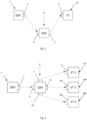
- fig. 1 shows a system for transferring quantum states information according to the first, second, third and fourth embodiment of the present invention
- fig. 2 shows a system for transferring quantum states information according to a fifth embodiment of the present invention
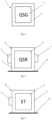
- fig. 3 is a schematic diagram of the construction of a quantum states generator
- fig. 4 shows a schematic diagram of the construction of a quantum states resonator
- fig. 5 shows a schematic diagram of the construction of the end tank
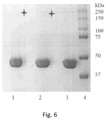
- fig. 6 shows a photo of an electrophoretic test for the glycation products of enolase with methylsiloxane.
- the system for transferring quantum states information comprises a quantum states generator 1 (QSG), a quantum states resonator 8 (QSR) made of polar dielectric 5, such as quartz glass, and an end tank 10 (ET), also made of polar dielectric 5, such as quartz glass.
- QSG quantum states generator 1
- QSR quantum states resonator 8
- ET end tank 10
- the system also comprises two pairs, Ia-Ib and IIa-IIb, of entanglement elements 3, 4, 7, 9 that are quantum entangled and connected to a quantum states generator 1 (QSG), a quantum states resonator 8 (QSR), and an end tank 10 (ET) in a following manner:
- the source medium 2 of quantum information is a silicon monocrystal, and in both the intermediate medium 6 and the end medium 11, it is water.
- the silicon monocrystal in the form of a homogeneous solid constitutes the core of the quantum states generator 1 and is fully coated with entanglement element 3, which constitutes the shell of the quantum states generator 1.
- Monocrystals are characterized by a very low level of entropy, which is close to zero, and this exact quantum information is transferred to the end medium 11.
- Fig. 3 provides a schematic illustration of the construction of the quantum states generator 1.
- Entanglement elements 3, 4, 7, 9 are made of aluminium (in the boron group) and are quantum entangled with each other: the first entanglement element 3 la of the first pair of entanglement elements la-lb with the second entanglement element 4 lb of the first pair of entanglement elements la-lb and the first entanglement element 7 Ila of the second pair of entanglement elements IIa-IIb with the second entanglement element 9 IIb of the second pair of entanglement elements IIa-IIb.
- the quantum states resonator 8 is a quartz glass (polar dielectric) tank and is filled with intermediate medium 6, in this example with water.
- the second entanglement element 4 lb of the first pair of entanglement elements la-lb and the first entanglement element 7 Ila of the second pair of entanglement elements IIa-IIb are attached to the wall of the quantum states resonator 8 (water tank).
- the quantum states resonator 8 (water tank) is disposed on the insulation 12, which is a wooden washer.
- the schematic construction of the quantum states resonator 8 is shown in fig. 4 .
- the end tank 10 is a quartz glass (polar dielectric) tank and is filled with the end medium 11, in this example with water.
- a second entanglement element 9 IIb of the second pair of entanglement elements IIa-IIb is attached to the wall of the end tank 10.
- the end tank 10 is disposed on the insulation 12, which is a wooden washer. The schematic construction of the end tank 10 is shown in fig. 5 .
- Quantum states information of the source medium 2 is transmitted by quantum teleportation to the intermediate medium 6 located in the quantum states resonator 8 (QSR), and then to the end medium 11 located in the end tank 10 (ET).
- QSR quantum states resonator 8
- ET end medium 11 located in the end tank 10
- the system for transferring quantum states information according to the second embodiment of the present invention comprises components substantially similar to those of the system for transferring quantum states information according to the first embodiment of the present invention.
- the diagram of the second embodiment of the system for transferring quantum states information is analogous to the diagram of the first embodiment shown in fig. 1 . For clarity of the present disclosure, a description of concurrent elements of system construction is omitted.
- the system for transferring quantum states information comprises a quantum states generator 1 (QSG) with a source medium 2 of quantum information, which is a silver monocrystal.
- the intermediate medium 6 of the quantum states resonator 8 (QSR) is a mixture of methanol and air
- the end tank 10 (ET) is a reactor in which the process takes place, requiring a reduction in the entropy of the system.
- an oxidation reaction takes place in the reactor during the production of formaldehyde from methanol and air.
- Silver is a catalyst for oxidation reaction.
- quantum information about the low entropy of the source medium 2 of quantum information and about the catalytic properties of silver is transmitted to the end tank 10 (ET) and therefore, the level of entropy in the recipient reactor decreases, and the expected chemical reaction occurs, i.e., there is an effective oxidation reaction resulting in the formation of formaldehyde.
- the system for transferring quantum states information according to a third embodiment of the present invention comprises components substantially identical to those of the system for transferring quantum states information according to the first and the second embodiment of the present invention.
- the diagram of the third embodiment is analogous to the diagram of the first and second embodiment shown in fig. 1 .
- a description of concurrent elements of system construction is omitted.
- the system for transferring quantum states information of the third embodiment comprises entanglement elements 3, 4, 7, 9 made of another element in the boron group of the periodic table, in this example of boron. 99.999% pure boron tiles are commercially available from American Elements, Los Angeles, USA.
- the source medium 2 is, as in the third example, a silver monocrystal
- the intermediate medium 6 is a mixture of air and ethylene
- the end tank 10 (ET) is a recipient reactor in which ethylene is converted into ethylene oxide, which, following hydrolysis, yields ethyl glycol used to produce polyester.
- Silver is the catalyst in ethylene oxidation reaction.
- Entanglement elements 3, 4, 7, 9 are quantum entangled with each other, which guarantees the possibility of transferring quantum states information from source medium 2 (silver monocrystal) to quantum states resonator 8 (QSR) by quantum teleportation. Also, in this example, information about the low entropy of the source is transferred to the end tank 10 (ET), resulting in a decrease in entropy in the reactor system and information about the presence of silver in the system, inducing the occurrence of the ethylene oxidation reaction.
- end tank 10 ET
- the system for transferring quantum states information according to a fourth embodiment of the present invention comprises components substantially identical to those of the system for transferring quantum states information according to the first embodiment of the present invention.
- the diagram of the fourth embodiment is analogous to the diagram of the first, second and third embodiment shown in fig. 1 . For clarity of the present disclosure, a description of concurrent elements of system construction is omitted.
- the system for transferring quantum states information of the fourth embodiment comprises a source medium 2 in the form of nitrogen oxide (II), NO, which is a catalyst in the sulphur oxide (VI), SO 3 , formation reaction.
- source medium 2 in the form of nitrogen oxide (II), NO, which is a catalyst in the sulphur oxide (VI), SO 3 , formation reaction.
- intermediate medium 6 located in the quantum states resonator 8 (QSR) is a gaseous medium, air.
- the quantum states resonator 8 (QSR) is located on an insulation 12 made of material that does not transfer quantum information, in the present embodiment it is wood.
- the end tank 10 (ET) is a reactor that is also located on the insulation layer 12.
- the end tank 10 there are gaseous reaction substrates, i.e., sulphur (IV) oxide, SOz, and oxygen, O 2 .
- sulphur (IV) oxide i.e., sulfur oxide, SOz, and oxygen, O 2 .
- Quantum information about the catalytic properties of the source medium 2 is transmitted to the reactor, which ensures the correct reaction rate without the need to physically supply a catalyst in the form of nitrogen oxide (II), NO, to the end tank 10 (ET).
- the system for transferring quantum states information is shown schematically in fig. 2 .
- the system for transferring information comprises, as in examples 1-4, a quantum states generator 1 (QSG) and a quantum states resonator 8 (QSR).
- QSG quantum states generator 1
- QSR quantum states resonator 8
- the system for transferring quantum states information comprises four pairs of independent entanglement elements 3, 4, 7, 7a, 7b, 9, 9a, 9b, which enable the simultaneous transmission of quantum information regarding the catalytic properties of source medium 2 to three recipients.
- the system comprises three separate end tanks 10, 10a, 10b (ET1, ET2, ET3), so that the desired reaction can be carried out in three different recipients.
- Four entanglement elements 4, 7, 7a, 7b of independent entanglement element pairs are connected to the quantum states resonator 8 (QSR).
- One of them is a second entanglement element 4 lb of the first pair of entanglement elements Ia-Ib which transmits, to the quantum states resonator 8 (QSR), the quantum states information of the source medium 2, received from the first entanglement element 3 la of the first pair of entanglement elements Ia-Ib.
- QSR quantum states resonator 8
- the second, third and fourth entanglement element connected to the quantum states resonator 8 are entanglement elements 7, 7a, 7b IIa, IIIa and IVa of the three second pairs of entanglement elements IIa-IIb, IIIa-IIIb, IVa-IVb that receive quantum states information from the quantum states resonator 8 (QSR) and transmit it to the corresponding second entanglement elements 9, 9a, 9b Ilb, Illb, IVb of the three second pairs of entanglement elements Ila-Ilb, Illa-Illb, IVa-IVb.
- Each of the second entanglement elements 9, 9a, 9b Ilb, Illb, IVb of the three second pairs of entanglement elements Ila-Ilb, Illa-Illb, IVa-IVb receiving information from the first entanglement elements 7, 7a, 7b IIa, IIIa and IVa of the three second pairs of entanglement elements IIa-IIb, IIIa-IIIb, IVa-IVb is connected to a separate end tank 10, 10a, 10b (ET1, ET2, ET3).
- the effect of quantum information transmitted from the system for transferring quantum states information, according to a first embodiment, on the catalytic activity of an enzyme in an enolase reaction substrate solution was studied.
- Enolase is an important enzyme involved in basic life processes, such as the combustion of glucose for energy production during the glycolysis process. It is a conservative protein that was evolutionarily shaped at the beginning of life on Earth. Apart from its catalytic function, enolase also plays other roles in metabolism in human cells and tissues and lower organisms; it is a multifunctional protein. Acting on the surface of cells as a receptor of plasminogen, it is converted into plasmin, which in turn digests tissue proteins. It is a mechanism used in embryogenesis (normal tissue growth), wound reconstruction, infection and settlement of the host organism by bacteria, fungi, and parasites. Microorganisms have their own enolase used for tissue infection. This mechanism is also important in the growth of cancerous tumors. In addition, enolase of microscopic fungi is a factor responsible for some allergies.
- the second entanglement elements 9, 9a of the second and third pair of entanglement elements were aluminium plates, 1 cm by 2 cm in size, which were kept for 30 min at room temperature prior to testing.
- Enolase was isolated from human muscle tissue - by own method ( Bednarz-Misa I, Pietkiewicz J, et al., 2009. Adv.Clin.Exp.Med. 18 (1),71-78 ).
- the enzyme stock solution was a preparation of 7.5 mM imidazole-HCl, pH 6.8, in stabilizing buffer containing 2.5 mM of MgSO 4 , 50 mM of NaCl, and 50% of glycerol (stored at 4°C).
- the concentration of enolase in the stock solution R 0 was 5 mg/ml; while the catalytic activity was 52 IU/mg.
- the enzyme working solution (R 0 diluted 10 times with test buffer of pH 6.8) had a concentration of 1 mg/ml.
- a standard test buffer was used in tests: 50 of mM imidazole-HCl, pH 6.8, 3 mM of MgSO 4 , 0.4M of KCI and 2-PGA substrate (sodium salt), dissolved in H 2 O - stock solution R 0 at a concentration of 63 mM.
- 2-PGA in the enzyme assay was used at a standard concentration of 1 mM.
- Protein concentration was determined spectrophotometrically by measuring the absorbance of enolase solution at 280 nm wavelength in quartz cells.
- quartz cuvettes constituted the end tanks 10 made of polar dielectric 5.
- Enolase activity was determined by monitoring using a Jasco UV-Vis V-530 spectrophotometer. Increase of absorbance of the test solution at 240 nm wavelength (a measure of the reaction product production, PEP) within 60 seconds.
- the specific activity of the enzyme was expressed in international units relative to 1 mg of protein ( Bednarz-Misa I, Pietkiewicz J, et al., 2009. Adv.Clin.Exp.Med. 18(1);71-78 ).
- Results are shown in Table 1.
- Table 1 Analytical activity of the enzyme-enolase Incubation time [h] 0 1 2 3 4 5 Substantive test Activity [IU/mg] 52.4 53.1 50.45 52.27 48.1 47.08 W i / W 0 [%] 100 101.74 96.3 99.75 92.0 89.8 Control test Activity [IU/mg] 52.4 45.13 40.06 36.44 28.24 25.13 K i / K 0 [%] 100 86.1 76.5 69.54 53.9 47.95 W i / K i [%] 100 117.7 125.9 143.4 170.3 187.3
- a gradual loss of enolase activity during enzyme exposure at room temperature is a typical phenomenon and therefore, it was observed in control tests with added substrate unmodified by second entanglement elements 9, 9a of the second and third pairs of entanglement elements: after 1 hour, the enzyme lost specific activity by approx. 14%, and after 5 hours, the loss was as much as 52% of the initial activity.
- the quantum information transmitted from the source medium 2, in the present embodiment a silicon monocrystal of very low entropy value, to the intermediate medium 6 placed in the quantum states resonator 8, and then to the end tank 10, which is a quartz reaction cell, very positively affected the catalytic activity of the enzyme.
- Such a phenomenon may reduce the energy expenditures needed to obtain the correct orientation of 2-PGA functional groups (carboxylic and phosphate) in relation to the centre of the catalytic enzyme.
- Second entanglement elements 9, 9', 9" of the second pair of entanglement elements were aluminium plates (1 cm by 2 cm), which were maintained at room temperature for 30 min prior to testing.
- test samples are determined as follows:
- Blank test C - a plate made of aluminium (without quantum entanglement) not being a part of the system for transferring quantum states information of the present invention.
- Substantive test D - a second entanglement element 9" of a second pair of entanglement elements of the third system for transferring quantum states information, wherein the quantum states generator 1" is a silicon monocrystal weighing approx. 500 g.
- the third system for transferring quantum states information contained only one second pair of entanglement elements Ila-Ilb, comprising a first entanglement element 7" of the second entanglement element pair and a second entanglement element 9" of the second entanglement element pair, respectively.
- Enolase was isolated from human muscle tissue - by own method ( Bednarz-Misa I, Pietkiewicz J, et al., 2009. Adv.Clin.Exp.Med. 18 (1),71-78 ).
- the enzyme stock solution was a preparation in the stabilizing buffer comprising 7.5 mM of imidazole-HCl pH 6.8, containing 2.5 mM of MgSO 4 , 50 mM of NaCl, 50% of glycerol (stored at 4°C).
- the concentration of enolase in the stock solution R 0 was 5 mg/ml; while the catalytic activity was 52 IU/mg.
- the enzyme working solution (Ro diluted 10 times with test buffer of pH 6.8) had a concentration of 1 mg/ml.
- a standard test buffer was used in tests: 50 of mM imidazole-HCl, pH 6.8, 3 mM of MgSO 4 , 0.4M of KCI and 2-PGA substrate (sodium salt), dissolved in H 2 O - stock solution Ro at a concentration of 63 mM.
- the 2-PGA substrate was prepared in portions of 200 ⁇ l in five glass cuvettes (comprising end tanks 10 made of polar dielectric 5) and incubated over a period of 5 hours in the presence (in direct contact) of second entanglement elements 9, 9', 9" of a second pair of entanglement elements of three (different) systems for transferring quantum states information of the present invention, in the presence of an aluminium plate (without quantum entanglement - blank test C) and without contact with the plates (control).
- test substrate containing 0.773 ml of test buffer (buffer without contact with platelets) and 8 ⁇ l of enolase (Eno working solution in 1 mg/ml of test buffer without contact with platelets) was taken at one-hour intervals.
- the reaction was initiated by adding a sample of 17 ⁇ l of 2-PGA substrate to test buffer and enolase.
- 2-PGA in the enzyme assay was used at a standard concentration of 1 mM.
- Protein concentration was determined spectrophotometrically by measuring the absorbance of enolase solution at 280 nm wavelength in quartz cells.
- quartz cuvettes constituted the end tanks 10 made of polar dielectric 5.
- Enolase activity was determined by monitoring using a Jasco UV-Vis V-530 spectrophotometer. Increase of absorbance of the test solution at 240 nm wavelength (a measure of the reaction product production, PEP) within 60 seconds.
- the specific activity of the enzyme was expressed in international units relative to 1 mg of protein ( Bednarz-Misa I, Pietkiewicz J, et al., 2009. Adv.Clin.Exp.Med. 18(1);71-78 ).
- Enolase activity was tested in 0.773 ml of test buffer (buffer without contact with platelets) and 8 ⁇ l of enzyme (enolase working solution in test buffer, 1 mg/ml without contact with platelets).
- the enzymatic reaction was initiated by adding 17 ⁇ l of 2-PGA substrate taken at 1-hour intervals from a 2-PGA sample (incubated at room temperature in the presence of second entanglement elements 9, 9', 9" of the second pair of entanglement elements of three (different) systems for transferring quantum states information according to the present invention) or taken from the control test containing a substrate not treated with platelets (distance between incubated tests - approx. 3 m). Results are shown in Table 2.
- an increase in enzyme-specific activity can be observed.
- an increase of the test activity relative to the control K ranged from over a dozen % to more than 20% (see Table 2) can be observed.
- the system for transferring quantum states information by transmitting information about low entropy from a quantum states generator 1, 1', 1", enables the reduction of energy expenditures needed to obtain the correct orientation of 2-PGA functional groups (carboxylic and phosphate) in relation to the catalytic center of the enzyme.
- Substrate molecules, ordered by interacting with second entanglement elements 9, 9', 9" of the second pair of entanglement elements of the three (different) systems for transferring quantum states information of the present invention are believed to generate changes in the spatial structure of the catalytic pocket itself, facilitating the occurrence of the 2-PGA ⁇ PEP reaction.
- Glycation is a non-enzymatic process, in which carbonyl groups present in reducing sugars or ⁇ -oxo-aldehydes react with amino groups of peptides and proteins, nucleic acids, phospholipids (Maillard reaction).
- a mixture of highly cross-linked products adversely affecting metabolic processes is formed.
- the process takes place slowly, but intensifies in states of chronic hyperglycaemia, impairs protein functions and is accompanied by carbonyl and oxidative stress, especially in complications of diabetes.
- the resulting high molecular advanced glycation (AGE) products exhibit significant resistance to enzymatic degradation.
- Enolase is an important enzyme involved in basic life processes, such as the combustion of glucose for energy production during the glycolysis process. It is a conservative protein that was evolutionarily shaped at the beginning of life on Earth. Apart from its catalytic function, enolase also plays other roles in metabolism in human cells and tissues and lower organisms; it is a multifunctional protein. When it appears on the surface of cells as a receptor of plasminogen, it converts it into plasmin, which in turn digests tissue proteins. It is a mechanism used in embryogenesis (normal tissue growth), wound reconstruction, infection and settlement of the host organism by bacteria, fungi, and parasites.
- Microorganisms have their own enolase used for tissue infection. This mechanism is also important in the growth of cancerous tumors.
- enolase of microscopic fungi is a factor responsible for some allergies.
- Human muscle enolase has previously been shown to be glycated by several glycosylating agents, while phosphatidylserine significantly protects the enzyme against a decrease in enolase activity in the presence of AGE [ Protein J. 2011, 30(3): 149-158 ]. This is important because enolase glycation can disrupt many processes in the body.
- Methylglyoxal was chosen as an enolase modifying agent because it is formed in the body mainly as a product of defective glycolysis or in the lipid peroxidation process, as well as a result of disorders of defence systems against carbonyl and oxidative stress. Simultaneously, enolase glycation was performed without exposure to the second entanglement elements 9, 9a of the second and third pair of entanglement elements. The second control was a sample of enolase that was not glycated and not treated with the second entanglement elements 9, 9a of the second and third pair of entanglement elements.
- the second entanglement elements 9, 9a of the second and third pair of entanglement elements were aluminium plates, 1 cm by 2 cm in size, which were kept for 30 min at room temperature prior to testing.
- Enolase was isolated from human muscle tissue using own method ( Bednarz-Misa I, Pietkiewicz J, et al., 2009. Adv.Clin.Exp.Med. Vol.18 no.1; p.71-78 ).
- the enzyme stock solution was a preparation of 7.5 mM of imidazole-HCl, pH 6.8, in stabilizing buffer, containing 2.5 mM of MgSO 4 , 50 mM of NaCl, 50% of glycerol (formulation stored at 4°C).
- the concentration of enolase in the stock solution Ro was 8 mg/ml (87 ⁇ M), while the enzyme specific activity was 25 IU/mg. In glycation mixtures, the enzyme concentration was 1 mg/ml (Ro diluted 8x with PBS buffer, pH 7.4).
- Protein concentration was determined spectrophotometrically by measuring the absorbance of enolase solution at 280 nm wavelength using quartz cuvettes.
- quartz cuvettes constituted the end tanks 10 made of polar dielectric 5.
- Enolase activity was determined by monitoring in a Jasco UV-Vis V-530 spectrophotometer within 60 seconds, the increase in absorbance of the test solution at 240 nm wavelength (a measure of reaction product production, PEP).
- the specific activity of the enzyme was expressed in international units relative to 1 mg of protein ( Bednarz-Misa I, Pietkiewicz J, et al., 2009. Adv.Clin.Exp.Med. 18(1);71-78 ).
- reaction system was prepared as a substantive test (a). Incubation at room temperature occurred at the same time, without contact with the second entanglement elements 9, 9a of the second and third pair of entanglement elements (3 m distance from the substantive test). c) Control test 2: Unmodified enolase, not treated with second entanglement elements 9, 9a of the second and third pair of entanglement elements.
- the control system (2) was prepared by adding to 180 ⁇ l of PBS buffer, pH 7.4, 20 ⁇ l of enolase only; incubation at room temperature was carried out at the same time without contact with the second entanglement elements 9.9a of the second and third pair of entanglement elements (3 m distance from the substantive test).
- the glycation process was interrupted after 3 hours by adding an aqueous solution of lysine at a concentration of 4 mg/ml to methylglyoxal samples (excess lysine bound unreacted methylglyoxal).
- Glycation that accompanies humans throughout their lives is an adverse phenomenon, as it reduces metabolic efficiency of the body.
- human muscle enolase modified by methylglyoxal shows a decrease in the catalytic activity of the enzyme accompanying the formation of high-molecular glycation products.
- the second entanglement element 9, 9a of the second and third pair of entanglement elements that transmit quantum states information from the source medium 2, which is a silicon monocrystal, do not inhibit the production of AGE, but have a very beneficial effect on maintaining the high catalytic capacity of the enzyme.
- the lower limit of the occurrence of forced ignition determines the lowest concentration of fuel (in this case coal dust with air in the measuring sphere) at which ignition and combustion occurred. Below this value, the combustible mixture is too low in the combustible component and contains too much oxidant to initiate ignition.
- the measured parameters show the amount of energy obtained in the combustion process, the amount of exhaust gases and the increase in temperature over time.
- the lower explosion limit is also shifted towards lower values, from about 0.40 kg/m 3 for raw coal to 0.30 kg/m 3 for modified coal.
- the obtained results suggest a significant increase in flammability properties by significantly reducing the initiation energy of combustion.
- the degree of change in the activity of the lysozyme disposed in the end tank 10 to which the second entanglement element 9 of the second entanglement element pair of the system for transferring quantum states information of the present invention is attached is determined by measuring the specific activity (enzyme concentration of 1 mg/ml) at 1h intervals. In the sample placed in the end tank 10, the maximum increase in specific activity by 27.65%, compared to the control test, was observed on the 5th hour of the process. On day 3, the lysozyme solution in the end tank 10 exhibited 5.63% higher activity compared to the control test.
Landscapes
- Engineering & Computer Science (AREA)
- Organic Chemistry (AREA)
- Chemical & Material Sciences (AREA)
- Bioinformatics & Cheminformatics (AREA)
- Zoology (AREA)
- Wood Science & Technology (AREA)
- Genetics & Genomics (AREA)
- Physics & Mathematics (AREA)
- Health & Medical Sciences (AREA)
- Life Sciences & Earth Sciences (AREA)
- General Engineering & Computer Science (AREA)
- Electromagnetism (AREA)
- Signal Processing (AREA)
- General Health & Medical Sciences (AREA)
- Computer Networks & Wireless Communication (AREA)
- Biochemistry (AREA)
- Theoretical Computer Science (AREA)
- Computer Security & Cryptography (AREA)
- Optics & Photonics (AREA)
- Biomedical Technology (AREA)
- Biotechnology (AREA)
- Microbiology (AREA)
- Physical Or Chemical Processes And Apparatus (AREA)
- Crystals, And After-Treatments Of Crystals (AREA)
- Superconductor Devices And Manufacturing Methods Thereof (AREA)
Claims (15)
- Das System zur Übertragung von Quantenzustandsinformationen, insbesondere von makromolekularen Systemen, umfassend einen Sender (2) von Quanteninformationen, einen Sender und Empfänger von Quantenzustandsinformationen und ein Endmedium (11), undeinen Quantenzustandsresonator (8)in Kontakt mit einem Zwischenmedium (6), und dadurch gekennzeichnet, dass der Sender und Empfänger von Quantenzustandsinformationen mindestens zwei Paare von Verschränkungselementen (3, 4, 7, 9) Ia-IIb, IIa-IIb sind, wobei das erste Verschränkungselement (3) Ia des ersten Paares von Verschränkungselementen la- lb mit einem Quantenzustandsgenerator (1) in Kontakt mit dem Quellmedium (2) der Quanteninformation verbunden ist, und das zweite Verschränkungselement (4) lb des ersten Paares von Verschränkungselementen Ia-Ib mit dem Quantenzustandsresonator (8) verbunden ist und mindestens einen Endtank (10) in Kontakt mit dem Endmedium (11) umfasst, wobei das erste Verschränkungselement (7) Ila mindestens eines zweiten Paars von Verschränkungselementen IIa-IIb mit einem Quantenzustandsresonator (8) verbunden ist und das zweite Verschränkungselement (9) Ilb mindestens eines zweiten Paars von Verschränkungselementen IIa-IIb mit mindestens einem Endtank (10) verbunden ist.
- Das System zur Übertragung von Quantenzustandsinformationen gemäß Anspruch 1, wobei
einzelne Paare von Verschränkungselementen (3, 4, 7, 9) - erstes la-lb und mindestens ein zweites IIa-IIb - quantenverschränkt sind, so dass das erste Verschränkungselement (3) la des ersten Paares von Verschränkungselementen la-lb mit dem zweiten Verschränkungselement (4) lb des ersten Paares von Verschränkungselementen la-lb umfasst, und das erste Verschränkungselement (7) Ila mindestens eines zweiten Paares von Verschränkungselementen IIa-IIb mit dem zweiten Verschränkungselement (9) Ilb mindestens eines zweiten Paares von Verschränkungselementen Ila- Ilb quantenverschränkt ist, wobei die Quantenverschränkung des ersten Paares von Verschränkungselementen la-lb unabhängig von der Quantenverschränkung von mindestens einem zweiten Paar von Verschränkungselementen IIa-IIb ist. - Das System zur Übertragung von Quantenzustandsinformationen gemäß Anspruch 1 oder 2, wobei
die einzelnen Paare von Verschränkungselementen (3, 4, 7, 9) la-lb, IIa-IIb aus einem Material bestehen, das ein chemisches Element in der Borgruppe des Periodensystems oder ein Element ist, das eine ungerade Anzahl von Elektronen auf der Valenzschale eines Atoms umfasst und in Form eines Feststoffes vorliegt, oder einem Material, in dem kovalente Bindungen zwischen Atomen bestehen, und das in Form eines Feststoffes vorliegt. - Das System zur Übertragung von Quantenzustandsinformationen gemäß einem der Ansprüche 1 bis 3, wobei
das Quellmedium (2) der Quanteninformation ein Feststoff, eine Flüssigkeit, ein Gas, ein Plasma oder eine Mischung davon ist und/oder einen Monokristall darstellt, der aus einem chemischen Element in der Kohlenstoffgruppe des Periodensystems gebildet ist. - Das System zur Übertragung von Quantenzustandsinformationen gemäß einem der Ansprüche 1 bis 4, wobei
das Zwischenmedium (6) und/oder das Endmedium (11) ein Gas, eine Flüssigkeit, ein Feststoff oder eine Mischung davon ist. - Das System zur Übertragung von Quantenzustandsinformationen gemäß einem der Ansprüche 1 bis 5, wobei
der Quantenzustandsresonator (8) und/oder mindestens ein Endtank (10) aus polarem Dielektrikum (5) besteht. - Das System zur Übertragung von Quantenzustandsinformationen gemäß einem der Ansprüche 1 bis 6, wobei
der Quantenzustandsresonator (8) und/oder mindestens ein Endtank (10) mit einer Isolierung (12) bedeckt ist. - Ein Verfahren zur Übertragung von Quantenzustandsinformationen, insbesondere von makromolekularen Systemen, dadurch gekennzeichnet, dass sie die folgenden Schritte umfassen:a) Empfangen einer Quantenzustandsinformation von dem Quellenmedium (2) der Quanteninformation durch das erste Verschränkungselement (3) Ia des ersten Paares von Verschränkungselementen Ia-Ib, das mit dem Quantenzustandsgenerator (1) in Kontakt mit dem Quellenmedium (2) der Quanteninformation verbunden ist,b) Übertragen der Quantenzustandsinformation des Quellmediums (2) der Quanteninformation von dem ersten Verschränkungselement (3) Ia des ersten Paares von Verschränkungselementen Ia-Ib zu dem zweiten Verschränkungselement (4) lb des ersten Paares von Verschränkungselementen la-lb;c) Übertragen der Quantenzustandsinformation von dem zweiten Verschränkungselement (4) lb des ersten Paares von Verschränkungselementen la- lb an den Quantenzustandsresonator (8), der mit dem zweiten Verschränkungselement (4) des ersten Paares von Verschränkungselementen la-lb verbunden ist, und dann an das Zwischenmedium (6) in Kontakt mit dem Quantenzustandsresonator (8);d) Empfangen der Quantenzustandsinformation des Zwischenmediums (6) durch das erste Verschränkungselement (7) IIa von mindestens einem zweiten Paar von Verschränkungselementen IIa-IIb, das mit dem Quantenzustandsresonator (8) verbunden ist,e) Übertragen der Quantenzustandsinformation des Zwischenmediums (6) von dem ersten Verschränkungselement (7) IIa von mindestens einem zweiten Paar von Verschränkungselementen IIa-IIb an das zweite Verschränkungselement (9) Ilb von mindestens einem zweiten Paar von Verschränkungselementen Ila- IIb;f) Übertragen der Quantenzustandsinformation des Zwischenmediums (6) von dem zweiten Verschränkungselement (9) Ilb mindestens eines zweiten Paares von Verschränkungselementen IIa-IIb an das Endmedium (11) in Kontakt mit mindestens einem Endtank (10), der mit dem zweiten Verschränkungselement (9) Ilb mindestens eines zweiten Paares von Verschränkungselementen IIa-IIb verbunden ist.
- Das Verfahren zur Übertragung von Quantenzustandsinformationen gemäß Anspruch 8, wobei
die einzelne Paare von Verschränkungselementen (3, 4, 7, 9) - erstes Ia-Ib und mindestens ein zweites IIa-IIb - quantenverschränkt sind, so dass das erste Verschränkungselement (3) Ia des ersten Paares von Verschränkungselementen Ia-Ib mit dem zweiten Verschränkungselement (4) Ib des ersten Paares von Verschränkungselementen Ia-Ib quantenverschränkt ist, und das erste Verschränkungselement (7) Ila mindestens eines zweiten Paares von Verschränkungselementen IIa-IIb mit dem zweiten Verschränkungselement (9) Ilb mindestens eines zweiten Paares von Verschränkungselementen Ila- Ilb quantenverschränkt ist, wobei die Quantenverschränkung des ersten Paares von Verschränkungselementen Ia-Ib unabhängig von der Quantenverschränkung von mindestens einem zweiten Paar von Verschränkungselementen IIa-IIb ist. - Das Verfahren zur Übertragung von Quantenzustandsinformationen nach Anspruch 8 oder 9, wobei
die einzelnen Paare von Verschränkungselementen (3, 4, 7, 9) Ia-Ib, IIa-IIb aus einem Material bestehen, das ein chemisches Element in der Borgruppe des Periodensystems oder ein Element ist, das eine ungerade Anzahl von Elektronen auf der Valenzschale eines Atoms umfasst und in Form eines Feststoffes vorliegt, oder einem Material, in dem kovalente Bindungen zwischen Atomen bestehen, und das in Form eines Feststoffes vorliegt. - Das Verfahren zur Übertragung von Quantenzustandsinformationen gemäß einem der Ansprüche 8 bis 10, wobei
das Quellenmedium (2) der Quanteninformationen ein Feststoff, eine Flüssigkeit, ein Gas, ein Plasma oder eine Mischung davon ist. - Das Verfahren zur Übertragung von Quantenzustandsinformationen gemäß Anspruch 11, wobei
das Quellenmedium (2) der Quanteninformationen ein Monokristall ist, der aus einem chemischen Element in der Kohlenstoffgruppe des Periodensystems gebildet ist. - Das Verfahren zur Übertragung von Quantenzustandsinformationen gemäß einem der Ansprüche 8 bis 12, wobei
das Zwischenmedium (6) und/oder das Endmedium (11) ein Gas, eine Flüssigkeit, ein Feststoff oder eine Mischung davon ist. - Das Verfahren zur Übertragung von Quantenzustandsinformationen gemäß einem der Ansprüche 8 bis 13, wobei
der Quantenzustandsresonator (8) und/oder mindestens ein Endtank (10) aus polarem Dielektrikum (5) besteht. - Das Verfahren zur Übertragung von Quantenzustandsinformationen gemäß einem der Ansprüche 8 bis 14, wobei
der Quantenzustandsresonator (8) und/oder mindestens ein Endtank (10) mit einer Isolierung (12) bedeckt ist.
Applications Claiming Priority (2)
| Application Number | Priority Date | Filing Date | Title |
|---|---|---|---|
| PL432852A PL432852A1 (pl) | 2020-02-06 | 2020-02-06 | Układ i sposób przenoszenia informacji o stanach kwantowych zwłaszcza układów makrocząsteczkowych |
| PCT/IB2021/050480 WO2021156694A1 (en) | 2020-02-06 | 2021-01-22 | System and method of transferring quantum states information, especially of macromolecular systems |
Publications (3)
| Publication Number | Publication Date |
|---|---|
| EP4100520A1 EP4100520A1 (de) | 2022-12-14 |
| EP4100520B1 true EP4100520B1 (de) | 2024-03-27 |
| EP4100520C0 EP4100520C0 (de) | 2024-03-27 |
Family
ID=74873780
Family Applications (1)
| Application Number | Title | Priority Date | Filing Date |
|---|---|---|---|
| EP21711951.0A Active EP4100520B1 (de) | 2020-02-06 | 2021-01-22 | System und verfahren zur übertragung von quantumstaaten informationen, insbesondere von makromolekulären systemen |
Country Status (3)
| Country | Link |
|---|---|
| EP (1) | EP4100520B1 (de) |
| PL (1) | PL432852A1 (de) |
| WO (1) | WO2021156694A1 (de) |
Families Citing this family (2)
| Publication number | Priority date | Publication date | Assignee | Title |
|---|---|---|---|---|
| CN114640401B (zh) * | 2022-03-01 | 2024-05-17 | 南京理工大学 | 一种量子网络中非局域的多体纠缠态的并行制备方法 |
| CN116059426A (zh) * | 2023-01-10 | 2023-05-05 | 周天明 | 一种沉香有序盒及其使用方法 |
Family Cites Families (3)
| Publication number | Priority date | Publication date | Assignee | Title |
|---|---|---|---|---|
| AU2008353278A1 (en) * | 2008-03-17 | 2009-09-24 | Powermat Technologies Ltd. | Inductive transmission system |
| JP2018513452A (ja) * | 2015-02-27 | 2018-05-24 | イェール ユニバーシティーYale University | 量子コヒーレント状態のユニバーサル量子制御のための技術ならびに関連のある系および方法 |
| CN108671406A (zh) * | 2018-06-14 | 2018-10-19 | 金冠量子科技有限公司 | 一种能使物体量子化的设备与方法 |
-
2020
- 2020-02-06 PL PL432852A patent/PL432852A1/pl unknown
-
2021
- 2021-01-22 WO PCT/IB2021/050480 patent/WO2021156694A1/en not_active Ceased
- 2021-01-22 EP EP21711951.0A patent/EP4100520B1/de active Active
Also Published As
| Publication number | Publication date |
|---|---|
| EP4100520A1 (de) | 2022-12-14 |
| EP4100520C0 (de) | 2024-03-27 |
| PL432852A1 (pl) | 2021-08-09 |
| WO2021156694A1 (en) | 2021-08-12 |
Similar Documents
| Publication | Publication Date | Title |
|---|---|---|
| Moradi et al. | Carbon dots synthesized from microorganisms and food by-products: active and smart food packaging applications | |
| Crowe et al. | Preservation of membranes in anhydrobiotic organisms: the role of trehalose | |
| Kolbe et al. | Structure of the light-driven chloride pump halorhodopsin at 1.8 Å resolution | |
| Krywka et al. | Effect of osmolytes on pressure‐induced unfolding of proteins: a high‐pressure SAXS Study | |
| Hsu et al. | Structural basis for substrate recognition by a unique Legionella phosphoinositide phosphatase | |
| Tehei et al. | Adaptation to extreme environments: macromolecular dynamics in bacteria compared in vivo by neutron scattering | |
| Evans et al. | Structures of the N-terminal modules imply large domain motions during catalysis by methionine synthase | |
| Torkzadeh‐Mahani et al. | A combined theoretical and experimental study to improve the thermal stability of recombinant D‐lactate dehydrogenase immobilized on a novel superparamagnetic Fe3O4NPs@ metal–organic framework | |
| Kim et al. | Disordered form of the scaffold protein IscU is the substrate for iron-sulfur cluster assembly on cysteine desulfurase | |
| Gutman et al. | Time-resolved dynamics of proton transfer in proteinous systems | |
| Rogl et al. | Assignment of spectral substructures to pigment-binding sites in higher plant light-harvesting complex LHC-II | |
| EP4100520A1 (de) | System und verfahren zur übertragung von quantenzustandsinformationen, insbesondere von makromolekularen systemen | |
| Murata et al. | Ion binding and selectivity of the rotor ring of the Na+-transporting V-ATPase | |
| Feliciano et al. | Crystal structure of an Fe-S cluster-containing fumarate hydratase enzyme from Leishmania major reveals a unique protein fold | |
| Müllner et al. | A PAS domain with an oxygen labile [4Fe-4S] 2+ cluster in the oxygen sensor kinase NreB of Staphylococcus carnosus | |
| Khan et al. | Effect of metal ions present in milk on the structure and functional integrity of native and polyaniline chitosan nanocomposites bound β-galactosidase: A multi-spectroscopic approach | |
| Perederina et al. | Eukaryotic ribonucleases P/MRP: the crystal structure of the P3 domain | |
| Zhang et al. | Conformation and thermodynamic properties of the binding of vitamin C to human serum albumin | |
| Chaudhary et al. | Sustainable solvothermal conversion of waste biomass to functional carbon material: extending its utility as a biocompatible cosolvent for lysozyme | |
| Chilom et al. | Ferrihydrite nanoparticles insights: Structural characterization, lactate dehydrogenase binding and virtual screening assay | |
| Etzler et al. | A ROLE FOR WATER IN BIOLOGICAL RATE PROCESSES¹ | |
| Liutkus et al. | Protein-directed crystalline 2D fullerene assemblies | |
| Zhu et al. | Natural DNA mixed with trehalose persists in B-form double-stranding even in the dry state | |
| Meador et al. | The significance of the D ewar valence photoisomer as a UV radiation‐induced DNA photoproduct in marine microbial communities | |
| Khade et al. | α-amylase binding to thermal plasma synthesized zinc oxide nanosheets: A fluorescence study |
Legal Events
| Date | Code | Title | Description |
|---|---|---|---|
| STAA | Information on the status of an ep patent application or granted ep patent |
Free format text: STATUS: UNKNOWN |
|
| STAA | Information on the status of an ep patent application or granted ep patent |
Free format text: STATUS: THE INTERNATIONAL PUBLICATION HAS BEEN MADE |
|
| PUAI | Public reference made under article 153(3) epc to a published international application that has entered the european phase |
Free format text: ORIGINAL CODE: 0009012 |
|
| STAA | Information on the status of an ep patent application or granted ep patent |
Free format text: STATUS: REQUEST FOR EXAMINATION WAS MADE |
|
| 17P | Request for examination filed |
Effective date: 20220831 |
|
| AK | Designated contracting states |
Kind code of ref document: A1 Designated state(s): AL AT BE BG CH CY CZ DE DK EE ES FI FR GB GR HR HU IE IS IT LI LT LU LV MC MK MT NL NO PL PT RO RS SE SI SK SM TR |
|
| DAV | Request for validation of the european patent (deleted) | ||
| DAX | Request for extension of the european patent (deleted) | ||
| GRAP | Despatch of communication of intention to grant a patent |
Free format text: ORIGINAL CODE: EPIDOSNIGR1 |
|
| STAA | Information on the status of an ep patent application or granted ep patent |
Free format text: STATUS: GRANT OF PATENT IS INTENDED |
|
| INTG | Intention to grant announced |
Effective date: 20231023 |
|
| GRAS | Grant fee paid |
Free format text: ORIGINAL CODE: EPIDOSNIGR3 |
|
| GRAA | (expected) grant |
Free format text: ORIGINAL CODE: 0009210 |
|
| STAA | Information on the status of an ep patent application or granted ep patent |
Free format text: STATUS: THE PATENT HAS BEEN GRANTED |
|
| AK | Designated contracting states |
Kind code of ref document: B1 Designated state(s): AL AT BE BG CH CY CZ DE DK EE ES FI FR GB GR HR HU IE IS IT LI LT LU LV MC MK MT NL NO PL PT RO RS SE SI SK SM TR |
|
| REG | Reference to a national code |
Ref country code: GB Ref legal event code: FG4D |
|
| REG | Reference to a national code |
Ref country code: CH Ref legal event code: EP |
|
| REG | Reference to a national code |
Ref country code: DE Ref legal event code: R096 Ref document number: 602021010972 Country of ref document: DE |
|
| REG | Reference to a national code |
Ref country code: IE Ref legal event code: FG4D |
|
| U01 | Request for unitary effect filed |
Effective date: 20240426 |
|
| U07 | Unitary effect registered |
Designated state(s): AT BE BG DE DK EE FI FR IT LT LU LV MT NL PT SE SI Effective date: 20240503 |
|
| PG25 | Lapsed in a contracting state [announced via postgrant information from national office to epo] |
Ref country code: GR Free format text: LAPSE BECAUSE OF FAILURE TO SUBMIT A TRANSLATION OF THE DESCRIPTION OR TO PAY THE FEE WITHIN THE PRESCRIBED TIME-LIMIT Effective date: 20240628 |
|
| PG25 | Lapsed in a contracting state [announced via postgrant information from national office to epo] |
Ref country code: HR Free format text: LAPSE BECAUSE OF FAILURE TO SUBMIT A TRANSLATION OF THE DESCRIPTION OR TO PAY THE FEE WITHIN THE PRESCRIBED TIME-LIMIT Effective date: 20240327 Ref country code: RS Free format text: LAPSE BECAUSE OF FAILURE TO SUBMIT A TRANSLATION OF THE DESCRIPTION OR TO PAY THE FEE WITHIN THE PRESCRIBED TIME-LIMIT Effective date: 20240627 |
|
| PG25 | Lapsed in a contracting state [announced via postgrant information from national office to epo] |
Ref country code: RS Free format text: LAPSE BECAUSE OF FAILURE TO SUBMIT A TRANSLATION OF THE DESCRIPTION OR TO PAY THE FEE WITHIN THE PRESCRIBED TIME-LIMIT Effective date: 20240627 Ref country code: NO Free format text: LAPSE BECAUSE OF FAILURE TO SUBMIT A TRANSLATION OF THE DESCRIPTION OR TO PAY THE FEE WITHIN THE PRESCRIBED TIME-LIMIT Effective date: 20240627 Ref country code: HR Free format text: LAPSE BECAUSE OF FAILURE TO SUBMIT A TRANSLATION OF THE DESCRIPTION OR TO PAY THE FEE WITHIN THE PRESCRIBED TIME-LIMIT Effective date: 20240327 Ref country code: GR Free format text: LAPSE BECAUSE OF FAILURE TO SUBMIT A TRANSLATION OF THE DESCRIPTION OR TO PAY THE FEE WITHIN THE PRESCRIBED TIME-LIMIT Effective date: 20240628 |
|
| PG25 | Lapsed in a contracting state [announced via postgrant information from national office to epo] |
Ref country code: IS Free format text: LAPSE BECAUSE OF FAILURE TO SUBMIT A TRANSLATION OF THE DESCRIPTION OR TO PAY THE FEE WITHIN THE PRESCRIBED TIME-LIMIT Effective date: 20240727 |
|
| PG25 | Lapsed in a contracting state [announced via postgrant information from national office to epo] |
Ref country code: SM Free format text: LAPSE BECAUSE OF FAILURE TO SUBMIT A TRANSLATION OF THE DESCRIPTION OR TO PAY THE FEE WITHIN THE PRESCRIBED TIME-LIMIT Effective date: 20240327 |
|
| PG25 | Lapsed in a contracting state [announced via postgrant information from national office to epo] |
Ref country code: ES Free format text: LAPSE BECAUSE OF FAILURE TO SUBMIT A TRANSLATION OF THE DESCRIPTION OR TO PAY THE FEE WITHIN THE PRESCRIBED TIME-LIMIT Effective date: 20240327 |
|
| PG25 | Lapsed in a contracting state [announced via postgrant information from national office to epo] |
Ref country code: CZ Free format text: LAPSE BECAUSE OF FAILURE TO SUBMIT A TRANSLATION OF THE DESCRIPTION OR TO PAY THE FEE WITHIN THE PRESCRIBED TIME-LIMIT Effective date: 20240327 |
|
| PG25 | Lapsed in a contracting state [announced via postgrant information from national office to epo] |
Ref country code: SK Free format text: LAPSE BECAUSE OF FAILURE TO SUBMIT A TRANSLATION OF THE DESCRIPTION OR TO PAY THE FEE WITHIN THE PRESCRIBED TIME-LIMIT Effective date: 20240327 |
|
| PG25 | Lapsed in a contracting state [announced via postgrant information from national office to epo] |
Ref country code: SM Free format text: LAPSE BECAUSE OF FAILURE TO SUBMIT A TRANSLATION OF THE DESCRIPTION OR TO PAY THE FEE WITHIN THE PRESCRIBED TIME-LIMIT Effective date: 20240327 Ref country code: SK Free format text: LAPSE BECAUSE OF FAILURE TO SUBMIT A TRANSLATION OF THE DESCRIPTION OR TO PAY THE FEE WITHIN THE PRESCRIBED TIME-LIMIT Effective date: 20240327 Ref country code: RO Free format text: LAPSE BECAUSE OF FAILURE TO SUBMIT A TRANSLATION OF THE DESCRIPTION OR TO PAY THE FEE WITHIN THE PRESCRIBED TIME-LIMIT Effective date: 20240327 Ref country code: IS Free format text: LAPSE BECAUSE OF FAILURE TO SUBMIT A TRANSLATION OF THE DESCRIPTION OR TO PAY THE FEE WITHIN THE PRESCRIBED TIME-LIMIT Effective date: 20240727 Ref country code: ES Free format text: LAPSE BECAUSE OF FAILURE TO SUBMIT A TRANSLATION OF THE DESCRIPTION OR TO PAY THE FEE WITHIN THE PRESCRIBED TIME-LIMIT Effective date: 20240327 Ref country code: CZ Free format text: LAPSE BECAUSE OF FAILURE TO SUBMIT A TRANSLATION OF THE DESCRIPTION OR TO PAY THE FEE WITHIN THE PRESCRIBED TIME-LIMIT Effective date: 20240327 |
|
| REG | Reference to a national code |
Ref country code: DE Ref legal event code: R097 Ref document number: 602021010972 Country of ref document: DE |
|
| PG25 | Lapsed in a contracting state [announced via postgrant information from national office to epo] |
Ref country code: PL Free format text: LAPSE BECAUSE OF FAILURE TO SUBMIT A TRANSLATION OF THE DESCRIPTION OR TO PAY THE FEE WITHIN THE PRESCRIBED TIME-LIMIT Effective date: 20240327 |
|
| PG25 | Lapsed in a contracting state [announced via postgrant information from national office to epo] |
Ref country code: PL Free format text: LAPSE BECAUSE OF FAILURE TO SUBMIT A TRANSLATION OF THE DESCRIPTION OR TO PAY THE FEE WITHIN THE PRESCRIBED TIME-LIMIT Effective date: 20240327 |
|
| PLBE | No opposition filed within time limit |
Free format text: ORIGINAL CODE: 0009261 |
|
| STAA | Information on the status of an ep patent application or granted ep patent |
Free format text: STATUS: NO OPPOSITION FILED WITHIN TIME LIMIT |
|
| 26N | No opposition filed |
Effective date: 20250103 |
|
| REG | Reference to a national code |
Ref country code: CH Ref legal event code: PL |
|
| U90 | Renewal fees not paid: noting of loss of rights |
Free format text: RENEWAL FEE NOT PAID FOR YEAR 05 Effective date: 20250814 |
|
| PG25 | Lapsed in a contracting state [announced via postgrant information from national office to epo] |
Ref country code: MC Free format text: LAPSE BECAUSE OF FAILURE TO SUBMIT A TRANSLATION OF THE DESCRIPTION OR TO PAY THE FEE WITHIN THE PRESCRIBED TIME-LIMIT Effective date: 20240327 |
|
| GBPC | Gb: european patent ceased through non-payment of renewal fee |
Effective date: 20250122 |
|
| PG25 | Lapsed in a contracting state [announced via postgrant information from national office to epo] |
Ref country code: GB Free format text: LAPSE BECAUSE OF NON-PAYMENT OF DUE FEES Effective date: 20250122 |
|
| PG25 | Lapsed in a contracting state [announced via postgrant information from national office to epo] |
Ref country code: CH Free format text: LAPSE BECAUSE OF NON-PAYMENT OF DUE FEES Effective date: 20250131 |
|
| U93 | Unitary patent lapsed |
Free format text: RENEWAL FEE NOT PAID Effective date: 20250131 |
|
| PG25 | Lapsed in a contracting state [announced via postgrant information from national office to epo] |
Ref country code: IE Free format text: LAPSE BECAUSE OF NON-PAYMENT OF DUE FEES Effective date: 20250122 |