EP4100105B1 - Implantierbare vorrichtung zur langzeitunterstützung des rechten ventrikels eines herzens - Google Patents
Implantierbare vorrichtung zur langzeitunterstützung des rechten ventrikels eines herzens Download PDFInfo
- Publication number
- EP4100105B1 EP4100105B1 EP21703697.9A EP21703697A EP4100105B1 EP 4100105 B1 EP4100105 B1 EP 4100105B1 EP 21703697 A EP21703697 A EP 21703697A EP 4100105 B1 EP4100105 B1 EP 4100105B1
- Authority
- EP
- European Patent Office
- Prior art keywords
- blood
- assist device
- ventricular assist
- right ventricular
- motor
- Prior art date
- Legal status (The legal status is an assumption and is not a legal conclusion. Google has not performed a legal analysis and makes no representation as to the accuracy of the status listed.)
- Active
Links
Images


Classifications
-
- A—HUMAN NECESSITIES
- A61—MEDICAL OR VETERINARY SCIENCE; HYGIENE
- A61M—DEVICES FOR INTRODUCING MEDIA INTO, OR ONTO, THE BODY; DEVICES FOR TRANSDUCING BODY MEDIA OR FOR TAKING MEDIA FROM THE BODY; DEVICES FOR PRODUCING OR ENDING SLEEP OR STUPOR
- A61M60/00—Blood pumps; Devices for mechanical circulatory actuation; Balloon pumps for circulatory assistance
- A61M60/10—Location thereof with respect to the patient's body
- A61M60/122—Implantable pumps or pumping devices, i.e. the blood being pumped inside the patient's body
- A61M60/165—Implantable pumps or pumping devices, i.e. the blood being pumped inside the patient's body implantable in, on, or around the heart
- A61M60/17—Implantable pumps or pumping devices, i.e. the blood being pumped inside the patient's body implantable in, on, or around the heart inside a ventricle, e.g. intraventricular balloon pumps
- A61M60/174—Implantable pumps or pumping devices, i.e. the blood being pumped inside the patient's body implantable in, on, or around the heart inside a ventricle, e.g. intraventricular balloon pumps discharging the blood to the ventricle or arterial system via a cannula internal to the ventricle or arterial system
-
- A—HUMAN NECESSITIES
- A61—MEDICAL OR VETERINARY SCIENCE; HYGIENE
- A61M—DEVICES FOR INTRODUCING MEDIA INTO, OR ONTO, THE BODY; DEVICES FOR TRANSDUCING BODY MEDIA OR FOR TAKING MEDIA FROM THE BODY; DEVICES FOR PRODUCING OR ENDING SLEEP OR STUPOR
- A61M60/00—Blood pumps; Devices for mechanical circulatory actuation; Balloon pumps for circulatory assistance
- A61M60/10—Location thereof with respect to the patient's body
- A61M60/122—Implantable pumps or pumping devices, i.e. the blood being pumped inside the patient's body
- A61M60/165—Implantable pumps or pumping devices, i.e. the blood being pumped inside the patient's body implantable in, on, or around the heart
- A61M60/17—Implantable pumps or pumping devices, i.e. the blood being pumped inside the patient's body implantable in, on, or around the heart inside a ventricle, e.g. intraventricular balloon pumps
-
- A—HUMAN NECESSITIES
- A61—MEDICAL OR VETERINARY SCIENCE; HYGIENE
- A61M—DEVICES FOR INTRODUCING MEDIA INTO, OR ONTO, THE BODY; DEVICES FOR TRANSDUCING BODY MEDIA OR FOR TAKING MEDIA FROM THE BODY; DEVICES FOR PRODUCING OR ENDING SLEEP OR STUPOR
- A61M60/00—Blood pumps; Devices for mechanical circulatory actuation; Balloon pumps for circulatory assistance
- A61M60/10—Location thereof with respect to the patient's body
- A61M60/122—Implantable pumps or pumping devices, i.e. the blood being pumped inside the patient's body
- A61M60/126—Implantable pumps or pumping devices, i.e. the blood being pumped inside the patient's body implantable via, into, inside, in line, branching on, or around a blood vessel
- A61M60/135—Implantable pumps or pumping devices, i.e. the blood being pumped inside the patient's body implantable via, into, inside, in line, branching on, or around a blood vessel inside a blood vessel, e.g. using grafting
-
- A—HUMAN NECESSITIES
- A61—MEDICAL OR VETERINARY SCIENCE; HYGIENE
- A61M—DEVICES FOR INTRODUCING MEDIA INTO, OR ONTO, THE BODY; DEVICES FOR TRANSDUCING BODY MEDIA OR FOR TAKING MEDIA FROM THE BODY; DEVICES FOR PRODUCING OR ENDING SLEEP OR STUPOR
- A61M60/00—Blood pumps; Devices for mechanical circulatory actuation; Balloon pumps for circulatory assistance
- A61M60/20—Type thereof
- A61M60/205—Non-positive displacement blood pumps
- A61M60/216—Non-positive displacement blood pumps including a rotating member acting on the blood, e.g. impeller
- A61M60/226—Non-positive displacement blood pumps including a rotating member acting on the blood, e.g. impeller the blood flow through the rotating member having mainly radial components
- A61M60/232—Centrifugal pumps
-
- A—HUMAN NECESSITIES
- A61—MEDICAL OR VETERINARY SCIENCE; HYGIENE
- A61M—DEVICES FOR INTRODUCING MEDIA INTO, OR ONTO, THE BODY; DEVICES FOR TRANSDUCING BODY MEDIA OR FOR TAKING MEDIA FROM THE BODY; DEVICES FOR PRODUCING OR ENDING SLEEP OR STUPOR
- A61M60/00—Blood pumps; Devices for mechanical circulatory actuation; Balloon pumps for circulatory assistance
- A61M60/40—Details relating to driving
- A61M60/403—Details relating to driving for non-positive displacement blood pumps
- A61M60/408—Details relating to driving for non-positive displacement blood pumps the force acting on the blood contacting member being mechanical, e.g. transmitted by a shaft or cable
- A61M60/411—Details relating to driving for non-positive displacement blood pumps the force acting on the blood contacting member being mechanical, e.g. transmitted by a shaft or cable generated by an electromotor
- A61M60/416—Details relating to driving for non-positive displacement blood pumps the force acting on the blood contacting member being mechanical, e.g. transmitted by a shaft or cable generated by an electromotor transmitted directly by the motor rotor drive shaft
-
- A—HUMAN NECESSITIES
- A61—MEDICAL OR VETERINARY SCIENCE; HYGIENE
- A61M—DEVICES FOR INTRODUCING MEDIA INTO, OR ONTO, THE BODY; DEVICES FOR TRANSDUCING BODY MEDIA OR FOR TAKING MEDIA FROM THE BODY; DEVICES FOR PRODUCING OR ENDING SLEEP OR STUPOR
- A61M60/00—Blood pumps; Devices for mechanical circulatory actuation; Balloon pumps for circulatory assistance
- A61M60/50—Details relating to control
- A61M60/508—Electronic control means, e.g. for feedback regulation
- A61M60/515—Regulation using real-time patient data
-
- A—HUMAN NECESSITIES
- A61—MEDICAL OR VETERINARY SCIENCE; HYGIENE
- A61M—DEVICES FOR INTRODUCING MEDIA INTO, OR ONTO, THE BODY; DEVICES FOR TRANSDUCING BODY MEDIA OR FOR TAKING MEDIA FROM THE BODY; DEVICES FOR PRODUCING OR ENDING SLEEP OR STUPOR
- A61M60/00—Blood pumps; Devices for mechanical circulatory actuation; Balloon pumps for circulatory assistance
- A61M60/80—Constructional details other than related to driving
- A61M60/802—Constructional details other than related to driving of non-positive displacement blood pumps
- A61M60/804—Impellers
- A61M60/806—Vanes or blades
-
- A—HUMAN NECESSITIES
- A61—MEDICAL OR VETERINARY SCIENCE; HYGIENE
- A61M—DEVICES FOR INTRODUCING MEDIA INTO, OR ONTO, THE BODY; DEVICES FOR TRANSDUCING BODY MEDIA OR FOR TAKING MEDIA FROM THE BODY; DEVICES FOR PRODUCING OR ENDING SLEEP OR STUPOR
- A61M60/00—Blood pumps; Devices for mechanical circulatory actuation; Balloon pumps for circulatory assistance
- A61M60/80—Constructional details other than related to driving
- A61M60/802—Constructional details other than related to driving of non-positive displacement blood pumps
- A61M60/804—Impellers
- A61M60/806—Vanes or blades
- A61M60/808—Vanes or blades specially adapted for deformable impellers, e.g. expandable impellers
-
- A—HUMAN NECESSITIES
- A61—MEDICAL OR VETERINARY SCIENCE; HYGIENE
- A61M—DEVICES FOR INTRODUCING MEDIA INTO, OR ONTO, THE BODY; DEVICES FOR TRANSDUCING BODY MEDIA OR FOR TAKING MEDIA FROM THE BODY; DEVICES FOR PRODUCING OR ENDING SLEEP OR STUPOR
- A61M60/00—Blood pumps; Devices for mechanical circulatory actuation; Balloon pumps for circulatory assistance
- A61M60/80—Constructional details other than related to driving
- A61M60/802—Constructional details other than related to driving of non-positive displacement blood pumps
- A61M60/81—Pump housings
- A61M60/814—Volutes
-
- A—HUMAN NECESSITIES
- A61—MEDICAL OR VETERINARY SCIENCE; HYGIENE
- A61M—DEVICES FOR INTRODUCING MEDIA INTO, OR ONTO, THE BODY; DEVICES FOR TRANSDUCING BODY MEDIA OR FOR TAKING MEDIA FROM THE BODY; DEVICES FOR PRODUCING OR ENDING SLEEP OR STUPOR
- A61M60/00—Blood pumps; Devices for mechanical circulatory actuation; Balloon pumps for circulatory assistance
- A61M60/80—Constructional details other than related to driving
- A61M60/855—Constructional details other than related to driving of implantable pumps or pumping devices
- A61M60/861—Connections or anchorings for connecting or anchoring pumps or pumping devices to parts of the patient's body
-
- A—HUMAN NECESSITIES
- A61—MEDICAL OR VETERINARY SCIENCE; HYGIENE
- A61M—DEVICES FOR INTRODUCING MEDIA INTO, OR ONTO, THE BODY; DEVICES FOR TRANSDUCING BODY MEDIA OR FOR TAKING MEDIA FROM THE BODY; DEVICES FOR PRODUCING OR ENDING SLEEP OR STUPOR
- A61M60/00—Blood pumps; Devices for mechanical circulatory actuation; Balloon pumps for circulatory assistance
- A61M60/80—Constructional details other than related to driving
- A61M60/855—Constructional details other than related to driving of implantable pumps or pumping devices
- A61M60/865—Devices for guiding or inserting pumps or pumping devices into the patient's body
-
- A—HUMAN NECESSITIES
- A61—MEDICAL OR VETERINARY SCIENCE; HYGIENE
- A61M—DEVICES FOR INTRODUCING MEDIA INTO, OR ONTO, THE BODY; DEVICES FOR TRANSDUCING BODY MEDIA OR FOR TAKING MEDIA FROM THE BODY; DEVICES FOR PRODUCING OR ENDING SLEEP OR STUPOR
- A61M60/00—Blood pumps; Devices for mechanical circulatory actuation; Balloon pumps for circulatory assistance
- A61M60/80—Constructional details other than related to driving
- A61M60/855—Constructional details other than related to driving of implantable pumps or pumping devices
- A61M60/871—Energy supply devices; Converters therefor
- A61M60/876—Implantable batteries
Definitions
- the present invention pertains to the field of long-term assist of the right ventricle of a heart to pump blood.
- the invention relates to an implantable right ventricular assist device 1 configured to be implemented within the right ventricle of a patient's heart.
- Congestive heart failure is a progressive condition in which cardiac functions deteriorate over time. It is most common among people around 65 or older, but any one can be at risk. Heart failure includes everything from coronary artery disease, high blood pressure, and congenital heart defects to myocarditis, abnormal heart rhythms, valve disease, diabetes and obesity.
- failure denotes the failure of the heart's muscular ventricle to pump enough blood out of the heart to meet the body's requirement, causing a backup, or “congestion”, of blood in the veins and tissues. Over time, these conditions worsen, the heart beats more rapidly to compensate for its weakness, putting itself under great strain.
- VAD is a battery-operated, mechanical pump-alike device surgically implanted. It helps maintaining the pumping ability of a heart that can't effectively work on its own. VAD are generally used as “bridge to transplant”, “bridge to recovery” or as a “destination therapy” in end-stage heart failure patients when heart transplantation isn't an option.
- VAD Left-sided Ventricular Assist Device
- LVAD Left-sided Ventricular Assist Device
- the pump is implanted at the left ventricle then sends blood into the aorta. Due to high energy consumption, the pump is generally powered by an external battery, through a cable that exits the patient's body around the abdominal wall, the cable being linked to a control system.
- LVADs are often used for weeks to months and patients can be discharged from the hospital while waiting for a donor heart.
- Bi-ventricular Assist Devices (BiVAD) have been developed, but are not used anymore due to the requirement of heavy surgery involving a low survival rate at six months (56%) and a high peri-operative adverse event rates (Survival after biventricular assist device implantation: An analysis of the Interagency Registry for Mechanically Assisted Circulatory Support Database; The Journal of Heart and Lung Transplantation, Vol 30, No 8, Aug. 2011 ).
- EP 0156289 discloses for example, a right ventricular assist device for assisting the blood circulation, comprising a smooth seamfree sac formed of segmented polyurethane for receiving blood to be circulated, the sac having a single valveless passageway to provide a single inlet and outlet.
- None of the prior art inventions sought to provide a permanently implantable blood pump that could be positioned in the cavity of the ventricle by means of less invasive surgical techniques without the need of cardiopulmonary bypass.
- the goal of the present invention is to provide a Right Ventricular Assist Device (RVAD) percutaneously implanted within the right ventricle of a patient's heart for a definitive assistance, which, on the first hand, does not require a heavy surgery and, on the second hand, enables to avoid the major risks of hemorrhage and infection.
- RVAD Right Ventricular Assist Device
- the RVAD of the invention relies on the heart native channels to assist the heart to transport the blood.
- the RVAD of the invention comprises a crimpable pump which can be implanted by percutaneous and powered by power source.
- Another object of the invention is to minimize the energy required to operate the device and in particular to transport the blood from the right ventricle to the pulmonary artery with the minimum energy and the shortest distance.
- Yet another object of the invention is to avoid low or high shearstress that can occur when the blood comes into contact with the blades rotating at high RPM leading in the long term to thrombosis or hemolysis of the blood.
- This invention thus relates to an implantable right ventricular assist device configured to be implanted within the apex or the admission chamber of the right ventricle of a patient's heart, in order to carry the patient's blood from the right ventricle to the pulmonary artery, said device comprising:
- said centrifugal pump delivers a pressure ranging from 15 to 75 mmHg.
- said crimpable material is selected from PTFE, a Shape Memory Polymer or a Shape Memory alloy selected from NiTinol, Copper-Zinc-Aluminum, Copper-Aluminum-Nickle, Iron-Manganese-Silicon, Copper-Aluminium-Manganes, or stainless steel.
- This configuration is advantageous because it allows the centrifugal pump 2 to be implanted within the right ventricle via a catheter inserted into the patient's femoral artery or by high way via the subclavian or jugular vein or by a trans-apical minimally invasive incision under the costal.
- said exit cylinder is a self-expanding stent configured to directly or indirectly connect said outlet channel to a portion of the pulmonary artery.
- the rotatable propeller comprises between two and six blades, preferably four blades.
- said rotatable propeller is made of a crimpable material. In some further embodiments, the rotatable propeller is not made of a crimpable material.
- said rotatable propeller is made of a shaped memory alloy selected from NiTinol, Copper-Zinc-Aluminum, Copper-Aluminum-Nickle, Iron-Manganese-Silicon, Copper-Aluminium-Manganese, steel coated with En or Cu in order to display magnetic properties or stainless steel, preferably in NiTinol.
- said rotatable propeller presents a shearstress ranging from 100 Pa to 800 Pa, and more preferably 400 Pa.
- said motor delivers a torque value ranging from 0,2 to 7 mN.m, preferably from 0,4 to 7mN.m.
- said motor is an electric motor which receives electricity from said power source (4).
- said motor is connected to said power source through a power wire.
- said power source is a percutaneously implantable rechargeable battery.
- the device of the invention further comprises an external controller configured to control said electric motor.
- the communication between the external controller and the motor allows for an accurate control of the centrifugal pump depending on the patient's need.
- the device of the invention further comprises a subcutaneously implantable sensor configured to communicate with said external controller.
- the communication between the external controller and the subcutaneously implantable sensor allows to variate the pump speed either in synchronization with the heart rhythm, or the paced rhythm or out of synchronization with the heart rhythm or paced rhythm.
- it allows to adapt and optimize the blood flow depending on the patient's need.
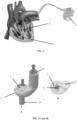
- a right ventricular assist device 1 in accordance with the present invention is illustrated in conjunction with a patient's heart.
- the right ventricular assist device 1 of the present invention includes a crimpable centrifugal pump 2 which is percutaneously and transluminally delivered within the right ventricular apex of a patient and a transluminally deliverable exit cylinder 3.
- the right ventricular assist device 1 is disposed within a portion of the right ventricle.
- the crimpable centrifugal pump 2 pumps blood through the right ventricle, thereby helping the blood to flow downward from the superior vena cava and upward from the inferior vena cava. The blood is then sent upward through the pulmonary artery.
- the energy to carry the blood to the pulmonary artery is minimized.
- the distance to transport the blood from the right ventricle to the pulmonary artery is minimized too.
- the blood is carried from the right ventricle to the pulmonary artery over a distance between 50 mm and 130 mm.
- said body 6 presents a length ranging from 30 mm to 130 mm and a diameter ranging from 10 mm to 20 mm. In one particular embodiment, the body presents a diameter of 13,6mm.
- the inlet opening 7 presents a diameter ranging from 5 mm to 20 mm.
- the outlet 8 presents a diameter ranging from 5 mm to 20 mm.
- the rotatable propeller 9 is disposed between the inlet opening 7 and the body 6 because it is inside.
- the propeller 9 is preferably powered by an electric motor (not shown), in communication with said rotatable propeller 9.
- Said motor is disposed inside a motor support 10, situated below the propeller 9, and is configured to generate the required power and torque for said rotatable propeller 9 to carry the blood from the right ventricle to the pulmonary artery with the desired flow rate and pressure ideally a flow rate of 5 L/min and a pressure of 25 mmHg.
- the motor delivers a torque value ranging from 0,2 to 8 mN.m, preferably a torque value of 0,6 mN.m.
- the mechanical power is directly linked to the torque value generated by the motor. Power and torque value allow the rotatable propeller 9 to generate the desired flow rate and pressure to carry the blood from the right ventricle to the pulmonary artery.
- the motor also delivers a rotation speed ranging from 5000 to 15000 rpm, preferably ranging from 6000 to 10000 rpm.
- the motor may further comprise a gearbox.
- the gearbox allows, if necessary, to reduce the speed and increase the torque, in order to reach the desired flow rate and pressure of 5 liters/minute and 25 mmHg respectively.
- the propeller 9 of the centrifugal pump 2 allows to generate the adequate pressure at the outlet 8 for the blood to rise and reach the pulmonary artery, after the blood passes through the inlet opening 7.
- Said adequate pressure is ranging from 15 to 75 mmHg, preferably 25 mmHg. In most cases the adequate pressure ranges between 20-25 mmHg, depending on the patient. However, in some case, high pressure as 75mmHg may be needed to meet the needs of classic patients which exercise a lot or patients with highly advanced heart failure.
- the rotation of the propeller 9 generates a velocity ranging from 0,2 m/s to 2 m/s at the outlet channel 8 of the centrifugal pump 2. The generated velocity is preferably about of 0,6 m/s.
- the rotatable propeller 9 further presents a shearstress ranging from 200 Pa to 800 Pa, preferably 400 Pa.
- the velocity generated at the outlet channel 8 of the centrifugal pump 2 is enough to generate the desired flow rate to carry the blood from the right ventricle to the pulmonary artery.
- Desired flow rate is ranging from 1 liters/minute to as high as 10 liters/minute, preferably 5 liters/minute depending upon the needs of the patient.
- the body 6 of the centrifugal pump 2 is made of bio-compatible materials, including plastic materials, having the requisite strength and bio-compatibility characteristics which permit the desired use in a patient's body.
- the body 6 of the centrifugal pump 2 is made of a suitable crimpable material.
- the body of the centrifugal pump 2 is made of PTFE.
- the body 6 of the centrifugal pump 2 is made of a Shape Memory Polymer (SMP), such as Silicone resin, Polyurethane-based SMP, thermoset (covalently cross-linked) polymeric materials.
- SMP Shape Memory Polymer
- the body 6 of the centrifugal pump 2 is made of Shape Memory Alloy (SMA).
- the Shape Memory Alloy is selected from NiTinol, Copper-Zinc-Aluminum, Copper-Aluminum-Nickle, Iron-Manganese-Silicon or Copper-Aluminium-Manganese. According to a preferred embodiment, the Shape Memory Alloy is NiTinol.
- these embodiments allow the centrifugal pump 2 to be implanted within the right ventricle via a catheter inserted into the patient's femoral artery, or by the subclavian vein or the internal jugular vein.
- the implantation method will be described further.
- the power is supplied to the motor of the centrifugal pump 2 by a power source 4.
- the power source 4 is a subcutaneously implantable battery. which may be implanted in the pectoral area of the patient or in a pocket made in the abdomen of the patient.
- the subcutaneously implantable battery 4 is a rechargeable battery and may be rechargeable per induction.
- a power wire 5 is associated with the electric motor.
- the power wire 5 extends from the electric motor to the power source 4.
- the power wire 5 passes through the superior vena cava, towards the pectoral area where it may be connected to the power source 4.
- the power wire 5 passes through the internal jugular vein and is connected to the battery by means of a tunnel created under the skin.
- the power source 4 delivers a voltage ranging from 2 to 15 Volt, preferably ranging from 4 to 8 Volt. More particularly, the power source 4 delivers a voltage of 2,8 Volts.
- the rotatable propeller 9 is made of bio-compatible materials, including plastic materials, having the requisite strength and bio-compatibility characteristics which permit the desired use in a patient's body.
- the rotatable propeller 9 is made of suitable crimpable material. According to one embodiment, the rotatable propeller 9 is made of PTFE. According to one embodiment, the body of the rotatable propeller 9 is made of a Shape Memory Polymer, such as Silicone resin, Polyurethane-based SMP, thermoset (covalently cross-linked) polymeric materials. According to one embodiment, the body of the rotatable propeller 9 is made of Shape Memory Alloy.
- the Shape Memory Alloy is selected from NiTinol, Copper-Zinc-Aluminum, Copper-Aluminum-Nickle, Iron-Manganese-Silicon, magnetic steel, stainless steel or Copper-Aluminium-Manganese.
- the shaped memory alloy is NiTinol.
- the rotatable propeller 9 allows to generate the desired flow rate and pressure to carry the blood from the right ventricle to the pulmonary artery without being harmful for the body and by avoiding low shearstress or high shearstress.
- the right ventricular assist device 1 further comprises an external controller configured to control the electric motor destined to communicate with the motor and to provide information to the patient implanted with the device 1.
- the external controller communicates, in a well know way, with the motor via a cable or a wireless protocol.
- the external controller may for example be a portable device such as a smartphone, tablet, a personal computer, or a personal controller.
- the external controller is equipped with a Bluetooth chip or a with a WIFI connection system. Said external controller could be worn on the patient's belt or up on a holster-type system, or strapped to the patient's leg via a Velcro ® type attachment means, or other suitable attachment structure.
- the communication between the external controller and the motor allows for an accurate control of the centrifugal pump 2 depending on the patient's need.
- the right ventricular assist device 1 further comprises a subcutaneously implantable sensor configured to communicate with the external controller.
- the communication between the external controller and the subcutaneously implantable sensor allows an accurate control of the centrifugal pump 2 depending on the patient's need.
- the communication between the external controller and the subcutaneously implantable sensor allows to variate the pump speed either in synchronization with the heart rhythm, or the paced rhythm or out of synchronization with the heart rhythm or paced rhythm.
- the subcutaneously implantable sensor may also have the ability to sense the native electrocardiogram of the patient or the paced rhythm. In this case, the sensor communicates the measured data to the external controller, which may vary the pump speed accordingly.
- the external controller is able to communicate directly or indirectly with an implanted pacemaker or defibrillator device, to optimize flow depending on the patient's need.
- the sensor may be able to sense when the patient is supine or lying down and communicates the information to the external controller which may decrease or increase overall pump speed to compensate for decreased need while supine.
- the sensor may also be able to sense other physiologic parameters such as bioimpedance, body motion or cardiac performance parameters and communicates the information to the external controller which may adjust pump speed to optimize flow of blood to the body.
- physiologic parameters such as bioimpedance, body motion or cardiac performance parameters
- Said method comprises the steps of:
- the catheter is inserted up to the pulmonary artery via the femoral artery or by high way via the subclavian or jugular vein or by a trans-apical minimally invasive incision under the costal.
- the method to percutaneously and transluminally implant the Right Ventricular Assist Device 1 further comprises a step of associating a first end of a power wire with the motor and a second end of a power wire with a power source 4.
- the method to percutaneously and transluminally implant the Right Ventricular Assist Device 1 further comprises a step of subcutaneously implanting the power source in the pectoral area of the patient or in a pocket made in the abdomen of the patient.
- the centrifugal pump 2 and its associated motor are attached within the right ventricular apex. According to one embodiment, the centrifugal pump 2 and its associated motor are attached within the admission chamber of the right ventricle. In these embodiments, the centrifugal pump 2, pumps blood downward from superior vena cava and upward from the inferior vena cava, the blood is then sent upward through the pulmonary artery.
- the method to percutaneously and transluminally implant the Right Ventricular Assist Device 1 further comprise a step of controlling the pump speed either in synchronization with a rhythm of the heart or out of synchronization with the rhythm of the heart.
- the disclosure also relates to the use of the right ventricular assist device of the present invention for long-term assist of the right ventricle of a patient's heart to pump blood.
- the right ventricular assist device of the present disclosure is used in congestive heart failure.
Landscapes
- Health & Medical Sciences (AREA)
- Engineering & Computer Science (AREA)
- Heart & Thoracic Surgery (AREA)
- Cardiology (AREA)
- Life Sciences & Earth Sciences (AREA)
- Public Health (AREA)
- Biomedical Technology (AREA)
- Hematology (AREA)
- Mechanical Engineering (AREA)
- Animal Behavior & Ethology (AREA)
- General Health & Medical Sciences (AREA)
- Anesthesiology (AREA)
- Veterinary Medicine (AREA)
- Medical Informatics (AREA)
- Vascular Medicine (AREA)
- Transplantation (AREA)
- External Artificial Organs (AREA)
- Electrotherapy Devices (AREA)
Claims (13)
- Implantierbare rechtsventrikuläre Herzunterstützungsvorrichtung (1), die so eingerichtet ist, dass sie innerhalb des Apex oder der Einlasskammer des rechten Ventrikels eines Patienten implantiert wird, um das Blut des Patienten von dem rechten Ventrikel in die Pulmonalarterie zu transportieren, wobei die Vorrichtung (1) Folgendes umfasst:
eine perkutan abgegebene Zentrifugalpumpe (2), die so eingerichtet ist, dass sie das Blut aus dem rechten Ventrikel in die Pulmonalarterie mit einer Flussrate von 1 bis 10 l/min leitet, wobei die Zentrifugalpumpe (2) Folgendes umfasst:- einen Körper (6) aus einem crimpbaren Material, die Folgendes aufweist:- eine Einlassöffnung (7), durch die das Blut in das Innere des Körpers (6) gelangen kann;- einen Auslasskanal (8), der dazu bestimmt ist, das Blut aus dem Körper (6) austreten zu lassen;- einen drehbaren Propeller (9) mit einem Durchmesser von 5 mm bis 15 mm, der so eingerichtet ist, dass er das aus dem rechten Ventrikel und dem rechten Vorhof kommende Blut durch die Einlassöffnung (7) in Richtung der Pulmonalarterie durch den Auslasskanal (8) transportiert;- einen Motorträger (10); und- einen Motor, der mit dem drehbaren Propeller (9) verbunden ist, wobei der Motor so eingerichtet ist, dass er eine elektrische Leistung von 1 bis 10 Watt verwendet, wodurch der drehbare Propeller (9) das Blut von dem rechten Ventrikel zur Pulmonalarterie mit einer Rotationsgeschwindigkeit von 5000 bis 15000 U/min transportieren kann,- einen Auslasszylinder (3), der so eingerichtet ist, dass er das Blut aus dem rechten Ventrikel über einen Abstand zwischen 50 mm und 130 mm in die Pulmonalarterie leitet; und- eine Stromquelle (4), die mit dem Motor verbunden und so eingerichtet ist, dass sie eine Spannung von 2 bis 15 Volt liefert. - Rechtsventrikuläre Herzunterstützungsvorrichtung (1) nach Anspruch 1, wobei die Zentrifugalpumpe (2) einen Druck von 15 bis 75 mmHg liefert.
- Rechtsventrikuläre Herzunterstützungsvorrichtung (1) nach Anspruch 1 oder Anspruch 2, wobei das crimpbare Material aus PTFE, einem Formspeicherpolymer oder einer Formspeicherlegierung ausgewählt ist, die aus NiTinol, Kupfer-Zink-Aluminium, Kupfer-Aluminium-Nickel, Eisen-Mangan-Silikon, Kupfer-Aluminium-Mangan oder Edelstahl ausgewählt ist.
- Rechtsventrikuläre Herzunterstützungsvorrichtung (1) nach einem der Ansprüche 1 bis 3, wobei der Auslasszylinder (3) ein selbstexpandierender Stent ist, der so eingerichtet ist, dass er den Auslasskanal (8) direkt oder indirekt mit einem Teil der Pulmonalarterie verbindet.
- Rechtsventrikuläre Herzunterstützungsvorrichtung (1) nach einem der Ansprüche 1 bis 4, wobei der drehbare Propeller (9) zwischen 2 und 6 Flügel umfasst.
- Rechtsventrikuläre Herzunterstützungsvorrichtung (1) nach Anspruch 5, wobei der drehbare Propeller (9) aus einer geformten Speicherlegierung besteht, die aus NiTinol, Kupfer-Zink-Aluminium, Kupfer-Aluminium-Nickel, Eisen-Mangan-Silizium, Kupfer-Aluminium-Mangan, mit En oder Cu beschichteter Stahl, rostfreier Stahl, vorzugsweise in NiTinol, ausgewählt ist
- Rechtsventrikuläre Herzunterstützungsvorrichtung (1) nach einem der Ansprüche 1 bis 6, wobei der drehbare Propeller (9) eine Scherspannung von 100 Pa bis 800 Pa aufweist.
- Rechtsventrikuläre Herzunterstützungsvorrichtung (1) nach einem der Ansprüche 1 bis 7, wobei der Motor einen Drehmomentwert von 0,2 bis 7 mN.m liefert.
- Rechtsventrikuläre Herzunterstützungsvorrichtung (1) nach einem der Ansprüche 1 bis 8, wobei der Motor ein Elektromotor ist, der Strom von der Stromquelle (4) erhält.
- Rechtsventrikuläre Herzunterstützungsvorrichtung (1) nach Anspruch 9, wobei der Motor über ein Stromkabel (5) mit der Stromquelle (4) verbunden ist.
- Rechtsventrikuläre Herzunterstützungsvorrichtung (1) nach einem der Ansprüche 1 bis 10, wobei die Stromquelle (4) ein perkutan implantierbarer wiederaufladbarer Akku ist.
- Rechtsventrikuläre Herzunterstützungsvorrichtung (1) nach einem der Ansprüche 1 bis 11, ferner umfassend eine externe Steuerung, die zur Steuerung des Elektromotors eingerichtet ist.
- Rechtsventrikuläre Herzunterstützungsvorrichtung (1) nach einem der Ansprüche 1 bis 12, ferner umfassend einen subkutan implantierbaren Sensor, der so eingerichtet ist, dass er mit der externen Steuerung kommuniziert.
Applications Claiming Priority (2)
| Application Number | Priority Date | Filing Date | Title |
|---|---|---|---|
| EP20305121.4A EP3862036A1 (de) | 2020-02-07 | 2020-02-07 | Implantierbare vorrichtung zur langzeitunterstützung des rechten ventrikels eines herzens |
| PCT/EP2021/052803 WO2021156438A1 (en) | 2020-02-07 | 2021-02-05 | Implantable device for long-term assist of the right ventricle of a heart |
Publications (2)
| Publication Number | Publication Date |
|---|---|
| EP4100105A1 EP4100105A1 (de) | 2022-12-14 |
| EP4100105B1 true EP4100105B1 (de) | 2025-05-21 |
Family
ID=69784361
Family Applications (2)
| Application Number | Title | Priority Date | Filing Date |
|---|---|---|---|
| EP20305121.4A Withdrawn EP3862036A1 (de) | 2020-02-07 | 2020-02-07 | Implantierbare vorrichtung zur langzeitunterstützung des rechten ventrikels eines herzens |
| EP21703697.9A Active EP4100105B1 (de) | 2020-02-07 | 2021-02-05 | Implantierbare vorrichtung zur langzeitunterstützung des rechten ventrikels eines herzens |
Family Applications Before (1)
| Application Number | Title | Priority Date | Filing Date |
|---|---|---|---|
| EP20305121.4A Withdrawn EP3862036A1 (de) | 2020-02-07 | 2020-02-07 | Implantierbare vorrichtung zur langzeitunterstützung des rechten ventrikels eines herzens |
Country Status (7)
| Country | Link |
|---|---|
| US (1) | US20230080217A1 (de) |
| EP (2) | EP3862036A1 (de) |
| JP (1) | JP2023512585A (de) |
| CN (1) | CN115175729A (de) |
| AU (1) | AU2021215346A1 (de) |
| CA (1) | CA3166062A1 (de) |
| WO (1) | WO2021156438A1 (de) |
Families Citing this family (2)
| Publication number | Priority date | Publication date | Assignee | Title |
|---|---|---|---|---|
| CN116889679B (zh) * | 2023-06-08 | 2024-07-19 | 上海心恒睿医疗科技有限公司 | 心室辅助系统 |
| CN118161743A (zh) * | 2024-03-25 | 2024-06-11 | 安徽通灵仿生科技有限公司 | 一种右心室辅助系统以及右心室辅助设备的控制方法 |
Citations (2)
| Publication number | Priority date | Publication date | Assignee | Title |
|---|---|---|---|---|
| EP0156289A2 (de) * | 1984-03-19 | 1985-10-02 | Research Corporation | Vorrichtung zur Unterstützung der Funktion der rechten Herzkammer |
| US7010954B2 (en) * | 2000-12-05 | 2006-03-14 | Impella Cardiosystems Ag | Method for calibrating a pressure sensor or a flow sensor at a rotary pump |
Family Cites Families (10)
| Publication number | Priority date | Publication date | Assignee | Title |
|---|---|---|---|---|
| AU2003273612A1 (en) * | 2002-06-11 | 2003-12-22 | Walid Aboul-Hosn | Percutaneously introduced blood pump and related methods |
| EP2026856B1 (de) * | 2006-05-31 | 2015-08-26 | VADovations, Inc. | Herzunterstützungsvorrichtung |
| CN101868628B (zh) * | 2007-10-18 | 2015-08-19 | 克里夫兰诊所基金会 | 两级转子动力血泵 |
| AU2011312606A1 (en) * | 2010-10-07 | 2013-05-30 | Everheart Systems, Inc. | Cardiac support systems and methods for chronic use |
| US10857274B2 (en) * | 2012-11-06 | 2020-12-08 | Queen Mary University Of London | Mechanical circulatory support device with centrifugal impeller designed for implantation in the descending aorta |
| KR20160044492A (ko) * | 2013-08-14 | 2016-04-25 | 하트웨어, 인코포레이티드 | 축방향 유동 펌프용 임펠러 |
| US20190224394A1 (en) * | 2016-06-01 | 2019-07-25 | Peter Ayre | Ventricle assist device |
| US20180193543A1 (en) * | 2017-01-09 | 2018-07-12 | Benjamin Sun | Implantable intravascular ventricular assist device |
| JP7566724B2 (ja) * | 2018-04-04 | 2024-10-15 | セオドシオス・アレクサンダー | 短期の使用のための除去可能な機械的循環支援部 |
| US11141580B2 (en) * | 2018-05-15 | 2021-10-12 | Cardiovascular Systems, Inc. | Intravascular blood pump system with integrated conductor(s) in housing and methods thereof |
-
2020
- 2020-02-07 EP EP20305121.4A patent/EP3862036A1/de not_active Withdrawn
-
2021
- 2021-02-05 CA CA3166062A patent/CA3166062A1/en active Pending
- 2021-02-05 US US17/795,317 patent/US20230080217A1/en not_active Abandoned
- 2021-02-05 WO PCT/EP2021/052803 patent/WO2021156438A1/en not_active Ceased
- 2021-02-05 CN CN202180013238.6A patent/CN115175729A/zh active Pending
- 2021-02-05 AU AU2021215346A patent/AU2021215346A1/en active Pending
- 2021-02-05 EP EP21703697.9A patent/EP4100105B1/de active Active
- 2021-02-05 JP JP2022548152A patent/JP2023512585A/ja active Pending
Patent Citations (2)
| Publication number | Priority date | Publication date | Assignee | Title |
|---|---|---|---|---|
| EP0156289A2 (de) * | 1984-03-19 | 1985-10-02 | Research Corporation | Vorrichtung zur Unterstützung der Funktion der rechten Herzkammer |
| US7010954B2 (en) * | 2000-12-05 | 2006-03-14 | Impella Cardiosystems Ag | Method for calibrating a pressure sensor or a flow sensor at a rotary pump |
Also Published As
| Publication number | Publication date |
|---|---|
| JP2023512585A (ja) | 2023-03-27 |
| AU2021215346A1 (en) | 2022-08-25 |
| CA3166062A1 (en) | 2021-08-12 |
| EP3862036A1 (de) | 2021-08-11 |
| US20230080217A1 (en) | 2023-03-16 |
| CN115175729A (zh) | 2022-10-11 |
| WO2021156438A1 (en) | 2021-08-12 |
| EP4100105A1 (de) | 2022-12-14 |
Similar Documents
| Publication | Publication Date | Title |
|---|---|---|
| US20240017052A1 (en) | Method and apparatus for long-term assisting a left ventricle to pump blood | |
| US7238151B2 (en) | Permanent heart assist system | |
| KR100544944B1 (ko) | 이식가능한 심장 보조 기관 | |
| EP2195043B1 (de) | Intraatriale ventrikuläre Unterstützungsvorrichtung | |
| US20060155158A1 (en) | Percutaneously introduced blood pump and related methods | |
| EP0986409A1 (de) | Ventrikulare unterstützungsvorrichtung mit axialblutpumpe mit innenflügellaufrad | |
| WO2021062565A2 (en) | Fluid kinetic energy redistribution system for use as hemodynamic support | |
| US20230080217A1 (en) | Implantable device for long-term assist of the right ventricle of a heart | |
| US12515035B2 (en) | Unloading blood pump system and the blood pump thereof | |
| US20240285927A1 (en) | Axial flow pumps for supporting cardiac function | |
| Franco | New devices for chronic ventricular support | |
| WO2025188554A1 (en) | Devices and methods for supporting cardiac function | |
| EP4326147A1 (de) | Vorrichtung und verfahren zur verbesserung der herzkontraktilität und zur ermöglichung der kardialen erholung bei patienten mit herzinsuffizienz | |
| Liao et al. | End-Stage Congestive Heart Failure in the Adult Population: Ventricular Assist Devices |
Legal Events
| Date | Code | Title | Description |
|---|---|---|---|
| STAA | Information on the status of an ep patent application or granted ep patent |
Free format text: STATUS: UNKNOWN |
|
| STAA | Information on the status of an ep patent application or granted ep patent |
Free format text: STATUS: THE INTERNATIONAL PUBLICATION HAS BEEN MADE |
|
| PUAI | Public reference made under article 153(3) epc to a published international application that has entered the european phase |
Free format text: ORIGINAL CODE: 0009012 |
|
| STAA | Information on the status of an ep patent application or granted ep patent |
Free format text: STATUS: REQUEST FOR EXAMINATION WAS MADE |
|
| 17P | Request for examination filed |
Effective date: 20220907 |
|
| AK | Designated contracting states |
Kind code of ref document: A1 Designated state(s): AL AT BE BG CH CY CZ DE DK EE ES FI FR GB GR HR HU IE IS IT LI LT LU LV MC MK MT NL NO PL PT RO RS SE SI SK SM TR |
|
| DAV | Request for validation of the european patent (deleted) | ||
| DAX | Request for extension of the european patent (deleted) | ||
| GRAP | Despatch of communication of intention to grant a patent |
Free format text: ORIGINAL CODE: EPIDOSNIGR1 |
|
| STAA | Information on the status of an ep patent application or granted ep patent |
Free format text: STATUS: GRANT OF PATENT IS INTENDED |
|
| INTG | Intention to grant announced |
Effective date: 20250108 |
|
| RAP3 | Party data changed (applicant data changed or rights of an application transferred) |
Owner name: BRIGHTFLOW |
|
| GRAS | Grant fee paid |
Free format text: ORIGINAL CODE: EPIDOSNIGR3 |
|
| GRAA | (expected) grant |
Free format text: ORIGINAL CODE: 0009210 |
|
| STAA | Information on the status of an ep patent application or granted ep patent |
Free format text: STATUS: THE PATENT HAS BEEN GRANTED |
|
| AK | Designated contracting states |
Kind code of ref document: B1 Designated state(s): AL AT BE BG CH CY CZ DE DK EE ES FI FR GB GR HR HU IE IS IT LI LT LU LV MC MK MT NL NO PL PT RO RS SE SI SK SM TR |
|
| REG | Reference to a national code |
Ref country code: GB Ref legal event code: FG4D |
|
| REG | Reference to a national code |
Ref country code: CH Ref legal event code: EP |
|
| REG | Reference to a national code |
Ref country code: DE Ref legal event code: R096 Ref document number: 602021031081 Country of ref document: DE |
|
| REG | Reference to a national code |
Ref country code: IE Ref legal event code: FG4D |
|
| REG | Reference to a national code |
Ref country code: NL Ref legal event code: MP Effective date: 20250521 |
|
| PG25 | Lapsed in a contracting state [announced via postgrant information from national office to epo] |
Ref country code: PT Free format text: LAPSE BECAUSE OF FAILURE TO SUBMIT A TRANSLATION OF THE DESCRIPTION OR TO PAY THE FEE WITHIN THE PRESCRIBED TIME-LIMIT Effective date: 20250922 Ref country code: FI Free format text: LAPSE BECAUSE OF FAILURE TO SUBMIT A TRANSLATION OF THE DESCRIPTION OR TO PAY THE FEE WITHIN THE PRESCRIBED TIME-LIMIT Effective date: 20250521 Ref country code: ES Free format text: LAPSE BECAUSE OF FAILURE TO SUBMIT A TRANSLATION OF THE DESCRIPTION OR TO PAY THE FEE WITHIN THE PRESCRIBED TIME-LIMIT Effective date: 20250521 |
|
| REG | Reference to a national code |
Ref country code: LT Ref legal event code: MG9D |
|
| PG25 | Lapsed in a contracting state [announced via postgrant information from national office to epo] |
Ref country code: GR Free format text: LAPSE BECAUSE OF FAILURE TO SUBMIT A TRANSLATION OF THE DESCRIPTION OR TO PAY THE FEE WITHIN THE PRESCRIBED TIME-LIMIT Effective date: 20250822 Ref country code: NO Free format text: LAPSE BECAUSE OF FAILURE TO SUBMIT A TRANSLATION OF THE DESCRIPTION OR TO PAY THE FEE WITHIN THE PRESCRIBED TIME-LIMIT Effective date: 20250821 |
|
| PG25 | Lapsed in a contracting state [announced via postgrant information from national office to epo] |
Ref country code: PL Free format text: LAPSE BECAUSE OF FAILURE TO SUBMIT A TRANSLATION OF THE DESCRIPTION OR TO PAY THE FEE WITHIN THE PRESCRIBED TIME-LIMIT Effective date: 20250521 Ref country code: NL Free format text: LAPSE BECAUSE OF FAILURE TO SUBMIT A TRANSLATION OF THE DESCRIPTION OR TO PAY THE FEE WITHIN THE PRESCRIBED TIME-LIMIT Effective date: 20250521 |
|
| PG25 | Lapsed in a contracting state [announced via postgrant information from national office to epo] |
Ref country code: BG Free format text: LAPSE BECAUSE OF FAILURE TO SUBMIT A TRANSLATION OF THE DESCRIPTION OR TO PAY THE FEE WITHIN THE PRESCRIBED TIME-LIMIT Effective date: 20250521 |
|
| PG25 | Lapsed in a contracting state [announced via postgrant information from national office to epo] |
Ref country code: HR Free format text: LAPSE BECAUSE OF FAILURE TO SUBMIT A TRANSLATION OF THE DESCRIPTION OR TO PAY THE FEE WITHIN THE PRESCRIBED TIME-LIMIT Effective date: 20250521 |
|
| PG25 | Lapsed in a contracting state [announced via postgrant information from national office to epo] |
Ref country code: RS Free format text: LAPSE BECAUSE OF FAILURE TO SUBMIT A TRANSLATION OF THE DESCRIPTION OR TO PAY THE FEE WITHIN THE PRESCRIBED TIME-LIMIT Effective date: 20250821 |
|
| PG25 | Lapsed in a contracting state [announced via postgrant information from national office to epo] |
Ref country code: IS Free format text: LAPSE BECAUSE OF FAILURE TO SUBMIT A TRANSLATION OF THE DESCRIPTION OR TO PAY THE FEE WITHIN THE PRESCRIBED TIME-LIMIT Effective date: 20250921 |
|
| PG25 | Lapsed in a contracting state [announced via postgrant information from national office to epo] |
Ref country code: LV Free format text: LAPSE BECAUSE OF FAILURE TO SUBMIT A TRANSLATION OF THE DESCRIPTION OR TO PAY THE FEE WITHIN THE PRESCRIBED TIME-LIMIT Effective date: 20250521 |
|
| REG | Reference to a national code |
Ref country code: AT Ref legal event code: MK05 Ref document number: 1796286 Country of ref document: AT Kind code of ref document: T Effective date: 20250521 |
|
| PG25 | Lapsed in a contracting state [announced via postgrant information from national office to epo] |
Ref country code: DK Free format text: LAPSE BECAUSE OF FAILURE TO SUBMIT A TRANSLATION OF THE DESCRIPTION OR TO PAY THE FEE WITHIN THE PRESCRIBED TIME-LIMIT Effective date: 20250521 Ref country code: SM Free format text: LAPSE BECAUSE OF FAILURE TO SUBMIT A TRANSLATION OF THE DESCRIPTION OR TO PAY THE FEE WITHIN THE PRESCRIBED TIME-LIMIT Effective date: 20250521 Ref country code: AT Free format text: LAPSE BECAUSE OF FAILURE TO SUBMIT A TRANSLATION OF THE DESCRIPTION OR TO PAY THE FEE WITHIN THE PRESCRIBED TIME-LIMIT Effective date: 20250521 |
|
| PG25 | Lapsed in a contracting state [announced via postgrant information from national office to epo] |
Ref country code: CZ Free format text: LAPSE BECAUSE OF FAILURE TO SUBMIT A TRANSLATION OF THE DESCRIPTION OR TO PAY THE FEE WITHIN THE PRESCRIBED TIME-LIMIT Effective date: 20250521 |
|
| PG25 | Lapsed in a contracting state [announced via postgrant information from national office to epo] |
Ref country code: EE Free format text: LAPSE BECAUSE OF FAILURE TO SUBMIT A TRANSLATION OF THE DESCRIPTION OR TO PAY THE FEE WITHIN THE PRESCRIBED TIME-LIMIT Effective date: 20250521 |
|
| PG25 | Lapsed in a contracting state [announced via postgrant information from national office to epo] |
Ref country code: SK Free format text: LAPSE BECAUSE OF FAILURE TO SUBMIT A TRANSLATION OF THE DESCRIPTION OR TO PAY THE FEE WITHIN THE PRESCRIBED TIME-LIMIT Effective date: 20250521 |
|
| PG25 | Lapsed in a contracting state [announced via postgrant information from national office to epo] |
Ref country code: IT Free format text: LAPSE BECAUSE OF FAILURE TO SUBMIT A TRANSLATION OF THE DESCRIPTION OR TO PAY THE FEE WITHIN THE PRESCRIBED TIME-LIMIT Effective date: 20250521 |
|
| REG | Reference to a national code |
Ref country code: DE Ref legal event code: R097 Ref document number: 602021031081 Country of ref document: DE |
|
| PLBE | No opposition filed within time limit |
Free format text: ORIGINAL CODE: 0009261 |
|
| STAA | Information on the status of an ep patent application or granted ep patent |
Free format text: STATUS: NO OPPOSITION FILED WITHIN TIME LIMIT |
|
| REG | Reference to a national code |
Ref country code: CH Ref legal event code: L10 Free format text: ST27 STATUS EVENT CODE: U-0-0-L10-L00 (AS PROVIDED BY THE NATIONAL OFFICE) Effective date: 20260402 |
|
| 26N | No opposition filed |
Effective date: 20260224 |