EP4098417B1 - Verfahren zur herstellung eines verbundbauteils mit keramischer matrix und einem internen kühlkreislauf - Google Patents
Verfahren zur herstellung eines verbundbauteils mit keramischer matrix und einem internen kühlkreislauf Download PDFInfo
- Publication number
- EP4098417B1 EP4098417B1 EP22169258.5A EP22169258A EP4098417B1 EP 4098417 B1 EP4098417 B1 EP 4098417B1 EP 22169258 A EP22169258 A EP 22169258A EP 4098417 B1 EP4098417 B1 EP 4098417B1
- Authority
- EP
- European Patent Office
- Prior art keywords
- sheet
- mandrel
- holes
- preform
- openings
- Prior art date
- Legal status (The legal status is an assumption and is not a legal conclusion. Google has not performed a legal analysis and makes no representation as to the accuracy of the status listed.)
- Active
Links
Images


Classifications
-
- C—CHEMISTRY; METALLURGY
- C04—CEMENTS; CONCRETE; ARTIFICIAL STONE; CERAMICS; REFRACTORIES
- C04B—LIME, MAGNESIA; SLAG; CEMENTS; COMPOSITIONS THEREOF, e.g. MORTARS, CONCRETE OR LIKE BUILDING MATERIALS; ARTIFICIAL STONE; CERAMICS; REFRACTORIES; TREATMENT OF NATURAL STONE
- C04B35/00—Shaped ceramic products characterised by their composition; Ceramics compositions; Processing powders of inorganic compounds preparatory to the manufacturing of ceramic products
- C04B35/71—Ceramic products containing macroscopic reinforcing agents
- C04B35/78—Ceramic products containing macroscopic reinforcing agents containing non-metallic materials
- C04B35/80—Fibres, filaments, whiskers, platelets, or the like
-
- B—PERFORMING OPERATIONS; TRANSPORTING
- B28—WORKING CEMENT, CLAY, OR STONE
- B28B—SHAPING CLAY OR OTHER CERAMIC COMPOSITIONS; SHAPING SLAG; SHAPING MIXTURES CONTAINING CEMENTITIOUS MATERIAL, e.g. PLASTER
- B28B1/00—Producing shaped prefabricated articles from the material
- B28B1/30—Producing shaped prefabricated articles from the material by applying the material on to a core or other moulding surface to form a layer thereon
- B28B1/40—Producing shaped prefabricated articles from the material by applying the material on to a core or other moulding surface to form a layer thereon by wrapping, e.g. winding
- B28B1/42—Producing shaped prefabricated articles from the material by applying the material on to a core or other moulding surface to form a layer thereon by wrapping, e.g. winding using mixtures containing fibres, e.g. for making sheets by slitting the wound layer
-
- C—CHEMISTRY; METALLURGY
- C04—CEMENTS; CONCRETE; ARTIFICIAL STONE; CERAMICS; REFRACTORIES
- C04B—LIME, MAGNESIA; SLAG; CEMENTS; COMPOSITIONS THEREOF, e.g. MORTARS, CONCRETE OR LIKE BUILDING MATERIALS; ARTIFICIAL STONE; CERAMICS; REFRACTORIES; TREATMENT OF NATURAL STONE
- C04B35/00—Shaped ceramic products characterised by their composition; Ceramics compositions; Processing powders of inorganic compounds preparatory to the manufacturing of ceramic products
- C04B35/515—Shaped ceramic products characterised by their composition; Ceramics compositions; Processing powders of inorganic compounds preparatory to the manufacturing of ceramic products based on non-oxide ceramics
- C04B35/56—Shaped ceramic products characterised by their composition; Ceramics compositions; Processing powders of inorganic compounds preparatory to the manufacturing of ceramic products based on non-oxide ceramics based on carbides or oxycarbides
- C04B35/565—Shaped ceramic products characterised by their composition; Ceramics compositions; Processing powders of inorganic compounds preparatory to the manufacturing of ceramic products based on non-oxide ceramics based on carbides or oxycarbides based on silicon carbide
-
- F—MECHANICAL ENGINEERING; LIGHTING; HEATING; WEAPONS; BLASTING
- F01—MACHINES OR ENGINES IN GENERAL; ENGINE PLANTS IN GENERAL; STEAM ENGINES
- F01D—NON-POSITIVE DISPLACEMENT MACHINES OR ENGINES, e.g. STEAM TURBINES
- F01D5/00—Blades; Blade-carrying members; Heating, heat-insulating, cooling or antivibration means on the blades or the members
- F01D5/12—Blades
- F01D5/14—Form or construction
- F01D5/18—Hollow blades, i.e. blades with cooling or heating channels or cavities; Heating, heat-insulating or cooling means on blades
-
- F—MECHANICAL ENGINEERING; LIGHTING; HEATING; WEAPONS; BLASTING
- F01—MACHINES OR ENGINES IN GENERAL; ENGINE PLANTS IN GENERAL; STEAM ENGINES
- F01D—NON-POSITIVE DISPLACEMENT MACHINES OR ENGINES, e.g. STEAM TURBINES
- F01D5/00—Blades; Blade-carrying members; Heating, heat-insulating, cooling or antivibration means on the blades or the members
- F01D5/12—Blades
- F01D5/14—Form or construction
- F01D5/18—Hollow blades, i.e. blades with cooling or heating channels or cavities; Heating, heat-insulating or cooling means on blades
- F01D5/187—Convection cooling
-
- F—MECHANICAL ENGINEERING; LIGHTING; HEATING; WEAPONS; BLASTING
- F01—MACHINES OR ENGINES IN GENERAL; ENGINE PLANTS IN GENERAL; STEAM ENGINES
- F01D—NON-POSITIVE DISPLACEMENT MACHINES OR ENGINES, e.g. STEAM TURBINES
- F01D5/00—Blades; Blade-carrying members; Heating, heat-insulating, cooling or antivibration means on the blades or the members
- F01D5/12—Blades
- F01D5/28—Selecting particular materials; Particular measures relating thereto; Measures against erosion or corrosion
- F01D5/282—Selecting composite materials, e.g. blades with reinforcing filaments
-
- C—CHEMISTRY; METALLURGY
- C04—CEMENTS; CONCRETE; ARTIFICIAL STONE; CERAMICS; REFRACTORIES
- C04B—LIME, MAGNESIA; SLAG; CEMENTS; COMPOSITIONS THEREOF, e.g. MORTARS, CONCRETE OR LIKE BUILDING MATERIALS; ARTIFICIAL STONE; CERAMICS; REFRACTORIES; TREATMENT OF NATURAL STONE
- C04B2235/00—Aspects relating to ceramic starting mixtures or sintered ceramic products
- C04B2235/02—Composition of constituents of the starting material or of secondary phases of the final product
- C04B2235/50—Constituents or additives of the starting mixture chosen for their shape or used because of their shape or their physical appearance
- C04B2235/52—Constituents or additives characterised by their shapes
- C04B2235/5208—Fibers
- C04B2235/5216—Inorganic
- C04B2235/524—Non-oxidic, e.g. borides, carbides, silicides or nitrides
- C04B2235/5244—Silicon carbide
-
- C—CHEMISTRY; METALLURGY
- C04—CEMENTS; CONCRETE; ARTIFICIAL STONE; CERAMICS; REFRACTORIES
- C04B—LIME, MAGNESIA; SLAG; CEMENTS; COMPOSITIONS THEREOF, e.g. MORTARS, CONCRETE OR LIKE BUILDING MATERIALS; ARTIFICIAL STONE; CERAMICS; REFRACTORIES; TREATMENT OF NATURAL STONE
- C04B2235/00—Aspects relating to ceramic starting mixtures or sintered ceramic products
- C04B2235/60—Aspects relating to the preparation, properties or mechanical treatment of green bodies or pre-forms
- C04B2235/614—Gas infiltration of green bodies or pre-forms
-
- F—MECHANICAL ENGINEERING; LIGHTING; HEATING; WEAPONS; BLASTING
- F05—INDEXING SCHEMES RELATING TO ENGINES OR PUMPS IN VARIOUS SUBCLASSES OF CLASSES F01-F04
- F05D—INDEXING SCHEME FOR ASPECTS RELATING TO NON-POSITIVE-DISPLACEMENT MACHINES OR ENGINES, GAS-TURBINES OR JET-PROPULSION PLANTS
- F05D2230/00—Manufacture
- F05D2230/30—Manufacture with deposition of material
- F05D2230/31—Layer deposition
- F05D2230/314—Layer deposition by chemical vapour deposition
-
- F—MECHANICAL ENGINEERING; LIGHTING; HEATING; WEAPONS; BLASTING
- F05—INDEXING SCHEMES RELATING TO ENGINES OR PUMPS IN VARIOUS SUBCLASSES OF CLASSES F01-F04
- F05D—INDEXING SCHEME FOR ASPECTS RELATING TO NON-POSITIVE-DISPLACEMENT MACHINES OR ENGINES, GAS-TURBINES OR JET-PROPULSION PLANTS
- F05D2240/00—Components
- F05D2240/20—Rotors
- F05D2240/30—Characteristics of rotor blades, i.e. of any element transforming dynamic fluid energy to or from rotational energy and being attached to a rotor
- F05D2240/303—Characteristics of rotor blades, i.e. of any element transforming dynamic fluid energy to or from rotational energy and being attached to a rotor related to the leading edge of a rotor blade
-
- F—MECHANICAL ENGINEERING; LIGHTING; HEATING; WEAPONS; BLASTING
- F05—INDEXING SCHEMES RELATING TO ENGINES OR PUMPS IN VARIOUS SUBCLASSES OF CLASSES F01-F04
- F05D—INDEXING SCHEME FOR ASPECTS RELATING TO NON-POSITIVE-DISPLACEMENT MACHINES OR ENGINES, GAS-TURBINES OR JET-PROPULSION PLANTS
- F05D2250/00—Geometry
- F05D2250/20—Three-dimensional
- F05D2250/23—Three-dimensional prismatic
- F05D2250/231—Three-dimensional prismatic cylindrical
-
- F—MECHANICAL ENGINEERING; LIGHTING; HEATING; WEAPONS; BLASTING
- F05—INDEXING SCHEMES RELATING TO ENGINES OR PUMPS IN VARIOUS SUBCLASSES OF CLASSES F01-F04
- F05D—INDEXING SCHEME FOR ASPECTS RELATING TO NON-POSITIVE-DISPLACEMENT MACHINES OR ENGINES, GAS-TURBINES OR JET-PROPULSION PLANTS
- F05D2250/00—Geometry
- F05D2250/20—Three-dimensional
- F05D2250/23—Three-dimensional prismatic
- F05D2250/232—Three-dimensional prismatic conical
-
- F—MECHANICAL ENGINEERING; LIGHTING; HEATING; WEAPONS; BLASTING
- F05—INDEXING SCHEMES RELATING TO ENGINES OR PUMPS IN VARIOUS SUBCLASSES OF CLASSES F01-F04
- F05D—INDEXING SCHEME FOR ASPECTS RELATING TO NON-POSITIVE-DISPLACEMENT MACHINES OR ENGINES, GAS-TURBINES OR JET-PROPULSION PLANTS
- F05D2260/00—Function
- F05D2260/20—Heat transfer, e.g. cooling
- F05D2260/232—Heat transfer, e.g. cooling characterized by the cooling medium
-
- F—MECHANICAL ENGINEERING; LIGHTING; HEATING; WEAPONS; BLASTING
- F05—INDEXING SCHEMES RELATING TO ENGINES OR PUMPS IN VARIOUS SUBCLASSES OF CLASSES F01-F04
- F05D—INDEXING SCHEME FOR ASPECTS RELATING TO NON-POSITIVE-DISPLACEMENT MACHINES OR ENGINES, GAS-TURBINES OR JET-PROPULSION PLANTS
- F05D2300/00—Materials; Properties thereof
- F05D2300/20—Oxide or non-oxide ceramics
-
- F—MECHANICAL ENGINEERING; LIGHTING; HEATING; WEAPONS; BLASTING
- F05—INDEXING SCHEMES RELATING TO ENGINES OR PUMPS IN VARIOUS SUBCLASSES OF CLASSES F01-F04
- F05D—INDEXING SCHEME FOR ASPECTS RELATING TO NON-POSITIVE-DISPLACEMENT MACHINES OR ENGINES, GAS-TURBINES OR JET-PROPULSION PLANTS
- F05D2300/00—Materials; Properties thereof
- F05D2300/20—Oxide or non-oxide ceramics
- F05D2300/22—Non-oxide ceramics
- F05D2300/226—Carbides
- F05D2300/2261—Carbides of silicon
-
- F—MECHANICAL ENGINEERING; LIGHTING; HEATING; WEAPONS; BLASTING
- F05—INDEXING SCHEMES RELATING TO ENGINES OR PUMPS IN VARIOUS SUBCLASSES OF CLASSES F01-F04
- F05D—INDEXING SCHEME FOR ASPECTS RELATING TO NON-POSITIVE-DISPLACEMENT MACHINES OR ENGINES, GAS-TURBINES OR JET-PROPULSION PLANTS
- F05D2300/00—Materials; Properties thereof
- F05D2300/60—Properties or characteristics given to material by treatment or manufacturing
- F05D2300/603—Composites; e.g. fibre-reinforced
- F05D2300/6033—Ceramic matrix composites [CMC]
Definitions
- the present invention relates to the fabrication of composite components, and more particularly, to a ceramic matrix composite having improved properties for operating in gas turbine engines.
- Ceramic matrix composite components such as those formed of silicon carbide, are commonly used in high-temperature environments because they can withstand temperatures up to 2500°F (1371°C). Such components can still benefit from additional cooling to prevent component degradation.
- One way to provide additional cooling is through the incorporation of internal cooling channels into the component.
- the structure of many composite components can make adding such features somewhat difficult when using traditional fabrication processes.
- EP 3 508 316 A2 discloses a method for forming a hole within a ceramic matrix composite component according to the preamble of claim 1.
- a method of forming a ceramic matrix composite component is as defined in claim 1.
- This disclosure presents composite component with internal, fluidly-connected cavities, and a method of forming that composite component.
- the method includes wrapping multiple mandrels each with at least one fiber sheet.
- Each mandrel has openings or cut-outs that can serve as a template for creating corresponding holes in these fiber sheets.
- holes can be formed by removal of material (e.g., cutting or punching an opening in the sheet) or by pushing a pin through the thickness of the sheet and into the mandrel opening.
- Two wrapped mandrels are placed together and aligned such that the holes in each sheet face and are aligned with one another.
- the mandrels are then overwrapped with at least one further sheet securing the wrapped mandrels in place.
- the resulting preform structure can undergo matrix formation and mandrel removal to become a composite component with elongate cavities fluidly connected at least in part by passages formed by the aligned holes within the fiber sheets.
- FIG. 1 is a flowchart illustrating selected steps 12-18 of method 10, used to form a composite component.
- the component is a ceramic matrix composite (CMC) component.
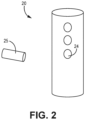
- FIG. 2 is a simplified illustration of mandrel 20 used in method 10.
- FIGS. 3, 4 , 5, and 6 are simplified cross-sectional views of alternate embodiments of a fiber preform. Steps 12-18 are described below in combination with FIGS. 2-6 .
- each mandrel 20 is wrapped with at least one composite fiber sheet 22 (shown in FIGS. 3 and 5 ).
- sheet can be interchangeable with terms such as "ply” and "fabric”.
- Each sheet 22 (or 122 in FIG. 5 ) can be formed from braided or woven ceramic fibers or tows arranged in a uni- or multidirectional manner.
- Exemplary sheets 22, 122 can have 5-harness, 8-harness, plain, or twill weave patterns.
- the ceramic fibers can be formed from silicon carbide or other suitable ceramic materials.
- Each sheet 22, 122 can have a thickness ranging from 0.152 mm to 0.508 mm (0.006 inches to 0.020 inches).
- each mandrel 20 includes one or more openings 24.
- Openings 24 can be rounded (e.g., circular, elliptical, etc.), have straight sides (e.g., diamond, square, etc.) or a combination of the two. Openings 24 can further be generally uniform in size and shape, as shown in FIG. 2 , or can vary along a given mandrel 20. Most generally, openings 24 are formed at locations and in shapes selected to promote a desired fluid flow volume and patterns between open or hollow spaces in the final component defined during manufacture by the respective locations of adjacent mandrels.
- a sheet 22 is wrapped around a respective mandrel 20 such that it at least fully circumscribes the mandrel (i.e., opposite ends of sheet 22 touch or overlap slightly). In an alternative embodiment, however, it may only be necessary to cover an area including openings 24, but otherwise not fully circumscribe the mandrel 20 with the one or more sheets 22.
- holes 26 can be formed by completely removing sections (i.e., portions lesser than the whole) of sheet 22 by, for example, cutting through the fibers of sheet 22 with a sharp tool or laser, or by using a punching tool. Each hole 26 can generally be formed to match the geometry of the underlying mandrel opening 24.
- holes 26 can be formed by pushing pin 25 (shown in FIG. 2 ) through a section of sheet 22 corresponding to an opening 24 in mandrel 20.
- pin can be interchangeable with terms such as “needle,” “rod,” “tube,” or “wire.”
- Pin 25 can be inserted into sheet 22 such that it generally does not damage (e.g., puncture or break) individual fibers, rather, fibers are pushed aside to accommodate the pin. This differs from cutting or punching through sheet 22 which breaks fibers so that a section of sheet 22 is separated and removed.
- Using a pin may be preferable if greater continuity (e.g., lack of breakage) of fibers within individual sheets 22 is desired for enhanced mechanical and/or thermal properties.
- One or more pins 25 can be used to create holes 26.
- pin(s) 25 can create a hole 26 but be removed prior to subsequent processing.
- individual pins 25 can be pushed into sheet 22 at the desired location of holes 26 and remain embedded throughout subsequent steps of method 10. The latter may prevent the fibers from moving back into the region of holes 26 during, for example, matrix formation discussed below.
- one or more pins 25 can be formed as a part of mandrel 20 (as protrusions, bumps, bosses, etc.) in a manner similar to the arrangement of openings 24. In such an embodiment, a sheet 22 can be pushed down onto the protrusions and wrapped as desired.
- mandrels 20 are brought together and aligned such that the holes 26 of the first sheet 22 on the first mandrel 20 are aligned with holes 26 on the second sheet 22 of the second mandrel 20.
- This alignment can, as in the embodiment illustrated in FIGS. 3 and 4 , be achieved when openings 24 of adjacent mandrels are aligned.
- the shaping or angle of holes 26 can result in alignment of holes 26 requiring that openings 24 of adjacent mandrels be relatively displaced or offset.
- FIG. 3 is a cross-sectional view of preform 28 including a first mandrel 20 wrapped with a first sheet 22, a second mandrel 20 wrapped with a second sheet 22, and overwrapped with a third sheet 22.
- Preform 28 extends along longitudinal axis A. It should be understood that either/both mandrels 20 can be wrapped with more than one sheet 22, and the overwrap can additionally/alternatively include more than one sheet 22 based on, for example, the desired thickness of the corresponding regions of the final component. Further, although represented with varied hatching for easier visualization of the individual sheets 22, sheets 22 can be formed from the same material and/or have the same thickness, or vary in material and/or thickness. As can be seen in FIG. 3 , a pair of aligned holes 26 form a channel 30.
- FIG. 4 is an enlarged view of area A4 of FIG. 3 showing an individual channel 30.
- Such channel orientation can be achieved by forming pairs of holes 26 at the same location on the respective mandrels 20.
- channels 30 can have a generally cylindrical cross-sectional shape when each hole 26 in a respective pair has the same area as the corresponding hole 26.
- Other cross-sectional shapes e.g., frustoconical are contemplated herein.
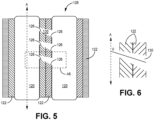
- FIG. 5 is a cross-sectional view of alternative preform 128.
- FIG. 6 is an enlarged view of area A6 of FIG. 5 showing an individual channel 130 of preform 128.
- Preform 128 is substantially similar to preform 28, except for the shape and orientation of channels 130.
- channels 130 extend at a non-orthogonal angle with respect to axis A. More specifically, angle ⁇ is greater than 90°, and can alternatively be less than 90° in another embodiment.
- Angled channels 130 can be achieved by staggering/offsetting each hole 126 in a respective pair of holes 126.
- Channels 130 are also shown as having a frustoconical cross-sectional shape, which can be achieved by making one hole 126 in a respective pair of holes 126 larger in at least one dimension than the corresponding hole 126.
- Other cross-sectional shapes e.g., cylindrical
- Angled and/or frustoconical channels can promote directional flow (e.g., for vortex formation) to improve cooling.
- each hole 26 and/or 126 can range from 0.254 mm to 5.08 mm (0.010 inches to 0.200 inches). As used herein, size can refer to a major dimension, such as radius for circular and elliptical holes 26, 126, or length of a straight segment for shapes such as square, rectangular, diamond, etc.
- preform 28, 128 undergoes matrix formation and densification using a chemical vapor infiltration or deposition (CVI or CVD) process.
- CVI or CVD chemical vapor infiltration or deposition
- sheets 22,122 are infiltrated by reactant vapors, and a gaseous precursor deposits on the fibers.
- the matrix material can be a silicon carbide or other suitable ceramic material. Densification is carried out until the resulting CMC has reached the desired residual porosity.
- Mandrels 20, 120 can also be physically or chemically removed post-densification, as well as any pins, if used, inserted in sheets 22, 122. Removing mandrels 20, 120 and pins 25 leaves cavities and passages within the finished workpiece for cooling airflow.
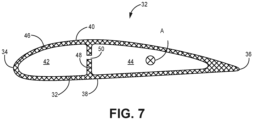
- FIG. 7 is a cross-sectional view of component 32, a CMC airfoil, formed using method 10.
- Component 32 extends longitudinally along axis A, which can be the same as the longitudinal axis of preform 28, 128.
- Component 32 includes leading edge 34, trailing edge 36, pressure side 38, and suction side 40.
- a leading edge cavity 42 is and trailing edge cavity 44 are defined by outer wall 46 and dividing wall 48.
- Each of leading edge cavity 42 and trailing edge cavity 44 represent the space at least partially occupied by mandrels 20, 120 during component preforming.
- Walls 46 and 48 are formed by the various sheets 22, 122 wrapped around mandrels 20, 120.
- any of walls 46 and 48 can have a wall thickness ranging from 0.508 mm to 1.524 mm (0.020 inches to 0.060 inches).
- Crossover channels 50 (only one is shown) in dividing wall 48 is equivalent to channels 30, 130 of preform 28, 128.
- a cooling airflow can be supplied to leading edge cavity 42 and/or trailing edge cavity 44 from an external source, and the cooling airflow can pass from the receiving cavity to the other cavity via crossover channels 50.
- Method 10 discussed above can include additional steps (inter-step or post processing) not shown in FIG. 1 .
- various post-processing steps can be performed, such as the application of one or more protective coatings, such an environmental and/or thermal barrier coatings.
- a bond coat can also be applied to facilitate bonding between the CMC and protective coating.
- Other protective coatings especially those suitable for use in a gas turbine engine environment, are contemplated herein.
- Various inter-step processes can also be performed, such as the application of a tackifier to sheets 22, 122 prior to or just after wrapping on mandrels 20. Other inter-step processes like surface preparation and cleaning are contemplated herein.
- alternative preform embodiments can include more than two mandrels to create additional cavities in component 32, as well as any combination of channels 30, 130 in a single embodiment.
- Channels can also be formed in other walls (e.g., outer wall) and structures in the composite component.
Landscapes
- Engineering & Computer Science (AREA)
- Chemical & Material Sciences (AREA)
- Mechanical Engineering (AREA)
- Materials Engineering (AREA)
- General Engineering & Computer Science (AREA)
- Ceramic Engineering (AREA)
- Manufacturing & Machinery (AREA)
- Composite Materials (AREA)
- Structural Engineering (AREA)
- Organic Chemistry (AREA)
- Chemical Kinetics & Catalysis (AREA)
- Turbine Rotor Nozzle Sealing (AREA)
Claims (11)
- Verfahren zum Ausbilden eines Verbundbauteils mit keramischer Matrix, das einen internen Kühlkreislauf aufweist, wobei das Verfahren Folgendes umfasst:Wickeln von mindestens einem ersten Blatt (22; 122) um einen ersten Dorn (20; 120);Wickeln von mindestens einem zweiten Blatt (22; 122) um einen zweiten Dorn (20; 120);Erzeugen einer ersten Vielzahl von Löchern (26; 126) in dem ersten Blatt (22; 122) entsprechend einer Vielzahl von Öffnungen (24; 124) in dem ersten Dorn (20; 120);Erzeugen einer zweiten Vielzahl von Löchern (26; 126) in dem zweiten Blatt (22; 122) entsprechend einer Vielzahl von Öffnungen (24; 124) in dem zweiten Dorn (20; 120);Ausrichten des ersten Dorns (20; 120) und des zweiten Dorns (20; 120);Wickeln von mindestens einem dritten Blatt (22; 122) um sowohl den ersten Dorn (20; 120) als auch den zweiten Dorn (20; 120),um einen Vorformling (28; 128) auszubilden, wobei der Vorformling (28; 128) jedes des ersten Blatts (22; 122), des zweiten Blatts (22; 122) und des dritten Blatts (22; 122) umfasst; undVerdichten des Vorformlings (28; 128), wobei das erste Blatt (22; 122), das zweite Blatt (22; 122) und das dritte Blatt (22; 122) aus einem keramischen Fasermaterial ausgebildet sind;dadurch gekennzeichnet, dass der Schritt des Ausrichtens des ersten Dorns (20; 120) und des zweiten Dorns (20; 120) derart ausgeführt wird, dass die erste Vielzahl von Löchern (26; 126) der zweiten Vielzahl von Löchern (26; 126) gegenüberliegt undmit ihr ausgerichtet ist, wodurch eine entsprechende Vielzahl von offenen Kanälen (30; 130) ausgebildet wird.
- Verfahren nach Anspruch 1, wobei das Verdichten des Vorformlings (28; 128) einen von einem Prozess der chemischen Dampfinfiltration (CVI) oder einem Prozess der chemischen Dampfabscheidung (CVD) umfasst.
- Verfahren nach Anspruch 1 oder 2, wobei mindestens eines der ersten Vielzahl von Löchern (26; 126) und mindestens eines der zweiten Vielzahl von Löchern (26; 126) eine Abmessung im Bereich von 0,254 mm bis 5,08 mm (0,010 Zoll bis 0,200 Zoll) aufweist und die Abmessung ein Durchmesser oder eine Länge ist.
- Verfahren nach Anspruch 3,
wobei die Abmessung des mindestens einen der ersten Vielzahl von Löchern (26; 126) kleiner als die Abmessung des entsprechenden der zweiten Vielzahl von Löchern (26, 126) ist. - Verfahren nach einem der vorhergehenden Ansprüche, wobei mindestens eines der ersten Vielzahl von Löchern (26) mit einem entsprechenden der zweiten Vielzahl von Löchern (26) ausgerichtet ist, um einen offenen Kanal (30) durch eine Innenwand eines Vorformlings (28) hindurch orthogonal zu einer Längsachse (A) des Vorformlings (28) auszubilden.
- Verfahren nach einem der Ansprüche 1 bis 4, wobei mindestens eines der ersten Vielzahl von Löchern (126) von einem entsprechenden der zweiten Vielzahl von Löchern (126) versetzt ist, um einen offenen Kanal (130) durch eine Innenwand eines Vorformlings (128) hindurch auszubilden, die von einer Längsachse (A) des Vorformlings (128) um weniger als 90° oder um mehr als 90° abgewinkelt ist.
- Verfahren nach einem der vorhergehenden Ansprüche, wobei der Schritt des Erzeugens der ersten Vielzahl von Löchern (26; 126) in dem ersten Blatt (22; 122) und der zweiten Vielzahl von Löchern (26; 126) in dem zweiten Blatt (22; 122) Folgendes umfasst:Entfernen einer Vielzahl von Abschnitten des ersten Blatts (22; 122) unter Verwendung einer Schneide- oder Stanztechnik, wobei die Vielzahl von Abschnitten der Vielzahl von Öffnungen (24; 124) in dem ersten Dorn (20; 120) entspricht; undEntfernen einer Vielzahl von Abschnitten des zweiten Blatts (22; 122) unter Verwendung der Schneide- oder Stanztechnik, wobei die Vielzahl von Abschnitten der Vielzahl von Öffnungen (24; 124) in dem zweiten Dorn (20; 120) entspricht.
- Verfahren nach einem der Ansprüche 1 bis 6, wobei der Schritt des Erzeugens einer ersten Vielzahl von Löchern (26; 126) in dem ersten Blatt (22; 122) und der zweiten Vielzahl von Löchern (26; 126) in dem zweiten Blatt (22; 122) Folgendes umfasst:Einführen eines Stifts (25) durch eine Vielzahl von Abschnitten des ersten Blatts (22; 122) hindurch, die der Vielzahl von Öffnungen (24; 124) in dem ersten Dorn (20; 120) entspricht; undEinführen eines Stifts (25) durch eine Vielzahl von Abschnitten des zweiten Blatts (22; 122) hindurch, die der Vielzahl von Öffnungen (24; 124) in dem zweiten Dorn (20; 120) entspricht.
- Verfahren nach Anspruch 8, wobei das Einführen des Stifts (25) durch die Vielzahl von Abschnitten des ersten Blatts (22; 122) und des zweiten Blatts (22; 122) hindurch Fasern jedes des ersten Blatts (22; 122) und des zweiten Blatts (22; 122) an einer Stelle des Stifts (25) auseinander drückt.
- Verfahren nach einem der vorhergehenden Ansprüche, ferner umfassend Entfernen des ersten Dorns (20; 120) und des zweiten Dorns (20; 120) aus dem Vorformling (28; 128).
- Verfahren nach einem der vorhergehenden Ansprüche, wobei das keramische Fasermaterial Siliziumkarbid umfasst.
Applications Claiming Priority (1)
| Application Number | Priority Date | Filing Date | Title |
|---|---|---|---|
| US17/339,198 US11608748B2 (en) | 2021-06-04 | 2021-06-04 | Preform crossovers for composite airfoils |
Publications (2)
| Publication Number | Publication Date |
|---|---|
| EP4098417A1 EP4098417A1 (de) | 2022-12-07 |
| EP4098417B1 true EP4098417B1 (de) | 2024-10-23 |
Family
ID=81346659
Family Applications (1)
| Application Number | Title | Priority Date | Filing Date |
|---|---|---|---|
| EP22169258.5A Active EP4098417B1 (de) | 2021-06-04 | 2022-04-21 | Verfahren zur herstellung eines verbundbauteils mit keramischer matrix und einem internen kühlkreislauf |
Country Status (2)
| Country | Link |
|---|---|
| US (1) | US11608748B2 (de) |
| EP (1) | EP4098417B1 (de) |
Families Citing this family (1)
| Publication number | Priority date | Publication date | Assignee | Title |
|---|---|---|---|---|
| US12473236B2 (en) * | 2023-10-20 | 2025-11-18 | Rtx Corporation | Internal tooling configuration for the creation of z-channels in woven ceramic matrix composite preforms |
Family Cites Families (19)
| Publication number | Priority date | Publication date | Assignee | Title |
|---|---|---|---|---|
| US5383566A (en) * | 1993-08-05 | 1995-01-24 | Edo Corporation, Fiber Science Division | Dual-chamber composite pressure vessel and method of fabrication thereof |
| US6884030B2 (en) * | 2002-12-20 | 2005-04-26 | General Electric Company | Methods and apparatus for securing multi-piece nozzle assemblies |
| US7600979B2 (en) * | 2006-11-28 | 2009-10-13 | General Electric Company | CMC articles having small complex features |
| ES2442873T3 (es) * | 2008-03-31 | 2014-02-14 | Alstom Technology Ltd | Perfil aerodinámico de turbina de gas |
| US9394798B2 (en) | 2013-04-02 | 2016-07-19 | Honeywell International Inc. | Gas turbine engines with turbine airfoil cooling |
| US10408084B2 (en) * | 2015-03-02 | 2019-09-10 | Rolls-Royce North American Technologies Inc. | Vane assembly for a gas turbine engine |
| US10465533B2 (en) | 2015-10-08 | 2019-11-05 | General Electric Company | Ceramic matrix composite component and process of producing a ceramic matrix composite component |
| US10260358B2 (en) | 2015-10-29 | 2019-04-16 | General Electric Company | Ceramic matrix composite component and process of producing a ceramic matrix composite component |
| US10458251B2 (en) * | 2016-04-15 | 2019-10-29 | General Electric Company | Airfoil cooling using non-line of sight holes |
| US10207471B2 (en) * | 2016-05-04 | 2019-02-19 | General Electric Company | Perforated ceramic matrix composite ply, ceramic matrix composite article, and method for forming ceramic matrix composite article |
| EP3381668B1 (de) * | 2017-03-31 | 2020-12-09 | Crompton Technology Group Limited | Welle aus faserverbundwerkstoff |
| US10370976B2 (en) * | 2017-08-17 | 2019-08-06 | United Technologies Corporation | Directional cooling arrangement for airfoils |
| US10774005B2 (en) | 2018-01-05 | 2020-09-15 | Raytheon Technologies Corporation | Needled ceramic matrix composite cooling passages |
| US10934854B2 (en) | 2018-09-11 | 2021-03-02 | General Electric Company | CMC component cooling cavities |
| US10724387B2 (en) * | 2018-11-08 | 2020-07-28 | Raytheon Technologies Corporation | Continuation of a shear tube through a vane platform for structural support |
| US11098608B2 (en) * | 2019-03-13 | 2021-08-24 | Raytheon Technologies Corporation | CMC BOAS with internal support structure |
| US11384028B2 (en) | 2019-05-03 | 2022-07-12 | Raytheon Technologies Corporation | Internal cooling circuits for CMC and method of manufacture |
| US11286792B2 (en) * | 2019-07-30 | 2022-03-29 | Rolls-Royce Plc | Ceramic matrix composite vane with cooling holes and methods of making the same |
| US11180999B2 (en) * | 2019-12-20 | 2021-11-23 | General Electric Company | Ceramic matrix composite component and method of producing a ceramic matrix composite component |
-
2021
- 2021-06-04 US US17/339,198 patent/US11608748B2/en active Active
-
2022
- 2022-04-21 EP EP22169258.5A patent/EP4098417B1/de active Active
Also Published As
| Publication number | Publication date |
|---|---|
| EP4098417A1 (de) | 2022-12-07 |
| US20220389822A1 (en) | 2022-12-08 |
| US11608748B2 (en) | 2023-03-21 |
Similar Documents
| Publication | Publication Date | Title |
|---|---|---|
| CN102782256B (zh) | 采用复合材料制成的涡轮发动机叶片和制造该叶片的方法 | |
| RU2608422C2 (ru) | Способ изготовления композитных лопаток турбинного двигателя со встроенными полками | |
| JP5599865B2 (ja) | 複合材料から作られるターボ機械ブレードを製造する方法 | |
| JP5996530B2 (ja) | 複数のターボ機械ブレードのセット、その製造方法、ターボ機械ディスク、およびターボ機械 | |
| US9802869B2 (en) | Method for manufacturing an oxide/oxide composite material turbomachine blade provided with internal channels | |
| JP6563423B2 (ja) | 複合材料で形成されたタービンエンジンベーンの製造方法、結果として得られるベーン、およびこのベーンを含むタービンエンジン | |
| CN102971135B (zh) | 具有互补的非对称几何形状的涡轮机组叶片 | |
| CN108367524B (zh) | 制造具有与一个或多个平台形成一体的主体的复合材料部件的方法 | |
| CN105593417B (zh) | 具有分组浮丝的纤维结构 | |
| JP2014518976A (ja) | 複合材料製の脚付きブレードを備えたターボ機械のロータ | |
| EP4427896A1 (de) | Verfahren zur dornentfernung mit komplexer geometrie von komponenten aus keramikmatrixverbundstoff | |
| EP4098417B1 (de) | Verfahren zur herstellung eines verbundbauteils mit keramischer matrix und einem internen kühlkreislauf | |
| US11905851B2 (en) | CMC trailing edge 3D weaved cross brace | |
| EP4086055B1 (de) | Verfahren zum erzeugen von kühllöchern in einem cmc-laminat | |
| CN116802046A (zh) | 用于制造具有集成附接凸耳和平台的由复合材料制成的叶片的方法 | |
| EP3760604B1 (de) | Verfahren zur bildung von kühlkanälen in einem keramischen matrixverbundbauteil | |
| EP4357114A1 (de) | Schwimmende werkzeuganordnung zur chemischen dampfinfiltration | |
| US11280200B2 (en) | Gas turbine blade | |
| EP4286127B1 (de) | Eine faserige vorform mit einer vielzahl von sanduhrförmigen hohlräumen | |
| EP4177052B1 (de) | 3d-gewebter raumfüller | |
| EP4541536A1 (de) | Werkzeugkonfiguration zur erzeugung von z-kanälen in vorformen aus gewebten keramischen matrixverbundstoff (cmc) | |
| EP4442856A2 (de) | Werkzeug zur chemischen dampfinfiltration zur optimierung der infiltration in keramikmatrixverbundstoffen | |
| EP4345185A1 (de) | Minimierung der werkzeuglochlänge bei der chemischen dampfinfiltration durch senkbohrungen | |
| EP4527581A1 (de) | Verformbarer dorn aus auxetischen material und verfahren zur herstellung von keramikmatrixverbundstoffkomponenten unter verwendung desselben | |
| EP4549146A1 (de) | Vorgeformte raumfüller für kleine querschnittmerkmale |
Legal Events
| Date | Code | Title | Description |
|---|---|---|---|
| PUAI | Public reference made under article 153(3) epc to a published international application that has entered the european phase |
Free format text: ORIGINAL CODE: 0009012 |
|
| STAA | Information on the status of an ep patent application or granted ep patent |
Free format text: STATUS: THE APPLICATION HAS BEEN PUBLISHED |
|
| AK | Designated contracting states |
Kind code of ref document: A1 Designated state(s): AL AT BE BG CH CY CZ DE DK EE ES FI FR GB GR HR HU IE IS IT LI LT LU LV MC MK MT NL NO PL PT RO RS SE SI SK SM TR |
|
| STAA | Information on the status of an ep patent application or granted ep patent |
Free format text: STATUS: REQUEST FOR EXAMINATION WAS MADE |
|
| 17P | Request for examination filed |
Effective date: 20230607 |
|
| RBV | Designated contracting states (corrected) |
Designated state(s): AL AT BE BG CH CY CZ DE DK EE ES FI FR GB GR HR HU IE IS IT LI LT LU LV MC MK MT NL NO PL PT RO RS SE SI SK SM TR |
|
| RAP3 | Party data changed (applicant data changed or rights of an application transferred) |
Owner name: RTX CORPORATION |
|
| GRAP | Despatch of communication of intention to grant a patent |
Free format text: ORIGINAL CODE: EPIDOSNIGR1 |
|
| STAA | Information on the status of an ep patent application or granted ep patent |
Free format text: STATUS: GRANT OF PATENT IS INTENDED |
|
| RIC1 | Information provided on ipc code assigned before grant |
Ipc: F01D 5/28 20060101ALI20240418BHEP Ipc: F01D 5/18 20060101ALI20240418BHEP Ipc: C04B 35/80 20060101ALI20240418BHEP Ipc: C04B 35/76 20060101ALI20240418BHEP Ipc: C04B 35/565 20060101ALI20240418BHEP Ipc: B28B 23/00 20060101ALI20240418BHEP Ipc: B28B 21/70 20060101ALI20240418BHEP Ipc: B28B 21/48 20060101ALI20240418BHEP Ipc: B28B 19/00 20060101ALI20240418BHEP Ipc: B28B 11/00 20060101ALI20240418BHEP Ipc: B28B 1/48 20060101ALI20240418BHEP Ipc: B28B 1/40 20060101AFI20240418BHEP |
|
| INTG | Intention to grant announced |
Effective date: 20240517 |
|
| GRAS | Grant fee paid |
Free format text: ORIGINAL CODE: EPIDOSNIGR3 |
|
| GRAA | (expected) grant |
Free format text: ORIGINAL CODE: 0009210 |
|
| STAA | Information on the status of an ep patent application or granted ep patent |
Free format text: STATUS: THE PATENT HAS BEEN GRANTED |
|
| AK | Designated contracting states |
Kind code of ref document: B1 Designated state(s): AL AT BE BG CH CY CZ DE DK EE ES FI FR GB GR HR HU IE IS IT LI LT LU LV MC MK MT NL NO PL PT RO RS SE SI SK SM TR |
|
| REG | Reference to a national code |
Ref country code: GB Ref legal event code: FG4D |
|
| REG | Reference to a national code |
Ref country code: CH Ref legal event code: EP |
|
| REG | Reference to a national code |
Ref country code: DE Ref legal event code: R096 Ref document number: 602022006971 Country of ref document: DE |
|
| REG | Reference to a national code |
Ref country code: IE Ref legal event code: FG4D |
|
| REG | Reference to a national code |
Ref country code: LT Ref legal event code: MG9D |
|
| REG | Reference to a national code |
Ref country code: NL Ref legal event code: MP Effective date: 20241023 |
|
| REG | Reference to a national code |
Ref country code: AT Ref legal event code: MK05 Ref document number: 1734486 Country of ref document: AT Kind code of ref document: T Effective date: 20241023 |
|
| PG25 | Lapsed in a contracting state [announced via postgrant information from national office to epo] |
Ref country code: NL Free format text: LAPSE BECAUSE OF FAILURE TO SUBMIT A TRANSLATION OF THE DESCRIPTION OR TO PAY THE FEE WITHIN THE PRESCRIBED TIME-LIMIT Effective date: 20241023 |
|
| PG25 | Lapsed in a contracting state [announced via postgrant information from national office to epo] |
Ref country code: NL Free format text: LAPSE BECAUSE OF FAILURE TO SUBMIT A TRANSLATION OF THE DESCRIPTION OR TO PAY THE FEE WITHIN THE PRESCRIBED TIME-LIMIT Effective date: 20241023 |
|
| PG25 | Lapsed in a contracting state [announced via postgrant information from national office to epo] |
Ref country code: IS Free format text: LAPSE BECAUSE OF FAILURE TO SUBMIT A TRANSLATION OF THE DESCRIPTION OR TO PAY THE FEE WITHIN THE PRESCRIBED TIME-LIMIT Effective date: 20250223 Ref country code: PT Free format text: LAPSE BECAUSE OF FAILURE TO SUBMIT A TRANSLATION OF THE DESCRIPTION OR TO PAY THE FEE WITHIN THE PRESCRIBED TIME-LIMIT Effective date: 20250224 Ref country code: HR Free format text: LAPSE BECAUSE OF FAILURE TO SUBMIT A TRANSLATION OF THE DESCRIPTION OR TO PAY THE FEE WITHIN THE PRESCRIBED TIME-LIMIT Effective date: 20241023 |
|
| PG25 | Lapsed in a contracting state [announced via postgrant information from national office to epo] |
Ref country code: FI Free format text: LAPSE BECAUSE OF FAILURE TO SUBMIT A TRANSLATION OF THE DESCRIPTION OR TO PAY THE FEE WITHIN THE PRESCRIBED TIME-LIMIT Effective date: 20241023 |
|
| PG25 | Lapsed in a contracting state [announced via postgrant information from national office to epo] |
Ref country code: BG Free format text: LAPSE BECAUSE OF FAILURE TO SUBMIT A TRANSLATION OF THE DESCRIPTION OR TO PAY THE FEE WITHIN THE PRESCRIBED TIME-LIMIT Effective date: 20241023 |
|
| PG25 | Lapsed in a contracting state [announced via postgrant information from national office to epo] |
Ref country code: ES Free format text: LAPSE BECAUSE OF FAILURE TO SUBMIT A TRANSLATION OF THE DESCRIPTION OR TO PAY THE FEE WITHIN THE PRESCRIBED TIME-LIMIT Effective date: 20241023 |
|
| PG25 | Lapsed in a contracting state [announced via postgrant information from national office to epo] |
Ref country code: NO Free format text: LAPSE BECAUSE OF FAILURE TO SUBMIT A TRANSLATION OF THE DESCRIPTION OR TO PAY THE FEE WITHIN THE PRESCRIBED TIME-LIMIT Effective date: 20250123 |
|
| PG25 | Lapsed in a contracting state [announced via postgrant information from national office to epo] |
Ref country code: LV Free format text: LAPSE BECAUSE OF FAILURE TO SUBMIT A TRANSLATION OF THE DESCRIPTION OR TO PAY THE FEE WITHIN THE PRESCRIBED TIME-LIMIT Effective date: 20241023 Ref country code: AT Free format text: LAPSE BECAUSE OF FAILURE TO SUBMIT A TRANSLATION OF THE DESCRIPTION OR TO PAY THE FEE WITHIN THE PRESCRIBED TIME-LIMIT Effective date: 20241023 Ref country code: GR Free format text: LAPSE BECAUSE OF FAILURE TO SUBMIT A TRANSLATION OF THE DESCRIPTION OR TO PAY THE FEE WITHIN THE PRESCRIBED TIME-LIMIT Effective date: 20250124 |
|
| PG25 | Lapsed in a contracting state [announced via postgrant information from national office to epo] |
Ref country code: PL Free format text: LAPSE BECAUSE OF FAILURE TO SUBMIT A TRANSLATION OF THE DESCRIPTION OR TO PAY THE FEE WITHIN THE PRESCRIBED TIME-LIMIT Effective date: 20241023 |
|
| PGFP | Annual fee paid to national office [announced via postgrant information from national office to epo] |
Ref country code: FR Payment date: 20250319 Year of fee payment: 4 |
|
| PG25 | Lapsed in a contracting state [announced via postgrant information from national office to epo] |
Ref country code: RS Free format text: LAPSE BECAUSE OF FAILURE TO SUBMIT A TRANSLATION OF THE DESCRIPTION OR TO PAY THE FEE WITHIN THE PRESCRIBED TIME-LIMIT Effective date: 20250123 |
|
| PG25 | Lapsed in a contracting state [announced via postgrant information from national office to epo] |
Ref country code: SM Free format text: LAPSE BECAUSE OF FAILURE TO SUBMIT A TRANSLATION OF THE DESCRIPTION OR TO PAY THE FEE WITHIN THE PRESCRIBED TIME-LIMIT Effective date: 20241023 |
|
| PGFP | Annual fee paid to national office [announced via postgrant information from national office to epo] |
Ref country code: DE Payment date: 20250319 Year of fee payment: 4 |
|
| PG25 | Lapsed in a contracting state [announced via postgrant information from national office to epo] |
Ref country code: DK Free format text: LAPSE BECAUSE OF FAILURE TO SUBMIT A TRANSLATION OF THE DESCRIPTION OR TO PAY THE FEE WITHIN THE PRESCRIBED TIME-LIMIT Effective date: 20241023 |
|
| PG25 | Lapsed in a contracting state [announced via postgrant information from national office to epo] |
Ref country code: EE Free format text: LAPSE BECAUSE OF FAILURE TO SUBMIT A TRANSLATION OF THE DESCRIPTION OR TO PAY THE FEE WITHIN THE PRESCRIBED TIME-LIMIT Effective date: 20241023 |
|
| PG25 | Lapsed in a contracting state [announced via postgrant information from national office to epo] |
Ref country code: RO Free format text: LAPSE BECAUSE OF FAILURE TO SUBMIT A TRANSLATION OF THE DESCRIPTION OR TO PAY THE FEE WITHIN THE PRESCRIBED TIME-LIMIT Effective date: 20241023 |
|
| REG | Reference to a national code |
Ref country code: DE Ref legal event code: R097 Ref document number: 602022006971 Country of ref document: DE |
|
| PG25 | Lapsed in a contracting state [announced via postgrant information from national office to epo] |
Ref country code: SK Free format text: LAPSE BECAUSE OF FAILURE TO SUBMIT A TRANSLATION OF THE DESCRIPTION OR TO PAY THE FEE WITHIN THE PRESCRIBED TIME-LIMIT Effective date: 20241023 |
|
| PG25 | Lapsed in a contracting state [announced via postgrant information from national office to epo] |
Ref country code: CZ Free format text: LAPSE BECAUSE OF FAILURE TO SUBMIT A TRANSLATION OF THE DESCRIPTION OR TO PAY THE FEE WITHIN THE PRESCRIBED TIME-LIMIT Effective date: 20241023 |
|
| PG25 | Lapsed in a contracting state [announced via postgrant information from national office to epo] |
Ref country code: IT Free format text: LAPSE BECAUSE OF FAILURE TO SUBMIT A TRANSLATION OF THE DESCRIPTION OR TO PAY THE FEE WITHIN THE PRESCRIBED TIME-LIMIT Effective date: 20241023 |
|
| PLBE | No opposition filed within time limit |
Free format text: ORIGINAL CODE: 0009261 |
|
| STAA | Information on the status of an ep patent application or granted ep patent |
Free format text: STATUS: NO OPPOSITION FILED WITHIN TIME LIMIT |
|
| PG25 | Lapsed in a contracting state [announced via postgrant information from national office to epo] |
Ref country code: SE Free format text: LAPSE BECAUSE OF FAILURE TO SUBMIT A TRANSLATION OF THE DESCRIPTION OR TO PAY THE FEE WITHIN THE PRESCRIBED TIME-LIMIT Effective date: 20241023 |
|
| 26N | No opposition filed |
Effective date: 20250724 |
|
| REG | Reference to a national code |
Ref country code: CH Ref legal event code: H13 Free format text: ST27 STATUS EVENT CODE: U-0-0-H10-H13 (AS PROVIDED BY THE NATIONAL OFFICE) Effective date: 20251125 |
|
| PG25 | Lapsed in a contracting state [announced via postgrant information from national office to epo] |
Ref country code: LU Free format text: LAPSE BECAUSE OF NON-PAYMENT OF DUE FEES Effective date: 20250421 |
|
| PG25 | Lapsed in a contracting state [announced via postgrant information from national office to epo] |
Ref country code: MC Free format text: LAPSE BECAUSE OF FAILURE TO SUBMIT A TRANSLATION OF THE DESCRIPTION OR TO PAY THE FEE WITHIN THE PRESCRIBED TIME-LIMIT Effective date: 20241023 |
|
| REG | Reference to a national code |
Ref country code: BE Ref legal event code: MM Effective date: 20250430 |
|
| PG25 | Lapsed in a contracting state [announced via postgrant information from national office to epo] |
Ref country code: BE Free format text: LAPSE BECAUSE OF NON-PAYMENT OF DUE FEES Effective date: 20250430 |
|
| PG25 | Lapsed in a contracting state [announced via postgrant information from national office to epo] |
Ref country code: CH Free format text: LAPSE BECAUSE OF NON-PAYMENT OF DUE FEES Effective date: 20250430 |