EP4098196A1 - Cognitive battery for return to service - Google Patents
Cognitive battery for return to service Download PDFInfo
- Publication number
- EP4098196A1 EP4098196A1 EP22177250.2A EP22177250A EP4098196A1 EP 4098196 A1 EP4098196 A1 EP 4098196A1 EP 22177250 A EP22177250 A EP 22177250A EP 4098196 A1 EP4098196 A1 EP 4098196A1
- Authority
- EP
- European Patent Office
- Prior art keywords
- pilot
- tests
- duty
- processor
- physiological event
- Prior art date
- Legal status (The legal status is an assumption and is not a legal conclusion. Google has not performed a legal analysis and makes no representation as to the accuracy of the status listed.)
- Withdrawn
Links
Images

Classifications
-
- A—HUMAN NECESSITIES
- A61—MEDICAL OR VETERINARY SCIENCE; HYGIENE
- A61B—DIAGNOSIS; SURGERY; IDENTIFICATION
- A61B5/00—Measuring for diagnostic purposes; Identification of persons
- A61B5/16—Devices for psychotechnics; Testing reaction times ; Devices for evaluating the psychological state
- A61B5/165—Evaluating the state of mind, e.g. depression, anxiety
-
- A—HUMAN NECESSITIES
- A61—MEDICAL OR VETERINARY SCIENCE; HYGIENE
- A61B—DIAGNOSIS; SURGERY; IDENTIFICATION
- A61B5/00—Measuring for diagnostic purposes; Identification of persons
- A61B5/16—Devices for psychotechnics; Testing reaction times ; Devices for evaluating the psychological state
- A61B5/18—Devices for psychotechnics; Testing reaction times ; Devices for evaluating the psychological state for vehicle drivers or machine operators
-
- A—HUMAN NECESSITIES
- A61—MEDICAL OR VETERINARY SCIENCE; HYGIENE
- A61B—DIAGNOSIS; SURGERY; IDENTIFICATION
- A61B5/00—Measuring for diagnostic purposes; Identification of persons
- A61B5/16—Devices for psychotechnics; Testing reaction times ; Devices for evaluating the psychological state
- A61B5/168—Evaluating attention deficit, hyperactivity
-
- A—HUMAN NECESSITIES
- A61—MEDICAL OR VETERINARY SCIENCE; HYGIENE
- A61B—DIAGNOSIS; SURGERY; IDENTIFICATION
- A61B5/00—Measuring for diagnostic purposes; Identification of persons
- A61B5/72—Signal processing specially adapted for physiological signals or for diagnostic purposes
- A61B5/7235—Details of waveform analysis
- A61B5/7264—Classification of physiological signals or data, e.g. using neural networks, statistical classifiers, expert systems or fuzzy systems
- A61B5/7267—Classification of physiological signals or data, e.g. using neural networks, statistical classifiers, expert systems or fuzzy systems involving training the classification device
-
- A—HUMAN NECESSITIES
- A61—MEDICAL OR VETERINARY SCIENCE; HYGIENE
- A61B—DIAGNOSIS; SURGERY; IDENTIFICATION
- A61B5/00—Measuring for diagnostic purposes; Identification of persons
- A61B5/72—Signal processing specially adapted for physiological signals or for diagnostic purposes
- A61B5/7271—Specific aspects of physiological measurement analysis
- A61B5/7282—Event detection, e.g. detecting unique waveforms indicative of a medical condition
-
- A—HUMAN NECESSITIES
- A61—MEDICAL OR VETERINARY SCIENCE; HYGIENE
- A61B—DIAGNOSIS; SURGERY; IDENTIFICATION
- A61B5/00—Measuring for diagnostic purposes; Identification of persons
- A61B5/74—Details of notification to user or communication with user or patient; User input means
- A61B5/746—Alarms related to a physiological condition, e.g. details of setting alarm thresholds or avoiding false alarms
-
- G—PHYSICS
- G16—INFORMATION AND COMMUNICATION TECHNOLOGY [ICT] SPECIALLY ADAPTED FOR SPECIFIC APPLICATION FIELDS
- G16H—HEALTHCARE INFORMATICS, i.e. INFORMATION AND COMMUNICATION TECHNOLOGY [ICT] SPECIALLY ADAPTED FOR THE HANDLING OR PROCESSING OF MEDICAL OR HEALTHCARE DATA
- G16H10/00—ICT specially adapted for the handling or processing of patient-related medical or healthcare data
- G16H10/20—ICT specially adapted for the handling or processing of patient-related medical or healthcare data for electronic clinical trials or questionnaires
-
- G—PHYSICS
- G16—INFORMATION AND COMMUNICATION TECHNOLOGY [ICT] SPECIALLY ADAPTED FOR SPECIFIC APPLICATION FIELDS
- G16H—HEALTHCARE INFORMATICS, i.e. INFORMATION AND COMMUNICATION TECHNOLOGY [ICT] SPECIALLY ADAPTED FOR THE HANDLING OR PROCESSING OF MEDICAL OR HEALTHCARE DATA
- G16H40/00—ICT specially adapted for the management or administration of healthcare resources or facilities; ICT specially adapted for the management or operation of medical equipment or devices
- G16H40/60—ICT specially adapted for the management or administration of healthcare resources or facilities; ICT specially adapted for the management or operation of medical equipment or devices for the operation of medical equipment or devices
- G16H40/63—ICT specially adapted for the management or administration of healthcare resources or facilities; ICT specially adapted for the management or operation of medical equipment or devices for the operation of medical equipment or devices for local operation
-
- G—PHYSICS
- G16—INFORMATION AND COMMUNICATION TECHNOLOGY [ICT] SPECIALLY ADAPTED FOR SPECIFIC APPLICATION FIELDS
- G16H—HEALTHCARE INFORMATICS, i.e. INFORMATION AND COMMUNICATION TECHNOLOGY [ICT] SPECIALLY ADAPTED FOR THE HANDLING OR PROCESSING OF MEDICAL OR HEALTHCARE DATA
- G16H50/00—ICT specially adapted for medical diagnosis, medical simulation or medical data mining; ICT specially adapted for detecting, monitoring or modelling epidemics or pandemics
- G16H50/20—ICT specially adapted for medical diagnosis, medical simulation or medical data mining; ICT specially adapted for detecting, monitoring or modelling epidemics or pandemics for computer-aided diagnosis, e.g. based on medical expert systems
-
- A—HUMAN NECESSITIES
- A61—MEDICAL OR VETERINARY SCIENCE; HYGIENE
- A61B—DIAGNOSIS; SURGERY; IDENTIFICATION
- A61B2503/00—Evaluating a particular growth phase or type of persons or animals
- A61B2503/20—Workers
- A61B2503/22—Motor vehicles operators, e.g. drivers, pilots, captains
-
- A—HUMAN NECESSITIES
- A61—MEDICAL OR VETERINARY SCIENCE; HYGIENE
- A61B—DIAGNOSIS; SURGERY; IDENTIFICATION
- A61B5/00—Measuring for diagnostic purposes; Identification of persons
- A61B5/72—Signal processing specially adapted for physiological signals or for diagnostic purposes
- A61B5/7235—Details of waveform analysis
- A61B5/7264—Classification of physiological signals or data, e.g. using neural networks, statistical classifiers, expert systems or fuzzy systems
-
- B—PERFORMING OPERATIONS; TRANSPORTING
- B64—AIRCRAFT; AVIATION; COSMONAUTICS
- B64D—EQUIPMENT FOR FITTING IN OR TO AIRCRAFT; FLIGHT SUITS; PARACHUTES; ARRANGEMENT OR MOUNTING OF POWER PLANTS OR PROPULSION TRANSMISSIONS IN AIRCRAFT
- B64D45/00—Aircraft indicators or protectors not otherwise provided for
Definitions
- inventive concepts are not limited in their application to the details of construction and the arrangement of the components or steps or methodologies set forth in the following description or illustrated in the drawings.
- inventive concepts disclosed herein may be practiced without these specific details.
- well-known features may not be described in detail to avoid unnecessarily complicating the instant disclosure.
- inventive concepts disclosed herein are capable of other embodiments or of being practiced or carried out in various ways. Also, it is to be understood that the phraseology and terminology employed herein is for the purpose of description and should not be regarded as limiting.
- a letter following a reference numeral is intended to reference an embodiment of the feature or element that may be similar, but not necessarily identical, to a previously described element or feature bearing the same reference numeral (e.g., 1, 1a, 1b).
- reference numeral e.g. 1, 1a, 1b
- Such shorthand notations are used for purposes of convenience only, and should not be construed to limit the inventive concepts disclosed herein in any way unless expressly stated to the contrary.
- any reference to "one embodiment,” or “some embodiments” means that a particular element, feature, structure, or characteristic described in connection with the embodiment is included in at least one embodiment of the inventive concepts disclosed herein.
- the appearances of the phrase “in some embodiments” in various places in the specification are not necessarily all referring to the same embodiment, and embodiments of the inventive concepts disclosed may include one or more of the features expressly described or inherently present herein, or any combination of sub-combination of two or more such features, along with any other features which may not necessarily be expressly described or inherently present in the instant disclosure.
- embodiments of the inventive concepts disclosed herein are directed to a computerized system for recognizing the need for cognitive tests due to a physiological event and administering such tests.
- the system offers the opportunity to automate pilot evaluation for single pilot operations, and to reduce the burden on a co-pilot.
- the cognitive tests may be specific to the physiological event, and may be compared to a pilot-specific profile when evaluating the results.
- Embodiments of the present disclosure may be more fully understood with reference to U.S. Patent App. No. 63/196,784 ("Physiological and Behavioural Methods to Assess Pilot Readiness") (filed June 4, 2021 ) and U.S. Patent App. No. 63/196,798 ("Embedding Sensors in an Aircraft Control") (filed June 4, 2021 ).
- the system 100 includes a cognitive evaluation system 102 including a processor and memory connected to the processor for embodying processor executable code.
- the cognitive evaluation system 102 is in data communication with a biometric monitoring system 104.
- the biometric monitoring system 104 includes a plurality of biometric monitoring sensors such as a pulse sensor, an O 2 sensor, an electroencephalogram sensor, an electrocardiogram sensor, one or more vision-based sensors, etc.
- the biometric monitoring system 104 may include a separate processor configured to pre-process inputs from the biometric sensors and deliver data streams to the cognitive evaluation system 102.
- the biometric monitoring system 104 continuously receives biometric data from a pilot 106.
- the cognitive evaluation system is configured to analyze the biometric data streams to identify physiological events in the pilot that may be impairing or incapacitating.
- the cognitive evaluation system 102 may identify hypoxia in the pilot 106 with reference to an O 2 sensor. It may be appreciated that electroencephalogram sensors and electrocardiogram sensors are highly sensitive to changes in the pilot's limbic system which may indicate changes to the pilot's cognitive state.
- the cognitive evaluation system 102 may send a signal to a pilot fitness alerting system 108 configured to provide a warning message to the pilot 106, other crew members, flight or ground control, etc. If the pilot 106 believes he or she is fit for duty, the cognitive evaluation system 102 may administer a set of tests to objectively determine if the pilot 106 is sufficiently unimpaired for duty.
- the cognitive evaluation system 102 identifies a set of tests specific to the physiological event.
- the cognitive evaluation system 102 administers the set of tests and receives responses from the pilot 106.
- the biometric monitoring system 104 is configured to monitor the pilot 106 while responding to the tests, and includes the received biometric data when evaluating test responses.
- the pilot fitness alerting system 108 reports the pilot's fitness for duty to the pilot and ground support.
- a processor in data communication with a plurality of biometric sensors continuously monitors 200 a pilot.
- the processor identifies 204 a set of tests specific to the physiological event and administers 206 the tests to the pilot.
- biometric data from the pilot is analyzed in concert with the test results to provide additional objective pilot fitness verification.
- the methodology of identifying a physiological event may comprise monitoring for certain biometric thresholds.
- identifying a physiological event may comprise a weighted analysis of multiple biometric factors such as via a trained neural network or other machine intelligence.
- identifying 204 a set of tests may comprise selecting a defined set of tests according to each identified physiological event, or selecting tests based on some machine intelligence implemented algorithm. Tests may be selected based on prior test responses or biometric data gathered during test administration, or both.
- the processor evaluates 208 the pilot's responses to determine the pilot's fitness for duty.
- Such evaluation 208 may be comprise a simple comparison of desired responses with actual responses.
- such evaluation 208 may comprise a weighted analysis of multiple biometric factors such as via a trained neural network or other machine intelligence, test responses, and response time. For example, a correct response to a simple question, accompanied by a biometric indication of extreme concentration and a long dwell time on the question, may indicate continued cognitive impairment.
- the processor sends 210 a signal to a pilot monitoring system which may send a message to the pilot, other crewmembers, and a ground or flight controller indicating the results of the evaluation 208.
- Embodiments of the present disclosure enable a computerized cognitive testing system to determine a pilot's mental capabilities after a physiological event.
- the system consists of a number of tests to evaluate particular cognitive functions. These tests can be selected to evaluate general functionality or can be chosen to be relevant to the physiological event.
- the system provides an objective measure of pilot cognitive capability, which would enable certain single pilot operations.
Landscapes
- Health & Medical Sciences (AREA)
- Engineering & Computer Science (AREA)
- Life Sciences & Earth Sciences (AREA)
- Medical Informatics (AREA)
- Public Health (AREA)
- Biomedical Technology (AREA)
- General Health & Medical Sciences (AREA)
- Physics & Mathematics (AREA)
- Pathology (AREA)
- Animal Behavior & Ethology (AREA)
- Heart & Thoracic Surgery (AREA)
- Molecular Biology (AREA)
- Biophysics (AREA)
- Surgery (AREA)
- Veterinary Medicine (AREA)
- Psychiatry (AREA)
- Artificial Intelligence (AREA)
- Developmental Disabilities (AREA)
- Physiology (AREA)
- Social Psychology (AREA)
- Psychology (AREA)
- Hospice & Palliative Care (AREA)
- Educational Technology (AREA)
- Child & Adolescent Psychology (AREA)
- Epidemiology (AREA)
- Primary Health Care (AREA)
- Signal Processing (AREA)
- Computer Vision & Pattern Recognition (AREA)
- Mathematical Physics (AREA)
- Evolutionary Computation (AREA)
- Fuzzy Systems (AREA)
- Data Mining & Analysis (AREA)
- Databases & Information Systems (AREA)
- Business, Economics & Management (AREA)
- General Business, Economics & Management (AREA)
- Measurement And Recording Of Electrical Phenomena And Electrical Characteristics Of The Living Body (AREA)
- Measuring And Recording Apparatus For Diagnosis (AREA)
- Measurement Of The Respiration, Hearing Ability, Form, And Blood Characteristics Of Living Organisms (AREA)
Abstract
Description
- The present application claims the benefit under 35 U.S.C. § 119(e) of
U.S. Provisional App. No. 63/196,765 (filed June 4, 2021 - Currently, the ability of a pilot to return to service after a physiological event is determined by a co-pilot. That methodology is slow, subjective, prone to human error, and places an additional burden on the co-pilot at precisely the time when that additional burden is unsupportable. Furthermore, during single pilot operations, there is no individual that can administer a cognitive test for return to service.
- The numerous advantages of the embodiments of the inventive concepts disclosed herein may be better understood by those skilled in the art by reference to the accompanying figures in which:
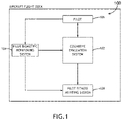
- FIG. 1
- shows a block diagram of pilot monitoring system according to an exemplary embodiment;
- FIG. 2
- shows a flowchart of a pilot monitoring process according to an exemplary embodiment;
- Before explaining at least one embodiment of the inventive concepts disclosed herein in detail, it is to be understood that the inventive concepts are not limited in their application to the details of construction and the arrangement of the components or steps or methodologies set forth in the following description or illustrated in the drawings. In the following detailed description of embodiments of the instant inventive concepts, numerous specific details are set forth in order to provide a more thorough understanding of the inventive concepts. However, it will be apparent to one of ordinary skill in the art having the benefit of the instant disclosure that the inventive concepts disclosed herein may be practiced without these specific details. In other instances, well-known features may not be described in detail to avoid unnecessarily complicating the instant disclosure. The inventive concepts disclosed herein are capable of other embodiments or of being practiced or carried out in various ways. Also, it is to be understood that the phraseology and terminology employed herein is for the purpose of description and should not be regarded as limiting.
- As used herein a letter following a reference numeral is intended to reference an embodiment of the feature or element that may be similar, but not necessarily identical, to a previously described element or feature bearing the same reference numeral (e.g., 1, 1a, 1b). Such shorthand notations are used for purposes of convenience only, and should not be construed to limit the inventive concepts disclosed herein in any way unless expressly stated to the contrary.
- Further, unless expressly stated to the contrary, "or" refers to an inclusive or and not to an exclusive or. For example, a condition A or B is satisfied by anyone of the following: A is true (or present) and B is false (or not present), A is false (or not present) and B is true (or present), and both A and B are true (or present).
- In addition, use of the "a" or "an" are employed to describe elements and components of embodiments of the instant inventive concepts. This is done merely for convenience and to give a general sense of the inventive concepts, and "a" and "an" are intended to include one or at least one and the singular also includes the plural unless it is obvious that it is meant otherwise.
- Finally, as used herein any reference to "one embodiment," or "some embodiments" means that a particular element, feature, structure, or characteristic described in connection with the embodiment is included in at least one embodiment of the inventive concepts disclosed herein. The appearances of the phrase "in some embodiments" in various places in the specification are not necessarily all referring to the same embodiment, and embodiments of the inventive concepts disclosed may include one or more of the features expressly described or inherently present herein, or any combination of sub-combination of two or more such features, along with any other features which may not necessarily be expressly described or inherently present in the instant disclosure.
- Broadly, embodiments of the inventive concepts disclosed herein are directed to a computerized system for recognizing the need for cognitive tests due to a physiological event and administering such tests. The system offers the opportunity to automate pilot evaluation for single pilot operations, and to reduce the burden on a co-pilot. The cognitive tests may be specific to the physiological event, and may be compared to a pilot-specific profile when evaluating the results.
- Embodiments of the present disclosure may be more fully understood with reference to
U.S. Patent App. No. 63/196,784 ("Physiological and Behavioural Methods to Assess Pilot Readiness") (filed June 4, 2021 U.S. Patent App. No. 63/196,798 ("Embedding Sensors in an Aircraft Control") (filed June 4, 2021 - Referring to
FIG. 1 , a block diagram ofpilot monitoring system 100 according to an exemplary embodiment is shown. Thesystem 100 includes acognitive evaluation system 102 including a processor and memory connected to the processor for embodying processor executable code. Thecognitive evaluation system 102 is in data communication with abiometric monitoring system 104. Thebiometric monitoring system 104 includes a plurality of biometric monitoring sensors such as a pulse sensor, an O2 sensor, an electroencephalogram sensor, an electrocardiogram sensor, one or more vision-based sensors, etc. In at least one embodiment, thebiometric monitoring system 104 may include a separate processor configured to pre-process inputs from the biometric sensors and deliver data streams to thecognitive evaluation system 102. - The
biometric monitoring system 104 continuously receives biometric data from apilot 106. The cognitive evaluation system is configured to analyze the biometric data streams to identify physiological events in the pilot that may be impairing or incapacitating. For example, thecognitive evaluation system 102 may identify hypoxia in thepilot 106 with reference to an O2 sensor. It may be appreciated that electroencephalogram sensors and electrocardiogram sensors are highly sensitive to changes in the pilot's limbic system which may indicate changes to the pilot's cognitive state. - Upon identifying a physiological event that may impair or incapacitate the
pilot 106, thecognitive evaluation system 102 may send a signal to a pilotfitness alerting system 108 configured to provide a warning message to thepilot 106, other crew members, flight or ground control, etc. If thepilot 106 believes he or she is fit for duty, thecognitive evaluation system 102 may administer a set of tests to objectively determine if thepilot 106 is sufficiently unimpaired for duty. - In at least one embodiment, the
cognitive evaluation system 102 identifies a set of tests specific to the physiological event. Thecognitive evaluation system 102 administers the set of tests and receives responses from thepilot 106. In at least one embodiment, thebiometric monitoring system 104 is configured to monitor thepilot 106 while responding to the tests, and includes the received biometric data when evaluating test responses. - After the tests are administered, the pilot
fitness alerting system 108 reports the pilot's fitness for duty to the pilot and ground support. - Referring to
FIG. 2 , a flowchart of a pilot monitoring process according to an exemplary embodiment is shown. A processor in data communication with a plurality of biometric sensors continuously monitors 200 a pilot. When a physiological event is identified 202, the processor identifies 204 a set of tests specific to the physiological event and administers 206 the tests to the pilot. In at least one embodiment, biometric data from the pilot is analyzed in concert with the test results to provide additional objective pilot fitness verification. - In at least one embodiment, the methodology of identifying a physiological event may comprise monitoring for certain biometric thresholds. Alternatively, or in addition, identifying a physiological event may comprise a weighted analysis of multiple biometric factors such as via a trained neural network or other machine intelligence. Likewise, identifying 204 a set of tests may comprise selecting a defined set of tests according to each identified physiological event, or selecting tests based on some machine intelligence implemented algorithm. Tests may be selected based on prior test responses or biometric data gathered during test administration, or both.
- The processor evaluates 208 the pilot's responses to determine the pilot's fitness for duty.
Such evaluation 208 may be comprise a simple comparison of desired responses with actual responses. Alternatively,such evaluation 208 may comprise a weighted analysis of multiple biometric factors such as via a trained neural network or other machine intelligence, test responses, and response time. For example, a correct response to a simple question, accompanied by a biometric indication of extreme concentration and a long dwell time on the question, may indicate continued cognitive impairment. - In at least one embodiment, the processor sends 210 a signal to a pilot monitoring system which may send a message to the pilot, other crewmembers, and a ground or flight controller indicating the results of the
evaluation 208. - Embodiments of the present disclosure enable a computerized cognitive testing system to determine a pilot's mental capabilities after a physiological event. The system consists of a number of tests to evaluate particular cognitive functions. These tests can be selected to evaluate general functionality or can be chosen to be relevant to the physiological event. The system provides an objective measure of pilot cognitive capability, which would enable certain single pilot operations.
- It is believed that the inventive concepts disclosed herein and many of their attendant advantages will be understood by the foregoing description of embodiments of the inventive concepts disclosed, and it will be apparent that various changes may be made in the form, construction, and arrangement of the components thereof without departing from the broad scope of the inventive concepts disclosed herein or without sacrificing all of their material advantages; and individual features from various embodiments may be combined to arrive at other embodiments. The form herein before described being merely an explanatory embodiment thereof, it is the intention of the following claims to encompass and include such changes. Furthermore, any of the features disclosed in relation to any of the individual embodiments may be incorporated into any other embodiment.
Claims (15)
- A computer apparatus comprising:a pilot display device;a pilot input device; andat least one processor in data communication with a plurality of biometric sensors, the pilot display device, the pilot input device, and a memory storing processor executable code for configuring the at least one processor to:continuously receive data streams (200) from each of the biometric sensors;identify (202) a physiological event of a pilot based on the data streams;retrieve a set of tests to evaluate a cognitive state of the pilot;administer (206) the set of tests to the pilot and receive corresponding responses; anddetermine the pilot's cognitive fitness for duty based on the pilot's responses to the set of tests.
- The computer apparatus of Claim 1, wherein the at least one processor is further configured to communicate the determined fitness for duty to the pilot and a ground controller.
- The computer apparatus of Claim 1 or 2, wherein the at least one processor is further configured to:a. alert the pilot of the physiological event; andb. receive an affirmation from the pilot that the pilot is fit for duty prior to administering the set of tests.
- The computer apparatus of any preceding Claim, wherein retrieving the set of tests comprises identifying a set of tests specific to the identified physiological event.
- The computer apparatus of any preceding Claim, wherein the at least one processor is further configured to continuously receive data streams from each of the biometric sensors while administering the set of tests, and optionally wherein determining the pilot's cognitive fitness for duty further comprises monitoring the data streams during the pilot responses to the set of tests, or wherein at least one of the at least one processors is configured to instantiate a trained neural network to identify the physiological event and determine the pilot's cognitive fitness for duty.
- A method for evaluating pilot readiness comprising:i. continuously receiving data streams from each of the biometric sensors;ii. identifying a physiological event of a pilot based on the data streams;iii. alerting the pilot of the physiological event;iv. receiving an affirmation from the pilot that the pilot is fit for duty prior to administering the set of tests;v. retrieving a set of tests to evaluate a cognitive state of the pilot;vi. administering the set of tests to the pilot and receive corresponding responses; andvii. determining the pilot's cognitive fitness for duty based on the pilot's responses to the set of tests.
- The method of Claim 6, further comprising communicating the determined fitness for duty to the pilot and a ground controller.
- The method of Claim 6 or 7, wherein retrieving the set of tests comprises identifying a set of tests specific to the identified physiological event.
- The method of any of Claims 6 to 8, further comprising continuously receiving data streams from each of the biometric sensors while administering the set of tests, and optionally wherein determining the pilot's cognitive fitness for duty further comprises monitoring the data streams during the pilot responses to the set of tests.
- The method of any of Claims 6 to 9, further comprising instantiating a trained neural network to identify the physiological event and determine the pilot's cognitive fitness for duty.
- A system for evaluating pilot readiness comprising:a. a plurality of biometric sensors;b. a pilot display device;c. a pilot input device; andd. at least one processor in data communication with the plurality of biometric sensors, the pilot display device, the pilot input device, and a memory storing processor executable code for configuring the at least one processor to:i. continuously receive data streams from each of the biometric sensors;ii. identify a physiological event of a pilot based on the data streams;iii. retrieve a set of tests to evaluate a cognitive state of the pilot;iv. administer the set of tests to the pilot and receive corresponding responses; andv. determine the pilot's cognitive fitness for duty based on the pilot's responses to the set of tests.
- The system of Claim 11, wherein the at least one processor is further configured to communicate the determined fitness for duty to the pilot and a ground controller, or wherein the at least one processor is further configured to:e. alert the pilot of the physiological event; andf. receive an affirmation from the pilot that the pilot is fit for duty prior to administering the set of tests.
- The system of Claim 11 or 12, wherein retrieving the set of tests comprises identifying a set of tests specific to the identified physiological event.
- The system of any of Claims 11 to 13, wherein the at least one processor is further configured to continuously receive data streams from each of the biometric sensors while administering the set of tests, and optionally wherein determining the pilot's cognitive fitness for duty further comprises monitoring the data streams during the pilot responses to the set of tests.
- The system of any of Claims 11 to 14, wherein the at least one processor is further configured to instantiate a trained neural network to identify the physiological event and determine the pilot's cognitive fitness for duty.
Applications Claiming Priority (2)
| Application Number | Priority Date | Filing Date | Title |
|---|---|---|---|
| US202163196765P | 2021-06-04 | 2021-06-04 | |
| US17/749,299 US12042289B2 (en) | 2021-06-04 | 2022-05-20 | Cognitive battery for return to service |
Publications (1)
| Publication Number | Publication Date |
|---|---|
| EP4098196A1 true EP4098196A1 (en) | 2022-12-07 |
Family
ID=81940445
Family Applications (1)
| Application Number | Title | Priority Date | Filing Date |
|---|---|---|---|
| EP22177250.2A Withdrawn EP4098196A1 (en) | 2021-06-04 | 2022-06-03 | Cognitive battery for return to service |
Country Status (2)
| Country | Link |
|---|---|
| US (1) | US12042289B2 (en) |
| EP (1) | EP4098196A1 (en) |
Citations (4)
| Publication number | Priority date | Publication date | Assignee | Title |
|---|---|---|---|---|
| US20190080802A1 (en) * | 2017-09-12 | 2019-03-14 | Duro Health, LLC | Sensor fusion of physiological and machine-interface factors as a biometric |
| US20190090800A1 (en) * | 2017-09-22 | 2019-03-28 | Aurora Flight Sciences Corporation | Systems and Methods for Monitoring Pilot Health |
| US10376198B1 (en) * | 2017-11-10 | 2019-08-13 | Rockwell Collins, Inc. | Pilot fatigue and attention tunneling using biometric monitoring |
| US20210034053A1 (en) * | 2019-07-30 | 2021-02-04 | The Boeing Company | Pilot Health and Alertness Monitoring, Communication and Safeguarding |
Family Cites Families (9)
| Publication number | Priority date | Publication date | Assignee | Title |
|---|---|---|---|---|
| US8289172B2 (en) * | 2005-03-24 | 2012-10-16 | Matos Jeffrey A | Method and system of aircraft pilot assessment and for remedial action upon pilot impairment |
| GB2412188A (en) | 2003-09-08 | 2005-09-21 | Secr Defence | Driver impairment test |
| US10192173B2 (en) | 2010-07-02 | 2019-01-29 | The United States Of America As Represented By The Administrator Of The National Aeronautics And Space Administration | System and method for training of state-classifiers |
| US20130018592A1 (en) | 2011-07-15 | 2013-01-17 | Pulsar Informatics, Inc. | Systems and Methods for Inter-Population Neurobehavioral Status Assessment Using Profiles Adjustable to Testing Conditions |
| CA2936507C (en) | 2014-01-10 | 2022-03-15 | Carleton Life Support Systems, Inc. | Reduced cognitive function detection and alleviation system for a pilot |
| US10328852B2 (en) * | 2015-05-12 | 2019-06-25 | University Of North Dakota | Systems and methods to provide feedback to pilot/operator by utilizing integration of navigation and physiological monitoring |
| US11807090B2 (en) * | 2020-03-17 | 2023-11-07 | GM Global Technology Operations LLC | Motor vehicle with cognitive response test system for preemptively detecting potential driver impairment |
| JP7851548B2 (en) * | 2020-04-28 | 2026-04-27 | ストロング フォース ティーピー ポートフォリオ 2022,エルエルシー | Digital twin system and method for transport systems |
| US11518408B2 (en) * | 2020-11-13 | 2022-12-06 | Toyota Research Institute, Inc. | Predictive impairment monitor system and method |
-
2022
- 2022-05-20 US US17/749,299 patent/US12042289B2/en active Active
- 2022-06-03 EP EP22177250.2A patent/EP4098196A1/en not_active Withdrawn
Patent Citations (4)
| Publication number | Priority date | Publication date | Assignee | Title |
|---|---|---|---|---|
| US20190080802A1 (en) * | 2017-09-12 | 2019-03-14 | Duro Health, LLC | Sensor fusion of physiological and machine-interface factors as a biometric |
| US20190090800A1 (en) * | 2017-09-22 | 2019-03-28 | Aurora Flight Sciences Corporation | Systems and Methods for Monitoring Pilot Health |
| US10376198B1 (en) * | 2017-11-10 | 2019-08-13 | Rockwell Collins, Inc. | Pilot fatigue and attention tunneling using biometric monitoring |
| US20210034053A1 (en) * | 2019-07-30 | 2021-02-04 | The Boeing Company | Pilot Health and Alertness Monitoring, Communication and Safeguarding |
Also Published As
| Publication number | Publication date |
|---|---|
| US20220386916A1 (en) | 2022-12-08 |
| US12042289B2 (en) | 2024-07-23 |
Similar Documents
| Publication | Publication Date | Title |
|---|---|---|
| CN113994403B (en) | Mitigating operational risk of aircraft | |
| US10376198B1 (en) | Pilot fatigue and attention tunneling using biometric monitoring | |
| US20230389840A1 (en) | Systems and methods for non-intrusive deception detection | |
| US20160042658A1 (en) | System and method to provide career counseling and management using biofeedback | |
| US20090082692A1 (en) | System And Method For The Real-Time Evaluation Of Time-Locked Physiological Measures | |
| US11045126B2 (en) | System and a method for enabling responsive cognitive behavioral therapy | |
| Jiang et al. | Correlation Evaluation of Pilots’ Situation Awareness in Bridge Simulations via Eye‐Tracking Technology | |
| KR102528032B1 (en) | Method and system for checking fatigue of pilot before flying | |
| EP4098195A1 (en) | Physiological and behavioural methods to assess pilot readiness | |
| CN105282502B (en) | Air traffic controller's fatigue detection method based on confidence interval, device and system | |
| US12042289B2 (en) | Cognitive battery for return to service | |
| EP3716151A1 (en) | Stress monitor and stress-monitoring method | |
| EP4483788A1 (en) | Pupil dynamics, physiology, and context for estimating vigilance | |
| US20180153457A1 (en) | Detection of physiological state using thermal image analysis | |
| EP4485149A1 (en) | Pupil dynamics, physiology, and performance for estimating competency in situational awareness | |
| CN112382053A (en) | Method and system for monitoring the fatigue state of a crew member of an aircraft | |
| WO2024238823A1 (en) | Apparatus and method for detecting infection using breath | |
| KR102248796B1 (en) | Method and device of predicting user's decision | |
| US20220188737A1 (en) | System for determining an operational state of an aircrew according to an adaptive task plan and associated method | |
| Smith et al. | Dissociable effects of fatigue on performance and metacognition from automatic target cuing in undersea threat detection | |
| Iordache et al. | The Assessment of Mental Load of Air Traffic Controllers Based on Psychophysiological Indicators | |
| US20210338125A1 (en) | Lie Detector Based on Monitoring of Pupil Dilation | |
| CN110801205A (en) | Human body data monitoring method based on Internet technology | |
| Naeeri et al. | Multimodal Analysis of Eye Movements and Fatigue in a Simulated Glass Cockpit Environment. Aerospace 2021, 8, 283 | |
| EP4485393A1 (en) | Eye tracking, physiology for shared situational awareness |
Legal Events
| Date | Code | Title | Description |
|---|---|---|---|
| PUAI | Public reference made under article 153(3) epc to a published international application that has entered the european phase |
Free format text: ORIGINAL CODE: 0009012 |
|
| STAA | Information on the status of an ep patent application or granted ep patent |
Free format text: STATUS: THE APPLICATION HAS BEEN PUBLISHED |
|
| AK | Designated contracting states |
Kind code of ref document: A1 Designated state(s): AL AT BE BG CH CY CZ DE DK EE ES FI FR GB GR HR HU IE IS IT LI LT LU LV MC MK MT NL NO PL PT RO RS SE SI SK SM TR |
|
| STAA | Information on the status of an ep patent application or granted ep patent |
Free format text: STATUS: REQUEST FOR EXAMINATION WAS MADE |
|
| 17P | Request for examination filed |
Effective date: 20230606 |
|
| RBV | Designated contracting states (corrected) |
Designated state(s): AL AT BE BG CH CY CZ DE DK EE ES FI FR GB GR HR HU IE IS IT LI LT LU LV MC MK MT NL NO PL PT RO RS SE SI SK SM TR |
|
| RIC1 | Information provided on ipc code assigned before grant |
Ipc: G16H 50/20 20180101ALI20230626BHEP Ipc: G16H 40/63 20180101ALI20230626BHEP Ipc: G16H 10/20 20180101ALI20230626BHEP Ipc: B64D 45/00 20060101ALI20230626BHEP Ipc: G16H 50/00 20180101ALI20230626BHEP Ipc: B64D 43/00 20060101ALI20230626BHEP Ipc: A61B 5/00 20060101ALI20230626BHEP Ipc: A61B 5/16 20060101AFI20230626BHEP |
|
| STAA | Information on the status of an ep patent application or granted ep patent |
Free format text: STATUS: EXAMINATION IS IN PROGRESS |
|
| 17Q | First examination report despatched |
Effective date: 20230825 |
|
| STAA | Information on the status of an ep patent application or granted ep patent |
Free format text: STATUS: THE APPLICATION HAS BEEN WITHDRAWN |
|
| 18W | Application withdrawn |
Effective date: 20260304 |