EP4097632B1 - Verfahren zur erzeugung von trainingsdaten für ein bot-detektormodul, bot-detektormodul, das anhand von durch das verfahren erzeugten trainingsdaten trainiert wird, und bot-detektionssystem - Google Patents
Verfahren zur erzeugung von trainingsdaten für ein bot-detektormodul, bot-detektormodul, das anhand von durch das verfahren erzeugten trainingsdaten trainiert wird, und bot-detektionssystem Download PDFInfo
- Publication number
- EP4097632B1 EP4097632B1 EP21702262.3A EP21702262A EP4097632B1 EP 4097632 B1 EP4097632 B1 EP 4097632B1 EP 21702262 A EP21702262 A EP 21702262A EP 4097632 B1 EP4097632 B1 EP 4097632B1
- Authority
- EP
- European Patent Office
- Prior art keywords
- training
- signal
- data
- synthetic
- training data
- Prior art date
- Legal status (The legal status is an assumption and is not a legal conclusion. Google has not performed a legal analysis and makes no representation as to the accuracy of the status listed.)
- Active
Links
Images




Classifications
-
- G—PHYSICS
- G06—COMPUTING OR CALCULATING; COUNTING
- G06V—IMAGE OR VIDEO RECOGNITION OR UNDERSTANDING
- G06V40/00—Recognition of biometric, human-related or animal-related patterns in image or video data
- G06V40/20—Movements or behaviour, e.g. gesture recognition
-
- G—PHYSICS
- G06—COMPUTING OR CALCULATING; COUNTING
- G06F—ELECTRIC DIGITAL DATA PROCESSING
- G06F18/00—Pattern recognition
- G06F18/20—Analysing
- G06F18/21—Design or setup of recognition systems or techniques; Extraction of features in feature space; Blind source separation
- G06F18/214—Generating training patterns; Bootstrap methods, e.g. bagging or boosting
-
- G—PHYSICS
- G06—COMPUTING OR CALCULATING; COUNTING
- G06V—IMAGE OR VIDEO RECOGNITION OR UNDERSTANDING
- G06V10/00—Arrangements for image or video recognition or understanding
- G06V10/70—Arrangements for image or video recognition or understanding using pattern recognition or machine learning
- G06V10/82—Arrangements for image or video recognition or understanding using pattern recognition or machine learning using neural networks
-
- G—PHYSICS
- G06—COMPUTING OR CALCULATING; COUNTING
- G06V—IMAGE OR VIDEO RECOGNITION OR UNDERSTANDING
- G06V40/00—Recognition of biometric, human-related or animal-related patterns in image or video data
- G06V40/40—Spoof detection, e.g. liveness detection
Definitions
- Patent Application no. P202030066 This description is related to Internet Bot detection methods, more specifically to detection methods based on human interaction with devices and to the training of models from real and synthetic data.
- CAPTCHA The most popular anti-fraud method to distinguish whether the interaction with a device is performed by a human is known as CAPTCHA, from "Completely Automated Public Turing test to tell Computer and Humans Apart".
- CAPTCHA comprises algorithms that determine whether a speaker on the device is human, through challenges associated with human cognitive abilities, i.e., information processing skills involving the use of memory, attention, perception, creativity and abstract or analogical thinking.
- Some examples of CAPTCHA are: object identification, character recognition in distorted images, translation of distorted audio, etc.
- malware has evolved, thanks largely to new Deep Learning techniques, and has adapted to be able to circumvent security countermeasures such as CAPTCHA.
- Bots autonomous computer programs that carry out specific tasks through a set of instructions programmed in any type of language, have become complex and capable of generating behavior that imitates or simulates human behavior very precisely. Such bots are difficult to detect or avoid using current methods such as blocking IP addresses, among others.
- This description defines a method of detecting bots based on the analysis of an interaction with mobile devices. This is done by processing a signal from at least one sensor integrated in a device by means of a detection algorithm previously trained with real samples of human interaction.
- the detection algorithm allows determining if the signal, product of the interaction, has been generated from a human interaction or if it has been synthetically generated by a bot.
- a method of training the detection algorithm through real and synthetic interaction samples is also proposed.
- the generation of synthetic samples is performed through a previously trained generation method based on adverse generative neural networks and through generation methods based on the observation and characterization of real signals.
- Generative Adversarial Networks GAN have been used in the prior art for generating synthetic data.
- the present disclosure proposes the use of GAN within the specific field of bot detection tracking or monitoring mobile device interaction.
- the GAN of the present disclosure are trained by tracking or monitoring or analyzing the actions performed on a screen of a user device, such as a smartphone or tablet.
- the actions monitored or tracked may comprise touching a touchscreen, swiping on the screen, human gestures performed under the field of view of a camera installed in the user device, such as the front or rear camera of a smartphone.
- a method to generate training data for a bot detector module through human interaction with a mobile device comprises receiving at least one signal generated by at least one sensor integrated into the mobile device, with the signal being at least one signal generated during the interaction of a human with the mobile device.
- the method also comprises calculating scalar and/or time variables of at least one sensor-generated signal that characterize human behavior, thus providing real training data and generating training data comprising at least the real training data.
- biomechanical and contextual aspects are taken into account in order to more accurately and/or realistically model human interactions. Therefore, the learning data are more complete, which improves the quality of the training of the detector modules, increasing the security of the accesses through the devices (either locally or through the Internet) and improving the usability with respect to traditional detection techniques based, for example, on solving puzzles or cognitive tasks.
- Training data comprising real training data therefore improves the detection of bots. By comprising more complex signals, they are more difficult for bots to mimic, so detection modules trained with real training data in a more reliable manner against non-human interactions, thus increasing security and confidence in digital environments.
- the use of sensors integrated into the device allows the acquisition of real training data in a more affordable way, since neither specific nor complex device is required to obtain the real training data.
- a mobile device such as a smartphone or tablet makes the acquisition a quick and simple task, since it is a device of common use and does not require special skills.
- the method comprises synthesizing at least one signal that models human behavior, so that synthetic training data may be generated.
- the function allows the generation of an unlimited number of synthetic signals with characteristics similar to those that would be generated during a real human interaction. Synthesizing at least one signal that models human behavior does not require training.
- the operation may be based on heuristic functions obtained from a study of signals generated by humans, such as statistics, and functions that allow to model, for example, spatial trajectory and velocity of a gestures, e.g. Gaussian, linear, exponential, polynomial functions.
- a detector module may be trained with two types of data: real and synthetic. That is, detectors may be trained by including data similar to that which would try to avoid being discriminated or classified as non-human by the discriminator, and by real samples from real human interactions. In this example, the detector module learns to distinguish the differences between real data and synthetic data so that, once training is completed, be able to discriminate non-human interactions more reliably and effectively.
- the use of real and synthetic training data may, for example, serve to generate new CAPTCHAS.
- acquiring actual human interaction data is done transparently without asking the user to perform a predefined acquisition task on the mobile device.
- Such transparent acquisition may comprise tracking at least one of the following actions performed by a user: daily operation of a mobile phone, daily operation of a keyboard or touchpad, daily swiping actions on a screen of a user device and daily actions captured by a camera of a user device, for example human gestures performed by a user under the field of view of a from or rear camera of a smartphone, holding the device or changing the device's location.
- Transparent detection may be carried out while the user is interacting with a device through, for example, a mobile application or app, a website, an online platform, etc.
- a training method for a bot detector module to detect whether a user action is human or synthetic, characterized by comprising training a detector module using an Automatic Learning method from the training data acquired according to any of the examples described.
- a bot detector module trained from the training data generated by the method of any of the examples described. Using such detector module increases security not only in internet accesses but also locally, for example, in case a bot is installed in a device without internet access.
- a bot detection method comprising training a bot detection module in accordance with a training method according to any of the examples described.
- a fifth aspect defines a method of detecting bots using a detector module according to any of the examples described.
- a bot detection system that comprises a detector module according to any of the described examples, at least one memory and at least one processor to perform a detection method according to any of the described examples.
- a training system comprising a detector module according to any of the described examples, at least one memory and at least one processor to carry out a training method according to any of the described examples.
- device means a mobile and/or wearable device such as mobile or smart phones, tablets, smart bracelets, smart glasses, etc.
- Transparent use means the free use of the device by a user, that is, without asking the user to perform specific tasks so that the required data is generated.
- specific tasks may include: selecting from a plurality of distorted images, those representing a predefined object; drawing a specific figure on the screen, etc.
- a "bot” is a computer program designed in any programming language and which performs repetitive tasks automatically. In many cases they are used to reduce workload and perform tasks more effectively than a human. However, in some cases they may be used for malicious uses such as: occupying bandwidth by downloading entire websites, denial of service attacks by sending hundreds or even thousands of requests to a web server, propagation of content interested in social networks such as fake news, etc.
- bot attacks refers to insecurities created both through accesses via the Internet and those that arise locally, i.e., on a device that does not have access to the Internet.
- human interaction with the device or "real human interaction” refers to any interaction performed by a human being. Interactions may be conscious, for example, entering characters; or unconscious, for example, browsing a web page; of a human user with the device, through the touch screen or by any other means, for example, holding the device or changing the device's location.
- Human behavior means a pattern or conduct inherent in human beings that no other animal or machine possesses or may possess.
- a "synthetic signal” is a signal of artificial origin, i.e., not generated by a sensor due to human interaction, and which imitates a signal from a sensor generated after human interaction.
- “Handcrafted method” means an experimental synthetic signal generation method based on the observation, analysis and characterization of signals.
- Machine Learning is the set of techniques and/or algorithms that help a machine to adapt, learn and/or evolve through the successive analysis of data, thus improving its performance.
- percentage of confidence means a percentage that evaluates the probability that the signal analyzed by a detector module represents a human interaction. In other words, the confidence percentage quantifies the percentage of human behavior present in a signal.
- Figure 1 shows a device 100 that may comprise a screen 110, for example, a touch screen; and at least an actuator 120, which may be configured to turn the device on, turn the volume up/down, etc.
- the example in Figure 1 shows a smartphone, although in some examples the device may be any mobile device, such as a tablet, a smart bracelet, smart glasses, etc.
- the device may be any mobile device, such as a tablet, smart bracelet, smart glasses, etc., that allows the interaction of a user to access and/or browse the Internet, interact with an app, publish content on social networks, or communicate with other users through messaging or mail services.
- the device may comprise a plurality of functions to facilitate human user interaction, i.e. to allow, for example, text input or selection via the screen.
- screen 110 comprises a virtual keyboard function 111 to allow the entry of text and/or typing characters.
- a real human interaction may also include, among others: the pressure with which a user presses the keys of a virtual keyboard, measurable through a pressure sensor; the change of location of the device measured by a location system (GPS); or the inclination when holding the device measured by an accelerometer and/or gyroscope.
- GPS location system
- Device 100 may comprise at least one integrated sensor 131, 132, 133, 134, 135, 136, 137, 138.
- the device may comprise a plurality of sensors that may be used individually or together to acquire data from a real human interaction.
- the sensors may be, for example, a global positioning system 131, GPS; a Wi-Fi system 132; a Bluetooth device 133; an accelerometer 134; a gyroscope 135; a microphone 136; a pressure sensor 137; a keystroke feature acquisition sensor 138, a magnetometer not illustrated; etc.
- the size of the screen may be taken into account to normalize the data obtained from it, thus avoiding discrepancies due to the difference in size between different devices.
- Each sensor may generate at least one signal as a result of real human interaction with the device.
- the microphone for example, generates a single signal from an acoustic wave when the human interaction takes place. However, depending on the sensor, several signals may be generated in a single sensor.
- the accelerometer generates three signals related to the three degrees of freedom of a device located in a three-dimensional space.
- the actual human interaction may be defined or characterized by the signal(s) generated by a single sensor, for example, a keystroke feature acquisition sensor.
- human interaction may be defined by combining the signals generated by several sensors. For example, through the signals generated by the accelerometer and the pressure sensor.
- the real data characterizing human interactions may be more complex and prevent, or make it very difficult for a bot to generate synthetic signals similar to the real human interaction signals generated by the sensors.
- These real human interaction data may be used, for example, to generate training data that may be used to train a bot detection module to learn how to discern or detect and discriminate bots more reliably.
- Figure 3 illustrates a method 300 for generating training data for a bot detector module of human interaction simulation with a device.
- the method 300 may comprise receiving, in block 301, at least one signal generated by at least one sensor integrated into the device 100 in Figure 1 . This signal may be generated during the interaction of a human with the device 1 in order to take into account aspects or features of the interaction of a human user with the device.
- the method may comprise receiving several signals generated by a single sensor or by several sensors.
- acquiring the actual human interaction data is done transparently, i.e. without asking the user to perform a predefined acquisition task on the mobile device.
- Method 300 may also comprise calculating, in block 302, variables of at the least one signal generated by the at least one sensor.
- the variables may be scalar and/or temporal, depending on the sensor, and may be features that characterize or model a human behavior, for example, Cartesian coordinates, duration, speed profiles, acceleration, etc.
- the sensor that generates the signal is an accelerometer, and the variables calculated are both scalar and temporal, more specifically duration, distance, displacement, angle, speed and motion efficiency.
- the method may comprise, in block 303, generating training data that comprise at least the real training data.
- the training module may be trained with real training data that more accurately models human interactions with a device.
- the method 300 also comprises training at least one function from actual human interaction data.
- the function is configured to synthesize at least one signal that models human behavior.
- the synthesis or elaboration of at the least one signal is carried out in different ways, such as handcrafted, i.e., by a synthesis method based on the observation, analysis and characterization of a signal (see Figure 4 ); or by a method comprising the adversarial training of a generative neural network, or Generator; and a discrimination algorithm, or Discriminator; (see Figure 5 ).
- Figure 4 shows a flow chart of a method 400 to synthesize at least one signal that models human behavior.
- the method 400 may comprise, in block 401, receiving a plurality of signals generated by at the least one integrated sensor and calculating a set of common features of the plurality of signals to characterize human behavior, in block 402.
- the common features are those that serve to model human behavior, and that may vary depending on each sensor. For example, if a gesture, such as a sweep, is captured through the device's touch screen, the common features of the signals are, among others: direction, duration, displacement, angle, etc.
- the common features may be calculated using vectors of spatial and time coordinates ( x, y , t ) .
- the method 400 also comprises performing, in block 403, a statistical analysis of common features to obtain a variability.
- the statistical analysis comprises calculating statistical variables such as the mean, standard deviation, etc. using methods of estimating probability densities of histograms, for example.
- the obtained variability reflects a natural variability, that is a duration, directionality, angle and speed similar to that produced by a human gesture and may serve, for example, to filter out signals that could hardly belong to a human behavior, for example, a signal that reflects an unrealistic or impossible frequency of keystrokes by a human, 2000 million times per second.
- the common features of the signals is, among others: direction, duration, displacement, angle, etc.
- the synthetic data is characterized by a synthesized direction, a synthesized duration, a synthesized displacement, and a synthesized angle.
- the method 400 may comprise generating, in block 405, training data that comprise at least the synthetic training data.
- the training data may therefore comprise both real and synthetic training data. These heterogeneous training data reduce the risk of classifying both synthetic and human behaviors.
- a bot detector module By training a bot detector module with both real training data and synthetic training data, a more efficient and reliable detector for discriminating non-human interactions is obtained.
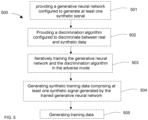
- Figure 5 shows a flow chart of another method 500 to synthesize at least one signal that models human behavior.
- Method 500 may comprise providing, in block 501, a generative neural network configured to generate at least one synthetic signal, for example, from a random noise signal.
- the generative neural network may comprise at least two inputs, a first input to introduce a signal that serves as a basis for generating the synthetic function, for example, a random noise signal; and a second input to introduce a signal that modifies or influences the generation of the successive/subsequent synthetic signals, such as a feedback signal.
- Method 500 may comprise providing, in block 502, a discrimination algorithm configured to discriminate between real and synthetic data. That is, the algorithm may be configured to receive a signal, analyze it and provide a confidence measure to determine whether it is due to a real human interaction or a synthetic interaction.
- the discrimination algorithm may, in some examples, be a neural network or other type of supervised learning algorithm such as a Vector Support Machine, Random Forest, etc. and may comprise at least three inputs.
- a first input may be configured to receive the signal to be analyzed, for example, a synthetic signal generated by a generative neural network; a second input to receive a signal with which to compare the signal to be analyzed, for example, a signal generated by a sensor after a real human interaction; and, a third input, which is used during training, to introduce a signal that modifies or influences the result of the discrimination algorithm, i.e. that modifies the parameters of the discrimination algorithm itself, during the successive/subsequent comparisons of the training process.
- the discrimination algorithm is configured to generate a loss function as an output during training.
- the loss function is proportional to the error committed when discriminating.
- the algorithm may be configured to discriminate an input signal, for example, a signal generated by the generative neural network, that is: to analyze and compare the input signal with a signal generated by a sensor due to real human interaction; and to give as output a percentage of its similarity with real human patterns.
- the method 500 may also comprise iteratively training, in block 503, the generative neural network and the discrimination algorithm in the adverse mode. That is, the neural network may generate a plurality of successive functions that are discriminated or analyzed by the discriminator algorithm, and the result may feed back both the generative neural network and the discrimination algorithm itself in a zero-sum game that allows to improve the performance of both.
- the loss function generated by the discrimination algorithm and at least one random noise signal may be introduced as inputs to the generative neural network to generate a synthetic signal.
- a random noise signal comprises a vector of N random numbers that serves as a seed for the generative neural network to generate signals from it.
- the synthetic signal generated by the generative neural network a signal generated by an integrated sensor after real human interaction and/or real training data, and the loss function generated by the discrimination algorithm may be introduced as inputs to the discriminating algorithm.
- Training may be carried out until the absolute value of the difference of loss functions between successive iterations is between 0.0001% and 20%. That is, until the training method is not capable of improving the outputs and/or the code of the generative neural network or the discrimination algorithm.
- a trained generative neural network (see Figure 7 ) and a trained discriminator algorithm are obtained.
- the trained generative neural network may be used to generate synthetic samples to train better bot detection models.
- the trained discrimination algorithm may be used as a bot detector.
- the difference of loss functions between successive iterations is between 0.0001%, that is, a small variability between the loss functions of successive iterations, it is achieved that the generative neural network has learned enough, that is, that the difference between the successive signals generated is not significant and that it is capable of generating synthetic signals very similar to the signals that a sensor could generate after a real human interaction.
- Method 500 may comprise generating, in block 504, synthetic training data comprising at least one synthetic signal generated by the trained generative neural network to which a random noise signal may be introduced as an input signal.
- the method 500 may comprise generating, in block 505, training data comprising at least the synthetic training data. That is, the training data that may be used to train a bot detector will comprise at least one synthetic signal generated by a trained neural network, so the detector will learn to discriminate more effectively, which will considerably increase the safety and reliability of the detector module.
- Figure 6 schematically illustrates a generative neural network 610, and a discriminator 620 algorithm connected for adversarial mode training according to an example.
- the generative neural network 610 may comprise two inputs: a random noise signal 1 and a feedback signal 3, for example, the output of the discriminator algorithm; and an output signal 4, for example, a synthetic function.
- the discriminator algorithm 620 may comprise three inputs: a synthetic signal 4, for example generated by the generative neural network; a real data signal 2, for example a signal generated by a sensor integrated into a mobile device after an interaction and/or real training data; and a feedback signal 3, for example the output of the discriminator algorithm 620.
- Feedback signal 3, i.e., the output of the discriminator algorithm 620 may comprise a loss function reflecting the probability that such signal was generated by a human or a bot.
- the discriminator is fed with real human signals and with synthetic signals generated by the generative neural network.
- the loss function will reflect with high values when the discriminator is not able to differentiate each type of signal (human or synthetic) while it will reflect values close to zero when the discrimination is correct. This process is repeated iteratively using the loss function to improve the performance of both the discriminator and the generative neural network.
- the discriminator algorithm comprises: an input, at least one signal from at least one sensor that captures the human interaction; an output that reflects the probability that the signal was generated by a human or a bot, typically a value between 0 and 1, where values close to 1 mean a high probability that the signal is from a bot and; values close to 0, a high probability that the signal is from a human interaction.
- FIG. 7 shows schematically a trained generative neural network 700.
- the trained generative neural network 700 may comprise as input 5 a signal, for example, a random noise signal; it serves as a basis for generating a synthetic signal and as output 6 a synthetic signal.
- the synthetic signal generated by the Trained Generative Neural Network 700 may be used, for example, as synthetic training data to train a bot detector, since the neural network has learned enough to generate synthetic functions very similar to the signal generated by a sensor.
- the trained generative neural network 700 may receive as input 5 a plurality of random noise signals, to generate a plurality of synthetic signals that may be used, for example, as synthetic training data to train a bot detector.
- FIG. 8 shows a flowchart of a method 800 of training a bot detector module to detect whether a user action is human or synthetic.
- the method 800 may comprise training, in block 801, a detector module using an Automatic Learning method from real training data acquired according to any of the examples described. So a trained bot detector module may be obtained, that is, capable of detecting whether the user who is interacting is a bot.
- the method 800 may comprise training the detector module with real training data and with a plurality of synthetic training data generated according to any of the examples described, for example, by a handcrafted method or with a neural network trained in an adversarial mode together with a discriminator algorithm.
- the training may use classification or discrimination algorithms such as Support Vector Machine, Random Forest, or Multilayer Perceptron.
- the method 800 may also comprise detecting, in block 802, bots by means of the training detector module.
- the detector module may receive an input signal and output a percentage of confidence that reflects the probability that the input signal is generated by a real human interaction.
- the method 800 of training a bot detector module to detect whether a user action is human or synthetic training method may comprise the following features:
- a synthesis method is proposed in the present disclosure that based on a Generative Adversarial Network (GAN).
- GAN Generative Adversarial Network
- the GAN is made up of two networks called: Generator and Discriminator.
- Such networks may be formed by architectures called Recurrent Neural Networks (RNN), in particular, RNN model called Long Short-Term Memory Network (LSTM).
- RNN Recurrent Neural Networks
- LSTM Long Short-Term Memory Network
- These LSTMs may have multiple parameters.
- the following description represents an example implementation, but a skilled person may slightly modify some or all of the parameters and get similar results.
- the LSTMs may be composed of two 128-unit LSTM layers followed by a 128-unit "Dense" layer.
- a learning objective of the Generator may be to synthesize samples as realistically as possible
- the learning objective of the Discriminator may be to classify human samples from synthetic samples. This may be achieved through a loss function known as "minimax los".
- the synthetic signals generated according to any of the methods of the present disclosure, and human signals may be parameterized. For example, velocity, acceleration, duration, trajectory, etc... may be parametrized to obtain a characteristic vector for each gesture, which may be called "fixed length characteristic vector".
- the vectors of the real samples and the synthetic samples may be used to train a binary classifier which may distinguish between human or bot. Once the classifier is trained, it may be used to discriminate a gesture between human gesture or bot gesture, which have not been used during the training. Besides the classifier may parameterize the gesture and determine whether it is a gesture produced by a human or a bot. Support Vector Machines or Random Forest may be used as classifier or discriminator.
- results may be recorded in tables of results (you can see them in the article we passed to you). We can include results if you think it would help.
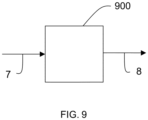
- Figure 9 shows a schematic of a 900 bot detector module trained from training data generated by the method according to any of the examples described.
- the module may be trained with real training data.
- the module may also be trained with synthetic training data generated according to any of the examples described, for example, by means of a trained generative neural network.
- the module is a bot-detector device.
- the Bot Detector Module 900 may be configured to receive an input signal 7, for example, a signal from a mobile device, and to generate an output 8 that may comprise a confidence percentage to give the probability that the input signal 7 was generated by a human interaction with the device, i.e., that it is a real human interaction.
Landscapes
- Engineering & Computer Science (AREA)
- Theoretical Computer Science (AREA)
- Physics & Mathematics (AREA)
- General Physics & Mathematics (AREA)
- Multimedia (AREA)
- Computer Vision & Pattern Recognition (AREA)
- Evolutionary Computation (AREA)
- General Health & Medical Sciences (AREA)
- Health & Medical Sciences (AREA)
- Human Computer Interaction (AREA)
- Artificial Intelligence (AREA)
- Psychiatry (AREA)
- Computing Systems (AREA)
- Databases & Information Systems (AREA)
- Medical Informatics (AREA)
- Software Systems (AREA)
- Data Mining & Analysis (AREA)
- Social Psychology (AREA)
- Life Sciences & Earth Sciences (AREA)
- Evolutionary Biology (AREA)
- General Engineering & Computer Science (AREA)
- Bioinformatics & Computational Biology (AREA)
- Bioinformatics & Cheminformatics (AREA)
- User Interface Of Digital Computer (AREA)
- Management, Administration, Business Operations System, And Electronic Commerce (AREA)
Claims (5)
- Verfahren (800) zum Trainieren eines Bot-Detektormoduls durch automatisches Lernen, um zu erkennen, ob eine Benutzerhandlung eine menschliche oder eine synthetische Handlung ist, unter Verwendung von Trainingsdaten, die durch ein Verfahren zum Erzeugen von Trainingsdaten durch menschliche Interaktion mit einer mobilen Vorrichtung erfasst werden;wobei das Verfahren zum Erzeugen von Trainingsdaten Folgendes umfasst:empfangen (301) von mindestens einem Signal, das von mindestens einem in der mobilen Vorrichtung integrierten Sensor erzeugt wird, wobei das Signal mindestens eines ist, das während der menschlichen Interaktion mit der mobilen Vorrichtung erzeugt wird, wobei das Empfangen des mindestens einen Signals durch Verfolgen von mindestens einer der folgenden von einem Benutzer durchgeführten Aktionen durchgeführt wird: täglicher Betrieb eines Mobiltelefons, täglicher Betrieb einer Tastatur oder eines Touchpads, tägliche Wischaktionen auf einem Bildschirm einer Benutzervorrichtung und tägliche Aktionen, die von einer Kamera einer Benutzervorrichtung erfasst werden, Halten der Vorrichtung oder Ändern des Standorts der Vorrichtung;berechnen (302) von Skalar- und Zeitvariablen des mindestens einen sensorgenerierten Signals, das menschliche Gesten charakterisiert, wodurch echte Trainingsdaten bereitgestellt werden; undsynthetisieren von mindestens einem Signal, das menschliche Gesten modelliert, um synthetische Trainingsdaten zu erzeugen (504), wobei die synthetischen Trainingsdaten eine synthetisierte Richtung, eine synthetisierte Dauer, eine synthetisierte Verschiebung und einen synthetisierten Winkel umfassen; wobei das Synthetisieren des mindestens einen Signals, das eine menschliche Geste modelliert, Folgendes umfasst:bereitstellen (501) eines generativen neuronalen Netzwerks (610), das dazu konfiguriert ist, das mindestens eine synthetische Signal zu erzeugen, wobei das generative neuronale Netzwerk mindestens zwei Eingaben umfasst;bereitstellen (502) eines Unterscheidungsalgorithmus (620), der dazu konfiguriert ist, zwischen realen und synthetischen Daten zu unterscheiden und als Ausgabe eine Verlustfunktion zu erzeugen, die den beim Unterscheiden begangenen Fehler definiert, wobei der Unterscheidungsalgorithmus mindestens drei Eingaben umfasst;iteratives Trainieren (503) des generativen neuronalen Netzes (610) und des Diskriminierungsalgorithmus (620) in einem kontradiktorischen Modus, indem als Eingaben in das generative neuronale Netz (610) Folgendes eingeführt wird:- die Verlustfunktion (3), die durch den Unterscheidungsalgorithmus erzeugt wird; und- mindestens ein Zufallsrauschsignal (1), um mindestens ein synthetisches Signal zu erzeugen;und indem als Eingaben in den Unterscheidungsalgorithmus (620) Folgendes eingeführt wird:- das mindestens eine synthetische Signal (4), das von dem generativen neuronalen Netz erzeugt wird,- das mindestens eine Signal (2), das von dem mindestens einen integrierten Sensor erzeugt wird, und/oder die realen Trainingsdaten, und- die Verlustfunktion (3), die durch den Diskriminierungsalgorithmus erzeugt wird;bis der Absolutwert der Differenz der Verlustfunktionen zwischen aufeinanderfolgenden Iterationen zwischen 0,0001 % und 20 % liegt, wodurch ein trainiertes generatives neuronales Netz erhalten wird;erzeugen (504) von synthetischen Trainingsdaten, die mindestens ein synthetisches Signal umfassen, das von dem trainierten generativen neuronalen Netzwerk erzeugt wird, durch Einführen von mindestens einem Zufallsrauschsignal als Eingabe;erzeugen (303, 505) von Trainingsdaten, die mindestens die synthetischen Trainingsdaten und die realen Trainingsdaten umfassen;und wobei das Verfahren zum Trainieren des Bot-Detektormoduls das Trainieren (801) des Bot-Detektormoduls mit einer Vielzahl von synthetischen Trainingsdaten umfasst.
- Verfahren zum Trainieren eines Bot-Detektormoduls nach Anspruch 1, wobei das Synthetisieren des mindestens einen Signals, das eine menschliche Geste modelliert, ein Syntheseverfahren auf Grundlage der Beobachtung, Analyse und Charakterisierung des mindestens einen durch den Sensor erzeugten Signals umfasst, wobei das Syntheseverfahren Folgendes umfasst:empfangen (401) einer Vielzahl von Signalen, die von mindestens einem integrierten Sensor erzeugt werden;berechnen (402) eines Satzes von gemeinsamen Merkmalen, wobei die gemeinsamen Merkmale mindestens eines von einer Gruppe beinhalten, die Richtung, Dauer, Verschiebung und Winkel der Vielzahl von Signalen umfasst, um ein menschliches Verhalten zu charakterisieren;durchführen (403) einer statistischen Analyse der gemeinsamen Merkmale, um eine Variabilität zu erhalten;erzeugen (404) von synthetischen Trainingsdaten, die aus Anfangsdaten und aufeinanderfolgenden Daten bestehen, die sich je nach Variabilität von den Anfangsdaten unterscheiden, wobei die synthetischen Daten gekennzeichnet durch eine synthetisierte Richtung, eine synthetisierte Dauer, eine synthetisierte Verschiebung und einen synthetisierten Winkel sind; undgenerieren (405) von Trainingsdaten, die mindestens die synthetischen Trainingsdaten umfassen.
- Verfahren zum Trainieren eines Bot-Detektormoduls nach einem der Ansprüche 1 bis 2, wobei der mindestens eine integrierte Sensor ein GPS (global positioning system, globales Positionierungssystem), und/oder ein WLAN-System und/oder eine Bluetooth-Vorrichtung und/oder ein Beschleunigungsmesser und/oder ein Gyroskop und/oder ein Magnetometer und/oder ein Drucksensor und/oder ein Sensor zum Erfassen von Tastenanschlägen ist.
- Verfahren zum Trainieren eines Bot-Detektormoduls nach einem der Ansprüche 1 bis 3, umfassend:- Vorverarbeiten der realen Trainingsdaten und der Vielzahl von synthetischen Trainingsdaten durch Auswählen von Wischgesten von mehr als 0,3 Sekunden auf einem Bildschirm;- Normalisieren solcher Gesten, um mindestens eines der folgenden Merkmale bereitzustellen: gleiche Ursprungskoordinate und Richtung;- Aufteilen der normalisierten Daten in drei Gruppen, wobei jede Gruppe 60 % der normalisierten Daten für das Training, 20 % der normalisierten Daten für die Validierung und 20 % der normalisierten Daten für das Testen umfasst;- Trainieren des Bot-Detektormoduls, das die 60% der normalisierten Daten für das Training bereitstellt;- Anpassen von Hyperparametern an die 20 % der normalisierten Daten für die Validierung und- Testen der resultierenden klassifizierten Daten mit den 20% der normalisierten Daten zum Testen.
- Bots-Detektormodul (900), das durch das Verfahren zum Trainieren eines Bot-Detektormoduls nach einem der Ansprüche 1 bis 4 trainiert wird, wobei das Bots-Detektormodul dazu konfiguriert ist, ein Eingabesignal von einer mobilen Vorrichtung zu empfangen und eine Ausgabe zu erzeugen, die einen Prozentsatz der Zuversicht umfasst, dass das Eingabesignal durch eine reale menschliche Interaktion erzeugt wird.
Applications Claiming Priority (2)
| Application Number | Priority Date | Filing Date | Title |
|---|---|---|---|
| ES202030066 | 2020-01-28 | ||
| PCT/EP2021/051864 WO2021151947A1 (en) | 2020-01-28 | 2021-01-27 | Method to generate training data for a bot detector module, bot detector module trained from training data generated by the method and bot detection system |
Publications (3)
| Publication Number | Publication Date |
|---|---|
| EP4097632A1 EP4097632A1 (de) | 2022-12-07 |
| EP4097632C0 EP4097632C0 (de) | 2025-04-30 |
| EP4097632B1 true EP4097632B1 (de) | 2025-04-30 |
Family
ID=74347102
Family Applications (1)
| Application Number | Title | Priority Date | Filing Date |
|---|---|---|---|
| EP21702262.3A Active EP4097632B1 (de) | 2020-01-28 | 2021-01-27 | Verfahren zur erzeugung von trainingsdaten für ein bot-detektormodul, bot-detektormodul, das anhand von durch das verfahren erzeugten trainingsdaten trainiert wird, und bot-detektionssystem |
Country Status (3)
| Country | Link |
|---|---|
| EP (1) | EP4097632B1 (de) |
| ES (1) | ES3028243T3 (de) |
| WO (1) | WO2021151947A1 (de) |
Families Citing this family (4)
| Publication number | Priority date | Publication date | Assignee | Title |
|---|---|---|---|---|
| AU2014101585A4 (en) | 2013-10-11 | 2016-09-22 | Swipejobs, Inc. | Employment related browsing and matching application, method and system |
| CN116910683B (zh) * | 2023-06-06 | 2025-11-21 | 北京理工大学 | 一种基于事件依赖的多模态虚假新闻检测方法 |
| CN116738407B (zh) * | 2023-08-14 | 2023-10-27 | 北京安天网络安全技术有限公司 | 一种非生物用户的确定方法、装置及介质 |
| CN119831744B (zh) * | 2024-12-23 | 2025-10-21 | 中国工商银行股份有限公司 | 数据处理方法、装置、计算机可读存储介质及电子设备 |
Citations (1)
| Publication number | Priority date | Publication date | Assignee | Title |
|---|---|---|---|---|
| EP3540633B1 (de) * | 2018-03-16 | 2020-09-23 | Identy Inc. | Verfahren zur identifizierung eines objekts innerhalb eines bildes und mobile vorrichtung zur durchführung des verfahrens |
Family Cites Families (2)
| Publication number | Priority date | Publication date | Assignee | Title |
|---|---|---|---|---|
| US20180300572A1 (en) * | 2017-04-17 | 2018-10-18 | Splunk Inc. | Fraud detection based on user behavior biometrics |
| US10496809B1 (en) * | 2019-07-09 | 2019-12-03 | Capital One Services, Llc | Generating a challenge-response for authentication using relations among objects |
-
2021
- 2021-01-27 ES ES21702262T patent/ES3028243T3/es active Active
- 2021-01-27 WO PCT/EP2021/051864 patent/WO2021151947A1/en not_active Ceased
- 2021-01-27 EP EP21702262.3A patent/EP4097632B1/de active Active
Patent Citations (2)
| Publication number | Priority date | Publication date | Assignee | Title |
|---|---|---|---|---|
| EP3540633B1 (de) * | 2018-03-16 | 2020-09-23 | Identy Inc. | Verfahren zur identifizierung eines objekts innerhalb eines bildes und mobile vorrichtung zur durchführung des verfahrens |
| US20210027041A1 (en) * | 2018-03-16 | 2021-01-28 | Identy Inc. | Method for identifying an object within an image and mobile device for executing the method |
Also Published As
| Publication number | Publication date |
|---|---|
| WO2021151947A1 (en) | 2021-08-05 |
| EP4097632C0 (de) | 2025-04-30 |
| ES3028243T3 (en) | 2025-06-18 |
| EP4097632A1 (de) | 2022-12-07 |
Similar Documents
| Publication | Publication Date | Title |
|---|---|---|
| EP4097632B1 (de) | Verfahren zur erzeugung von trainingsdaten für ein bot-detektormodul, bot-detektormodul, das anhand von durch das verfahren erzeugten trainingsdaten trainiert wird, und bot-detektionssystem | |
| Thomas et al. | A broad review on non-intrusive active user authentication in biometrics | |
| Acien et al. | BeCAPTCHA-Mouse: Synthetic mouse trajectories and improved bot detection | |
| US10467394B2 (en) | Pointing device biometrics for continuous user authentication | |
| US12505188B2 (en) | Reference image enrollment and evolution for security systems | |
| Qin et al. | A fuzzy authentication system based on neural network learning and extreme value statistics | |
| Rashmi et al. | Robust speech processing with fuzzy logic-driven anti-spoofing techniques | |
| Buriro et al. | Itsme: Multi-modal and unobtrusive behavioural user authentication for smartphones | |
| CN111625792B (zh) | 一种基于异常行为检测的身份识别方法 | |
| Gavrilova et al. | A multifaceted role of biometrics in online security, privacy, and trustworthy decision making | |
| Acien et al. | BeCAPTCHA: Detecting human behavior in smartphone interaction using multiple inbuilt sensors | |
| Sharma et al. | Behavioral biometrics: Past, present | |
| Gilbert et al. | Continuous user authentication on mobile devices | |
| Ding et al. | Accelerometer-based mobile device identification system for the realistic environment | |
| Wandji Piugie et al. | Deep features fusion for user authentication based on human activity | |
| Dissanayake et al. | “Trust Pass”-Blockchain-Based Trusted Digital Identity Platform Towards Digital Transformation | |
| Gonzalez-Garcia et al. | Introduction to presentation attacks in signature biometrics and recent advances | |
| Davarci et al. | Hybrid architecture for gender recognition using smartphone motion sensors | |
| Kek et al. | User authentication with keystroke dynamics: Performance evaluation in neural network | |
| Shanmugavalli et al. | A hybrid machine learning technique for multiple soft biometric based dynamic keystroke pattern recognition system | |
| Nerini et al. | Machine Learning for PIN Side-Channel Attacks Based on Smartphone Motion Sensors | |
| Kaur et al. | Towards Explainable AI in Continuous Smartphone Authentication: Leveraging CNN, BiLSTM, and Attention Techniques | |
| Janke et al. | Detecting Fake and Genuine Facebook Users Using Gradient Boosted Trees and Interpretable Machine Learning | |
| Ejaz et al. | Behaviour Biometrics Using AI for Continuous Authentication Systems | |
| Alzahrani et al. | A User Authentication Approach Based on Human Activity Recognition Method Using CNN and RNN Models |
Legal Events
| Date | Code | Title | Description |
|---|---|---|---|
| STAA | Information on the status of an ep patent application or granted ep patent |
Free format text: STATUS: UNKNOWN |
|
| STAA | Information on the status of an ep patent application or granted ep patent |
Free format text: STATUS: THE INTERNATIONAL PUBLICATION HAS BEEN MADE |
|
| PUAI | Public reference made under article 153(3) epc to a published international application that has entered the european phase |
Free format text: ORIGINAL CODE: 0009012 |
|
| STAA | Information on the status of an ep patent application or granted ep patent |
Free format text: STATUS: REQUEST FOR EXAMINATION WAS MADE |
|
| 17P | Request for examination filed |
Effective date: 20220829 |
|
| AK | Designated contracting states |
Kind code of ref document: A1 Designated state(s): AL AT BE BG CH CY CZ DE DK EE ES FI FR GB GR HR HU IE IS IT LI LT LU LV MC MK MT NL NO PL PT RO RS SE SI SK SM TR |
|
| DAV | Request for validation of the european patent (deleted) | ||
| DAX | Request for extension of the european patent (deleted) | ||
| REG | Reference to a national code |
Ref country code: DE Ref legal event code: R079 Free format text: PREVIOUS MAIN CLASS: G06K0009000000 Ipc: G06F0018214000 Ref country code: DE Ref legal event code: R079 Ref document number: 602021029970 Country of ref document: DE Free format text: PREVIOUS MAIN CLASS: G06K0009000000 Ipc: G06F0018214000 |
|
| GRAP | Despatch of communication of intention to grant a patent |
Free format text: ORIGINAL CODE: EPIDOSNIGR1 |
|
| STAA | Information on the status of an ep patent application or granted ep patent |
Free format text: STATUS: GRANT OF PATENT IS INTENDED |
|
| RIC1 | Information provided on ipc code assigned before grant |
Ipc: G06V 40/40 20220101ALI20241115BHEP Ipc: G06V 40/20 20220101ALI20241115BHEP Ipc: G06V 10/82 20220101ALI20241115BHEP Ipc: G06F 18/214 20230101AFI20241115BHEP |
|
| INTG | Intention to grant announced |
Effective date: 20241128 |
|
| GRAS | Grant fee paid |
Free format text: ORIGINAL CODE: EPIDOSNIGR3 |
|
| GRAA | (expected) grant |
Free format text: ORIGINAL CODE: 0009210 |
|
| STAA | Information on the status of an ep patent application or granted ep patent |
Free format text: STATUS: THE PATENT HAS BEEN GRANTED |
|
| RAP3 | Party data changed (applicant data changed or rights of an application transferred) |
Owner name: UNIVERSIDAD AUTONOMA DE MADRID |
|
| AK | Designated contracting states |
Kind code of ref document: B1 Designated state(s): AL AT BE BG CH CY CZ DE DK EE ES FI FR GB GR HR HU IE IS IT LI LT LU LV MC MK MT NL NO PL PT RO RS SE SI SK SM TR |
|
| REG | Reference to a national code |
Ref country code: CH Ref legal event code: EP Ref country code: GB Ref legal event code: FG4D |
|
| REG | Reference to a national code |
Ref country code: IE Ref legal event code: FG4D |
|
| REG | Reference to a national code |
Ref country code: DE Ref legal event code: R096 Ref document number: 602021029970 Country of ref document: DE |
|
| U01 | Request for unitary effect filed |
Effective date: 20250507 |
|
| REG | Reference to a national code |
Ref country code: ES Ref legal event code: FG2A Ref document number: 3028243 Country of ref document: ES Kind code of ref document: T3 Effective date: 20250618 |
|
| U07 | Unitary effect registered |
Designated state(s): AT BE BG DE DK EE FI FR IT LT LU LV MT NL PT RO SE SI Effective date: 20250514 |
|
| PG25 | Lapsed in a contracting state [announced via postgrant information from national office to epo] |
Ref country code: GR Free format text: LAPSE BECAUSE OF FAILURE TO SUBMIT A TRANSLATION OF THE DESCRIPTION OR TO PAY THE FEE WITHIN THE PRESCRIBED TIME-LIMIT Effective date: 20250731 Ref country code: NO Free format text: LAPSE BECAUSE OF FAILURE TO SUBMIT A TRANSLATION OF THE DESCRIPTION OR TO PAY THE FEE WITHIN THE PRESCRIBED TIME-LIMIT Effective date: 20250730 |
|
| PG25 | Lapsed in a contracting state [announced via postgrant information from national office to epo] |
Ref country code: PL Free format text: LAPSE BECAUSE OF FAILURE TO SUBMIT A TRANSLATION OF THE DESCRIPTION OR TO PAY THE FEE WITHIN THE PRESCRIBED TIME-LIMIT Effective date: 20250430 |
|
| PG25 | Lapsed in a contracting state [announced via postgrant information from national office to epo] |
Ref country code: HR Free format text: LAPSE BECAUSE OF FAILURE TO SUBMIT A TRANSLATION OF THE DESCRIPTION OR TO PAY THE FEE WITHIN THE PRESCRIBED TIME-LIMIT Effective date: 20250430 |
|
| PG25 | Lapsed in a contracting state [announced via postgrant information from national office to epo] |
Ref country code: RS Free format text: LAPSE BECAUSE OF FAILURE TO SUBMIT A TRANSLATION OF THE DESCRIPTION OR TO PAY THE FEE WITHIN THE PRESCRIBED TIME-LIMIT Effective date: 20250731 |
|
| PG25 | Lapsed in a contracting state [announced via postgrant information from national office to epo] |
Ref country code: IS Free format text: LAPSE BECAUSE OF FAILURE TO SUBMIT A TRANSLATION OF THE DESCRIPTION OR TO PAY THE FEE WITHIN THE PRESCRIBED TIME-LIMIT Effective date: 20250830 |
|
| PG25 | Lapsed in a contracting state [announced via postgrant information from national office to epo] |
Ref country code: SM Free format text: LAPSE BECAUSE OF FAILURE TO SUBMIT A TRANSLATION OF THE DESCRIPTION OR TO PAY THE FEE WITHIN THE PRESCRIBED TIME-LIMIT Effective date: 20250430 |
|
| PG25 | Lapsed in a contracting state [announced via postgrant information from national office to epo] |
Ref country code: CZ Free format text: LAPSE BECAUSE OF FAILURE TO SUBMIT A TRANSLATION OF THE DESCRIPTION OR TO PAY THE FEE WITHIN THE PRESCRIBED TIME-LIMIT Effective date: 20250430 |
|
| PG25 | Lapsed in a contracting state [announced via postgrant information from national office to epo] |
Ref country code: SK Free format text: LAPSE BECAUSE OF FAILURE TO SUBMIT A TRANSLATION OF THE DESCRIPTION OR TO PAY THE FEE WITHIN THE PRESCRIBED TIME-LIMIT Effective date: 20250430 |