EP4093494B1 - Verfahren zur gewinnung von personalisierten parametern für transkranielle stimulation, transkranielles stimulationssystem - Google Patents
Verfahren zur gewinnung von personalisierten parametern für transkranielle stimulation, transkranielles stimulationssystem Download PDFInfo
- Publication number
- EP4093494B1 EP4093494B1 EP21702066.8A EP21702066A EP4093494B1 EP 4093494 B1 EP4093494 B1 EP 4093494B1 EP 21702066 A EP21702066 A EP 21702066A EP 4093494 B1 EP4093494 B1 EP 4093494B1
- Authority
- EP
- European Patent Office
- Prior art keywords
- stimulation
- parameters
- transcranial
- gaussian process
- baseline
- Prior art date
- Legal status (The legal status is an assumption and is not a legal conclusion. Google has not performed a legal analysis and makes no representation as to the accuracy of the status listed.)
- Active
Links
Images





Classifications
-
- A—HUMAN NECESSITIES
- A61—MEDICAL OR VETERINARY SCIENCE; HYGIENE
- A61N—ELECTROTHERAPY; MAGNETOTHERAPY; RADIATION THERAPY; ULTRASOUND THERAPY
- A61N1/00—Electrotherapy; Circuits therefor
- A61N1/18—Applying electric currents by contact electrodes
- A61N1/32—Applying electric currents by contact electrodes alternating or intermittent currents
- A61N1/36—Applying electric currents by contact electrodes alternating or intermittent currents for stimulation
- A61N1/36014—External stimulators, e.g. with patch electrodes
- A61N1/3603—Control systems
- A61N1/36034—Control systems specified by the stimulation parameters
-
- A—HUMAN NECESSITIES
- A61—MEDICAL OR VETERINARY SCIENCE; HYGIENE
- A61N—ELECTROTHERAPY; MAGNETOTHERAPY; RADIATION THERAPY; ULTRASOUND THERAPY
- A61N1/00—Electrotherapy; Circuits therefor
- A61N1/18—Applying electric currents by contact electrodes
- A61N1/32—Applying electric currents by contact electrodes alternating or intermittent currents
- A61N1/36—Applying electric currents by contact electrodes alternating or intermittent currents for stimulation
- A61N1/36014—External stimulators, e.g. with patch electrodes
- A61N1/3603—Control systems
-
- A—HUMAN NECESSITIES
- A61—MEDICAL OR VETERINARY SCIENCE; HYGIENE
- A61N—ELECTROTHERAPY; MAGNETOTHERAPY; RADIATION THERAPY; ULTRASOUND THERAPY
- A61N1/00—Electrotherapy; Circuits therefor
- A61N1/02—Details
- A61N1/04—Electrodes
- A61N1/0404—Electrodes for external use
- A61N1/0408—Use-related aspects
- A61N1/0456—Specially adapted for transcutaneous electrical nerve stimulation [TENS]
-
- A—HUMAN NECESSITIES
- A61—MEDICAL OR VETERINARY SCIENCE; HYGIENE
- A61N—ELECTROTHERAPY; MAGNETOTHERAPY; RADIATION THERAPY; ULTRASOUND THERAPY
- A61N1/00—Electrotherapy; Circuits therefor
- A61N1/18—Applying electric currents by contact electrodes
- A61N1/32—Applying electric currents by contact electrodes alternating or intermittent currents
- A61N1/36—Applying electric currents by contact electrodes alternating or intermittent currents for stimulation
- A61N1/36014—External stimulators, e.g. with patch electrodes
- A61N1/36025—External stimulators, e.g. with patch electrodes for treating a mental or cerebral condition
Definitions
- the invention relates to transcranial stimulation.
- transcranial stimulation can be used to treat patients or to achieve cognitive enhancement in healthy individuals.
- US2019/0321583 discloses a method of replicating a mental state of a first subject in a second subject by inducing the brain activity patterns of the first subject in the second subject.
- Optimal parameters for the stimulation may differ between different individuals but need to be selected from a large range of possible combinations.
- a practical approach has been to use a one-size-fits-all methodology in which the same set of parameters are used for multiple different subjects.
- a computer-implemented method for obtaining personalized parameters for transcranial stimulation comprising: receiving baseline data about a test subject, the baseline data comprising information about the test subject acquired prior to any transcranial stimulation applied to the test subject; and using a Gaussian process model of performance of one or more training subjects to obtain personalized parameters for transcranial stimulation for the test subject based on the received baseline data, wherein: the Gaussian process jointly models subject performance during and/or after transcranial stimulation as a function of both i) parameters defining the transcranial stimulation; and ii) baseline data for the one or more training subjects.
- a probabilistic model is provided that intrinsically takes account of variations between different people by means of baseline data.
- the model is better able to predict optimal parameters for the transcranial stimulation even where past data from no or very few subjects with the same or similar baseline data is available.
- the method is able to provide personalized parameters that vary between different subjects and, on average, perform better than a one-size-fits-all methodology which ignores the fact that people differ from each other, and that the individual brain is plastic and changes over time as well.
- the present method makes it possible to effectively tailor the stimulation protocol to provide the best outcome.
- the stimulation may be used for various clinical and non-clinical purposes, including for example improving tremor in Parkinson's, improving people's sustained attention/concentration, memory, mathematical performance, emotions, training capabilities, and learning (e.g., language, maths, IT, factual information).
- improving tremor in Parkinson's improving people's sustained attention/concentration, memory, mathematical performance, emotions, training capabilities, and learning (e.g., language, maths, IT, factual information).
- the baseline data represents a performance (e.g. cognitive performance and/or motor performance, subjective report) without influence from transcranial stimulation.
- a performance e.g. cognitive performance and/or motor performance, subjective report
- the inventors have found that using baseline data of this type makes it possible to obtain personalized parameters particularly effectively.
- the obtaining of the personalized parameters further comprises: obtaining test data representing performances (e.g. cognitive performance and/or motor performance, subjective report) of the test subject during and/or after application of transcranial stimulation with multiple respective combinations of parameters; refining the Gaussian process model using the obtained test data; and using the refined Gaussian process model to obtain the personalized parameters.
- the Gaussian process model is refined in an iterative Bayesian optimization process that in each step chooses to sample next where a combination of parameters for stimulation optimizes an acquisition function. Using an acquisition function in this way allows the Gaussian process model to explore the most relevant parts of the available parameter space in an efficient manner, thereby promoting rapid and reliable convergence to optimal personalized parameters for the test subject.
- Transcranial alternating current stimulation and similar techniques are believed to be able to promote oscillatory activity via transcranial stimulation. Such techniques may modulate brain oscillations that subserve cognitive processes. It is possible to enhance or disrupt the effects of the stimulation by changing parameters of the stimulation (e.g., current and frequency), for example to target a specific neural population. However, exploring the effects of every combination of parameters individually on a test subject (e.g., on cognitive performance) is not practical. It has therefore been difficult to use transcranial stimulation techniques such as tACS optimally. Embodiments of the present disclosure address this issue.
- parameters of the stimulation e.g., current and frequency
- Figure 1 schematically depicts a framework for methods of obtaining personalized parameters for transcranial stimulation.
- the methods may be computer-implemented. Each of one or more of the steps of each method may therefore be performed by a computer.
- the computer may comprise various combinations of computer hardware, including for example CPUs, RAM, SSDs, motherboards, network connections, firmware, software, and/or other elements known in the art that allow the computer hardware to perform the required computing operations.
- the required computing operations may be defined by one or more computer programs.
- the one or more computer programs may be provided in the form of media or data carriers, optionally non-transitory media, storing computer readable instructions. When the computer readable instructions are read by the computer, the computer performs the required method steps.
- the computer may consist of a self-contained unit, such as a general-purpose desktop computer, laptop, tablet, mobile telephone, or other smart device.
- the computer may consist of a distributed computing system having plural different computers connected to each other via a network such as the internet or an intranet. The methods may thus be performed partly or entirely by cloud computing facilities.
- the method comprises receiving baseline data about a test subject.
- the baseline data may be received from a data storage device or directly from a device that measures the baseline data, or based on a subjective report.
- a subject report may be done by the subject (e.g. reporting how tired he/she feels) or by a third party (e.g. reporting how distracted a subject is).
- the baseline data comprises information about the test subject that is acquired prior to (and/or separately from and/or independently of) transcranial stimulation applied to the test subject.
- the baseline data represents a performance (e.g. cognitive performance and/or motor performance, subjective report) of the test subject without influence from transcranial stimulation.
- the baseline data may thus be obtained during a time period when transcranial stimulation is not being applied to the subject and/or has not been applied so recently that the subject's performance is significantly influenced by the stimulation.
- the baseline data alternatively or additionally comprises other personal information about the subject, such as neural data and/or demographic data (e.g., information about sleep patterns, lifestyle habits such as smoking, alcohol consumption, age, gender, etc.).
- Performance may be measured in various ways, providing a corresponding variety of possibilities for a format of the baseline data (in embodiments where the baseline data comprises information about performance). For example, measurements of accuracy and/or reaction times during tests may be made.
- the baseline data comprises a scalar numerical value that may optionally vary continuously as a function of cognitive performance (e.g., a test score or IQ score).
- the baseline data comprises a drift rate value obtained by applying a diffusion decision model to the results of tests performed by the subject.
- the tests may comprise any suitable activity that provides information about performance.
- the tests comprise mathematical tests, such as arithmetic tests.
- arithmetic tests comprising single-digit times multi-digit multiplications are used.
- Modelling human behaviour using a diffusion decision model facilitates pinpointing of cognitive processes of interest in preference to more peripheral processes such as stimulus encoding or motor-related activity.
- This approach makes it possible to dissect different components in the chain of information processing by modelling the decision process and targeting the component that reflects ability/task difficulty (e.g., the drift rate, which combines response time and accuracy), rather than auxiliary components.
- the approach allows simultaneous characterisation of changes in accuracy and reaction time in the form of a single metric value.
- the method comprises using a Gaussian process model of performance (e.g. cognitive performance and/or motor performance, subjective report) of one or more training subjects to obtain personalized parameters for transcranial stimulation for the test subject based on the baseline data received in step S1.
- the Gaussian process model jointly models performance (cognitive performance and/or motor performance, subjective report) during and/or after transcranial stimulation as a function of both: 1) parameters defining the transcranial stimulation; and 2) baseline data for the one or more training subjects.
- the obtaining of the personalized parameters comprises an iterative refining of the Gaussian process model using measurements of performance (e.g. cognitive and/or motor performance, subjective report) of the test subject during application of transcranial stimulation with multiple combinations of parameters.
- the parameters include one or more of the following: frequency, frequencies, current, phase, duration, dose, brain region. Different combinations of currents in the range 0.4-2 mA and frequencies in the range of 0.1-100 Hz may be considered, for example.
- the stimulation comprises waveforms that are more complex than pure sinusoids, other parameters may be included to define relevant additional features of the waveforms (e.g., to define aspects of the frequency spectrum of the waveforms such as central frequency and bandwidth, band shape, pulse length, etc.).
- the iterative refinement of the model comprises iterative performance of sub-steps S21, S22 and S23.
- the obtaining of the personalized parameters may include selecting between different overall modes of stimulation (e.g. between tACS, transcranial direct current stimulation (tDCS), transcranial random noise stimulation (tRNS) and/or other modes of stimulation), either during treatment of an individual or between different individuals.
- tACS transcranial direct current stimulation
- tRNS transcranial random noise stimulation
- initial parameters for stimulation for the test subject are obtained using only the pretrained Gaussian process model and the baseline data.
- the initial operating parameters are thus obtained without yet having performed any measurements of performance (e.g. cognitive performance and/or motor performance, subjective report) during and/or after application of transcranial stimulation to the test subject.
- the pretrained Gaussian process model may be trained on range of previously collected data. This data can come from the random assignment of stimulation parameters.
- the Gaussian process (GP) does not explore the different combinations, it just models the existing data and provides estimates of the response to the variety of stimulation parameters as well as an estimate of uncertainty. The exploration is done by the acquisition function which is the next stage of the Bayesian optimisation process.
- a performance e.g. cognitive performance and/or motor performance, subjective report
- the transcranial stimulation is applied using the parameters provided by sub-step S21.
- the measured performance forms test data.
- sub-step 22 is repeated, thereby obtaining test data that represents measurements of performance during and/or after application of transcranial stimulation with multiple respective combinations of operating parameters (e.g., the operating parameters have different combinations of values during each iteration).
- the test data obtained in sub-step S22 is used to adjust the Gaussian process model that was used in the preceding instance of sub-step S21.
- Sub-steps S21, S22 and S23 are then iteratively repeated until the measured performance (e.g. cognitive performance and/or motor performance, subjective report) obtained in sub-step S22 converges to an optimal value (e.g., when a rate of improvement falls below a predetermined threshold value) and/or a predetermined number of iterations has been performed.
- the Gaussian process model is refined using the obtained test data (obtained over multiple iterations of sub-steps S21, S22 and S23 in the example shown). This optimization process may be performed across multiple different users (with each user using the process at least once) and/or multiple uses by each of one or more individual users.
- the refined Gaussian process model at convergence provides a prediction of how subject performance (e.g. cognitive performance and/or motor performance, subjective report) is expected to vary as a function of parameters for stimulation for the test subject.
- subject performance e.g. cognitive performance and/or motor performance, subjective report
- the combination of parameters that are predicted by the refined Gaussian process model to give the maximum performance may thus be output as the personalized parameters for the test subject.
- the refined Gaussian process model is thus used to obtain the personalized parameters.
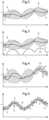
- the Gaussian process model may be refined in an iterative Bayesian optimization (BO) process, as depicted schematically in Figures 2-5 .
- BO is an active machine learning technique that aims to find the global optimum of a black-box function f (x) by making a series of evaluations.
- the vertical axes represent f ( x )
- the horizontal axes represent x (in a schematic one-dimensional form for ease of illustration, but it will be understood that x will be multidimensional in embodiments of the present disclosure, including for example one dimension for each type of parameter for simulation, such as current and frequency, and one dimension for baseline data).
- a BO process may initially comprise fitting a Gaussian process model to available data points (a representative point is labelled “2" in Figures 2-5 ).
- the fitted Gaussian process model has an associated estimated mean (labelled "4") and uncertainty (labelled "6").
- An example objective function is labelled "8".
- the Gaussian process model can be refined by providing further data points.
- the further data points may comprise measurements of performance (e.g. cognitive performance and/or motor performance, subjective report) of the test subject during and/or after application of transcranial stimulation with different combinations of parameters, such as is provided by the test data generated during each iteration of the sub-step S22 in Figure 1 , or test data provided from other test subjects.
- the iterative BO process may be configured to choose to sample next where x optimizes (e.g., maximizes) an acquisition function 10, as depicted in Figure 3 .
- the BO process may thus choose to sample next where a combination of parameters for stimulation optimizes (e.g., maximizes) an acquisition function 10.
- the acquisition function 10 is derived based on the Gaussian process model but is configured to be computationally cheaper to optimize than the objective function of the Gaussian process model.
- the acquisition function may be chosen to promote steering of sampling in the direction where improvement over the current best evaluation (e.g., highest cognitive performance) is most likely.
- the nature of the acquisition function is not particularly limited.
- the acquisition function may, for example, comprise a known acquisition function such as the Gaussian process upper confidence bound (GP-UCB) and/or the expected improvement (EI). Further example details about the acquisition function are given below.
- GP-UCB Gaussian process upper confidence bound
- EI expected improvement
- a value of x (e.g., corresponding to a particular combination of parameters for stimulation) at an optimal point (a maximum in the example shown) of the acquisition function 10 shown in Figure 3 is selected as the next data point (labelled "12") to sample in the BO process.
- the Gaussian process model is adjusted (e.g., by adjusting the hyperparameters) to take account of the new data point 12, resulting in a new estimated mean 4 and uncertainty 6.
- the BO process is continued by progressively adding further data points until a potential improvement is considered negligible (e.g., convergence).
- Figure 5 schematically depicts a state of convergence in which the Gaussian process more accurately models the objective function 4 with a relatively narrow band of uncertainty.
- parameters for stimulation corresponding to a maximum of the estimated mean performance in the converged Gaussian process model may be output as the personalized parameters for the test subject.
- the procedure described above for iteratively refining a Gaussian process model may also be used for providing the Gaussian process model that is initially input to step S21 in Figure 1 .
- the training of the Gaussian process model may, for example, use training data representing performances (e.g. cognitive performances and/or motor performances, subjective report) of each of multiple training subjects during and/or after application of transcranial stimulation with multiple respective combinations of parameters for each training subject.
- the Gaussian process model may be trained in an iterative Bayesian optimization process that in each step chooses to sample next where a combination of parameters for stimulation optimizes (e.g., maximizes) an acquisition function.
- a data processing apparatus 22 may be provided for performing any of one or more of the computer-implemented methods described above.
- the data processing apparatus 22 may be provided as a stand-alone device or may be incorporated into a transcranial stimulation system 20, as depicted in Figure 14 .
- the transcranial stimulation system 20 may comprise a stimulation unit 24 that provides a stimulation to a subject.
- the transcranial stimulation may comprise any one or more of the following: transcranial alternating current stimulation; transcranial random noise stimulation; transcranial direct current stimulation; transcranial magnetic stimulation; transcranial focused ultrasound; and transcranial light stimulation.
- the stimulation unit 24 comprises suitable hardware for applying the relevant stimulation (e.g., one or more electrodes 26 for transcranial electrical stimulation in the example shown).
- the data processing apparatus 20 controls operating parameters of the stimulation unit 24 to define parameters for stimulation.
- the parameters for stimulation may comprise one or more of the following: frequency, frequencies, current, phase, duration, dose, and brain region.
- the data processing apparatus 20 may perform any of the computer-implemented methods described above that provide personalized parameters for the subject and control the operating parameters of the stimulation unit 24 based on the obtained personalized parameters for the subject.
- a function f may be used to denote an unknown black-box function for which we do not have a closed-form expression, but we could have an infinite number of queries. Furthermore, this black-box function is expensive and time costly to evaluate.
- X ⁇ R (a set of real numbers representing the values from - ⁇ to + ⁇ ) be a well-behaved function defined on a subset X ⁇ R d whereby d is the number of dimensions.
- Each subject has individual baseline data, representing for example a baseline cognitive performance (e.g., arithmetic ability), which may be represented by a baseline data value c .
- the baseline data value c is provided separately for every subject.
- the inventors have found that optimal parameters to use for transcranial stimulation vary significantly between subjects with different baselines. That is, the optimal parameter x ⁇ is not unique for different baseline data values c .
- the inventors have recognised that methods of obtaining parameters for stimulation can be improved by adapting the global optimisation problem described above to intrinsically take account of the baseline data.
- x * c argmax x ⁇ X f x c
- c the baseline data value.
- the optimal parameter x ⁇ is not defined globally, but specifically to the variable c .
- the covariance function for a noisy process becomes the sum of the signal covariance and the noise covariance.
- These covariance functions correspond to the parameters for stimulation and baseline data values respectively.
- the length scale parameter ⁇ c 2 used in k ( c i, c j ) is different from ⁇ x 2 used in k ( x i, x j ) .
- the baseline data length-scale ⁇ c 2 is extremely large, it means the performance function is not changing with respect to the baseline data (e.g., baseline performance).
- ⁇ c 2 is small, it means the performance function is changing rapidly with the baseline data. We later use the maximum marginal likelihood to estimate these length scale parameters from the data directly.
- ⁇ is the parameter controlling the exploration and exploitation tradeoff.
- the value of ⁇ can be theoretically chosen following the approach presented in Srinivas, Niranjan, Andreas Krause, Sham Kakade, and Matthias Seeger. "Gaussian process optimization in the bandit setting: no regret and experimental design.” In Proceedings of the 27th International Conference on International Conference on Machine Learning, pp. 1015-1022. 2010 .
- ⁇ x Vstim Vbase
- Vstim the drift rate during the 50 trials of an arithmetic multiplication block that is normalized by the Vbase which is the drift rate calculated over 25 trials from the baseline task.
- Vbase the drift rate calculated over 25 trials from the baseline task.
- a second Vbase was calculated over the other 25 trials from the baseline task.
- a burn-in phase of 60 random tACS frequency-current combinations was used that were assigned to the first 20 participants of the BO design to determine the amount of variation induced by stimulation.
- EI expected improvement
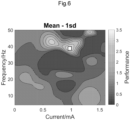
- Figures 6-8 depict maps of predicted cognitive performance during stimulation of three respective groups of subjects having different baseline cognitive performances, as a function of frequency (vertical axis) and current (horizontal axis) of applied stimulation.
- the predicted cognitive performance may be obtained using a Gaussian process model that jointly models performance as a function of parameters for stimulation and baseline data values c , as described above with reference to Figures 1-5 .
- Figure 6 depicts a model for relatively poor baseline performance (1SD below a mean drift rate).
- Figure 8 depicts a model for relatively high baseline performance (1SD above the mean drift rate).
- the vertical axis shows the frequency range of the applied stimulation (0-50 Hz) and the horizontal axis shows the current of the stimulation (0-1.6 mA).
- Arithmetic performance is indicated by shading based on the calculated drift rates (tACS block/baseline block). Low drift rates are shown in darker shading and high drift rates are shown in lighter shading.
- a best inferred point for arithmetic performance, which can be used as the basis to provide optimal personalized parameters for stimulation, is indicated by a white square in each figure.
- Figures 6-8 show that there is a marked shift from higher to lower frequencies and currents from lower (poor) to higher (strong) baseline performances: for the mean-1SD example of Figure 6 , the optimal operating parameters were 38.67Hz and 0.97mA peak-to-peak; for the mean example of Figure 7 , the optimal operating parameters were 16.67Hz and 0.88mA peak-to-peak, and for the mean+1SD example, the optimal operating parameters were 18Hz and 0.60mA peak-to-peak.
- the baseline data value was a continuous parameter, such that the best inferred combination of parameters is expected to vary along this continuum.
- results of Figures 6-8 are derived from tests that included a larger number of subjects with lower than average baseline data values (representing lower than average baseline cognitive performances) than subjects with higher than average baseline data values. Therefore, the results of Figure 6 are of higher confidence regarding an estimation of the optimum frequency-current parameter combination than the results of Figure 8 .
- Figure 9 is a graph showing variation of an optimized performance (middle curve) of subjects as a function of baseline cognitive performance. 95% confidence intervals are indicated by shading. Figure 9 shows a fluctuation across subjects with low and high baseline data values but a significant improvement is seen for all subjects, with the stimulation not being markedly more effective for any particular group of subjects (range of baseline data values).
- Figure 10 depicts the variation in personalized tACS parameters (vertical axes) proposed by the BO algorithm as a function of baseline cognitive performance (horizontal axis).
- the solid line represents variation of stimulation current with baseline cognitive performance and the broken line represents variation of stimulation frequency with baseline cognitive performance. This plot confirms a shift from higher frequencies and currents in low baseline ability subjects to lower frequencies and currents when baseline ability increases, consistent with the group-level BO models shown in Figures 6-8 .
- Figure 11 depicts increased optimisation of the black-box function f ( x ) with EI as acquisition function along an increase in number of iterations.
- the stable plateauing shows that the black-box function f ( x ) is reliably optimised after every iteration.
- the current study is the first to attempt to optimise complex human behaviour by means of a personalized BO approach to obtaining parameters for transcranial stimulation, with the BO being configured to jointly model parameters for stimulation and baseline data representing personal information about a subject that is independent of any transcranial stimulation, such as baseline cognitive performance.
- arithmetic performance was improved by applying different frequency-current tACS combinations over the left frontoparietal network.
- Figure 12 shows the results of running a simulation analysis (a Hartmann 3-Dimensional simulation - further details are provided below) to compare the performance of the present method for finding optimal parameters for transcranial stimulation (upper curve, based on using the EI acquisition function) with what can be obtained by randomly sampling the parameter space (lower curve). Over the 60 iteration window depicted, it can be seen that the best found value rises much more quickly using the present method than with random sampling and reaches a significantly higher level early in the iteration window than is ever reached by the random sampling approach.
- Figure 13 compares use of a BO that only models parameters for stimulation (lower curve) with use of a personalized BO that jointly models parameters for stimulation and baseline cognitive performance (upper curve). It can be seen that the personalized BO (upper curve) is able to efficiently find the higher found values along 100 iterations while the conventional BO that only models the parameters for stimulation (lower curve) does not. In other words, higher cognitive performance levels (e.g., drift rate values) are attained when using the methodology of the present disclosure based on joint modelling of parameters for stimulation and baseline data, in comparison to random sampling of parameters. This finding applies regardless of whether EI or GP-UCB acquisition functions were used.
- higher cognitive performance levels e.g., drift rate values
- Arithmetic performance was tested using an arithmetic calculation paradigm, consisting of problems involving a single-digit number multiplied by a two-digit number, with a three-digit outcome.
- a calculation paradigm was used instead of a retrieval paradigm since calculation has been associated with an increased activation in the frontoparietal network.
- None of the multiplications included operands with the digits 0, 1, 2, to account for variations in difficulty.
- the two-digit operand was not smaller than 15 and did not exist out of identical digits.
- Subjects were visually presented with a multiplication problem on a screen with a correct and incorrect answer positioned under the multiplication problem on the left and right side. The position of the correct and incorrect answer was randomly allocated to the right and left sides of the screen and they always differed by 10 digits.
- every arithmetic multiplication problem consisted of a novel problem.
- the Bayesian Optimisation procedure was run in order to determine the stimulation parameters to use.
- 150 diverse multiplication problems three blocks of 50 trials
- the combination of tACS parameters were changed for every subject and between every block depending on the Bayesian optimisation.
- performance from the baseline task was entered as a contextual variable (e.g., as the baseline metric value c).
- behavioural performance optimisation relied on the frequency and current of tACS together with the baseline cognitive ability, as indicated for example by the drift rate as a baseline metric value. Every subject received three different frequency- current tACS combinations whilst mentally calculating arithmetic problems.
- the alternating current stimulation was always administered to the left frontoparietal network.
- the tACS procedures included two stimulation (3.14 mm diameter) NG Pistim Ag/AgCl electrodes (F3 and P3) with one return electrode (Cz) using the Starstim 32 (Neuroelectrics, Barcelona).
- the impedances of the electrodes were held at ⁇ 10 kQ.
- the stimulation intensity ranged between 0.1 mA - 1.6 mA peak-to- peak in steps of 0.1 for the burn-in phase of the study.
- 0 mA was also added to control for possible sham influences. We chose this maximum stimulation intensity based on a small pilot study on 3 subjects to determine the maximum comfortable intensity.
- Stimulation was administered in a double-blind manner during the three experimental blocks with a maximum of 10 minutes for each block. Stimulation started 45 s before the start of the block and changed after every block. If the subjects received a stimulation intensity of 0 mA during a block (sham stimulation), a ramp-up and a ramp-down of 30 s was initiated to provide the initial skin sensations during stimulation to ensure blinding. When the subject completed a block within 10 minutes, stimulation was ramped down for 30 s and the subject proceeded to the four-minute rs-EEG.
- the rs-EEG data of the remaining datasets were separated in 2 second segments with an overlap of 1 second and windowed with a Hann window. Subsequently, data were transformed into the frequency domain via Fast Fourier Transformation (FFT).
- FFT Fast Fourier Transformation
- Theta (4-7.5 Hz) and beta (14-30 Hz) frequency bands were calculated according to their relative power ( ⁇ V 2 ) and normalised by means of dividing the absolute frequency power of each frequency band by the average absolute power in the 1.5-30 Hz range.
- we decided to normalise the power by means of dividing the absolute frequency power of the applied tACS frequency value by the average absolute power in the 4-50 Hz range.
- Weighted phase lag index (wPLI) in the theta and beta range was computed to determine the phase lag synchronisation between the left frontal and parietal areas at baseline and after every tACS block. This computation was done for the complementary channels F3 and P3. Theta wPLI was calculated for 4-8 Hz in steps of 1 Hz and beta wPLI was calculated from 14 - 30 Hz in steps of 4 Hz. Furthermore, we normalised wPLI by calculating the wPLI at the specific tACS frequency divided by the baseline wPLI at the same frequency.
- tES transcranial electrical stimulation
- ADHD Attention Deficit Hyperactivity Disorder
- a simulated function was designed to demonstrate the utility of taking into account ADHD heterogeneity in order to tailor optimal tES parameters using personalized Bayesian optimization.
- the simulated function was set up with two input dimensions: (1) tES Current Intensity (mA) ranging from 0.1 to 2.0 and (2) Neurophysiology (TBR) ranging from 0.6 to 3.0.
- the Neurophysiology was considered as the personalized variable, which is specific to each participant.
- the output of the simulated function was the clinical outcome, which for illustrative purposes ranged from -1 (poor outcome) to 1 (desired outcome).
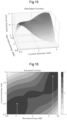
- the best parameter estimated at the final iteration by Bayesian optimization and personalized Bayesian optimization are visualized in Figure 18 .
- the parameters suggested by personalized Bayesian optimization are depicted by white squares.
- the true optimal parameters are depicted by black dots.
- the results of Bayesian optimization are depicted by the white broken line. It can be seen that the parameters suggested by personalized Bayesian optimization (white squares) are very close to the true optimal parameters (black dots). In contrast, the Bayesian optimization, which does not consider the personalized Neurophysiology values, suggests a flat line (white broken line).
- Figure 19 plots the parameters selected by personalized Bayesian optimization over iterations.
- the randomly chosen points from the initial phase are represented by black squares and the points selected by personalized Bayesian optimization are represented by white squares. These points are conditioned on the Neurophysiology value, as indicated by the white broken lines. From this it becomes evident that personalized Bayesian optimization can identify the high-performing region, as most of its selected parameters remain within the high value region (dark grey).
- One desirable property of personalized Bayesian optimization is that, while mainly selecting points in high value regions, it preserves some probability for exploration to gain information about the underlying function.
- Figure 20 compares the performance across methods.
- Figure 20 shows that personalized Bayesian optimization outperformed both Bayesian optimization and Random Search in terms of providing the best clinical outcome.
- the performance of personalized Bayesian optimization at an early stage (at iteration 10) is achieved only later by Bayesian optimization and Random Search (after 20 and 30 iterations, respectively).
- personalized Bayesian optimization was two times faster than Bayesian optimization and three times faster than Random Search in this experiment, therefore requiring significantly less resources.
Landscapes
- Health & Medical Sciences (AREA)
- Life Sciences & Earth Sciences (AREA)
- Engineering & Computer Science (AREA)
- Biomedical Technology (AREA)
- Nuclear Medicine, Radiotherapy & Molecular Imaging (AREA)
- Radiology & Medical Imaging (AREA)
- Animal Behavior & Ethology (AREA)
- General Health & Medical Sciences (AREA)
- Public Health (AREA)
- Veterinary Medicine (AREA)
- Biophysics (AREA)
- Heart & Thoracic Surgery (AREA)
- Child & Adolescent Psychology (AREA)
- Neurology (AREA)
- Psychiatry (AREA)
- Psychology (AREA)
- Social Psychology (AREA)
- Hospice & Palliative Care (AREA)
- Developmental Disabilities (AREA)
- Measurement Of The Respiration, Hearing Ability, Form, And Blood Characteristics Of Living Organisms (AREA)
- Electrotherapy Devices (AREA)
Claims (15)
- Computerimplementiertes Verfahren zum Erlangen personalisierter Parameter für transkranielle Stimulation, umfassend:Empfangen von Ausgangsdaten über ein Testsubjekt (S1), die Ausgangsdaten umfassend Informationen über das Testsubjekt, die vor Anwenden der transkraniellen Stimulation an dem Testsubjekt erfasst werden; undVerwenden eines Gaußschen Prozessmodells einer Leistung eines oder mehrerer Trainingssubjekte, um personalisierte Parameter für transkranielle Stimulation für das Testsubjekt basierend auf den empfangenen Ausgangsdaten (S2) zu erlangen, wobei:
der Gaußsche Prozess gemeinsam die Leistung eines Subjekts während und/oder nach transkranieller Stimulation abhängig von folgenden beiden modellierti) Parametern, die die transkranielle Stimulation definieren; undii) Ausgangsdaten für das eine oder die mehreren Trainingssubjekte. - Verfahren nach Anspruch 1, wobei die Ausgangsdaten eine Leistung ohne Einfluss von transkranieller Stimulation darstellen.
- Verfahren nach Anspruch 1 oder 2, wobei das Erlangen der personalisierten Parameter (S2) ferner Folgendes umfasst:Erlangen von Testdaten, die Leistungen des Testsubjekts während und/oder nach Anwenden von transkraniellen Stimulation mit mehreren entsprechenden Parameterkombinationen darstellen;Verfeinern des Gaußschen Prozessmodells unter Verwendung der erlangten Testdaten; undVerwenden des verfeinerten Gaußschen Prozessmodells, um die personalisierten Parameter zu erlangen.
- Verfahren nach Anspruch 3, wobei das Gaußsche Prozessmodell in einem iterativen Bayesschen Optimierungsprozess verfeinert wird, der in j edem Schritt die nächste Probe auswählt, bei der eine Kombination von Parametern zur Stimulation eine Erfassungsfunktion optimiert.
- Verfahren nach Anspruch 4, wobei die Erfassungsfunktion so konfiguriert ist, dass sie rechnerisch billiger zu optimieren ist als eine Zielfunktion des Gaußschen Prozessmodells, und wobei die Erfassungsfunktion optional eines oder mehrere von Folgenden umfasst: die obere Konfidenzgrenze des Gaußschen Prozesses; und die erwartete Verbesserung.
- Verfahren nach einem vorherigen Anspruch, ferner umfassend ein Trainieren eines Gaußschen Prozessmodells, um das Gaußsche Prozessmodell bereitzustellen, das verwendet wird, um die personalisierten Parameter zu erlangen.
- Verfahren nach Anspruch 6, wobei das Training des Gaußschen Prozessmodells ein Verwenden von Trainingsdaten umfasst, die Leistungen jedes von mehreren Trainingssubjekten während und/oder nach Anwenden von transkranieller Stimulation mit mehreren jeweiligen Kombinationen von Parametern für jedes Trainingssubjekt darstellen.
- Verfahren nach Anspruch 7, wobei das Gaußsche Prozessmodell in einem iterativen Bayesschen Optimierungsprozess trainiert wird, der in jedem Schritt die nächste Probe auswählt, bei der eine Kombination von Parametern zur Stimulation eine Erfassungsfunktion optimiert.
- Verfahren nach Anspruch 8, wobei die Erfassungsfunktion so konfiguriert ist, dass sie rechnerisch billiger zu optimieren ist als eine Zielfunktion des Gaußschen Prozessmodells, und wobei die Erfassungsfunktion optional eines oder mehrere von Folgenden umfasst: die obere Konfidenzgrenze des Gaußschen Prozesses; und die erwartete Verbesserung.
- Verfahren nach einem vorherigen Anspruch, wobei:die transkranielle Stimulation eine oder mehrere der Folgenden umfasst: transkranielle Wechselstromstimulation; transkranielle Zufallsrauschstimulation; transkranielle Gleichstromstimulation; transkranielle Magnetstimulation; transkranieller fokussierter Ultraschall; und transkranielle Lichtstimulation; und/oderdie Parameter für transkranielle Stimulation umfassen eines oder mehrere von Folgenden: Frequenz, Frequenzen, Stromstärke, Phase, Dauer, Dosis und Gehirnregion.
- Verfahren nach einem vorherigen Anspruch, wobei:die Leistungen durch eines oder mehrere von Folgenden dargestellt sind: Genauigkeit; Reaktionszeit; Testergebnis; und subjektive Berichterstattung; und/oderdie Leistungen durch einen Driftratenwert dargestellt sind, der durch Anwenden eines Diffusionsentscheidungsmodells auf die Ergebnisse der von der jeweiligen Testsubjekt durchgeführten Tests erlangt wird.
- Datenverarbeitungsgerät, umfassend einen Prozessor, der konfiguriert ist, um das Verfahren nach einem vorherigen Anspruch durchzuführen.
- Computerprogramm, umfassend Anweisungen, die, wenn das Programm von einem Computer ausgeführt wird, den Computer veranlassen, das Verfahren nach einem der Ansprüche 1-11 durchzuführen.
- Computerlesbarer Datenträger, auf dem das Computerprogramm nach Anspruch 13 gespeichert ist.
- System für transkranielle Stimulation, umfassend:eine Stimulationseinheit, die konfiguriert ist, um transkranielle Stimulation für ein Subjekt bereitzustellen; undein Datenverarbeitungsgerät, das konfiguriert ist, um Betriebsparameter der Stimulationseinheit zu steuern, um Parameter der transkraniellen Stimulation zu definieren, wobei:
die Datenverarbeitungsgerät konfiguriert ist, um das Verfahren nach einem der Ansprüche 1-11 durchzuführen, um personalisierte Parameter für das Subjekt zu erlangen und die Betriebsparameter der Stimulationseinheit basierend auf den Erlangten personalisierten Parameter zu steuern.
Applications Claiming Priority (2)
| Application Number | Priority Date | Filing Date | Title |
|---|---|---|---|
| GBGB2000874.4A GB202000874D0 (en) | 2020-01-21 | 2020-01-21 | Method for obtaining personalized parameters for transcranial stimulation, transcranial stimulation system, method of applying transcranial stimulation |
| PCT/GB2021/050123 WO2021148787A1 (en) | 2020-01-21 | 2021-01-20 | Method for obtaining personalized parameters for transcranial stimulation, transcranial stimulation system, method of applying transcranial stimulation |
Publications (3)
| Publication Number | Publication Date |
|---|---|
| EP4093494A1 EP4093494A1 (de) | 2022-11-30 |
| EP4093494B1 true EP4093494B1 (de) | 2023-09-13 |
| EP4093494C0 EP4093494C0 (de) | 2023-09-13 |
Family
ID=69636858
Family Applications (1)
| Application Number | Title | Priority Date | Filing Date |
|---|---|---|---|
| EP21702066.8A Active EP4093494B1 (de) | 2020-01-21 | 2021-01-20 | Verfahren zur gewinnung von personalisierten parametern für transkranielle stimulation, transkranielles stimulationssystem |
Country Status (7)
| Country | Link |
|---|---|
| US (1) | US20230191127A1 (de) |
| EP (1) | EP4093494B1 (de) |
| CN (1) | CN115209947A (de) |
| ES (1) | ES2956099T3 (de) |
| GB (1) | GB202000874D0 (de) |
| IL (1) | IL294872A (de) |
| WO (1) | WO2021148787A1 (de) |
Families Citing this family (6)
| Publication number | Priority date | Publication date | Assignee | Title |
|---|---|---|---|---|
| CN116098619B (zh) * | 2022-11-17 | 2023-09-22 | 天津大学 | 一种基于高频听觉稳态响应的抑郁症自动检测系统 |
| CN116725511B (zh) * | 2023-08-09 | 2023-11-03 | 杭州般意科技有限公司 | 经颅直流电刺激时的干预电流值确定方法、装置及终端 |
| CN118698042B (zh) * | 2024-05-31 | 2025-09-30 | 北京脑科学与类脑研究所 | 经颅光刺激装置和系统 |
| CN118634423B (zh) * | 2024-08-16 | 2024-12-17 | 首都医科大学宣武医院 | 一种tDCS经颅直流电刺激系统 |
| CN119347799B (zh) * | 2024-12-25 | 2025-04-15 | 中国科学技术大学 | 灵巧臂手机器人铰接物体操作性能优化方法、设备及介质 |
| CN120260830B (zh) * | 2025-06-04 | 2025-11-14 | 北京大学 | 基于生成式模型的多通道经颅刺激参数优化方法和装置 |
Family Cites Families (7)
| Publication number | Priority date | Publication date | Assignee | Title |
|---|---|---|---|---|
| WO2013192582A1 (en) * | 2012-06-22 | 2013-12-27 | Neurotrek , Inc. | Device and methods for noninvasive neuromodulation using targeted transcrannial electrical stimulation |
| US20160175586A1 (en) * | 2014-10-10 | 2016-06-23 | Neurorecovery Technologies, Inc. | Epidural stimulation for facilitation of locomotion, posture, voluntary movement, and recovery of autonomic, sexual, vasomotor, and cognitive function after neurological injury |
| US11337631B2 (en) * | 2017-10-03 | 2022-05-24 | Brainn F.I.T. Imaging, LLC | Methods and magnetic imaging devices to inventory human brain cortical function |
| CA3090265A1 (en) * | 2018-02-01 | 2019-08-08 | Regents Of The University Of Minnesota | Method for adaptive control of a medical device using bayesian optimization |
| US11364361B2 (en) * | 2018-04-20 | 2022-06-21 | Neuroenhancement Lab, LLC | System and method for inducing sleep by transplanting mental states |
| WO2020058761A1 (en) * | 2018-09-18 | 2020-03-26 | NeuroSteer Ltd. | Systems and methods for cooperative invasive and noninvasive brain stimulation |
| CA3079431A1 (en) * | 2019-04-24 | 2020-10-24 | Interaxon Inc. | System and method for brain modelling |
-
2020
- 2020-01-21 GB GBGB2000874.4A patent/GB202000874D0/en not_active Ceased
-
2021
- 2021-01-20 US US17/814,178 patent/US20230191127A1/en active Pending
- 2021-01-20 CN CN202180010224.9A patent/CN115209947A/zh active Pending
- 2021-01-20 IL IL294872A patent/IL294872A/en unknown
- 2021-01-20 ES ES21702066T patent/ES2956099T3/es active Active
- 2021-01-20 WO PCT/GB2021/050123 patent/WO2021148787A1/en not_active Ceased
- 2021-01-20 EP EP21702066.8A patent/EP4093494B1/de active Active
Also Published As
| Publication number | Publication date |
|---|---|
| CN115209947A (zh) | 2022-10-18 |
| EP4093494C0 (de) | 2023-09-13 |
| WO2021148787A1 (en) | 2021-07-29 |
| US20230191127A1 (en) | 2023-06-22 |
| EP4093494A1 (de) | 2022-11-30 |
| IL294872A (en) | 2022-09-01 |
| GB202000874D0 (en) | 2020-03-04 |
| ES2956099T3 (es) | 2023-12-13 |
Similar Documents
| Publication | Publication Date | Title |
|---|---|---|
| EP4093494B1 (de) | Verfahren zur gewinnung von personalisierten parametern für transkranielle stimulation, transkranielles stimulationssystem | |
| Neymotin et al. | Human Neocortical Neurosolver (HNN), a new software tool for interpreting the cellular and network origin of human MEG/EEG data | |
| Gartus et al. | Predicting perceived visual complexity of abstract patterns using computational measures: The influence of mirror symmetry on complexity perception | |
| Londero-Santos et al. | Do romantic relationships promote happiness? Relationships’ characteristics as predictors of subjective well-being | |
| Arya et al. | ECoG high-gamma modulation versus electrical stimulation for presurgical language mapping | |
| KR101320624B1 (ko) | 통합형 인지 재활 시스템 및 통합형 인지 재활 서비스 제공 방법 | |
| Hussein et al. | Technical mentorship during robot‐assisted surgery: a cognitive analysis | |
| Navarro et al. | Fuzzy adaptive cognitive stimulation therapy generation for Alzheimer’s sufferers: Towards a pervasive dementia care monitoring platform | |
| Wang et al. | Multimodal motivation modelling and computing towards motivationally intelligent E-learning systems | |
| Yang et al. | Effects of parental emotional warmth on the relationship between regional gray matter volume and depression-related personality traits | |
| de Carvalho Rodrigues et al. | What neuropsychological functions best discriminate performance in adults post-stroke? | |
| Kim et al. | Characterization of attentional event-related potential from REM sleep behavior disorder patients based on explainable machine learning | |
| Yan et al. | The influence of AI-driven personalized foreign language learning on college students’ mental health: a dynamic interaction among pleasure, anxiety, and self-efficacy | |
| Zhang et al. | Measuring the effect of mental workload and explanations on appropriate AI reliance using EEG | |
| Aguilar-Herrera et al. | Advanced learner assistance system's (ALAS) recent results | |
| Dumont et al. | Non-invasive brain stimulation in information systems research: A proof-of-concept study | |
| Looney et al. | The role of simulation in imagery rescripting for post-traumatic stress disorder: a single case series | |
| Zaltz et al. | Practice makes transfer imperfect: Evidence from auditory learning | |
| Maaz et al. | Spontaneous modulation of alpha power during a neurofeedback session without instructions | |
| Stefano Filho et al. | Actual, sham and no-feedback effects in motor imagery practice | |
| Shanarova et al. | Schizophrenia diagnosis using latent components of event-related potentials and machine learning approach | |
| Corlier et al. | Voluntary control of intracortical oscillations for reconfiguration of network activity | |
| van Bueren et al. | Personalized closed-loop brain stimulation for effective neurointervention across participants | |
| McHaney et al. | Combining pupillometry and drift-diffusion models reveals auditory category learning dynamics | |
| Bellaert et al. | Interaction Effects of Irritability and Anhedonia on ERP and Time–Frequency Measures of Reward Sensitivity |
Legal Events
| Date | Code | Title | Description |
|---|---|---|---|
| STAA | Information on the status of an ep patent application or granted ep patent |
Free format text: STATUS: UNKNOWN |
|
| STAA | Information on the status of an ep patent application or granted ep patent |
Free format text: STATUS: THE INTERNATIONAL PUBLICATION HAS BEEN MADE |
|
| PUAI | Public reference made under article 153(3) epc to a published international application that has entered the european phase |
Free format text: ORIGINAL CODE: 0009012 |
|
| STAA | Information on the status of an ep patent application or granted ep patent |
Free format text: STATUS: REQUEST FOR EXAMINATION WAS MADE |
|
| 17P | Request for examination filed |
Effective date: 20220726 |
|
| AK | Designated contracting states |
Kind code of ref document: A1 Designated state(s): AL AT BE BG CH CY CZ DE DK EE ES FI FR GB GR HR HU IE IS IT LI LT LU LV MC MK MT NL NO PL PT RO RS SE SI SK SM TR |
|
| DAV | Request for validation of the european patent (deleted) | ||
| DAX | Request for extension of the european patent (deleted) | ||
| GRAP | Despatch of communication of intention to grant a patent |
Free format text: ORIGINAL CODE: EPIDOSNIGR1 |
|
| STAA | Information on the status of an ep patent application or granted ep patent |
Free format text: STATUS: GRANT OF PATENT IS INTENDED |
|
| INTG | Intention to grant announced |
Effective date: 20230517 |
|
| GRAS | Grant fee paid |
Free format text: ORIGINAL CODE: EPIDOSNIGR3 |
|
| GRAA | (expected) grant |
Free format text: ORIGINAL CODE: 0009210 |
|
| STAA | Information on the status of an ep patent application or granted ep patent |
Free format text: STATUS: THE PATENT HAS BEEN GRANTED |
|
| AK | Designated contracting states |
Kind code of ref document: B1 Designated state(s): AL AT BE BG CH CY CZ DE DK EE ES FI FR GB GR HR HU IE IS IT LI LT LU LV MC MK MT NL NO PL PT RO RS SE SI SK SM TR |
|
| REG | Reference to a national code |
Ref country code: CH Ref legal event code: EP |
|
| REG | Reference to a national code |
Ref country code: DE Ref legal event code: R096 Ref document number: 602021005156 Country of ref document: DE |
|
| REG | Reference to a national code |
Ref country code: IE Ref legal event code: FG4D |
|
| U01 | Request for unitary effect filed |
Effective date: 20230918 |
|
| U07 | Unitary effect registered |
Designated state(s): AT BE BG DE DK EE FI FR IT LT LU LV MT NL PT SE SI Effective date: 20230922 |
|
| REG | Reference to a national code |
Ref country code: ES Ref legal event code: FG2A Ref document number: 2956099 Country of ref document: ES Kind code of ref document: T3 Effective date: 20231213 |
|
| PG25 | Lapsed in a contracting state [announced via postgrant information from national office to epo] |
Ref country code: GR Free format text: LAPSE BECAUSE OF FAILURE TO SUBMIT A TRANSLATION OF THE DESCRIPTION OR TO PAY THE FEE WITHIN THE PRESCRIBED TIME-LIMIT Effective date: 20231214 |
|
| PG25 | Lapsed in a contracting state [announced via postgrant information from national office to epo] |
Ref country code: RS Free format text: LAPSE BECAUSE OF FAILURE TO SUBMIT A TRANSLATION OF THE DESCRIPTION OR TO PAY THE FEE WITHIN THE PRESCRIBED TIME-LIMIT Effective date: 20230913 Ref country code: NO Free format text: LAPSE BECAUSE OF FAILURE TO SUBMIT A TRANSLATION OF THE DESCRIPTION OR TO PAY THE FEE WITHIN THE PRESCRIBED TIME-LIMIT Effective date: 20231213 Ref country code: HR Free format text: LAPSE BECAUSE OF FAILURE TO SUBMIT A TRANSLATION OF THE DESCRIPTION OR TO PAY THE FEE WITHIN THE PRESCRIBED TIME-LIMIT Effective date: 20230913 Ref country code: GR Free format text: LAPSE BECAUSE OF FAILURE TO SUBMIT A TRANSLATION OF THE DESCRIPTION OR TO PAY THE FEE WITHIN THE PRESCRIBED TIME-LIMIT Effective date: 20231214 |
|
| U20 | Renewal fee for the european patent with unitary effect paid |
Year of fee payment: 4 Effective date: 20240119 |
|
| PG25 | Lapsed in a contracting state [announced via postgrant information from national office to epo] |
Ref country code: IS Free format text: LAPSE BECAUSE OF FAILURE TO SUBMIT A TRANSLATION OF THE DESCRIPTION OR TO PAY THE FEE WITHIN THE PRESCRIBED TIME-LIMIT Effective date: 20240113 |
|
| PG25 | Lapsed in a contracting state [announced via postgrant information from national office to epo] |
Ref country code: SM Free format text: LAPSE BECAUSE OF FAILURE TO SUBMIT A TRANSLATION OF THE DESCRIPTION OR TO PAY THE FEE WITHIN THE PRESCRIBED TIME-LIMIT Effective date: 20230913 Ref country code: RO Free format text: LAPSE BECAUSE OF FAILURE TO SUBMIT A TRANSLATION OF THE DESCRIPTION OR TO PAY THE FEE WITHIN THE PRESCRIBED TIME-LIMIT Effective date: 20230913 Ref country code: IS Free format text: LAPSE BECAUSE OF FAILURE TO SUBMIT A TRANSLATION OF THE DESCRIPTION OR TO PAY THE FEE WITHIN THE PRESCRIBED TIME-LIMIT Effective date: 20240113 Ref country code: CZ Free format text: LAPSE BECAUSE OF FAILURE TO SUBMIT A TRANSLATION OF THE DESCRIPTION OR TO PAY THE FEE WITHIN THE PRESCRIBED TIME-LIMIT Effective date: 20230913 Ref country code: SK Free format text: LAPSE BECAUSE OF FAILURE TO SUBMIT A TRANSLATION OF THE DESCRIPTION OR TO PAY THE FEE WITHIN THE PRESCRIBED TIME-LIMIT Effective date: 20230913 |
|
| PG25 | Lapsed in a contracting state [announced via postgrant information from national office to epo] |
Ref country code: PL Free format text: LAPSE BECAUSE OF FAILURE TO SUBMIT A TRANSLATION OF THE DESCRIPTION OR TO PAY THE FEE WITHIN THE PRESCRIBED TIME-LIMIT Effective date: 20230913 |
|
| REG | Reference to a national code |
Ref country code: DE Ref legal event code: R097 Ref document number: 602021005156 Country of ref document: DE |
|
| PLBE | No opposition filed within time limit |
Free format text: ORIGINAL CODE: 0009261 |
|
| STAA | Information on the status of an ep patent application or granted ep patent |
Free format text: STATUS: NO OPPOSITION FILED WITHIN TIME LIMIT |
|
| 26N | No opposition filed |
Effective date: 20240614 |
|
| PG25 | Lapsed in a contracting state [announced via postgrant information from national office to epo] |
Ref country code: MC Free format text: LAPSE BECAUSE OF FAILURE TO SUBMIT A TRANSLATION OF THE DESCRIPTION OR TO PAY THE FEE WITHIN THE PRESCRIBED TIME-LIMIT Effective date: 20230913 |
|
| PG25 | Lapsed in a contracting state [announced via postgrant information from national office to epo] |
Ref country code: MC Free format text: LAPSE BECAUSE OF FAILURE TO SUBMIT A TRANSLATION OF THE DESCRIPTION OR TO PAY THE FEE WITHIN THE PRESCRIBED TIME-LIMIT Effective date: 20230913 |
|
| U20 | Renewal fee for the european patent with unitary effect paid |
Year of fee payment: 5 Effective date: 20250120 |
|
| PG25 | Lapsed in a contracting state [announced via postgrant information from national office to epo] |
Ref country code: CY Free format text: LAPSE BECAUSE OF FAILURE TO SUBMIT A TRANSLATION OF THE DESCRIPTION OR TO PAY THE FEE WITHIN THE PRESCRIBED TIME-LIMIT; INVALID AB INITIO Effective date: 20210120 |
|
| PG25 | Lapsed in a contracting state [announced via postgrant information from national office to epo] |
Ref country code: HU Free format text: LAPSE BECAUSE OF FAILURE TO SUBMIT A TRANSLATION OF THE DESCRIPTION OR TO PAY THE FEE WITHIN THE PRESCRIBED TIME-LIMIT; INVALID AB INITIO Effective date: 20210120 |
|
| PG25 | Lapsed in a contracting state [announced via postgrant information from national office to epo] |
Ref country code: TR Free format text: LAPSE BECAUSE OF FAILURE TO SUBMIT A TRANSLATION OF THE DESCRIPTION OR TO PAY THE FEE WITHIN THE PRESCRIBED TIME-LIMIT Effective date: 20230913 |
|
| REG | Reference to a national code |
Ref country code: CH Ref legal event code: U11 Free format text: ST27 STATUS EVENT CODE: U-0-0-U10-U11 (AS PROVIDED BY THE NATIONAL OFFICE) Effective date: 20260201 |
|
| U20 | Renewal fee for the european patent with unitary effect paid |
Year of fee payment: 6 Effective date: 20260128 |
|
| PGFP | Annual fee paid to national office [announced via postgrant information from national office to epo] |
Ref country code: GB Payment date: 20260114 Year of fee payment: 6 |
|
| PGFP | Annual fee paid to national office [announced via postgrant information from national office to epo] |
Ref country code: ES Payment date: 20260217 Year of fee payment: 6 |
|
| PGFP | Annual fee paid to national office [announced via postgrant information from national office to epo] |
Ref country code: IE Payment date: 20260121 Year of fee payment: 6 |
|
| PGFP | Annual fee paid to national office [announced via postgrant information from national office to epo] |
Ref country code: CH Payment date: 20260201 Year of fee payment: 6 |