EP4093146A1 - 2g and 3g cellular radio communications over a packet-based open radio access network fronthaul interface (o-ran fh) - Google Patents
2g and 3g cellular radio communications over a packet-based open radio access network fronthaul interface (o-ran fh) Download PDFInfo
- Publication number
- EP4093146A1 EP4093146A1 EP22170616.1A EP22170616A EP4093146A1 EP 4093146 A1 EP4093146 A1 EP 4093146A1 EP 22170616 A EP22170616 A EP 22170616A EP 4093146 A1 EP4093146 A1 EP 4093146A1
- Authority
- EP
- European Patent Office
- Prior art keywords
- ran
- plane
- rat
- radio access
- fronthaul interface
- Prior art date
- Legal status (The legal status is an assumption and is not a legal conclusion. Google has not performed a legal analysis and makes no representation as to the accuracy of the status listed.)
- Pending
Links
- 238000004891 communication Methods 0.000 title claims abstract description 6
- 230000001413 cellular effect Effects 0.000 title 1
- 238000000034 method Methods 0.000 claims abstract description 21
- 238000012545 processing Methods 0.000 claims description 54
- 230000006870 function Effects 0.000 claims description 37
- 238000007906 compression Methods 0.000 claims description 26
- 238000005516 engineering process Methods 0.000 claims description 26
- 230000006835 compression Effects 0.000 claims description 21
- 230000006837 decompression Effects 0.000 claims description 12
- 230000008859 change Effects 0.000 claims description 8
- 238000012546 transfer Methods 0.000 claims description 8
- 238000012937 correction Methods 0.000 claims description 4
- 238000001914 filtration Methods 0.000 claims description 4
- 230000007480 spreading Effects 0.000 claims description 4
- 241000700159 Rattus Species 0.000 description 73
- 238000010586 diagram Methods 0.000 description 9
- 238000013459 approach Methods 0.000 description 5
- 238000013461 design Methods 0.000 description 5
- 230000003116 impacting effect Effects 0.000 description 4
- 230000008569 process Effects 0.000 description 4
- 230000003068 static effect Effects 0.000 description 4
- 101100335633 Rattus norvegicus Fh gene Proteins 0.000 description 3
- 239000000969 carrier Substances 0.000 description 3
- 230000010354 integration Effects 0.000 description 3
- MWRWFPQBGSZWNV-UHFFFAOYSA-N Dinitrosopentamethylenetetramine Chemical compound C1N2CN(N=O)CN1CN(N=O)C2 MWRWFPQBGSZWNV-UHFFFAOYSA-N 0.000 description 2
- 229940112112 capex Drugs 0.000 description 2
- FEBLZLNTKCEFIT-VSXGLTOVSA-N fluocinolone acetonide Chemical compound C1([C@@H](F)C2)=CC(=O)C=C[C@]1(C)[C@]1(F)[C@@H]2[C@@H]2C[C@H]3OC(C)(C)O[C@@]3(C(=O)CO)[C@@]2(C)C[C@@H]1O FEBLZLNTKCEFIT-VSXGLTOVSA-N 0.000 description 2
- 238000012986 modification Methods 0.000 description 2
- 230000004048 modification Effects 0.000 description 2
- 238000005070 sampling Methods 0.000 description 2
- TVZRAEYQIKYCPH-UHFFFAOYSA-N 3-(trimethylsilyl)propane-1-sulfonic acid Chemical compound C[Si](C)(C)CCCS(O)(=O)=O TVZRAEYQIKYCPH-UHFFFAOYSA-N 0.000 description 1
- 102100022734 Acyl carrier protein, mitochondrial Human genes 0.000 description 1
- 101000678845 Homo sapiens Acyl carrier protein, mitochondrial Proteins 0.000 description 1
- 230000006978 adaptation Effects 0.000 description 1
- 239000000654 additive Substances 0.000 description 1
- 230000000996 additive effect Effects 0.000 description 1
- 230000005540 biological transmission Effects 0.000 description 1
- 230000015572 biosynthetic process Effects 0.000 description 1
- 230000010267 cellular communication Effects 0.000 description 1
- 230000001419 dependent effect Effects 0.000 description 1
- 238000000605 extraction Methods 0.000 description 1
- 230000007246 mechanism Effects 0.000 description 1
- 230000008450 motivation Effects 0.000 description 1
- 230000006855 networking Effects 0.000 description 1
- 238000005204 segregation Methods 0.000 description 1
- 230000001360 synchronised effect Effects 0.000 description 1
Images






Classifications
-
- H—ELECTRICITY
- H04—ELECTRIC COMMUNICATION TECHNIQUE
- H04W—WIRELESS COMMUNICATION NETWORKS
- H04W28/00—Network traffic management; Network resource management
- H04W28/02—Traffic management, e.g. flow control or congestion control
- H04W28/0247—Traffic management, e.g. flow control or congestion control based on conditions of the access network or the infrastructure network
-
- H—ELECTRICITY
- H04—ELECTRIC COMMUNICATION TECHNIQUE
- H04W—WIRELESS COMMUNICATION NETWORKS
- H04W88/00—Devices specially adapted for wireless communication networks, e.g. terminals, base stations or access point devices
- H04W88/08—Access point devices
- H04W88/10—Access point devices adapted for operation in multiple networks, e.g. multi-mode access points
-
- H—ELECTRICITY
- H04—ELECTRIC COMMUNICATION TECHNIQUE
- H04L—TRANSMISSION OF DIGITAL INFORMATION, e.g. TELEGRAPHIC COMMUNICATION
- H04L69/00—Network arrangements, protocols or services independent of the application payload and not provided for in the other groups of this subclass
- H04L69/18—Multiprotocol handlers, e.g. single devices capable of handling multiple protocols
-
- H—ELECTRICITY
- H04—ELECTRIC COMMUNICATION TECHNIQUE
- H04L—TRANSMISSION OF DIGITAL INFORMATION, e.g. TELEGRAPHIC COMMUNICATION
- H04L69/00—Network arrangements, protocols or services independent of the application payload and not provided for in the other groups of this subclass
- H04L69/26—Special purpose or proprietary protocols or architectures
-
- H—ELECTRICITY
- H04—ELECTRIC COMMUNICATION TECHNIQUE
- H04W—WIRELESS COMMUNICATION NETWORKS
- H04W48/00—Access restriction; Network selection; Access point selection
- H04W48/02—Access restriction performed under specific conditions
-
- H—ELECTRICITY
- H04—ELECTRIC COMMUNICATION TECHNIQUE
- H04W—WIRELESS COMMUNICATION NETWORKS
- H04W52/00—Power management, e.g. Transmission Power Control [TPC] or power classes
- H04W52/04—Transmission power control [TPC]
- H04W52/52—Transmission power control [TPC] using AGC [Automatic Gain Control] circuits or amplifiers
-
- H—ELECTRICITY
- H04—ELECTRIC COMMUNICATION TECHNIQUE
- H04W—WIRELESS COMMUNICATION NETWORKS
- H04W56/00—Synchronisation arrangements
- H04W56/001—Synchronization between nodes
-
- H—ELECTRICITY
- H04—ELECTRIC COMMUNICATION TECHNIQUE
- H04W—WIRELESS COMMUNICATION NETWORKS
- H04W92/00—Interfaces specially adapted for wireless communication networks
- H04W92/02—Inter-networking arrangements
-
- H—ELECTRICITY
- H04—ELECTRIC COMMUNICATION TECHNIQUE
- H04W—WIRELESS COMMUNICATION NETWORKS
- H04W84/00—Network topologies
- H04W84/02—Hierarchically pre-organised networks, e.g. paging networks, cellular networks, WLAN [Wireless Local Area Network] or WLL [Wireless Local Loop]
-
- H—ELECTRICITY
- H04—ELECTRIC COMMUNICATION TECHNIQUE
- H04W—WIRELESS COMMUNICATION NETWORKS
- H04W84/00—Network topologies
- H04W84/02—Hierarchically pre-organised networks, e.g. paging networks, cellular networks, WLAN [Wireless Local Area Network] or WLL [Wireless Local Loop]
- H04W84/04—Large scale networks; Deep hierarchical networks
- H04W84/042—Public Land Mobile systems, e.g. cellular systems
-
- H—ELECTRICITY
- H04—ELECTRIC COMMUNICATION TECHNIQUE
- H04W—WIRELESS COMMUNICATION NETWORKS
- H04W88/00—Devices specially adapted for wireless communication networks, e.g. terminals, base stations or access point devices
- H04W88/12—Access point controller devices
-
- H—ELECTRICITY
- H04—ELECTRIC COMMUNICATION TECHNIQUE
- H04W—WIRELESS COMMUNICATION NETWORKS
- H04W92/00—Interfaces specially adapted for wireless communication networks
- H04W92/04—Interfaces between hierarchically different network devices
- H04W92/12—Interfaces between hierarchically different network devices between access points and access point controllers
Definitions
- the present disclosure relates to a radio access network (RAN), and more particularly, a RAN design that accommodates 2G and 3G based mobile networks.
- RAN radio access network
- the present document near its end, includes a list of acronyms and a list of definitions.
- Open-RAN Open-RAN
- DU distributed unit
- RU radio unit
- RAT new radio
- a primary reason for such growth includes an O-RAN standard allowing interoperability and standardization of RAN components, primarily O-DU and O-RU through including a unified interconnection standard over packet-based transport interfaces like eCPRI and RoE. This has enabled seamless integration of white-box hardware and open-source software elements from different component vendors for O-DUs and O-RUs.
- O-RAN standard supports 4G and 5G NR radio access technologies (RAT) based layer 1 functional split 7.2x (FS-7.2x) where frequency domain data IQ samples and related control, management and synchronization information is carried over a fronthaul (FH) interface.
- RAT radio access technologies
- FH fronthaul
- packet-based FH interface supports only FS-7.2x RAT operations, and thus defines frequency-domain IQ data transfer mechanism over FH using O-RAN specified CUS- and M-Plane standards.
- 2G and 3G radio access technologies traditionally use streaming interface-based FH connections to carry time-domain IQ samples to or from an O-RU.
- the O-RAN standard in its current form does not support RATs with FS-8, which do not have any frequency-domain operations defined in their respective RAT standards.
- the current fronthaul O-RAN standards for the control, user, and synchronization planes (CUS-Plane) and management plane (M-Plane) support only 4G LTE and 5G NR RATs.
- the O-RAN standard in its current form does not provide any support to carry functional split-8 (FS-8) RAT time domain IQ data, control, and related management information over the FH interface. Enhancements in multiple aspects are needed in the O-RAN standard for seamless integration of 2G and 3G RATs supporting functional split FS-8 with newer RATs (4G and NR) supporting FS-7.2x.
- the present document discloses a set of enhancements to the current O-RAN standard.
- a set of innovations around system, O-DU and O-RU architectures, and methods are disclosed to extend the capability of the present O-RAN FH interface standard, generalized as a packet-based FH transport standard, to carry FS-8 RAT time domain IQ data, control, and management information over the same FH interface without impacting existing operations for FS-7.2x RATs, thus allowing traditional 2G and 3G radio IQ data transmissions and reception to/from an O-RU.
- unified O-DU and O-RU designs are emerged.
- the present document uses the terms O-DU and DU interchangeably, and also uses the terms O-RU and RU interchangeably.
- Systems and methods disclosed herein allow 2G and 3G RAT generated time-domain IQ data to be carried in downlink and uplink directions as per functional split-8 (FS-8) over generalized networks such as packet-based O-RAN FH transport network.
- FS-8 functional split-8
- the systems and methods disclosed herein will significantly extend the capability support of the current O-RAN standard (such packet interface-based FH interface standards) to any RATs supporting FS-8 as well as FS-7.2x standalone or simultaneously.
- Content of the packet-based FH interface packets can be determined by the Layer1 standard of the RAT without limiting the FH capability or radio operation capability.
- the systems and methods disclosed herein augment the current O-RAN standard, and in general, any packet-based FH transport standard.
- Systems designed based on such an enhanced O-RAN standard will allow seamless integration and deployment of both legacy (2G and 3G) and new RATs using the same O-RAN FH standard.
- an Open Radio Access Network that includes a fronthaul interface over which an O-RAN Distributed Unit (O-DU) and an O-RAN Radio Unit (O-RU) communicate with one another and exchange O-RAN standard defined user-plane (U-plane) packets and control-place (C-Plane) packets.
- the fronthaul interface carries control and management information via management-plane (M-Plane) message exchange, and timing synchronization is achieved in accordance with synchronization-plane (S-Plane) procedures, and the O-RAN accommodates communications via 2G and 3G based mobile networks.
- M-Plane management-plane
- S-Plane synchronization-plane
- the present document discloses an O-RAN that includes a fronthaul interface over which an O-DU and an O-RU communicate with one another and exchange O-RAN standard defined U-plane packets and C-Plane packets.
- the fronthaul interface carries control and management information via M-Plane message exchange, timing synchronization is achieved in accordance with S-Plane procedures, and the O-RAN accommodates communications via 2G and 3G based mobile networks.
- FIG. 8 is a block diagram of an O-RAN, namely system 800, of a single RAT radio access solution where an O-DU 805 communicates with an O-RU 810 over an O-RAN packet-based FH interface, i.e., FH 815, also designated herein as an IP/Ethernet (Eth) cloud.
- FH 815 also designated herein as an IP/Ethernet (Eth) cloud.
- the techniques disclosed herein augment the current O-RAN standard where, at a minimum, O-DU 805 communicates to O-RU 810 over FH 815 by exchanging O-RAN standard defined U-Plane and C-Plane packets. Additional static C&M information is carried over M-Plane message exchange over FH 815. Timing synchronization is achieved over S-Plane procedures defined in the O-RAN standard.
- Section 1 System and architecture of a packet-based FH interface, i.e., FH 815, definition capable of carrying RATs supporting FS-8 along with FS-7.2x (not mandatory to be active in the system)
- Section 1.1 O-DU 805 - O-RU 810 Architecture for 2G RAT interfaced through packet-based FH
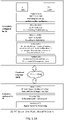
- FIGS. 1.1A and 1.1B are block diagrams of systems that provide single RAT and multi-RAT solution (one antenna path or multiple antenna paths) architectures for 2G RAT.
- x-RAT indicates RATs supporting FS-7.2 (LTE/NR).
- each of these architectures can support multiple component carriers from one or different types of FS-8 RATs (homogeneous or heterogeneous combination of 2G and 3G RATs).
- These architectures provide a packet-based FH Interface, i.e., FH 815, to support FS-8 RATs with or without FS-7.2x RATs in mix of single and multimode operation.
- Example FS-8 RAT is 2G and FS-7.2x RAT is LTE.
- Section 1.2 O-DU 805 - O-RU 810 Architecture for 3G RAT interfaced through packet-based FH 815
- each architecture can support multiple component carriers from one or different type FS-8 RATs (homogeneous or heterogeneous combination of 2G and 3G RATs).
- FIG. 1.1A presents a system and architecture of a radio FH interface, i.e., FH 815, capable of carrying RATs supporting FS-8 (2G) along with FS-7.2x (not mandatory to be active in the system).
- FIG.1.1B presents O-DU 805 and O-RU 810 architectures for FH 815 support FS-8 RATs with or without FS-7.2x RATs in a mix of single and multimode operation.
- FS-8 RAT is 2G
- FS-7.2x RAT is LTE or NR.
- O-DU 805 Architecture includes FS-8 RAT Standard L1 processing blocks, e.g., for 2G they are:
- O-RU 810 Architecture includes FS-8 RAT radio processing blocks, e.g., for 2G they are:
- O-DU 805 and O-RU 810 communicate via FH 815, which is represented as an IP/ETH cloud.
- x-RAT and X-DU 111 indicates RATs supporting FS-7.2x.
- each architecture can support multiple component carriers from one or different type FS-8 RATs (homogeneous or heterogeneous combination of 2G and 3G RATs).
- X-DU 111 Architecture includes FS-7.2 X-RAT Standard L1 processing blocks (Module 112) and the fronthaul interface functions and real time control functions (Module 113).
- Timing is provided to the 2G/3G RAT and the X-RAT from a common timing source Grand Master (GM) 400.
- GM Grand Master
- Shared O-RU 810 is an RU that has the capability to concurrently support more than one type of RAT.
- X-RAT RU Architecture includes:
- FIG. 1.1B is labeled as a multi RAT system over Packet based FH system with independent IQ data paths. This is shown in FIG 1.1B as two independent IQ data outputs from O-DU 805 and X-DU 111 to the IP/ETH cloud, and then as two separate IQ data inputs to the shared O-RU 810.
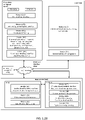
- FIGS. 1.2A and 1.2B are block diagrams of systems that provide packet-based FH for supporting RATs with FS-8 and FS-7.2x in mix of single and multimode operation.
- Example FS-8 RAT is 3G.
- FIGS. 1.2A and 1.2B represent O-DU 805 and O-RU 810 architectures for packet-based FH Interface to support FS-8 RATs with or without FS-7.2x RATs in a mix of single and multimode operation.
- Example FS-8 RAT is 3G and FS-7.2x RAT is LTE.
- O-DU 805 Architecture includes FS-8 RAT Standard L1 processing blocks, e.g., for 3G they are:
- O-RU 810 Architecture includes FS-8 RAT radio processing blocks, e.g., for 3G they are:
- O-RAN standard in current form lists required processing blocks in both O-DU 805 and O-RU 810 which are not repeated here.
- Section 1.3 O-RAN split for DL/UL data transfer for selected FS-8 RATs
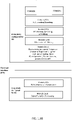
- FIG. 1.3A is a block diagram of a 2G DL/UL O-RAN split.
- FIG. 1.3B is a block diagram of a 3G DL/UL O-RAN split.
- FS-8 RATs can apply additional processing in O-DU 805 that will allow FH 815 to transport time domain IQ data which could be synonymous to current O-RAN standards for 4G and 5G, which carries frequency domain IQ data over FH 815.
- a User Plane (U-Plane) packet is defined for FS-8 RAT IQ data transfer over O-RAN FH interface.
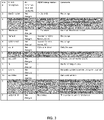
- FIG. 2 presents an O-RAN U-Plane header definition along with a description table for modified header fields for FS-8 RATs 2G and 3G.
- Bit fields interpretations shown in FIG. 2 can be used along with existing definitions for multi-RAT operations (FS-8 and FS-7.2x). With this packet structure, support inclusion will enable O-RAN standard to support FS-8 RATs in addition to FS-7.2x RATs.
- the same U-Plane packet format can be used for IQ data and associated U-Plane for any RAT from FS-8 configuration category, and O-RU 810 can use the defined fields to segregate respective U-Plane packets and process as per functions shown in FIGS. 1.1A and 1.1B , or FIGS. 1.2A and 1.2B . Any additional control information needed can be added to the reserved bit fields which can be accommodated within the frame format for U-Plane. No C-Plane packets are needed for U-Plane data processing in O-RU except O-RU power control via C-Plane Type-0 packets from O-DU 805.
- FIG. 3 is a table of O-RAN compliant U-Plane header field definitions for 2G/3G operations. Each bit filed is interpreted to represent 2G/3G RAT U-Plane packets without any ambiguity at O-RU 810.
- FIG. 3 shows bit level descriptions for each header field in the U-Plane ORAN header to carry FS-8 IQ data which is necessary for processing at O-RU. Definitions of the bitfields in the column named "2G/3G Interpretation" will be applied with similar meaning for all the FS-8 RATs. These definitions enable O-RAN standard to cater to RATs supporting FS-8 without impacting existing FS-7.2x RATs.
- the following embodiments differentiate the RAT type.
- Embodiment 1 Keep the payloadVersion definition as is in O-RAN standard and indicate via M-Plane parameter exchange the RAT type (part of M-Plane messaging).
- RATs can be differentiated by allocating dedicated endpoints (eAxC IDs) to different RATs.
- Embodiment 2 Keep the payloadVersion definition as in O-RAN standard. Add 2G and 3G RATs to section extension 9. Modify section extension 9 definition to be used for RAT identification rather than only RAT identification for DSS.
- Embodiment 3 Use payloadVersion to indicate the RAT type to O-RU 810 as shown in FIG. 3 .
- FIG. 4 shows eCPRI header fields representation for FS-8 RATs 2G and 3G U-Plane packets, and also shows usage of the existing eCPRI packet header fields definitions that can be applicable to both ORAN U-Plane and C-Plane Type-0 packets. Changes in the header field interpretation accommodate 2G/3G RATs operations without impacting FS-7.2x RAT 4G and 5G operations.
- RoE FH Usage of existing RoE packet header fields will enable RoE FH to carry FS-8 O-RAN U-Plane packets. These changes in the header field interpretation enable FS-8 RAT operation without impacting FS-7.2x 4G and 5G RAT operations.
- FIG. 5 is a representation of RoEorderInfo header fields for 2G and 3G U-Plane and C-Plane Type-0 packets. U-plane sequence Id generation is required.
- O-RU 810 for FS-8 RATs, there is no requirement for separate RACH IQ processing. Hence, O-RU 810 does not have to send any U-Plane message to O-DU 805, and related control (C-Plane message) from O-DU 805 is not needed at O-RU 810. This is consistent with the RU-DU functional split architecture for the FS-8 RATs shown in FIGS. 1.1A and 1.2A.
- C-Plane No Real-Time Control Information (C-Plane) for FS-8 RAT downlink and uplink U-Plane Operations.
- C-Plane Type-0 message/frames are used for the power control operations in FS-8 RATs RU. Note that there are no U-Plane messages associated with this C-Plane Type "0".
- FIG. 6 is a representation of idle slot scheduling C-Plane frame format (C-Plane Section Type - 0).
- FS-8 RAT related changes and updated definitions of header fields are shown. These changes are additive and will not impact existing FS-7.2x RAT operations.
- Static configurations for U-Plane IQ data processing in O-RU 810 or O-DU 805 are carried over M-Plane information exchange.
- the FH frame timing structure disclosed herein will be used to carry FS-8 RAT IQ data via U-Plane packets.
- the existing frame format can be also supported by O-RAN standard alongside on the same eCPRI/RoE and physical medium.
- Example number for multiple FH sampling rates are given in Table 1, below.
- Table 1 Number of data IQ samples in one FH packet for a given FH rate Supported Fronthaul Rate 1 FS8 Packet Size (Number of IQ Samples pair, Signed 16 bits representation) 1 3.84Msps 256 2 7.68Msps 512 3 15.36Msps 1024 4 30.76Msps 2048
- FIG. 7 is a representation of FS-8 RAT FH frame format and relationships with FS-7.2x LTE RAT.
- FIG. 7 shows timing relationships of the FH U-Plane frames for FS-8 RATs with FS-7.2x LTE RAT. Similar relationships will exist for other FS-8 RATs as well.
- Table 2 shows fronthaul timing calculations to meet the frame structure proposed herein for FS8 RATs with respect to the existing O-RAN compliant S-Plane based IEEE 1588 PTP or SyncE protocol recovered time in O-DU/O-RU.
- Table 2 GSM frame timing calculations from GPS epoch Fronthaul Timing -Example 2G RAT time now 28-nov-2020-10:42:42 GPS epoch 6-jan-1980-0:0:0 max Frame number 1.25E+10 Frame Number 5.43E+09 MultiFrame number 1146523 SuperFrame number 52083 Hyperframe number 1090
- a system that is configured as disclosed herein will be ready for coexistence of FS-8 and FS-7.2 RATs on the same O-RU 810 SW/HW/FW. Similar configurations will allow one O-DU 805 SW/HW support for RATs coexistence and parallel operations. In addition, common M-Plane and S-Plane design shared across multiple RATs will help in better O-RU 810 system coordination and power savings.
- a method of exchanging user-Plane (U-Plane) data packets between O-DU 805 and O-RU 810 includes defining packet header for FS-8 RATs generated IQ data transfer over a packet-based O-RAN FH interface, i.e., FH 815. Additionally:
- C-Plane For control information (C-Plane) packet definition for RATs supporting FS-8:
- Front-Haul frame timing and U-Plane packet size definitions support FS-8 RATs over eCPRI/RoE/O-RAN interface.
- Exemplary system I is a system of operating an enhanced Open Radio Access Network (O-RAN) fronthaul interface, i.e., FH 815, supporting 2G radio access technologies simultaneously or standalone operations along with 3G, 4G and 5G radio technologies.
- the system includes (a) an O-RAN compliant distributed unit (O-DU 805) sending/receiving IQ sample that is rate adapted to fronthaul link rates, multi-carrier processed over wider bandwidths and Time Division Multiple Access (TDMA) framed (frame structure proposed herein) time-domain IQ samples generated from traditional FS-8, and (b) an O-RAN compliant radio unit (O-RU 810) sending/receiving time-domain IQ that is rate adapted to fronthaul link rates, multi-carrier processed over wider bandwidths and TDMA framed time-domain IQ samples generated from traditional FS-8.
- O-RAN O-RAN compliant distributed unit
- TDMA Time Division Multiple Access
- O-DU 805 executes the following functions:
- the O-RU(s) execute the following functions:
- Exemplary system II is a system of operating an Open Radio Access Network (O-RAN) fronthaul interface, i.e., FH 815, supporting 3G radio access technology simultaneously or standalone operations along with 2G, 4G and 5G radio technologies.
- the system includes (a) an O-RAN compliant distributed unit (O-DU 805) sending/receiving time-domain IQ samples based on functional split 8, and (b) an O-RAN compliant radio unit (O-RU 810) sending/receiving time-domain IQ samples based on functional split 8.
- O-RAN Open Radio Access Network
- O-DU 805 executes the following functions:
- O-RU 810 executes the following functions:
- Exemplary system III is a system of operating an Open Radio Access Network (O-RAN) fronthaul interface, e.g., FH 815, supporting 2G or 3G radio access technology or both simultaneously or standalone operations along with 4G and 5G radio technologies.
- the system includes (a) an O-RAN compliant distributed unit (O-DU 805) sending/receiving time-domain IQ samples based on functional split 8; and (b) an O-RAN compliant radio unit (O-RU 810) sending/receiving time-domain IQ samples based on functional split 8.
- O-RAN Open Radio Access Network
- O-RU 810 can differentiate between different RATs by:
- the PRACH signal is processed using the same chain of other data traffic in O-RU 810.
- control information is indicated via M-Plane and no real-time C-Plane packets are sent along with the U-Plane packets.
- C-Plane section type 0 can be used to indicate unused RBs or symbols.
- compression schemes except modulation compression
- O-RAN can be used for 2G/3G RATs and configured statically.
- FS-8 2G RAT specific frequency hopping over wideband operations can be implemented in O-DU 805 SW allowing further system design flexibility.
- FS-8 RAT specific multicarrier signal formation in DL and multicarrier segregation in the UL can be implemented in O-DU SW allowing further system design flexibility.
- the methods/processes described herein can be performed by an apparatus that is configured of electronic circuitry, which may be implemented with discrete components, or may include a processor and a memory.
- the processor is an electronic device, e.g., digital circuitry, that executes instructions.
- the memory is a storage device, e.g., electronic, that is readable by the processor.
- the memory includes instructions, i.e., a program module, that when read by the processor, cause the processor to execute the methods/processes described herein.
- the apparatus can be (a) a component of an O-RAN that is communicatively coupled to one or more other components of the O-RAN, or (b) embedded in a component of the O-RAN, (c) distributed among components of the O-RAN in a distributed processing system, or (d) a component that is external to the O-RAN and communicatively coupled to one or more components of the O-RAN.
- the discrete components or the processor and memory may be components of O-RU 810 or O-DU 805, or distributed among O-RU 810 and O-DU 805.
- the instructions can also be stored on an external storage device and copied from the external storage device to the memory.
- an Open Radio Access Network that includes FH 815, over which O-DU 805 and O-RU 810 communicate with one another and exchange O-RAN standard defined user-plane (U-plane) packets and control-place (C-Plane) packets.
- FH 815 carries control and management information via management-pane (M-Plane) message exchange, and timing synchronization is achieved in accordance with synchronization-plane (S-Plane) procedures, and the O-RAN accommodates communications via 2G and 3G based mobile networks.
- M-Plane management-pane
- S-Plane synchronization-plane
- O-DU 805 and O-RU 810 support FS-8 radio access technology (RAT), 2G and 3G RAT, and 7.2 x-RAT to co-exist in the O-RAN.
- RAT radio access technology
- 2G and 3G RAT 2G and 3G RAT
- 7.2 x-RAT to co-exist in the O-RAN.
- O-DU 805 includes FS-8 radio access technology (RAT) Standard L1 processing blocks for 2G.
- the processing blocks include one or more blocks for:
- the O-RU 810 includes FS-8 radio access technology (RAT) radio processing blocks for 2G.
- the processing blocks include one or more blocks for:
- O-DU 805 includes FS-8 radio access technology (RAT) Standard L1 processing blocks for 3G.
- the processing blocks include one or more blocks for:
- O-RU 810 includes FS-8 radio access technology (RAT) radio processing blocks for 3G.
- the processing blocks include one or more blocks for:
- O-RU 810 does not include separate physical random-access channel (PRACH) processing for 2G and 3G radio access technology (RAT).
- PRACH physical random-access channel
- RAT radio access technology
- FH 815 accommodates IQ downlink/uplink (DL/UL) data transfer between O-DU 805 and O-RU 810 for FS-8 radio access technology (RAT).
- RAT radio access technology
- FH 815 utilizes U-Plane frame structure and header field formats to carry FS-8 radio access technology (RAT) IQ samples to/from O-RU 810 over FH 815 without changing a frame structure for carrying FS7.2 x-RAT IQ samples to/from O-RU 810 over FH 815.
- RAT radio access technology
- FH 815 utilizes U-Plane header field definitions for 2G/3G operations.
- FH 815 has no requirement for a C-plane message for U-Plane data processing in O-RU 810, except O-RU 810 power control via C-Plane Type-0 packets from O-DU 805. This leads to lower bandwidth requirements on FH 815.
- the U-Plane packets are optimized for 2G/3G.
Landscapes
- Engineering & Computer Science (AREA)
- Computer Networks & Wireless Communication (AREA)
- Signal Processing (AREA)
- Computer Security & Cryptography (AREA)
- Computing Systems (AREA)
- Mobile Radio Communication Systems (AREA)
Abstract
Description
- The present disclosure relates to a radio access network (RAN), and more particularly, a RAN design that accommodates 2G and 3G based mobile networks.
- The approaches described in this section are approaches that could be pursued, but not necessarily approaches that have been previously conceived or pursued. Therefore, the approaches described in this section may not be prior art, and are not admitted prior art by inclusion in this section.
- The present document, near its end, includes a list of acronyms and a list of definitions.
- Open-RAN (O-RAN) standard based packet networking fronthaul interfaces between a distributed unit (DU) and a radio unit (RU) for 4G and new radio (NR) 5G radio access technologies (RAT) have gained huge attention from wireless cellular communication industries. A primary reason for such growth includes an O-RAN standard allowing interoperability and standardization of RAN components, primarily O-DU and O-RU through including a unified interconnection standard over packet-based transport interfaces like eCPRI and RoE. This has enabled seamless integration of white-box hardware and open-source software elements from different component vendors for O-DUs and O-RUs.
- O-RAN standard supports 4G and 5G NR radio access technologies (RAT) based
layer 1 functional split 7.2x (FS-7.2x) where frequency domain data IQ samples and related control, management and synchronization information is carried over a fronthaul (FH) interface. This allowed 4G and NR base-station systems (eNB and gNB) to be designed and deployed more cost effectively and efficiently thus reducing CAPEX and OPEX significantly. - In the current O-RAN standard, packet-based FH interface supports only FS-7.2x RAT operations, and thus defines frequency-domain IQ data transfer mechanism over FH using O-RAN specified CUS- and M-Plane standards. 2G and 3G radio access technologies traditionally use streaming interface-based FH connections to carry time-domain IQ samples to or from an O-RU. The O-RAN standard in its current form does not support RATs with FS-8, which do not have any frequency-domain operations defined in their respective RAT standards.
- The current fronthaul O-RAN standards for the control, user, and synchronization planes (CUS-Plane) and management plane (M-Plane) support only 4G LTE and 5G NR RATs. Specifically, the O-RAN standard in its current form does not provide any support to carry functional split-8 (FS-8) RAT time domain IQ data, control, and related management information over the FH interface. Enhancements in multiple aspects are needed in the O-RAN standard for seamless integration of 2G and 3G RATs supporting functional split FS-8 with newer RATs (4G and NR) supporting FS-7.2x.
- The present document discloses a set of enhancements to the current O-RAN standard. A set of innovations around system, O-DU and O-RU architectures, and methods are disclosed to extend the capability of the present O-RAN FH interface standard, generalized as a packet-based FH transport standard, to carry FS-8 RAT time domain IQ data, control, and management information over the same FH interface without impacting existing operations for FS-7.2x RATs, thus allowing traditional 2G and 3G radio IQ data transmissions and reception to/from an O-RU. Hence, unified O-DU and O-RU designs are emerged. The present document uses the terms O-DU and DU interchangeably, and also uses the terms O-RU and RU interchangeably.
- Systems and methods disclosed herein allow 2G and 3G RAT generated time-domain IQ data to be carried in downlink and uplink directions as per functional split-8 (FS-8) over generalized networks such as packet-based O-RAN FH transport network. Thus, the systems and methods disclosed herein will significantly extend the capability support of the current O-RAN standard (such packet interface-based FH interface standards) to any RATs supporting FS-8 as well as FS-7.2x standalone or simultaneously. Content of the packet-based FH interface packets can be determined by the Layer1 standard of the RAT without limiting the FH capability or radio operation capability.
- The systems and methods disclosed herein augment the current O-RAN standard, and in general, any packet-based FH transport standard. Systems designed based on such an enhanced O-RAN standard will allow seamless integration and deployment of both legacy (2G and 3G) and new RATs using the same O-RAN FH standard.
- There is thus provided an Open Radio Access Network (O-RAN) that includes a fronthaul interface over which an O-RAN Distributed Unit (O-DU) and an O-RAN Radio Unit (O-RU) communicate with one another and exchange O-RAN standard defined user-plane (U-plane) packets and control-place (C-Plane) packets. The fronthaul interface carries control and management information via management-plane (M-Plane) message exchange, and timing synchronization is achieved in accordance with synchronization-plane (S-Plane) procedures, and the O-RAN accommodates communications via 2G and 3G based mobile networks.
-
-
FIGS. 1.1A and1.1B are block diagrams of single RAT (2G) and multi-RAT (2G and any other FS-7.2x RAT) solution (one antenna path or multiple antenna paths) architectures in a mix of single and multimode operation. -
FIGS. 1.2A and1.2B are block diagrams of systems that provide packet-based FH interface for supporting standalone 3G RAT and multi-RATs (FS-8 for 3G and FS-7.2x for 4G/5G) in a mix of single and multimode operation. -
FIGS. 1.3A and1.3B are O-RAN split diagrams for DL/UL data transfers for selected FS-8 RATs. -
FIG. 2 is a representation of U-Plane Frame structure and header field formats to carry FS-8 RAT IQ samples to/from an O-RU over a FH interface. -
FIG. 3 is a table of O-RAN compliant U-Plane header field definitions for 2G/3G operations. -
FIG. 4 shows eCPRI header fields representation for FS-8RATs -
FIG. 5 is a representation of RoE header fields (namely RoEsubTypes and RoEorderInfo) for 2G and 3G U-Plane and C-Plane Type-0 packets. -
FIG. 6 is a representation of idle slot scheduling frame format (C-Plane Section Type - 0) for FS-8 RATs. -
FIG. 7 is a representation of FS-8 RAT FH frame format and relationships with FS-7.2x 4G/5G RATs. -
FIG. 8 is block diagram of a system of a single RAT radio access solution where an O-DU communicates with an O-RU over an O-RAN fronthaul. - The present document discloses an O-RAN that includes a fronthaul interface over which an O-DU and an O-RU communicate with one another and exchange O-RAN standard defined U-plane packets and C-Plane packets. The fronthaul interface carries control and management information via M-Plane message exchange, timing synchronization is achieved in accordance with S-Plane procedures, and the O-RAN accommodates communications via 2G and 3G based mobile networks.
-
FIG. 8 is a block diagram of an O-RAN, namelysystem 800, of a single RAT radio access solution where an O-DU 805 communicates with an O-RU 810 over an O-RAN packet-based FH interface, i.e.,FH 815, also designated herein as an IP/Ethernet (Eth) cloud. The techniques disclosed herein augment the current O-RAN standard where, at a minimum, O-DU 805 communicates to O-RU 810 overFH 815 by exchanging O-RAN standard defined U-Plane and C-Plane packets. Additional static C&M information is carried over M-Plane message exchange overFH 815. Timing synchronization is achieved over S-Plane procedures defined in the O-RAN standard. - Systems and methods described herein are applicable to systems supporting multi-RAT radio access solution without any major structural modifications.
- Single RAT and multi-RAT solutions (one antenna path or multiple antenna paths) architecture is presented here for 2G RAT.
-
FIGS. 1.1A and1.1B are block diagrams of systems that provide single RAT and multi-RAT solution (one antenna path or multiple antenna paths) architectures for 2G RAT. Here x-RAT indicates RATs supporting FS-7.2 (LTE/NR). In addition, each of these architectures can support multiple component carriers from one or different types of FS-8 RATs (homogeneous or heterogeneous combination of 2G and 3G RATs). These architectures provide a packet-based FH Interface, i.e.,FH 815, to support FS-8 RATs with or without FS-7.2x RATs in mix of single and multimode operation. Example FS-8 RAT is 2G and FS-7.2x RAT is LTE. - Single RAT and multi-RAT solutions (one antenna path or multiple antenna path) architecture is presented here for 3G RAT.
- x-RAT indicates RATs supporting FS-7.2x. In addition, each architecture can support multiple component carriers from one or different type FS-8 RATs (homogeneous or heterogeneous combination of 2G and 3G RATs).
- Thus,
FIG. 1.1A presents a system and architecture of a radio FH interface, i.e.,FH 815, capable of carrying RATs supporting FS-8 (2G) along with FS-7.2x (not mandatory to be active in the system).FIG.1.1B presents O-DU 805 and O-RU 810 architectures forFH 815 support FS-8 RATs with or without FS-7.2x RATs in a mix of single and multimode operation. For example, FS-8 RAT is 2G and FS-7.2x RAT is LTE or NR. - O-
DU 805 Architecture includes FS-8 RAT Standard L1 processing blocks, e.g., for 2G they are: - (a) TCH (Traffic Channel) 100 / CCH (control Channel) 101 generation/reception;
- (b) Encoding/Decoding & Interleaving/de-interleaving (Module 102);
- (c) burst handling, multiplexing/ de-multiplexing (Module 103);
- (d) encoding and modulation/demodulation functions (Module 104);
- (e) additional DFE (digital front end) functions (Module 105): Sample rate change, frequency hopping, power control, AGC, multicarrier configurations, IQ compression/decompression operations (optional); and
- (f) FH interface functions & Realtime Control (Module 106) (i.e., Packet based FH interface data, control and management, sync).
- O-
RU 810 Architecture includes FS-8 RAT radio processing blocks, e.g., for 2G they are: - (a) FH interface functions & Realtime Control (Module 107) (i.e., Packet based FH interface data, control and management, sync);
- (b) IQ compression/De-compression (Module 108) (optional);
- (c) Processing to convert to time domain IQ (Module 120); and
- (d) additional DFE processing (Module 110).
- O-
DU 805 and O-RU 810 communicate viaFH 815, which is represented as an IP/ETH cloud. - x-RAT and
X-DU 111 indicates RATs supporting FS-7.2x. In addition, each architecture can support multiple component carriers from one or different type FS-8 RATs (homogeneous or heterogeneous combination of 2G and 3G RATs). -
X-DU 111 Architecture includes FS-7.2 X-RAT Standard L1 processing blocks (Module 112) and the fronthaul interface functions and real time control functions (Module 113). - Timing is provided to the 2G/3G RAT and the X-RAT from a common timing source Grand Master (GM) 400.
- Shared O-
RU 810 is an RU that has the capability to concurrently support more than one type of RAT. - X-RAT RU Architecture includes:
- (a) IP packet-based fronthaul interface data, control and management, sync (Module 107);
- (b) IQ Decompression (Module 108);
- (c) FS-7.2 X-RAT Standard Lower-Physical layer processing blocks (Module 109); and
- (d) DFE processing (Module 110).
-
FIG. 1.1B is labeled as a multi RAT system over Packet based FH system with independent IQ data paths. This is shown inFIG 1.1B as two independent IQ data outputs from O-DU 805 and X-DU 111 to the IP/ETH cloud, and then as two separate IQ data inputs to the shared O-RU 810. -
FIGS. 1.2A and1.2B are block diagrams of systems that provide packet-based FH for supporting RATs with FS-8 and FS-7.2x in mix of single and multimode operation. Example FS-8 RAT is 3G. -
FIGS. 1.2A and1.2B represent O-DU 805 and O-RU 810 architectures for packet-based FH Interface to support FS-8 RATs with or without FS-7.2x RATs in a mix of single and multimode operation. Example FS-8 RAT is 3G and FS-7.2x RAT is LTE. - O-
DU 805 Architecture includes FS-8 RAT Standard L1 processing blocks, e.g., for 3G they are: - (a)
TCH 200 /CCH 201 generation/reception; - (b) Forward Error Correction (FEC) Encoding/Decoding (Module 202);
- (c) interleaving/de-interleaving, Spreading/De-spreading, Scrambling De-Scrambling (Module 203);
- (d) Modulation and Filtering/ Filtering-demodulation functions (Module 204);
- (e) IQ processing to convert to frequency domain and target sample rate and additional DFE functions: Sample rate change/Power control Fast AGC, Multicarrier Configurations, IQ compression/decompression operations (optional) (Module 205); and
- (f) FH interface functions & Realtime Control (Module 206).
- O-
RU 810 Architecture includes FS-8 RAT radio processing blocks, e.g., for 3G they are: - (a) FH interface functions & Realtime Control (Module 207) (i.e., Packet based FH interface data, control and management, sync);
- (b) IQ compression/decompression (optional) (Module 208);
- (c) Processing to convert to time domain IQ (Module 209); and
- (d) additional DFE processing (Module 210).
- For FS-7.2x RATs, O-RAN standard in current form lists required processing blocks in both O-
DU 805 and O-RU 810 which are not repeated here. -
FIG. 1.3A is a block diagram of a 2G DL/UL O-RAN split.FIG. 1.3B is a block diagram of a 3G DL/UL O-RAN split. FS-8 RATs can apply additional processing in O-DU 805 that will allowFH 815 to transport time domain IQ data which could be synonymous to current O-RAN standards for 4G and 5G, which carries frequency domain IQ data overFH 815. - A User Plane (U-Plane) packet is defined for FS-8 RAT IQ data transfer over O-RAN FH interface.
-
FIG. 2 presents an O-RAN U-Plane header definition along with a description table for modified header fields for FS-8RATs - An O-RAN compliant U-Plane frame structure enabling FS-8 IQ data transfer over
FH 815 is presented below. One option is to align the frame structure with O-RAN U-Plane packet for LTE/NR. For this option, U-Plane header field formats with their interpretations are shown inFIG 2 . In the subsequent description we take up this approach and discuss U-Plane adaptations for 2G/3G RAT operations. - In another embodiment, we can optimize a U-Plane packet to enable the 2G/3G RAT operations where in SectionId, rb, symInc can be removed from the U-plane packet. The motivation is that there is no need to try to maintain backward compatibility (except for transport header) since this RAT may employ separate processing at the O-RU.
- Bit fields interpretations shown in
FIG. 2 can be used along with existing definitions for multi-RAT operations (FS-8 and FS-7.2x). With this packet structure, support inclusion will enable O-RAN standard to support FS-8 RATs in addition to FS-7.2x RATs. - The same U-Plane packet format can be used for IQ data and associated U-Plane for any RAT from FS-8 configuration category, and O-
RU 810 can use the defined fields to segregate respective U-Plane packets and process as per functions shown inFIGS. 1.1A and1.1B , orFIGS. 1.2A and1.2B . Any additional control information needed can be added to the reserved bit fields which can be accommodated within the frame format for U-Plane. No C-Plane packets are needed for U-Plane data processing in O-RU except O-RU power control via C-Plane Type-0 packets from O-DU 805. -
FIG. 3 is a table of O-RAN compliant U-Plane header field definitions for 2G/3G operations. Each bit filed is interpreted to represent 2G/3G RAT U-Plane packets without any ambiguity at O-RU 810.FIG. 3 shows bit level descriptions for each header field in the U-Plane ORAN header to carry FS-8 IQ data which is necessary for processing at O-RU. Definitions of the bitfields in the column named "2G/3G Interpretation" will be applied with similar meaning for all the FS-8 RATs. These definitions enable O-RAN standard to cater to RATs supporting FS-8 without impacting existing FS-7.2x RATs. - The following embodiments differentiate the RAT type.
- Embodiment 1: Keep the payloadVersion definition as is in O-RAN standard and indicate via M-Plane parameter exchange the RAT type (part of M-Plane messaging). RATs can be differentiated by allocating dedicated endpoints (eAxC IDs) to different RATs.
- Embodiment 2: Keep the payloadVersion definition as in O-RAN standard. Add 2G and 3G RATs to
section extension 9. Modifysection extension 9 definition to be used for RAT identification rather than only RAT identification for DSS. - Embodiment 3: Use payloadVersion to indicate the RAT type to O-
RU 810 as shown inFIG. 3 . - 1 - FS 7.2x
- 2-
FS 8 -
FIG. 4 shows eCPRI header fields representation for FS-8RATs - Usage of existing RoE packet header fields will enable RoE FH to carry FS-8 O-RAN U-Plane packets. These changes in the header field interpretation enable FS-8 RAT operation without impacting FS-7.2x 4G and 5G RAT operations.
-
FIG. 5 is a representation of RoEorderInfo header fields for 2G and 3G U-Plane and C-Plane Type-0 packets. U-plane sequence Id generation is required. - In O-
RU 810, for FS-8 RATs, there is no requirement for separate RACH IQ processing. Hence, O-RU 810 does not have to send any U-Plane message to O-DU 805, and related control (C-Plane message) from O-DU 805 is not needed at O-RU 810. This is consistent with the RU-DU functional split architecture for the FS-8 RATs shown inFIGS. 1.1A and1.2A. - No Real-Time Control Information (C-Plane) for FS-8 RAT downlink and uplink U-Plane Operations.
- Based on the DL and UL processing functions of the FS-8 RATs, unlike 4G and 5G, real time control information is not needed for the 2G and 3G U-Plane operations. Thus, no C-Plane definitions are needed for U-Plane IQ processing in O-RAN for FS-8 RAT operation. All required configurations are static in nature and are carried over management plane (M-Plane) at the connection establishment time and remain the same during the whole connection period.
- C-Plane Type-0 message/frames are used for the power control operations in FS-8 RATs RU. Note that there are no U-Plane messages associated with this C-Plane Type "0".
-
FIG. 6 is a representation of idle slot scheduling C-Plane frame format (C-Plane Section Type - 0). FS-8 RAT related changes and updated definitions of header fields are shown. These changes are additive and will not impact existing FS-7.2x RAT operations. - Static configurations for U-Plane IQ data processing in O-
RU 810 or O-DU 805 are carried over M-Plane information exchange. - The FH frame timing structure disclosed herein will be used to carry FS-8 RAT IQ data via U-Plane packets. The existing frame format can be also supported by O-RAN standard alongside on the same eCPRI/RoE and physical medium.
-
- FH Frame duration = 10ms
- Number of Subframes in 1 Frame = 10
- Subframe Duration = 1ms
- Number of FS-8 RAT Packets in 1ms duration = 15.
- Number of data IQ samples in one FS-8 RAT FH packet:
FH Rate dependent, can be calculated following the equation given as - Number of IQ samples per U-Plane packet = ((1e -3) ∗ FH rate )/15, where FH rate is the target IQ sampling rate.
- Example number for multiple FH sampling rates are given in Table 1, below.
Table 1: Number of data IQ samples in one FH packet for a given FH rate Supported Fronthaul Rate 1 FS8 Packet Size (Number of IQ Samples pair, Signed 16 bits representation) 1 3.84Msps 256 2 7.68Msps 512 3 15.36Msps 1024 4 30.76Msps 2048 -
FIG. 7 is a representation of FS-8 RAT FH frame format and relationships with FS-7.2x LTE RAT.FIG. 7 shows timing relationships of the FH U-Plane frames for FS-8 RATs with FS-7.2x LTE RAT. Similar relationships will exist for other FS-8 RATs as well. - Use existing O-RAN standard IQ compression schemes (except modulation compression) for FS-8 RATs U-Plane packets.
- Table 2, below, shows fronthaul timing calculations to meet the frame structure proposed herein for FS8 RATs with respect to the existing O-RAN compliant S-Plane based IEEE 1588 PTP or SyncE protocol recovered time in O-DU/O-RU.
Table 2: GSM frame timing calculations from GPS epoch Fronthaul Timing -Example 2G RAT time now 28-nov-2020-10:42:42 GPS epoch 6-jan-1980-0:0:0 max Frame number 1.25E+10 Frame Number 5.43E+09 MultiFrame number 1146523 SuperFrame number 52083 Hyperframe number 1090 - For FS-8 3G RAT, similar computations can be done at O-
DU 805 to match the 3G frame timing. This calculation is done in order to interface with the proposed FH frame structure for the 2G and 3G RATs. - A system that is configured as disclosed herein will be ready for coexistence of FS-8 and FS-7.2 RATs on the same O-
RU 810 SW/HW/FW. Similar configurations will allow one O-DU 805 SW/HW support for RATs coexistence and parallel operations. In addition, common M-Plane and S-Plane design shared across multiple RATs will help in better O-RU 810 system coordination and power savings. - A method of exchanging user-Plane (U-Plane) data packets between O-
DU 805 and O-RU 810 includes defining packet header for FS-8 RATs generated IQ data transfer over a packet-based O-RAN FH interface, i.e.,FH 815. Additionally: - (a) U-Plane header field definitions to support FS-8 RATs includes:
- (i) Methods to reuse the eCPRI and RoE header fields definitions; and
- (ii) O-RAN header fields definitions.
- For control information (C-Plane) packet definition for RATs supporting FS-8:
- (a) there is no C-Plane need for U-Plane IQ processing in O-
RU 810 for both DL and UL.- (i) U-Plane processing information is carried over M-Plane interface.
- (b) C-Plane Type-0 header definition provides for power saving in FS-8 RATs.
- Additional static configurations necessary for U-Plane IQ data processing in O-
RU 810 are carried over management M-Plane. - Front-Haul frame timing and U-Plane packet size definitions support FS-8 RATs over eCPRI/RoE/O-RAN interface.
- There is a coexistence of RATs supporting FS-8 and FS-7.2x over packet-based FH interface network, specifically over O-RAN FH.
- Exemplary system I is a system of operating an enhanced Open Radio Access Network (O-RAN) fronthaul interface, i.e.,
FH 815, supporting 2G radio access technologies simultaneously or standalone operations along with 3G, 4G and 5G radio technologies. The system includes (a) an O-RAN compliant distributed unit (O-DU 805) sending/receiving IQ sample that is rate adapted to fronthaul link rates, multi-carrier processed over wider bandwidths and Time Division Multiple Access (TDMA) framed (frame structure proposed herein) time-domain IQ samples generated from traditional FS-8, and (b) an O-RAN compliant radio unit (O-RU 810) sending/receiving time-domain IQ that is rate adapted to fronthaul link rates, multi-carrier processed over wider bandwidths and TDMA framed time-domain IQ samples generated from traditional FS-8. - In exemplary system I, O-
DU 805 executes the following functions: - (a)
TCH 100 /CCH 101 generation/reception; - (b) Encoding/Decoding & Interleaving/de-interleaving (Module 102);
- (c) Burst handling, multiplexing/ de-multiplexing (Module 103);
- (d) Modulation/demodulation functions (Module 104);
- (e) Additional DFE functions: Sample rate change/Power control Fast AGC, Multicarrier Configurations, IQ compression/decompression operations (optional) (Module 105); and
- (f) FH interface functions & Realtime Control (Module 106).
- In exemplary system I, the O-RU(s) execute the following functions:
- (a) FH interface functions & Realtime Control (Module 107);
- (b) IQ compression/De-compression(optional) (Module 108); and
- (c) Additional DFE processing (Module 110).
- Exemplary system II is a system of operating an Open Radio Access Network (O-RAN) fronthaul interface, i.e.,
FH 815, supporting 3G radio access technology simultaneously or standalone operations along with 2G, 4G and 5G radio technologies. The system includes (a) an O-RAN compliant distributed unit (O-DU 805) sending/receiving time-domain IQ samples based onfunctional split 8, and (b) an O-RAN compliant radio unit (O-RU 810) sending/receiving time-domain IQ samples based onfunctional split 8. - In exemplary system II, O-
DU 805 executes the following functions: - (a)
TCH 200 /CCH 201 generation/reception; - (b) FEC Encoding/Decoding (Module 202);
- (c) Interleaving/ de-interleaving, Spreading/ De-spreading, Scrambling/ De-Scrambling (Module 203);
- (d) Modulation-Filtering/ Filtering-demodulation functions (Module 204);
- (e) Additional DFE functions: Sample rate change/Power control Fast AGC, Multicarrier Configurations, IQ compression/decompression operations (optional) Module (205); and
- (f) FH interface functions & Realtime Control (Module 206).
- In
exemplary system 2, O-RU 810 executes the following functions: - (a) FH interface functions & Realtime Control (Module 207);
- (b) IQ compression/decompression (Module 208) (optional); and
- (c) Additional DFE processing (Module 210).
- Exemplary system III is a system of operating an Open Radio Access Network (O-RAN) fronthaul interface, e.g.,
FH 815, supporting 2G or 3G radio access technology or both simultaneously or standalone operations along with 4G and 5G radio technologies. The system includes (a) an O-RAN compliant distributed unit (O-DU 805) sending/receiving time-domain IQ samples based onfunctional split 8; and (b) an O-RAN compliant radio unit (O-RU 810) sending/receiving time-domain IQ samples based onfunctional split 8. - In exemplary system III, O-
RU 810 can differentiate between different RATs by: - (a) Allocating dedicated endpoints or eAxC IDs to different RATs;
- (b) Indicating to O-
RU 810 the RAT of the associated C-Plane and U-Plane packets by using appendingsection extension 9 to the C-Plane messages; and - (c) Using the payload version in the application header to differentiate between different RATs.
- In exemplary systems I, II and III, the PRACH signal is processed using the same chain of other data traffic in O-
RU 810. - In exemplary systems I, II and III, control information is indicated via M-Plane and no real-time C-Plane packets are sent along with the U-Plane packets.
- In exemplary systems I, II and III, C-
Plane section type 0 can be used to indicate unused RBs or symbols. - In exemplary systems I, II and III, compression schemes (except modulation compression) defined in O-RAN can be used for 2G/3G RATs and configured statically.
- In exemplary systems I, II and III, FS-8 2G RAT specific frequency hopping over wideband operations can be implemented in O-
DU 805 SW allowing further system design flexibility. - In exemplary systems I, II and III, FS-8 RAT specific multicarrier signal formation in DL and multicarrier segregation in the UL can be implemented in O-DU SW allowing further system design flexibility.
- The methods/processes described herein can be performed by an apparatus that is configured of electronic circuitry, which may be implemented with discrete components, or may include a processor and a memory. The processor is an electronic device, e.g., digital circuitry, that executes instructions. The memory is a storage device, e.g., electronic, that is readable by the processor. The memory includes instructions, i.e., a program module, that when read by the processor, cause the processor to execute the methods/processes described herein. The apparatus can be (a) a component of an O-RAN that is communicatively coupled to one or more other components of the O-RAN, or (b) embedded in a component of the O-RAN, (c) distributed among components of the O-RAN in a distributed processing system, or (d) a component that is external to the O-RAN and communicatively coupled to one or more components of the O-RAN. For example, the discrete components or the processor and memory may be components of O-
RU 810 or O-DU 805, or distributed among O-RU 810 and O-DU 805. The instructions can also be stored on an external storage device and copied from the external storage device to the memory. - In summary, the present document provides for an Open Radio Access Network (O-RAN) that includes
FH 815, over which O-DU 805 and O-RU 810 communicate with one another and exchange O-RAN standard defined user-plane (U-plane) packets and control-place (C-Plane) packets.FH 815 carries control and management information via management-pane (M-Plane) message exchange, and timing synchronization is achieved in accordance with synchronization-plane (S-Plane) procedures, and the O-RAN accommodates communications via 2G and 3G based mobile networks. - O-
DU 805 and O-RU 810 support FS-8 radio access technology (RAT), 2G and 3G RAT, and 7.2 x-RAT to co-exist in the O-RAN. - O-
DU 805 includes FS-8 radio access technology (RAT) Standard L1 processing blocks for 2G. The processing blocks include one or more blocks for: - (a) traffic channel (TCH) 100 /control channel (CCH) 101 generation/reception;
- (b) encoding/decoding and interleaving/de-interleaving (Module 102);
- (c) burst handling, multiplexing de-multiplexing (Module 103);
- (d) modulation/demodulation functions (Module 104);
- (e) sample rate change/power control fast automatic gain control (AGC) (Module 105);
- (f) multicarrier configurations (Module 105);
- (g) IQ compression/decompression operations (Module 105); and
- (h) fronthaul interface functions and realtime control (Module 106).
- The O-
RU 810 includes FS-8 radio access technology (RAT) radio processing blocks for 2G. The processing blocks include one or more blocks for: - (a) fronthaul interface functions and realtime control (Module 107);
- (b) IQ compression/de-compression (Module 108); and
- (c) digital front end processing (Module 110).
- O-
DU 805 includes FS-8 radio access technology (RAT) Standard L1 processing blocks for 3G. The processing blocks include one or more blocks for: - (a) traffic channel (TCH) 200 /control channel (CCH) 201 generation/reception;
- (b) FEC encoding/decoding (Module 202);
- (c) interleaving/de-interleaving, spreading/de-spreading, scrambling de-scrambling (Module 203);
- (d) modulation-filtering/ filtering-demodulation functions (Module 204);
- (e) sample rate change/power control fast automatic gain control (AGC) (Module 205);
- (f) multicarrier configurations (Module 205);
- (g) IQ compression/decompression operations (Module 205); and
- (h) fronthaul interface functions and realtime control (Module 206).
- O-
RU 810 includes FS-8 radio access technology (RAT) radio processing blocks for 3G. The processing blocks include one or more blocks for: - (a) fronthaul interface functions and realtime control (Module 207);
- (b) IQ compression/decompression (Module 208); and
- (c) digital front end processing (Module 210).
- O-
RU 810 does not include separate physical random-access channel (PRACH) processing for 2G and 3G radio access technology (RAT). -
FH 815 accommodates IQ downlink/uplink (DL/UL) data transfer between O-DU 805 and O-RU 810 for FS-8 radio access technology (RAT). -
FH 815 utilizes U-Plane frame structure and header field formats to carry FS-8 radio access technology (RAT) IQ samples to/from O-RU 810 overFH 815 without changing a frame structure for carrying FS7.2 x-RAT IQ samples to/from O-RU 810 overFH 815. -
FH 815 utilizes U-Plane header field definitions for 2G/3G operations. -
FH 815 has no requirement for a C-plane message for U-Plane data processing in O-RU 810, except O-RU 810 power control via C-Plane Type-0 packets from O-DU 805. This leads to lower bandwidth requirements onFH 815. - The U-Plane packets are optimized for 2G/3G.
-
- 3GPP: 3rd Generation Partnership Project
- AGC: Automatic gain control
- BS: Base Station
- CAPEX: Capital expenditures
- CCH: Control channel
- CPRI: Common Public Radio Interface
- CUS-Plane: Control, user, and synchronization plane
- C&M: Control and Management
- DL: Downlink
- DU: Distributed Unit
- eCPRI: Enhanced Common Public Radio Interface
- eNB: eNodeB (4G LTE base station)
- FEC: Forward error correction
- FH: Fronthaul
- FS: Functional split
- FW: Firmware
- gNB: gNodeB (5G NR base station)
- GPS: Global positioning system
- HW: Hardware
- IQ: In-phase Quadrature-phase
- M-Plane: Management plane
- NR: New Radio
- O-CU: O-RAN compliant Centralized Unit
- O-DU: O-RAN compliant Distributed Unit
- O-RAN: Open Radio Access Network
- O-RU: O-RAN compliant Radio Unit
- OPEX: Operating expenses
- PRACH: Physical random-access channel
- PRB: Physical resource block
- PTP: Precision time protocol
- RACH: Random Access Channel
- RAN: Radio Access Network
- RAT: Radio Access Technology
- RE: Resource Element
- RoE: Radio over Ethernet
- RU: Radio Unit
- SMO: Service Management and Orchestration
- SW: Software
- SyncE: Synchronous Ethernet
- TCH: Traffic channel
- UL: Uplink
-
- C-Plane: Control Plane: refers to real time control messages for the sending/receiving of the U-plane packets between an O-DU and an O-RU.
- Channel: A contiguous frequency range between lower and upper frequency limits. DL: DownLink: Data flow towards a radiating antenna (generally on an LLS interface).
- LLS: Lower Layer Split: logical interface between an O-DU and an O-RU when using a lower layer (intra-PHY based) functional split.
- M-Plane: Management Plane: refers to non-real-time management operations between an O-DU and an O-RU.
- O-CU: O-RAN Control Unit - a logical node hosting PDCP, RRC, SDAP and other control functions.
- O-DU: O-RAN Distributed Unit: a logical node hosting RLC/MAC/High-PHY layers based on a lower layer functional split.
- O-RU: O-RAN Radio Unit: a logical node hosting Low-PHY layer and RF processing based on a lower layer functional split. This is similar to 3GPP's "TRP" or "RRH" but more specific in including the Low-PHY layer (FFT/iFFT, PRACH extraction).
- OTA: Over the Air.
- S-Plane: Synchronization Plane: refers to traffic between an O-DU or an O-RU to a synchronization controller which is generally an IEEE 1588 Grand Master (however, Grand Master functionality may be embedded in the O-DU).
- U-Plane: User Plane: refers to IQ sample data transferred between an O-DU and an O-RU.
- UL: UpLink : Data flow away from the radiating antenna (generally on the LLS interface).
- The techniques described herein are exemplary, and should not be construed as implying any particular limitation on the present disclosure. It should be understood that various alternatives, combinations and modifications could be devised by those skilled in the art. For example, operations associated with the processes described herein can be performed in any order, unless otherwise specified or dictated by the operations themselves.
- The terms "comprises" or "comprising" are to be interpreted as specifying the presence of the stated features, integers, operations or components, but not precluding the presence of one or more other features, integers, operations or components or groups thereof. The terms "a" and "an" are indefinite articles, and as such, do not preclude embodiments having pluralities of articles.
Claims (16)
- An Open Radio Access Network (O-RAN) comprising:a fronthaul interface over which an O-RAN Distributed Unit (O-DU) and an O-RAN Radio Unit (O-RU) communicate with one another and exchange O-RAN standard defined user-plane (U-plane) packets and control-place (C-Plane) packets,wherein said fronthaul interface carries control and management information via management-pane (M-Plane) message exchange, and timing synchronization is achieved in accordance with synchronization-plane (S-Plane) procedures, andwherein said O-RAN accommodates communications via 2G and 3G based mobile networks.
- The O-RAN of claim 1, wherein said O-DU and said O-RU support FS-8 radio access technology (RAT), 2G and 3G RAT, and 7.2 x-RAT to co-exist in said O-RAN.
- The O-RAN of claim 1, wherein said O-DU comprises FS-8 radio access technology (RAT) Standard L1 processing blocks for 2G.
- The O-RAN of claim 3, wherein said processing blocks comprise one or more blocks selected from the group consisting of:(a) traffic channel (TCH)/control channel (CCH) generation/reception;(b) forward error correction (FEC) encoding/decoding and interleaving/de-interleaving;(c) burst handling, multiplexing de-multiplexing;(d) modulation/demodulation functions;(e) fractional sample rate change/power control fast automatic gain control (AGC);(f) multicarrier configurations;(g) IQ compression/decompression operations; and(h) fronthaul interface functions and realtime control.
- The O-RAN of claim 1, wherein said O-RU comprises FS-8 radio access technology (RAT) radio processing blocks for 2G.
- The O-RAN of claim 5, wherein said processing blocks comprise one or more blocks selected from the group consisting of:(a) fronthaul interface functions and realtime control;(b) IQ compression/de-compression; and(c) digital front end processing.
- The O-RAN of claim 1, wherein said O-DU comprises FS-8 radio access technology (RAT) Standard L1 processing blocks for 3G.
- The O-RAN of claim 7, wherein said processing blocks comprise one or more blocks selected from the group consisting of:(a) traffic channel (TCH)/control channel (CCH) generation/reception;(b) forward error correction (FEC) encoding/decoding;(c) interleaving/de-interleaving, spreading/de-spreading, scrambling de-scrambling;(d) modulation-filtering/ filtering-demodulation functions;(e) integer sample rate change/power control fast automatic gain control (AGC);(f) multicarrier configurations;(g) IQ compression/decompression operations; and(h) fronthaul interface functions and realtime control.
- The O-RAN of claim 1, wherein said O-RU comprises FS-8 radio access technology (RAT) radio processing blocks for 3G.
- The O-RAN of claim 9, wherein said processing blocks comprise one or more blocks selected from the group consisting of:(a) fronthaul interface functions and realtime control;(b) IQ compression/de-compression; and(c) digital front end processing.
- The O-RAN of claim 1, wherein said O-RU does not include separate physical random-access channel (PRACH) processing for 2G and 3G radio access technology (RAT).
- The O-RAN of claim 1, wherein said fronthaul interface accommodates IQ downlink/uplink (DL/UL) data transfer between said O-DU and said O-RU for FS-8 radio access technology (RAT).
- The O-RAN of claim 12, wherein said fronthaul interface utilizes U-Plane frame structure and header field formats to carry FS-8 radio access technology (RAT) IQ samples to/from said O-RU over said fronthaul interface without changing a frame structure for carrying FS7.2 x-RAT IQ samples to/from said O-RU over said fronthaul interface.
- The O-RAN of claim 12, wherein said fronthaul interface utilizes U-Plane header field definitions for 2G/3G operations.
- The O-RAN of claim 12, wherein said fronthaul interface has no requirement for a C-plane message for U-Plane data processing in said O-RU except O-RU power control via C-Plane Type-0 packets from said O-DU.
- The O-RAN of claim 12, wherein said U-Plane packets are optimized for 2G/3G.
Applications Claiming Priority (3)
| Application Number | Priority Date | Filing Date | Title |
|---|---|---|---|
| IN202121019773 | 2021-04-29 | ||
| US202263318215P | 2022-03-09 | 2022-03-09 | |
| US17/730,291 US11864018B2 (en) | 2021-04-29 | 2022-04-27 | Enabling 2G and 3G cellular radio communications over a packet-based open radio access network fronthaul interface |
Publications (1)
| Publication Number | Publication Date |
|---|---|
| EP4093146A1 true EP4093146A1 (en) | 2022-11-23 |
Family
ID=83690971
Family Applications (1)
| Application Number | Title | Priority Date | Filing Date |
|---|---|---|---|
| EP22170616.1A Pending EP4093146A1 (en) | 2021-04-29 | 2022-04-28 | 2g and 3g cellular radio communications over a packet-based open radio access network fronthaul interface (o-ran fh) |
Country Status (2)
| Country | Link |
|---|---|
| US (1) | US11864018B2 (en) |
| EP (1) | EP4093146A1 (en) |
Cited By (1)
| Publication number | Priority date | Publication date | Assignee | Title |
|---|---|---|---|---|
| WO2024137278A1 (en) * | 2022-12-20 | 2024-06-27 | Qualcomm Incorporated | Enhanced synchronization in o-ran environments |
Families Citing this family (3)
| Publication number | Priority date | Publication date | Assignee | Title |
|---|---|---|---|---|
| US12238567B2 (en) * | 2021-04-29 | 2025-02-25 | Mavenir Systems, Inc. | Enabling 2G and 3G cellular radio communications over a packet-based open radio access network fronthaul interface |
| US20240205309A1 (en) * | 2022-12-15 | 2024-06-20 | EdgeQ, Inc. | Method and architecture for scalable open radio access network (o-ran) fronthaul traffic processing |
| WO2025189156A1 (en) * | 2024-03-08 | 2025-09-12 | Cohere Technologies, Inc. | Shared radio access network methods and apparatus |
Citations (1)
| Publication number | Priority date | Publication date | Assignee | Title |
|---|---|---|---|---|
| US20210045193A1 (en) * | 2019-08-11 | 2021-02-11 | Parallel Wireless, Inc. | 5G/4G/3G/2G Cloud-Native OpenRAN Architecture |
Family Cites Families (3)
| Publication number | Priority date | Publication date | Assignee | Title |
|---|---|---|---|---|
| US11228475B2 (en) | 2019-01-03 | 2022-01-18 | Parallel Wireless, Inc. | 2G/3G signals over 4G/5G virtual RAN architecture |
| KR20230031227A (en) * | 2020-06-30 | 2023-03-07 | 콤스코프 테크놀로지스, 엘엘씨 | An open radio access network with an integrated remote unit supporting multiple functional divisions, multiple air interface protocols, multiple generations of radio access technologies and multiple radio frequency bands. |
| CN118044158A (en) * | 2021-10-05 | 2024-05-14 | 三星电子株式会社 | Device and method for fronthaul transmission in wireless communication system |
-
2022
- 2022-04-27 US US17/730,291 patent/US11864018B2/en active Active
- 2022-04-28 EP EP22170616.1A patent/EP4093146A1/en active Pending
Patent Citations (1)
| Publication number | Priority date | Publication date | Assignee | Title |
|---|---|---|---|---|
| US20210045193A1 (en) * | 2019-08-11 | 2021-02-11 | Parallel Wireless, Inc. | 5G/4G/3G/2G Cloud-Native OpenRAN Architecture |
Non-Patent Citations (3)
| Title |
|---|
| ALIMI ISIAKA A. ET AL: "Functional Split Perspectives: A Disruptive Approach to RAN Performance Improvement", WIRELESS PERSONAL COMMUNICATIONS., vol. 106, no. 1, 21 May 2019 (2019-05-21), NL, pages 205 - 218, XP055960742, ISSN: 0929-6212, DOI: 10.1007/s11277-019-06272-7 * |
| ANONYMOUS: "O-RAN Fronthaul Working Group; Control, User and Synchronization Plane Specification", 28 February 2021 (2021-02-28), INTERNET, pages 1 - 292, XP055960973, Retrieved from the Internet <URL:https://orandownloadsweb.azurewebsites.net/specifications> [retrieved on 20220914] * |
| JORDAN EUGINA: "Open RAN functional splits, explained", 24 February 2021 (2021-02-24), INTERNET, XP055961023, Retrieved from the Internet <URL:https://www.5gtechnologyworld.com/open-ran-functional-splits-explained/> [retrieved on 20220914] * |
Cited By (1)
| Publication number | Priority date | Publication date | Assignee | Title |
|---|---|---|---|---|
| WO2024137278A1 (en) * | 2022-12-20 | 2024-06-27 | Qualcomm Incorporated | Enhanced synchronization in o-ran environments |
Also Published As
| Publication number | Publication date |
|---|---|
| US11864018B2 (en) | 2024-01-02 |
| US20220353828A1 (en) | 2022-11-03 |
Similar Documents
| Publication | Publication Date | Title |
|---|---|---|
| US11864018B2 (en) | Enabling 2G and 3G cellular radio communications over a packet-based open radio access network fronthaul interface | |
| US20240389039A1 (en) | Time synchronization accuracy enhancements | |
| US12238567B2 (en) | Enabling 2G and 3G cellular radio communications over a packet-based open radio access network fronthaul interface | |
| US10021695B2 (en) | Apparatus and method for generating and transmitting data frames | |
| EP3500026B1 (en) | Communication device, communication method, and program | |
| CN108141425B (en) | Transmission equipment, method and system of reference signal | |
| TW201707412A (en) | Frame format for facilitating channel estimation for signals transmitted via bonded channels | |
| CN116133146A (en) | A communication method and communication device | |
| JP7018952B2 (en) | Header extended format | |
| CN118044158A (en) | Device and method for fronthaul transmission in wireless communication system | |
| CN104782073B (en) | For the receiver of wireless system and equipment, method and the computer-readable medium of transmitter | |
| US10361893B2 (en) | Radio network node, wireless device and methods thereof using GMSK modulation applying negative modulation index | |
| CN107295649A (en) | The transmission method and relevant apparatus of information | |
| CN113424654B (en) | Data transmission method and communication equipment | |
| US12395947B2 (en) | System and method to configure O-RAN fronthaul to support 2nd-generation (2G), 3rd-generation (3G) and NB-IOT | |
| US12273884B2 (en) | Electronic device, method, and storage medium for wireless communication system | |
| US12003433B2 (en) | Interfacing 2G and 3G cellular radio communication systems to a packet-based eCPRI/RoE/O-RAN compliant front haul interface | |
| WO2019027360A1 (en) | Differential encoded m-psk in a wireless communication system | |
| WO2018027905A1 (en) | Physical channel sending method, receiving method, terminal device and network device | |
| US20220159473A1 (en) | 4G/5G Dynamic Spectrum Sharing (DSS) Analysis | |
| EP4087141A1 (en) | Interfacing 2g and 3g cellular radio communication systems to a packet-based ecpri/roe/o-ran compliant front haul interface | |
| CN115211039A (en) | Bus traffic reduction mechanism and related method of operation | |
| CN117320161A (en) | 5GNR uplink and downlink configuration method for increasing flexibility | |
| US9236984B1 (en) | Determination of frequency band information by a wireless communication device | |
| CN119497212A (en) | A method and device for sending a signal |
Legal Events
| Date | Code | Title | Description |
|---|---|---|---|
| PUAI | Public reference made under article 153(3) epc to a published international application that has entered the european phase |
Free format text: ORIGINAL CODE: 0009012 |
|
| STAA | Information on the status of an ep patent application or granted ep patent |
Free format text: STATUS: THE APPLICATION HAS BEEN PUBLISHED |
|
| AK | Designated contracting states |
Kind code of ref document: A1 Designated state(s): AL AT BE BG CH CY CZ DE DK EE ES FI FR GB GR HR HU IE IS IT LI LT LU LV MC MK MT NL NO PL PT RO RS SE SI SK SM TR |
|
| STAA | Information on the status of an ep patent application or granted ep patent |
Free format text: STATUS: REQUEST FOR EXAMINATION WAS MADE |
|
| 17P | Request for examination filed |
Effective date: 20230518 |
|
| RBV | Designated contracting states (corrected) |
Designated state(s): AL AT BE BG CH CY CZ DE DK EE ES FI FR GB GR HR HU IE IS IT LI LT LU LV MC MK MT NL NO PL PT RO RS SE SI SK SM TR |
|
| P01 | Opt-out of the competence of the unified patent court (upc) registered |
Effective date: 20230601 |
|
| STAA | Information on the status of an ep patent application or granted ep patent |
Free format text: STATUS: EXAMINATION IS IN PROGRESS |
|
| 17Q | First examination report despatched |
Effective date: 20241128 |