EP4092343A1 - Air conditioner, control method for air conditioner, and computer-readable storage medium - Google Patents
Air conditioner, control method for air conditioner, and computer-readable storage medium Download PDFInfo
- Publication number
- EP4092343A1 EP4092343A1 EP20922012.8A EP20922012A EP4092343A1 EP 4092343 A1 EP4092343 A1 EP 4092343A1 EP 20922012 A EP20922012 A EP 20922012A EP 4092343 A1 EP4092343 A1 EP 4092343A1
- Authority
- EP
- European Patent Office
- Prior art keywords
- air
- air conditioner
- operative configuration
- output assembly
- operative
- Prior art date
- Legal status (The legal status is an assumption and is not a legal conclusion. Google has not performed a legal analysis and makes no representation as to the accuracy of the status listed.)
- Granted
Links
Images



Classifications
-
- F—MECHANICAL ENGINEERING; LIGHTING; HEATING; WEAPONS; BLASTING
- F24—HEATING; RANGES; VENTILATING
- F24F—AIR-CONDITIONING; AIR-HUMIDIFICATION; VENTILATION; USE OF AIR CURRENTS FOR SCREENING
- F24F1/00—Room units for air-conditioning, e.g. separate or self-contained units or units receiving primary air from a central station
- F24F1/0007—Indoor units, e.g. fan coil units
- F24F1/0011—Indoor units, e.g. fan coil units characterised by air outlets
-
- F—MECHANICAL ENGINEERING; LIGHTING; HEATING; WEAPONS; BLASTING
- F24—HEATING; RANGES; VENTILATING
- F24F—AIR-CONDITIONING; AIR-HUMIDIFICATION; VENTILATION; USE OF AIR CURRENTS FOR SCREENING
- F24F11/00—Control or safety arrangements
- F24F11/50—Control or safety arrangements characterised by user interfaces or communication
- F24F11/61—Control or safety arrangements characterised by user interfaces or communication using timers
-
- F—MECHANICAL ENGINEERING; LIGHTING; HEATING; WEAPONS; BLASTING
- F24—HEATING; RANGES; VENTILATING
- F24F—AIR-CONDITIONING; AIR-HUMIDIFICATION; VENTILATION; USE OF AIR CURRENTS FOR SCREENING
- F24F11/00—Control or safety arrangements
- F24F11/62—Control or safety arrangements characterised by the type of control or by internal processing, e.g. using fuzzy logic, adaptive control or estimation of values
- F24F11/63—Electronic processing
- F24F11/64—Electronic processing using pre-stored data
-
- F—MECHANICAL ENGINEERING; LIGHTING; HEATING; WEAPONS; BLASTING
- F24—HEATING; RANGES; VENTILATING
- F24F—AIR-CONDITIONING; AIR-HUMIDIFICATION; VENTILATION; USE OF AIR CURRENTS FOR SCREENING
- F24F11/00—Control or safety arrangements
- F24F11/70—Control systems characterised by their outputs; Constructional details thereof
- F24F11/72—Control systems characterised by their outputs; Constructional details thereof for controlling the supply of treated air, e.g. its pressure
- F24F11/79—Control systems characterised by their outputs; Constructional details thereof for controlling the supply of treated air, e.g. its pressure for controlling the direction of the supplied air
-
- F—MECHANICAL ENGINEERING; LIGHTING; HEATING; WEAPONS; BLASTING
- F24—HEATING; RANGES; VENTILATING
- F24F—AIR-CONDITIONING; AIR-HUMIDIFICATION; VENTILATION; USE OF AIR CURRENTS FOR SCREENING
- F24F13/00—Details common to, or for air-conditioning, air-humidification, ventilation or use of air currents for screening
- F24F13/08—Air-flow control members, e.g. louvres, grilles, flaps or guide plates
-
- F—MECHANICAL ENGINEERING; LIGHTING; HEATING; WEAPONS; BLASTING
- F24—HEATING; RANGES; VENTILATING
- F24F—AIR-CONDITIONING; AIR-HUMIDIFICATION; VENTILATION; USE OF AIR CURRENTS FOR SCREENING
- F24F13/00—Details common to, or for air-conditioning, air-humidification, ventilation or use of air currents for screening
- F24F13/08—Air-flow control members, e.g. louvres, grilles, flaps or guide plates
- F24F13/081—Air-flow control members, e.g. louvres, grilles, flaps or guide plates for guiding air around a curve
-
- F—MECHANICAL ENGINEERING; LIGHTING; HEATING; WEAPONS; BLASTING
- F24—HEATING; RANGES; VENTILATING
- F24F—AIR-CONDITIONING; AIR-HUMIDIFICATION; VENTILATION; USE OF AIR CURRENTS FOR SCREENING
- F24F13/00—Details common to, or for air-conditioning, air-humidification, ventilation or use of air currents for screening
- F24F13/08—Air-flow control members, e.g. louvres, grilles, flaps or guide plates
- F24F13/10—Air-flow control members, e.g. louvres, grilles, flaps or guide plates movable, e.g. dampers
- F24F13/14—Air-flow control members, e.g. louvres, grilles, flaps or guide plates movable, e.g. dampers built up of tilting members, e.g. louvre
- F24F13/1413—Air-flow control members, e.g. louvres, grilles, flaps or guide plates movable, e.g. dampers built up of tilting members, e.g. louvre using more than one tilting member, e.g. with several pivoting blades
-
- F—MECHANICAL ENGINEERING; LIGHTING; HEATING; WEAPONS; BLASTING
- F24—HEATING; RANGES; VENTILATING
- F24F—AIR-CONDITIONING; AIR-HUMIDIFICATION; VENTILATION; USE OF AIR CURRENTS FOR SCREENING
- F24F13/00—Details common to, or for air-conditioning, air-humidification, ventilation or use of air currents for screening
- F24F13/08—Air-flow control members, e.g. louvres, grilles, flaps or guide plates
- F24F13/10—Air-flow control members, e.g. louvres, grilles, flaps or guide plates movable, e.g. dampers
- F24F13/14—Air-flow control members, e.g. louvres, grilles, flaps or guide plates movable, e.g. dampers built up of tilting members, e.g. louvre
- F24F13/1426—Air-flow control members, e.g. louvres, grilles, flaps or guide plates movable, e.g. dampers built up of tilting members, e.g. louvre characterised by actuating means
-
- F—MECHANICAL ENGINEERING; LIGHTING; HEATING; WEAPONS; BLASTING
- F24—HEATING; RANGES; VENTILATING
- F24F—AIR-CONDITIONING; AIR-HUMIDIFICATION; VENTILATION; USE OF AIR CURRENTS FOR SCREENING
- F24F2120/00—Control inputs relating to users or occupants
- F24F2120/10—Occupancy
- F24F2120/12—Position of occupants
Definitions
- the present invention relates to the field of air conditioning technology, and particularly relates to an air conditioner, a method for controlling an air conditioner, and a computer-readable storage medium.
- air conditioners are generally set with a windless feeling mode.
- a windless feeling mode the room as a whole is in a windless feeling state, resulting in a problem that the cooling efficiency is reduced and cannot meet the user's needs.
- the present invention aims to solve at least one of the technical problems existing in the prior art or in the related art.
- a first aspect of the present invention proposes an air conditioner.
- a second aspect of the present invention proposes a method for controlling an air conditioner.
- a third aspect of the present invention proposes a computer-readable storage medium.
- the first aspect of the present invention provides an air conditioner, comprising: an air conditioner body, the air conditioner body being provided with an air outlet; an air output assembly adjusting air output of the air outlet, the air output assembly having a plurality of operative configurations; a detection device acquiring a distance value of a target object from the air conditioner; and a controller, the controller being electrically connected to the air output assembly and the detection device and controlling, according to the distance value, the air output assembly to switch operative configurations.
- the air conditioner comprises an air conditioner body provided with an air outlet, and through the air outlet, the air after heat exchange with an indoor heat exchanger is blown out to achieve cooling or heating.
- An air output assembly is provided at the air outlet, and the air output assembly has a plurality of operative configurations and can change the air supply mode by form switching.
- the air conditioner is provided with a detection device which can measure a distance value of a target object from the air conditioner.
- the target object may be a human body, and may also be a preset object, such as "a bed", “a desk”, “a sofa” and other furniture where the human body may stay.
- the air output assembly is controlled to switch operative configurations according to the distance of the target object from the air conditioner, allowing the region where the "target object” is located to be in a windless feeling state, thus ensuring that air will not "blow directly" on a person's body, improving the comfort of the air conditioner.
- the volume of air blowing can be increased via "direct blowing" or other modes, thereby improving cooling or heating efficiency under the condition of guaranteeing the person's need to not feel the air blowing, and thereby satisfying multiple requirements of the user.
- the air conditioner in the above embodiment provided in the present invention may also have the following additional technical features.
- the plurality of operative configurations comprise a first operative configuration
- the air conditioner further comprises: a communication interface electrically connected to the controller and receiving a control instruction; and the controller controls, according to the control instruction, the air output assembly to work in the first operative configuration.
- the first operative configuration is a default windless feeling form.
- the air conditioner runs in an ordinary cooling mode or an ordinary heating mode by default, and the windless feeling mode is not activated at this time.
- the air conditioner receives a corresponding control instruction, which is a windless feeling control instruction, through the communication interface, the air conditioner enters the default windless feeling state, and the room as a whole is in the windless feeling state at this time, ensuring, to the greatest extent, that the human body will not be "blown directly" by the cold air of the air conditioner.
- the plurality of operative configurations further comprise a second operative configuration and a third operative configuration
- the controller controlling, according to the distance value, the air output assembly to switch operative configurations can comprise: acquiring a first preset distance range and a second preset distance range; determining that the distance value is within the first preset distance range and controlling the air output assembly to switch to the second operative configuration; and determining that the distance value is within the second preset distance range and controlling the air output assembly to switch to the third operative configuration.
- the second operative configuration is a windless feeling front-side distribution state
- the corresponding first preset distance is a range of distance relatively close to the air conditioner.
- the air conditioner supplies air to the range of the first preset distance in the windless feeling mode, and at the same time supplies air to the range of the second preset distance in a relatively large air volume.
- the third operative configuration is a windless feeling lower-side distribution state, and the corresponding second preset distance is a range of distance relatively far from the air conditioner.
- the air conditioner supplies air to the range of the second preset distance in the windless feeling mode, and at the same time supplies air to the range of the first preset distance in a relatively large air volume.
- the air output assembly comprises: a first air deflector provided in the air outlet, the first air deflector rotates relative to an orientation of the air outlet to change an air output direction of the air outlet; a second air deflector rotatably connected to the air conditioner body and opening or closing the air outlet, the second air deflector being provided with through holes for an airflow to pass through; and an air diffusing assembly connected to the air conditioner body and moving relative to the air conditioner body to shield or open the air outlet, wherein the air diffusing assembly is formed with an air diffusing structure, and the air diffusing structure allows air flow to pass through and diffuses the passing air flow.
- the air output assembly comprises a first air deflector, a second air deflector and an air diffusing assembly.
- the first air deflector is disposed in the air outlet and can rotate along an axis parallel to the air outlet, so as to change the air output direction of the air outlet to achieve "long-distance" air supply or "short-distance” air supply.
- the second air deflector is used for opening or closing the air outlet. For example , when the air conditioner is turned off, the second air deflector covers the air outlet; and when the air conditioner is turned on, the second air deflector rotates relative to the air conditioner body and opens the air outlet.
- the second air deflector is provided with a plurality of through holes, and after passing through the through holes, the airflow is broken up into a plurality of small staggered airflows.
- the air diffusing assembly can move relative to the air conditioner body.
- the air diffusing assembly is received in the air conditioner body.
- the air diffusing assembly extends out to abut against one end of the second air deflector and shield the air outlet.
- the air diffusing assembly is further provided with an air diffusing structure. Through the air diffusing structure, the airflow passing through the air diffusing assembly can be broken up and dispersed to achieve "windless feeling” and "direct blowing prevention".
- the air diffusing structure comprises: a plurality of wind wheels, the plurality of wind wheels being meshed and driven by a gear structure, the wind wheel comprising an inner rib and an outer ring rib, a first blade and a second blade being provided between the inner rib and the outer ring rib, the first blade being fixedly connected to the inner rib and the outer ring rib, the second blade being rotatably connected to the inner rib, and the second blade having a first operative position and a second operative position; wherein when the second blade is in the first operative position, the second blade and the first blade are arranged at intervals; and when the second blade is in the second operative position, at least part of the second blade coincides with the first blade in an axial direction of the wind wheel.
- the air diffusing structure comprises a plurality of wind wheels, and the plurality of wind wheels are meshed and driven by a gear structure and rotate under the driving of a motor to disperse the airflow passing therethrough.
- the wind wheel comprises an inner rib and an outer ring rib, and first blade and second blade are provided between the inner rib and the outer ring rib.
- the first blade is static blade, which are fixedly connected to the outer ring rib and the inner rib.
- the second blade is dynamic blade, and can rotate with the inner rib as a rotation shaft and switch between the first operative position and the second operative position.
- the second blade rotates to the first operative position
- the second blade and the first blade are arranged at intervals, and the blades of the wind wheel are distributed "relatively densely” at this time, so the velocity of the airflow through the wind wheel is relatively low, leading to a relatively strong “windless feeling” effect.
- the second blade rotates to the second operative position
- at least part of the second blade coincides with the first blade, and the blades of the wind wheel are distributed "relatively thinly” at this time, so the velocity of the airflow through the wind wheel is relatively high, leading to a relatively weak "windless feeling” effect and a relatively strong air supply capability.
- the outer ring rib is provided with a positioning portion protruding towards the inner rib
- the second blade is provided with a convex rib corresponding to the positioning portion, the second blade moves to the first operative position, and the positioning portion abuts against the convex rib to limit the second blade.
- the outer ring rib is provided with a protruding positioning portion
- the second blade is provided with a convex rib cooperating with the positioning portion, and when the second blade is controlled to move for position switching, the position of the second blade is limited by the convex rib and the positioning portion to realize positioning.
- the second blade When the air conditioner is turned off and reset, or when the second blade is switched to the first operative position, the second blade is driven to rotate by a motor until the convex rib abuts against the positioning portion, and the motor locks the second blade.
- the controller controlling, according to a control instruction, the air output assembly to work in the first operative configuration can comprise: the controller controlling the air diffusing assembly to shield the air outlet, controlling the second blade to move to the first operative position, and controlling the first air deflector to rotate to a first angle.
- the controller when controlling the air output assembly to switch to the first operative configuration, the controller first controls the air diffusing assembly to shield the air outlet to enter the windless feeling mode. After rotating to the first angle, the first air deflector directs the air output of the air outlet mainly to the structure of the air diffusing assembly, and at the same time the second blade of the air diffusing assembly is controlled to move to the first operative position, leading to the strongest windless feeling effect. The first air deflector is controlled to rotate to the first angle.
- the controller controlling the air output assembly to switch to the second operative configuration can comprise: controlling the second blade to move to the second operative position, and controlling the first air deflector to rotate from the first angle to a second angle.
- the air output assembly when the air output assembly is controlled to switch to the second operative configuration, the position of the air diffusing assembly is maintained, and the first air deflector is controlled to rotate from the first angle to the second angle, at this time, the first air deflector still maintains directing the air output of the air outlet to the air diffusing assembly, but after the first air deflector is adjusted to the second angle, the coverage of the air output direction is the range corresponding to the first preset distance.
- the second blade is controlled to move to the second operative position to increase the volume of air supplied to the range of the first preset distance to improve the cooling or heating effect.
- the controller controlling the air output assembly to switch to the third operative configuration can comprise: controlling the first air deflector to rotate from the first angle to a third angle; wherein the first air deflector rotates to the first angle or the second angle, the first air deflector directs the air blown out of the air outlet to the air diffusing assembly; and the first air deflector rotates to the third angle, the first air deflector directs the air blown out of the air outlet to the second air deflector.
- the first air deflector when the air output assembly is controlled to switch to the third operative configuration, the first air deflector is controlled to rotate from the first angle to the third angle, and after the first air deflector rotates to the third angle, the first air deflector directs the air output of the air outlet to the first air deflector, i.e., air comes out through the through holes provided in the first air deflector.
- the air diffusing assembly maintains the strongest windless feeling effect, to ensure that the human body within the range corresponding to the first preset distance will not be "blown directly", while increasing the volume of air supplied to the range of the second preset distance, in order to improve the cooling or heating effect.
- the detection device also acquires an ambient temperature, before the controller controls, according to the distance value, the air output assembly to switch operative configurations, the controller acquires a preset difference and a preset temperature, and calculates a first difference between the ambient temperature and the preset temperature; and when determining that the first difference is greater than the preset difference, the controller performs the step of controlling, according to the distance value, the air output assembly to switch operative configurations.
- the step of controlling, according to the distance value, the air output assembly to switch operative configurations is performed. If the difference between the current ambient temperature and the preset temperature is smaller than or equal to the preset difference, it indicates that the current ambient temperature is relatively comfortable, and then the air output assembly is controlled to maintain the first operative configuration to ensure windless feeling to the greatest extent.
- the air output assembly is in the first operative configuration, the air diffusing assembly shields the air outlet, the second air deflector rotates to abut against the air diffusing assembly, the first air deflector directs the air blown out of the air outlet to the air diffusing assembly, and the second blade is in the first operative position;
- the air output assembly is in the second operative configuration, the air diffusing assembly shields the air outlet, the second air deflector rotates to abut against the air diffusing assembly, the first air deflector directs the air blown out of the air outlet to the air diffusing assembly, and the second blade is in the second operative position;
- the air output assembly is in the third operative configuration, the air diffusing assembly shields the air outlet, the second air deflector rotates to abut against the air diffusing assembly, the first air deflector directs the air blown out of the air outlet to the second air deflector, and the second blade is in the first operative position.
- the first operative configuration is a default windless feeling form
- the second operative configuration is a windless feeling front-side distribution state
- the third operative configuration is a windless feeling lower-side distribution state.
- the default windless feeling form is whole room windless feeling.
- the windless feeling front-side distribution is to ensure windless feeling at the location relatively close to the air conditioner, while increasing the air out put to the location relatively far away from the air conditioner.
- the windless feeling lower-side distribution state is to ensure windless feeling at the location relatively far away from the air conditioner, while increasing the air output to the location relatively close to the air conditioner.
- the second air deflector and the air diffusing assembly are spliced to define an angle-shaped cavity located on the outer side of the air outlet of the air conditioner and communicated with the air outlet of the air conditioner, the cavity is formed with side opening at two ends in a length direction of a splicing line between the second air deflector and the air diffusing assembly, and the side openings are communicated with the cavity.
- a cavity located on the outer side of the air outlet is formed, and the cavity is formed with a side opening on both sides, thus realizing air supply on both sides.
- a side fan may also be provided at the side opening to ensure the volume of air output from the side.
- the detection device comprises at least one of: a temperature sensor, an infrared distance detection device, an image recognition apparatus, and a radar position detection apparatus.
- the detection device is capable of detecting the distance of a target object, and the ambient temperature.
- the detection device comprises a temperature sensor capable of detecting the ambient temperature.
- the second aspect of the present invention provides a method for controlling an air conditioner, which is used for controlling the air conditioner provided in any of the above embodiments, the method comprising: acquiring a distance value of a target object from an air conditioner; and controlling, according to the distance value, the air output assembly of the air conditioner to switch operative configurations.
- the air conditioner comprises an air output assembly, and the air output assembly has a plurality of operative configurations and is capable of changing the air supply mode by switching operative configurations.
- the distance value of the target object from the air conditioner is detected.
- the target object may be a human body, and may also be a preset object, such as "a bed”, “a desk”, “a sofa” and other furniture where the human body may stay.
- the air output assembly is controlled to switch operative configurations according to the distance of the target object from the air conditioner, allowing the region where the "target object” is located to be in a windless feeling state, thus ensuring that air will not "blow directly" on a person's body, improving the comfort of the air conditioner.
- the volume of air blowing can be increased via "direct blowing" or other modes, thereby improving cooling or heating efficiency under the condition of guaranteeing the person's need to not feel the air blowing, and thereby satisfying multiple requirements of the user.
- the air output assembly comprises a first operative configuration
- the control method further comprises: receiving a control instruction, and controlling, according to the control instruction, the air output assembly to work in the first operative configuration.
- the first operative configuration is a default windless feeling form.
- the air conditioner runs in an ordinary cooling mode or an ordinary heating mode by default, and the windless feeling mode is not activated at this time.
- the air conditioner receives a corresponding control instruction, which is a windless feeling control instruction, through the communication interface, the air conditioner enters the default windless feeling state, and the room as a whole is in the windless feeling state at this time, ensuring, to the greatest extent, that the human body will not be "blown directly" by the cold air of the air conditioner.
- the air output assembly comprises a second operative configuration and a third operative configuration
- the step of controlling, according to the distance value, the air output assembly of the air conditioner to switch operative configurations can comprise: acquiring a first preset distance range and a second preset distance range; determining that the distance value is within the first preset distance range and controlling the air output assembly to switch to the second operative configuration; and determining that the distance value is within the second preset distance range and controlling the air output assembly to switch to the third operative configuration.
- the second operative configuration is a windless feeling front-side distribution state
- the corresponding first preset distance is a range of distance relatively close to the air conditioner.
- the air conditioner supplies air to the range of the first preset distance in the windless feeling mode, and at the same time supplies air to the range of the second preset distance in a relatively large air volume.
- the third operative configuration is a windless feeling lower-side distribution state, and the corresponding second preset distance is a range of distance relatively far from the air conditioner.
- the air conditioner supplies air to the range of the second preset distance in the windless feeling mode, and at the same time supplies air to the range of the first preset distance in a relatively large air volume.
- the control method before the step of controlling, according to the distance value, the air output assembly of the air conditioner to switch operative configurations, the control method further comprises: acquiring an ambient temperature, and acquiring a preset difference and a preset temperature; calculating a first difference between the ambient temperature and the preset temperature; and when determining that the first difference is greater than the preset difference, performing the step of controlling, according to the distance value, the air output assembly to switch operative configurations.
- the step of controlling, according to the distance value, the air output assembly to switch operative configurations is performed. If the first difference between the current ambient temperature and the preset temperature is smaller than or equal to the preset difference, it indicates that the current ambient temperature is relatively comfortable, and then the air output assembly is controlled to maintain the first operative configuration to ensure windless feeling to the greatest extent.
- the step of acquiring an ambient temperature can comprise: acquiring a corresponding first ambient temperature in a first preset distance range and acquiring a corresponding second ambient temperature in a second preset distance range; and the control method further comprises: calculating a second difference between the first ambient temperature and the second ambient temperature; determining that the second difference is positive and the second difference is greater than the preset difference, controlling the air output assembly to switch to the third operative configuration; and determining that the second difference is negative and an absolute value of the second difference is greater than the preset difference, controlling the air output assembly to switch to the second operative configuration.
- the air output assembly when there is a temperature difference between the first ambient temperature in the first preset distance range and the second ambient temperature in the second preset distance range, it indicates that the temperature in the room is currently not uniform. If the second difference is positive and the second difference is greater than the preset difference, it indicates that the temperature within the first preset distance is relatively high, then the air output assembly is controlled to switch to the third state to reduce the temperature within the first preset distance range.
- the air output assembly is controlled to switch to the second state to reduce the temperature within the first preset distance, so as to improve the user experience.
- the step of controlling, according to the distance value, the air output assembly of the air conditioner to switch between the first operative configuration, the second operative configuration and the third operative configuration further comprises: determining a change trend of the distance value according to a plurality of distance values acquired within a preset duration; determining that the change trend is a descending trend, and controlling the air output assembly to switch from the third operative configuration to the first operative configuration and then from the first operative configuration to the second from; and determining that the change trend is an ascending trend, and controlling the air output assembly to switch from the second operative configuration to the first operative configuration and then from the first operative configuration to the third operative configuration.
- the moving direction of the target object can be determined according to the change trend of the plurality of distance values within the preset duration. If the change trend is a descending trend, it indicates that the human body moves towards the air conditioner, and in such a case, the air output assembly is controlled to switch from the third operative configuration to the first operative configuration and then from the first operative configuration to the second operative configuration. If the change trend is an ascending trend, it indicates that the human body moves away from the air conditioner, and in such a case, the air output assembly is controlled to switch from the second operative configuration to the first operative configuration and then from the first operative configuration to the third operative configuration, to avoid the output air blowing directly on the human body.
- the preset temperature is greater than or equal to 25°C and less than or equal to 27°C; and the preset difference is greater than or equal to 1.5°C and less than or equal to 3.5°C.
- the preset temperature is the human body comfort temperature. It may be understood that the preset temperature can be correspondingly raised when there are people who are physically weaker, such as the elderly and children. Therefore, the preset temperature and the preset difference can be set freely according to the actual needs of the user, and are not limited to the above-mentioned ranges.
- the method for controlling an air conditioner further comprises: determining that the ambient temperature is within the range of the preset temperature, and controlling the air output assembly to switch from the second operative configuration or the third operative configuration to the first operative configuration.
- the air output assembly when the ambient temperature is within the range of the preset temperature, it indicates that the cooling or heating effect has been achieved currently, and the air output assembly is controlled to switch to the first operative configuration to ensure "windless feeling" to the largest extent to improve the user experience.
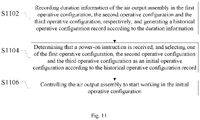
- the method for controlling an air conditioner further comprises: recording duration information of the air output assembly in the first operative configuration, the second operative configuration and the third operative configuration, respectively, and generating a historical form record according to the duration information; determining that a power-on instruction is received, and selecting one of the first operative configuration, the second operative configuration and the third operative configuration as an initial operative configuration according to the historical form record; and controlling the air output assembly to start working in the initial operative configuration.
- the air conditioner generates a historical form record according to the duration information corresponding to the form in which the air output assembly is, and the most frequently used form of the user can be acquired according to the historical form record.
- the form with the longest use time by the user is taken as the initial operative configuration by default, and the air output assembly is controlled to work in the initial operative configuration, which can ensure, to the largest extent, that the air output mode of the air conditioner matches the user's usage habits, thus improving the use experience of the user.
- the third aspect of the present invention provides a computer-readable storage medium on which a computer program is stored, when the computer program is executed by a processor, the method for controlling an air conditioner as provided in any of the above embodiments is implemented. Therefore, the computer-readable storage medium comprises all the beneficial effects of the method for controlling an air conditioner as provided in any of the above embodiments, which will not be repeated here.
- FIG. 1 The corresponding relationship between the reference signs and component names in Figs. 1 to 6 is as follows: air conditioner body 100, air outlet 102, air output assembly 200, first air deflector 202, second air deflector 204, air diffusing assembly 206, wind wheel 300, inner rib 302, outer ring rib 304, first blade 306, second blade 308, convex rib 310, and positioning portion 312.
- the air conditioner, the method for controlling an air conditioner, and the computer-readable storage medium according to some embodiments of the present invention are described below with reference to Fig. 1 to Fig. 12 .
- an air conditioner comprising: an air conditioner body 100, the air conditioner body 100 being provided with an air outlet 102; an air output assembly 200 configured to adjust air output of the air outlet 102, the air output assembly 200 having a plurality of operative configurations; a detection device configured to acquire a distance value of a target object from the air conditioner; and a controller, the controller being electrically connected to the air output assembly 200 and the detection device and controlling, according to the distance value, the air output assembly 200 to switch operative configurations.
- the detection device includes at least one of: a temperature sensor, an infrared distance detection device, an image recognition apparatus, and a radar position detection apparatus.
- the air conditioner comprises an air conditioner body 100 provided with an air outlet 102, and through the air outlet 102, the air after heat exchange with an indoor heat exchanger is blown out to achieve cooling or heating.
- An air output assembly 200 is provided at the air outlet 102, and the air output assembly 200 has a plurality of operative configurations and can change the air supply mode by switching the air output assembly 200 among the plurality of operative configurations.
- the operative configuration of the air output assembly 200 is as shown in Fig. 1 .
- the operative configuration of the air output assembly 200 is as shown in Fig. 2 .
- the air conditioner is provided with a detection device which can measure a distance value of a target object from the air conditioner.
- the target object may be a human body, and may also be a preset object, such as "a bed", “a desk”, “a sofa” and other furniture where the human body may stay.
- the air output assembly 200 is controlled to switch operative configurations according to the distance of the target object from the air conditioner, allowing the region where the "target object" is located to be in a windless feeling state, thus ensuring that air will not "blow directly" on a person's body, improving the comfort of the air conditioner.
- the volume of air blowing can be increased via "direct blowing" or other modes, thereby improving cooling or heating efficiency under the condition of guaranteeing the person's need to not feel the air blowing, and thereby satisfying multiple requirements of the user.
- windless feeling is as follows: in the range of 2.5 meters to 3 meters from the air outlet of the air conditioner, the velocity of airflow is below 0.1m/s on average, or at a distance of 2.5 meters or less from the air outlet, the DR (air delivery rate) value ranges from 5 to 20.
- the detection device is capable of detecting the distance of a target object, and the ambient temperature.
- the detection device comprises a temperature sensor capable of detecting the ambient temperature.
- the air output assembly 200 of the air conditioner has a plurality of operative configurations.
- the plurality of operative configurations include a first operative configuration
- the air conditioner further comprises: a communication interface electrically connected to the controller and configured to receive a control instruction; and the controller controls, according to the control instruction, the air output assembly 200 to work in the first operative configuration.
- the plurality of operative configurations further include a second operative configuration and a third operative configuration
- the controller controlling, according to the distance value, the air output assembly 200 to switch operative configurations can comprise: acquiring a first preset distance range and a second preset distance range; determining that the distance value is within the first preset distance range and controlling the air output assembly 200 to switch to the second operative configuration; and determining that the distance value is within the second preset distance range and controlling the air output assembly 200 to switch to the third operative configuration .
- the first operative configuration is a default windless feeling operative configuration.
- the air conditioner runs in an ordinary cooling mode or an ordinary heating mode by default, and the windless feeling mode is not activated at this time.
- the air conditioner receives a corresponding control instruction, which is a windless feeling control instruction, through the communication interface, the air conditioner enters the default windless feeling state, and the room as a whole is in the windless feeling state at this time, ensuring, to the greatest extent, that the human body will not be "blown directly" by the cold air of the air conditioner.
- Fig. 3 is a schematic diagram in which the air output assembly 200 is in the first operative configuration
- Fig. 4 is a schematic diagram in which the air output assembly 200 is in the second operative configuration
- Fig. 5 is a schematic diagram in which the air output assembly is in the third operative configuration.
- the second operative configuration is a windless feeling front-side distribution state, and the corresponding first preset distance is a range of distance relatively close to the air conditioner.
- the air conditioner supplies air to the range of the first preset distance in the windless feeling mode, and at the same time supplies air to the range of the second preset distance in a relatively large air volume.
- the third operative configuration is a windless feeling lower-side distribution state, and the corresponding second preset distance is a range of distance relatively far from the air conditioner.
- the air conditioner supplies air to the range of the second preset distance in the windless feeling mode, and at the same time supplies air to the range of the first preset distance in a relatively large air volume.
- the detection device is also configured to acquire an ambient temperature, before the controller controls, according to the distance value, the air output assembly 200 to switch operative configurations, the controller acquires a preset difference and a preset temperature, and calculates a first difference between the ambient temperature and the preset temperature; and when determining that the first difference is greater than the preset difference, the controller performs the step of controlling, according to the distance value, the air output assembly 200 to switch operative configurations.
- the step of controlling, according to the distance value, the air output assembly 200 to switch operative configurations is performed. If the difference between the current ambient temperature and the preset temperature is smaller than or equal to the preset difference, it indicates that the current ambient temperature is relatively comfortable, and then the air output assembly 200 is controlled to maintain the first operative configuration to ensure windless feeling to the greatest extent.
- the air output assembly 200 comprises: a first air deflector 202 provided in the air outlet 102, the first air deflector 202 is configured to rotate relative to an orientation of the air outlet 102 to change an air output direction of the air outlet 102; a second air deflector 204 rotatably connected to the air conditioner body 100 and configured to open or close the air outlet 102, the second air deflector 204 being provided with through holes for airflow to pass through; and an air diffusing assembly 206 connected to the air conditioner body 100 and configured to move relative to the air conditioner body 100 to shield or open the air outlet 102, wherein the air diffusing assembly 206 is formed with an air diffusing structure, and the air diffusing structure is configured to allow an air flow to pass through and diffusing the passing air flow.
- the air diffusing structure comprises: a plurality of wind wheels 300, the plurality of wind wheels 300 being meshed and driven by a gear structure, the wind wheel 300 comprising an inner rib 302 and an outer ring rib 304, first blades 306 and second blades 308 being provided between the inner rib 302 and the outer ring rib 304, the first blades 306 being fixedly connected to the inner rib 302 and the outer ring rib 304, the second blades 308 being rotatably connected to the inner rib 302, and the second blades 308 having a first operative position and a second operative position.
- the second blades 308 When the second blades 308 are in the first operative position, the second blades 308 and the first blades 306 are arranged at intervals; and when the second blades 308 are in the second operative position, at least part of the second blades 308 coincide with the first blades 306 in an axial direction of the wind wheel 300.
- the outer ring rib 304 is provided with a positioning portion 312 protruding towards the inner rib 302, and the second blade 308 is provided with a convex rib 310 corresponding to the positioning portion 312, the second blade 308 moves to the first operative position, and the positioning portion 312 abuts against the convex rib 310 to limit the second blade 308.
- the air output assembly 200 comprises a first air deflector 202, a second air deflector 204 and an air diffusing assembly 206.
- the first air deflector 202 is disposed in the air outlet 102 and can rotate along an axis parallel to the air outlet 102, so as to change the air output direction of the air outlet 102 to achieve "long-distance" air supply or "short-distance” air supply.
- the second air deflector 204 is used for opening or closing the air outlet 102. When the air conditioner is turned off, the second air deflector 204 covers the air outlet 102; and when the air conditioner is turned on, the second air deflector 204 rotates relative to the air conditioner body 100 and opens the air outlet 102.
- the second air deflector 204 is provided with a plurality of through holes, and after passing through the through holes, the airflow is broken up into a plurality of small staggered airflows.
- the air diffusing assembly 206 can move relative to the air conditioner body 100. When the windless feeling mode is not activated, the air diffusing assembly 206 is received in the air conditioner body 100. After the windless feeling mode is activated, the air diffusing assembly 206 extends out to abut against one end of the second air deflector 204 and shield the air outlet 102.
- the air diffusing assembly 206 is further provided with an air diffusing structure. Through the air diffusing structure, the airflow passing through the air diffusing assembly 206 can be broken up and dispersed to achieve "windless feeling” and "direct blowing prevention".
- the air diffusing structure comprises a plurality of wind wheels 300, and the plurality of wind wheels 300 are meshed and driven by a gear structure and rotate under the driving of a motor to disperse the airflow passing therethrough.
- the wind wheel 300 comprises an inner rib 302 and an outer ring rib 304, and first blades 306 and second blades 308 are provided between the inner rib 302 and the outer ring rib 304.
- the first blades 306 are static blades, which are fixedly connected to the outer ring rib 304 and the inner rib 302.
- the second blades 308 are dynamic blades, and can rotate with the inner rib 302 as a rotation shaft and switch between the first operative position and the second operative position.
- the second blades 308 rotate to the first operative position
- the second blades 308 and the first blades 306 are arranged at intervals, and the blades of the wind wheel 300 are distributed "relatively densely” at this time, so the velocity of the airflow through the wind wheel 300 is relatively low, leading to a relatively strong "windless feeling” effect.
- the second blades 308 rotate to the second operative position
- at least part of the second blades 308 coincide with the first blades 306, and the blades of the wind wheel 300 are distributed "relatively thinly” at this time, so the velocity of the airflow through the wind wheel 300 is relatively high, leading to a relatively weak "windless feeling” effect and a relatively strong air supply capability.
- the outer ring rib is provided with a protruding positioning portion 312, and the second blade 308 is provided with a convex rib 310 cooperating with the positioning portion 312, and when the second blade 308 is controlled to move for position switching, the position of the second blade 308 is limited by the convex rib 310 and the positioning portion 312 to realize positioning.
- the second blade 308 is driven to rotate by a motor until the convex rib 310 abuts against the positioning portion 312, and the motor locks the second blade 308.
- the motor driving the second blade 308 can be a stepper motor, and the position of the second blade 308 is adjusted by controlling the stepper motor to rotate by a fixed number of steps.
- the controller controlling, according to a control instruction, the air output assembly 200 to work in the first operative configuration can comprise: the controller controlling the air diffusing assembly 206 to shield the air outlet 102, controlling the second blade 308 to move to the first operative position, and controlling the first air deflector 202 to rotate to a first angle.
- the controller controlling the air output assembly 200 to switch to the second operative configuration can comprise: controlling the second blade 308 to move to the second operative position, and controlling the first air deflector 202 to rotate from the first angle to a second angle.
- the controller controlling the air output assembly 200 to switch to the third operative configuration can comprise: controlling the first air deflector 202 to rotate from the first angle to a third angle.
- the first air deflector 202 rotates to the first angle or the second angle, the first air deflector 202 directs the air blown out of the air outlet 102 to the air diffusing assembly 206; and the first air deflector 202 rotates to the third angle, the first air deflector 202 directs the air blown out of the air outlet 102 to the second air deflector 204.
- the air output assembly is in the first operative configuration, the air diffusing assembly 206 shields the air outlet 102, the second air deflector 204 rotates to abut against the air diffusing assembly 206, the first air deflector 202 directs the air blown out of the air outlet 102 to the air diffusing assembly 206, and the second blade 308 is in the first operative position;
- the air output assembly is in the second operative configuration, the air diffusing assembly 206 shields the air outlet 102, the second air deflector 204 rotates to abut against the air diffusing assembly 206, the first air deflector 202 directs the air blown out of the air outlet 102 to the air diffusing assembly 206, and the second blade 308 is in the second operative position;
- the air output assembly is in the third operative configuration, the air diffusing assembly 206 shields the air outlet 102, the second air deflector 204 rotates to abut against the air diffusing assembly 206, the first air deflector 202 directs the air
- the second air deflector 204 and the air diffusing assembly 206 are spliced to define an angle-shaped cavity located on the outer side of the air outlet 102 of the air conditioner and communicated with the air outlet 102 of the air conditioner, the cavity is formed with a side opening at both ends in a length direction of an splicing line between the second air deflector 204 and the air diffusing assembly 206, and the side openings are communicated with the cavity.
- the controller when controlling the air output assembly 200 to switch to the first operative configuration, the controller first controls the air diffusing assembly 206 to shield the air outlet 102 to enter the windless feeling mode. After rotating to the first angle, the first air deflector 202 directs the air output of the air outlet 102 mainly to the structure of the air diffusing assembly 206, and at the same time the second blade 308 of the air diffusing assembly 206 is controlled to move to the first operative position, leading to the strongest windless feeling effect. The first air deflector 202 is controlled to rotate to the first angle.
- the air output assembly 200 When the air output assembly 200 is controlled to switch to the second operative configuration, the position of the air diffusing assembly 206 is maintained, and the first air deflector 202 is controlled to rotate from the first angle to the second angle, at this time, the first air deflector 202 still maintains directing the air output of the air outlet 102 to the air diffusing assembly 206, but after the first air deflector 202 is adjusted to the second angle, the coverage of the air output direction is the range corresponding to the first preset distance.
- the second blade 308 is controlled to move to the second operative position to increase the volume of air supplied to the range of the first preset distance to improve the cooling or heating effect.
- the first air deflector 202 When the air output assembly 200 is controlled to switch to the third operative configuration, the first air deflector 202 is controlled to rotate from the first angle to the third angle, and after the first air deflector 202 rotates to the third angle, the first air deflector 202 directs the air output of the air outlet 102 to the first air deflector 202, i.e., air comes out through the through holes provided in the first air deflector 202.
- the air diffusing assembly 206 maintains the strongest windless feeling effect, to ensure that the human body within the range corresponding to the first preset distance will not be "blown directly", while increasing the volume of air supplied to the range of the second preset distance, in order to improve the cooling or heating effect.
- the first operative configuration is a default windless feeling form
- the second operative configuration is a windless feeling front-side distribution state
- the third operative configuration is a windless feeling lower-side distribution state.
- the default windless feeling form is whole room windless feeling.
- the windless feeling front-side distribution is to ensure windless feeling at the location relatively close to the air conditioner, while increasing the air output to the location relatively far away from the air conditioner.
- the windless feeling lower-side distribution state is to ensure windless feeling at the location relatively far away from the air conditioner, while increasing the air output to the location relatively close to the air conditioner.
- a cavity located on the outer side of the air outlet 102 is formed, and the cavity is formed with a side opening on both sides, thus realizing air supply on both sides.
- a side fan may also be provided at the side opening to ensure the volume of air output from the side.
- the user turns on the machine and selects the cooling mode operation, and the air output assembly operates at a cooling angle.
- the air output assembly swings from the cooling angle to a windless feeling default angle, and at this time the wind wheels are positioned to be staggered.
- the difference between room temperature and comfort temperature is detected. If the difference is less than the preset temperature, it is determined that the room requires for maintaining the cooling capacity, and at this time, the air guide plate is at the windless feeling default angle. If the difference is greater than the preset temperature, it is determined that the room needs to be cooled, and the following control is performed.
- Control is performed according to the user's position.
- the user position information is acquired by an intelligent device, if the user's distance from the air conditioner is within the first preset distance range, the air guide plate component swings from the windless feeling default angle to the windless feeling front-side distribution angle, and at this time, cyclonic blades are positioned to be staggered.
- the air guide plate component swings from the windless feeling default angle to the windless feeling lower-side distribution angle.
- the air guide plate component transitions from the windless feeling lower-side distribution angle to the windless feeling default angle, and then swings to the windless feeling front-side distribution angle.
- Control is performed according to the position of a preset object.
- the preset object is a bed
- information of the position relationship between the air conditioner and the bed when the air conditioner is installed is acquired, if the distance of the bed from the air conditioner is within the first preset distance range, the air guide plate component swings from the windless feeling default angle to the windless feeling front-side distribution angle, at this time, the cyclonic blades are positioned to be staggered; and if the distance of the bed from the air conditioner is within the second preset distance range, the air guide plate component swings from the windless feeling default angle to the windless feeling lower-side distribution angle.
- the cold is concentrated on the indoor heat exchanger and cannot be fully discharged; then it is feasible to control the air conditioner to increase the downward (the ground-facing direction) air output to improve the efficiency of cold discharge by using the downward flow trend of the cold, thereby improving the performance of the system.
- a circulation may be formed in the vicinity of the air conditioner.
- the overall air volume is reduced, the overall circulation of the room becomes poor, and the user feels "stuffy".
- differential air supply may be employed.
- Such a mode is employed that air supply is implemented partially with a large volume and partially with a small volume, to promote the exchange of airflow in the different places in the room.
- a method for controlling an air conditioner is provided, which is used for controlling the air conditioner provided in any of the above embodiments, the method comprising:
- the air conditioner comprises an air output assembly, and the air output assembly has a plurality of operative configurations and is capable of changing the air supply mode by switching operative configurations.
- the distance value of the target object from the air conditioner is detected.
- the target object may be a human body, and may also be a preset object, such as "a bed”, “a desk”, “a sofa” and other furniture where the human body may stay.
- the air output assembly is controlled to switch operative configurations according to the distance of the target object from the air conditioner, allowing the region where the "target object” is located to be in a windless feeling state, thus ensuring that air will not "blow directly" on a person's body, improving the comfort of the air conditioner.
- the volume of air blowing can be increased via "direct blowing" or other modes, thereby improving cooling or heating efficiency under the condition of guaranteeing the person's need to not feel the air blowing, and thereby satisfying multiple requirements of the user.
- the air output assembly includes a first operative configuration
- the control method further comprises: receiving a control instruction, and controlling, according to the control instruction, the air output assembly to work in the first operative configuration.
- the first operative configuration is a default windless feeling form. After being turned on, the air conditioner runs in an ordinary cooling mode or an ordinary heating mode by default, and the windless feeling mode is not activated at this time.
- the air conditioner receives a corresponding control instruction, which is a windless feeling control instruction, through the communication interface, the air conditioner enters the default windless feeling state, and the room as a whole is in the windless feeling state at this time, ensuring, to the greatest extent, that the human body will not be "blown directly" by the cold air of the air conditioner.
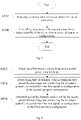
- the air output assembly further includes a second operative configuration and a third operative configuration, as shown in Fig. 8 , the step of controlling, according to the distance value, the air output assembly of the air conditioner to switch operative configurations can comprise:
- the second operative configuration is a windless feeling front-side distribution state, and the corresponding first preset distance is a range of distance relatively close to the air conditioner.
- the air conditioner supplies air to the range of the first preset distance in the windless feeling mode, and at the same time supplies air to the range of the second preset distance in a relatively large air volume.
- the third operative configuration is a windless feeling lower-side distribution state, and the corresponding second preset distance is a range of distance relatively far from the air conditioner.
- the air conditioner supplies air to the range of the second preset distance in the windless feeling mode, and at the same time supplies air to the range of the first preset distance in a relatively large air volume.
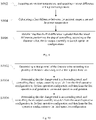
- control method before the step of controlling, according to the distance value, the air output assembly of the air conditioner to switch operative configurations, the control method further comprises:
- the step of controlling, according to the distance value, the air output assembly to switch operative configurations is performed. If the difference between the current ambient temperature and the preset temperature is smaller than or equal to the preset difference, it indicates that the current ambient temperature is relatively comfortable, and then the air output assembly is controlled to maintain the first operative configuration to ensure windless feeling to the greatest extent.
- the step of acquiring an ambient temperature can comprise: acquiring a corresponding first ambient temperature in a first preset distance range and acquiring a corresponding second ambient temperature in a second preset distance range; and the control method further comprises: calculating a second difference between the first ambient temperature and the second ambient temperature; determining that the second difference is positive and the second difference is greater than the preset difference, controlling the air output assembly to switch to the third operative configuration; and determining that the second difference is negative and an absolute value of the second difference is greater than the preset difference, controlling the air output assembly to switch to the second operative configuration.
- the air output assembly when there is a temperature difference between the first ambient temperature in the first preset distance range and the second ambient temperature in the second preset distance range, it indicates that the temperature in the room is currently not uniform. If the second difference is positive and the second difference is greater than the preset difference, it indicates that the temperature within the first preset distance is relatively high, then the air output assembly is controlled to switch to the third state to reduce the temperature within the first preset distance range.
- the air output assembly is controlled to switch to the second state to reduce the temperature within the first preset distance, so as to improve the user experience.
- the preset temperature is greater than or equal to 25°C and less than or equal to 27°C; and the preset difference is greater than or equal to 1.5°C and less than or equal to 3.5°C.
- the preset temperature is the human body comfort temperature. It may be understood that the preset temperature can be correspondingly raised when there are people who are physically weaker, such as the elderly and children. Therefore, the preset temperature and the preset difference can be set freely according to the actual needs of the user, and are not limited to the above-mentioned ranges.
- the step of controlling, according to the distance value, the air output assembly of the air conditioner to switch between the first operative configuration, the second operative configuration and the third operative configuration further comprises:
- the moving direction of the target object can be determined according to the change trend of the plurality of distance values within the preset duration. If the change trend is a descending trend, it indicates that the human body moves towards the air conditioner, and in such a case, the air output assembly is controlled to switch from the third operative configuration to the first operative configuration and then from the first operative configuration to the second operative configuration. If the change trend is an ascending trend, it indicates that the human body moves away from the air conditioner, and in such a case, the air output assembly is controlled to switch from the second operative configuration to the first operative configuration and then from the first operative configuration to the third operative configuration, to avoid the output air blowing directly on the human body.
- the method for controlling an air conditioner further comprises: determining that the ambient temperature is within the range of the preset temperature, and controlling the air output assembly to switch from the second operative configuration or the third operative configuration to the first operative configuration.
- the air output assembly is controlled to switch to the first operative configuration to ensure "windless feeling" to the largest extent to improve the user experience.
- the method for controlling an air conditioner further comprises:
- the air conditioner generates a historical form record according to the duration information corresponding to the form in which the air output assembly is, and the most frequently used form of the user can be acquired according to the historical form record.
- the form with the longest use time by the user is taken as the initial operative configuration by default, and the air output assembly is controlled to work in the initial operative configuration, which can ensure, to the largest extent, that the air output mode of the air conditioner matches the user's usage habits, thus improving the use experience of the user.
- the overall logic of the windless feeling control is as shown in Fig. 12 :
- the computer-readable storage medium on which a computer program is stored, when the computer program is executed by a processor, the method for controlling an air conditioner as provided in any of the above embodiments is implemented. Therefore, the computer-readable storage medium includes all the beneficial effects of the method for controlling an air conditioner as provided in any of the above embodiments, which will not be repeated here.
- connection may be a fixed connection, and may also be a removable connection, or an integral connection; and may be direct connection and may also be indirect connection through an intermediary.
Landscapes
- Engineering & Computer Science (AREA)
- Chemical & Material Sciences (AREA)
- Combustion & Propulsion (AREA)
- Mechanical Engineering (AREA)
- General Engineering & Computer Science (AREA)
- Signal Processing (AREA)
- Physics & Mathematics (AREA)
- Fuzzy Systems (AREA)
- Mathematical Physics (AREA)
- Human Computer Interaction (AREA)
- Air Conditioning Control Device (AREA)
Abstract
Description
- This application claims priority to
Chinese Patent Application No. 202010120978.7 filed with China National Intellectual Property Administration on February 26, 2020 - The present invention relates to the field of air conditioning technology, and particularly relates to an air conditioner, a method for controlling an air conditioner, and a computer-readable storage medium.
- In the related art, in order to avoid direct blowing, air conditioners are generally set with a windless feeling mode. In a windless feeling mode, the room as a whole is in a windless feeling state, resulting in a problem that the cooling efficiency is reduced and cannot meet the user's needs.
- The present invention aims to solve at least one of the technical problems existing in the prior art or in the related art.
- To this end, a first aspect of the present invention proposes an air conditioner.
- A second aspect of the present invention proposes a method for controlling an air conditioner.
- A third aspect of the present invention proposes a computer-readable storage medium.
- In view of this, the first aspect of the present invention provides an air conditioner, comprising: an air conditioner body, the air conditioner body being provided with an air outlet; an air output assembly adjusting air output of the air outlet, the air output assembly having a plurality of operative configurations; a detection device acquiring a distance value of a target object from the air conditioner; and a controller, the controller being electrically connected to the air output assembly and the detection device and controlling, according to the distance value, the air output assembly to switch operative configurations.
- In this embodiment, the air conditioner comprises an air conditioner body provided with an air outlet, and through the air outlet, the air after heat exchange with an indoor heat exchanger is blown out to achieve cooling or heating. An air output assembly is provided at the air outlet, and the air output assembly has a plurality of operative configurations and can change the air supply mode by form switching.
- In this embodiment , the air conditioner is provided with a detection device which can measure a distance value of a target object from the air conditioner. The target object may be a human body, and may also be a preset object, such as "a bed", "a desk", "a sofa" and other furniture where the human body may stay. The air output assembly is controlled to switch operative configurations according to the distance of the target object from the air conditioner, allowing the region where the "target object" is located to be in a windless feeling state, thus ensuring that air will not "blow directly" on a person's body, improving the comfort of the air conditioner. Meanwhile, in a region outside the region where the target object is located, the volume of air blowing can be increased via "direct blowing" or other modes, thereby improving cooling or heating efficiency under the condition of guaranteeing the person's need to not feel the air blowing, and thereby satisfying multiple requirements of the user.
- In addition, the air conditioner in the above embodiment provided in the present invention may also have the following additional technical features.
- In the above embodiment, the plurality of operative configurations comprise a first operative configuration, and the air conditioner further comprises: a communication interface electrically connected to the controller and receiving a control instruction; and the controller controls, according to the control instruction, the air output assembly to work in the first operative configuration.
- In this embodiment, the first operative configuration is a default windless feeling form. After being turned on, the air conditioner runs in an ordinary cooling mode or an ordinary heating mode by default, and the windless feeling mode is not activated at this time. When the air conditioner receives a corresponding control instruction, which is a windless feeling control instruction, through the communication interface, the air conditioner enters the default windless feeling state, and the room as a whole is in the windless feeling state at this time, ensuring, to the greatest extent, that the human body will not be "blown directly" by the cold air of the air conditioner.
- In any of the above embodiments, the plurality of operative configurations further comprise a second operative configuration and a third operative configuration, and the controller controlling, according to the distance value, the air output assembly to switch operative configurations can comprise: acquiring a first preset distance range and a second preset distance range; determining that the distance value is within the first preset distance range and controlling the air output assembly to switch to the second operative configuration; and determining that the distance value is within the second preset distance range and controlling the air output assembly to switch to the third operative configuration.
- In this embodiment, the second operative configuration is a windless feeling front-side distribution state, and the corresponding first preset distance is a range of distance relatively close to the air conditioner. In the second operative configuration, the air conditioner supplies air to the range of the first preset distance in the windless feeling mode, and at the same time supplies air to the range of the second preset distance in a relatively large air volume.
- The third operative configuration is a windless feeling lower-side distribution state, and the corresponding second preset distance is a range of distance relatively far from the air conditioner. In the third operative configuration, the air conditioner supplies air to the range of the second preset distance in the windless feeling mode, and at the same time supplies air to the range of the first preset distance in a relatively large air volume.
- By controlling the air output assembly to switch between different air supply states according to the distance of the target object, it is possible to effectively improve the cooling or heating efficiency and thus enhance the use experience of the air conditioner, while ensuring that the human body "does not feel the air blowing".
- In any of the above embodiments, the air output assembly comprises: a first air deflector provided in the air outlet, the first air deflector rotates relative to an orientation of the air outlet to change an air output direction of the air outlet; a second air deflector rotatably connected to the air conditioner body and opening or closing the air outlet, the second air deflector being provided with through holes for an airflow to pass through; and an air diffusing assembly connected to the air conditioner body and moving relative to the air conditioner body to shield or open the air outlet, wherein the air diffusing assembly is formed with an air diffusing structure, and the air diffusing structure allows air flow to pass through and diffuses the passing air flow.
- In this embodiment, the air output assembly comprises a first air deflector, a second air deflector and an air diffusing assembly. The first air deflector is disposed in the air outlet and can rotate along an axis parallel to the air outlet, so as to change the air output direction of the air outlet to achieve "long-distance" air supply or "short-distance" air supply. The second air deflector is used for opening or closing the air outlet. For example , when the air conditioner is turned off, the second air deflector covers the air outlet; and when the air conditioner is turned on, the second air deflector rotates relative to the air conditioner body and opens the air outlet. Moreover, the second air deflector is provided with a plurality of through holes, and after passing through the through holes, the airflow is broken up into a plurality of small staggered airflows.
- The air diffusing assembly can move relative to the air conditioner body. When the windless feeling mode is not activated, the air diffusing assembly is received in the air conditioner body. After the windless feeling mode is activated, the air diffusing assembly extends out to abut against one end of the second air deflector and shield the air outlet. The air diffusing assembly is further provided with an air diffusing structure. Through the air diffusing structure, the airflow passing through the air diffusing assembly can be broken up and dispersed to achieve "windless feeling" and "direct blowing prevention".
- In any of the above embodiments, the air diffusing structure comprises: a plurality of wind wheels, the plurality of wind wheels being meshed and driven by a gear structure, the wind wheel comprising an inner rib and an outer ring rib, a first blade and a second blade being provided between the inner rib and the outer ring rib, the first blade being fixedly connected to the inner rib and the outer ring rib, the second blade being rotatably connected to the inner rib, and the second blade having a first operative position and a second operative position; wherein when the second blade is in the first operative position, the second blade and the first blade are arranged at intervals; and when the second blade is in the second operative position, at least part of the second blade coincides with the first blade in an axial direction of the wind wheel.
- In this embodiment, the air diffusing structure comprises a plurality of wind wheels, and the plurality of wind wheels are meshed and driven by a gear structure and rotate under the driving of a motor to disperse the airflow passing therethrough. The wind wheel comprises an inner rib and an outer ring rib, and first blade and second blade are provided between the inner rib and the outer ring rib. The first blade is static blade, which are fixedly connected to the outer ring rib and the inner rib. The second blade is dynamic blade, and can rotate with the inner rib as a rotation shaft and switch between the first operative position and the second operative position.
- When the second blade rotates to the first operative position, the second blade and the first blade are arranged at intervals, and the blades of the wind wheel are distributed "relatively densely" at this time, so the velocity of the airflow through the wind wheel is relatively low, leading to a relatively strong "windless feeling" effect. When the second blade rotates to the second operative position, at least part of the second blade coincides with the first blade, and the blades of the wind wheel are distributed "relatively thinly" at this time, so the velocity of the airflow through the wind wheel is relatively high, leading to a relatively weak "windless feeling" effect and a relatively strong air supply capability.
- In any of the above embodiments, the outer ring rib is provided with a positioning portion protruding towards the inner rib, and the second blade is provided with a convex rib corresponding to the positioning portion, the second blade moves to the first operative position, and the positioning portion abuts against the convex rib to limit the second blade.
- In this embodiment, the outer ring rib is provided with a protruding positioning portion, and the second blade is provided with a convex rib cooperating with the positioning portion, and when the second blade is controlled to move for position switching, the position of the second blade is limited by the convex rib and the positioning portion to realize positioning.
- When the air conditioner is turned off and reset, or when the second blade is switched to the first operative position, the second blade is driven to rotate by a motor until the convex rib abuts against the positioning portion, and the motor locks the second blade.
- In any of the above embodiments, the controller controlling, according to a control instruction, the air output assembly to work in the first operative configuration can comprise: the controller controlling the air diffusing assembly to shield the air outlet, controlling the second blade to move to the first operative position, and controlling the first air deflector to rotate to a first angle.
- In this embodiment, when controlling the air output assembly to switch to the first operative configuration, the controller first controls the air diffusing assembly to shield the air outlet to enter the windless feeling mode. After rotating to the first angle, the first air deflector directs the air output of the air outlet mainly to the structure of the air diffusing assembly, and at the same time the second blade of the air diffusing assembly is controlled to move to the first operative position, leading to the strongest windless feeling effect. The first air deflector is controlled to rotate to the first angle.
- In any of the above embodiments, the controller controlling the air output assembly to switch to the second operative configuration can comprise: controlling the second blade to move to the second operative position, and controlling the first air deflector to rotate from the first angle to a second angle.
- In this embodiment, when the air output assembly is controlled to switch to the second operative configuration, the position of the air diffusing assembly is maintained, and the first air deflector is controlled to rotate from the first angle to the second angle, at this time, the first air deflector still maintains directing the air output of the air outlet to the air diffusing assembly, but after the first air deflector is adjusted to the second angle, the coverage of the air output direction is the range corresponding to the first preset distance. At the same time, the second blade is controlled to move to the second operative position to increase the volume of air supplied to the range of the first preset distance to improve the cooling or heating effect.
- In any of the above embodiments, the controller controlling the air output assembly to switch to the third operative configuration can comprise: controlling the first air deflector to rotate from the first angle to a third angle; wherein the first air deflector rotates to the first angle or the second angle, the first air deflector directs the air blown out of the air outlet to the air diffusing assembly; and the first air deflector rotates to the third angle, the first air deflector directs the air blown out of the air outlet to the second air deflector.
- In this embodiment, when the air output assembly is controlled to switch to the third operative configuration, the first air deflector is controlled to rotate from the first angle to the third angle, and after the first air deflector rotates to the third angle, the first air deflector directs the air output of the air outlet to the first air deflector, i.e., air comes out through the through holes provided in the first air deflector. At the same time, the air diffusing assembly maintains the strongest windless feeling effect, to ensure that the human body within the range corresponding to the first preset distance will not be "blown directly", while increasing the volume of air supplied to the range of the second preset distance, in order to improve the cooling or heating effect.
- In any of the above embodiments, the detection device also acquires an ambient temperature, before the controller controls, according to the distance value, the air output assembly to switch operative configurations, the controller acquires a preset difference and a preset temperature, and calculates a first difference between the ambient temperature and the preset temperature; and when determining that the first difference is greater than the preset difference, the controller performs the step of controlling, according to the distance value, the air output assembly to switch operative configurations.
- In this embodiment, when the first difference between the ambient temperature and the preset temperature is greater than the preset difference, it indicates that there is a relatively large temperature difference between the current ambient temperature and the comfortable temperature. In order to improve the cooling or heating effect, the step of controlling, according to the distance value, the air output assembly to switch operative configurations is performed. If the difference between the current ambient temperature and the preset temperature is smaller than or equal to the preset difference, it indicates that the current ambient temperature is relatively comfortable, and then the air output assembly is controlled to maintain the first operative configuration to ensure windless feeling to the greatest extent.
- In any of the above embodiments, the air output assembly is in the first operative configuration, the air diffusing assembly shields the air outlet, the second air deflector rotates to abut against the air diffusing assembly, the first air deflector directs the air blown out of the air outlet to the air diffusing assembly, and the second blade is in the first operative position; the air output assembly is in the second operative configuration, the air diffusing assembly shields the air outlet, the second air deflector rotates to abut against the air diffusing assembly, the first air deflector directs the air blown out of the air outlet to the air diffusing assembly, and the second blade is in the second operative position; the air output assembly is in the third operative configuration, the air diffusing assembly shields the air outlet, the second air deflector rotates to abut against the air diffusing assembly, the first air deflector directs the air blown out of the air outlet to the second air deflector, and the second blade is in the first operative position.
- In this embodiment, the first operative configuration is a default windless feeling form, the second operative configuration is a windless feeling front-side distribution state, and the third operative configuration is a windless feeling lower-side distribution state. The default windless feeling form is whole room windless feeling. The windless feeling front-side distribution is to ensure windless feeling at the location relatively close to the air conditioner, while increasing the air out put to the location relatively far away from the air conditioner. The windless feeling lower-side distribution state is to ensure windless feeling at the location relatively far away from the air conditioner, while increasing the air output to the location relatively close to the air conditioner.
- In any of the above embodiments, the second air deflector and the air diffusing assembly are spliced to define an angle-shaped cavity located on the outer side of the air outlet of the air conditioner and communicated with the air outlet of the air conditioner, the cavity is formed with side opening at two ends in a length direction of a splicing line between the second air deflector and the air diffusing assembly, and the side openings are communicated with the cavity.
- In this embodiment, after the second air deflector is assembled with the air diffusing assembly, a cavity located on the outer side of the air outlet is formed, and the cavity is formed with a side opening on both sides, thus realizing air supply on both sides. In some implementations, a side fan may also be provided at the side opening to ensure the volume of air output from the side.
- In any of the above embodiments, the detection device comprises at least one of: a temperature sensor, an infrared distance detection device, an image recognition apparatus, and a radar position detection apparatus.
- In this embodiment, the detection device is capable of detecting the distance of a target object, and the ambient temperature. For example, the detection device comprises a temperature sensor capable of detecting the ambient temperature. At the time of detecting the distance of the target object, it is feasible to detect a distance value by an infrared distance detection device, or photograph image information in front of the air conditioner, and determine the location of the target object by an image recognition apparatus, and further determine the distance value. And it is also feasible to realize the detection of the distance of the target object by a radar position detection apparatus.
- The second aspect of the present invention provides a method for controlling an air conditioner, which is used for controlling the air conditioner provided in any of the above embodiments, the method comprising: acquiring a distance value of a target object from an air conditioner; and controlling, according to the distance value, the air output assembly of the air conditioner to switch operative configurations.
- In this embodiment, the air conditioner comprises an air output assembly, and the air output assembly has a plurality of operative configurations and is capable of changing the air supply mode by switching operative configurations.
- For example, the distance value of the target object from the air conditioner is detected. The target object may be a human body, and may also be a preset object, such as "a bed", "a desk", "a sofa" and other furniture where the human body may stay. The air output assembly is controlled to switch operative configurations according to the distance of the target object from the air conditioner, allowing the region where the "target object" is located to be in a windless feeling state, thus ensuring that air will not "blow directly" on a person's body, improving the comfort of the air conditioner. Meanwhile, in a region outside the region where the target object is located, the volume of air blowing can be increased via "direct blowing" or other modes, thereby improving cooling or heating efficiency under the condition of guaranteeing the person's need to not feel the air blowing, and thereby satisfying multiple requirements of the user.
- In the above embodiment, the air output assembly comprises a first operative configuration, and the control method further comprises: receiving a control instruction, and controlling, according to the control instruction, the air output assembly to work in the first operative configuration.
- In this embodiment, the first operative configuration is a default windless feeling form. After being turned on, the air conditioner runs in an ordinary cooling mode or an ordinary heating mode by default, and the windless feeling mode is not activated at this time. When the air conditioner receives a corresponding control instruction, which is a windless feeling control instruction, through the communication interface, the air conditioner enters the default windless feeling state, and the room as a whole is in the windless feeling state at this time, ensuring, to the greatest extent, that the human body will not be "blown directly" by the cold air of the air conditioner.
- In the above embodiment, the air output assembly comprises a second operative configuration and a third operative configuration, and the step of controlling, according to the distance value, the air output assembly of the air conditioner to switch operative configurations can comprise: acquiring a first preset distance range and a second preset distance range; determining that the distance value is within the first preset distance range and controlling the air output assembly to switch to the second operative configuration; and determining that the distance value is within the second preset distance range and controlling the air output assembly to switch to the third operative configuration.
- In this embodiment, the second operative configuration is a windless feeling front-side distribution state, and the corresponding first preset distance is a range of distance relatively close to the air conditioner. In the second operative configuration, the air conditioner supplies air to the range of the first preset distance in the windless feeling mode, and at the same time supplies air to the range of the second preset distance in a relatively large air volume.
- The third operative configuration is a windless feeling lower-side distribution state, and the corresponding second preset distance is a range of distance relatively far from the air conditioner. In the third operative configuration, the air conditioner supplies air to the range of the second preset distance in the windless feeling mode, and at the same time supplies air to the range of the first preset distance in a relatively large air volume.
- By controlling the air output assembly to switch between different air supply states according to the distance of the target object, it is possible to effectively improve the cooling or heating efficiency and thus enhance the use experience of the air conditioner, while ensuring that the human body "does not feel the air blowing".
- In the above embodiment, before the step of controlling, according to the distance value, the air output assembly of the air conditioner to switch operative configurations, the control method further comprises: acquiring an ambient temperature, and acquiring a preset difference and a preset temperature; calculating a first difference between the ambient temperature and the preset temperature; and when determining that the first difference is greater than the preset difference, performing the step of controlling, according to the distance value, the air output assembly to switch operative configurations.
- In this embodiment, when the first difference between the ambient temperature and the preset temperature is greater than the preset difference, it indicates that there is a relatively large temperature difference between the current ambient temperature and the comfortable temperature. In order to improve the cooling or heating effect, the step of controlling, according to the distance value, the air output assembly to switch operative configurations is performed. If the first difference between the current ambient temperature and the preset temperature is smaller than or equal to the preset difference, it indicates that the current ambient temperature is relatively comfortable, and then the air output assembly is controlled to maintain the first operative configuration to ensure windless feeling to the greatest extent.
- In any of the above embodiments, the step of acquiring an ambient temperature can comprise: acquiring a corresponding first ambient temperature in a first preset distance range and acquiring a corresponding second ambient temperature in a second preset distance range; and the control method further comprises: calculating a second difference between the first ambient temperature and the second ambient temperature; determining that the second difference is positive and the second difference is greater than the preset difference, controlling the air output assembly to switch to the third operative configuration; and determining that the second difference is negative and an absolute value of the second difference is greater than the preset difference, controlling the air output assembly to switch to the second operative configuration.
- In this embodiment, when there is a temperature difference between the first ambient temperature in the first preset distance range and the second ambient temperature in the second preset distance range, it indicates that the temperature in the room is currently not uniform. If the second difference is positive and the second difference is greater than the preset difference, it indicates that the temperature within the first preset distance is relatively high, then the air output assembly is controlled to switch to the third state to reduce the temperature within the first preset distance range.
- If the second difference is negative and the absolute value of the second difference is greater than the preset difference, it indicates that the temperature within the second preset distance is relatively high, then the air output assembly is controlled to switch to the second state to reduce the temperature within the first preset distance, so as to improve the user experience.
- In any of the above embodiments, the step of controlling, according to the distance value, the air output assembly of the air conditioner to switch between the first operative configuration, the second operative configuration and the third operative configuration further comprises: determining a change trend of the distance value according to a plurality of distance values acquired within a preset duration; determining that the change trend is a descending trend, and controlling the air output assembly to switch from the third operative configuration to the first operative configuration and then from the first operative configuration to the second from; and determining that the change trend is an ascending trend, and controlling the air output assembly to switch from the second operative configuration to the first operative configuration and then from the first operative configuration to the third operative configuration.
- In this embodiment, the moving direction of the target object, such as a human body, can be determined according to the change trend of the plurality of distance values within the preset duration. If the change trend is a descending trend, it indicates that the human body moves towards the air conditioner, and in such a case, the air output assembly is controlled to switch from the third operative configuration to the first operative configuration and then from the first operative configuration to the second operative configuration. If the change trend is an ascending trend, it indicates that the human body moves away from the air conditioner, and in such a case, the air output assembly is controlled to switch from the second operative configuration to the first operative configuration and then from the first operative configuration to the third operative configuration, to avoid the output air blowing directly on the human body.
- In any of the above embodiments, the preset temperature is greater than or equal to 25°C and less than or equal to 27°C; and the preset difference is greater than or equal to 1.5°C and less than or equal to 3.5°C.
- In this embodiment, the preset temperature is the human body comfort temperature. It may be understood that the preset temperature can be correspondingly raised when there are people who are physically weaker, such as the elderly and children. Therefore, the preset temperature and the preset difference can be set freely according to the actual needs of the user, and are not limited to the above-mentioned ranges.
- In any of the above embodiments, the method for controlling an air conditioner further comprises: determining that the ambient temperature is within the range of the preset temperature, and controlling the air output assembly to switch from the second operative configuration or the third operative configuration to the first operative configuration.
- In this embodiment, when the ambient temperature is within the range of the preset temperature, it indicates that the cooling or heating effect has been achieved currently, and the air output assembly is controlled to switch to the first operative configuration to ensure "windless feeling" to the largest extent to improve the user experience.
- In any of the above embodiments, the method for controlling an air conditioner further comprises: recording duration information of the air output assembly in the first operative configuration, the second operative configuration and the third operative configuration, respectively, and generating a historical form record according to the duration information; determining that a power-on instruction is received, and selecting one of the first operative configuration, the second operative configuration and the third operative configuration as an initial operative configuration according to the historical form record; and controlling the air output assembly to start working in the initial operative configuration.
- In this embodiment, the air conditioner generates a historical form record according to the duration information corresponding to the form in which the air output assembly is, and the most frequently used form of the user can be acquired according to the historical form record. When the user turns on the air conditioner again, the form with the longest use time by the user is taken as the initial operative configuration by default, and the air output assembly is controlled to work in the initial operative configuration, which can ensure, to the largest extent, that the air output mode of the air conditioner matches the user's usage habits, thus improving the use experience of the user.
- The third aspect of the present invention provides a computer-readable storage medium on which a computer program is stored, when the computer program is executed by a processor, the method for controlling an air conditioner as provided in any of the above embodiments is implemented. Therefore, the computer-readable storage medium comprises all the beneficial effects of the method for controlling an air conditioner as provided in any of the above embodiments, which will not be repeated here.
- The above and/or additional aspects and advantages of the present invention will become apparent and readily understood from the following description of embodiments in conjunction with the drawings, wherein:
-
Fig. 1 is a schematic structural diagram of an air conditioner according to an embodiment of the present invention; -
Fig. 2 is another schematic structural diagram of an air conditioner according to an embodiment of the present invention; -
Fig. 3 is a further schematic structural diagram of an air conditioner according to an embodiment of the present invention; -
Fig. 4 is a still further schematic structural diagram of an air conditioner according to an embodiment of the present invention; -
Fig. 5 is a still further schematic structural diagram of an air conditioner according to an embodiment of the present invention; -
Fig. 6 is a schematic structural diagram of an air diffusing assembly of an air conditioner according to an embodiment of the present invention; -
Fig. 7 is a flowchart of a method for controlling an air conditioner according to an embodiment of the present invention; -
Fig. 8 is another flowchart of a method for controlling an air conditioner according to an embodiment of the present invention; -
Fig. 9 is a further flowchart of a method for controlling an air conditioner according to an embodiment of the present invention; -
Fig. 10 is a still further flowchart of a method for controlling an air conditioner according to an embodiment of the present invention; -
Fig. 11 is a still further flowchart of a method for controlling an air conditioner according to an embodiment of the present invention; and -
Fig. 12 is a still further flowchart of a method for controlling an air conditioner according to an embodiment of the present invention. - The corresponding relationship between the reference signs and component names in
Figs. 1 to 6 is as follows:
air conditioner body 100,air outlet 102,air output assembly 200,first air deflector 202,second air deflector 204,air diffusing assembly 206,wind wheel 300,inner rib 302,outer ring rib 304,first blade 306,second blade 308,convex rib 310, andpositioning portion 312. - In order that the above-mentioned objectives, features and advantages of the present invention can be understood more clearly, a further detailed description of the present invention will be given below in connection with the accompanying drawings and specific embodiments. It should be noted that the embodiments of the present invention and the features in the embodiments can be combined with each other if there is no conflict.
- In the following description, numerous specific details are set forth in order to provide a thorough understanding of the present invention. However, the present invention can also be implemented in other manners than those described herein. Therefore, the protection scope of the present invention is not limited to the specific embodiments disclosed below.
- The air conditioner, the method for controlling an air conditioner, and the computer-readable storage medium according to some embodiments of the present invention are described below with reference to
Fig. 1 to Fig. 12 . - As shown in
Fig. 1 and Fig. 2 , in an embodiment of the present invention, an air conditioner is provided, comprising: anair conditioner body 100, theair conditioner body 100 being provided with anair outlet 102; anair output assembly 200 configured to adjust air output of theair outlet 102, theair output assembly 200 having a plurality of operative configurations; a detection device configured to acquire a distance value of a target object from the air conditioner; and a controller, the controller being electrically connected to theair output assembly 200 and the detection device and controlling, according to the distance value, theair output assembly 200 to switch operative configurations. - The detection device includes at least one of: a temperature sensor, an infrared distance detection device, an image recognition apparatus, and a radar position detection apparatus.
- In this embodiment, the air conditioner comprises an
air conditioner body 100 provided with anair outlet 102, and through theair outlet 102, the air after heat exchange with an indoor heat exchanger is blown out to achieve cooling or heating. Anair output assembly 200 is provided at theair outlet 102, and theair output assembly 200 has a plurality of operative configurations and can change the air supply mode by switching theair output assembly 200 among the plurality of operative configurations. - When the air conditioner is turned off, the operative configuration of the
air output assembly 200 is as shown inFig. 1 . When the air conditioner is turned on and running in the cooling mode, and the windless feeling mode is not activated, the operative configuration of theair output assembly 200 is as shown inFig. 2 . - For example, the air conditioner is provided with a detection device which can measure a distance value of a target object from the air conditioner. The target object may be a human body, and may also be a preset object, such as "a bed", "a desk", "a sofa" and other furniture where the human body may stay. The
air output assembly 200 is controlled to switch operative configurations according to the distance of the target object from the air conditioner, allowing the region where the "target object" is located to be in a windless feeling state, thus ensuring that air will not "blow directly" on a person's body, improving the comfort of the air conditioner. Meanwhile, in a region outside the region where the target object is located, the volume of air blowing can be increased via "direct blowing" or other modes, thereby improving cooling or heating efficiency under the condition of guaranteeing the person's need to not feel the air blowing, and thereby satisfying multiple requirements of the user. - The definition of "windless feeling" is as follows: in the range of 2.5 meters to 3 meters from the air outlet of the air conditioner, the velocity of airflow is below 0.1m/s on average, or at a distance of 2.5 meters or less from the air outlet, the DR (air delivery rate) value ranges from 5 to 20.
- The detection device is capable of detecting the distance of a target object, and the ambient temperature. For example, the detection device comprises a temperature sensor capable of detecting the ambient temperature. At the time of detecting the distance of the target object, it is feasible to detect a distance value by an infrared distance detection device, or photograph image information in front of the air conditioner, and determine the location of the target object by an image recognition apparatus, and further determine the distance value. And it is also feasible to realize the detection of the distance of the target object by a radar position detection apparatus.
- As shown in
Fig. 3, Fig. 4 andFig. 5 , in an embodiment of the present invention, theair output assembly 200 of the air conditioner has a plurality of operative configurations. - As shown in
Fig. 3 , the plurality of operative configurations include a first operative configuration, and the air conditioner further comprises: a communication interface electrically connected to the controller and configured to receive a control instruction; and the controller controls, according to the control instruction, theair output assembly 200 to work in the first operative configuration. - As shown in
Fig. 4 andFig. 5 , the plurality of operative configurations further include a second operative configuration and a third operative configuration, and the controller controlling, according to the distance value, theair output assembly 200 to switch operative configurations can comprise: acquiring a first preset distance range and a second preset distance range; determining that the distance value is within the first preset distance range and controlling theair output assembly 200 to switch to the second operative configuration; and determining that the distance value is within the second preset distance range and controlling theair output assembly 200 to switch to the third operative configuration . - In this embodiment, the first operative configuration is a default windless feeling operative configuration. After being turned on, the air conditioner runs in an ordinary cooling mode or an ordinary heating mode by default, and the windless feeling mode is not activated at this time. When the air conditioner receives a corresponding control instruction, which is a windless feeling control instruction, through the communication interface, the air conditioner enters the default windless feeling state, and the room as a whole is in the windless feeling state at this time, ensuring, to the greatest extent, that the human body will not be "blown directly" by the cold air of the air conditioner.
-
Fig. 3 is a schematic diagram in which theair output assembly 200 is in the first operative configuration,Fig. 4 is a schematic diagram in which theair output assembly 200 is in the second operative configuration, andFig. 5 is a schematic diagram in which the air output assembly is in the third operative configuration. - The second operative configuration is a windless feeling front-side distribution state, and the corresponding first preset distance is a range of distance relatively close to the air conditioner. In the second operative configuration, the air conditioner supplies air to the range of the first preset distance in the windless feeling mode, and at the same time supplies air to the range of the second preset distance in a relatively large air volume.
- The third operative configuration is a windless feeling lower-side distribution state, and the corresponding second preset distance is a range of distance relatively far from the air conditioner. In the third operative configuration, the air conditioner supplies air to the range of the second preset distance in the windless feeling mode, and at the same time supplies air to the range of the first preset distance in a relatively large air volume.
- By controlling the air output assembly to switch between different air supply states according to the distance of the target object, it is possible to effectively improve the cooling or heating efficiency and thus enhance the use experience of the air conditioner, while ensuring that the human body "does not feel the air blowing".
- In some embodiments, the detection device is also configured to acquire an ambient temperature, before the controller controls, according to the distance value, the
air output assembly 200 to switch operative configurations, the controller acquires a preset difference and a preset temperature, and calculates a first difference between the ambient temperature and the preset temperature; and when determining that the first difference is greater than the preset difference, the controller performs the step of controlling, according to the distance value, theair output assembly 200 to switch operative configurations. - When the first difference between the ambient temperature and the preset temperature is greater than the preset difference, it indicates that there is a relatively large temperature difference between the current ambient temperature and the comfortable temperature. In order to improve the cooling or heating effect, the step of controlling, according to the distance value, the
air output assembly 200 to switch operative configurations is performed. If the difference between the current ambient temperature and the preset temperature is smaller than or equal to the preset difference, it indicates that the current ambient temperature is relatively comfortable, and then theair output assembly 200 is controlled to maintain the first operative configuration to ensure windless feeling to the greatest extent. - As shown in
Fig. 3, Fig. 4 andFig. 5 , in an embodiment of the present invention, theair output assembly 200 comprises: afirst air deflector 202 provided in theair outlet 102, thefirst air deflector 202 is configured to rotate relative to an orientation of theair outlet 102 to change an air output direction of theair outlet 102; asecond air deflector 204 rotatably connected to theair conditioner body 100 and configured to open or close theair outlet 102, thesecond air deflector 204 being provided with through holes for airflow to pass through; and anair diffusing assembly 206 connected to theair conditioner body 100 and configured to move relative to theair conditioner body 100 to shield or open theair outlet 102, wherein theair diffusing assembly 206 is formed with an air diffusing structure, and the air diffusing structure is configured to allow an air flow to pass through and diffusing the passing air flow. - As shown in
Fig. 6 , the air diffusing structure comprises: a plurality ofwind wheels 300, the plurality ofwind wheels 300 being meshed and driven by a gear structure, thewind wheel 300 comprising aninner rib 302 and anouter ring rib 304,first blades 306 andsecond blades 308 being provided between theinner rib 302 and theouter ring rib 304, thefirst blades 306 being fixedly connected to theinner rib 302 and theouter ring rib 304, thesecond blades 308 being rotatably connected to theinner rib 302, and thesecond blades 308 having a first operative position and a second operative position. When thesecond blades 308 are in the first operative position, thesecond blades 308 and thefirst blades 306 are arranged at intervals; and when thesecond blades 308 are in the second operative position, at least part of thesecond blades 308 coincide with thefirst blades 306 in an axial direction of thewind wheel 300. - The
outer ring rib 304 is provided with apositioning portion 312 protruding towards theinner rib 302, and thesecond blade 308 is provided with aconvex rib 310 corresponding to thepositioning portion 312, thesecond blade 308 moves to the first operative position, and thepositioning portion 312 abuts against theconvex rib 310 to limit thesecond blade 308. - In this embodiment, the
air output assembly 200 comprises afirst air deflector 202, asecond air deflector 204 and anair diffusing assembly 206. Thefirst air deflector 202 is disposed in theair outlet 102 and can rotate along an axis parallel to theair outlet 102, so as to change the air output direction of theair outlet 102 to achieve "long-distance" air supply or "short-distance" air supply. Thesecond air deflector 204 is used for opening or closing theair outlet 102. When the air conditioner is turned off, thesecond air deflector 204 covers theair outlet 102; and when the air conditioner is turned on, thesecond air deflector 204 rotates relative to theair conditioner body 100 and opens theair outlet 102. Moreover, thesecond air deflector 204 is provided with a plurality of through holes, and after passing through the through holes, the airflow is broken up into a plurality of small staggered airflows. - The
air diffusing assembly 206 can move relative to theair conditioner body 100. When the windless feeling mode is not activated, theair diffusing assembly 206 is received in theair conditioner body 100. After the windless feeling mode is activated, theair diffusing assembly 206 extends out to abut against one end of thesecond air deflector 204 and shield theair outlet 102. Theair diffusing assembly 206 is further provided with an air diffusing structure. Through the air diffusing structure, the airflow passing through theair diffusing assembly 206 can be broken up and dispersed to achieve "windless feeling" and "direct blowing prevention". - The air diffusing structure comprises a plurality of
wind wheels 300, and the plurality ofwind wheels 300 are meshed and driven by a gear structure and rotate under the driving of a motor to disperse the airflow passing therethrough. Thewind wheel 300 comprises aninner rib 302 and anouter ring rib 304, andfirst blades 306 andsecond blades 308 are provided between theinner rib 302 and theouter ring rib 304. Thefirst blades 306 are static blades, which are fixedly connected to theouter ring rib 304 and theinner rib 302. Thesecond blades 308 are dynamic blades, and can rotate with theinner rib 302 as a rotation shaft and switch between the first operative position and the second operative position. - When the
second blades 308 rotate to the first operative position, thesecond blades 308 and thefirst blades 306 are arranged at intervals, and the blades of thewind wheel 300 are distributed "relatively densely" at this time, so the velocity of the airflow through thewind wheel 300 is relatively low, leading to a relatively strong "windless feeling" effect. When thesecond blades 308 rotate to the second operative position, at least part of thesecond blades 308 coincide with thefirst blades 306, and the blades of thewind wheel 300 are distributed "relatively thinly" at this time, so the velocity of the airflow through thewind wheel 300 is relatively high, leading to a relatively weak "windless feeling" effect and a relatively strong air supply capability. - The outer ring rib is provided with a protruding
positioning portion 312, and thesecond blade 308 is provided with aconvex rib 310 cooperating with thepositioning portion 312, and when thesecond blade 308 is controlled to move for position switching, the position of thesecond blade 308 is limited by theconvex rib 310 and thepositioning portion 312 to realize positioning. When the air conditioner is turned off and reset, or when thesecond blade 308 is switched to the first operative position, thesecond blade 308 is driven to rotate by a motor until theconvex rib 310 abuts against thepositioning portion 312, and the motor locks thesecond blade 308. - The motor driving the
second blade 308 can be a stepper motor, and the position of thesecond blade 308 is adjusted by controlling the stepper motor to rotate by a fixed number of steps. - As shown in
Fig. 3, Fig. 4 andFig. 5 , in an embodiment of the present invention, the controller controlling, according to a control instruction, theair output assembly 200 to work in the first operative configuration can comprise: the controller controlling theair diffusing assembly 206 to shield theair outlet 102, controlling thesecond blade 308 to move to the first operative position, and controlling thefirst air deflector 202 to rotate to a first angle. - The controller controlling the
air output assembly 200 to switch to the second operative configuration can comprise: controlling thesecond blade 308 to move to the second operative position, and controlling thefirst air deflector 202 to rotate from the first angle to a second angle. - The controller controlling the
air output assembly 200 to switch to the third operative configuration can comprise: controlling thefirst air deflector 202 to rotate from the first angle to a third angle. Thefirst air deflector 202 rotates to the first angle or the second angle, thefirst air deflector 202 directs the air blown out of theair outlet 102 to theair diffusing assembly 206; and thefirst air deflector 202 rotates to the third angle, thefirst air deflector 202 directs the air blown out of theair outlet 102 to thesecond air deflector 204. - The air output assembly is in the first operative configuration, the
air diffusing assembly 206 shields theair outlet 102, thesecond air deflector 204 rotates to abut against theair diffusing assembly 206, thefirst air deflector 202 directs the air blown out of theair outlet 102 to theair diffusing assembly 206, and thesecond blade 308 is in the first operative position; the air output assembly is in the second operative configuration, theair diffusing assembly 206 shields theair outlet 102, thesecond air deflector 204 rotates to abut against theair diffusing assembly 206, thefirst air deflector 202 directs the air blown out of theair outlet 102 to theair diffusing assembly 206, and thesecond blade 308 is in the second operative position; the air output assembly is in the third operative configuration, theair diffusing assembly 206 shields theair outlet 102, thesecond air deflector 204 rotates to abut against theair diffusing assembly 206, thefirst air deflector 202 directs the air blown out of theair outlet 102 to thesecond air deflector 204, and thesecond blade 308 is in the first operative position. - The
second air deflector 204 and theair diffusing assembly 206 are spliced to define an angle-shaped cavity located on the outer side of theair outlet 102 of the air conditioner and communicated with theair outlet 102 of the air conditioner, the cavity is formed with a side opening at both ends in a length direction of an splicing line between thesecond air deflector 204 and theair diffusing assembly 206, and the side openings are communicated with the cavity. - In this embodiment, when controlling the
air output assembly 200 to switch to the first operative configuration, the controller first controls theair diffusing assembly 206 to shield theair outlet 102 to enter the windless feeling mode. After rotating to the first angle, thefirst air deflector 202 directs the air output of theair outlet 102 mainly to the structure of theair diffusing assembly 206, and at the same time thesecond blade 308 of theair diffusing assembly 206 is controlled to move to the first operative position, leading to the strongest windless feeling effect. Thefirst air deflector 202 is controlled to rotate to the first angle. - When the
air output assembly 200 is controlled to switch to the second operative configuration, the position of theair diffusing assembly 206 is maintained, and thefirst air deflector 202 is controlled to rotate from the first angle to the second angle, at this time, thefirst air deflector 202 still maintains directing the air output of theair outlet 102 to theair diffusing assembly 206, but after thefirst air deflector 202 is adjusted to the second angle, the coverage of the air output direction is the range corresponding to the first preset distance. At the same time, thesecond blade 308 is controlled to move to the second operative position to increase the volume of air supplied to the range of the first preset distance to improve the cooling or heating effect. - When the
air output assembly 200 is controlled to switch to the third operative configuration, thefirst air deflector 202 is controlled to rotate from the first angle to the third angle, and after thefirst air deflector 202 rotates to the third angle, thefirst air deflector 202 directs the air output of theair outlet 102 to thefirst air deflector 202, i.e., air comes out through the through holes provided in thefirst air deflector 202. At the same time, theair diffusing assembly 206 maintains the strongest windless feeling effect, to ensure that the human body within the range corresponding to the first preset distance will not be "blown directly", while increasing the volume of air supplied to the range of the second preset distance, in order to improve the cooling or heating effect. - The first operative configuration is a default windless feeling form, the second operative configuration is a windless feeling front-side distribution state, and the third operative configuration is a windless feeling lower-side distribution state. The default windless feeling form is whole room windless feeling. The windless feeling front-side distribution is to ensure windless feeling at the location relatively close to the air conditioner, while increasing the air output to the location relatively far away from the air conditioner. The windless feeling lower-side distribution state is to ensure windless feeling at the location relatively far away from the air conditioner, while increasing the air output to the location relatively close to the air conditioner.
- After the
second air deflector 204 is assembled with theair diffusing assembly 206, a cavity located on the outer side of theair outlet 102 is formed, and the cavity is formed with a side opening on both sides, thus realizing air supply on both sides. In some implementations, a side fan may also be provided at the side opening to ensure the volume of air output from the side. - In an embodiment of the present invention, the user turns on the machine and selects the cooling mode operation, and the air output assembly operates at a cooling angle. When receiving a windless feeling function signal, the air output assembly swings from the cooling angle to a windless feeling default angle, and at this time the wind wheels are positioned to be staggered.
- The difference between room temperature and comfort temperature is detected. If the difference is less than the preset temperature, it is determined that the room requires for maintaining the cooling capacity, and at this time, the air guide plate is at the windless feeling default angle. If the difference is greater than the preset temperature, it is determined that the room needs to be cooled, and the following control is performed.
- Control is performed according to the user's position. The user position information is acquired by an intelligent device, if the user's distance from the air conditioner is within the first preset distance range, the air guide plate component swings from the windless feeling default angle to the windless feeling front-side distribution angle, and at this time, cyclonic blades are positioned to be staggered.
- If the user's distance from the air conditioner is within the second preset distance range, the air guide plate component swings from the windless feeling default angle to the windless feeling lower-side distribution angle.
- If the user is getting close to the air conditioner, the air guide plate component transitions from the windless feeling lower-side distribution angle to the windless feeling default angle, and then swings to the windless feeling front-side distribution angle.
- Control is performed according to the position of a preset object. Taking the case as an example where the preset object is a bed, information of the position relationship between the air conditioner and the bed when the air conditioner is installed is acquired, if the distance of the bed from the air conditioner is within the first preset distance range, the air guide plate component swings from the windless feeling default angle to the windless feeling front-side distribution angle, at this time, the cyclonic blades are positioned to be staggered; and if the distance of the bed from the air conditioner is within the second preset distance range, the air guide plate component swings from the windless feeling default angle to the windless feeling lower-side distribution angle.
- In some implementations, due to the overall decrease in heat exchange capability of the system in the windless feeling mode, the cold is concentrated on the indoor heat exchanger and cannot be fully discharged; then it is feasible to control the air conditioner to increase the downward (the ground-facing direction) air output to improve the efficiency of cold discharge by using the downward flow trend of the cold, thereby improving the performance of the system.
- In some cases, due to the positive pressure at the air outlet and the negative pressure at the air return port that may occur in the windless feeling mode, a circulation may be formed in the vicinity of the air conditioner. As a result, the overall air volume is reduced, the overall circulation of the room becomes poor, and the user feels "stuffy".
- In order to solve the above problem, differential air supply may be employed. Such a mode is employed that air supply is implemented partially with a large volume and partially with a small volume, to promote the exchange of airflow in the different places in the room.
- As shown in
Fig. 7 , in an embodiment of the present invention, a method for controlling an air conditioner is provided, which is used for controlling the air conditioner provided in any of the above embodiments, the method comprising: - step S702, acquiring a distance value of a target object from an air conditioner; and
- step S704, controlling, according to the distance value, the air output assembly of the air conditioner to switch operative configurations.
- In this embodiment, the air conditioner comprises an air output assembly, and the air output assembly has a plurality of operative configurations and is capable of changing the air supply mode by switching operative configurations.
- For example, the distance value of the target object from the air conditioner is detected. The target object may be a human body, and may also be a preset object, such as "a bed", "a desk", "a sofa" and other furniture where the human body may stay. The air output assembly is controlled to switch operative configurations according to the distance of the target object from the air conditioner, allowing the region where the "target object" is located to be in a windless feeling state, thus ensuring that air will not "blow directly" on a person's body, improving the comfort of the air conditioner. Meanwhile, in a region outside the region where the target object is located, the volume of air blowing can be increased via "direct blowing" or other modes, thereby improving cooling or heating efficiency under the condition of guaranteeing the person's need to not feel the air blowing, and thereby satisfying multiple requirements of the user.
- The air output assembly includes a first operative configuration, and the control method further comprises: receiving a control instruction, and controlling, according to the control instruction, the air output assembly to work in the first operative configuration.
- The first operative configuration is a default windless feeling form. After being turned on, the air conditioner runs in an ordinary cooling mode or an ordinary heating mode by default, and the windless feeling mode is not activated at this time. When the air conditioner receives a corresponding control instruction, which is a windless feeling control instruction, through the communication interface, the air conditioner enters the default windless feeling state, and the room as a whole is in the windless feeling state at this time, ensuring, to the greatest extent, that the human body will not be "blown directly" by the cold air of the air conditioner.
- The air output assembly further includes a second operative configuration and a third operative configuration, as shown in
Fig. 8 , the step of controlling, according to the distance value, the air output assembly of the air conditioner to switch operative configurations can comprise: - step S802, acquiring a first preset distance range and a second preset distance range;
- step S804, determining that the distance value is within the first preset distance range and controlling the air output assembly to switch to the second operative configuration; and
- step S806, determining that the distance value is within the second preset distance range and controlling the air output assembly to switch to the third operative configuration.
- The second operative configuration is a windless feeling front-side distribution state, and the corresponding first preset distance is a range of distance relatively close to the air conditioner. In the second operative configuration, the air conditioner supplies air to the range of the first preset distance in the windless feeling mode, and at the same time supplies air to the range of the second preset distance in a relatively large air volume.
- The third operative configuration is a windless feeling lower-side distribution state, and the corresponding second preset distance is a range of distance relatively far from the air conditioner. In the third operative configuration, the air conditioner supplies air to the range of the second preset distance in the windless feeling mode, and at the same time supplies air to the range of the first preset distance in a relatively large air volume.
- By controlling the air output assembly to switch between different air supply states according to the distance of the target object, it is possible to effectively improve the cooling or heating efficiency and thus enhance the use experience of the air conditioner, while ensuring that the human body "does not feel the air blowing".
- As shown in
Fig. 9 , in an embodiment of the present invention, before the step of controlling, according to the distance value, the air output assembly of the air conditioner to switch operative configurations, the control method further comprises: - step S902, acquiring an ambient temperature, and acquiring a preset difference and a preset temperature;
- step S904, calculating a first difference between the ambient temperature and the preset temperature; and
- step S906, when determining that the first difference is greater than the preset difference, performing the step of controlling, according to the distance value, the air output assembly to switch operative configurations.
- When the difference between the ambient temperature and the preset temperature is greater than the preset difference, it indicates that there is a relatively large temperature difference between the current ambient temperature and the comfortable temperature. In order to improve the cooling or heating effect, the step of controlling, according to the distance value, the air output assembly to switch operative configurations is performed. If the difference between the current ambient temperature and the preset temperature is smaller than or equal to the preset difference, it indicates that the current ambient temperature is relatively comfortable, and then the air output assembly is controlled to maintain the first operative configuration to ensure windless feeling to the greatest extent.
- In some implementations, the step of acquiring an ambient temperature can comprise: acquiring a corresponding first ambient temperature in a first preset distance range and acquiring a corresponding second ambient temperature in a second preset distance range; and the control method further comprises: calculating a second difference between the first ambient temperature and the second ambient temperature; determining that the second difference is positive and the second difference is greater than the preset difference, controlling the air output assembly to switch to the third operative configuration; and determining that the second difference is negative and an absolute value of the second difference is greater than the preset difference, controlling the air output assembly to switch to the second operative configuration.
- In this embodiment, when there is a temperature difference between the first ambient temperature in the first preset distance range and the second ambient temperature in the second preset distance range, it indicates that the temperature in the room is currently not uniform. If the second difference is positive and the second difference is greater than the preset difference, it indicates that the temperature within the first preset distance is relatively high, then the air output assembly is controlled to switch to the third state to reduce the temperature within the first preset distance range.
- If the second difference is negative and the absolute value of the second difference is greater than the preset difference, it indicates that the temperature within the second preset distance is relatively high, then the air output assembly is controlled to switch to the second state to reduce the temperature within the first preset distance, so as to improve the user experience.
- The preset temperature is greater than or equal to 25°C and less than or equal to 27°C; and the preset difference is greater than or equal to 1.5°C and less than or equal to 3.5°C.
- The preset temperature is the human body comfort temperature. It may be understood that the preset temperature can be correspondingly raised when there are people who are physically weaker, such as the elderly and children. Therefore, the preset temperature and the preset difference can be set freely according to the actual needs of the user, and are not limited to the above-mentioned ranges.
- In an embodiment of the present invention, as shown in
Fig. 10 , the step of controlling, according to the distance value, the air output assembly of the air conditioner to switch between the first operative configuration, the second operative configuration and the third operative configuration further comprises: - step S1002, determining a change trend of the distance value according to a plurality of distance values acquired within a preset duration;
- step S1004, determining that the change trend is a descending trend, and controlling the air output assembly to switch from the third operative configuration to the first operative configuration and then from the first operative configuration to the second operative configuration; and
- step S1006, determining that the change trend is an ascending trend, and controlling the air output assembly to switch from the second operative configuration to the first operative configuration and then from the first operative configuration to the third operative configuration.
- In this embodiment, the moving direction of the target object, such as a human body, can be determined according to the change trend of the plurality of distance values within the preset duration. If the change trend is a descending trend, it indicates that the human body moves towards the air conditioner, and in such a case, the air output assembly is controlled to switch from the third operative configuration to the first operative configuration and then from the first operative configuration to the second operative configuration. If the change trend is an ascending trend, it indicates that the human body moves away from the air conditioner, and in such a case, the air output assembly is controlled to switch from the second operative configuration to the first operative configuration and then from the first operative configuration to the third operative configuration, to avoid the output air blowing directly on the human body.
- The method for controlling an air conditioner further comprises: determining that the ambient temperature is within the range of the preset temperature, and controlling the air output assembly to switch from the second operative configuration or the third operative configuration to the first operative configuration.
- When the ambient temperature is within the range of the preset temperature, it indicates that the cooling or heating effect has been achieved currently, and the air output assembly is controlled to switch to the first operative configuration to ensure "windless feeling" to the largest extent to improve the user experience.
- As shown in
Fig. 11 , in an embodiment of the present invention, the method for controlling an air conditioner further comprises: - step S1102, recording duration information of the air output assembly in the first operative configuration, the second operative configuration and the third operative configuration, respectively, and generating a historical operative configuration record according to the duration information;
- step S1104, determining that a power-on instruction is received, and selecting one of the first operative configuration, the second operative configuration and the third operative configuration as an initial operative configuration according to the historical operative configuration record; and
- step S1106, controlling the air output assembly to start working in the initial operative configuration.
- In this embodiment, the air conditioner generates a historical form record according to the duration information corresponding to the form in which the air output assembly is, and the most frequently used form of the user can be acquired according to the historical form record. When the user turns on the air conditioner again, the form with the longest use time by the user is taken as the initial operative configuration by default, and the air output assembly is controlled to work in the initial operative configuration, which can ensure, to the largest extent, that the air output mode of the air conditioner matches the user's usage habits, thus improving the use experience of the user.
- In an embodiment of the present invention, the overall logic of the windless feeling control is as shown in
Fig. 12 : - after starting for cooling, performing step S1202 to enter the cooling default angle;
- step S1204, determining whether there is a windless feeling signal; if yes, proceeding to step S1206, otherwise, returning to step S1202;
- step S1206, entering the windless feeling default angle;
- step S1208, determining whether there is a cooling demand; if yes, proceeding to step S1210, otherwise, returning to step S1206;
- step S1210, acquiring the user position information;
- step S1212, determining the distance relationship between a person and the air conditioner; if the first preset distance is satisfied, proceeding to step S1214, and if the second preset distance is satisfied, proceeding to step S1216;
- step S1214, proceeding to front-side cold distribution;
- step S1216, proceeding to lower-side cold distribution;
- step S1218, determining whether the comfort temperature is reached; if yes, proceeding to step S1220, otherwise, returning to S1212; and
- step S1220, entering the windless feeling default angle.
- In an embodiment of the present invention, there is provided a computer-readable storage medium on which a computer program is stored, when the computer program is executed by a processor, the method for controlling an air conditioner as provided in any of the above embodiments is implemented. Therefore, the computer-readable storage medium includes all the beneficial effects of the method for controlling an air conditioner as provided in any of the above embodiments, which will not be repeated here.
- In the description of the present invention, the term "a plurality of' means two or more, unless otherwise explicitly defined, the orientation or position relationships indicated by the terms "upper", "lower" and the like are the orientation or position relationships based on what is shown in the drawings, are merely for the convenience of describing the present invention and simplifying the description, and do not indicate or imply that the device or element referred to must have a particular orientation and is constructed and operated in a specific orientation, and thus cannot be understood as the limitation on the present invention; and the terms "connection", "mounting", "fixing" and the like should be understood in a broad sense, for example, "connection" may be a fixed connection, and may also be a removable connection, or an integral connection; and may be direct connection and may also be indirect connection through an intermediary. A person of ordinary skills in the art could understand the specific meaning of the terms in the present invention according to specific situations.
- In the description of the present invention, the descriptions of the terms "one embodiment", "some embodiments" and "specific embodiments" and the like mean that specific features, structures, materials or characteristics described in conjunction with the embodiment(s) or example(s) are included in at least one embodiment or example of the present invention. In the present invention, the schematic representation of the above terms does not necessarily refer to the same embodiment or example. Moreover, the particular features, structures, materials or characteristics described may be combined in a suitable manner in any one or more embodiments or examples.
- The descriptions above are only preferred embodiments of the present invention, which are not used to limit the present invention. For a person skilled in the art, the present invention may have various changes and variations. Any modifications, equivalent substitutions, improvements etc. within the spirit and principle of the present invention shall all be included in the protection scope of the present invention.
Claims (23)
- An air conditioner comprising:an air conditioner body, being provided with an air outlet;an air output assembly, adjusting an air output of the air outlet, the air output assembly being provided with a plurality of operative configurations;a detection device, acquiring a distance value of a target object from the air conditioner; anda controller, being electrically connected to the air output assembly and the detection device, and the controller controlling, according to the distance value, the air output assembly to switch operative configurations.
- The air conditioner according to claim 1, wherein the plurality of operative configurations comprises a first operative configuration, and the air conditioner further comprises:a communication interface electrically connected to the controller and receiving a control instruction,wherein the controller controls the air output assembly to work in the first operative configuration, according to the control instruction.
- The air conditioner according to claim 2, wherein the plurality of operative configurations further comprises a second operative configuration and a third operative configuration, and the controller controlling, according to the distance value, the air output assembly to switch operative configurations comprises:acquire a first preset distance range and a second preset distance range;determine that the distance value is within the first preset distance range and controlling the air output assembly to switch to the second operative configuration; anddetermine that the distance value is within the second preset distance range and controlling the air output assembly to switch to the third operative configuration.
- The air conditioner according to claim 3, wherein the air output assembly comprises:a first air deflector arranged inside the air outlet and rotating relative to an orientation of the air outlet so as to change an air output direction of the air outlet;a second air deflector rotatably connected to the air conditioner body and opening or closing the air outlet, the second air deflector being provided with a through hole for an airflow to pass through; andan air diffusing assembly connected to the air conditioner body and moving relative to the air conditioner body so as to shield or open the air outlet, wherein the air diffusing assembly is formed with an air diffusing structure, and the air diffusing structure allows an airflow to pass through and diffuses the passing airflow.
- The air conditioner according to claim 4, wherein the air diffusing structure comprises:a plurality of wind wheels, the plurality of wind wheels being meshed and driven by a gear structure, the wind wheel comprising an inner rib and an outer ring rib, wherein a first blade and a second blade being provided between the inner rib and the outer ring rib, the first blade being fixedly connected to the inner rib and the outer ring rib, the second blade being rotatably connected to the inner rib, and the second blade having a first operative position and a second operative position;wherein when the second blade is in the first operative position, the second blade and the first blade are arranged at an interval; and when the second blade is in the second operative position, at least a part of the second blade coincides with the first blade in an axial direction of the wind wheel.
- The air conditioner according to claim 5, wherein the outer ring rib is provided with a positioning portion protruding towards the inner rib, and the second blade is provided with a convex rib corresponding to the positioning portion, and when the second blade moves to the first operative position, the positioning portion abuts against the convex rib to limit the second blade.
- The air conditioner according to claim 5, wherein the controller controlling, according to a control instruction, the air output assembly to work in the first operative configuration, according to the control instruction comprises:the controller controls the air diffusing assembly to shield the air outlet,controls the second blade to move to the first operative position, andcontrols the first air deflector to rotate to a first angle.
- The air conditioner according to claim 7, wherein the controller controlling the air output assembly to switch to the second operative configuration comprises:control the second blade to move to the second operative position, andcontrol the first air deflector to rotate from the first angle to a second angle.
- The air conditioner according to claim 8, wherein the controller controlling the air output assembly to switch to the third operative configuration comprises:control the first air deflector to rotate from the first angle to a third angle;wherein:the first air deflector rotates to the first angle or the second angle, and the first air deflector directs an air blown out of the air outlet to the air diffusing assembly; andthe first air deflector rotates to the third angle, and the first air deflector directs the air blown out of the air outlet to the second air deflector.
- The air conditioner according to any one of claims 3-9, wherein the detection device further acquires an ambient temperature, before the controller controls, according to the distance value, the air output assembly to switch operative configurations;the controller acquires a preset difference and a preset temperature, and calculates a first difference between the ambient temperature and the preset temperature; andwhen determining that the first difference is greater than the preset difference, the controller controls, according to the distance value, the air output assembly to switch operative configurations.
- The air conditioner according to any one of claims 5 to 9, wherein:when the air output assembly is in the first operative configuration, the air diffusing assembly shields the air outlet, the second air deflector rotates to abut against the air diffusing assembly, the first air deflector directs the air blown out of the air outlet to the air diffusing assembly, and the second blade is in the first operative position;when the air output assembly is in the second operative configuration, the air diffusing assembly shields the air outlet, the second air deflector rotates to abut against the air diffusing assembly, the first air deflector directs the air blown out of the air outlet to the air diffusing assembly, and the second blade is in the second operative position; andwhen the air output assembly is in the third operative configuration, the air diffusing assembly shields the air outlet, the second air deflector rotates to abut against the air diffusing assembly, the first air deflector directs the air blown out of the air outlet to the second air deflector, and the second blade is in the first operative position.
- The air conditioner according to any one of claims 4 to 9, wherein:
the second air deflector and the air diffusing assembly are spliced to define an angle-shaped cavity, wherein the cavity located on an outer side of the air outlet of the air conditioner and communicated with the air outlet of the air conditioner, the cavity is formed with side openings at two ends in a length direction of a splicing line between the second air deflector and the air diffusing assembly, and the side openings are communicated with the cavity. - The air conditioner according to any one of claims 4 to 9, wherein the detection device comprises at least one of:
a temperature sensor, an infrared distance detection device, an image recognition apparatus, and a radar position detection apparatus. - A method for controlling an air conditioner according to any one of claims 1 to 13, wherein the method comprising:acquiring a distance value of a target object from the air conditioner; andcontrolling, according to the distance value, an air output assembly of the air conditioner to switch operative configurations.
- The method for controlling an air conditioner according to claim 14, wherein the air output assembly comprises a first operative configuration, and the method further comprises:
receiving a control instruction, and controlling, according to the control instruction, the air output assembly to work in the first operative configuration. - The method for controlling an air conditioner according to claim 15, wherein the air output assembly comprises a second operative configuration and a third operative configuration, and the controlling, according to the distance value, the air output assembly of the air conditioner to switch operative configurations comprises:acquiring a first preset distance range and a second preset distance range;determining that the distance value is within the first preset distance range and controlling the air output assembly to switch to the second operative configuration; anddetermining that the distance value is within the second preset distance range and controlling the air output assembly to switch to the third operative configuration.
- The method for controlling an air conditioner according to claim 16, wherein before the controlling, according to the distance value, the air output assembly of the air conditioner to switch operative configurations, the method further comprises:acquiring an ambient temperature, and acquiring a preset difference and a preset temperature;calculating a first difference between the ambient temperature and the preset temperature; andwhen determining that the first difference is greater than the preset difference, performing the controlling, according to the distance value, the air output assembly to switch operative configurations.
- The method for controlling an air conditioner according to claim 17, wherein the acquiring an ambient temperature comprises:acquiring a corresponding first ambient temperature in the first preset distance range and acquiring a corresponding second ambient temperature in the second preset distance range; andthe method further comprises:calculating a second difference between the first ambient temperature and the second ambient temperature;determining that the second difference is positive and the second difference is greater than the preset difference, controlling the air output assembly to switch to the third operative configuration; anddetermining that the second difference is negative and an absolute value of the second difference is greater than the preset difference, controlling the air output assembly to switch to the second operative configuration.
- The method for controlling an air conditioner according to claim 16, wherein controlling, according to the distance value, the air output assembly of the air conditioner to switch between the first operative configuration, the second operative configuration and the third operative configuration further comprises:determining a change trend of the distance value according to a plurality of distance values acquired within a preset duration;determining that the change trend is a descending trend, and controlling the air output assembly to switch from the third operative configuration to the first operative configuration, and then from the first operative configuration to the second from; anddetermining that the change trend is an ascending trend, and controlling the air output assembly to switch from the second operative configuration to the first operative configuration, and then from the first operative configuration to the third operative configuration.
- The method for controlling an air conditioner according to claim 17, wherein the preset temperature is greater than or equal to 25°C and less than or equal to 27°C; and
the preset difference is greater than or equal to 1.5°C and less than or equal to 3.5°C. - The method for controlling an air conditioner according to claim 17, further comprising:
determining that the ambient temperature is within a range of the preset temperature, and controlling the air output assembly to switch from the second operative configuration or the third operative configuration to the first operative configuration. - The method for controlling an air conditioner according to any one of claims 17 to 21, further comprising:recording a duration information of the air output assembly in the first operative configuration, the second operative configuration and the third operative configuration, respectively, and generating a historical form record according to the duration information;determining that a power-on instruction is received, and selecting one of the first operative configuration, the second operative configuration and the third operative configuration as an initial operative configuration according to the historical form record; andcontrolling the air output assembly to start working in the initial operative configuration.
- A computer-readable storage medium on which a computer program is stored, wherein when the computer program is executed by a processor, a method for controlling an air conditioner according to any one of claims 14 to 22 is implemented.
Applications Claiming Priority (2)
| Application Number | Priority Date | Filing Date | Title |
|---|---|---|---|
| CN202010120978.7A CN113310200B (en) | 2020-02-26 | 2020-02-26 | Air conditioner, control method of air conditioner, and computer readable storage medium |
| PCT/CN2020/082265 WO2021168985A1 (en) | 2020-02-26 | 2020-03-31 | Air conditioner, control method for air conditioner, and computer-readable storage medium |
Publications (3)
| Publication Number | Publication Date |
|---|---|
| EP4092343A1 true EP4092343A1 (en) | 2022-11-23 |
| EP4092343A4 EP4092343A4 (en) | 2023-07-05 |
| EP4092343B1 EP4092343B1 (en) | 2025-02-26 |
Family
ID=77370207
Family Applications (1)
| Application Number | Title | Priority Date | Filing Date |
|---|---|---|---|
| EP20922012.8A Active EP4092343B1 (en) | 2020-02-26 | 2020-03-31 | Air conditioner, control method for air conditioner, and computer-readable storage medium |
Country Status (5)
| Country | Link |
|---|---|
| US (1) | US12546487B2 (en) |
| EP (1) | EP4092343B1 (en) |
| CN (1) | CN113310200B (en) |
| ES (1) | ES3018888T3 (en) |
| WO (1) | WO2021168985A1 (en) |
Families Citing this family (9)
| Publication number | Priority date | Publication date | Assignee | Title |
|---|---|---|---|---|
| CN116182356A (en) * | 2021-11-29 | 2023-05-30 | 广东美的制冷设备有限公司 | Control method of air conditioner indoor unit, control device and air conditioner indoor unit |
| CN113864986B (en) * | 2021-10-20 | 2023-02-17 | 珠海格力电器股份有限公司 | Air conditioner control method |
| CN114674059B (en) * | 2022-03-16 | 2024-04-26 | 青岛海尔空调器有限总公司 | Control method, control device, air conditioner and storage medium for air conditioner |
| CN117190443A (en) * | 2022-05-31 | 2023-12-08 | 广东美的制冷设备有限公司 | Control method, device, air conditioner and medium of air conditioner |
| CN114838403B (en) * | 2022-06-10 | 2023-10-20 | 海信空调有限公司 | Air conditioner and comfort control method thereof |
| JPWO2024029015A1 (en) * | 2022-08-04 | 2024-02-08 | ||
| CN116608559B (en) * | 2023-04-17 | 2025-12-19 | 青岛海尔空调器有限总公司 | Air conditioner and control method thereof |
| CN116576536B (en) * | 2023-04-21 | 2025-12-19 | 青岛海尔空调器有限总公司 | Air conditioner and control method thereof |
| CN116719251B (en) * | 2023-06-09 | 2025-10-03 | 浙江新至数碳科技有限公司 | Power saving control method and system for electrical equipment |
Family Cites Families (23)
| Publication number | Priority date | Publication date | Assignee | Title |
|---|---|---|---|---|
| US5180333A (en) * | 1991-10-28 | 1993-01-19 | Norm Pacific Automation Corp. | Ventilation device adjusted and controlled automatically with movement of human body |
| US5326028A (en) * | 1992-08-24 | 1994-07-05 | Sanyo Electric Co., Ltd. | System for detecting indoor conditions and air conditioner incorporating same |
| JP3960812B2 (en) * | 2002-02-06 | 2007-08-15 | シャープ株式会社 | Air conditioner |
| US8323081B2 (en) * | 2007-09-14 | 2012-12-04 | Mitsubishi Electric Corporation | Positioning system, air conditioning system, and lighting system |
| JP5220068B2 (en) * | 2010-08-04 | 2013-06-26 | 三菱電機株式会社 | Air conditioner indoor unit and air conditioner |
| JP4911255B1 (en) * | 2011-06-30 | 2012-04-04 | パナソニック株式会社 | Air conditioner |
| JP2014020670A (en) * | 2012-07-18 | 2014-02-03 | Mitsubishi Electric Corp | Indoor unit for air conditioner |
| JP6335425B2 (en) * | 2012-10-17 | 2018-05-30 | 日立ジョンソンコントロールズ空調株式会社 | Air conditioner |
| JP5664644B2 (en) * | 2012-12-28 | 2015-02-04 | 株式会社富士通ゼネラル | Air conditioner and control circuit |
| WO2017101673A1 (en) * | 2015-12-18 | 2017-06-22 | 广东美的制冷设备有限公司 | Air conditioner air guide plate assembly and air conditioner |
| CN106440028B (en) * | 2016-09-19 | 2021-11-05 | 珠海格力电器股份有限公司 | Air conditioner |
| CN209326035U (en) * | 2018-12-17 | 2019-08-30 | 广东美的制冷设备有限公司 | Air conditioner |
| CN109945422B (en) * | 2019-02-28 | 2021-03-16 | 广东美的制冷设备有限公司 | Operation control method, module, household appliance and computer storage medium |
| CN209689037U (en) * | 2019-03-29 | 2019-11-26 | 广东美的制冷设备有限公司 | Air conditioner indoor unit and air conditioner having same |
| IT201900013962A1 (en) * | 2019-08-05 | 2021-02-05 | De Longhi Appliances Srl | CONDITIONING APPARATUS AND REGULATION METHOD |
| CN110319547B (en) * | 2019-08-09 | 2023-05-26 | 广东美的制冷设备有限公司 | Air conditioner, control method thereof, operation control device and storage medium |
| CN110319569A (en) * | 2019-08-09 | 2019-10-11 | 广东美的制冷设备有限公司 | Air conditioner |
| CN110319565A (en) * | 2019-08-09 | 2019-10-11 | 广东美的制冷设备有限公司 | Air conditioner, the control method of air conditioner and storage medium |
| CN110454962B (en) * | 2019-08-12 | 2020-08-11 | 珠海格力电器股份有限公司 | Control method of air conditioner |
| CN110715422A (en) * | 2019-10-17 | 2020-01-21 | 广东美的制冷设备有限公司 | Air conditioner and control method and control device thereof |
| CN110779179B (en) * | 2019-11-11 | 2022-03-25 | 广东美的制冷设备有限公司 | Air conditioner and control method and control device thereof |
| CN110701772B (en) * | 2019-11-13 | 2025-09-23 | 广东美的制冷设备有限公司 | Air conditioner wind-free structure and air conditioner having the same |
| KR102781211B1 (en) * | 2020-02-06 | 2025-03-12 | 엘지전자 주식회사 | Air conditioner and method for controlling for the same |
-
2020
- 2020-02-26 CN CN202010120978.7A patent/CN113310200B/en active Active
- 2020-03-31 EP EP20922012.8A patent/EP4092343B1/en active Active
- 2020-03-31 WO PCT/CN2020/082265 patent/WO2021168985A1/en not_active Ceased
- 2020-03-31 ES ES20922012T patent/ES3018888T3/en active Active
-
2022
- 2022-07-29 US US17/876,919 patent/US12546487B2/en active Active
Also Published As
| Publication number | Publication date |
|---|---|
| CN113310200A (en) | 2021-08-27 |
| US12546487B2 (en) | 2026-02-10 |
| US20220364741A1 (en) | 2022-11-17 |
| EP4092343A4 (en) | 2023-07-05 |
| EP4092343B1 (en) | 2025-02-26 |
| WO2021168985A1 (en) | 2021-09-02 |
| CN113310200B (en) | 2024-07-02 |
| ES3018888T3 (en) | 2025-05-19 |
Similar Documents
| Publication | Publication Date | Title |
|---|---|---|
| EP4092343A1 (en) | Air conditioner, control method for air conditioner, and computer-readable storage medium | |
| US12372266B2 (en) | Air conditioner, air conditioner control method, and computer-readable storage medium | |
| EP4089343B1 (en) | Air conditioner, control method for air conditioner, and computer-readable storage medium | |
| WO2019024825A1 (en) | Wall-mounted air conditioning indoor unit and control method thereof | |
| CN109945446B (en) | Control method of air conditioner | |
| CN111780247B (en) | Cabinet air conditioner with double air outlets | |
| JPH0635895B2 (en) | Heat pump type air conditioner operation control method and heat pump type air conditioner | |
| CN114383198A (en) | Air conditioner and control method thereof | |
| CN111780241A (en) | Air conditioner with double air outlets | |
| US20060286923A1 (en) | Air conditioner and control method thereof | |
| CN111780230A (en) | Air conditioner | |
| CN111780231A (en) | Cabinet air conditioner | |
| JPH05223299A (en) | Ventilating device automatically adjusted and controlled by movement of human body | |
| JP3607689B2 (en) | Air conditioner controlled based on amount of infrared rays and operation method thereof | |
| CN111780248B (en) | Air conditioner with double air outlets | |
| KR100248763B1 (en) | Discharge current control apparatus of air conditioner and method thereof | |
| CN113091132A (en) | Double-air-outlet fresh air conditioner indoor unit, fresh air conditioner and control method of fresh air conditioner | |
| JP3815471B2 (en) | Air conditioner | |
| JP3815470B2 (en) | Air conditioner | |
| CN219243724U (en) | Indoor unit of air conditioner and air conditioner | |
| CN118258059A (en) | Air conditioning system, air conditioning indoor unit and control method of air conditioning indoor unit | |
| KR0161926B1 (en) | Air capacity and cooling capacity control method of an airconditioner | |
| JPS5934932B2 (en) | air conditioner | |
| KR100244325B1 (en) | Air flow control apparatus and control method for air conditioner | |
| KR100239544B1 (en) | Discharge airflow control device and method for air conditioner |
Legal Events
| Date | Code | Title | Description |
|---|---|---|---|
| STAA | Information on the status of an ep patent application or granted ep patent |
Free format text: STATUS: THE INTERNATIONAL PUBLICATION HAS BEEN MADE |
|
| PUAI | Public reference made under article 153(3) epc to a published international application that has entered the european phase |
Free format text: ORIGINAL CODE: 0009012 |
|
| STAA | Information on the status of an ep patent application or granted ep patent |
Free format text: STATUS: REQUEST FOR EXAMINATION WAS MADE |
|
| 17P | Request for examination filed |
Effective date: 20220819 |
|
| AK | Designated contracting states |
Kind code of ref document: A1 Designated state(s): AL AT BE BG CH CY CZ DE DK EE ES FI FR GB GR HR HU IE IS IT LI LT LU LV MC MK MT NL NO PL PT RO RS SE SI SK SM TR |
|
| DAV | Request for validation of the european patent (deleted) | ||
| DAX | Request for extension of the european patent (deleted) | ||
| A4 | Supplementary search report drawn up and despatched |
Effective date: 20230602 |
|
| RIC1 | Information provided on ipc code assigned before grant |
Ipc: F24F 120/12 20180101ALI20230526BHEP Ipc: F24F 13/08 20060101ALI20230526BHEP Ipc: F24F 13/14 20060101ALI20230526BHEP Ipc: F24F 1/0011 20190101ALI20230526BHEP Ipc: F24F 11/61 20180101ALI20230526BHEP Ipc: F24F 11/64 20180101ALI20230526BHEP Ipc: F24F 11/79 20180101AFI20230526BHEP |
|
| GRAP | Despatch of communication of intention to grant a patent |
Free format text: ORIGINAL CODE: EPIDOSNIGR1 |
|
| STAA | Information on the status of an ep patent application or granted ep patent |
Free format text: STATUS: GRANT OF PATENT IS INTENDED |
|
| INTG | Intention to grant announced |
Effective date: 20241216 |
|
| GRAS | Grant fee paid |
Free format text: ORIGINAL CODE: EPIDOSNIGR3 |
|
| GRAA | (expected) grant |
Free format text: ORIGINAL CODE: 0009210 |
|
| STAA | Information on the status of an ep patent application or granted ep patent |
Free format text: STATUS: THE PATENT HAS BEEN GRANTED |
|
| AK | Designated contracting states |
Kind code of ref document: B1 Designated state(s): AL AT BE BG CH CY CZ DE DK EE ES FI FR GB GR HR HU IE IS IT LI LT LU LV MC MK MT NL NO PL PT RO RS SE SI SK SM TR |
|
| REG | Reference to a national code |
Ref country code: GB Ref legal event code: FG4D |
|
| REG | Reference to a national code |
Ref country code: CH Ref legal event code: EP |
|
| REG | Reference to a national code |
Ref country code: DE Ref legal event code: R096 Ref document number: 602020047022 Country of ref document: DE |
|
| REG | Reference to a national code |
Ref country code: IE Ref legal event code: FG4D |
|
| REG | Reference to a national code |
Ref country code: ES Ref legal event code: FG2A Ref document number: 3018888 Country of ref document: ES Kind code of ref document: T3 Effective date: 20250519 |
|
| REG | Reference to a national code |
Ref country code: NL Ref legal event code: MP Effective date: 20250226 |
|
| PG25 | Lapsed in a contracting state [announced via postgrant information from national office to epo] |
Ref country code: RS Free format text: LAPSE BECAUSE OF FAILURE TO SUBMIT A TRANSLATION OF THE DESCRIPTION OR TO PAY THE FEE WITHIN THE PRESCRIBED TIME-LIMIT Effective date: 20250526 |
|
| PG25 | Lapsed in a contracting state [announced via postgrant information from national office to epo] |
Ref country code: FI Free format text: LAPSE BECAUSE OF FAILURE TO SUBMIT A TRANSLATION OF THE DESCRIPTION OR TO PAY THE FEE WITHIN THE PRESCRIBED TIME-LIMIT Effective date: 20250226 |
|
| PG25 | Lapsed in a contracting state [announced via postgrant information from national office to epo] |
Ref country code: PL Free format text: LAPSE BECAUSE OF FAILURE TO SUBMIT A TRANSLATION OF THE DESCRIPTION OR TO PAY THE FEE WITHIN THE PRESCRIBED TIME-LIMIT Effective date: 20250226 |
|
| PGFP | Annual fee paid to national office [announced via postgrant information from national office to epo] |
Ref country code: ES Payment date: 20250401 Year of fee payment: 6 |
|
| REG | Reference to a national code |
Ref country code: LT Ref legal event code: MG9D |
|
| PG25 | Lapsed in a contracting state [announced via postgrant information from national office to epo] |
Ref country code: NO Free format text: LAPSE BECAUSE OF FAILURE TO SUBMIT A TRANSLATION OF THE DESCRIPTION OR TO PAY THE FEE WITHIN THE PRESCRIBED TIME-LIMIT Effective date: 20250526 Ref country code: IS Free format text: LAPSE BECAUSE OF FAILURE TO SUBMIT A TRANSLATION OF THE DESCRIPTION OR TO PAY THE FEE WITHIN THE PRESCRIBED TIME-LIMIT Effective date: 20250626 |
|
| PG25 | Lapsed in a contracting state [announced via postgrant information from national office to epo] |
Ref country code: NL Free format text: LAPSE BECAUSE OF FAILURE TO SUBMIT A TRANSLATION OF THE DESCRIPTION OR TO PAY THE FEE WITHIN THE PRESCRIBED TIME-LIMIT Effective date: 20250226 |
|
| PG25 | Lapsed in a contracting state [announced via postgrant information from national office to epo] |
Ref country code: HR Free format text: LAPSE BECAUSE OF FAILURE TO SUBMIT A TRANSLATION OF THE DESCRIPTION OR TO PAY THE FEE WITHIN THE PRESCRIBED TIME-LIMIT Effective date: 20250226 |
|
| PG25 | Lapsed in a contracting state [announced via postgrant information from national office to epo] |
Ref country code: LV Free format text: LAPSE BECAUSE OF FAILURE TO SUBMIT A TRANSLATION OF THE DESCRIPTION OR TO PAY THE FEE WITHIN THE PRESCRIBED TIME-LIMIT Effective date: 20250226 Ref country code: PT Free format text: LAPSE BECAUSE OF FAILURE TO SUBMIT A TRANSLATION OF THE DESCRIPTION OR TO PAY THE FEE WITHIN THE PRESCRIBED TIME-LIMIT Effective date: 20250626 |
|
| PG25 | Lapsed in a contracting state [announced via postgrant information from national office to epo] |
Ref country code: GR Free format text: LAPSE BECAUSE OF FAILURE TO SUBMIT A TRANSLATION OF THE DESCRIPTION OR TO PAY THE FEE WITHIN THE PRESCRIBED TIME-LIMIT Effective date: 20250527 Ref country code: BG Free format text: LAPSE BECAUSE OF FAILURE TO SUBMIT A TRANSLATION OF THE DESCRIPTION OR TO PAY THE FEE WITHIN THE PRESCRIBED TIME-LIMIT Effective date: 20250226 |
|
| REG | Reference to a national code |
Ref country code: AT Ref legal event code: MK05 Ref document number: 1770974 Country of ref document: AT Kind code of ref document: T Effective date: 20250226 |
|
| PG25 | Lapsed in a contracting state [announced via postgrant information from national office to epo] |
Ref country code: SE Free format text: LAPSE BECAUSE OF FAILURE TO SUBMIT A TRANSLATION OF THE DESCRIPTION OR TO PAY THE FEE WITHIN THE PRESCRIBED TIME-LIMIT Effective date: 20250226 |
|
| REG | Reference to a national code |
Ref country code: DE Ref legal event code: R119 Ref document number: 602020047022 Country of ref document: DE |
|
| PG25 | Lapsed in a contracting state [announced via postgrant information from national office to epo] |
Ref country code: SM Free format text: LAPSE BECAUSE OF FAILURE TO SUBMIT A TRANSLATION OF THE DESCRIPTION OR TO PAY THE FEE WITHIN THE PRESCRIBED TIME-LIMIT Effective date: 20250226 |
|
| PG25 | Lapsed in a contracting state [announced via postgrant information from national office to epo] |
Ref country code: DK Free format text: LAPSE BECAUSE OF FAILURE TO SUBMIT A TRANSLATION OF THE DESCRIPTION OR TO PAY THE FEE WITHIN THE PRESCRIBED TIME-LIMIT Effective date: 20250226 |
|
| PG25 | Lapsed in a contracting state [announced via postgrant information from national office to epo] |
Ref country code: AT Free format text: LAPSE BECAUSE OF FAILURE TO SUBMIT A TRANSLATION OF THE DESCRIPTION OR TO PAY THE FEE WITHIN THE PRESCRIBED TIME-LIMIT Effective date: 20250226 |
|
| PG25 | Lapsed in a contracting state [announced via postgrant information from national office to epo] |
Ref country code: CZ Free format text: LAPSE BECAUSE OF FAILURE TO SUBMIT A TRANSLATION OF THE DESCRIPTION OR TO PAY THE FEE WITHIN THE PRESCRIBED TIME-LIMIT Effective date: 20250226 Ref country code: EE Free format text: LAPSE BECAUSE OF FAILURE TO SUBMIT A TRANSLATION OF THE DESCRIPTION OR TO PAY THE FEE WITHIN THE PRESCRIBED TIME-LIMIT Effective date: 20250226 |
|
| REG | Reference to a national code |
Ref country code: CH Ref legal event code: H13 Free format text: ST27 STATUS EVENT CODE: U-0-0-H10-H13 (AS PROVIDED BY THE NATIONAL OFFICE) Effective date: 20251023 |
|
| PG25 | Lapsed in a contracting state [announced via postgrant information from national office to epo] |
Ref country code: RO Free format text: LAPSE BECAUSE OF FAILURE TO SUBMIT A TRANSLATION OF THE DESCRIPTION OR TO PAY THE FEE WITHIN THE PRESCRIBED TIME-LIMIT Effective date: 20250226 |
|
| PG25 | Lapsed in a contracting state [announced via postgrant information from national office to epo] |
Ref country code: SK Free format text: LAPSE BECAUSE OF FAILURE TO SUBMIT A TRANSLATION OF THE DESCRIPTION OR TO PAY THE FEE WITHIN THE PRESCRIBED TIME-LIMIT Effective date: 20250226 |
|
| PG25 | Lapsed in a contracting state [announced via postgrant information from national office to epo] |
Ref country code: LU Free format text: LAPSE BECAUSE OF NON-PAYMENT OF DUE FEES Effective date: 20250331 |
|
| REG | Reference to a national code |
Ref country code: BE Ref legal event code: MM Effective date: 20250331 |
|
| PG25 | Lapsed in a contracting state [announced via postgrant information from national office to epo] |
Ref country code: MC Free format text: LAPSE BECAUSE OF FAILURE TO SUBMIT A TRANSLATION OF THE DESCRIPTION OR TO PAY THE FEE WITHIN THE PRESCRIBED TIME-LIMIT Effective date: 20250226 |
|
| PLBE | No opposition filed within time limit |
Free format text: ORIGINAL CODE: 0009261 |
|
| STAA | Information on the status of an ep patent application or granted ep patent |
Free format text: STATUS: NO OPPOSITION FILED WITHIN TIME LIMIT |
|
| PG25 | Lapsed in a contracting state [announced via postgrant information from national office to epo] |
Ref country code: DE Free format text: LAPSE BECAUSE OF NON-PAYMENT OF DUE FEES Effective date: 20251001 |
|
| PG25 | Lapsed in a contracting state [announced via postgrant information from national office to epo] |
Ref country code: FR Free format text: LAPSE BECAUSE OF NON-PAYMENT OF DUE FEES Effective date: 20250426 |
|
| PG25 | Lapsed in a contracting state [announced via postgrant information from national office to epo] |
Ref country code: BE Free format text: LAPSE BECAUSE OF NON-PAYMENT OF DUE FEES Effective date: 20250331 |
|
| PG25 | Lapsed in a contracting state [announced via postgrant information from national office to epo] |
Ref country code: CH Free format text: LAPSE BECAUSE OF NON-PAYMENT OF DUE FEES Effective date: 20250331 |
|
| PG25 | Lapsed in a contracting state [announced via postgrant information from national office to epo] |
Ref country code: IE Free format text: LAPSE BECAUSE OF NON-PAYMENT OF DUE FEES Effective date: 20250331 |
|
| GBPC | Gb: european patent ceased through non-payment of renewal fee |
Effective date: 20250526 |
|
| 26N | No opposition filed |
Effective date: 20251127 |
|
| PG25 | Lapsed in a contracting state [announced via postgrant information from national office to epo] |
Ref country code: GB Free format text: LAPSE BECAUSE OF NON-PAYMENT OF DUE FEES Effective date: 20250526 |
|
| PGFP | Annual fee paid to national office [announced via postgrant information from national office to epo] |
Ref country code: IT Payment date: 20260323 Year of fee payment: 7 |