EP4091641A1 - Method for producing artificial joint sliding member, artificial joint sliding member, and artificial joint - Google Patents
Method for producing artificial joint sliding member, artificial joint sliding member, and artificial joint Download PDFInfo
- Publication number
- EP4091641A1 EP4091641A1 EP21740983.8A EP21740983A EP4091641A1 EP 4091641 A1 EP4091641 A1 EP 4091641A1 EP 21740983 A EP21740983 A EP 21740983A EP 4091641 A1 EP4091641 A1 EP 4091641A1
- Authority
- EP
- European Patent Office
- Prior art keywords
- polymer film
- base member
- joint according
- artificial
- mol
- Prior art date
- Legal status (The legal status is an assumption and is not a legal conclusion. Google has not performed a legal analysis and makes no representation as to the accuracy of the status listed.)
- Pending
Links
- 238000004519 manufacturing process Methods 0.000 title claims abstract description 23
- 150000001875 compounds Chemical class 0.000 claims abstract description 67
- NJNWCIAPVGRBHO-UHFFFAOYSA-N 2-hydroxyethyl-dimethyl-[(oxo-$l^{5}-phosphanylidyne)methyl]azanium Chemical group OCC[N+](C)(C)C#P=O NJNWCIAPVGRBHO-UHFFFAOYSA-N 0.000 claims abstract description 24
- 229910017053 inorganic salt Inorganic materials 0.000 claims abstract description 24
- 229920006254 polymer film Polymers 0.000 claims description 124
- 239000002585 base Substances 0.000 claims description 94
- 239000000463 material Substances 0.000 claims description 44
- 229920000642 polymer Polymers 0.000 claims description 36
- NBIIXXVUZAFLBC-UHFFFAOYSA-N Phosphoric acid Chemical group OP(O)(O)=O NBIIXXVUZAFLBC-UHFFFAOYSA-N 0.000 claims description 31
- 210000004394 hip joint Anatomy 0.000 claims description 21
- 125000001570 methylene group Chemical group [H]C([H])([*:1])[*:2] 0.000 claims description 19
- 125000001997 phenyl group Chemical group [H]C1=C([H])C([H])=C(*)C([H])=C1[H] 0.000 claims description 19
- 238000001228 spectrum Methods 0.000 claims description 16
- 125000004185 ester group Chemical group 0.000 claims description 15
- -1 alkali metal salt Chemical class 0.000 claims description 13
- 238000010183 spectrum analysis Methods 0.000 claims description 8
- 238000010438 heat treatment Methods 0.000 claims description 5
- 229910052783 alkali metal Inorganic materials 0.000 claims description 4
- 229910052784 alkaline earth metal Inorganic materials 0.000 claims description 3
- 239000000919 ceramic Substances 0.000 claims description 3
- 230000003746 surface roughness Effects 0.000 claims description 3
- TVFDJXOCXUVLDH-UHFFFAOYSA-N caesium atom Chemical class [Cs] TVFDJXOCXUVLDH-UHFFFAOYSA-N 0.000 claims description 2
- 229910003002 lithium salt Inorganic materials 0.000 claims description 2
- 159000000002 lithium salts Chemical class 0.000 claims description 2
- 239000007769 metal material Substances 0.000 claims description 2
- XAEFZNCEHLXOMS-UHFFFAOYSA-M potassium benzoate Chemical compound [K+].[O-]C(=O)C1=CC=CC=C1 XAEFZNCEHLXOMS-UHFFFAOYSA-M 0.000 claims description 2
- 159000000000 sodium salts Chemical class 0.000 claims description 2
- 239000000243 solution Substances 0.000 description 60
- 230000000052 comparative effect Effects 0.000 description 31
- 238000012360 testing method Methods 0.000 description 30
- 238000000034 method Methods 0.000 description 19
- 229920002946 poly[2-(methacryloxy)ethyl phosphorylcholine] polymer Polymers 0.000 description 19
- 239000004696 Poly ether ether ketone Substances 0.000 description 15
- 239000004699 Ultra-high molecular weight polyethylene Substances 0.000 description 15
- 229920002530 polyetherether ketone Polymers 0.000 description 15
- 229920000785 ultra high molecular weight polyethylene Polymers 0.000 description 15
- FAPWRFPIFSIZLT-UHFFFAOYSA-M Sodium chloride Chemical compound [Na+].[Cl-] FAPWRFPIFSIZLT-UHFFFAOYSA-M 0.000 description 14
- 235000011007 phosphoric acid Nutrition 0.000 description 11
- 238000005033 Fourier transform infrared spectroscopy Methods 0.000 description 10
- 229910000147 aluminium phosphate Inorganic materials 0.000 description 10
- 238000010521 absorption reaction Methods 0.000 description 9
- 150000002148 esters Chemical class 0.000 description 9
- 238000004132 cross linking Methods 0.000 description 8
- 239000000178 monomer Substances 0.000 description 8
- 210000000588 acetabulum Anatomy 0.000 description 7
- 239000011780 sodium chloride Substances 0.000 description 7
- ZSZRUEAFVQITHH-UHFFFAOYSA-N 2-(2-methylprop-2-enoyloxy)ethyl 2-(trimethylazaniumyl)ethyl phosphate Chemical compound CC(=C)C(=O)OCCOP([O-])(=O)OCC[N+](C)(C)C ZSZRUEAFVQITHH-UHFFFAOYSA-N 0.000 description 6
- 238000010559 graft polymerization reaction Methods 0.000 description 6
- 238000004088 simulation Methods 0.000 description 6
- 239000003431 cross linking reagent Substances 0.000 description 5
- 238000005259 measurement Methods 0.000 description 5
- XLYOFNOQVPJJNP-UHFFFAOYSA-N water Substances O XLYOFNOQVPJJNP-UHFFFAOYSA-N 0.000 description 5
- LFQSCWFLJHTTHZ-UHFFFAOYSA-N Ethanol Chemical compound CCO LFQSCWFLJHTTHZ-UHFFFAOYSA-N 0.000 description 4
- 239000004698 Polyethylene Substances 0.000 description 4
- NNBZCPXTIHJBJL-UHFFFAOYSA-N decalin Chemical compound C1CCCC2CCCCC21 NNBZCPXTIHJBJL-UHFFFAOYSA-N 0.000 description 4
- 229910052751 metal Inorganic materials 0.000 description 4
- 239000002184 metal Substances 0.000 description 4
- 229920000573 polyethylene Polymers 0.000 description 4
- 238000006116 polymerization reaction Methods 0.000 description 4
- 238000007669 thermal treatment Methods 0.000 description 4
- 210000000988 bone and bone Anatomy 0.000 description 3
- 238000006243 chemical reaction Methods 0.000 description 3
- 230000000977 initiatory effect Effects 0.000 description 3
- 230000001050 lubricating effect Effects 0.000 description 3
- 150000003904 phospholipids Chemical class 0.000 description 3
- 239000000843 powder Substances 0.000 description 3
- 150000003254 radicals Chemical class 0.000 description 3
- CSCPPACGZOOCGX-UHFFFAOYSA-N Acetone Chemical compound CC(C)=O CSCPPACGZOOCGX-UHFFFAOYSA-N 0.000 description 2
- 229920000049 Carbon (fiber) Polymers 0.000 description 2
- TWRXJAOTZQYOKJ-UHFFFAOYSA-L Magnesium chloride Chemical compound [Mg+2].[Cl-].[Cl-] TWRXJAOTZQYOKJ-UHFFFAOYSA-L 0.000 description 2
- 208000003076 Osteolysis Diseases 0.000 description 2
- WCUXLLCKKVVCTQ-UHFFFAOYSA-M Potassium chloride Chemical compound [Cl-].[K+] WCUXLLCKKVVCTQ-UHFFFAOYSA-M 0.000 description 2
- MCMNRKCIXSYSNV-UHFFFAOYSA-N Zirconium dioxide Chemical compound O=[Zr]=O MCMNRKCIXSYSNV-UHFFFAOYSA-N 0.000 description 2
- 238000004458 analytical method Methods 0.000 description 2
- 239000003963 antioxidant agent Substances 0.000 description 2
- RWCCWEUUXYIKHB-UHFFFAOYSA-N benzophenone Chemical compound C=1C=CC=CC=1C(=O)C1=CC=CC=C1 RWCCWEUUXYIKHB-UHFFFAOYSA-N 0.000 description 2
- 239000012965 benzophenone Substances 0.000 description 2
- 238000004364 calculation method Methods 0.000 description 2
- 239000004917 carbon fiber Substances 0.000 description 2
- 210000000845 cartilage Anatomy 0.000 description 2
- 238000000748 compression moulding Methods 0.000 description 2
- 238000005315 distribution function Methods 0.000 description 2
- 238000010894 electron beam technology Methods 0.000 description 2
- 230000007613 environmental effect Effects 0.000 description 2
- 238000011156 evaluation Methods 0.000 description 2
- 230000001747 exhibiting effect Effects 0.000 description 2
- 238000001125 extrusion Methods 0.000 description 2
- 239000012530 fluid Substances 0.000 description 2
- 229920001519 homopolymer Polymers 0.000 description 2
- 239000003999 initiator Substances 0.000 description 2
- 238000001746 injection moulding Methods 0.000 description 2
- 210000001503 joint Anatomy 0.000 description 2
- 238000005461 lubrication Methods 0.000 description 2
- 208000029791 lytic metastatic bone lesion Diseases 0.000 description 2
- 125000005395 methacrylic acid group Chemical group 0.000 description 2
- 238000012986 modification Methods 0.000 description 2
- 230000004048 modification Effects 0.000 description 2
- 230000005855 radiation Effects 0.000 description 2
- 238000010526 radical polymerization reaction Methods 0.000 description 2
- 239000012779 reinforcing material Substances 0.000 description 2
- 229920005989 resin Polymers 0.000 description 2
- 239000011347 resin Substances 0.000 description 2
- 239000000126 substance Substances 0.000 description 2
- 229920002554 vinyl polymer Polymers 0.000 description 2
- CPELXLSAUQHCOX-UHFFFAOYSA-M Bromide Chemical compound [Br-] CPELXLSAUQHCOX-UHFFFAOYSA-M 0.000 description 1
- WVYMVEUTZMWINA-UHFFFAOYSA-O CC(=C)C(=O)OCCCCCCP(=O)=C(O)C[N+](C)(C)C Chemical compound CC(=C)C(=O)OCCCCCCP(=O)=C(O)C[N+](C)(C)C WVYMVEUTZMWINA-UHFFFAOYSA-O 0.000 description 1
- CBSPKSCTXSWPAL-UHFFFAOYSA-O CC(=C)C(=O)OCCCCP(=O)=C(O)C[N+](C)(C)C Chemical compound CC(=C)C(=O)OCCCCP(=O)=C(O)C[N+](C)(C)C CBSPKSCTXSWPAL-UHFFFAOYSA-O 0.000 description 1
- LWLHCZLCSDUDEL-UHFFFAOYSA-O C[N+](C)(C)CC(O)=P(=O)CCOC(=O)C=C Chemical compound C[N+](C)(C)CC(O)=P(=O)CCOC(=O)C=C LWLHCZLCSDUDEL-UHFFFAOYSA-O 0.000 description 1
- UXVMQQNJUSDDNG-UHFFFAOYSA-L Calcium chloride Chemical compound [Cl-].[Cl-].[Ca+2] UXVMQQNJUSDDNG-UHFFFAOYSA-L 0.000 description 1
- VEXZGXHMUGYJMC-UHFFFAOYSA-M Chloride anion Chemical compound [Cl-] VEXZGXHMUGYJMC-UHFFFAOYSA-M 0.000 description 1
- KRHYYFGTRYWZRS-UHFFFAOYSA-M Fluoride anion Chemical compound [F-] KRHYYFGTRYWZRS-UHFFFAOYSA-M 0.000 description 1
- 229920010741 Ultra High Molecular Weight Polyethylene (UHMWPE) Polymers 0.000 description 1
- WAIPAZQMEIHHTJ-UHFFFAOYSA-N [Cr].[Co] Chemical class [Cr].[Co] WAIPAZQMEIHHTJ-UHFFFAOYSA-N 0.000 description 1
- PNEYBMLMFCGWSK-UHFFFAOYSA-N aluminium oxide Inorganic materials [O-2].[O-2].[O-2].[Al+3].[Al+3] PNEYBMLMFCGWSK-UHFFFAOYSA-N 0.000 description 1
- 150000001450 anions Chemical class 0.000 description 1
- 230000003078 antioxidant effect Effects 0.000 description 1
- 210000000544 articulatio talocruralis Anatomy 0.000 description 1
- 125000003118 aryl group Chemical group 0.000 description 1
- 159000000009 barium salts Chemical class 0.000 description 1
- 230000005540 biological transmission Effects 0.000 description 1
- 239000012888 bovine serum Substances 0.000 description 1
- 239000001110 calcium chloride Substances 0.000 description 1
- 229910001628 calcium chloride Inorganic materials 0.000 description 1
- 159000000007 calcium salts Chemical class 0.000 description 1
- 150000004649 carbonic acid derivatives Chemical class 0.000 description 1
- 229910017052 cobalt Inorganic materials 0.000 description 1
- 239000010941 cobalt Substances 0.000 description 1
- GUTLYIVDDKVIGB-UHFFFAOYSA-N cobalt atom Chemical compound [Co] GUTLYIVDDKVIGB-UHFFFAOYSA-N 0.000 description 1
- 238000012885 constant function Methods 0.000 description 1
- 229920001577 copolymer Polymers 0.000 description 1
- 230000001186 cumulative effect Effects 0.000 description 1
- 238000010586 diagram Methods 0.000 description 1
- 201000010099 disease Diseases 0.000 description 1
- 208000037265 diseases, disorders, signs and symptoms Diseases 0.000 description 1
- 230000000694 effects Effects 0.000 description 1
- 210000002310 elbow joint Anatomy 0.000 description 1
- 230000009881 electrostatic interaction Effects 0.000 description 1
- 238000005421 electrostatic potential Methods 0.000 description 1
- 239000003822 epoxy resin Substances 0.000 description 1
- 210000001145 finger joint Anatomy 0.000 description 1
- 125000000524 functional group Chemical group 0.000 description 1
- 230000005251 gamma ray Effects 0.000 description 1
- 229920000578 graft copolymer Polymers 0.000 description 1
- 150000004820 halides Chemical class 0.000 description 1
- 210000001981 hip bone Anatomy 0.000 description 1
- XMBWDFGMSWQBCA-UHFFFAOYSA-N hydrogen iodide Chemical compound I XMBWDFGMSWQBCA-UHFFFAOYSA-N 0.000 description 1
- 150000004679 hydroxides Chemical class 0.000 description 1
- 210000000987 immune system Anatomy 0.000 description 1
- 208000014674 injury Diseases 0.000 description 1
- 230000001678 irradiating effect Effects 0.000 description 1
- 210000000629 knee joint Anatomy 0.000 description 1
- 239000007788 liquid Substances 0.000 description 1
- 239000000314 lubricant Substances 0.000 description 1
- 238000003754 machining Methods 0.000 description 1
- 229910001629 magnesium chloride Inorganic materials 0.000 description 1
- 159000000003 magnesium salts Chemical class 0.000 description 1
- 238000002844 melting Methods 0.000 description 1
- 230000008018 melting Effects 0.000 description 1
- QSHDDOUJBYECFT-UHFFFAOYSA-N mercury Chemical compound [Hg] QSHDDOUJBYECFT-UHFFFAOYSA-N 0.000 description 1
- 229910052753 mercury Inorganic materials 0.000 description 1
- VNWKTOKETHGBQD-UHFFFAOYSA-N methane Chemical compound C VNWKTOKETHGBQD-UHFFFAOYSA-N 0.000 description 1
- 238000000329 molecular dynamics simulation Methods 0.000 description 1
- 238000004776 molecular orbital Methods 0.000 description 1
- 238000000465 moulding Methods 0.000 description 1
- 210000005088 multinucleated cell Anatomy 0.000 description 1
- 150000002823 nitrates Chemical class 0.000 description 1
- 201000008482 osteoarthritis Diseases 0.000 description 1
- 210000002997 osteoclast Anatomy 0.000 description 1
- 239000002245 particle Substances 0.000 description 1
- 150000003016 phosphoric acids Chemical class 0.000 description 1
- 229950004354 phosphorylcholine Drugs 0.000 description 1
- PYJNAPOPMIJKJZ-UHFFFAOYSA-N phosphorylcholine chloride Chemical compound [Cl-].C[N+](C)(C)CCOP(O)(O)=O PYJNAPOPMIJKJZ-UHFFFAOYSA-N 0.000 description 1
- 229920001643 poly(ether ketone) Polymers 0.000 description 1
- 229920000647 polyepoxide Polymers 0.000 description 1
- 229920000098 polyolefin Polymers 0.000 description 1
- 239000001103 potassium chloride Substances 0.000 description 1
- 235000011164 potassium chloride Nutrition 0.000 description 1
- 150000003255 radium Chemical class 0.000 description 1
- IREVRWRNACELSM-UHFFFAOYSA-J ruthenium(4+);tetrachloride Chemical compound Cl[Ru](Cl)(Cl)Cl IREVRWRNACELSM-UHFFFAOYSA-J 0.000 description 1
- 238000007493 shaping process Methods 0.000 description 1
- 210000000323 shoulder joint Anatomy 0.000 description 1
- 239000007787 solid Substances 0.000 description 1
- 239000002904 solvent Substances 0.000 description 1
- 239000010935 stainless steel Substances 0.000 description 1
- 229910001220 stainless steel Inorganic materials 0.000 description 1
- 230000001954 sterilising effect Effects 0.000 description 1
- 238000004659 sterilization and disinfection Methods 0.000 description 1
- 159000000008 strontium salts Chemical class 0.000 description 1
- 229920005992 thermoplastic resin Polymers 0.000 description 1
- 230000008733 trauma Effects 0.000 description 1
- 210000000689 upper leg Anatomy 0.000 description 1
- PXXNTAGJWPJAGM-UHFFFAOYSA-N vertaline Natural products C1C2C=3C=C(OC)C(OC)=CC=3OC(C=C3)=CC=C3CCC(=O)OC1CC1N2CCCC1 PXXNTAGJWPJAGM-UHFFFAOYSA-N 0.000 description 1
- 239000011800 void material Substances 0.000 description 1
Images



Classifications
-
- A—HUMAN NECESSITIES
- A61—MEDICAL OR VETERINARY SCIENCE; HYGIENE
- A61F—FILTERS IMPLANTABLE INTO BLOOD VESSELS; PROSTHESES; DEVICES PROVIDING PATENCY TO, OR PREVENTING COLLAPSING OF, TUBULAR STRUCTURES OF THE BODY, e.g. STENTS; ORTHOPAEDIC, NURSING OR CONTRACEPTIVE DEVICES; FOMENTATION; TREATMENT OR PROTECTION OF EYES OR EARS; BANDAGES, DRESSINGS OR ABSORBENT PADS; FIRST-AID KITS
- A61F2/00—Filters implantable into blood vessels; Prostheses, i.e. artificial substitutes or replacements for parts of the body; Appliances for connecting them with the body; Devices providing patency to, or preventing collapsing of, tubular structures of the body, e.g. stents
- A61F2/02—Prostheses implantable into the body
- A61F2/30—Joints
- A61F2/32—Joints for the hip
-
- A—HUMAN NECESSITIES
- A61—MEDICAL OR VETERINARY SCIENCE; HYGIENE
- A61F—FILTERS IMPLANTABLE INTO BLOOD VESSELS; PROSTHESES; DEVICES PROVIDING PATENCY TO, OR PREVENTING COLLAPSING OF, TUBULAR STRUCTURES OF THE BODY, e.g. STENTS; ORTHOPAEDIC, NURSING OR CONTRACEPTIVE DEVICES; FOMENTATION; TREATMENT OR PROTECTION OF EYES OR EARS; BANDAGES, DRESSINGS OR ABSORBENT PADS; FIRST-AID KITS
- A61F2/00—Filters implantable into blood vessels; Prostheses, i.e. artificial substitutes or replacements for parts of the body; Appliances for connecting them with the body; Devices providing patency to, or preventing collapsing of, tubular structures of the body, e.g. stents
- A61F2/02—Prostheses implantable into the body
- A61F2/30—Joints
- A61F2/3094—Designing or manufacturing processes
-
- A—HUMAN NECESSITIES
- A61—MEDICAL OR VETERINARY SCIENCE; HYGIENE
- A61F—FILTERS IMPLANTABLE INTO BLOOD VESSELS; PROSTHESES; DEVICES PROVIDING PATENCY TO, OR PREVENTING COLLAPSING OF, TUBULAR STRUCTURES OF THE BODY, e.g. STENTS; ORTHOPAEDIC, NURSING OR CONTRACEPTIVE DEVICES; FOMENTATION; TREATMENT OR PROTECTION OF EYES OR EARS; BANDAGES, DRESSINGS OR ABSORBENT PADS; FIRST-AID KITS
- A61F2/00—Filters implantable into blood vessels; Prostheses, i.e. artificial substitutes or replacements for parts of the body; Appliances for connecting them with the body; Devices providing patency to, or preventing collapsing of, tubular structures of the body, e.g. stents
- A61F2/02—Prostheses implantable into the body
- A61F2/30—Joints
- A61F2/32—Joints for the hip
- A61F2/34—Acetabular cups
-
- A—HUMAN NECESSITIES
- A61—MEDICAL OR VETERINARY SCIENCE; HYGIENE
- A61F—FILTERS IMPLANTABLE INTO BLOOD VESSELS; PROSTHESES; DEVICES PROVIDING PATENCY TO, OR PREVENTING COLLAPSING OF, TUBULAR STRUCTURES OF THE BODY, e.g. STENTS; ORTHOPAEDIC, NURSING OR CONTRACEPTIVE DEVICES; FOMENTATION; TREATMENT OR PROTECTION OF EYES OR EARS; BANDAGES, DRESSINGS OR ABSORBENT PADS; FIRST-AID KITS
- A61F2/00—Filters implantable into blood vessels; Prostheses, i.e. artificial substitutes or replacements for parts of the body; Appliances for connecting them with the body; Devices providing patency to, or preventing collapsing of, tubular structures of the body, e.g. stents
- A61F2/02—Prostheses implantable into the body
- A61F2/30—Joints
- A61F2/32—Joints for the hip
- A61F2/36—Femoral heads ; Femoral endoprostheses
-
- A—HUMAN NECESSITIES
- A61—MEDICAL OR VETERINARY SCIENCE; HYGIENE
- A61F—FILTERS IMPLANTABLE INTO BLOOD VESSELS; PROSTHESES; DEVICES PROVIDING PATENCY TO, OR PREVENTING COLLAPSING OF, TUBULAR STRUCTURES OF THE BODY, e.g. STENTS; ORTHOPAEDIC, NURSING OR CONTRACEPTIVE DEVICES; FOMENTATION; TREATMENT OR PROTECTION OF EYES OR EARS; BANDAGES, DRESSINGS OR ABSORBENT PADS; FIRST-AID KITS
- A61F2/00—Filters implantable into blood vessels; Prostheses, i.e. artificial substitutes or replacements for parts of the body; Appliances for connecting them with the body; Devices providing patency to, or preventing collapsing of, tubular structures of the body, e.g. stents
- A61F2/02—Prostheses implantable into the body
- A61F2/30—Joints
- A61F2/32—Joints for the hip
- A61F2/36—Femoral heads ; Femoral endoprostheses
- A61F2/3609—Femoral heads or necks; Connections of endoprosthetic heads or necks to endoprosthetic femoral shafts
-
- A—HUMAN NECESSITIES
- A61—MEDICAL OR VETERINARY SCIENCE; HYGIENE
- A61F—FILTERS IMPLANTABLE INTO BLOOD VESSELS; PROSTHESES; DEVICES PROVIDING PATENCY TO, OR PREVENTING COLLAPSING OF, TUBULAR STRUCTURES OF THE BODY, e.g. STENTS; ORTHOPAEDIC, NURSING OR CONTRACEPTIVE DEVICES; FOMENTATION; TREATMENT OR PROTECTION OF EYES OR EARS; BANDAGES, DRESSINGS OR ABSORBENT PADS; FIRST-AID KITS
- A61F2/00—Filters implantable into blood vessels; Prostheses, i.e. artificial substitutes or replacements for parts of the body; Appliances for connecting them with the body; Devices providing patency to, or preventing collapsing of, tubular structures of the body, e.g. stents
- A61F2/02—Prostheses implantable into the body
- A61F2/30—Joints
- A61F2/32—Joints for the hip
- A61F2/36—Femoral heads ; Femoral endoprostheses
- A61F2/3662—Femoral shafts
-
- A—HUMAN NECESSITIES
- A61—MEDICAL OR VETERINARY SCIENCE; HYGIENE
- A61L—METHODS OR APPARATUS FOR STERILISING MATERIALS OR OBJECTS IN GENERAL; DISINFECTION, STERILISATION OR DEODORISATION OF AIR; CHEMICAL ASPECTS OF BANDAGES, DRESSINGS, ABSORBENT PADS OR SURGICAL ARTICLES; MATERIALS FOR BANDAGES, DRESSINGS, ABSORBENT PADS OR SURGICAL ARTICLES
- A61L27/00—Materials for grafts or prostheses or for coating grafts or prostheses
- A61L27/28—Materials for coating prostheses
- A61L27/34—Macromolecular materials
-
- A—HUMAN NECESSITIES
- A61—MEDICAL OR VETERINARY SCIENCE; HYGIENE
- A61L—METHODS OR APPARATUS FOR STERILISING MATERIALS OR OBJECTS IN GENERAL; DISINFECTION, STERILISATION OR DEODORISATION OF AIR; CHEMICAL ASPECTS OF BANDAGES, DRESSINGS, ABSORBENT PADS OR SURGICAL ARTICLES; MATERIALS FOR BANDAGES, DRESSINGS, ABSORBENT PADS OR SURGICAL ARTICLES
- A61L27/00—Materials for grafts or prostheses or for coating grafts or prostheses
- A61L27/50—Materials characterised by their function or physical properties, e.g. injectable or lubricating compositions, shape-memory materials, surface modified materials
-
- C—CHEMISTRY; METALLURGY
- C10—PETROLEUM, GAS OR COKE INDUSTRIES; TECHNICAL GASES CONTAINING CARBON MONOXIDE; FUELS; LUBRICANTS; PEAT
- C10M—LUBRICATING COMPOSITIONS; USE OF CHEMICAL SUBSTANCES EITHER ALONE OR AS LUBRICATING INGREDIENTS IN A LUBRICATING COMPOSITION
- C10M107/00—Lubricating compositions characterised by the base-material being a macromolecular compound
- C10M107/48—Lubricating compositions characterised by the base-material being a macromolecular compound containing phosphorus
-
- A—HUMAN NECESSITIES
- A61—MEDICAL OR VETERINARY SCIENCE; HYGIENE
- A61F—FILTERS IMPLANTABLE INTO BLOOD VESSELS; PROSTHESES; DEVICES PROVIDING PATENCY TO, OR PREVENTING COLLAPSING OF, TUBULAR STRUCTURES OF THE BODY, e.g. STENTS; ORTHOPAEDIC, NURSING OR CONTRACEPTIVE DEVICES; FOMENTATION; TREATMENT OR PROTECTION OF EYES OR EARS; BANDAGES, DRESSINGS OR ABSORBENT PADS; FIRST-AID KITS
- A61F2/00—Filters implantable into blood vessels; Prostheses, i.e. artificial substitutes or replacements for parts of the body; Appliances for connecting them with the body; Devices providing patency to, or preventing collapsing of, tubular structures of the body, e.g. stents
- A61F2/02—Prostheses implantable into the body
- A61F2/30—Joints
- A61F2002/30001—Additional features of subject-matter classified in A61F2/28, A61F2/30 and subgroups thereof
- A61F2002/30003—Material related properties of the prosthesis or of a coating on the prosthesis
- A61F2002/30004—Material related properties of the prosthesis or of a coating on the prosthesis the prosthesis being made from materials having different values of a given property at different locations within the same prosthesis
- A61F2002/30026—Material related properties of the prosthesis or of a coating on the prosthesis the prosthesis being made from materials having different values of a given property at different locations within the same prosthesis differing in wear resistance
-
- A—HUMAN NECESSITIES
- A61—MEDICAL OR VETERINARY SCIENCE; HYGIENE
- A61F—FILTERS IMPLANTABLE INTO BLOOD VESSELS; PROSTHESES; DEVICES PROVIDING PATENCY TO, OR PREVENTING COLLAPSING OF, TUBULAR STRUCTURES OF THE BODY, e.g. STENTS; ORTHOPAEDIC, NURSING OR CONTRACEPTIVE DEVICES; FOMENTATION; TREATMENT OR PROTECTION OF EYES OR EARS; BANDAGES, DRESSINGS OR ABSORBENT PADS; FIRST-AID KITS
- A61F2/00—Filters implantable into blood vessels; Prostheses, i.e. artificial substitutes or replacements for parts of the body; Appliances for connecting them with the body; Devices providing patency to, or preventing collapsing of, tubular structures of the body, e.g. stents
- A61F2/02—Prostheses implantable into the body
- A61F2/30—Joints
- A61F2002/30001—Additional features of subject-matter classified in A61F2/28, A61F2/30 and subgroups thereof
- A61F2002/30316—The prosthesis having different structural features at different locations within the same prosthesis; Connections between prosthetic parts; Special structural features of bone or joint prostheses not otherwise provided for
- A61F2002/30317—The prosthesis having different structural features at different locations within the same prosthesis
- A61F2002/30324—The prosthesis having different structural features at different locations within the same prosthesis differing in thickness
-
- A—HUMAN NECESSITIES
- A61—MEDICAL OR VETERINARY SCIENCE; HYGIENE
- A61F—FILTERS IMPLANTABLE INTO BLOOD VESSELS; PROSTHESES; DEVICES PROVIDING PATENCY TO, OR PREVENTING COLLAPSING OF, TUBULAR STRUCTURES OF THE BODY, e.g. STENTS; ORTHOPAEDIC, NURSING OR CONTRACEPTIVE DEVICES; FOMENTATION; TREATMENT OR PROTECTION OF EYES OR EARS; BANDAGES, DRESSINGS OR ABSORBENT PADS; FIRST-AID KITS
- A61F2/00—Filters implantable into blood vessels; Prostheses, i.e. artificial substitutes or replacements for parts of the body; Appliances for connecting them with the body; Devices providing patency to, or preventing collapsing of, tubular structures of the body, e.g. stents
- A61F2/02—Prostheses implantable into the body
- A61F2/30—Joints
- A61F2/3094—Designing or manufacturing processes
- A61F2002/30971—Laminates, i.e. layered products
-
- A—HUMAN NECESSITIES
- A61—MEDICAL OR VETERINARY SCIENCE; HYGIENE
- A61F—FILTERS IMPLANTABLE INTO BLOOD VESSELS; PROSTHESES; DEVICES PROVIDING PATENCY TO, OR PREVENTING COLLAPSING OF, TUBULAR STRUCTURES OF THE BODY, e.g. STENTS; ORTHOPAEDIC, NURSING OR CONTRACEPTIVE DEVICES; FOMENTATION; TREATMENT OR PROTECTION OF EYES OR EARS; BANDAGES, DRESSINGS OR ABSORBENT PADS; FIRST-AID KITS
- A61F2/00—Filters implantable into blood vessels; Prostheses, i.e. artificial substitutes or replacements for parts of the body; Appliances for connecting them with the body; Devices providing patency to, or preventing collapsing of, tubular structures of the body, e.g. stents
- A61F2/02—Prostheses implantable into the body
- A61F2/30—Joints
- A61F2/32—Joints for the hip
- A61F2/34—Acetabular cups
- A61F2002/3445—Acetabular cups having a number of shells different from two
- A61F2002/3446—Single cups
-
- A—HUMAN NECESSITIES
- A61—MEDICAL OR VETERINARY SCIENCE; HYGIENE
- A61F—FILTERS IMPLANTABLE INTO BLOOD VESSELS; PROSTHESES; DEVICES PROVIDING PATENCY TO, OR PREVENTING COLLAPSING OF, TUBULAR STRUCTURES OF THE BODY, e.g. STENTS; ORTHOPAEDIC, NURSING OR CONTRACEPTIVE DEVICES; FOMENTATION; TREATMENT OR PROTECTION OF EYES OR EARS; BANDAGES, DRESSINGS OR ABSORBENT PADS; FIRST-AID KITS
- A61F2/00—Filters implantable into blood vessels; Prostheses, i.e. artificial substitutes or replacements for parts of the body; Appliances for connecting them with the body; Devices providing patency to, or preventing collapsing of, tubular structures of the body, e.g. stents
- A61F2/02—Prostheses implantable into the body
- A61F2/30—Joints
- A61F2/32—Joints for the hip
- A61F2/36—Femoral heads ; Femoral endoprostheses
- A61F2/3609—Femoral heads or necks; Connections of endoprosthetic heads or necks to endoprosthetic femoral shafts
- A61F2002/3611—Heads or epiphyseal parts of femur
-
- A—HUMAN NECESSITIES
- A61—MEDICAL OR VETERINARY SCIENCE; HYGIENE
- A61F—FILTERS IMPLANTABLE INTO BLOOD VESSELS; PROSTHESES; DEVICES PROVIDING PATENCY TO, OR PREVENTING COLLAPSING OF, TUBULAR STRUCTURES OF THE BODY, e.g. STENTS; ORTHOPAEDIC, NURSING OR CONTRACEPTIVE DEVICES; FOMENTATION; TREATMENT OR PROTECTION OF EYES OR EARS; BANDAGES, DRESSINGS OR ABSORBENT PADS; FIRST-AID KITS
- A61F2/00—Filters implantable into blood vessels; Prostheses, i.e. artificial substitutes or replacements for parts of the body; Appliances for connecting them with the body; Devices providing patency to, or preventing collapsing of, tubular structures of the body, e.g. stents
- A61F2/02—Prostheses implantable into the body
- A61F2/30—Joints
- A61F2/32—Joints for the hip
- A61F2/36—Femoral heads ; Femoral endoprostheses
- A61F2/3609—Femoral heads or necks; Connections of endoprosthetic heads or necks to endoprosthetic femoral shafts
- A61F2002/365—Connections of heads to necks
-
- A—HUMAN NECESSITIES
- A61—MEDICAL OR VETERINARY SCIENCE; HYGIENE
- A61L—METHODS OR APPARATUS FOR STERILISING MATERIALS OR OBJECTS IN GENERAL; DISINFECTION, STERILISATION OR DEODORISATION OF AIR; CHEMICAL ASPECTS OF BANDAGES, DRESSINGS, ABSORBENT PADS OR SURGICAL ARTICLES; MATERIALS FOR BANDAGES, DRESSINGS, ABSORBENT PADS OR SURGICAL ARTICLES
- A61L2400/00—Materials characterised by their function or physical properties
- A61L2400/10—Materials for lubricating medical devices
-
- A—HUMAN NECESSITIES
- A61—MEDICAL OR VETERINARY SCIENCE; HYGIENE
- A61L—METHODS OR APPARATUS FOR STERILISING MATERIALS OR OBJECTS IN GENERAL; DISINFECTION, STERILISATION OR DEODORISATION OF AIR; CHEMICAL ASPECTS OF BANDAGES, DRESSINGS, ABSORBENT PADS OR SURGICAL ARTICLES; MATERIALS FOR BANDAGES, DRESSINGS, ABSORBENT PADS OR SURGICAL ARTICLES
- A61L2420/00—Materials or methods for coatings medical devices
- A61L2420/02—Methods for coating medical devices
-
- A—HUMAN NECESSITIES
- A61—MEDICAL OR VETERINARY SCIENCE; HYGIENE
- A61L—METHODS OR APPARATUS FOR STERILISING MATERIALS OR OBJECTS IN GENERAL; DISINFECTION, STERILISATION OR DEODORISATION OF AIR; CHEMICAL ASPECTS OF BANDAGES, DRESSINGS, ABSORBENT PADS OR SURGICAL ARTICLES; MATERIALS FOR BANDAGES, DRESSINGS, ABSORBENT PADS OR SURGICAL ARTICLES
- A61L2430/00—Materials or treatment for tissue regeneration
- A61L2430/02—Materials or treatment for tissue regeneration for reconstruction of bones; weight-bearing implants
-
- C—CHEMISTRY; METALLURGY
- C10—PETROLEUM, GAS OR COKE INDUSTRIES; TECHNICAL GASES CONTAINING CARBON MONOXIDE; FUELS; LUBRICANTS; PEAT
- C10M—LUBRICATING COMPOSITIONS; USE OF CHEMICAL SUBSTANCES EITHER ALONE OR AS LUBRICATING INGREDIENTS IN A LUBRICATING COMPOSITION
- C10M2225/00—Organic macromolecular compounds containing phosphorus as ingredients in lubricant compositions
- C10M2225/02—Macromolecular compounds from phosphorus-containg monomers, obtained by reactions involving only carbon-to-carbon unsaturated bonds
- C10M2225/025—Macromolecular compounds from phosphorus-containg monomers, obtained by reactions involving only carbon-to-carbon unsaturated bonds used as base material
-
- C—CHEMISTRY; METALLURGY
- C10—PETROLEUM, GAS OR COKE INDUSTRIES; TECHNICAL GASES CONTAINING CARBON MONOXIDE; FUELS; LUBRICANTS; PEAT
- C10N—INDEXING SCHEME ASSOCIATED WITH SUBCLASS C10M RELATING TO LUBRICATING COMPOSITIONS
- C10N2040/00—Specified use or application for which the lubricating composition is intended
- C10N2040/50—Medical uses
-
- C—CHEMISTRY; METALLURGY
- C10—PETROLEUM, GAS OR COKE INDUSTRIES; TECHNICAL GASES CONTAINING CARBON MONOXIDE; FUELS; LUBRICANTS; PEAT
- C10N—INDEXING SCHEME ASSOCIATED WITH SUBCLASS C10M RELATING TO LUBRICATING COMPOSITIONS
- C10N2050/00—Form in which the lubricant is applied to the material being lubricated
- C10N2050/08—Solids
Definitions
- the present disclosure relates to a manufacturing method of a sliding member for an artificial joint, a sliding member for an artificial joint, and an artificial joint.
- a known sliding material used for such an artificial joint includes an artificial joint member whose sliding surface is made of a polymer having a phosphorylcholine group.
- One aspect of the present disclosure provides a sliding member for an artificial joint having wear resistance equal to or higher than that of the related art while reducing a concentration of a compound having a phosphorylcholine group.
- a manufacturing method of a sliding member for an artificial joint includes exposing a base member with ultraviolet rays in a state where the base member is in contact with an aqueous treatment solution containing a compound having 0.20 mol/L or more and less than 0.50 mol/L of phosphorylcholine group and a water-soluble inorganic salt.
- the sliding member for an artificial joint includes a base member including a compound having a methylene group and a polymer film that is formed on at least a portion of a surface of the base member and includes a polymer chain in which a compound having a phosphorylcholine group is polymerized, and the following formula (1) is satisfied: peak intensity of phosphoric acid group / peak intensity of methylene group in infrared spectral analysis spectrum / film thickness of polymer film ⁇ 0 .007 nm ⁇ 1
- the sliding member for an artificial joint includes a base member including a compound having a benzene ring and a polymer film that is formed on at least a portion of a surface of the base member and includes a polymer chain in which a compound having an ester group and a phosphorylcholine group is polymerized, and the following formula (2) is satisfied: peak intensity of ester group / peak intensity of benzene ring in infrared spectral analysis spectrum / film thickness of polymer film ⁇ 0 .0005 nm ⁇ 1
- One aspect of the present disclosure allows for providing the sliding member for an artificial joint having wear resistance that can be used for a member for an artificial joint member while reducing the concentration of a compound having a phosphorylcholine group.
- the manufacturing method of a sliding member for an artificial joint includes a step of exposing a base member with ultraviolet rays in a state where the base member is in contact with an aqueous treatment solution containing a compound having 0.20 mol/L or more and less than 0.50 mol/L of phosphorylcholine group and a water-soluble inorganic salt.
- This allows a polymer film including a polymer chain in which a compound having a phosphorylcholine group is polymerized to be formed on at least a portion of a surface of the base member. That is, the sliding member for an artificial joint in which the surface of the base member is covered with the polymer film may be obtained.
- the compound having a phosphorylcholine group is also referred to as a "PC compound”.
- An artificial joint which is implanted in a living body, is necessary to be safe and maintain a constant function in the living body for a long period of time. Avoiding replacing the artificial joint with a new one as much as possible allows the physical or economic burden on the patient to be reduced.
- a total replacement artificial joint includes mainly two members, and each of the two members is mounted on an end portion of the bone. When a joint is moved, these two members move and slide relatively. As repeatedly slid, these members may generate wear powder. Since the generated wear powder is recognized as a foreign matter in the living body, the biological immune system functions to eliminate the foreign matter. At this time, multinucleated cells called osteoclasts are activated, causing osteolysis in which the bone around the artificial joint is resorbed. This osteolysis may cause a void between the bone and the artificial joint, generating the loosening of the artificial joint. The artificial joint inevitably slides, and a sliding material that suppresses generation of such wear powder and has excellent wear resistance is required.
- the PC compound is expensive, and reducing the usage of the PC compound is awaited from the viewpoint of production cost. Also, in treating the artificial joint member using the PC compound, not all of the compounds used are bonded to the surface of the artificial joint member. Since the unbonded PC compound will be discarded, the usage thereof is preferably small from the viewpoint of the environmental impact.
- the related art as described above has room for enhancement from the viewpoint of implementing a sliding member for an artificial joint having wear resistance equal to or higher than that of the related art while reducing the concentration of the PC compound.
- the present inventor has found that using the PC compound together with a water-soluble inorganic salt at a specific concentration allows the sliding member for an artificial joint having wear resistance equal to or higher than that of the related art to be implemented though the concentration of the PC compound is lower than that of the related art.
- the present inventor has found that a water-soluble inorganic salt is added to an aqueous treatment solution containing a PC compound to improve radical polymerization efficiency, thus enabling a polymer film to be formed on a surface of a base member by using an aqueous treatment solution having a concentration lower than that of the related art. Further, the present inventor has found from the results of simulations based on molecular orbital calculations and actual tests that a lower concentration of the aqueous treatment solution is not necessarily better and that there is a suitable concentration range.
- a high-density polymer film can be formed by using an aqueous treatment solution containing the PC compound at the specific concentration described above together with the water-soluble inorganic salt. This allows the sliding member for an artificial joint having wear resistance equal to or higher than that of the related art to be implemented.
- the step of exposing a base member with ultraviolet rays in a state where the base member is in contact with an aqueous treatment solution is also referred to as a "polymer film forming step".
- a cartilage surface of the joint of the living body is covered with the phospholipid.
- This phospholipid contributes to protection and lubrication of cartilage.
- a polymer film including a polymer chain in which a PC compound having a chemical structure close to that of this phospholipid is polymerized forms a sliding surface, maintaining a good lubrication state for a long period of time. As a result, a sliding member for an artificial joint which is subject to extremely low wear and has an impact absorbing function can be obtained.
- the aqueous treatment solution described above contains the PC compound and a water-soluble inorganic salt in addition to water.
- the concentration of the PC compound in the aqueous treatment solution is 0.20 mol/L or more and less than 0.50 mol/L, may be 0.20 mol/L or more and 0.40 mol/L or less, may be 0.20 mol/L or more and 0.33 mol/L or less, may be 0.20 mol/L or more and 0.30 mol/L or less, or may be 0.225 mol/L or more and 0.30 mol/L or less.
- the above concentration allows the production costs and the environmental impact to be reduced, a polymer film having sufficient density to be formed, and excellent wear resistance to be provided to the sliding member for an artificial joint.
- a polymerizable monomer having a phosphorylcholine group at one end and a functional group graft-polymerizable with the polymer base member at the other end allows the polymer film to be graft-bonded to the sliding surface of the base member.
- PC compound examples include 2-methacryloyloxyethyl phosphorylcholine, 2-acryloyloxyethyl phosphorylcholine, 4-methacryloyloxybutyl phosphorylcholine, 6-methacryloyloxyhexyl phosphorylcholine, and ⁇ -methacryloyloxyethylene phosphorylcholine.
- 2-methacryloyloxyethyl phosphorylcholine may be used.
- 2-methacryloyloxyethyl phosphorylcholine is also referred to as "MPC”.
- a polymer in which MPC is polymerized is also referred to as poly (MPC) or PMPC.
- MPC which has a chemical structure represented by the following structural formula, is a polymerizable monomer having a phosphorylcholine group and a polymerizable methacrylic acid unit.
- MPC can be easily polymerized by radical polymerization, forming a high molecular weight homopolymer ( Ishihara et al., Polymer Journal 22, p355 (1990 )). Therefore, forming a polymer film as an aggregate of polymer chains in which MPC is polymerized allows graft-bonding between the MPC polymer chains and the sliding surface of the base member to be performed under relatively mild conditions. Further, forming a high-density polymer film allows a large number of phosphorylcholine groups to be formed on the sliding surface of the base member.
- the polymer film described above can be formed not only as a homopolymer composed of a single polymerizable monomer having a phosphorylcholine group but also as a copolymer composed of a polymerizable monomer having a phosphorylcholine group and, for example, another vinyl compound monomer. This enables a function for improving mechanical strength and the like to be added to the polymer film depending on the type of other vinyl compound monomers used.
- Examples of the water-soluble inorganic salt described above include an alkali metal salt, and an alkaline earth metal salt.
- the alkali metal salt include a sodium salt, a potassium salt, a lithium salt, and a cesium salt.
- Examples of the alkaline earth metal salt include a magnesium salt, a calcium salt, a strontium salt, a barium salt, and a radium salt.
- examples of the water-soluble inorganic salt classified according to the type of counter anion include halides (for example, chloride, fluoride, bromide, and iodide), phosphoric acids, carbonates, nitrates, and hydroxides.
- the water-soluble inorganic salt is one or more selected from the group consisting of, for example, sodium chloride, potassium chloride, calcium chloride, and magnesium chloride.
- the concentration of the water-soluble inorganic salt in the aqueous treatment solution can be set to, for example, 0.01 to 5.0 mol/L. Furthermore, the concentration of the water-soluble inorganic salt in the aqueous treatment solution can be set to, for example, 1.0 to 5.0 mol/L, or 1.0 to 3.0 mol/L. The above concentration allows a polymer film having sufficient graft density to be efficiently formed.
- a polymer film having a film thickness of 100 nm or more can be formed on the surface of the base member in a short time of 1 to 90 minutes. More specifically, a polymer film having a film thickness of 600 nm or more can also be obtained. Even with such a large film thickness, no voids, etc., are observed at the interface between the film and the base member, and it can be expected to have sufficient film strength.
- the material constituting the base member examples include polymeric materials such as polyolefin-based materials such as polyethylene, and aromatic polyether ketone-based materials, such as polyether ether ketone (PEEK). These polymeric materials may include functional compounds, such as antioxidants and crosslinking agents, and/or reinforcing materials, such as carbon fibers.
- polymeric materials such as polyolefin-based materials such as polyethylene, and aromatic polyether ketone-based materials, such as polyether ether ketone (PEEK).
- PEEK polyether ether ketone
- These polymeric materials may include functional compounds, such as antioxidants and crosslinking agents, and/or reinforcing materials, such as carbon fibers.
- polyethylene examples include ultra-high molecular weight polyethylene (UHMWPE).
- UHMWPE ultra-high molecular weight polyethylene
- PEEK polyether ether ketone
- PEEK also has excellent mechanical characteristics such as impact resistance, and deformation resistance, and thus can be used in artificial joints as resin materials.
- the base member includes a compound having a methylene group such as polyethylene
- the molecular weight of the polymer constituting the base member may be 1 million or more, 1 million to 7 million, 3 million to 7 million, or 3 million to 4 million.
- the base member includes a compound having a benzene ring such as the PEEK
- the molecular weight of the polymer constituting the base member may be 50,000 or more, 80,000 to 500,000, or 80,000 to 200,000.
- the density of the polymer constituting the base member may be 0.927 to 0.944 g/cm 3 when the base member includes the compound having a methylene group. Also, when the base member includes the compound having a benzene ring, the density may be 1.20 to 1.55 g/cm 3 .
- the polymer film may be formed at a portion corresponding to a sliding surface that is at least a portion of the surface of the base member.
- the polymer film may be formed on an inner spherical surface of the cup with which at least the femoral head comes into contact.
- the polymer film may be formed by photo-initiated graft polymerization of a polymer chain in which the PC compound is polymerized with the sliding surface of the base member.
- the photo-initiated graft polymerization can stably immobilize the polymer chain in which the PC compound is polymerized on the surface of the base member. Further, the photo-initiated graft polymerization forms a polymer chain having a phosphorylcholine group at a high density on the sliding surface of the base member, enabling the density of the polymer film to be increased.
- the sliding surface of the base member is exposed with ultraviolet rays in a state where the base member is in contact with an aqueous treatment solution containing the PC compound as a polymerizable monomer and the water-soluble inorganic salt.
- the manufacturing method may further include the step of heating the base member.
- the PC compound in the vicinity of the sliding surface polymerizes to produce the polymer chain.
- the produced polymer chain is covalently bonded to the sliding surface of the base member. Causing the polymer chain to be graft-bonded to the sliding surface at a high density forms the polymer film covering the sliding surface of the base member as a whole.
- a photopolymerization initiator Before the base member is in contact with the aqueous treatment solution, a photopolymerization initiator may be applied to the sliding surface of the base member.
- a photopolymerization initiator radical generated by the ultraviolet exposure forms a polymerization initiation point on the surface of the base member.
- the PC compound which is a polymerizable monomer, reacts with the polymerization initiation point to initiate graft polymerization and grow into a graft polymer.
- the wavelength of the ultraviolet rays to be exposed is, for example, 300 to 400 nm.
- ultraviolet exposing sources include high-pressure mercury lamps (UVL 400HA, manufactured by Riko Kagaku Sangyo Co., Ltd.) and LEDs (MeV365 P601JMM, manufactured by YEV Co., Ltd.).
- the ultraviolet exposing time may be 11 to 90 minutes or may be 23 to 90 minutes.
- sterilization treatment by gamma irradiation can be performed.
- the manufacturing method of a sliding member for an artificial joint may include a base member forming step of molding a polymeric material to obtain a base member before the polymer film forming step.
- the base member can be obtained by charging a powdery, granular, or pellet-like polymeric material into a metal mold, followed by compression molding, extrusion molding, or injection molding.
- the polymeric material include the UHMWPE and the PEEK described above.
- the UHMWPE and the PEEK which are thermoplastic resins, have less flowability than the melting temperature. Therefore, the UHMWPE or the PEEK in a solid state may be charged into a metal mold and molded under high heat and pressure conditions.
- An antioxidant, a crosslinking agent, or a reinforcing material, such as carbon fiber, together with the polymeric material may be added to the metal mold.
- the base member obtained by the compression molding, the extrusion molding, or the injection molding may be subjected to the subsequent polymer film forming step as it is or may be subjected to the polymer film forming step after shaping by machining.
- the manufacturing method of a sliding member for an artificial joint may include a crosslinking step of generating a crosslinked structure in a molecule of the polymeric material before the polymer film forming step. This obtains a base member having further improved mechanical characteristics, such as wear resistance.
- the crosslinking step may include a step of irradiating the base member with a high energy ray. This step is also referred to as a high energy ray irradiation step.
- the base member including the UHMWPE is irradiated with the high energy ray to generate a free radical. This causes the UHMWPE to be bonded between molecular chains, enabling the UHMWPE having a crosslinked structure to be obtained. Generating the crosslinked structure between the molecular chains improves the mechanical characteristics, such as wear resistance and impact resistance.
- the crosslinking reaction is made possible by adding a crosslinking agent, but completely removing unreacted crosslinking agent tends to be difficult. Therefore, the crosslinking reaction by high energy ray irradiation may be used in consideration of the influence of the unreacted crosslinking agent on the living body.
- Examples of the high energy ray include X-rays, gamma rays, and electron beams.
- the irradiation dose of the high energy ray is, for example, 25 to 200 kGy but may be 50 to 150 kGy.
- Examples of the high energy ray source that can be used include a radiation device using Co (cobalt) 60 as a radiation source as a gamma ray source, an accelerator that emits an electron beam, and a device that emits an X-ray.
- the crosslinking step may further include a thermal treatment step after the high energy ray irradiation step.
- the thermal treatment step the free radical generated by the high energy ray irradiation step is more efficiently consumed in the crosslinking reaction to promote intramolecular crosslinking.
- the temperature range of the thermal treatment may be 110 to 130°C.
- the thermal treatment time may be 2 to 12 hours.
- a sliding member for an artificial joint includes a base member including a compound having a methylene group, and a polymer film that is formed on at least a portion of a surface of the base member and includes a polymer chain in which a compound having a phosphorylcholine group is polymerized, and the following formula (1) is satisfied: peak intensity of phosphoric acid group / peak intensity of methylene group in infrared spectral analysis spectrum / film thickness of polymer film ⁇ 0.007 nm ⁇ 1
- a sliding member for an artificial joint includes a base member including a compound having a benzene ring, and a polymer film that is formed on at least a portion of a surface of the base member and includes a polymer chain in which a compound having an ester group and a phosphorylcholine group is polymerized, and the following formula (2) is satisfied: peak intensity of ester group / peak intensity of benzene ring in infrared spectral analysis spectrum / film thickness of polymer film ⁇ 0 .0005 nm ⁇ 1
- Such a sliding member for an artificial joint can be obtained by, for example, the manufacturing method of a sliding member for an artificial joint according to the above-described one embodiment.
- the matters already described in [1. Manufacturing Method of Sliding Member for Artificial Joint] will not be described below.
- the polymer film is formed by a polymer chain obtained by initiating polymerization of the PC compound from the sliding surface of the base member.
- the present inventor has found that the wear resistance is improved as the amount of the polymer chain in which the PC compound is polymerized per film thickness of the polymer film is increased.
- an index of the amount of the polymer chain a "phosphoric acid index” or an “ester index” can be used.
- the "phosphoric acid index" is defined by a peak intensity of 1460 cm -1 , which corresponds to an absorption of a phosphoric acid group, with respect to a peak intensity of 1080 cm -1 , which corresponds to an absorption of a methylene group, in a spectrum of Fourier-transform infrared spectroscopy (FT-IR) analysis. That is, the phosphoric acid index is represented as peak intensity of phosphoric acid group/peak intensity of methylene group in infrared spectroscopic spectrum.
- FT-IR Fourier-transform infrared spectroscopy
- the "ester index" is defined by a peak intensity of 1600 cm -1 , which corresponds to an absorption of an ester group, with respect to a peak intensity of 1730 cm -1 , which corresponds to an absorption of a benzene ring, in a spectrum of Fourier-transform infrared spectroscopy (FT-IR) analysis. That is, the ester index is represented as peak intensity of ester group/peak intensity of benzene ring in infrared spectroscopic spectrum.
- FT-IR Fourier-transform infrared spectroscopy
- a peak of the methylene group derived from the base member and a peak of a phosphoric acid group derived from the polymer film are observed.
- the value obtained by dividing the phosphoric acid index calculated from the peak intensity due to the absorption of the methylene group and the peak intensity due to the absorption of the phosphoric acid group by the film thickness of the polymer film is considered to be a graft chain density present per unit area of the surface of the base member.
- a peak of the benzene ring derived from the base member and a peak of an ester group derived from the polymer film are observed.
- the value obtained by dividing the ester index calculated from the peak intensity due to the absorption of the benzene ring and the peak intensity due to the absorption of the ester group by the film thickness of the polymer film is also considered to be the graft chain density present per unit area of the surface of the base member.
- the peak of the phosphoric acid group derived from the polymer film may not be observed. Therefore, the peak of the ester group is used as an index instead of the peak of the phosphoric acid group.
- the compound having an ester group and a phosphorylcholine group is used as the PC compound, and the value obtained by dividing the ester index by the film thickness of the polymer film can also be regarded as corresponding to the graft chain density.
- the use of the aqueous treatment solution containing the PC compound at a high concentration does not necessarily obtain a polymer film with high density and excellent wear resistance. This cannot be predicted even by a person skilled in the art. That is, a sliding member for an artificial joint satisfying Formula (1) or Formula (2) has not been easily obtained in accordance with the conventional common technical knowledge.
- the density of the polymer film may be 0.007 nm -1 or more or may be 0.008 nm -1 or more.
- the density of the polymer film is 0.007 nm -1 or more, the polymer film exhibits wear resistance equal to or higher than that of the related art even the use of the aqueous treatment solution containing the PC compound at a concentration lower than that of the related art.
- the upper limit of the density of the polymer film is not particularly limited but may be, for example, 0.020 nm -1 or less, may be 0.015 nm -1 or less, or may be 0.012 nm -1 or less.
- the density of the polymer film may be 0.0005 nm -1 or more or may be 0.0008 nm -1 or more.
- the density of the polymer film is 0.0005 nm -1 or more, the polymer film exhibits wear resistance equal to or higher than that of the related art even the use of the aqueous treatment solution containing the PC compound at a concentration lower than that of the related art.
- the upper limit of the density of the polymer film is not particularly limited but may be, for example, 0.0020 nm -1 or less, may be 0.0015 nm -1 or less, or may be 0.0012 nm -1 or less.
- the film thickness of the polymer film may be 50 to 1000 nm, may be 100 nm or more, or may be 100 to 500 nm from the viewpoint of obtaining sufficient wear resistance.
- the base member includes compounds having at least a methylene group or a benzene ring. Examples of these compounds include polyethylene or the PEEK.
- the UHMWPE may be used as described in [1. Manufacturing Method of Sliding Member for Artificial Joint].
- the molecular weight and density of the compound having a methylene group may be the same as the molecular weight and density of the polymer constituting the base member described in [1. Manufacturing Method of Sliding Member for Artificial Joint].
- the artificial joint to which the above-described sliding member for an artificial joint is applied is not particularly limited.
- the artificial joint include an artificial hip joint, an artificial knee joint, an artificial ankle joint, an artificial shoulder joint, an artificial elbow joint, an artificial finger joint, and an artificial intervertebral disc.
- the artificial hip joint may include a femoral head and an acetabulum.
- the sliding member for an artificial joint according to one embodiment can be applied to the femoral head or the acetabulum, or both.
- the sliding member for an artificial joint according to one embodiment may be used for either one of the femoral head and the acetabulum.
- a member including a metal such as stainless steel or a cobalt chromium alloy, a ceramic such as alumina or zirconia, a polymer such as the UHMWPE or the PEEK may be used for the other.
- the femoral head and acetabulum may be formed of different materials.
- the femoral head may be formed of a polymer, ceramic, or metal material
- the base member of the acetabulum may be formed of, for example, a polymeric material.
- FIG. 1 is a schematic view of an artificial hip joint 1 according to one embodiment.
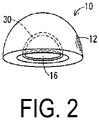
- FIG. 2 is a schematic view of an acetabular cup 10 according to one embodiment.
- the artificial hip joint 1 is composed of the acetabular cup 10 to be fixed to an acetabulum 94 of a hip bone 93 and a femoral stem 20 to be fixed to a proximal end of a femur 91.
- the acetabular cup 10 includes a cup base member 12 having a substantially hemispherical acetabular fixing surface 14 and a substantially hemispherically recessed sliding surface 16, and a polymer film 30 covering the sliding surface 16.
- a femoral head 22 of the femoral stem 20 fitted into a recess 161 in which the polymer film 30 of the acetabular cup 10 is formed is slid to function as a hip joint.
- the acetabular fixing surface 14 is an outer surface disposed closer to the acetabulum 94.
- the sliding surface 16 is also an inner surface or contact surface (first contact surface) configured to contact the femoral head 22.
- the sliding surface 16 of the cup base member 12 is covered with the polymer film 30.
- the polymer film 30 is obtained by graft-bonding a polymer chain in which the PC compound is polymerized with the sliding surface 16.
- the polymer film 30 may be disposed only at the acetabular cup 10 and may be disposed on both the acetabular cup 10 and the femoral head 22.
- the surface of the acetabular cup 10 may have a first region and a second region different from the first region.
- the film thickness of the polymer film 30 in the second region is thicker than that in the first region.
- the polymer film 30 may be disposed only on the sliding surface 16 of the acetabular cup 10.
- the sliding surface 16 is the second region, and the surface other than the sliding surface 16 of the acetabular cup 10 can be regarded as the first region.
- the first region is located on the outer surface of the surfaces of the acetabular cup 10, and it can also be said that the second region is located on the inner surface configured to contact the femoral head 22 of the surfaces of the acetabular cup 10. Further, the first region is located on an edge portion located between the outer surface and the inner surface of the surfaces of the acetabular cup 10, and the second region may be located on the inner surface of the surfaces of the acetabular cup 10.
- the acetabular cup 10 has the first contact surface configured to contact the femoral head 22, and the femoral head 22 may have a second contact surface that is configured to contact the acetabular cup 10 and has a surface roughness less than the first contact surface.
- the surface roughness of the second contact surface has an average roughness Ra of, for example, 0.1 microns or less.
- the polymer film 30 has a structure similar to that of a biological film, has a high affinity with lubricating fluid in the joint, and can retain the lubricating fluid inside the film. Furthermore, the polymer film 30 includes a phosphoric acid group at a high density. Thus, the acetabular cup 10 exhibits superior wear resistance.
- the polymer film including the polymer chain in which the PC compound is polymerized can be formed by exposing the base member with ultraviolet rays in a state where the base member is in contact with the aqueous treatment solution containing the PC compound together with a water-soluble inorganic salt at a specific concentration.
- the results are illustrated in FIG. 3 .
- the vertical axis of FIG. 3 represents a radial distribution function.
- the radial distribution function represents the frequency at which the distance between the double bond portions of the two MPC molecules becomes shortest at each MPC concentration. From FIG. 3 , it was found that the frequency at which the distance between the double bond portions of the two MPC molecules became shortest increased when the MPC concentration was 0.20 mol/L or more and less than 0.50 mol/L. From this, it was expected that a sliding member for an artificial joint having excellent wear resistance could be efficiently obtained by using an aqueous treatment solution having a specific MPC concentration.
- a square material (cross section: 10 mm x 3 mm, length: 100 mm) made of the UHMWPE having a molecular weight of 3.5 million and a density of 0.930 g/cm 3 was used as a base member.
- the square material was immersed in an acetone solution containing 1.0 g/dL of benzophenone for 30 seconds. Immediately thereafter, the square material was pulled up and the solvent was removed at room temperature, whereby benzophenone was sufficiently adsorbed on the square material.
- the aqueous treatment solution containing 2.5 mol/L of sodium chloride was held in advance at 60°C, and then sufficiently degassed.
- the above-described benzophenone-adsorbed square material was immersed in the aqueous treatment solution, and then, while heating the square material, the 10 mm x 100 mm surface of the six surfaces was exposed with ultraviolet rays having wavelengths of 300 to 400 nm and an intensity of 5 mW/cm 2 for 90 minutes.
- the square material was taken out from the aqueous treatment solution and then sufficiently washed with pure water and ethanol to obtain a test piece.
- a test piece was obtained by the same method as in Comparative Example 1 except that the aqueous treatment solution containing 2.5 mol/L of sodium chloride and 0.10 mol/L of MPC was used as the aqueous treatment solution.
- a polymer film made of PMPC was formed on the 10 mm x 100 mm surface of the six surfaces of the square material.
- a square material (cross section: 10 mm x 3 mm, length: 100 mm) made of the PEEK having a density of 1.26 to 1.36 g/cm 3 was used as a base member.
- the aqueous treatment solution containing 2.5 mol/L of sodium chloride was held in advance at 60°C, and then sufficiently degassed.
- the square material was immersed in the aqueous treatment solution, and then, while heating the square material, the 10 mm x 100 mm surface of the six surfaces was exposed with ultraviolet rays having wavelengths of 300 to 400 nm and an intensity of 5 mW/cm 2 for 90 minutes.
- the square material was taken out from the aqueous treatment solution and then sufficiently washed with pure water and ethanol to obtain a test piece.
- a test piece was obtained by the same method as in Comparative Example 5 except that the aqueous treatment solution containing 2.5 mol/L of sodium chloride and 0.10 mol/L of MPC was used as the aqueous treatment solution.
- a polymer film made of PMPC was formed on the 10 mm x 100 mm surface of the six surfaces of the square material.
- test piece was subjected to FT-IR measurement.
- the FT-IR measurement was performed using an FT-IR apparatus (FT/IR-6300 type A manufactured by JASCO Corporation) with a resolution of 4 cm -1 and a cumulative number of 64.
- the test piece was also embedded in epoxy resin and then stained with ruthenium tetrachloride. Thereafter, an ultra-thin piece was cut from the test piece using an ultramicrotome.
- An electron microscopic image of a cut surface of the ultra-thin piece was obtained using a transmission electron microscope (JEM-1010 manufactured by JEOL Ltd.) with an accelerating voltage 100 kV. With respect to one image of the obtained electron microscopic image, the film thickness on the cut surface was measured at 10 points, and the arithmetic average value thereof was calculated as the film thickness of the polymer film.
- the density of the polymer film was calculated based on the following formula from the peak intensity of the phosphoric acid group and the peak intensity of the methylene group in the obtained infrared spectroscopic spectrum and the film thickness of the polymer film.
- density of polymer film peak intensity of phosphoric acid group / peak intensity of methylene group in infrared spectral analysis spectrum / film thickness of polymer film
- the density of the polymer film was calculated based on the following formula from the peak intensity of the ester group and the peak intensity of the benzene ring in the obtained infrared spectroscopic spectrum and the film thickness of the polymer film.
- density of polymer film peak intensity of ester group / peak intensity of benzene ring in infrared spectral analysis spectrum / film thickness of polymer film
- Weight wear rate was measured by a pin-on-disk test. Specifically, the weight wear rate was measured by a multi-directional sliding test using a pin-on-disk type wear tester (Ortho-POD, available from AMTI Inc.), with reference to ASTM F732-00 standard. The multi-directional sliding test was performed in bovine serum at 37°C. The maximum load was set to 213 N, and the test was performed up to one million cycles under conditions of a sliding length of 30 mm and a sliding speed of 1 Hz. The lubricant was replaced every 250,000 cycles, and at the same time, the test piece was collected, washed, dried, and weighed. In addition, the test piece of the control group was immersed in the lubricating liquid, and the amount of wear was calculated by correcting the amount of water absorption from the change in weight.
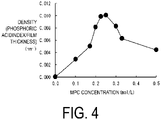
- FIG. 4 is a graph showing the relationship between the concentration of MPC in an aqueous treatment solution and the density (phosphoric acid index/film thickness) of a formed polymer film in examples and comparative examples using the UHMWPE as a base member.
- FIG. 4 indicates that a high-density PMPC layer can be obtained when an aqueous treatment solution containing 0.20 mol/L or more and less than 0.50 mol/L of MPC and a water-soluble inorganic salt is used.
- a polymer film having a density of 0.007 nm -1 or more can be obtained.
- the density of the obtained polymer film is about 0.0045 nm -1 . That is, according to one embodiment, it can be seen that a high-density polymer film is obtained compared to that in the related art.
- FIG. 5 is a graph showing the relationship between the concentration of MPC in an aqueous treatment solution and the weight wear rate of a formed polymer film in examples and comparative examples using the UHMWPE as a base member. From FIG. 5 , it can be seen that a polymer film exhibiting a weight wear rate equal to or higher than that of the related art can be obtained when an aqueous treatment solution containing 0.20 mol/L or more and less than 0.50 mol/L of MPC and a water-soluble inorganic salt is used. As described above, it is surprising that the sliding member for an artificial joint exhibiting wear resistance equal to or higher than that of the related art can be obtained even though the aqueous treatment solution having the MPC concentration lower than that of the related art is used.
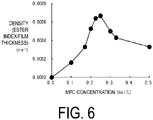
- FIG. 6 is a graph showing the relationship between the concentration of MPC in an aqueous treatment solution and the density (ester index/film thickness) of a formed polymer film in examples and comparative examples using the PEEK as a base member. From FIG. 6 , it can be seen that a high-density PMPC layer can be obtained when an aqueous treatment solution containing 0.20 mol/L or more and less than 0.50 mol/L of MPC and a water-soluble inorganic salt is used.
- a polymer film having a density of 0.0005 nm -1 or more can be obtained.
- the density of the obtained polymer film is about 0.0004 nm -1 . That is, according to one embodiment, even when the PEEK is used as a base member, it can be seen that a high-density polymer film is obtained compared to that in the related art.
- One aspect of the present disclosure is available for manufacturing an artificial joint.
Landscapes
- Health & Medical Sciences (AREA)
- Orthopedic Medicine & Surgery (AREA)
- General Health & Medical Sciences (AREA)
- Oral & Maxillofacial Surgery (AREA)
- Transplantation (AREA)
- Life Sciences & Earth Sciences (AREA)
- Animal Behavior & Ethology (AREA)
- Public Health (AREA)
- Veterinary Medicine (AREA)
- Engineering & Computer Science (AREA)
- Chemical & Material Sciences (AREA)
- Heart & Thoracic Surgery (AREA)
- Vascular Medicine (AREA)
- Biomedical Technology (AREA)
- Cardiology (AREA)
- Epidemiology (AREA)
- Medicinal Chemistry (AREA)
- Dermatology (AREA)
- Chemical Kinetics & Catalysis (AREA)
- General Chemical & Material Sciences (AREA)
- Oil, Petroleum & Natural Gas (AREA)
- Organic Chemistry (AREA)
- Manufacturing & Machinery (AREA)
- Prostheses (AREA)
- Materials For Medical Uses (AREA)
Abstract
Description
- The present disclosure relates to a manufacturing method of a sliding member for an artificial joint, a sliding member for an artificial joint, and an artificial joint.
- There has been established a treatment method in which a joint that has lost its original function due to trauma or disease such as osteoarthritis is replaced with an artificial joint. A known sliding material used for such an artificial joint includes an artificial joint member whose sliding surface is made of a polymer having a phosphorylcholine group.
- One aspect of the present disclosure provides a sliding member for an artificial joint having wear resistance equal to or higher than that of the related art while reducing a concentration of a compound having a phosphorylcholine group.
- A manufacturing method of a sliding member for an artificial joint according to the present disclosure includes exposing a base member with ultraviolet rays in a state where the base member is in contact with an aqueous treatment solution containing a compound having 0.20 mol/L or more and less than 0.50 mol/L of phosphorylcholine group and a water-soluble inorganic salt.
- Further, the sliding member for an artificial joint according to the present disclosure includes a base member including a compound having a methylene group and a polymer film that is formed on at least a portion of a surface of the base member and includes a polymer chain in which a compound having a phosphorylcholine group is polymerized, and the following formula (1) is satisfied:

- Alternatively, the sliding member for an artificial joint according to the present disclosure includes a base member including a compound having a benzene ring and a polymer film that is formed on at least a portion of a surface of the base member and includes a polymer chain in which a compound having an ester group and a phosphorylcholine group is polymerized, and the following formula (2) is satisfied:

- One aspect of the present disclosure allows for providing the sliding member for an artificial joint having wear resistance that can be used for a member for an artificial joint member while reducing the concentration of a compound having a phosphorylcholine group.
-
-
FIG. 1 is a schematic view of anartificial hip joint 1 according to one embodiment. -
FIG. 2 is a schematic view of anacetabular cup 10 according to one embodiment. -
FIG. 3 is a diagram illustrating a result of simulation in Reference Example 1. -
FIG. 4 is a graph showing a relationship between a concentration of 2-methacryloyloxyethyl phosphorylcholine in an aqueous treatment solution and a density (phosphoric acid index/film thickness) of a formed polymer film in examples and comparative examples using UHMWPE as a base member. -
FIG. 5 is a graph showing a relationship between the concentration of 2-methacryloyloxyethyl phosphorylcholine in an aqueous treatment solution and a weight wear rate of a formed polymer film in examples and comparative examples using UHMWPE as a base member. -
FIG. 6 is a graph showing a relationship between the concentration of 2-methacryloyloxyethyl phosphorylcholine in an aqueous treatment solution and a density (ester index/film thickness) of a formed polymer film in examples and comparative examples using PEEK as a base member. - Hereinafter, one embodiment will be described in detail. Unless otherwise specified in the present specification, "A to B" representing a numerical value range means "A or more and B or less".
- The manufacturing method of a sliding member for an artificial joint according to one embodiment includes a step of exposing a base member with ultraviolet rays in a state where the base member is in contact with an aqueous treatment solution containing a compound having 0.20 mol/L or more and less than 0.50 mol/L of phosphorylcholine group and a water-soluble inorganic salt. This allows a polymer film including a polymer chain in which a compound having a phosphorylcholine group is polymerized to be formed on at least a portion of a surface of the base member. That is, the sliding member for an artificial joint in which the surface of the base member is covered with the polymer film may be obtained. Hereinafter, the compound having a phosphorylcholine group is also referred to as a "PC compound".
- An artificial joint, which is implanted in a living body, is necessary to be safe and maintain a constant function in the living body for a long period of time. Avoiding replacing the artificial joint with a new one as much as possible allows the physical or economic burden on the patient to be reduced.
- For example, a total replacement artificial joint includes mainly two members, and each of the two members is mounted on an end portion of the bone. When a joint is moved, these two members move and slide relatively. As repeatedly slid, these members may generate wear powder. Since the generated wear powder is recognized as a foreign matter in the living body, the biological immune system functions to eliminate the foreign matter. At this time, multinucleated cells called osteoclasts are activated, causing osteolysis in which the bone around the artificial joint is resorbed. This osteolysis may cause a void between the bone and the artificial joint, generating the loosening of the artificial joint. The artificial joint inevitably slides, and a sliding material that suppresses generation of such wear powder and has excellent wear resistance is required.
- On the other hand, the PC compound is expensive, and reducing the usage of the PC compound is awaited from the viewpoint of production cost. Also, in treating the artificial joint member using the PC compound, not all of the compounds used are bonded to the surface of the artificial joint member. Since the unbonded PC compound will be discarded, the usage thereof is preferably small from the viewpoint of the environmental impact. The related art as described above has room for enhancement from the viewpoint of implementing a sliding member for an artificial joint having wear resistance equal to or higher than that of the related art while reducing the concentration of the PC compound.
- As a result of intensive studies, the present inventor has found that using the PC compound together with a water-soluble inorganic salt at a specific concentration allows the sliding member for an artificial joint having wear resistance equal to or higher than that of the related art to be implemented though the concentration of the PC compound is lower than that of the related art.
- The present inventor has found that a water-soluble inorganic salt is added to an aqueous treatment solution containing a PC compound to improve radical polymerization efficiency, thus enabling a polymer film to be formed on a surface of a base member by using an aqueous treatment solution having a concentration lower than that of the related art. Further, the present inventor has found from the results of simulations based on molecular orbital calculations and actual tests that a lower concentration of the aqueous treatment solution is not necessarily better and that there is a suitable concentration range.
- Furthermore, a high-density polymer film can be formed by using an aqueous treatment solution containing the PC compound at the specific concentration described above together with the water-soluble inorganic salt. This allows the sliding member for an artificial joint having wear resistance equal to or higher than that of the related art to be implemented.
- In the present specification, the step of exposing a base member with ultraviolet rays in a state where the base member is in contact with an aqueous treatment solution is also referred to as a "polymer film forming step".
- A cartilage surface of the joint of the living body is covered with the phospholipid. This phospholipid contributes to protection and lubrication of cartilage. A polymer film including a polymer chain in which a PC compound having a chemical structure close to that of this phospholipid is polymerized forms a sliding surface, maintaining a good lubrication state for a long period of time. As a result, a sliding member for an artificial joint which is subject to extremely low wear and has an impact absorbing function can be obtained.
- The aqueous treatment solution described above contains the PC compound and a water-soluble inorganic salt in addition to water. The concentration of the PC compound in the aqueous treatment solution is 0.20 mol/L or more and less than 0.50 mol/L, may be 0.20 mol/L or more and 0.40 mol/L or less, may be 0.20 mol/L or more and 0.33 mol/L or less, may be 0.20 mol/L or more and 0.30 mol/L or less, or may be 0.225 mol/L or more and 0.30 mol/L or less. The above concentration allows the production costs and the environmental impact to be reduced, a polymer film having sufficient density to be formed, and excellent wear resistance to be provided to the sliding member for an artificial joint.
- Selecting, as the PC compound, in particular, a polymerizable monomer having a phosphorylcholine group at one end and a functional group graft-polymerizable with the polymer base member at the other end allows the polymer film to be graft-bonded to the sliding surface of the base member.
- Examples of the PC compound include 2-methacryloyloxyethyl phosphorylcholine, 2-acryloyloxyethyl phosphorylcholine, 4-methacryloyloxybutyl phosphorylcholine, 6-methacryloyloxyhexyl phosphorylcholine, and ω-methacryloyloxyethylene phosphorylcholine. Of these, 2-methacryloyloxyethyl phosphorylcholine may be used. Hereinafter, 2-methacryloyloxyethyl phosphorylcholine is also referred to as "MPC". A polymer in which MPC is polymerized is also referred to as poly (MPC) or PMPC.
- MPC, which has a chemical structure represented by the following structural formula, is a polymerizable monomer having a phosphorylcholine group and a polymerizable methacrylic acid unit.

- MPC can be easily polymerized by radical polymerization, forming a high molecular weight homopolymer (Ishihara et al., Polymer Journal 22, p355 (1990)). Therefore, forming a polymer film as an aggregate of polymer chains in which MPC is polymerized allows graft-bonding between the MPC polymer chains and the sliding surface of the base member to be performed under relatively mild conditions. Further, forming a high-density polymer film allows a large number of phosphorylcholine groups to be formed on the sliding surface of the base member.
- The polymer film described above can be formed not only as a homopolymer composed of a single polymerizable monomer having a phosphorylcholine group but also as a copolymer composed of a polymerizable monomer having a phosphorylcholine group and, for example, another vinyl compound monomer. This enables a function for improving mechanical strength and the like to be added to the polymer film depending on the type of other vinyl compound monomers used.
- Examples of the water-soluble inorganic salt described above include an alkali metal salt, and an alkaline earth metal salt. Examples of the alkali metal salt include a sodium salt, a potassium salt, a lithium salt, and a cesium salt. Examples of the alkaline earth metal salt include a magnesium salt, a calcium salt, a strontium salt, a barium salt, and a radium salt. Further, examples of the water-soluble inorganic salt classified according to the type of counter anion include halides (for example, chloride, fluoride, bromide, and iodide), phosphoric acids, carbonates, nitrates, and hydroxides. The water-soluble inorganic salt is one or more selected from the group consisting of, for example, sodium chloride, potassium chloride, calcium chloride, and magnesium chloride.
- The concentration of the water-soluble inorganic salt in the aqueous treatment solution can be set to, for example, 0.01 to 5.0 mol/L. Furthermore, the concentration of the water-soluble inorganic salt in the aqueous treatment solution can be set to, for example, 1.0 to 5.0 mol/L, or 1.0 to 3.0 mol/L. The above concentration allows a polymer film having sufficient graft density to be efficiently formed.
- For example, according to one embodiment, by using the water-soluble inorganic salt, a polymer film having a film thickness of 100 nm or more can be formed on the surface of the base member in a short time of 1 to 90 minutes. More specifically, a polymer film having a film thickness of 600 nm or more can also be obtained. Even with such a large film thickness, no voids, etc., are observed at the interface between the film and the base member, and it can be expected to have sufficient film strength.
- Examples of the material constituting the base member include polymeric materials such as polyolefin-based materials such as polyethylene, and aromatic polyether ketone-based materials, such as polyether ether ketone (PEEK). These polymeric materials may include functional compounds, such as antioxidants and crosslinking agents, and/or reinforcing materials, such as carbon fibers.
- Examples of the polyethylene include ultra-high molecular weight polyethylene (UHMWPE). The UHMWPE, which has excellent mechanical characteristics such as wear resistance, impact resistance, and deformation resistance, can be used for artificial joints as a resin material. In addition, polyether ether ketone (PEEK) also has excellent mechanical characteristics such as impact resistance, and deformation resistance, and thus can be used in artificial joints as resin materials.
- The higher the molecular weight of the polymer constituting the base member is, the higher the wear resistance tends to be. When the base member includes a compound having a methylene group such as polyethylene, the molecular weight of the polymer constituting the base member may be 1 million or more, 1 million to 7 million, 3 million to 7 million, or 3 million to 4 million. When the base member includes a compound having a benzene ring such as the PEEK, the molecular weight of the polymer constituting the base member may be 50,000 or more, 80,000 to 500,000, or 80,000 to 200,000. In the present specification, the molecular weight of the polymer constituting the base member means the molecular weight determined by the following formula (3) by measuring the viscosity of a decahydronaphthalene (decalin) solution containing the polymer at 135°C.

- From the viewpoint of mechanical characteristics such as the impact resistance and the deformation resistance, the density of the polymer constituting the base member may be 0.927 to 0.944 g/cm3 when the base member includes the compound having a methylene group. Also, when the base member includes the compound having a benzene ring, the density may be 1.20 to 1.55 g/cm3.
- The polymer film may be formed at a portion corresponding to a sliding surface that is at least a portion of the surface of the base member. For example, in manufacturing an acetabular cup in an artificial hip joint, the polymer film may be formed on an inner spherical surface of the cup with which at least the femoral head comes into contact.
- The polymer film may be formed by photo-initiated graft polymerization of a polymer chain in which the PC compound is polymerized with the sliding surface of the base member. The photo-initiated graft polymerization can stably immobilize the polymer chain in which the PC compound is polymerized on the surface of the base member. Further, the photo-initiated graft polymerization forms a polymer chain having a phosphorylcholine group at a high density on the sliding surface of the base member, enabling the density of the polymer film to be increased.
- To perform the photo-initiated graft polymerization of the polymer chain with the sliding surface of the base member, the sliding surface of the base member is exposed with ultraviolet rays in a state where the base member is in contact with an aqueous treatment solution containing the PC compound as a polymerizable monomer and the water-soluble inorganic salt. At this time, it is also possible to heat the base member. That is, the manufacturing method may further include the step of heating the base member. By heating the base member and the aqueous treatment solution in contact with the base member, the photo-initiated graft polymerization reaction can be controlled.
- When the sliding surface of the base member is exposed with ultraviolet rays, the PC compound in the vicinity of the sliding surface polymerizes to produce the polymer chain. The produced polymer chain is covalently bonded to the sliding surface of the base member. Causing the polymer chain to be graft-bonded to the sliding surface at a high density forms the polymer film covering the sliding surface of the base member as a whole.
- Before the base member is in contact with the aqueous treatment solution, a photopolymerization initiator may be applied to the sliding surface of the base member. In this case, a photopolymerization initiator radical generated by the ultraviolet exposure forms a polymerization initiation point on the surface of the base member. The PC compound, which is a polymerizable monomer, reacts with the polymerization initiation point to initiate graft polymerization and grow into a graft polymer.
- The wavelength of the ultraviolet rays to be exposed is, for example, 300 to 400 nm. Examples of ultraviolet exposing sources that can be used include high-pressure mercury lamps (UVL 400HA, manufactured by Riko Kagaku Sangyo Co., Ltd.) and LEDs (MeV365 P601JMM, manufactured by YEV Co., Ltd.). The ultraviolet exposing time may be 11 to 90 minutes or may be 23 to 90 minutes.
- Further, after the polymer film forming step, sterilization treatment by gamma irradiation can be performed.
- The manufacturing method of a sliding member for an artificial joint according to one embodiment may include a base member forming step of molding a polymeric material to obtain a base member before the polymer film forming step.
- For example, the base member can be obtained by charging a powdery, granular, or pellet-like polymeric material into a metal mold, followed by compression molding, extrusion molding, or injection molding. Examples of the polymeric material include the UHMWPE and the PEEK described above. The UHMWPE and the PEEK, which are thermoplastic resins, have less flowability than the melting temperature. Therefore, the UHMWPE or the PEEK in a solid state may be charged into a metal mold and molded under high heat and pressure conditions. An antioxidant, a crosslinking agent, or a reinforcing material, such as carbon fiber, together with the polymeric material may be added to the metal mold.
- The base member obtained by the compression molding, the extrusion molding, or the injection molding may be subjected to the subsequent polymer film forming step as it is or may be subjected to the polymer film forming step after shaping by machining.
- The manufacturing method of a sliding member for an artificial joint according to one embodiment may include a crosslinking step of generating a crosslinked structure in a molecule of the polymeric material before the polymer film forming step. This obtains a base member having further improved mechanical characteristics, such as wear resistance.
- The crosslinking step may include a step of irradiating the base member with a high energy ray. This step is also referred to as a high energy ray irradiation step.
- The base member including the UHMWPE is irradiated with the high energy ray to generate a free radical. This causes the UHMWPE to be bonded between molecular chains, enabling the UHMWPE having a crosslinked structure to be obtained. Generating the crosslinked structure between the molecular chains improves the mechanical characteristics, such as wear resistance and impact resistance.
- The crosslinking reaction is made possible by adding a crosslinking agent, but completely removing unreacted crosslinking agent tends to be difficult. Therefore, the crosslinking reaction by high energy ray irradiation may be used in consideration of the influence of the unreacted crosslinking agent on the living body.
- Examples of the high energy ray include X-rays, gamma rays, and electron beams. The irradiation dose of the high energy ray is, for example, 25 to 200 kGy but may be 50 to 150 kGy. Examples of the high energy ray source that can be used include a radiation device using Co (cobalt) 60 as a radiation source as a gamma ray source, an accelerator that emits an electron beam, and a device that emits an X-ray.
- The crosslinking step may further include a thermal treatment step after the high energy ray irradiation step. In the thermal treatment step, the free radical generated by the high energy ray irradiation step is more efficiently consumed in the crosslinking reaction to promote intramolecular crosslinking. The temperature range of the thermal treatment may be 110 to 130°C. The thermal treatment time may be 2 to 12 hours.
- A sliding member for an artificial joint according to one embodiment includes a base member including a compound having a methylene group, and a polymer film that is formed on at least a portion of a surface of the base member and includes a polymer chain in which a compound having a phosphorylcholine group is polymerized, and the following formula (1) is satisfied:

- A sliding member for an artificial joint according to another embodiment includes a base member including a compound having a benzene ring, and a polymer film that is formed on at least a portion of a surface of the base member and includes a polymer chain in which a compound having an ester group and a phosphorylcholine group is polymerized, and the following formula (2) is satisfied:

- Such a sliding member for an artificial joint can be obtained by, for example, the manufacturing method of a sliding member for an artificial joint according to the above-described one embodiment. The matters already described in [1. Manufacturing Method of Sliding Member for Artificial Joint] will not be described below.
- The polymer film is formed by a polymer chain obtained by initiating polymerization of the PC compound from the sliding surface of the base member. The present inventor has found that the wear resistance is improved as the amount of the polymer chain in which the PC compound is polymerized per film thickness of the polymer film is increased. As an index of the amount of the polymer chain, a "phosphoric acid index" or an "ester index" can be used.
- Here, the "phosphoric acid index" is defined by a peak intensity of 1460 cm-1, which corresponds to an absorption of a phosphoric acid group, with respect to a peak intensity of 1080 cm-1, which corresponds to an absorption of a methylene group, in a spectrum of Fourier-transform infrared spectroscopy (FT-IR) analysis. That is, the phosphoric acid index is represented as peak intensity of phosphoric acid group/peak intensity of methylene group in infrared spectroscopic spectrum.
- Similarly, the "ester index" is defined by a peak intensity of 1600 cm-1, which corresponds to an absorption of an ester group, with respect to a peak intensity of 1730 cm-1, which corresponds to an absorption of a benzene ring, in a spectrum of Fourier-transform infrared spectroscopy (FT-IR) analysis. That is, the ester index is represented as peak intensity of ester group/peak intensity of benzene ring in infrared spectroscopic spectrum.
- When a polymer film including the PC compound formed on the base member including a methylene group is subjected to FT-IR measurement, a peak of the methylene group derived from the base member and a peak of a phosphoric acid group derived from the polymer film are observed. The value obtained by dividing the phosphoric acid index calculated from the peak intensity due to the absorption of the methylene group and the peak intensity due to the absorption of the phosphoric acid group by the film thickness of the polymer film is considered to be a graft chain density present per unit area of the surface of the base member.
- In addition, when a polymer film including the PC compound formed on the base member including a benzene ring is subjected to the FT-IR measurement, a peak of the benzene ring derived from the base member and a peak of an ester group derived from the polymer film are observed. The value obtained by dividing the ester index calculated from the peak intensity due to the absorption of the benzene ring and the peak intensity due to the absorption of the ester group by the film thickness of the polymer film is also considered to be the graft chain density present per unit area of the surface of the base member. Even when the polymer film including the PC compound formed on the base member including the benzene ring is subjected to the FT-IR measurement, the peak of the phosphoric acid group derived from the polymer film may not be observed. Therefore, the peak of the ester group is used as an index instead of the peak of the phosphoric acid group. The compound having an ester group and a phosphorylcholine group is used as the PC compound, and the value obtained by dividing the ester index by the film thickness of the polymer film can also be regarded as corresponding to the graft chain density.
- "(Peak intensity of phosphoric acid group/peak intensity of methylene group in infrared spectroscopic spectrum)/film thickness of polymer film" is also expressed as "phosphoric acid index/film thickness of polymer film". "(Peak intensity of ester group /peak intensity of benzene ring in infrared spectroscopic spectrum)/film thickness of polymer film" is also expressed as "ester index/film thickness of polymer film". The parameter represented by the "phosphoric acid index/film thickness of polymer film" or the "ester index/film thickness of polymer film" is also referred to as "density of polymer film" for convenience in the present specification.
- As illustrated in examples described later, the use of the aqueous treatment solution containing the PC compound at a high concentration does not necessarily obtain a polymer film with high density and excellent wear resistance. This cannot be predicted even by a person skilled in the art. That is, a sliding member for an artificial joint satisfying Formula (1) or Formula (2) has not been easily obtained in accordance with the conventional common technical knowledge.
- When the base member includes the compound having a methylene group, the density of the polymer film may be 0.007 nm-1 or more or may be 0.008 nm-1 or more. When the density of the polymer film is 0.007 nm-1 or more, the polymer film exhibits wear resistance equal to or higher than that of the related art even the use of the aqueous treatment solution containing the PC compound at a concentration lower than that of the related art. The upper limit of the density of the polymer film is not particularly limited but may be, for example, 0.020 nm-1 or less, may be 0.015 nm-1 or less, or may be 0.012 nm-1 or less.
- When the base member includes the compound having a benzene ring, the density of the polymer film may be 0.0005 nm-1 or more or may be 0.0008 nm-1 or more. When the density of the polymer film is 0.0005 nm-1 or more, the polymer film exhibits wear resistance equal to or higher than that of the related art even the use of the aqueous treatment solution containing the PC compound at a concentration lower than that of the related art. The upper limit of the density of the polymer film is not particularly limited but may be, for example, 0.0020 nm-1 or less, may be 0.0015 nm-1 or less, or may be 0.0012 nm-1 or less.
- The film thickness of the polymer film may be 50 to 1000 nm, may be 100 nm or more, or may be 100 to 500 nm from the viewpoint of obtaining sufficient wear resistance.
- The base member includes compounds having at least a methylene group or a benzene ring. Examples of these compounds include polyethylene or the PEEK. In particular, the UHMWPE may be used as described in [1. Manufacturing Method of Sliding Member for Artificial Joint]. In addition, the molecular weight and density of the compound having a methylene group may be the same as the molecular weight and density of the polymer constituting the base member described in [1. Manufacturing Method of Sliding Member for Artificial Joint].
- The artificial joint to which the above-described sliding member for an artificial joint is applied is not particularly limited. Examples of the artificial joint include an artificial hip joint, an artificial knee joint, an artificial ankle joint, an artificial shoulder joint, an artificial elbow joint, an artificial finger joint, and an artificial intervertebral disc. For example, the artificial hip joint may include a femoral head and an acetabulum. The sliding member for an artificial joint according to one embodiment can be applied to the femoral head or the acetabulum, or both. For example, the sliding member for an artificial joint according to one embodiment may be used for either one of the femoral head and the acetabulum. In this case, a member including a metal such as stainless steel or a cobalt chromium alloy, a ceramic such as alumina or zirconia, a polymer such as the UHMWPE or the PEEK may be used for the other. Also, for example, the femoral head and acetabulum may be formed of different materials. For example, the femoral head may be formed of a polymer, ceramic, or metal material, and the base member of the acetabulum may be formed of, for example, a polymeric material.
- Hereinafter, an example in which the sliding member for an artificial joint according to one embodiment is used as an acetabular cup of an artificial hip joint will be described.
FIG. 1 is a schematic view of anartificial hip joint 1 according to one embodiment.FIG. 2 is a schematic view of anacetabular cup 10 according to one embodiment. Theartificial hip joint 1 is composed of theacetabular cup 10 to be fixed to anacetabulum 94 of ahip bone 93 and afemoral stem 20 to be fixed to a proximal end of afemur 91. Theacetabular cup 10 includes acup base member 12 having a substantially hemisphericalacetabular fixing surface 14 and a substantially hemispherically recessed slidingsurface 16, and apolymer film 30 covering the slidingsurface 16. Afemoral head 22 of thefemoral stem 20 fitted into arecess 161 in which thepolymer film 30 of theacetabular cup 10 is formed is slid to function as a hip joint. Theacetabular fixing surface 14 is an outer surface disposed closer to theacetabulum 94. The slidingsurface 16 is also an inner surface or contact surface (first contact surface) configured to contact thefemoral head 22. - As illustrated in
FIGS. 1 and2 , in theacetabular cup 10, the slidingsurface 16 of thecup base member 12 is covered with thepolymer film 30. Thepolymer film 30 is obtained by graft-bonding a polymer chain in which the PC compound is polymerized with the slidingsurface 16. Thepolymer film 30 may be disposed only at theacetabular cup 10 and may be disposed on both theacetabular cup 10 and thefemoral head 22. - Also, the surface of the
acetabular cup 10 may have a first region and a second region different from the first region. For example, the film thickness of thepolymer film 30 in the second region is thicker than that in the first region. Furthermore, thepolymer film 30 may be disposed only on the slidingsurface 16 of theacetabular cup 10. In this case, the slidingsurface 16 is the second region, and the surface other than the slidingsurface 16 of theacetabular cup 10 can be regarded as the first region. The first region is located on the outer surface of the surfaces of theacetabular cup 10, and it can also be said that the second region is located on the inner surface configured to contact thefemoral head 22 of the surfaces of theacetabular cup 10. Further, the first region is located on an edge portion located between the outer surface and the inner surface of the surfaces of theacetabular cup 10, and the second region may be located on the inner surface of the surfaces of theacetabular cup 10. - Also, the
acetabular cup 10 has the first contact surface configured to contact thefemoral head 22, and thefemoral head 22 may have a second contact surface that is configured to contact theacetabular cup 10 and has a surface roughness less than the first contact surface. The surface roughness of the second contact surface has an average roughness Ra of, for example, 0.1 microns or less. - The
polymer film 30 has a structure similar to that of a biological film, has a high affinity with lubricating fluid in the joint, and can retain the lubricating fluid inside the film. Furthermore, thepolymer film 30 includes a phosphoric acid group at a high density. Thus, theacetabular cup 10 exhibits superior wear resistance. - The invention according to the present disclosure has been described above based on the drawings and examples. However, the invention according to the present disclosure is not limited to each embodiment described above. That is, the invention according to the present disclosure can be variously modified within the scope indicated in the present disclosure, and an embodiment to be obtained by appropriately combining technical means disclosed in different embodiments is also included in the technical scope of the invention according to the present disclosure. In other words, it should be noted that a person skilled in the art can easily make various variations or modifications based on the present disclosure. It should also be noted that these variations or modifications are included within the scope of the present disclosure.
- Hereinafter, the invention according to the present disclosure will be described in more detail based on reference examples, examples, and comparative examples, but the invention according to the present disclosure is not limited to these examples.
- As described above, the polymer film including the polymer chain in which the PC compound is polymerized can be formed by exposing the base member with ultraviolet rays in a state where the base member is in contact with the aqueous treatment solution containing the PC compound together with a water-soluble inorganic salt at a specific concentration.
- First, a simulation was performed on the assumption of using sodium chloride as the water-soluble inorganic salt and MPC as the PC compound. Specifically, the distance between the double bond portions of the methacrylic group that contributes to the polymerization of two MPC molecules was evaluated by simulation calculation in a case where the sodium chloride concentration in the aqueous treatment solution was 2.5 mol/L and where the MPC concentration was changed from 0.00 mol/L to 0.50 mol/L. Amber was used as simulation software, and the following conditions were set. The General AMBER Force Field (GAFF) and electrostatic potential (RESP) charge (calculated by HF/6-31G∗) were used as a force field of solute, and the TIP3P was used as a force field of water molecules. A constraint condition by the SHAKE method was imposed, and the particle mesh Ewald (PME) method was used for long-range electrostatic interactions. Under the above conditions, the molecular dynamics simulations in the Langevin heat bath at 300 K were performed.
- The results are illustrated in
FIG. 3 . The vertical axis ofFIG. 3 represents a radial distribution function. In the simulation, the radial distribution function represents the frequency at which the distance between the double bond portions of the two MPC molecules becomes shortest at each MPC concentration. FromFIG. 3 , it was found that the frequency at which the distance between the double bond portions of the two MPC molecules became shortest increased when the MPC concentration was 0.20 mol/L or more and less than 0.50 mol/L. From this, it was expected that a sliding member for an artificial joint having excellent wear resistance could be efficiently obtained by using an aqueous treatment solution having a specific MPC concentration. - A square material (cross section: 10 mm x 3 mm, length: 100 mm) made of the UHMWPE having a molecular weight of 3.5 million and a density of 0.930 g/cm3 was used as a base member. The square material was immersed in an acetone solution containing 1.0 g/dL of benzophenone for 30 seconds. Immediately thereafter, the square material was pulled up and the solvent was removed at room temperature, whereby benzophenone was sufficiently adsorbed on the square material.
- The aqueous treatment solution containing 2.5 mol/L of sodium chloride was held in advance at 60°C, and then sufficiently degassed. The above-described benzophenone-adsorbed square material was immersed in the aqueous treatment solution, and then, while heating the square material, the 10 mm x 100 mm surface of the six surfaces was exposed with ultraviolet rays having wavelengths of 300 to 400 nm and an intensity of 5 mW/cm2 for 90 minutes. The square material was taken out from the aqueous treatment solution and then sufficiently washed with pure water and ethanol to obtain a test piece.
- A test piece was obtained by the same method as in Comparative Example 1 except that the aqueous treatment solution containing 2.5 mol/L of sodium chloride and 0.10 mol/L of MPC was used as the aqueous treatment solution. In the test piece, a polymer film made of PMPC was formed on the 10 mm x 100 mm surface of the six surfaces of the square material.
- By the same method as in Comparative Example 2 except that the MPC concentration in the aqueous treatment solution was changed to 0.17 mol/L, a test piece in which a polymer film made of PMPC was formed on the 10 mm x 100 mm surface of the six surfaces of the square material was obtained.
- By the same method as in Comparative Example 2 except that the MPC concentration in the aqueous treatment solution was changed to 0.20 mol/L, a test piece in which a polymer film made of PMPC was formed on the 10 mm x 100 mm surface of the six surfaces of the square material was obtained.
- By the same method as in Comparative Example 2 except that the MPC concentration in the aqueous treatment solution was changed to 0.225 mol/L, a test piece in which a polymer film made of PMPC was formed on the 10 mm x 100 mm surface of the six surfaces of the square material was obtained.
- By the same method as in Comparative Example 2 except that the MPC concentration in the aqueous treatment solution was changed to 0.25 mol/L, a test piece in which a polymer film made of PMPC was formed on the 10 mm x 100 mm surface of the six surfaces of the square material was obtained.
- By the same method as in Comparative Example 2 except that the MPC concentration in the aqueous treatment solution was changed to 0.30 mol/L, a test piece in which a polymer film made of PMPC was formed on the 10 mm x 100 mm surface of the six surfaces of the square material was obtained.
- By the same method as in Comparative Example 2 except that the MPC concentration in the aqueous treatment solution was changed to 0.33 mol/L, a test piece in which a polymer film made of PMPC was formed on the 10 mm x 100 mm surface of the six surfaces of the square material was obtained.
- By the same method as in Comparative Example 2 except that the MPC concentration in the aqueous treatment solution was changed to 0.50 mol/L, a test piece in which a polymer film made of PMPC was formed on the 10 mm x 100 mm surface of the six surfaces of the square material was obtained.
- A square material (cross section: 10 mm x 3 mm, length: 100 mm) made of the PEEK having a density of 1.26 to 1.36 g/cm3 was used as a base member.
- The aqueous treatment solution containing 2.5 mol/L of sodium chloride was held in advance at 60°C, and then sufficiently degassed. The square material was immersed in the aqueous treatment solution, and then, while heating the square material, the 10 mm x 100 mm surface of the six surfaces was exposed with ultraviolet rays having wavelengths of 300 to 400 nm and an intensity of 5 mW/cm2 for 90 minutes. The square material was taken out from the aqueous treatment solution and then sufficiently washed with pure water and ethanol to obtain a test piece.
- A test piece was obtained by the same method as in Comparative Example 5 except that the aqueous treatment solution containing 2.5 mol/L of sodium chloride and 0.10 mol/L of MPC was used as the aqueous treatment solution. In the test piece, a polymer film made of PMPC was formed on the 10 mm x 100 mm surface of the six surfaces of the square material.
- By the same method as in Comparative Example 6 except that the MPC concentration in the aqueous treatment solution was changed to 0.17 mol/L, a test piece in which a polymer film made of PMPC was formed on the 10 mm x 100 mm surface of the six surfaces of the square material was obtained.
- By the same method as in Comparative Example 6 except that the MPC concentration in the aqueous treatment solution was changed to 0.20 mol/L, a test piece in which a polymer film made of PMPC was formed on the 10 mm x 100 mm surface of the six surfaces of the square material was obtained.
- By the same method as in Comparative Example 6 except that the MPC concentration in the aqueous treatment solution was changed to 0.225 mol/L, a test piece in which a polymer film made of PMPC was formed on the 10 mm x 100 mm surface of the six surfaces of the square material was obtained.
- By the same method as in Comparative Example 6 except that the MPC concentration in the aqueous treatment solution was changed to 0.25 mol/L, a test piece in which a polymer film made of PMPC was formed on the 10 mm x 100 mm surface of the six surfaces of the square material was obtained.
- By the same method as in Comparative Example 6 except that the MPC concentration in the aqueous treatment solution was changed to 0.30 mol/L, a test piece in which a polymer film made of PMPC was formed on the 10 mm x 100 mm surface of the six surfaces of the square material was obtained.
- By the same method as in Comparative Example 6 except that the MPC concentration in the aqueous treatment solution was changed to 0.33 mol/L, a test piece in which a polymer film made of PMPC was formed on the 10 mm x 100 mm surface of the six surfaces of the square material was obtained.
- By the same method as in Comparative Example 6 except that the MPC concentration in the aqueous treatment solution was changed to 0.50 mol/L, a test piece in which a polymer film made of PMPC was formed on the 10 mm x 100 mm surface of the six surfaces of the square material was obtained.
- First, the test piece was subjected to FT-IR measurement. The FT-IR measurement was performed using an FT-IR apparatus (FT/IR-6300 type A manufactured by JASCO Corporation) with a resolution of 4 cm-1 and a cumulative number of 64.
- The test piece was also embedded in epoxy resin and then stained with ruthenium tetrachloride. Thereafter, an ultra-thin piece was cut from the test piece using an ultramicrotome. An electron microscopic image of a cut surface of the ultra-thin piece was obtained using a transmission electron microscope (JEM-1010 manufactured by JEOL Ltd.) with an accelerating voltage 100 kV. With respect to one image of the obtained electron microscopic image, the film thickness on the cut surface was measured at 10 points, and the arithmetic average value thereof was calculated as the film thickness of the polymer film.
- In the case where the UHMWPE was used as the base member, the density of the polymer film was calculated based on the following formula from the peak intensity of the phosphoric acid group and the peak intensity of the methylene group in the obtained infrared spectroscopic spectrum and the film thickness of the polymer film.

- In the case where the PEEK was used as the base member, the density of the polymer film was calculated based on the following formula from the peak intensity of the ester group and the peak intensity of the benzene ring in the obtained infrared spectroscopic spectrum and the film thickness of the polymer film.

- Weight wear rate was measured by a pin-on-disk test. Specifically, the weight wear rate was measured by a multi-directional sliding test using a pin-on-disk type wear tester (Ortho-POD, available from AMTI Inc.), with reference to ASTM F732-00 standard. The multi-directional sliding test was performed in bovine serum at 37°C. The maximum load was set to 213 N, and the test was performed up to one million cycles under conditions of a sliding length of 30 mm and a sliding speed of 1 Hz. The lubricant was replaced every 250,000 cycles, and at the same time, the test piece was collected, washed, dried, and weighed. In addition, the test piece of the control group was immersed in the lubricating liquid, and the amount of wear was calculated by correcting the amount of water absorption from the change in weight.
-
FIG. 4 is a graph showing the relationship between the concentration of MPC in an aqueous treatment solution and the density (phosphoric acid index/film thickness) of a formed polymer film in examples and comparative examples using the UHMWPE as a base member.FIG. 4 indicates that a high-density PMPC layer can be obtained when an aqueous treatment solution containing 0.20 mol/L or more and less than 0.50 mol/L of MPC and a water-soluble inorganic salt is used. In particular, when an aqueous treatment solution containing 0.20 mol/L or more and 0.30 mol/L or less of MPC and a water-soluble inorganic salt is used, a polymer film having a density of 0.007 nm-1 or more can be obtained. Compared to this, for example, when the MPC concentration is 0.50 mol/L, the density of the obtained polymer film is about 0.0045 nm-1. That is, according to one embodiment, it can be seen that a high-density polymer film is obtained compared to that in the related art. - Further,
FIG. 5 is a graph showing the relationship between the concentration of MPC in an aqueous treatment solution and the weight wear rate of a formed polymer film in examples and comparative examples using the UHMWPE as a base member. FromFIG. 5 , it can be seen that a polymer film exhibiting a weight wear rate equal to or higher than that of the related art can be obtained when an aqueous treatment solution containing 0.20 mol/L or more and less than 0.50 mol/L of MPC and a water-soluble inorganic salt is used. As described above, it is surprising that the sliding member for an artificial joint exhibiting wear resistance equal to or higher than that of the related art can be obtained even though the aqueous treatment solution having the MPC concentration lower than that of the related art is used. - In particular, from
FIGS. 4 and5 , it can be seen that when an aqueous treatment solution containing 0.20 mol/L or more and 0.30 mol/L or less of MPC and a water-soluble inorganic salt is used, a polymer film having a density of 0.007 nm-1 or more can be obtained and exhibits excellent wear resistance. -
FIG. 6 is a graph showing the relationship between the concentration of MPC in an aqueous treatment solution and the density (ester index/film thickness) of a formed polymer film in examples and comparative examples using the PEEK as a base member. FromFIG. 6 , it can be seen that a high-density PMPC layer can be obtained when an aqueous treatment solution containing 0.20 mol/L or more and less than 0.50 mol/L of MPC and a water-soluble inorganic salt is used. In particular, when an aqueous treatment solution containing 0.20 mol/L or more and 0.30 mol/L or less of MPC and a water-soluble inorganic salt is used, a polymer film having a density of 0.0005 nm-1 or more can be obtained. Compared to this, for example, when the MPC concentration is 0.50 mol/L, the density of the obtained polymer film is about 0.0004 nm-1. That is, according to one embodiment, even when the PEEK is used as a base member, it can be seen that a high-density polymer film is obtained compared to that in the related art. - One aspect of the present disclosure is available for manufacturing an artificial joint.
-
- 1
- Artificial hip joint
- 10
- Acetabular cup (sliding member for an artificial joint)
- 12
- Cup base member (base member)
- 30
- Polymer film
Claims (21)
- A manufacturing method of a sliding member for an artificial joint, comprising
exposing a base member with ultraviolet rays in a state where the base member is in contact with an aqueous treatment solution containing a compound having 0.20 mol/L or more and less than 0.50 mol/L of phosphorylcholine group and a water-soluble inorganic salt. - The manufacturing method of a sliding member for an artificial joint according to claim 1, wherein a concentration of the compound having the phosphorylcholine group is 0.20 mol/L or more and 0.30 mol/L or less.
- The manufacturing method of a sliding member for an artificial joint according to claim 1 or 2, wherein the concentration of the compound having the phosphorylcholine group is 0.225 mol/L or more and 0.30 mol/L or less.
- The manufacturing method of a sliding member for an artificial joint according to any one of claims 1 to 3, wherein the water-soluble inorganic salt is an alkali metal salt or an alkaline earth metal salt.
- The manufacturing method of a sliding member for an artificial joint according to claim 4, wherein the alkali metal salt is one or more selected from a sodium salt, a potassium salt, a lithium salt, and a cesium salt.
- The manufacturing method of a sliding member for an artificial joint according to any one of claims 1 to 5, further comprising
heating the base member. - A sliding member for an artificial joint, comprising:a base member comprising a compound having a methylene group; anda polymer film that is formed on at least a portion of a surface of the base member and comprises a polymer chain in which a compound having a phosphorylcholine group is polymerized, whereinthe following formula (1) is satisfied:

- A sliding member for an artificial joint, comprising:a base member comprising a compound having a benzene ring; anda polymer film that is formed on at least a portion of a surface of the base member and comprises a polymer chain in which a compound having an ester group and a phosphorylcholine group is polymerized, whereinthe following formula (2) is satisfied:

- The sliding member for an artificial joint according to claim 7 or 8, wherein the polymer film has a film thickness of 100 nm or more.
- An artificial hip joint, comprising
the sliding member for an artificial joint according to any one of claims 7 to 9. - The artificial hip joint according to claim 10, comprising:an acetabular cup comprising the base member and the polymer film; anda femoral head disposed in the acetabular cup.
- The artificial hip joint according to claim 11, wherein the polymer film is disposed only on the acetabular cup of the acetabular cup and the femoral head.
- The artificial hip joint according to claim 11, wherein the polymer film is disposed on both the acetabular cup and the femoral head.
- The artificial hip joint according to any one of claims 11 to 13, wherein the acetabular cup has a contact surface configured to contact the femoral head, and
the polymer film is disposed on the contact surface. - The artificial hip joint according to any one of claims 11 to 14, wherein the femoral head is formed of a material different from that of the base member of the acetabular cup.
- The artificial hip joint according to any one of claims 11 to 15, wherein the femoral head is formed of a polymer, ceramic, or metal material.
- The artificial hip joint according to any one of claims 11 to 16, wherein surfaces of the acetabular cup have a first region and a second region having the polymer film thicker than the first region.
- The artificial hip joint according to claim 17, wherein the first region is located on an outer surface of the surfaces, and
the second region is located on an inner surface configured to contact the femoral head of the surfaces. - The artificial hip joint according to claim 17 or 18, wherein the first region is located on an edge portion located between an outer surface and an inner surface of the surfaces, the inner surface being configured to contact the femoral head, and
the second region is located on the inner surface. - The artificial hip joint according to any one of claims 11 to 19, wherein the acetabular cup has a contact surface configured to contact the femoral head, and
the polymer film is disposed only on the contact surface. - The artificial hip joint according to any one of claims 11 to 20, wherein the acetabular cup has a first contact surface configured to contact the femoral head, and
the femoral head has a second contact surface configured to contact the acetabular cup and having a surface roughness less than that of the first contact surface.
Applications Claiming Priority (2)
| Application Number | Priority Date | Filing Date | Title |
|---|---|---|---|
| JP2020005371A JP7499032B2 (en) | 2020-01-16 | 2020-01-16 | Manufacturing method of slide member for artificial joint and slide member for artificial joint |
| PCT/JP2021/000620 WO2021145298A1 (en) | 2020-01-16 | 2021-01-12 | Method for producing artificial joint sliding member, artificial joint sliding member, and artificial joint |
Publications (2)
| Publication Number | Publication Date |
|---|---|
| EP4091641A1 true EP4091641A1 (en) | 2022-11-23 |
| EP4091641A4 EP4091641A4 (en) | 2024-02-07 |
Family
ID=76863790
Family Applications (1)
| Application Number | Title | Priority Date | Filing Date |
|---|---|---|---|
| EP21740983.8A Pending EP4091641A4 (en) | 2020-01-16 | 2021-01-12 | METHOD FOR PRODUCING ARTIFICIAL JOINT SLIDING ELEMENT, ARTIFICIAL JOINT SLIDING ELEMENT AND ARTIFICIAL JOINT SLIDING ELEMENT |
Country Status (6)
| Country | Link |
|---|---|
| US (1) | US20230047677A1 (en) |
| EP (1) | EP4091641A4 (en) |
| JP (2) | JP7499032B2 (en) |
| CN (2) | CN118217455A (en) |
| AU (1) | AU2021206955B2 (en) |
| WO (1) | WO2021145298A1 (en) |
Family Cites Families (8)
| Publication number | Priority date | Publication date | Assignee | Title |
|---|---|---|---|---|
| AU2003211465A1 (en) * | 2002-02-19 | 2003-09-09 | Kazuhiko Ishihara | Artificial joint member made of polymeric material |
| EP1987849B1 (en) * | 2006-02-06 | 2016-11-23 | Kyocera Medical Corporation | Low-wear sliding member and artificial joint making use of the same |
| WO2010058848A1 (en) * | 2008-11-21 | 2010-05-27 | 日本メディカルマテリアル株式会社 | Graft polymerization method and product obtained thereby |
| JP5764062B2 (en) | 2009-08-20 | 2015-08-12 | 京セラメディカル株式会社 | High lubricity sliding member and artificial joint using the same |
| JP6061670B2 (en) | 2012-12-27 | 2017-01-18 | 京セラメディカル株式会社 | Method for manufacturing sliding member for artificial joint and sliding member for artificial joint |
| JP6192362B2 (en) | 2012-05-31 | 2017-09-06 | 京セラ株式会社 | Sliding member and manufacturing method thereof |
| CN105102677B (en) * | 2013-10-18 | 2018-09-28 | 住友橡胶工业株式会社 | Surface modification of metals and method for being modified to metal surface |
| JP2017144191A (en) | 2016-02-19 | 2017-08-24 | 京セラ株式会社 | Manufacturing method of sliding member for artificial joint |
-
2020
- 2020-01-16 JP JP2020005371A patent/JP7499032B2/en active Active
-
2021
- 2021-01-12 CN CN202410308669.0A patent/CN118217455A/en active Pending
- 2021-01-12 AU AU2021206955A patent/AU2021206955B2/en active Active
- 2021-01-12 US US17/792,565 patent/US20230047677A1/en active Pending
- 2021-01-12 EP EP21740983.8A patent/EP4091641A4/en active Pending
- 2021-01-12 WO PCT/JP2021/000620 patent/WO2021145298A1/en not_active Ceased
- 2021-01-12 CN CN202180008574.1A patent/CN114929296A/en active Pending
-
2024
- 2024-04-01 JP JP2024058908A patent/JP2024069721A/en active Pending
Also Published As
| Publication number | Publication date |
|---|---|
| AU2021206955A1 (en) | 2022-08-11 |
| US20230047677A1 (en) | 2023-02-16 |
| WO2021145298A1 (en) | 2021-07-22 |
| JP7499032B2 (en) | 2024-06-13 |
| JP2024069721A (en) | 2024-05-21 |
| JP2021112283A (en) | 2021-08-05 |
| EP4091641A4 (en) | 2024-02-07 |
| AU2021206955B2 (en) | 2024-01-04 |
| CN118217455A (en) | 2024-06-21 |
| CN114929296A (en) | 2022-08-19 |
Similar Documents
| Publication | Publication Date | Title |
|---|---|---|
| US6726727B2 (en) | Cross-linked ultra-high molecular weight polyethylene for medical implant use | |
| EP1987849B1 (en) | Low-wear sliding member and artificial joint making use of the same | |
| EP2468311B1 (en) | Highly lubricating sliding member and artificial joint using same | |
| JP4963838B2 (en) | Low wear sliding member and artificial joint using the same | |
| Kyomoto et al. | Effect of UV‐irradiation intensity on graft polymerization of 2‐methacryloyloxyethyl phosphorylcholine on orthopedic bearing substrate | |
| US20210205495A1 (en) | Method for manufacturing sliding member for artificial joint | |
| JP6192362B2 (en) | Sliding member and manufacturing method thereof | |
| JP6061670B2 (en) | Method for manufacturing sliding member for artificial joint and sliding member for artificial joint | |
| EP4091641A1 (en) | Method for producing artificial joint sliding member, artificial joint sliding member, and artificial joint | |
| WO2013180228A1 (en) | Sliding material and method for producing same | |
| AU2021340988B2 (en) | Method for forming graft layer, method for producing composite, and treatment liquid for forming graft layer | |
| JP5936566B2 (en) | Manufacturing method of sliding member | |
| Yamane et al. | Effects of extra irradiation on surface and bulk properties of PMPC‐grafted cross‐linked polyethylene | |
| Das et al. | Wear performance of UHMWPE and PCU artificial disc materials | |
| Affatato et al. | Polyethylene based polymer for joint replacement | |
| Schmidt | Surface texture and micromechanics of ultra high molecular weight polyethylene (UHMWPE) orthopaedic implant bearings | |
| Kipping | Wear and degradation of uhmwpe total hip replacement components | |
| Stark et al. | Oxidation and Crosslinking on the Wear Performance of Ultra-High Molecular Weight Polyethylene (UHMWPE) Acetabular Cups | |
| Pascaud | On the Influence of Gamma-Irradiation Sterilisation and Ageing on the Fracture Properties of Ultra High Molecular Weight Polyethylene |
Legal Events
| Date | Code | Title | Description |
|---|---|---|---|
| STAA | Information on the status of an ep patent application or granted ep patent |
Free format text: STATUS: THE INTERNATIONAL PUBLICATION HAS BEEN MADE |
|
| PUAI | Public reference made under article 153(3) epc to a published international application that has entered the european phase |
Free format text: ORIGINAL CODE: 0009012 |
|
| STAA | Information on the status of an ep patent application or granted ep patent |
Free format text: STATUS: REQUEST FOR EXAMINATION WAS MADE |
|
| 17P | Request for examination filed |
Effective date: 20220714 |
|
| AK | Designated contracting states |
Kind code of ref document: A1 Designated state(s): AL AT BE BG CH CY CZ DE DK EE ES FI FR GB GR HR HU IE IS IT LI LT LU LV MC MK MT NL NO PL PT RO RS SE SI SK SM TR |
|
| DAV | Request for validation of the european patent (deleted) | ||
| DAX | Request for extension of the european patent (deleted) | ||
| P01 | Opt-out of the competence of the unified patent court (upc) registered |
Effective date: 20230505 |
|
| A4 | Supplementary search report drawn up and despatched |
Effective date: 20240108 |
|
| RIC1 | Information provided on ipc code assigned before grant |
Ipc: A61L 27/50 20060101ALI20240102BHEP Ipc: A61L 27/36 20060101ALI20240102BHEP Ipc: A61L 27/32 20060101ALI20240102BHEP Ipc: A61L 27/18 20060101ALI20240102BHEP Ipc: A61L 27/16 20060101ALI20240102BHEP Ipc: A61L 27/14 20060101ALI20240102BHEP Ipc: A61L 27/10 20060101ALI20240102BHEP Ipc: A61L 27/04 20060101ALI20240102BHEP Ipc: A61F 2/30 20060101ALI20240102BHEP Ipc: A61L 27/34 20060101AFI20240102BHEP |
|
| STAA | Information on the status of an ep patent application or granted ep patent |
Free format text: STATUS: EXAMINATION IS IN PROGRESS |
|
| 17Q | First examination report despatched |
Effective date: 20240919 |