EP4091085B1 - Digitales signatursystem anhand zuverlässiger server - Google Patents
Digitales signatursystem anhand zuverlässiger server Download PDFInfo
- Publication number
- EP4091085B1 EP4091085B1 EP20913381.8A EP20913381A EP4091085B1 EP 4091085 B1 EP4091085 B1 EP 4091085B1 EP 20913381 A EP20913381 A EP 20913381A EP 4091085 B1 EP4091085 B1 EP 4091085B1
- Authority
- EP
- European Patent Office
- Prior art keywords
- server
- signature
- backend
- frontend
- public key
- Prior art date
- Legal status (The legal status is an assumption and is not a legal conclusion. Google has not performed a legal analysis and makes no representation as to the accuracy of the status listed.)
- Active
Links
Images





Classifications
-
- H—ELECTRICITY
- H04—ELECTRIC COMMUNICATION TECHNIQUE
- H04L—TRANSMISSION OF DIGITAL INFORMATION, e.g. TELEGRAPHIC COMMUNICATION
- H04L9/00—Cryptographic mechanisms or cryptographic arrangements for secret or secure communications; Network security protocols
- H04L9/32—Cryptographic mechanisms or cryptographic arrangements for secret or secure communications; Network security protocols including means for verifying the identity or authority of a user of the system or for message authentication, e.g. authorization, entity authentication, data integrity or data verification, non-repudiation, key authentication or verification of credentials
- H04L9/3247—Cryptographic mechanisms or cryptographic arrangements for secret or secure communications; Network security protocols including means for verifying the identity or authority of a user of the system or for message authentication, e.g. authorization, entity authentication, data integrity or data verification, non-repudiation, key authentication or verification of credentials involving digital signatures
- H04L9/3255—Cryptographic mechanisms or cryptographic arrangements for secret or secure communications; Network security protocols including means for verifying the identity or authority of a user of the system or for message authentication, e.g. authorization, entity authentication, data integrity or data verification, non-repudiation, key authentication or verification of credentials involving digital signatures using group based signatures, e.g. ring or threshold signatures
-
- H—ELECTRICITY
- H04—ELECTRIC COMMUNICATION TECHNIQUE
- H04L—TRANSMISSION OF DIGITAL INFORMATION, e.g. TELEGRAPHIC COMMUNICATION
- H04L9/00—Cryptographic mechanisms or cryptographic arrangements for secret or secure communications; Network security protocols
- H04L9/32—Cryptographic mechanisms or cryptographic arrangements for secret or secure communications; Network security protocols including means for verifying the identity or authority of a user of the system or for message authentication, e.g. authorization, entity authentication, data integrity or data verification, non-repudiation, key authentication or verification of credentials
- H04L9/3247—Cryptographic mechanisms or cryptographic arrangements for secret or secure communications; Network security protocols including means for verifying the identity or authority of a user of the system or for message authentication, e.g. authorization, entity authentication, data integrity or data verification, non-repudiation, key authentication or verification of credentials involving digital signatures
-
- H—ELECTRICITY
- H04—ELECTRIC COMMUNICATION TECHNIQUE
- H04L—TRANSMISSION OF DIGITAL INFORMATION, e.g. TELEGRAPHIC COMMUNICATION
- H04L63/00—Network architectures or network communication protocols for network security
- H04L63/08—Network architectures or network communication protocols for network security for authentication of entities
- H04L63/0823—Network architectures or network communication protocols for network security for authentication of entities using certificates
-
- H—ELECTRICITY
- H04—ELECTRIC COMMUNICATION TECHNIQUE
- H04L—TRANSMISSION OF DIGITAL INFORMATION, e.g. TELEGRAPHIC COMMUNICATION
- H04L63/00—Network architectures or network communication protocols for network security
- H04L63/10—Network architectures or network communication protocols for network security for controlling access to devices or network resources
- H04L63/108—Network architectures or network communication protocols for network security for controlling access to devices or network resources when the policy decisions are valid for a limited amount of time
-
- H—ELECTRICITY
- H04—ELECTRIC COMMUNICATION TECHNIQUE
- H04L—TRANSMISSION OF DIGITAL INFORMATION, e.g. TELEGRAPHIC COMMUNICATION
- H04L63/00—Network architectures or network communication protocols for network security
- H04L63/12—Applying verification of the received information
-
- H—ELECTRICITY
- H04—ELECTRIC COMMUNICATION TECHNIQUE
- H04L—TRANSMISSION OF DIGITAL INFORMATION, e.g. TELEGRAPHIC COMMUNICATION
- H04L67/00—Network arrangements or protocols for supporting network services or applications
- H04L67/01—Protocols
- H04L67/10—Protocols in which an application is distributed across nodes in the network
- H04L67/1001—Protocols in which an application is distributed across nodes in the network for accessing one among a plurality of replicated servers
- H04L67/1034—Reaction to server failures by a load balancer
-
- H—ELECTRICITY
- H04—ELECTRIC COMMUNICATION TECHNIQUE
- H04L—TRANSMISSION OF DIGITAL INFORMATION, e.g. TELEGRAPHIC COMMUNICATION
- H04L9/00—Cryptographic mechanisms or cryptographic arrangements for secret or secure communications; Network security protocols
- H04L9/32—Cryptographic mechanisms or cryptographic arrangements for secret or secure communications; Network security protocols including means for verifying the identity or authority of a user of the system or for message authentication, e.g. authorization, entity authentication, data integrity or data verification, non-repudiation, key authentication or verification of credentials
- H04L9/3263—Cryptographic mechanisms or cryptographic arrangements for secret or secure communications; Network security protocols including means for verifying the identity or authority of a user of the system or for message authentication, e.g. authorization, entity authentication, data integrity or data verification, non-repudiation, key authentication or verification of credentials involving certificates, e.g. public key certificate [PKC] or attribute certificate [AC]; Public key infrastructure [PKI] arrangements
-
- H—ELECTRICITY
- H04—ELECTRIC COMMUNICATION TECHNIQUE
- H04L—TRANSMISSION OF DIGITAL INFORMATION, e.g. TELEGRAPHIC COMMUNICATION
- H04L9/00—Cryptographic mechanisms or cryptographic arrangements for secret or secure communications; Network security protocols
- H04L9/32—Cryptographic mechanisms or cryptographic arrangements for secret or secure communications; Network security protocols including means for verifying the identity or authority of a user of the system or for message authentication, e.g. authorization, entity authentication, data integrity or data verification, non-repudiation, key authentication or verification of credentials
- H04L9/3263—Cryptographic mechanisms or cryptographic arrangements for secret or secure communications; Network security protocols including means for verifying the identity or authority of a user of the system or for message authentication, e.g. authorization, entity authentication, data integrity or data verification, non-repudiation, key authentication or verification of credentials involving certificates, e.g. public key certificate [PKC] or attribute certificate [AC]; Public key infrastructure [PKI] arrangements
- H04L9/3268—Cryptographic mechanisms or cryptographic arrangements for secret or secure communications; Network security protocols including means for verifying the identity or authority of a user of the system or for message authentication, e.g. authorization, entity authentication, data integrity or data verification, non-repudiation, key authentication or verification of credentials involving certificates, e.g. public key certificate [PKC] or attribute certificate [AC]; Public key infrastructure [PKI] arrangements using certificate validation, registration, distribution or revocation, e.g. certificate revocation list [CRL]
Definitions
- the present disclosure generally relates to secure electronic communication and electronic commerce and, more specifically, a digital signature system using reliable servers.
- Digital signatures employ systems that (a) authenticates a person signing the document is who they say they are when they sign and (b) validates that a signed document is authentic. In this manner, a person who is relying on the document can be certain that the document is authentic and the person who signed the document cannot deny that they signed it.
- These digital signature systems often use asymmetric cryptography which rely on a secret private key and a non-secret public key associated with an individual. To forge a signature, a malicious actor needs to obtain the secret key or spend the computational cost (if possible) of breaking the signature scheme (i.e. signing a message without having the private key).
- Attack tolerance to a digital signature system can be classified into mathematical tolerance (e.g., the ability to forge a digital signature by breaking the signature mathematically) or physical tolerance (e.g., tampering with a physical device to forge a signature, etc.).
- mathematical tolerance e.g., the ability to forge a digital signature by breaking the signature mathematically
- physical tolerance e.g., tampering with a physical device to forge a signature, etc.
- An example system for generating a digital signature includes a first backend server, a second backend server, and a frontend server.
- the frontend server receives a signature request from a remote application server.
- the signature request includes a first total public key with a cryptographically embedded first server identifier and a second total public key with a cryptographically embedded second server identifier.
- the frontend server extracts the cryptographically embedded first server identifier from the first total public key.
- the frontend server then forwards the signature request to first backend server that corresponds to the first server identifier.
- the frontend server In response to determining that the first backend server is unavailable, the frontend server extracts the cryptographically embedded second server identifier from the second total public key, and forward the signature request to the second backend server that corresponds to the second server identifier.
- the responding backend server forwards the signature request to a plurality of remote security devices associated with the total public key.
- the backend server receives a first signature from each of the plurality of remote security devices and generates a combined signature based on the first signatures.
- the backend server then generates the second signature based on the combined signature and a finalizing key.
- the finalizing key is cryptographically generated based on the server identifier of the backend server.
- the backend server forwards the second signature to the frontend server.
- the frontend server then forwards the second signature to the remote application server.
- Signatures are often requested by third party application servers.
- a signature may be required to acknowledge that a customer has read a website's privacy and personal data policy, or a signature may be required when a customer signs government documents, such as tax documents, or commercial contracts (e.g., mortgage applications, etc.).
- the third party application servers are independent from the digital signature scheme and are not equipped to handle the actual signature process.
- the signature generation process becomes more complicated when one or more physical security devices are used in the signature generating process. It is not practical for third party application servers to know how to contact the physical security devices.
- a reliable system should be configured such that: (a) private keys are never transferred from the device on which they are created; and (b) when one server in the system is offline, a digital signature can still be created without disruption.
- a Signature Authority includes backend servers and frontend servers.
- the backend servers perform signature functions and communicate with specific security devices and/or security tokens.
- Each backend server has a unique identifier (a "BESID").
- the frontend servers communicate with third party application servers to handle signature requests.
- a customer registers with the Signature Authority.
- a customer associates themselves with one or more physical security devices and/or physical security tokens.
- the security device(s) and/or security token(s) are assigned to two or more backend servers so that those particular backend servers have the information necessary to communicate with the particular security device and/or security token. Additionally, those backend servers each use the security device and/or security token unique information to generate a certificate with a Certificate Authority (CA) that identifies the particular backend server.
- CA Certificate Authority
- the security devices When a composite key scheme is used, (a) the security devices generate a private key and a public key and provides the public key to the designated backend servers and/or, (b) when a security token is used, the assigned backend servers generate a private key and a public key associated with the customer.
- the backend servers Using the two or more independent public keys, the backend servers each create a composite public key.
- the backend servers then each create a total public key based on the composite public key and the BESID.
- the backend servers each independently send the total public key, its BESID, and a unique client identifier (a "CID") the Certificate Authority (CA)).
- the Certificate Authority generates independent certificates associated with the CID.
- the Certificate Authority designates one of the certificates as a "primary certificate” and the other certificate as a "secondary certificate.”
- the Certificate Authority (CA) is a public repository of these certificates that supplies certificates in response to receiving a request that is accompanied by a CID.
- each backend server When a split key scheme is used, each backend server generates two or more key shares and a public key. Each backend server shares one of the key shares with the security device and keeps one of the key shares. The security device stores each of the key shares associated with BESID of the backend server that generated it. The backend servers then each create a total public key based on the public key and their BESID. The backend servers each independently send the total public key, its BESID, and a unique client identifier (a "CID") the Certificate Authority (CA)).
- a "CID" the Certificate Authority
- the security devices may be any portable electronic device that is capable of (a) securely storing the independently generated private key, (b) receiving an input from a signer, (c) reliably authenticating the identity of the signer based on that input, (d) receiving a message to generate a signature, (e) generating the signature with the independently generated private key and the message, and (f) transmitting the signature to a computing device (e.g., a server, etc.) requesting the signature.
- the security devices may be smartphones, smart watches, tablet computers, jewelry with embedded electronics (e.g., bracelets, rings, broaches, etc.), smart cards (e.g., a credit card, an identification card, etc.), and/or an electronic hanko, etc.
- each security device is configured to physically receive an input (e.g., a biometric identifier such as a fingerprint, a password, etc.) from the signer independently from any other security device.
- each security device communicates with computing device (e.g., via a wireless connection to the Internet, etc.).
- one of the security devices acts as a primary device that communicates with the computing device (e.g., via a wireless connection to the Internet, etc.) while other security devices communicate with the primary device via a local area network (e.g., a wireless local area network, a Bluetooth ® Low Energy connection, etc.) to communicate with the computing device.
- a local area network e.g., a wireless local area network, a Bluetooth ® Low Energy connection, etc.
- the security token communicates directly or indirectly (e.g., via a mobile device) with the backend server to authenticate an identity of the customer when the backend server is generating a digital signature.
- the security token may be any mobile device that can communicate with the backend server and securely provide user credentials when the user provides authentication to the device.
- the device may have biometric sensors and/or biometric input (e.g., a iris scanner, a finger printer scanner, etc.).
- the device may have a GPS and may rely on geofencing or its proximity to another device (e.g., a security device) in order to authenticate the user.
- the security token may be another security device that is not involved in the current signature generation.
- the security token is jewelry with embedded electronics (e.g., bracelets, rings, broaches, etc.) or a smart card (e.g., a credit card, an identification card, etc.).
- the customer provides credentials and/or the customer's CID to an application server (e.g., credential controlled by the application server to identify the customer).
- the application server uses the identity of the customer to retrieve multiple certificates from the Certificate Authority (CA).
- CA Certificate Authority
- the application server has an established relationship with at least two frontend servers of the Signature Authority (e.g., established when the application server enrolls with the Signature Authority, etc.).
- one of the frontend servers may be designated as a "primary server” and another one of the frontend servers may be designated as a "secondary server.”
- SA Signature Authority
- SA may designate an order or priority for the backend servers.
- the application server sends a signature request to the primary (or first) frontend server.
- the signature request includes the multiple certificates retrieved from the Certificate Authority (CA) and a message.
- the message may be an original message (e.g., the digital document to be signed) or a message digest computed from the original message by applying a cryptographic hash function (e.g., SHA-256, etc.) to the original message.
- a cryptographic hash function e.g., SHA-256, etc.
- the frontend server extracts the BESID from the primary (or first) certificate and forwards the signature request to the backend server associated with the BESID. If the front end server does not received an acknowledgement of its request from the primary backend server within a threshold period of time (e.g., 500 milliseconds, one second, etc.), the frontend server extracts the BESID from the secondary certificate and forwards the signature request to that backend server. If there are more than two certificates that accompany the signature request, this process repeats until the frontend server receives an acknowledgement of its request. If no acknowledgement is received, the frontend server generates an error message and transmits it to the application server the sent the signature request.
- a threshold period of time e.g. 500 milliseconds, one second, etc.
- the backend server in conjunction with security devices and/or security tokens generates a signature with the message.
- the backend sever uses the finalizing key to generate a finalized signature.
- the backend server sends the finalized key to the frontend server that sent the signature request.
- the frontend server then forwards the finalized signature to the application server that requested the signature.
- the application then appends the finalized signature to a digital document. Later, when required, the digital signature can be verified using the certificate .
- FIG. 1 illustrates a system 100 to implement a digital signature system using reliable servers in accordance with the teachings of this disclosure.
- the system 100 generates a digital signature that is secure and reliable.
- the system 100 includes a signing authority 102, a certificate authority 104, and one or more application servers 106.
- the signing authority 102 acts as an intermediary between the application servers 106 and one or more security devices 108 processed by a 110 user of the application server 106.
- the signing authority 102 collects and/or generates information for the certificate authority 104 to generate multiple certificates associated with the security device(s) 108.
- the signing authority 102 in conjunction with the security device(s) 108, generates digital signatures in response to a signature request that includes the certificates that are sent by one of the application servers 106.
- the certificate authority 104 stores generates and stores certificates.
- the certificate authority 104 generates certificates based on input from the signing authority 102.
- the input includes a public key and a client identifier (CID).
- the certificate authority 104 stores the generated certificates in a database (sometimes referred to as a "certificate repository” or a "public key repository”).
- the certificate authority 104 provides the stored certificates to the application servers 106 in response to receiving a CID associated with the certificates (e.g., the certificates are freely available to an entity that requests them using a CID).
- a customer 110 may interact with the application server 106 in a manner such that the application server 106 generates a signature request.
- the customer 110 may be signing a document or accepting a privacy and data use policy on a website.
- the application servers 106 requires a digital signature
- the application servers 106 obtains the certificates from the certificate authority 104 associated with a CID supplied, directly or indirectly, but the customer 110.
- the signing authority 500 manages the signature process so that the application server 106 does not require a direct relationship with the security device(s) 108 of the customer 110.
- the application servers 106 are communicative coupled to the signing authority 102 via pre-established relationship. For example, when the owner of an application server 106 desires to accept digital signatures from the signing authority 102, the signing authority 102 may provide settings on how to transmit the signature requests.
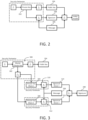
- FIG. 2 illustrates a system that employs traditional asymmetric cryptography using a single private key, and generally, the system to verify a signature.
- a common asymmetric cryptography system (sometimes referred to as a "public key cryptosystem") used for digital signatures is Rivest-Shamir-Adleman (RSA).
- RSA Rivest-Shamir-Adleman
- the RSA cryptosystem uses four functions. The first function is a Private Key Generation function ( f 1 ), which generates a private key 202 based on two distinct prime numbers p and q. The integers p and q are randomly chosen and are kept secret.
- the second function is a Public Key Generation function ( f 2 ) which generates a public key 204 based on the two prime numbers p and q.
- the public key 204 consists of a public modulus ( n ) and a public exponent ( e ).
- the public modulus ( n ) is calculated in accordance with Equation 1 below.
- the public exponent ( e ) is selected such that Equation 2 below is true.
- gcd is the greatest common divisor function that returns the largest positive integer that divides each of the inputs.
- the RSA cryptosystem uses a private exponent ( d ) to calculate the signature 208 of the message ( m ) 206.
- the private exponent ( d ) is calculated in accordance with Equation 3 below.
- d 1 e mod p ⁇ 1 q ⁇ 1
- the signature 208 of the message ( m ) 206 is ⁇ ( m ), which is calculated in accordance with Equation 4 below.
- ⁇ m m d mod n
- the RSA cryptosystem uses a fourth function ( f 4 ) based on the public modulus ( n ) and the public exponent ( e ).
- the signature ( ⁇ ) 208 is verified when Equation 5 below is true.
- ⁇ e mod n m
- a signer e.g., a person or group of persons
- a device implementing the RSA signature scheme (a) executes the Private Key Generation function ( f 1 ) and the Public Key Generation function ( f 2 ) only once in a lifetime of the device; and (b) assures that only the authorized signer can execute the signing function ( f 3 ).
- the private key (e.g., the private key 202) must never leave the device.
- the device must always be capable of reliably authenticating the signer before executing signing function ( f 3 ).
- the security device requires, within the security perimeter, (a) computational power to computer the functions, (b) memory to store the keys, (c) input/output (I/O) devices, and (d) an authentication solution.
- the security perimeter may consist of separate electronics that each implement a partial functionality.
- the key generating functions, the Private Key Generation function ( f 1 ) and the Public Key Generation function ( f 2 ) may be implemented by one set of electronics, and the signing function ( f 3 ) may be implemented as a separate set of electronics.
- the cryptographic attack tolerance of a signature scheme (such as the RSA cryptosystem described above) is defined in terms of computational complexity theory and has mathematical and physical components.
- the measure of mathematical attack tolerance takes into account the computational resources (number of steps, memory in bits, program size, etc.) that is necessary to break the scheme (i.e., sign a message without having access to the private key).
- the computational cost of breaking the scheme is expressed as a security level.
- the security level is usually expressed in "bits.”
- N-bit security means that the malicious actor would have to perform 2 N operations to break the scheme.
- a signing scheme may have 128-bit or 256-bit security.
- the monetary cost of breaking the scheme is considered proportional with the computational cost.
- Physical attack tolerance of a security device refers to the cost of forging a signature without breaking the signature scheme mathematically (e.g., tampering with the security device).
- the mathematical and physical attack tolerance required for a signing scheme are derived from risk analysis and takes into account the application in which the signature solution is being used. Often, the physical design of security devices are a weakness in an RSA-based signing scheme.
- One approach to increasing physical attack tolerance is to require cooperation between multiple devices. In such an approach, a signature key (e.g., a master private key) is shared between several security devices. As such, a signature can only be created when the security devices cooperate. Attacking one device (e.g., physically tampering with one device, uncovering the portion of the master private key on one device, etc.) is insufficient to forge signatures. Cryptography schemes in to address these issues are discussed in connection with FIGS. 3 and 4 below.
- a master private key 302 is split into two private key shares 304 and 306 (sometimes referred to as a Split-Key signing scheme).
- the master private key 302 is generated by a trusted dealer 308 who splits the master private key 302 with a key split function ( f 10 ) to create a first private key share ( d' ) 304 and a second private key share ( d" ) 306.
- the trusted dealer 308 may split the master private key 302 for additive sharing or for multiplicative sharing.
- FIG. 2 illustrates the trusted dealer 308 splitting the master private key 302 for additive sharing.
- the trusted dealer 308 uses the key split function ( f 10 ) to derive the first private key share ( d' ) 304 and the second private key share ( d" ) 306 based on the private exponent ( d ) of the master private key 302 in accordance to Equation 6 below.
- d ⁇ d ′ + d " mod ⁇ n When splitting for multiplicative sharing, the trusted dealer 308 uses the key split function ( f 10 ) to derive the first private key share ( d' ) 304 and the second private key share ( d" ) 306 in accordance to Equation 7 below.
- the trusted dealer 308 transmits the first private key share ( d' ) 304 to a first security device 310 and the second private key share ( d" ) to a second security device 312.
- the security devices 310 and 312 perform the signing function ( f 3 ) with their respective private key shares to generate a first signature share ( ⁇ ') 314 and a second signature share ( ⁇ ") 316.
- the signature ( ⁇ ) 308 is generated with the first signature share ( ⁇ ') 314 and the second signature share ( ⁇ ") 316 with a splitkey combiner function ( f 11 ).
- the splitkey combiner function ( f 11 ) is calculated in accordance with Equation 8 below.
- one of the private key shares is held by security device and the other private key share is held by a backend server (e.g., the backend server 702 of FIG. 7 below)
- the Split-Key signing scheme often requires the trusted dealer 308 to split a master private key 302 into the private key shares 304 and 306 and then securely transmitting the signature shares 314 and 316 to the security devices.
- the trusted dealer 308 uses a distributed generation of shares is used, where the first signature share ( ⁇ ') 314 and the second signature share ( ⁇ ") 316 and the common public key 204 are generated as the outcome of a multi-party cryptographic protocol (e.g., the multi-party cryptographic protocol ⁇ ) in which the master private key 302 never exists as a whole.
- a multi-party cryptographic protocol e.g., the multi-party cryptographic protocol ⁇
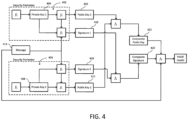
- FIG. 4 illustrates a system that employs composite-key key asymmetric cryptography that uses multiple private keys that are independent of each other.
- FIG. 4 illustrates a Comp Key signing scheme using a first security device 402 and a second security device 404.
- one of the first or second security devices 402 and 404 is a backend server (e.g., the backend server 702 of FIG. 7 below).
- the security devices 402 and 404 each independently generate a private key 406 and 408 using the Private Key Generation function ( f 1 ) (as described above).
- the security devices 402 and 404 each generate a public key 410 and 412 with a public modulus ( n ) (e.g., calculated in accordance with Equation 1 above) and a public exponent (e) (e.g., determined in accordance with Equation 2 above).
- the public keys 410 and 412 are transmitted to the backend server.
- the security devices 402 and 404 receive a message 414 to use to generate a signature
- the security devices 402 and 404 use the signing function ( f 3 ) (as described above) to each independently generate a signature 416 and 418.
- a composite signature 420 is generated from the first signature ( ⁇ 1 ) 416 and the second signature ( ⁇ 2 ) 418.
- the composite signature ( ⁇ C ) 420 is generated with a composite signature function ( f 6 ) in accordance with Equation 10 below.
- ⁇ C bn 1 ⁇ 1 + an 2 ⁇ 2 mod n 1 n 2
- n 1 is the public modulus of the first public key 410
- n 2 is the public modulus of the second public key 412.
- the composite signature ( ⁇ C ) 420 is further modified by the backend server and then used to append a digital document.
- the composite public modulus ( n C ) of the composite public key 422 is calculated using a composite public key function ( f 5 ) in accordance with Equation 11 below.
- the composite public modulus ( n C ) of the composite public key 422 is based on the public modulus ( n 1 ) of the first public key 410 and the second public modulus ( n 2 ) of the second public key 412.
- n c n 1 n 2
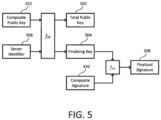
- FIG. 5 illustrates a system that generates a total public key 502 and a finalizing key 504 using a unique backend server identifier (BESID) 506.
- BESID unique backend server identifier
- the system embeds the BESID 506 into the total public key 502 and the finalizing key 504.
- the description below uses the Comp Key scheme, but the Split Key scheme may also be used.
- the system generates the total public key 502 and a finalized signature 508 using an identity embedding function ( f 20 ).
- the identity embedding function ( f 20 ) uses the composite public key 422 (or any other applicable public key) and the BESID 506 to generate the total public key 502 and the finalized signature 508.
- the identity embedding function ( f 20 ) is calculated in accordance with Equations 12 through 17 below.
- the system computes an L bound according with Equation 12 below.
- L c ⁇ 2 k + l ′ n ′
- the system computes an R bound in accordance with Equation 13 below.
- Equation 12 c + 1 ⁇ 2 k + l ′ n ′
- c is the m-bit length BESID
- k is a reliability parameter
- n ' is an RSA modulus (with 2 l'- 1 ⁇ n' ⁇ 2 l' and 2 m -1 ⁇ n' ⁇ 2 m ) (such as, the modulus ( n C ) of the composite public key 422, etc.).
- the system finds prime number ( p ) where Equation 14 below is true.
- n TP n ′ ⁇ p
- the identity embedding function ( f 20 ) outputs the total public key 502 as ⁇ n TP , e>.
- the system computes a finalizing exponent ( d f ) in accordance with Equation 16 below.
- d f 1 e mod p ⁇ 1
- the system finds the Bezout coefficients a' and b ' such that Equation 17 below is satisfied.
- a ′ ⁇ p + b ′ ⁇ n ′ 1
- the identity embedding function ( f 20 ) outputs the finalizing key 504 as (n, a', b', p, d f ).
- the system After the backend server generates the composite signature 420, the system generates a finalized signature ( ⁇ F ) 508 to send to the frontend server to be forwarded to the requesting application server.
- the finalized signature ( ⁇ F ) 508 has the BESID 506 of the backend server embedded in it using a finalizing function ( f 30 ).
- the finalizing function ( f 30 ) uses an RSA signature ( ⁇ ' ) (such as, the composite signature ( ⁇ C ) 420, etc.), a padded message P , and the finalizing key 504 (e.g., (n, a', b', p, d f ), etc.) to generate the finalized signature ( ⁇ F ).
- the finalizing function ( f 30 ) is calculated in accordance with Equations 18 through 20 below.
- the system reduces the padded message P in accordance with Equation 18 below.
- P f P mod p
- P f is the reduced message.
- the system then computes a partial final signature ( ⁇ f ) in accordance with Equation 19 below.
- ⁇ f P f d f mod p
- the system computes the finalized signature ( ⁇ F ) 508 in accordance with Equation 20 below.
- ⁇ F n TP ⁇ b ′ ⁇ ⁇ f p + p ⁇ a ′ ⁇ ⁇ ′ mod n TP
- the system then forwards the finalized signature ( ⁇ F ) to the frontend server.
- FIGS. 6A and 6B are block diagrams of the certificate authority 104, in cooperation with the signing authority 102, generating certificates 602 to be associated with a user.
- FIG. 6A illustrates an example when the certificate authority 104 has access to internal information of the signing authority 102 (such as, the BESIDs 506, etc.).
- the certificate authority 104 may be closely related to the signing authority 102 (e.g., operated by the same entity, etc.) or incorporated into the signing authority 102.
- FIG. 6B illustrates an example when the certificate authority 104 does not have access to internal information of the signing authority 102.
- the certificate authority 104 may be operated by a separate entity as the signing authority 102. In the illustrated examples of FIGS.
- the certificate authority 104 includes a certificate authority (CA) private key 604 and a certificate generator 606.
- the CA private key 604 may be generated by the certificate authority 104 by any suitable means (e.g., the Private Key Generation function ( f 1 ) as described above).
- the certificate generator 606 received input from the signing authority 102 and generates the certificate 602.
- the certificate generator 606 includes a combination function ( f 50 ) that generates a certification statement 608 using a public key (e.g., the composite public key 422 of FIG. 4 above), the BESID 506, and a client identifier (CID) 610.
- the public key, the BESID 506, and the CID 610 are received from the signing authority 102.
- the combination function ( f 50 ) generates the certification statement 608 that is a list or concatenation of the public key, the BESID 506, and the CID 610.
- the certificate generator 606 includes a combination function ( f 70 ) that generates a certification statement 608 using a total public key (e.g., the total public key 502 of FIG. 5 above) and the CID 610.
- the total public key and the CID 610 are received from the signing authority 102.
- the combination function ( f 70 ) generates the certification statement 608 that is a list or concatenation of total public key and the CID 610.
- the certificate generator 606 generates the certificate 602 by applying signing function ( f 3 ) to the certification statement 608 using the CA private key 604.
- the certificate generator 606 then stores the certificate 602 associated with the CID 610 in a database.
- the signing authority 102 uses an identity extraction function ( f 60 ) to extract the BESID 506 from the certificate 602.
- the identify extraction function ( f 60 ) extracts the BESID 506 from the certificate 602 by decrypting the certificate using the public key of the certificate authority 104 that corresponds to the CA private key 604 and extracts the BESID 506 from the certification statement 608.
- FIG. 7 is a block diagram of a system to generate multiple certificates 602 associated with a customer 110.
- the security device 108 When the security device 108 is first activated, it generates a private key (e.g., the private key 202 of FIG. 2 above) and a public key 204.
- the security device 108 transmits the public key 204 to the signing authority 102, which routes the public key 204 to at least two backend servers 702.
- These backend servers 702 become the servers with the information (e.g., IP address, credentials, etc.) necessary to communicate with the security device 108.
- the backend servers 702 also receive or otherwise retrieve the CID 610 associated with the security device 108 (e.g., obtained via an activation process, etc.).
- the backend servers 702a and 702b independently generate a public key and combine the generate public key with the public key received from the security device 108 using the composite public key function ( f 5 ).
- the customer 110 registers two or more security devices 108 and the backend servers 702 combine the received public keys using the composite public key function ( f 5 ).
- the primary backend server 702a generates a primary composite public key 422a.
- the primary backend server 702a forwards the composite public key 422a, its BESID 506a, and the CID 610 to a frontend server 704.
- the frontend server 704 transmits the composite public key 422a, the CID 610, and the BESID 506a to the certificate authority 104.
- the certificate authority 104 using the certificate generator 606, generates a primary certificate 706a using the composite public key 422a, the CID 610, and the BESID 506a.
- the secondary backend server 702b generates a secondary composite public key 422b. Because the public key generated by the secondary backend server 702b is different than the public key generated by the primary backend server 702a, the secondary composite public key 422b is different than the primary composite key 422.
- the secondary backend server 702b forwards the composite public key 422b, its BESID 506b, and the CID 610 to the frontend server 704.
- the frontend server 704 transmits the composite public key 422, the CID 610, and the BESID 506b to the certificate authority 104.
- the certificate authority 104 using the certificate generator 606, generates a secondary certificate 706b using the composite public key 422b, the CID 610, and the BESID 506b.
- FIG. 8 is a block diagram of a system that uses redundant certificates (e.g., the primary certificate 706a and the secondary certificate 706b) associated with a customer 110 to generate a digital signature (e.g., the finalized signature 508) to sign a document.
- the customer 110 interacts with the application server 106 such that the application server 106 needs to generate a signed document.
- the application server 106 receives and/or otherwise retrieves the CID 610 (e.g., via the customer 110). Using the CID 610, the application server requests the certificates associated with the CID 610 (e.g., the primary certificate 706a and the secondary certificate 706b, etc.).
- the application server 106 generates a signature request 804 that includes (i) the certificates 706a and 706b and (ii) a message 414.
- the message may be an original message (e.g., the digital document to be signed) or a message digest computed from the original message by applying a cryptographic hash function (e.g., SHA-256, etc.) to the original message.
- a cryptographic hash function e.g., SHA-256, etc.
- the application server 106 has an established relationship with at least two frontend servers (e.g., a primary frontend server 704a and a secondary frontend server 704b) of the signing authority 102 (e.g., established when the application server 106 enrolls with the signing authority 102, etc.).
- the relationship with multiple frontend servers provide redundancy for when one of the frontend servers is unavailable.
- the signing authority 102 may select which particular frontend servers are assigned to the application server 106 based on traffic management principles. For example, application servers 106 assigned to the same primary frontend server 704a may be assigned to different secondary frontend servers 704b so that the unavailability of a primary frontend server 704a does not stress any one secondary frontend server 704b.
- the frontend server that acts as a primary frontend server 704a of one application server 106 may be the secondary frontend server 704b of another application server 106.
- the application server 106 sends the signature request 804 to the primary frontend server 704a. If the application server 106 does not get an acknowledgement of the signature request 804 and/or receives any other indication that the primary frontend server 704a is unavailable, the application server 106 sends the signature request 804 to the secondary frontend server 704b. In examples where the application server 106 is associated with more than two frontend servers, this may continue until the application server 106 has tried all of the frontend servers it is associated with. If no frontend servers are available, the application server 106 generates an error.
- the frontend server (e.g., the primary frontend server 704a or the secondary frontend server 704b) that receives the signature request 804 extracts the BESID 506a of the primary backend server 702a from the primary certificate 706a using the identity extraction function ( f 60 ). The frontend sever then forwards the signature request 804 to the primary backend server 702a.
- the frontend server If the frontend server does not get an acknowledgement of the signature request 804 and/or receives any other indication that the primary backend server 702a is unavailable, the frontend server (i) extracts the BESID 506b of the secondary backend server 702b from the secondary certificate 706b using the identity extraction function ( f 60 ) and (ii) sends the signature request 804 to the secondary backend server 702b. In examples where the signature request 804 includes more than two certificates, this may continue until the frontend server has tried to forward the signature request 804 using all of the certificates. If no backend servers are available, the frontend server sends an error message to the application server 106.
- the backend server (e.g., the secondary backend server 702b) identifies the customer 110.
- backend server includes a private key associated with the customer 110 (e.g., an independent private key for the Comp Key scheme or a key share for the Split Key scheme, etc.).
- the backend server attempts to authenticate the identity of the customer 110 (e.g., via a security token 806).
- the backend server uses the signing function ( f 3 ) to generate a first signature (or first signature share) using the message 414 and the private key associated with the customer 110.
- the backend server also sends the signature request (or a part thereof) to the security device 108 associated with the customer 110.
- the security device 108 After the security device 108 authenticates the identity of the customer 110, the security device 108 generates a second signature (or a second signature share) 808 and sends it the backend server that sent it the signature request 804.
- the backend server In a Comp Key embodiments, the backend server generates a composite signature 420 using the composite signature function ( f 6 ).
- the backend server In Split Key embodiments, the backend server generates signature using the splitkey combiner function ( f 11 ).
- the backend server uses the finalizing key 504, the backend server generates the finalized signature 508 using the finalizing function ( f 30 ).
- the backend server sends the finalized signature 508 to the frontend server that sent the signature request 804.
- the frontend server sends the finalized signature 508 to the application server 106 that sent the signature request 804.
- the application server 106 appends the finalized signature 508 to the digital document to be signed.
- the frontend servers and the backend servers may operate on the same physical machine or set of physical machines using virtual computing resources, such as virtual machines or containers, etc.
- the frontend servers and the backend servers are isolated from each other so that if one is breached, none of the others are affected. For example, if one frontend server is breached, the other frontend servers and the backend servers are not affected.
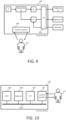
- FIG. 9 illustrates a security device 108 implementing a device-side portion of the signing scheme of FIGS. 2, 3 , 5 , 7 , and 8 .
- the security device 108 implements the functions: the Private Key Generation function ( f 1 ), the Public Key Generation function ( f 2 ), and signing function ( f 3 ).
- the security device 108 includes a control interface 902 and a input/output (I/O) interface 904.
- the control interface 902 receives input from a signer (e.g., the customer 110, etc.) to authenticate the identity of the signer before the security device 108 generates a signature (e.g., the signatures 416 and 418).
- the I/O interface 904 communicates directly or indirectly with the signing authority 102 to transmit the signature and the public key, and receive the message used to generate the signature.
- FIG. 10 is a block diagram of electronic components 1000 of the security device 108 of FIG. 9 .
- the electronic components 1000 include the control interface 902, the I/O interface 904, a processor or controller 1002, and memory 1004, and a data bus 1006 that connects the other electronic components.
- the control interface 902 provides a physical interface between the security device 108 and the signer.
- the control interface 902 may include a digital camera (e.g., for image capture, visual command recognition, facial recognition, iris recognition, etc.), a touch screen and/or keyboard (e.g., for input of credentials), an audio input device (e.g., a microphone for voice recognition, etc.), a biometric input device (e.g., a fingerprint scanner, etc.) and/or a biometric sensor (e.g., a pulse oximeter, a pulse sensor, etc.).
- the control interface 902 may include the touch screen and fingerprint identity sensor of a smart phone. The input from the signer to the control interface 902 is used to authenticate the identity of the signer.
- more than one method of identifying and authenticating the signer is included.
- the signer may need to provide both a fingerprint and a password.
- the control interface 902 may be different between two cooperating security devices 108.
- one security device 108 may have a camera to perform facial recognition and the other security device 108 may have a fingerprint scanner.
- the I/O interface 904 provides an interface to communicate with other devices to transmit the public key and the signature and receive the message.
- the I/O interface 904 includes communication controllers and antenna for one or more for standards-based networks (e.g., Global System for Mobile Communications (GSM), Universal Mobile Telecommunications System (UMTS), Long Term Evolution (LTE), Code Division Multiple Access (CDMA), WiMAX (IEEE 802.16m); Near Field Communication (NFC); local area wireless network (including IEEE 802.11 a/b/g/n/ac or others), Bluetooth ® and Bluetooth ® Low Energy, and Wireless Gigabit (IEEE 802.11ad), etc.).
- the I/O interface 904 directly or indirectly (e.g., via anther security device 108) communicates with an external network.
- the external network may be a public network, such as the Internet; a private network, such as an intranet; or combinations thereof, and may utilize a variety of networking protocols now available or later developed including, but not limited to, TCP/IP-
- the processor or controller 1002 may be any suitable processing device or set of processing devices such as, but not limited to: a microprocessor, a microcontroller-based platform, a suitable integrated circuit, one or more field programmable gate arrays (FPGAs), and/or one or more application-specific integrated circuits (ASICs).
- the memory 1004 may be volatile memory, non-volatile memory, unalterable memory, read-only memory, and/or high-capacity storage devices (e.g., hard drives, solid state drives, etc). In some examples, the memory 1004 includes multiple kinds of memory, particularly volatile memory and non-volatile memory. Additionally, the memory 1004 may include secure memory (sometimes referred to as "cryptomemory”) which includes an embedded hardware encryption engine with its own authentication keys to securely store information.
- cryptomemory secure memory
- FIG. 11 is a flowchart of a method to use redundant certificates 602 associated with a customer 110 to generate a document signed by a digital signature, which may be implemented by the application server 106 of FIGS. 1 and 8 .
- the application server 106 receives an input from a customer 110 that results in a digital document to sign. For example, the customer 110 may click on an acceptance button to indicate acceptance of a privacy policy of a website associated with the application server 106.
- the application server 106 retrieves two or more certificates 602 associated with the customer 110 from the certificate authority 104.
- the application server 106 sends a signature request 804 to the primary frontend server 704a.
- the application server 106 is configured to communicatively couple to at least two frontend servers.
- the order of the frontend server e.g., which frontend server is the primary frontend server 704a and which frontend server is the secondary frontend server 704b, etc.
- the application server 106 selects one of the frontend servers to send the signature request 804 to first.
- the application server 106 determines whether it has received an indication that the frontend server is unavailable. For example, the application server 106 may (b) wait a threshold period of time to receive the signature from the frontend server, (b) receive a message that the frontend server is not available, and/or (c) fail to receive an acknowledgement from the frontend server in response to the signature request 804. If the frontend server is available, the method continues at block 1110. Otherwise, if the frontend server is not available, the method continues at block 1114.
- the application server 106 receives a finalized signature 508 from the frontend server.
- the application server 106 appends finalized signature to the digital document.
- the application server 106 determines whether there is another frontend server to send the signature request. If there is another frontend server, the method continues to block 1116. Otherwise, if there is not another frontend server, the method continues to block 1118.
- the application server 106 sends the signature request 804 to the next frontend server (e.g., the secondary frontend server 704b, etc.). The method then returns to block 1108.
- the next frontend server e.g., the secondary frontend server 704b, etc.
- the application server 106 generates an error message.
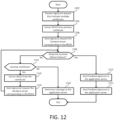
- FIG. 12 is a flowchart of method to use redundant certificates associated with a customer 110 to generate a document signed by a digital signature, which may be implemented by the frontend server(s) 704 of FIGS. 1 and 8 .
- the frontend server 704 receives a signature request 804 from an application server 106 that includes multiple certificates (e.g., a primary certificate 706a and a secondary certificate 706b, etc.).
- the frontend server 704 extracts the BESID 506 from the primary certificate 706a using the identity extraction function ( f 60 ).
- the frontend server 704 sends the signature request 804 to the backend server 702 that corresponds to the BESID 506 extracted at block 1204.
- the frontend server 704 determines whether it has received an indication that the backend server 702 is unavailable. For example, the frontend server 704 may (b) wait a threshold period of time to receive the signature from the backend server 702, (b) receive a message that the backend server 702 is not available, and/or (c) fail to receive an acknowledgement from the backend server 702 in response to the signature request 804. If the backend server 702 is available, the method continues at block 1210. Otherwise, if the backend server 702 is not available, the method continues at block 1214.
- the frontend server 704 receives the finalized signature 508 from the backend server 702.
- the frontend server 704 sends the finalized signature 508 to the application server 106.
- the frontend server 704 determines whether there is another certificate (e.g., a secondary certificate 706b). If there is another certificate, the method continues to block 1216. Otherwise, if there is not another certificate, the method continues to block 1220. At block 1216, the frontend server 704 extracts the BESID 506 from the secondary certificate 706b using the identity extraction function ( f 60 ). At block 1218, the frontend server 704 sends the signature request 804 to the backend server 702 that corresponds to the BESID 506 extracted at block 1216. The method then returns to block 1208.
- another certificate e.g., a secondary certificate 706b
- the frontend server 704 sends an error message to the application server 106.
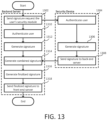
- FIG. 13 is a flowchart of a method to generate a signature for a digital document which may be implemented by the system of FIGS. 1 and 8 .
- the backend server 702 stores a private key for a customer 110.
- the backend server 702 sends the signature request 804 to the security device 108 associated with the corresponding certificate 602 included in the signature request 804.
- the security device 108 authenticates the customer 110.
- the security device 108 may authenticate the customer 110 in response to receiving a finger print and/or a set of credentials.
- the security device 108 generates a first signature with its stored private key using the signing function ( f 3 ).
- the security device 108 transmits the first signature to the backend server 702.
- the backend server 702 generates a finalized signature using the finalizing function ( f 30 ) based on the combined signature and the finalizing key 504 associated with the customer 110.
- the backend server 702 sends the finalized signature to the frontend server 704.
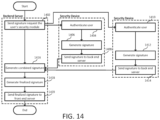
- FIG. 14 is a flowchart of a method to generate a signature for a digital document which may be implemented by the system of FIGS. 1 and 8 .
- the backend server 702 does not store a private key for a customer 110.
- the backend server 702 sends the signature request 804 to the security devices 108 associated with the corresponding certificates 602 included in the signature request 804.
- the first security device 108 authenticates the customer 110. For example, the first security device 108 may authenticate the customer 110 in response to receiving a finger print and/or a set of credentials.
- the first security device 108 generates a first signature with its stored private key using the signing function ( f 3 ).
- the first security device 108 transmits the first signature to the backend server 702.
- the second security device 108 authenticates the customer 110.
- the second security device 108 generates a second signature with its stored private key using the signing function ( f 3 ).
- the second security device 108 transmits the second signature to the backend server 702.
- the backend server 7022 generates a combined signature (e.g., a composite signature using the composite signature function ( f 6 ), or a splitkey signature using the splitkey combiner function ( f 11 ), etc.).
- the backend server 702 generates a finalized signature using the finalizing function ( f 30 ) based on the combined signature and the finalizing key 404 associated with the customer 110.
- the backend server 702 sends the finalized signature 508 to the frontend server 704.
- FIG. 15 is a flowchart of a method to reissue certificates 602.
- the certificates may be reissued, for example, when one of the backend servers 702 becomes non-functional.
- a new backend server can be installed and new certificates can be issued based on the existing certificates.
- this process is automatic and does not, in some examples, require sending a specific request to the certificate authority 104. If two different backend servers 702 are use, and one of them is non-functional, then this automatic certificate issuing procedure enables recovery of the system without any downtime.
- the certificate authority 104 receives the BESID 506 and the public key of the new backend server 702.
- the certificate authority 104 verifies the primary and secondary certificates 706a and 706b associated with the primary and secondary backend servers 702a and 702b.
- the certificate authority 104 extracts the CID 610, the public key of the primary certificate 706a, and the public key of the secondary certificate 706b.
- the certificate authority 104 computes the public key to the customer's security device 108 using the public key of the primary certificate 706a and the public key of the secondary certificate 706b.
- the certificate authority 104 creates the new public key using the public key to the customer's security device 108 and the public key of the new backend server 702 (e.g., using the composite public key function ( f 5 ), etc.).
- the certificate authority 104 creates a new certificate 602 for the new backend server 702 based on the BESID 506 of the new backend server 702, the new public key, and the CID 610 associated with the primary and secondary certificates 706a and 706b.
- the certificate authority 104 the certificate associated with the non-functioning backend server 702 with the new certificate.
- disjunctive is intended to include the conjunctive.
- definite or indefinite articles is not intended to indicate cardinality.
- a reference to “the” object or “a” and “an” object is intended to denote also one of a possible plurality of such objects.
- the conjunction “or” may be used to convey features that are simultaneously present instead of mutually exclusive alternatives. In other words, the conjunction “or” should be understood to include “and/or”.
- module and “unit” refer to hardware with circuitry to provide communication, control and/or monitoring capabilities, often in conjunction with sensors. "Modules” and “units” may also include firmware that executes on the circuitry.
- remote means being geographically removed from and communicatively coupled via an internal or external network, such as an intranet or the Internet).
- the terms “includes,” “including,” and “include” are inclusive and have the same scope as “comprises,” “comprising,” and “comprise” respectively.
Landscapes
- Engineering & Computer Science (AREA)
- Computer Security & Cryptography (AREA)
- Computer Networks & Wireless Communication (AREA)
- Signal Processing (AREA)
- Computer Hardware Design (AREA)
- Computing Systems (AREA)
- General Engineering & Computer Science (AREA)
- Storage Device Security (AREA)
- Management, Administration, Business Operations System, And Electronic Commerce (AREA)
Claims (16)
- Ein System zum Erzeugen einer digitalen Signatur, umfassend:einen ersten Backend-Server;einen zweiten Backend-Server;einen Frontend-Server, der dazu eingerichtet ist:eine Signaturanforderung von einem entfernten Anwendungsserver zu empfangen, wobei die Signaturanforderung einen ersten öffentlichen Gesamtschlüssel mit einer kryptographisch eingebetteten ersten Serverkennung und einen zweiten öffentlichen Gesamtschlüssel mit einer kryptographisch eingebetteten zweiten Serverkennung enthält;die kryptographisch eingebettete erste Serverkennung aus dem ersten öffentlichen Gesamtschlüssel zu extrahieren;die Signaturanforderung an den ersten Backend-Server weiterzuleiten, der der ersten Serverkennung entspricht;als Antwort auf das Bestimmen, dass der erste Backend-Server nicht verfügbar ist, die kryptographisch eingebettete zweite Serverkennung aus dem zweiten öffentlichen Gesamtschlüssel zu extrahieren und die Signaturanforderung an den zweiten Backend-Server weiterzuleiten, der der zweiten Serverkennung entspricht;eine zweite Signatur an den Anwendungsserver weiterzuleiten; und wobei der erste und der zweite Backend-Server jeweils dazu eingerichtet sind:die Signaturanforderung an eine Vielzahl von entfernten Sicherheitsvorrichtungen weiterzuleiten, die dem öffentlichen Gesamtschlüssel zugeordnet sind;eine erste Signatur von jeder der Vielzahl von entfernten Sicherheitsvorrichtungen zu empfangen;eine kombinierte Signatur auf der Grundlage der ersten Signaturen zu erzeugen;die zweite Signatur auf der Grundlage der kombinierten Signatur und eines abschließenden Schlüssels zu erzeugen, wobei der abschließende Schlüssel auf der Grundlage der Serverkennung des Backend-Servers kryptografisch erzeugt wird; unddie zweite Signatur an den Frontend-Server weiterzuleiten.
- Das System nach Anspruch 1, wobei kombinierte Signatur unter Verwendung eines Signaturschemas für zusammengesetzte Schlüssel erzeugt wird.
- Das System nach Anspruch 1, wobei die kombinierte Signatur unter Verwendung eines Signaturschemas für kombinierte Schlüssel erzeugt wird.
- Das System nach Anspruch 1, wobei der Frontend-Server bestimmt, dass der erste Backend-Server nicht verfügbar ist, wenn der Frontend-Server keine Bestätigung vom ersten Backend-Server als Antwort auf das Weiterleiten der Signaturanforderung empfängt.
- Das System nach Anspruch 1, wobei der Frontend-Server bestimmt, dass der erste Backend-Server nicht verfügbar ist, wenn der Frontend-Server die zweite Signatur nicht innerhalb eines Schwellenwertzeitraums empfängt.
- Ein System zum Erzeugen einer digitalen Signatur, umfassend:einen ersten Backend-Server;einen zweiten Backend-Server;einen ersten Frontend-Server;einen zweiten Frontend-Server undeine Zertifizierungsstelle;wobei die Zertifizierungsstelle dazu eingerichtet ist, als Antwort auf den Empfang einer Zertifikats anforderung von einem Anwendungsserver, die eine Benutzerkennung enthält, ein erstes Zertifikat mit einem ersten öffentlichen Schlüssel und ein zweites Zertifikat mit einem zweiten öffentlichen Schlüssel an den Anwendungsserver weiterzuleiten, wobei das erste und das zweite Zertifikat der Benutzerkennung zugeordnet sind;wobei der erste und der zweite Frontend-Server jeweils dazu eingerichtet sind,eine Signaturanforderung vom Anwendungsserver zu empfangen, wobei die Signaturanforderung den ersten öffentlichen Schlüssel mit einer kryptographisch eingebetteten ersten Serverkennung und den zweiten öffentlichen Schlüssel mit einer kryptographisch eingebetteten zweiten Serverkennung enthält;die kryptographisch eingebettete erste Serverkennung aus dem ersten öffentlichen Schlüssel zu extrahieren;die Signaturanforderung an den ersten Backend-Server weiterzuleiten, der der ersten Serverkennung entspricht;als Antwort auf das Bestimmen, dass der erste Backend-Server nicht verfügbar ist, die kryptographisch eingebettete zweite Serverkennung aus dem zweiten öffentlichen Schlüssel zu extrahieren und die Signaturanforderung an den zweiten Backend-Server weiterzuleiten, der der zweiten Serverkennung entspricht;eine zweite Signatur an den Anwendungsserver weiterzuleiten; undwobei der erste Backend-Server und der zweite Backend-Server jeweils dazu eingerichtet sind:die Signaturanforderung an eine Vielzahl von entfernten Sicherheitsvorrichtungen weiterzuleiten, die dem öffentlichen Gesamtschlüssel zugeordnet sind;eine erste Signatur von jeder der Vielzahl von entfernten Sicherheitsvorrichtungen zu empfangen;eine kombinierte Signatur auf der Grundlage der ersten Signaturen zu erzeugen;die zweite Signatur auf der Grundlage der kombinierten Signatur und eines abschließenden Schlüssels zu erzeugen, wobei der abschließende Schlüssel auf der Grundlage der Serverkennung des Backend-Servers kryptografisch erzeugt wird; unddie zweite Signatur an den Frontend-Server weiterzuleiten.
- Das System nach Anspruch 6, wobei kombinierte Signatur unter Verwendung eines Signaturschemas für zusammengesetzte Schlüssel erzeugt wird.
- Das System nach Anspruch 6, wobei die kombinierte Signatur unter Verwendung eines Signaturschemas für kombinierte Schlüssel erzeugt wird.
- Das System nach Anspruch 6, wobei der Frontend-Server bestimmt, dass der erste Backend-Server nicht verfügbar ist, wenn der Frontend-Server keine Bestätigung vom ersten Backend-Server als Antwort auf das Weiterleiten der Signaturanforderung empfängt.
- Das System nach Anspruch 6, wobei der Frontend-Server bestimmt, dass der erste Backend-Server nicht verfügbar ist, wenn der Frontend-Server die zweite Signatur nicht innerhalb eines Schwellenwertzeitraums empfängt.
- Das System nach Anspruch 6, wobei die Zertifizierungsstelle ferner dazu eingerichtet ist, als Antwort auf das Bestimmen, dass einer der ersten oder zweiten Backend-Server nicht verfügbar ist, basierend auf dem ersten Zertifikat und dem zweiten Zertifikat ein drittes Zertifikat zu erzeugen, das einem dritten Backend-Server zugeordnet ist.
- Ein Verfahren zum Erzeugen einer digitalen Signatur, umfassend:Empfangen einer Signaturanforderung von einem entfernten Anwendungsserver an einem Front-End-Server, wobei die Signaturanforderung einen ersten öffentlichen Gesamtschlüssel mit einer kryptographisch eingebetteten ersten Serverkennung und einen zweiten öffentlichen Gesamtschlüssel mit einer kryptographisch eingebetteten zweiten Serverkennung enthält;Extrahieren der kryptographisch eingebetteten ersten Serverkennung aus dem ersten öffentlichen Gesamtschlüssel durch den Front-End-Server;Weiterleiten der Signaturanforderung durch den Frontend-Server an ersten Backend-Server, der der ersten Serverkennung entspricht;als Antwort auf das Bestimmen, dass der erste Backend-Server nicht verfügbar ist, Extrahieren der kryptografisch eingebetteten zweiten Serverkennung aus dem zweiten öffentlichen Gesamtschlüssel durch den Frontend-Server und Weiterleiten der Signaturanforderung an den zweiten Backend-Server, der der zweiten Serverkennung entspricht;Weiterleiten der Signaturanforderung durch den ersten oder zweiten Backend-Server an eine Vielzahl von entfernten Sicherheitsvorrichtungen, die dem öffentlichen Gesamtschlüssel zugeordnet sind;Empfangen einer ersten Signatur von jeder der Vielzahl von entfernten Sicherheitsvorrichtungen durch den ersten oder zweiten Backend-Server;Erzeugen einer kombinierten Signatur durch den ersten oder zweiten Backend-Server auf der Grundlage der ersten Signaturen;Erzeugen einer zweiten Signatur durch den ersten oder zweiten Backend-Server auf der Grundlage der kombinierten Signatur und eines abschließenden Schlüssels, wobei der abschließende Schlüssel auf der Grundlage der Serverkennung des Backend-Servers kryptografisch erzeugt wird;Weiterleiten der zweiten Signatur durch den ersten oder zweiten Backend-Server an den Frontend-Server; undWeiterleiten der zweiten Signatur durch den Frontend-Server an den Anwendungsserver.
- Das Verfahren nach Anspruch 12, wobei kombinierte Signatur unter Verwendung eines Signaturschemas für zusammengesetzte Schlüssel erzeugt wird.
- Das Verfahren nach Anspruch 12, wobei die kombinierte Signatur unter Verwendung eines Signaturschemas für kombinierte Schlüssel erzeugt wird.
- Das System nach Anspruch 12, wobei das Bestimmen, dass der erste Backend-Server nicht verfügbar ist, das Bestimmen enthält, wann der Frontend-Server keine Bestätigung vom ersten Backend-Server als Antwort auf das Weiterleiten der Signaturanforderung empfängt.
- Das System nach Anspruch 12, wobei der Frontend-Server bestimmt, dass der erste Backend-Server nicht verfügbar ist, wenn der Frontend-Server die zweite Signatur nicht innerhalb eines Schwellenwertzeitraums empfängt.
Applications Claiming Priority (1)
| Application Number | Priority Date | Filing Date | Title |
|---|---|---|---|
| PCT/US2020/014144 WO2021145894A1 (en) | 2020-01-17 | 2020-01-17 | Digital signature system using reliable servers |
Publications (4)
| Publication Number | Publication Date |
|---|---|
| EP4091085A1 EP4091085A1 (de) | 2022-11-23 |
| EP4091085A4 EP4091085A4 (de) | 2023-10-04 |
| EP4091085B1 true EP4091085B1 (de) | 2025-04-23 |
| EP4091085C0 EP4091085C0 (de) | 2025-04-23 |
Family
ID=76864016
Family Applications (1)
| Application Number | Title | Priority Date | Filing Date |
|---|---|---|---|
| EP20913381.8A Active EP4091085B1 (de) | 2020-01-17 | 2020-01-17 | Digitales signatursystem anhand zuverlässiger server |
Country Status (4)
| Country | Link |
|---|---|
| US (1) | US20230048174A1 (de) |
| EP (1) | EP4091085B1 (de) |
| JP (1) | JP7617117B2 (de) |
| WO (1) | WO2021145894A1 (de) |
Families Citing this family (6)
| Publication number | Priority date | Publication date | Assignee | Title |
|---|---|---|---|---|
| US20220385481A1 (en) * | 2021-06-01 | 2022-12-01 | International Business Machines Corporation | Certificate-based multi-factor authentication |
| KR102568418B1 (ko) * | 2021-08-26 | 2023-08-18 | 하이파이브랩 주식회사 | 다중 서명을 지원하는 전자 인증 시스템 및 방법 |
| US11553008B1 (en) * | 2021-12-30 | 2023-01-10 | Netskope, Inc. | Electronic agent scribe and communication protections |
| US20240362002A1 (en) | 2023-04-28 | 2024-10-31 | Oracle International Corporation | Obtaining Deployment Tokens For Deploying Artifacts To A Cloud Environment |
| US12494901B2 (en) * | 2024-01-11 | 2025-12-09 | Oracle International Corporation | Issuing surrogate credentials for accessing target resources |
| LU507229B1 (fr) * | 2024-05-15 | 2025-11-17 | Asymkey | Procédé asymétrique d'inscription de codes cryptographiques |
Family Cites Families (48)
| Publication number | Priority date | Publication date | Assignee | Title |
|---|---|---|---|---|
| US20020129255A1 (en) * | 1998-08-31 | 2002-09-12 | Chikako Tsuchiyama | Digital signature or electronic seal authentication system and recognized mark management program |
| JP2001142397A (ja) * | 1998-10-30 | 2001-05-25 | Hitachi Ltd | ディジタル署名方法、秘密情報の管理方法およびシステム |
| JP3659178B2 (ja) * | 2001-02-22 | 2005-06-15 | 日本電信電話株式会社 | 分散ディジタル署名作成方法及び装置及び分散ディジタル署名付ディジタル文書作成方法及び装置及び分散ディジタル署名作成プログラム及び分散ディジタル署名作成プログラムを格納した記憶媒体 |
| US20020184504A1 (en) * | 2001-03-26 | 2002-12-05 | Eric Hughes | Combined digital signature |
| US20020178366A1 (en) * | 2001-05-24 | 2002-11-28 | Amiran Ofir | Method for performing on behalf of a registered user an operation on data stored on a publicly accessible data access server |
| US20060005237A1 (en) * | 2003-01-30 | 2006-01-05 | Hiroshi Kobata | Securing computer network communication using a proxy server |
| US8046579B2 (en) * | 2005-10-04 | 2011-10-25 | Neopost Technologies | Secure gateway with redundent servers |
| US8656175B2 (en) * | 2005-10-31 | 2014-02-18 | Panasonic Corporation | Secure processing device, secure processing method, encrypted confidential information embedding method, program, storage medium, and integrated circuit |
| US9002018B2 (en) * | 2006-05-09 | 2015-04-07 | Sync Up Technologies Corporation | Encryption key exchange system and method |
| CN101340282B (zh) * | 2008-05-28 | 2011-05-11 | 北京易恒信认证科技有限公司 | 复合公钥的生成方法 |
| US8631134B2 (en) * | 2008-07-30 | 2014-01-14 | Visa U.S.A. Inc. | Network architecture for secure data communications |
| US8281127B2 (en) * | 2010-02-01 | 2012-10-02 | Blackridge Technology Holdings, Inc. | Method for digital identity authentication |
| JP5498255B2 (ja) * | 2010-05-20 | 2014-05-21 | 日本電信電話株式会社 | 委託計算システム及び方法 |
| EP2651072A3 (de) * | 2010-09-20 | 2013-10-23 | Security First Corp. | Systeme und Verfahren für sichere gemeinsame Datennutzung |
| ITTO20110902A1 (it) * | 2011-10-10 | 2013-04-11 | Antonio Bonsignore | Sistema di firma elettronica qualificata, relativo procedimento e apparecchio terminale per la firma elettronica qualificata |
| US9754253B1 (en) * | 2011-11-28 | 2017-09-05 | Amazon Technologies, Inc. | Conditioned use of certificates |
| US8925055B2 (en) * | 2011-12-07 | 2014-12-30 | Telefonaktiebolaget Lm Ericsson (Publ) | Device using secure processing zone to establish trust for digital rights management |
| US8799641B1 (en) * | 2011-12-16 | 2014-08-05 | Amazon Technologies, Inc. | Secure proxying using network intermediaries |
| US8908868B1 (en) * | 2012-05-17 | 2014-12-09 | Amazon Technologies, Inc. | Key rotation with external workflows |
| US8964990B1 (en) * | 2012-05-17 | 2015-02-24 | Amazon Technologies, Inc. | Automating key rotation in a distributed system |
| US9165126B1 (en) * | 2012-10-30 | 2015-10-20 | Amazon Technologies, Inc. | Techniques for reliable network authentication |
| KR101687275B1 (ko) * | 2013-03-14 | 2016-12-16 | 인텔 코포레이션 | 공개 클라우드에서의 신뢰 데이터 프로세싱 |
| US10498530B2 (en) * | 2013-09-27 | 2019-12-03 | Network-1 Technologies, Inc. | Secure PKI communications for “machine-to-machine” modules, including key derivation by modules and authenticating public keys |
| US9503447B2 (en) * | 2014-01-30 | 2016-11-22 | Sap Se | Secure communication between processes in cloud |
| TW201546649A (zh) * | 2014-06-05 | 2015-12-16 | Cavium Inc | 用於基於硬體安全模組的基於雲端的web服務安全管理的系統和方法 |
| US9949115B2 (en) * | 2014-06-10 | 2018-04-17 | Qualcomm Incorporated | Common modulus RSA key pairs for signature generation and encryption/decryption |
| US9928377B2 (en) * | 2015-03-19 | 2018-03-27 | Netskope, Inc. | Systems and methods of monitoring and controlling enterprise information stored on a cloud computing service (CCS) |
| US9906505B2 (en) * | 2015-05-08 | 2018-02-27 | Nxp B.V. | RSA decryption using multiplicative secret sharing |
| US10284374B2 (en) * | 2015-06-10 | 2019-05-07 | Arris Enterprises Llc | Code signing system with machine to machine interaction |
| US10122689B2 (en) * | 2015-06-16 | 2018-11-06 | Amazon Technologies, Inc. | Load balancing with handshake offload |
| US10015150B2 (en) * | 2015-10-15 | 2018-07-03 | Pkware, Inc. | Systems and methods for Smartkey information management |
| KR101977109B1 (ko) * | 2015-11-17 | 2019-08-28 | (주)마크애니 | 해시함수 기반의 대규모 동시 전자서명 서비스 시스템 및 그 방법 |
| US9660970B1 (en) * | 2015-12-03 | 2017-05-23 | Amazon Technologies, Inc. | Cryptographic key distribution |
| US9755832B2 (en) * | 2015-12-29 | 2017-09-05 | International Business Machines Corporation | Password-authenticated public key encryption and decryption |
| US10263789B1 (en) * | 2016-03-28 | 2019-04-16 | Amazon Technologies, Inc. | Auto-generation of security certificate |
| US10812452B2 (en) * | 2016-04-01 | 2020-10-20 | Egnyte, Inc. | Methods for improving performance and security in a cloud computing system |
| US20170346639A1 (en) * | 2016-05-24 | 2017-11-30 | Business Information Exchange System Corp. | Public Key Infrastructure based on the Public Certificates Ledger |
| US10171495B1 (en) * | 2016-06-09 | 2019-01-01 | Amazon Technologies, Inc. | Detection of modified requests |
| US10110383B1 (en) * | 2016-06-30 | 2018-10-23 | EMC IP Holding Company LLC | Managing embedded and remote encryption keys on data storage systems |
| US10461943B1 (en) * | 2016-11-14 | 2019-10-29 | Amazon Technologies, Inc. | Transparently scalable virtual hardware security module |
| US10447668B1 (en) * | 2016-11-14 | 2019-10-15 | Amazon Technologies, Inc. | Virtual cryptographic module with load balancer and cryptographic module fleet |
| US10693638B1 (en) * | 2016-12-01 | 2020-06-23 | Amazon Technologies, Inc. | Protected cryptographic environment |
| US10313123B1 (en) * | 2016-12-14 | 2019-06-04 | Amazon Technologies, Inc. | Synchronizable hardware security module |
| US10425225B1 (en) * | 2016-12-14 | 2019-09-24 | Amazon Technologies, Inc. | Synchronizable hardware security module |
| US10263778B1 (en) * | 2016-12-14 | 2019-04-16 | Amazon Technologies, Inc. | Synchronizable hardware security module |
| WO2019183980A1 (en) * | 2018-03-31 | 2019-10-03 | Intel Corporation | Technologies for securing network function virtualization images |
| US11362841B2 (en) * | 2018-07-06 | 2022-06-14 | Nec Corporation | Method and system for providing security in trusted execution environments |
| US11251939B2 (en) * | 2018-08-31 | 2022-02-15 | Quantifind, Inc. | Apparatuses, methods and systems for common key identification in distributed data environments |
-
2020
- 2020-01-17 WO PCT/US2020/014144 patent/WO2021145894A1/en not_active Ceased
- 2020-01-17 JP JP2022543431A patent/JP7617117B2/ja active Active
- 2020-01-17 US US17/793,160 patent/US20230048174A1/en active Pending
- 2020-01-17 EP EP20913381.8A patent/EP4091085B1/de active Active
Also Published As
| Publication number | Publication date |
|---|---|
| WO2021145894A1 (en) | 2021-07-22 |
| EP4091085C0 (de) | 2025-04-23 |
| JP7617117B2 (ja) | 2025-01-17 |
| EP4091085A1 (de) | 2022-11-23 |
| JP2023519082A (ja) | 2023-05-10 |
| US20230048174A1 (en) | 2023-02-16 |
| EP4091085A4 (de) | 2023-10-04 |
Similar Documents
| Publication | Publication Date | Title |
|---|---|---|
| EP4091085B1 (de) | Digitales signatursystem anhand zuverlässiger server | |
| CN112637131B (zh) | 用户身份认证方法、装置、设备和存储介质 | |
| US11855983B1 (en) | Biometric electronic signature authenticated key exchange token | |
| US12206792B2 (en) | Digital signature system using scalable servers | |
| EP3841702B1 (de) | Verfahren, benutzervorrichtung, verwaltungsvorrichtung, speichermedium und computerprogrammprodukt zur schlüsselverwaltung | |
| US8670562B2 (en) | Generation and use of a biometric key | |
| US8930704B2 (en) | Digital signature method and system | |
| CN104509027B (zh) | 使用同态签名|在广播和多播网络中进行消息验证的系统和方法 | |
| US11405387B1 (en) | Biometric electronic signature authenticated key exchange token | |
| US20130046984A1 (en) | Establishing a Secured Communication Session | |
| EP2595340A2 (de) | Kryptografische Dokumentenverarbeitung in einem Netzwerk | |
| US11652647B2 (en) | Authentication system and computer readable medium | |
| WO2015072203A1 (ja) | 情報配信システム | |
| US9860069B2 (en) | Group signature using a pseudonym | |
| CN108833431B (zh) | 一种密码重置的方法、装置、设备及存储介质 | |
| JP2025156351A (ja) | 一群の特定目的用ローカルデバイスに基づくデジタル署名システム | |
| US8898462B2 (en) | Method and device for authenticating components within an automatic teller machine | |
| US9455973B1 (en) | Secure storage and retrieval of data in a database with multiple data classes and multiple data identifiers | |
| CN110572257B (zh) | 基于身份的数据来源鉴别方法和系统 | |
| US20250112786A1 (en) | Method and system for generating digital signatures using universal composition | |
| CN112738067A (zh) | 一种人脸识别方法、装置及设备 | |
| CN111767531A (zh) | 一种基于生物特征的认证系统和方法 | |
| JPWO2020121459A1 (ja) | 認証システム、クライアントおよびサーバ | |
| NL2037022B1 (en) | Method for secure authentication and audit data generation | |
| CN117035793A (zh) | 资源交易认证方法和装置、设备及存储介质 |
Legal Events
| Date | Code | Title | Description |
|---|---|---|---|
| STAA | Information on the status of an ep patent application or granted ep patent |
Free format text: STATUS: THE INTERNATIONAL PUBLICATION HAS BEEN MADE |
|
| PUAI | Public reference made under article 153(3) epc to a published international application that has entered the european phase |
Free format text: ORIGINAL CODE: 0009012 |
|
| STAA | Information on the status of an ep patent application or granted ep patent |
Free format text: STATUS: REQUEST FOR EXAMINATION WAS MADE |
|
| 17P | Request for examination filed |
Effective date: 20220804 |
|
| AK | Designated contracting states |
Kind code of ref document: A1 Designated state(s): AL AT BE BG CH CY CZ DE DK EE ES FI FR GB GR HR HU IE IS IT LI LT LU LV MC MK MT NL NO PL PT RO RS SE SI SK SM TR |
|
| DAV | Request for validation of the european patent (deleted) | ||
| DAX | Request for extension of the european patent (deleted) | ||
| A4 | Supplementary search report drawn up and despatched |
Effective date: 20230901 |
|
| RIC1 | Information provided on ipc code assigned before grant |
Ipc: H04L 9/08 20060101ALI20230828BHEP Ipc: G06F 21/60 20130101AFI20230828BHEP |
|
| GRAP | Despatch of communication of intention to grant a patent |
Free format text: ORIGINAL CODE: EPIDOSNIGR1 |
|
| STAA | Information on the status of an ep patent application or granted ep patent |
Free format text: STATUS: GRANT OF PATENT IS INTENDED |
|
| INTG | Intention to grant announced |
Effective date: 20241118 |
|
| GRAS | Grant fee paid |
Free format text: ORIGINAL CODE: EPIDOSNIGR3 |
|
| GRAA | (expected) grant |
Free format text: ORIGINAL CODE: 0009210 |
|
| STAA | Information on the status of an ep patent application or granted ep patent |
Free format text: STATUS: THE PATENT HAS BEEN GRANTED |
|
| AK | Designated contracting states |
Kind code of ref document: B1 Designated state(s): AL AT BE BG CH CY CZ DE DK EE ES FI FR GB GR HR HU IE IS IT LI LT LU LV MC MK MT NL NO PL PT RO RS SE SI SK SM TR |
|
| REG | Reference to a national code |
Ref country code: GB Ref legal event code: FG4D |
|
| REG | Reference to a national code |
Ref country code: CH Ref legal event code: EP |
|
| REG | Reference to a national code |
Ref country code: IE Ref legal event code: FG4D |
|
| U01 | Request for unitary effect filed |
Effective date: 20250423 |
|
| U07 | Unitary effect registered |
Designated state(s): AT BE BG DE DK EE FI FR IT LT LU LV MT NL PT RO SE SI Effective date: 20250429 |
|
| PG25 | Lapsed in a contracting state [announced via postgrant information from national office to epo] |
Ref country code: ES Free format text: LAPSE BECAUSE OF FAILURE TO SUBMIT A TRANSLATION OF THE DESCRIPTION OR TO PAY THE FEE WITHIN THE PRESCRIBED TIME-LIMIT Effective date: 20250423 |
|
| PG25 | Lapsed in a contracting state [announced via postgrant information from national office to epo] |
Ref country code: GR Free format text: LAPSE BECAUSE OF FAILURE TO SUBMIT A TRANSLATION OF THE DESCRIPTION OR TO PAY THE FEE WITHIN THE PRESCRIBED TIME-LIMIT Effective date: 20250724 Ref country code: NO Free format text: LAPSE BECAUSE OF FAILURE TO SUBMIT A TRANSLATION OF THE DESCRIPTION OR TO PAY THE FEE WITHIN THE PRESCRIBED TIME-LIMIT Effective date: 20250723 |
|
| PG25 | Lapsed in a contracting state [announced via postgrant information from national office to epo] |
Ref country code: PL Free format text: LAPSE BECAUSE OF FAILURE TO SUBMIT A TRANSLATION OF THE DESCRIPTION OR TO PAY THE FEE WITHIN THE PRESCRIBED TIME-LIMIT Effective date: 20250423 |
|
| PG25 | Lapsed in a contracting state [announced via postgrant information from national office to epo] |
Ref country code: HR Free format text: LAPSE BECAUSE OF FAILURE TO SUBMIT A TRANSLATION OF THE DESCRIPTION OR TO PAY THE FEE WITHIN THE PRESCRIBED TIME-LIMIT Effective date: 20250423 |
|
| PG25 | Lapsed in a contracting state [announced via postgrant information from national office to epo] |
Ref country code: RS Free format text: LAPSE BECAUSE OF FAILURE TO SUBMIT A TRANSLATION OF THE DESCRIPTION OR TO PAY THE FEE WITHIN THE PRESCRIBED TIME-LIMIT Effective date: 20250723 |
|
| PG25 | Lapsed in a contracting state [announced via postgrant information from national office to epo] |
Ref country code: IS Free format text: LAPSE BECAUSE OF FAILURE TO SUBMIT A TRANSLATION OF THE DESCRIPTION OR TO PAY THE FEE WITHIN THE PRESCRIBED TIME-LIMIT Effective date: 20250823 |
|
| PG25 | Lapsed in a contracting state [announced via postgrant information from national office to epo] |
Ref country code: SM Free format text: LAPSE BECAUSE OF FAILURE TO SUBMIT A TRANSLATION OF THE DESCRIPTION OR TO PAY THE FEE WITHIN THE PRESCRIBED TIME-LIMIT Effective date: 20250423 |
|
| PG25 | Lapsed in a contracting state [announced via postgrant information from national office to epo] |
Ref country code: CZ Free format text: LAPSE BECAUSE OF FAILURE TO SUBMIT A TRANSLATION OF THE DESCRIPTION OR TO PAY THE FEE WITHIN THE PRESCRIBED TIME-LIMIT Effective date: 20250423 |
|
| PG25 | Lapsed in a contracting state [announced via postgrant information from national office to epo] |
Ref country code: SK Free format text: LAPSE BECAUSE OF FAILURE TO SUBMIT A TRANSLATION OF THE DESCRIPTION OR TO PAY THE FEE WITHIN THE PRESCRIBED TIME-LIMIT Effective date: 20250423 |
|
| PLBE | No opposition filed within time limit |
Free format text: ORIGINAL CODE: 0009261 |
|
| STAA | Information on the status of an ep patent application or granted ep patent |
Free format text: STATUS: NO OPPOSITION FILED WITHIN TIME LIMIT |
|
| REG | Reference to a national code |
Ref country code: CH Ref legal event code: L10 Free format text: ST27 STATUS EVENT CODE: U-0-0-L10-L00 (AS PROVIDED BY THE NATIONAL OFFICE) Effective date: 20260304 |
|
| U20 | Renewal fee for the european patent with unitary effect paid |
Year of fee payment: 7 Effective date: 20260127 |