EP4090779B1 - Geschmiedete mahlkugeln für halbautogenes mahlwerk - Google Patents
Geschmiedete mahlkugeln für halbautogenes mahlwerk Download PDFInfo
- Publication number
- EP4090779B1 EP4090779B1 EP21701066.9A EP21701066A EP4090779B1 EP 4090779 B1 EP4090779 B1 EP 4090779B1 EP 21701066 A EP21701066 A EP 21701066A EP 4090779 B1 EP4090779 B1 EP 4090779B1
- Authority
- EP
- European Patent Office
- Prior art keywords
- content
- grinding ball
- comprised
- less
- bar
- Prior art date
- Legal status (The legal status is an assumption and is not a legal conclusion. Google has not performed a legal analysis and makes no representation as to the accuracy of the status listed.)
- Active
Links
Images


Classifications
-
- C—CHEMISTRY; METALLURGY
- C22—METALLURGY; FERROUS OR NON-FERROUS ALLOYS; TREATMENT OF ALLOYS OR NON-FERROUS METALS
- C22C—ALLOYS
- C22C38/00—Ferrous alloys, e.g. steel alloys
- C22C38/02—Ferrous alloys, e.g. steel alloys containing silicon
-
- C—CHEMISTRY; METALLURGY
- C21—METALLURGY OF IRON
- C21D—MODIFYING THE PHYSICAL STRUCTURE OF FERROUS METALS; GENERAL DEVICES FOR HEAT TREATMENT OF FERROUS OR NON-FERROUS METALS OR ALLOYS; MAKING METAL MALLEABLE, e.g. BY DECARBURISATION OR TEMPERING
- C21D9/00—Heat treatment, e.g. annealing, hardening, quenching or tempering, adapted for particular articles; Furnaces therefor
- C21D9/36—Heat treatment, e.g. annealing, hardening, quenching or tempering, adapted for particular articles; Furnaces therefor for balls; for rollers
-
- B—PERFORMING OPERATIONS; TRANSPORTING
- B02—CRUSHING, PULVERISING, OR DISINTEGRATING; PREPARATORY TREATMENT OF GRAIN FOR MILLING
- B02C—CRUSHING, PULVERISING, OR DISINTEGRATING IN GENERAL; MILLING GRAIN
- B02C17/00—Disintegrating by tumbling mills, i.e. mills having a container charged with the material to be disintegrated with or without special disintegrating members such as pebbles or balls
- B02C17/18—Details
- B02C17/20—Disintegrating members
-
- C—CHEMISTRY; METALLURGY
- C21—METALLURGY OF IRON
- C21D—MODIFYING THE PHYSICAL STRUCTURE OF FERROUS METALS; GENERAL DEVICES FOR HEAT TREATMENT OF FERROUS OR NON-FERROUS METALS OR ALLOYS; MAKING METAL MALLEABLE, e.g. BY DECARBURISATION OR TEMPERING
- C21D1/00—General methods or devices for heat treatment, e.g. annealing, hardening, quenching or tempering
- C21D1/18—Hardening; Quenching with or without subsequent tempering
-
- C—CHEMISTRY; METALLURGY
- C22—METALLURGY; FERROUS OR NON-FERROUS ALLOYS; TREATMENT OF ALLOYS OR NON-FERROUS METALS
- C22C—ALLOYS
- C22C38/00—Ferrous alloys, e.g. steel alloys
- C22C38/04—Ferrous alloys, e.g. steel alloys containing manganese
-
- C—CHEMISTRY; METALLURGY
- C22—METALLURGY; FERROUS OR NON-FERROUS ALLOYS; TREATMENT OF ALLOYS OR NON-FERROUS METALS
- C22C—ALLOYS
- C22C38/00—Ferrous alloys, e.g. steel alloys
- C22C38/18—Ferrous alloys, e.g. steel alloys containing chromium
-
- C—CHEMISTRY; METALLURGY
- C22—METALLURGY; FERROUS OR NON-FERROUS ALLOYS; TREATMENT OF ALLOYS OR NON-FERROUS METALS
- C22C—ALLOYS
- C22C38/00—Ferrous alloys, e.g. steel alloys
- C22C38/18—Ferrous alloys, e.g. steel alloys containing chromium
- C22C38/22—Ferrous alloys, e.g. steel alloys containing chromium with molybdenum or tungsten
-
- C—CHEMISTRY; METALLURGY
- C22—METALLURGY; FERROUS OR NON-FERROUS ALLOYS; TREATMENT OF ALLOYS OR NON-FERROUS METALS
- C22C—ALLOYS
- C22C38/00—Ferrous alloys, e.g. steel alloys
- C22C38/18—Ferrous alloys, e.g. steel alloys containing chromium
- C22C38/36—Ferrous alloys, e.g. steel alloys containing chromium with more than 1.7% by weight of carbon
-
- C—CHEMISTRY; METALLURGY
- C22—METALLURGY; FERROUS OR NON-FERROUS ALLOYS; TREATMENT OF ALLOYS OR NON-FERROUS METALS
- C22C—ALLOYS
- C22C38/00—Ferrous alloys, e.g. steel alloys
- C22C38/18—Ferrous alloys, e.g. steel alloys containing chromium
- C22C38/38—Ferrous alloys, e.g. steel alloys containing chromium with more than 1.5% by weight of manganese
-
- C—CHEMISTRY; METALLURGY
- C22—METALLURGY; FERROUS OR NON-FERROUS ALLOYS; TREATMENT OF ALLOYS OR NON-FERROUS METALS
- C22C—ALLOYS
- C22C38/00—Ferrous alloys, e.g. steel alloys
- C22C38/18—Ferrous alloys, e.g. steel alloys containing chromium
- C22C38/40—Ferrous alloys, e.g. steel alloys containing chromium with nickel
- C22C38/44—Ferrous alloys, e.g. steel alloys containing chromium with nickel with molybdenum or tungsten
-
- C—CHEMISTRY; METALLURGY
- C22—METALLURGY; FERROUS OR NON-FERROUS ALLOYS; TREATMENT OF ALLOYS OR NON-FERROUS METALS
- C22C—ALLOYS
- C22C38/00—Ferrous alloys, e.g. steel alloys
- C22C38/18—Ferrous alloys, e.g. steel alloys containing chromium
- C22C38/40—Ferrous alloys, e.g. steel alloys containing chromium with nickel
- C22C38/56—Ferrous alloys, e.g. steel alloys containing chromium with nickel with more than 1.7% by weight of carbon
-
- C—CHEMISTRY; METALLURGY
- C22—METALLURGY; FERROUS OR NON-FERROUS ALLOYS; TREATMENT OF ALLOYS OR NON-FERROUS METALS
- C22C—ALLOYS
- C22C38/00—Ferrous alloys, e.g. steel alloys
- C22C38/18—Ferrous alloys, e.g. steel alloys containing chromium
- C22C38/40—Ferrous alloys, e.g. steel alloys containing chromium with nickel
- C22C38/58—Ferrous alloys, e.g. steel alloys containing chromium with nickel with more than 1.5% by weight of manganese
-
- C—CHEMISTRY; METALLURGY
- C21—METALLURGY OF IRON
- C21D—MODIFYING THE PHYSICAL STRUCTURE OF FERROUS METALS; GENERAL DEVICES FOR HEAT TREATMENT OF FERROUS OR NON-FERROUS METALS OR ALLOYS; MAKING METAL MALLEABLE, e.g. BY DECARBURISATION OR TEMPERING
- C21D2211/00—Microstructure comprising significant phases
- C21D2211/001—Austenite
-
- C—CHEMISTRY; METALLURGY
- C21—METALLURGY OF IRON
- C21D—MODIFYING THE PHYSICAL STRUCTURE OF FERROUS METALS; GENERAL DEVICES FOR HEAT TREATMENT OF FERROUS OR NON-FERROUS METALS OR ALLOYS; MAKING METAL MALLEABLE, e.g. BY DECARBURISATION OR TEMPERING
- C21D2211/00—Microstructure comprising significant phases
- C21D2211/002—Bainite
-
- C—CHEMISTRY; METALLURGY
- C21—METALLURGY OF IRON
- C21D—MODIFYING THE PHYSICAL STRUCTURE OF FERROUS METALS; GENERAL DEVICES FOR HEAT TREATMENT OF FERROUS OR NON-FERROUS METALS OR ALLOYS; MAKING METAL MALLEABLE, e.g. BY DECARBURISATION OR TEMPERING
- C21D2211/00—Microstructure comprising significant phases
- C21D2211/004—Dispersions; Precipitations
-
- C—CHEMISTRY; METALLURGY
- C21—METALLURGY OF IRON
- C21D—MODIFYING THE PHYSICAL STRUCTURE OF FERROUS METALS; GENERAL DEVICES FOR HEAT TREATMENT OF FERROUS OR NON-FERROUS METALS OR ALLOYS; MAKING METAL MALLEABLE, e.g. BY DECARBURISATION OR TEMPERING
- C21D2211/00—Microstructure comprising significant phases
- C21D2211/008—Martensite
-
- C—CHEMISTRY; METALLURGY
- C21—METALLURGY OF IRON
- C21D—MODIFYING THE PHYSICAL STRUCTURE OF FERROUS METALS; GENERAL DEVICES FOR HEAT TREATMENT OF FERROUS OR NON-FERROUS METALS OR ALLOYS; MAKING METAL MALLEABLE, e.g. BY DECARBURISATION OR TEMPERING
- C21D2211/00—Microstructure comprising significant phases
- C21D2211/009—Pearlite
Definitions
- the present invention relates to cast iron grinding balls with a high chromium content, intended for semi-autogenous grinding. It also relates to the manufacturing process of said balls.
- the current process is based on a semi-autogenous rotary mill and one or more rotary ball mills. Such a process line can be duplicated depending on the desired flow rate or the types of ores existing in the mine.
- the semi-autogenous grinder is characterized by an original design.
- the diameter is very large, more than five meters in general, with a proportionally short length. It is characterized by a length to diameter ratio generally less than 1, preferably between 0.5 and 1.
- the ore supply made continuously, comes directly from the mine or from a crushing section. A varying amount of water is added to ore blocks of different sizes. The flow rates are very high, often well over 1000 tonnes per hour.
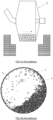
- FIGS. 1A and 1B show a semi-autogenous crusher 1.
- These crushers include shields 2 with protruding parts called lifters 3, which allow very intensive lifting. When the crusher is rotating around its horizontal axis, the pieces of rock are lifted and fall back onto the rock bed in the part lower. In addition, through relative movement between blocks and impacts linked to rotation, the material is significantly reduced in size, which justifies the term “autogenous grinding”.
- the grinding balls used in semi-autogenous mills must have good impact resistance as well as good wear resistance. Indeed, the balls used in the semi-autogenous mill are subject to significant wear by abrasion and numerous impacts. This is due to the combined action of very hard minerals in the form of large blocks and often presenting sharp edges and to destruction by rupture and spalling, in relation to the impact conditions inside this equipment. Worn or broken balls of smaller size are no longer effective in their role of crushing the critical size blocks which accumulate in the crusher. These small balls also exit the crusher through open orifices existing in the discharge grid of the semi-autogenous crusher.
- low-alloy carbon steel balls contain by weight 0.4 to 0.9% carbon, less than 1% manganese, chromium and silicon as well as elements in smaller quantities such as molybdenum, vanadium, titanium, niobium as well as impurities more harmful such as sulfur and phosphorus for example. These balls are shaped by forging a bar resulting from casting.
- chrome cast iron balls with a chromium content greater than or equal to 5% by weight, which are directly shaped by casting into a sand or metal mold.
- These alloys have the characteristic of containing chromium carbides, called primary, which appear during solidification during casting. These are M 7 C 3 type carbides.
- austenite cells free of carbides appear first.
- lattice carbides form at the eutectic point around these austenite cells.
- THE Figures 2A and 2B typically represent the distribution of carbides in a cast iron shaped by casting into a mold. We observe at the Figure 2A the network distribution of carbides 5 which formed between the austenite dendrites during solidification.
- the concentration section generally by flotation for sulphide ores such as copper or lead and zinc.
- sulphide ores such as copper or lead and zinc.
- the presence of chromium makes it possible to obtain a better quality pulp with, as a corollary, a reduction in the quantity of reagent required.
- the chromium content must, however, be perfectly dosed to avoid additional costs linked to the addition of chromium.
- the carbide and therefore carbon content must also be perfectly controlled in cast iron to avoid weakening of the material due to excess carbides.
- grinding balls forged in white cast iron with a high chromium content obtained from a bar manufactured by continuous casting.
- the grinding balls have a carbon content of between 1.5 and 3% by weight and a chromium content of between 8 and 25%.
- the grinding balls have a carbon content of between 1.7 and 2.15% by weight and a chromium content of between 5.3 and 8%.
- the present invention proposes a grinding ball having the advantages of low-alloy steels as well as the advantages of chrome cast irons, that is to say having both good impact resistance and good wear resistance. while having an optimized chromium content for the concentration section. To do this, according to the invention, the composition and the manufacturing process are optimized. The present invention proposes this type of ball in particular for use in the context of a semi-autogenous grinding process.
- the carbon content is maintained in the range 1.1-1.4% by weight to obtain the sufficient but not too large quantity of carbides in order to avoid weakening the ball.
- the chromium content is maintained in the 10-14% range to obtain a matrix sufficiently rich in chromium for better recovery after grinding while avoiding additional costs linked to the addition of chromium.
- the carbon content and the chromium content are correlated according to the following inequalities: 2.55 ⁇ Cr ⁇ 5.42 * VS ⁇ 7.67 And 41.76 ⁇ Cr + 28.66 * VS ⁇ 53.69 .
- the carbides are finely distributed within the microstructure of the ball. Preferably, they have an equivalent diameter of less than 100 ⁇ m, more preferably less than 50 ⁇ m and even more preferably less than 20 ⁇ m.
- the microstructure includes a matrix in which the chromium carbides are distributed.
- the microstructure comprises martensite with a percentage greater than 50%, residual austenite with a percentage between 7 and 25%, a total fraction of pearlite and bainite between 2 and 10%, the balance being made up of chromium carbides with a percentage less than or equal to 22%.
- the present invention relates to the process for manufacturing grinding balls and to grinding balls more specifically intended for application in a semi-autogenous mill. Typically, these are balls having a diameter between 90 mm and 150 mm.
- the chromium content and the carbon content are jointly and respectively maintained in the range 10-14% and 1.1-1.4%.
- carbon content and chromium content are closely related.
- the dotted lines, called conodes are lines representing alloys having the same matrix composition, that is to say, among other things, the same chromium content in the matrix. Moving from one conode to another following the solid line arrow results in an increase in the chromium content in the matrix. On the other hand, when moving along a conode, the composition of the matrix remains unchanged but the carbide content evolves and increases as we move in the direction of the arrow in dotted lines.
- the carbon and chromium contents are correlated according to the two inequalities: 2.55 ⁇ Cr-5.42*C ⁇ 7.67 and 41.76 ⁇ Cr+28.66*C ⁇ 53.69.
- the ball according to the invention has a predominantly martensitic microstructure, i.e. with a percentage of martensite greater than 50%, with a fine and homogeneous distribution of chromium carbides, called primary carbides, of type M 7 C 3 within the matrix.
- the average of the equivalent diameters is carried out on the basis of measurements taken on at least three images.
- the measurements are, for example, taken on images having a size of 660 ⁇ m x 495 ⁇ m.
- the size of the carbides is substantially homogeneous between the surface and the core of the ball with the manufacturing process described below.
- the continuous casting step is illustrated using the figure 5 , more specifically for horizontal continuous casting. This technique promotes fine-grain solidification by rapid cooling in a shell 9 cooled by water circulation.
- the installation includes a tank of liquid metal, called a casting ladle 8, serving as a buffer between the melting equipment which is an induction furnace 6a or an arc furnace 7, and the horizontal continuous casting.
- Solidification (the liquid part is referenced 12a) is initiated in the shell 9 made of copper alloy combining good thermal conductivity and good resistance to wear by friction, possibly followed by a graphite part enclosed in a copper envelope cooled with water and possibly followed by secondary cooling by water jets.
- the internal morphology of this copper or composite shell takes into account the specific contraction linked to the composition of the alloy which will pass from the liquid state to the solid state.
- the bar 12 or billet begins to solidify in this part of the equipment and then continues to solidify towards the center in the ambient air with movement exerted by an extraction system 10. Sometimes, certain short movements against the direction of extraction are possible to improve the quality of the surface of the billet.
- the bar 12 is then subjected to a magnetic stirring system 11 before the cutting equipment 13 which cuts the bar 12 to the chosen length. It will be noted that several magnetic stirring systems can, if necessary, be used on the continuous casting line.
- a first parameter is the casting temperature which must be as close as possible to the solidification temperature but compatible with industrial production.
- a overheating of 5 to 40°C above the solidification temperature will be the rule, however preferring an overheating of 10 to 15°C. This technique ensures good internal health of the billet by reducing shrinkage in the liquid metal.
- the water jets will be controlled to accelerate solidification while avoiding the formation of cracks on the surface.
- the extraction speed and the extraction step out of the shell must be adapted to the cast alloy.
- Programming the extraction speed can be complex with stops and jerks, even acceleration and braking.
- the extraction pitch for a 90 mm round billet will be between 4 and 12 mm and preferably around 7 to 8 mm.
- the extraction speed will be between 50 and 250 steps per minute and preferably around 150 steps per minute.
- magnetic stirrers can be placed in different locations to ensure the internal health of the bar. Indeed, the solidification is of the dendritic type and develops from the surface initially in contact with the copper shell. Then, the dendrites continue to grow towards the center, those corresponding to the bottom of the billet will grow more quickly given gravity; temperature gradients can also be created in the not yet solidified volume of the solidifying billet, which sometimes increases the risk of a central defect.
- a first electromagnetic stirrer can be positioned around the shell allowing a relatively low but homogeneous casting temperature.
- a second stirrer can be positioned at the end of the pour when the solidified thickness is approximately 20 mm.
- the electromagnetic stirrer could be placed at a distance corresponding to the end of solidification of said billet, i.e. approximately 7 m from the shell.
- the structure includes a fine distribution of chromium carbides, called primary carbides, of the M 7 C 3 type, which appear during eutectic solidification.
- primary carbides of the M 7 C 3 type
- Two optical microscopies and their schematic representations are given respectively to figures 3A And 3B (after forging).
- the carbides 5 do not appear in the form of a network but rather with a discrete distribution within the matrix.
- These primary carbides distributed in a point or in other words discrete manner as opposed to a network distribution, provide improved abrasion resistance without deteriorating the impact resistance properties.
- the carbides can have a certain orientation which is given by the subsequent deformation sequences.
- the size of the solidification grain is reduced thanks to the rapid and directed solidification of the continuous casting step according to the invention as well as by the use of the magnetic stirrer(s).
- This grain fineness also contributes, but to a lesser extent, to improving impact resistance.
- the interpolation method is used. For a known length, we count the number of grains crossed in the direction figure 4A . A reference length is chosen arbitrarily, i.e. 200 ⁇ m for example. The numbers on the right side give the number of intersections. This method is repeated in the other direction Y. In the example illustrated, an average value of 35 ⁇ m is obtained in X and 100 ⁇ m in Y, i.e. a general average of 67 ⁇ m.
- the size of the solidification grain is less than 90 ⁇ m, preferably less than 80 ⁇ m and particularly preferably between 30 and 70 ⁇ m especially in the first 15 millimeters below the surface, preferably 20 mm, or even 25 mm below the surface.
- the grain size obtained by foundry in a sand mold is 100 to 400 ⁇ m and 100 to 200 ⁇ m in a metal mold.
- the shaping step which can be carried out by rolling and/or forging. It is illustrated using the figures 6 to 8 . It can be produced by rolling in a train of fluted cylinders gradually forming the ball. More often, it is carried out by forging in a press 16 of a piece 18 cut from the bar 12 as illustrated in figures 7 and 8 . It is also possible to carry out a first rolling to reduce the diameter of the bar as illustrated in Figure 6 and then put the pieces from the bar into ball shape in the forging press. It is also possible to carry out a rolling sequence following forging in the press to perfect the sphericity of the ball coming from the press.
- the bar 12 is reheated in a pushing furnace 14 or through a series of induction furnaces 6b in the austenitic domain before being rolled in the rolling stands 15, to reduce the thickness of the bar and close the possible porosities. Then, the rolled bar 12 is reheated again in these same types of ovens 14.6b in the austenitic domain before being introduced into the forging press 16 ( Figure 7 ). Typically, reheating is carried out at a temperature between 950 and 1250°C. The bar 12 is then cut by the knife 17 into a piece 18 which is introduced into the press 16 comprising, in the example illustrated, a fixed part 16a and a mobile part 16b.
- the piece 18 is deformed into a blank having the shape of the ball 19 by the movable part 16b moved towards the fixed part 16a.
- the sphericity of the blank can then be improved by passing it between two cylinders having a shape close to an Archimedes screw.
- the blank in ball form is then subjected to heat treatment in one or more cycles to obtain the final product.
- Austenitization is carried out in a temperature range between 880 and 1075°C for a time of between 30 minutes and 3 hours.
- this cycle can be carried out in several stages with a first stage of maintaining a temperature between 620 and 730°C for a time of between 15 minutes and two hours followed by the second maintaining between 880 and 1075°C for a time of between 15 minutes and two hours. between 30 minutes and 3 hours.
- the blank is quenched to a temperature below 220°C to form the martensite.
- Quenching can be done in oil, water, air blast, polymer, etc.
- This austenitization and quenching cycle can be followed by a stress-relieving temper at a temperature of between 150 and 400°C for a time of between 30 minutes and 6 hours.
- the purpose of this relaxation income is to slightly reduce the internal tensions generated by the transformation of austenite into martensite.
- a microstructure is obtained with a matrix comprising martensite in a percentage greater than 50%, preferably between 60 and 80%, residual austenite with a percentage between 7 and 25 % and preferably between 10 and 20%, and a fraction of perlite and bainite comprised in total between 2 and 10%.
- the microstructure comprises the primary carbides distributed in the matrix and possibly some secondary carbides of the M 23 C 6 type, formed during the heat treatment cycles. The microstructure thus comprises for a total percentage of 100%, the aforementioned structures with a balance consisting of chromium carbides with a percentage of up to 22%.
- the fraction of residual austenite is measured by X-ray diffraction according to the ASTM E975-13 standard and the fractions of the other phases are measured by image analysis.
- the final properties are a hardness of 54 to 65 Rc and more generally close to 60 Rc, the Rockwell C hardness being measured according to the ISO6508-1:2016 standard.
- the grinding balls according to the invention thus have excellent resistance to wear conferred in a known manner by the high hardness of the alloy obtained thanks to the presence of martensite and chromium carbides.
- this excellent wear resistance is combined with very good impact resistance properties thanks to the fine distribution of primary carbides as well as the reduced size of the solidification grains.
- the impact resistance properties were tested and compared with those of high chromium cast iron grinding balls shaped by casting according to the prior art.
- the test is based on a technical article from the US Bureau of Mines ( R. Collinsensderfer and JH Tylczak, Minerals & Metallurgical processing, May 1989, pp 60-66 ).
- the test consists of dropping, for each of the two types of balls, 46 balls with a diameter of 125 mm from a height of 10 m.
- the test is carried out in cycles with each of the balls released successively and then re-entered into the loop to be released again.
- the balls are regularly weighed. If the weight loss is greater than 50%, the test is stopped.
- the basic specification is a minimum of 60,000 impacts.
- the grinding balls according to the invention thus have excellent wear resistance with impact resistance properties at least equal to those of conventional forged carbon steels.
Landscapes
- Chemical & Material Sciences (AREA)
- Engineering & Computer Science (AREA)
- Materials Engineering (AREA)
- Mechanical Engineering (AREA)
- Metallurgy (AREA)
- Organic Chemistry (AREA)
- Physics & Mathematics (AREA)
- Thermal Sciences (AREA)
- Crystallography & Structural Chemistry (AREA)
- Food Science & Technology (AREA)
- Crushing And Grinding (AREA)
- Heat Treatment Of Steel (AREA)
- Forging (AREA)
- Grinding And Polishing Of Tertiary Curved Surfaces And Surfaces With Complex Shapes (AREA)
- Grinding Of Cylindrical And Plane Surfaces (AREA)
Claims (16)
- Mahlkugel (19), die Folgendes umfasst:- einen Kohlenstoffgehalt zwischen 1,1 und 1,4 Gew.-%,- einen Chromgehalt zwischen 10 und 14 Gew.-%,- einen Mangangehalt zwischen 0,8 und 1,5 Gew.-%,- einen Siliziumgehalt zwischen 0,6 und 1 Gew.-%,- einen Molybdängehalt unter 1 Gew.-%,- einen Nickelgehalt unter 1 Gew.-%,- eventuelle Verunreinigungen in einem Gehalt, der insgesamt unter 0,5 Gew.-% liegt,- wobei der Rest, um 100 Gew.-% zu erhalten, Eisen ist.wobei die Mahlkugel (19) eine diskrete Verteilung von Chromkarbiden (5) umfasst und eine Mikrostruktur hat, die über 50 % Martensit, zwischen 7 und 25 % Restaustenit, eine Gesamtfraktion von Perlit und Bainit zwischen 2 und 10 % sowie 22 % oder weniger Chromkarbide umfasst.
- Mahlkugel (19) nach Anspruch 1, die Folgendes umfasst:- einen Kohlenstoffgehalt von 1,2 Gew.-%,- einen Chromgehalt von 12 Gew.-%,- einen Mangangehalt von 1,1 Gew.-%,- einen Siliziumgehalt von 0,8 Gew.-%,- einen Molybdängehalt unter 1,5 Gew.-%,- einen Nickelgehalt unter 1,5 Gew.-%,- eventuelle Verunreinigungen in einem Gehalt, der insgesamt unter 0,5 Gew.-% liegt,- wobei der Rest, um 100 Gew.-% zu erhalten, Eisen ist.
- Mahlkugel (19) nach einem der vorangehenden Ansprüche, dadurch gekennzeichnet, dass der Kohlenstoffgehalt und der Chromgehalt den Verhältnissen 2,55 ≤ Cr-5,42*C ≤ 7,67 und 41,76 ≤ Cr+28,66*C ≤ 53,69 entsprechen.
- Mahlkugel (19) nach einem der vorangehenden Ansprüche, dadurch gekennzeichnet, dass die Chromkarbide (5) einen äquivalenten Durchmesser unter 100 µm, vorzugsweise unter 50 µm, am meisten bevorzugt unter 20 µm haben, wobei der äquivalente Durchmesser Deq gemäß der Formel Deq=2*(A/π)1/2 bestimmt wird, wobei A der Flächeninhalt der Karbide ist, welcher durch Bildanalyse gemessen wird.
- Mahlkugel (19) nach einem der vorangehenden Ansprüche, dadurch gekennzeichnet, dass sie eine Mikrostruktur hat, die zwischen 60 und 80 % Martensit, zwischen 10 und 20 % Restaustenit und eine Gesamtfraktion von Perlit und Bainit zwischen 2 und 10 % umfasst.
- Mahlkugel (19) nach einem der vorangehenden Ansprüche, dadurch gekennzeichnet, dass sie eine Rockwell-C-Härte zwischen 54 bis 64 hat, wobei die Rockwell-C-Härte gemäß der Norm ISO 6508-1:2016 gemessen wird.
- Mahlkugel (19) nach einem der vorangehenden Ansprüche, dadurch gekennzeichnet, dass sie einen Durchmesser zwischen 90 mm und 150 mm hat.
- Verfahren zur Herstellung der Mahlkugel (19) nach einem der Ansprüche 1 bis 7, welches die folgenden Schritte umfasst:- Erzeugung, durch kontinuierliches Gießen, eines Barrens (12) mit einer chemischen Zusammensetzung nach einem der Ansprüche 1 bis 2, wobei die Erzeugung durch kontinuierliches Gießen es ermöglicht, die diskrete Verteilung von Chromkarbiden (5) zu erhalten,- Formgebung, durch Verformung in einer oder mehrerer Sequenzen, des Barrens (12), um einen Rohling in der Form der Mahlkugel (19) zu erhalten,- thermische Behandlung, in einem oder mehreren Zyklen, des Rohlings, um die Mahlkugel (19) mit einer überwiegend martensitischen Mikrostruktur zu erhalten, wobei der Schritt der thermischen Behandlung einen Austenitisierungszyklus bei einer Temperatur zwischen 880 und 1075 °C während einer Zeit zwischen 30 Minuten und 3 Stunden umfasst, gefolgt von einem Tempern bis auf eine Temperatur unter 220 °C, um den Austenit mindestens zum Teil in Martensit umzuwandeln.
- Verfahren zur Herstellung der Mahlkugel (19) nach dem vorangehenden Anspruch, dadurch gekennzeichnet, dass für einen Barren (12) mit einem Durchmesser oder einer Dicke über 85 mm, die Größe des Erstarrungskorns in den 15 ersten Millimetern unter der Oberfläche des Barrens (12) nach Abschluss des Erzeugungsschritts des Barrens (12) durch kontinuierliches Gießen kleiner als 80 µm ist, wobei die Größe der Körner mit einem Interpolationsverfahren ermittelt wird: für eine willkürlich gewählte Referenzlänge wird die Anzahl der durchquerten Körner in einer Richtung X und in einer Richtung Y gezählt, für die Richtungen X und Y wird ein Mittelwert der Korngröße erhalten und das Mittel der Mittelwerte in den Richtungen X und Y ist gleich der Korngröße.
- Verfahren zur Herstellung der Mahlkugel (19) nach dem vorangehenden Anspruch, dadurch gekennzeichnet, dass die Größe des Erstarrungskorns in den 15 ersten Millimetern unter der Oberfläche des Barrens (12) zwischen 20 und 75 µm liegt.
- Verfahren zur Herstellung der Mahlkugel (19) nach dem vorangehenden Anspruch, dadurch gekennzeichnet, dass die Größe des Erstarrungskorns in den 15 ersten Millimetern unter der Oberfläche des Barrens (12) zwischen 30 und 70 µm liegt.
- Verfahren zur Herstellung der Mahlkugel (19) nach einem der Ansprüche 8 bis 11, dadurch gekennzeichnet, dass das kontinuierliche Gießen bei einer Temperatur von 5 bis 40 °C, vorzugsweise 10 bis 15 °C, oberhalb der Erstarrungstemperatur durchgeführt wird.
- Verfahren zur Herstellung der Mahlkugel (19) nach einem der Ansprüche 8 bis 12, dadurch gekennzeichnet, dass die Erstarrung des Barrens (12) in einer mindestens teilweise metallischen und gekühlten Kokille (9) initiiert wird.
- Verfahren zur Herstellung der Mahlkugel (19) nach einem der Ansprüche 8 bis 13, dadurch gekennzeichnet, dass die Erstarrung des Barrens (12) in Gegenwart von einem oder mehreren Magnetrührern (11) initiiert wird.
- Verfahren zur Herstellung der Mahlkugel (19) nach einem der Ansprüche 8 bis 14, dadurch gekennzeichnet, dass der Schritt der Formgebung durch Walzen und/oder Schmieden durchgeführt wird.
- Verfahren zum Mahlen von Gestein in einer Semiautogenmühle (1), welches die Verwendung einer Mahlkugel (19) nach einem der Ansprüche 1 bis 7 aufweist.
Applications Claiming Priority (2)
| Application Number | Priority Date | Filing Date | Title |
|---|---|---|---|
| BE20205031A BE1027395B1 (fr) | 2020-01-16 | 2020-01-16 | Boulets de broyage forges pour broyeur semi-autogene |
| PCT/EP2021/050656 WO2021144347A1 (fr) | 2020-01-16 | 2021-01-14 | Boulets de broyage forges pour broyeur semi-autogene |
Publications (2)
| Publication Number | Publication Date |
|---|---|
| EP4090779A1 EP4090779A1 (de) | 2022-11-23 |
| EP4090779B1 true EP4090779B1 (de) | 2024-02-28 |
Family
ID=69232706
Family Applications (1)
| Application Number | Title | Priority Date | Filing Date |
|---|---|---|---|
| EP21701066.9A Active EP4090779B1 (de) | 2020-01-16 | 2021-01-14 | Geschmiedete mahlkugeln für halbautogenes mahlwerk |
Country Status (11)
| Country | Link |
|---|---|
| US (1) | US20230071728A1 (de) |
| EP (1) | EP4090779B1 (de) |
| CN (1) | CN114929906B (de) |
| AU (1) | AU2021207260B2 (de) |
| BE (1) | BE1027395B1 (de) |
| BR (1) | BR112022013975A2 (de) |
| CA (1) | CA3167890A1 (de) |
| ES (1) | ES2979363T3 (de) |
| PL (1) | PL4090779T3 (de) |
| WO (1) | WO2021144347A1 (de) |
| ZA (1) | ZA202207221B (de) |
Families Citing this family (3)
| Publication number | Priority date | Publication date | Assignee | Title |
|---|---|---|---|---|
| CN116179926B (zh) * | 2022-09-07 | 2026-03-20 | 包头钢铁(集团)有限责任公司 | 一种矿用稀土耐磨gn-14a热轧圆钢的生产方法 |
| CN116657032B (zh) * | 2023-07-14 | 2026-01-27 | 江西铜业集团(德兴)铸造有限公司 | 一种低表面缺陷的高铬耐磨球及其制备方法 |
| CN118527215B (zh) * | 2024-05-31 | 2025-10-24 | 福州大学 | 一种半自磨机智能化加球系统及方法 |
Family Cites Families (14)
| Publication number | Priority date | Publication date | Assignee | Title |
|---|---|---|---|---|
| LU63431A1 (de) * | 1971-06-29 | 1973-01-22 | ||
| US4043842A (en) * | 1972-07-12 | 1977-08-23 | Joiret Victor L J | Grinding members |
| FR2228115B1 (de) * | 1973-05-04 | 1975-11-21 | Thome Cromback Acieries | |
| FR2405749A1 (fr) * | 1977-10-14 | 1979-05-11 | Thome Cromback Acieries | Nouveaux corps broyants forges, notamment boulets de broyage, et leur procede de fabrication |
| US5183518A (en) * | 1989-05-01 | 1993-02-02 | Townley Foundry & Machine Co., Inc. | Cryogenically super-hardened high-chromium white cast iron and method thereof |
| JPH08120333A (ja) * | 1994-10-20 | 1996-05-14 | Nippon Koshuha Kogyo Kk | 工具鋼及びその製造方法 |
| WO2000043555A1 (en) * | 1999-01-19 | 2000-07-27 | Magotteaux International S.A. | Process of the production of high-carbon cast steels intended for wearing parts |
| US6843824B2 (en) * | 2001-11-06 | 2005-01-18 | Cerbide | Method of making a ceramic body of densified tungsten carbide |
| FR2847271B1 (fr) * | 2002-11-19 | 2004-12-24 | Usinor | Procede pour fabriquer une tole en acier resistant a l'abrasion et tole obtenue |
| SE529370C2 (sv) * | 2006-01-09 | 2007-07-17 | Sandvik Intellectual Property | Vattenbaserad hårdmetallslurry, gelad hårdmetallkropp och sätt att framställa en gelad kropp och en sintrad hårdmetallkropp |
| CN102876961A (zh) * | 2012-08-31 | 2013-01-16 | 宁国市金六星研磨材料科技有限公司 | 一种新型超低锰、高铬耐磨耐腐蚀铸造磨球 |
| CN103710646A (zh) * | 2013-12-18 | 2014-04-09 | 宁国市中意耐磨材料有限公司 | 一种超硬低铬含量研磨体以及制造方法 |
| CN104294186A (zh) * | 2014-10-18 | 2015-01-21 | 无棣向上机械设计服务有限公司 | 一种纳米氮化硼增强耐磨球及其制备工艺 |
| GB2532761A (en) * | 2014-11-27 | 2016-06-01 | Skf Ab | Bearing steel |
-
2020
- 2020-01-16 BE BE20205031A patent/BE1027395B1/fr active IP Right Grant
-
2021
- 2021-01-14 BR BR112022013975A patent/BR112022013975A2/pt active Search and Examination
- 2021-01-14 WO PCT/EP2021/050656 patent/WO2021144347A1/fr not_active Ceased
- 2021-01-14 CN CN202180007683.1A patent/CN114929906B/zh active Active
- 2021-01-14 PL PL21701066.9T patent/PL4090779T3/pl unknown
- 2021-01-14 US US17/789,728 patent/US20230071728A1/en active Pending
- 2021-01-14 EP EP21701066.9A patent/EP4090779B1/de active Active
- 2021-01-14 AU AU2021207260A patent/AU2021207260B2/en active Active
- 2021-01-14 ES ES21701066T patent/ES2979363T3/es active Active
- 2021-01-14 CA CA3167890A patent/CA3167890A1/en active Pending
-
2022
- 2022-06-29 ZA ZA2022/07221A patent/ZA202207221B/en unknown
Also Published As
| Publication number | Publication date |
|---|---|
| EP4090779A1 (de) | 2022-11-23 |
| BE1027395B1 (fr) | 2021-01-29 |
| CA3167890A1 (en) | 2021-07-22 |
| US20230071728A1 (en) | 2023-03-09 |
| AU2021207260B2 (en) | 2026-02-12 |
| ZA202207221B (en) | 2023-11-29 |
| CN114929906A (zh) | 2022-08-19 |
| BR112022013975A2 (pt) | 2022-10-11 |
| CN114929906B (zh) | 2024-07-19 |
| PL4090779T3 (pl) | 2024-06-24 |
| WO2021144347A1 (fr) | 2021-07-22 |
| ES2979363T3 (es) | 2024-09-25 |
| AU2021207260A1 (en) | 2022-07-28 |
Similar Documents
| Publication | Publication Date | Title |
|---|---|---|
| ELSawy et al. | Effect of manganese, silicon and chromium additions on microstructure and wear characteristics of grey cast iron for sugar industries applications | |
| BE1027395B1 (fr) | Boulets de broyage forges pour broyeur semi-autogene | |
| CN109641251B (zh) | 轧制用辊外层材料和轧制用复合辊 | |
| JP5949596B2 (ja) | 熱間圧延用ロール外層材、および熱間圧延用複合ロール | |
| Zhu et al. | Effect of electroslag remelting on carbides in 8Cr13MoV martensitic stainless steel | |
| JP6787238B2 (ja) | 機械構造用鋼材の製造方法 | |
| Gu et al. | Ultra strong FCC structured Ni8Cr4Co4Fe6W2 high entropy alloys with high strength and ductility by laser powder bed fusion | |
| Bhatta et al. | Microstructure and mechanical properties of solid state recycled 4Cr5MoSiV (H11) steel prepared by powder metallurgy | |
| JP4548263B2 (ja) | 耐摩耗性に優れた鋳鉄品の製造方法 | |
| Todić et al. | The Influence of the Vanadium Content on the Toughness and Hardness of Wear resistant High-alloyed Cr-Mo Steel. | |
| Opapaiboon et al. | Effect of chromium content on the three-body-type abrasive wear behavior of multi-alloyed white cast iron | |
| JP6515957B2 (ja) | 耐摩耗性に優れた圧延用ロール外層材および圧延用複合ロール | |
| Liang et al. | Effects of oxygen content, Mn/S ratio, Cu content, hot-rolling, and annealing on morphology/distribution of MnS inclusions and microstructure/mechanical properties of free-cutting stainless steel | |
| WO2019045068A1 (ja) | 圧延用複合ロール及びその製造方法 | |
| KR102145761B1 (ko) | 파쇄기용 고망간 주조합금강 및 그 제조방법 | |
| RU2819724C1 (ru) | Кованые мелющие шары для мельницы полусамоизмельчения | |
| JPH0456106B2 (de) | ||
| Liu et al. | Tailoring microstructure and wear resistance of Cr-Mo alloy steel: The synergistic effects of squeeze casting and melt degassing treatment | |
| Chooprajong et al. | Three-body-type abrasive wear behavior of 26% Cr cast iron with molybdenum | |
| Ludlow et al. | Precipitation of nitrides and carbides during solidification and cooling in continuous casting | |
| Čamagić et al. | The influence of the vanadium content on the toughness and hardness of high-alloyed Cr-Mo steel | |
| Agunsoye et al. | WEAR BEHAVIOUR OF NF-GREY 8 ALLOYED WITH FEMN NANOPARTICLES | |
| FR2829405A1 (fr) | Corps de broyage en acier ou fonte a teneur en carbone elevee, et son procede de fabrication | |
| Plummer | Assessment of Microstructural Modification Methods for Cast CuSn12Ni | |
| Meran et al. | Usability of Boron as an Alloying Element in Gray Cast Iron Rollers and Its Effect to Abrasive Wear Behaviour |
Legal Events
| Date | Code | Title | Description |
|---|---|---|---|
| STAA | Information on the status of an ep patent application or granted ep patent |
Free format text: STATUS: UNKNOWN |
|
| STAA | Information on the status of an ep patent application or granted ep patent |
Free format text: STATUS: THE INTERNATIONAL PUBLICATION HAS BEEN MADE |
|
| PUAI | Public reference made under article 153(3) epc to a published international application that has entered the european phase |
Free format text: ORIGINAL CODE: 0009012 |
|
| STAA | Information on the status of an ep patent application or granted ep patent |
Free format text: STATUS: REQUEST FOR EXAMINATION WAS MADE |
|
| 17P | Request for examination filed |
Effective date: 20220630 |
|
| AK | Designated contracting states |
Kind code of ref document: A1 Designated state(s): AL AT BE BG CH CY CZ DE DK EE ES FI FR GB GR HR HU IE IS IT LI LT LU LV MC MK MT NL NO PL PT RO RS SE SI SK SM TR |
|
| DAV | Request for validation of the european patent (deleted) | ||
| DAX | Request for extension of the european patent (deleted) | ||
| GRAP | Despatch of communication of intention to grant a patent |
Free format text: ORIGINAL CODE: EPIDOSNIGR1 |
|
| STAA | Information on the status of an ep patent application or granted ep patent |
Free format text: STATUS: GRANT OF PATENT IS INTENDED |
|
| INTG | Intention to grant announced |
Effective date: 20230913 |
|
| GRAS | Grant fee paid |
Free format text: ORIGINAL CODE: EPIDOSNIGR3 |
|
| P01 | Opt-out of the competence of the unified patent court (upc) registered |
Effective date: 20231218 |
|
| GRAA | (expected) grant |
Free format text: ORIGINAL CODE: 0009210 |
|
| STAA | Information on the status of an ep patent application or granted ep patent |
Free format text: STATUS: THE PATENT HAS BEEN GRANTED |
|
| AK | Designated contracting states |
Kind code of ref document: B1 Designated state(s): AL AT BE BG CH CY CZ DE DK EE ES FI FR GB GR HR HU IE IS IT LI LT LU LV MC MK MT NL NO PL PT RO RS SE SI SK SM TR |
|
| REG | Reference to a national code |
Ref country code: GB Ref legal event code: FG4D Free format text: NOT ENGLISH |
|
| REG | Reference to a national code |
Ref country code: CH Ref legal event code: EP |
|
| REG | Reference to a national code |
Ref country code: DE Ref legal event code: R096 Ref document number: 602021009834 Country of ref document: DE |
|
| REG | Reference to a national code |
Ref country code: IE Ref legal event code: FG4D Free format text: LANGUAGE OF EP DOCUMENT: FRENCH |
|
| REG | Reference to a national code |
Ref country code: LT Ref legal event code: MG9D |
|
| PG25 | Lapsed in a contracting state [announced via postgrant information from national office to epo] |
Ref country code: IS Free format text: LAPSE BECAUSE OF FAILURE TO SUBMIT A TRANSLATION OF THE DESCRIPTION OR TO PAY THE FEE WITHIN THE PRESCRIBED TIME-LIMIT Effective date: 20240628 |
|
| REG | Reference to a national code |
Ref country code: NL Ref legal event code: MP Effective date: 20240228 |
|
| PG25 | Lapsed in a contracting state [announced via postgrant information from national office to epo] |
Ref country code: LT Free format text: LAPSE BECAUSE OF FAILURE TO SUBMIT A TRANSLATION OF THE DESCRIPTION OR TO PAY THE FEE WITHIN THE PRESCRIBED TIME-LIMIT Effective date: 20240228 |
|
| PG25 | Lapsed in a contracting state [announced via postgrant information from national office to epo] |
Ref country code: GR Free format text: LAPSE BECAUSE OF FAILURE TO SUBMIT A TRANSLATION OF THE DESCRIPTION OR TO PAY THE FEE WITHIN THE PRESCRIBED TIME-LIMIT Effective date: 20240529 |
|
| PG25 | Lapsed in a contracting state [announced via postgrant information from national office to epo] |
Ref country code: RS Free format text: LAPSE BECAUSE OF FAILURE TO SUBMIT A TRANSLATION OF THE DESCRIPTION OR TO PAY THE FEE WITHIN THE PRESCRIBED TIME-LIMIT Effective date: 20240528 Ref country code: NL Free format text: LAPSE BECAUSE OF FAILURE TO SUBMIT A TRANSLATION OF THE DESCRIPTION OR TO PAY THE FEE WITHIN THE PRESCRIBED TIME-LIMIT Effective date: 20240228 Ref country code: HR Free format text: LAPSE BECAUSE OF FAILURE TO SUBMIT A TRANSLATION OF THE DESCRIPTION OR TO PAY THE FEE WITHIN THE PRESCRIBED TIME-LIMIT Effective date: 20240228 |
|
| PG25 | Lapsed in a contracting state [announced via postgrant information from national office to epo] |
Ref country code: RS Free format text: LAPSE BECAUSE OF FAILURE TO SUBMIT A TRANSLATION OF THE DESCRIPTION OR TO PAY THE FEE WITHIN THE PRESCRIBED TIME-LIMIT Effective date: 20240528 Ref country code: NO Free format text: LAPSE BECAUSE OF FAILURE TO SUBMIT A TRANSLATION OF THE DESCRIPTION OR TO PAY THE FEE WITHIN THE PRESCRIBED TIME-LIMIT Effective date: 20240528 Ref country code: NL Free format text: LAPSE BECAUSE OF FAILURE TO SUBMIT A TRANSLATION OF THE DESCRIPTION OR TO PAY THE FEE WITHIN THE PRESCRIBED TIME-LIMIT Effective date: 20240228 Ref country code: LT Free format text: LAPSE BECAUSE OF FAILURE TO SUBMIT A TRANSLATION OF THE DESCRIPTION OR TO PAY THE FEE WITHIN THE PRESCRIBED TIME-LIMIT Effective date: 20240228 Ref country code: IS Free format text: LAPSE BECAUSE OF FAILURE TO SUBMIT A TRANSLATION OF THE DESCRIPTION OR TO PAY THE FEE WITHIN THE PRESCRIBED TIME-LIMIT Effective date: 20240628 Ref country code: HR Free format text: LAPSE BECAUSE OF FAILURE TO SUBMIT A TRANSLATION OF THE DESCRIPTION OR TO PAY THE FEE WITHIN THE PRESCRIBED TIME-LIMIT Effective date: 20240228 Ref country code: GR Free format text: LAPSE BECAUSE OF FAILURE TO SUBMIT A TRANSLATION OF THE DESCRIPTION OR TO PAY THE FEE WITHIN THE PRESCRIBED TIME-LIMIT Effective date: 20240529 Ref country code: FI Free format text: LAPSE BECAUSE OF FAILURE TO SUBMIT A TRANSLATION OF THE DESCRIPTION OR TO PAY THE FEE WITHIN THE PRESCRIBED TIME-LIMIT Effective date: 20240228 |
|
| PG25 | Lapsed in a contracting state [announced via postgrant information from national office to epo] |
Ref country code: PT Free format text: LAPSE BECAUSE OF FAILURE TO SUBMIT A TRANSLATION OF THE DESCRIPTION OR TO PAY THE FEE WITHIN THE PRESCRIBED TIME-LIMIT Effective date: 20240628 |
|
| REG | Reference to a national code |
Ref country code: AT Ref legal event code: MK05 Ref document number: 1661293 Country of ref document: AT Kind code of ref document: T Effective date: 20240228 |
|
| PG25 | Lapsed in a contracting state [announced via postgrant information from national office to epo] |
Ref country code: SE Free format text: LAPSE BECAUSE OF FAILURE TO SUBMIT A TRANSLATION OF THE DESCRIPTION OR TO PAY THE FEE WITHIN THE PRESCRIBED TIME-LIMIT Effective date: 20240228 Ref country code: PT Free format text: LAPSE BECAUSE OF FAILURE TO SUBMIT A TRANSLATION OF THE DESCRIPTION OR TO PAY THE FEE WITHIN THE PRESCRIBED TIME-LIMIT Effective date: 20240628 Ref country code: LV Free format text: LAPSE BECAUSE OF FAILURE TO SUBMIT A TRANSLATION OF THE DESCRIPTION OR TO PAY THE FEE WITHIN THE PRESCRIBED TIME-LIMIT Effective date: 20240228 |
|
| REG | Reference to a national code |
Ref country code: ES Ref legal event code: FG2A Ref document number: 2979363 Country of ref document: ES Kind code of ref document: T3 Effective date: 20240925 |
|
| PG25 | Lapsed in a contracting state [announced via postgrant information from national office to epo] |
Ref country code: DK Free format text: LAPSE BECAUSE OF FAILURE TO SUBMIT A TRANSLATION OF THE DESCRIPTION OR TO PAY THE FEE WITHIN THE PRESCRIBED TIME-LIMIT Effective date: 20240228 |
|
| PG25 | Lapsed in a contracting state [announced via postgrant information from national office to epo] |
Ref country code: SM Free format text: LAPSE BECAUSE OF FAILURE TO SUBMIT A TRANSLATION OF THE DESCRIPTION OR TO PAY THE FEE WITHIN THE PRESCRIBED TIME-LIMIT Effective date: 20240228 |
|
| PG25 | Lapsed in a contracting state [announced via postgrant information from national office to epo] |
Ref country code: EE Free format text: LAPSE BECAUSE OF FAILURE TO SUBMIT A TRANSLATION OF THE DESCRIPTION OR TO PAY THE FEE WITHIN THE PRESCRIBED TIME-LIMIT Effective date: 20240228 |
|
| PG25 | Lapsed in a contracting state [announced via postgrant information from national office to epo] |
Ref country code: AT Free format text: LAPSE BECAUSE OF FAILURE TO SUBMIT A TRANSLATION OF THE DESCRIPTION OR TO PAY THE FEE WITHIN THE PRESCRIBED TIME-LIMIT Effective date: 20240228 |
|
| PG25 | Lapsed in a contracting state [announced via postgrant information from national office to epo] |
Ref country code: SK Free format text: LAPSE BECAUSE OF FAILURE TO SUBMIT A TRANSLATION OF THE DESCRIPTION OR TO PAY THE FEE WITHIN THE PRESCRIBED TIME-LIMIT Effective date: 20240228 |
|
| PG25 | Lapsed in a contracting state [announced via postgrant information from national office to epo] |
Ref country code: SM Free format text: LAPSE BECAUSE OF FAILURE TO SUBMIT A TRANSLATION OF THE DESCRIPTION OR TO PAY THE FEE WITHIN THE PRESCRIBED TIME-LIMIT Effective date: 20240228 Ref country code: SK Free format text: LAPSE BECAUSE OF FAILURE TO SUBMIT A TRANSLATION OF THE DESCRIPTION OR TO PAY THE FEE WITHIN THE PRESCRIBED TIME-LIMIT Effective date: 20240228 Ref country code: RO Free format text: LAPSE BECAUSE OF FAILURE TO SUBMIT A TRANSLATION OF THE DESCRIPTION OR TO PAY THE FEE WITHIN THE PRESCRIBED TIME-LIMIT Effective date: 20240228 Ref country code: EE Free format text: LAPSE BECAUSE OF FAILURE TO SUBMIT A TRANSLATION OF THE DESCRIPTION OR TO PAY THE FEE WITHIN THE PRESCRIBED TIME-LIMIT Effective date: 20240228 Ref country code: DK Free format text: LAPSE BECAUSE OF FAILURE TO SUBMIT A TRANSLATION OF THE DESCRIPTION OR TO PAY THE FEE WITHIN THE PRESCRIBED TIME-LIMIT Effective date: 20240228 Ref country code: AT Free format text: LAPSE BECAUSE OF FAILURE TO SUBMIT A TRANSLATION OF THE DESCRIPTION OR TO PAY THE FEE WITHIN THE PRESCRIBED TIME-LIMIT Effective date: 20240228 |
|
| REG | Reference to a national code |
Ref country code: DE Ref legal event code: R097 Ref document number: 602021009834 Country of ref document: DE |
|
| PLBE | No opposition filed within time limit |
Free format text: ORIGINAL CODE: 0009261 |
|
| STAA | Information on the status of an ep patent application or granted ep patent |
Free format text: STATUS: NO OPPOSITION FILED WITHIN TIME LIMIT |
|
| 26N | No opposition filed |
Effective date: 20241129 |
|
| PG25 | Lapsed in a contracting state [announced via postgrant information from national office to epo] |
Ref country code: SI Free format text: LAPSE BECAUSE OF FAILURE TO SUBMIT A TRANSLATION OF THE DESCRIPTION OR TO PAY THE FEE WITHIN THE PRESCRIBED TIME-LIMIT Effective date: 20240228 |
|
| REG | Reference to a national code |
Ref country code: DE Ref legal event code: R119 Ref document number: 602021009834 Country of ref document: DE |
|
| REG | Reference to a national code |
Ref country code: CH Ref legal event code: PL |
|
| PG25 | Lapsed in a contracting state [announced via postgrant information from national office to epo] |
Ref country code: MC Free format text: LAPSE BECAUSE OF FAILURE TO SUBMIT A TRANSLATION OF THE DESCRIPTION OR TO PAY THE FEE WITHIN THE PRESCRIBED TIME-LIMIT Effective date: 20240228 Ref country code: LU Free format text: LAPSE BECAUSE OF NON-PAYMENT OF DUE FEES Effective date: 20250114 |
|
| GBPC | Gb: european patent ceased through non-payment of renewal fee |
Effective date: 20250114 |
|
| PG25 | Lapsed in a contracting state [announced via postgrant information from national office to epo] |
Ref country code: DE Free format text: LAPSE BECAUSE OF NON-PAYMENT OF DUE FEES Effective date: 20250801 |
|
| PG25 | Lapsed in a contracting state [announced via postgrant information from national office to epo] |
Ref country code: BE Free format text: LAPSE BECAUSE OF NON-PAYMENT OF DUE FEES Effective date: 20250131 Ref country code: GB Free format text: LAPSE BECAUSE OF NON-PAYMENT OF DUE FEES Effective date: 20250114 |
|
| PG25 | Lapsed in a contracting state [announced via postgrant information from national office to epo] |
Ref country code: FR Free format text: LAPSE BECAUSE OF NON-PAYMENT OF DUE FEES Effective date: 20250131 |
|
| PG25 | Lapsed in a contracting state [announced via postgrant information from national office to epo] |
Ref country code: CH Free format text: LAPSE BECAUSE OF NON-PAYMENT OF DUE FEES Effective date: 20250131 |
|
| REG | Reference to a national code |
Ref country code: BE Ref legal event code: MM Effective date: 20250131 |
|
| PG25 | Lapsed in a contracting state [announced via postgrant information from national office to epo] |
Ref country code: IE Free format text: LAPSE BECAUSE OF NON-PAYMENT OF DUE FEES Effective date: 20250114 |
|
| PGFP | Annual fee paid to national office [announced via postgrant information from national office to epo] |
Ref country code: CZ Payment date: 20251230 Year of fee payment: 6 |
|
| PGFP | Annual fee paid to national office [announced via postgrant information from national office to epo] |
Ref country code: PL Payment date: 20251219 Year of fee payment: 6 |
|
| PGFP | Annual fee paid to national office [announced via postgrant information from national office to epo] |
Ref country code: BG Payment date: 20251229 Year of fee payment: 6 |
|
| PGFP | Annual fee paid to national office [announced via postgrant information from national office to epo] |
Ref country code: ES Payment date: 20260202 Year of fee payment: 6 |
|
| PGFP | Annual fee paid to national office [announced via postgrant information from national office to epo] |
Ref country code: IT Payment date: 20260107 Year of fee payment: 6 |