EP4089552B1 - Appareil électronique et méthode de traitement des données associé - Google Patents
Appareil électronique et méthode de traitement des données associé Download PDFInfo
- Publication number
- EP4089552B1 EP4089552B1 EP21750900.9A EP21750900A EP4089552B1 EP 4089552 B1 EP4089552 B1 EP 4089552B1 EP 21750900 A EP21750900 A EP 21750900A EP 4089552 B1 EP4089552 B1 EP 4089552B1
- Authority
- EP
- European Patent Office
- Prior art keywords
- matrix
- data
- real number
- codeword
- number data
- Prior art date
- Legal status (The legal status is an assumption and is not a legal conclusion. Google has not performed a legal analysis and makes no representation as to the accuracy of the status listed.)
- Active
Links
Images





Classifications
-
- G—PHYSICS
- G06—COMPUTING OR CALCULATING; COUNTING
- G06F—ELECTRIC DIGITAL DATA PROCESSING
- G06F7/00—Methods or arrangements for processing data by operating upon the order or content of the data handled
- G06F7/38—Methods or arrangements for performing computations using exclusively denominational number representation, e.g. using binary, ternary, decimal representation
- G06F7/48—Methods or arrangements for performing computations using exclusively denominational number representation, e.g. using binary, ternary, decimal representation using non-contact-making devices, e.g. tube, solid state device; using unspecified devices
- G06F7/544—Methods or arrangements for performing computations using exclusively denominational number representation, e.g. using binary, ternary, decimal representation using non-contact-making devices, e.g. tube, solid state device; using unspecified devices for evaluating functions by calculation
- G06F7/5443—Sum of products
-
- G—PHYSICS
- G06—COMPUTING OR CALCULATING; COUNTING
- G06F—ELECTRIC DIGITAL DATA PROCESSING
- G06F17/00—Digital computing or data processing equipment or methods, specially adapted for specific functions
- G06F17/10—Complex mathematical operations
- G06F17/16—Matrix or vector computation, e.g. matrix-matrix or matrix-vector multiplication, matrix factorization
-
- G—PHYSICS
- G06—COMPUTING OR CALCULATING; COUNTING
- G06F—ELECTRIC DIGITAL DATA PROCESSING
- G06F21/00—Security arrangements for protecting computers, components thereof, programs or data against unauthorised activity
- G06F21/30—Authentication, i.e. establishing the identity or authorisation of security principals
- G06F21/31—User authentication
Definitions
- biometric data examples include a fingerprint, iris, face, and voice, and various other biometric information may be used.
- An object of the disclosure is to provide an electronic apparatus capable of performing error correction on real number data and a method for processing data thereof.
- a singular expression includes a plural expression, unless otherwise specified. It is to be understood that the terms such as "comprise” may, for example, be used to designate a presence of a characteristic, number, step, operation, element, component, or a combination thereof, and not to preclude a presence or a possibility of adding one or more of other characteristics, numbers, steps, operations, elements, components or a combination thereof.
- first and “second,” may identify corresponding components, regardless of order and/or importance, and are used to distinguish a component from another without limiting the components.
- a certain element e.g., first element
- another element e.g., second element
- the certain element may be connected to the other element directly or through still another element (e.g., third element).
- module e.g., a "user” may refer to a person using an electronic apparatus or an artificial intelligence electronic apparatus using an electronic apparatus (e.g., artificial intelligence electronic apparatus).
- FIG. 1 is a diagram illustrating an electronic system according to an embodiment of the disclosure.
- an electronic system 1000 may include an electronic apparatus 100 and a server device 200.
- the electronic system 1000 may be referred to as a user authentication system in terms of performing a user authentication operation using user biometric information.
- the electronic apparatus 100 generates real number data.
- the electronic apparatus 100 may include a sensor capable of extracting biometric information from the user's body, and may generate biometric information (or real number data) having a real number form by using the sensor.
- the real number data may be biometric information such as the user's iris, retina, and voice information, and user information in real number form such as information indicating the location of the electronic apparatus 100 (e.g., signal strength, global positioning system (GPS) information, etc.) or device information.
- biometric information such as the user's iris, retina, and voice information
- user information in real number form such as information indicating the location of the electronic apparatus 100 (e.g., signal strength, global positioning system (GPS) information, etc.) or device information.
- GPS global positioning system
- the electronic apparatus 100 may generate a key by using the generated real number data. For example, the electronic apparatus 100 may generate a codeword, a helper matrix, and a vector.
- the codeword is a key used for user authentication, etc., and may be referred to as a secret key. These codewords may be randomly generated.
- the electronic apparatus 100 may select one of vectors composed of a plurality of elements and having a preset size. For example, in the codeword, 16 elements out of 512 elements may have a size of 1/4 (i.e., a value of ⁇ 1/4) and the remaining elements may have a value of 0. As such, since only 16 elements have a value of ⁇ 1/4, the size of the generated codeword may have a value of 1.
- the vector is generated by reflecting the generated real number data to the helper matrix, and may be referred to as a codeword in that it corresponds to the above-described codeword.
- a vector generated in an initial key generation process is referred to as a codeword
- a vector generated in the decoding process is referred to as a decoding codeword or a vector.
- the server device 200 may perform user authentication based on the codeword received from the electronic apparatus 100. Specifically, the server device 200 may perform user authentication by comparing the information previously stored in the database with the encrypted biometric information received from the electronic apparatus 100.
- the server device 200 may store a codeword (C) value for user A, and when a codeword is received from the electronic apparatus 100, may perform user authentication by comparing the received codeword with a pre-stored codeword.
- C codeword
- the electronic system 1000 according to the embodiment does not need to convert data to binary data when performing error correction on real number data, more accurate error correction or user authentication is possible. Since the electronic system 1000 according to the disclosure does not need to convert real number data into binary data, error correction or user authentication processing may be performed more quickly.
- the electronic apparatus 100 also extracts biometric information and generates a codeword with the extracted information, the extraction of biometric information and the operation of generating a codeword using the extracted biometric information may be performed in another separate device.
- three or more devices may operate organically to perform user authentication. For example, when a codeword required for user authentication is stored in the first server and if a service in the second server is required, the codeword generated by the user terminal device may be provided to the first server. The first server provided with the codeword may perform user authentication and provide the result to the second server, so that the user may use the service in the second server.
- FIG. 2 is a block diagram illustrating a configuration of an electronic apparatus according to an embodiment of the disclosure.
- the electronic apparatus 100 may include a memory 110 and a processor 120.
- At least one instruction related to the electronic apparatus 100 may be stored in the memory 110.
- various programs (or software) for operating the electronic apparatus 100 according to various embodiments of the disclosure may be stored in the memory 110.
- the memory 110 may store a helper matrix.
- the memory 110 may store a generated vector using a helper matrix.
- the memory 110 may store real number data necessary to generate a helper matrix.
- the memory 110 may be implemented as a memory physically distinguished from the processor 120.
- the memory 110 may be implemented as at least one of a memory embedded within the electronic apparatus 100 or a memory detachable from the electronic apparatus 100 according to the usage of data storage.
- the memory 110 may be implemented as at least one of a volatile memory such as a dynamic random access memory (DRAM), a static random access memory (SRAM), a synchronous dynamic random access memory (SDRAM), or a non-volatile memory (for example, one time programmable ROM (OTPROM), programmable ROM (PROM), erasable and programmable ROM (EPROM), electrically erasable and programmable ROM (EEPROM), mask ROM, flash ROM, a flash memory (for example, NAND flash or NOR flash), a hard disk drive (HDD) or a solid state drive (SSD), a memory card (for example, a compact flash (CF), secure digital (SD), micro secure digital (micro-SD), mini secure digital (mini-SD), extreme digital (xD), multi-media card (MMC), etc.), an external memory (for example, a universal serial bus (USB) memory) connectable to the USB port, or the like.
- a volatile memory such as a dynamic random access memory (D
- the memory 110 may be implemented as an internal memory such as a read-only memory (ROM) (for example, electrically erasable programmable read-only memory (EEPROM)), a random-access memory (RAM) included in the processor 120.
- ROM read-only memory
- EEPROM electrically erasable programmable read-only memory
- RAM random-access memory
- the processor 120 may control the overall operation of the electronic apparatus 100.
- the processor 120 may control overall operation of the electronic apparatus 100 by executing at least one instruction stored in the memory 110.
- the processor 120 may be composed of a single device such as a central processing unit (CPU), a micro controller unit (MCU), a micro processing unit (MPU), a controller, a system on a chip (SoC), a large scale integration (LSI), an application-specific integrated circuit (ASIC), a field programmable gate array (FPGA), an application processor (AP), etc. or may be composed of the combination of a plurality of devices such as a central processing unit (CPU), graphics processing unit (GPU), or the like.
- CPU central processing unit
- MCU micro controller unit
- MPU micro processing unit
- SoC system on a chip
- SoC system on a chip
- LSI large scale integration
- ASIC application-specific integrated circuit
- FPGA field programmable gate array
- AP application processor
- the processor 120 may perform a key generation operation.
- the key generation operation may be an operation of generating a codeword and a helper matrix.
- the processor 120 may select one of vectors composed of a plurality of elements and having a predetermined size as a codeword. When the codeword is selected, the processor 120 may store the codeword in the memory 110 or transmit the codeword to the server device 200.
- the codeword may be selected (or generated) by an external device (or server device), and the electronic apparatus 100 may receive and use the codeword selected by the external device.
- the processor 120 may generate a helper matrix by using the selected codeword and real number data. For example, the processor 120 may select a random orthogonal matrix for moving real number data in a random direction, calculate a rotation matrix for rotationally moving real number data, and crease the helper matrix by using real number data, the selected random orthogonal matrix, and the calculated rotation matrix. A detailed operation of generating the helper matrix will be described later with reference to FIGS. 6 and 7 .
- the processor 120 may calculate a vector (that is, decoding codeword) using the helper matrix pre-generated in the input real number data. For example, the processor 120 may, based on new real number data being input, calculate a vector composed of a plurality of elements by matrix-multiplying the helper matrix by new real number data.
- the processor 120 may perform user authentication by comparing a pre-generated codeword with the vector calculated in the previous process. For example, the processor 120 may calculate the dot product sum of the pre-generated codeword and the calculated vector, and when the size of the calculated dot product sum is smaller than the preset size, it may be determined that the codeword and the vector are identical.
- the processor 120 may perform error correction on the calculated vector and perform user authentication by comparing the error-corrected vector (i.e., decoding codeword) with a pre-stored codeword.
- error-corrected vector i.e., decoding codeword
- the electronic apparatus 100 according to the embodiment does not need to convert data to binary data when performing error correction on real number data, more accurate error correction or user authentication is possible.
- the electronic apparatus 100 according to the disclosure does not need to convert data into binary data, it is possible to more quickly perform error correction or user authentication processing.
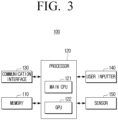
- FIG. 3 is a block diagram illustrating a detailed configuration of an electronic apparatus.
- the electronic apparatus 100 may include a memory 110, a processor 120, a communication interface 130, a user inputter 140, and a sensor 150.
- a configuration of the memory 110 and the processor 120 has been described with reference to FIG. 2 and an overlapped description will be omitted.
- the communication interface 130 may include a circuitry and may transmit information with an external device.
- the communication interface 130 may include a Wi-Fi module, a Bluetooth module, a local area network (LAN) module, a wireless communication module, or the like.
- Each communication module may be implemented as at least one hardware chip.
- the wireless communication module may include at least one communication chip performing communication according to various wireless communication standards such as ZigBee, Ethernet, universal serial bus (USB), mobile industry processor interface camera serial interface (MIPI CSI), 3rd generation (3G), 3rd generation partnership project (3GPP), long term evolution (LTE), LTE advanced (LTE-A), 4th generation (4G), 5th generation (5G), or the like.
- various wireless communication standards such as ZigBee, Ethernet, universal serial bus (USB), mobile industry processor interface camera serial interface (MIPI CSI), 3rd generation (3G), 3rd generation partnership project (3GPP), long term evolution (LTE), LTE advanced (LTE-A), 4th generation (4G), 5th generation (5G), or the like.
- MCP mobile industry processor interface camera serial interface
- 3G 3rd generation partnership project
- LTE long term evolution
- LTE-A LTE advanced
- 4G 4th generation
- 5G 5th generation
- the processor 120 may include a main CPU 121 and a GPU 122.
- the main CPU 121 may access the memory 110 and perform booting using an operating system stored in the memory 110.
- the main CPU 121 may perform various operations using various programs and contents data, or the like, stored in the memory 110.
- the main CPU 121 may copy a program stored in the memory 110 to random access memory (RAM) according to an instruction stored in read-only memory (ROM), access the RAM, and execute a corresponding program.
- RAM random access memory
- ROM read-only memory
- the GPU 122 may correspond to a high performance processing device for graphics processing, and may be a specialized electronic circuit designed to accelerate image generation in a frame buffer to quickly process and change a memory and output the processed result to a screen.
- the GPU 122 may mean a visual processing unit (VPU).
- the user inputter 140 is configured to receive various user commands and information.
- the processor 120 may execute a function corresponding to a user command input through the user inputter 140, or store information input through the user inputter 140 in the memory 110.
- the sensor 150 may generate real number data.
- the sensor 150 may be a camera capturing a face, or a microphone (not shown) for reading a user's voice.
- the processor 120 may perform an operation such as extraction/editing of the data generated by the sensor 150 to generate real number data. For example, the processor 120 may extract a user's face from the image captured by the sensor 150, and extract only real number data required for face recognition from the extracted face.
- the electronic apparatus 100 may include other configurations in addition to the aforementioned configurations, and some of the aforementioned configurations may be omitted.
- the processor 120 includes only the main CPU 121 and the GPU 122 in the illustrated example, but in implementation, the processor 120 may further include an arithmetic circuit that performs the above-described key generation operation or vector generation operation.
- FIG. 4 is a block diagram illustrating a configuration of a server device according to an embodiment of the disclosure.
- the server device 200 may include a communication interface 210, a processor 220, and a memory 230.
- the communication interface 210 is a configuration capable of transmitting and receiving information to and from the server device 200.
- the communication interface 210 may receive biometric information or a codeword from the electronic apparatus 100. Thereafter, the communication interface 210 may transmit the authentication result to the electronic apparatus 100.
- the memory 230 may store at least one instruction related to the server device 200.
- various programs (or software) for operating the server device 200 may be stored in the memory 230 according to various embodiments.
- the memory 230 may store a helper matrix.
- the stored helper matrix may be generated by the server device 200 or received from the electronic apparatus 100 through the communication interface 210.
- the memory 230 may store the vector generated using the helper matrix.
- the memory 230 may store real number data necessary to generate a helper matrix.
- the processor 220 may control each configuration in the server device 200.
- the processor 220 may calculate a vector using a pre-stored helper matrix.
- a vector calculated from the electronic apparatus 100 may be received.
- the processor 220 may perform user authentication using the pre-stored codeword and the calculated vector. For example, the processor 220 may determine whether the pre-stored codeword and the calculated vector are the same or whether the dot product of the codeword and the calculated vector is less than a preset value.
- the processor 220 may control the communication interface 210 to transmit the user authentication result.
- server device 200 according to the embodiment does not need to convert real number data to binary data when performing error correction on real number data, more accurate error correction or user authentication is possible. Since the server device 200 according to the disclosure does not need to convert real number data into binary data, error correction or user authentication processing may be performed more quickly.
- the server device 200 may further include additional configurations for performing a function unique to the server device 200 in addition to the above-described configuration.
- FIG. 5 is a conceptual diagram for describing a fuzzy extractor according to an embodiment of the disclosure.
- the fuzzy extraction method is a method of extracting an encryption key from biometric information itself.
- This fuzzy extraction method generates a helper matrix P from the biometric information x, and the generated helper matrix enables codewords to be restored when biometric information similar to pre-registered biometric information is proposed in the future.
- a codeword sk may be generated using the second real number data 20 and the helper matrix P.
- error correction may be performed using a technology such as a Hamming distance metric.
- the existing Hamming distance metric may be applied only to binary data, the Hamming distance metric technology cannot be directly applied to real number type biometric data such as face/voice.
- the disclosure newly proposes an error correction technology applicable to real number data, and below, the new error correction technology will be described in detail.
- the error correction for the real number data may operate in an nth sphere satisfying Equation 1 below.
- the nth sphere is defined as Sn, but in implementation, the nth sphere may be defined as Sn-1.
- the distance between the two vectors in the sphere may be calculated using a cosine function, and an operation may be performed on the two vectors using the sphere coordinates.
- the decoding may be performed by finding the nearest vector using the orthogonal coordinates.
- the codeword may be defined as Equation 2.
- C i 1 l
- C is a codeword
- C1 may be ⁇ ( ⁇ 1,0,0,0),(0, ⁇ 1,0,0),(0,0, ⁇ 1,0),(0,0,0, ⁇ 1) ⁇ .
- C2 may be 1 2 1 2 0,0 , 1 2 0 1 2 0 , ... , 0,0 , ⁇ 1 2 , ⁇ 1 2 .
- the codeword has C16 in S512.
- the number of elements of the codeword and the number of elements having a preset value may be used differently.
- the minimum distance of two vectors is 1 ⁇ 1 2 i ⁇ 1
- the minimum distance of two vectors in Ci and Cj is 1 2 j ⁇ i i ⁇ j .
- decoding may be performed through a process of finding the closest codeword for each element of Ci.
- FIG. 6 is a diagram illustrating a fuzzy extraction operation according to an embodiment of the disclosure.
- a codeword c that may satisfy an ECC condition may be generated first. Specifically, some elements (e.g., 16) among the plurality of elements (e.g., 512) may have a preset value (e.g., ⁇ 1/4), and the remaining elements may have a value of 0, and one of the sets having a preset vector size may be selected.
- the generated codeword may be output by applying a hash function.
- the helper matrix p for moving the input real number data 10 to the corresponding codeword C may be calculated.
- the value (C') for the second real number data equals that the difference value between the first real number data (W) (10) and the second real number data (W') (20) is added to the codeword (C).
- the value moved by the helper matrix is not the biometric information itself, so the value may be used as a public key.
- the vector is calculated by moving real number data only once, but in implementation, the vector may be calculated by moving the real number data for a plurality of times.
- the vector may be calculated by moving the real number data for a plurality of times.
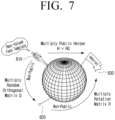
- FIG. 7 is a diagram illustrating a fuzzy extraction operation according to another embodiment of the disclosure.
- a random codeword may be selected from a set satisfying Equation 1 described above.
- a random orthogonal matrix satisfying Q ⁇ R n x n may be selected.
- the random orthogonal matrix is a matrix for moving real number data in a random direction.
- the rotation matrix for rotating and moving the real number data may be calculated.
- unit orthogonalization e.g., Gram-Schmidt process
- the rotation angle ⁇ between the codeword c and the first intermediate data u may be calculated.
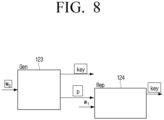
- FIG. 8 is a diagram illustrating an operation of a generation module and a decoding module according to an embodiment of the disclosure.
- a key generation module 123 and a reproduction module 124 are disclosed.
- the key generation module 123 and the reproduction module 124 may be a hardware configuration (e.g., an operation block in an ASIC) in the processor 120 or a software module.
- the key generation module 123 may generate a codeword (key) or a helper matrix (p). Specifically, the key generation module 123 may select one of vectors composed of a plurality of elements and having a preset size as the codeword. For example, if only 16 of the 512 elements of the codeword have a preset value and the remaining values have a value of 0, the codeword may be generated by randomly selecting 16 out of 512 elements that will have a preset value.
- the key generation module 123 may generate the helper matrix P by reflecting the real number data Wo to the generated codeword.
- a helper matrix may be of a form in which real number data is moved only once on a sphere surface, or may be configured in a form in which real number data is moved a plurality of times. For example, if it is a form that moves only once, it can be calculated by matrix multiplying real number data by a generated codeword.
- the helper matrix may be generated by selecting a random orthogonal matrix for moving real number data in a random direction, calculating a rotation matrix for rotating real number data, and using real number data, the selected random orthogonal matrix, and the calculated rotation matrix.
- Such a key generation module 123 may be implemented as an instruction for performing the above-described operation.
- the helper matrix P may be generated using the aforementioned GPU 122.
- the key generation module 123 may be implemented as hardware (e.g., ASIC, etc.) capable of performing the above-described operation.
- the reproduction module 124 may generate a vector when real number data W1 is input. Specifically, the reproduction module 124 may calculate a vector by matrix- multiplying the pre-generated helper matrix by the real number data w1. The reproduction module 124 may enable each element in the calculated vector to have a predetermined value or a value of 0, so that when real number data W1 similar to real number data wo used in generating the helper matrix is input, the same key (or vector) may be generated.
- the reproduction module 124 may decode a unique codeword in which the angle difference between the codeword and the input real number data is within the range of Equation 3 below. cos ⁇ 1 max 1 ⁇ 1 2 m ⁇ 1 ⁇ 1 2 / 2
- the reproduction module 124 may be implemented as a set of instructions (i.e., a program) for performing the above-described operations.
- the vector may be generated using the aforementioned GPU 122.
- the reproduction module 124 may be implemented as hardware (e.g., ASIC, etc.) capable of performing the above-described operation.
- the fuzzy extraction according to the disclosure there is no need to convert the real number data into binary data, and thus accuracy does not fall. Since the fuzzy extraction according to the disclosure does not require a separate conversion process, faster error correction or user authentication processing is possible.
- the error correction technology for real number data according to the disclosure is applied only to the fuzzy extraction operation, but the above real number data is not limited to biometric information and may be various information (e.g., position information according to an antenna signal) and may be applied to various fields.
- one device is illustrated as including both the key generation module 123 and the reproduction module 124, but in implementation, the electronic apparatus 100 may include only the key generation module 123 or the reproduction module 124.
- FIG. 9 is a flowchart illustrating a data processing method according to an embodiment of the disclosure.
- one of a vector among vectors, composed of multiple elements and have a predetermined size is selected as a codeword in operation S910.
- the vector having a predetermined size in which a predetermined number of elements among the plurality of elements may have a same value other than zero.
- the vector may consist of 512 elements, and 16 out of 512 elements may have a value of ⁇ 1/4.
- the helper matrix is generated by using the selected codeword and the real number data in operation S920.
- the helper matrix is a vector that relatively moves the value of the sphere surface on the surface of the sphere, and may be one movement on the surface of the sphere, or may be a plurality of movements.
- the helper matrix may be calculated using a random orthogonal matrix and a rotation matrix.
- the helper matrix is output in operation S930.
- the helper matrix may be utilized as a public key.
- the data processing method generates a helper matrix for moving real number data on a spherical surface, so that real number data may be directly used without conversion into binary data.
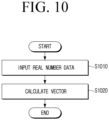
- FIG. 10 is a flowchart illustrating a data processing method according to another embodiment of the disclosure.
- a vector composed of a plurality of elements is calculated by reflecting the input real number data to a helper matrix that relatively moves a value of a sphere surface on the sphere surface in operation S1020.
- equality of the calculated vector and the codeword corresponding to the helper matrix may be determined.
- a dot product sum of the calculated vector and the codeword corresponding to the helper matrix may be calculated, and equality based on whether the size of the calculated dot product sum is smaller than a predetermined size may be determined.
- error correction for the calculated vector may be performed.
- An element value of each of a plurality of elements constituting the vector may be approximated to a predetermined value or a zero value.
- the data processing method may perform error correction without separately converting real data into binary data or check whether the real data is identical to existing data, and thus more precise error correction or authentication for real data may be performed.
- various embodiments of the disclosure described above may be performed through an embedded server provided in the electronic apparatus or at least one external server of the electronic apparatus.
- the various embodiments described above may be implemented as software including instructions stored in a machine-readable storage media which is readable by a machine (e.g., a computer).
- the device may include the electronic apparatus according to the disclosed embodiments, as a device which calls the stored instructions from the storage media and which is operable according to the called instructions.
- the processor may directory perform functions corresponding to the instructions using other components or the functions may be performed under a control of the processor.
- the instructions may include code generated or executed by a compiler or an interpreter.
- the machine-readable storage media may be provided in a form of a non-transitory storage media. The 'non-transitory' means that the storage media does not include a signal and is tangible, but does not distinguish whether data is stored semi-permanently or temporarily in the storage media.
- the method according to the various embodiments described herein may be provided while being included in a computer program product.
- the computer program product can be traded between a seller and a purchaser as a commodity.
- the computer program product may be distributed in the form of a machine-readable storage medium (e.g.: a compact disc read only memory (CD-ROM)), or distributed online through an application store (e.g.: PLAYSTORE TM ).
- an application store e.g.: PLAYSTORE TM
- at least a portion of the computer program product may be at least temporarily stored in a storage medium such as a server of a manufacturer, a server of an application store, or a memory of a relay server, or temporarily generated.
- embodiments described above may be implemented in a recordable medium which is readable by a computer or a device similar to the computer using software, hardware, or the combination of software and hardware.
- embodiments described herein may be implemented by the processor itself.
- embodiments such as the procedures and functions described herein may be implemented with separate software modules. Each of the software modules may perform one or more of the functions and operations described herein.
- computer instructions for performing processing operations of a device according to the various embodiments described above may be stored in a non-transitory computer-readable medium.
- the computer instructions stored in the non-transitory computer-readable medium may cause a particular device to perform processing operations on the device according to the various embodiments described above when executed by the processor of the particular device.
- the non-transitory computer-readable medium is not a medium storing data for a short period of time such as a register, a cache, or a memory, but may refer to a medium that semi-permanently stores data and is readable by a machine.
- Specific examples of the non-transitory computer-readable medium may include a CD, a DVD, a hard disk drive, a Blu-ray disc, a USB, a memory card, and a ROM.
- Each of the elements may be comprised of a single entity or a plurality of entities, and some sub-elements of the abovementioned sub-elements may be omitted, or different sub-elements may be further included in the various embodiments.
- some elements e.g., modules or programs
- Operations performed by a module, a program, or another element, in accordance with various embodiments, may be performed sequentially, in a parallel, repetitively, or in a heuristically manner, or at least some operations may be performed in a different order, omitted or a different operation may be added.
Landscapes
- Engineering & Computer Science (AREA)
- Physics & Mathematics (AREA)
- General Physics & Mathematics (AREA)
- Theoretical Computer Science (AREA)
- Mathematical Physics (AREA)
- Mathematical Optimization (AREA)
- Pure & Applied Mathematics (AREA)
- Computational Mathematics (AREA)
- Mathematical Analysis (AREA)
- Data Mining & Analysis (AREA)
- General Engineering & Computer Science (AREA)
- Computing Systems (AREA)
- Software Systems (AREA)
- Algebra (AREA)
- Databases & Information Systems (AREA)
- Computer Security & Cryptography (AREA)
- Computer Hardware Design (AREA)
- Collating Specific Patterns (AREA)
- User Interface Of Digital Computer (AREA)
Claims (14)
- Procédé de traitement de données, comprenant :sélectionner (S910), en tant que mot codé, un vecteur parmi des vecteurs composés d'éléments multiples et ayant une taille prédéterminée ;générer (S920) une matrice d'aide pour déplacer des données de nombre réel vers le mot codé sélectionné sur une surface sphérique, les données de nombre réel étant au moins l'une de données d'information biométrique, de données d'information vocale ou de données d'information de lieu, etsortir (S930) la matrice d'aide.
- Procédé de la revendication 1, dans lequel un nombre prédéterminé d'éléments des éléments multiples du vecteur dans une taille prédéterminée a une même valeur différente de zéro,dans lequel le vecteur consiste en 512 éléments, etdans lequel 16 éléments des 512 éléments ont une valeur de ±1/4.
- Procédé de la revendication 1, dans lequel la matrice d'aide est un vecteur déplaçant relativement une valeur d'une surface sphérique sur la surface de la sphère.
- Procédé de la revendication 1, dans lequel la génération de la matrice d'aide comprend :sélectionner une matrice orthogonale aléatoire pour déplacer les données de nombre réel dans une direction aléatoire ;calculer une matrice de rotation pour déplacer par rotation les données de nombre réel ; etcalculer la matrice d'aide en utilisant les données de nombre réel, la matrice orthogonale aléatoire sélectionnée et la matrice de rotation calculée.
- Procédé de la revendication 4, dans lequel le calcul de la matrice de rotation comprend :calculer des premières données intermédiaires par multiplication matricielle de la matrice orthogonale aléatoire sélectionnée par les données de nombre réel ;générer des deuxièmes données intermédiaires en effectuant un traitement d'orthogonalisation unitaire sur le mot codé et les premières données intermédiaires ;calculer un angle de rotation entre le mot codé et les premières données intermédiaires ; etgénérer une matrice de rotation en utilisant l'angle de rotation calculé, des premières données intermédiaires et des deuxièmes données intermédiaires.
- Procédé de la revendication 1, dans lequel les informations biométriques comprennent des données d'information de visage.
- Procédé de traitement de données, comprenant :recevoir (S 1010) des données de nombre réel ;calculer (S1020) un vecteur composé d'une pluralité d'éléments par multiplication matricielle d'une matrice d'aide qui déplace relativement une valeur d'une surface sphérique sur la surface sphérique par les données de nombre réel d'entrée, les données de nombre réel étant au moins une de données d'information biométrique, de données d'information vocale ou de données d'information de lieu ; etdéterminer l'égalité entre le vecteur calculé et un mot codé correspondant à la matrice d'aide.
- Procédé de la revendication 7, dans lequel la détermination de l'égalité comprend le calcul d'une somme de produits de points du vecteur calculé et du mot codé correspondant à la matrice d'aide, et la détermination de l'égalité en se basant sur le fait que la taille de la somme de produits de points calculée est plus petite qu'une taille prédéterminée.
- Procédé de la revendication 7, comprenant en outre :
effectuer une correction d'erreur sur le vecteur calculé. - Procédé de la revendication 9, dans lequel la correction d'erreur comprend l'approximation d'une valeur d'élément de chacun d'une pluralité d'éléments constituant le vecteur à une valeur prédéterminée ou à une valeur zéro.
- Dispositif électronique (100) comprenant :une mémoire (110) stockant au moins une instruction ; etun processeur (120) pour exécuter l'au moins une instruction,dans lequel le processeur (120), en exécutant l'au moins une instruction, sélectionne l'un des vecteurs composés d'une pluralité d'éléments et ayant une taille prédéterminée en tant que mot codé, etgénère une matrice d'aide pour déplacer des données de nombre réel vers le mot codé sélectionné sur une surface sphérique ; les données de nombre réel étant au moins l'une de données d'information biométrique, de données d'information vocale ou de données d'information de lieu.
- Dispositif électronique (100) de la revendication 11, dans lequel le processeur (120) est en outre configuré pour :sélectionner une matrice orthogonale aléatoire pour déplacer les données des nombre réel dans une direction aléatoire,calculer une matrice de rotation pour déplacer par rotation les données de nombre réel, etgénérer la matrice d'aide en utilisant les données de nombre réel, la matrice orthogonale aléatoire sélectionnée et la matrice de rotation calculée.
- Dispositif électronique (100) de la revendication 12, dans lequel le processeur (120) est en outre configuré pour :calculer des premières données intermédiaires par multiplication matricielle de la matrice orthogonale aléatoire sélectionnée par les données de nombre réel,générer des deuxièmes données intermédiaires en effectuant un traitement d'orthogonalisation unitaire sur le mot codé et les premières données intermédiaires,calculer un angle de rotation entre le mot codé et les premières données intermédiaires, etcalculer la matrice de rotation en utilisant l'angle de rotation calculé, des premières données intermédiaires et des deuxièmes données intermédiaires.
- Dispositif électronique (100) de la revendication 11, dans lequel le processeur (120) est en outre configuré pour, en se basant sur l'entrée de nouvelles données de nombre réel, calculer un vecteur composé d'une pluralité d'éléments en reflétant les nouvelles données de nombre réel vers la matrice d'aide.
Applications Claiming Priority (2)
| Application Number | Priority Date | Filing Date | Title |
|---|---|---|---|
| KR1020200013557A KR20210099777A (ko) | 2020-02-05 | 2020-02-05 | 전자 장치 및 데이터 처리 방법 |
| PCT/KR2021/000195 WO2021157880A1 (fr) | 2020-02-05 | 2021-01-07 | Dispositif électronique et procédé de traitement de données |
Publications (4)
| Publication Number | Publication Date |
|---|---|
| EP4089552A1 EP4089552A1 (fr) | 2022-11-16 |
| EP4089552A4 EP4089552A4 (fr) | 2023-01-18 |
| EP4089552C0 EP4089552C0 (fr) | 2025-03-05 |
| EP4089552B1 true EP4089552B1 (fr) | 2025-03-05 |
Family
ID=77200131
Family Applications (1)
| Application Number | Title | Priority Date | Filing Date |
|---|---|---|---|
| EP21750900.9A Active EP4089552B1 (fr) | 2020-02-05 | 2021-01-07 | Appareil électronique et méthode de traitement des données associé |
Country Status (4)
| Country | Link |
|---|---|
| US (1) | US20220382832A1 (fr) |
| EP (1) | EP4089552B1 (fr) |
| KR (1) | KR20210099777A (fr) |
| WO (1) | WO2021157880A1 (fr) |
Families Citing this family (4)
| Publication number | Priority date | Publication date | Assignee | Title |
|---|---|---|---|---|
| KR20240121527A (ko) * | 2023-02-02 | 2024-08-09 | 삼성전자주식회사 | 보안 데이터를 테스트하는 전자 장치 및 그 동작 방법 |
| KR20240132642A (ko) * | 2023-02-27 | 2024-09-04 | 삼성전자주식회사 | 생체 정보를 암호화하는 전자 장치 및 그 동작 방법 |
| CN120693616A (zh) | 2023-02-27 | 2025-09-23 | 三星电子株式会社 | 用于加密生物特征信息的电子装置及其操作方法 |
| KR102941634B1 (ko) | 2023-12-11 | 2026-03-19 | 한양대학교 산학협력단 | 초 구 위에 정의되는 실수기반 오류정정부호 프로토콜 시스템 |
Family Cites Families (6)
| Publication number | Priority date | Publication date | Assignee | Title |
|---|---|---|---|---|
| EP1759484A1 (fr) * | 2004-06-09 | 2007-03-07 | Koninklijke Philips Electronics N.V. | Protection de modeles biometriques et gestion de caracteristiques |
| KR100826873B1 (ko) * | 2006-09-07 | 2008-05-06 | 한국전자통신연구원 | 생체 인식 방법 및 이를 위한 장치 |
| KR101275590B1 (ko) * | 2012-03-28 | 2013-06-17 | 충북대학교 산학협력단 | 생체 정보 템플릿 보호를 위한 실수형 오류정정부호 기반 퍼지 볼트 방법 |
| KR102583536B1 (ko) * | 2015-11-13 | 2023-09-27 | 뱃지 인크. | 공개/비공개 키 바이오메트릭 인증 시스템 |
| EP3340216B1 (fr) * | 2016-12-23 | 2020-01-29 | Secure-IC SAS | Génération de clé secrète à l'aide d'une fonction physiquement inclonable de haute fiabilité |
| KR102289419B1 (ko) * | 2017-06-26 | 2021-08-12 | 한국전자통신연구원 | 바이오메트릭을 이용한 사용자의 인증 방법 및 장치 |
-
2020
- 2020-02-05 KR KR1020200013557A patent/KR20210099777A/ko active Pending
-
2021
- 2021-01-07 EP EP21750900.9A patent/EP4089552B1/fr active Active
- 2021-01-07 WO PCT/KR2021/000195 patent/WO2021157880A1/fr not_active Ceased
-
2022
- 2022-08-05 US US17/882,331 patent/US20220382832A1/en active Pending
Also Published As
| Publication number | Publication date |
|---|---|
| US20220382832A1 (en) | 2022-12-01 |
| EP4089552A1 (fr) | 2022-11-16 |
| EP4089552C0 (fr) | 2025-03-05 |
| KR20210099777A (ko) | 2021-08-13 |
| EP4089552A4 (fr) | 2023-01-18 |
| WO2021157880A1 (fr) | 2021-08-12 |
Similar Documents
| Publication | Publication Date | Title |
|---|---|---|
| EP4089552A1 (fr) | Dispositif électronique et procédé de traitement de données | |
| US11444774B2 (en) | Method and system for biometric verification | |
| CN108010031B (zh) | 一种人像分割方法及移动终端 | |
| US9646216B2 (en) | Multiple user biometric for authentication to secured resources | |
| CN111538968A (zh) | 基于隐私保护的身份核验方法、装置及设备 | |
| EP3043290A1 (fr) | Authentification biométrique basee sur des ensembles préservant la confidentialité | |
| US10997717B2 (en) | Method and system for generating a confidence score using deep learning model | |
| US20200159905A1 (en) | Key generating method and apparatus using characteristic of memory | |
| KR102524163B1 (ko) | 신분증 인식 방법 및 장치 | |
| JP2015226323A (ja) | 誤り訂正符号に基づいたプライバシーを保護する生体認証 | |
| US11847210B2 (en) | Detecting device and detecting method | |
| CN108351963B (zh) | 用于面部分析的方法和装置 | |
| JP7434291B2 (ja) | 非特定化されたデータに基づいてアイデンティティ認証を実行するためのシステムおよび方法 | |
| CN107895105B (zh) | 一种密码处理方法、终端设备及计算机可读存储介质 | |
| CN113343295B (zh) | 基于隐私保护的图像处理方法、装置、设备和存储介质 | |
| US9483710B1 (en) | Image processing apparatus and method | |
| KR102073644B1 (ko) | 이미지에 포함된 텍스트 인식장치, 텍스트 인식방법 및 텍스트 인식방법을 실행하기 위한 프로그램을 기록한 기록매체 | |
| US11582041B2 (en) | Electronic device and control method thereof | |
| KR102500252B1 (ko) | 얼굴 개인정보 보호 기술을 이용한 기계학습 데이터베이스 구축 시스템 | |
| CN115765976A (zh) | 验证码加密方法、电子设备及存储介质 | |
| US12425221B2 (en) | Authentication method and authentication system using biometric information and functional encryption | |
| US10475195B2 (en) | Automatic global non-rigid scan point registration | |
| KR102247056B1 (ko) | 인증 과정 분류 방법 및 그 장치 | |
| US20250356027A1 (en) | Electronic device for testing secure data, and operating method therefor | |
| JP7502390B2 (ja) | 認証システム及び認証方法 |
Legal Events
| Date | Code | Title | Description |
|---|---|---|---|
| STAA | Information on the status of an ep patent application or granted ep patent |
Free format text: STATUS: THE INTERNATIONAL PUBLICATION HAS BEEN MADE |
|
| PUAI | Public reference made under article 153(3) epc to a published international application that has entered the european phase |
Free format text: ORIGINAL CODE: 0009012 |
|
| STAA | Information on the status of an ep patent application or granted ep patent |
Free format text: STATUS: REQUEST FOR EXAMINATION WAS MADE |
|
| 17P | Request for examination filed |
Effective date: 20220808 |
|
| AK | Designated contracting states |
Kind code of ref document: A1 Designated state(s): AL AT BE BG CH CY CZ DE DK EE ES FI FR GB GR HR HU IE IS IT LI LT LU LV MC MK MT NL NO PL PT RO RS SE SI SK SM TR |
|
| A4 | Supplementary search report drawn up and despatched |
Effective date: 20221220 |
|
| RIC1 | Information provided on ipc code assigned before grant |
Ipc: G06F 21/31 20130101ALI20221214BHEP Ipc: G06F 17/16 20060101AFI20221214BHEP |
|
| DAV | Request for validation of the european patent (deleted) | ||
| DAX | Request for extension of the european patent (deleted) | ||
| GRAP | Despatch of communication of intention to grant a patent |
Free format text: ORIGINAL CODE: EPIDOSNIGR1 |
|
| STAA | Information on the status of an ep patent application or granted ep patent |
Free format text: STATUS: GRANT OF PATENT IS INTENDED |
|
| INTG | Intention to grant announced |
Effective date: 20240923 |
|
| RIN1 | Information on inventor provided before grant (corrected) |
Inventor name: LEE, HYUNG TAE Inventor name: SEO, JAE HONG Inventor name: KIM, JINSU |
|
| GRAS | Grant fee paid |
Free format text: ORIGINAL CODE: EPIDOSNIGR3 |
|
| GRAA | (expected) grant |
Free format text: ORIGINAL CODE: 0009210 |
|
| STAA | Information on the status of an ep patent application or granted ep patent |
Free format text: STATUS: THE PATENT HAS BEEN GRANTED |
|
| AK | Designated contracting states |
Kind code of ref document: B1 Designated state(s): AL AT BE BG CH CY CZ DE DK EE ES FI FR GB GR HR HU IE IS IT LI LT LU LV MC MK MT NL NO PL PT RO RS SE SI SK SM TR |
|
| REG | Reference to a national code |
Ref country code: GB Ref legal event code: FG4D |
|
| REG | Reference to a national code |
Ref country code: CH Ref legal event code: EP |
|
| REG | Reference to a national code |
Ref country code: DE Ref legal event code: R096 Ref document number: 602021027192 Country of ref document: DE |
|
| REG | Reference to a national code |
Ref country code: IE Ref legal event code: FG4D |
|
| U01 | Request for unitary effect filed |
Effective date: 20250404 |
|
| U07 | Unitary effect registered |
Designated state(s): AT BE BG DE DK EE FI FR IT LT LU LV MT NL PT RO SE SI Effective date: 20250414 |
|
| PG25 | Lapsed in a contracting state [announced via postgrant information from national office to epo] |
Ref country code: RS Free format text: LAPSE BECAUSE OF FAILURE TO SUBMIT A TRANSLATION OF THE DESCRIPTION OR TO PAY THE FEE WITHIN THE PRESCRIBED TIME-LIMIT Effective date: 20250605 |
|
| PG25 | Lapsed in a contracting state [announced via postgrant information from national office to epo] |
Ref country code: ES Free format text: LAPSE BECAUSE OF FAILURE TO SUBMIT A TRANSLATION OF THE DESCRIPTION OR TO PAY THE FEE WITHIN THE PRESCRIBED TIME-LIMIT Effective date: 20250305 |
|
| PG25 | Lapsed in a contracting state [announced via postgrant information from national office to epo] |
Ref country code: NO Free format text: LAPSE BECAUSE OF FAILURE TO SUBMIT A TRANSLATION OF THE DESCRIPTION OR TO PAY THE FEE WITHIN THE PRESCRIBED TIME-LIMIT Effective date: 20250605 |
|
| PG25 | Lapsed in a contracting state [announced via postgrant information from national office to epo] |
Ref country code: HR Free format text: LAPSE BECAUSE OF FAILURE TO SUBMIT A TRANSLATION OF THE DESCRIPTION OR TO PAY THE FEE WITHIN THE PRESCRIBED TIME-LIMIT Effective date: 20250305 |
|
| PG25 | Lapsed in a contracting state [announced via postgrant information from national office to epo] |
Ref country code: GR Free format text: LAPSE BECAUSE OF FAILURE TO SUBMIT A TRANSLATION OF THE DESCRIPTION OR TO PAY THE FEE WITHIN THE PRESCRIBED TIME-LIMIT Effective date: 20250606 |
|
| PG25 | Lapsed in a contracting state [announced via postgrant information from national office to epo] |
Ref country code: SM Free format text: LAPSE BECAUSE OF FAILURE TO SUBMIT A TRANSLATION OF THE DESCRIPTION OR TO PAY THE FEE WITHIN THE PRESCRIBED TIME-LIMIT Effective date: 20250305 |
|
| PG25 | Lapsed in a contracting state [announced via postgrant information from national office to epo] |
Ref country code: PL Free format text: LAPSE BECAUSE OF FAILURE TO SUBMIT A TRANSLATION OF THE DESCRIPTION OR TO PAY THE FEE WITHIN THE PRESCRIBED TIME-LIMIT Effective date: 20250305 |
|
| PG25 | Lapsed in a contracting state [announced via postgrant information from national office to epo] |
Ref country code: CZ Free format text: LAPSE BECAUSE OF FAILURE TO SUBMIT A TRANSLATION OF THE DESCRIPTION OR TO PAY THE FEE WITHIN THE PRESCRIBED TIME-LIMIT Effective date: 20250305 |
|
| PG25 | Lapsed in a contracting state [announced via postgrant information from national office to epo] |
Ref country code: SK Free format text: LAPSE BECAUSE OF FAILURE TO SUBMIT A TRANSLATION OF THE DESCRIPTION OR TO PAY THE FEE WITHIN THE PRESCRIBED TIME-LIMIT Effective date: 20250305 |
|
| PG25 | Lapsed in a contracting state [announced via postgrant information from national office to epo] |
Ref country code: IS Free format text: LAPSE BECAUSE OF FAILURE TO SUBMIT A TRANSLATION OF THE DESCRIPTION OR TO PAY THE FEE WITHIN THE PRESCRIBED TIME-LIMIT Effective date: 20250705 |
|
| PGFP | Annual fee paid to national office [announced via postgrant information from national office to epo] |
Ref country code: GB Payment date: 20251222 Year of fee payment: 6 |
|
| PLBE | No opposition filed within time limit |
Free format text: ORIGINAL CODE: 0009261 |
|
| STAA | Information on the status of an ep patent application or granted ep patent |
Free format text: STATUS: NO OPPOSITION FILED WITHIN TIME LIMIT |
|
| REG | Reference to a national code |
Ref country code: CH Ref legal event code: L10 Free format text: ST27 STATUS EVENT CODE: U-0-0-L10-L00 (AS PROVIDED BY THE NATIONAL OFFICE) Effective date: 20260114 |
|
| 26N | No opposition filed |
Effective date: 20251208 |
|
| U20 | Renewal fee for the european patent with unitary effect paid |
Year of fee payment: 6 Effective date: 20260122 |